Cambridge IGCSE Food and Nutrition 0648 — 2019 May/June Paper 1 · Variant 1
0648/11/M/J/19 · 100 marks · ≈113 min
The question paper and its mark scheme, free to read here and free to download. This is Cambridge’s own paper, exactly as it was sat.
Question paper12 pages

Mark scheme16 pages
Answers below. Sit the paper first if you are practising.

Paper as text
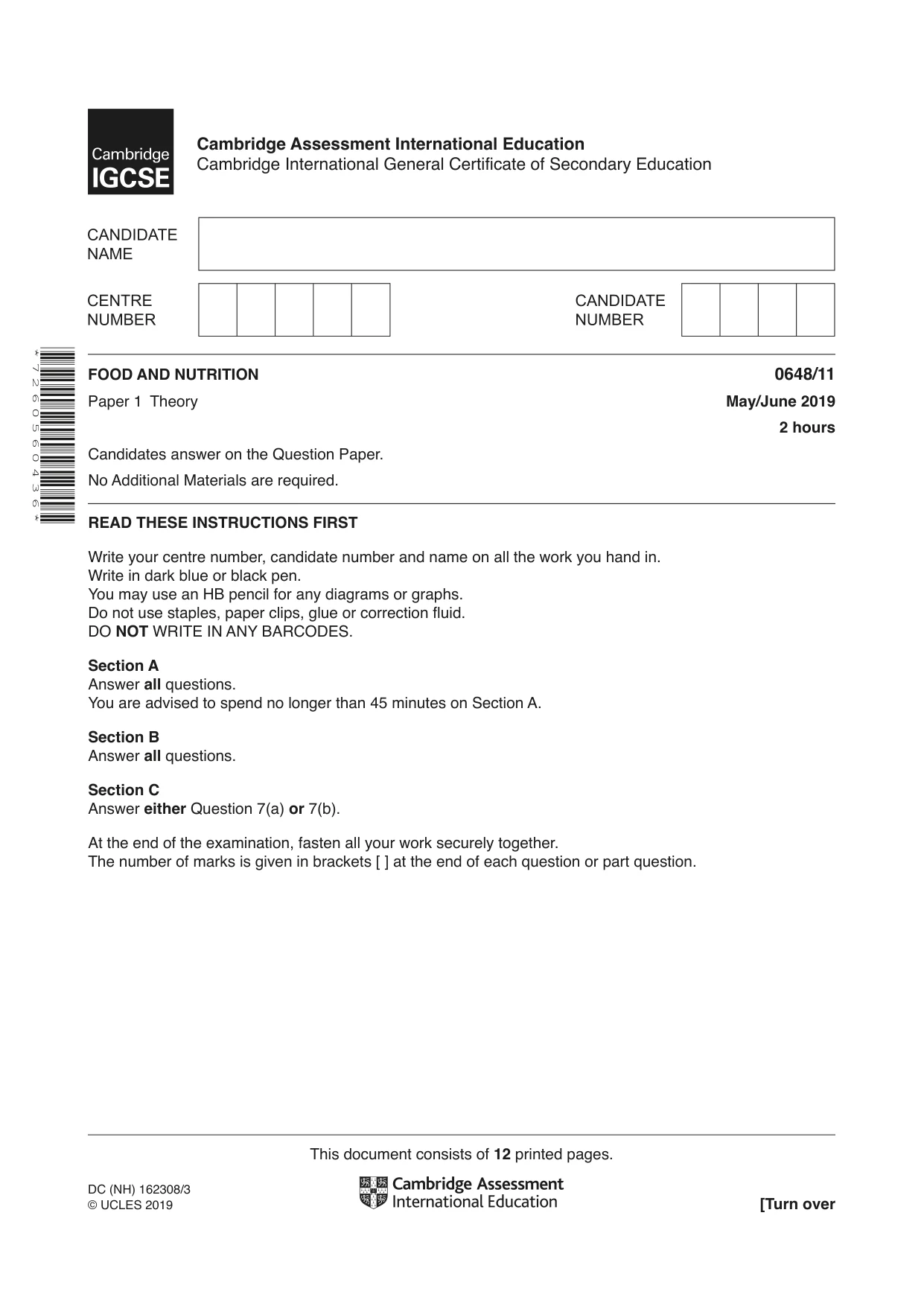
Question paper, page 1
This document consists of 12 printed pages. DC (NH) 162308/3 © UCLES 2019 [Turn over * 7 2 6 0 5 6 0 4 3 6 * FOOD AND NUTRITION 0648/11 Paper 1 Theory May/June 2019 2 hours Candidates answer on the Question Paper. No Additional Materials are required. READ THESE INSTRUCTIONS FIRST Write your centre number, candidate number and name on all the work you hand in. Write in dark blue or black pen. You may use an HB pencil for any diagrams or graphs. Do not use staples, paper clips, glue or correction fluid. DO NOT WRITE IN ANY BARCODES. Section A Answer all questions. You are advised to spend no longer than 45 minutes on Section A. Section B Answer all questions. Section C Answer either Question 7(a) or 7(b). At the end of the examination, fasten all your work securely together. The number of marks is given in brackets [ ] at the end of each question or part question. Cambridge Assessment International Education Cambridge International General Certificate of Secondary Education
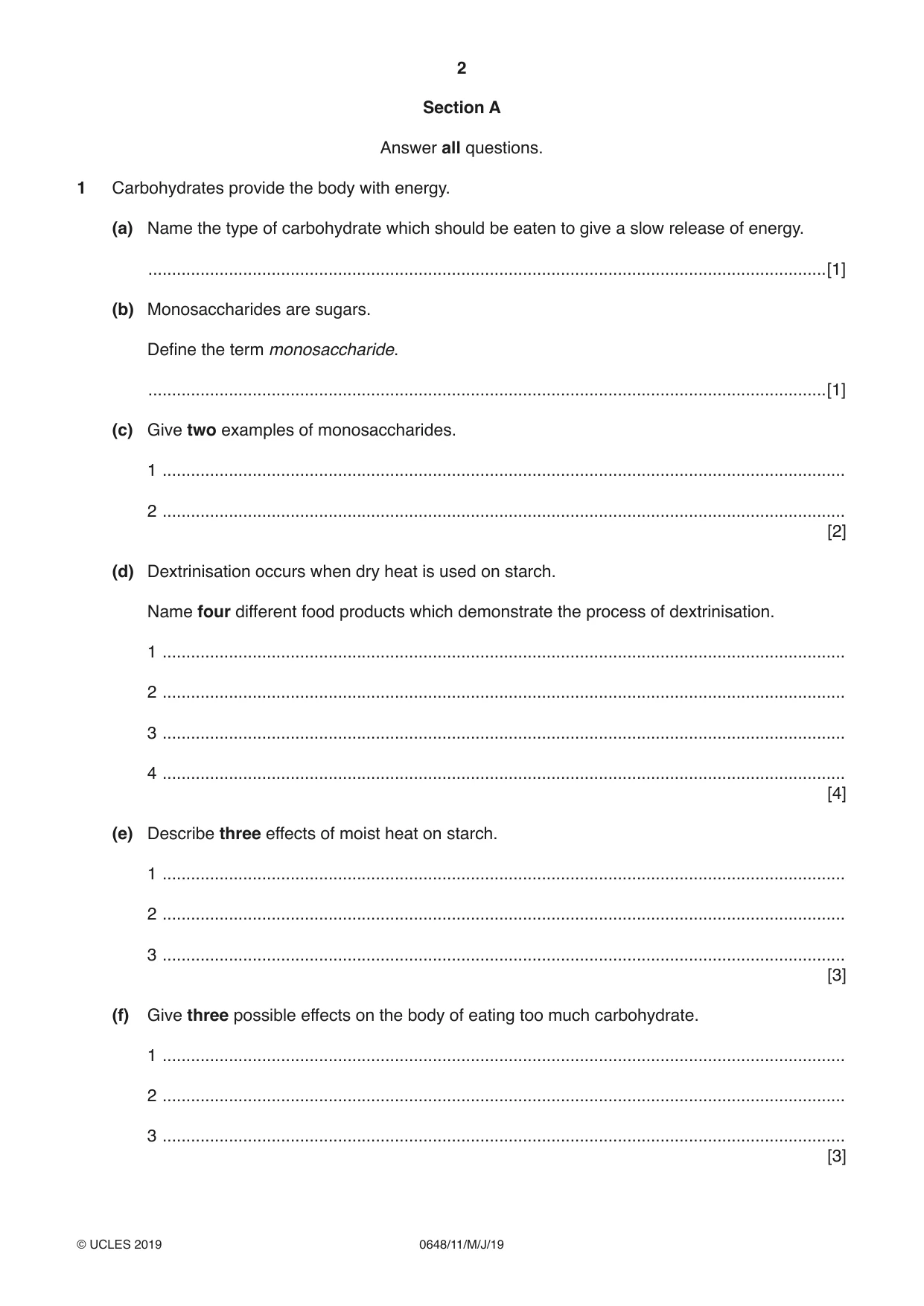
Question paper, page 2
2 0648/11/M/J/19 © UCLES 2019 Section A Answer all questions. 1 Carbohydrates provide the body with energy. (a) Name the type of carbohydrate which should be eaten to give a slow release of energy. …[1] (b) Monosaccharides are sugars. Define the term monosaccharide. …[1] (c) Give two examples of monosaccharides. 1 … 2 … [2] (d) Dextrinisation occurs when dry heat is used on starch. Name four different food products which demonstrate the process of dextrinisation. 1 … 2 … 3 … 4 … [4] (e) Describe three effects of moist heat on starch. 1 … 2 … 3 … [3] (f) Give three possible effects on the body of eating too much carbohydrate. 1 … 2 … 3 … [3]
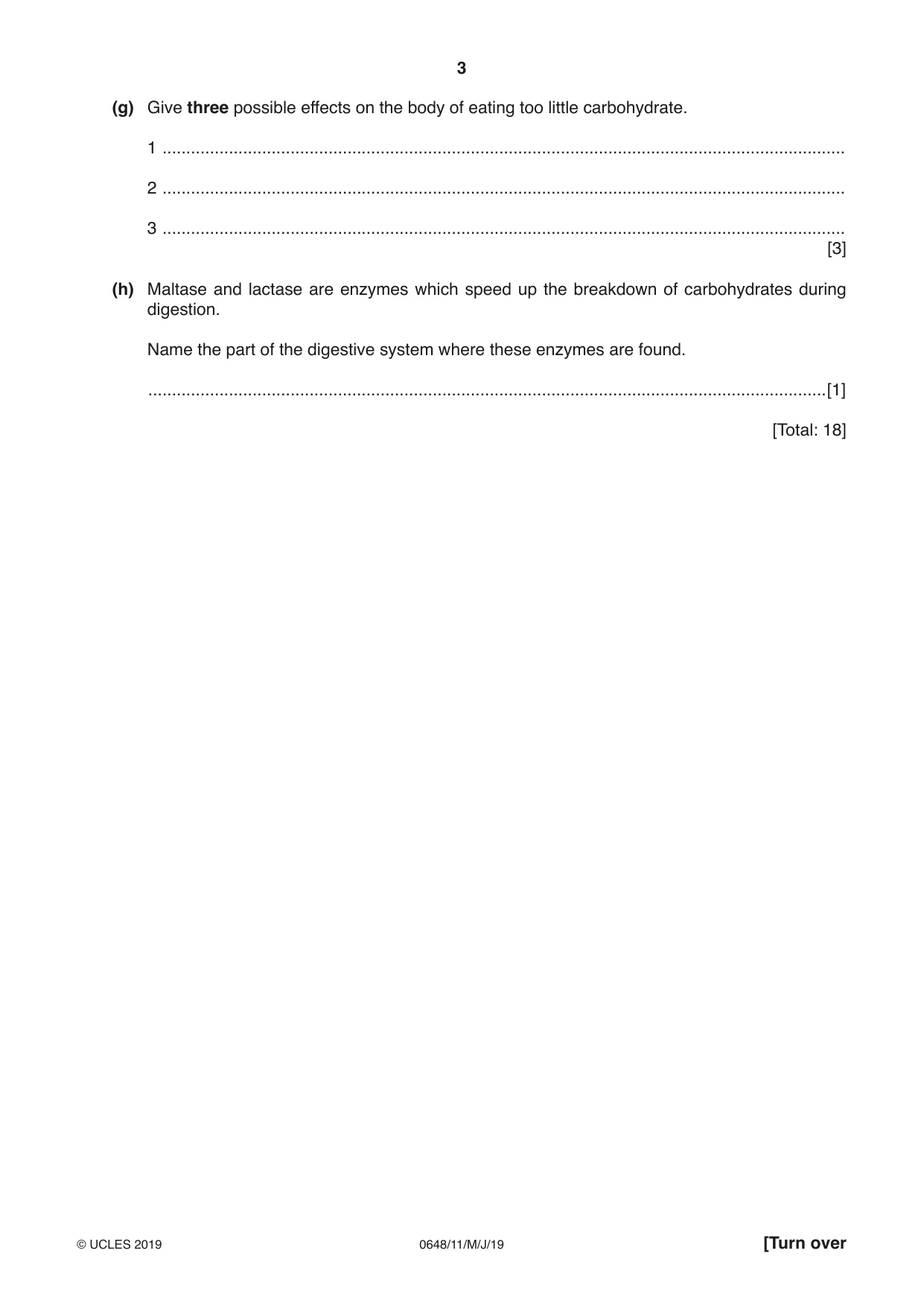
Question paper, page 3
3 0648/11/M/J/19 © UCLES 2019 [Turn over (g) Give three possible effects on the body of eating too little carbohydrate. 1 … 2 … 3 … [3] (h) Maltase and lactase are enzymes which speed up the breakdown of carbohydrates during digestion. Name the part of the digestive system where these enzymes are found. …[1] [Total: 18]
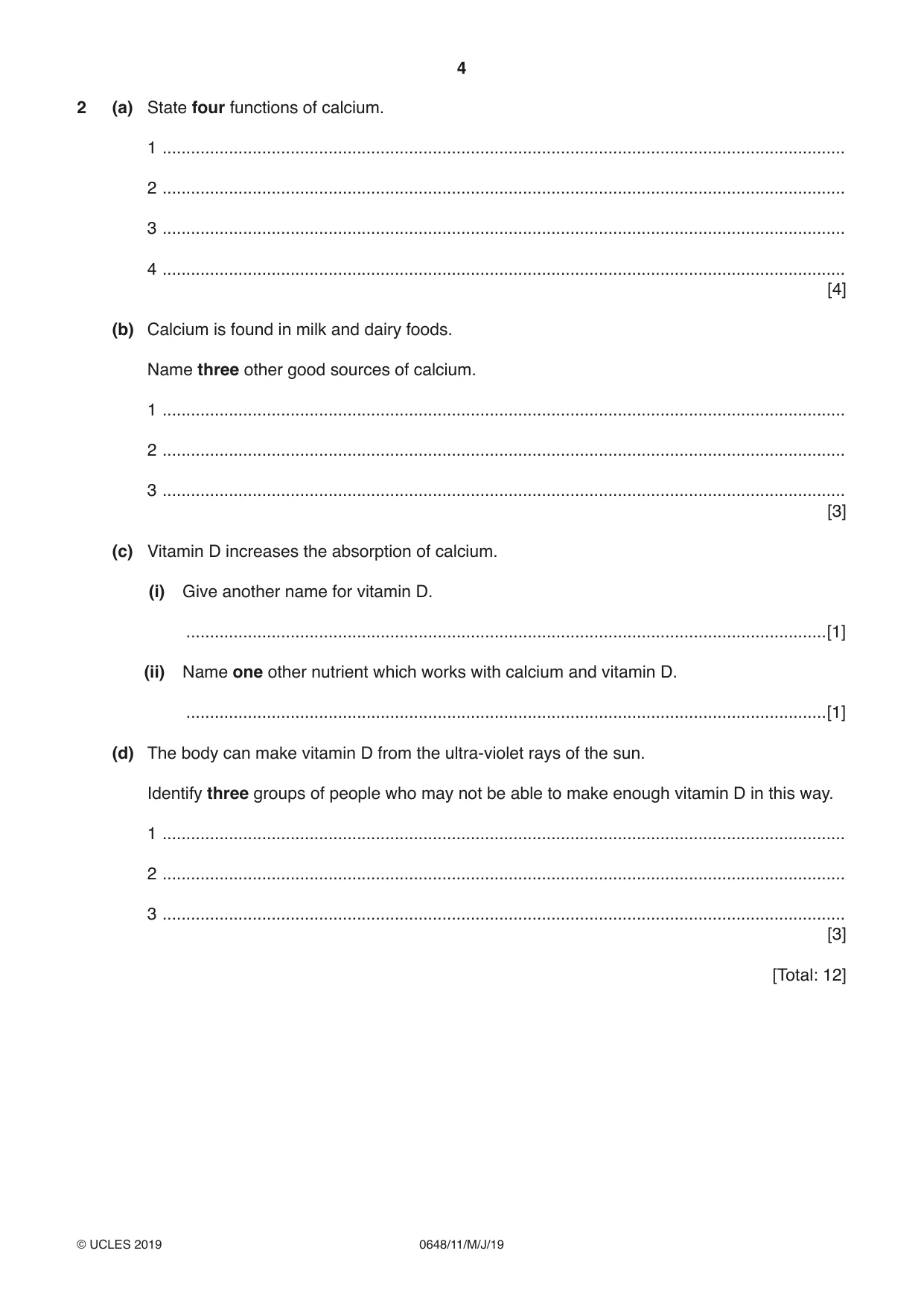
Question paper, page 4
4 0648/11/M/J/19 © UCLES 2019 2 (a) State four functions of calcium. 1 … 2 … 3 … 4 … [4] (b) Calcium is found in milk and dairy foods. Name three other good sources of calcium. 1 … 2 … 3 … [3] (c) Vitamin D increases the absorption of calcium. (i) Give another name for vitamin D. …[1] (ii) Name one other nutrient which works with calcium and vitamin D. …[1] (d) The body can make vitamin D from the ultra-violet rays of the sun. Identify three groups of people who may not be able to make enough vitamin D in this way. 1 … 2 … 3 … [3] [Total: 12]
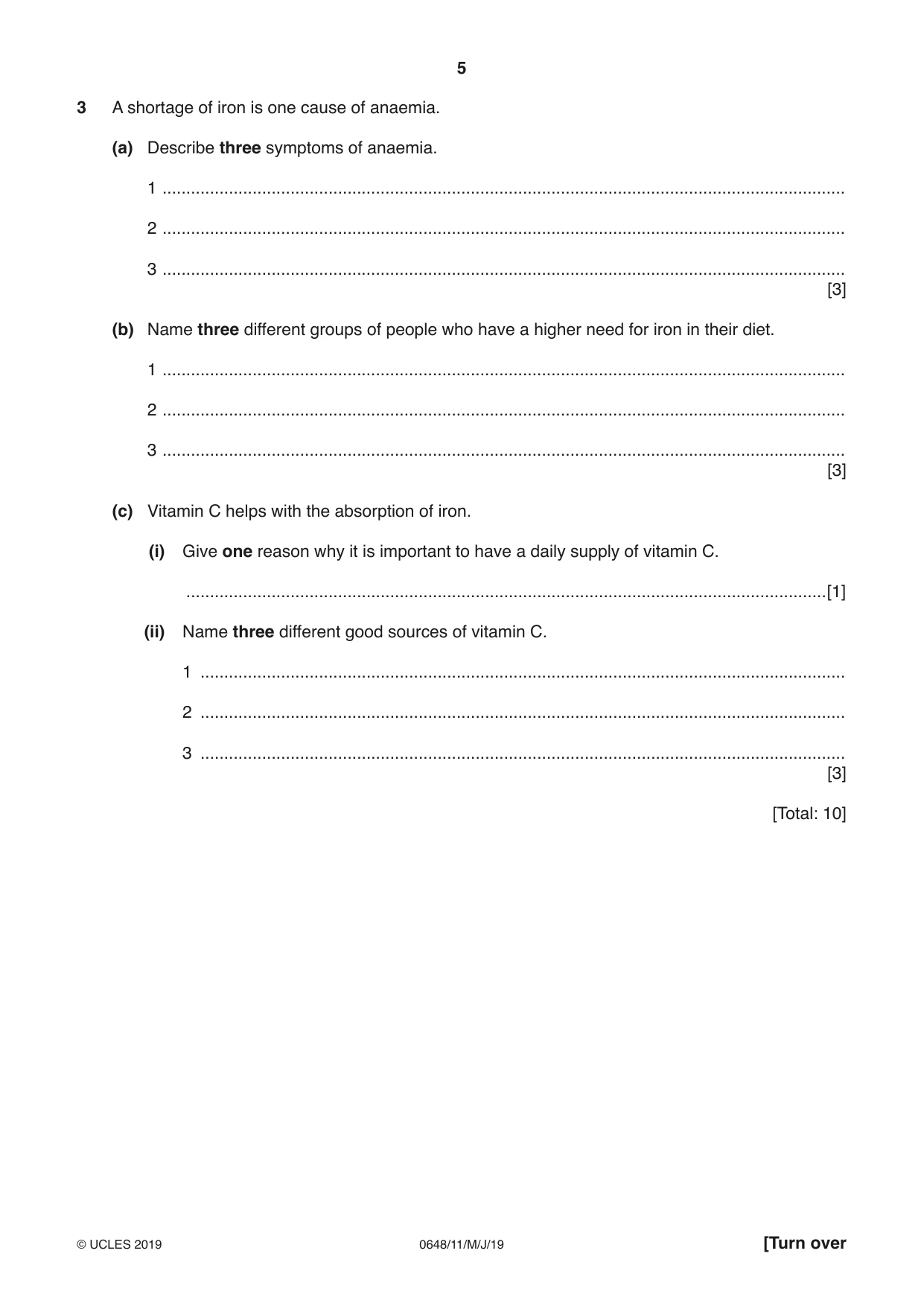
Question paper, page 5
5 0648/11/M/J/19 © UCLES 2019 [Turn over 3 A shortage of iron is one cause of anaemia. (a) Describe three symptoms of anaemia. 1 … 2 … 3 … [3] (b) Name three different groups of people who have a higher need for iron in their diet. 1 … 2 … 3 … [3] (c) Vitamin C helps with the absorption of iron. (i) Give one reason why it is important to have a daily supply of vitamin C. …[1] (ii) Name three different good sources of vitamin C. 1 … 2 … 3 … [3] [Total: 10]
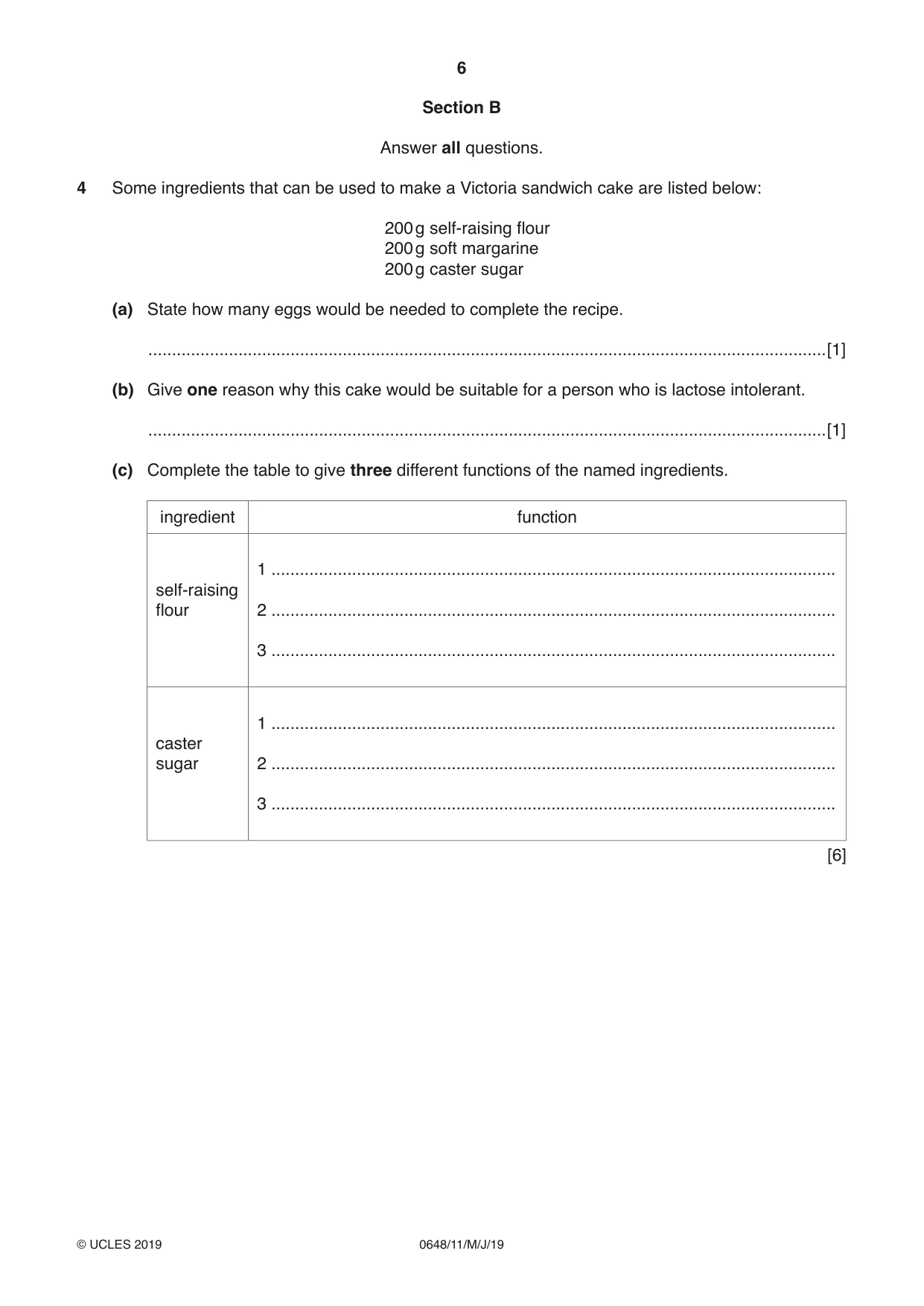
Question paper, page 6
6 0648/11/M/J/19 © UCLES 2019 Section B Answer all questions. 4 Some ingredients that can be used to make a Victoria sandwich cake are listed below: 200 g self-raising flour 200 g soft margarine 200 g caster sugar (a) State how many eggs would be needed to complete the recipe. …[1] (b) Give one reason why this cake would be suitable for a person who is lactose intolerant. …[1] (c) Complete the table to give three different functions of the named ingredients. ingredient function self-raising flour 1 … 2 … 3 … caster sugar 1 … 2 … 3 … [6]
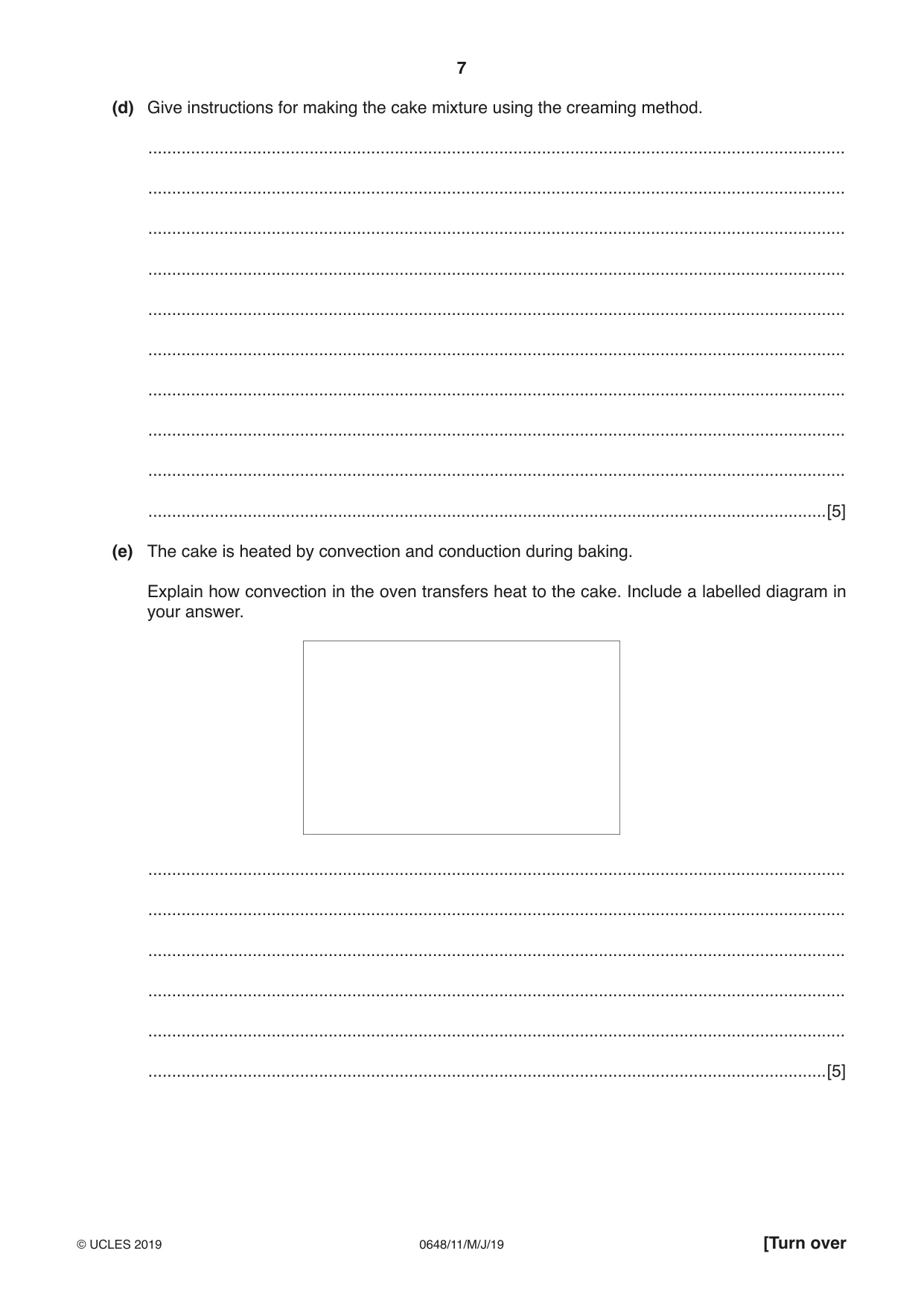
Question paper, page 7
7 0648/11/M/J/19 © UCLES 2019 [Turn over (d) Give instructions for making the cake mixture using the creaming method. … … … … … … … … … …[5] (e) The cake is heated by convection and conduction during baking. Explain how convection in the oven transfers heat to the cake. Include a labelled diagram in your answer. … … … … … …[5]
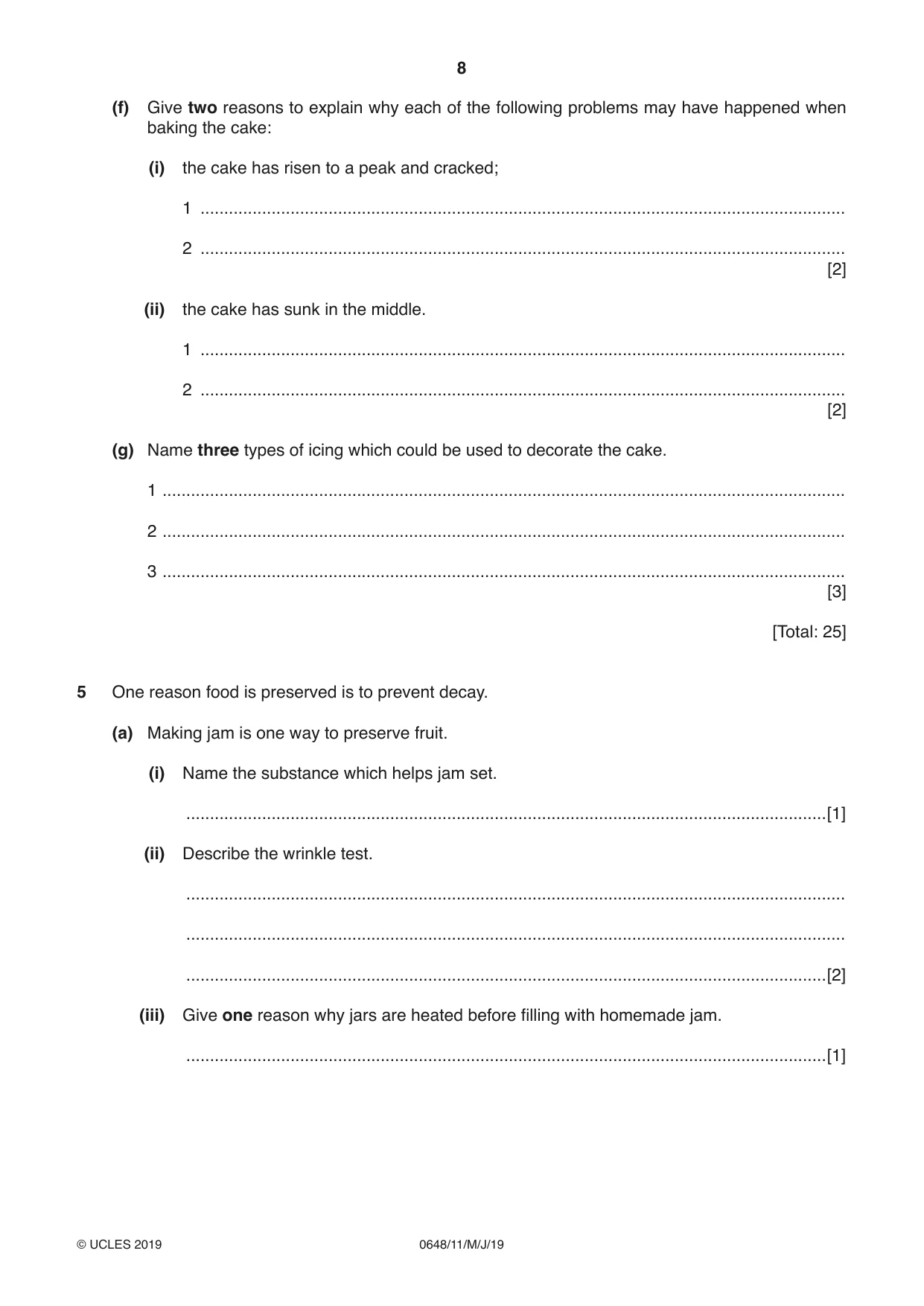
Question paper, page 8
8 0648/11/M/J/19 © UCLES 2019 (f) Give two reasons to explain why each of the following problems may have happened when baking the cake: (i) the cake has risen to a peak and cracked; 1 … 2 … [2] (ii) the cake has sunk in the middle. 1 … 2 … [2] (g) Name three types of icing which could be used to decorate the cake. 1 … 2 … 3 … [3] [Total: 25] 5 One reason food is preserved is to prevent decay. (a) Making jam is one way to preserve fruit. (i) Name the substance which helps jam set. …[1] (ii) Describe the wrinkle test. … … …[2] (iii) Give one reason why jars are heated before filling with homemade jam. …[1]
Question paper, page 9
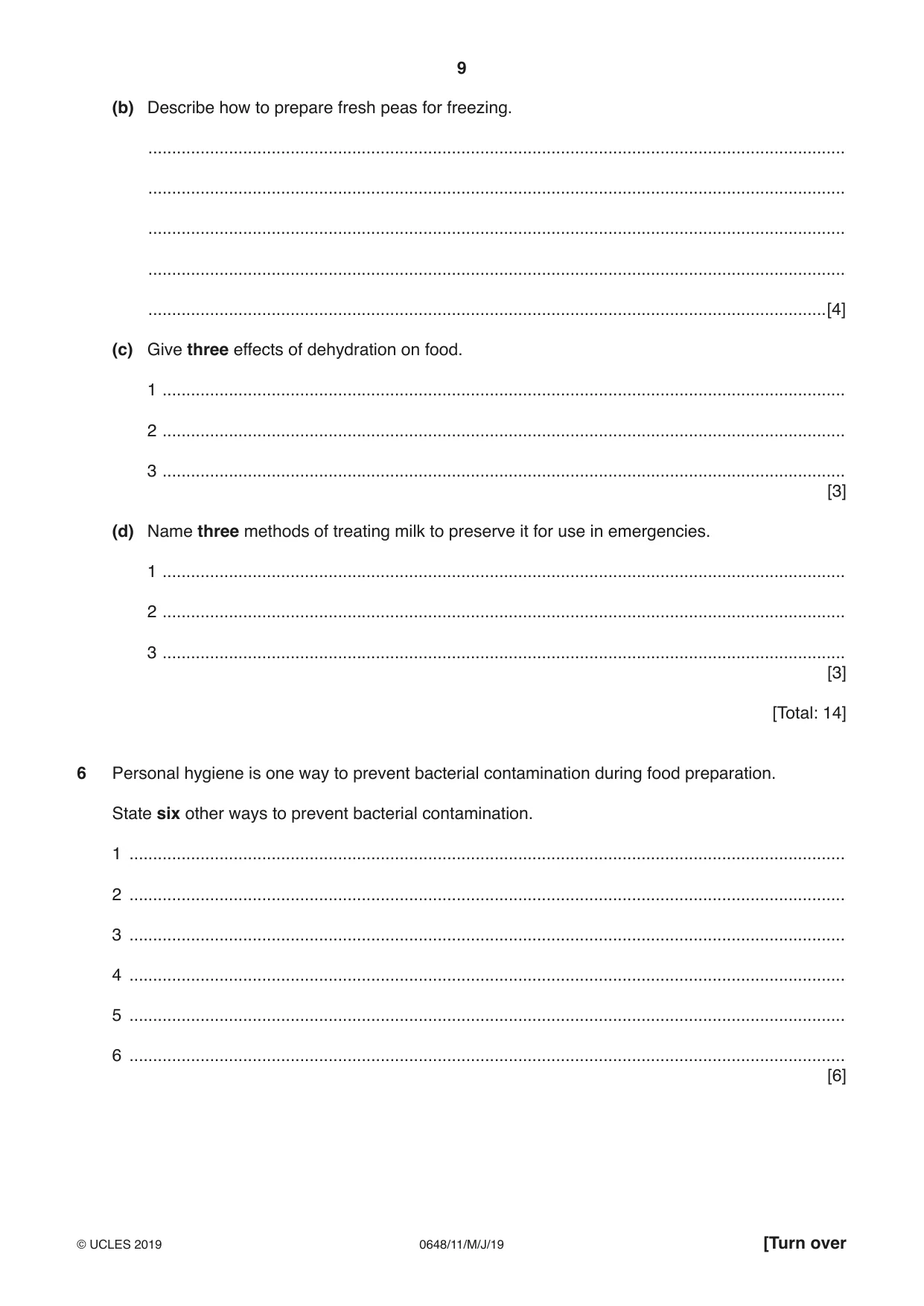
9 0648/11/M/J/19 © UCLES 2019 [Turn over (b) Describe how to prepare fresh peas for freezing. … … … … …[4] (c) Give three effects of dehydration on food. 1 … 2 … 3 … [3] (d) Name three methods of treating milk to preserve it for use in emergencies. 1 … 2 … 3 … [3] [Total: 14] 6 Personal hygiene is one way to prevent bacterial contamination during food preparation. State six other ways to prevent bacterial contamination. 1 … 2 … 3 … 4 … 5 … 6 … [6]
Question paper, page 10
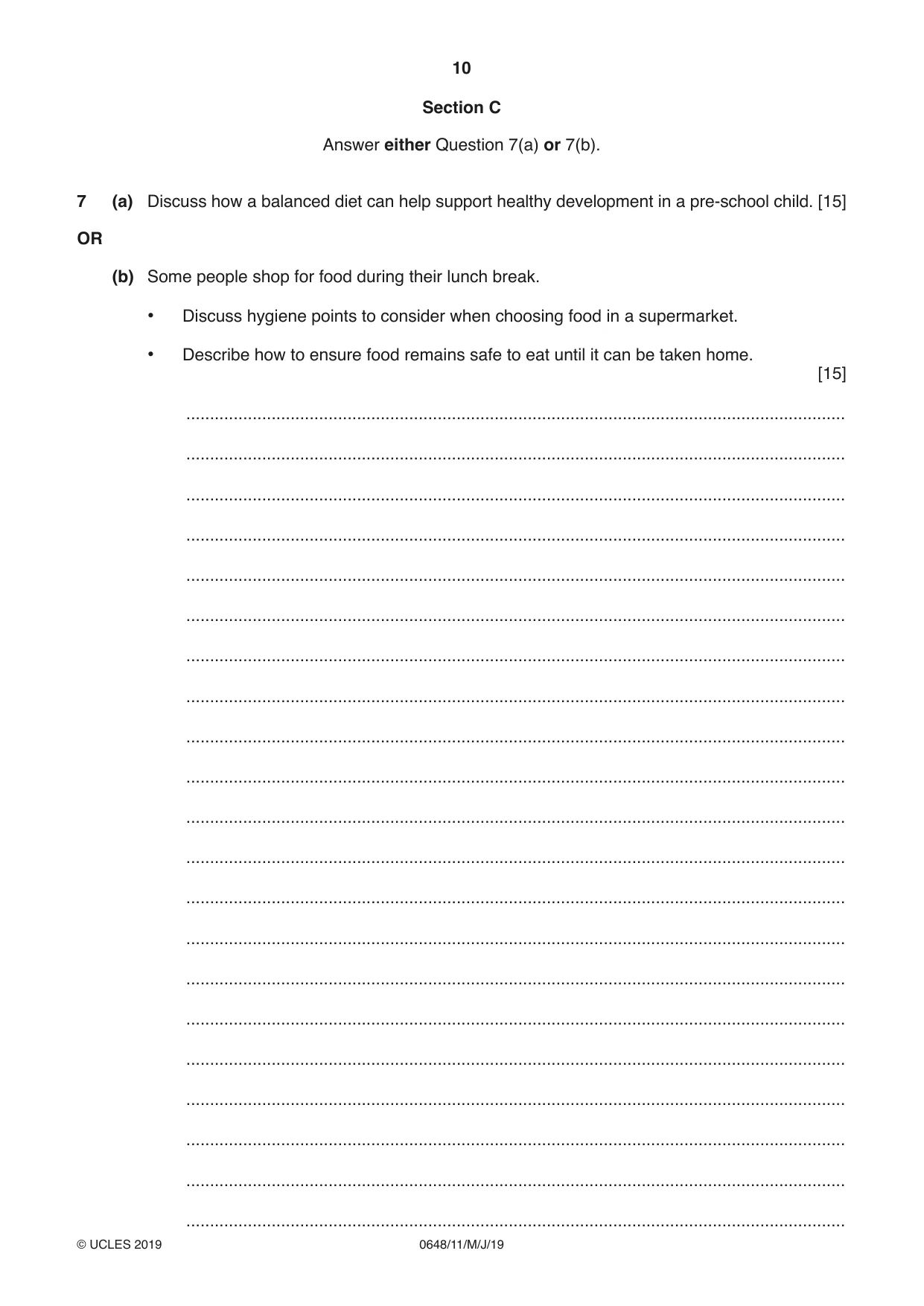
10 0648/11/M/J/19 © UCLES 2019 Section C Answer either Question 7(a) or 7(b). 7 (a) Discuss how a balanced diet can help support healthy development in a pre-school child. [15] OR (b) Some people shop for food during their lunch break. • Discuss hygiene points to consider when choosing food in a supermarket. • Describe how to ensure food remains safe to eat until it can be taken home. [15] … … … … … … … … … … … … … … … … … … … … …
Question paper, page 11
11 0648/11/M/J/19 © UCLES 2019 [Turn over … … … … … … … … … … … … … … … … … … … … … … … … … … … …
Question paper, page 12
12 0648/11/M/J/19 © UCLES 2019 Permission to reproduce items where third-party owned material protected by copyright is included has been sought and cleared where possible. Every reasonable effort has been made by the publisher (UCLES) to trace copyright holders, but if any items requiring clearance have unwittingly been included, the publisher will be pleased to make amends at the earliest possible opportunity. To avoid the issue of disclosure of answer-related information to candidates, all copyright acknowledgements are reproduced online in the Cambridge Assessment International Education Copyright Acknowledgements Booklet. This is produced for each series of examinations and is freely available to download at www.cambridgeinternational.org after the live examination series. Cambridge Assessment International Education is part of the Cambridge Assessment Group. Cambridge Assessment is the brand name of the University of Cambridge Local Examinations Syndicate (UCLES), which itself is a department of the University of Cambridge. … … … … … … … … … … … … … … … … … … … … … … …
Mark scheme, page 1
This document consists of 16 printed pages. © UCLES 2019 [Turn over Cambridge Assessment International Education Cambridge International General Certificate of Secondary Education FOOD AND NUTRITION 0648/11 Paper 1 Theory May/June 2019 MARK SCHEME Maximum Mark: 100 Published This mark scheme is published as an aid to teachers and candidates, to indicate the requirements of the examination. It shows the basis on which Examiners were instructed to award marks. It does not indicate the details of the discussions that took place at an Examiners’ meeting before marking began, which would have considered the acceptability of alternative answers. Mark schemes should be read in conjunction with the question paper and the Principal Examiner Report for Teachers. Cambridge International will not enter into discussions about these mark schemes. Cambridge International is publishing the mark schemes for the May/June 2019 series for most Cambridge IGCSE™, Cambridge International A and AS Level and Cambridge Pre-U components, and some Cambridge O Level components.
Mark scheme, page 2
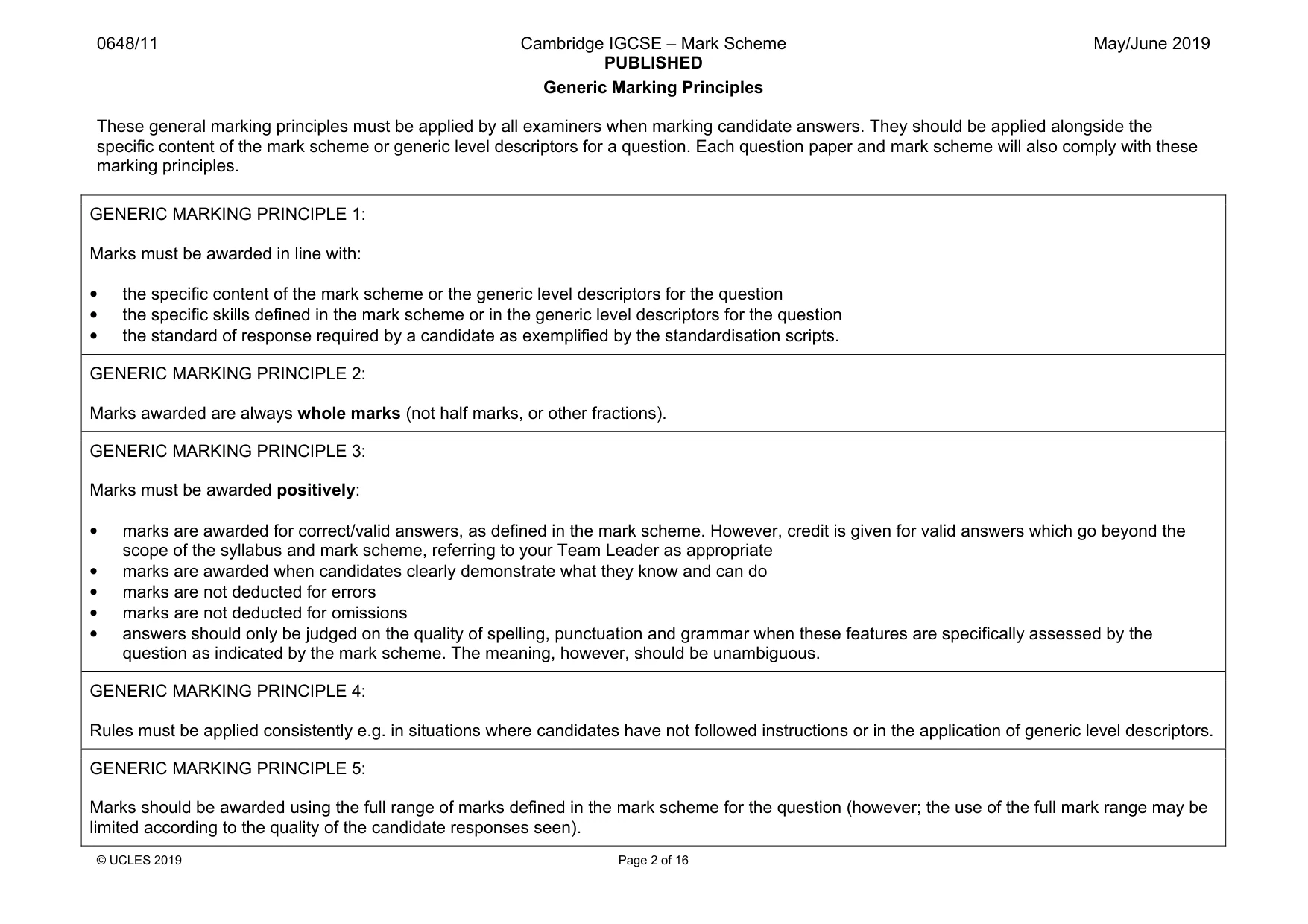
0648/11 Cambridge IGCSE – Mark Scheme PUBLISHED May/June 2019 © UCLES 2019 Page 2 of 16 Generic Marking Principles These general marking principles must be applied by all examiners when marking candidate answers. They should be applied alongside the specific content of the mark scheme or generic level descriptors for a question. Each question paper and mark scheme will also comply with these marking principles. GENERIC MARKING PRINCIPLE 1: Marks must be awarded in line with: • the specific content of the mark scheme or the generic level descriptors for the question • the specific skills defined in the mark scheme or in the generic level descriptors for the question • the standard of response required by a candidate as exemplified by the standardisation scripts. GENERIC MARKING PRINCIPLE 2: Marks awarded are always whole marks (not half marks, or other fractions). GENERIC MARKING PRINCIPLE 3: Marks must be awarded positively: • marks are awarded for correct/valid answers, as defined in the mark scheme. However, credit is given for valid answers which go beyond the scope of the syllabus and mark scheme, referring to your Team Leader as appropriate • marks are awarded when candidates clearly demonstrate what they know and can do • marks are not deducted for errors • marks are not deducted for omissions • answers should only be judged on the quality of spelling, punctuation and grammar when these features are specifically assessed by the question as indicated by the mark scheme. The meaning, however, should be unambiguous. GENERIC MARKING PRINCIPLE 4: Rules must be applied consistently e.g. in situations where candidates have not followed instructions or in the application of generic level descriptors. GENERIC MARKING PRINCIPLE 5: Marks should be awarded using the full range of marks defined in the mark scheme for the question (however; the use of the full mark range may be limited according to the quality of the candidate responses seen).
Mark scheme, page 3
0648/11 Cambridge IGCSE – Mark Scheme PUBLISHED May/June 2019 © UCLES 2019 Page 3 of 16 GENERIC MARKING PRINCIPLE 6: Marks awarded are based solely on the requirements as defined in the mark scheme. Marks should not be awarded with grade thresholds or grade descriptors in mind.
Mark scheme, page 4
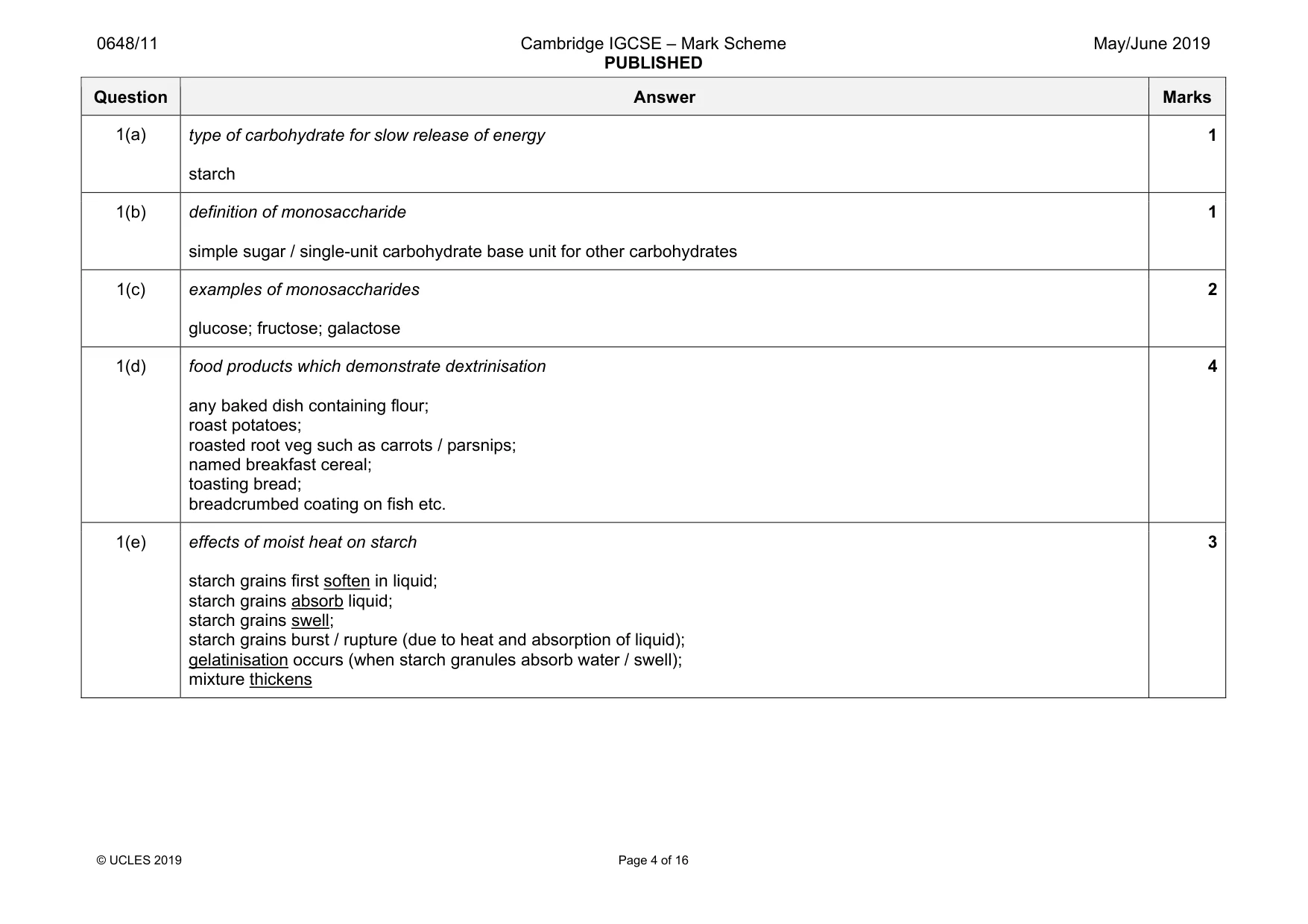
0648/11 Cambridge IGCSE – Mark Scheme PUBLISHED May/June 2019 © UCLES 2019 Page 4 of 16 Question Answer Marks 1(a) type of carbohydrate for slow release of energy starch 1 1(b) definition of monosaccharide simple sugar / single-unit carbohydrate base unit for other carbohydrates 1 1(c) examples of monosaccharides glucose; fructose; galactose 2 1(d) food products which demonstrate dextrinisation any baked dish containing flour; roast potatoes; roasted root veg such as carrots / parsnips; named breakfast cereal; toasting bread; breadcrumbed coating on fish etc. 4 1(e) effects of moist heat on starch starch grains first soften in liquid; starch grains absorb liquid; starch grains swell; starch grains burst / rupture (due to heat and absorption of liquid); gelatinisation occurs (when starch granules absorb water / swell); mixture thickens 3
Mark scheme, page 5
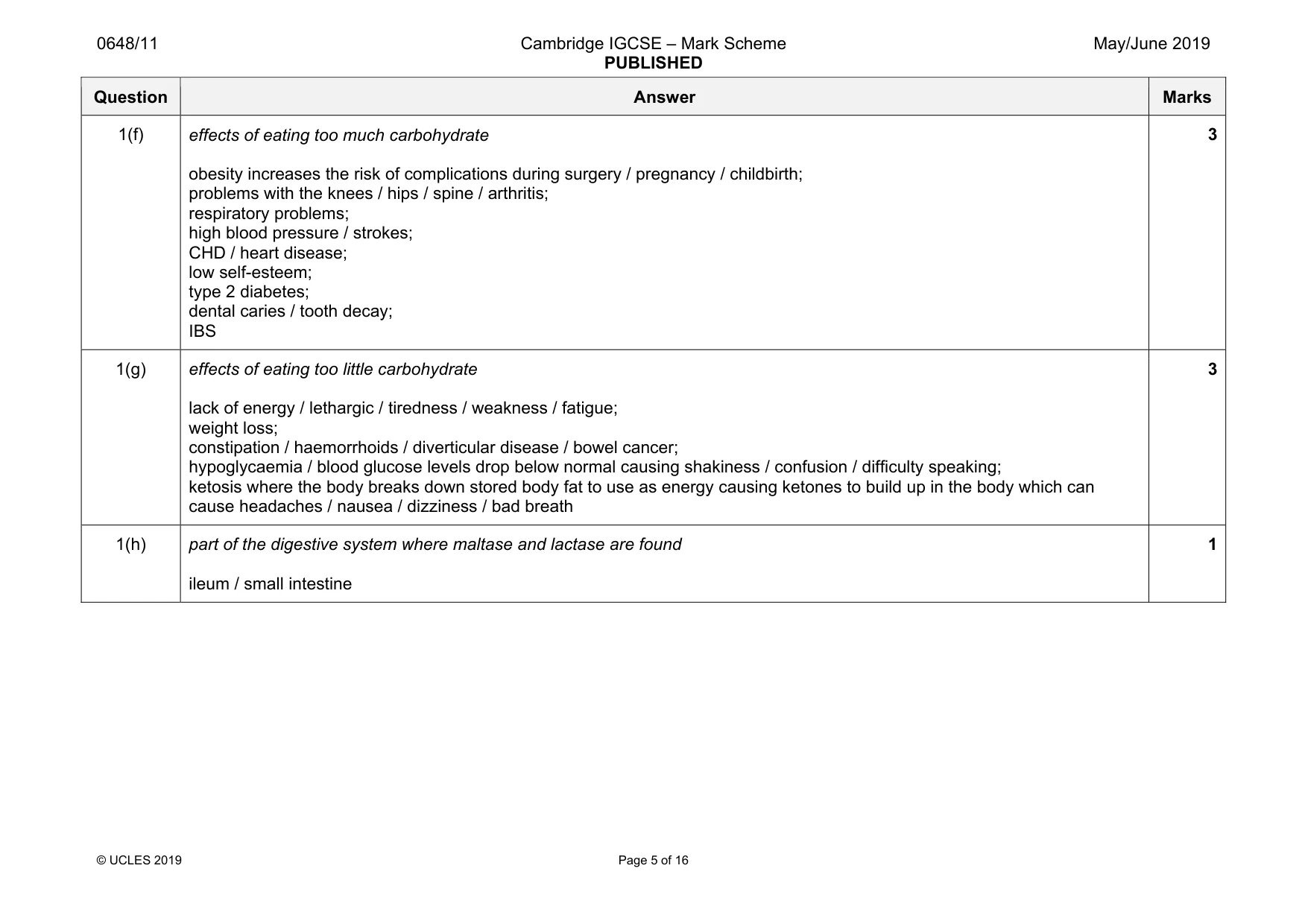
0648/11 Cambridge IGCSE – Mark Scheme PUBLISHED May/June 2019 © UCLES 2019 Page 5 of 16 Question Answer Marks 1(f) effects of eating too much carbohydrate obesity increases the risk of complications during surgery / pregnancy / childbirth; problems with the knees / hips / spine / arthritis; respiratory problems; high blood pressure / strokes; CHD / heart disease; low self-esteem; type 2 diabetes; dental caries / tooth decay; IBS 3 1(g) effects of eating too little carbohydrate lack of energy / lethargic / tiredness / weakness / fatigue; weight loss; constipation / haemorrhoids / diverticular disease / bowel cancer; hypoglycaemia / blood glucose levels drop below normal causing shakiness / confusion / difficulty speaking; ketosis where the body breaks down stored body fat to use as energy causing ketones to build up in the body which can cause headaches / nausea / dizziness / bad breath 3 1(h) part of the digestive system where maltase and lactase are found ileum / small intestine 1
Mark scheme, page 6
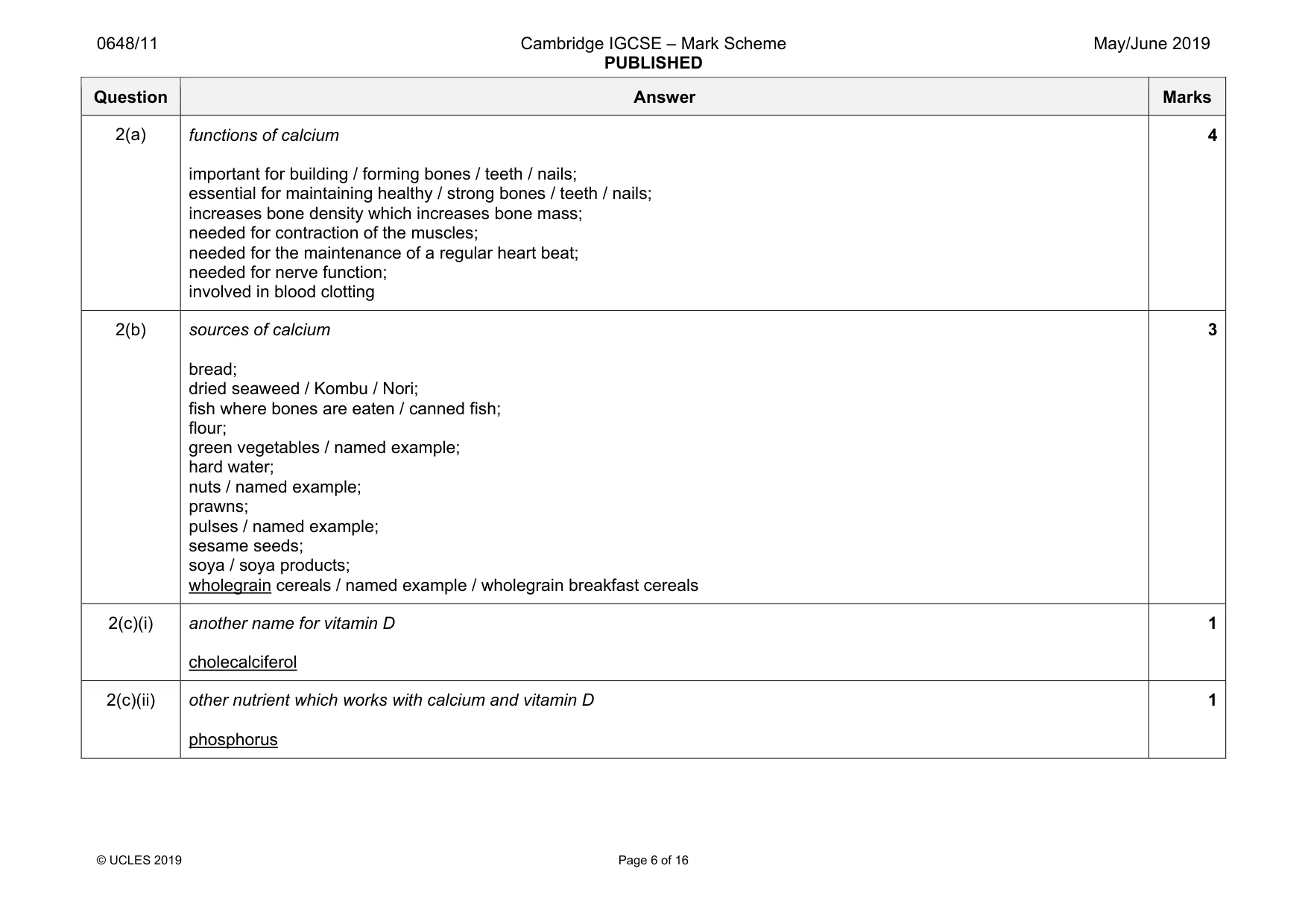
0648/11 Cambridge IGCSE – Mark Scheme PUBLISHED May/June 2019 © UCLES 2019 Page 6 of 16 Question Answer Marks 2(a) functions of calcium important for building / forming bones / teeth / nails; essential for maintaining healthy / strong bones / teeth / nails; increases bone density which increases bone mass; needed for contraction of the muscles; needed for the maintenance of a regular heart beat; needed for nerve function; involved in blood clotting 4 2(b) sources of calcium bread; dried seaweed / Kombu / Nori; fish where bones are eaten / canned fish; flour; green vegetables / named example; hard water; nuts / named example; prawns; pulses / named example; sesame seeds; soya / soya products; wholegrain cereals / named example / wholegrain breakfast cereals 3 2(c)(i) another name for vitamin D cholecalciferol 1 2(c)(ii) other nutrient which works with calcium and vitamin D phosphorus 1
Mark scheme, page 7
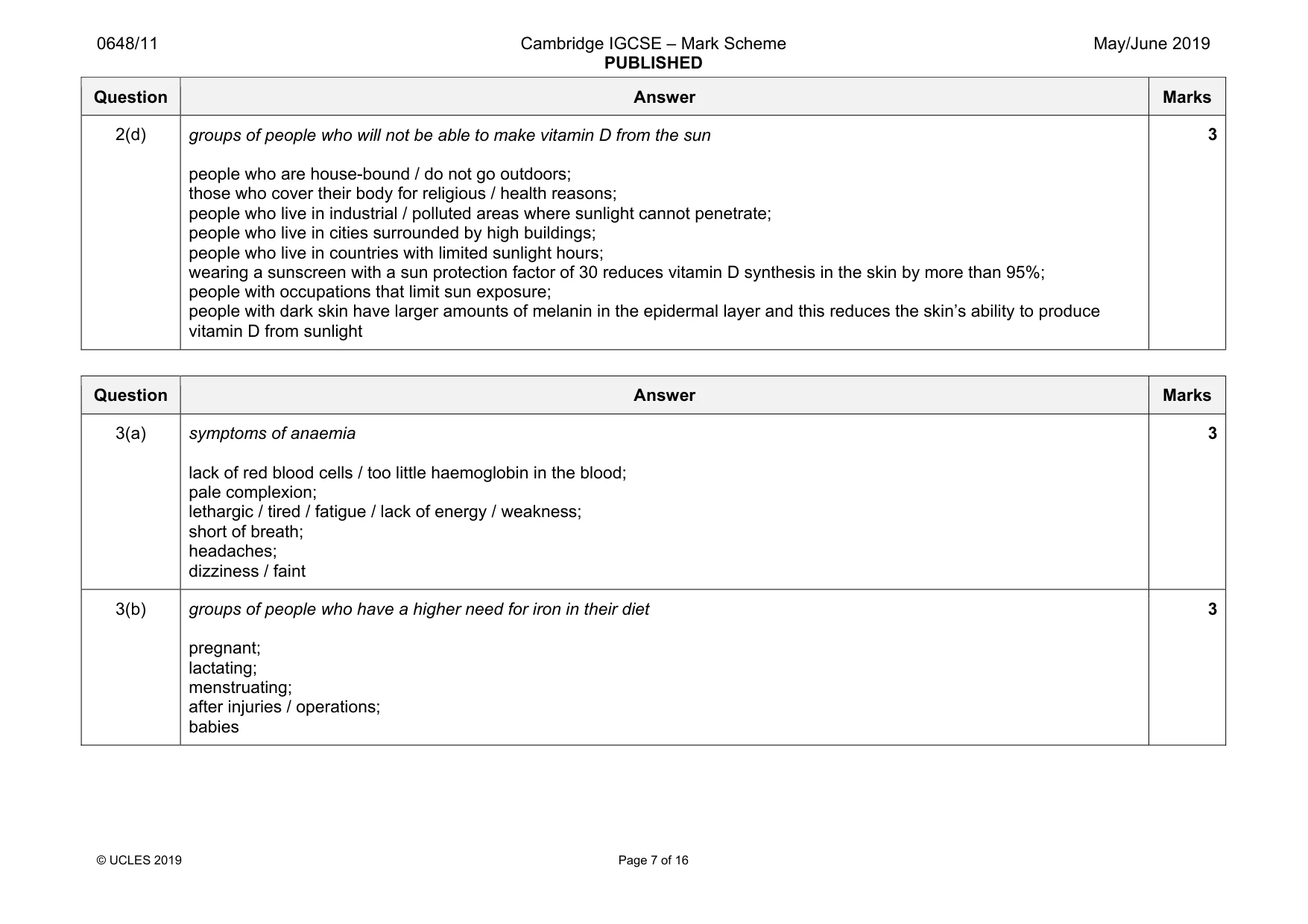
0648/11 Cambridge IGCSE – Mark Scheme PUBLISHED May/June 2019 © UCLES 2019 Page 7 of 16 Question Answer Marks 2(d) groups of people who will not be able to make vitamin D from the sun people who are house-bound / do not go outdoors; those who cover their body for religious / health reasons; people who live in industrial / polluted areas where sunlight cannot penetrate; people who live in cities surrounded by high buildings; people who live in countries with limited sunlight hours; wearing a sunscreen with a sun protection factor of 30 reduces vitamin D synthesis in the skin by more than 95%; people with occupations that limit sun exposure; people with dark skin have larger amounts of melanin in the epidermal layer and this reduces the skin’s ability to produce vitamin D from sunlight 3 Question Answer Marks 3(a) symptoms of anaemia lack of red blood cells / too little haemoglobin in the blood; pale complexion; lethargic / tired / fatigue / lack of energy / weakness; short of breath; headaches; dizziness / faint 3 3(b) groups of people who have a higher need for iron in their diet pregnant; lactating; menstruating; after injuries / operations; babies 3
Mark scheme, page 8
0648/11 Cambridge IGCSE – Mark Scheme PUBLISHED May/June 2019 © UCLES 2019 Page 8 of 16 Question Answer Marks 3(c)(i) why it is important to have a daily supply of vitamin C vitamin C cannot be stored in the body / vitamin C is water soluble so is easily lost from the body 1 3(c)(ii) sources of vitamin C blackcurrants; citrus fruit / 1 named example; all coloured peppers; green vegetables / 1 named example; kiwi fruit; mango; new potatoes; rose hips; strawberries; tomatoes 3 Question Answer Marks 4(a) how many eggs needed to complete the recipe 4 / four / 200 g 1 4(b) why cake suitable for a person who is lactose intolerant no lactose present as no dairy / no butter used / marg used rather than butter 1
Mark scheme, page 9
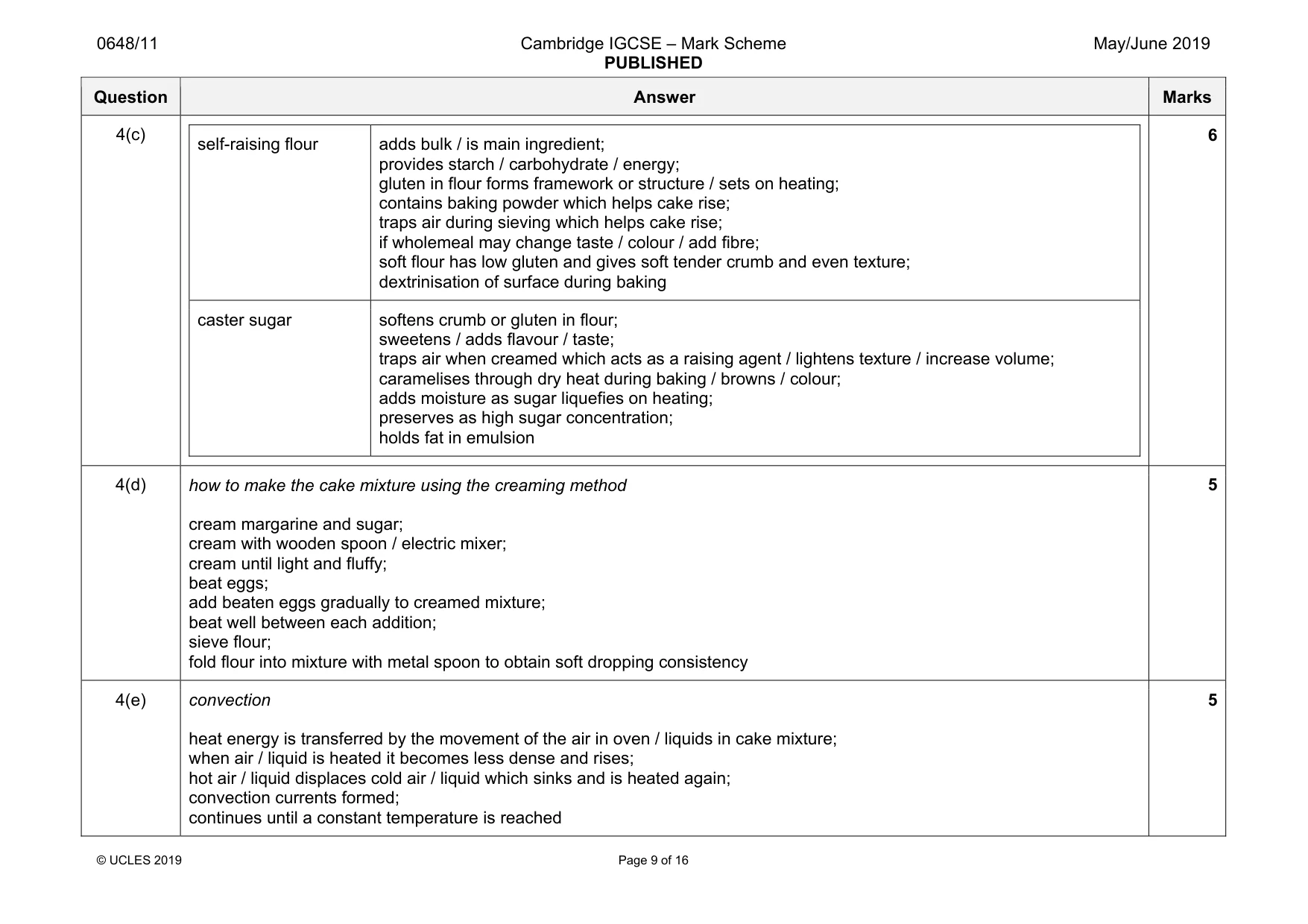
0648/11 Cambridge IGCSE – Mark Scheme PUBLISHED May/June 2019 © UCLES 2019 Page 9 of 16 Question Answer Marks 4(c) self-raising flour adds bulk / is main ingredient; provides starch / carbohydrate / energy; gluten in flour forms framework or structure / sets on heating; contains baking powder which helps cake rise; traps air during sieving which helps cake rise; if wholemeal may change taste / colour / add fibre; soft flour has low gluten and gives soft tender crumb and even texture; dextrinisation of surface during baking caster sugar softens crumb or gluten in flour; sweetens / adds flavour / taste; traps air when creamed which acts as a raising agent / lightens texture / increase volume; caramelises through dry heat during baking / browns / colour; adds moisture as sugar liquefies on heating; preserves as high sugar concentration; holds fat in emulsion 6 4(d) how to make the cake mixture using the creaming method cream margarine and sugar; cream with wooden spoon / electric mixer; cream until light and fluffy; beat eggs; add beaten eggs gradually to creamed mixture; beat well between each addition; sieve flour; fold flour into mixture with metal spoon to obtain soft dropping consistency 5 4(e) convection heat energy is transferred by the movement of the air in oven / liquids in cake mixture; when air / liquid is heated it becomes less dense and rises; hot air / liquid displaces cold air / liquid which sinks and is heated again; convection currents formed; continues until a constant temperature is reached 5
Mark scheme, page 10
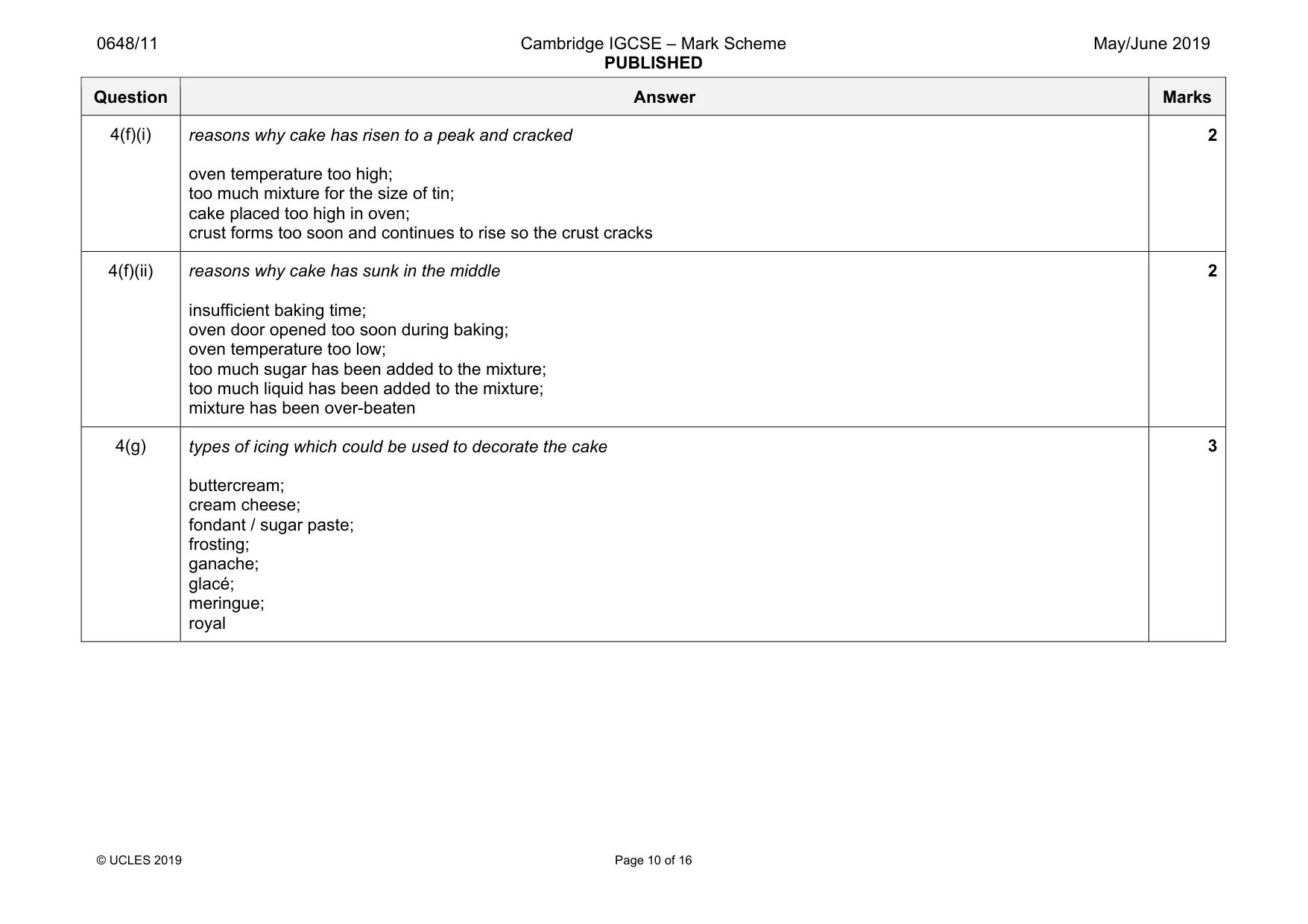
0648/11 Cambridge IGCSE – Mark Scheme PUBLISHED May/June 2019 © UCLES 2019 Page 10 of 16 Question Answer Marks 4(f)(i) reasons why cake has risen to a peak and cracked oven temperature too high; too much mixture for the size of tin; cake placed too high in oven; crust forms too soon and continues to rise so the crust cracks 2 4(f)(ii) reasons why cake has sunk in the middle insufficient baking time; oven door opened too soon during baking; oven temperature too low; too much sugar has been added to the mixture; too much liquid has been added to the mixture; mixture has been over-beaten 2 4(g) types of icing which could be used to decorate the cake buttercream; cream cheese; fondant / sugar paste; frosting; ganache; glacé; meringue; royal 3
Mark scheme, page 11
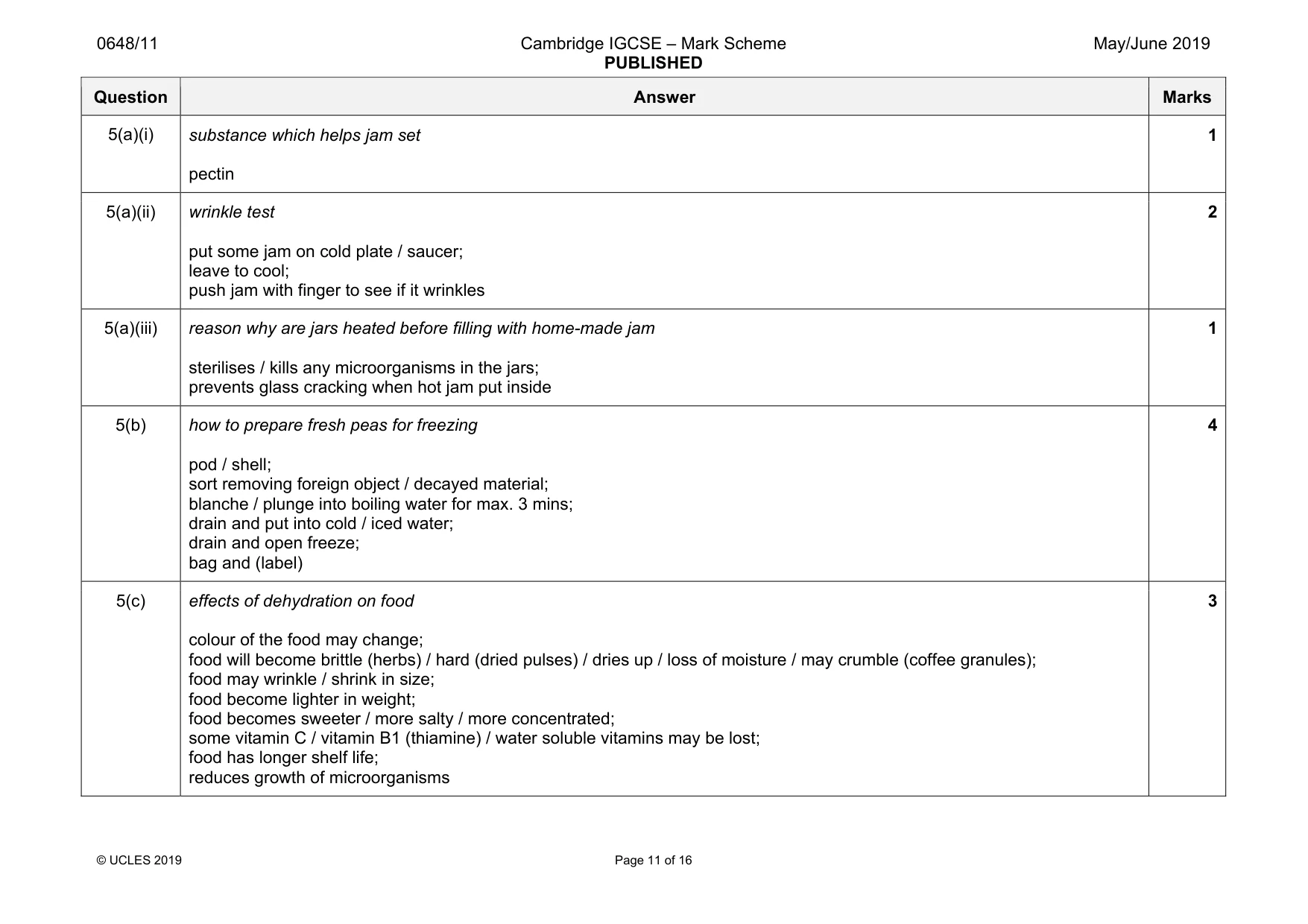
0648/11 Cambridge IGCSE – Mark Scheme PUBLISHED May/June 2019 © UCLES 2019 Page 11 of 16 Question Answer Marks 5(a)(i) substance which helps jam set pectin 1 5(a)(ii) wrinkle test put some jam on cold plate / saucer; leave to cool; push jam with finger to see if it wrinkles 2 5(a)(iii) reason why are jars heated before filling with home-made jam sterilises / kills any microorganisms in the jars; prevents glass cracking when hot jam put inside 1 5(b) how to prepare fresh peas for freezing pod / shell; sort removing foreign object / decayed material; blanche / plunge into boiling water for max. 3 mins; drain and put into cold / iced water; drain and open freeze; bag and (label) 4 5(c) effects of dehydration on food colour of the food may change; food will become brittle (herbs) / hard (dried pulses) / dries up / loss of moisture / may crumble (coffee granules); food may wrinkle / shrink in size; food become lighter in weight; food becomes sweeter / more salty / more concentrated; some vitamin C / vitamin B1 (thiamine) / water soluble vitamins may be lost; food has longer shelf life; reduces growth of microorganisms 3
Mark scheme, page 12
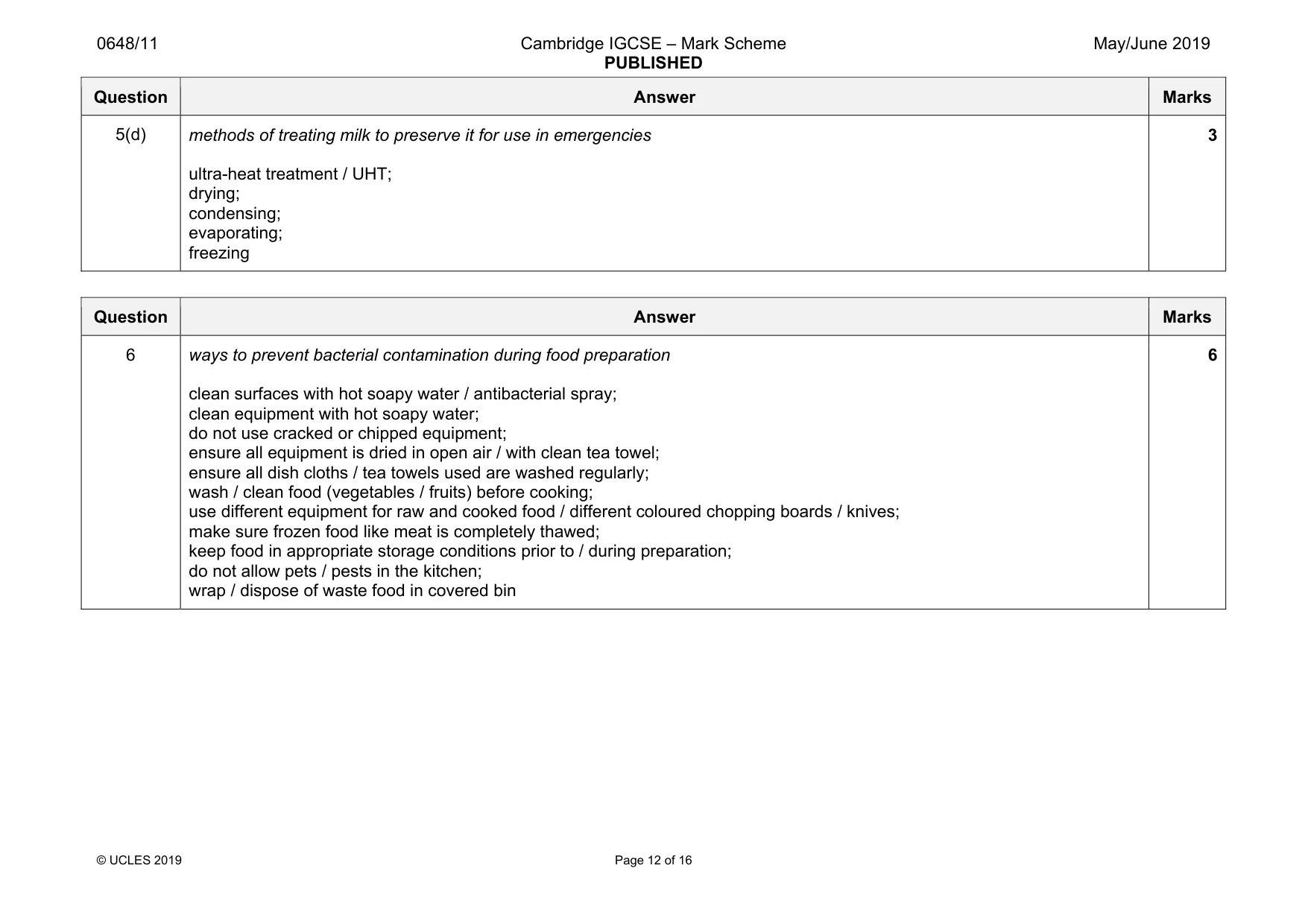
0648/11 Cambridge IGCSE – Mark Scheme PUBLISHED May/June 2019 © UCLES 2019 Page 12 of 16 Question Answer Marks 5(d) methods of treating milk to preserve it for use in emergencies ultra-heat treatment / UHT; drying; condensing; evaporating; freezing 3 Question Answer Marks 6 ways to prevent bacterial contamination during food preparation clean surfaces with hot soapy water / antibacterial spray; clean equipment with hot soapy water; do not use cracked or chipped equipment; ensure all equipment is dried in open air / with clean tea towel; ensure all dish cloths / tea towels used are washed regularly; wash / clean food (vegetables / fruits) before cooking; use different equipment for raw and cooked food / different coloured chopping boards / knives; make sure frozen food like meat is completely thawed; keep food in appropriate storage conditions prior to / during preparation; do not allow pets / pests in the kitchen; wrap / dispose of waste food in covered bin 6
Mark scheme, page 13
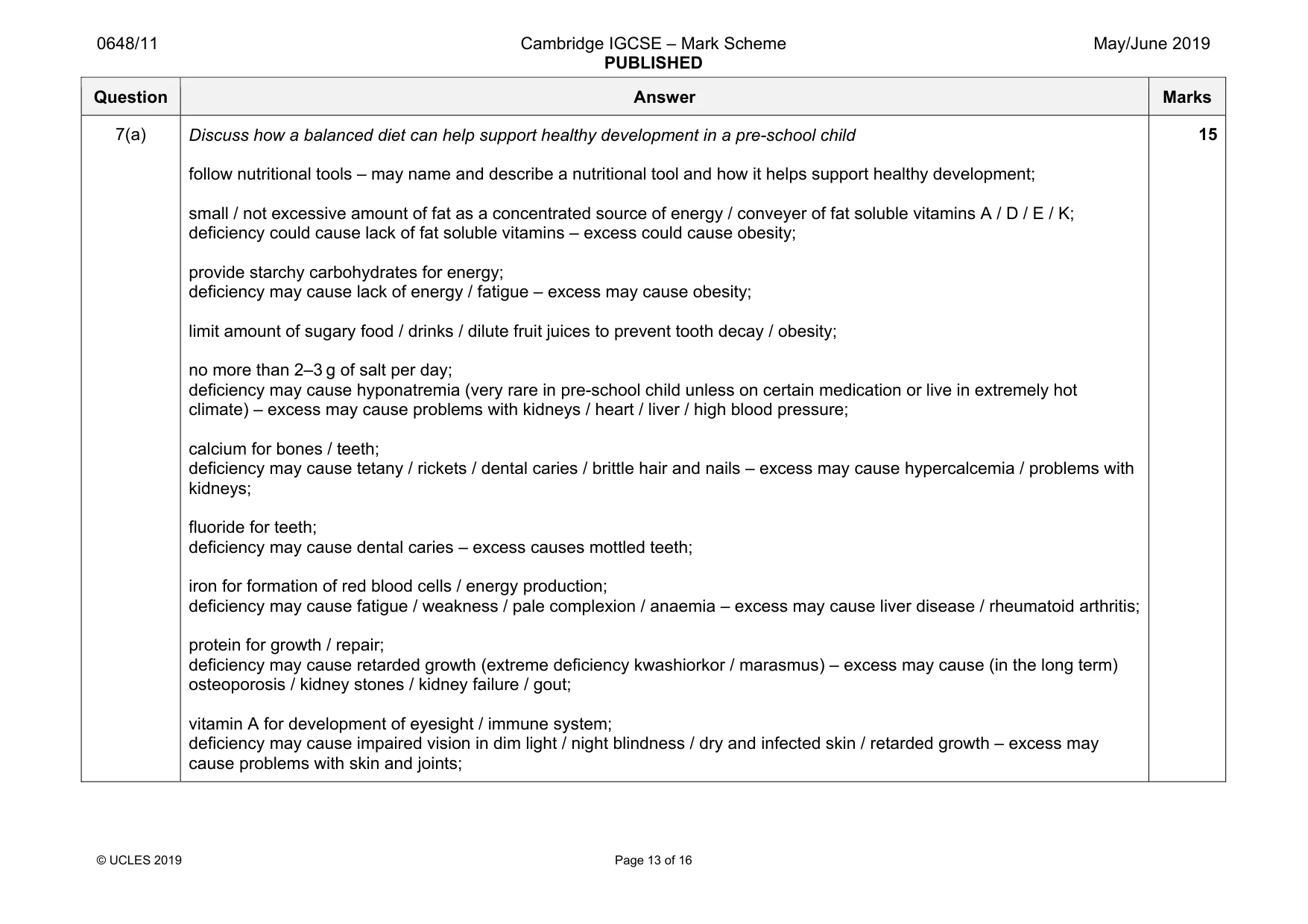
0648/11 Cambridge IGCSE – Mark Scheme PUBLISHED May/June 2019 © UCLES 2019 Page 13 of 16 Question Answer Marks 7(a) Discuss how a balanced diet can help support healthy development in a pre-school child follow nutritional tools – may name and describe a nutritional tool and how it helps support healthy development; small / not excessive amount of fat as a concentrated source of energy / conveyer of fat soluble vitamins A / D / E / K; deficiency could cause lack of fat soluble vitamins – excess could cause obesity; provide starchy carbohydrates for energy; deficiency may cause lack of energy / fatigue – excess may cause obesity; limit amount of sugary food / drinks / dilute fruit juices to prevent tooth decay / obesity; no more than 2–3 g of salt per day; deficiency may cause hyponatremia (very rare in pre-school child unless on certain medication or live in extremely hot climate) – excess may cause problems with kidneys / heart / liver / high blood pressure; calcium for bones / teeth; deficiency may cause tetany / rickets / dental caries / brittle hair and nails – excess may cause hypercalcemia / problems with kidneys; fluoride for teeth; deficiency may cause dental caries – excess causes mottled teeth; iron for formation of red blood cells / energy production; deficiency may cause fatigue / weakness / pale complexion / anaemia – excess may cause liver disease / rheumatoid arthritis; protein for growth / repair; deficiency may cause retarded growth (extreme deficiency kwashiorkor / marasmus) – excess may cause (in the long term) osteoporosis / kidney stones / kidney failure / gout; vitamin A for development of eyesight / immune system; deficiency may cause impaired vision in dim light / night blindness / dry and infected skin / retarded growth – excess may cause problems with skin and joints; 15
Mark scheme, page 14
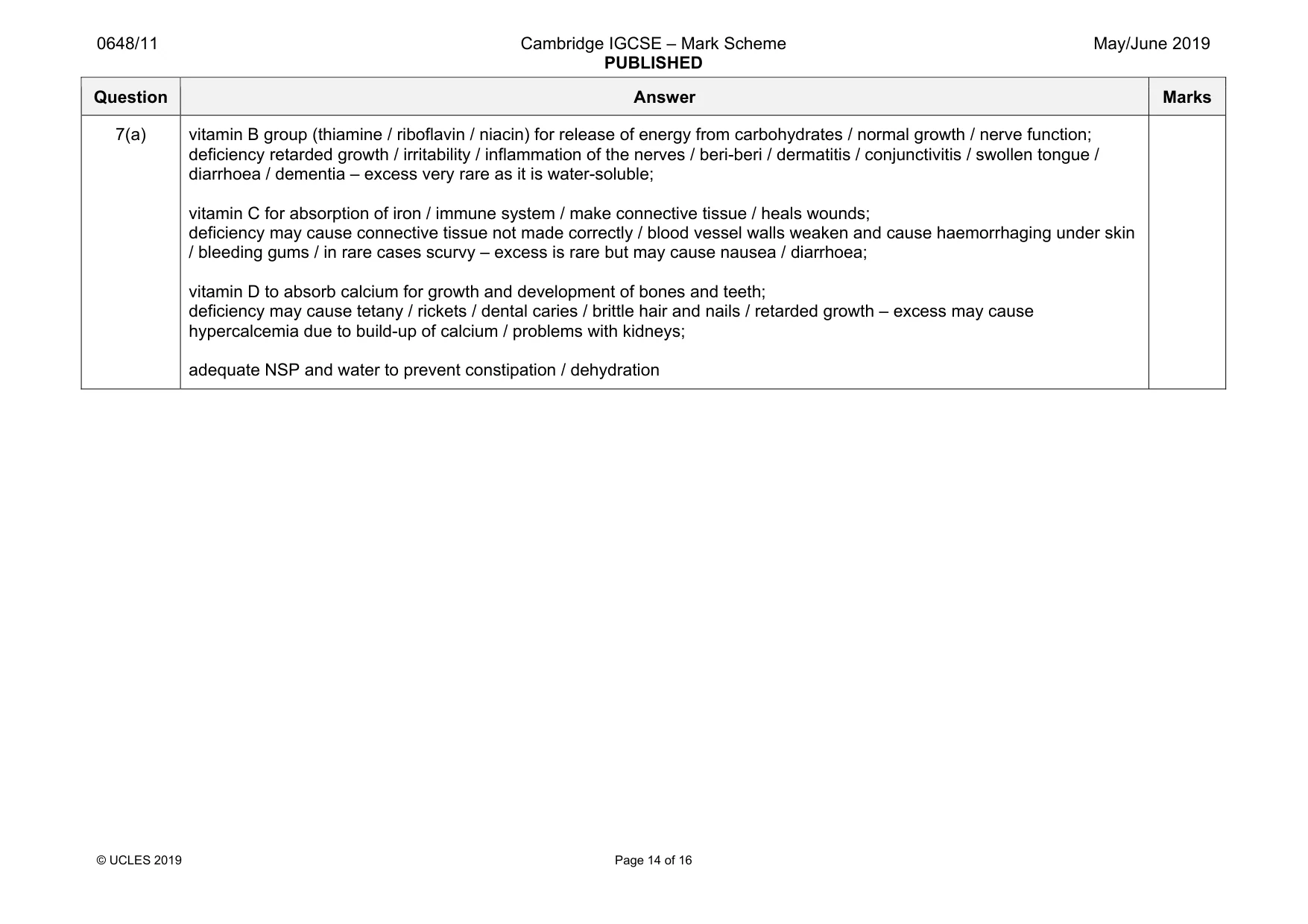
0648/11 Cambridge IGCSE – Mark Scheme PUBLISHED May/June 2019 © UCLES 2019 Page 14 of 16 Question Answer Marks 7(a) vitamin B group (thiamine / riboflavin / niacin) for release of energy from carbohydrates / normal growth / nerve function; deficiency retarded growth / irritability / inflammation of the nerves / beri-beri / dermatitis / conjunctivitis / swollen tongue / diarrhoea / dementia – excess very rare as it is water-soluble; vitamin C for absorption of iron / immune system / make connective tissue / heals wounds; deficiency may cause connective tissue not made correctly / blood vessel walls weaken and cause haemorrhaging under skin / bleeding gums / in rare cases scurvy – excess is rare but may cause nausea / diarrhoea; vitamin D to absorb calcium for growth and development of bones and teeth; deficiency may cause tetany / rickets / dental caries / brittle hair and nails / retarded growth – excess may cause hypercalcemia due to build-up of calcium / problems with kidneys; adequate NSP and water to prevent constipation / dehydration
Mark scheme, page 15
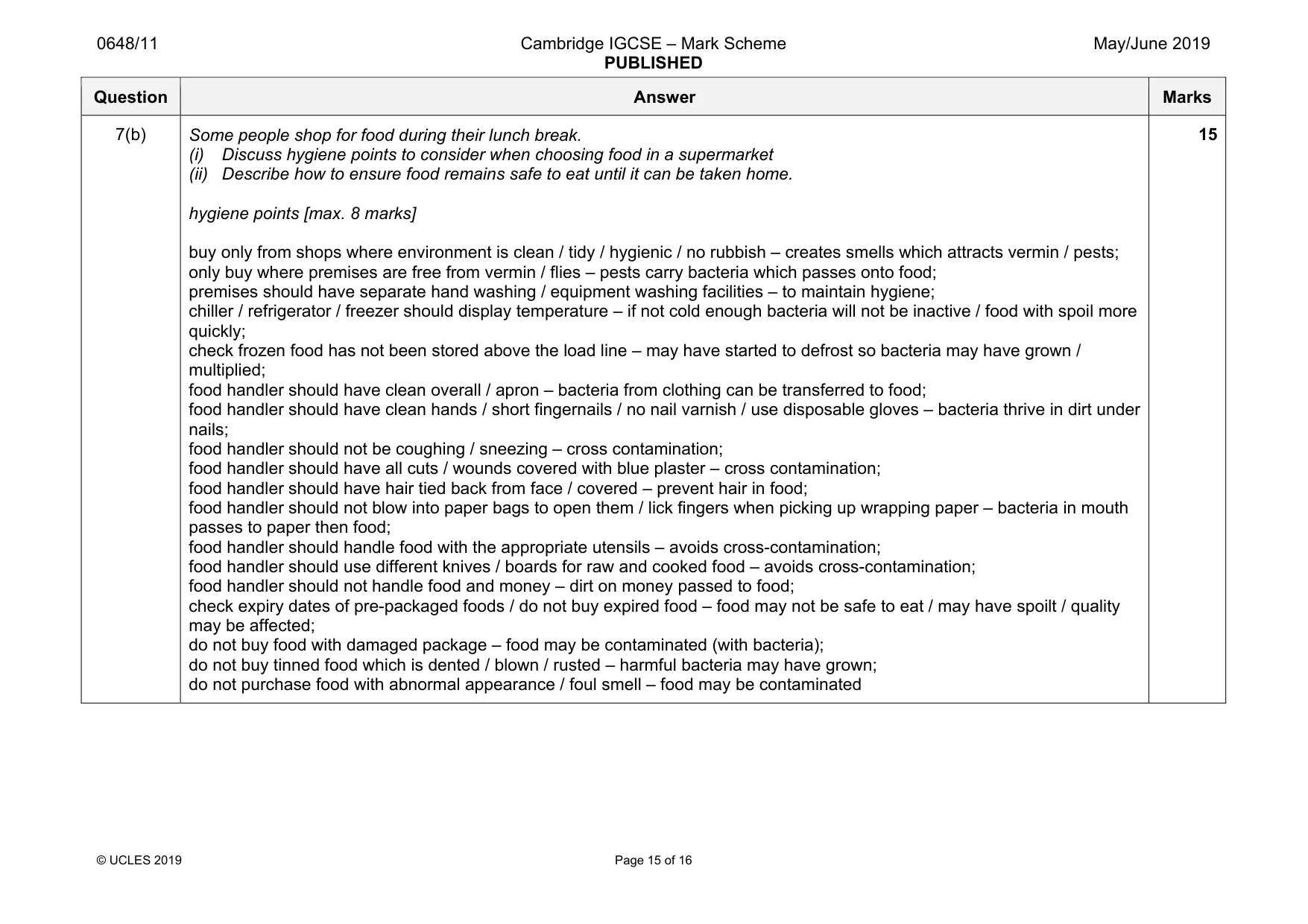
0648/11 Cambridge IGCSE – Mark Scheme PUBLISHED May/June 2019 © UCLES 2019 Page 15 of 16 Question Answer Marks 7(b) Some people shop for food during their lunch break. (i) Discuss hygiene points to consider when choosing food in a supermarket (ii) Describe how to ensure food remains safe to eat until it can be taken home. hygiene points [max. 8 marks] buy only from shops where environment is clean / tidy / hygienic / no rubbish – creates smells which attracts vermin / pests; only buy where premises are free from vermin / flies – pests carry bacteria which passes onto food; premises should have separate hand washing / equipment washing facilities – to maintain hygiene; chiller / refrigerator / freezer should display temperature – if not cold enough bacteria will not be inactive / food with spoil more quickly; check frozen food has not been stored above the load line – may have started to defrost so bacteria may have grown / multiplied; food handler should have clean overall / apron – bacteria from clothing can be transferred to food; food handler should have clean hands / short fingernails / no nail varnish / use disposable gloves – bacteria thrive in dirt under nails; food handler should not be coughing / sneezing – cross contamination; food handler should have all cuts / wounds covered with blue plaster – cross contamination; food handler should have hair tied back from face / covered – prevent hair in food; food handler should not blow into paper bags to open them / lick fingers when picking up wrapping paper – bacteria in mouth passes to paper then food; food handler should handle food with the appropriate utensils – avoids cross-contamination; food handler should use different knives / boards for raw and cooked food – avoids cross-contamination; food handler should not handle food and money – dirt on money passed to food; check expiry dates of pre-packaged foods / do not buy expired food – food may not be safe to eat / may have spoilt / quality may be affected; do not buy food with damaged package – food may be contaminated (with bacteria); do not buy tinned food which is dented / blown / rusted – harmful bacteria may have grown; do not purchase food with abnormal appearance / foul smell – food may be contaminated 15
Mark scheme, page 16
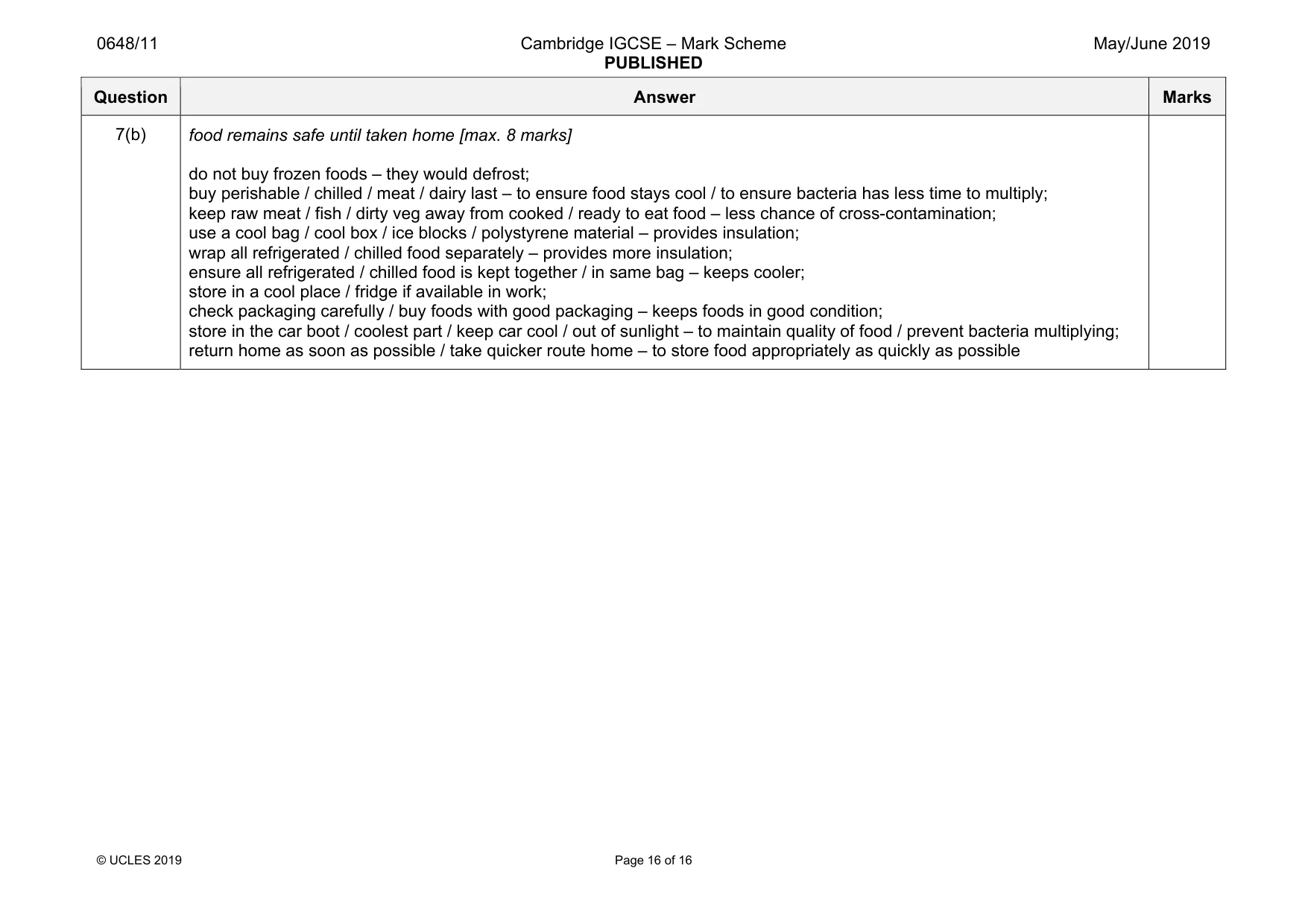
0648/11 Cambridge IGCSE – Mark Scheme PUBLISHED May/June 2019 © UCLES 2019 Page 16 of 16 Question Answer Marks 7(b) food remains safe until taken home [max. 8 marks] do not buy frozen foods – they would defrost; buy perishable / chilled / meat / dairy last – to ensure food stays cool / to ensure bacteria has less time to multiply; keep raw meat / fish / dirty veg away from cooked / ready to eat food – less chance of cross-contamination; use a cool bag / cool box / ice blocks / polystyrene material – provides insulation; wrap all refrigerated / chilled food separately – provides more insulation; ensure all refrigerated / chilled food is kept together / in same bag – keeps cooler; store in a cool place / fridge if available in work; check packaging carefully / buy foods with good packaging – keeps foods in good condition; store in the car boot / coolest part / keep car cool / out of sunlight – to maintain quality of food / prevent bacteria multiplying; return home as soon as possible / take quicker route home – to store food appropriately as quickly as possible
What you needed in this session
Cambridge’s own grade thresholds for 2019 May/June, Paper 1 · Variant 1. A higher threshold means an easier paper — the bar moves with how the cohort did.