Cambridge IGCSE Food and Nutrition 0648 — 2018 Oct/Nov Paper 1 · Variant 2
0648/12/O/N/18 · 100 marks · ≈113 min
The question paper and its mark scheme, free to read here and free to download. This is Cambridge’s own paper, exactly as it was sat.
Question paper12 pages



Mark scheme14 pages
Answers below. Sit the paper first if you are practising.
Paper as text
Question paper, page 1
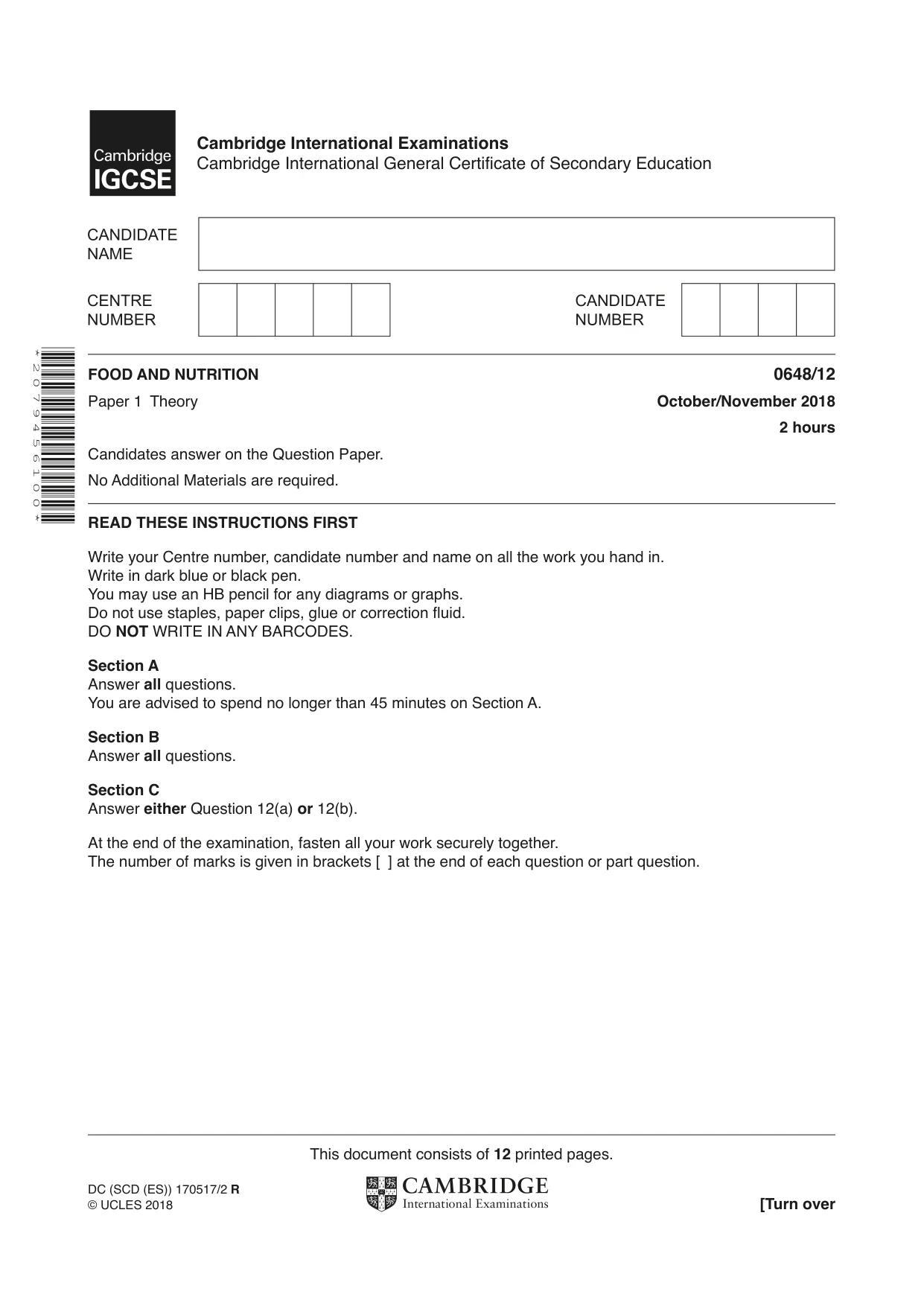
This document consists of 12 printed pages. DC (SCD (ES)) 170517/2 R © UCLES 2018 [Turn over Cambridge International Examinations Cambridge International General Certificate of Secondary Education * 2 0 7 9 4 5 6 1 0 0 * FOOD AND NUTRITION 0648/12 Paper 1 Theory October/November 2018 2 hours Candidates answer on the Question Paper. No Additional Materials are required. READ THESE INSTRUCTIONS FIRST Write your Centre number, candidate number and name on all the work you hand in. Write in dark blue or black pen. You may use an HB pencil for any diagrams or graphs. Do not use staples, paper clips, glue or correction fluid. DO NOT WRITE IN ANY BARCODES. Section A Answer all questions. You are advised to spend no longer than 45 minutes on Section A. Section B Answer all questions. Section C Answer either Question 12(a) or 12(b). At the end of the examination, fasten all your work securely together. The number of marks is given in brackets [ ] at the end of each question or part question.
Question paper, page 2
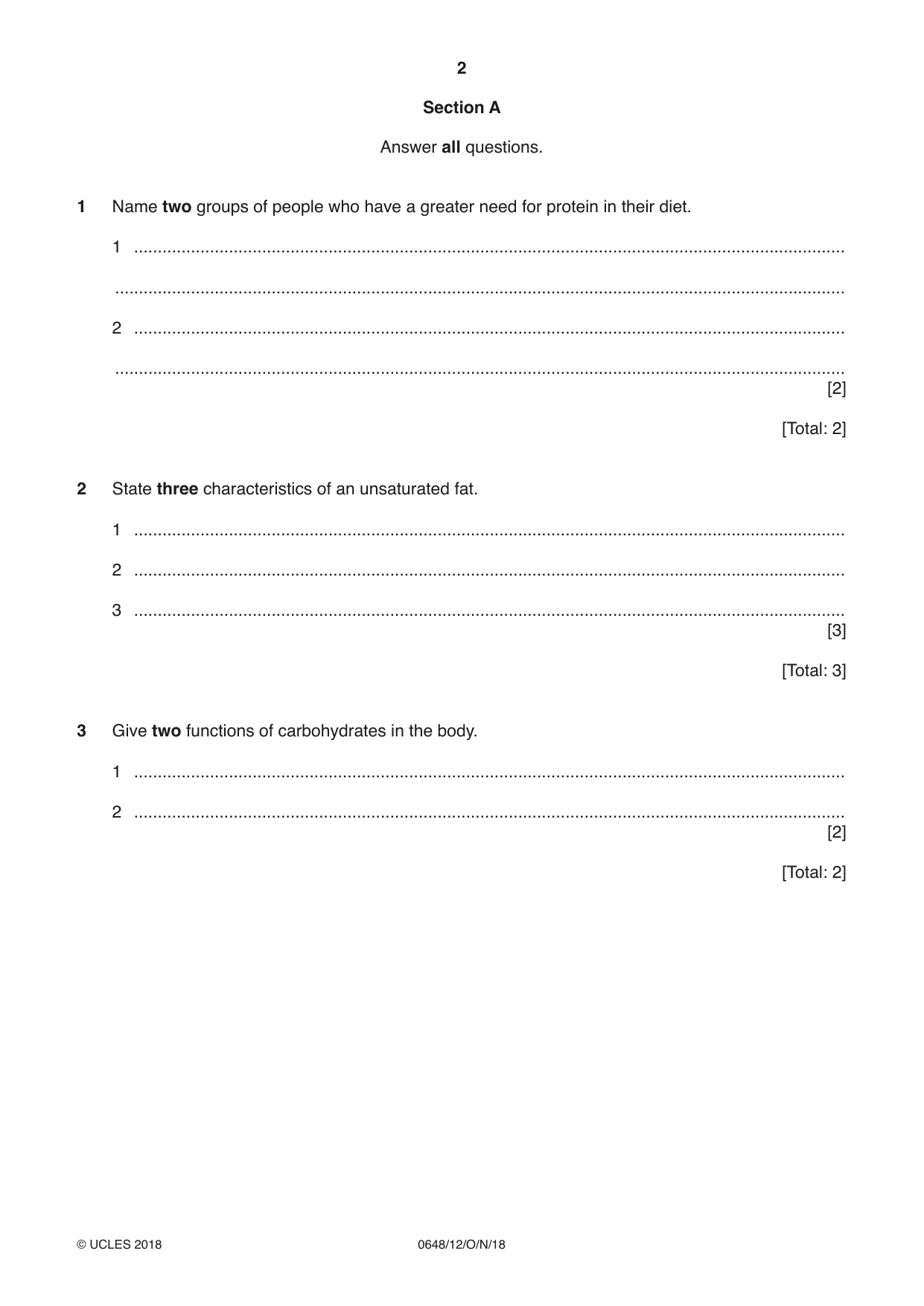
2 0648/12/O/N/18 © UCLES 2018 Section A Answer all questions. 1 Name two groups of people who have a greater need for protein in their diet. 1 … … 2 … … [2] [Total: 2] 2 State three characteristics of an unsaturated fat. 1 … 2 … 3 … [3] [Total: 3] 3 Give two functions of carbohydrates in the body. 1 … 2 … [2] [Total: 2]
Question paper, page 3
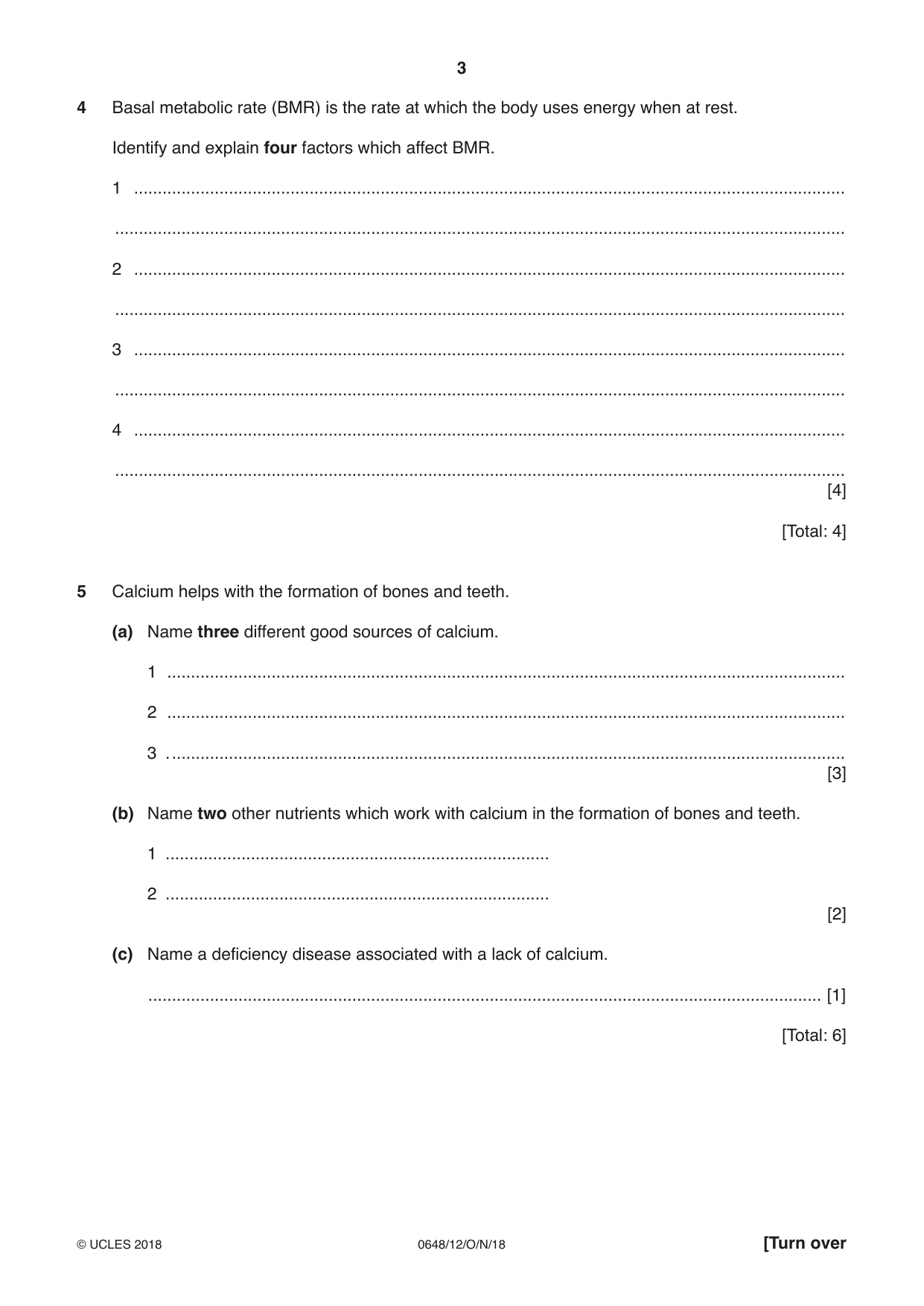
3 0648/12/O/N/18 © UCLES 2018 [Turn over 4 Basal metabolic rate (BMR) is the rate at which the body uses energy when at rest. Identify and explain four factors which affect BMR. 1 … … 2 … … 3 … … 4 … … [4] [Total: 4] 5 Calcium helps with the formation of bones and teeth. (a) Name three different good sources of calcium. 1 … 2 … 3 . … [3] (b) Name two other nutrients which work with calcium in the formation of bones and teeth. 1 … 2 … [2] (c) Name a deficiency disease associated with a lack of calcium. … [1] [Total: 6]
Question paper, page 4
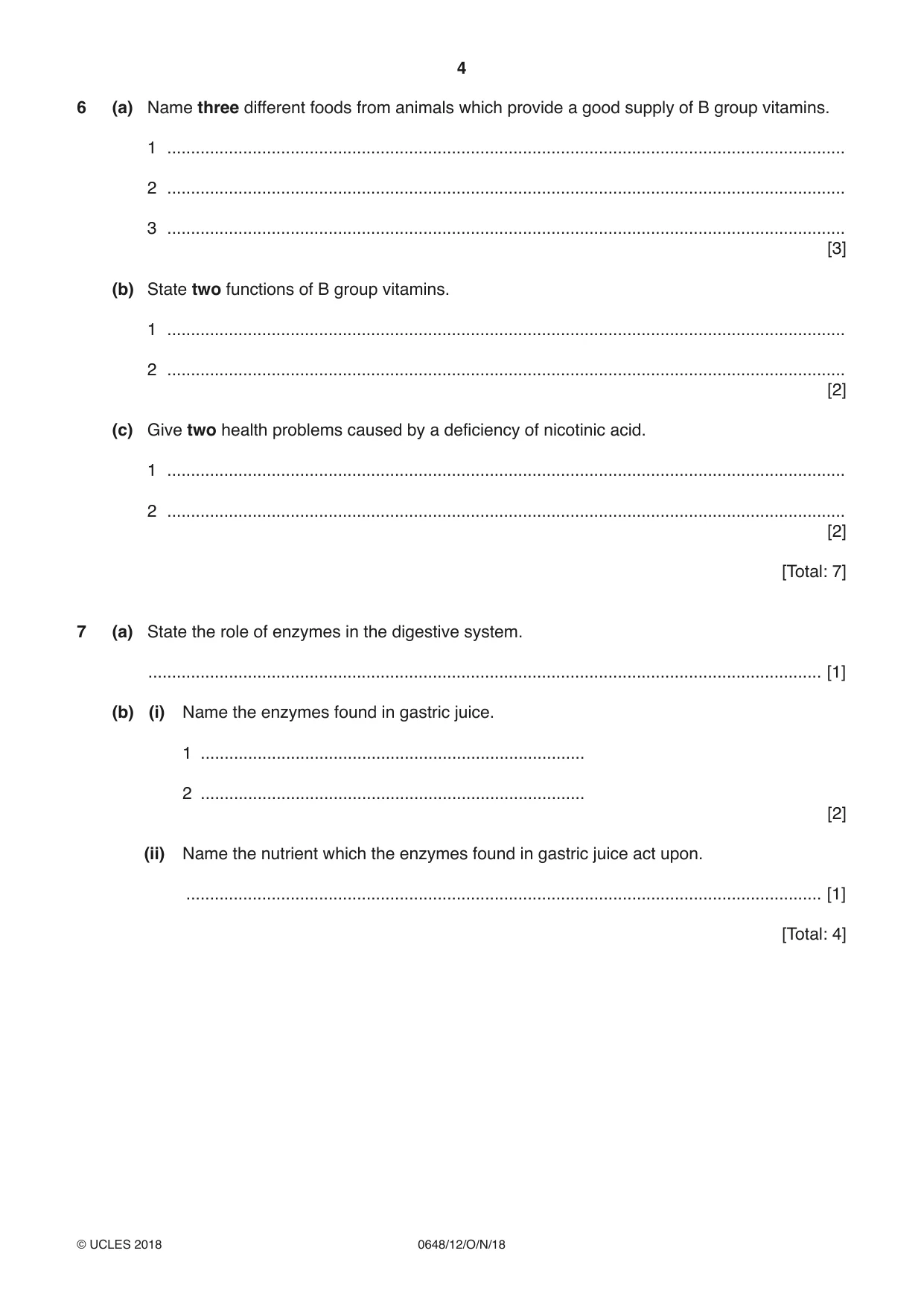
4 0648/12/O/N/18 © UCLES 2018 6 (a) Name three different foods from animals which provide a good supply of B group vitamins. 1 … 2 … 3 … [3] (b) State two functions of B group vitamins. 1 … 2 … [2] (c) Give two health problems caused by a deficiency of nicotinic acid. 1 … 2 … [2] [Total: 7] 7 (a) State the role of enzymes in the digestive system. … [1] (b) (i) Name the enzymes found in gastric juice. 1 … 2 … [2] (ii) Name the nutrient which the enzymes found in gastric juice act upon. … [1] [Total: 4]
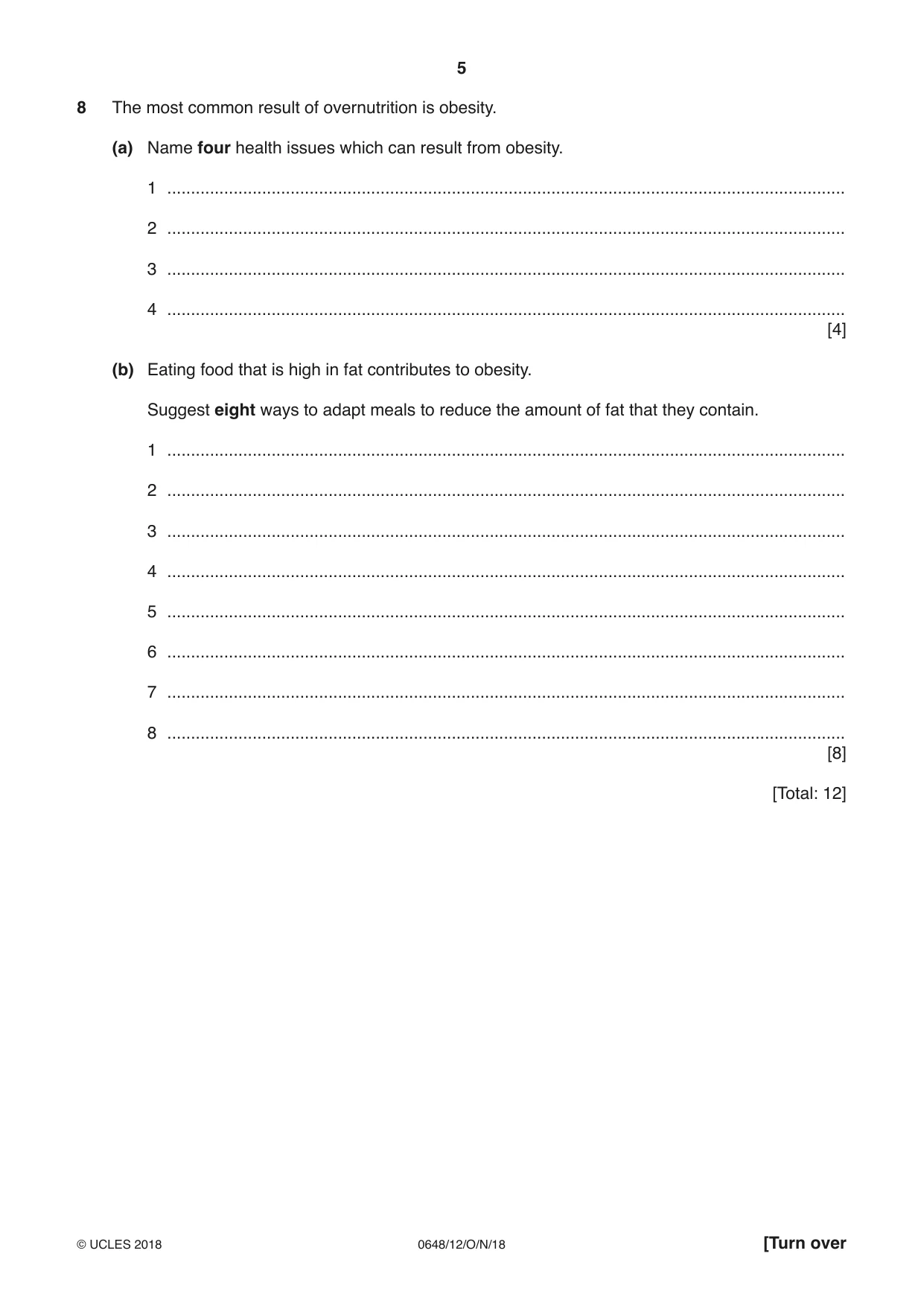
Question paper, page 5
5 0648/12/O/N/18 © UCLES 2018 [Turn over 8 The most common result of overnutrition is obesity. (a) Name four health issues which can result from obesity. 1 … 2 … 3 … 4 … [4] (b) Eating food that is high in fat contributes to obesity. Suggest eight ways to adapt meals to reduce the amount of fat that they contain. 1 … 2 … 3 … 4 … 5 … 6 … 7 … 8 … [8] [Total: 12]
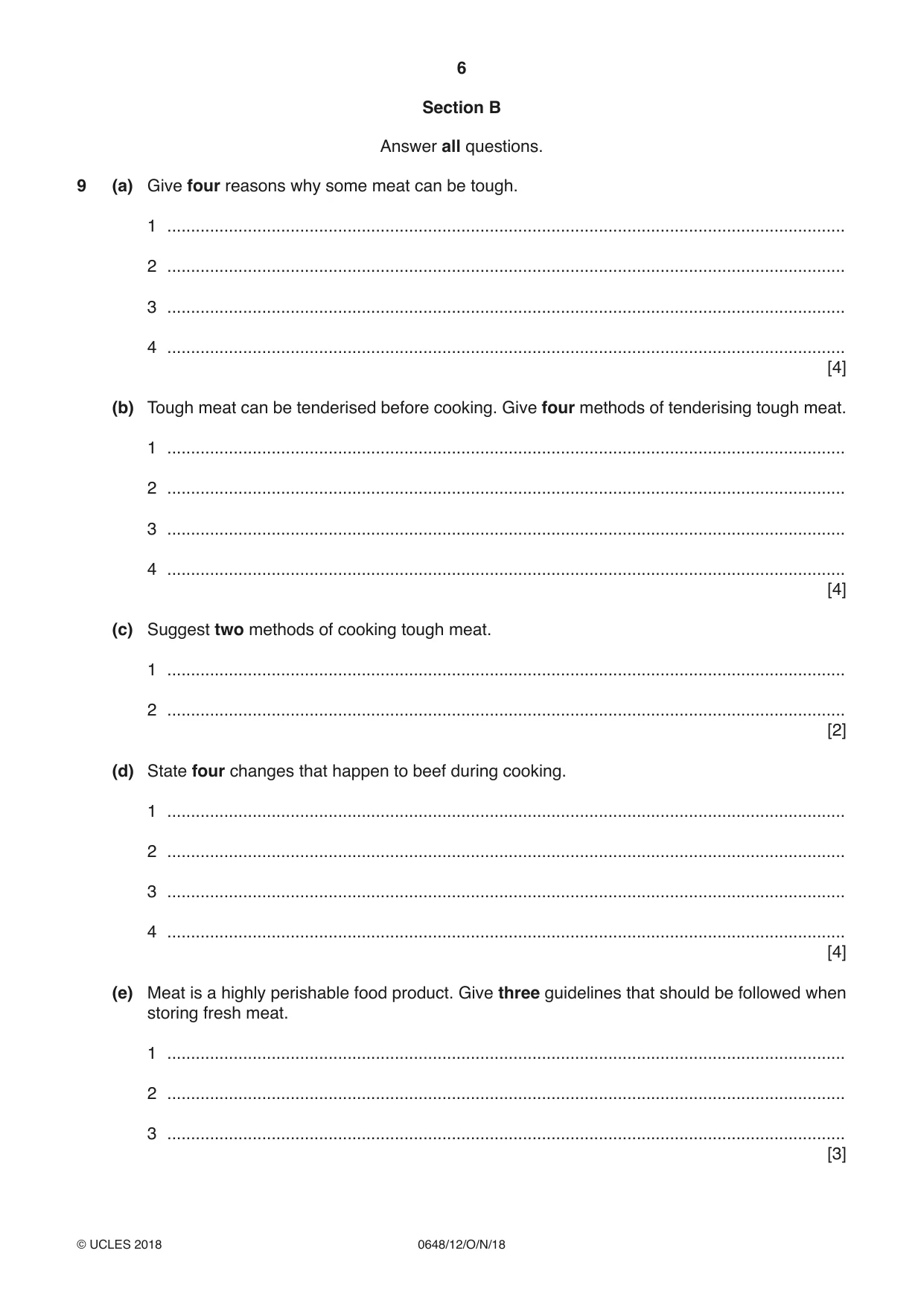
Question paper, page 6
6 0648/12/O/N/18 © UCLES 2018 Section B Answer all questions. 9 (a) Give four reasons why some meat can be tough. 1 … 2 … 3 … 4 … [4] (b) Tough meat can be tenderised before cooking. Give four methods of tenderising tough meat. 1 … 2 … 3 … 4 … [4] (c) Suggest two methods of cooking tough meat. 1 … 2 … [2] (d) State four changes that happen to beef during cooking. 1 … 2 … 3 … 4 … [4] (e) Meat is a highly perishable food product. Give three guidelines that should be followed when storing fresh meat. 1 … 2 … 3 … [3]
Question paper, page 7
7 0648/12/O/N/18 © UCLES 2018 [Turn over (f) State five reasons why some people choose not to eat meat. 1 … 2 … 3 … 4 … 5 … [5] [Total: 22]
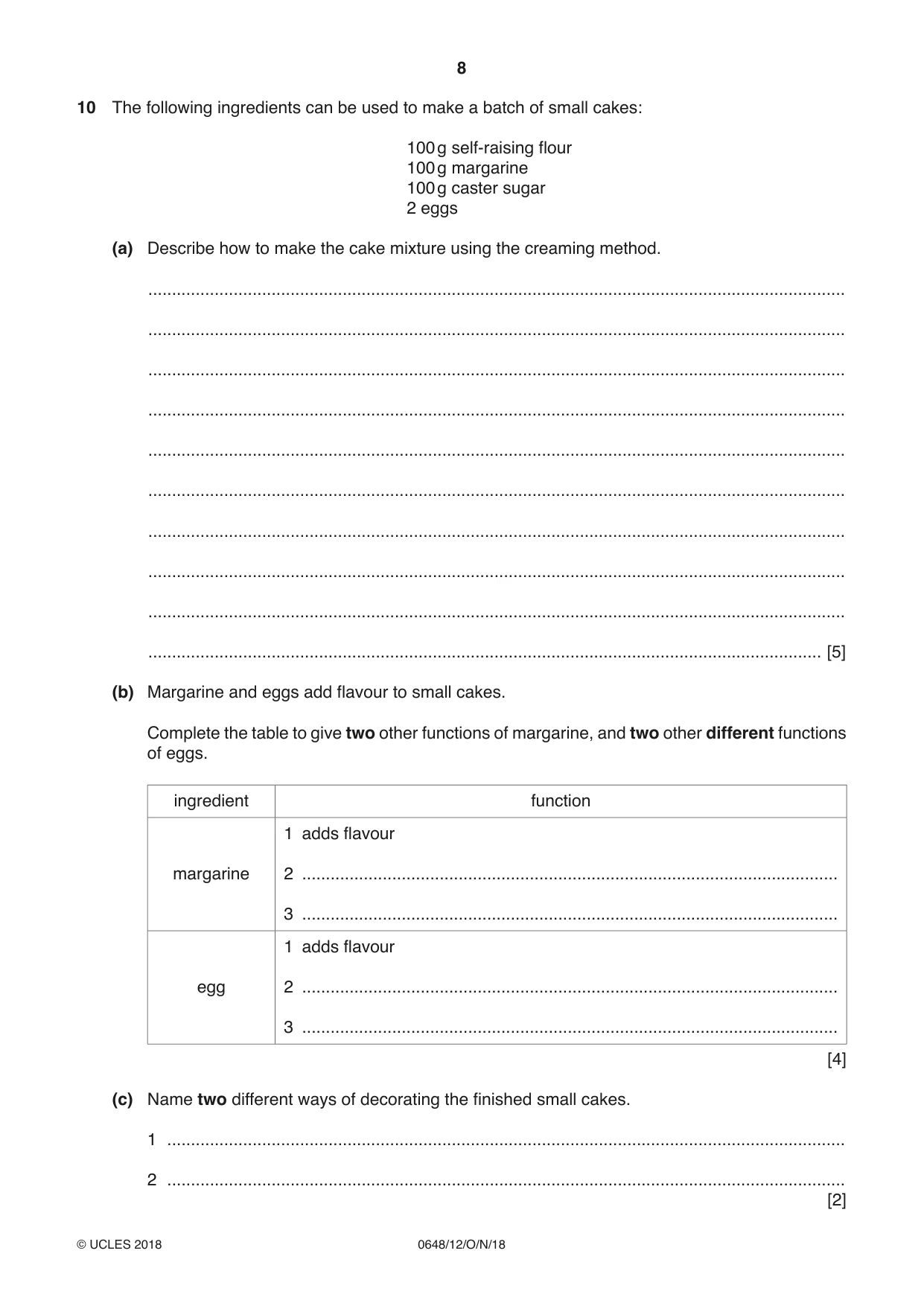
Question paper, page 8
8 0648/12/O/N/18 © UCLES 2018 10 The following ingredients can be used to make a batch of small cakes: 100 g self-raising flour 100 g margarine 100 g caster sugar 2 eggs (a) Describe how to make the cake mixture using the creaming method. … … … … … … … … … … [5] (b) Margarine and eggs add flavour to small cakes. Complete the table to give two other functions of margarine, and two other different functions of eggs. ingredient function margarine 1 adds flavour 2 … 3 … egg 1 adds flavour 2 … 3 … [4] (c) Name two different ways of decorating the finished small cakes. 1 … 2 … [2]
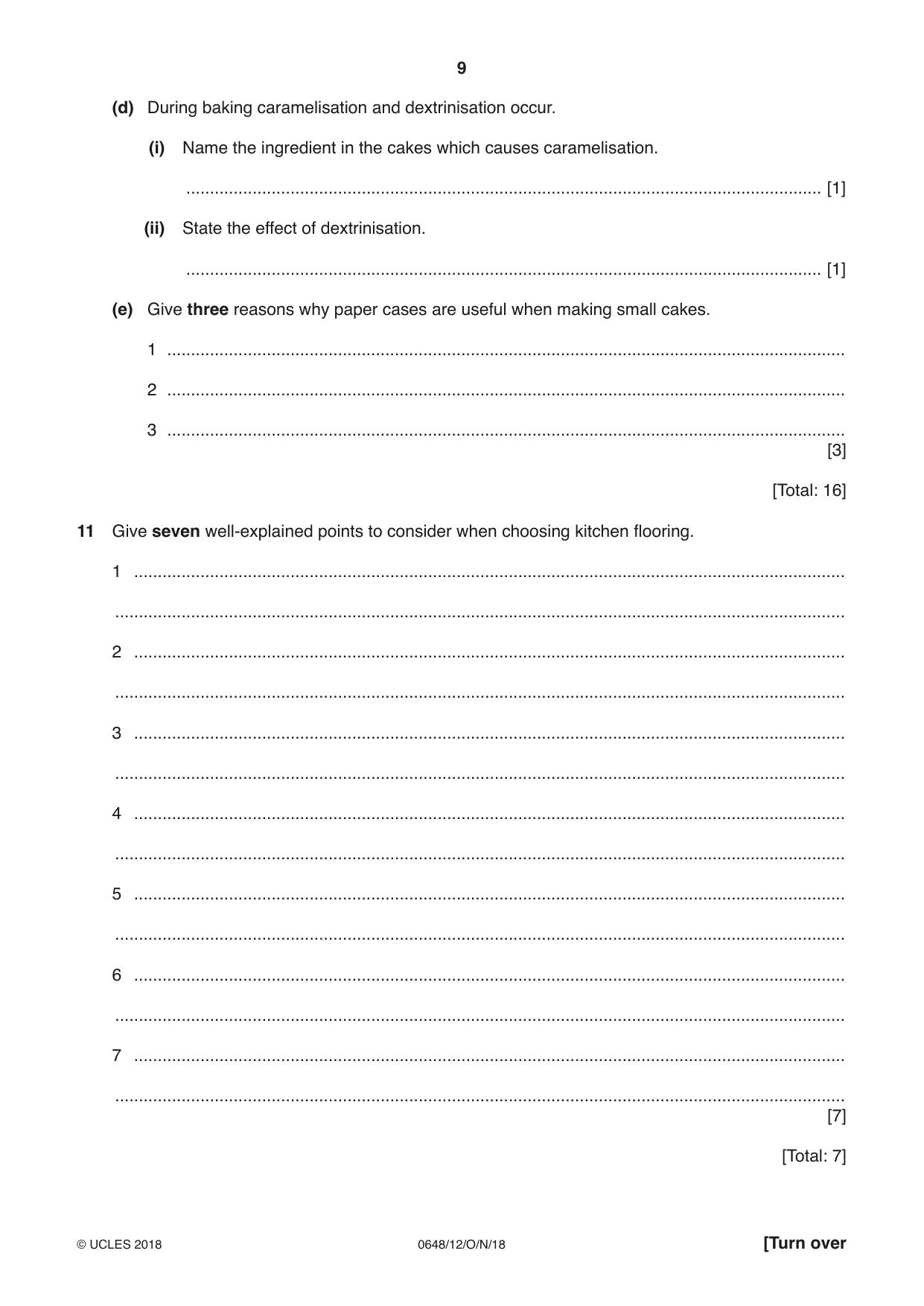
Question paper, page 9
9 0648/12/O/N/18 © UCLES 2018 [Turn over (d) During baking caramelisation and dextrinisation occur. (i) Name the ingredient in the cakes which causes caramelisation. … [1] (ii) State the effect of dextrinisation. … [1] (e) Give three reasons why paper cases are useful when making small cakes. 1 … 2 … 3 … [3] [Total: 16] 11 Give seven well-explained points to consider when choosing kitchen flooring. 1 … … 2 … … 3 … … 4 … … 5 … … 6 … … 7 … … [7] [Total: 7]
Question paper, page 10
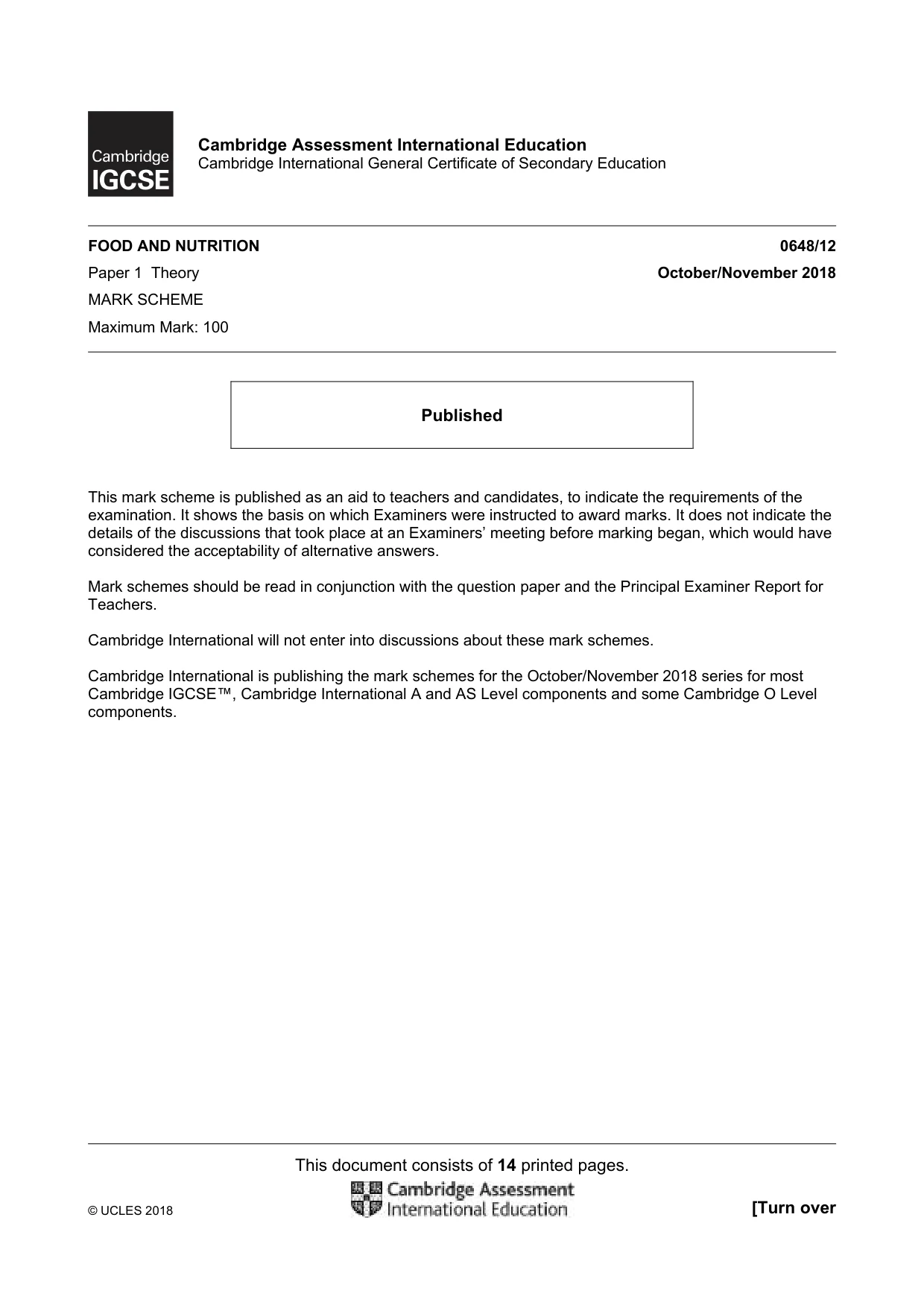
10 0648/12/O/N/18 © UCLES 2018 Section C Answer either Question 12(a) or 12(b). 12 (a) Nutritional needs are one factor to consider when planning meals. Identify and discuss other factors to consider when planning meals for a pre-school child. [15] OR (b) There are many ways to slow down the process of food spoilage and improve the keeping qualities of food. Discuss different processes where the use of a high temperature is the main factor preventing food spoilage. [15] … … … … … … … … … … … … … … … … … … …
Question paper, page 11
11 0648/12/O/N/18 © UCLES 2018 [Turn over … … … … … … … … … … … … … … … … … … … … … … … … … … … …
Question paper, page 12
12 0648/12/O/N/18 © UCLES 2018 … … … … … … … … … … … … … … … … … … … … … … … [Total: 15] Permission to reproduce items where third-party owned material protected by copyright is included has been sought and cleared where possible. Every reasonable effort has been made by the publisher (UCLES) to trace copyright holders, but if any items requiring clearance have unwittingly been included, the publisher will be pleased to make amends at the earliest possible opportunity. To avoid the issue of disclosure of answer-related information to candidates, all copyright acknowledgements are reproduced online in the Cambridge International Examinations Copyright Acknowledgements Booklet. This is produced for each series of examinations and is freely available to download at www.cie.org.uk after the live examination series. Cambridge International Examinations is part of the Cambridge Assessment Group. Cambridge Assessment is the brand name of University of Cambridge Local Examinations Syndicate (UCLES), which is itself a department of the University of Cambridge.
Mark scheme, page 1
This document consists of 14 printed pages. © UCLES 2018 [Turn over Cambridge Assessment International Education Cambridge International General Certificate of Secondary Education FOOD AND NUTRITION 0648/12 Paper 1 Theory October/November 2018 MARK SCHEME Maximum Mark: 100 Published This mark scheme is published as an aid to teachers and candidates, to indicate the requirements of the examination. It shows the basis on which Examiners were instructed to award marks. It does not indicate the details of the discussions that took place at an Examiners’ meeting before marking began, which would have considered the acceptability of alternative answers. Mark schemes should be read in conjunction with the question paper and the Principal Examiner Report for Teachers. Cambridge International will not enter into discussions about these mark schemes. Cambridge International is publishing the mark schemes for the October/November 2018 series for most Cambridge IGCSE™, Cambridge International A and AS Level components and some Cambridge O Level components.
Mark scheme, page 2
0648/12 Cambridge IGCSE – Mark Scheme PUBLISHED October/November 2018 © UCLES 2018 Page 2 of 14 Generic Marking Principles These general marking principles must be applied by all examiners when marking candidate answers. They should be applied alongside the specific content of the mark scheme or generic level descriptors for a question. Each question paper and mark scheme will also comply with these marking principles. GENERIC MARKING PRINCIPLE 1: Marks must be awarded in line with: • the specific content of the mark scheme or the generic level descriptors for the question • the specific skills defined in the mark scheme or in the generic level descriptors for the question • the standard of response required by a candidate as exemplified by the standardisation scripts. GENERIC MARKING PRINCIPLE 2: Marks awarded are always whole marks (not half marks, or other fractions). GENERIC MARKING PRINCIPLE 3: Marks must be awarded positively: • marks are awarded for correct/valid answers, as defined in the mark scheme. However, credit is given for valid answers which go beyond the scope of the syllabus and mark scheme, referring to your Team Leader as appropriate • marks are awarded when candidates clearly demonstrate what they know and can do • marks are not deducted for errors • marks are not deducted for omissions • answers should only be judged on the quality of spelling, punctuation and grammar when these features are specifically assessed by the question as indicated by the mark scheme. The meaning, however, should be unambiguous. GENERIC MARKING PRINCIPLE 4: Rules must be applied consistently e.g. in situations where candidates have not followed instructions or in the application of generic level descriptors.
Mark scheme, page 3
0648/12 Cambridge IGCSE – Mark Scheme PUBLISHED October/November 2018 © UCLES 2018 Page 3 of 14 GENERIC MARKING PRINCIPLE 5: Marks should be awarded using the full range of marks defined in the mark scheme for the question (however; the use of the full mark range may be limited according to the quality of the candidate responses seen). GENERIC MARKING PRINCIPLE 6: Marks awarded are based solely on the requirements as defined in the mark scheme. Marks should not be awarded with grade thresholds or grade descriptors in mind.
Mark scheme, page 4
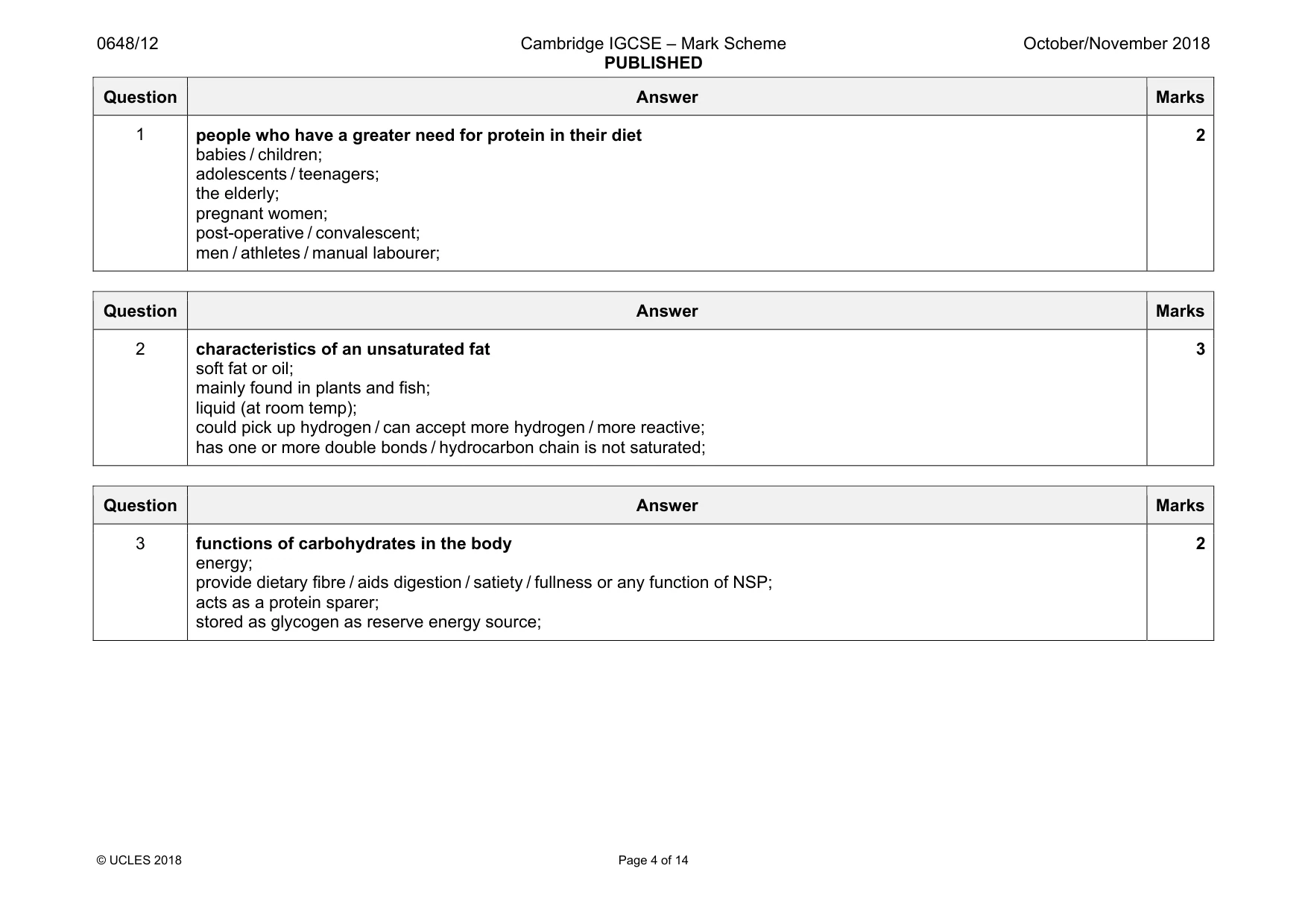
0648/12 Cambridge IGCSE – Mark Scheme PUBLISHED October/November 2018 © UCLES 2018 Page 4 of 14 Question Answer Marks 1 people who have a greater need for protein in their diet babies / children; adolescents / teenagers; the elderly; pregnant women; post-operative / convalescent; men / athletes / manual labourer; 2 Question Answer Marks 2 characteristics of an unsaturated fat soft fat or oil; mainly found in plants and fish; liquid (at room temp); could pick up hydrogen / can accept more hydrogen / more reactive; has one or more double bonds / hydrocarbon chain is not saturated; 3 Question Answer Marks 3 functions of carbohydrates in the body energy; provide dietary fibre / aids digestion / satiety / fullness or any function of NSP; acts as a protein sparer; stored as glycogen as reserve energy source; 2
Mark scheme, page 5
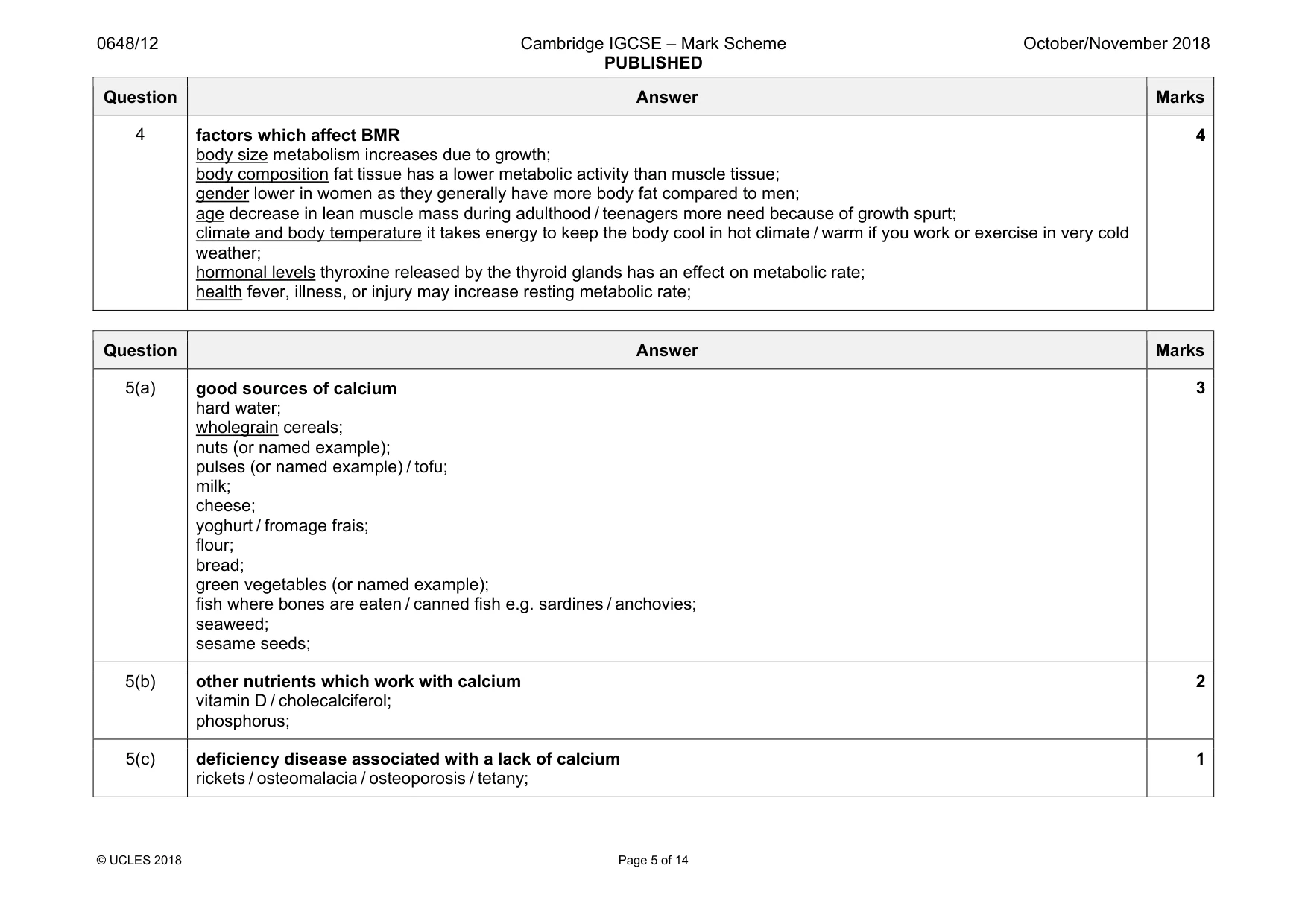
0648/12 Cambridge IGCSE – Mark Scheme PUBLISHED October/November 2018 © UCLES 2018 Page 5 of 14 Question Answer Marks 4 factors which affect BMR body size metabolism increases due to growth; body composition fat tissue has a lower metabolic activity than muscle tissue; gender lower in women as they generally have more body fat compared to men; age decrease in lean muscle mass during adulthood / teenagers more need because of growth spurt; climate and body temperature it takes energy to keep the body cool in hot climate / warm if you work or exercise in very cold weather; hormonal levels thyroxine released by the thyroid glands has an effect on metabolic rate; health fever, illness, or injury may increase resting metabolic rate; 4 Question Answer Marks 5(a) good sources of calcium hard water; wholegrain cereals; nuts (or named example); pulses (or named example) / tofu; milk; cheese; yoghurt / fromage frais; flour; bread; green vegetables (or named example); fish where bones are eaten / canned fish e.g. sardines / anchovies; seaweed; sesame seeds; 3 5(b) other nutrients which work with calcium vitamin D / cholecalciferol; phosphorus; 2 5(c) deficiency disease associated with a lack of calcium rickets / osteomalacia / osteoporosis / tetany; 1
Mark scheme, page 6
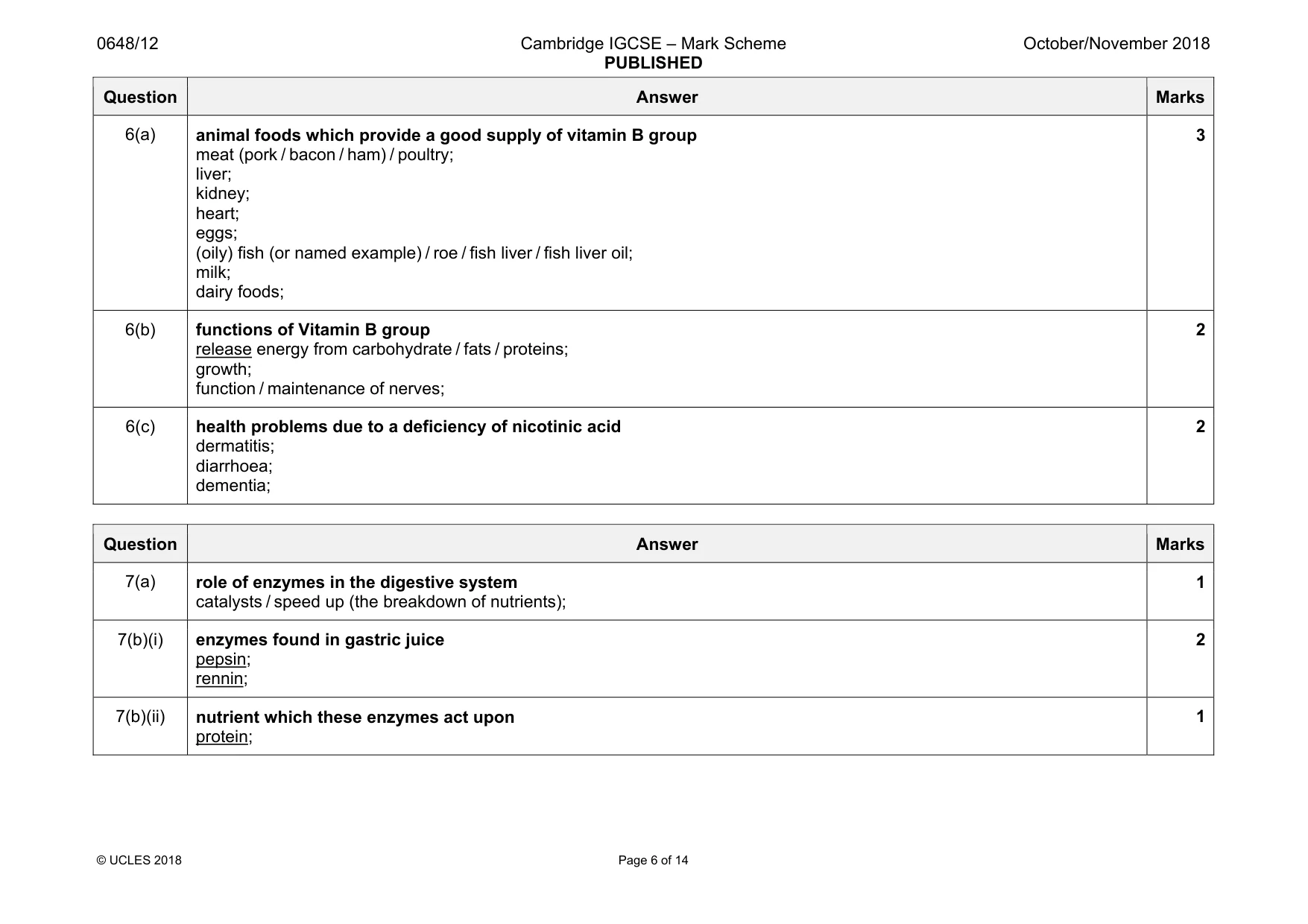
0648/12 Cambridge IGCSE – Mark Scheme PUBLISHED October/November 2018 © UCLES 2018 Page 6 of 14 Question Answer Marks 6(a) animal foods which provide a good supply of vitamin B group meat (pork / bacon / ham) / poultry; liver; kidney; heart; eggs; (oily) fish (or named example) / roe / fish liver / fish liver oil; milk; dairy foods; 3 6(b) functions of Vitamin B group release energy from carbohydrate / fats / proteins; growth; function / maintenance of nerves; 2 6(c) health problems due to a deficiency of nicotinic acid dermatitis; diarrhoea; dementia; 2 Question Answer Marks 7(a) role of enzymes in the digestive system catalysts / speed up (the breakdown of nutrients); 1 7(b)(i) enzymes found in gastric juice pepsin; rennin; 2 7(b)(ii) nutrient which these enzymes act upon protein; 1
Mark scheme, page 7
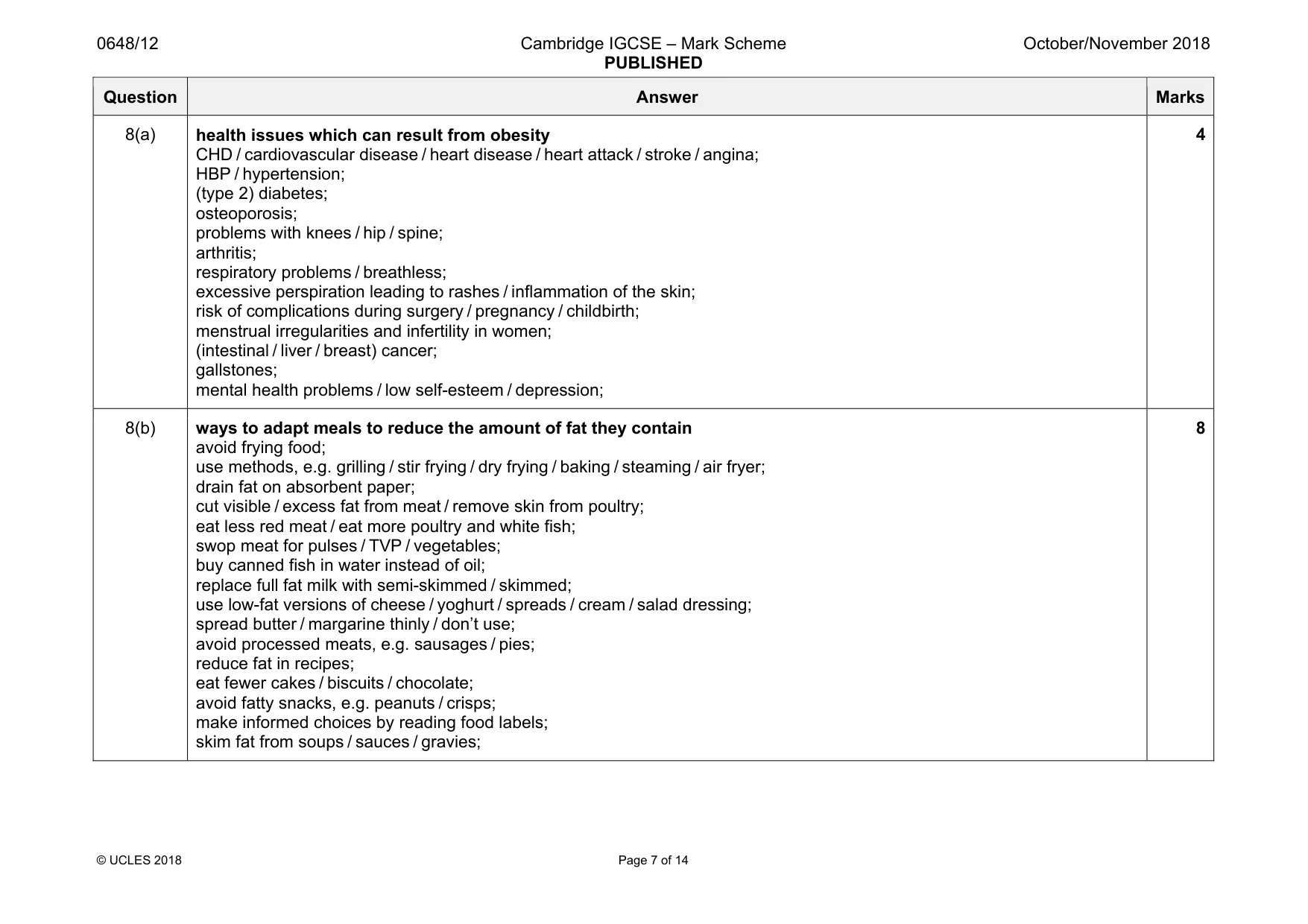
0648/12 Cambridge IGCSE – Mark Scheme PUBLISHED October/November 2018 © UCLES 2018 Page 7 of 14 Question Answer Marks 8(a) health issues which can result from obesity CHD / cardiovascular disease / heart disease / heart attack / stroke / angina; HBP / hypertension; (type 2) diabetes; osteoporosis; problems with knees / hip / spine; arthritis; respiratory problems / breathless; excessive perspiration leading to rashes / inflammation of the skin; risk of complications during surgery / pregnancy / childbirth; menstrual irregularities and infertility in women; (intestinal / liver / breast) cancer; gallstones; mental health problems / low self-esteem / depression; 4 8(b) ways to adapt meals to reduce the amount of fat they contain avoid frying food; use methods, e.g. grilling / stir frying / dry frying / baking / steaming / air fryer; drain fat on absorbent paper; cut visible / excess fat from meat / remove skin from poultry; eat less red meat / eat more poultry and white fish; swop meat for pulses / TVP / vegetables; buy canned fish in water instead of oil; replace full fat milk with semi-skimmed / skimmed; use low-fat versions of cheese / yoghurt / spreads / cream / salad dressing; spread butter / margarine thinly / don’t use; avoid processed meats, e.g. sausages / pies; reduce fat in recipes; eat fewer cakes / biscuits / chocolate; avoid fatty snacks, e.g. peanuts / crisps; make informed choices by reading food labels; skim fat from soups / sauces / gravies; 8
Mark scheme, page 8
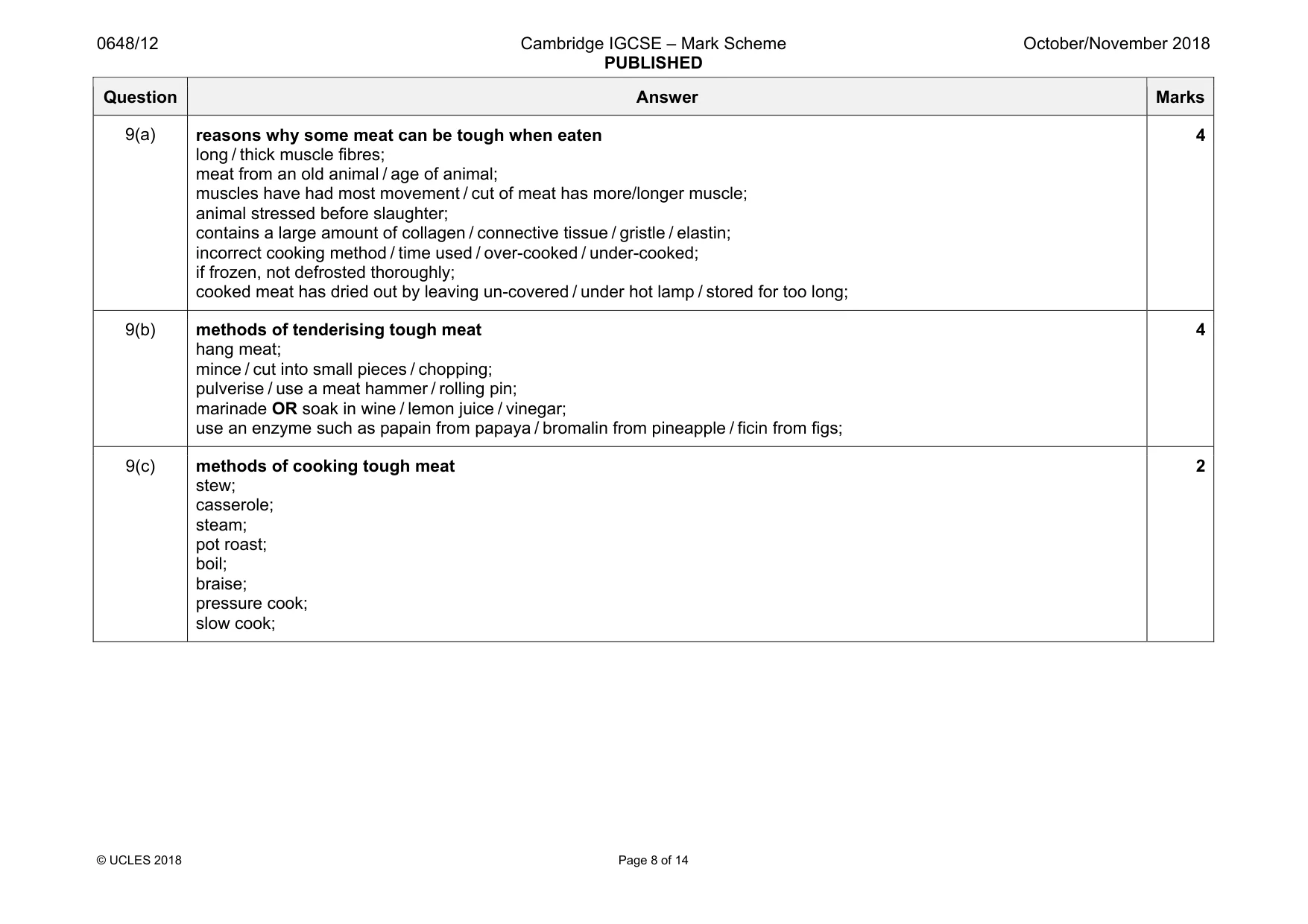
0648/12 Cambridge IGCSE – Mark Scheme PUBLISHED October/November 2018 © UCLES 2018 Page 8 of 14 Question Answer Marks 9(a) reasons why some meat can be tough when eaten long / thick muscle fibres; meat from an old animal / age of animal; muscles have had most movement / cut of meat has more/longer muscle; animal stressed before slaughter; contains a large amount of collagen / connective tissue / gristle / elastin; incorrect cooking method / time used / over-cooked / under-cooked; if frozen, not defrosted thoroughly; cooked meat has dried out by leaving un-covered / under hot lamp / stored for too long; 4 9(b) methods of tenderising tough meat hang meat; mince / cut into small pieces / chopping; pulverise / use a meat hammer / rolling pin; marinade OR soak in wine / lemon juice / vinegar; use an enzyme such as papain from papaya / bromalin from pineapple / ficin from figs; 4 9(c) methods of cooking tough meat stew; casserole; steam; pot roast; boil; braise; pressure cook; slow cook; 2
Mark scheme, page 9
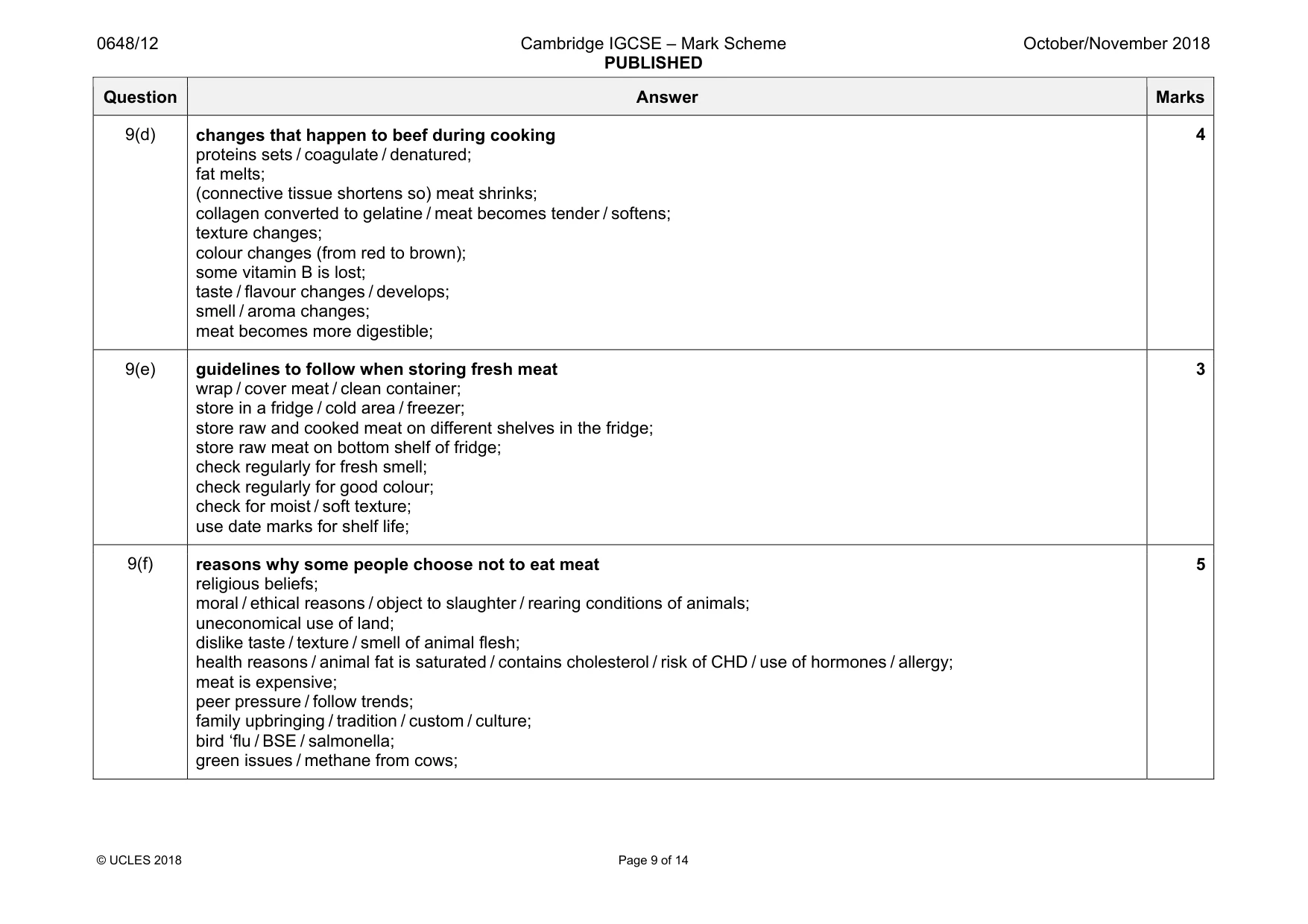
0648/12 Cambridge IGCSE – Mark Scheme PUBLISHED October/November 2018 © UCLES 2018 Page 9 of 14 Question Answer Marks 9(d) changes that happen to beef during cooking proteins sets / coagulate / denatured; fat melts; (connective tissue shortens so) meat shrinks; collagen converted to gelatine / meat becomes tender / softens; texture changes; colour changes (from red to brown); some vitamin B is lost; taste / flavour changes / develops; smell / aroma changes; meat becomes more digestible; 4 9(e) guidelines to follow when storing fresh meat wrap / cover meat / clean container; store in a fridge / cold area / freezer; store raw and cooked meat on different shelves in the fridge; store raw meat on bottom shelf of fridge; check regularly for fresh smell; check regularly for good colour; check for moist / soft texture; use date marks for shelf life; 3 9(f) reasons why some people choose not to eat meat religious beliefs; moral / ethical reasons / object to slaughter / rearing conditions of animals; uneconomical use of land; dislike taste / texture / smell of animal flesh; health reasons / animal fat is saturated / contains cholesterol / risk of CHD / use of hormones / allergy; meat is expensive; peer pressure / follow trends; family upbringing / tradition / custom / culture; bird ‘flu / BSE / salmonella; green issues / methane from cows; 5
Mark scheme, page 10
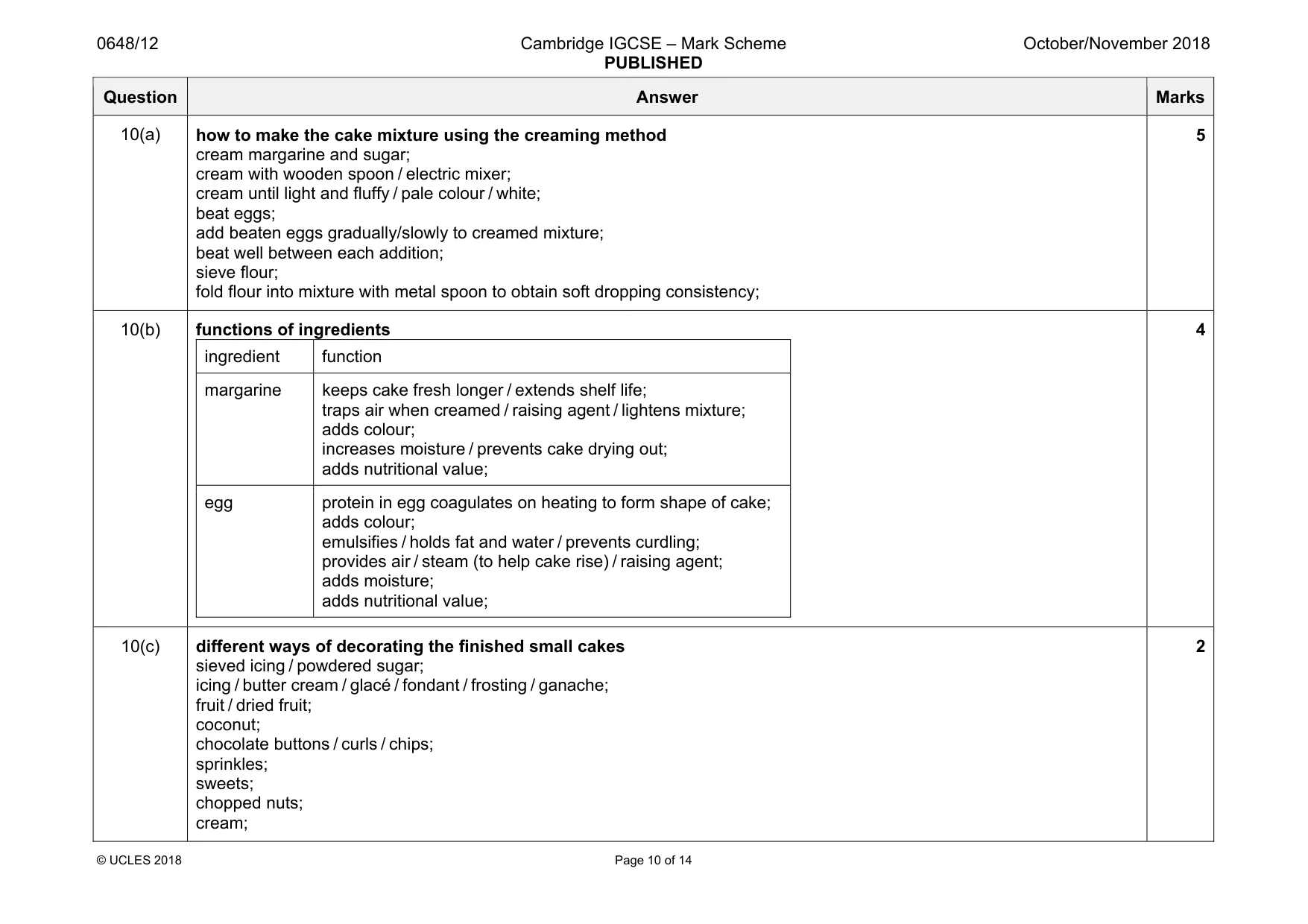
0648/12 Cambridge IGCSE – Mark Scheme PUBLISHED October/November 2018 © UCLES 2018 Page 10 of 14 Question Answer Marks 10(a) how to make the cake mixture using the creaming method cream margarine and sugar; cream with wooden spoon / electric mixer; cream until light and fluffy / pale colour / white; beat eggs; add beaten eggs gradually/slowly to creamed mixture; beat well between each addition; sieve flour; fold flour into mixture with metal spoon to obtain soft dropping consistency; 5 10(b) functions of ingredients ingredient function margarine keeps cake fresh longer / extends shelf life; traps air when creamed / raising agent / lightens mixture; adds colour; increases moisture / prevents cake drying out; adds nutritional value; egg protein in egg coagulates on heating to form shape of cake; adds colour; emulsifies / holds fat and water / prevents curdling; provides air / steam (to help cake rise) / raising agent; adds moisture; adds nutritional value; 4 10(c) different ways of decorating the finished small cakes sieved icing / powdered sugar; icing / butter cream / glacé / fondant / frosting / ganache; fruit / dried fruit; coconut; chocolate buttons / curls / chips; sprinkles; sweets; chopped nuts; cream; 2
Mark scheme, page 11
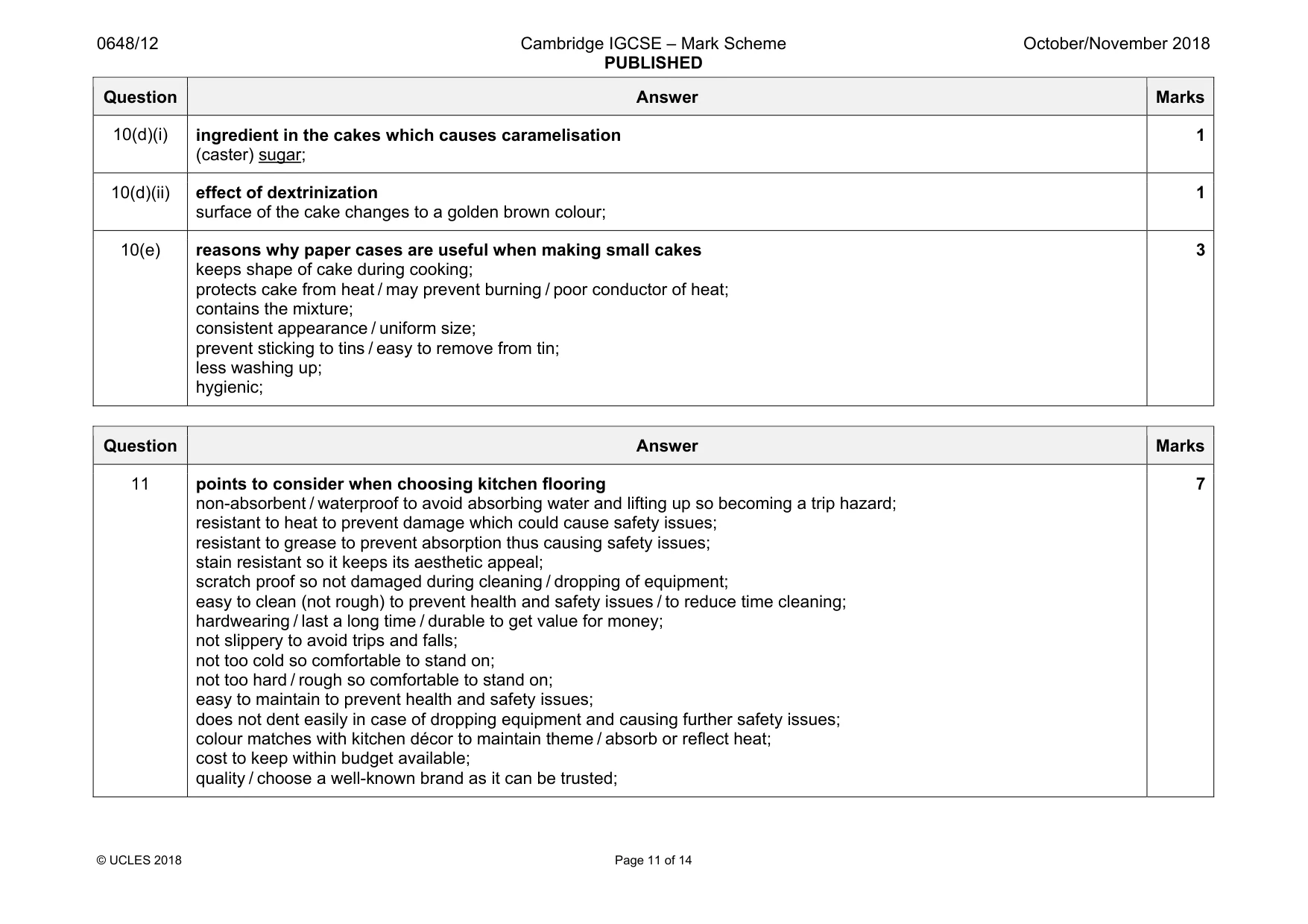
0648/12 Cambridge IGCSE – Mark Scheme PUBLISHED October/November 2018 © UCLES 2018 Page 11 of 14 Question Answer Marks 10(d)(i) ingredient in the cakes which causes caramelisation (caster) sugar; 1 10(d)(ii) effect of dextrinization surface of the cake changes to a golden brown colour; 1 10(e) reasons why paper cases are useful when making small cakes keeps shape of cake during cooking; protects cake from heat / may prevent burning / poor conductor of heat; contains the mixture; consistent appearance / uniform size; prevent sticking to tins / easy to remove from tin; less washing up; hygienic; 3 Question Answer Marks 11 points to consider when choosing kitchen flooring non-absorbent / waterproof to avoid absorbing water and lifting up so becoming a trip hazard; resistant to heat to prevent damage which could cause safety issues; resistant to grease to prevent absorption thus causing safety issues; stain resistant so it keeps its aesthetic appeal; scratch proof so not damaged during cleaning / dropping of equipment; easy to clean (not rough) to prevent health and safety issues / to reduce time cleaning; hardwearing / last a long time / durable to get value for money; not slippery to avoid trips and falls; not too cold so comfortable to stand on; not too hard / rough so comfortable to stand on; easy to maintain to prevent health and safety issues; does not dent easily in case of dropping equipment and causing further safety issues; colour matches with kitchen décor to maintain theme / absorb or reflect heat; cost to keep within budget available; quality / choose a well-known brand as it can be trusted; 7
Mark scheme, page 12
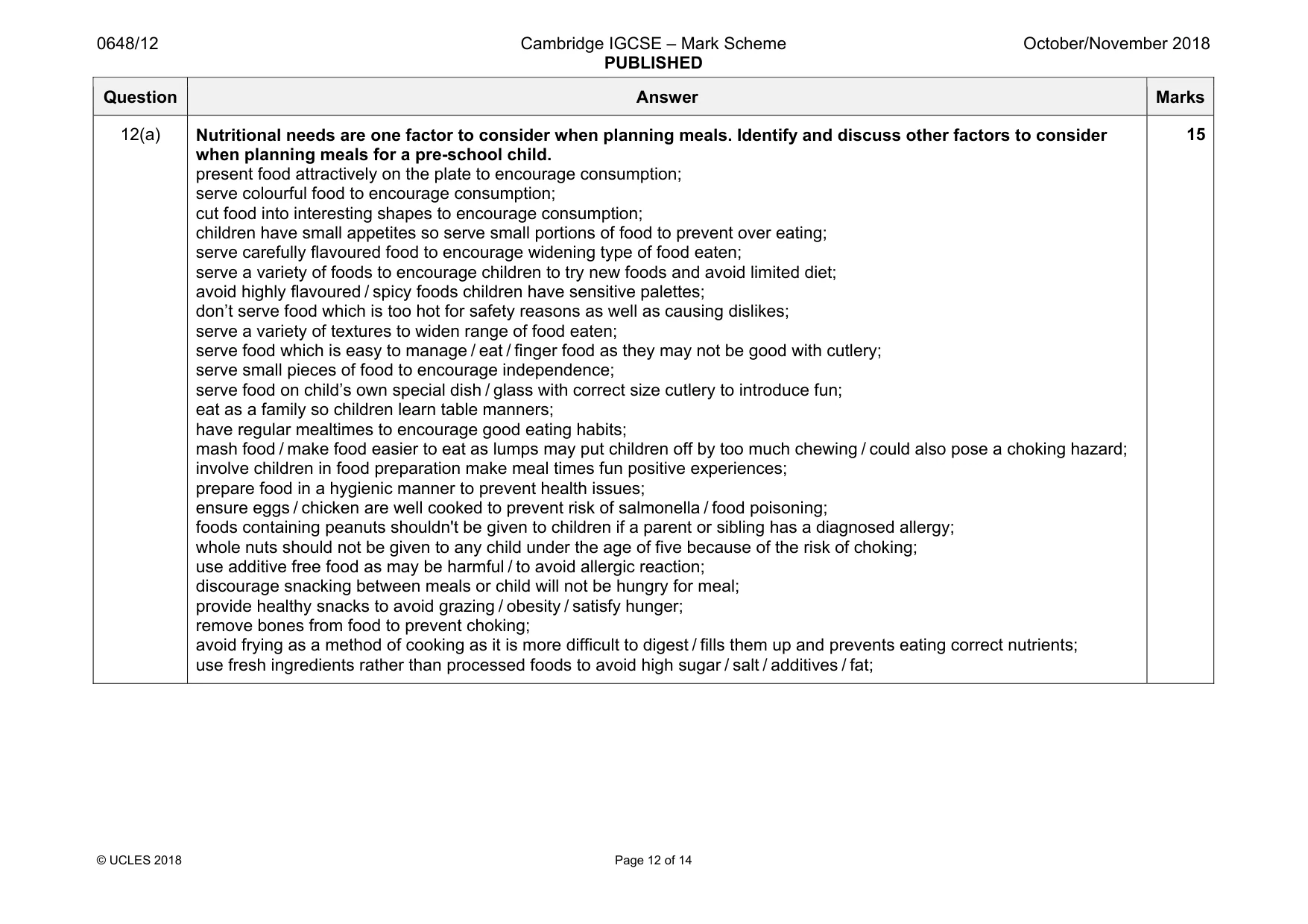
0648/12 Cambridge IGCSE – Mark Scheme PUBLISHED October/November 2018 © UCLES 2018 Page 12 of 14 Question Answer Marks 12(a) Nutritional needs are one factor to consider when planning meals. Identify and discuss other factors to consider when planning meals for a pre-school child. present food attractively on the plate to encourage consumption; serve colourful food to encourage consumption; cut food into interesting shapes to encourage consumption; children have small appetites so serve small portions of food to prevent over eating; serve carefully flavoured food to encourage widening type of food eaten; serve a variety of foods to encourage children to try new foods and avoid limited diet; avoid highly flavoured / spicy foods children have sensitive palettes; don’t serve food which is too hot for safety reasons as well as causing dislikes; serve a variety of textures to widen range of food eaten; serve food which is easy to manage / eat / finger food as they may not be good with cutlery; serve small pieces of food to encourage independence; serve food on child’s own special dish / glass with correct size cutlery to introduce fun; eat as a family so children learn table manners; have regular mealtimes to encourage good eating habits; mash food / make food easier to eat as lumps may put children off by too much chewing / could also pose a choking hazard; involve children in food preparation make meal times fun positive experiences; prepare food in a hygienic manner to prevent health issues; ensure eggs / chicken are well cooked to prevent risk of salmonella / food poisoning; foods containing peanuts shouldn't be given to children if a parent or sibling has a diagnosed allergy; whole nuts should not be given to any child under the age of five because of the risk of choking; use additive free food as may be harmful / to avoid allergic reaction; discourage snacking between meals or child will not be hungry for meal; provide healthy snacks to avoid grazing / obesity / satisfy hunger; remove bones from food to prevent choking; avoid frying as a method of cooking as it is more difficult to digest / fills them up and prevents eating correct nutrients; use fresh ingredients rather than processed foods to avoid high sugar / salt / additives / fat; 15
Mark scheme, page 13
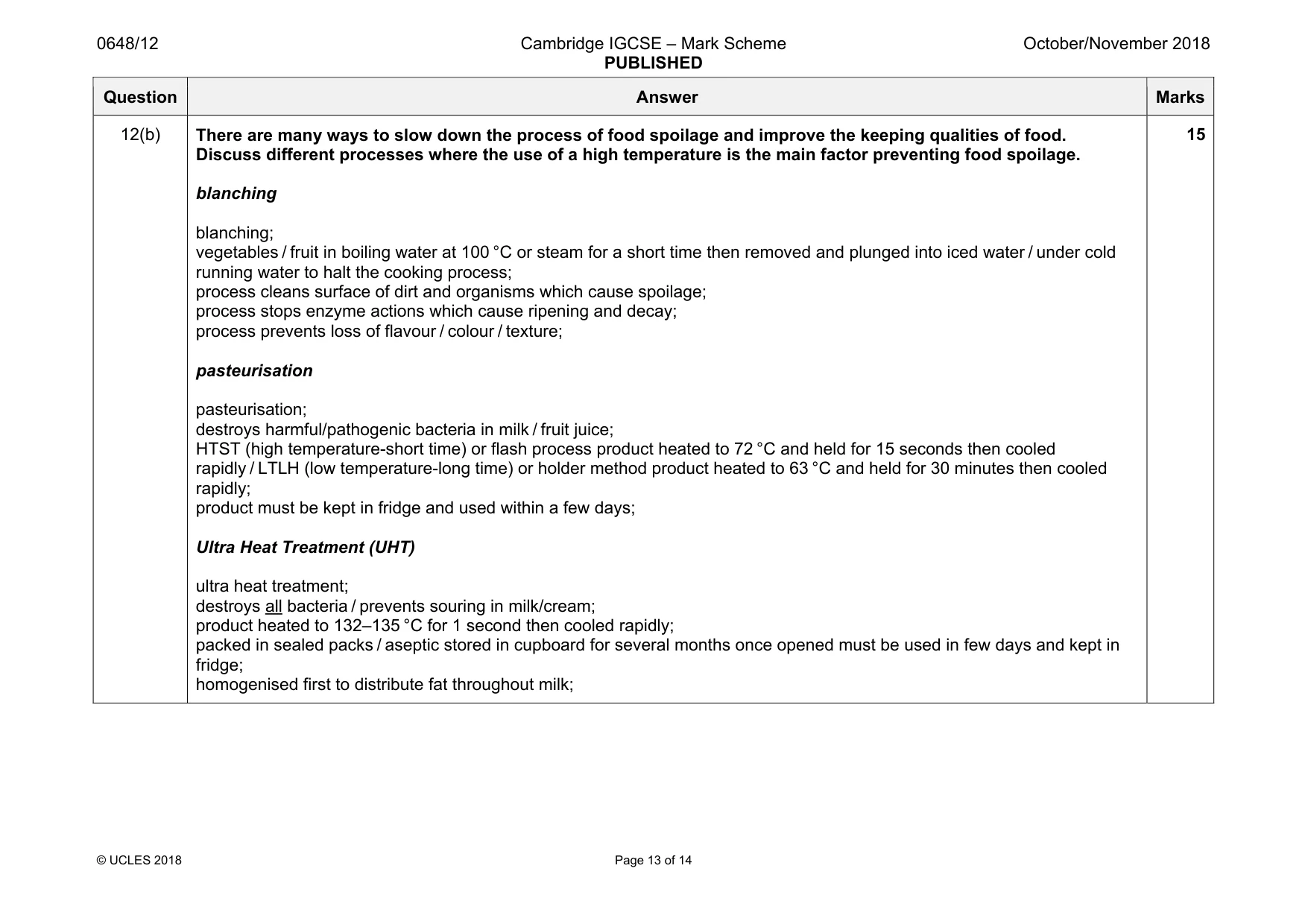
0648/12 Cambridge IGCSE – Mark Scheme PUBLISHED October/November 2018 © UCLES 2018 Page 13 of 14 Question Answer Marks 12(b) There are many ways to slow down the process of food spoilage and improve the keeping qualities of food. Discuss different processes where the use of a high temperature is the main factor preventing food spoilage. blanching blanching; vegetables / fruit in boiling water at 100 °C or steam for a short time then removed and plunged into iced water / under cold running water to halt the cooking process; process cleans surface of dirt and organisms which cause spoilage; process stops enzyme actions which cause ripening and decay; process prevents loss of flavour / colour / texture; pasteurisation pasteurisation; destroys harmful/pathogenic bacteria in milk / fruit juice; HTST (high temperature-short time) or flash process product heated to 72 °C and held for 15 seconds then cooled rapidly / LTLH (low temperature-long time) or holder method product heated to 63 °C and held for 30 minutes then cooled rapidly; product must be kept in fridge and used within a few days; Ultra Heat Treatment (UHT) ultra heat treatment; destroys all bacteria / prevents souring in milk/cream; product heated to 132–135 °C for 1 second then cooled rapidly; packed in sealed packs / aseptic stored in cupboard for several months once opened must be used in few days and kept in fridge; homogenised first to distribute fat throughout milk; 15
Mark scheme, page 14
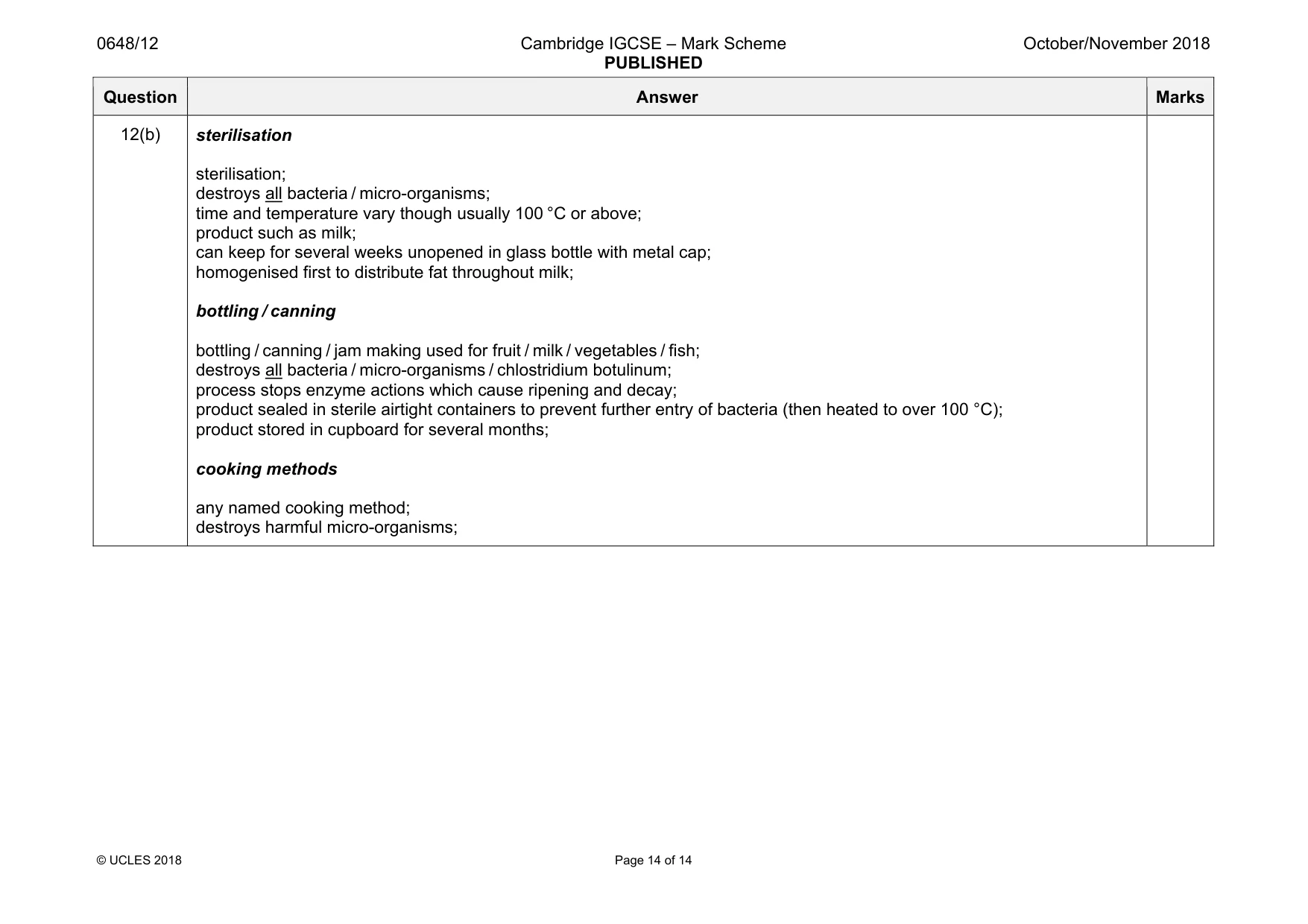
0648/12 Cambridge IGCSE – Mark Scheme PUBLISHED October/November 2018 © UCLES 2018 Page 14 of 14 Question Answer Marks 12(b) sterilisation sterilisation; destroys all bacteria / micro-organisms; time and temperature vary though usually 100 °C or above; product such as milk; can keep for several weeks unopened in glass bottle with metal cap; homogenised first to distribute fat throughout milk; bottling / canning bottling / canning / jam making used for fruit / milk / vegetables / fish; destroys all bacteria / micro-organisms / chlostridium botulinum; process stops enzyme actions which cause ripening and decay; product sealed in sterile airtight containers to prevent further entry of bacteria (then heated to over 100 °C); product stored in cupboard for several months; cooking methods any named cooking method; destroys harmful micro-organisms;
What you needed in this session
Cambridge’s own grade thresholds for 2018 Oct/Nov, Paper 1 · Variant 2. A higher threshold means an easier paper — the bar moves with how the cohort did.