Cambridge IGCSE Food and Nutrition 0648 — 2018 Oct/Nov Paper 1 · Variant 3
0648/13/O/N/18 · 100 marks · ≈113 min
The question paper and its mark scheme, free to read here and free to download. This is Cambridge’s own paper, exactly as it was sat.
Question paper16 pages




Mark scheme18 pages
Answers below. Sit the paper first if you are practising.
Paper as text
Question paper, page 1
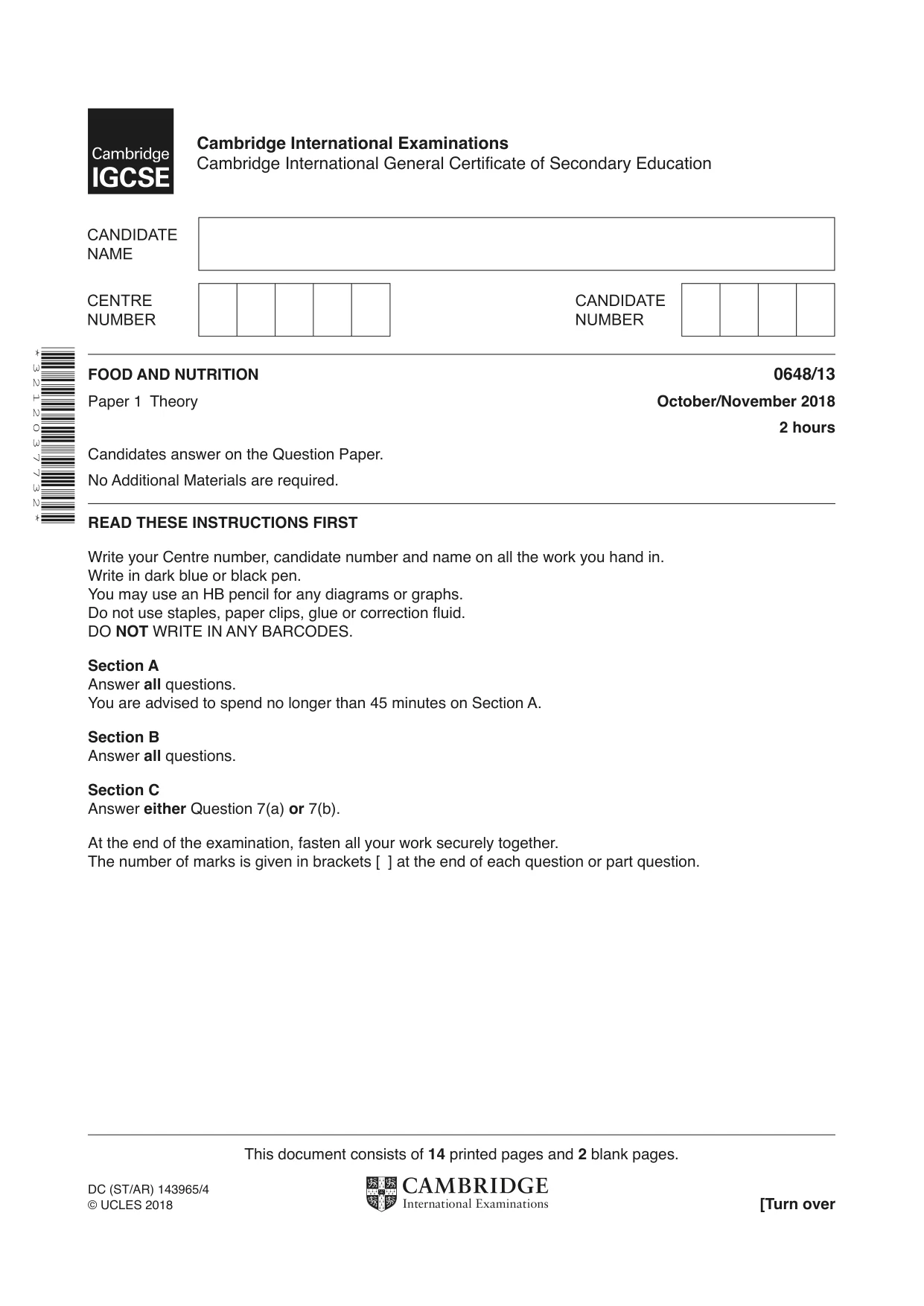
* 3 2 1 2 0 3 7 7 3 2 * This document consists of 14 printed pages and 2 blank pages. DC (ST/AR) 143965/4 © UCLES 2018 [Turn over Cambridge International Examinations Cambridge International General Certificate of Secondary Education FOOD AND NUTRITION 0648/13 Paper 1 Theory October/November 2018 2 hours Candidates answer on the Question Paper. No Additional Materials are required. READ THESE INSTRUCTIONS FIRST Write your Centre number, candidate number and name on all the work you hand in. Write in dark blue or black pen. You may use an HB pencil for any diagrams or graphs. Do not use staples, paper clips, glue or correction fluid. DO NOT WRITE IN ANY BARCODES. Section A Answer all questions. You are advised to spend no longer than 45 minutes on Section A. Section B Answer all questions. Section C Answer either Question 7(a) or 7(b). At the end of the examination, fasten all your work securely together. The number of marks is given in brackets [ ] at the end of each question or part question.
Question paper, page 2
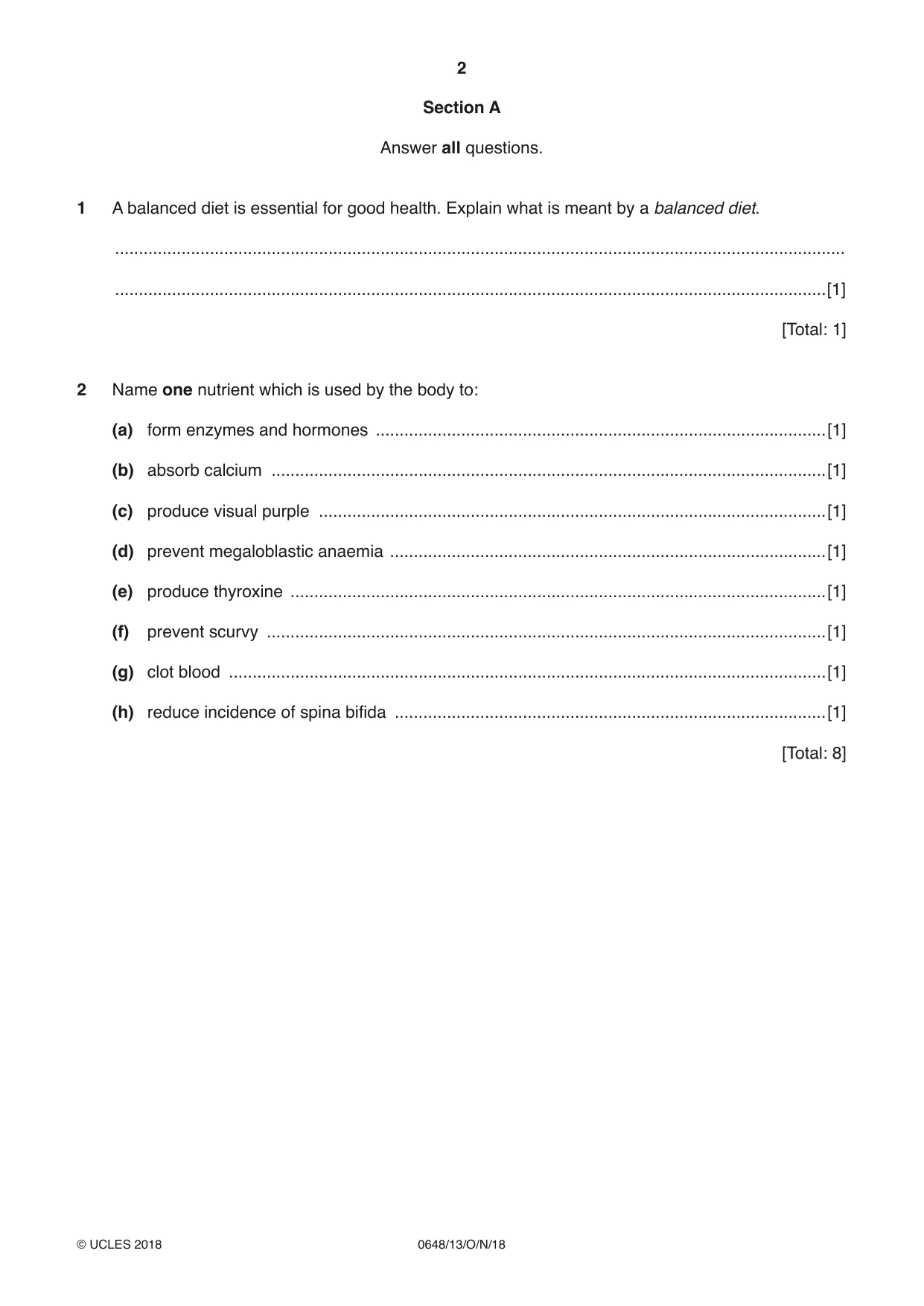
2 0648/13/O/N/18 © UCLES 2018 Section A Answer all questions. 1 A balanced diet is essential for good health. Explain what is meant by a balanced diet. … …[1] [Total: 1] 2 Name one nutrient which is used by the body to: (a) form enzymes and hormones …[1] (b) absorb calcium …[1] (c) produce visual purple …[1] (d) prevent megaloblastic anaemia …[1] (e) produce thyroxine …[1] (f) prevent scurvy …[1] (g) clot blood …[1] (h) reduce incidence of spina bifida …[1] [Total: 8]
Question paper, page 3
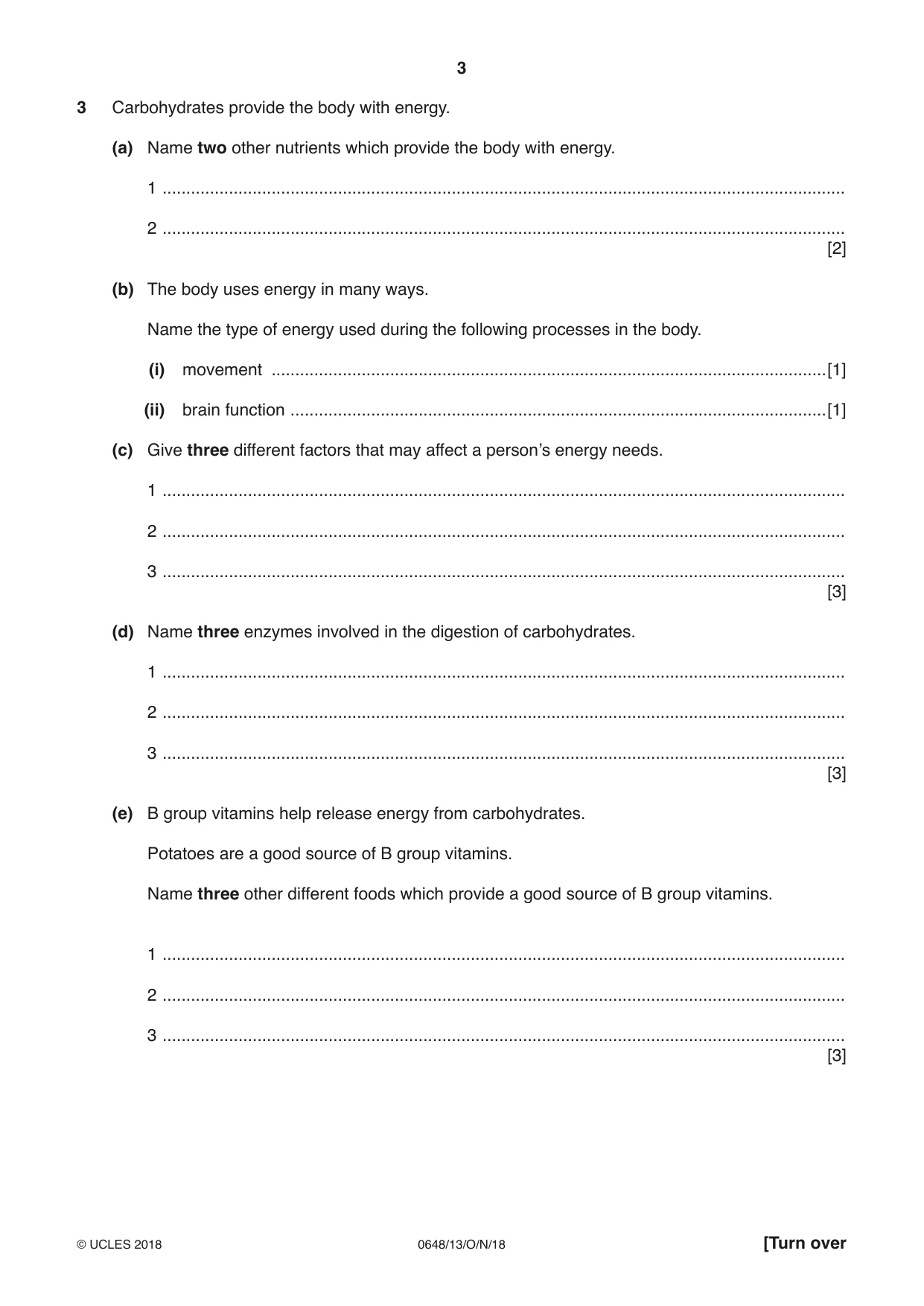
3 0648/13/O/N/18 © UCLES 2018 [Turn over 3 Carbohydrates provide the body with energy. (a) Name two other nutrients which provide the body with energy. 1 … 2 … [2] (b) The body uses energy in many ways. Name the type of energy used during the following processes in the body. (i) movement …[1] (ii) brain function …[1] (c) Give three different factors that may affect a person’s energy needs. 1 … 2 … 3 … [3] (d) Name three enzymes involved in the digestion of carbohydrates. 1 … 2 … 3 … [3] (e) B group vitamins help release energy from carbohydrates. Potatoes are a good source of B group vitamins. Name three other different foods which provide a good source of B group vitamins. 1 … 2 … 3 … [3]
Question paper, page 4
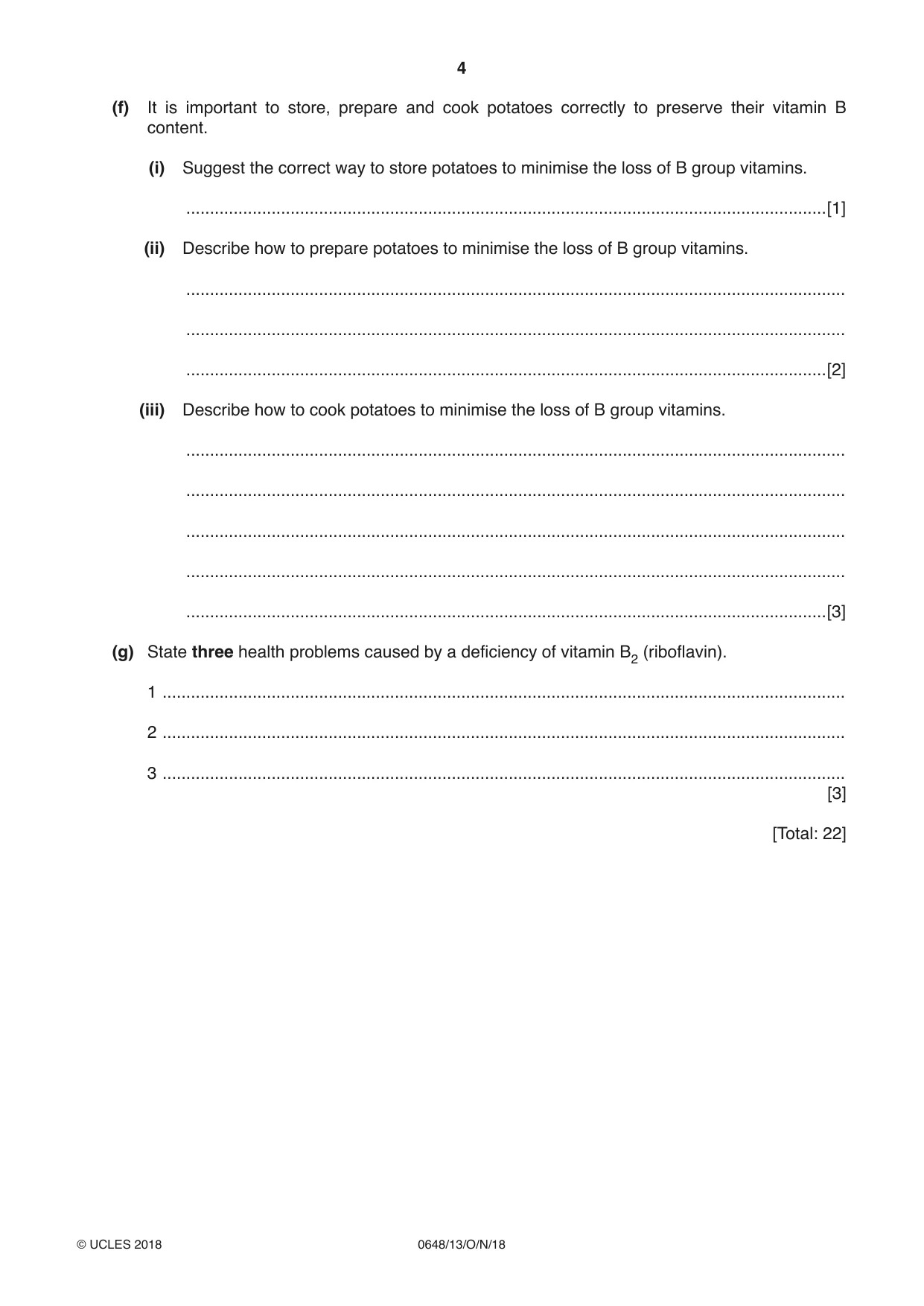
4 0648/13/O/N/18 © UCLES 2018 (f) It is important to store, prepare and cook potatoes correctly to preserve their vitamin B content. (i) Suggest the correct way to store potatoes to minimise the loss of B group vitamins. …[1] (ii) Describe how to prepare potatoes to minimise the loss of B group vitamins. … … …[2] (iii) Describe how to cook potatoes to minimise the loss of B group vitamins. … … … … …[3] (g) State three health problems caused by a deficiency of vitamin B2 (riboflavin). 1 … 2 … 3 … [3] [Total: 22]
Question paper, page 5
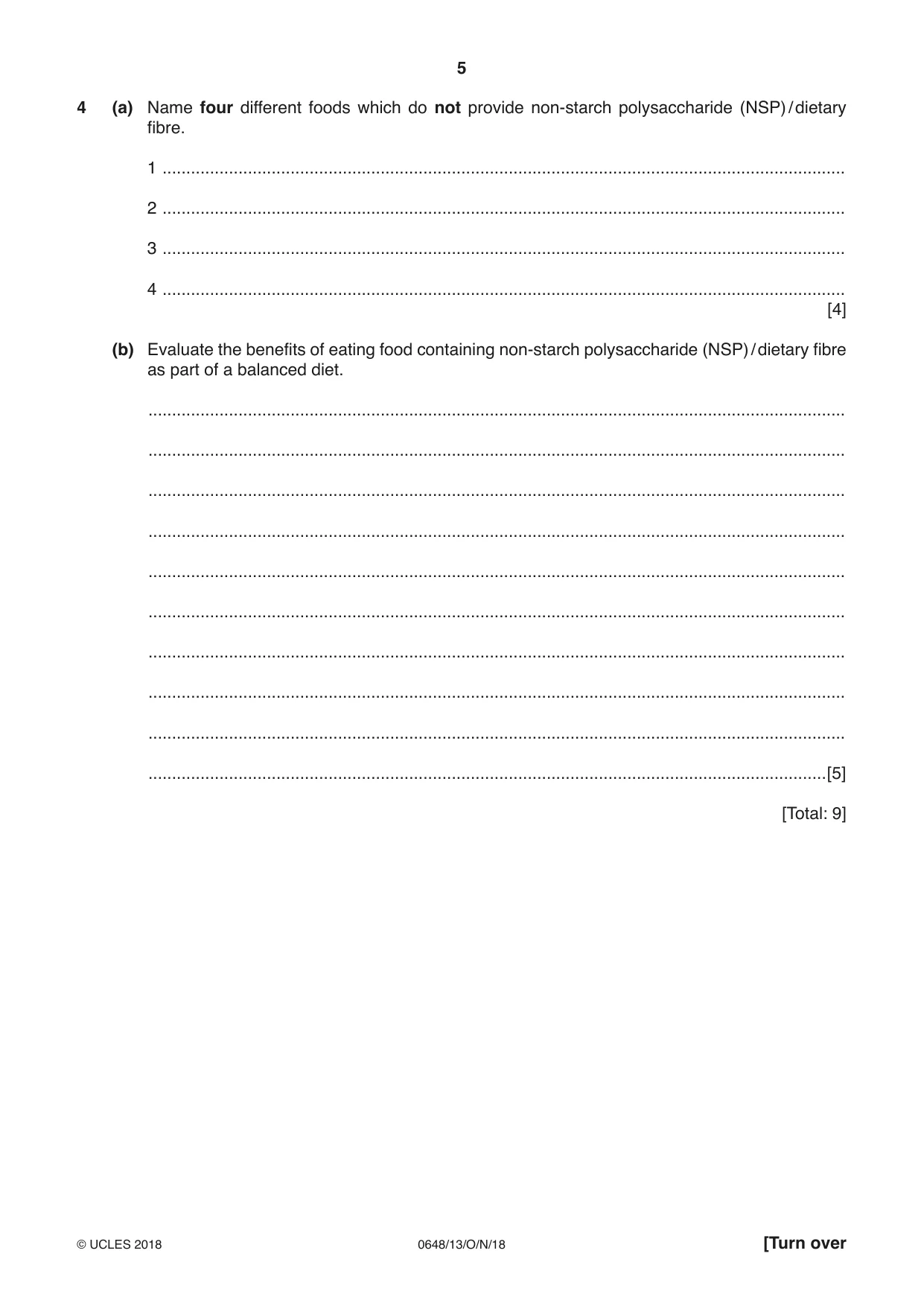
5 0648/13/O/N/18 © UCLES 2018 [Turn over 4 (a) Name four different foods which do not provide non-starch polysaccharide (NSP) / dietary fibre. 1 … 2 … 3 … 4 … [4] (b) Evaluate the benefits of eating food containing non-starch polysaccharide (NSP) / dietary fibre as part of a balanced diet. … … … … … … … … … …[5] [Total: 9]
Question paper, page 6
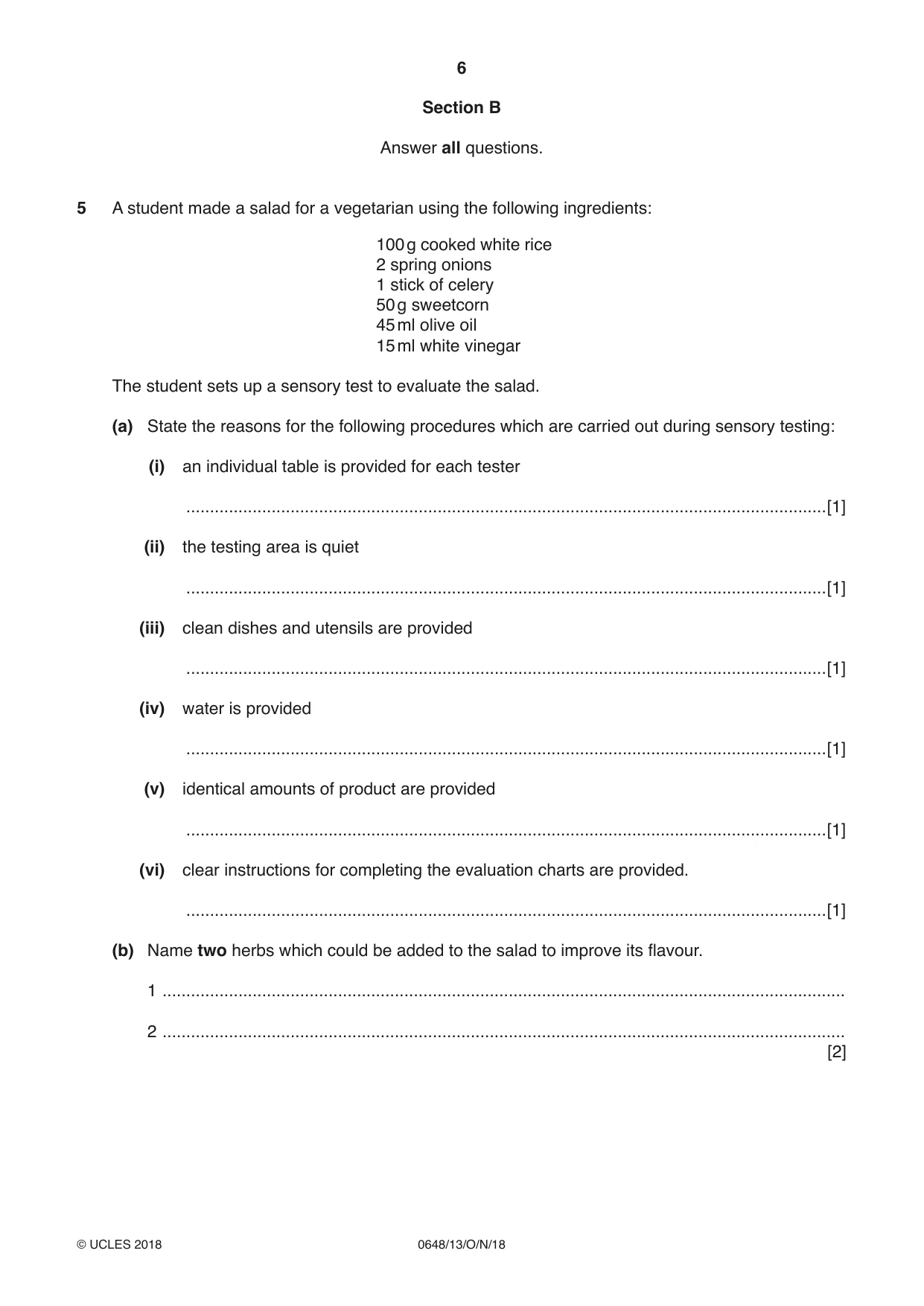
6 0648/13/O/N/18 © UCLES 2018 Section B Answer all questions. 5 A student made a salad for a vegetarian using the following ingredients: 100 g cooked white rice 2 spring onions 1 stick of celery 50 g sweetcorn 45 ml olive oil 15 ml white vinegar The student sets up a sensory test to evaluate the salad. (a) State the reasons for the following procedures which are carried out during sensory testing: (i) an individual table is provided for each tester …[1] (ii) the testing area is quiet …[1] (iii) clean dishes and utensils are provided …[1] (iv) water is provided …[1] (v) identical amounts of product are provided …[1] (vi) clear instructions for completing the evaluation charts are provided. …[1] (b) Name two herbs which could be added to the salad to improve its flavour. 1 … 2 … [2]
Question paper, page 7
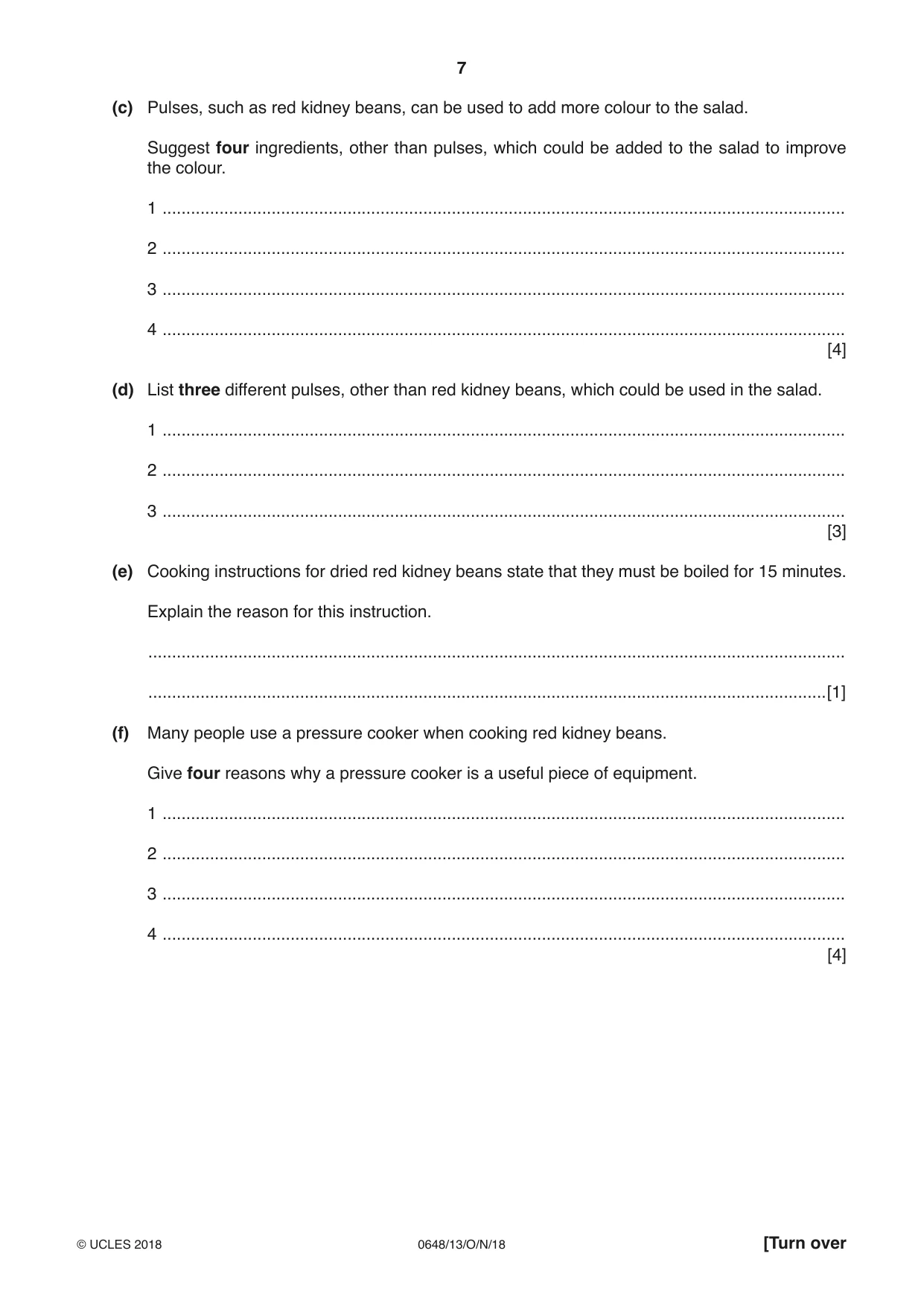
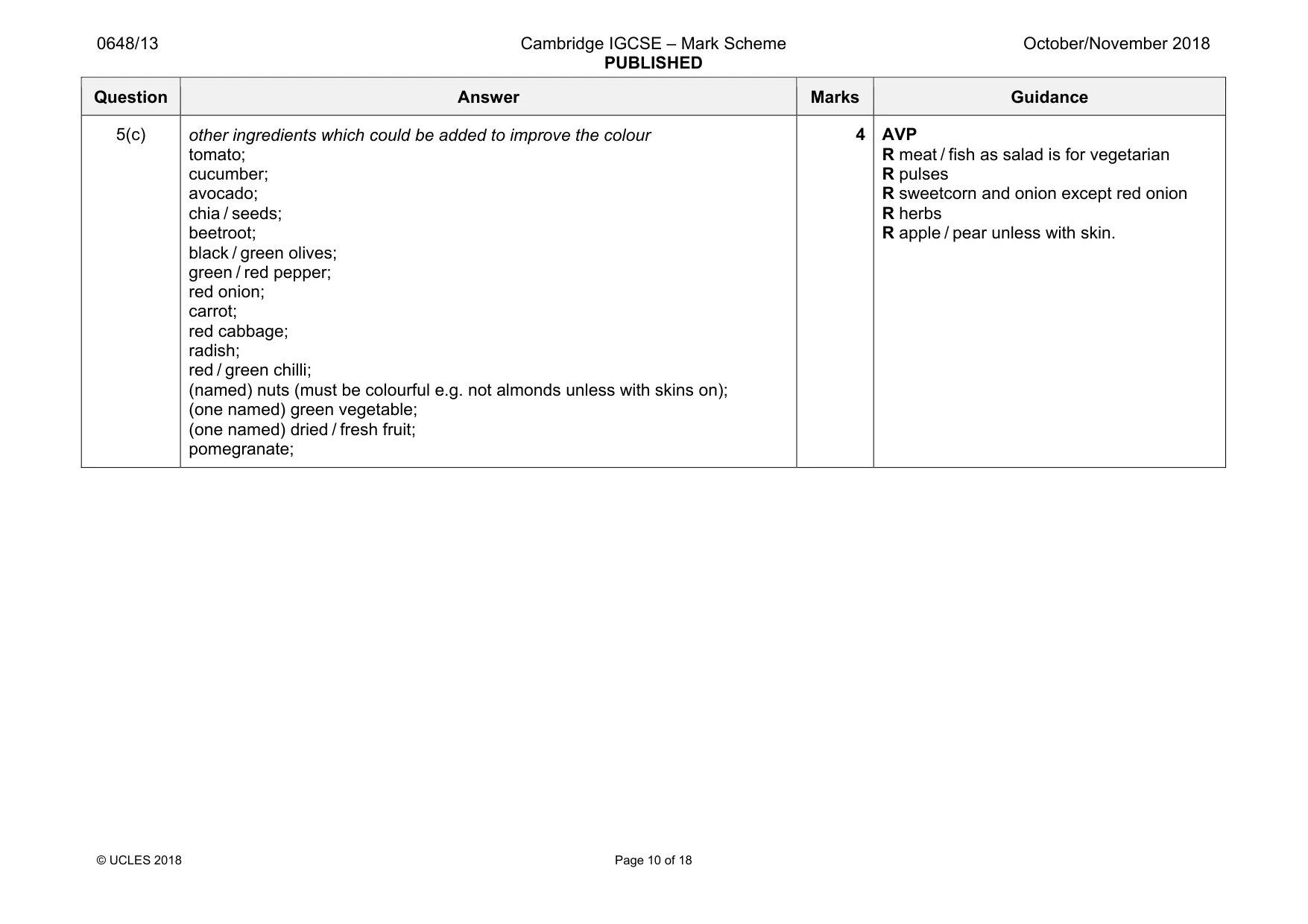
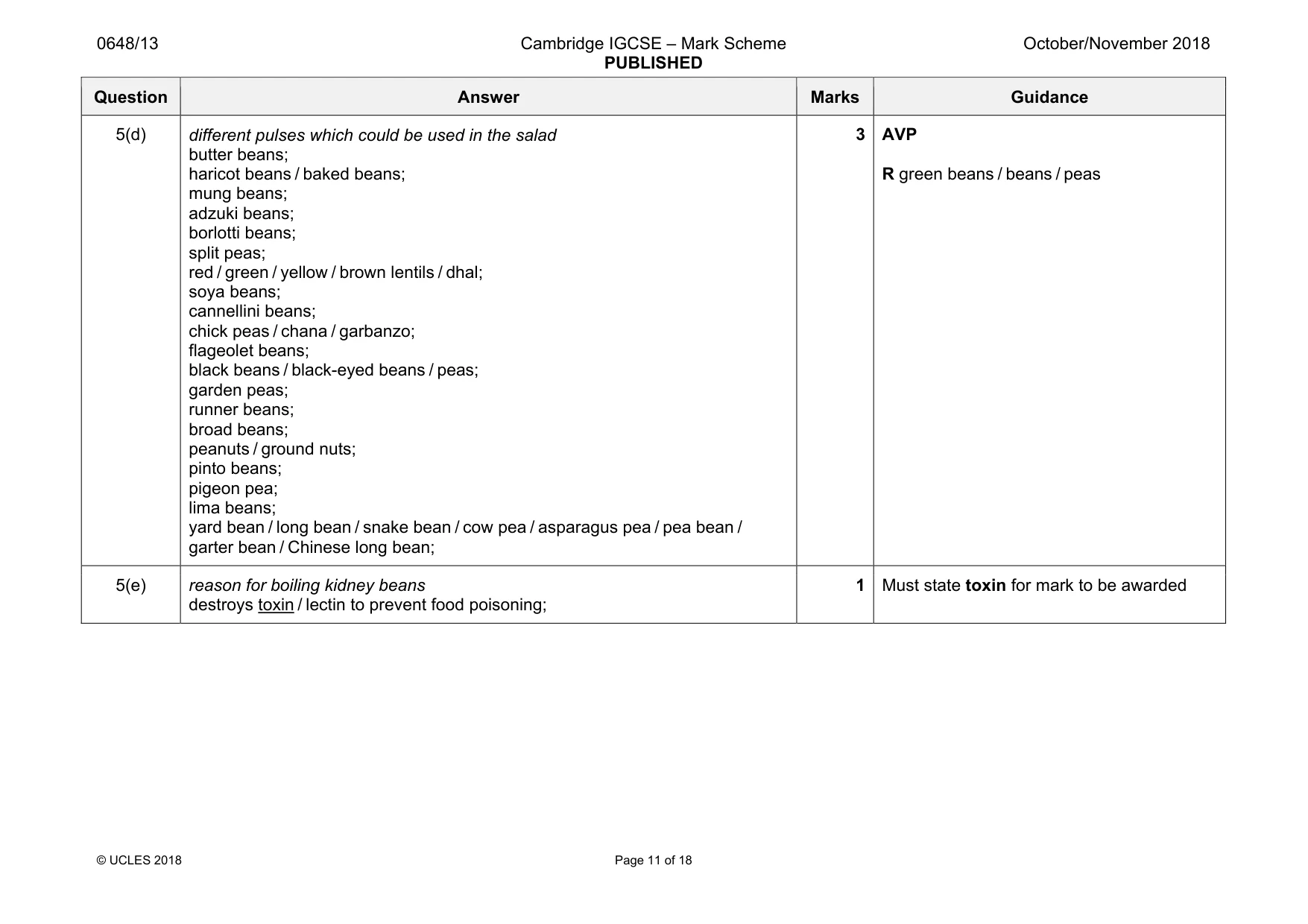
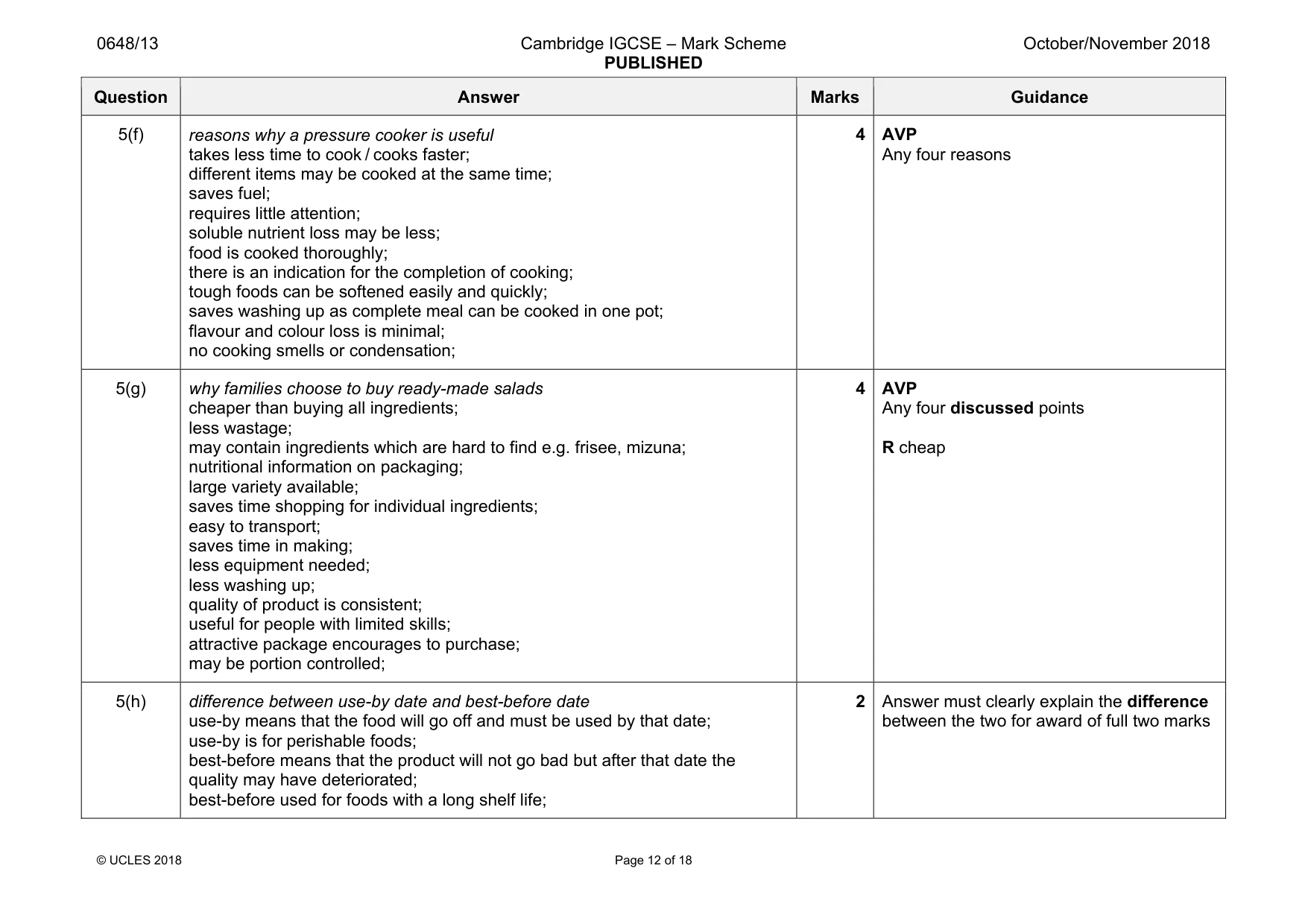
7 0648/13/O/N/18 © UCLES 2018 [Turn over (c) Pulses, such as red kidney beans, can be used to add more colour to the salad. Suggest four ingredients, other than pulses, which could be added to the salad to improve the colour. 1 … 2 … 3 … 4 … [4] (d) List three different pulses, other than red kidney beans, which could be used in the salad. 1 … 2 … 3 … [3] (e) Cooking instructions for dried red kidney beans state that they must be boiled for 15 minutes. Explain the reason for this instruction. … …[1] (f) Many people use a pressure cooker when cooking red kidney beans. Give four reasons why a pressure cooker is a useful piece of equipment. 1 … 2 … 3 … 4 … [4]
Question paper, page 8
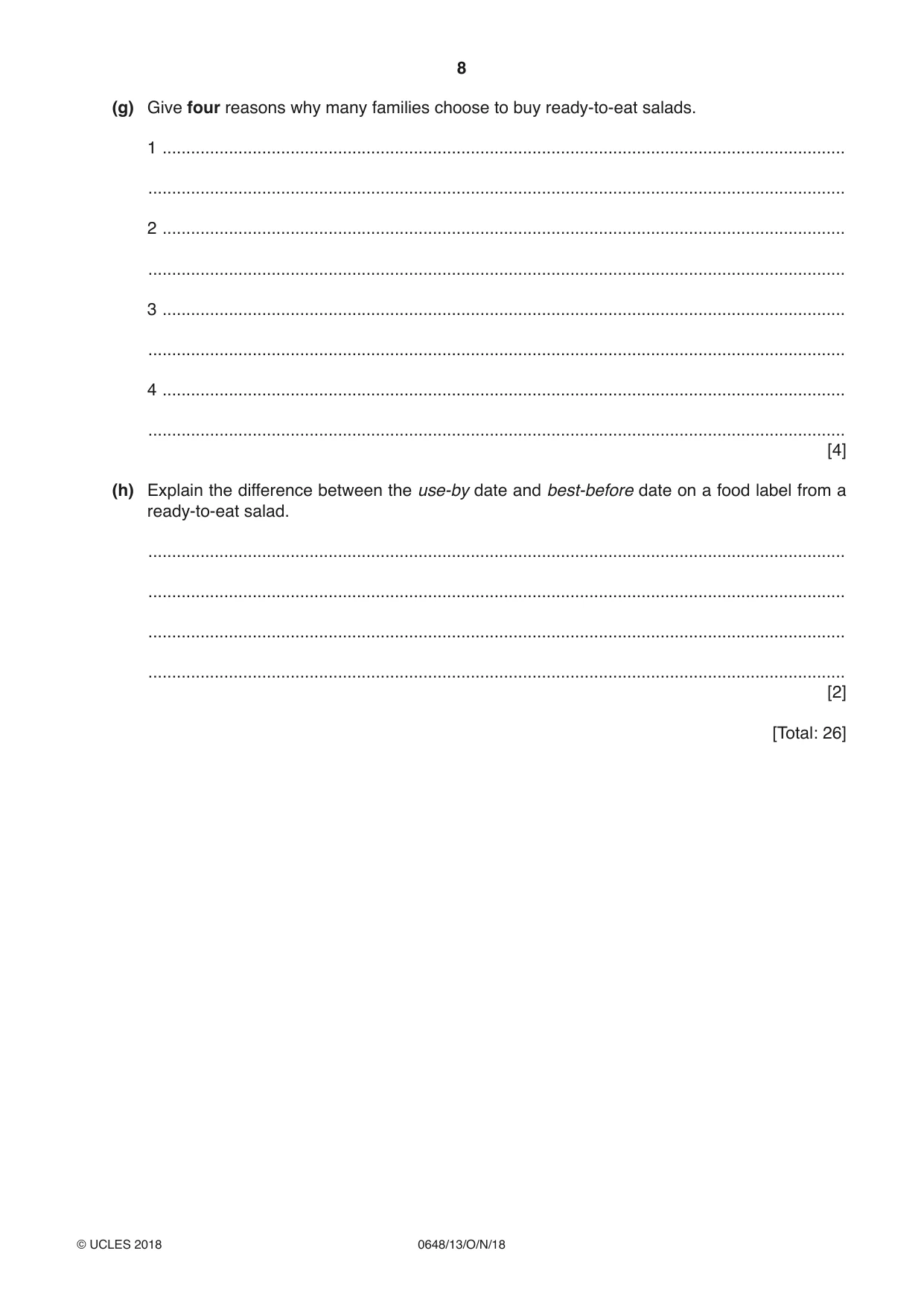
8 0648/13/O/N/18 © UCLES 2018 (g) Give four reasons why many families choose to buy ready-to-eat salads. 1 … … 2 … … 3 … … 4 … … [4] (h) Explain the difference between the use-by date and best-before date on a food label from a ready-to-eat salad. … … … … [2] [Total: 26]
Question paper, page 9
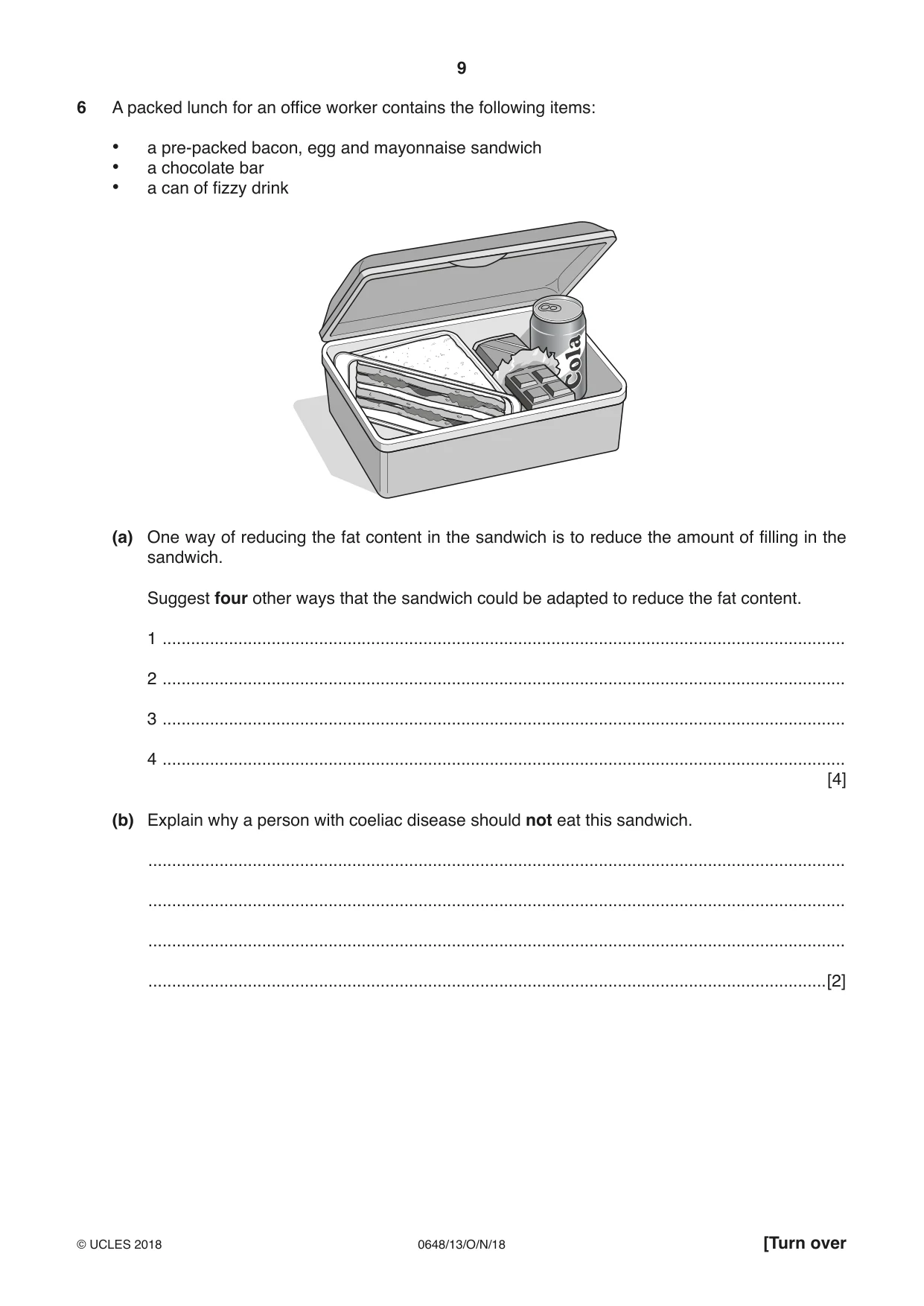
9 0648/13/O/N/18 © UCLES 2018 [Turn over 6 A packed lunch for an office worker contains the following items: • a pre-packed bacon, egg and mayonnaise sandwich • a chocolate bar • a can of fizzy drink (a) One way of reducing the fat content in the sandwich is to reduce the amount of filling in the sandwich. Suggest four other ways that the sandwich could be adapted to reduce the fat content. 1 … 2 … 3 … 4 … [4] (b) Explain why a person with coeliac disease should not eat this sandwich. … … … …[2]
Question paper, page 10
10 0648/13/O/N/18 © UCLES 2018 (c) The chocolate bar and can of fizzy drink are high in sugar which can cause tooth decay. Describe how sugar can cause tooth decay. … … … … … …[3] (d) Name the mineral which can be added to the water supply to strengthen tooth enamel. …[1] (e) The ingredient list on the pre-packed sandwich label includes the emulsifier lecithin. Explain the function of an emulsifier. … … … … … …[3]
Question paper, page 11
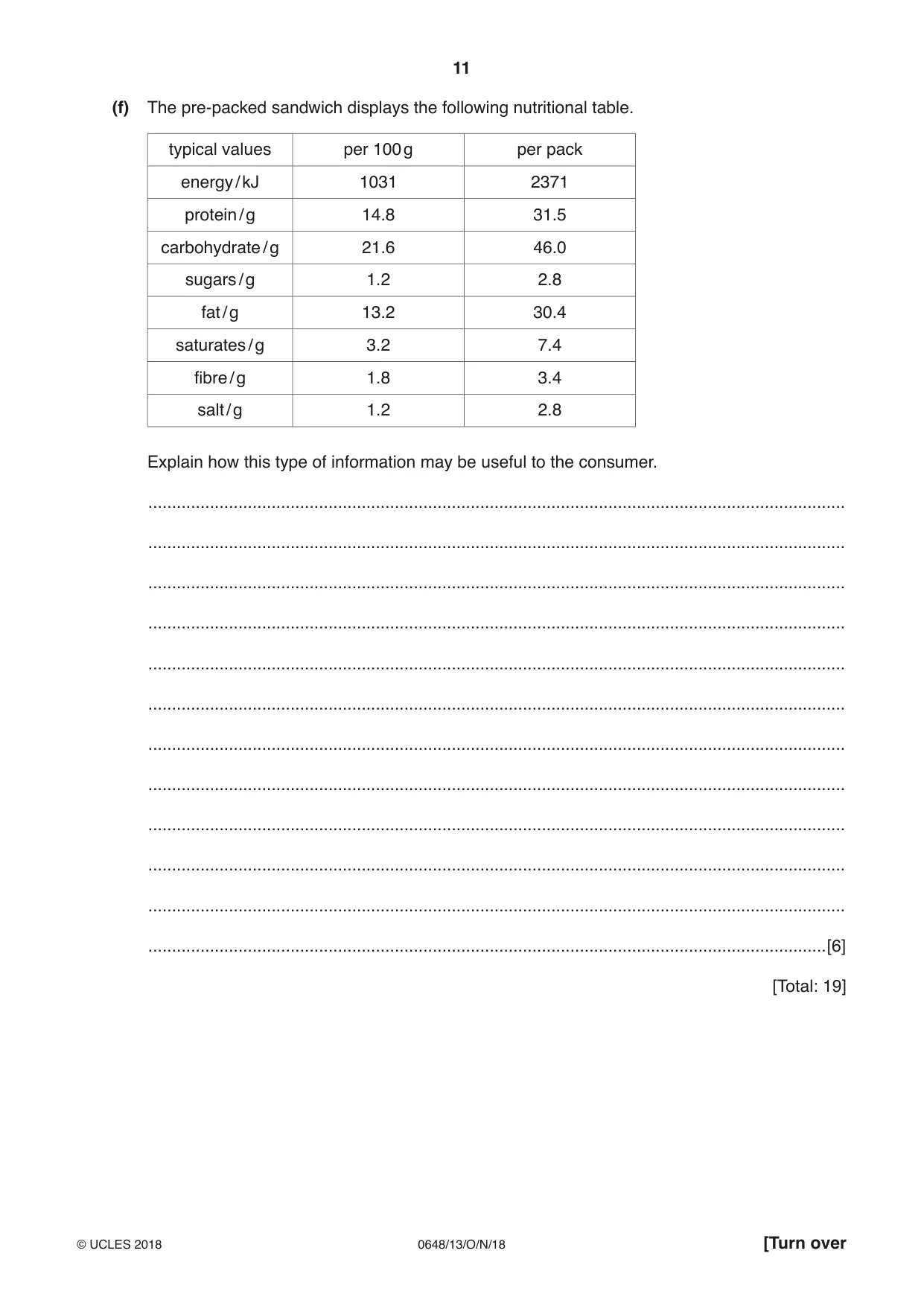
11 0648/13/O/N/18 © UCLES 2018 [Turn over (f) The pre-packed sandwich displays the following nutritional table. typical values per 100 g per pack energy / kJ 1031 2371 protein / g 14.8 31.5 carbohydrate / g 21.6 46.0 sugars / g 1.2 2.8 fat / g 13.2 30.4 saturates / g 3.2 7.4 fibre / g 1.8 3.4 salt / g 1.2 2.8 Explain how this type of information may be useful to the consumer. … … … … … … … … … … … …[6] [Total: 19]
Question paper, page 12
12 0648/13/O/N/18 © UCLES 2018 Section C Answer either Question 7(a) or 7(b). 7 (a) Freezing is a popular method of food preservation. Discuss the benefits of using a freezer. Explain the principles of freezing and the guidelines to follow when using a freezer. [15] OR (b) The kitchen is the heart of the home. Give advice regarding the organisation of the cooking area for efficient work and the prevention of accidents in the kitchen. [15] … … … … … … … … … … … … … … … … … … … …
Question paper, page 13
13 0648/13/O/N/18 © UCLES 2018 [Turn over … … … … … … … … … … … … … … … … … … … … … … … … … … … …
Question paper, page 14
14 0648/13/O/N/18 © UCLES 2018 … … … … … … … … … … … … … … … … … … … … … … … … … [Total: 15]
Question paper, page 15
15 0648/13/O/N/18 © UCLES 2018 BLANK PAGE
Question paper, page 16
16 0648/13/O/N/18 © UCLES 2018 Permission to reproduce items where third-party owned material protected by copyright is included has been sought and cleared where possible. Every reasonable effort has been made by the publisher (UCLES) to trace copyright holders, but if any items requiring clearance have unwittingly been included, the publisher will be pleased to make amends at the earliest possible opportunity. To avoid the issue of disclosure of answer-related information to candidates, all copyright acknowledgements are reproduced online in the Cambridge International Examinations Copyright Acknowledgements Booklet. This is produced for each series of examinations and is freely available to download at www.cie.org.uk after the live examination series. Cambridge International Examinations is part of the Cambridge Assessment Group. Cambridge Assessment is the brand name of University of Cambridge Local Examinations Syndicate (UCLES), which is itself a department of the University of Cambridge. BLANK PAGE
Mark scheme, page 1
This document consists of 18 printed pages. © UCLES 2018 [Turn over Cambridge Assessment International Education Cambridge International General Certificate of Secondary Education FOOD AND NUTRITION 0648/13 Paper 1 Theory October/November 2018 MARK SCHEME Maximum Mark: 100 Published This mark scheme is published as an aid to teachers and candidates, to indicate the requirements of the examination. It shows the basis on which Examiners were instructed to award marks. It does not indicate the details of the discussions that took place at an Examiners’ meeting before marking began, which would have considered the acceptability of alternative answers. Mark schemes should be read in conjunction with the question paper and the Principal Examiner Report for Teachers. Cambridge International will not enter into discussions about these mark schemes. Cambridge International is publishing the mark schemes for the October/November 2018 series for most Cambridge IGCSE™, Cambridge International A and AS Level components and some Cambridge O Level components.
Mark scheme, page 2
0648/13 Cambridge IGCSE – Mark Scheme PUBLISHED October/November 2018 © UCLES 2018 Page 2 of 18 Generic Marking Principles These general marking principles must be applied by all examiners when marking candidate answers. They should be applied alongside the specific content of the mark scheme or generic level descriptors for a question. Each question paper and mark scheme will also comply with these marking principles. GENERIC MARKING PRINCIPLE 1: Marks must be awarded in line with: • the specific content of the mark scheme or the generic level descriptors for the question • the specific skills defined in the mark scheme or in the generic level descriptors for the question • the standard of response required by a candidate as exemplified by the standardisation scripts. GENERIC MARKING PRINCIPLE 2: Marks awarded are always whole marks (not half marks, or other fractions). GENERIC MARKING PRINCIPLE 3: Marks must be awarded positively: • marks are awarded for correct/valid answers, as defined in the mark scheme. However, credit is given for valid answers which go beyond the scope of the syllabus and mark scheme, referring to your Team Leader as appropriate • marks are awarded when candidates clearly demonstrate what they know and can do • marks are not deducted for errors • marks are not deducted for omissions • answers should only be judged on the quality of spelling, punctuation and grammar when these features are specifically assessed by the question as indicated by the mark scheme. The meaning, however, should be unambiguous. GENERIC MARKING PRINCIPLE 4: Rules must be applied consistently e.g. in situations where candidates have not followed instructions or in the application of generic level descriptors.
Mark scheme, page 3
0648/13 Cambridge IGCSE – Mark Scheme PUBLISHED October/November 2018 © UCLES 2018 Page 3 of 18 GENERIC MARKING PRINCIPLE 5: Marks should be awarded using the full range of marks defined in the mark scheme for the question (however; the use of the full mark range may be limited according to the quality of the candidate responses seen). GENERIC MARKING PRINCIPLE 6: Marks awarded are based solely on the requirements as defined in the mark scheme. Marks should not be awarded with grade thresholds or grade descriptors in mind.
Mark scheme, page 4
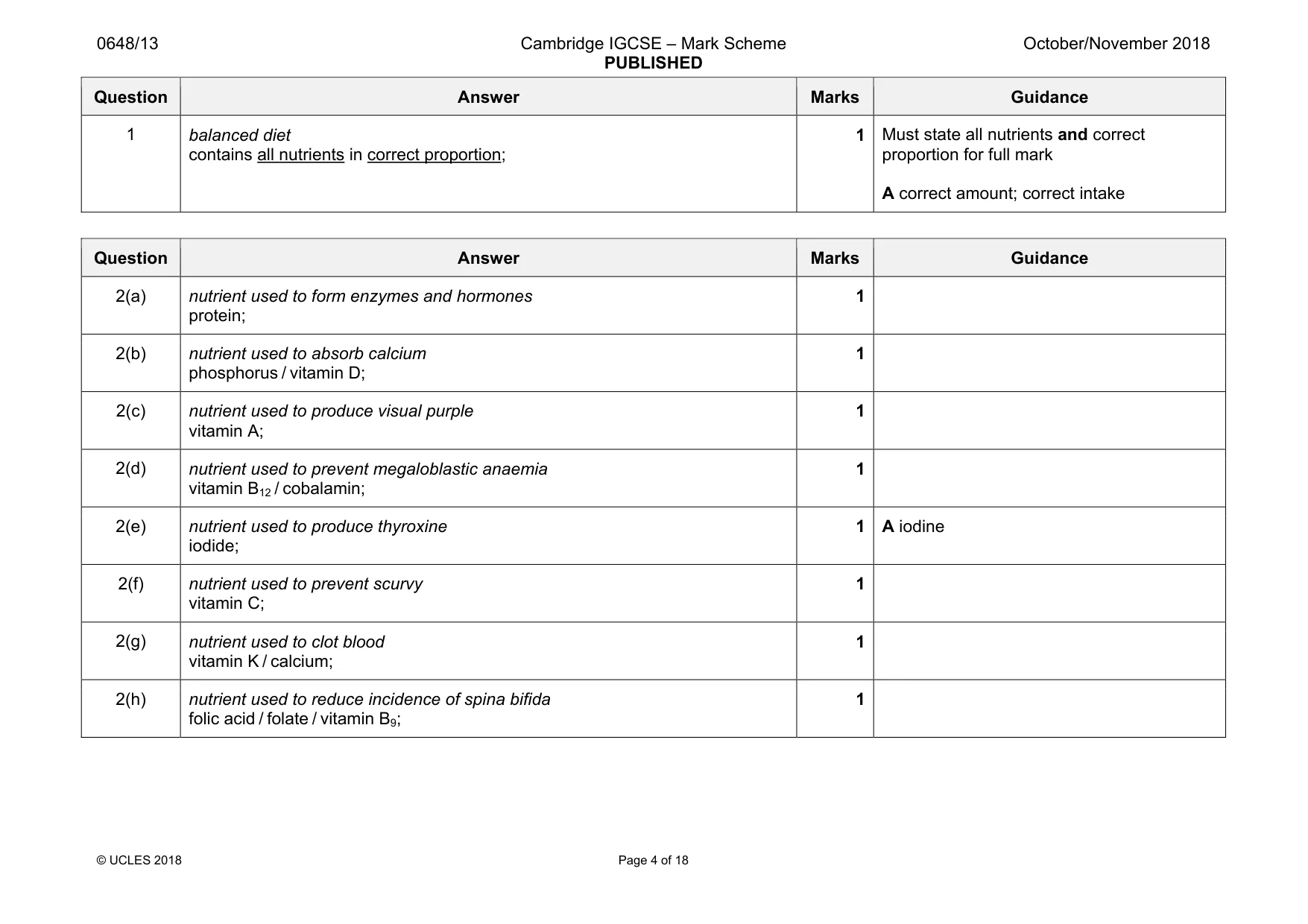
0648/13 Cambridge IGCSE – Mark Scheme PUBLISHED October/November 2018 © UCLES 2018 Page 4 of 18 Question Answer Marks Guidance 1 balanced diet contains all nutrients in correct proportion; 1 Must state all nutrients and correct proportion for full mark A correct amount; correct intake Question Answer Marks Guidance 2(a) nutrient used to form enzymes and hormones protein; 1 2(b) nutrient used to absorb calcium phosphorus / vitamin D; 1 2(c) nutrient used to produce visual purple vitamin A; 1 2(d) nutrient used to prevent megaloblastic anaemia vitamin B12 / cobalamin; 1 2(e) nutrient used to produce thyroxine iodide; 1 A iodine 2(f) nutrient used to prevent scurvy vitamin C; 1 2(g) nutrient used to clot blood vitamin K / calcium; 1 2(h) nutrient used to reduce incidence of spina bifida folic acid / folate / vitamin B9; 1
Mark scheme, page 5
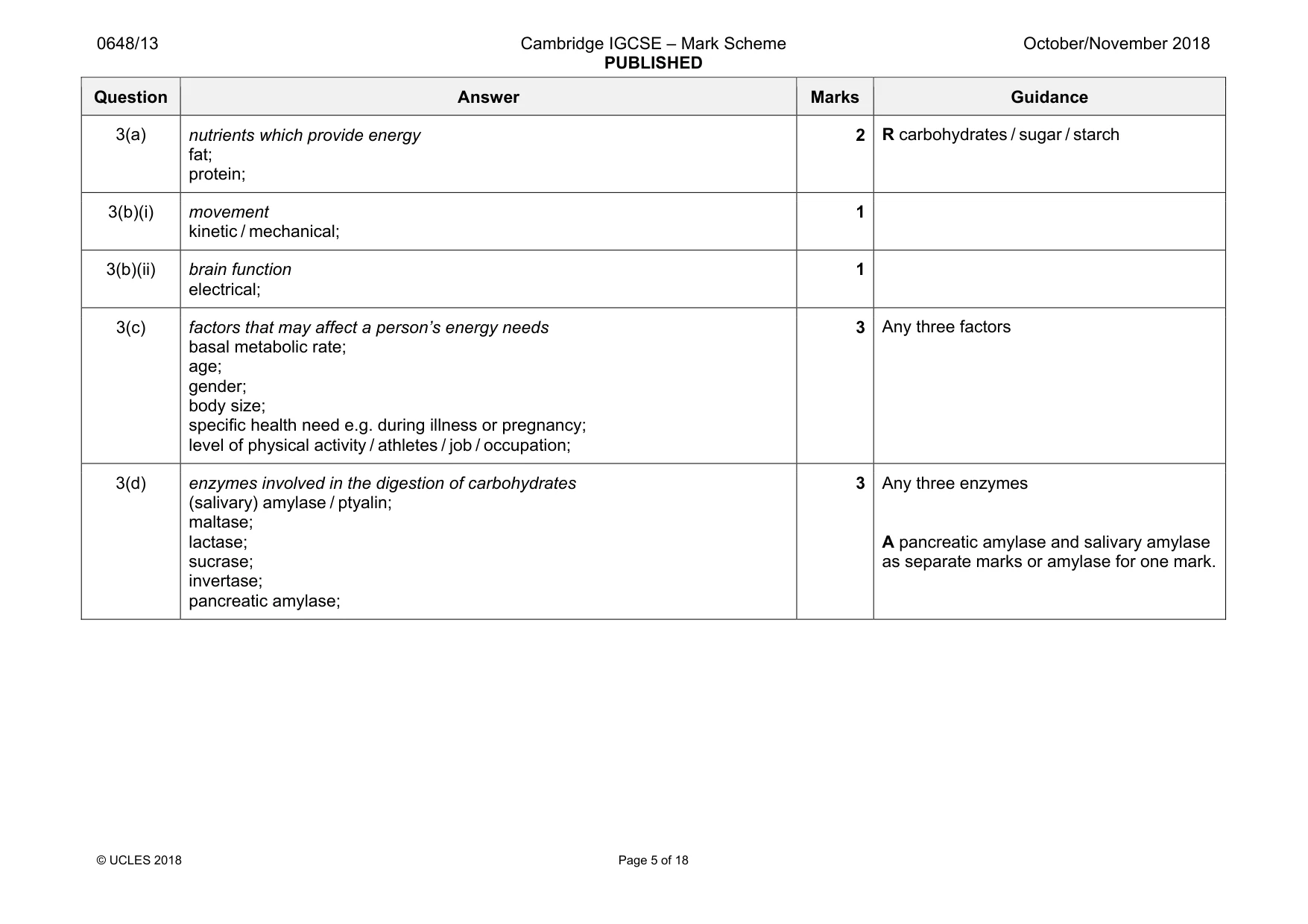
0648/13 Cambridge IGCSE – Mark Scheme PUBLISHED October/November 2018 © UCLES 2018 Page 5 of 18 Question Answer Marks Guidance 3(a) nutrients which provide energy fat; protein; 2 R carbohydrates / sugar / starch 3(b)(i) movement kinetic / mechanical; 1 3(b)(ii) brain function electrical; 1 3(c) factors that may affect a person’s energy needs basal metabolic rate; age; gender; body size; specific health need e.g. during illness or pregnancy; level of physical activity / athletes / job / occupation; 3 Any three factors 3(d) enzymes involved in the digestion of carbohydrates (salivary) amylase / ptyalin; maltase; lactase; sucrase; invertase; pancreatic amylase; 3 Any three enzymes A pancreatic amylase and salivary amylase as separate marks or amylase for one mark.
Mark scheme, page 6
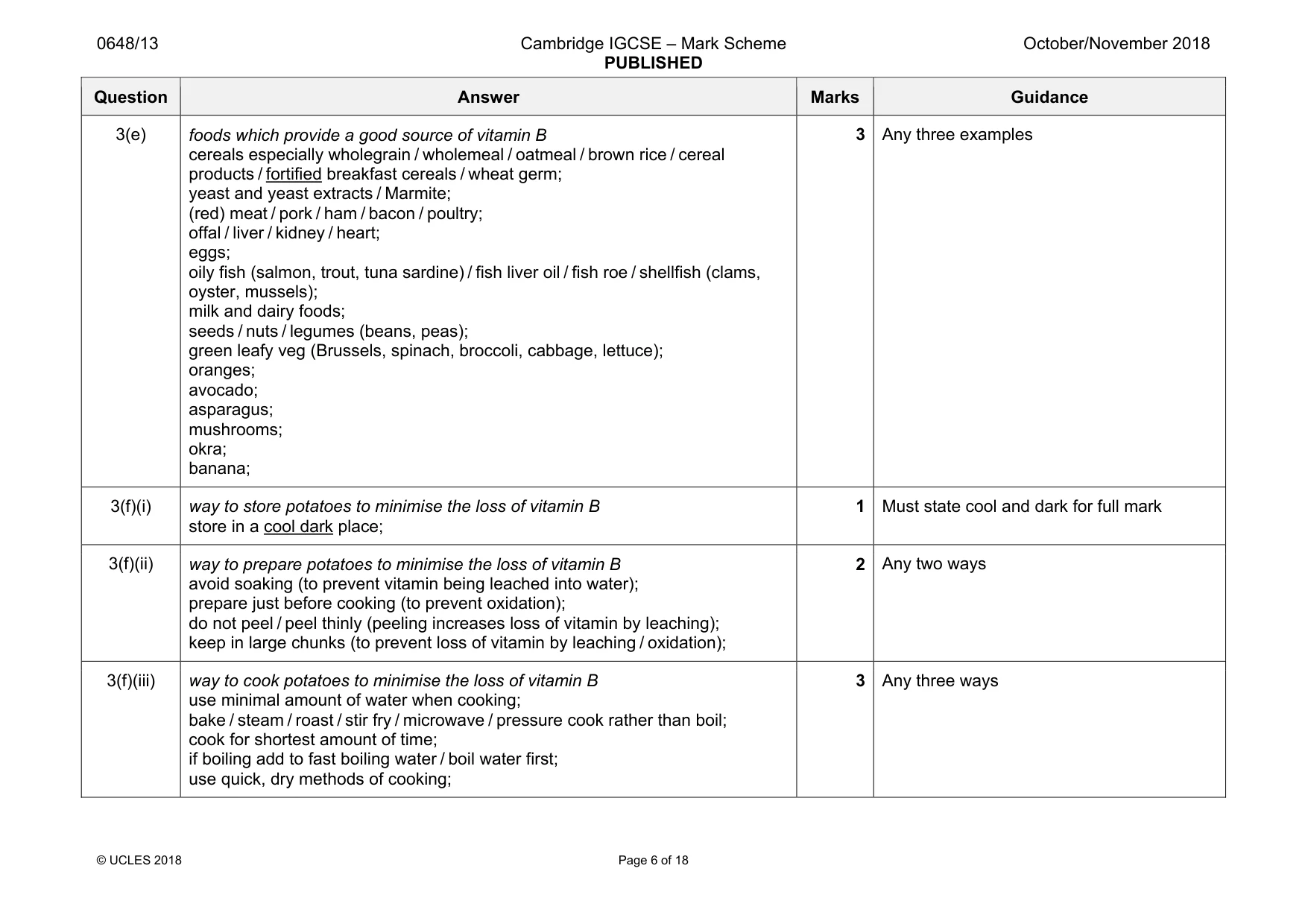
0648/13 Cambridge IGCSE – Mark Scheme PUBLISHED October/November 2018 © UCLES 2018 Page 6 of 18 Question Answer Marks Guidance 3(e) foods which provide a good source of vitamin B cereals especially wholegrain / wholemeal / oatmeal / brown rice / cereal products / fortified breakfast cereals / wheat germ; yeast and yeast extracts / Marmite; (red) meat / pork / ham / bacon / poultry; offal / liver / kidney / heart; eggs; oily fish (salmon, trout, tuna sardine) / fish liver oil / fish roe / shellfish (clams, oyster, mussels); milk and dairy foods; seeds / nuts / legumes (beans, peas); green leafy veg (Brussels, spinach, broccoli, cabbage, lettuce); oranges; avocado; asparagus; mushrooms; okra; banana; 3 Any three examples 3(f)(i) way to store potatoes to minimise the loss of vitamin B store in a cool dark place; 1 Must state cool and dark for full mark 3(f)(ii) way to prepare potatoes to minimise the loss of vitamin B avoid soaking (to prevent vitamin being leached into water); prepare just before cooking (to prevent oxidation); do not peel / peel thinly (peeling increases loss of vitamin by leaching); keep in large chunks (to prevent loss of vitamin by leaching / oxidation); 2 Any two ways 3(f)(iii) way to cook potatoes to minimise the loss of vitamin B use minimal amount of water when cooking; bake / steam / roast / stir fry / microwave / pressure cook rather than boil; cook for shortest amount of time; if boiling add to fast boiling water / boil water first; use quick, dry methods of cooking; 3 Any three ways
Mark scheme, page 7
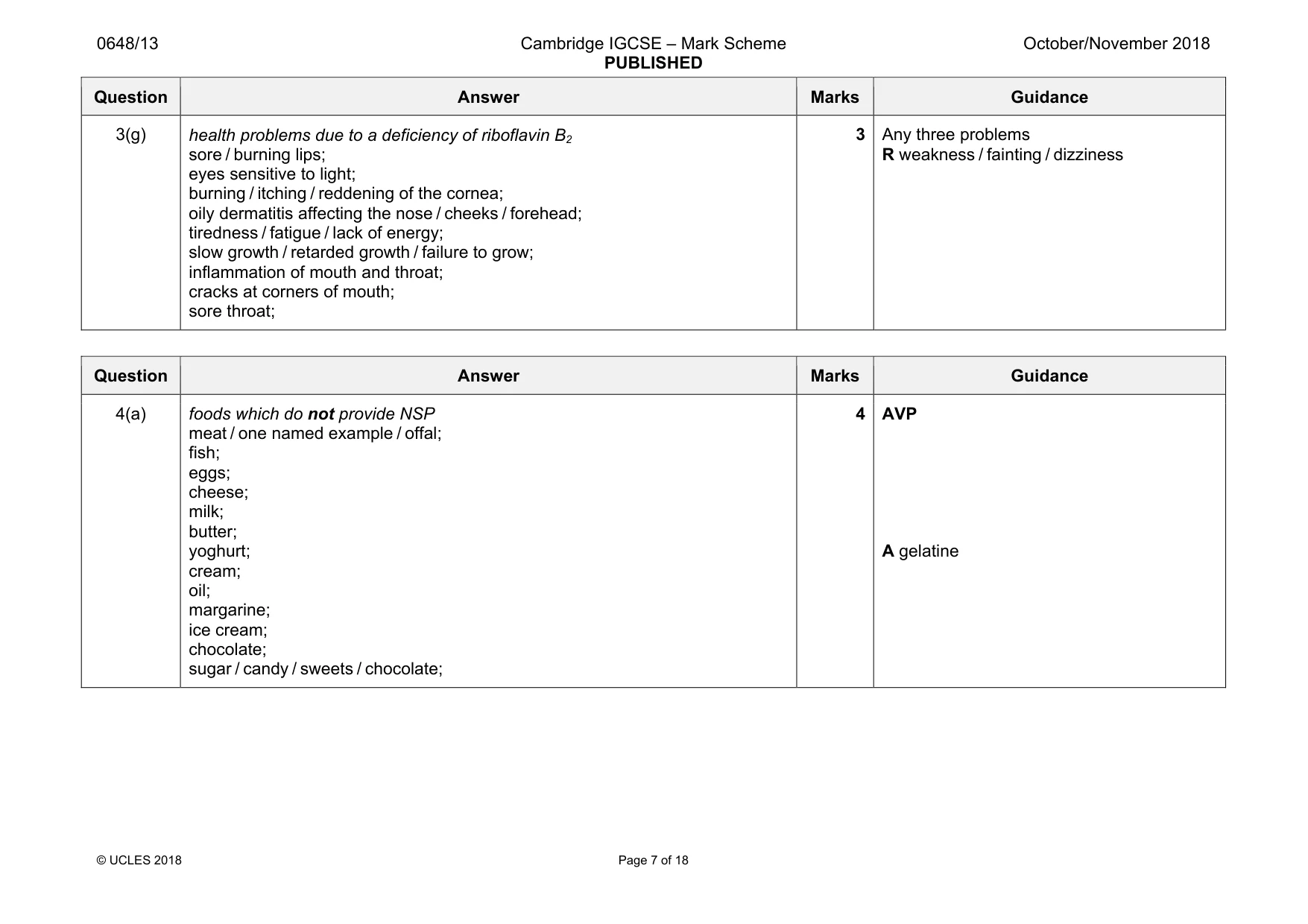
0648/13 Cambridge IGCSE – Mark Scheme PUBLISHED October/November 2018 © UCLES 2018 Page 7 of 18 Question Answer Marks Guidance 3(g) health problems due to a deficiency of riboflavin B2 sore / burning lips; eyes sensitive to light; burning / itching / reddening of the cornea; oily dermatitis affecting the nose / cheeks / forehead; tiredness / fatigue / lack of energy; slow growth / retarded growth / failure to grow; inflammation of mouth and throat; cracks at corners of mouth; sore throat; 3 Any three problems R weakness / fainting / dizziness Question Answer Marks Guidance 4(a) foods which do not provide NSP meat / one named example / offal; fish; eggs; cheese; milk; butter; yoghurt; cream; oil; margarine; ice cream; chocolate; sugar / candy / sweets / chocolate; 4 AVP A gelatine
Mark scheme, page 8
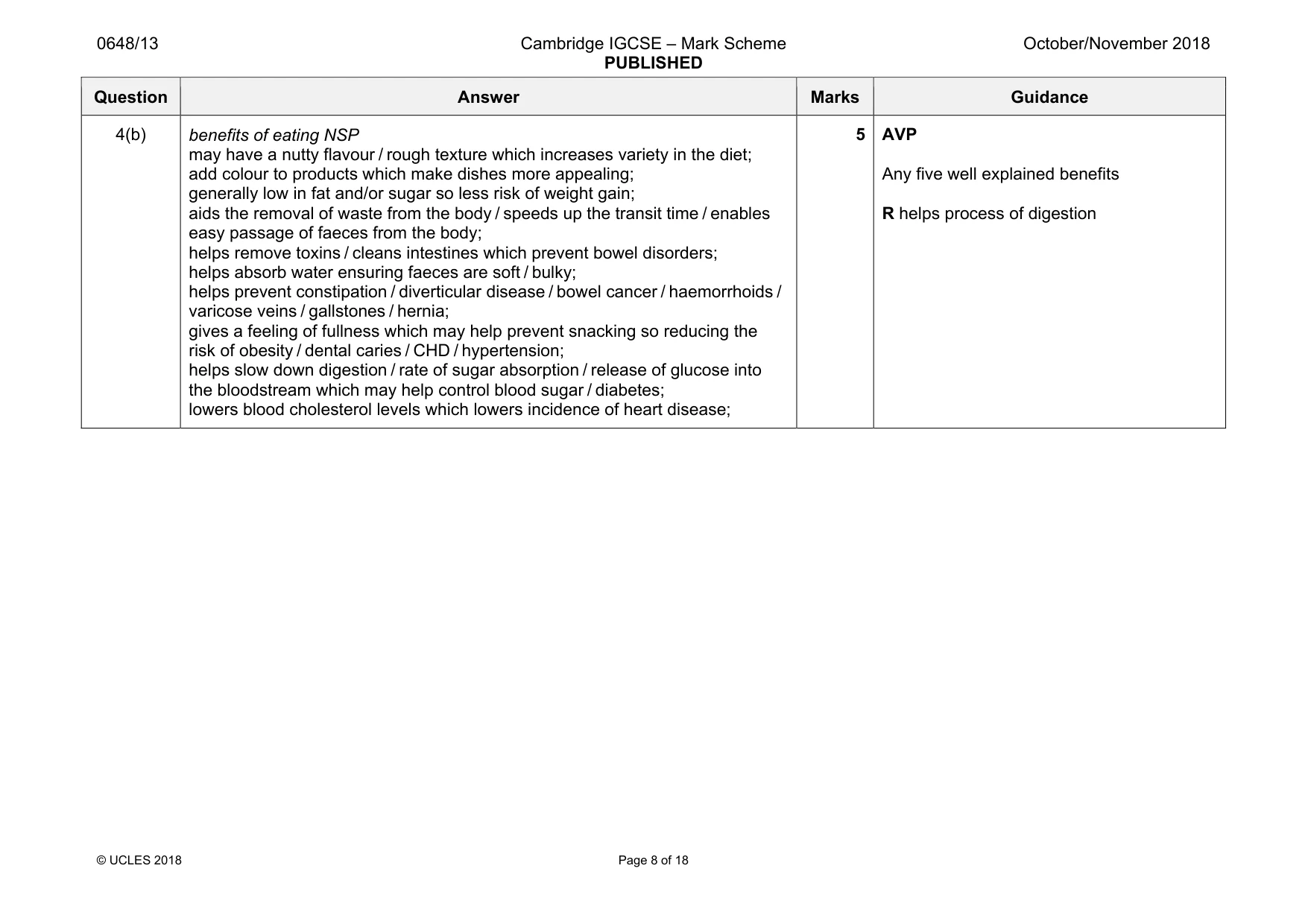
0648/13 Cambridge IGCSE – Mark Scheme PUBLISHED October/November 2018 © UCLES 2018 Page 8 of 18 Question Answer Marks Guidance 4(b) benefits of eating NSP may have a nutty flavour / rough texture which increases variety in the diet; add colour to products which make dishes more appealing; generally low in fat and/or sugar so less risk of weight gain; aids the removal of waste from the body / speeds up the transit time / enables easy passage of faeces from the body; helps remove toxins / cleans intestines which prevent bowel disorders; helps absorb water ensuring faeces are soft / bulky; helps prevent constipation / diverticular disease / bowel cancer / haemorrhoids / varicose veins / gallstones / hernia; gives a feeling of fullness which may help prevent snacking so reducing the risk of obesity / dental caries / CHD / hypertension; helps slow down digestion / rate of sugar absorption / release of glucose into the bloodstream which may help control blood sugar / diabetes; lowers blood cholesterol levels which lowers incidence of heart disease; 5 AVP Any five well explained benefits R helps process of digestion
Mark scheme, page 9
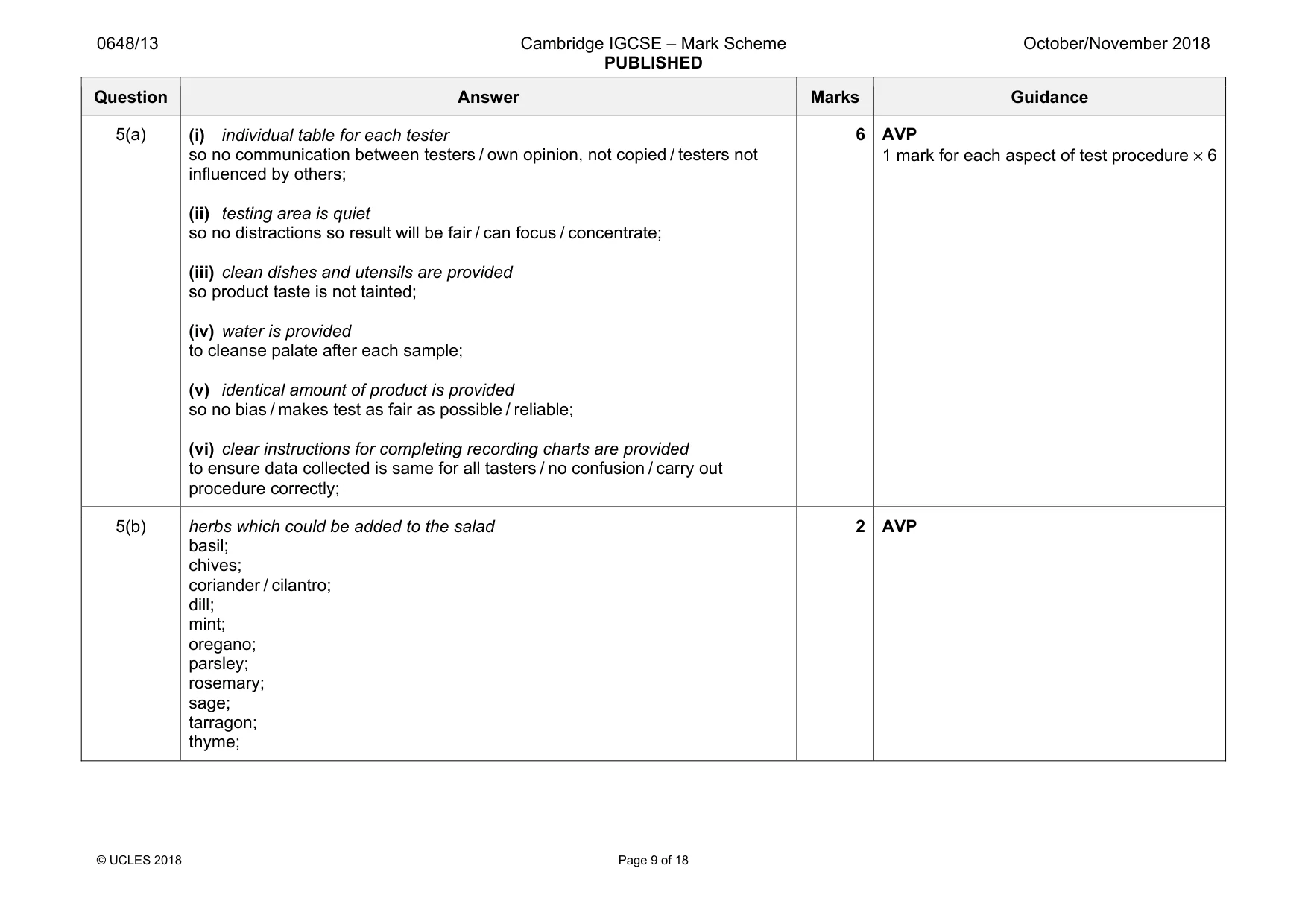
0648/13 Cambridge IGCSE – Mark Scheme PUBLISHED October/November 2018 © UCLES 2018 Page 9 of 18 Question Answer Marks Guidance 5(a) (i) individual table for each tester so no communication between testers / own opinion, not copied / testers not influenced by others; (ii) testing area is quiet so no distractions so result will be fair / can focus / concentrate; (iii) clean dishes and utensils are provided so product taste is not tainted; (iv) water is provided to cleanse palate after each sample; (v) identical amount of product is provided so no bias / makes test as fair as possible / reliable; (vi) clear instructions for completing recording charts are provided to ensure data collected is same for all tasters / no confusion / carry out procedure correctly; 6 AVP 1 mark for each aspect of test procedure × 6 5(b) herbs which could be added to the salad basil; chives; coriander / cilantro; dill; mint; oregano; parsley; rosemary; sage; tarragon; thyme; 2 AVP
Mark scheme, page 10
0648/13 Cambridge IGCSE – Mark Scheme PUBLISHED October/November 2018 © UCLES 2018 Page 10 of 18 Question Answer Marks Guidance 5(c) other ingredients which could be added to improve the colour tomato; cucumber; avocado; chia / seeds; beetroot; black / green olives; green / red pepper; red onion; carrot; red cabbage; radish; red / green chilli; (named) nuts (must be colourful e.g. not almonds unless with skins on); (one named) green vegetable; (one named) dried / fresh fruit; pomegranate; 4 AVP R meat / fish as salad is for vegetarian R pulses R sweetcorn and onion except red onion R herbs R apple / pear unless with skin.
Mark scheme, page 11
0648/13 Cambridge IGCSE – Mark Scheme PUBLISHED October/November 2018 © UCLES 2018 Page 11 of 18 Question Answer Marks Guidance 5(d) different pulses which could be used in the salad butter beans; haricot beans / baked beans; mung beans; adzuki beans; borlotti beans; split peas; red / green / yellow / brown lentils / dhal; soya beans; cannellini beans; chick peas / chana / garbanzo; flageolet beans; black beans / black-eyed beans / peas; garden peas; runner beans; broad beans; peanuts / ground nuts; pinto beans; pigeon pea; lima beans; yard bean / long bean / snake bean / cow pea / asparagus pea / pea bean / garter bean / Chinese long bean; 3 AVP R green beans / beans / peas 5(e) reason for boiling kidney beans destroys toxin / lectin to prevent food poisoning; 1 Must state toxin for mark to be awarded
Mark scheme, page 12
0648/13 Cambridge IGCSE – Mark Scheme PUBLISHED October/November 2018 © UCLES 2018 Page 12 of 18 Question Answer Marks Guidance 5(f) reasons why a pressure cooker is useful takes less time to cook / cooks faster; different items may be cooked at the same time; saves fuel; requires little attention; soluble nutrient loss may be less; food is cooked thoroughly; there is an indication for the completion of cooking; tough foods can be softened easily and quickly; saves washing up as complete meal can be cooked in one pot; flavour and colour loss is minimal; no cooking smells or condensation; 4 AVP Any four reasons 5(g) why families choose to buy ready-made salads cheaper than buying all ingredients; less wastage; may contain ingredients which are hard to find e.g. frisee, mizuna; nutritional information on packaging; large variety available; saves time shopping for individual ingredients; easy to transport; saves time in making; less equipment needed; less washing up; quality of product is consistent; useful for people with limited skills; attractive package encourages to purchase; may be portion controlled; 4 AVP Any four discussed points R cheap 5(h) difference between use-by date and best-before date use-by means that the food will go off and must be used by that date; use-by is for perishable foods; best-before means that the product will not go bad but after that date the quality may have deteriorated; best-before used for foods with a long shelf life; 2 Answer must clearly explain the difference between the two for award of full two marks
Mark scheme, page 13
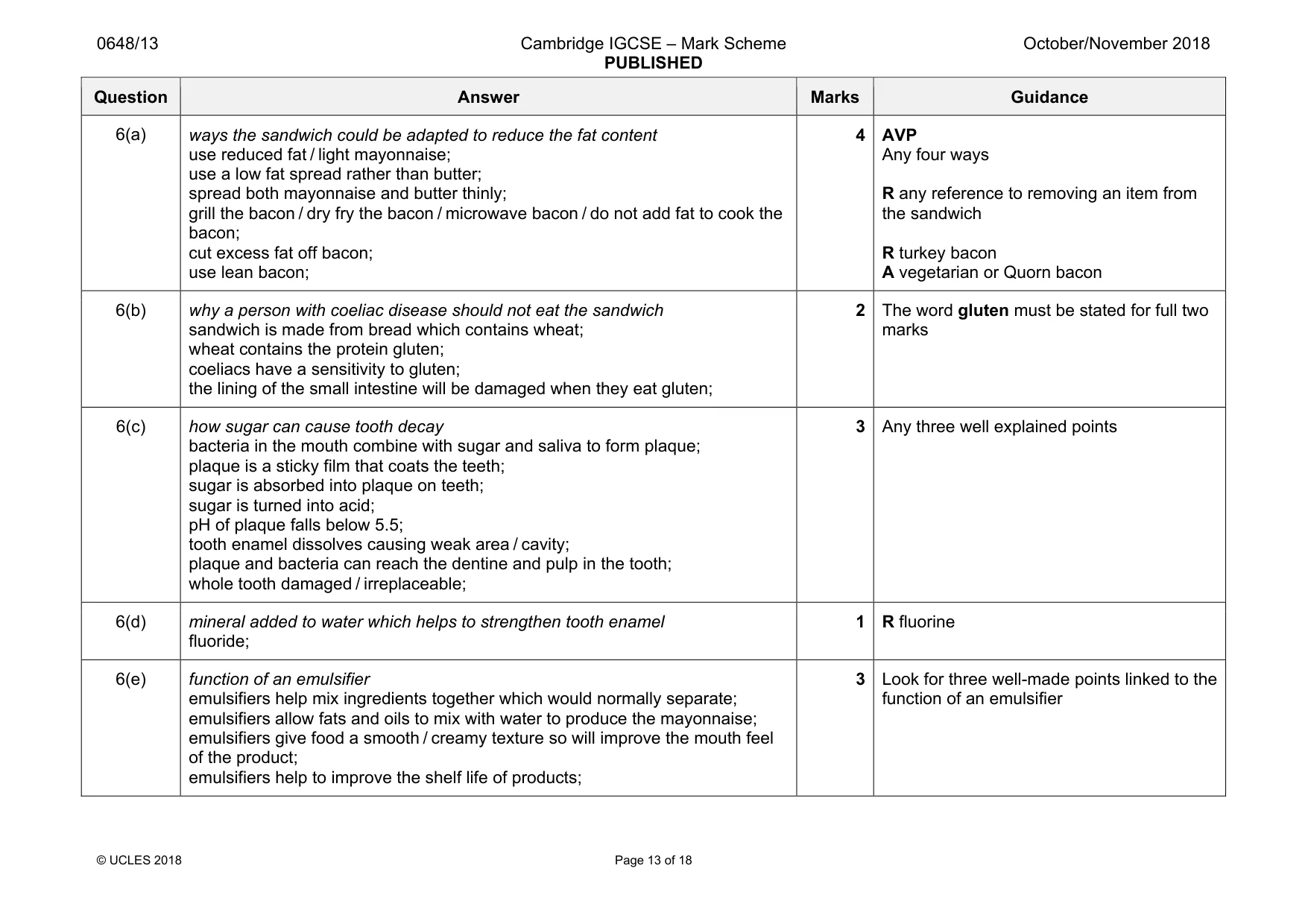
0648/13 Cambridge IGCSE – Mark Scheme PUBLISHED October/November 2018 © UCLES 2018 Page 13 of 18 Question Answer Marks Guidance 6(a) ways the sandwich could be adapted to reduce the fat content use reduced fat / light mayonnaise; use a low fat spread rather than butter; spread both mayonnaise and butter thinly; grill the bacon / dry fry the bacon / microwave bacon / do not add fat to cook the bacon; cut excess fat off bacon; use lean bacon; 4 AVP Any four ways R any reference to removing an item from the sandwich R turkey bacon A vegetarian or Quorn bacon 6(b) why a person with coeliac disease should not eat the sandwich sandwich is made from bread which contains wheat; wheat contains the protein gluten; coeliacs have a sensitivity to gluten; the lining of the small intestine will be damaged when they eat gluten; 2 The word gluten must be stated for full two marks 6(c) how sugar can cause tooth decay bacteria in the mouth combine with sugar and saliva to form plaque; plaque is a sticky film that coats the teeth; sugar is absorbed into plaque on teeth; sugar is turned into acid; pH of plaque falls below 5.5; tooth enamel dissolves causing weak area / cavity; plaque and bacteria can reach the dentine and pulp in the tooth; whole tooth damaged / irreplaceable; 3 Any three well explained points 6(d) mineral added to water which helps to strengthen tooth enamel fluoride; 1 R fluorine 6(e) function of an emulsifier emulsifiers help mix ingredients together which would normally separate; emulsifiers allow fats and oils to mix with water to produce the mayonnaise; emulsifiers give food a smooth / creamy texture so will improve the mouth feel of the product; emulsifiers help to improve the shelf life of products; 3 Look for three well-made points linked to the function of an emulsifier
Mark scheme, page 14
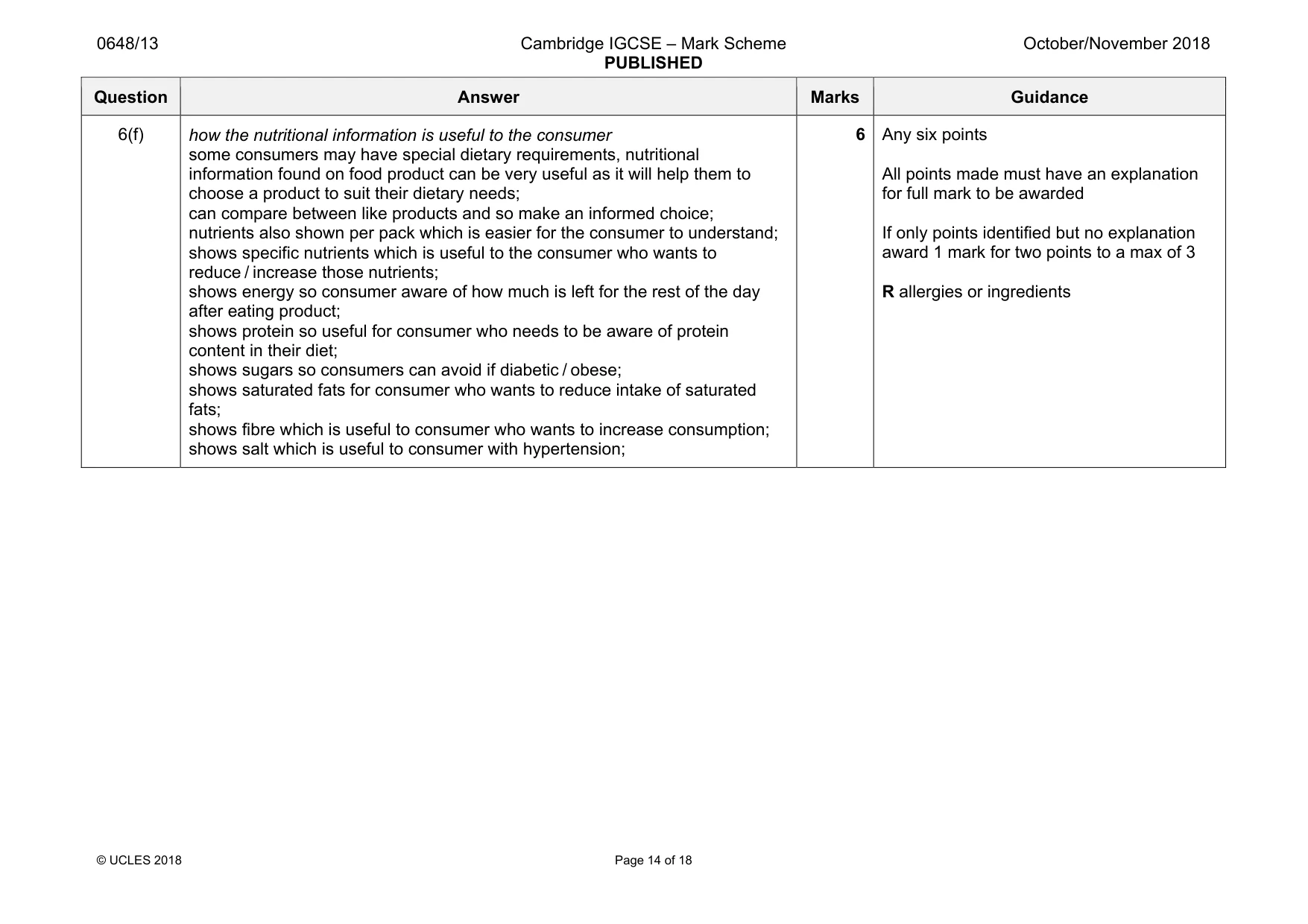
0648/13 Cambridge IGCSE – Mark Scheme PUBLISHED October/November 2018 © UCLES 2018 Page 14 of 18 Question Answer Marks Guidance 6(f) how the nutritional information is useful to the consumer some consumers may have special dietary requirements, nutritional information found on food product can be very useful as it will help them to choose a product to suit their dietary needs; can compare between like products and so make an informed choice; nutrients also shown per pack which is easier for the consumer to understand; shows specific nutrients which is useful to the consumer who wants to reduce / increase those nutrients; shows energy so consumer aware of how much is left for the rest of the day after eating product; shows protein so useful for consumer who needs to be aware of protein content in their diet; shows sugars so consumers can avoid if diabetic / obese; shows saturated fats for consumer who wants to reduce intake of saturated fats; shows fibre which is useful to consumer who wants to increase consumption; shows salt which is useful to consumer with hypertension; 6 Any six points All points made must have an explanation for full mark to be awarded If only points identified but no explanation award 1 mark for two points to a max of 3 R allergies or ingredients
Mark scheme, page 15
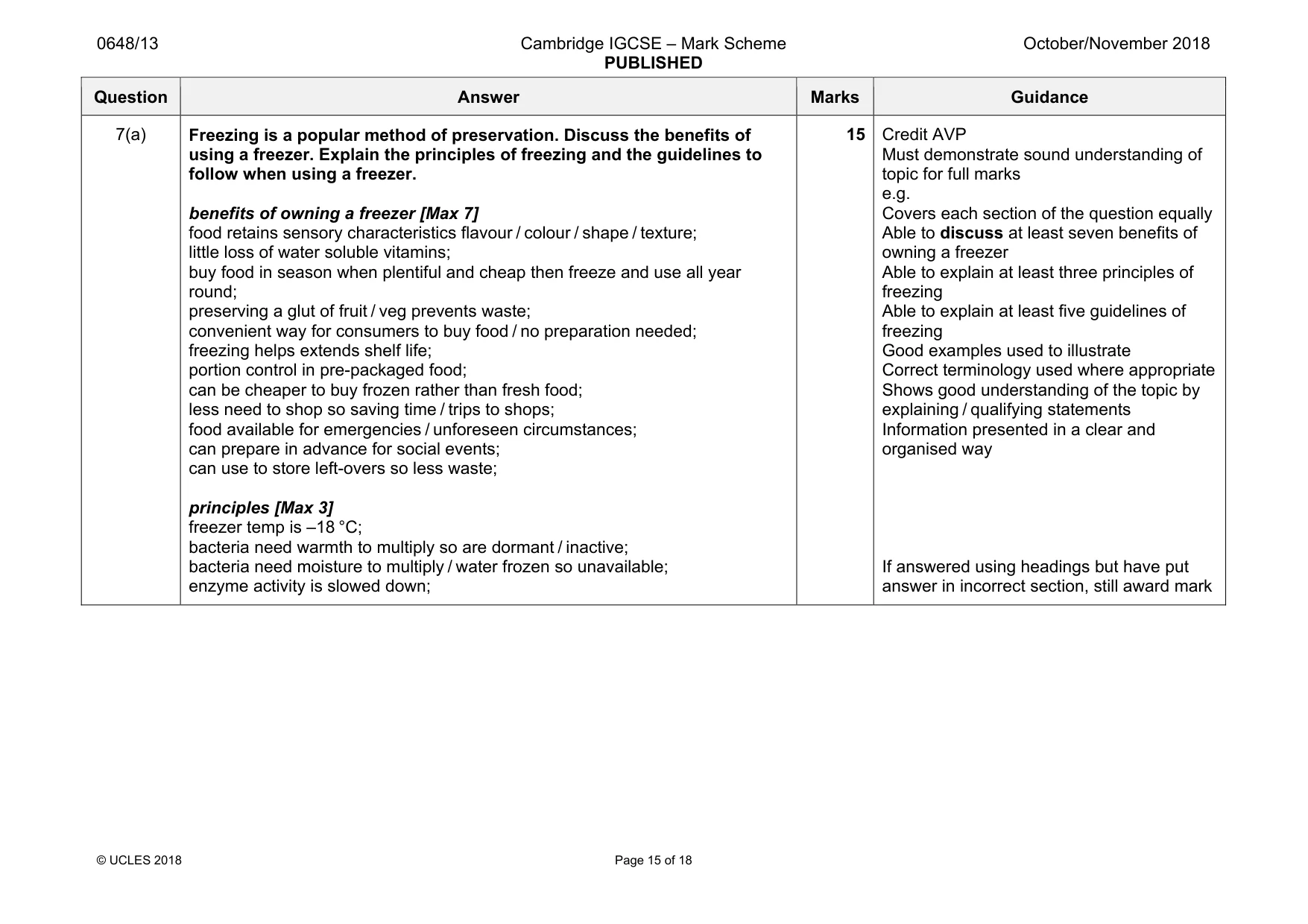
0648/13 Cambridge IGCSE – Mark Scheme PUBLISHED October/November 2018 © UCLES 2018 Page 15 of 18 Question Answer Marks Guidance 7(a) Freezing is a popular method of preservation. Discuss the benefits of using a freezer. Explain the principles of freezing and the guidelines to follow when using a freezer. benefits of owning a freezer [Max 7] food retains sensory characteristics flavour / colour / shape / texture; little loss of water soluble vitamins; buy food in season when plentiful and cheap then freeze and use all year round; preserving a glut of fruit / veg prevents waste; convenient way for consumers to buy food / no preparation needed; freezing helps extends shelf life; portion control in pre-packaged food; can be cheaper to buy frozen rather than fresh food; less need to shop so saving time / trips to shops; food available for emergencies / unforeseen circumstances; can prepare in advance for social events; can use to store left-overs so less waste; principles [Max 3] freezer temp is –18 °C; bacteria need warmth to multiply so are dormant / inactive; bacteria need moisture to multiply / water frozen so unavailable; enzyme activity is slowed down; 15 Credit AVP Must demonstrate sound understanding of topic for full marks e.g. Covers each section of the question equally Able to discuss at least seven benefits of owning a freezer Able to explain at least three principles of freezing Able to explain at least five guidelines of freezing Good examples used to illustrate Correct terminology used where appropriate Shows good understanding of the topic by explaining / qualifying statements Information presented in a clear and organised way If answered using headings but have put answer in incorrect section, still award mark
Mark scheme, page 16
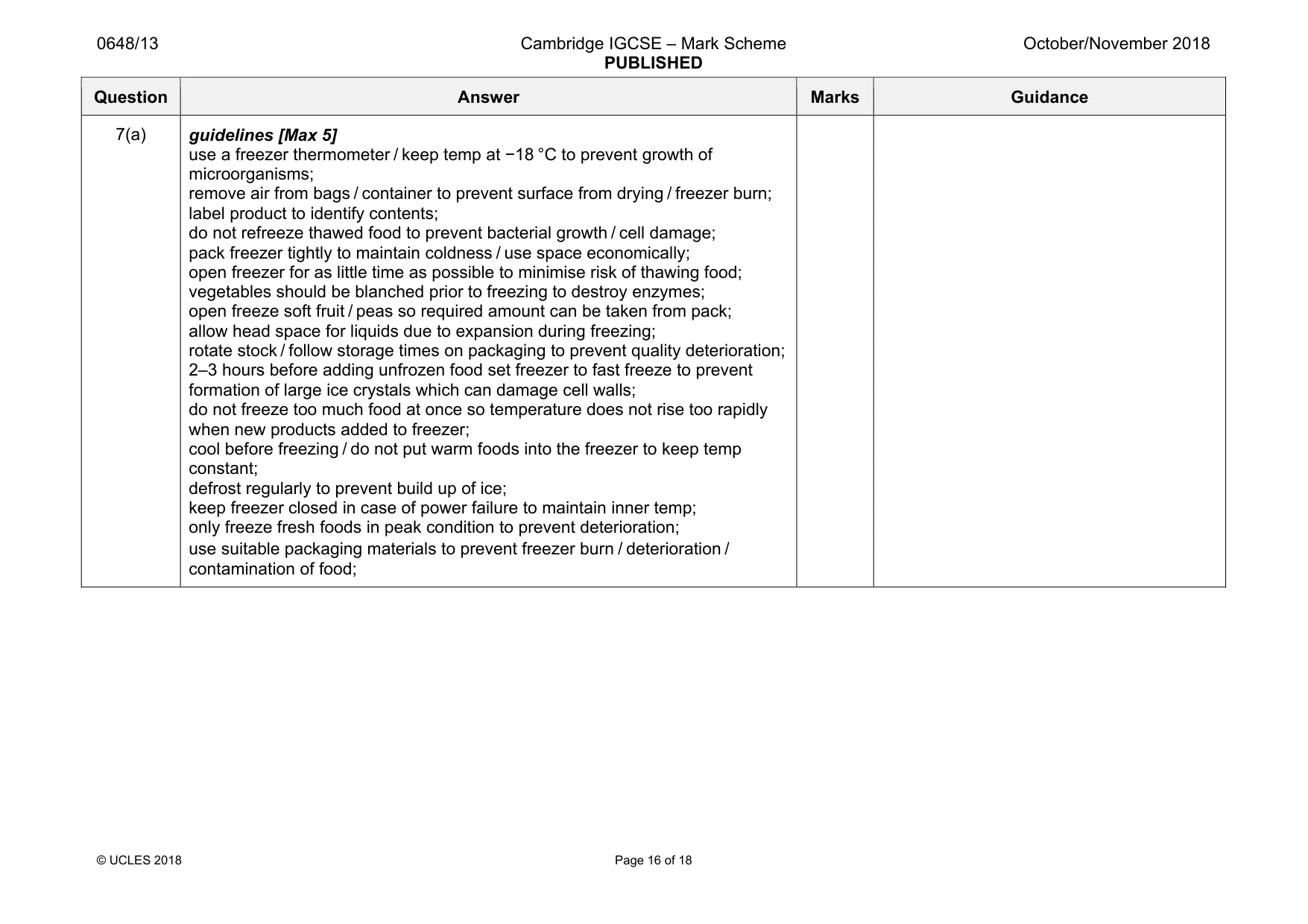
0648/13 Cambridge IGCSE – Mark Scheme PUBLISHED October/November 2018 © UCLES 2018 Page 16 of 18 Question Answer Marks Guidance 7(a) guidelines [Max 5] use a freezer thermometer / keep temp at −18 °C to prevent growth of microorganisms; remove air from bags / container to prevent surface from drying / freezer burn; label product to identify contents; do not refreeze thawed food to prevent bacterial growth / cell damage; pack freezer tightly to maintain coldness / use space economically; open freezer for as little time as possible to minimise risk of thawing food; vegetables should be blanched prior to freezing to destroy enzymes; open freeze soft fruit / peas so required amount can be taken from pack; allow head space for liquids due to expansion during freezing; rotate stock / follow storage times on packaging to prevent quality deterioration; 2–3 hours before adding unfrozen food set freezer to fast freeze to prevent formation of large ice crystals which can damage cell walls; do not freeze too much food at once so temperature does not rise too rapidly when new products added to freezer; cool before freezing / do not put warm foods into the freezer to keep temp constant; defrost regularly to prevent build up of ice; keep freezer closed in case of power failure to maintain inner temp; only freeze fresh foods in peak condition to prevent deterioration; use suitable packaging materials to prevent freezer burn / deterioration / contamination of food;
Mark scheme, page 17
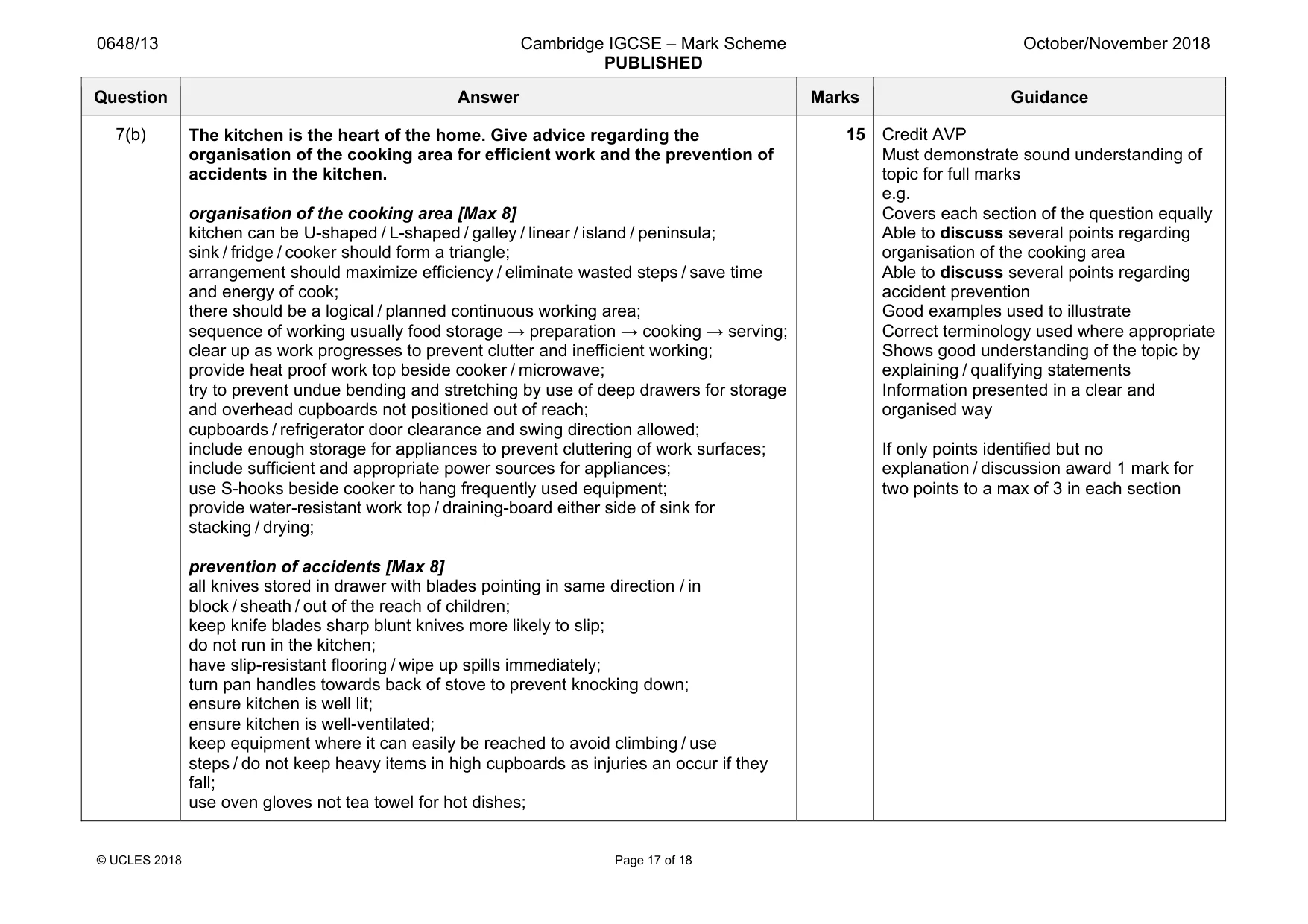
0648/13 Cambridge IGCSE – Mark Scheme PUBLISHED October/November 2018 © UCLES 2018 Page 17 of 18 Question Answer Marks Guidance 7(b) The kitchen is the heart of the home. Give advice regarding the organisation of the cooking area for efficient work and the prevention of accidents in the kitchen. organisation of the cooking area [Max 8] kitchen can be U-shaped / L-shaped / galley / linear / island / peninsula; sink / fridge / cooker should form a triangle; arrangement should maximize efficiency / eliminate wasted steps / save time and energy of cook; there should be a logical / planned continuous working area; sequence of working usually food storage → preparation → cooking → serving; clear up as work progresses to prevent clutter and inefficient working; provide heat proof work top beside cooker / microwave; try to prevent undue bending and stretching by use of deep drawers for storage and overhead cupboards not positioned out of reach; cupboards / refrigerator door clearance and swing direction allowed; include enough storage for appliances to prevent cluttering of work surfaces; include sufficient and appropriate power sources for appliances; use S-hooks beside cooker to hang frequently used equipment; provide water-resistant work top / draining-board either side of sink for stacking / drying; prevention of accidents [Max 8] all knives stored in drawer with blades pointing in same direction / in block / sheath / out of the reach of children; keep knife blades sharp blunt knives more likely to slip; do not run in the kitchen; have slip-resistant flooring / wipe up spills immediately; turn pan handles towards back of stove to prevent knocking down; ensure kitchen is well lit; ensure kitchen is well-ventilated; keep equipment where it can easily be reached to avoid climbing / use steps / do not keep heavy items in high cupboards as injuries an occur if they fall; use oven gloves not tea towel for hot dishes; 15 Credit AVP Must demonstrate sound understanding of topic for full marks e.g. Covers each section of the question equally Able to discuss several points regarding organisation of the cooking area Able to discuss several points regarding accident prevention Good examples used to illustrate Correct terminology used where appropriate Shows good understanding of the topic by explaining / qualifying statements Information presented in a clear and organised way If only points identified but no explanation / discussion award 1 mark for two points to a max of 3 in each section
Mark scheme, page 18
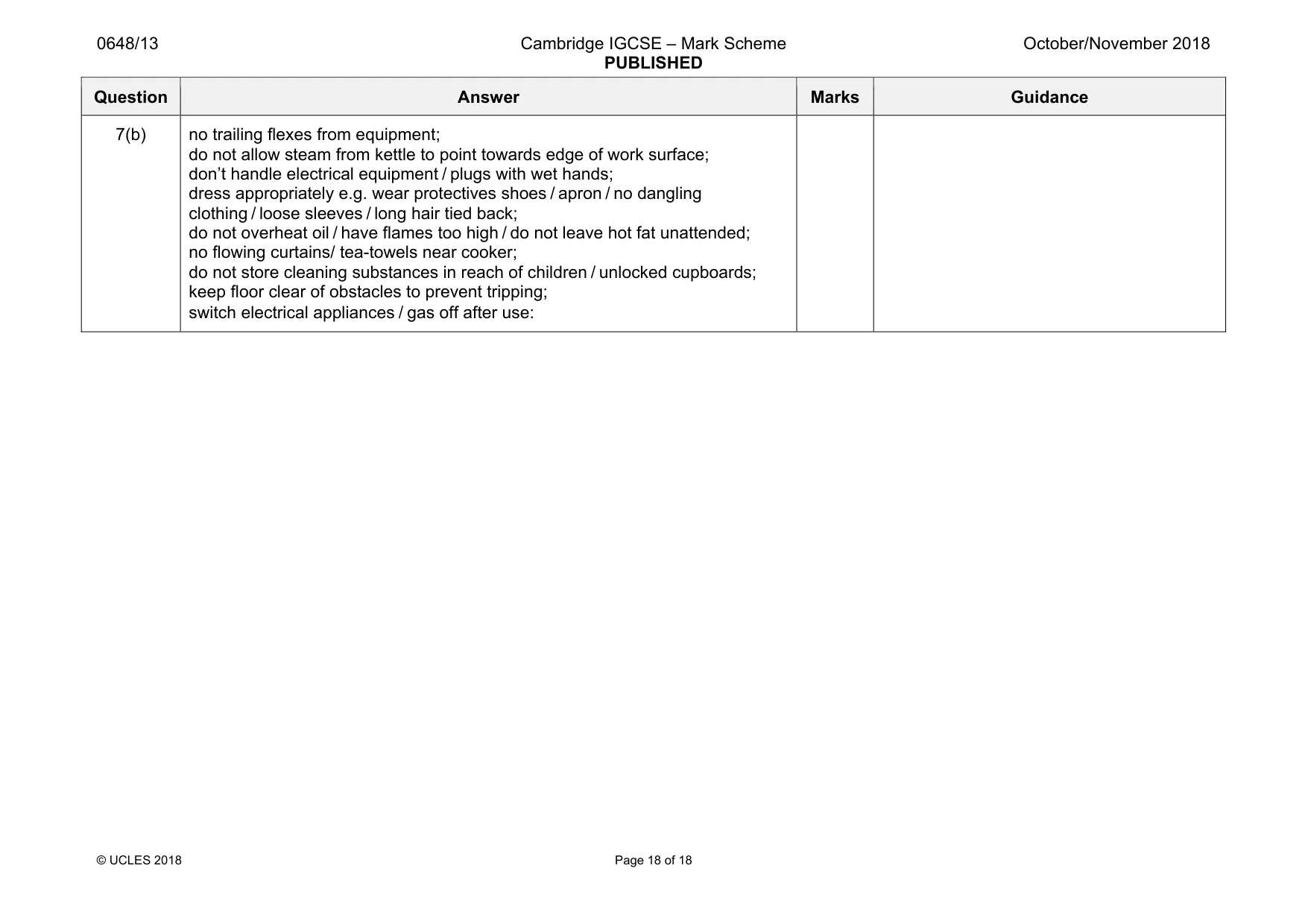
0648/13 Cambridge IGCSE – Mark Scheme PUBLISHED October/November 2018 © UCLES 2018 Page 18 of 18 Question Answer Marks Guidance 7(b) no trailing flexes from equipment; do not allow steam from kettle to point towards edge of work surface; don’t handle electrical equipment / plugs with wet hands; dress appropriately e.g. wear protectives shoes / apron / no dangling clothing / loose sleeves / long hair tied back; do not overheat oil / have flames too high / do not leave hot fat unattended; no flowing curtains/ tea-towels near cooker; do not store cleaning substances in reach of children / unlocked cupboards; keep floor clear of obstacles to prevent tripping; switch electrical appliances / gas off after use:
What you needed in this session
Cambridge’s own grade thresholds for 2018 Oct/Nov, Paper 1 · Variant 3. A higher threshold means an easier paper — the bar moves with how the cohort did.