Cambridge IGCSE Food and Nutrition 0648 — 2018 Oct/Nov Paper 1 · Variant 1
0648/11/O/N/18 · 100 marks · ≈113 min
The question paper and its mark scheme, free to read here and free to download. This is Cambridge’s own paper, exactly as it was sat.
Question paper12 pages
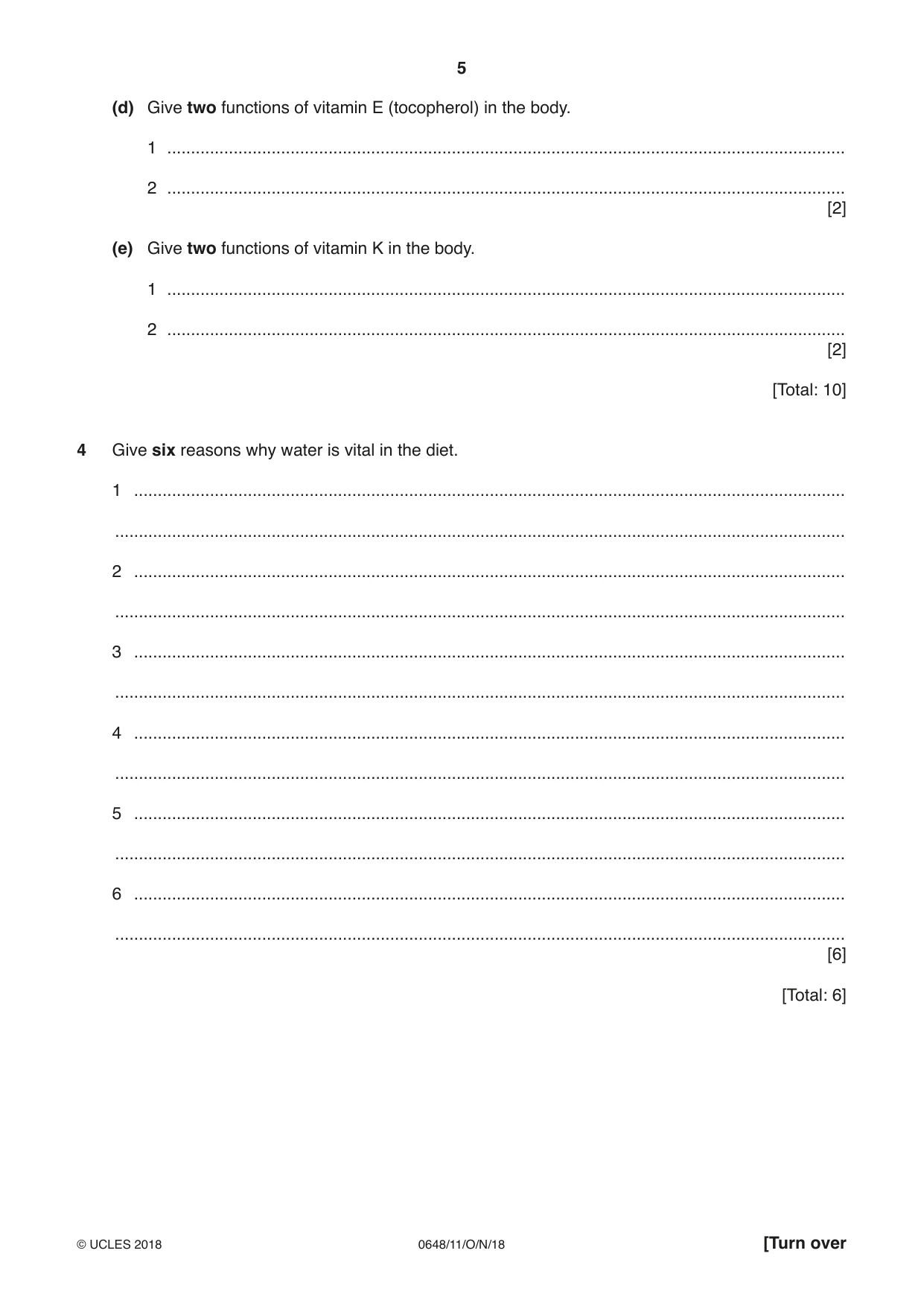
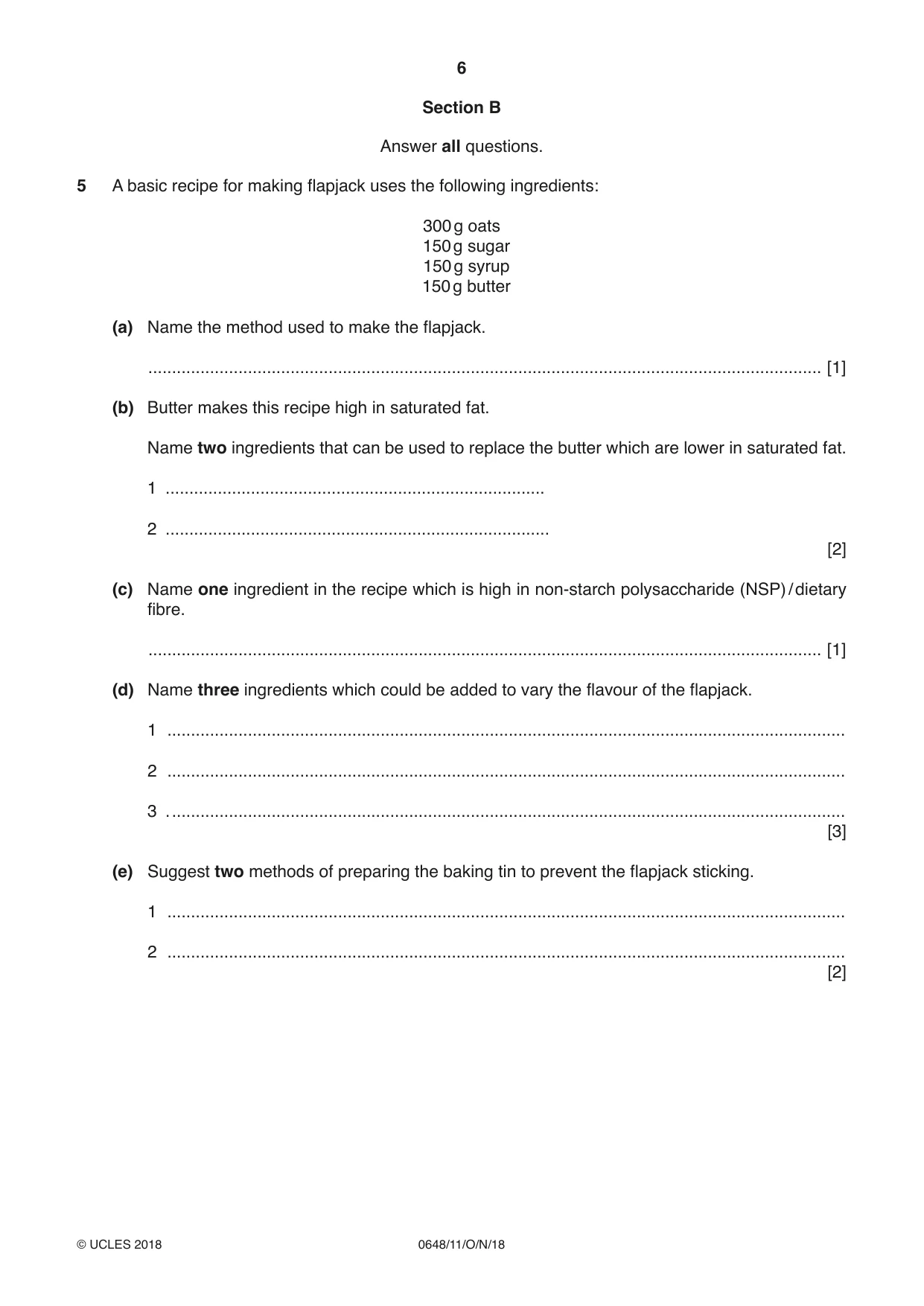
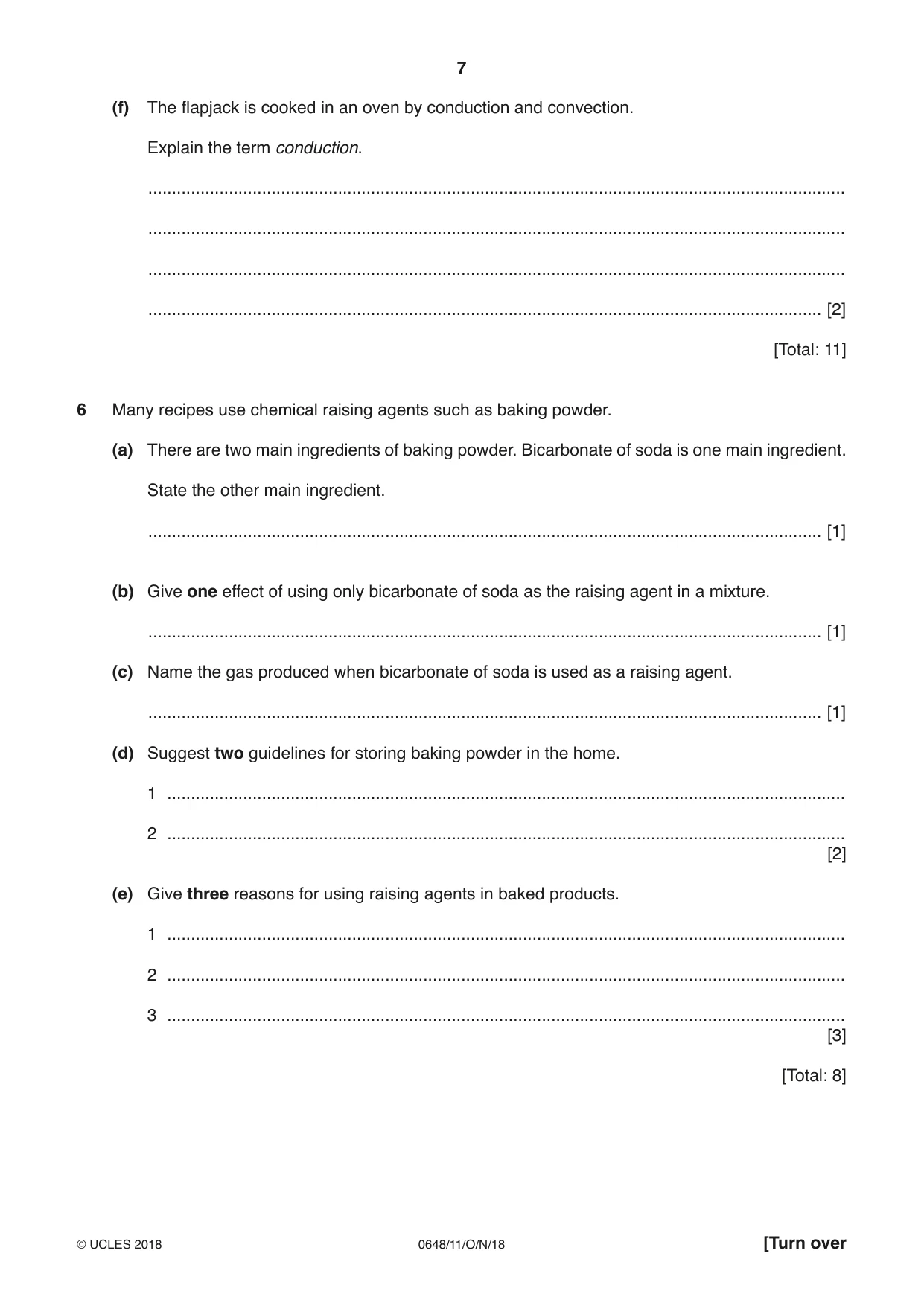
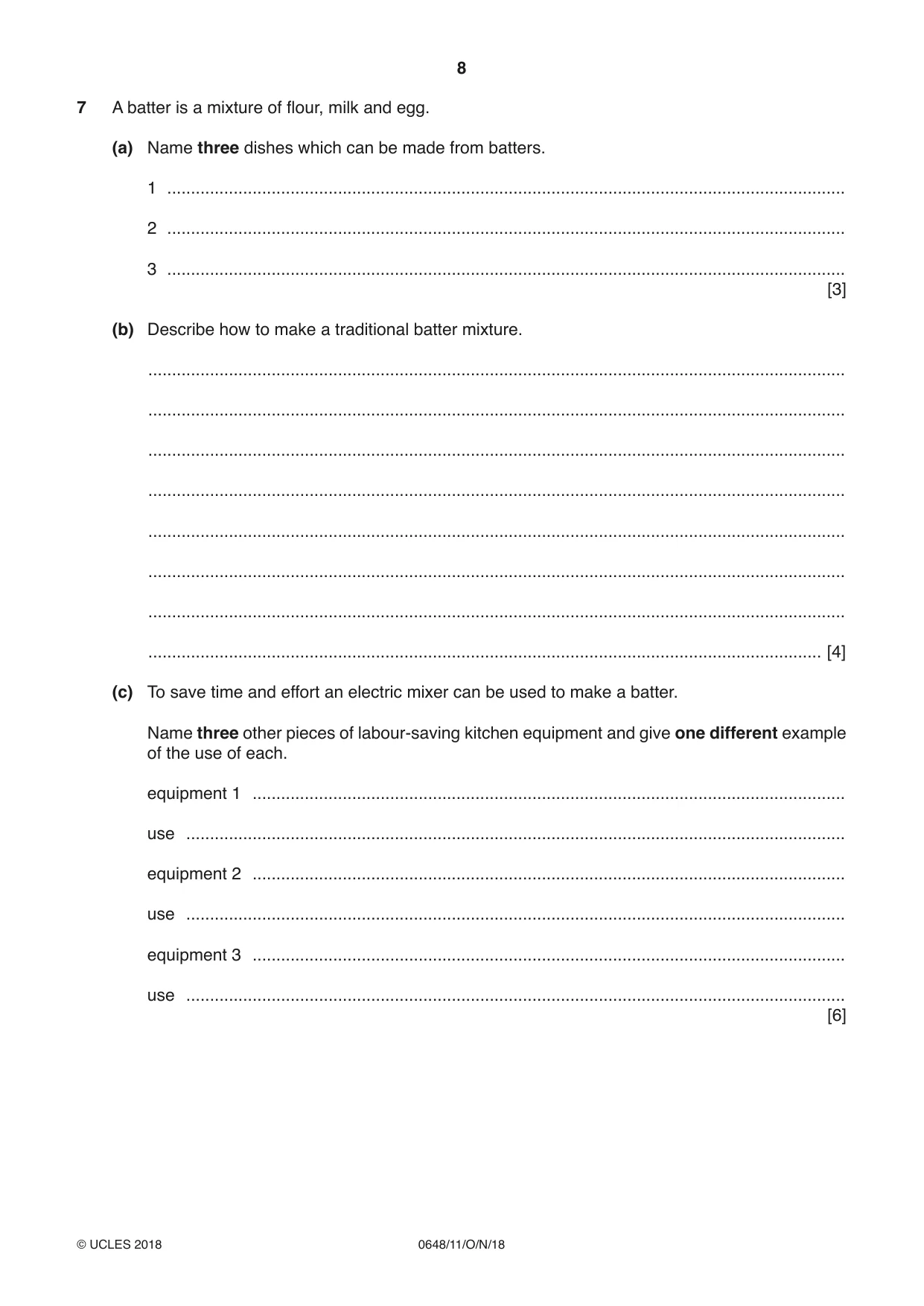


Mark scheme14 pages
Answers below. Sit the paper first if you are practising.
Paper as text
Question paper, page 1
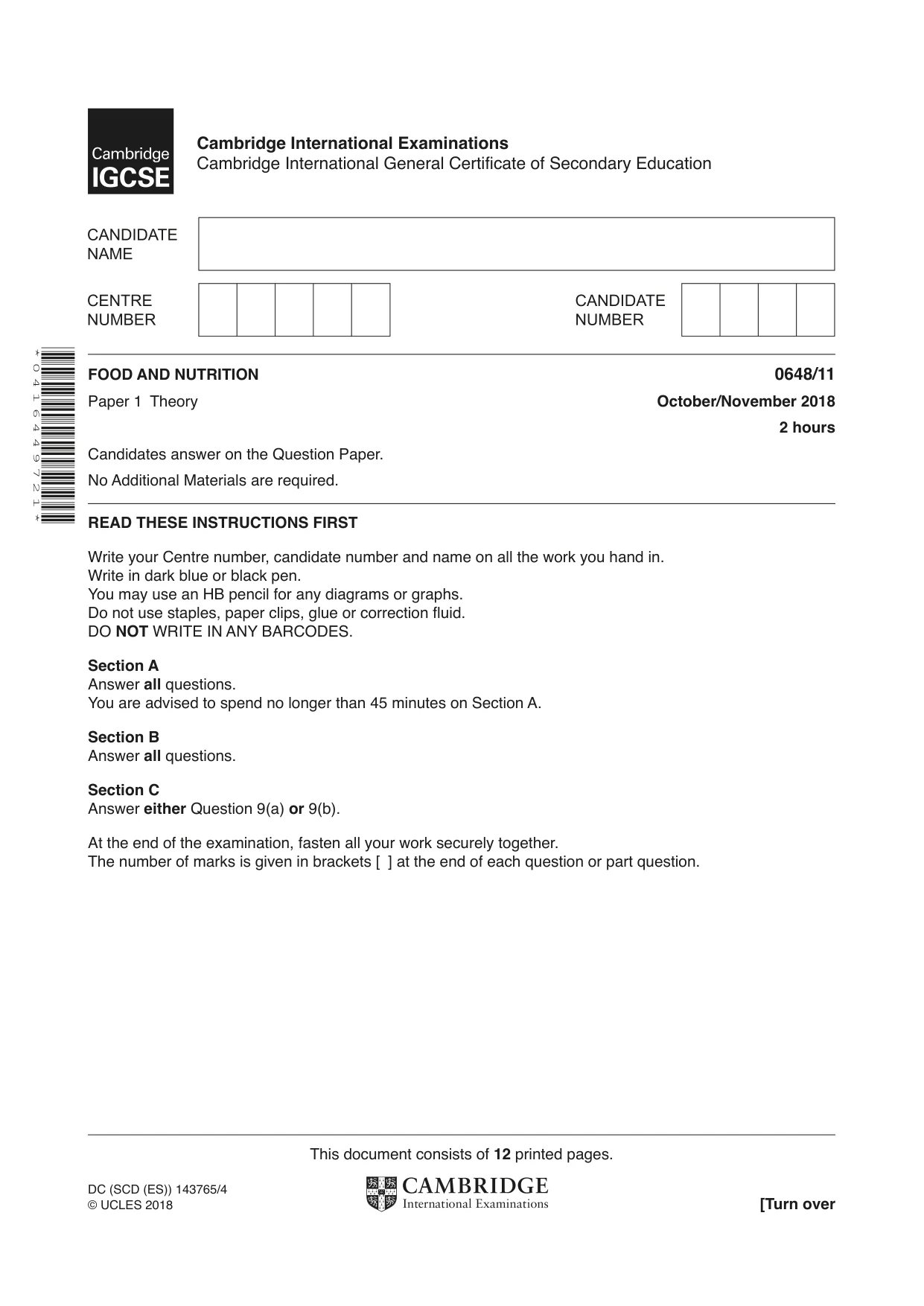
This document consists of 12 printed pages. DC (SCD (ES)) 143765/4 © UCLES 2018 [Turn over Cambridge International Examinations Cambridge International General Certificate of Secondary Education * 0 4 1 6 4 4 9 7 2 1 * FOOD AND NUTRITION 0648/11 Paper 1 Theory October/November 2018 2 hours Candidates answer on the Question Paper. No Additional Materials are required. READ THESE INSTRUCTIONS FIRST Write your Centre number, candidate number and name on all the work you hand in. Write in dark blue or black pen. You may use an HB pencil for any diagrams or graphs. Do not use staples, paper clips, glue or correction fluid. DO NOT WRITE IN ANY BARCODES. Section A Answer all questions. You are advised to spend no longer than 45 minutes on Section A. Section B Answer all questions. Section C Answer either Question 9(a) or 9(b). At the end of the examination, fasten all your work securely together. The number of marks is given in brackets [ ] at the end of each question or part question.
Question paper, page 2
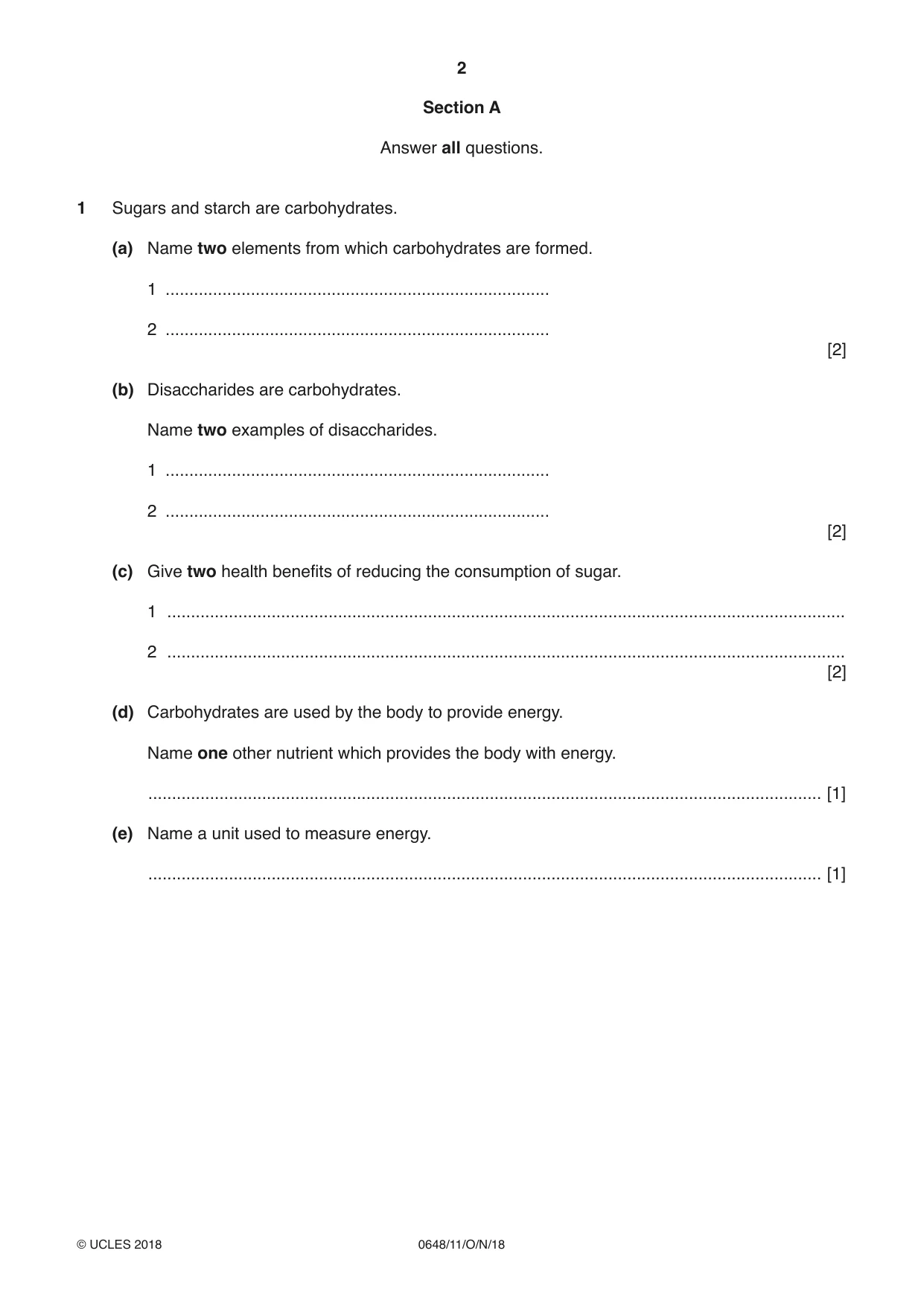
2 0648/11/O/N/18 © UCLES 2018 Section A Answer all questions. 1 Sugars and starch are carbohydrates. (a) Name two elements from which carbohydrates are formed. 1 … 2 … [2] (b) Disaccharides are carbohydrates. Name two examples of disaccharides. 1 … 2 … [2] (c) Give two health benefits of reducing the consumption of sugar. 1 … 2 … [2] (d) Carbohydrates are used by the body to provide energy. Name one other nutrient which provides the body with energy. … [1] (e) Name a unit used to measure energy. … [1]
Question paper, page 3
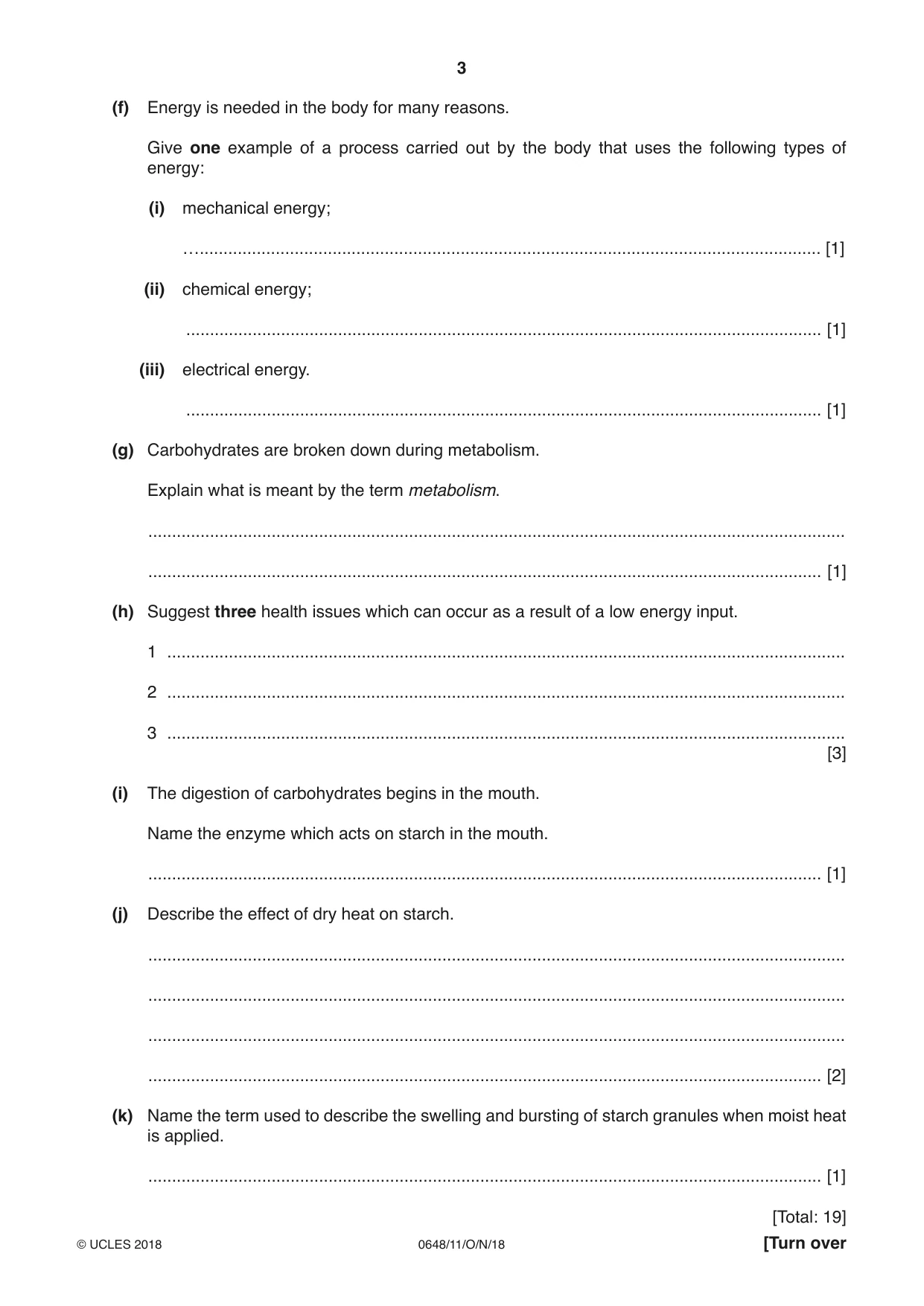
3 0648/11/O/N/18 © UCLES 2018 [Turn over (f) Energy is needed in the body for many reasons. Give one example of a process carried out by the body that uses the following types of energy: (i) mechanical energy; …… [1] (ii) chemical energy; … [1] (iii) electrical energy. … [1] (g) Carbohydrates are broken down during metabolism. Explain what is meant by the term metabolism. … … [1] (h) Suggest three health issues which can occur as a result of a low energy input. 1 … 2 … 3 … [3] (i) The digestion of carbohydrates begins in the mouth. Name the enzyme which acts on starch in the mouth. … [1] (j) Describe the effect of dry heat on starch. … … … … [2] (k) Name the term used to describe the swelling and bursting of starch granules when moist heat is applied. … [1] [Total: 19]
Question paper, page 4
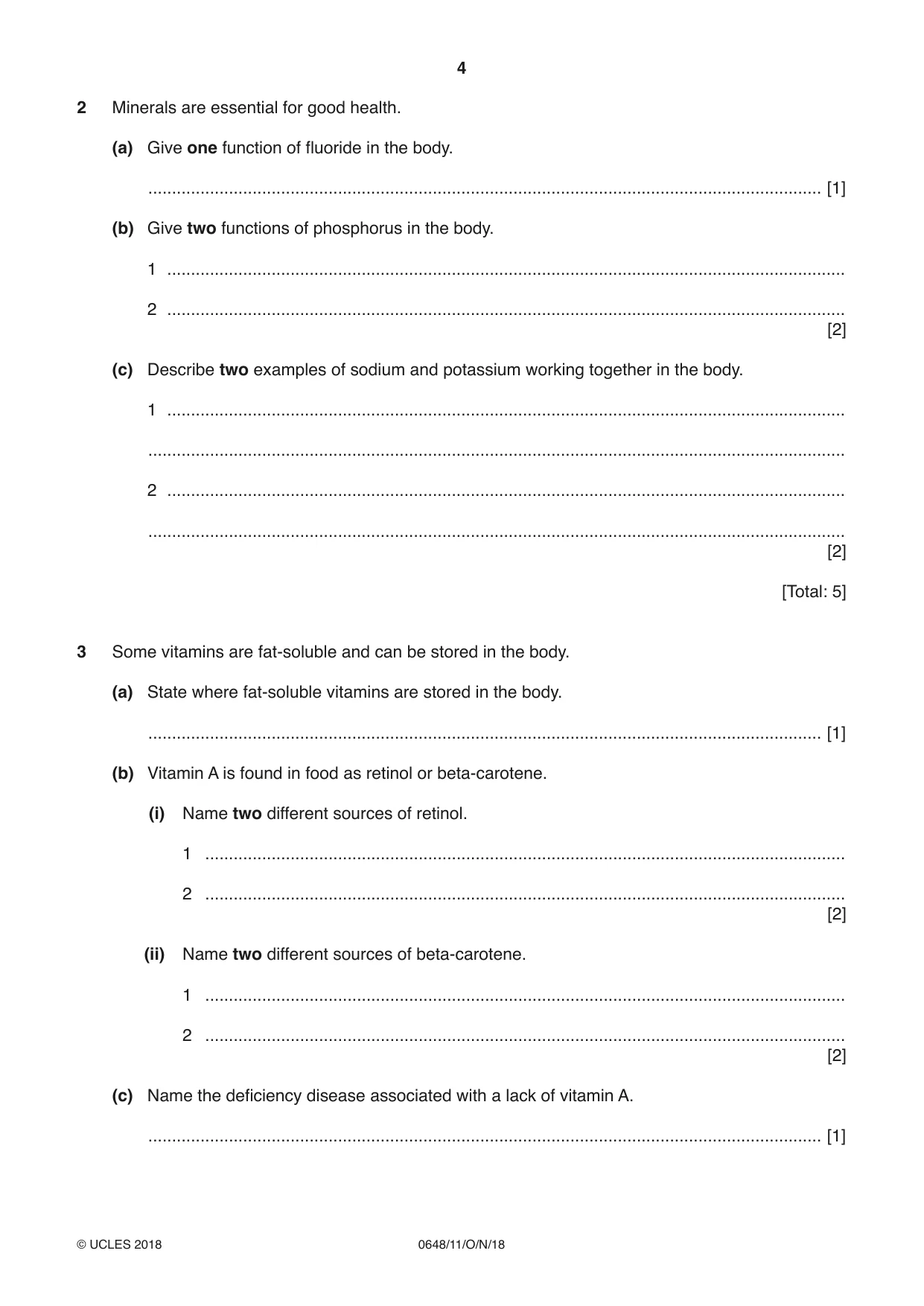
4 0648/11/O/N/18 © UCLES 2018 2 Minerals are essential for good health. (a) Give one function of fluoride in the body. … [1] (b) Give two functions of phosphorus in the body. 1 … 2 … [2] (c) Describe two examples of sodium and potassium working together in the body. 1 … … 2 … … [2] [Total: 5] 3 Some vitamins are fat-soluble and can be stored in the body. (a) State where fat-soluble vitamins are stored in the body. … [1] (b) Vitamin A is found in food as retinol or beta-carotene. (i) Name two different sources of retinol. 1 … 2 … [2] (ii) Name two different sources of beta-carotene. 1 … 2 … [2] (c) Name the deficiency disease associated with a lack of vitamin A. … [1]
Question paper, page 5
5 0648/11/O/N/18 © UCLES 2018 [Turn over (d) Give two functions of vitamin E (tocopherol) in the body. 1 … 2 … [2] (e) Give two functions of vitamin K in the body. 1 … 2 … [2] [Total: 10] 4 Give six reasons why water is vital in the diet. 1 … … 2 … … 3 … … 4 … … 5 … … 6 … … [6] [Total: 6]
Question paper, page 6
6 0648/11/O/N/18 © UCLES 2018 Section B Answer all questions. 5 A basic recipe for making flapjack uses the following ingredients: 300 g oats 150 g sugar 150 g syrup 150 g butter (a) Name the method used to make the flapjack. … [1] (b) Butter makes this recipe high in saturated fat. Name two ingredients that can be used to replace the butter which are lower in saturated fat. 1 … 2 … [2] (c) Name one ingredient in the recipe which is high in non-starch polysaccharide (NSP) / dietary fibre. … [1] (d) Name three ingredients which could be added to vary the flavour of the flapjack. 1 … 2 … 3 . … [3] (e) Suggest two methods of preparing the baking tin to prevent the flapjack sticking. 1 … 2 … [2]
Question paper, page 7
7 0648/11/O/N/18 © UCLES 2018 [Turn over (f) The flapjack is cooked in an oven by conduction and convection. Explain the term conduction. … … … … [2] [Total: 11] 6 Many recipes use chemical raising agents such as baking powder. (a) There are two main ingredients of baking powder. Bicarbonate of soda is one main ingredient. State the other main ingredient. … [1] (b) Give one effect of using only bicarbonate of soda as the raising agent in a mixture. … [1] (c) Name the gas produced when bicarbonate of soda is used as a raising agent. … [1] (d) Suggest two guidelines for storing baking powder in the home. 1 … 2 … [2] (e) Give three reasons for using raising agents in baked products. 1 … 2 … 3 … [3] [Total: 8]
Question paper, page 8
8 0648/11/O/N/18 © UCLES 2018 7 A batter is a mixture of flour, milk and egg. (a) Name three dishes which can be made from batters. 1 … 2 … 3 … [3] (b) Describe how to make a traditional batter mixture. … … … … … … … … [4] (c) To save time and effort an electric mixer can be used to make a batter. Name three other pieces of labour-saving kitchen equipment and give one different example of the use of each. equipment 1 … use … equipment 2 … use … equipment 3 … use … [6]
Question paper, page 9
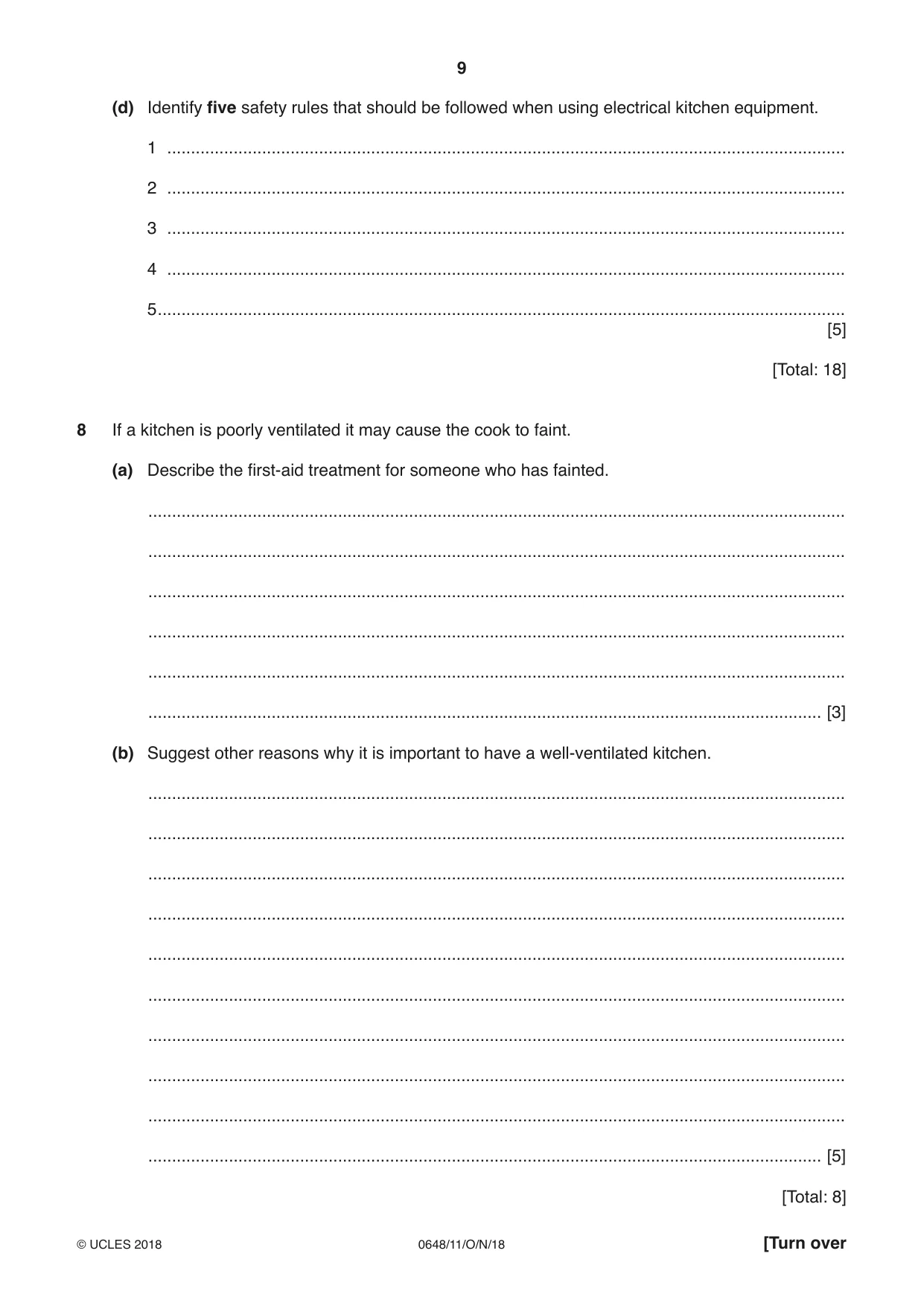
9 0648/11/O/N/18 © UCLES 2018 [Turn over (d) Identify five safety rules that should be followed when using electrical kitchen equipment. 1 … 2 … 3 … 4 … 5 … [5] [Total: 18] 8 If a kitchen is poorly ventilated it may cause the cook to faint. (a) Describe the first-aid treatment for someone who has fainted. … … … … … … [3] (b) Suggest other reasons why it is important to have a well-ventilated kitchen. … … … … … … … … … … [5] [Total: 8]
Question paper, page 10
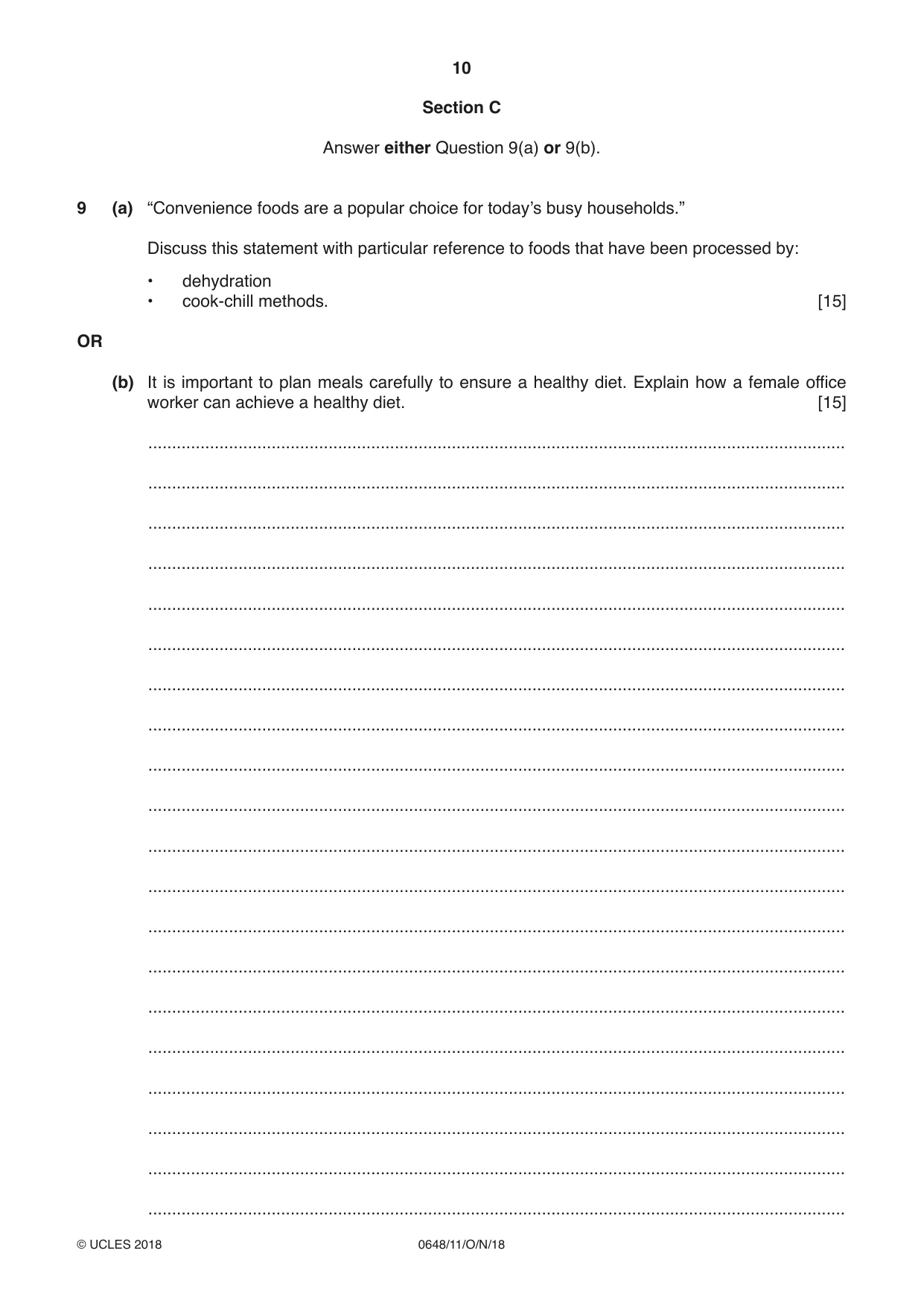
10 0648/11/O/N/18 © UCLES 2018 Section C Answer either Question 9(a) or 9(b). 9 (a) “Convenience foods are a popular choice for today’s busy households.” Discuss this statement with particular reference to foods that have been processed by: • dehydration • cook-chill methods. [15] OR (b) It is important to plan meals carefully to ensure a healthy diet. Explain how a female office worker can achieve a healthy diet. [15] … … … … … … … … … … … … … … … … … … … …
Question paper, page 11
11 0648/11/O/N/18 © UCLES 2018 [Turn over … … … … … … … … … … … … … … … … … … … … … … … … … … … …
Question paper, page 12
12 0648/11/O/N/18 © UCLES 2018 … … … … … … … … … … … … … … … … … … … … … … … [Total: 15] Permission to reproduce items where third-party owned material protected by copyright is included has been sought and cleared where possible. Every reasonable effort has been made by the publisher (UCLES) to trace copyright holders, but if any items requiring clearance have unwittingly been included, the publisher will be pleased to make amends at the earliest possible opportunity. To avoid the issue of disclosure of answer-related information to candidates, all copyright acknowledgements are reproduced online in the Cambridge International Examinations Copyright Acknowledgements Booklet. This is produced for each series of examinations and is freely available to download at www.cie.org.uk after the live examination series. Cambridge International Examinations is part of the Cambridge Assessment Group. Cambridge Assessment is the brand name of University of Cambridge Local Examinations Syndicate (UCLES), which is itself a department of the University of Cambridge.
Mark scheme, page 1
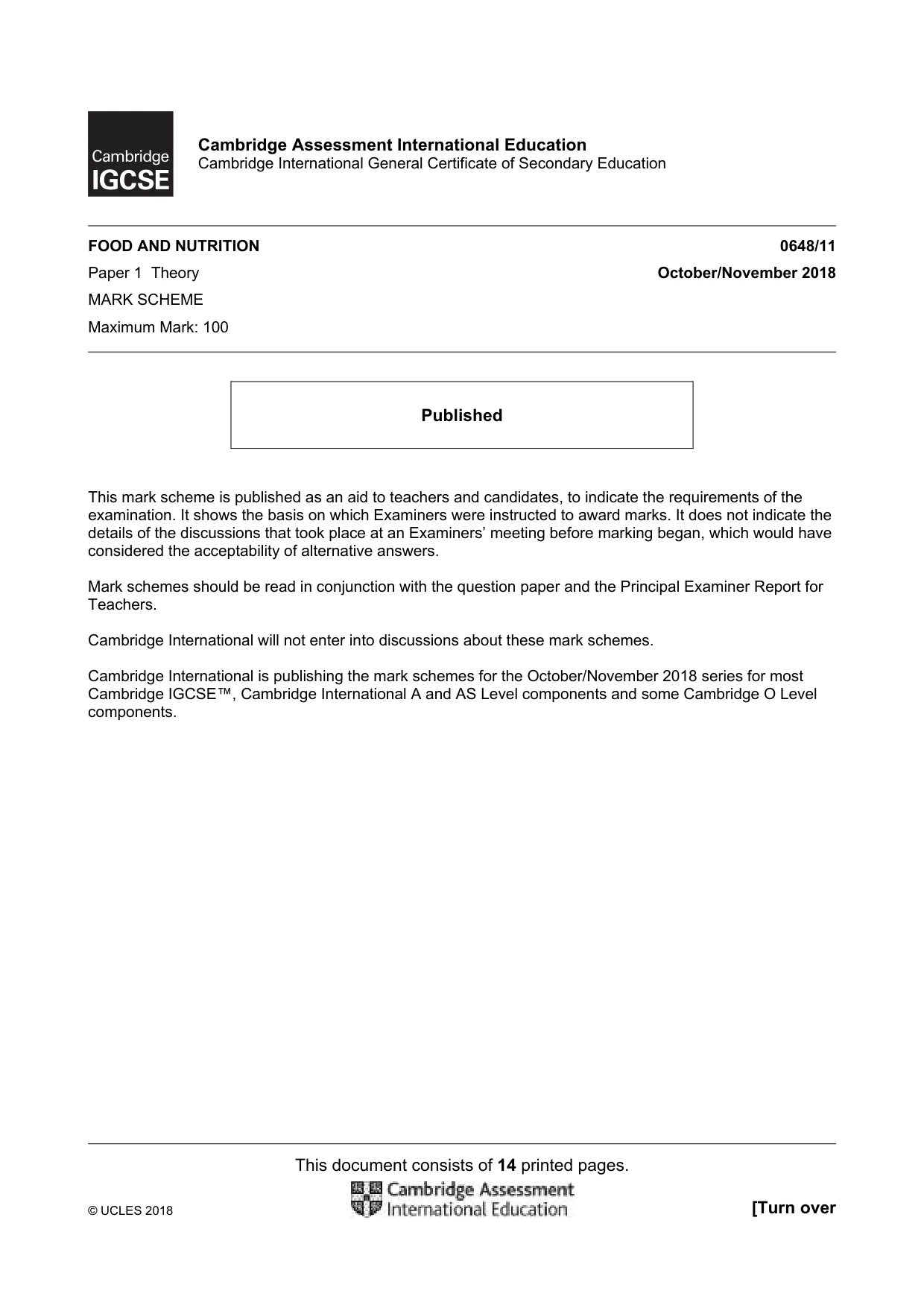
This document consists of 14 printed pages. © UCLES 2018 [Turn over Cambridge Assessment International Education Cambridge International General Certificate of Secondary Education FOOD AND NUTRITION 0648/11 Paper 1 Theory October/November 2018 MARK SCHEME Maximum Mark: 100 Published This mark scheme is published as an aid to teachers and candidates, to indicate the requirements of the examination. It shows the basis on which Examiners were instructed to award marks. It does not indicate the details of the discussions that took place at an Examiners’ meeting before marking began, which would have considered the acceptability of alternative answers. Mark schemes should be read in conjunction with the question paper and the Principal Examiner Report for Teachers. Cambridge International will not enter into discussions about these mark schemes. Cambridge International is publishing the mark schemes for the October/November 2018 series for most Cambridge IGCSE™, Cambridge International A and AS Level components and some Cambridge O Level components.
Mark scheme, page 2
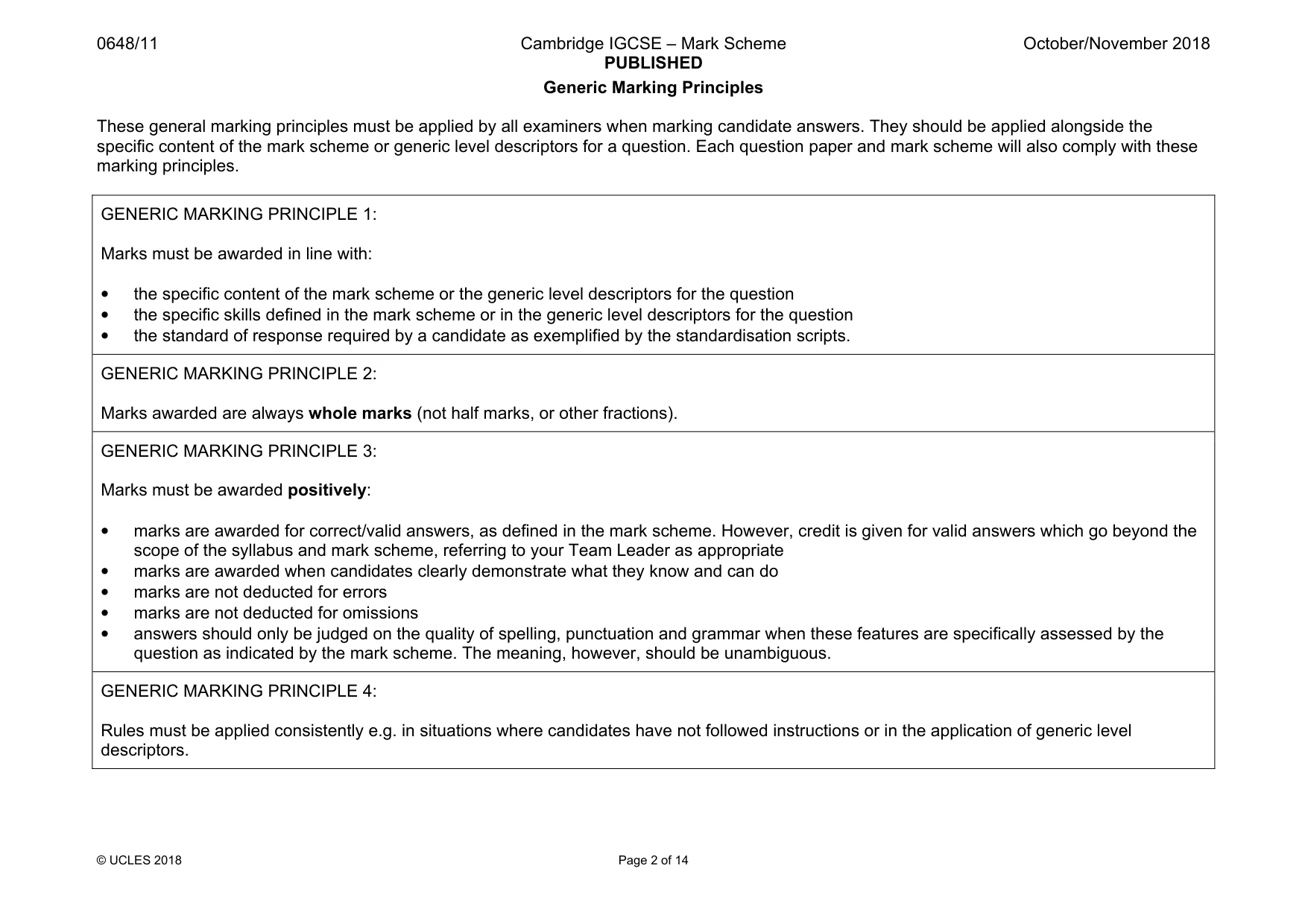
0648/11 Cambridge IGCSE – Mark Scheme PUBLISHED October/November 2018 © UCLES 2018 Page 2 of 14 Generic Marking Principles These general marking principles must be applied by all examiners when marking candidate answers. They should be applied alongside the specific content of the mark scheme or generic level descriptors for a question. Each question paper and mark scheme will also comply with these marking principles. GENERIC MARKING PRINCIPLE 1: Marks must be awarded in line with: • the specific content of the mark scheme or the generic level descriptors for the question • the specific skills defined in the mark scheme or in the generic level descriptors for the question • the standard of response required by a candidate as exemplified by the standardisation scripts. GENERIC MARKING PRINCIPLE 2: Marks awarded are always whole marks (not half marks, or other fractions). GENERIC MARKING PRINCIPLE 3: Marks must be awarded positively: • marks are awarded for correct/valid answers, as defined in the mark scheme. However, credit is given for valid answers which go beyond the scope of the syllabus and mark scheme, referring to your Team Leader as appropriate • marks are awarded when candidates clearly demonstrate what they know and can do • marks are not deducted for errors • marks are not deducted for omissions • answers should only be judged on the quality of spelling, punctuation and grammar when these features are specifically assessed by the question as indicated by the mark scheme. The meaning, however, should be unambiguous. GENERIC MARKING PRINCIPLE 4: Rules must be applied consistently e.g. in situations where candidates have not followed instructions or in the application of generic level descriptors.
Mark scheme, page 3
0648/11 Cambridge IGCSE – Mark Scheme PUBLISHED October/November 2018 © UCLES 2018 Page 3 of 14 GENERIC MARKING PRINCIPLE 5: Marks should be awarded using the full range of marks defined in the mark scheme for the question (however; the use of the full mark range may be limited according to the quality of the candidate responses seen). GENERIC MARKING PRINCIPLE 6: Marks awarded are based solely on the requirements as defined in the mark scheme. Marks should not be awarded with grade thresholds or grade descriptors in mind.
Mark scheme, page 4
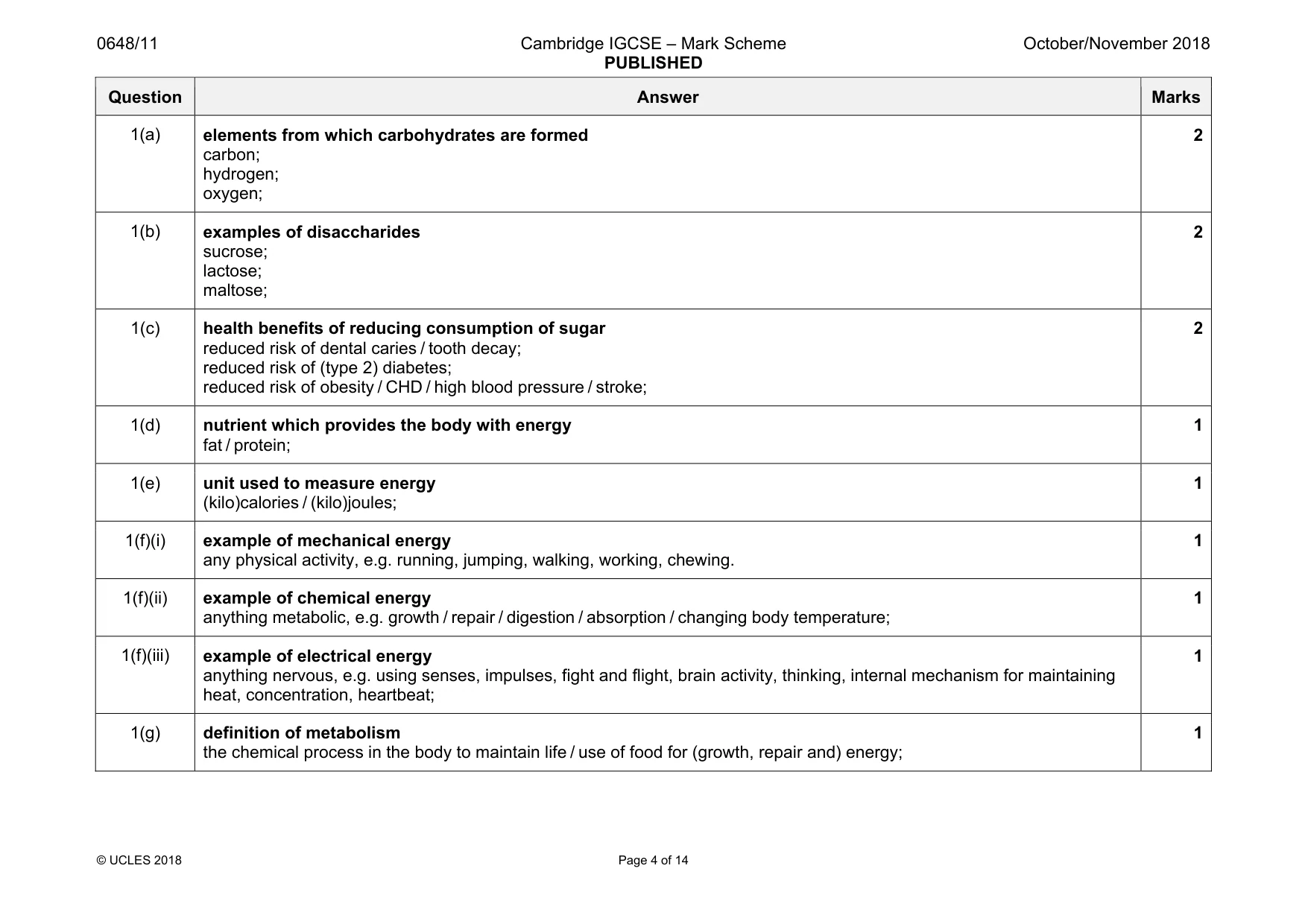
0648/11 Cambridge IGCSE – Mark Scheme PUBLISHED October/November 2018 © UCLES 2018 Page 4 of 14 Question Answer Marks 1(a) elements from which carbohydrates are formed carbon; hydrogen; oxygen; 2 1(b) examples of disaccharides sucrose; lactose; maltose; 2 1(c) health benefits of reducing consumption of sugar reduced risk of dental caries / tooth decay; reduced risk of (type 2) diabetes; reduced risk of obesity / CHD / high blood pressure / stroke; 2 1(d) nutrient which provides the body with energy fat / protein; 1 1(e) unit used to measure energy (kilo)calories / (kilo)joules; 1 1(f)(i) example of mechanical energy any physical activity, e.g. running, jumping, walking, working, chewing. 1 1(f)(ii) example of chemical energy anything metabolic, e.g. growth / repair / digestion / absorption / changing body temperature; 1 1(f)(iii) example of electrical energy anything nervous, e.g. using senses, impulses, fight and flight, brain activity, thinking, internal mechanism for maintaining heat, concentration, heartbeat; 1 1(g) definition of metabolism the chemical process in the body to maintain life / use of food for (growth, repair and) energy; 1
Mark scheme, page 5
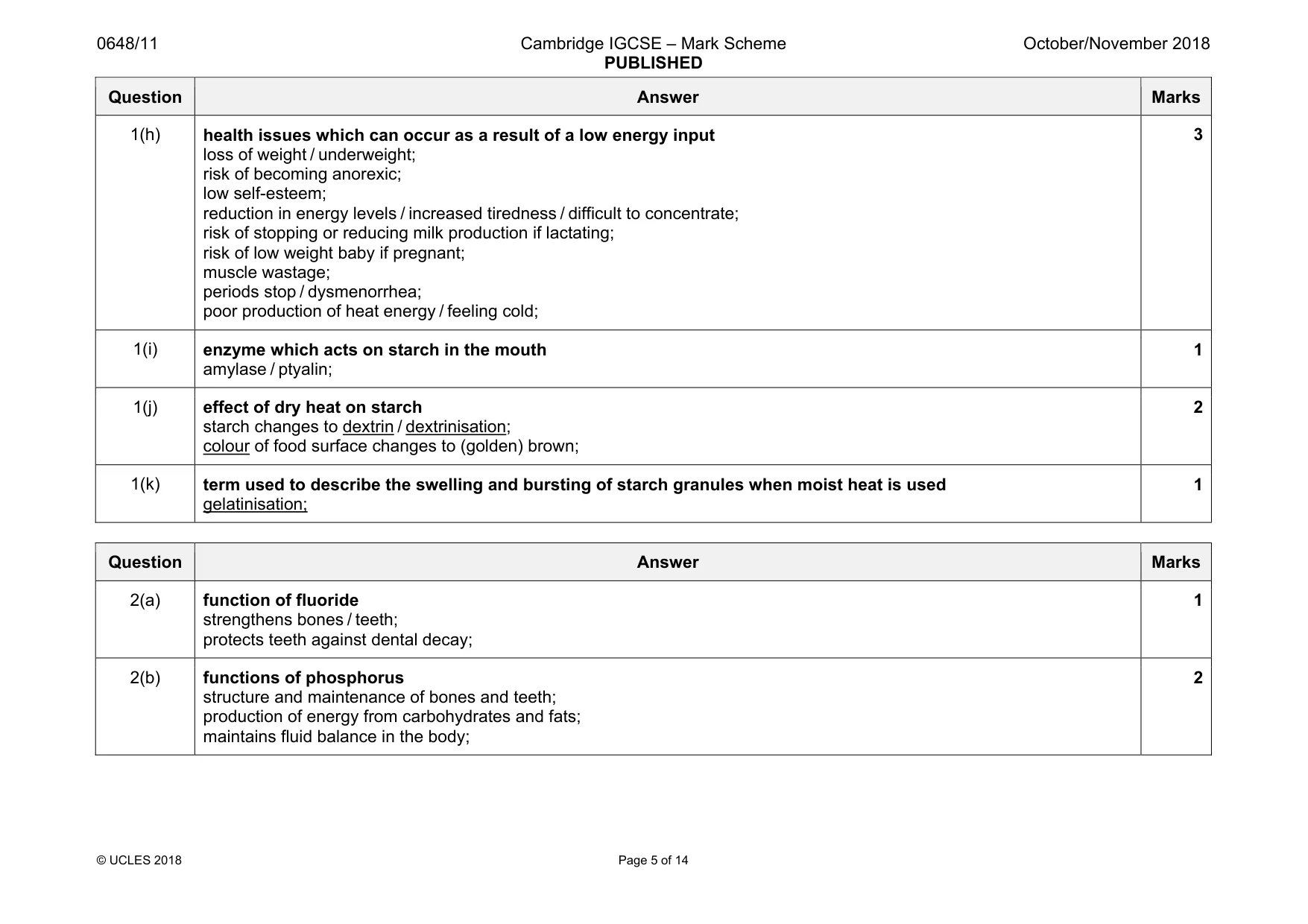
0648/11 Cambridge IGCSE – Mark Scheme PUBLISHED October/November 2018 © UCLES 2018 Page 5 of 14 Question Answer Marks 1(h) health issues which can occur as a result of a low energy input loss of weight / underweight; risk of becoming anorexic; low self-esteem; reduction in energy levels / increased tiredness / difficult to concentrate; risk of stopping or reducing milk production if lactating; risk of low weight baby if pregnant; muscle wastage; periods stop / dysmenorrhea; poor production of heat energy / feeling cold; 3 1(i) enzyme which acts on starch in the mouth amylase / ptyalin; 1 1(j) effect of dry heat on starch starch changes to dextrin / dextrinisation; colour of food surface changes to (golden) brown; 2 1(k) term used to describe the swelling and bursting of starch granules when moist heat is used gelatinisation; 1 Question Answer Marks 2(a) function of fluoride strengthens bones / teeth; protects teeth against dental decay; 1 2(b) functions of phosphorus structure and maintenance of bones and teeth; production of energy from carbohydrates and fats; maintains fluid balance in the body; 2
Mark scheme, page 6
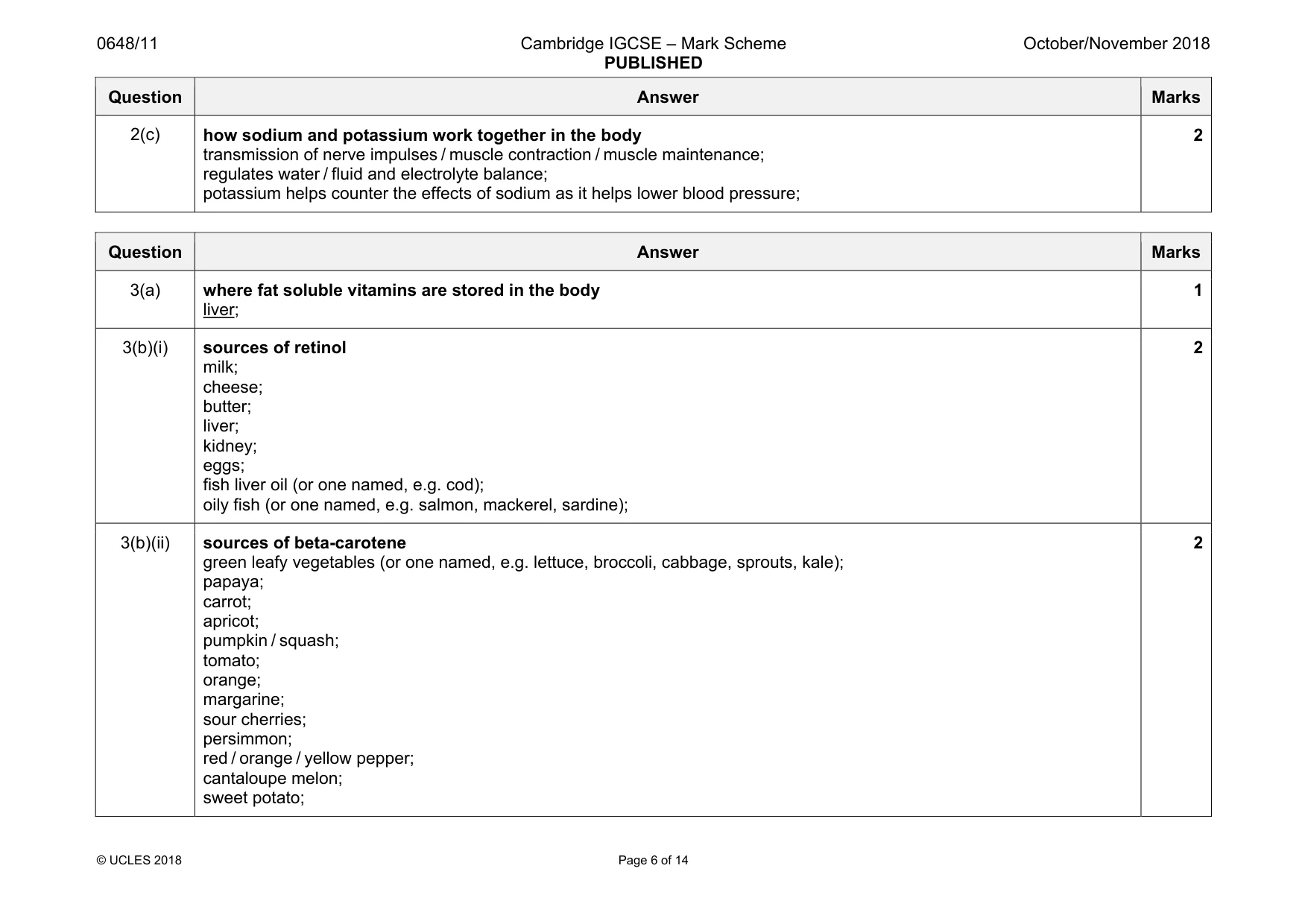
0648/11 Cambridge IGCSE – Mark Scheme PUBLISHED October/November 2018 © UCLES 2018 Page 6 of 14 Question Answer Marks 2(c) how sodium and potassium work together in the body transmission of nerve impulses / muscle contraction / muscle maintenance; regulates water / fluid and electrolyte balance; potassium helps counter the effects of sodium as it helps lower blood pressure; 2 Question Answer Marks 3(a) where fat soluble vitamins are stored in the body liver; 1 3(b)(i) sources of retinol milk; cheese; butter; liver; kidney; eggs; fish liver oil (or one named, e.g. cod); oily fish (or one named, e.g. salmon, mackerel, sardine); 2 3(b)(ii) sources of beta-carotene green leafy vegetables (or one named, e.g. lettuce, broccoli, cabbage, sprouts, kale); papaya; carrot; apricot; pumpkin / squash; tomato; orange; margarine; sour cherries; persimmon; red / orange / yellow pepper; cantaloupe melon; sweet potato; 2
Mark scheme, page 7
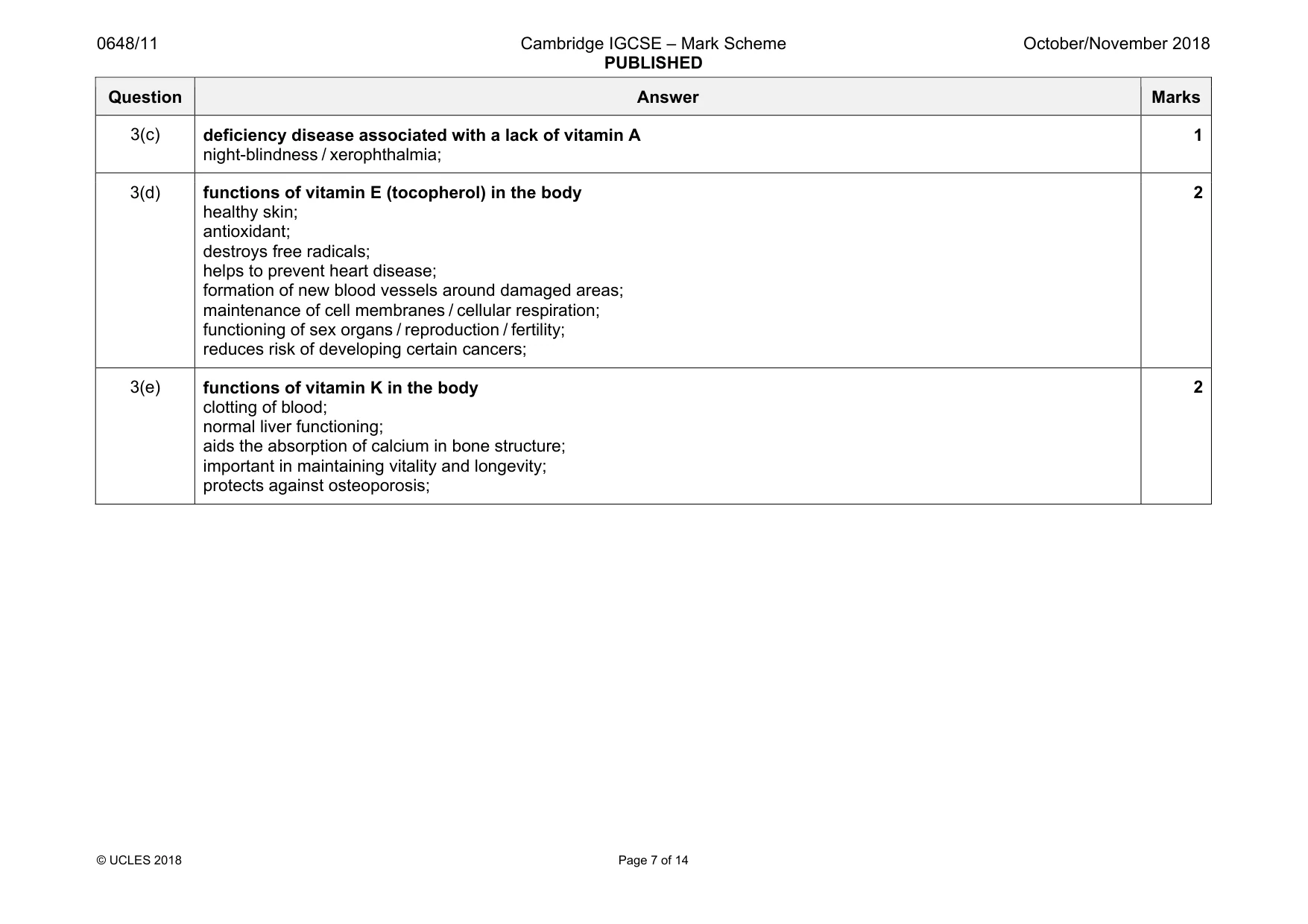
0648/11 Cambridge IGCSE – Mark Scheme PUBLISHED October/November 2018 © UCLES 2018 Page 7 of 14 Question Answer Marks 3(c) deficiency disease associated with a lack of vitamin A night-blindness / xerophthalmia; 1 3(d) functions of vitamin E (tocopherol) in the body healthy skin; antioxidant; destroys free radicals; helps to prevent heart disease; formation of new blood vessels around damaged areas; maintenance of cell membranes / cellular respiration; functioning of sex organs / reproduction / fertility; reduces risk of developing certain cancers; 2 3(e) functions of vitamin K in the body clotting of blood; normal liver functioning; aids the absorption of calcium in bone structure; important in maintaining vitality and longevity; protects against osteoporosis; 2
Mark scheme, page 8
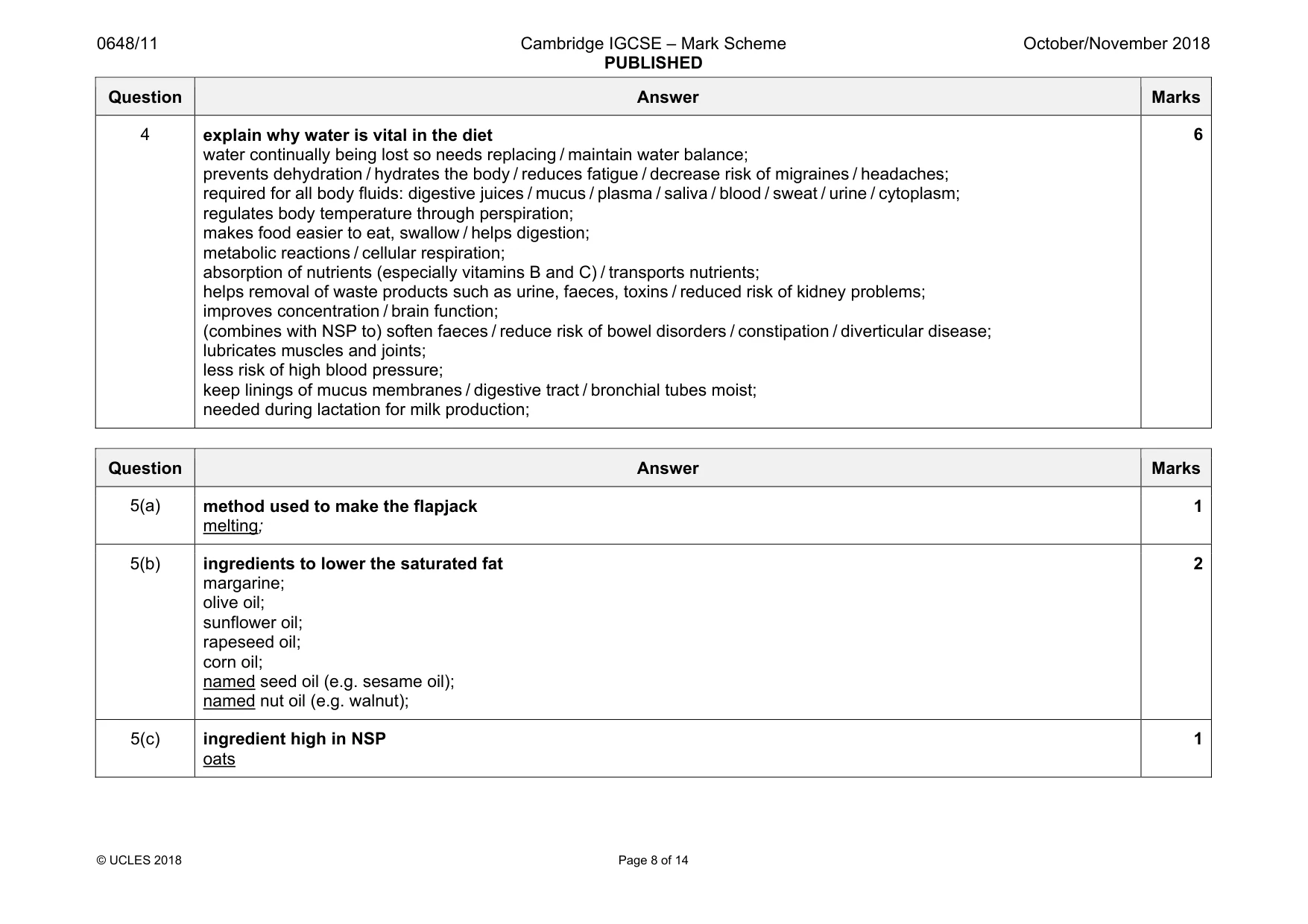
0648/11 Cambridge IGCSE – Mark Scheme PUBLISHED October/November 2018 © UCLES 2018 Page 8 of 14 Question Answer Marks 4 explain why water is vital in the diet water continually being lost so needs replacing / maintain water balance; prevents dehydration / hydrates the body / reduces fatigue / decrease risk of migraines / headaches; required for all body fluids: digestive juices / mucus / plasma / saliva / blood / sweat / urine / cytoplasm; regulates body temperature through perspiration; makes food easier to eat, swallow / helps digestion; metabolic reactions / cellular respiration; absorption of nutrients (especially vitamins B and C) / transports nutrients; helps removal of waste products such as urine, faeces, toxins / reduced risk of kidney problems; improves concentration / brain function; (combines with NSP to) soften faeces / reduce risk of bowel disorders / constipation / diverticular disease; lubricates muscles and joints; less risk of high blood pressure; keep linings of mucus membranes / digestive tract / bronchial tubes moist; needed during lactation for milk production; 6 Question Answer Marks 5(a) method used to make the flapjack melting; 1 5(b) ingredients to lower the saturated fat margarine; olive oil; sunflower oil; rapeseed oil; corn oil; named seed oil (e.g. sesame oil); named nut oil (e.g. walnut); 2 5(c) ingredient high in NSP oats 1
Mark scheme, page 9
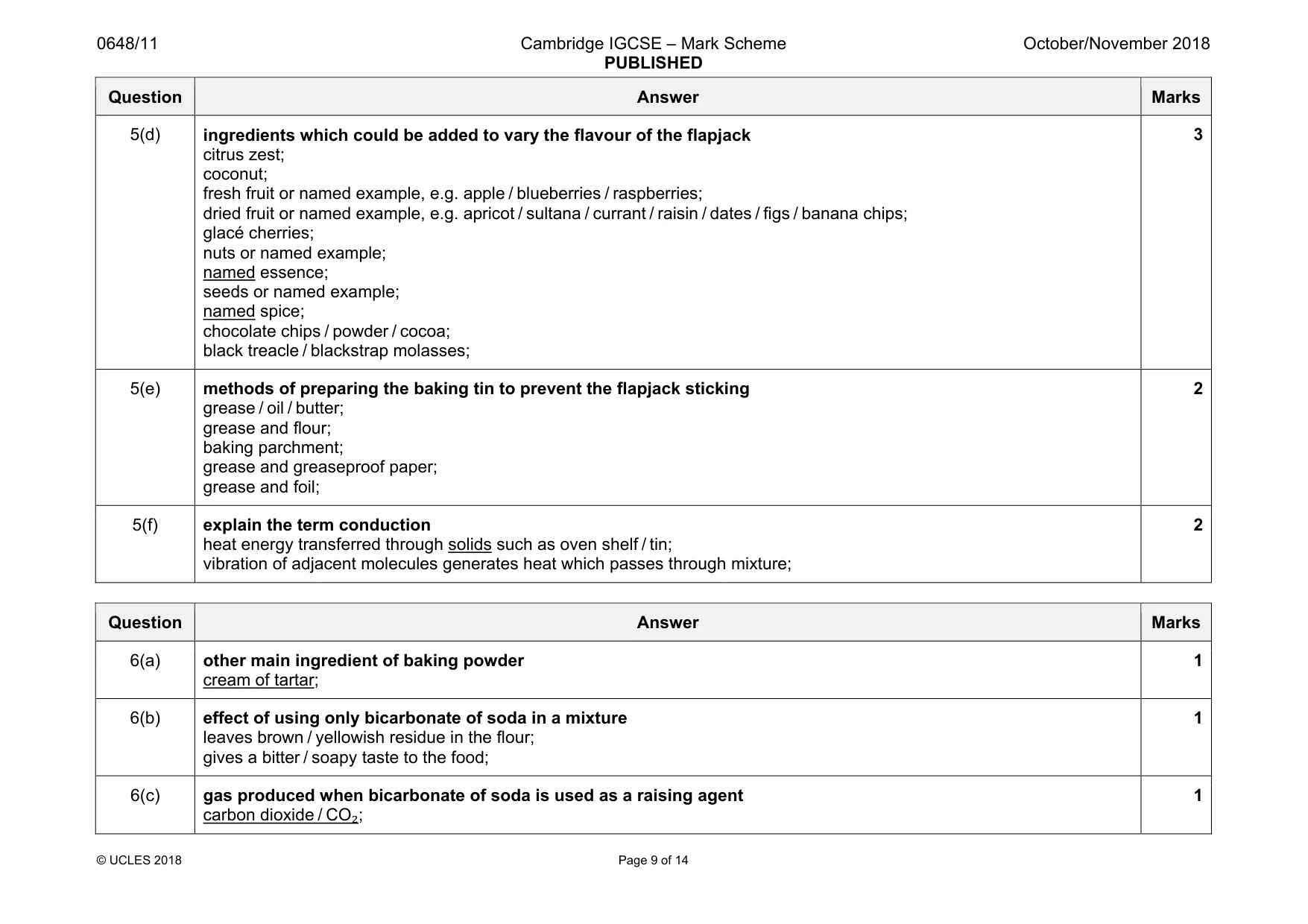
0648/11 Cambridge IGCSE – Mark Scheme PUBLISHED October/November 2018 © UCLES 2018 Page 9 of 14 Question Answer Marks 5(d) ingredients which could be added to vary the flavour of the flapjack citrus zest; coconut; fresh fruit or named example, e.g. apple / blueberries / raspberries; dried fruit or named example, e.g. apricot / sultana / currant / raisin / dates / figs / banana chips; glacé cherries; nuts or named example; named essence; seeds or named example; named spice; chocolate chips / powder / cocoa; black treacle / blackstrap molasses; 3 5(e) methods of preparing the baking tin to prevent the flapjack sticking grease / oil / butter; grease and flour; baking parchment; grease and greaseproof paper; grease and foil; 2 5(f) explain the term conduction heat energy transferred through solids such as oven shelf / tin; vibration of adjacent molecules generates heat which passes through mixture; 2 Question Answer Marks 6(a) other main ingredient of baking powder cream of tartar; 1 6(b) effect of using only bicarbonate of soda in a mixture leaves brown / yellowish residue in the flour; gives a bitter / soapy taste to the food; 1 6(c) gas produced when bicarbonate of soda is used as a raising agent carbon dioxide / CO₂; 1
Mark scheme, page 10
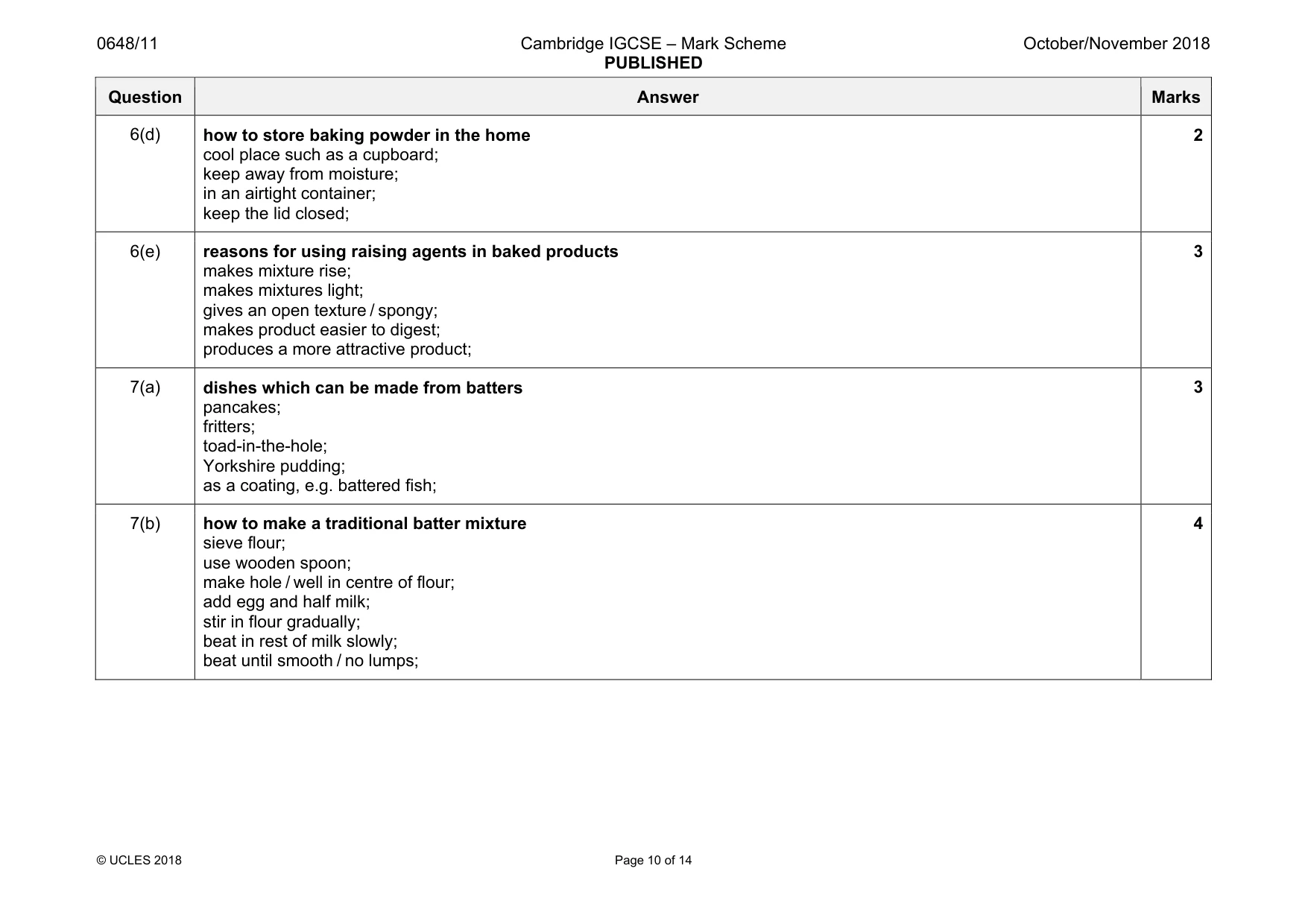
0648/11 Cambridge IGCSE – Mark Scheme PUBLISHED October/November 2018 © UCLES 2018 Page 10 of 14 Question Answer Marks 6(d) how to store baking powder in the home cool place such as a cupboard; keep away from moisture; in an airtight container; keep the lid closed; 2 6(e) reasons for using raising agents in baked products makes mixture rise; makes mixtures light; gives an open texture / spongy; makes product easier to digest; produces a more attractive product; 3 7(a) dishes which can be made from batters pancakes; fritters; toad-in-the-hole; Yorkshire pudding; as a coating, e.g. battered fish; 3 7(b) how to make a traditional batter mixture sieve flour; use wooden spoon; make hole / well in centre of flour; add egg and half milk; stir in flour gradually; beat in rest of milk slowly; beat until smooth / no lumps; 4
Mark scheme, page 11
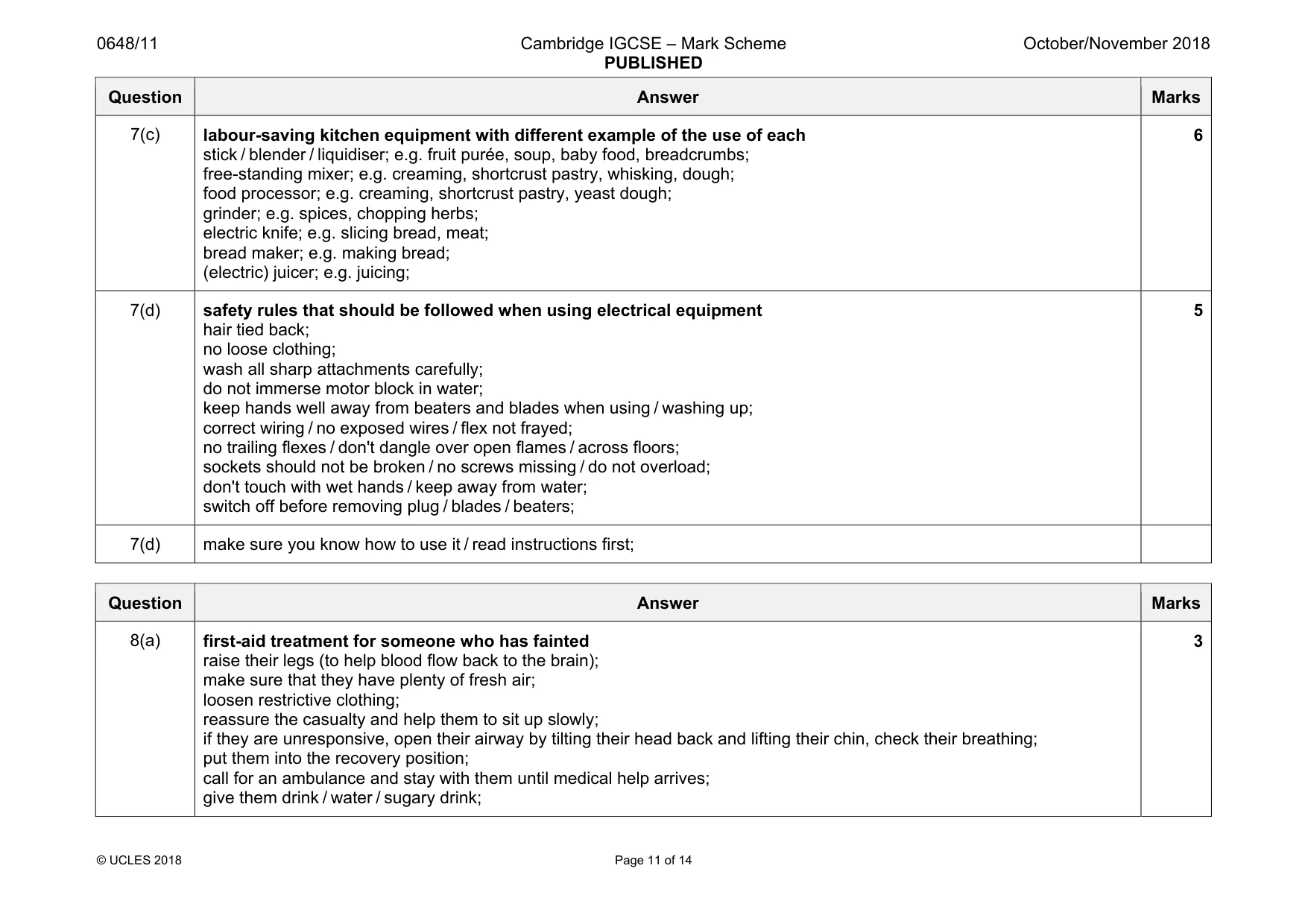
0648/11 Cambridge IGCSE – Mark Scheme PUBLISHED October/November 2018 © UCLES 2018 Page 11 of 14 Question Answer Marks 7(c) labour-saving kitchen equipment with different example of the use of each stick / blender / liquidiser; e.g. fruit purée, soup, baby food, breadcrumbs; free-standing mixer; e.g. creaming, shortcrust pastry, whisking, dough; food processor; e.g. creaming, shortcrust pastry, yeast dough; grinder; e.g. spices, chopping herbs; electric knife; e.g. slicing bread, meat; bread maker; e.g. making bread; (electric) juicer; e.g. juicing; 6 7(d) safety rules that should be followed when using electrical equipment hair tied back; no loose clothing; wash all sharp attachments carefully; do not immerse motor block in water; keep hands well away from beaters and blades when using / washing up; correct wiring / no exposed wires / flex not frayed; no trailing flexes / don't dangle over open flames / across floors; sockets should not be broken / no screws missing / do not overload; don't touch with wet hands / keep away from water; switch off before removing plug / blades / beaters; 5 7(d) make sure you know how to use it / read instructions first; Question Answer Marks 8(a) first-aid treatment for someone who has fainted raise their legs (to help blood flow back to the brain); make sure that they have plenty of fresh air; loosen restrictive clothing; reassure the casualty and help them to sit up slowly; if they are unresponsive, open their airway by tilting their head back and lifting their chin, check their breathing; put them into the recovery position; call for an ambulance and stay with them until medical help arrives; give them drink / water / sugary drink; 3
Mark scheme, page 12
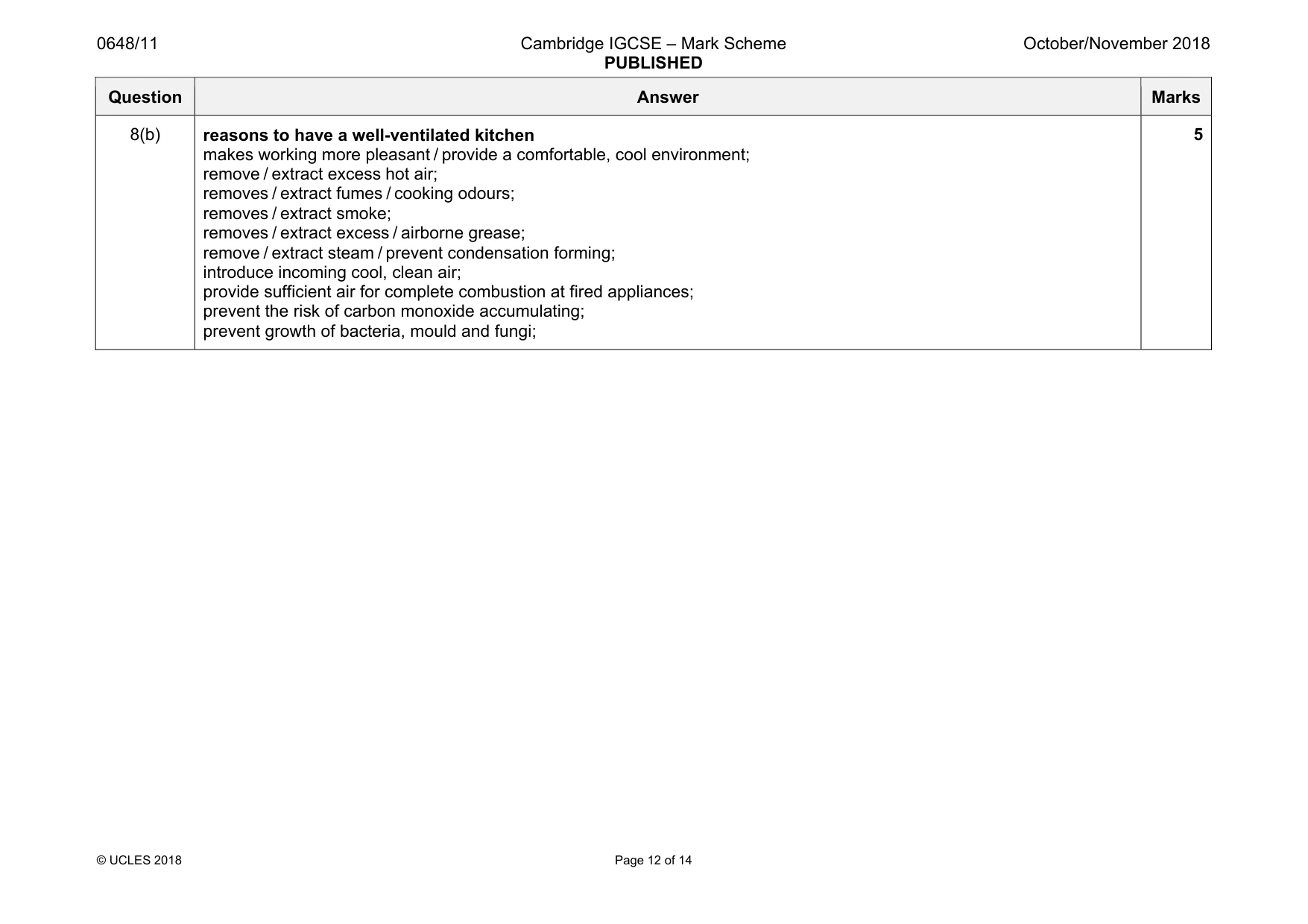
0648/11 Cambridge IGCSE – Mark Scheme PUBLISHED October/November 2018 © UCLES 2018 Page 12 of 14 Question Answer Marks 8(b) reasons to have a well-ventilated kitchen makes working more pleasant / provide a comfortable, cool environment; remove / extract excess hot air; removes / extract fumes / cooking odours; removes / extract smoke; removes / extract excess / airborne grease; remove / extract steam / prevent condensation forming; introduce incoming cool, clean air; provide sufficient air for complete combustion at fired appliances; prevent the risk of carbon monoxide accumulating; prevent growth of bacteria, mould and fungi; 5
Mark scheme, page 13
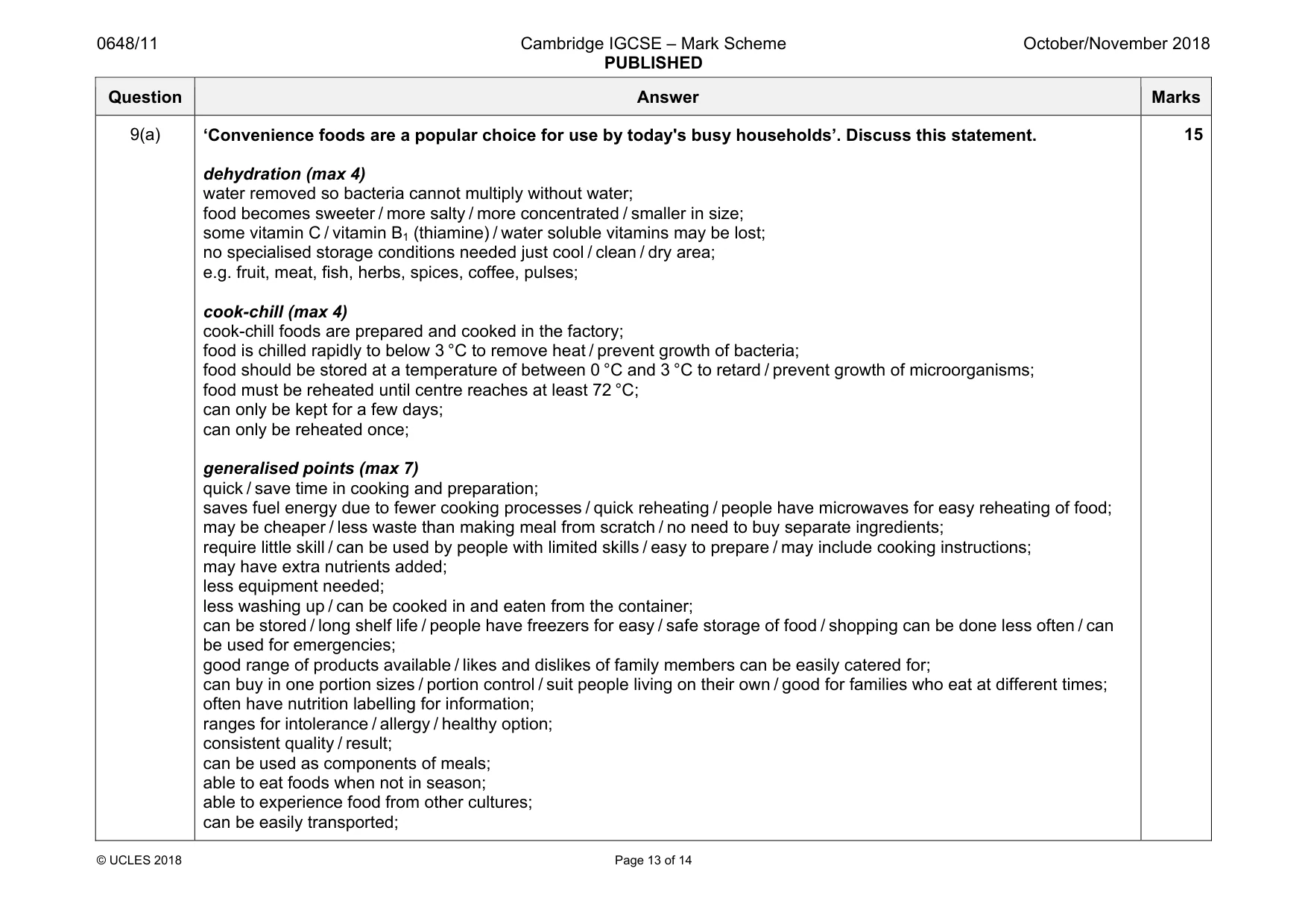
0648/11 Cambridge IGCSE – Mark Scheme PUBLISHED October/November 2018 © UCLES 2018 Page 13 of 14 Question Answer Marks 9(a) ‘Convenience foods are a popular choice for use by today's busy households’. Discuss this statement. dehydration (max 4) water removed so bacteria cannot multiply without water; food becomes sweeter / more salty / more concentrated / smaller in size; some vitamin C / vitamin B1 (thiamine) / water soluble vitamins may be lost; no specialised storage conditions needed just cool / clean / dry area; e.g. fruit, meat, fish, herbs, spices, coffee, pulses; cook-chill (max 4) cook-chill foods are prepared and cooked in the factory; food is chilled rapidly to below 3 °C to remove heat / prevent growth of bacteria; food should be stored at a temperature of between 0 °C and 3 °C to retard / prevent growth of microorganisms; food must be reheated until centre reaches at least 72 °C; can only be kept for a few days; can only be reheated once; generalised points (max 7) quick / save time in cooking and preparation; saves fuel energy due to fewer cooking processes / quick reheating / people have microwaves for easy reheating of food; may be cheaper / less waste than making meal from scratch / no need to buy separate ingredients; require little skill / can be used by people with limited skills / easy to prepare / may include cooking instructions; may have extra nutrients added; less equipment needed; less washing up / can be cooked in and eaten from the container; can be stored / long shelf life / people have freezers for easy / safe storage of food / shopping can be done less often / can be used for emergencies; good range of products available / likes and dislikes of family members can be easily catered for; can buy in one portion sizes / portion control / suit people living on their own / good for families who eat at different times; often have nutrition labelling for information; ranges for intolerance / allergy / healthy option; consistent quality / result; can be used as components of meals; able to eat foods when not in season; able to experience food from other cultures; can be easily transported; 15
Mark scheme, page 14
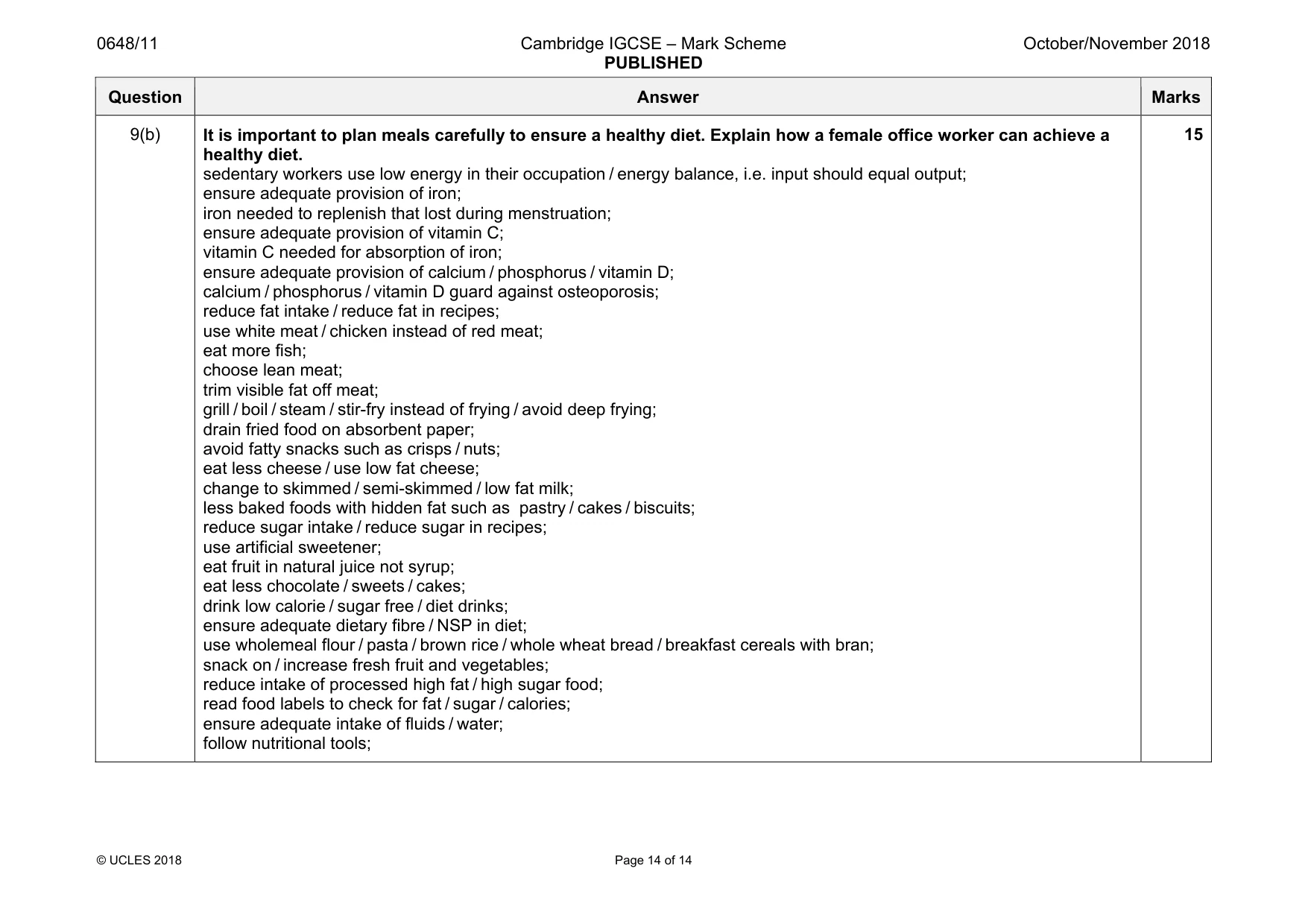
0648/11 Cambridge IGCSE – Mark Scheme PUBLISHED October/November 2018 © UCLES 2018 Page 14 of 14 Question Answer Marks 9(b) It is important to plan meals carefully to ensure a healthy diet. Explain how a female office worker can achieve a healthy diet. sedentary workers use low energy in their occupation / energy balance, i.e. input should equal output; ensure adequate provision of iron; iron needed to replenish that lost during menstruation; ensure adequate provision of vitamin C; vitamin C needed for absorption of iron; ensure adequate provision of calcium / phosphorus / vitamin D; calcium / phosphorus / vitamin D guard against osteoporosis; reduce fat intake / reduce fat in recipes; use white meat / chicken instead of red meat; eat more fish; choose lean meat; trim visible fat off meat; grill / boil / steam / stir-fry instead of frying / avoid deep frying; drain fried food on absorbent paper; avoid fatty snacks such as crisps / nuts; eat less cheese / use low fat cheese; change to skimmed / semi-skimmed / low fat milk; less baked foods with hidden fat such as pastry / cakes / biscuits; reduce sugar intake / reduce sugar in recipes; use artificial sweetener; eat fruit in natural juice not syrup; eat less chocolate / sweets / cakes; drink low calorie / sugar free / diet drinks; ensure adequate dietary fibre / NSP in diet; use wholemeal flour / pasta / brown rice / whole wheat bread / breakfast cereals with bran; snack on / increase fresh fruit and vegetables; reduce intake of processed high fat / high sugar food; read food labels to check for fat / sugar / calories; ensure adequate intake of fluids / water; follow nutritional tools; 15
What you needed in this session
Cambridge’s own grade thresholds for 2018 Oct/Nov, Paper 1 · Variant 1. A higher threshold means an easier paper — the bar moves with how the cohort did.