Cambridge IGCSE Food and Nutrition 0648 — 2016 Oct/Nov Paper 1 · Variant 2
0648/12/O/N/16 · 100 marks · ≈113 min
The question paper and its mark scheme, free to read here and free to download. This is Cambridge’s own paper, exactly as it was sat.
Question paper12 pages

Mark scheme14 pages
Answers below. Sit the paper first if you are practising.
Paper as text
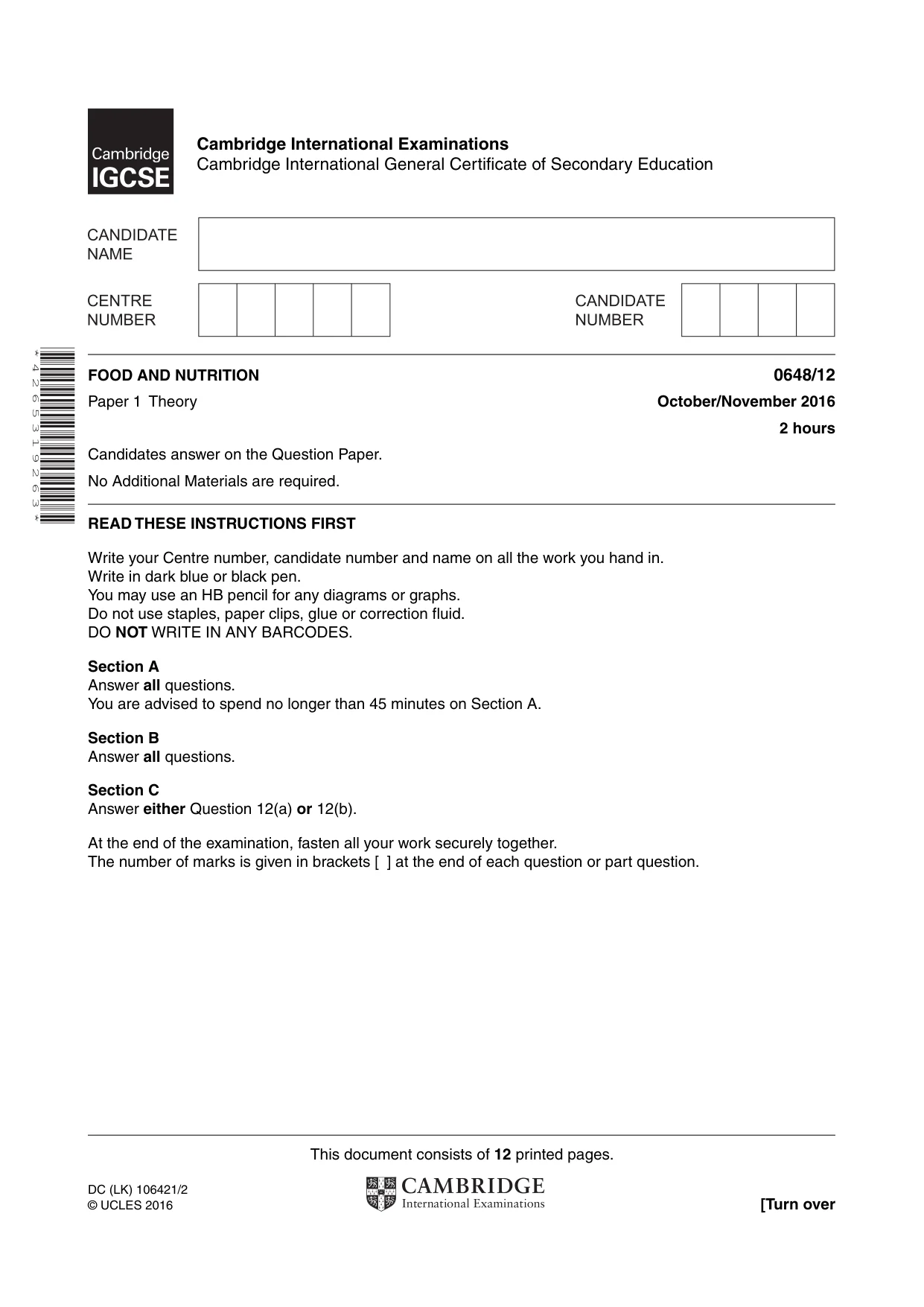
Question paper, page 1
This document consists of 12 printed pages. DC (LK) 106421/2 © UCLES 2016 [Turn over Cambridge International Examinations Cambridge International General Certificate of Secondary Education * 4 2 6 5 3 1 9 2 6 3 * FOOD AND NUTRITION 0648/12 Paper 1 Theory October/November 2016 2 hours Candidates answer on the Question Paper. No Additional Materials are required. READ THESE INSTRUCTIONS FIRST Write your Centre number, candidate number and name on all the work you hand in. Write in dark blue or black pen. You may use an HB pencil for any diagrams or graphs. Do not use staples, paper clips, glue or correction fluid. DO NOT WRITE IN ANY BARCODES. Section A Answer all questions. You are advised to spend no longer than 45 minutes on Section A. Section B Answer all questions. Section C Answer either Question 12(a) or 12(b). At the end of the examination, fasten all your work securely together. The number of marks is given in brackets [ ] at the end of each question or part question.
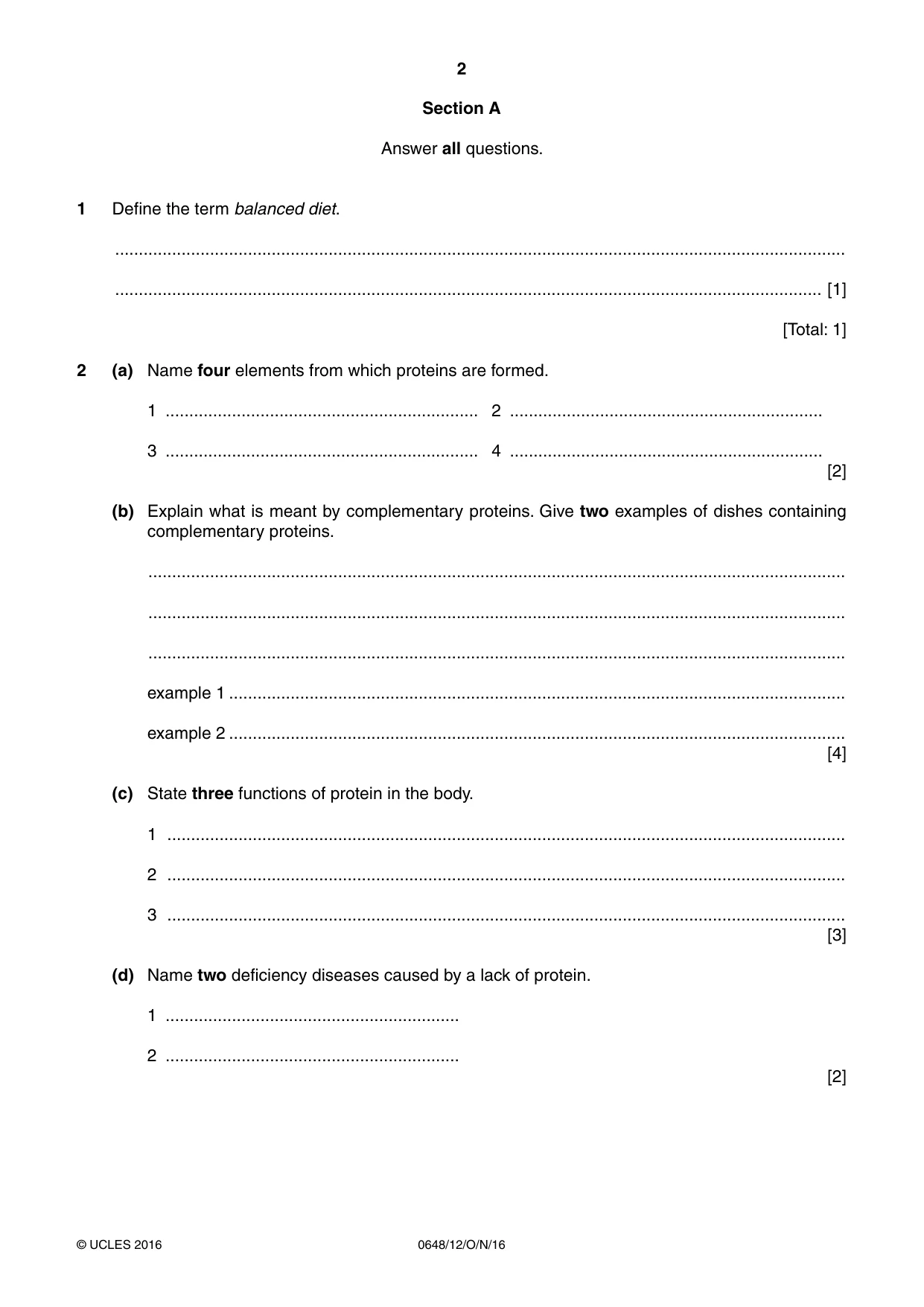
Question paper, page 2
2 0648/12/O/N/16 © UCLES 2016 Section A Answer all questions. 1 Define the term balanced diet. … … [1] [Total: 1] 2 (a) Name four elements from which proteins are formed. 1 … 2 … 3 … 4 … [2] (b) Explain what is meant by complementary proteins. Give two examples of dishes containing complementary proteins. … … … example 1 … example 2 … [4] (c) State three functions of protein in the body. 1 … 2 … 3 … [3] (d) Name two deficiency diseases caused by a lack of protein. 1 … 2 … [2]
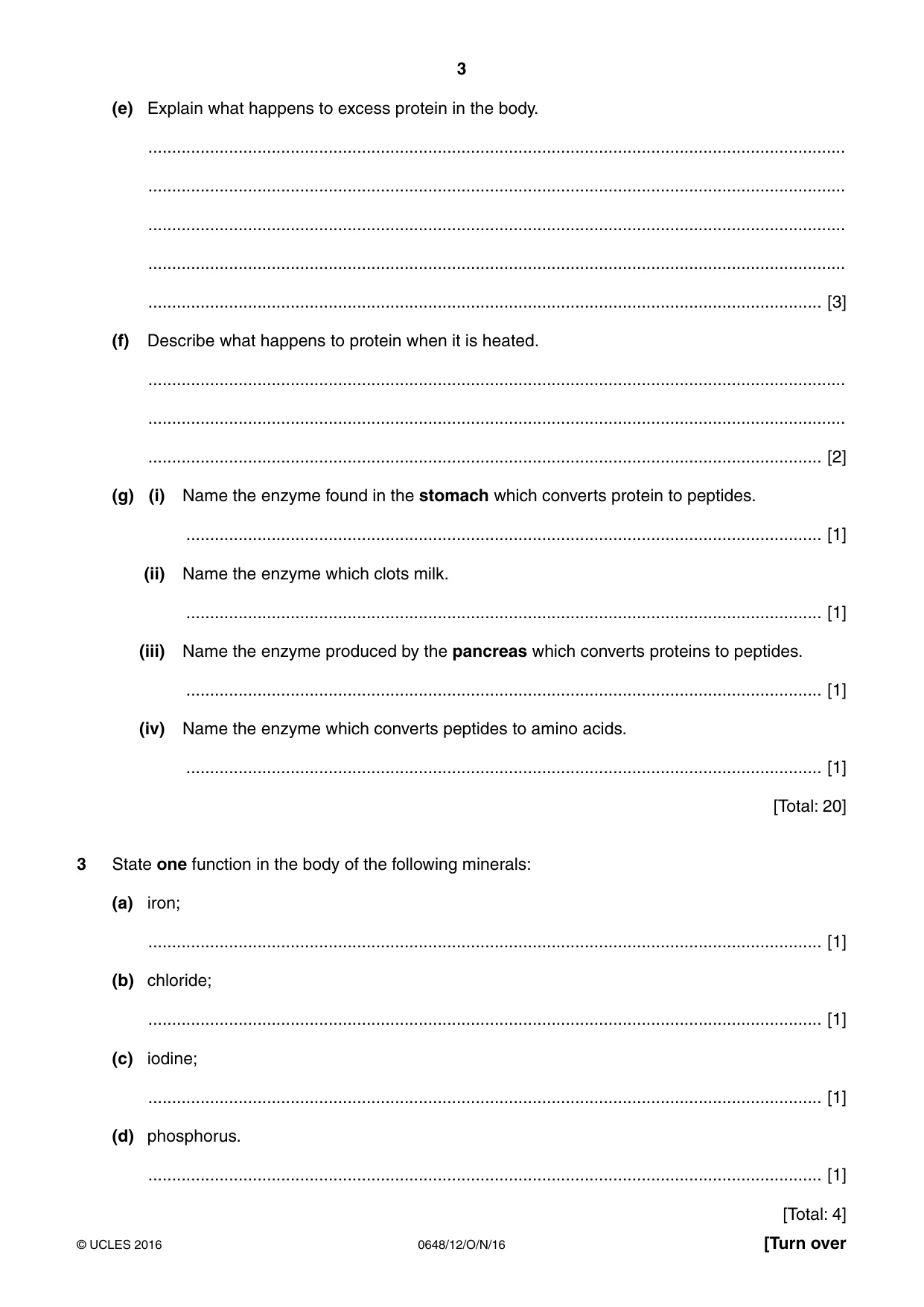
Question paper, page 3
3 0648/12/O/N/16 © UCLES 2016 [Turn over (e) Explain what happens to excess protein in the body. … … … … … [3] (f) Describe what happens to protein when it is heated. … … … [2] (g) (i) Name the enzyme found in the stomach which converts protein to peptides. … [1] (ii) Name the enzyme which clots milk. … [1] (iii) Name the enzyme produced by the pancreas which converts proteins to peptides. … [1] (iv) Name the enzyme which converts peptides to amino acids. … [1] [Total: 20] 3 State one function in the body of the following minerals: (a) iron; … [1] (b) chloride; … [1] (c) iodine; … [1] (d) phosphorus. … [1] [Total: 4]
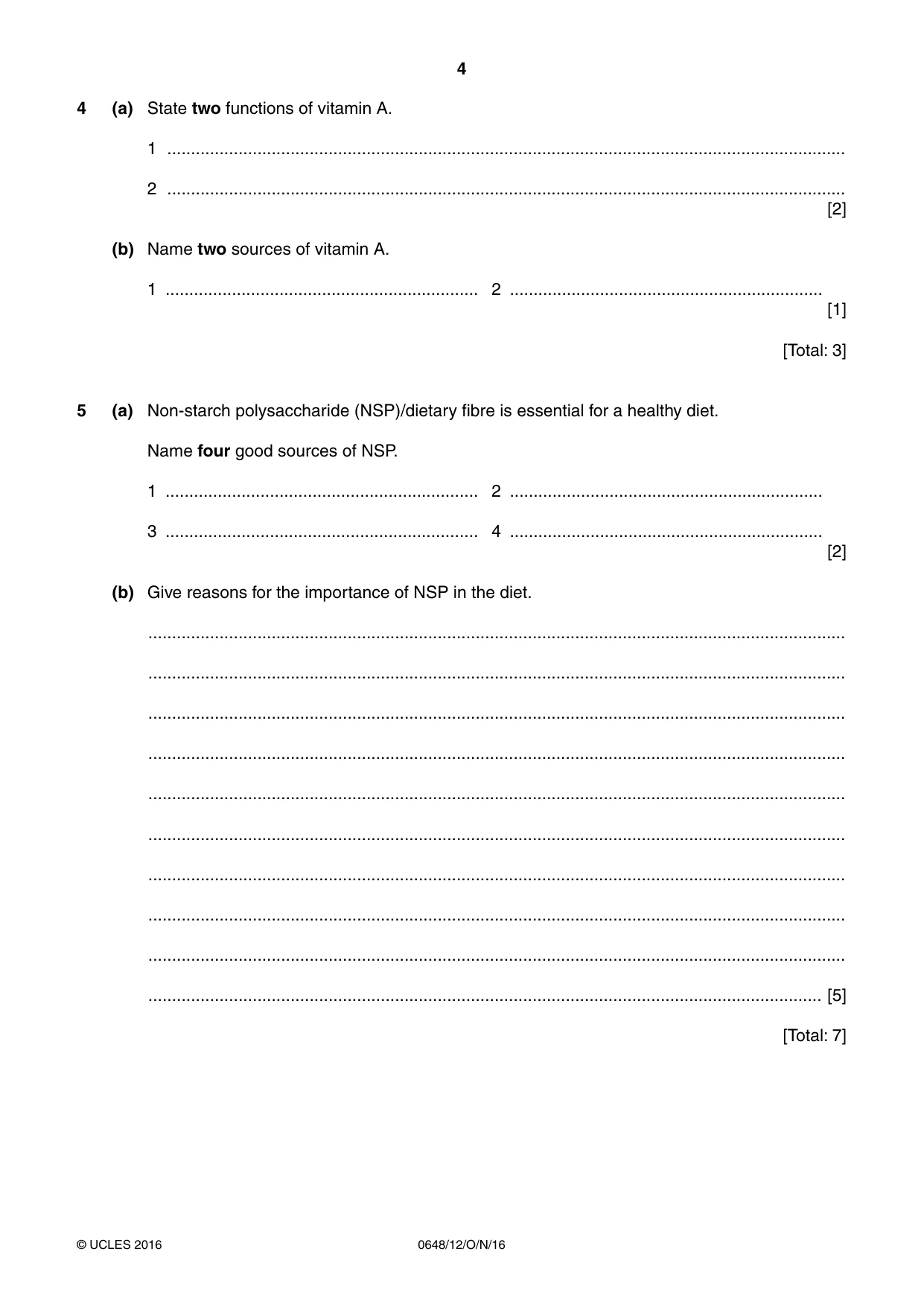
Question paper, page 4
4 0648/12/O/N/16 © UCLES 2016 4 (a) State two functions of vitamin A. 1 … 2 … [2] (b) Name two sources of vitamin A. 1 … 2 … [1] [Total: 3] 5 (a) Non-starch polysaccharide (NSP)/dietary fibre is essential for a healthy diet. Name four good sources of NSP. 1 … 2 … 3 … 4 … [2] (b) Give reasons for the importance of NSP in the diet. … … … … … … … … … … [5] [Total: 7]
Question paper, page 5
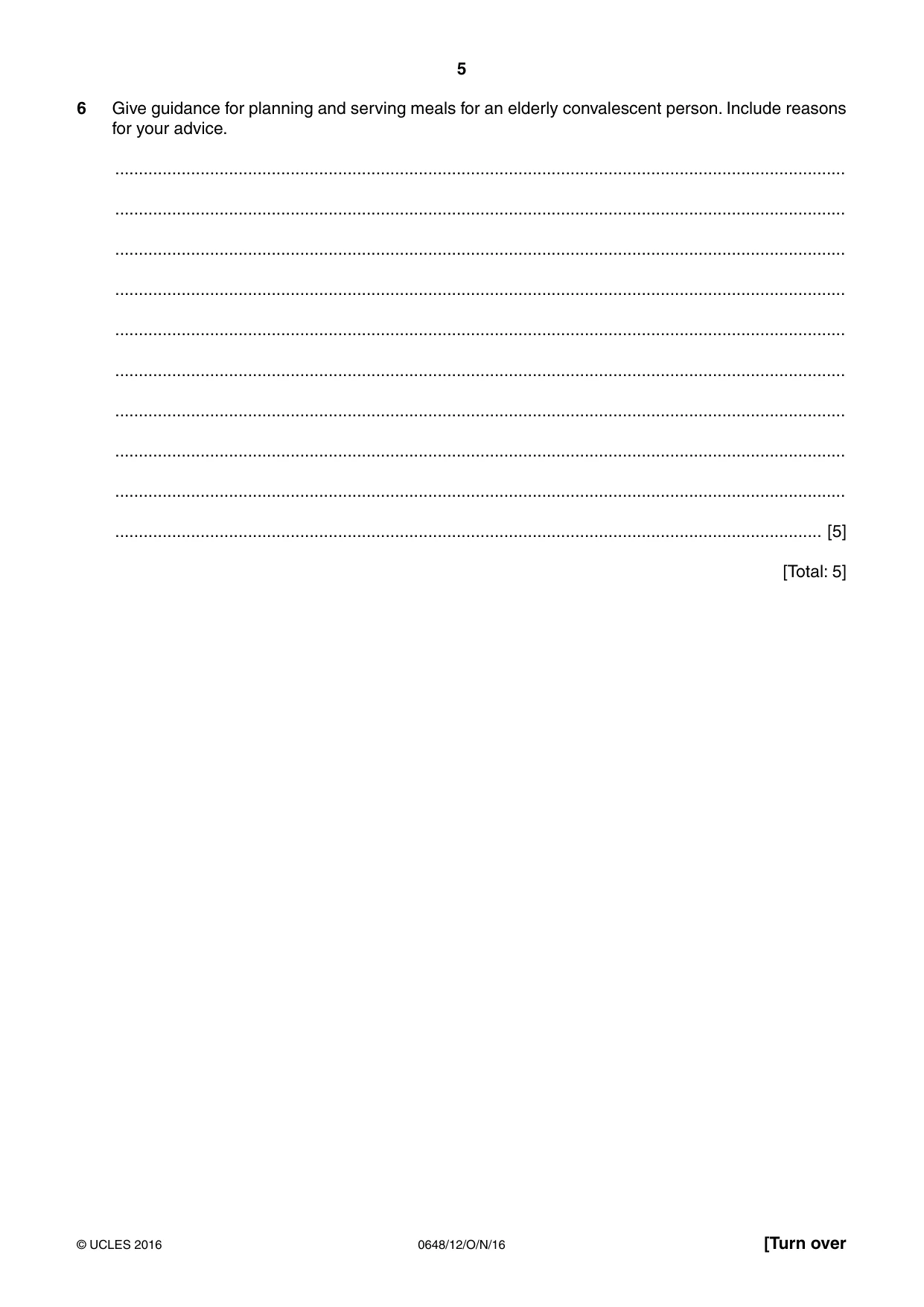
5 0648/12/O/N/16 © UCLES 2016 [Turn over 6 Give guidance for planning and serving meals for an elderly convalescent person. Include reasons for your advice. … … … … … … … … … … [5] [Total: 5]
Question paper, page 6
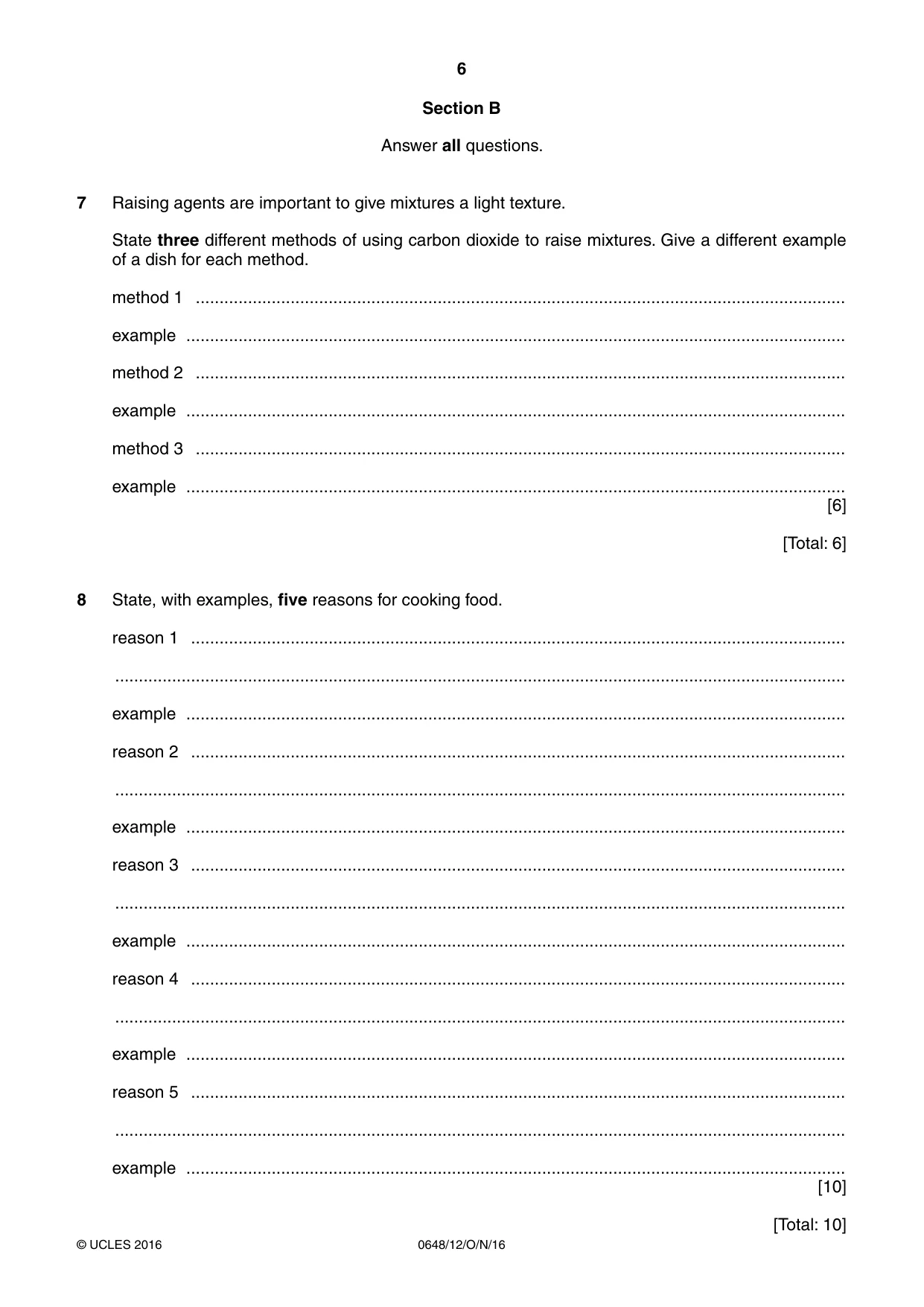
6 0648/12/O/N/16 © UCLES 2016 Section B Answer all questions. 7 Raising agents are important to give mixtures a light texture. State three different methods of using carbon dioxide to raise mixtures. Give a different example of a dish for each method. method 1 … example … method 2 … example … method 3 … example … [6] [Total: 6] 8 State, with examples, five reasons for cooking food. reason 1 … … example … reason 2 … … example … reason 3 … … example … reason 4 … … example … reason 5 … … example … [10] [Total: 10]
Question paper, page 7
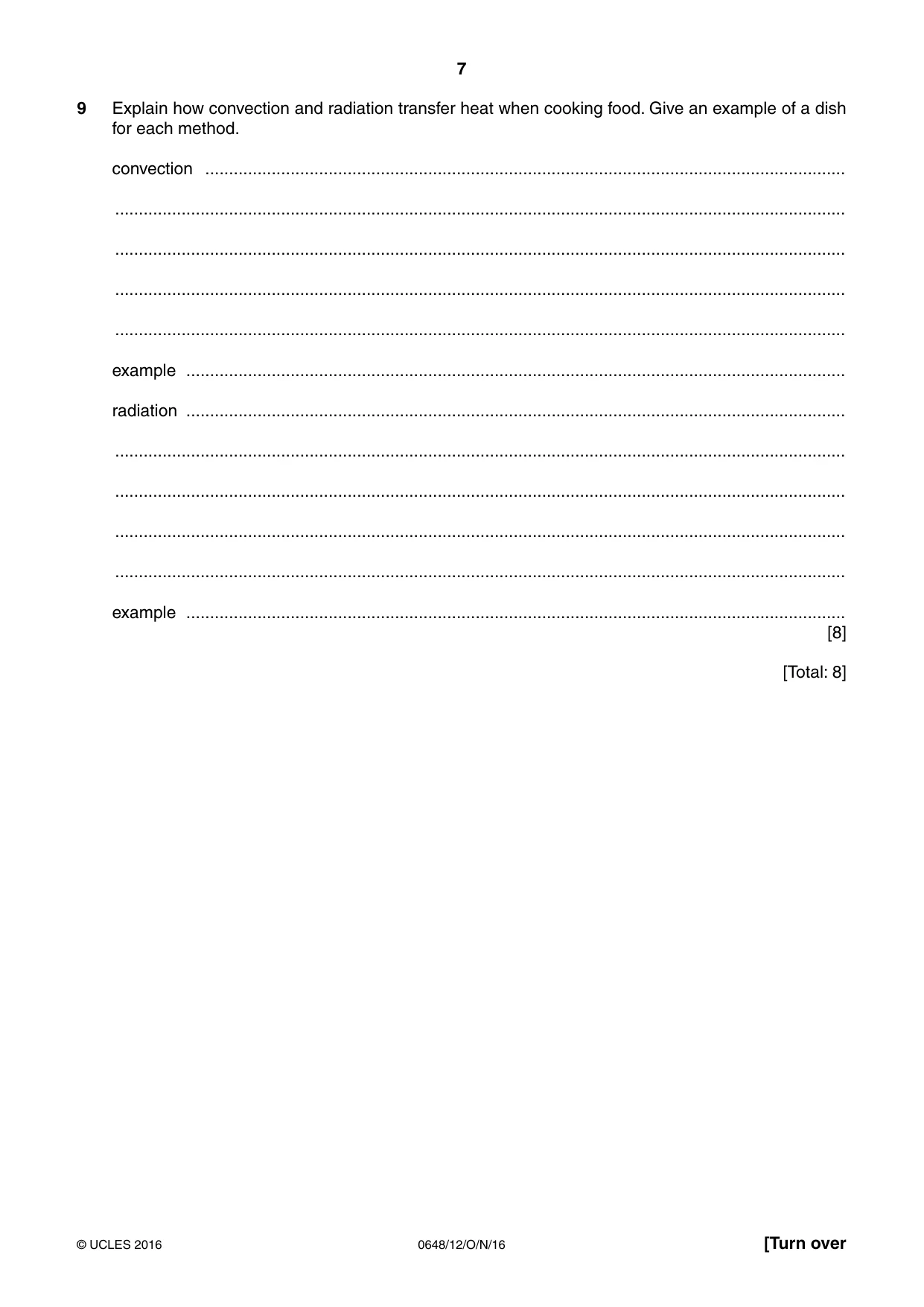
7 0648/12/O/N/16 © UCLES 2016 [Turn over 9 Explain how convection and radiation transfer heat when cooking food. Give an example of a dish for each method. convection … … … … … example … radiation … … … … … example … [8] [Total: 8]
Question paper, page 8
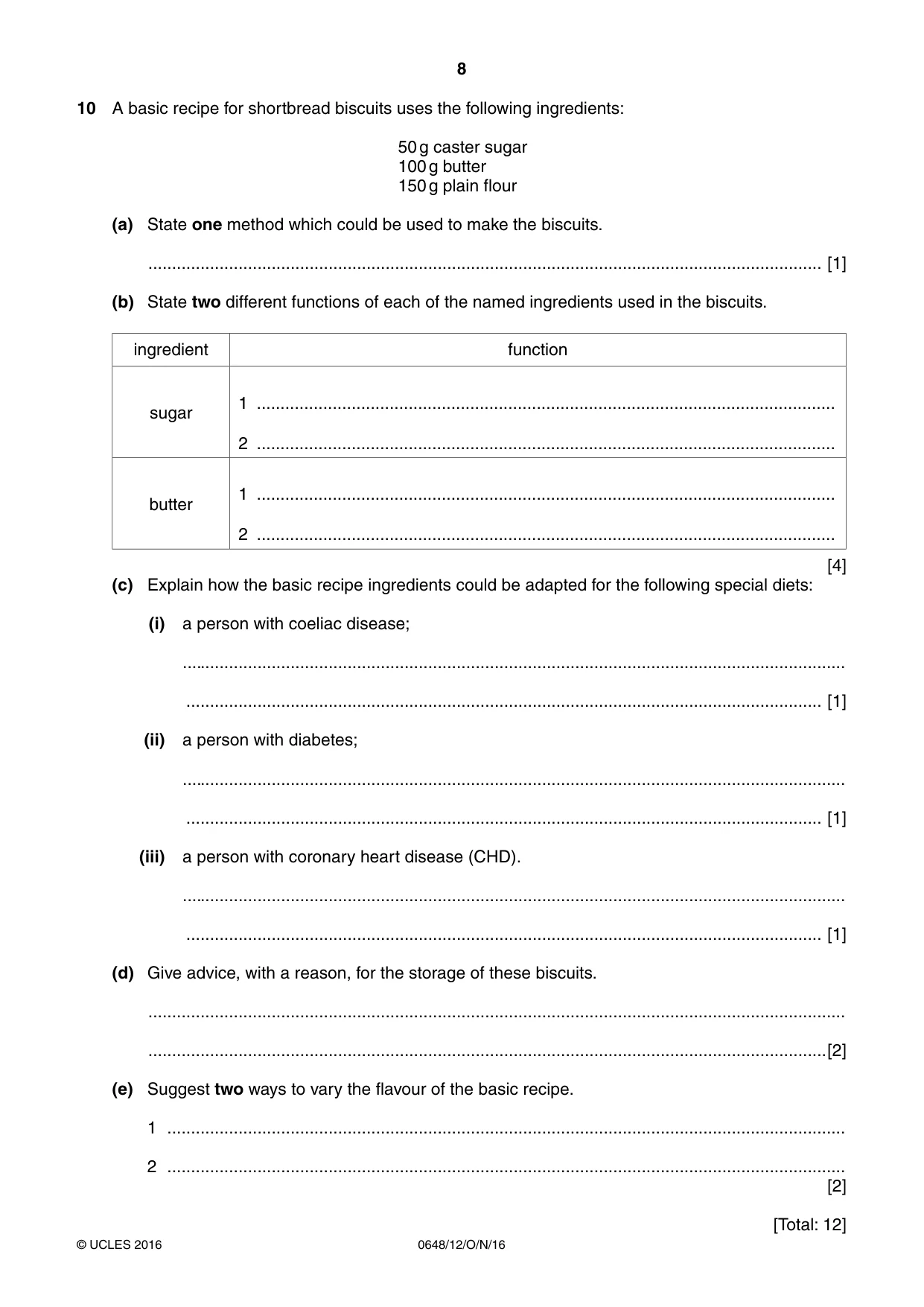
8 0648/12/O/N/16 © UCLES 2016 10 A basic recipe for shortbread biscuits uses the following ingredients: 50 g caster sugar 100 g butter 150 g plain flour (a) State one method which could be used to make the biscuits. … [1] (b) State two different functions of each of the named ingredients used in the biscuits. ingredient function sugar 1 … 2 … butter 1 … 2 … [4] (c) Explain how the basic recipe ingredients could be adapted for the following special diets: (i) a person with coeliac disease; … … [1] (ii) a person with diabetes; … … [1] (iii) a person with coronary heart disease (CHD). … … [1] (d) Give advice, with a reason, for the storage of these biscuits. … …[2] (e) Suggest two ways to vary the flavour of the basic recipe. 1 … 2 … [2] [Total: 12]
Question paper, page 9
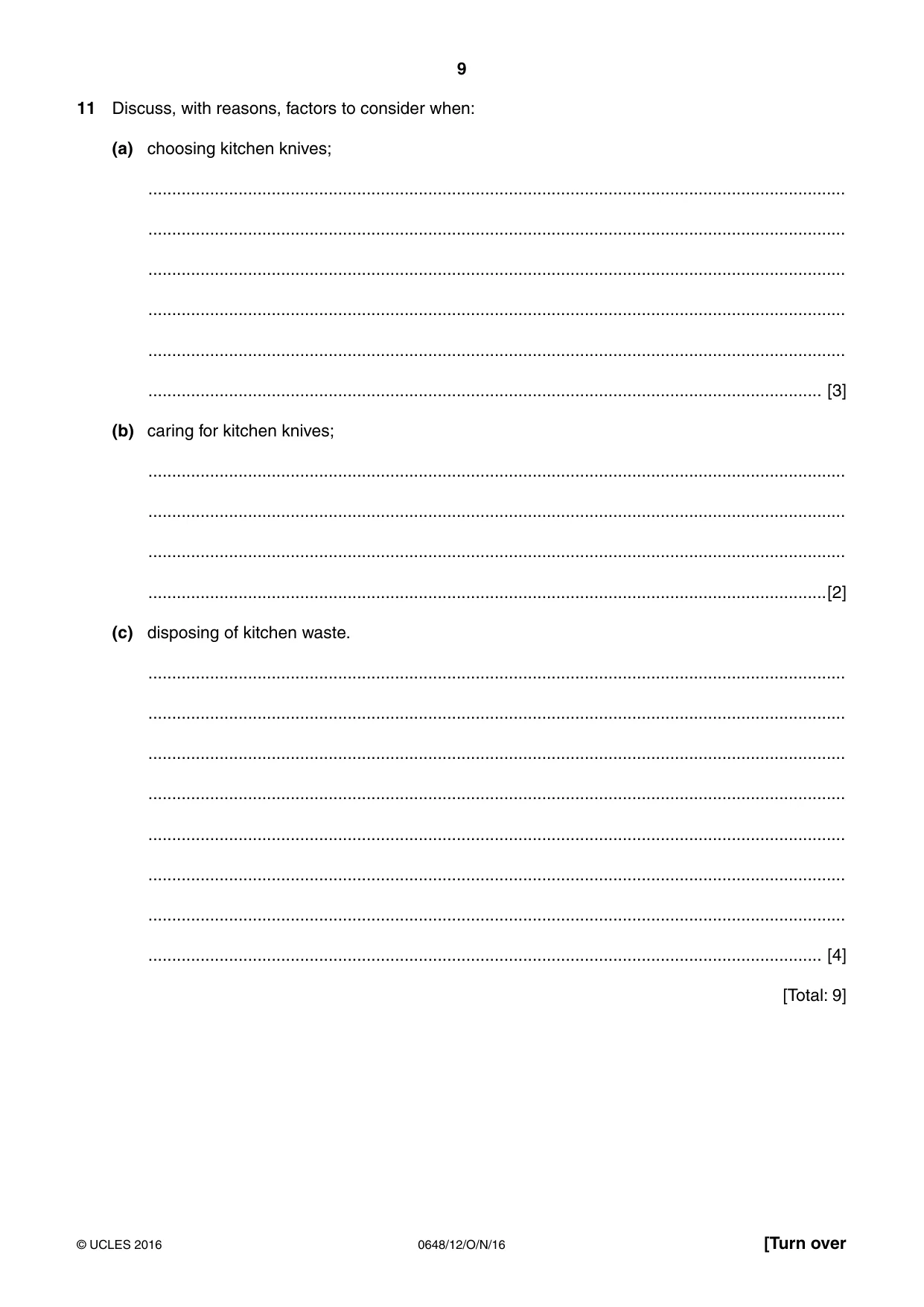
9 0648/12/O/N/16 © UCLES 2016 [Turn over 11 Discuss, with reasons, factors to consider when: (a) choosing kitchen knives; … … … … … … [3] (b) caring for kitchen knives; … … … …[2] (c) disposing of kitchen waste. … … … … … … … … [4] [Total: 9]
Question paper, page 10
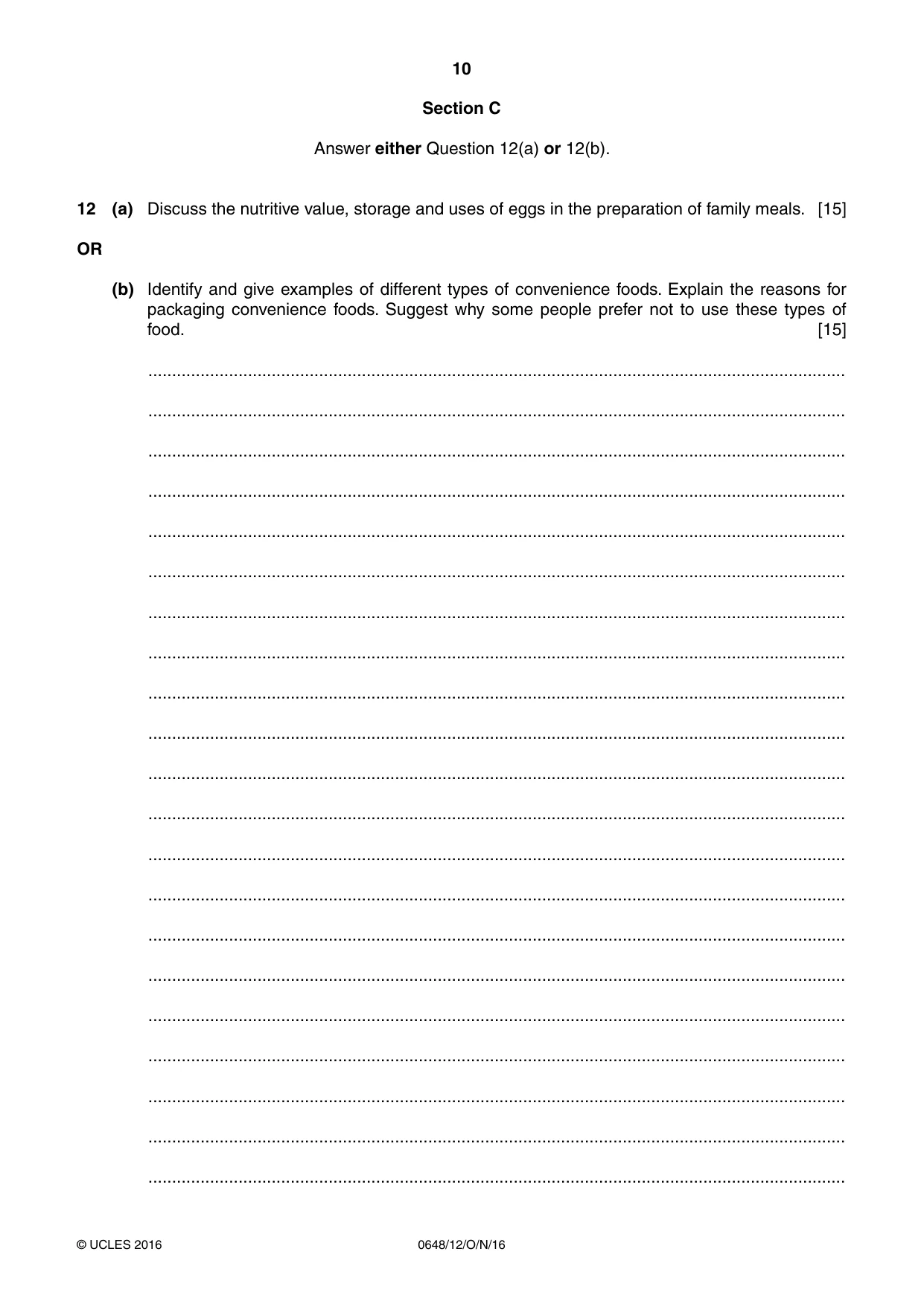
10 0648/12/O/N/16 © UCLES 2016 Section C Answer either Question 12(a) or 12(b). 12 (a) Discuss the nutritive value, storage and uses of eggs in the preparation of family meals. [15] OR (b) Identify and give examples of different types of convenience foods. Explain the reasons for packaging convenience foods. Suggest why some people prefer not to use these types of food. [15] … … … … … … … … … … … … … … … … … … … … …
Question paper, page 11
11 0648/12/O/N/16 © UCLES 2016 [Turn over … … … … … … … … … … … … … … … … … … … … … … … … … … … …
Question paper, page 12
12 0648/12/O/N/16 © UCLES 2016 Permission to reproduce items where third-party owned material protected by copyright is included has been sought and cleared where possible. Every reasonable effort has been made by the publisher (UCLES) to trace copyright holders, but if any items requiring clearance have unwittingly been included, the publisher will be pleased to make amends at the earliest possible opportunity. To avoid the issue of disclosure of answer-related information to candidates, all copyright acknowledgements are reproduced online in the Cambridge International Examinations Copyright Acknowledgements Booklet. This is produced for each series of examinations and is freely available to download at www.cie.org.uk after the live examination series. Cambridge International Examinations is part of the Cambridge Assessment Group. Cambridge Assessment is the brand name of University of Cambridge Local Examinations Syndicate (UCLES), which is itself a department of the University of Cambridge. … … … … … … … … … … … … … … … … … … … … … … … [Total: 15]
Mark scheme, page 1
® IGCSE is the registered trademark of Cambridge International Examinations. This document consists of 14 printed pages. © UCLES 2016 Turn over Cambridge International Examinations Cambridge International General Certificate of Secondary Education FOOD AND NUTRITION 0648/12 Paper 1 Theory October/November 2016 MARK SCHEME Maximum Mark: 100 Published This mark scheme is published as an aid to teachers and candidates, to indicate the requirements of the examination. It shows the basis on which Examiners were instructed to award marks. It does not indicate the details of the discussions that took place at an Examiners’ meeting before marking began, which would have considered the acceptability of alternative answers. Mark schemes should be read in conjunction with the question paper and the Principal Examiner Report for Teachers. Cambridge will not enter into discussions about these mark schemes. Cambridge is publishing the mark schemes for the October/November 2016 series for most Cambridge IGCSE®, Cambridge International A and AS Level components and some Cambridge O Level components.
Mark scheme, page 2
Page 2 Mark Scheme Syllabus Paper Cambridge IGCSE – October/November 2016 0648 12 © UCLES 2016 Mark schemes will use these abbreviations • ; separates points worth 1 mark • – separates points worth less than 1 mark • / alternatives • R reject • A accept (for answers correctly cued by the question) • I ignore as irrelevant • ecf error carried forward • AW alternative wording (where responses vary more than usual) • AVP alternative valid point • ORA or reverse argument • underline actual word given must be used by candidate • ( ) the word / phrase in brackets is not required but sets the context • max indicates the maximum number of marks • italics used to denote words or phrases from the question
Mark scheme, page 3
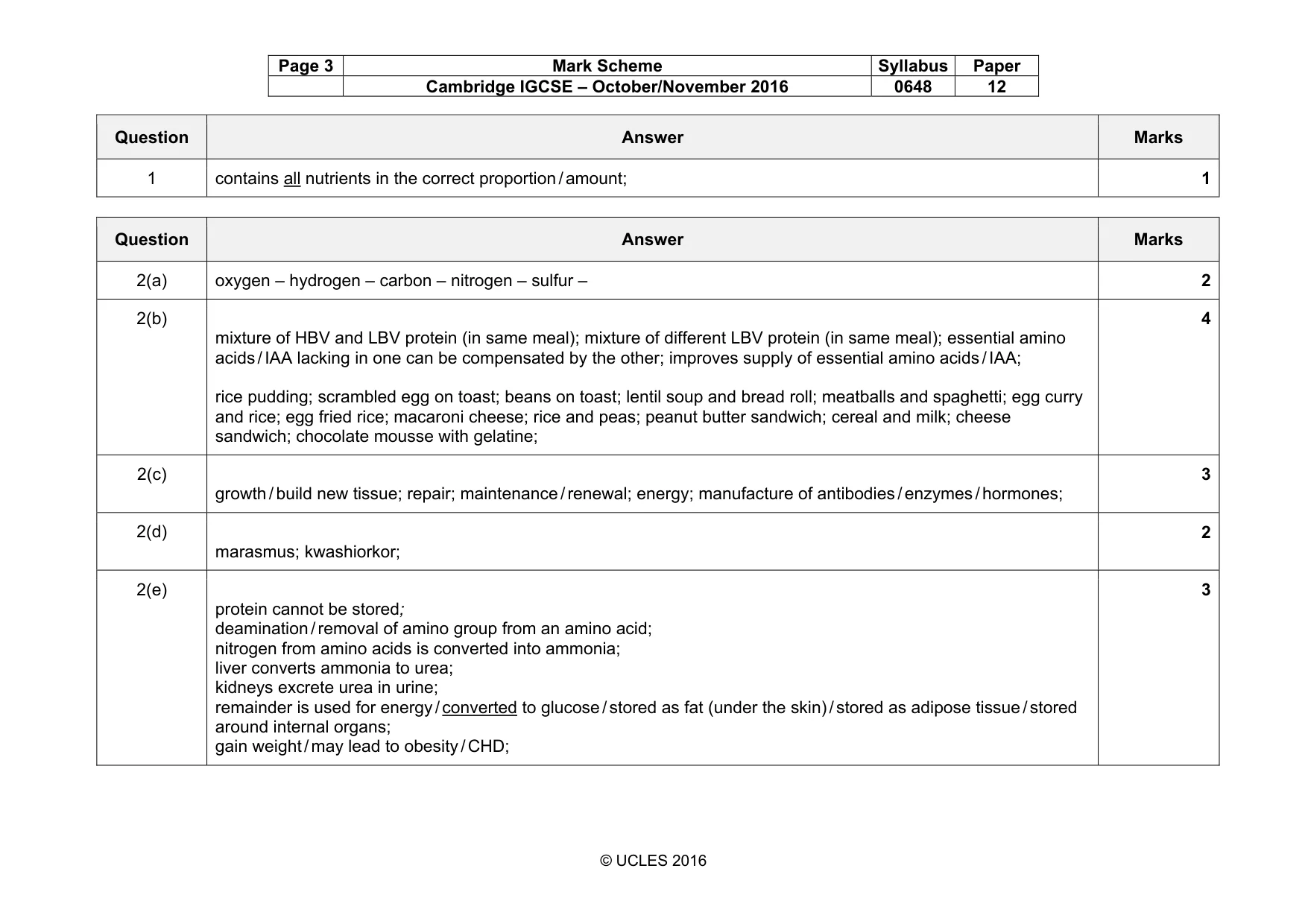
Page 3 Mark Scheme Syllabus Paper Cambridge IGCSE – October/November 2016 0648 12 © UCLES 2016 Question Answer Marks 1 contains all nutrients in the correct proportion / amount; 1 Question Answer Marks 2(a) oxygen – hydrogen – carbon – nitrogen – sulfur – 2 2(b) mixture of HBV and LBV protein (in same meal); mixture of different LBV protein (in same meal); essential amino acids / IAA lacking in one can be compensated by the other; improves supply of essential amino acids / IAA; rice pudding; scrambled egg on toast; beans on toast; lentil soup and bread roll; meatballs and spaghetti; egg curry and rice; egg fried rice; macaroni cheese; rice and peas; peanut butter sandwich; cereal and milk; cheese sandwich; chocolate mousse with gelatine; 4 2(c) growth / build new tissue; repair; maintenance / renewal; energy; manufacture of antibodies / enzymes / hormones; 3 2(d) marasmus; kwashiorkor; 2 2(e) protein cannot be stored; deamination / removal of amino group from an amino acid; nitrogen from amino acids is converted into ammonia; liver converts ammonia to urea; kidneys excrete urea in urine; remainder is used for energy / converted to glucose / stored as fat (under the skin) / stored as adipose tissue / stored around internal organs; gain weight / may lead to obesity / CHD; 3
Mark scheme, page 4
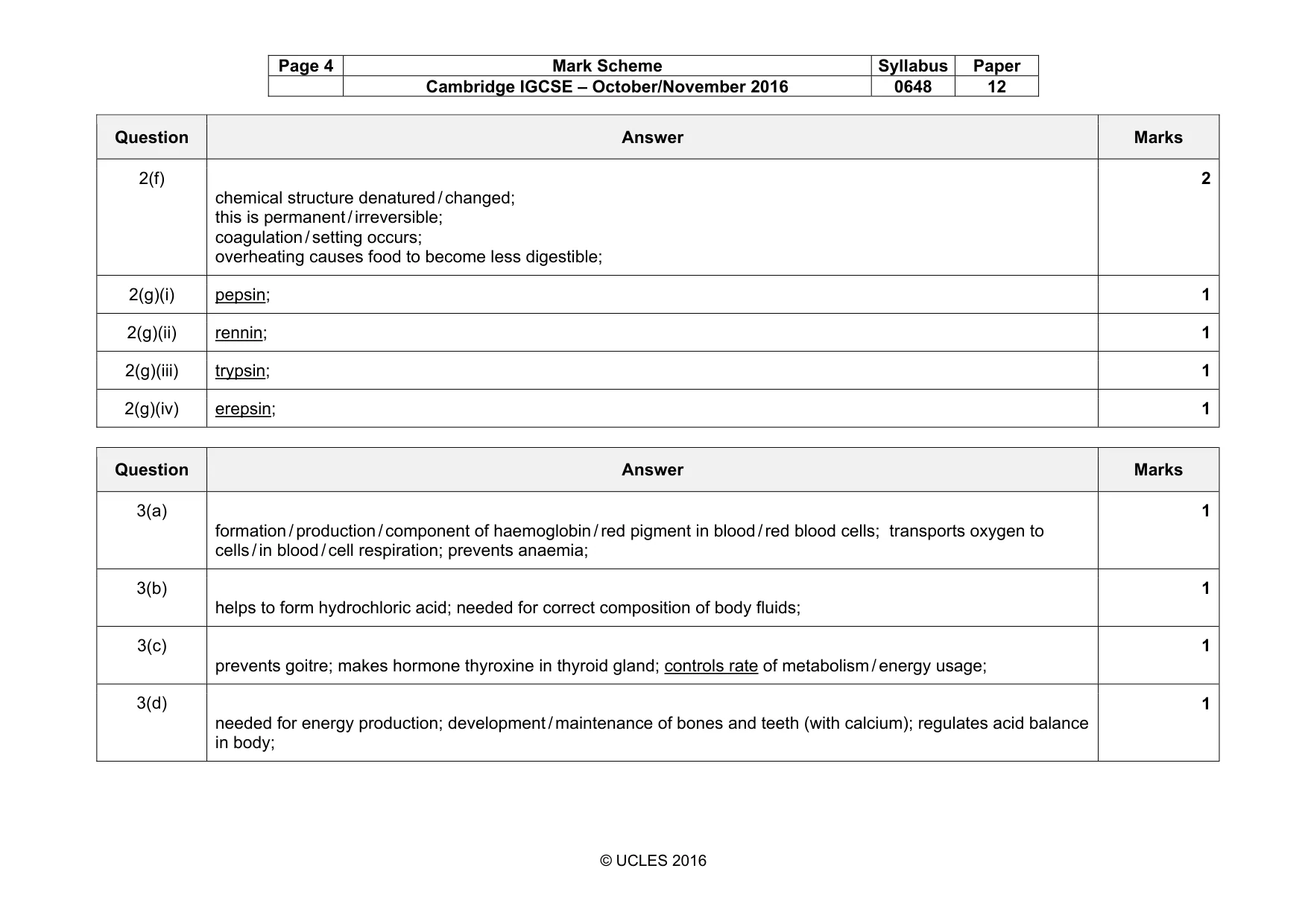
Page 4 Mark Scheme Syllabus Paper Cambridge IGCSE – October/November 2016 0648 12 © UCLES 2016 Question Answer Marks 2(f) chemical structure denatured / changed; this is permanent / irreversible; coagulation / setting occurs; overheating causes food to become less digestible; 2 2(g)(i) pepsin; 1 2(g)(ii) rennin; 1 2(g)(iii) trypsin; 1 2(g)(iv) erepsin; 1 Question Answer Marks 3(a) formation / production / component of haemoglobin / red pigment in blood / red blood cells; transports oxygen to cells / in blood / cell respiration; prevents anaemia; 1 3(b) helps to form hydrochloric acid; needed for correct composition of body fluids; 1 3(c) prevents goitre; makes hormone thyroxine in thyroid gland; controls rate of metabolism / energy usage; 1 3(d) needed for energy production; development / maintenance of bones and teeth (with calcium); regulates acid balance in body; 1
Mark scheme, page 5
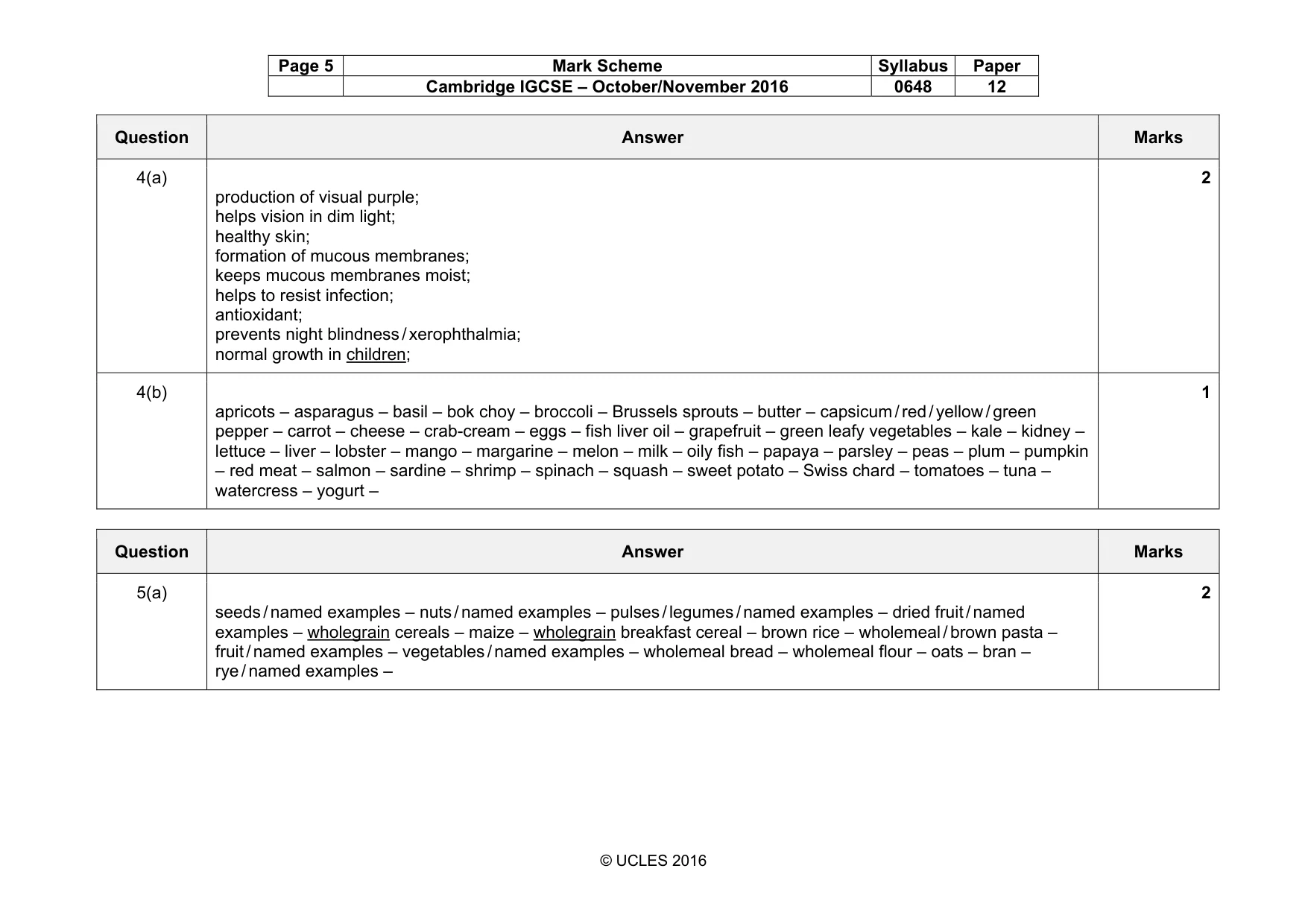
Page 5 Mark Scheme Syllabus Paper Cambridge IGCSE – October/November 2016 0648 12 © UCLES 2016 Question Answer Marks 4(a) production of visual purple; helps vision in dim light; healthy skin; formation of mucous membranes; keeps mucous membranes moist; helps to resist infection; antioxidant; prevents night blindness / xerophthalmia; normal growth in children; 2 4(b) apricots – asparagus – basil – bok choy – broccoli – Brussels sprouts – butter – capsicum / red / yellow / green pepper – carrot – cheese – crab-cream – eggs – fish liver oil – grapefruit – green leafy vegetables – kale – kidney – lettuce – liver – lobster – mango – margarine – melon – milk – oily fish – papaya – parsley – peas – plum – pumpkin – red meat – salmon – sardine – shrimp – spinach – squash – sweet potato – Swiss chard – tomatoes – tuna – watercress – yogurt – 1 Question Answer Marks 5(a) seeds / named examples – nuts / named examples – pulses / legumes / named examples – dried fruit / named examples – wholegrain cereals – maize – wholegrain breakfast cereal – brown rice – wholemeal / brown pasta – fruit / named examples – vegetables / named examples – wholemeal bread – wholemeal flour – oats – bran – rye / named examples – 2
Mark scheme, page 6
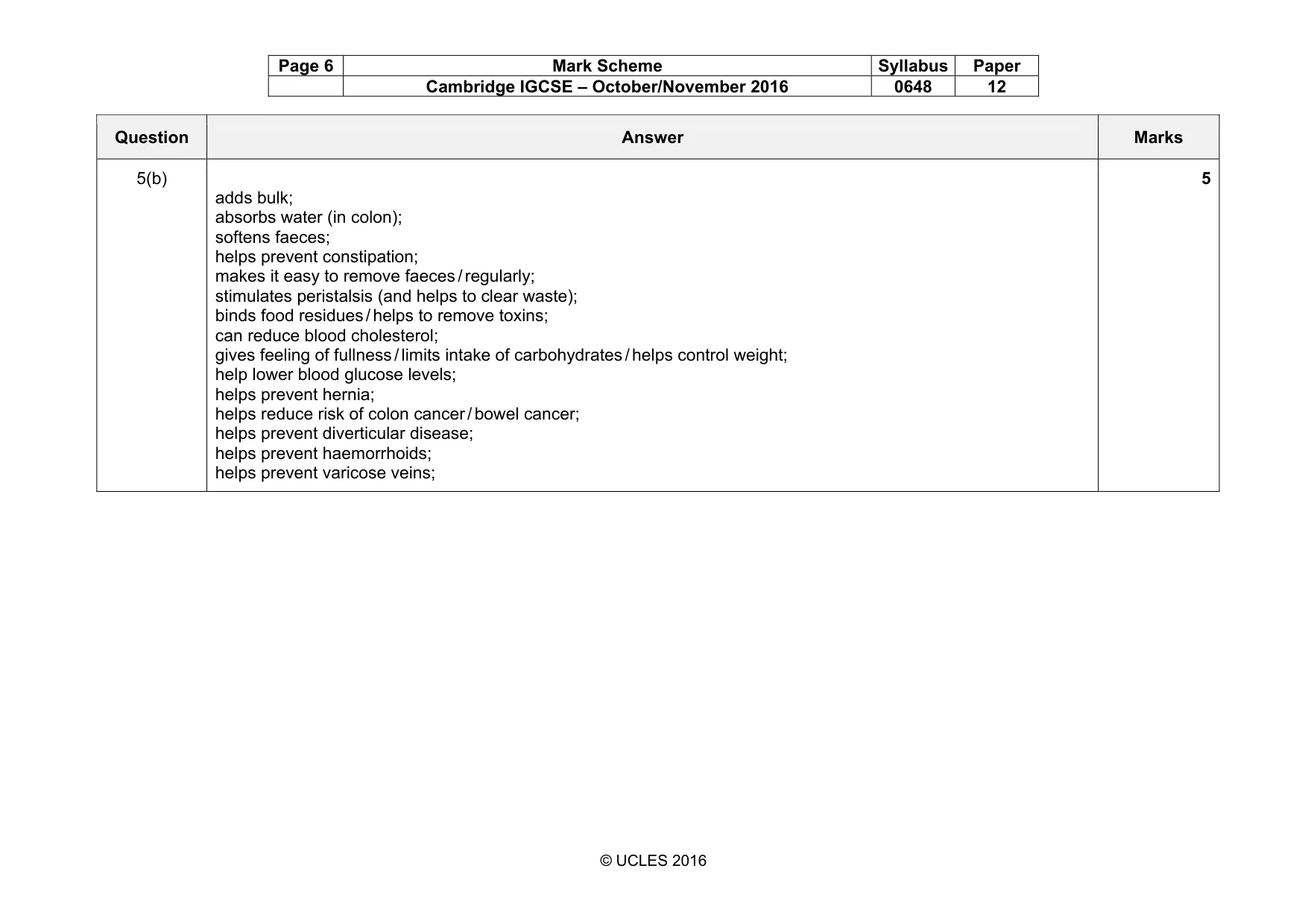
Page 6 Mark Scheme Syllabus Paper Cambridge IGCSE – October/November 2016 0648 12 © UCLES 2016 Question Answer Marks 5(b) adds bulk; absorbs water (in colon); softens faeces; helps prevent constipation; makes it easy to remove faeces / regularly; stimulates peristalsis (and helps to clear waste); binds food residues / helps to remove toxins; can reduce blood cholesterol; gives feeling of fullness / limits intake of carbohydrates / helps control weight; help lower blood glucose levels; helps prevent hernia; helps reduce risk of colon cancer / bowel cancer; helps prevent diverticular disease; helps prevent haemorrhoids; helps prevent varicose veins; 5
Mark scheme, page 7
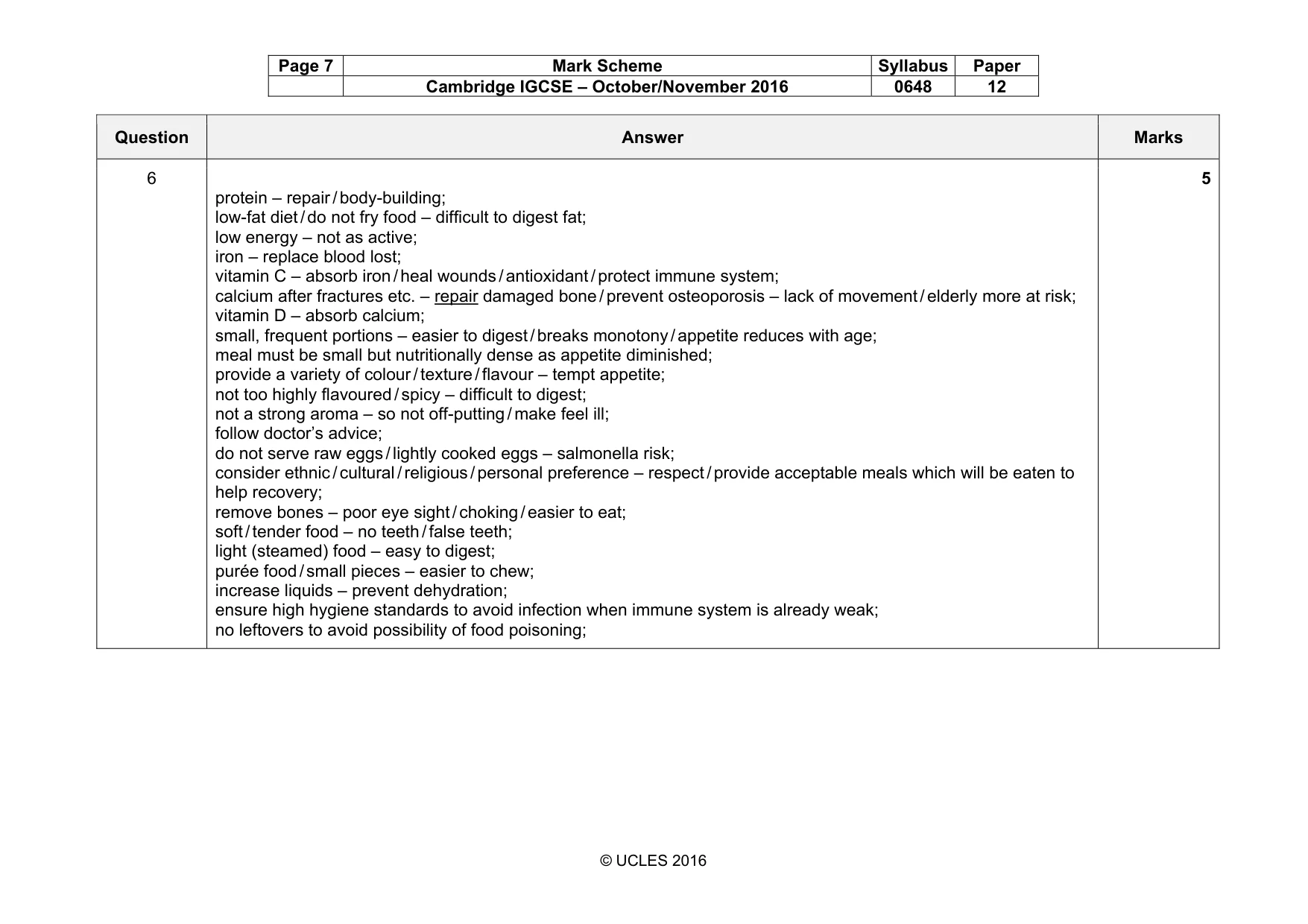
Page 7 Mark Scheme Syllabus Paper Cambridge IGCSE – October/November 2016 0648 12 © UCLES 2016 Question Answer Marks 6 protein – repair / body-building; low-fat diet / do not fry food – difficult to digest fat; low energy – not as active; iron – replace blood lost; vitamin C – absorb iron / heal wounds / antioxidant / protect immune system; calcium after fractures etc. – repair damaged bone / prevent osteoporosis – lack of movement / elderly more at risk; vitamin D – absorb calcium; small, frequent portions – easier to digest / breaks monotony / appetite reduces with age; meal must be small but nutritionally dense as appetite diminished; provide a variety of colour / texture / flavour – tempt appetite; not too highly flavoured / spicy – difficult to digest; not a strong aroma – so not off-putting / make feel ill; follow doctor’s advice; do not serve raw eggs / lightly cooked eggs – salmonella risk; consider ethnic / cultural / religious / personal preference – respect / provide acceptable meals which will be eaten to help recovery; remove bones – poor eye sight / choking / easier to eat; soft / tender food – no teeth / false teeth; light (steamed) food – easy to digest; purée food / small pieces – easier to chew; increase liquids – prevent dehydration; ensure high hygiene standards to avoid infection when immune system is already weak; no leftovers to avoid possibility of food poisoning; 5
Mark scheme, page 8
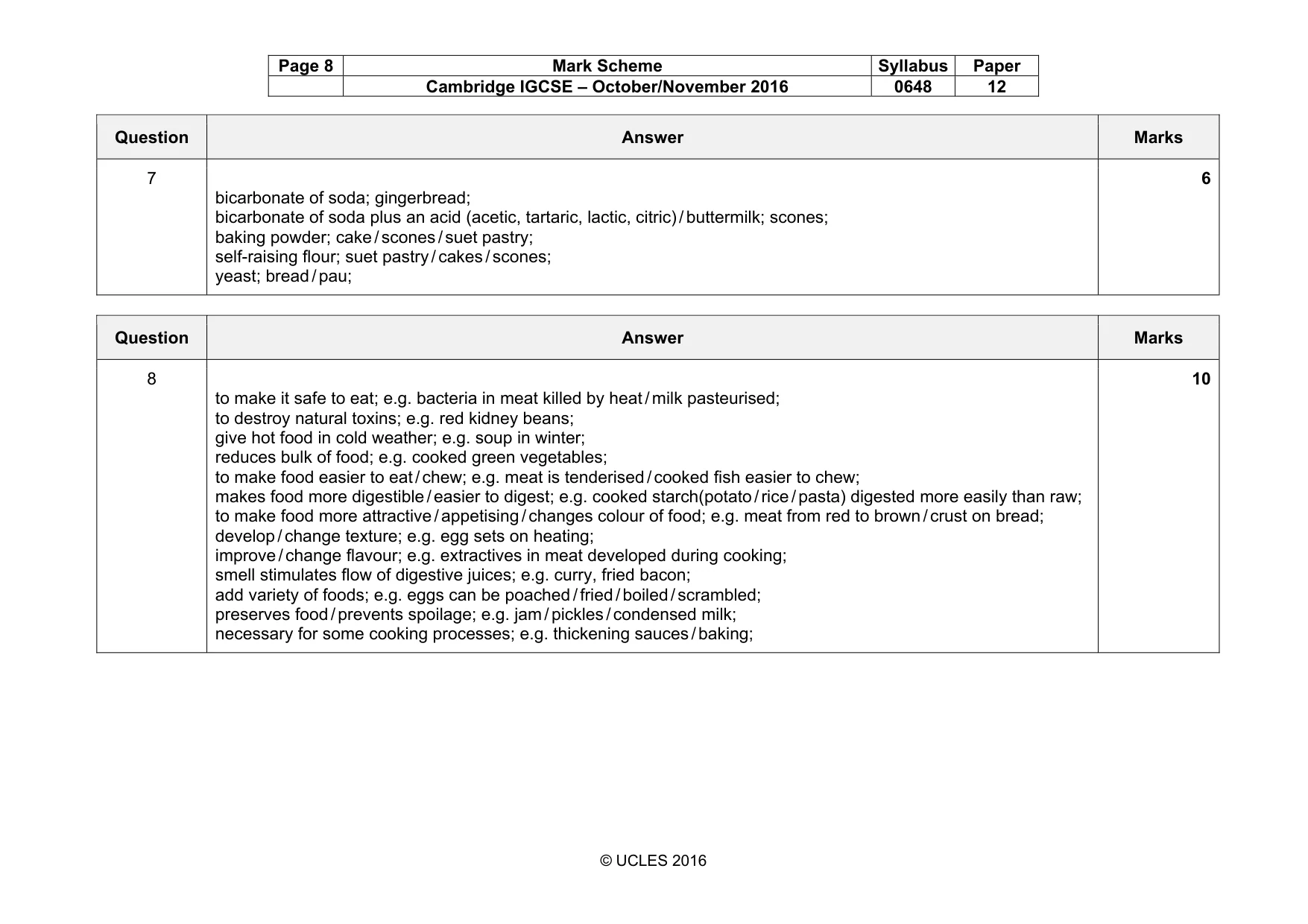
Page 8 Mark Scheme Syllabus Paper Cambridge IGCSE – October/November 2016 0648 12 © UCLES 2016 Question Answer Marks 7 bicarbonate of soda; gingerbread; bicarbonate of soda plus an acid (acetic, tartaric, lactic, citric) / buttermilk; scones; baking powder; cake / scones / suet pastry; self-raising flour; suet pastry / cakes / scones; yeast; bread / pau; 6 Question Answer Marks 8 to make it safe to eat; e.g. bacteria in meat killed by heat / milk pasteurised; to destroy natural toxins; e.g. red kidney beans; give hot food in cold weather; e.g. soup in winter; reduces bulk of food; e.g. cooked green vegetables; to make food easier to eat / chew; e.g. meat is tenderised / cooked fish easier to chew; makes food more digestible / easier to digest; e.g. cooked starch(potato / rice / pasta) digested more easily than raw; to make food more attractive / appetising / changes colour of food; e.g. meat from red to brown / crust on bread; develop / change texture; e.g. egg sets on heating; improve / change flavour; e.g. extractives in meat developed during cooking; smell stimulates flow of digestive juices; e.g. curry, fried bacon; add variety of foods; e.g. eggs can be poached / fried / boiled / scrambled; preserves food / prevents spoilage; e.g. jam / pickles / condensed milk; necessary for some cooking processes; e.g. thickening sauces / baking; 10
Mark scheme, page 9
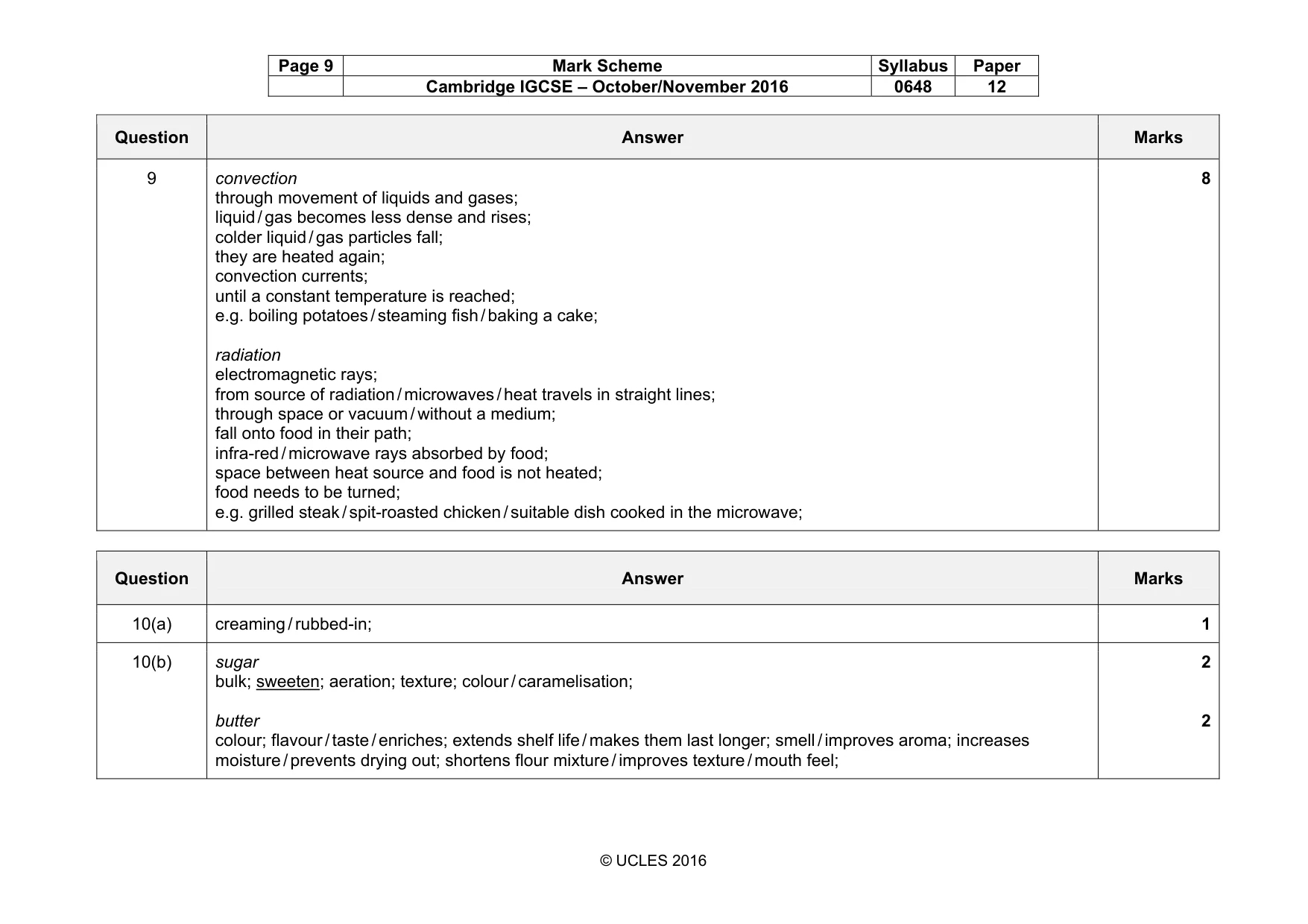
Page 9 Mark Scheme Syllabus Paper Cambridge IGCSE – October/November 2016 0648 12 © UCLES 2016 Question Answer Marks 9 convection through movement of liquids and gases; liquid / gas becomes less dense and rises; colder liquid / gas particles fall; they are heated again; convection currents; until a constant temperature is reached; e.g. boiling potatoes / steaming fish / baking a cake; radiation electromagnetic rays; from source of radiation / microwaves / heat travels in straight lines; through space or vacuum / without a medium; fall onto food in their path; infra-red / microwave rays absorbed by food; space between heat source and food is not heated; food needs to be turned; e.g. grilled steak / spit-roasted chicken / suitable dish cooked in the microwave; 8 Question Answer Marks 10(a) creaming / rubbed-in; 1 10(b) sugar bulk; sweeten; aeration; texture; colour / caramelisation; butter colour; flavour / taste / enriches; extends shelf life / makes them last longer; smell / improves aroma; increases moisture / prevents drying out; shortens flour mixture / improves texture / mouth feel; 2 2
Mark scheme, page 10
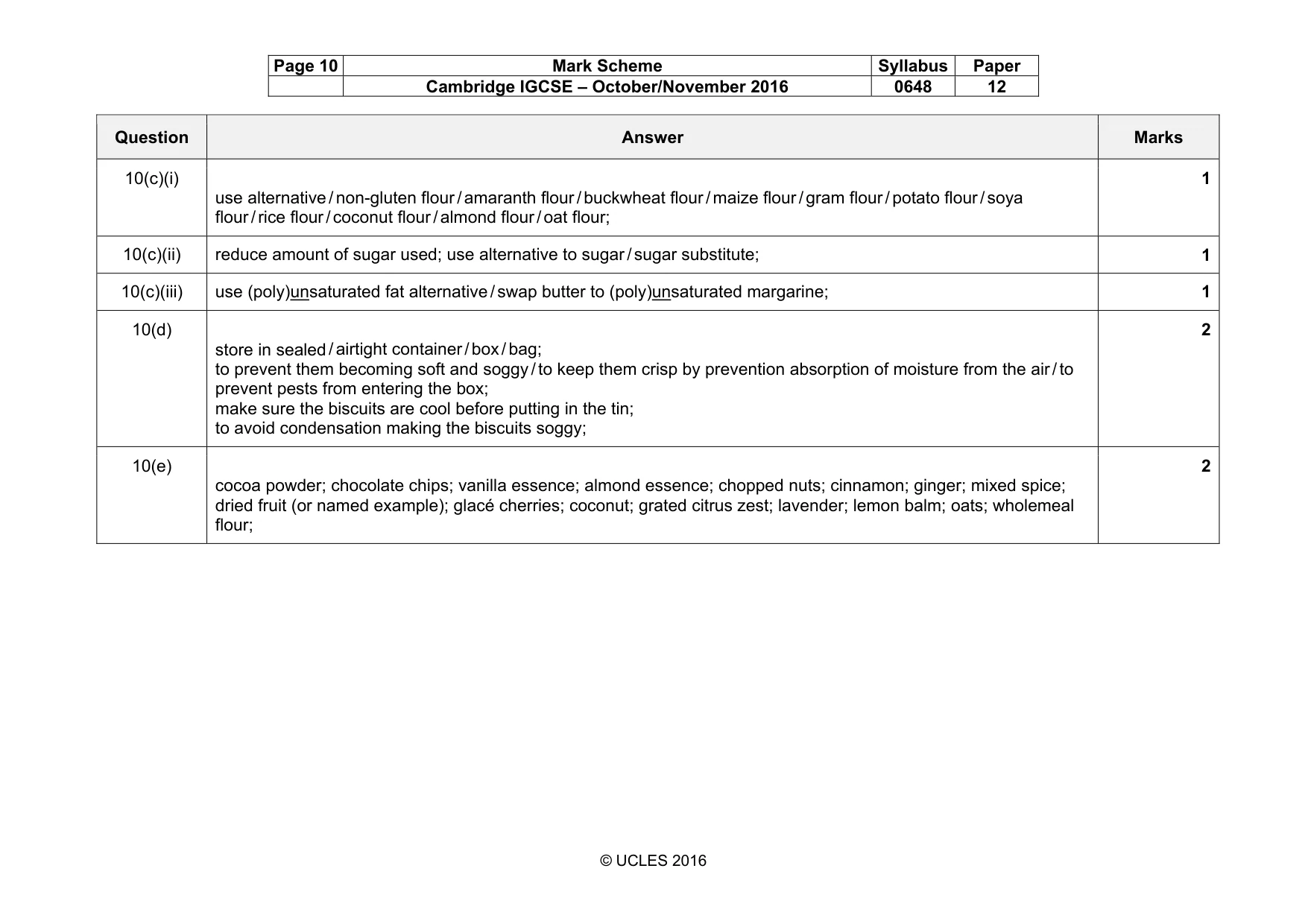
Page 10 Mark Scheme Syllabus Paper Cambridge IGCSE – October/November 2016 0648 12 © UCLES 2016 Question Answer Marks 10(c)(i) use alternative / non-gluten flour / amaranth flour / buckwheat flour / maize flour / gram flour / potato flour / soya flour / rice flour / coconut flour / almond flour / oat flour; 1 10(c)(ii) reduce amount of sugar used; use alternative to sugar / sugar substitute; 1 10(c)(iii) use (poly)unsaturated fat alternative / swap butter to (poly)unsaturated margarine; 1 10(d) store in sealed / airtight container / box / bag; to prevent them becoming soft and soggy / to keep them crisp by prevention absorption of moisture from the air / to prevent pests from entering the box; make sure the biscuits are cool before putting in the tin; to avoid condensation making the biscuits soggy; 2 10(e) cocoa powder; chocolate chips; vanilla essence; almond essence; chopped nuts; cinnamon; ginger; mixed spice; dried fruit (or named example); glacé cherries; coconut; grated citrus zest; lavender; lemon balm; oats; wholemeal flour; 2
Mark scheme, page 11
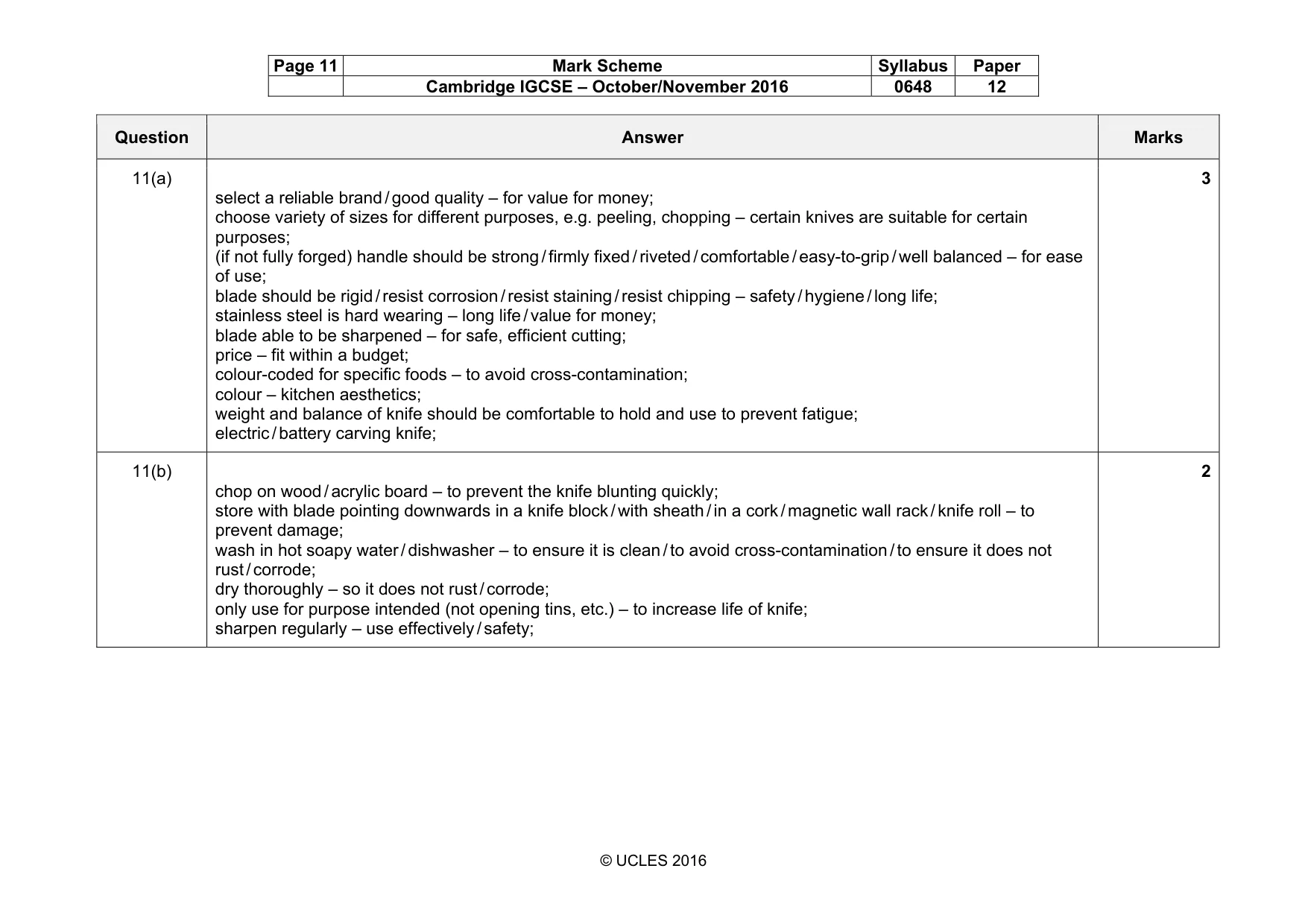
Page 11 Mark Scheme Syllabus Paper Cambridge IGCSE – October/November 2016 0648 12 © UCLES 2016 Question Answer Marks 11(a) select a reliable brand / good quality – for value for money; choose variety of sizes for different purposes, e.g. peeling, chopping – certain knives are suitable for certain purposes; (if not fully forged) handle should be strong / firmly fixed / riveted / comfortable / easy-to-grip / well balanced – for ease of use; blade should be rigid / resist corrosion / resist staining / resist chipping – safety / hygiene / long life; stainless steel is hard wearing – long life / value for money; blade able to be sharpened – for safe, efficient cutting; price – fit within a budget; colour-coded for specific foods – to avoid cross-contamination; colour – kitchen aesthetics; weight and balance of knife should be comfortable to hold and use to prevent fatigue; electric / battery carving knife; 3 11(b) chop on wood / acrylic board – to prevent the knife blunting quickly; store with blade pointing downwards in a knife block / with sheath / in a cork / magnetic wall rack / knife roll – to prevent damage; wash in hot soapy water / dishwasher – to ensure it is clean / to avoid cross-contamination / to ensure it does not rust / corrode; dry thoroughly – so it does not rust / corrode; only use for purpose intended (not opening tins, etc.) – to increase life of knife; sharpen regularly – use effectively / safety; 2
Mark scheme, page 12
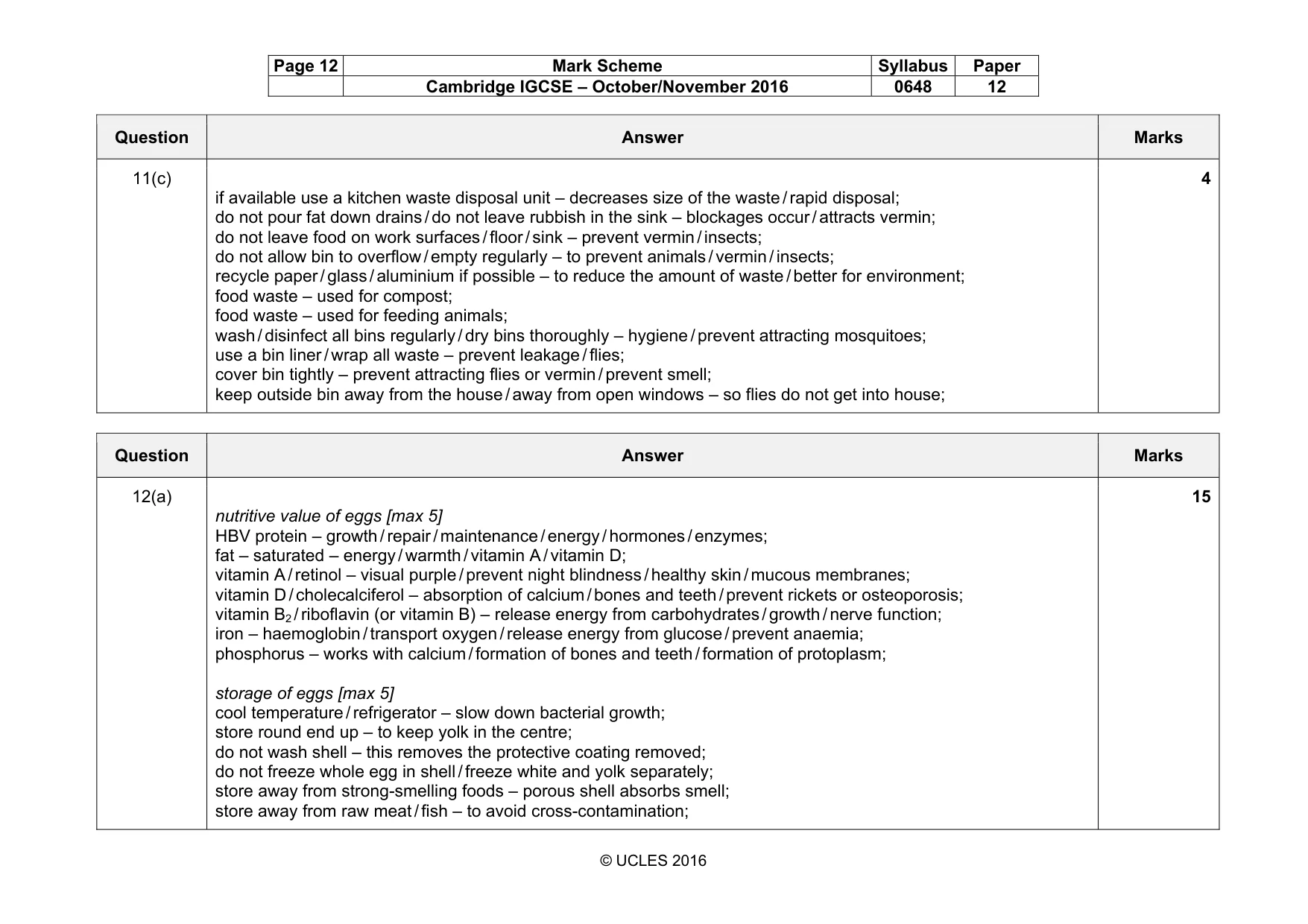
Page 12 Mark Scheme Syllabus Paper Cambridge IGCSE – October/November 2016 0648 12 © UCLES 2016 Question Answer Marks 11(c) if available use a kitchen waste disposal unit – decreases size of the waste / rapid disposal; do not pour fat down drains / do not leave rubbish in the sink – blockages occur / attracts vermin; do not leave food on work surfaces / floor / sink – prevent vermin / insects; do not allow bin to overflow / empty regularly – to prevent animals / vermin / insects; recycle paper / glass / aluminium if possible – to reduce the amount of waste / better for environment; food waste – used for compost; food waste – used for feeding animals; wash / disinfect all bins regularly / dry bins thoroughly – hygiene / prevent attracting mosquitoes; use a bin liner / wrap all waste – prevent leakage / flies; cover bin tightly – prevent attracting flies or vermin / prevent smell; keep outside bin away from the house / away from open windows – so flies do not get into house; 4 Question Answer Marks 12(a) nutritive value of eggs [max 5] HBV protein – growth / repair / maintenance / energy / hormones / enzymes; fat – saturated – energy / warmth / vitamin A / vitamin D; vitamin A / retinol – visual purple / prevent night blindness / healthy skin / mucous membranes; vitamin D / cholecalciferol – absorption of calcium / bones and teeth / prevent rickets or osteoporosis; vitamin B2 / riboflavin (or vitamin B) – release energy from carbohydrates / growth / nerve function; iron – haemoglobin / transport oxygen / release energy from glucose / prevent anaemia; phosphorus – works with calcium / formation of bones and teeth / formation of protoplasm; storage of eggs [max 5] cool temperature / refrigerator – slow down bacterial growth; store round end up – to keep yolk in the centre; do not wash shell – this removes the protective coating removed; do not freeze whole egg in shell / freeze white and yolk separately; store away from strong-smelling foods – porous shell absorbs smell; store away from raw meat / fish – to avoid cross-contamination; 15
Mark scheme, page 13
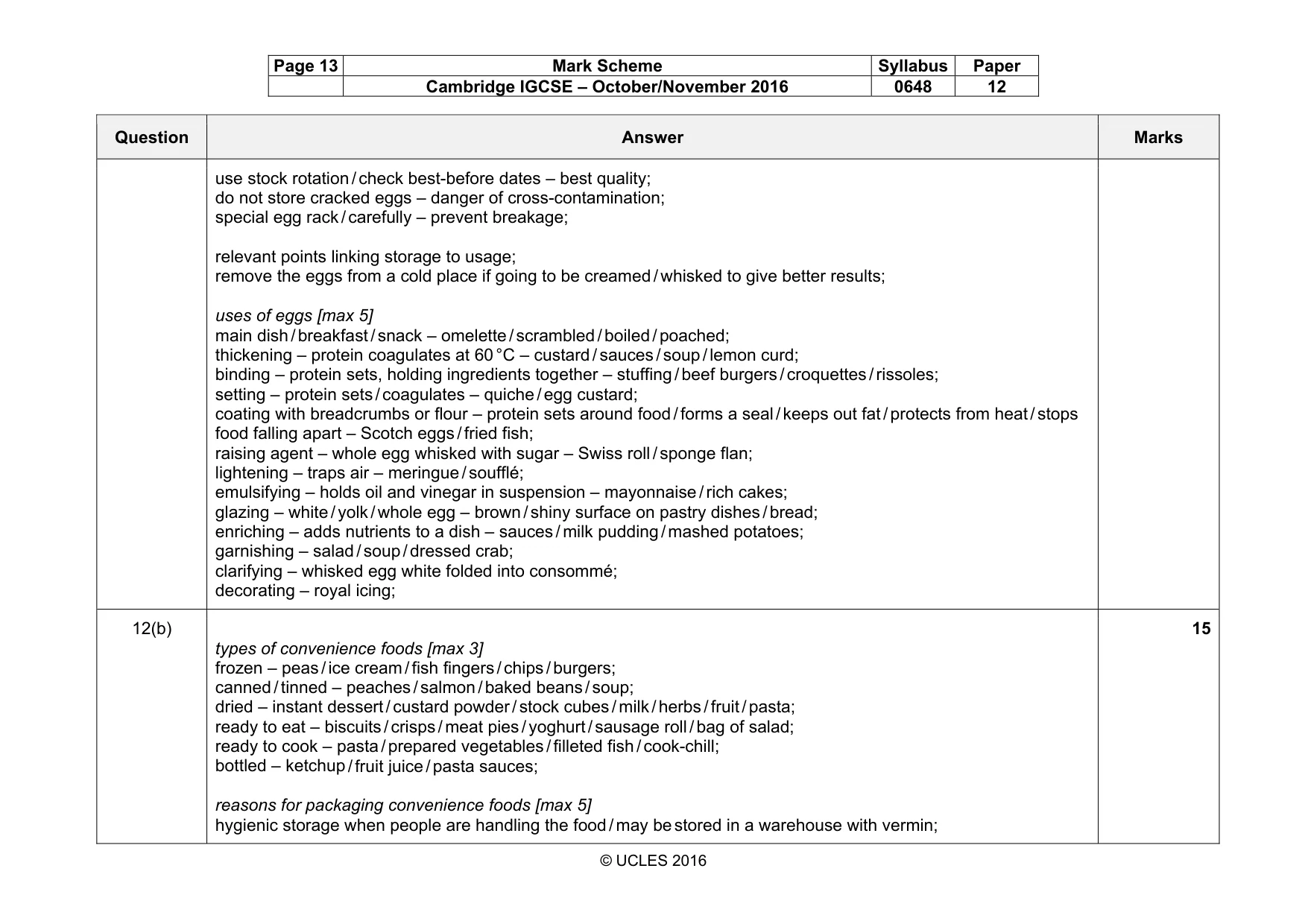
Page 13 Mark Scheme Syllabus Paper Cambridge IGCSE – October/November 2016 0648 12 © UCLES 2016 Question Answer Marks use stock rotation / check best-before dates – best quality; do not store cracked eggs – danger of cross-contamination; special egg rack / carefully – prevent breakage; relevant points linking storage to usage; remove the eggs from a cold place if going to be creamed / whisked to give better results; uses of eggs [max 5] main dish / breakfast / snack – omelette / scrambled / boiled / poached; thickening – protein coagulates at 60 °C – custard / sauces / soup / lemon curd; binding – protein sets, holding ingredients together – stuffing / beef burgers / croquettes / rissoles; setting – protein sets / coagulates – quiche / egg custard; coating with breadcrumbs or flour – protein sets around food / forms a seal / keeps out fat / protects from heat / stops food falling apart – Scotch eggs / fried fish; raising agent – whole egg whisked with sugar – Swiss roll / sponge flan; lightening – traps air – meringue / soufflé; emulsifying – holds oil and vinegar in suspension – mayonnaise / rich cakes; glazing – white / yolk / whole egg – brown / shiny surface on pastry dishes / bread; enriching – adds nutrients to a dish – sauces / milk pudding / mashed potatoes; garnishing – salad / soup / dressed crab; clarifying – whisked egg white folded into consommé; decorating – royal icing; 12(b) types of convenience foods [max 3] frozen – peas / ice cream / fish fingers / chips / burgers; canned / tinned – peaches / salmon / baked beans / soup; dried – instant dessert / custard powder / stock cubes / milk / herbs / fruit / pasta; ready to eat – biscuits / crisps / meat pies / yoghurt / sausage roll / bag of salad; ready to cook – pasta / prepared vegetables / filleted fish / cook-chill; bottled – ketchup / fruit juice / pasta sauces; reasons for packaging convenience foods [max 5] hygienic storage when people are handling the food / may be stored in a warehouse with vermin; 15
Mark scheme, page 14
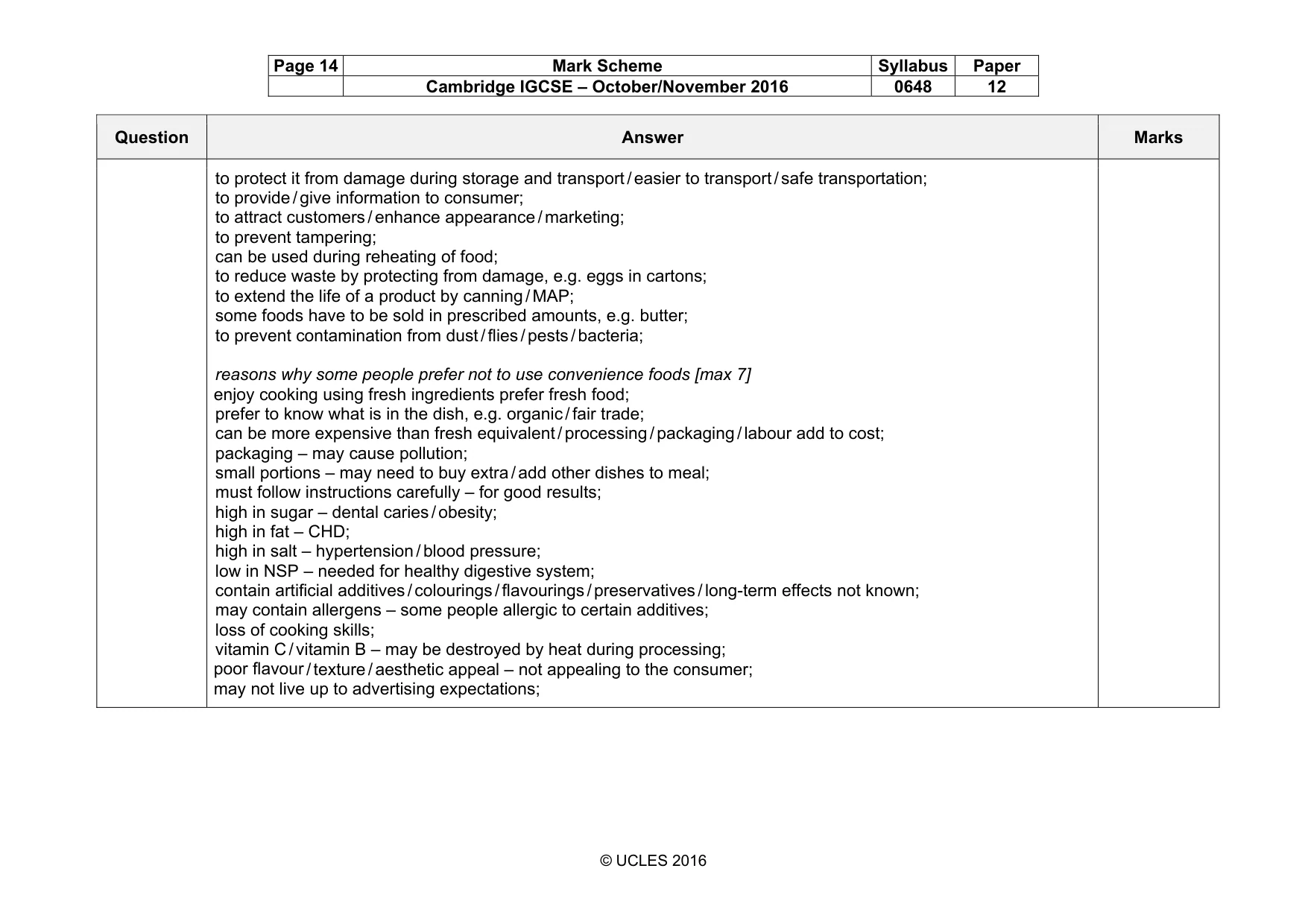
Page 14 Mark Scheme Syllabus Paper Cambridge IGCSE – October/November 2016 0648 12 © UCLES 2016 Question Answer Marks to protect it from damage during storage and transport / easier to transport / safe transportation; to provide / give information to consumer; to attract customers / enhance appearance / marketing; to prevent tampering; can be used during reheating of food; to reduce waste by protecting from damage, e.g. eggs in cartons; to extend the life of a product by canning / MAP; some foods have to be sold in prescribed amounts, e.g. butter; to prevent contamination from dust / flies / pests / bacteria; reasons why some people prefer not to use convenience foods [max 7] enjoy cooking using fresh ingredients prefer fresh food; prefer to know what is in the dish, e.g. organic / fair trade; can be more expensive than fresh equivalent / processing / packaging / labour add to cost; packaging – may cause pollution; small portions – may need to buy extra / add other dishes to meal; must follow instructions carefully – for good results; high in sugar – dental caries / obesity; high in fat – CHD; high in salt – hypertension / blood pressure; low in NSP – needed for healthy digestive system; contain artificial additives / colourings / flavourings / preservatives / long-term effects not known; may contain allergens – some people allergic to certain additives; loss of cooking skills; vitamin C / vitamin B – may be destroyed by heat during processing; poor flavour / texture / aesthetic appeal – not appealing to the consumer; may not live up to advertising expectations;
What you needed in this session
Cambridge’s own grade thresholds for 2016 Oct/Nov, Paper 1 · Variant 2. A higher threshold means an easier paper — the bar moves with how the cohort did.