Cambridge IGCSE Food and Nutrition 0648 — 2016 Oct/Nov Paper 1 · Variant 3
0648/13/O/N/16 · 100 marks · ≈113 min
The question paper and its mark scheme, free to read here and free to download. This is Cambridge’s own paper, exactly as it was sat.
Question paper12 pages

Mark scheme16 pages
Answers below. Sit the paper first if you are practising.
Paper as text
Question paper, page 1
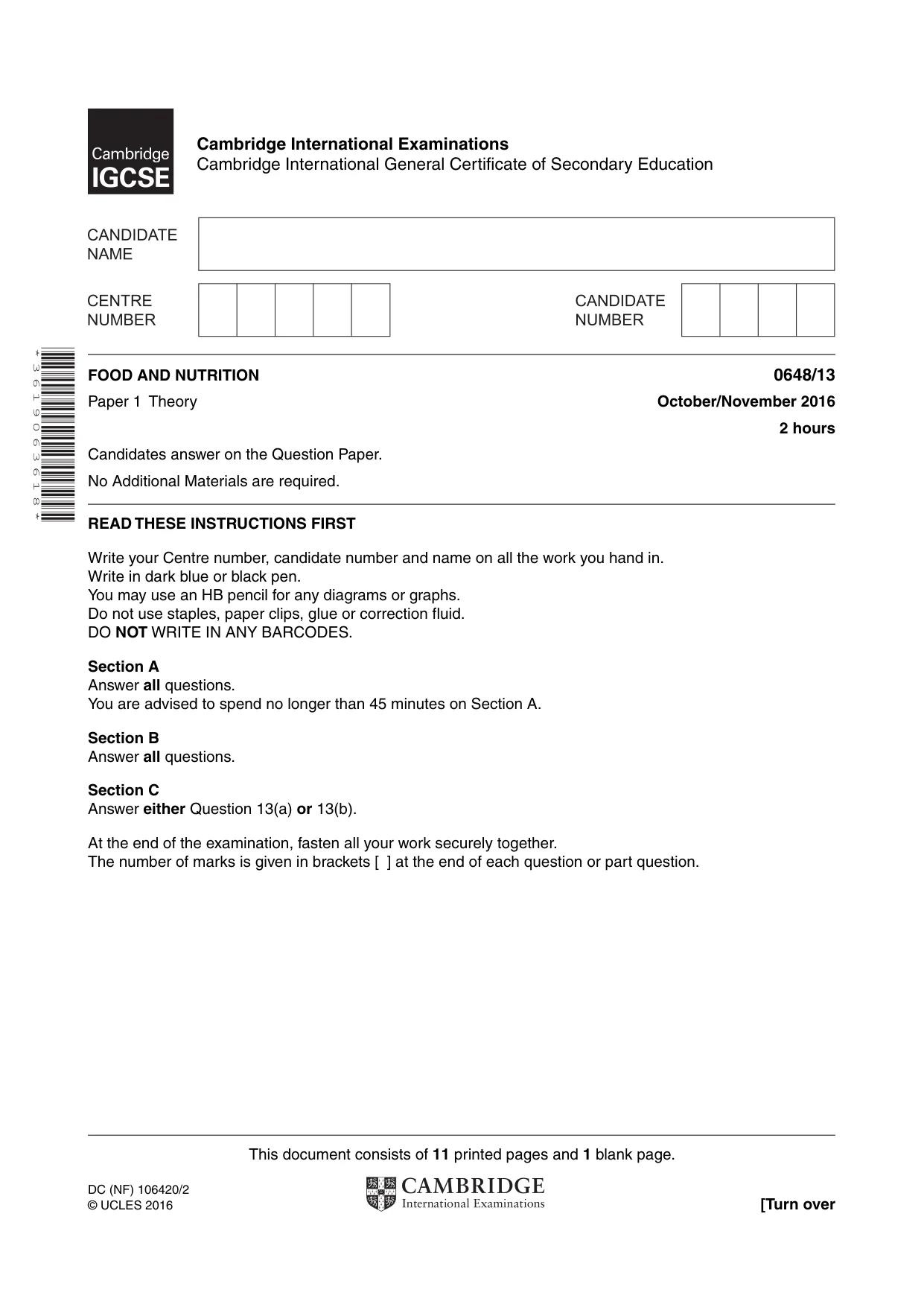
This document consists of 11 printed pages and 1 blank page. DC (NF) 106420/2 © UCLES 2016 [Turn over Cambridge International Examinations Cambridge International General Certificate of Secondary Education * 3 6 1 9 0 6 3 6 1 8 * FOOD AND NUTRITION 0648/13 Paper 1 Theory October/November 2016 2 hours Candidates answer on the Question Paper. No Additional Materials are required. READ THESE INSTRUCTIONS FIRST Write your Centre number, candidate number and name on all the work you hand in. Write in dark blue or black pen. You may use an HB pencil for any diagrams or graphs. Do not use staples, paper clips, glue or correction fluid. DO NOT WRITE IN ANY BARCODES. Section A Answer all questions. You are advised to spend no longer than 45 minutes on Section A. Section B Answer all questions. Section C Answer either Question 13(a) or 13(b). At the end of the examination, fasten all your work securely together. The number of marks is given in brackets [ ] at the end of each question or part question.
Question paper, page 2
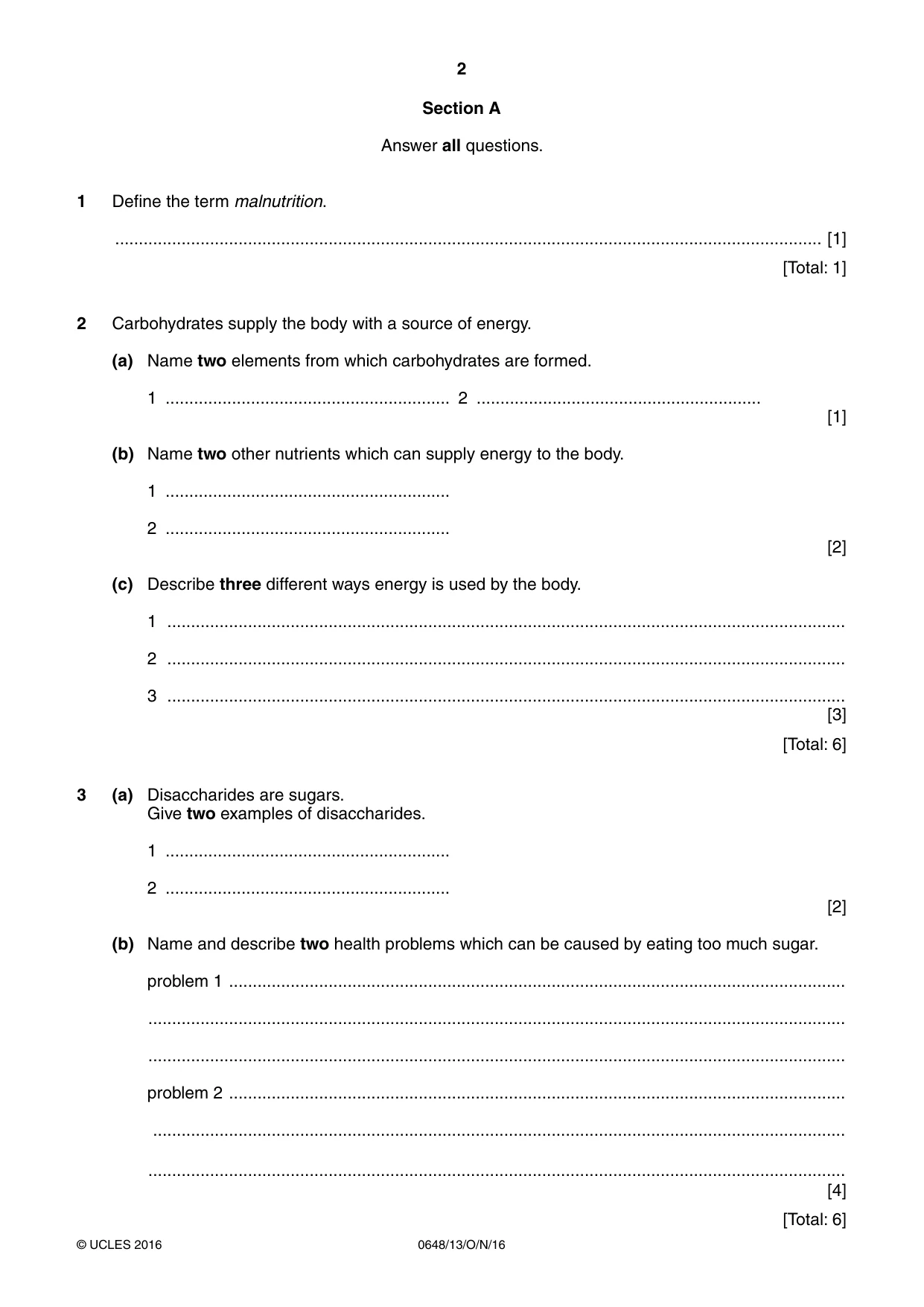
2 0648/13/O/N/16 © UCLES 2016 Section A Answer all questions. 1 Define the term malnutrition. … [1] [Total: 1] 2 Carbohydrates supply the body with a source of energy. (a) Name two elements from which carbohydrates are formed. 1 … 2 … [1] (b) Name two other nutrients which can supply energy to the body. 1 … 2 … [2] (c) Describe three different ways energy is used by the body. 1 … 2 … 3 … [3] [Total: 6] 3 (a) Disaccharides are sugars. Give two examples of disaccharides. 1 … 2 … [2] (b) Name and describe two health problems which can be caused by eating too much sugar. problem 1 … … … problem 2 … … … [4] [Total: 6]
Question paper, page 3
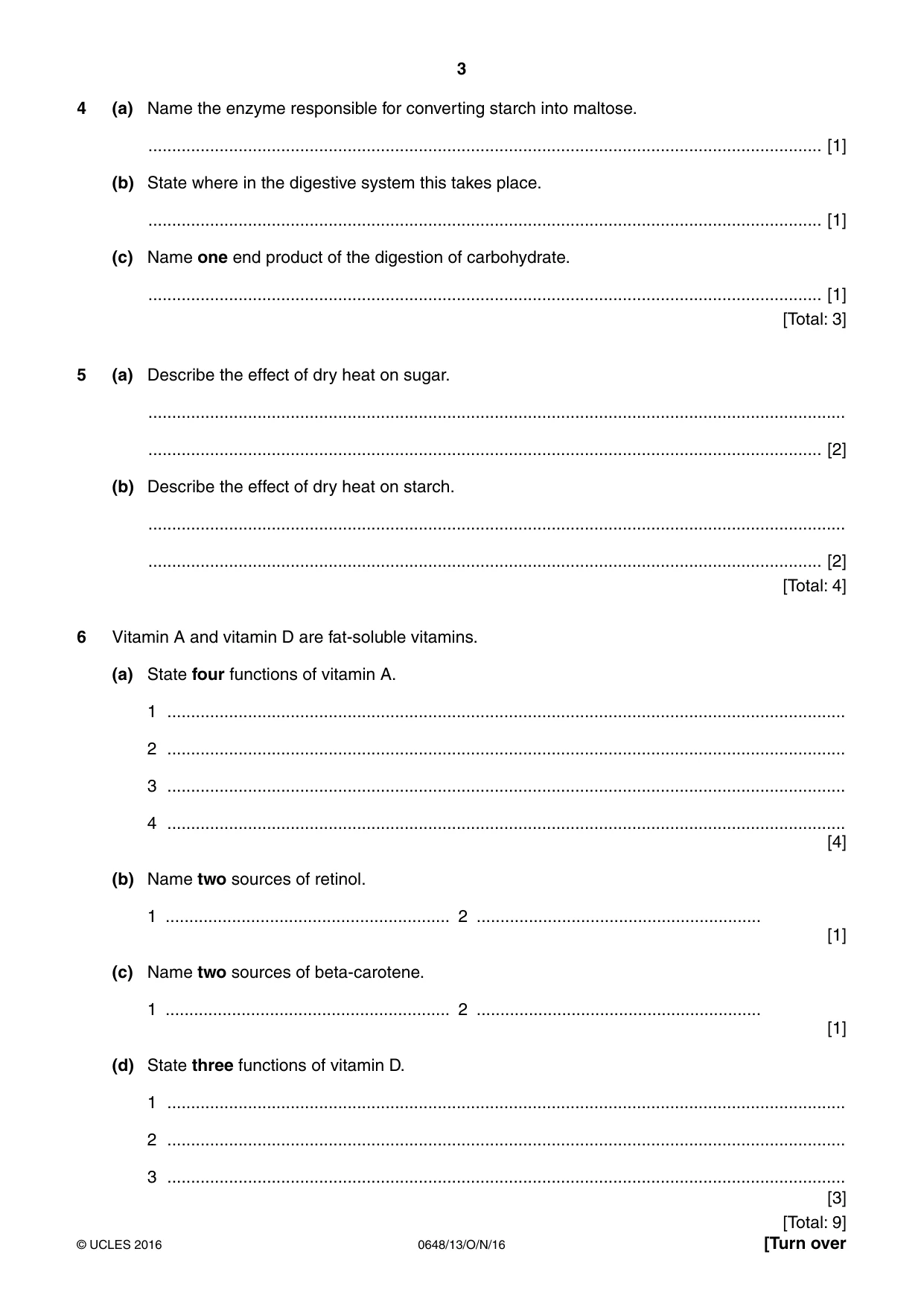
3 0648/13/O/N/16 © UCLES 2016 [Turn over 4 (a) Name the enzyme responsible for converting starch into maltose. … [1] (b) State where in the digestive system this takes place. … [1] (c) Name one end product of the digestion of carbohydrate. … [1] [Total: 3] 5 (a) Describe the effect of dry heat on sugar. … … [2] (b) Describe the effect of dry heat on starch. … … [2] [Total: 4] 6 Vitamin A and vitamin D are fat-soluble vitamins. (a) State four functions of vitamin A. 1 … 2 … 3 … 4 … [4] (b) Name two sources of retinol. 1 … 2 … [1] (c) Name two sources of beta-carotene. 1 … 2 … [1] (d) State three functions of vitamin D. 1 … 2 … 3 … [3] [Total: 9]
Question paper, page 4
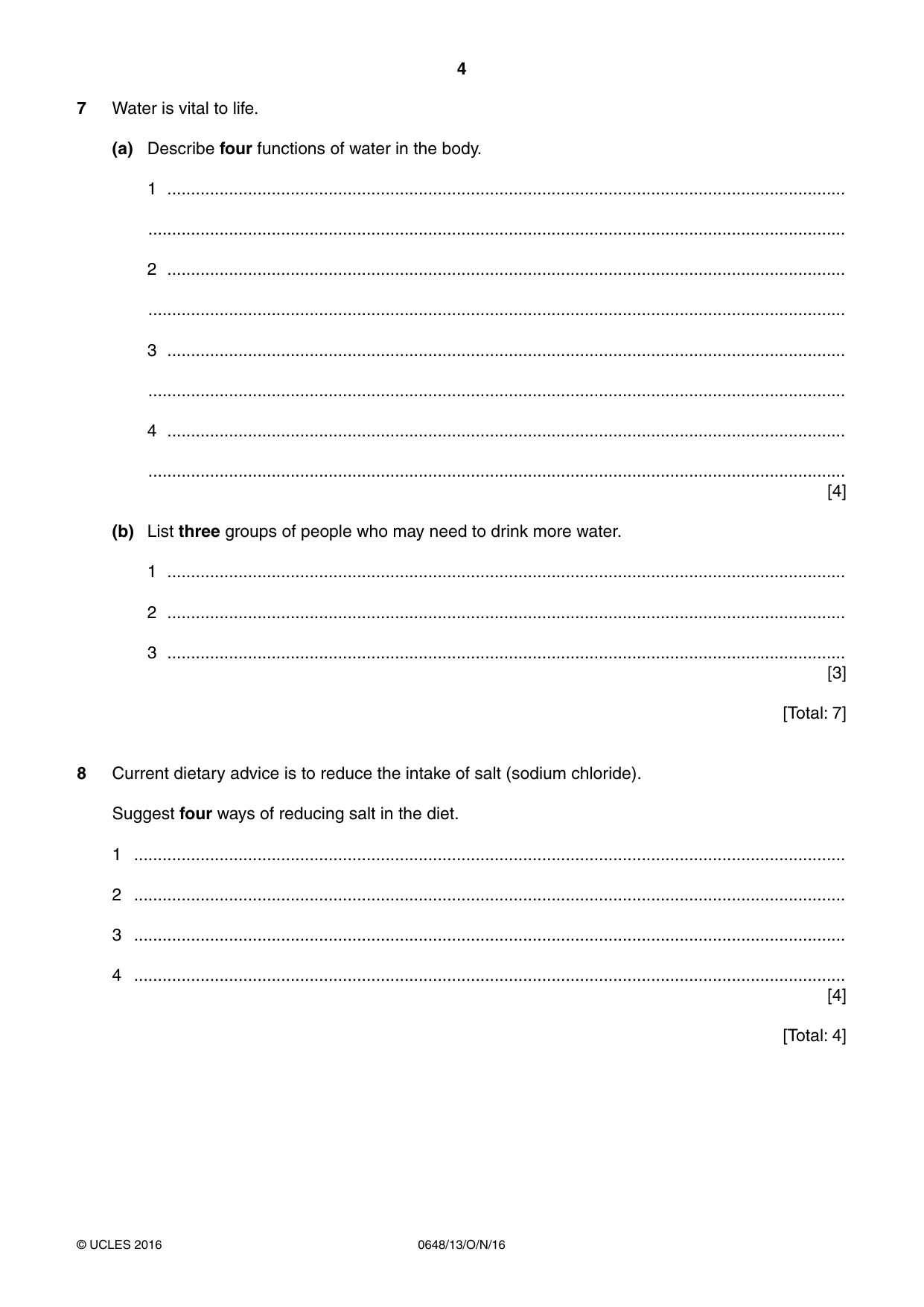
4 0648/13/O/N/16 © UCLES 2016 7 Water is vital to life. (a) Describe four functions of water in the body. 1 … … 2 … … 3 … … 4 … … [4] (b) List three groups of people who may need to drink more water. 1 … 2 … 3 … [3] [Total: 7] 8 Current dietary advice is to reduce the intake of salt (sodium chloride). Suggest four ways of reducing salt in the diet. 1 … 2 … 3 … 4 … [4] [Total: 4]
Question paper, page 5
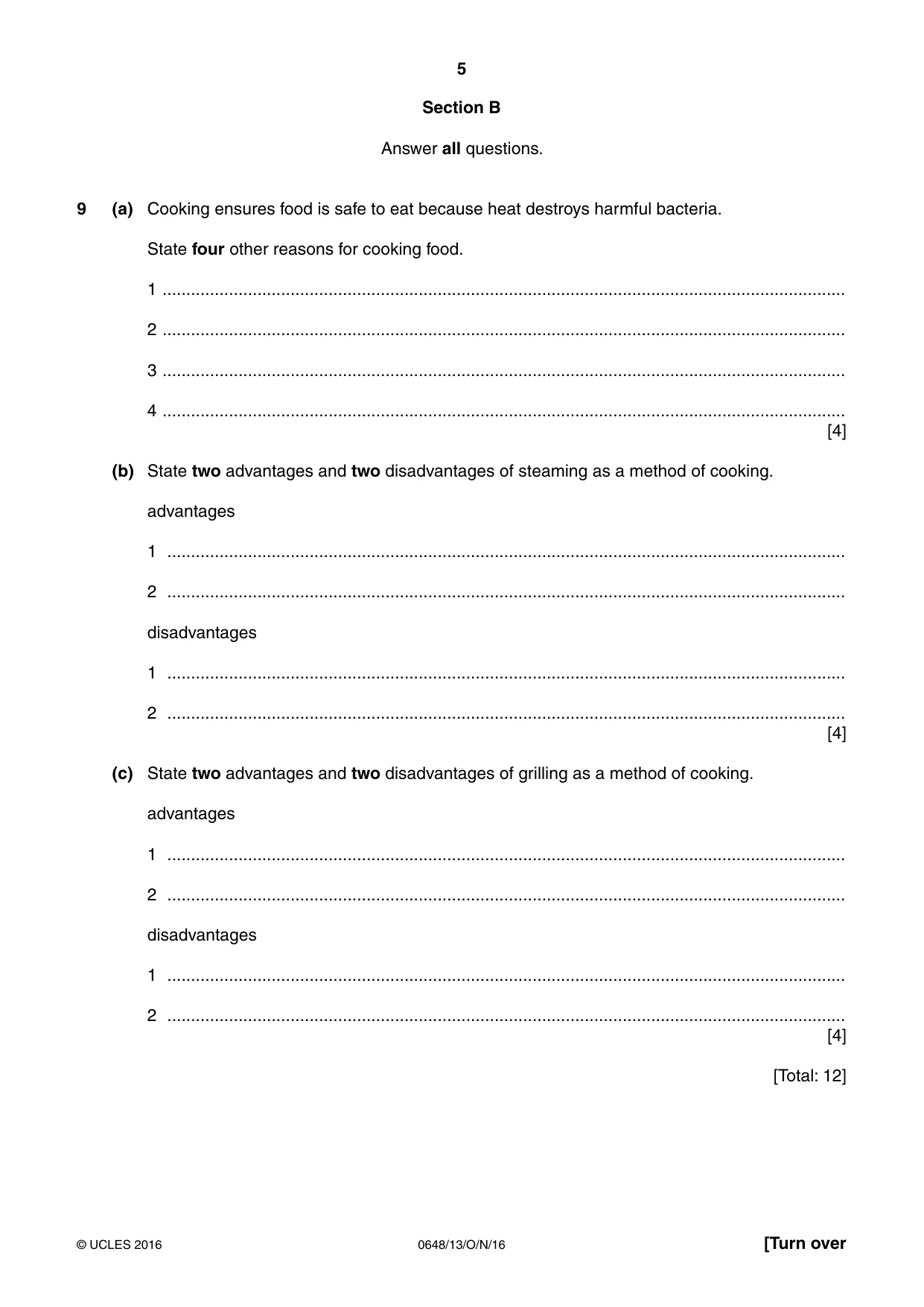
5 0648/13/O/N/16 © UCLES 2016 [Turn over Section B Answer all questions. 9 (a) Cooking ensures food is safe to eat because heat destroys harmful bacteria. State four other reasons for cooking food. 1 … 2 … 3 … 4 … [4] (b) State two advantages and two disadvantages of steaming as a method of cooking. advantages 1 … 2 … disadvantages 1 … 2 … [4] (c) State two advantages and two disadvantages of grilling as a method of cooking. advantages 1 … 2 … disadvantages 1 … 2 … [4] [Total: 12]
Question paper, page 6
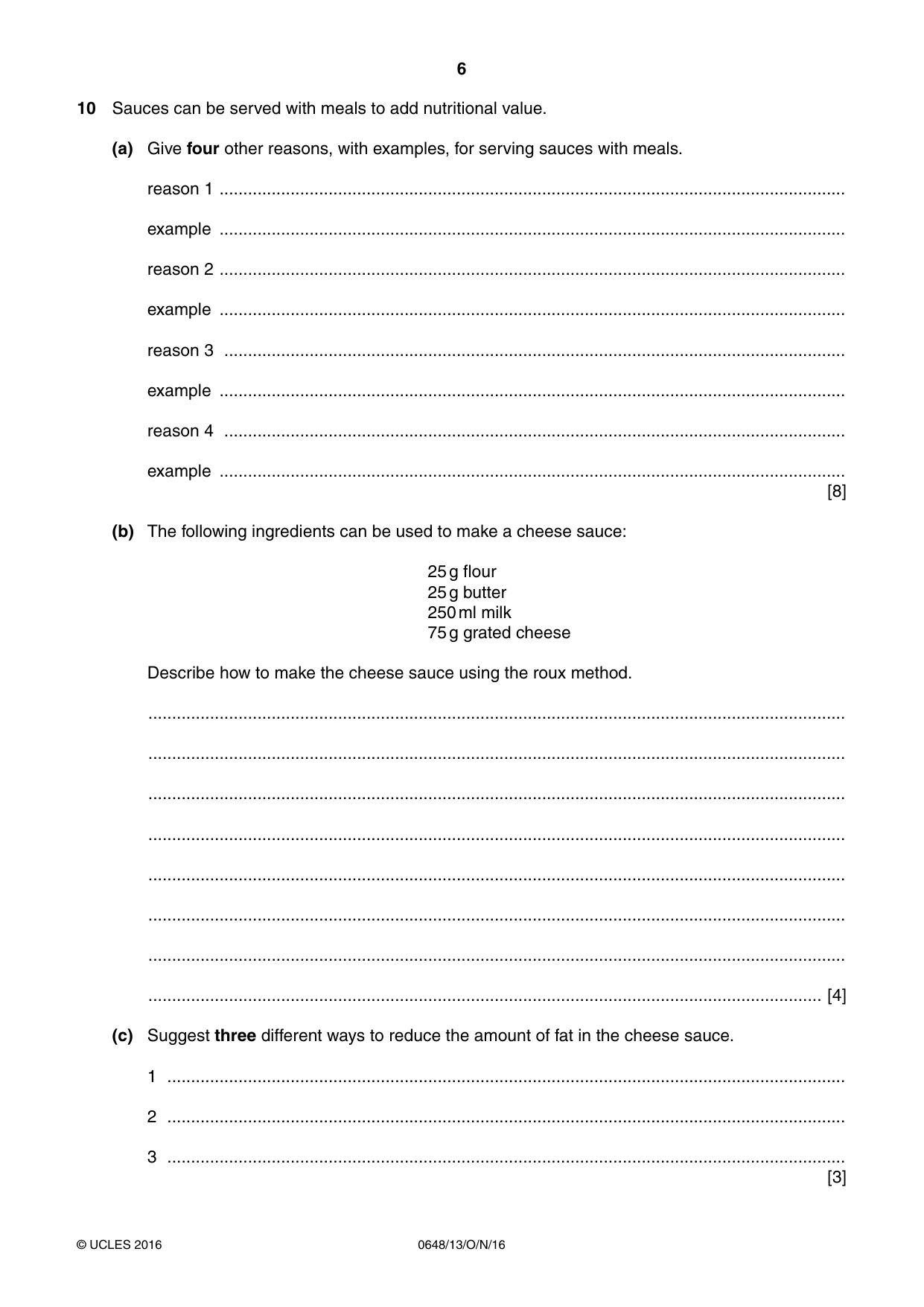
6 0648/13/O/N/16 © UCLES 2016 10 Sauces can be served with meals to add nutritional value. (a) Give four other reasons, with examples, for serving sauces with meals. reason 1 … example … reason 2 … example … reason 3 … example … reason 4 … example … [8] (b) The following ingredients can be used to make a cheese sauce: 25 g flour 25 g butter 250 ml milk 75 g grated cheese Describe how to make the cheese sauce using the roux method. … … … … … … … … [4] (c) Suggest three different ways to reduce the amount of fat in the cheese sauce. 1 … 2 … 3 … [3]
Question paper, page 7
7 0648/13/O/N/16 © UCLES 2016 [Turn over (d) Name two ingredients which could be added to vary the flavour of the sauce instead of using cheese. 1 … 2 … [2] (e) Suggest three possible reasons for a lumpy sauce. 1 … 2 … 3 … [3] [Total: 20]
Question paper, page 8
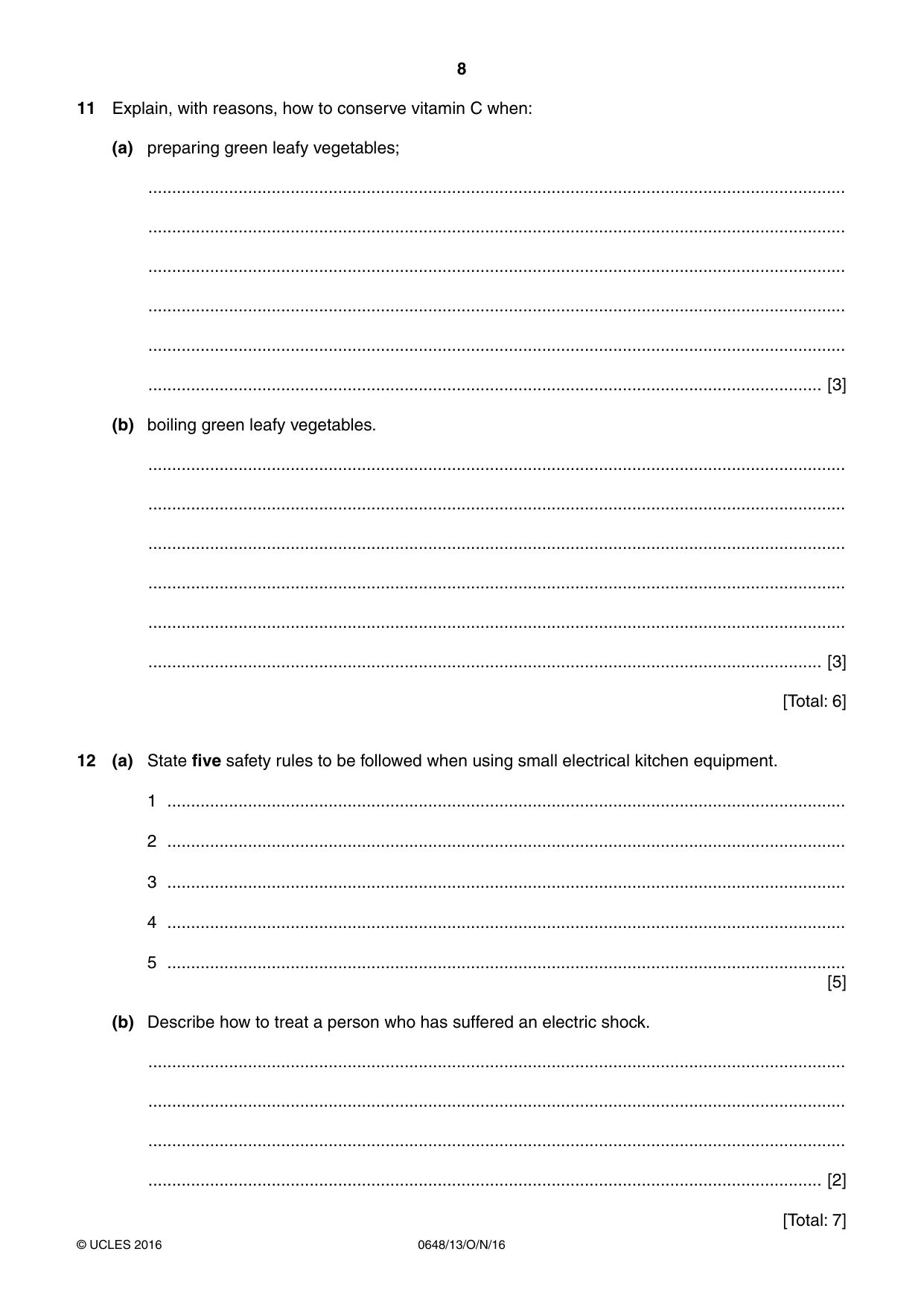
8 0648/13/O/N/16 © UCLES 2016 11 Explain, with reasons, how to conserve vitamin C when: (a) preparing green leafy vegetables; … … … … … … [3] (b) boiling green leafy vegetables. … … … … … … [3] [Total: 6] 12 (a) State five safety rules to be followed when using small electrical kitchen equipment. 1 … 2 … 3 … 4 … 5 … [5] (b) Describe how to treat a person who has suffered an electric shock. … … … … [2] [Total: 7]
Question paper, page 9
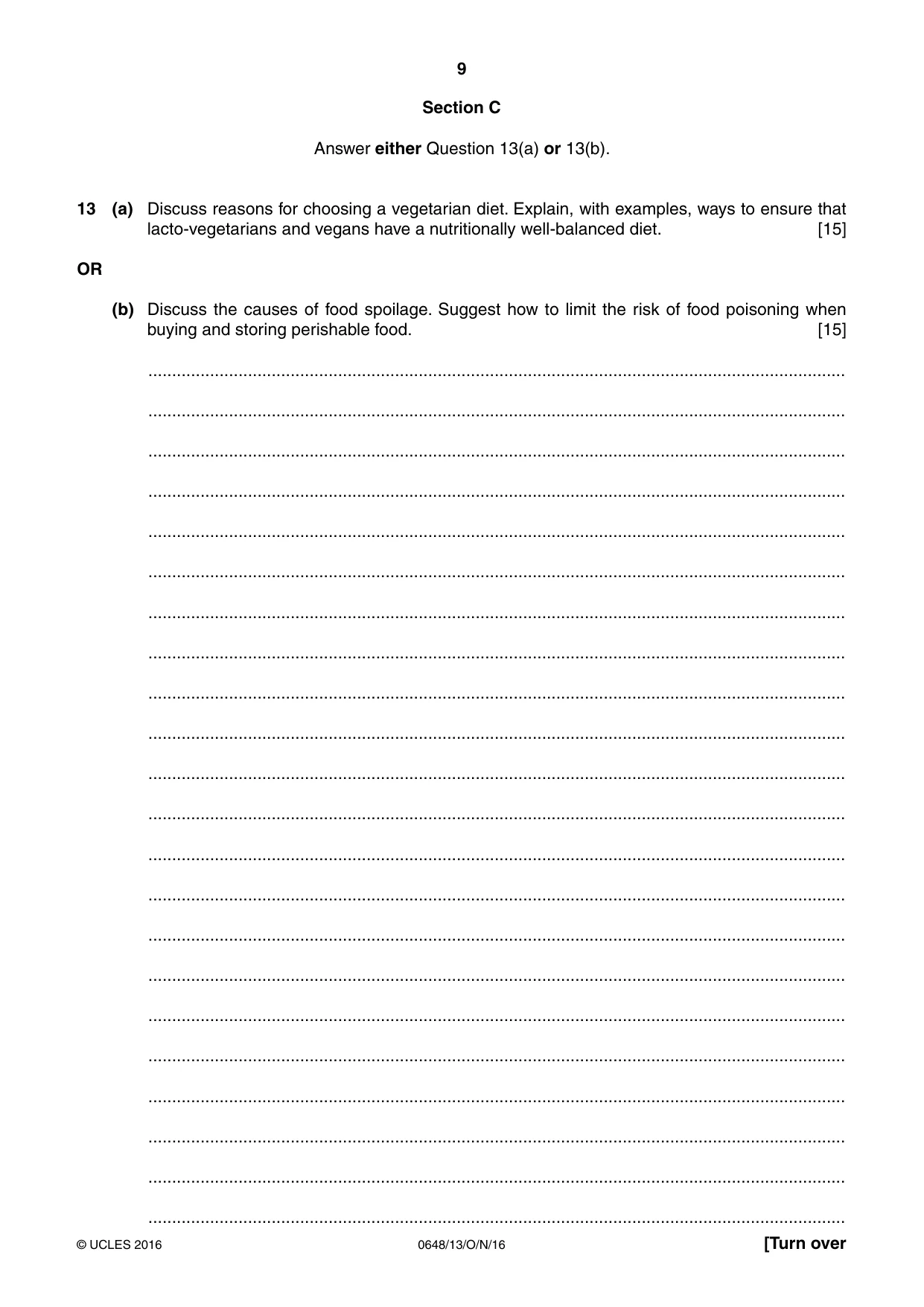
9 0648/13/O/N/16 © UCLES 2016 [Turn over Section C Answer either Question 13(a) or 13(b). 13 (a) Discuss reasons for choosing a vegetarian diet. Explain, with examples, ways to ensure that lacto-vegetarians and vegans have a nutritionally well-balanced diet. [15] OR (b) Discuss the causes of food spoilage. Suggest how to limit the risk of food poisoning when buying and storing perishable food. [15] … … … … … … … … … … … … … … … … … … … … … …
Question paper, page 10
10 0648/13/O/N/16 © UCLES 2016 … … … … … … … … … … … … … … … … … … … … … … … … … … … …
Question paper, page 11
11 0648/13/O/N/16 © UCLES 2016 … … … … … … … … … … … … … … … … … … … … … … … … … … … [Total: 15]
Question paper, page 12
12 0648/13/O/N/16 © UCLES 2016 Permission to reproduce items where third-party owned material protected by copyright is included has been sought and cleared where possible. Every reasonable effort has been made by the publisher (UCLES) to trace copyright holders, but if any items requiring clearance have unwittingly been included, the publisher will be pleased to make amends at the earliest possible opportunity. To avoid the issue of disclosure of answer-related information to candidates, all copyright acknowledgements are reproduced online in the Cambridge International Examinations Copyright Acknowledgements Booklet. This is produced for each series of examinations and is freely available to download at www.cie.org.uk after the live examination series. Cambridge International Examinations is part of the Cambridge Assessment Group. Cambridge Assessment is the brand name of University of Cambridge Local Examinations Syndicate (UCLES), which is itself a department of the University of Cambridge. BLANK PAGE
Mark scheme, page 1
® IGCSE is the registered trademark of Cambridge International Examinations. This document consists of 16 printed pages. © UCLES 2016 [Turn over Cambridge International Examinations Cambridge International General Certificate of Secondary Education FOOD AND NUTRITION 0648/13 Paper 1 Theory October/November 2016 MARK SCHEME Maximum Mark: 100 Published This mark scheme is published as an aid to teachers and candidates, to indicate the requirements of the examination. It shows the basis on which Examiners were instructed to award marks. It does not indicate the details of the discussions that took place at an Examiners’ meeting before marking began, which would have considered the acceptability of alternative answers. Mark schemes should be read in conjunction with the question paper and the Principal Examiner Report for Teachers. Cambridge will not enter into discussions about these mark schemes. Cambridge is publishing the mark schemes for the October/November 2016 series for most Cambridge IGCSE®, Cambridge International A and AS Level components and some Cambridge O Level components.
Mark scheme, page 2
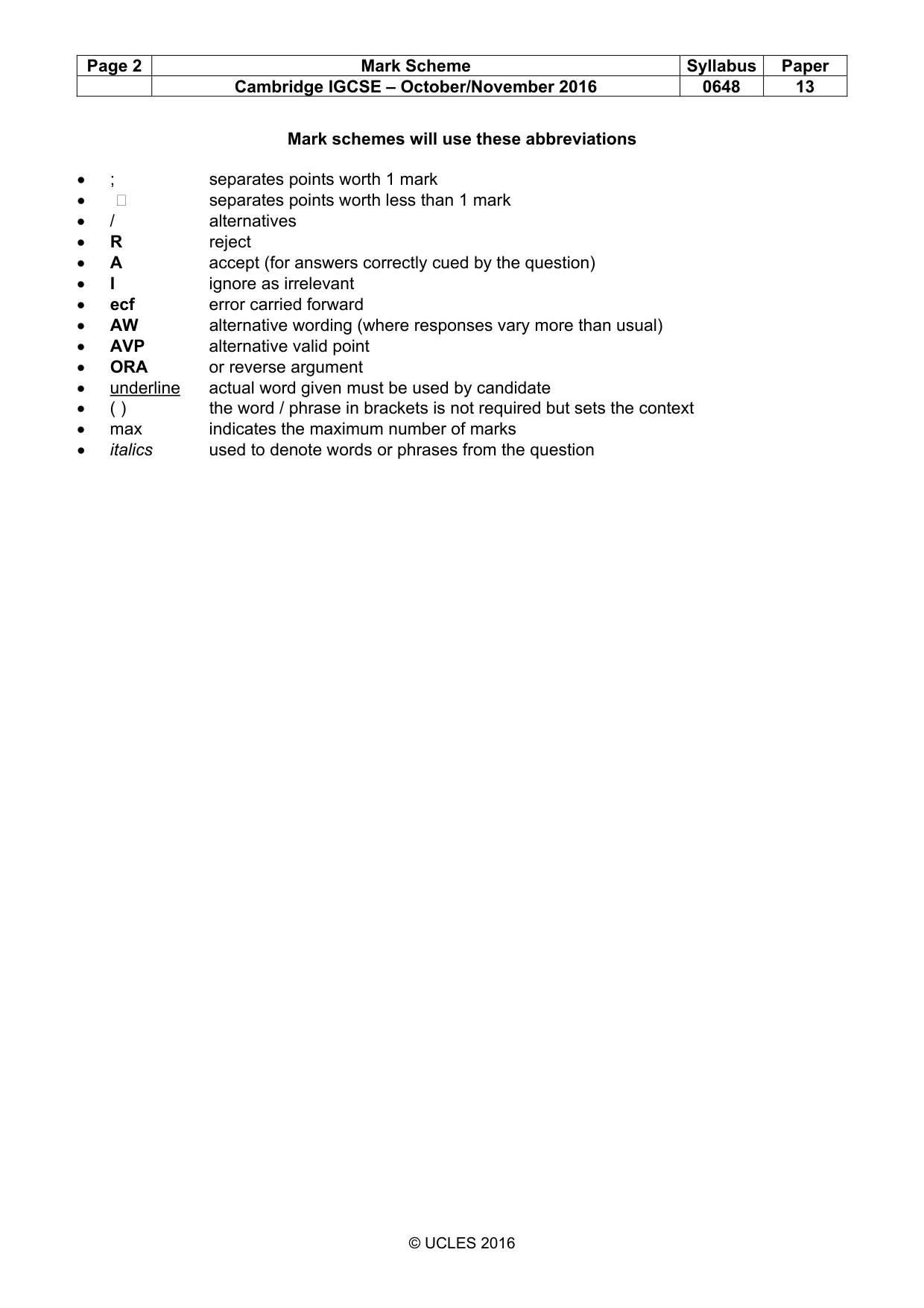
Page 2 Mark Scheme Syllabus Paper Cambridge IGCSE – October/November 2016 0648 13 © UCLES 2016 Mark schemes will use these abbreviations • ; separates points worth 1 mark • separates points worth less than 1 mark • / alternatives • R reject • A accept (for answers correctly cued by the question) • I ignore as irrelevant • ecf error carried forward • AW alternative wording (where responses vary more than usual) • AVP alternative valid point • ORA or reverse argument • underline actual word given must be used by candidate • ( ) the word / phrase in brackets is not required but sets the context • max indicates the maximum number of marks • italics used to denote words or phrases from the question
Mark scheme, page 3
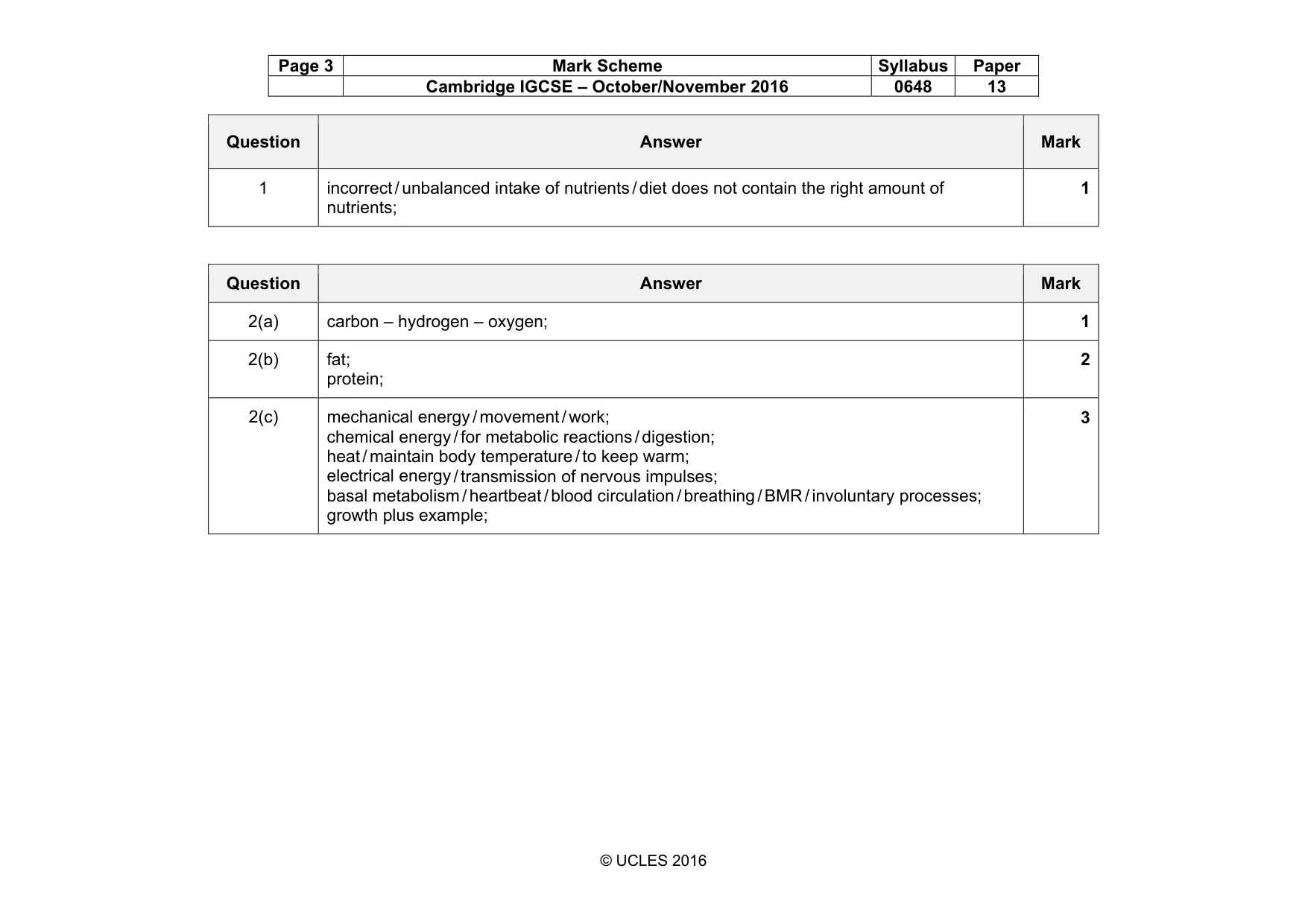
Page 3 Mark Scheme Syllabus Paper Cambridge IGCSE – October/November 2016 0648 13 © UCLES 2016 Question Answer Mark 1 incorrect / unbalanced intake of nutrients / diet does not contain the right amount of nutrients; 1 Question Answer Mark 2(a) carbon – hydrogen – oxygen; 1 2(b) fat; protein; 2 2(c) mechanical energy / movement / work; chemical energy / for metabolic reactions / digestion; heat / maintain body temperature / to keep warm; electrical energy / transmission of nervous impulses; basal metabolism / heartbeat / blood circulation / breathing / BMR / involuntary processes; growth plus example; 3
Mark scheme, page 4
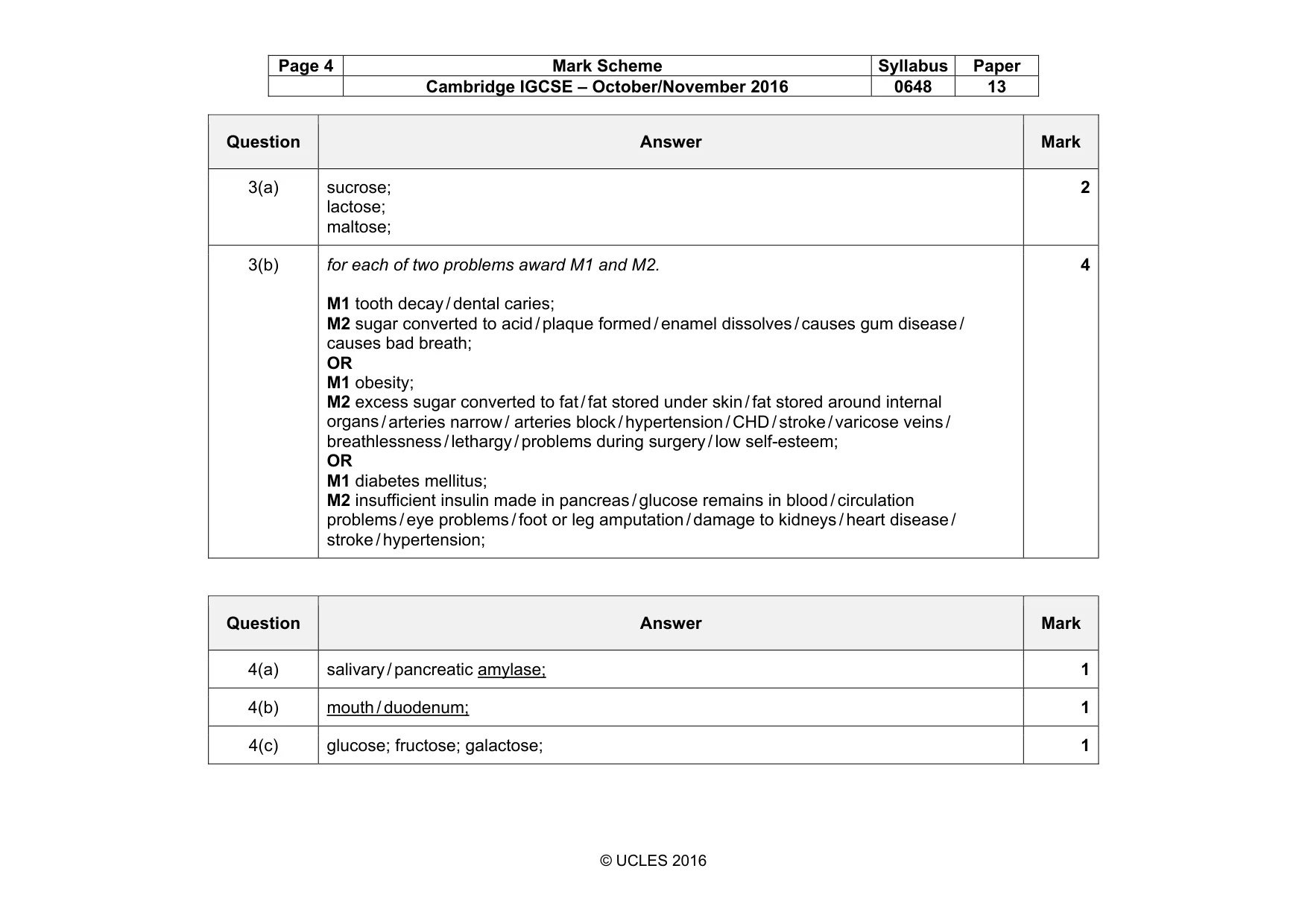
Page 4 Mark Scheme Syllabus Paper Cambridge IGCSE – October/November 2016 0648 13 © UCLES 2016 Question Answer Mark 3(a) sucrose; lactose; maltose; 2 3(b) for each of two problems award M1 and M2. M1 tooth decay / dental caries; M2 sugar converted to acid / plaque formed / enamel dissolves / causes gum disease / causes bad breath; OR M1 obesity; M2 excess sugar converted to fat / fat stored under skin / fat stored around internal organs / arteries narrow / arteries block / hypertension / CHD / stroke / varicose veins / breathlessness / lethargy / problems during surgery / low self-esteem; OR M1 diabetes mellitus; M2 insufficient insulin made in pancreas / glucose remains in blood / circulation problems / eye problems / foot or leg amputation / damage to kidneys / heart disease / stroke / hypertension; 4 Question Answer Mark 4(a) salivary / pancreatic amylase; 1 4(b) mouth / duodenum; 1 4(c) glucose; fructose; galactose; 1
Mark scheme, page 5
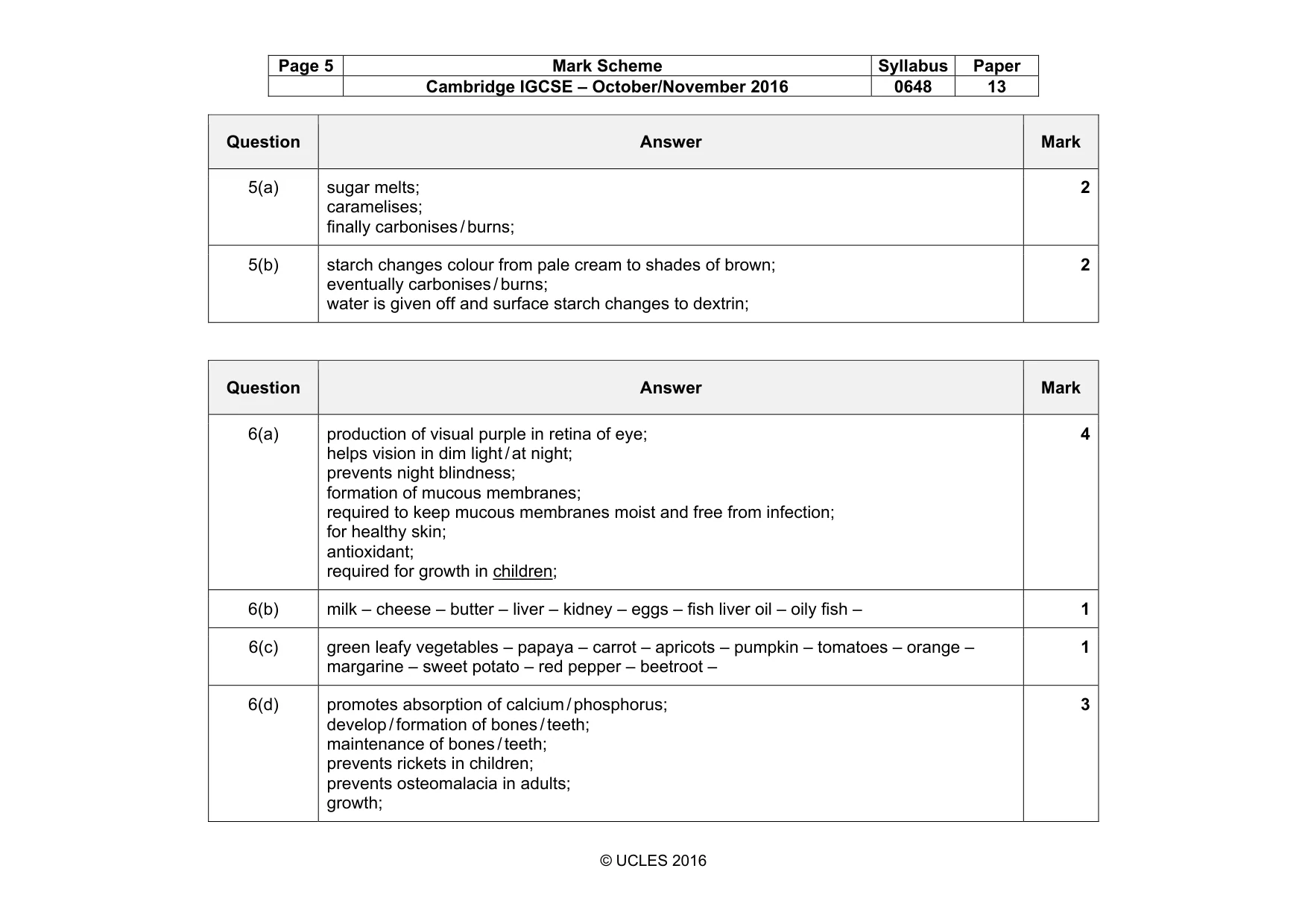
Page 5 Mark Scheme Syllabus Paper Cambridge IGCSE – October/November 2016 0648 13 © UCLES 2016 Question Answer Mark 5(a) sugar melts; caramelises; finally carbonises / burns; 2 5(b) starch changes colour from pale cream to shades of brown; eventually carbonises / burns; water is given off and surface starch changes to dextrin; 2 Question Answer Mark 6(a) production of visual purple in retina of eye; helps vision in dim light / at night; prevents night blindness; formation of mucous membranes; required to keep mucous membranes moist and free from infection; for healthy skin; antioxidant; required for growth in children; 4 6(b) milk – cheese – butter – liver – kidney – eggs – fish liver oil – oily fish – 1 6(c) green leafy vegetables – papaya – carrot – apricots – pumpkin – tomatoes – orange – margarine – sweet potato – red pepper – beetroot – 1 6(d) promotes absorption of calcium / phosphorus; develop / formation of bones / teeth; maintenance of bones / teeth; prevents rickets in children; prevents osteomalacia in adults; growth; 3
Mark scheme, page 6
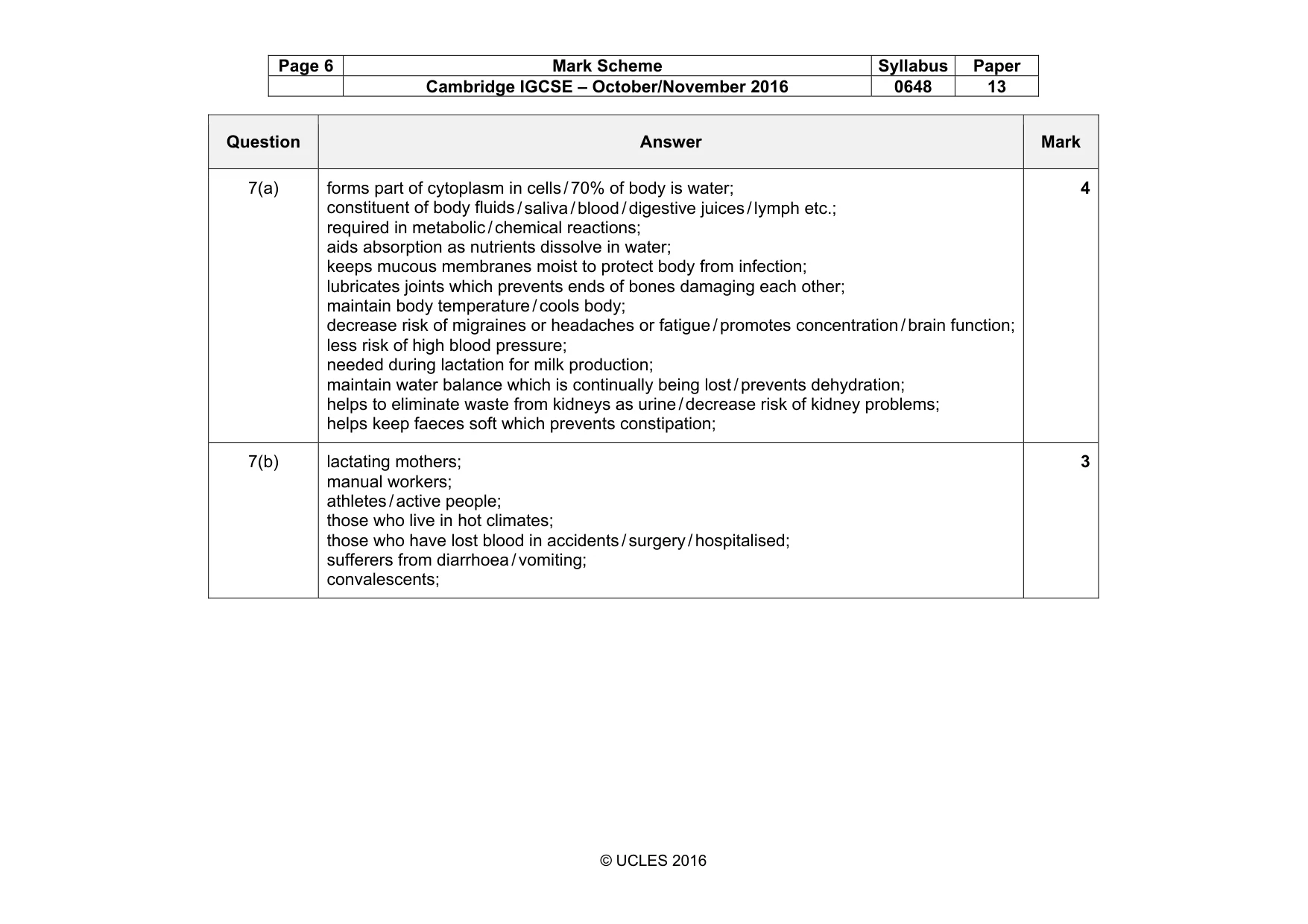
Page 6 Mark Scheme Syllabus Paper Cambridge IGCSE – October/November 2016 0648 13 © UCLES 2016 Question Answer Mark 7(a) forms part of cytoplasm in cells / 70% of body is water; constituent of body fluids / saliva / blood / digestive juices / lymph etc.; required in metabolic / chemical reactions; aids absorption as nutrients dissolve in water; keeps mucous membranes moist to protect body from infection; lubricates joints which prevents ends of bones damaging each other; maintain body temperature / cools body; decrease risk of migraines or headaches or fatigue / promotes concentration / brain function; less risk of high blood pressure; needed during lactation for milk production; maintain water balance which is continually being lost / prevents dehydration; helps to eliminate waste from kidneys as urine / decrease risk of kidney problems; helps keep faeces soft which prevents constipation; 4 7(b) lactating mothers; manual workers; athletes / active people; those who live in hot climates; those who have lost blood in accidents / surgery / hospitalised; sufferers from diarrhoea / vomiting; convalescents; 3
Mark scheme, page 7
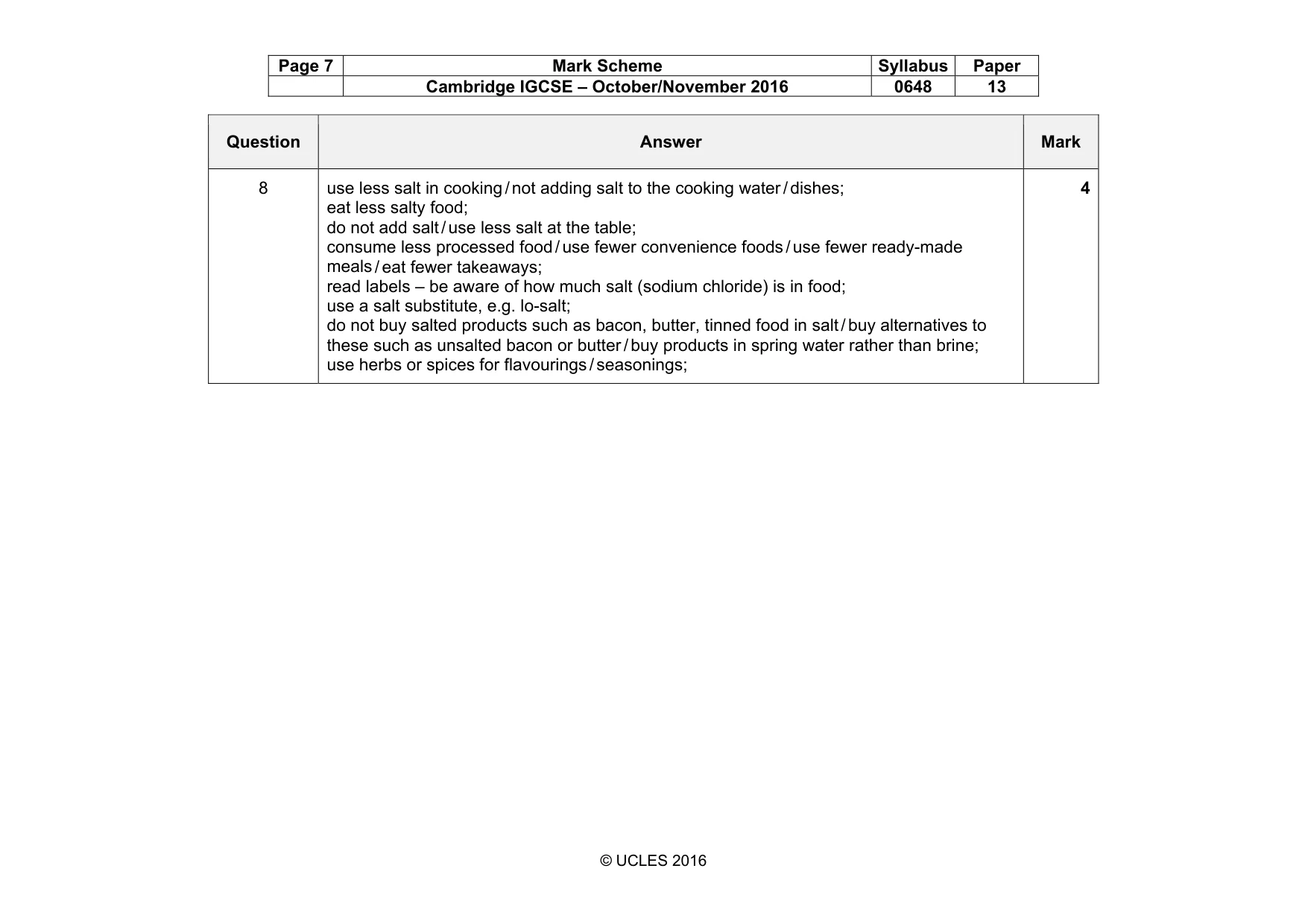
Page 7 Mark Scheme Syllabus Paper Cambridge IGCSE – October/November 2016 0648 13 © UCLES 2016 Question Answer Mark 8 use less salt in cooking / not adding salt to the cooking water / dishes; eat less salty food; do not add salt / use less salt at the table; consume less processed food / use fewer convenience foods / use fewer ready-made meals / eat fewer takeaways; read labels – be aware of how much salt (sodium chloride) is in food; use a salt substitute, e.g. lo-salt; do not buy salted products such as bacon, butter, tinned food in salt / buy alternatives to these such as unsalted bacon or butter / buy products in spring water rather than brine; use herbs or spices for flavourings / seasonings; 4
Mark scheme, page 8
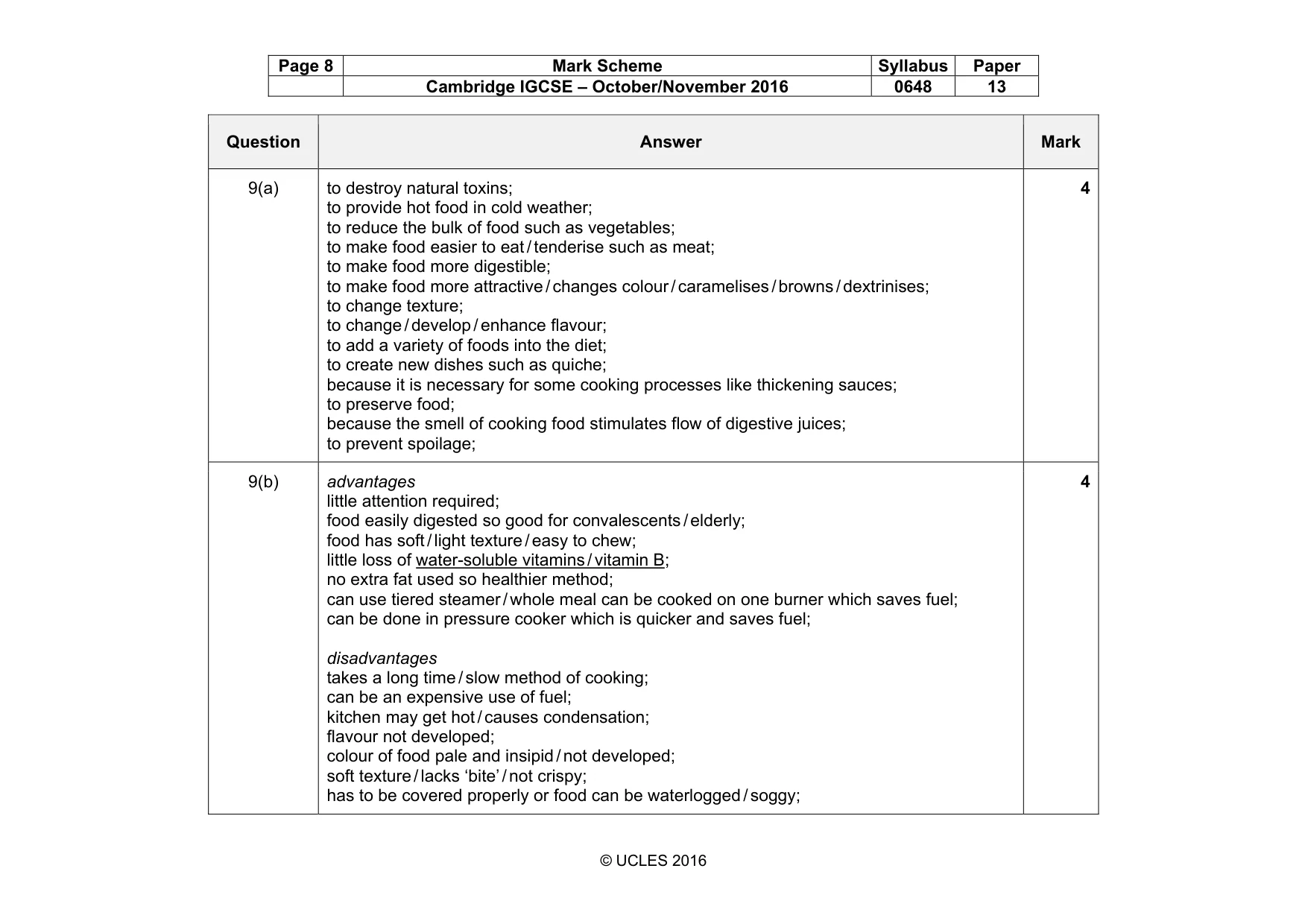
Page 8 Mark Scheme Syllabus Paper Cambridge IGCSE – October/November 2016 0648 13 © UCLES 2016 Question Answer Mark 9(a) to destroy natural toxins; to provide hot food in cold weather; to reduce the bulk of food such as vegetables; to make food easier to eat / tenderise such as meat; to make food more digestible; to make food more attractive / changes colour / caramelises / browns / dextrinises; to change texture; to change / develop / enhance flavour; to add a variety of foods into the diet; to create new dishes such as quiche; because it is necessary for some cooking processes like thickening sauces; to preserve food; because the smell of cooking food stimulates flow of digestive juices; to prevent spoilage; 4 9(b) advantages little attention required; food easily digested so good for convalescents / elderly; food has soft / light texture / easy to chew; little loss of water-soluble vitamins / vitamin B; no extra fat used so healthier method; can use tiered steamer / whole meal can be cooked on one burner which saves fuel; can be done in pressure cooker which is quicker and saves fuel; disadvantages takes a long time / slow method of cooking; can be an expensive use of fuel; kitchen may get hot / causes condensation; flavour not developed; colour of food pale and insipid / not developed; soft texture / lacks ‘bite’ / not crispy; has to be covered properly or food can be waterlogged / soggy; 4
Mark scheme, page 9
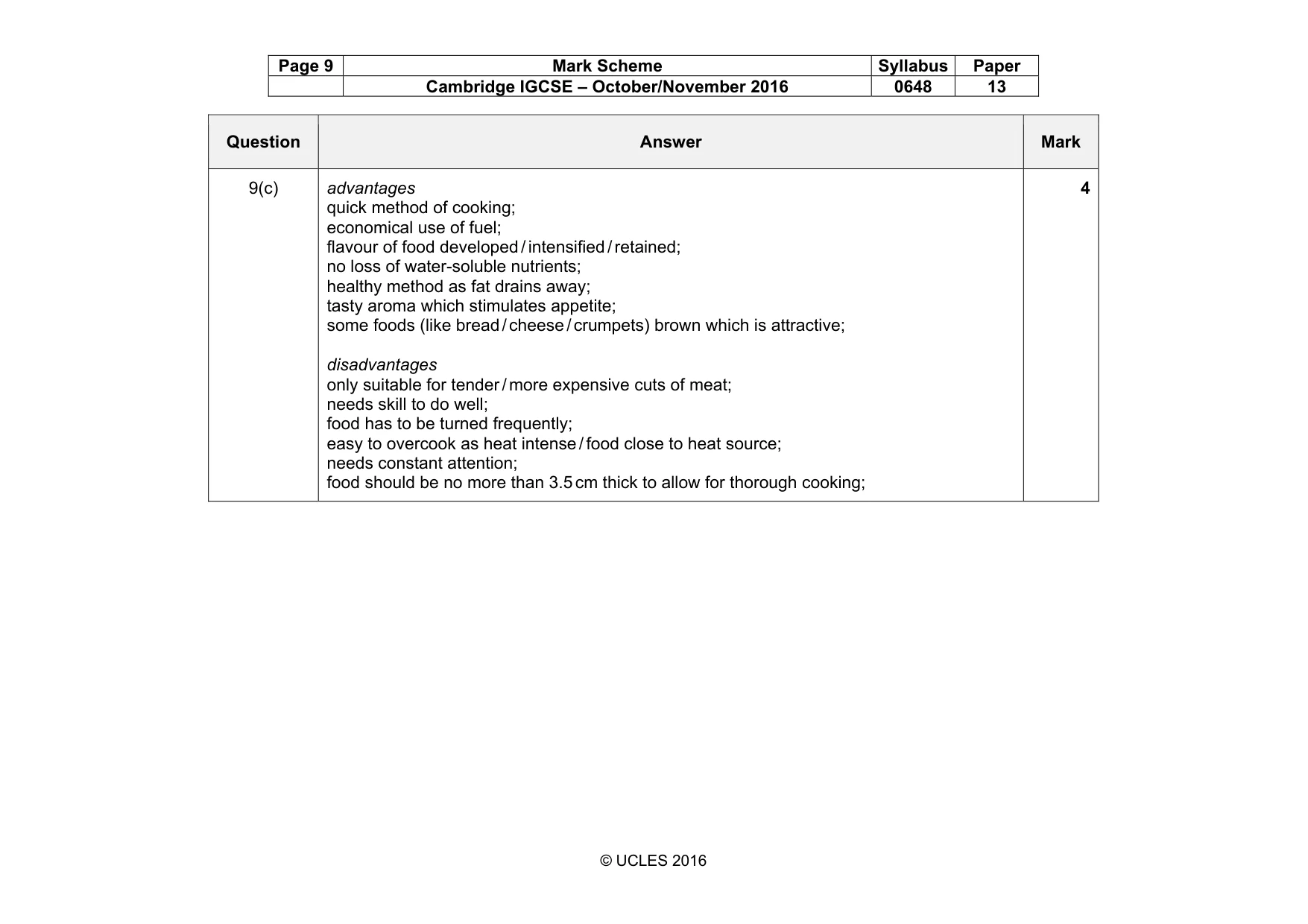
Page 9 Mark Scheme Syllabus Paper Cambridge IGCSE – October/November 2016 0648 13 © UCLES 2016 Question Answer Mark 9(c) advantages quick method of cooking; economical use of fuel; flavour of food developed / intensified / retained; no loss of water-soluble nutrients; healthy method as fat drains away; tasty aroma which stimulates appetite; some foods (like bread / cheese / crumpets) brown which is attractive; disadvantages only suitable for tender / more expensive cuts of meat; needs skill to do well; food has to be turned frequently; easy to overcook as heat intense / food close to heat source; needs constant attention; food should be no more than 3.5 cm thick to allow for thorough cooking; 4
Mark scheme, page 10
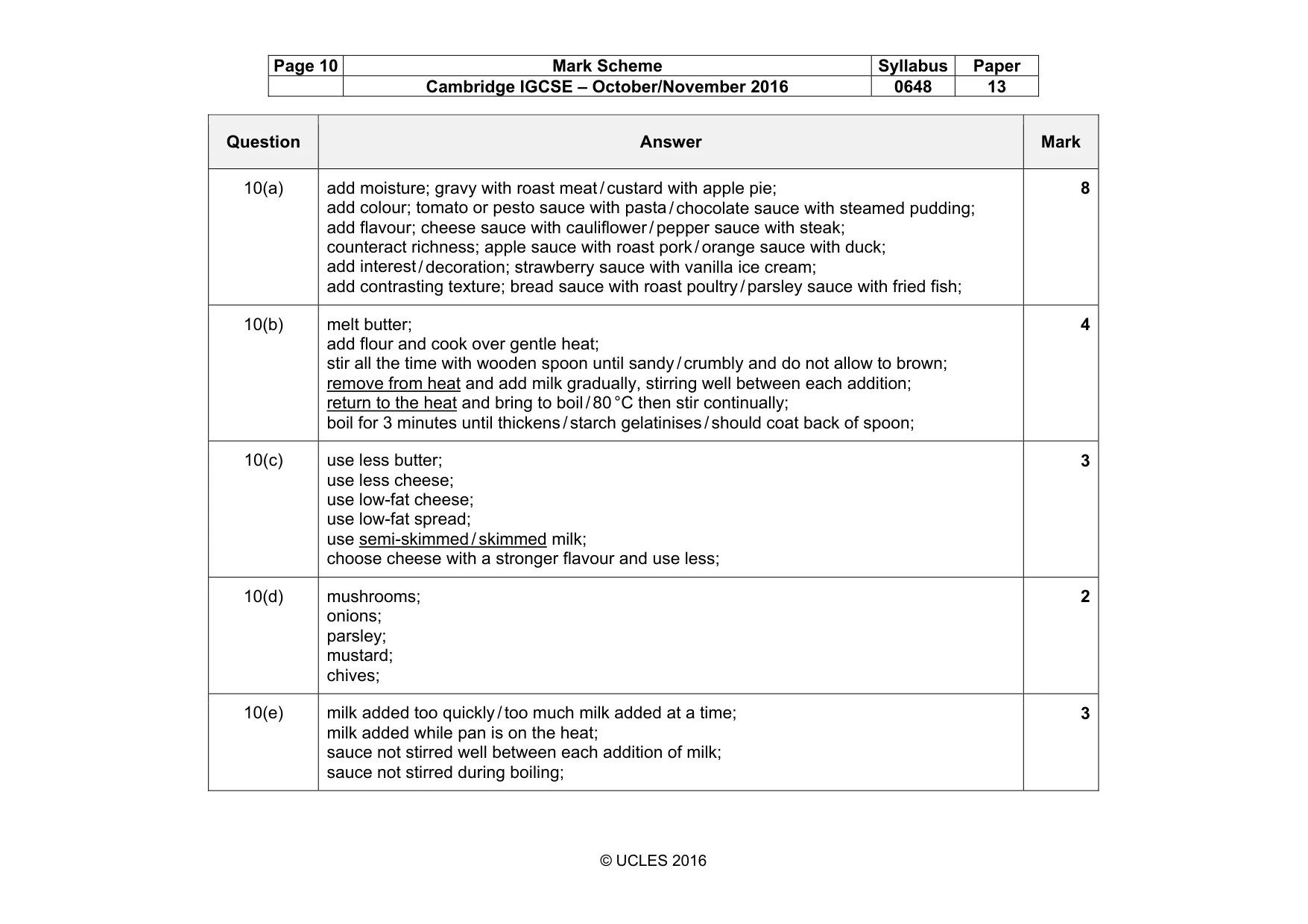
Page 10 Mark Scheme Syllabus Paper Cambridge IGCSE – October/November 2016 0648 13 © UCLES 2016 Question Answer Mark 10(a) add moisture; gravy with roast meat / custard with apple pie; add colour; tomato or pesto sauce with pasta / chocolate sauce with steamed pudding; add flavour; cheese sauce with cauliflower / pepper sauce with steak; counteract richness; apple sauce with roast pork / orange sauce with duck; add interest / decoration; strawberry sauce with vanilla ice cream; add contrasting texture; bread sauce with roast poultry / parsley sauce with fried fish; 8 10(b) melt butter; add flour and cook over gentle heat; stir all the time with wooden spoon until sandy / crumbly and do not allow to brown; remove from heat and add milk gradually, stirring well between each addition; return to the heat and bring to boil / 80 °C then stir continually; boil for 3 minutes until thickens / starch gelatinises / should coat back of spoon; 4 10(c) use less butter; use less cheese; use low-fat cheese; use low-fat spread; use semi-skimmed / skimmed milk; choose cheese with a stronger flavour and use less; 3 10(d) mushrooms; onions; parsley; mustard; chives; 2 10(e) milk added too quickly / too much milk added at a time; milk added while pan is on the heat; sauce not stirred well between each addition of milk; sauce not stirred during boiling; 3
Mark scheme, page 11
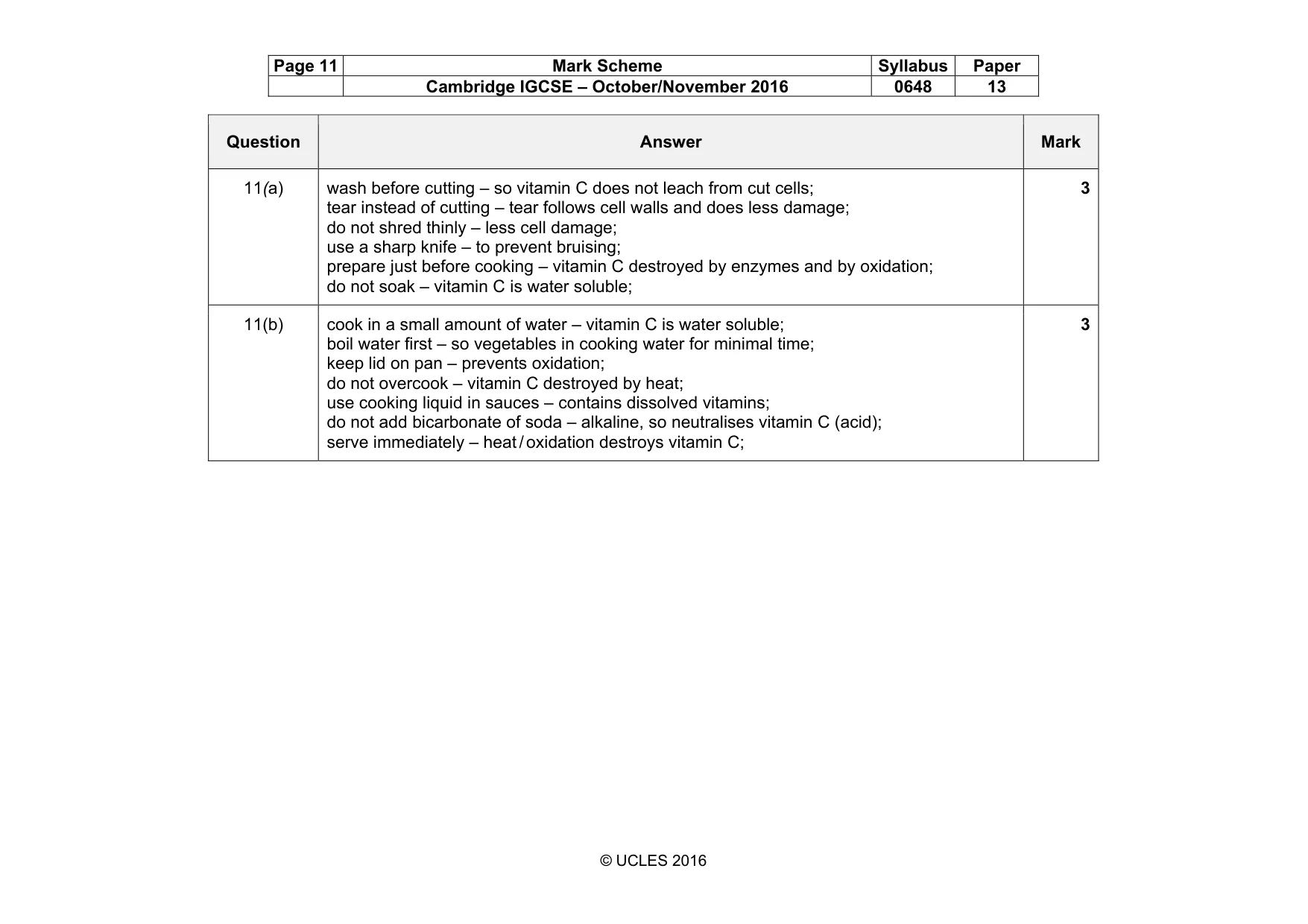
Page 11 Mark Scheme Syllabus Paper Cambridge IGCSE – October/November 2016 0648 13 © UCLES 2016 Question Answer Mark 11(a) wash before cutting – so vitamin C does not leach from cut cells; tear instead of cutting – tear follows cell walls and does less damage; do not shred thinly – less cell damage; use a sharp knife – to prevent bruising; prepare just before cooking – vitamin C destroyed by enzymes and by oxidation; do not soak – vitamin C is water soluble; 3 11(b) cook in a small amount of water – vitamin C is water soluble; boil water first – so vegetables in cooking water for minimal time; keep lid on pan – prevents oxidation; do not overcook – vitamin C destroyed by heat; use cooking liquid in sauces – contains dissolved vitamins; do not add bicarbonate of soda – alkaline, so neutralises vitamin C (acid); serve immediately – heat / oxidation destroys vitamin C; 3
Mark scheme, page 12
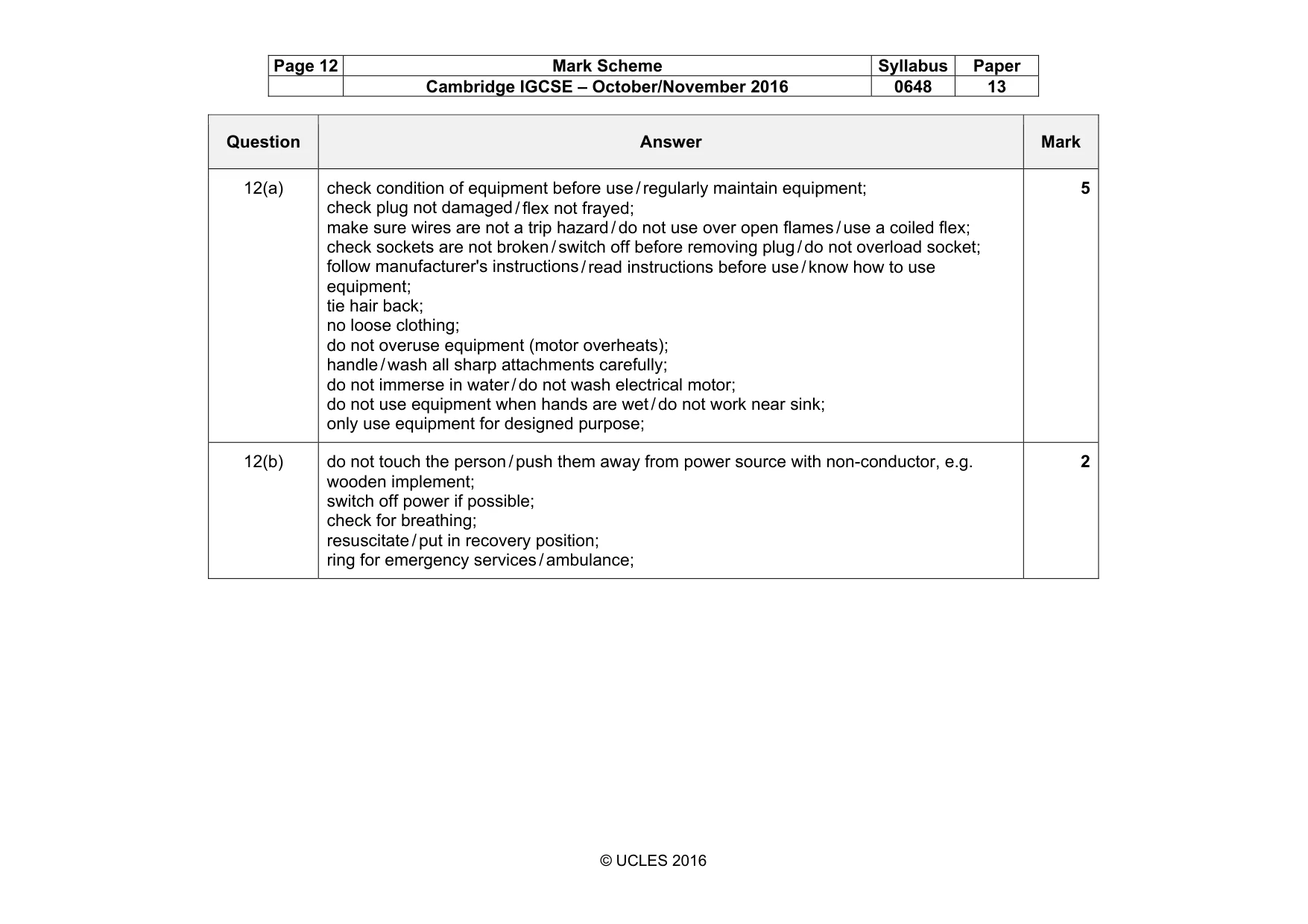
Page 12 Mark Scheme Syllabus Paper Cambridge IGCSE – October/November 2016 0648 13 © UCLES 2016 Question Answer Mark 12(a) check condition of equipment before use / regularly maintain equipment; check plug not damaged / flex not frayed; make sure wires are not a trip hazard / do not use over open flames / use a coiled flex; check sockets are not broken / switch off before removing plug / do not overload socket; follow manufacturer's instructions / read instructions before use / know how to use equipment; tie hair back; no loose clothing; do not overuse equipment (motor overheats); handle / wash all sharp attachments carefully; do not immerse in water / do not wash electrical motor; do not use equipment when hands are wet / do not work near sink; only use equipment for designed purpose; 5 12(b) do not touch the person / push them away from power source with non-conductor, e.g. wooden implement; switch off power if possible; check for breathing; resuscitate / put in recovery position; ring for emergency services / ambulance; 2
Mark scheme, page 13
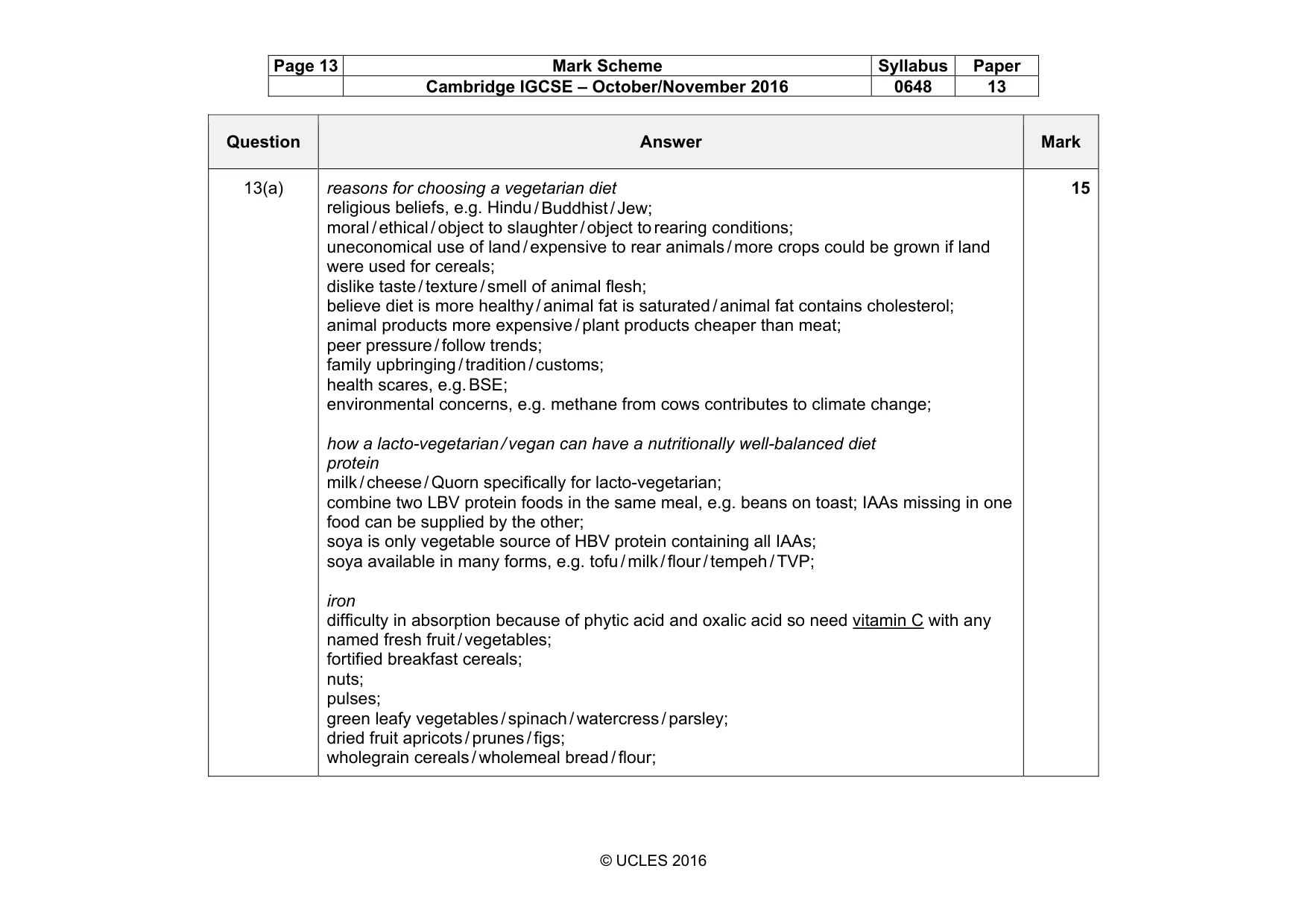
Page 13 Mark Scheme Syllabus Paper Cambridge IGCSE – October/November 2016 0648 13 © UCLES 2016 Question Answer Mark 13(a) reasons for choosing a vegetarian diet religious beliefs, e.g. Hindu / Buddhist / Jew; moral / ethical / object to slaughter / object to rearing conditions; uneconomical use of land / expensive to rear animals / more crops could be grown if land were used for cereals; dislike taste / texture / smell of animal flesh; believe diet is more healthy / animal fat is saturated / animal fat contains cholesterol; animal products more expensive / plant products cheaper than meat; peer pressure / follow trends; family upbringing / tradition / customs; health scares, e.g. BSE; environmental concerns, e.g. methane from cows contributes to climate change; how a lacto-vegetarian / vegan can have a nutritionally well-balanced diet protein milk / cheese / Quorn specifically for lacto-vegetarian; combine two LBV protein foods in the same meal, e.g. beans on toast; IAAs missing in one food can be supplied by the other; soya is only vegetable source of HBV protein containing all IAAs; soya available in many forms, e.g. tofu / milk / flour / tempeh / TVP; iron difficulty in absorption because of phytic acid and oxalic acid so need vitamin C with any named fresh fruit / vegetables; fortified breakfast cereals; nuts; pulses; green leafy vegetables / spinach / watercress / parsley; dried fruit apricots / prunes / figs; wholegrain cereals / wholemeal bread / flour; 15
Mark scheme, page 14
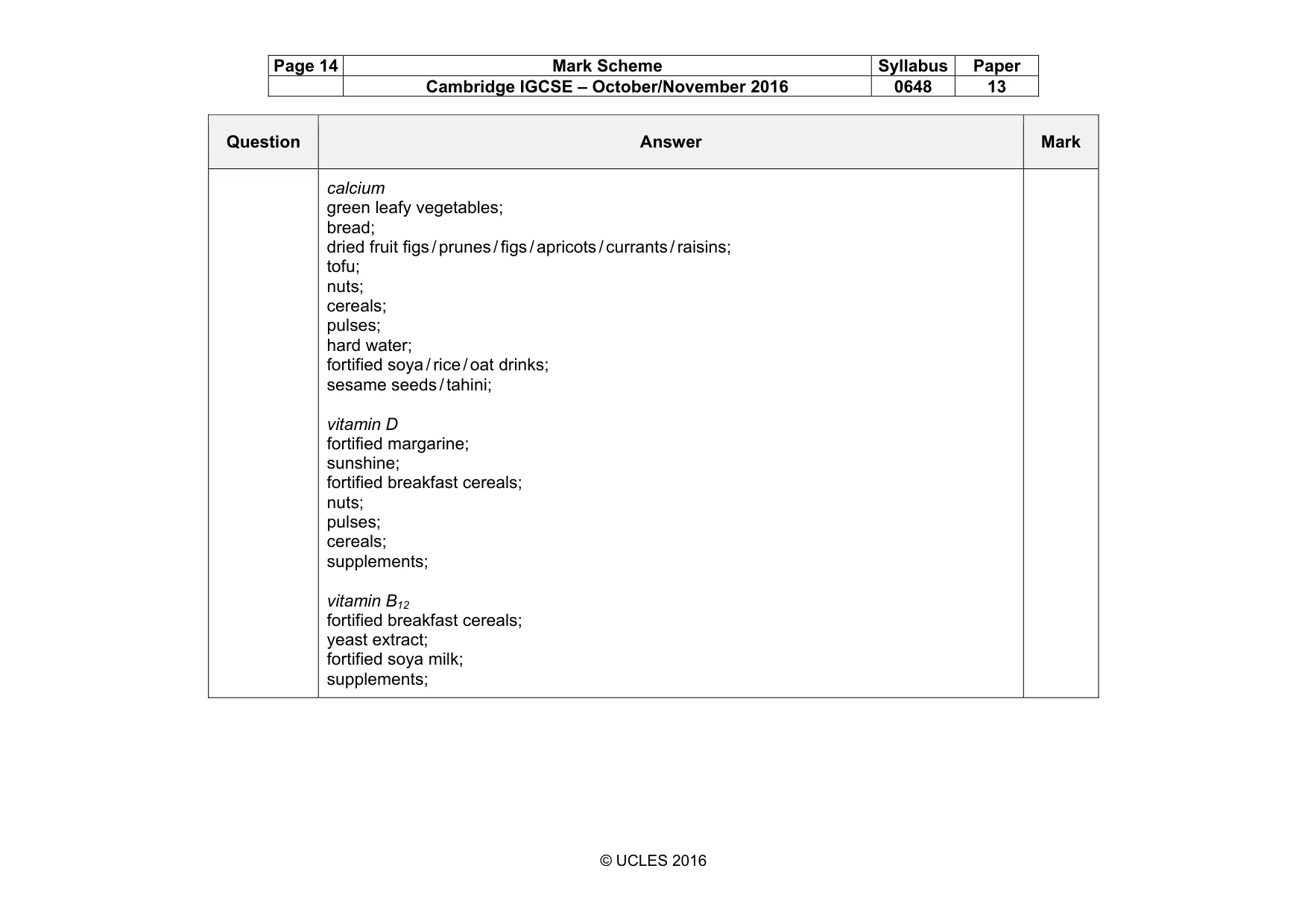
Page 14 Mark Scheme Syllabus Paper Cambridge IGCSE – October/November 2016 0648 13 © UCLES 2016 Question Answer Mark calcium green leafy vegetables; bread; dried fruit figs / prunes / figs / apricots / currants / raisins; tofu; nuts; cereals; pulses; hard water; fortified soya / rice / oat drinks; sesame seeds / tahini; vitamin D fortified margarine; sunshine; fortified breakfast cereals; nuts; pulses; cereals; supplements; vitamin B12 fortified breakfast cereals; yeast extract; fortified soya milk; supplements;
Mark scheme, page 15
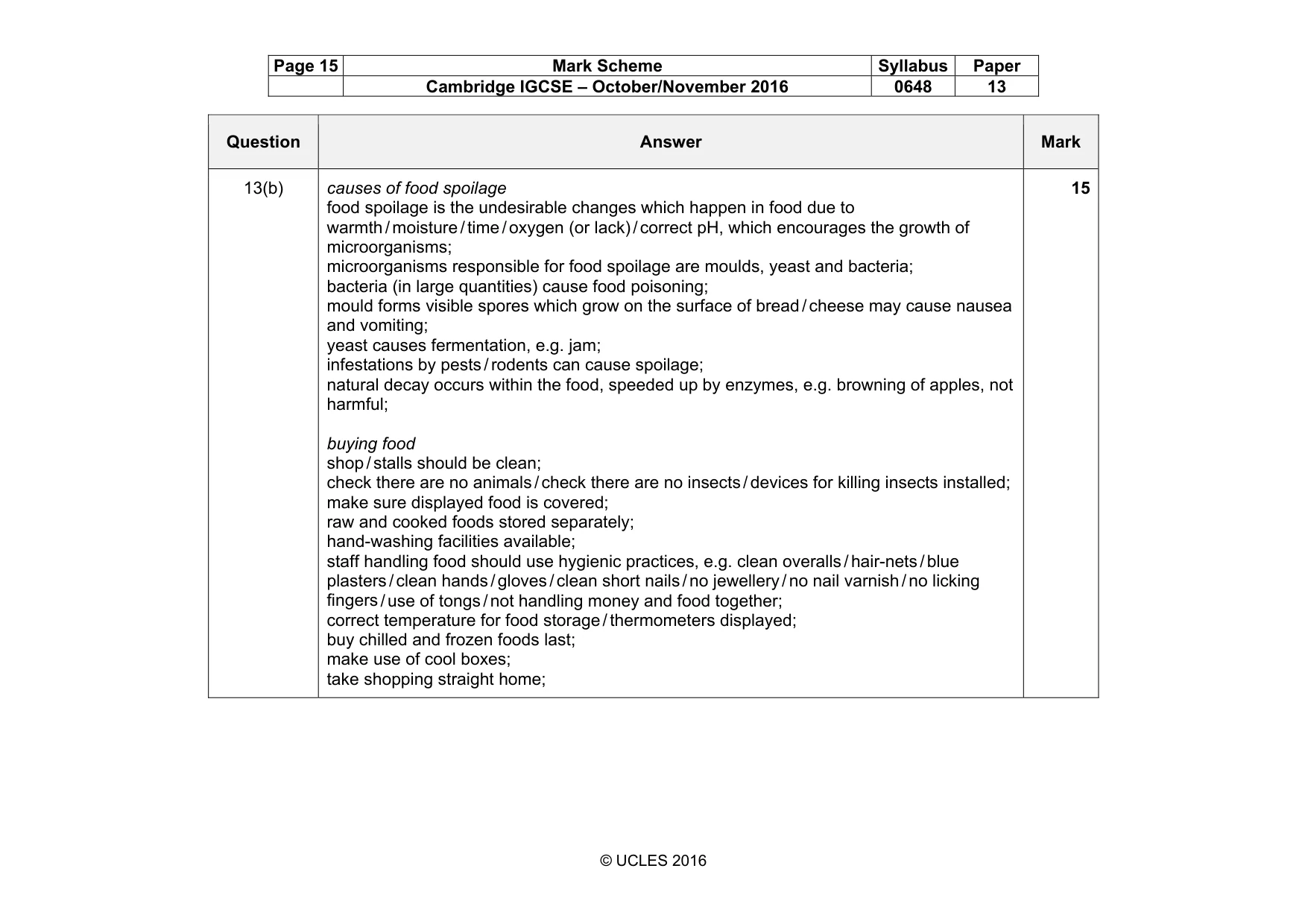
Page 15 Mark Scheme Syllabus Paper Cambridge IGCSE – October/November 2016 0648 13 © UCLES 2016 Question Answer Mark 13(b) causes of food spoilage food spoilage is the undesirable changes which happen in food due to warmth / moisture / time / oxygen (or lack) / correct pH, which encourages the growth of microorganisms; microorganisms responsible for food spoilage are moulds, yeast and bacteria; bacteria (in large quantities) cause food poisoning; mould forms visible spores which grow on the surface of bread / cheese may cause nausea and vomiting; yeast causes fermentation, e.g. jam; infestations by pests / rodents can cause spoilage; natural decay occurs within the food, speeded up by enzymes, e.g. browning of apples, not harmful; buying food shop / stalls should be clean; check there are no animals / check there are no insects / devices for killing insects installed; make sure displayed food is covered; raw and cooked foods stored separately; hand-washing facilities available; staff handling food should use hygienic practices, e.g. clean overalls / hair-nets / blue plasters / clean hands / gloves / clean short nails / no jewellery / no nail varnish / no licking fingers / use of tongs / not handling money and food together; correct temperature for food storage / thermometers displayed; buy chilled and frozen foods last; make use of cool boxes; take shopping straight home; 15
Mark scheme, page 16
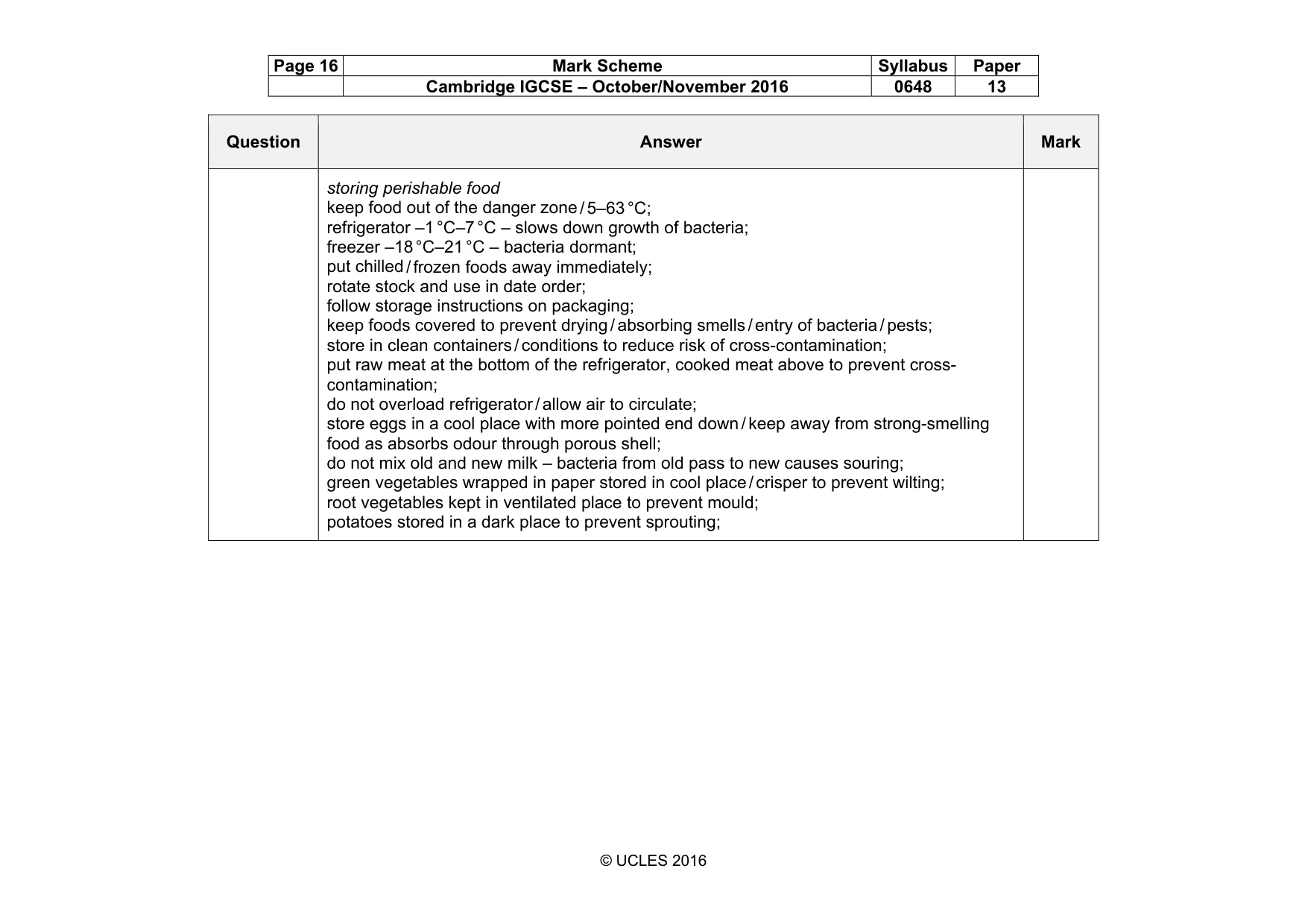
Page 16 Mark Scheme Syllabus Paper Cambridge IGCSE – October/November 2016 0648 13 © UCLES 2016 Question Answer Mark storing perishable food keep food out of the danger zone / 5–63 °C; refrigerator –1 °C–7 °C – slows down growth of bacteria; freezer –18 °C–21 °C – bacteria dormant; put chilled / frozen foods away immediately; rotate stock and use in date order; follow storage instructions on packaging; keep foods covered to prevent drying / absorbing smells / entry of bacteria / pests; store in clean containers / conditions to reduce risk of cross-contamination; put raw meat at the bottom of the refrigerator, cooked meat above to prevent cross- contamination; do not overload refrigerator / allow air to circulate; store eggs in a cool place with more pointed end down / keep away from strong-smelling food as absorbs odour through porous shell; do not mix old and new milk – bacteria from old pass to new causes souring; green vegetables wrapped in paper stored in cool place / crisper to prevent wilting; root vegetables kept in ventilated place to prevent mould; potatoes stored in a dark place to prevent sprouting;
What you needed in this session
Cambridge’s own grade thresholds for 2016 Oct/Nov, Paper 1 · Variant 3. A higher threshold means an easier paper — the bar moves with how the cohort did.