Cambridge IGCSE Food and Nutrition 0648 — 2016 Oct/Nov Paper 1 · Variant 1
0648/11/O/N/16 · 100 marks · ≈113 min
The question paper and its mark scheme, free to read here and free to download. This is Cambridge’s own paper, exactly as it was sat.
Question paper12 pages
Mark scheme15 pages
Answers below. Sit the paper first if you are practising.
Paper as text
Question paper, page 1
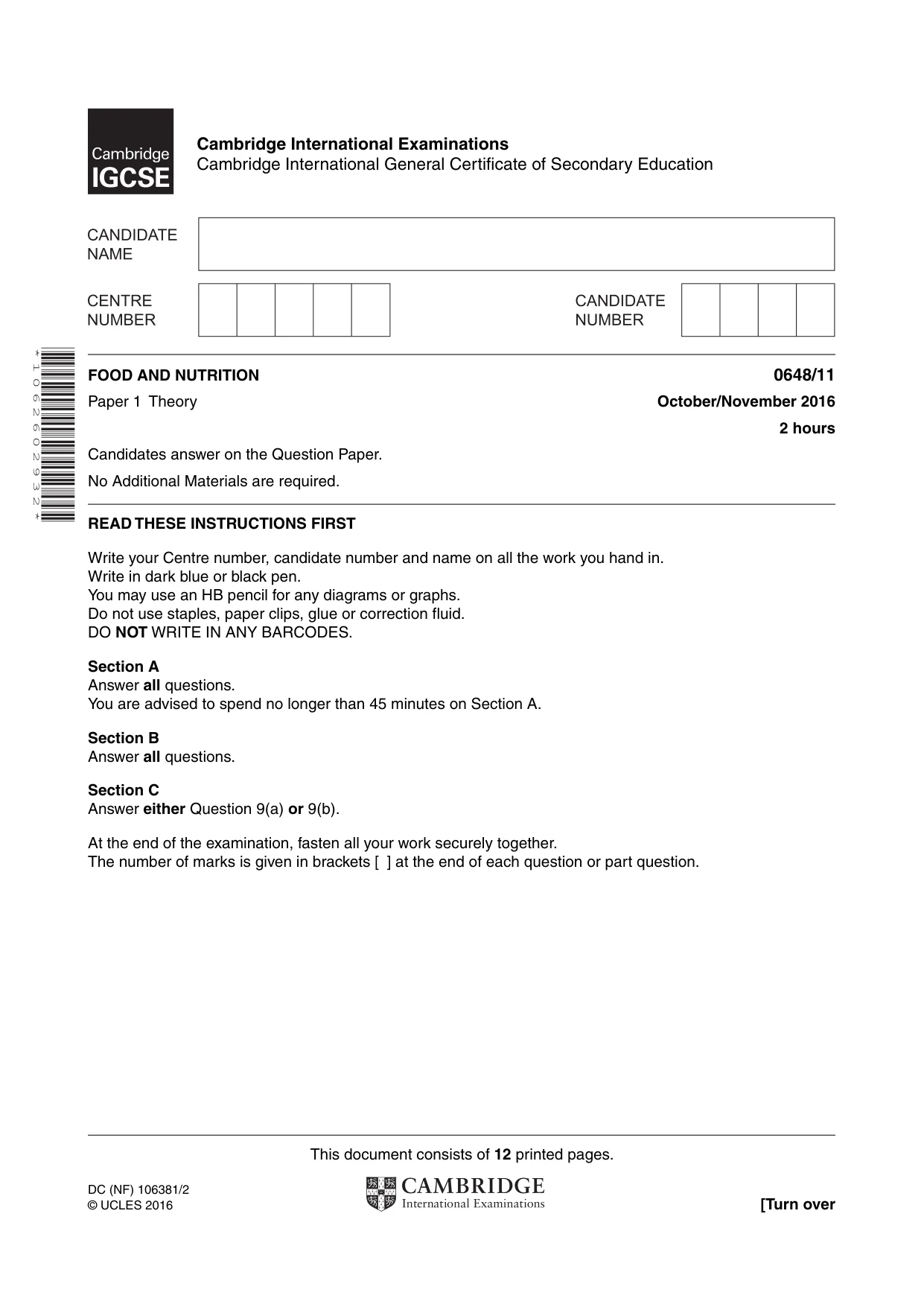
This document consists of 12 printed pages. DC (NF) 106381/2 © UCLES 2016 [Turn over Cambridge International Examinations Cambridge International General Certificate of Secondary Education * 1 0 6 2 6 0 2 9 3 2 * FOOD AND NUTRITION 0648/11 Paper 1 Theory October/November 2016 2 hours Candidates answer on the Question Paper. No Additional Materials are required. READ THESE INSTRUCTIONS FIRST Write your Centre number, candidate number and name on all the work you hand in. Write in dark blue or black pen. You may use an HB pencil for any diagrams or graphs. Do not use staples, paper clips, glue or correction fluid. DO NOT WRITE IN ANY BARCODES. Section A Answer all questions. You are advised to spend no longer than 45 minutes on Section A. Section B Answer all questions. Section C Answer either Question 9(a) or 9(b). At the end of the examination, fasten all your work securely together. The number of marks is given in brackets [ ] at the end of each question or part question.
Question paper, page 2
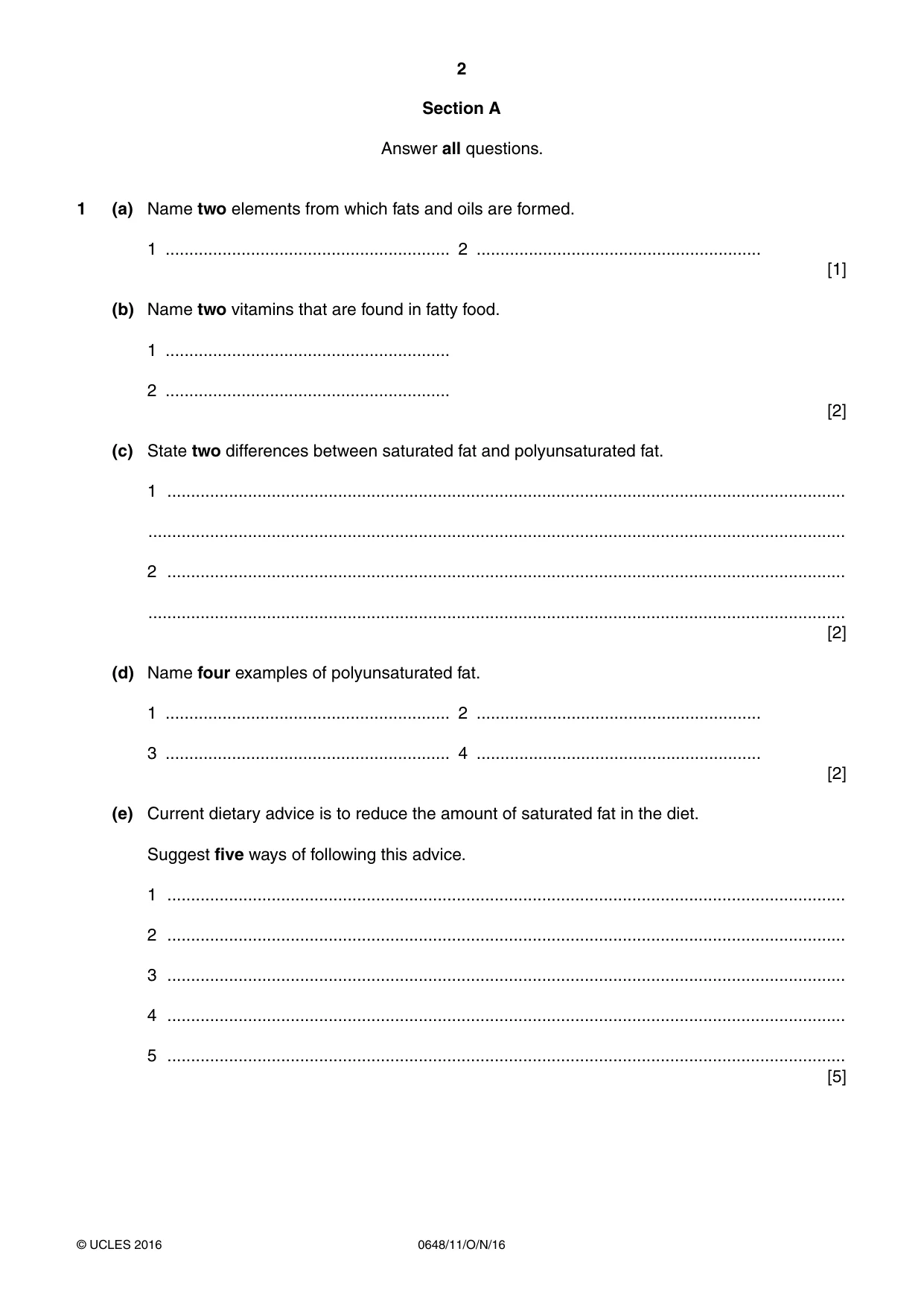
2 0648/11/O/N/16 © UCLES 2016 Section A Answer all questions. 1 (a) Name two elements from which fats and oils are formed. 1 … 2 … [1] (b) Name two vitamins that are found in fatty food. 1 … 2 … [2] (c) State two differences between saturated fat and polyunsaturated fat. 1 … … 2 … … [2] (d) Name four examples of polyunsaturated fat. 1 … 2 … 3 … 4 … [2] (e) Current dietary advice is to reduce the amount of saturated fat in the diet. Suggest five ways of following this advice. 1 … 2 … 3 … 4 … 5 … [5]
Question paper, page 3
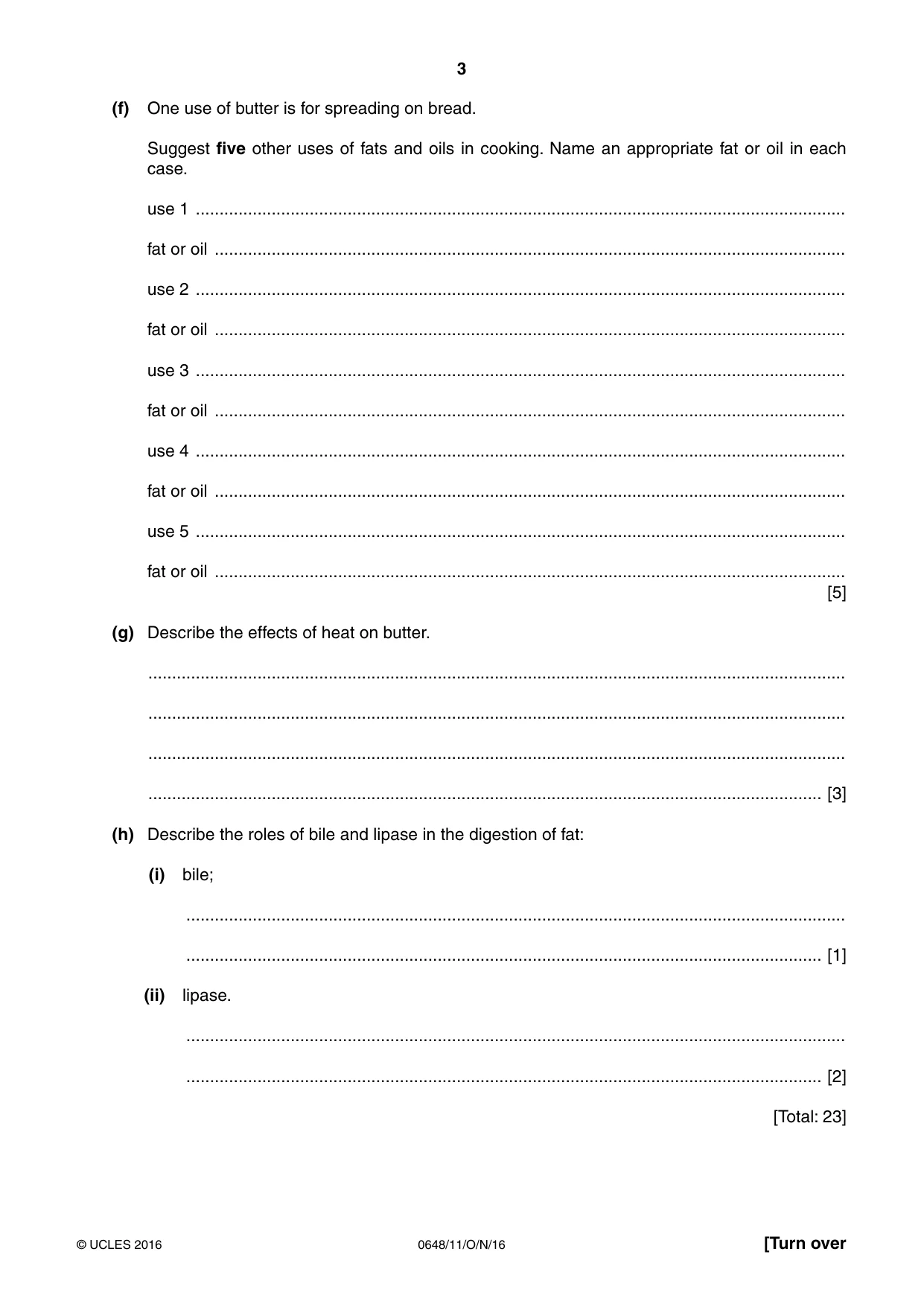
3 0648/11/O/N/16 © UCLES 2016 [Turn over (f) One use of butter is for spreading on bread. Suggest five other uses of fats and oils in cooking. Name an appropriate fat or oil in each case. use 1 … fat or oil … use 2 … fat or oil … use 3 … fat or oil … use 4 … fat or oil … use 5 … fat or oil … [5] (g) Describe the effects of heat on butter. … … … … [3] (h) Describe the roles of bile and lipase in the digestion of fat: (i) bile; … … [1] (ii) lipase. … … [2] [Total: 23]
Question paper, page 4
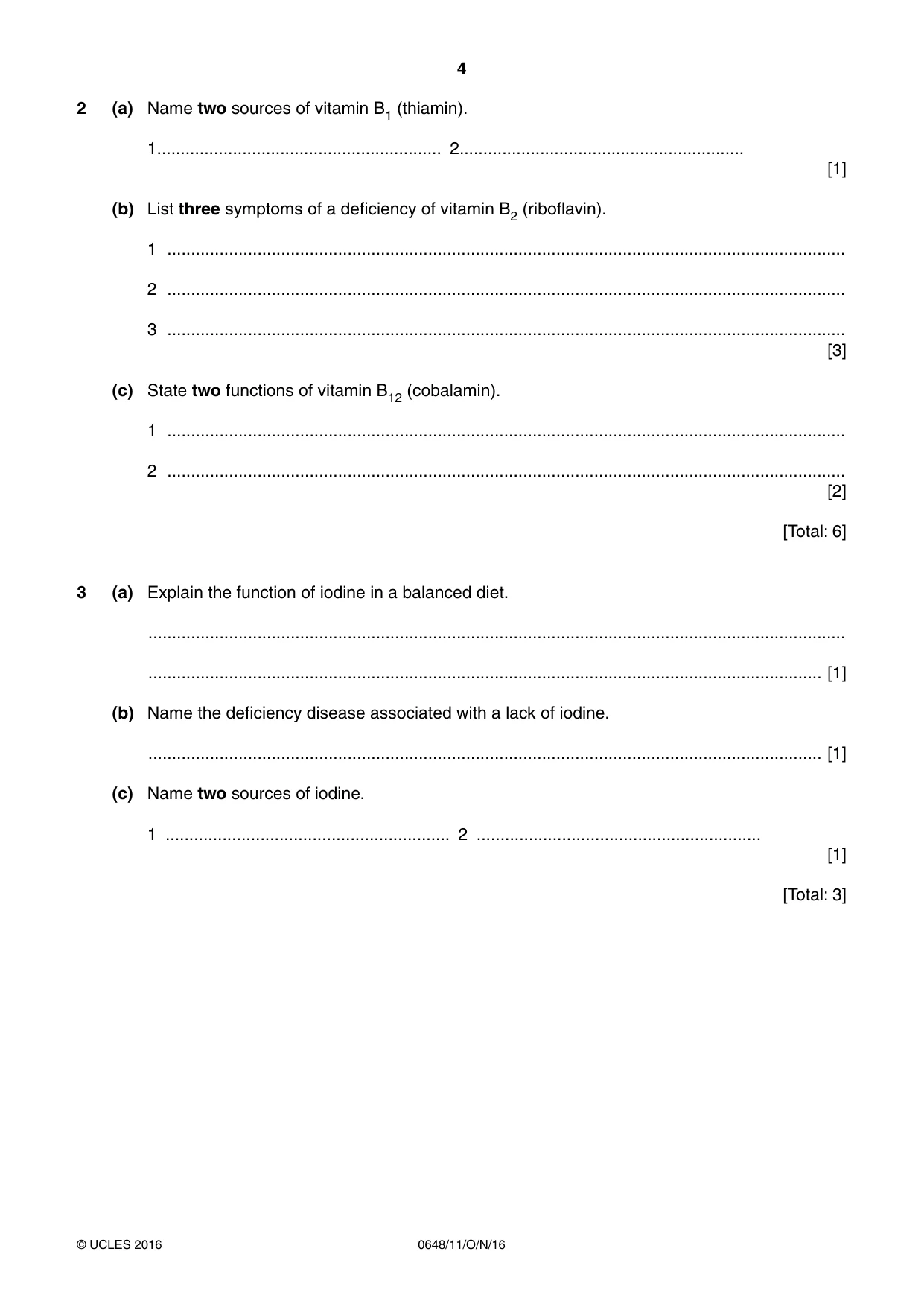
4 0648/11/O/N/16 © UCLES 2016 2 (a) Name two sources of vitamin B1 (thiamin). 1… 2… [1] (b) List three symptoms of a deficiency of vitamin B2 (riboflavin). 1 … 2 … 3 … [3] (c) State two functions of vitamin B12 (cobalamin). 1 … 2 … [2] [Total: 6] 3 (a) Explain the function of iodine in a balanced diet. … … [1] (b) Name the deficiency disease associated with a lack of iodine. … [1] (c) Name two sources of iodine. 1 … 2 … [1] [Total: 3]
Question paper, page 5
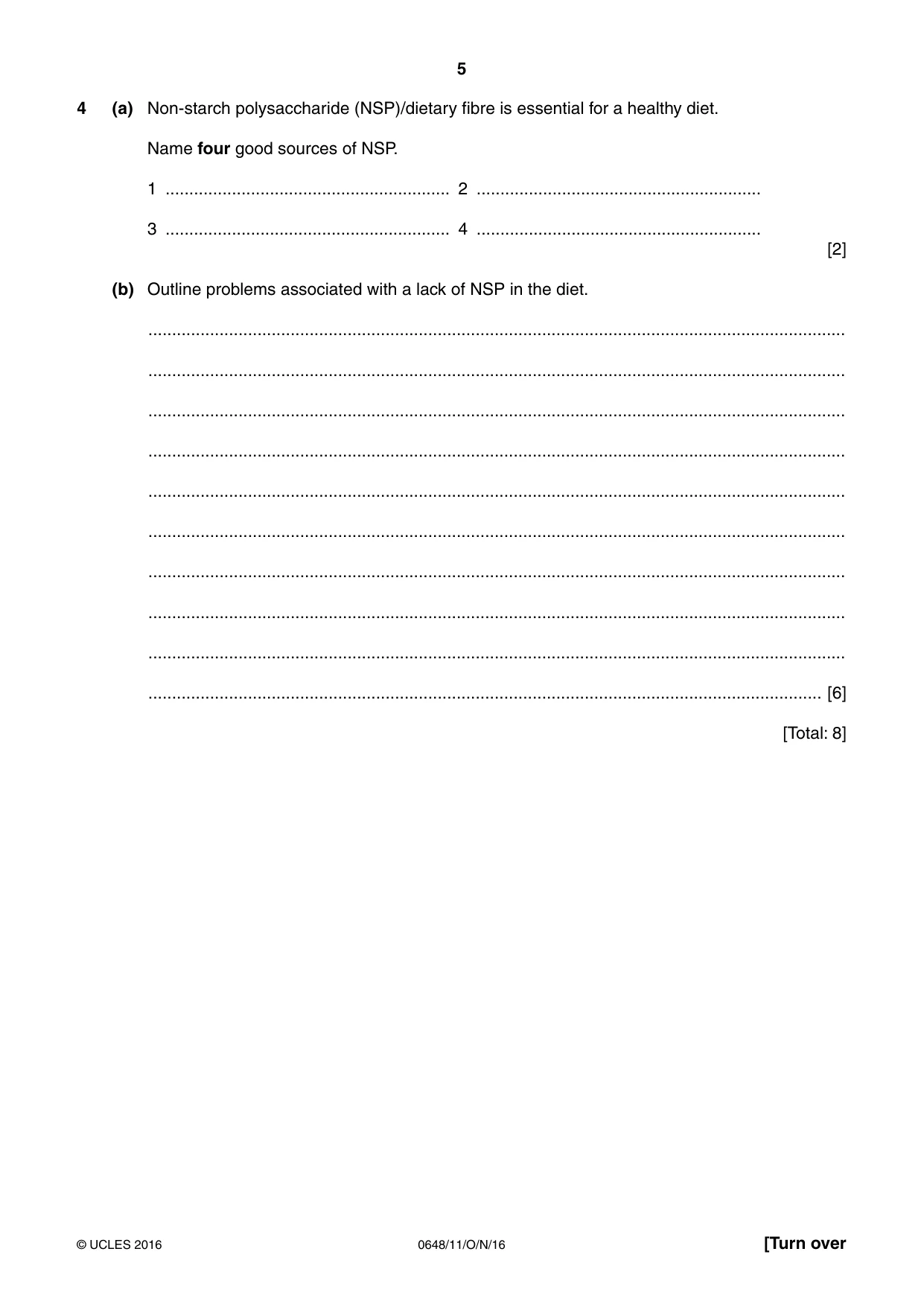
5 0648/11/O/N/16 © UCLES 2016 [Turn over 4 (a) Non-starch polysaccharide (NSP)/dietary fibre is essential for a healthy diet. Name four good sources of NSP. 1 … 2 … 3 … 4 … [2] (b) Outline problems associated with a lack of NSP in the diet. … … … … … … … … … … [6] [Total: 8]
Question paper, page 6
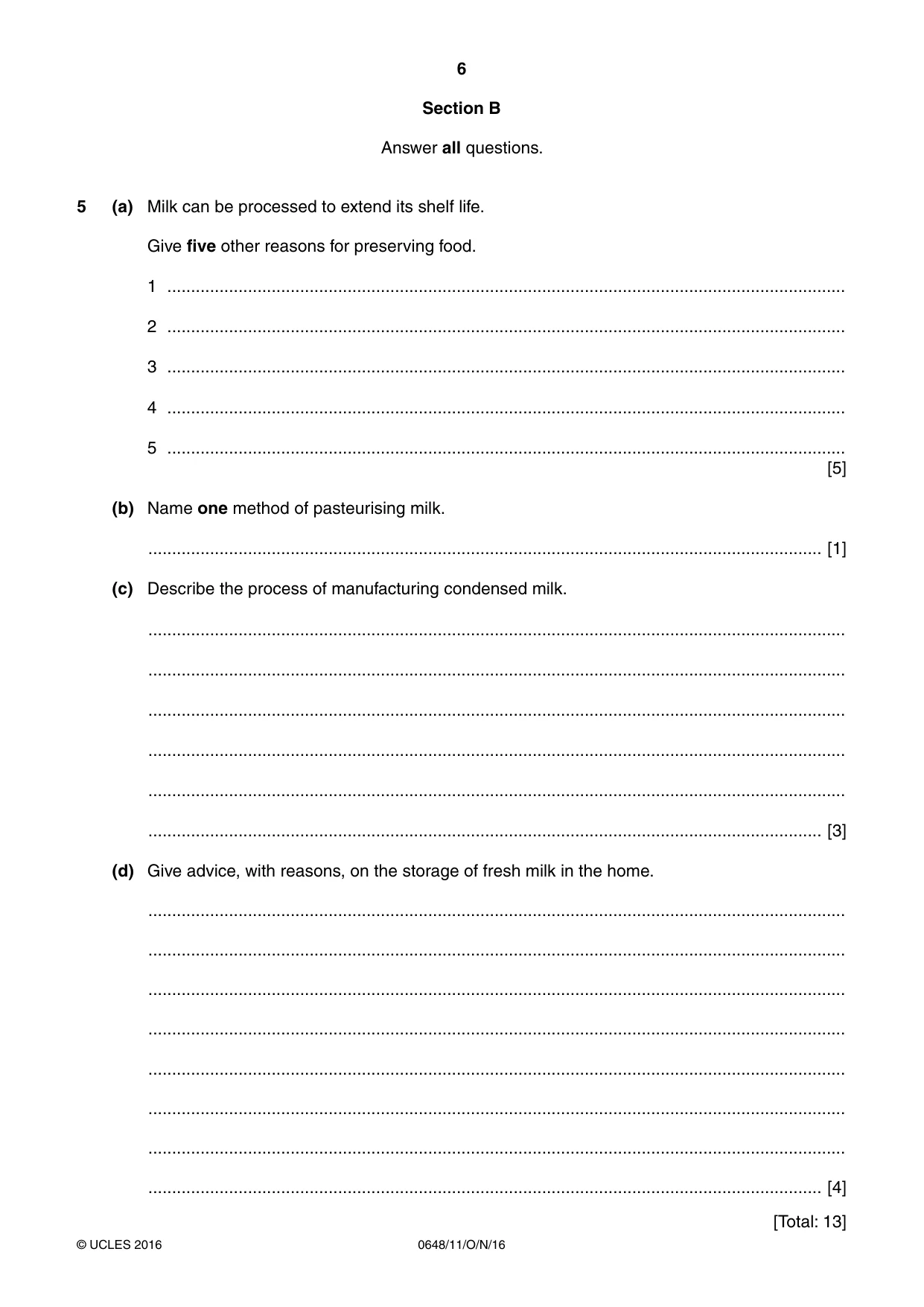
6 0648/11/O/N/16 © UCLES 2016 Section B Answer all questions. 5 (a) Milk can be processed to extend its shelf life. Give five other reasons for preserving food. 1 … 2 … 3 … 4 … 5 … [5] (b) Name one method of pasteurising milk. … [1] (c) Describe the process of manufacturing condensed milk. … … … … … … [3] (d) Give advice, with reasons, on the storage of fresh milk in the home. … … … … … … … … [4] [Total: 13]
Question paper, page 7
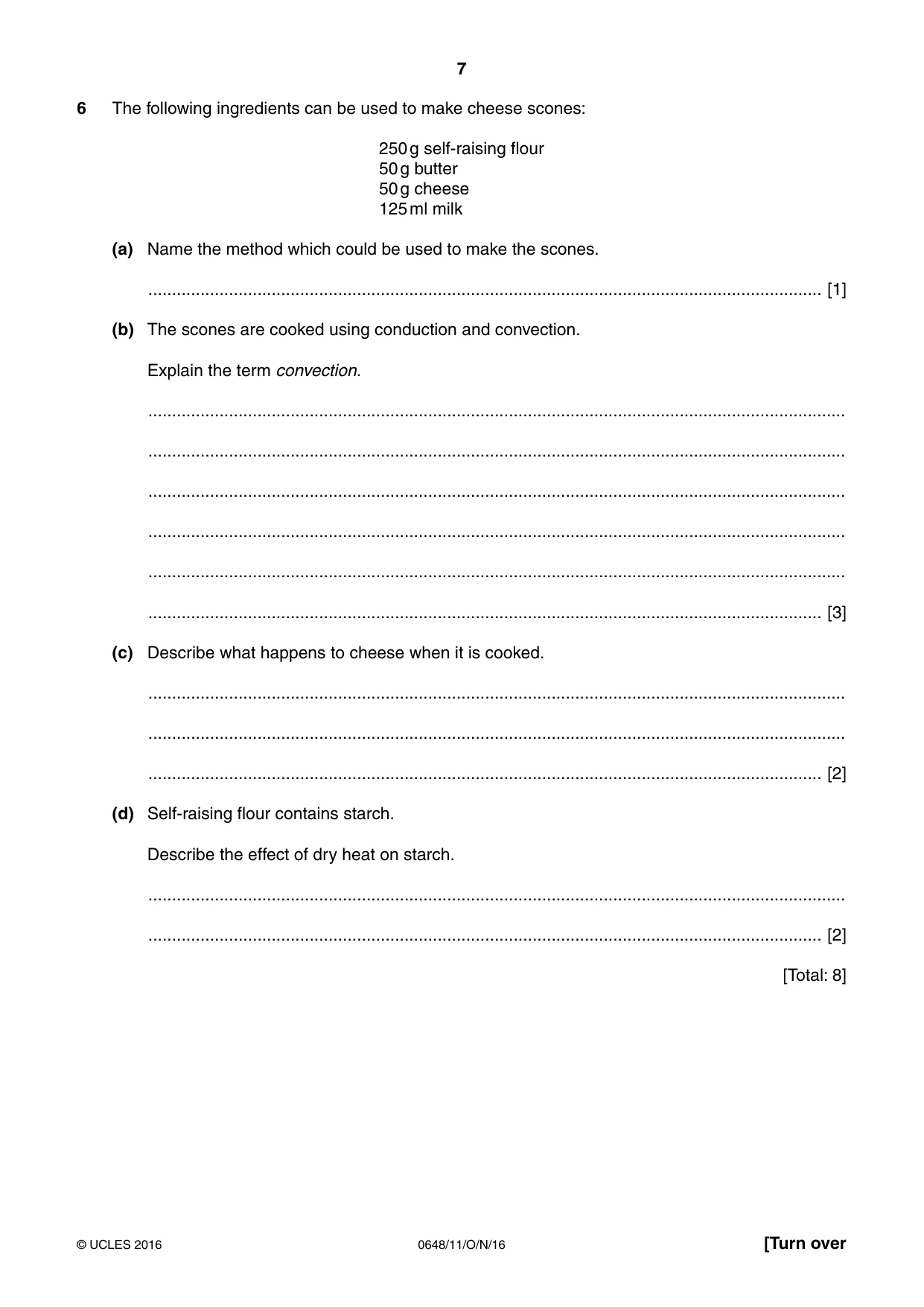
7 0648/11/O/N/16 © UCLES 2016 [Turn over 6 The following ingredients can be used to make cheese scones: 250 g self-raising flour 50 g butter 50 g cheese 125 ml milk (a) Name the method which could be used to make the scones. … [1] (b) The scones are cooked using conduction and convection. Explain the term convection. … … … … … … [3] (c) Describe what happens to cheese when it is cooked. … … … [2] (d) Self-raising flour contains starch. Describe the effect of dry heat on starch. … … [2] [Total: 8]
Question paper, page 8
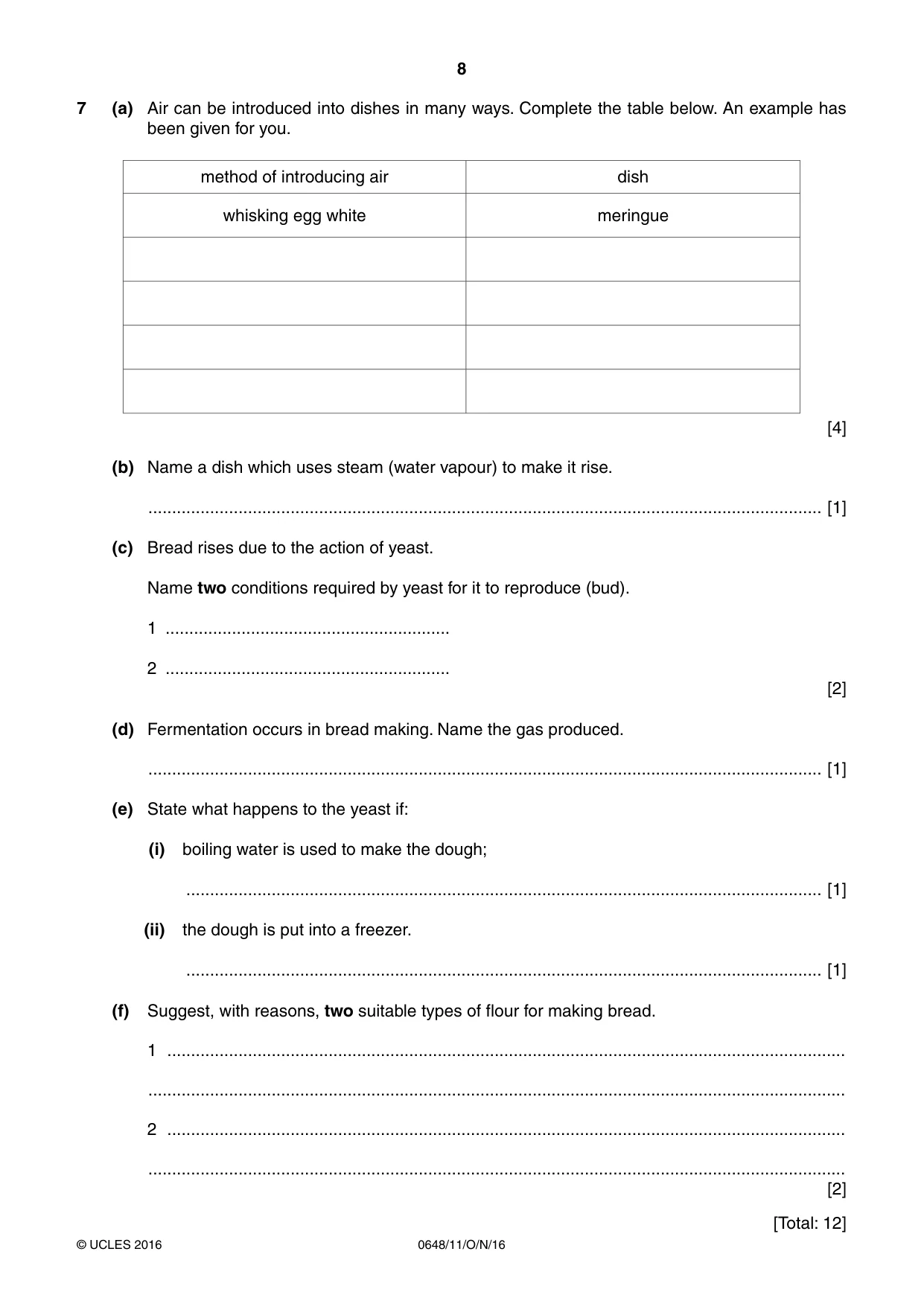
8 0648/11/O/N/16 © UCLES 2016 7 (a) Air can be introduced into dishes in many ways. Complete the table below. An example has been given for you. method of introducing air dish whisking egg white meringue [4] (b) Name a dish which uses steam (water vapour) to make it rise. … [1] (c) Bread rises due to the action of yeast. Name two conditions required by yeast for it to reproduce (bud). 1 … 2 … [2] (d) Fermentation occurs in bread making. Name the gas produced. … [1] (e) State what happens to the yeast if: (i) boiling water is used to make the dough; … [1] (ii) the dough is put into a freezer. … [1] (f) Suggest, with reasons, two suitable types of flour for making bread. 1 … … 2 … … [2] [Total: 12]
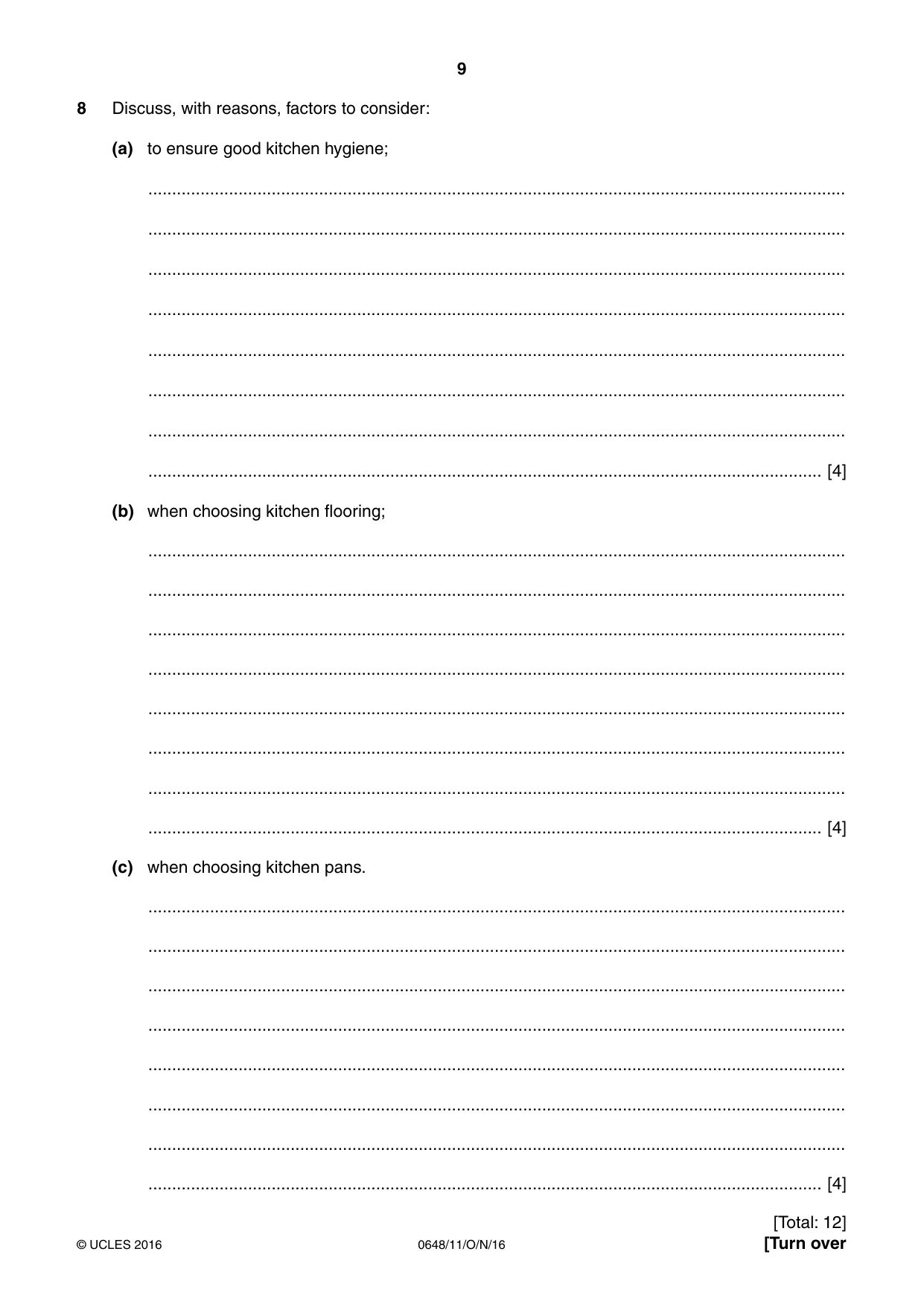
Question paper, page 9
9 0648/11/O/N/16 © UCLES 2016 [Turn over 8 Discuss, with reasons, factors to consider: (a) to ensure good kitchen hygiene; … … … … … … … … [4] (b) when choosing kitchen flooring; … … … … … … … … [4] (c) when choosing kitchen pans. … … … … … … … … [4] [Total: 12]
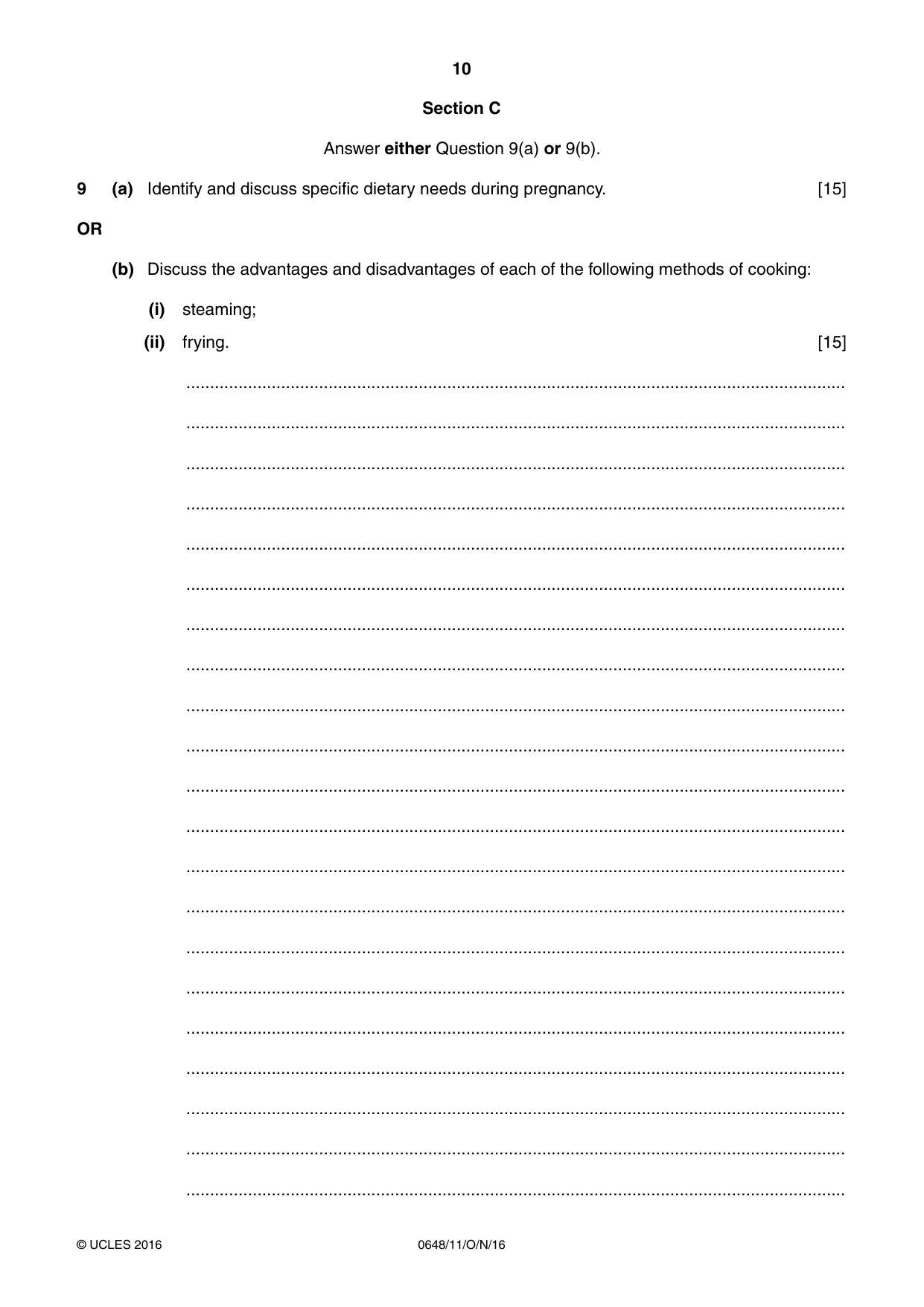
Question paper, page 10
10 0648/11/O/N/16 © UCLES 2016 Section C Answer either Question 9(a) or 9(b). 9 (a) Identify and discuss specific dietary needs during pregnancy. [15] OR (b) Discuss the advantages and disadvantages of each of the following methods of cooking: (i) steaming; (ii) frying. [15] … … … … … … … … … … … … … … … … … … … … …
Question paper, page 11
11 0648/11/O/N/16 © UCLES 2016 [Turn over … … … … … … … … … … … … … … … … … … … … … … … … … … … …
Question paper, page 12
12 0648/11/O/N/16 © UCLES 2016 Permission to reproduce items where third-party owned material protected by copyright is included has been sought and cleared where possible. Every reasonable effort has been made by the publisher (UCLES) to trace copyright holders, but if any items requiring clearance have unwittingly been included, the publisher will be pleased to make amends at the earliest possible opportunity. To avoid the issue of disclosure of answer-related information to candidates, all copyright acknowledgements are reproduced online in the Cambridge International Examinations Copyright Acknowledgements Booklet. This is produced for each series of examinations and is freely available to download at www.cie.org.uk after the live examination series. Cambridge International Examinations is part of the Cambridge Assessment Group. Cambridge Assessment is the brand name of University of Cambridge Local Examinations Syndicate (UCLES), which is itself a department of the University of Cambridge. … … … … … … … … … … … … … … … … … … … … … … … [Total:15]
Mark scheme, page 1
® IGCSE is the registered trademark of Cambridge International Examinations. This document consists of 15 printed pages. © UCLES 2016 [Turn over Cambridge International Examinations Cambridge International General Certificate of Secondary Education FOOD AND NUTRITION 0648/11 Paper 1 Theory October/November 2016 MARK SCHEME Maximum Mark: 100 Published This mark scheme is published as an aid to teachers and candidates, to indicate the requirements of the examination. It shows the basis on which Examiners were instructed to award marks. It does not indicate the details of the discussions that took place at an Examiners’ meeting before marking began, which would have considered the acceptability of alternative answers. Mark schemes should be read in conjunction with the question paper and the Principal Examiner Report for Teachers. Cambridge will not enter into discussions about these mark schemes. Cambridge is publishing the mark schemes for the October/November 2016 series for most Cambridge IGCSE®, Cambridge International A and AS Level components and some Cambridge O Level components.
Mark scheme, page 2
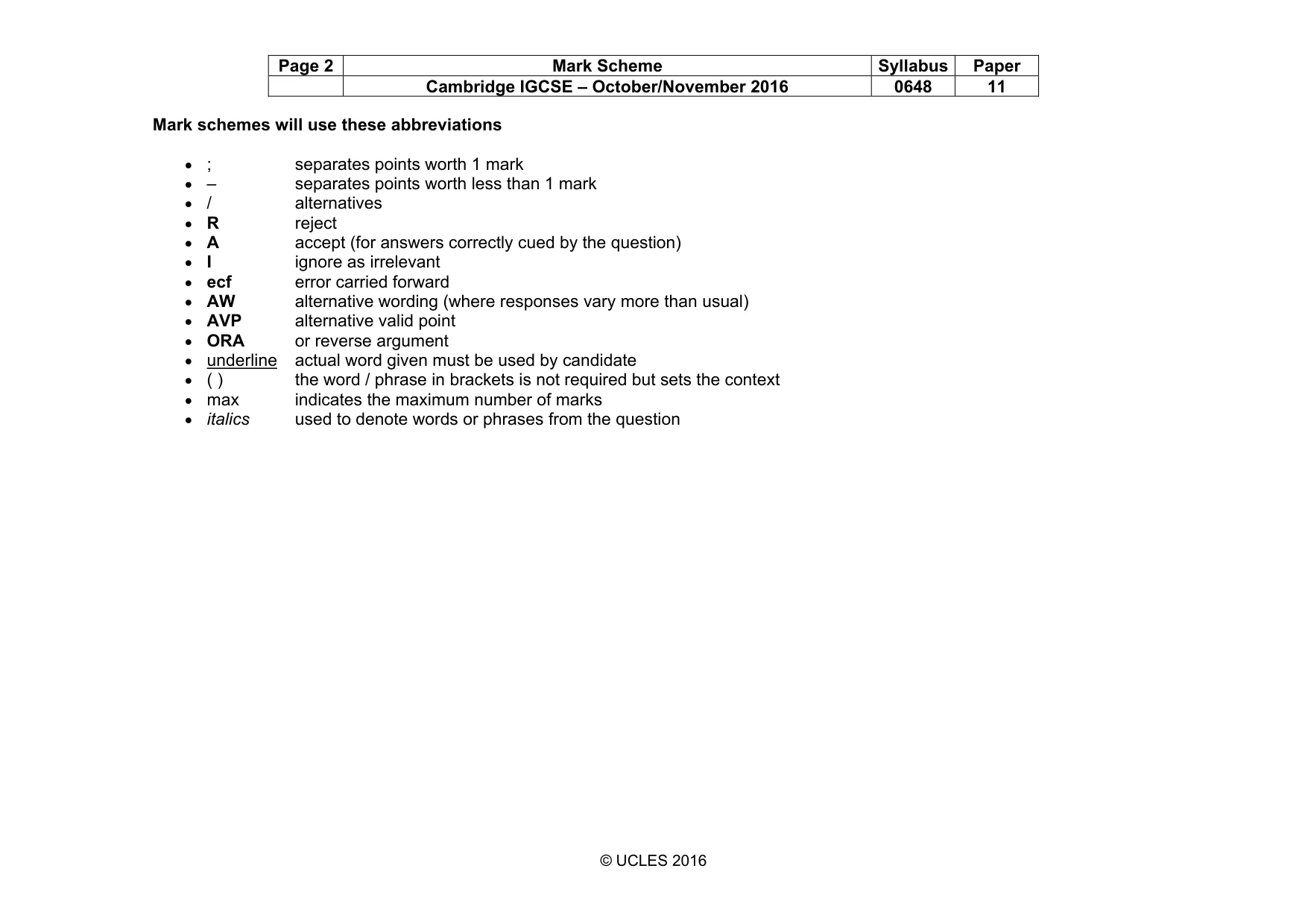
Page 2 Mark Scheme Syllabus Paper Cambridge IGCSE – October/November 2016 0648 11 © UCLES 2016 Mark schemes will use these abbreviations • ; separates points worth 1 mark • – separates points worth less than 1 mark • / alternatives • R reject • A accept (for answers correctly cued by the question) • I ignore as irrelevant • ecf error carried forward • AW alternative wording (where responses vary more than usual) • AVP alternative valid point • ORA or reverse argument • underline actual word given must be used by candidate • ( ) the word / phrase in brackets is not required but sets the context • max indicates the maximum number of marks • italics used to denote words or phrases from the question
Mark scheme, page 3
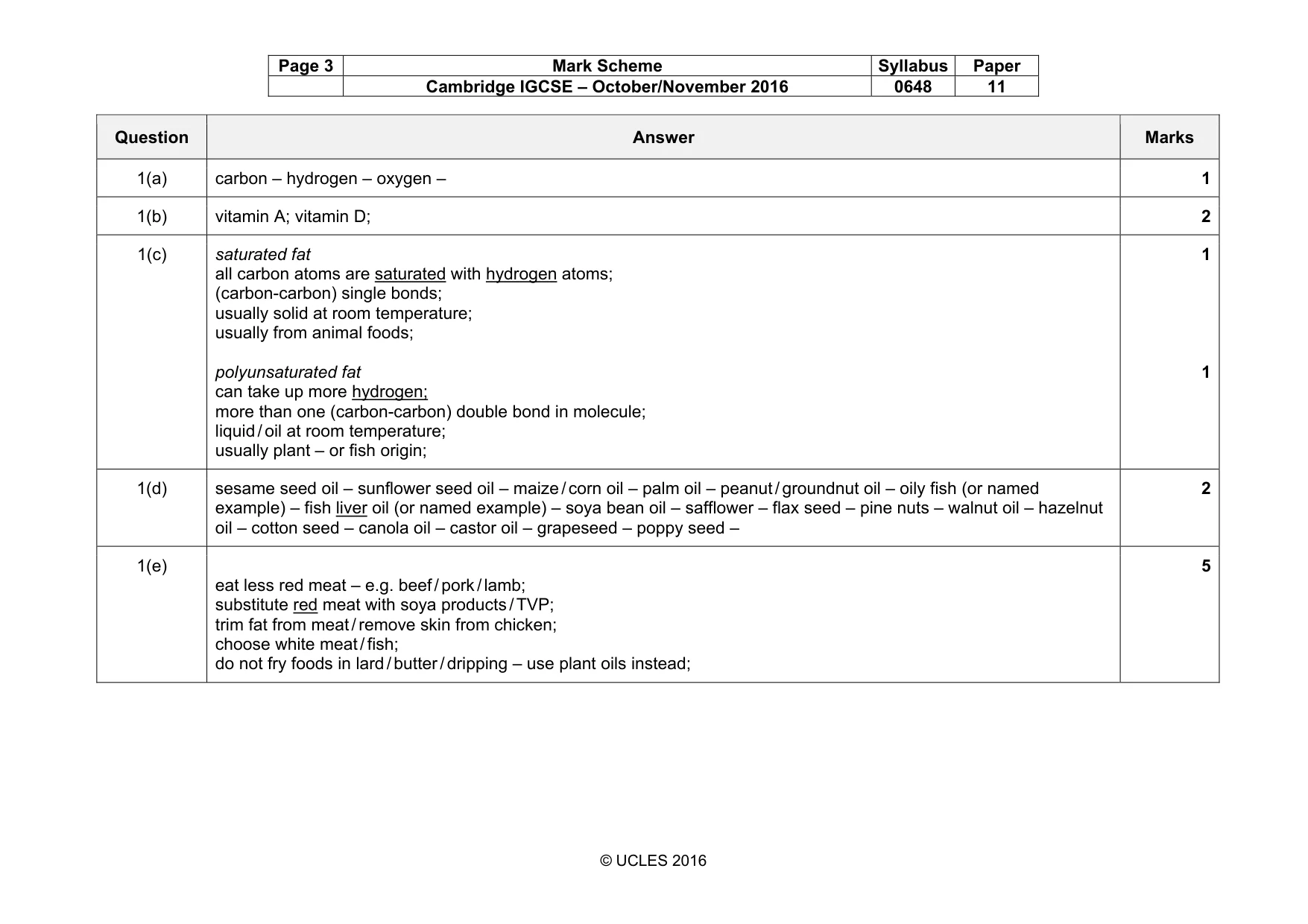
Page 3 Mark Scheme Syllabus Paper Cambridge IGCSE – October/November 2016 0648 11 © UCLES 2016 Question Answer Marks 1(a) carbon – hydrogen – oxygen – 1 1(b) vitamin A; vitamin D; 2 1(c) saturated fat all carbon atoms are saturated with hydrogen atoms; (carbon-carbon) single bonds; usually solid at room temperature; usually from animal foods; polyunsaturated fat can take up more hydrogen; more than one (carbon-carbon) double bond in molecule; liquid / oil at room temperature; usually plant – or fish origin; 1 1 1(d) sesame seed oil – sunflower seed oil – maize / corn oil – palm oil – peanut / groundnut oil – oily fish (or named example) – fish liver oil (or named example) – soya bean oil – safflower – flax seed – pine nuts – walnut oil – hazelnut oil – cotton seed – canola oil – castor oil – grapeseed – poppy seed – 2 1(e) eat less red meat – e.g. beef / pork / lamb; substitute red meat with soya products / TVP; trim fat from meat / remove skin from chicken; choose white meat / fish; do not fry foods in lard / butter / dripping – use plant oils instead; 5
Mark scheme, page 4
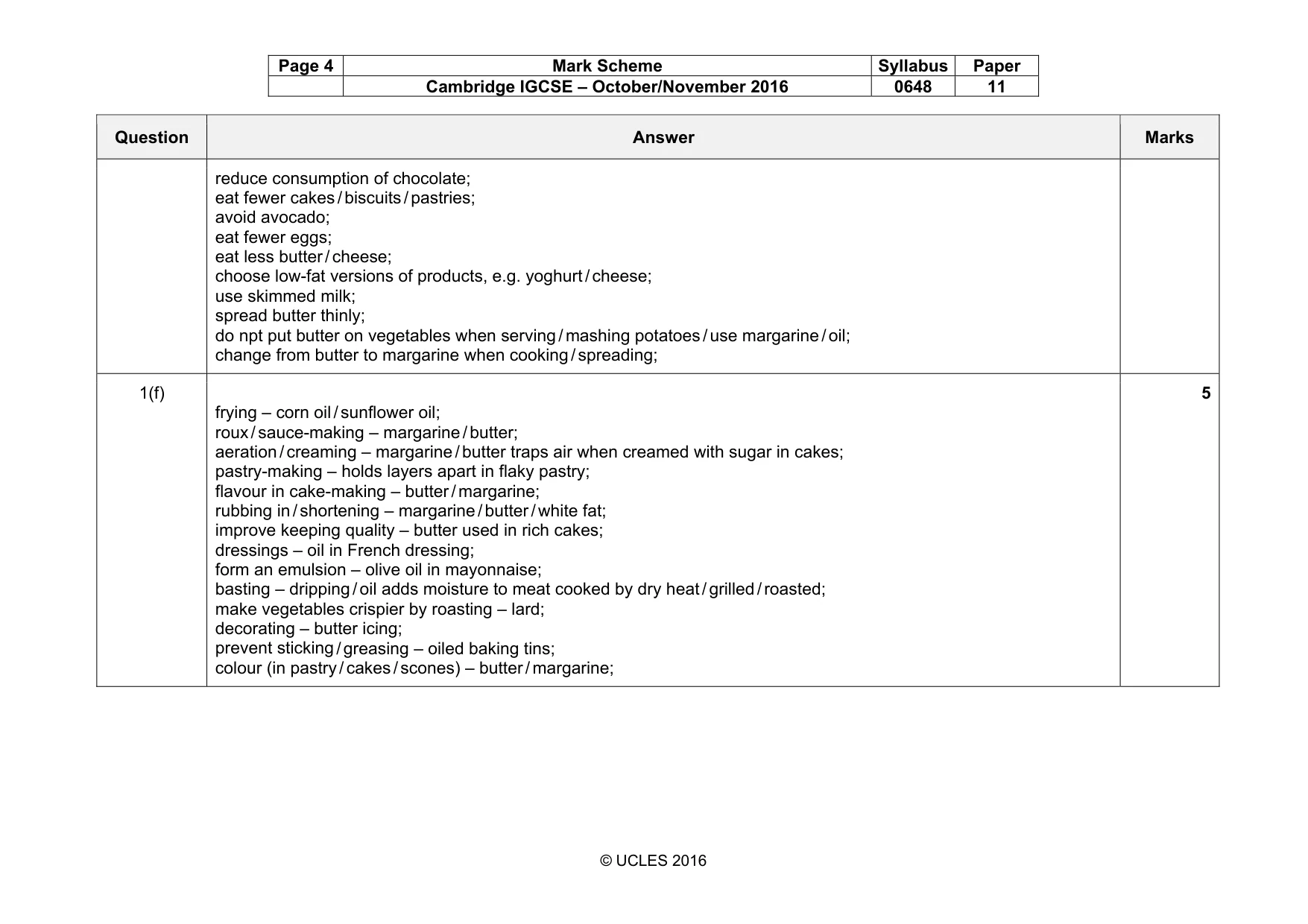
Page 4 Mark Scheme Syllabus Paper Cambridge IGCSE – October/November 2016 0648 11 © UCLES 2016 Question Answer Marks reduce consumption of chocolate; eat fewer cakes / biscuits / pastries; avoid avocado; eat fewer eggs; eat less butter / cheese; choose low-fat versions of products, e.g. yoghurt / cheese; use skimmed milk; spread butter thinly; do npt put butter on vegetables when serving / mashing potatoes / use margarine / oil; change from butter to margarine when cooking / spreading; 1(f) frying – corn oil / sunflower oil; roux / sauce-making – margarine / butter; aeration / creaming – margarine / butter traps air when creamed with sugar in cakes; pastry-making – holds layers apart in flaky pastry; flavour in cake-making – butter / margarine; rubbing in / shortening – margarine / butter / white fat; improve keeping quality – butter used in rich cakes; dressings – oil in French dressing; form an emulsion – olive oil in mayonnaise; basting – dripping / oil adds moisture to meat cooked by dry heat / grilled / roasted; make vegetables crispier by roasting – lard; decorating – butter icing; prevent sticking / greasing – oiled baking tins; colour (in pastry / cakes / scones) – butter / margarine; 5
Mark scheme, page 5
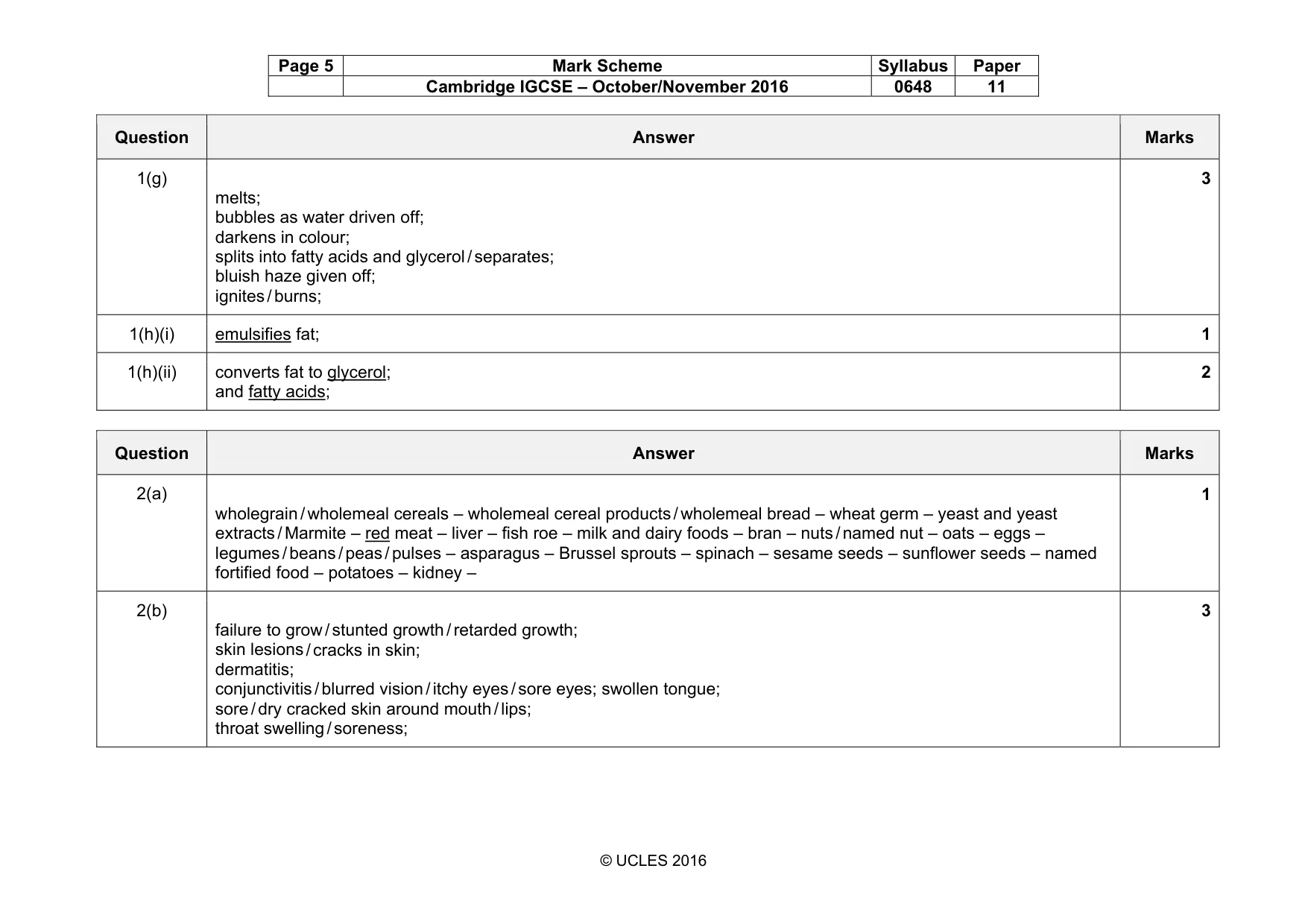
Page 5 Mark Scheme Syllabus Paper Cambridge IGCSE – October/November 2016 0648 11 © UCLES 2016 Question Answer Marks 1(g) melts; bubbles as water driven off; darkens in colour; splits into fatty acids and glycerol / separates; bluish haze given off; ignites / burns; 3 1(h)(i) emulsifies fat; 1 1(h)(ii) converts fat to glycerol; and fatty acids; 2 Question Answer Marks 2(a) wholegrain / wholemeal cereals – wholemeal cereal products / wholemeal bread – wheat germ – yeast and yeast extracts / Marmite – red meat – liver – fish roe – milk and dairy foods – bran – nuts / named nut – oats – eggs – legumes / beans / peas / pulses – asparagus – Brussel sprouts – spinach – sesame seeds – sunflower seeds – named fortified food – potatoes – kidney – 1 2(b) failure to grow / stunted growth / retarded growth; skin lesions / cracks in skin; dermatitis; conjunctivitis / blurred vision / itchy eyes / sore eyes; swollen tongue; sore / dry cracked skin around mouth / lips; throat swelling / soreness; 3
Mark scheme, page 6
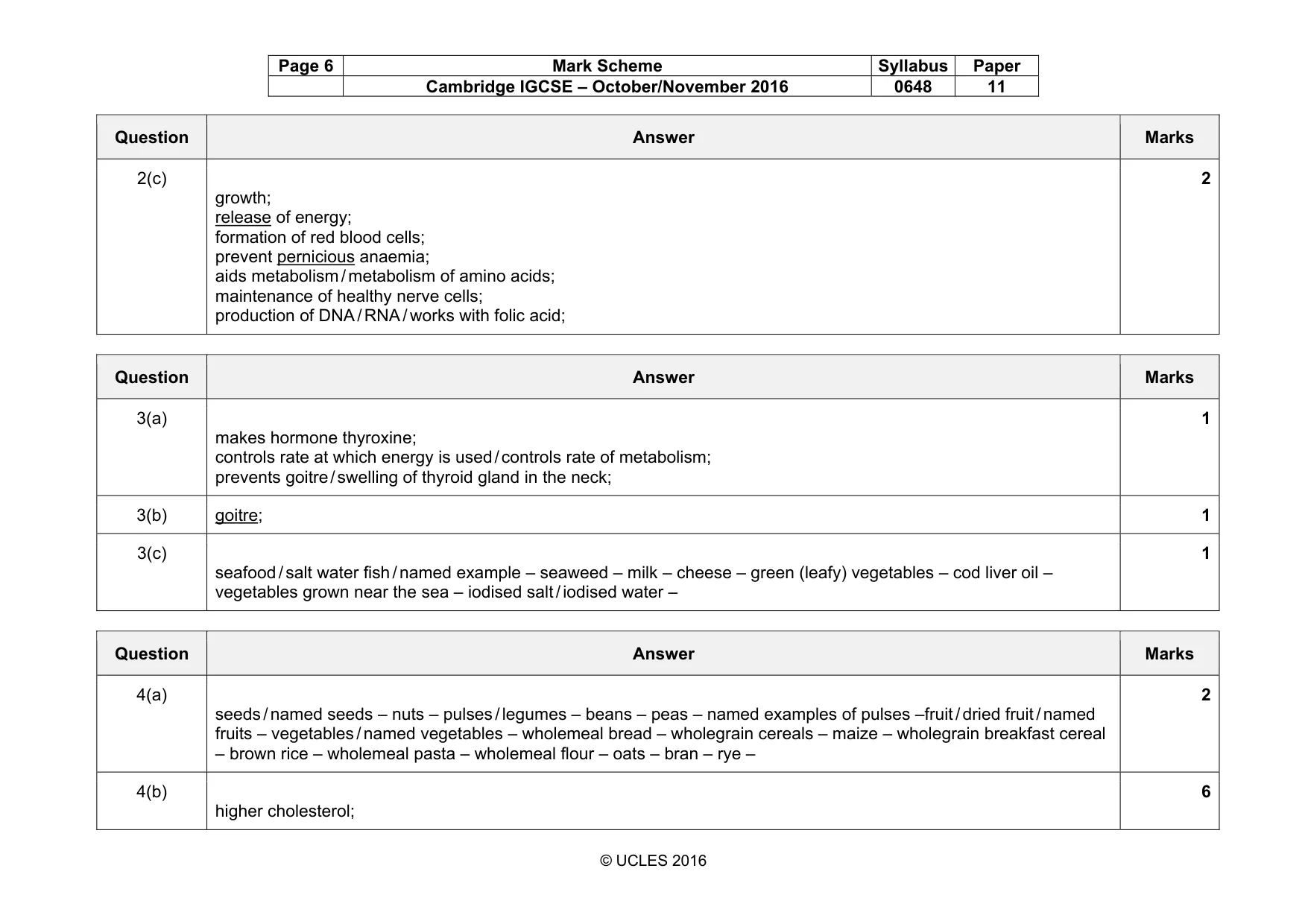
Page 6 Mark Scheme Syllabus Paper Cambridge IGCSE – October/November 2016 0648 11 © UCLES 2016 Question Answer Marks 2(c) growth; release of energy; formation of red blood cells; prevent pernicious anaemia; aids metabolism / metabolism of amino acids; maintenance of healthy nerve cells; production of DNA / RNA / works with folic acid; 2 Question Answer Marks 3(a) makes hormone thyroxine; controls rate at which energy is used / controls rate of metabolism; prevents goitre / swelling of thyroid gland in the neck; 1 3(b) goitre; 1 3(c) seafood / salt water fish / named example – seaweed – milk – cheese – green (leafy) vegetables – cod liver oil – vegetables grown near the sea – iodised salt / iodised water – 1 Question Answer Marks 4(a) seeds / named seeds – nuts – pulses / legumes – beans – peas – named examples of pulses –fruit / dried fruit / named fruits – vegetables / named vegetables – wholemeal bread – wholegrain cereals – maize – wholegrain breakfast cereal – brown rice – wholemeal pasta – wholemeal flour – oats – bran – rye – 2 4(b) higher cholesterol; 6
Mark scheme, page 7
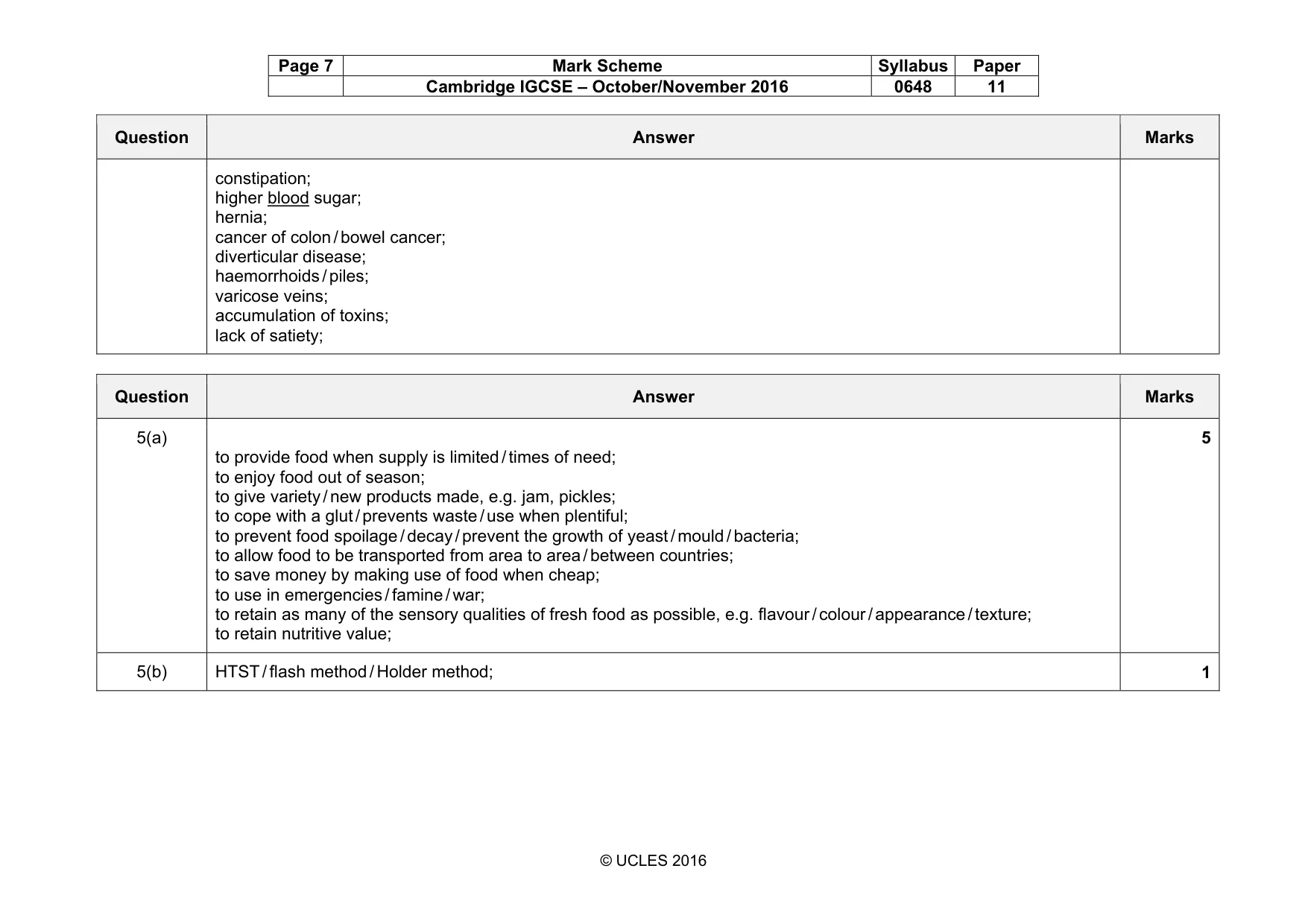
Page 7 Mark Scheme Syllabus Paper Cambridge IGCSE – October/November 2016 0648 11 © UCLES 2016 Question Answer Marks constipation; higher blood sugar; hernia; cancer of colon / bowel cancer; diverticular disease; haemorrhoids / piles; varicose veins; accumulation of toxins; lack of satiety; Question Answer Marks 5(a) to provide food when supply is limited / times of need; to enjoy food out of season; to give variety / new products made, e.g. jam, pickles; to cope with a glut / prevents waste / use when plentiful; to prevent food spoilage / decay / prevent the growth of yeast / mould / bacteria; to allow food to be transported from area to area / between countries; to save money by making use of food when cheap; to use in emergencies / famine / war; to retain as many of the sensory qualities of fresh food as possible, e.g. flavour / colour / appearance / texture; to retain nutritive value; 5 5(b) HTST / flash method / Holder method; 1
Mark scheme, page 8
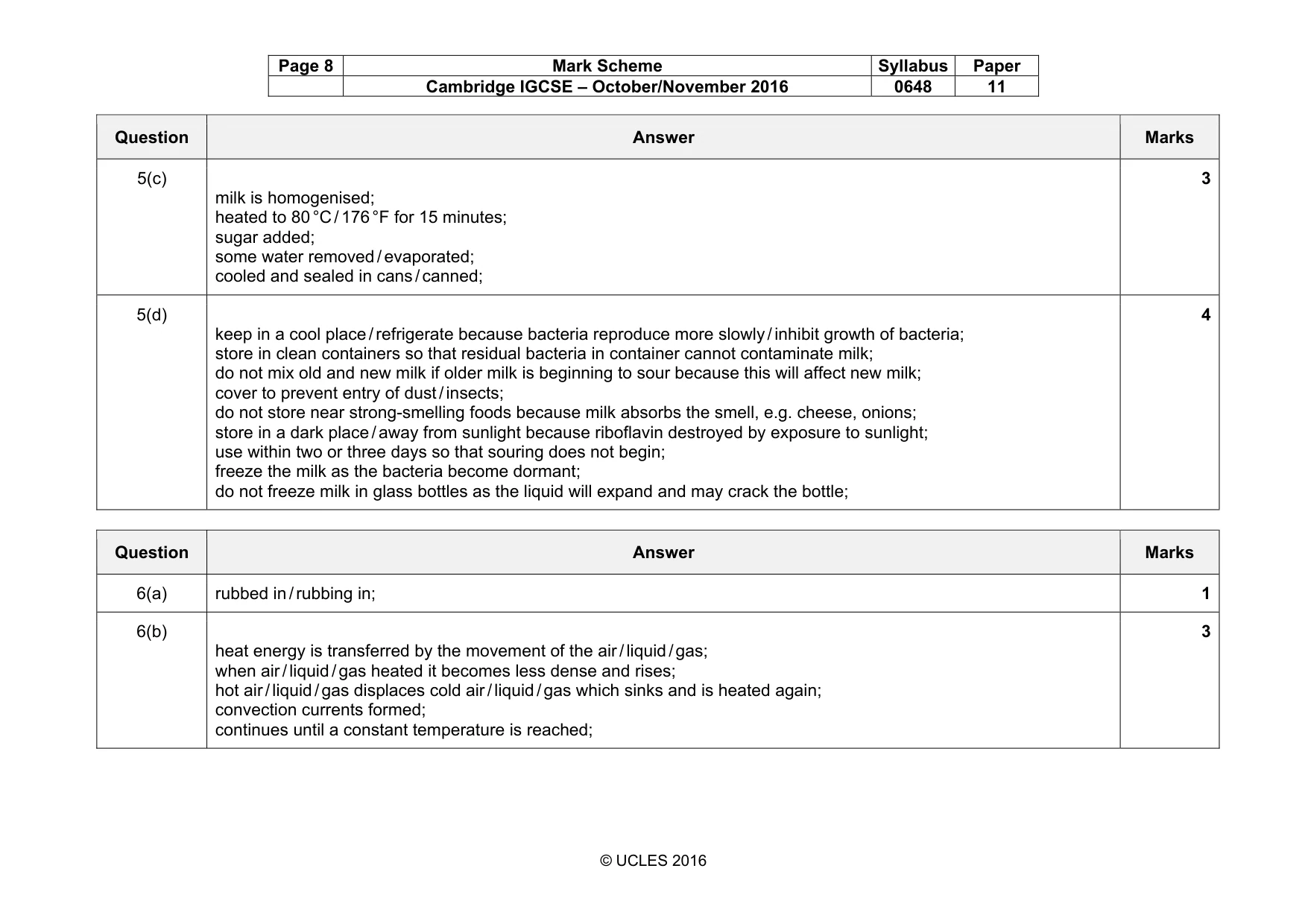
Page 8 Mark Scheme Syllabus Paper Cambridge IGCSE – October/November 2016 0648 11 © UCLES 2016 Question Answer Marks 5(c) milk is homogenised; heated to 80 °C / 176 °F for 15 minutes; sugar added; some water removed / evaporated; cooled and sealed in cans / canned; 3 5(d) keep in a cool place / refrigerate because bacteria reproduce more slowly / inhibit growth of bacteria; store in clean containers so that residual bacteria in container cannot contaminate milk; do not mix old and new milk if older milk is beginning to sour because this will affect new milk; cover to prevent entry of dust / insects; do not store near strong-smelling foods because milk absorbs the smell, e.g. cheese, onions; store in a dark place / away from sunlight because riboflavin destroyed by exposure to sunlight; use within two or three days so that souring does not begin; freeze the milk as the bacteria become dormant; do not freeze milk in glass bottles as the liquid will expand and may crack the bottle; 4 Question Answer Marks 6(a) rubbed in / rubbing in; 1 6(b) heat energy is transferred by the movement of the air / liquid / gas; when air / liquid / gas heated it becomes less dense and rises; hot air / liquid / gas displaces cold air / liquid / gas which sinks and is heated again; convection currents formed; continues until a constant temperature is reached; 3
Mark scheme, page 9
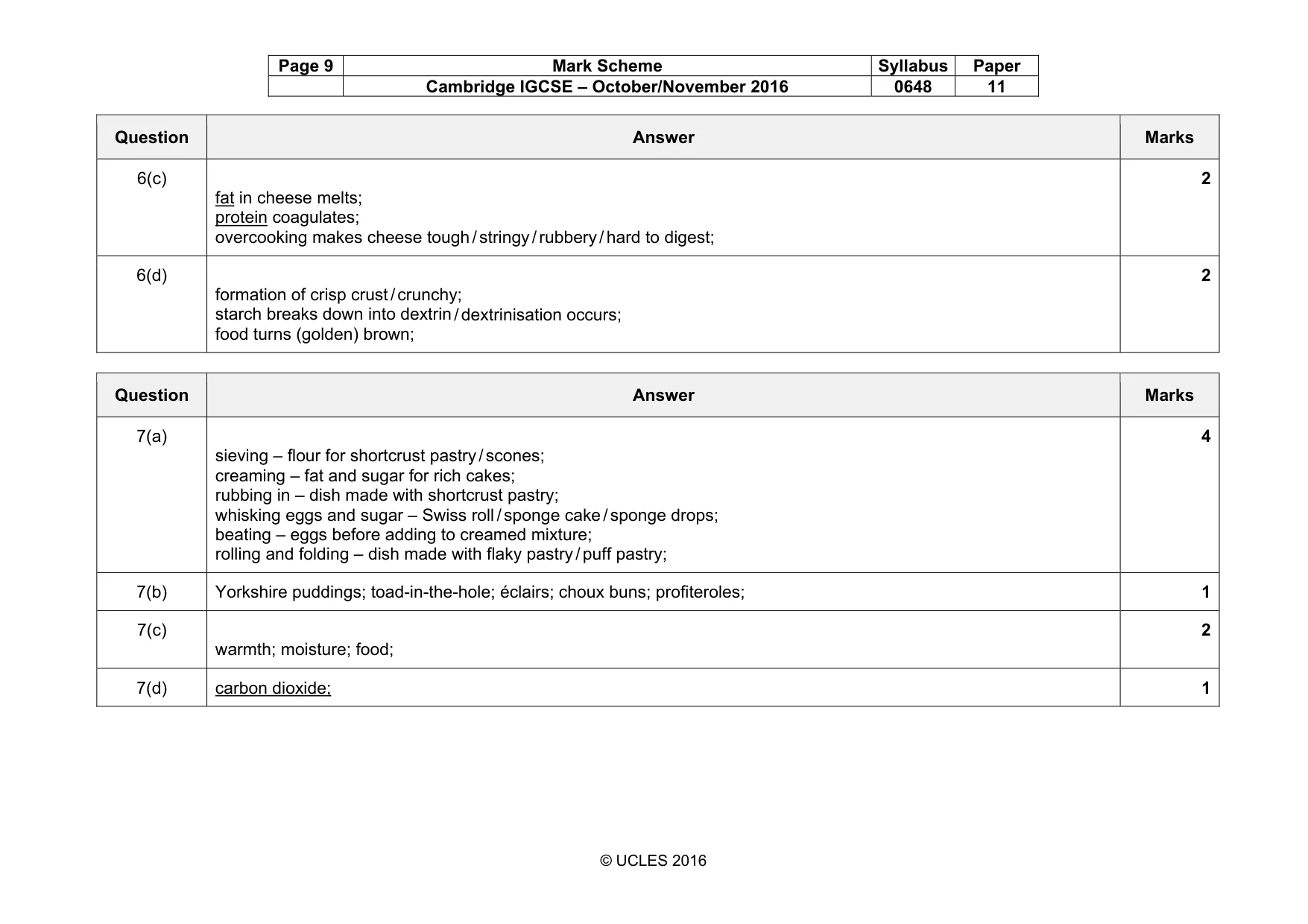
Page 9 Mark Scheme Syllabus Paper Cambridge IGCSE – October/November 2016 0648 11 © UCLES 2016 Question Answer Marks 6(c) fat in cheese melts; protein coagulates; overcooking makes cheese tough / stringy / rubbery / hard to digest; 2 6(d) formation of crisp crust / crunchy; starch breaks down into dextrin / dextrinisation occurs; food turns (golden) brown; 2 Question Answer Marks 7(a) sieving – flour for shortcrust pastry / scones; creaming – fat and sugar for rich cakes; rubbing in – dish made with shortcrust pastry; whisking eggs and sugar – Swiss roll / sponge cake / sponge drops; beating – eggs before adding to creamed mixture; rolling and folding – dish made with flaky pastry / puff pastry; 4 7(b) Yorkshire puddings; toad-in-the-hole; éclairs; choux buns; profiteroles; 1 7(c) warmth; moisture; food; 2 7(d) carbon dioxide; 1
Mark scheme, page 10
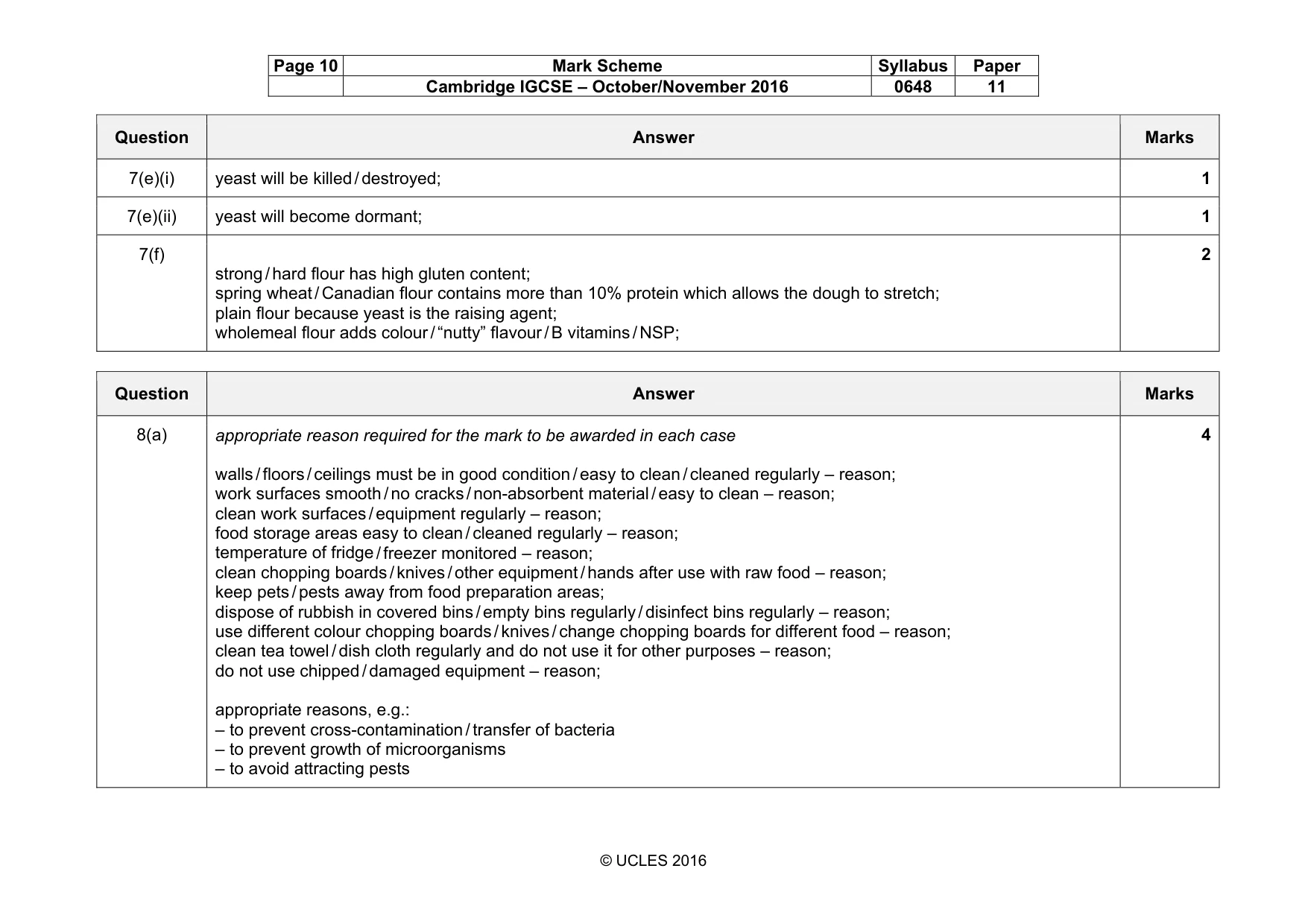
Page 10 Mark Scheme Syllabus Paper Cambridge IGCSE – October/November 2016 0648 11 © UCLES 2016 Question Answer Marks 7(e)(i) yeast will be killed / destroyed; 1 7(e)(ii) yeast will become dormant; 1 7(f) strong / hard flour has high gluten content; spring wheat / Canadian flour contains more than 10% protein which allows the dough to stretch; plain flour because yeast is the raising agent; wholemeal flour adds colour / “nutty” flavour / B vitamins / NSP; 2 Question Answer Marks 8(a) appropriate reason required for the mark to be awarded in each case walls / floors / ceilings must be in good condition / easy to clean / cleaned regularly – reason; work surfaces smooth / no cracks / non-absorbent material / easy to clean – reason; clean work surfaces / equipment regularly – reason; food storage areas easy to clean / cleaned regularly – reason; temperature of fridge / freezer monitored – reason; clean chopping boards / knives / other equipment / hands after use with raw food – reason; keep pets / pests away from food preparation areas; dispose of rubbish in covered bins / empty bins regularly / disinfect bins regularly – reason; use different colour chopping boards / knives / change chopping boards for different food – reason; clean tea towel / dish cloth regularly and do not use it for other purposes – reason; do not use chipped / damaged equipment – reason; appropriate reasons, e.g.: – to prevent cross-contamination / transfer of bacteria – to prevent growth of microorganisms – to avoid attracting pests 4
Mark scheme, page 11
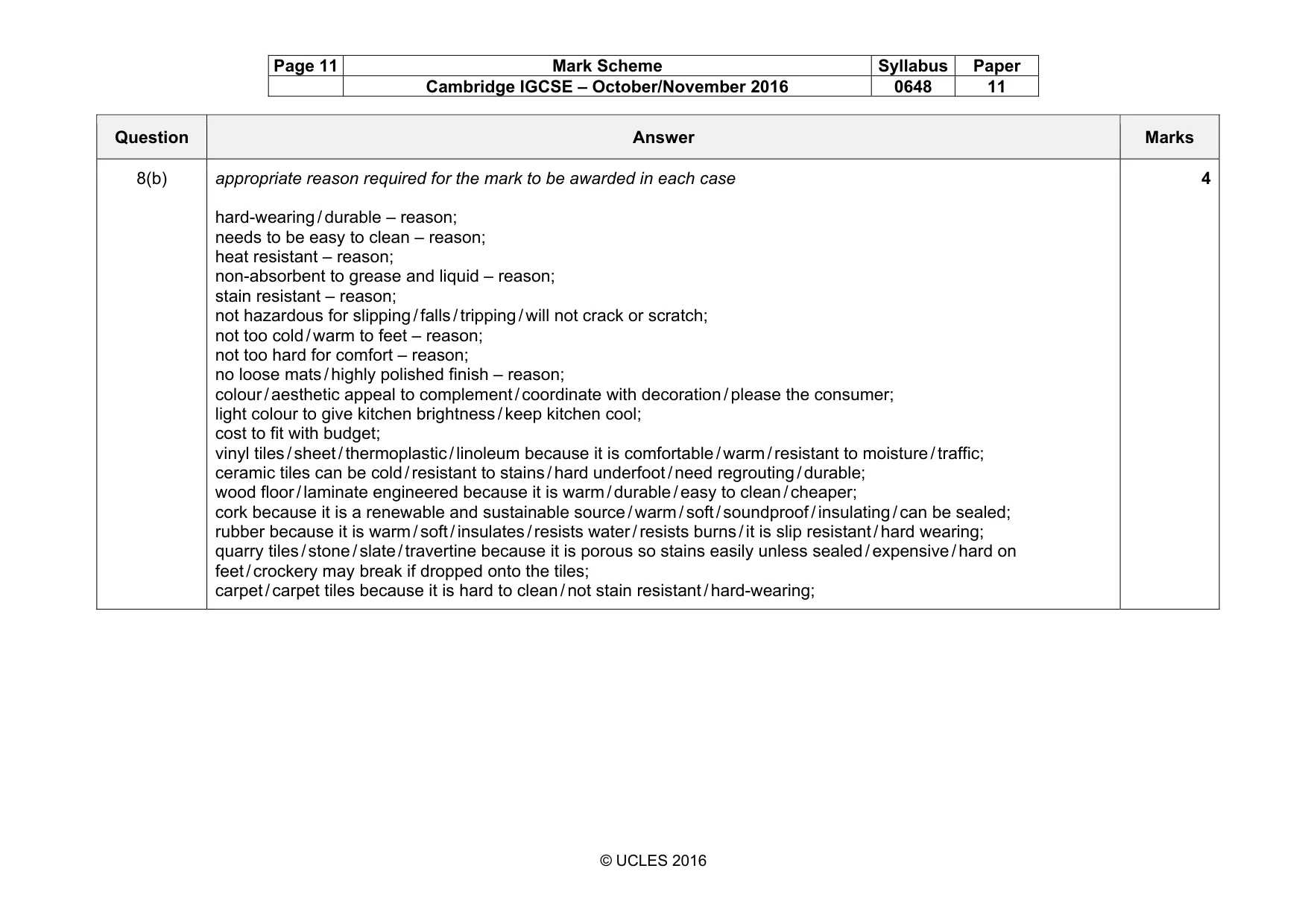
Page 11 Mark Scheme Syllabus Paper Cambridge IGCSE – October/November 2016 0648 11 © UCLES 2016 Question Answer Marks 8(b) appropriate reason required for the mark to be awarded in each case hard-wearing / durable – reason; needs to be easy to clean – reason; heat resistant – reason; non-absorbent to grease and liquid – reason; stain resistant – reason; not hazardous for slipping / falls / tripping / will not crack or scratch; not too cold / warm to feet – reason; not too hard for comfort – reason; no loose mats / highly polished finish – reason; colour / aesthetic appeal to complement / coordinate with decoration / please the consumer; light colour to give kitchen brightness / keep kitchen cool; cost to fit with budget; vinyl tiles / sheet / thermoplastic / linoleum because it is comfortable / warm / resistant to moisture / traffic; ceramic tiles can be cold / resistant to stains / hard underfoot / need regrouting / durable; wood floor / laminate engineered because it is warm / durable / easy to clean / cheaper; cork because it is a renewable and sustainable source / warm / soft / soundproof / insulating / can be sealed; rubber because it is warm / soft / insulates / resists water / resists burns / it is slip resistant / hard wearing; quarry tiles / stone / slate / travertine because it is porous so stains easily unless sealed / expensive / hard on feet / crockery may break if dropped onto the tiles; carpet / carpet tiles because it is hard to clean / not stain resistant / hard-wearing; 4
Mark scheme, page 12
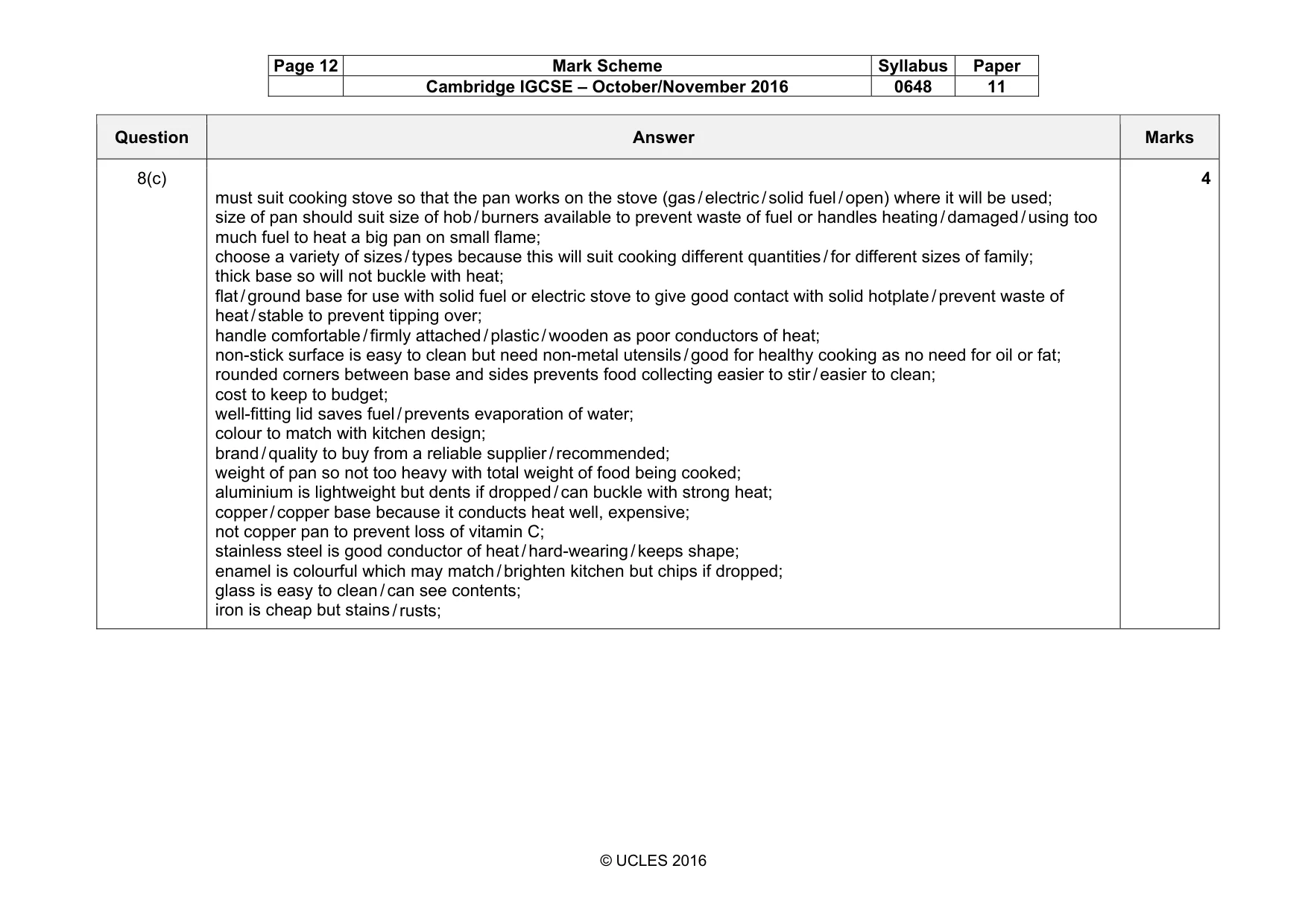
Page 12 Mark Scheme Syllabus Paper Cambridge IGCSE – October/November 2016 0648 11 © UCLES 2016 Question Answer Marks 8(c) must suit cooking stove so that the pan works on the stove (gas / electric / solid fuel / open) where it will be used; size of pan should suit size of hob / burners available to prevent waste of fuel or handles heating / damaged / using too much fuel to heat a big pan on small flame; choose a variety of sizes / types because this will suit cooking different quantities / for different sizes of family; thick base so will not buckle with heat; flat / ground base for use with solid fuel or electric stove to give good contact with solid hotplate / prevent waste of heat / stable to prevent tipping over; handle comfortable / firmly attached / plastic / wooden as poor conductors of heat; non-stick surface is easy to clean but need non-metal utensils / good for healthy cooking as no need for oil or fat; rounded corners between base and sides prevents food collecting easier to stir / easier to clean; cost to keep to budget; well-fitting lid saves fuel / prevents evaporation of water; colour to match with kitchen design; brand / quality to buy from a reliable supplier / recommended; weight of pan so not too heavy with total weight of food being cooked; aluminium is lightweight but dents if dropped / can buckle with strong heat; copper / copper base because it conducts heat well, expensive; not copper pan to prevent loss of vitamin C; stainless steel is good conductor of heat / hard-wearing / keeps shape; enamel is colourful which may match / brighten kitchen but chips if dropped; glass is easy to clean / can see contents; iron is cheap but stains / rusts; 4
Mark scheme, page 13
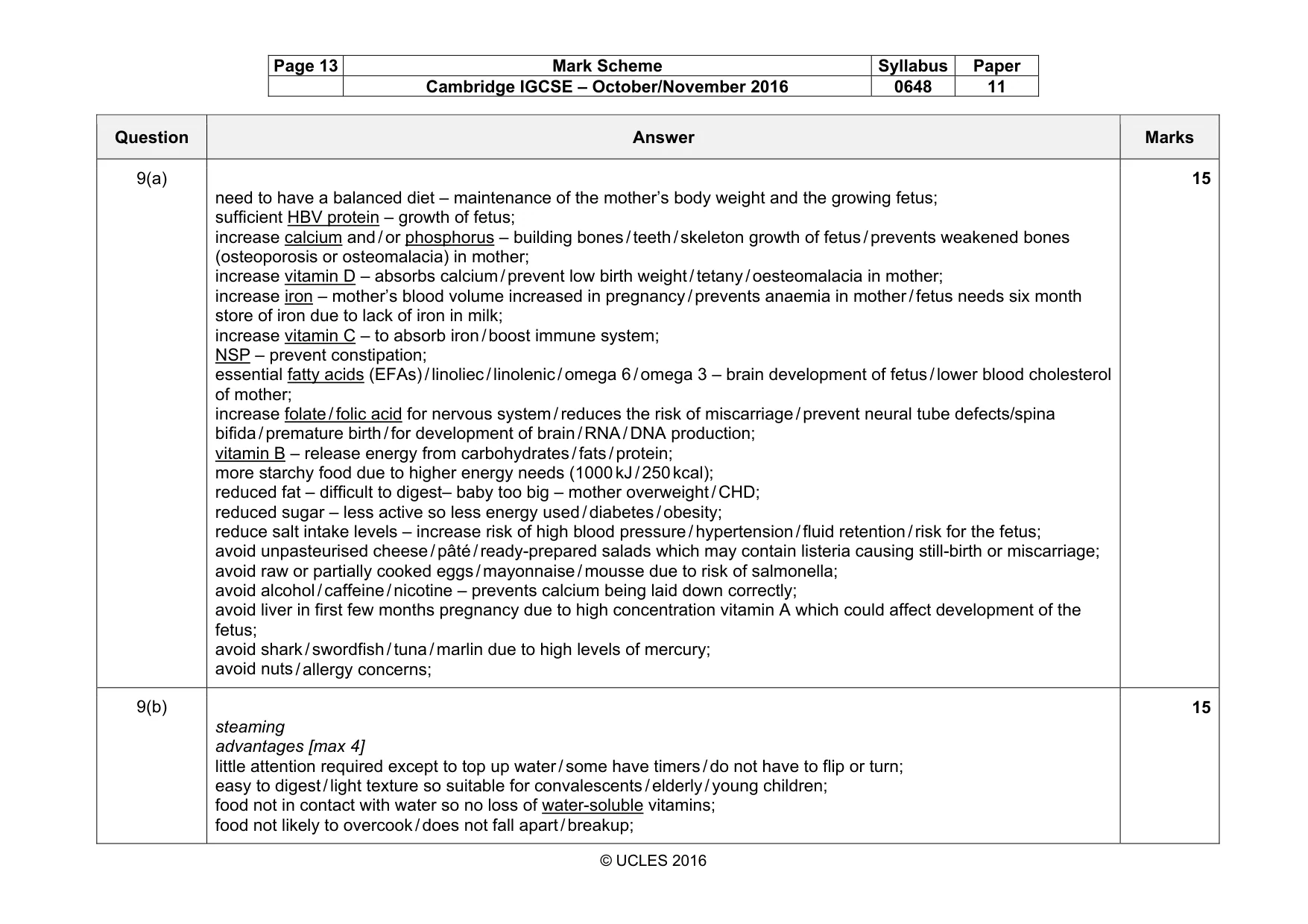
Page 13 Mark Scheme Syllabus Paper Cambridge IGCSE – October/November 2016 0648 11 © UCLES 2016 Question Answer Marks 9(a) need to have a balanced diet – maintenance of the mother’s body weight and the growing fetus; sufficient HBV protein – growth of fetus; increase calcium and / or phosphorus – building bones / teeth / skeleton growth of fetus / prevents weakened bones (osteoporosis or osteomalacia) in mother; increase vitamin D – absorbs calcium / prevent low birth weight / tetany / oesteomalacia in mother; increase iron – mother’s blood volume increased in pregnancy / prevents anaemia in mother / fetus needs six month store of iron due to lack of iron in milk; increase vitamin C – to absorb iron / boost immune system; NSP – prevent constipation; essential fatty acids (EFAs) / linoliec / linolenic / omega 6 / omega 3 – brain development of fetus / lower blood cholesterol of mother; increase folate / folic acid for nervous system / reduces the risk of miscarriage / prevent neural tube defects/spina bifida / premature birth / for development of brain / RNA / DNA production; vitamin B – release energy from carbohydrates / fats / protein; more starchy food due to higher energy needs (1000 kJ / 250 kcal); reduced fat – difficult to digest– baby too big – mother overweight / CHD; reduced sugar – less active so less energy used / diabetes / obesity; reduce salt intake levels – increase risk of high blood pressure / hypertension / fluid retention / risk for the fetus; avoid unpasteurised cheese / pâté / ready-prepared salads which may contain listeria causing still-birth or miscarriage; avoid raw or partially cooked eggs / mayonnaise / mousse due to risk of salmonella; avoid alcohol / caffeine / nicotine – prevents calcium being laid down correctly; avoid liver in first few months pregnancy due to high concentration vitamin A which could affect development of the fetus; avoid shark / swordfish / tuna / marlin due to high levels of mercury; avoid nuts / allergy concerns; 15 9(b) steaming advantages [max 4] little attention required except to top up water / some have timers / do not have to flip or turn; easy to digest / light texture so suitable for convalescents / elderly / young children; food not in contact with water so no loss of water-soluble vitamins; food not likely to overcook / does not fall apart / breakup; 15
Mark scheme, page 14
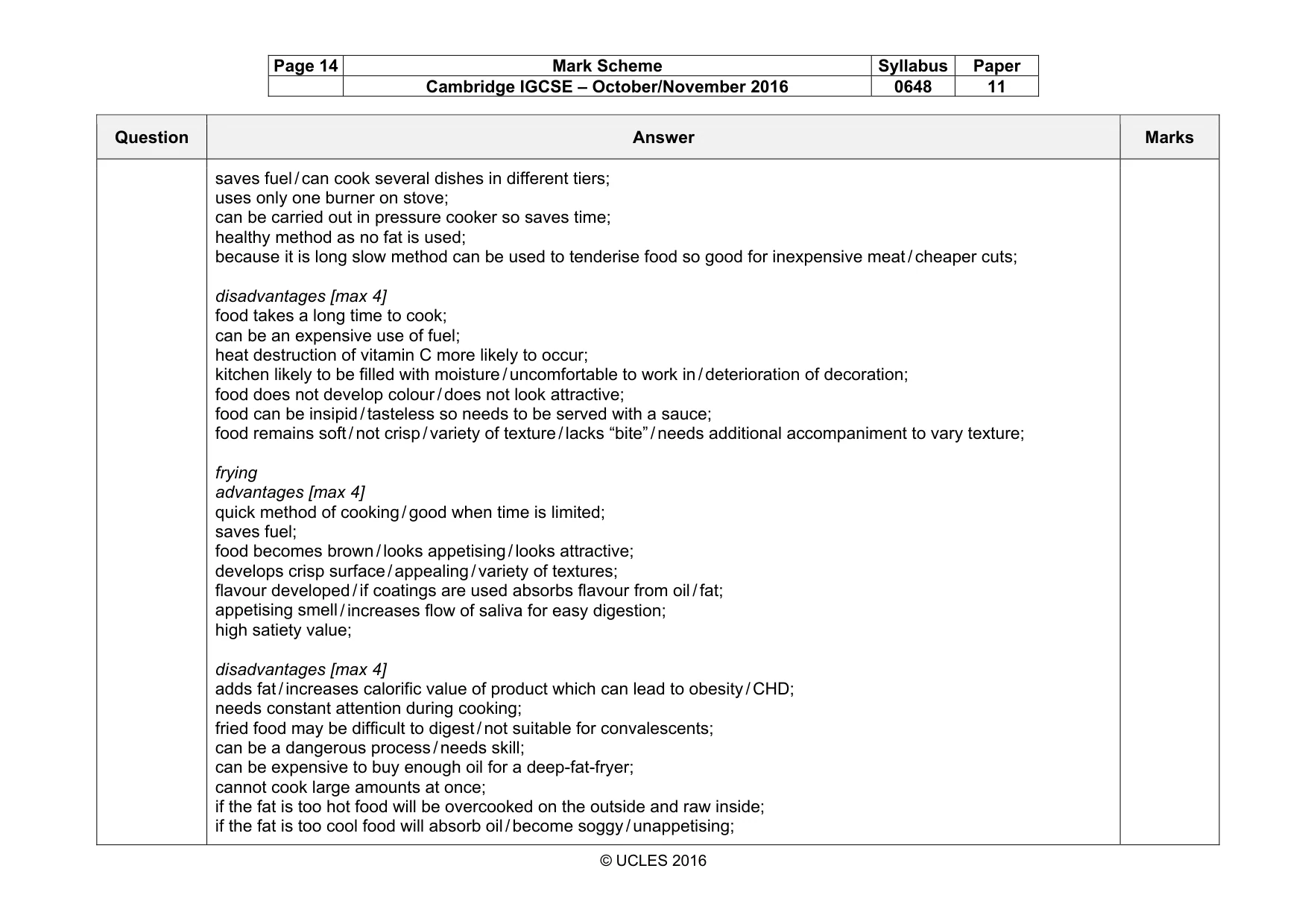
Page 14 Mark Scheme Syllabus Paper Cambridge IGCSE – October/November 2016 0648 11 © UCLES 2016 Question Answer Marks saves fuel / can cook several dishes in different tiers; uses only one burner on stove; can be carried out in pressure cooker so saves time; healthy method as no fat is used; because it is long slow method can be used to tenderise food so good for inexpensive meat / cheaper cuts; disadvantages [max 4] food takes a long time to cook; can be an expensive use of fuel; heat destruction of vitamin C more likely to occur; kitchen likely to be filled with moisture / uncomfortable to work in / deterioration of decoration; food does not develop colour / does not look attractive; food can be insipid / tasteless so needs to be served with a sauce; food remains soft / not crisp / variety of texture / lacks “bite” / needs additional accompaniment to vary texture; frying advantages [max 4] quick method of cooking / good when time is limited; saves fuel; food becomes brown / looks appetising / looks attractive; develops crisp surface / appealing / variety of textures; flavour developed / if coatings are used absorbs flavour from oil / fat; appetising smell / increases flow of saliva for easy digestion; high satiety value; disadvantages [max 4] adds fat / increases calorific value of product which can lead to obesity / CHD; needs constant attention during cooking; fried food may be difficult to digest / not suitable for convalescents; can be a dangerous process / needs skill; can be expensive to buy enough oil for a deep-fat-fryer; cannot cook large amounts at once; if the fat is too hot food will be overcooked on the outside and raw inside; if the fat is too cool food will absorb oil / become soggy / unappetising;
Mark scheme, page 15
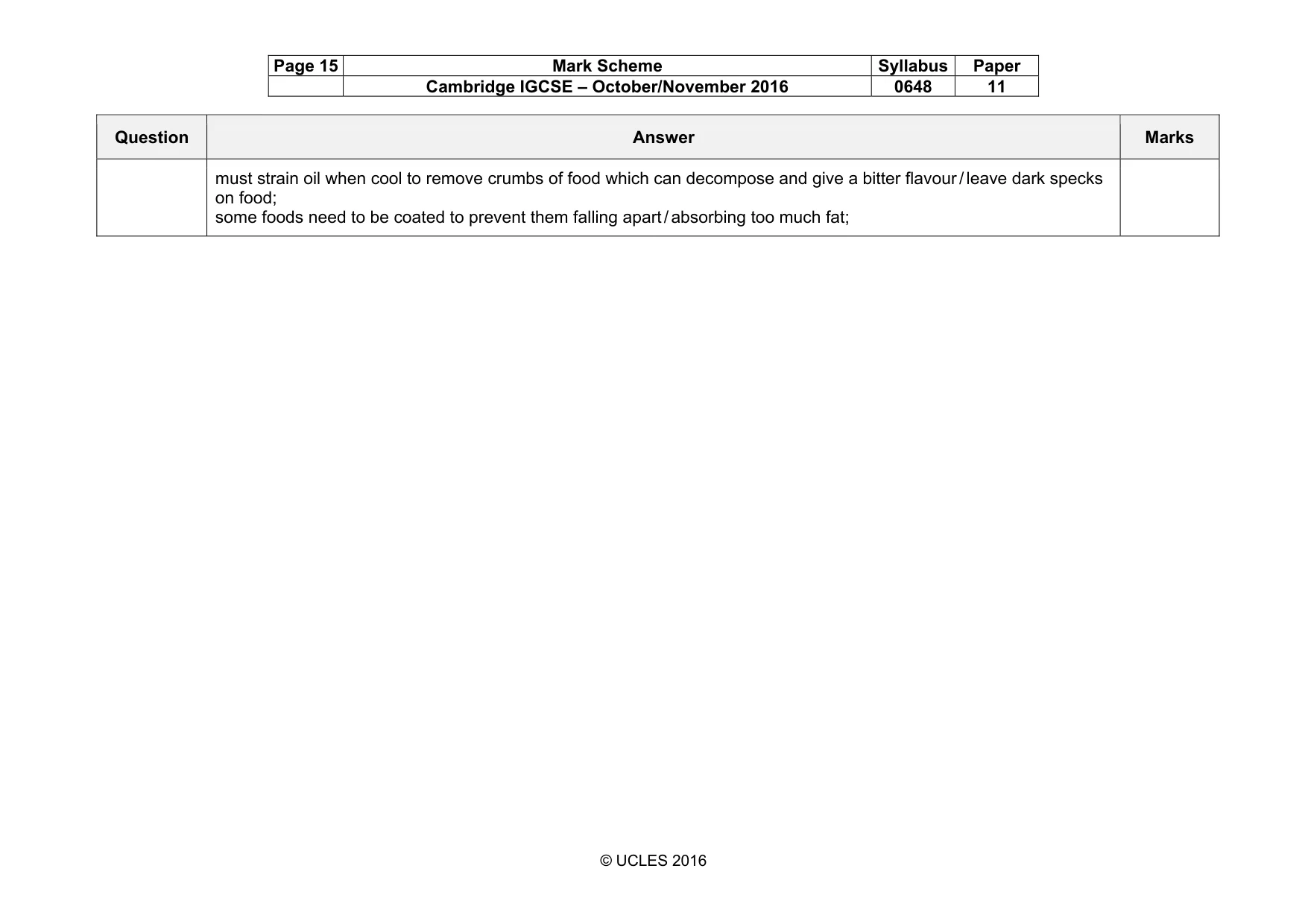
Page 15 Mark Scheme Syllabus Paper Cambridge IGCSE – October/November 2016 0648 11 © UCLES 2016 Question Answer Marks must strain oil when cool to remove crumbs of food which can decompose and give a bitter flavour / leave dark specks on food; some foods need to be coated to prevent them falling apart / absorbing too much fat;
What you needed in this session
Cambridge’s own grade thresholds for 2016 Oct/Nov, Paper 1 · Variant 1. A higher threshold means an easier paper — the bar moves with how the cohort did.