Cambridge IGCSE Environmental Management 0680 — 2022 Oct/Nov Paper 1 · Variant 2
0680/12/O/N/22 · 80 marks · ≈90 min
The question paper and its mark scheme, free to read here and free to download. This is Cambridge’s own paper, exactly as it was sat.
Question paper20 pages




Mark scheme13 pages
Answers below. Sit the paper first if you are practising.
Paper as text
Question paper, page 1
This document has 20 pages. Any blank pages are indicated. [Turn over Cambridge IGCSE™ ENVIRONMENTAL MANAGEMENT 0680/12 Paper 1 Theory October/November 2022 1 hour 45 minutes You must answer on the question paper. No additional materials are needed. INSTRUCTIONS ● Answer all questions. ● Use a black or dark blue pen. You may use an HB pencil for any diagrams or graphs. ● Write your name, centre number and candidate number in the boxes at the top of the page. ● Write your answer to each question in the space provided. ● Do not use an erasable pen or correction fluid. ● Do not write on any bar codes. ● You may use a calculator. ● You should show all your working and use appropriate units. INFORMATION ● The total mark for this paper is 80. ● The number of marks for each question or part question is shown in brackets [ ]. * 6 2 3 4 6 8 9 6 8 2 * DC (CJ/CB) 307646/2 © UCLES 2022
Question paper, page 2
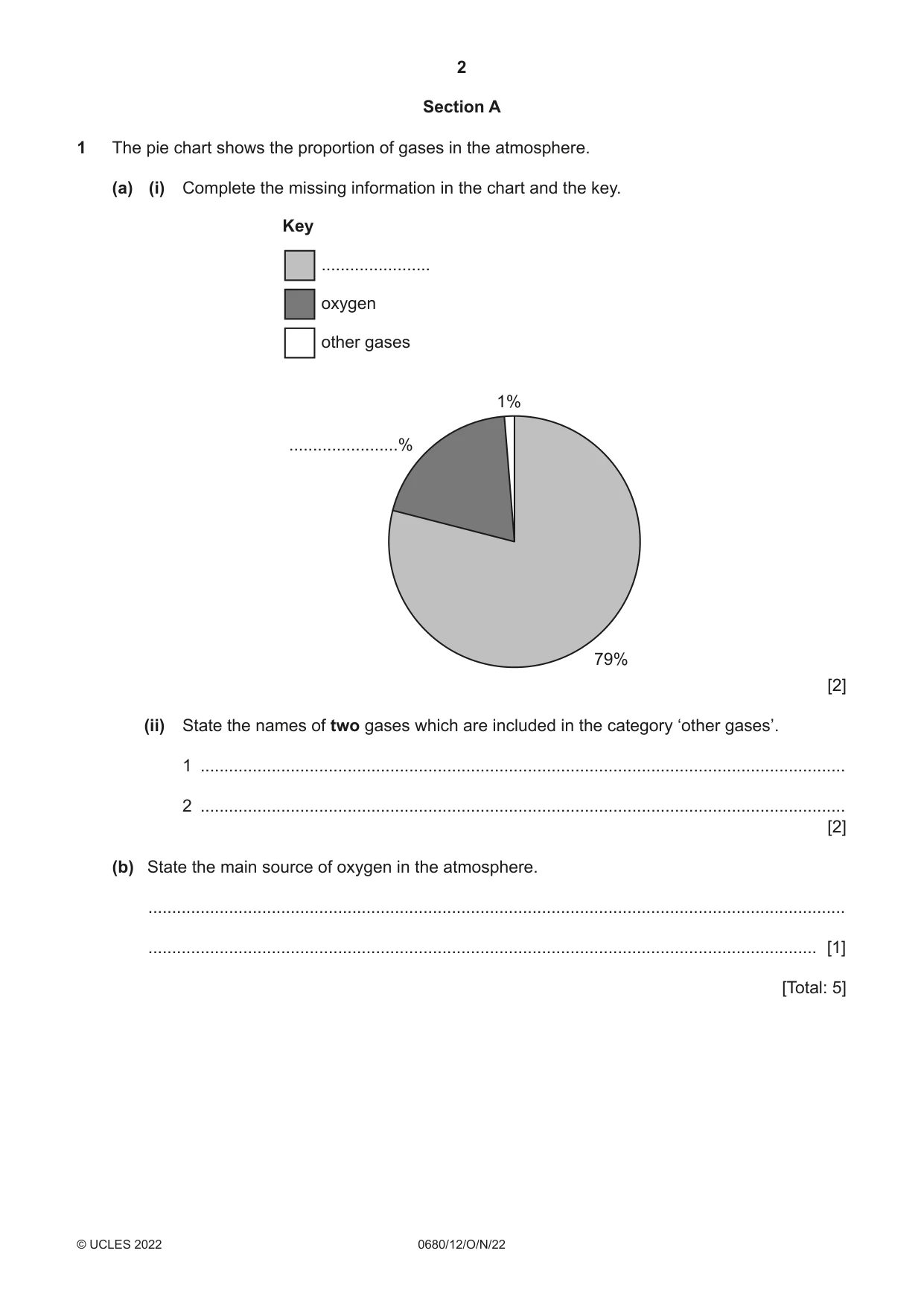
2 0680/12/O/N/22 © UCLES 2022 Section A 1 The pie chart shows the proportion of gases in the atmosphere. (a) (i) Complete the missing information in the chart and the key. Key … oxygen other gases …% 1% 79% [2] (ii) State the names of two gases which are included in the category ‘other gases’. 1 … 2 … [2] (b) State the main source of oxygen in the atmosphere. … … [1] [Total: 5]
Question paper, page 3
3 0680/12/O/N/22 © UCLES 2022 [Turn over BLANK PAGE
Question paper, page 4
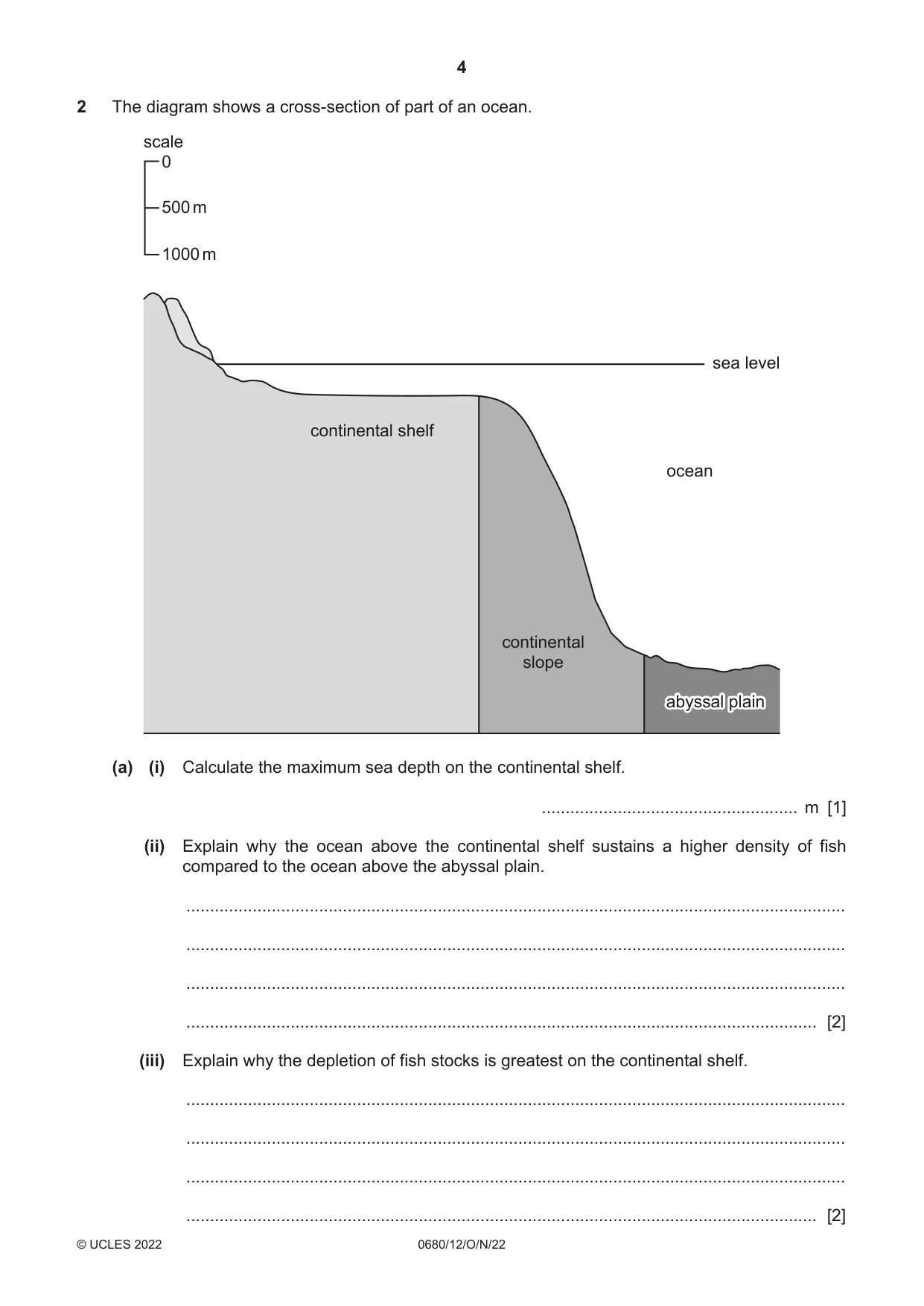
4 0680/12/O/N/22 © UCLES 2022 2 The diagram shows a cross-section of part of an ocean. continental slope continental shelf ocean sea level scale 0 500 m 1000 m abyssal plain (a) (i) Calculate the maximum sea depth on the continental shelf. … m [1] (ii) Explain why the ocean above the continental shelf sustains a higher density of fish compared to the ocean above the abyssal plain. … … … … [2] (iii) Explain why the depletion of fish stocks is greatest on the continental shelf. … … … … [2]
Question paper, page 5
5 0680/12/O/N/22 © UCLES 2022 [Turn over (b) Describe how the use of fish farms reduces the impact on wild fish stocks. … … … … … … [3] [Total: 8]
Question paper, page 6
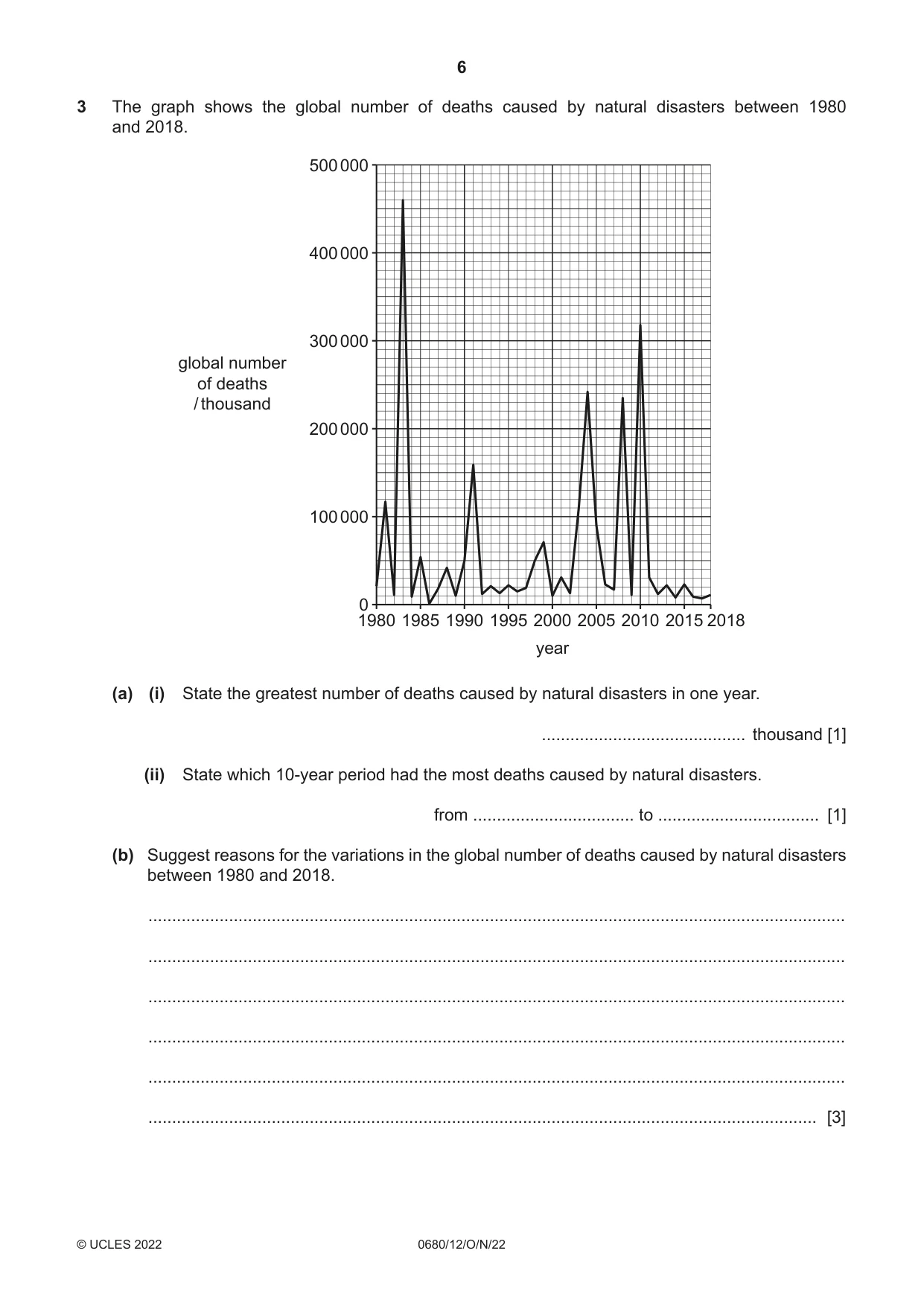
6 0680/12/O/N/22 © UCLES 2022 3 The graph shows the global number of deaths caused by natural disasters between 1980 and 2018. 0 1980 1985 1990 1995 2000 year 2005 2010 2015 2018 100 000 global number of deaths / thousand 200 000 300 000 400 000 500 000 (a) (i) State the greatest number of deaths caused by natural disasters in one year. … thousand [1] (ii) State which 10-year period had the most deaths caused by natural disasters. from … to … [1] (b) Suggest reasons for the variations in the global number of deaths caused by natural disasters between 1980 and 2018. … … … … … … [3]
Question paper, page 7
7 0680/12/O/N/22 © UCLES 2022 [Turn over (c) Name two natural disasters that are caused by tectonic plate movement. 1 … 2 … [2] [Total: 7]
Question paper, page 8
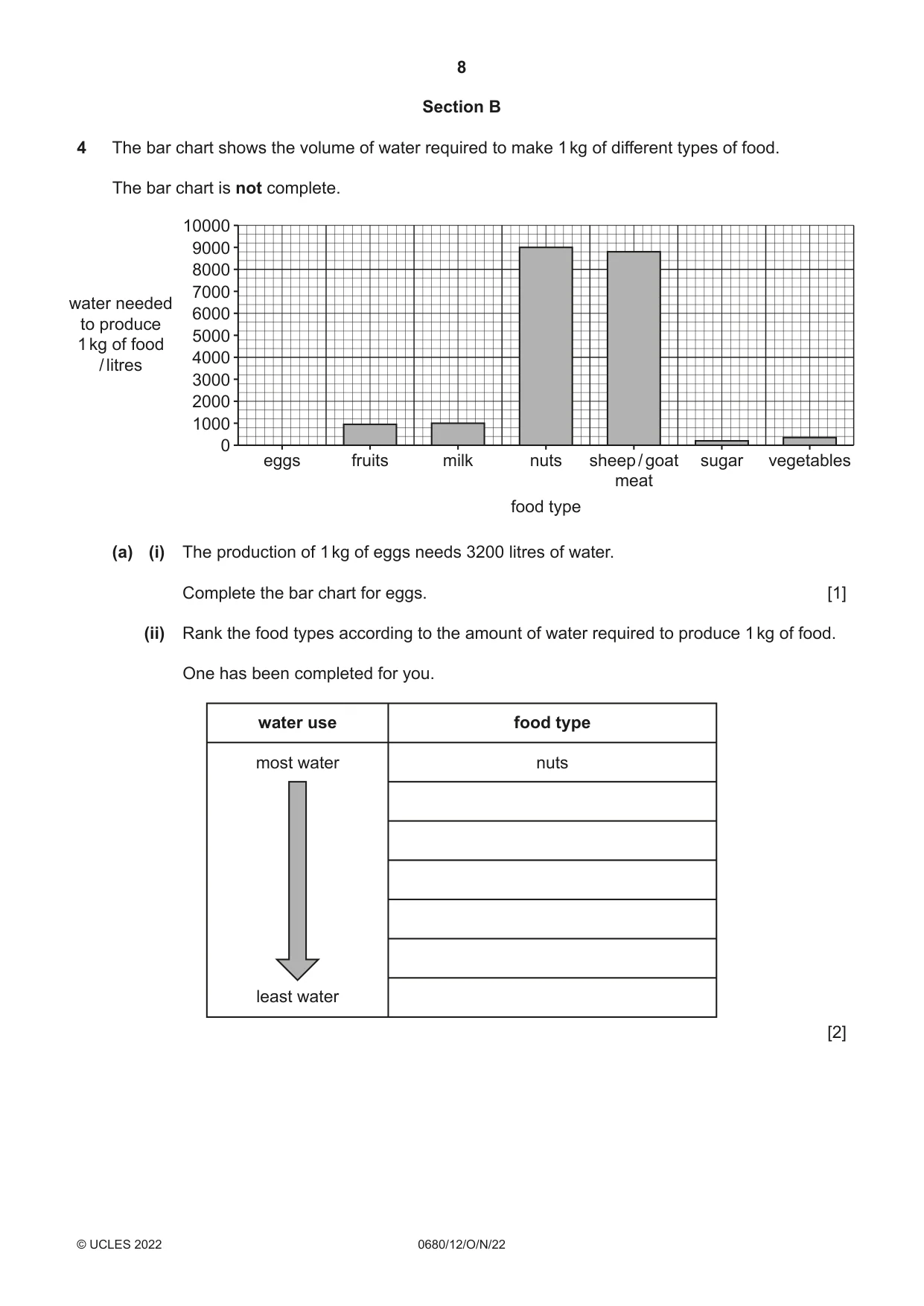
8 0680/12/O/N/22 © UCLES 2022 Section B 4 The bar chart shows the volume of water required to make 1 kg of different types of food. The bar chart is not complete. 0 eggs fruits milk nuts sheep / goat meat food type water needed to produce 1 kg of food / litres sugar vegetables 1000 2000 3000 4000 5000 6000 7000 8000 9000 10000 (a) (i) The production of 1 kg of eggs needs 3200 litres of water. Complete the bar chart for eggs. [1] (ii) Rank the food types according to the amount of water required to produce 1 kg of food. One has been completed for you. water use food type most water least water nuts [2]
Question paper, page 9
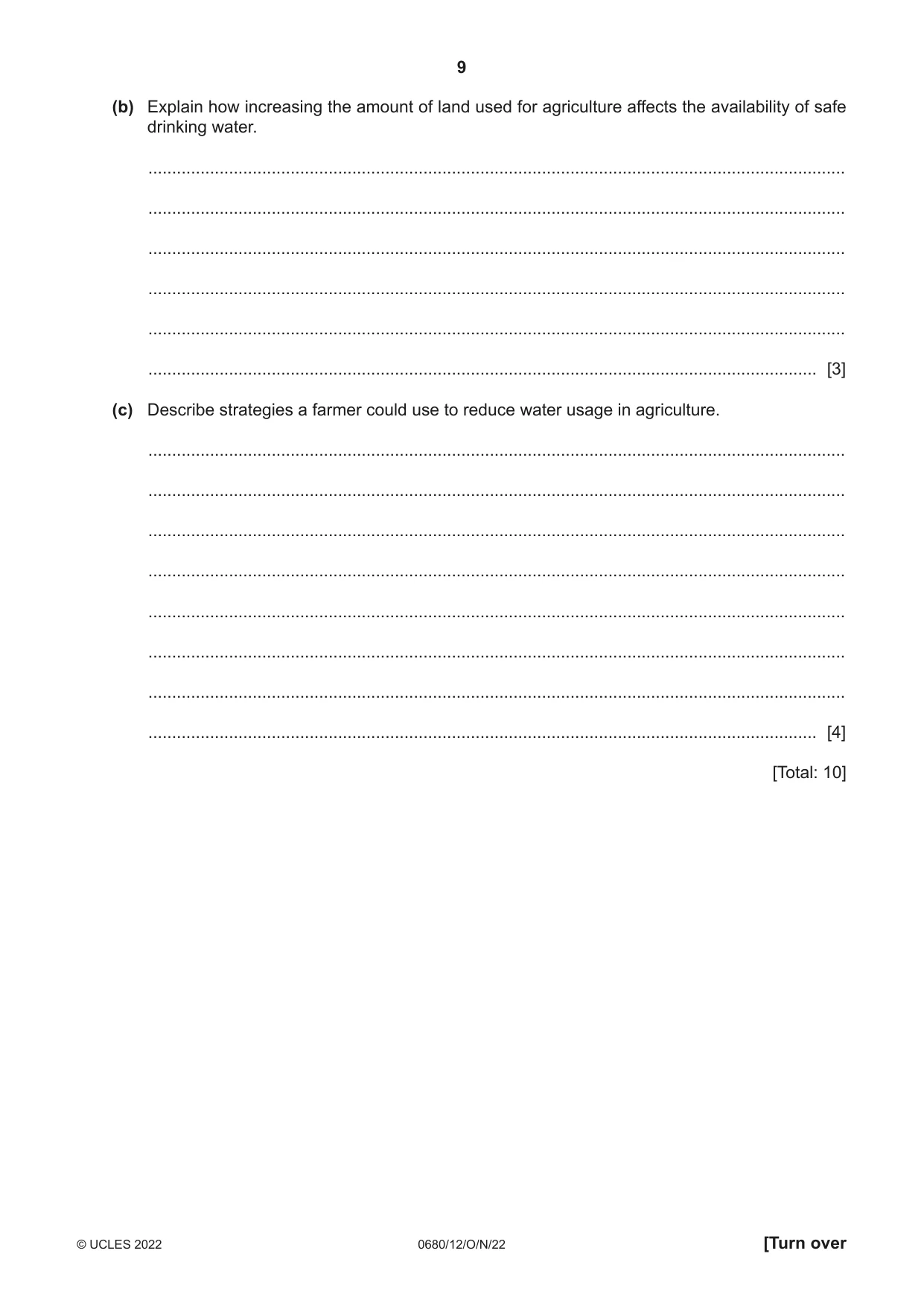
9 0680/12/O/N/22 © UCLES 2022 [Turn over (b) Explain how increasing the amount of land used for agriculture affects the availability of safe drinking water. … … … … … … [3] (c) Describe strategies a farmer could use to reduce water usage in agriculture. … … … … … … … … [4] [Total: 10]
Question paper, page 10
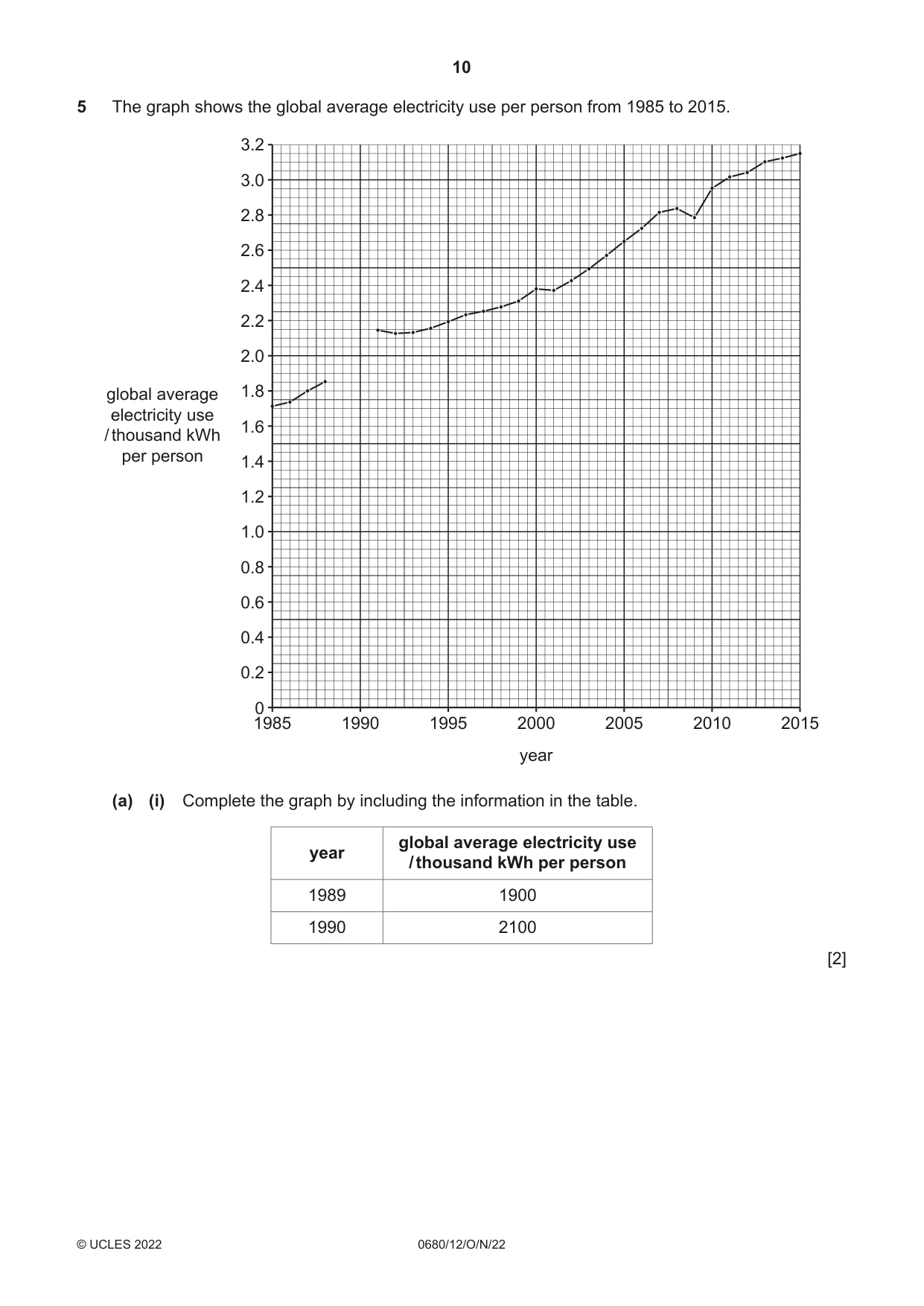
10 0680/12/O/N/22 © UCLES 2022 5 The graph shows the global average electricity use per person from 1985 to 2015. 0 1985 1990 1995 global average electricity use / thousand kWh per person year 2000 2005 2010 2015 0.2 0.4 0.6 0.8 1.0 1.2 1.4 1.6 1.8 2.0 2.2 2.4 2.6 2.8 3.0 3.2 (a) (i) Complete the graph by including the information in the table. year global average electricity use / thousand kWh per person 1989 1900 1990 2100 [2]
Question paper, page 11
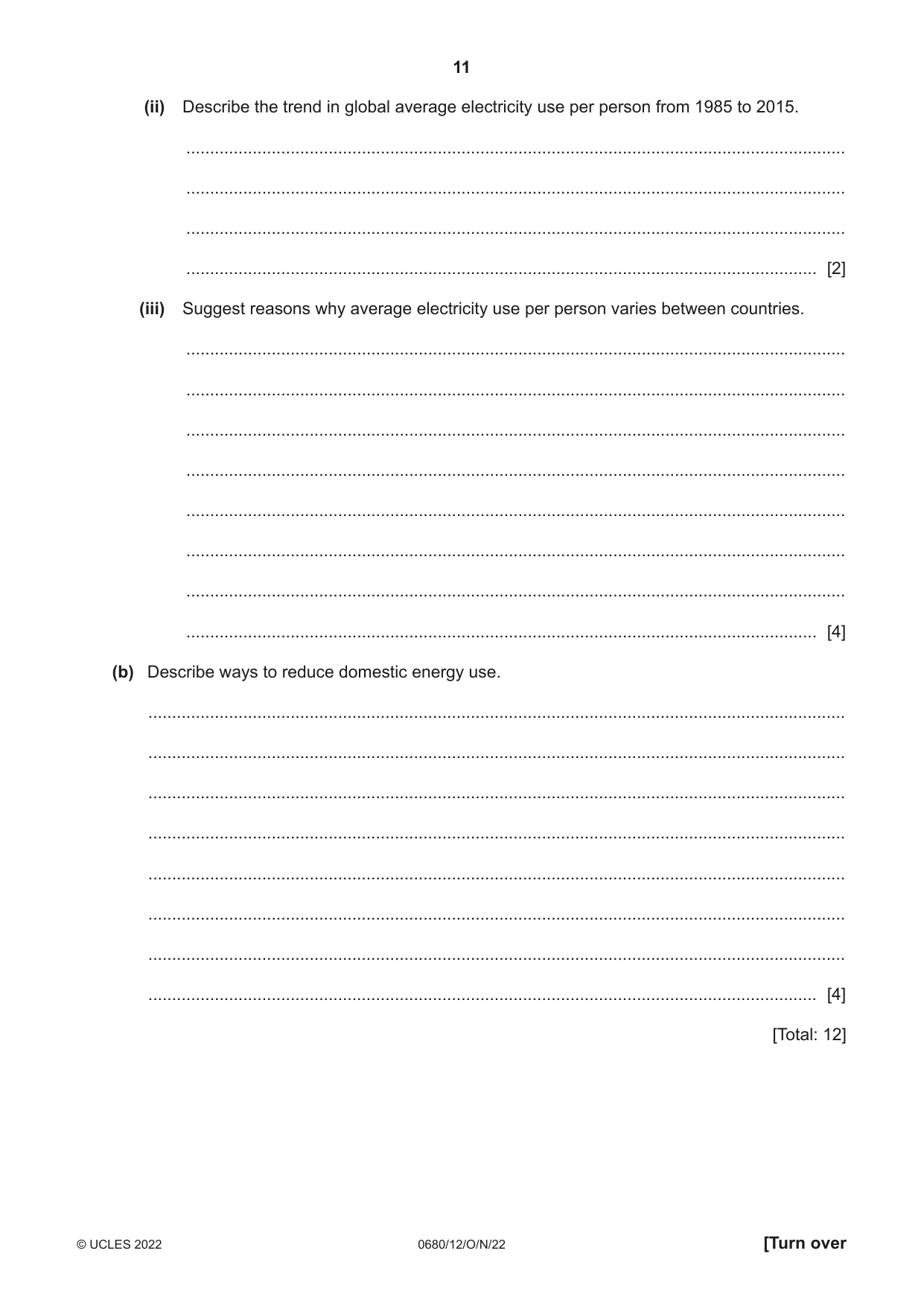
11 0680/12/O/N/22 © UCLES 2022 [Turn over (ii) Describe the trend in global average electricity use per person from 1985 to 2015. … … … … [2] (iii) Suggest reasons why average electricity use per person varies between countries. … … … … … … … … [4] (b) Describe ways to reduce domestic energy use. … … … … … … … … [4] [Total: 12]
Question paper, page 12
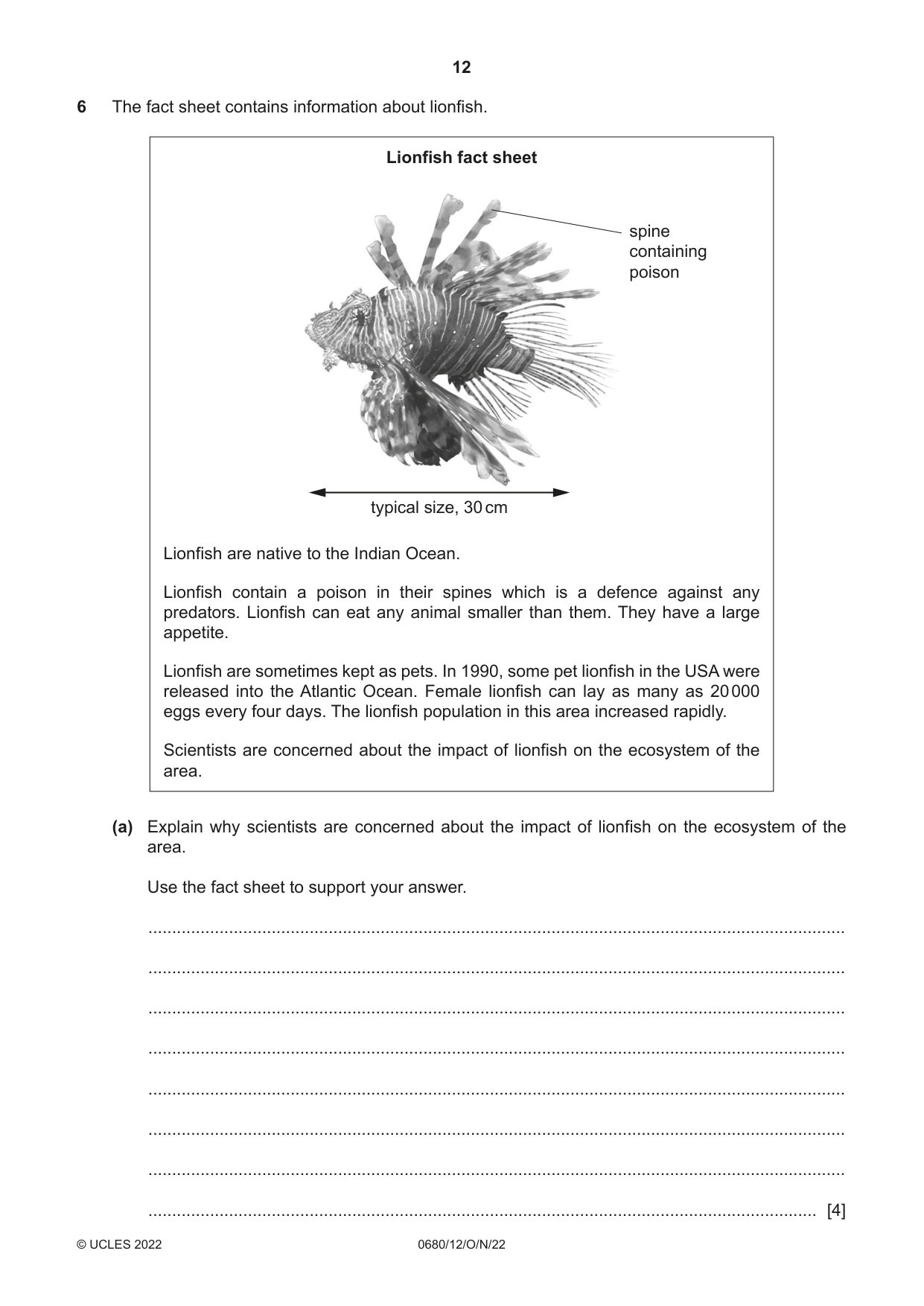
12 0680/12/O/N/22 © UCLES 2022 6 The fact sheet contains information about lionfish. Lionfish fact sheet spine containing poison typical size, 30 cm Lionfish are native to the Indian Ocean. Lionfish contain a poison in their spines which is a defence against any predators. Lionfish can eat any animal smaller than them. They have a large appetite. Lionfish are sometimes kept as pets. In 1990, some pet lionfish in the USA were released into the Atlantic Ocean. Female lionfish can lay as many as 20 000 eggs every four days. The lionfish population in this area increased rapidly. Scientists are concerned about the impact of lionfish on the ecosystem of the area. (a) Explain why scientists are concerned about the impact of lionfish on the ecosystem of the area. Use the fact sheet to support your answer. … … … … … … … … [4]
Question paper, page 13
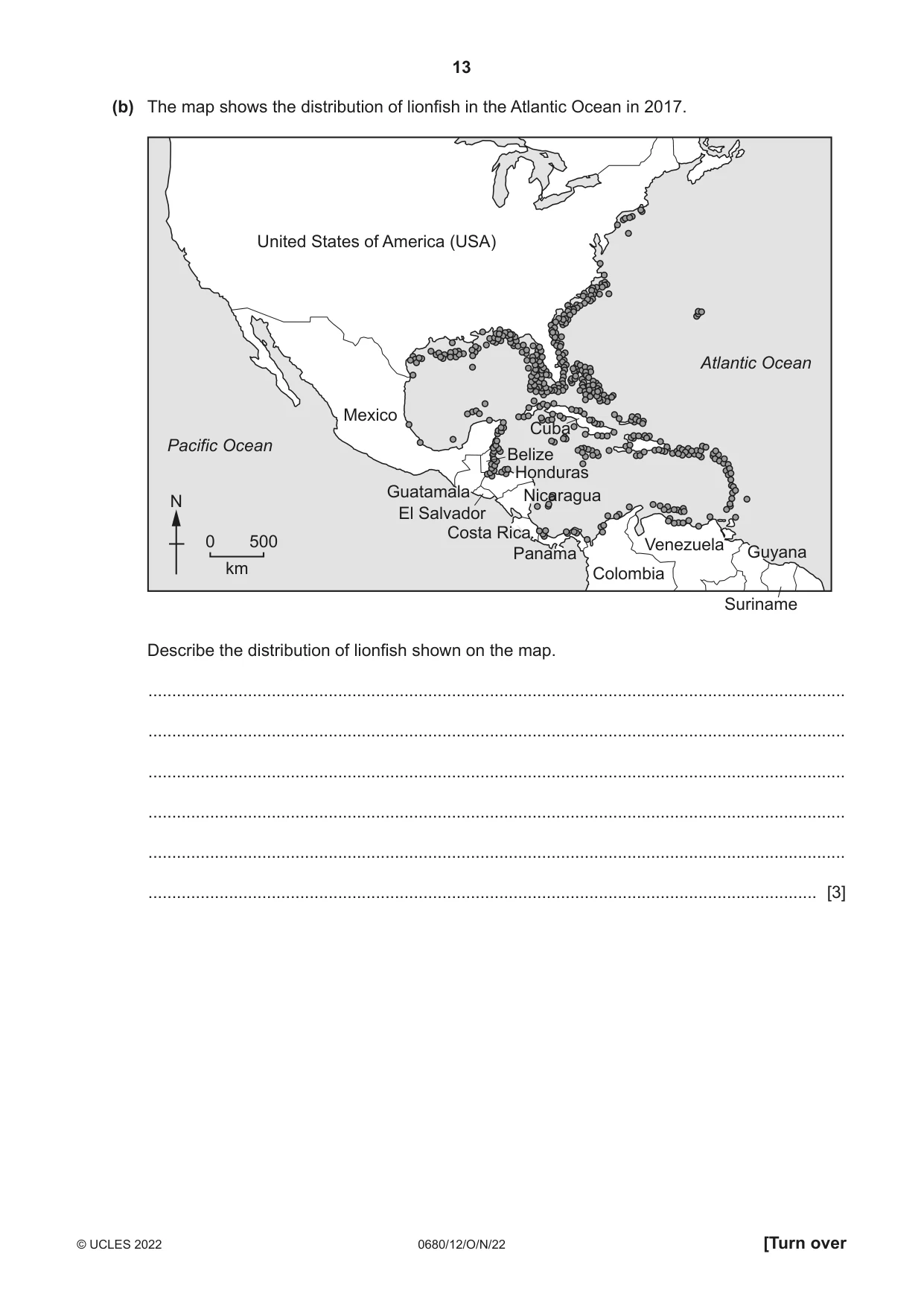
13 0680/12/O/N/22 © UCLES 2022 [Turn over (b) The map shows the distribution of lionfish in the Atlantic Ocean in 2017. United States of America (USA) Pacific Ocean Atlantic Ocean Mexico Guatamala Honduras Belize Nicaragua Costa Rica El Salvador Panama Colombia Venezuela Guyana Suriname Cuba 0 500 km N Describe the distribution of lionfish shown on the map. … … … … … … [3]
Question paper, page 14
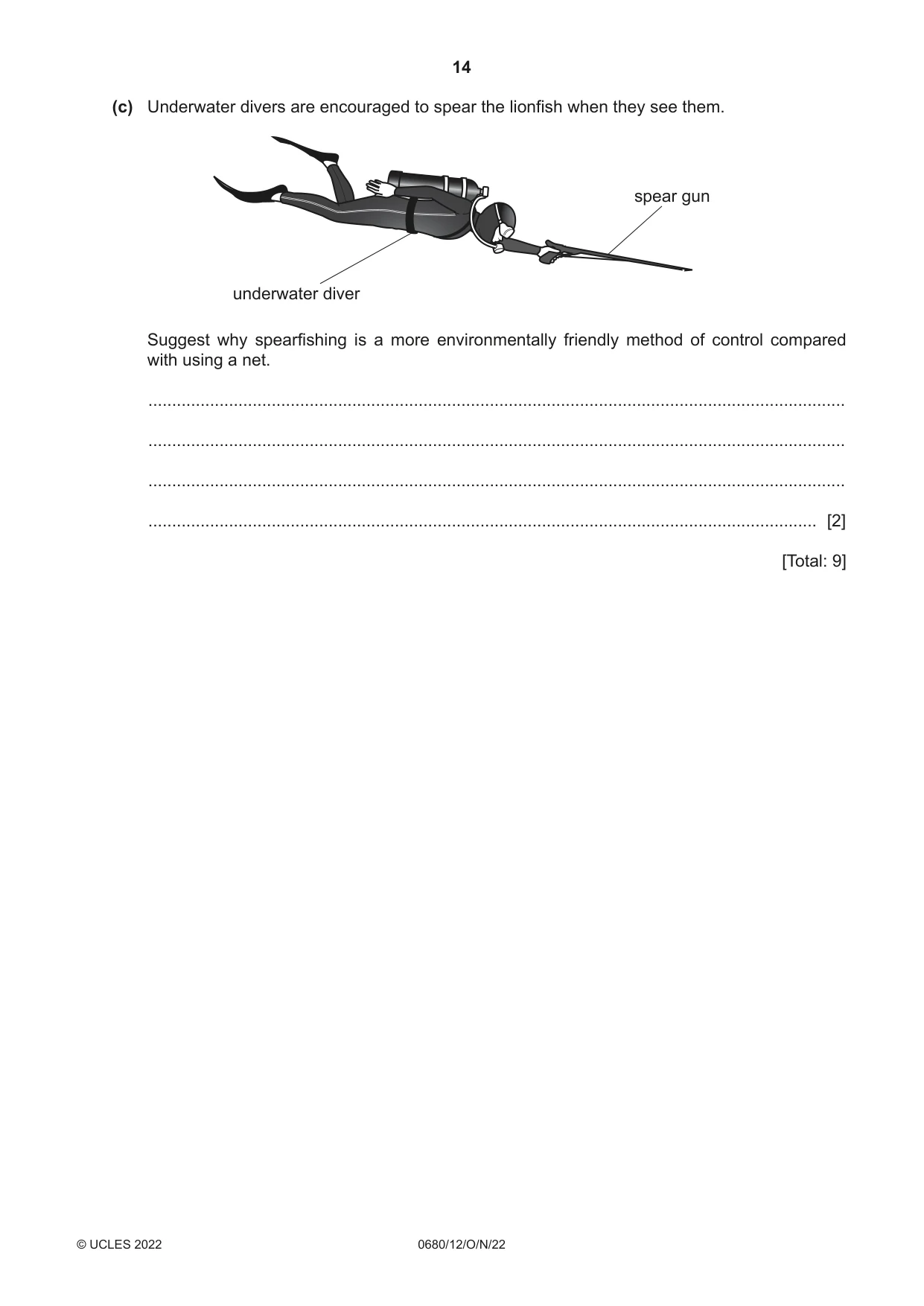
14 0680/12/O/N/22 © UCLES 2022 (c) Underwater divers are encouraged to spear the lionfish when they see them. spear gun underwater diver Suggest why spearfishing is a more environmentally friendly method of control compared with using a net. … … … … [2] [Total: 9]
Question paper, page 15
15 0680/12/O/N/22 © UCLES 2022 [Turn over BLANK PAGE
Question paper, page 16
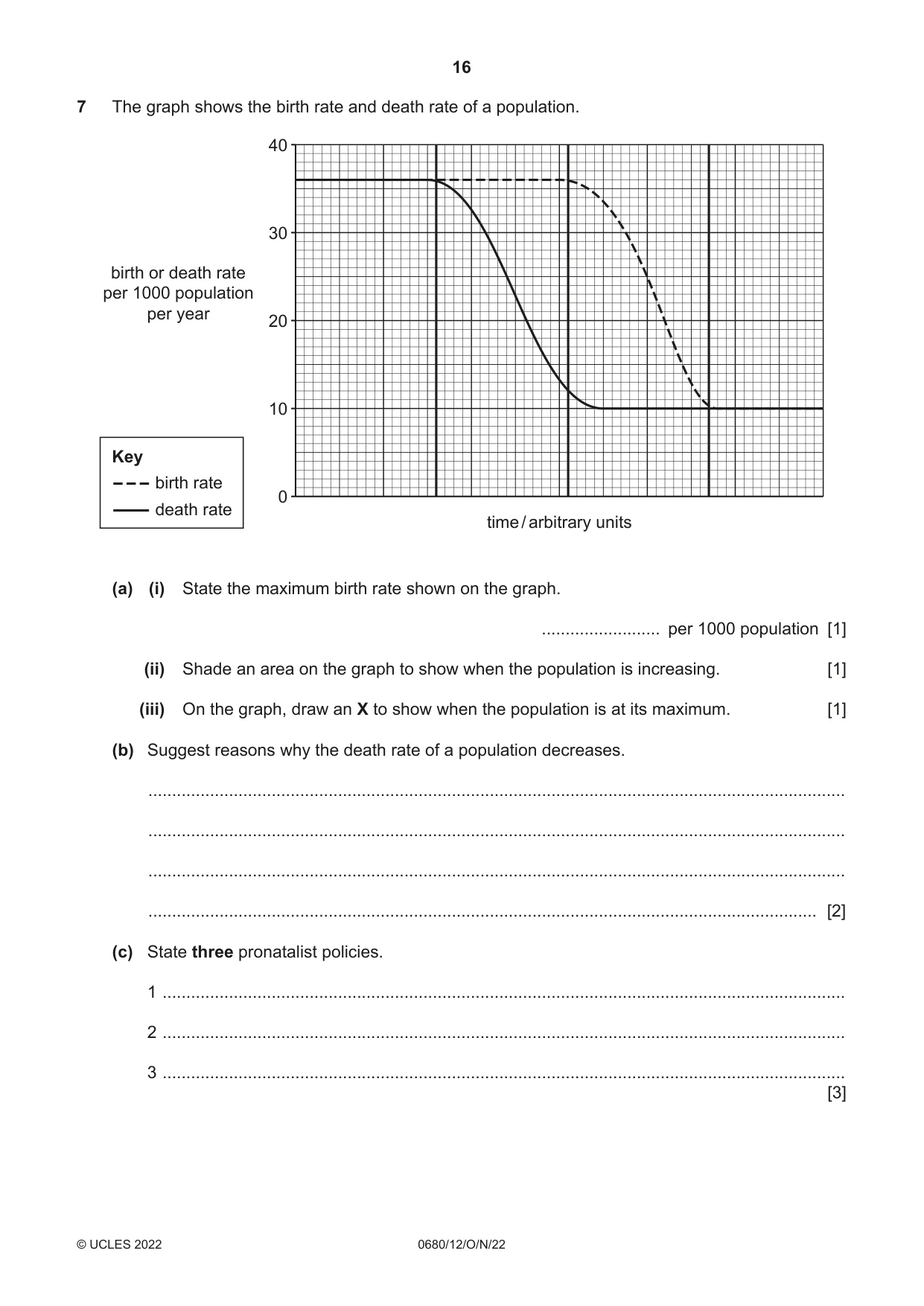
16 0680/12/O/N/22 © UCLES 2022 7 The graph shows the birth rate and death rate of a population. 10 0 20 30 40 birth or death rate per 1000 population per year time / arbitrary units Key birth rate death rate (a) (i) State the maximum birth rate shown on the graph. … per 1000 population [1] (ii) Shade an area on the graph to show when the population is increasing. [1] (iii) On the graph, draw an X to show when the population is at its maximum. [1] (b) Suggest reasons why the death rate of a population decreases. … … … … [2] (c) State three pronatalist policies. 1 … 2 … 3 … [3]
Question paper, page 17
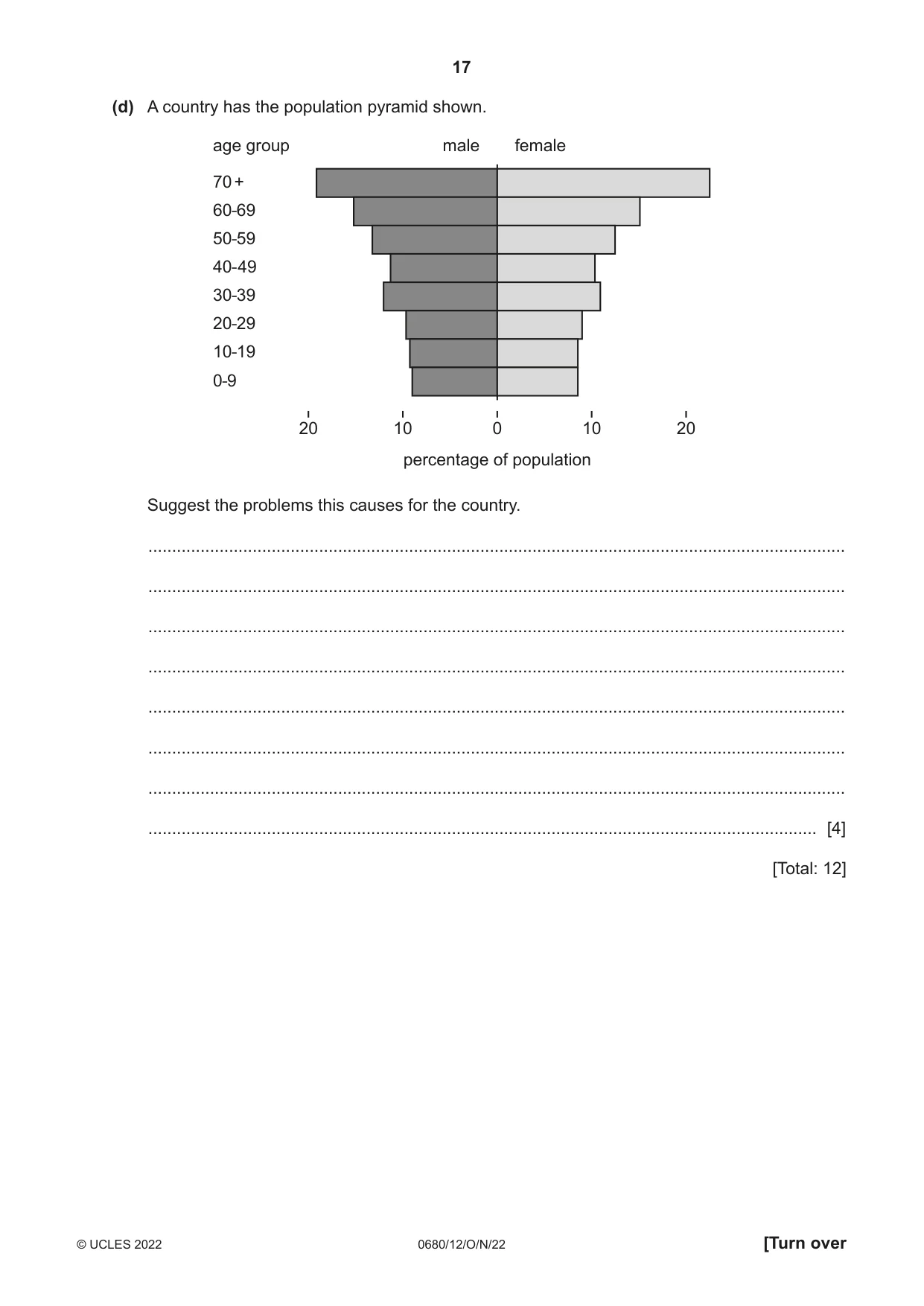
17 0680/12/O/N/22 © UCLES 2022 [Turn over (d) A country has the population pyramid shown. 20 10 0 percentage of population male age group 70 + 60–69 50–59 40–49 30–39 20–29 10–19 0–9 female 10 20 Suggest the problems this causes for the country. … … … … … … … … [4] [Total: 12]
Question paper, page 18
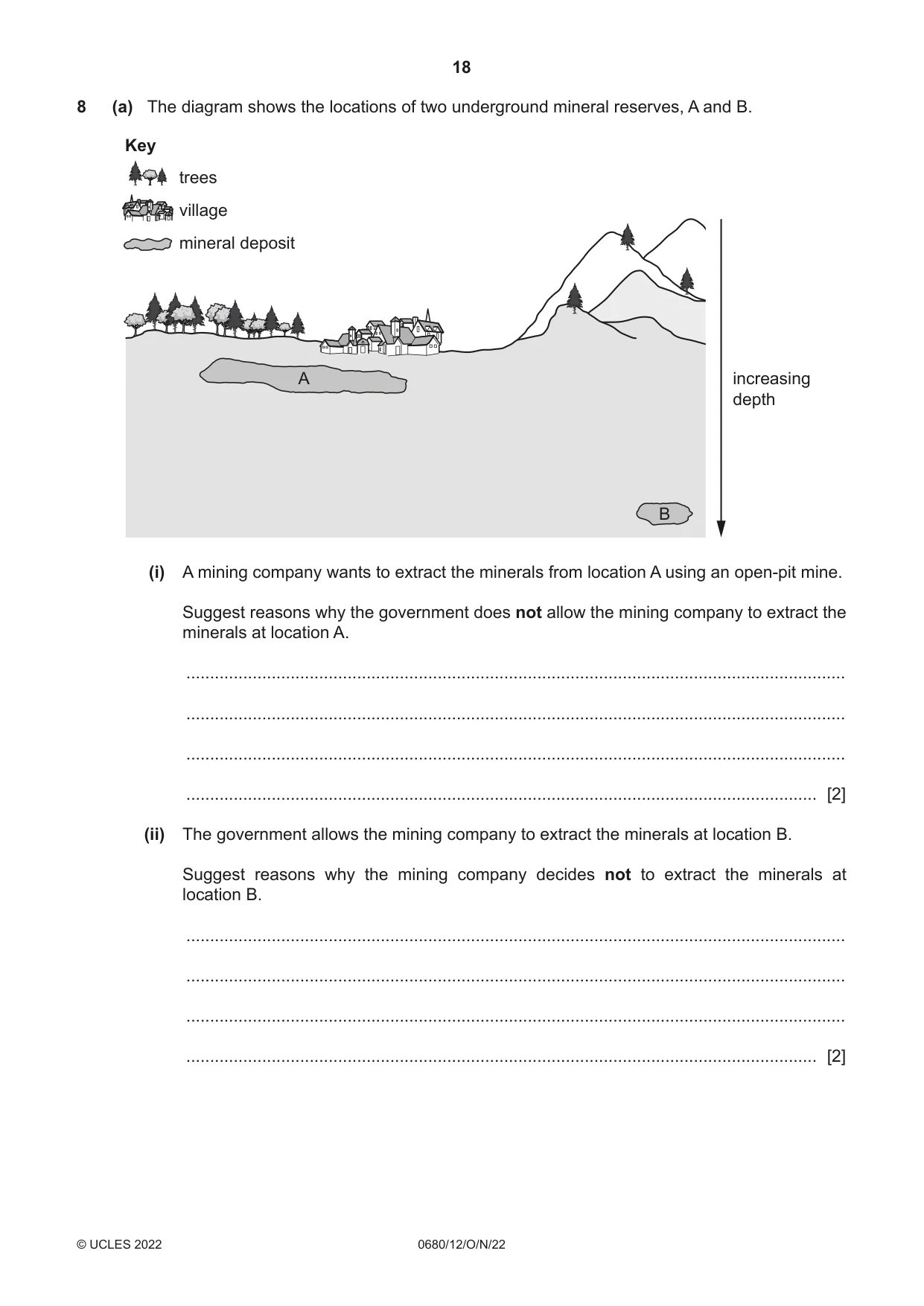
18 0680/12/O/N/22 © UCLES 2022 8 (a) The diagram shows the locations of two underground mineral reserves, A and B. A B Key trees village mineral deposit increasing depth (i) A mining company wants to extract the minerals from location A using an open-pit mine. Suggest reasons why the government does not allow the mining company to extract the minerals at location A. … … … … [2] (ii) The government allows the mining company to extract the minerals at location B. Suggest reasons why the mining company decides not to extract the minerals at location B. … … … … [2]
Question paper, page 19
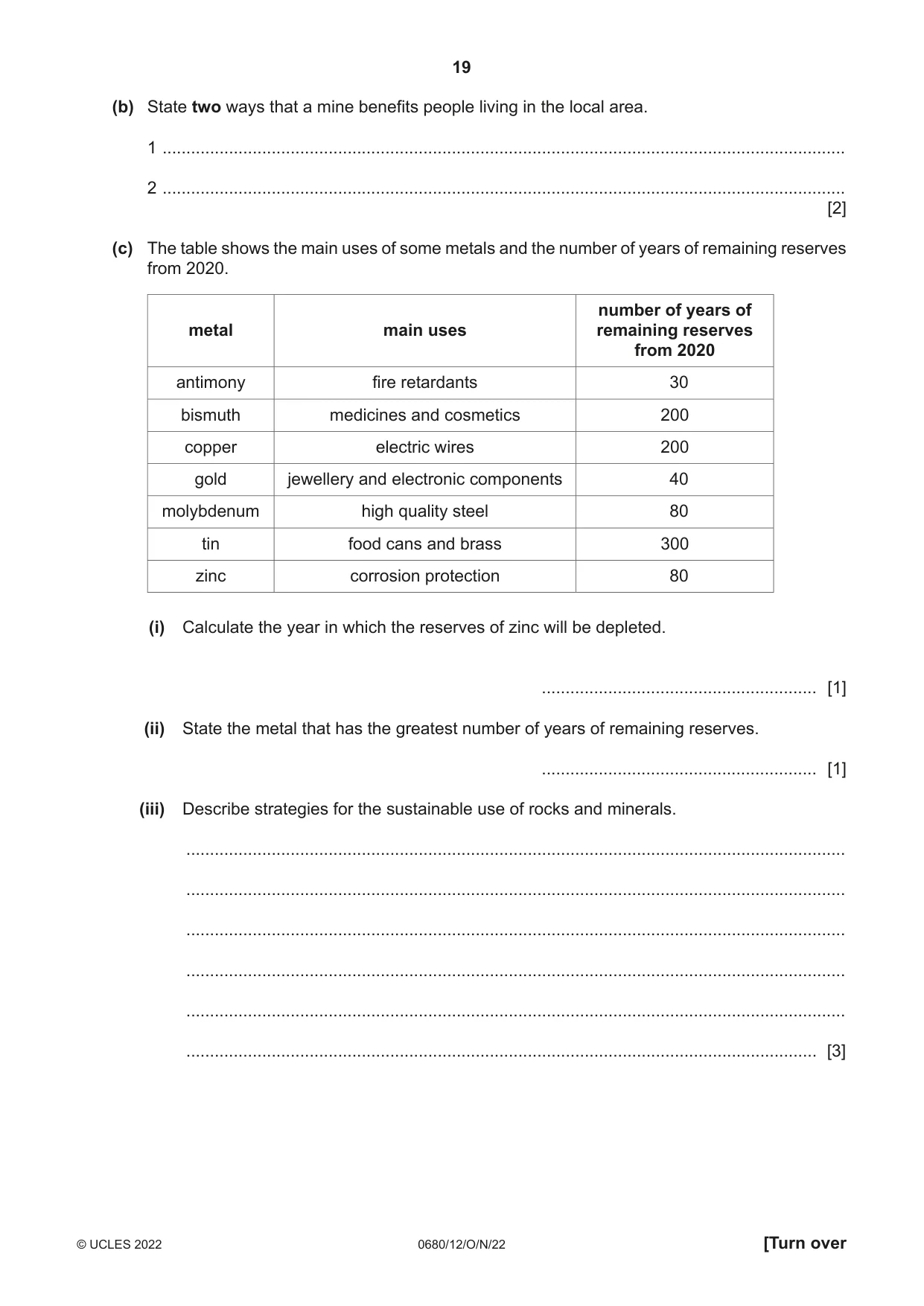
19 0680/12/O/N/22 © UCLES 2022 [Turn over (b) State two ways that a mine benefits people living in the local area. 1 … 2 … [2] (c) The table shows the main uses of some metals and the number of years of remaining reserves from 2020. metal main uses number of years of remaining reserves from 2020 antimony fire retardants 30 bismuth medicines and cosmetics 200 copper electric wires 200 gold jewellery and electronic components 40 molybdenum high quality steel 80 tin food cans and brass 300 zinc corrosion protection 80 (i) Calculate the year in which the reserves of zinc will be depleted. … [1] (ii) State the metal that has the greatest number of years of remaining reserves. … [1] (iii) Describe strategies for the sustainable use of rocks and minerals. … … … … … … [3]
Question paper, page 20
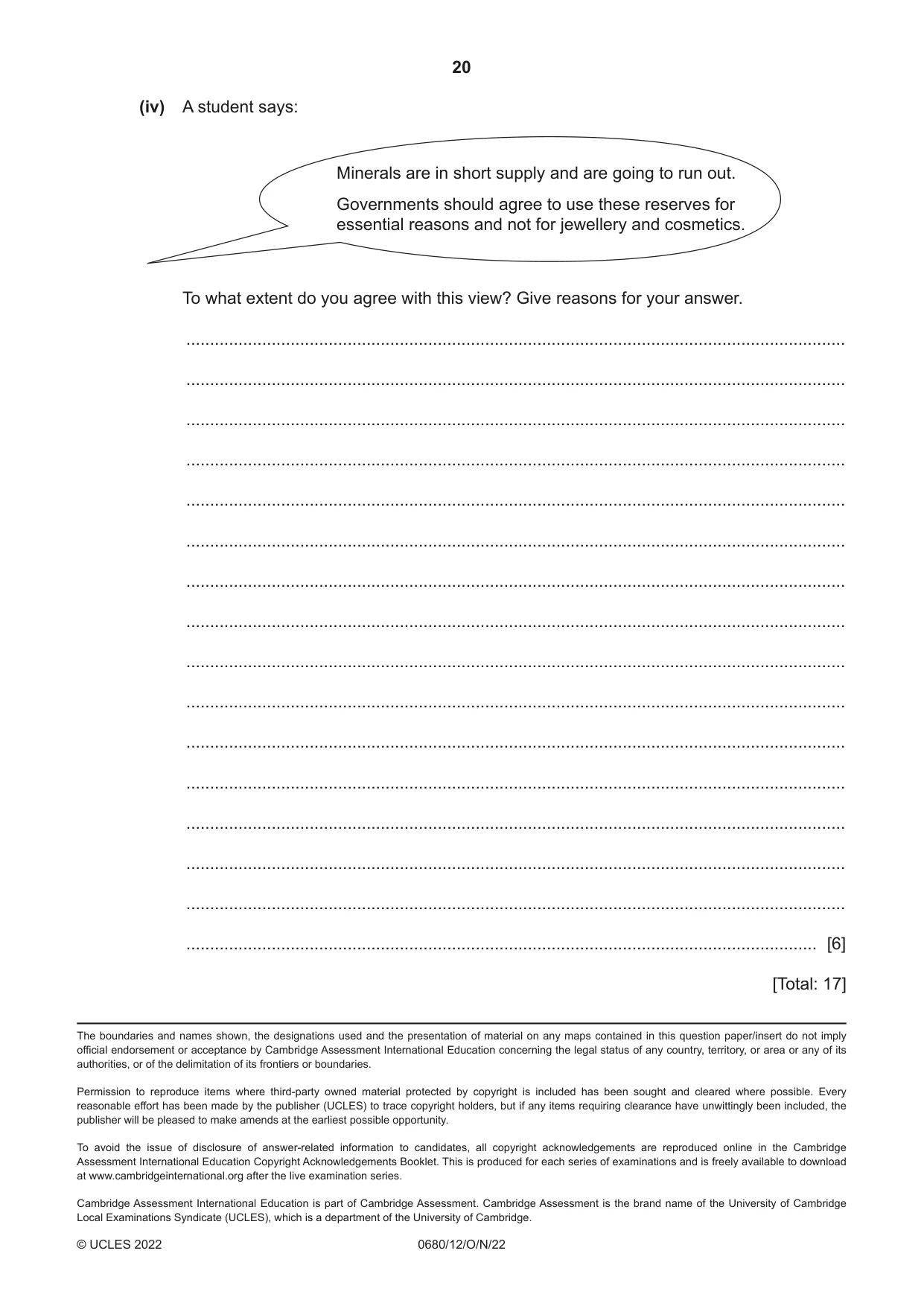
20 0680/12/O/N/22 © UCLES 2022 The boundaries and names shown, the designations used and the presentation of material on any maps contained in this question paper/insert do not imply official endorsement or acceptance by Cambridge Assessment International Education concerning the legal status of any country, territory, or area or any of its authorities, or of the delimitation of its frontiers or boundaries. Permission to reproduce items where third-party owned material protected by copyright is included has been sought and cleared where possible. Every reasonable effort has been made by the publisher (UCLES) to trace copyright holders, but if any items requiring clearance have unwittingly been included, the publisher will be pleased to make amends at the earliest possible opportunity. To avoid the issue of disclosure of answer-related information to candidates, all copyright acknowledgements are reproduced online in the Cambridge Assessment International Education Copyright Acknowledgements Booklet. This is produced for each series of examinations and is freely available to download at www.cambridgeinternational.org after the live examination series. Cambridge Assessment International Education is part of Cambridge Assessment. Cambridge Assessment is the brand name of the University of Cambridge Local Examinations Syndicate (UCLES), which is a department of the University of Cambridge. (iv) A student says: Minerals are in short supply and are going to run out. Governments should agree to use these reserves for essential reasons and not for jewellery and cosmetics. To what extent do you agree with this view? Give reasons for your answer. … … … … … … … … … … … … … … … … [6] [Total: 17]
Mark scheme, page 1
This document consists of 13 printed pages. © UCLES 2022 [Turn over Cambridge IGCSE™ ENVIRONMENTAL MANAGEMENT 0680/12 Paper 1 Theory October/November 2022 MARK SCHEME Maximum Mark: 80 Published This mark scheme is published as an aid to teachers and candidates, to indicate the requirements of the examination. It shows the basis on which Examiners were instructed to award marks. It does not indicate the details of the discussions that took place at an Examiners’ meeting before marking began, which would have considered the acceptability of alternative answers. Mark schemes should be read in conjunction with the question paper and the Principal Examiner Report for Teachers. Cambridge International will not enter into discussions about these mark schemes. Cambridge International is publishing the mark schemes for the October/November 2022 series for most Cambridge IGCSE™, Cambridge International A and AS Level components and some Cambridge O Level components.
Mark scheme, page 2
0680/12 Cambridge IGCSE – Mark Scheme PUBLISHED October/November 2022 © UCLES 2022 Page 2 of 13 Generic Marking Principles These general marking principles must be applied by all examiners when marking candidate answers. They should be applied alongside the specific content of the mark scheme or generic level descriptors for a question. Each question paper and mark scheme will also comply with these marking principles. GENERIC MARKING PRINCIPLE 1: Marks must be awarded in line with: • the specific content of the mark scheme or the generic level descriptors for the question • the specific skills defined in the mark scheme or in the generic level descriptors for the question • the standard of response required by a candidate as exemplified by the standardisation scripts. GENERIC MARKING PRINCIPLE 2: Marks awarded are always whole marks (not half marks, or other fractions). GENERIC MARKING PRINCIPLE 3: Marks must be awarded positively: • marks are awarded for correct/valid answers, as defined in the mark scheme. However, credit is given for valid answers which go beyond the scope of the syllabus and mark scheme, referring to your Team Leader as appropriate • marks are awarded when candidates clearly demonstrate what they know and can do • marks are not deducted for errors • marks are not deducted for omissions • answers should only be judged on the quality of spelling, punctuation and grammar when these features are specifically assessed by the question as indicated by the mark scheme. The meaning, however, should be unambiguous. GENERIC MARKING PRINCIPLE 4: Rules must be applied consistently, e.g. in situations where candidates have not followed instructions or in the application of generic level descriptors.
Mark scheme, page 3
0680/12 Cambridge IGCSE – Mark Scheme PUBLISHED October/November 2022 © UCLES 2022 Page 3 of 13 GENERIC MARKING PRINCIPLE 5: Marks should be awarded using the full range of marks defined in the mark scheme for the question (however; the use of the full mark range may be limited according to the quality of the candidate responses seen). GENERIC MARKING PRINCIPLE 6: Marks awarded are based solely on the requirements as defined in the mark scheme. Marks should not be awarded with grade thresholds or grade descriptors in mind. Science-Specific Marking Principles 1 Examiners should consider the context and scientific use of any keywords when awarding marks. Although keywords may be present, marks should not be awarded if the keywords are used incorrectly. 2 The examiner should not choose between contradictory statements given in the same question part, and credit should not be awarded for any correct statement that is contradicted within the same question part. Wrong science that is irrelevant to the question should be ignored. 3 Although spellings do not have to be correct, spellings of syllabus terms must allow for clear and unambiguous separation from other syllabus terms with which they may be confused (e.g. ethane / ethene, glucagon / glycogen, refraction / reflection). 4 The error carried forward (ecf) principle should be applied, where appropriate. If an incorrect answer is subsequently used in a scientifically correct way, the candidate should be awarded these subsequent marking points. Further guidance will be included in the mark scheme where necessary and any exceptions to this general principle will be noted. 5 ‘List rule’ guidance For questions that require n responses (e.g. State two reasons …): • The response should be read as continuous prose, even when numbered answer spaces are provided. • Any response marked ignore in the mark scheme should not count towards n. • Incorrect responses should not be awarded credit but will still count towards n. • Read the entire response to check for any responses that contradict those that would otherwise be credited. Credit should not be awarded for any responses that are contradicted within the rest of the response. Where two responses contradict one another, this should be treated as a single incorrect response. • Non-contradictory responses after the first n responses may be ignored even if they include incorrect science.
Mark scheme, page 4
0680/12 Cambridge IGCSE – Mark Scheme PUBLISHED October/November 2022 © UCLES 2022 Page 4 of 13 6 Calculation specific guidance Correct answers to calculations should be given full credit even if there is no working or incorrect working, unless the question states ‘show your working’. For questions in which the number of significant figures required is not stated, credit should be awarded for correct answers when rounded by the examiner to the number of significant figures given in the mark scheme. This may not apply to measured values. For answers given in standard form (e.g. a 10n) in which the convention of restricting the value of the coefficient (a) to a value between 1 and 10 is not followed, credit may still be awarded if the answer can be converted to the answer given in the mark scheme. Unless a separate mark is given for a unit, a missing or incorrect unit will normally mean that the final calculation mark is not awarded. Exceptions to this general principle will be noted in the mark scheme. 7 Guidance for chemical equations Multiples / fractions of coefficients used in chemical equations are acceptable unless stated otherwise in the mark scheme. State symbols given in an equation should be ignored unless asked for in the question or stated otherwise in the mark scheme.
Mark scheme, page 5
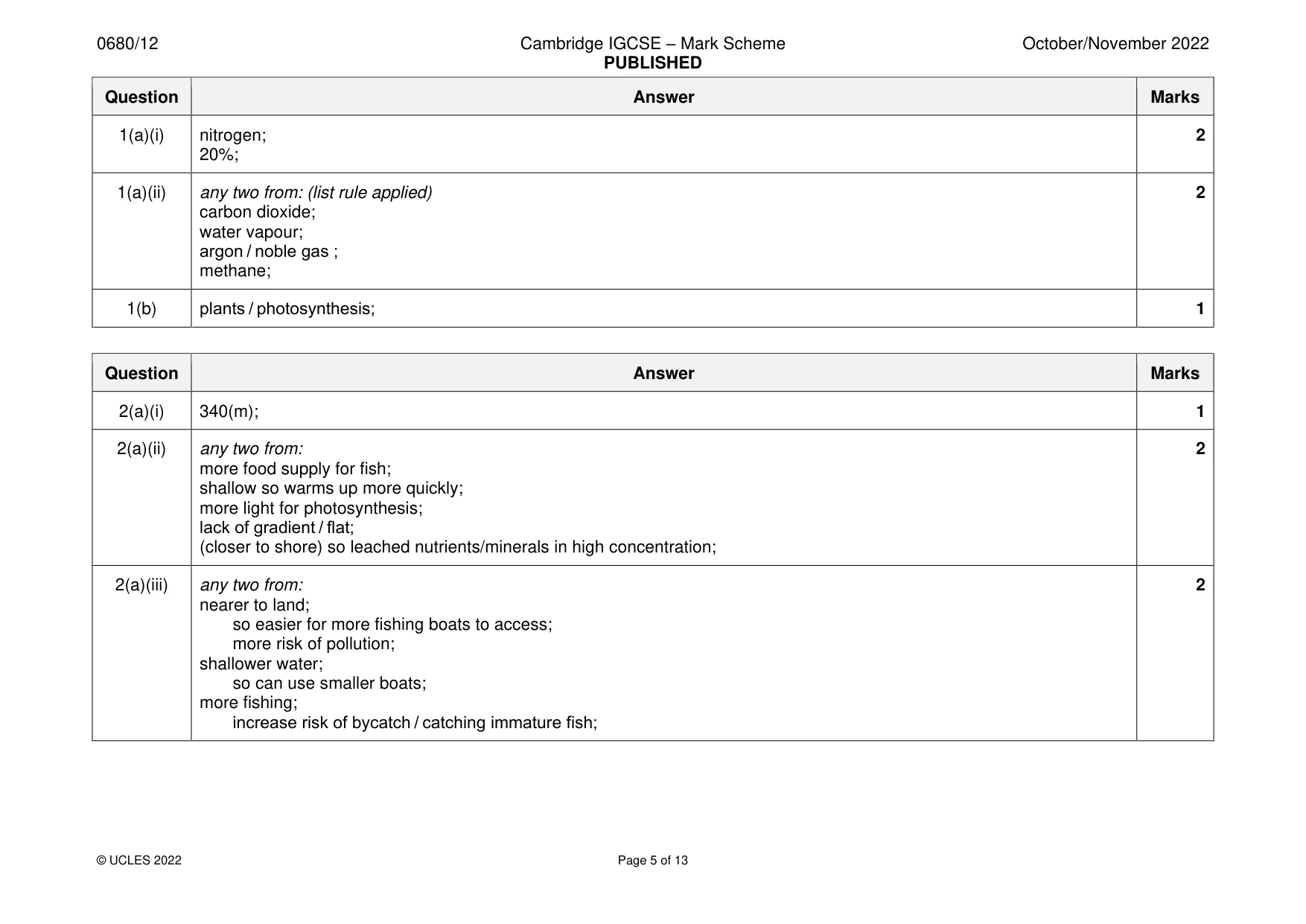
0680/12 Cambridge IGCSE – Mark Scheme PUBLISHED October/November 2022 © UCLES 2022 Page 5 of 13 Question Answer Marks 1(a)(i) nitrogen; 20%; 2 1(a)(ii) any two from: (list rule applied) carbon dioxide; water vapour; argon / noble gas ; methane; 2 1(b) plants / photosynthesis; 1 Question Answer Marks 2(a)(i) 340(m); 1 2(a)(ii) any two from: more food supply for fish; shallow so warms up more quickly; more light for photosynthesis; lack of gradient / flat; (closer to shore) so leached nutrients/minerals in high concentration; 2 2(a)(iii) any two from: nearer to land; so easier for more fishing boats to access; more risk of pollution; shallower water; so can use smaller boats; more fishing; increase risk of bycatch / catching immature fish; 2
Mark scheme, page 6
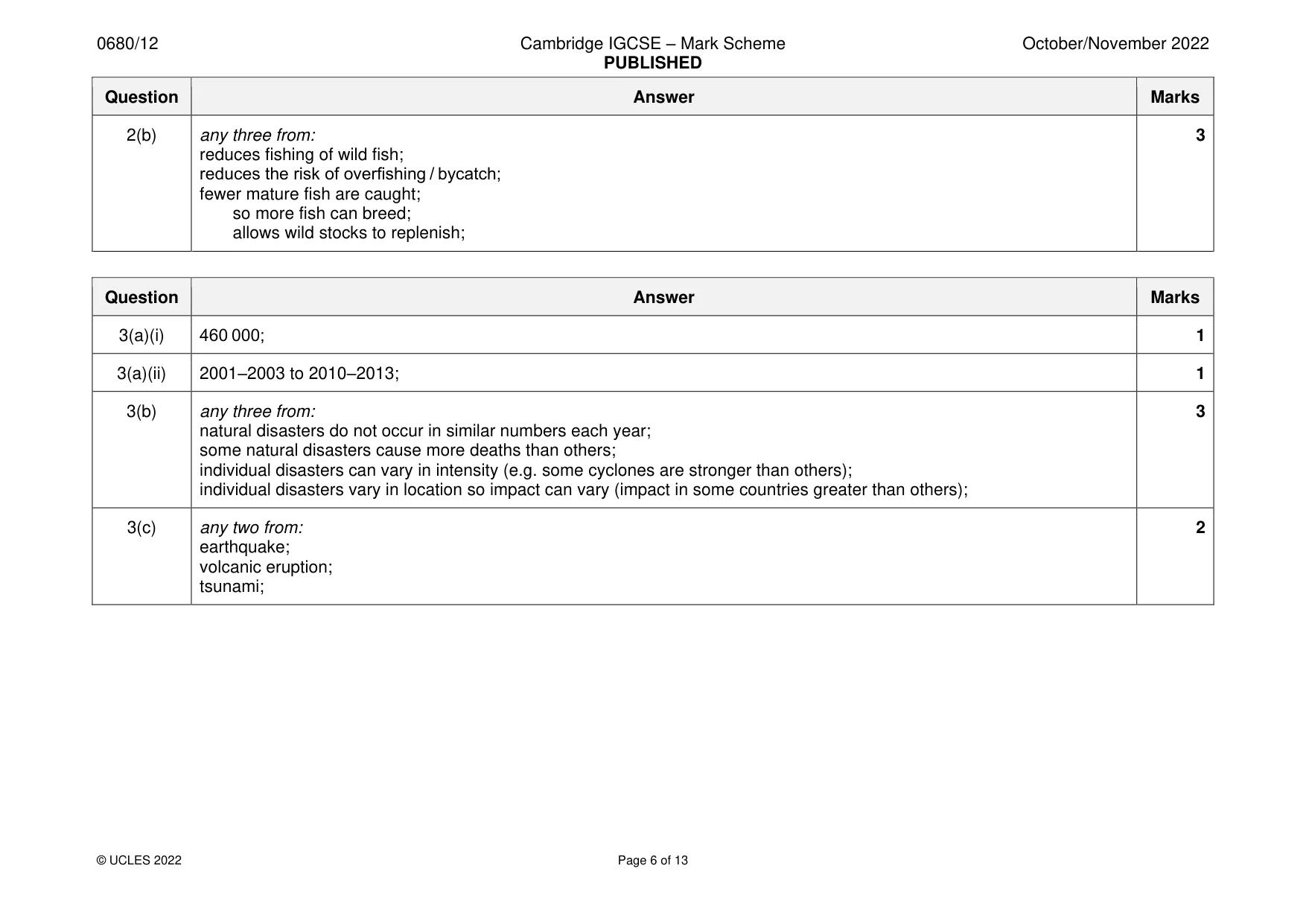
0680/12 Cambridge IGCSE – Mark Scheme PUBLISHED October/November 2022 © UCLES 2022 Page 6 of 13 Question Answer Marks 2(b) any three from: reduces fishing of wild fish; reduces the risk of overfishing / bycatch; fewer mature fish are caught; so more fish can breed; allows wild stocks to replenish; 3 Question Answer Marks 3(a)(i) 460 000; 1 3(a)(ii) 2001–2003 to 2010–2013; 1 3(b) any three from: natural disasters do not occur in similar numbers each year; some natural disasters cause more deaths than others; individual disasters can vary in intensity (e.g. some cyclones are stronger than others); individual disasters vary in location so impact can vary (impact in some countries greater than others); 3 3(c) any two from: earthquake; volcanic eruption; tsunami; 2
Mark scheme, page 7
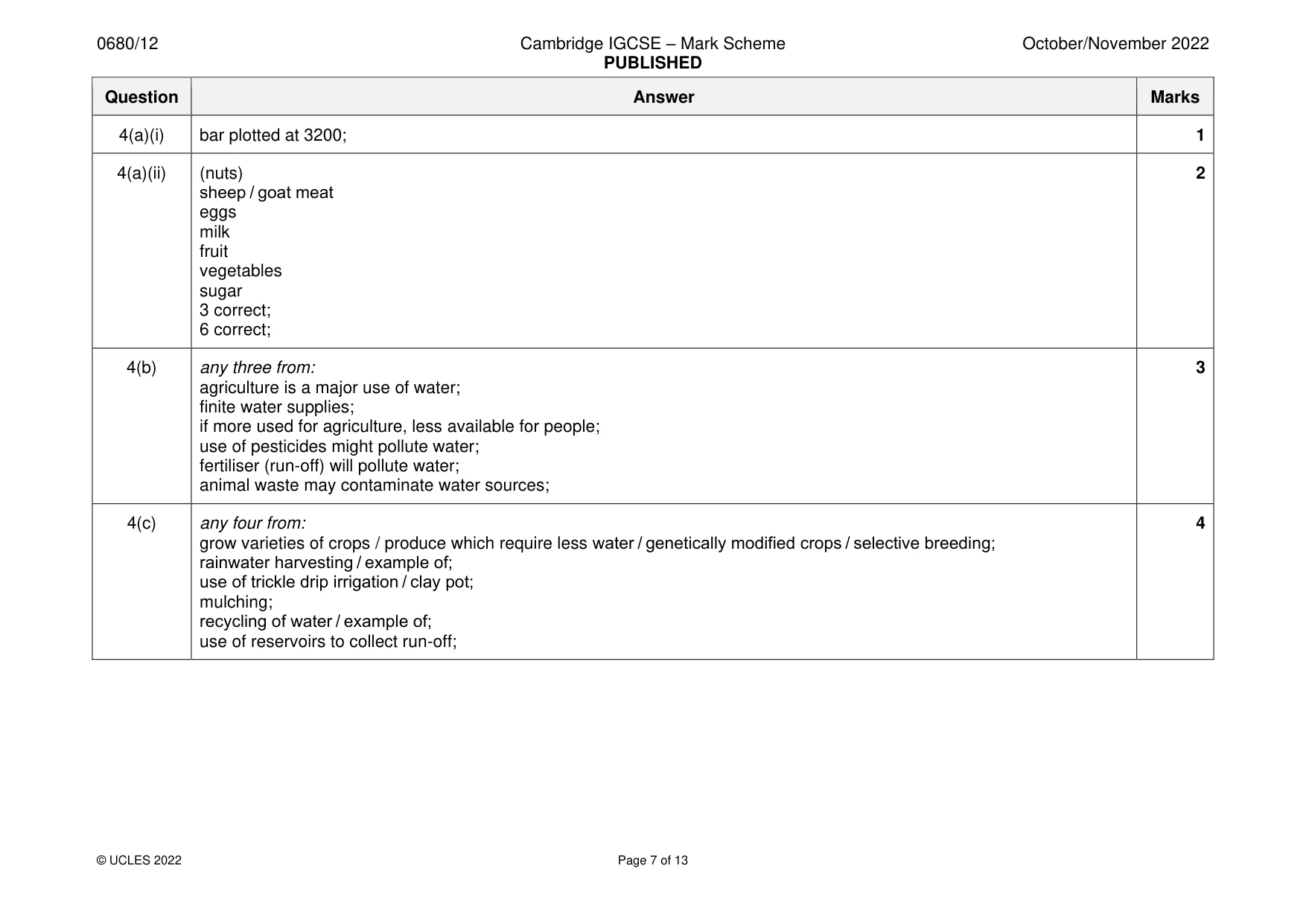
0680/12 Cambridge IGCSE – Mark Scheme PUBLISHED October/November 2022 © UCLES 2022 Page 7 of 13 Question Answer Marks 4(a)(i) bar plotted at 3200; 1 4(a)(ii) (nuts) sheep / goat meat eggs milk fruit vegetables sugar 3 correct; 6 correct; 2 4(b) any three from: agriculture is a major use of water; finite water supplies; if more used for agriculture, less available for people; use of pesticides might pollute water; fertiliser (run-off) will pollute water; animal waste may contaminate water sources; 3 4(c) any four from: grow varieties of crops / produce which require less water / genetically modified crops / selective breeding; rainwater harvesting / example of; use of trickle drip irrigation / clay pot; mulching; recycling of water / example of; use of reservoirs to collect run-off; 4
Mark scheme, page 8
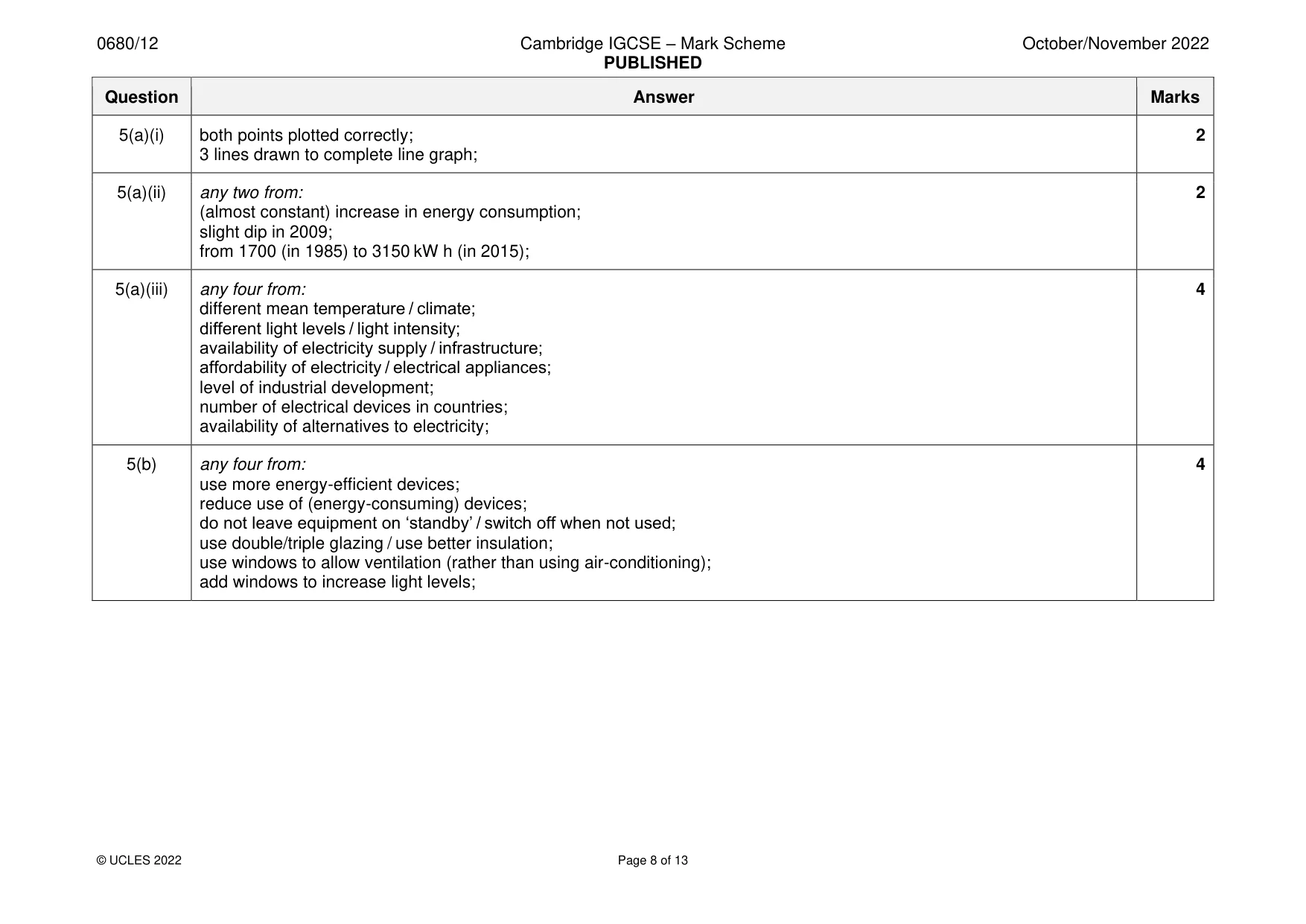
0680/12 Cambridge IGCSE – Mark Scheme PUBLISHED October/November 2022 © UCLES 2022 Page 8 of 13 Question Answer Marks 5(a)(i) both points plotted correctly; 3 lines drawn to complete line graph; 2 5(a)(ii) any two from: (almost constant) increase in energy consumption; slight dip in 2009; from 1700 (in 1985) to 3150 kW h (in 2015); 2 5(a)(iii) any four from: different mean temperature / climate; different light levels / light intensity; availability of electricity supply / infrastructure; affordability of electricity / electrical appliances; level of industrial development; number of electrical devices in countries; availability of alternatives to electricity; 4 5(b) any four from: use more energy-efficient devices; reduce use of (energy-consuming) devices; do not leave equipment on ‘standby’ / switch off when not used; use double/triple glazing / use better insulation; use windows to allow ventilation (rather than using air-conditioning); add windows to increase light levels; 4
Mark scheme, page 9
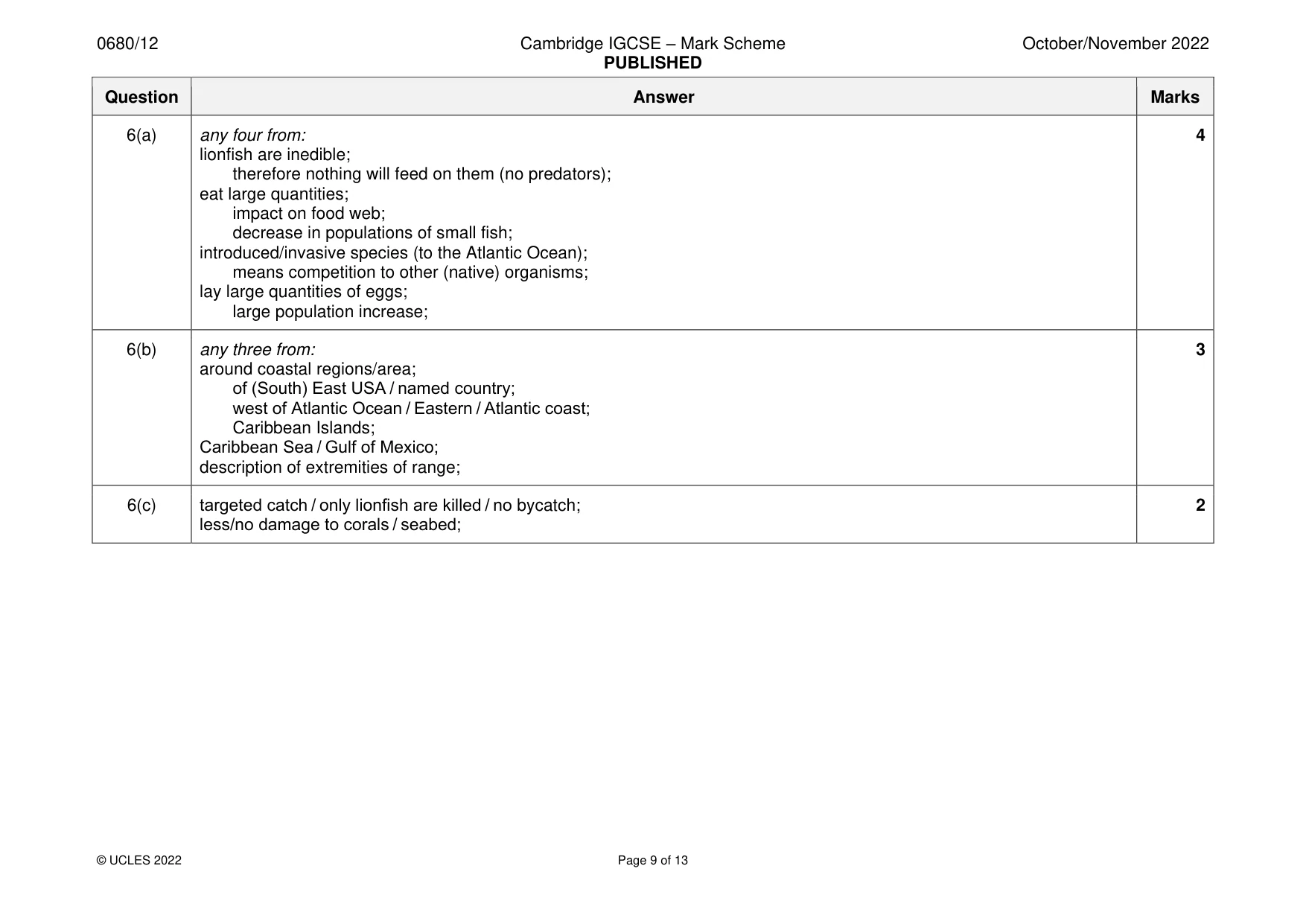
0680/12 Cambridge IGCSE – Mark Scheme PUBLISHED October/November 2022 © UCLES 2022 Page 9 of 13 Question Answer Marks 6(a) any four from: lionfish are inedible; therefore nothing will feed on them (no predators); eat large quantities; impact on food web; decrease in populations of small fish; introduced/invasive species (to the Atlantic Ocean); means competition to other (native) organisms; lay large quantities of eggs; large population increase; 4 6(b) any three from: around coastal regions/area; of (South) East USA / named country; west of Atlantic Ocean / Eastern / Atlantic coast; Caribbean Islands; Caribbean Sea / Gulf of Mexico; description of extremities of range; 3 6(c) targeted catch / only lionfish are killed / no bycatch; less/no damage to corals / seabed; 2
Mark scheme, page 10
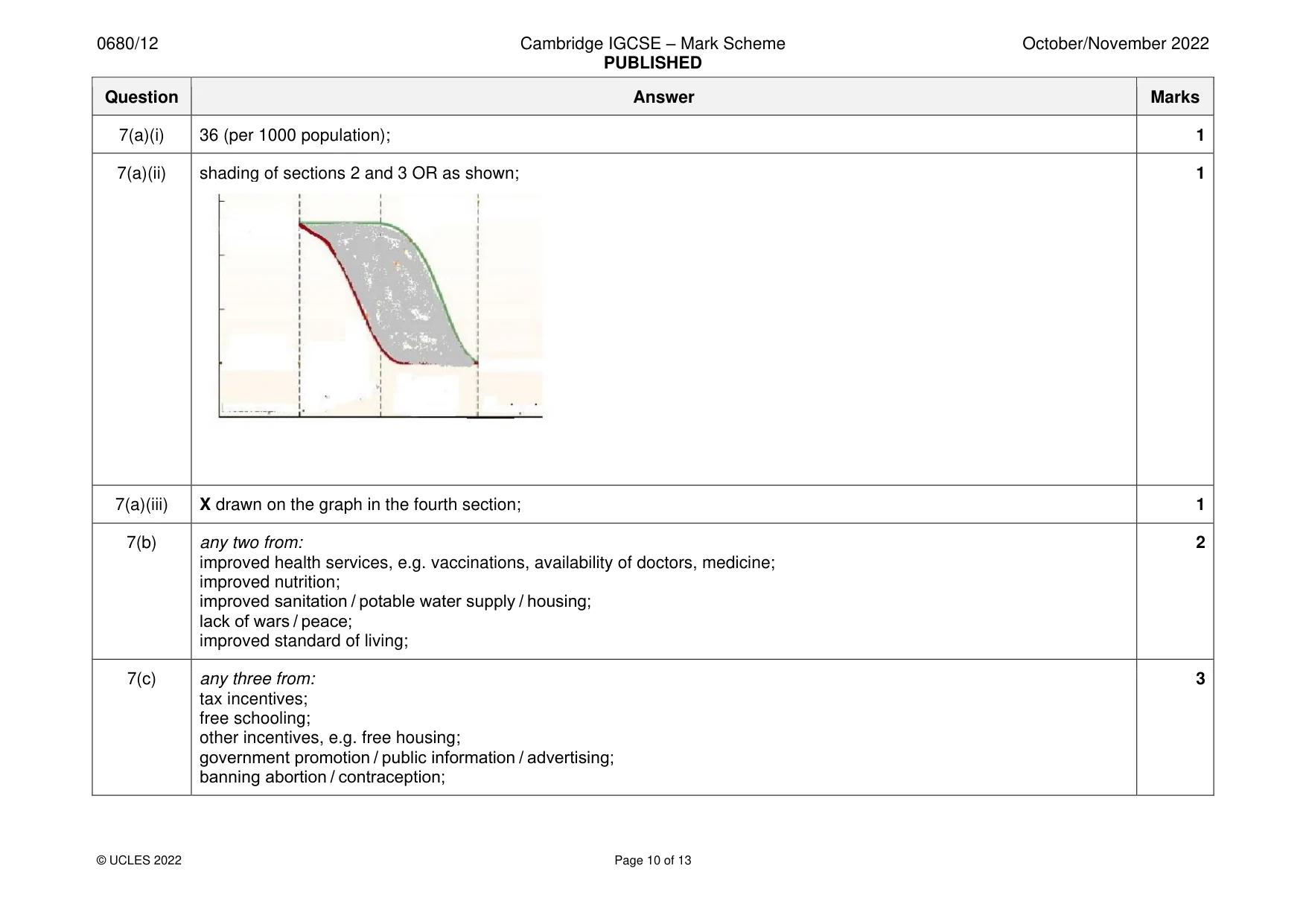
0680/12 Cambridge IGCSE – Mark Scheme PUBLISHED October/November 2022 © UCLES 2022 Page 10 of 13 Question Answer Marks 7(a)(i) 36 (per 1000 population); 1 7(a)(ii) shading of sections 2 and 3 OR as shown; 1 7(a)(iii) X drawn on the graph in the fourth section; 1 7(b) any two from: improved health services, e.g. vaccinations, availability of doctors, medicine; improved nutrition; improved sanitation / potable water supply / housing; lack of wars / peace; improved standard of living; 2 7(c) any three from: tax incentives; free schooling; other incentives, e.g. free housing; government promotion / public information / advertising; banning abortion / contraception; 3
Mark scheme, page 11
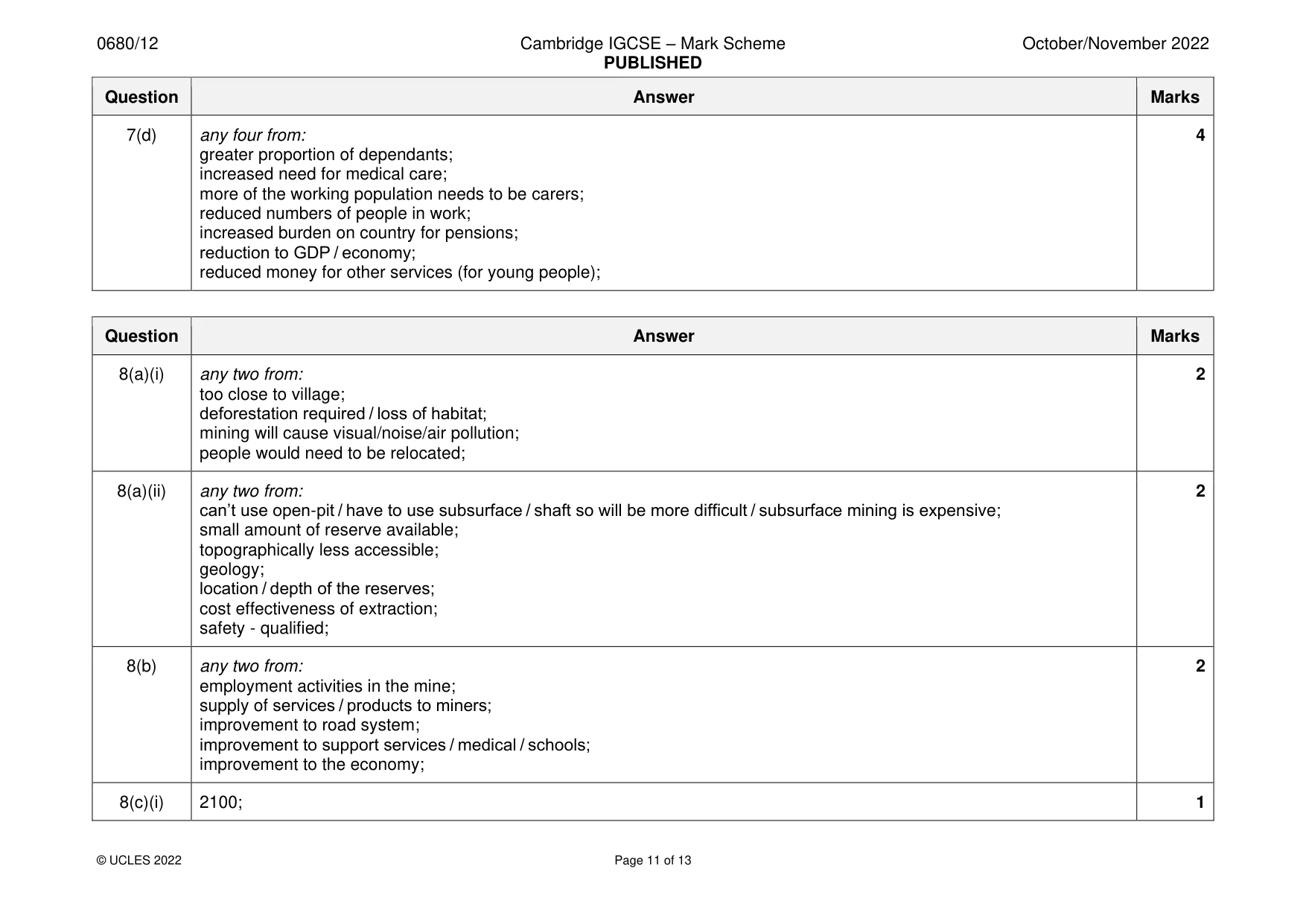
0680/12 Cambridge IGCSE – Mark Scheme PUBLISHED October/November 2022 © UCLES 2022 Page 11 of 13 Question Answer Marks 7(d) any four from: greater proportion of dependants; increased need for medical care; more of the working population needs to be carers; reduced numbers of people in work; increased burden on country for pensions; reduction to GDP / economy; reduced money for other services (for young people); 4 Question Answer Marks 8(a)(i) any two from: too close to village; deforestation required / loss of habitat; mining will cause visual/noise/air pollution; people would need to be relocated; 2 8(a)(ii) any two from: can’t use open-pit / have to use subsurface / shaft so will be more difficult / subsurface mining is expensive; small amount of reserve available; topographically less accessible; geology; location / depth of the reserves; cost effectiveness of extraction; safety - qualified; 2 8(b) any two from: employment activities in the mine; supply of services / products to miners; improvement to road system; improvement to support services / medical / schools; improvement to the economy; 2 8(c)(i) 2100; 1
Mark scheme, page 12
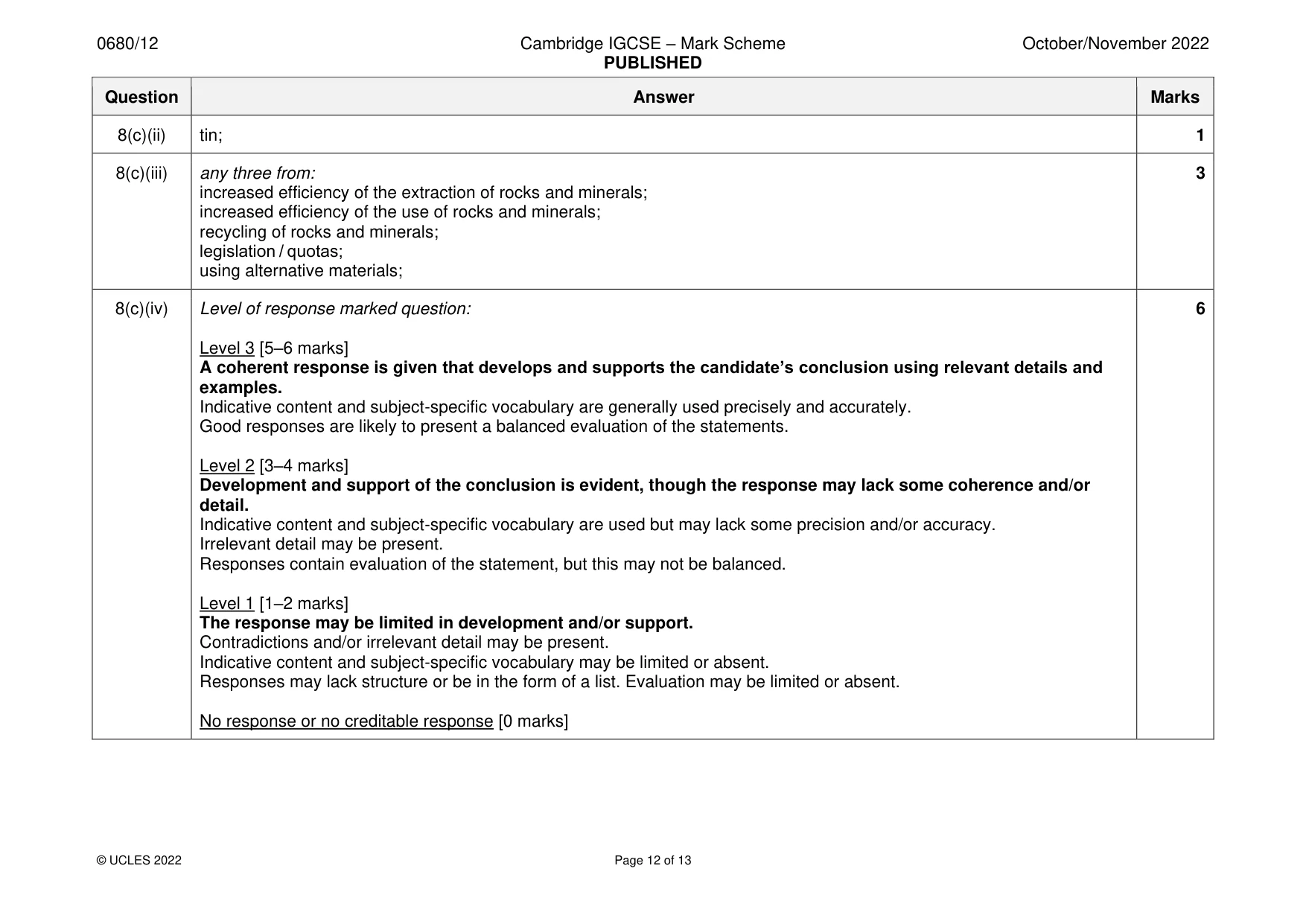
0680/12 Cambridge IGCSE – Mark Scheme PUBLISHED October/November 2022 © UCLES 2022 Page 12 of 13 Question Answer Marks 8(c)(ii) tin; 1 8(c)(iii) any three from: increased efficiency of the extraction of rocks and minerals; increased efficiency of the use of rocks and minerals; recycling of rocks and minerals; legislation / quotas; using alternative materials; 3 8(c)(iv) Level of response marked question: Level 3 [5–6 marks] A coherent response is given that develops and supports the candidate’s conclusion using relevant details and examples. Indicative content and subject-specific vocabulary are generally used precisely and accurately. Good responses are likely to present a balanced evaluation of the statements. Level 2 [3–4 marks] Development and support of the conclusion is evident, though the response may lack some coherence and/or detail. Indicative content and subject-specific vocabulary are used but may lack some precision and/or accuracy. Irrelevant detail may be present. Responses contain evaluation of the statement, but this may not be balanced. Level 1 [1–2 marks] The response may be limited in development and/or support. Contradictions and/or irrelevant detail may be present. Indicative content and subject-specific vocabulary may be limited or absent. Responses may lack structure or be in the form of a list. Evaluation may be limited or absent. No response or no creditable response [0 marks] 6
Mark scheme, page 13
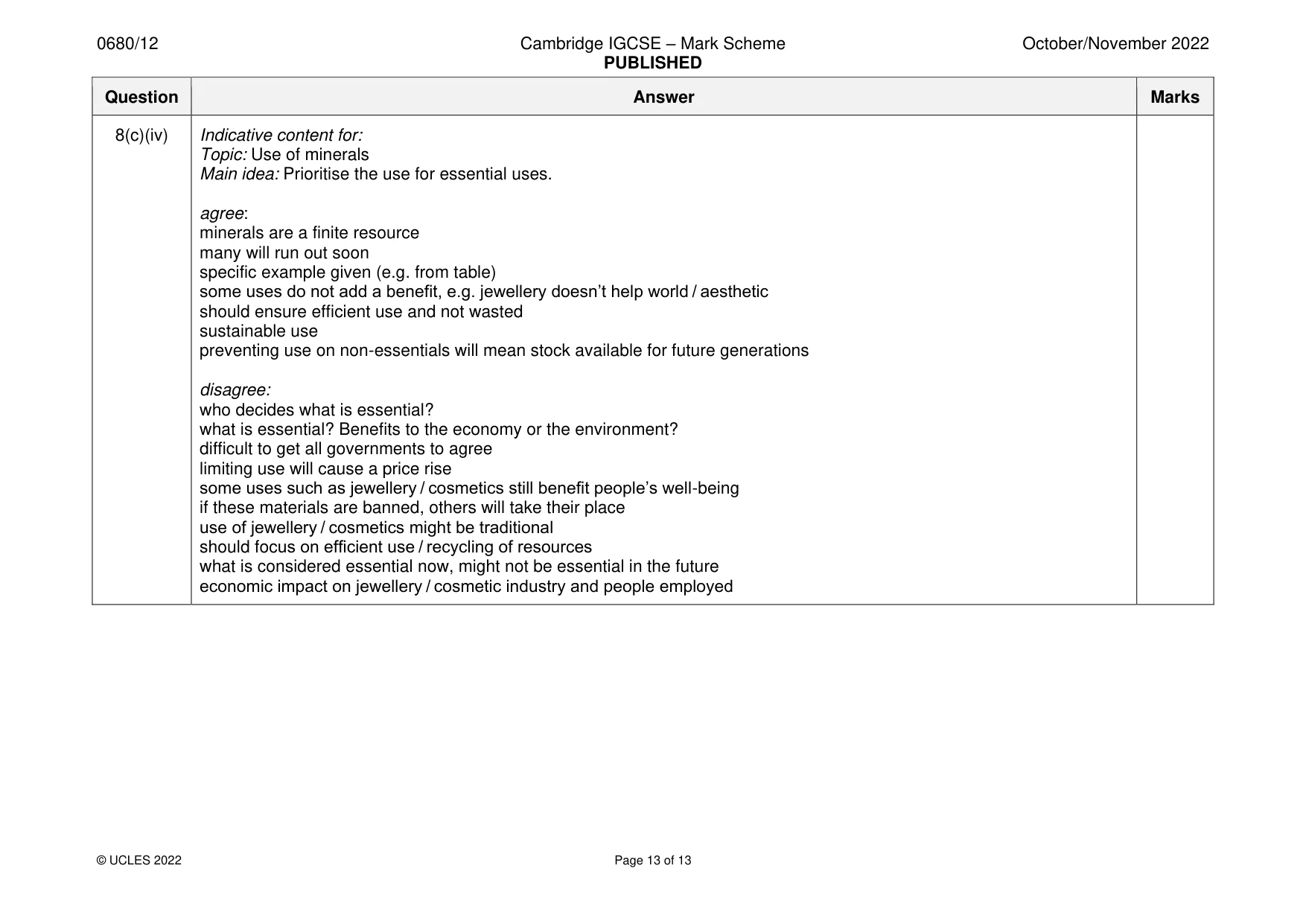
0680/12 Cambridge IGCSE – Mark Scheme PUBLISHED October/November 2022 © UCLES 2022 Page 13 of 13 Question Answer Marks 8(c)(iv) Indicative content for: Topic: Use of minerals Main idea: Prioritise the use for essential uses. agree: minerals are a finite resource many will run out soon specific example given (e.g. from table) some uses do not add a benefit, e.g. jewellery doesn’t help world / aesthetic should ensure efficient use and not wasted sustainable use preventing use on non-essentials will mean stock available for future generations disagree: who decides what is essential? what is essential? Benefits to the economy or the environment? difficult to get all governments to agree limiting use will cause a price rise some uses such as jewellery / cosmetics still benefit people’s well-being if these materials are banned, others will take their place use of jewellery / cosmetics might be traditional should focus on efficient use / recycling of resources what is considered essential now, might not be essential in the future economic impact on jewellery / cosmetic industry and people employed
What you needed in this session
Cambridge’s own grade thresholds for 2022 Oct/Nov, Paper 1 · Variant 2. A higher threshold means an easier paper — the bar moves with how the cohort did.