Cambridge IGCSE Environmental Management 0680 — 2024 May/June Paper 1 · Variant 2
0680/12/M/J/24 · 80 marks · ≈90 min
The question paper and its mark scheme, free to read here and free to download. This is Cambridge’s own paper, exactly as it was sat.
Question paper20 pages



Mark scheme13 pages
Answers below. Sit the paper first if you are practising.
Paper as text
Question paper, page 1
This document has 20 pages. Any blank pages are indicated. [Turn over Cambridge IGCSE™ ENVIRONMENTAL MANAGEMENT 0680/12 Paper 1 Theory May/June 2024 1 hour 45 minutes You must answer on the question paper. No additional materials are needed. INSTRUCTIONS ● Answer all questions. ● Use a black or dark blue pen. You may use an HB pencil for any diagrams or graphs. ● Write your name, centre number and candidate number in the boxes at the top of the page. ● Write your answer to each question in the space provided. ● Do not use an erasable pen or correction fluid. ● Do not write on any bar codes. ● You may use a calculator. ● You should show all your working and use appropriate units. INFORMATION ● The total mark for this paper is 80. ● The number of marks for each question or part question is shown in brackets [ ]. * 5 5 7 1 8 7 9 8 8 2 * DC (PB/SW) 331464/4 © UCLES 2024
Question paper, page 2
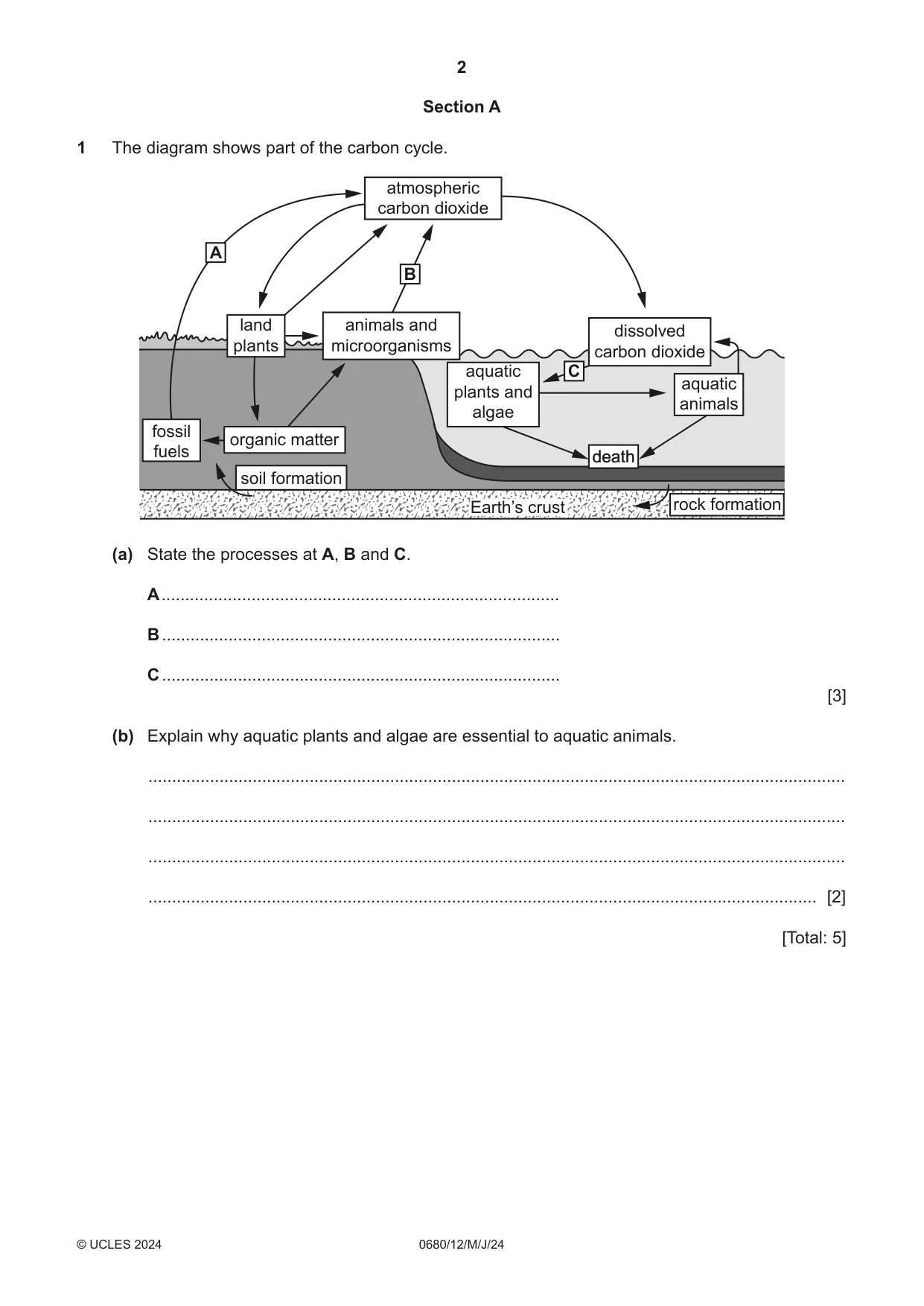
2 0680/12/M/J/24 © UCLES 2024 Section A 1 The diagram shows part of the carbon cycle. land plants fossil fuels animals and microorganisms aquatic plants and algae death death Earth’s crust Earth’s crust soil formation soil formation rock formation rock formation organic matter atmospheric carbon dioxide aquatic animals dissolved carbon dioxide A B C (a) State the processes at A, B and C. A … B … C … [3] (b) Explain why aquatic plants and algae are essential to aquatic animals. … … … … [2] [Total: 5]
Question paper, page 3
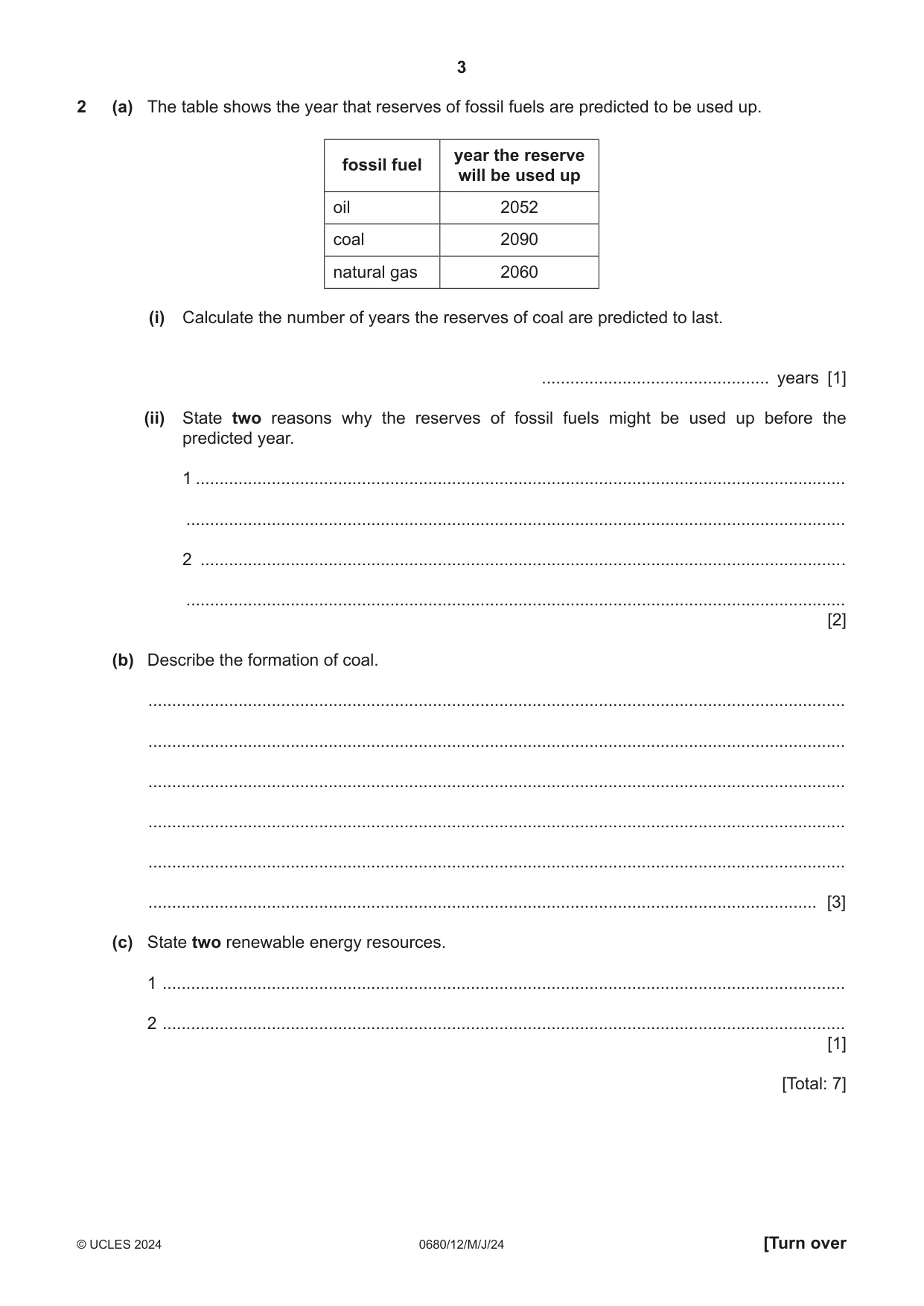
3 0680/12/M/J/24 © UCLES 2024 [Turn over 2 (a) The table shows the year that reserves of fossil fuels are predicted to be used up. fossil fuel year the reserve will be used up oil 2052 coal 2090 natural gas 2060 (i) Calculate the number of years the reserves of coal are predicted to last. … years [1] (ii) State two reasons why the reserves of fossil fuels might be used up before the predicted year. 1 … … 2 … … [2] (b) Describe the formation of coal. … … … … … … [3] (c) State two renewable energy resources. 1 … 2 … [1] [Total: 7]
Question paper, page 4
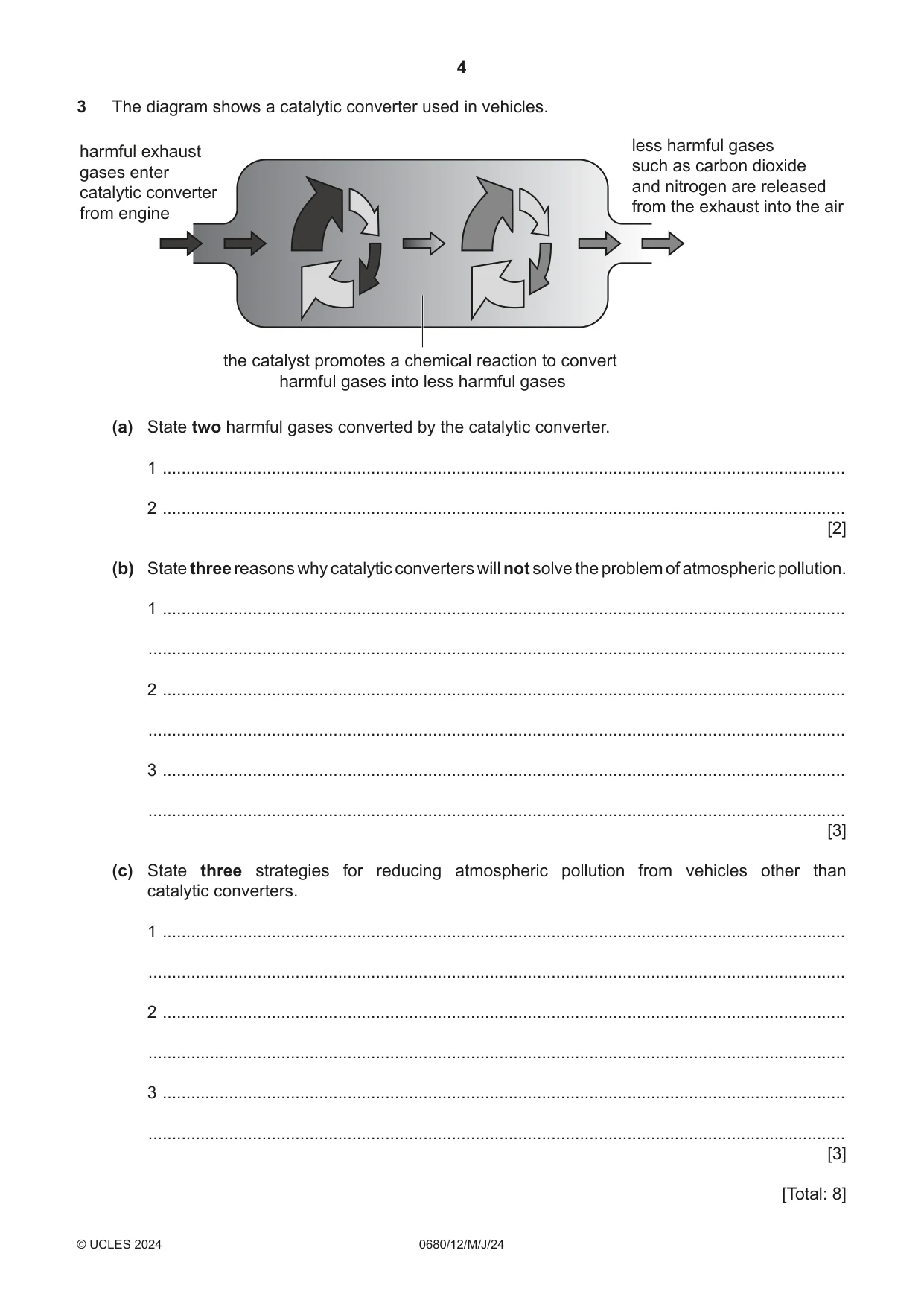
4 0680/12/M/J/24 © UCLES 2024 3 The diagram shows a catalytic converter used in vehicles. harmful exhaust gases enter catalytic converter from engine the catalyst promotes a chemical reaction to convert harmful gases into less harmful gases less harmful gases such as carbon dioxide and nitrogen are released from the exhaust into the air (a) State two harmful gases converted by the catalytic converter. 1 … 2 … [2] (b) State three reasons why catalytic converters will not solve the problem of atmospheric pollution. 1 … … 2 … … 3 … … [3] (c) State three strategies for reducing atmospheric pollution from vehicles other than catalytic converters. 1 … … 2 … … 3 … … [3] [Total: 8]
Question paper, page 5
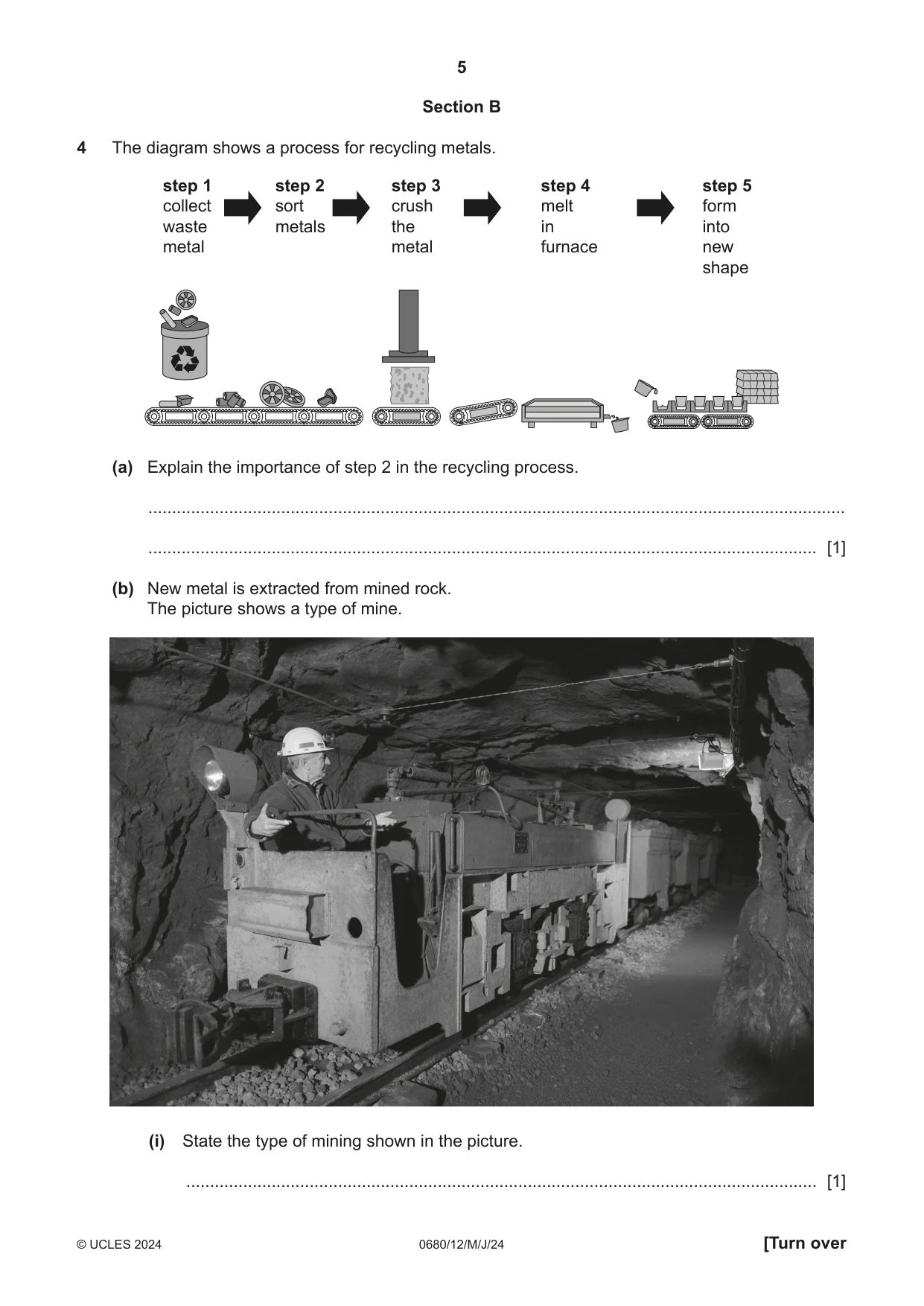
5 0680/12/M/J/24 © UCLES 2024 [Turn over Section B 4 The diagram shows a process for recycling metals. step 1 collect waste metal step 2 sort metals step 3 crush the metal step 4 melt in furnace step 5 form into new shape (a) Explain the importance of step 2 in the recycling process. … … [1] (b) New metal is extracted from mined rock. The picture shows a type of mine. (i) State the type of mining shown in the picture. … [1]
Question paper, page 6
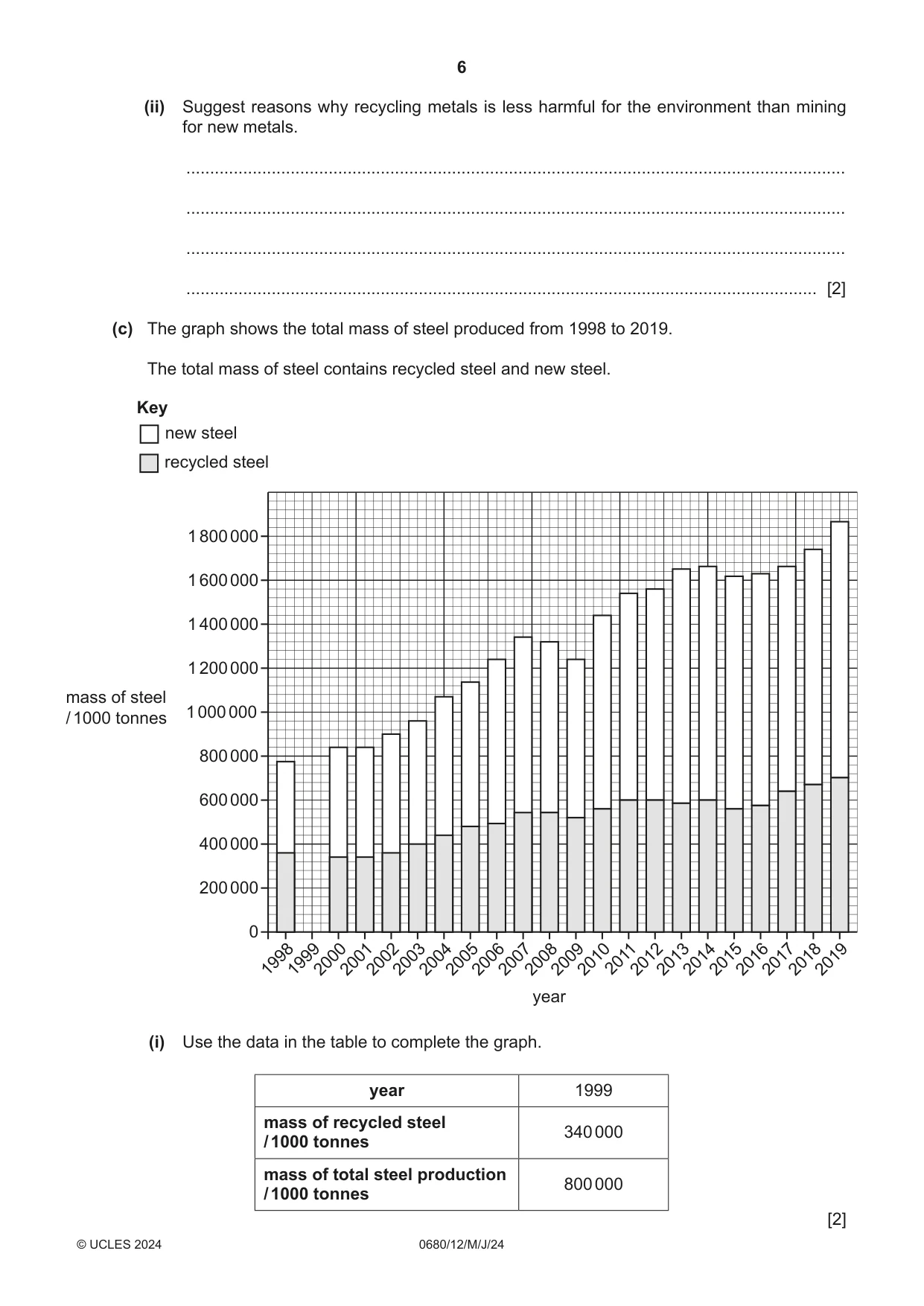
6 0680/12/M/J/24 © UCLES 2024 (ii) Suggest reasons why recycling metals is less harmful for the environment than mining for new metals. … … … … [2] (c) The graph shows the total mass of steel produced from 1998 to 2019. The total mass of steel contains recycled steel and new steel. 0 200 000 1998 1999 2000 2001 2002 2003 2004 2005 2006 2007 2008 2009 2010 2011 2012 2013 2014 2015 2016 2017 2018 2019 400 000 600 000 800 000 1 000 000 1 200 000 1 400 000 1 600 000 1 800 000 recycled steel new steel Key mass of steel / 1000 tonnes year (i) Use the data in the table to complete the graph. year 1999 mass of recycled steel / 1000 tonnes 340 000 mass of total steel production / 1000 tonnes 800 000 [2]
Question paper, page 7
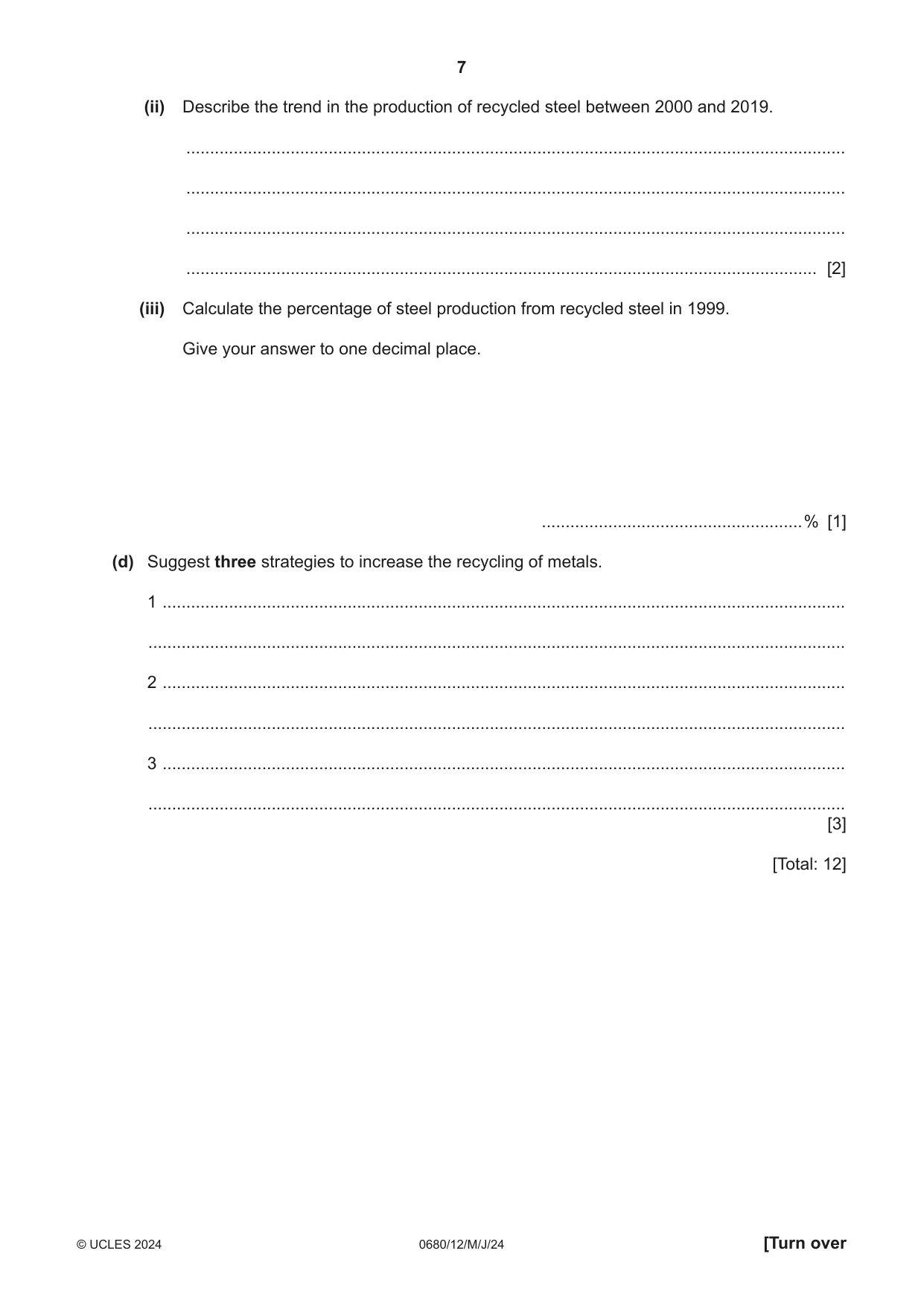
7 0680/12/M/J/24 © UCLES 2024 [Turn over (ii) Describe the trend in the production of recycled steel between 2000 and 2019. … … … … [2] (iii) Calculate the percentage of steel production from recycled steel in 1999. Give your answer to one decimal place. …% [1] (d) Suggest three strategies to increase the recycling of metals. 1 … … 2 … … 3 … … [3] [Total: 12]
Question paper, page 8
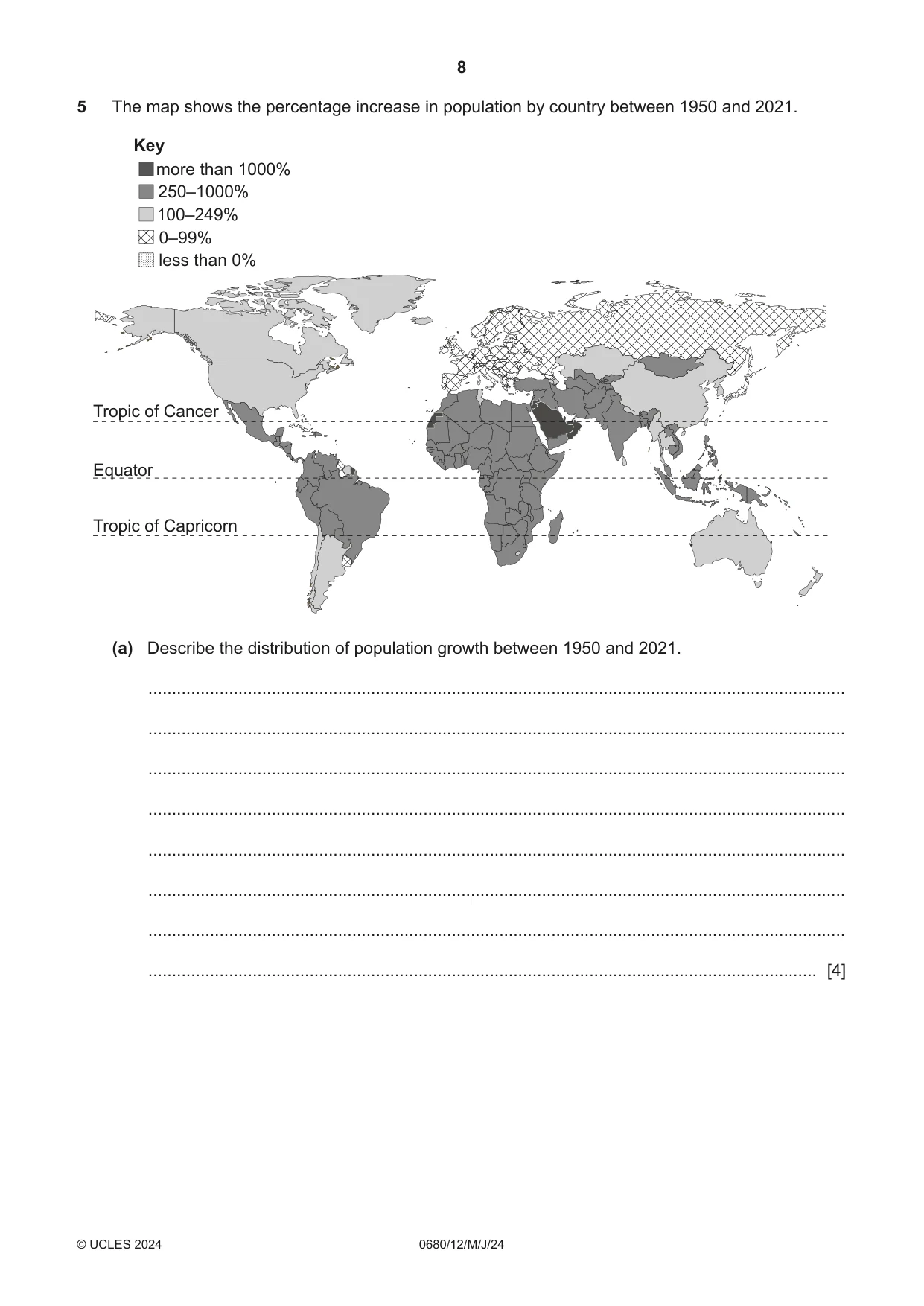
8 0680/12/M/J/24 © UCLES 2024 5 The map shows the percentage increase in population by country between 1950 and 2021. more than 1000% 250–1000% Key 100–249% 0–99% less than 0% Tropic of Cancer Tropic of Capricorn Equator (a) Describe the distribution of population growth between 1950 and 2021. … … … … … … … … [4]
Question paper, page 9
9 0680/12/M/J/24 © UCLES 2024 [Turn over (b) Suggest the impacts on natural resources for countries with an increase in population of more than 1000%. Give reasons for your answer. … … … … … … [3] (c) A country with a low population growth introduces a pronatalist strategy to encourage families to have more children. (i) State one example of a pronatalist strategy. … [1] (ii) Suggest one negative impact of this strategy on the economy of a country. … [1] [Total: 9]
Question paper, page 10
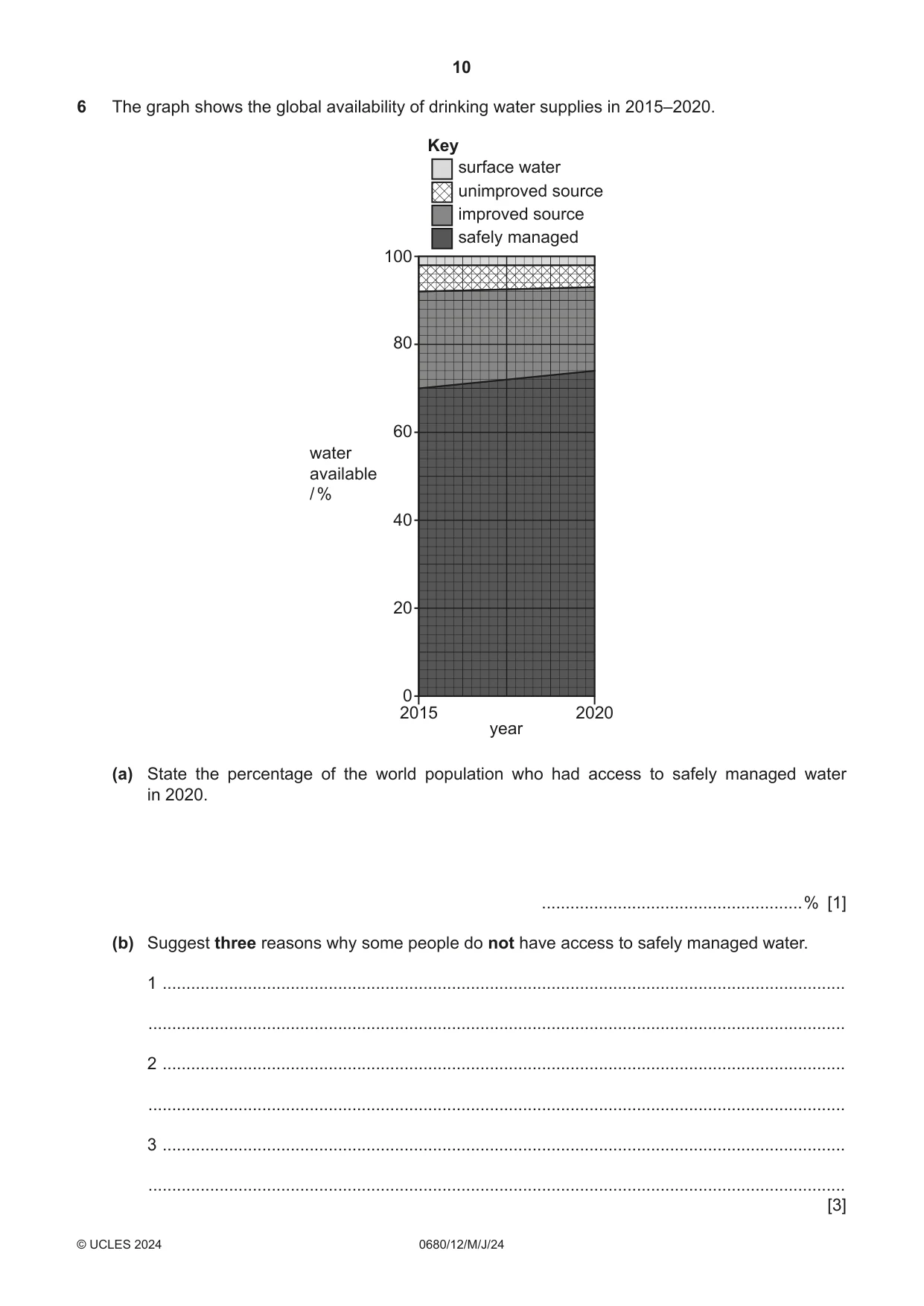
10 0680/12/M/J/24 © UCLES 2024 6 The graph shows the global availability of drinking water supplies in 2015–2020. surface water unimproved source improved source safely managed Key 0 2015 year 2020 20 40 60 80 100 water available / % (a) State the percentage of the world population who had access to safely managed water in 2020. …% [1] (b) Suggest three reasons why some people do not have access to safely managed water. 1 … … 2 … … 3 … … [3]
Question paper, page 11
11 0680/12/M/J/24 © UCLES 2024 [Turn over (c) Cholera is an infectious disease that can enter drinking water. (i) State two strategies to treat drinking water which is contaminated with cholera. 1 … 2 … [2] (ii) Describe how cholera enters drinking water. … … … … … … [3] (d) Suggest two reasons why some fresh water sources are not used for drinking water, other than contamination. 1 … … 2 … … [2] [Total: 11]
Question paper, page 12
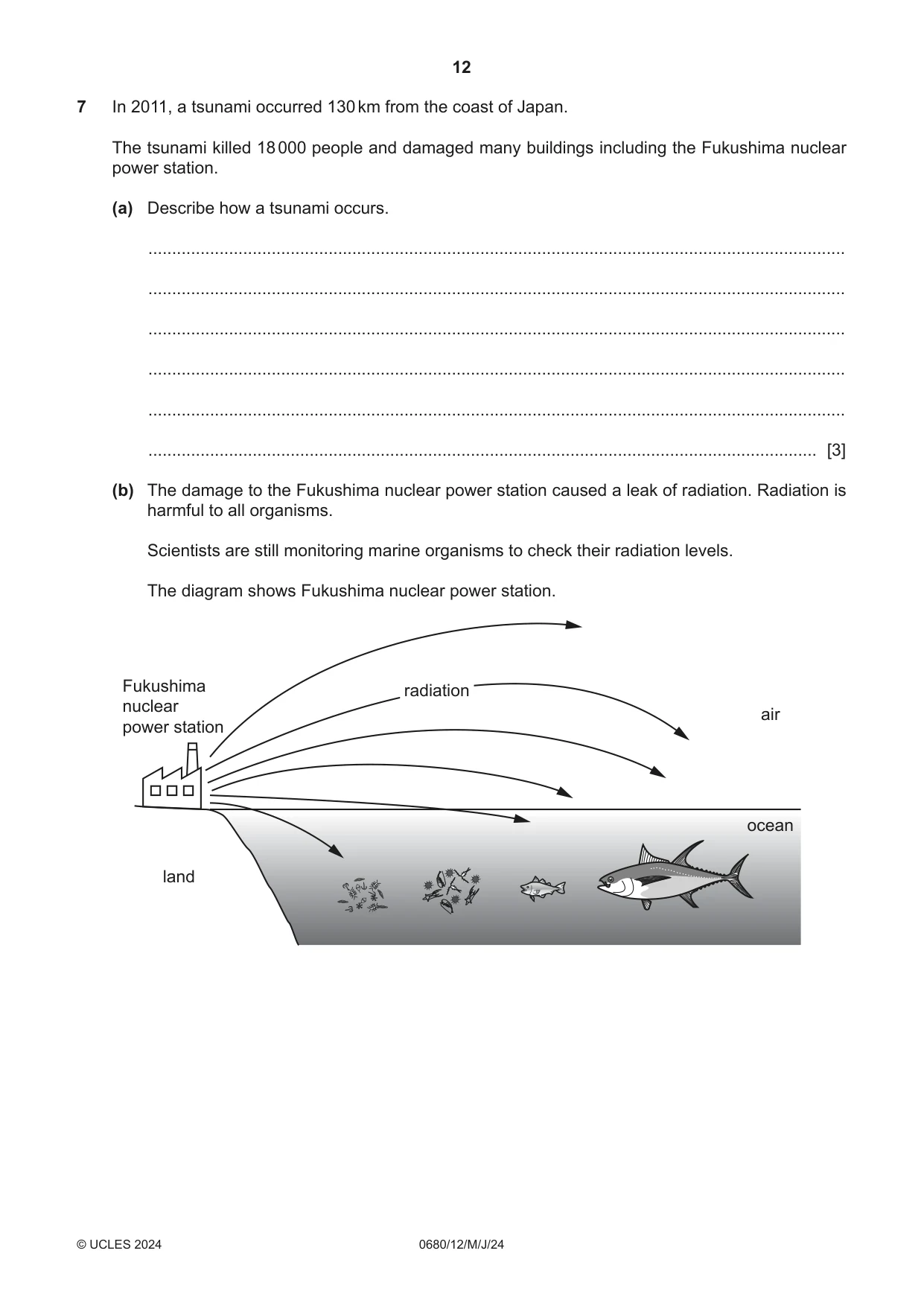
12 0680/12/M/J/24 © UCLES 2024 7 In 2011, a tsunami occurred 130 km from the coast of Japan. The tsunami killed 18 000 people and damaged many buildings including the Fukushima nuclear power station. (a) Describe how a tsunami occurs. … … … … … … [3] (b) The damage to the Fukushima nuclear power station caused a leak of radiation. Radiation is harmful to all organisms. Scientists are still monitoring marine organisms to check their radiation levels. The diagram shows Fukushima nuclear power station. Fukushima nuclear power station land air ocean radiation
Question paper, page 13
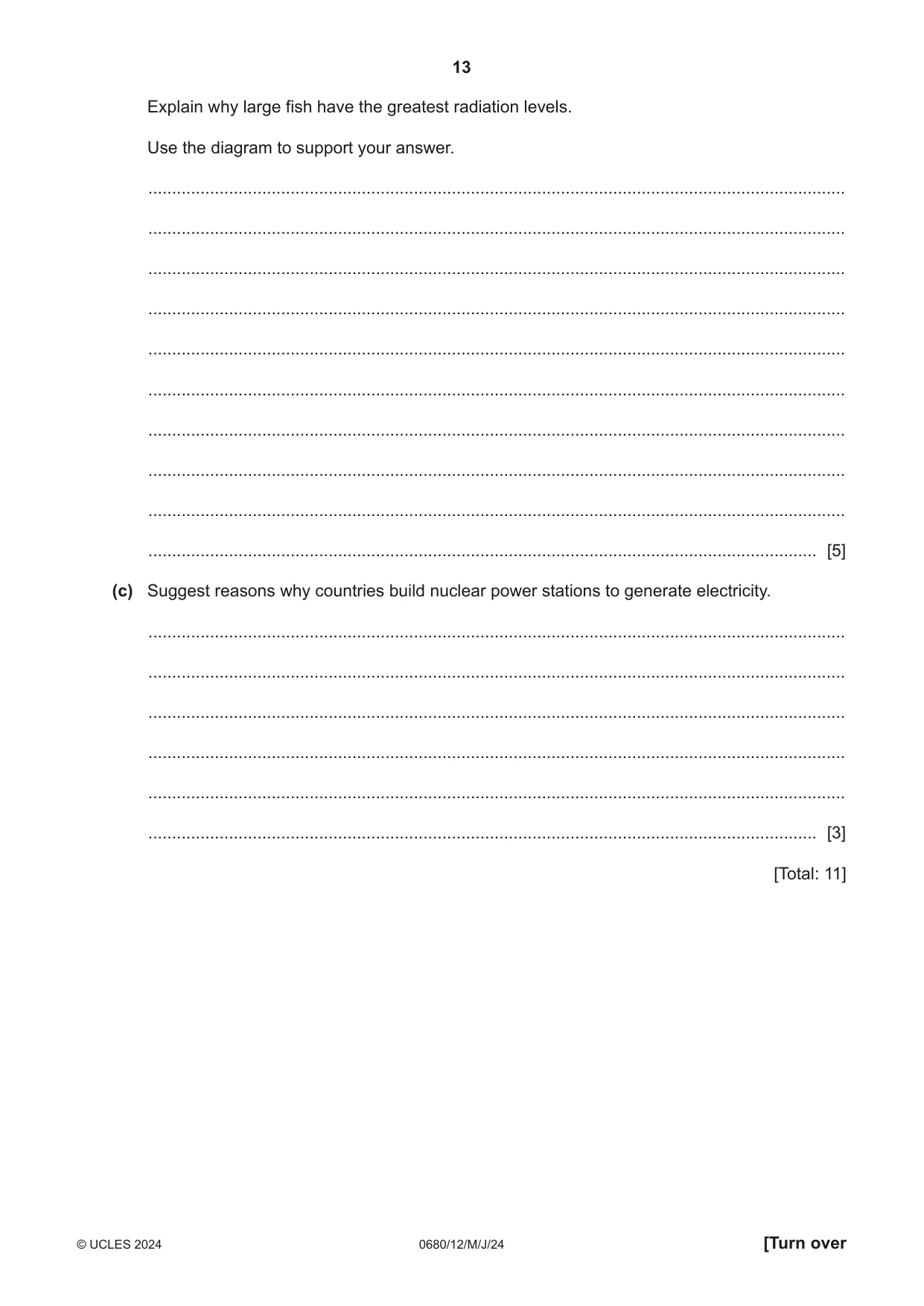
13 0680/12/M/J/24 © UCLES 2024 [Turn over Explain why large fish have the greatest radiation levels. Use the diagram to support your answer. … … … … … … … … … … [5] (c) Suggest reasons why countries build nuclear power stations to generate electricity. … … … … … … [3] [Total: 11]
Question paper, page 14
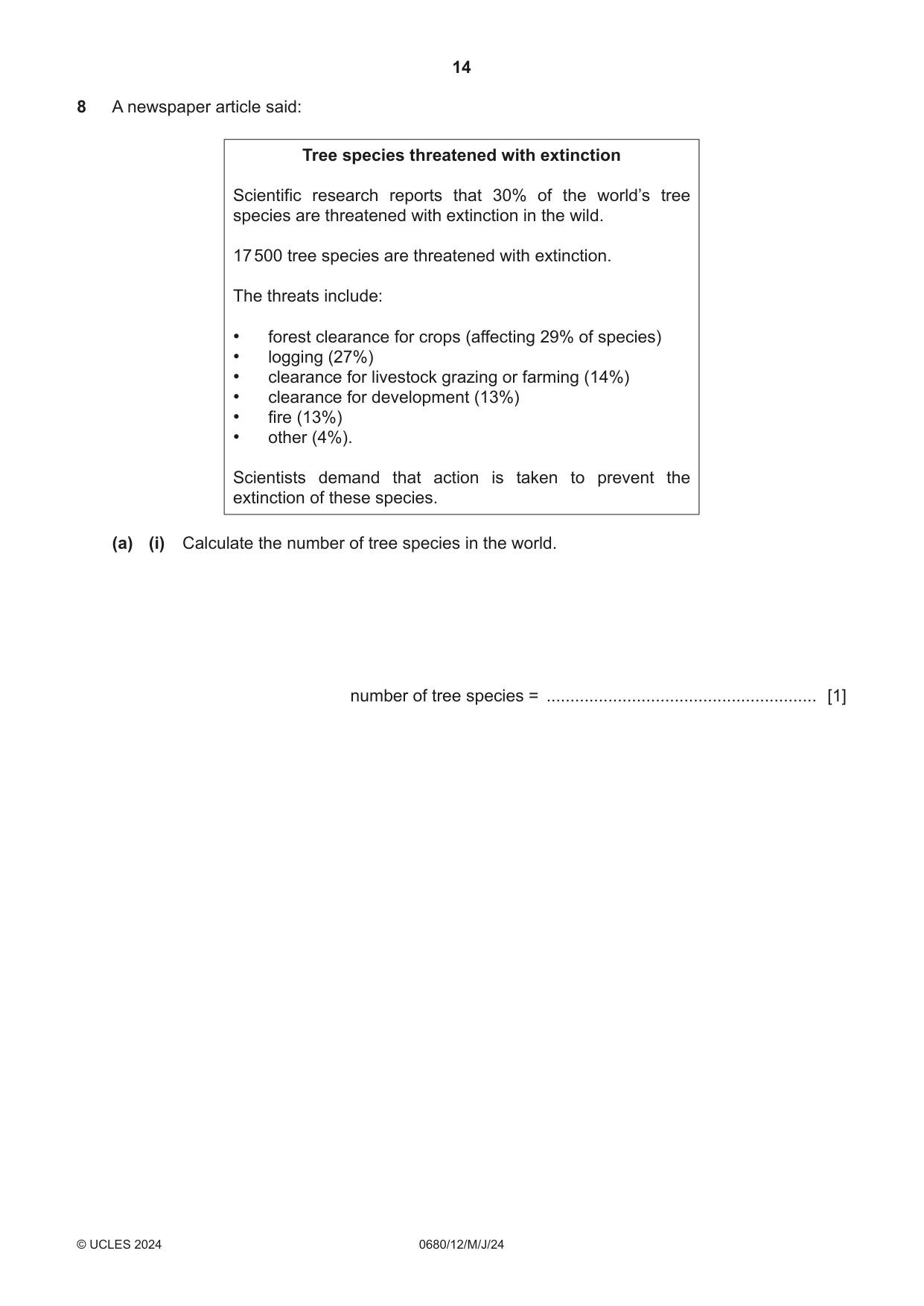
14 0680/12/M/J/24 © UCLES 2024 8 A newspaper article said: Tree species threatened with extinction Scientific research reports that 30% of the world’s tree species are threatened with extinction in the wild. 17 500 tree species are threatened with extinction. The threats include: • forest clearance for crops (affecting 29% of species) • logging (27%) • clearance for livestock grazing or farming (14%) • clearance for development (13%) • fire (13%) • other (4%). Scientists demand that action is taken to prevent the extinction of these species. (a) (i) Calculate the number of tree species in the world. number of tree species = … [1]
Question paper, page 15
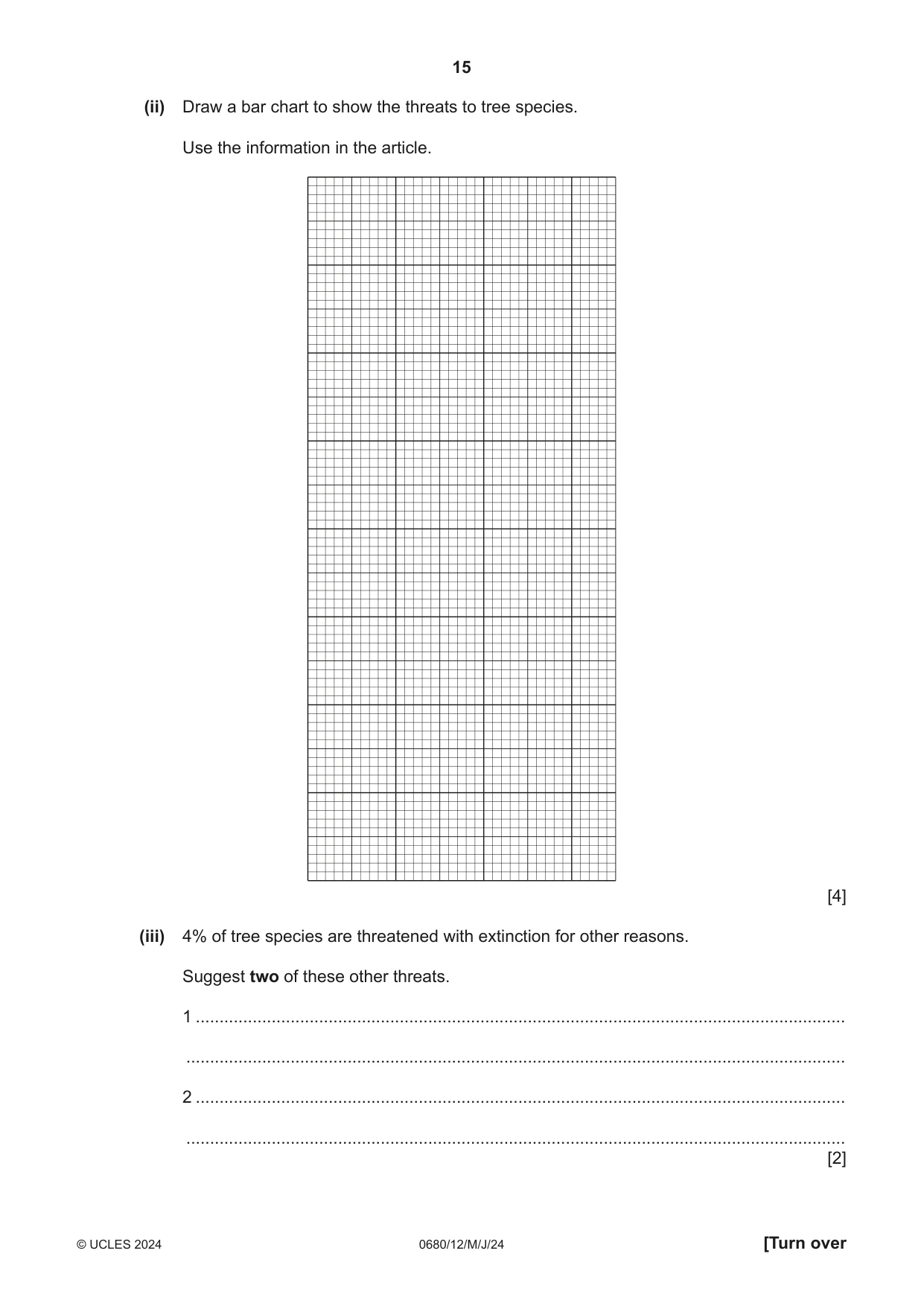
15 0680/12/M/J/24 © UCLES 2024 [Turn over (ii) Draw a bar chart to show the threats to tree species. Use the information in the article. [4] (iii) 4% of tree species are threatened with extinction for other reasons. Suggest two of these other threats. 1 … … 2 … … [2]
Question paper, page 16
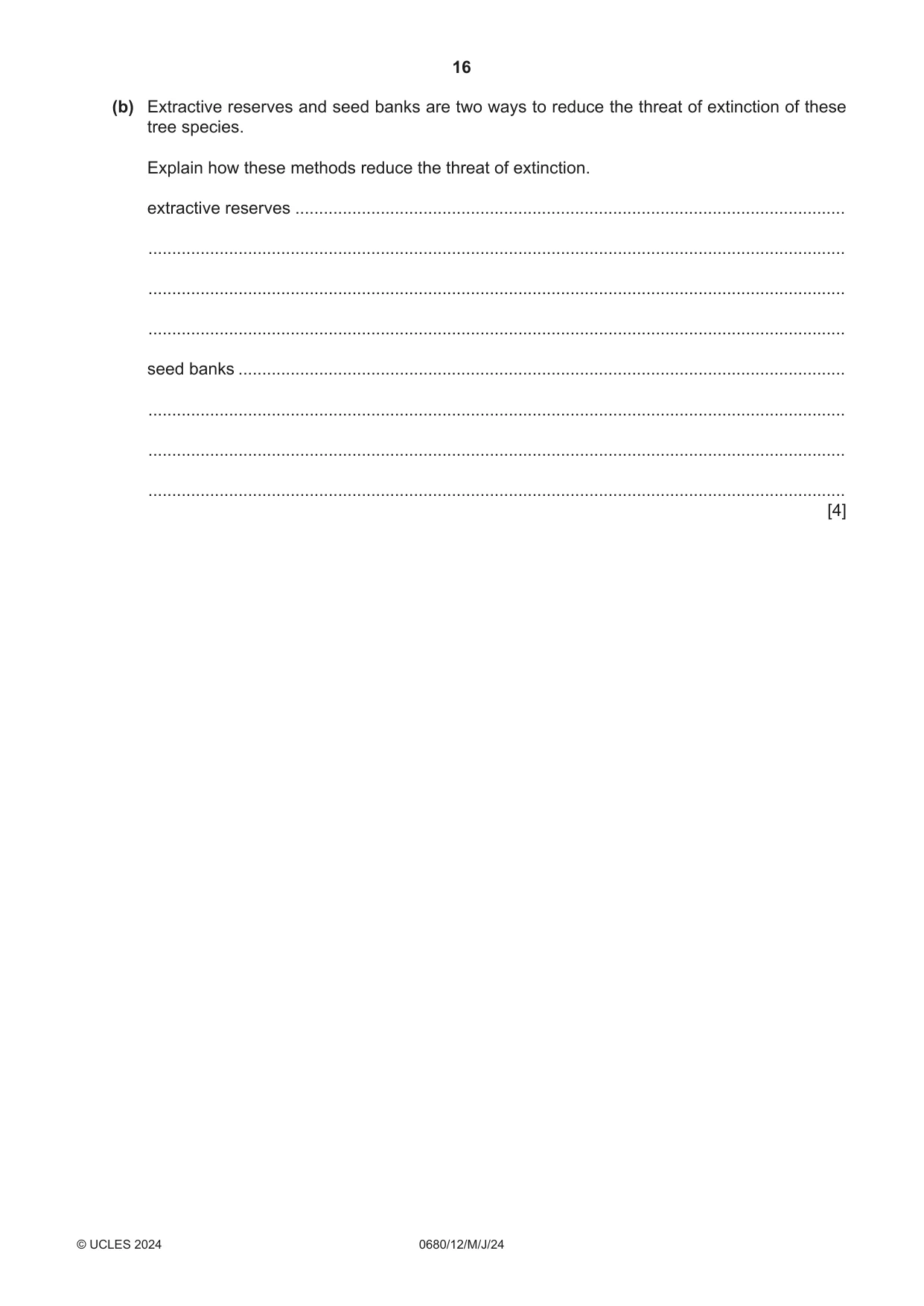
16 0680/12/M/J/24 © UCLES 2024 (b) Extractive reserves and seed banks are two ways to reduce the threat of extinction of these tree species. Explain how these methods reduce the threat of extinction. extractive reserves … … … … seed banks … … … … [4]
Question paper, page 17
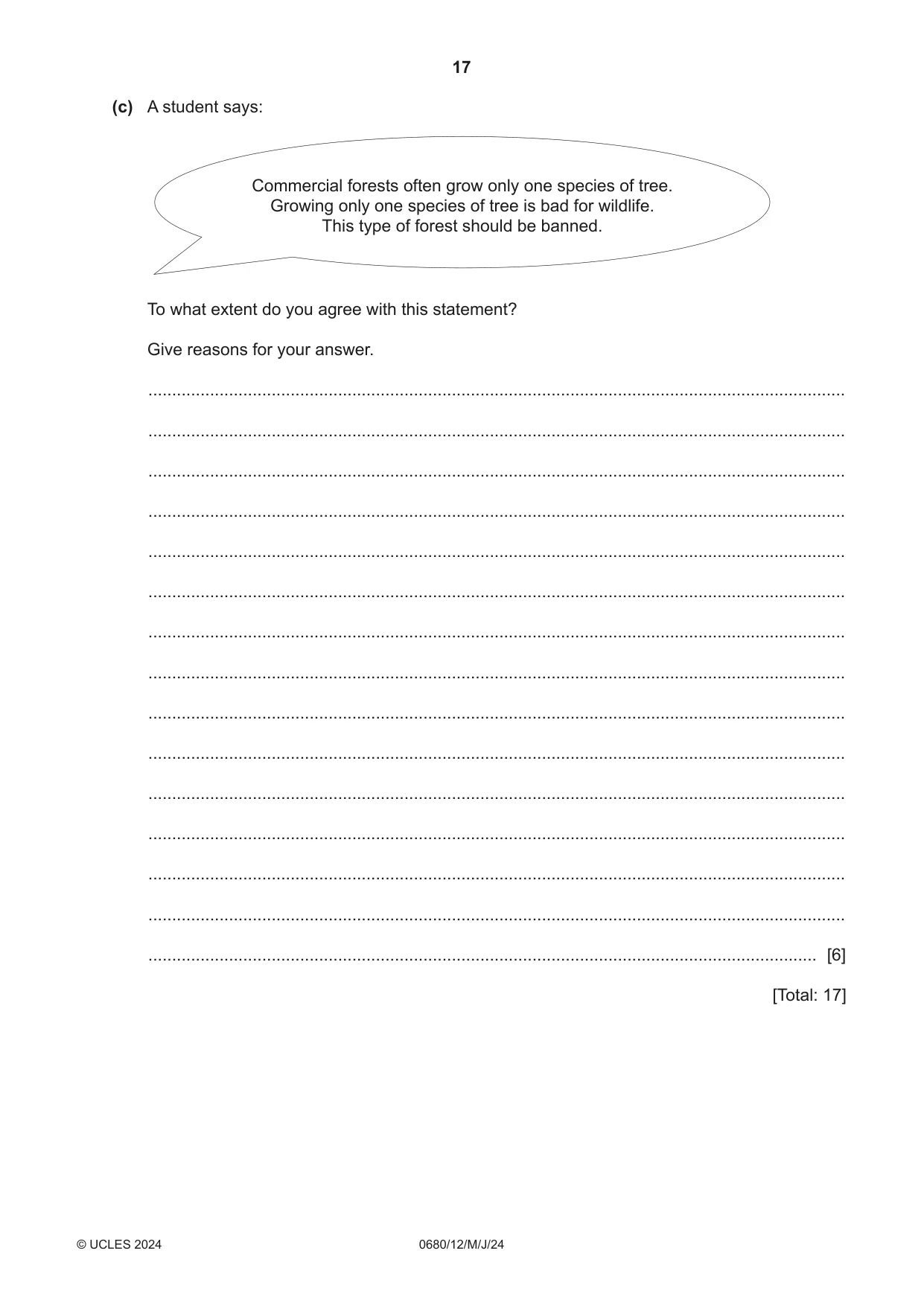
17 0680/12/M/J/24 © UCLES 2024 (c) A student says: Commercial forests often grow only one species of tree. Growing only one species of tree is bad for wildlife. This type of forest should be banned. To what extent do you agree with this statement? Give reasons for your answer. … … … … … … … … … … … … … … … [6] [Total: 17]
Question paper, page 18
18 0680/12/M/J/24 © UCLES 2024 BLANK PAGE
Question paper, page 19
19 0680/12/M/J/24 © UCLES 2024 BLANK PAGE
Question paper, page 20
20 0680/12/M/J/24 © UCLES 2024 BLANK PAGE The boundaries and names shown, the designations used and the presentation of material on any maps contained in this question paper/insert do not imply official endorsement or acceptance by Cambridge Assessment International Education concerning the legal status of any country, territory, or area or any of its authorities, or of the delimitation of its frontiers or boundaries. Permission to reproduce items where third-party owned material protected by copyright is included has been sought and cleared where possible. Every reasonable effort has been made by the publisher (UCLES) to trace copyright holders, but if any items requiring clearance have unwittingly been included, the publisher will be pleased to make amends at the earliest possible opportunity. To avoid the issue of disclosure of answer-related information to candidates, all copyright acknowledgements are reproduced online in the Cambridge Assessment International Education Copyright Acknowledgements Booklet. This is produced for each series of examinations and is freely available to download at www.cambridgeinternational.org after the live examination series. Cambridge Assessment International Education is part of Cambridge Assessment. Cambridge Assessment is the brand name of the University of Cambridge Local Examinations Syndicate (UCLES), which is a department of the University of Cambridge.
Mark scheme, page 1
This document consists of 13 printed pages. © Cambridge University Press & Assessment 2024 [Turn over Cambridge IGCSE™ ENVIRONMENTAL MANAGEMENT 0680/12 Paper 1 Theory May/June 2024 MARK SCHEME Maximum Mark: 80 Published This mark scheme is published as an aid to teachers and candidates, to indicate the requirements of the examination. It shows the basis on which Examiners were instructed to award marks. It does not indicate the details of the discussions that took place at an Examiners’ meeting before marking began, which would have considered the acceptability of alternative answers. Mark schemes should be read in conjunction with the question paper and the Principal Examiner Report for Teachers. Cambridge International will not enter into discussions about these mark schemes. Cambridge International is publishing the mark schemes for the May/June 2024 series for most Cambridge IGCSE, Cambridge International A and AS Level and Cambridge Pre-U components, and some Cambridge O Level components.
Mark scheme, page 2
0680/12 Cambridge IGCSE – Mark Scheme PUBLISHED May/June 2024 © Cambridge University Press & Assessment 2024 Page 2 of 13 Generic Marking Principles These general marking principles must be applied by all examiners when marking candidate answers. They should be applied alongside the specific content of the mark scheme or generic level descriptions for a question. Each question paper and mark scheme will also comply with these marking principles. GENERIC MARKING PRINCIPLE 1: Marks must be awarded in line with: the specific content of the mark scheme or the generic level descriptors for the question the specific skills defined in the mark scheme or in the generic level descriptors for the question the standard of response required by a candidate as exemplified by the standardisation scripts. GENERIC MARKING PRINCIPLE 2: Marks awarded are always whole marks (not half marks, or other fractions). GENERIC MARKING PRINCIPLE 3: Marks must be awarded positively: marks are awarded for correct/valid answers, as defined in the mark scheme. However, credit is given for valid answers which go beyond the scope of the syllabus and mark scheme, referring to your Team Leader as appropriate marks are awarded when candidates clearly demonstrate what they know and can do marks are not deducted for errors marks are not deducted for omissions answers should only be judged on the quality of spelling, punctuation and grammar when these features are specifically assessed by the question as indicated by the mark scheme. The meaning, however, should be unambiguous. GENERIC MARKING PRINCIPLE 4: Rules must be applied consistently, e.g. in situations where candidates have not followed instructions or in the application of generic level descriptors.
Mark scheme, page 3
0680/12 Cambridge IGCSE – Mark Scheme PUBLISHED May/June 2024 © Cambridge University Press & Assessment 2024 Page 3 of 13 GENERIC MARKING PRINCIPLE 5: Marks should be awarded using the full range of marks defined in the mark scheme for the question (however; the use of the full mark range may be limited according to the quality of the candidate responses seen). GENERIC MARKING PRINCIPLE 6: Marks awarded are based solely on the requirements as defined in the mark scheme. Marks should not be awarded with grade thresholds or grade descriptors in mind. Science-Specific Marking Principles 1 Examiners should consider the context and scientific use of any keywords when awarding marks. Although keywords may be present, marks should not be awarded if the keywords are used incorrectly. 2 The examiner should not choose between contradictory statements given in the same question part, and credit should not be awarded for any correct statement that is contradicted within the same question part. Wrong science that is irrelevant to the question should be ignored. 3 Although spellings do not have to be correct, spellings of syllabus terms must allow for clear and unambiguous separation from other syllabus terms with which they may be confused (e.g. ethane / ethene, glucagon / glycogen, refraction / reflection). 4 The error carried forward (ecf) principle should be applied, where appropriate. If an incorrect answer is subsequently used in a scientifically correct way, the candidate should be awarded these subsequent marking points. Further guidance will be included in the mark scheme where necessary and any exceptions to this general principle will be noted. 5 ‘List rule’ guidance For questions that require n responses (e.g. State two reasons …): The response should be read as continuous prose, even when numbered answer spaces are provided. Any response marked ignore in the mark scheme should not count towards n. Incorrect responses should not be awarded credit but will still count towards n. Read the entire response to check for any responses that contradict those that would otherwise be credited. Credit should not be awarded for any responses that are contradicted within the rest of the response. Where two responses contradict one another, this should be treated as a single incorrect response. Non-contradictory responses after the first n responses may be ignored even if they include incorrect science.
Mark scheme, page 4
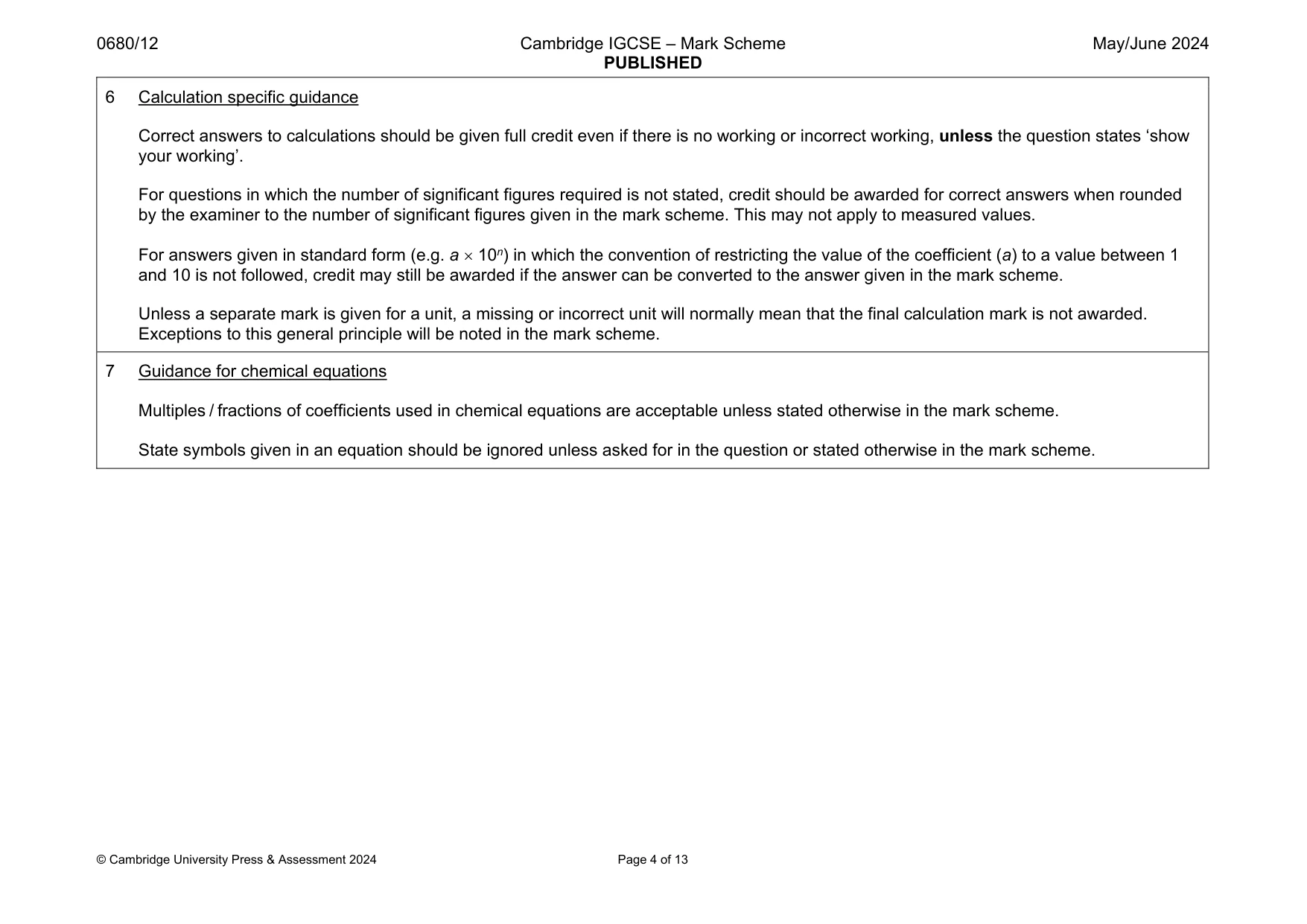
0680/12 Cambridge IGCSE – Mark Scheme PUBLISHED May/June 2024 © Cambridge University Press & Assessment 2024 Page 4 of 13 6 Calculation specific guidance Correct answers to calculations should be given full credit even if there is no working or incorrect working, unless the question states ‘show your working’. For questions in which the number of significant figures required is not stated, credit should be awarded for correct answers when rounded by the examiner to the number of significant figures given in the mark scheme. This may not apply to measured values. For answers given in standard form (e.g. a 10n) in which the convention of restricting the value of the coefficient (a) to a value between 1 and 10 is not followed, credit may still be awarded if the answer can be converted to the answer given in the mark scheme. Unless a separate mark is given for a unit, a missing or incorrect unit will normally mean that the final calculation mark is not awarded. Exceptions to this general principle will be noted in the mark scheme. 7 Guidance for chemical equations Multiples / fractions of coefficients used in chemical equations are acceptable unless stated otherwise in the mark scheme. State symbols given in an equation should be ignored unless asked for in the question or stated otherwise in the mark scheme.
Mark scheme, page 5
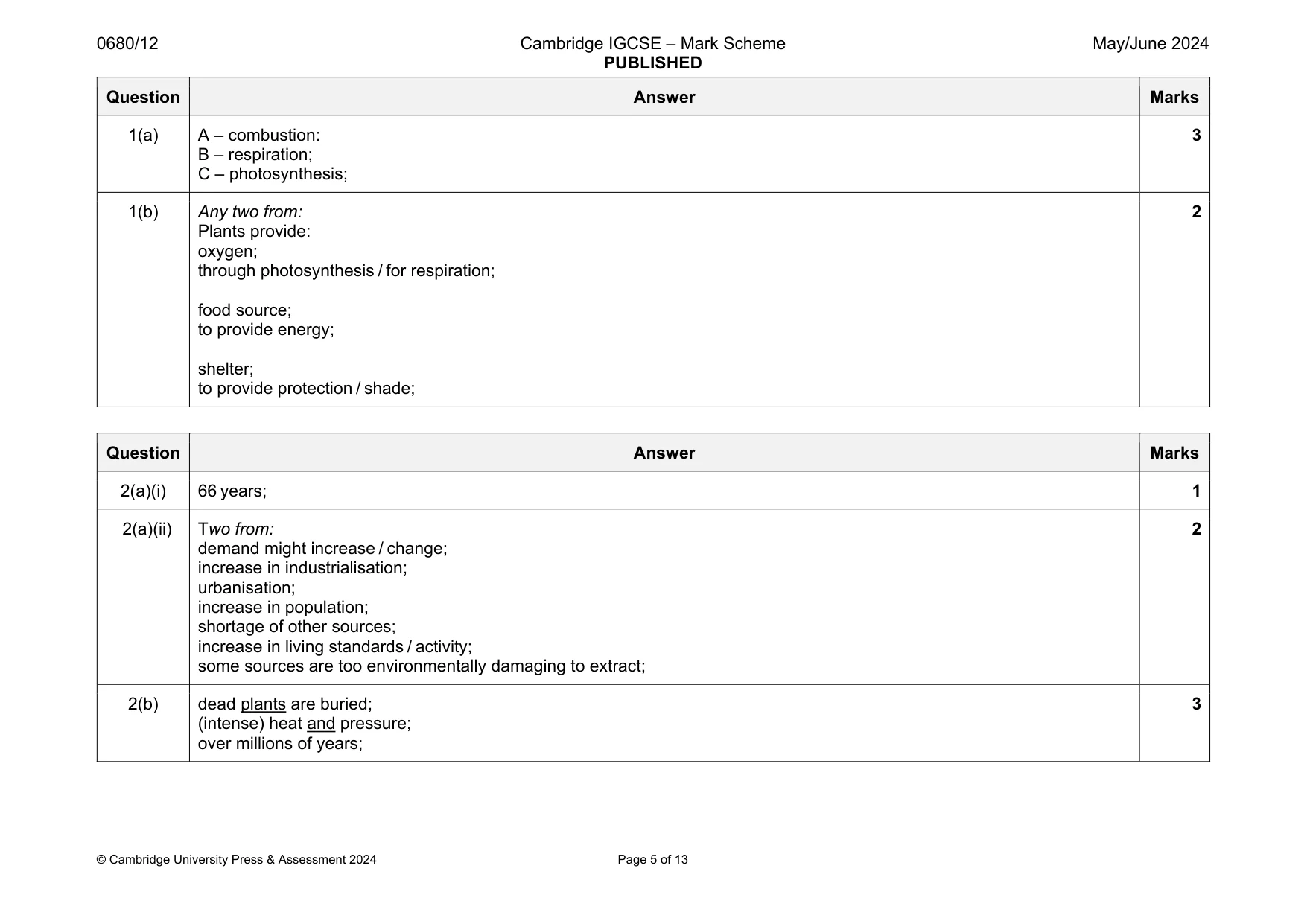
0680/12 Cambridge IGCSE – Mark Scheme PUBLISHED May/June 2024 © Cambridge University Press & Assessment 2024 Page 5 of 13 Question Answer Marks 1(a) A – combustion: B – respiration; C – photosynthesis; 3 1(b) Any two from: Plants provide: oxygen; through photosynthesis / for respiration; food source; to provide energy; shelter; to provide protection / shade; 2 Question Answer Marks 2(a)(i) 66 years; 1 2(a)(ii) Two from: demand might increase / change; increase in industrialisation; urbanisation; increase in population; shortage of other sources; increase in living standards / activity; some sources are too environmentally damaging to extract; 2 2(b) dead plants are buried; (intense) heat and pressure; over millions of years; 3
Mark scheme, page 6
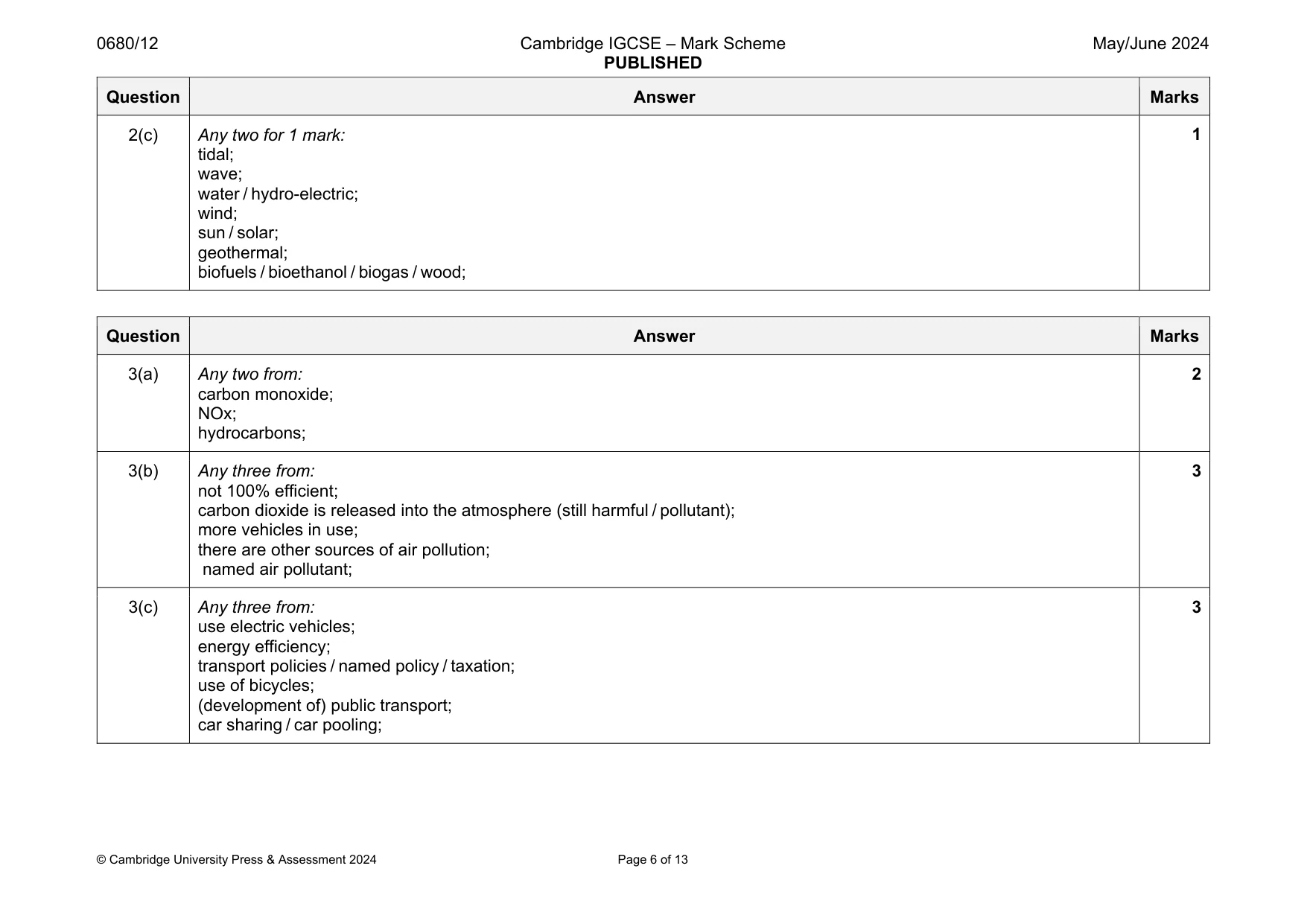
0680/12 Cambridge IGCSE – Mark Scheme PUBLISHED May/June 2024 © Cambridge University Press & Assessment 2024 Page 6 of 13 Question Answer Marks 2(c) Any two for 1 mark: tidal; wave; water / hydro-electric; wind; sun / solar; geothermal; biofuels / bioethanol / biogas / wood; 1 Question Answer Marks 3(a) Any two from: carbon monoxide; NOx; hydrocarbons; 2 3(b) Any three from: not 100% efficient; carbon dioxide is released into the atmosphere (still harmful / pollutant); more vehicles in use; there are other sources of air pollution; named air pollutant; 3 3(c) Any three from: use electric vehicles; energy efficiency; transport policies / named policy / taxation; use of bicycles; (development of) public transport; car sharing / car pooling; 3
Mark scheme, page 7
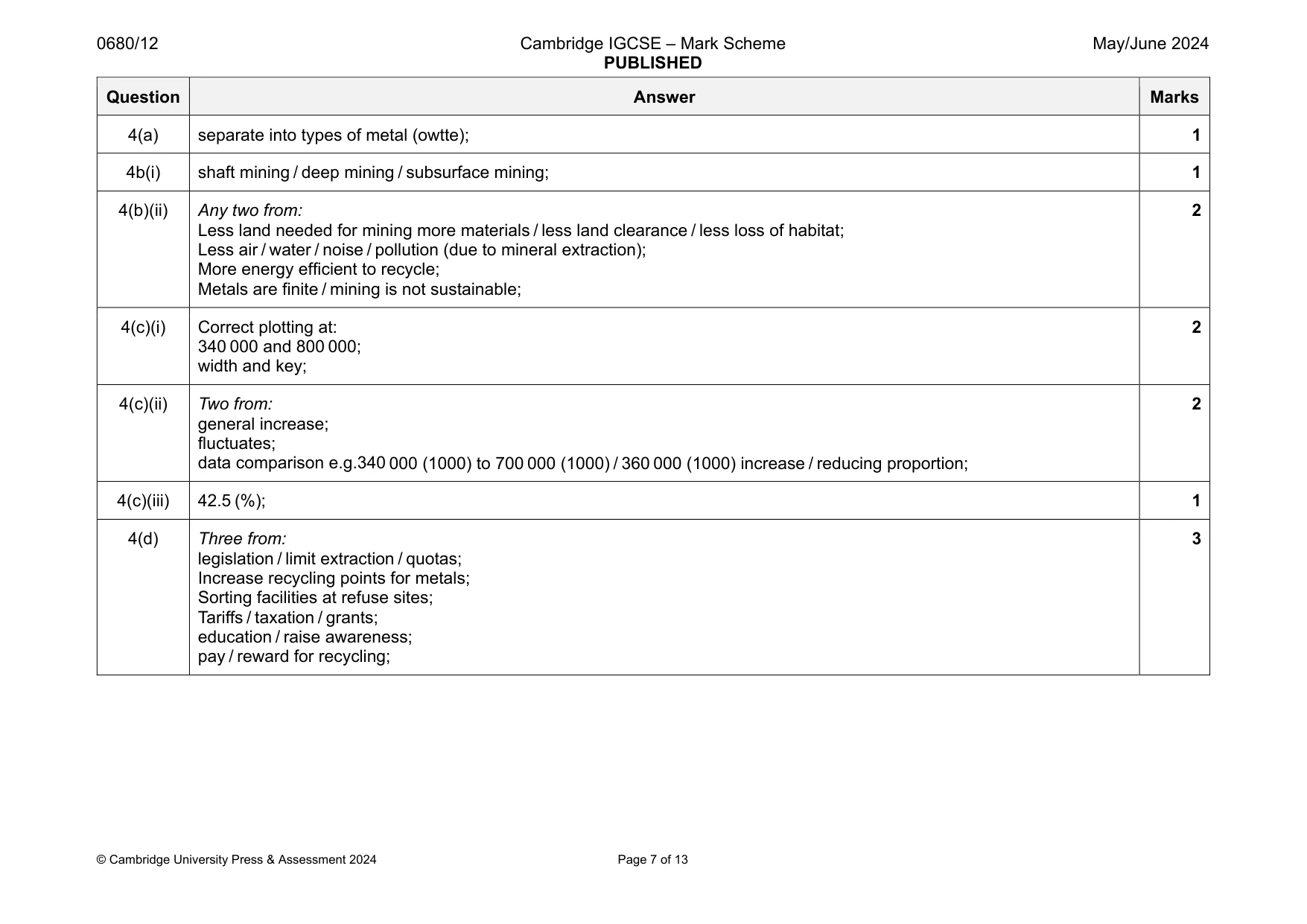
0680/12 Cambridge IGCSE – Mark Scheme PUBLISHED May/June 2024 © Cambridge University Press & Assessment 2024 Page 7 of 13 Question Answer Marks 4(a) separate into types of metal (owtte); 1 4b(i) shaft mining / deep mining / subsurface mining; 1 4(b)(ii) Any two from: Less land needed for mining more materials / less land clearance / less loss of habitat; Less air / water / noise / pollution (due to mineral extraction); More energy efficient to recycle; Metals are finite / mining is not sustainable; 2 4(c)(i) Correct plotting at: 340 000 and 800 000; width and key; 2 4(c)(ii) Two from: general increase; fluctuates; data comparison e.g.340 000 (1000) to 700 000 (1000) / 360 000 (1000) increase / reducing proportion; 2 4(c)(iii) 42.5 (%); 1 4(d) Three from: legislation / limit extraction / quotas; Increase recycling points for metals; Sorting facilities at refuse sites; Tariffs / taxation / grants; education / raise awareness; pay / reward for recycling; 3
Mark scheme, page 8
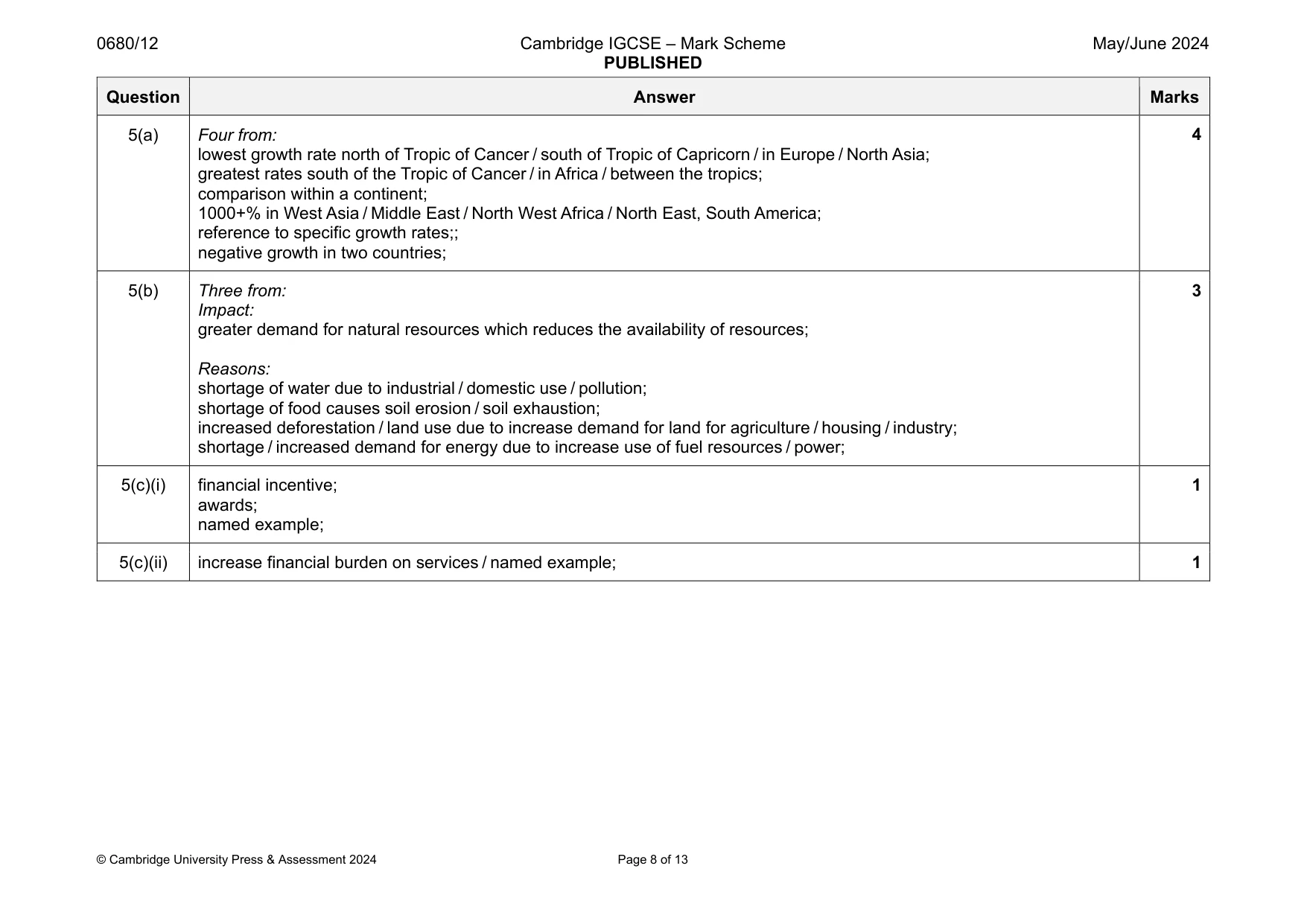
0680/12 Cambridge IGCSE – Mark Scheme PUBLISHED May/June 2024 © Cambridge University Press & Assessment 2024 Page 8 of 13 Question Answer Marks 5(a) Four from: lowest growth rate north of Tropic of Cancer / south of Tropic of Capricorn / in Europe / North Asia; greatest rates south of the Tropic of Cancer / in Africa / between the tropics; comparison within a continent; 1000+% in West Asia / Middle East / North West Africa / North East, South America; reference to specific growth rates;; negative growth in two countries; 4 5(b) Three from: Impact: greater demand for natural resources which reduces the availability of resources; Reasons: shortage of water due to industrial / domestic use / pollution; shortage of food causes soil erosion / soil exhaustion; increased deforestation / land use due to increase demand for land for agriculture / housing / industry; shortage / increased demand for energy due to increase use of fuel resources / power; 3 5(c)(i) financial incentive; awards; named example; 1 5(c)(ii) increase financial burden on services / named example; 1
Mark scheme, page 9
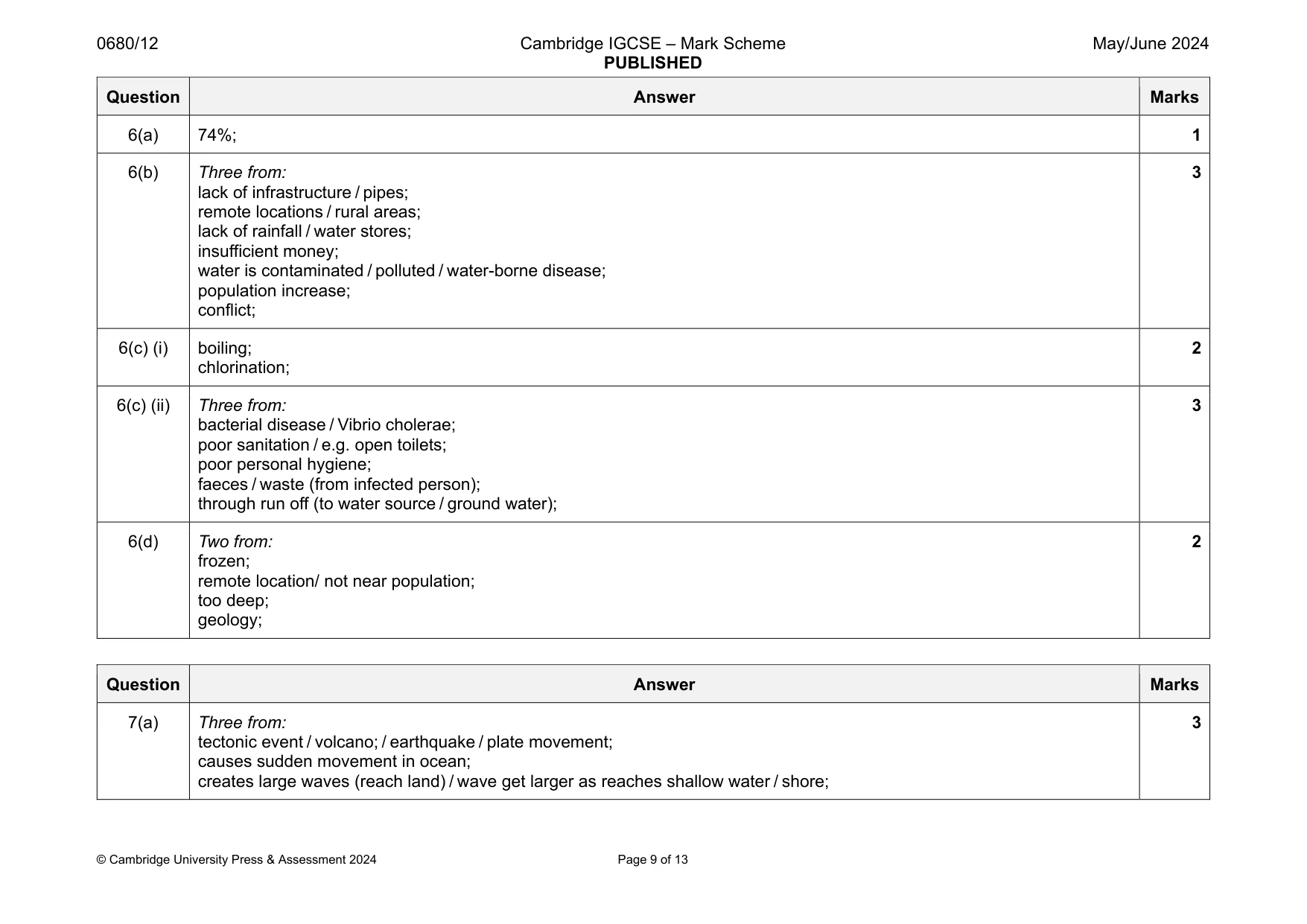
0680/12 Cambridge IGCSE – Mark Scheme PUBLISHED May/June 2024 © Cambridge University Press & Assessment 2024 Page 9 of 13 Question Answer Marks 6(a) 74%; 1 6(b) Three from: lack of infrastructure / pipes; remote locations / rural areas; lack of rainfall / water stores; insufficient money; water is contaminated / polluted / water-borne disease; population increase; conflict; 3 6(c) (i) boiling; chlorination; 2 6(c) (ii) Three from: bacterial disease / Vibrio cholerae; poor sanitation / e.g. open toilets; poor personal hygiene; faeces / waste (from infected person); through run off (to water source / ground water); 3 6(d) Two from: frozen; remote location/ not near population; too deep; geology; 2 Question Answer Marks 7(a) Three from: tectonic event / volcano; / earthquake / plate movement; causes sudden movement in ocean; creates large waves (reach land) / wave get larger as reaches shallow water / shore; 3
Mark scheme, page 10
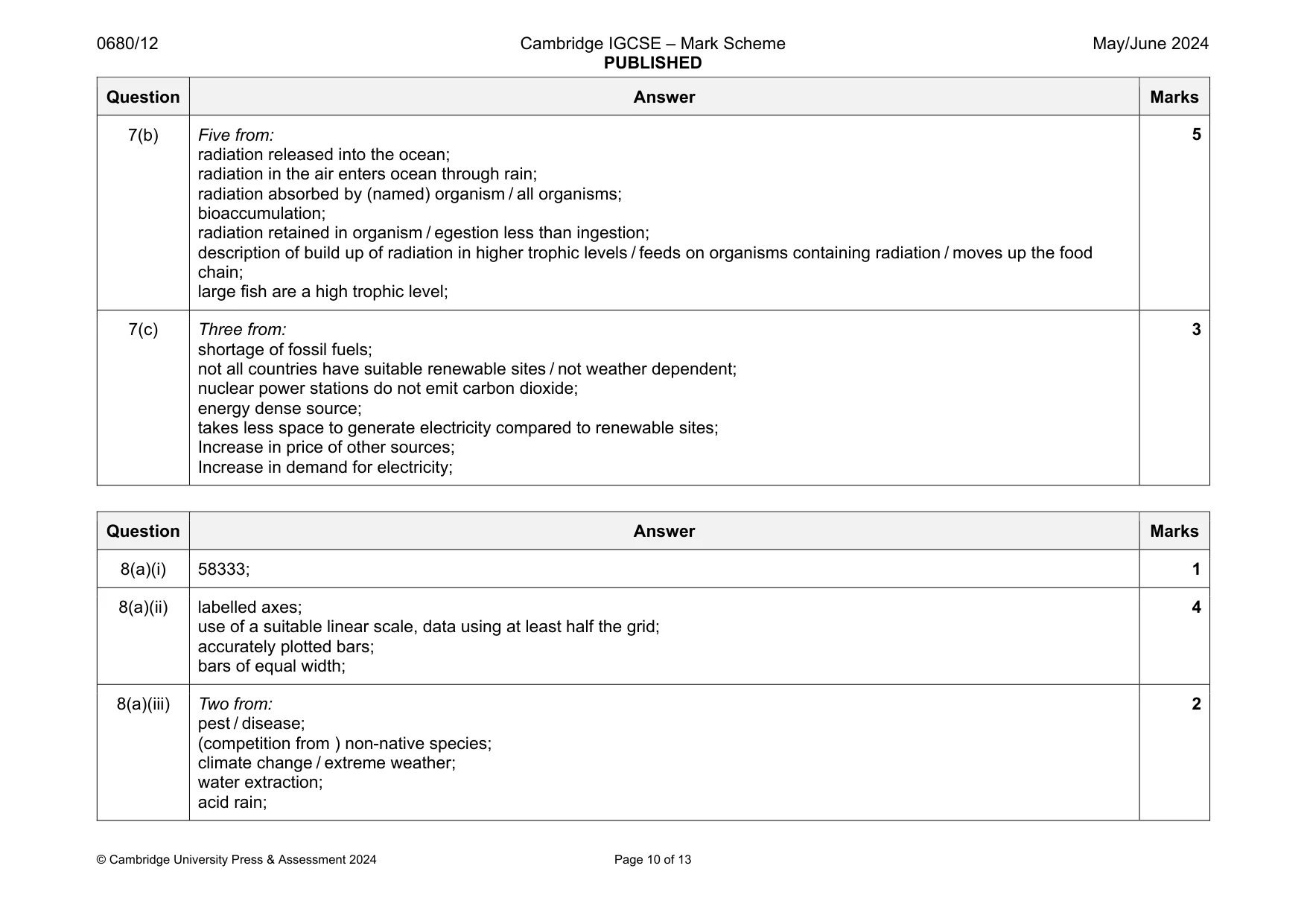
0680/12 Cambridge IGCSE – Mark Scheme PUBLISHED May/June 2024 © Cambridge University Press & Assessment 2024 Page 10 of 13 Question Answer Marks 7(b) Five from: radiation released into the ocean; radiation in the air enters ocean through rain; radiation absorbed by (named) organism / all organisms; bioaccumulation; radiation retained in organism / egestion less than ingestion; description of build up of radiation in higher trophic levels / feeds on organisms containing radiation / moves up the food chain; large fish are a high trophic level; 5 7(c) Three from: shortage of fossil fuels; not all countries have suitable renewable sites / not weather dependent; nuclear power stations do not emit carbon dioxide; energy dense source; takes less space to generate electricity compared to renewable sites; Increase in price of other sources; Increase in demand for electricity; 3 Question Answer Marks 8(a)(i) 58333; 1 8(a)(ii) labelled axes; use of a suitable linear scale, data using at least half the grid; accurately plotted bars; bars of equal width; 4 8(a)(iii) Two from: pest / disease; (competition from ) non-native species; climate change / extreme weather; water extraction; acid rain; 2
Mark scheme, page 11
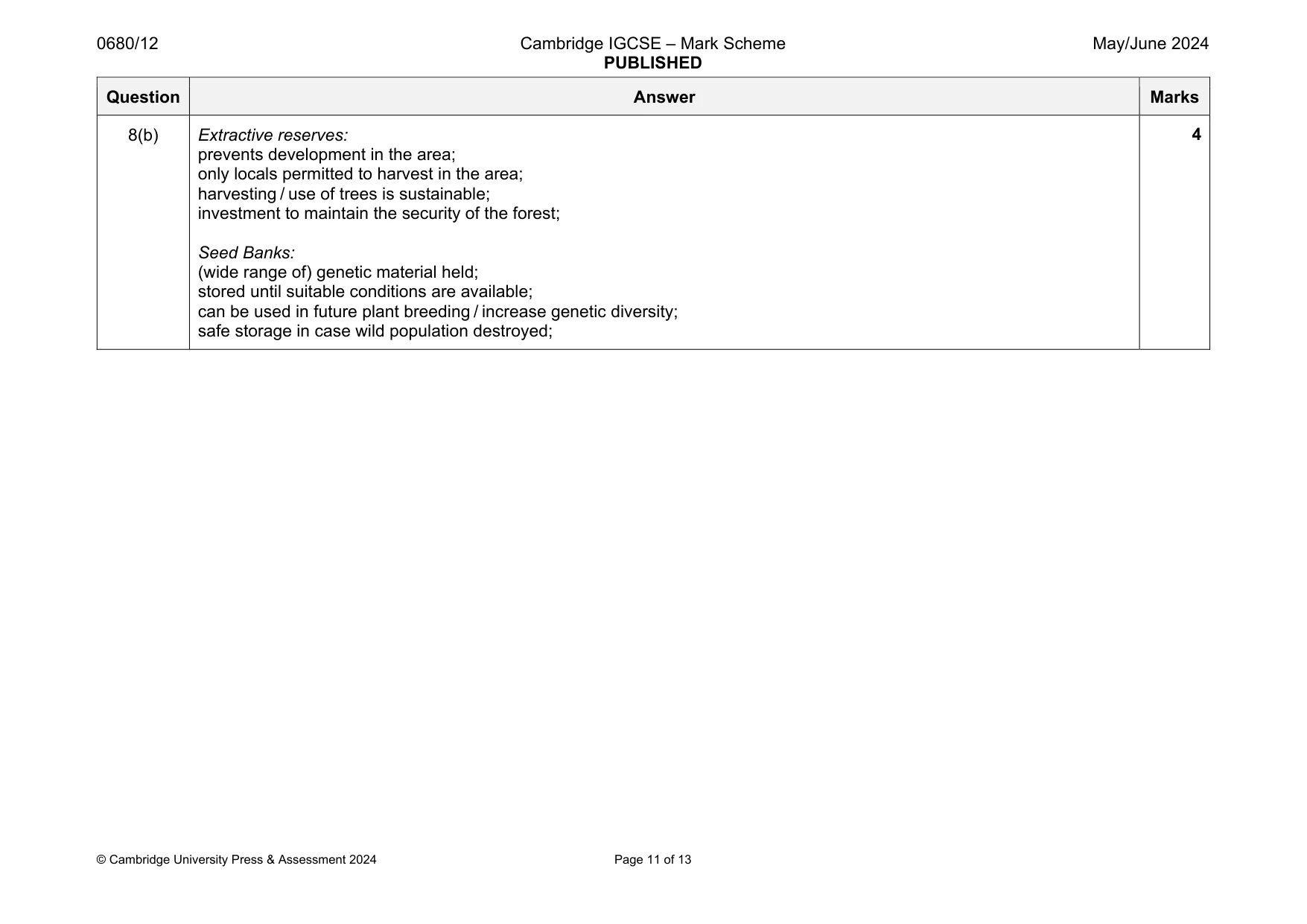
0680/12 Cambridge IGCSE – Mark Scheme PUBLISHED May/June 2024 © Cambridge University Press & Assessment 2024 Page 11 of 13 Question Answer Marks 8(b) Extractive reserves: prevents development in the area; only locals permitted to harvest in the area; harvesting / use of trees is sustainable; investment to maintain the security of the forest; Seed Banks: (wide range of) genetic material held; stored until suitable conditions are available; can be used in future plant breeding / increase genetic diversity; safe storage in case wild population destroyed; 4
Mark scheme, page 12
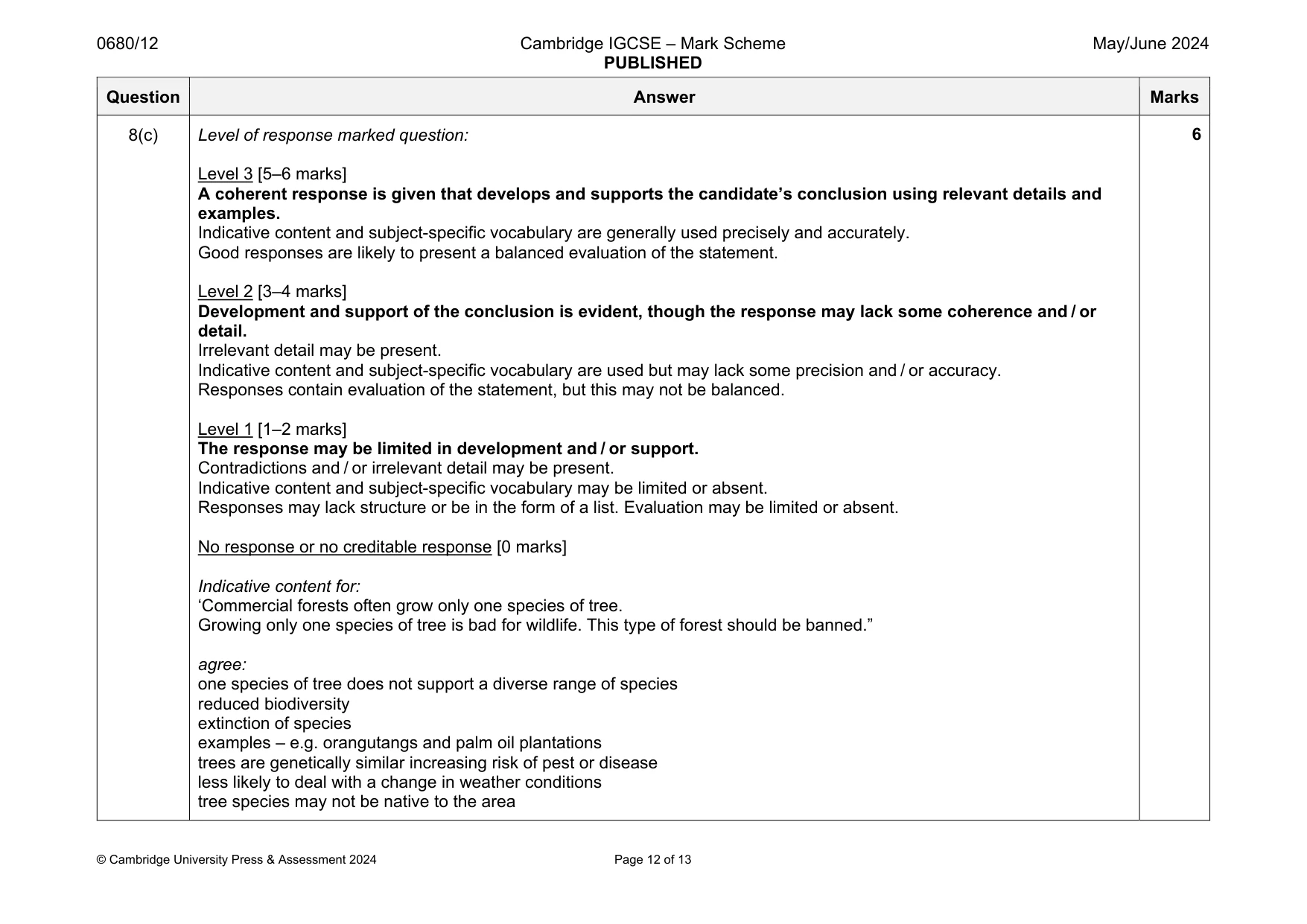
0680/12 Cambridge IGCSE – Mark Scheme PUBLISHED May/June 2024 © Cambridge University Press & Assessment 2024 Page 12 of 13 Question Answer Marks 8(c) Level of response marked question: Level 3 [5–6 marks] A coherent response is given that develops and supports the candidate’s conclusion using relevant details and examples. Indicative content and subject-specific vocabulary are generally used precisely and accurately. Good responses are likely to present a balanced evaluation of the statement. Level 2 [3–4 marks] Development and support of the conclusion is evident, though the response may lack some coherence and / or detail. Irrelevant detail may be present. Indicative content and subject-specific vocabulary are used but may lack some precision and / or accuracy. Responses contain evaluation of the statement, but this may not be balanced. Level 1 [1–2 marks] The response may be limited in development and / or support. Contradictions and / or irrelevant detail may be present. Indicative content and subject-specific vocabulary may be limited or absent. Responses may lack structure or be in the form of a list. Evaluation may be limited or absent. No response or no creditable response [0 marks] Indicative content for: ‘Commercial forests often grow only one species of tree. Growing only one species of tree is bad for wildlife. This type of forest should be banned.” agree: one species of tree does not support a diverse range of species reduced biodiversity extinction of species examples – e.g. orangutangs and palm oil plantations trees are genetically similar increasing risk of pest or disease less likely to deal with a change in weather conditions tree species may not be native to the area 6
Mark scheme, page 13
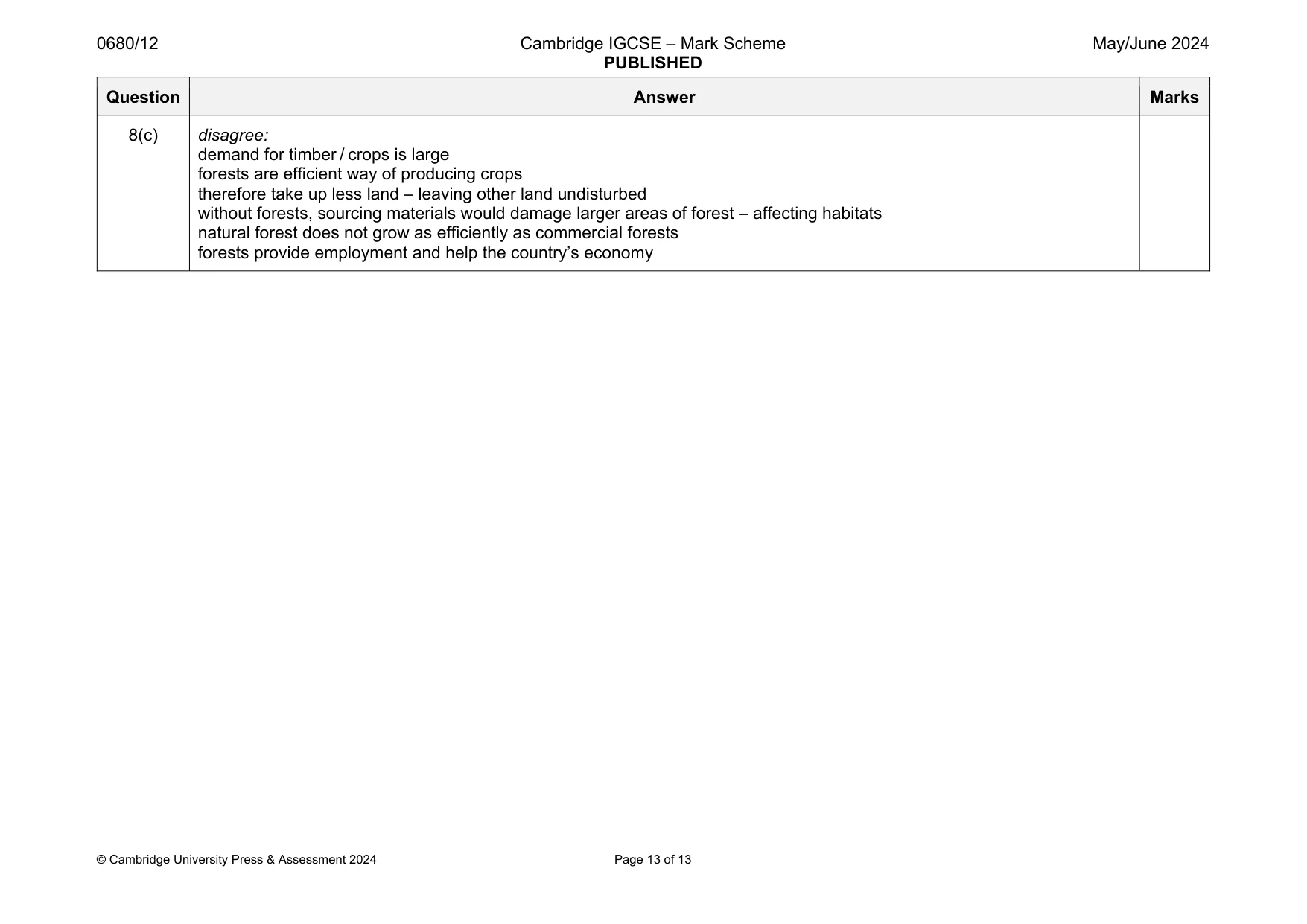
0680/12 Cambridge IGCSE – Mark Scheme PUBLISHED May/June 2024 © Cambridge University Press & Assessment 2024 Page 13 of 13 Question Answer Marks 8(c) disagree: demand for timber / crops is large forests are efficient way of producing crops therefore take up less land – leaving other land undisturbed without forests, sourcing materials would damage larger areas of forest – affecting habitats natural forest does not grow as efficiently as commercial forests forests provide employment and help the country’s economy
What you needed in this session
Cambridge’s own grade thresholds for 2024 May/June, Paper 1 · Variant 2. A higher threshold means an easier paper — the bar moves with how the cohort did.