Cambridge IGCSE Environmental Management 0680 — 2022 Oct/Nov Paper 1 · Variant 1
0680/11/O/N/22 · 80 marks · ≈90 min
The question paper and its mark scheme, free to read here and free to download. This is Cambridge’s own paper, exactly as it was sat.
Question paper20 pages




Mark scheme12 pages
Answers below. Sit the paper first if you are practising.
Paper as text
Question paper, page 1
This document has 20 pages. Any blank pages are indicated. [Turn over Cambridge IGCSE™ DC (CE/CT) 307613/2 © UCLES 2022 ENVIRONMENTAL MANAGEMENT 0680/11 Paper 1 Theory October/November 2022 1 hour 45 minutes You must answer on the question paper. No additional materials are needed. INSTRUCTIONS ● Answer all questions. ● Use a black or dark blue pen. You may use an HB pencil for any diagrams or graphs. ● Write your name, centre number and candidate number in the boxes at the top of the page. ● Write your answer to each question in the space provided. ● Do not use an erasable pen or correction fluid. ● Do not write on any bar codes. ● You may use a calculator. ● You should show all your working and use appropriate units. INFORMATION ● The total mark for this paper is 80. ● The number of marks for each question or part question is shown in brackets [ ]. * 9 8 0 4 0 0 6 5 3 0 *
Question paper, page 2
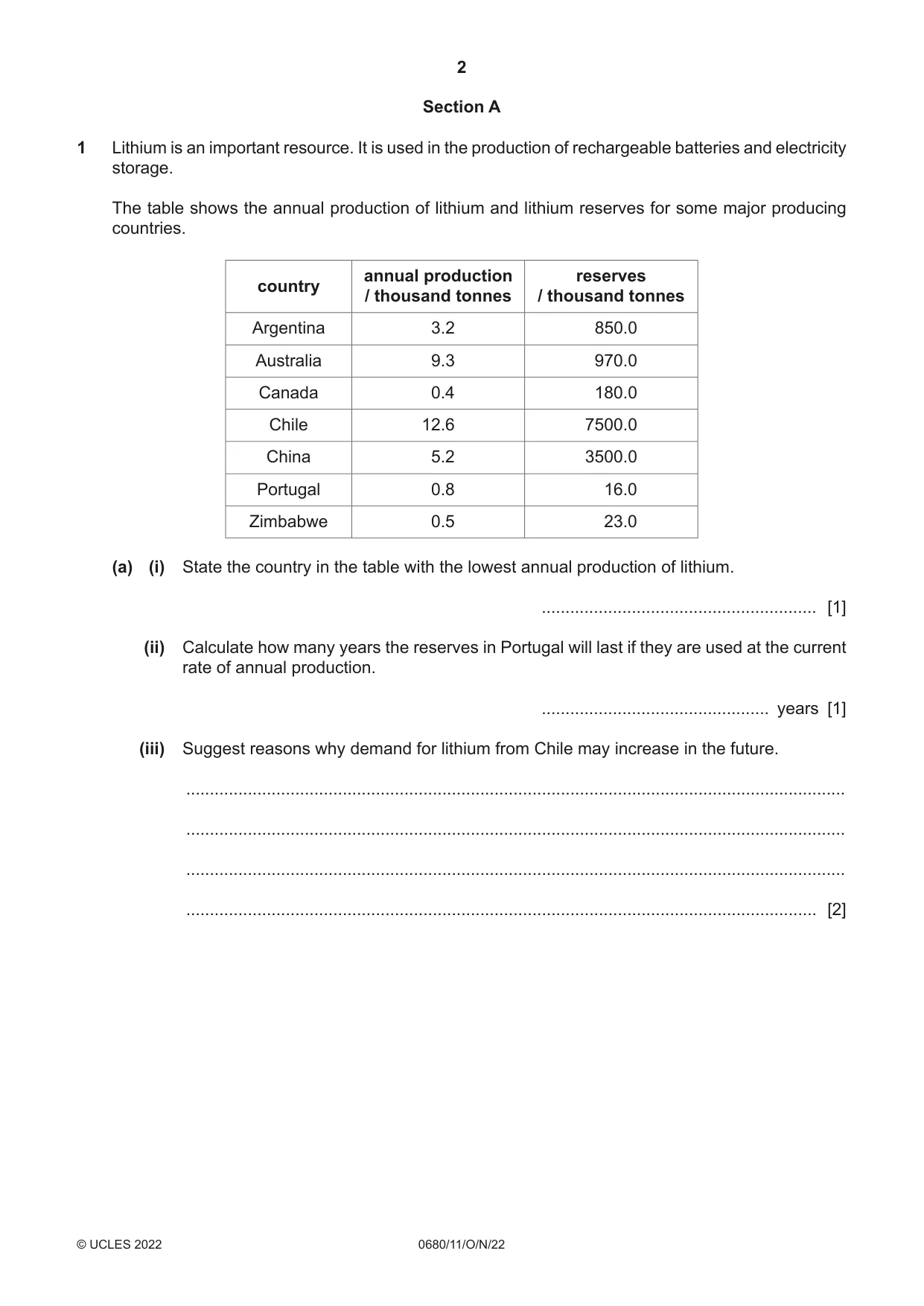
2 0680/11/O/N/22 © UCLES 2022 Section A 1 Lithium is an important resource. It is used in the production of rechargeable batteries and electricity storage. The table shows the annual production of lithium and lithium reserves for some major producing countries. country annual production / thousand tonnes reserves / thousand tonnes Argentina 3.2 850.0 Australia 9.3 970.0 Canada 0.4 180.0 Chile 12.6 7500.0 China 5.2 3500.0 Portugal 0.8 16.0 Zimbabwe 0.5 23.0 (a) (i) State the country in the table with the lowest annual production of lithium. … [1] (ii) Calculate how many years the reserves in Portugal will last if they are used at the current rate of annual production. … years [1] (iii) Suggest reasons why demand for lithium from Chile may increase in the future. … … … … [2]
Question paper, page 3
3 0680/11/O/N/22 © UCLES 2022 [Turn over (b) Suggest strategies to make the use of lithium more sustainable. … … … … … … [3] [Total: 7]
Question paper, page 4
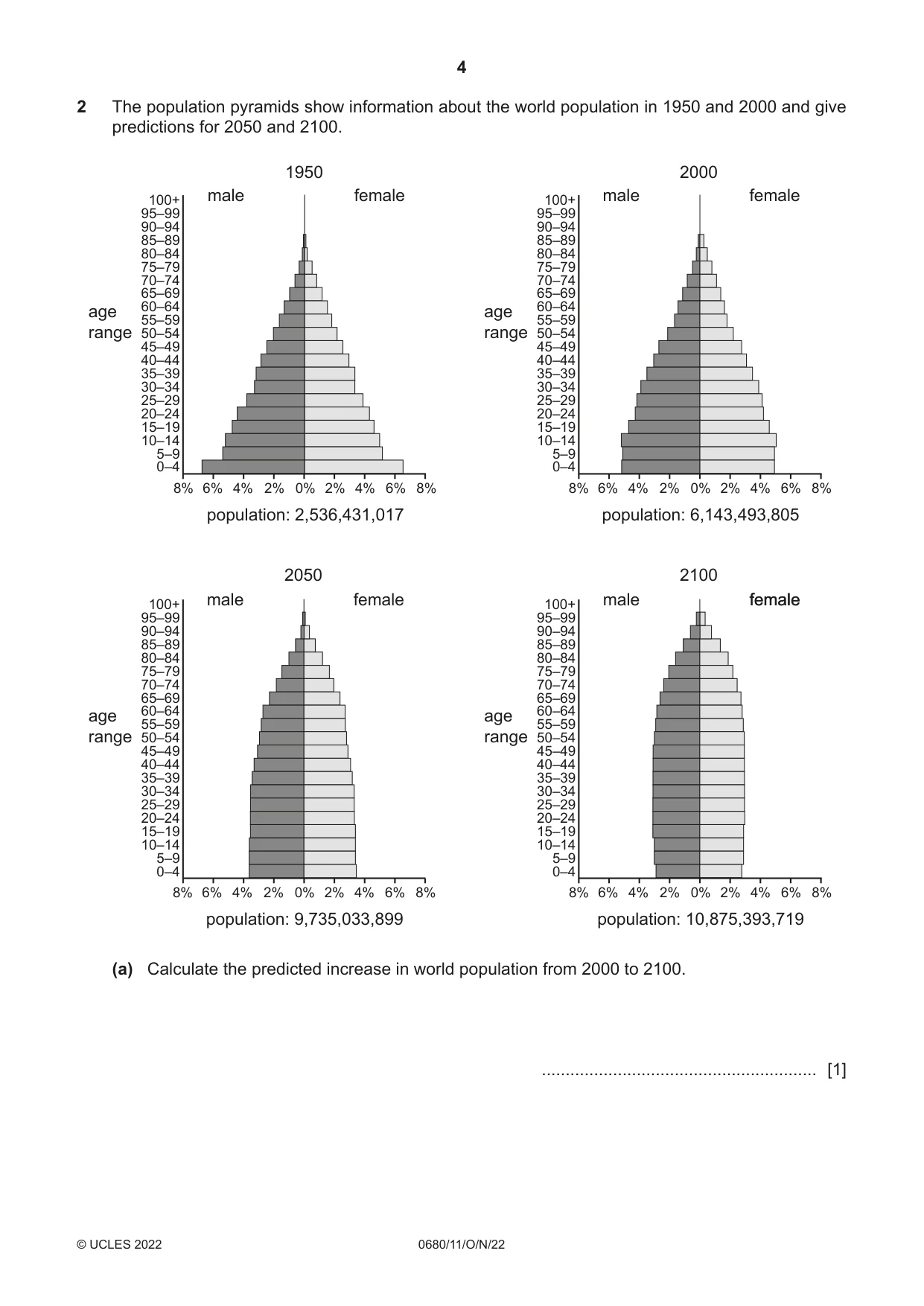
4 0680/11/O/N/22 © UCLES 2022 2 The population pyramids show information about the world population in 1950 and 2000 and give predictions for 2050 and 2100. male female age range population: 2,536,431,017 0% 2% 2% 4% 4% 6% 6% 8% 8% 0–4 5–9 10–14 15–19 20–24 25–29 30–34 35–39 40–44 45–49 50–54 55–59 60–64 65–69 70–74 75–79 80–84 85–89 90–94 95–99 100+ male female age range population: 6,143,493,805 0% 2% 2% 4% 4% 6% 6% 8% 8% 0–4 5–9 10–14 15–19 20–24 25–29 30–34 35–39 40–44 45–49 50–54 55–59 60–64 65–69 70–74 75–79 80–84 85–89 90–94 95–99 100+ male female age range population: 9,735,033,899 0% 2% 2% 4% 4% 6% 6% 8% 8% 0–4 5–9 10–14 15–19 20–24 25–29 30–34 35–39 40–44 45–49 50–54 55–59 60–64 65–69 70–74 75–79 80–84 85–89 90–94 95–99 100+ female male female age range population: 10,875,393,719 0% 2% 2% 4% 4% 6% 6% 8% 8% 0–4 5–9 10–14 15–19 20–24 25–29 30–34 35–39 40–44 45–49 50–54 55–59 60–64 65–69 70–74 75–79 80–84 85–89 90–94 95–99 100+ 1950 2000 2050 2100 (a) Calculate the predicted increase in world population from 2000 to 2100. … [1]
Question paper, page 5
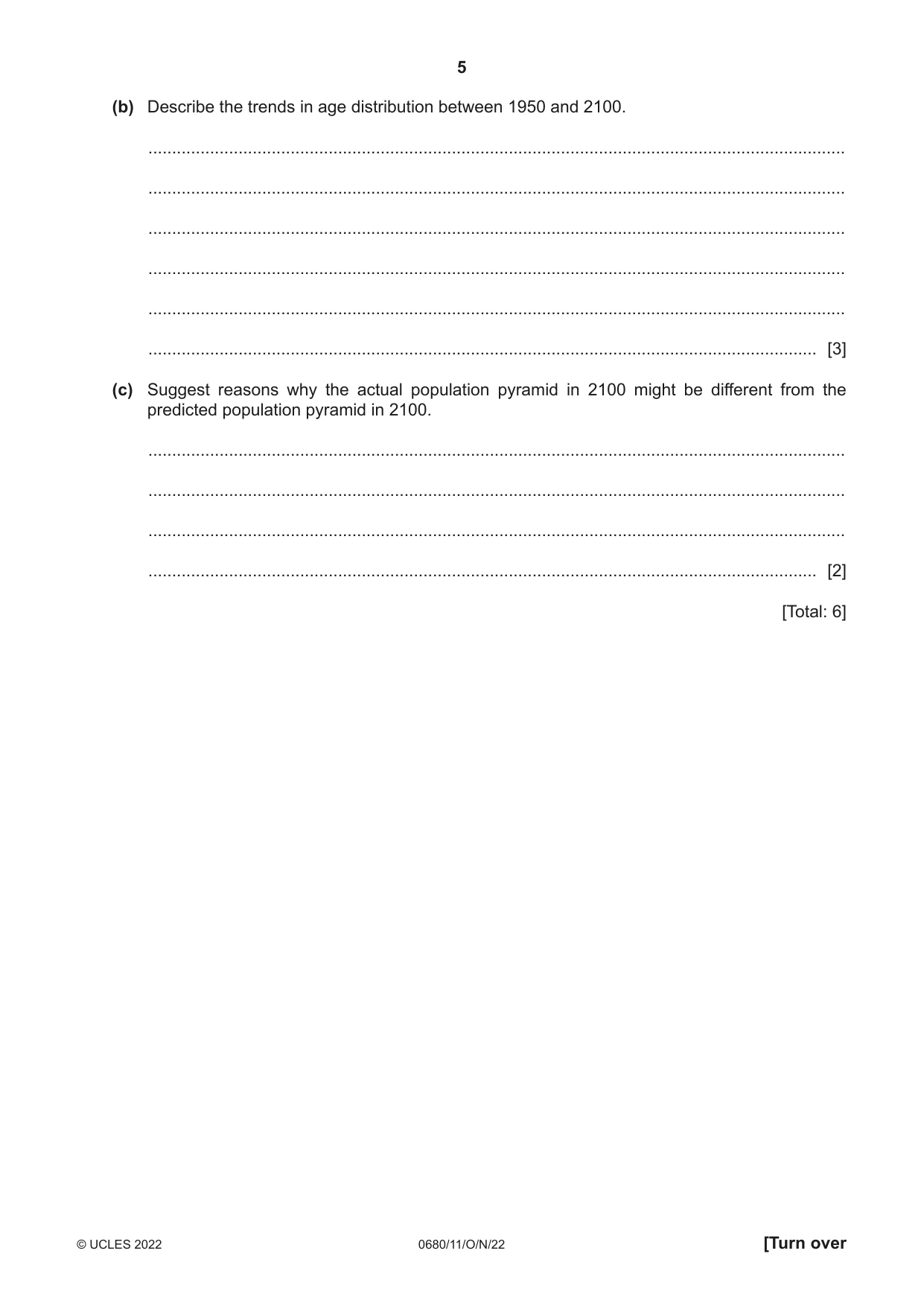
5 0680/11/O/N/22 © UCLES 2022 [Turn over (b) Describe the trends in age distribution between 1950 and 2100. … … … … … … [3] (c) Suggest reasons why the actual population pyramid in 2100 might be different from the predicted population pyramid in 2100. … … … … [2] [Total: 6]
Question paper, page 6
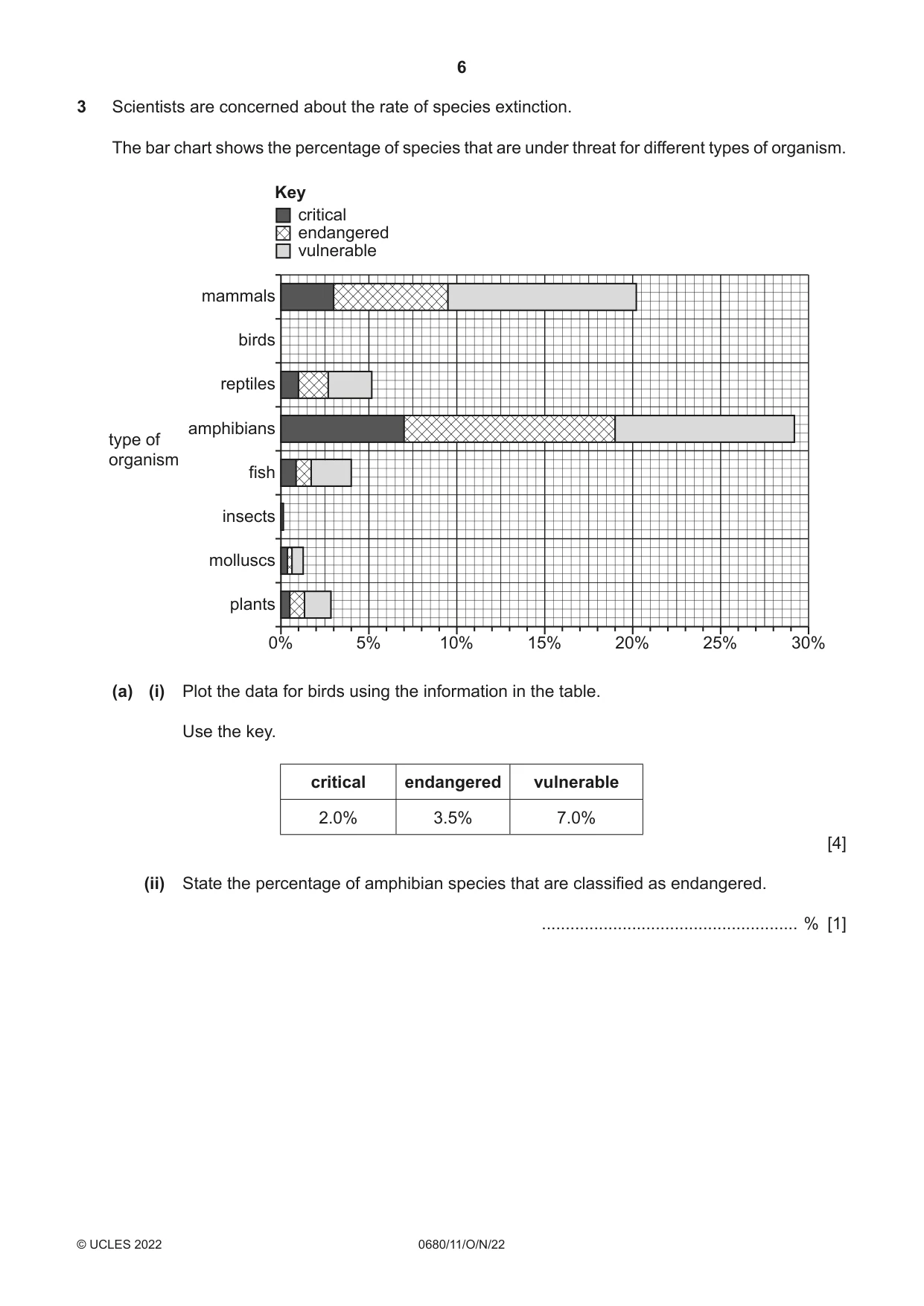
6 0680/11/O/N/22 © UCLES 2022 3 Scientists are concerned about the rate of species extinction. The bar chart shows the percentage of species that are under threat for different types of organism. type of organism mammals birds reptiles amphibians fish insects molluscs plants 0% 5% 10% 15% 20% 25% 30% Key critical endangered vulnerable (a) (i) Plot the data for birds using the information in the table. Use the key. critical endangered vulnerable 2.0% 3.5% 7.0% [4] (ii) State the percentage of amphibian species that are classified as endangered. … % [1]
Question paper, page 7
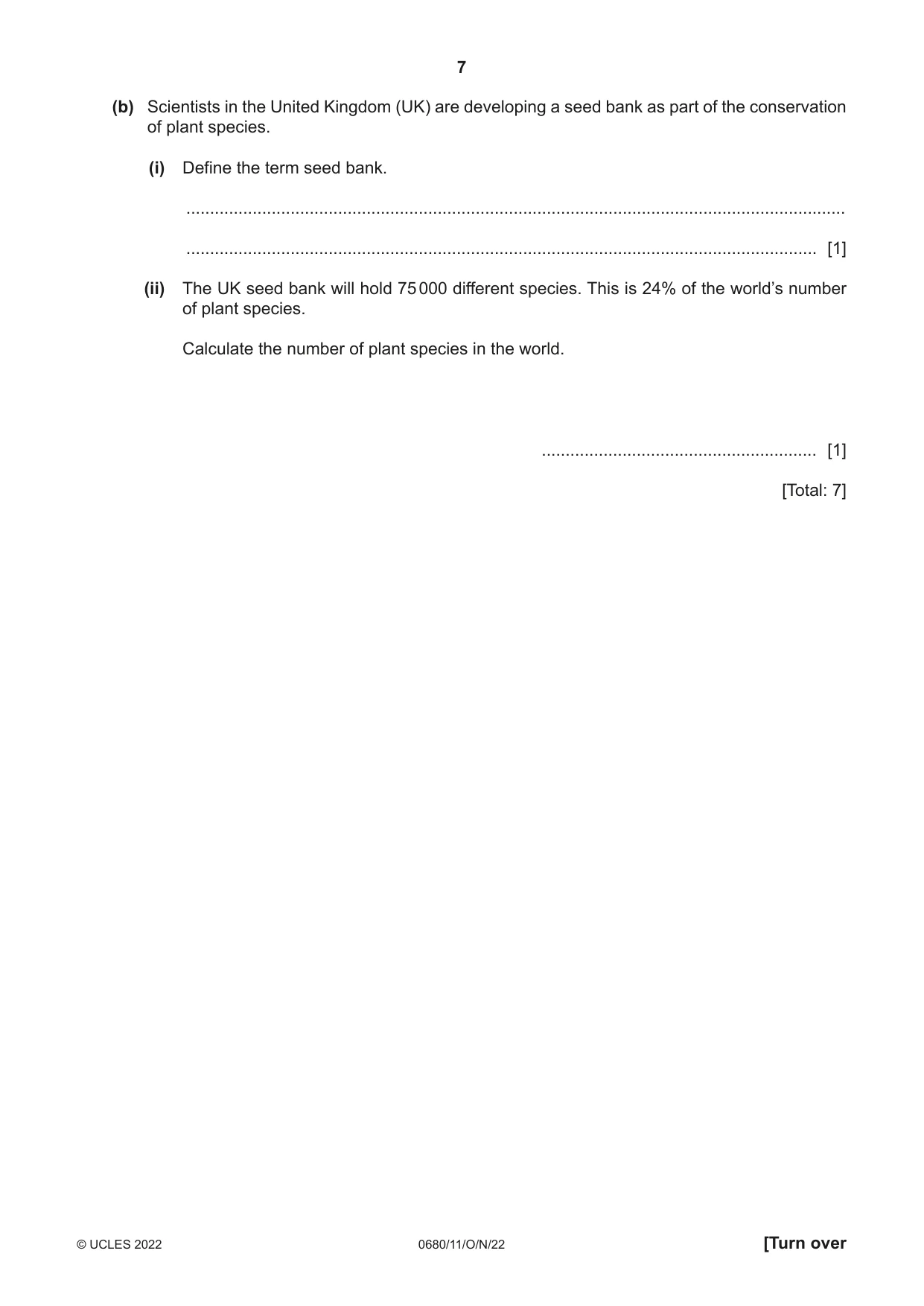
7 0680/11/O/N/22 © UCLES 2022 [Turn over (b) Scientists in the United Kingdom (UK) are developing a seed bank as part of the conservation of plant species. (i) Define the term seed bank. … … [1] (ii) The UK seed bank will hold 75 000 different species. This is 24% of the world’s number of plant species. Calculate the number of plant species in the world. … [1] [Total: 7]
Question paper, page 8
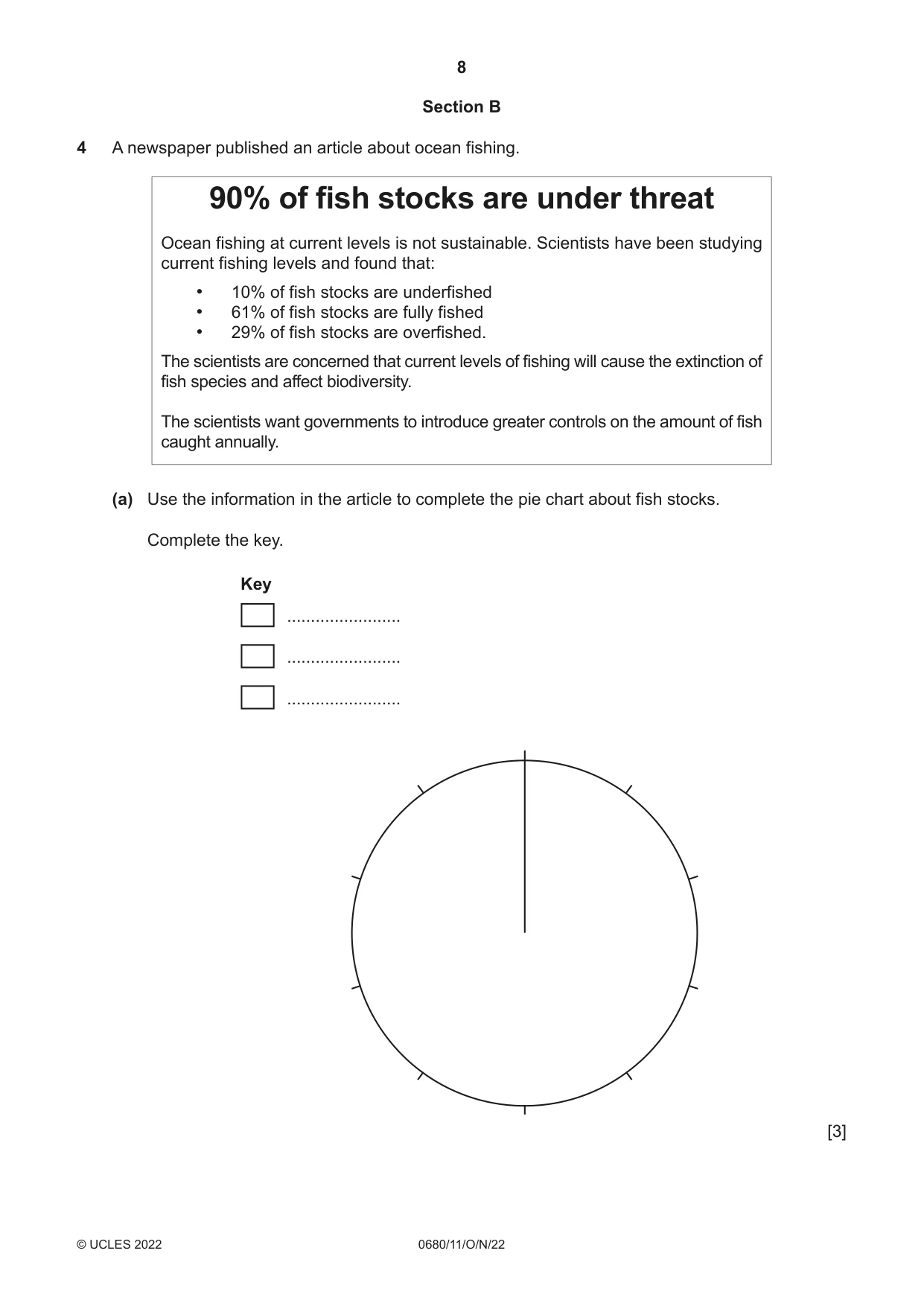
8 0680/11/O/N/22 © UCLES 2022 Section B 4 A newspaper published an article about ocean fishing. 90% of fish stocks are under threat Ocean fishing at current levels is not sustainable. Scientists have been studying current fishing levels and found that: • 10% of fish stocks are underfished • 61% of fish stocks are fully fished • 29% of fish stocks are overfished. The scientists are concerned that current levels of fishing will cause the extinction of fish species and affect biodiversity. The scientists want governments to introduce greater controls on the amount of fish caught annually. (a) Use the information in the article to complete the pie chart about fish stocks. Complete the key. Key … … … [3]
Question paper, page 9
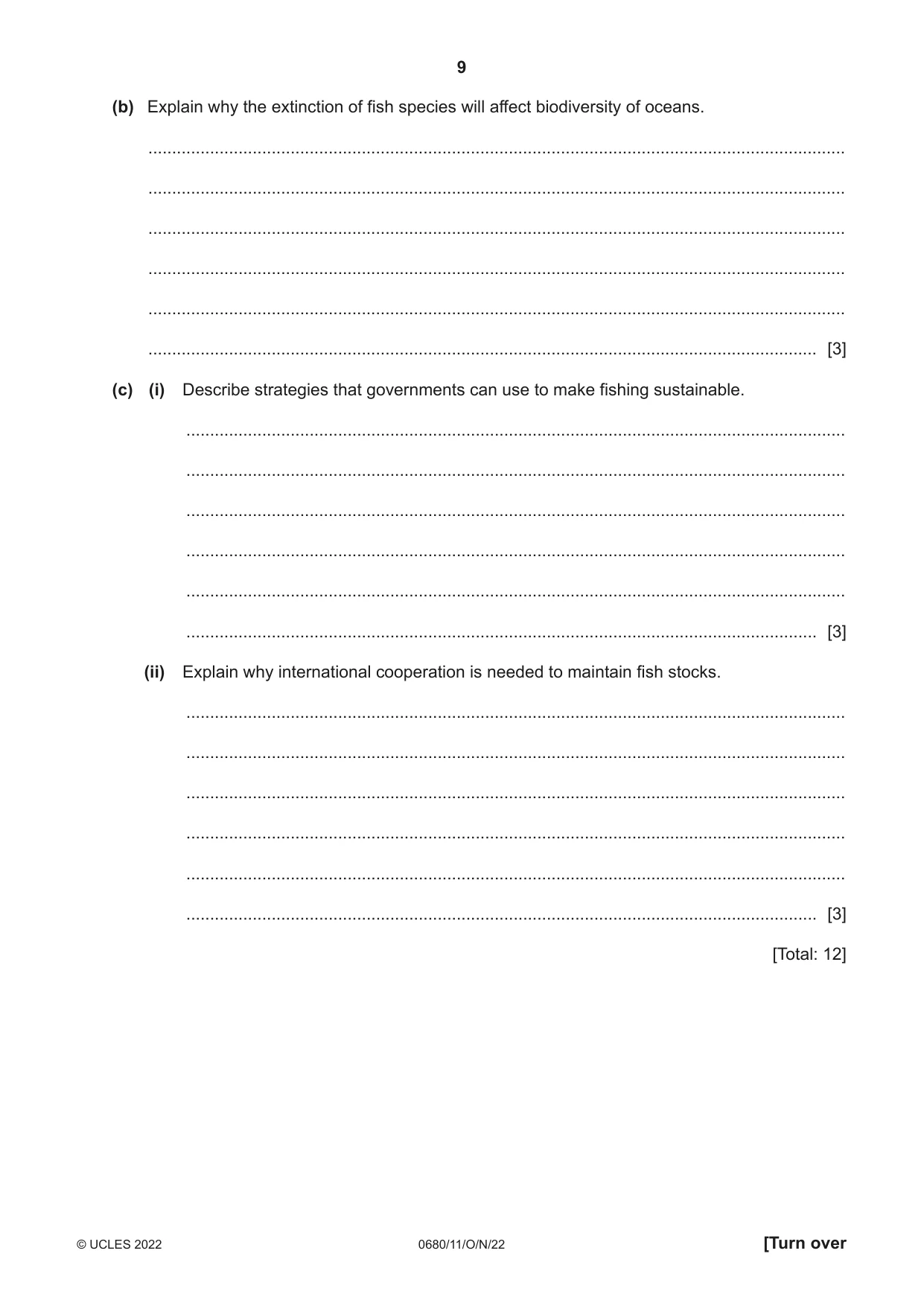
9 0680/11/O/N/22 © UCLES 2022 [Turn over (b) Explain why the extinction of fish species will affect biodiversity of oceans. … … … … … … [3] (c) (i) Describe strategies that governments can use to make fishing sustainable. … … … … … … [3] (ii) Explain why international cooperation is needed to maintain fish stocks. … … … … … … [3] [Total: 12]
Question paper, page 10
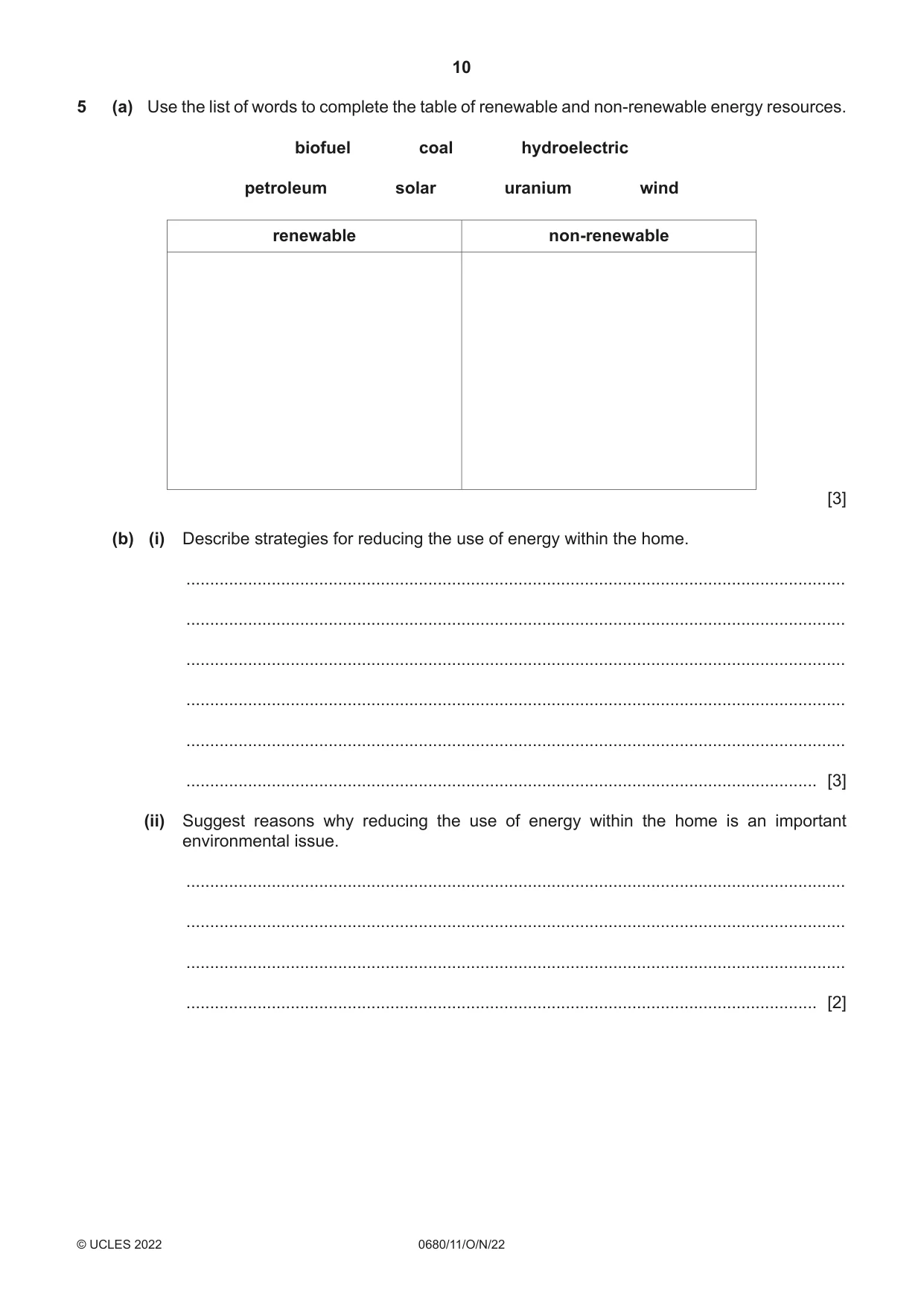
10 0680/11/O/N/22 © UCLES 2022 5 (a) Use the list of words to complete the table of renewable and non-renewable energy resources. biofuel coal hydroelectric petroleum solar uranium wind renewable non-renewable [3] (b) (i) Describe strategies for reducing the use of energy within the home. … … … … … … [3] (ii) Suggest reasons why reducing the use of energy within the home is an important environmental issue. … … … … [2]
Question paper, page 11
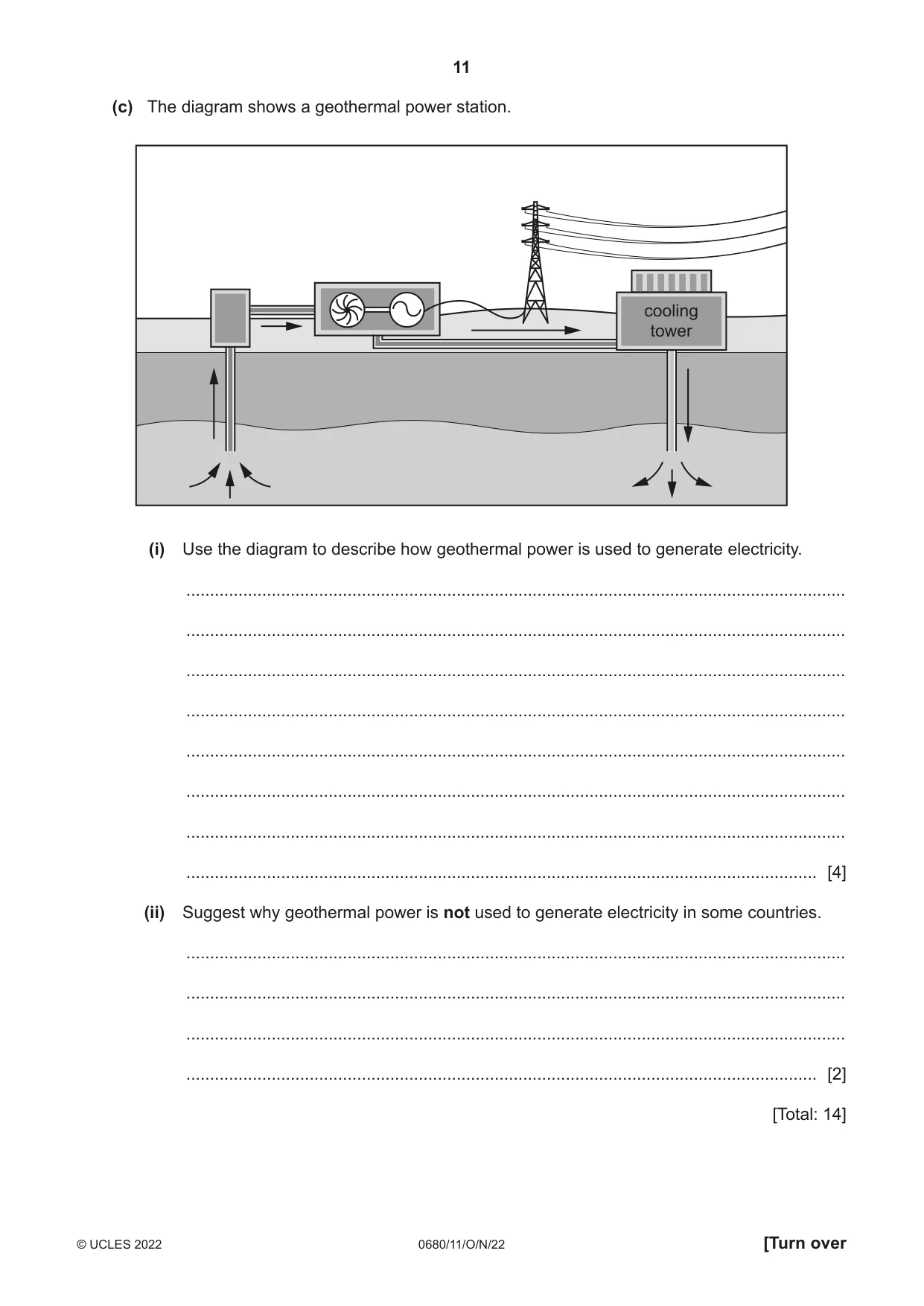
11 0680/11/O/N/22 © UCLES 2022 [Turn over (c) The diagram shows a geothermal power station. cooling tower (i) Use the diagram to describe how geothermal power is used to generate electricity. … … … … … … … … [4] (ii) Suggest why geothermal power is not used to generate electricity in some countries. … … … … [2] [Total: 14]
Question paper, page 12
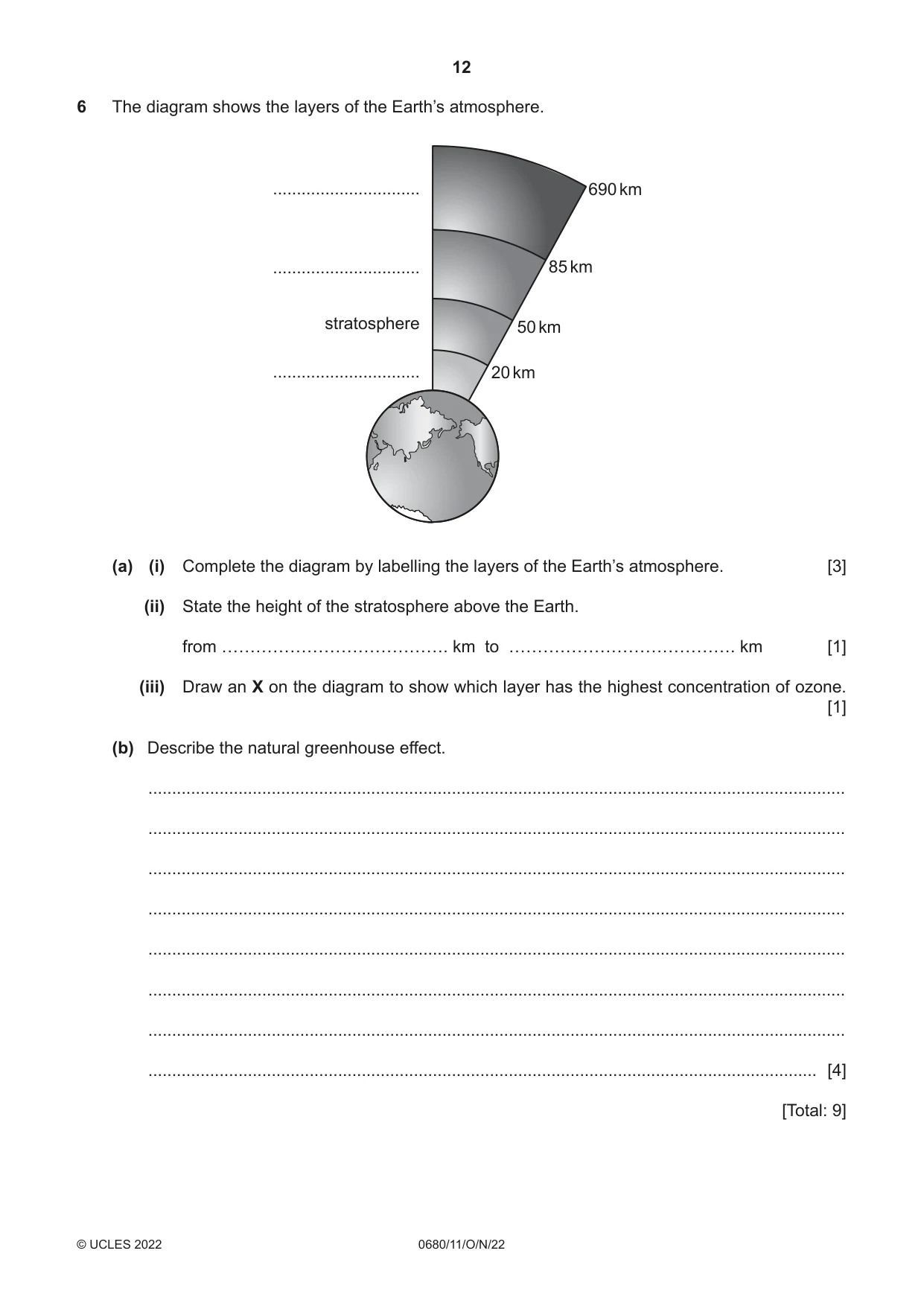
12 0680/11/O/N/22 © UCLES 2022 6 The diagram shows the layers of the Earth’s atmosphere. stratosphere … … … 20 km 50 km 85 km 690 km (a) (i) Complete the diagram by labelling the layers of the Earth’s atmosphere. [3] (ii) State the height of the stratosphere above the Earth. from …………………………………. km to …………………………………. km [1] (iii) Draw an X on the diagram to show which layer has the highest concentration of ozone. [1] (b) Describe the natural greenhouse effect. … … … … … … … … [4] [Total: 9]
Question paper, page 13
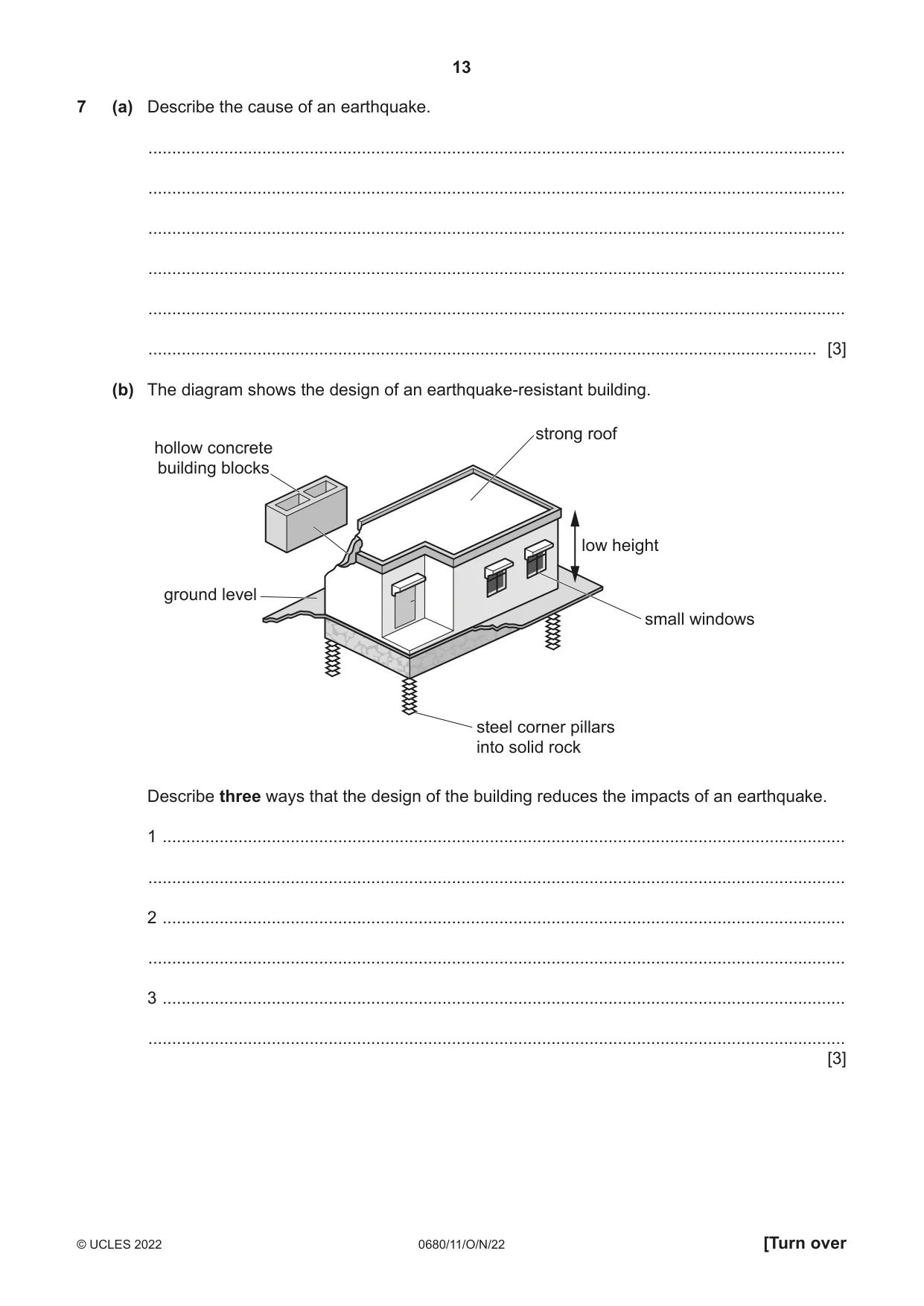
13 0680/11/O/N/22 © UCLES 2022 [Turn over 7 (a) Describe the cause of an earthquake. … … … … … … [3] (b) The diagram shows the design of an earthquake-resistant building. low height strong roof hollow concrete building blocks steel corner pillars into solid rock small windows ground level Describe three ways that the design of the building reduces the impacts of an earthquake. 1 … … 2 … … 3 … … [3]
Question paper, page 14
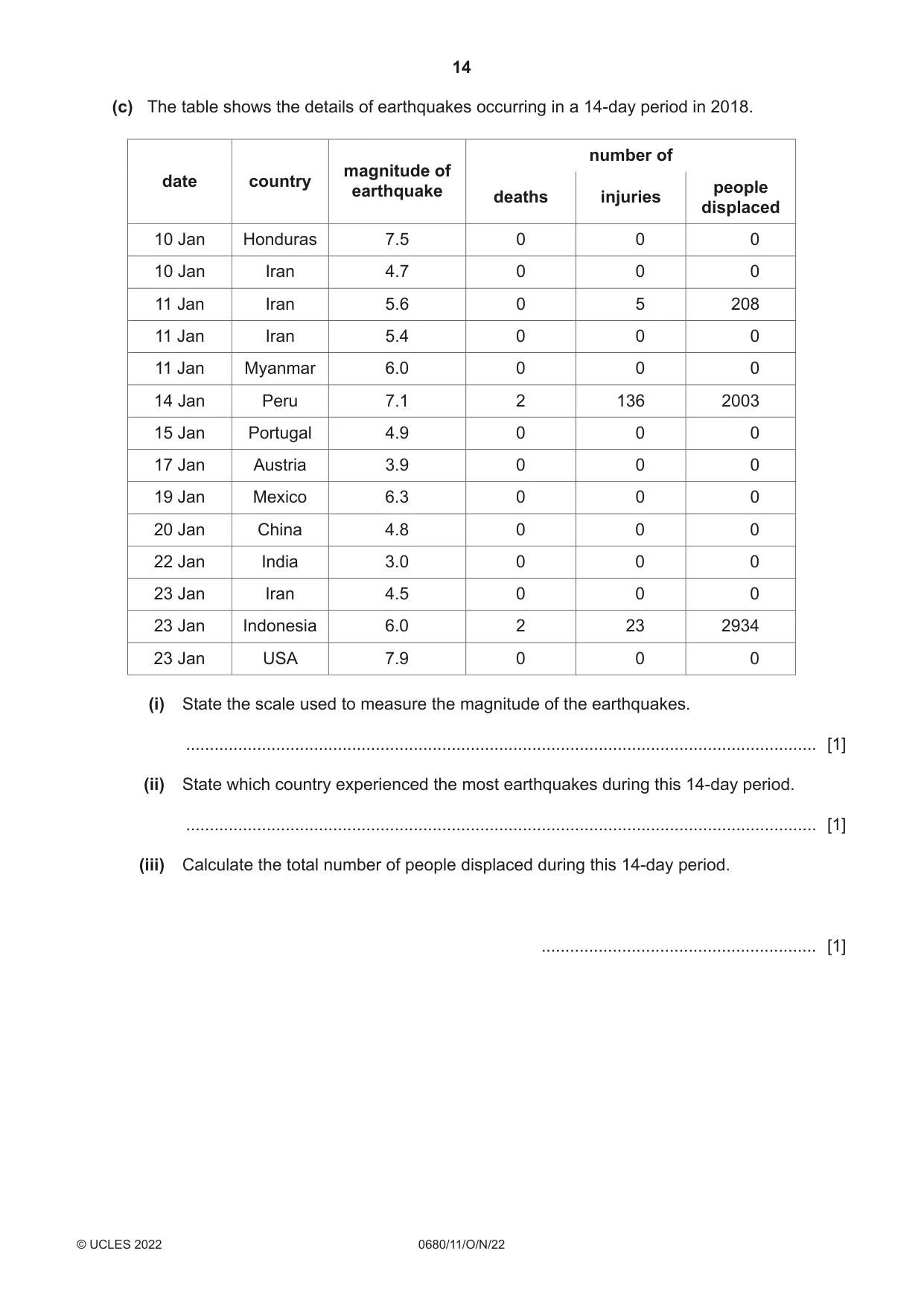
14 0680/11/O/N/22 © UCLES 2022 (c) The table shows the details of earthquakes occurring in a 14-day period in 2018. date country magnitude of earthquake number of deaths injuries people displaced 10 Jan Honduras 7.5 0 0 0 10 Jan Iran 4.7 0 0 0 11 Jan Iran 5.6 0 5 208 11 Jan Iran 5.4 0 0 0 11 Jan Myanmar 6.0 0 0 0 14 Jan Peru 7.1 2 136 2003 15 Jan Portugal 4.9 0 0 0 17 Jan Austria 3.9 0 0 0 19 Jan Mexico 6.3 0 0 0 20 Jan China 4.8 0 0 0 22 Jan India 3.0 0 0 0 23 Jan Iran 4.5 0 0 0 23 Jan Indonesia 6.0 2 23 2934 23 Jan USA 7.9 0 0 0 (i) State the scale used to measure the magnitude of the earthquakes. … [1] (ii) State which country experienced the most earthquakes during this 14-day period. … [1] (iii) Calculate the total number of people displaced during this 14-day period. … [1]
Question paper, page 15
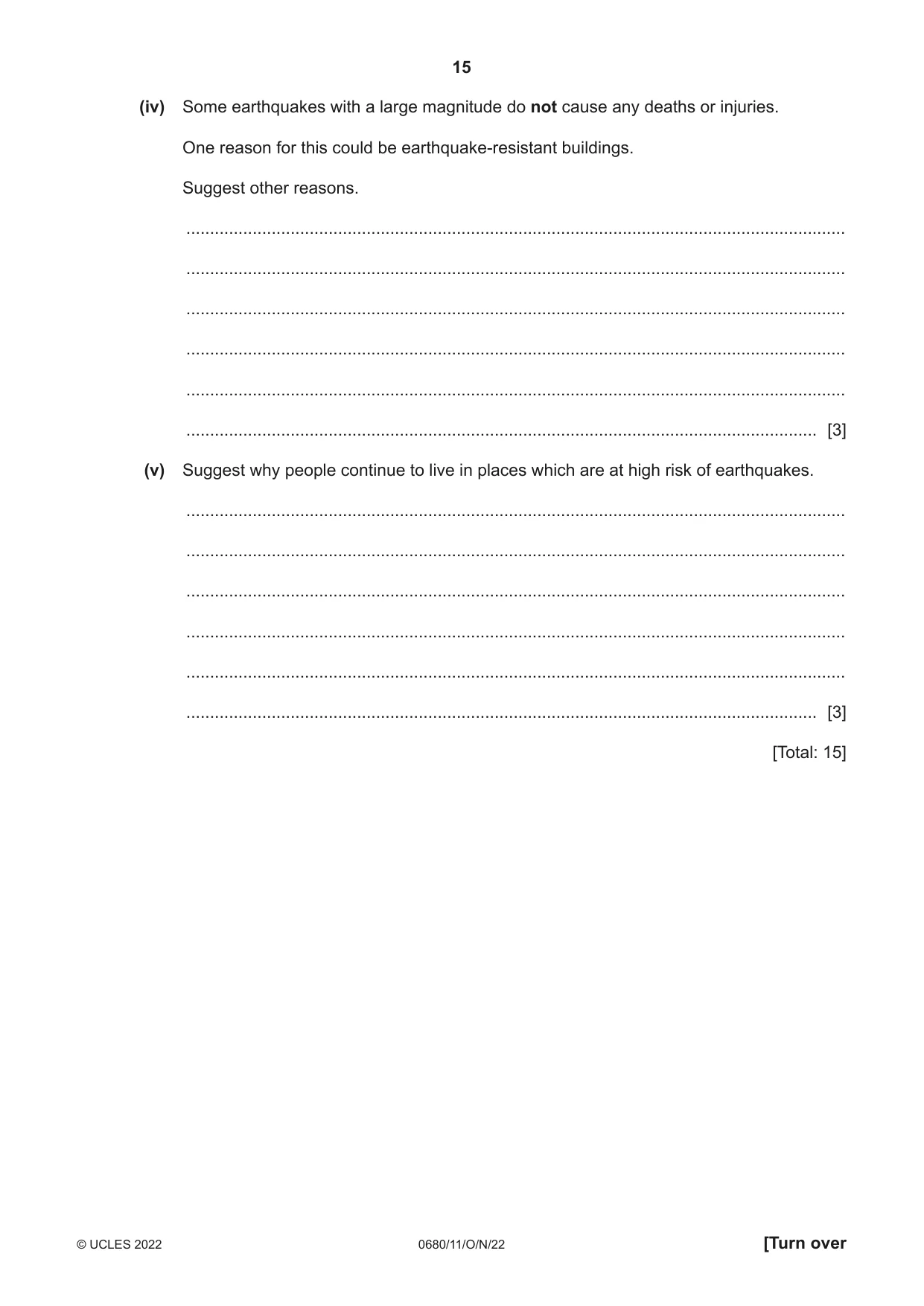
15 0680/11/O/N/22 © UCLES 2022 [Turn over (iv) Some earthquakes with a large magnitude do not cause any deaths or injuries. One reason for this could be earthquake-resistant buildings. Suggest other reasons. … … … … … … [3] (v) Suggest why people continue to live in places which are at high risk of earthquakes. … … … … … … [3] [Total: 15]
Question paper, page 16
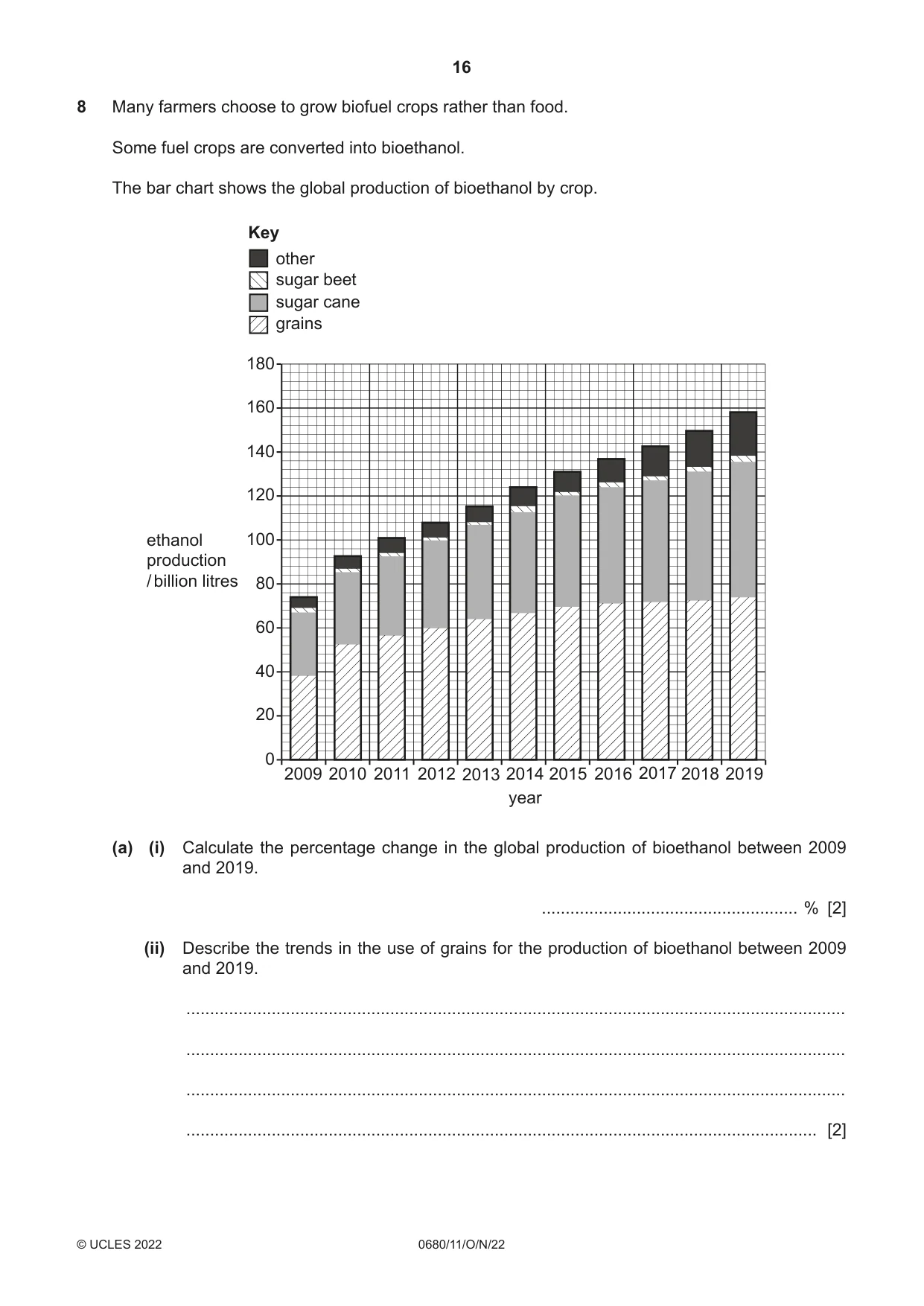
16 0680/11/O/N/22 © UCLES 2022 8 Many farmers choose to grow biofuel crops rather than food. Some fuel crops are converted into bioethanol. The bar chart shows the global production of bioethanol by crop. year 2009 2010 2011 2012 2013 2014 2015 2016 2017 2018 2019 0 20 40 60 80 100 120 140 160 180 Key ethanol production / billion litres sugar beet other grains sugar cane (a) (i) Calculate the percentage change in the global production of bioethanol between 2009 and 2019. … % [2] (ii) Describe the trends in the use of grains for the production of bioethanol between 2009 and 2019. … … … … [2]
Question paper, page 17
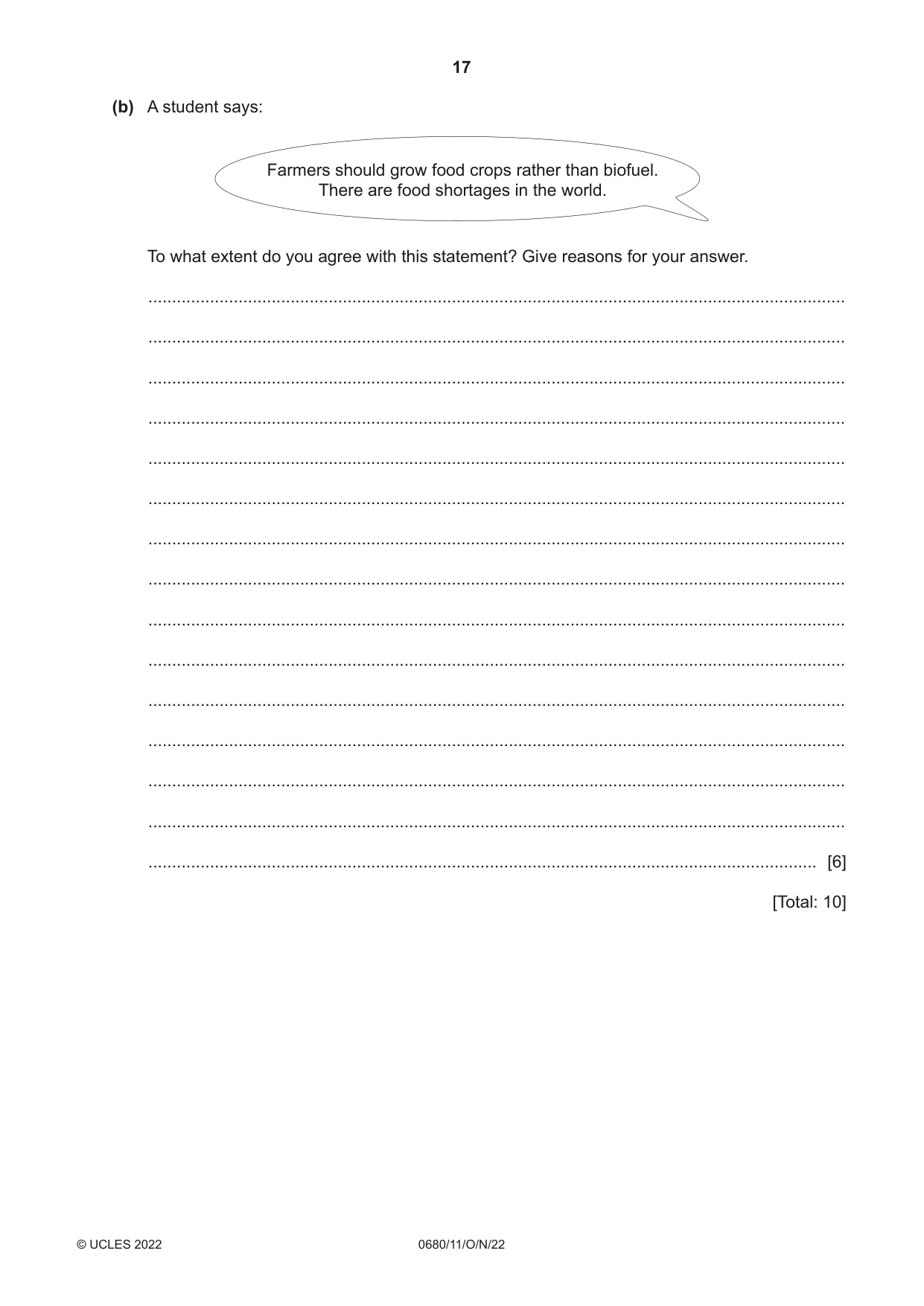
17 0680/11/O/N/22 © UCLES 2022 (b) A student says: Farmers should grow food crops rather than biofuel. There are food shortages in the world. To what extent do you agree with this statement? Give reasons for your answer. … … … … … … … … … … … … … … … [6] [Total: 10]
Question paper, page 18
18 0680/11/O/N/22 © UCLES 2022 BLANK PAGE
Question paper, page 19
19 0680/11/O/N/22 © UCLES 2022 BLANK PAGE
Question paper, page 20
20 0680/11/O/N/22 © UCLES 2022 The boundaries and names shown, the designations used and the presentation of material on any maps contained in this question paper/insert do not imply official endorsement or acceptance by Cambridge Assessment International Education concerning the legal status of any country, territory, or area or any of its authorities, or of the delimitation of its frontiers or boundaries. Permission to reproduce items where third-party owned material protected by copyright is included has been sought and cleared where possible. Every reasonable effort has been made by the publisher (UCLES) to trace copyright holders, but if any items requiring clearance have unwittingly been included, the publisher will be pleased to make amends at the earliest possible opportunity. To avoid the issue of disclosure of answer-related information to candidates, all copyright acknowledgements are reproduced online in the Cambridge Assessment International Education Copyright Acknowledgements Booklet. This is produced for each series of examinations and is freely available to download at www.cambridgeinternational.org after the live examination series. Cambridge Assessment International Education is part of Cambridge Assessment. Cambridge Assessment is the brand name of the University of Cambridge Local Examinations Syndicate (UCLES), which is a department of the University of Cambridge. BLANK PAGE
Mark scheme, page 1
This document consists of 12 printed pages. © UCLES 2022 [Turn over Cambridge IGCSE™ ENVIRONMENTAL MANAGEMENT 0680/11 Paper 1 Theory October/November 2022 MARK SCHEME Maximum Mark: 80 Published This mark scheme is published as an aid to teachers and candidates, to indicate the requirements of the examination. It shows the basis on which Examiners were instructed to award marks. It does not indicate the details of the discussions that took place at an Examiners’ meeting before marking began, which would have considered the acceptability of alternative answers. Mark schemes should be read in conjunction with the question paper and the Principal Examiner Report for Teachers. Cambridge International will not enter into discussions about these mark schemes. Cambridge International is publishing the mark schemes for the October/November 2022 series for most Cambridge IGCSE™, Cambridge International A and AS Level components and some Cambridge O Level components.
Mark scheme, page 2
0680/11 Cambridge IGCSE – Mark Scheme PUBLISHED October/November 2022 © UCLES 2022 Page 2 of 12 Generic Marking Principles These general marking principles must be applied by all examiners when marking candidate answers. They should be applied alongside the specific content of the mark scheme or generic level descriptors for a question. Each question paper and mark scheme will also comply with these marking principles. GENERIC MARKING PRINCIPLE 1: Marks must be awarded in line with: • the specific content of the mark scheme or the generic level descriptors for the question • the specific skills defined in the mark scheme or in the generic level descriptors for the question • the standard of response required by a candidate as exemplified by the standardisation scripts. GENERIC MARKING PRINCIPLE 2: Marks awarded are always whole marks (not half marks, or other fractions). GENERIC MARKING PRINCIPLE 3: Marks must be awarded positively: • marks are awarded for correct/valid answers, as defined in the mark scheme. However, credit is given for valid answers which go beyond the scope of the syllabus and mark scheme, referring to your Team Leader as appropriate • marks are awarded when candidates clearly demonstrate what they know and can do • marks are not deducted for errors • marks are not deducted for omissions • answers should only be judged on the quality of spelling, punctuation and grammar when these features are specifically assessed by the question as indicated by the mark scheme. The meaning, however, should be unambiguous. GENERIC MARKING PRINCIPLE 4: Rules must be applied consistently, e.g. in situations where candidates have not followed instructions or in the application of generic level descriptors.
Mark scheme, page 3
0680/11 Cambridge IGCSE – Mark Scheme PUBLISHED October/November 2022 © UCLES 2022 Page 3 of 12 GENERIC MARKING PRINCIPLE 5: Marks should be awarded using the full range of marks defined in the mark scheme for the question (however; the use of the full mark range may be limited according to the quality of the candidate responses seen). GENERIC MARKING PRINCIPLE 6: Marks awarded are based solely on the requirements as defined in the mark scheme. Marks should not be awarded with grade thresholds or grade descriptors in mind. Science-Specific Marking Principles 1 Examiners should consider the context and scientific use of any keywords when awarding marks. Although keywords may be present, marks should not be awarded if the keywords are used incorrectly. 2 The examiner should not choose between contradictory statements given in the same question part, and credit should not be awarded for any correct statement that is contradicted within the same question part. Wrong science that is irrelevant to the question should be ignored. 3 Although spellings do not have to be correct, spellings of syllabus terms must allow for clear and unambiguous separation from other syllabus terms with which they may be confused (e.g. ethane / ethene, glucagon / glycogen, refraction / reflection). 4 The error carried forward (ecf) principle should be applied, where appropriate. If an incorrect answer is subsequently used in a scientifically correct way, the candidate should be awarded these subsequent marking points. Further guidance will be included in the mark scheme where necessary and any exceptions to this general principle will be noted. 5 ‘List rule’ guidance For questions that require n responses (e.g. State two reasons …): • The response should be read as continuous prose, even when numbered answer spaces are provided. • Any response marked ignore in the mark scheme should not count towards n. • Incorrect responses should not be awarded credit but will still count towards n. • Read the entire response to check for any responses that contradict those that would otherwise be credited. Credit should not be awarded for any responses that are contradicted within the rest of the response. Where two responses contradict one another, this should be treated as a single incorrect response. • Non-contradictory responses after the first n responses may be ignored even if they include incorrect science.
Mark scheme, page 4
0680/11 Cambridge IGCSE – Mark Scheme PUBLISHED October/November 2022 © UCLES 2022 Page 4 of 12 6 Calculation specific guidance Correct answers to calculations should be given full credit even if there is no working or incorrect working, unless the question states ‘show your working’. For questions in which the number of significant figures required is not stated, credit should be awarded for correct answers when rounded by the examiner to the number of significant figures given in the mark scheme. This may not apply to measured values. For answers given in standard form (e.g. a 10n) in which the convention of restricting the value of the coefficient (a) to a value between 1 and 10 is not followed, credit may still be awarded if the answer can be converted to the answer given in the mark scheme. Unless a separate mark is given for a unit, a missing or incorrect unit will normally mean that the final calculation mark is not awarded. Exceptions to this general principle will be noted in the mark scheme. 7 Guidance for chemical equations Multiples / fractions of coefficients used in chemical equations are acceptable unless stated otherwise in the mark scheme. State symbols given in an equation should be ignored unless asked for in the question or stated otherwise in the mark scheme.
Mark scheme, page 5
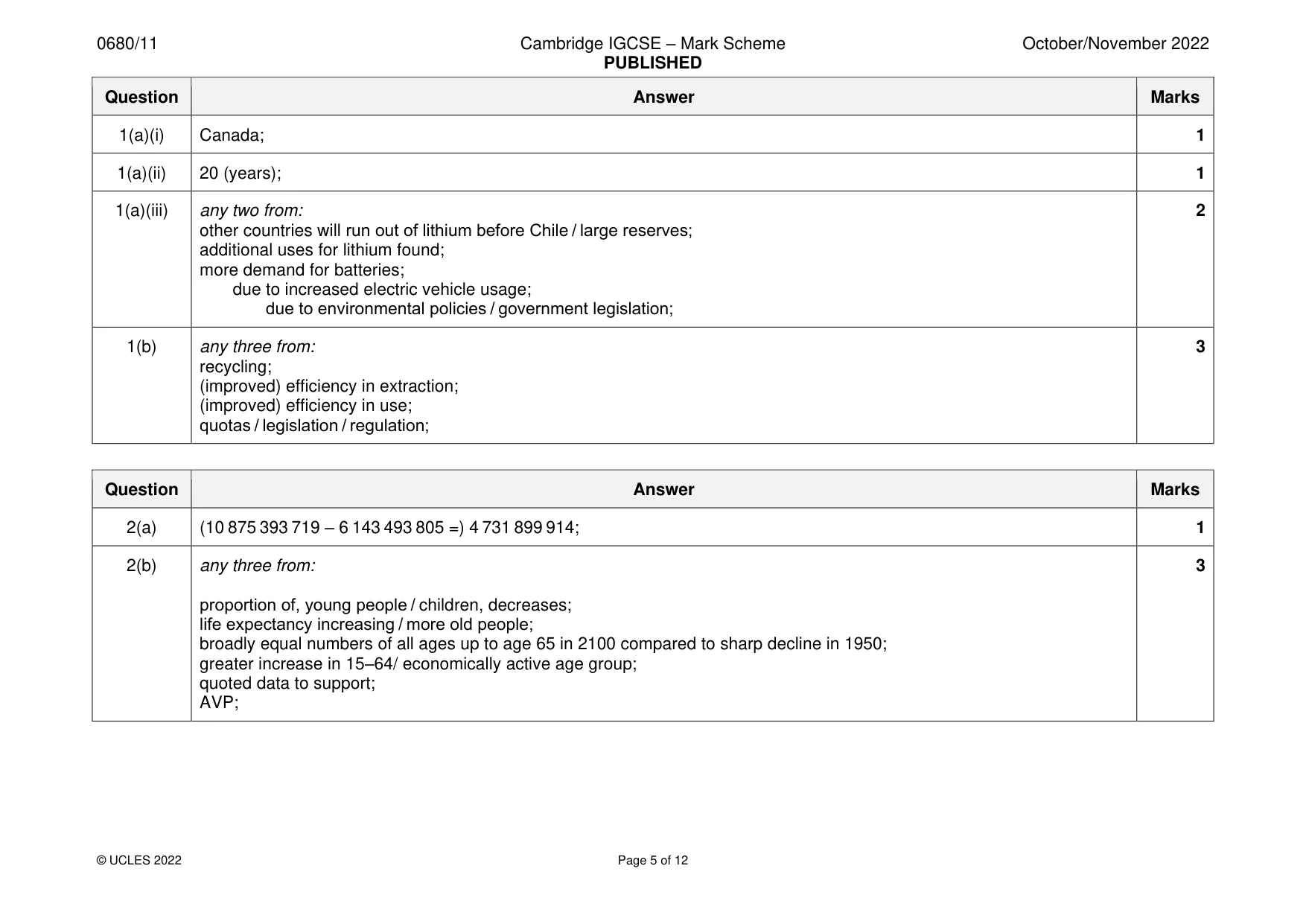
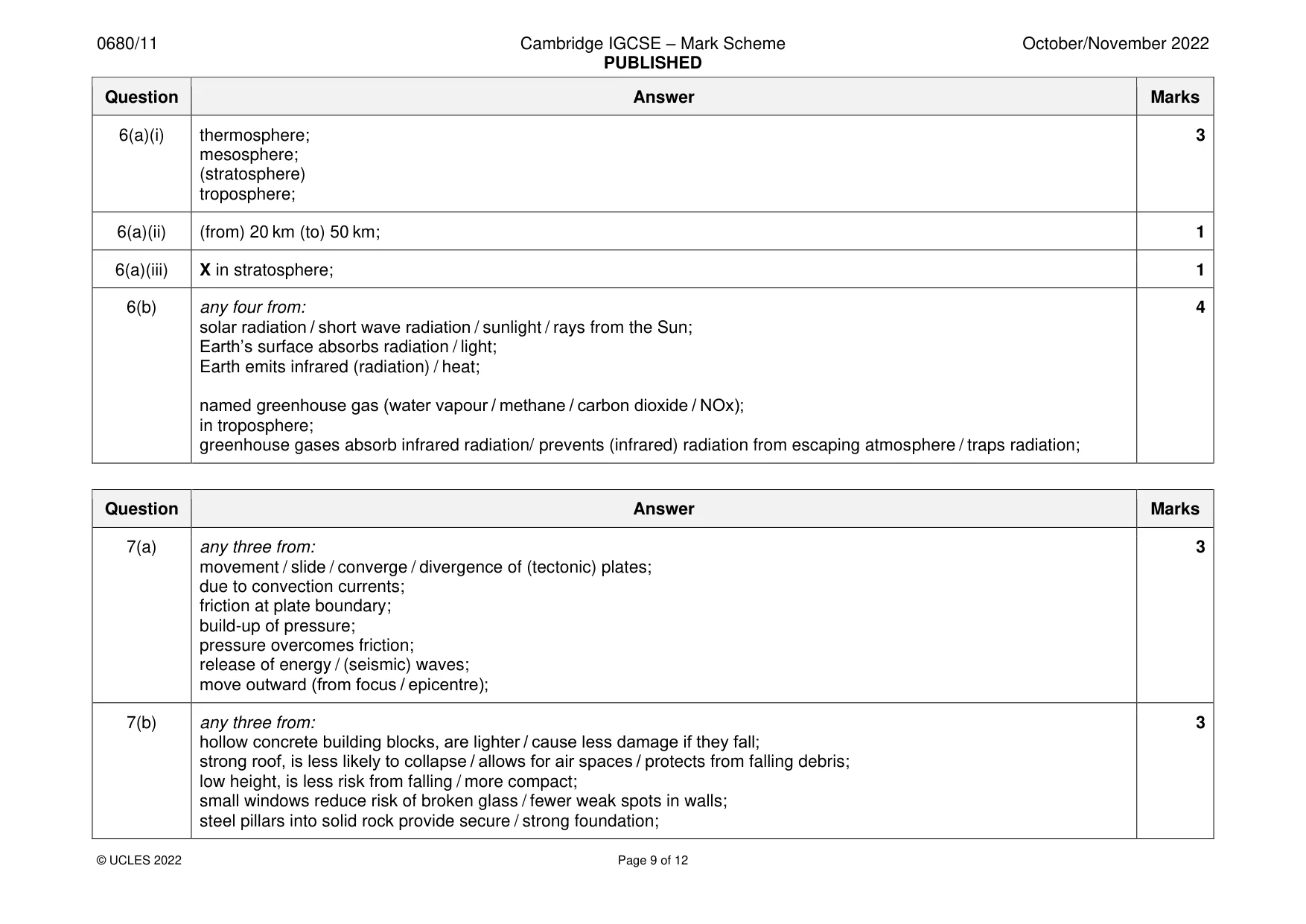
0680/11 Cambridge IGCSE – Mark Scheme PUBLISHED October/November 2022 © UCLES 2022 Page 5 of 12 Question Answer Marks 1(a)(i) Canada; 1 1(a)(ii) 20 (years); 1 1(a)(iii) any two from: other countries will run out of lithium before Chile / large reserves; additional uses for lithium found; more demand for batteries; due to increased electric vehicle usage; due to environmental policies / government legislation; 2 1(b) any three from: recycling; (improved) efficiency in extraction; (improved) efficiency in use; quotas / legislation / regulation; 3 Question Answer Marks 2(a) (10 875 393 719 – 6 143 493 805 =) 4 731 899 914; 1 2(b) any three from: proportion of, young people / children, decreases; life expectancy increasing / more old people; broadly equal numbers of all ages up to age 65 in 2100 compared to sharp decline in 1950; greater increase in 15–64/ economically active age group; quoted data to support; AVP; 3
Mark scheme, page 6
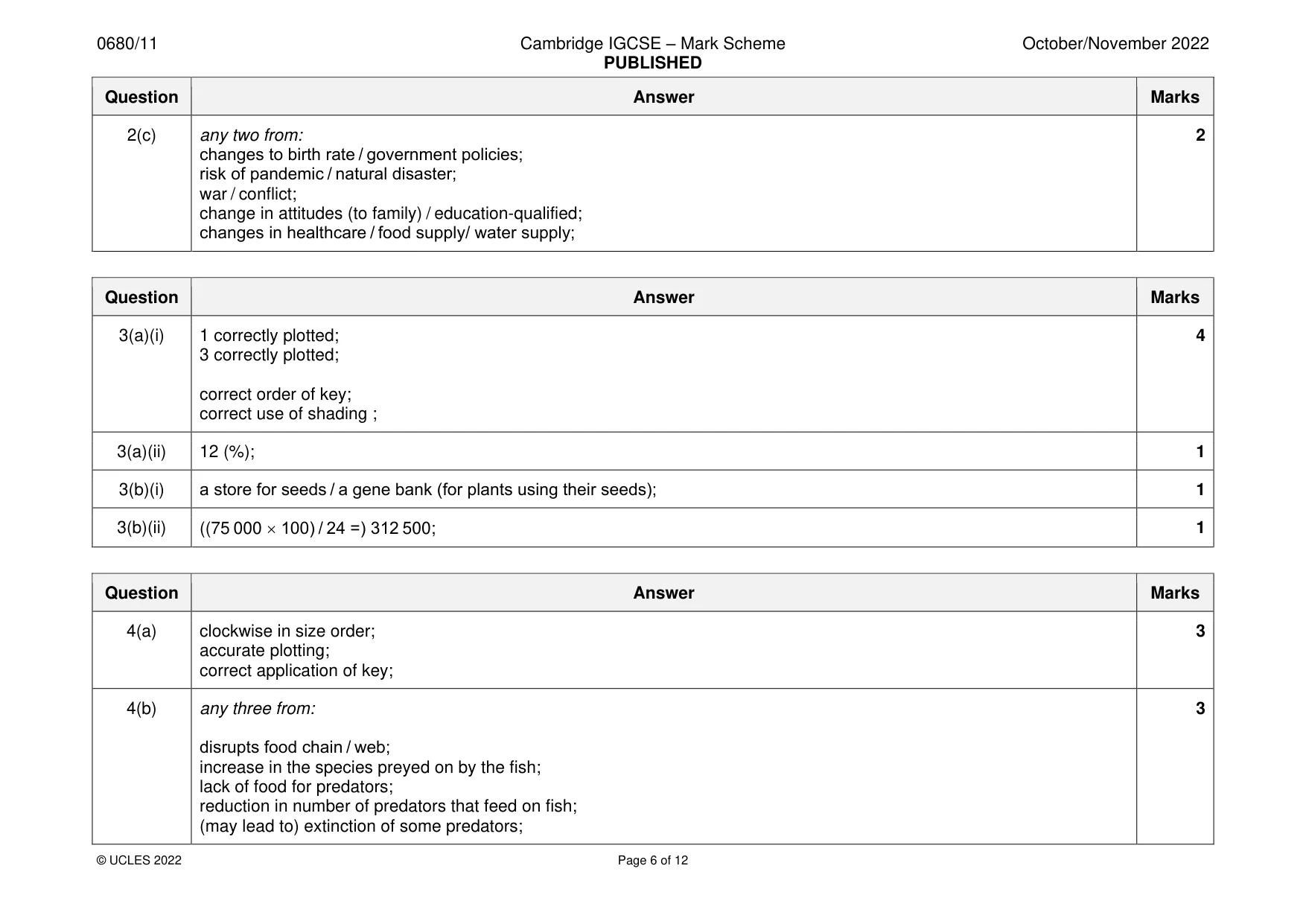
0680/11 Cambridge IGCSE – Mark Scheme PUBLISHED October/November 2022 © UCLES 2022 Page 6 of 12 Question Answer Marks 2(c) any two from: changes to birth rate / government policies; risk of pandemic / natural disaster; war / conflict; change in attitudes (to family) / education-qualified; changes in healthcare / food supply/ water supply; 2 Question Answer Marks 3(a)(i) 1 correctly plotted; 3 correctly plotted; correct order of key; correct use of shading ; 4 3(a)(ii) 12 (%); 1 3(b)(i) a store for seeds / a gene bank (for plants using their seeds); 1 3(b)(ii) ((75 000 100) / 24 =) 312 500; 1 Question Answer Marks 4(a) clockwise in size order; accurate plotting; correct application of key; 3 4(b) any three from: disrupts food chain / web; increase in the species preyed on by the fish; lack of food for predators; reduction in number of predators that feed on fish; (may lead to) extinction of some predators; 3
Mark scheme, page 7
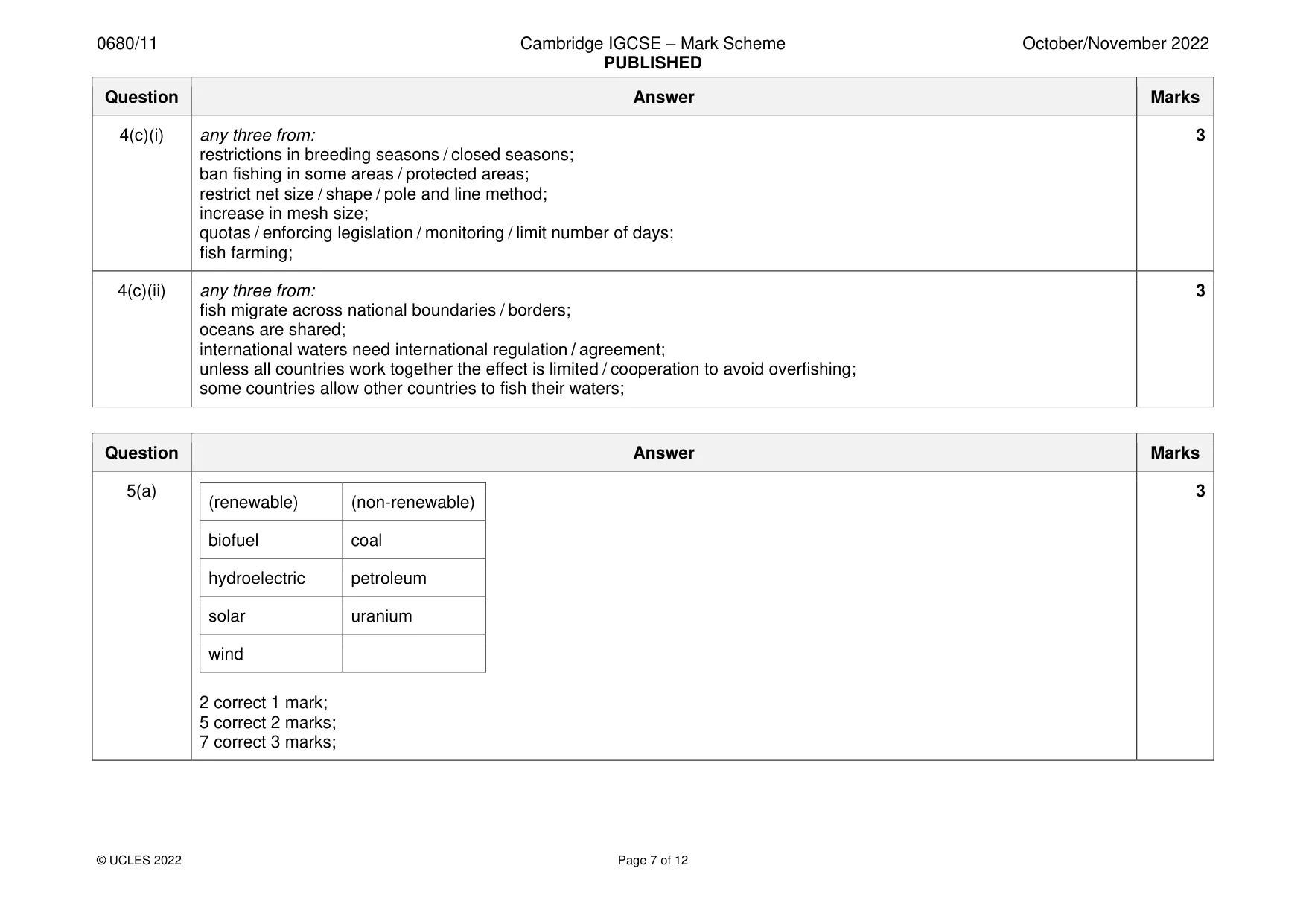
0680/11 Cambridge IGCSE – Mark Scheme PUBLISHED October/November 2022 © UCLES 2022 Page 7 of 12 Question Answer Marks 4(c)(i) any three from: restrictions in breeding seasons / closed seasons; ban fishing in some areas / protected areas; restrict net size / shape / pole and line method; increase in mesh size; quotas / enforcing legislation / monitoring / limit number of days; fish farming; 3 4(c)(ii) any three from: fish migrate across national boundaries / borders; oceans are shared; international waters need international regulation / agreement; unless all countries work together the effect is limited / cooperation to avoid overfishing; some countries allow other countries to fish their waters; 3 Question Answer Marks 5(a) (renewable) (non-renewable) biofuel coal hydroelectric petroleum solar uranium wind 2 correct 1 mark; 5 correct 2 marks; 7 correct 3 marks; 3
Mark scheme, page 8
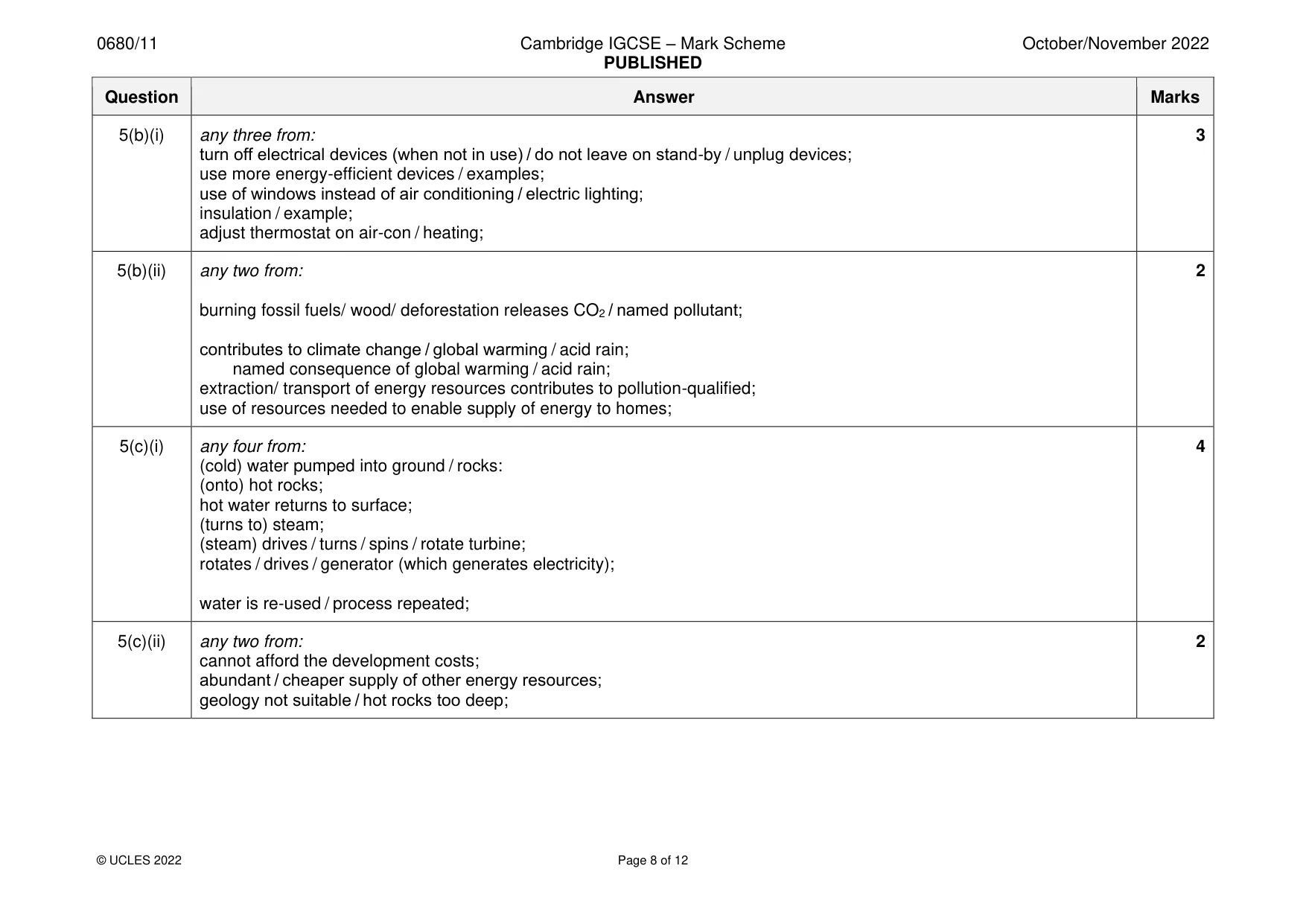
0680/11 Cambridge IGCSE – Mark Scheme PUBLISHED October/November 2022 © UCLES 2022 Page 8 of 12 Question Answer Marks 5(b)(i) any three from: turn off electrical devices (when not in use) / do not leave on stand-by / unplug devices; use more energy-efficient devices / examples; use of windows instead of air conditioning / electric lighting; insulation / example; adjust thermostat on air-con / heating; 3 5(b)(ii) any two from: burning fossil fuels/ wood/ deforestation releases CO2 / named pollutant; contributes to climate change / global warming / acid rain; named consequence of global warming / acid rain; extraction/ transport of energy resources contributes to pollution-qualified; use of resources needed to enable supply of energy to homes; 2 5(c)(i) any four from: (cold) water pumped into ground / rocks: (onto) hot rocks; hot water returns to surface; (turns to) steam; (steam) drives / turns / spins / rotate turbine; rotates / drives / generator (which generates electricity); water is re-used / process repeated; 4 5(c)(ii) any two from: cannot afford the development costs; abundant / cheaper supply of other energy resources; geology not suitable / hot rocks too deep; 2
Mark scheme, page 9
0680/11 Cambridge IGCSE – Mark Scheme PUBLISHED October/November 2022 © UCLES 2022 Page 9 of 12 Question Answer Marks 6(a)(i) thermosphere; mesosphere; (stratosphere) troposphere; 3 6(a)(ii) (from) 20 km (to) 50 km; 1 6(a)(iii) X in stratosphere; 1 6(b) any four from: solar radiation / short wave radiation / sunlight / rays from the Sun; Earth’s surface absorbs radiation / light; Earth emits infrared (radiation) / heat; named greenhouse gas (water vapour / methane / carbon dioxide / NOx); in troposphere; greenhouse gases absorb infrared radiation/ prevents (infrared) radiation from escaping atmosphere / traps radiation; 4 Question Answer Marks 7(a) any three from: movement / slide / converge / divergence of (tectonic) plates; due to convection currents; friction at plate boundary; build-up of pressure; pressure overcomes friction; release of energy / (seismic) waves; move outward (from focus / epicentre); 3 7(b) any three from: hollow concrete building blocks, are lighter / cause less damage if they fall; strong roof, is less likely to collapse / allows for air spaces / protects from falling debris; low height, is less risk from falling / more compact; small windows reduce risk of broken glass / fewer weak spots in walls; steel pillars into solid rock provide secure / strong foundation; 3
Mark scheme, page 10
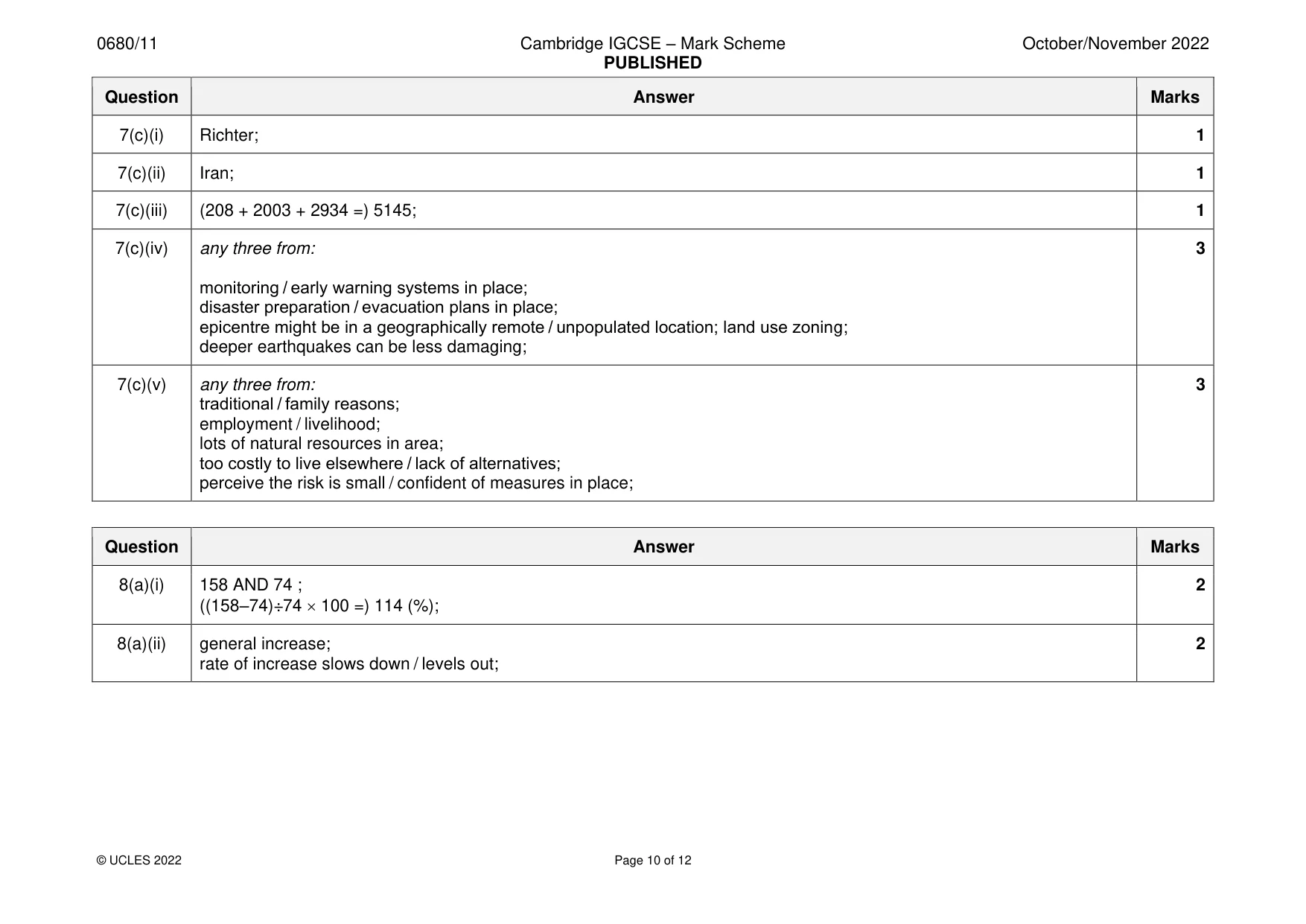
0680/11 Cambridge IGCSE – Mark Scheme PUBLISHED October/November 2022 © UCLES 2022 Page 10 of 12 Question Answer Marks 7(c)(i) Richter; 1 7(c)(ii) Iran; 1 7(c)(iii) (208 + 2003 + 2934 =) 5145; 1 7(c)(iv) any three from: monitoring / early warning systems in place; disaster preparation / evacuation plans in place; epicentre might be in a geographically remote / unpopulated location; land use zoning; deeper earthquakes can be less damaging; 3 7(c)(v) any three from: traditional / family reasons; employment / livelihood; lots of natural resources in area; too costly to live elsewhere / lack of alternatives; perceive the risk is small / confident of measures in place; 3 Question Answer Marks 8(a)(i) 158 AND 74 ; ((158–74)÷74 100 =) 114 (%); 2 8(a)(ii) general increase; rate of increase slows down / levels out; 2
Mark scheme, page 11
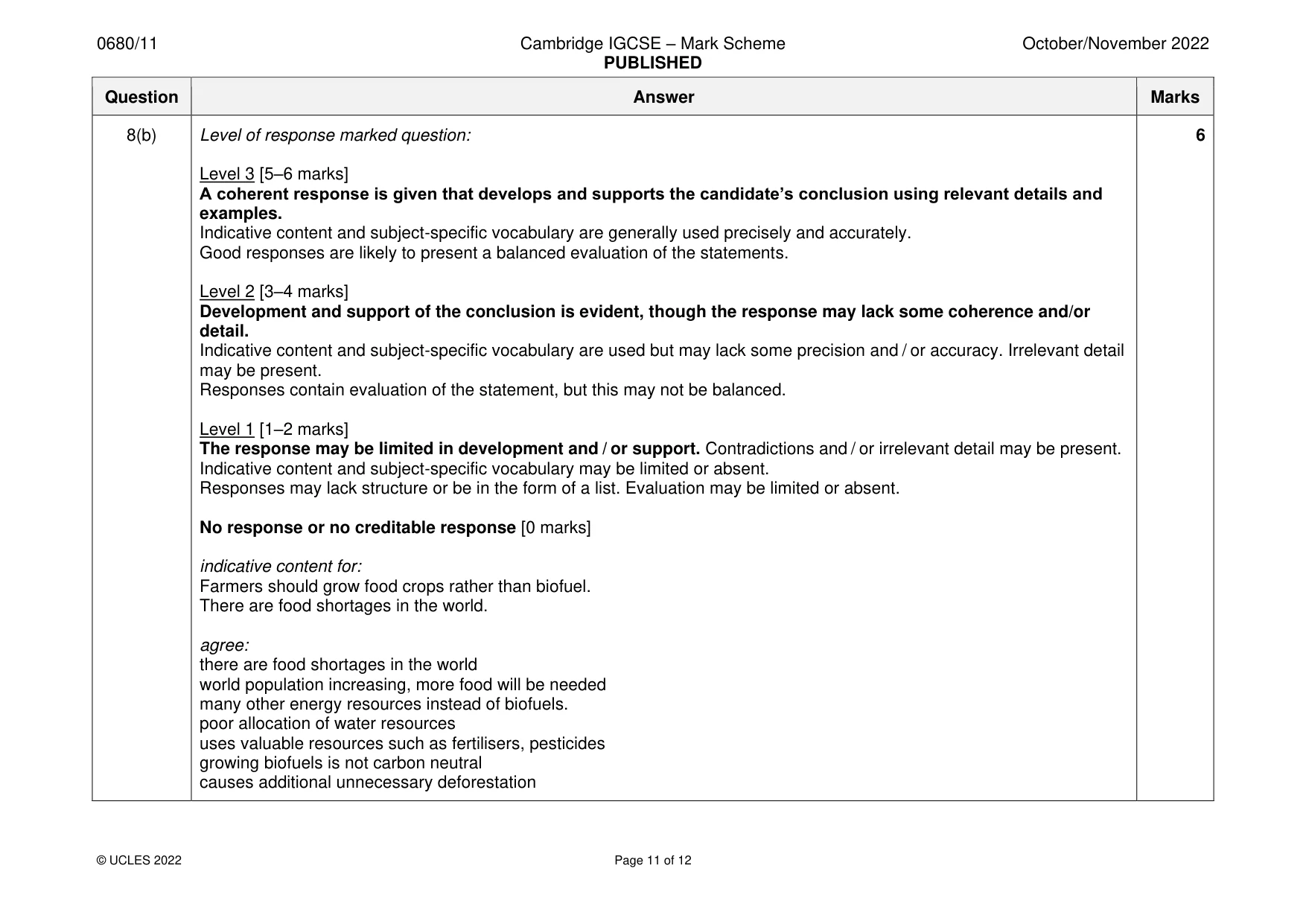
0680/11 Cambridge IGCSE – Mark Scheme PUBLISHED October/November 2022 © UCLES 2022 Page 11 of 12 Question Answer Marks 8(b) Level of response marked question: Level 3 [5–6 marks] A coherent response is given that develops and supports the candidate’s conclusion using relevant details and examples. Indicative content and subject-specific vocabulary are generally used precisely and accurately. Good responses are likely to present a balanced evaluation of the statements. Level 2 [3–4 marks] Development and support of the conclusion is evident, though the response may lack some coherence and/or detail. Indicative content and subject-specific vocabulary are used but may lack some precision and / or accuracy. Irrelevant detail may be present. Responses contain evaluation of the statement, but this may not be balanced. Level 1 [1–2 marks] The response may be limited in development and / or support. Contradictions and / or irrelevant detail may be present. Indicative content and subject-specific vocabulary may be limited or absent. Responses may lack structure or be in the form of a list. Evaluation may be limited or absent. No response or no creditable response [0 marks] indicative content for: Farmers should grow food crops rather than biofuel. There are food shortages in the world. agree: there are food shortages in the world world population increasing, more food will be needed many other energy resources instead of biofuels. poor allocation of water resources uses valuable resources such as fertilisers, pesticides growing biofuels is not carbon neutral causes additional unnecessary deforestation 6
Mark scheme, page 12
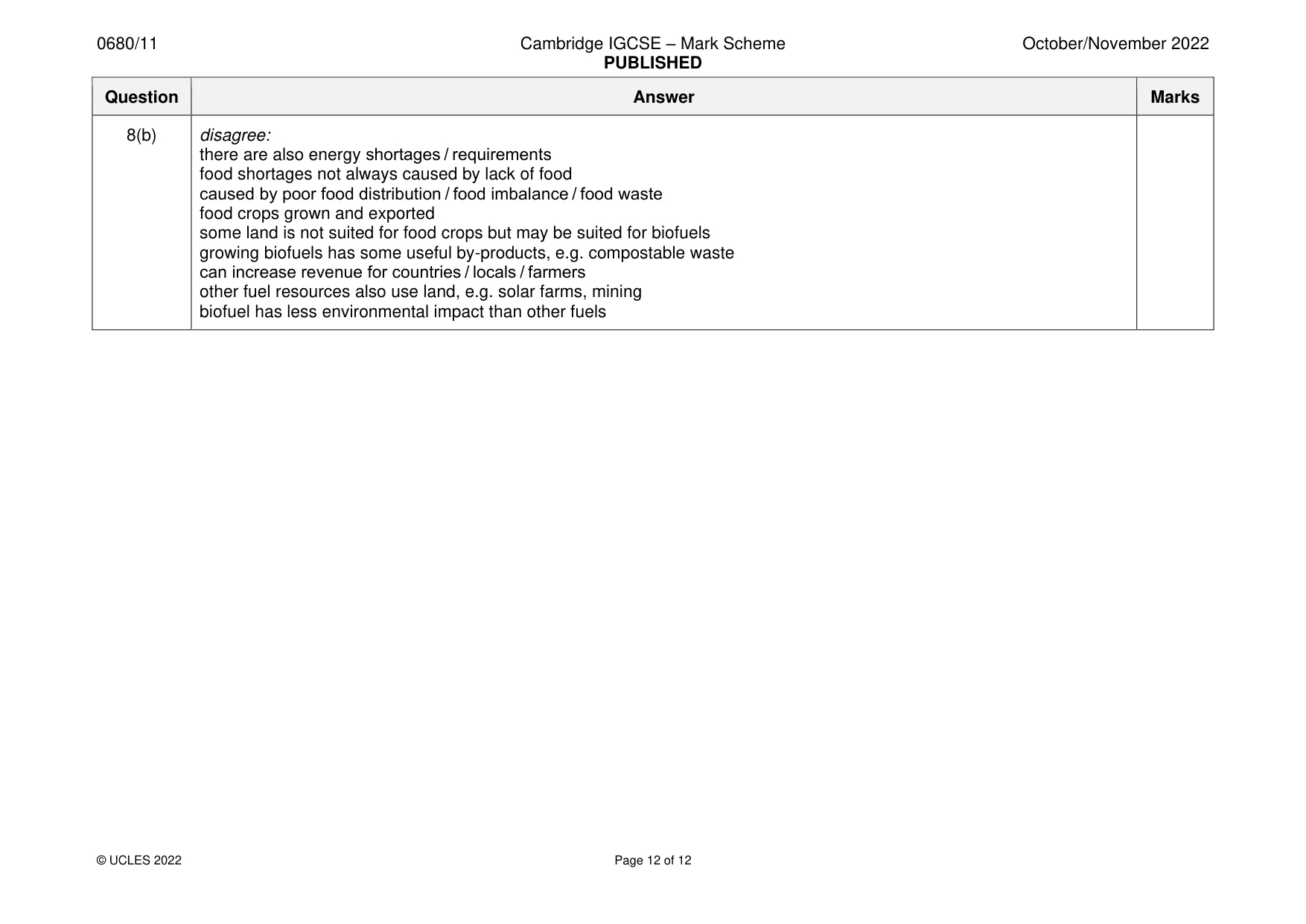
0680/11 Cambridge IGCSE – Mark Scheme PUBLISHED October/November 2022 © UCLES 2022 Page 12 of 12 Question Answer Marks 8(b) disagree: there are also energy shortages / requirements food shortages not always caused by lack of food caused by poor food distribution / food imbalance / food waste food crops grown and exported some land is not suited for food crops but may be suited for biofuels growing biofuels has some useful by-products, e.g. compostable waste can increase revenue for countries / locals / farmers other fuel resources also use land, e.g. solar farms, mining biofuel has less environmental impact than other fuels
What you needed in this session
Cambridge’s own grade thresholds for 2022 Oct/Nov, Paper 1 · Variant 1. A higher threshold means an easier paper — the bar moves with how the cohort did.