Cambridge IGCSE Environmental Management 0680 — 2024 Feb/March Paper 1 · Variant 2
0680/12/F/M/24 · 80 marks · ≈90 min
The question paper and its mark scheme, free to read here and free to download. This is Cambridge’s own paper, exactly as it was sat.
Question paper20 pages



Mark scheme13 pages
Answers below. Sit the paper first if you are practising.
Paper as text
Question paper, page 1
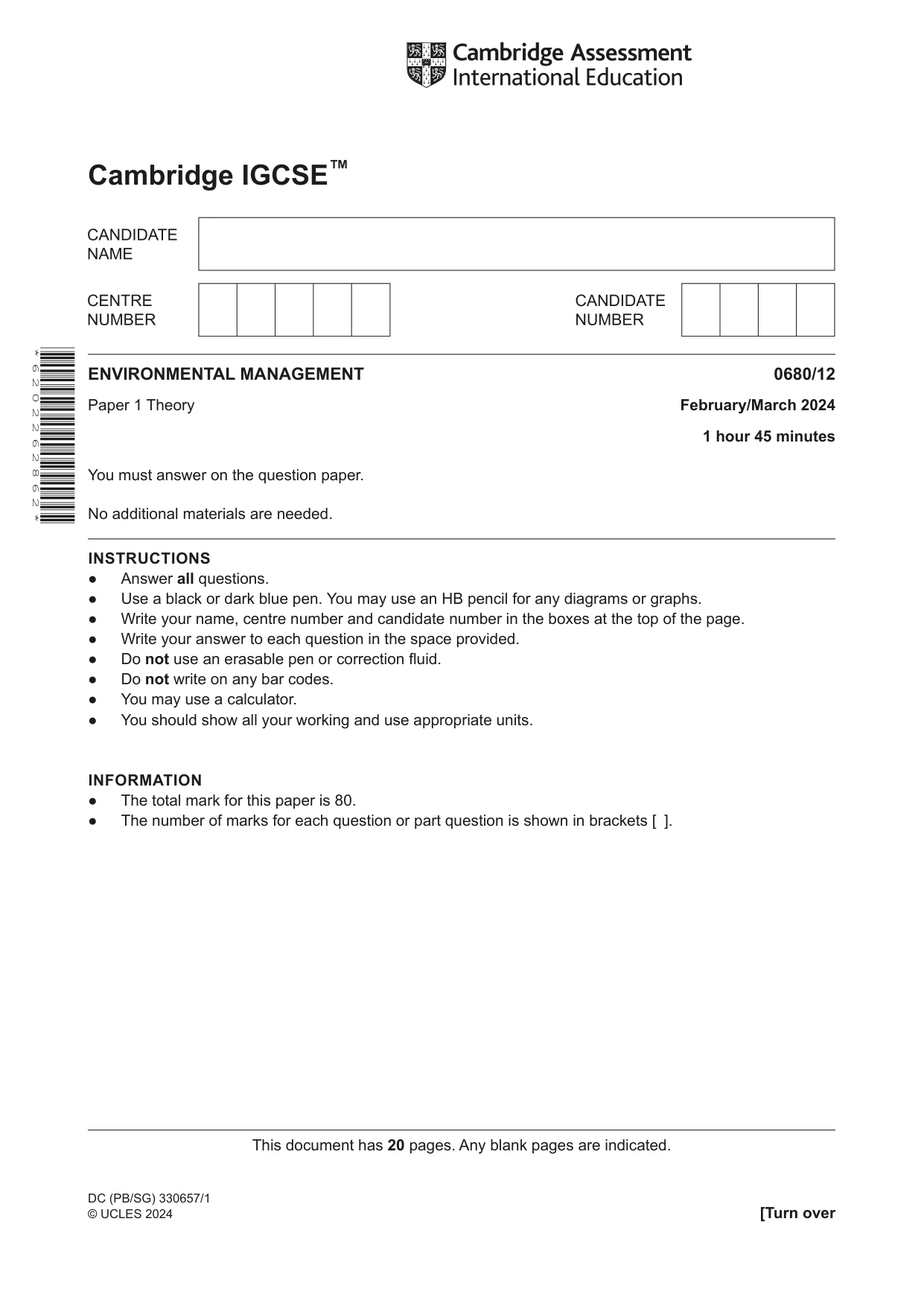
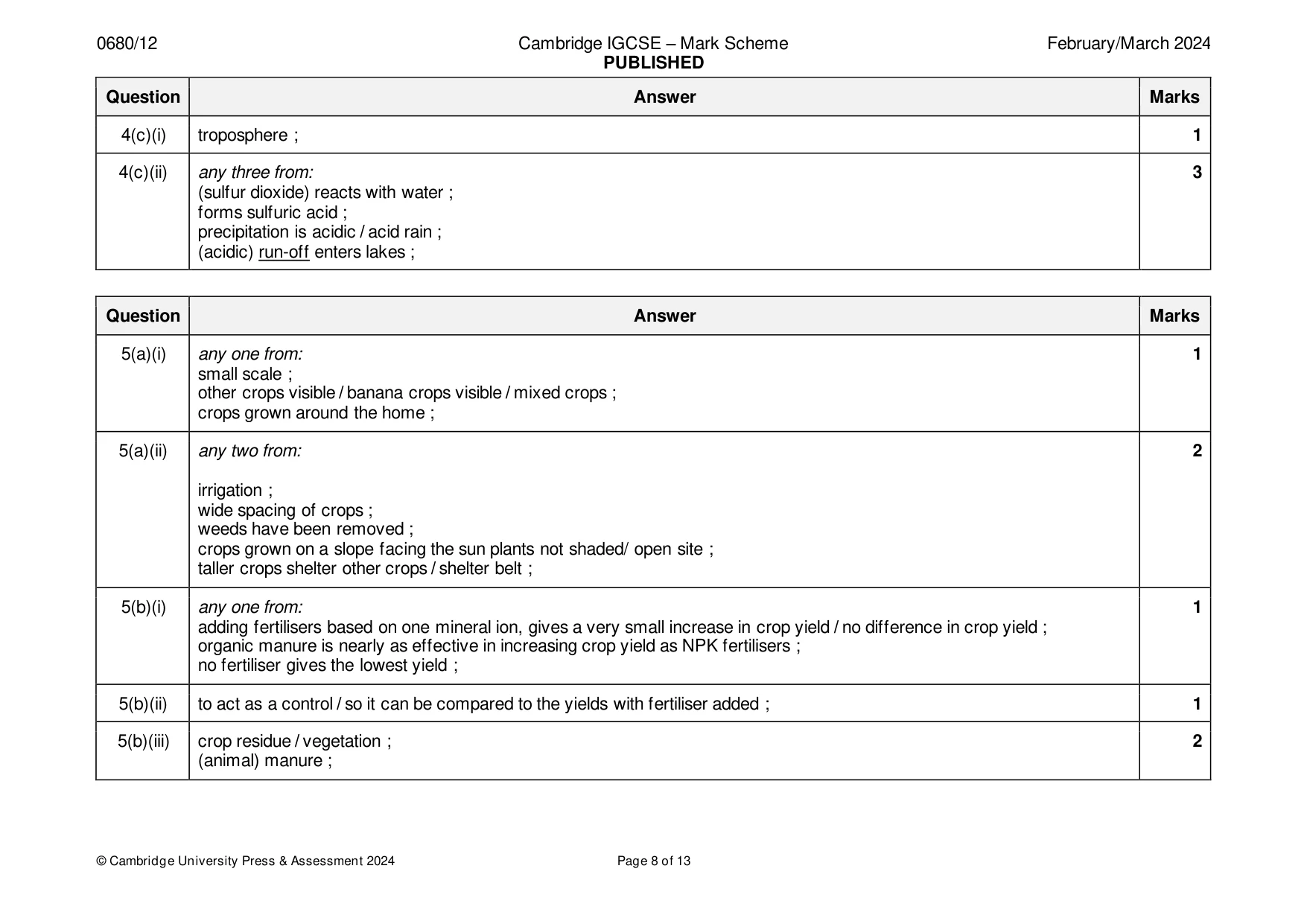
This document has 20 pages. Any blank pages are indicated. [Turn over Cambridge IGCSE™ ENVIRONMENTAL MANAGEMENT 0680/12 Paper 1 Theory February/March 2024 1 hour 45 minutes You must answer on the question paper. No additional materials are needed. INSTRUCTIONS ● Answer all questions. ● Use a black or dark blue pen. You may use an HB pencil for any diagrams or graphs. ● Write your name, centre number and candidate number in the boxes at the top of the page. ● Write your answer to each question in the space provided. ● Do not use an erasable pen or correction fluid. ● Do not write on any bar codes. ● You may use a calculator. ● You should show all your working and use appropriate units. INFORMATION ● The total mark for this paper is 80. ● The number of marks for each question or part question is shown in brackets [ ]. * 6 2 0 2 2 6 2 8 6 2 * DC (PB/SG) 330657/1 © UCLES 2024
Question paper, page 2
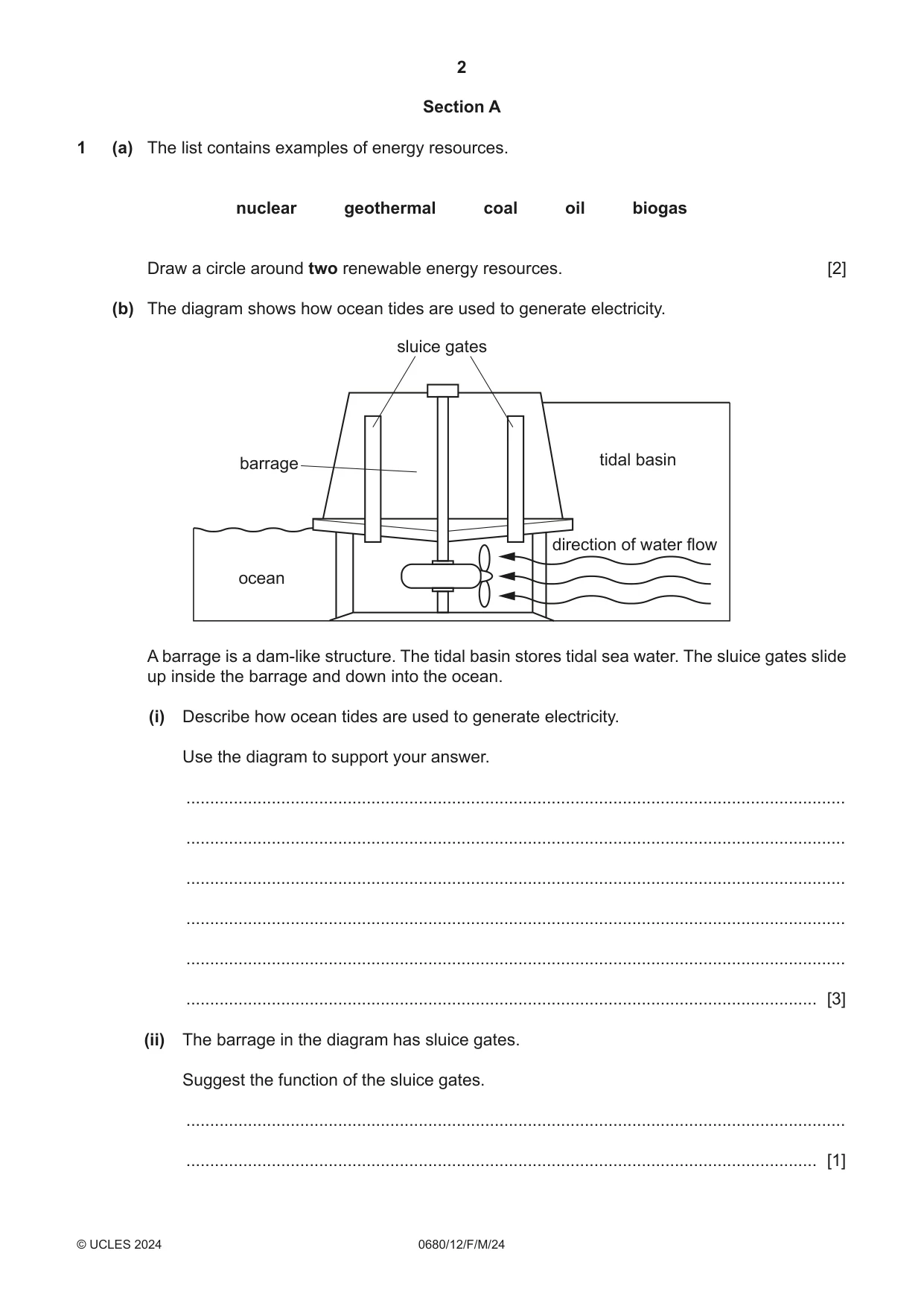
2 0680/12/F/M/24 © UCLES 2024 Section A 1 (a) The list contains examples of energy resources. nuclear geothermal coal oil biogas Draw a circle around two renewable energy resources. [2] (b) The diagram shows how ocean tides are used to generate electricity. sluice gates tidal basin ocean barrage direction of water flow A barrage is a dam‑like structure. The tidal basin stores tidal sea water. The sluice gates slide up inside the barrage and down into the ocean. (i) Describe how ocean tides are used to generate electricity. Use the diagram to support your answer. … … … … … … [3] (ii) The barrage in the diagram has sluice gates. Suggest the function of the sluice gates. … … [1]
Question paper, page 3
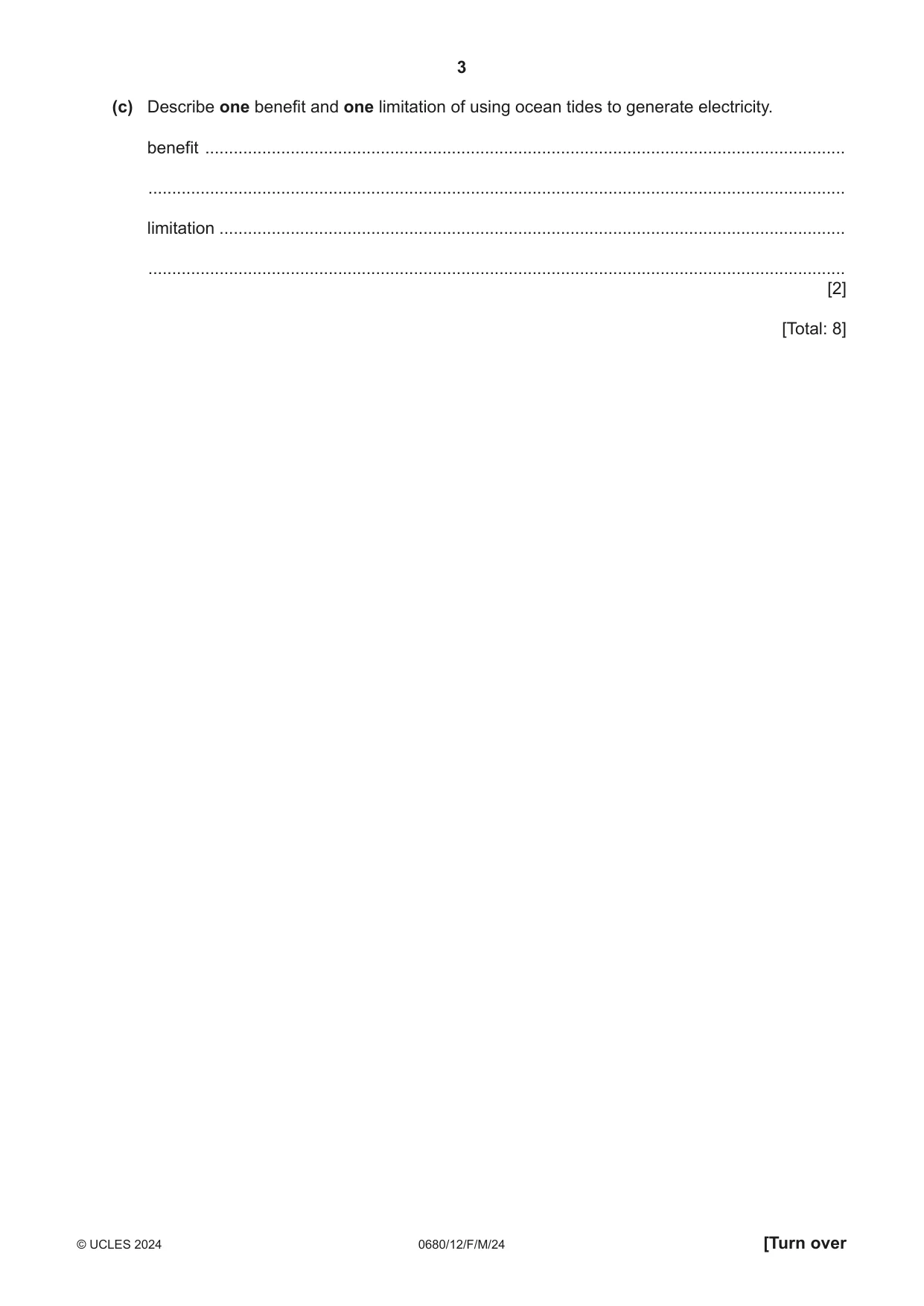
3 0680/12/F/M/24 © UCLES 2024 [Turn over (c) Describe one benefit and one limitation of using ocean tides to generate electricity. benefit … … limitation … … [2] [Total: 8]
Question paper, page 4
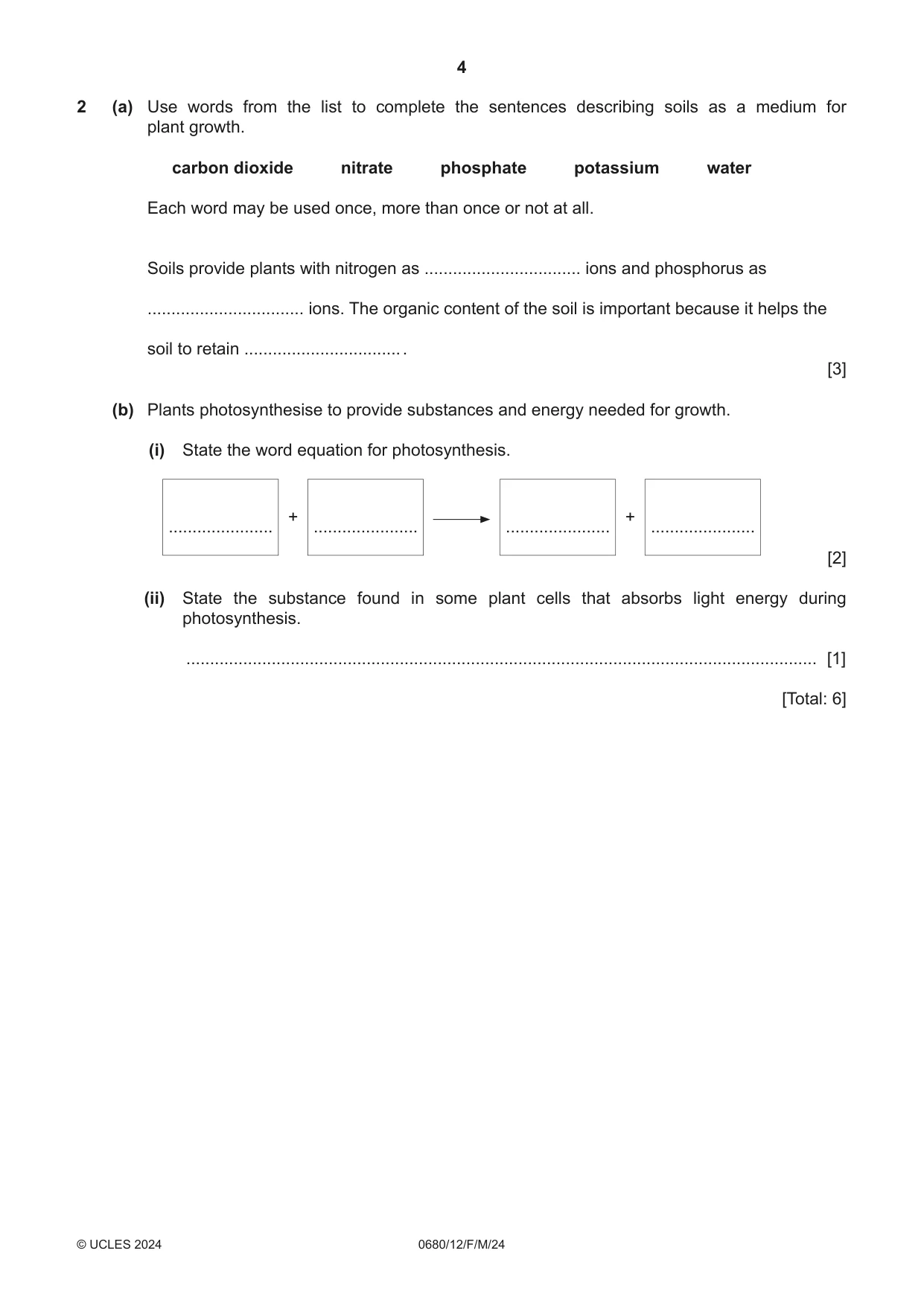
4 0680/12/F/M/24 © UCLES 2024 2 (a) Use words from the list to complete the sentences describing soils as a medium for plant growth. carbon dioxide nitrate phosphate potassium water Each word may be used once, more than once or not at all. Soils provide plants with nitrogen as … ions and phosphorus as … ions. The organic content of the soil is important because it helps the soil to retain … . [3] (b) Plants photosynthesise to provide substances and energy needed for growth. (i) State the word equation for photosynthesis. … + … … + … [2] (ii) State the substance found in some plant cells that absorbs light energy during photosynthesis. … [1] [Total: 6]
Question paper, page 5
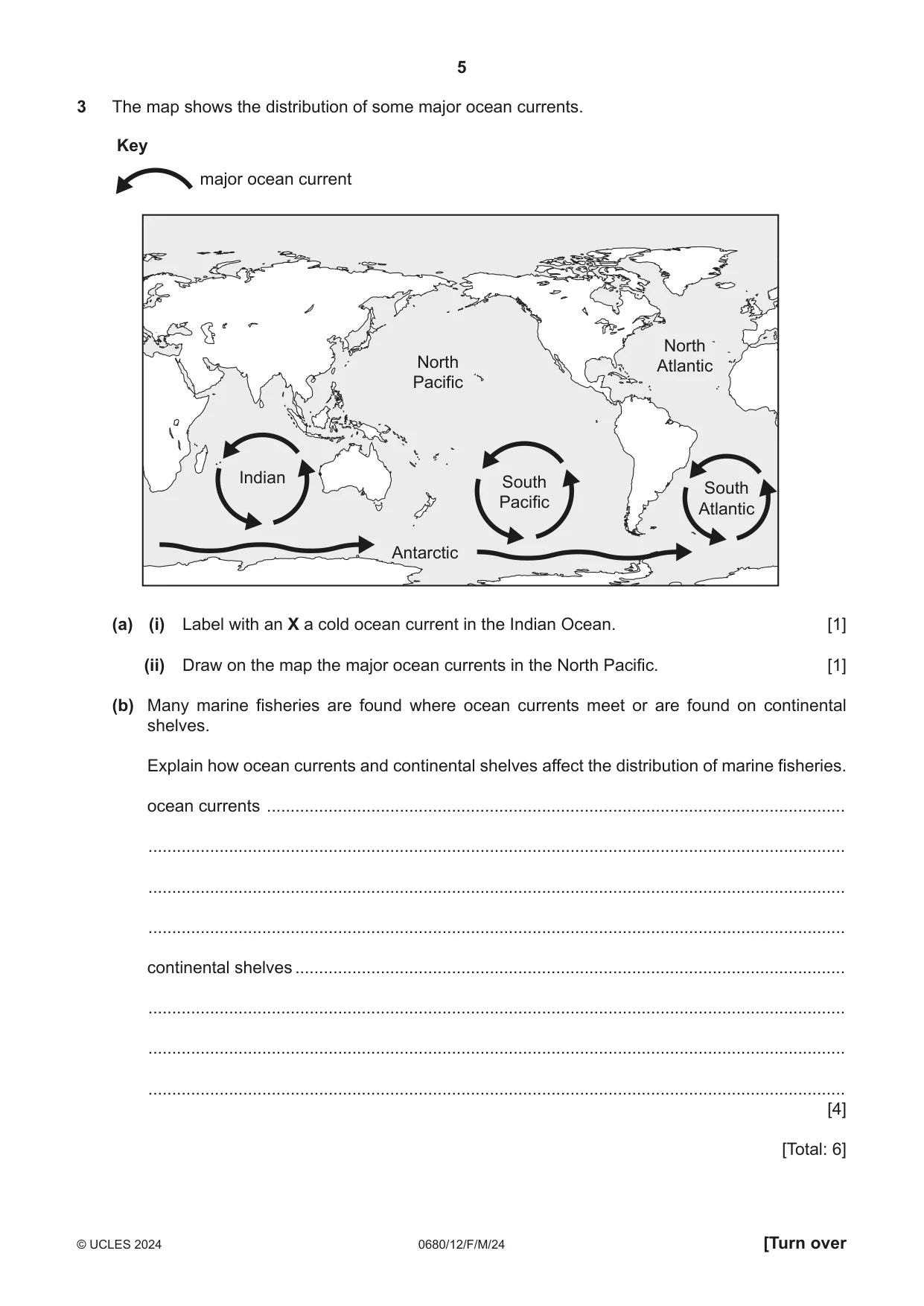
5 0680/12/F/M/24 © UCLES 2024 [Turn over 3 The map shows the distribution of some major ocean currents. Key major ocean current North Pacific South Pacific Indian Antarctic North Atlantic South Atlantic (a) (i) Label with an X a cold ocean current in the Indian Ocean. [1] (ii) Draw on the map the major ocean currents in the North Pacific. [1] (b) Many marine fisheries are found where ocean currents meet or are found on continental shelves. Explain how ocean currents and continental shelves affect the distribution of marine fisheries. ocean currents … … … … continental shelves … … … … [4] [Total: 6]
Question paper, page 6
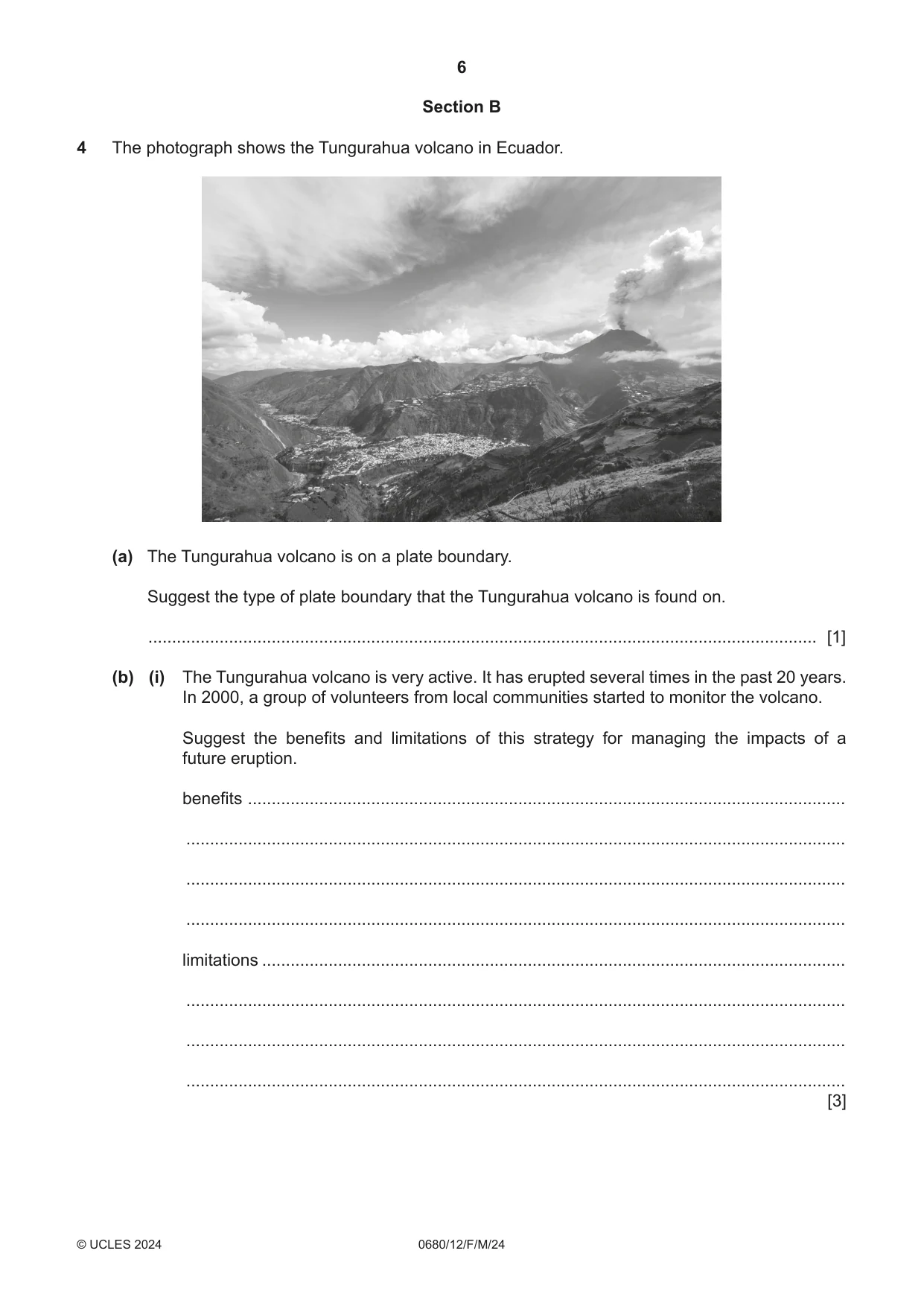
6 0680/12/F/M/24 © UCLES 2024 Section B 4 The photograph shows the Tungurahua volcano in Ecuador. (a) The Tungurahua volcano is on a plate boundary. Suggest the type of plate boundary that the Tungurahua volcano is found on. … [1] (b) (i) The Tungurahua volcano is very active. It has erupted several times in the past 20 years. In 2000, a group of volunteers from local communities started to monitor the volcano. Suggest the benefits and limitations of this strategy for managing the impacts of a future eruption. benefits … … … … limitations … … … … [3]
Question paper, page 7
7 0680/12/F/M/24 © UCLES 2024 [Turn over (ii) There is a small town near the volcano. Explain two reasons why people choose to live close to a volcano. 1 … … … 2 … … … [4] (c) (i) During an eruption in 2006, the Tungurahua volcano emitted 12 000 tonnes of sulfur dioxide gas that reached a height of 8 km in the atmosphere. State the layer of the atmosphere that contains this sulfur dioxide gas. … [1] (ii) Sulfur dioxide gas is an atmospheric pollutant. Explain how sulfur dioxide gas causes the acidification of lakes. … … … … … … [3] [Total: 12]
Question paper, page 8
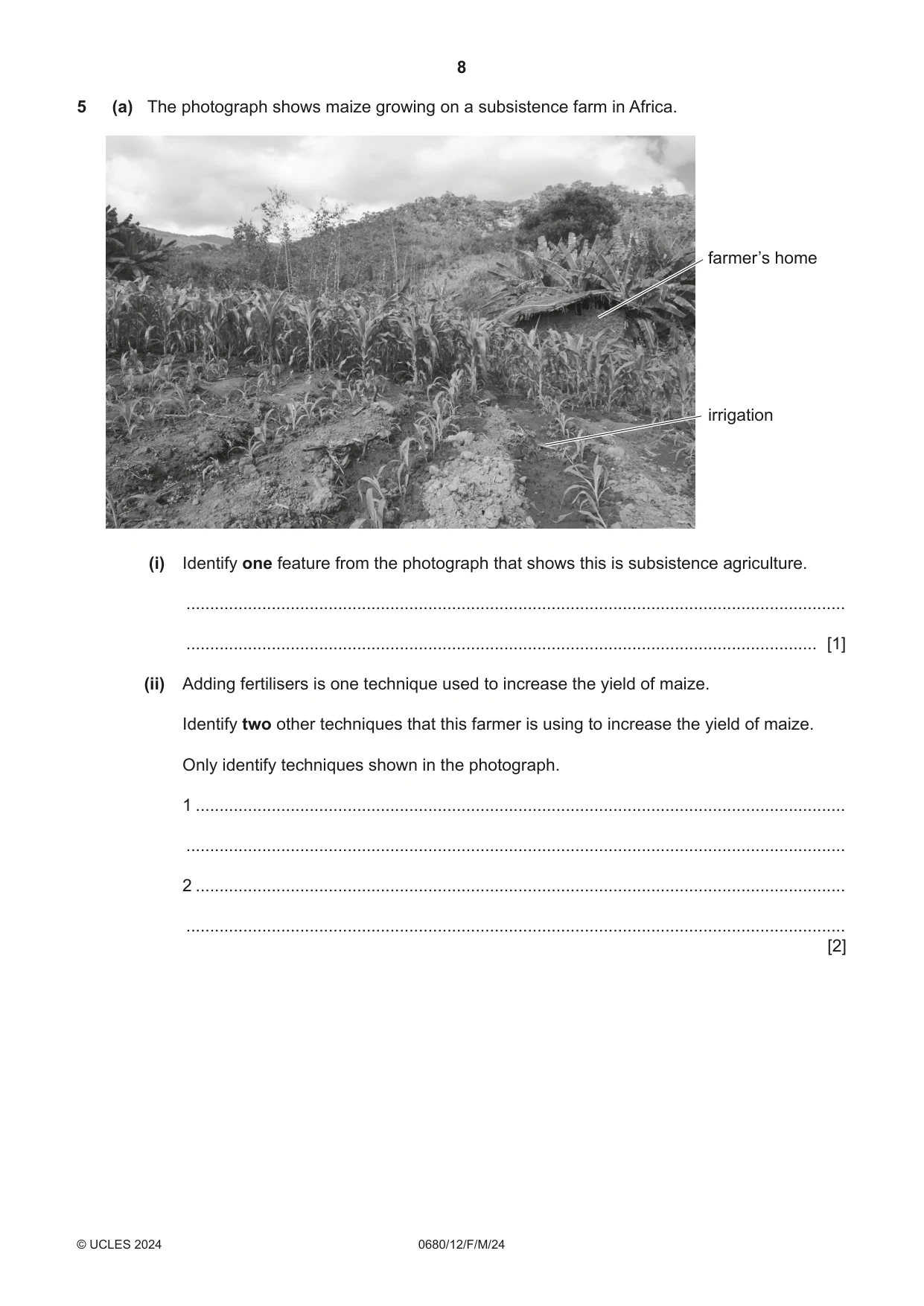
8 0680/12/F/M/24 © UCLES 2024 5 (a) The photograph shows maize growing on a subsistence farm in Africa. farmer’s home irrigation (i) Identify one feature from the photograph that shows this is subsistence agriculture. … … [1] (ii) Adding fertilisers is one technique used to increase the yield of maize. Identify two other techniques that this farmer is using to increase the yield of maize. Only identify techniques shown in the photograph. 1 … … 2 … … [2]
Question paper, page 9
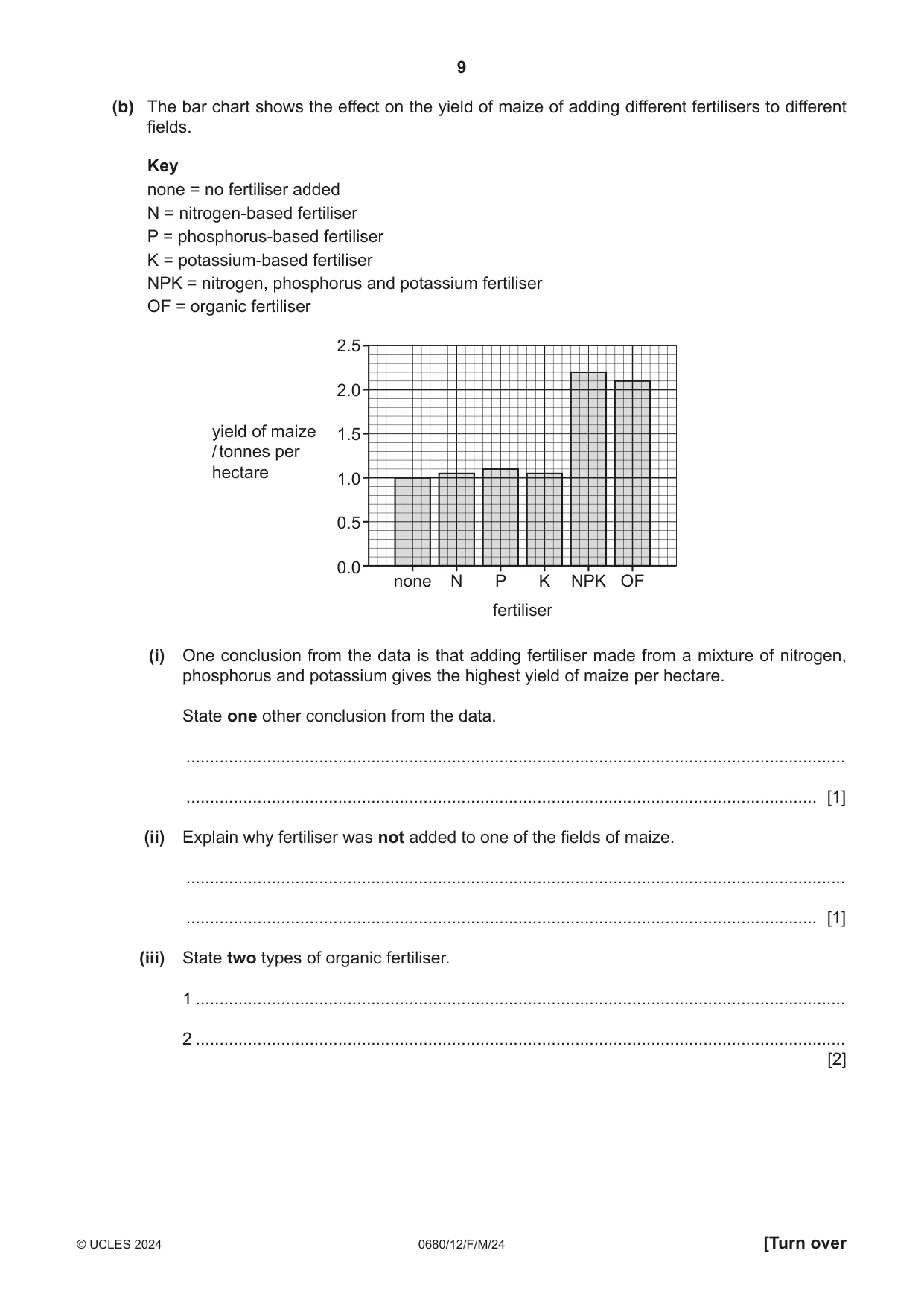
9 0680/12/F/M/24 © UCLES 2024 [Turn over (b) The bar chart shows the effect on the yield of maize of adding different fertilisers to different fields. 0.0 none N P fertiliser K NPK OF 0.5 1.0 yield of maize / tonnes per hectare 1.5 2.0 2.5 Key N = nitrogen-based fertiliser P = phosphorus-based fertiliser K = potassium-based fertiliser NPK = nitrogen, phosphorus and potassium fertiliser OF = organic fertiliser none = no fertiliser added (i) One conclusion from the data is that adding fertiliser made from a mixture of nitrogen, phosphorus and potassium gives the highest yield of maize per hectare. State one other conclusion from the data. … … [1] (ii) Explain why fertiliser was not added to one of the fields of maize. … … [1] (iii) State two types of organic fertiliser. 1 … 2 … [2]
Question paper, page 10
10 0680/12/F/M/24 © UCLES 2024 (c) Describe how the overuse of fertilisers can lead to the death of aquatic organisms. … … … … … … … … [4] [Total: 11]
Question paper, page 11
11 0680/12/F/M/24 © UCLES 2024 [Turn over BLANK PAGE
Question paper, page 12
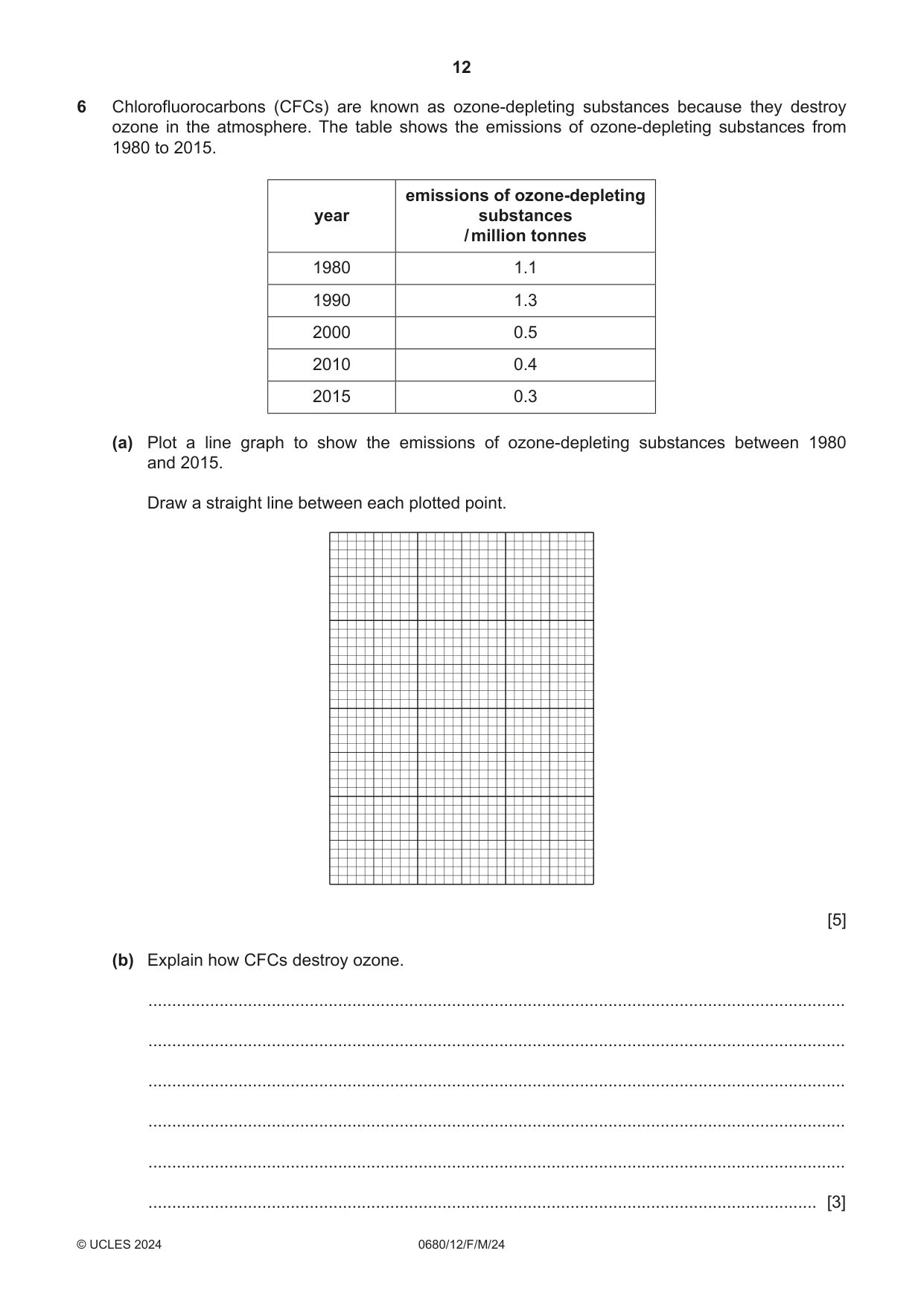
12 0680/12/F/M/24 © UCLES 2024 6 Chlorofluorocarbons (CFCs) are known as ozone‑depleting substances because they destroy ozone in the atmosphere. The table shows the emissions of ozone‑depleting substances from 1980 to 2015. year emissions of ozone‑depleting substances / million tonnes 1980 1.1 1990 1.3 2000 0.5 2010 0.4 2015 0.3 (a) Plot a line graph to show the emissions of ozone‑depleting substances between 1980 and 2015. Draw a straight line between each plotted point. [5] (b) Explain how CFCs destroy ozone. … … … … … … [3]
Question paper, page 13
13 0680/12/F/M/24 © UCLES 2024 [Turn over (c) Describe the benefits and limitations of strategies to reduce the impact of CFCs. benefits … … … … … limitations … … … … … [5] [Total: 13]
Question paper, page 14
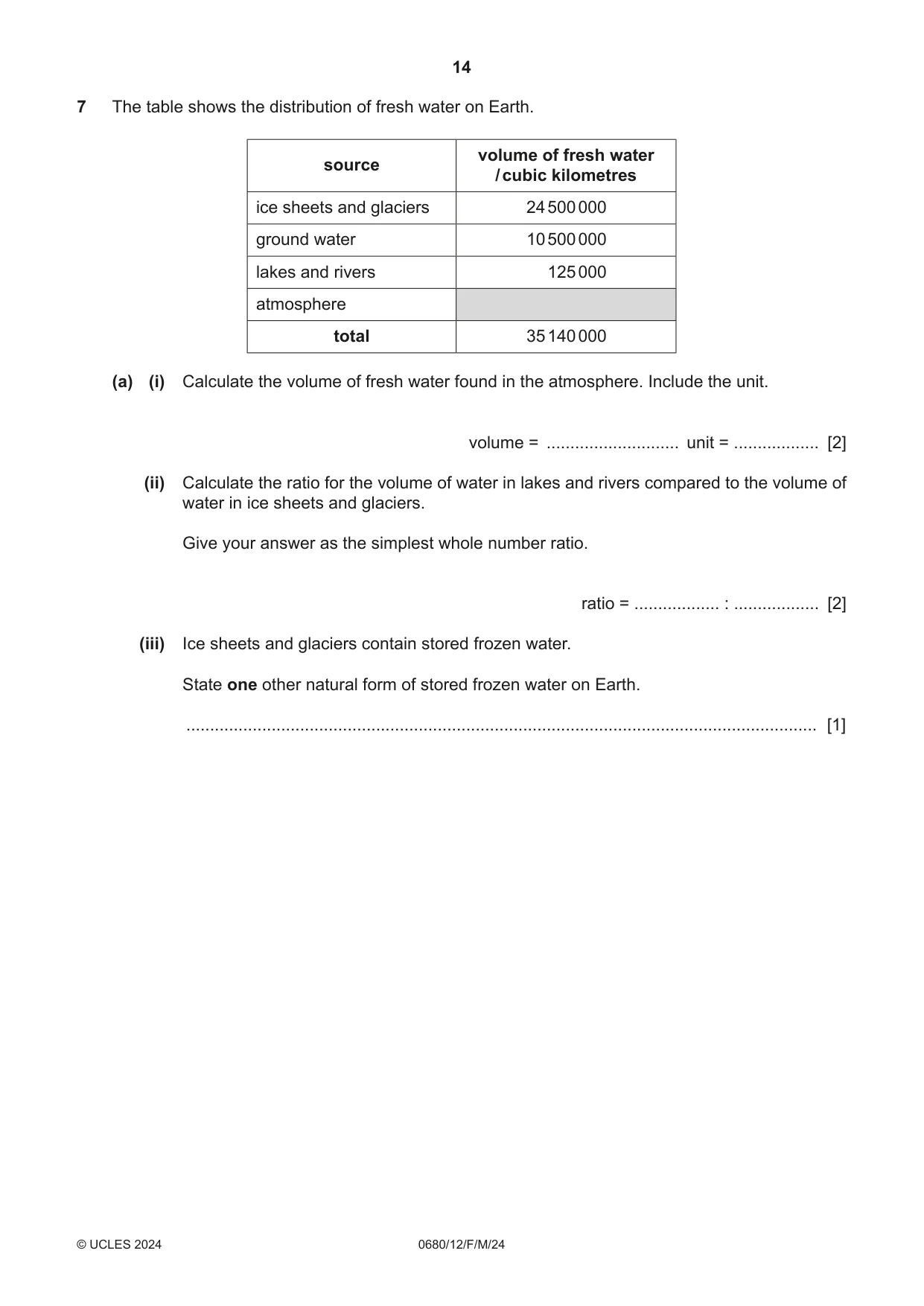
14 0680/12/F/M/24 © UCLES 2024 7 The table shows the distribution of fresh water on Earth. source volume of fresh water / cubic kilometres ice sheets and glaciers 24 500 000 ground water 10 500 000 lakes and rivers 125 000 atmosphere total 35 140 000 (a) (i) Calculate the volume of fresh water found in the atmosphere. Include the unit. volume = … unit = … [2] (ii) Calculate the ratio for the volume of water in lakes and rivers compared to the volume of water in ice sheets and glaciers. Give your answer as the simplest whole number ratio. ratio = … : … [2] (iii) Ice sheets and glaciers contain stored frozen water. State one other natural form of stored frozen water on Earth. … [1]
Question paper, page 15
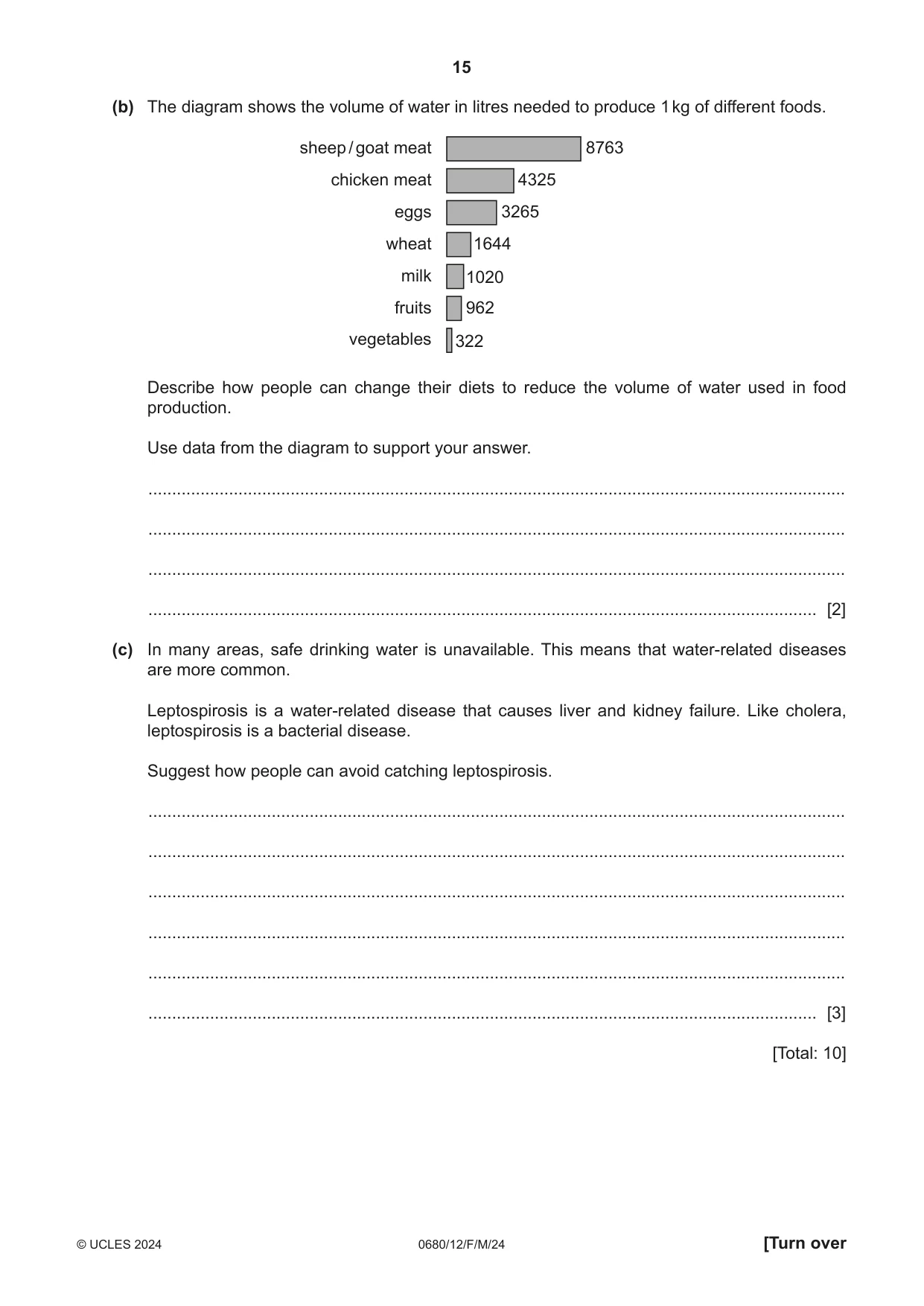
15 0680/12/F/M/24 © UCLES 2024 [Turn over (b) The diagram shows the volume of water in litres needed to produce 1 kg of different foods. sheep / goat meat 8763 4325 3265 1644 1020 962 322 chicken meat eggs wheat milk fruits vegetables Describe how people can change their diets to reduce the volume of water used in food production. Use data from the diagram to support your answer. … … … … [2] (c) In many areas, safe drinking water is unavailable. This means that water‑related diseases are more common. Leptospirosis is a water‑related disease that causes liver and kidney failure. Like cholera, leptospirosis is a bacterial disease. Suggest how people can avoid catching leptospirosis. … … … … … … [3] [Total: 10]
Question paper, page 16
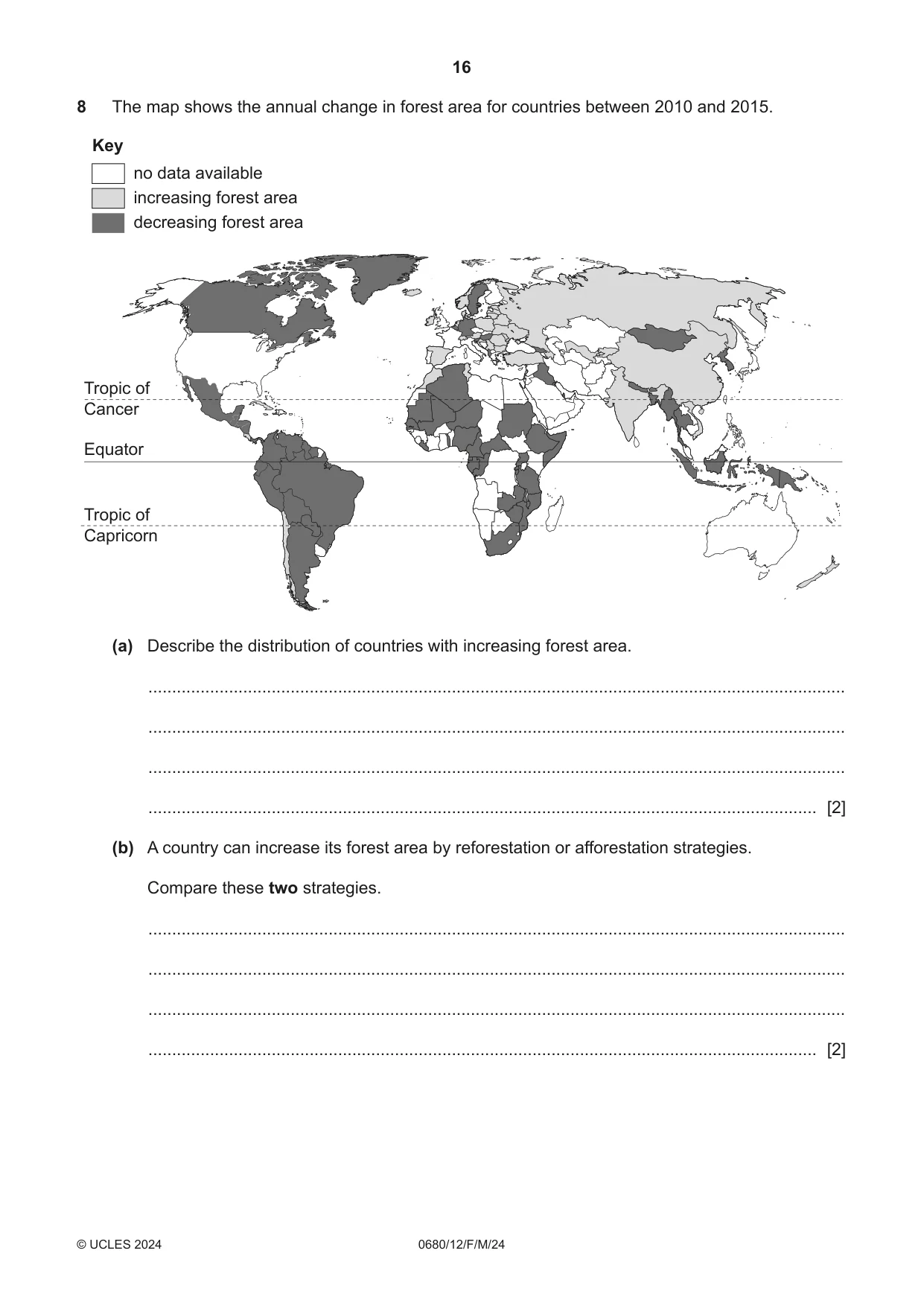
16 0680/12/F/M/24 © UCLES 2024 8 The map shows the annual change in forest area for countries between 2010 and 2015. Equator no data available increasing forest area decreasing forest area Tropic of Capricorn Tropic of Cancer Key (a) Describe the distribution of countries with increasing forest area. … … … … [2] (b) A country can increase its forest area by reforestation or afforestation strategies. Compare these two strategies. … … … … [2]
Question paper, page 17
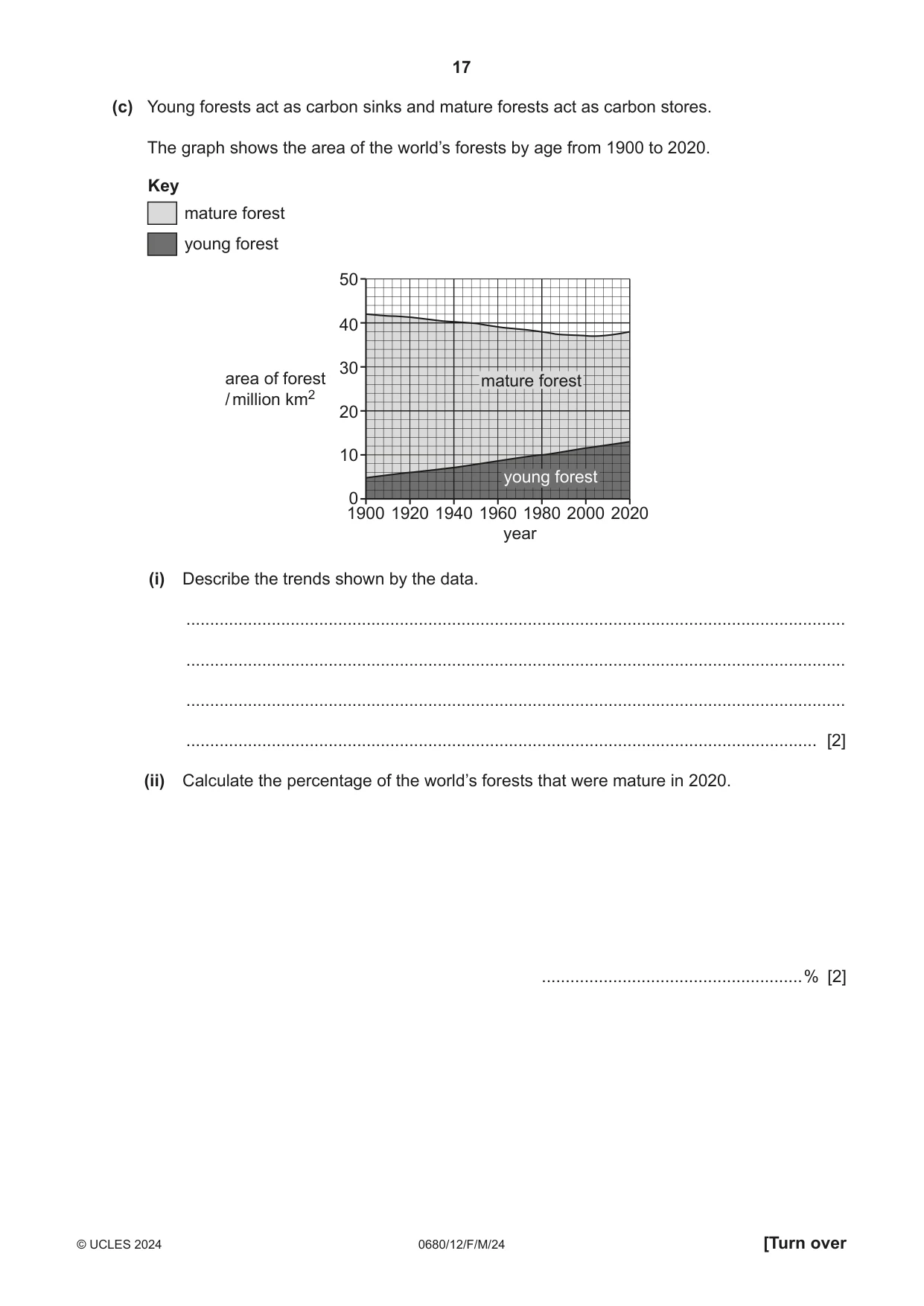
17 0680/12/F/M/24 © UCLES 2024 [Turn over (c) Young forests act as carbon sinks and mature forests act as carbon stores. The graph shows the area of the world’s forests by age from 1900 to 2020. Key mature forest young forest 1900 0 10 20 30 40 50 1920 1940 1960 year 1980 2000 2020 area of forest / million km2 mature forest young forest (i) Describe the trends shown by the data. … … … … [2] (ii) Calculate the percentage of the world’s forests that were mature in 2020. …% [2]
Question paper, page 18
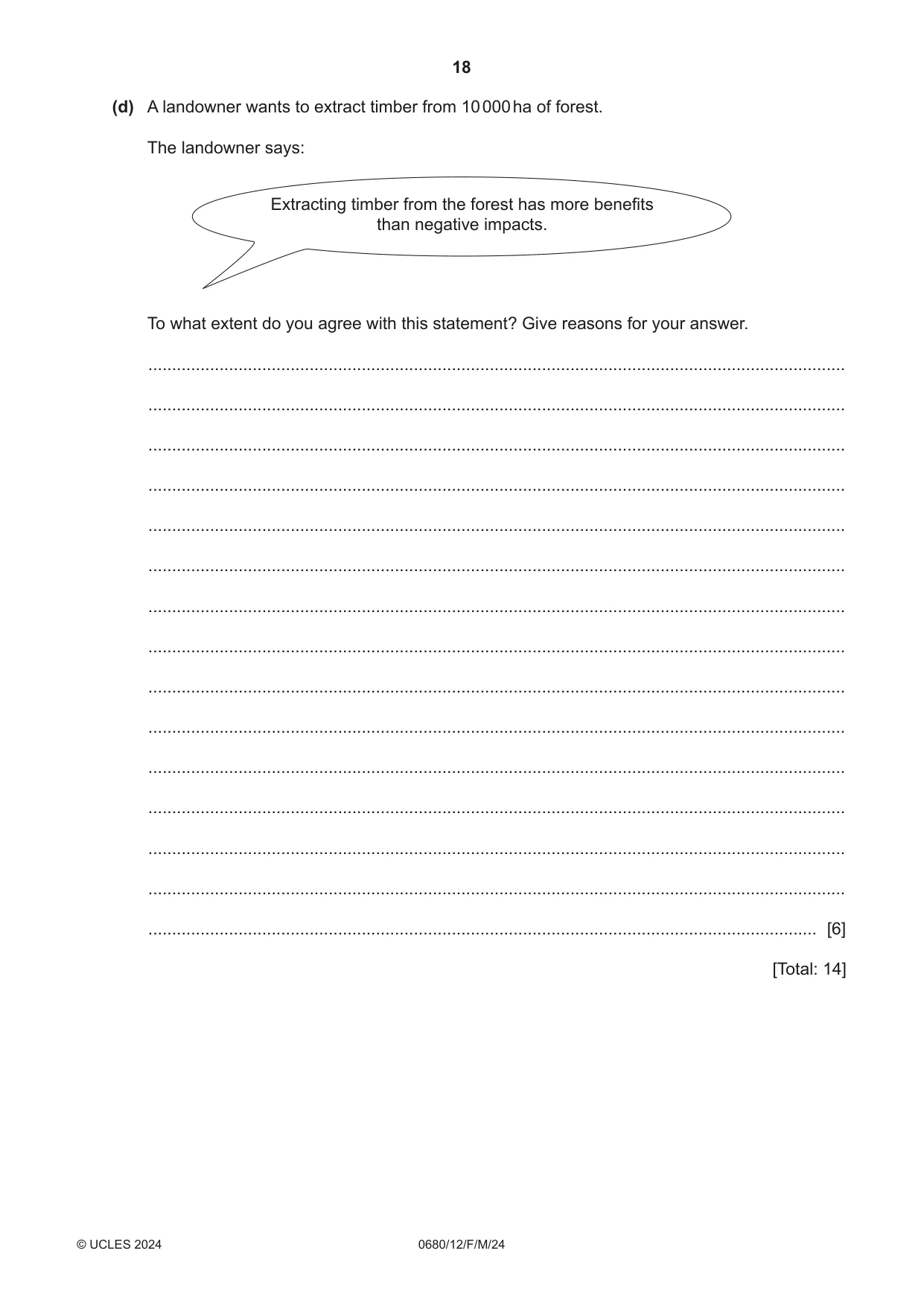
18 0680/12/F/M/24 © UCLES 2024 (d) A landowner wants to extract timber from 10 000 ha of forest. The landowner says: Extracting timber from the forest has more benefits than negative impacts. To what extent do you agree with this statement? Give reasons for your answer. … … … … … … … … … … … … … … … [6] [Total: 14]
Question paper, page 19
19 0680/12/F/M/24 © UCLES 2024 BLANK PAGE
Question paper, page 20
20 0680/12/F/M/24 © UCLES 2024 The boundaries and names shown, the designations used and the presentation of material on any maps contained in this question paper/insert do not imply official endorsement or acceptance by Cambridge Assessment International Education concerning the legal status of any country, territory, or area or any of its authorities, or of the delimitation of its frontiers or boundaries. Permission to reproduce items where third‑party owned material protected by copyright is included has been sought and cleared where possible. Every reasonable effort has been made by the publisher (UCLES) to trace copyright holders, but if any items requiring clearance have unwittingly been included, the publisher will be pleased to make amends at the earliest possible opportunity. To avoid the issue of disclosure of answer‑related information to candidates, all copyright acknowledgements are reproduced online in the Cambridge Assessment International Education Copyright Acknowledgements Booklet. This is produced for each series of examinations and is freely available to download at www.cambridgeinternational.org after the live examination series. Cambridge Assessment International Education is part of Cambridge Assessment. Cambridge Assessment is the brand name of the University of Cambridge Local Examinations Syndicate (UCLES), which is a department of the University of Cambridge. BLANK PAGE
Mark scheme, page 1
This document consists of 13 printed pages. © Cambridge University Press & Assessment 2024 [Turn over Cambridge IGCSE™ ENVIRONMENTAL MANAGEMENT 0680/12 Paper 1 Theory February/March 2024 MARK SCHEME Maximum Mark: 80 Published This mark scheme is published as an aid to teachers and candidates, to indicate the requirements of the examination. It shows the basis on which Examiners were instructed to award marks. It does not indicate the details of the discussions that took place at an Examiners’ meeting before marking began, which would have considered the acceptability of alternative answers. Mark schemes should be read in conjunction with the question paper and the Principal Examiner Report for Teachers. Cambridge International will not enter into discussions about these mark schemes. Cambridge International is publishing the mark schemes for the February/March 2024 series for most Cambridge IGCSE, Cambridge International A and AS Level components, and some Cambridge O Level components.
Mark scheme, page 2
0680/12 Cambridge IGCSE – Mark Scheme PUBLISHED February/March 2024 © Cambridge University Press & Assessment 2024 Page 2 of 13 Generic Marking Principles These general marking principles must be applied by all examiners when marking candidate answers. They should be applied alongside the specific content of the mark scheme or generic level descriptions for a question. Each question paper and mark scheme will also comply with these marking principles. GENERIC MARKING PRINCIPLE 1: Marks must be awarded in line with: • the specific content of the mark scheme or the generic level descriptors for the question • the specific skills defined in the mark scheme or in the generic level descriptors for the question • the standard of response required by a candidate as exemplified by the standardisation scripts. GENERIC MARKING PRINCIPLE 2: Marks awarded are always whole marks (not half marks, or other fractions). GENERIC MARKING PRINCIPLE 3: Marks must be awarded positively: • marks are awarded for correct/valid answers, as defined in the mark scheme. However, credit is given for valid answers which go beyond the scope of the syllabus and mark scheme, referring to your Team Leader as appropriate • marks are awarded when candidates clearly demonstrate what they know and can do • marks are not deducted for errors • marks are not deducted for omissions • answers should only be judged on the quality of spelling, punctuation and grammar when these features are specifically assessed by the question as indicated by the mark scheme. The meaning, however, should be unambiguous. GENERIC MARKING PRINCIPLE 4: Rules must be applied consistently, e.g. in situations where candidates have not followed instructions or in the application of generic level descriptors.
Mark scheme, page 3
0680/12 Cambridge IGCSE – Mark Scheme PUBLISHED February/March 2024 © Cambridge University Press & Assessment 2024 Page 3 of 13 GENERIC MARKING PRINCIPLE 5: Marks should be awarded using the full range of marks defined in the mark scheme for the question (however; the use of the full mark range may be limited according to the quality of the candidate responses seen). GENERIC MARKING PRINCIPLE 6: Marks awarded are based solely on the requirements as defined in the mark scheme. Marks should not be awarded with grade thresholds or grade descriptors in mind. Science-Specific Marking Principles 1 Examiners should consider the context and scientific use of any keywords when awarding marks. Although keywords may be present, marks should not be awarded if the keywords are used incorrectly. 2 The examiner should not choose between contradictory statements given in the same question part, and credit should not be awarded for any correct statement that is contradicted within the same question part. Wrong science that is irrelevant to the question should be ignored. 3 Although spellings do not have to be correct, spellings of syllabus terms must allow for clear and unambiguous separation from other syllabus terms with which they may be confused (e.g. ethane / ethene, glucagon / glycogen, refraction / reflection). 4 The error carried forward (ecf) principle should be applied, where appropriate. If an incorrect answer is subsequently used in a scientifically correct way, the candidate should be awarded these subsequent marking points. Further guidance will be included in the mark scheme where necessary and any exceptions to this general principle will be noted. 5 ‘List rule’ guidance For questions that require n responses (e.g. State two reasons …): • The response should be read as continuous prose, even when numbered answer spaces are provided. • Any response marked ignore in the mark scheme should not count towards n. • Incorrect responses should not be awarded credit but will still count towards n. • Read the entire response to check for any responses that contradict those that would otherwise be credited. Credit should not be awarded for any responses that are contradicted within the rest of the response. Where two responses contradict one another, this should be treated as a single incorrect response. • Non-contradictory responses after the first n responses may be ignored even if they include incorrect science.
Mark scheme, page 4
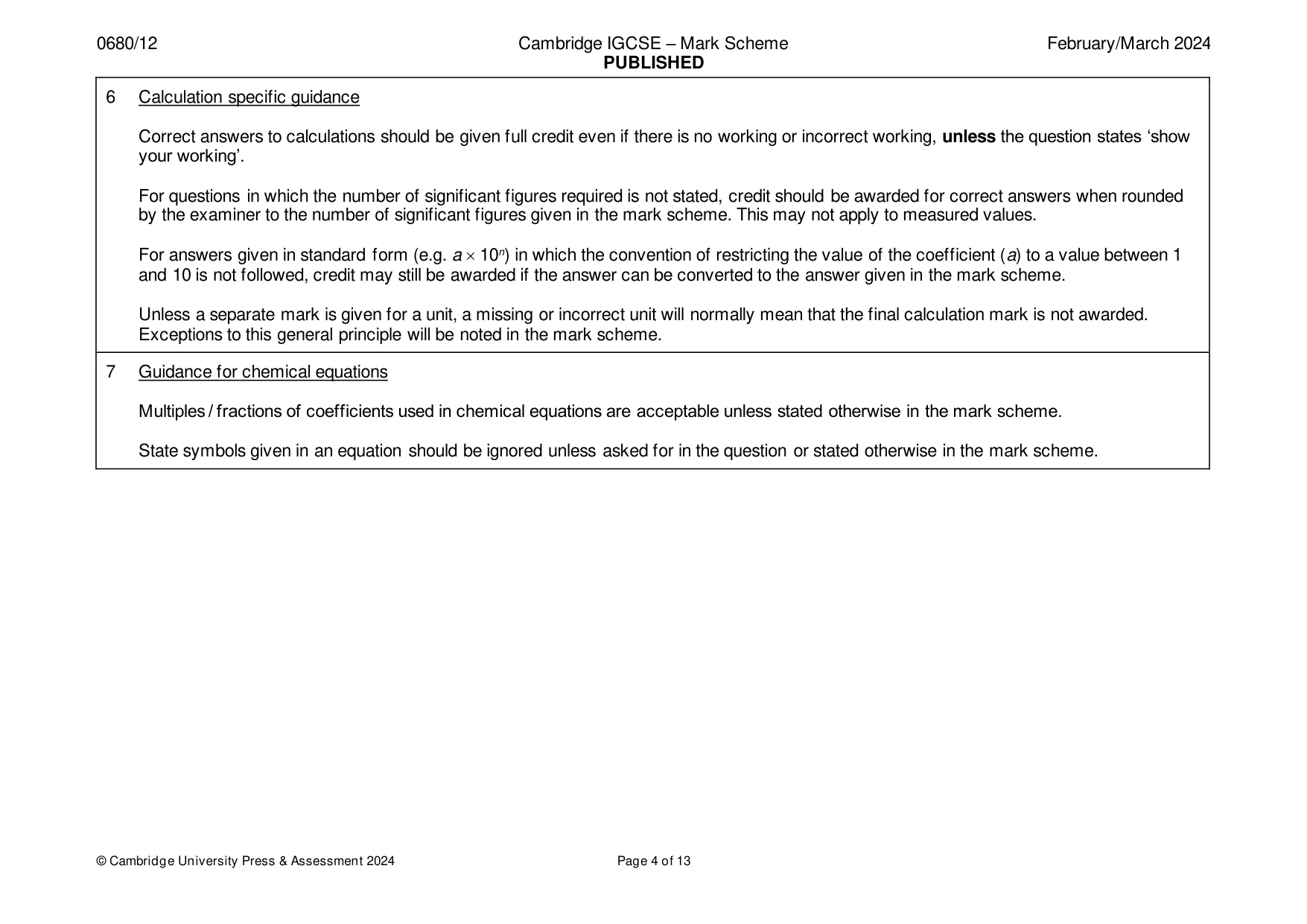
0680/12 Cambridge IGCSE – Mark Scheme PUBLISHED February/March 2024 © Cambridge University Press & Assessment 2024 Page 4 of 13 6 Calculation specific guidance Correct answers to calculations should be given full credit even if there is no working or incorrect working, unless the question states ‘show your working’. For questions in which the number of significant figures required is not stated, credit should be awarded for correct answers when rounded by the examiner to the number of significant figures given in the mark scheme. This may not apply to measured values. For answers given in standard form (e.g. a 10n) in which the convention of restricting the value of the coefficient (a) to a value between 1 and 10 is not followed, credit may still be awarded if the answer can be converted to the answer given in the mark scheme. Unless a separate mark is given for a unit, a missing or incorrect unit will normally mean that the final calculation mark is not awarded. Exceptions to this general principle will be noted in the mark scheme. 7 Guidance for chemical equations Multiples / fractions of coefficients used in chemical equations are acceptable unless stated otherwise in the mark scheme. State symbols given in an equation should be ignored unless asked for in the question or stated otherwise in the mark scheme.
Mark scheme, page 5
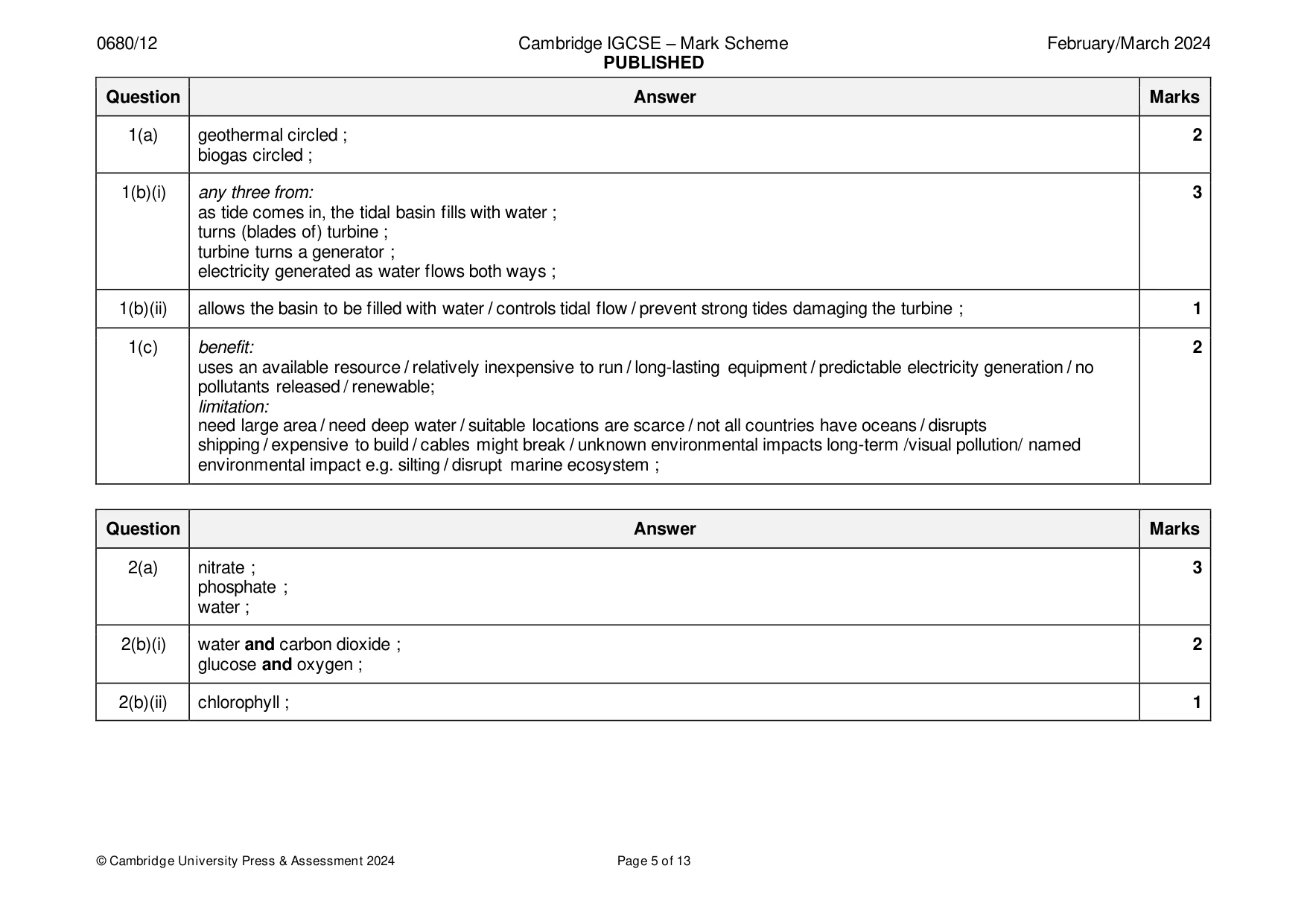
0680/12 Cambridge IGCSE – Mark Scheme PUBLISHED February/March 2024 © Cambridge University Press & Assessment 2024 Page 5 of 13 Question Answer Marks 1(a) geothermal circled ; biogas circled ; 2 1(b)(i) any three from: as tide comes in, the tidal basin fills with water ; turns (blades of) turbine ; turbine turns a generator ; electricity generated as water flows both ways ; 3 1(b)(ii) allows the basin to be filled with water / controls tidal flow / prevent strong tides damaging the turbine ; 1 1(c) benefit: uses an available resource / relatively inexpensive to run / long-lasting equipment / predictable electricity generation / no pollutants released / renewable; limitation: need large area / need deep water / suitable locations are scarce / not all countries have oceans / disrupts shipping / expensive to build / cables might break / unknown environmental impacts long-term /visual pollution/ named environmental impact e.g. silting / disrupt marine ecosystem ; 2 Question Answer Marks 2(a) nitrate ; phosphate ; water ; 3 2(b)(i) water and carbon dioxide ; glucose and oxygen ; 2 2(b)(ii) chlorophyll ; 1
Mark scheme, page 6
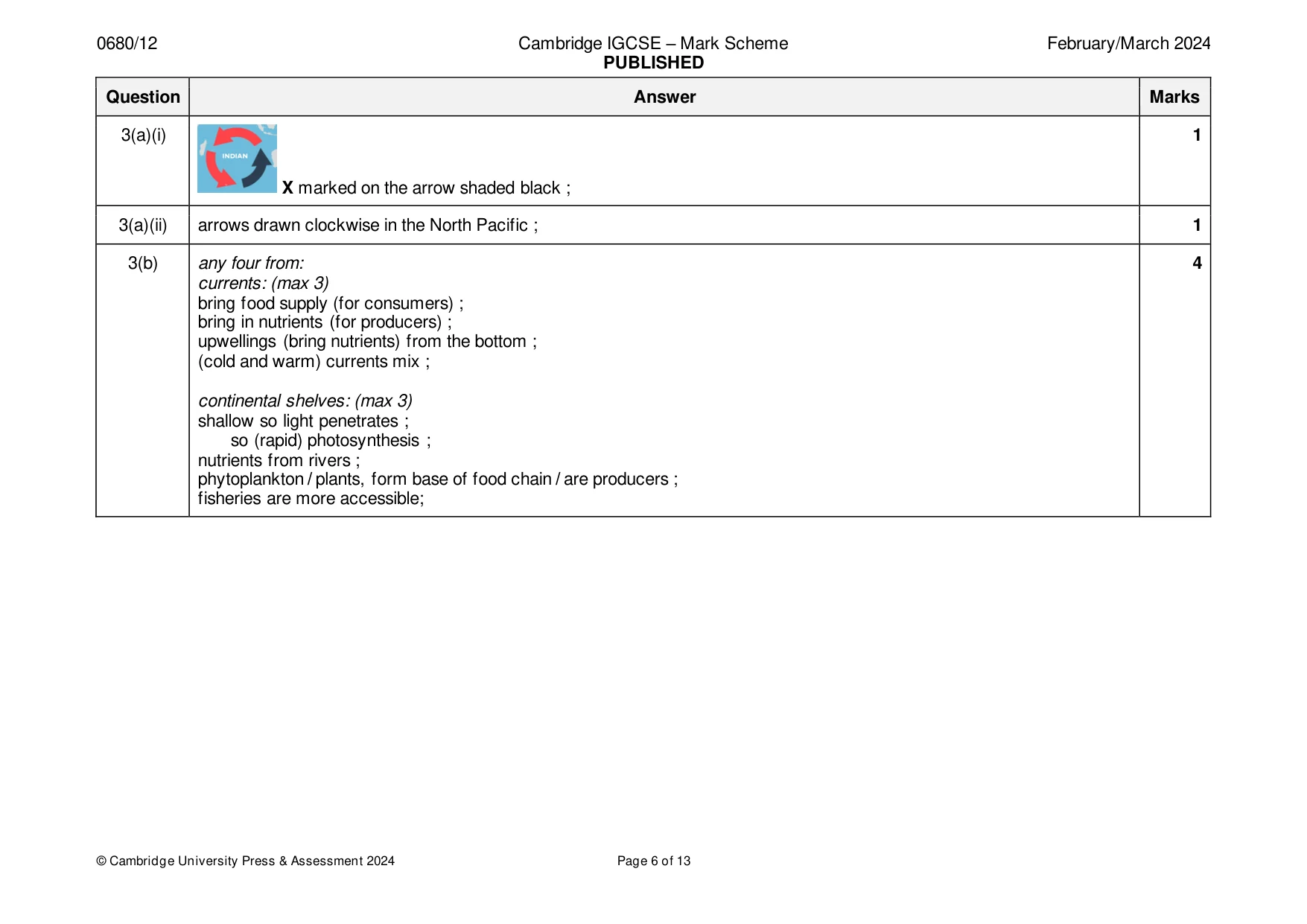
0680/12 Cambridge IGCSE – Mark Scheme PUBLISHED February/March 2024 © Cambridge University Press & Assessment 2024 Page 6 of 13 Question Answer Marks 3(a)(i) X marked on the arrow shaded black ; 1 3(a)(ii) arrows drawn clockwise in the North Pacific ; 1 3(b) any four from: currents: (max 3) bring food supply (for consumers) ; bring in nutrients (for producers) ; upwellings (bring nutrients) from the bottom ; (cold and warm) currents mix ; continental shelves: (max 3) shallow so light penetrates ; so (rapid) photosynthesis ; nutrients from rivers ; phytoplankton / plants, form base of food chain / are producers ; fisheries are more accessible; 4
Mark scheme, page 7
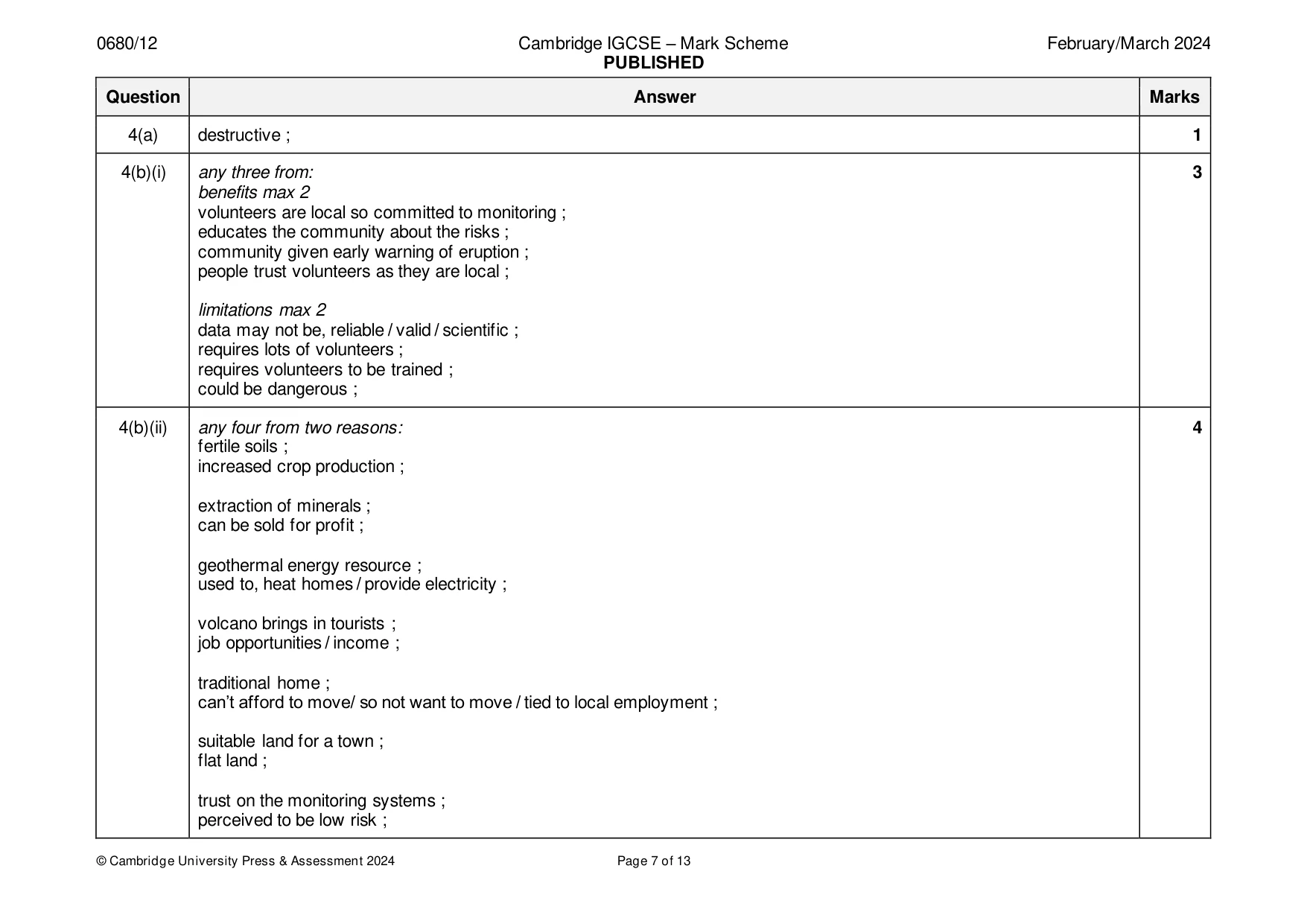
0680/12 Cambridge IGCSE – Mark Scheme PUBLISHED February/March 2024 © Cambridge University Press & Assessment 2024 Page 7 of 13 Question Answer Marks 4(a) destructive ; 1 4(b)(i) any three from: benefits max 2 volunteers are local so committed to monitoring ; educates the community about the risks ; community given early warning of eruption ; people trust volunteers as they are local ; limitations max 2 data may not be, reliable / valid / scientific ; requires lots of volunteers ; requires volunteers to be trained ; could be dangerous ; 3 4(b)(ii) any four from two reasons: fertile soils ; increased crop production ; extraction of minerals ; can be sold for profit ; geothermal energy resource ; used to, heat homes / provide electricity ; volcano brings in tourists ; job opportunities / income ; traditional home ; can’t afford to move/ so not want to move / tied to local employment ; suitable land for a town ; flat land ; trust on the monitoring systems ; perceived to be low risk ; 4
Mark scheme, page 8
0680/12 Cambridge IGCSE – Mark Scheme PUBLISHED February/March 2024 © Cambridge University Press & Assessment 2024 Page 8 of 13 Question Answer Marks 4(c)(i) troposphere ; 1 4(c)(ii) any three from: (sulfur dioxide) reacts with water ; forms sulfuric acid ; precipitation is acidic / acid rain ; (acidic) run-off enters lakes ; 3 Question Answer Marks 5(a)(i) any one from: small scale ; other crops visible / banana crops visible / mixed crops ; crops grown around the home ; 1 5(a)(ii) any two from: irrigation ; wide spacing of crops ; weeds have been removed ; crops grown on a slope facing the sun plants not shaded/ open site ; taller crops shelter other crops / shelter belt ; 2 5(b)(i) any one from: adding fertilisers based on one mineral ion, gives a very small increase in crop yield / no difference in crop yield ; organic manure is nearly as effective in increasing crop yield as NPK fertilisers ; no fertiliser gives the lowest yield ; 1 5(b)(ii) to act as a control / so it can be compared to the yields with fertiliser added ; 1 5(b)(iii) crop residue / vegetation ; (animal) manure ; 2
Mark scheme, page 9
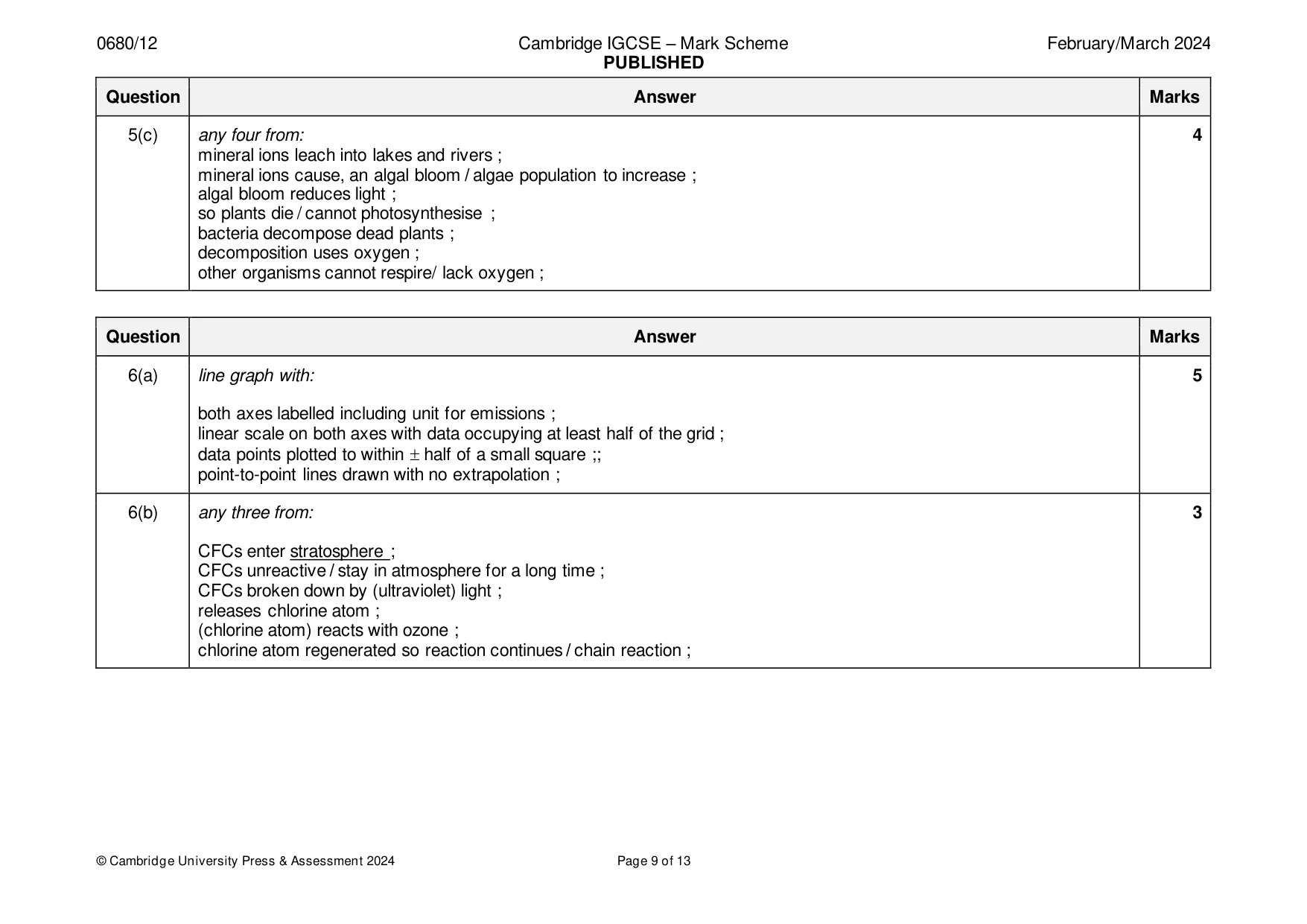
0680/12 Cambridge IGCSE – Mark Scheme PUBLISHED February/March 2024 © Cambridge University Press & Assessment 2024 Page 9 of 13 Question Answer Marks 5(c) any four from: mineral ions leach into lakes and rivers ; mineral ions cause, an algal bloom / algae population to increase ; algal bloom reduces light ; so plants die / cannot photosynthesise ; bacteria decompose dead plants ; decomposition uses oxygen ; other organisms cannot respire/ lack oxygen ; 4 Question Answer Marks 6(a) line graph with: both axes labelled including unit for emissions ; linear scale on both axes with data occupying at least half of the grid ; data points plotted to within half of a small square ;; point-to-point lines drawn with no extrapolation ; 5 6(b) any three from: CFCs enter stratosphere ; CFCs unreactive / stay in atmosphere for a long time ; CFCs broken down by (ultraviolet) light ; releases chlorine atom ; (chlorine atom) reacts with ozone ; chlorine atom regenerated so reaction continues / chain reaction ; 3
Mark scheme, page 10
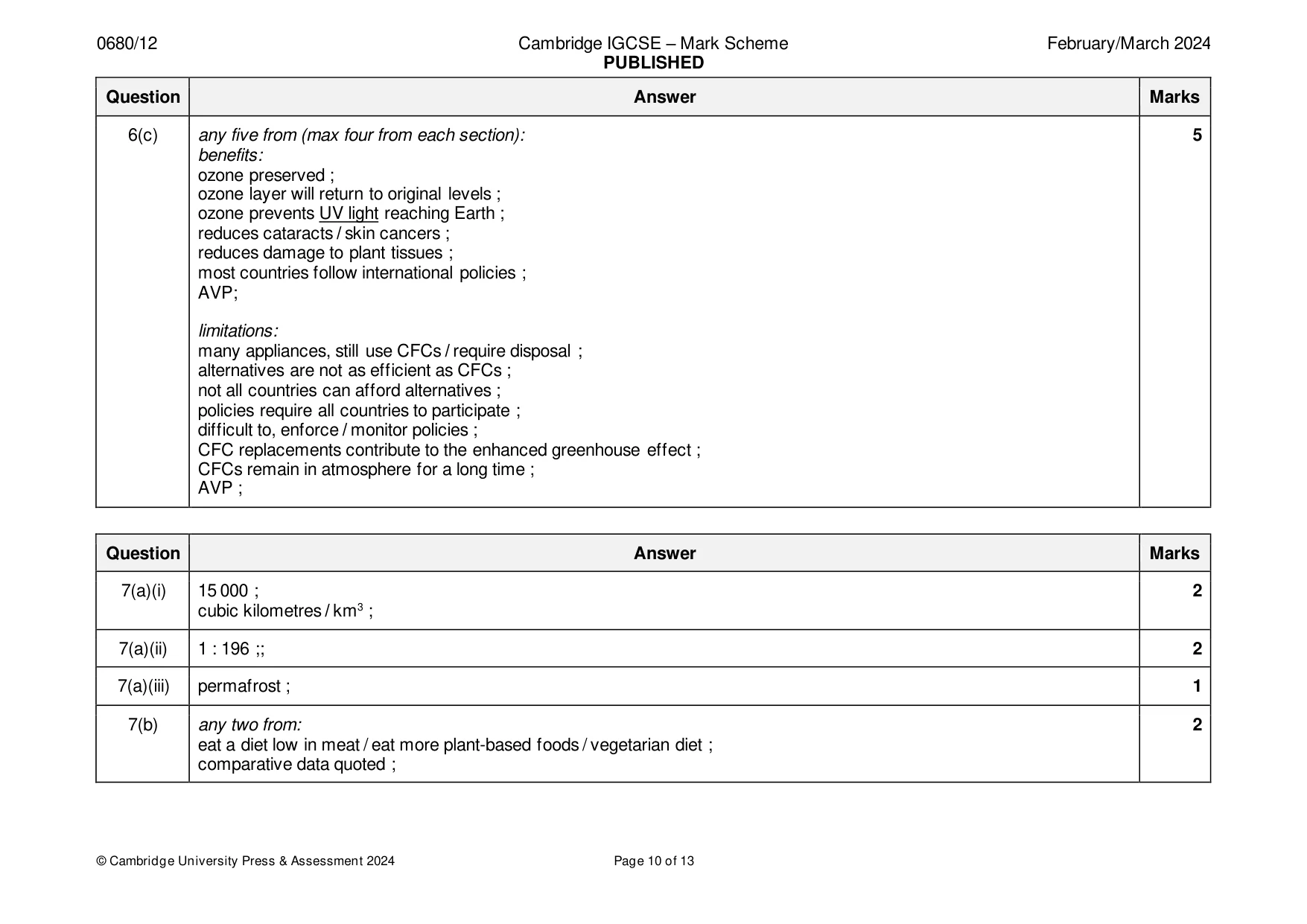
0680/12 Cambridge IGCSE – Mark Scheme PUBLISHED February/March 2024 © Cambridge University Press & Assessment 2024 Page 10 of 13 Question Answer Marks 6(c) any five from (max four from each section): benefits: ozone preserved ; ozone layer will return to original levels ; ozone prevents UV light reaching Earth ; reduces cataracts / skin cancers ; reduces damage to plant tissues ; most countries follow international policies ; AVP; limitations: many appliances, still use CFCs / require disposal ; alternatives are not as efficient as CFCs ; not all countries can afford alternatives ; policies require all countries to participate ; difficult to, enforce / monitor policies ; CFC replacements contribute to the enhanced greenhouse effect ; CFCs remain in atmosphere for a long time ; AVP ; 5 Question Answer Marks 7(a)(i) 15 000 ; cubic kilometres / km3 ; 2 7(a)(ii) 1 : 196 ;; 2 7(a)(iii) permafrost ; 1 7(b) any two from: eat a diet low in meat / eat more plant-based foods / vegetarian diet ; comparative data quoted ; 2
Mark scheme, page 11
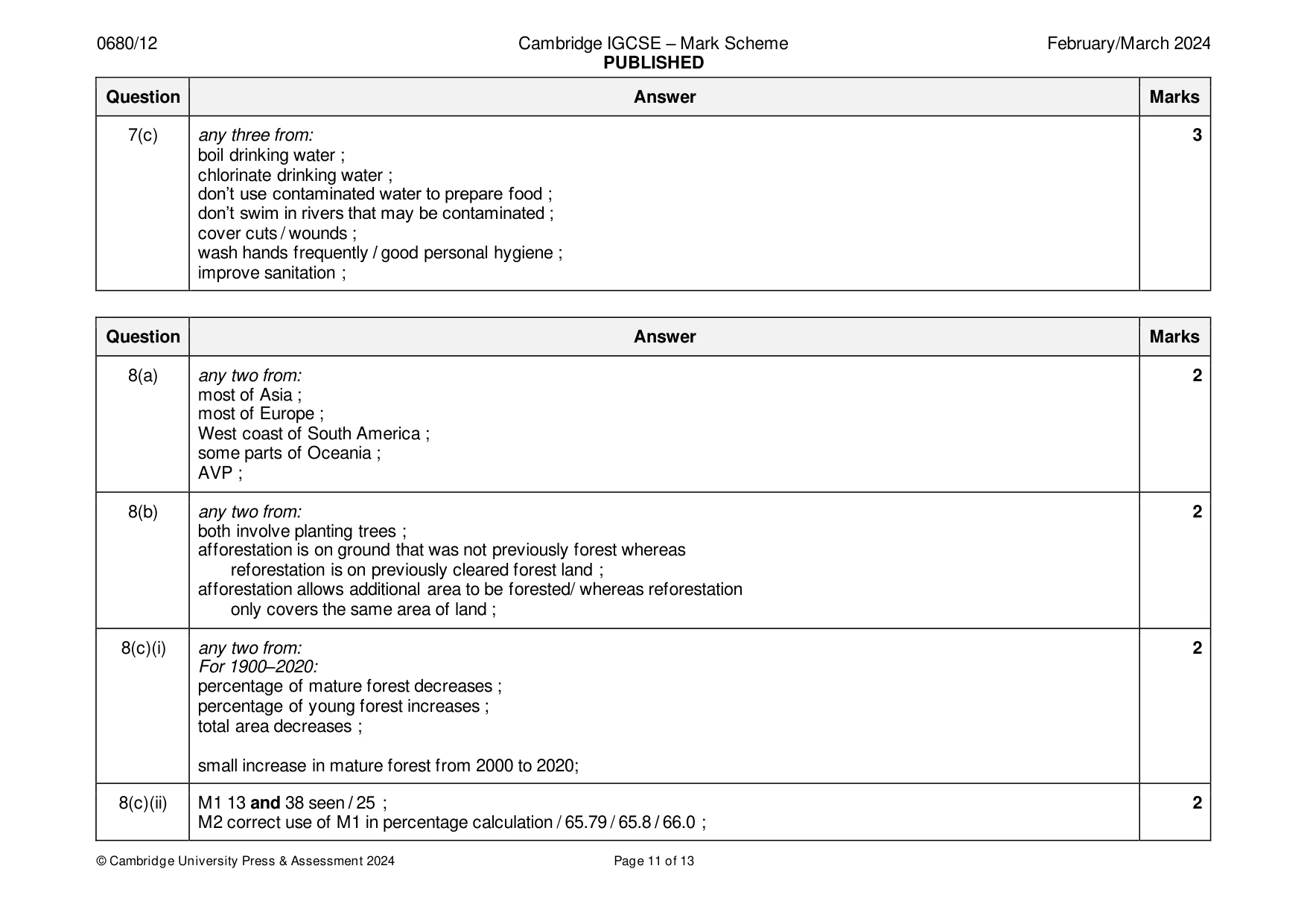
0680/12 Cambridge IGCSE – Mark Scheme PUBLISHED February/March 2024 © Cambridge University Press & Assessment 2024 Page 11 of 13 Question Answer Marks 7(c) any three from: boil drinking water ; chlorinate drinking water ; don’t use contaminated water to prepare food ; don’t swim in rivers that may be contaminated ; cover cuts / wounds ; wash hands frequently / good personal hygiene ; improve sanitation ; 3 Question Answer Marks 8(a) any two from: most of Asia ; most of Europe ; West coast of South America ; some parts of Oceania ; AVP ; 2 8(b) any two from: both involve planting trees ; afforestation is on ground that was not previously forest whereas reforestation is on previously cleared forest land ; afforestation allows additional area to be forested/ whereas reforestation only covers the same area of land ; 2 8(c)(i) any two from: For 1900–2020: percentage of mature forest decreases ; percentage of young forest increases ; total area decreases ; small increase in mature forest from 2000 to 2020; 2 8(c)(ii) M1 13 and 38 seen / 25 ; M2 correct use of M1 in percentage calculation / 65.79 / 65.8 / 66.0 ; 2
Mark scheme, page 12
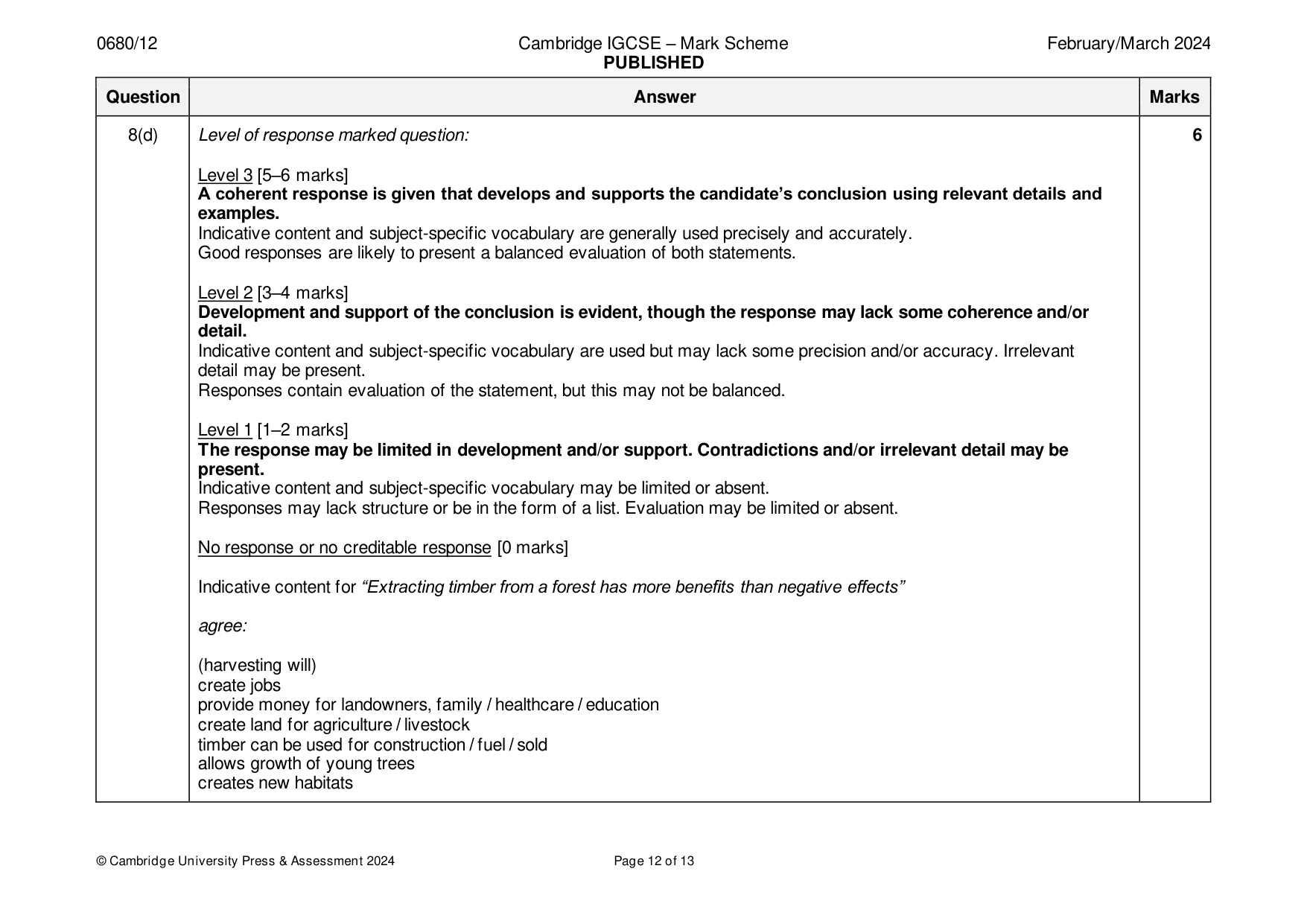
0680/12 Cambridge IGCSE – Mark Scheme PUBLISHED February/March 2024 © Cambridge University Press & Assessment 2024 Page 12 of 13 Question Answer Marks 8(d) Level of response marked question: Level 3 [5–6 marks] A coherent response is given that develops and supports the candidate’s conclusion using relevant details and examples. Indicative content and subject-specific vocabulary are generally used precisely and accurately. Good responses are likely to present a balanced evaluation of both statements. Level 2 [3–4 marks] Development and support of the conclusion is evident, though the response may lack some coherence and/or detail. Indicative content and subject-specific vocabulary are used but may lack some precision and/or accuracy. Irrelevant detail may be present. Responses contain evaluation of the statement, but this may not be balanced. Level 1 [1–2 marks] The response may be limited in development and/or support. Contradictions and/or irrelevant detail may be present. Indicative content and subject-specific vocabulary may be limited or absent. Responses may lack structure or be in the form of a list. Evaluation may be limited or absent. No response or no creditable response [0 marks] Indicative content for “Extracting timber from a forest has more benefits than negative effects” agree: (harvesting will) create jobs provide money for landowners, family / healthcare / education create land for agriculture / livestock timber can be used for construction / fuel / sold allows growth of young trees creates new habitats 6
Mark scheme, page 13
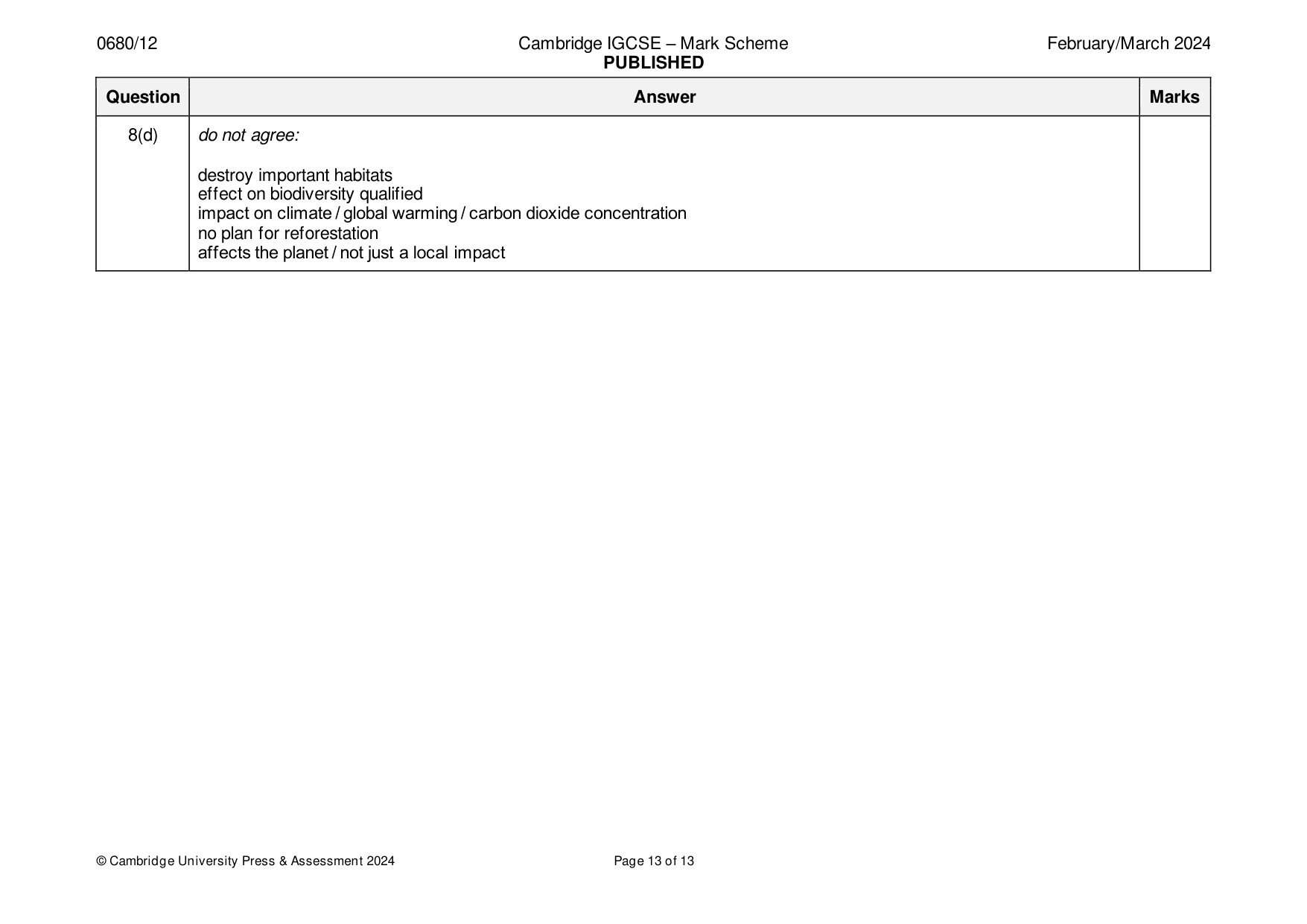
0680/12 Cambridge IGCSE – Mark Scheme PUBLISHED February/March 2024 © Cambridge University Press & Assessment 2024 Page 13 of 13 Question Answer Marks 8(d) do not agree: destroy important habitats effect on biodiversity qualified impact on climate / global warming / carbon dioxide concentration no plan for reforestation affects the planet / not just a local impact
What you needed in this session
Cambridge’s own grade thresholds for 2024 Feb/March, Paper 1 · Variant 2. A higher threshold means an easier paper — the bar moves with how the cohort did.