Cambridge IGCSE Environmental Management 0680 — 2024 May/June Paper 1 · Variant 1
0680/11/M/J/24 · 80 marks · ≈90 min
The question paper and its mark scheme, free to read here and free to download. This is Cambridge’s own paper, exactly as it was sat.
Question paper20 pages

Mark scheme12 pages
Answers below. Sit the paper first if you are practising.
Paper as text
Question paper, page 1
This document has 20 pages. Any blank pages are indicated. [Turn over Cambridge IGCSE™ ENVIRONMENTAL MANAGEMENT 0680/11 Paper 1 Theory May/June 2024 1 hour 45 minutes You must answer on the question paper. No additional materials are needed. INSTRUCTIONS ● Answer all questions. ● Use a black or dark blue pen. You may use an HB pencil for any diagrams or graphs. ● Write your name, centre number and candidate number in the boxes at the top of the page. ● Write your answer to each question in the space provided. ● Do not use an erasable pen or correction fluid. ● Do not write on any bar codes. ● You may use a calculator. ● You should show all your working and use appropriate units. INFORMATION ● The total mark for this paper is 80. ● The number of marks for each question or part question is shown in brackets [ ]. * 2 8 6 8 3 0 7 4 9 1 * DC (PB/CB) 331068/2 © UCLES 2024
Question paper, page 2
2 0680/11/M/J/24 © UCLES 2024 Section A 1 (a) Igneous and sedimentary are types of rock. Complete the sentences about rocks. An example of an igneous rock is … An example of a sedimentary rock is … [2] (b) Describe the formation of a sedimentary rock. … … … … … … [3] [Total: 5]
Question paper, page 3
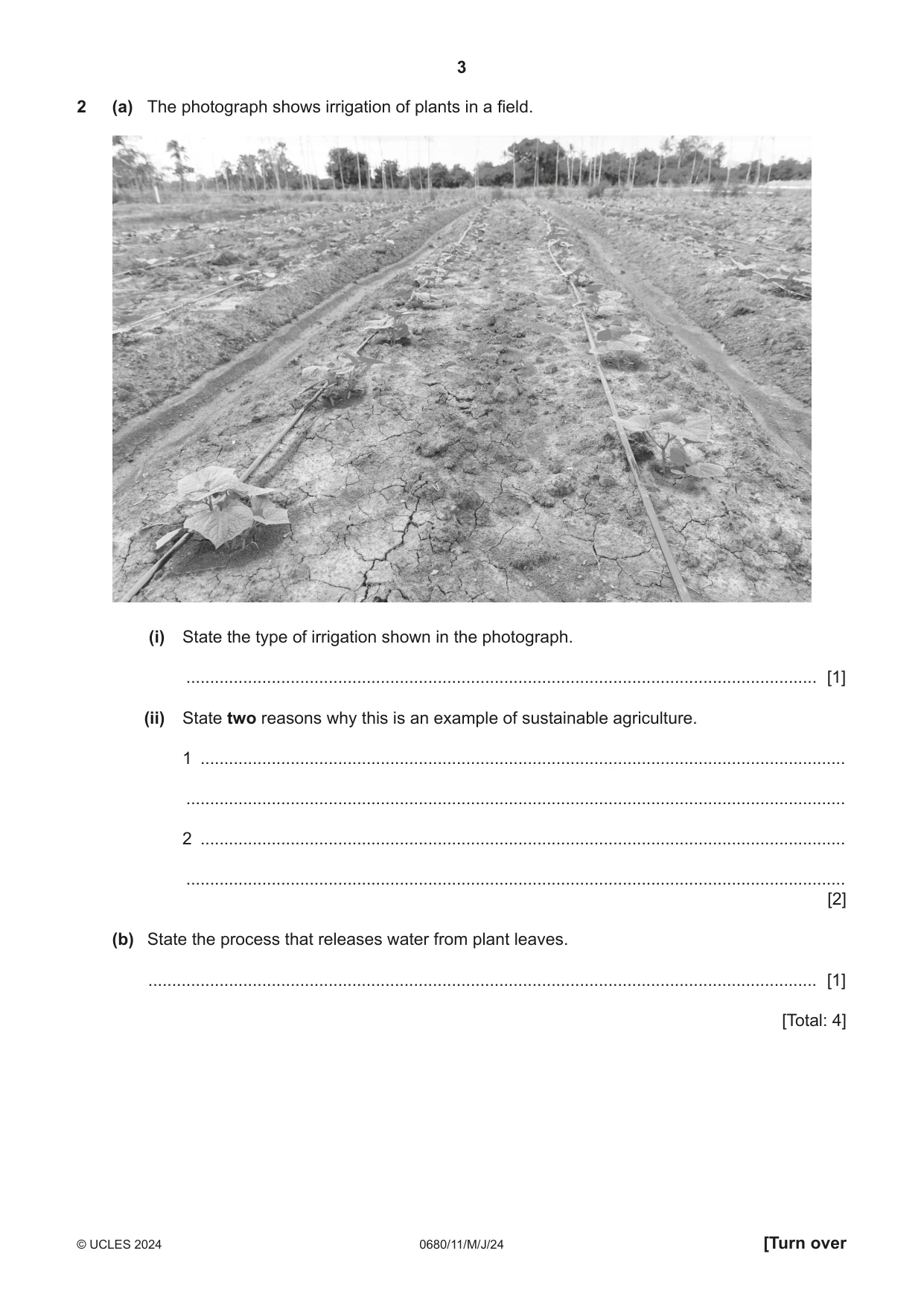
3 0680/11/M/J/24 © UCLES 2024 [Turn over 2 (a) The photograph shows irrigation of plants in a field. (i) State the type of irrigation shown in the photograph. … [1] (ii) State two reasons why this is an example of sustainable agriculture. 1 … … 2 … … [2] (b) State the process that releases water from plant leaves. … [1] [Total: 4]
Question paper, page 4
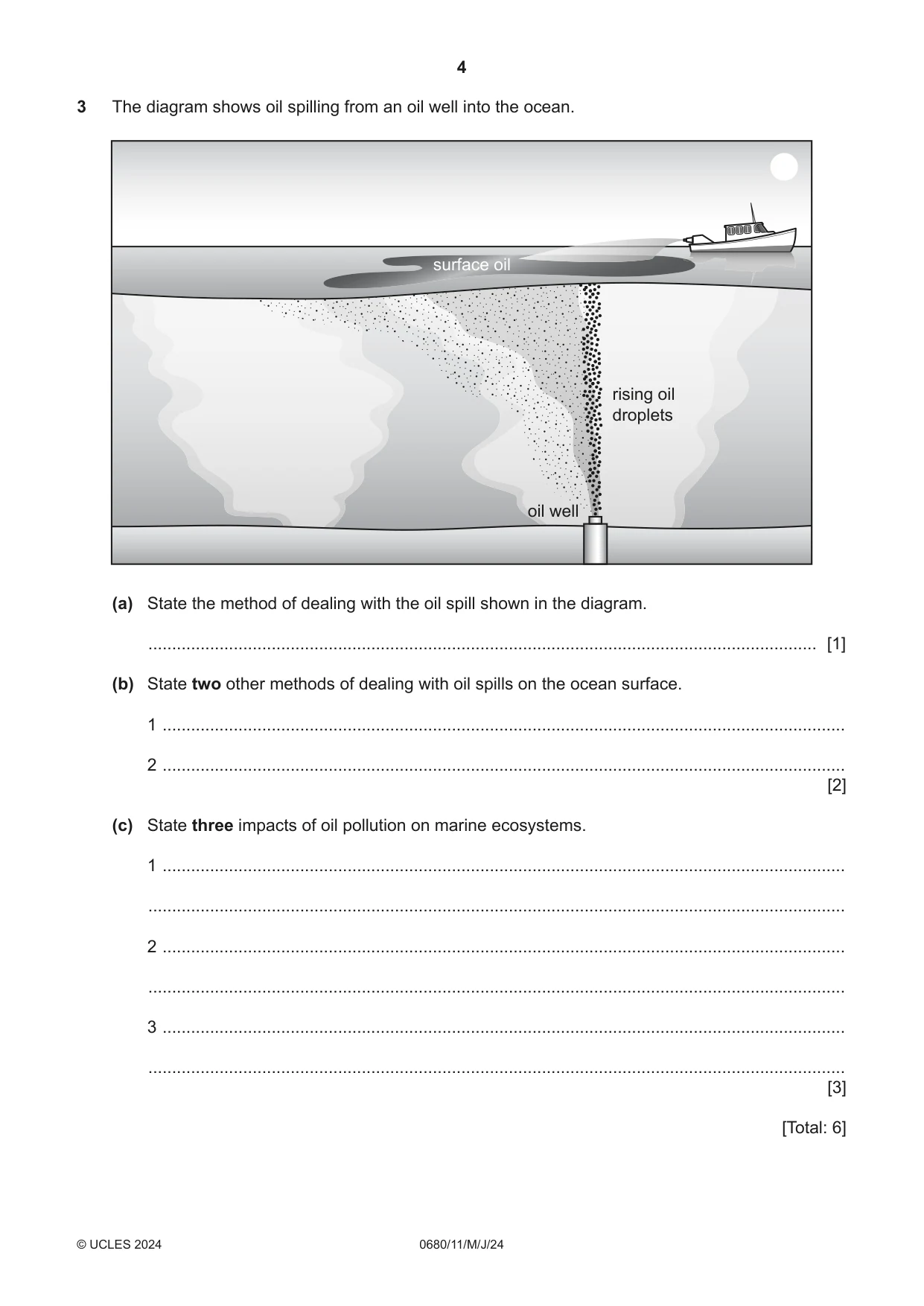
4 0680/11/ M/J/24 © UCLES 2024 3 The diagram shows oil spilling from an oil well into the ocean. oil well rising oil droplets surface oil (a) State the method of dealing with the oil spill shown in the diagram. … [1] (b) State two other methods of dealing with oil spills on the ocean surface. 1 … 2 … [2] (c) State three impacts of oil pollution on marine ecosystems. 1 … … 2 … … 3 … … [3] [Total: 6]
Question paper, page 5
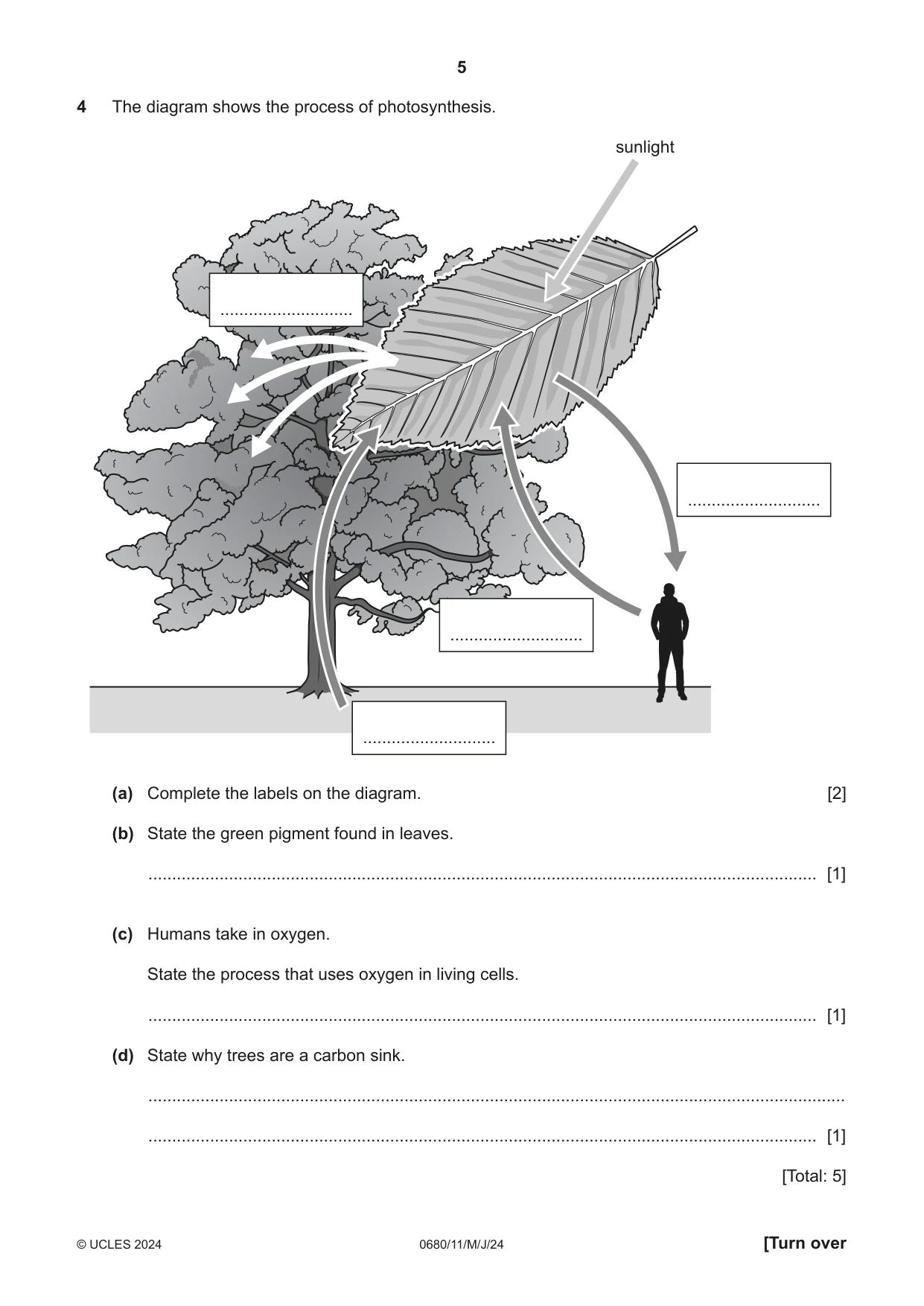
5 0680/11/M/J/24 © UCLES 2024 [Turn over 4 The diagram shows the process of photosynthesis. sunlight … … … … (a) Complete the labels on the diagram. [2] (b) State the green pigment found in leaves. … [1] (c) Humans take in oxygen. State the process that uses oxygen in living cells. … [1] (d) State why trees are a carbon sink. … … [1] [Total: 5]
Question paper, page 6
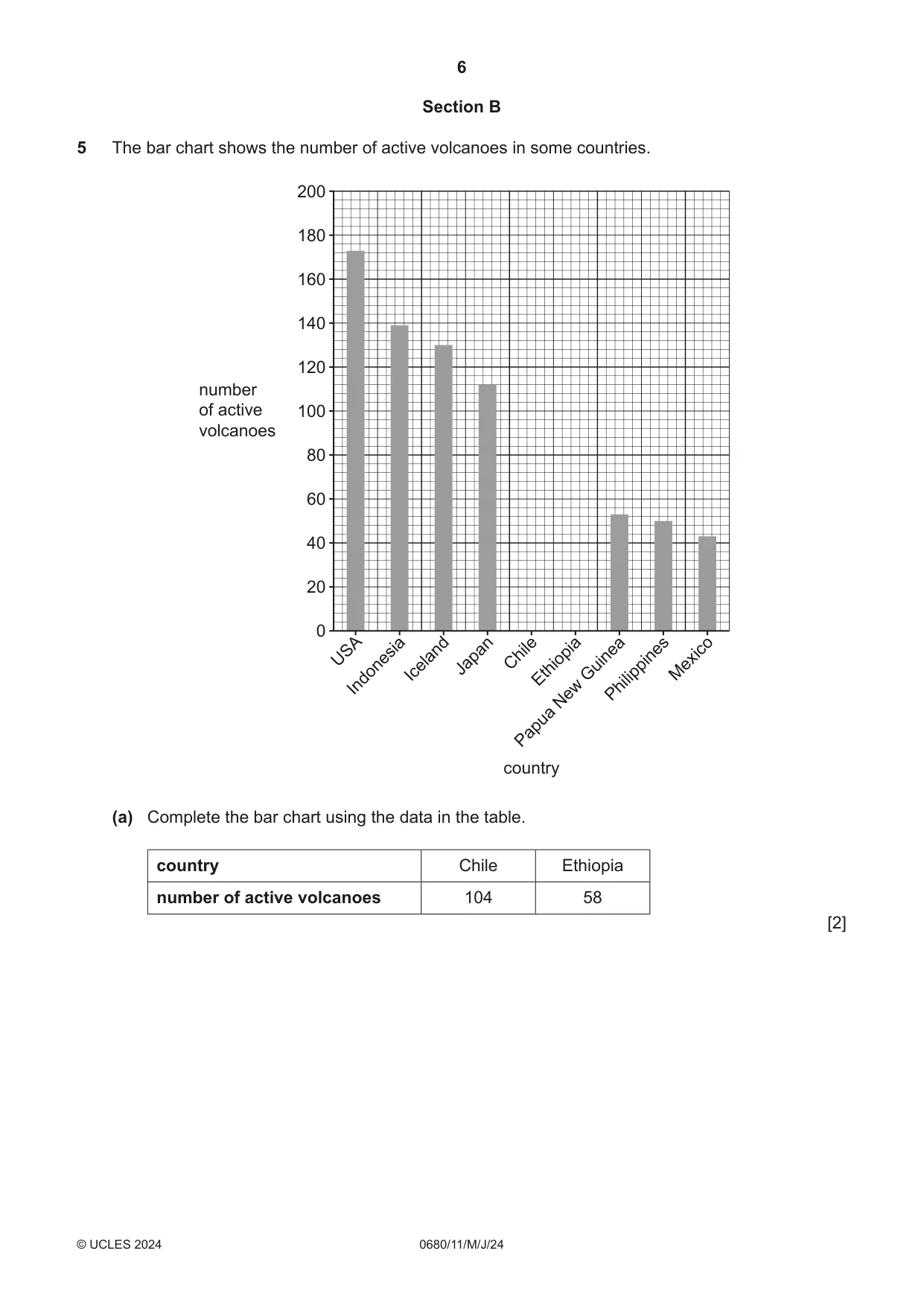
6 0680/11/M/J/24 © UCLES 2024 Section B 5 The bar chart shows the number of active volcanoes in some countries. country 0 number of active volcanoes USA Indonesia Iceland Japan Chile Ethiopia Papua New Guinea Philippines Mexico 20 40 60 80 100 120 140 160 180 200 (a) Complete the bar chart using the data in the table. country Chile Ethiopia number of active volcanoes 104 58 [2]
Question paper, page 7
7 0680/11/M/J/24 © UCLES 2024 [Turn over (b) Volcanoes erupt when magma rises to the Earth’s surface from the mantle. Explain how tectonic plate movement causes magma to rise to the Earth’s surface. … … … … … … … … … [4]
Question paper, page 8
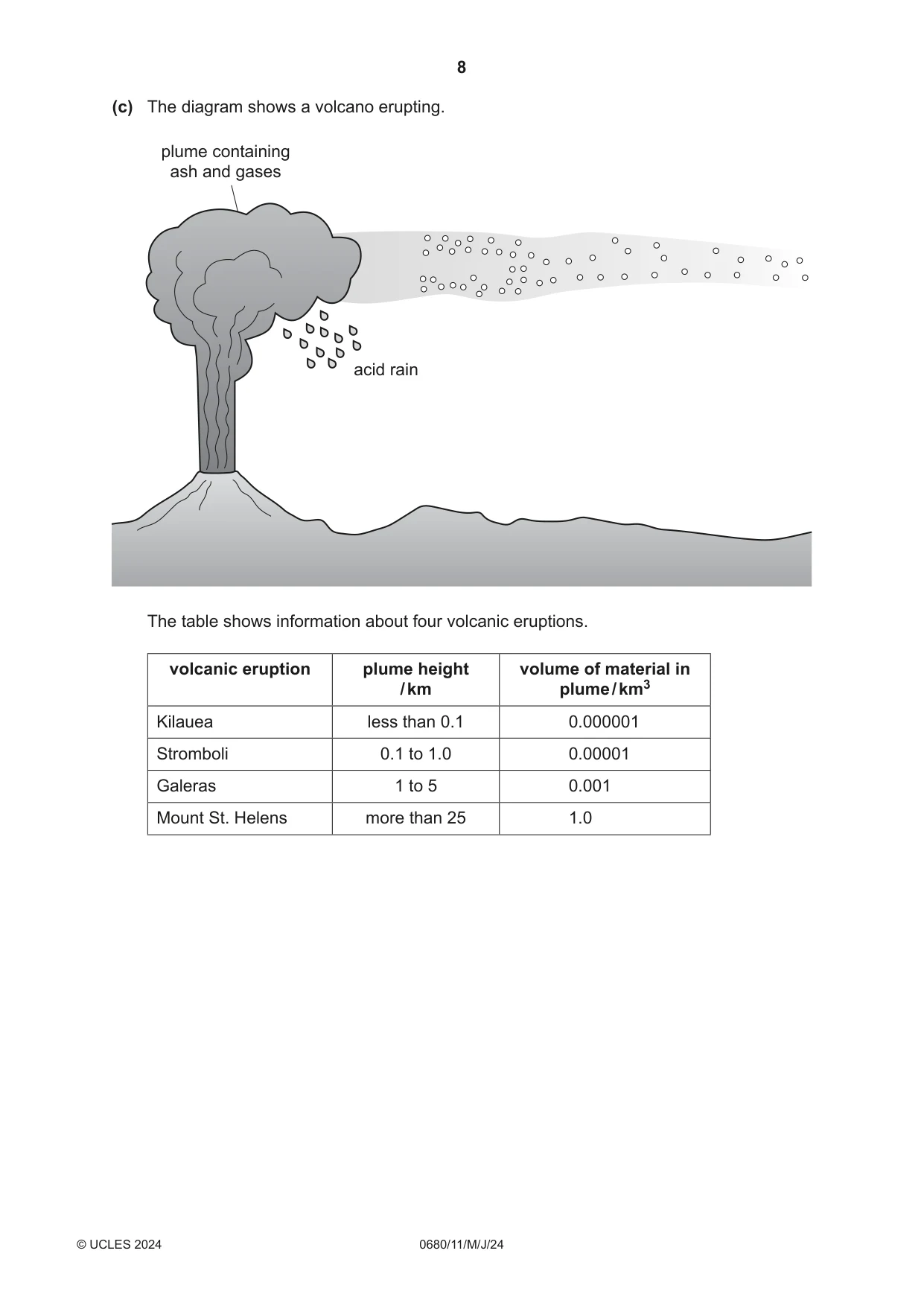
8 0680/11/ M/J/24 © UCLES 2024 (c) The diagram shows a volcano erupting. acid rain plume containing ash and gases The table shows information about four volcanic eruptions. volcanic eruption plume height / km volume of material in plume / km3 Kilauea less than 0.1 0.000001 Stromboli 0.1 to 1.0 0.00001 Galeras 1 to 5 0.001 Mount St. Helens more than 25 1.0
Question paper, page 9
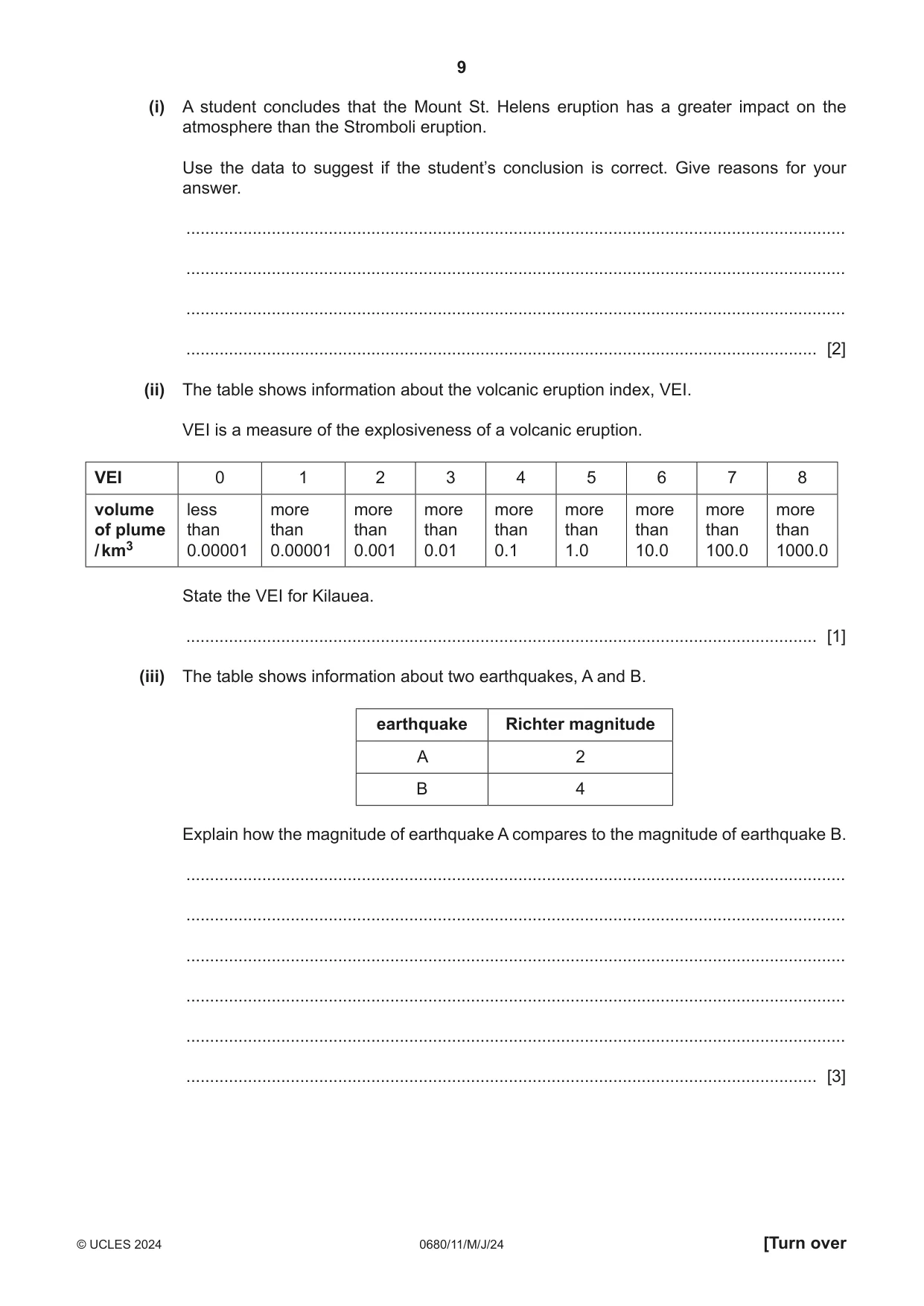
9 0680/11/M/J/24 © UCLES 2024 [Turn over (i) A student concludes that the Mount St. Helens eruption has a greater impact on the atmosphere than the Stromboli eruption. Use the data to suggest if the student’s conclusion is correct. Give reasons for your answer. … … … … [2] (ii) The table shows information about the volcanic eruption index, VEI. VEI is a measure of the explosiveness of a volcanic eruption. VEI 0 1 2 3 4 5 6 7 8 volume of plume / km3 less than 0.00001 more than 0.00001 more than 0.001 more than 0.01 more than 0.1 more than 1.0 more than 10.0 more than 100.0 more than 1000.0 State the VEI for Kilauea. … [1] (iii) The table shows information about two earthquakes, A and B. earthquake Richter magnitude A 2 B 4 Explain how the magnitude of earthquake A compares to the magnitude of earthquake B. … … … … … … [3]
Question paper, page 10
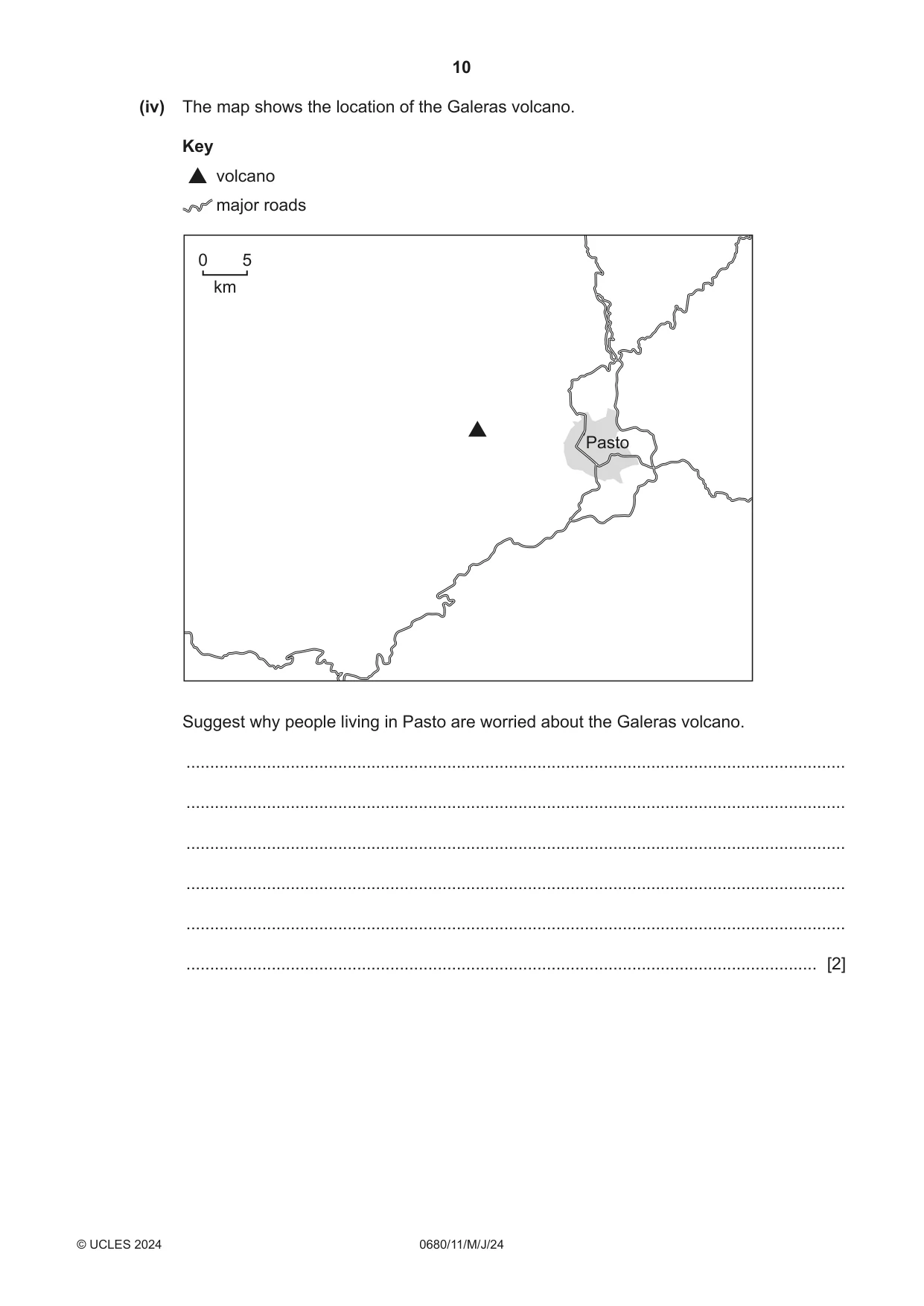
10 0680/11/M/J/24 © UCLES 2024 (iv) The map shows the location of the Galeras volcano. 0 km 5 Pasto Key volcano major roads Suggest why people living in Pasto are worried about the Galeras volcano. … … … … … … [2]
Question paper, page 11
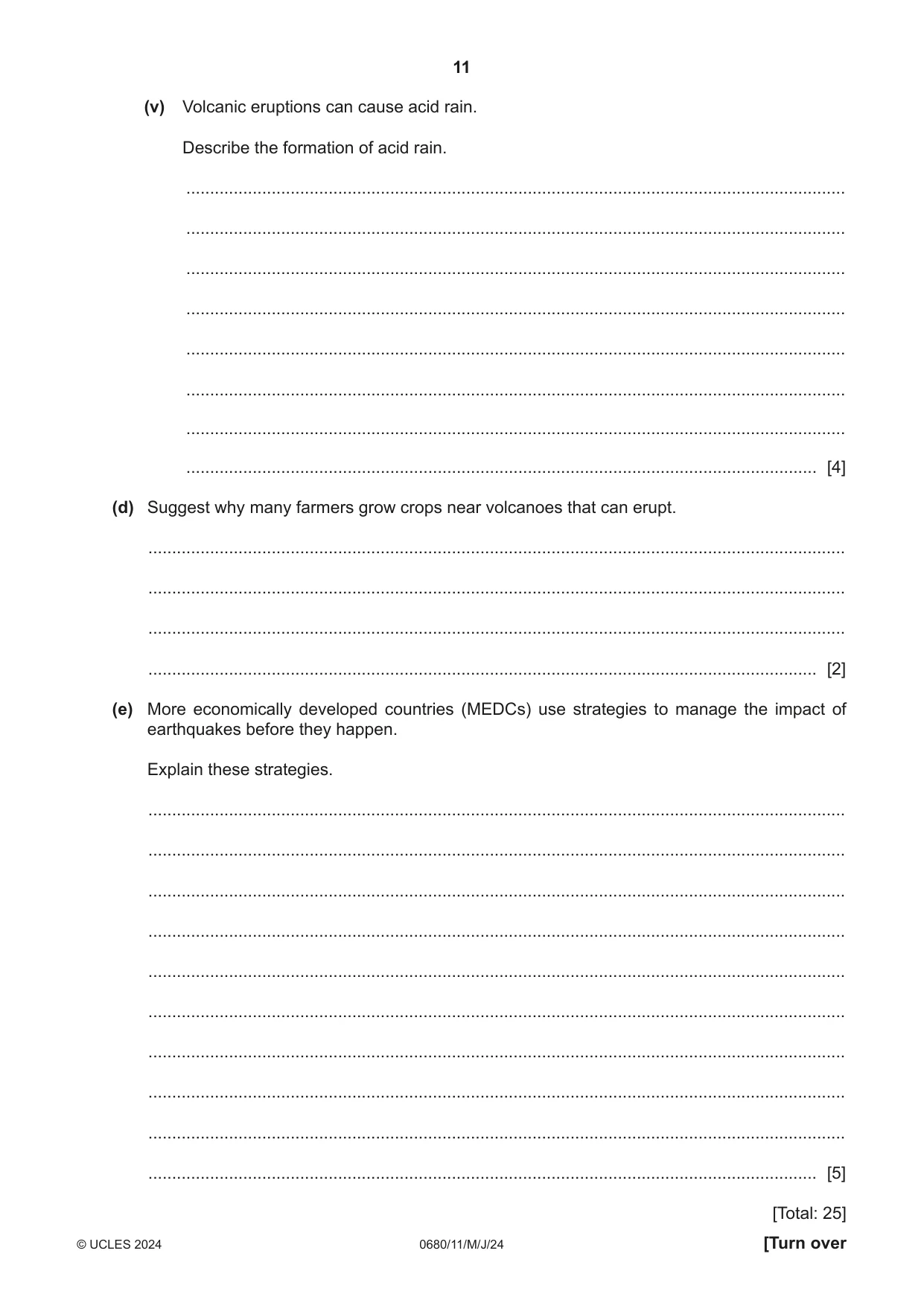
11 0680/11/M/J/24 © UCLES 2024 [Turn over (v) Volcanic eruptions can cause acid rain. Describe the formation of acid rain. … … … … … … … … [4] (d) Suggest why many farmers grow crops near volcanoes that can erupt. … … … … [2] (e) More economically developed countries (MEDCs) use strategies to manage the impact of earthquakes before they happen. Explain these strategies. … … … … … … … … … … [5] [Total: 25]
Question paper, page 12
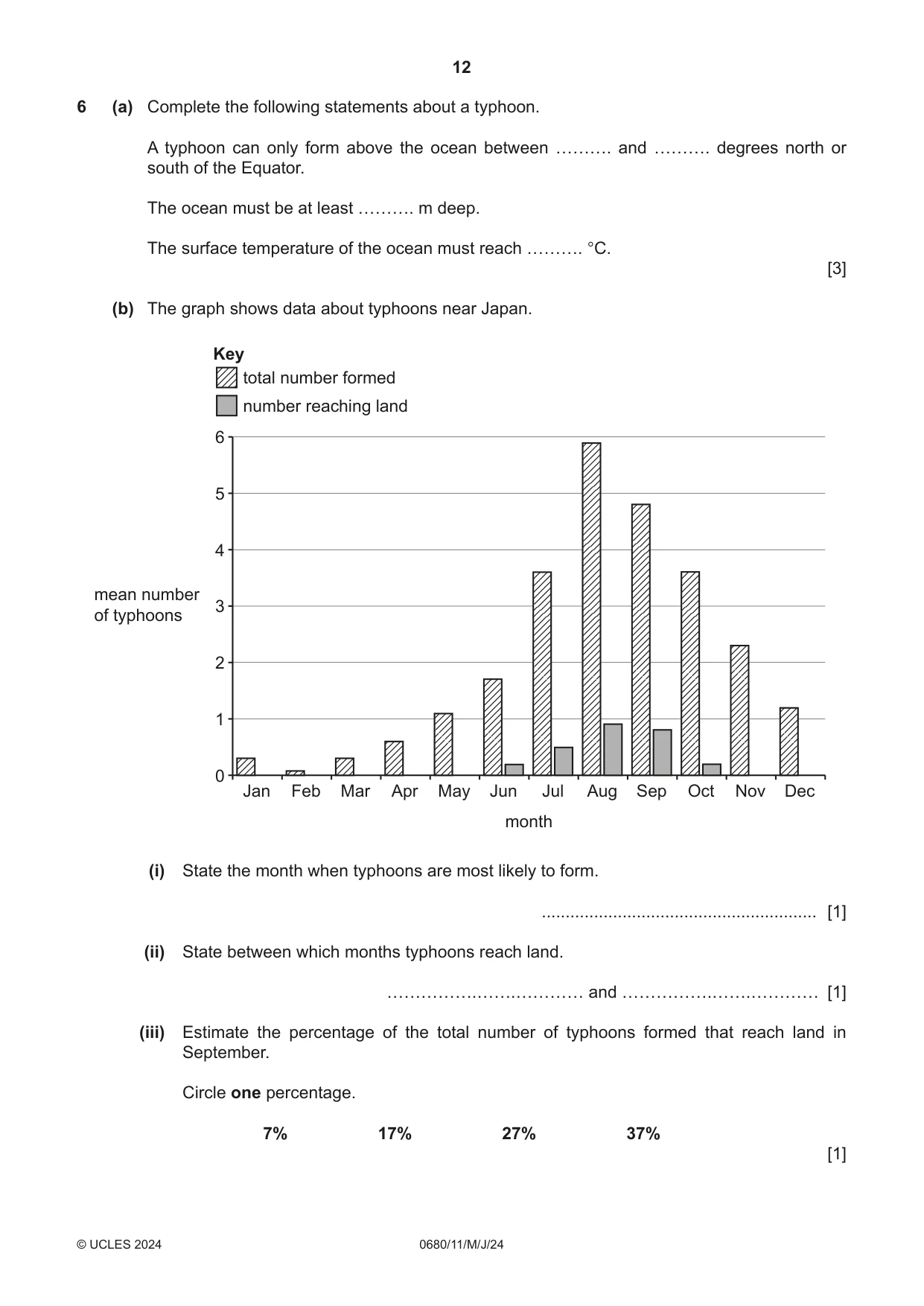
12 0680/11/M/J/24 © UCLES 2024 6 (a) Complete the following statements about a typhoon. A typhoon can only form above the ocean between ………. and ………. degrees north or south of the Equator. The ocean must be at least ………. m deep. The surface temperature of the ocean must reach ………. °C. [3] (b) The graph shows data about typhoons near Japan. 0 Jan Feb Mar Apr May Jun Jul month total number formed number reaching land Key mean number of typhoons Aug Sep Oct Nov Dec 1 2 3 4 5 6 (i) State the month when typhoons are most likely to form. … [1] (ii) State between which months typhoons reach land. …………….…….………… and …………….…….………… [1] (iii) Estimate the percentage of the total number of typhoons formed that reach land in September. Circle one percentage. 7% 17% 27% 37% [1]
Question paper, page 13
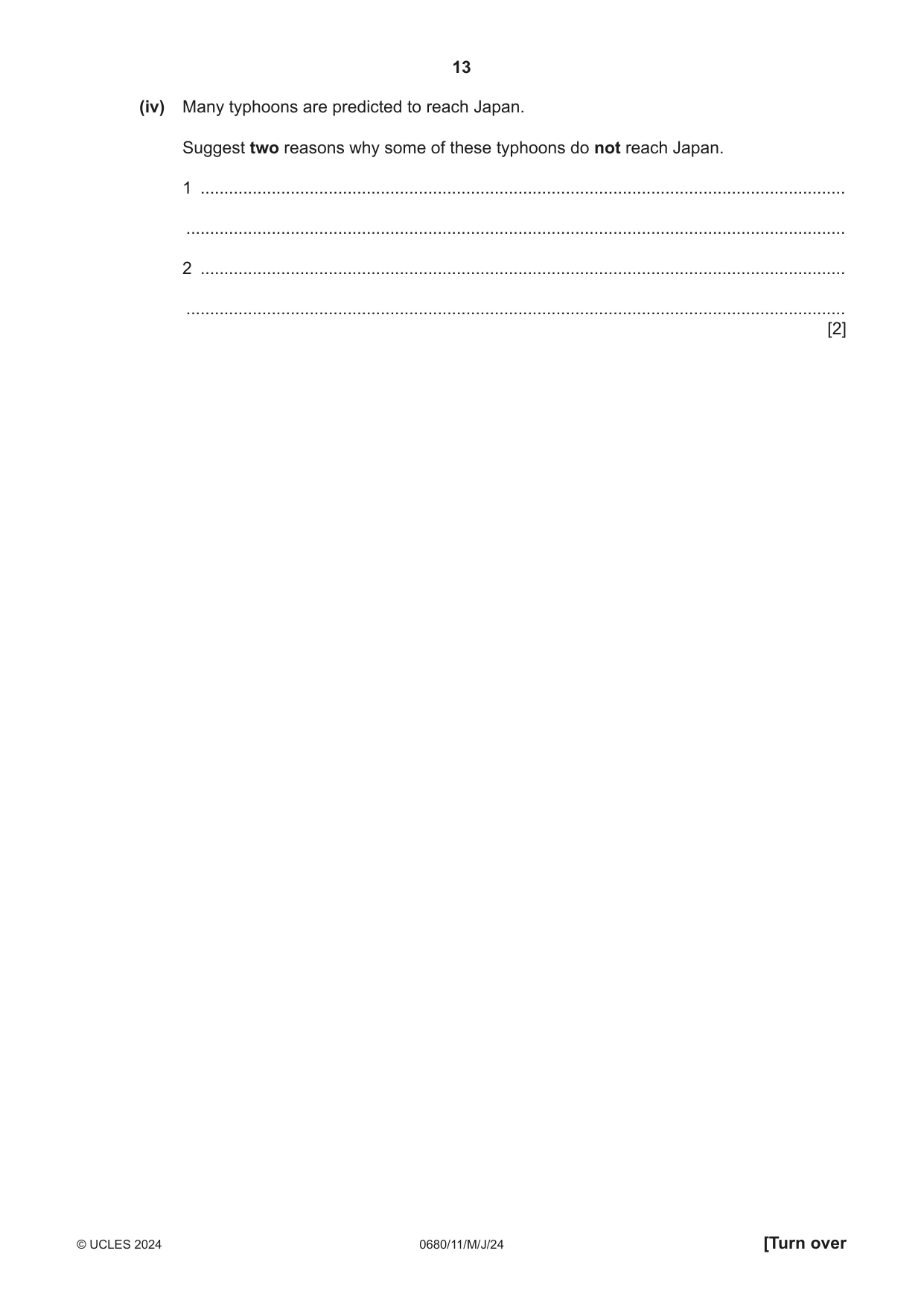
13 0680/11/M/J/24 © UCLES 2024 [Turn over (iv) Many typhoons are predicted to reach Japan. Suggest two reasons why some of these typhoons do not reach Japan. 1 … … 2 … … [2]
Question paper, page 14
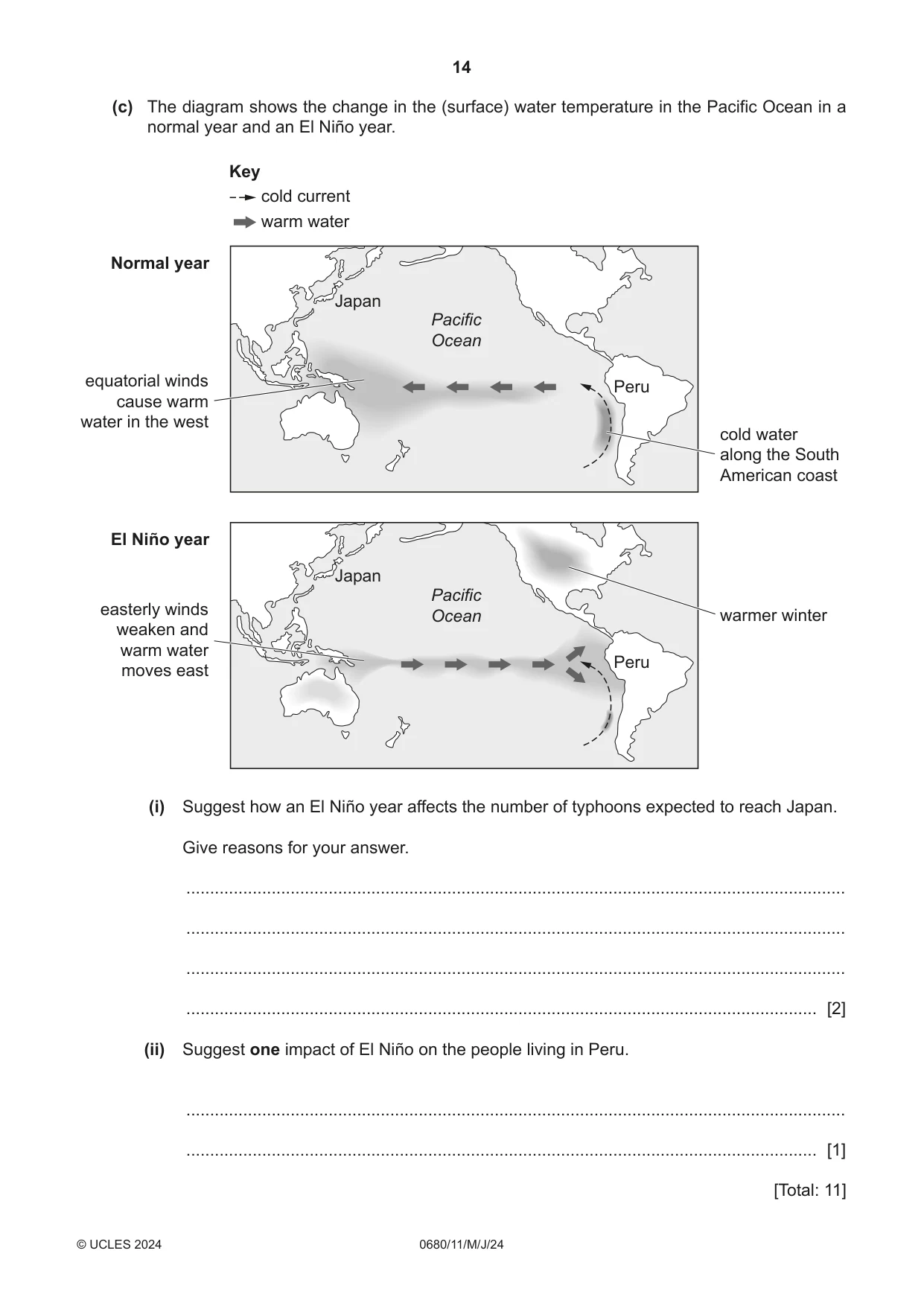
14 0680/11/M/J/24 © UCLES 2024 (c) The diagram shows the change in the (surface) water temperature in the Pacific Ocean in a normal year and an El Niño year. Pacific Ocean Japan Normal year El Niño year Key cold current warm water Peru Pacific Ocean Japan Peru easterly winds weaken and warm water moves east cold water along the South American coast warmer winter equatorial winds cause warm water in the west (i) Suggest how an El Niño year affects the number of typhoons expected to reach Japan. Give reasons for your answer. … … … … [2] (ii) Suggest one impact of El Niño on the people living in Peru. … … [1] [Total: 11]
Question paper, page 15
15 0680/11/M/J/24 © UCLES 2024 [Turn over BLANK PAGE
Question paper, page 16
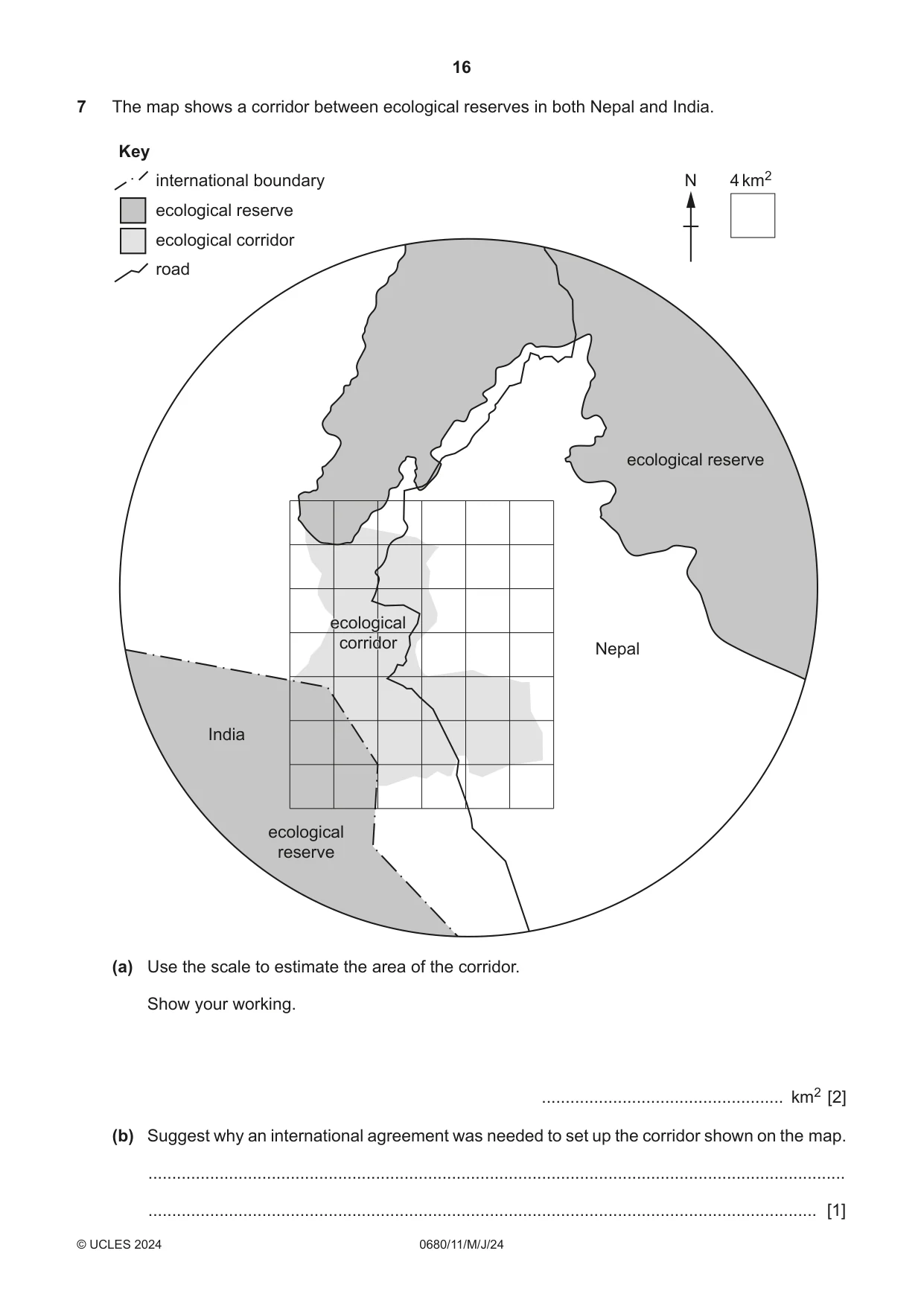
16 0680/11/M/J/24 © UCLES 2024 7 The map shows a corridor between ecological reserves in both Nepal and India. India Nepal ecological corridor ecological reserve ecological reserve N 4 km2 Key international boundary ecological reserve ecological corridor road (a) Use the scale to estimate the area of the corridor. Show your working. … km2 [2] (b) Suggest why an international agreement was needed to set up the corridor shown on the map. … … [1]
Question paper, page 17
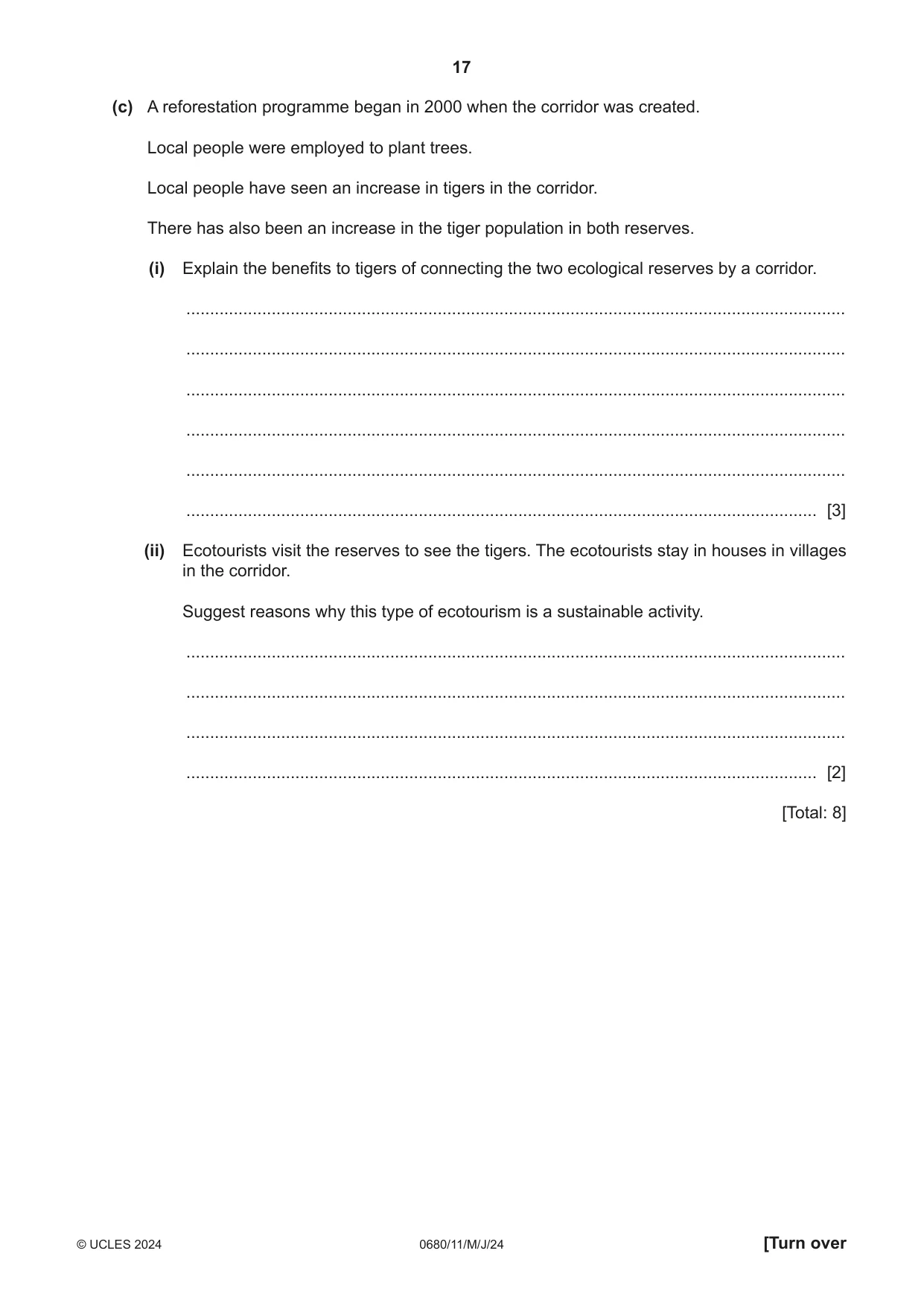
17 0680/11/M/J/24 © UCLES 2024 [Turn over (c) A reforestation programme began in 2000 when the corridor was created. Local people were employed to plant trees. Local people have seen an increase in tigers in the corridor. There has also been an increase in the tiger population in both reserves. (i) Explain the benefits to tigers of connecting the two ecological reserves by a corridor. … … … … … … [3] (ii) Ecotourists visit the reserves to see the tigers. The ecotourists stay in houses in villages in the corridor. Suggest reasons why this type of ecotourism is a sustainable activity. … … … … [2] [Total: 8]
Question paper, page 18
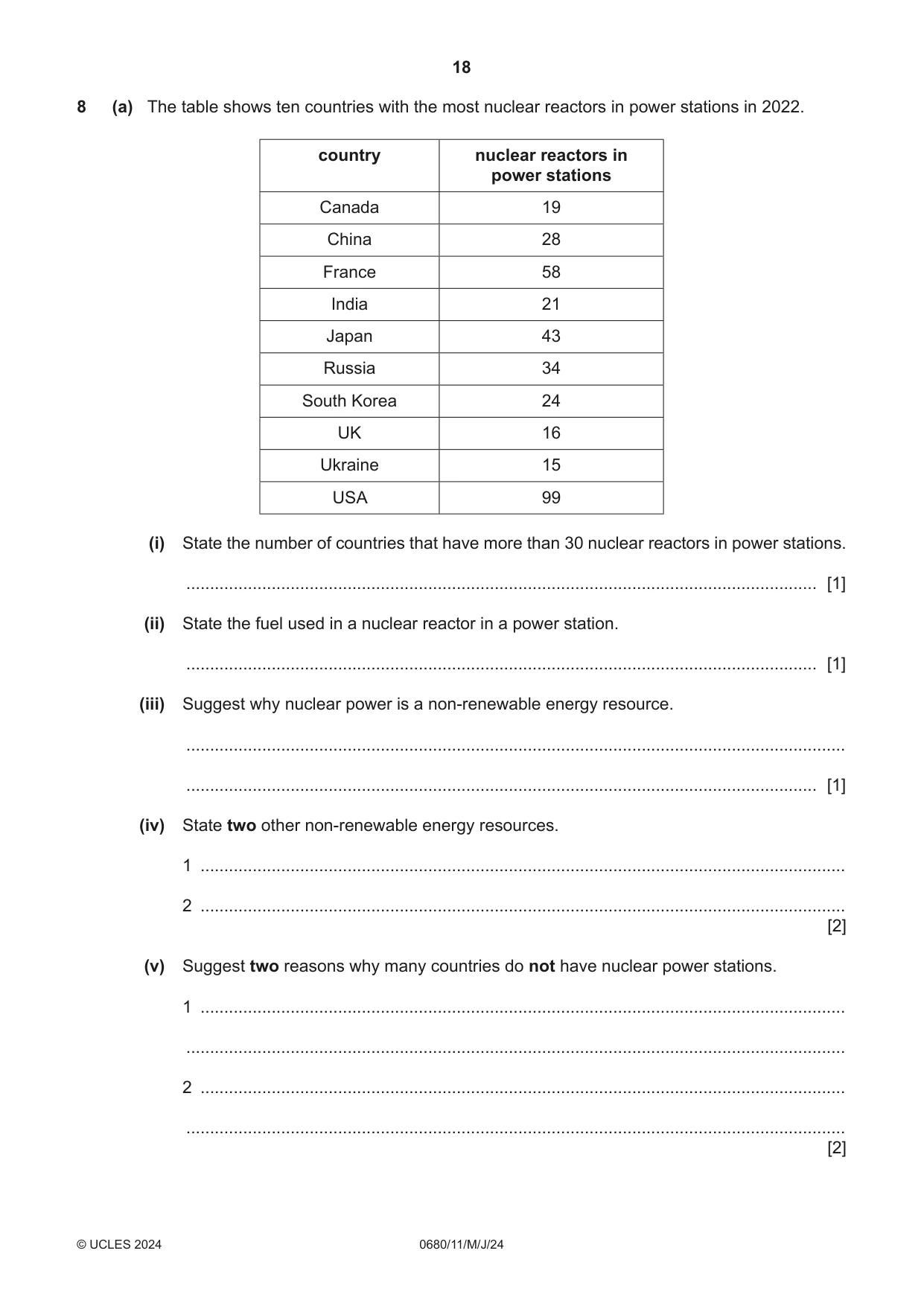
18 0680/11/M/J/24 © UCLES 2024 8 (a) The table shows ten countries with the most nuclear reactors in power stations in 2022. country nuclear reactors in power stations Canada 19 China 28 France 58 India 21 Japan 43 Russia 34 South Korea 24 UK 16 Ukraine 15 USA 99 (i) State the number of countries that have more than 30 nuclear reactors in power stations. … [1] (ii) State the fuel used in a nuclear reactor in a power station. … [1] (iii) Suggest why nuclear power is a non-renewable energy resource. … … [1] (iv) State two other non-renewable energy resources. 1 … 2 … [2] (v) Suggest two reasons why many countries do not have nuclear power stations. 1 … … 2 … … [2]
Question paper, page 19
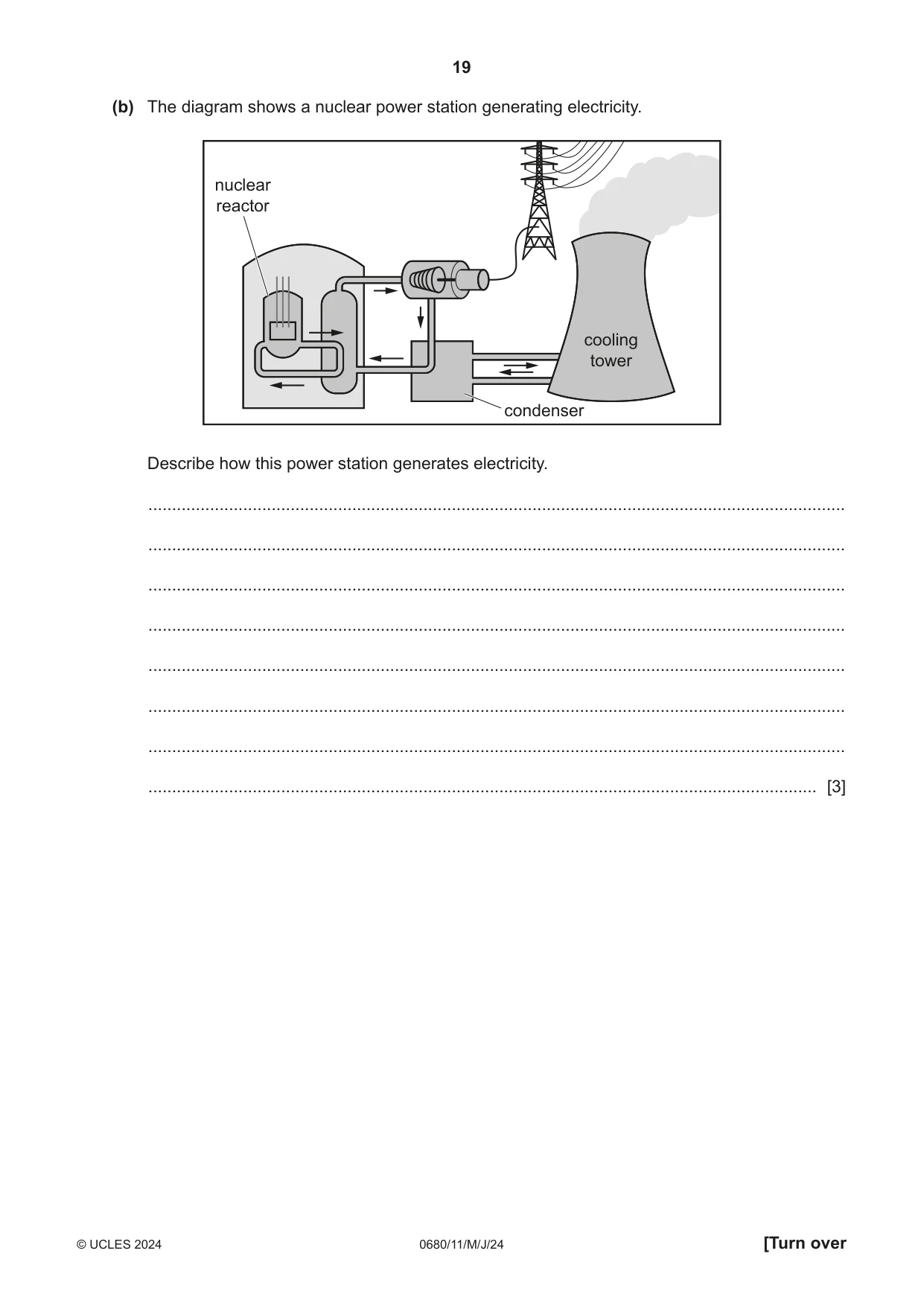
19 0680/11/M/J/24 © UCLES 2024 [Turn over (b) The diagram shows a nuclear power station generating electricity. condenser nuclear reactor cooling tower Describe how this power station generates electricity. … … … … … … … … [3]
Question paper, page 20
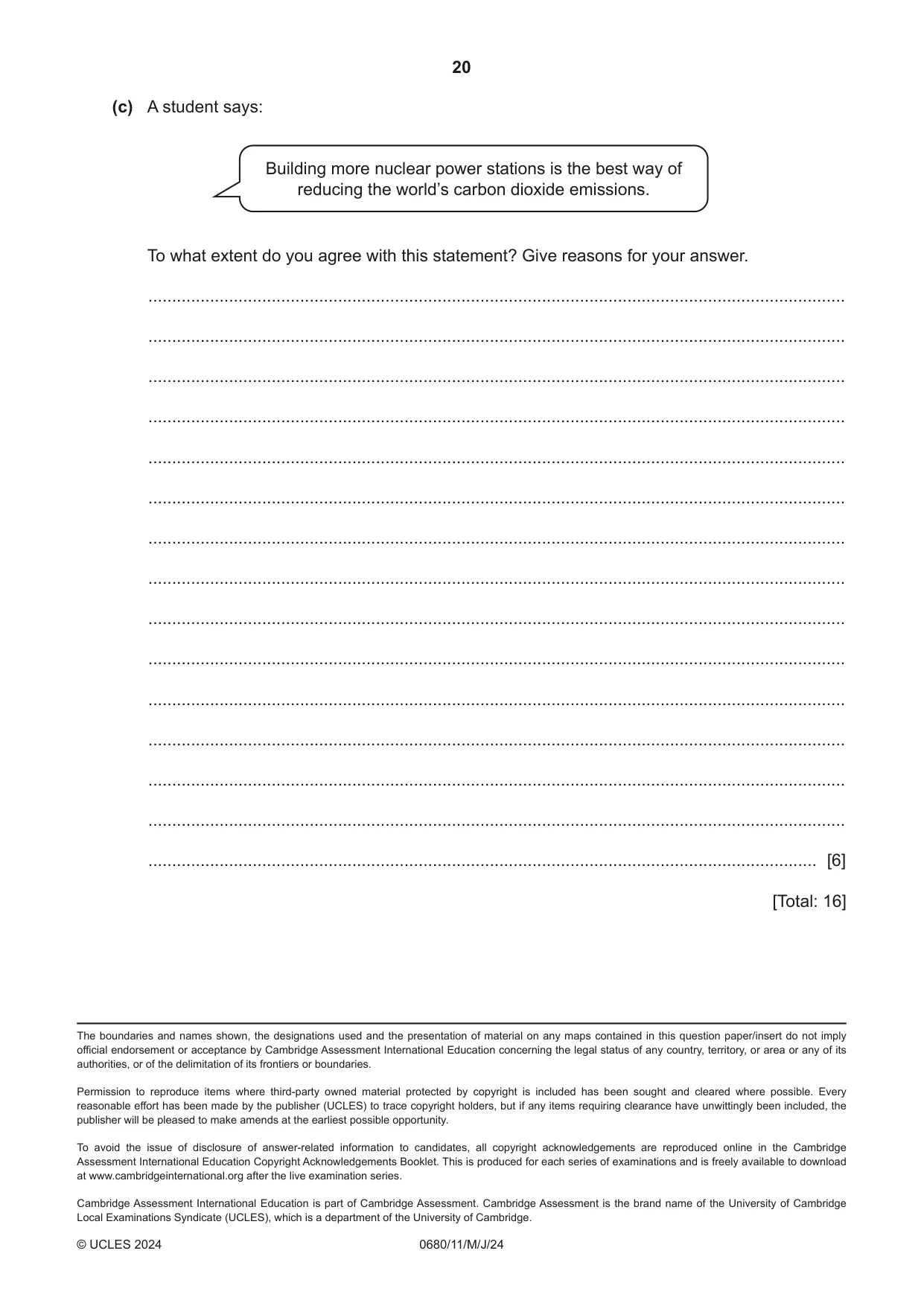
20 0680/11/M/J/24 © UCLES 2024 (c) A student says: Building more nuclear power stations is the best way of reducing the world’s carbon dioxide emissions. To what extent do you agree with this statement? Give reasons for your answer. … … … … … … … … … … … … … … … [6] [Total: 16] The boundaries and names shown, the designations used and the presentation of material on any maps contained in this question paper/insert do not imply official endorsement or acceptance by Cambridge Assessment International Education concerning the legal status of any country, territory, or area or any of its authorities, or of the delimitation of its frontiers or boundaries. Permission to reproduce items where third-party owned material protected by copyright is included has been sought and cleared where possible. Every reasonable effort has been made by the publisher (UCLES) to trace copyright holders, but if any items requiring clearance have unwittingly been included, the publisher will be pleased to make amends at the earliest possible opportunity. To avoid the issue of disclosure of answer-related information to candidates, all copyright acknowledgements are reproduced online in the Cambridge Assessment International Education Copyright Acknowledgements Booklet. This is produced for each series of examinations and is freely available to download at www.cambridgeinternational.org after the live examination series. Cambridge Assessment International Education is part of Cambridge Assessment. Cambridge Assessment is the brand name of the University of Cambridge Local Examinations Syndicate (UCLES), which is a department of the University of Cambridge.
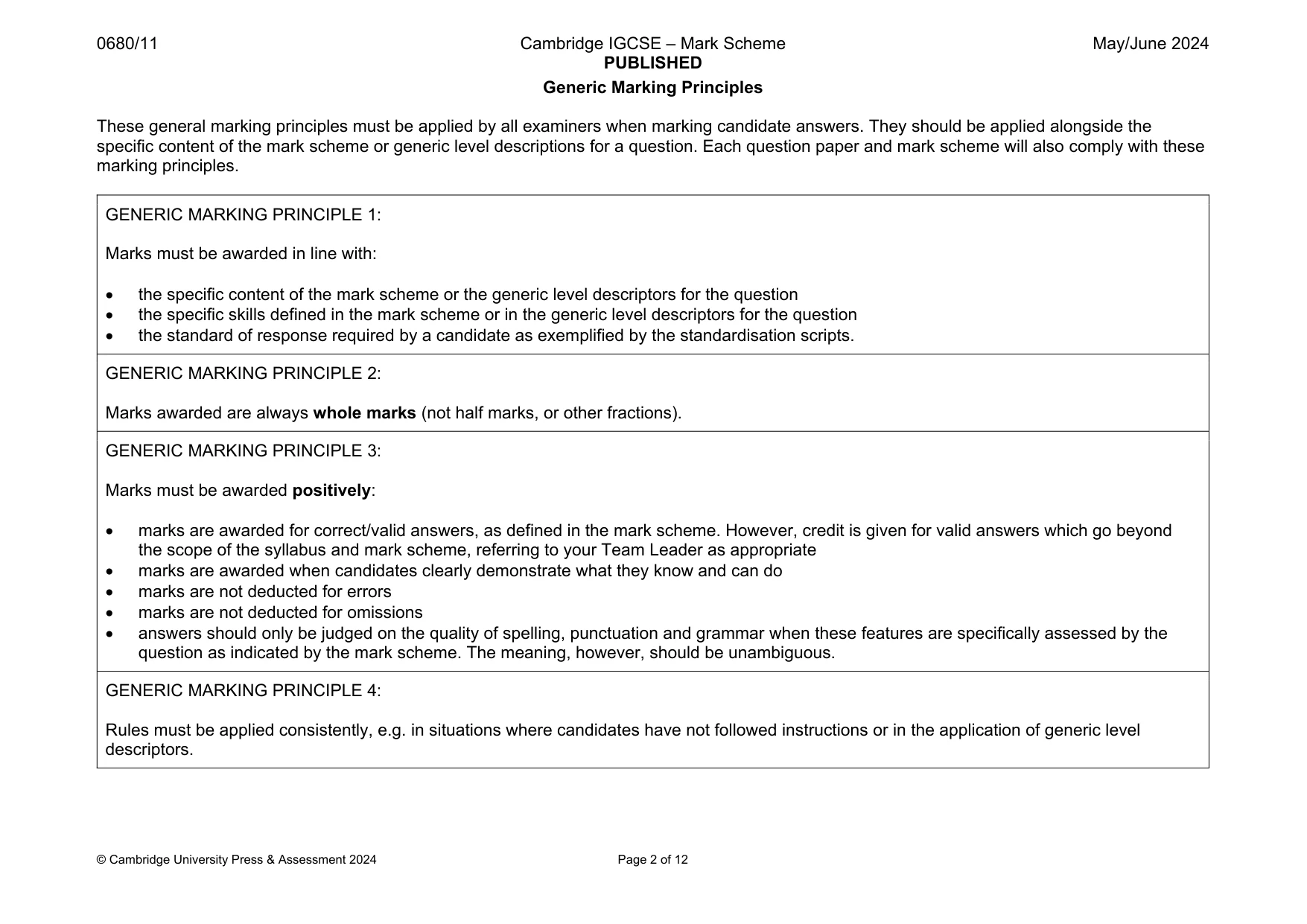
Mark scheme, page 1
This document consists of 12 printed pages. © Cambridge University Press & Assessment 2024 [Turn over Cambridge IGCSE™ ENVIRONMENTAL MANAGEMENT 0680/11 Paper 1 Theory May/June 2024 MARK SCHEME Maximum Mark: 80 Published This mark scheme is published as an aid to teachers and candidates, to indicate the requirements of the examination. It shows the basis on which Examiners were instructed to award marks. It does not indicate the details of the discussions that took place at an Examiners’ meeting before marking began, which would have considered the acceptability of alternative answers. Mark schemes should be read in conjunction with the question paper and the Principal Examiner Report for Teachers. Cambridge International will not enter into discussions about these mark schemes. Cambridge International is publishing the mark schemes for the May/June 2024 series for most Cambridge IGCSE, Cambridge International A and AS Level and Cambridge Pre-U components, and some Cambridge O Level components.
Mark scheme, page 2
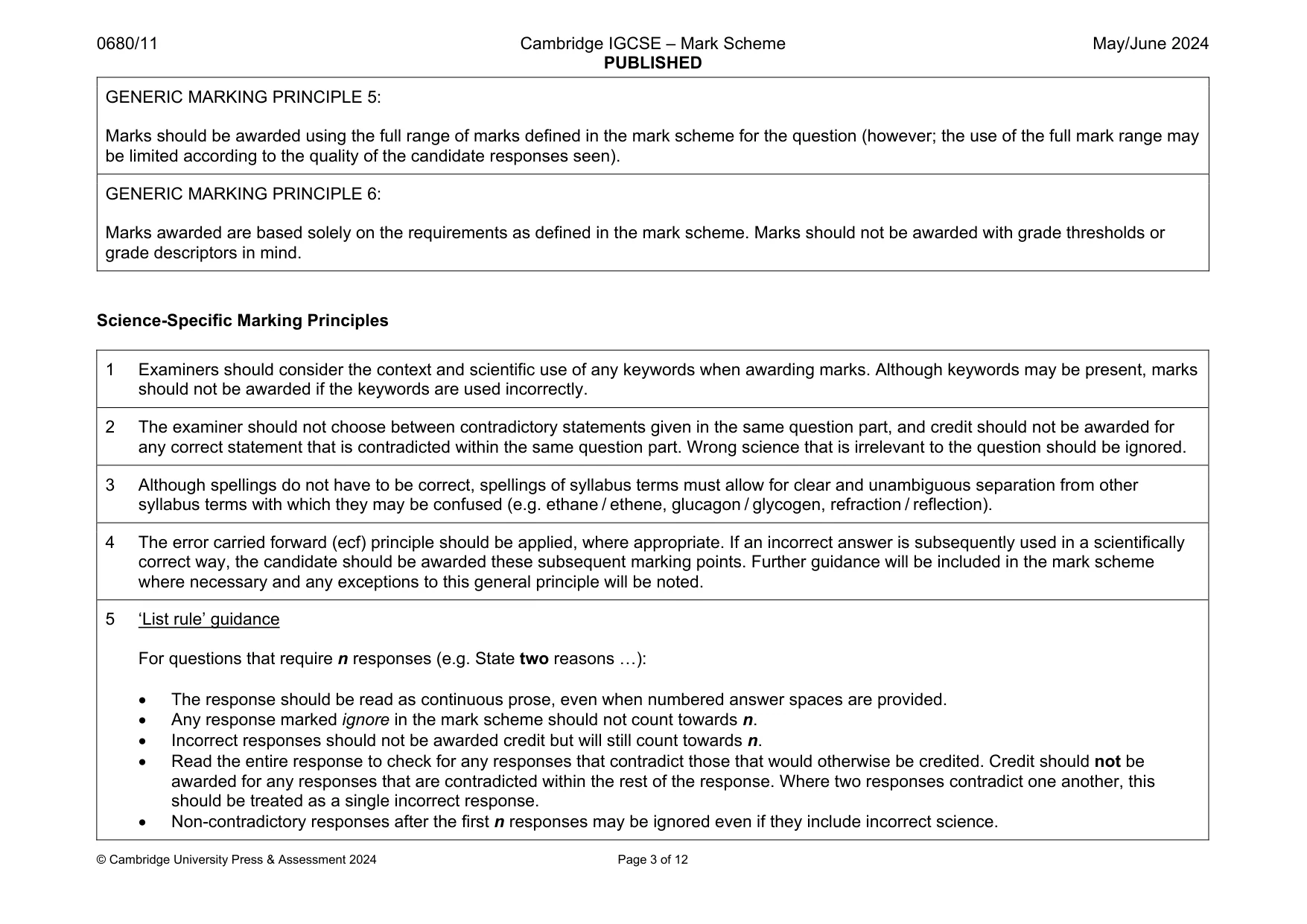
0680/11 Cambridge IGCSE – Mark Scheme PUBLISHED May/June 2024 © Cambridge University Press & Assessment 2024 Page 2 of 12 Generic Marking Principles These general marking principles must be applied by all examiners when marking candidate answers. They should be applied alongside the specific content of the mark scheme or generic level descriptions for a question. Each question paper and mark scheme will also comply with these marking principles. GENERIC MARKING PRINCIPLE 1: Marks must be awarded in line with: the specific content of the mark scheme or the generic level descriptors for the question the specific skills defined in the mark scheme or in the generic level descriptors for the question the standard of response required by a candidate as exemplified by the standardisation scripts. GENERIC MARKING PRINCIPLE 2: Marks awarded are always whole marks (not half marks, or other fractions). GENERIC MARKING PRINCIPLE 3: Marks must be awarded positively: marks are awarded for correct/valid answers, as defined in the mark scheme. However, credit is given for valid answers which go beyond the scope of the syllabus and mark scheme, referring to your Team Leader as appropriate marks are awarded when candidates clearly demonstrate what they know and can do marks are not deducted for errors marks are not deducted for omissions answers should only be judged on the quality of spelling, punctuation and grammar when these features are specifically assessed by the question as indicated by the mark scheme. The meaning, however, should be unambiguous. GENERIC MARKING PRINCIPLE 4: Rules must be applied consistently, e.g. in situations where candidates have not followed instructions or in the application of generic level descriptors.
Mark scheme, page 3
0680/11 Cambridge IGCSE – Mark Scheme PUBLISHED May/June 2024 © Cambridge University Press & Assessment 2024 Page 3 of 12 GENERIC MARKING PRINCIPLE 5: Marks should be awarded using the full range of marks defined in the mark scheme for the question (however; the use of the full mark range may be limited according to the quality of the candidate responses seen). GENERIC MARKING PRINCIPLE 6: Marks awarded are based solely on the requirements as defined in the mark scheme. Marks should not be awarded with grade thresholds or grade descriptors in mind. Science-Specific Marking Principles 1 Examiners should consider the context and scientific use of any keywords when awarding marks. Although keywords may be present, marks should not be awarded if the keywords are used incorrectly. 2 The examiner should not choose between contradictory statements given in the same question part, and credit should not be awarded for any correct statement that is contradicted within the same question part. Wrong science that is irrelevant to the question should be ignored. 3 Although spellings do not have to be correct, spellings of syllabus terms must allow for clear and unambiguous separation from other syllabus terms with which they may be confused (e.g. ethane / ethene, glucagon / glycogen, refraction / reflection). 4 The error carried forward (ecf) principle should be applied, where appropriate. If an incorrect answer is subsequently used in a scientifically correct way, the candidate should be awarded these subsequent marking points. Further guidance will be included in the mark scheme where necessary and any exceptions to this general principle will be noted. 5 ‘List rule’ guidance For questions that require n responses (e.g. State two reasons …): The response should be read as continuous prose, even when numbered answer spaces are provided. Any response marked ignore in the mark scheme should not count towards n. Incorrect responses should not be awarded credit but will still count towards n. Read the entire response to check for any responses that contradict those that would otherwise be credited. Credit should not be awarded for any responses that are contradicted within the rest of the response. Where two responses contradict one another, this should be treated as a single incorrect response. Non-contradictory responses after the first n responses may be ignored even if they include incorrect science.
Mark scheme, page 4
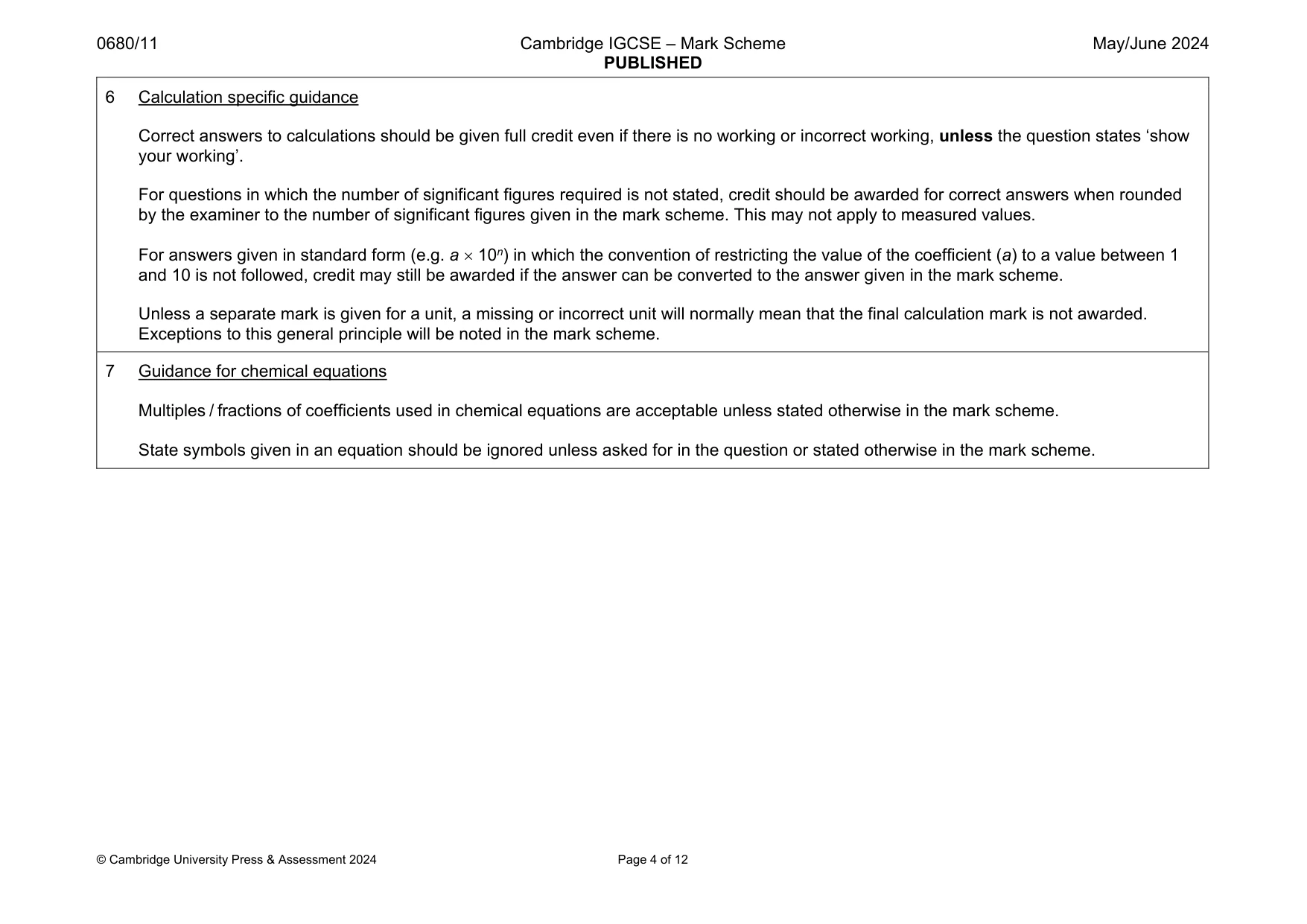
0680/11 Cambridge IGCSE – Mark Scheme PUBLISHED May/June 2024 © Cambridge University Press & Assessment 2024 Page 4 of 12 6 Calculation specific guidance Correct answers to calculations should be given full credit even if there is no working or incorrect working, unless the question states ‘show your working’. For questions in which the number of significant figures required is not stated, credit should be awarded for correct answers when rounded by the examiner to the number of significant figures given in the mark scheme. This may not apply to measured values. For answers given in standard form (e.g. a 10n) in which the convention of restricting the value of the coefficient (a) to a value between 1 and 10 is not followed, credit may still be awarded if the answer can be converted to the answer given in the mark scheme. Unless a separate mark is given for a unit, a missing or incorrect unit will normally mean that the final calculation mark is not awarded. Exceptions to this general principle will be noted in the mark scheme. 7 Guidance for chemical equations Multiples / fractions of coefficients used in chemical equations are acceptable unless stated otherwise in the mark scheme. State symbols given in an equation should be ignored unless asked for in the question or stated otherwise in the mark scheme.
Mark scheme, page 5
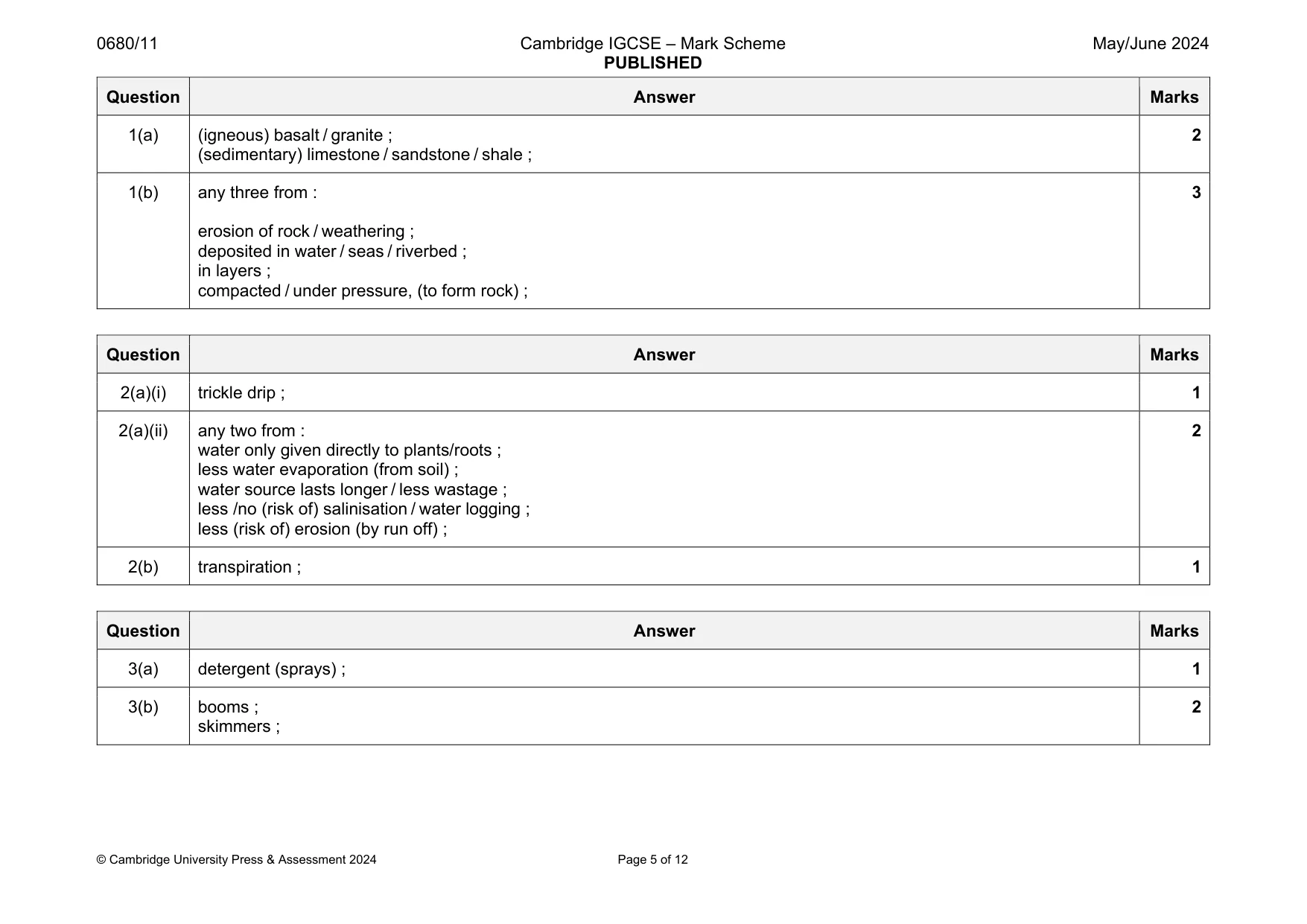
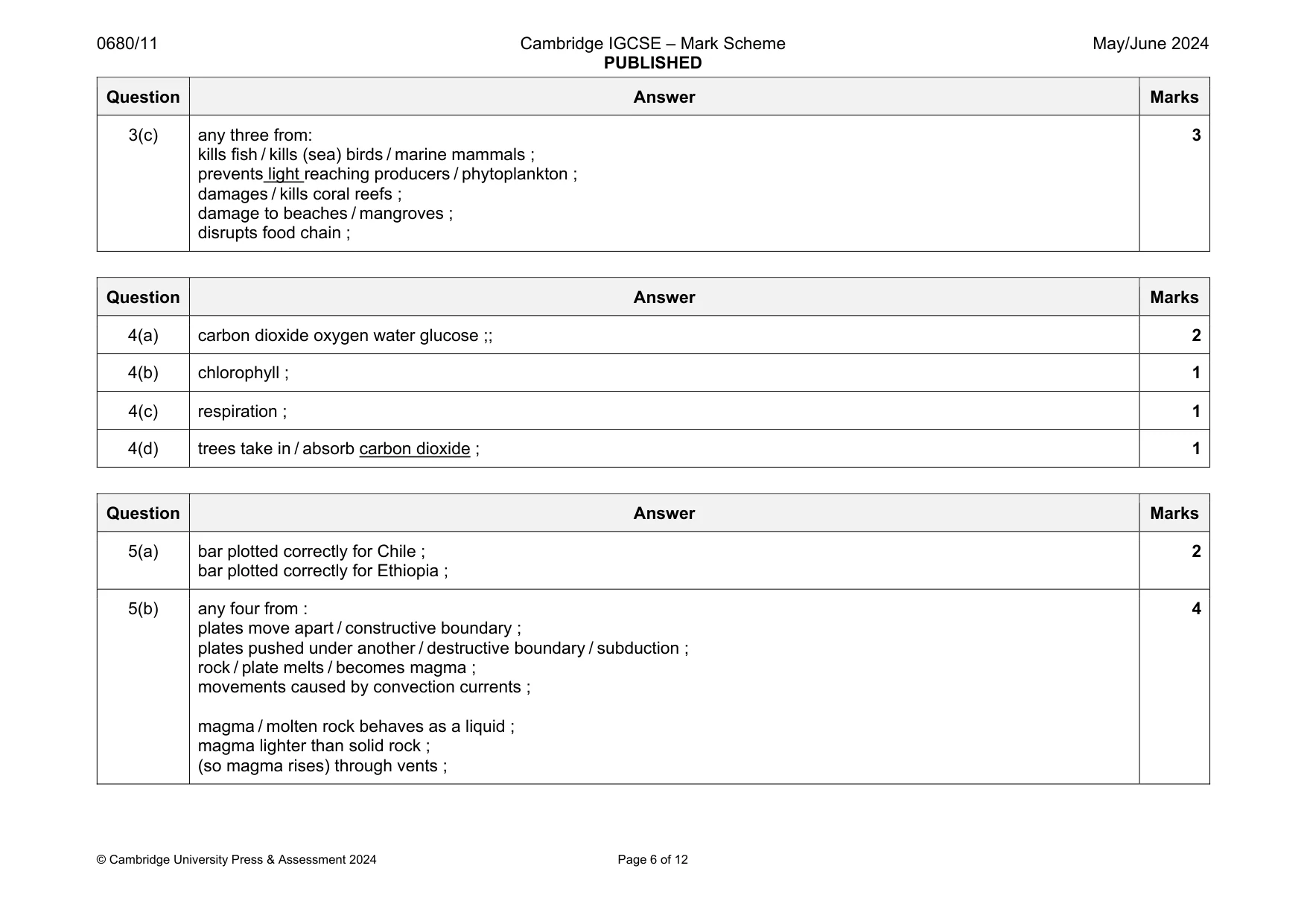
0680/11 Cambridge IGCSE – Mark Scheme PUBLISHED May/June 2024 © Cambridge University Press & Assessment 2024 Page 5 of 12 Question Answer Marks 1(a) (igneous) basalt / granite ; (sedimentary) limestone / sandstone / shale ; 2 1(b) any three from : erosion of rock / weathering ; deposited in water / seas / riverbed ; in layers ; compacted / under pressure, (to form rock) ; 3 Question Answer Marks 2(a)(i) trickle drip ; 1 2(a)(ii) any two from : water only given directly to plants/roots ; less water evaporation (from soil) ; water source lasts longer / less wastage ; less /no (risk of) salinisation / water logging ; less (risk of) erosion (by run off) ; 2 2(b) transpiration ; 1 Question Answer Marks 3(a) detergent (sprays) ; 1 3(b) booms ; skimmers ; 2
Mark scheme, page 6
0680/11 Cambridge IGCSE – Mark Scheme PUBLISHED May/June 2024 © Cambridge University Press & Assessment 2024 Page 6 of 12 Question Answer Marks 3(c) any three from: kills fish / kills (sea) birds / marine mammals ; prevents light reaching producers / phytoplankton ; damages / kills coral reefs ; damage to beaches / mangroves ; disrupts food chain ; 3 Question Answer Marks 4(a) carbon dioxide oxygen water glucose ;; 2 4(b) chlorophyll ; 1 4(c) respiration ; 1 4(d) trees take in / absorb carbon dioxide ; 1 Question Answer Marks 5(a) bar plotted correctly for Chile ; bar plotted correctly for Ethiopia ; 2 5(b) any four from : plates move apart / constructive boundary ; plates pushed under another / destructive boundary / subduction ; rock / plate melts / becomes magma ; movements caused by convection currents ; magma / molten rock behaves as a liquid ; magma lighter than solid rock ; (so magma rises) through vents ; 4
Mark scheme, page 7
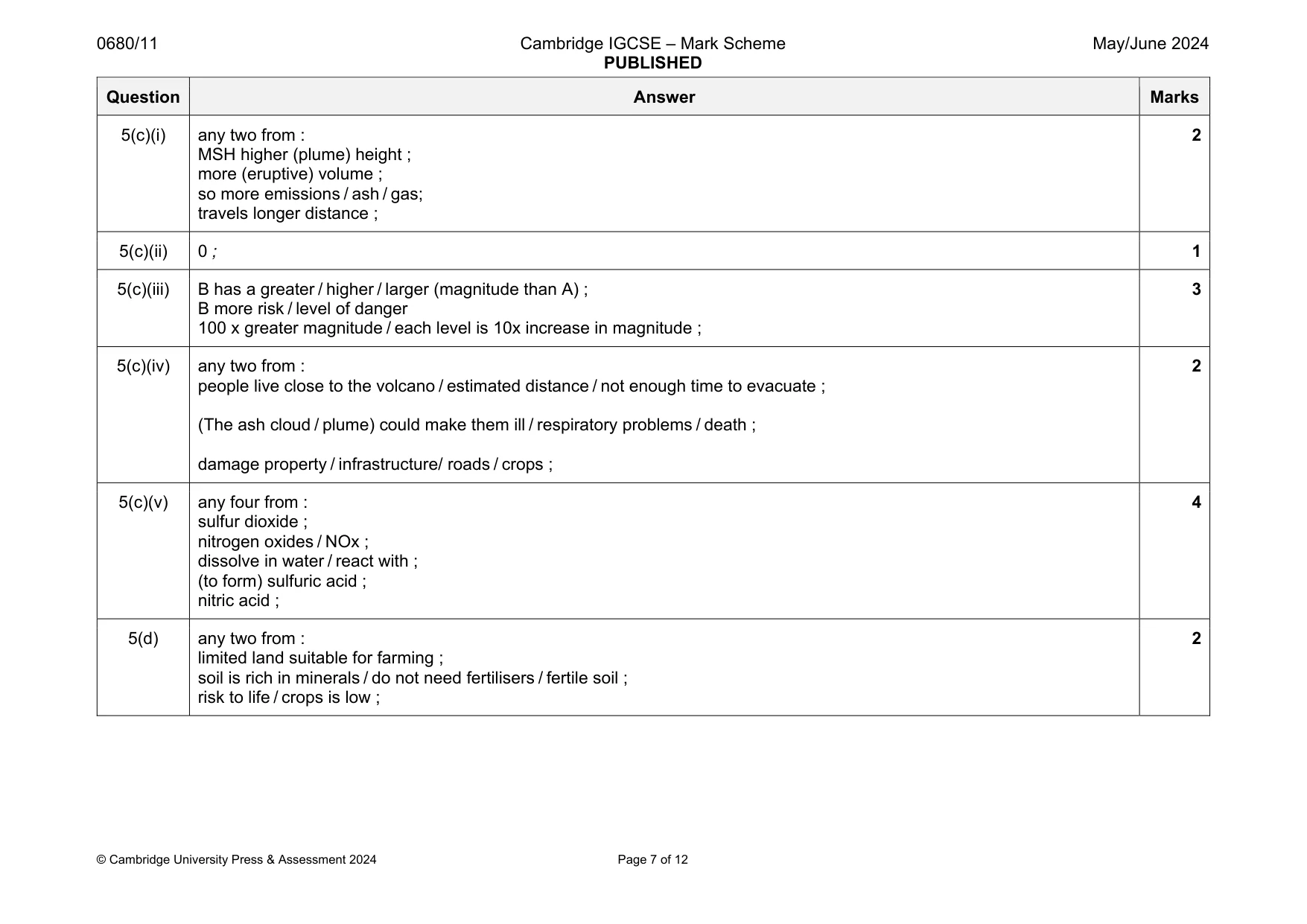
0680/11 Cambridge IGCSE – Mark Scheme PUBLISHED May/June 2024 © Cambridge University Press & Assessment 2024 Page 7 of 12 Question Answer Marks 5(c)(i) any two from : MSH higher (plume) height ; more (eruptive) volume ; so more emissions / ash / gas; travels longer distance ; 2 5(c)(ii) 0 ; 1 5(c)(iii) B has a greater / higher / larger (magnitude than A) ; B more risk / level of danger 100 x greater magnitude / each level is 10x increase in magnitude ; 3 5(c)(iv) any two from : people live close to the volcano / estimated distance / not enough time to evacuate ; (The ash cloud / plume) could make them ill / respiratory problems / death ; damage property / infrastructure/ roads / crops ; 2 5(c)(v) any four from : sulfur dioxide ; nitrogen oxides / NOx ; dissolve in water / react with ; (to form) sulfuric acid ; nitric acid ; 4 5(d) any two from : limited land suitable for farming ; soil is rich in minerals / do not need fertilisers / fertile soil ; risk to life / crops is low ; 2
Mark scheme, page 8
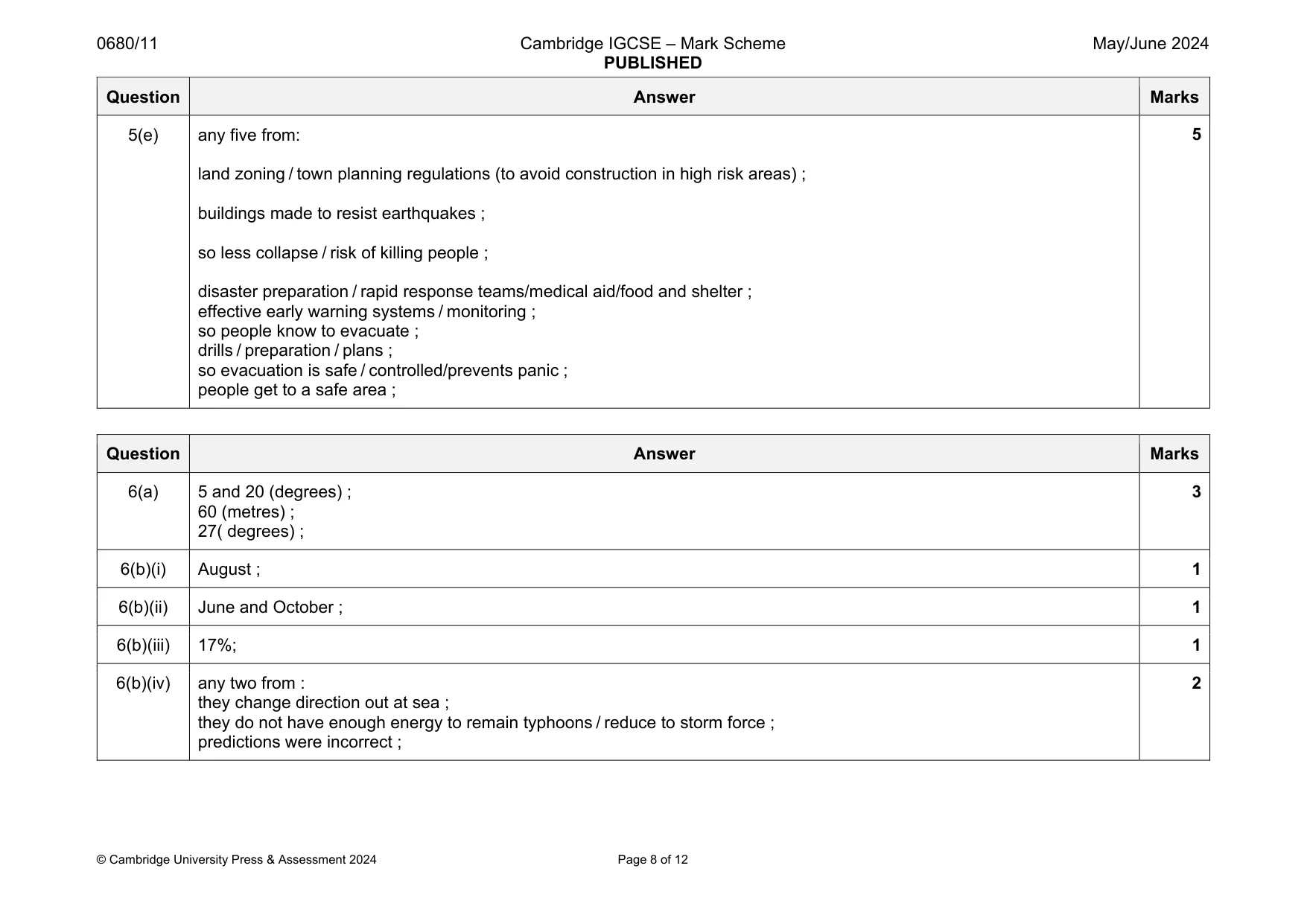
0680/11 Cambridge IGCSE – Mark Scheme PUBLISHED May/June 2024 © Cambridge University Press & Assessment 2024 Page 8 of 12 Question Answer Marks 5(e) any five from: land zoning / town planning regulations (to avoid construction in high risk areas) ; buildings made to resist earthquakes ; so less collapse / risk of killing people ; disaster preparation / rapid response teams/medical aid/food and shelter ; effective early warning systems / monitoring ; so people know to evacuate ; drills / preparation / plans ; so evacuation is safe / controlled/prevents panic ; people get to a safe area ; 5 Question Answer Marks 6(a) 5 and 20 (degrees) ; 60 (metres) ; 27( degrees) ; 3 6(b)(i) August ; 1 6(b)(ii) June and October ; 1 6(b)(iii) 17%; 1 6(b)(iv) any two from : they change direction out at sea ; they do not have enough energy to remain typhoons / reduce to storm force ; predictions were incorrect ; 2
Mark scheme, page 9
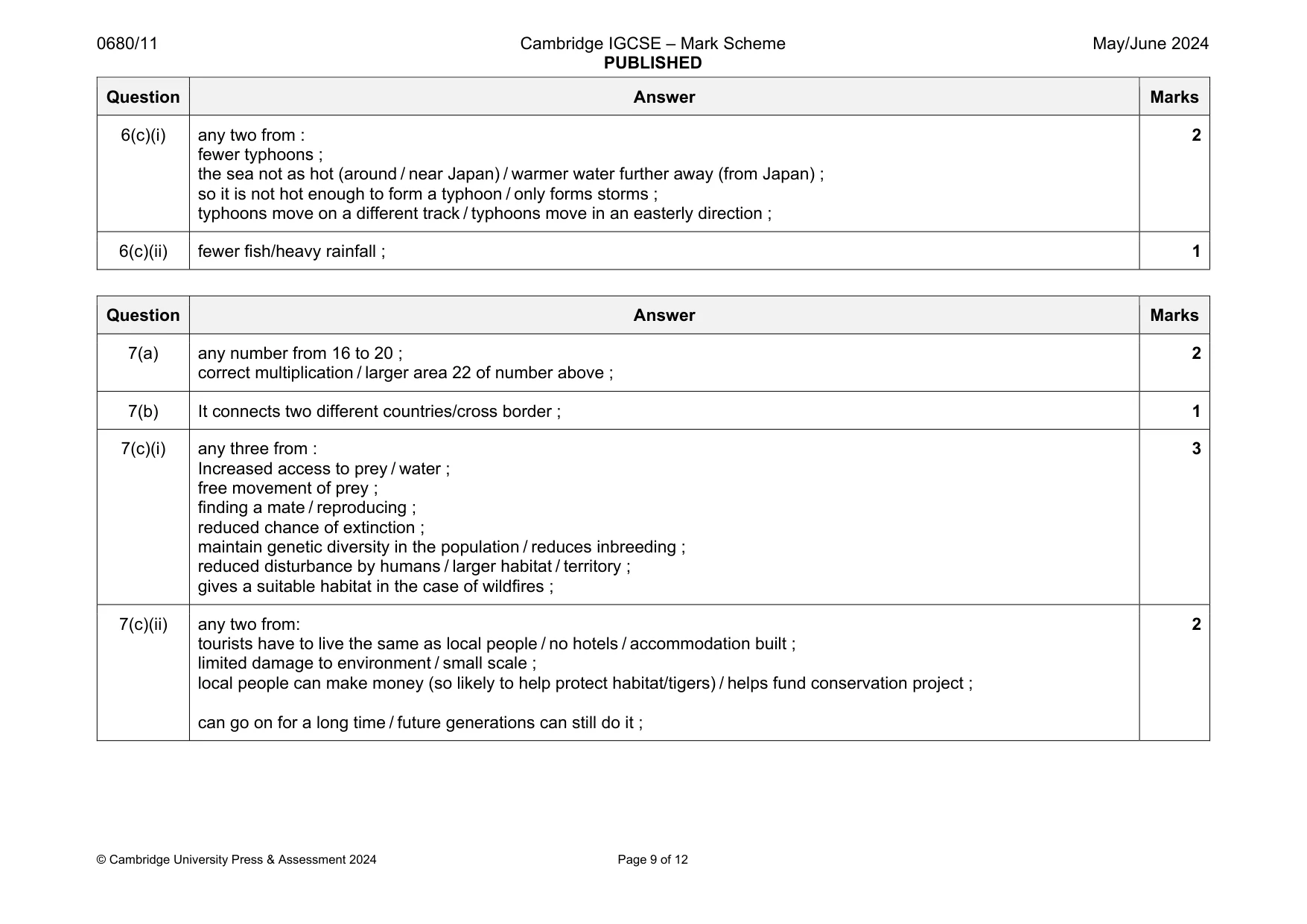
0680/11 Cambridge IGCSE – Mark Scheme PUBLISHED May/June 2024 © Cambridge University Press & Assessment 2024 Page 9 of 12 Question Answer Marks 6(c)(i) any two from : fewer typhoons ; the sea not as hot (around / near Japan) / warmer water further away (from Japan) ; so it is not hot enough to form a typhoon / only forms storms ; typhoons move on a different track / typhoons move in an easterly direction ; 2 6(c)(ii) fewer fish/heavy rainfall ; 1 Question Answer Marks 7(a) any number from 16 to 20 ; correct multiplication / larger area 22 of number above ; 2 7(b) It connects two different countries/cross border ; 1 7(c)(i) any three from : Increased access to prey / water ; free movement of prey ; finding a mate / reproducing ; reduced chance of extinction ; maintain genetic diversity in the population / reduces inbreeding ; reduced disturbance by humans / larger habitat / territory ; gives a suitable habitat in the case of wildfires ; 3 7(c)(ii) any two from: tourists have to live the same as local people / no hotels / accommodation built ; limited damage to environment / small scale ; local people can make money (so likely to help protect habitat/tigers) / helps fund conservation project ; can go on for a long time / future generations can still do it ; 2
Mark scheme, page 10
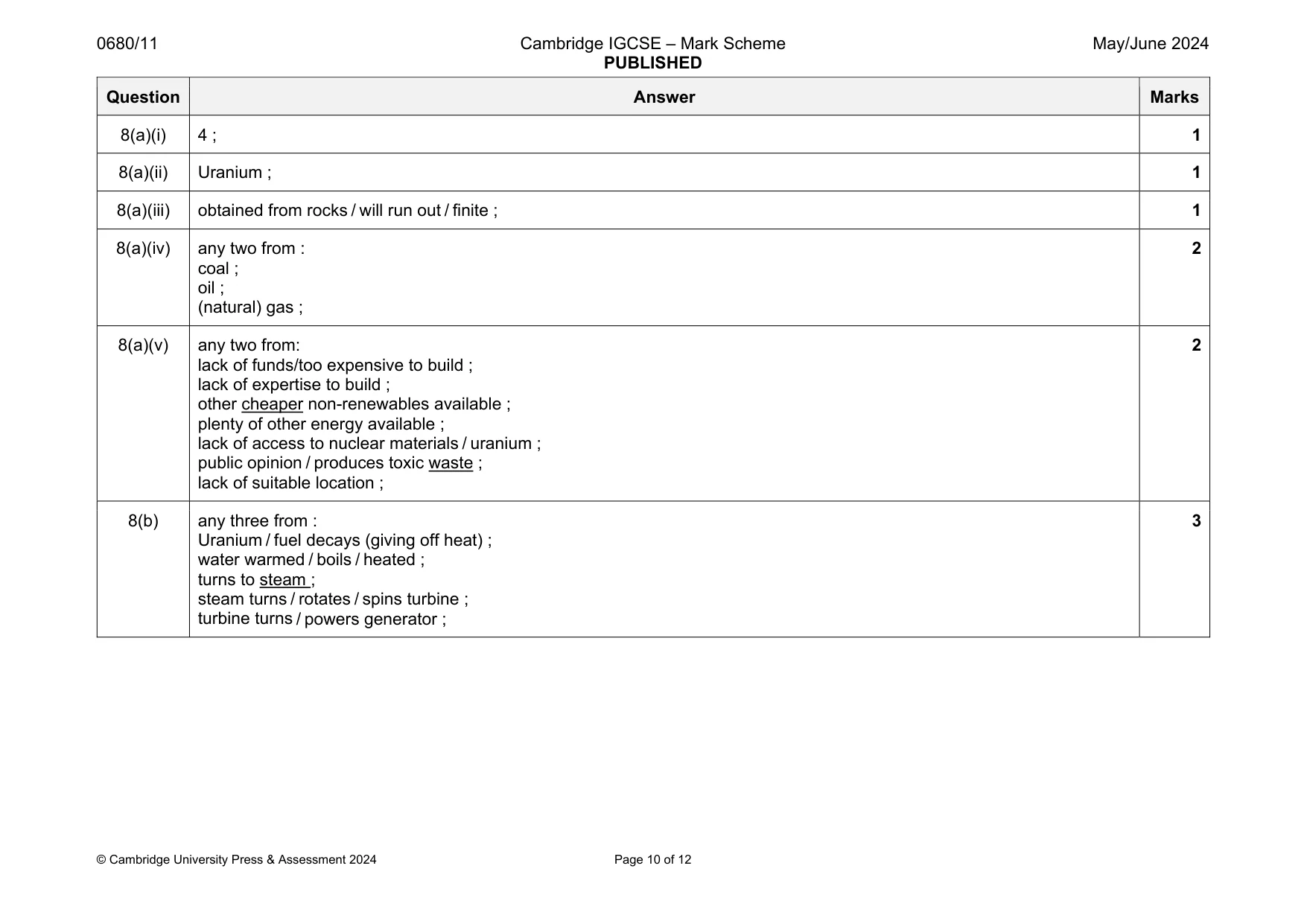
0680/11 Cambridge IGCSE – Mark Scheme PUBLISHED May/June 2024 © Cambridge University Press & Assessment 2024 Page 10 of 12 Question Answer Marks 8(a)(i) 4 ; 1 8(a)(ii) Uranium ; 1 8(a)(iii) obtained from rocks / will run out / finite ; 1 8(a)(iv) any two from : coal ; oil ; (natural) gas ; 2 8(a)(v) any two from: lack of funds/too expensive to build ; lack of expertise to build ; other cheaper non-renewables available ; plenty of other energy available ; lack of access to nuclear materials / uranium ; public opinion / produces toxic waste ; lack of suitable location ; 2 8(b) any three from : Uranium / fuel decays (giving off heat) ; water warmed / boils / heated ; turns to steam ; steam turns / rotates / spins turbine ; turbine turns / powers generator ; 3
Mark scheme, page 11
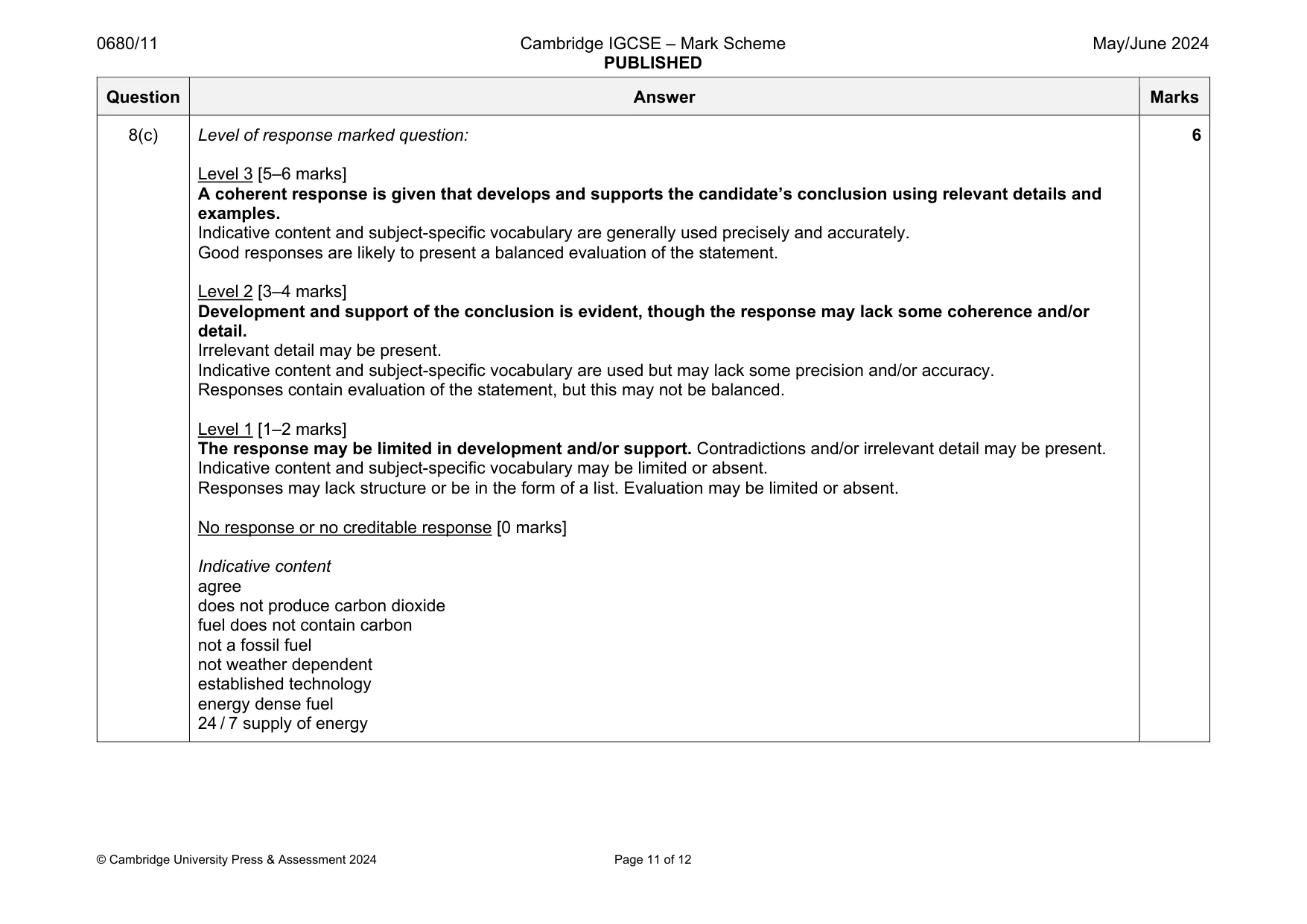
0680/11 Cambridge IGCSE – Mark Scheme PUBLISHED May/June 2024 © Cambridge University Press & Assessment 2024 Page 11 of 12 Question Answer Marks 8(c) Level of response marked question: Level 3 [5–6 marks] A coherent response is given that develops and supports the candidate’s conclusion using relevant details and examples. Indicative content and subject-specific vocabulary are generally used precisely and accurately. Good responses are likely to present a balanced evaluation of the statement. Level 2 [3–4 marks] Development and support of the conclusion is evident, though the response may lack some coherence and/or detail. Irrelevant detail may be present. Indicative content and subject-specific vocabulary are used but may lack some precision and/or accuracy. Responses contain evaluation of the statement, but this may not be balanced. Level 1 [1–2 marks] The response may be limited in development and/or support. Contradictions and/or irrelevant detail may be present. Indicative content and subject-specific vocabulary may be limited or absent. Responses may lack structure or be in the form of a list. Evaluation may be limited or absent. No response or no creditable response [0 marks] Indicative content agree does not produce carbon dioxide fuel does not contain carbon not a fossil fuel not weather dependent established technology energy dense fuel 24 / 7 supply of energy 6
Mark scheme, page 12
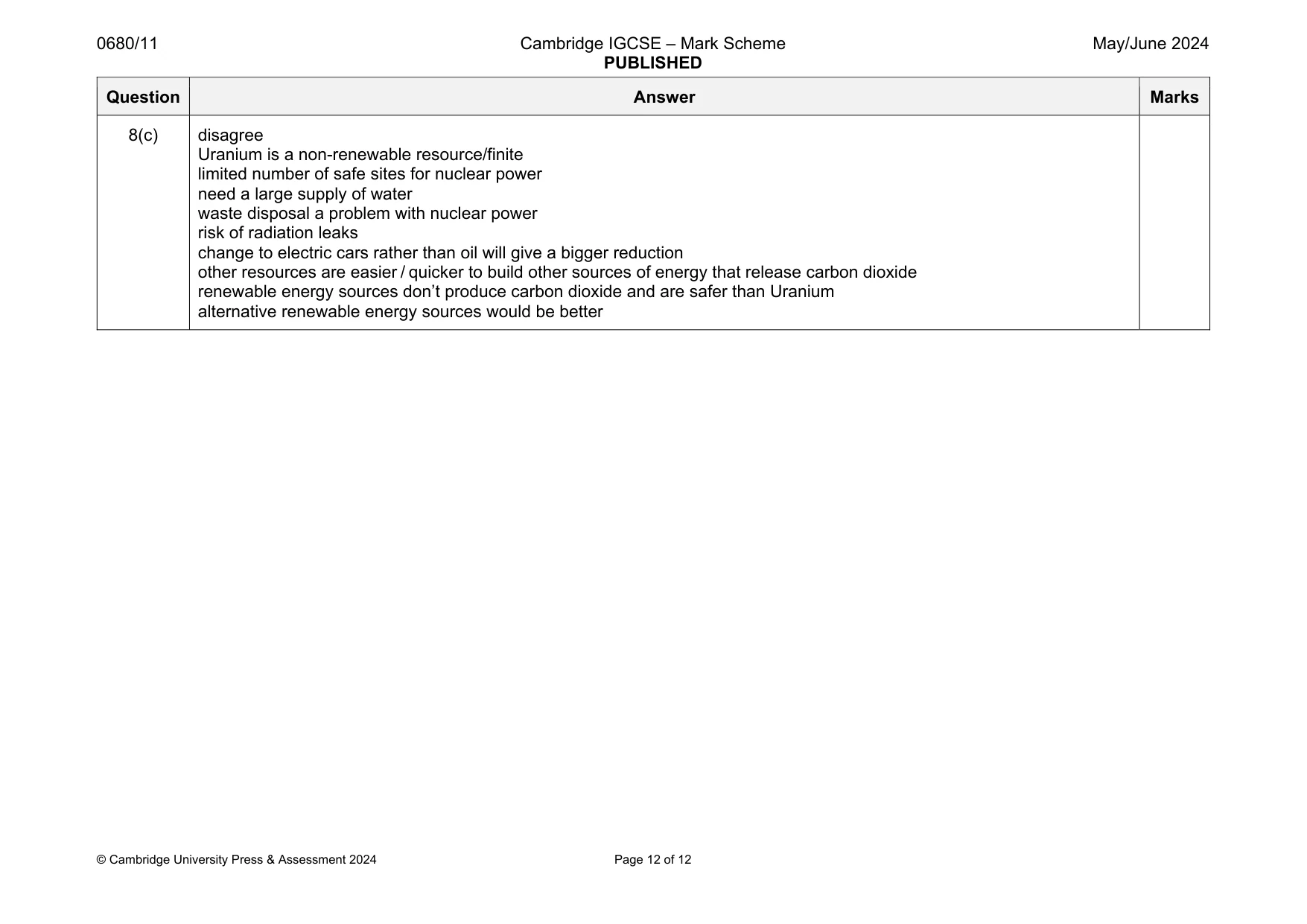
0680/11 Cambridge IGCSE – Mark Scheme PUBLISHED May/June 2024 © Cambridge University Press & Assessment 2024 Page 12 of 12 Question Answer Marks 8(c) disagree Uranium is a non-renewable resource/finite limited number of safe sites for nuclear power need a large supply of water waste disposal a problem with nuclear power risk of radiation leaks change to electric cars rather than oil will give a bigger reduction other resources are easier / quicker to build other sources of energy that release carbon dioxide renewable energy sources don’t produce carbon dioxide and are safer than Uranium alternative renewable energy sources would be better
What you needed in this session
Cambridge’s own grade thresholds for 2024 May/June, Paper 1 · Variant 1. A higher threshold means an easier paper — the bar moves with how the cohort did.