Cambridge IGCSE Environmental Management 0680 — 2023 May/June Paper 1 · Variant 1
0680/11/M/J/23 · 80 marks · ≈90 min
The question paper and its mark scheme, free to read here and free to download. This is Cambridge’s own paper, exactly as it was sat.
Question paper20 pages
Mark scheme13 pages
Answers below. Sit the paper first if you are practising.
Paper as text
Question paper, page 1
This document has 20 pages. Any blank pages are indicated. [Turn over Cambridge IGCSE™ * 4 5 9 1 2 4 3 2 5 1 * DC (CJ) 331457 © UCLES 2023 ENVIRONMENTAL MANAGEMENT 0680/11 Paper 1 Theory May/June 2023 1 hour 45 minutes You must answer on the question paper. No additional materials are needed. INSTRUCTIONS ● Answer all questions. ● Use a black or dark blue pen. You may use an HB pencil for any diagrams or graphs. ● Write your name, centre number and candidate number in the boxes at the top of the page. ● Write your answer to each question in the space provided. ● Do not use an erasable pen or correction fluid. ● Do not write on any bar codes. ● You may use a calculator. ● You should show all your working and use appropriate units. INFORMATION ● The total mark for this paper is 80. ● The number of marks for each question or part question is shown in brackets [ ].
Question paper, page 2
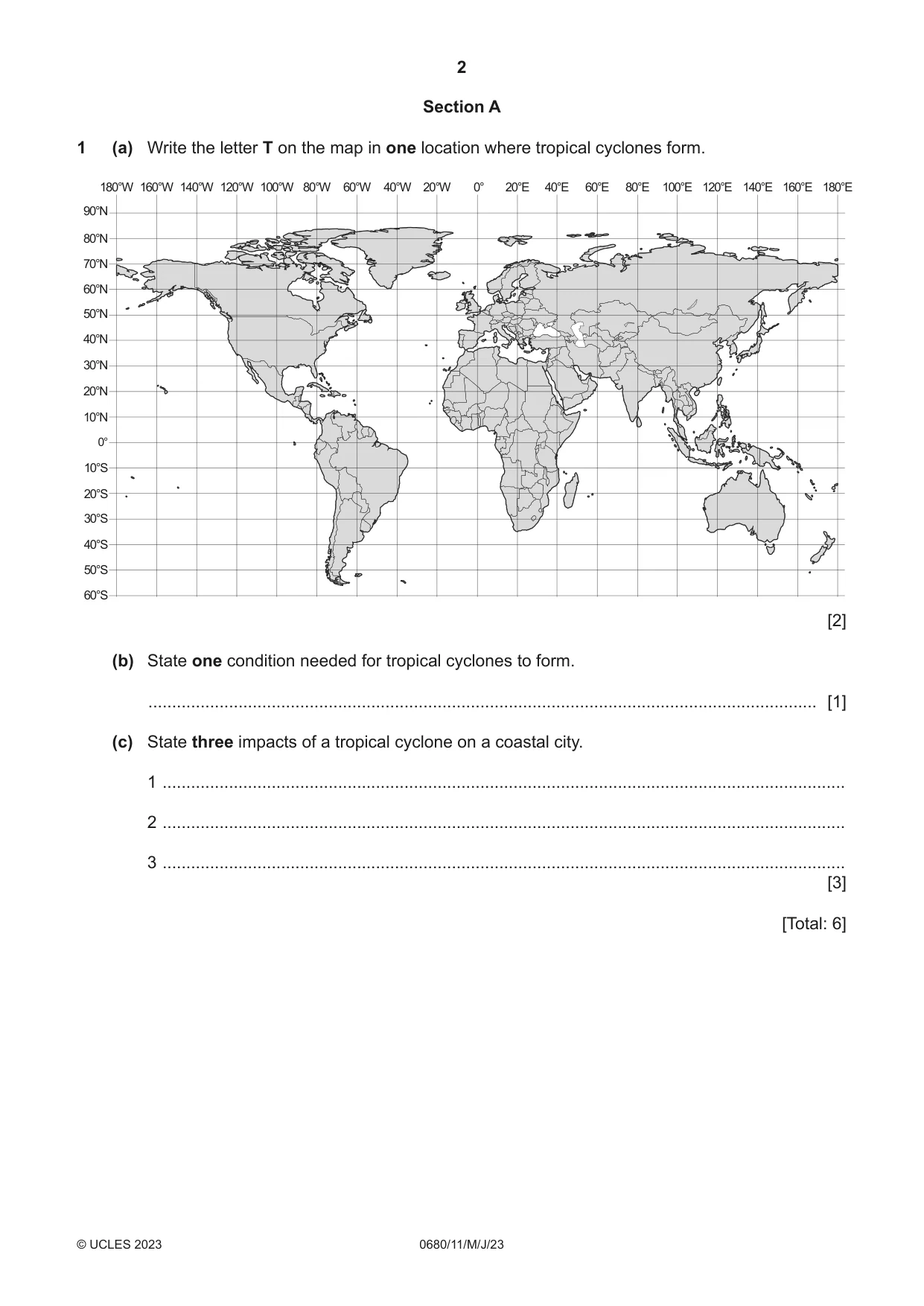
2 0680/11/M/J/23 © UCLES 2023 Section A 1 (a) Write the letter T on the map in one location where tropical cyclones form. 180°E 160°E 140°E 120°E 100°E 80°E 60°E 40°E 20°E 0° 20°W 40°W 60°W 80°W 90°N 80°N 70°N 60°N 50°N 40°N 30°N 20°N 10°N 0° 10°S 20°S 30°S 40°S 50°S 60°S 100°W 120°W 140°W 160°W 180°W [2] (b) State one condition needed for tropical cyclones to form. … [1] (c) State three impacts of a tropical cyclone on a coastal city. 1 … 2 … 3 … [3] [Total: 6]
Question paper, page 3
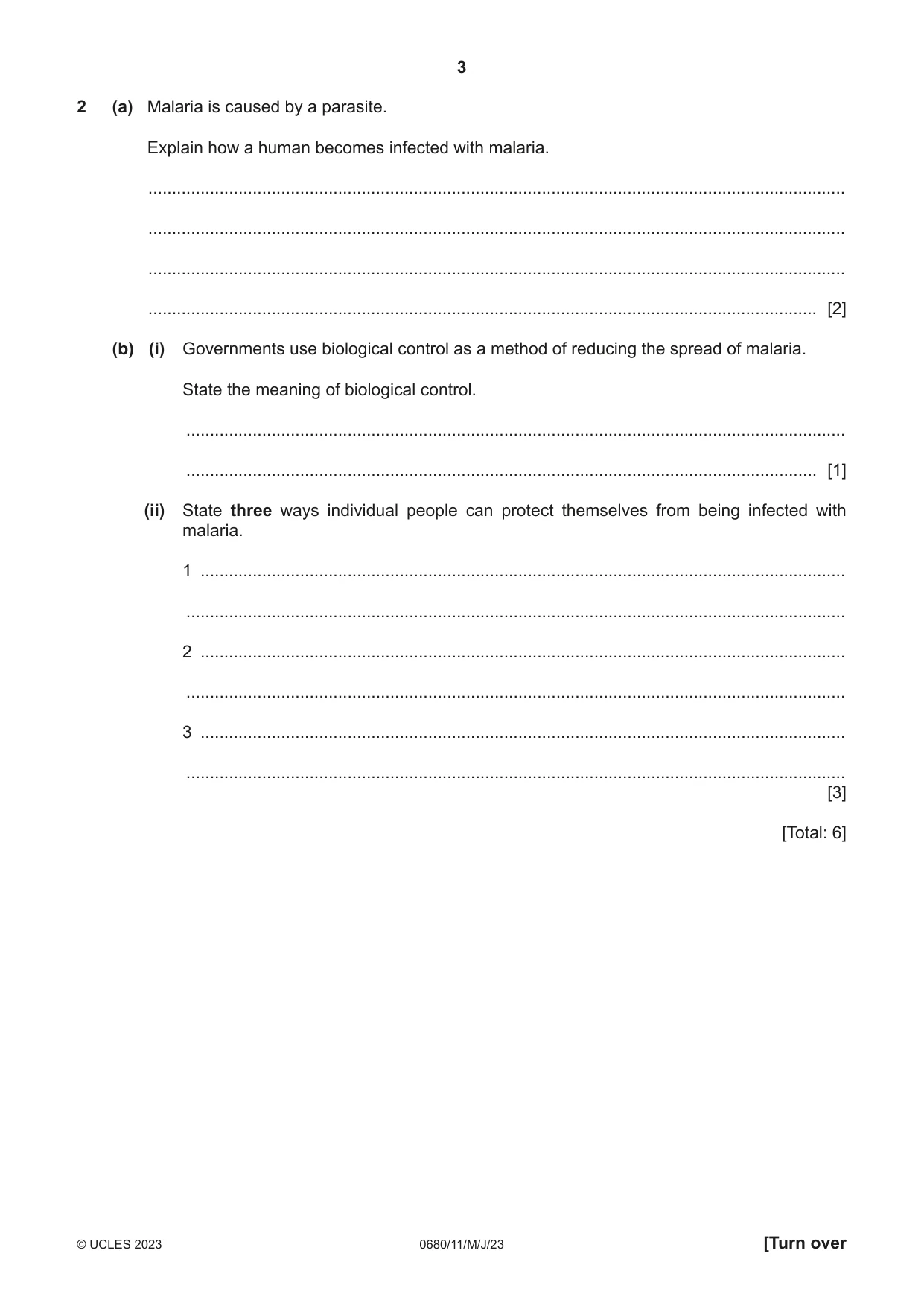
3 0680/11/M/J/23 © UCLES 2023 [Turn over 2 (a) Malaria is caused by a parasite. Explain how a human becomes infected with malaria. … … … … [2] (b) (i) Governments use biological control as a method of reducing the spread of malaria. State the meaning of biological control. … … [1] (ii) State three ways individual people can protect themselves from being infected with malaria. 1 … … 2 … … 3 … … [3] [Total: 6]
Question paper, page 4
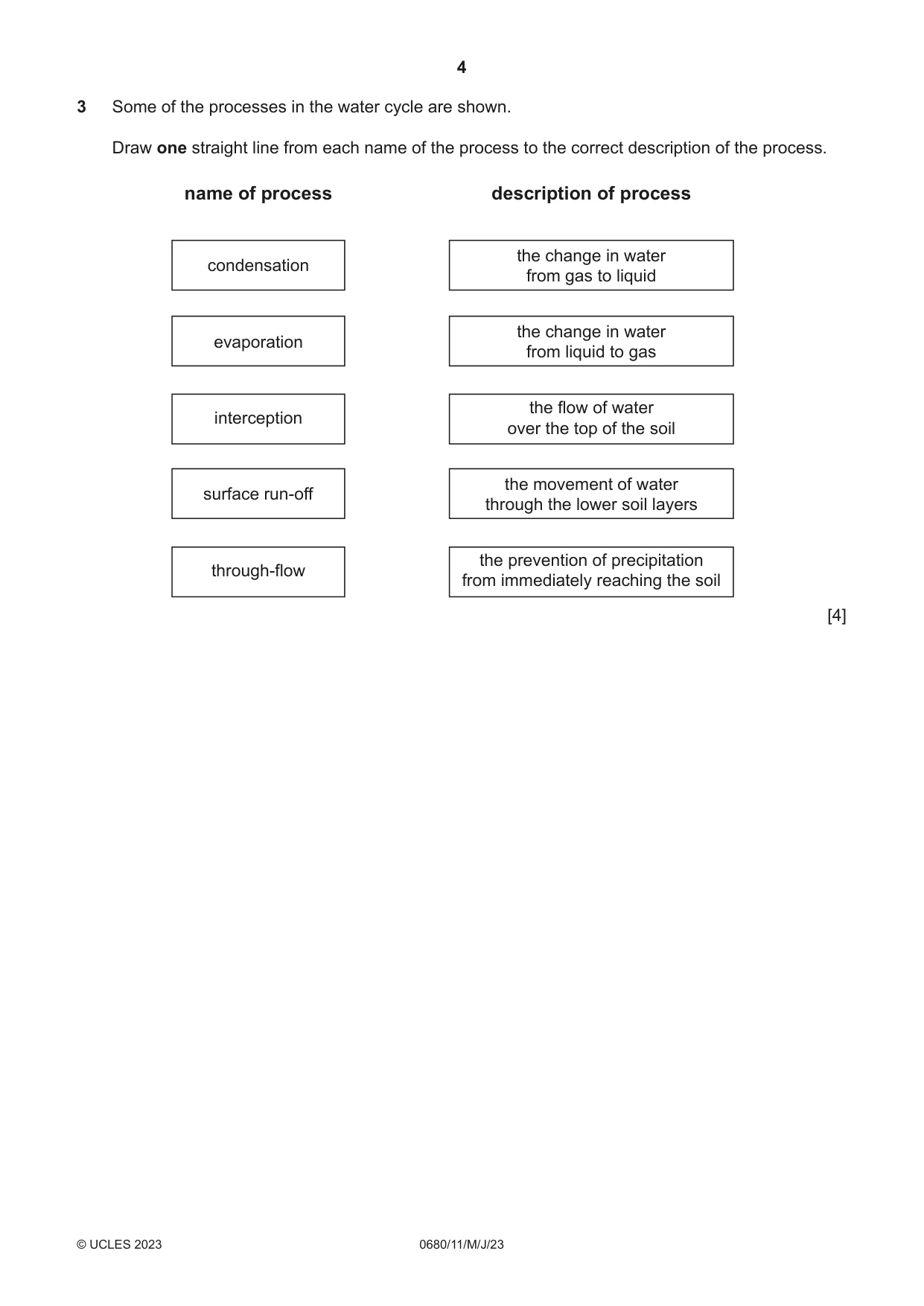
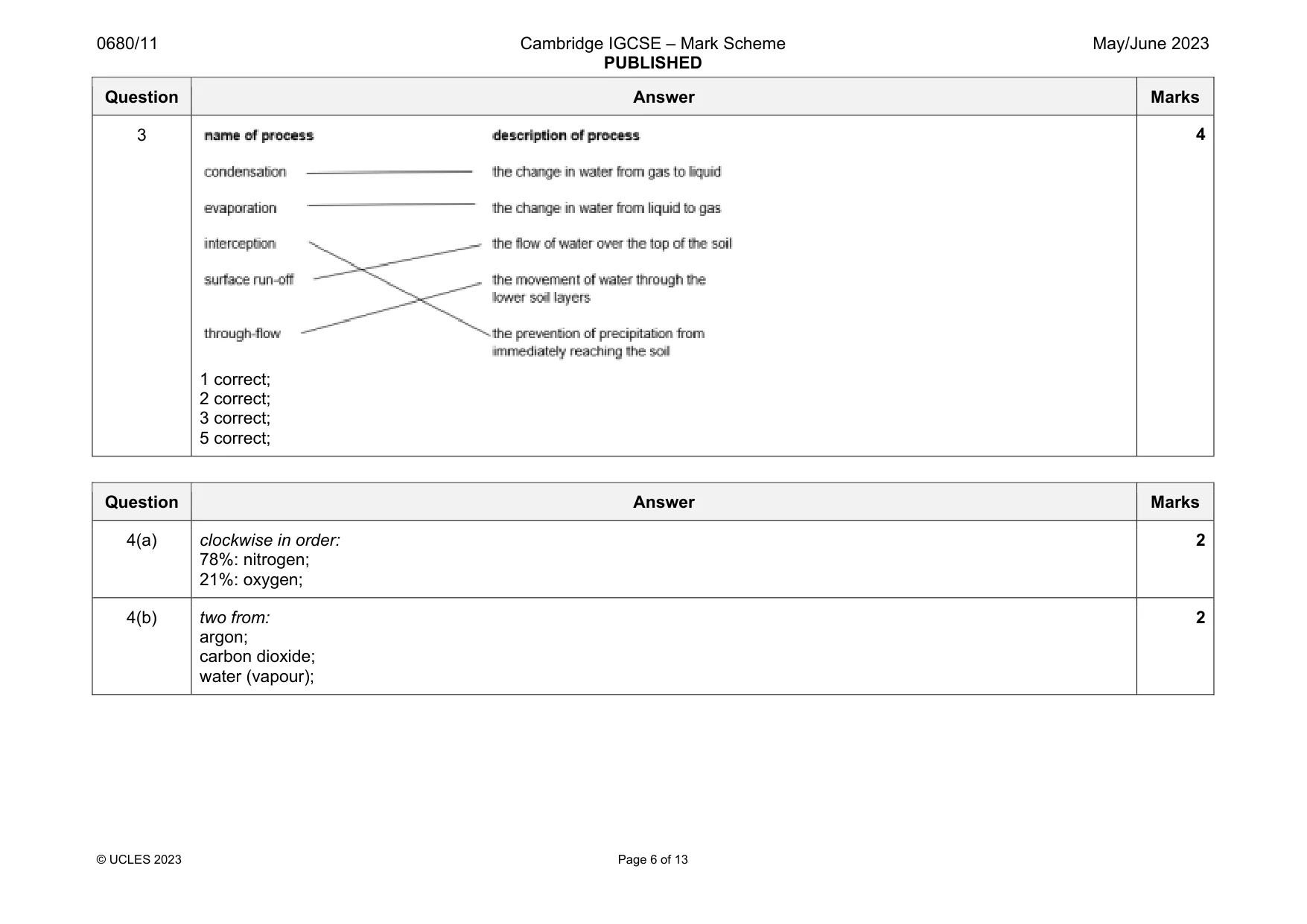
4 0680/11/M/J/23 © UCLES 2023 3 Some of the processes in the water cycle are shown. Draw one straight line from each name of the process to the correct description of the process. name of process description of process condensation the change in water from gas to liquid evaporation the change in water from liquid to gas interception the flow of water over the top of the soil surface run-off the movement of water through the lower soil layers through-flow the prevention of precipitation from immediately reaching the soil [4]
Question paper, page 5
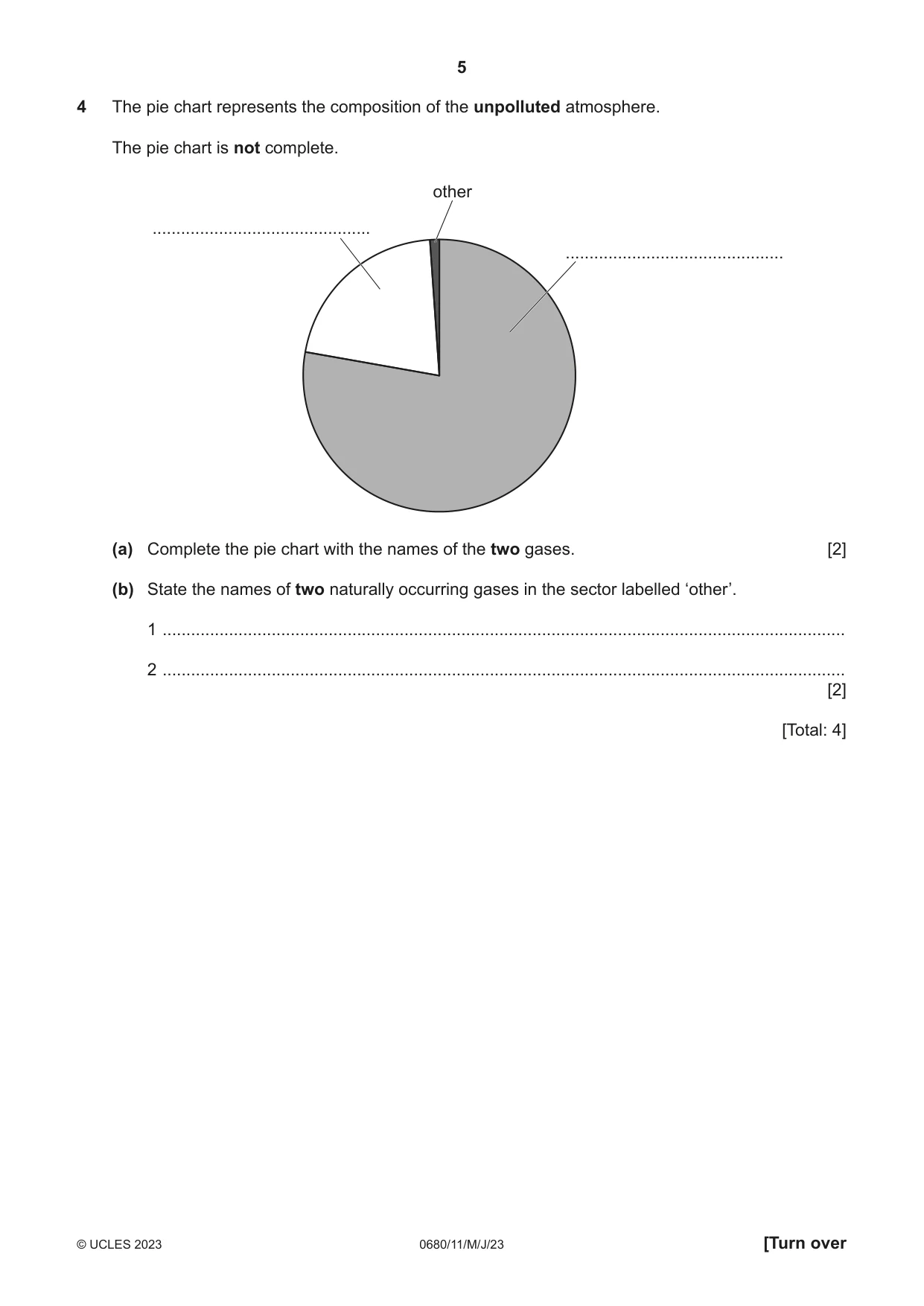
5 0680/11/M/J/23 © UCLES 2023 [Turn over 4 The pie chart represents the composition of the unpolluted atmosphere. The pie chart is not complete. … … other (a) Complete the pie chart with the names of the two gases. [2] (b) State the names of two naturally occurring gases in the sector labelled ‘other’. 1 … 2 … [2] [Total: 4]
Question paper, page 6
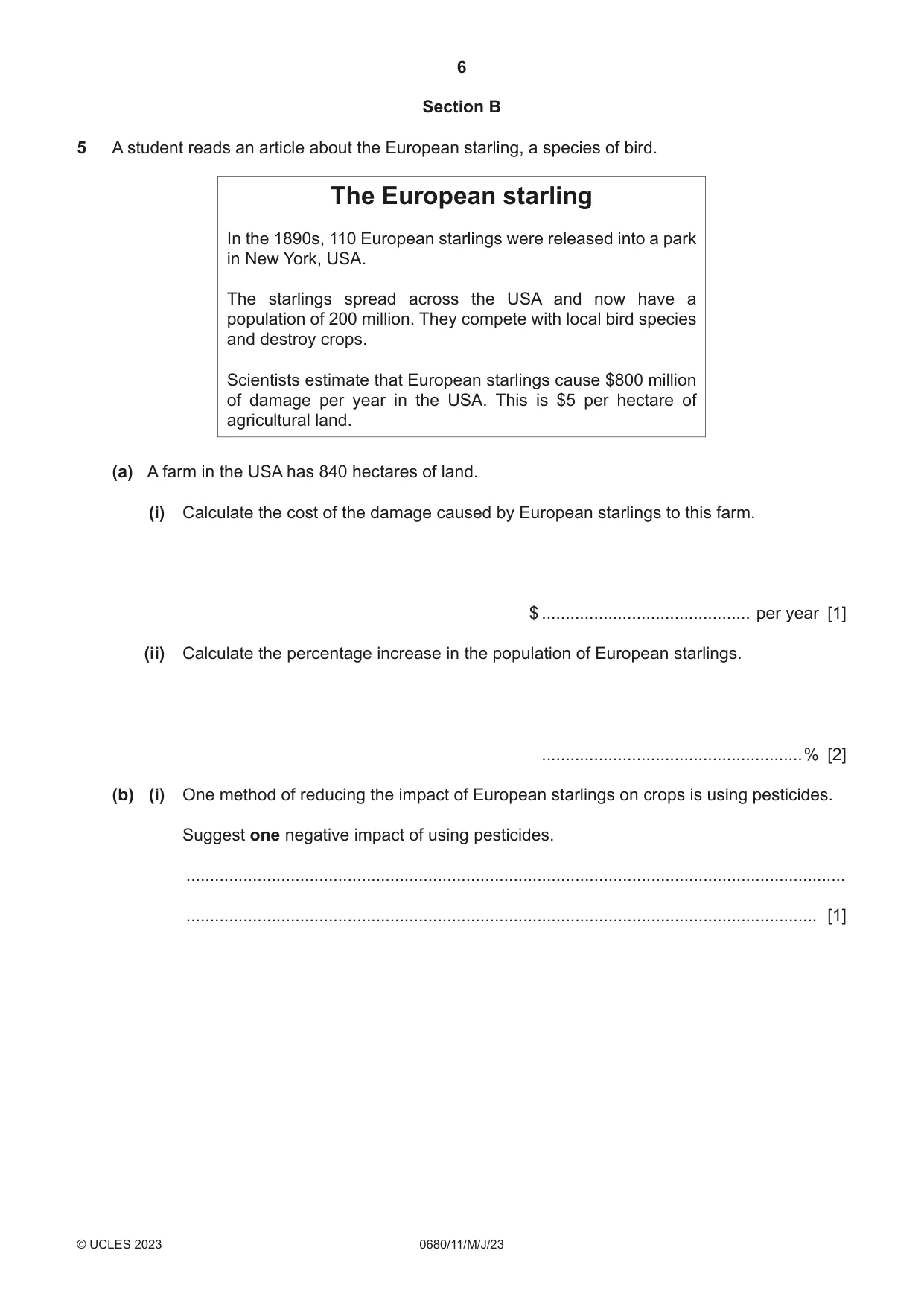
6 0680/11/M/J/23 © UCLES 2023 Section B 5 A student reads an article about the European starling, a species of bird. The European starling In the 1890s, 110 European starlings were released into a park in New York, USA. The starlings spread across the USA and now have a population of 200 million. They compete with local bird species and destroy crops. Scientists estimate that European starlings cause $800 million of damage per year in the USA. This is $5 per hectare of agricultural land. (a) A farm in the USA has 840 hectares of land. (i) Calculate the cost of the damage caused by European starlings to this farm. $ … per year [1] (ii) Calculate the percentage increase in the population of European starlings. …% [2] (b) (i) One method of reducing the impact of European starlings on crops is using pesticides. Suggest one negative impact of using pesticides. … … [1]
Question paper, page 7
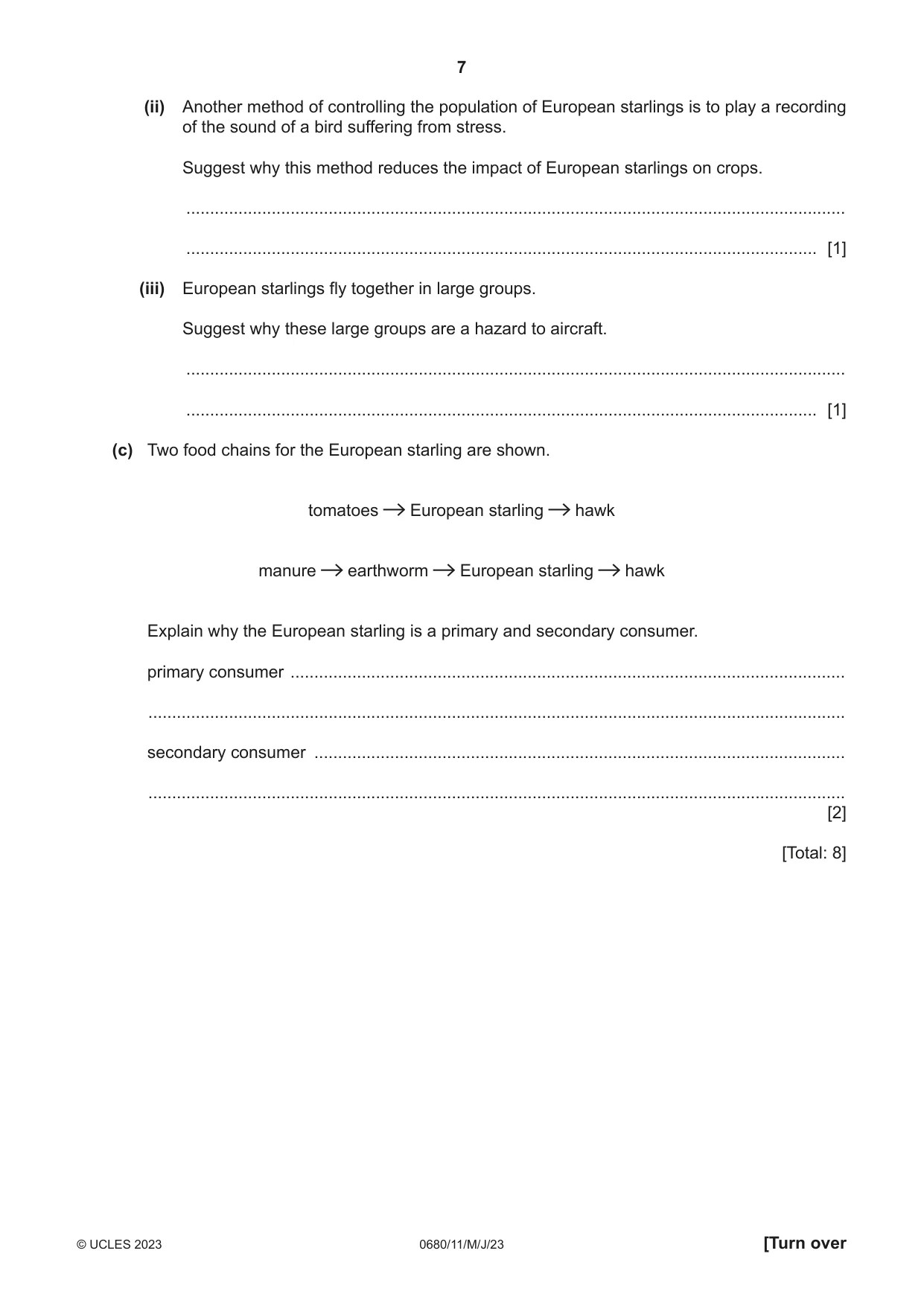
7 0680/11/M/J/23 © UCLES 2023 [Turn over (ii) Another method of controlling the population of European starlings is to play a recording of the sound of a bird suffering from stress. Suggest why this method reduces the impact of European starlings on crops. … … [1] (iii) European starlings fly together in large groups. Suggest why these large groups are a hazard to aircraft. … … [1] (c) Two food chains for the European starling are shown. tomatoes European starling hawk manure earthworm European starling hawk Explain why the European starling is a primary and secondary consumer. primary consumer … … secondary consumer … … [2] [Total: 8]
Question paper, page 8
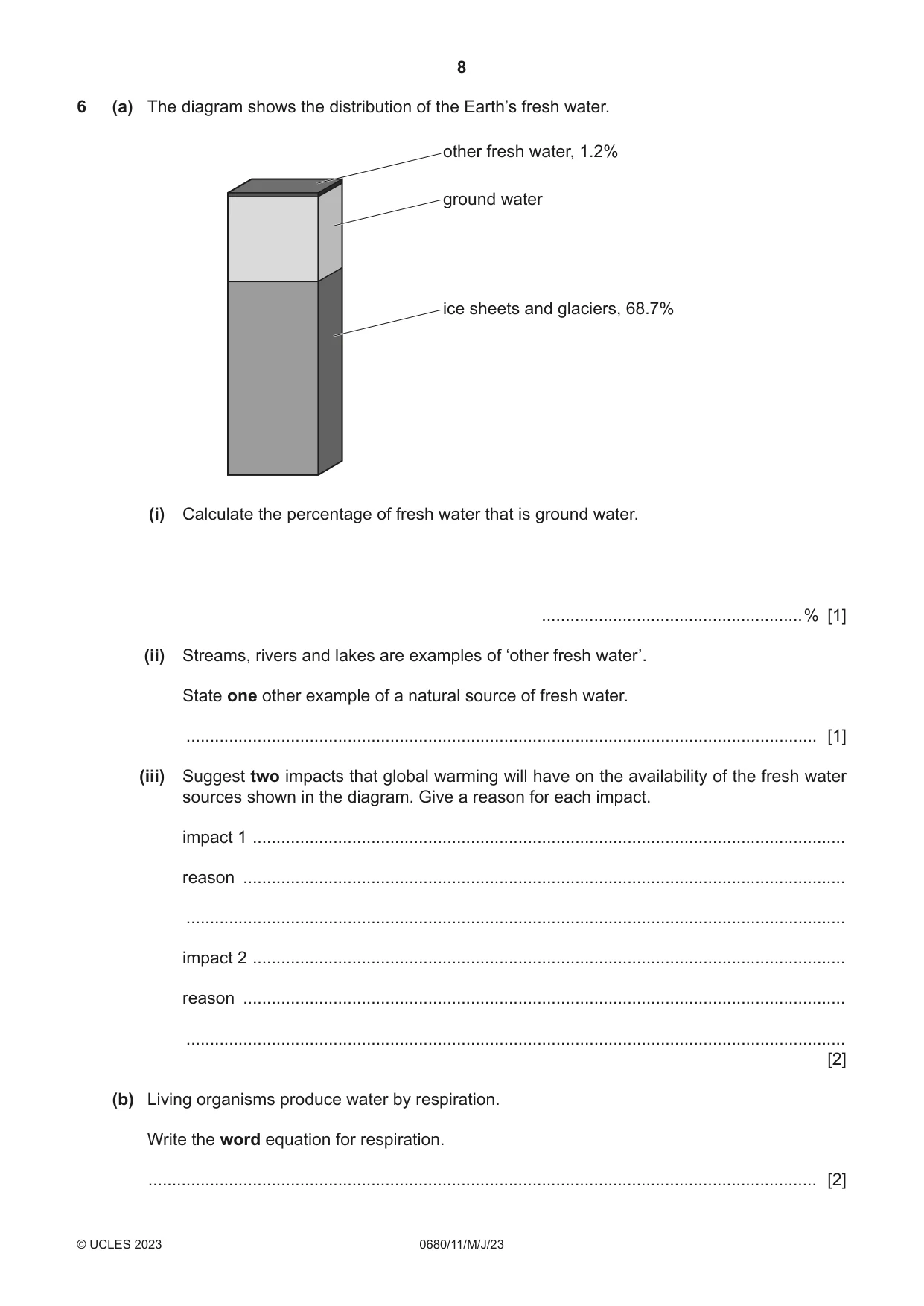
8 0680/11/ M / J /23 © UCLES 2023 6 (a) The diagram shows the distribution of the Earth’s fresh water. other fresh water, 1.2% ground water ice sheets and glaciers, 68.7% (i) Calculate the percentage of fresh water that is ground water. …% [1] (ii) Streams, rivers and lakes are examples of ‘other fresh water’. State one other example of a natural source of fresh water. … [1] (iii) Suggest two impacts that global warming will have on the availability of the fresh water sources shown in the diagram. Give a reason for each impact. impact 1 … reason … … impact 2 … reason … … [2] (b) Living organisms produce water by respiration. Write the word equation for respiration. … [2]
Question paper, page 9
9 0680/11/M/J/23 © UCLES 2023 [Turn over (c) Many people in rural areas of Africa have poor sanitation. Poor sanitation means drinking water is not safe and sewage is not treated. Suggest the impacts of poor sanitation. … … … … … … … … … … [5] [Total: 11]
Question paper, page 10
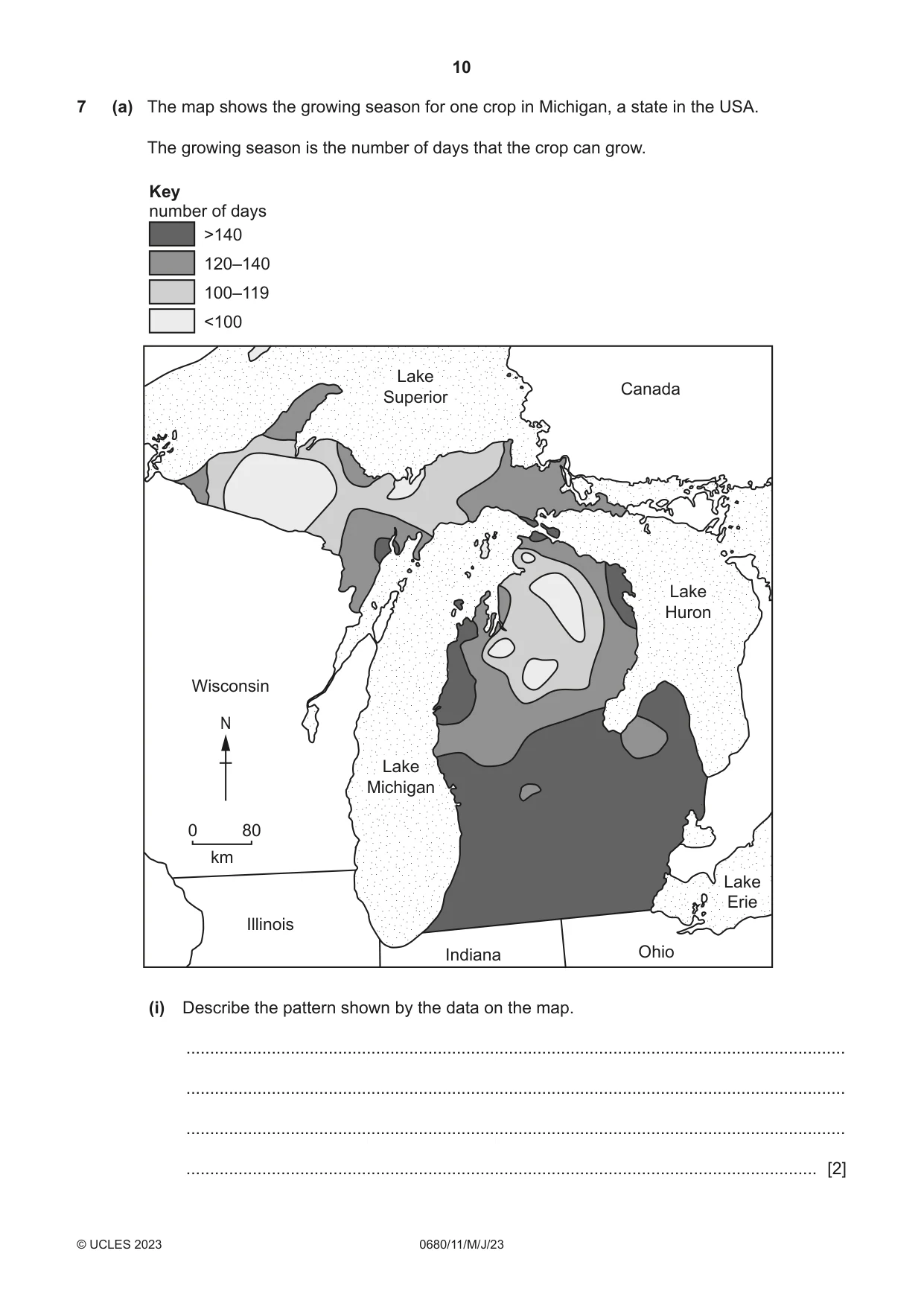
10 0680/11/M/J/23 © UCLES 2023 7 (a) The map shows the growing season for one crop in Michigan, a state in the USA. The growing season is the number of days that the crop can grow. Key number of days >140 120–140 100–119 <100 Canada Wisconsin Illinois Indiana Ohio Lake Superior Lake Superior N 0 km 80 Lake Erie Lake Erie Lake Huron Lake Huron Lake Michigan Lake Michigan (i) Describe the pattern shown by the data on the map. … … … … [2]
Question paper, page 11
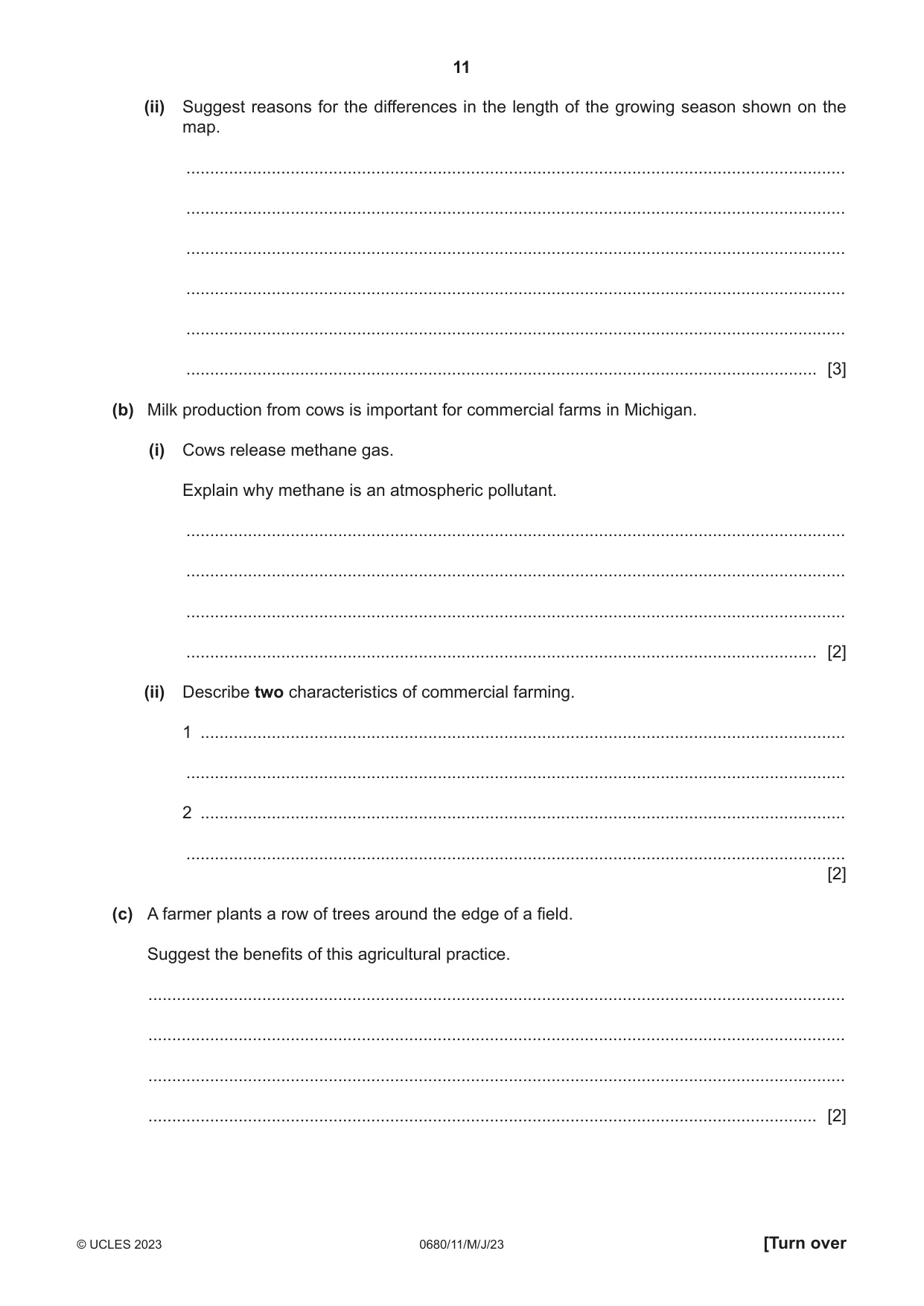
11 0680/11/M/J/23 © UCLES 2023 [Turn over (ii) Suggest reasons for the differences in the length of the growing season shown on the map. … … … … … … [3] (b) Milk production from cows is important for commercial farms in Michigan. (i) Cows release methane gas. Explain why methane is an atmospheric pollutant. … … … … [2] (ii) Describe two characteristics of commercial farming. 1 … … 2 … … [2] (c) A farmer plants a row of trees around the edge of a field. Suggest the benefits of this agricultural practice. … … … … [2]
Question paper, page 12
12 0680/11/M/J/23 © UCLES 2023 (d) A farmer uses rainwater harvesting for irrigation. Describe four benefits of rainwater harvesting. … … … … … … … … [4] [Total: 15]
Question paper, page 13
13 0680/11/M/J/23 © UCLES 2023 [Turn over BLANK PAGE
Question paper, page 14
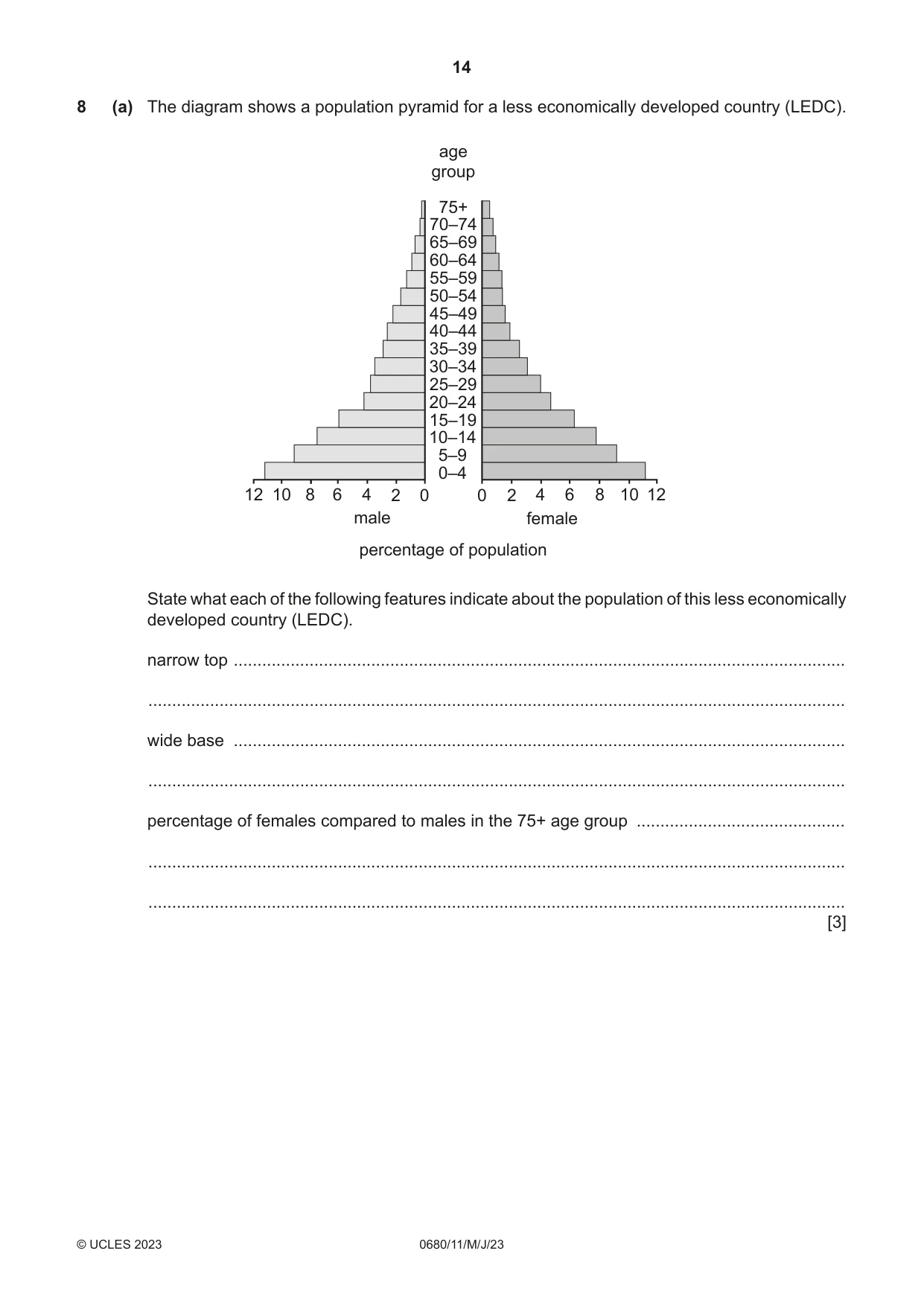
14 0680/11/M/J/23 © UCLES 2023 8 (a) The diagram shows a population pyramid for a less economically developed country (LEDC). male female 8 10 12 8 10 12 6 6 4 4 2 2 0 0 40–44 45–49 50–54 55–59 60–64 65–69 70–74 75+ age group 35–39 30–34 25–29 20–24 15–19 10–14 5–9 0–4 percentage of population State what each of the following features indicate about the population of this less economically developed country (LEDC). narrow top … … wide base … … percentage of females compared to males in the 75+ age group … … … [3]
Question paper, page 15
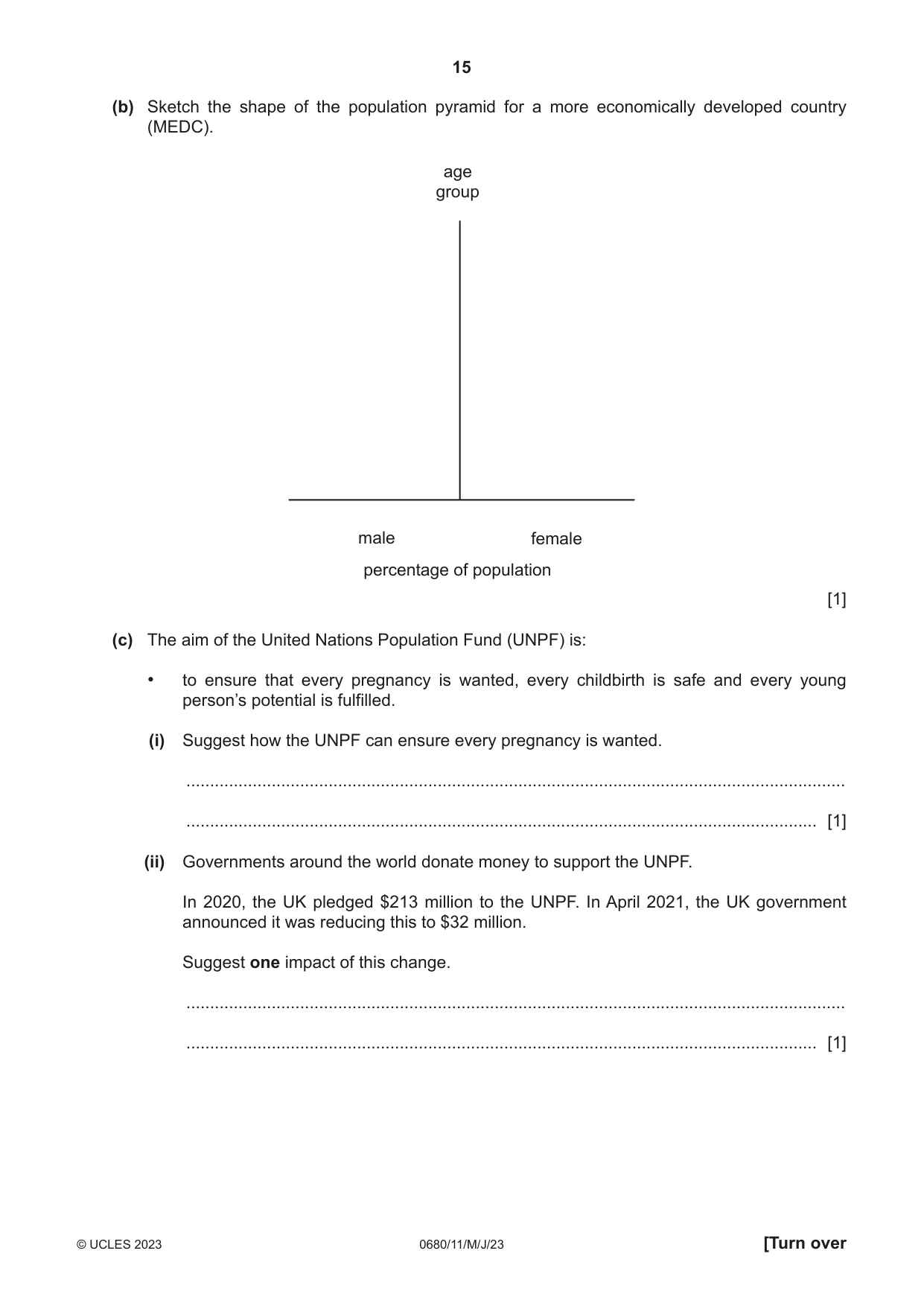
15 0680/11/M/J/23 © UCLES 2023 [Turn over (b) Sketch the shape of the population pyramid for a more economically developed country (MEDC). male female age group percentage of population [1] (c) The aim of the United Nations Population Fund (UNPF) is: • to ensure that every pregnancy is wanted, every childbirth is safe and every young person’s potential is fulfilled. (i) Suggest how the UNPF can ensure every pregnancy is wanted. … … [1] (ii) Governments around the world donate money to support the UNPF. In 2020, the UK pledged $213 million to the UNPF. In April 2021, the UK government announced it was reducing this to $32 million. Suggest one impact of this change. … … [1]
Question paper, page 16
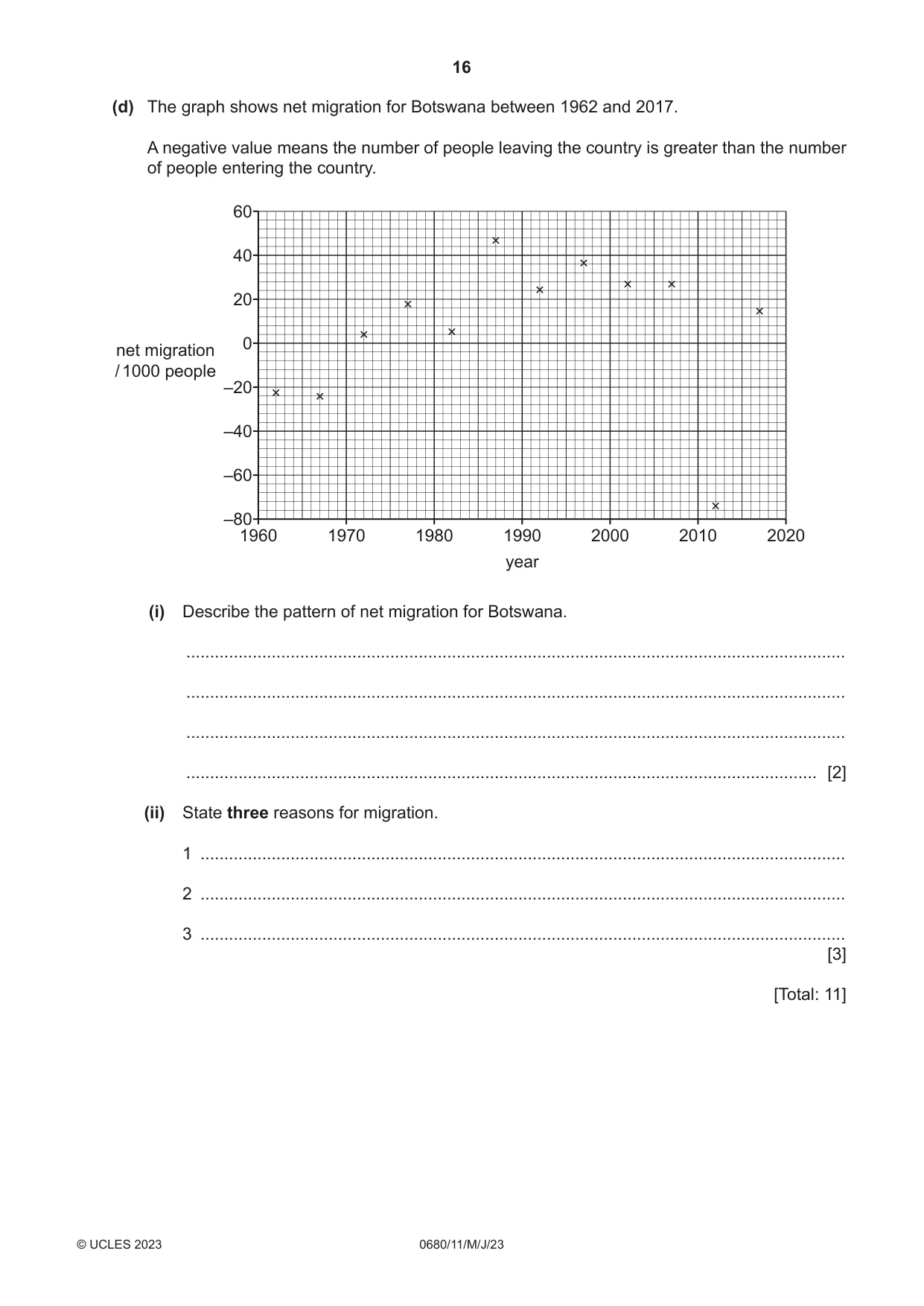
16 0680/11/M/J/23 © UCLES 2023 (d) The graph shows net migration for Botswana between 1962 and 2017. A negative value means the number of people leaving the country is greater than the number of people entering the country. –80 1960 1970 1980 year 1990 2000 2010 2020 –60 –40 –20 0 net migration / 1000 people 20 40 60 (i) Describe the pattern of net migration for Botswana. … … … … [2] (ii) State three reasons for migration. 1 … 2 … 3 … [3] [Total: 11]
Question paper, page 17
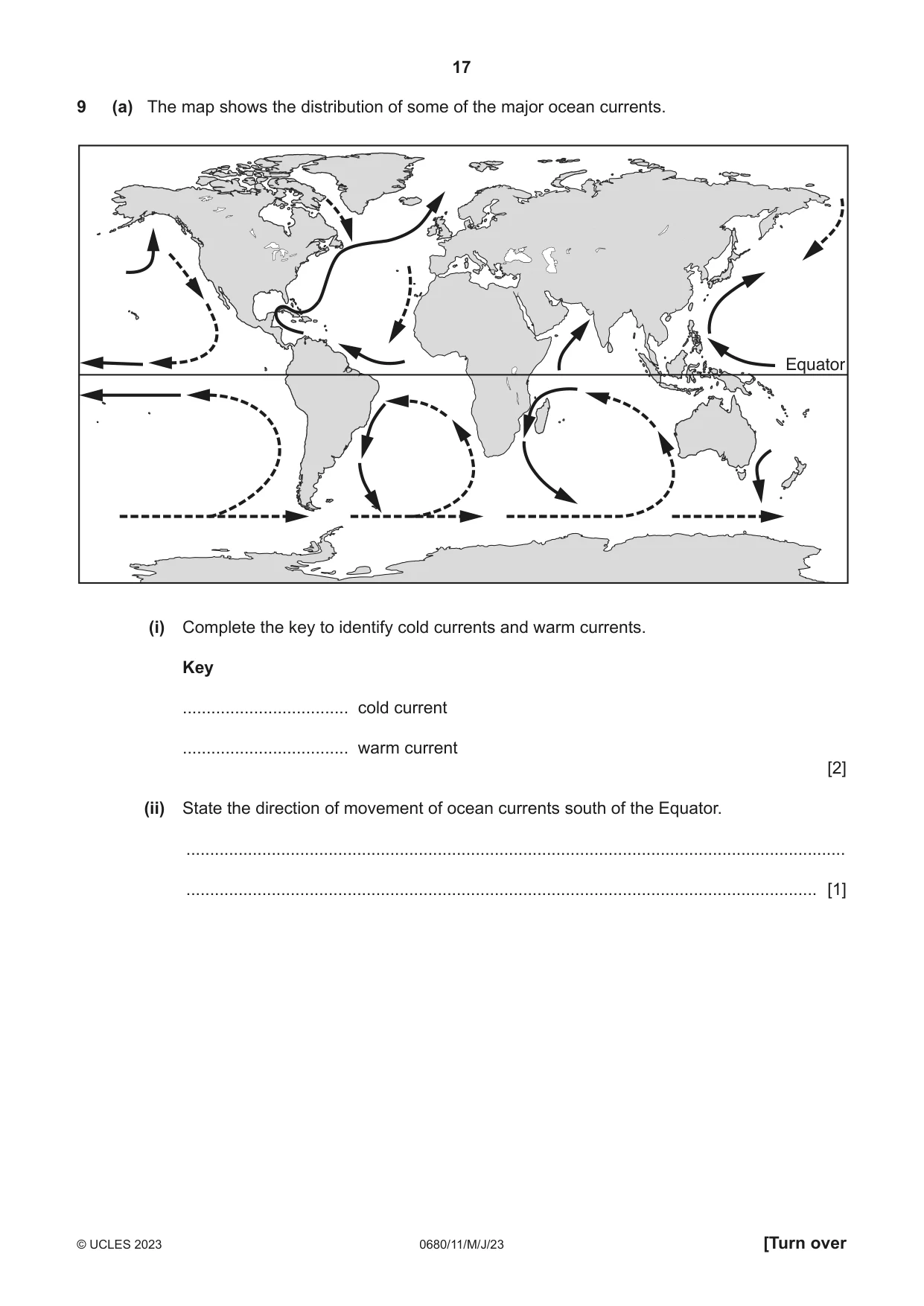
17 0680/11/M/J/23 © UCLES 2023 [Turn over 9 (a) The map shows the distribution of some of the major ocean currents. Equator (i) Complete the key to identify cold currents and warm currents. Key … cold current … warm current [2] (ii) State the direction of movement of ocean currents south of the Equator. … … [1]
Question paper, page 18
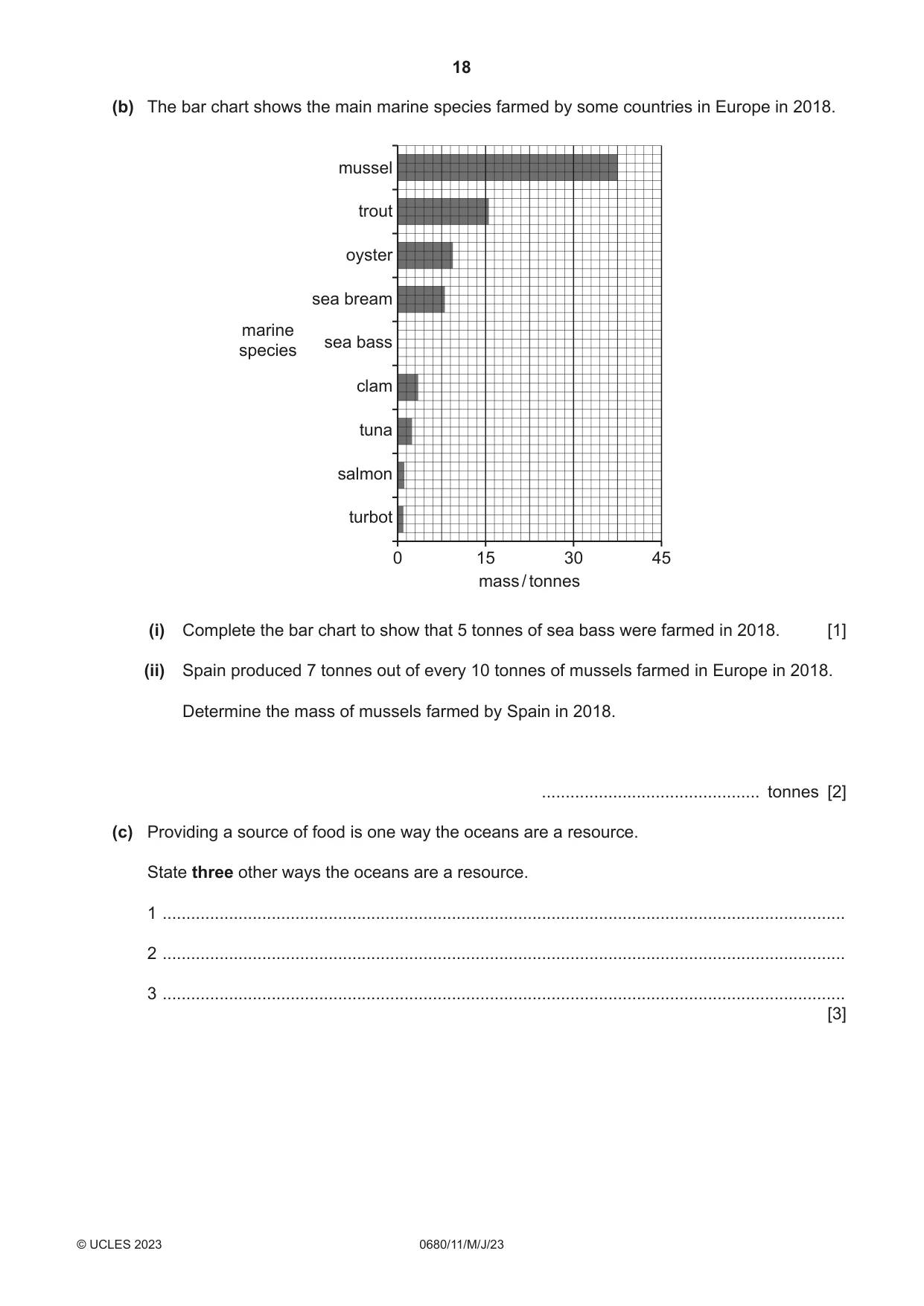
18 0680/11/M/J/23 © UCLES 2023 (b) The bar chart shows the main marine species farmed by some countries in Europe in 2018. 0 15 30 45 marine species mass / tonnes turbot salmon tuna clam sea bass sea bream oyster trout mussel (i) Complete the bar chart to show that 5 tonnes of sea bass were farmed in 2018. [1] (ii) Spain produced 7 tonnes out of every 10 tonnes of mussels farmed in Europe in 2018. Determine the mass of mussels farmed by Spain in 2018. … tonnes [2] (c) Providing a source of food is one way the oceans are a resource. State three other ways the oceans are a resource. 1 … 2 … 3 … [3]
Question paper, page 19
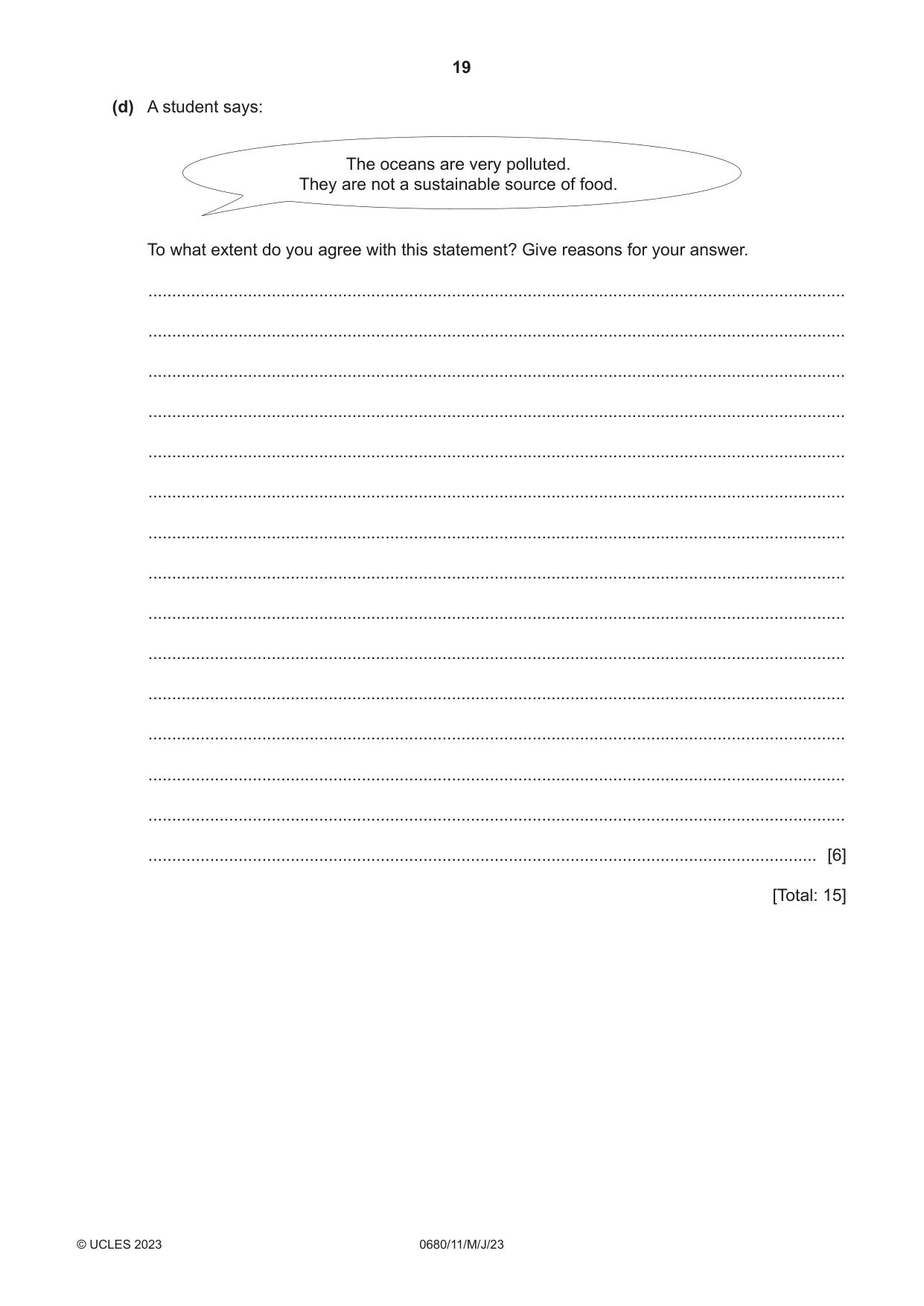
19 0680/11/M/J/23 © UCLES 2023 (d) A student says: The oceans are very polluted. They are not a sustainable source of food. To what extent do you agree with this statement? Give reasons for your answer. … … … … … … … … … … … … … … … [6] [Total: 15]
Question paper, page 20
20 0680/11/M/J/23 © UCLES 2023 The boundaries and names shown, the designations used and the presentation of material on any maps contained in this question paper/insert do not imply official endorsement or acceptance by Cambridge Assessment International Education concerning the legal status of any country, territory, or area or any of its authorities, or of the delimitation of its frontiers or boundaries. Permission to reproduce items where third-party owned material protected by copyright is included has been sought and cleared where possible. Every reasonable effort has been made by the publisher (UCLES) to trace copyright holders, but if any items requiring clearance have unwittingly been included, the publisher will be pleased to make amends at the earliest possible opportunity. To avoid the issue of disclosure of answer-related information to candidates, all copyright acknowledgements are reproduced online in the Cambridge Assessment International Education Copyright Acknowledgements Booklet. This is produced for each series of examinations and is freely available to download at www.cambridgeinternational.org after the live examination series. Cambridge Assessment International Education is part of Cambridge Assessment. Cambridge Assessment is the brand name of the University of Cambridge Local Examinations Syndicate (UCLES), which is a department of the University of Cambridge. BLANK PAGE
Mark scheme, page 1
This document consists of 13 printed pages. © UCLES 2023 [Turn over Cambridge IGCSE™ ENVIRONMENTAL MANAGEMENT 0680/11 Paper 1 Theory May/June 2023 MARK SCHEME Maximum Mark: 80 Published This mark scheme is published as an aid to teachers and candidates, to indicate the requirements of the examination. It shows the basis on which Examiners were instructed to award marks. It does not indicate the details of the discussions that took place at an Examiners’ meeting before marking began, which would have considered the acceptability of alternative answers. Mark schemes should be read in conjunction with the question paper and the Principal Examiner Report for Teachers. Cambridge International will not enter into discussions about these mark schemes. Cambridge International is publishing the mark schemes for the May/June 2023 series for most Cambridge IGCSE, Cambridge International A and AS Level and Cambridge Pre-U components, and some Cambridge O Level components.
Mark scheme, page 2
0680/11 Cambridge IGCSE – Mark Scheme PUBLISHED May/June 2023 © UCLES 2023 Page 2 of 13 Generic Marking Principles These general marking principles must be applied by all examiners when marking candidate answers. They should be applied alongside the specific content of the mark scheme or generic level descriptors for a question. Each question paper and mark scheme will also comply with these marking principles. GENERIC MARKING PRINCIPLE 1: Marks must be awarded in line with: the specific content of the mark scheme or the generic level descriptors for the question the specific skills defined in the mark scheme or in the generic level descriptors for the question the standard of response required by a candidate as exemplified by the standardisation scripts. GENERIC MARKING PRINCIPLE 2: Marks awarded are always whole marks (not half marks, or other fractions). GENERIC MARKING PRINCIPLE 3: Marks must be awarded positively: marks are awarded for correct/valid answers, as defined in the mark scheme. However, credit is given for valid answers which go beyond the scope of the syllabus and mark scheme, referring to your Team Leader as appropriate marks are awarded when candidates clearly demonstrate what they know and can do marks are not deducted for errors marks are not deducted for omissions answers should only be judged on the quality of spelling, punctuation and grammar when these features are specifically assessed by the question as indicated by the mark scheme. The meaning, however, should be unambiguous. GENERIC MARKING PRINCIPLE 4: Rules must be applied consistently, e.g. in situations where candidates have not followed instructions or in the application of generic level descriptors.
Mark scheme, page 3
0680/11 Cambridge IGCSE – Mark Scheme PUBLISHED May/June 2023 © UCLES 2023 Page 3 of 13 GENERIC MARKING PRINCIPLE 5: Marks should be awarded using the full range of marks defined in the mark scheme for the question (however; the use of the full mark range may be limited according to the quality of the candidate responses seen). GENERIC MARKING PRINCIPLE 6: Marks awarded are based solely on the requirements as defined in the mark scheme. Marks should not be awarded with grade thresholds or grade descriptors in mind. Science-Specific Marking Principles 1 Examiners should consider the context and scientific use of any keywords when awarding marks. Although keywords may be present, marks should not be awarded if the keywords are used incorrectly. 2 The examiner should not choose between contradictory statements given in the same question part, and credit should not be awarded for any correct statement that is contradicted within the same question part. Wrong science that is irrelevant to the question should be ignored. 3 Although spellings do not have to be correct, spellings of syllabus terms must allow for clear and unambiguous separation from other syllabus terms with which they may be confused (e.g. ethane / ethene, glucagon / glycogen, refraction / reflection). 4 The error carried forward (ecf) principle should be applied, where appropriate. If an incorrect answer is subsequently used in a scientifically correct way, the candidate should be awarded these subsequent marking points. Further guidance will be included in the mark scheme where necessary and any exceptions to this general principle will be noted. 5 ‘List rule’ guidance For questions that require n responses (e.g. State two reasons …): The response should be read as continuous prose, even when numbered answer spaces are provided. Any response marked ignore in the mark scheme should not count towards n. Incorrect responses should not be awarded credit but will still count towards n. Read the entire response to check for any responses that contradict those that would otherwise be credited. Credit should not be awarded for any responses that are contradicted within the rest of the response. Where two responses contradict one another, this should be treated as a single incorrect response. Non-contradictory responses after the first n responses may be ignored even if they include incorrect science.
Mark scheme, page 4
0680/11 Cambridge IGCSE – Mark Scheme PUBLISHED May/June 2023 © UCLES 2023 Page 4 of 13 6 Calculation specific guidance Correct answers to calculations should be given full credit even if there is no working or incorrect working, unless the question states ‘show your working’. For questions in which the number of significant figures required is not stated, credit should be awarded for correct answers when rounded by the examiner to the number of significant figures given in the mark scheme. This may not apply to measured values. For answers given in standard form (e.g. a 10n) in which the convention of restricting the value of the coefficient (a) to a value between 1 and 10 is not followed, credit may still be awarded if the answer can be converted to the answer given in the mark scheme. Unless a separate mark is given for a unit, a missing or incorrect unit will normally mean that the final calculation mark is not awarded. Exceptions to this general principle will be noted in the mark scheme. 7 Guidance for chemical equations Multiples / fractions of coefficients used in chemical equations are acceptable unless stated otherwise in the mark scheme. State symbols given in an equation should be ignored unless asked for in the question or stated otherwise in the mark scheme.
Mark scheme, page 5
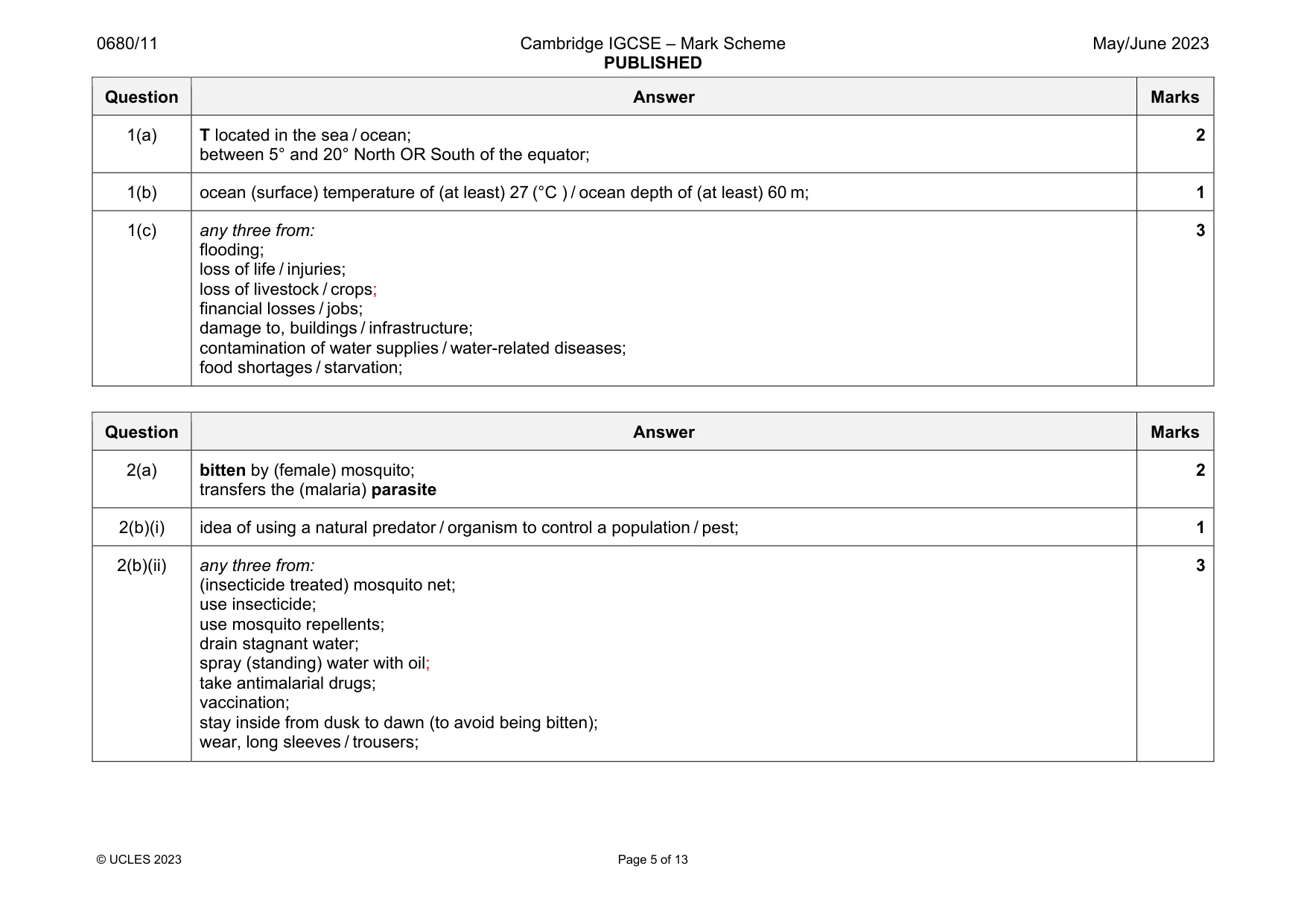
0680/11 Cambridge IGCSE – Mark Scheme PUBLISHED May/June 2023 © UCLES 2023 Page 5 of 13 Question Answer Marks 1(a) T located in the sea / ocean; between 5° and 20° North OR South of the equator; 2 1(b) ocean (surface) temperature of (at least) 27 (°C ) / ocean depth of (at least) 60 m; 1 1(c) any three from: flooding; loss of life / injuries; loss of livestock / crops; financial losses / jobs; damage to, buildings / infrastructure; contamination of water supplies / water-related diseases; food shortages / starvation; 3 Question Answer Marks 2(a) bitten by (female) mosquito; transfers the (malaria) parasite 2 2(b)(i) idea of using a natural predator / organism to control a population / pest; 1 2(b)(ii) any three from: (insecticide treated) mosquito net; use insecticide; use mosquito repellents; drain stagnant water; spray (standing) water with oil; take antimalarial drugs; vaccination; stay inside from dusk to dawn (to avoid being bitten); wear, long sleeves / trousers; 3
Mark scheme, page 6
0680/11 Cambridge IGCSE – Mark Scheme PUBLISHED May/June 2023 © UCLES 2023 Page 6 of 13 Question Answer Marks 3 1 correct; 2 correct; 3 correct; 5 correct; 4 Question Answer Marks 4(a) clockwise in order: 78%: nitrogen; 21%: oxygen; 2 4(b) two from: argon; carbon dioxide; water (vapour); 2
Mark scheme, page 7
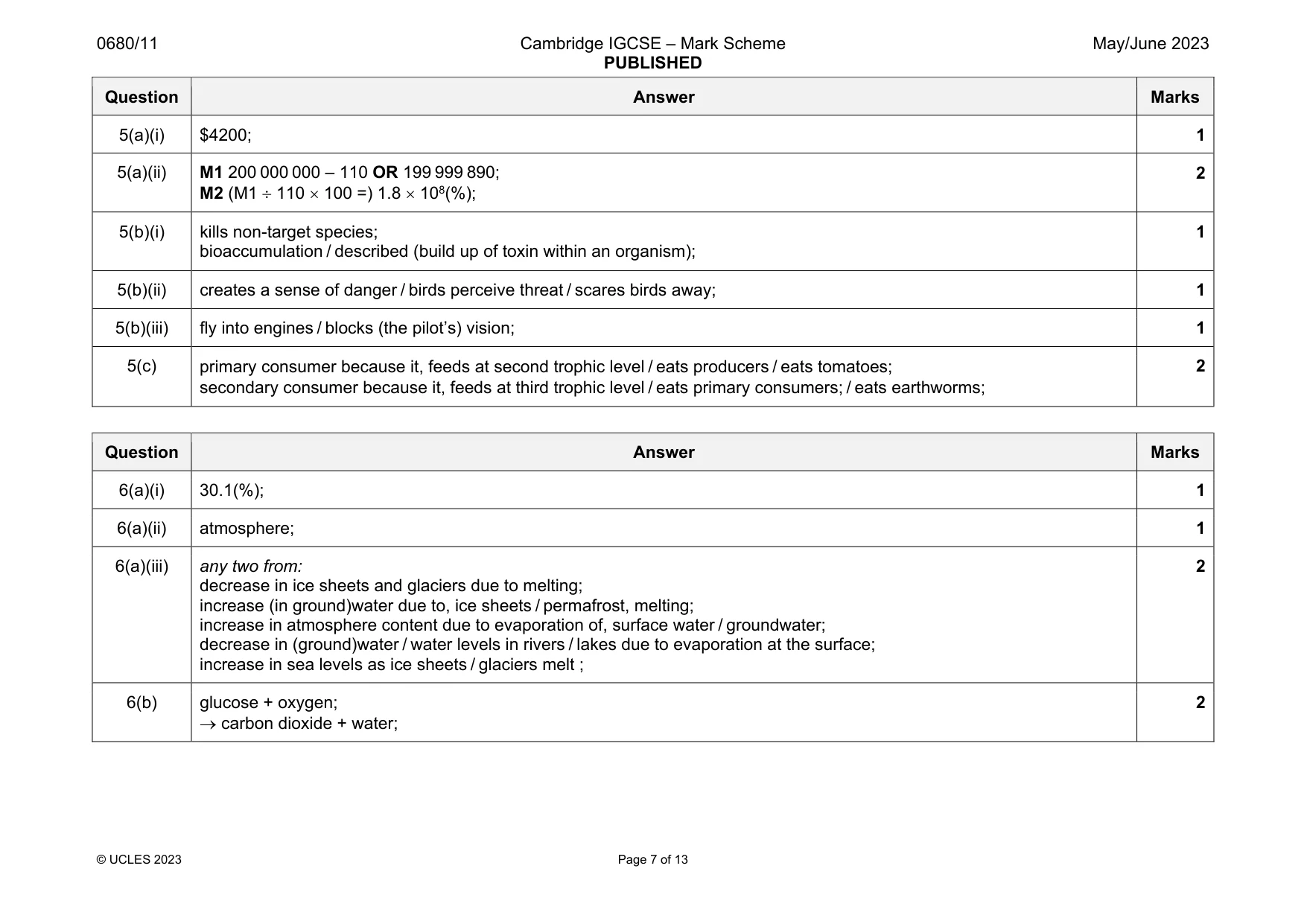
0680/11 Cambridge IGCSE – Mark Scheme PUBLISHED May/June 2023 © UCLES 2023 Page 7 of 13 Question Answer Marks 5(a)(i) $4200; 1 5(a)(ii) M1 200 000 000 – 110 OR 199 999 890; M2 (M1 110 100 =) 1.8 108(%); 2 5(b)(i) kills non-target species; bioaccumulation / described (build up of toxin within an organism); 1 5(b)(ii) creates a sense of danger / birds perceive threat / scares birds away; 1 5(b)(iii) fly into engines / blocks (the pilot’s) vision; 1 5(c) primary consumer because it, feeds at second trophic level / eats producers / eats tomatoes; secondary consumer because it, feeds at third trophic level / eats primary consumers; / eats earthworms; 2 Question Answer Marks 6(a)(i) 30.1(%); 1 6(a)(ii) atmosphere; 1 6(a)(iii) any two from: decrease in ice sheets and glaciers due to melting; increase (in ground)water due to, ice sheets / permafrost, melting; increase in atmosphere content due to evaporation of, surface water / groundwater; decrease in (ground)water / water levels in rivers / lakes due to evaporation at the surface; increase in sea levels as ice sheets / glaciers melt ; 2 6(b) glucose + oxygen; carbon dioxide + water; 2
Mark scheme, page 8
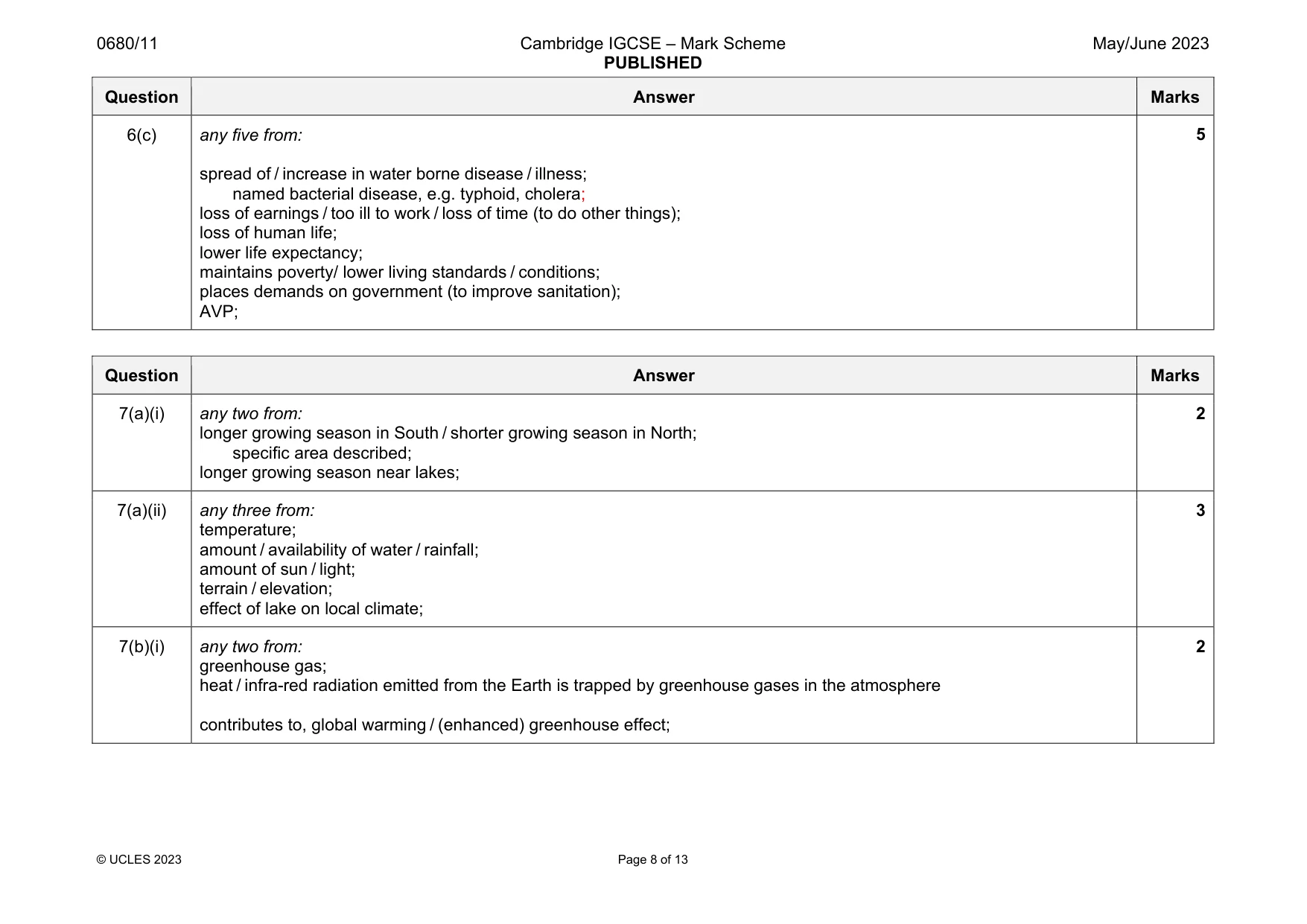
0680/11 Cambridge IGCSE – Mark Scheme PUBLISHED May/June 2023 © UCLES 2023 Page 8 of 13 Question Answer Marks 6(c) any five from: spread of / increase in water borne disease / illness; named bacterial disease, e.g. typhoid, cholera; loss of earnings / too ill to work / loss of time (to do other things); loss of human life; lower life expectancy; maintains poverty/ lower living standards / conditions; places demands on government (to improve sanitation); AVP; 5 Question Answer Marks 7(a)(i) any two from: longer growing season in South / shorter growing season in North; specific area described; longer growing season near lakes; 2 7(a)(ii) any three from: temperature; amount / availability of water / rainfall; amount of sun / light; terrain / elevation; effect of lake on local climate; 3 7(b)(i) any two from: greenhouse gas; heat / infra-red radiation emitted from the Earth is trapped by greenhouse gases in the atmosphere contributes to, global warming / (enhanced) greenhouse effect; 2
Mark scheme, page 9
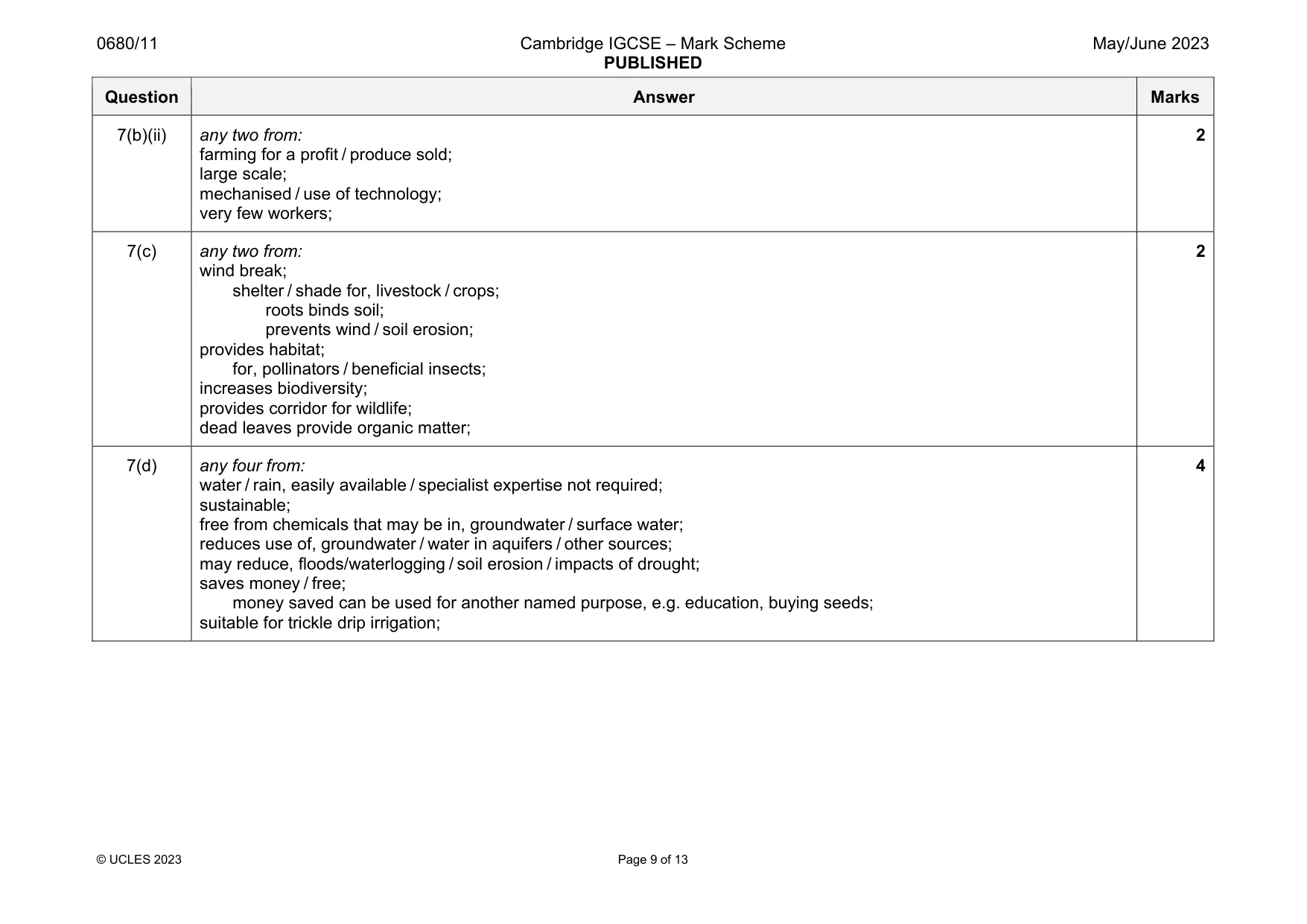
0680/11 Cambridge IGCSE – Mark Scheme PUBLISHED May/June 2023 © UCLES 2023 Page 9 of 13 Question Answer Marks 7(b)(ii) any two from: farming for a profit / produce sold; large scale; mechanised / use of technology; very few workers; 2 7(c) any two from: wind break; shelter / shade for, livestock / crops; roots binds soil; prevents wind / soil erosion; provides habitat; for, pollinators / beneficial insects; increases biodiversity; provides corridor for wildlife; dead leaves provide organic matter; 2 7(d) any four from: water / rain, easily available / specialist expertise not required; sustainable; free from chemicals that may be in, groundwater / surface water; reduces use of, groundwater / water in aquifers / other sources; may reduce, floods/waterlogging / soil erosion / impacts of drought; saves money / free; money saved can be used for another named purpose, e.g. education, buying seeds; suitable for trickle drip irrigation; 4
Mark scheme, page 10
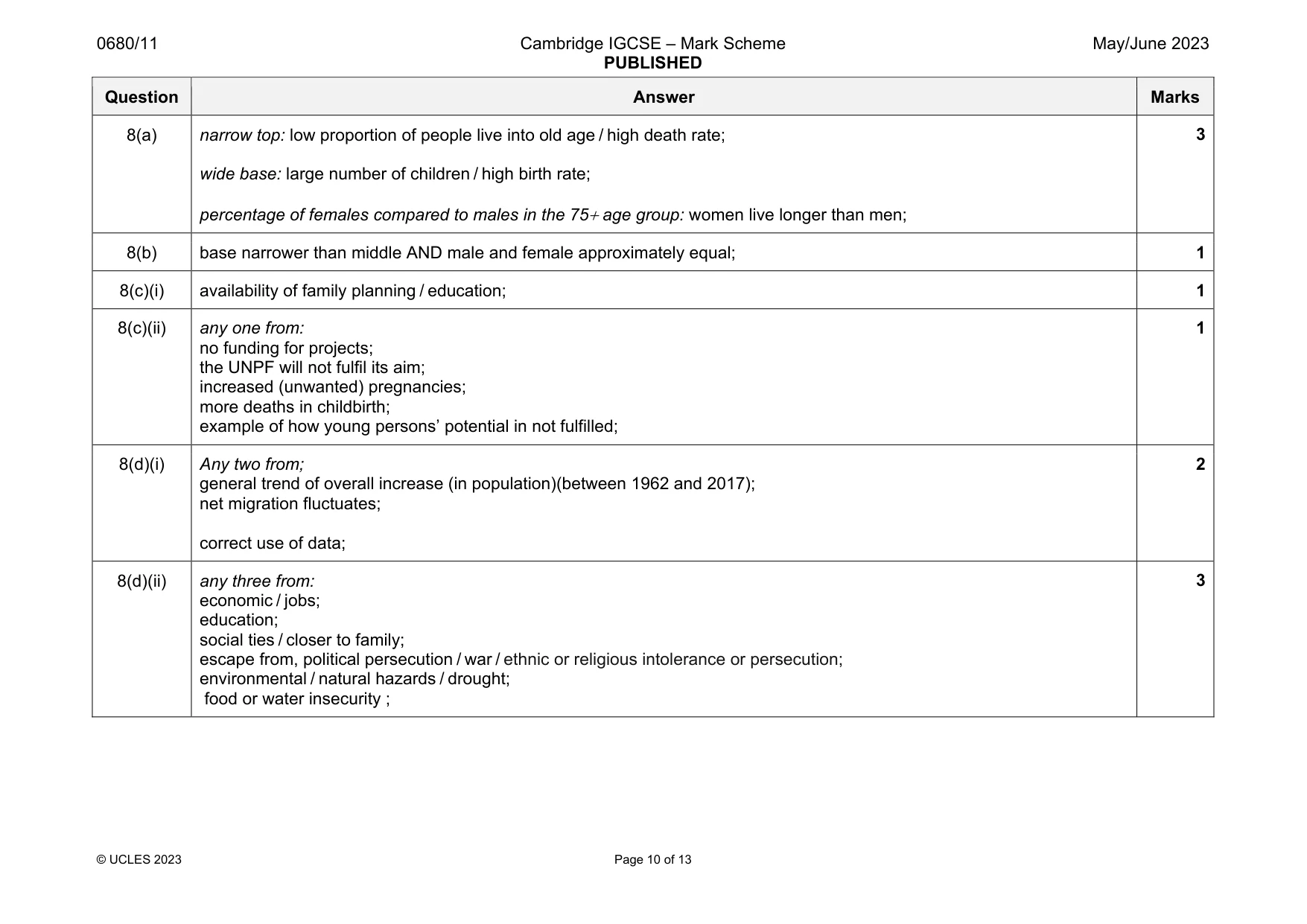
0680/11 Cambridge IGCSE – Mark Scheme PUBLISHED May/June 2023 © UCLES 2023 Page 10 of 13 Question Answer Marks 8(a) narrow top: low proportion of people live into old age / high death rate; wide base: large number of children / high birth rate; percentage of females compared to males in the 75 age group: women live longer than men; 3 8(b) base narrower than middle AND male and female approximately equal; 1 8(c)(i) availability of family planning / education; 1 8(c)(ii) any one from: no funding for projects; the UNPF will not fulfil its aim; increased (unwanted) pregnancies; more deaths in childbirth; example of how young persons’ potential in not fulfilled; 1 8(d)(i) Any two from; general trend of overall increase (in population)(between 1962 and 2017); net migration fluctuates; correct use of data; 2 8(d)(ii) any three from: economic / jobs; education; social ties / closer to family; escape from, political persecution / war / ethnic or religious intolerance or persecution; environmental / natural hazards / drought; food or water insecurity ; 3
Mark scheme, page 11
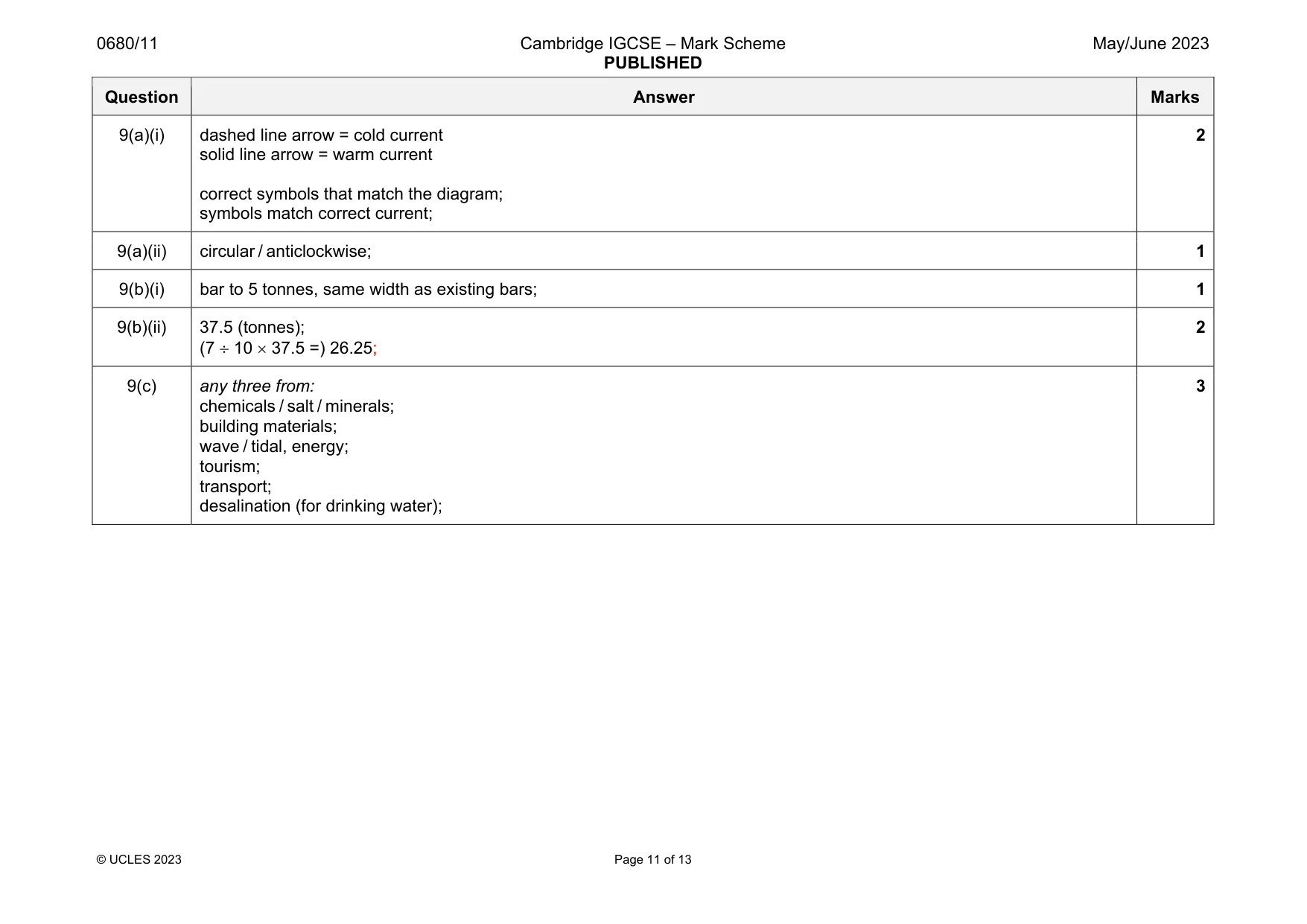
0680/11 Cambridge IGCSE – Mark Scheme PUBLISHED May/June 2023 © UCLES 2023 Page 11 of 13 Question Answer Marks 9(a)(i) dashed line arrow = cold current solid line arrow = warm current correct symbols that match the diagram; symbols match correct current; 2 9(a)(ii) circular / anticlockwise; 1 9(b)(i) bar to 5 tonnes, same width as existing bars; 1 9(b)(ii) 37.5 (tonnes); (7 10 37.5 =) 26.25; 2 9(c) any three from: chemicals / salt / minerals; building materials; wave / tidal, energy; tourism; transport; desalination (for drinking water); 3
Mark scheme, page 12
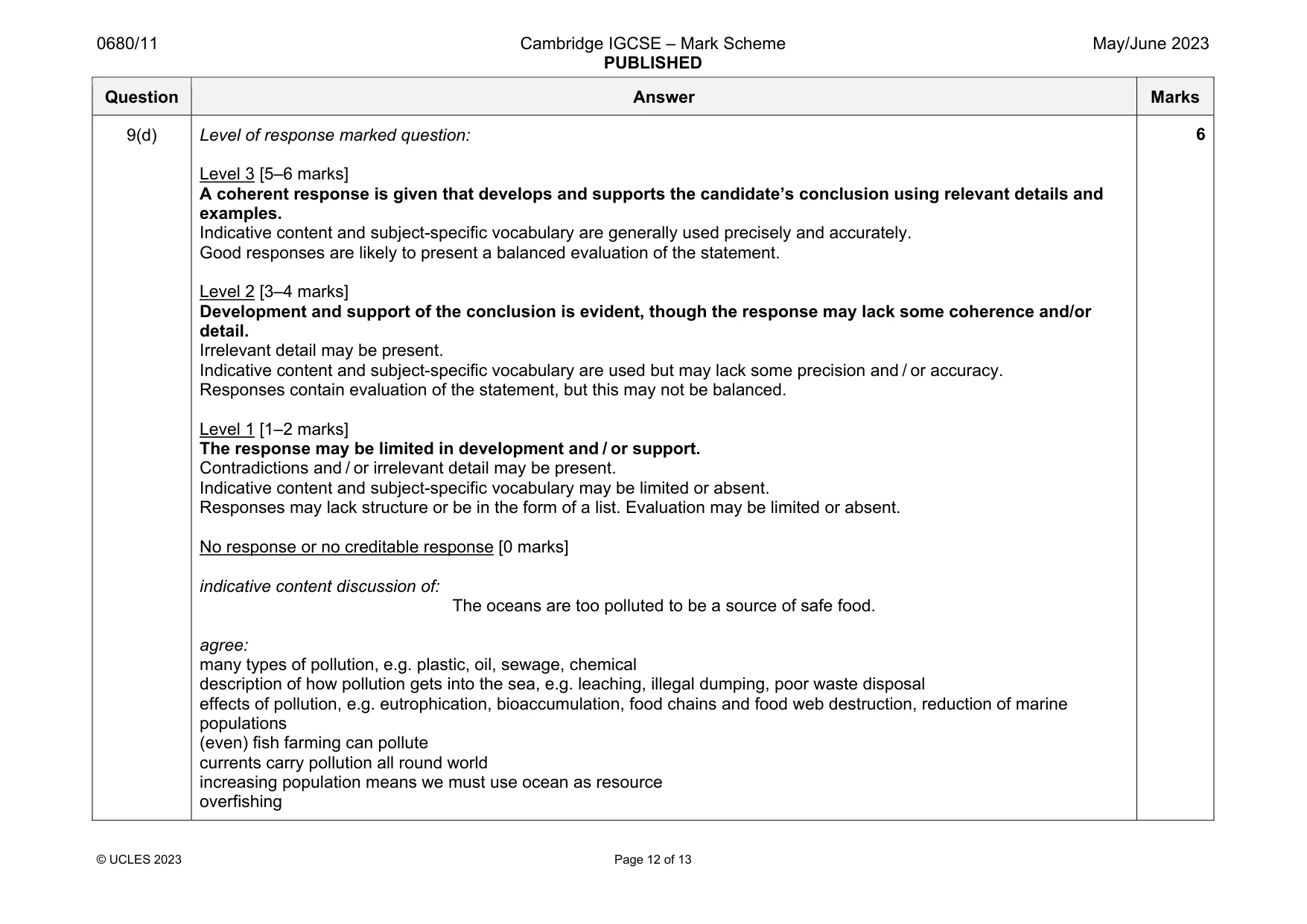
0680/11 Cambridge IGCSE – Mark Scheme PUBLISHED May/June 2023 © UCLES 2023 Page 12 of 13 Question Answer Marks 9(d) Level of response marked question: Level 3 [5–6 marks] A coherent response is given that develops and supports the candidate’s conclusion using relevant details and examples. Indicative content and subject-specific vocabulary are generally used precisely and accurately. Good responses are likely to present a balanced evaluation of the statement. Level 2 [3–4 marks] Development and support of the conclusion is evident, though the response may lack some coherence and/or detail. Irrelevant detail may be present. Indicative content and subject-specific vocabulary are used but may lack some precision and / or accuracy. Responses contain evaluation of the statement, but this may not be balanced. Level 1 [1–2 marks] The response may be limited in development and / or support. Contradictions and / or irrelevant detail may be present. Indicative content and subject-specific vocabulary may be limited or absent. Responses may lack structure or be in the form of a list. Evaluation may be limited or absent. No response or no creditable response [0 marks] indicative content discussion of: The oceans are too polluted to be a source of safe food. agree: many types of pollution, e.g. plastic, oil, sewage, chemical description of how pollution gets into the sea, e.g. leaching, illegal dumping, poor waste disposal effects of pollution, e.g. eutrophication, bioaccumulation, food chains and food web destruction, reduction of marine populations (even) fish farming can pollute currents carry pollution all round world increasing population means we must use ocean as resource overfishing 6
Mark scheme, page 13
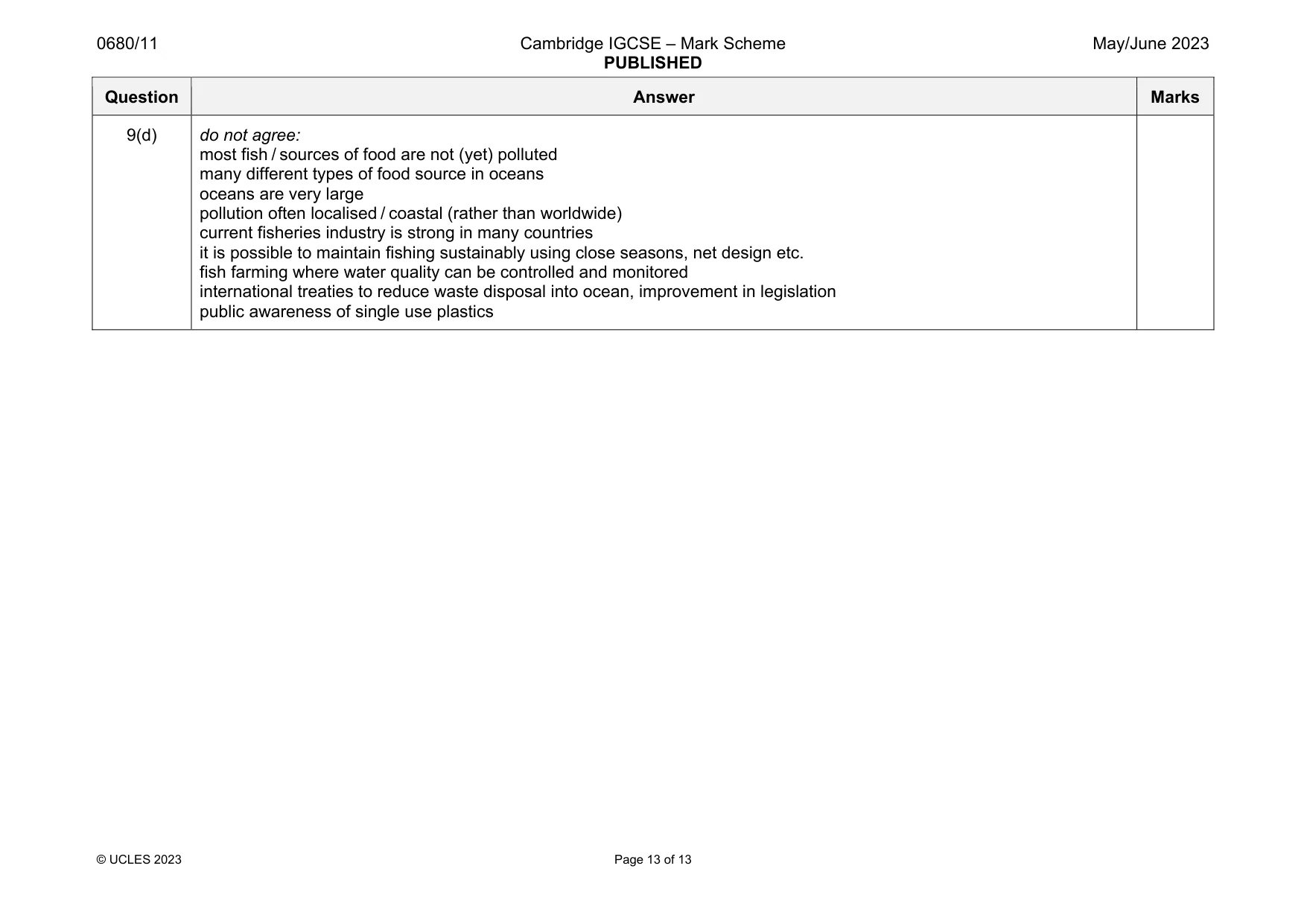
0680/11 Cambridge IGCSE – Mark Scheme PUBLISHED May/June 2023 © UCLES 2023 Page 13 of 13 Question Answer Marks 9(d) do not agree: most fish / sources of food are not (yet) polluted many different types of food source in oceans oceans are very large pollution often localised / coastal (rather than worldwide) current fisheries industry is strong in many countries it is possible to maintain fishing sustainably using close seasons, net design etc. fish farming where water quality can be controlled and monitored international treaties to reduce waste disposal into ocean, improvement in legislation public awareness of single use plastics
What you needed in this session
Cambridge’s own grade thresholds for 2023 May/June, Paper 1 · Variant 1. A higher threshold means an easier paper — the bar moves with how the cohort did.