Cambridge IGCSE Environmental Management 0680 — 2023 Oct/Nov Paper 1 · Variant 1
0680/11/O/N/23 · 80 marks · ≈90 min
The question paper and its mark scheme, free to read here and free to download. This is Cambridge’s own paper, exactly as it was sat.
Question paper20 pages
Mark scheme12 pages
Answers below. Sit the paper first if you are practising.
Paper as text
Question paper, page 1
This document has 20 pages. [Turn over Cambridge IGCSE™ * 2 6 6 2 6 0 5 3 2 6 * DC (EF/CT) 315336/4 © UCLES 2023 ENVIRONMENTAL MANAGEMENT 0680/11 Paper 1 Theory October/November 2023 1 hour 45 minutes You must answer on the question paper. No additional materials are needed. INSTRUCTIONS ● Answer all questions. ● Use a black or dark blue pen. You may use an HB pencil for any diagrams or graphs. ● Write your name, centre number and candidate number in the boxes at the top of the page. ● Write your answer to each question in the space provided. ● Do not use an erasable pen or correction fluid. ● Do not write on any bar codes. ● You may use a calculator. ● You should show all your working and use appropriate units. INFORMATION ● The total mark for this paper is 80. ● The number of marks for each question or part question is shown in brackets [ ].
Question paper, page 2
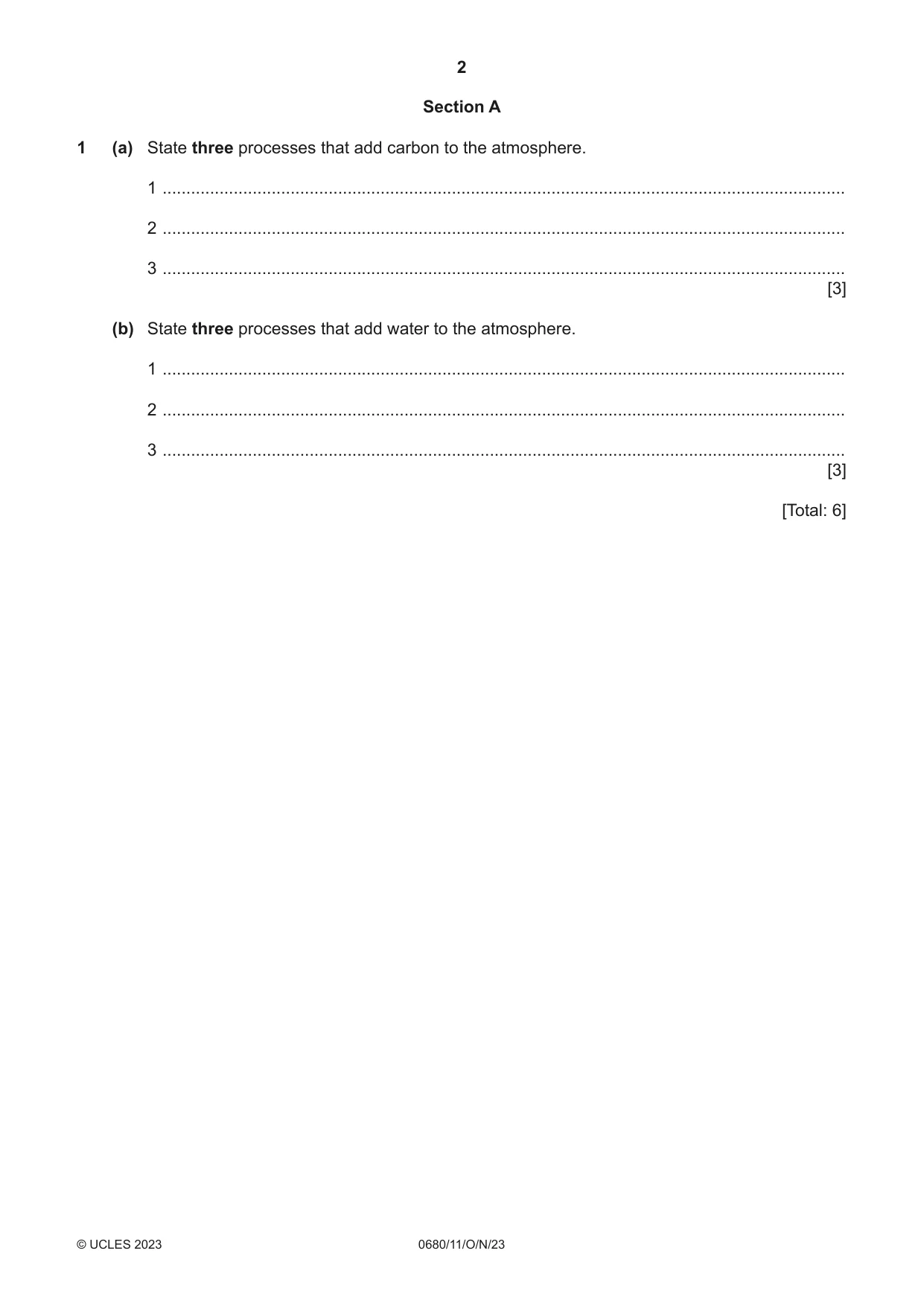
2 0680/11/O/N/23 © UCLES 2023 Section A 1 (a) State three processes that add carbon to the atmosphere. 1 … 2 … 3 … [3] (b) State three processes that add water to the atmosphere. 1 … 2 … 3 … [3] [Total: 6]
Question paper, page 3
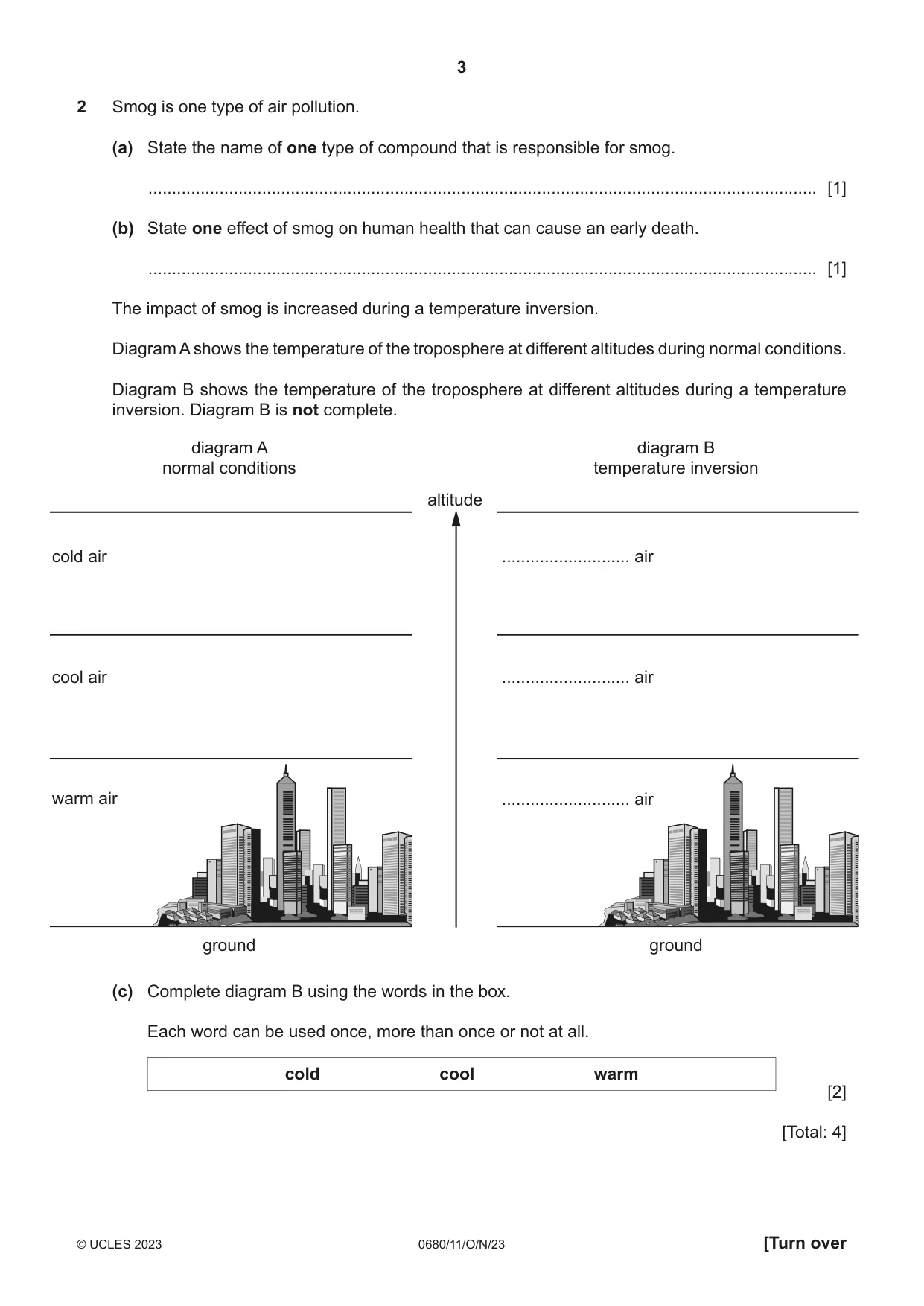
3 0680/11/O/N/23 © UCLES 2023 [Turn over 2 Smog is one type of air pollution. (a) State the name of one type of compound that is responsible for smog. … [1] (b) State one effect of smog on human health that can cause an early death. … [1] The impact of smog is increased during a temperature inversion. Diagram A shows the temperature of the troposphere at different altitudes during normal conditions. Diagram B shows the temperature of the troposphere at different altitudes during a temperature inversion. Diagram B is not complete. altitude diagram A normal conditions warm air cool air cold air ground diagram B temperature inversion … air … air … air ground (c) Complete diagram B using the words in the box. Each word can be used once, more than once or not at all. cold cool warm [2] [Total: 4]
Question paper, page 4
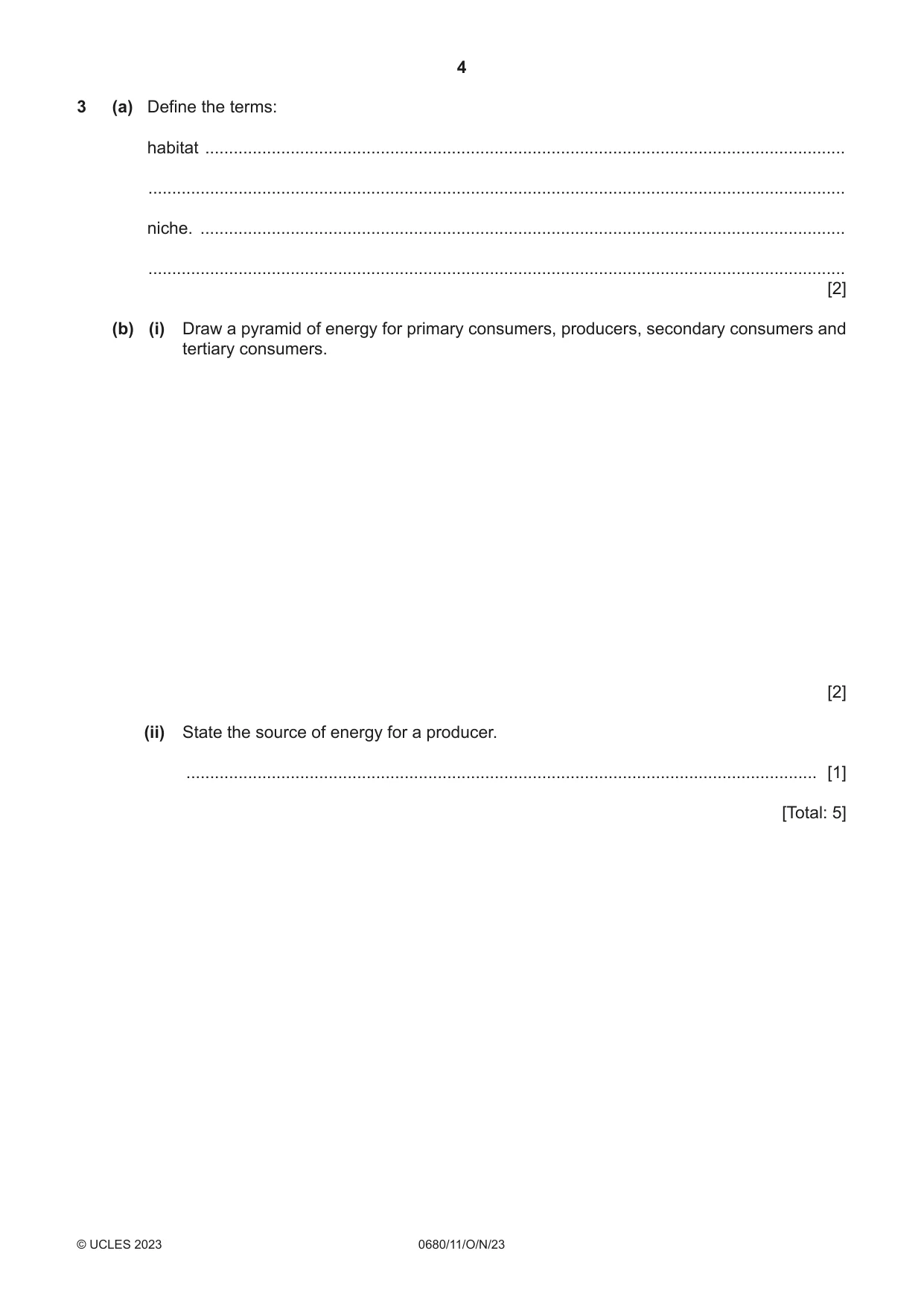
4 0680/11/O/N/23 © UCLES 2023 3 (a) Define the terms: habitat … … niche. … … [2] (b) (i) Draw a pyramid of energy for primary consumers, producers, secondary consumers and tertiary consumers. [2] (ii) State the source of energy for a producer. … [1] [Total: 5]
Question paper, page 5
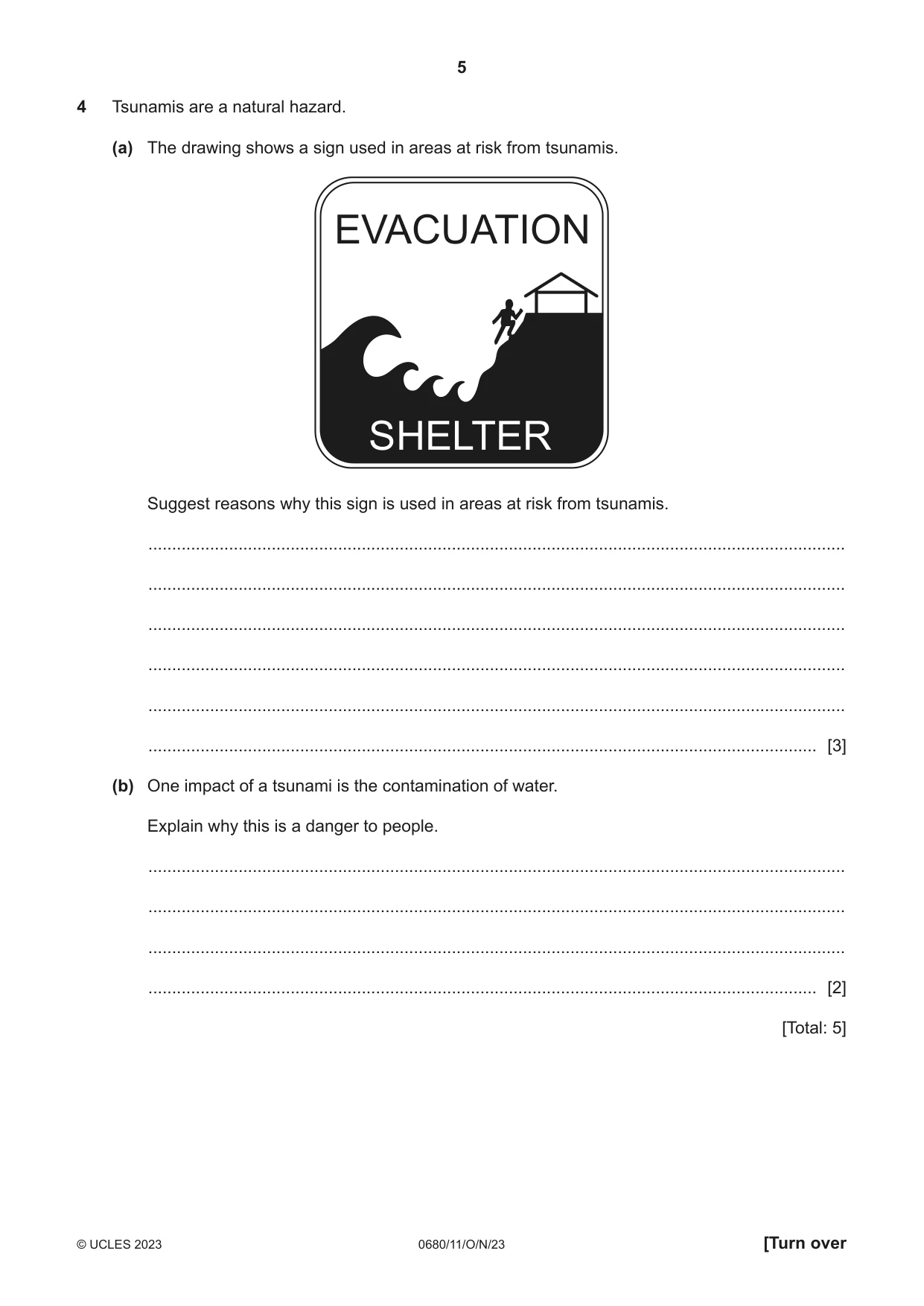
5 0680/11/O/N/23 © UCLES 2023 [Turn over 4 Tsunamis are a natural hazard. (a) The drawing shows a sign used in areas at risk from tsunamis. EVACUATION SHELTER Suggest reasons why this sign is used in areas at risk from tsunamis. … … … … … … [3] (b) One impact of a tsunami is the contamination of water. Explain why this is a danger to people. … … … … [2] [Total: 5]
Question paper, page 6
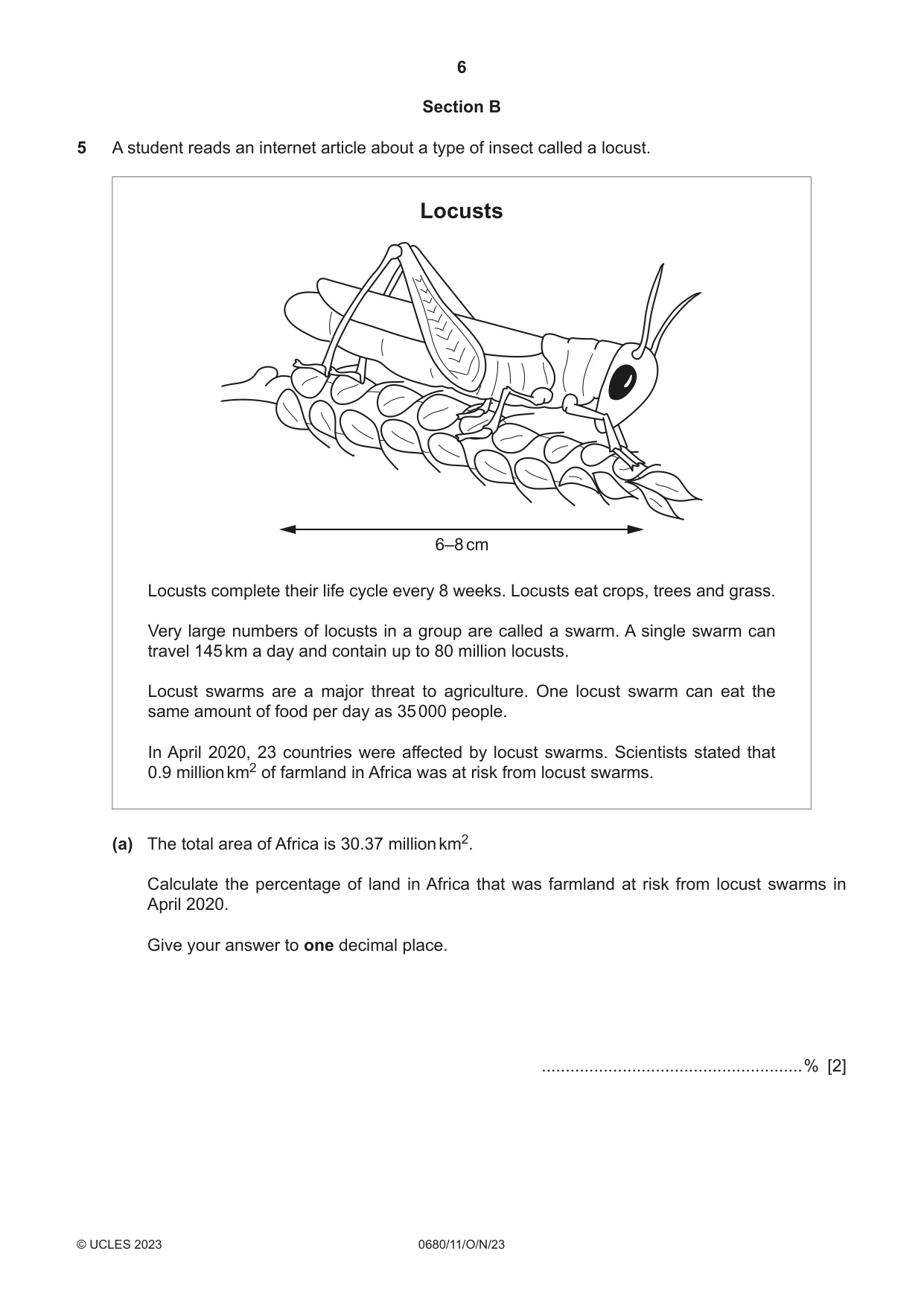
6 0680/11/O/N/23 © UCLES 2023 Section B 5 A student reads an internet article about a type of insect called a locust. Locusts 6–8 cm Locusts complete their life cycle every 8 weeks. Locusts eat crops, trees and grass. Very large numbers of locusts in a group are called a swarm. A single swarm can travel 145 km a day and contain up to 80 million locusts. Locust swarms are a major threat to agriculture. One locust swarm can eat the same amount of food per day as 35 000 people. In April 2020, 23 countries were affected by locust swarms. Scientists stated that 0.9 million km2 of farmland in Africa was at risk from locust swarms. (a) The total area of Africa is 30.37 million km2. Calculate the percentage of land in Africa that was farmland at risk from locust swarms in April 2020. Give your answer to one decimal place. …% [2]
Question paper, page 7
7 0680/11/O/N/23 © UCLES 2023 [Turn over (b) One strategy for reducing the impact of locust swarms is to hand pick individual locusts from crops. This is done at night when the locusts are resting. (i) Suggest two limitations of this strategy. 1 … … 2 … … [2] (ii) The hand‑picked locusts are crushed and dried. They are then used as animal feed. Suggest how this can benefit farmers. … … [1] (c) Another strategy for controlling locust swarms is spraying them with insecticide. Describe two impacts of the overuse of insecticides. 1 … … 2 … … [2]
Question paper, page 8
8 0680/11/O/N/23 © UCLES 2023 (d) The Emergency Locust Response Program (ELRP) is a fund of $500 million to support countries affected by locust swarms. Suggest ways the ELRP can support countries affected by locust swarms. … … … … … … … … [4] (e) Locust populations increase after rainfall and in warm weather. Suggest reasons why locust populations may increase in the future. … … … … [2] [Total: 13]
Question paper, page 9
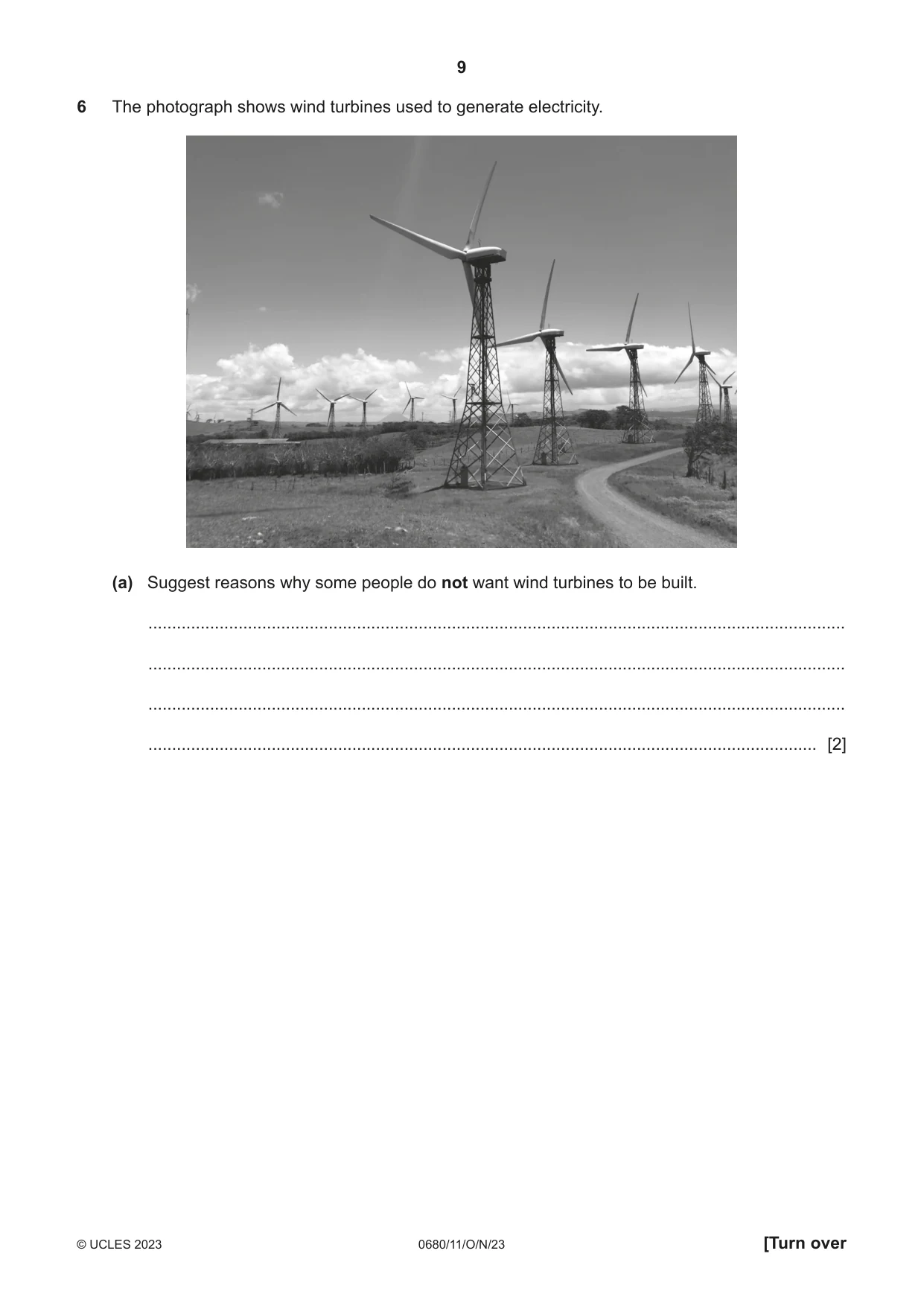
9 0680/11/O/N/23 © UCLES 2023 [Turn over 6 The photograph shows wind turbines used to generate electricity. (a) Suggest reasons why some people do not want wind turbines to be built. … … … … [2]
Question paper, page 10
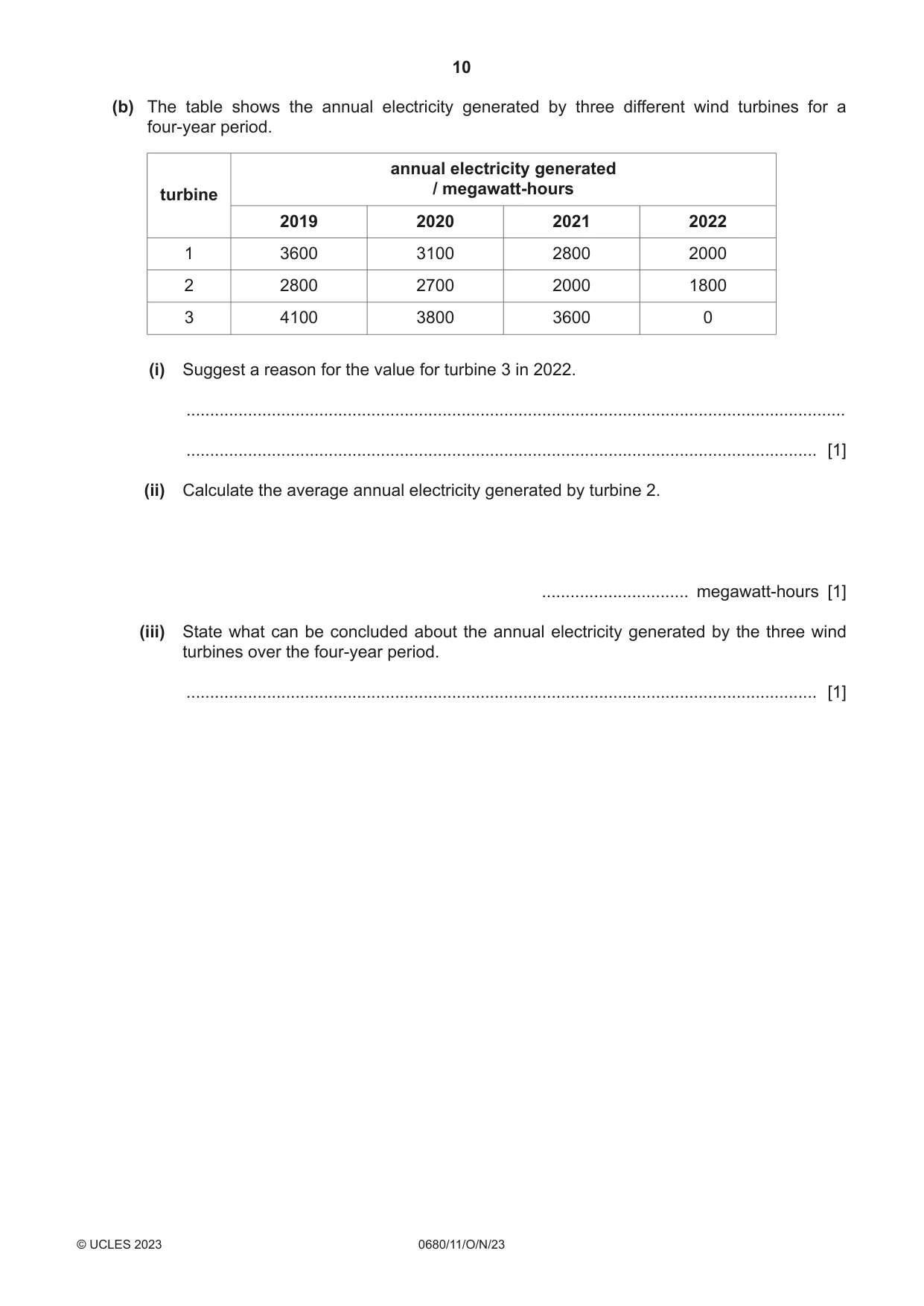
10 0680/11/O/N/23 © UCLES 2023 (b) The table shows the annual electricity generated by three different wind turbines for a four‑year period. turbine annual electricity generated / megawatt‑hours 2019 2020 2021 2022 1 3600 3100 2800 2000 2 2800 2700 2000 1800 3 4100 3800 3600 0 (i) Suggest a reason for the value for turbine 3 in 2022. … … [1] (ii) Calculate the average annual electricity generated by turbine 2. … megawatt‑hours [1] (iii) State what can be concluded about the annual electricity generated by the three wind turbines over the four‑year period. … [1]
Question paper, page 11
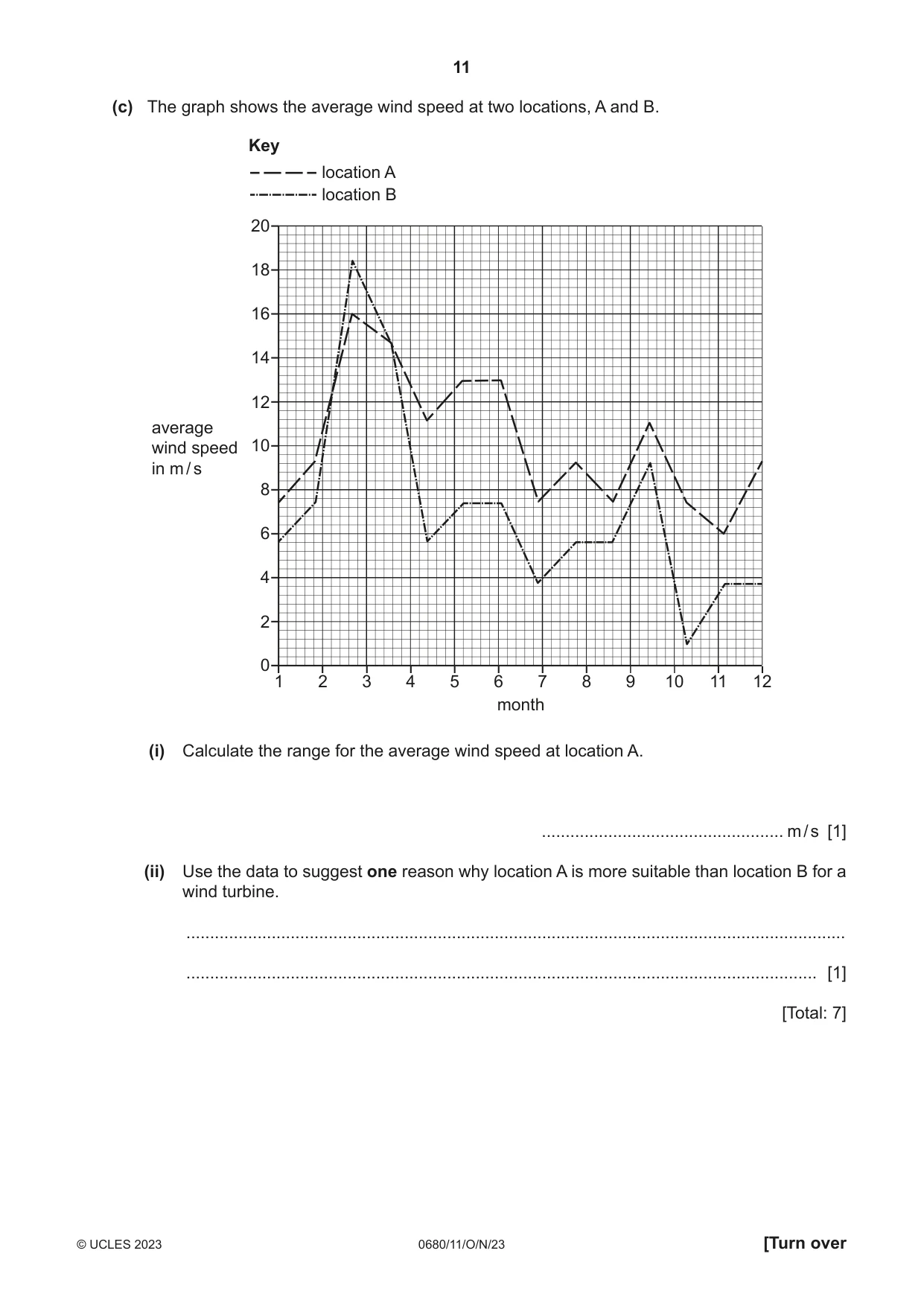
11 0680/11/O/N/23 © UCLES 2023 [Turn over (c) The graph shows the average wind speed at two locations, A and B. 2 0 1 2 3 4 5 6 7 month 8 9 10 11 12 4 6 8 10 12 14 16 18 20 average wind speed in m / s Key location A location B (i) Calculate the range for the average wind speed at location A. … m / s [1] (ii) Use the data to suggest one reason why location A is more suitable than location B for a wind turbine. … … [1] [Total: 7]
Question paper, page 12
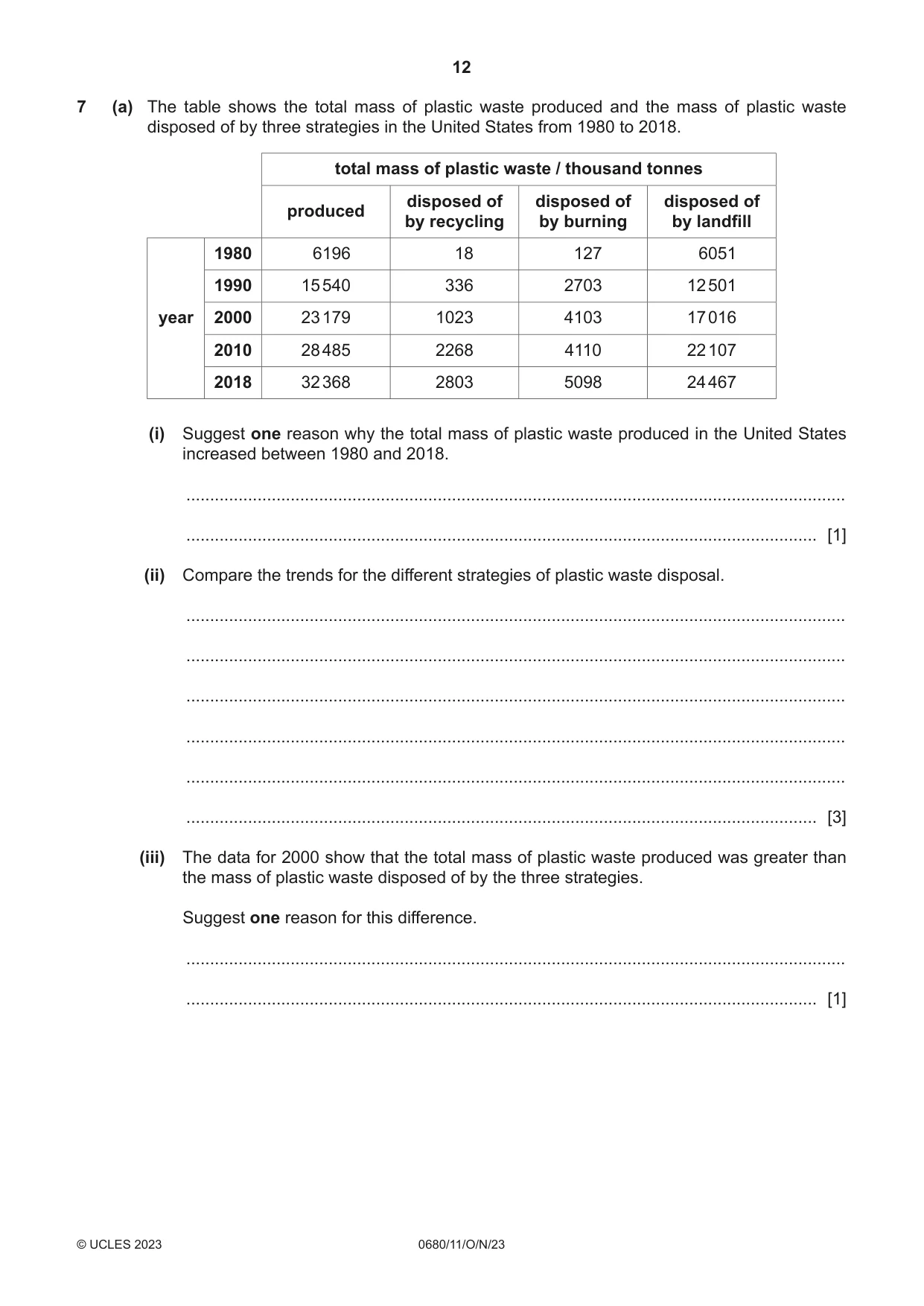
12 0680/11/O/N/23 © UCLES 2023 7 (a) The table shows the total mass of plastic waste produced and the mass of plastic waste disposed of by three strategies in the United States from 1980 to 2018. total mass of plastic waste / thousand tonnes produced disposed of by recycling disposed of by burning disposed of by landfill year 1980 6196 18 127 6051 1990 15 540 336 2703 12 501 2000 23 179 1023 4103 17 016 2010 28 485 2268 4110 22 107 2018 32 368 2803 5098 24 467 (i) Suggest one reason why the total mass of plastic waste produced in the United States increased between 1980 and 2018. … … [1] (ii) Compare the trends for the different strategies of plastic waste disposal. … … … … … … [3] (iii) The data for 2000 show that the total mass of plastic waste produced was greater than the mass of plastic waste disposed of by the three strategies. Suggest one reason for this difference. … … [1]
Question paper, page 13
13 0680/11/O/N/23 © UCLES 2023 [Turn over (b) Some plastic waste is washed into the ocean from landfill sites. State three ways in which plastic waste pollution has an impact in the oceans. … … … … … … [3] [Total: 8]
Question paper, page 14
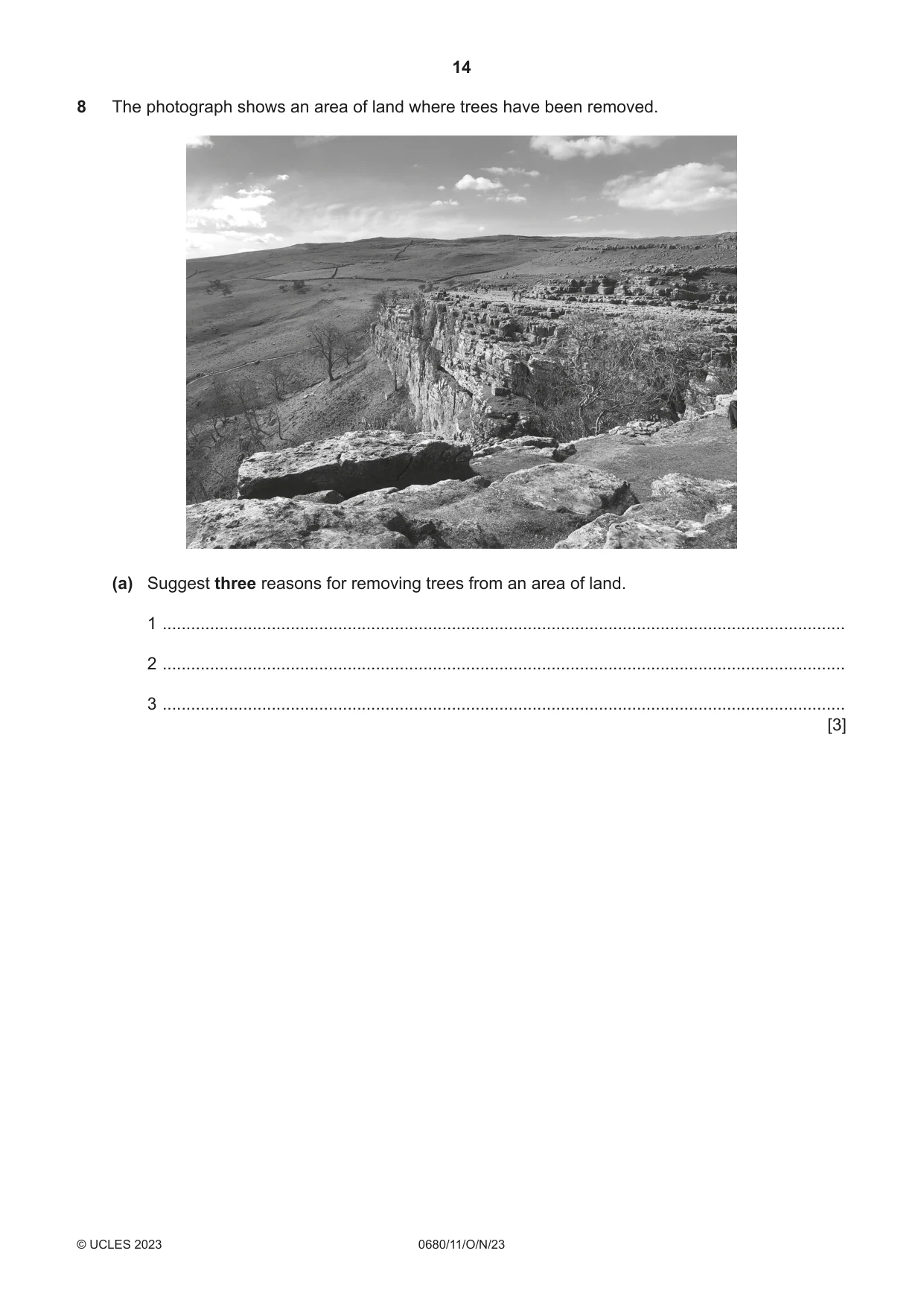
14 0680/11/O/N/23 © UCLES 2023 8 The photograph shows an area of land where trees have been removed. (a) Suggest three reasons for removing trees from an area of land. 1 … 2 … 3 … [3]
Question paper, page 15
15 0680/11/O/N/23 © UCLES 2023 [Turn over (b) Explain the impacts of deforestation. … … … … … … … … … … … … … … [7] [Total: 10]
Question paper, page 16
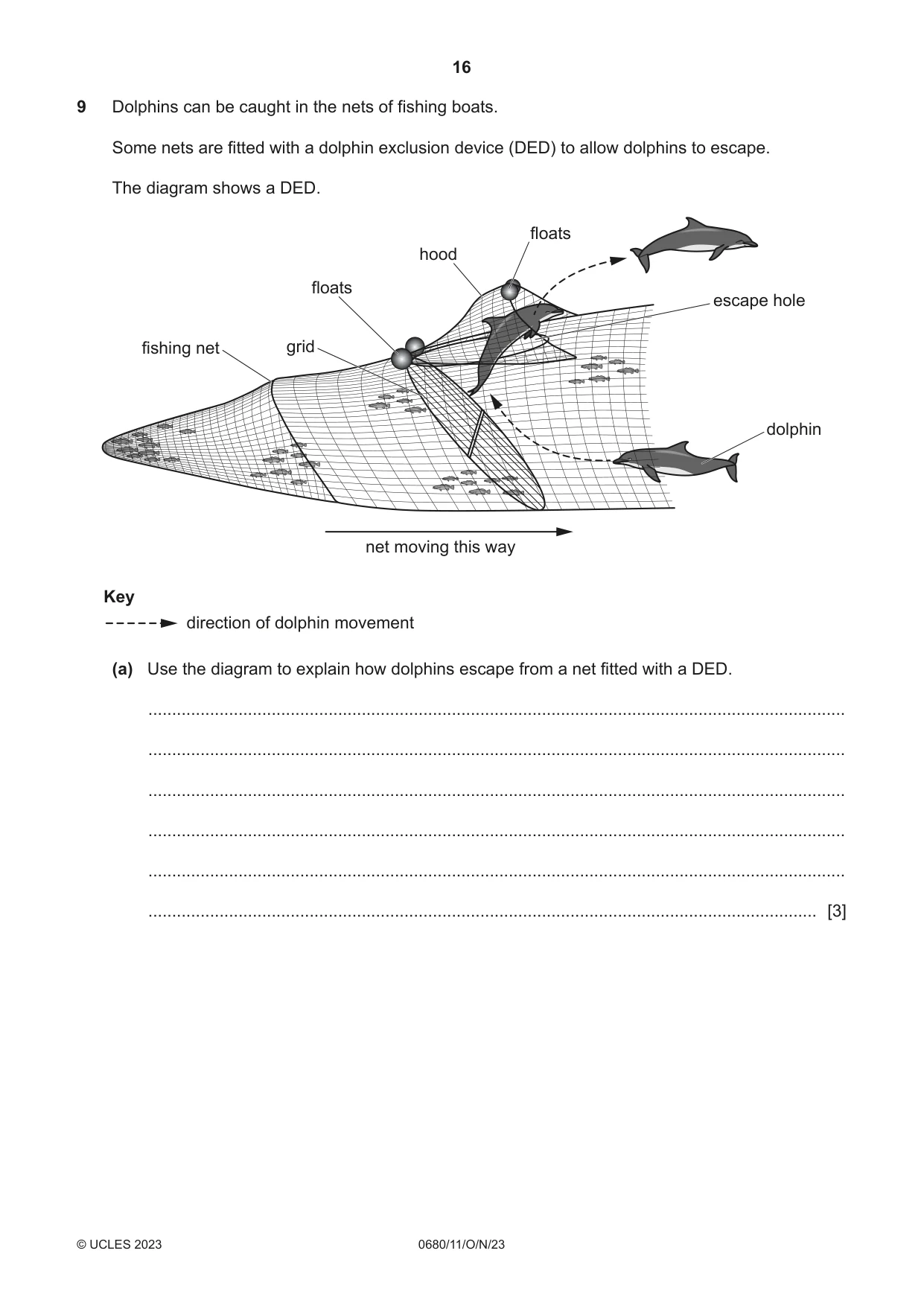
16 0680/11/O/N/23 © UCLES 2023 9 Dolphins can be caught in the nets of fishing boats. Some nets are fitted with a dolphin exclusion device (DED) to allow dolphins to escape. The diagram shows a DED. net moving this way direction of dolphin movement hood floats dolphin escape hole Key fishing net grid floats (a) Use the diagram to explain how dolphins escape from a net fitted with a DED. … … … … … … [3]
Question paper, page 17
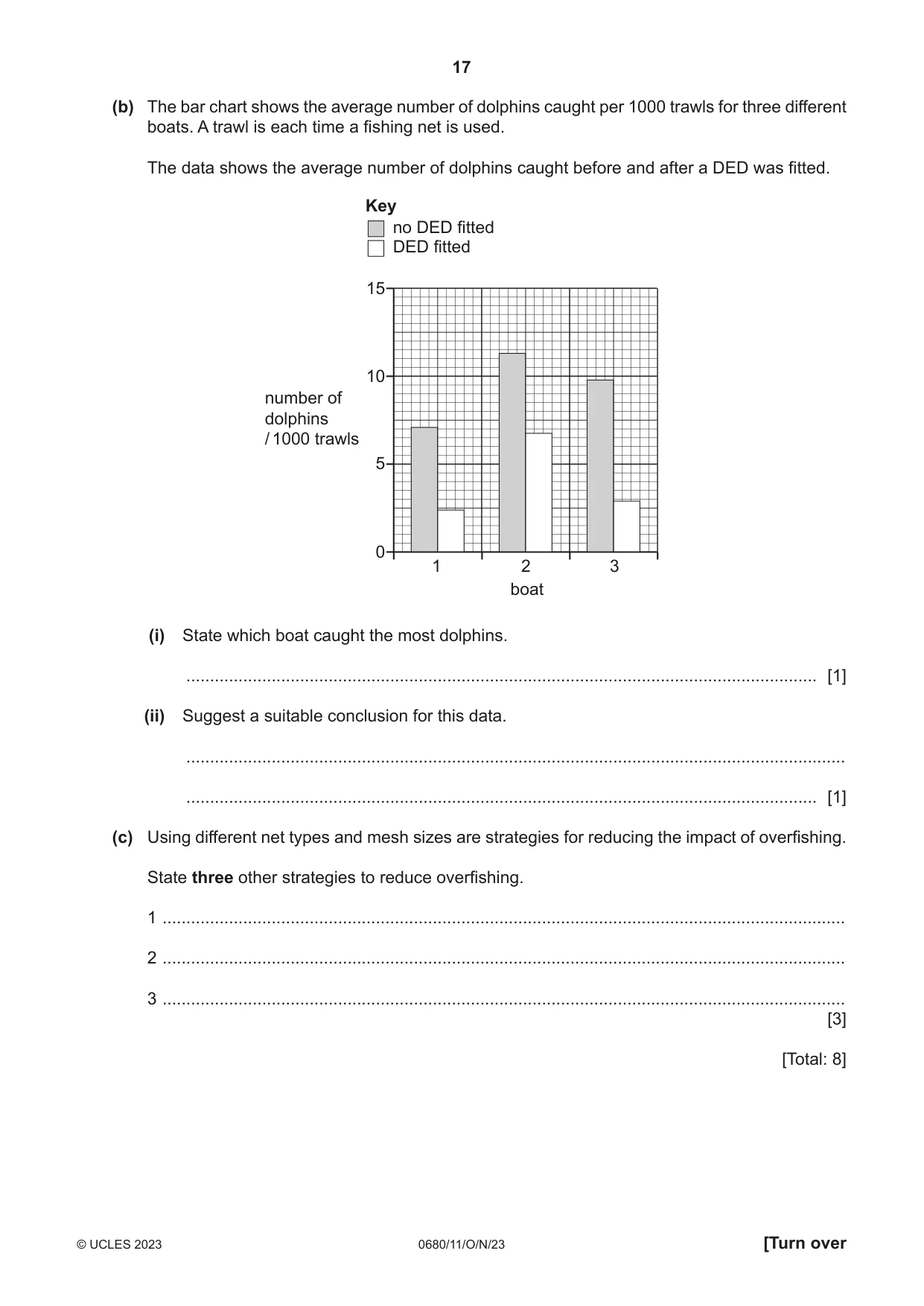
17 0680/11/O/N/23 © UCLES 2023 [Turn over (b) The bar chart shows the average number of dolphins caught per 1000 trawls for three different boats. A trawl is each time a fishing net is used. The data shows the average number of dolphins caught before and after a DED was fitted. 1 2 3 0 5 10 15 number of dolphins / 1000 trawls boat Key no DED fitted DED fitted (i) State which boat caught the most dolphins. … [1] (ii) Suggest a suitable conclusion for this data. … … [1] (c) Using different net types and mesh sizes are strategies for reducing the impact of overfishing. State three other strategies to reduce overfishing. 1 … 2 … 3 … [3] [Total: 8]
Question paper, page 18
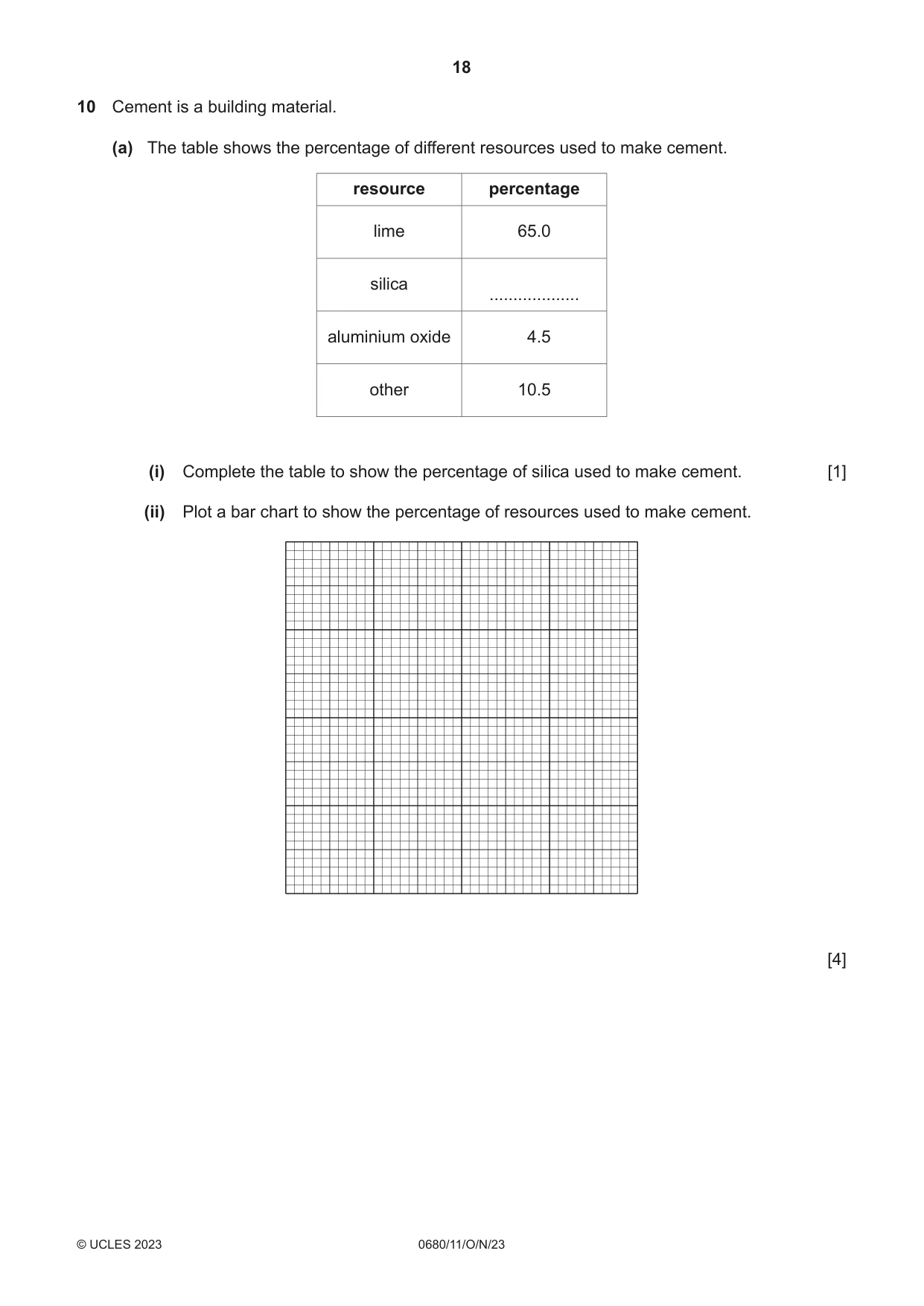
18 0680/11/O/N/23 © UCLES 2023 10 Cement is a building material. (a) The table shows the percentage of different resources used to make cement. resource percentage lime 65.0 silica … aluminium oxide 4.5 other 10.5 (i) Complete the table to show the percentage of silica used to make cement. [1] (ii) Plot a bar chart to show the percentage of resources used to make cement. [4]
Question paper, page 19
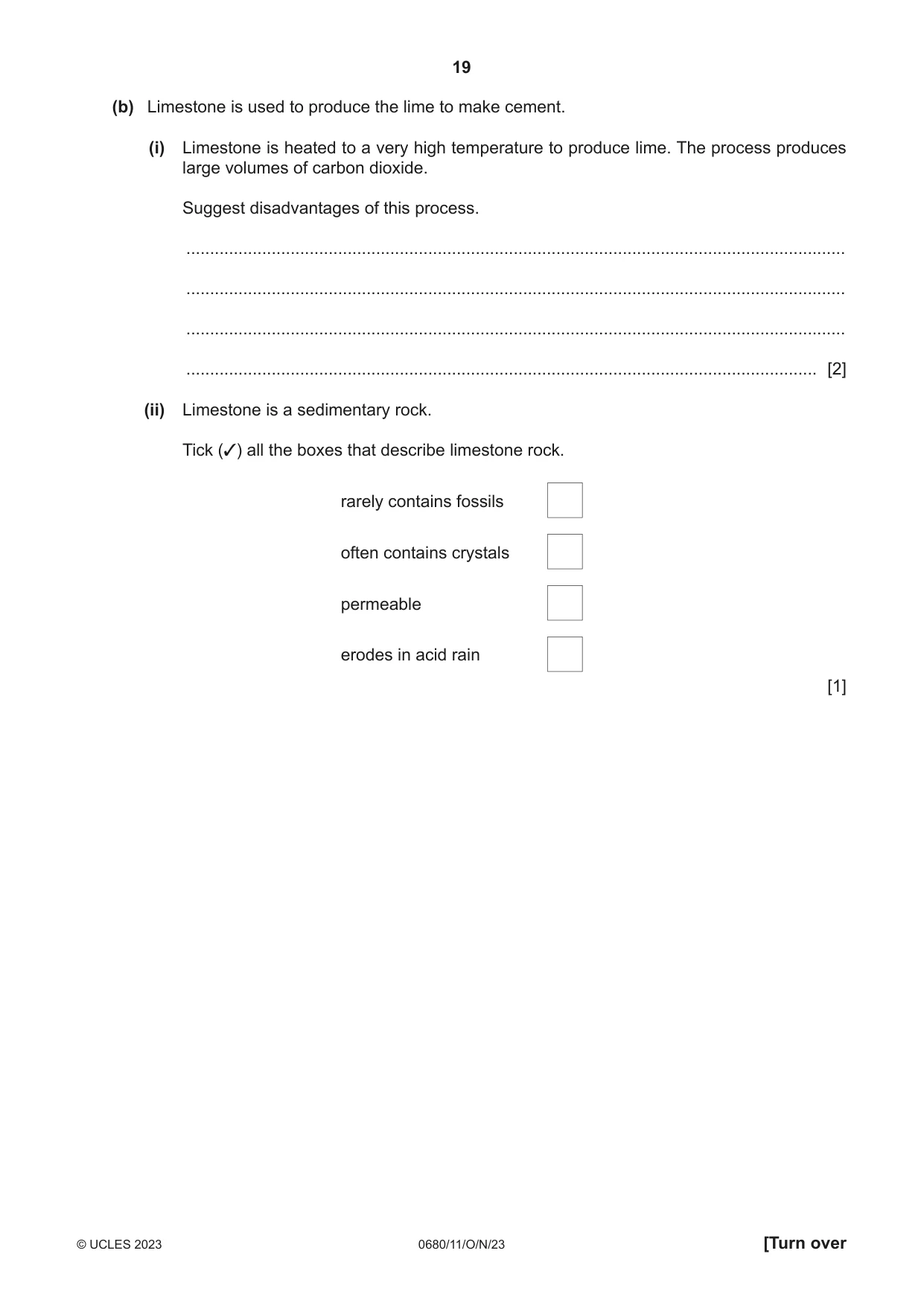
19 0680/11/O/N/23 © UCLES 2023 [Turn over (b) Limestone is used to produce the lime to make cement. (i) Limestone is heated to a very high temperature to produce lime. The process produces large volumes of carbon dioxide. Suggest disadvantages of this process. … … … … [2] (ii) Limestone is a sedimentary rock. Tick (✓) all the boxes that describe limestone rock. rarely contains fossils often contains crystals permeable erodes in acid rain [1]
Question paper, page 20
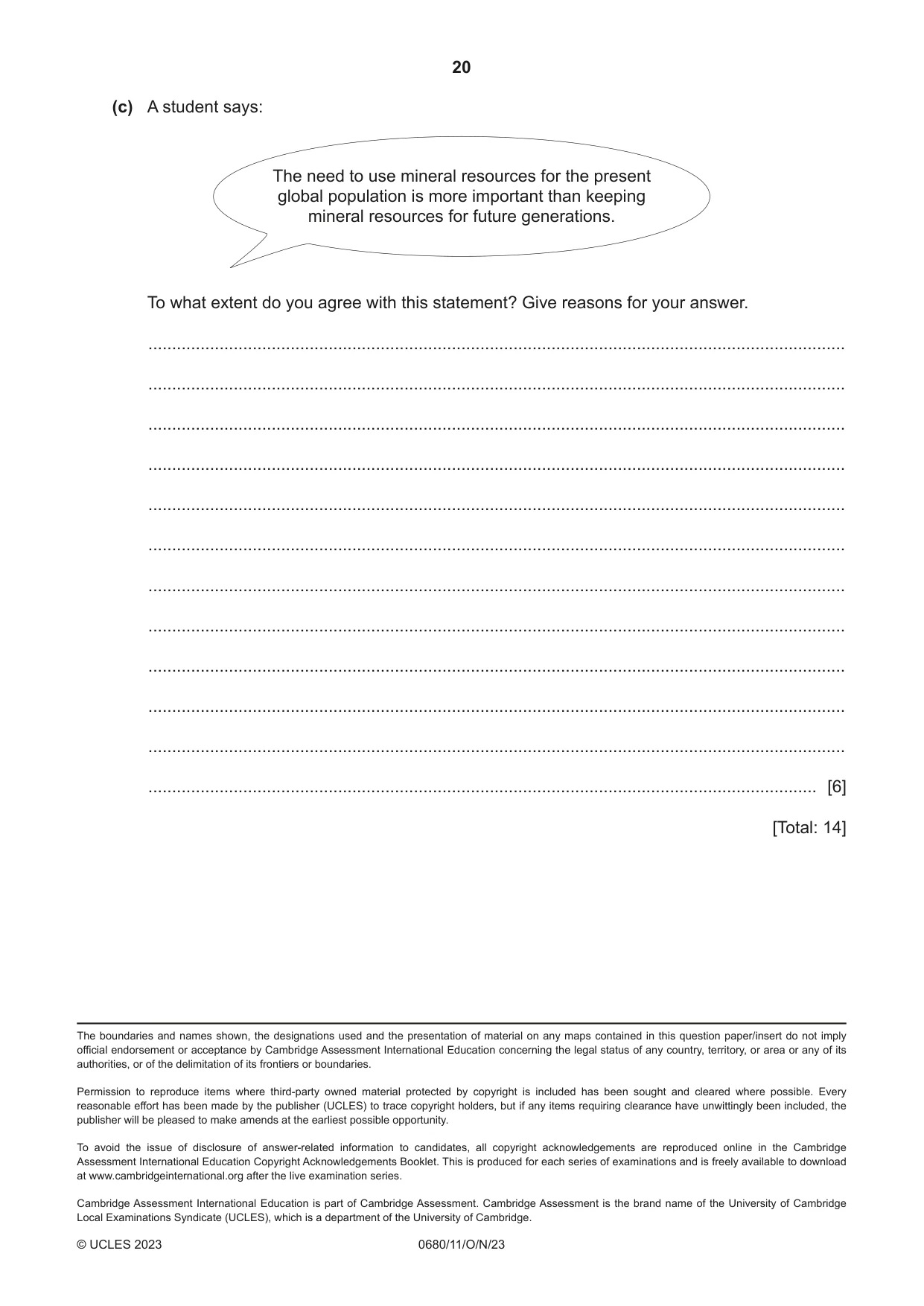
20 0680/11/O/N/23 © UCLES 2023 (c) A student says: The need to use mineral resources for the present global population is more important than keeping mineral resources for future generations. To what extent do you agree with this statement? Give reasons for your answer. … … … … … … … … … … … … [6] [Total: 14] The boundaries and names shown, the designations used and the presentation of material on any maps contained in this question paper/insert do not imply official endorsement or acceptance by Cambridge Assessment International Education concerning the legal status of any country, territory, or area or any of its authorities, or of the delimitation of its frontiers or boundaries. Permission to reproduce items where third‑party owned material protected by copyright is included has been sought and cleared where possible. Every reasonable effort has been made by the publisher (UCLES) to trace copyright holders, but if any items requiring clearance have unwittingly been included, the publisher will be pleased to make amends at the earliest possible opportunity. To avoid the issue of disclosure of answer‑related information to candidates, all copyright acknowledgements are reproduced online in the Cambridge Assessment International Education Copyright Acknowledgements Booklet. This is produced for each series of examinations and is freely available to download at www.cambridgeinternational.org after the live examination series. Cambridge Assessment International Education is part of Cambridge Assessment. Cambridge Assessment is the brand name of the University of Cambridge Local Examinations Syndicate (UCLES), which is a department of the University of Cambridge.
Mark scheme, page 1
This document consists of 12 printed pages. © UCLES 2023 [Turn over Cambridge IGCSE™ ENVIRONMENTAL MANAGEMENT 0680/11 Paper 1 Theory October/November 2023 MARK SCHEME Maximum Mark: 80 Published This mark scheme is published as an aid to teachers and candidates, to indicate the requirements of the examination. It shows the basis on which Examiners were instructed to award marks. It does not indicate the details of the discussions that took place at an Examiners’ meeting before marking began, which would have considered the acceptability of alternative answers. Mark schemes should be read in conjunction with the question paper and the Principal Examiner Report for Teachers. Cambridge International will not enter into discussions about these mark schemes. Cambridge International is publishing the mark schemes for the October/November 2023 series for most Cambridge IGCSE, Cambridge International A and AS Level components, and some Cambridge O Level components.
Mark scheme, page 2
0680/11 Cambridge IGCSE – Mark Scheme PUBLISHED October/November 2023 © UCLES 2023 Page 2 of 12 Generic Marking Principles These general marking principles must be applied by all examiners when marking candidate answers. They should be applied alongside the specific content of the mark scheme or generic level descriptors for a question. Each question paper and mark scheme will also comply with these marking principles. GENERIC MARKING PRINCIPLE 1: Marks must be awarded in line with: • the specific content of the mark scheme or the generic level descriptors for the question • the specific skills defined in the mark scheme or in the generic level descriptors for the question • the standard of response required by a candidate as exemplified by the standardisation scripts. GENERIC MARKING PRINCIPLE 2: Marks awarded are always whole marks (not half marks, or other fractions). GENERIC MARKING PRINCIPLE 3: Marks must be awarded positively: • marks are awarded for correct/valid answers, as defined in the mark scheme. However, credit is given for valid answers which go beyond the scope of the syllabus and mark scheme, referring to your Team Leader as appropriate • marks are awarded when candidates clearly demonstrate what they know and can do • marks are not deducted for errors • marks are not deducted for omissions • answers should only be judged on the quality of spelling, punctuation and grammar when these features are specifically assessed by the question as indicated by the mark scheme. The meaning, however, should be unambiguous. GENERIC MARKING PRINCIPLE 4: Rules must be applied consistently, e.g. in situations where candidates have not followed instructions or in the application of generic level descriptors.
Mark scheme, page 3
0680/11 Cambridge IGCSE – Mark Scheme PUBLISHED October/November 2023 © UCLES 2023 Page 3 of 12 GENERIC MARKING PRINCIPLE 5: Marks should be awarded using the full range of marks defined in the mark scheme for the question (however; the use of the full mark range may be limited according to the quality of the candidate responses seen). GENERIC MARKING PRINCIPLE 6: Marks awarded are based solely on the requirements as defined in the mark scheme. Marks should not be awarded with grade thresholds or grade descriptors in mind. Science-Specific Marking Principles 1 Examiners should consider the context and scientific use of any keywords when awarding marks. Although keywords may be present, marks should not be awarded if the keywords are used incorrectly. 2 The examiner should not choose between contradictory statements given in the same question part, and credit should not be awarded for any correct statement that is contradicted within the same question part. Wrong science that is irrelevant to the question should be ignored. 3 Although spellings do not have to be correct, spellings of syllabus terms must allow for clear and unambiguous separation from other syllabus terms with which they may be confused (e.g. ethane / ethene, glucagon / glycogen, refraction / reflection). 4 The error carried forward (ecf) principle should be applied, where appropriate. If an incorrect answer is subsequently used in a scientifically correct way, the candidate should be awarded these subsequent marking points. Further guidance will be included in the mark scheme where necessary and any exceptions to this general principle will be noted. 5 ‘List rule’ guidance For questions that require n responses (e.g. State two reasons …): • The response should be read as continuous prose, even when numbered answer spaces are provided. • Any response marked ignore in the mark scheme should not count towards n. • Incorrect responses should not be awarded credit but will still count towards n. • Read the entire response to check for any responses that contradict those that would otherwise be credited. Credit should not be awarded for any responses that are contradicted within the rest of the response. Where two responses contradict one another, this should be treated as a single incorrect response. • Non-contradictory responses after the first n responses may be ignored even if they include incorrect science.
Mark scheme, page 4
0680/11 Cambridge IGCSE – Mark Scheme PUBLISHED October/November 2023 © UCLES 2023 Page 4 of 12 6 Calculation specific guidance Correct answers to calculations should be given full credit even if there is no working or incorrect working, unless the question states ‘show your working’. For questions in which the number of significant figures required is not stated, credit should be awarded for correct answers when rounded by the examiner to the number of significant figures given in the mark scheme. This may not apply to measured values. For answers given in standard form (e.g. a 10n) in which the convention of restricting the value of the coefficient (a) to a value between 1 and 10 is not followed, credit may still be awarded if the answer can be converted to the answer given in the mark scheme. Unless a separate mark is given for a unit, a missing or incorrect unit will normally mean that the final calculation mark is not awarded. Exceptions to this general principle will be noted in the mark scheme. 7 Guidance for chemical equations Multiples / fractions of coefficients used in chemical equations are acceptable unless stated otherwise in the mark scheme. State symbols given in an equation should be ignored unless asked for in the question or stated otherwise in the mark scheme.
Mark scheme, page 5
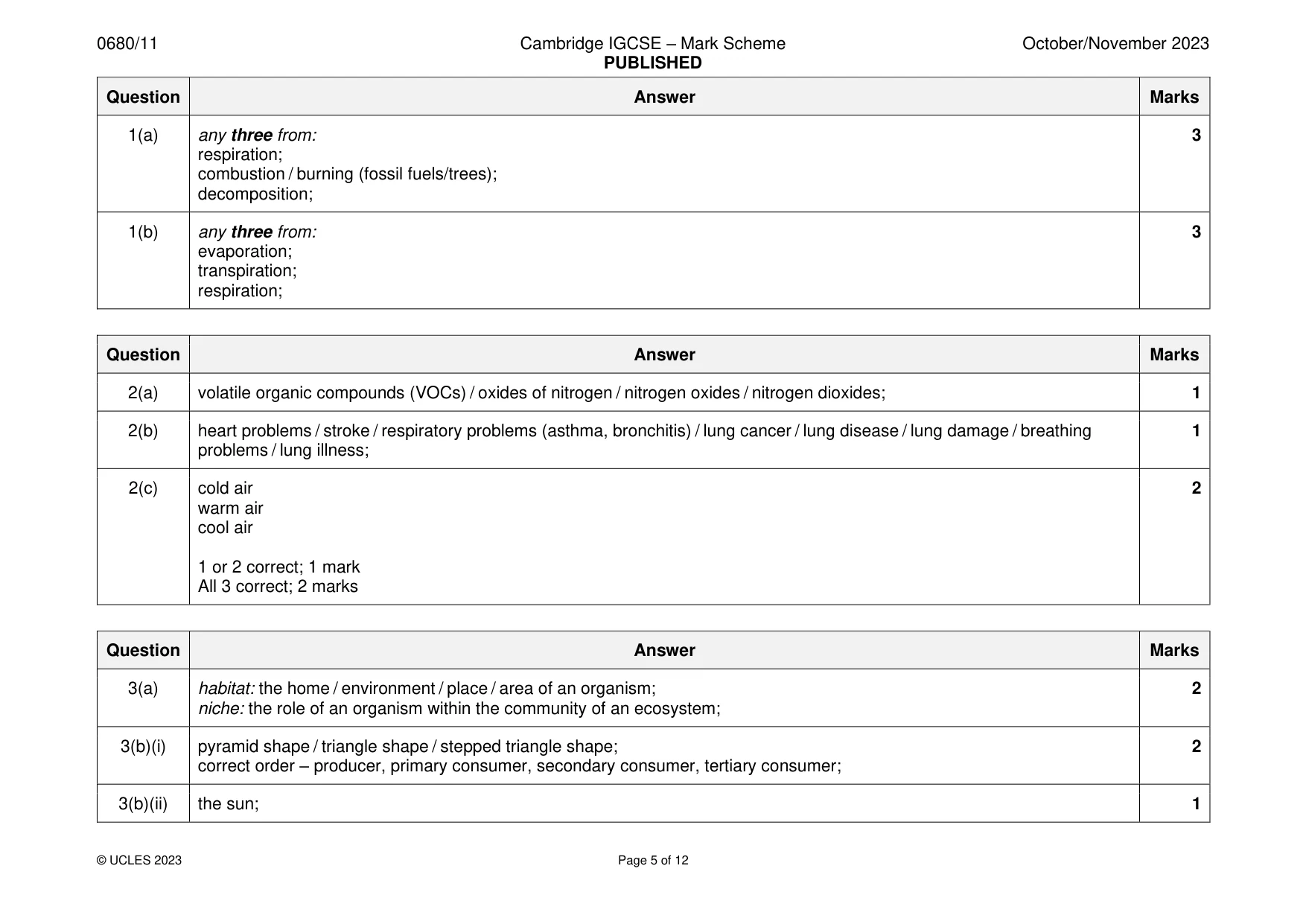
0680/11 Cambridge IGCSE – Mark Scheme PUBLISHED October/November 2023 © UCLES 2023 Page 5 of 12 Question Answer Marks 1(a) any three from: respiration; combustion / burning (fossil fuels/trees); decomposition; 3 1(b) any three from: evaporation; transpiration; respiration; 3 Question Answer Marks 2(a) volatile organic compounds (VOCs) / oxides of nitrogen / nitrogen oxides / nitrogen dioxides; 1 2(b) heart problems / stroke / respiratory problems (asthma, bronchitis) / lung cancer / lung disease / lung damage / breathing problems / lung illness; 1 2(c) cold air warm air cool air 1 or 2 correct; 1 mark All 3 correct; 2 marks 2 Question Answer Marks 3(a) habitat: the home / environment / place / area of an organism; niche: the role of an organism within the community of an ecosystem; 2 3(b)(i) pyramid shape / triangle shape / stepped triangle shape; correct order – producer, primary consumer, secondary consumer, tertiary consumer; 2 3(b)(ii) the sun; 1
Mark scheme, page 6
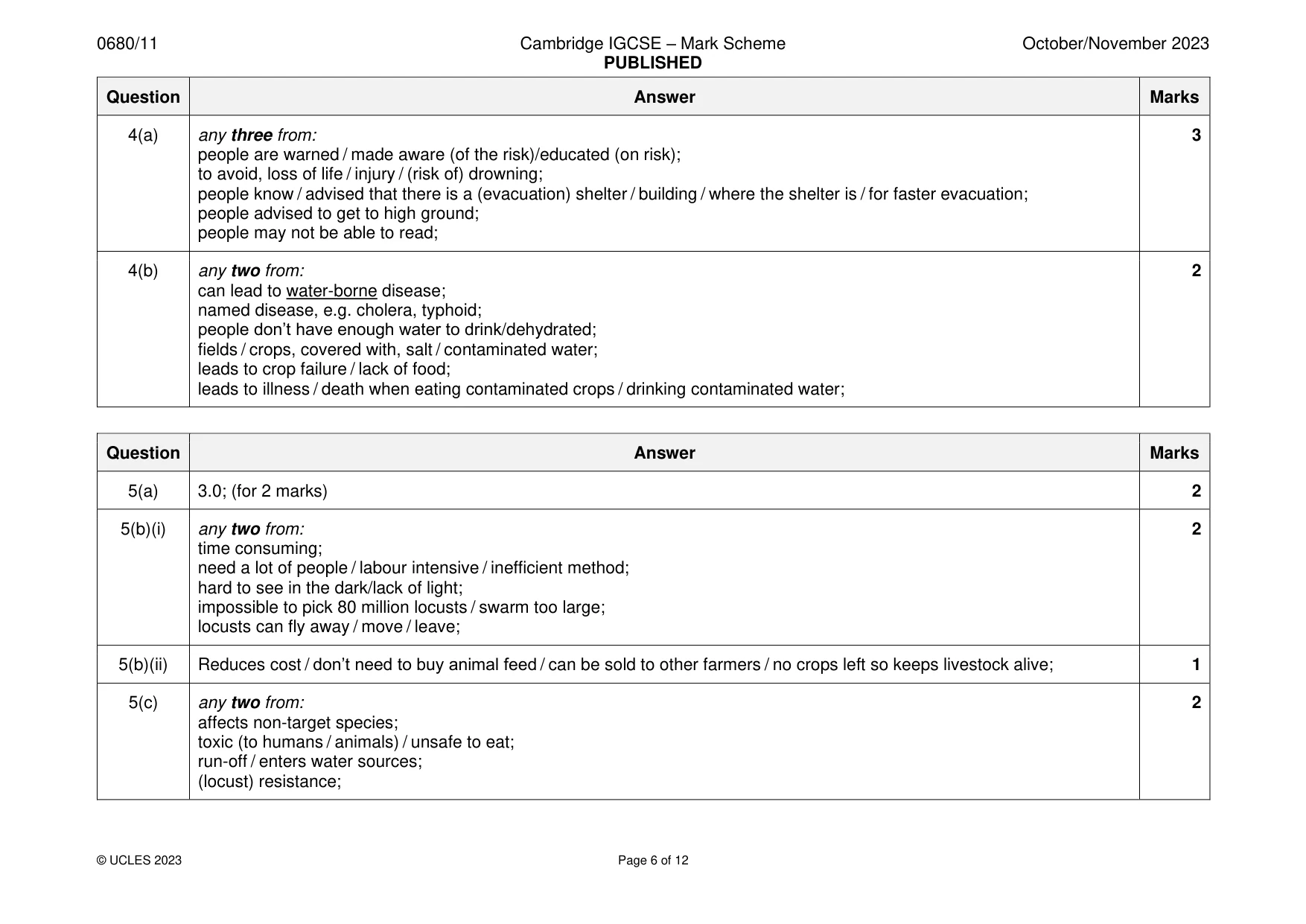
0680/11 Cambridge IGCSE – Mark Scheme PUBLISHED October/November 2023 © UCLES 2023 Page 6 of 12 Question Answer Marks 4(a) any three from: people are warned / made aware (of the risk)/educated (on risk); to avoid, loss of life / injury / (risk of) drowning; people know / advised that there is a (evacuation) shelter / building / where the shelter is / for faster evacuation; people advised to get to high ground; people may not be able to read; 3 4(b) any two from: can lead to water-borne disease; named disease, e.g. cholera, typhoid; people don’t have enough water to drink/dehydrated; fields / crops, covered with, salt / contaminated water; leads to crop failure / lack of food; leads to illness / death when eating contaminated crops / drinking contaminated water; 2 Question Answer Marks 5(a) 3.0; (for 2 marks) 2 5(b)(i) any two from: time consuming; need a lot of people / labour intensive / inefficient method; hard to see in the dark/lack of light; impossible to pick 80 million locusts / swarm too large; locusts can fly away / move / leave; 2 5(b)(ii) Reduces cost / don’t need to buy animal feed / can be sold to other farmers / no crops left so keeps livestock alive; 1 5(c) any two from: affects non-target species; toxic (to humans / animals) / unsafe to eat; run-off / enters water sources; (locust) resistance; 2
Mark scheme, page 7
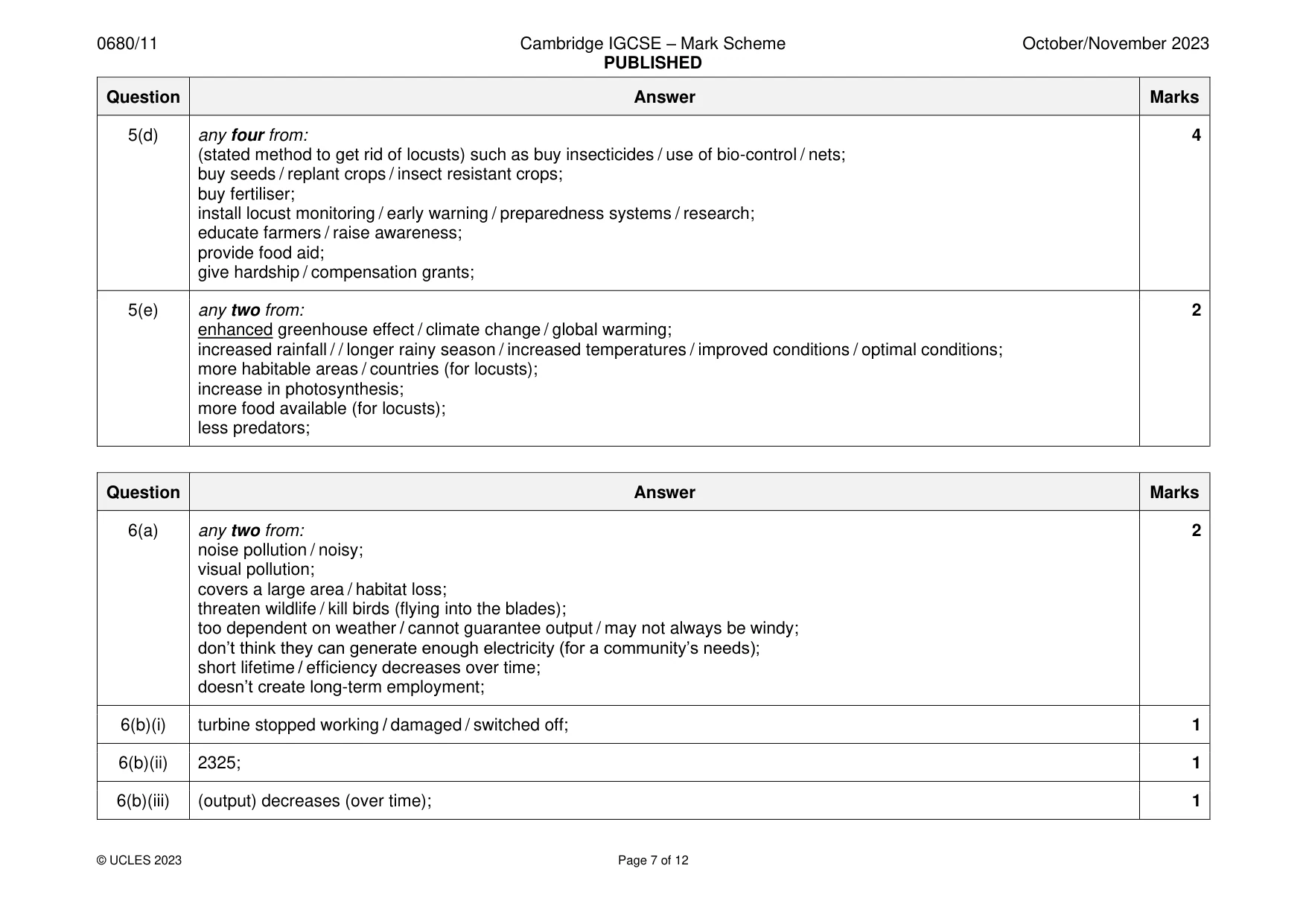
0680/11 Cambridge IGCSE – Mark Scheme PUBLISHED October/November 2023 © UCLES 2023 Page 7 of 12 Question Answer Marks 5(d) any four from: (stated method to get rid of locusts) such as buy insecticides / use of bio-control / nets; buy seeds / replant crops / insect resistant crops; buy fertiliser; install locust monitoring / early warning / preparedness systems / research; educate farmers / raise awareness; provide food aid; give hardship / compensation grants; 4 5(e) any two from: enhanced greenhouse effect / climate change / global warming; increased rainfall / / longer rainy season / increased temperatures / improved conditions / optimal conditions; more habitable areas / countries (for locusts); increase in photosynthesis; more food available (for locusts); less predators; 2 Question Answer Marks 6(a) any two from: noise pollution / noisy; visual pollution; covers a large area / habitat loss; threaten wildlife / kill birds (flying into the blades); too dependent on weather / cannot guarantee output / may not always be windy; don’t think they can generate enough electricity (for a community’s needs); short lifetime / efficiency decreases over time; doesn’t create long-term employment; 2 6(b)(i) turbine stopped working / damaged / switched off; 1 6(b)(ii) 2325; 1 6(b)(iii) (output) decreases (over time); 1
Mark scheme, page 8
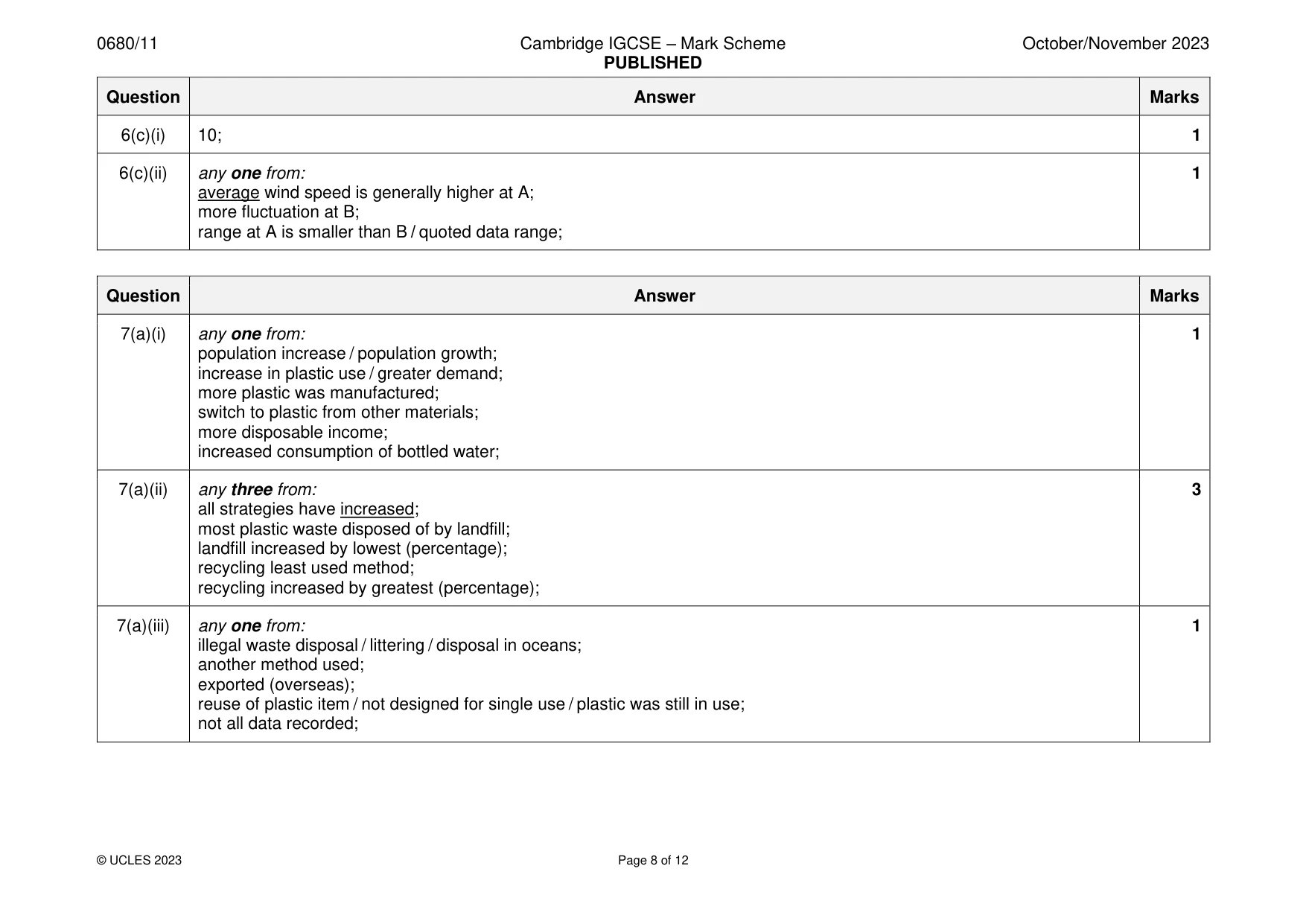
0680/11 Cambridge IGCSE – Mark Scheme PUBLISHED October/November 2023 © UCLES 2023 Page 8 of 12 Question Answer Marks 6(c)(i) 10; 1 6(c)(ii) any one from: average wind speed is generally higher at A; more fluctuation at B; range at A is smaller than B / quoted data range; 1 Question Answer Marks 7(a)(i) any one from: population increase / population growth; increase in plastic use / greater demand; more plastic was manufactured; switch to plastic from other materials; more disposable income; increased consumption of bottled water; 1 7(a)(ii) any three from: all strategies have increased; most plastic waste disposed of by landfill; landfill increased by lowest (percentage); recycling least used method; recycling increased by greatest (percentage); 3 7(a)(iii) any one from: illegal waste disposal / littering / disposal in oceans; another method used; exported (overseas); reuse of plastic item / not designed for single use / plastic was still in use; not all data recorded; 1
Mark scheme, page 9
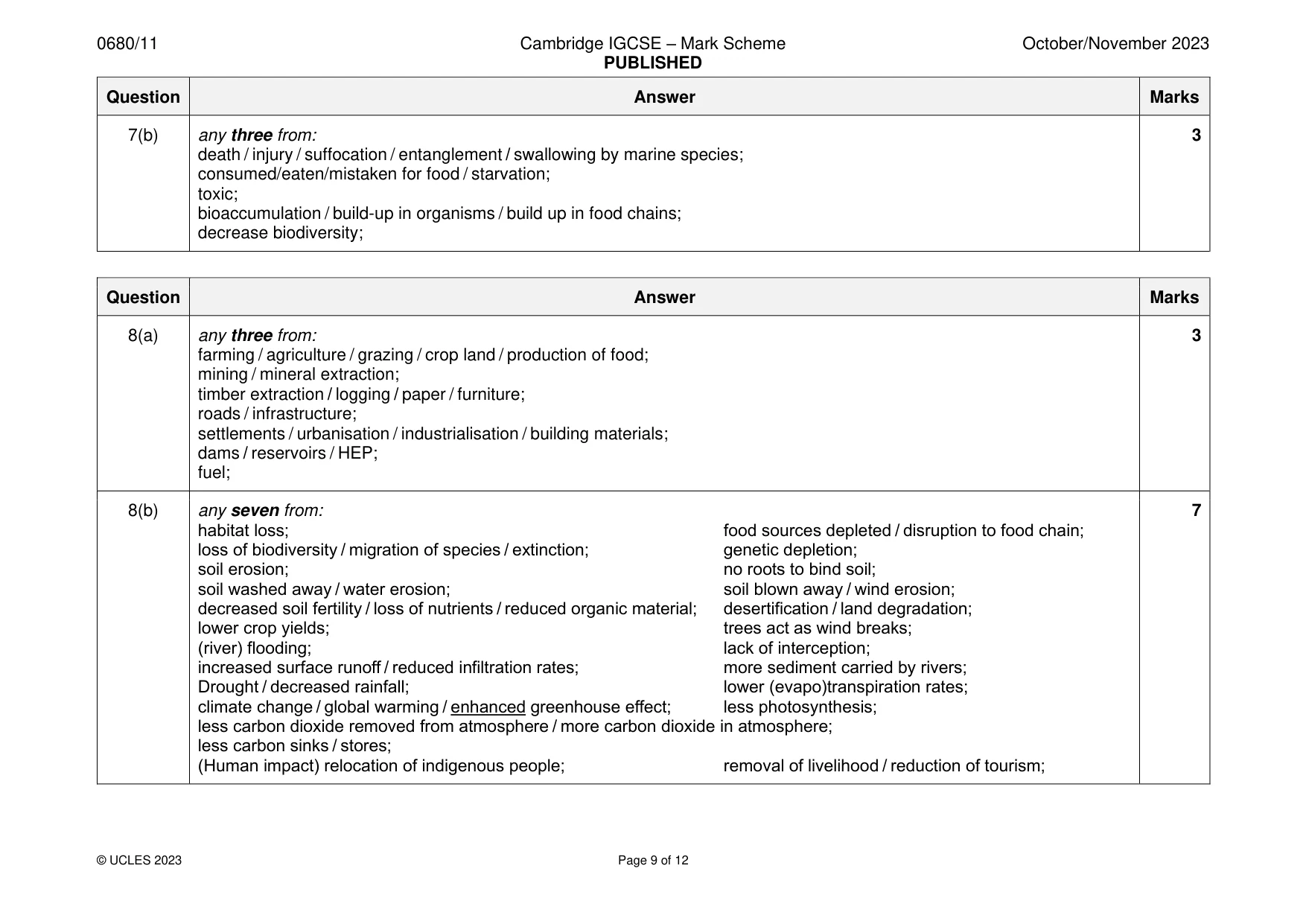
0680/11 Cambridge IGCSE – Mark Scheme PUBLISHED October/November 2023 © UCLES 2023 Page 9 of 12 Question Answer Marks 7(b) any three from: death / injury / suffocation / entanglement / swallowing by marine species; consumed/eaten/mistaken for food / starvation; toxic; bioaccumulation / build-up in organisms / build up in food chains; decrease biodiversity; 3 Question Answer Marks 8(a) any three from: farming / agriculture / grazing / crop land / production of food; mining / mineral extraction; timber extraction / logging / paper / furniture; roads / infrastructure; settlements / urbanisation / industrialisation / building materials; dams / reservoirs / HEP; fuel; 3 8(b) any seven from: habitat loss; food sources depleted / disruption to food chain; loss of biodiversity / migration of species / extinction; genetic depletion; soil erosion; no roots to bind soil; soil washed away / water erosion; soil blown away / wind erosion; decreased soil fertility / loss of nutrients / reduced organic material; desertification / land degradation; lower crop yields; trees act as wind breaks; (river) flooding; lack of interception; increased surface runoff / reduced infiltration rates; more sediment carried by rivers; Drought / decreased rainfall; lower (evapo)transpiration rates; climate change / global warming / enhanced greenhouse effect; less photosynthesis; less carbon dioxide removed from atmosphere / more carbon dioxide in atmosphere; less carbon sinks / stores; (Human impact) relocation of indigenous people; removal of livelihood / reduction of tourism; 7
Mark scheme, page 10
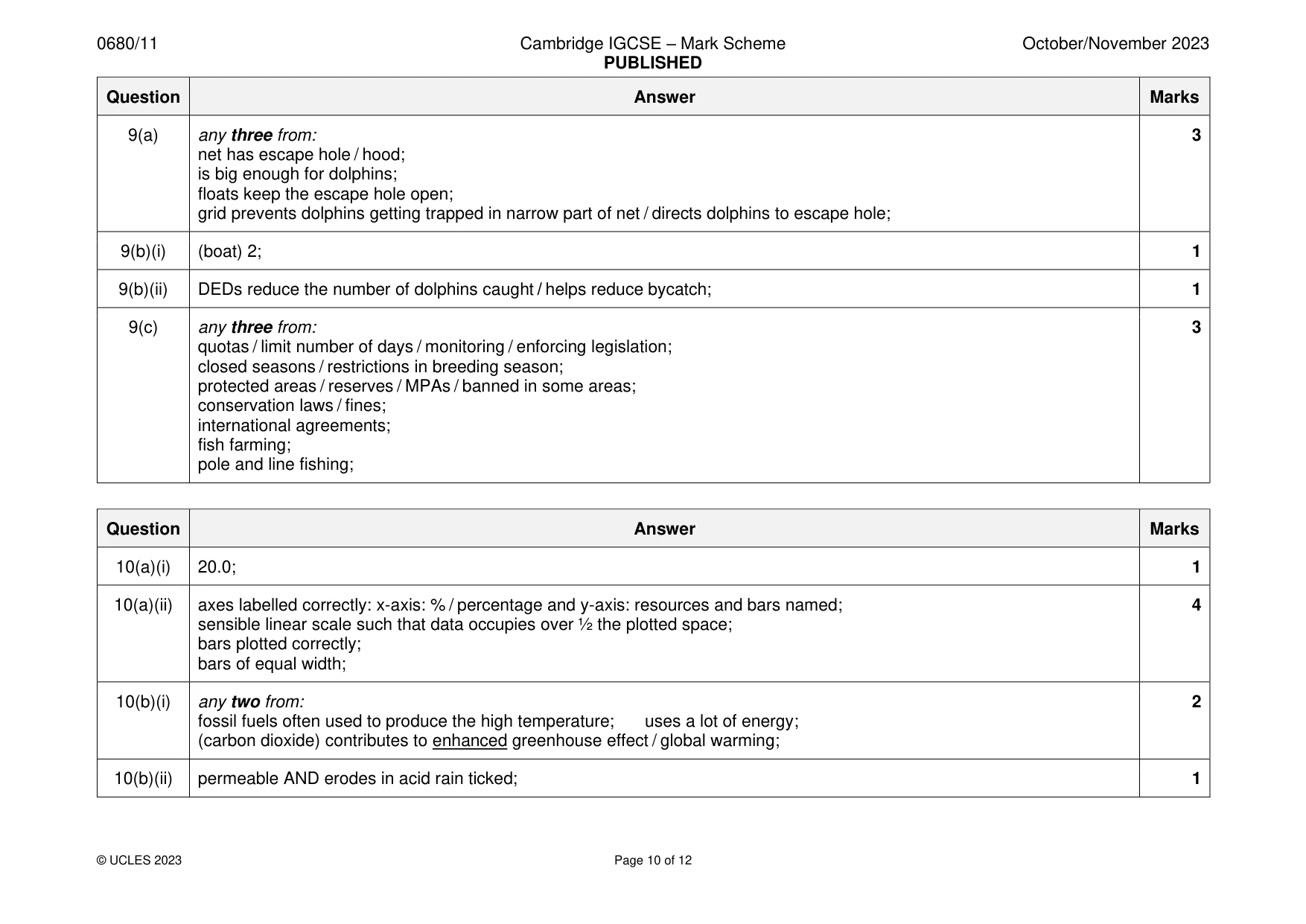
0680/11 Cambridge IGCSE – Mark Scheme PUBLISHED October/November 2023 © UCLES 2023 Page 10 of 12 Question Answer Marks 9(a) any three from: net has escape hole / hood; is big enough for dolphins; floats keep the escape hole open; grid prevents dolphins getting trapped in narrow part of net / directs dolphins to escape hole; 3 9(b)(i) (boat) 2; 1 9(b)(ii) DEDs reduce the number of dolphins caught / helps reduce bycatch; 1 9(c) any three from: quotas / limit number of days / monitoring / enforcing legislation; closed seasons / restrictions in breeding season; protected areas / reserves / MPAs / banned in some areas; conservation laws / fines; international agreements; fish farming; pole and line fishing; 3 Question Answer Marks 10(a)(i) 20.0; 1 10(a)(ii) axes labelled correctly: x-axis: % / percentage and y-axis: resources and bars named; sensible linear scale such that data occupies over ½ the plotted space; bars plotted correctly; bars of equal width; 4 10(b)(i) any two from: fossil fuels often used to produce the high temperature; uses a lot of energy; (carbon dioxide) contributes to enhanced greenhouse effect / global warming; 2 10(b)(ii) permeable AND erodes in acid rain ticked; 1
Mark scheme, page 11
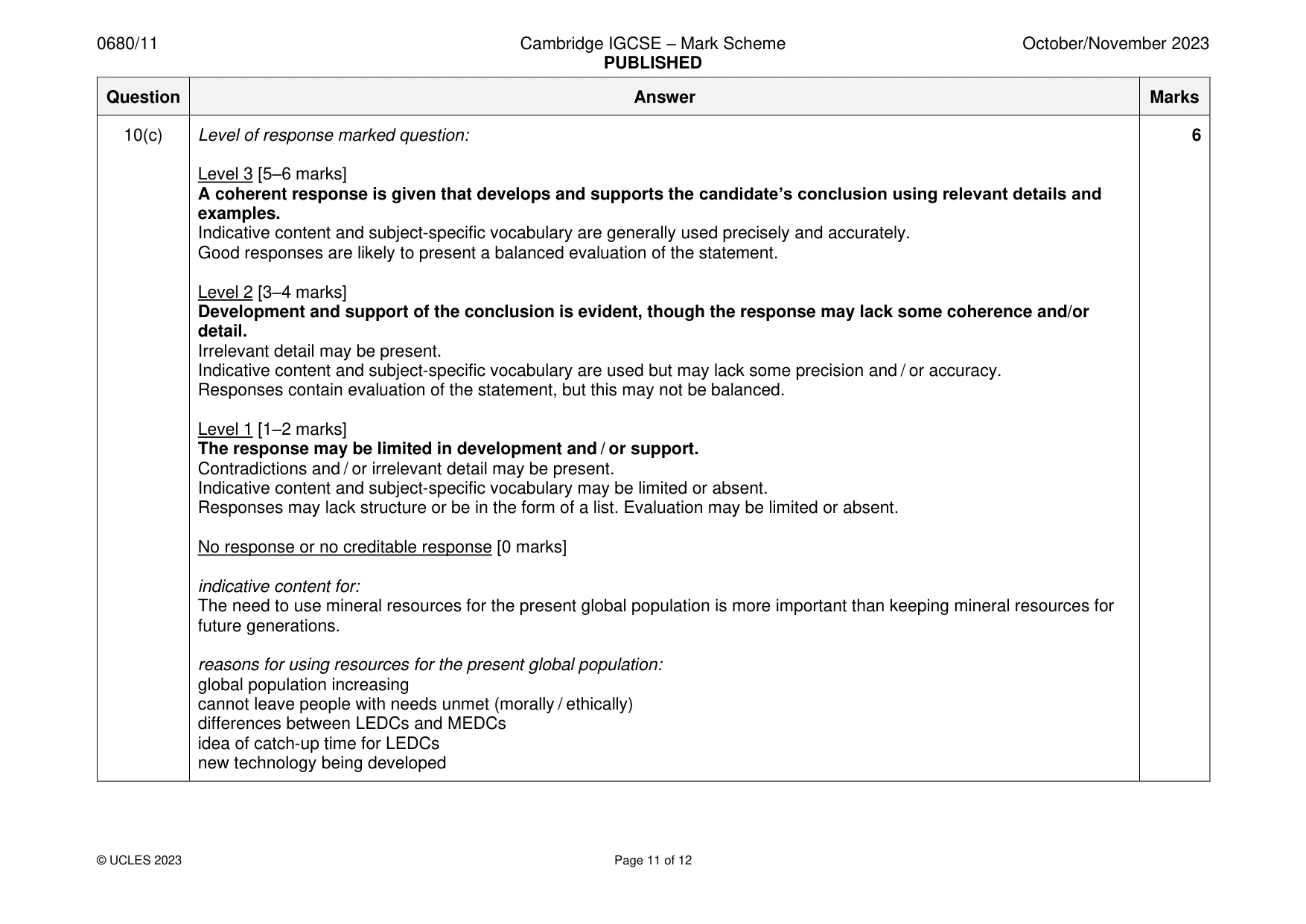
0680/11 Cambridge IGCSE – Mark Scheme PUBLISHED October/November 2023 © UCLES 2023 Page 11 of 12 Question Answer Marks 10(c) Level of response marked question: Level 3 [5–6 marks] A coherent response is given that develops and supports the candidate’s conclusion using relevant details and examples. Indicative content and subject-specific vocabulary are generally used precisely and accurately. Good responses are likely to present a balanced evaluation of the statement. Level 2 [3–4 marks] Development and support of the conclusion is evident, though the response may lack some coherence and/or detail. Irrelevant detail may be present. Indicative content and subject-specific vocabulary are used but may lack some precision and / or accuracy. Responses contain evaluation of the statement, but this may not be balanced. Level 1 [1–2 marks] The response may be limited in development and / or support. Contradictions and / or irrelevant detail may be present. Indicative content and subject-specific vocabulary may be limited or absent. Responses may lack structure or be in the form of a list. Evaluation may be limited or absent. No response or no creditable response [0 marks] indicative content for: The need to use mineral resources for the present global population is more important than keeping mineral resources for future generations. reasons for using resources for the present global population: global population increasing cannot leave people with needs unmet (morally / ethically) differences between LEDCs and MEDCs idea of catch-up time for LEDCs new technology being developed 6
Mark scheme, page 12
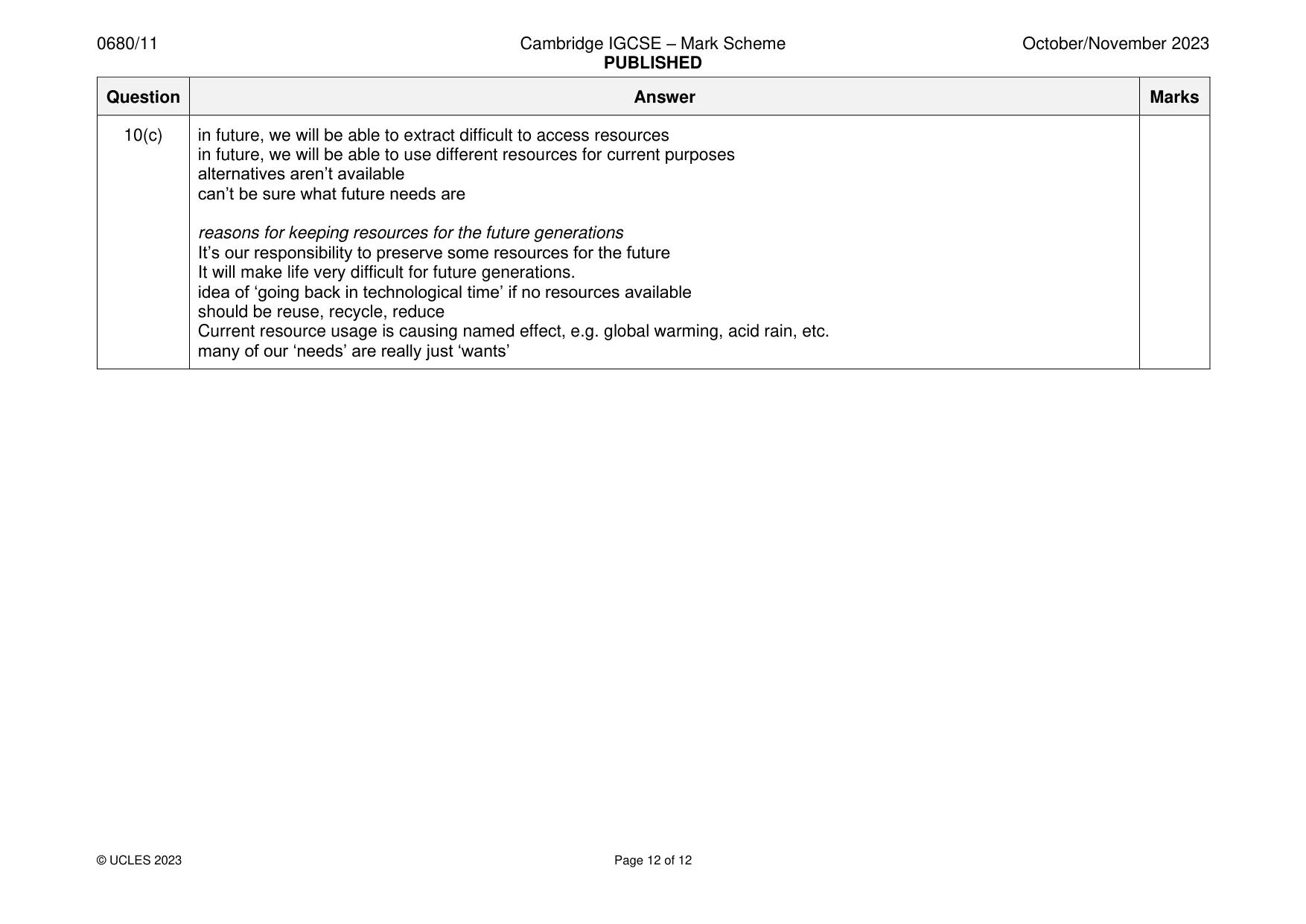
0680/11 Cambridge IGCSE – Mark Scheme PUBLISHED October/November 2023 © UCLES 2023 Page 12 of 12 Question Answer Marks 10(c) in future, we will be able to extract difficult to access resources in future, we will be able to use different resources for current purposes alternatives aren’t available can’t be sure what future needs are reasons for keeping resources for the future generations It’s our responsibility to preserve some resources for the future It will make life very difficult for future generations. idea of ‘going back in technological time’ if no resources available should be reuse, recycle, reduce Current resource usage is causing named effect, e.g. global warming, acid rain, etc. many of our ‘needs’ are really just ‘wants’
What you needed in this session
Cambridge’s own grade thresholds for 2023 Oct/Nov, Paper 1 · Variant 1. A higher threshold means an easier paper — the bar moves with how the cohort did.