Cambridge IGCSE Environmental Management 0680 — 2021 Oct/Nov Paper 1 · Variant 2
0680/12/O/N/21 · 80 marks · ≈90 min
The question paper and its mark scheme, free to read here and free to download. This is Cambridge’s own paper, exactly as it was sat.
Question paper20 pages






Mark scheme16 pages
Answers below. Sit the paper first if you are practising.
Paper as text
Question paper, page 1
This document has 20 pages. Any blank pages are indicated. Cambridge IGCSE™ ENVIRONMENTAL MANAGEMENT 0680/12 Paper 1 Theory October/November 2021 1 hour 45 minutes You must answer on the question paper. No additional materials are needed. INSTRUCTIONS ● Answer all questions. ● Use a black or dark blue pen. You may use an HB pencil for any diagrams or graphs. ● Write your name, centre number and candidate number in the boxes at the top of the page. ● Write your answer to each question in the space provided. ● Do not use an erasable pen or correction fluid. ● Do not write on any bar codes. ● You may use a calculator. ● You should show all your working and use appropriate units. INFORMATION ● The total mark for this paper is 80. ● The number of marks for each question or part question is shown in brackets [ ]. * 4 5 3 8 3 7 4 1 7 7 * DC (MB/JG) 211569/2 © UCLES 2021 [Turn over
Question paper, page 2
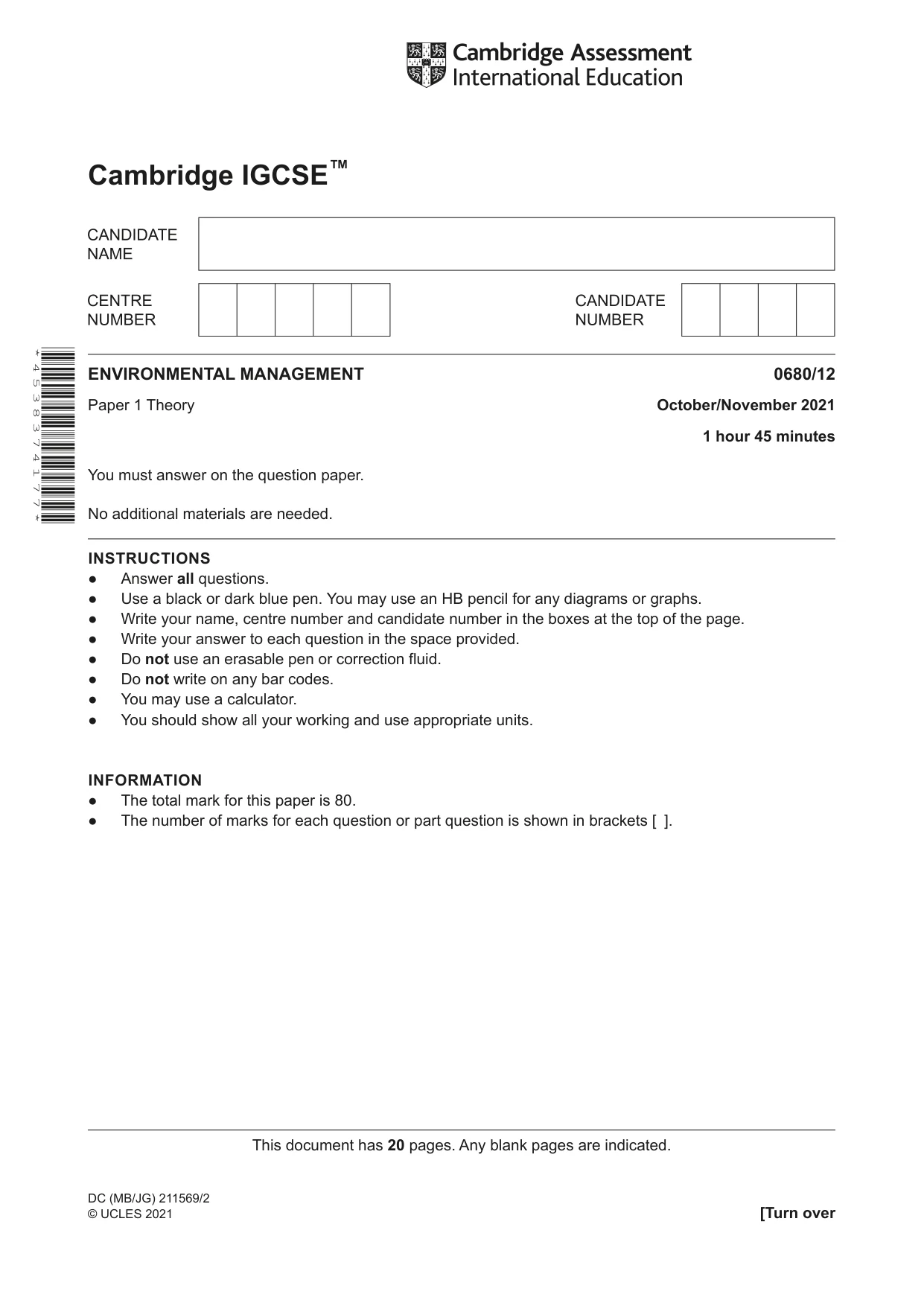
2 0680/12/O/N/21 © UCLES 2021 Section A 1 Green plants produce glucose by a process called photosynthesis. The diagram shows the process of photosynthesis. The diagram is not complete. … … … … (a) Complete the diagram by adding the words to the boxes. carbon dioxide oxygen sunlight water [2] (b) State the name of the green pigment in the leaves of green plants. … [1] (c) State the name of the process in plants that uses glucose. … [1] (d) Explain why crop yield increases when plants are grown in greenhouses. … … … … [2] [Total: 6]
Question paper, page 3
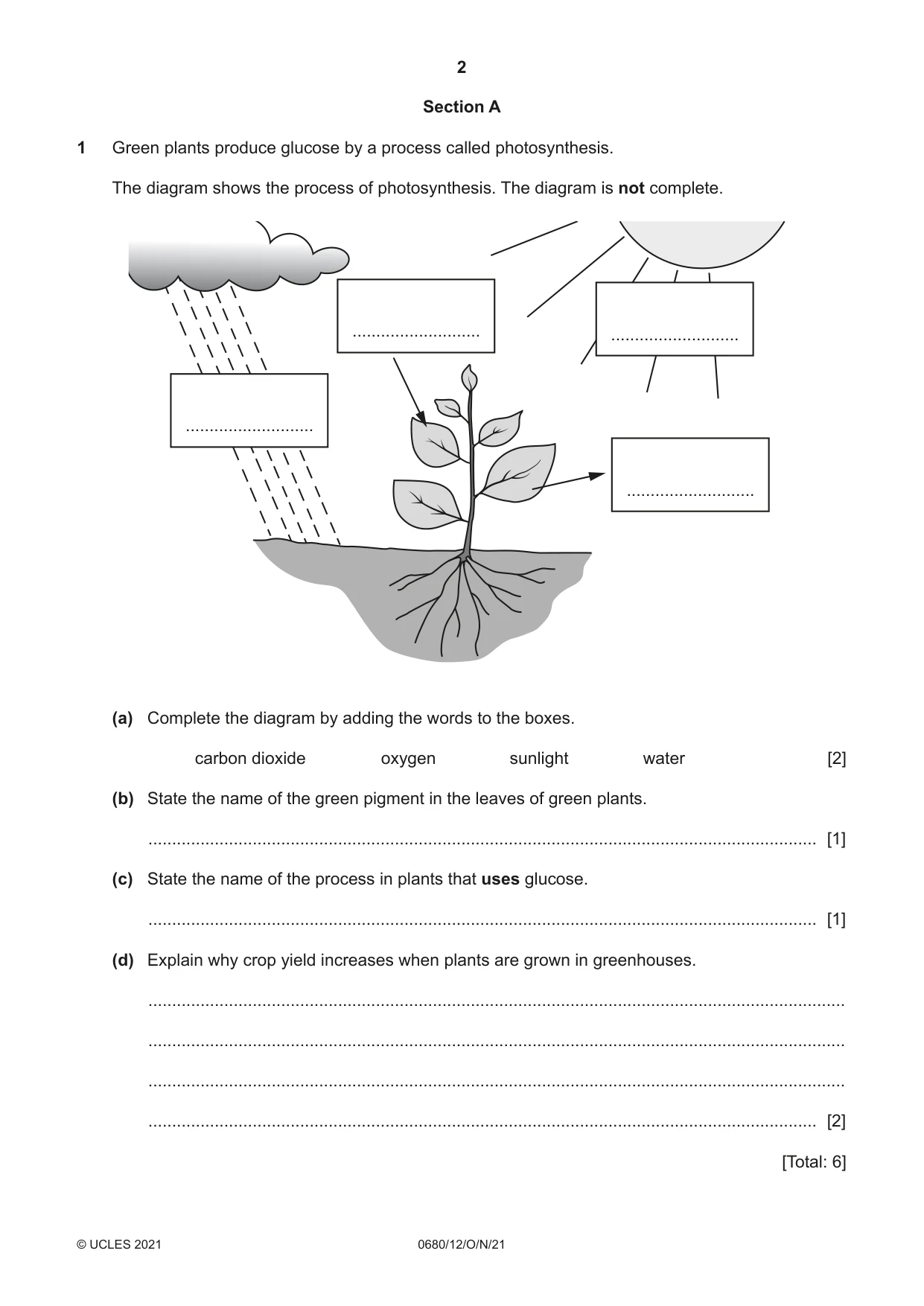
3 0680/12/O/N/21 © UCLES 2021 [Turn over 2 The photograph shows a large area of farmland. (a) Circle the type of agriculture shown in the photograph. commercial arable subsistence arable commercial pastoral subsistence pastoral [1] (b) Crop yield can be increased by improving irrigation methods. State two other methods of increasing crop yield. 1 … 2 … [2] (c) State two ways of damaging soil by the mismanagement of irrigation. 1 … 2 … [2] [Total: 5]
Question paper, page 4
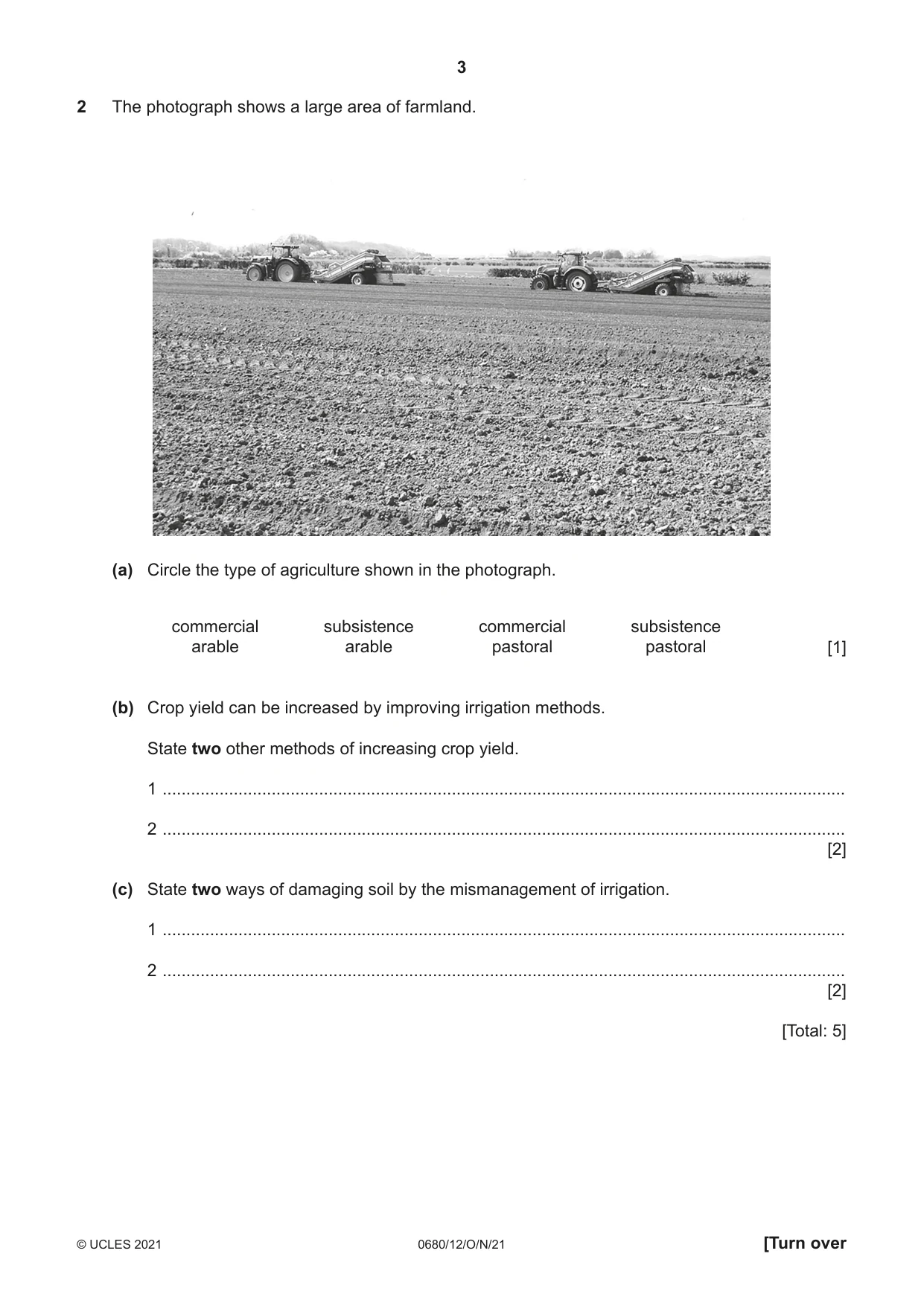
4 0680/12/O/N/21 © UCLES 2021 3 The poster shows a health campaign about preventing the spread of cholera. STOP CHOLERA PREVENTION TIPS 1 2 3 4 wash your hands with soap have a vaccination drink safe water keep cooking areas clean (a) Explain how these prevention tips can reduce the spread of cholera. … … … … … … [3] (b) Suggest why there are more outbreaks of cholera in less economically developed countries (LEDCs) than in more economically developed countries (MEDCs). … … … … [2] [Total: 5]
Question paper, page 5
5 0680/12/O/N/21 © UCLES 2021 [Turn over 4 The photograph shows an area of high population density in a city. (a) Suggest two reasons for high population density in a city. 1 … … 2 … … [2] (b) State two strategies for managing the population size of a country. 1 … … 2 … … [2] [Total: 4]
Question paper, page 6
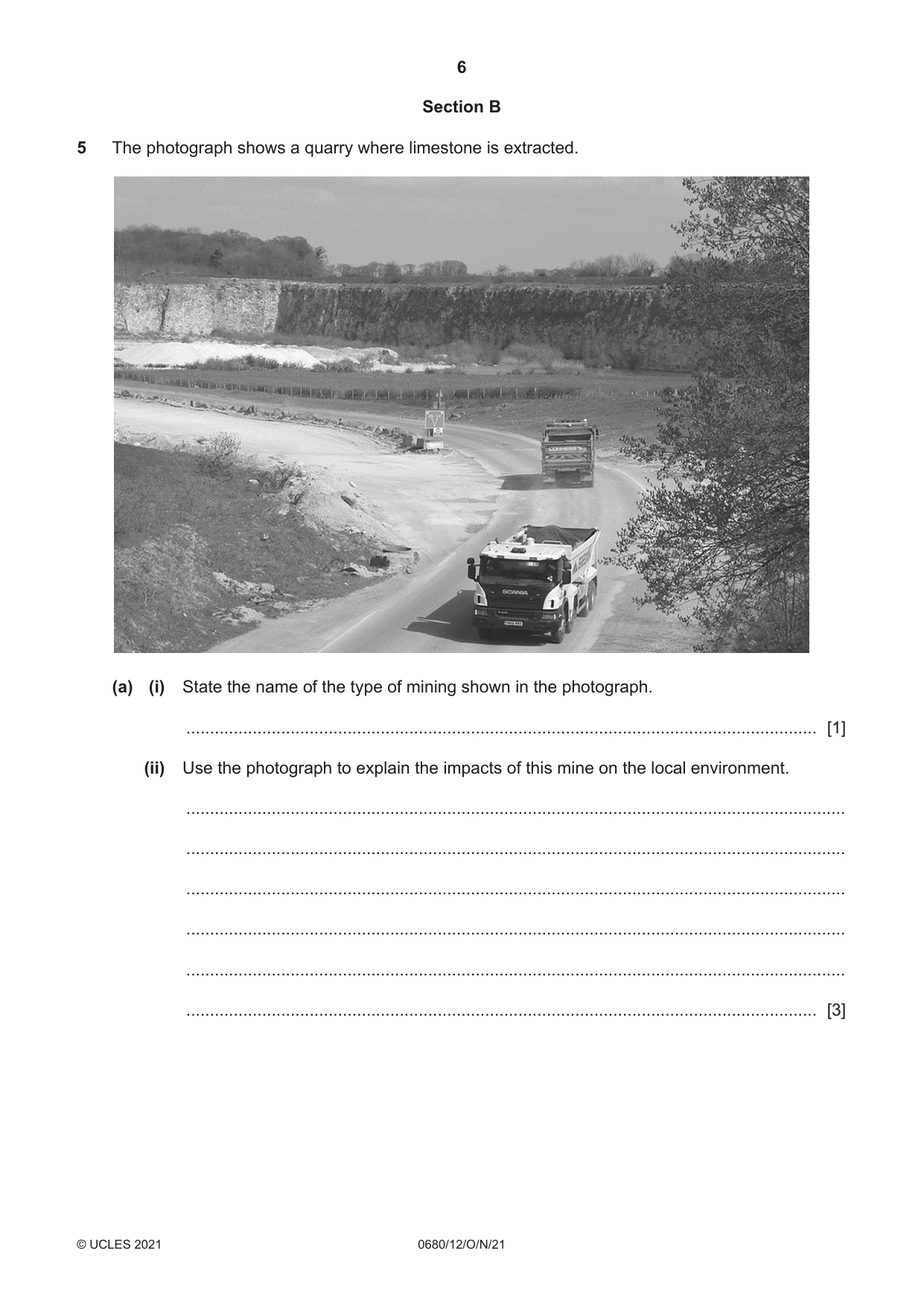
6 0680/12/O/N/21 © UCLES 2021 Section B 5 The photograph shows a quarry where limestone is extracted. (a) (i) State the name of the type of mining shown in the photograph. … [1] (ii) Use the photograph to explain the impacts of this mine on the local environment. … … … … … … [3]
Question paper, page 7
7 0680/12/O/N/21 © UCLES 2021 [Turn over (iii) Describe how limestone rock is formed. … … … … [2] (iv) A mining company wants to open a new mine. Suggest factors that affect the decision of the mining company to open the mine. … … … … … … [3]
Question paper, page 8
8 0680/12/O/N/21 © UCLES 2021 (b) Limestone is used to make cement. The bar chart shows cement production and cement consumption in India between 2013 and 2018. (i) Identify the year with the greatest difference between production and consumption. … [1] (ii) Use data from the bar chart to describe the trend in consumption of cement in India between 2013 and 2018. … … … … [2] Content removed due to copyright restrictions.
Question paper, page 9
9 0680/12/O/N/21 © UCLES 2021 [Turn over (iii) In 2018, 298 million tonnes of cement was produced. Cement production was predicted to increase by 4.5% in 2019. Calculate the predicted cement production in million tonnes for 2019. … million tonnes [2] [Total: 14]
Question paper, page 10
10 0680/12/O/N/21 © UCLES 2021 6 (a) Sea water contains mineral ions. The bar chart shows the mass of some mineral ions per kilogram of sea water. The bar chart is not complete. (i) Complete the bar chart to show 3.5 g of sulfate ions per kilogram of sea water. [1] (ii) Calculate the total mass of chloride and sodium ions in one kilogram of sea water. total mass = … g [1] Content removed due to copyright restrictions.
Question paper, page 11
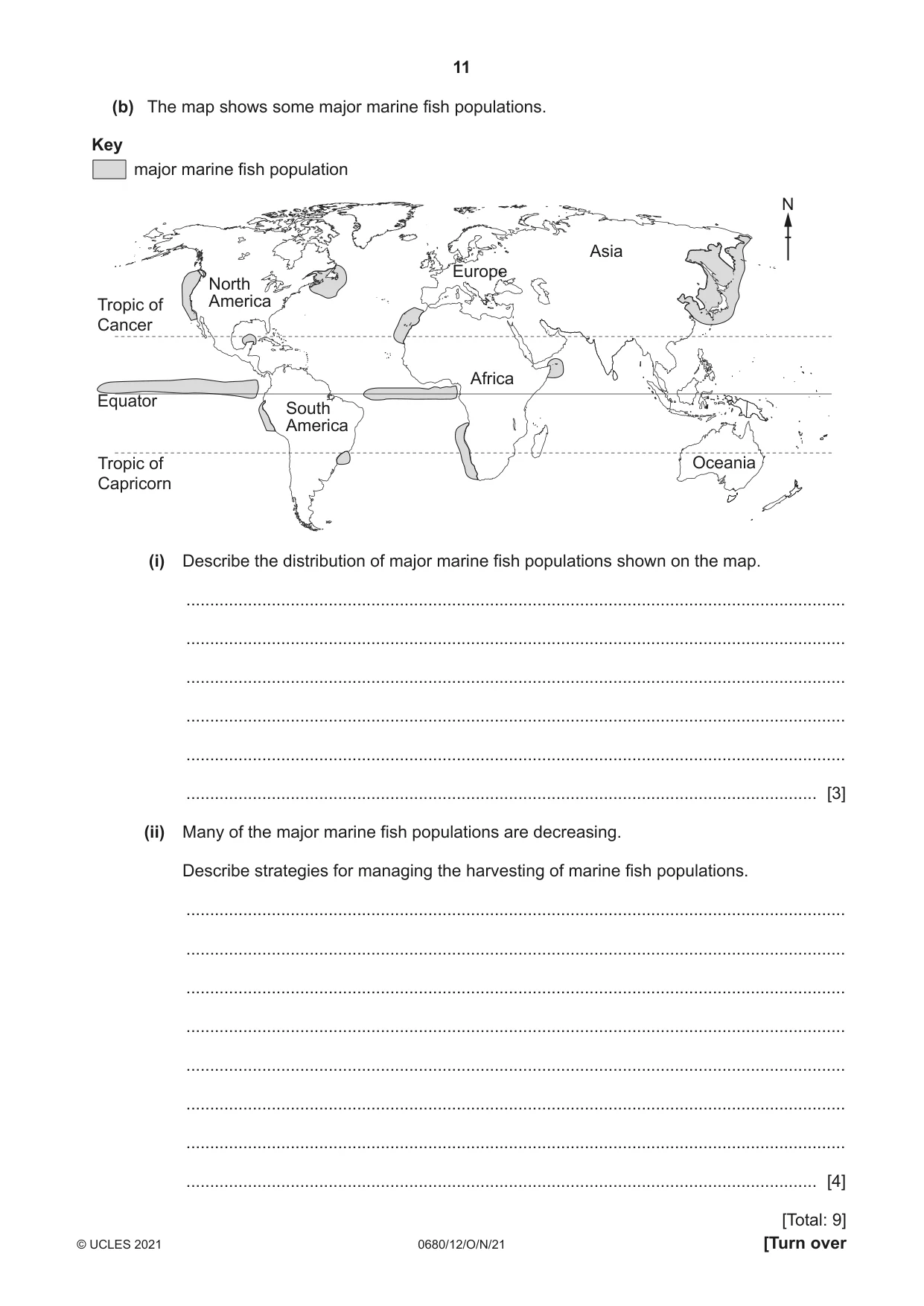
11 0680/12/O/N/21 © UCLES 2021 [Turn over (b) The map shows some major marine fish populations. N Equator Tropic of Capricorn Tropic of Cancer Key North America major marine fish population South America Africa Europe Asia Oceania (i) Describe the distribution of major marine fish populations shown on the map. … … … … … … [3] (ii) Many of the major marine fish populations are decreasing. Describe strategies for managing the harvesting of marine fish populations. … … … … … … … … [4] [Total: 9]
Question paper, page 12
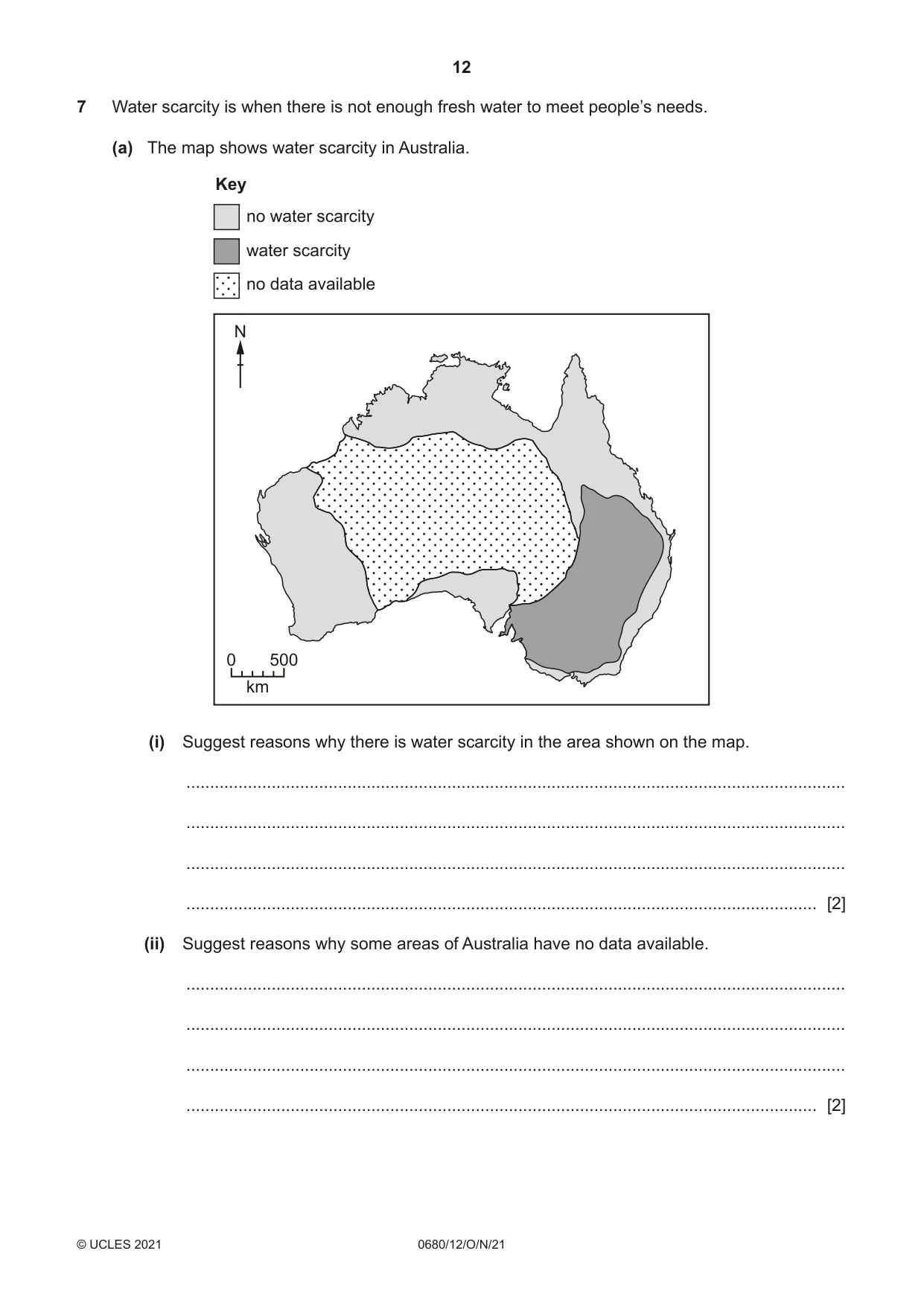
12 0680/12/O/N/21 © UCLES 2021 7 Water scarcity is when there is not enough fresh water to meet people’s needs. (a) The map shows water scarcity in Australia. 0 km 500 no water scarcity water scarcity no data available N Key (i) Suggest reasons why there is water scarcity in the area shown on the map. … … … … [2] (ii) Suggest reasons why some areas of Australia have no data available. … … … … [2]
Question paper, page 13
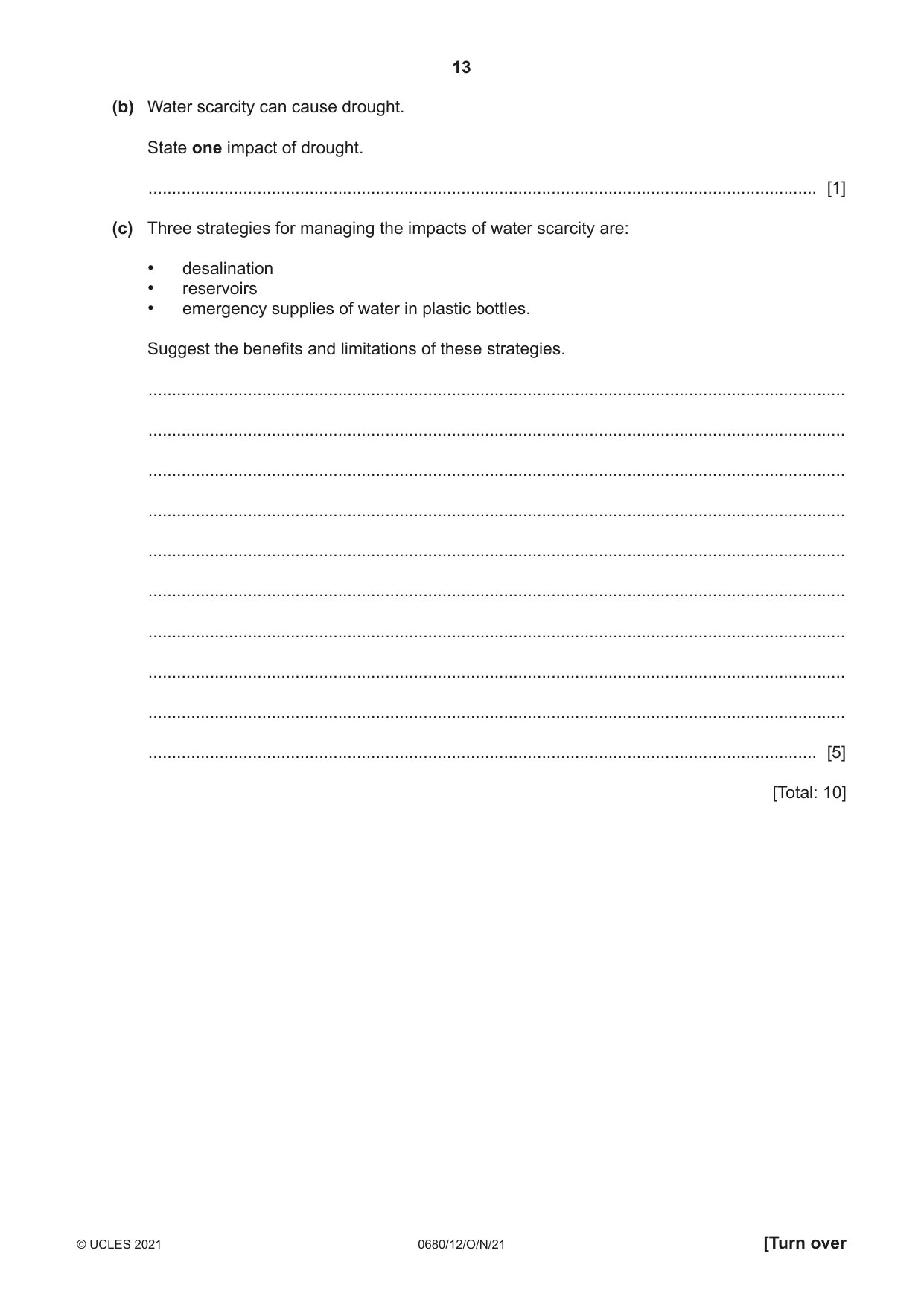
13 0680/12/O/N/21 © UCLES 2021 [Turn over (b) Water scarcity can cause drought. State one impact of drought. … [1] (c) Three strategies for managing the impacts of water scarcity are: • desalination • reservoirs • emergency supplies of water in plastic bottles. Suggest the benefits and limitations of these strategies. … … … … … … … … … … [5] [Total: 10]
Question paper, page 14
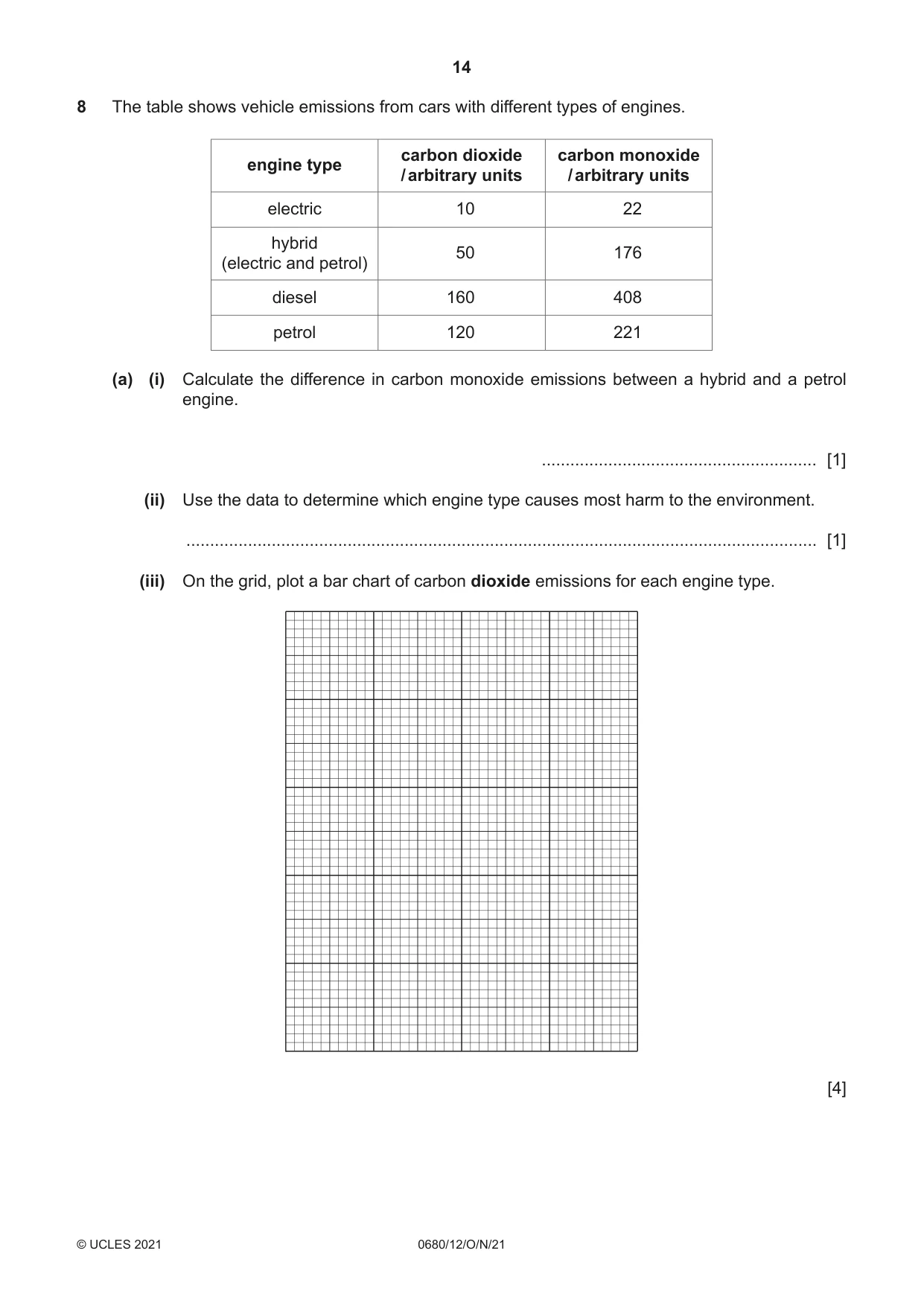
14 0680/12/O/N/21 © UCLES 2021 8 The table shows vehicle emissions from cars with different types of engines. engine type carbon dioxide / arbitrary units carbon monoxide / arbitrary units electric 10 22 hybrid (electric and petrol) 50 176 diesel 160 408 petrol 120 221 (a) (i) Calculate the difference in carbon monoxide emissions between a hybrid and a petrol engine. … [1] (ii) Use the data to determine which engine type causes most harm to the environment. … [1] (iii) On the grid, plot a bar chart of carbon dioxide emissions for each engine type. [4]
Question paper, page 15
15 0680/12/O/N/21 © UCLES 2021 [Turn over (b) Suggest ways that governments can encourage the use of electric vehicles. … … … … … … [3] (c) Explain why reducing carbon dioxide emissions is of global importance. … … … … … … … … [4] [Total: 13]
Question paper, page 16
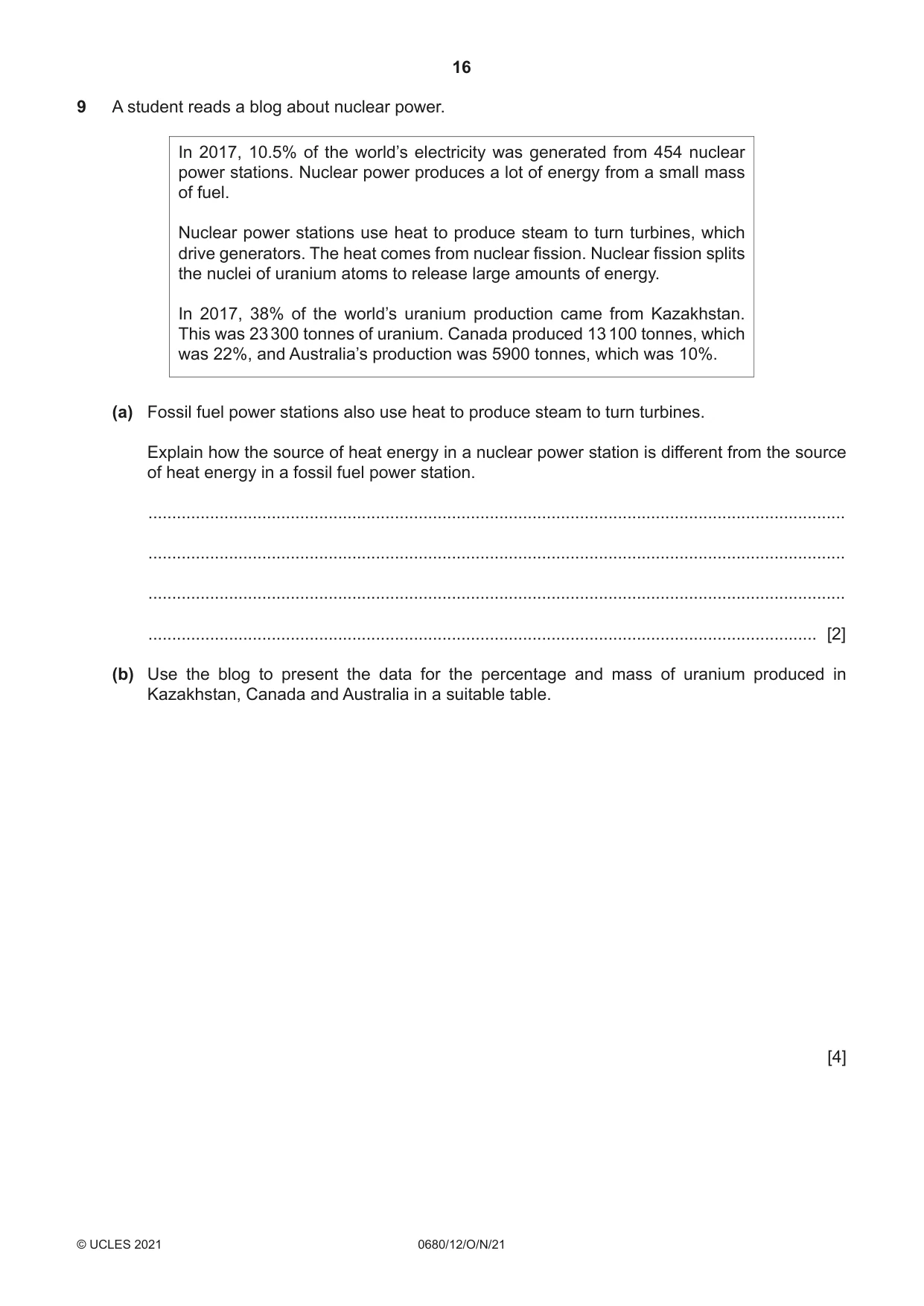
16 0680/12/O/N/21 © UCLES 2021 9 A student reads a blog about nuclear power. In 2017, 10.5% of the world’s electricity was generated from 454 nuclear power stations. Nuclear power produces a lot of energy from a small mass of fuel. Nuclear power stations use heat to produce steam to turn turbines, which drive generators. The heat comes from nuclear fission. Nuclear fission splits the nuclei of uranium atoms to release large amounts of energy. In 2017, 38% of the world’s uranium production came from Kazakhstan. This was 23 300 tonnes of uranium. Canada produced 13 100 tonnes, which was 22%, and Australia’s production was 5900 tonnes, which was 10%. (a) Fossil fuel power stations also use heat to produce steam to turn turbines. Explain how the source of heat energy in a nuclear power station is different from the source of heat energy in a fossil fuel power station. … … … … [2] (b) Use the blog to present the data for the percentage and mass of uranium produced in Kazakhstan, Canada and Australia in a suitable table. [4]
Question paper, page 17
17 0680/12/O/N/21 © UCLES 2021 (c) Over two-thirds of the world’s uranium production comes from only three countries. Suggest why some people are concerned about this. … … … … [2] (d) A student says: To meet world demand and combat climate change, all power stations built in the future should be nuclear power stations. To what extent do you agree with this statement? Give reasons for your answer. … … … … … … … … … … … … … … … [6] [Total: 14]
Question paper, page 18
18 0680/12/O/N/21 © UCLES 2021 BLANK PAGE
Question paper, page 19
19 0680/12/O/N/21 © UCLES 2021 BLANK PAGE
Question paper, page 20
20 0680/12/O/N/21 © UCLES 2021 The boundaries and names shown, the designations used and the presentation of material on any maps contained in this question paper/insert do not imply official endorsement or acceptance by Cambridge Assessment International Education concerning the legal status of any country, territory, or area or any of its authorities, or of the delimitation of its frontiers or boundaries. Permission to reproduce items where third-party owned material protected by copyright is included has been sought and cleared where possible. Every reasonable effort has been made by the publisher (UCLES) to trace copyright holders, but if any items requiring clearance have unwittingly been included, the publisher will be pleased to make amends at the earliest possible opportunity. To avoid the issue of disclosure of answer-related information to candidates, all copyright acknowledgements are reproduced online in the Cambridge Assessment International Education Copyright Acknowledgements Booklet. This is produced for each series of examinations and is freely available to download at www.cambridgeinternational.org after the live examination series. Cambridge Assessment International Education is part of the Cambridge Assessment Group. Cambridge Assessment is the brand name of the University of Cambridge Local Examinations Syndicate (UCLES), which itself is a department of the University of Cambridge. BLANK PAGE
Mark scheme, page 1
This document consists of 16 printed pages. © UCLES 2021 [Turn over Cambridge IGCSE™ ENVIRONMENTAL MANAGEMENT 0680/12 Paper 1 Theory October/November 2021 MARK SCHEME Maximum Mark: 80 Published This mark scheme is published as an aid to teachers and candidates, to indicate the requirements of the examination. It shows the basis on which Examiners were instructed to award marks. It does not indicate the details of the discussions that took place at an Examiners’ meeting before marking began, which would have considered the acceptability of alternative answers. Mark schemes should be read in conjunction with the question paper and the Principal Examiner Report for Teachers. Cambridge International will not enter into discussions about these mark schemes. Cambridge International is publishing the mark schemes for the October/November 2021 series for most Cambridge IGCSE™, Cambridge International A and AS Level components and some Cambridge O Level components.
Mark scheme, page 2
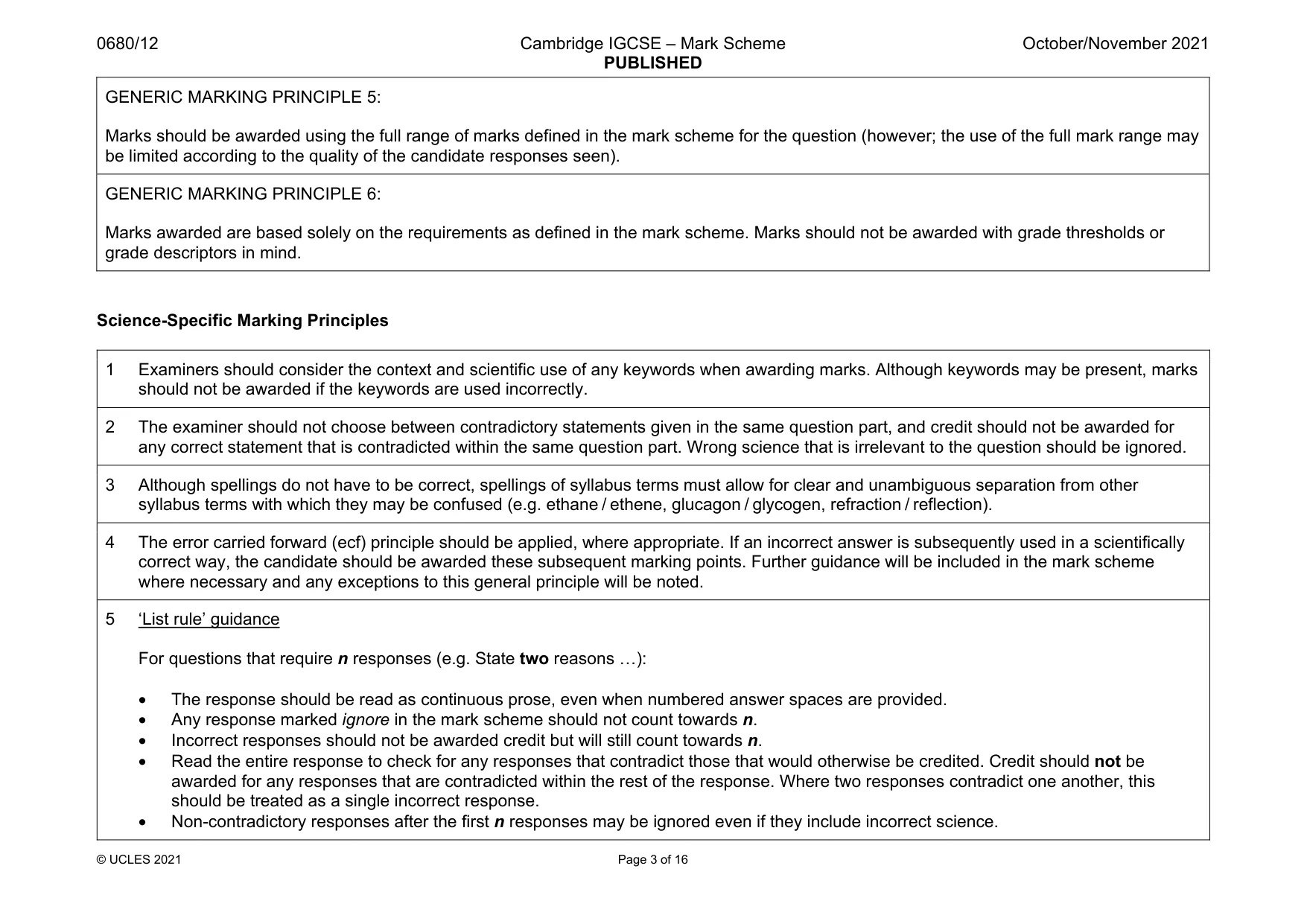
0680/12 Cambridge IGCSE – Mark Scheme PUBLISHED October/November 2021 © UCLES 2021 Page 2 of 16 Generic Marking Principles These general marking principles must be applied by all examiners when marking candidate answers. They should be applied alongside the specific content of the mark scheme or generic level descriptors for a question. Each question paper and mark scheme will also comply with these marking principles. GENERIC MARKING PRINCIPLE 1: Marks must be awarded in line with: • the specific content of the mark scheme or the generic level descriptors for the question • the specific skills defined in the mark scheme or in the generic level descriptors for the question • the standard of response required by a candidate as exemplified by the standardisation scripts. GENERIC MARKING PRINCIPLE 2: Marks awarded are always whole marks (not half marks, or other fractions). GENERIC MARKING PRINCIPLE 3: Marks must be awarded positively: • marks are awarded for correct/valid answers, as defined in the mark scheme. However, credit is given for valid answers which go beyond the scope of the syllabus and mark scheme, referring to your Team Leader as appropriate • marks are awarded when candidates clearly demonstrate what they know and can do • marks are not deducted for errors • marks are not deducted for omissions • answers should only be judged on the quality of spelling, punctuation and grammar when these features are specifically assessed by the question as indicated by the mark scheme. The meaning, however, should be unambiguous. GENERIC MARKING PRINCIPLE 4: Rules must be applied consistently, e.g. in situations where candidates have not followed instructions or in the application of generic level descriptors.
Mark scheme, page 3
0680/12 Cambridge IGCSE – Mark Scheme PUBLISHED October/November 2021 © UCLES 2021 Page 3 of 16 GENERIC MARKING PRINCIPLE 5: Marks should be awarded using the full range of marks defined in the mark scheme for the question (however; the use of the full mark range may be limited according to the quality of the candidate responses seen). GENERIC MARKING PRINCIPLE 6: Marks awarded are based solely on the requirements as defined in the mark scheme. Marks should not be awarded with grade thresholds or grade descriptors in mind. Science-Specific Marking Principles 1 Examiners should consider the context and scientific use of any keywords when awarding marks. Although keywords may be present, marks should not be awarded if the keywords are used incorrectly. 2 The examiner should not choose between contradictory statements given in the same question part, and credit should not be awarded for any correct statement that is contradicted within the same question part. Wrong science that is irrelevant to the question should be ignored. 3 Although spellings do not have to be correct, spellings of syllabus terms must allow for clear and unambiguous separation from other syllabus terms with which they may be confused (e.g. ethane / ethene, glucagon / glycogen, refraction / reflection). 4 The error carried forward (ecf) principle should be applied, where appropriate. If an incorrect answer is subsequently used in a scientifically correct way, the candidate should be awarded these subsequent marking points. Further guidance will be included in the mark scheme where necessary and any exceptions to this general principle will be noted. 5 ‘List rule’ guidance For questions that require n responses (e.g. State two reasons …): • The response should be read as continuous prose, even when numbered answer spaces are provided. • Any response marked ignore in the mark scheme should not count towards n. • Incorrect responses should not be awarded credit but will still count towards n. • Read the entire response to check for any responses that contradict those that would otherwise be credited. Credit should not be awarded for any responses that are contradicted within the rest of the response. Where two responses contradict one another, this should be treated as a single incorrect response. • Non-contradictory responses after the first n responses may be ignored even if they include incorrect science.
Mark scheme, page 4
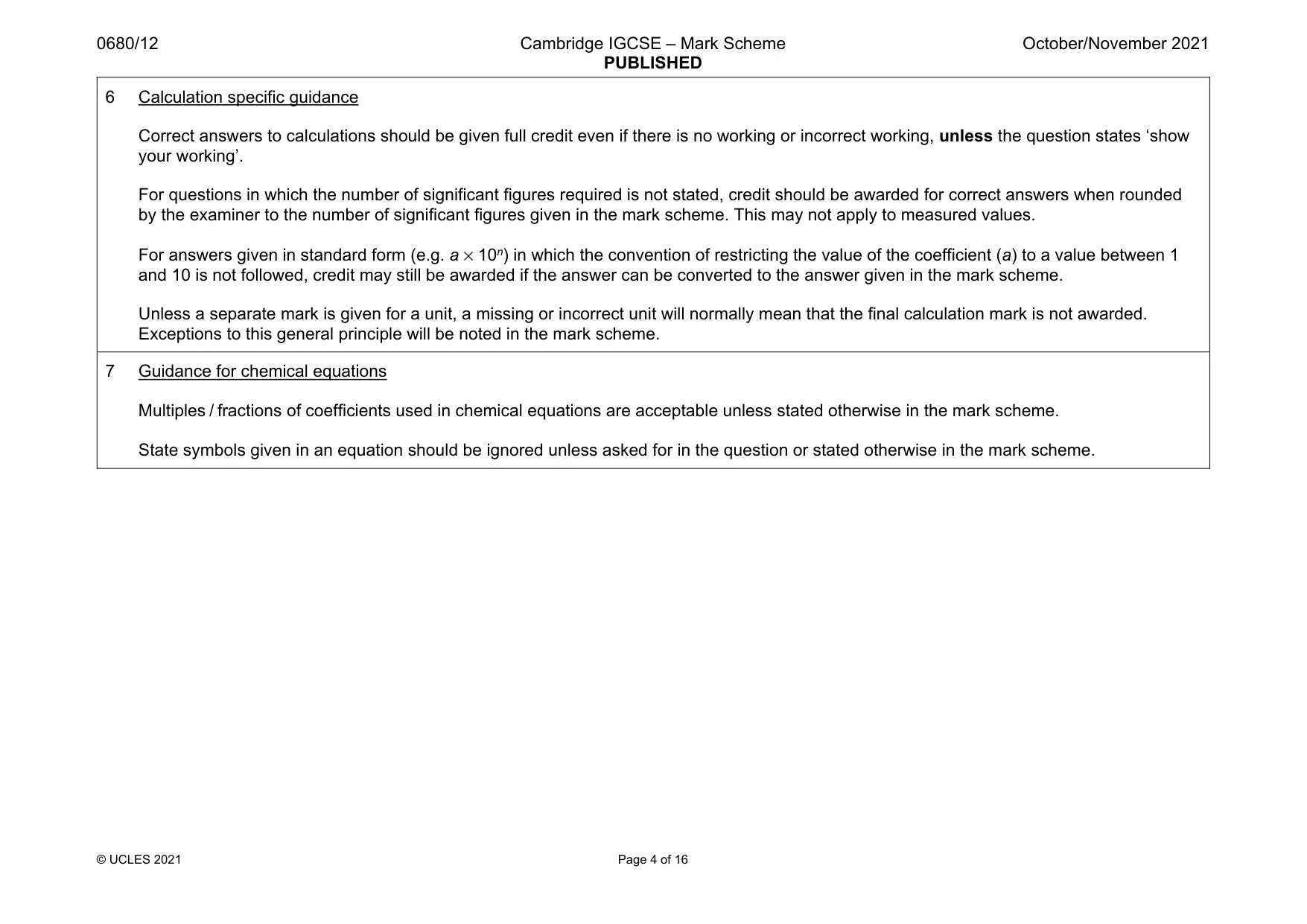
0680/12 Cambridge IGCSE – Mark Scheme PUBLISHED October/November 2021 © UCLES 2021 Page 4 of 16 6 Calculation specific guidance Correct answers to calculations should be given full credit even if there is no working or incorrect working, unless the question states ‘show your working’. For questions in which the number of significant figures required is not stated, credit should be awarded for correct answers when rounded by the examiner to the number of significant figures given in the mark scheme. This may not apply to measured values. For answers given in standard form (e.g. a × 10n) in which the convention of restricting the value of the coefficient (a) to a value between 1 and 10 is not followed, credit may still be awarded if the answer can be converted to the answer given in the mark scheme. Unless a separate mark is given for a unit, a missing or incorrect unit will normally mean that the final calculation mark is not awarded. Exceptions to this general principle will be noted in the mark scheme. 7 Guidance for chemical equations Multiples / fractions of coefficients used in chemical equations are acceptable unless stated otherwise in the mark scheme. State symbols given in an equation should be ignored unless asked for in the question or stated otherwise in the mark scheme.
Mark scheme, page 5
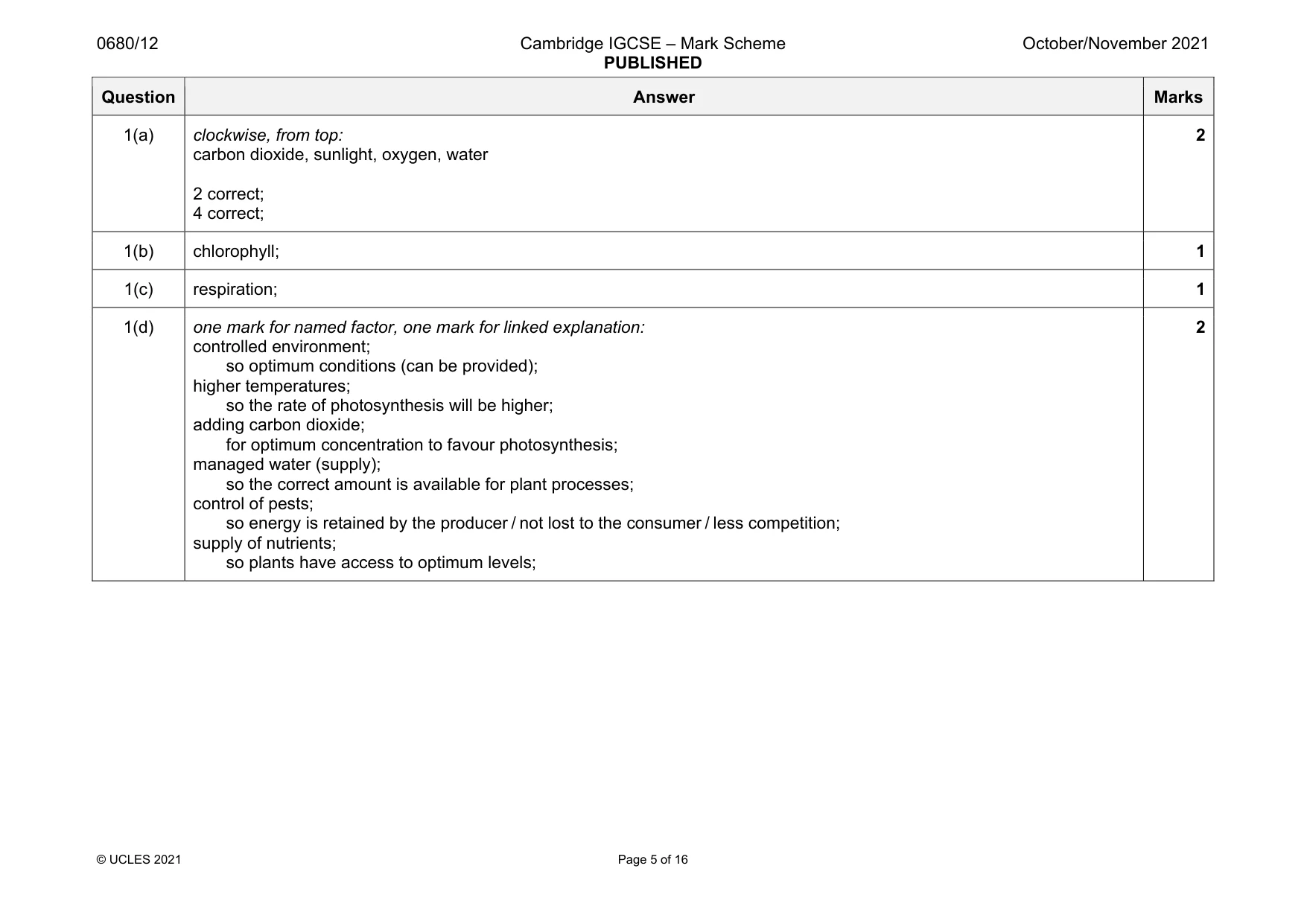
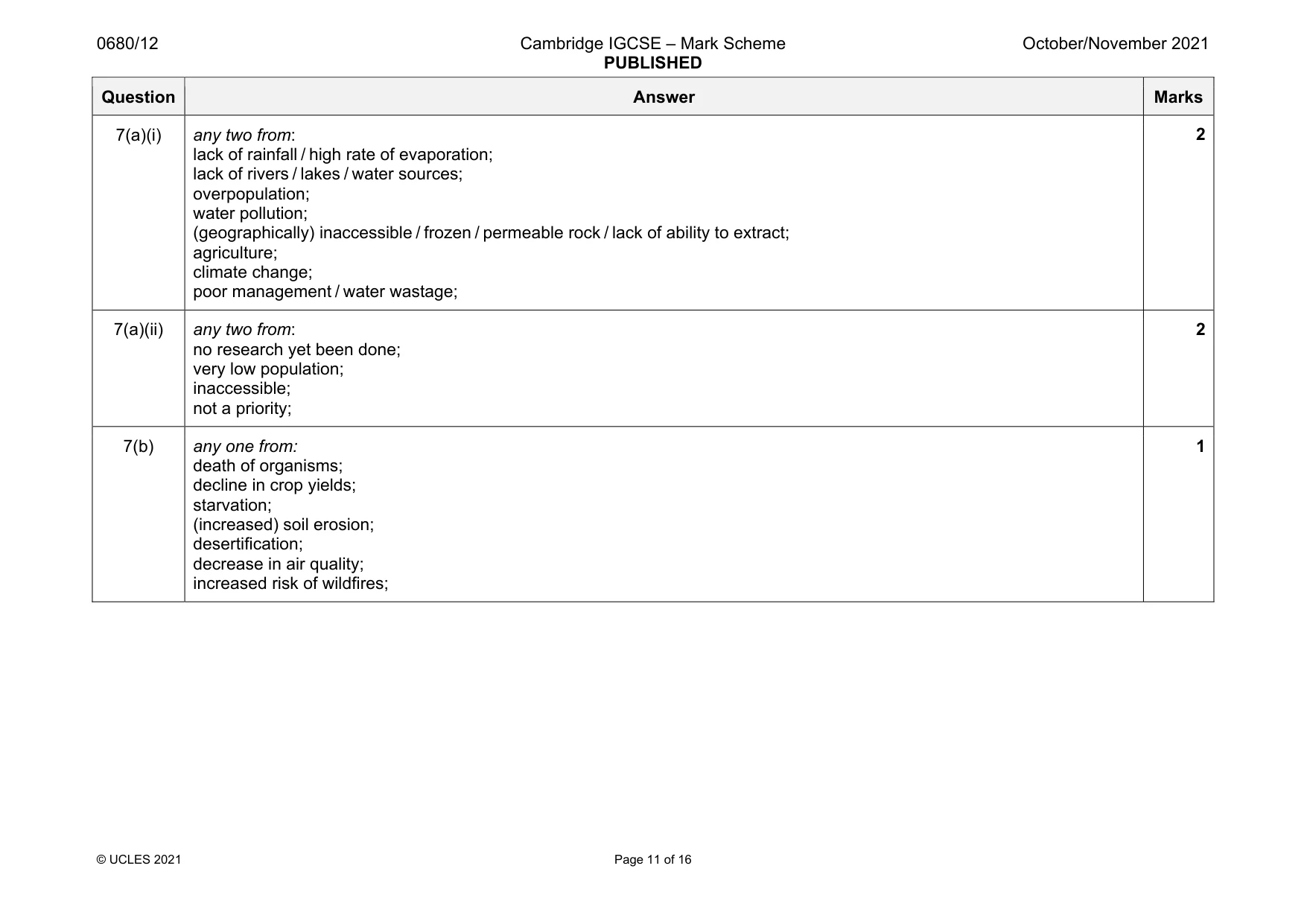
0680/12 Cambridge IGCSE – Mark Scheme PUBLISHED October/November 2021 © UCLES 2021 Page 5 of 16 Question Answer Marks 1(a) clockwise, from top: carbon dioxide, sunlight, oxygen, water 2 correct; 4 correct; 2 1(b) chlorophyll; 1 1(c) respiration; 1 1(d) one mark for named factor, one mark for linked explanation: controlled environment; so optimum conditions (can be provided); higher temperatures; so the rate of photosynthesis will be higher; adding carbon dioxide; for optimum concentration to favour photosynthesis; managed water (supply); so the correct amount is available for plant processes; control of pests; so energy is retained by the producer / not lost to the consumer / less competition; supply of nutrients; so plants have access to optimum levels; 2
Mark scheme, page 6
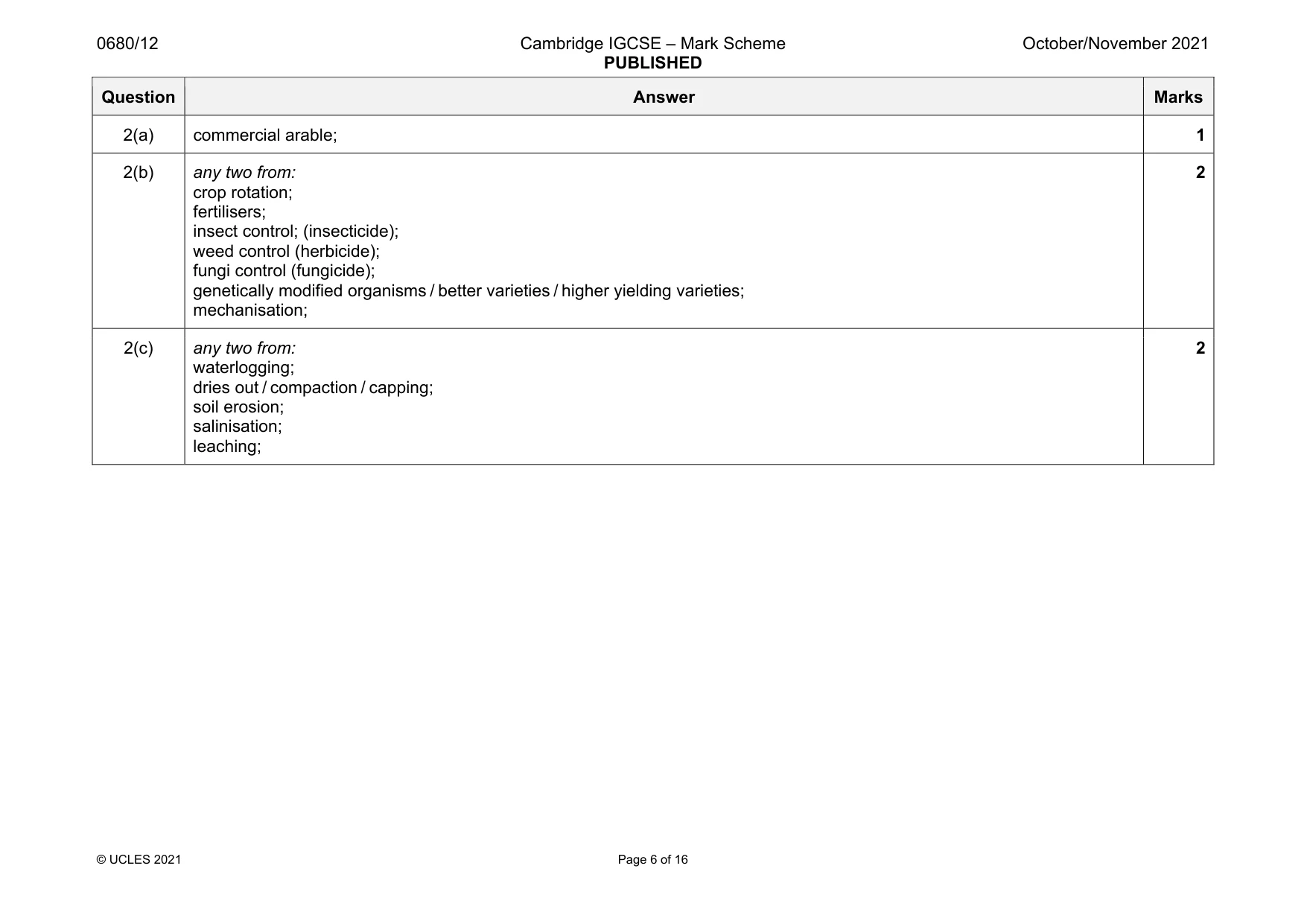
0680/12 Cambridge IGCSE – Mark Scheme PUBLISHED October/November 2021 © UCLES 2021 Page 6 of 16 Question Answer Marks 2(a) commercial arable; 1 2(b) any two from: crop rotation; fertilisers; insect control; (insecticide); weed control (herbicide); fungi control (fungicide); genetically modified organisms / better varieties / higher yielding varieties; mechanisation; 2 2(c) any two from: waterlogging; dries out / compaction / capping; soil erosion; salinisation; leaching; 2
Mark scheme, page 7
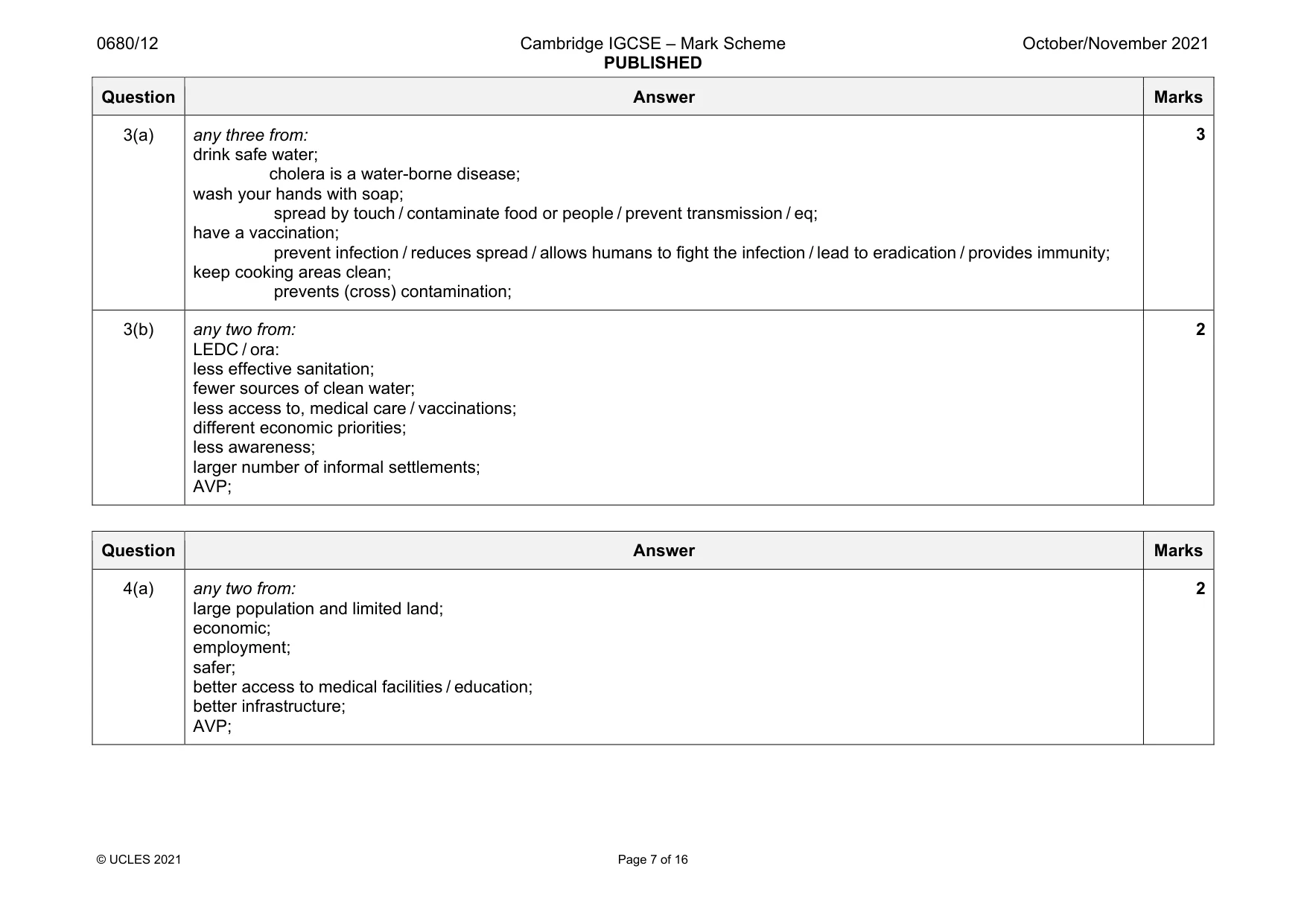
0680/12 Cambridge IGCSE – Mark Scheme PUBLISHED October/November 2021 © UCLES 2021 Page 7 of 16 Question Answer Marks 3(a) any three from: drink safe water; cholera is a water-borne disease; wash your hands with soap; spread by touch / contaminate food or people / prevent transmission / eq; have a vaccination; prevent infection / reduces spread / allows humans to fight the infection / lead to eradication / provides immunity; keep cooking areas clean; prevents (cross) contamination; 3 3(b) any two from: LEDC / ora: less effective sanitation; fewer sources of clean water; less access to, medical care / vaccinations; different economic priorities; less awareness; larger number of informal settlements; AVP; 2 Question Answer Marks 4(a) any two from: large population and limited land; economic; employment; safer; better access to medical facilities / education; better infrastructure; AVP; 2
Mark scheme, page 8
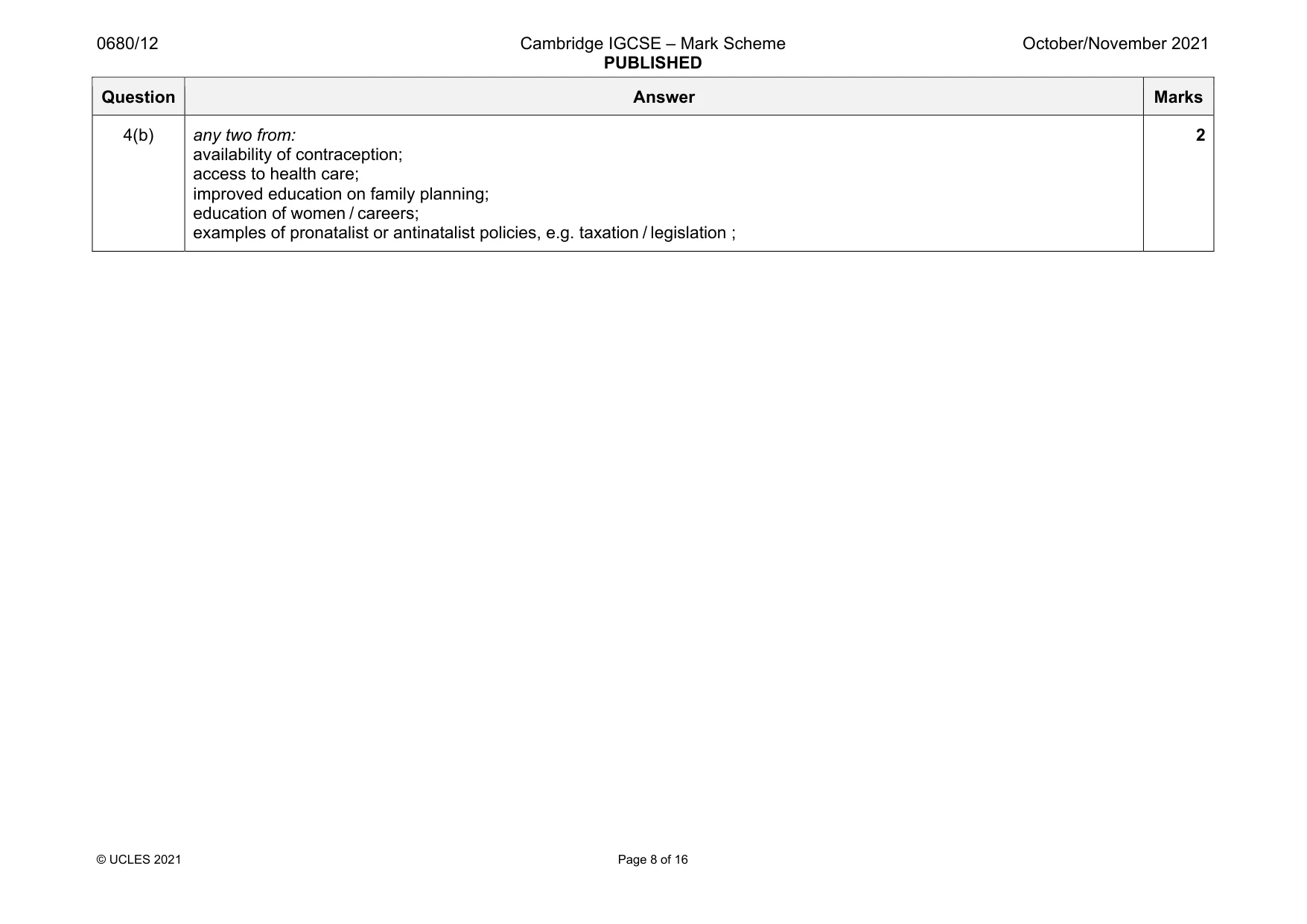
0680/12 Cambridge IGCSE – Mark Scheme PUBLISHED October/November 2021 © UCLES 2021 Page 8 of 16 Question Answer Marks 4(b) any two from: availability of contraception; access to health care; improved education on family planning; education of women / careers; examples of pronatalist or antinatalist policies, e.g. taxation / legislation ; 2
Mark scheme, page 9
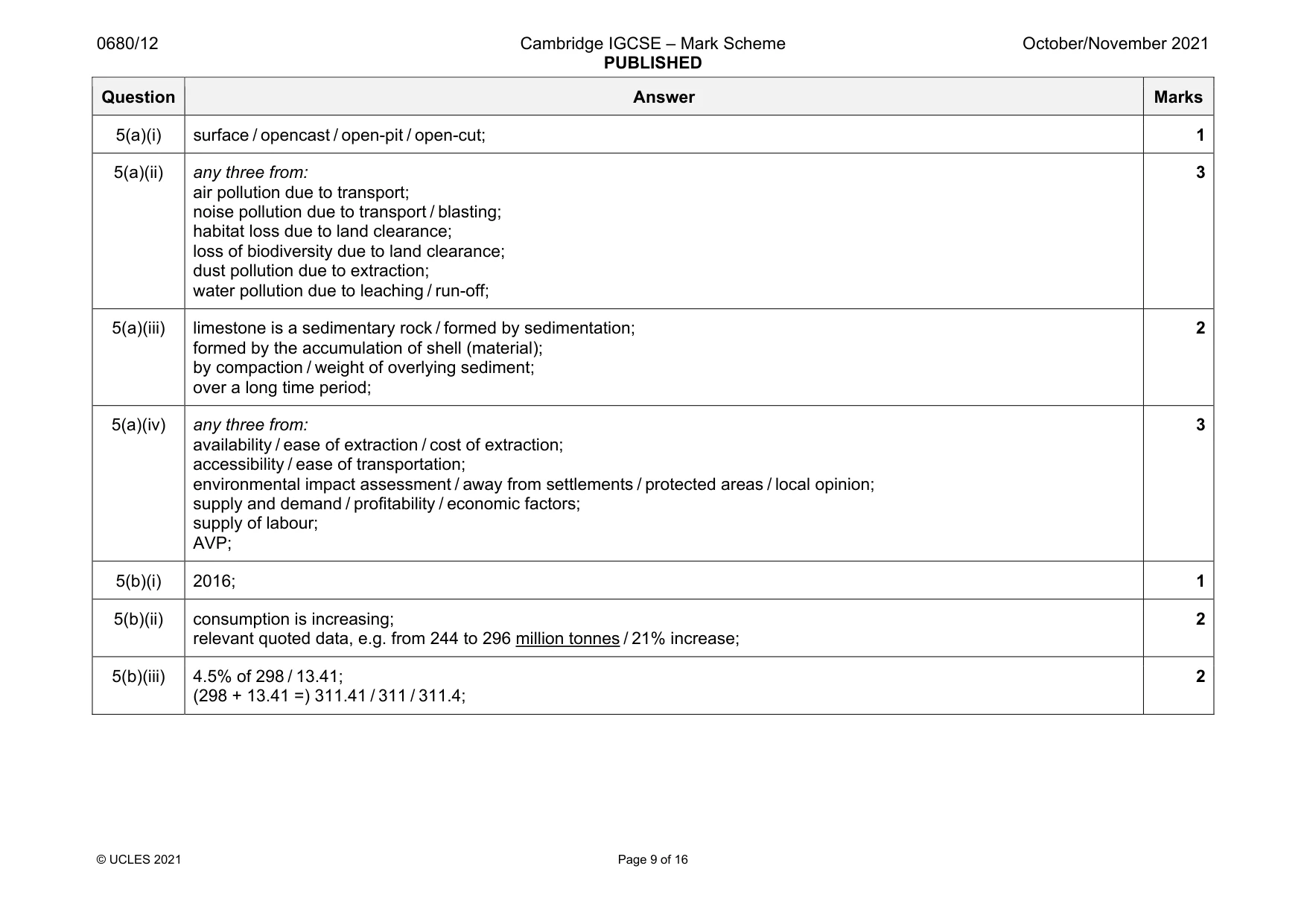
0680/12 Cambridge IGCSE – Mark Scheme PUBLISHED October/November 2021 © UCLES 2021 Page 9 of 16 Question Answer Marks 5(a)(i) surface / opencast / open-pit / open-cut; 1 5(a)(ii) any three from: air pollution due to transport; noise pollution due to transport / blasting; habitat loss due to land clearance; loss of biodiversity due to land clearance; dust pollution due to extraction; water pollution due to leaching / run-off; 3 5(a)(iii) limestone is a sedimentary rock / formed by sedimentation; formed by the accumulation of shell (material); by compaction / weight of overlying sediment; over a long time period; 2 5(a)(iv) any three from: availability / ease of extraction / cost of extraction; accessibility / ease of transportation; environmental impact assessment / away from settlements / protected areas / local opinion; supply and demand / profitability / economic factors; supply of labour; AVP; 3 5(b)(i) 2016; 1 5(b)(ii) consumption is increasing; relevant quoted data, e.g. from 244 to 296 million tonnes / 21% increase; 2 5(b)(iii) 4.5% of 298 / 13.41; (298 + 13.41 =) 311.41 / 311 / 311.4; 2
Mark scheme, page 10
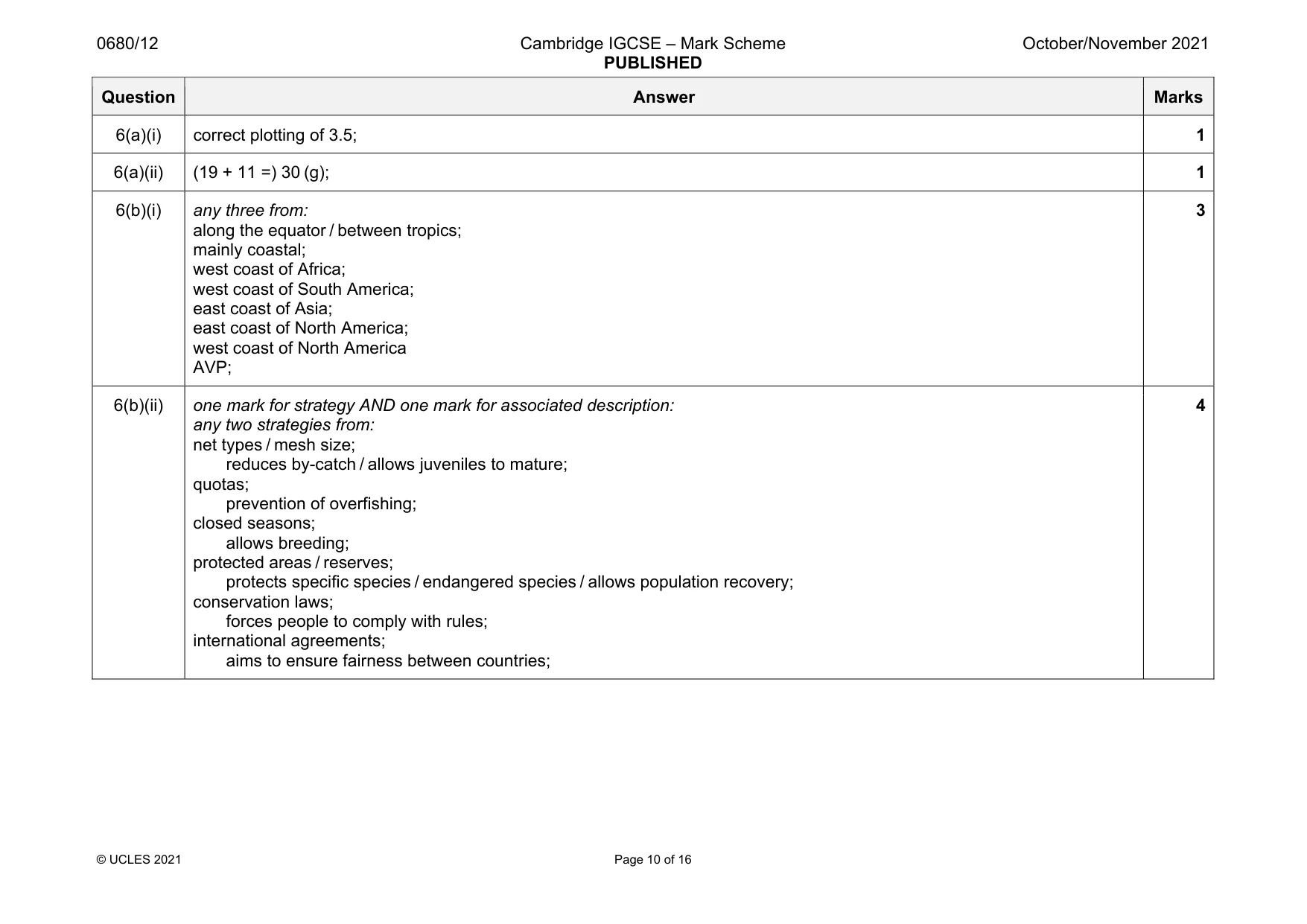
0680/12 Cambridge IGCSE – Mark Scheme PUBLISHED October/November 2021 © UCLES 2021 Page 10 of 16 Question Answer Marks 6(a)(i) correct plotting of 3.5; 1 6(a)(ii) (19 + 11 =) 30 (g); 1 6(b)(i) any three from: along the equator / between tropics; mainly coastal; west coast of Africa; west coast of South America; east coast of Asia; east coast of North America; west coast of North America AVP; 3 6(b)(ii) one mark for strategy AND one mark for associated description: any two strategies from: net types / mesh size; reduces by-catch / allows juveniles to mature; quotas; prevention of overfishing; closed seasons; allows breeding; protected areas / reserves; protects specific species / endangered species / allows population recovery; conservation laws; forces people to comply with rules; international agreements; aims to ensure fairness between countries; 4
Mark scheme, page 11
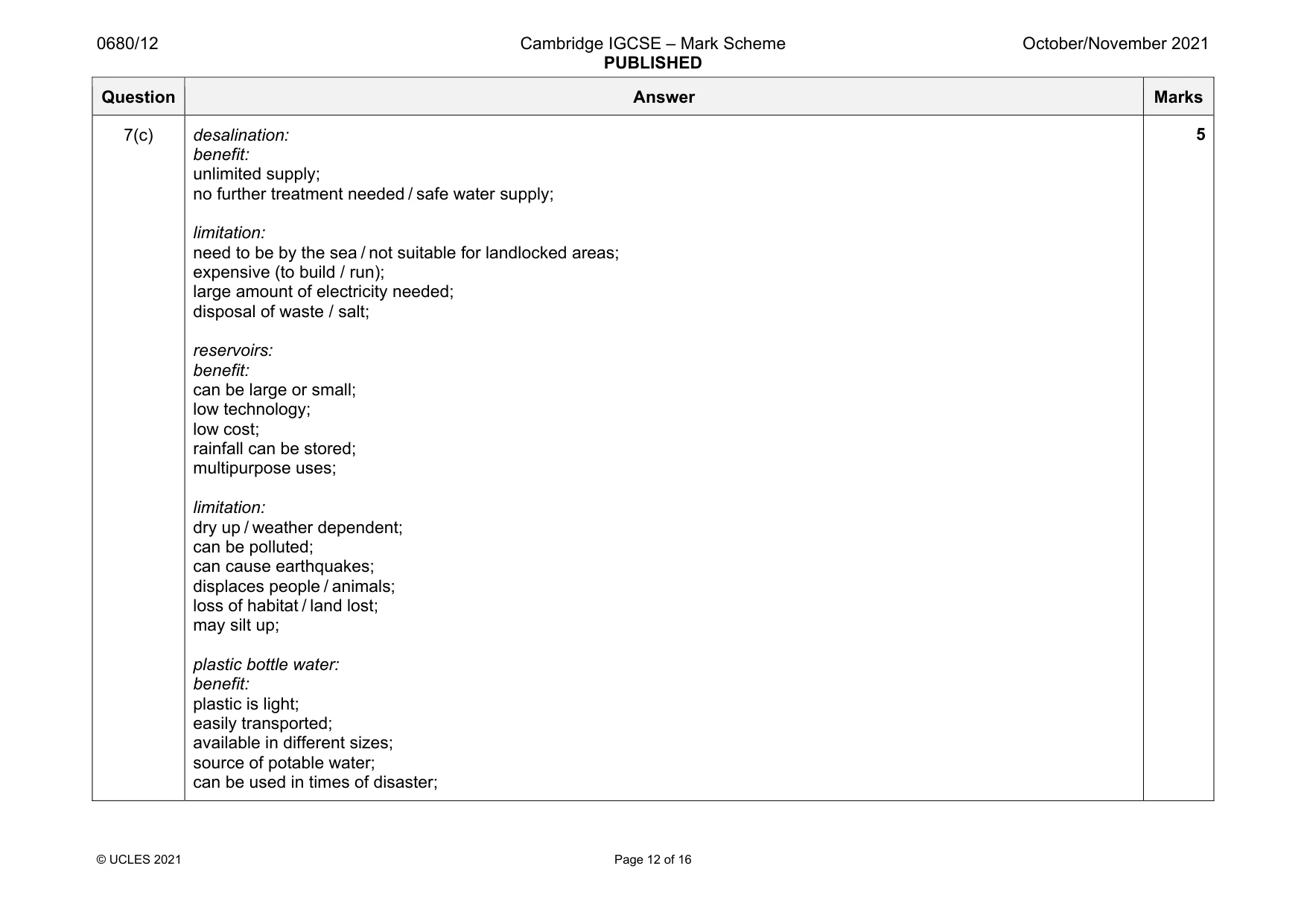
0680/12 Cambridge IGCSE – Mark Scheme PUBLISHED October/November 2021 © UCLES 2021 Page 11 of 16 Question Answer Marks 7(a)(i) any two from: lack of rainfall / high rate of evaporation; lack of rivers / lakes / water sources; overpopulation; water pollution; (geographically) inaccessible / frozen / permeable rock / lack of ability to extract; agriculture; climate change; poor management / water wastage; 2 7(a)(ii) any two from: no research yet been done; very low population; inaccessible; not a priority; 2 7(b) any one from: death of organisms; decline in crop yields; starvation; (increased) soil erosion; desertification; decrease in air quality; increased risk of wildfires; 1
Mark scheme, page 12
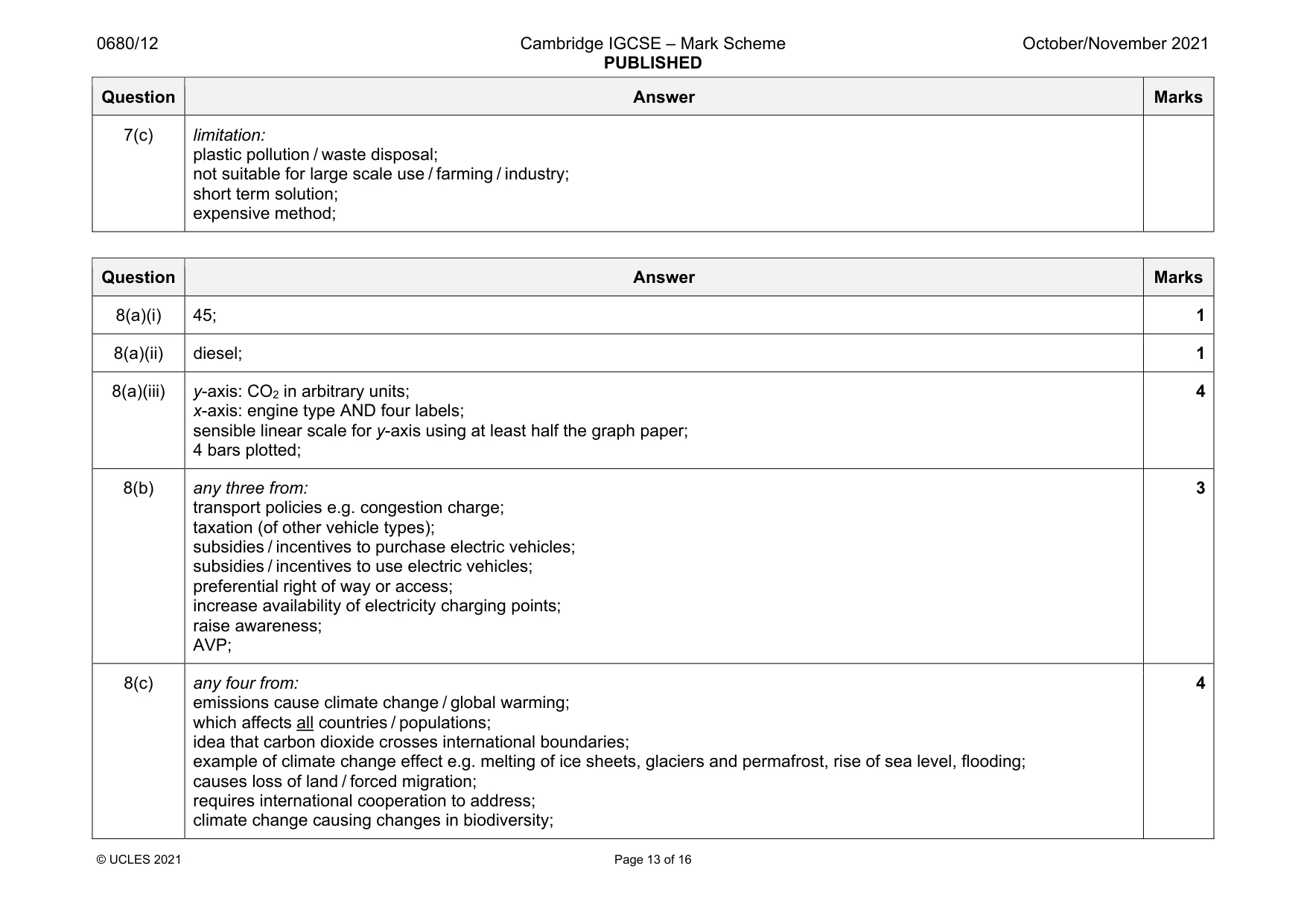
0680/12 Cambridge IGCSE – Mark Scheme PUBLISHED October/November 2021 © UCLES 2021 Page 12 of 16 Question Answer Marks 7(c) desalination: benefit: unlimited supply; no further treatment needed / safe water supply; limitation: need to be by the sea / not suitable for landlocked areas; expensive (to build / run); large amount of electricity needed; disposal of waste / salt; reservoirs: benefit: can be large or small; low technology; low cost; rainfall can be stored; multipurpose uses; limitation: dry up / weather dependent; can be polluted; can cause earthquakes; displaces people / animals; loss of habitat / land lost; may silt up; plastic bottle water: benefit: plastic is light; easily transported; available in different sizes; source of potable water; can be used in times of disaster; 5
Mark scheme, page 13
0680/12 Cambridge IGCSE – Mark Scheme PUBLISHED October/November 2021 © UCLES 2021 Page 13 of 16 Question Answer Marks 7(c) limitation: plastic pollution / waste disposal; not suitable for large scale use / farming / industry; short term solution; expensive method; Question Answer Marks 8(a)(i) 45; 1 8(a)(ii) diesel; 1 8(a)(iii) y-axis: CO2 in arbitrary units; x-axis: engine type AND four labels; sensible linear scale for y-axis using at least half the graph paper; 4 bars plotted; 4 8(b) any three from: transport policies e.g. congestion charge; taxation (of other vehicle types); subsidies / incentives to purchase electric vehicles; subsidies / incentives to use electric vehicles; preferential right of way or access; increase availability of electricity charging points; raise awareness; AVP; 3 8(c) any four from: emissions cause climate change / global warming; which affects all countries / populations; idea that carbon dioxide crosses international boundaries; example of climate change effect e.g. melting of ice sheets, glaciers and permafrost, rise of sea level, flooding; causes loss of land / forced migration; requires international cooperation to address; climate change causing changes in biodiversity; 4
Mark scheme, page 14
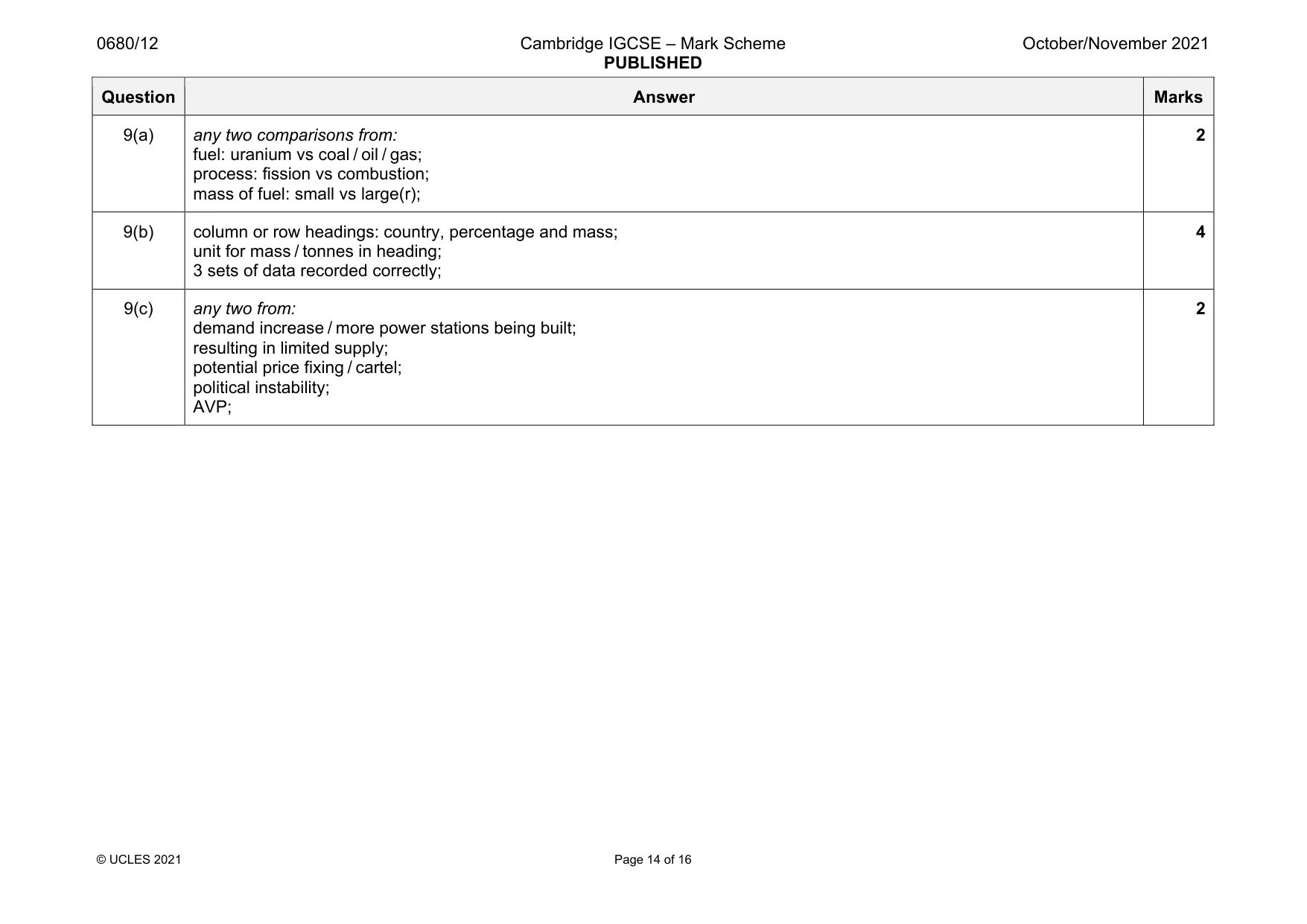
0680/12 Cambridge IGCSE – Mark Scheme PUBLISHED October/November 2021 © UCLES 2021 Page 14 of 16 Question Answer Marks 9(a) any two comparisons from: fuel: uranium vs coal / oil / gas; process: fission vs combustion; mass of fuel: small vs large(r); 2 9(b) column or row headings: country, percentage and mass; unit for mass / tonnes in heading; 3 sets of data recorded correctly; 4 9(c) any two from: demand increase / more power stations being built; resulting in limited supply; potential price fixing / cartel; political instability; AVP; 2
Mark scheme, page 15
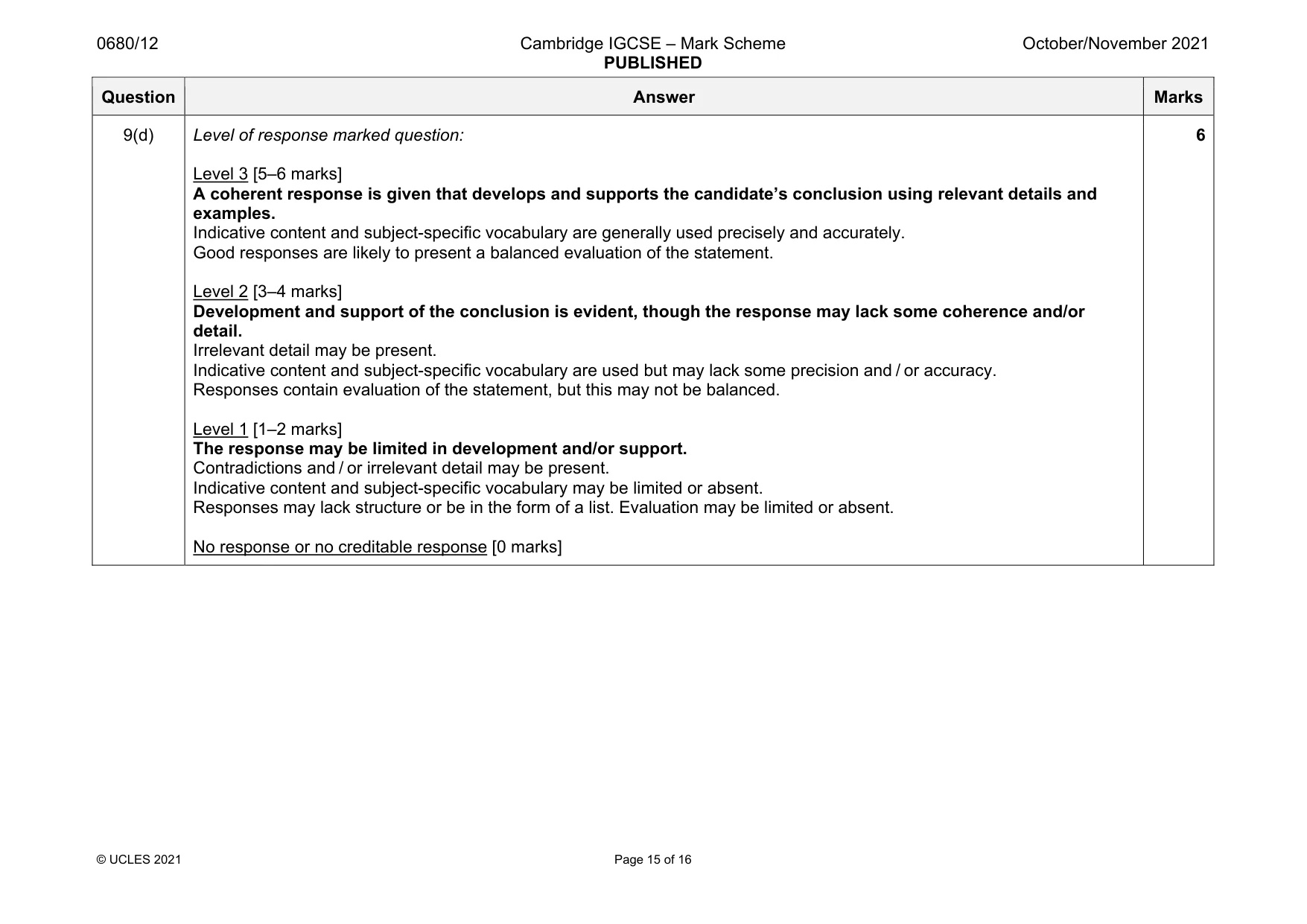
0680/12 Cambridge IGCSE – Mark Scheme PUBLISHED October/November 2021 © UCLES 2021 Page 15 of 16 Question Answer Marks 9(d) Level of response marked question: Level 3 [5–6 marks] A coherent response is given that develops and supports the candidate’s conclusion using relevant details and examples. Indicative content and subject-specific vocabulary are generally used precisely and accurately. Good responses are likely to present a balanced evaluation of the statement. Level 2 [3–4 marks] Development and support of the conclusion is evident, though the response may lack some coherence and/or detail. Irrelevant detail may be present. Indicative content and subject-specific vocabulary are used but may lack some precision and / or accuracy. Responses contain evaluation of the statement, but this may not be balanced. Level 1 [1–2 marks] The response may be limited in development and/or support. Contradictions and / or irrelevant detail may be present. Indicative content and subject-specific vocabulary may be limited or absent. Responses may lack structure or be in the form of a list. Evaluation may be limited or absent. No response or no creditable response [0 marks] 6
Mark scheme, page 16
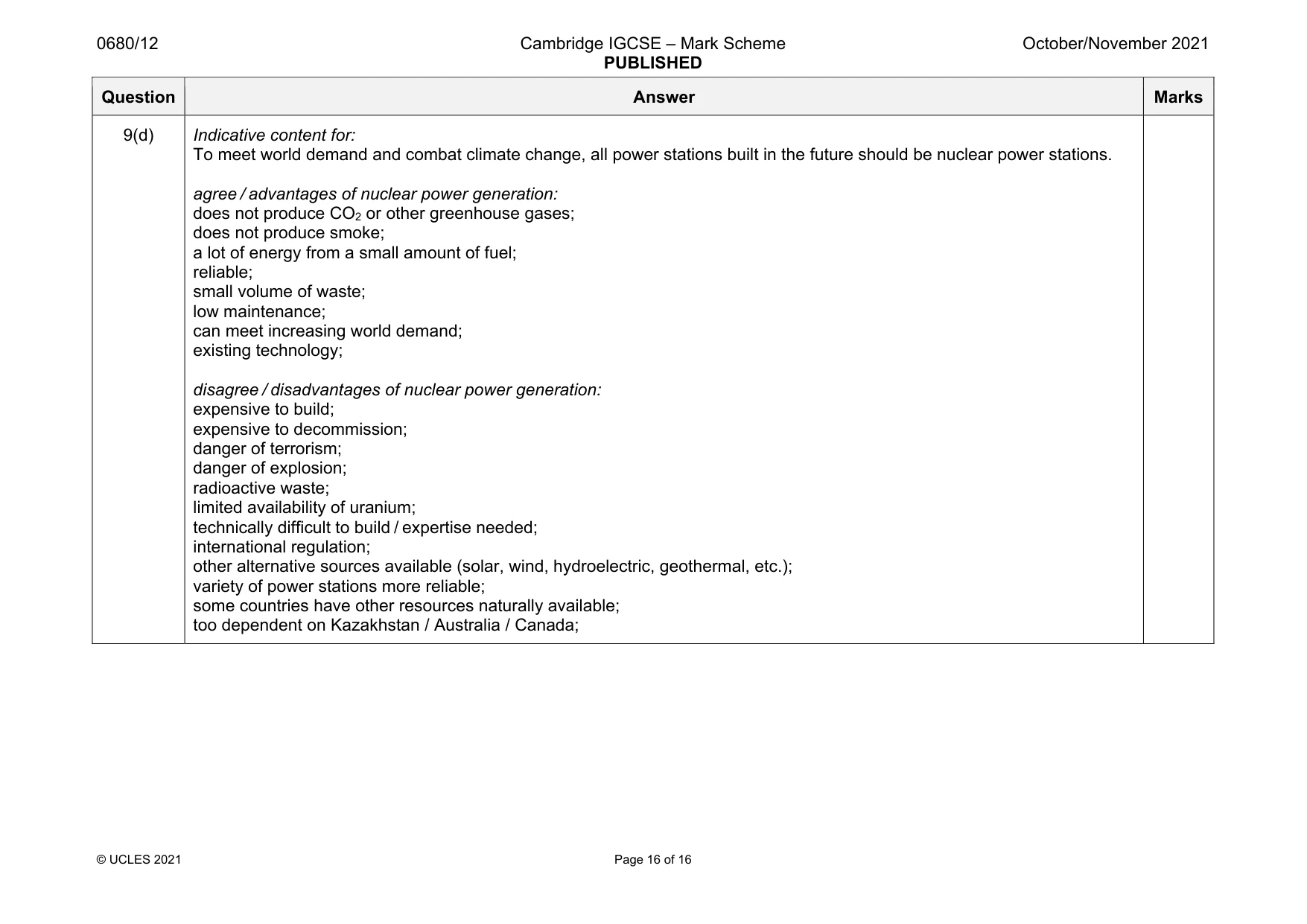
0680/12 Cambridge IGCSE – Mark Scheme PUBLISHED October/November 2021 © UCLES 2021 Page 16 of 16 Question Answer Marks 9(d) Indicative content for: To meet world demand and combat climate change, all power stations built in the future should be nuclear power stations. agree / advantages of nuclear power generation: does not produce CO2 or other greenhouse gases; does not produce smoke; a lot of energy from a small amount of fuel; reliable; small volume of waste; low maintenance; can meet increasing world demand; existing technology; disagree / disadvantages of nuclear power generation: expensive to build; expensive to decommission; danger of terrorism; danger of explosion; radioactive waste; limited availability of uranium; technically difficult to build / expertise needed; international regulation; other alternative sources available (solar, wind, hydroelectric, geothermal, etc.); variety of power stations more reliable; some countries have other resources naturally available; too dependent on Kazakhstan / Australia / Canada;
What you needed in this session
Cambridge’s own grade thresholds for 2021 Oct/Nov, Paper 1 · Variant 2. A higher threshold means an easier paper — the bar moves with how the cohort did.