Cambridge IGCSE Environmental Management 0680 — 2021 Oct/Nov Paper 1 · Variant 1
0680/11/O/N/21 · 80 marks · ≈90 min
The question paper and its mark scheme, free to read here and free to download. This is Cambridge’s own paper, exactly as it was sat.
Question paper24 pages






Mark scheme15 pages
Answers below. Sit the paper first if you are practising.
Paper as text
Question paper, page 1
This document has 24 pages. Any blank pages are indicated. Cambridge IGCSE™ * 8 4 8 0 5 8 5 4 1 4 * DC (PQ/CT) 211568/2 © UCLES 2021 [Turn over ENVIRONMENTAL MANAGEMENT 0680/11 Paper 1 Theory October/November 2021 1 hour 45 minutes You must answer on the question paper. No additional materials are needed. INSTRUCTIONS ● Answer all questions. ● Use a black or dark blue pen. You may use an HB pencil for any diagrams or graphs. ● Write your name, centre number and candidate number in the boxes at the top of the page. ● Write your answer to each question in the space provided. ● Do not use an erasable pen or correction fluid. ● Do not write on any bar codes. ● You may use a calculator. ● You should show all your working and use appropriate units. INFORMATION ● The total mark for this paper is 80. ● The number of marks for each question or part question is shown in brackets [ ].
Question paper, page 2
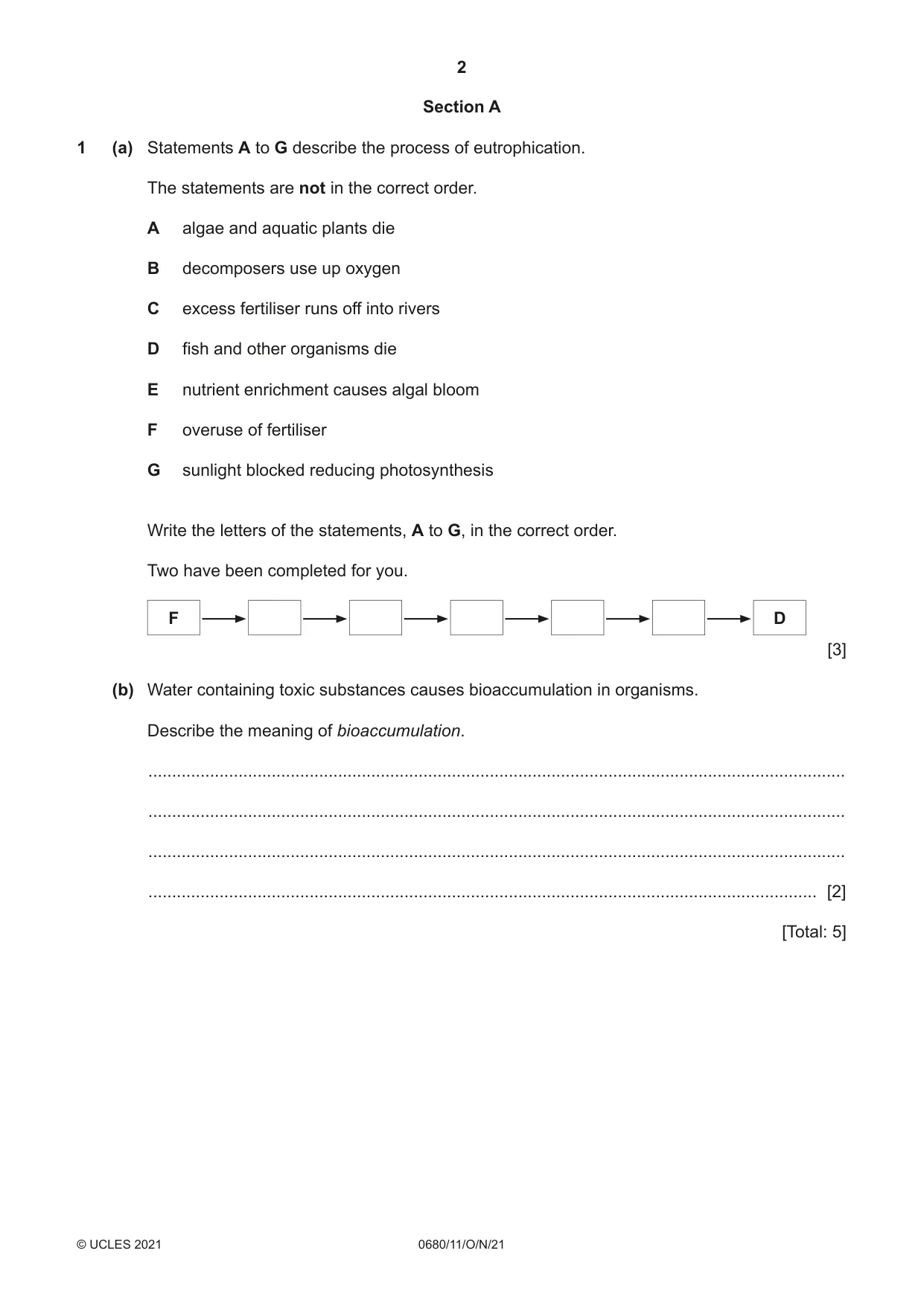
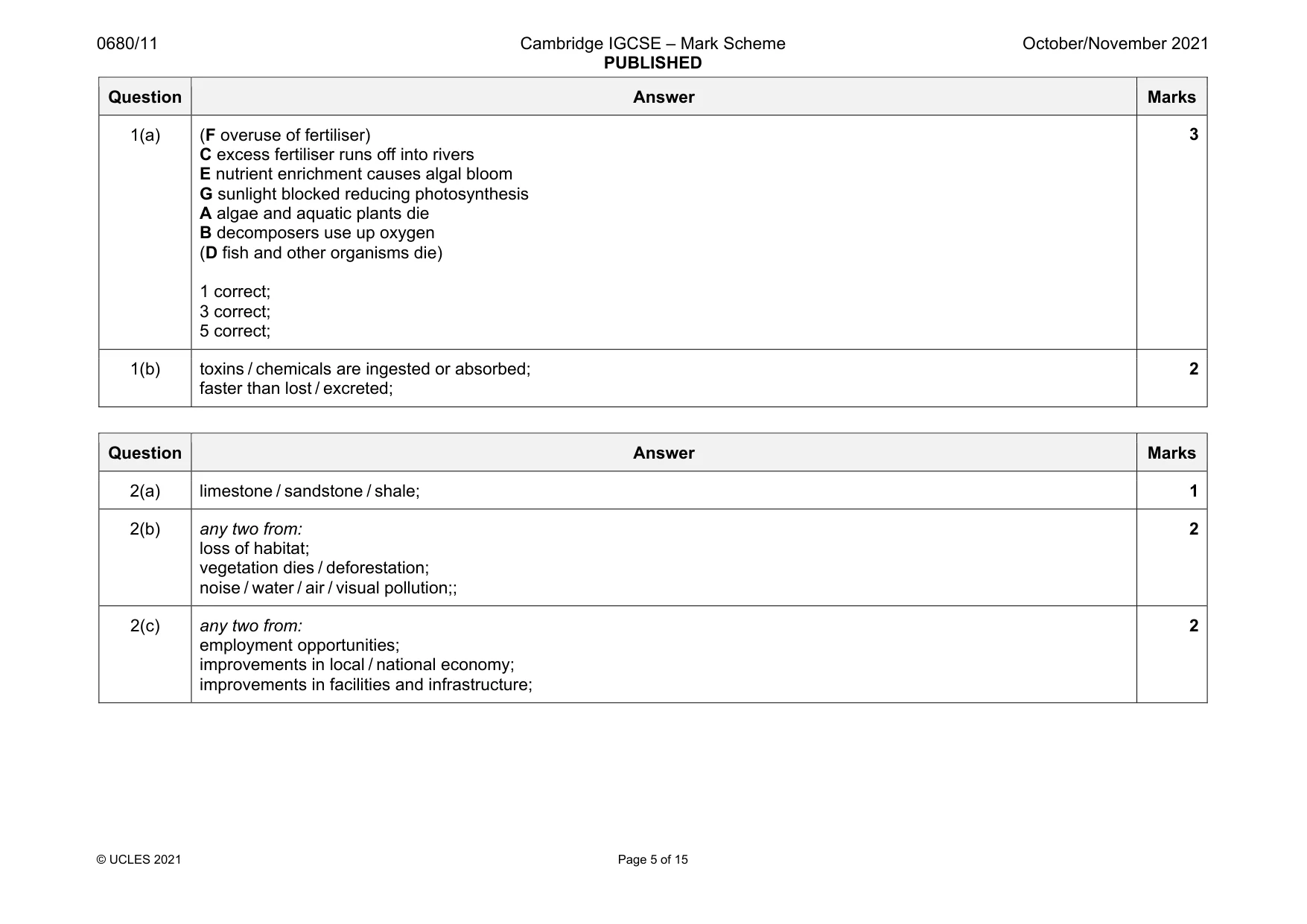
2 0680/11/O/N/21 © UCLES 2021 Section A 1 (a) Statements A to G describe the process of eutrophication. The statements are not in the correct order. A algae and aquatic plants die B decomposers use up oxygen C excess fertiliser runs off into rivers D fish and other organisms die E nutrient enrichment causes algal bloom F overuse of fertiliser G sunlight blocked reducing photosynthesis Write the letters of the statements, A to G, in the correct order. Two have been completed for you. F D [3] (b) Water containing toxic substances causes bioaccumulation in organisms. Describe the meaning of bioaccumulation. … … … … [2] [Total: 5]
Question paper, page 3
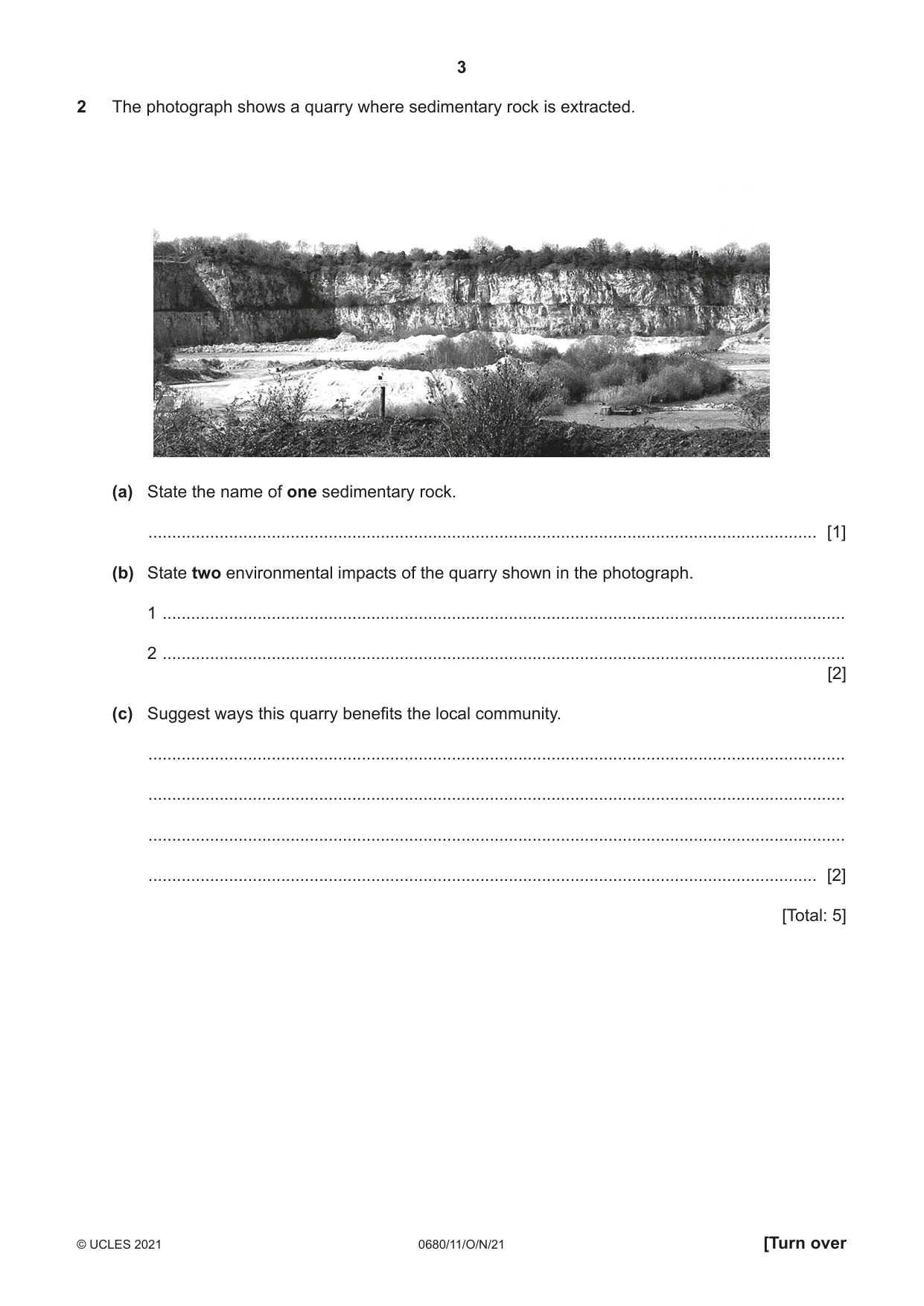
3 0680/11/O/N/21 © UCLES 2021 [Turn over 2 The photograph shows a quarry where sedimentary rock is extracted. (a) State the name of one sedimentary rock. … [1] (b) State two environmental impacts of the quarry shown in the photograph. 1 … 2 … [2] (c) Suggest ways this quarry benefits the local community. … … … … [2] [Total: 5]
Question paper, page 4
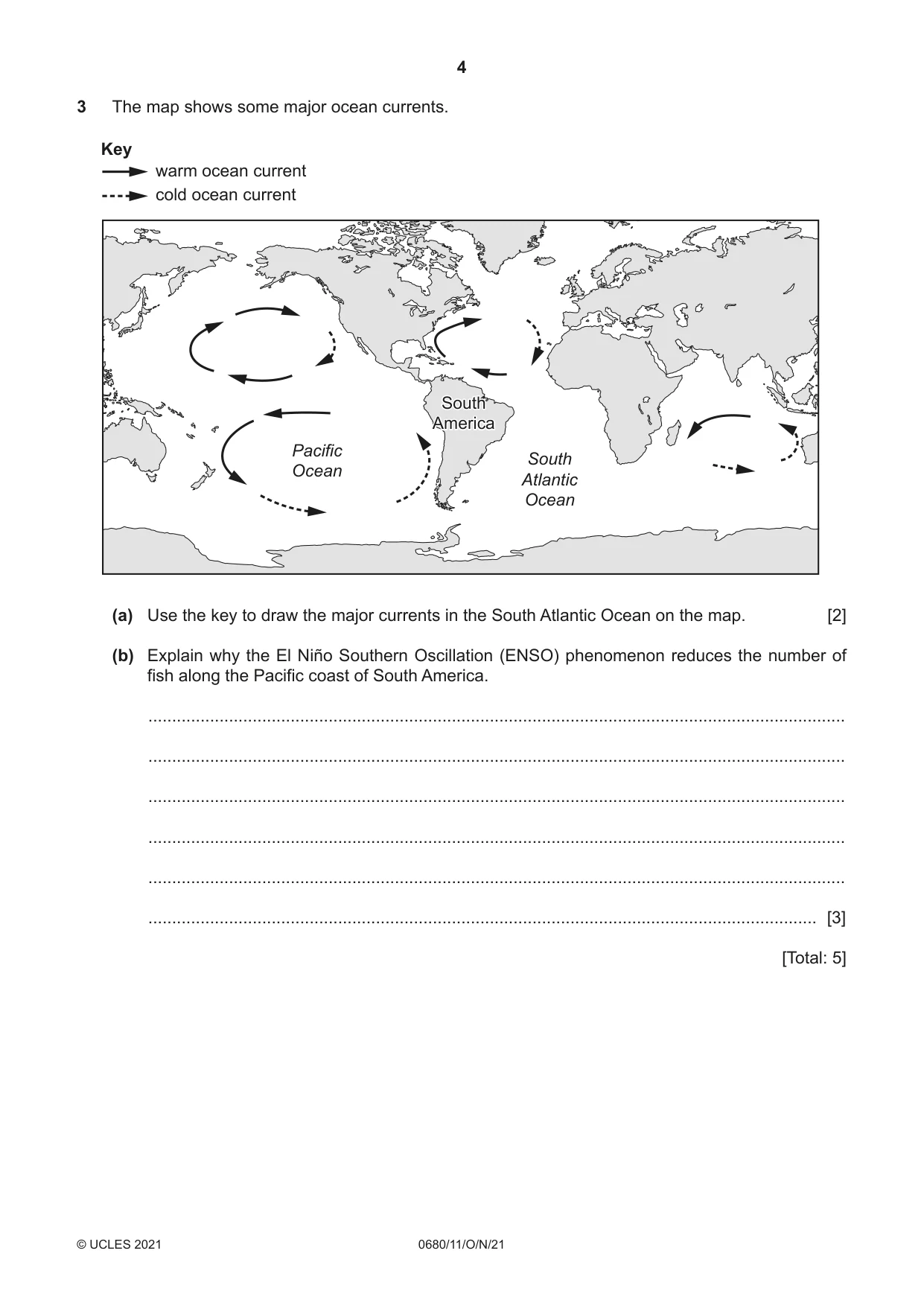
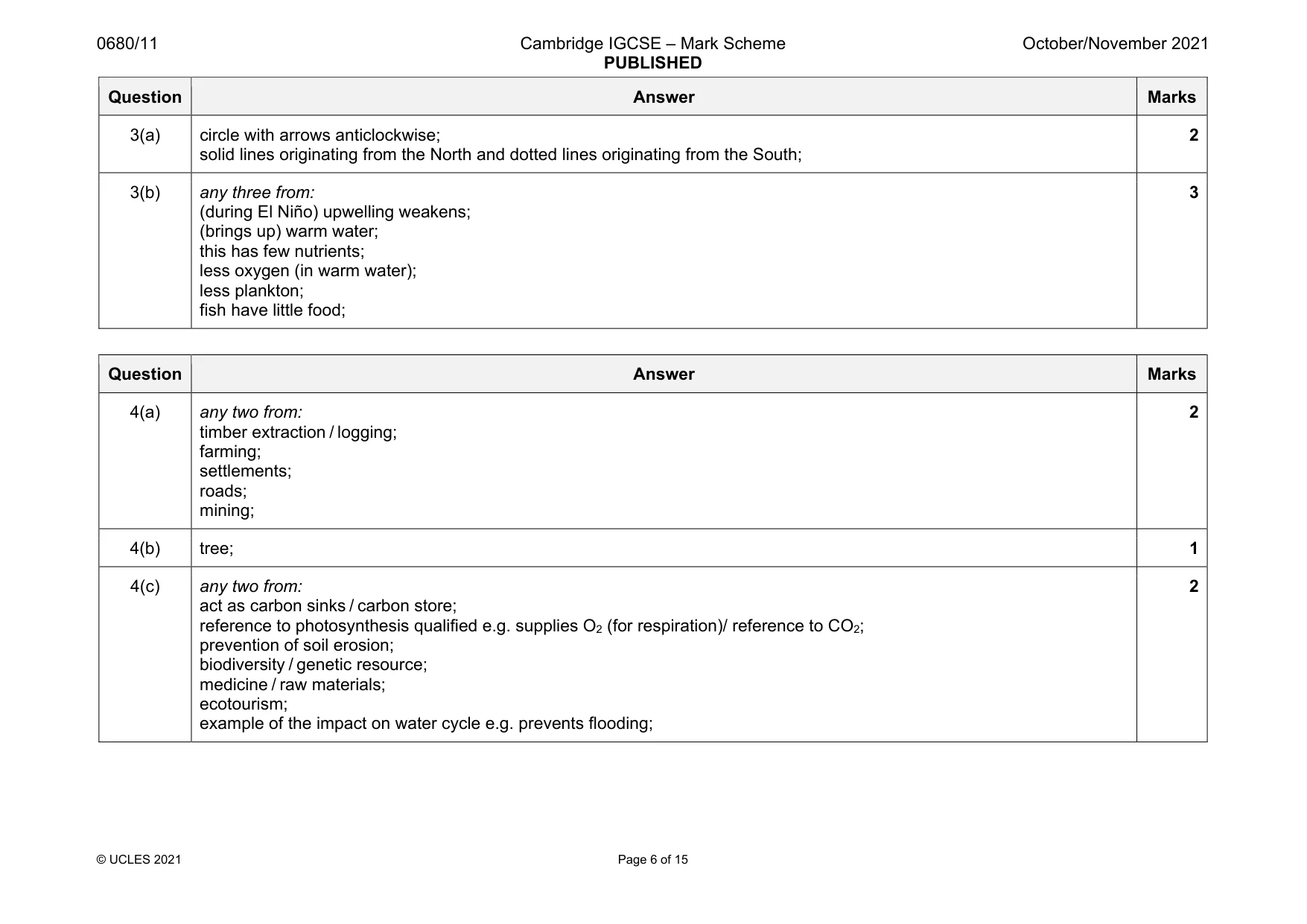
4 0680/11/O/N/21 © UCLES 2021 3 The map shows some major ocean currents. Key warm ocean current cold ocean current South Atlantic Ocean Pacific Ocean South America South America (a) Use the key to draw the major currents in the South Atlantic Ocean on the map. [2] (b) Explain why the El Niño Southern Oscillation (ENSO) phenomenon reduces the number of fish along the Pacific coast of South America. … … … … … … [3] [Total: 5]
Question paper, page 5
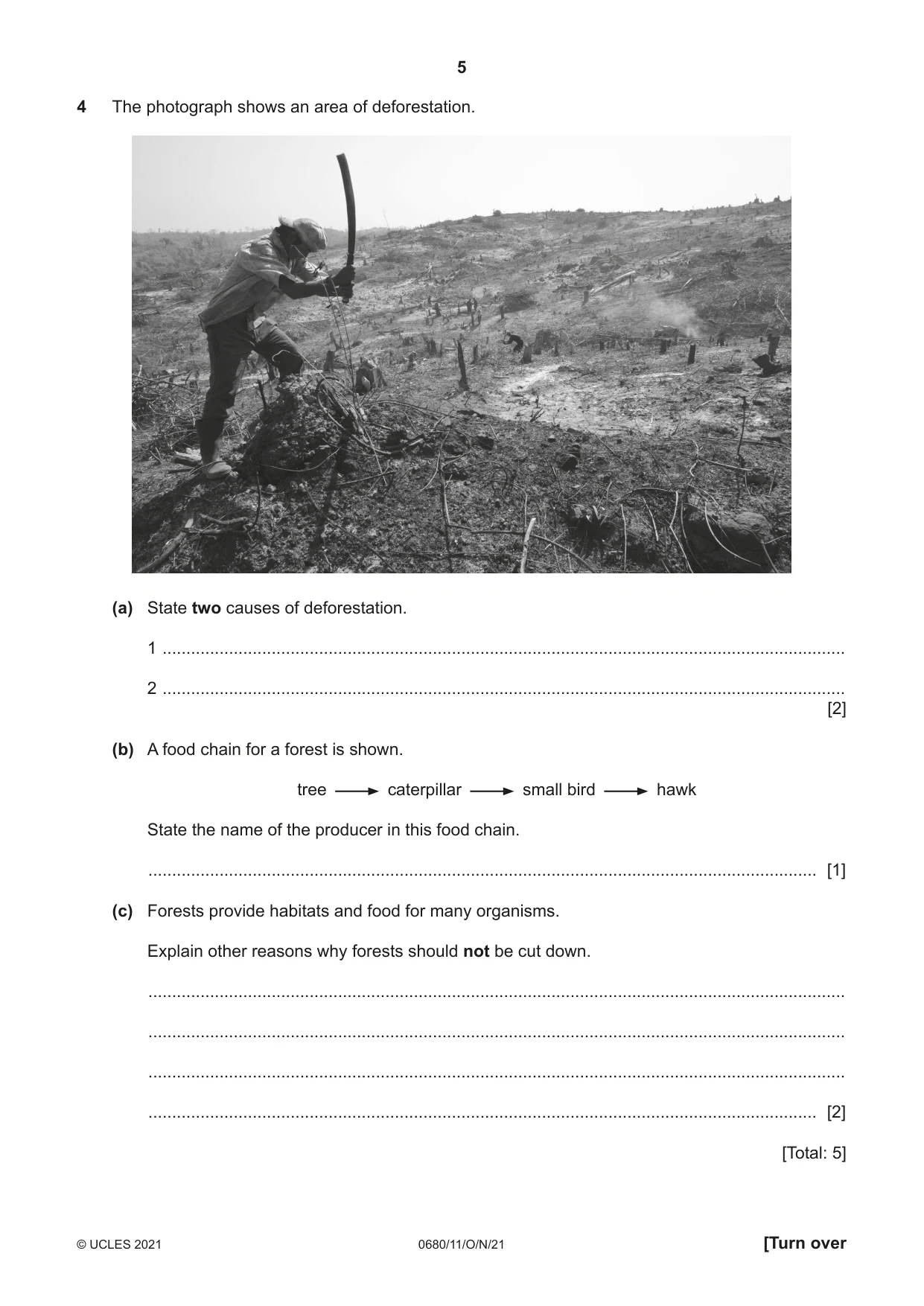
5 0680/11/O/N/21 © UCLES 2021 [Turn over 4 The photograph shows an area of deforestation. (a) State two causes of deforestation. 1 … 2 … [2] (b) A food chain for a forest is shown. tree caterpillar small bird hawk State the name of the producer in this food chain. … [1] (c) Forests provide habitats and food for many organisms. Explain other reasons why forests should not be cut down. … … … … [2] [Total: 5]
Question paper, page 6
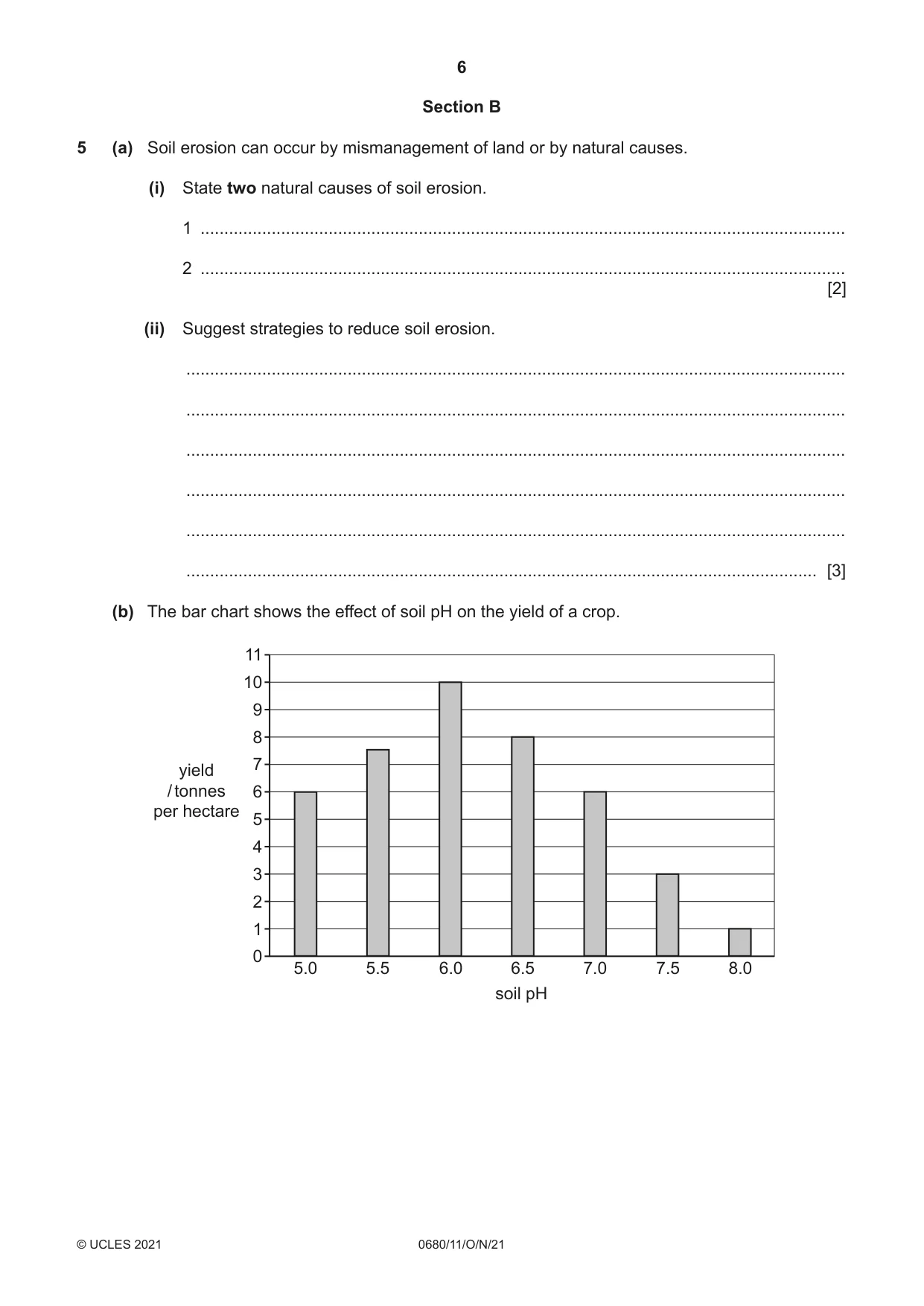
6 0680/11/O/N/21 © UCLES 2021 Section B 5 (a) Soil erosion can occur by mismanagement of land or by natural causes. (i) State two natural causes of soil erosion. 1 … 2 … [2] (ii) Suggest strategies to reduce soil erosion. … … … … … … [3] (b) The bar chart shows the effect of soil pH on the yield of a crop. 0 1 2 3 4 5 6 7 8 9 10 11 5.0 5.5 6.0 6.5 7.0 7.5 8.0 soil pH yield / tonnes per hectare
Question paper, page 7
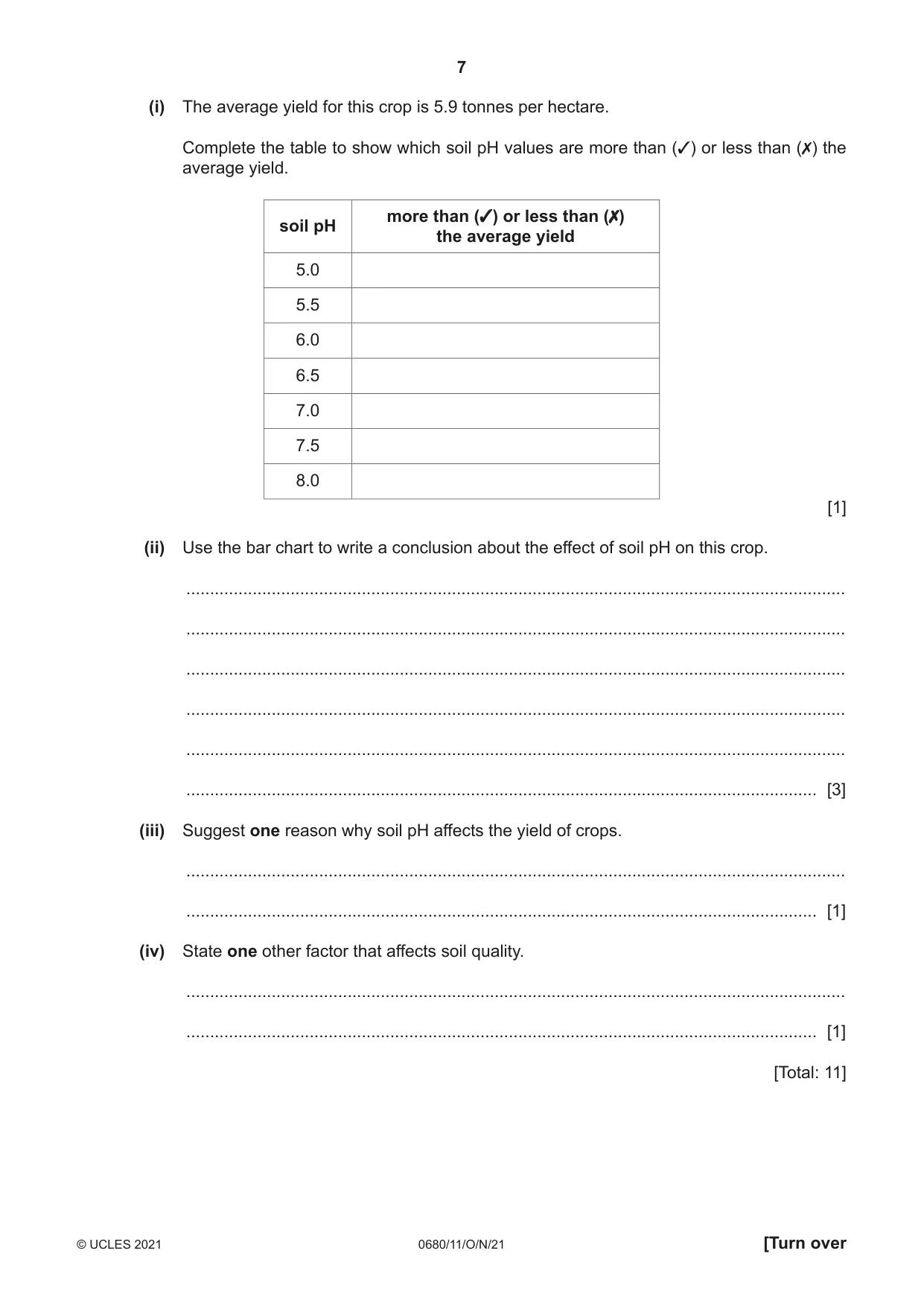
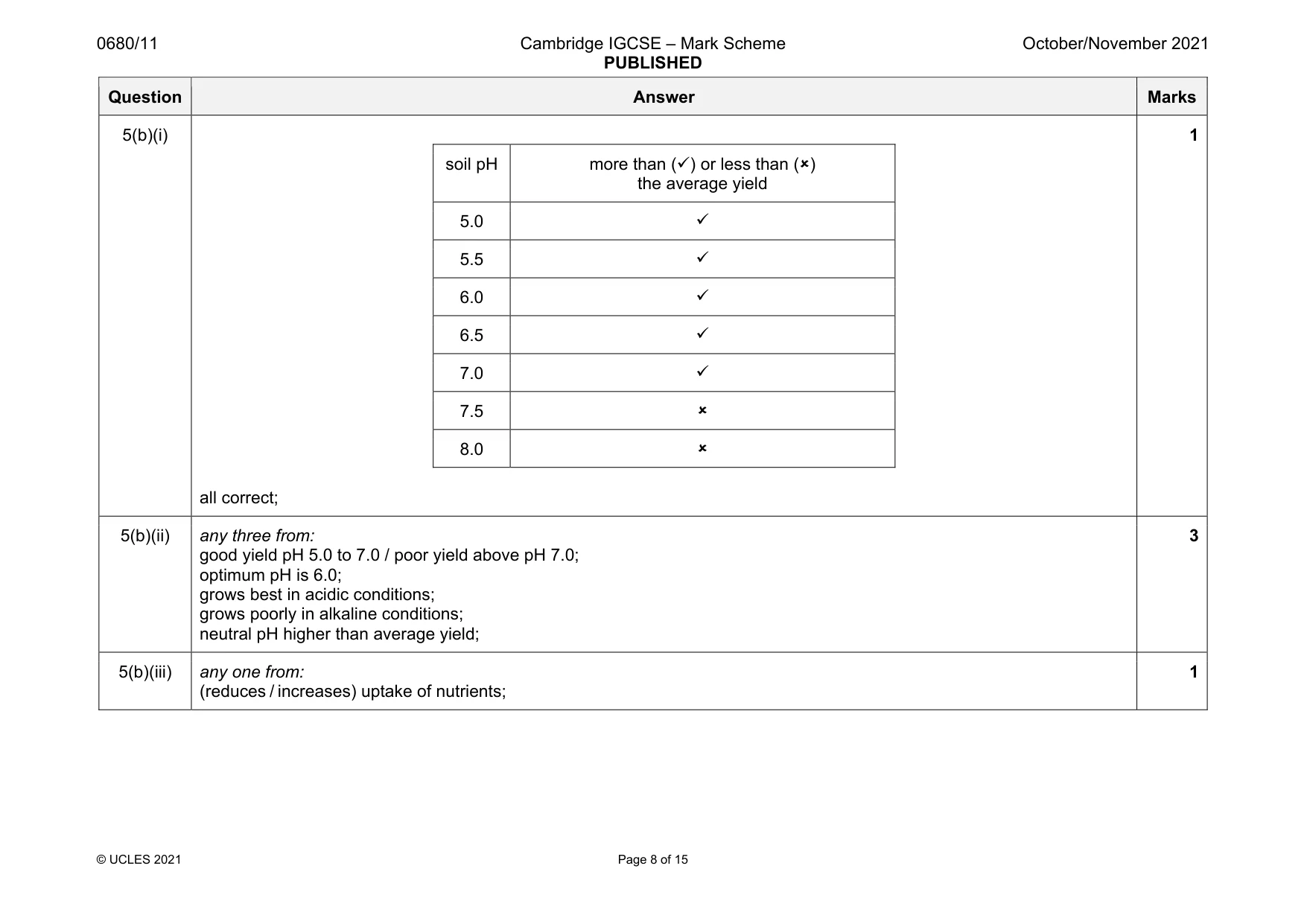
7 0680/11/O/N/21 © UCLES 2021 [Turn over (i) The average yield for this crop is 5.9 tonnes per hectare. Complete the table to show which soil pH values are more than (3) or less than (7) the average yield. soil pH more than (3) or less than (7) the average yield 5.0 5.5 6.0 6.5 7.0 7.5 8.0 [1] (ii) Use the bar chart to write a conclusion about the effect of soil pH on this crop. … … … … … … [3] (iii) Suggest one reason why soil pH affects the yield of crops. … … [1] (iv) State one other factor that affects soil quality. … … [1] [Total: 11]
Question paper, page 8
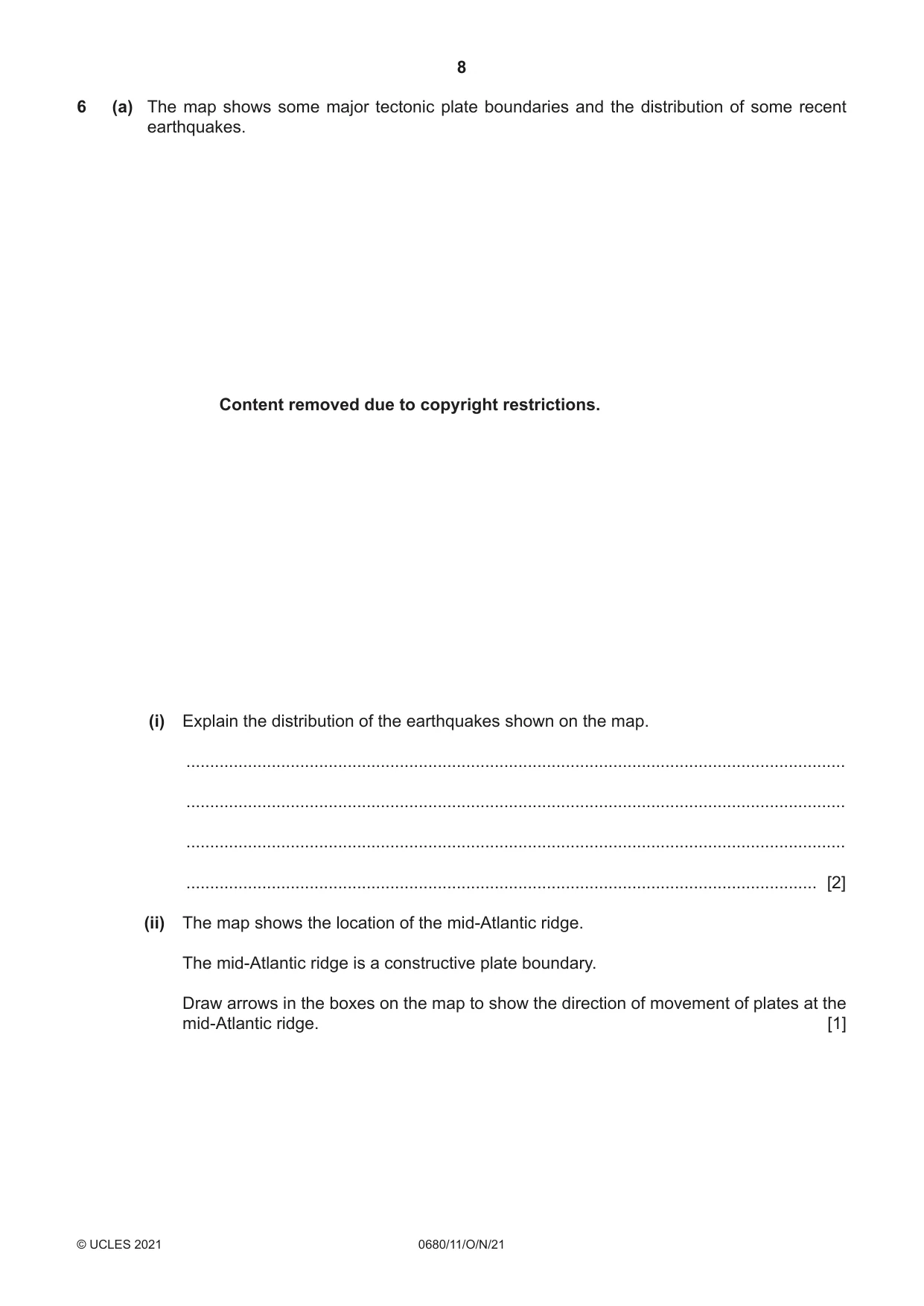
8 0680/11/O/N/21 © UCLES 2021 6 (a) The map shows some major tectonic plate boundaries and the distribution of some recent earthquakes. (i) Explain the distribution of the earthquakes shown on the map. … … … … [2] (ii) The map shows the location of the mid-Atlantic ridge. The mid-Atlantic ridge is a constructive plate boundary. Draw arrows in the boxes on the map to show the direction of movement of plates at the mid-Atlantic ridge. [1] Content removed due to copyright restrictions.
Question paper, page 9
9 0680/11/O/N/21 © UCLES 2021 [Turn over BLANK PAGE
Question paper, page 10
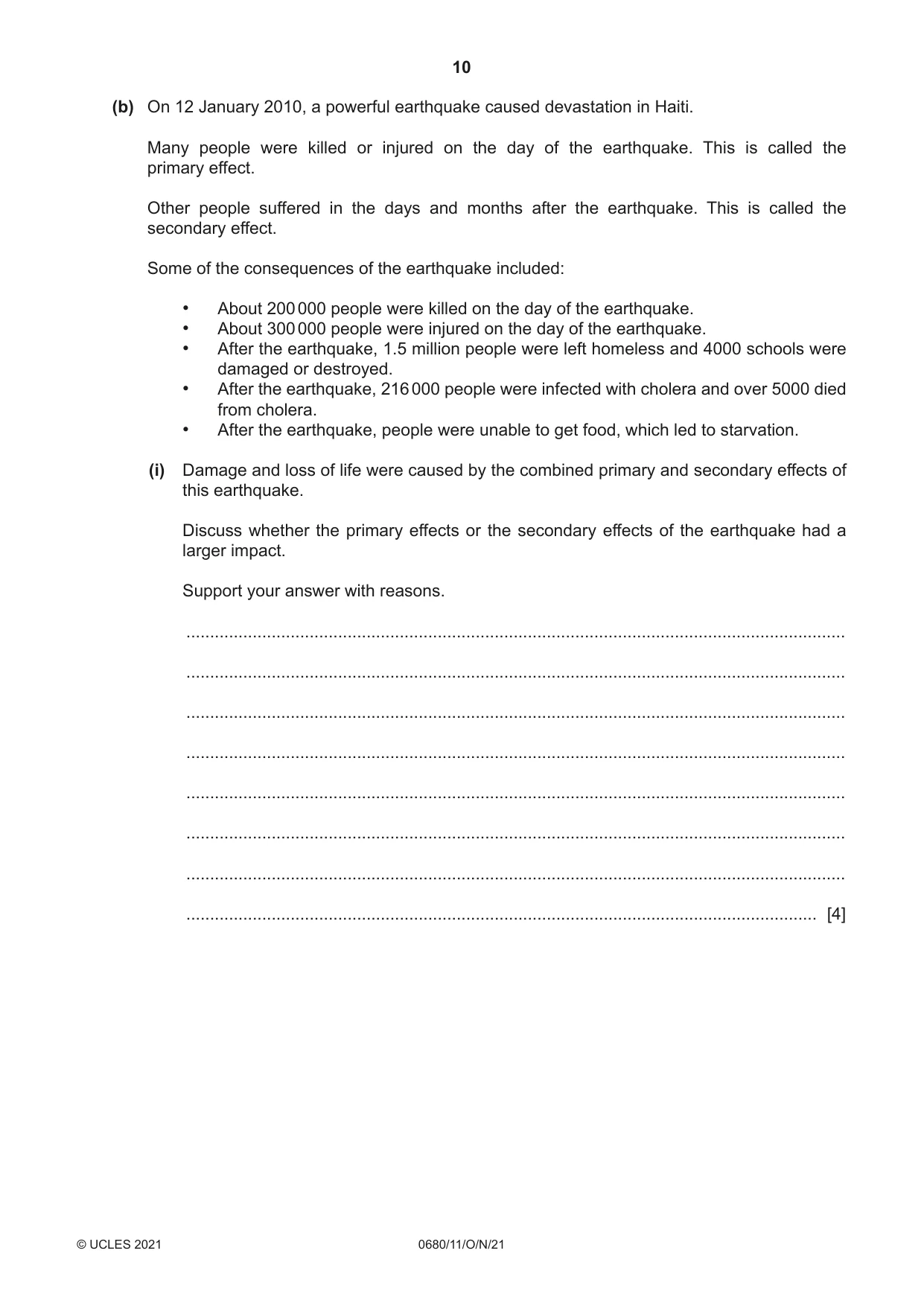
10 0680/11/O/N/21 © UCLES 2021 (b) On 12 January 2010, a powerful earthquake caused devastation in Haiti. Many people were killed or injured on the day of the earthquake. This is called the primary effect. Other people suffered in the days and months after the earthquake. This is called the secondary effect. Some of the consequences of the earthquake included: • About 200 000 people were killed on the day of the earthquake. • About 300 000 people were injured on the day of the earthquake. • After the earthquake, 1.5 million people were left homeless and 4000 schools were damaged or destroyed. • After the earthquake, 216 000 people were infected with cholera and over 5000 died from cholera. • After the earthquake, people were unable to get food, which led to starvation. (i) Damage and loss of life were caused by the combined primary and secondary effects of this earthquake. Discuss whether the primary effects or the secondary effects of the earthquake had a larger impact. Support your answer with reasons. … … … … … … … … [4]
Question paper, page 11
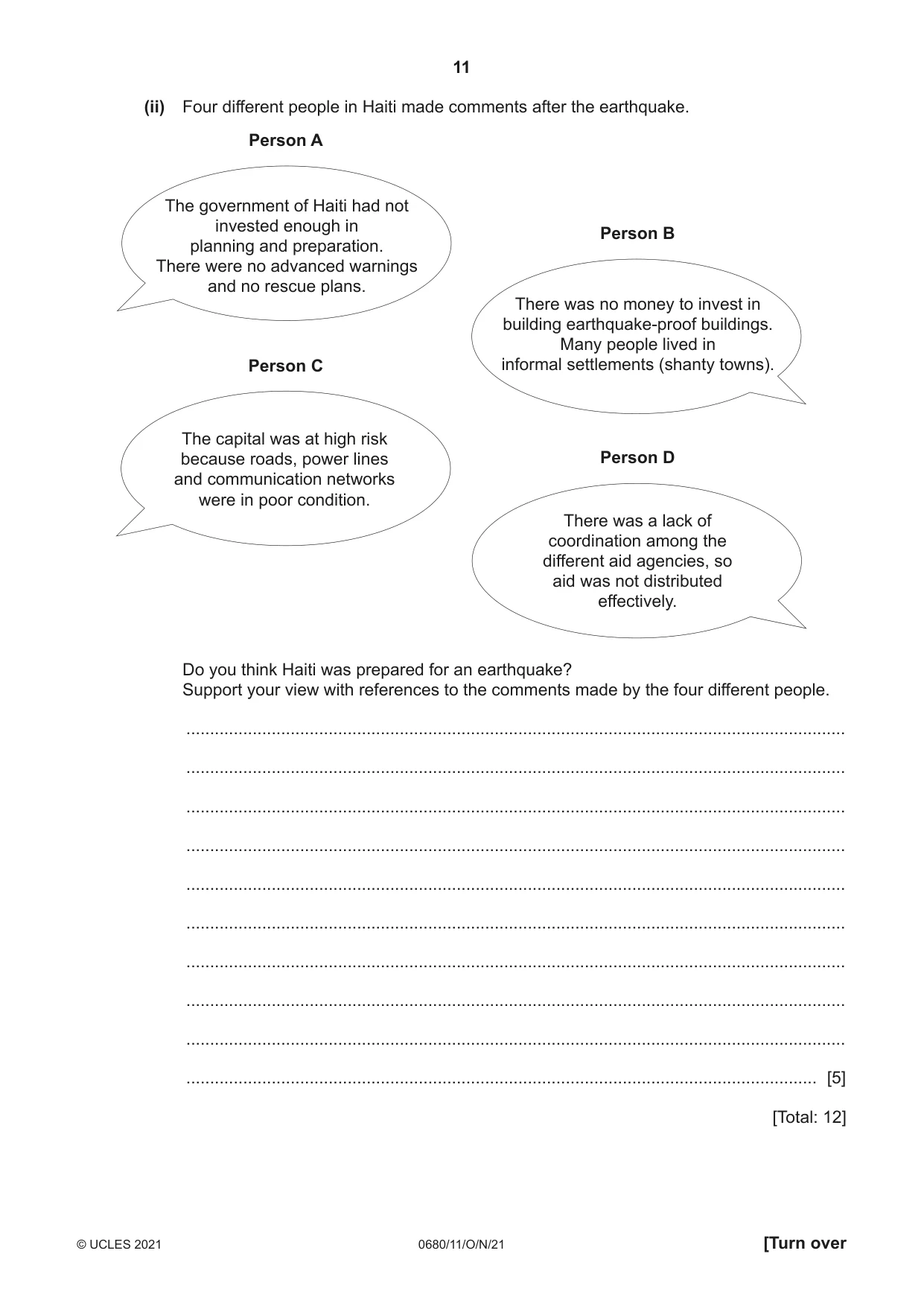
11 0680/11/O/N/21 © UCLES 2021 [Turn over (ii) Four different people in Haiti made comments after the earthquake. Person A There was no money to invest in building earthquake-proof buildings. Many people lived in informal settlements (shanty towns). Person B Person C There was a lack of coordination among the different aid agencies, so aid was not distributed effectively. Person D The government of Haiti had not invested enough in planning and preparation. There were no advanced warnings and no rescue plans. The capital was at high risk because roads, power lines and communication networks were in poor condition. Do you think Haiti was prepared for an earthquake? Support your view with references to the comments made by the four different people. … … … … … … … … … … [5] [Total: 12]
Question paper, page 12
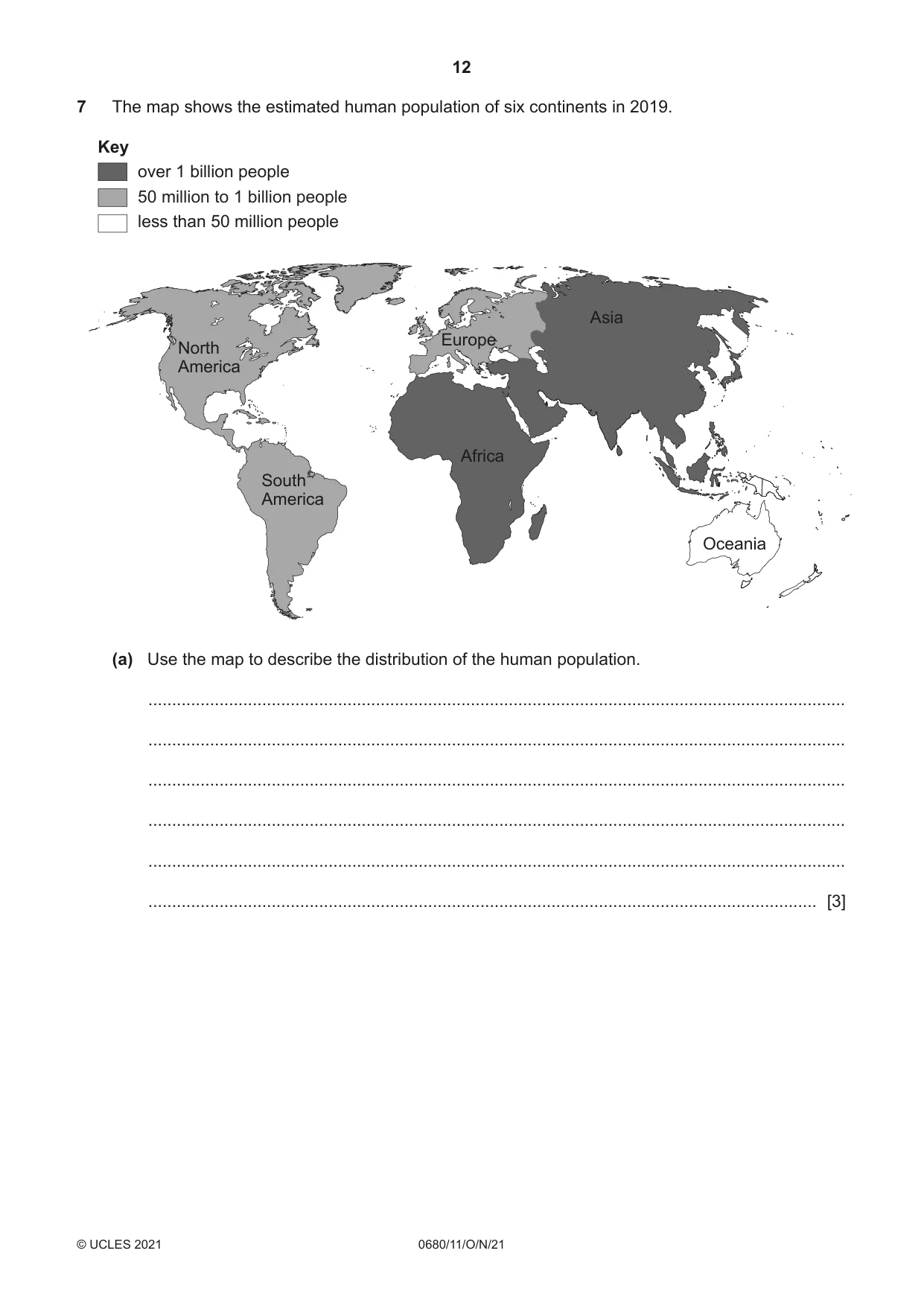
12 0680/11/O/N/21 © UCLES 2021 7 The map shows the estimated human population of six continents in 2019. Key over 1 billion people 50 million to 1 billion people less than 50 million people North America South America Africa Europe Asia Oceania (a) Use the map to describe the distribution of the human population. … … … … … … [3]
Question paper, page 13
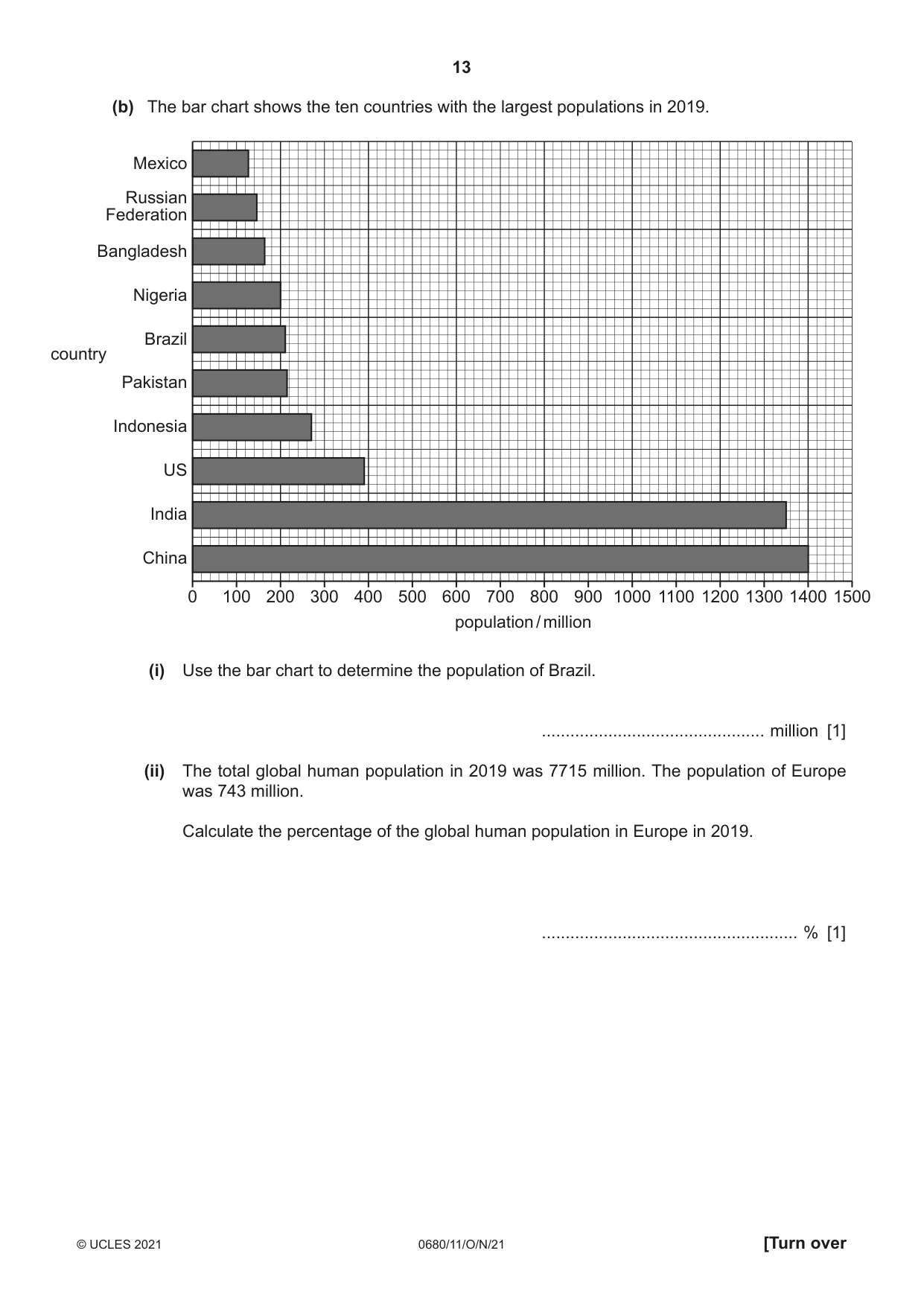
13 0680/11/O/N/21 © UCLES 2021 [Turn over (b) The bar chart shows the ten countries with the largest populations in 2019. 0 100 200 300 400 500 600 700 800 900 1000 1100 1200 1300 1400 1500 China India US Indonesia Pakistan Brazil Nigeria Bangladesh Russian Federation Mexico population / million country (i) Use the bar chart to determine the population of Brazil. … million [1] (ii) The total global human population in 2019 was 7715 million. The population of Europe was 743 million. Calculate the percentage of the global human population in Europe in 2019. … % [1]
Question paper, page 14
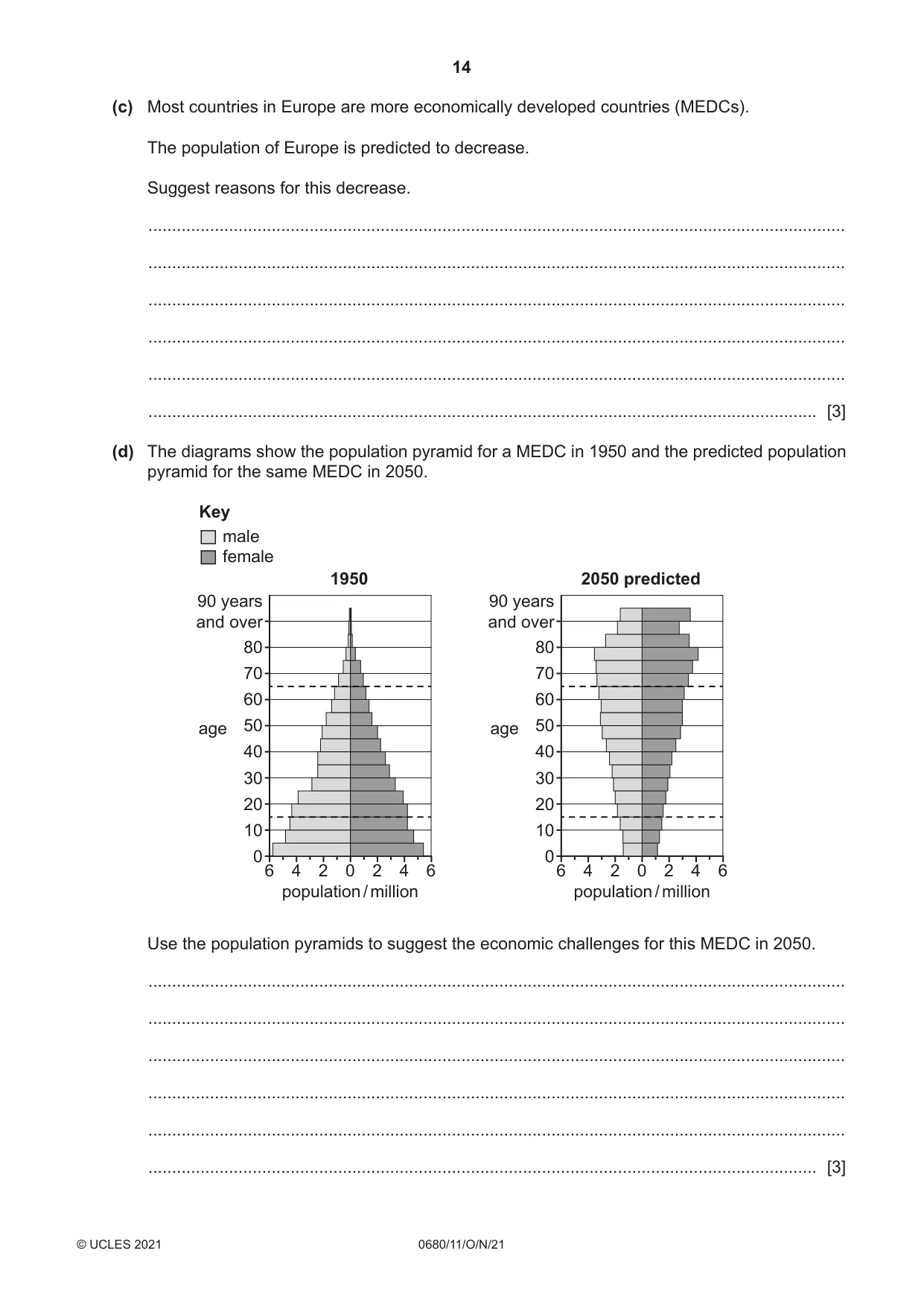
14 0680/11/O/N/21 © UCLES 2021 (c) Most countries in Europe are more economically developed countries (MEDCs). The population of Europe is predicted to decrease. Suggest reasons for this decrease. … … … … … … [3] (d) The diagrams show the population pyramid for a MEDC in 1950 and the predicted population pyramid for the same MEDC in 2050. 6 4 2 0 population / million 2 4 6 0 10 20 30 40 50 60 70 80 90 years and over 90 years and over age Key male female 1950 6 4 2 0 population / million 2 4 6 0 10 20 30 40 50 60 70 80 age 2050 predicted Use the population pyramids to suggest the economic challenges for this MEDC in 2050. … … … … … … [3]
Question paper, page 15
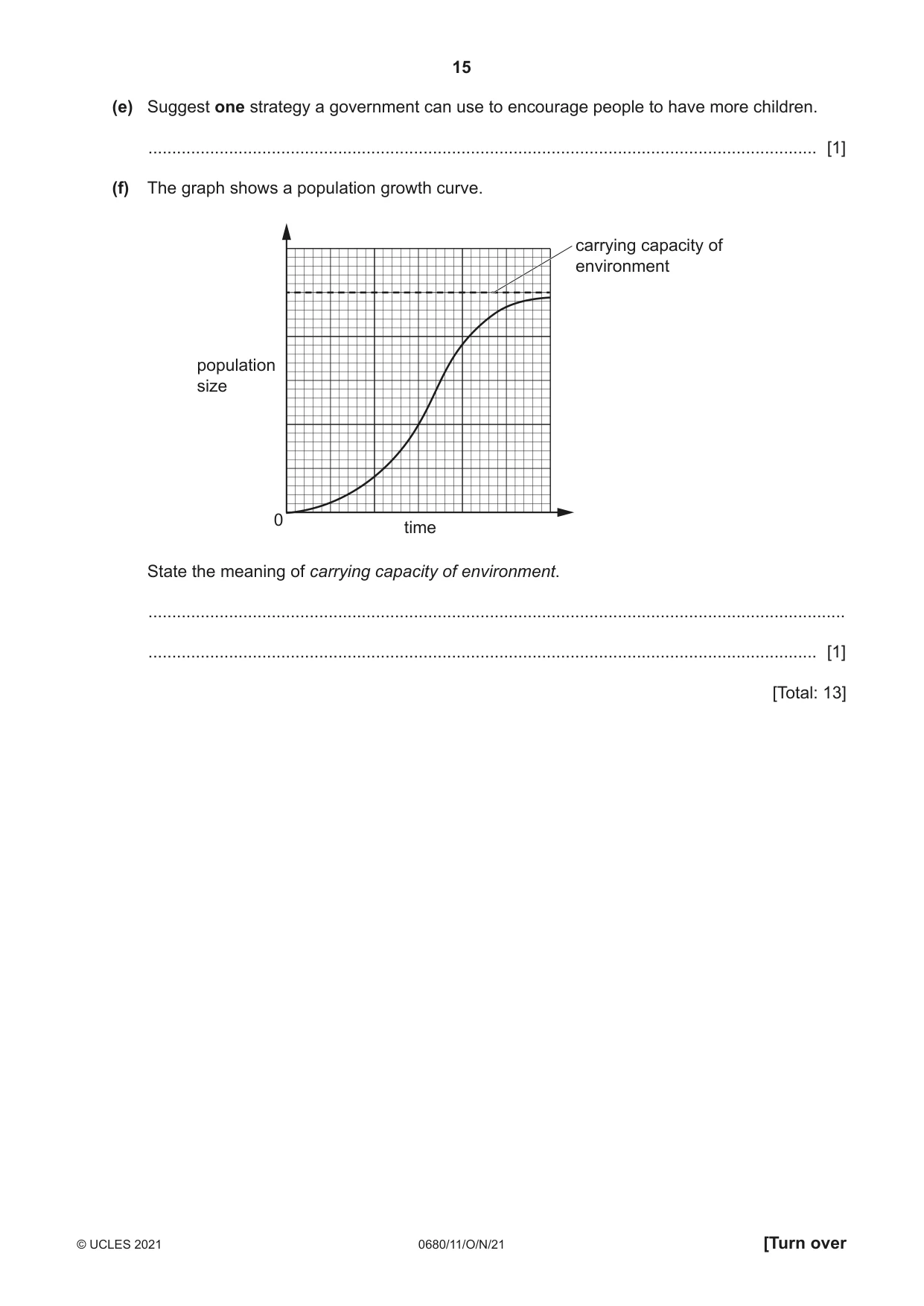
15 0680/11/O/N/21 © UCLES 2021 [Turn over (e) Suggest one strategy a government can use to encourage people to have more children. … [1] (f) The graph shows a population growth curve. 0 time population size carrying capacity of environment State the meaning of carrying capacity of environment. … … [1] [Total: 13]
Question paper, page 16
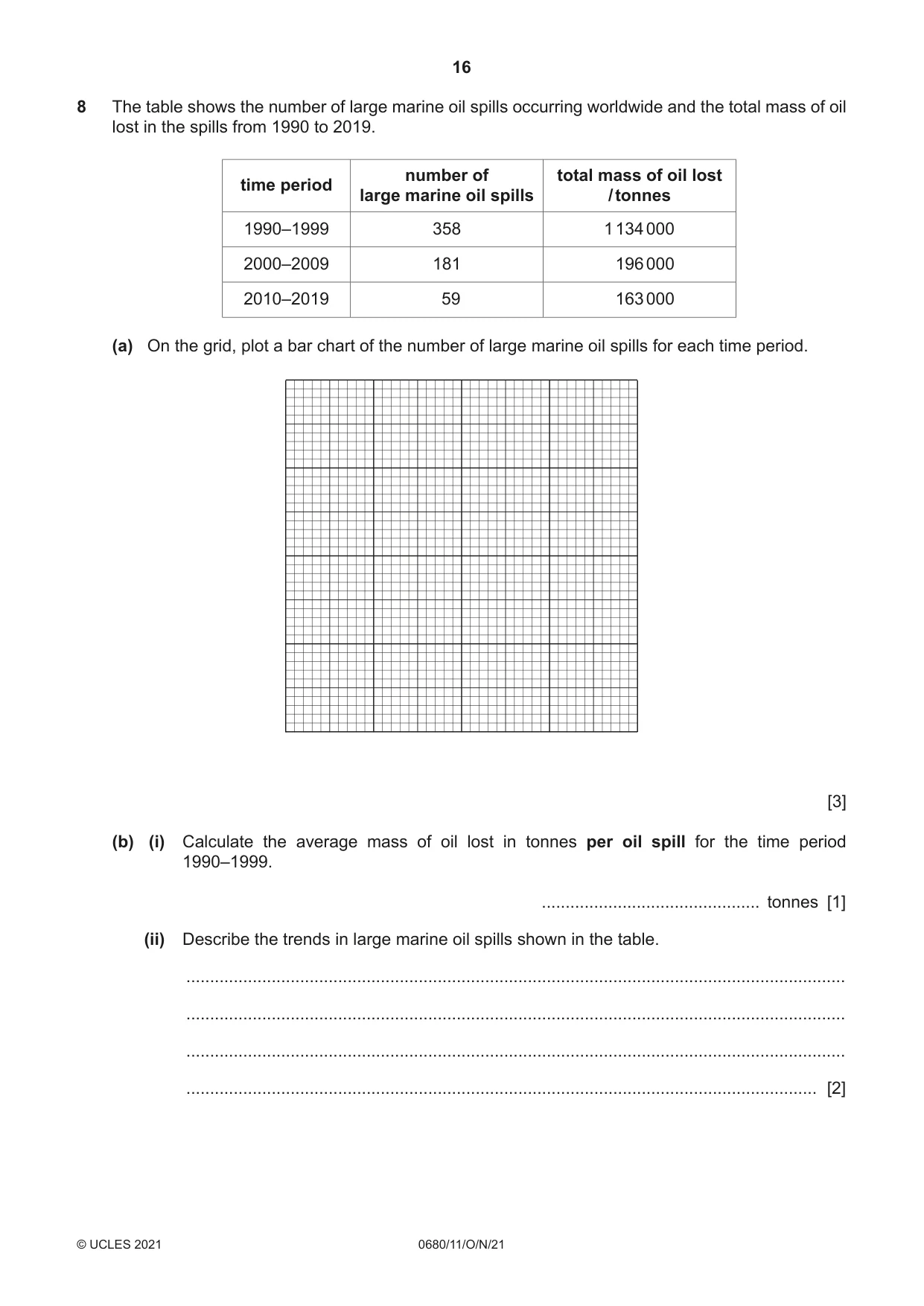
16 0680/11/O/N/21 © UCLES 2021 8 The table shows the number of large marine oil spills occurring worldwide and the total mass of oil lost in the spills from 1990 to 2019. time period number of large marine oil spills total mass of oil lost / tonnes 1990–1999 358 1 134 000 2000–2009 181 196 000 2010–2019 59 163 000 (a) On the grid, plot a bar chart of the number of large marine oil spills for each time period. [3] (b) (i) Calculate the average mass of oil lost in tonnes per oil spill for the time period 1990–1999. … tonnes [1] (ii) Describe the trends in large marine oil spills shown in the table. … … … … [2]
Question paper, page 17
17 0680/11/O/N/21 © UCLES 2021 [Turn over (c) Describe strategies for preventing large marine oil spills. … … … … [2]
Question paper, page 18
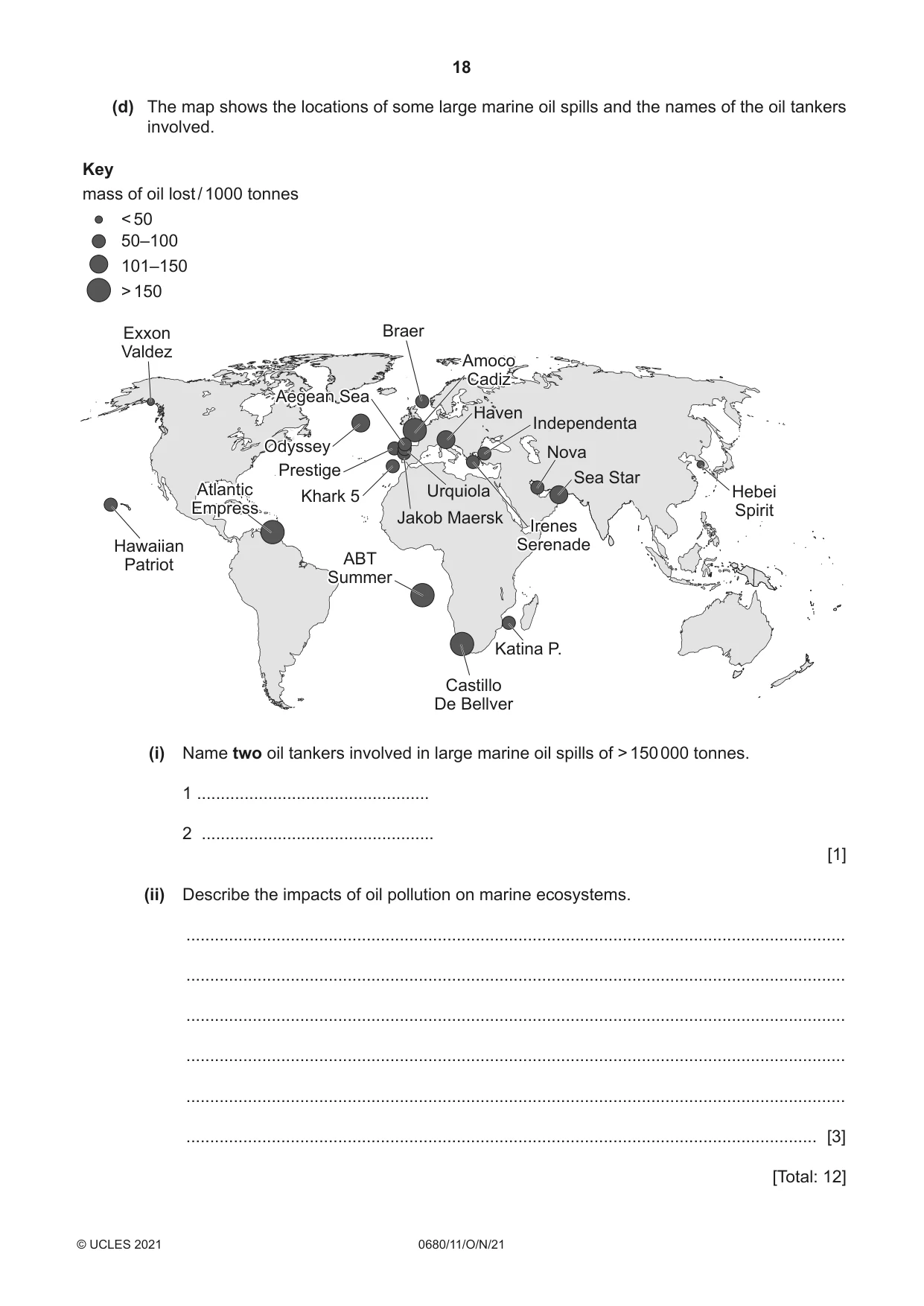
18 0680/11/O/N/21 © UCLES 2021 (d) The map shows the locations of some large marine oil spills and the names of the oil tankers involved. < 50 > 150 mass of oil lost / 1000 tonnes Key 50–100 101–150 Hawaiian Patriot Exxon Valdez Braer Aegean Sea Odyssey Atlantic Empress ABT Summer Irenes Serenade Amoco Cadiz Aegean Sea Odyssey Atlantic Empress Prestige Khark 5 ABT Summer Katina P. Castillo De Bellver Hebei Spirit Irenes Serenade Nova Sea Star Independenta Haven Amoco Cadiz Urquiola Jakob Maersk (i) Name two oil tankers involved in large marine oil spills of > 150 000 tonnes. 1 … 2 … [1] (ii) Describe the impacts of oil pollution on marine ecosystems. … … … … … … [3] [Total: 12]
Question paper, page 19
19 0680/11/O/N/21 © UCLES 2021 [Turn over BLANK PAGE
Question paper, page 20
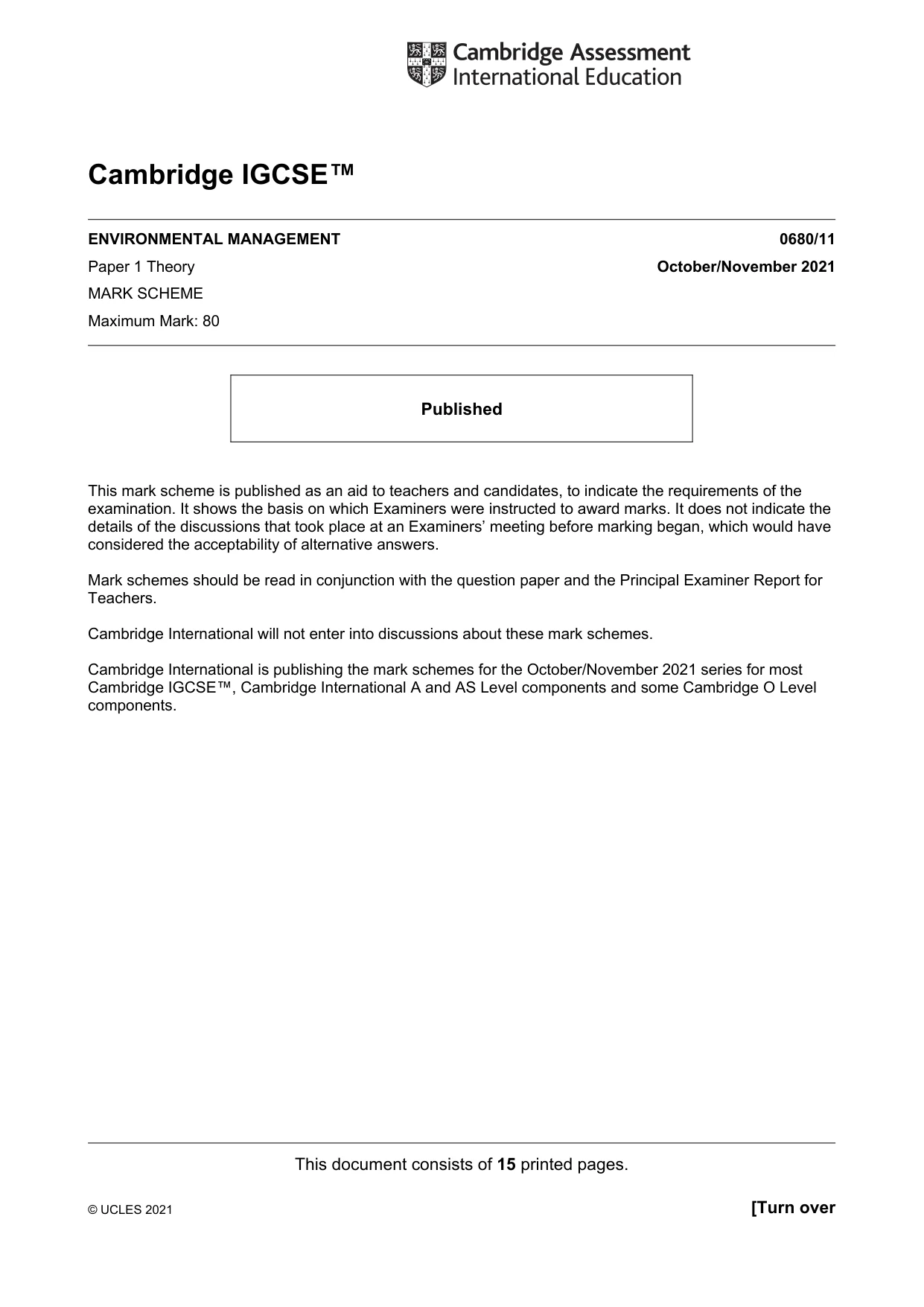
20 0680/11/O/N/21 © UCLES 2021 9 One impact of climate change is a rise in sea level. (a) Since 1900, the global sea level has risen by more than 200 mm. In the last 30 years, the rate of sea level rise has increased from around 1.7 mm per year to 3.3 mm per year. Calculate the sea level rise from 2021 to 2030 if the sea level continues to rise at 3.3 mm per year. …mm [2] (b) State two impacts of climate change other than sea level rise. 1 … 2 … [2] (c) Describe how some vehicles increase atmospheric carbon dioxide. … … … … [2]
Question paper, page 21
21 0680/11/O/N/21 © UCLES 2021 (d) A student said: The best strategy for stopping climate change is to ban the cutting down of trees. To what extent do you agree with this statement? Give reasons for your answer. … … … … … … … … … … … … … … … [6] [Total: 12]
Question paper, page 22
22 0680/11/O/N/21 © UCLES 2021 BLANK PAGE
Question paper, page 23
23 0680/11/O/N/21 © UCLES 2021 BLANK PAGE
Question paper, page 24
24 0680/11/O/N/21 © UCLES 2021 The boundaries and names shown, the designations used and the presentation of material on any maps contained in this question paper/insert do not imply official endorsement or acceptance by Cambridge Assessment International Education concerning the legal status of any country, territory, or area or any of its authorities, or of the delimitation of its frontiers or boundaries. Permission to reproduce items where third-party owned material protected by copyright is included has been sought and cleared where possible. Every reasonable effort has been made by the publisher (UCLES) to trace copyright holders, but if any items requiring clearance have unwittingly been included, the publisher will be pleased to make amends at the earliest possible opportunity. To avoid the issue of disclosure of answer-related information to candidates, all copyright acknowledgements are reproduced online in the Cambridge Assessment International Education Copyright Acknowledgements Booklet. This is produced for each series of examinations and is freely available to download at www.cambridgeinternational.org after the live examination series. Cambridge Assessment International Education is part of the Cambridge Assessment Group. Cambridge Assessment is the brand name of the University of Cambridge Local Examinations Syndicate (UCLES), which itself is a department of the University of Cambridge. BLANK PAGE
Mark scheme, page 1
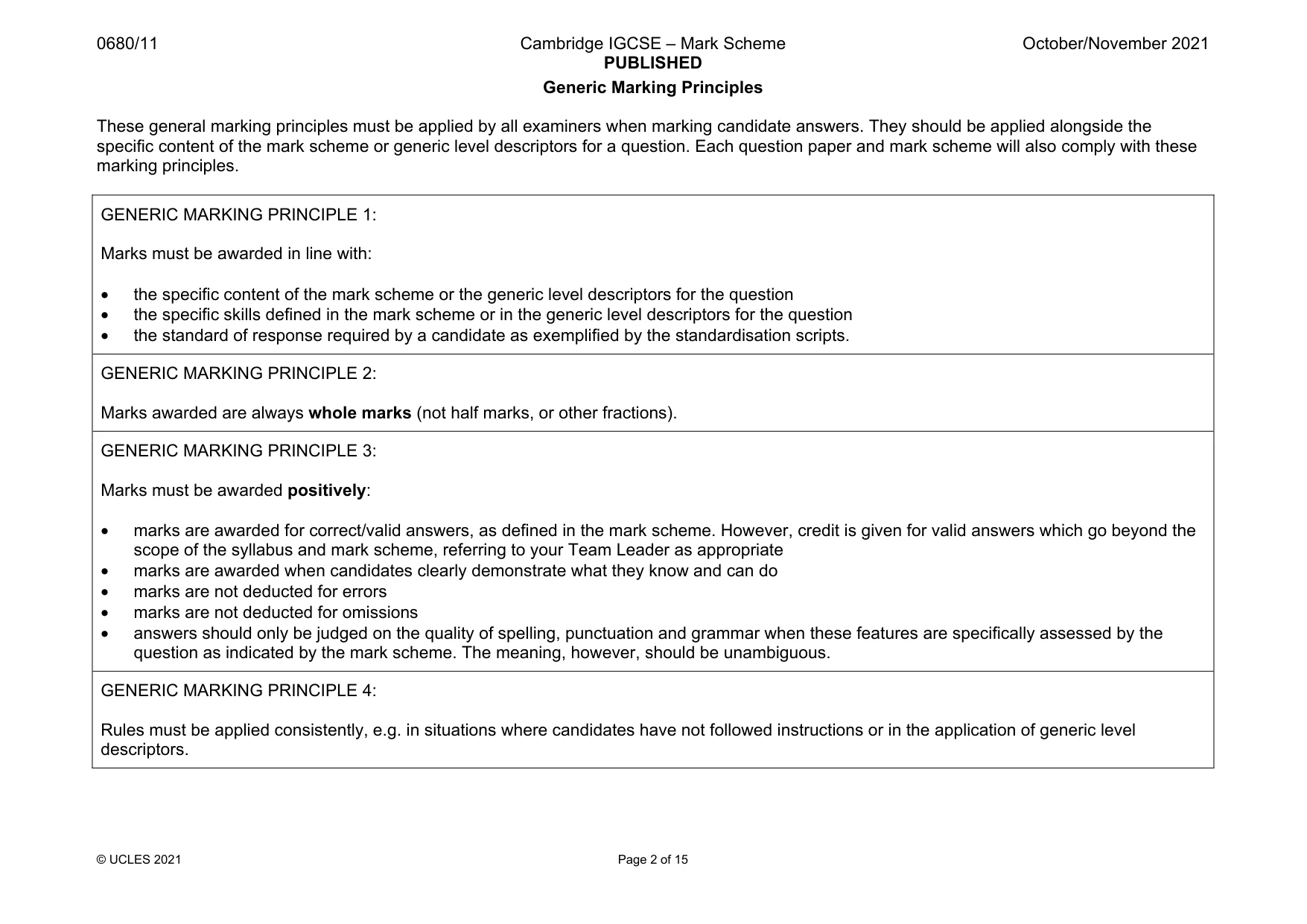
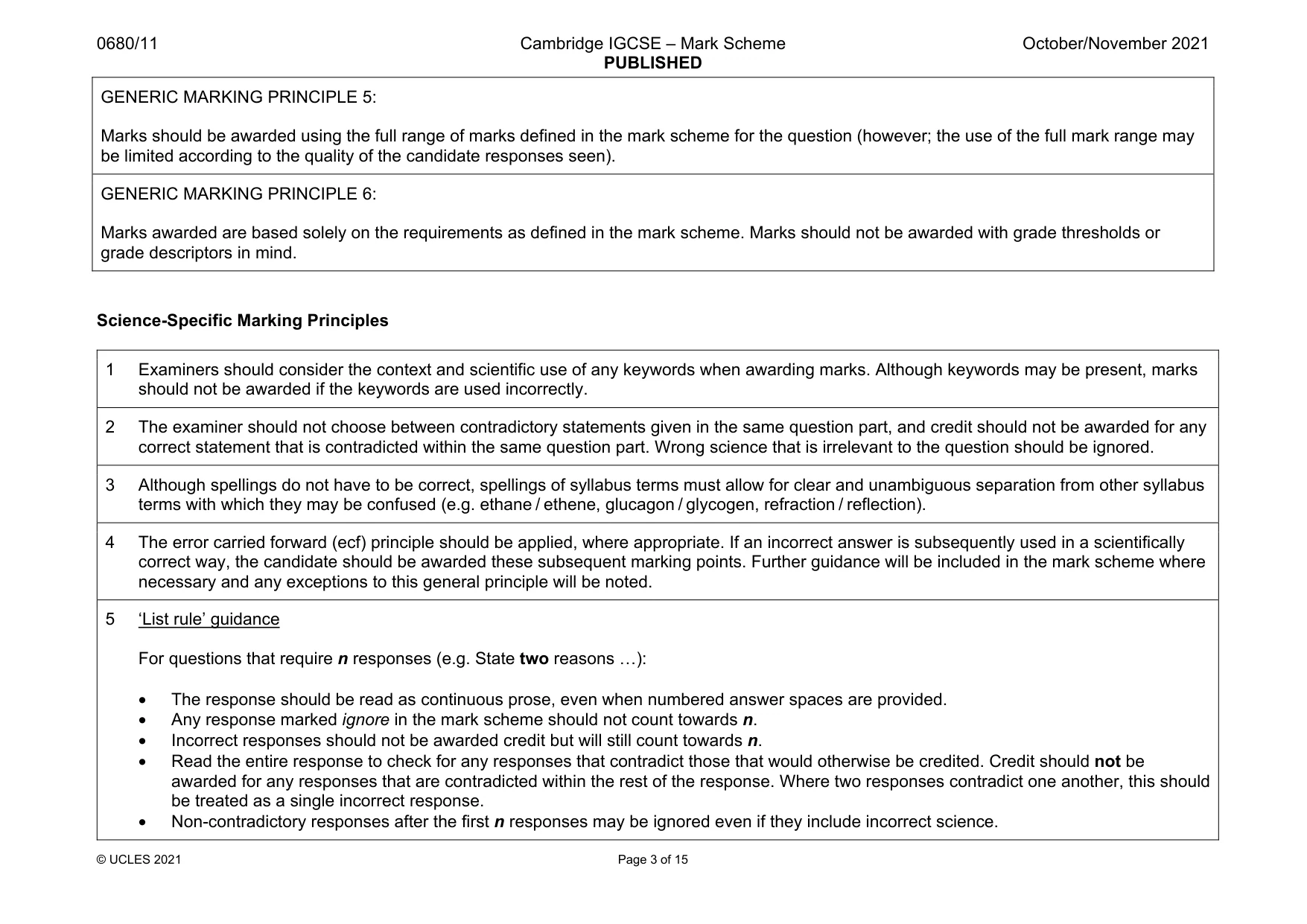
This document consists of 15 printed pages. © UCLES 2021 [Turn over Cambridge IGCSE™ ENVIRONMENTAL MANAGEMENT 0680/11 Paper 1 Theory October/November 2021 MARK SCHEME Maximum Mark: 80 Published This mark scheme is published as an aid to teachers and candidates, to indicate the requirements of the examination. It shows the basis on which Examiners were instructed to award marks. It does not indicate the details of the discussions that took place at an Examiners’ meeting before marking began, which would have considered the acceptability of alternative answers. Mark schemes should be read in conjunction with the question paper and the Principal Examiner Report for Teachers. Cambridge International will not enter into discussions about these mark schemes. Cambridge International is publishing the mark schemes for the October/November 2021 series for most Cambridge IGCSE™, Cambridge International A and AS Level components and some Cambridge O Level components.
Mark scheme, page 2
0680/11 Cambridge IGCSE – Mark Scheme PUBLISHED October/November 2021 © UCLES 2021 Page 2 of 15 Generic Marking Principles These general marking principles must be applied by all examiners when marking candidate answers. They should be applied alongside the specific content of the mark scheme or generic level descriptors for a question. Each question paper and mark scheme will also comply with these marking principles. GENERIC MARKING PRINCIPLE 1: Marks must be awarded in line with: • the specific content of the mark scheme or the generic level descriptors for the question • the specific skills defined in the mark scheme or in the generic level descriptors for the question • the standard of response required by a candidate as exemplified by the standardisation scripts. GENERIC MARKING PRINCIPLE 2: Marks awarded are always whole marks (not half marks, or other fractions). GENERIC MARKING PRINCIPLE 3: Marks must be awarded positively: • marks are awarded for correct/valid answers, as defined in the mark scheme. However, credit is given for valid answers which go beyond the scope of the syllabus and mark scheme, referring to your Team Leader as appropriate • marks are awarded when candidates clearly demonstrate what they know and can do • marks are not deducted for errors • marks are not deducted for omissions • answers should only be judged on the quality of spelling, punctuation and grammar when these features are specifically assessed by the question as indicated by the mark scheme. The meaning, however, should be unambiguous. GENERIC MARKING PRINCIPLE 4: Rules must be applied consistently, e.g. in situations where candidates have not followed instructions or in the application of generic level descriptors.
Mark scheme, page 3
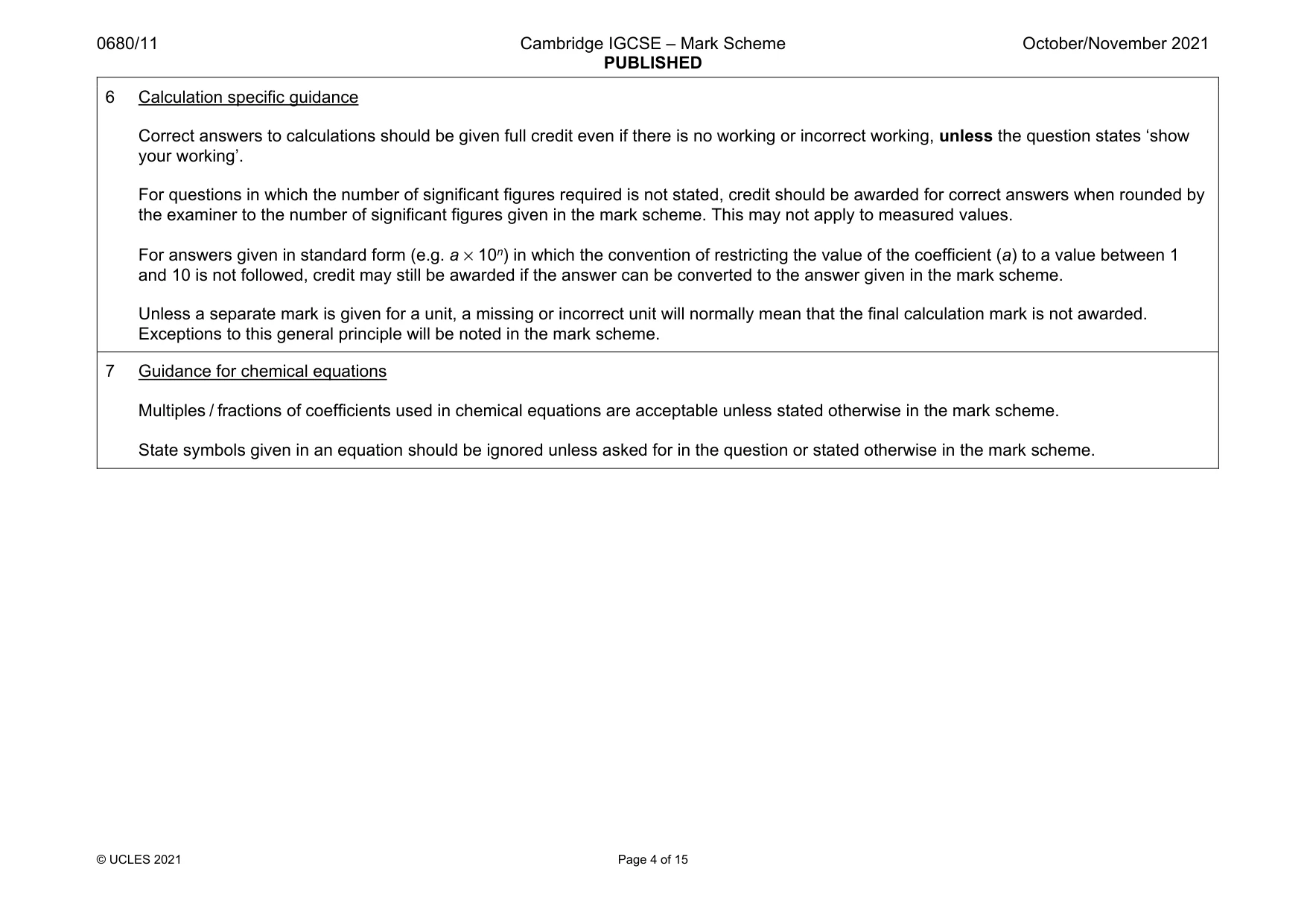
0680/11 Cambridge IGCSE – Mark Scheme PUBLISHED October/November 2021 © UCLES 2021 Page 3 of 15 GENERIC MARKING PRINCIPLE 5: Marks should be awarded using the full range of marks defined in the mark scheme for the question (however; the use of the full mark range may be limited according to the quality of the candidate responses seen). GENERIC MARKING PRINCIPLE 6: Marks awarded are based solely on the requirements as defined in the mark scheme. Marks should not be awarded with grade thresholds or grade descriptors in mind. Science-Specific Marking Principles 1 Examiners should consider the context and scientific use of any keywords when awarding marks. Although keywords may be present, marks should not be awarded if the keywords are used incorrectly. 2 The examiner should not choose between contradictory statements given in the same question part, and credit should not be awarded for any correct statement that is contradicted within the same question part. Wrong science that is irrelevant to the question should be ignored. 3 Although spellings do not have to be correct, spellings of syllabus terms must allow for clear and unambiguous separation from other syllabus terms with which they may be confused (e.g. ethane / ethene, glucagon / glycogen, refraction / reflection). 4 The error carried forward (ecf) principle should be applied, where appropriate. If an incorrect answer is subsequently used in a scientifically correct way, the candidate should be awarded these subsequent marking points. Further guidance will be included in the mark scheme where necessary and any exceptions to this general principle will be noted. 5 ‘List rule’ guidance For questions that require n responses (e.g. State two reasons …): • The response should be read as continuous prose, even when numbered answer spaces are provided. • Any response marked ignore in the mark scheme should not count towards n. • Incorrect responses should not be awarded credit but will still count towards n. • Read the entire response to check for any responses that contradict those that would otherwise be credited. Credit should not be awarded for any responses that are contradicted within the rest of the response. Where two responses contradict one another, this should be treated as a single incorrect response. • Non-contradictory responses after the first n responses may be ignored even if they include incorrect science.
Mark scheme, page 4
0680/11 Cambridge IGCSE – Mark Scheme PUBLISHED October/November 2021 © UCLES 2021 Page 4 of 15 6 Calculation specific guidance Correct answers to calculations should be given full credit even if there is no working or incorrect working, unless the question states ‘show your working’. For questions in which the number of significant figures required is not stated, credit should be awarded for correct answers when rounded by the examiner to the number of significant figures given in the mark scheme. This may not apply to measured values. For answers given in standard form (e.g. a × 10n) in which the convention of restricting the value of the coefficient (a) to a value between 1 and 10 is not followed, credit may still be awarded if the answer can be converted to the answer given in the mark scheme. Unless a separate mark is given for a unit, a missing or incorrect unit will normally mean that the final calculation mark is not awarded. Exceptions to this general principle will be noted in the mark scheme. 7 Guidance for chemical equations Multiples / fractions of coefficients used in chemical equations are acceptable unless stated otherwise in the mark scheme. State symbols given in an equation should be ignored unless asked for in the question or stated otherwise in the mark scheme.
Mark scheme, page 5
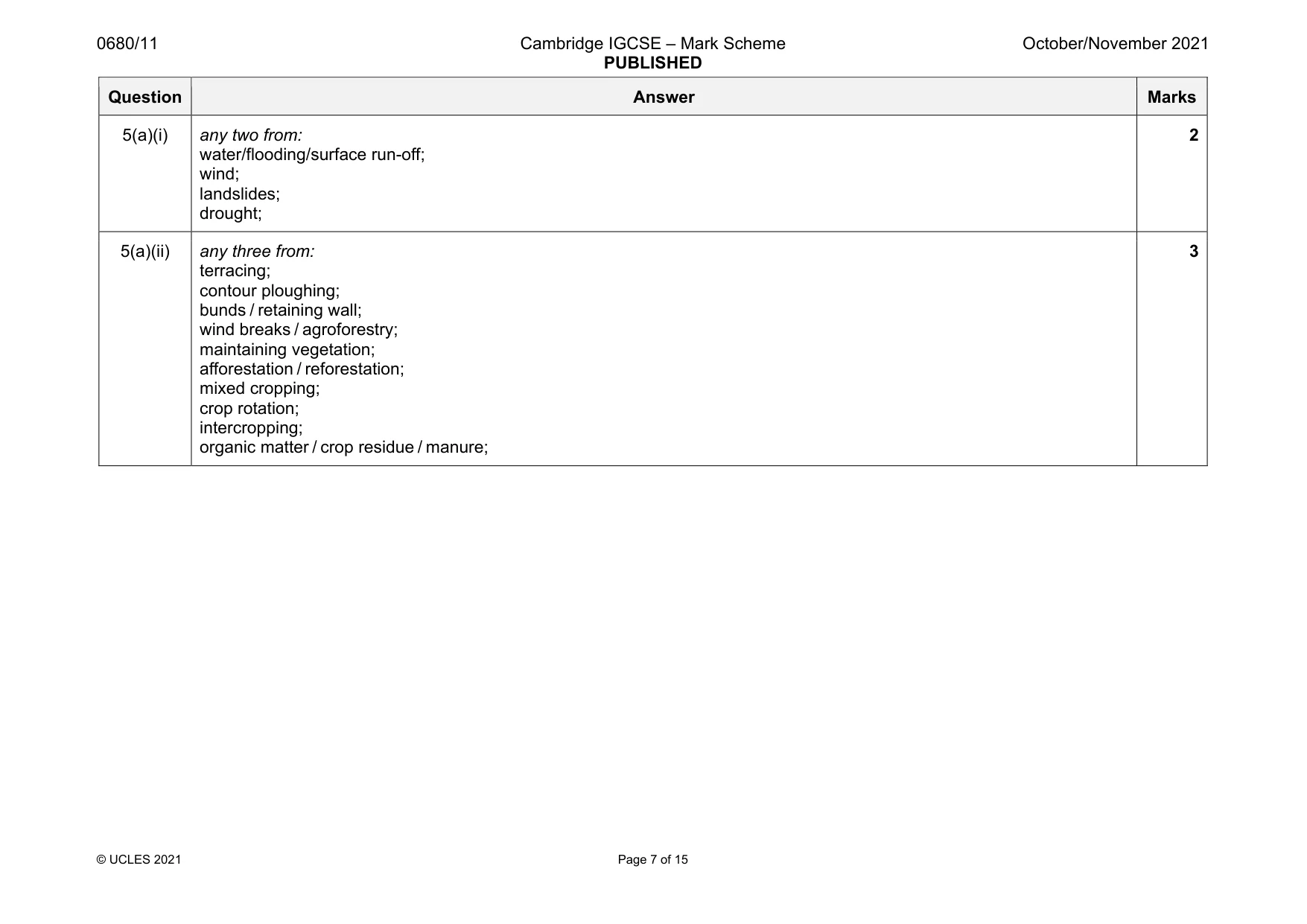
0680/11 Cambridge IGCSE – Mark Scheme PUBLISHED October/November 2021 © UCLES 2021 Page 5 of 15 Question Answer Marks 1(a) (F overuse of fertiliser) C excess fertiliser runs off into rivers E nutrient enrichment causes algal bloom G sunlight blocked reducing photosynthesis A algae and aquatic plants die B decomposers use up oxygen (D fish and other organisms die) 1 correct; 3 correct; 5 correct; 3 1(b) toxins / chemicals are ingested or absorbed; faster than lost / excreted; 2 Question Answer Marks 2(a) limestone / sandstone / shale; 1 2(b) any two from: loss of habitat; vegetation dies / deforestation; noise / water / air / visual pollution;; 2 2(c) any two from: employment opportunities; improvements in local / national economy; improvements in facilities and infrastructure; 2
Mark scheme, page 6
0680/11 Cambridge IGCSE – Mark Scheme PUBLISHED October/November 2021 © UCLES 2021 Page 6 of 15 Question Answer Marks 3(a) circle with arrows anticlockwise; solid lines originating from the North and dotted lines originating from the South; 2 3(b) any three from: (during El Niño) upwelling weakens; (brings up) warm water; this has few nutrients; less oxygen (in warm water); less plankton; fish have little food; 3 Question Answer Marks 4(a) any two from: timber extraction / logging; farming; settlements; roads; mining; 2 4(b) tree; 1 4(c) any two from: act as carbon sinks / carbon store; reference to photosynthesis qualified e.g. supplies O2 (for respiration)/ reference to CO2; prevention of soil erosion; biodiversity / genetic resource; medicine / raw materials; ecotourism; example of the impact on water cycle e.g. prevents flooding; 2
Mark scheme, page 7
0680/11 Cambridge IGCSE – Mark Scheme PUBLISHED October/November 2021 © UCLES 2021 Page 7 of 15 Question Answer Marks 5(a)(i) any two from: water/flooding/surface run-off; wind; landslides; drought; 2 5(a)(ii) any three from: terracing; contour ploughing; bunds / retaining wall; wind breaks / agroforestry; maintaining vegetation; afforestation / reforestation; mixed cropping; crop rotation; intercropping; organic matter / crop residue / manure; 3
Mark scheme, page 8
0680/11 Cambridge IGCSE – Mark Scheme PUBLISHED October/November 2021 © UCLES 2021 Page 8 of 15 Question Answer Marks 5(b)(i) soil pH more than () or less than () the average yield 5.0 5.5 6.0 6.5 7.0 7.5 8.0 all correct; 1 5(b)(ii) any three from: good yield pH 5.0 to 7.0 / poor yield above pH 7.0; optimum pH is 6.0; grows best in acidic conditions; grows poorly in alkaline conditions; neutral pH higher than average yield; 3 5(b)(iii) any one from: (reduces / increases) uptake of nutrients; 1
Mark scheme, page 9
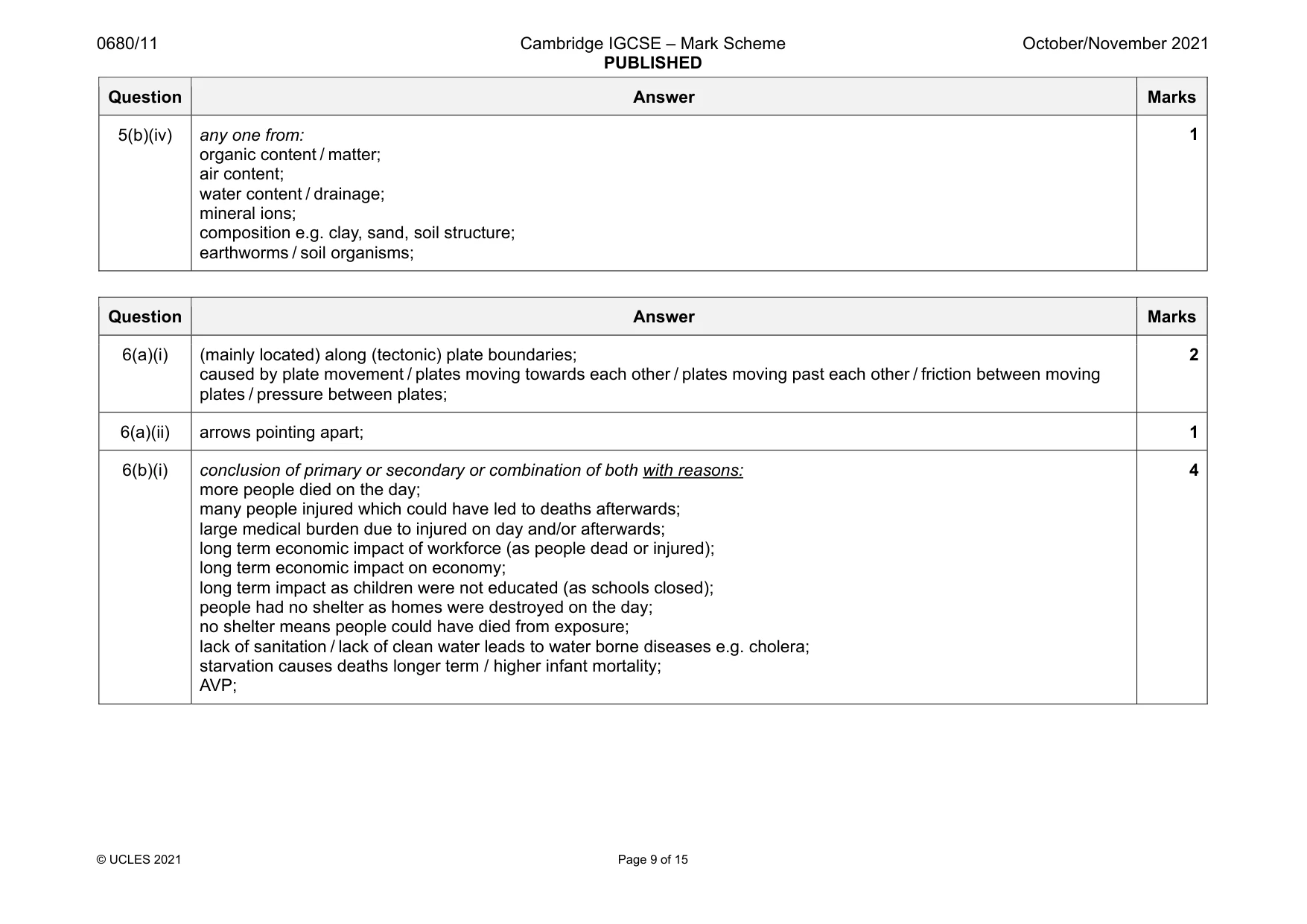
0680/11 Cambridge IGCSE – Mark Scheme PUBLISHED October/November 2021 © UCLES 2021 Page 9 of 15 Question Answer Marks 5(b)(iv) any one from: organic content / matter; air content; water content / drainage; mineral ions; composition e.g. clay, sand, soil structure; earthworms / soil organisms; 1 Question Answer Marks 6(a)(i) (mainly located) along (tectonic) plate boundaries; caused by plate movement / plates moving towards each other / plates moving past each other / friction between moving plates / pressure between plates; 2 6(a)(ii) arrows pointing apart; 1 6(b)(i) conclusion of primary or secondary or combination of both with reasons: more people died on the day; many people injured which could have led to deaths afterwards; large medical burden due to injured on day and/or afterwards; long term economic impact of workforce (as people dead or injured); long term economic impact on economy; long term impact as children were not educated (as schools closed); people had no shelter as homes were destroyed on the day; no shelter means people could have died from exposure; lack of sanitation / lack of clean water leads to water borne diseases e.g. cholera; starvation causes deaths longer term / higher infant mortality; AVP; 4
Mark scheme, page 10
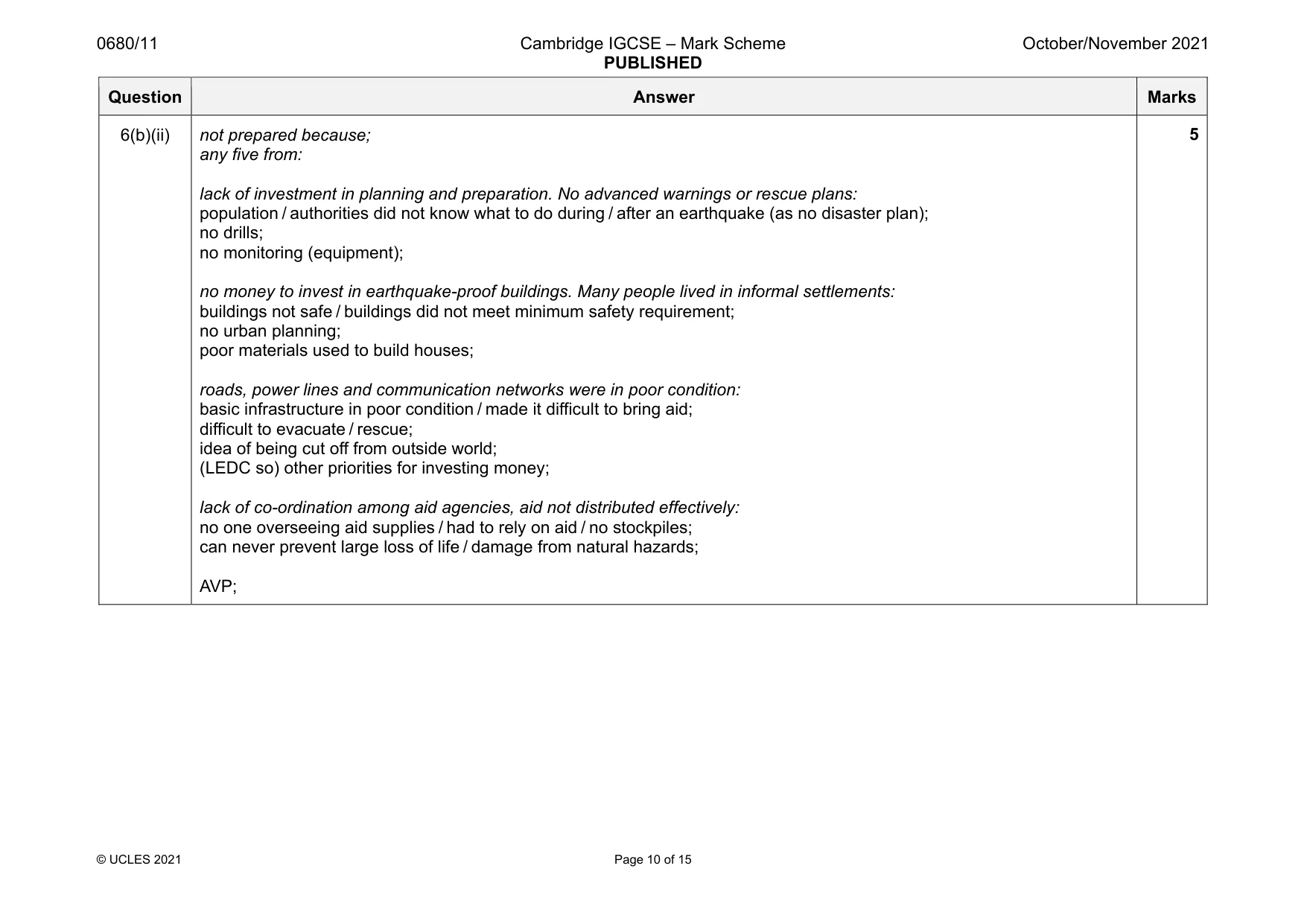
0680/11 Cambridge IGCSE – Mark Scheme PUBLISHED October/November 2021 © UCLES 2021 Page 10 of 15 Question Answer Marks 6(b)(ii) not prepared because; any five from: lack of investment in planning and preparation. No advanced warnings or rescue plans: population / authorities did not know what to do during / after an earthquake (as no disaster plan); no drills; no monitoring (equipment); no money to invest in earthquake-proof buildings. Many people lived in informal settlements: buildings not safe / buildings did not meet minimum safety requirement; no urban planning; poor materials used to build houses; roads, power lines and communication networks were in poor condition: basic infrastructure in poor condition / made it difficult to bring aid; difficult to evacuate / rescue; idea of being cut off from outside world; (LEDC so) other priorities for investing money; lack of co-ordination among aid agencies, aid not distributed effectively: no one overseeing aid supplies / had to rely on aid / no stockpiles; can never prevent large loss of life / damage from natural hazards; AVP; 5
Mark scheme, page 11
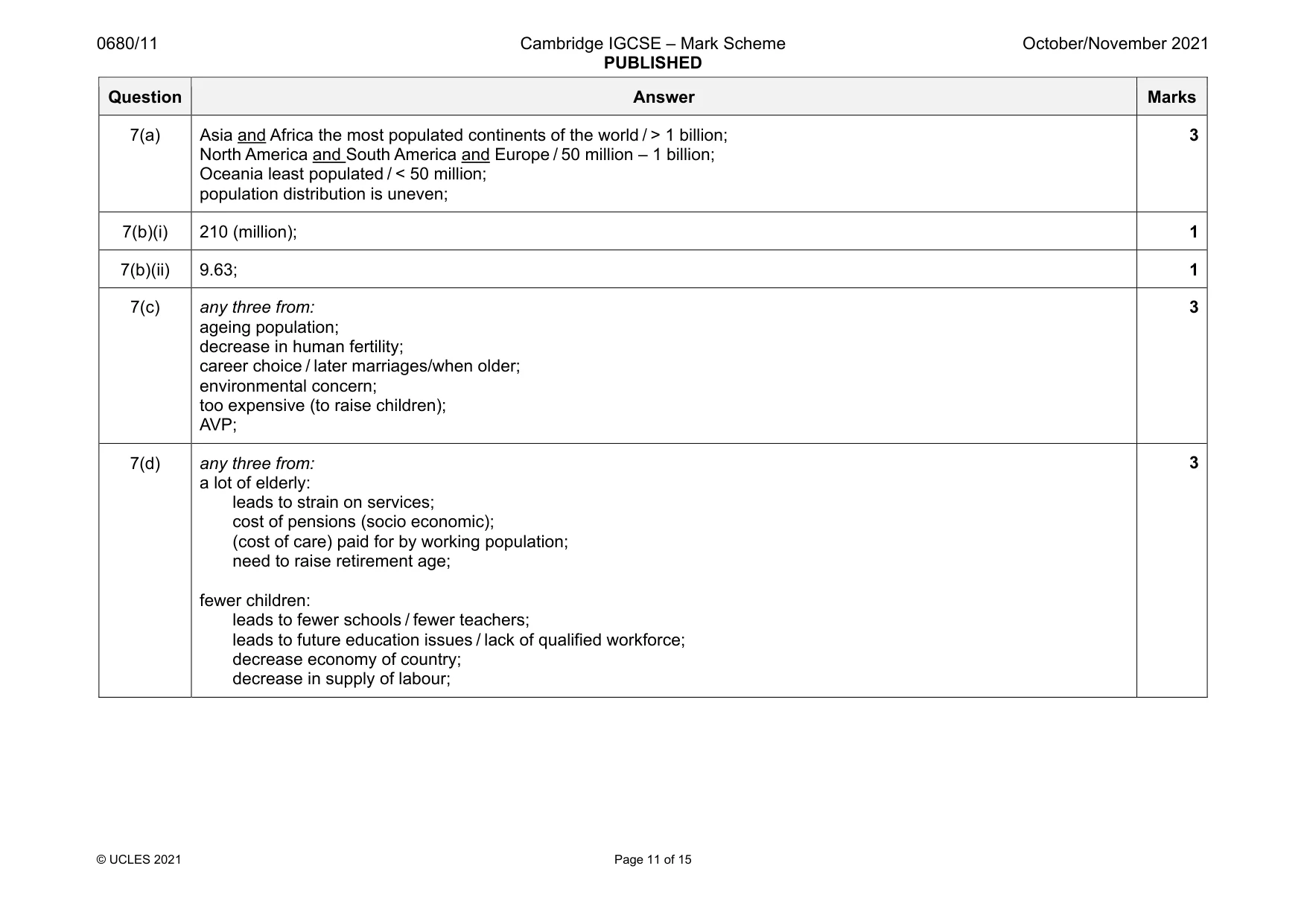
0680/11 Cambridge IGCSE – Mark Scheme PUBLISHED October/November 2021 © UCLES 2021 Page 11 of 15 Question Answer Marks 7(a) Asia and Africa the most populated continents of the world / > 1 billion; North America and South America and Europe / 50 million – 1 billion; Oceania least populated / < 50 million; population distribution is uneven; 3 7(b)(i) 210 (million); 1 7(b)(ii) 9.63; 1 7(c) any three from: ageing population; decrease in human fertility; career choice / later marriages/when older; environmental concern; too expensive (to raise children); AVP; 3 7(d) any three from: a lot of elderly: leads to strain on services; cost of pensions (socio economic); (cost of care) paid for by working population; need to raise retirement age; fewer children: leads to fewer schools / fewer teachers; leads to future education issues / lack of qualified workforce; decrease economy of country; decrease in supply of labour; 3
Mark scheme, page 12
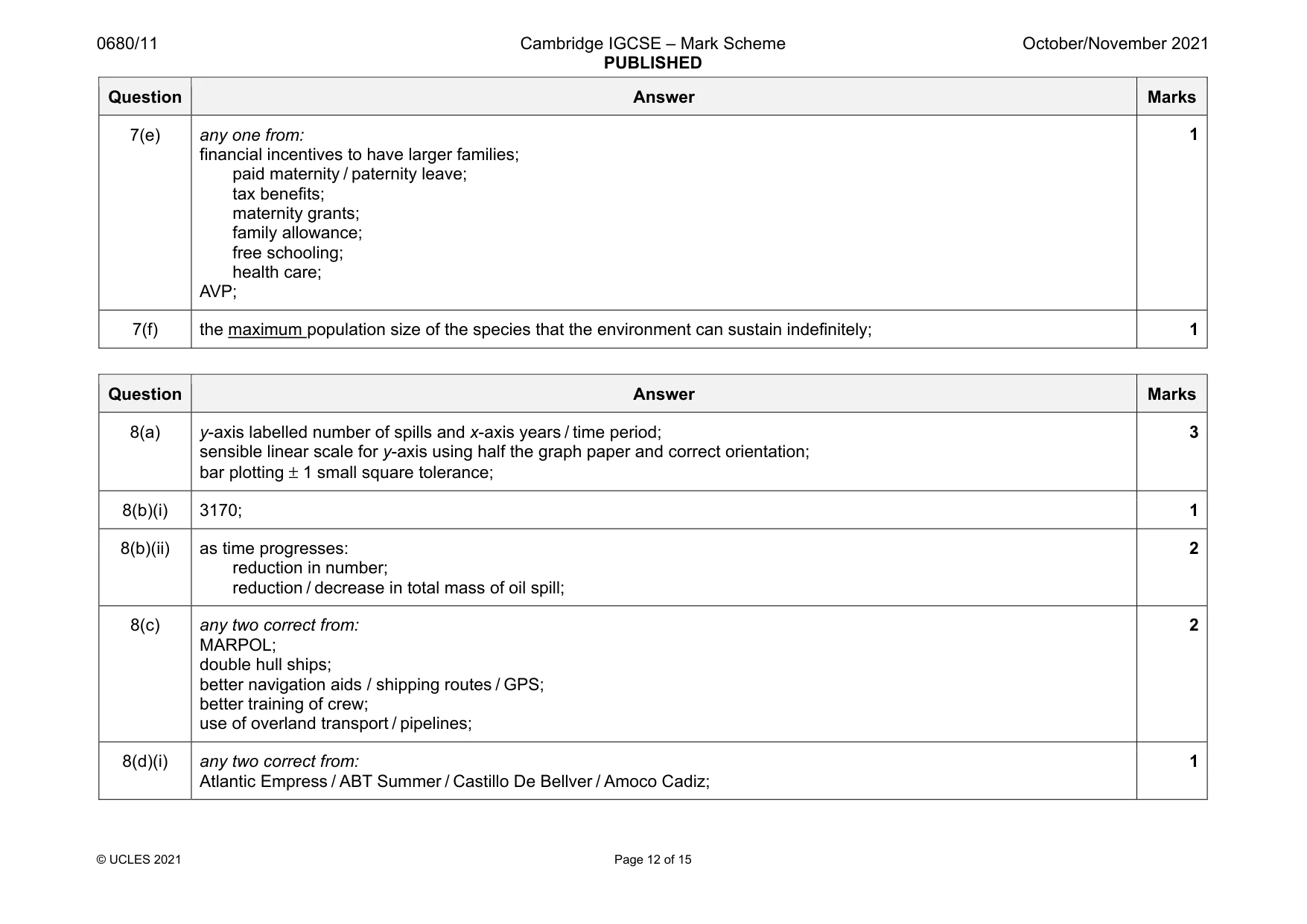
0680/11 Cambridge IGCSE – Mark Scheme PUBLISHED October/November 2021 © UCLES 2021 Page 12 of 15 Question Answer Marks 7(e) any one from: financial incentives to have larger families; paid maternity / paternity leave; tax benefits; maternity grants; family allowance; free schooling; health care; AVP; 1 7(f) the maximum population size of the species that the environment can sustain indefinitely; 1 Question Answer Marks 8(a) y-axis labelled number of spills and x-axis years / time period; sensible linear scale for y-axis using half the graph paper and correct orientation; bar plotting ± 1 small square tolerance; 3 8(b)(i) 3170; 1 8(b)(ii) as time progresses: reduction in number; reduction / decrease in total mass of oil spill; 2 8(c) any two correct from: MARPOL; double hull ships; better navigation aids / shipping routes / GPS; better training of crew; use of overland transport / pipelines; 2 8(d)(i) any two correct from: Atlantic Empress / ABT Summer / Castillo De Bellver / Amoco Cadiz; 1
Mark scheme, page 13
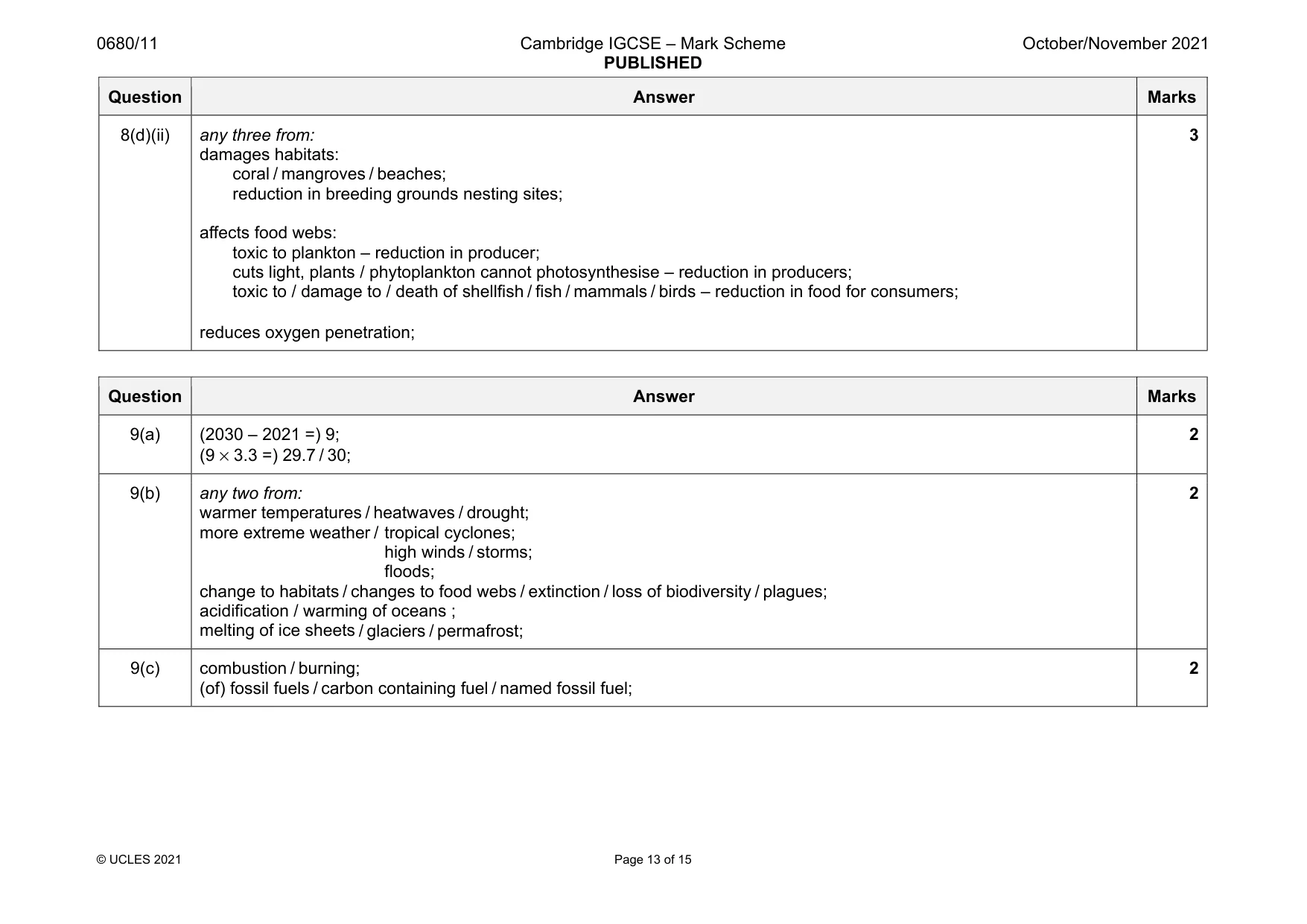
0680/11 Cambridge IGCSE – Mark Scheme PUBLISHED October/November 2021 © UCLES 2021 Page 13 of 15 Question Answer Marks 8(d)(ii) any three from: damages habitats: coral / mangroves / beaches; reduction in breeding grounds nesting sites; affects food webs: toxic to plankton – reduction in producer; cuts light, plants / phytoplankton cannot photosynthesise – reduction in producers; toxic to / damage to / death of shellfish / fish / mammals / birds – reduction in food for consumers; reduces oxygen penetration; 3 Question Answer Marks 9(a) (2030 – 2021 =) 9; (9 × 3.3 =) 29.7 / 30; 2 9(b) any two from: warmer temperatures / heatwaves / drought; more extreme weather / tropical cyclones; high winds / storms; floods; change to habitats / changes to food webs / extinction / loss of biodiversity / plagues; acidification / warming of oceans ; melting of ice sheets / glaciers / permafrost; 2 9(c) combustion / burning; (of) fossil fuels / carbon containing fuel / named fossil fuel; 2
Mark scheme, page 14
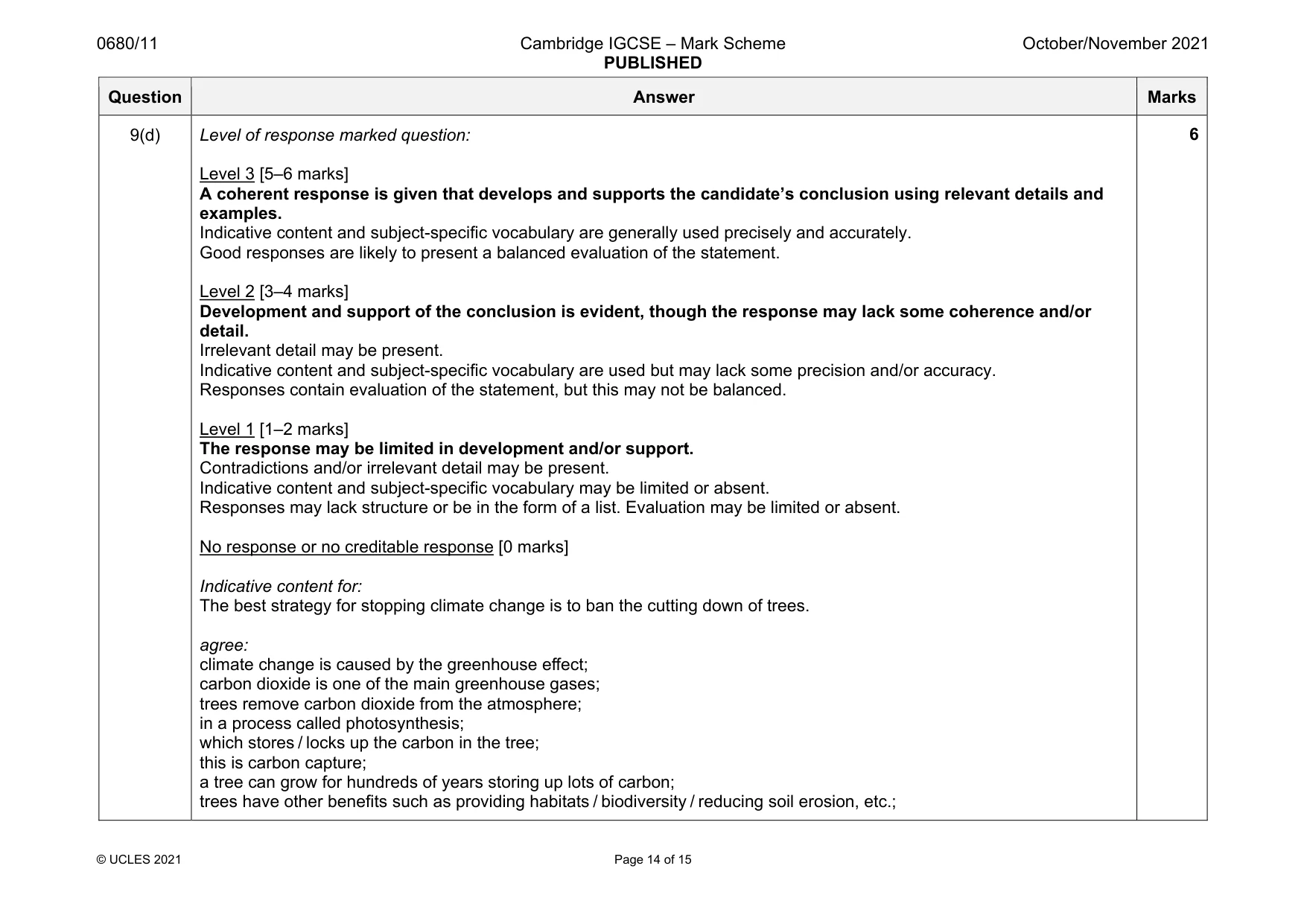
0680/11 Cambridge IGCSE – Mark Scheme PUBLISHED October/November 2021 © UCLES 2021 Page 14 of 15 Question Answer Marks 9(d) Level of response marked question: Level 3 [5–6 marks] A coherent response is given that develops and supports the candidate’s conclusion using relevant details and examples. Indicative content and subject-specific vocabulary are generally used precisely and accurately. Good responses are likely to present a balanced evaluation of the statement. Level 2 [3–4 marks] Development and support of the conclusion is evident, though the response may lack some coherence and/or detail. Irrelevant detail may be present. Indicative content and subject-specific vocabulary are used but may lack some precision and/or accuracy. Responses contain evaluation of the statement, but this may not be balanced. Level 1 [1–2 marks] The response may be limited in development and/or support. Contradictions and/or irrelevant detail may be present. Indicative content and subject-specific vocabulary may be limited or absent. Responses may lack structure or be in the form of a list. Evaluation may be limited or absent. No response or no creditable response [0 marks] Indicative content for: The best strategy for stopping climate change is to ban the cutting down of trees. agree: climate change is caused by the greenhouse effect; carbon dioxide is one of the main greenhouse gases; trees remove carbon dioxide from the atmosphere; in a process called photosynthesis; which stores / locks up the carbon in the tree; this is carbon capture; a tree can grow for hundreds of years storing up lots of carbon; trees have other benefits such as providing habitats / biodiversity / reducing soil erosion, etc.; 6
Mark scheme, page 15
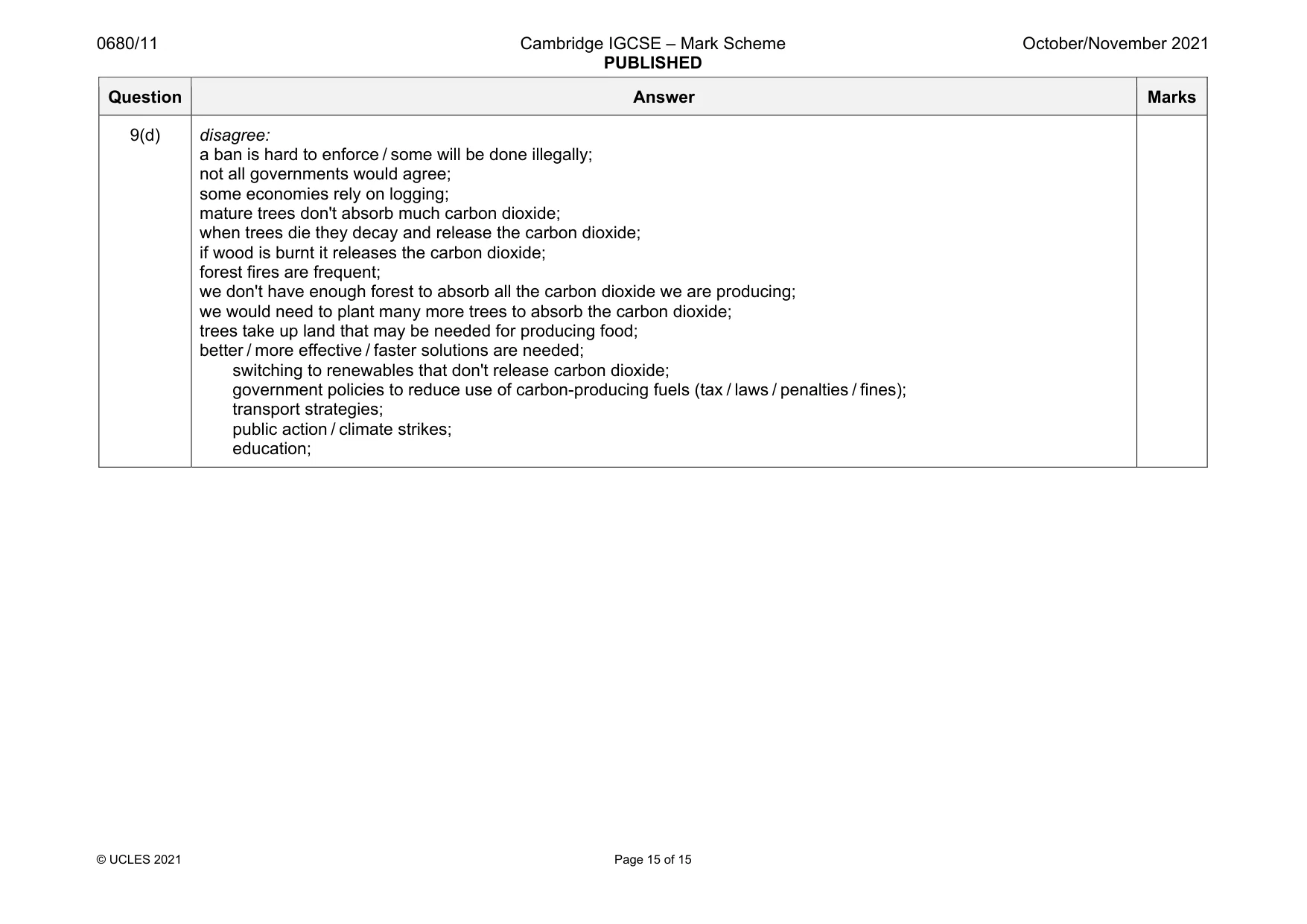
0680/11 Cambridge IGCSE – Mark Scheme PUBLISHED October/November 2021 © UCLES 2021 Page 15 of 15 Question Answer Marks 9(d) disagree: a ban is hard to enforce / some will be done illegally; not all governments would agree; some economies rely on logging; mature trees don't absorb much carbon dioxide; when trees die they decay and release the carbon dioxide; if wood is burnt it releases the carbon dioxide; forest fires are frequent; we don't have enough forest to absorb all the carbon dioxide we are producing; we would need to plant many more trees to absorb the carbon dioxide; trees take up land that may be needed for producing food; better / more effective / faster solutions are needed; switching to renewables that don't release carbon dioxide; government policies to reduce use of carbon-producing fuels (tax / laws / penalties / fines); transport strategies; public action / climate strikes; education;
What you needed in this session
Cambridge’s own grade thresholds for 2021 Oct/Nov, Paper 1 · Variant 1. A higher threshold means an easier paper — the bar moves with how the cohort did.