Cambridge IGCSE Environmental Management 0680 — 2021 Oct/Nov Paper 1 · Variant 3
0680/13/O/N/21 · 80 marks · ≈90 min
The question paper and its mark scheme, free to read here and free to download. This is Cambridge’s own paper, exactly as it was sat.
Question paper20 pages




Mark scheme15 pages
Answers below. Sit the paper first if you are practising.
Paper as text
Question paper, page 1
This document has 20 pages. Any blank pages are indicated. Cambridge IGCSE™ ENVIRONMENTAL MANAGEMENT 0680/13 Paper 1 Theory October/November 2021 1 hour 45 minutes You must answer on the question paper. No additional materials are needed. INSTRUCTIONS ● Answer all questions. ● Use a black or dark blue pen. You may use an HB pencil for any diagrams or graphs. ● Write your name, centre number and candidate number in the boxes at the top of the page. ● Write your answer to each question in the space provided. ● Do not use an erasable pen or correction fluid. ● Do not write on any bar codes. ● You may use a calculator. ● You should show all your working and use appropriate units. INFORMATION ● The total mark for this paper is 80. ● The number of marks for each question or part question is shown in brackets [ ]. * 0 0 2 2 2 4 2 6 5 2 * DC (MB/CT) 211570/4 © UCLES 2021 [Turn over
Question paper, page 2
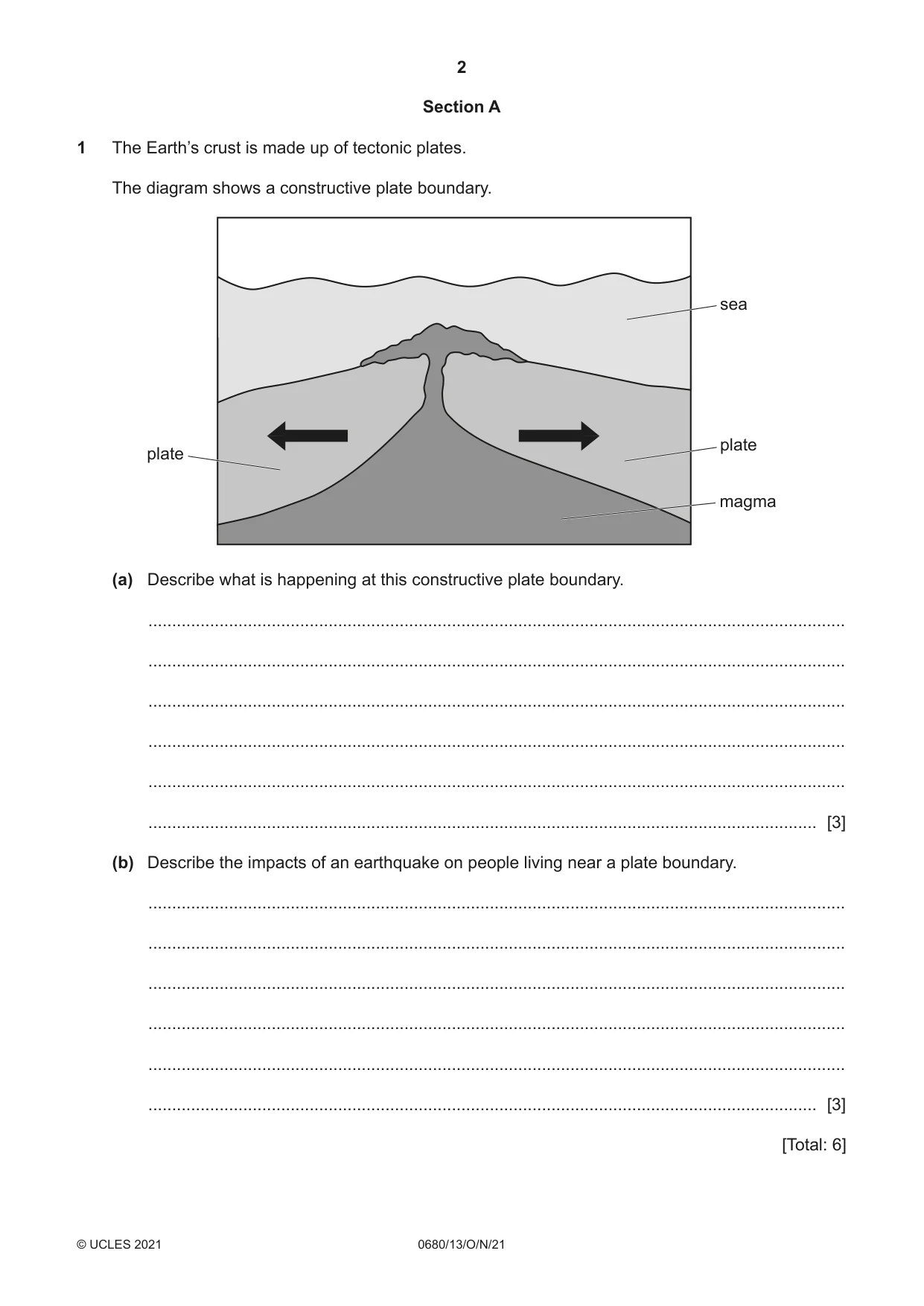
2 0680/13/O/N/21 © UCLES 2021 Section A 1 The Earth’s crust is made up of tectonic plates. The diagram shows a constructive plate boundary. sea plate magma plate (a) Describe what is happening at this constructive plate boundary. … … … … … … [3] (b) Describe the impacts of an earthquake on people living near a plate boundary. … … … … … … [3] [Total: 6]
Question paper, page 3
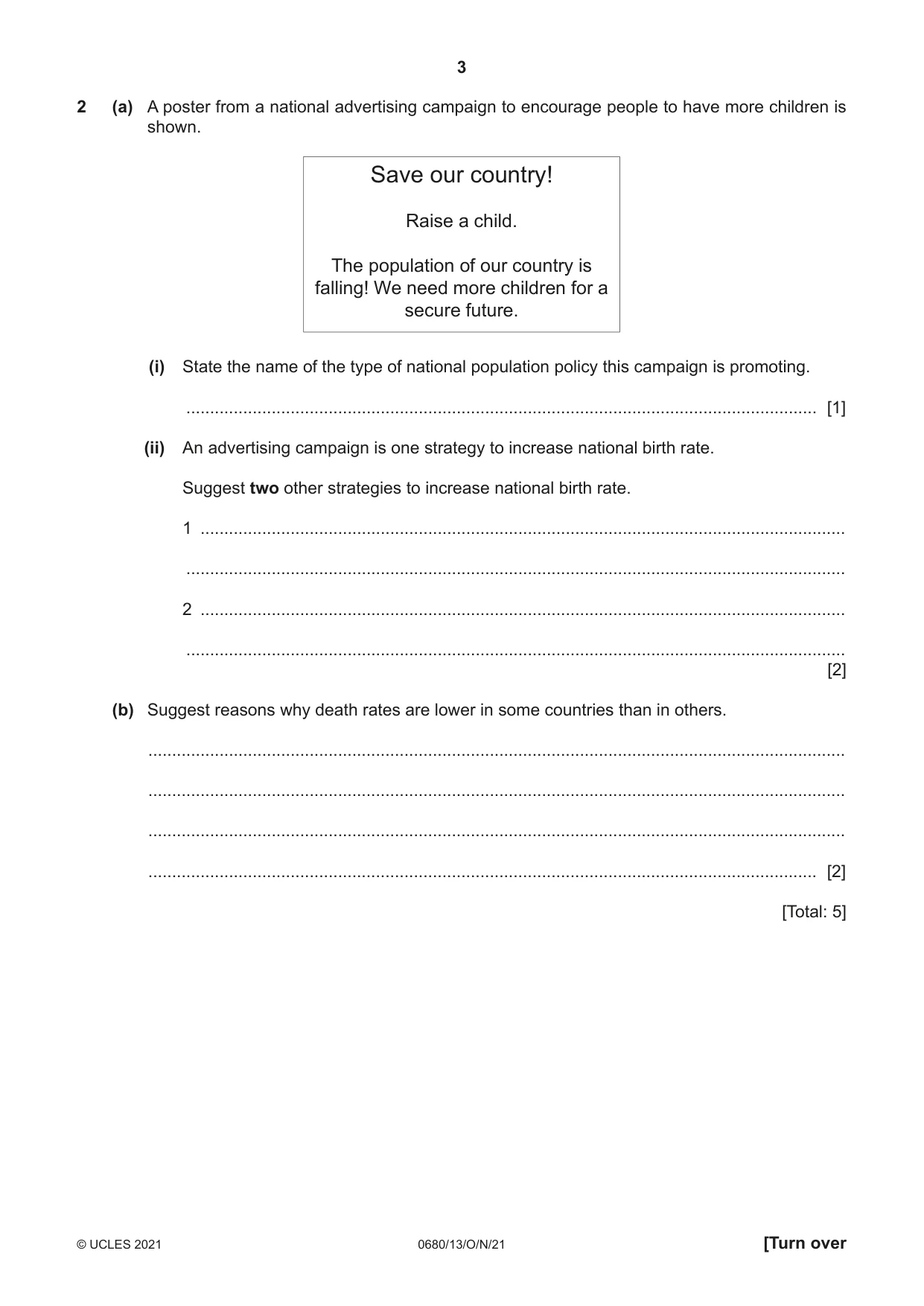
3 0680/13/O/N/21 © UCLES 2021 [Turn over 2 (a) A poster from a national advertising campaign to encourage people to have more children is shown. Save our country! Raise a child. The population of our country is falling! We need more children for a secure future. (i) State the name of the type of national population policy this campaign is promoting. … [1] (ii) An advertising campaign is one strategy to increase national birth rate. Suggest two other strategies to increase national birth rate. 1 … … 2 … … [2] (b) Suggest reasons why death rates are lower in some countries than in others. … … … … [2] [Total: 5]
Question paper, page 4
4 0680/13/O/N/21 © UCLES 2021 3 Ozone layer depletion is sometimes referred to as ‘the hole in the ozone layer’. (a) State one chemical responsible for ozone depletion. … [1] (b) State one impact of ozone depletion on people. … [1] (c) Describe a strategy to reduce ozone depletion. … … … … [2] [Total: 4]
Question paper, page 5
5 0680/13/O/N/21 © UCLES 2021 [Turn over 4 Overfishing has resulted in the depletion of many marine fish populations. (a) State two strategies used to manage the number of fish caught at sea. 1 … 2 … [2] (b) Over the last 50 years, there has been a large increase in farming marine fish species. Farming marine fish species helps reduce overfishing. (i) State two other benefits of farming marine fish species. 1 … 2 … [2] (ii) Suggest one problem associated with farming marine fish species. … … [1] [Total: 5]
Question paper, page 6
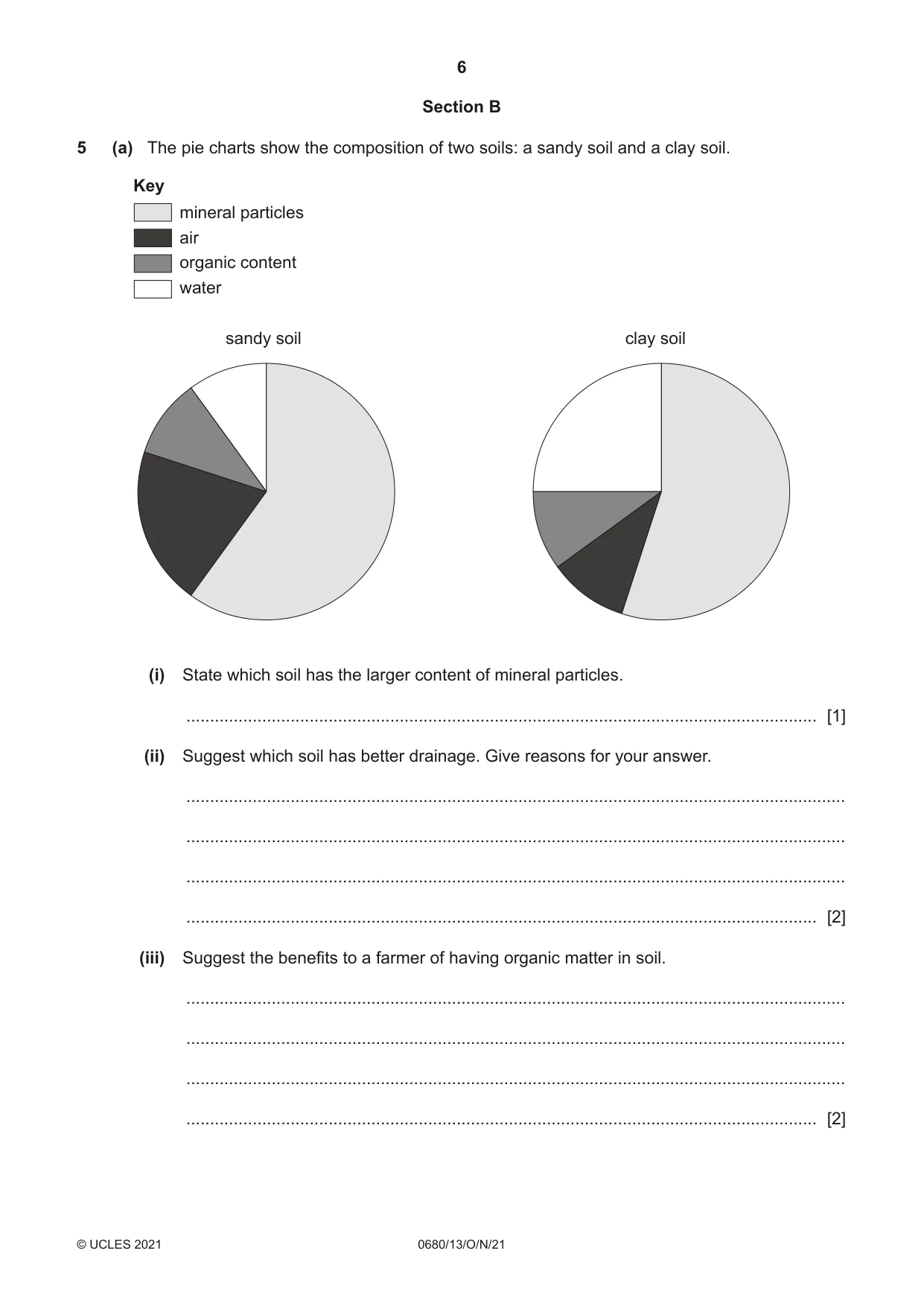
6 0680/13/O/N/21 © UCLES 2021 Section B 5 (a) The pie charts show the composition of two soils: a sandy soil and a clay soil. Key mineral particles air organic content water sandy soil clay soil (i) State which soil has the larger content of mineral particles. … [1] (ii) Suggest which soil has better drainage. Give reasons for your answer. … … … … [2] (iii) Suggest the benefits to a farmer of having organic matter in soil. … … … … [2]
Question paper, page 7
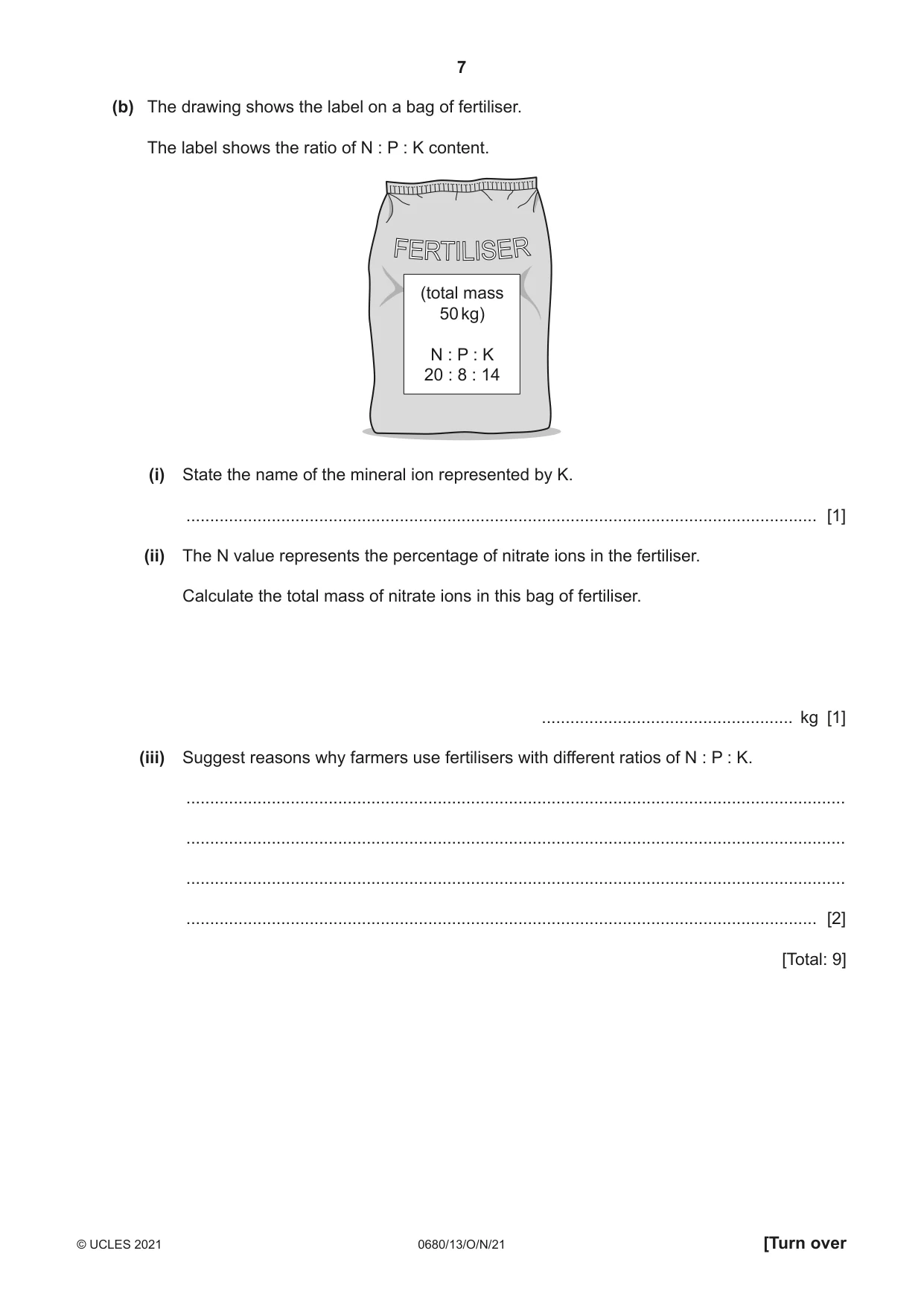
7 0680/13/O/N/21 © UCLES 2021 [Turn over (b) The drawing shows the label on a bag of fertiliser. The label shows the ratio of N : P : K content. FE RTI LIS E R (total mass 50 kg) N : P : K 20 : 8 : 14 (i) State the name of the mineral ion represented by K. … [1] (ii) The N value represents the percentage of nitrate ions in the fertiliser. Calculate the total mass of nitrate ions in this bag of fertiliser. … kg [1] (iii) Suggest reasons why farmers use fertilisers with different ratios of N : P : K. … … … … [2] [Total: 9]
Question paper, page 8
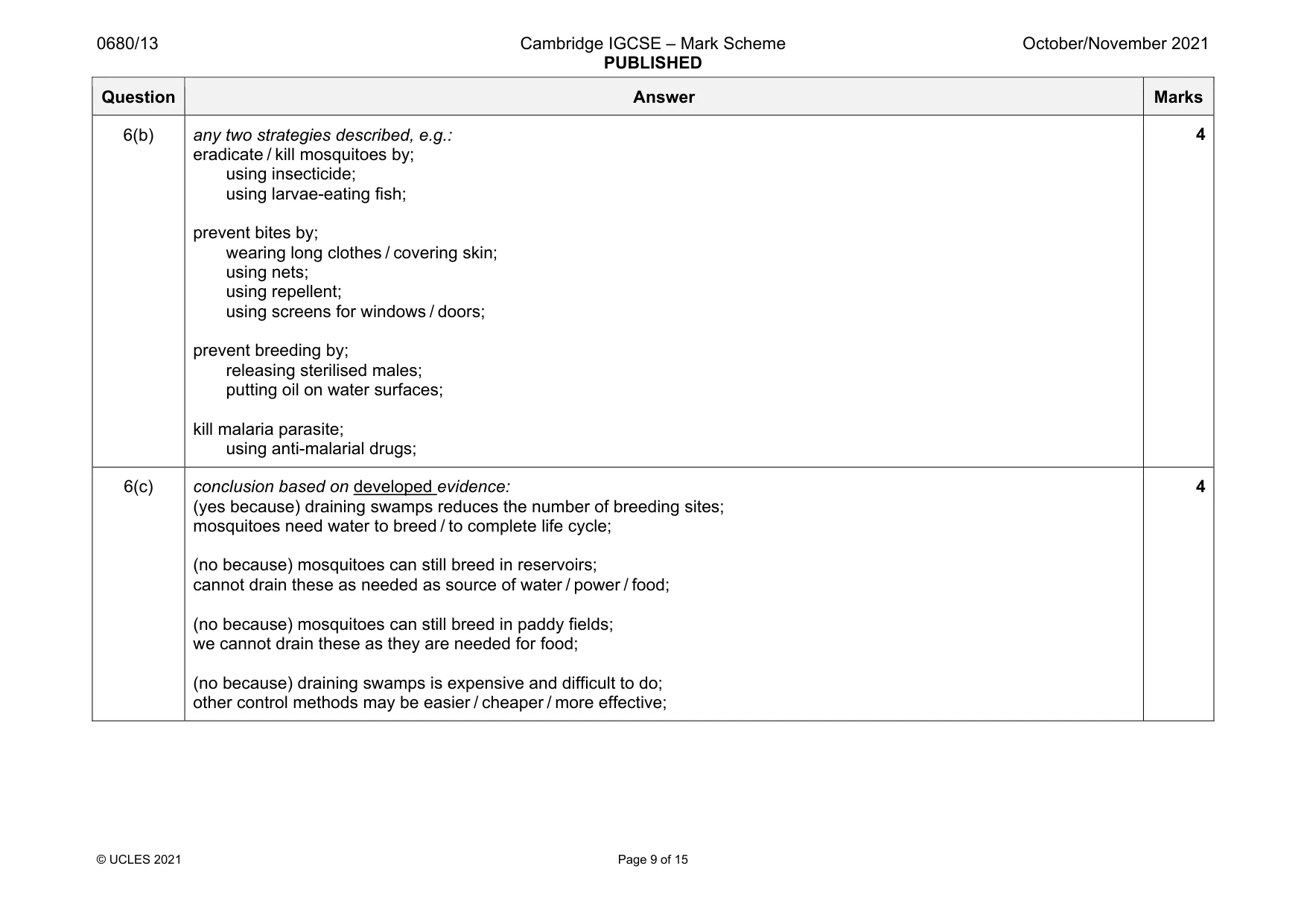
8 0680/13/O/N/21 © UCLES 2021 6 In 2017, there were an estimated 219 million people infected with malaria worldwide. (a) Complete the sentences about how malaria is spread. Use the words from the list. Each word may be used once, more than once or not at all. female human male mosquito parasite vector Mosquitoes are the … for malaria. Specifically, malaria is spread by the … Anopheles mosquito. When an infected mosquito bites an uninfected person, the malaria … is passed into the … bloodstream, making the person infected. This cycle of transmission is continued when an uninfected mosquito bites an infected person. [4] (b) One example of a strategy to control malaria is draining swamps. Draining swamps reduces the number of areas where mosquitoes can breed. Describe two other strategies to control malaria. strategy 1 … … … strategy 2 … … … [4]
Question paper, page 9
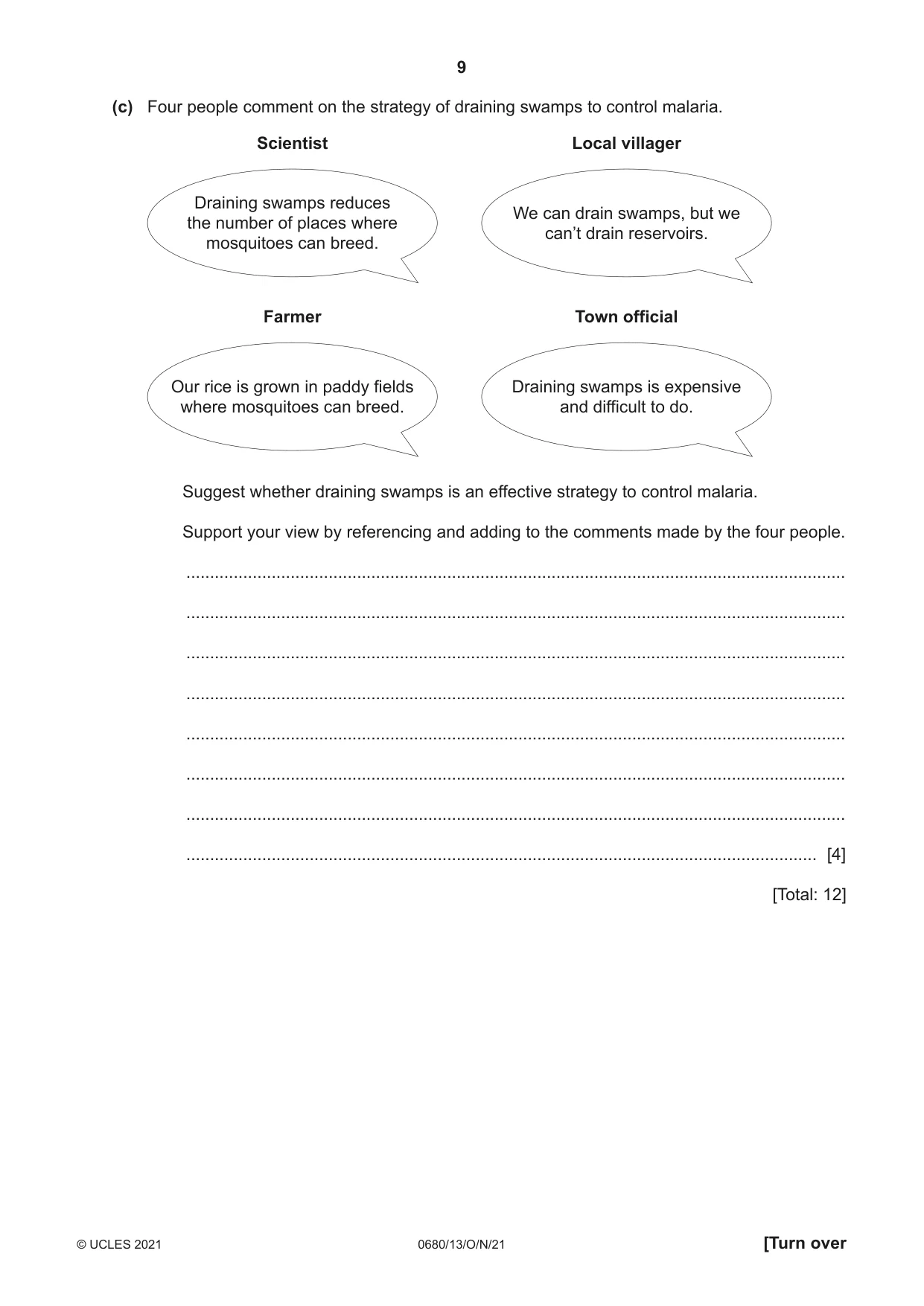
9 0680/13/O/N/21 © UCLES 2021 [Turn over (c) Four people comment on the strategy of draining swamps to control malaria. Draining swamps reduces the number of places where mosquitoes can breed. Scientist Our rice is grown in paddy fields where mosquitoes can breed. Farmer We can drain swamps, but we can’t drain reservoirs. Local villager Draining swamps is expensive and difficult to do. Town official Suggest whether draining swamps is an effective strategy to control malaria. Support your view by referencing and adding to the comments made by the four people. … … … … … … … … [4] [Total: 12]
Question paper, page 10
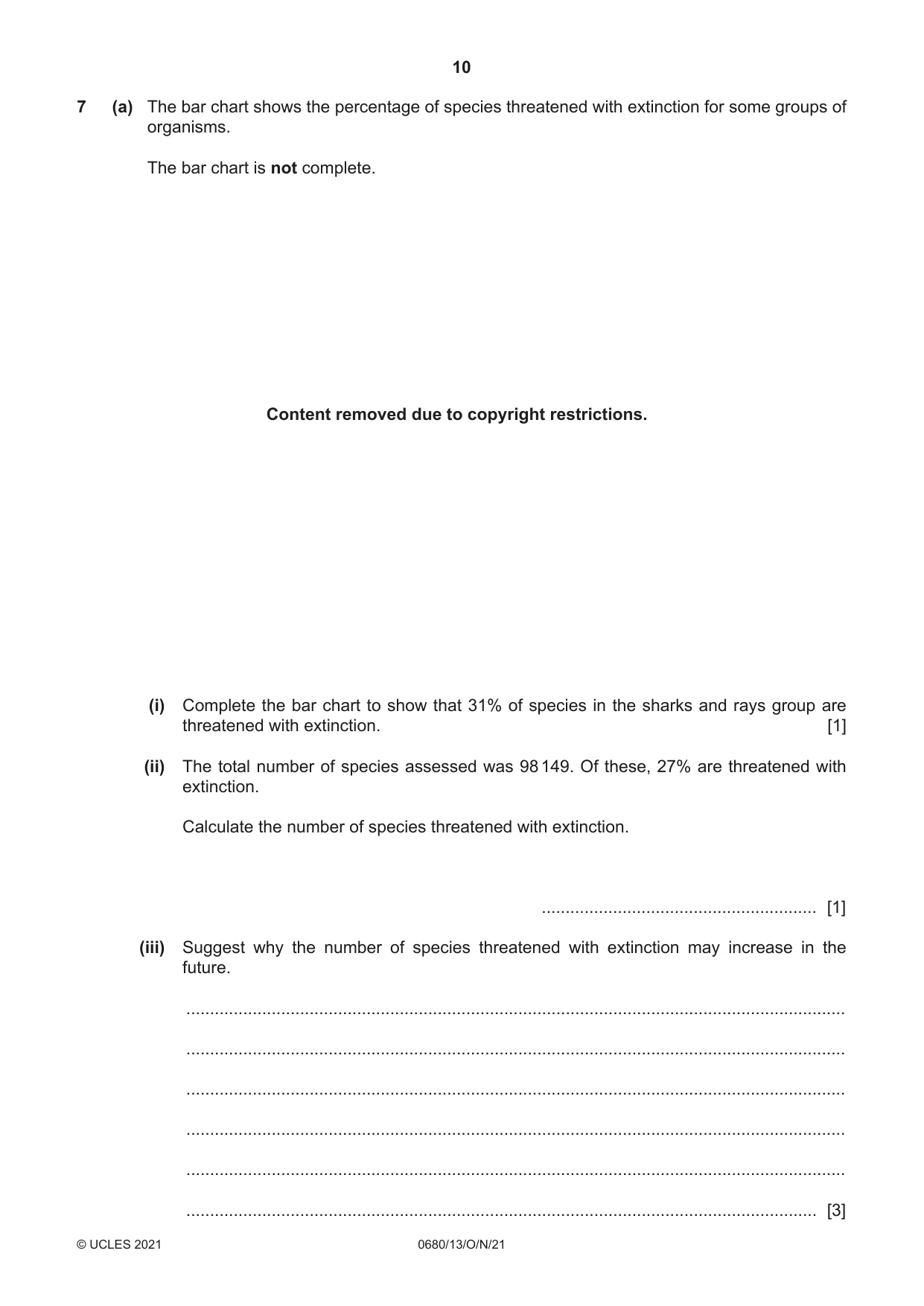
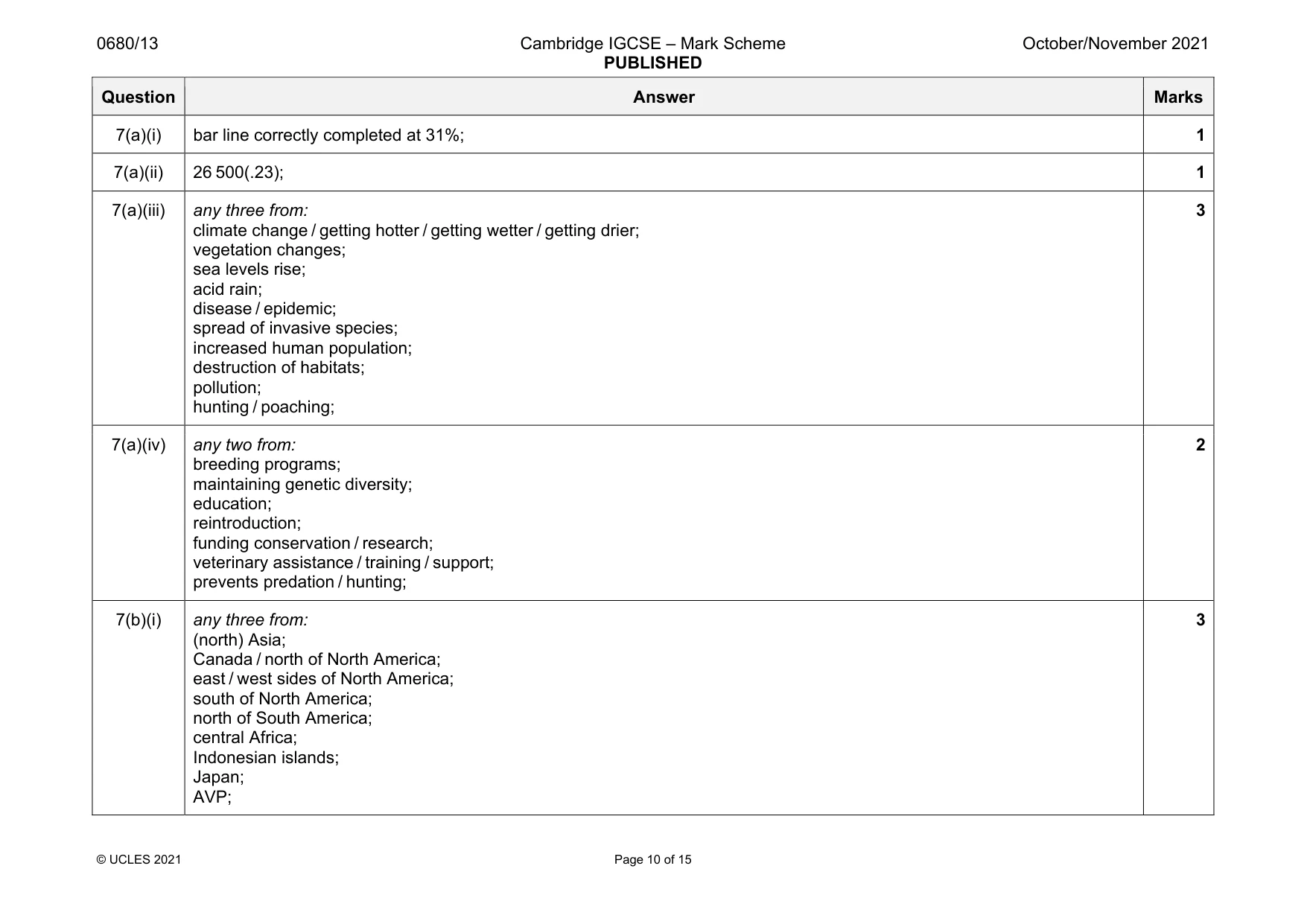
10 0680/13/O/N/21 © UCLES 2021 7 (a) The bar chart shows the percentage of species threatened with extinction for some groups of organisms. The bar chart is not complete. (i) Complete the bar chart to show that 31% of species in the sharks and rays group are threatened with extinction. [1] (ii) The total number of species assessed was 98 149. Of these, 27% are threatened with extinction. Calculate the number of species threatened with extinction. … [1] (iii) Suggest why the number of species threatened with extinction may increase in the future. … … … … … … [3] Content removed due to copyright restrictions.
Question paper, page 11
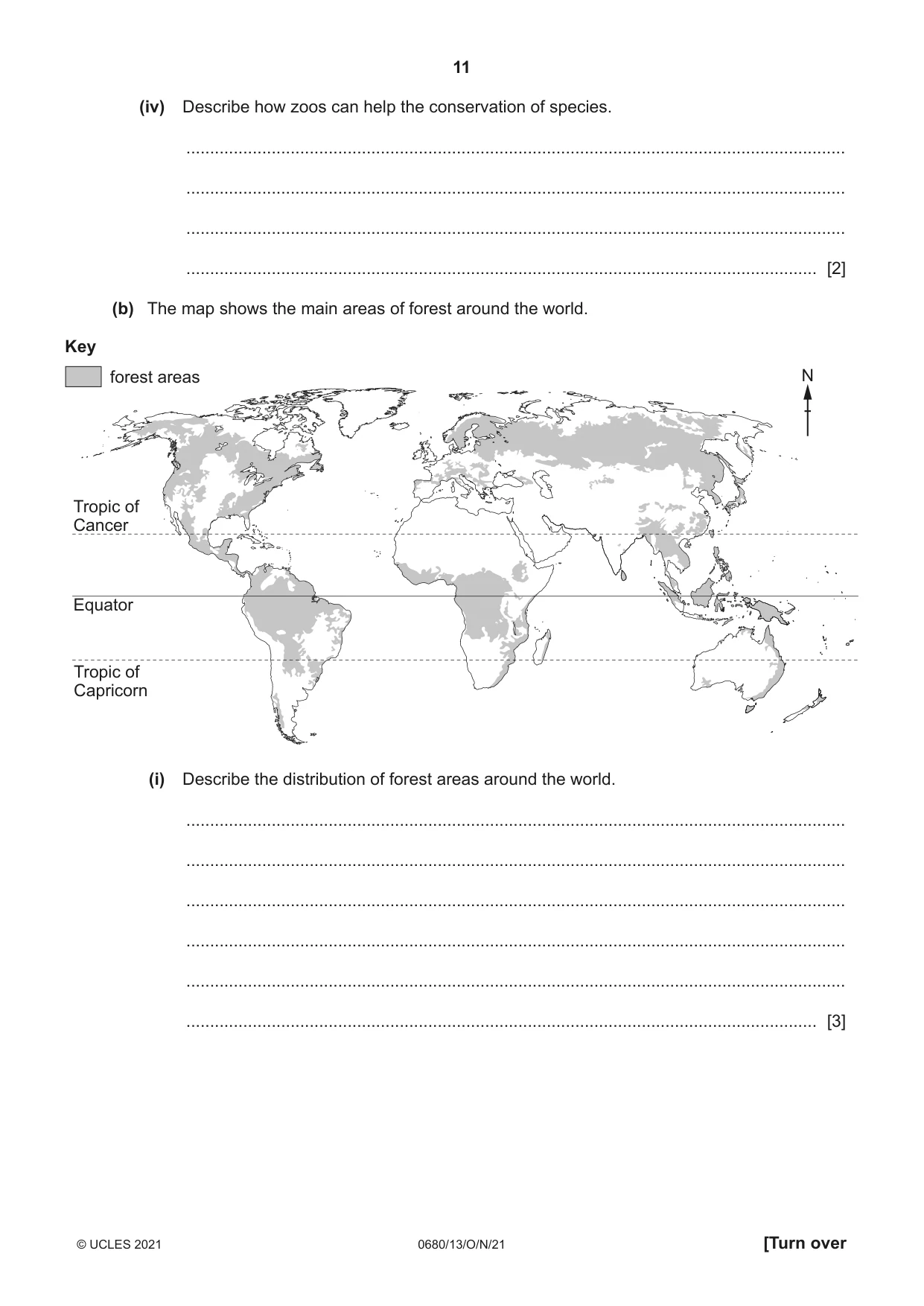
11 0680/13/O/N/21 © UCLES 2021 [Turn over (iv) Describe how zoos can help the conservation of species. … … … … [2] (b) The map shows the main areas of forest around the world. N Equator Tropic of Capricorn Tropic of Cancer Key forest areas (i) Describe the distribution of forest areas around the world. … … … … … … [3]
Question paper, page 12
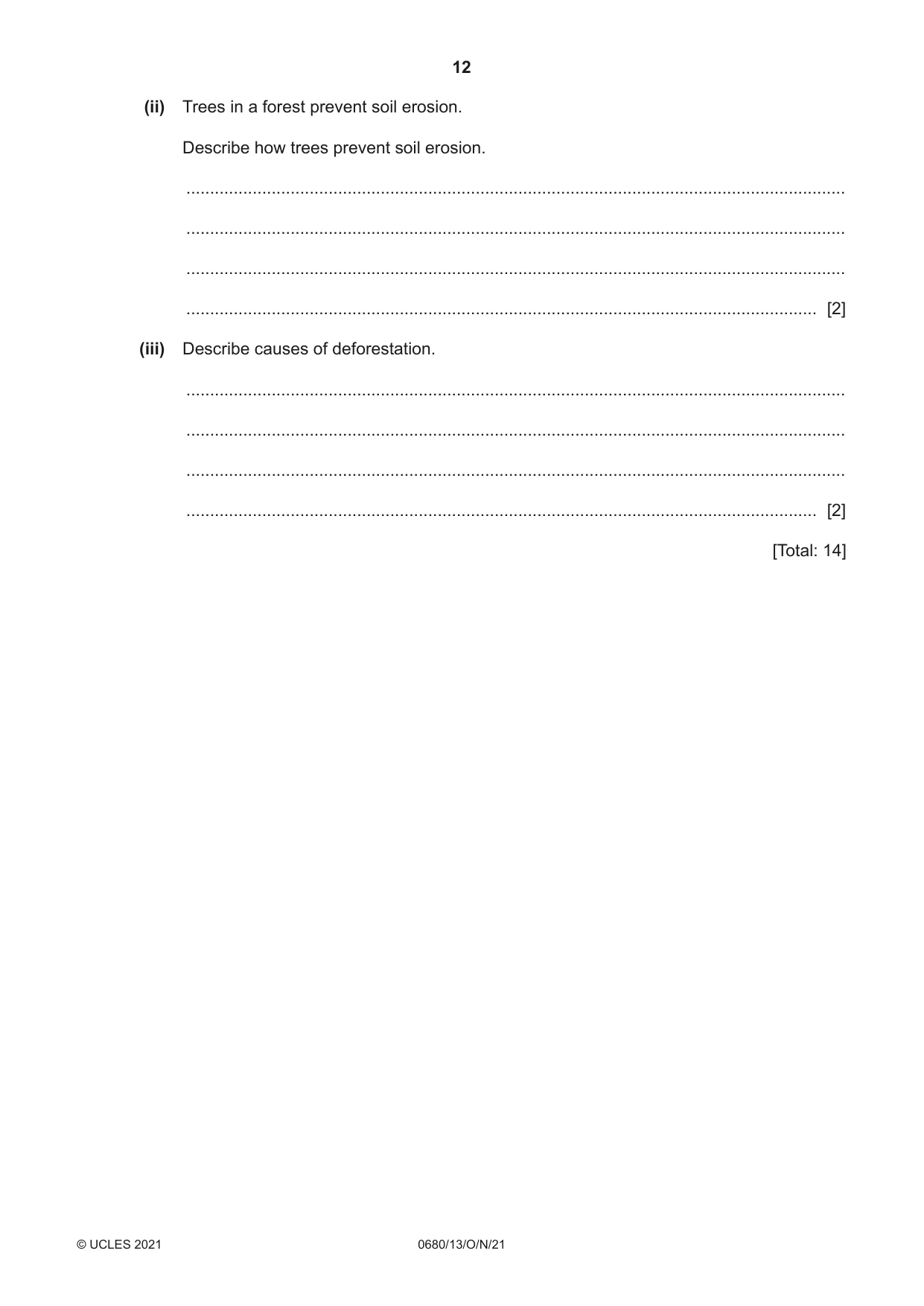
12 0680/13/O/N/21 © UCLES 2021 (ii) Trees in a forest prevent soil erosion. Describe how trees prevent soil erosion. … … … … [2] (iii) Describe causes of deforestation. … … … … [2] [Total: 14]
Question paper, page 13
13 0680/13/O/N/21 © UCLES 2021 [Turn over BLANK PAGE
Question paper, page 14
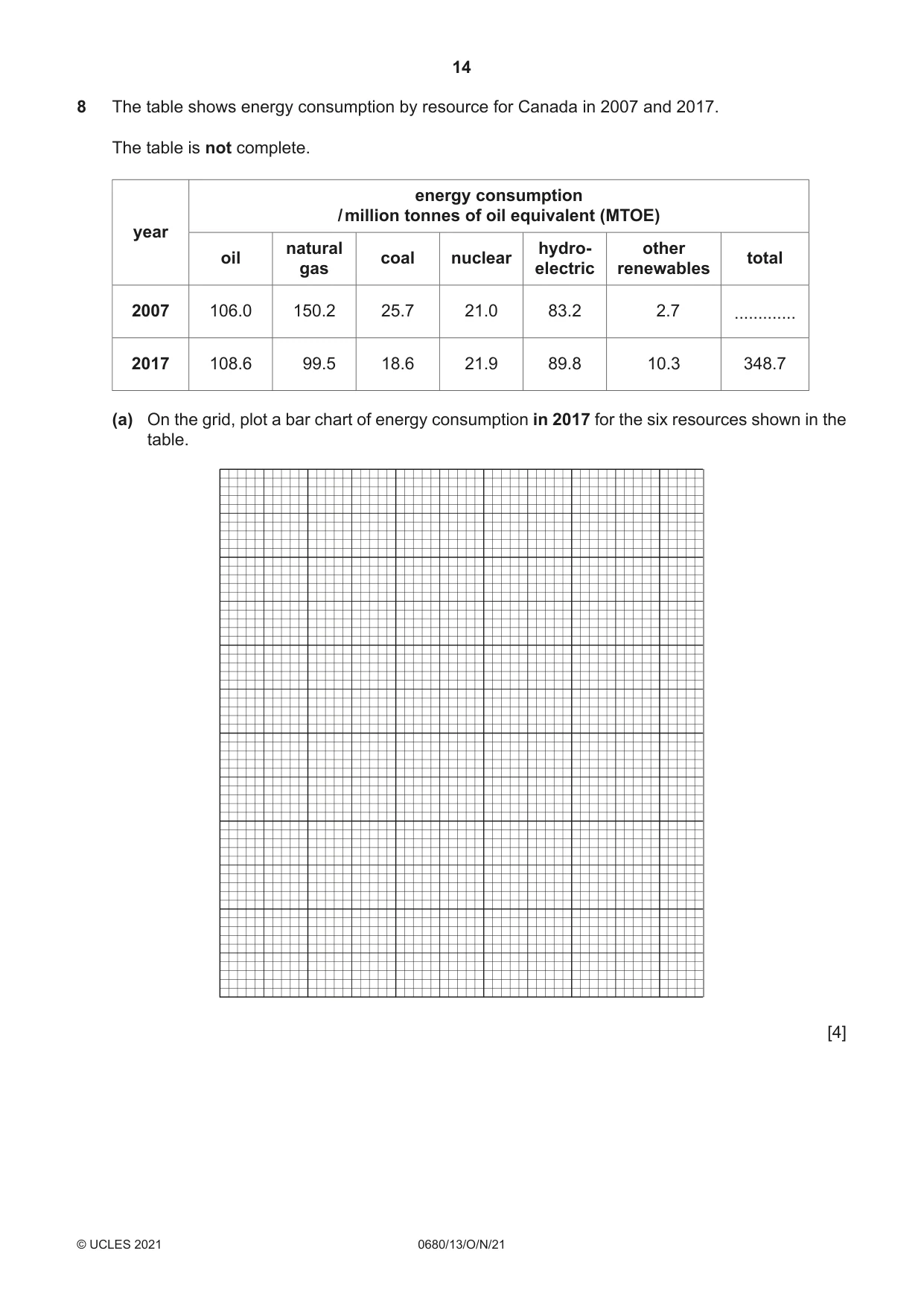
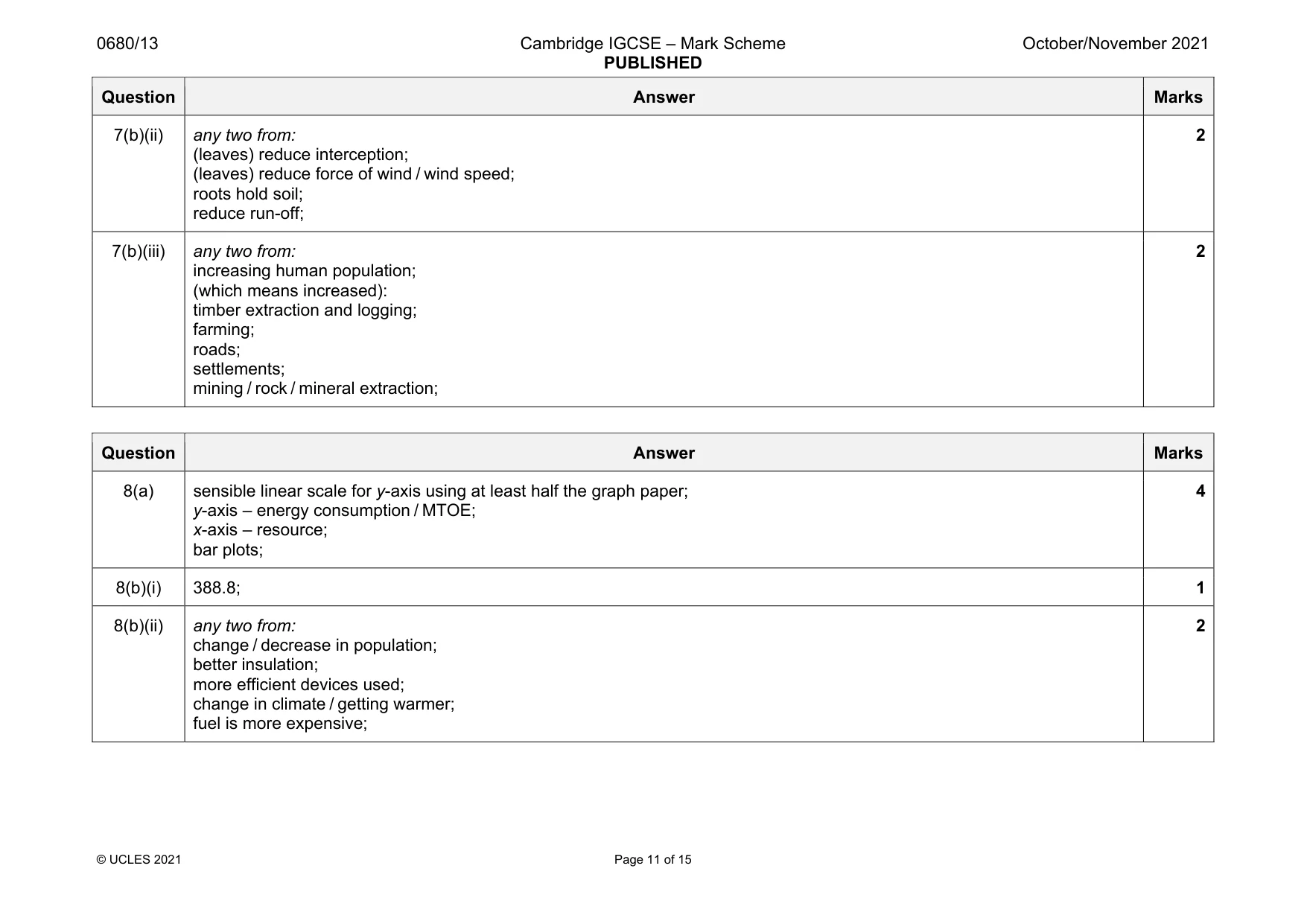
14 0680/13/O/N/21 © UCLES 2021 8 The table shows energy consumption by resource for Canada in 2007 and 2017. The table is not complete. year energy consumption / million tonnes of oil equivalent (MTOE) oil natural gas coal nuclear hydro- electric other renewables total 2007 106.0 150.2 25.7 21.0 83.2 2.7 … 2017 108.6 99.5 18.6 21.9 89.8 10.3 348.7 (a) On the grid, plot a bar chart of energy consumption in 2017 for the six resources shown in the table. [4]
Question paper, page 15
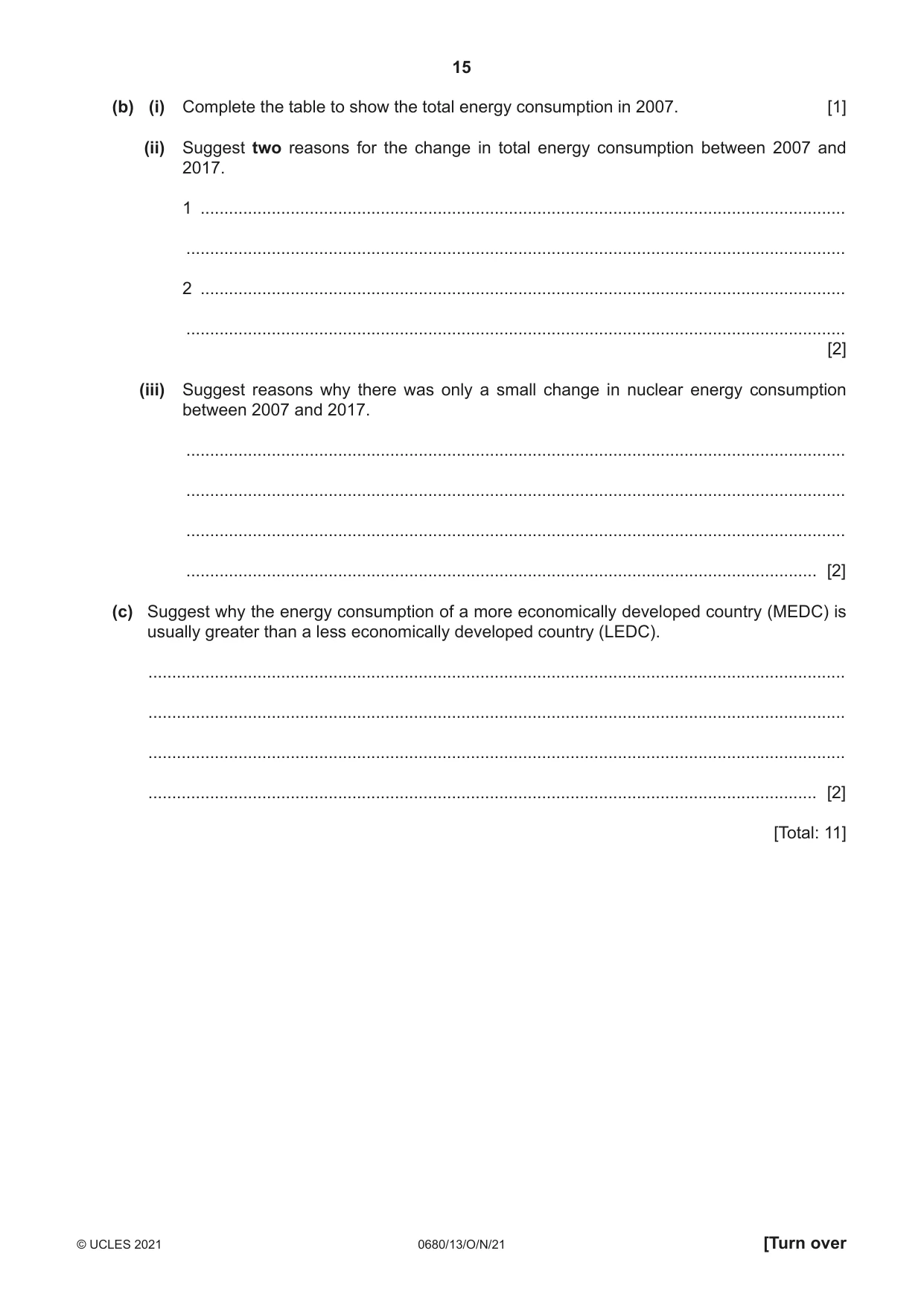
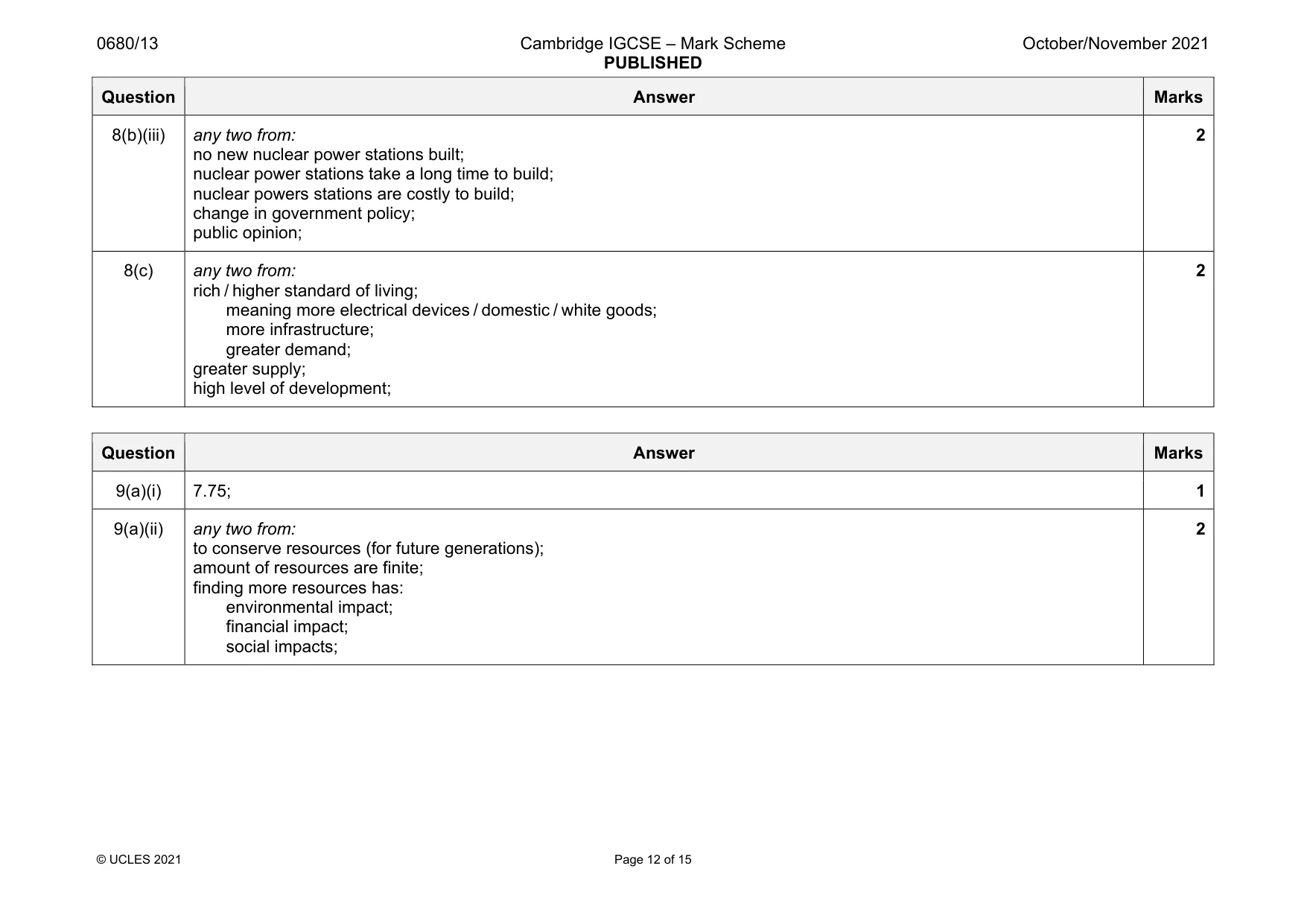
15 0680/13/O/N/21 © UCLES 2021 [Turn over (b) (i) Complete the table to show the total energy consumption in 2007. [1] (ii) Suggest two reasons for the change in total energy consumption between 2007 and 2017. 1 … … 2 … … [2] (iii) Suggest reasons why there was only a small change in nuclear energy consumption between 2007 and 2017. … … … … [2] (c) Suggest why the energy consumption of a more economically developed country (MEDC) is usually greater than a less economically developed country (LEDC). … … … … [2] [Total: 11]
Question paper, page 16
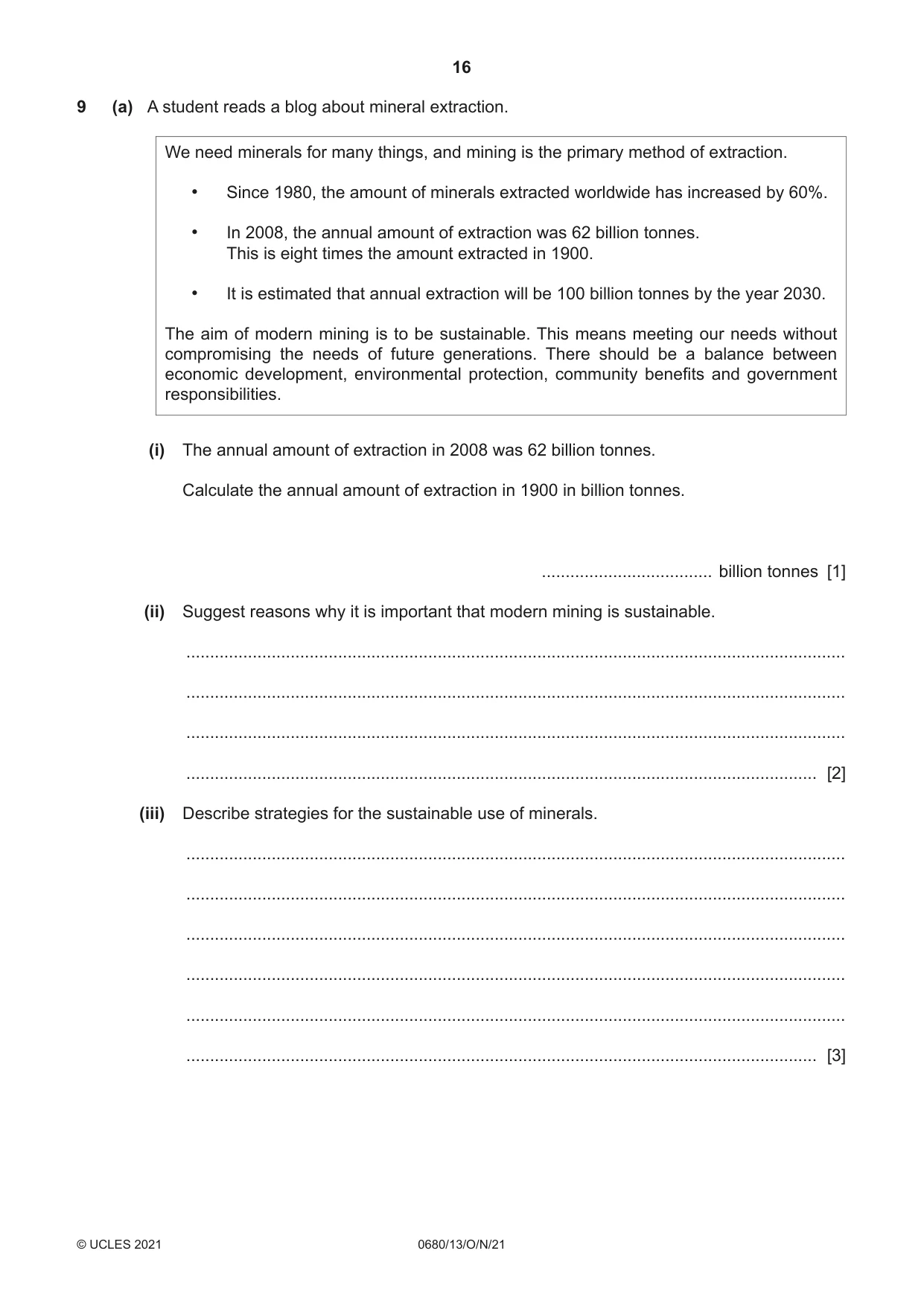
16 0680/13/O/N/21 © UCLES 2021 9 (a) A student reads a blog about mineral extraction. We need minerals for many things, and mining is the primary method of extraction. • Since 1980, the amount of minerals extracted worldwide has increased by 60%. • In 2008, the annual amount of extraction was 62 billion tonnes. This is eight times the amount extracted in 1900. • It is estimated that annual extraction will be 100 billion tonnes by the year 2030. The aim of modern mining is to be sustainable. This means meeting our needs without compromising the needs of future generations. There should be a balance between economic development, environmental protection, community benefits and government responsibilities. (i) The annual amount of extraction in 2008 was 62 billion tonnes. Calculate the annual amount of extraction in 1900 in billion tonnes. … billion tonnes [1] (ii) Suggest reasons why it is important that modern mining is sustainable. … … … … [2] (iii) Describe strategies for the sustainable use of minerals. … … … … … … [3]
Question paper, page 17
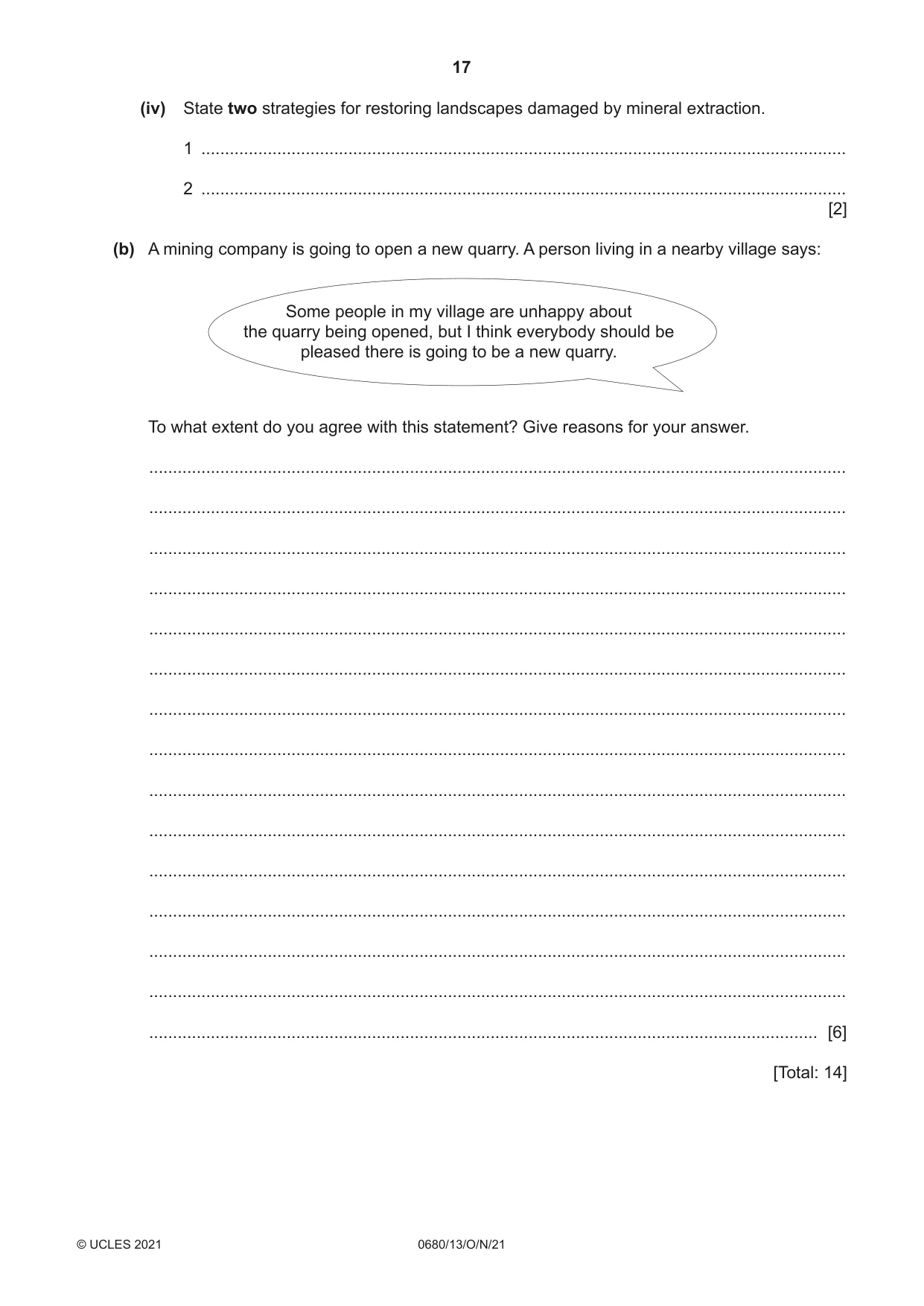
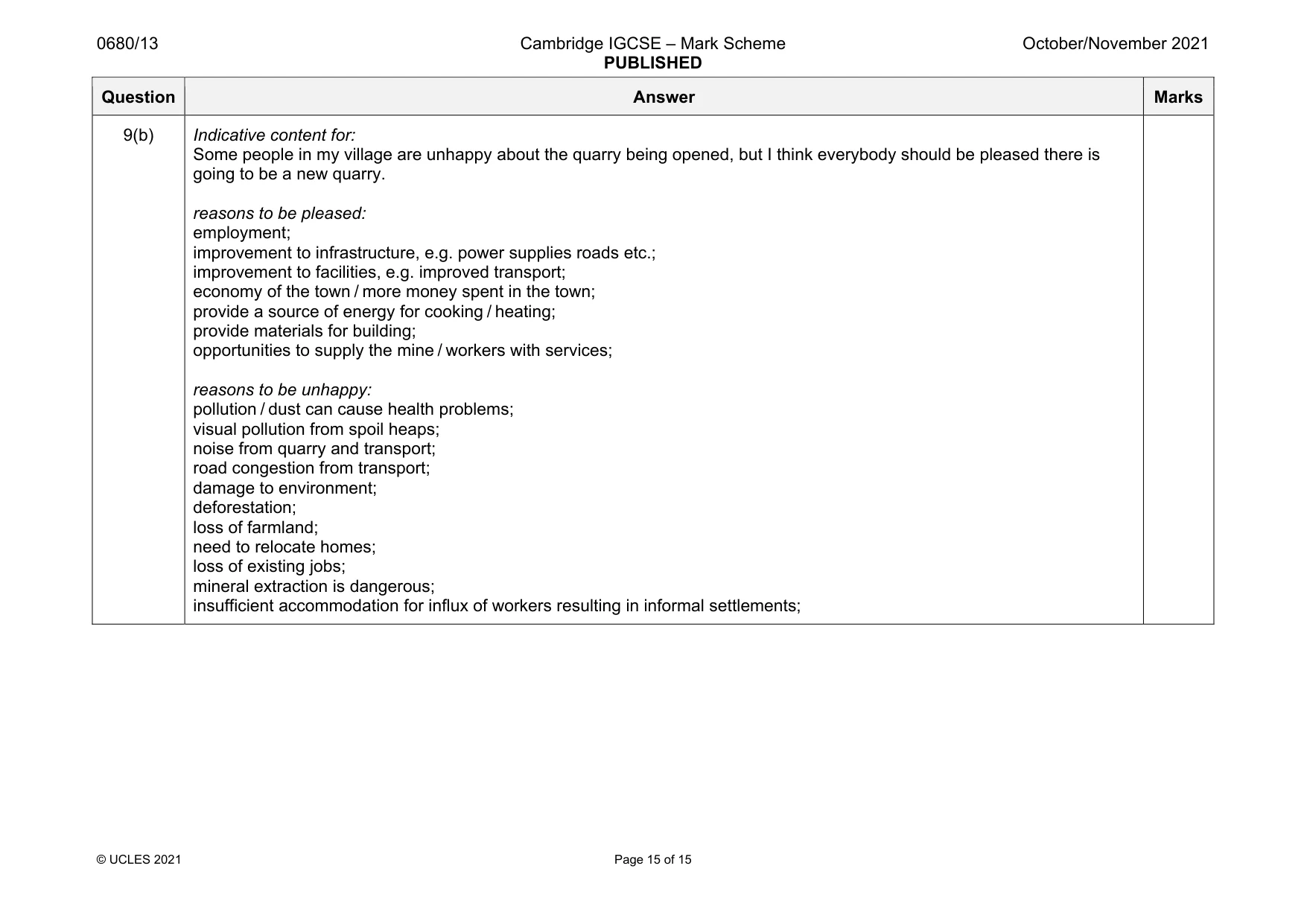
17 0680/13/O/N/21 © UCLES 2021 (iv) State two strategies for restoring landscapes damaged by mineral extraction. 1 … 2 … [2] (b) A mining company is going to open a new quarry. A person living in a nearby village says: Some people in my village are unhappy about the quarry being opened, but I think everybody should be pleased there is going to be a new quarry. To what extent do you agree with this statement? Give reasons for your answer. … … … … … … … … … … … … … … … [6] [Total: 14]
Question paper, page 18
18 0680/13/O/N/21 © UCLES 2021 BLANK PAGE
Question paper, page 19
19 0680/13/O/N/21 © UCLES 2021 BLANK PAGE
Question paper, page 20
20 0680/13/O/N/21 © UCLES 2021 The boundaries and names shown, the designations used and the presentation of material on any maps contained in this question paper/insert do not imply official endorsement or acceptance by Cambridge Assessment International Education concerning the legal status of any country, territory, or area or any of its authorities, or of the delimitation of its frontiers or boundaries. Permission to reproduce items where third-party owned material protected by copyright is included has been sought and cleared where possible. Every reasonable effort has been made by the publisher (UCLES) to trace copyright holders, but if any items requiring clearance have unwittingly been included, the publisher will be pleased to make amends at the earliest possible opportunity. To avoid the issue of disclosure of answer-related information to candidates, all copyright acknowledgements are reproduced online in the Cambridge Assessment International Education Copyright Acknowledgements Booklet. This is produced for each series of examinations and is freely available to download at www.cambridgeinternational.org after the live examination series. Cambridge Assessment International Education is part of the Cambridge Assessment Group. Cambridge Assessment is the brand name of the University of Cambridge Local Examinations Syndicate (UCLES), which itself is a department of the University of Cambridge. BLANK PAGE
Mark scheme, page 1
This document consists of 15 printed pages. © UCLES 2021 [Turn over Cambridge IGCSE™ ENVIRONMENTAL MANAGEMENT 0680/13 Paper 1 Theory October/November 2021 MARK SCHEME Maximum Mark: 80 Published This mark scheme is published as an aid to teachers and candidates, to indicate the requirements of the examination. It shows the basis on which Examiners were instructed to award marks. It does not indicate the details of the discussions that took place at an Examiners’ meeting before marking began, which would have considered the acceptability of alternative answers. Mark schemes should be read in conjunction with the question paper and the Principal Examiner Report for Teachers. Cambridge International will not enter into discussions about these mark schemes. Cambridge International is publishing the mark schemes for the October/November 2021 series for most Cambridge IGCSE™, Cambridge International A and AS Level components and some Cambridge O Level components.
Mark scheme, page 2
0680/13 Cambridge IGCSE – Mark Scheme PUBLISHED October/November 2021 © UCLES 2021 Page 2 of 15 Generic Marking Principles These general marking principles must be applied by all examiners when marking candidate answers. They should be applied alongside the specific content of the mark scheme or generic level descriptors for a question. Each question paper and mark scheme will also comply with these marking principles. GENERIC MARKING PRINCIPLE 1: Marks must be awarded in line with: • the specific content of the mark scheme or the generic level descriptors for the question • the specific skills defined in the mark scheme or in the generic level descriptors for the question • the standard of response required by a candidate as exemplified by the standardisation scripts. GENERIC MARKING PRINCIPLE 2: Marks awarded are always whole marks (not half marks, or other fractions). GENERIC MARKING PRINCIPLE 3: Marks must be awarded positively: • marks are awarded for correct / valid answers, as defined in the mark scheme. However, credit is given for valid answers which go beyond the scope of the syllabus and mark scheme, referring to your Team Leader as appropriate • marks are awarded when candidates clearly demonstrate what they know and can do • marks are not deducted for errors • marks are not deducted for omissions • answers should only be judged on the quality of spelling, punctuation and grammar when these features are specifically assessed by the question as indicated by the mark scheme. The meaning, however, should be unambiguous. GENERIC MARKING PRINCIPLE 4: Rules must be applied consistently, e.g. in situations where candidates have not followed instructions or in the application of generic level descriptors.
Mark scheme, page 3
0680/13 Cambridge IGCSE – Mark Scheme PUBLISHED October/November 2021 © UCLES 2021 Page 3 of 15 GENERIC MARKING PRINCIPLE 5: Marks should be awarded using the full range of marks defined in the mark scheme for the question (however; the use of the full mark range may be limited according to the quality of the candidate responses seen). GENERIC MARKING PRINCIPLE 6: Marks awarded are based solely on the requirements as defined in the mark scheme. Marks should not be awarded with grade thresholds or grade descriptors in mind. Science-Specific Marking Principles 1 Examiners should consider the context and scientific use of any keywords when awarding marks. Although keywords may be present, marks should not be awarded if the keywords are used incorrectly. 2 The examiner should not choose between contradictory statements given in the same question part, and credit should not be awarded for any correct statement that is contradicted within the same question part. Wrong science that is irrelevant to the question should be ignored. 3 Although spellings do not have to be correct, spellings of syllabus terms must allow for clear and unambiguous separation from other syllabus terms with which they may be confused (e.g. ethane / ethene, glucagon / glycogen, refraction / reflection). 4 The error carried forward (ecf) principle should be applied, where appropriate. If an incorrect answer is subsequently used in a scientifically correct way, the candidate should be awarded these subsequent marking points. Further guidance will be included in the mark scheme where necessary and any exceptions to this general principle will be noted. 5 ‘List rule’ guidance For questions that require n responses (e.g. State two reasons …): • The response should be read as continuous prose, even when numbered answer spaces are provided. • Any response marked ignore in the mark scheme should not count towards n. • Incorrect responses should not be awarded credit but will still count towards n. • Read the entire response to check for any responses that contradict those that would otherwise be credited. Credit should not be awarded for any responses that are contradicted within the rest of the response. Where two responses contradict one another, this should be treated as a single incorrect response. • Non-contradictory responses after the first n responses may be ignored even if they include incorrect science.
Mark scheme, page 4
0680/13 Cambridge IGCSE – Mark Scheme PUBLISHED October/November 2021 © UCLES 2021 Page 4 of 15 6 Calculation specific guidance Correct answers to calculations should be given full credit even if there is no working or incorrect working, unless the question states ‘show your working’. For questions in which the number of significant figures required is not stated, credit should be awarded for correct answers when rounded by the examiner to the number of significant figures given in the mark scheme. This may not apply to measured values. For answers given in standard form (e.g. a × 10n) in which the convention of restricting the value of the coefficient (a) to a value between 1 and 10 is not followed, credit may still be awarded if the answer can be converted to the answer given in the mark scheme. Unless a separate mark is given for a unit, a missing or incorrect unit will normally mean that the final calculation mark is not awarded. Exceptions to this general principle will be noted in the mark scheme. 7 Guidance for chemical equations Multiples / fractions of coefficients used in chemical equations are acceptable unless stated otherwise in the mark scheme. State symbols given in an equation should be ignored unless asked for in the question or stated otherwise in the mark scheme.
Mark scheme, page 5
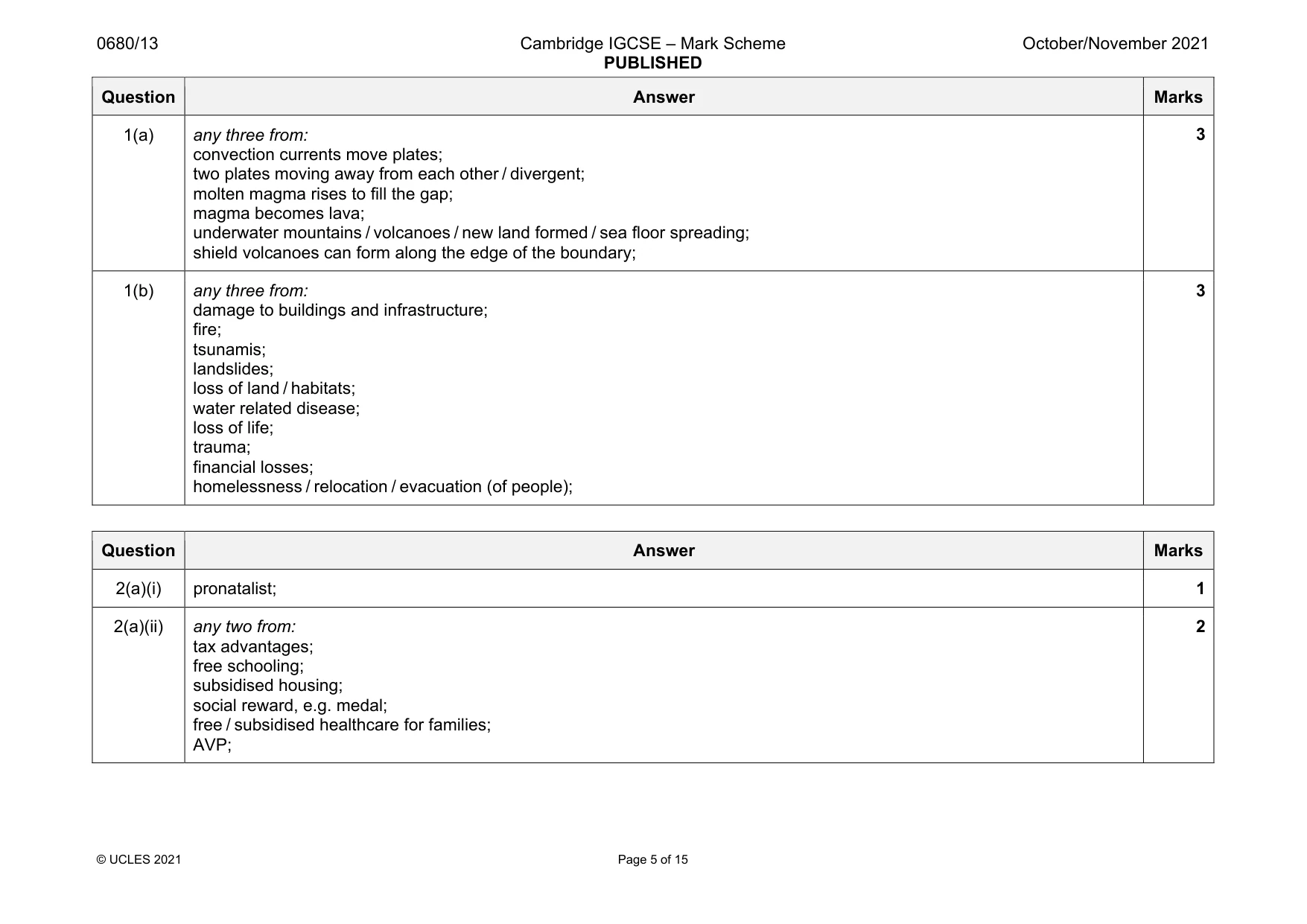
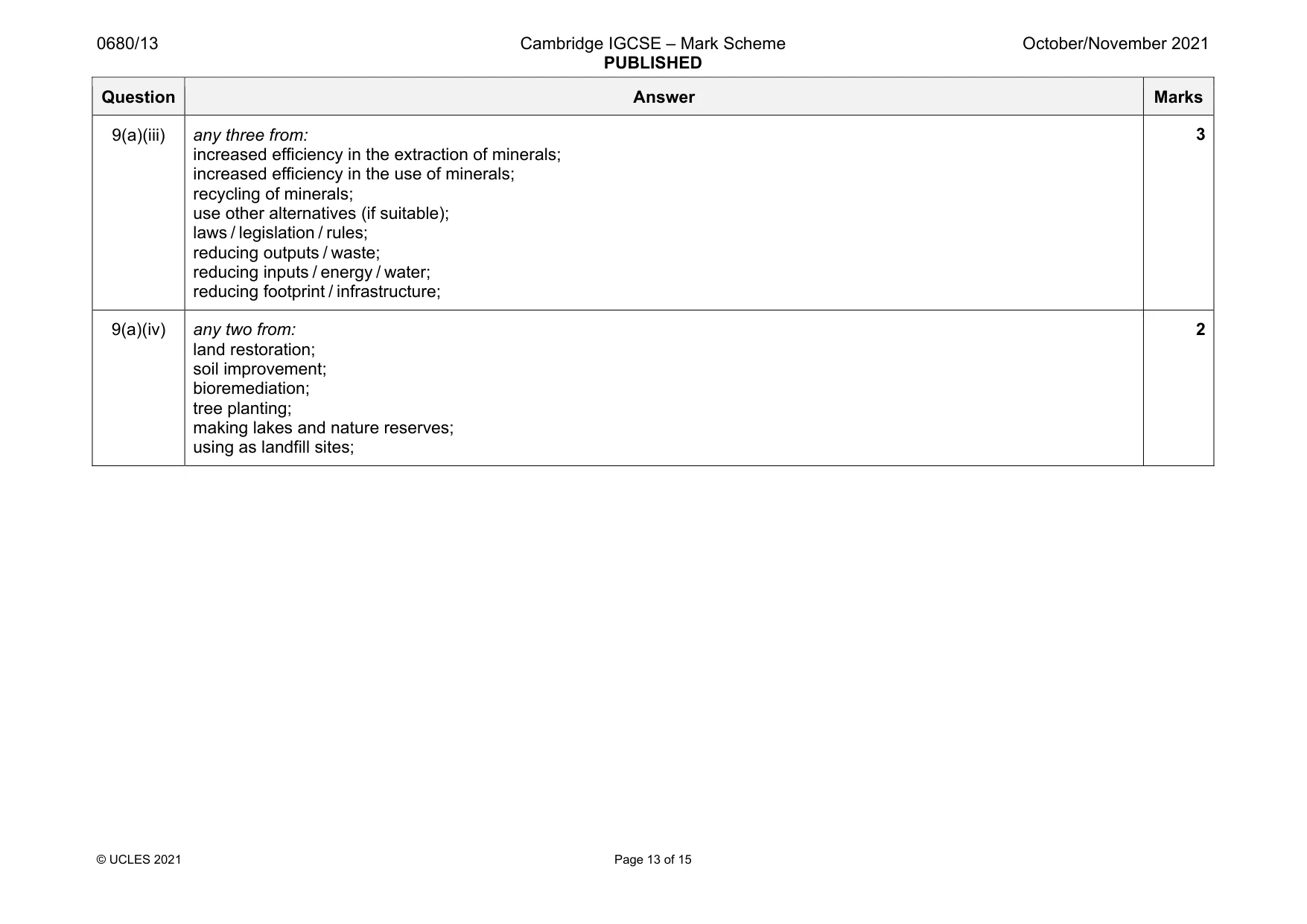
0680/13 Cambridge IGCSE – Mark Scheme PUBLISHED October/November 2021 © UCLES 2021 Page 5 of 15 Question Answer Marks 1(a) any three from: convection currents move plates; two plates moving away from each other / divergent; molten magma rises to fill the gap; magma becomes lava; underwater mountains / volcanoes / new land formed / sea floor spreading; shield volcanoes can form along the edge of the boundary; 3 1(b) any three from: damage to buildings and infrastructure; fire; tsunamis; landslides; loss of land / habitats; water related disease; loss of life; trauma; financial losses; homelessness / relocation / evacuation (of people); 3 Question Answer Marks 2(a)(i) pronatalist; 1 2(a)(ii) any two from: tax advantages; free schooling; subsidised housing; social reward, e.g. medal; free / subsidised healthcare for families; AVP; 2
Mark scheme, page 6
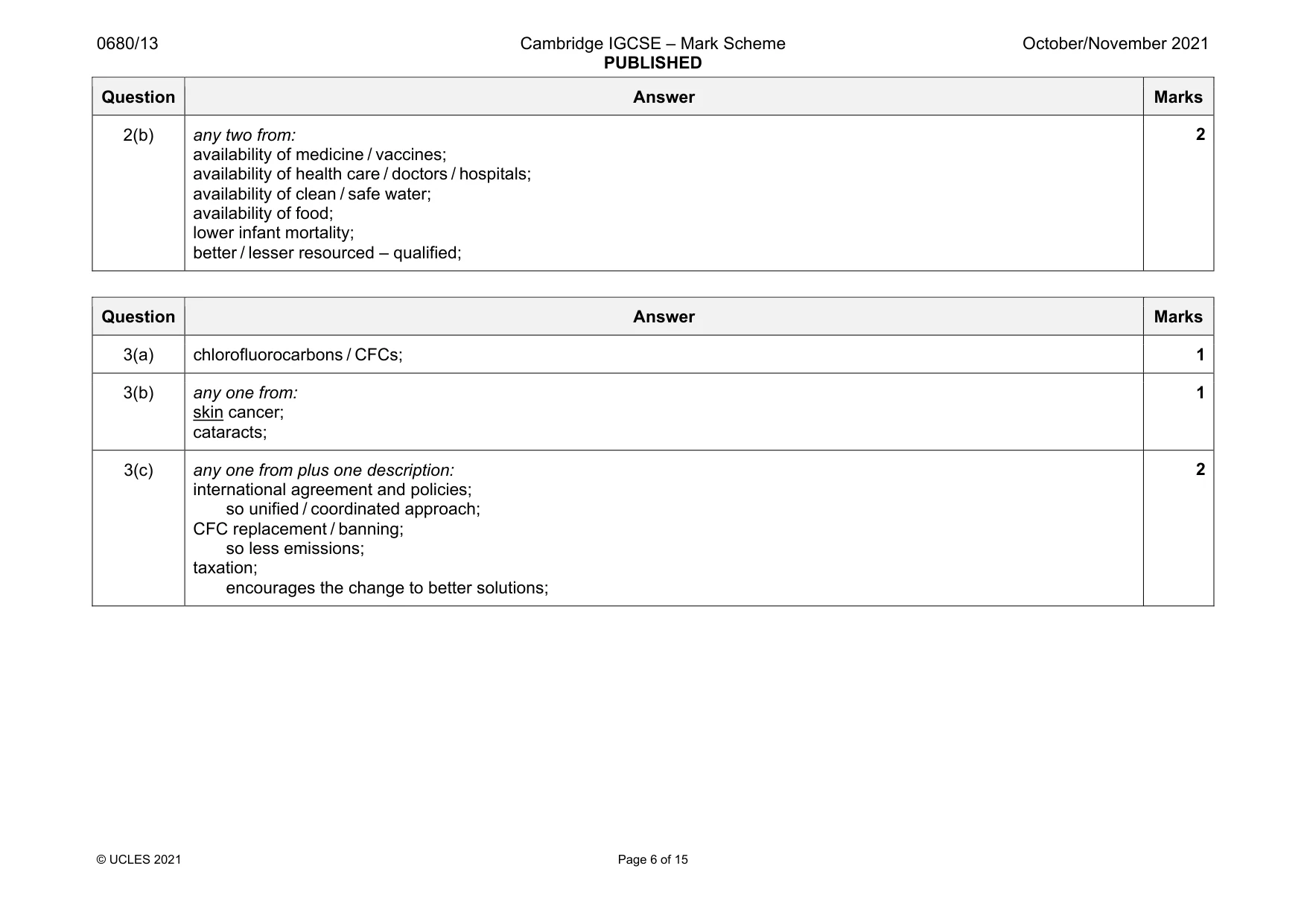
0680/13 Cambridge IGCSE – Mark Scheme PUBLISHED October/November 2021 © UCLES 2021 Page 6 of 15 Question Answer Marks 2(b) any two from: availability of medicine / vaccines; availability of health care / doctors / hospitals; availability of clean / safe water; availability of food; lower infant mortality; better / lesser resourced – qualified; 2 Question Answer Marks 3(a) chlorofluorocarbons / CFCs; 1 3(b) any one from: skin cancer; cataracts; 1 3(c) any one from plus one description: international agreement and policies; so unified / coordinated approach; CFC replacement / banning; so less emissions; taxation; encourages the change to better solutions; 2
Mark scheme, page 7
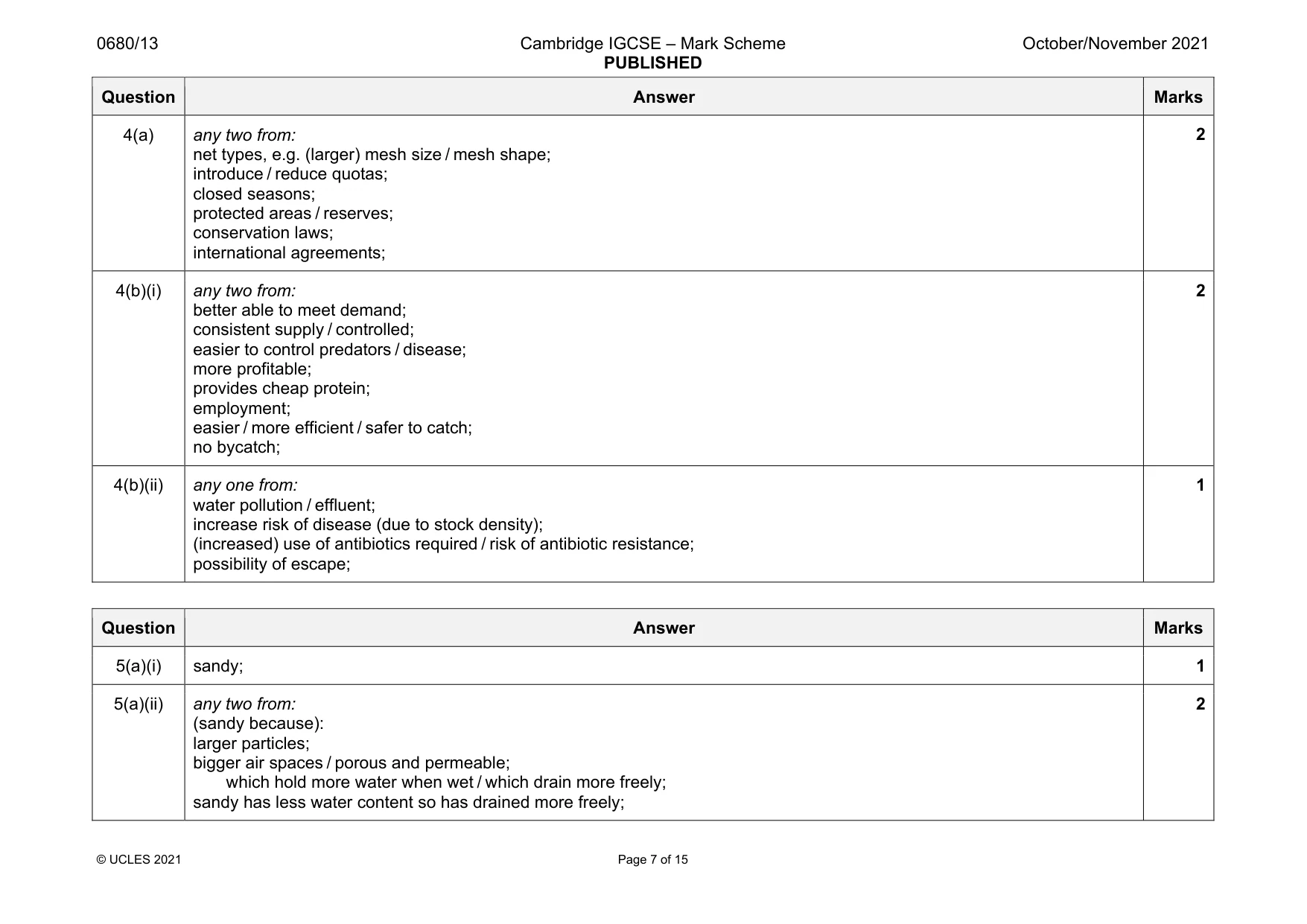
0680/13 Cambridge IGCSE – Mark Scheme PUBLISHED October/November 2021 © UCLES 2021 Page 7 of 15 Question Answer Marks 4(a) any two from: net types, e.g. (larger) mesh size / mesh shape; introduce / reduce quotas; closed seasons; protected areas / reserves; conservation laws; international agreements; 2 4(b)(i) any two from: better able to meet demand; consistent supply / controlled; easier to control predators / disease; more profitable; provides cheap protein; employment; easier / more efficient / safer to catch; no bycatch; 2 4(b)(ii) any one from: water pollution / effluent; increase risk of disease (due to stock density); (increased) use of antibiotics required / risk of antibiotic resistance; possibility of escape; 1 Question Answer Marks 5(a)(i) sandy; 1 5(a)(ii) any two from: (sandy because): larger particles; bigger air spaces / porous and permeable; which hold more water when wet / which drain more freely; sandy has less water content so has drained more freely; 2
Mark scheme, page 8
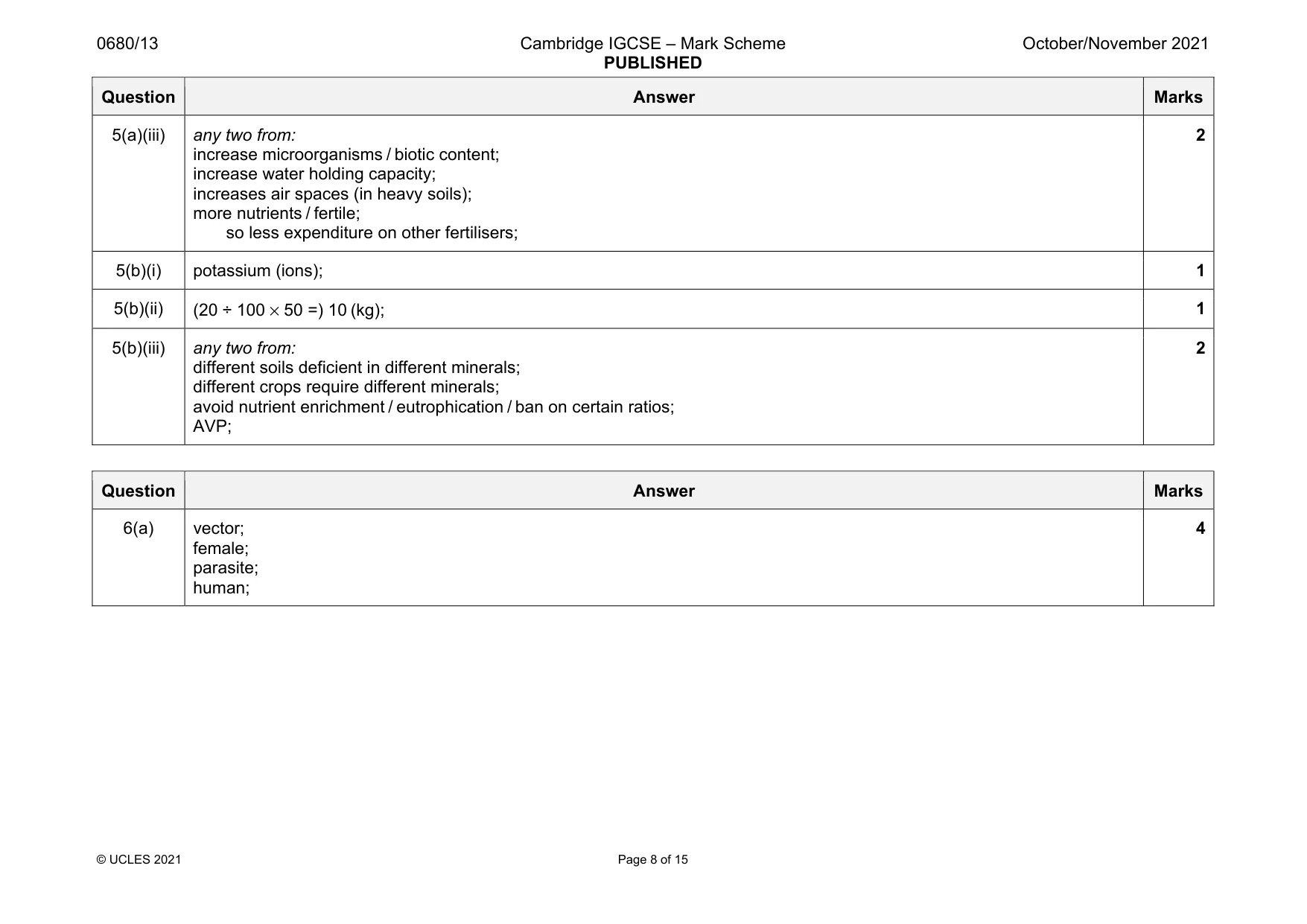
0680/13 Cambridge IGCSE – Mark Scheme PUBLISHED October/November 2021 © UCLES 2021 Page 8 of 15 Question Answer Marks 5(a)(iii) any two from: increase microorganisms / biotic content; increase water holding capacity; increases air spaces (in heavy soils); more nutrients / fertile; so less expenditure on other fertilisers; 2 5(b)(i) potassium (ions); 1 5(b)(ii) (20 ÷ 100 × 50 =) 10 (kg); 1 5(b)(iii) any two from: different soils deficient in different minerals; different crops require different minerals; avoid nutrient enrichment / eutrophication / ban on certain ratios; AVP; 2 Question Answer Marks 6(a) vector; female; parasite; human; 4
Mark scheme, page 9
0680/13 Cambridge IGCSE – Mark Scheme PUBLISHED October/November 2021 © UCLES 2021 Page 9 of 15 Question Answer Marks 6(b) any two strategies described, e.g.: eradicate / kill mosquitoes by; using insecticide; using larvae-eating fish; prevent bites by; wearing long clothes / covering skin; using nets; using repellent; using screens for windows / doors; prevent breeding by; releasing sterilised males; putting oil on water surfaces; kill malaria parasite; using anti-malarial drugs; 4 6(c) conclusion based on developed evidence: (yes because) draining swamps reduces the number of breeding sites; mosquitoes need water to breed / to complete life cycle; (no because) mosquitoes can still breed in reservoirs; cannot drain these as needed as source of water / power / food; (no because) mosquitoes can still breed in paddy fields; we cannot drain these as they are needed for food; (no because) draining swamps is expensive and difficult to do; other control methods may be easier / cheaper / more effective; 4
Mark scheme, page 10
0680/13 Cambridge IGCSE – Mark Scheme PUBLISHED October/November 2021 © UCLES 2021 Page 10 of 15 Question Answer Marks 7(a)(i) bar line correctly completed at 31%; 1 7(a)(ii) 26 500(.23); 1 7(a)(iii) any three from: climate change / getting hotter / getting wetter / getting drier; vegetation changes; sea levels rise; acid rain; disease / epidemic; spread of invasive species; increased human population; destruction of habitats; pollution; hunting / poaching; 3 7(a)(iv) any two from: breeding programs; maintaining genetic diversity; education; reintroduction; funding conservation / research; veterinary assistance / training / support; prevents predation / hunting; 2 7(b)(i) any three from: (north) Asia; Canada / north of North America; east / west sides of North America; south of North America; north of South America; central Africa; Indonesian islands; Japan; AVP; 3
Mark scheme, page 11
0680/13 Cambridge IGCSE – Mark Scheme PUBLISHED October/November 2021 © UCLES 2021 Page 11 of 15 Question Answer Marks 7(b)(ii) any two from: (leaves) reduce interception; (leaves) reduce force of wind / wind speed; roots hold soil; reduce run-off; 2 7(b)(iii) any two from: increasing human population; (which means increased): timber extraction and logging; farming; roads; settlements; mining / rock / mineral extraction; 2 Question Answer Marks 8(a) sensible linear scale for y-axis using at least half the graph paper; y-axis – energy consumption / MTOE; x-axis – resource; bar plots; 4 8(b)(i) 388.8; 1 8(b)(ii) any two from: change / decrease in population; better insulation; more efficient devices used; change in climate / getting warmer; fuel is more expensive; 2
Mark scheme, page 12
0680/13 Cambridge IGCSE – Mark Scheme PUBLISHED October/November 2021 © UCLES 2021 Page 12 of 15 Question Answer Marks 8(b)(iii) any two from: no new nuclear power stations built; nuclear power stations take a long time to build; nuclear powers stations are costly to build; change in government policy; public opinion; 2 8(c) any two from: rich / higher standard of living; meaning more electrical devices / domestic / white goods; more infrastructure; greater demand; greater supply; high level of development; 2 Question Answer Marks 9(a)(i) 7.75; 1 9(a)(ii) any two from: to conserve resources (for future generations); amount of resources are finite; finding more resources has: environmental impact; financial impact; social impacts; 2
Mark scheme, page 13
0680/13 Cambridge IGCSE – Mark Scheme PUBLISHED October/November 2021 © UCLES 2021 Page 13 of 15 Question Answer Marks 9(a)(iii) any three from: increased efficiency in the extraction of minerals; increased efficiency in the use of minerals; recycling of minerals; use other alternatives (if suitable); laws / legislation / rules; reducing outputs / waste; reducing inputs / energy / water; reducing footprint / infrastructure; 3 9(a)(iv) any two from: land restoration; soil improvement; bioremediation; tree planting; making lakes and nature reserves; using as landfill sites; 2
Mark scheme, page 14
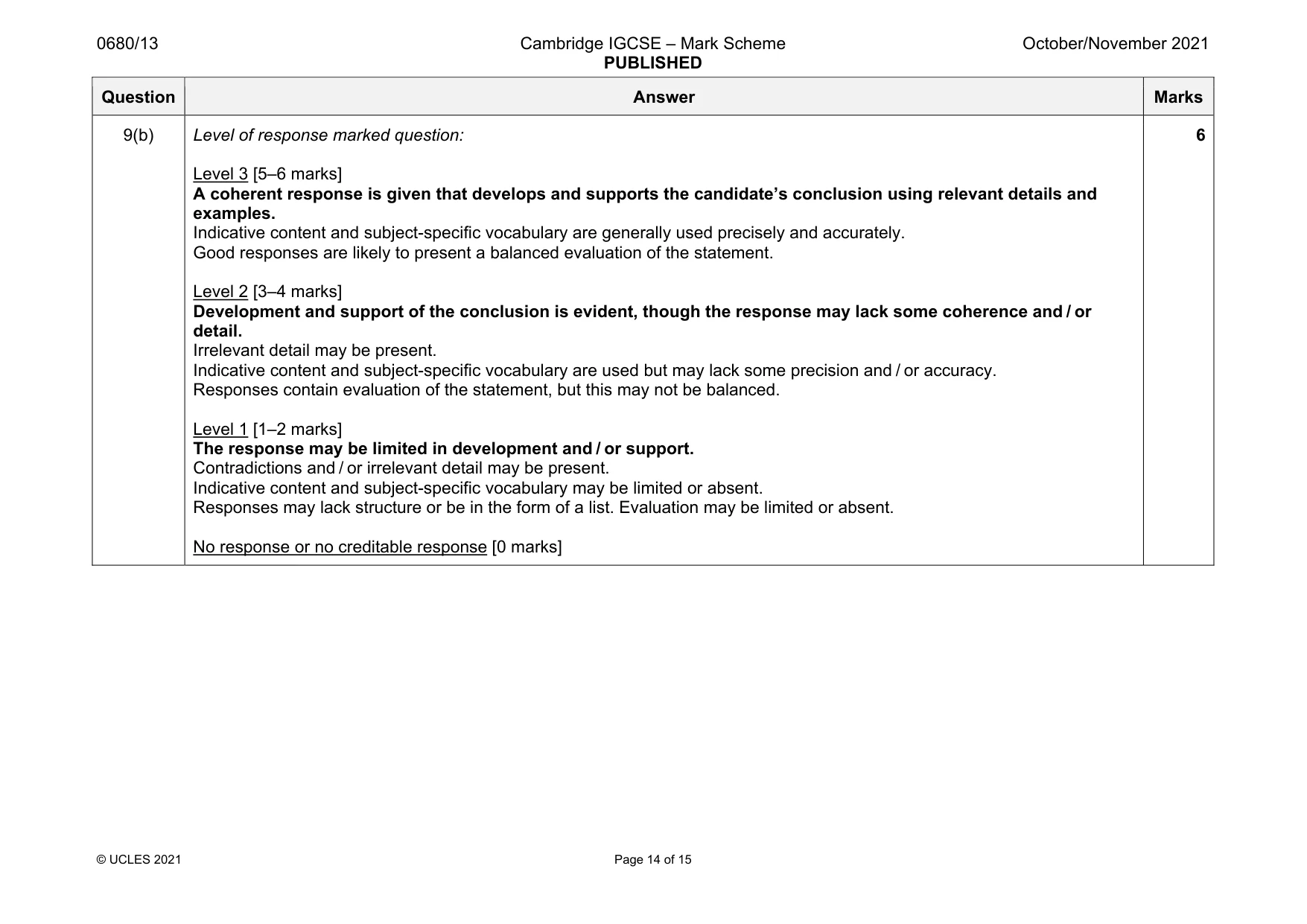
0680/13 Cambridge IGCSE – Mark Scheme PUBLISHED October/November 2021 © UCLES 2021 Page 14 of 15 Question Answer Marks 9(b) Level of response marked question: Level 3 [5–6 marks] A coherent response is given that develops and supports the candidate’s conclusion using relevant details and examples. Indicative content and subject-specific vocabulary are generally used precisely and accurately. Good responses are likely to present a balanced evaluation of the statement. Level 2 [3–4 marks] Development and support of the conclusion is evident, though the response may lack some coherence and / or detail. Irrelevant detail may be present. Indicative content and subject-specific vocabulary are used but may lack some precision and / or accuracy. Responses contain evaluation of the statement, but this may not be balanced. Level 1 [1–2 marks] The response may be limited in development and / or support. Contradictions and / or irrelevant detail may be present. Indicative content and subject-specific vocabulary may be limited or absent. Responses may lack structure or be in the form of a list. Evaluation may be limited or absent. No response or no creditable response [0 marks] 6
Mark scheme, page 15
0680/13 Cambridge IGCSE – Mark Scheme PUBLISHED October/November 2021 © UCLES 2021 Page 15 of 15 Question Answer Marks 9(b) Indicative content for: Some people in my village are unhappy about the quarry being opened, but I think everybody should be pleased there is going to be a new quarry. reasons to be pleased: employment; improvement to infrastructure, e.g. power supplies roads etc.; improvement to facilities, e.g. improved transport; economy of the town / more money spent in the town; provide a source of energy for cooking / heating; provide materials for building; opportunities to supply the mine / workers with services; reasons to be unhappy: pollution / dust can cause health problems; visual pollution from spoil heaps; noise from quarry and transport; road congestion from transport; damage to environment; deforestation; loss of farmland; need to relocate homes; loss of existing jobs; mineral extraction is dangerous; insufficient accommodation for influx of workers resulting in informal settlements;
What you needed in this session
Cambridge’s own grade thresholds for 2021 Oct/Nov, Paper 1 · Variant 3. A higher threshold means an easier paper — the bar moves with how the cohort did.