Cambridge IGCSE Environmental Management 0680 — 2019 Oct/Nov Paper 2 · Variant 1
0680/21/O/N/19 · 80 marks · ≈90 min
The question paper and its mark scheme, free to read here and free to download. This is Cambridge’s own paper, exactly as it was sat.
Question paper24 pages




Mark scheme11 pages
Answers below. Sit the paper first if you are practising.
Paper as text
Question paper, page 1
This document consists of 21 printed pages and 3 blank pages. DC (ST/JG) 173958/2 © UCLES 2019 [Turn over * 7 0 1 8 1 2 9 4 3 1 * ENVIRONMENTAL MANAGEMENT 0680/21 Paper 2 Management in context October/November 2019 1 hour 45 minutes Candidates answer on the Question Paper. No Additional Materials are required. READ THESE INSTRUCTIONS FIRST Write your centre number, candidate number and name in the spaces at the top of this page. Write in dark blue or black pen. You may use an HB pencil for any diagrams, graphs or rough working. Do not use staples, paper clips, glue or correction fluid. DO NOT WRITE IN ANY BARCODES. Answer all questions. Electronic calculators may be used. You may lose marks if you do not show your working or if you do not use appropriate units. At the end of the examination, fasten all your work securely together. The number of marks is given in brackets [ ] at the end of each question or part question. Cambridge Assessment International Education Cambridge International General Certificate of Secondary Education
Question paper, page 2
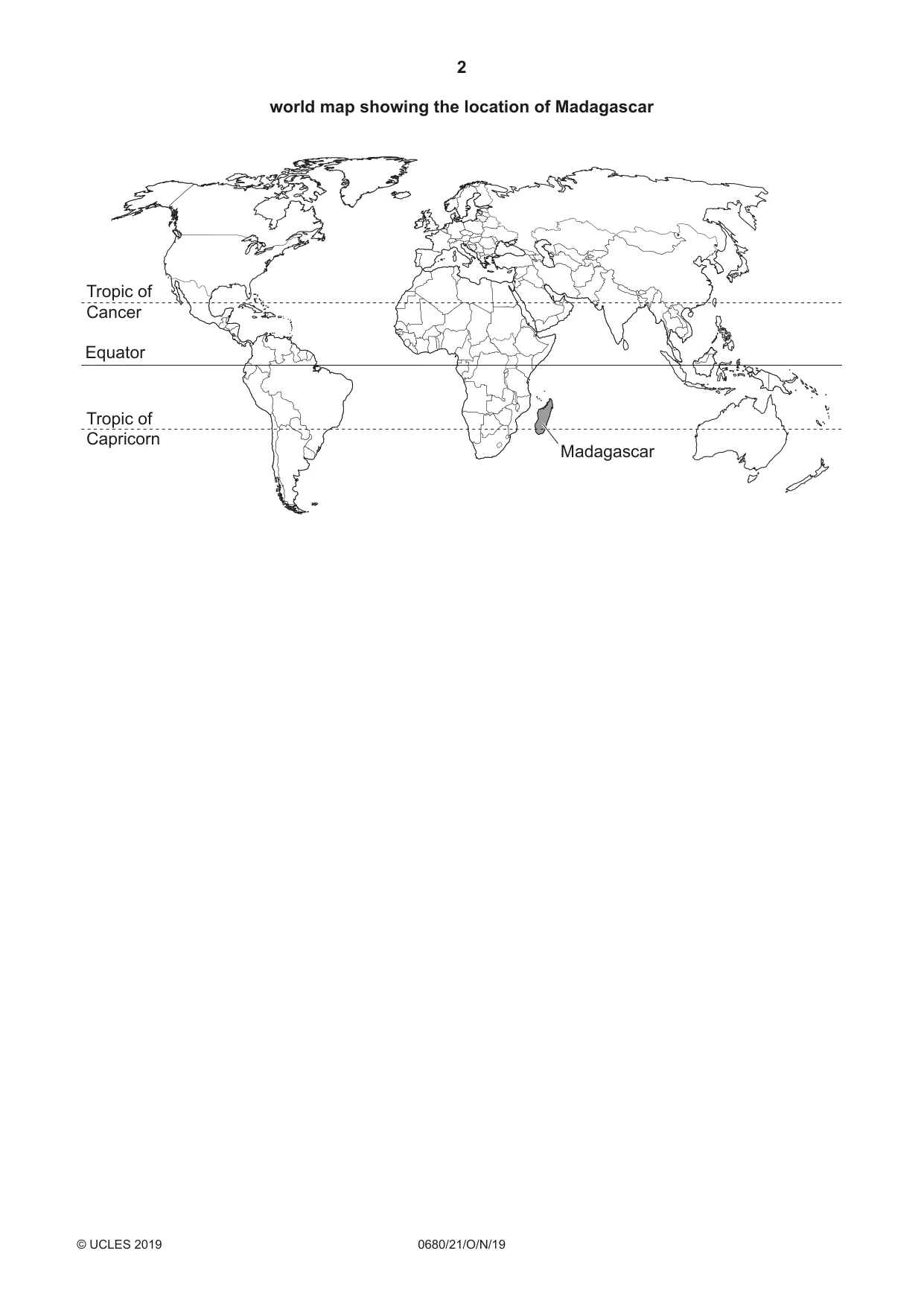
2 0680/21/O/N/19 © UCLES 2019 world map showing the location of Madagascar Equator Tropic of Capricorn Tropic of Cancer Madagascar
Question paper, page 3
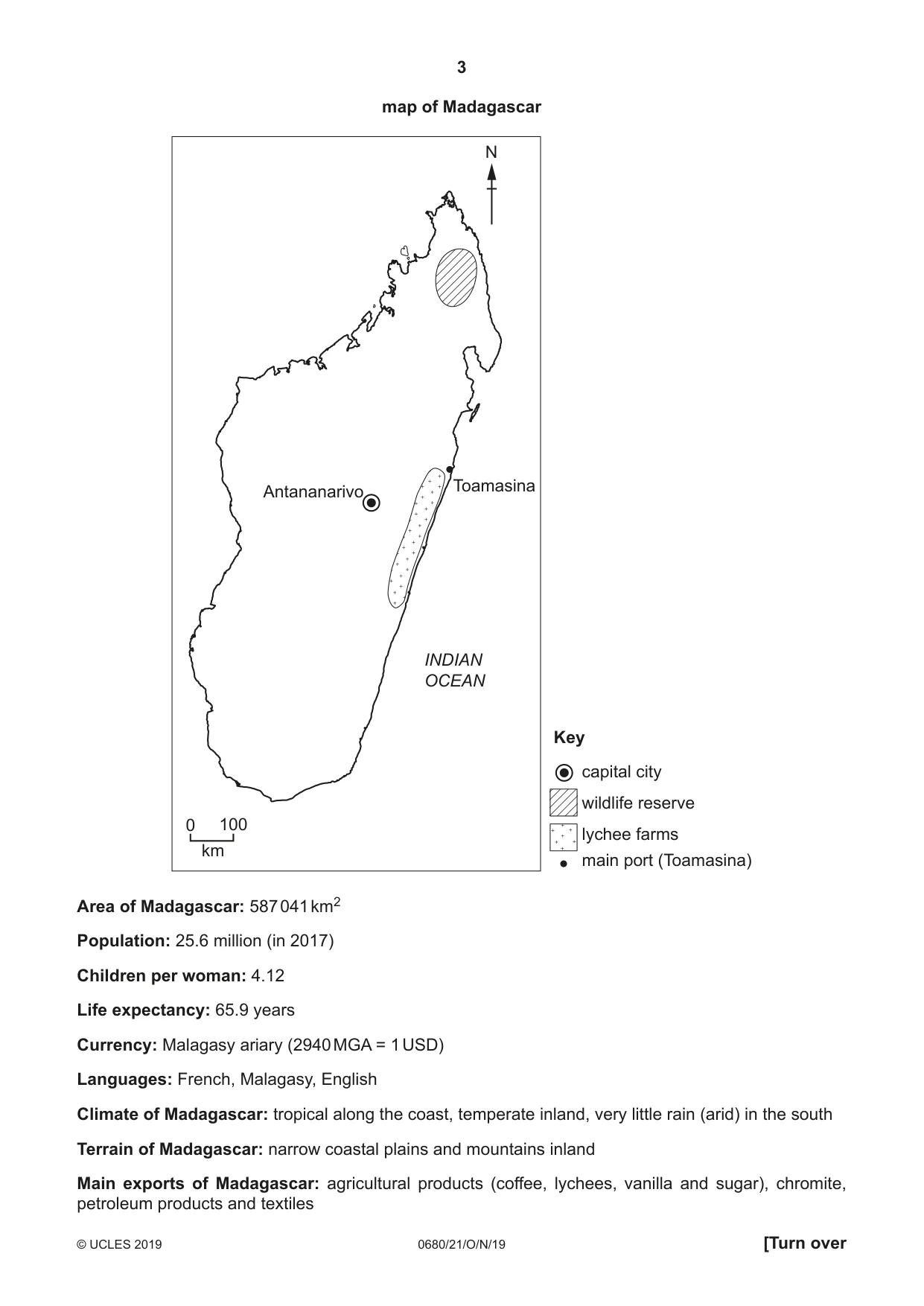
3 0680/21/O/N/19 © UCLES 2019 [Turn over map of Madagascar Antananarivo 0 100 Key km N Toamasina main port (Toamasina) capital city wildlife reserve lychee farms INDIAN OCEAN Area of Madagascar: 587 041 km2 Population: 25.6 million (in 2017) Children per woman: 4.12 Life expectancy: 65.9 years Currency: Malagasy ariary (2940 MGA = 1 USD) Languages: French, Malagasy, English Climate of Madagascar: tropical along the coast, temperate inland, very little rain (arid) in the south Terrain of Madagascar: narrow coastal plains and mountains inland Main exports of Madagascar: agricultural products (coffee, lychees, vanilla and sugar), chromite, petroleum products and textiles
Question paper, page 4
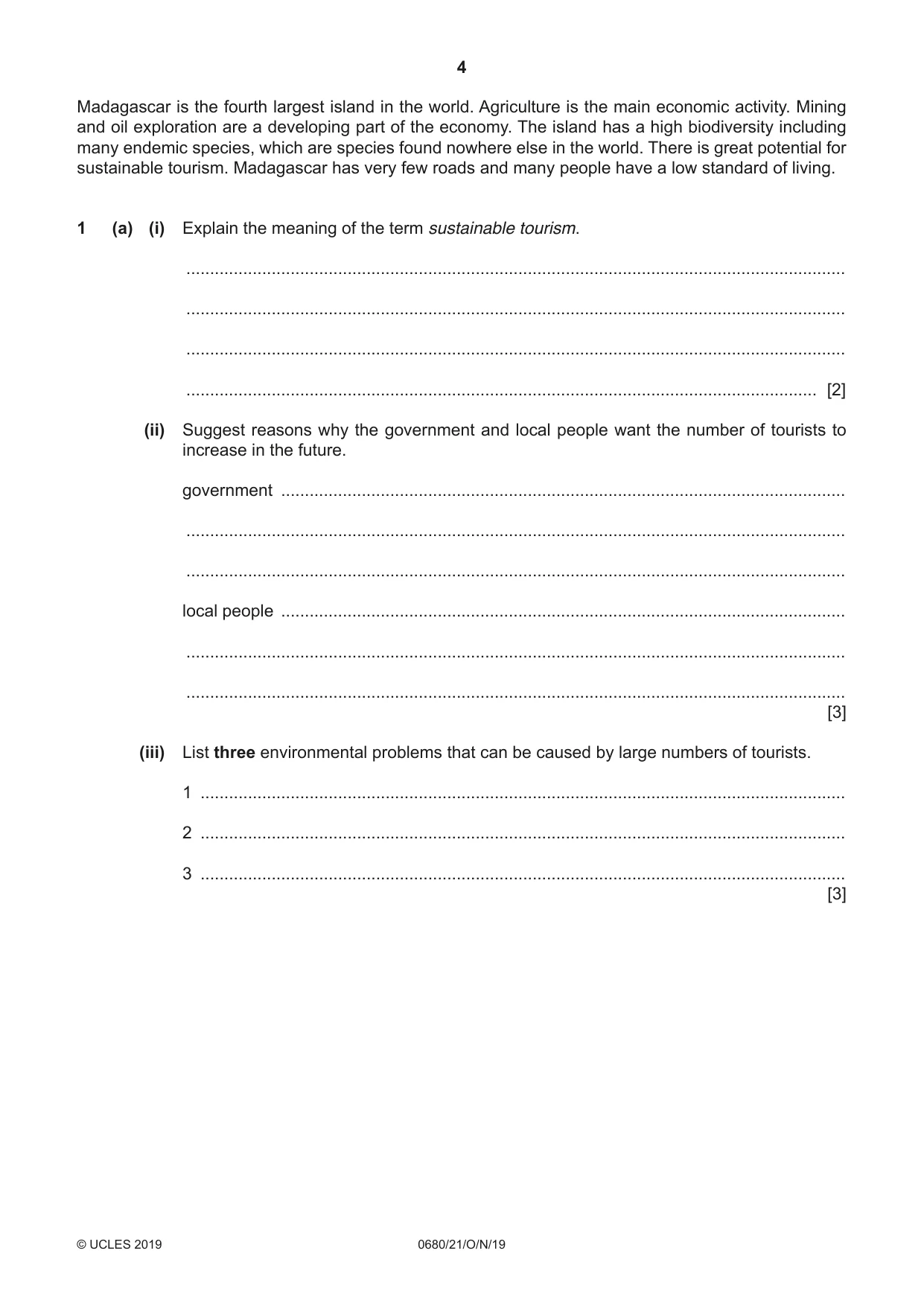
4 0680/21/O/N/19 © UCLES 2019 Madagascar is the fourth largest island in the world. Agriculture is the main economic activity. Mining and oil exploration are a developing part of the economy. The island has a high biodiversity including many endemic species, which are species found nowhere else in the world. There is great potential for sustainable tourism. Madagascar has very few roads and many people have a low standard of living. 1 (a) (i) Explain the meaning of the term sustainable tourism. … … … … [2] (ii) Suggest reasons why the government and local people want the number of tourists to increase in the future. government … … … local people … … … [3] (iii) List three environmental problems that can be caused by large numbers of tourists. 1 … 2 … 3 … [3]
Question paper, page 5
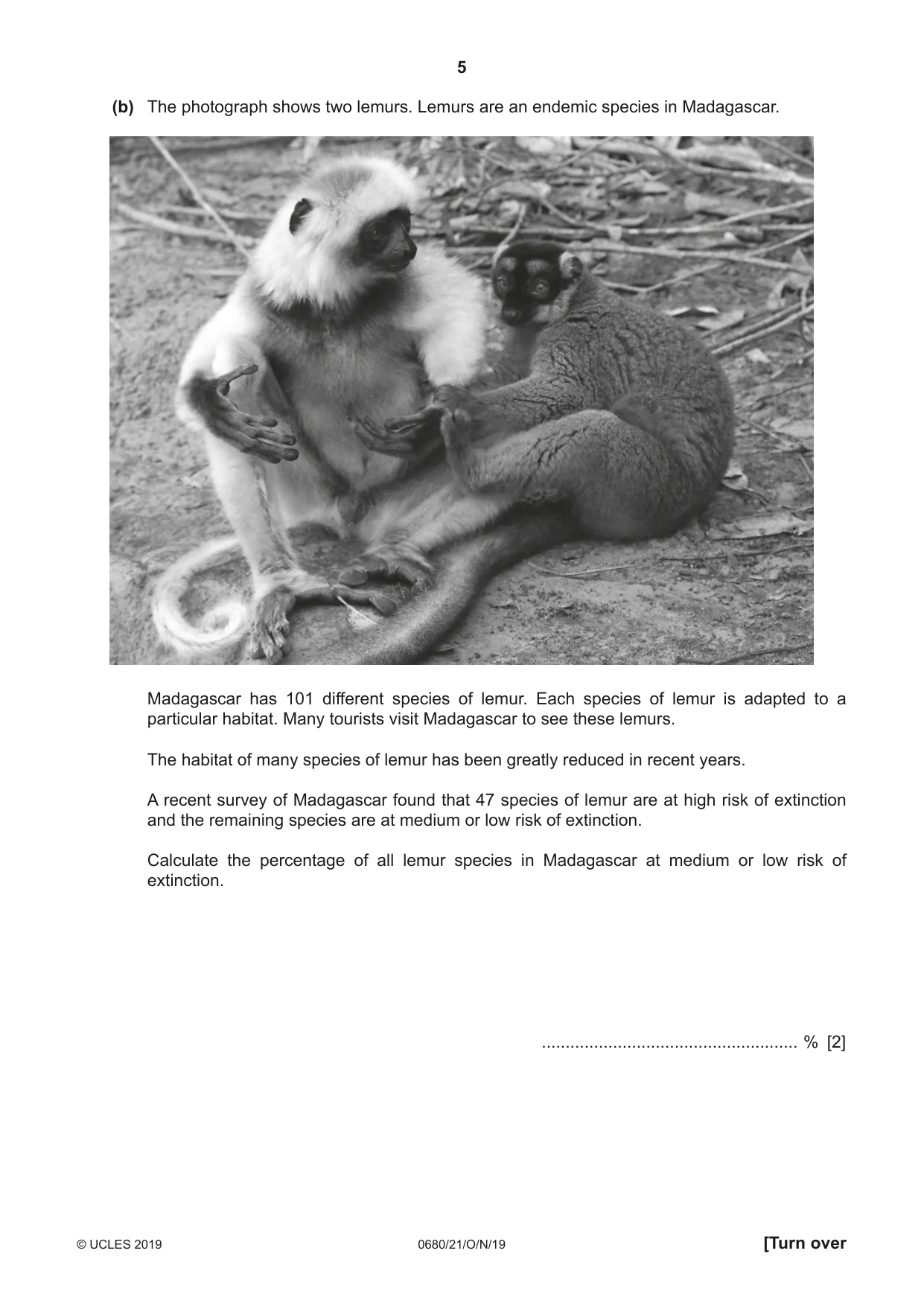
5 0680/21/O/N/19 © UCLES 2019 [Turn over (b) The photograph shows two lemurs. Lemurs are an endemic species in Madagascar. Madagascar has 101 different species of lemur. Each species of lemur is adapted to a particular habitat. Many tourists visit Madagascar to see these lemurs. The habitat of many species of lemur has been greatly reduced in recent years. A recent survey of Madagascar found that 47 species of lemur are at high risk of extinction and the remaining species are at medium or low risk of extinction. Calculate the percentage of all lemur species in Madagascar at medium or low risk of extinction. … % [2]
Question paper, page 6
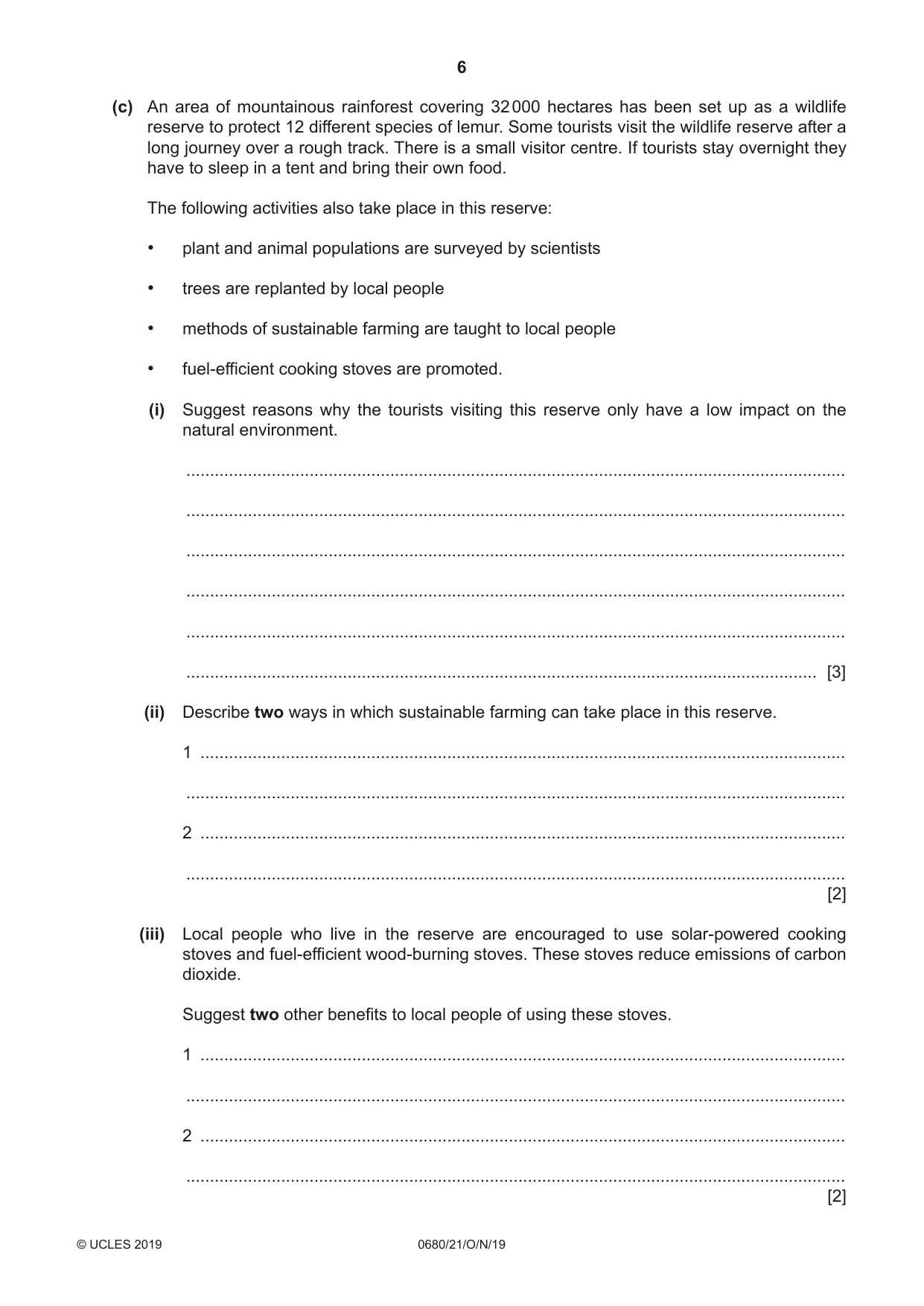
6 0680/21/O/N/19 © UCLES 2019 (c) An area of mountainous rainforest covering 32 000 hectares has been set up as a wildlife reserve to protect 12 different species of lemur. Some tourists visit the wildlife reserve after a long journey over a rough track. There is a small visitor centre. If tourists stay overnight they have to sleep in a tent and bring their own food. The following activities also take place in this reserve: • plant and animal populations are surveyed by scientists • trees are replanted by local people • methods of sustainable farming are taught to local people • fuel-efficient cooking stoves are promoted. (i) Suggest reasons why the tourists visiting this reserve only have a low impact on the natural environment. … … … … … … [3] (ii) Describe two ways in which sustainable farming can take place in this reserve. 1 … … 2 … … [2] (iii) Local people who live in the reserve are encouraged to use solar-powered cooking stoves and fuel-efficient wood-burning stoves. These stoves reduce emissions of carbon dioxide. Suggest two other benefits to local people of using these stoves. 1 … … 2 … … [2]
Question paper, page 7
7 0680/21/O/N/19 © UCLES 2019 [Turn over BLANK PAGE
Question paper, page 8
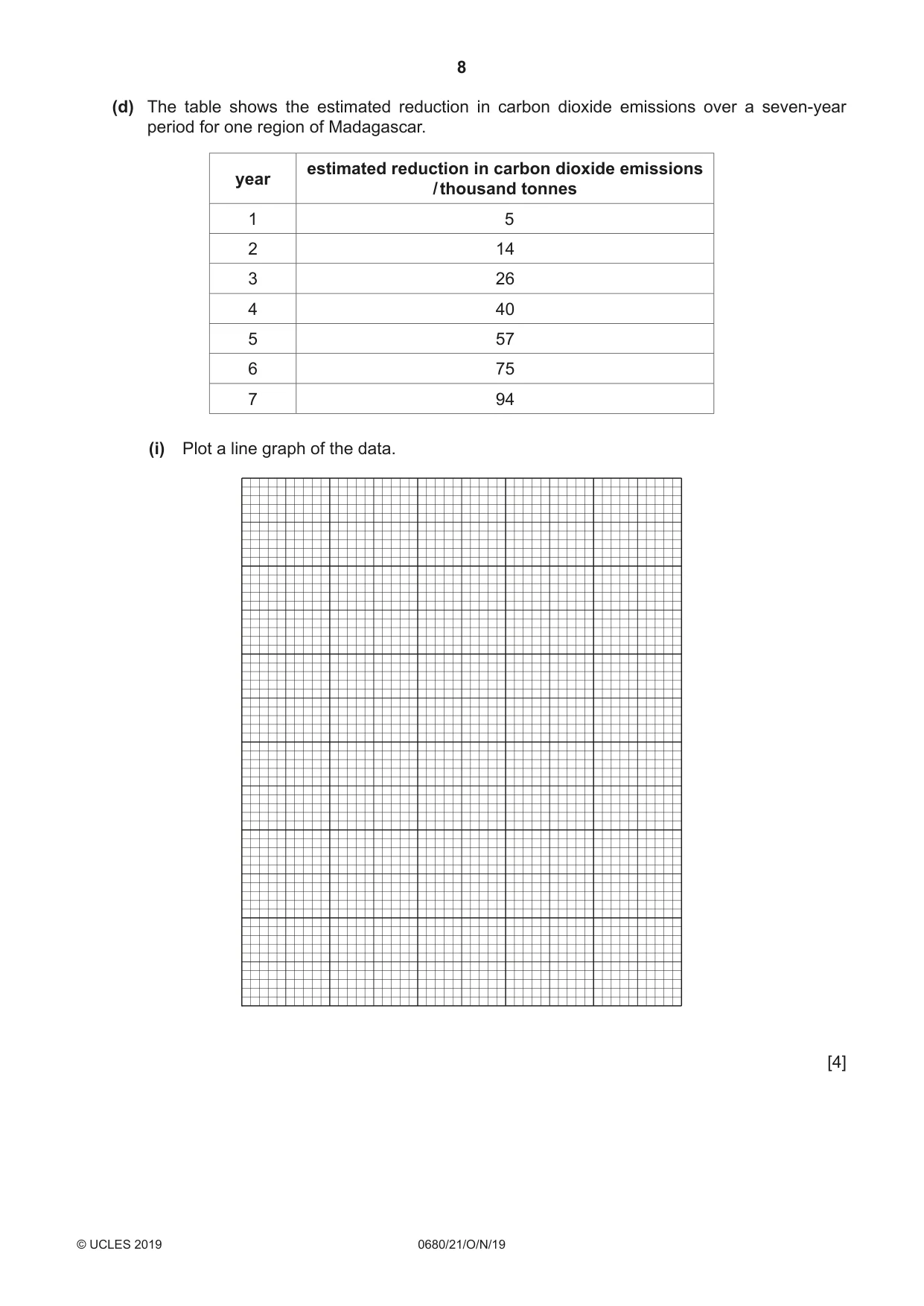
8 0680/21/O/N/19 © UCLES 2019 (d) The table shows the estimated reduction in carbon dioxide emissions over a seven-year period for one region of Madagascar. year estimated reduction in carbon dioxide emissions / thousand tonnes 1 5 2 14 3 26 4 40 5 57 6 75 7 94 (i) Plot a line graph of the data. [4]
Question paper, page 9
9 0680/21/O/N/19 © UCLES 2019 [Turn over (ii) Use the graph to predict the estimated reduction in carbon dioxide emissions in year 8. … thousand tonnes [1] (iii) Suggest why the reduction in carbon dioxide emissions is important to Madagascar. … … [1] (iv) Wood is a type of biofuel. Name two other types of biofuel. 1 … 2 … [2]
Question paper, page 10
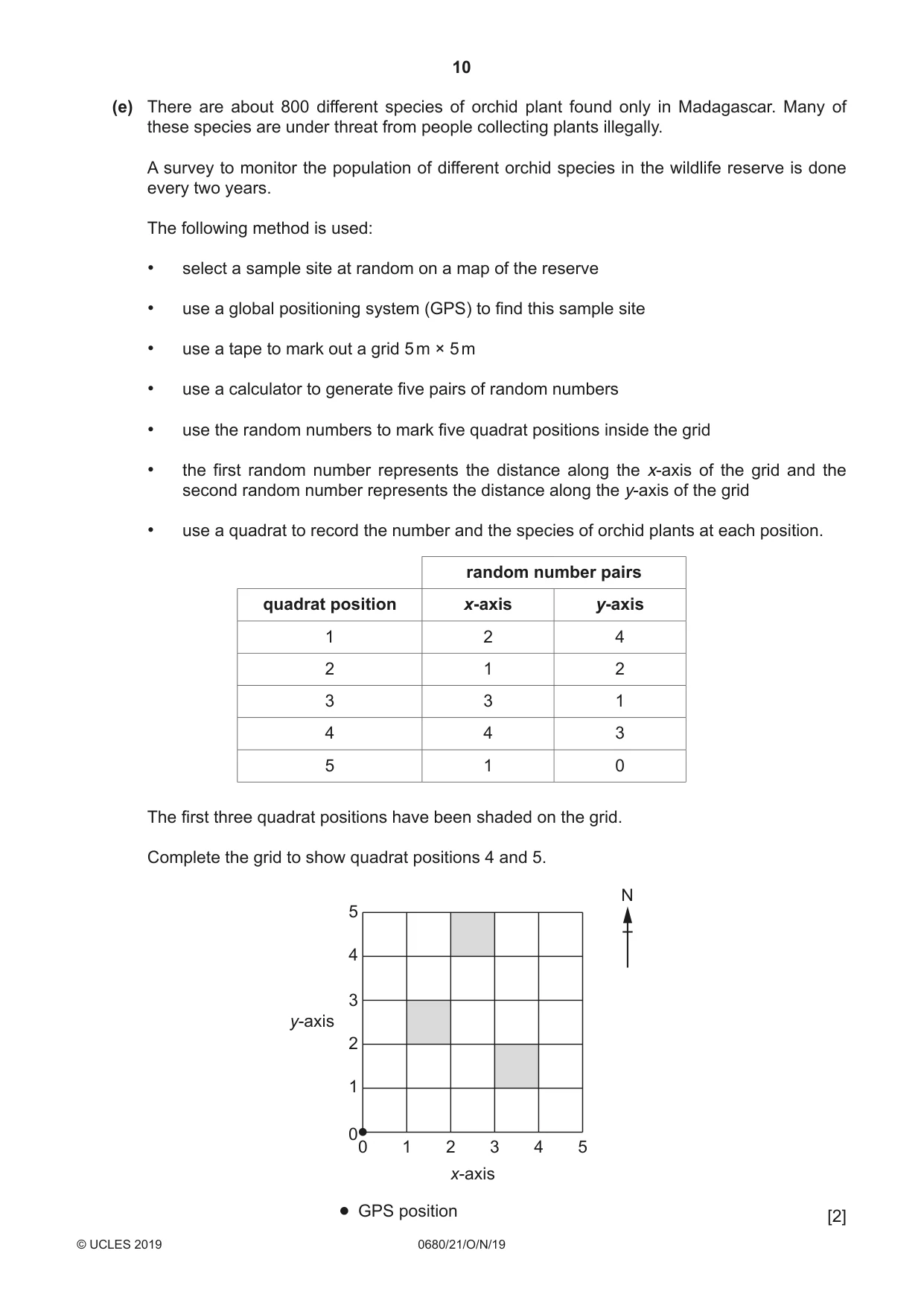
10 0680/21/O/N/19 © UCLES 2019 (e) There are about 800 different species of orchid plant found only in Madagascar. Many of these species are under threat from people collecting plants illegally. A survey to monitor the population of different orchid species in the wildlife reserve is done every two years. The following method is used: • select a sample site at random on a map of the reserve • use a global positioning system (GPS) to find this sample site • use a tape to mark out a grid 5 m × 5 m • use a calculator to generate five pairs of random numbers • use the random numbers to mark five quadrat positions inside the grid • the first random number represents the distance along the x-axis of the grid and the second random number represents the distance along the y-axis of the grid • use a quadrat to record the number and the species of orchid plants at each position. random number pairs quadrat position x-axis y-axis 1 2 4 2 1 2 3 3 1 4 4 3 5 1 0 The first three quadrat positions have been shaded on the grid. Complete the grid to show quadrat positions 4 and 5. 00 1 2 3 4 5 1 2 3 4 5 y-axis x-axis GPS position N [2]
Question paper, page 11
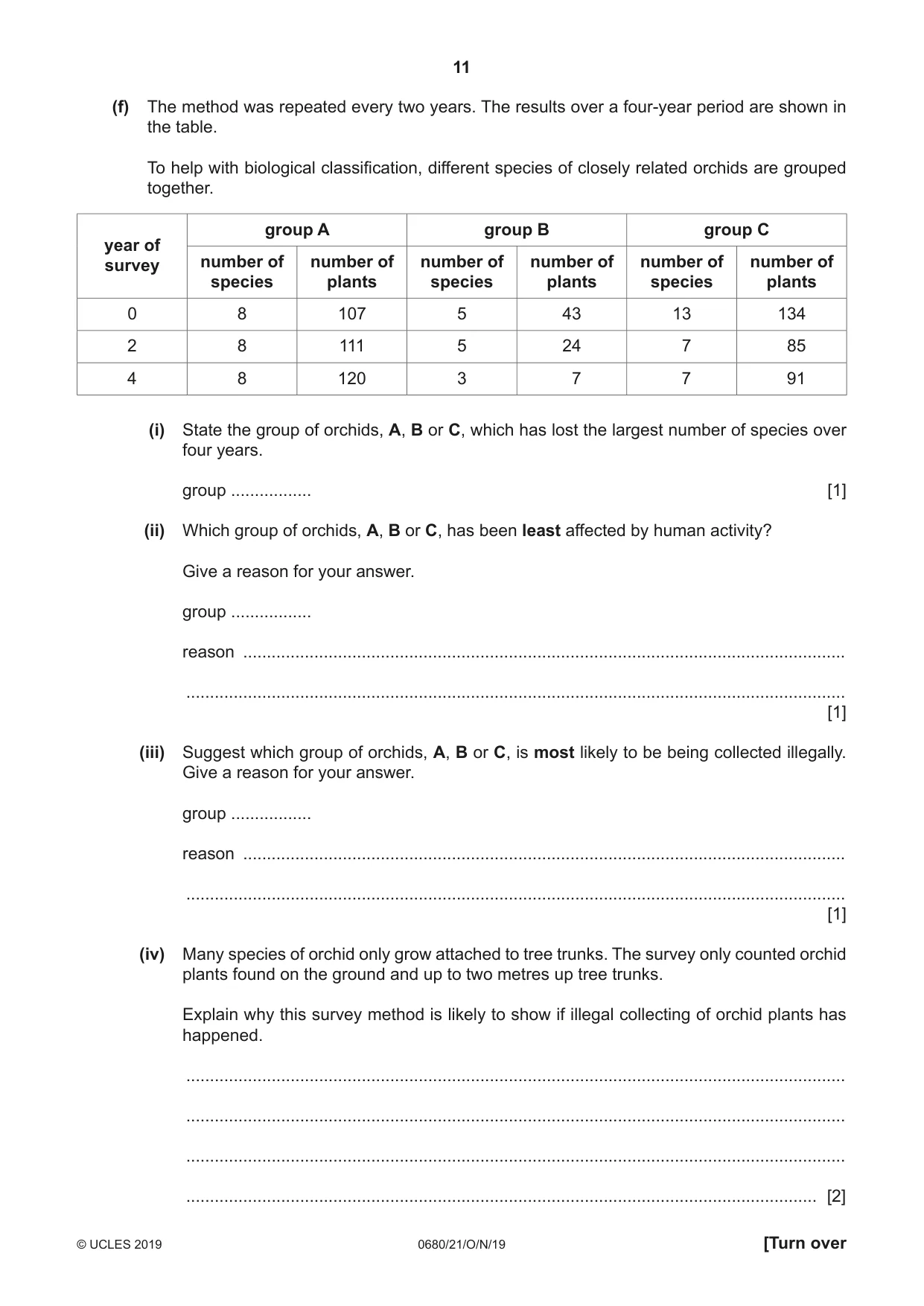
11 0680/21/O/N/19 © UCLES 2019 [Turn over (f) The method was repeated every two years. The results over a four-year period are shown in the table. To help with biological classification, different species of closely related orchids are grouped together. year of survey group A group B group C number of species number of plants number of species number of plants number of species number of plants 0 8 107 5 43 13 134 2 8 111 5 24 7 85 4 8 120 3 7 7 91 (i) State the group of orchids, A, B or C, which has lost the largest number of species over four years. group … [1] (ii) Which group of orchids, A, B or C, has been least affected by human activity? Give a reason for your answer. group … reason … … [1] (iii) Suggest which group of orchids, A, B or C, is most likely to be being collected illegally. Give a reason for your answer. group … reason … … [1] (iv) Many species of orchid only grow attached to tree trunks. The survey only counted orchid plants found on the ground and up to two metres up tree trunks. Explain why this survey method is likely to show if illegal collecting of orchid plants has happened. … … … … [2]
Question paper, page 12
12 0680/21/O/N/19 © UCLES 2019 (v) Suggest reasons why it is difficult to stop illegal plant collecting in the wildlife reserve. … … … … … … [3]
Question paper, page 13
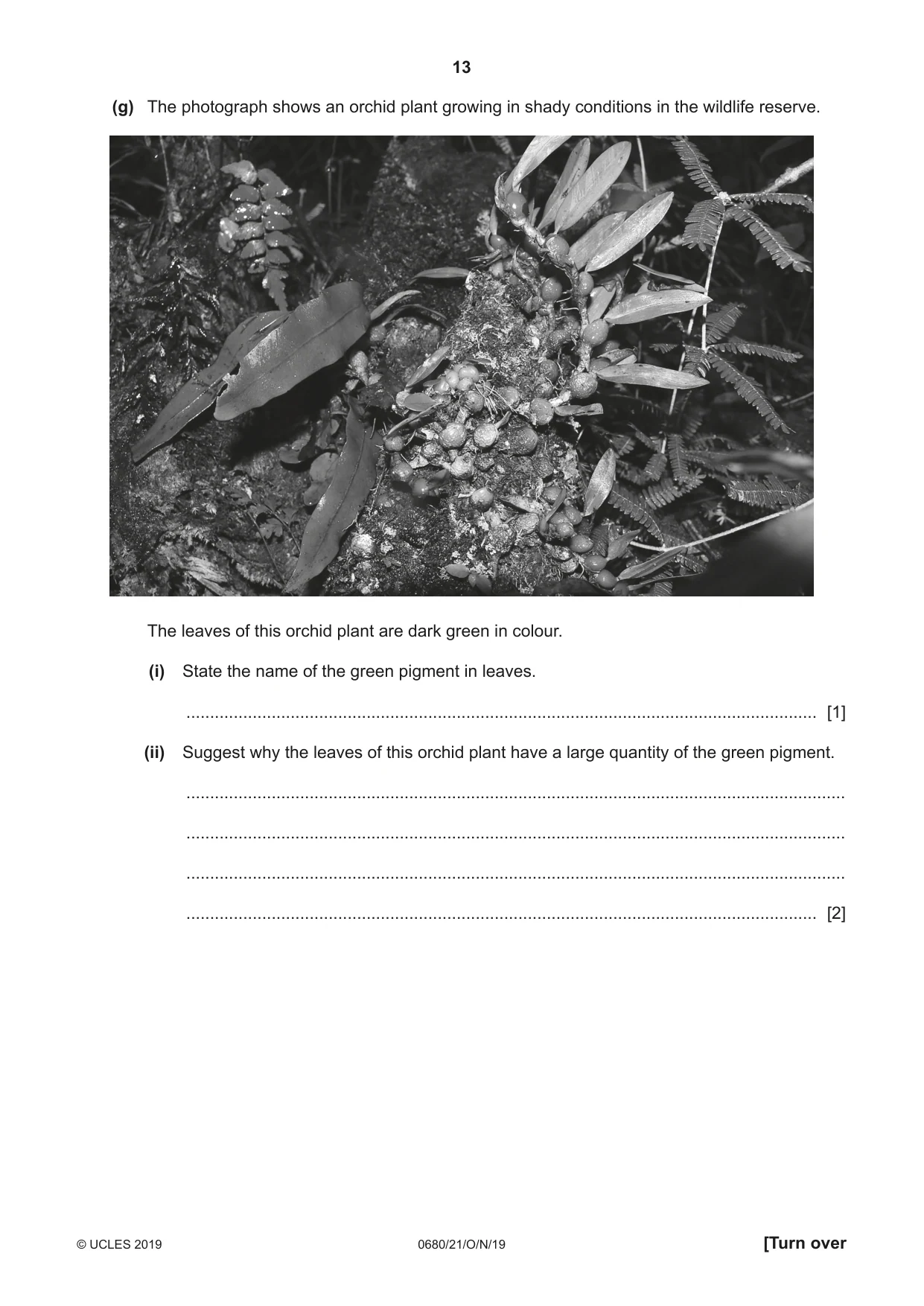
13 0680/21/O/N/19 © UCLES 2019 [Turn over (g) The photograph shows an orchid plant growing in shady conditions in the wildlife reserve. The leaves of this orchid plant are dark green in colour. (i) State the name of the green pigment in leaves. … [1] (ii) Suggest why the leaves of this orchid plant have a large quantity of the green pigment. … … … … [2]
Question paper, page 14
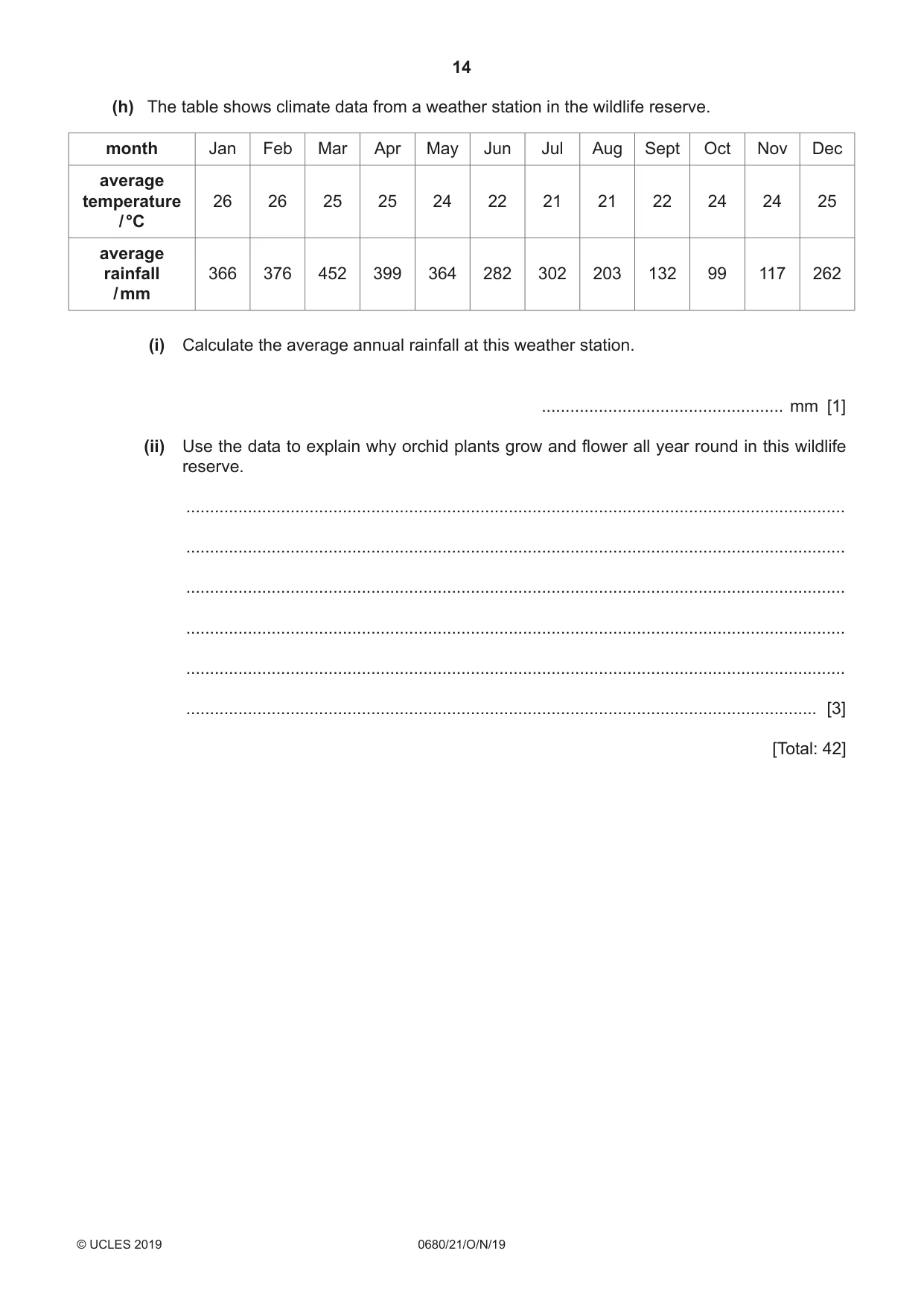
14 0680/21/O/N/19 © UCLES 2019 (h) The table shows climate data from a weather station in the wildlife reserve. month Jan Feb Mar Apr May Jun Jul Aug Sept Oct Nov Dec average temperature / °C 26 26 25 25 24 22 21 21 22 24 24 25 average rainfall / mm 366 376 452 399 364 282 302 203 132 99 117 262 (i) Calculate the average annual rainfall at this weather station. … mm [1] (ii) Use the data to explain why orchid plants grow and flower all year round in this wildlife reserve. … … … … … … [3] [Total: 42]
Question paper, page 15
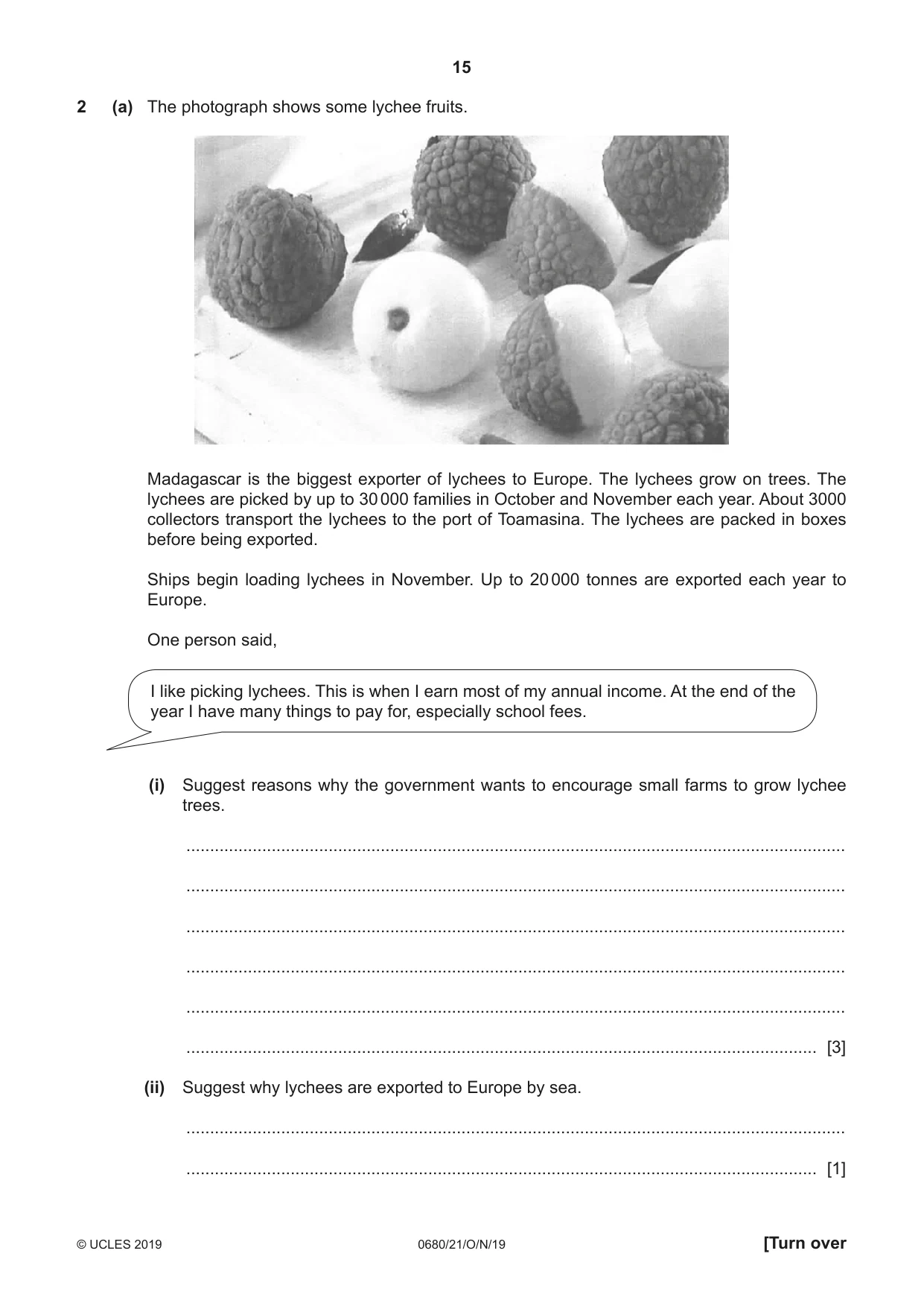
15 0680/21/O/N/19 © UCLES 2019 [Turn over 2 (a) The photograph shows some lychee fruits. Madagascar is the biggest exporter of lychees to Europe. The lychees grow on trees. The lychees are picked by up to 30 000 families in October and November each year. About 3000 collectors transport the lychees to the port of Toamasina. The lychees are packed in boxes before being exported. Ships begin loading lychees in November. Up to 20 000 tonnes are exported each year to Europe. One person said, I like picking lychees. This is when I earn most of my annual income. At the end of the year I have many things to pay for, especially school fees. (i) Suggest reasons why the government wants to encourage small farms to grow lychee trees. … … … … … … [3] (ii) Suggest why lychees are exported to Europe by sea. … … [1]
Question paper, page 16
16 0680/21/O/N/19 © UCLES 2019 (b) The boxes of lychees are exposed to sulfur dioxide gas to kill bacteria and fungi. The boxes are then transported in cool conditions in ships. (i) Suggest why killing the bacteria and fungi is important. … … [1] (ii) The cool conditions in the ships reduce the rate of respiration of the lychees. Describe the process of respiration. … … … … … … [3] (c) A student wanted to investigate the packing of lychees for export. The student: • selected ten lychee fruits at random • weighed each fruit • separated out the lychee parts into edible flesh, seed and skin • weighed each of these parts.
Question paper, page 17
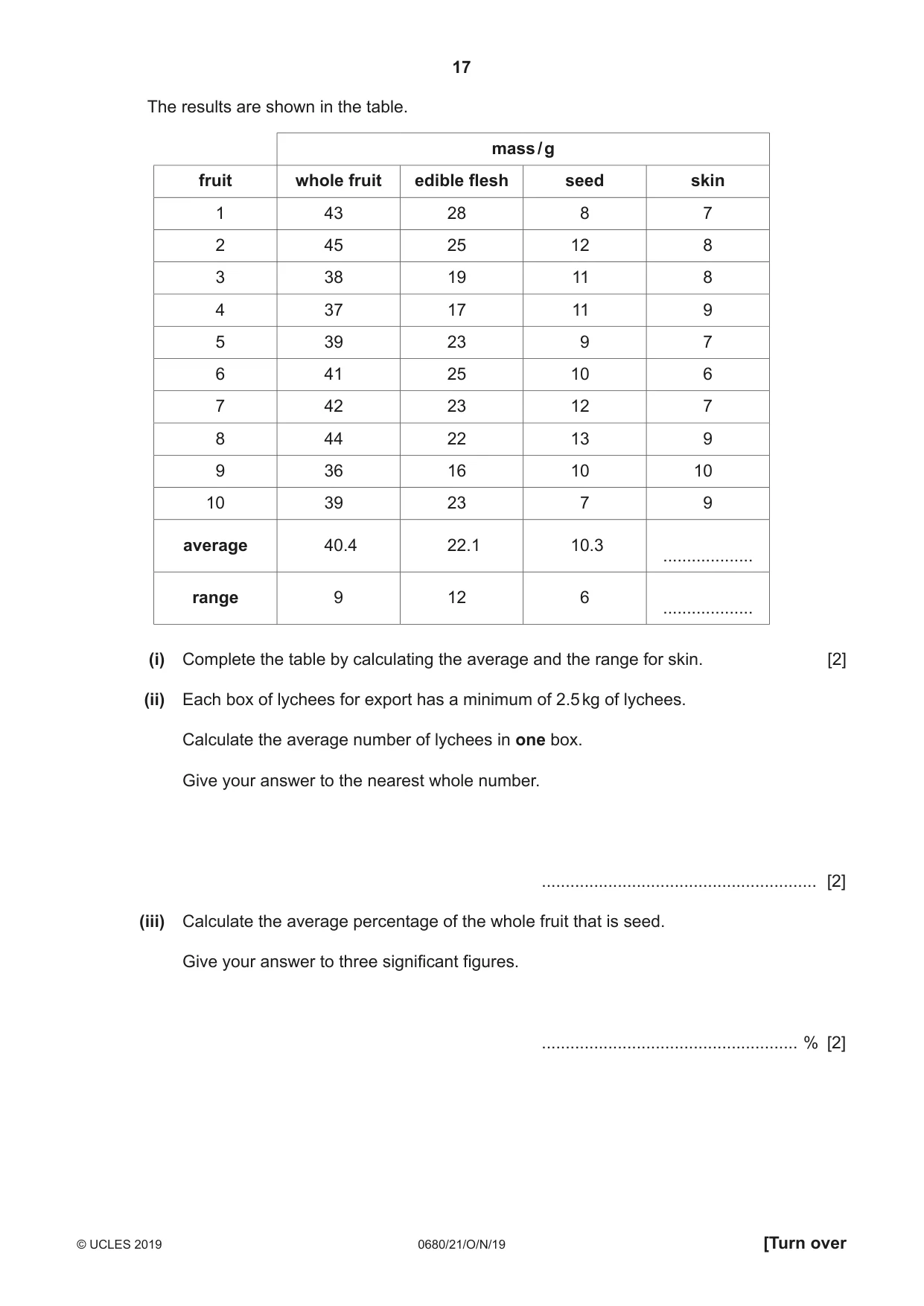
17 0680/21/O/N/19 © UCLES 2019 [Turn over The results are shown in the table. mass / g fruit whole fruit edible flesh seed skin 1 43 28 8 7 2 45 25 12 8 3 38 19 11 8 4 37 17 11 9 5 39 23 9 7 6 41 25 10 6 7 42 23 12 7 8 44 22 13 9 9 36 16 10 10 10 39 23 7 9 average 40.4 22.1 10.3 … range 9 12 6 … (i) Complete the table by calculating the average and the range for skin. [2] (ii) Each box of lychees for export has a minimum of 2.5 kg of lychees. Calculate the average number of lychees in one box. Give your answer to the nearest whole number. … [2] (iii) Calculate the average percentage of the whole fruit that is seed. Give your answer to three significant figures. … % [2]
Question paper, page 18
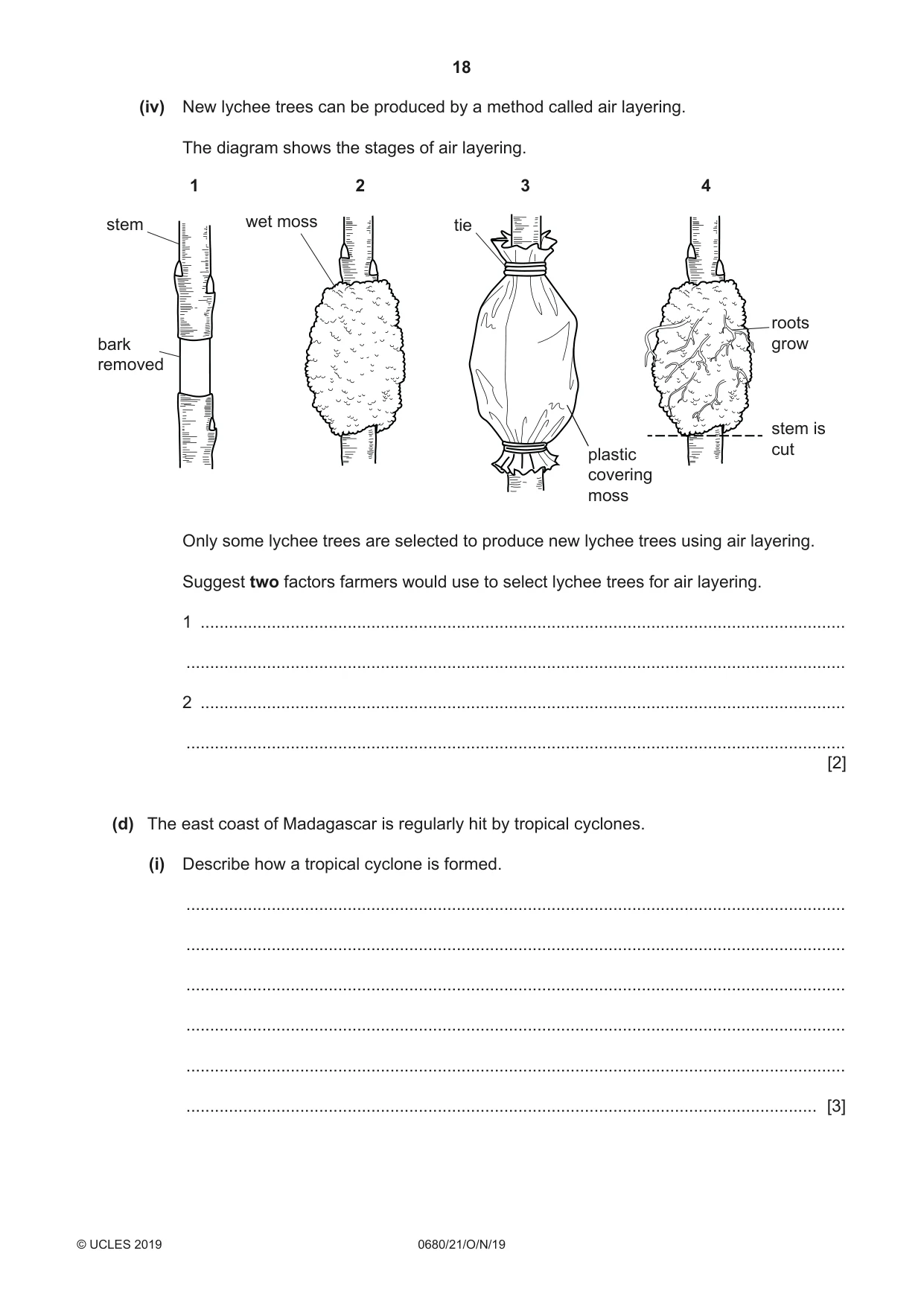
18 0680/21/O/N/19 © UCLES 2019 (iv) New lychee trees can be produced by a method called air layering. The diagram shows the stages of air layering. 1 2 3 4 stem bark removed wet moss tie plastic covering moss stem is cut roots grow Only some lychee trees are selected to produce new lychee trees using air layering. Suggest two factors farmers would use to select lychee trees for air layering. 1 … … 2 … … [2] (d) The east coast of Madagascar is regularly hit by tropical cyclones. (i) Describe how a tropical cyclone is formed. … … … … … … [3]
Question paper, page 19
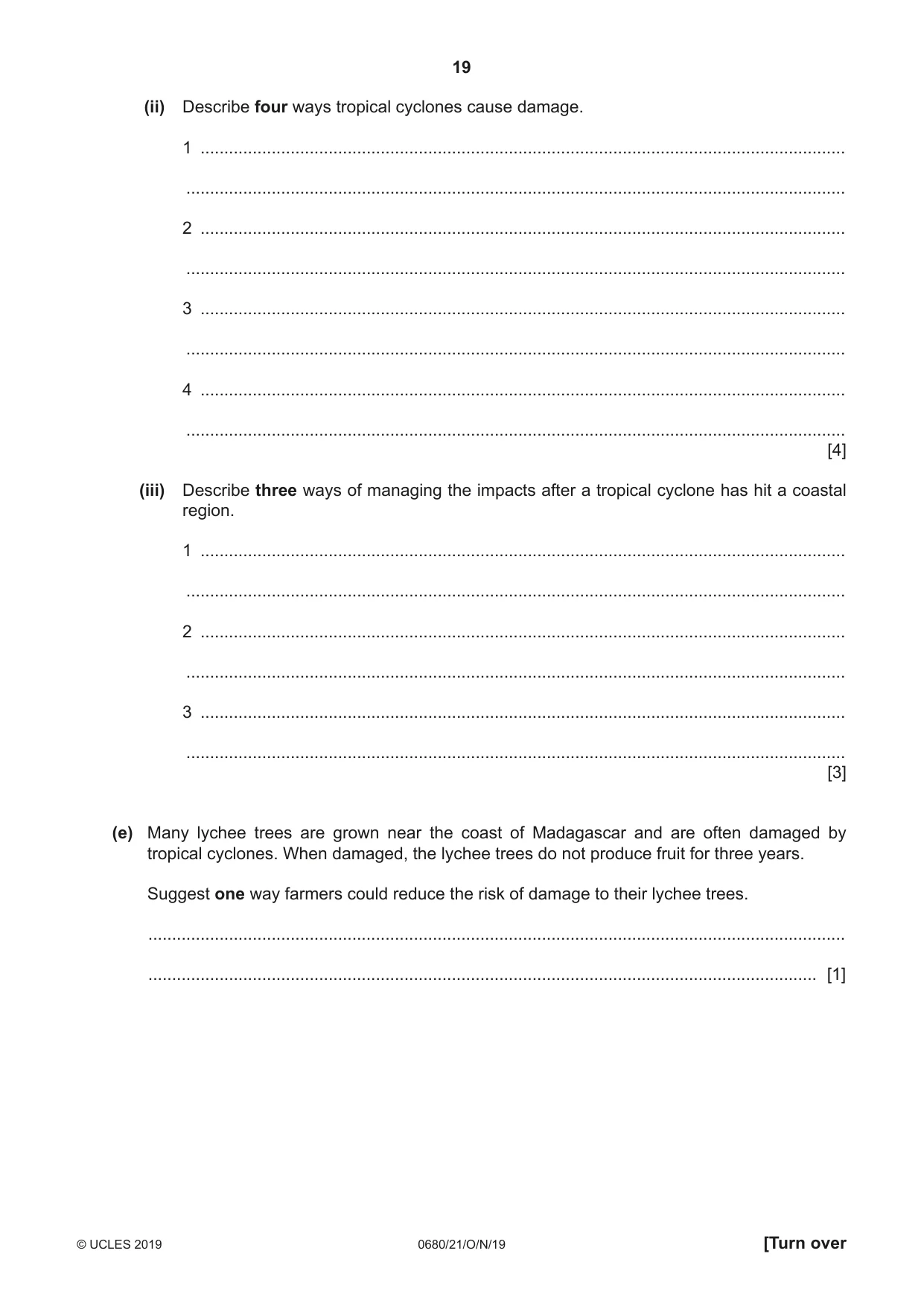
19 0680/21/O/N/19 © UCLES 2019 [Turn over (ii) Describe four ways tropical cyclones cause damage. 1 … … 2 … … 3 … … 4 … … [4] (iii) Describe three ways of managing the impacts after a tropical cyclone has hit a coastal region. 1 … … 2 … … 3 … … [3] (e) Many lychee trees are grown near the coast of Madagascar and are often damaged by tropical cyclones. When damaged, the lychee trees do not produce fruit for three years. Suggest one way farmers could reduce the risk of damage to their lychee trees. … … [1]
Question paper, page 20
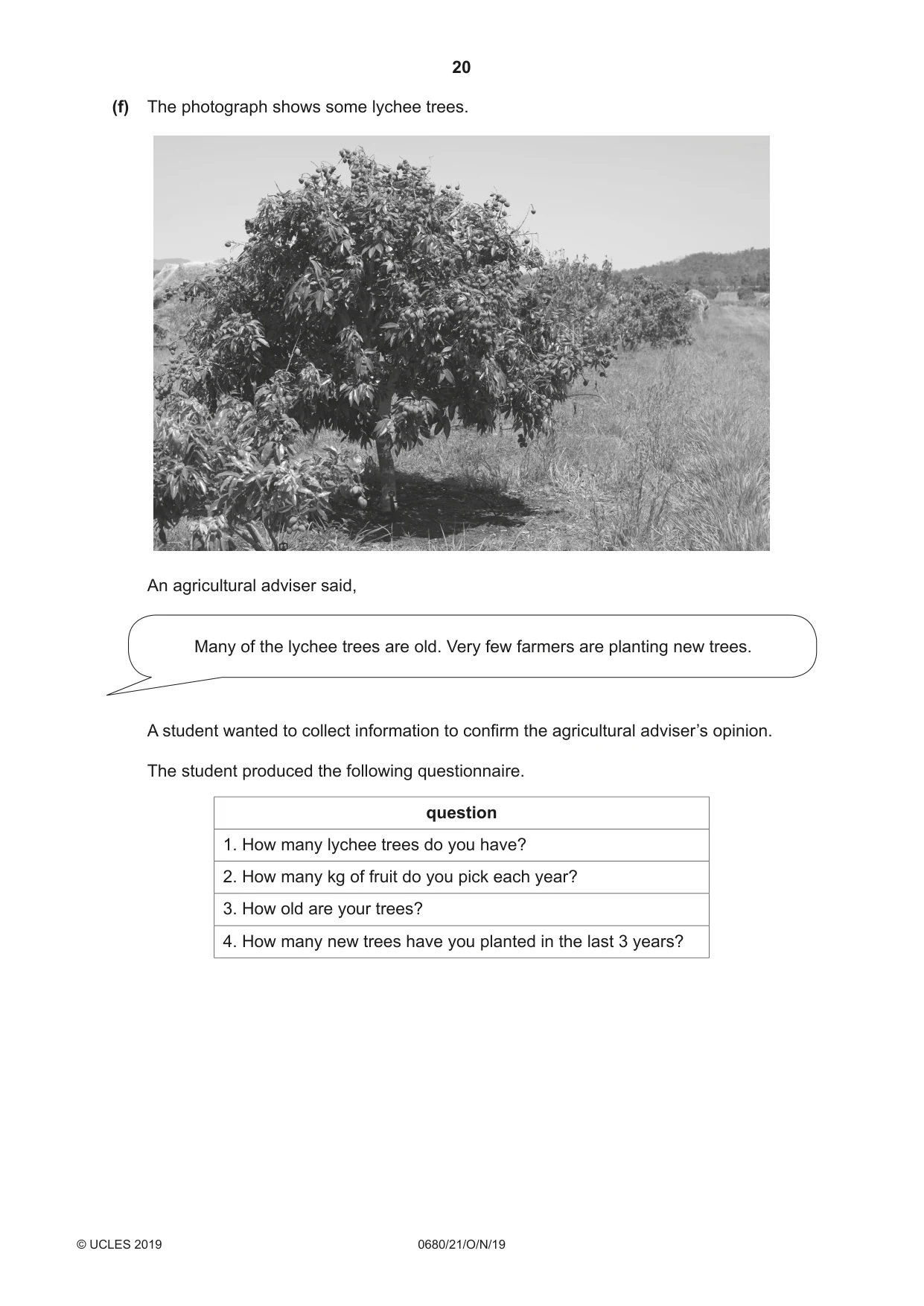
20 0680/21/O/N/19 © UCLES 2019 (f) The photograph shows some lychee trees. An agricultural adviser said, Many of the lychee trees are old. Very few farmers are planting new trees. A student wanted to collect information to confirm the agricultural adviser’s opinion. The student produced the following questionnaire. question 1. How many lychee trees do you have? 2. How many kg of fruit do you pick each year? 3. How old are your trees? 4. How many new trees have you planted in the last 3 years?
Question paper, page 21
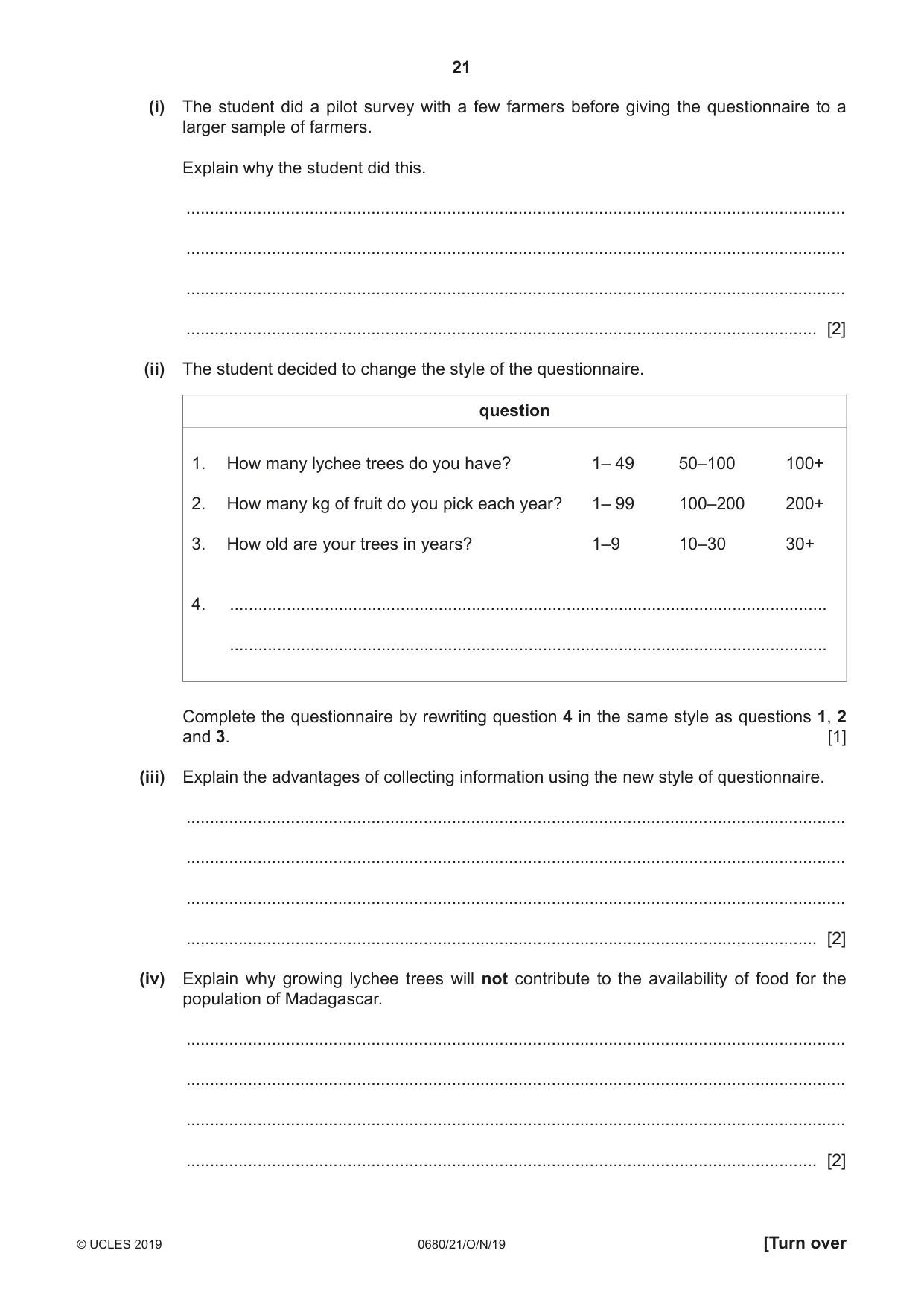
21 0680/21/O/N/19 © UCLES 2019 [Turn over (i) The student did a pilot survey with a few farmers before giving the questionnaire to a larger sample of farmers. Explain why the student did this. … … … … [2] (ii) The student decided to change the style of the questionnaire. question 1. How many lychee trees do you have? 1– 49 50–100 100+ 2. How many kg of fruit do you pick each year? 1– 99 100–200 200+ 3. How old are your trees in years? 1–9 10–30 30+ 4. … … Complete the questionnaire by rewriting question 4 in the same style as questions 1, 2 and 3. [1] (iii) Explain the advantages of collecting information using the new style of questionnaire. … … … … [2] (iv) Explain why growing lychee trees will not contribute to the availability of food for the population of Madagascar. … … … … [2]
Question paper, page 22
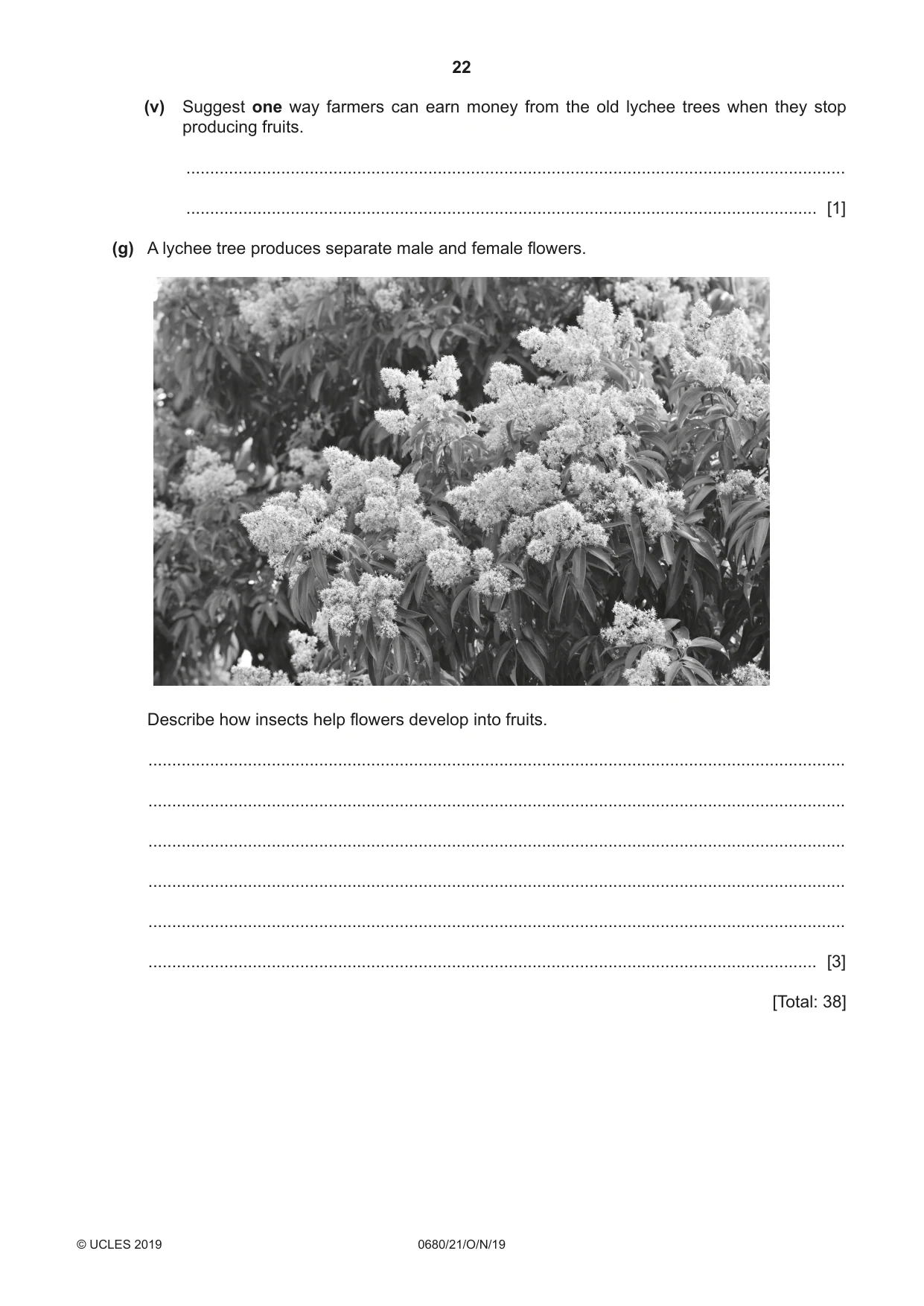
22 0680/21/O/N/19 © UCLES 2019 (v) Suggest one way farmers can earn money from the old lychee trees when they stop producing fruits. … … [1] (g) A lychee tree produces separate male and female flowers. Describe how insects help flowers develop into fruits. … … … … … … [3] [Total: 38]
Question paper, page 23
23 0680/21/O/N/19 © UCLES 2019 BLANK PAGE
Question paper, page 24
24 0680/21/O/N/19 © UCLES 2019 Permission to reproduce items where third-party owned material protected by copyright is included has been sought and cleared where possible. Every reasonable effort has been made by the publisher (UCLES) to trace copyright holders, but if any items requiring clearance have unwittingly been included, the publisher will be pleased to make amends at the earliest possible opportunity. To avoid the issue of disclosure of answer-related information to candidates, all copyright acknowledgements are reproduced online in the Cambridge Assessment International Education Copyright Acknowledgements Booklet. This is produced for each series of examinations and is freely available to download at www.cambridgeinternational.org after the live examination series. Cambridge Assessment International Education is part of the Cambridge Assessment Group. Cambridge Assessment is the brand name of the University of Cambridge Local Examinations Syndicate (UCLES), which itself is a department of the University of Cambridge. BLANK PAGE
Mark scheme, page 1
This document consists of 11 printed pages. © UCLES 2019 [Turn over Cambridge Assessment International Education Cambridge International General Certificate of Secondary Education ENVIRONMENTAL MANAGEMENT 0680/21 Paper 2 Management in Context October/November 2019 MARK SCHEME Maximum Mark: 80 Published This mark scheme is published as an aid to teachers and candidates, to indicate the requirements of the examination. It shows the basis on which Examiners were instructed to award marks. It does not indicate the details of the discussions that took place at an Examiners’ meeting before marking began, which would have considered the acceptability of alternative answers. Mark schemes should be read in conjunction with the question paper and the Principal Examiner Report for Teachers. Cambridge International will not enter into discussions about these mark schemes. Cambridge International is publishing the mark schemes for the October/November 2019 series for most Cambridge IGCSE™, Cambridge International A and AS Level components and some Cambridge O Level components.
Mark scheme, page 2
0680/21 Cambridge IGCSE – Mark Scheme PUBLISHED October/November 2019 © UCLES 2019 Page 2 of 11 Generic Marking Principles These general marking principles must be applied by all examiners when marking candidate answers. They should be applied alongside the specific content of the mark scheme or generic level descriptors for a question. Each question paper and mark scheme will also comply with these marking principles. GENERIC MARKING PRINCIPLE 1: Marks must be awarded in line with: • the specific content of the mark scheme or the generic level descriptors for the question • the specific skills defined in the mark scheme or in the generic level descriptors for the question • the standard of response required by a candidate as exemplified by the standardisation scripts. GENERIC MARKING PRINCIPLE 2: Marks awarded are always whole marks (not half marks, or other fractions). GENERIC MARKING PRINCIPLE 3: Marks must be awarded positively: • marks are awarded for correct/valid answers, as defined in the mark scheme. However, credit is given for valid answers which go beyond the scope of the syllabus and mark scheme, referring to your Team Leader as appropriate • marks are awarded when candidates clearly demonstrate what they know and can do • marks are not deducted for errors • marks are not deducted for omissions • answers should only be judged on the quality of spelling, punctuation and grammar when these features are specifically assessed by the question as indicated by the mark scheme. The meaning, however, should be unambiguous. GENERIC MARKING PRINCIPLE 4: Rules must be applied consistently e.g. in situations where candidates have not followed instructions or in the application of generic level descriptors.
Mark scheme, page 3
0680/21 Cambridge IGCSE – Mark Scheme PUBLISHED October/November 2019 © UCLES 2019 Page 3 of 11 GENERIC MARKING PRINCIPLE 5: Marks should be awarded using the full range of marks defined in the mark scheme for the question (however; the use of the full mark range may be limited according to the quality of the candidate responses seen). GENERIC MARKING PRINCIPLE 6: Marks awarded are based solely on the requirements as defined in the mark scheme. Marks should not be awarded with grade thresholds or grade descriptors in mind.
Mark scheme, page 4
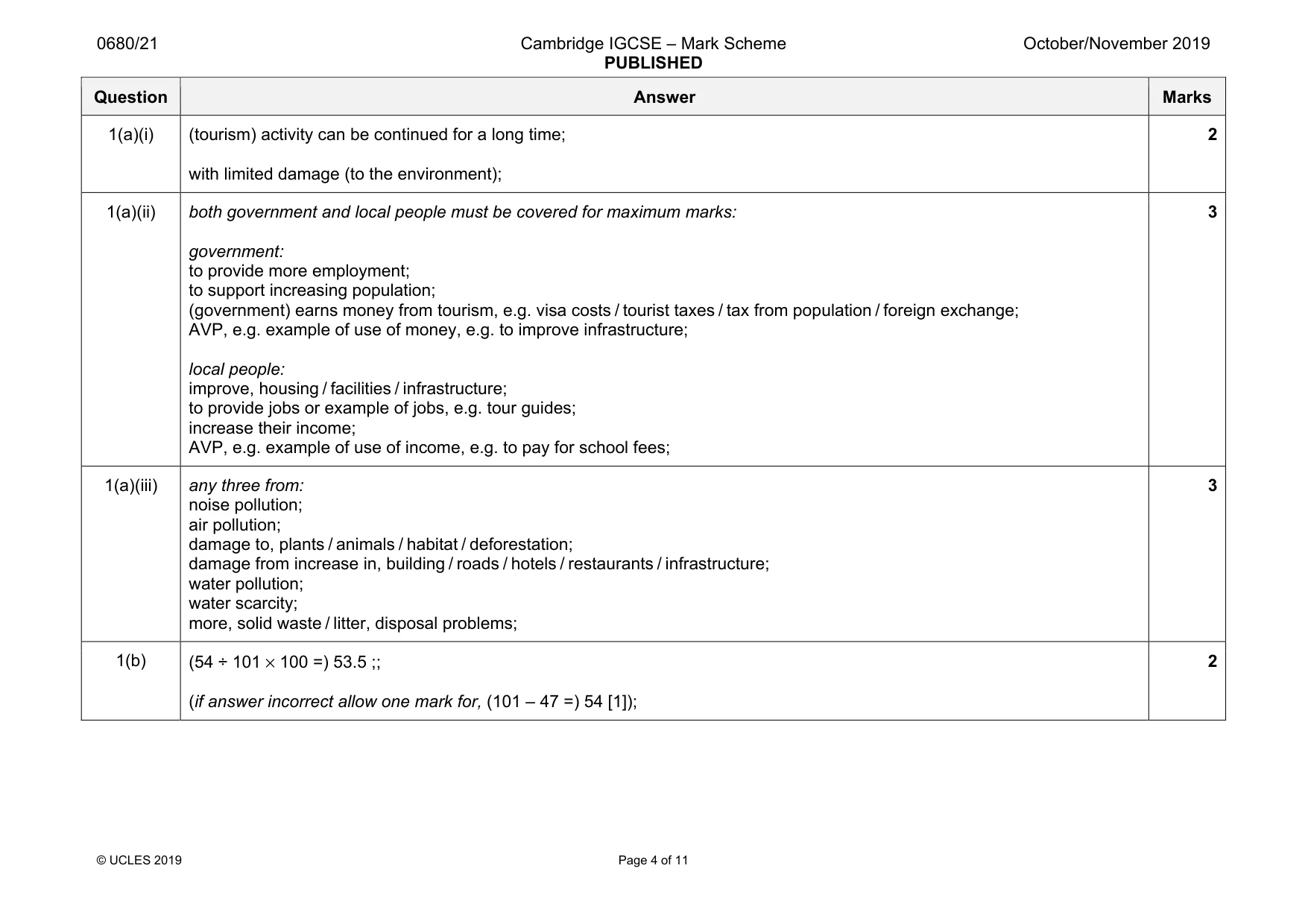
0680/21 Cambridge IGCSE – Mark Scheme PUBLISHED October/November 2019 © UCLES 2019 Page 4 of 11 Question Answer Marks 1(a)(i) (tourism) activity can be continued for a long time; with limited damage (to the environment); 2 1(a)(ii) both government and local people must be covered for maximum marks: government: to provide more employment; to support increasing population; (government) earns money from tourism, e.g. visa costs / tourist taxes / tax from population / foreign exchange; AVP, e.g. example of use of money, e.g. to improve infrastructure; local people: improve, housing / facilities / infrastructure; to provide jobs or example of jobs, e.g. tour guides; increase their income; AVP, e.g. example of use of income, e.g. to pay for school fees; 3 1(a)(iii) any three from: noise pollution; air pollution; damage to, plants / animals / habitat / deforestation; damage from increase in, building / roads / hotels / restaurants / infrastructure; water pollution; water scarcity; more, solid waste / litter, disposal problems; 3 1(b) (54 ÷ 101 × 100 =) 53.5 ;; (if answer incorrect allow one mark for, (101 – 47 =) 54 [1]); 2
Mark scheme, page 5
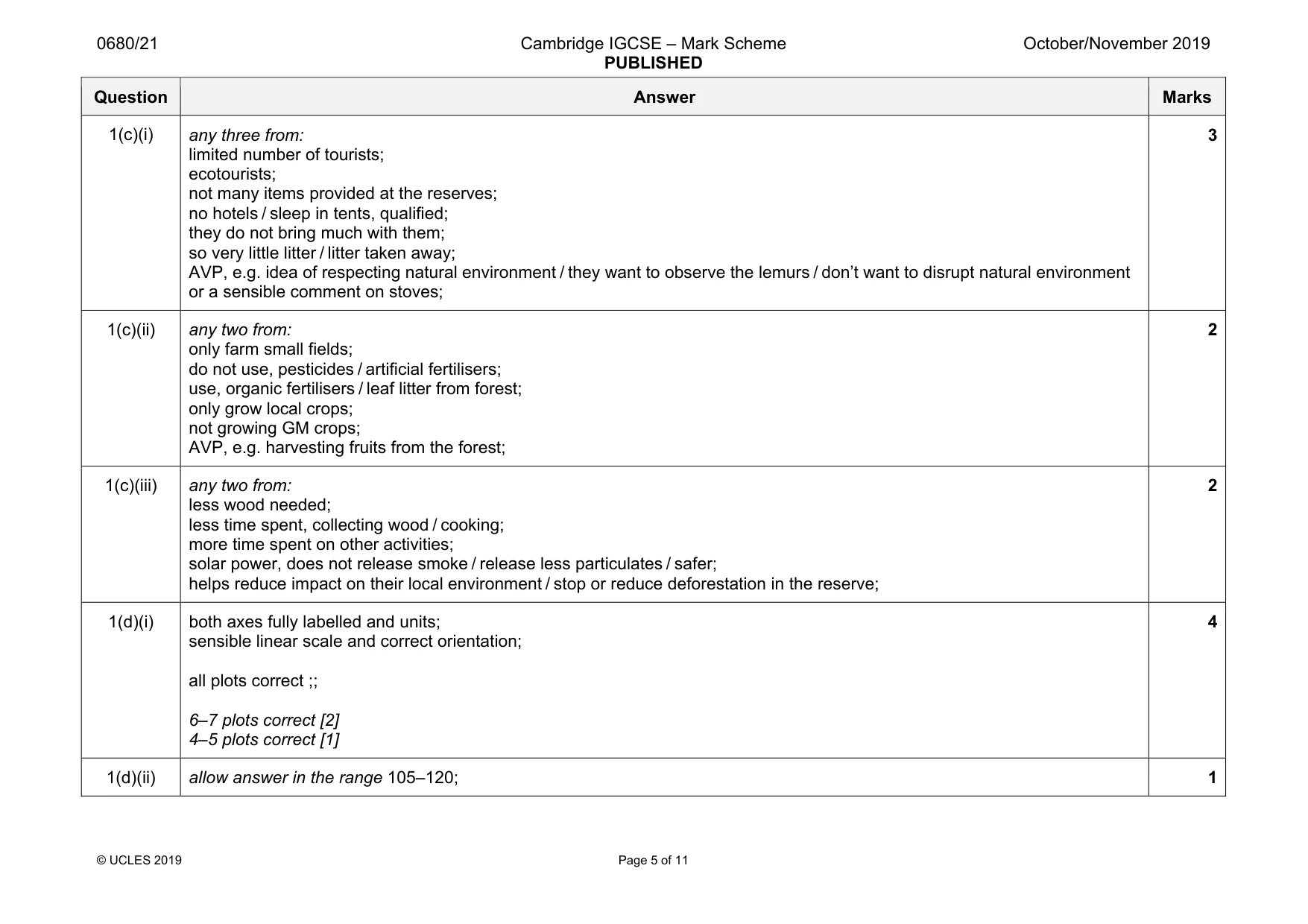
0680/21 Cambridge IGCSE – Mark Scheme PUBLISHED October/November 2019 © UCLES 2019 Page 5 of 11 Question Answer Marks 1(c)(i) any three from: limited number of tourists; ecotourists; not many items provided at the reserves; no hotels / sleep in tents, qualified; they do not bring much with them; so very little litter / litter taken away; AVP, e.g. idea of respecting natural environment / they want to observe the lemurs / don’t want to disrupt natural environment or a sensible comment on stoves; 3 1(c)(ii) any two from: only farm small fields; do not use, pesticides / artificial fertilisers; use, organic fertilisers / leaf litter from forest; only grow local crops; not growing GM crops; AVP, e.g. harvesting fruits from the forest; 2 1(c)(iii) any two from: less wood needed; less time spent, collecting wood / cooking; more time spent on other activities; solar power, does not release smoke / release less particulates / safer; helps reduce impact on their local environment / stop or reduce deforestation in the reserve; 2 1(d)(i) both axes fully labelled and units; sensible linear scale and correct orientation; all plots correct ;; 6–7 plots correct [2] 4–5 plots correct [1] 4 1(d)(ii) allow answer in the range 105–120; 1
Mark scheme, page 6
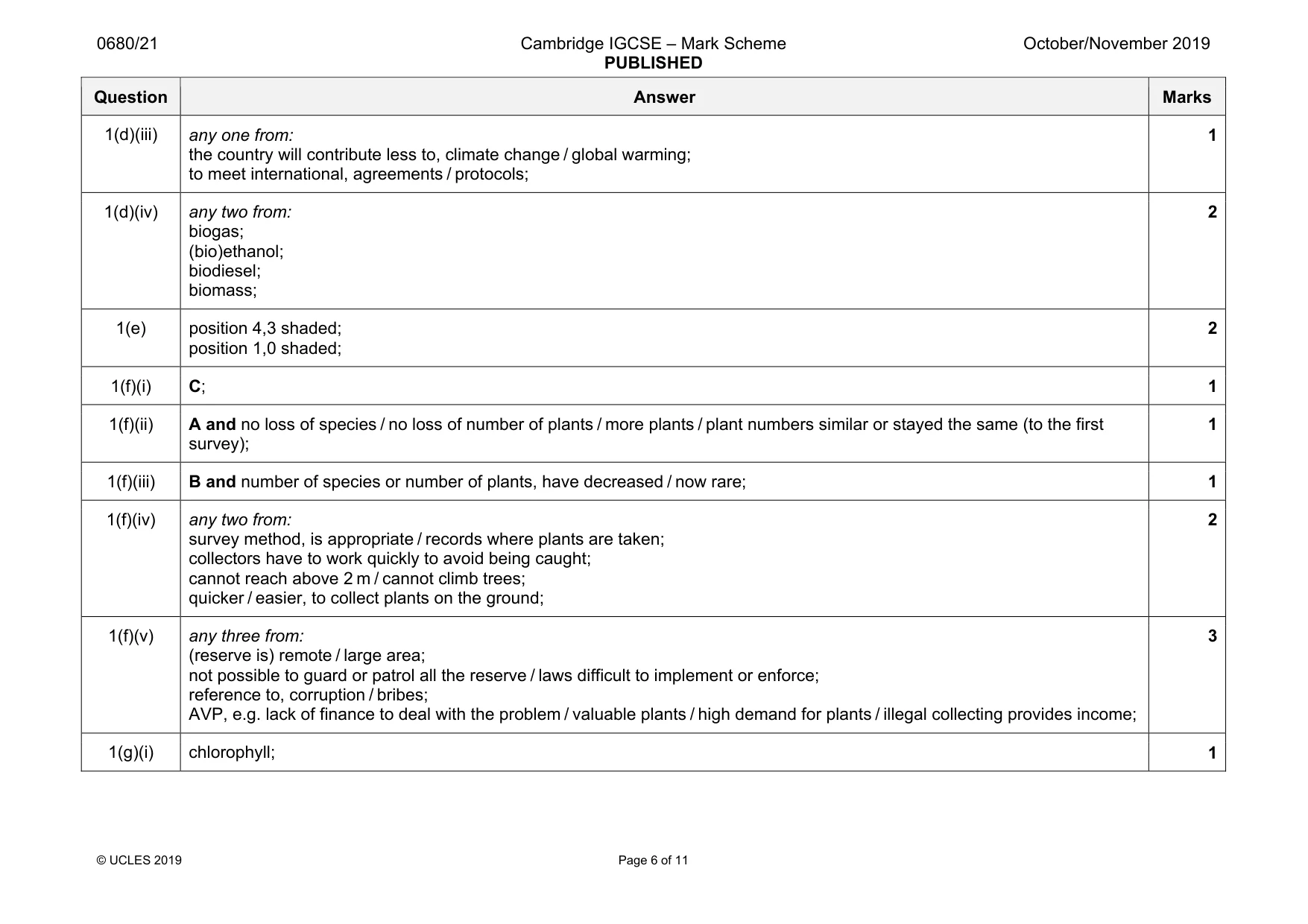
0680/21 Cambridge IGCSE – Mark Scheme PUBLISHED October/November 2019 © UCLES 2019 Page 6 of 11 Question Answer Marks 1(d)(iii) any one from: the country will contribute less to, climate change / global warming; to meet international, agreements / protocols; 1 1(d)(iv) any two from: biogas; (bio)ethanol; biodiesel; biomass; 2 1(e) position 4,3 shaded; position 1,0 shaded; 2 1(f)(i) C; 1 1(f)(ii) A and no loss of species / no loss of number of plants / more plants / plant numbers similar or stayed the same (to the first survey); 1 1(f)(iii) B and number of species or number of plants, have decreased / now rare; 1 1(f)(iv) any two from: survey method, is appropriate / records where plants are taken; collectors have to work quickly to avoid being caught; cannot reach above 2 m / cannot climb trees; quicker / easier, to collect plants on the ground; 2 1(f)(v) any three from: (reserve is) remote / large area; not possible to guard or patrol all the reserve / laws difficult to implement or enforce; reference to, corruption / bribes; AVP, e.g. lack of finance to deal with the problem / valuable plants / high demand for plants / illegal collecting provides income; 3 1(g)(i) chlorophyll; 1
Mark scheme, page 7
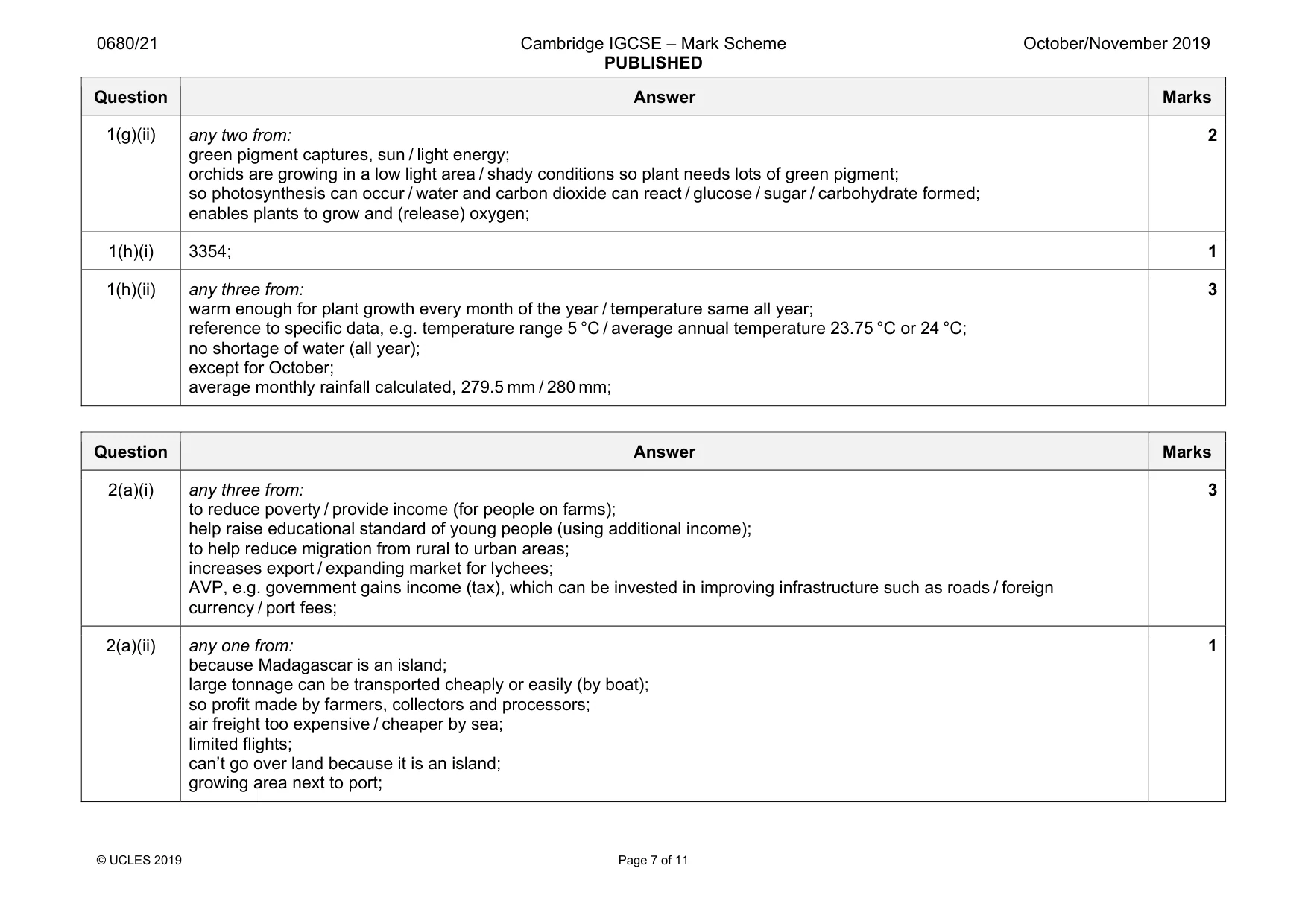
0680/21 Cambridge IGCSE – Mark Scheme PUBLISHED October/November 2019 © UCLES 2019 Page 7 of 11 Question Answer Marks 1(g)(ii) any two from: green pigment captures, sun / light energy; orchids are growing in a low light area / shady conditions so plant needs lots of green pigment; so photosynthesis can occur / water and carbon dioxide can react / glucose / sugar / carbohydrate formed; enables plants to grow and (release) oxygen; 2 1(h)(i) 3354; 1 1(h)(ii) any three from: warm enough for plant growth every month of the year / temperature same all year; reference to specific data, e.g. temperature range 5 °C / average annual temperature 23.75 °C or 24 °C; no shortage of water (all year); except for October; average monthly rainfall calculated, 279.5 mm / 280 mm; 3 Question Answer Marks 2(a)(i) any three from: to reduce poverty / provide income (for people on farms); help raise educational standard of young people (using additional income); to help reduce migration from rural to urban areas; increases export / expanding market for lychees; AVP, e.g. government gains income (tax), which can be invested in improving infrastructure such as roads / foreign currency / port fees; 3 2(a)(ii) any one from: because Madagascar is an island; large tonnage can be transported cheaply or easily (by boat); so profit made by farmers, collectors and processors; air freight too expensive / cheaper by sea; limited flights; can’t go over land because it is an island; growing area next to port; 1
Mark scheme, page 8
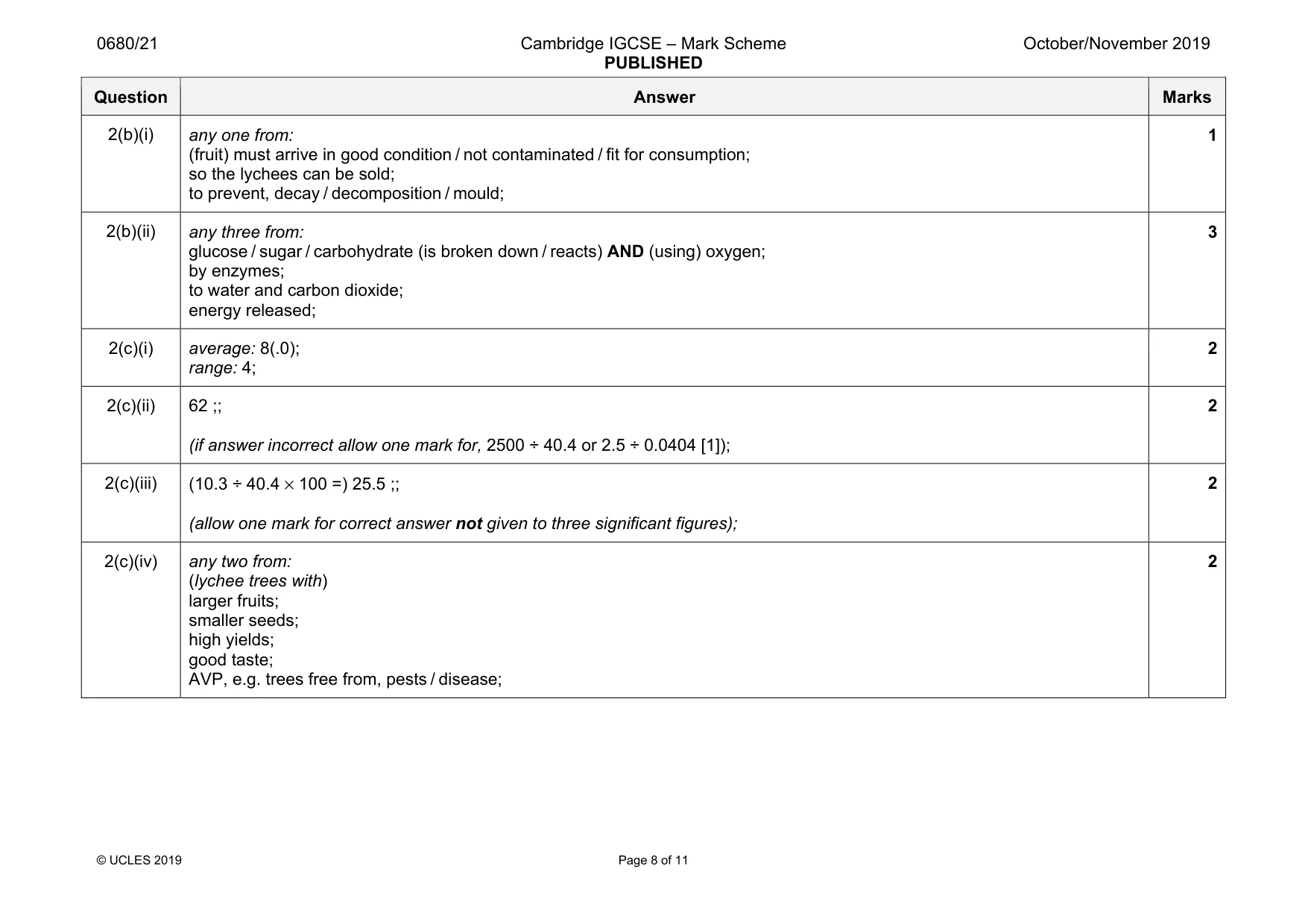
0680/21 Cambridge IGCSE – Mark Scheme PUBLISHED October/November 2019 © UCLES 2019 Page 8 of 11 Question Answer Marks 2(b)(i) any one from: (fruit) must arrive in good condition / not contaminated / fit for consumption; so the lychees can be sold; to prevent, decay / decomposition / mould; 1 2(b)(ii) any three from: glucose / sugar / carbohydrate (is broken down / reacts) AND (using) oxygen; by enzymes; to water and carbon dioxide; energy released; 3 2(c)(i) average: 8(.0); range: 4; 2 2(c)(ii) 62 ;; (if answer incorrect allow one mark for, 2500 ÷ 40.4 or 2.5 ÷ 0.0404 [1]); 2 2(c)(iii) (10.3 ÷ 40.4 × 100 =) 25.5 ;; (allow one mark for correct answer not given to three significant figures); 2 2(c)(iv) any two from: (lychee trees with) larger fruits; smaller seeds; high yields; good taste; AVP, e.g. trees free from, pests / disease; 2
Mark scheme, page 9
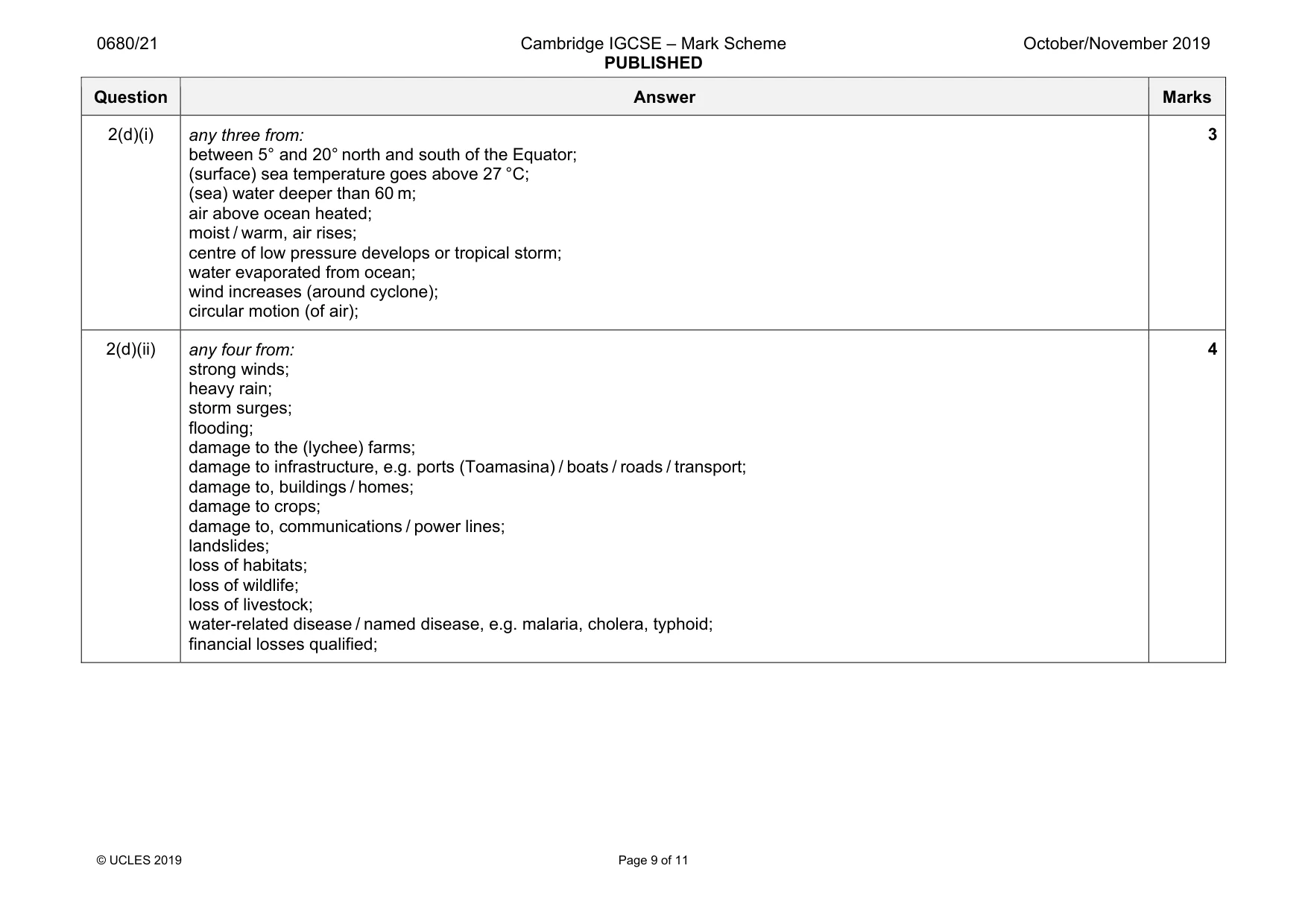
0680/21 Cambridge IGCSE – Mark Scheme PUBLISHED October/November 2019 © UCLES 2019 Page 9 of 11 Question Answer Marks 2(d)(i) any three from: between 5° and 20° north and south of the Equator; (surface) sea temperature goes above 27 °C; (sea) water deeper than 60 m; air above ocean heated; moist / warm, air rises; centre of low pressure develops or tropical storm; water evaporated from ocean; wind increases (around cyclone); circular motion (of air); 3 2(d)(ii) any four from: strong winds; heavy rain; storm surges; flooding; damage to the (lychee) farms; damage to infrastructure, e.g. ports (Toamasina) / boats / roads / transport; damage to, buildings / homes; damage to crops; damage to, communications / power lines; landslides; loss of habitats; loss of wildlife; loss of livestock; water-related disease / named disease, e.g. malaria, cholera, typhoid; financial losses qualified; 4
Mark scheme, page 10
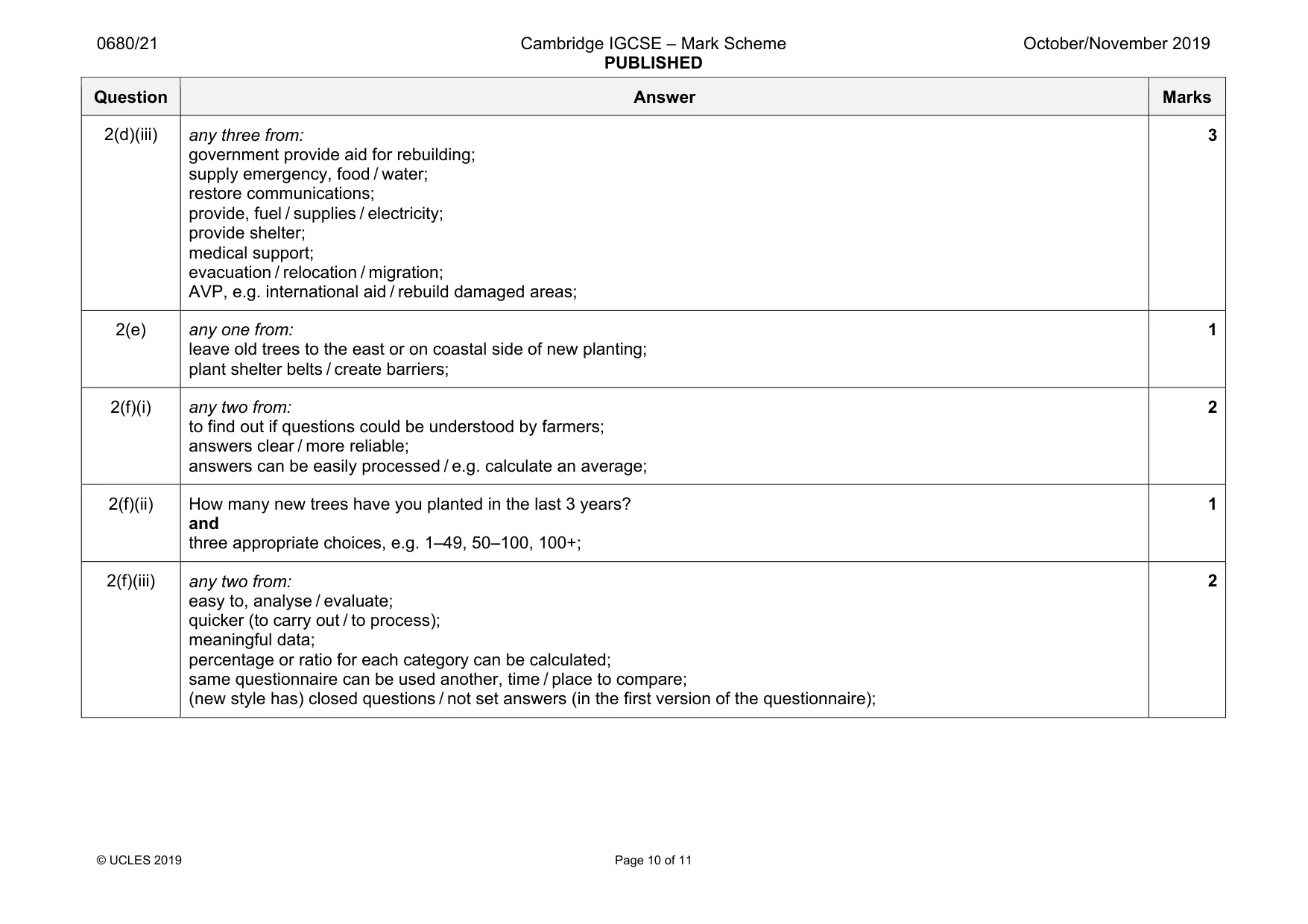
0680/21 Cambridge IGCSE – Mark Scheme PUBLISHED October/November 2019 © UCLES 2019 Page 10 of 11 Question Answer Marks 2(d)(iii) any three from: government provide aid for rebuilding; supply emergency, food / water; restore communications; provide, fuel / supplies / electricity; provide shelter; medical support; evacuation / relocation / migration; AVP, e.g. international aid / rebuild damaged areas; 3 2(e) any one from: leave old trees to the east or on coastal side of new planting; plant shelter belts / create barriers; 1 2(f)(i) any two from: to find out if questions could be understood by farmers; answers clear / more reliable; answers can be easily processed / e.g. calculate an average; 2 2(f)(ii) How many new trees have you planted in the last 3 years? and three appropriate choices, e.g. 1–49, 50–100, 100+; 1 2(f)(iii) any two from: easy to, analyse / evaluate; quicker (to carry out / to process); meaningful data; percentage or ratio for each category can be calculated; same questionnaire can be used another, time / place to compare; (new style has) closed questions / not set answers (in the first version of the questionnaire); 2
Mark scheme, page 11
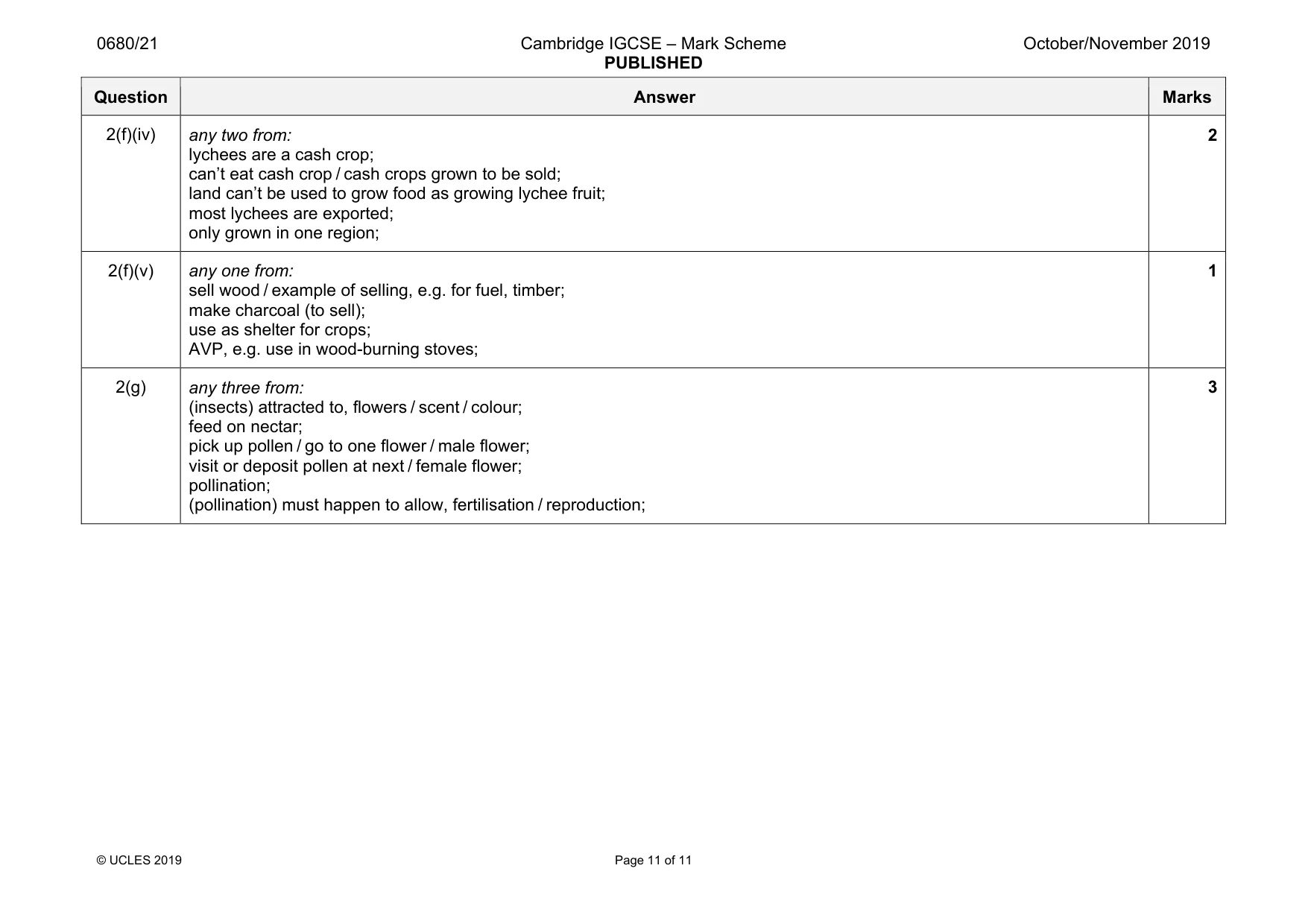
0680/21 Cambridge IGCSE – Mark Scheme PUBLISHED October/November 2019 © UCLES 2019 Page 11 of 11 Question Answer Marks 2(f)(iv) any two from: lychees are a cash crop; can’t eat cash crop / cash crops grown to be sold; land can’t be used to grow food as growing lychee fruit; most lychees are exported; only grown in one region; 2 2(f)(v) any one from: sell wood / example of selling, e.g. for fuel, timber; make charcoal (to sell); use as shelter for crops; AVP, e.g. use in wood-burning stoves; 1 2(g) any three from: (insects) attracted to, flowers / scent / colour; feed on nectar; pick up pollen / go to one flower / male flower; visit or deposit pollen at next / female flower; pollination; (pollination) must happen to allow, fertilisation / reproduction; 3
What you needed in this session
Cambridge’s own grade thresholds for 2019 Oct/Nov, Paper 2 · Variant 1. A higher threshold means an easier paper — the bar moves with how the cohort did.