Cambridge IGCSE Environmental Management 0680 — 2019 Oct/Nov Paper 1 · Variant 2
0680/12/O/N/19 · 80 marks · ≈90 min
The question paper and its mark scheme, free to read here and free to download. This is Cambridge’s own paper, exactly as it was sat.
Question paper20 pages



Mark scheme13 pages
Answers below. Sit the paper first if you are practising.
Paper as text
Question paper, page 1
This document consists of 17 printed pages and 3 blank pages. DC (NF/TP) 172933/2 © UCLES 2019 [Turn over * 1 2 0 7 9 8 0 4 9 5 * ENVIRONMENTAL MANAGEMENT 0680/12 Paper 1 Theory October/November 2019 1 hour 45 minutes Candidates answer on the Question Paper. No Additional Materials are required. READ THESE INSTRUCTIONS FIRST Write your centre number, candidate number and name in the spaces at the top of this page. Write in dark blue or black pen. You may use an HB pencil for any diagrams or graphs. Do not use staples, paper clips, glue or correction fluid. DO NOT WRITE IN ANY BARCODES. Answer all questions. Electronic calculators may be used. You may lose marks if you do not show your working or if you do not use appropriate units. At the end of the examination, fasten all your work securely together. The number of marks is given in brackets [ ] at the end of each question or part question. Cambridge Assessment International Education Cambridge International General Certificate of Secondary Education
Question paper, page 2
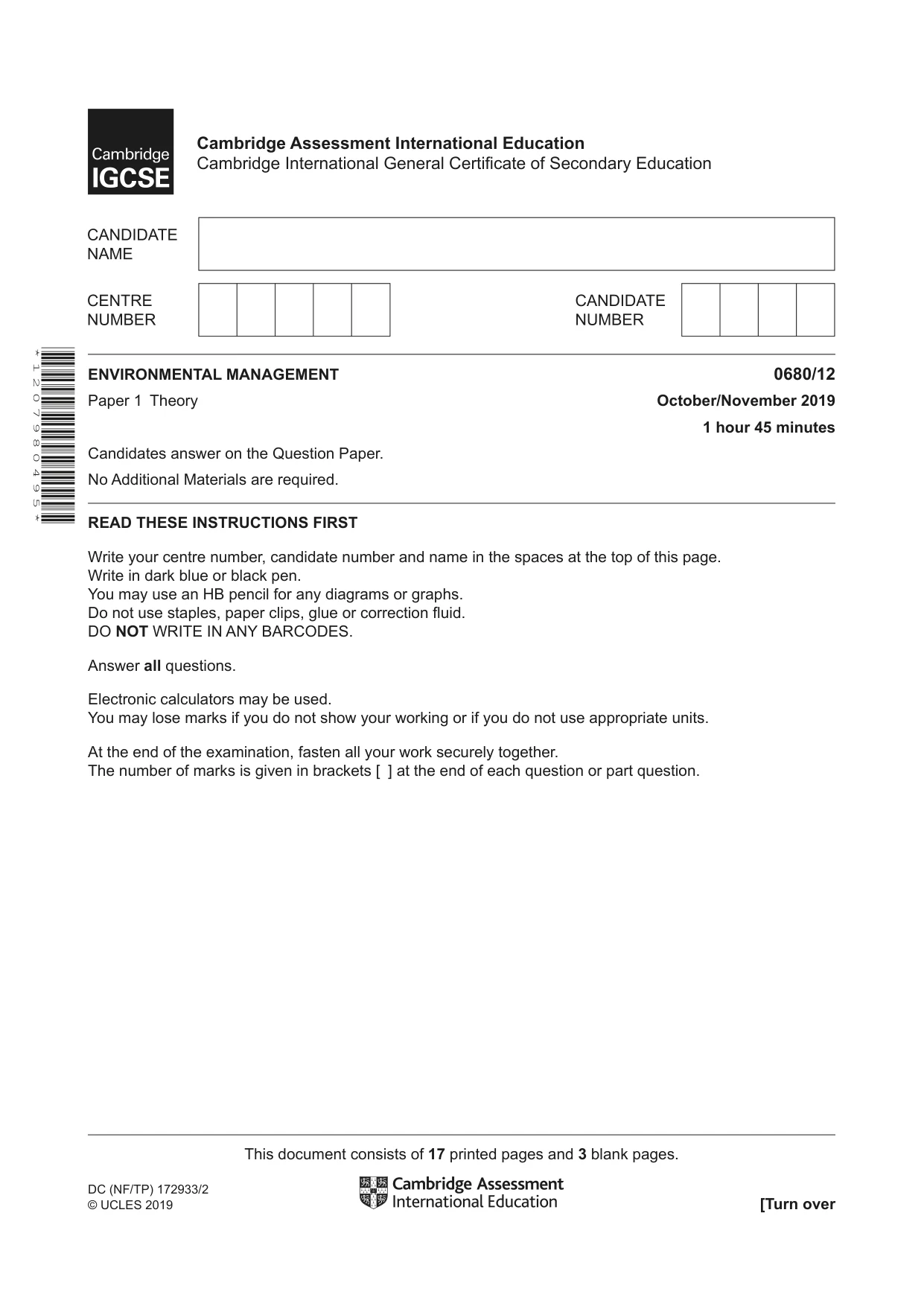
2 0680/12/O/N/19 © UCLES 2019 Section A 1 The photograph shows terracing, a method of reducing soil erosion. (a) Describe how this method reduces soil erosion. … … … … [2] (b) State two other methods that could be used to reduce soil erosion. 1 … 2 … [2] [Total: 4]
Question paper, page 3
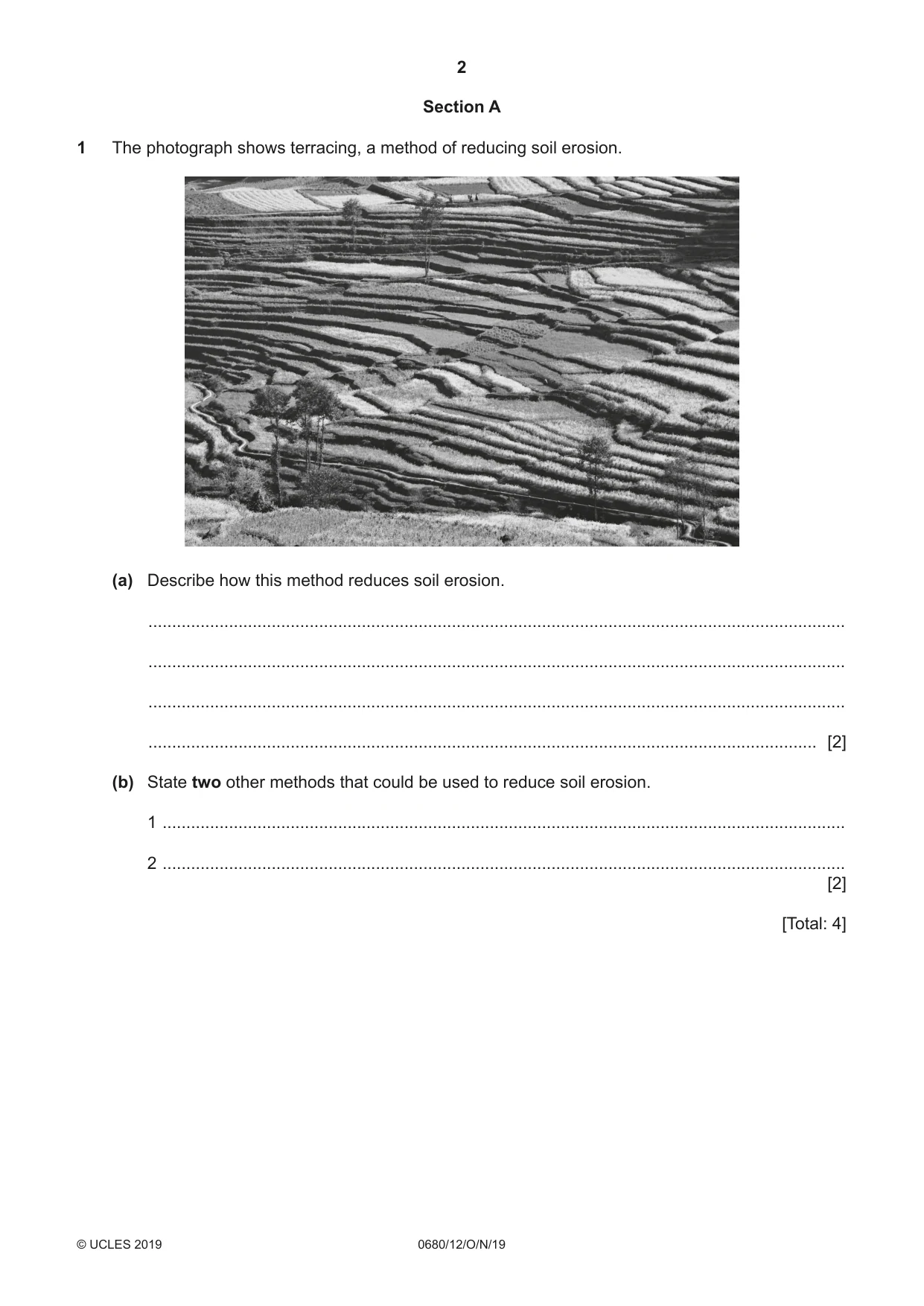
3 0680/12/O/N/19 © UCLES 2019 [Turn over 2 The graph shows a typical growth curve for a population. time population size A B D C D (a) State the name of each part of the graph, labelled A, B, C and D. part name of part A … B … C … D … [3] (b) Describe two ways a country could control its birth rate. 1 … … 2 … … [2] [Total: 5]
Question paper, page 4
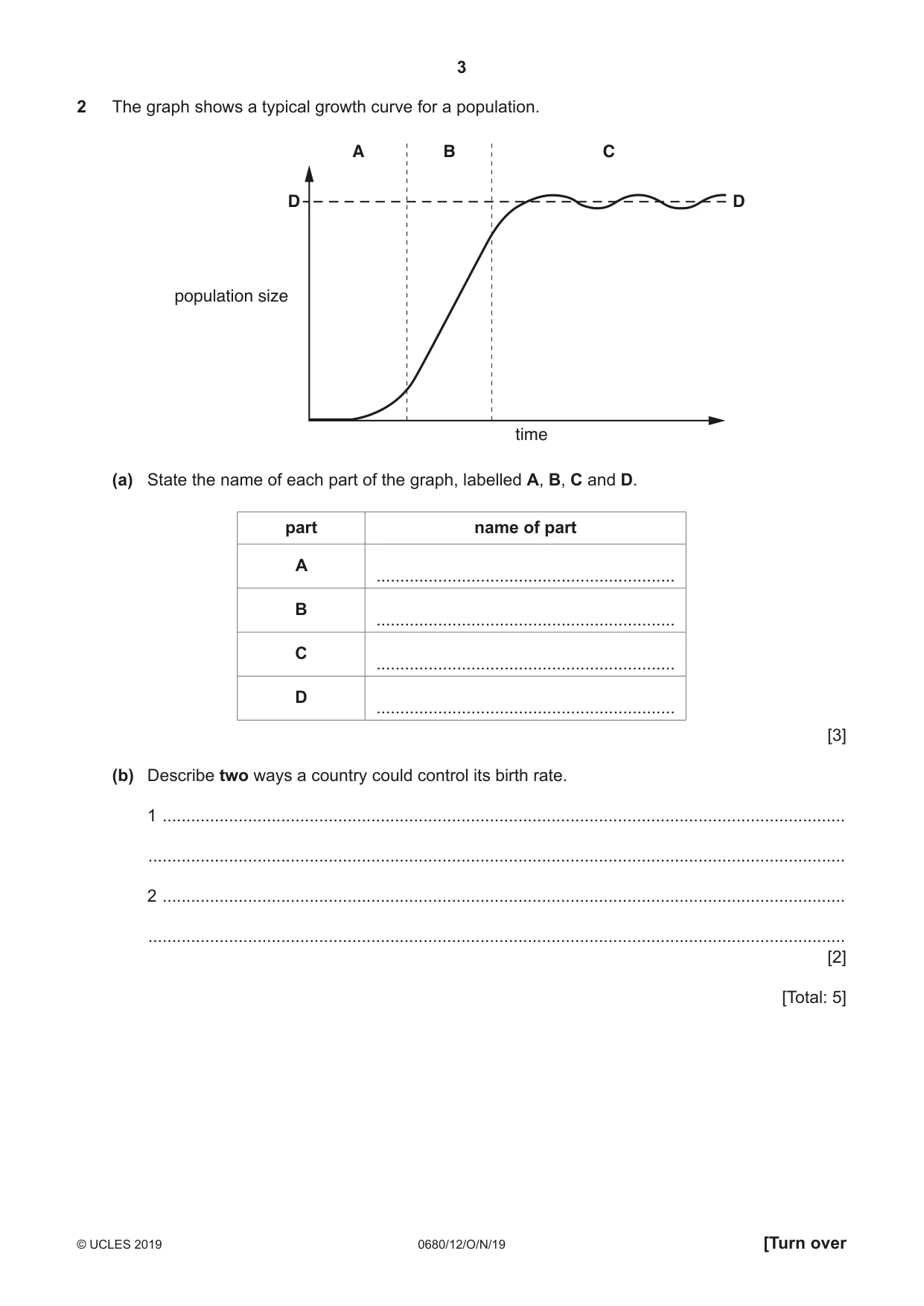
4 0680/12/O/N/19 © UCLES 2019 3 (a) The photograph shows a child collecting water to drink in an LEDC. (i) Suggest two reasons why the water may be unsafe to drink. 1 … … 2 … … [2] (ii) Describe two ways a supply of safe drinking water could be provided to the area. 1 … … 2 … … [2]
Question paper, page 5
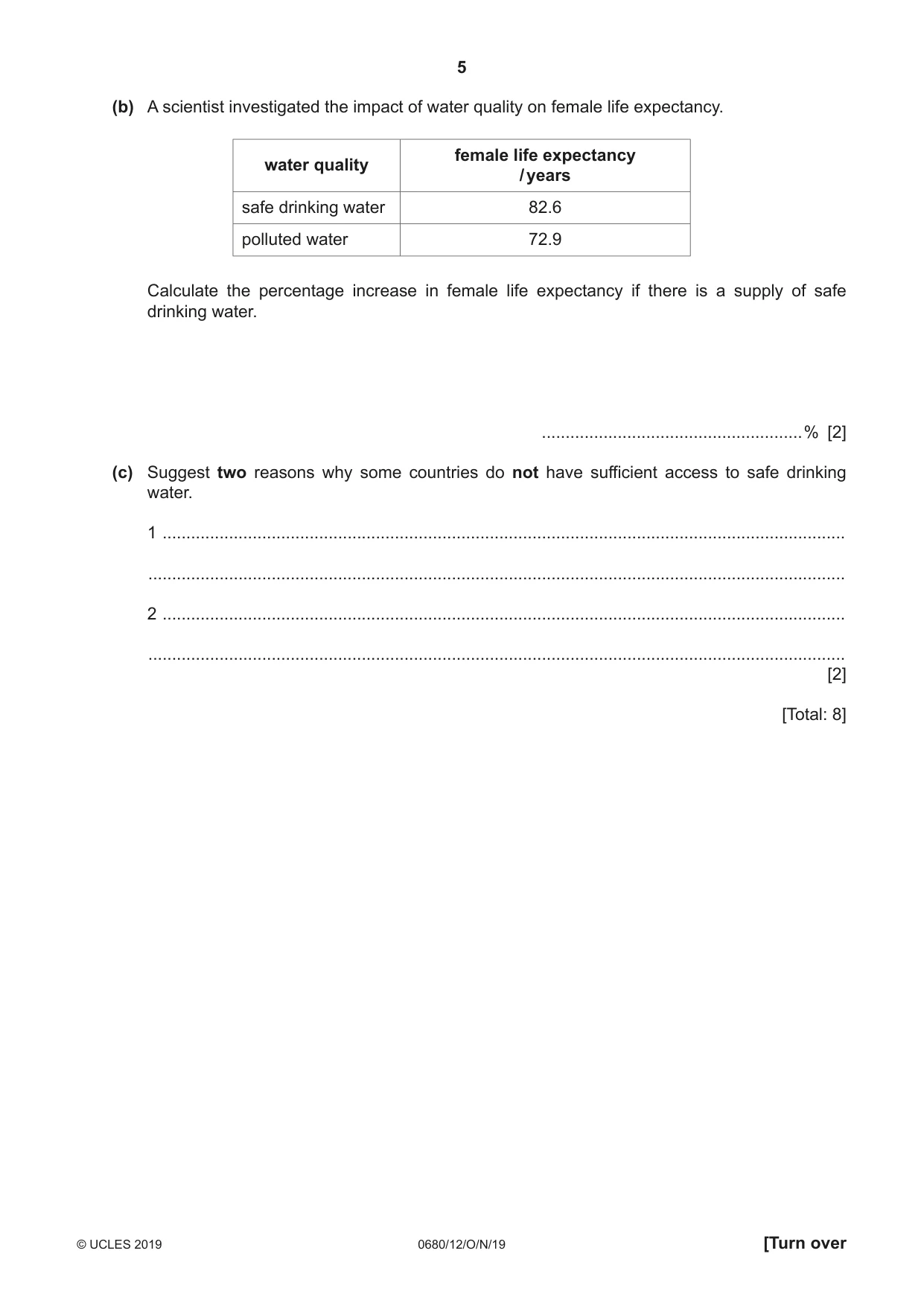
5 0680/12/O/N/19 © UCLES 2019 [Turn over (b) A scientist investigated the impact of water quality on female life expectancy. water quality female life expectancy / years safe drinking water 82.6 polluted water 72.9 Calculate the percentage increase in female life expectancy if there is a supply of safe drinking water. …% [2] (c) Suggest two reasons why some countries do not have sufficient access to safe drinking water. 1 … … 2 … … [2] [Total: 8]
Question paper, page 6
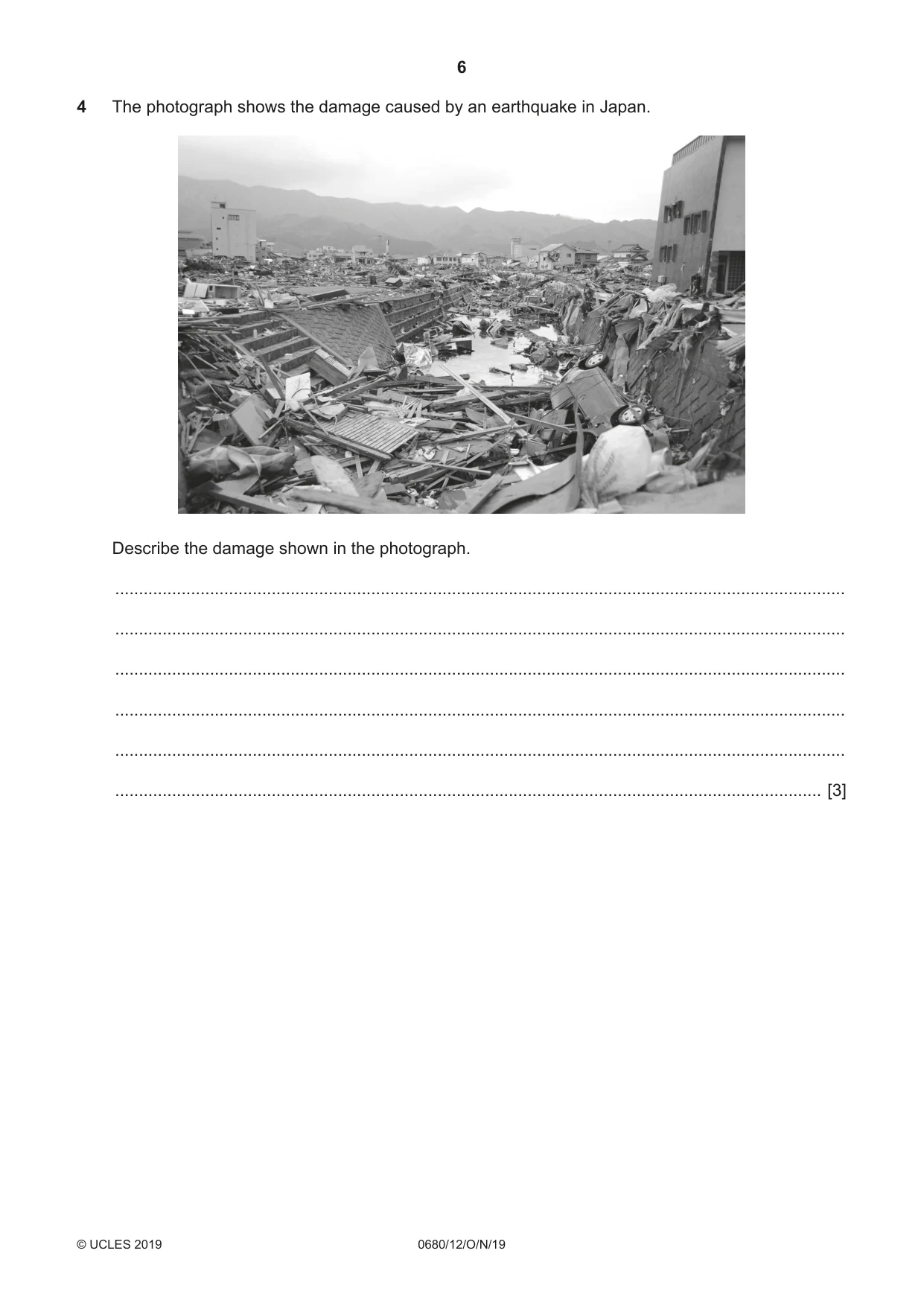
6 0680/12/O/N/19 © UCLES 2019 4 The photograph shows the damage caused by an earthquake in Japan. Describe the damage shown in the photograph. … … … … … … [3]
Question paper, page 7
7 0680/12/O/N/19 © UCLES 2019 [Turn over BLANK PAGE
Question paper, page 8
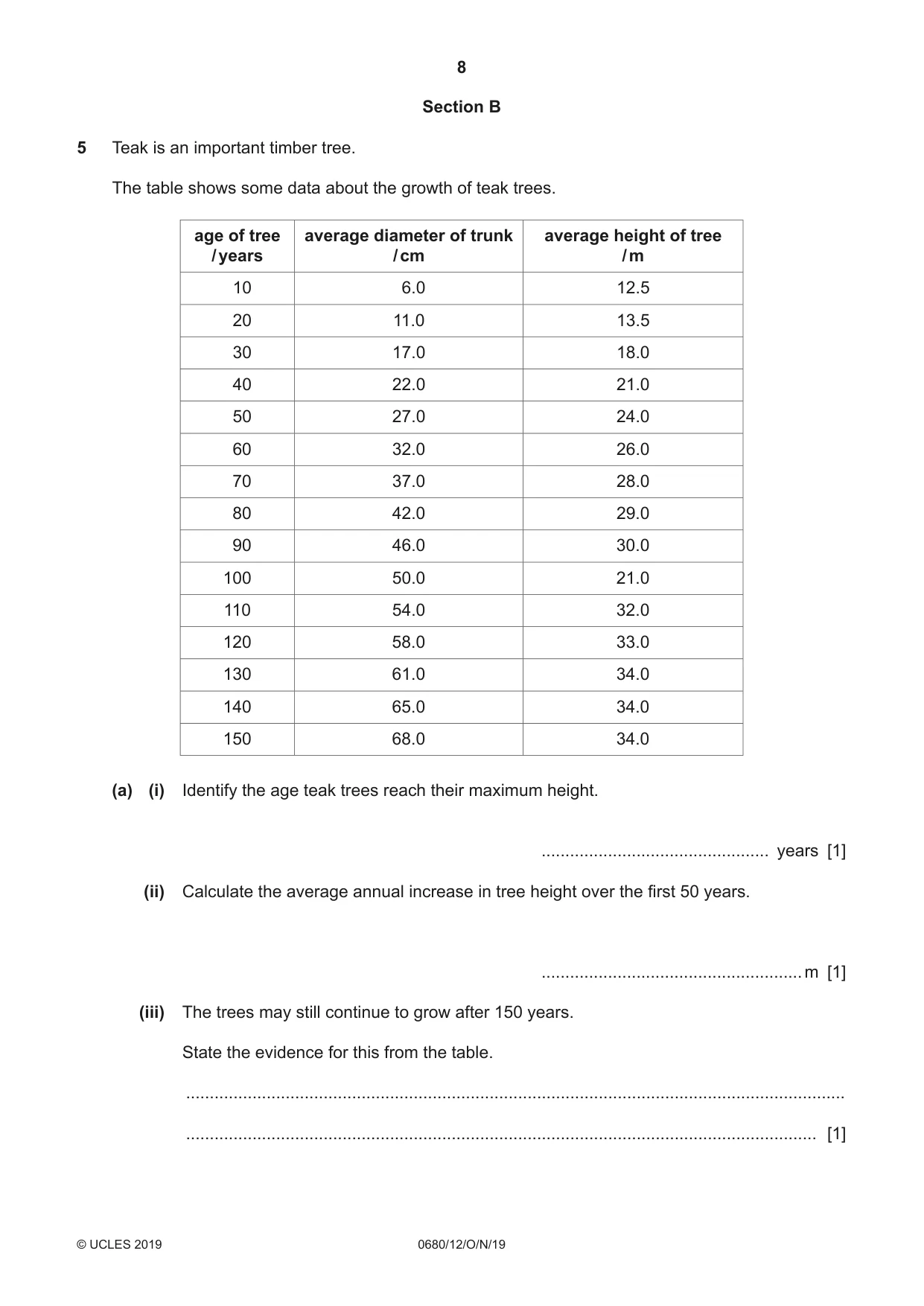
8 0680/12/O/N/19 © UCLES 2019 Section B 5 Teak is an important timber tree. The table shows some data about the growth of teak trees. age of tree / years average diameter of trunk / cm average height of tree / m 10 6.0 12.5 20 11.0 13.5 30 17.0 18.0 40 22.0 21.0 50 27.0 24.0 60 32.0 26.0 70 37.0 28.0 80 42.0 29.0 90 46.0 30.0 100 50.0 21.0 110 54.0 32.0 120 58.0 33.0 130 61.0 34.0 140 65.0 34.0 150 68.0 34.0 (a) (i) Identify the age teak trees reach their maximum height. … years [1] (ii) Calculate the average annual increase in tree height over the first 50 years. … m [1] (iii) The trees may still continue to grow after 150 years. State the evidence for this from the table. … … [1]
Question paper, page 9
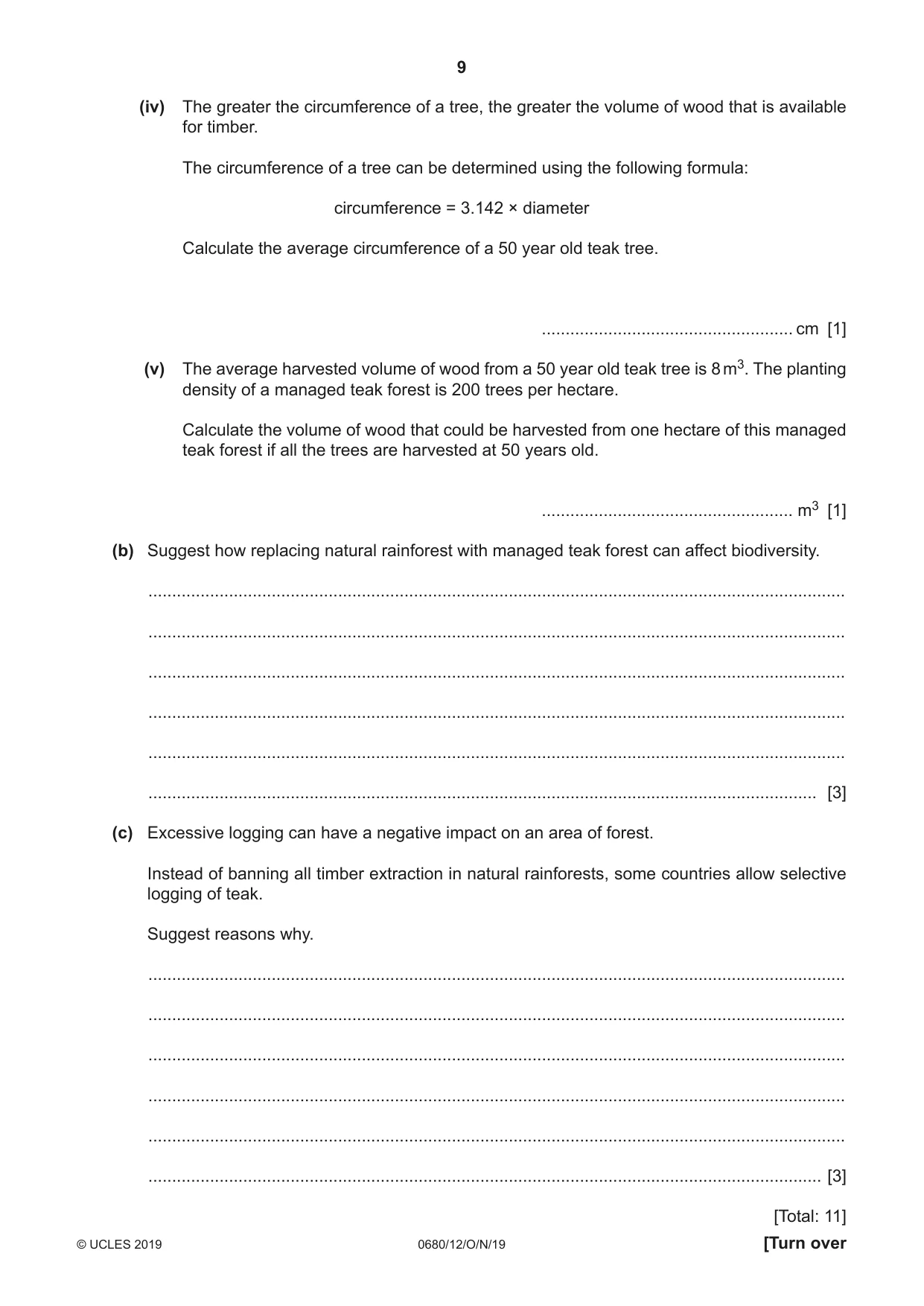
9 0680/12/O/N/19 © UCLES 2019 [Turn over (iv) The greater the circumference of a tree, the greater the volume of wood that is available for timber. The circumference of a tree can be determined using the following formula: circumference = 3.142 × diameter Calculate the average circumference of a 50 year old teak tree. … cm [1] (v) The average harvested volume of wood from a 50 year old teak tree is 8 m3. The planting density of a managed teak forest is 200 trees per hectare. Calculate the volume of wood that could be harvested from one hectare of this managed teak forest if all the trees are harvested at 50 years old. … m3 [1] (b) Suggest how replacing natural rainforest with managed teak forest can affect biodiversity. … … … … … … [3] (c) Excessive logging can have a negative impact on an area of forest. Instead of banning all timber extraction in natural rainforests, some countries allow selective logging of teak. Suggest reasons why. … … … … … … [3] [Total: 11]
Question paper, page 10
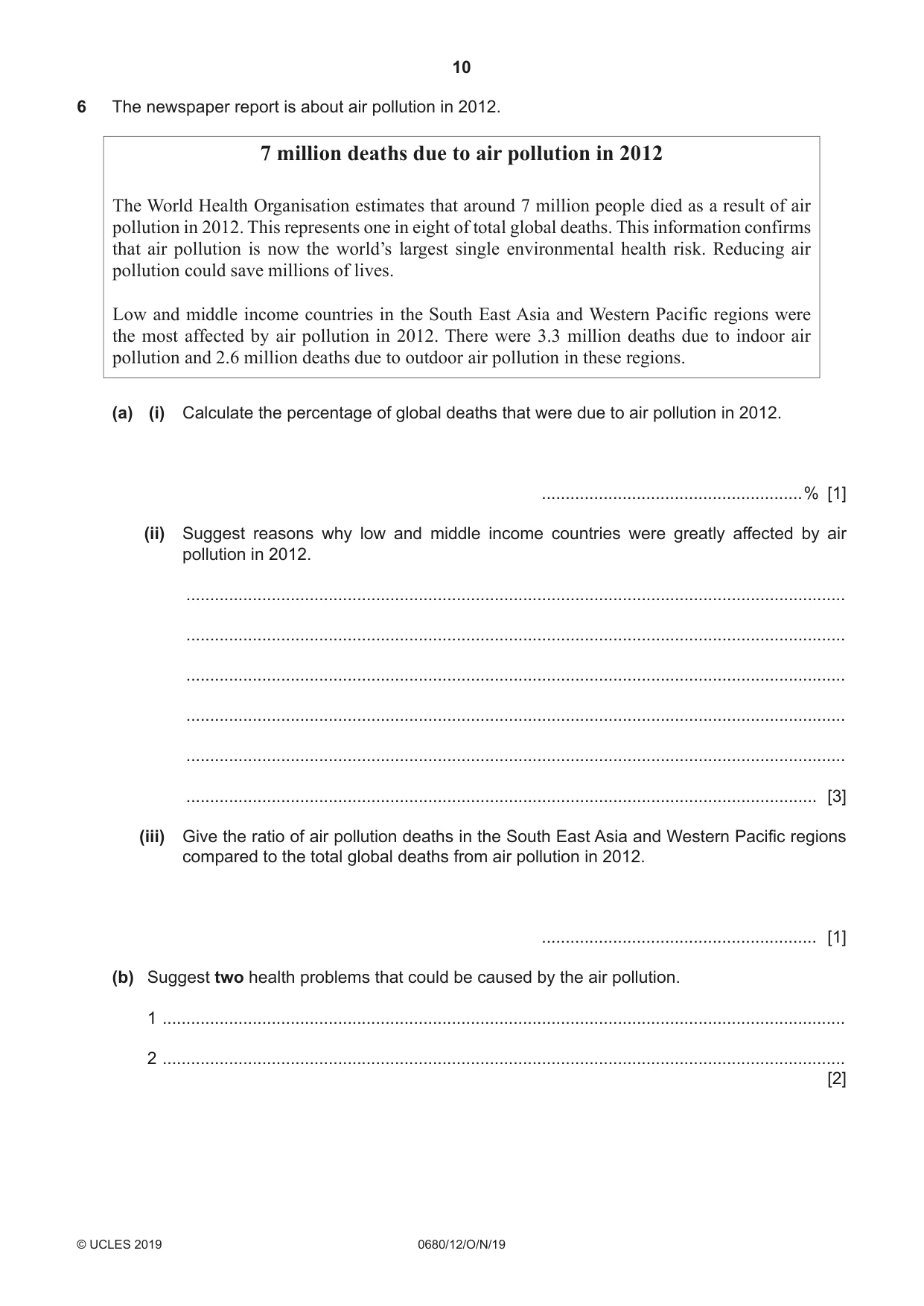
10 0680/12/O/N/19 © UCLES 2019 6 The newspaper report is about air pollution in 2012. 7 million deaths due to air pollution in 2012 The World Health Organisation estimates that around 7 million people died as a result of air pollution in 2012. This represents one in eight of total global deaths. This information confirms that air pollution is now the world’s largest single environmental health risk. Reducing air pollution could save millions of lives. Low and middle income countries in the South East Asia and Western Pacific regions were the most affected by air pollution in 2012. There were 3.3 million deaths due to indoor air pollution and 2.6 million deaths due to outdoor air pollution in these regions. (a) (i) Calculate the percentage of global deaths that were due to air pollution in 2012. …% [1] (ii) Suggest reasons why low and middle income countries were greatly affected by air pollution in 2012. … … … … … … [3] (iii) Give the ratio of air pollution deaths in the South East Asia and Western Pacific regions compared to the total global deaths from air pollution in 2012. … [1] (b) Suggest two health problems that could be caused by the air pollution. 1 … 2 … [2]
Question paper, page 11
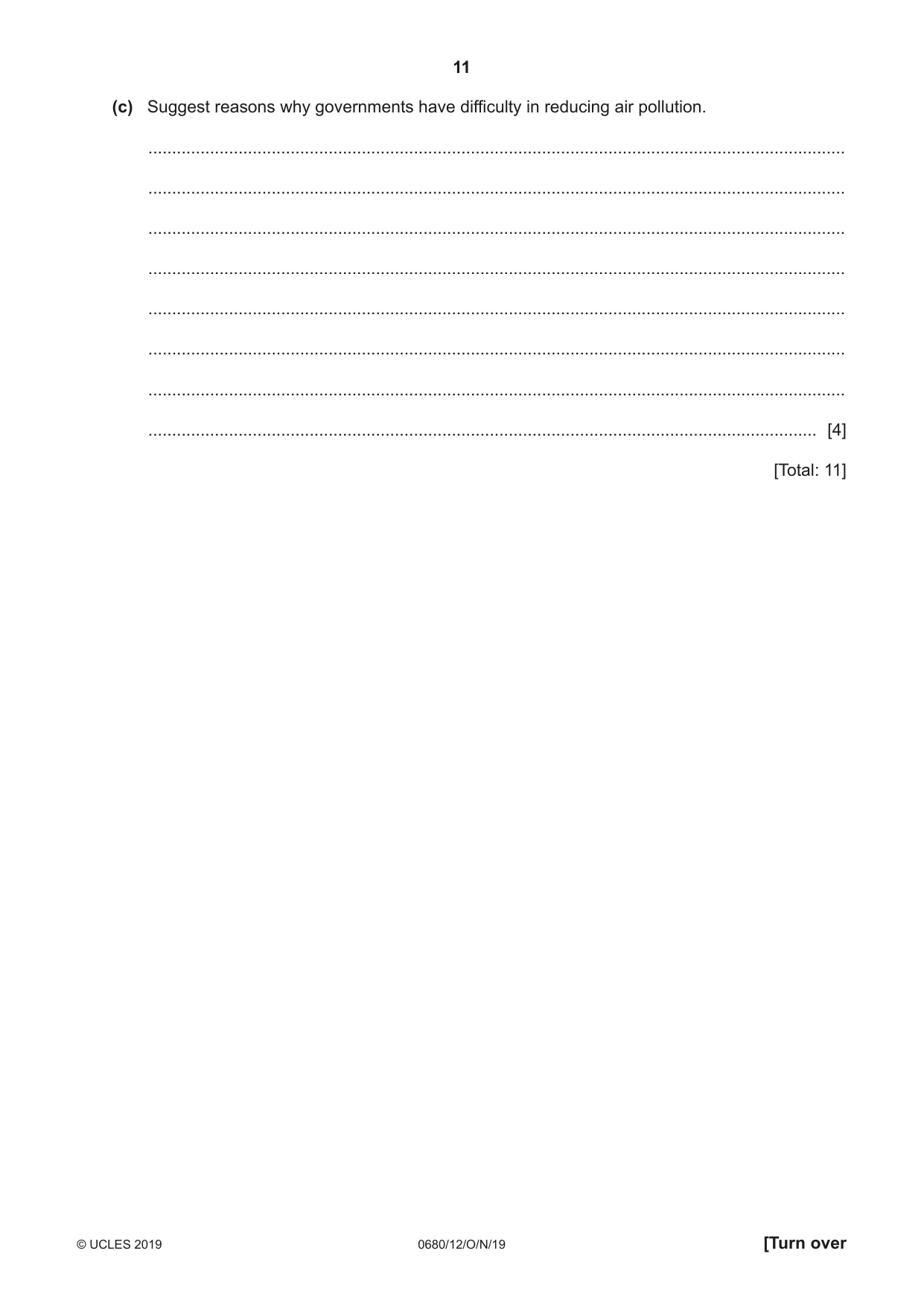
11 0680/12/O/N/19 © UCLES 2019 [Turn over (c) Suggest reasons why governments have difficulty in reducing air pollution. … … … … … … … … [4] [Total: 11]
Question paper, page 12
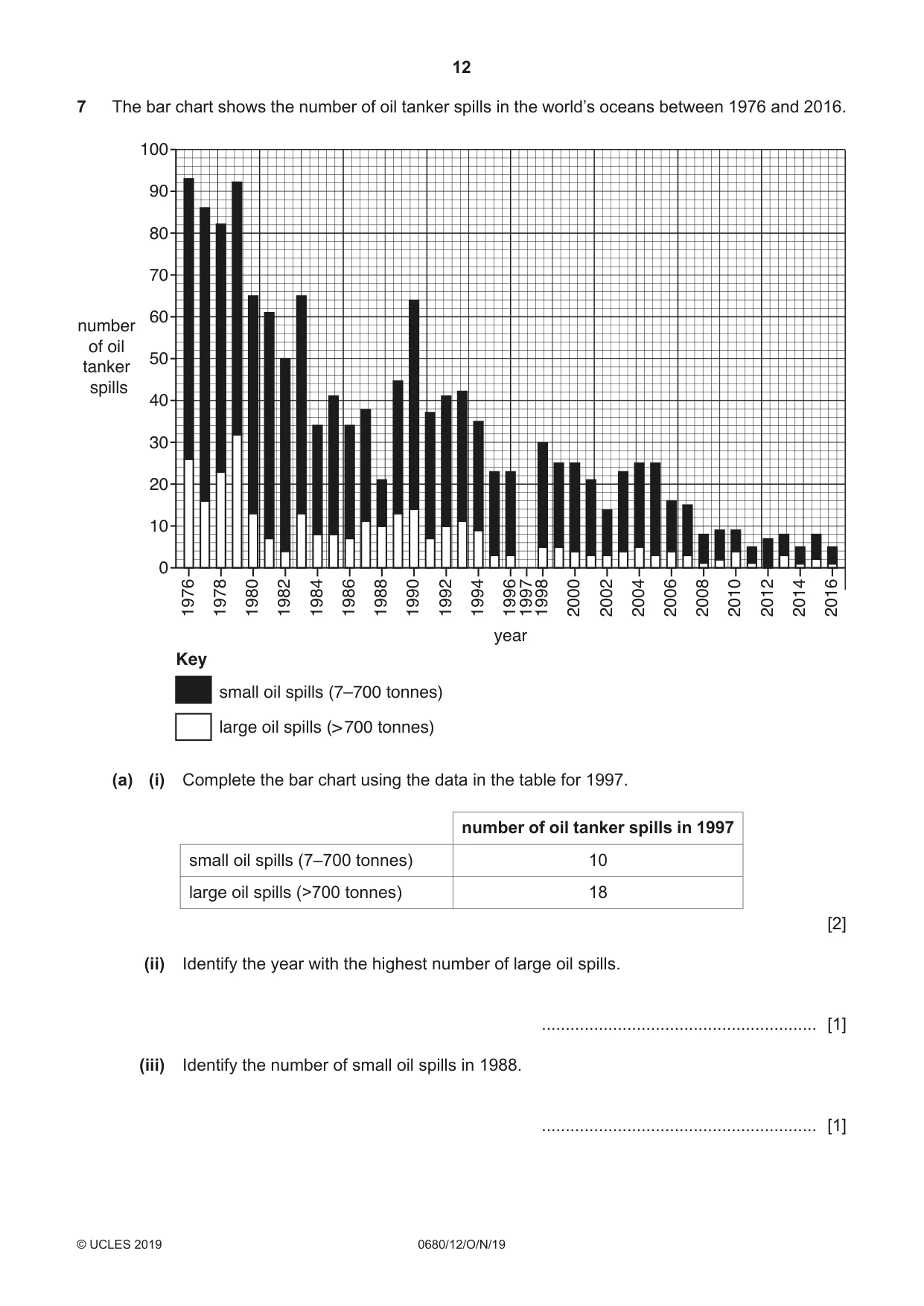
12 0680/12/O/N/19 © UCLES 2019 7 The bar chart shows the number of oil tanker spills in the world’s oceans between 1976 and 2016. 0 number of oil tanker spills 10 20 30 40 50 60 70 80 90 100 1976 1978 1980 1982 1984 1986 1988 1990 1992 1994 1996 1997 1998 2000 2002 2004 2006 2008 2010 2012 2014 2016 year small oil spills (7–700 tonnes) Key large oil spills (> 700 tonnes) (a) (i) Complete the bar chart using the data in the table for 1997. number of oil tanker spills in 1997 small oil spills (7–700 tonnes) 10 large oil spills (>700 tonnes) 18 [2] (ii) Identify the year with the highest number of large oil spills. … [1] (iii) Identify the number of small oil spills in 1988. … [1]
Question paper, page 13
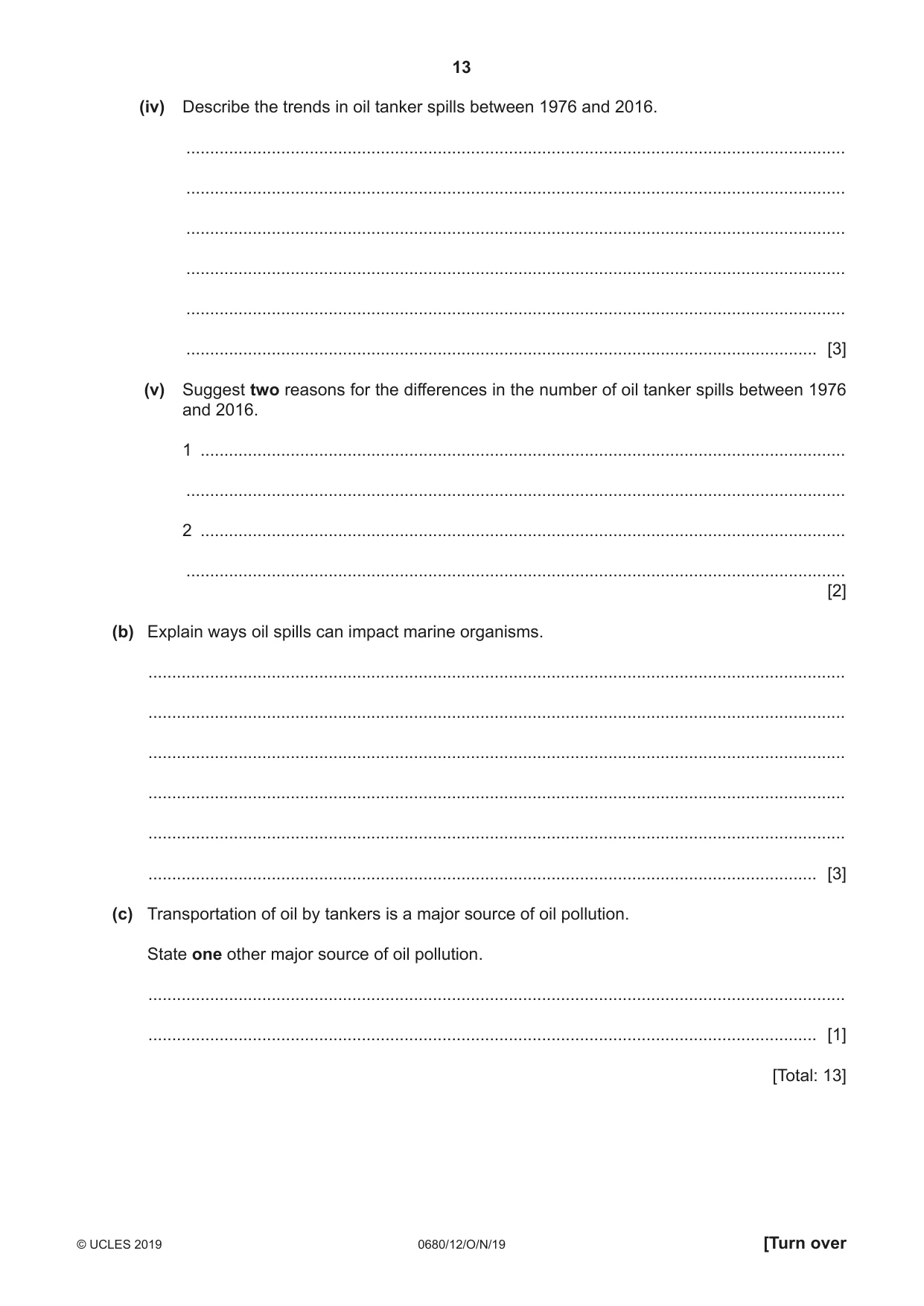
13 0680/12/O/N/19 © UCLES 2019 [Turn over (iv) Describe the trends in oil tanker spills between 1976 and 2016. … … … … … … [3] (v) Suggest two reasons for the differences in the number of oil tanker spills between 1976 and 2016. 1 … … 2 … … [2] (b) Explain ways oil spills can impact marine organisms. … … … … … … [3] (c) Transportation of oil by tankers is a major source of oil pollution. State one other major source of oil pollution. … … [1] [Total: 13]
Question paper, page 14
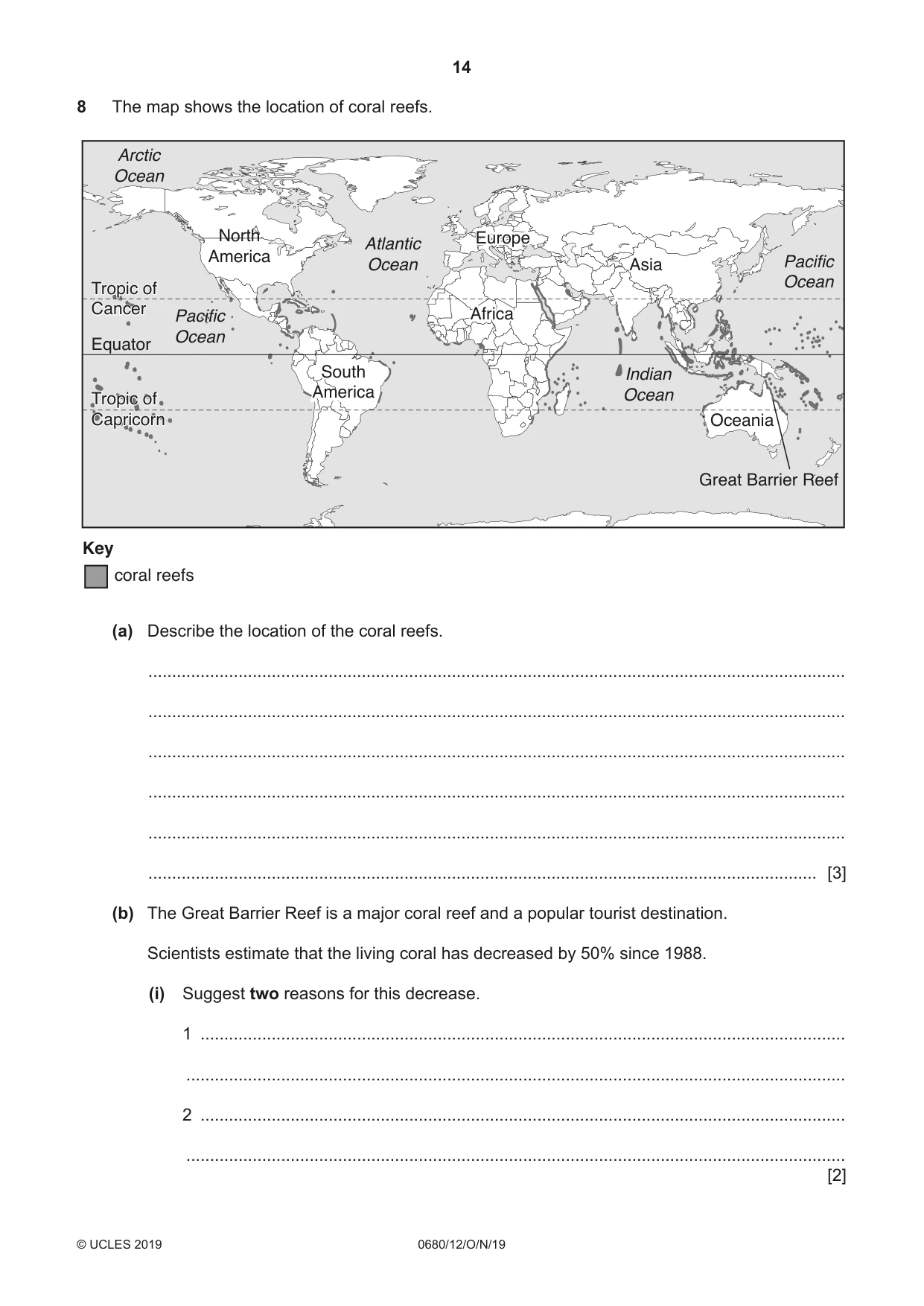
14 0680/12/O/N/19 © UCLES 2019 8 The map shows the location of coral reefs. Tropic of Cancer Equator Tropic of Cancer Europe Africa Asia Oceania Great Barrier Reef South America Indian Ocean Pacific Ocean Pacific Ocean Atlantic Ocean Arctic Ocean North America Tropic of Capricorn Tropic of Capricorn coral reefs Key (a) Describe the location of the coral reefs. … … … … … … [3] (b) The Great Barrier Reef is a major coral reef and a popular tourist destination. Scientists estimate that the living coral has decreased by 50% since 1988. (i) Suggest two reasons for this decrease. 1 … … 2 … … [2]
Question paper, page 15
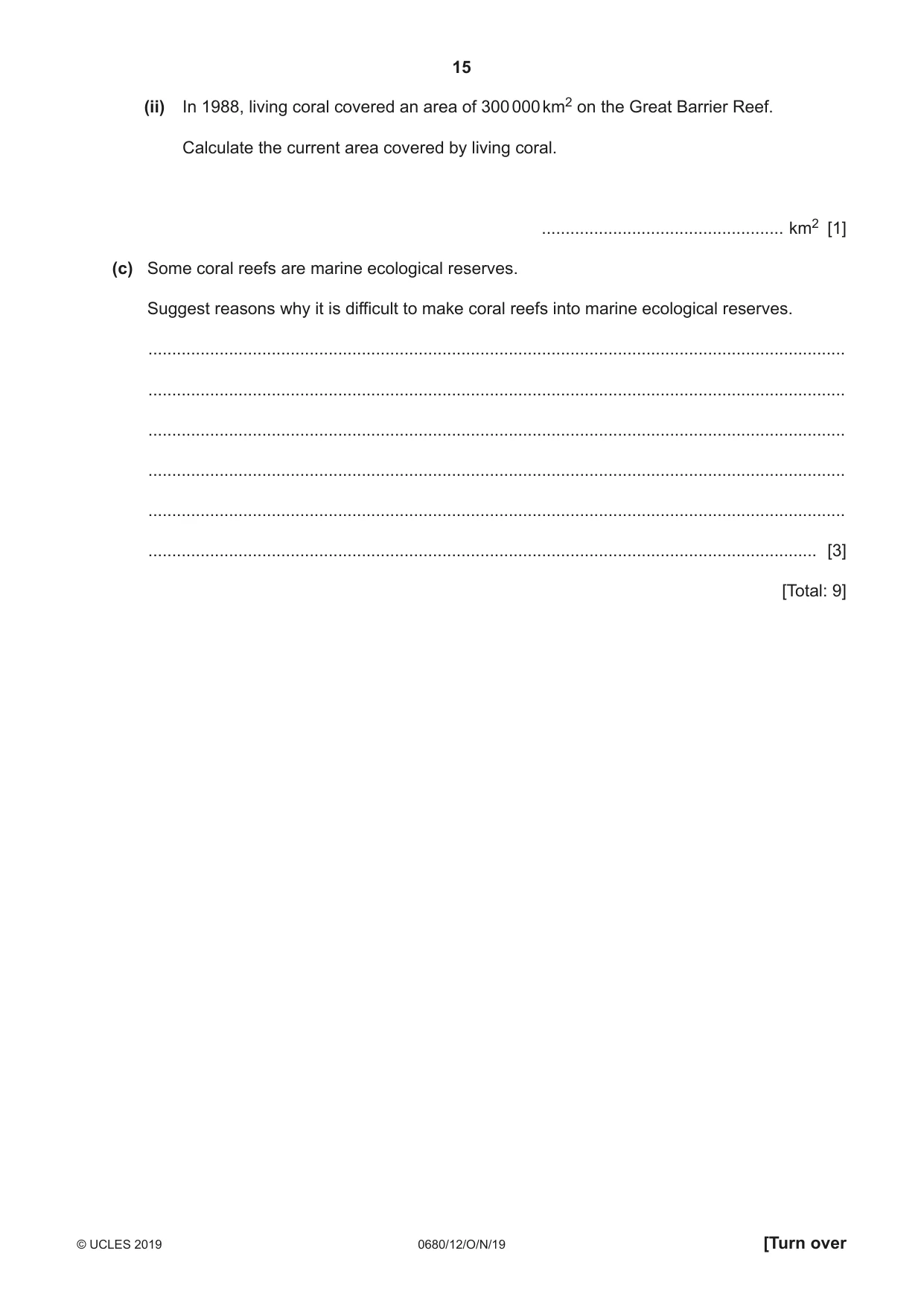
15 0680/12/O/N/19 © UCLES 2019 [Turn over (ii) In 1988, living coral covered an area of 300 000 km2 on the Great Barrier Reef. Calculate the current area covered by living coral. … km2 [1] (c) Some coral reefs are marine ecological reserves. Suggest reasons why it is difficult to make coral reefs into marine ecological reserves. … … … … … … [3] [Total: 9]
Question paper, page 16
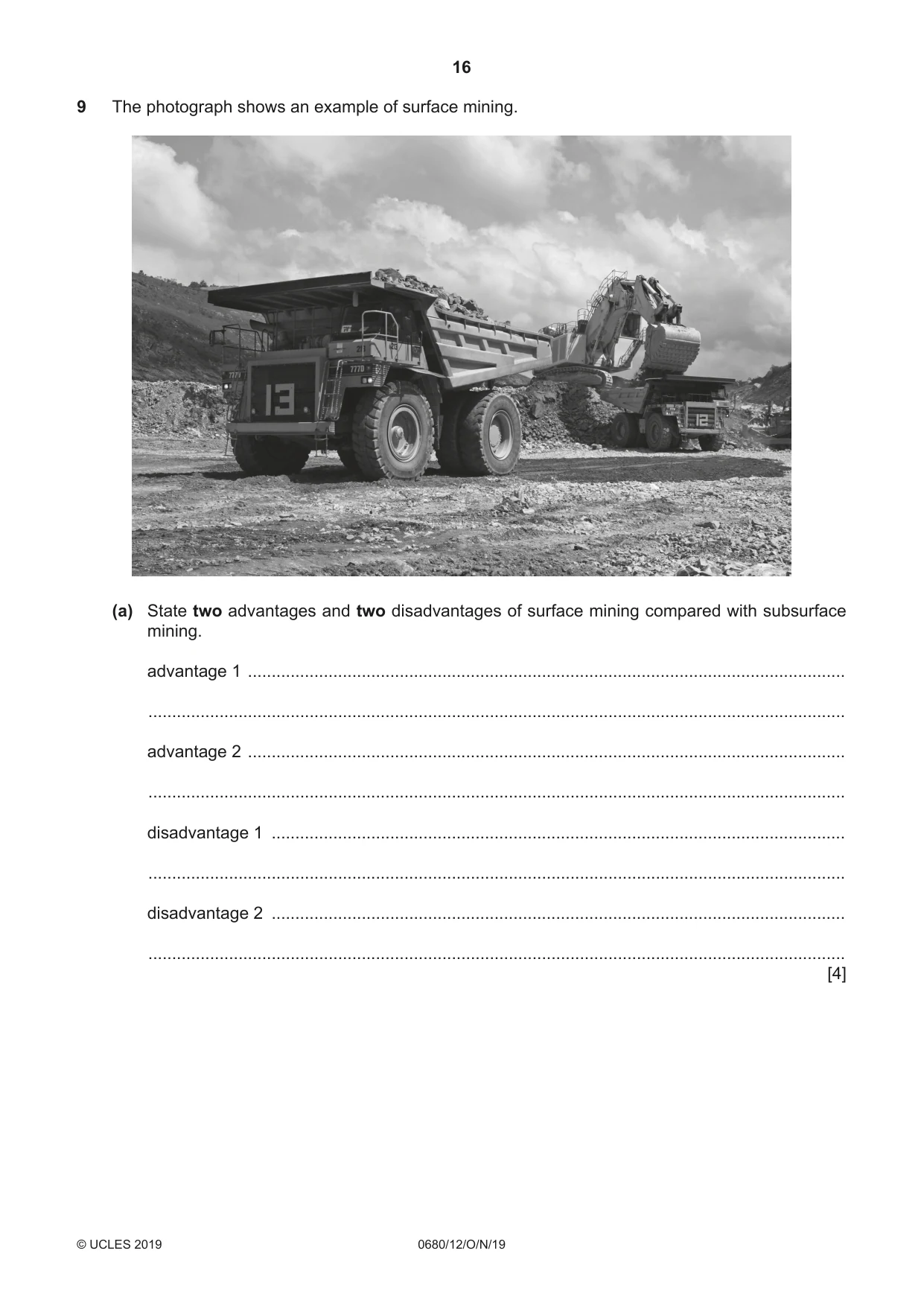
16 0680/12/O/N/19 © UCLES 2019 9 The photograph shows an example of surface mining. (a) State two advantages and two disadvantages of surface mining compared with subsurface mining. advantage 1 … … advantage 2 … … disadvantage 1 … … disadvantage 2 … … [4]
Question paper, page 17
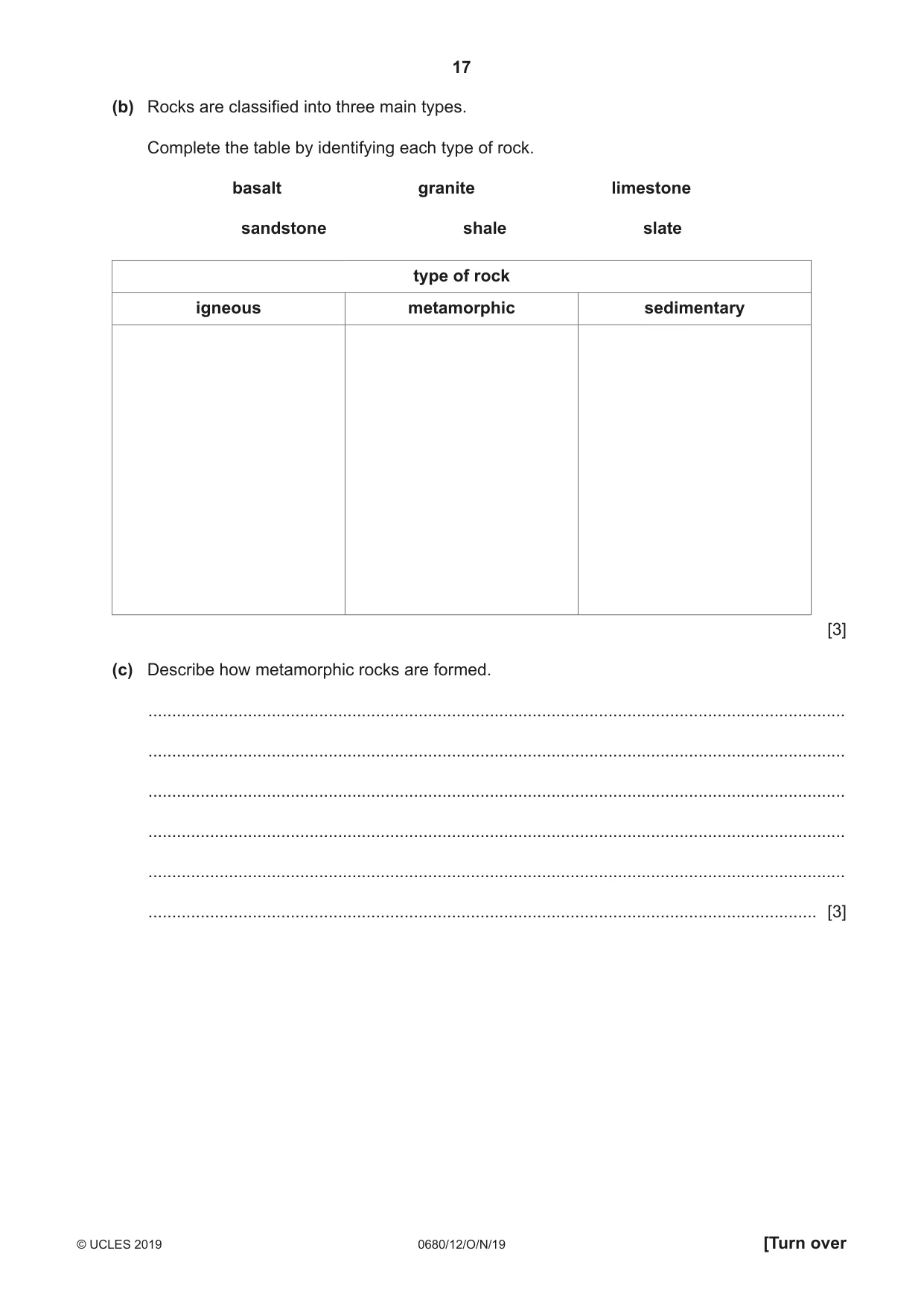
17 0680/12/O/N/19 © UCLES 2019 [Turn over (b) Rocks are classified into three main types. Complete the table by identifying each type of rock. basalt granite limestone sandstone shale slate type of rock igneous metamorphic sedimentary [3] (c) Describe how metamorphic rocks are formed. … … … … … … [3]
Question paper, page 18
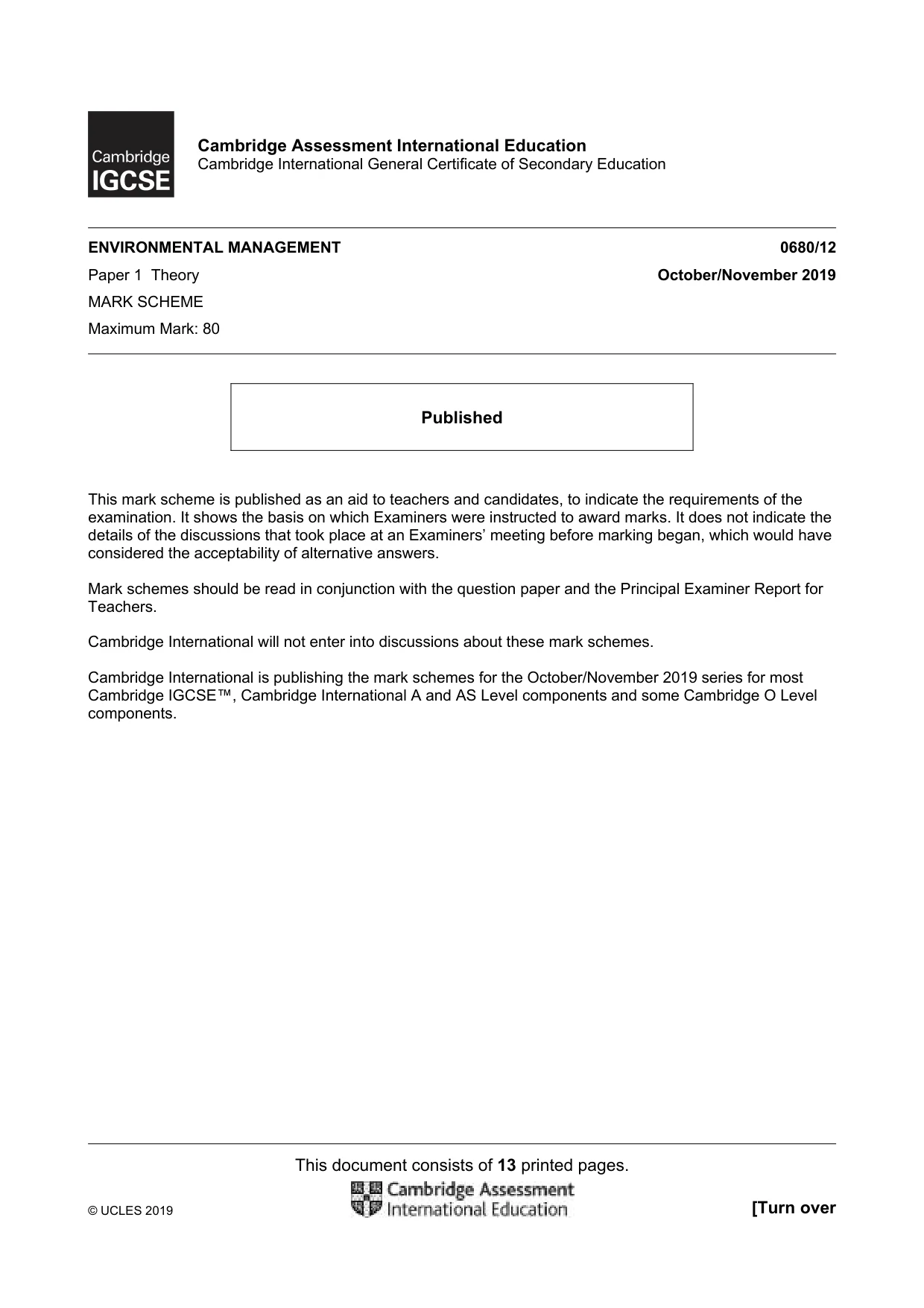
18 0680/12/O/N/19 © UCLES 2019 (d) Two students were talking about the extraction of minerals. The extraction of minerals is necessary as it will help the economy of the country. This is more important than preserving the environment. I disagree. Preserving the environment is far more important than obtaining minerals. How far do you agree with these views? Give reasons for your answer. … … … … … … … … … … … … … … … [6] [Total: 16]
Question paper, page 19
19 0680/12/O/N/19 © UCLES 2019 BLANK PAGE
Question paper, page 20
20 0680/12/O/N/19 © UCLES 2019 Permission to reproduce items where third-party owned material protected by copyright is included has been sought and cleared where possible. Every reasonable effort has been made by the publisher (UCLES) to trace copyright holders, but if any items requiring clearance have unwittingly been included, the publisher will be pleased to make amends at the earliest possible opportunity. To avoid the issue of disclosure of answer-related information to candidates, all copyright acknowledgements are reproduced online in the Cambridge Assessment International Education Copyright Acknowledgements Booklet. This is produced for each series of examinations and is freely available to download at www.cambridgeinternational.org after the live examination series. Cambridge Assessment International Education is part of the Cambridge Assessment Group. Cambridge Assessment is the brand name of the University of Cambridge Local Examinations Syndicate (UCLES), which itself is a department of the University of Cambridge. BLANK PAGE
Mark scheme, page 1
This document consists of 13 printed pages. © UCLES 2019 [Turn over Cambridge Assessment International Education Cambridge International General Certificate of Secondary Education ENVIRONMENTAL MANAGEMENT 0680/12 Paper 1 Theory October/November 2019 MARK SCHEME Maximum Mark: 80 Published This mark scheme is published as an aid to teachers and candidates, to indicate the requirements of the examination. It shows the basis on which Examiners were instructed to award marks. It does not indicate the details of the discussions that took place at an Examiners’ meeting before marking began, which would have considered the acceptability of alternative answers. Mark schemes should be read in conjunction with the question paper and the Principal Examiner Report for Teachers. Cambridge International will not enter into discussions about these mark schemes. Cambridge International is publishing the mark schemes for the October/November 2019 series for most Cambridge IGCSE™, Cambridge International A and AS Level components and some Cambridge O Level components.
Mark scheme, page 2
0680/12 Cambridge IGCSE – Mark Scheme PUBLISHED October/November 2019 © UCLES 2019 Page 2 of 13 Generic Marking Principles These general marking principles must be applied by all examiners when marking candidate answers. They should be applied alongside the specific content of the mark scheme or generic level descriptors for a question. Each question paper and mark scheme will also comply with these marking principles. GENERIC MARKING PRINCIPLE 1: Marks must be awarded in line with: • the specific content of the mark scheme or the generic level descriptors for the question • the specific skills defined in the mark scheme or in the generic level descriptors for the question • the standard of response required by a candidate as exemplified by the standardisation scripts. GENERIC MARKING PRINCIPLE 2: Marks awarded are always whole marks (not half marks, or other fractions). GENERIC MARKING PRINCIPLE 3: Marks must be awarded positively: • marks are awarded for correct/valid answers, as defined in the mark scheme. However, credit is given for valid answers which go beyond the scope of the syllabus and mark scheme, referring to your Team Leader as appropriate • marks are awarded when candidates clearly demonstrate what they know and can do • marks are not deducted for errors • marks are not deducted for omissions • answers should only be judged on the quality of spelling, punctuation and grammar when these features are specifically assessed by the question as indicated by the mark scheme. The meaning, however, should be unambiguous. GENERIC MARKING PRINCIPLE 4: Rules must be applied consistently e.g. in situations where candidates have not followed instructions or in the application of generic level descriptors.
Mark scheme, page 3
0680/12 Cambridge IGCSE – Mark Scheme PUBLISHED October/November 2019 © UCLES 2019 Page 3 of 13 GENERIC MARKING PRINCIPLE 5: Marks should be awarded using the full range of marks defined in the mark scheme for the question (however; the use of the full mark range may be limited according to the quality of the candidate responses seen). GENERIC MARKING PRINCIPLE 6: Marks awarded are based solely on the requirements as defined in the mark scheme. Marks should not be awarded with grade thresholds or grade descriptors in mind.
Mark scheme, page 4
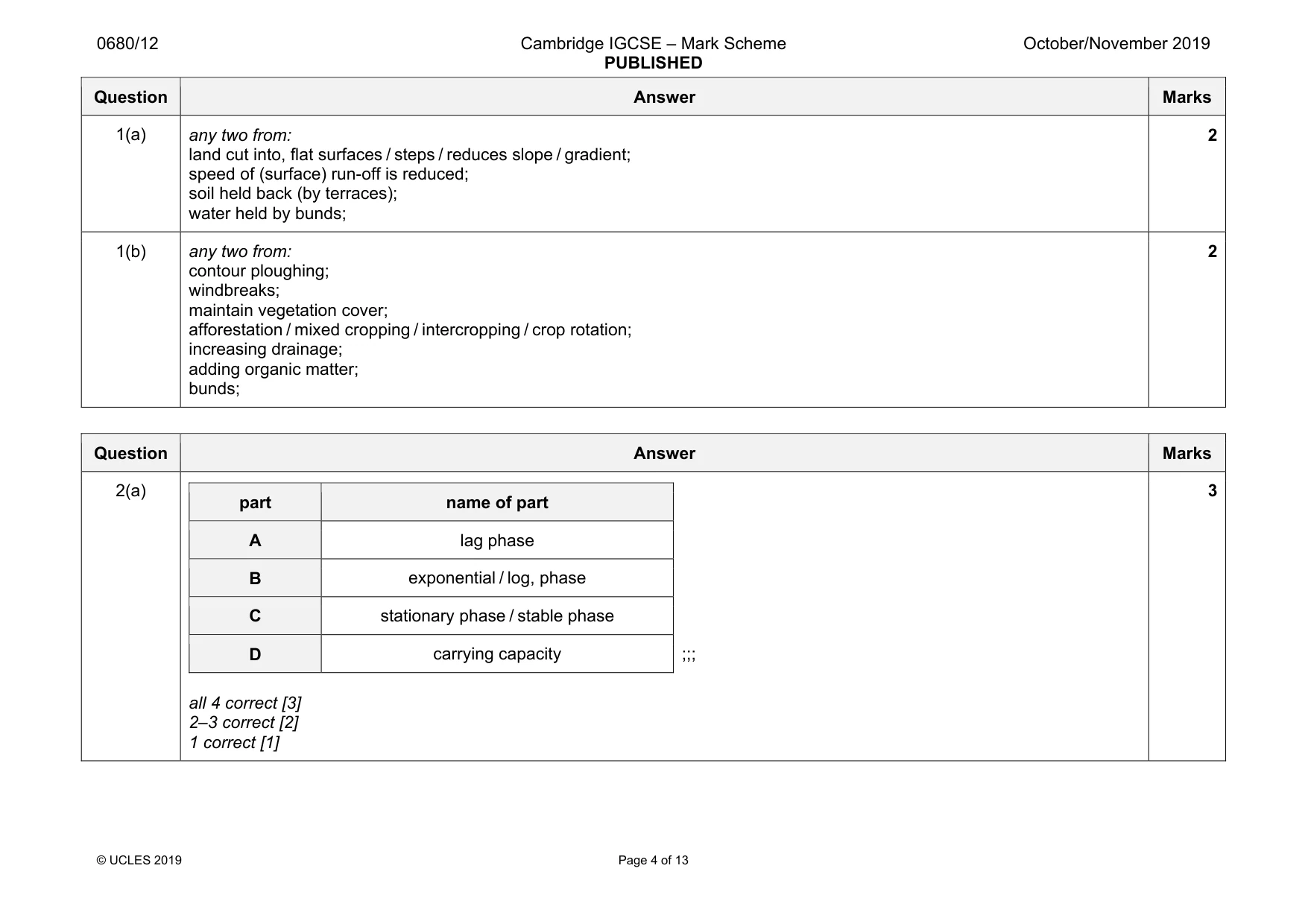
0680/12 Cambridge IGCSE – Mark Scheme PUBLISHED October/November 2019 © UCLES 2019 Page 4 of 13 Question Answer Marks 1(a) any two from: land cut into, flat surfaces / steps / reduces slope / gradient; speed of (surface) run-off is reduced; soil held back (by terraces); water held by bunds; 2 1(b) any two from: contour ploughing; windbreaks; maintain vegetation cover; afforestation / mixed cropping / intercropping / crop rotation; increasing drainage; adding organic matter; bunds; 2 Question Answer Marks 2(a) part name of part A lag phase B exponential / log, phase C stationary phase / stable phase D carrying capacity ;;; all 4 correct [3] 2–3 correct [2] 1 correct [1] 3
Mark scheme, page 5
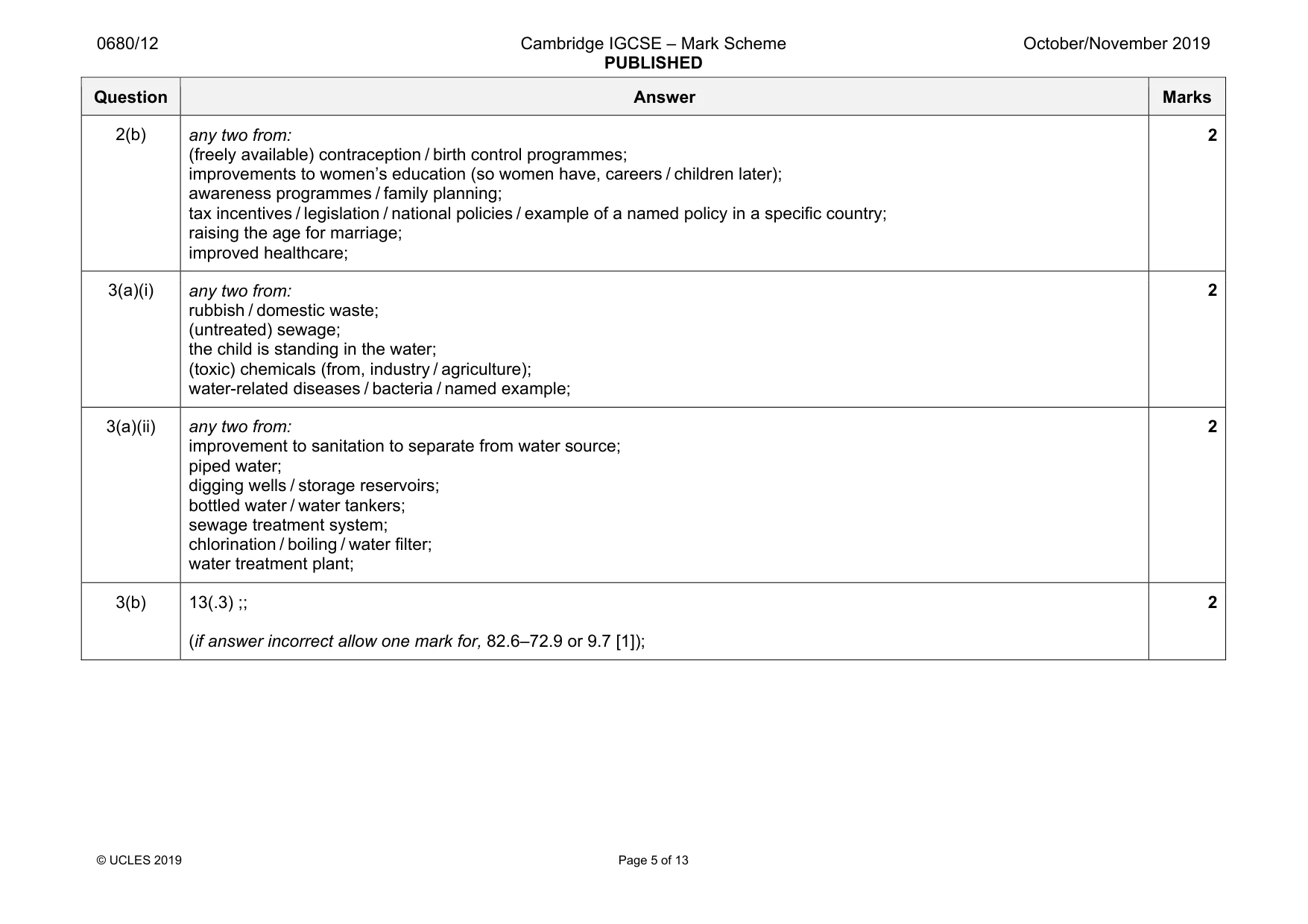
0680/12 Cambridge IGCSE – Mark Scheme PUBLISHED October/November 2019 © UCLES 2019 Page 5 of 13 Question Answer Marks 2(b) any two from: (freely available) contraception / birth control programmes; improvements to women’s education (so women have, careers / children later); awareness programmes / family planning; tax incentives / legislation / national policies / example of a named policy in a specific country; raising the age for marriage; improved healthcare; 2 3(a)(i) any two from: rubbish / domestic waste; (untreated) sewage; the child is standing in the water; (toxic) chemicals (from, industry / agriculture); water-related diseases / bacteria / named example; 2 3(a)(ii) any two from: improvement to sanitation to separate from water source; piped water; digging wells / storage reservoirs; bottled water / water tankers; sewage treatment system; chlorination / boiling / water filter; water treatment plant; 2 3(b) 13(.3) ;; (if answer incorrect allow one mark for, 82.6–72.9 or 9.7 [1]); 2
Mark scheme, page 6
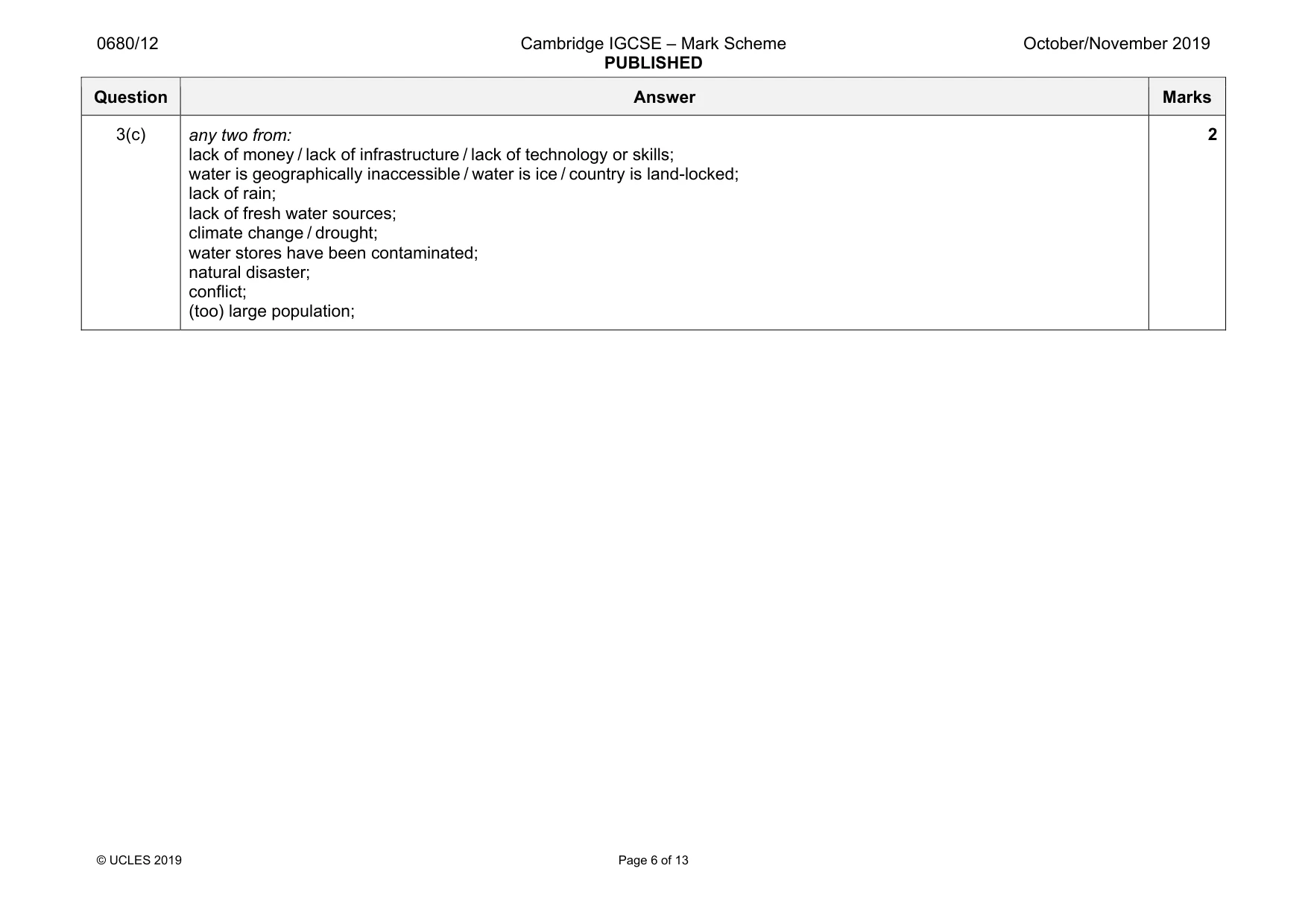
0680/12 Cambridge IGCSE – Mark Scheme PUBLISHED October/November 2019 © UCLES 2019 Page 6 of 13 Question Answer Marks 3(c) any two from: lack of money / lack of infrastructure / lack of technology or skills; water is geographically inaccessible / water is ice / country is land-locked; lack of rain; lack of fresh water sources; climate change / drought; water stores have been contaminated; natural disaster; conflict; (too) large population; 2
Mark scheme, page 7
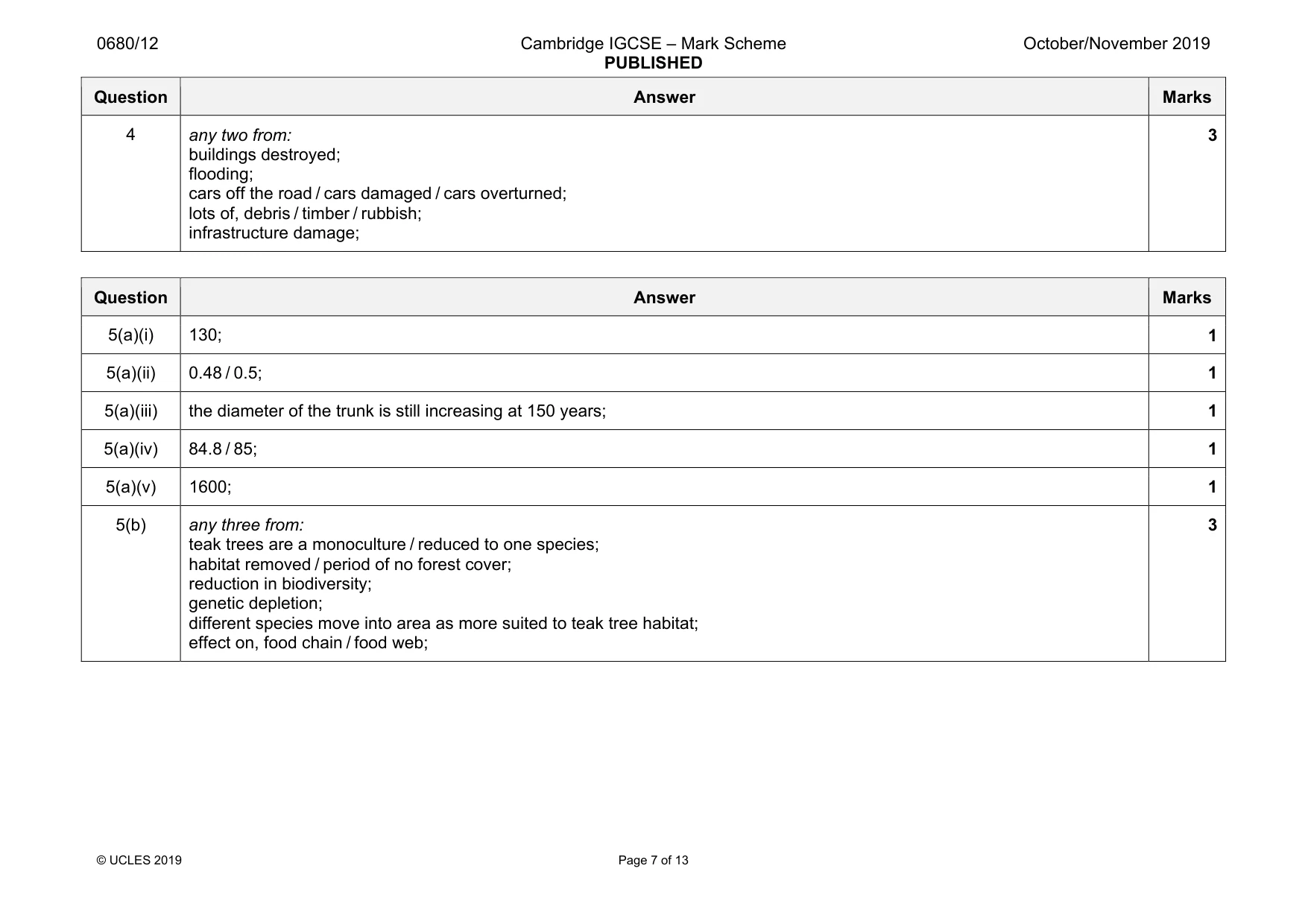
0680/12 Cambridge IGCSE – Mark Scheme PUBLISHED October/November 2019 © UCLES 2019 Page 7 of 13 Question Answer Marks 4 any two from: buildings destroyed; flooding; cars off the road / cars damaged / cars overturned; lots of, debris / timber / rubbish; infrastructure damage; 3 Question Answer Marks 5(a)(i) 130; 1 5(a)(ii) 0.48 / 0.5; 1 5(a)(iii) the diameter of the trunk is still increasing at 150 years; 1 5(a)(iv) 84.8 / 85; 1 5(a)(v) 1600; 1 5(b) any three from: teak trees are a monoculture / reduced to one species; habitat removed / period of no forest cover; reduction in biodiversity; genetic depletion; different species move into area as more suited to teak tree habitat; effect on, food chain / food web; 3
Mark scheme, page 8
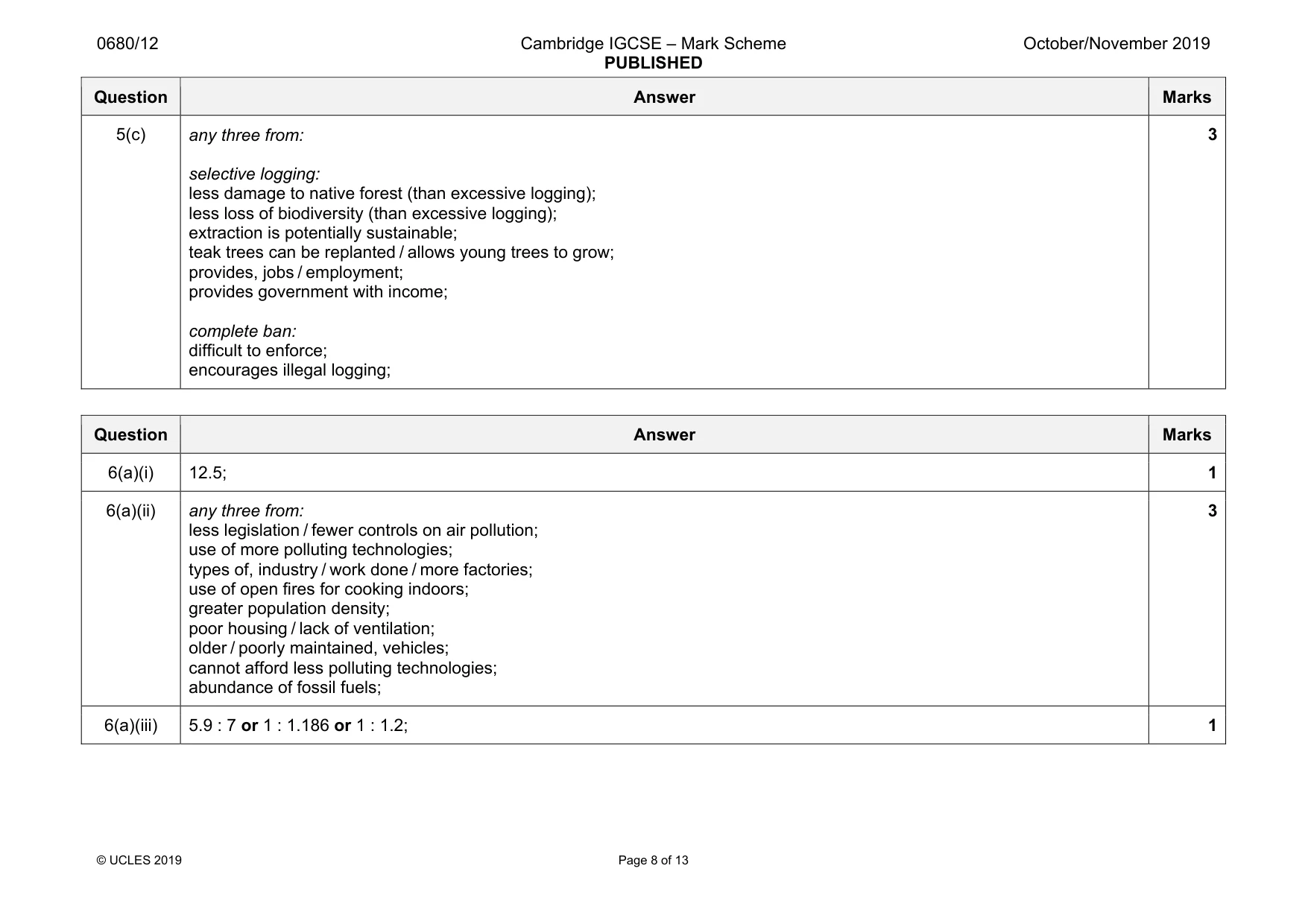
0680/12 Cambridge IGCSE – Mark Scheme PUBLISHED October/November 2019 © UCLES 2019 Page 8 of 13 Question Answer Marks 5(c) any three from: selective logging: less damage to native forest (than excessive logging); less loss of biodiversity (than excessive logging); extraction is potentially sustainable; teak trees can be replanted / allows young trees to grow; provides, jobs / employment; provides government with income; complete ban: difficult to enforce; encourages illegal logging; 3 Question Answer Marks 6(a)(i) 12.5; 1 6(a)(ii) any three from: less legislation / fewer controls on air pollution; use of more polluting technologies; types of, industry / work done / more factories; use of open fires for cooking indoors; greater population density; poor housing / lack of ventilation; older / poorly maintained, vehicles; cannot afford less polluting technologies; abundance of fossil fuels; 3 6(a)(iii) 5.9 : 7 or 1 : 1.186 or 1 : 1.2; 1
Mark scheme, page 9
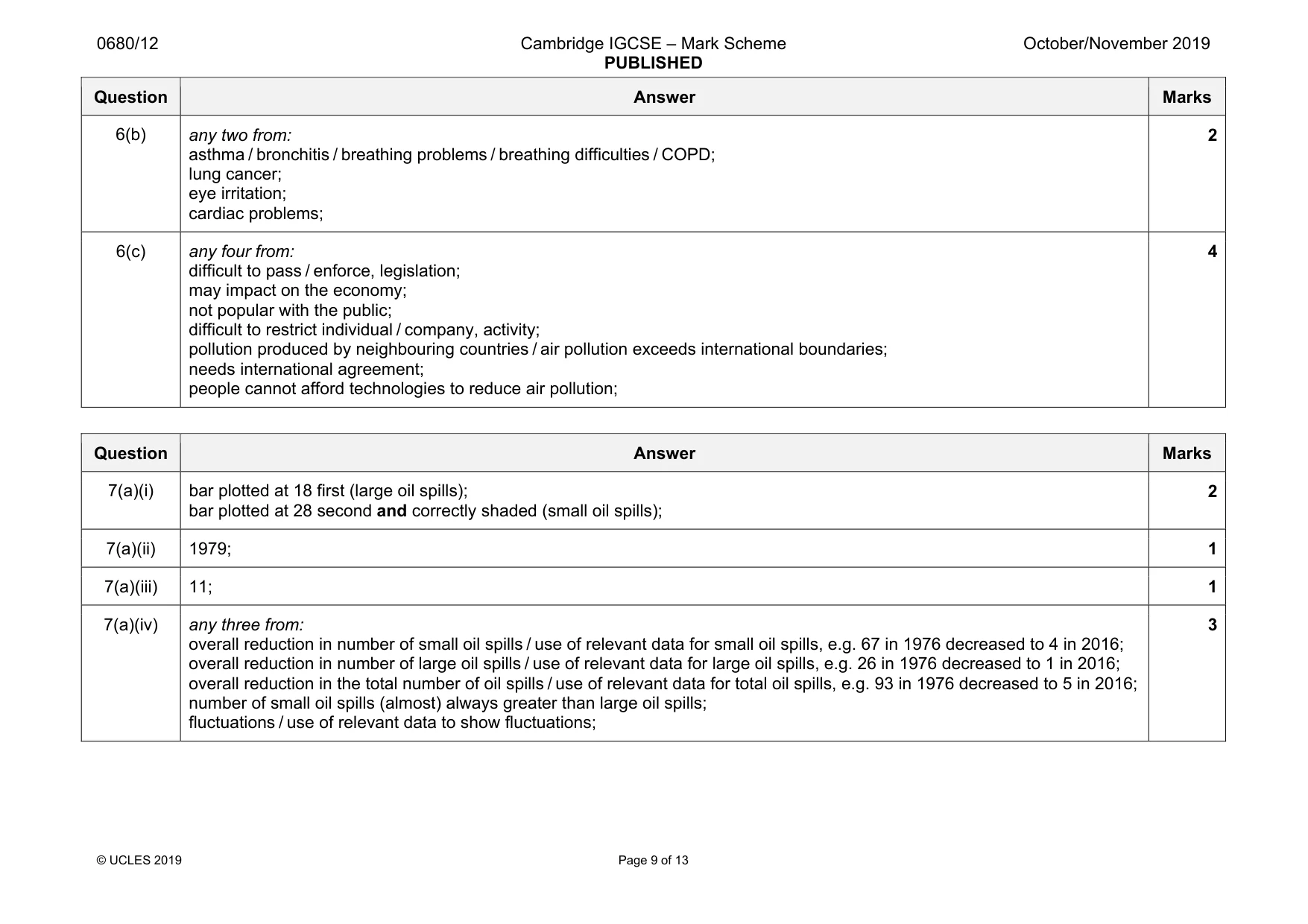
0680/12 Cambridge IGCSE – Mark Scheme PUBLISHED October/November 2019 © UCLES 2019 Page 9 of 13 Question Answer Marks 6(b) any two from: asthma / bronchitis / breathing problems / breathing difficulties / COPD; lung cancer; eye irritation; cardiac problems; 2 6(c) any four from: difficult to pass / enforce, legislation; may impact on the economy; not popular with the public; difficult to restrict individual / company, activity; pollution produced by neighbouring countries / air pollution exceeds international boundaries; needs international agreement; people cannot afford technologies to reduce air pollution; 4 Question Answer Marks 7(a)(i) bar plotted at 18 first (large oil spills); bar plotted at 28 second and correctly shaded (small oil spills); 2 7(a)(ii) 1979; 1 7(a)(iii) 11; 1 7(a)(iv) any three from: overall reduction in number of small oil spills / use of relevant data for small oil spills, e.g. 67 in 1976 decreased to 4 in 2016; overall reduction in number of large oil spills / use of relevant data for large oil spills, e.g. 26 in 1976 decreased to 1 in 2016; overall reduction in the total number of oil spills / use of relevant data for total oil spills, e.g. 93 in 1976 decreased to 5 in 2016; number of small oil spills (almost) always greater than large oil spills; fluctuations / use of relevant data to show fluctuations; 3
Mark scheme, page 10
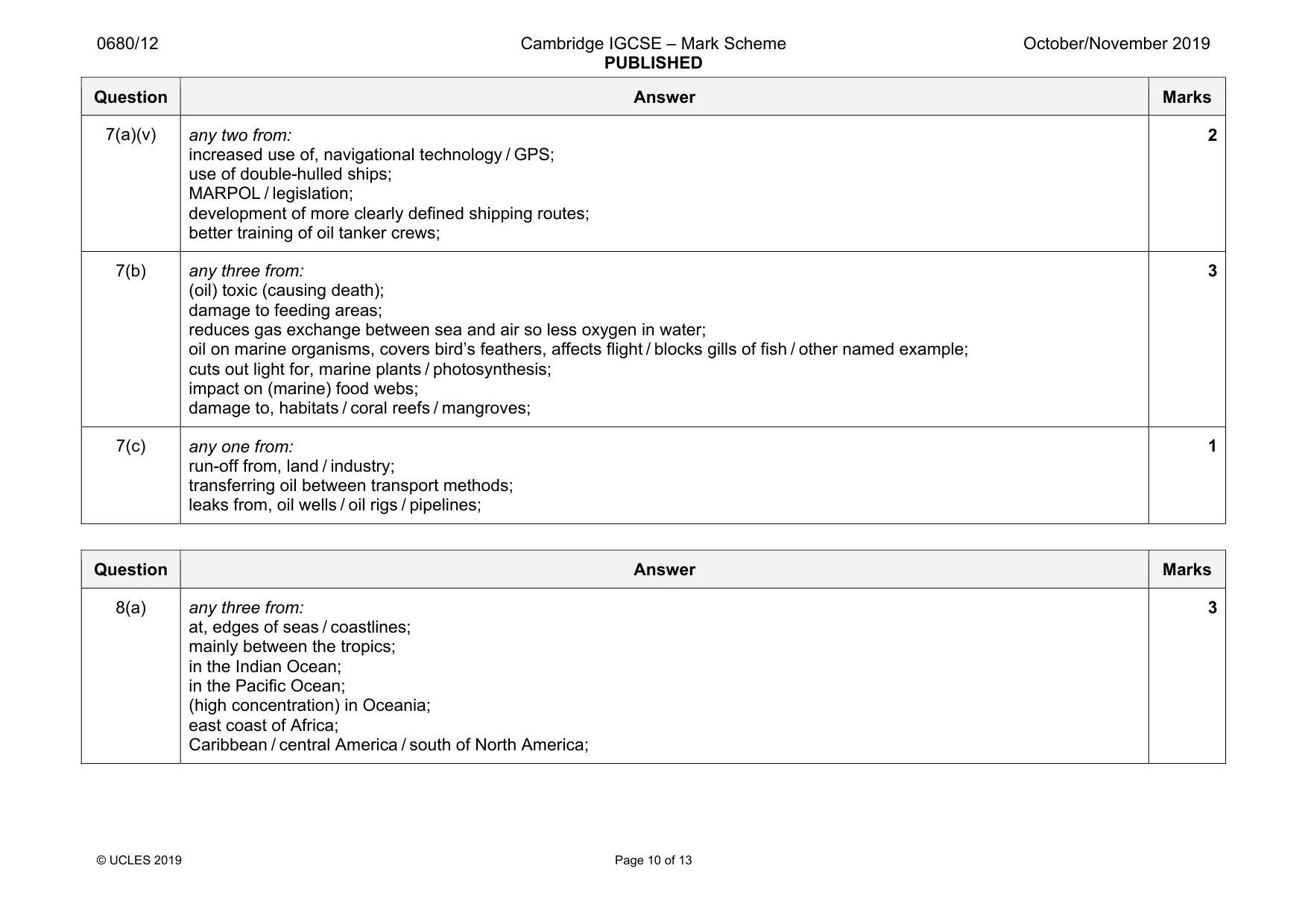
0680/12 Cambridge IGCSE – Mark Scheme PUBLISHED October/November 2019 © UCLES 2019 Page 10 of 13 Question Answer Marks 7(a)(v) any two from: increased use of, navigational technology / GPS; use of double-hulled ships; MARPOL / legislation; development of more clearly defined shipping routes; better training of oil tanker crews; 2 7(b) any three from: (oil) toxic (causing death); damage to feeding areas; reduces gas exchange between sea and air so less oxygen in water; oil on marine organisms, covers bird’s feathers, affects flight / blocks gills of fish / other named example; cuts out light for, marine plants / photosynthesis; impact on (marine) food webs; damage to, habitats / coral reefs / mangroves; 3 7(c) any one from: run-off from, land / industry; transferring oil between transport methods; leaks from, oil wells / oil rigs / pipelines; 1 Question Answer Marks 8(a) any three from: at, edges of seas / coastlines; mainly between the tropics; in the Indian Ocean; in the Pacific Ocean; (high concentration) in Oceania; east coast of Africa; Caribbean / central America / south of North America; 3
Mark scheme, page 11
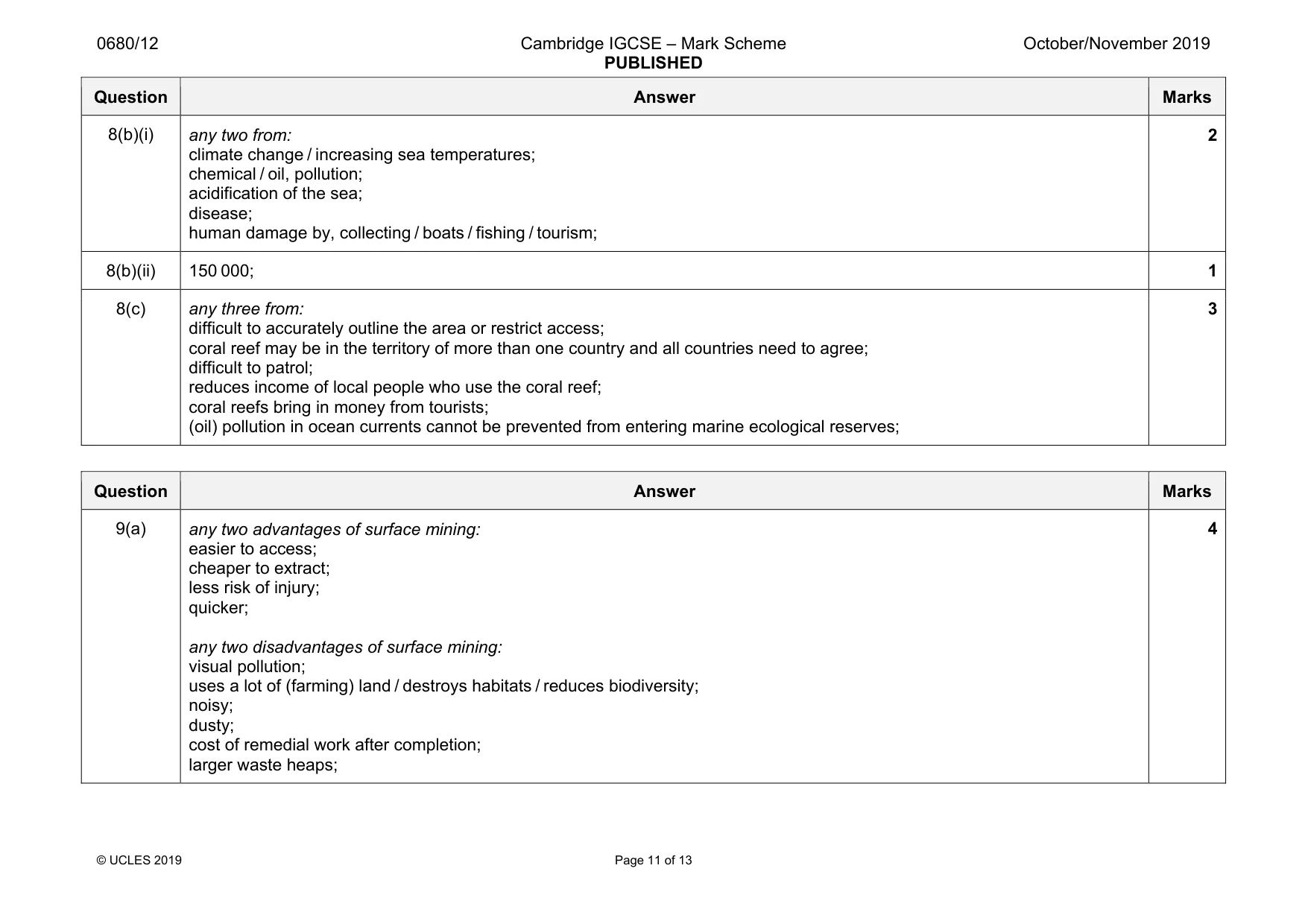
0680/12 Cambridge IGCSE – Mark Scheme PUBLISHED October/November 2019 © UCLES 2019 Page 11 of 13 Question Answer Marks 8(b)(i) any two from: climate change / increasing sea temperatures; chemical / oil, pollution; acidification of the sea; disease; human damage by, collecting / boats / fishing / tourism; 2 8(b)(ii) 150 000; 1 8(c) any three from: difficult to accurately outline the area or restrict access; coral reef may be in the territory of more than one country and all countries need to agree; difficult to patrol; reduces income of local people who use the coral reef; coral reefs bring in money from tourists; (oil) pollution in ocean currents cannot be prevented from entering marine ecological reserves; 3 Question Answer Marks 9(a) any two advantages of surface mining: easier to access; cheaper to extract; less risk of injury; quicker; any two disadvantages of surface mining: visual pollution; uses a lot of (farming) land / destroys habitats / reduces biodiversity; noisy; dusty; cost of remedial work after completion; larger waste heaps; 4
Mark scheme, page 12
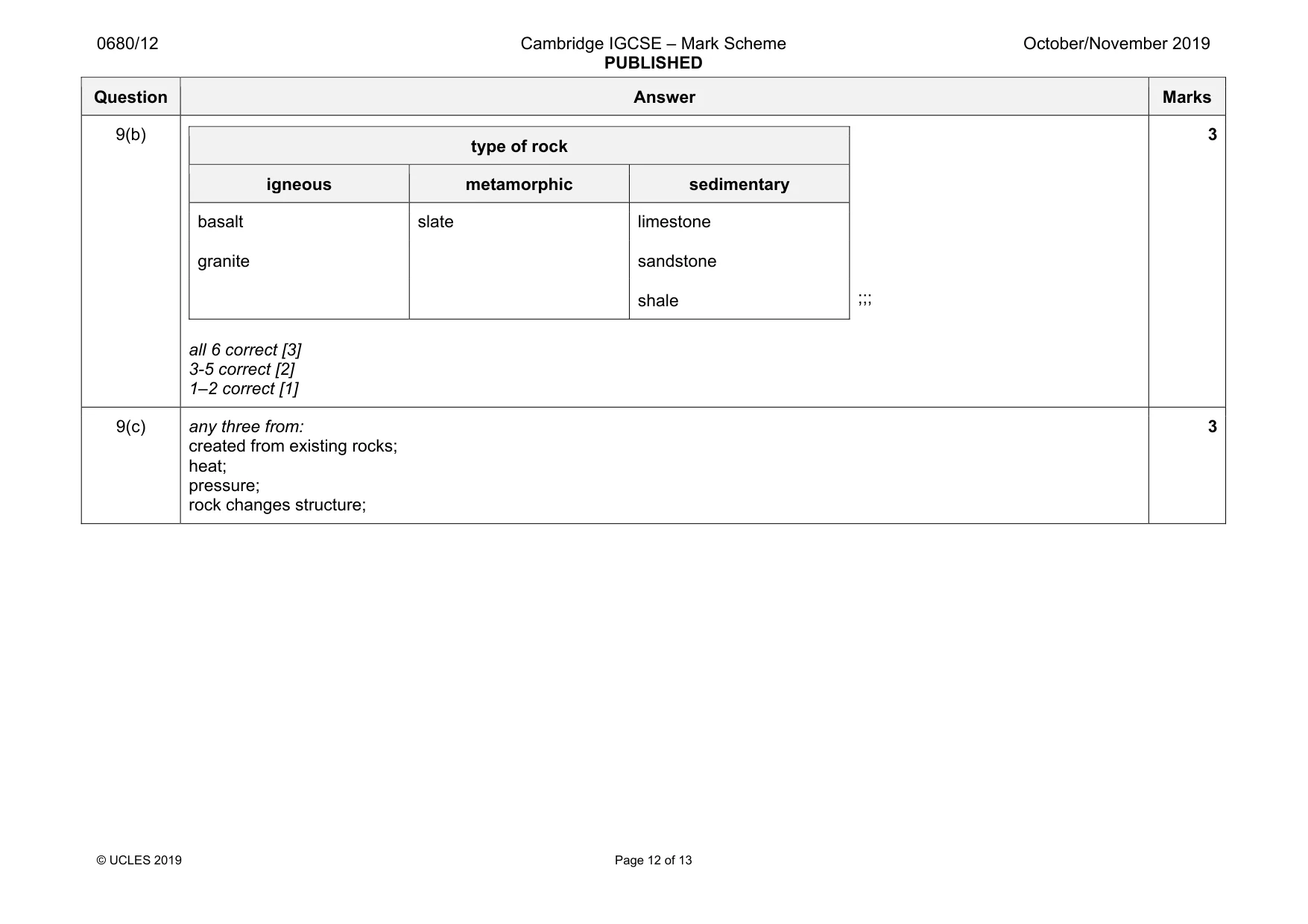
0680/12 Cambridge IGCSE – Mark Scheme PUBLISHED October/November 2019 © UCLES 2019 Page 12 of 13 Question Answer Marks 9(b) type of rock igneous metamorphic sedimentary basalt granite slate limestone sandstone shale ;;; all 6 correct [3] 3-5 correct [2] 1–2 correct [1] 3 9(c) any three from: created from existing rocks; heat; pressure; rock changes structure; 3
Mark scheme, page 13
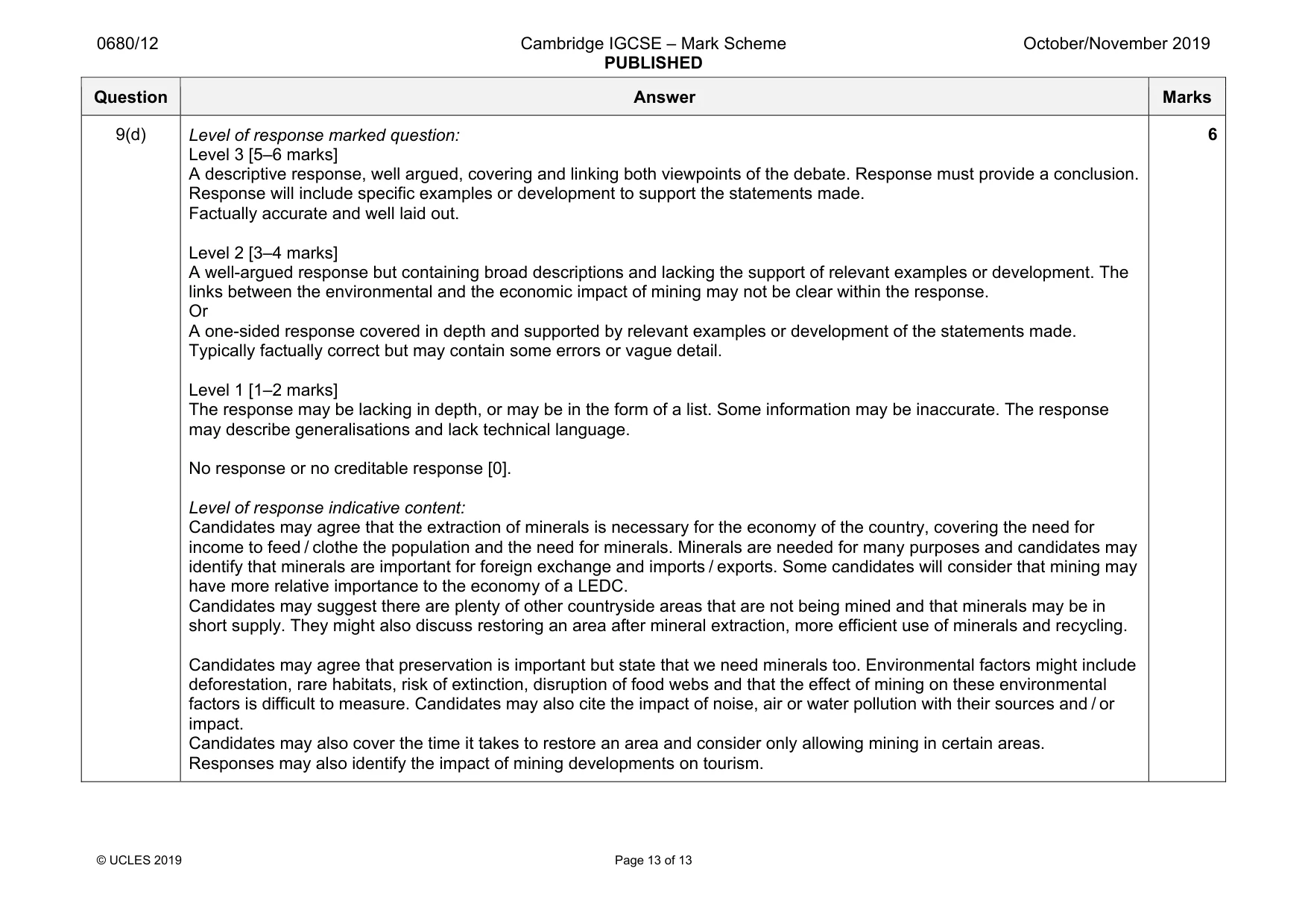
0680/12 Cambridge IGCSE – Mark Scheme PUBLISHED October/November 2019 © UCLES 2019 Page 13 of 13 Question Answer Marks 9(d) Level of response marked question: Level 3 [5–6 marks] A descriptive response, well argued, covering and linking both viewpoints of the debate. Response must provide a conclusion. Response will include specific examples or development to support the statements made. Factually accurate and well laid out. Level 2 [3–4 marks] A well-argued response but containing broad descriptions and lacking the support of relevant examples or development. The links between the environmental and the economic impact of mining may not be clear within the response. Or A one-sided response covered in depth and supported by relevant examples or development of the statements made. Typically factually correct but may contain some errors or vague detail. Level 1 [1–2 marks] The response may be lacking in depth, or may be in the form of a list. Some information may be inaccurate. The response may describe generalisations and lack technical language. No response or no creditable response [0]. Level of response indicative content: Candidates may agree that the extraction of minerals is necessary for the economy of the country, covering the need for income to feed / clothe the population and the need for minerals. Minerals are needed for many purposes and candidates may identify that minerals are important for foreign exchange and imports / exports. Some candidates will consider that mining may have more relative importance to the economy of a LEDC. Candidates may suggest there are plenty of other countryside areas that are not being mined and that minerals may be in short supply. They might also discuss restoring an area after mineral extraction, more efficient use of minerals and recycling. Candidates may agree that preservation is important but state that we need minerals too. Environmental factors might include deforestation, rare habitats, risk of extinction, disruption of food webs and that the effect of mining on these environmental factors is difficult to measure. Candidates may also cite the impact of noise, air or water pollution with their sources and / or impact. Candidates may also cover the time it takes to restore an area and consider only allowing mining in certain areas. Responses may also identify the impact of mining developments on tourism. 6
What you needed in this session
Cambridge’s own grade thresholds for 2019 Oct/Nov, Paper 1 · Variant 2. A higher threshold means an easier paper — the bar moves with how the cohort did.