Cambridge IGCSE Environmental Management 0680 — 2019 Oct/Nov Paper 1 · Variant 1
0680/11/O/N/19 · 80 marks · ≈90 min
The question paper and its mark scheme, free to read here and free to download. This is Cambridge’s own paper, exactly as it was sat.
Question paper16 pages
Mark scheme12 pages
Answers below. Sit the paper first if you are practising.
Paper as text
Question paper, page 1
This document consists of 15 printed pages and 1 blank page. DC (SC/FC) 172934/2 © UCLES 2019 [Turn over * 5 3 4 3 0 7 3 5 3 0 * ENVIRONMENTAL MANAGEMENT 0680/11 Paper 1 Theory October/November 2019 1 hour 45 minutes Candidates answer on the Question Paper. No Additional Materials are required. READ THESE INSTRUCTIONS FIRST Write your centre number, candidate number and name in the spaces at the top of this page. Write in dark blue or black pen. You may use an HB pencil for any diagrams or graphs. Do not use staples, paper clips, glue or correction fluid. DO NOT WRITE IN ANY BARCODES. Answer all questions. Electronic calculators may be used. You may lose marks if you do not show your working or if you do not use appropriate units. At the end of the examination, fasten all your work securely together. The number of marks is given in brackets [ ] at the end of each question or part question. Cambridge Assessment International Education Cambridge International General Certificate of Secondary Education
Question paper, page 2
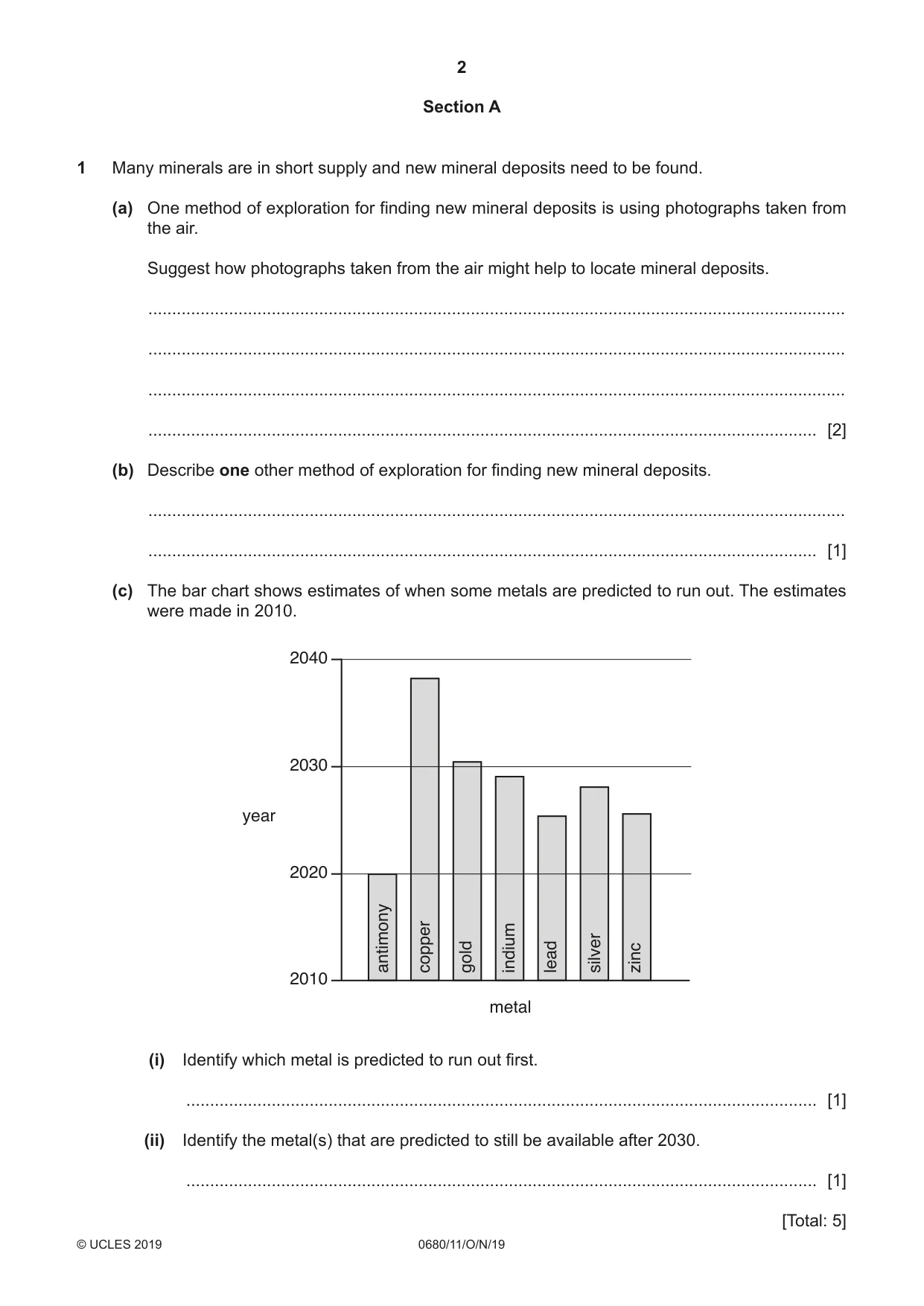
2 0680/11/O/N/19 © UCLES 2019 Section A 1 Many minerals are in short supply and new mineral deposits need to be found. (a) One method of exploration for finding new mineral deposits is using photographs taken from the air. Suggest how photographs taken from the air might help to locate mineral deposits. … … … … [2] (b) Describe one other method of exploration for finding new mineral deposits. … … [1] (c) The bar chart shows estimates of when some metals are predicted to run out. The estimates were made in 2010. 2010 metal antimony copper gold indium lead silver zinc year 2020 2030 2040 (i) Identify which metal is predicted to run out first. … [1] (ii) Identify the metal(s) that are predicted to still be available after 2030. … [1] [Total: 5]
Question paper, page 3
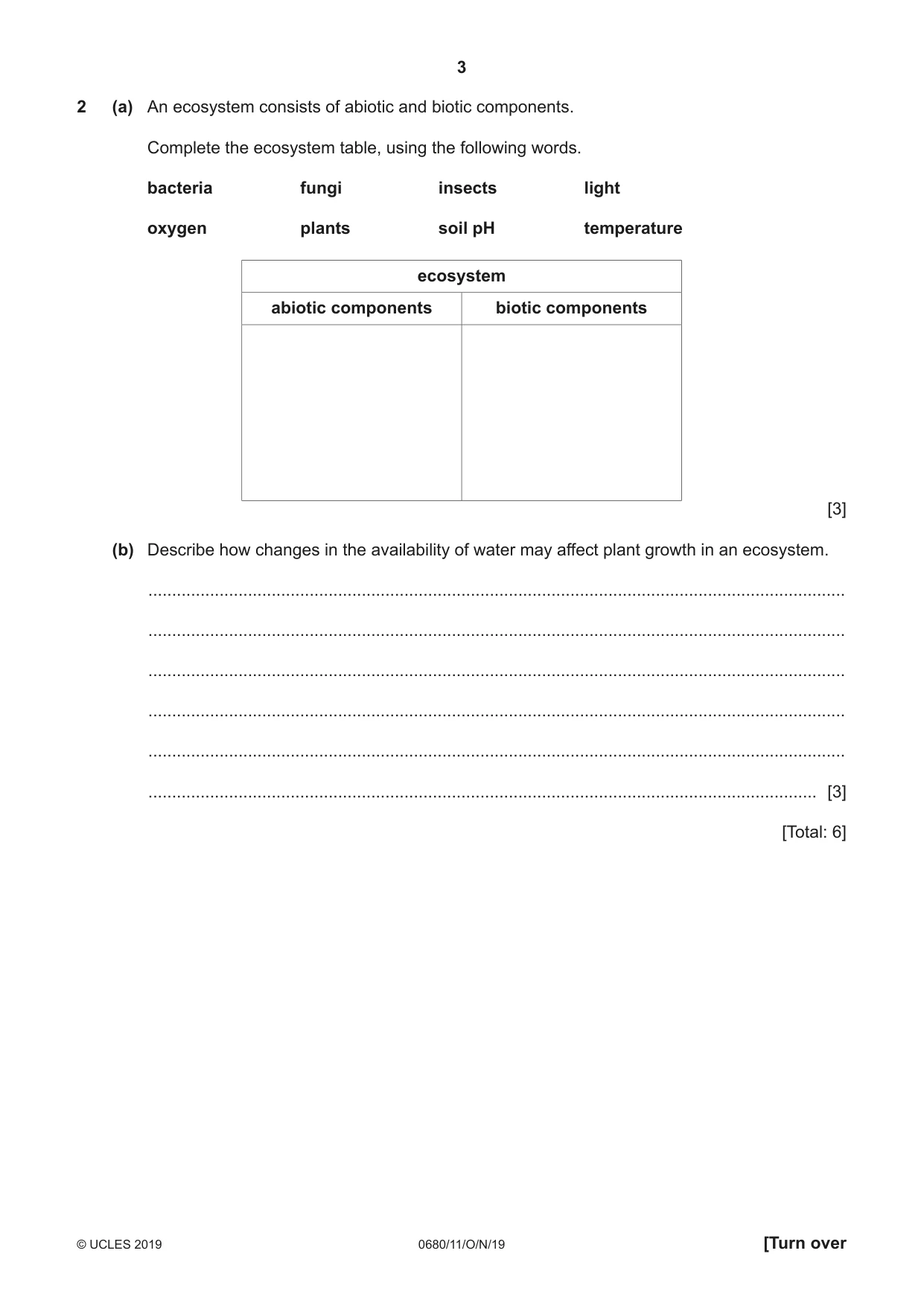
3 0680/11/O/N/19 © UCLES 2019 [Turn over 2 (a) An ecosystem consists of abiotic and biotic components. Complete the ecosystem table, using the following words. bacteria fungi insects light oxygen plants soil pH temperature ecosystem abiotic components biotic components [3] (b) Describe how changes in the availability of water may affect plant growth in an ecosystem. … … … … … … [3] [Total: 6]
Question paper, page 4
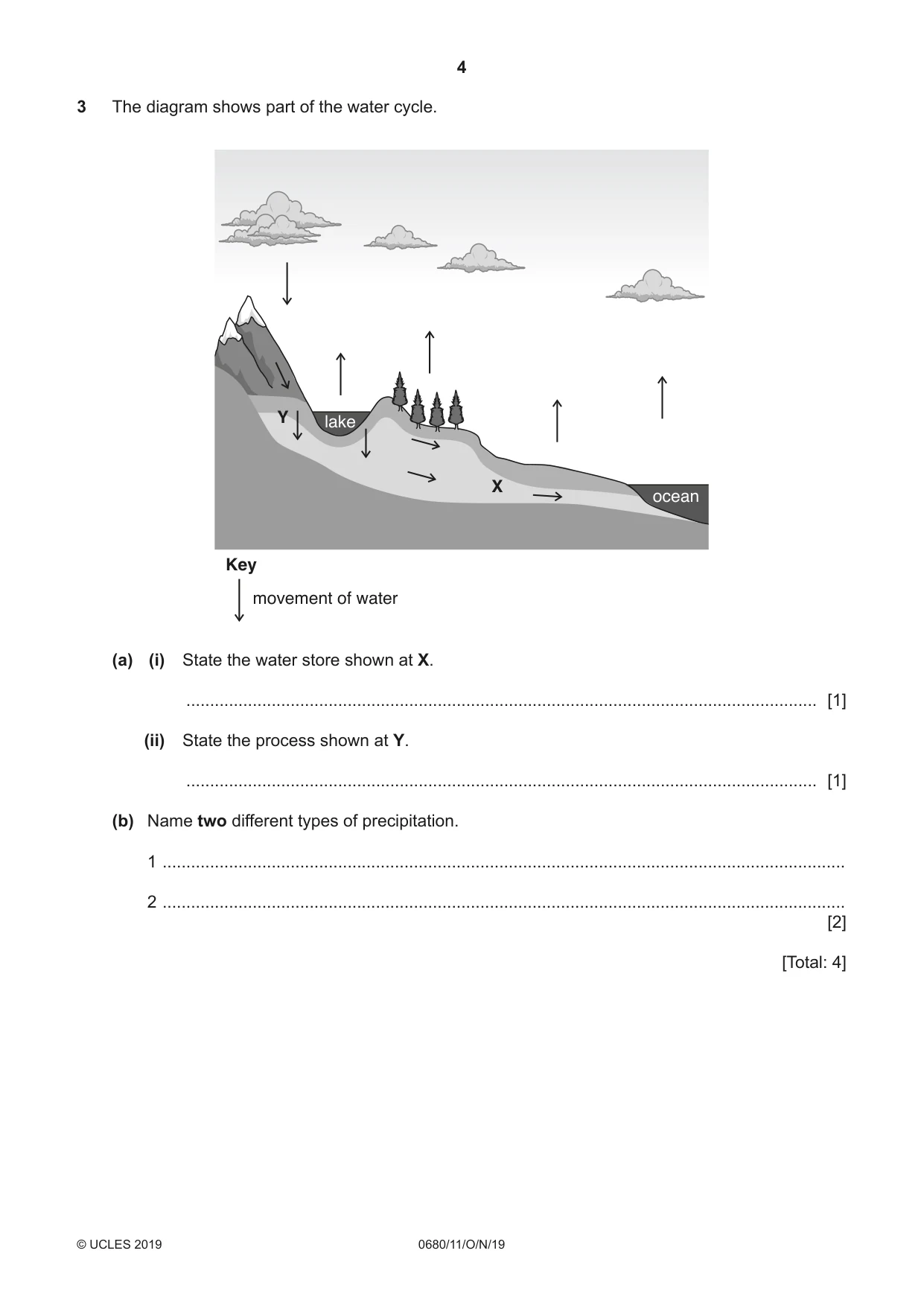
4 0680/11/O/N/19 © UCLES 2019 3 The diagram shows part of the water cycle. ocean lake Key movement of water X Y (a) (i) State the water store shown at X. … [1] (ii) State the process shown at Y. … [1] (b) Name two different types of precipitation. 1 … 2 … [2] [Total: 4]
Question paper, page 5
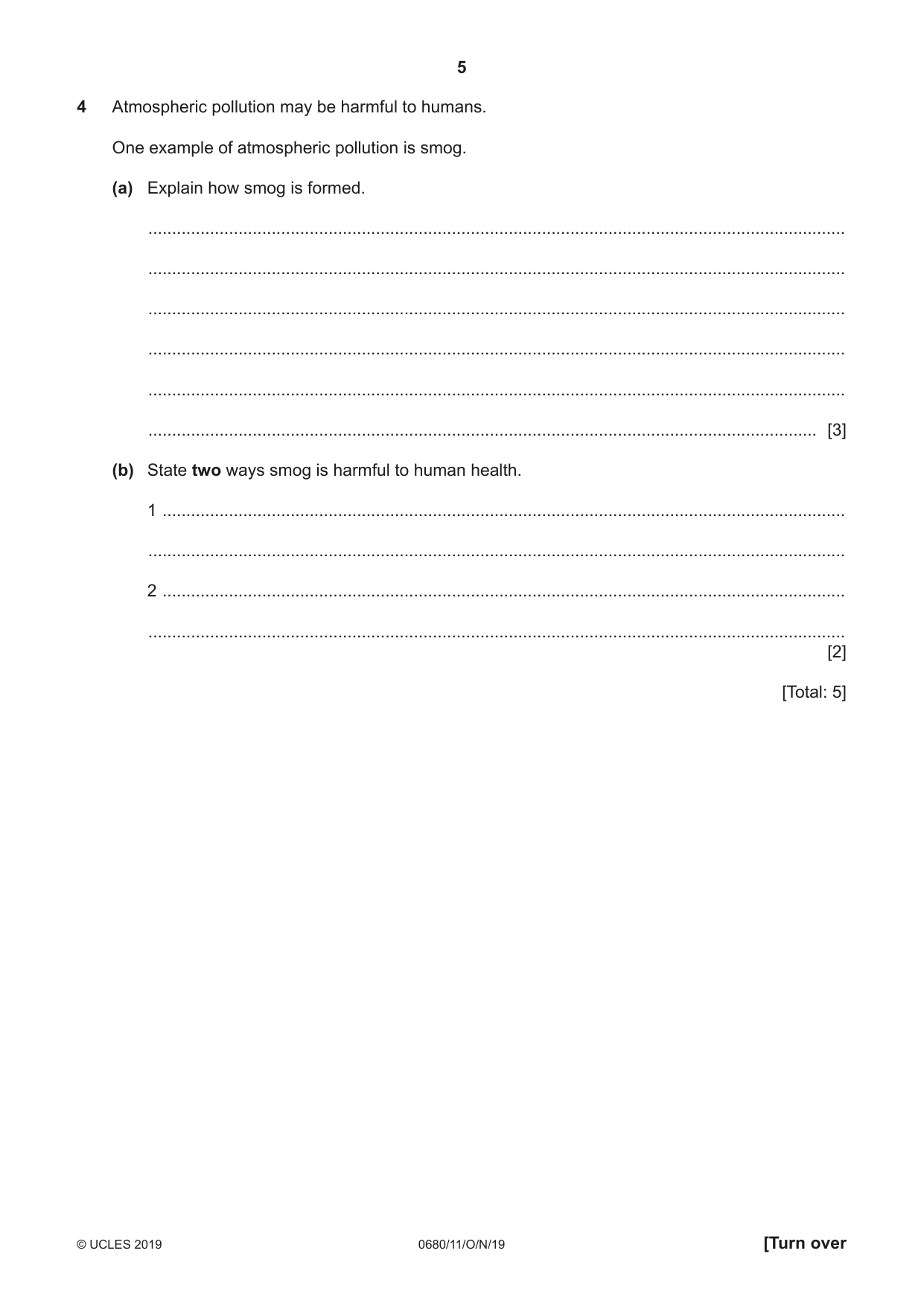
5 0680/11/O/N/19 © UCLES 2019 [Turn over 4 Atmospheric pollution may be harmful to humans. One example of atmospheric pollution is smog. (a) Explain how smog is formed. … … … … … … [3] (b) State two ways smog is harmful to human health. 1 … … 2 … … [2] [Total: 5]
Question paper, page 6
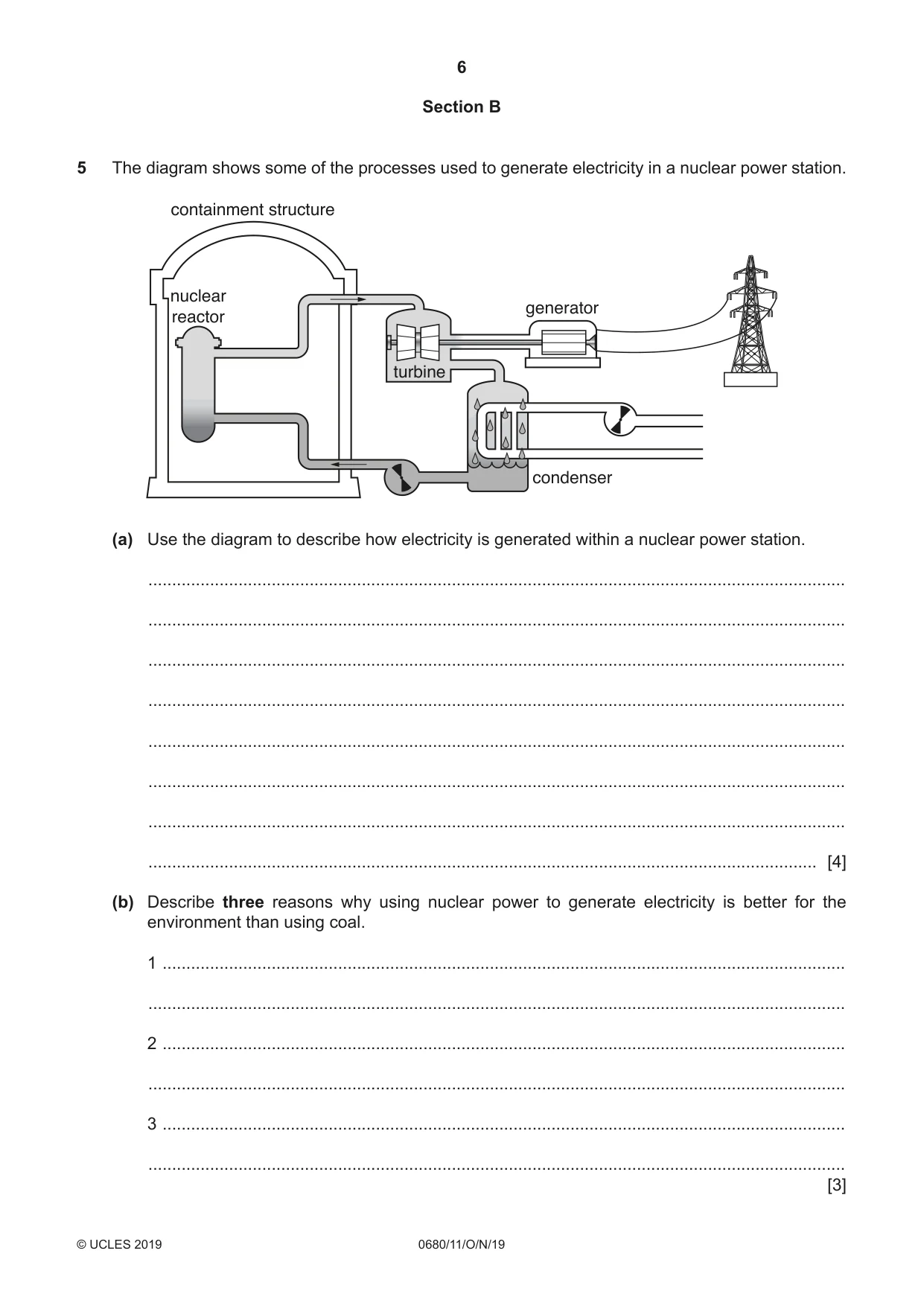
6 0680/11/O/N/19 © UCLES 2019 Section B 5 The diagram shows some of the processes used to generate electricity in a nuclear power station. nuclear reactor condenser generator turbine containment structure (a) Use the diagram to describe how electricity is generated within a nuclear power station. … … … … … … … … [4] (b) Describe three reasons why using nuclear power to generate electricity is better for the environment than using coal. 1 … … 2 … … 3 … … [3]
Question paper, page 7
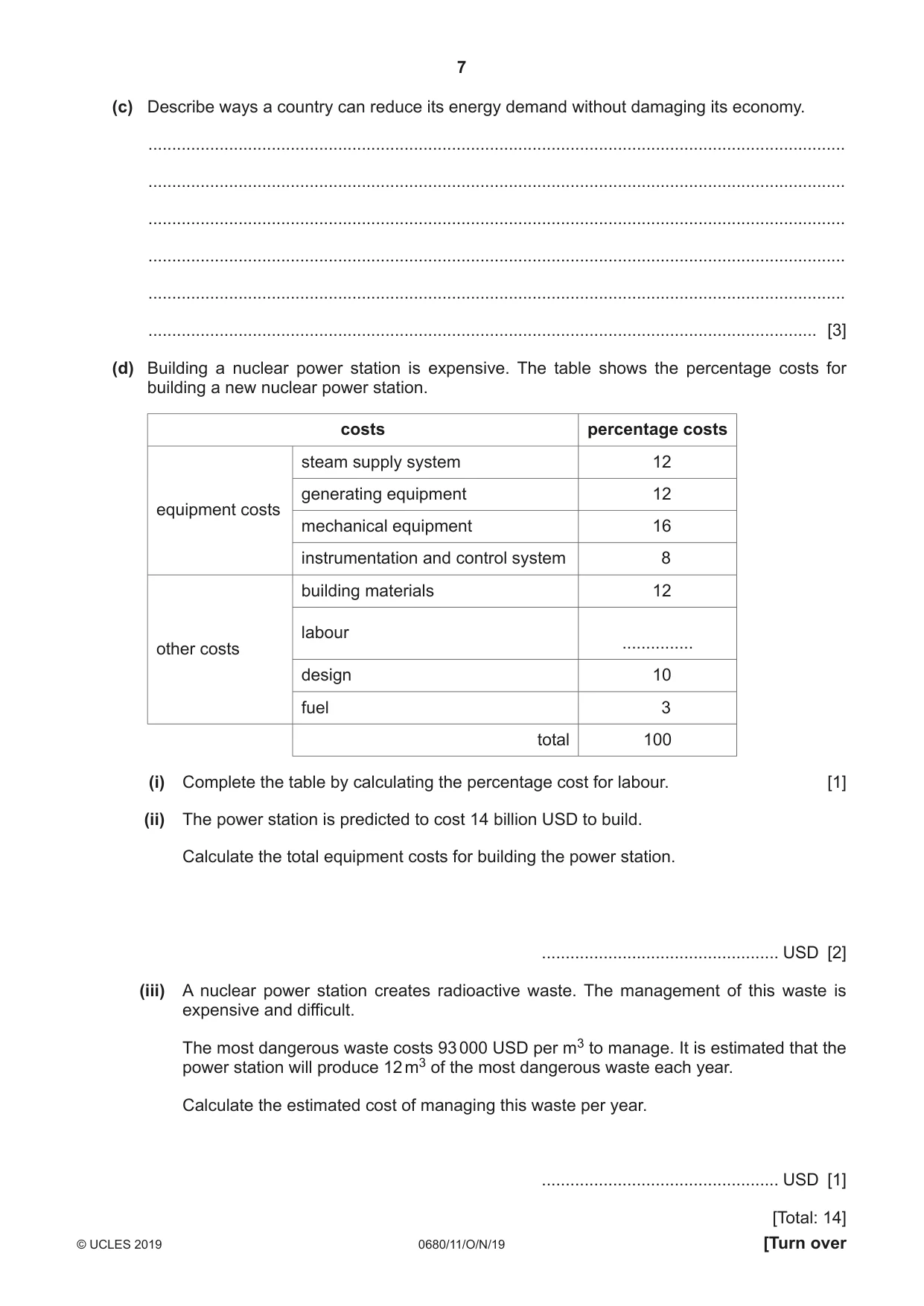
7 0680/11/O/N/19 © UCLES 2019 [Turn over (c) Describe ways a country can reduce its energy demand without damaging its economy. … … … … … … [3] (d) Building a nuclear power station is expensive. The table shows the percentage costs for building a new nuclear power station. costs percentage costs equipment costs steam supply system 12 generating equipment 12 mechanical equipment 16 instrumentation and control system 8 other costs building materials 12 labour … design 10 fuel 3 total 100 (i) Complete the table by calculating the percentage cost for labour. [1] (ii) The power station is predicted to cost 14 billion USD to build. Calculate the total equipment costs for building the power station. … USD [2] (iii) A nuclear power station creates radioactive waste. The management of this waste is expensive and difficult. The most dangerous waste costs 93 000 USD per m3 to manage. It is estimated that the power station will produce 12 m3 of the most dangerous waste each year. Calculate the estimated cost of managing this waste per year. … USD [1] [Total: 14]
Question paper, page 8
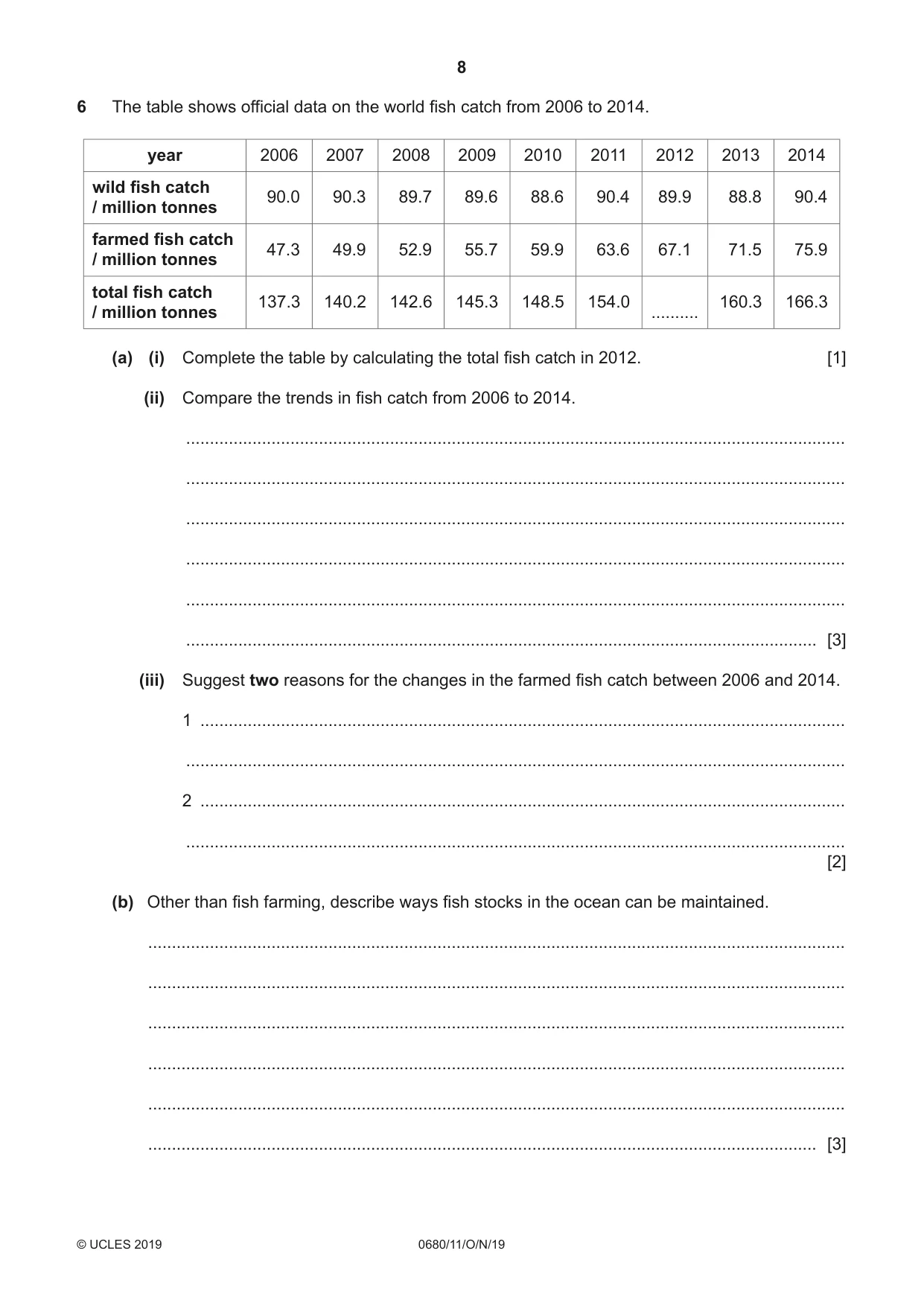
8 0680/11/O/N/19 © UCLES 2019 6 The table shows official data on the world fish catch from 2006 to 2014. year 2006 2007 2008 2009 2010 2011 2012 2013 2014 wild fish catch / million tonnes 90.0 90.3 89.7 89.6 88.6 90.4 89.9 88.8 90.4 farmed fish catch / million tonnes 47.3 49.9 52.9 55.7 59.9 63.6 67.1 71.5 75.9 total fish catch / million tonnes 137.3 140.2 142.6 145.3 148.5 154.0 … 160.3 166.3 (a) (i) Complete the table by calculating the total fish catch in 2012. [1] (ii) Compare the trends in fish catch from 2006 to 2014. … … … … … … [3] (iii) Suggest two reasons for the changes in the farmed fish catch between 2006 and 2014. 1 … … 2 … … [2] (b) Other than fish farming, describe ways fish stocks in the ocean can be maintained. … … … … … … [3]
Question paper, page 9
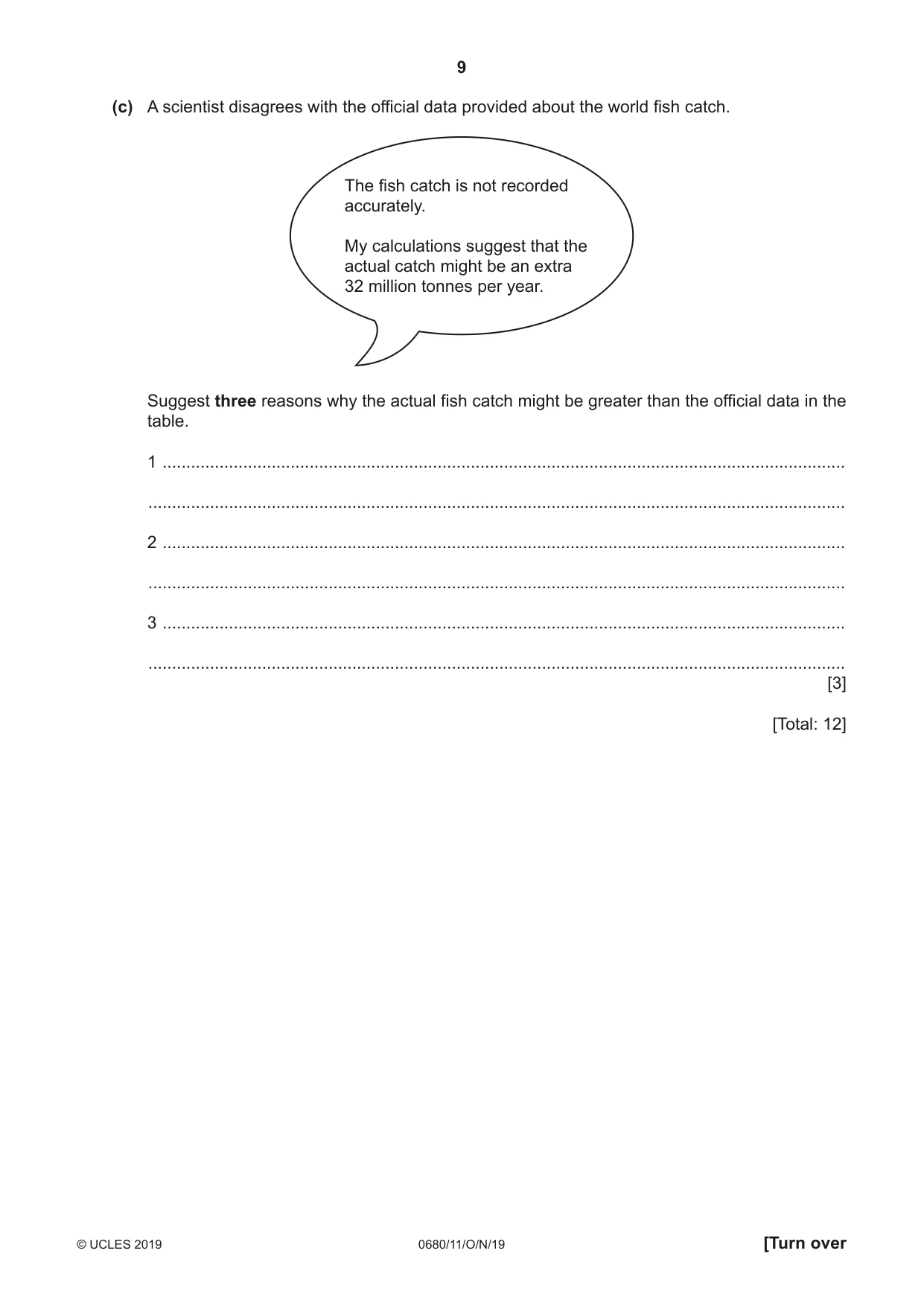
9 0680/11/O/N/19 © UCLES 2019 [Turn over (c) A scientist disagrees with the official data provided about the world fish catch. The fish catch is not recorded accurately. My calculations suggest that the actual catch might be an extra 32 million tonnes per year. Suggest three reasons why the actual fish catch might be greater than the official data in the table. 1 … … 2 … … 3 … … [3] [Total: 12]
Question paper, page 10
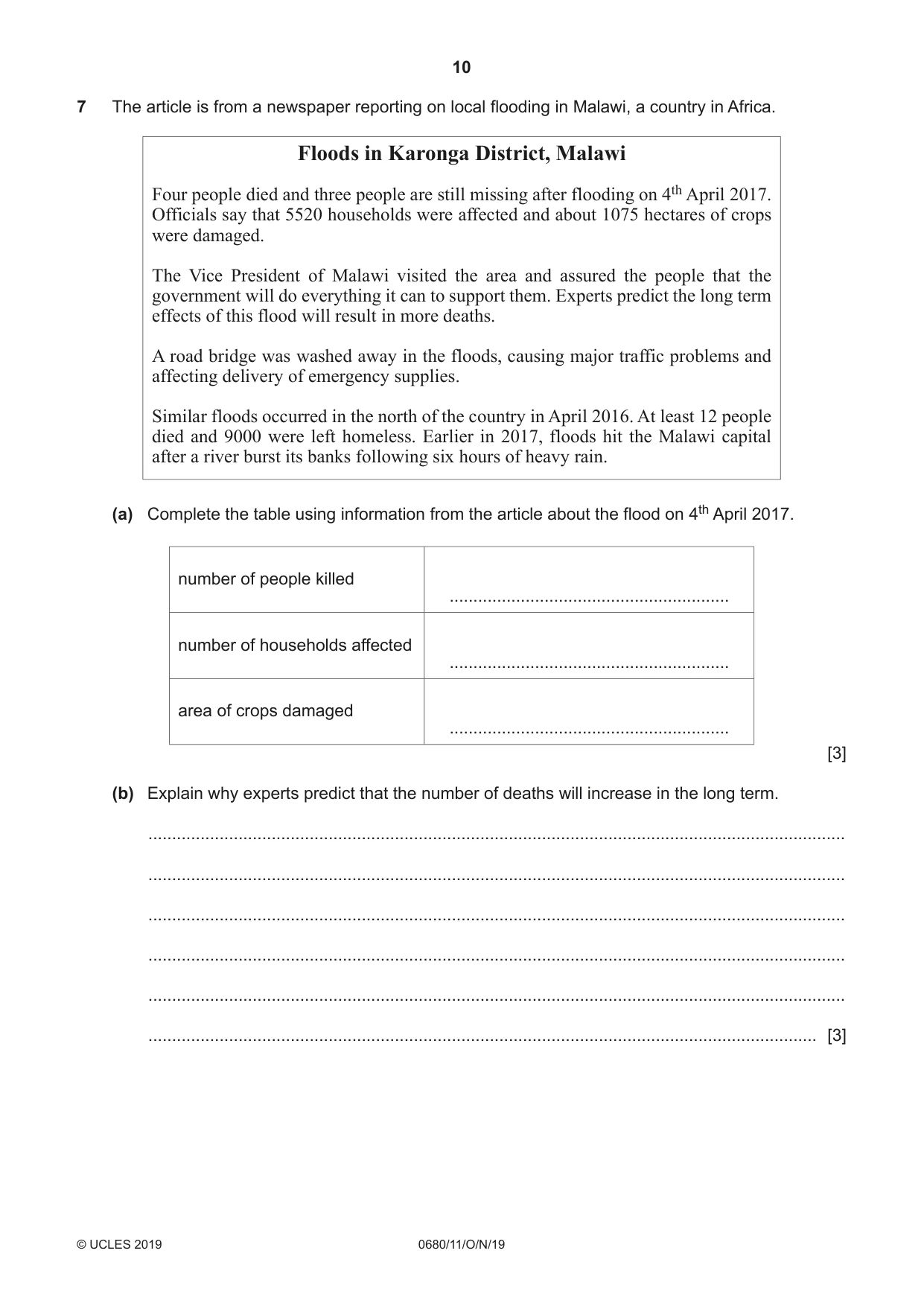
10 0680/11/O/N/19 © UCLES 2019 7 The article is from a newspaper reporting on local flooding in Malawi, a country in Africa. Floods in Karonga District, Malawi Four people died and three people are still missing after flooding on 4th April 2017. Officials say that 5520 households were affected and about 1075 hectares of crops were damaged. The Vice President of Malawi visited the area and assured the people that the government will do everything it can to support them. Experts predict the long term effects of this flood will result in more deaths. A road bridge was washed away in the floods, causing major traffic problems and affecting delivery of emergency supplies. Similar floods occurred in the north of the country in April 2016. At least 12 people died and 9000 were left homeless. Earlier in 2017, floods hit the Malawi capital after a river burst its banks following six hours of heavy rain. (a) Complete the table using information from the article about the flood on 4th April 2017. number of people killed … number of households affected … area of crops damaged … [3] (b) Explain why experts predict that the number of deaths will increase in the long term. … … … … … … [3]
Question paper, page 11
11 0680/11/O/N/19 © UCLES 2019 [Turn over (c) The government of Malawi are developing a plan to reduce the impact of future floods. Describe three ways the impact of flooding can be reduced. 1 … … 2 … … 3 … … [3] [Total: 9]
Question paper, page 12
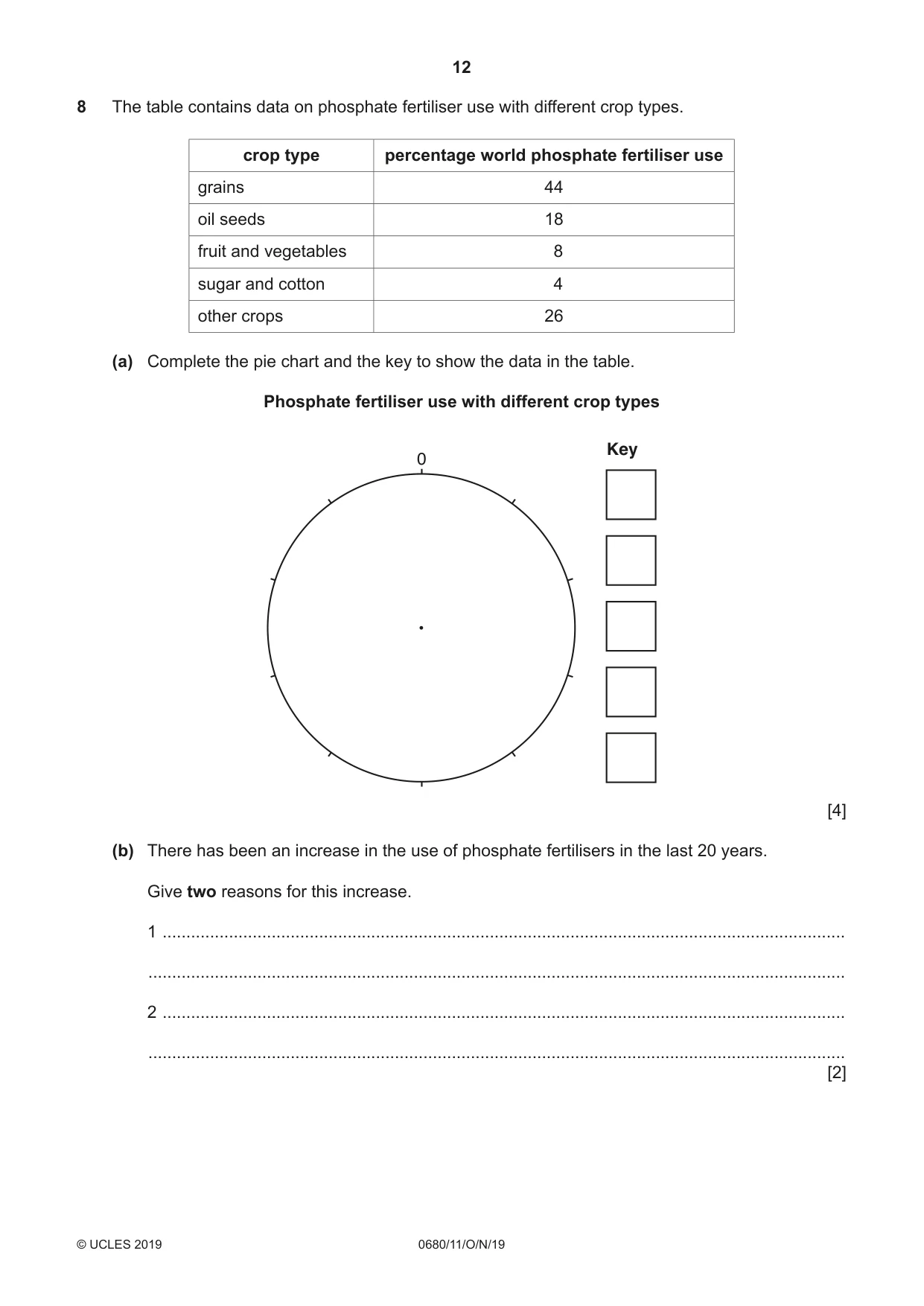
12 0680/11/O/N/19 © UCLES 2019 8 The table contains data on phosphate fertiliser use with different crop types. crop type percentage world phosphate fertiliser use grains 44 oil seeds 18 fruit and vegetables 8 sugar and cotton 4 other crops 26 (a) Complete the pie chart and the key to show the data in the table. Phosphate fertiliser use with different crop types Key 0 [4] (b) There has been an increase in the use of phosphate fertilisers in the last 20 years. Give two reasons for this increase. 1 … … 2 … … [2]
Question paper, page 13
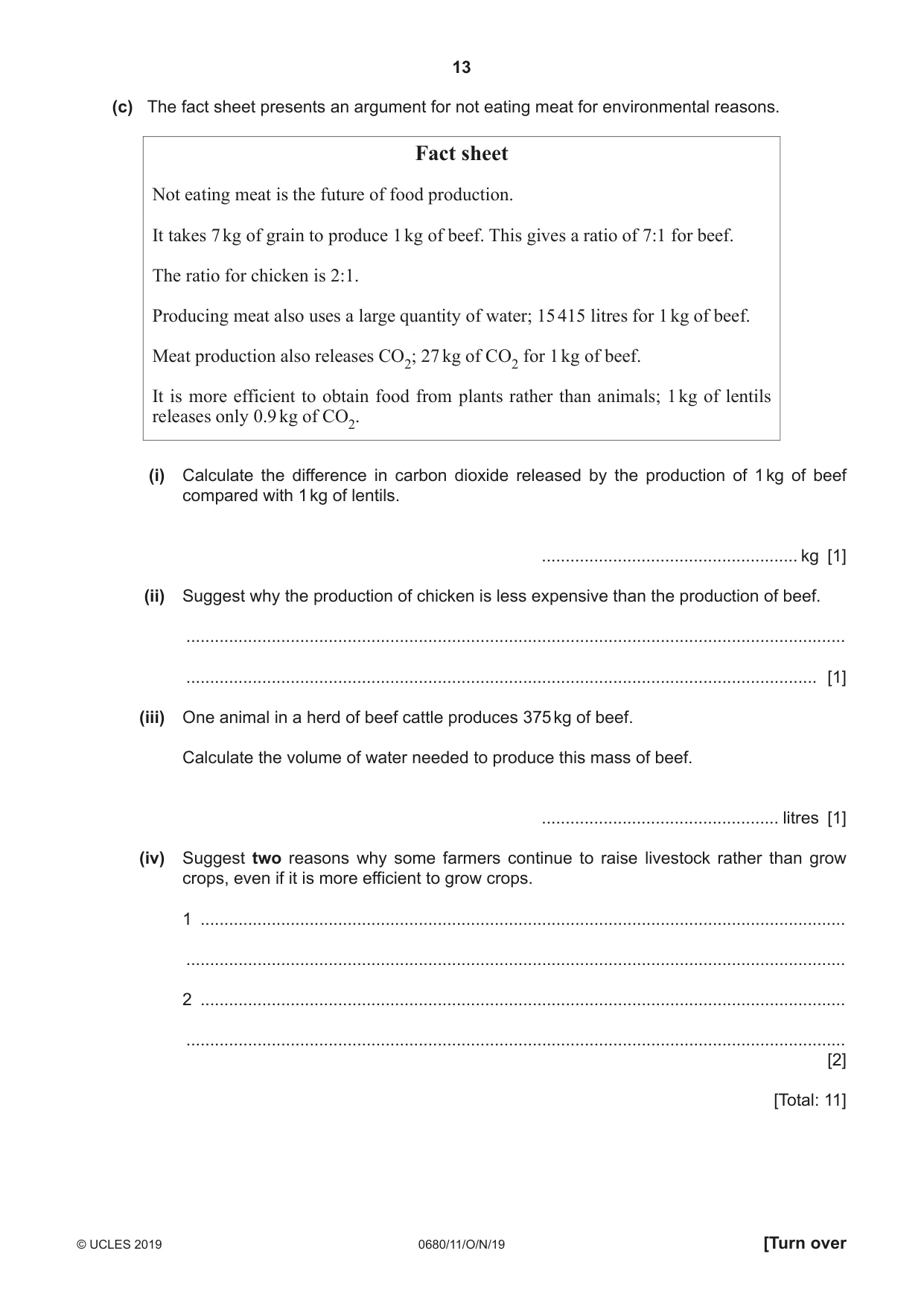
13 0680/11/O/N/19 © UCLES 2019 [Turn over (c) The fact sheet presents an argument for not eating meat for environmental reasons. Fact sheet Not eating meat is the future of food production. It takes 7 kg of grain to produce 1 kg of beef. This gives a ratio of 7:1 for beef. The ratio for chicken is 2:1. Producing meat also uses a large quantity of water; 15 415 litres for 1 kg of beef. Meat production also releases CO2; 27 kg of CO2 for 1 kg of beef. It is more efficient to obtain food from plants rather than animals; 1 kg of lentils releases only 0.9 kg of CO2. (i) Calculate the difference in carbon dioxide released by the production of 1 kg of beef compared with 1 kg of lentils. … kg [1] (ii) Suggest why the production of chicken is less expensive than the production of beef. … … [1] (iii) One animal in a herd of beef cattle produces 375 kg of beef. Calculate the volume of water needed to produce this mass of beef. … litres [1] (iv) Suggest two reasons why some farmers continue to raise livestock rather than grow crops, even if it is more efficient to grow crops. 1 … … 2 … … [2] [Total: 11]
Question paper, page 14
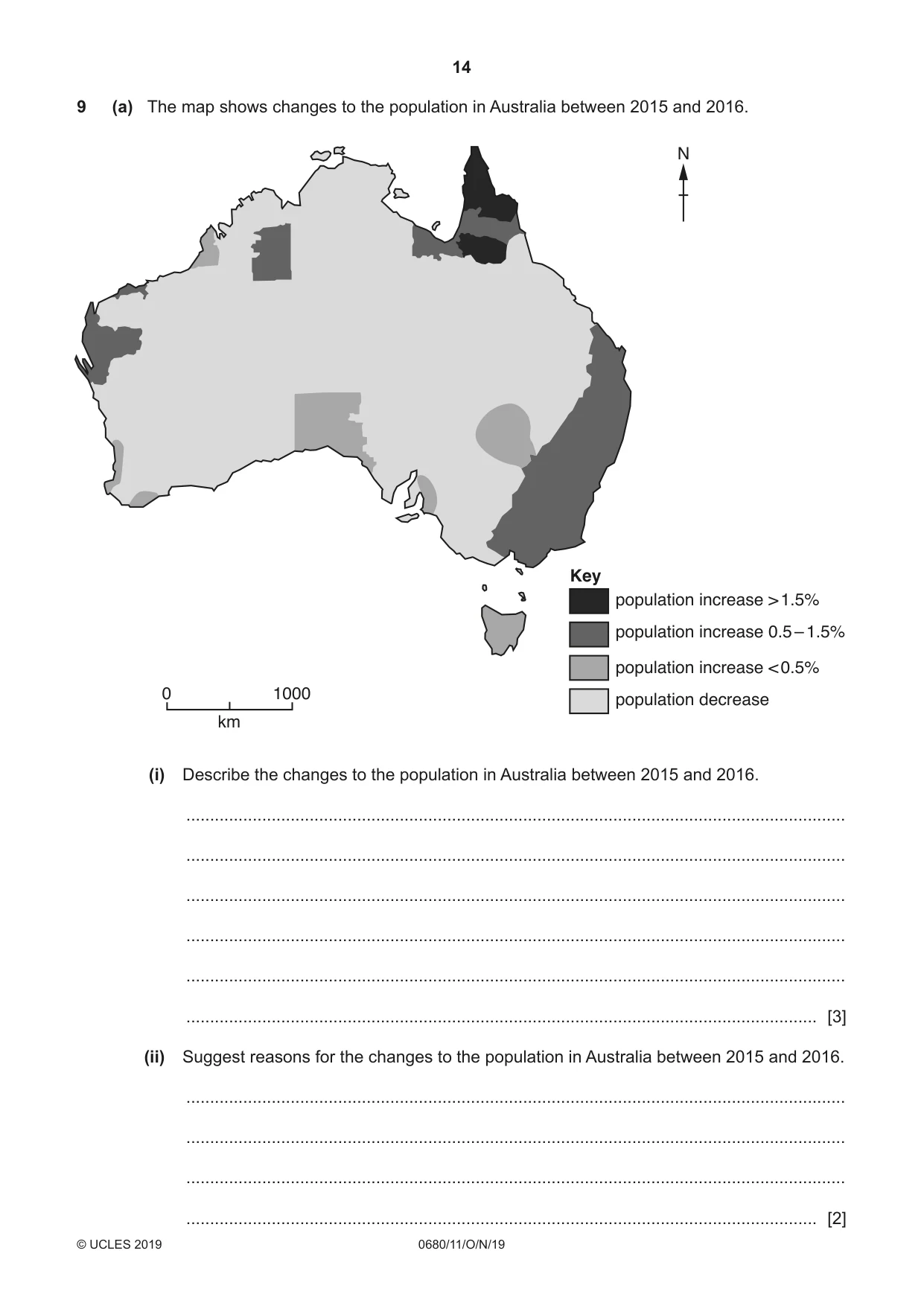
14 0680/11/O/N/19 © UCLES 2019 9 (a) The map shows changes to the population in Australia between 2015 and 2016. 0 1000 population increase > 1.5% population increase 0.5 – 1.5% population increase < 0.5% population decrease km N Key (i) Describe the changes to the population in Australia between 2015 and 2016. … … … … … … [3] (ii) Suggest reasons for the changes to the population in Australia between 2015 and 2016. … … … … [2]
Question paper, page 15
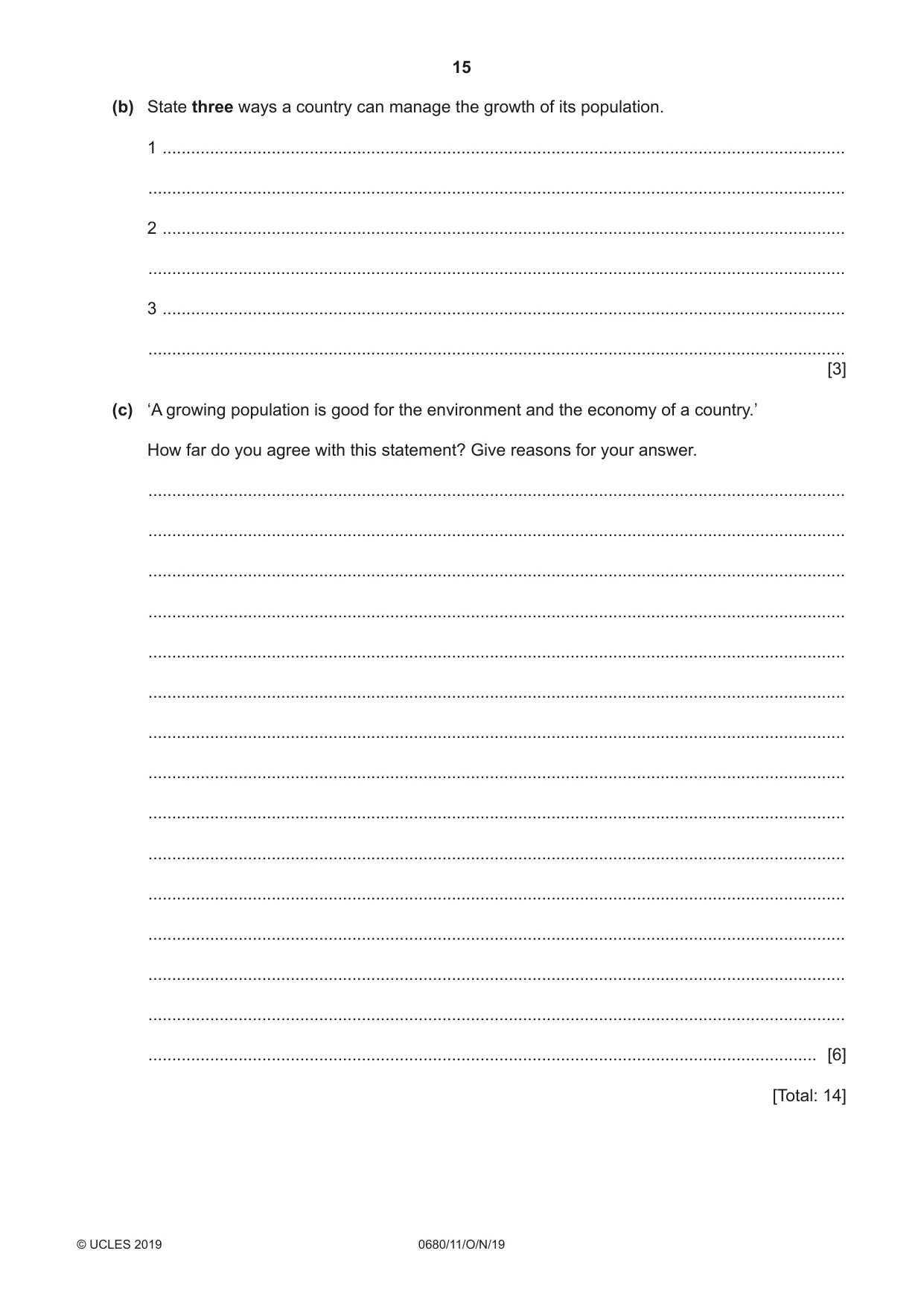
15 0680/11/O/N/19 © UCLES 2019 (b) State three ways a country can manage the growth of its population. 1 … … 2 … … 3 … … [3] (c) ‘A growing population is good for the environment and the economy of a country.’ How far do you agree with this statement? Give reasons for your answer. … … … … … … … … … … … … … … … [6] [Total: 14]
Question paper, page 16
16 0680/11/O/N/19 © UCLES 2019 Permission to reproduce items where third-party owned material protected by copyright is included has been sought and cleared where possible. Every reasonable effort has been made by the publisher (UCLES) to trace copyright holders, but if any items requiring clearance have unwittingly been included, the publisher will be pleased to make amends at the earliest possible opportunity. To avoid the issue of disclosure of answer-related information to candidates, all copyright acknowledgements are reproduced online in the Cambridge Assessment International Education Copyright Acknowledgements Booklet. This is produced for each series of examinations and is freely available to download at www.cambridgeinternational.org after the live examination series. Cambridge Assessment International Education is part of the Cambridge Assessment Group. Cambridge Assessment is the brand name of the University of Cambridge Local Examinations Syndicate (UCLES), which itself is a department of the University of Cambridge. BLANK PAGE
Mark scheme, page 1
This document consists of 12 printed pages. © UCLES 2019 [Turn over Cambridge Assessment International Education Cambridge International General Certificate of Secondary Education ENVIRONMENTAL MANAGEMENT 0680/11 Paper 1 Theory October/November 2019 MARK SCHEME Maximum Mark: 80 Published This mark scheme is published as an aid to teachers and candidates, to indicate the requirements of the examination. It shows the basis on which Examiners were instructed to award marks. It does not indicate the details of the discussions that took place at an Examiners’ meeting before marking began, which would have considered the acceptability of alternative answers. Mark schemes should be read in conjunction with the question paper and the Principal Examiner Report for Teachers. Cambridge International will not enter into discussions about these mark schemes. Cambridge International is publishing the mark schemes for the October/November 2019 series for most Cambridge IGCSE™, Cambridge International A and AS Level components and some Cambridge O Level components.
Mark scheme, page 2
0680/11 Cambridge IGCSE – Mark Scheme PUBLISHED October/November 2019 © UCLES 2019 Page 2 of 12 Generic Marking Principles These general marking principles must be applied by all examiners when marking candidate answers. They should be applied alongside the specific content of the mark scheme or generic level descriptors for a question. Each question paper and mark scheme will also comply with these marking principles. GENERIC MARKING PRINCIPLE 1: Marks must be awarded in line with: • the specific content of the mark scheme or the generic level descriptors for the question • the specific skills defined in the mark scheme or in the generic level descriptors for the question • the standard of response required by a candidate as exemplified by the standardisation scripts. GENERIC MARKING PRINCIPLE 2: Marks awarded are always whole marks (not half marks, or other fractions). GENERIC MARKING PRINCIPLE 3: Marks must be awarded positively: • marks are awarded for correct / valid answers, as defined in the mark scheme. However, credit is given for valid answers which go beyond the scope of the syllabus and mark scheme, referring to your Team Leader as appropriate • marks are awarded when candidates clearly demonstrate what they know and can do • marks are not deducted for errors • marks are not deducted for omissions • answers should only be judged on the quality of spelling, punctuation and grammar when these features are specifically assessed by the question as indicated by the mark scheme. The meaning, however, should be unambiguous. GENERIC MARKING PRINCIPLE 4: Rules must be applied consistently e.g. in situations where candidates have not followed instructions or in the application of generic level descriptors.
Mark scheme, page 3
0680/11 Cambridge IGCSE – Mark Scheme PUBLISHED October/November 2019 © UCLES 2019 Page 3 of 12 GENERIC MARKING PRINCIPLE 5: Marks should be awarded using the full range of marks defined in the mark scheme for the question (however; the use of the full mark range may be limited according to the quality of the candidate responses seen). GENERIC MARKING PRINCIPLE 6: Marks awarded are based solely on the requirements as defined in the mark scheme. Marks should not be awarded with grade thresholds or grade descriptors in mind.
Mark scheme, page 4
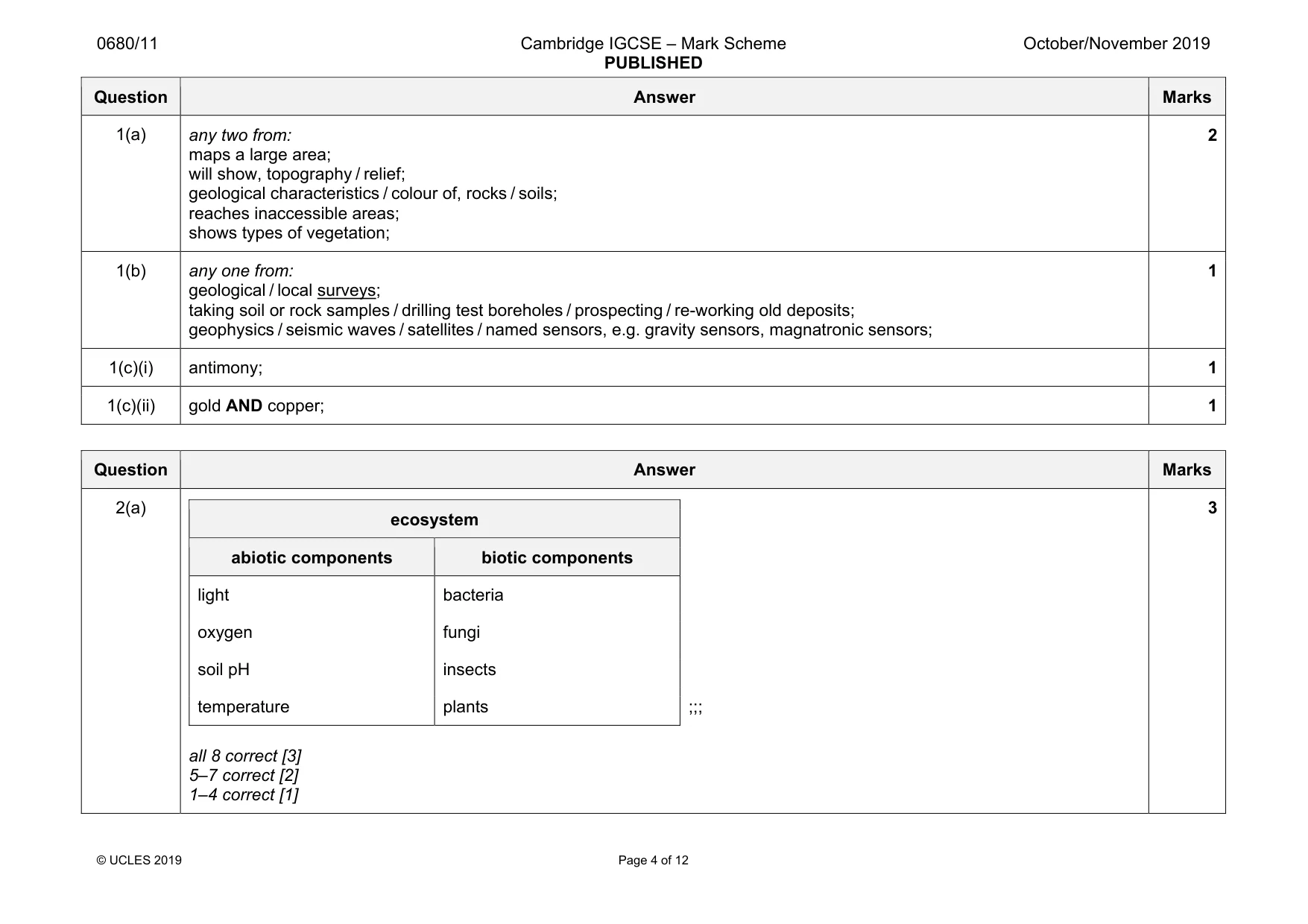
0680/11 Cambridge IGCSE – Mark Scheme PUBLISHED October/November 2019 © UCLES 2019 Page 4 of 12 Question Answer Marks 1(a) any two from: maps a large area; will show, topography / relief; geological characteristics / colour of, rocks / soils; reaches inaccessible areas; shows types of vegetation; 2 1(b) any one from: geological / local surveys; taking soil or rock samples / drilling test boreholes / prospecting / re-working old deposits; geophysics / seismic waves / satellites / named sensors, e.g. gravity sensors, magnatronic sensors; 1 1(c)(i) antimony; 1 1(c)(ii) gold AND copper; 1 Question Answer Marks 2(a) ecosystem abiotic components biotic components light bacteria oxygen fungi soil pH insects temperature plants ;;; all 8 correct [3] 5–7 correct [2] 1–4 correct [1] 3
Mark scheme, page 5
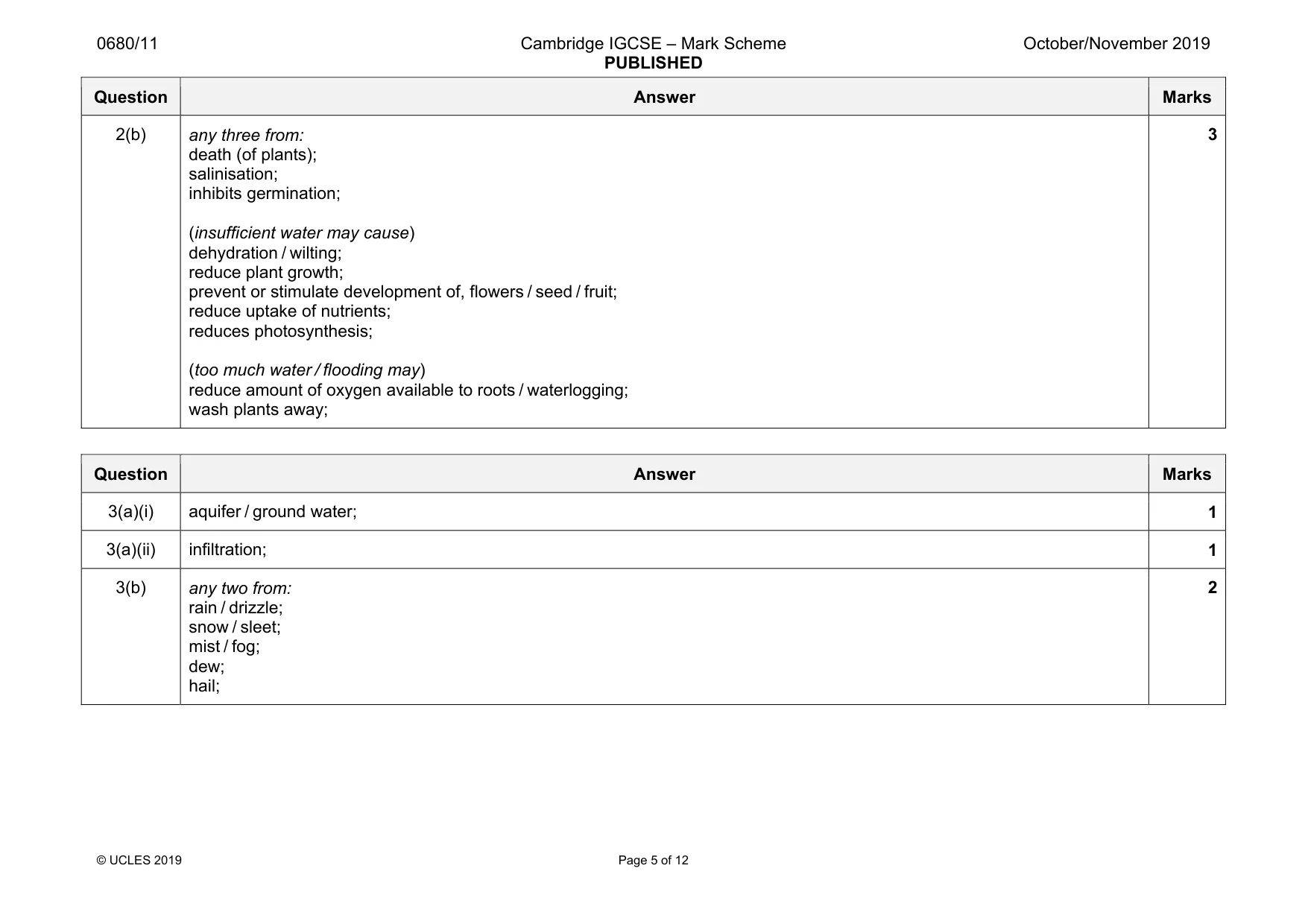
0680/11 Cambridge IGCSE – Mark Scheme PUBLISHED October/November 2019 © UCLES 2019 Page 5 of 12 Question Answer Marks 2(b) any three from: death (of plants); salinisation; inhibits germination; (insufficient water may cause) dehydration / wilting; reduce plant growth; prevent or stimulate development of, flowers / seed / fruit; reduce uptake of nutrients; reduces photosynthesis; (too much water / flooding may) reduce amount of oxygen available to roots / waterlogging; wash plants away; 3 Question Answer Marks 3(a)(i) aquifer / ground water; 1 3(a)(ii) infiltration; 1 3(b) any two from: rain / drizzle; snow / sleet; mist / fog; dew; hail; 2
Mark scheme, page 6
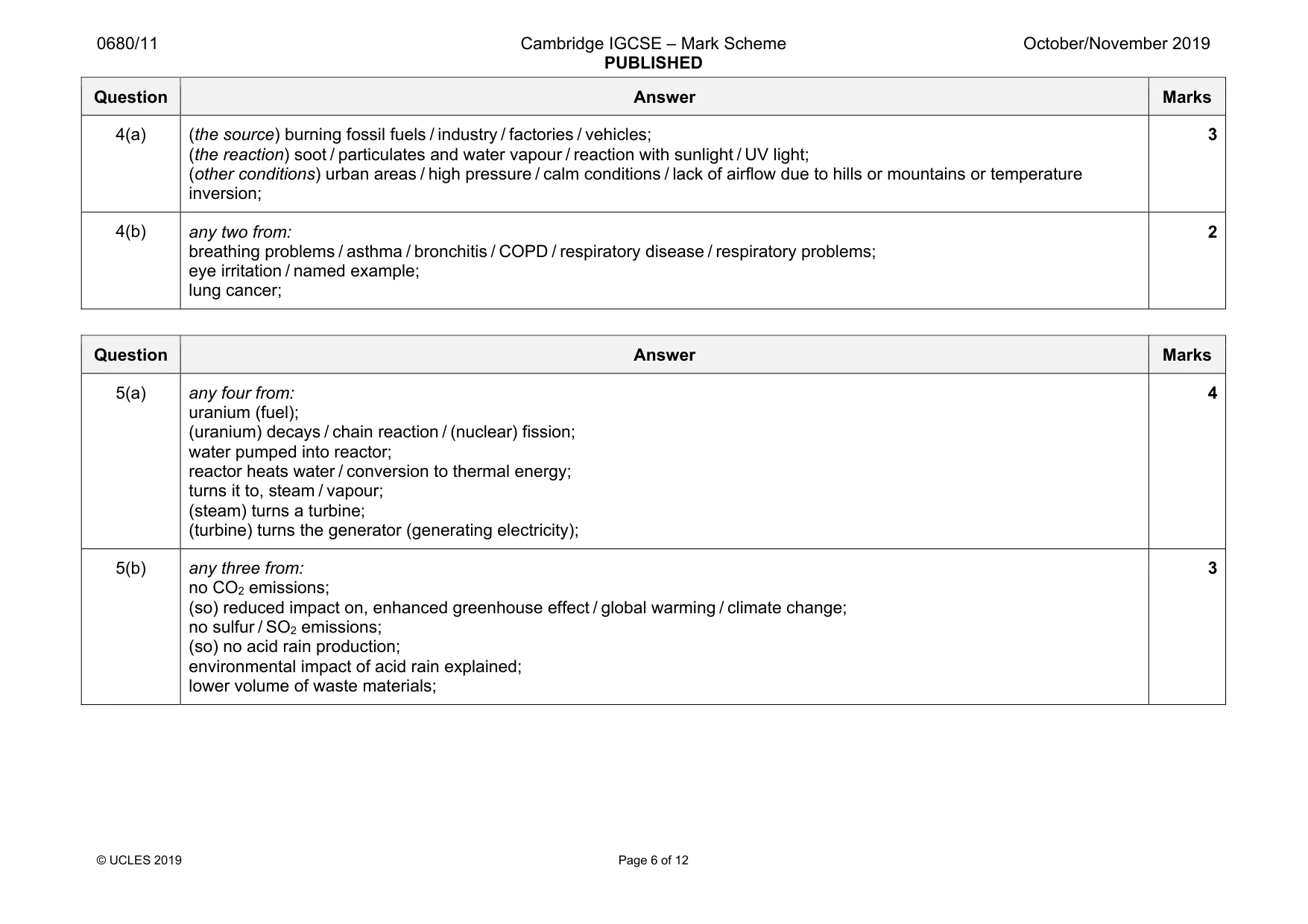
0680/11 Cambridge IGCSE – Mark Scheme PUBLISHED October/November 2019 © UCLES 2019 Page 6 of 12 Question Answer Marks 4(a) (the source) burning fossil fuels / industry / factories / vehicles; (the reaction) soot / particulates and water vapour / reaction with sunlight / UV light; (other conditions) urban areas / high pressure / calm conditions / lack of airflow due to hills or mountains or temperature inversion; 3 4(b) any two from: breathing problems / asthma / bronchitis / COPD / respiratory disease / respiratory problems; eye irritation / named example; lung cancer; 2 Question Answer Marks 5(a) any four from: uranium (fuel); (uranium) decays / chain reaction / (nuclear) fission; water pumped into reactor; reactor heats water / conversion to thermal energy; turns it to, steam / vapour; (steam) turns a turbine; (turbine) turns the generator (generating electricity); 4 5(b) any three from: no CO2 emissions; (so) reduced impact on, enhanced greenhouse effect / global warming / climate change; no sulfur / SO2 emissions; (so) no acid rain production; environmental impact of acid rain explained; lower volume of waste materials; 3
Mark scheme, page 7
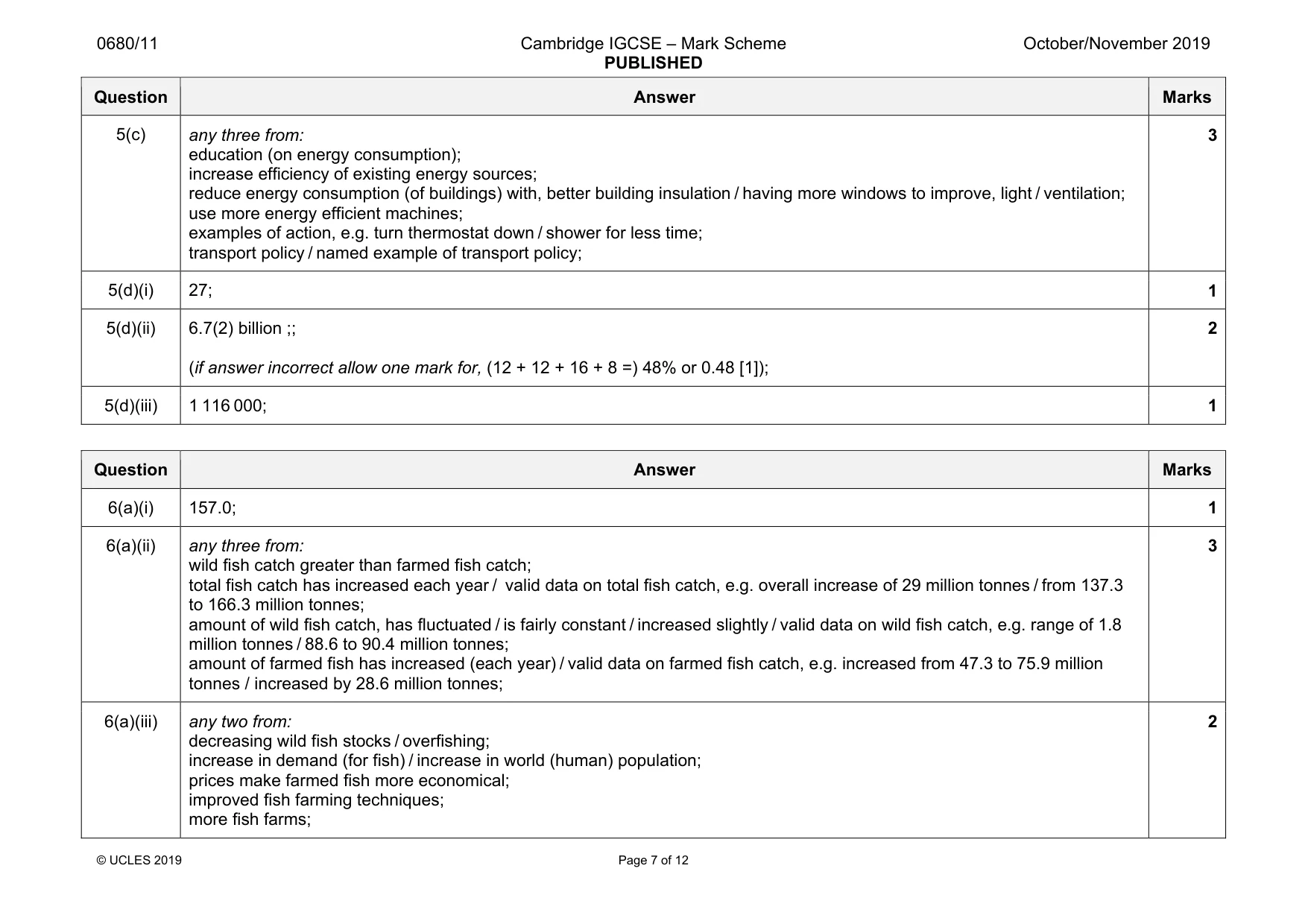
0680/11 Cambridge IGCSE – Mark Scheme PUBLISHED October/November 2019 © UCLES 2019 Page 7 of 12 Question Answer Marks 5(c) any three from: education (on energy consumption); increase efficiency of existing energy sources; reduce energy consumption (of buildings) with, better building insulation / having more windows to improve, light / ventilation; use more energy efficient machines; examples of action, e.g. turn thermostat down / shower for less time; transport policy / named example of transport policy; 3 5(d)(i) 27; 1 5(d)(ii) 6.7(2) billion ;; (if answer incorrect allow one mark for, (12 + 12 + 16 + 8 =) 48% or 0.48 [1]); 2 5(d)(iii) 1 116 000; 1 Question Answer Marks 6(a)(i) 157.0; 1 6(a)(ii) any three from: wild fish catch greater than farmed fish catch; total fish catch has increased each year / valid data on total fish catch, e.g. overall increase of 29 million tonnes / from 137.3 to 166.3 million tonnes; amount of wild fish catch, has fluctuated / is fairly constant / increased slightly / valid data on wild fish catch, e.g. range of 1.8 million tonnes / 88.6 to 90.4 million tonnes; amount of farmed fish has increased (each year) / valid data on farmed fish catch, e.g. increased from 47.3 to 75.9 million tonnes / increased by 28.6 million tonnes; 3 6(a)(iii) any two from: decreasing wild fish stocks / overfishing; increase in demand (for fish) / increase in world (human) population; prices make farmed fish more economical; improved fish farming techniques; more fish farms; 2
Mark scheme, page 8
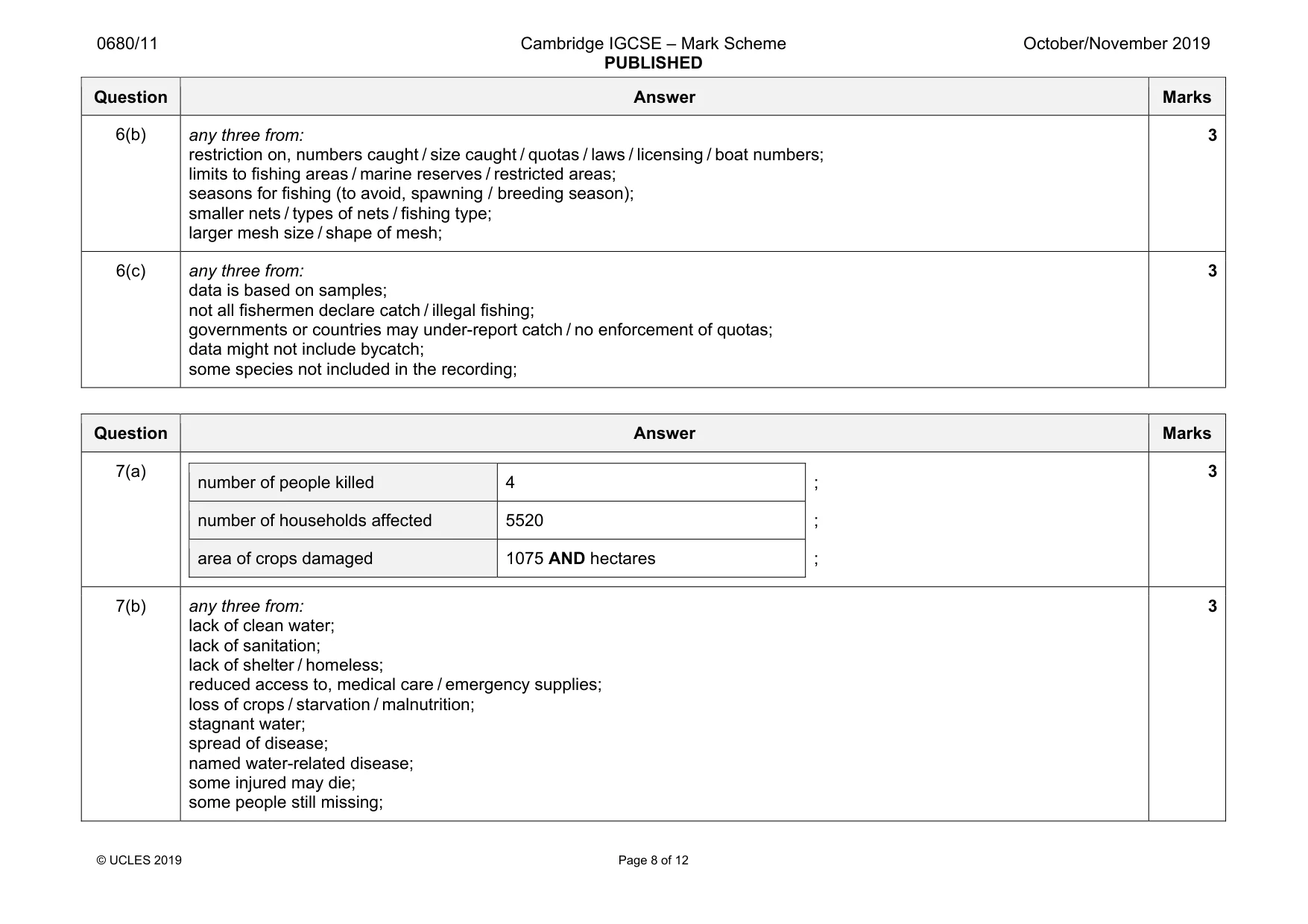
0680/11 Cambridge IGCSE – Mark Scheme PUBLISHED October/November 2019 © UCLES 2019 Page 8 of 12 Question Answer Marks 6(b) any three from: restriction on, numbers caught / size caught / quotas / laws / licensing / boat numbers; limits to fishing areas / marine reserves / restricted areas; seasons for fishing (to avoid, spawning / breeding season); smaller nets / types of nets / fishing type; larger mesh size / shape of mesh; 3 6(c) any three from: data is based on samples; not all fishermen declare catch / illegal fishing; governments or countries may under-report catch / no enforcement of quotas; data might not include bycatch; some species not included in the recording; 3 Question Answer Marks 7(a) number of people killed 4 ; number of households affected 5520 ; area of crops damaged 1075 AND hectares ; 3 7(b) any three from: lack of clean water; lack of sanitation; lack of shelter / homeless; reduced access to, medical care / emergency supplies; loss of crops / starvation / malnutrition; stagnant water; spread of disease; named water-related disease; some injured may die; some people still missing; 3
Mark scheme, page 9
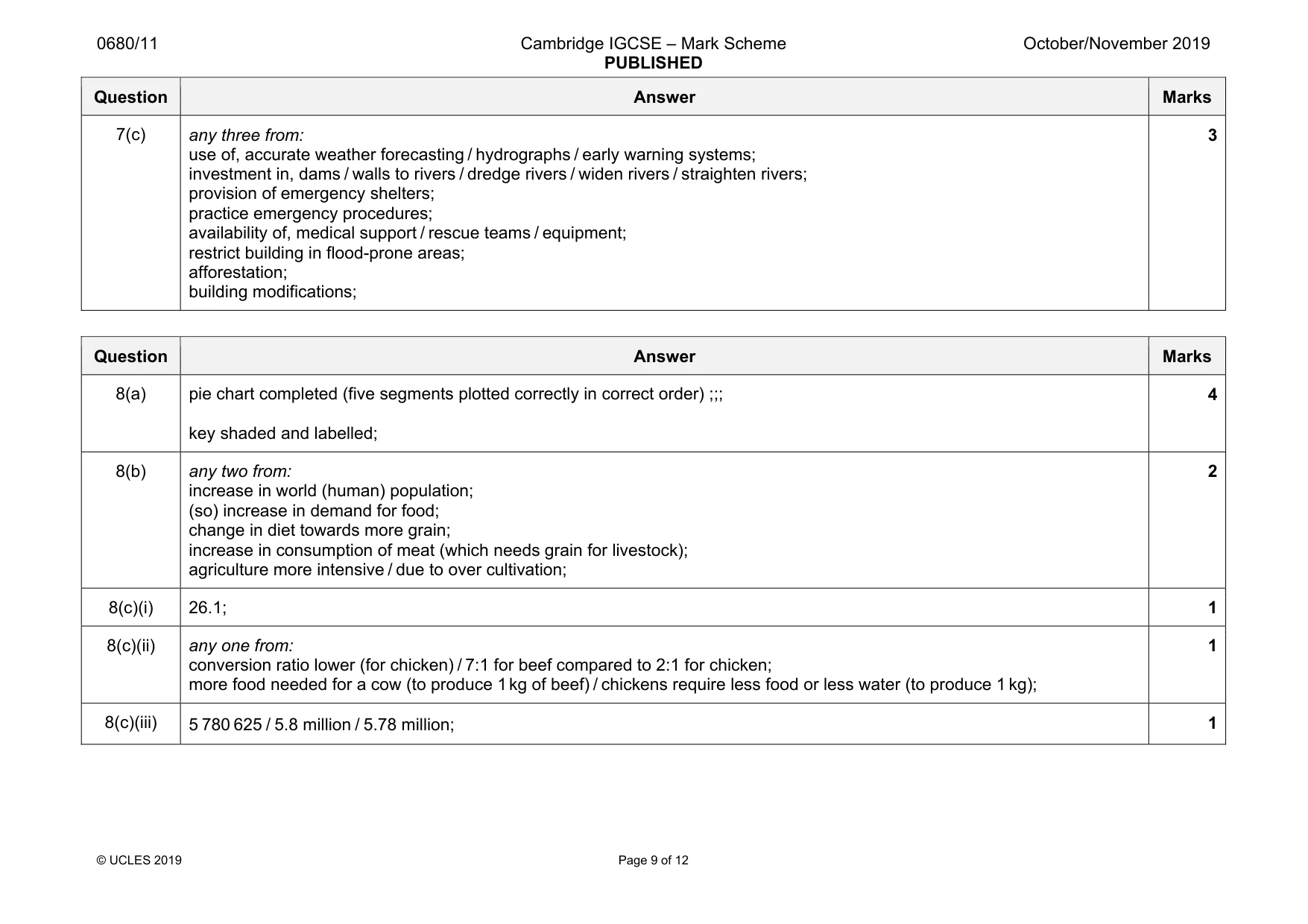
0680/11 Cambridge IGCSE – Mark Scheme PUBLISHED October/November 2019 © UCLES 2019 Page 9 of 12 Question Answer Marks 7(c) any three from: use of, accurate weather forecasting / hydrographs / early warning systems; investment in, dams / walls to rivers / dredge rivers / widen rivers / straighten rivers; provision of emergency shelters; practice emergency procedures; availability of, medical support / rescue teams / equipment; restrict building in flood-prone areas; afforestation; building modifications; 3 Question Answer Marks 8(a) pie chart completed (five segments plotted correctly in correct order) ;;; key shaded and labelled; 4 8(b) any two from: increase in world (human) population; (so) increase in demand for food; change in diet towards more grain; increase in consumption of meat (which needs grain for livestock); agriculture more intensive / due to over cultivation; 2 8(c)(i) 26.1; 1 8(c)(ii) any one from: conversion ratio lower (for chicken) / 7:1 for beef compared to 2:1 for chicken; more food needed for a cow (to produce 1kg of beef) / chickens require less food or less water (to produce 1 kg); 1 8(c)(iii) 5 780 625 / 5.8 million / 5.78 million; 1
Mark scheme, page 10
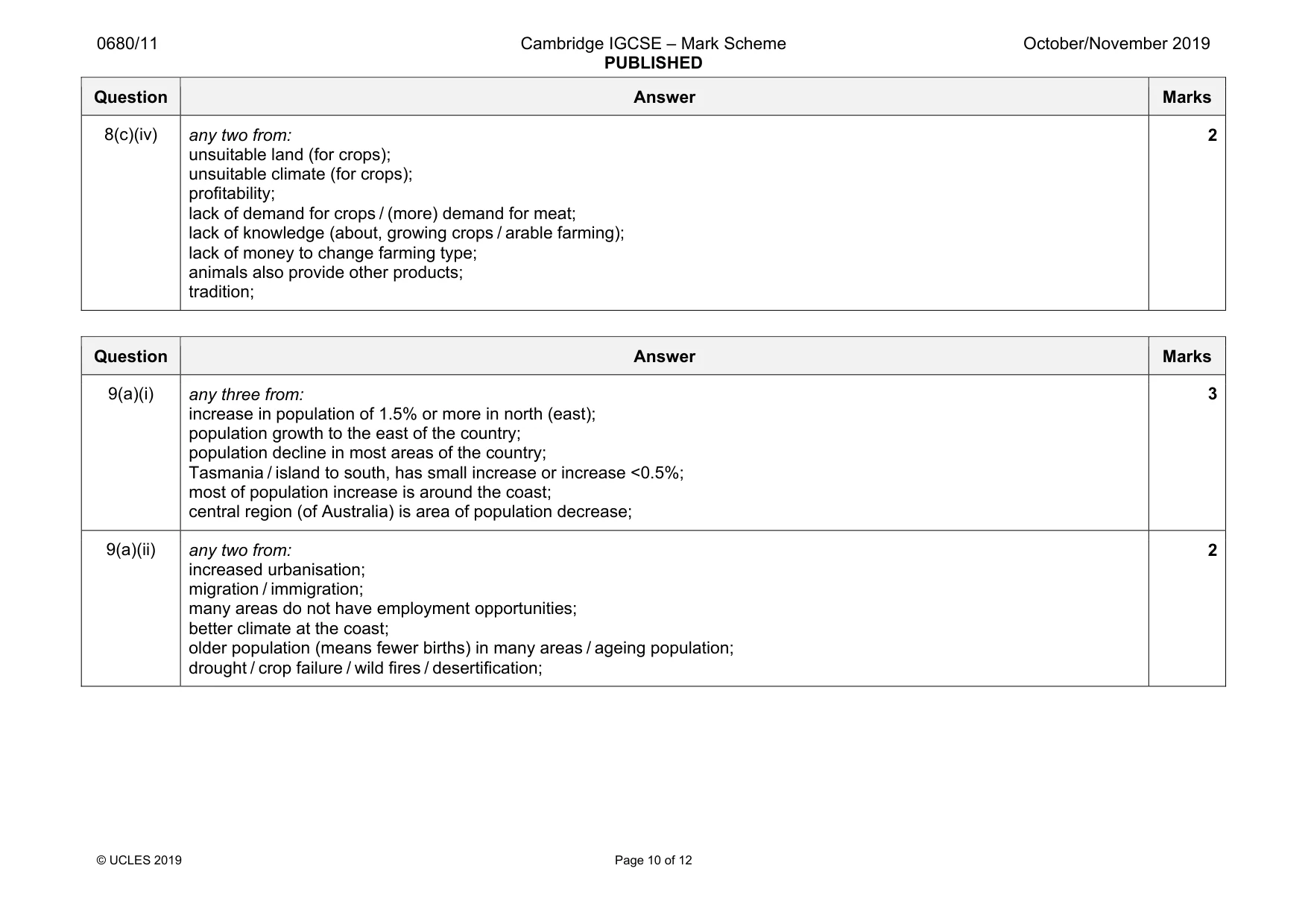
0680/11 Cambridge IGCSE – Mark Scheme PUBLISHED October/November 2019 © UCLES 2019 Page 10 of 12 Question Answer Marks 8(c)(iv) any two from: unsuitable land (for crops); unsuitable climate (for crops); profitability; lack of demand for crops / (more) demand for meat; lack of knowledge (about, growing crops / arable farming); lack of money to change farming type; animals also provide other products; tradition; 2 Question Answer Marks 9(a)(i) any three from: increase in population of 1.5% or more in north (east); population growth to the east of the country; population decline in most areas of the country; Tasmania / island to south, has small increase or increase <0.5%; most of population increase is around the coast; central region (of Australia) is area of population decrease; 3 9(a)(ii) any two from: increased urbanisation; migration / immigration; many areas do not have employment opportunities; better climate at the coast; older population (means fewer births) in many areas / ageing population; drought / crop failure / wild fires / desertification; 2
Mark scheme, page 11
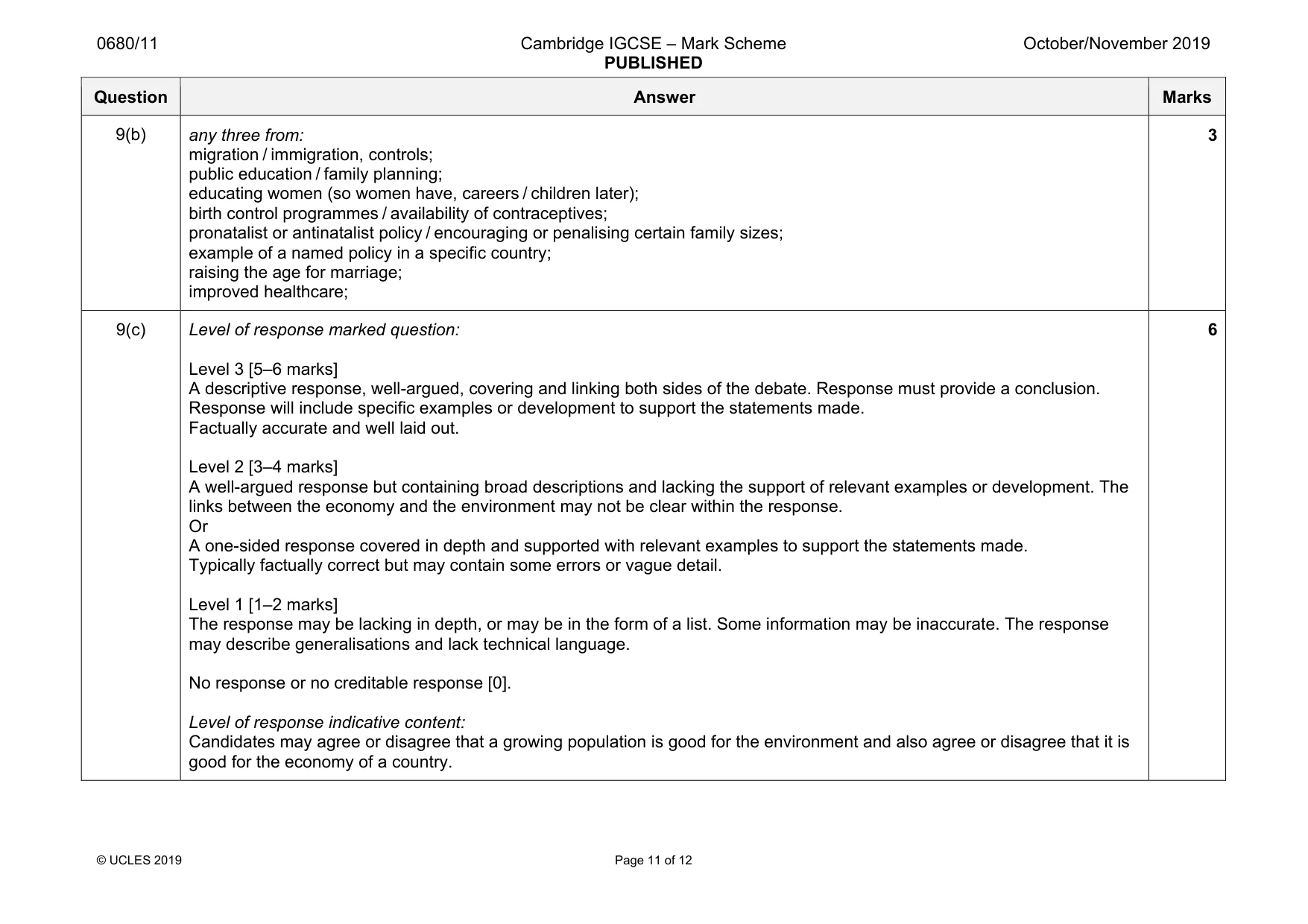
0680/11 Cambridge IGCSE – Mark Scheme PUBLISHED October/November 2019 © UCLES 2019 Page 11 of 12 Question Answer Marks 9(b) any three from: migration / immigration, controls; public education / family planning; educating women (so women have, careers / children later); birth control programmes / availability of contraceptives; pronatalist or antinatalist policy / encouraging or penalising certain family sizes; example of a named policy in a specific country; raising the age for marriage; improved healthcare; 3 9(c) Level of response marked question: Level 3 [5–6 marks] A descriptive response, well-argued, covering and linking both sides of the debate. Response must provide a conclusion. Response will include specific examples or development to support the statements made. Factually accurate and well laid out. Level 2 [3–4 marks] A well-argued response but containing broad descriptions and lacking the support of relevant examples or development. The links between the economy and the environment may not be clear within the response. Or A one-sided response covered in depth and supported with relevant examples to support the statements made. Typically factually correct but may contain some errors or vague detail. Level 1 [1–2 marks] The response may be lacking in depth, or may be in the form of a list. Some information may be inaccurate. The response may describe generalisations and lack technical language. No response or no creditable response [0]. Level of response indicative content: Candidates may agree or disagree that a growing population is good for the environment and also agree or disagree that it is good for the economy of a country. 6
Mark scheme, page 12
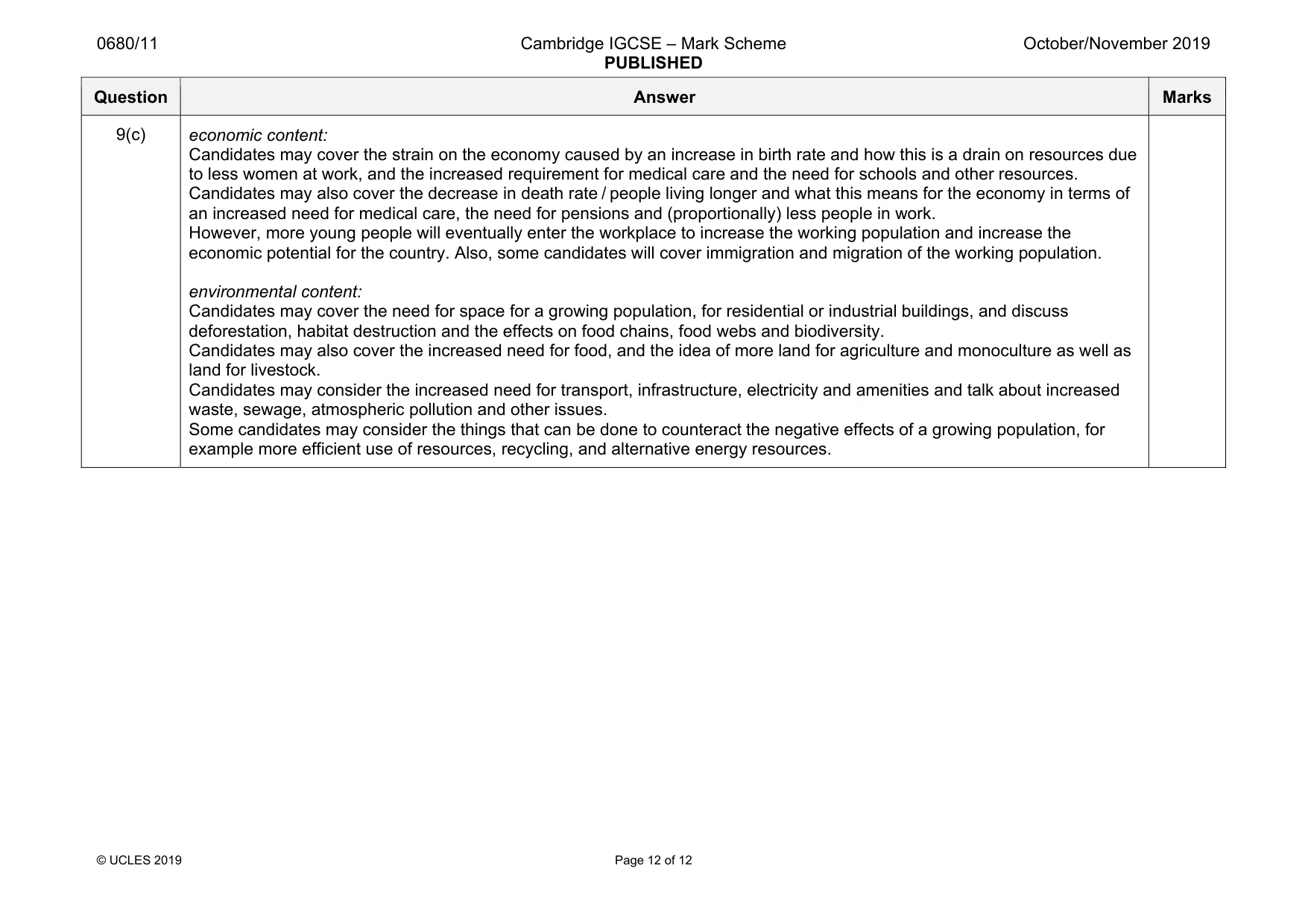
0680/11 Cambridge IGCSE – Mark Scheme PUBLISHED October/November 2019 © UCLES 2019 Page 12 of 12 Question Answer Marks 9(c) economic content: Candidates may cover the strain on the economy caused by an increase in birth rate and how this is a drain on resources due to less women at work, and the increased requirement for medical care and the need for schools and other resources. Candidates may also cover the decrease in death rate / people living longer and what this means for the economy in terms of an increased need for medical care, the need for pensions and (proportionally) less people in work. However, more young people will eventually enter the workplace to increase the working population and increase the economic potential for the country. Also, some candidates will cover immigration and migration of the working population. environmental content: Candidates may cover the need for space for a growing population, for residential or industrial buildings, and discuss deforestation, habitat destruction and the effects on food chains, food webs and biodiversity. Candidates may also cover the increased need for food, and the idea of more land for agriculture and monoculture as well as land for livestock. Candidates may consider the increased need for transport, infrastructure, electricity and amenities and talk about increased waste, sewage, atmospheric pollution and other issues. Some candidates may consider the things that can be done to counteract the negative effects of a growing population, for example more efficient use of resources, recycling, and alternative energy resources.
What you needed in this session
Cambridge’s own grade thresholds for 2019 Oct/Nov, Paper 1 · Variant 1. A higher threshold means an easier paper — the bar moves with how the cohort did.