Cambridge IGCSE Environmental Management 0680 — 2019 Oct/Nov Paper 1 · Variant 3
0680/13/O/N/19 · 80 marks · ≈90 min
The question paper and its mark scheme, free to read here and free to download. This is Cambridge’s own paper, exactly as it was sat.
Question paper20 pages


Mark scheme13 pages
Answers below. Sit the paper first if you are practising.
Paper as text
Question paper, page 1
This document consists of 18 printed pages and 2 blank pages. DC (ST/CT) 172932/2 © UCLES 2019 [Turn over * 6 4 3 9 9 2 1 8 5 8 * ENVIRONMENTAL MANAGEMENT 0680/13 Paper 1 Theory October/November 2019 1 hour 45 minutes Candidates answer on the Question Paper. No Additional Materials are required. READ THESE INSTRUCTIONS FIRST Write your centre number, candidate number and name in the spaces at the top of this page. Write in dark blue or black pen. You may use an HB pencil for any diagrams or graphs. Do not use staples, paper clips, glue or correction fluid. DO NOT WRITE IN ANY BARCODES. Answer all questions. Electronic calculators may be used. You may lose marks if you do not show your working or if you do not use appropriate units. At the end of the examination, fasten all your work securely together. The number of marks is given in brackets [ ] at the end of each question or part question. Cambridge Assessment International Education Cambridge International General Certificate of Secondary Education
Question paper, page 2
2 0680/13/O/N/19 © UCLES 2019 Section A 1 (a) Complete the sentences about the atmosphere of the Earth. The atmosphere of the Earth is a mixture of liquids, solids and … . The most abundant element in the atmosphere is nitrogen, followed by … , which forms around 21% of the atmosphere. The atmosphere is divided into zones, the lowest of these is the … . This is the zone where clouds and precipitation form. Atmospheric pressure … as the height in the atmosphere increases. [4] (b) Sulfur dioxide and oxides of nitrogen react with water in the atmosphere to form acid rain. Describe three effects acid rain may have on the environment. 1 … … 2 … … 3 … … [3] [Total: 7]
Question paper, page 3
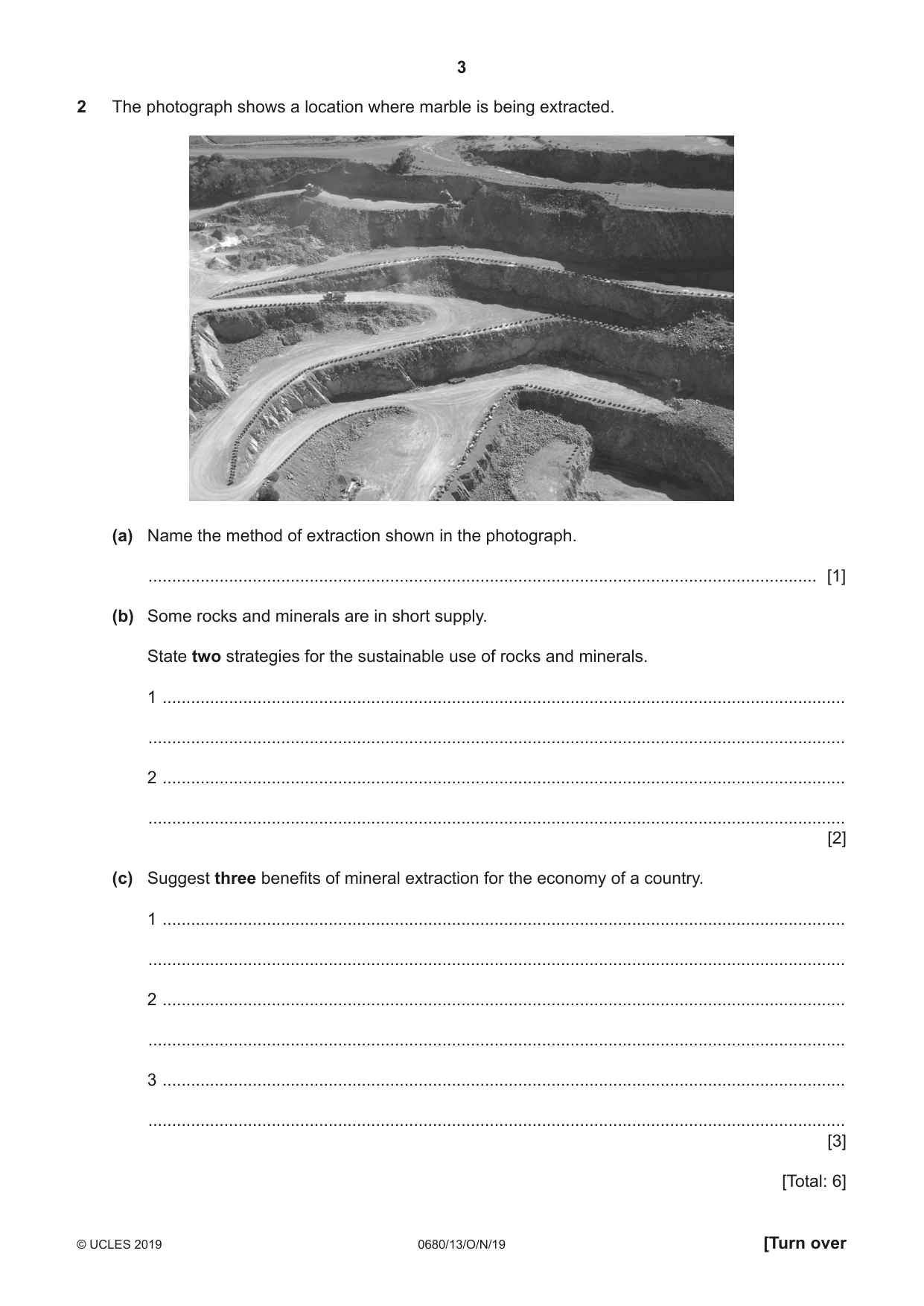
3 0680/13/O/N/19 © UCLES 2019 [Turn over 2 The photograph shows a location where marble is being extracted. (a) Name the method of extraction shown in the photograph. … [1] (b) Some rocks and minerals are in short supply. State two strategies for the sustainable use of rocks and minerals. 1 … … 2 … … [2] (c) Suggest three benefits of mineral extraction for the economy of a country. 1 … … 2 … … 3 … … [3] [Total: 6]
Question paper, page 4
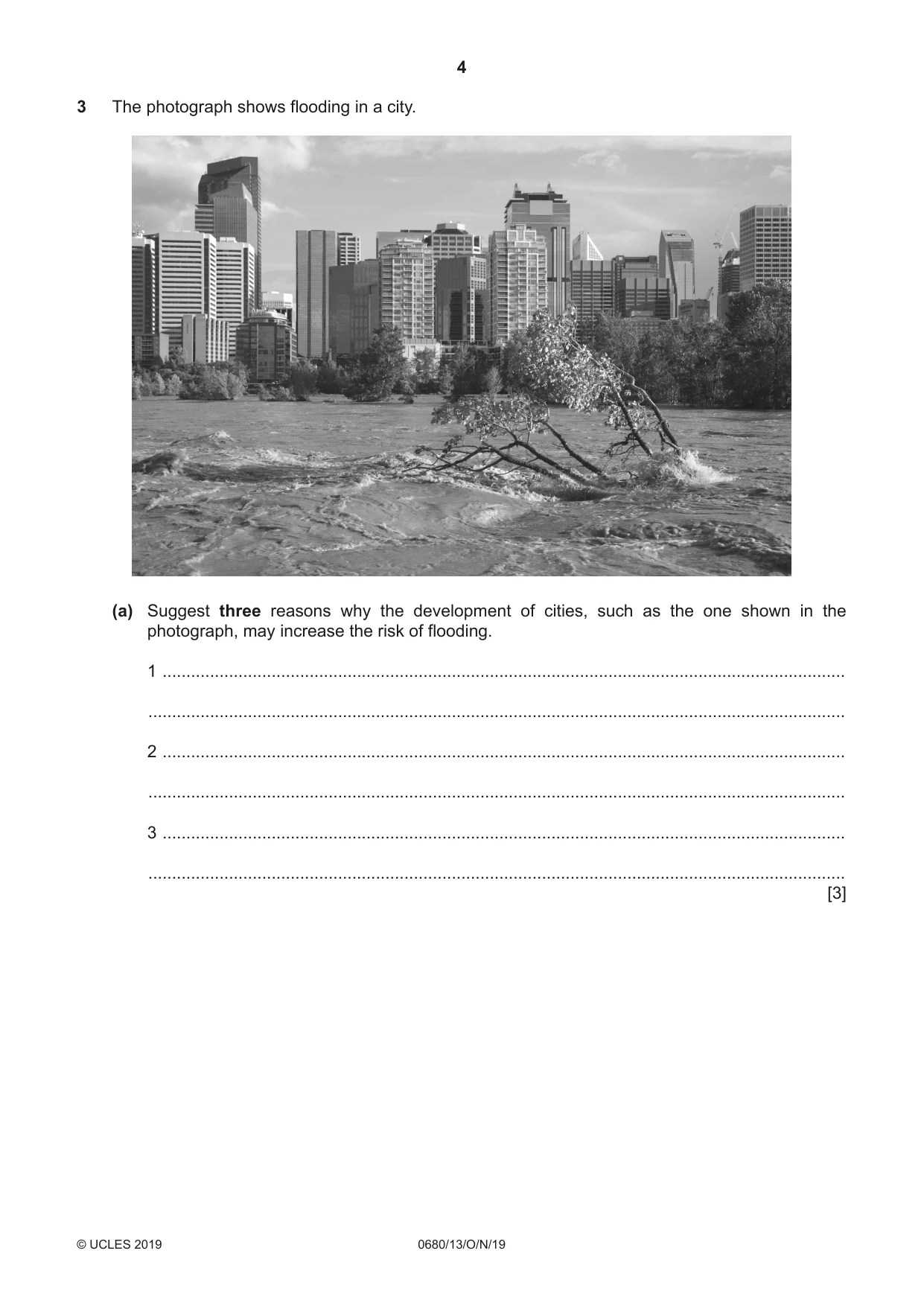
4 0680/13/O/N/19 © UCLES 2019 3 The photograph shows flooding in a city. (a) Suggest three reasons why the development of cities, such as the one shown in the photograph, may increase the risk of flooding. 1 … … 2 … … 3 … … [3]
Question paper, page 5
5 0680/13/O/N/19 © UCLES 2019 [Turn over (b) A flood in a more economically developed country (MEDC) might have less of an impact on the human population than in a less economically developed country (LEDC). Suggest reasons why. … … … … … … [3] (c) State one opportunity a flood might provide to people. … … [1] [Total: 7]
Question paper, page 6
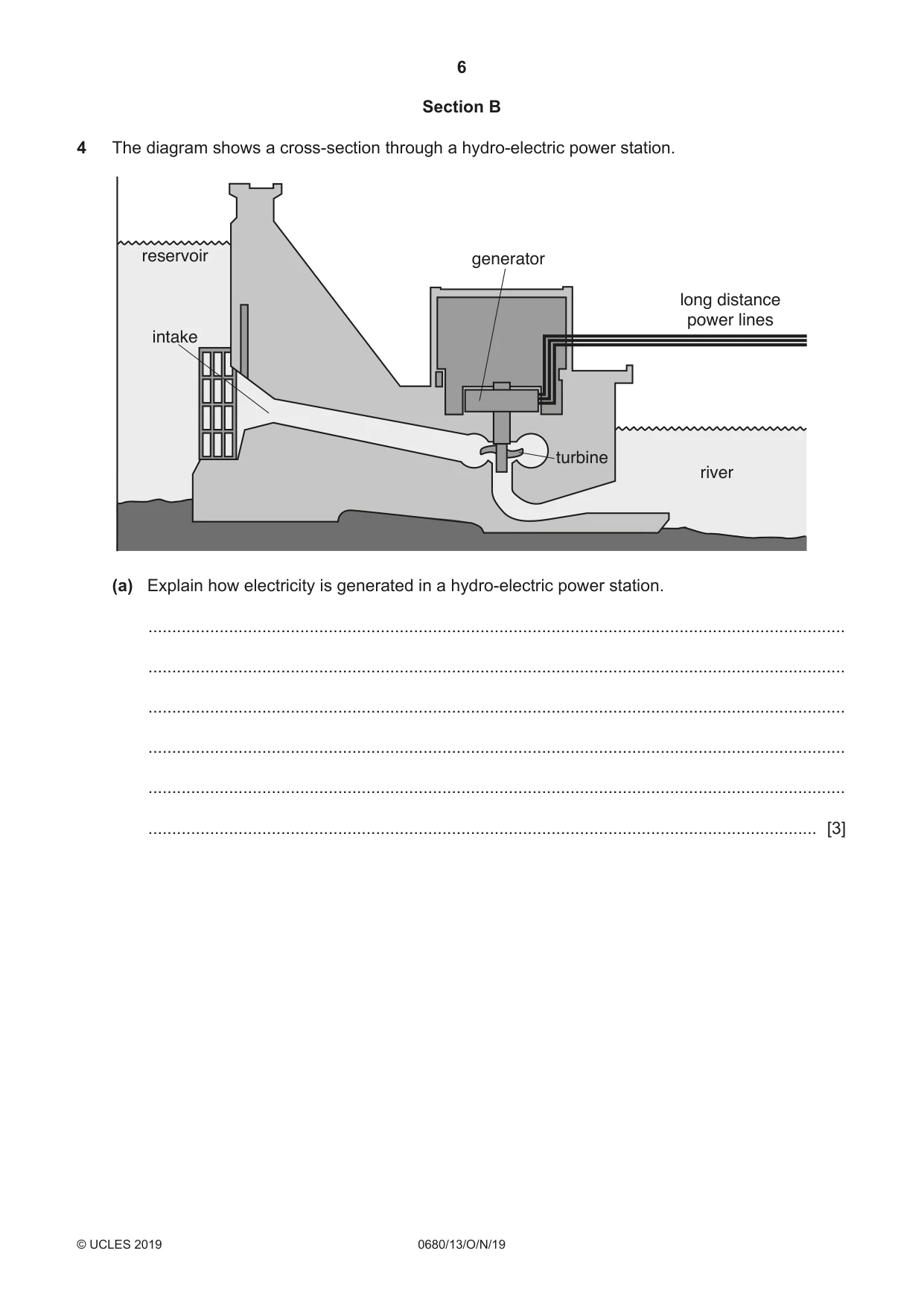
6 0680/13/O/N/19 © UCLES 2019 Section B 4 The diagram shows a cross-section through a hydro-electric power station. turbine river long distance power lines reservoir intake generator (a) Explain how electricity is generated in a hydro-electric power station. … … … … … … [3]
Question paper, page 7
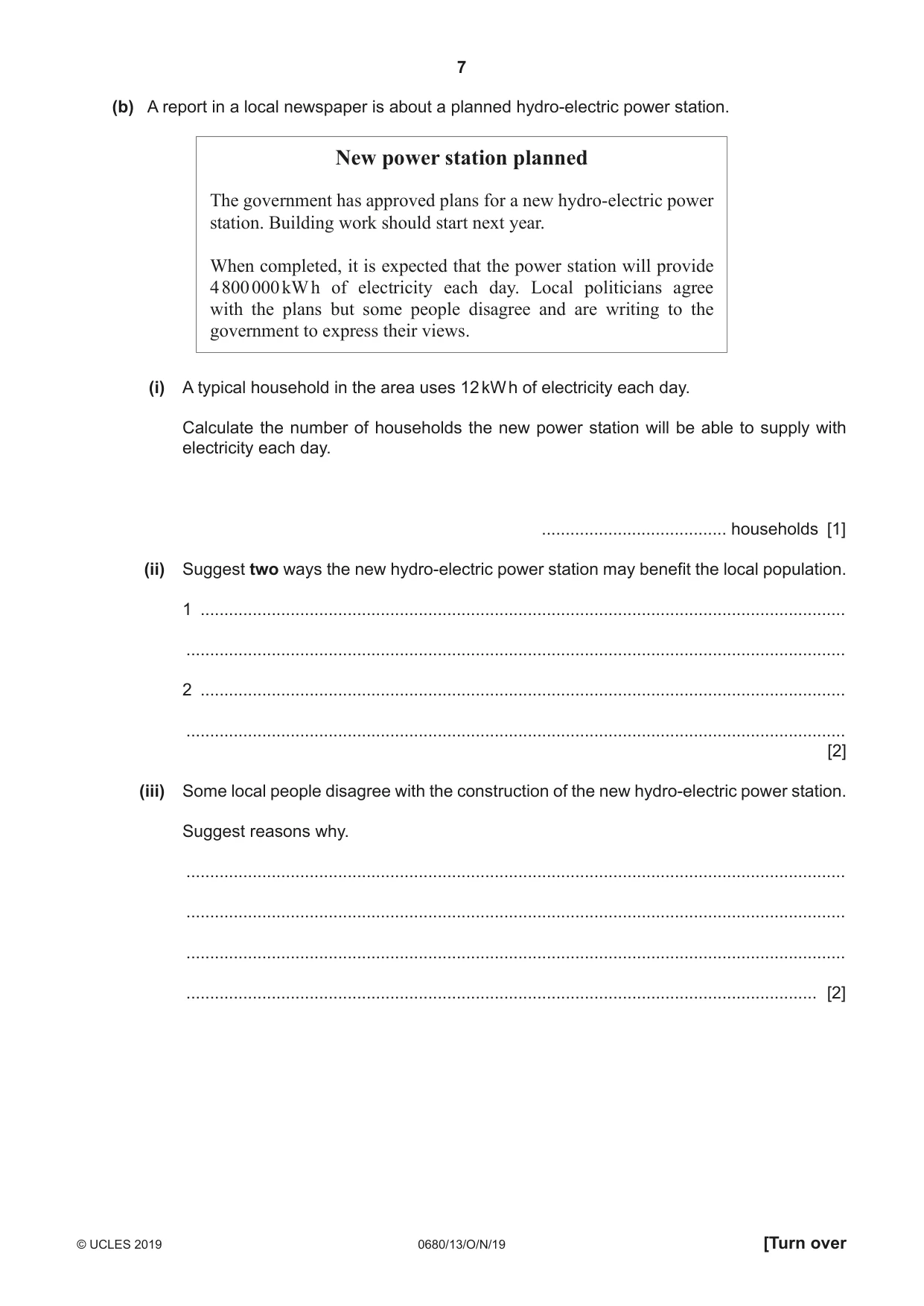
7 0680/13/O/N/19 © UCLES 2019 [Turn over (b) A report in a local newspaper is about a planned hydro-electric power station. New power station planned The government has approved plans for a new hydro-electric power station. Building work should start next year. When completed, it is expected that the power station will provide 4 800 000 kW h of electricity each day. Local politicians agree with the plans but some people disagree and are writing to the government to express their views. (i) A typical household in the area uses 12 kW h of electricity each day. Calculate the number of households the new power station will be able to supply with electricity each day. … households [1] (ii) Suggest two ways the new hydro-electric power station may benefit the local population. 1 … … 2 … … [2] (iii) Some local people disagree with the construction of the new hydro-electric power station. Suggest reasons why. … … … … [2]
Question paper, page 8
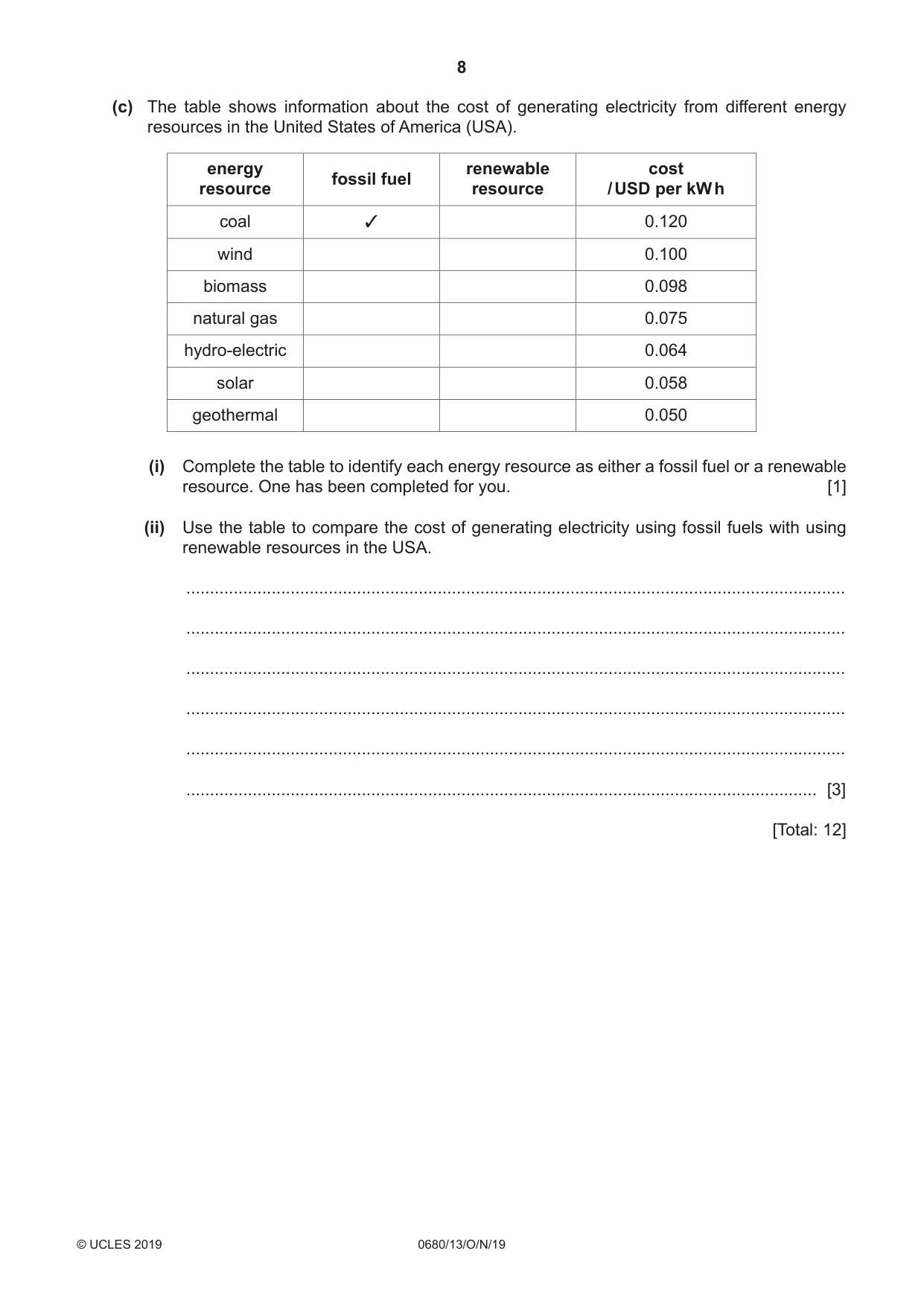
8 0680/13/O/N/19 © UCLES 2019 (c) The table shows information about the cost of generating electricity from different energy resources in the United States of America (USA). energy resource fossil fuel renewable resource cost / USD per kW h coal 3 0.120 wind 0.100 biomass 0.098 natural gas 0.075 hydro-electric 0.064 solar 0.058 geothermal 0.050 (i) Complete the table to identify each energy resource as either a fossil fuel or a renewable resource. One has been completed for you. [1] (ii) Use the table to compare the cost of generating electricity using fossil fuels with using renewable resources in the USA. … … … … … … [3] [Total: 12]
Question paper, page 9
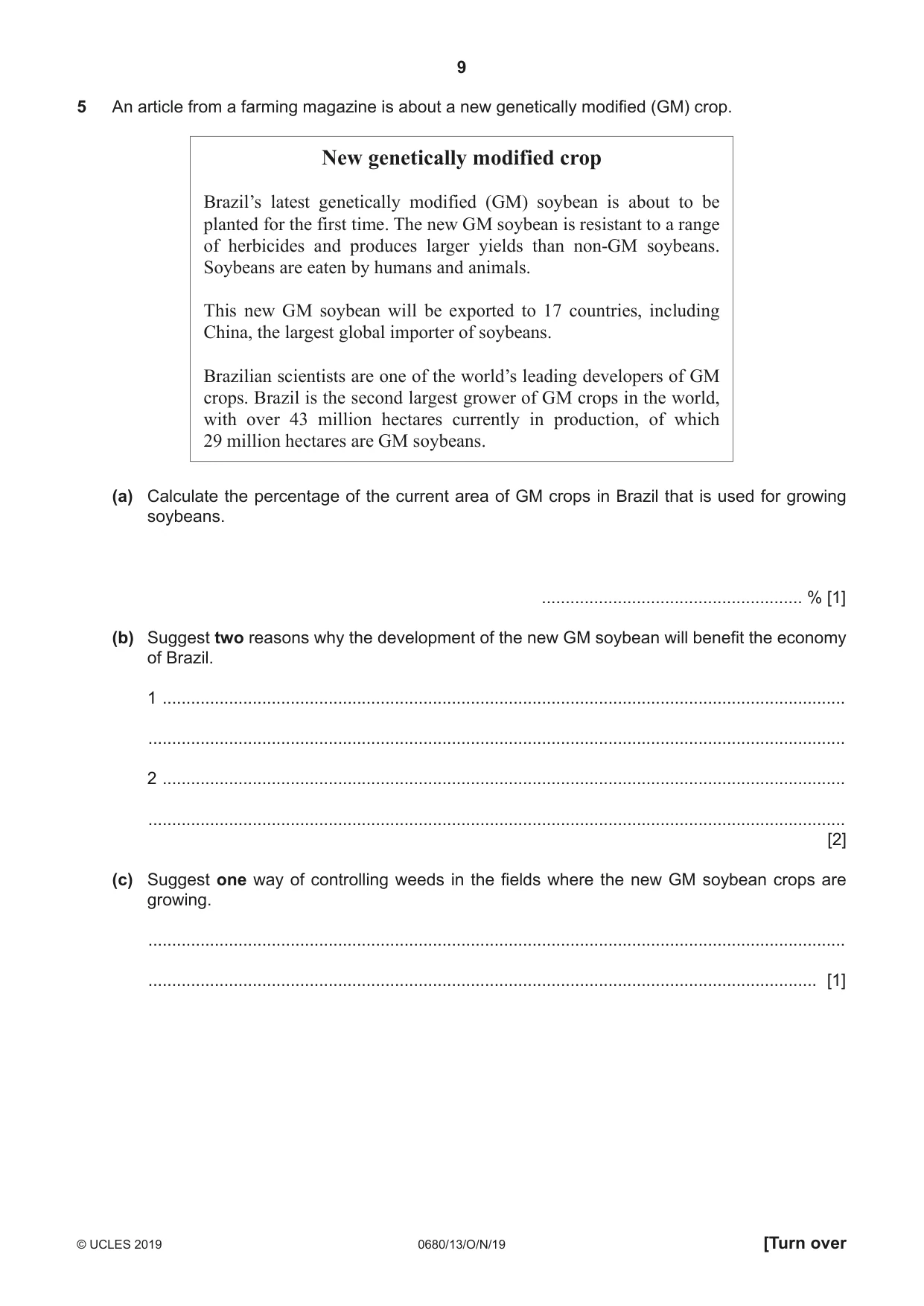
9 0680/13/O/N/19 © UCLES 2019 [Turn over 5 An article from a farming magazine is about a new genetically modified (GM) crop. New genetically modified crop Brazil’s latest genetically modified (GM) soybean is about to be planted for the first time. The new GM soybean is resistant to a range of herbicides and produces larger yields than non-GM soybeans. Soybeans are eaten by humans and animals. This new GM soybean will be exported to 17 countries, including China, the largest global importer of soybeans. Brazilian scientists are one of the world’s leading developers of GM crops. Brazil is the second largest grower of GM crops in the world, with over 43 million hectares currently in production, of which 29 million hectares are GM soybeans. (a) Calculate the percentage of the current area of GM crops in Brazil that is used for growing soybeans. … % [1] (b) Suggest two reasons why the development of the new GM soybean will benefit the economy of Brazil. 1 … … 2 … … [2] (c) Suggest one way of controlling weeds in the fields where the new GM soybean crops are growing. … … [1]
Question paper, page 10
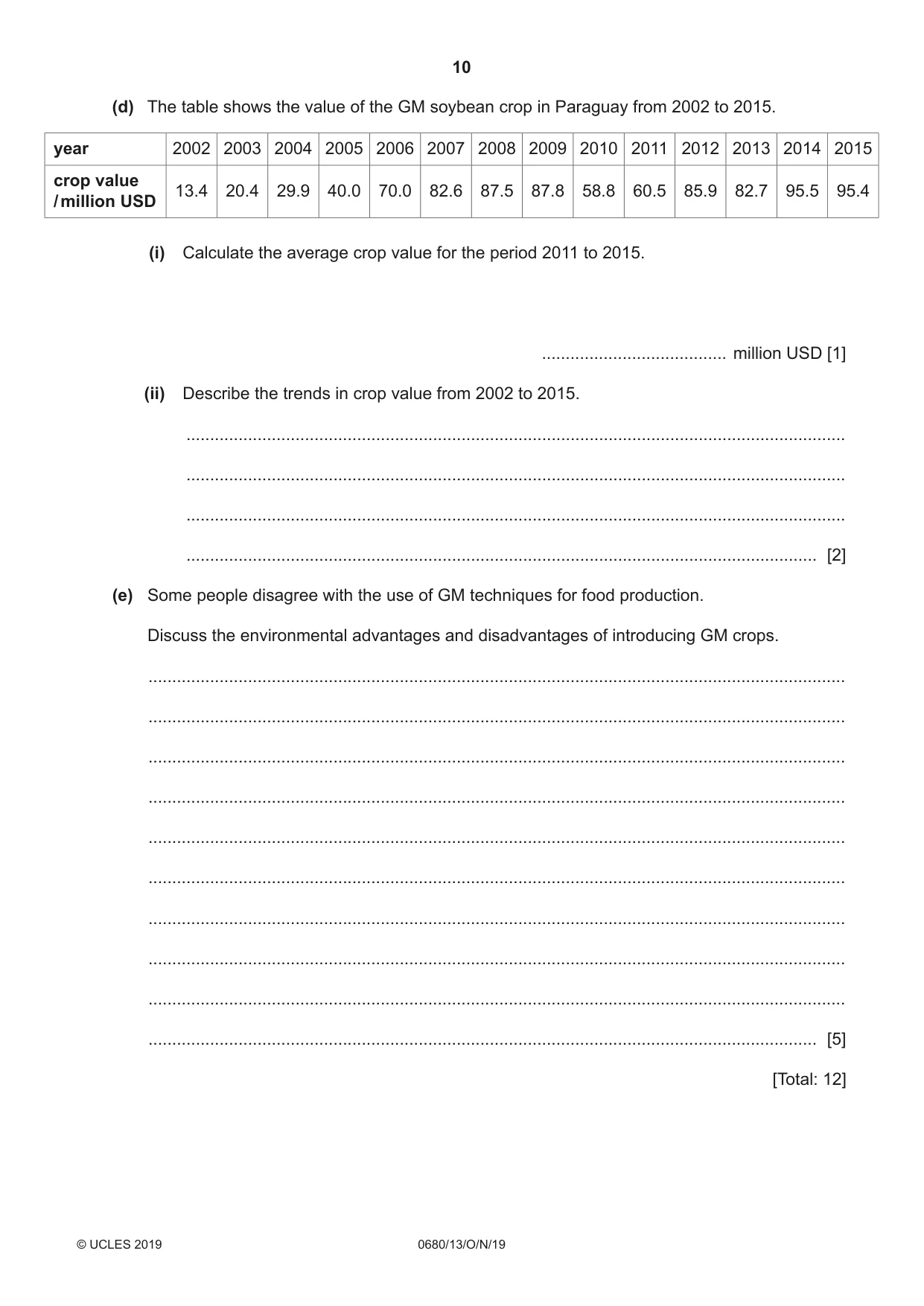
10 0680/13/O/N/19 © UCLES 2019 (d) The table shows the value of the GM soybean crop in Paraguay from 2002 to 2015. year 2002 2003 2004 2005 2006 2007 2008 2009 2010 2011 2012 2013 2014 2015 crop value / million USD 13.4 20.4 29.9 40.0 70.0 82.6 87.5 87.8 58.8 60.5 85.9 82.7 95.5 95.4 (i) Calculate the average crop value for the period 2011 to 2015. … million USD [1] (ii) Describe the trends in crop value from 2002 to 2015. … … … … [2] (e) Some people disagree with the use of GM techniques for food production. Discuss the environmental advantages and disadvantages of introducing GM crops. … … … … … … … … … … [5] [Total: 12]
Question paper, page 11
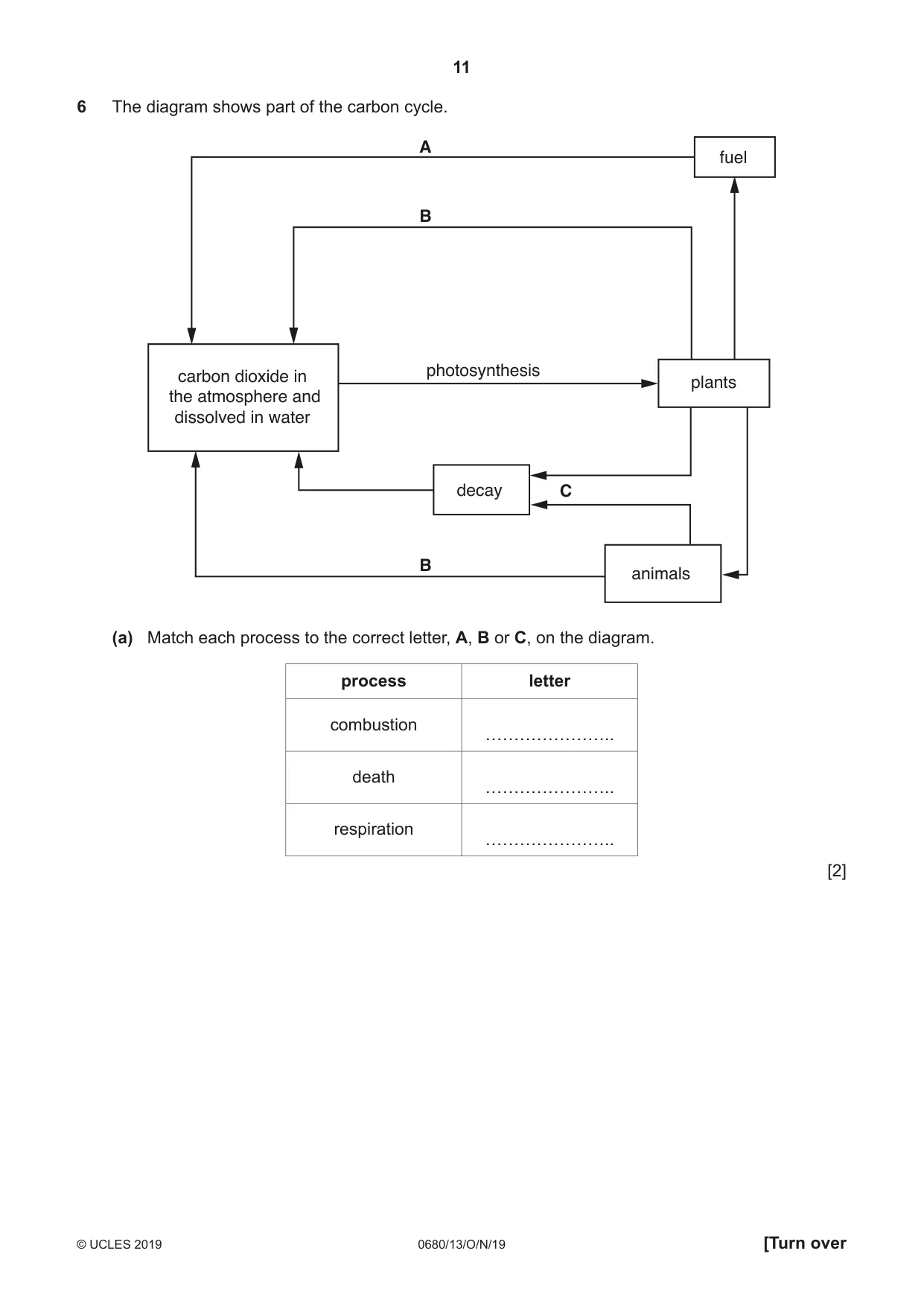
11 0680/13/O/N/19 © UCLES 2019 [Turn over 6 The diagram shows part of the carbon cycle. carbon dioxide in the atmosphere and dissolved in water plants fuel decay animals A B C B photosynthesis (a) Match each process to the correct letter, A, B or C, on the diagram. process letter combustion ………………….. death ………………….. respiration ………………….. [2]
Question paper, page 12
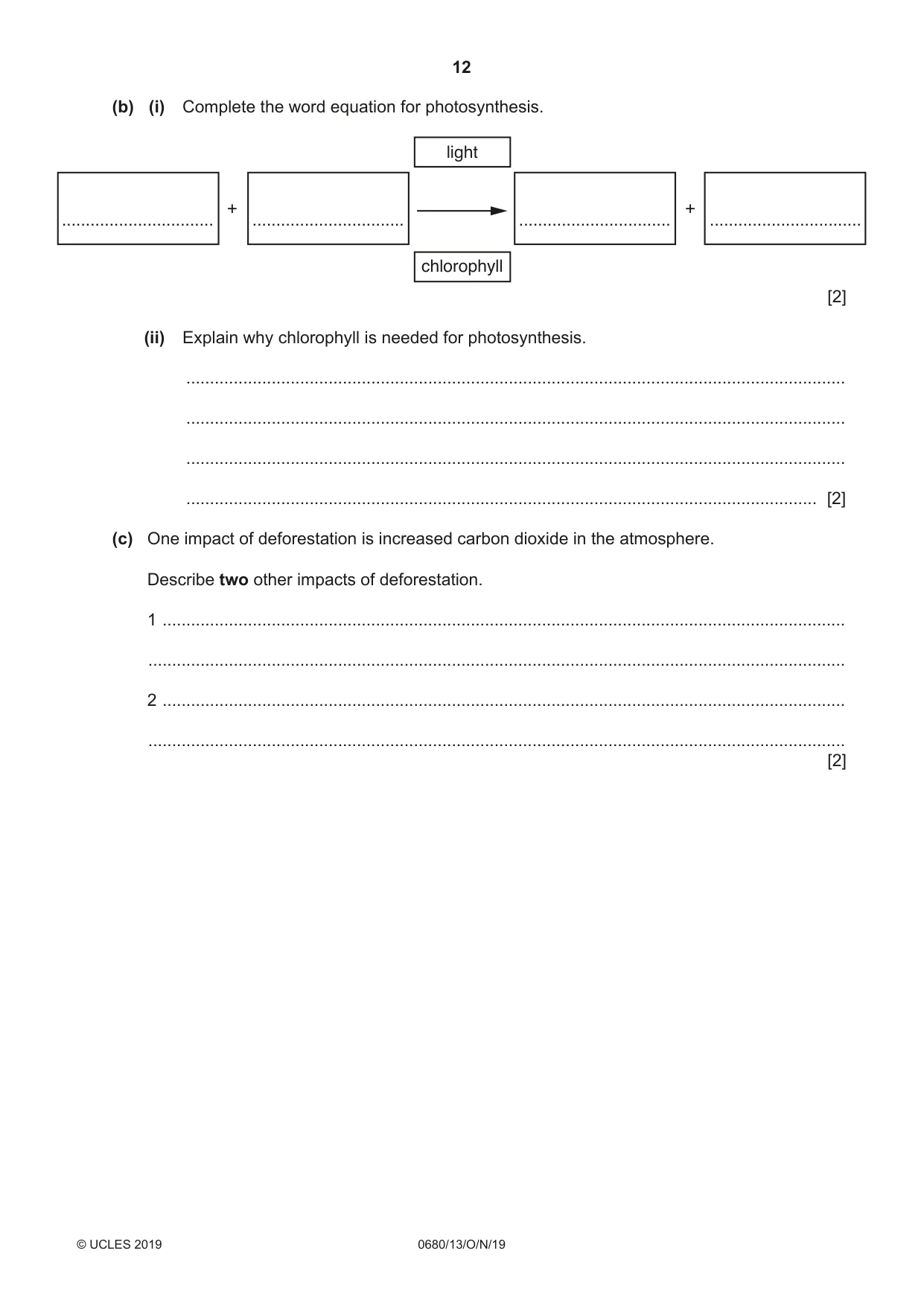
12 0680/13/O/N/19 © UCLES 2019 (b) (i) Complete the word equation for photosynthesis. + + … … … … light chlorophyll [2] (ii) Explain why chlorophyll is needed for photosynthesis. … … … … [2] (c) One impact of deforestation is increased carbon dioxide in the atmosphere. Describe two other impacts of deforestation. 1 … … 2 … … [2]
Question paper, page 13
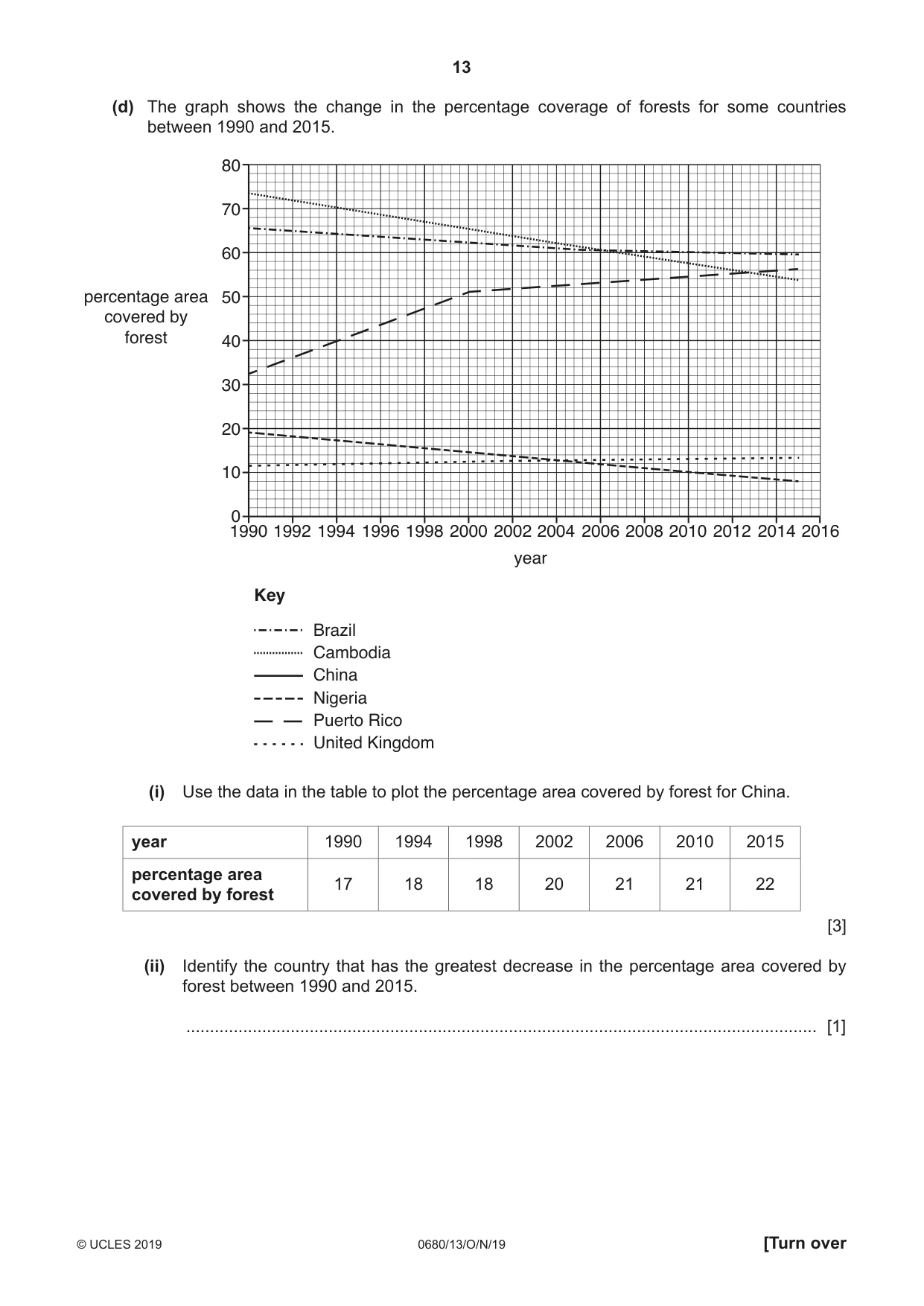
13 0680/13/O/N/19 © UCLES 2019 [Turn over (d) The graph shows the change in the percentage coverage of forests for some countries between 1990 and 2015. 0 1990 1992 1994 1996 1998 2000 2002 2004 year 2006 2008 2010 2012 2014 2016 10 20 30 40 50 60 70 80 percentage area covered by forest Key Brazil Cambodia China Nigeria Puerto Rico United Kingdom (i) Use the data in the table to plot the percentage area covered by forest for China. year 1990 1994 1998 2002 2006 2010 2015 percentage area covered by forest 17 18 18 20 21 21 22 [3] (ii) Identify the country that has the greatest decrease in the percentage area covered by forest between 1990 and 2015. … [1]
Question paper, page 14
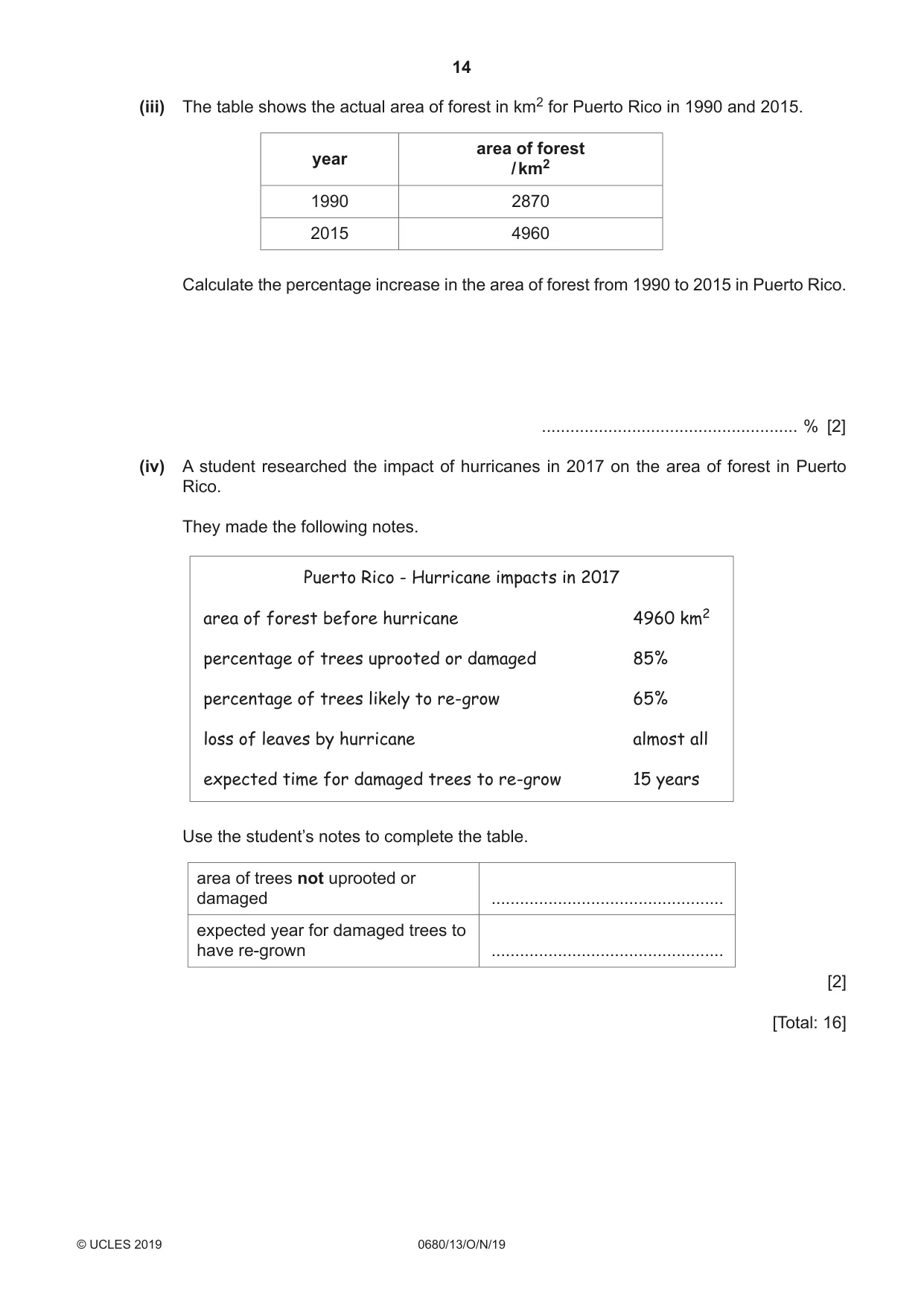
14 0680/13/O/N/19 © UCLES 2019 (iii) The table shows the actual area of forest in km2 for Puerto Rico in 1990 and 2015. year area of forest / km2 1990 2870 2015 4960 Calculate the percentage increase in the area of forest from 1990 to 2015 in Puerto Rico. … % [2] (iv) A student researched the impact of hurricanes in 2017 on the area of forest in Puerto Rico. They made the following notes. Puerto Rico - Hurricane impacts in 2017 area of forest before hurricane 4960 km2 percentage of trees uprooted or damaged 85% percentage of trees likely to re-grow 65% loss of leaves by hurricane almost all expected time for damaged trees to re-grow 15 years Use the student’s notes to complete the table. area of trees not uprooted or damaged … expected year for damaged trees to have re-grown … [2] [Total: 16]
Question paper, page 15
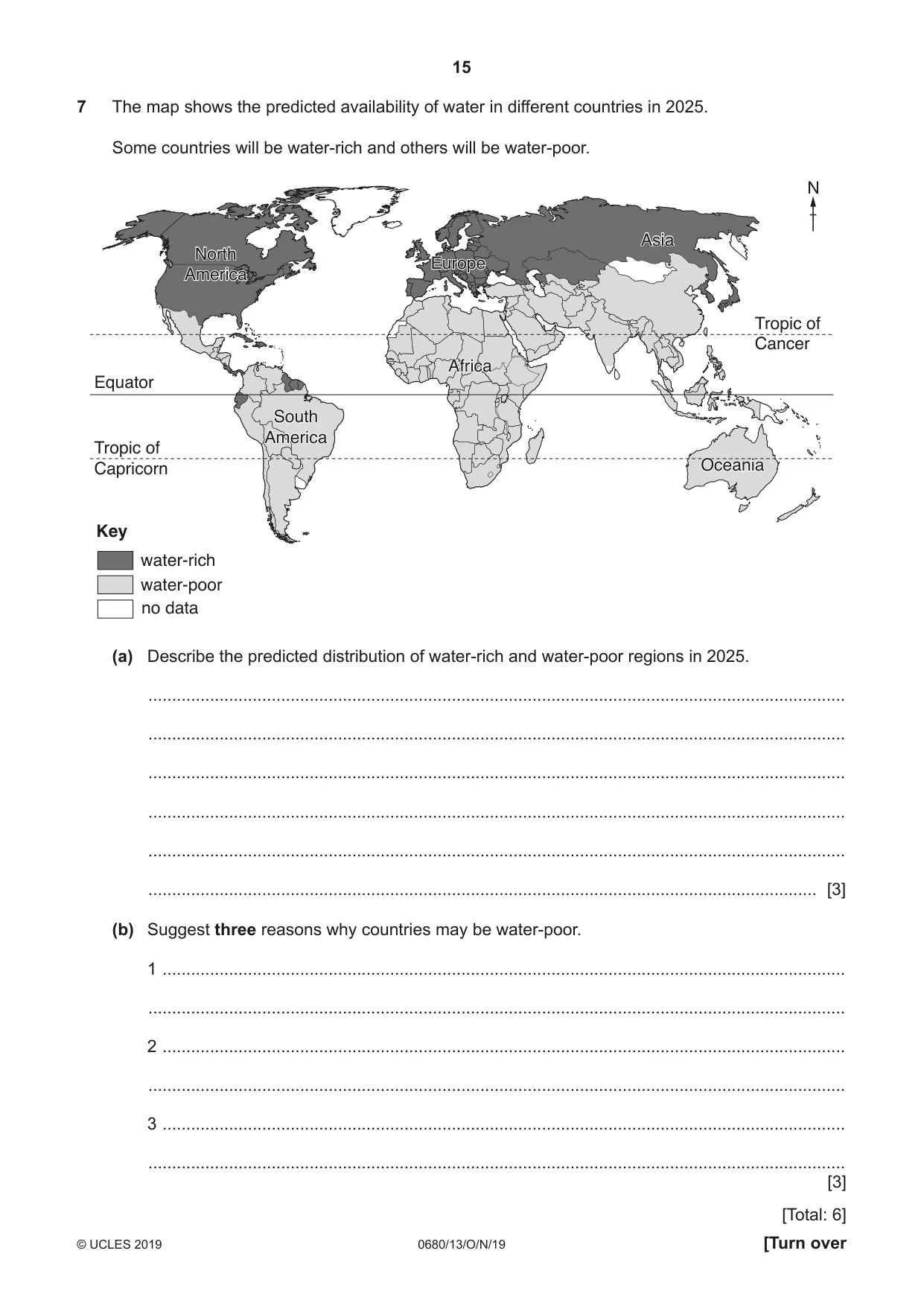
15 0680/13/O/N/19 © UCLES 2019 [Turn over 7 The map shows the predicted availability of water in different countries in 2025. Some countries will be water-rich and others will be water-poor. Equator Tropic of Capricorn Tropic of Cancer N Key water-rich water-poor no data South America North America Europe Africa Asia Oceania South America North America Europe Africa Asia Oceania (a) Describe the predicted distribution of water-rich and water-poor regions in 2025. … … … … … … [3] (b) Suggest three reasons why countries may be water-poor. 1 … … 2 … … 3 … … [3] [Total: 6]
Question paper, page 16
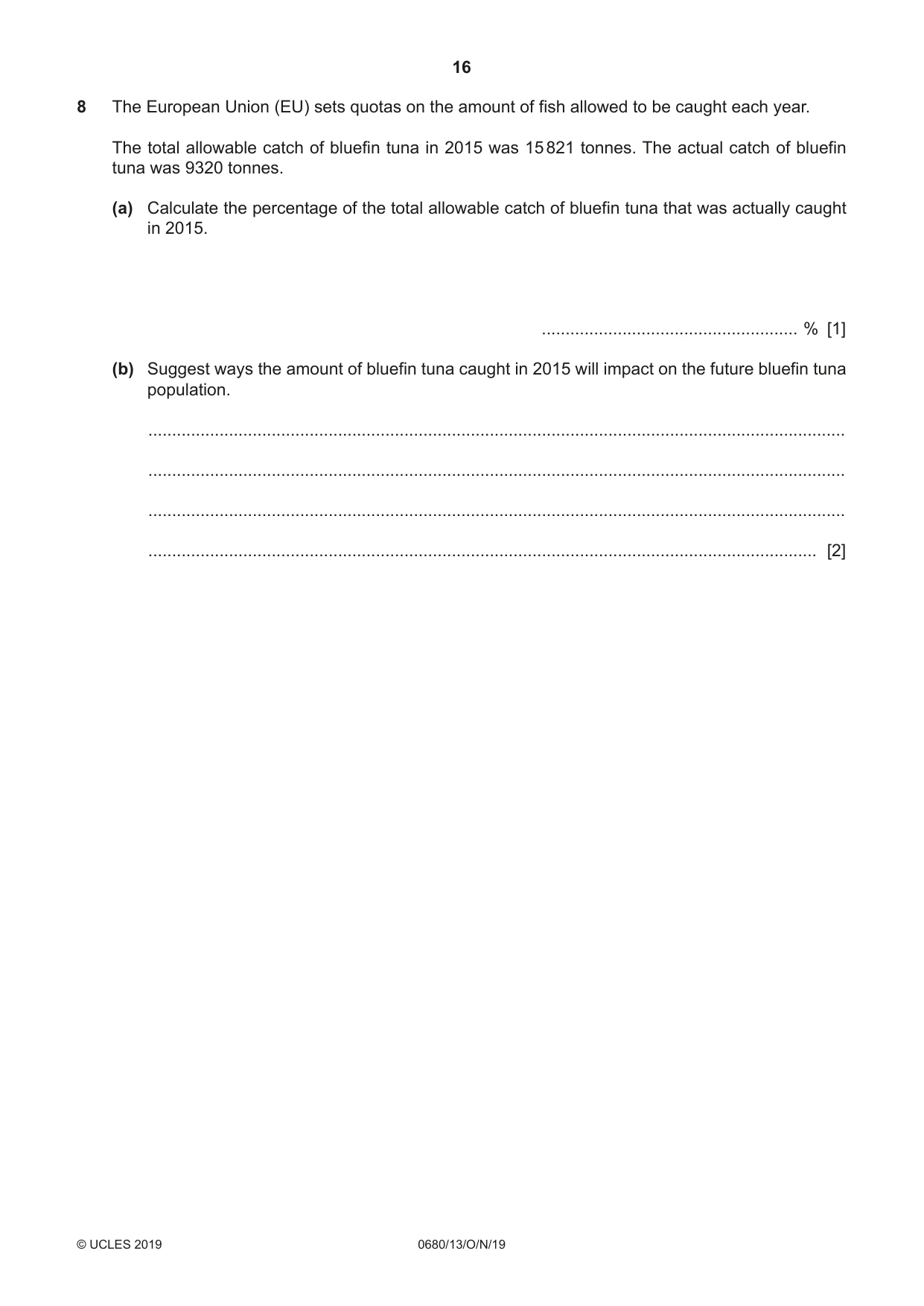
16 0680/13/O/N/19 © UCLES 2019 8 The European Union (EU) sets quotas on the amount of fish allowed to be caught each year. The total allowable catch of bluefin tuna in 2015 was 15 821 tonnes. The actual catch of bluefin tuna was 9320 tonnes. (a) Calculate the percentage of the total allowable catch of bluefin tuna that was actually caught in 2015. … % [1] (b) Suggest ways the amount of bluefin tuna caught in 2015 will impact on the future bluefin tuna population. … … … … [2]
Question paper, page 17
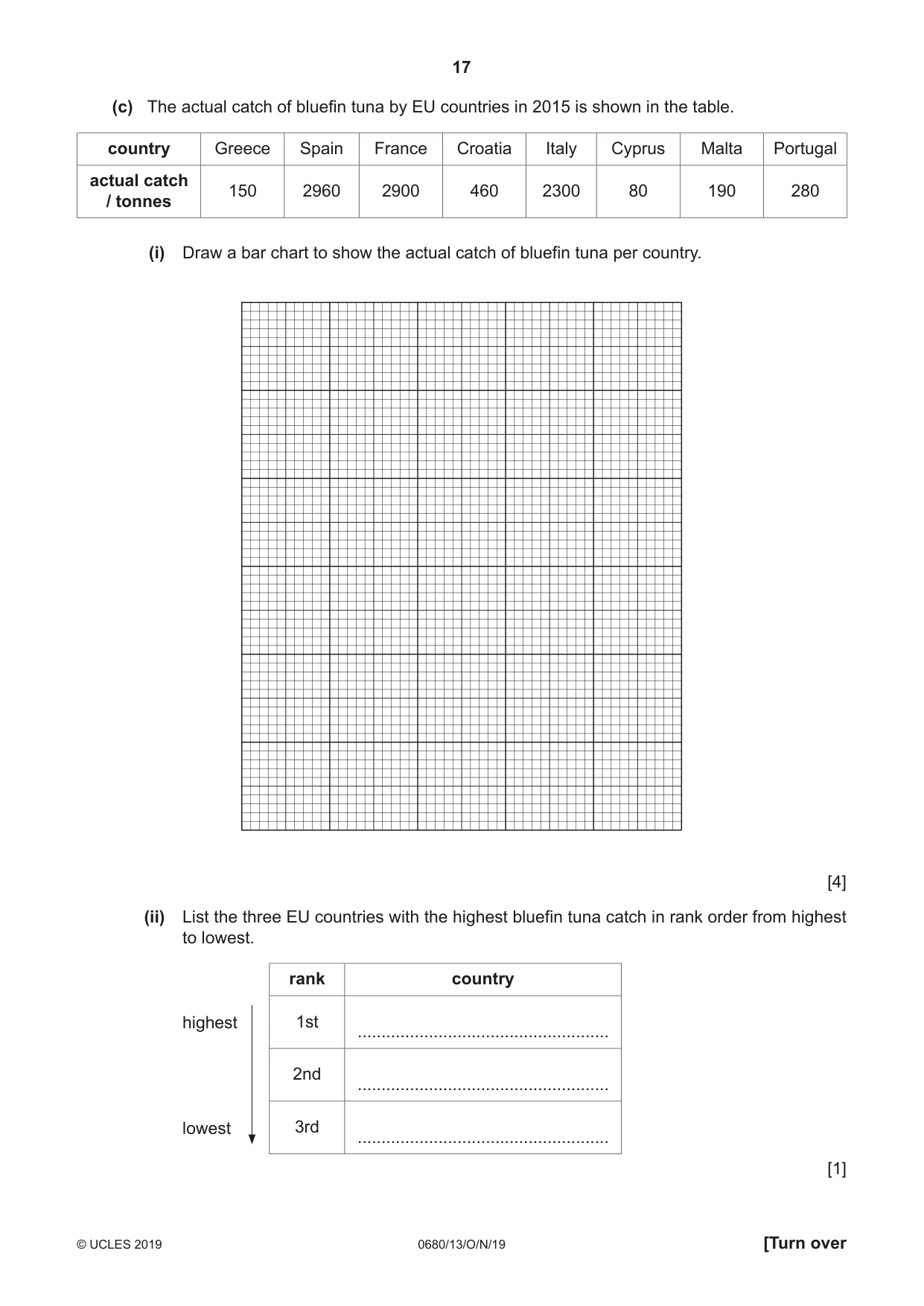
17 0680/13/O/N/19 © UCLES 2019 [Turn over (c) The actual catch of bluefin tuna by EU countries in 2015 is shown in the table. country Greece Spain France Croatia Italy Cyprus Malta Portugal actual catch / tonnes 150 2960 2900 460 2300 80 190 280 (i) Draw a bar chart to show the actual catch of bluefin tuna per country. [4] (ii) List the three EU countries with the highest bluefin tuna catch in rank order from highest to lowest. rank country highest 1st … 2nd … lowest 3rd … [1]
Question paper, page 18
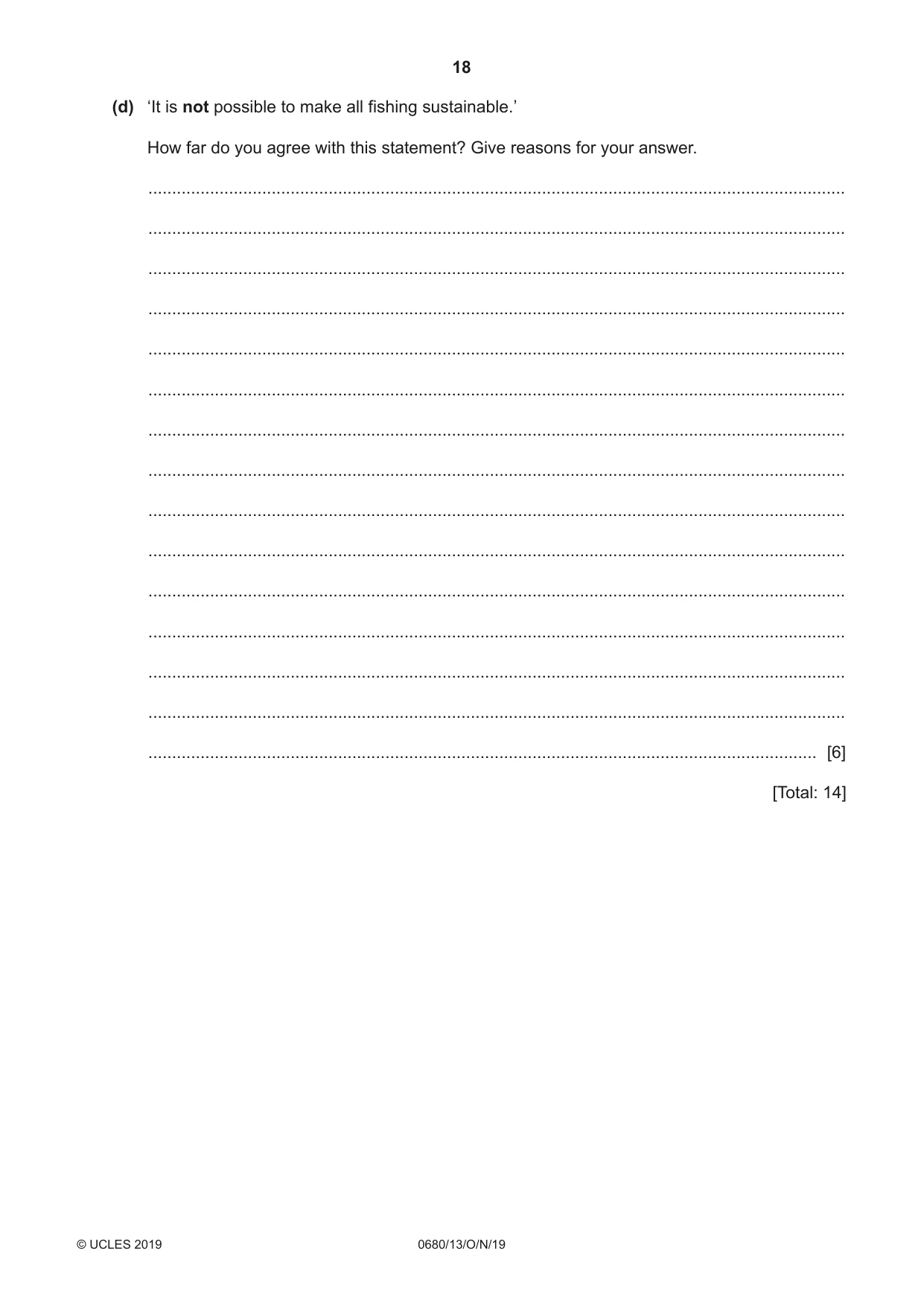
18 0680/13/O/N/19 © UCLES 2019 (d) ‘It is not possible to make all fishing sustainable.’ How far do you agree with this statement? Give reasons for your answer. … … … … … … … … … … … … … … … [6] [Total: 14]
Question paper, page 19
19 0680/13/O/N/19 © UCLES 2019 BLANK PAGE
Question paper, page 20
20 0680/13/O/N/19 © UCLES 2019 Permission to reproduce items where third-party owned material protected by copyright is included has been sought and cleared where possible. Every reasonable effort has been made by the publisher (UCLES) to trace copyright holders, but if any items requiring clearance have unwittingly been included, the publisher will be pleased to make amends at the earliest possible opportunity. To avoid the issue of disclosure of answer-related information to candidates, all copyright acknowledgements are reproduced online in the Cambridge Assessment International Education Copyright Acknowledgements Booklet. This is produced for each series of examinations and is freely available to download at www.cambridgeinternational.org after the live examination series. Cambridge Assessment International Education is part of the Cambridge Assessment Group. Cambridge Assessment is the brand name of the University of Cambridge Local Examinations Syndicate (UCLES), which itself is a department of the University of Cambridge. BLANK PAGE
Mark scheme, page 1
This document consists of 13 printed pages. © UCLES 2019 [Turn over Cambridge Assessment International Education Cambridge International General Certificate of Secondary Education ENVIRONMENTAL MANAGEMENT 0680/13 Paper 1 Theory October/November 2019 MARK SCHEME Maximum Mark: 80 Published This mark scheme is published as an aid to teachers and candidates, to indicate the requirements of the examination. It shows the basis on which Examiners were instructed to award marks. It does not indicate the details of the discussions that took place at an Examiners’ meeting before marking began, which would have considered the acceptability of alternative answers. Mark schemes should be read in conjunction with the question paper and the Principal Examiner Report for Teachers. Cambridge International will not enter into discussions about these mark schemes. Cambridge International is publishing the mark schemes for the October/November 2019 series for most Cambridge IGCSE™, Cambridge International A and AS Level components and some Cambridge O Level components.
Mark scheme, page 2
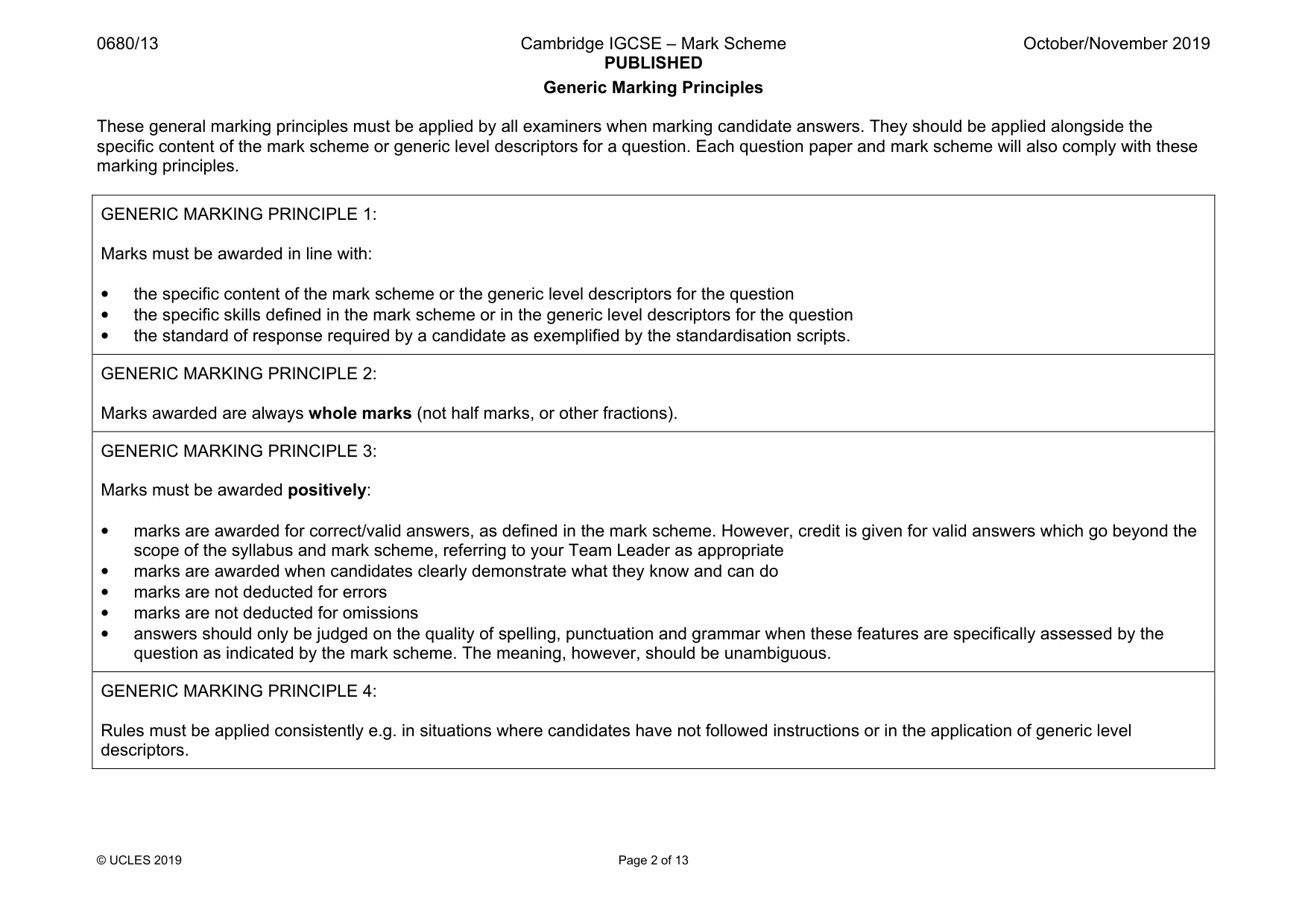
0680/13 Cambridge IGCSE – Mark Scheme PUBLISHED October/November 2019 © UCLES 2019 Page 2 of 13 Generic Marking Principles These general marking principles must be applied by all examiners when marking candidate answers. They should be applied alongside the specific content of the mark scheme or generic level descriptors for a question. Each question paper and mark scheme will also comply with these marking principles. GENERIC MARKING PRINCIPLE 1: Marks must be awarded in line with: • the specific content of the mark scheme or the generic level descriptors for the question • the specific skills defined in the mark scheme or in the generic level descriptors for the question • the standard of response required by a candidate as exemplified by the standardisation scripts. GENERIC MARKING PRINCIPLE 2: Marks awarded are always whole marks (not half marks, or other fractions). GENERIC MARKING PRINCIPLE 3: Marks must be awarded positively: • marks are awarded for correct/valid answers, as defined in the mark scheme. However, credit is given for valid answers which go beyond the scope of the syllabus and mark scheme, referring to your Team Leader as appropriate • marks are awarded when candidates clearly demonstrate what they know and can do • marks are not deducted for errors • marks are not deducted for omissions • answers should only be judged on the quality of spelling, punctuation and grammar when these features are specifically assessed by the question as indicated by the mark scheme. The meaning, however, should be unambiguous. GENERIC MARKING PRINCIPLE 4: Rules must be applied consistently e.g. in situations where candidates have not followed instructions or in the application of generic level descriptors.
Mark scheme, page 3
0680/13 Cambridge IGCSE – Mark Scheme PUBLISHED October/November 2019 © UCLES 2019 Page 3 of 13 GENERIC MARKING PRINCIPLE 5: Marks should be awarded using the full range of marks defined in the mark scheme for the question (however; the use of the full mark range may be limited according to the quality of the candidate responses seen). GENERIC MARKING PRINCIPLE 6: Marks awarded are based solely on the requirements as defined in the mark scheme. Marks should not be awarded with grade thresholds or grade descriptors in mind.
Mark scheme, page 4
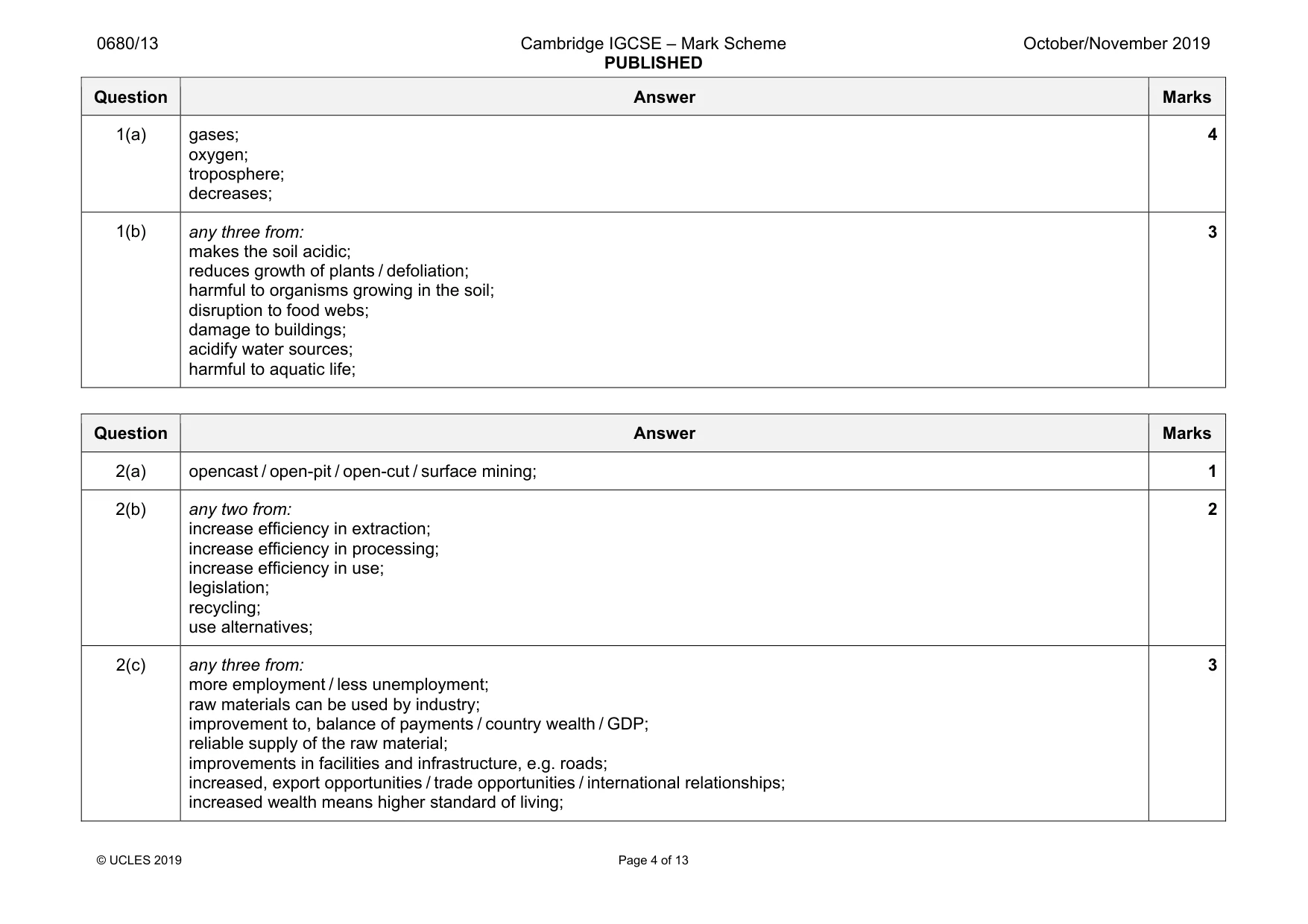
0680/13 Cambridge IGCSE – Mark Scheme PUBLISHED October/November 2019 © UCLES 2019 Page 4 of 13 Question Answer Marks 1(a) gases; oxygen; troposphere; decreases; 4 1(b) any three from: makes the soil acidic; reduces growth of plants / defoliation; harmful to organisms growing in the soil; disruption to food webs; damage to buildings; acidify water sources; harmful to aquatic life; 3 Question Answer Marks 2(a) opencast / open-pit / open-cut / surface mining; 1 2(b) any two from: increase efficiency in extraction; increase efficiency in processing; increase efficiency in use; legislation; recycling; use alternatives; 2 2(c) any three from: more employment / less unemployment; raw materials can be used by industry; improvement to, balance of payments / country wealth / GDP; reliable supply of the raw material; improvements in facilities and infrastructure, e.g. roads; increased, export opportunities / trade opportunities / international relationships; increased wealth means higher standard of living; 3
Mark scheme, page 5
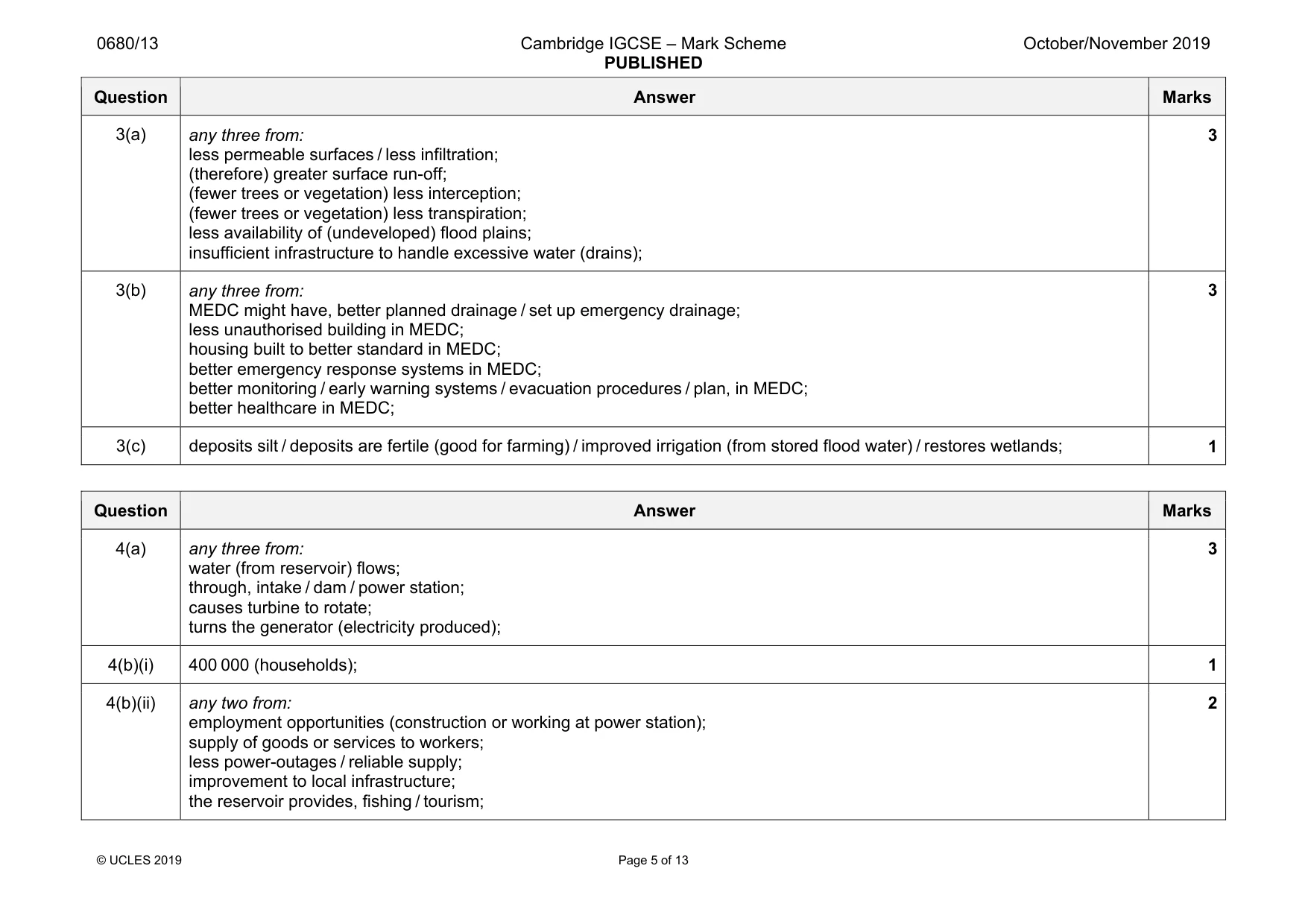
0680/13 Cambridge IGCSE – Mark Scheme PUBLISHED October/November 2019 © UCLES 2019 Page 5 of 13 Question Answer Marks 3(a) any three from: less permeable surfaces / less infiltration; (therefore) greater surface run-off; (fewer trees or vegetation) less interception; (fewer trees or vegetation) less transpiration; less availability of (undeveloped) flood plains; insufficient infrastructure to handle excessive water (drains); 3 3(b) any three from: MEDC might have, better planned drainage / set up emergency drainage; less unauthorised building in MEDC; housing built to better standard in MEDC; better emergency response systems in MEDC; better monitoring / early warning systems / evacuation procedures / plan, in MEDC; better healthcare in MEDC; 3 3(c) deposits silt / deposits are fertile (good for farming) / improved irrigation (from stored flood water) / restores wetlands; 1 Question Answer Marks 4(a) any three from: water (from reservoir) flows; through, intake / dam / power station; causes turbine to rotate; turns the generator (electricity produced); 3 4(b)(i) 400 000 (households); 1 4(b)(ii) any two from: employment opportunities (construction or working at power station); supply of goods or services to workers; less power-outages / reliable supply; improvement to local infrastructure; the reservoir provides, fishing / tourism; 2
Mark scheme, page 6
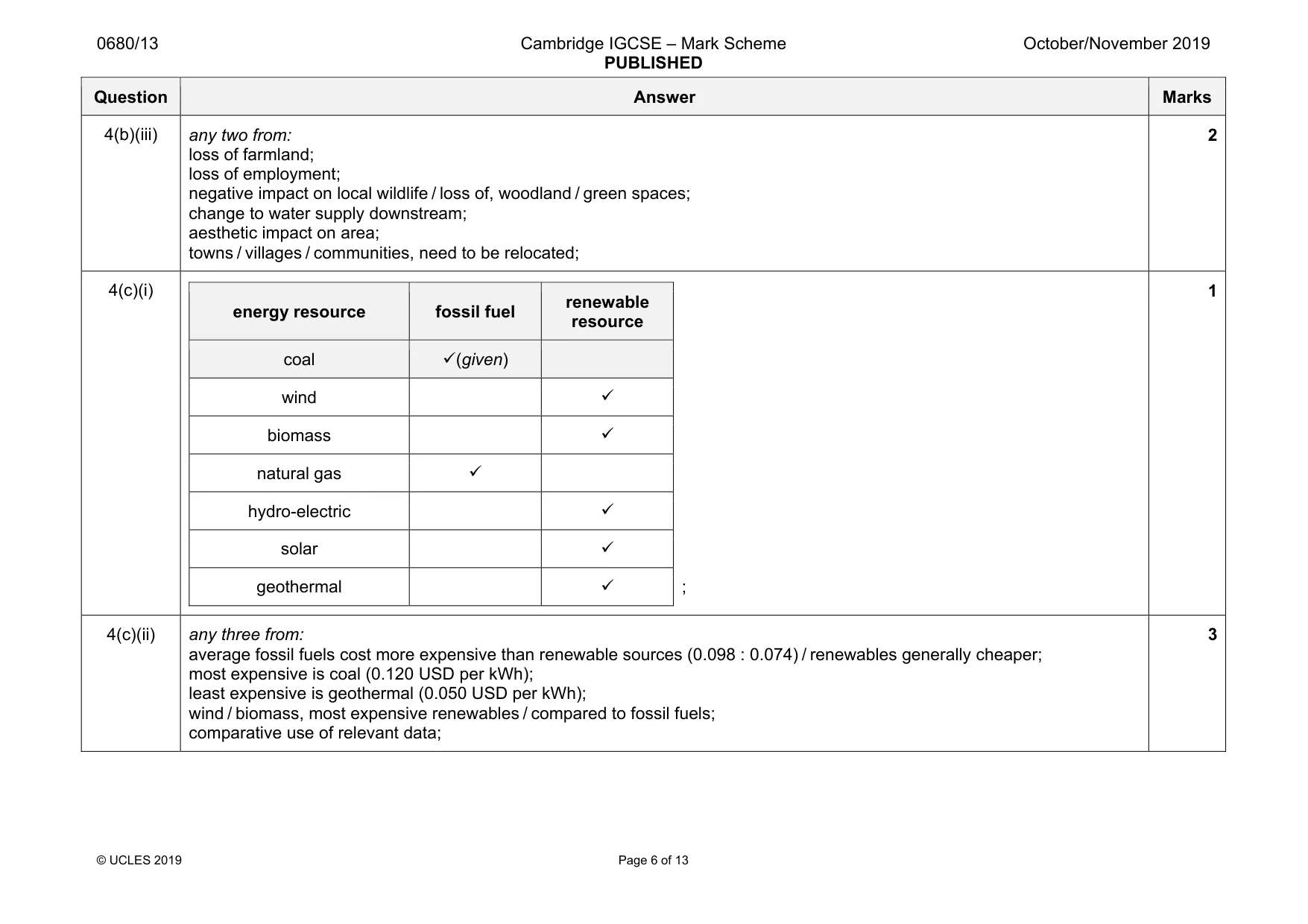
0680/13 Cambridge IGCSE – Mark Scheme PUBLISHED October/November 2019 © UCLES 2019 Page 6 of 13 Question Answer Marks 4(b)(iii) any two from: loss of farmland; loss of employment; negative impact on local wildlife / loss of, woodland / green spaces; change to water supply downstream; aesthetic impact on area; towns / villages / communities, need to be relocated; 2 4(c)(i) energy resource fossil fuel renewable resource coal 9(given) wind 9 biomass 9 natural gas 9 hydro-electric 9 solar 9 geothermal 9 ; 1 4(c)(ii) any three from: average fossil fuels cost more expensive than renewable sources (0.098 : 0.074) / renewables generally cheaper; most expensive is coal (0.120 USD per kWh); least expensive is geothermal (0.050 USD per kWh); wind / biomass, most expensive renewables / compared to fossil fuels; comparative use of relevant data; 3
Mark scheme, page 7
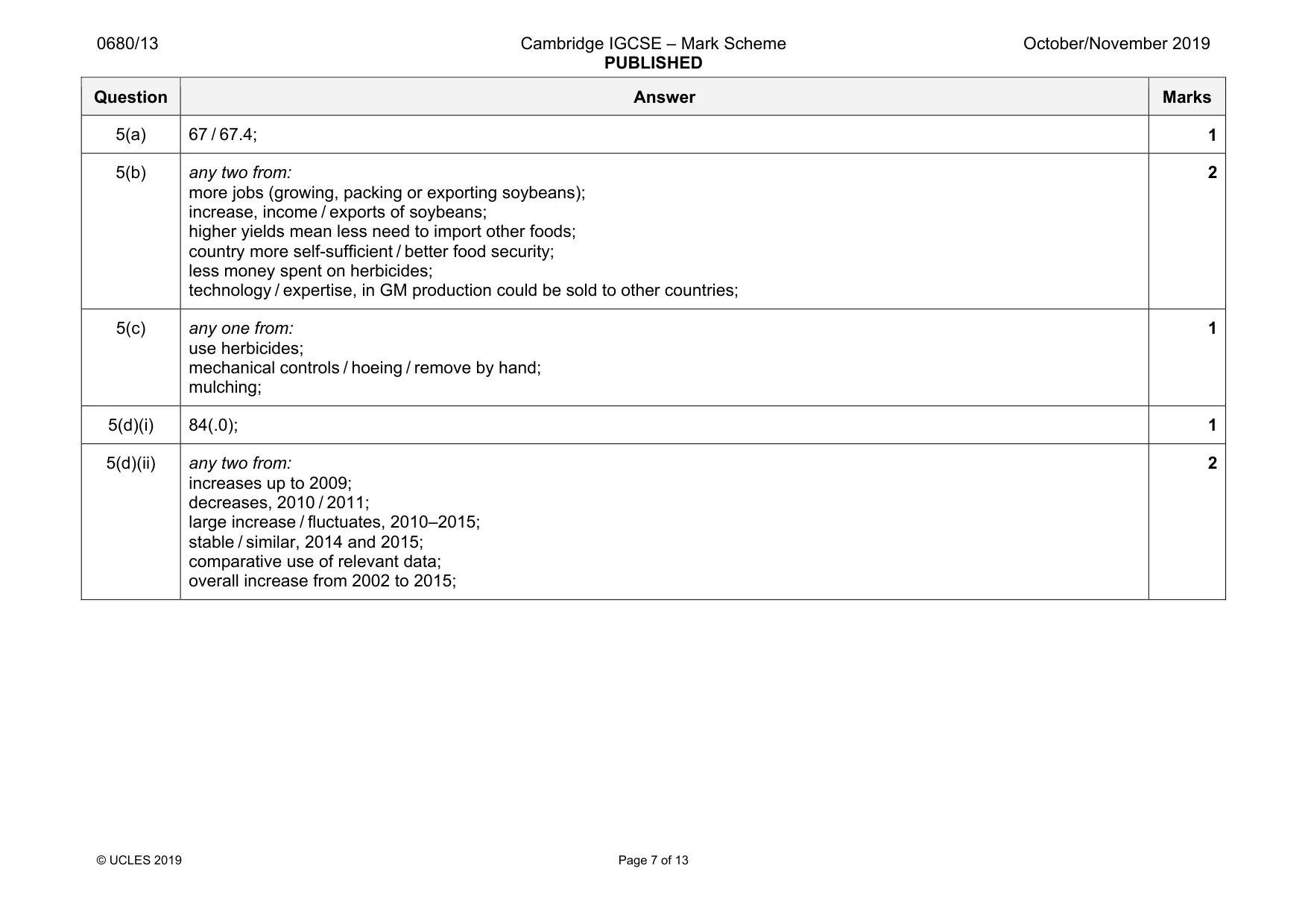
0680/13 Cambridge IGCSE – Mark Scheme PUBLISHED October/November 2019 © UCLES 2019 Page 7 of 13 Question Answer Marks 5(a) 67 / 67.4; 1 5(b) any two from: more jobs (growing, packing or exporting soybeans); increase, income / exports of soybeans; higher yields mean less need to import other foods; country more self-sufficient / better food security; less money spent on herbicides; technology / expertise, in GM production could be sold to other countries; 2 5(c) any one from: use herbicides; mechanical controls / hoeing / remove by hand; mulching; 1 5(d)(i) 84(.0); 1 5(d)(ii) any two from: increases up to 2009; decreases, 2010 / 2011; large increase / fluctuates, 2010–2015; stable / similar, 2014 and 2015; comparative use of relevant data; overall increase from 2002 to 2015; 2
Mark scheme, page 8
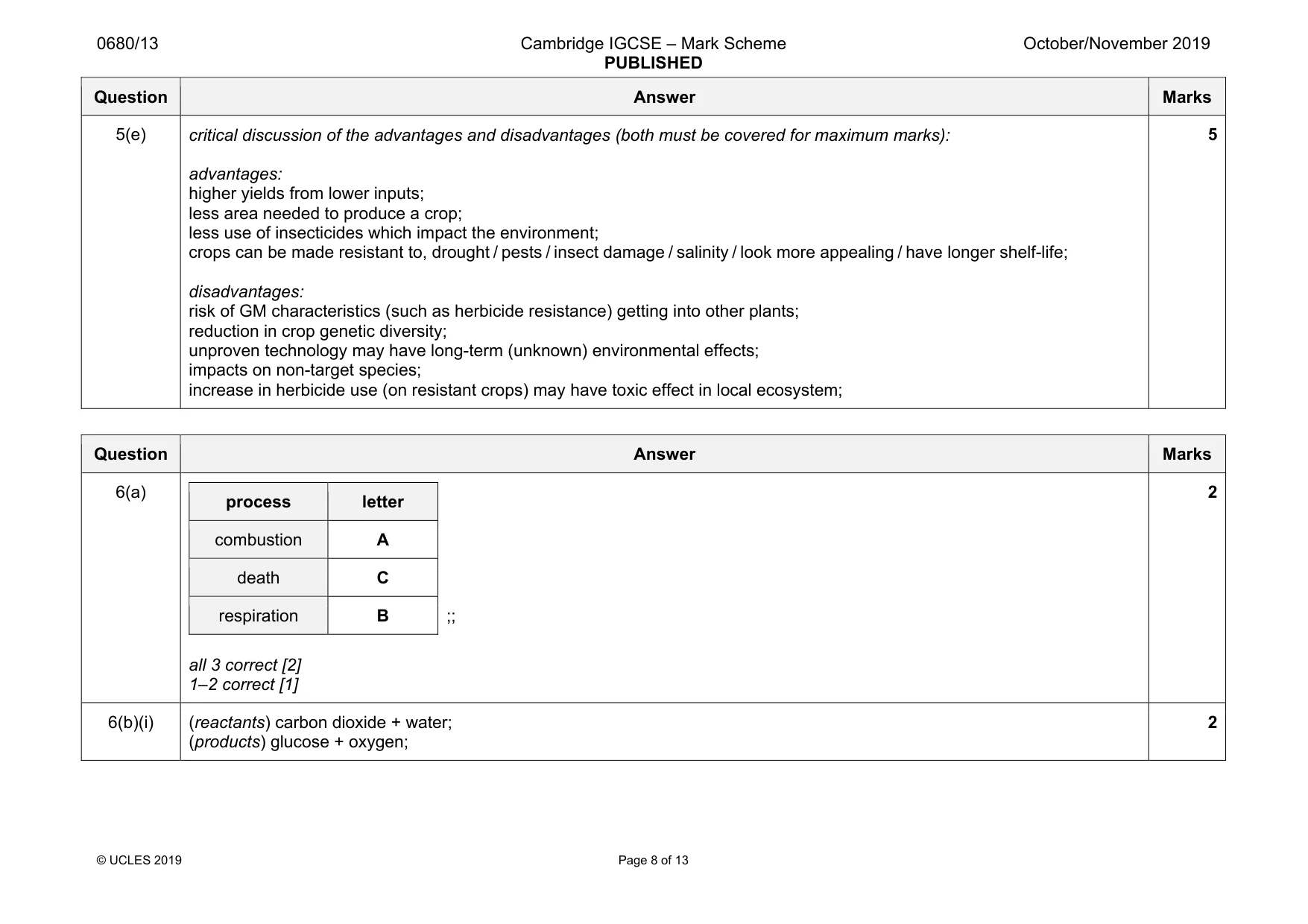
0680/13 Cambridge IGCSE – Mark Scheme PUBLISHED October/November 2019 © UCLES 2019 Page 8 of 13 Question Answer Marks 5(e) critical discussion of the advantages and disadvantages (both must be covered for maximum marks): advantages: higher yields from lower inputs; less area needed to produce a crop; less use of insecticides which impact the environment; crops can be made resistant to, drought / pests / insect damage / salinity / look more appealing / have longer shelf-life; disadvantages: risk of GM characteristics (such as herbicide resistance) getting into other plants; reduction in crop genetic diversity; unproven technology may have long-term (unknown) environmental effects; impacts on non-target species; increase in herbicide use (on resistant crops) may have toxic effect in local ecosystem; 5 Question Answer Marks 6(a) process letter combustion A death C respiration B ;; all 3 correct [2] 1–2 correct [1] 2 6(b)(i) (reactants) carbon dioxide + water; (products) glucose + oxygen; 2
Mark scheme, page 9
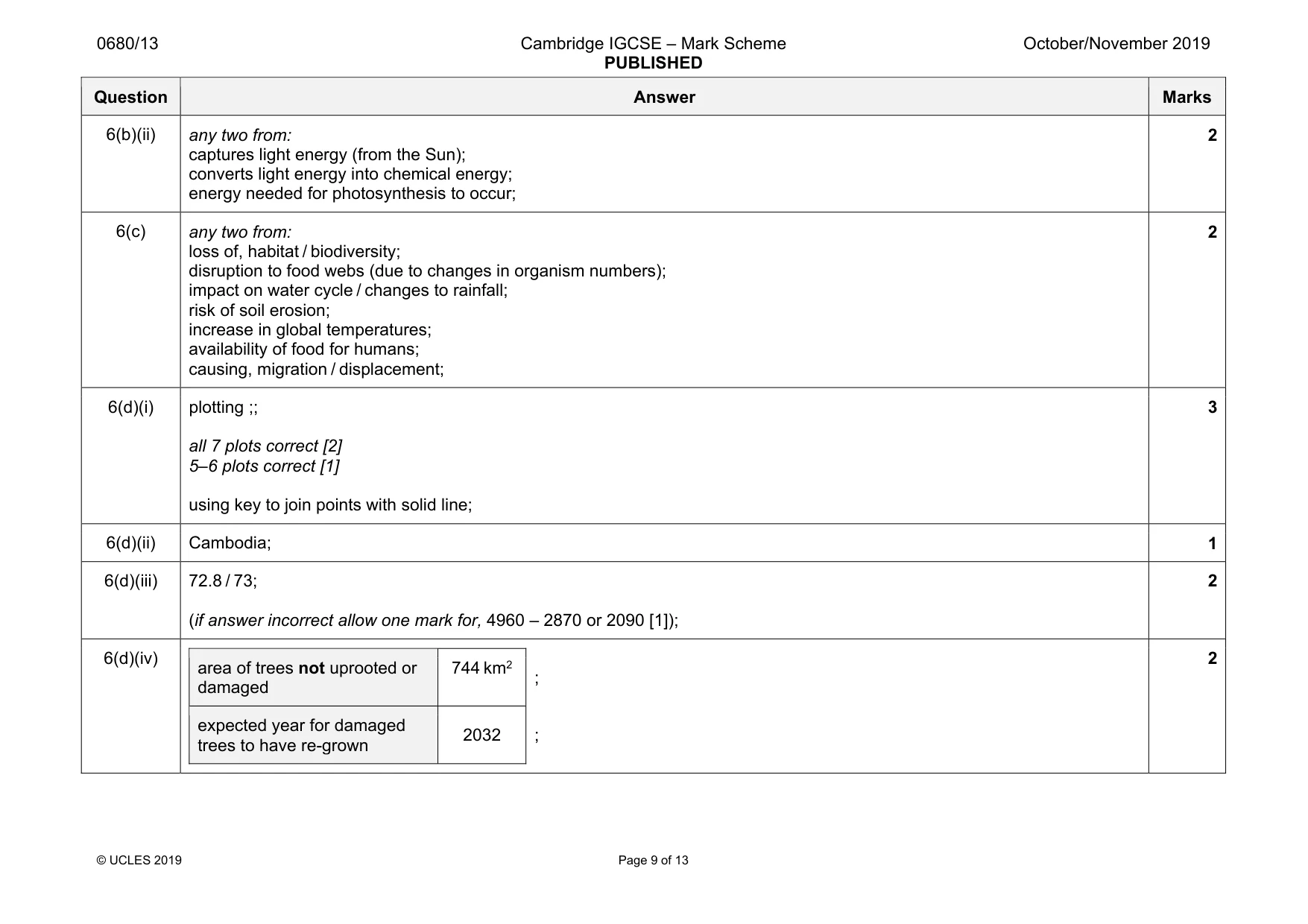
0680/13 Cambridge IGCSE – Mark Scheme PUBLISHED October/November 2019 © UCLES 2019 Page 9 of 13 Question Answer Marks 6(b)(ii) any two from: captures light energy (from the Sun); converts light energy into chemical energy; energy needed for photosynthesis to occur; 2 6(c) any two from: loss of, habitat / biodiversity; disruption to food webs (due to changes in organism numbers); impact on water cycle / changes to rainfall; risk of soil erosion; increase in global temperatures; availability of food for humans; causing, migration / displacement; 2 6(d)(i) plotting ;; all 7 plots correct [2] 5–6 plots correct [1] using key to join points with solid line; 3 6(d)(ii) Cambodia; 1 6(d)(iii) 72.8 / 73; (if answer incorrect allow one mark for, 4960 – 2870 or 2090 [1]); 2 6(d)(iv) area of trees not uprooted or damaged 744 km2 ; expected year for damaged trees to have re-grown 2032 ; 2
Mark scheme, page 10
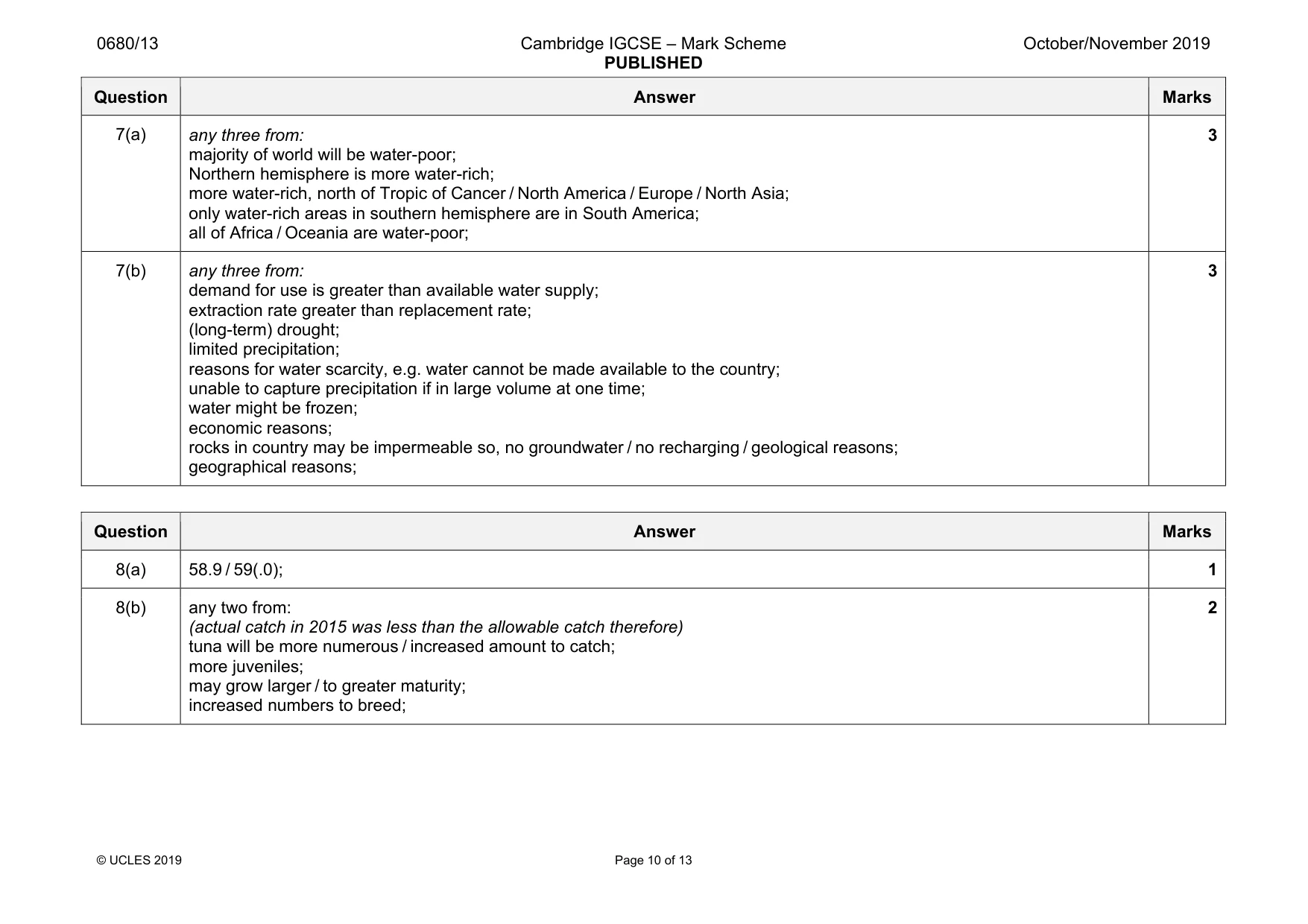
0680/13 Cambridge IGCSE – Mark Scheme PUBLISHED October/November 2019 © UCLES 2019 Page 10 of 13 Question Answer Marks 7(a) any three from: majority of world will be water-poor; Northern hemisphere is more water-rich; more water-rich, north of Tropic of Cancer / North America / Europe / North Asia; only water-rich areas in southern hemisphere are in South America; all of Africa / Oceania are water-poor; 3 7(b) any three from: demand for use is greater than available water supply; extraction rate greater than replacement rate; (long-term) drought; limited precipitation; reasons for water scarcity, e.g. water cannot be made available to the country; unable to capture precipitation if in large volume at one time; water might be frozen; economic reasons; rocks in country may be impermeable so, no groundwater / no recharging / geological reasons; geographical reasons; 3 Question Answer Marks 8(a) 58.9 / 59(.0); 1 8(b) any two from: (actual catch in 2015 was less than the allowable catch therefore) tuna will be more numerous / increased amount to catch; more juveniles; may grow larger / to greater maturity; increased numbers to breed; 2
Mark scheme, page 11
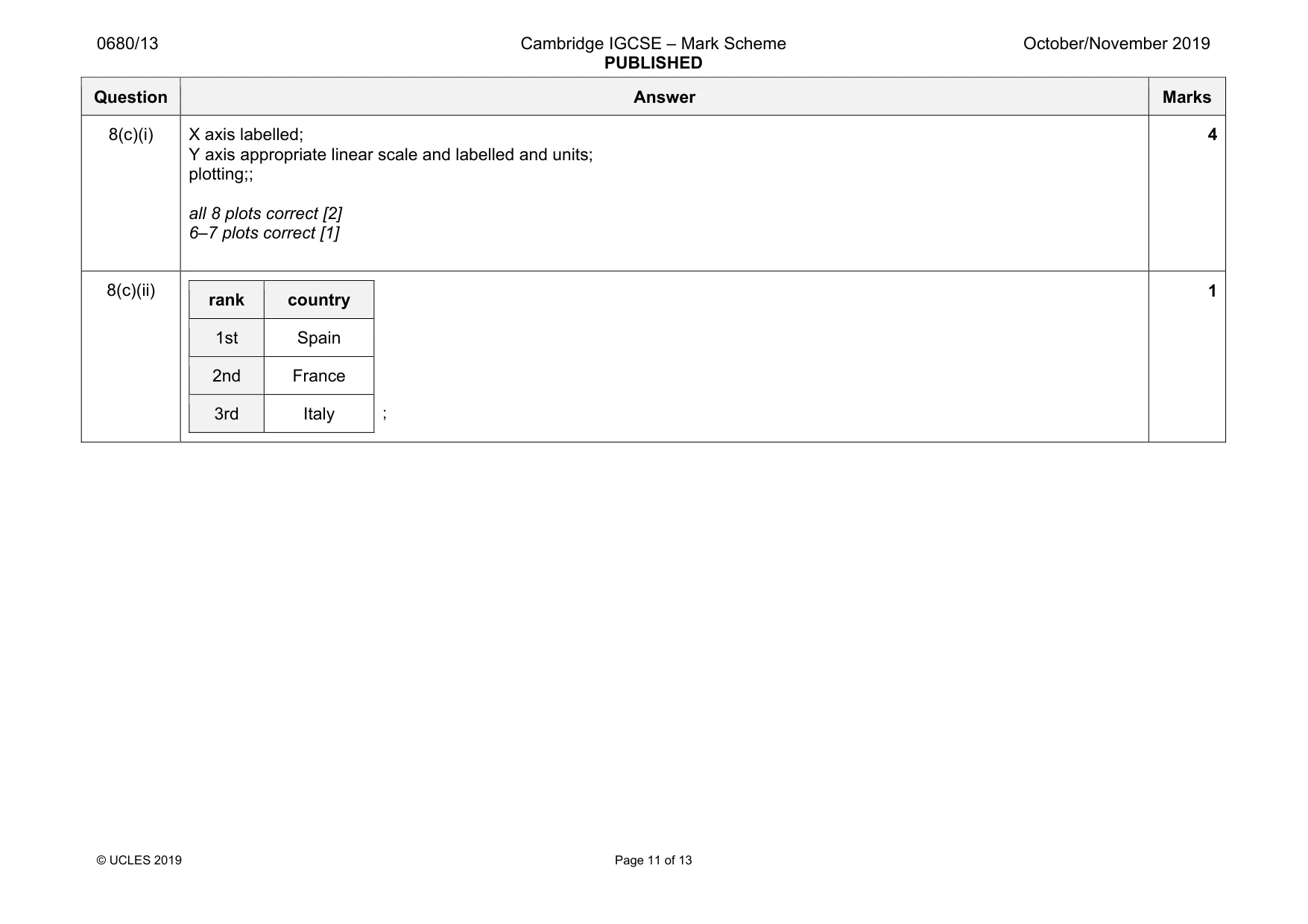
0680/13 Cambridge IGCSE – Mark Scheme PUBLISHED October/November 2019 © UCLES 2019 Page 11 of 13 Question Answer Marks 8(c)(i) X axis labelled; Y axis appropriate linear scale and labelled and units; plotting;; all 8 plots correct [2] 6–7 plots correct [1] 4 8(c)(ii) rank country 1st Spain 2nd France 3rd Italy ; 1
Mark scheme, page 12
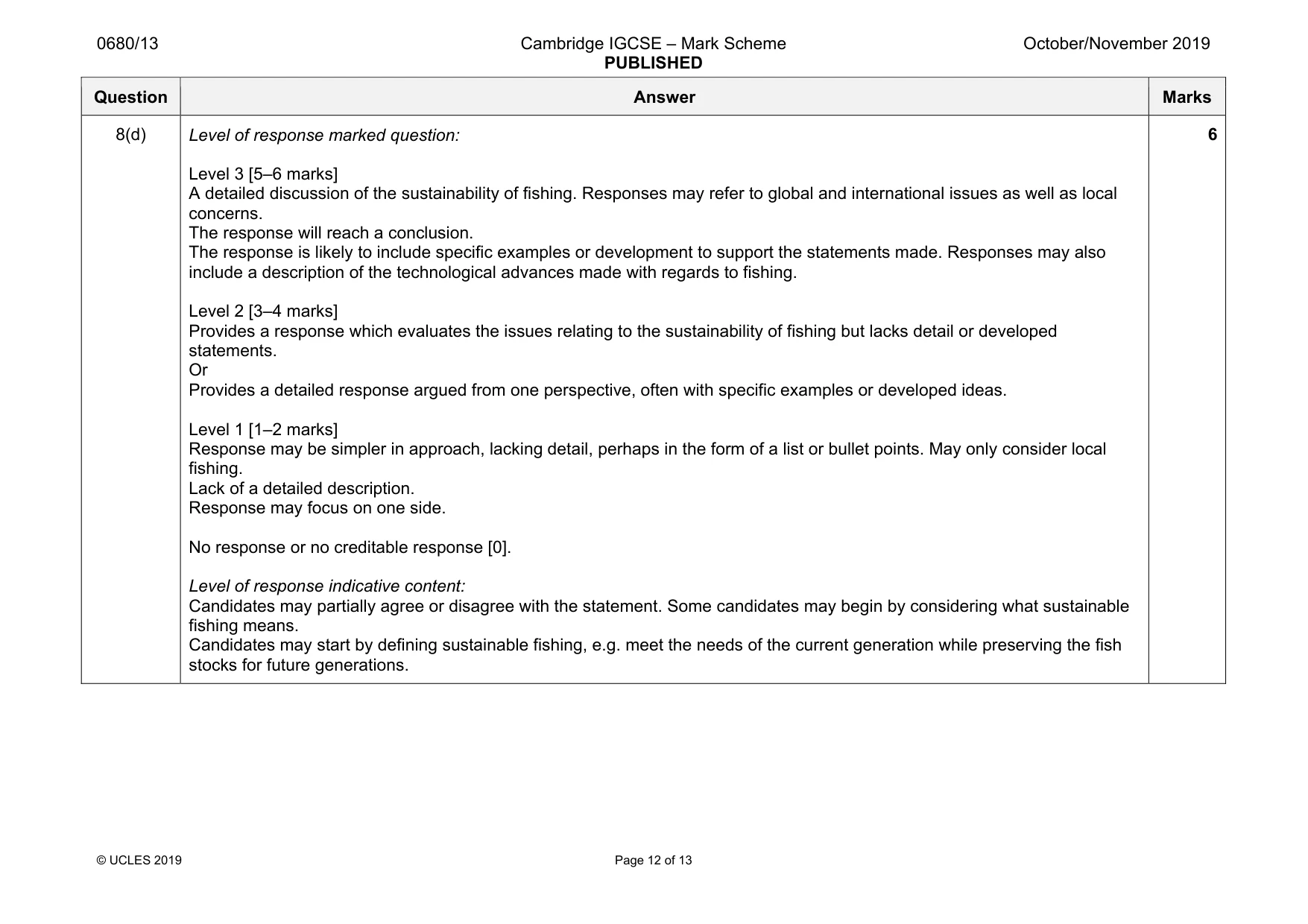
0680/13 Cambridge IGCSE – Mark Scheme PUBLISHED October/November 2019 © UCLES 2019 Page 12 of 13 Question Answer Marks 8(d) Level of response marked question: Level 3 [5–6 marks] A detailed discussion of the sustainability of fishing. Responses may refer to global and international issues as well as local concerns. The response will reach a conclusion. The response is likely to include specific examples or development to support the statements made. Responses may also include a description of the technological advances made with regards to fishing. Level 2 [3–4 marks] Provides a response which evaluates the issues relating to the sustainability of fishing but lacks detail or developed statements. Or Provides a detailed response argued from one perspective, often with specific examples or developed ideas. Level 1 [1–2 marks] Response may be simpler in approach, lacking detail, perhaps in the form of a list or bullet points. May only consider local fishing. Lack of a detailed description. Response may focus on one side. No response or no creditable response [0]. Level of response indicative content: Candidates may partially agree or disagree with the statement. Some candidates may begin by considering what sustainable fishing means. Candidates may start by defining sustainable fishing, e.g. meet the needs of the current generation while preserving the fish stocks for future generations. 6
Mark scheme, page 13
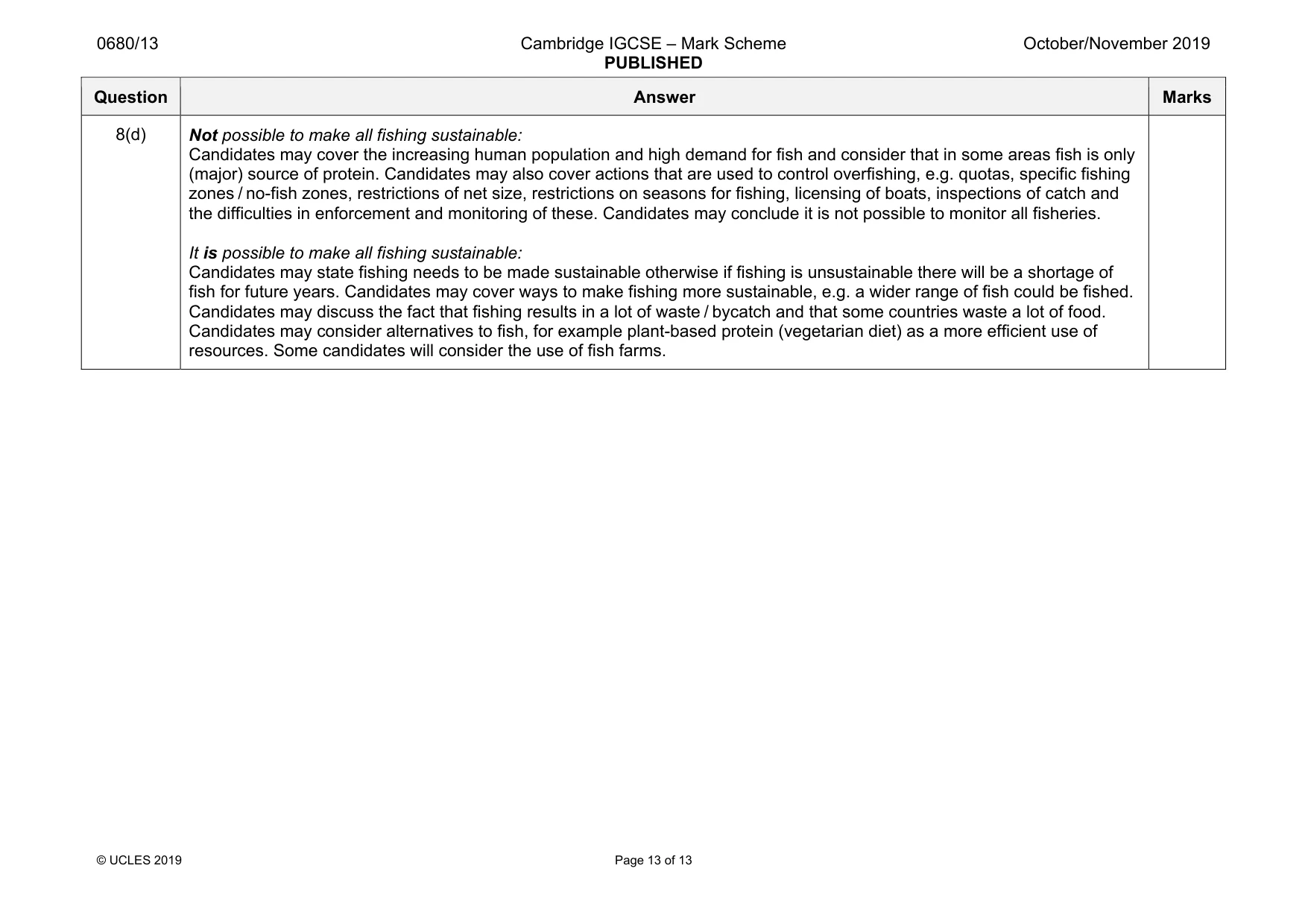
0680/13 Cambridge IGCSE – Mark Scheme PUBLISHED October/November 2019 © UCLES 2019 Page 13 of 13 Question Answer Marks 8(d) Not possible to make all fishing sustainable: Candidates may cover the increasing human population and high demand for fish and consider that in some areas fish is only (major) source of protein. Candidates may also cover actions that are used to control overfishing, e.g. quotas, specific fishing zones / no-fish zones, restrictions of net size, restrictions on seasons for fishing, licensing of boats, inspections of catch and the difficulties in enforcement and monitoring of these. Candidates may conclude it is not possible to monitor all fisheries. It is possible to make all fishing sustainable: Candidates may state fishing needs to be made sustainable otherwise if fishing is unsustainable there will be a shortage of fish for future years. Candidates may cover ways to make fishing more sustainable, e.g. a wider range of fish could be fished. Candidates may discuss the fact that fishing results in a lot of waste / bycatch and that some countries waste a lot of food. Candidates may consider alternatives to fish, for example plant-based protein (vegetarian diet) as a more efficient use of resources. Some candidates will consider the use of fish farms.
What you needed in this session
Cambridge’s own grade thresholds for 2019 Oct/Nov, Paper 1 · Variant 3. A higher threshold means an easier paper — the bar moves with how the cohort did.