Cambridge IGCSE Environmental Management 0680 — 2018 Oct/Nov Paper 1 · Variant 2
0680/12/O/N/18 · 60 marks · ≈68 min
The question paper and its mark scheme, free to read here and free to download. This is Cambridge’s own paper, exactly as it was sat.
Question paper16 pages



Mark scheme10 pages
Answers below. Sit the paper first if you are practising.
Paper as text
Question paper, page 1
This document consists of 13 printed pages and 3 blank pages. DC (SCD (JB)) 148049/4 © UCLES 2018 [Turn over * 3 6 7 0 8 9 7 4 5 7 * ENVIRONMENTAL MANAGEMENT 0680/12 Paper 1 October/November 2018 1 hour 30 minutes Candidates answer on the Question Paper. No Additional Materials are required. READ THESE INSTRUCTIONS FIRST Write your Centre number, candidate number and name on all the work you hand in. Write in dark blue or black pen. You may use an HB pencil for any diagrams or graphs. Do not use staples, paper clips, glue or correction fluid. DO NOT WRITE IN ANY BARCODES. Answer all questions. Electronic calculators may be used. You may lose marks if you do not show your working or if you do not use appropriate units. At the end of the examination, fasten all your work securely together. The number of marks is given in brackets [ ] at the end of each question or part question. Cambridge International Examinations Cambridge International General Certificate of Secondary Education
Question paper, page 2
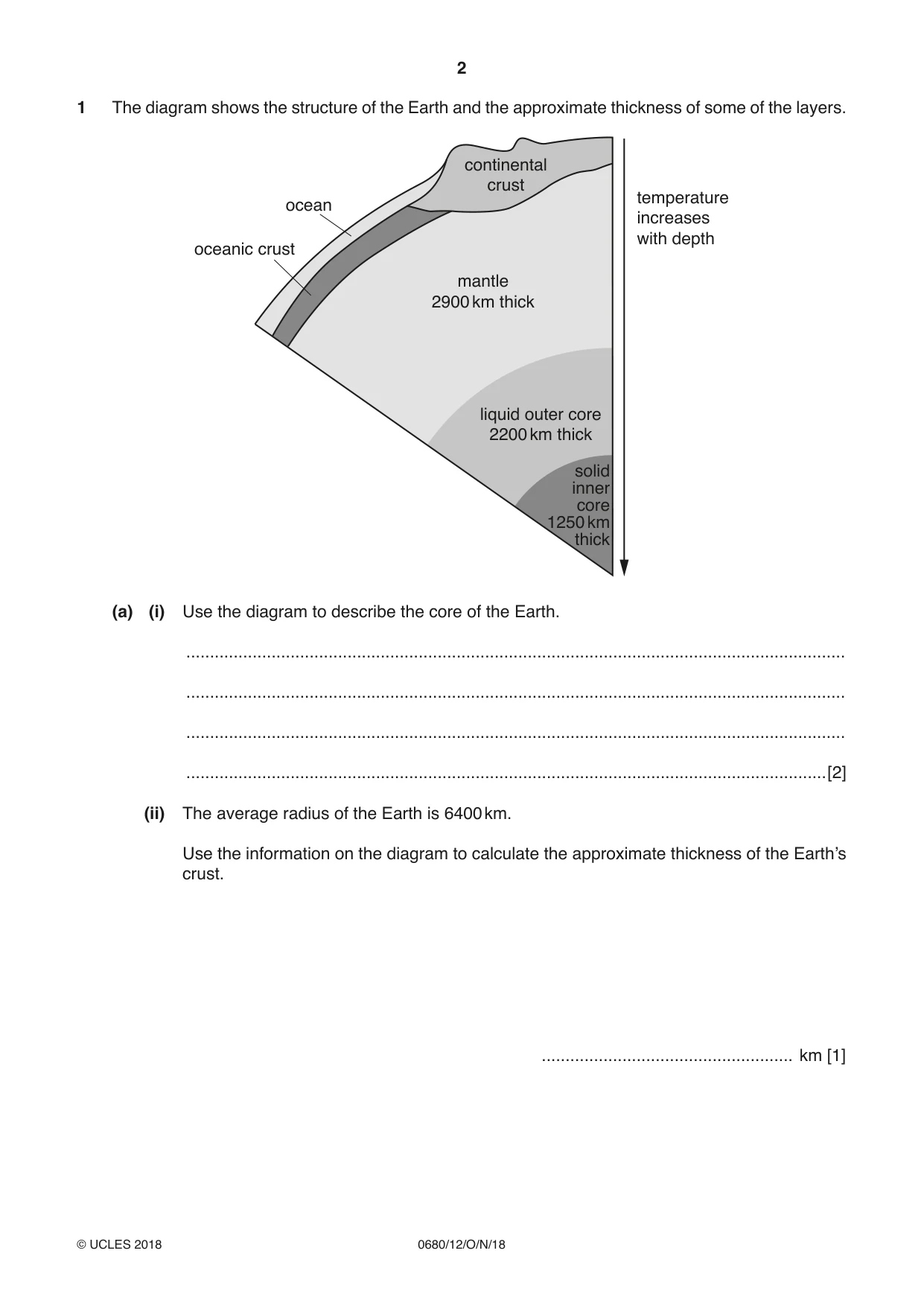
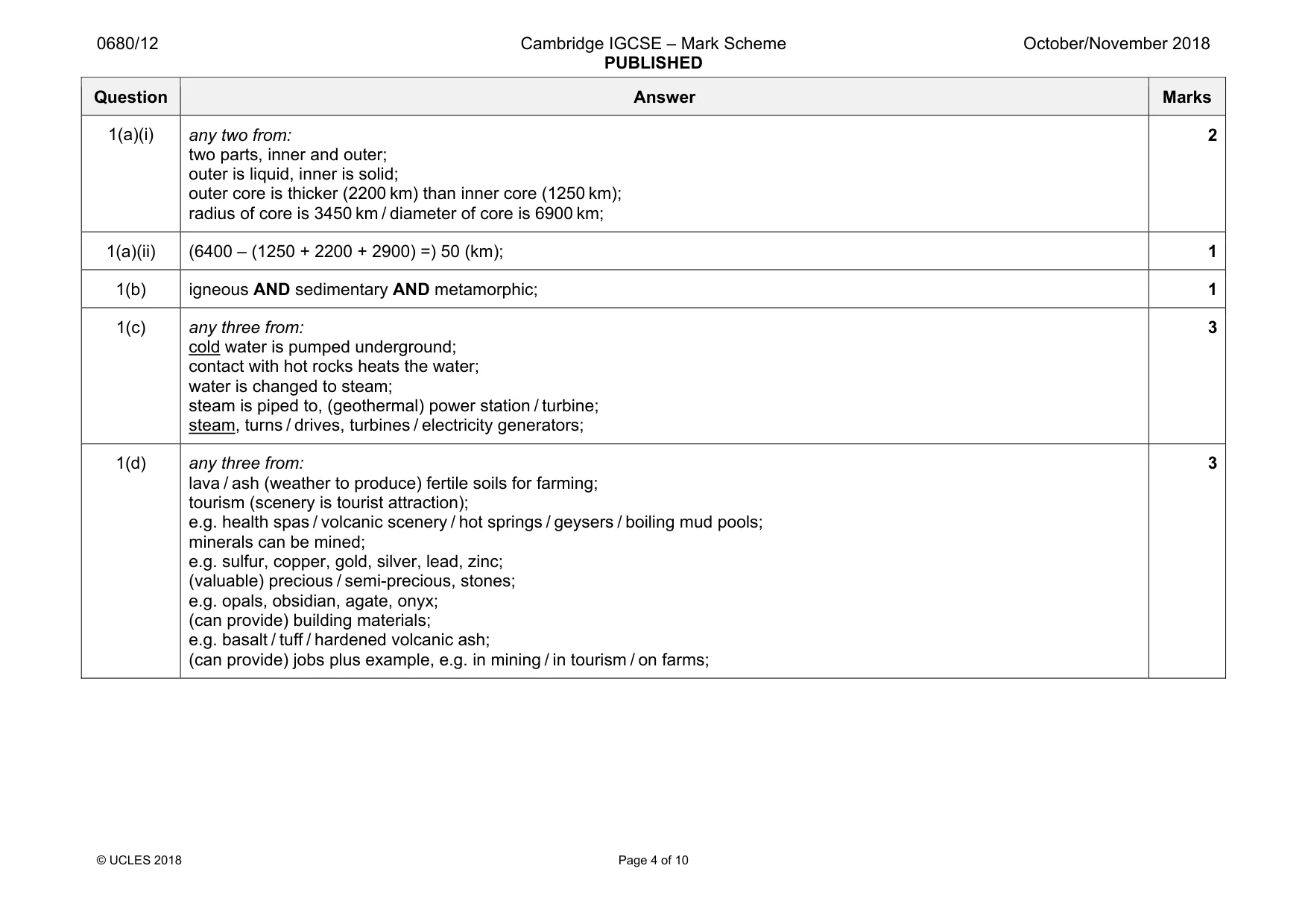
2 0680/12/O/N/18 © UCLES 2018 1 The diagram shows the structure of the Earth and the approximate thickness of some of the layers. mantle 2900 km thick continental crust ocean oceanic crust temperature increases with depth liquid outer core 2200 km thick solid inner core 1250 km thick (a) (i) Use the diagram to describe the core of the Earth. … … … …[2] (ii) The average radius of the Earth is 6400 km. Use the information on the diagram to calculate the approximate thickness of the Earth’s crust. … km [1]
Question paper, page 3
3 0680/12/O/N/18 © UCLES 2018 [Turn over (b) Name the three main types of rock found in the Earth’s crust. 1 … 2 … 3 … [1] (c) Explain how heat in the Earth’s crust can be used to generate electricity in a geothermal power station. … … … … … …[3] (d) Geothermal energy can be one benefit of living near a volcano. Suggest other benefits of living near a volcano. … … … … … …[3]
Question paper, page 4
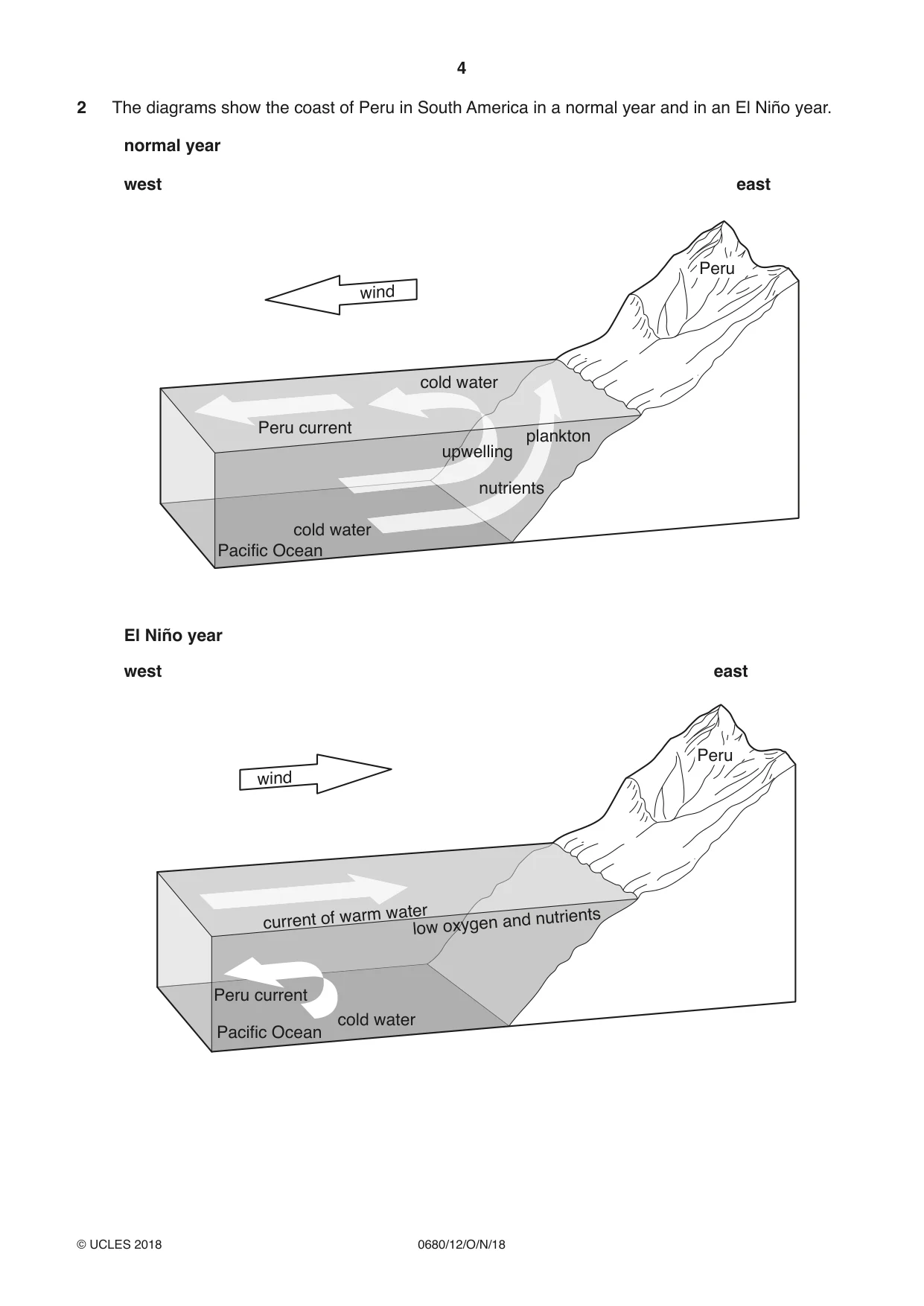
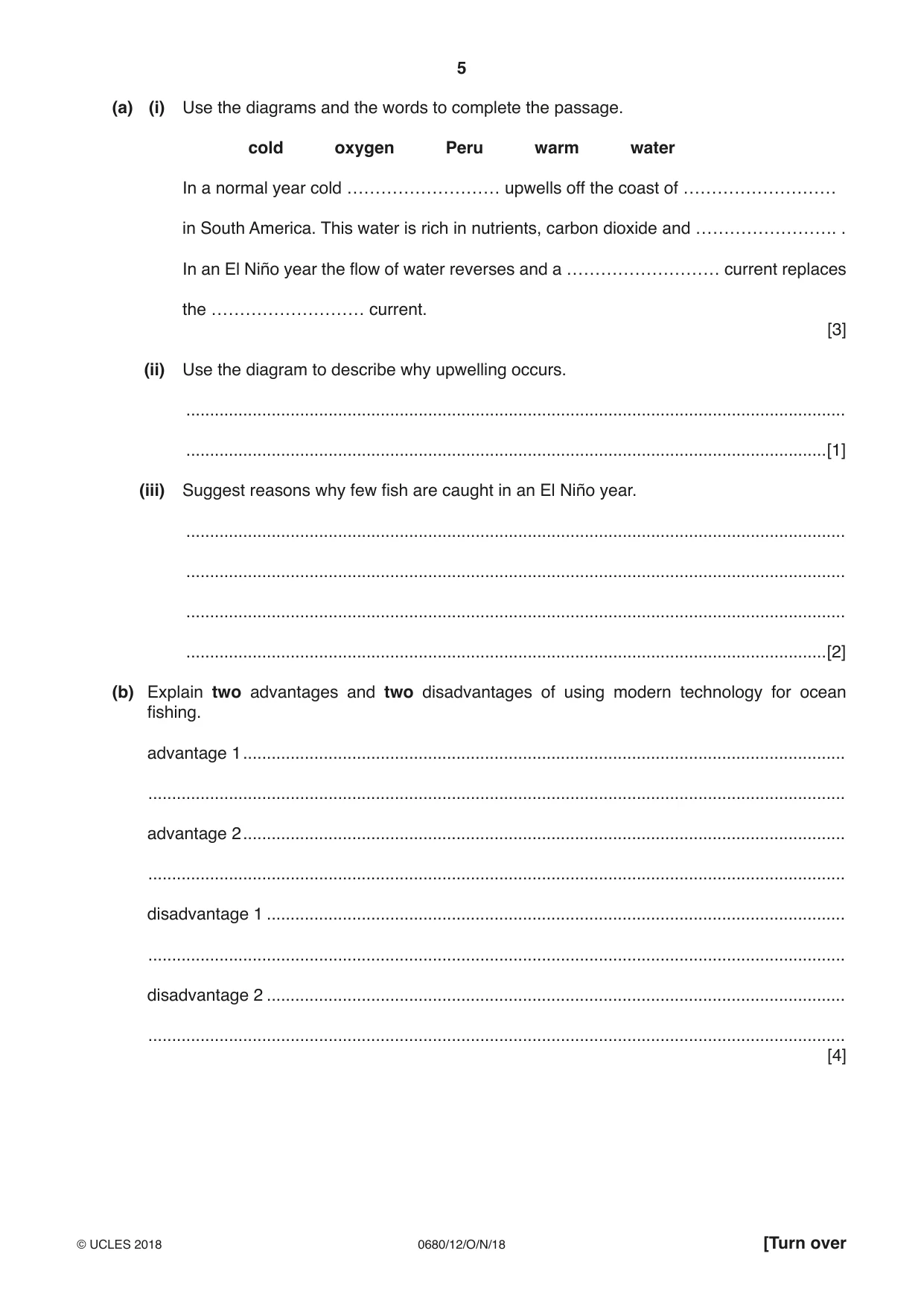
4 0680/12/O/N/18 © UCLES 2018 2 The diagrams show the coast of Peru in South America in a normal year and in an El Niño year. wind east Peru east west El Niño year normal year west Peru Peru current Peru current current of warm water low oxygen and nutrients cold water upwelling nutrients Pacific Ocean Pacific Ocean cold water cold water plankton wind
Question paper, page 5
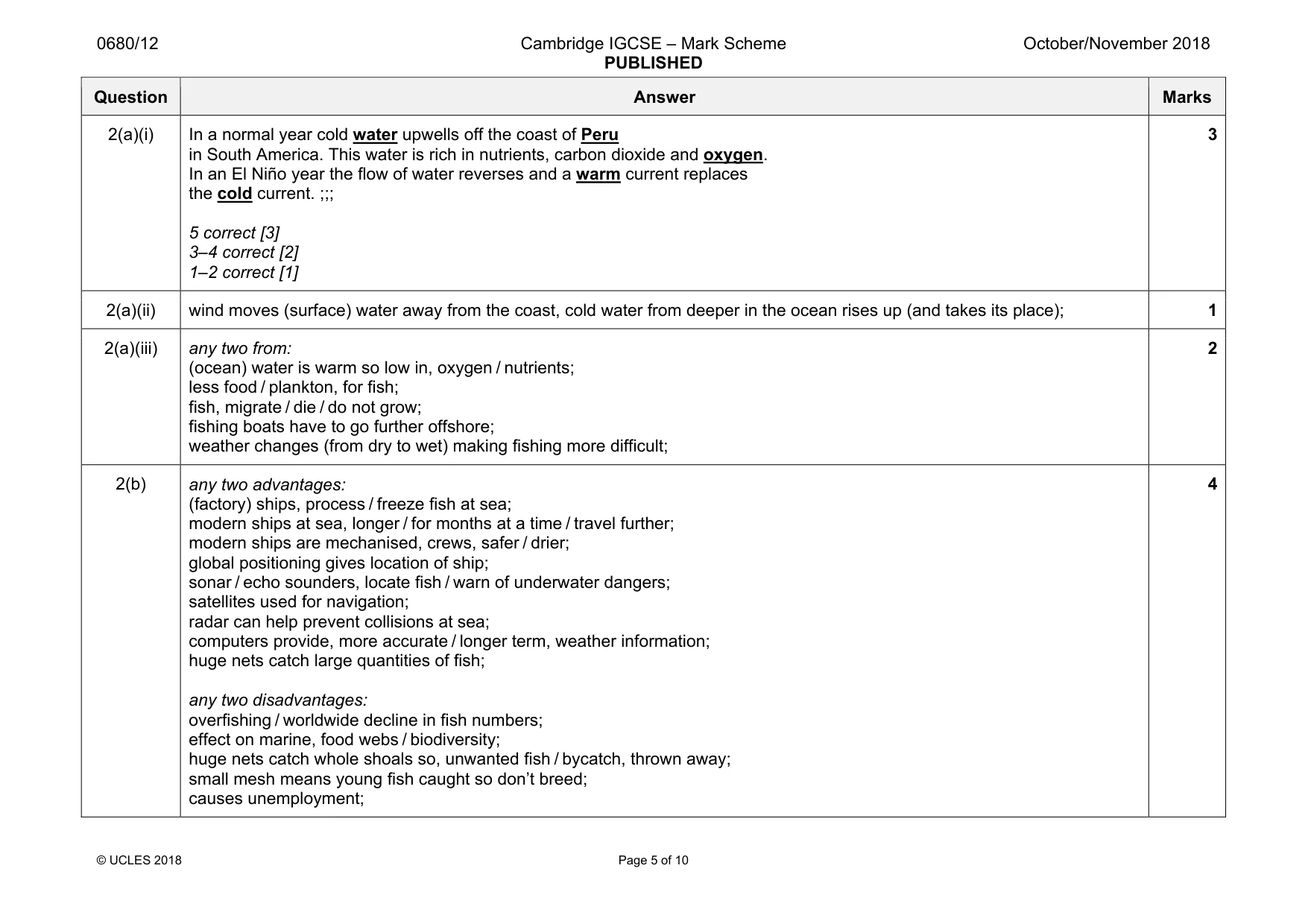
5 0680/12/O/N/18 © UCLES 2018 [Turn over (a) (i) Use the diagrams and the words to complete the passage. cold oxygen Peru warm water In a normal year cold ……………………… upwells off the coast of ……………………… in South America. This water is rich in nutrients, carbon dioxide and ……………………. . In an El Niño year the flow of water reverses and a ……………………… current replaces the ……………………… current. [3] (ii) Use the diagram to describe why upwelling occurs. … …[1] (iii) Suggest reasons why few fish are caught in an El Niño year. … … … …[2] (b) Explain two advantages and two disadvantages of using modern technology for ocean fishing. advantage 1 … … advantage 2 … … disadvantage 1 … … disadvantage 2 … … [4]
Question paper, page 6
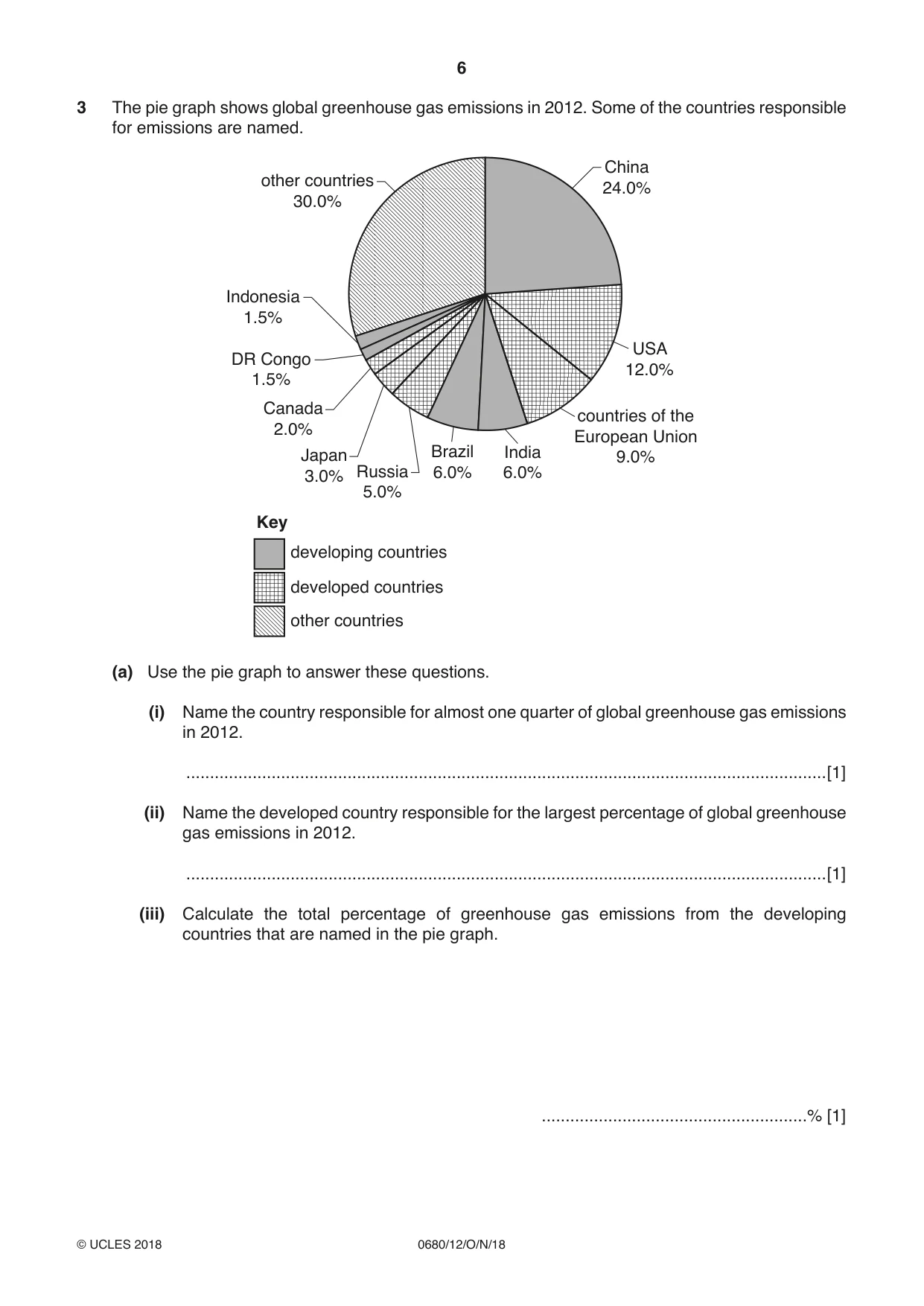
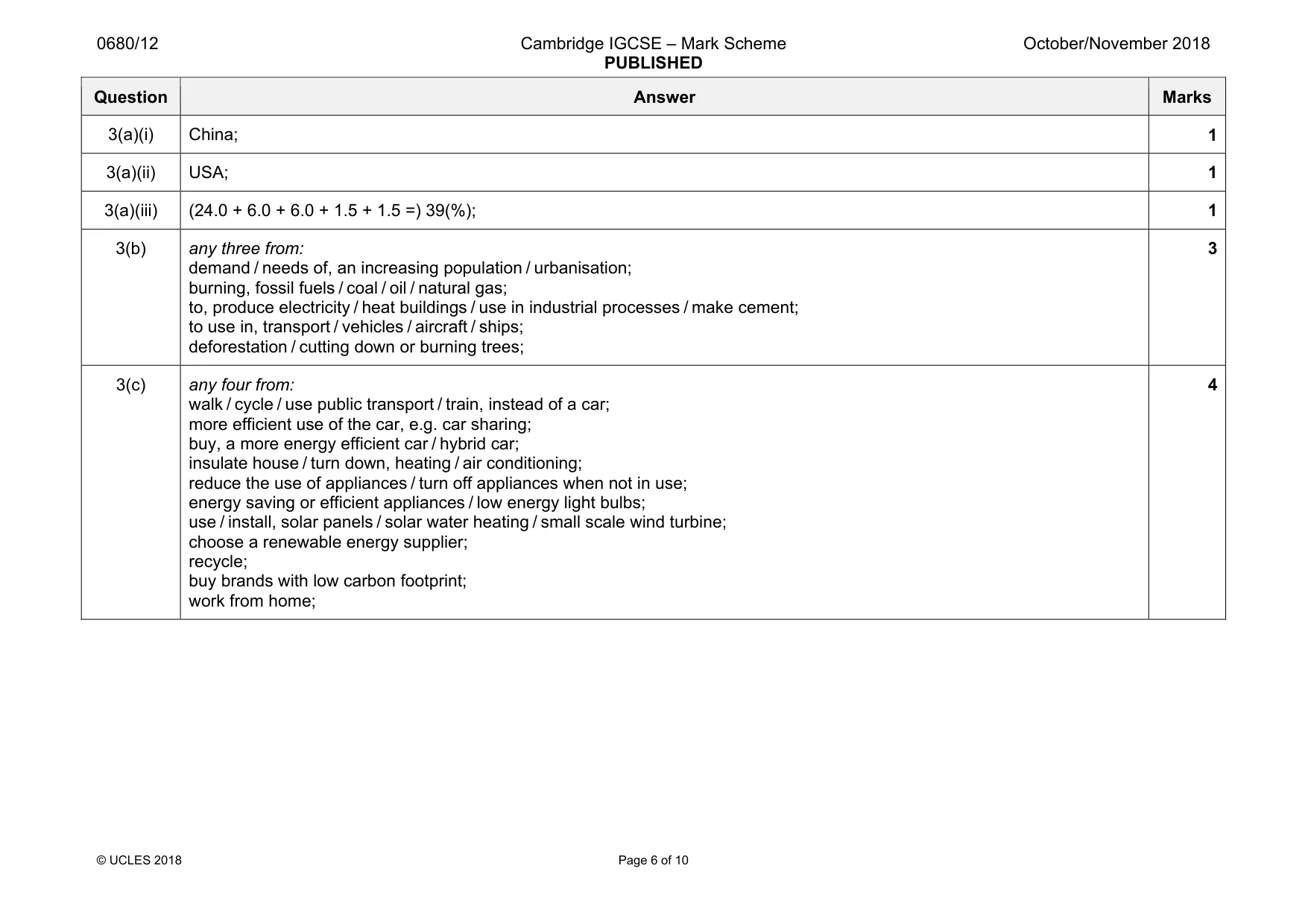
6 0680/12/O/N/18 © UCLES 2018 3 The pie graph shows global greenhouse gas emissions in 2012. Some of the countries responsible for emissions are named. developing countries Key developed countries other countries other countries 30.0% Indonesia 1.5% DR Congo 1.5% Canada 2.0% Japan 3.0% Russia 5.0% Brazil 6.0% India 6.0% USA 12.0% China 24.0% countries of the European Union 9.0% (a) Use the pie graph to answer these questions. (i) Name the country responsible for almost one quarter of global greenhouse gas emissions in 2012. …[1] (ii) Name the developed country responsible for the largest percentage of global greenhouse gas emissions in 2012. …[1] (iii) Calculate the total percentage of greenhouse gas emissions from the developing countries that are named in the pie graph. …% [1]
Question paper, page 7
7 0680/12/O/N/18 © UCLES 2018 [Turn over (b) Explain why the amount of carbon dioxide in the atmosphere is increasing. … … … … … …[3] (c) Describe ways in which people could reduce their contribution to carbon dioxide emissions. … … … … … … … …[4]
Question paper, page 8
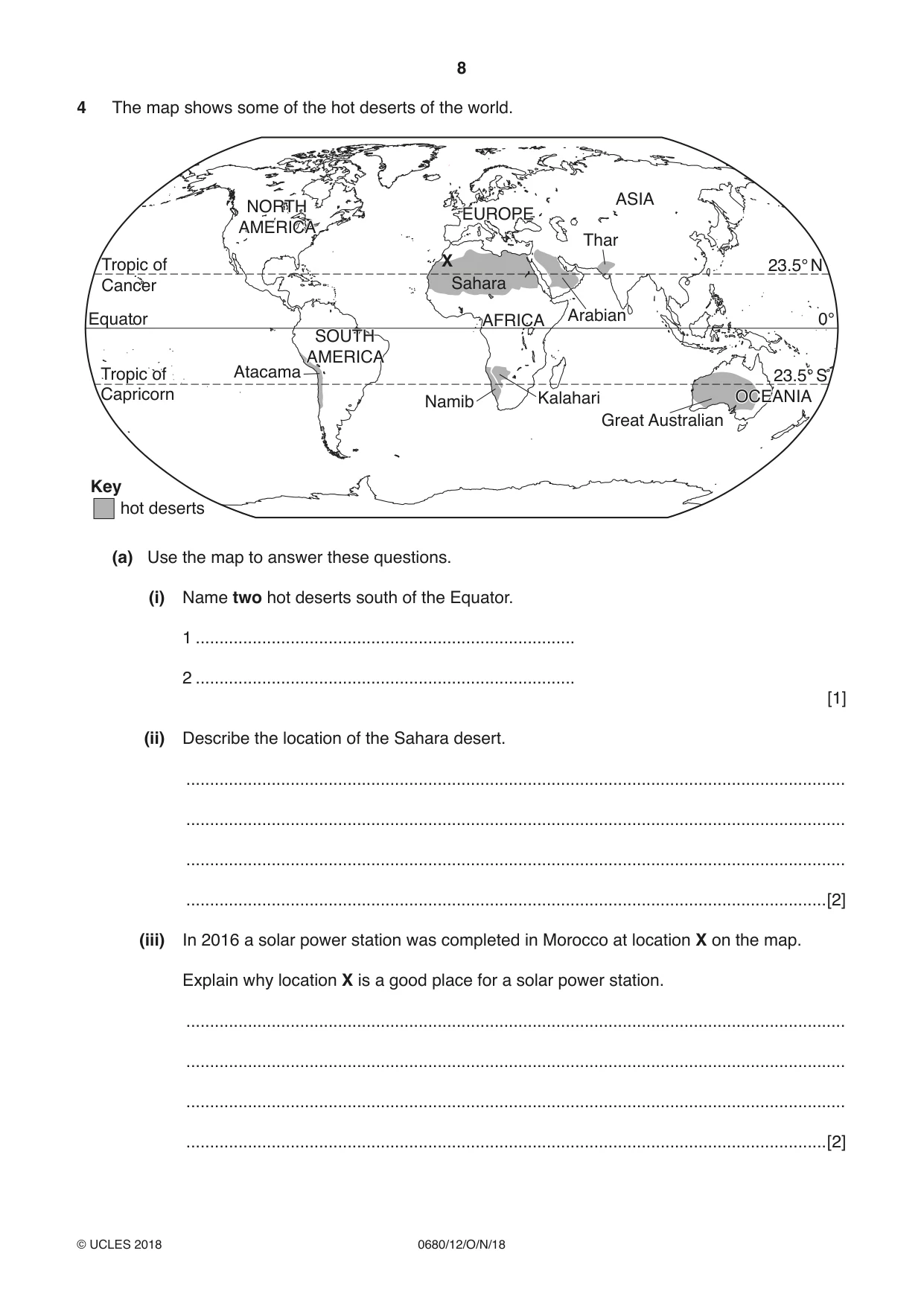
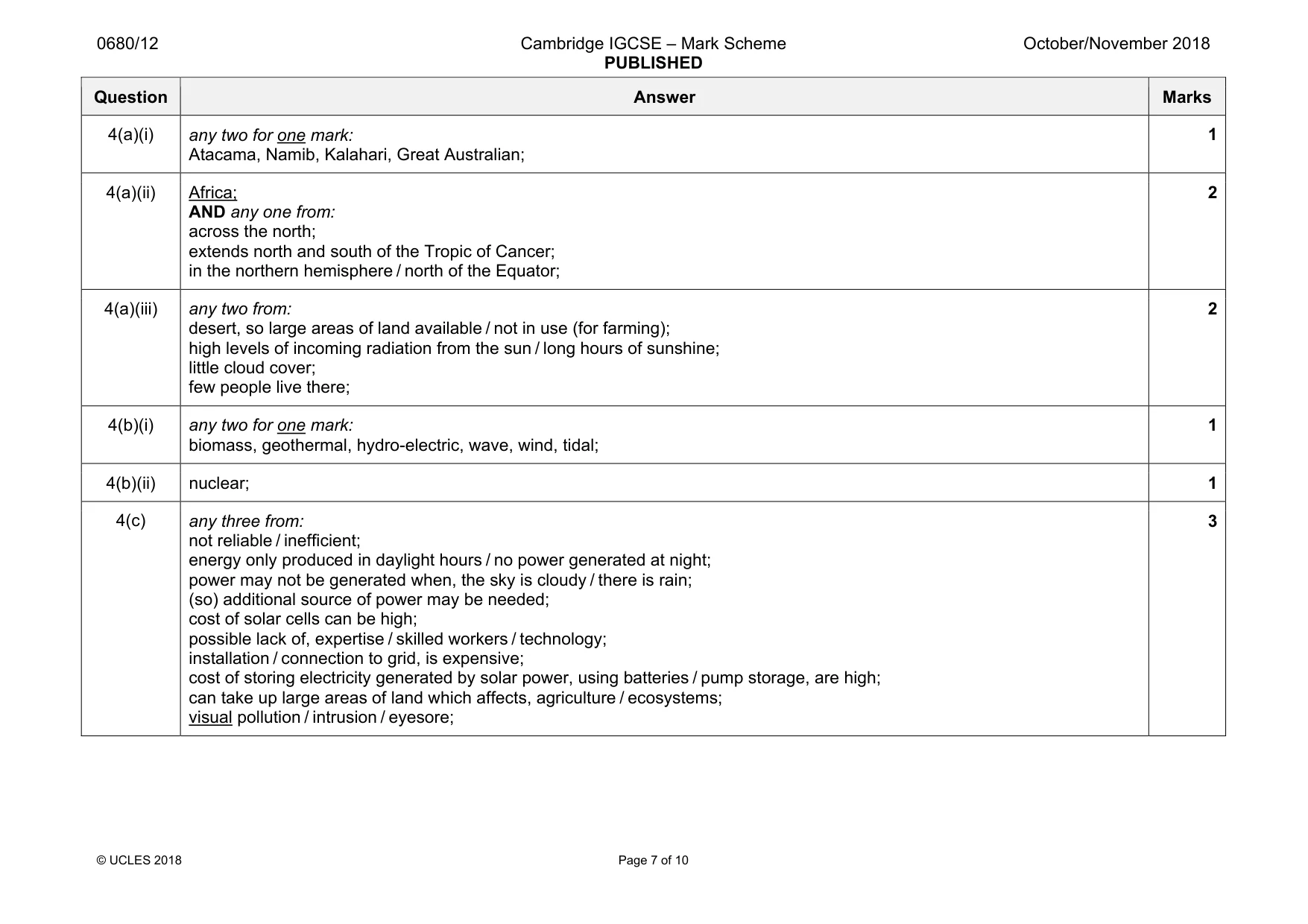
8 0680/12/O/N/18 © UCLES 2018 4 The map shows some of the hot deserts of the world. Tropic of Cancer Atacama Namib Great Australian Kalahari Arabian Thar Sahara X NORTH AMERICA SOUTH AMERICA EUROPE ASIA OCEANIA AFRICA Equator Tropic of Capricorn hot deserts Key 23.5° N 0° 23.5° S (a) Use the map to answer these questions. (i) Name two hot deserts south of the Equator. 1 … 2 … [1] (ii) Describe the location of the Sahara desert. … … … …[2] (iii) In 2016 a solar power station was completed in Morocco at location X on the map. Explain why location X is a good place for a solar power station. … … … …[2]
Question paper, page 9
9 0680/12/O/N/18 © UCLES 2018 [Turn over (b) Before the solar power station was built, Morocco depended on fossil fuels for 98% of the country’s energy. (i) Name two renewable energy sources other than solar power. 1 … 2 … [1] (ii) Name one source of energy that is an alternative to fossil fuels and to renewable energy. …[1] (c) Suggest disadvantages of solar power as a source of energy. … … … … … …[3]
Question paper, page 10
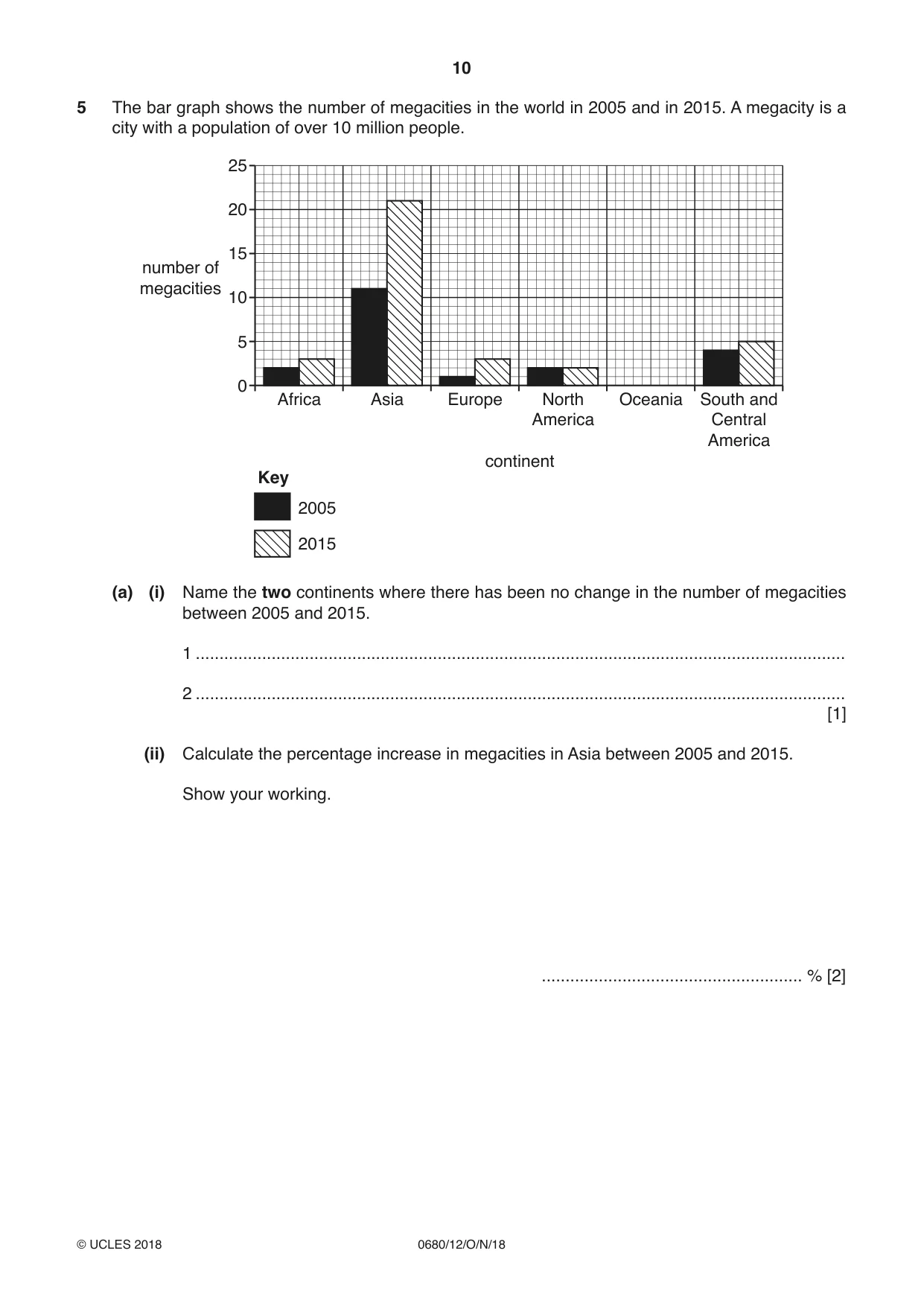
10 0680/12/O/N/18 © UCLES 2018 5 The bar graph shows the number of megacities in the world in 2005 and in 2015. A megacity is a city with a population of over 10 million people. 0 5 10 15 20 25 Africa Asia Europe 2005 Key 2015 North America continent number of megacities Oceania South and Central America (a) (i) Name the two continents where there has been no change in the number of megacities between 2005 and 2015. 1 … 2 … [1] (ii) Calculate the percentage increase in megacities in Asia between 2005 and 2015. Show your working. … % [2]
Question paper, page 11
11 0680/12/O/N/18 © UCLES 2018 [Turn over (b) The populations of megacities are growing faster in developing countries than in developed countries as a result of push and pull factors. (i) Explain what is meant by the terms push factor and pull factor. push factor … … pull factor … … [2] (ii) Explain three pull factors that would result in rapid population growth in megacities. pull factor 1 … explanation … … pull factor 2 … explanation … … pull factor 3 … explanation … … [3] (c) Describe two environmental problems caused by rapid population growth in cities. 1 … … 2 … … [2]
Question paper, page 12
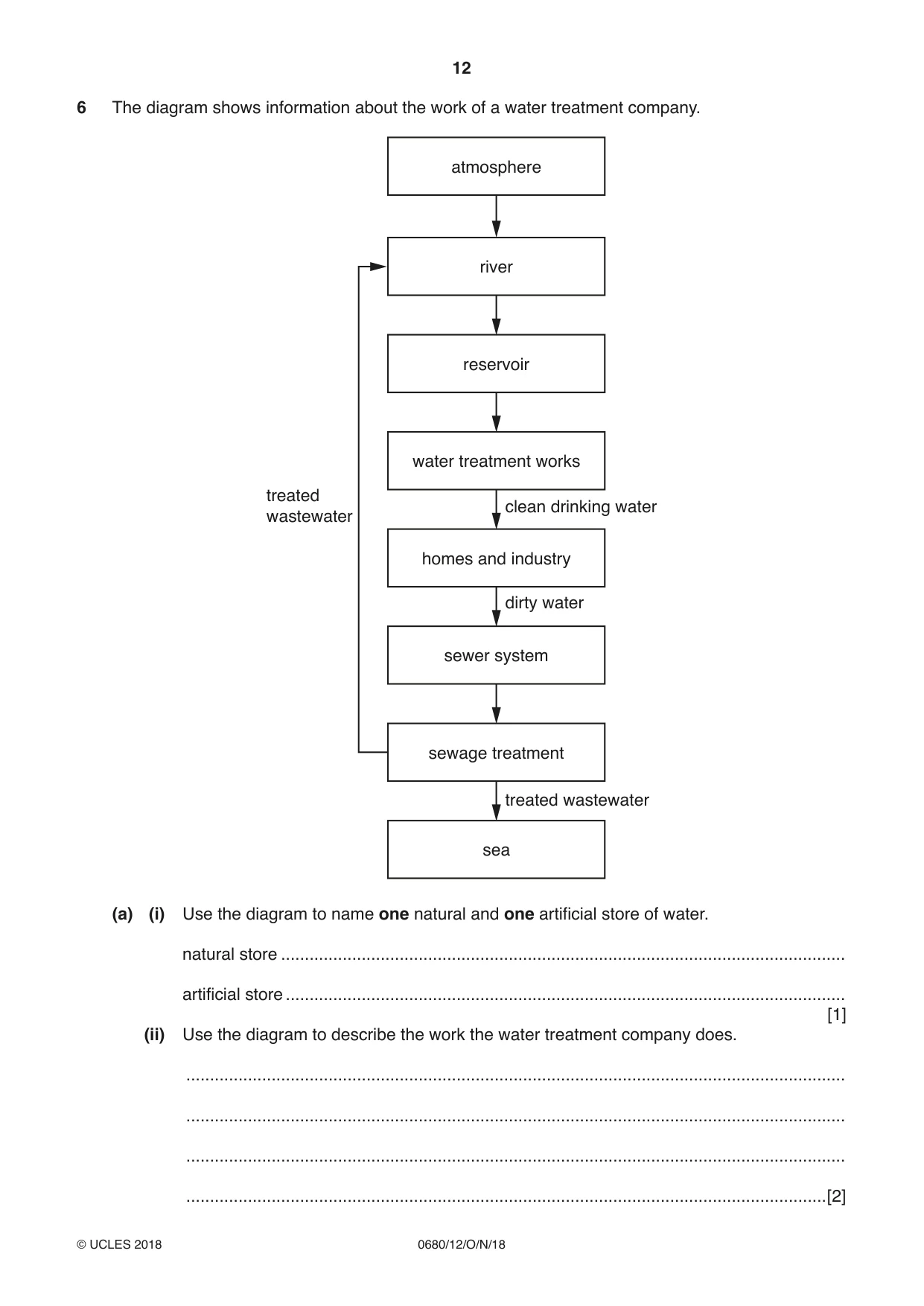
12 0680/12/O/N/18 © UCLES 2018 6 The diagram shows information about the work of a water treatment company. atmosphere river reservoir water treatment works clean drinking water treated wastewater dirty water treated wastewater homes and industry sewer system sewage treatment sea (a) (i) Use the diagram to name one natural and one artificial store of water. natural store … artificial store … [1] (ii) Use the diagram to describe the work the water treatment company does. … … … …[2]
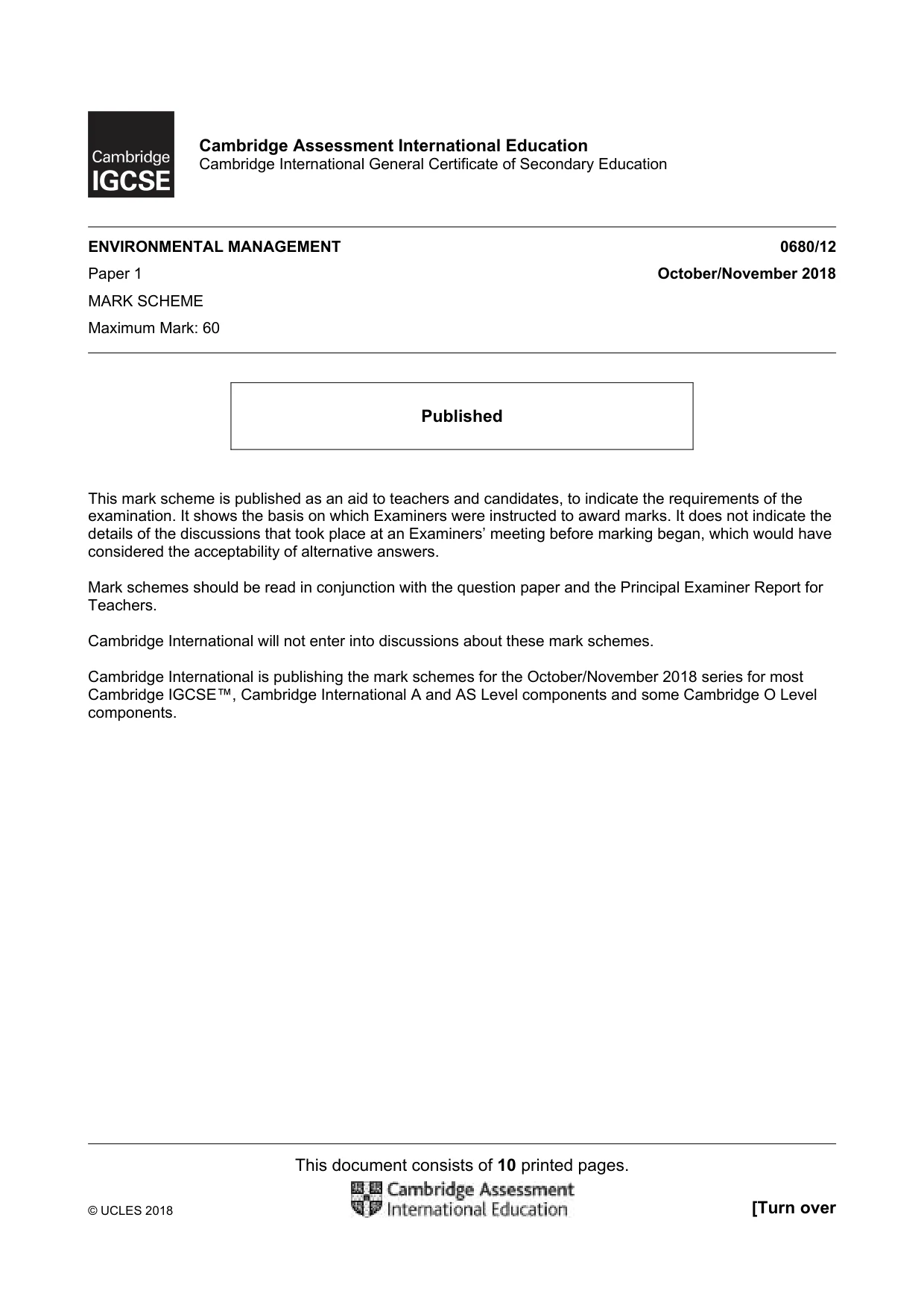
Question paper, page 13
13 0680/12/O/N/18 © UCLES 2018 (b) In some parts of the world people use untreated water from rivers. (i) Explain why untreated water from rivers may not be safe to use. … … … … … …[3] (ii) Mosquitoes breed in water and transmit disease. Name one disease transmitted by mosquitoes. …[1] (c) Oceans contain 97% of the Earth’s water. Suggest reasons why only a few countries use desalination to supply fresh water. … … … … … …[3]
Question paper, page 14
14 0680/12/O/N/18 © UCLES 2018 BLANK PAGE
Question paper, page 15
15 0680/12/O/N/18 © UCLES 2018 BLANK PAGE
Question paper, page 16
16 0680/12/O/N/18 © UCLES 2018 Permission to reproduce items where third-party owned material protected by copyright is included has been sought and cleared where possible. Every reasonable effort has been made by the publisher (UCLES) to trace copyright holders, but if any items requiring clearance have unwittingly been included, the publisher will be pleased to make amends at the earliest possible opportunity. To avoid the issue of disclosure of answer-related information to candidates, all copyright acknowledgements are reproduced online in the Cambridge International Examinations Copyright Acknowledgements Booklet. This is produced for each series of examinations and is freely available to download at www.cie.org.uk after the live examination series. Cambridge International Examinations is part of the Cambridge Assessment Group. Cambridge Assessment is the brand name of University of Cambridge Local Examinations Syndicate (UCLES), which is itself a department of the University of Cambridge. BLANK PAGE
Mark scheme, page 1
This document consists of 10 printed pages. © UCLES 2018 [Turn over Cambridge Assessment International Education Cambridge International General Certificate of Secondary Education ENVIRONMENTAL MANAGEMENT 0680/12 Paper 1 October/November 2018 MARK SCHEME Maximum Mark: 60 Published This mark scheme is published as an aid to teachers and candidates, to indicate the requirements of the examination. It shows the basis on which Examiners were instructed to award marks. It does not indicate the details of the discussions that took place at an Examiners’ meeting before marking began, which would have considered the acceptability of alternative answers. Mark schemes should be read in conjunction with the question paper and the Principal Examiner Report for Teachers. Cambridge International will not enter into discussions about these mark schemes. Cambridge International is publishing the mark schemes for the October/November 2018 series for most Cambridge IGCSE™, Cambridge International A and AS Level components and some Cambridge O Level components.
Mark scheme, page 2
0680/12 Cambridge IGCSE – Mark Scheme PUBLISHED October/November 2018 © UCLES 2018 Page 2 of 10 Generic Marking Principles These general marking principles must be applied by all examiners when marking candidate answers. They should be applied alongside the specific content of the mark scheme or generic level descriptors for a question. Each question paper and mark scheme will also comply with these marking principles. GENERIC MARKING PRINCIPLE 1: Marks must be awarded in line with: • the specific content of the mark scheme or the generic level descriptors for the question • the specific skills defined in the mark scheme or in the generic level descriptors for the question • the standard of response required by a candidate as exemplified by the standardisation scripts. GENERIC MARKING PRINCIPLE 2: Marks awarded are always whole marks (not half marks, or other fractions). GENERIC MARKING PRINCIPLE 3: Marks must be awarded positively: • marks are awarded for correct/valid answers, as defined in the mark scheme. However, credit is given for valid answers which go beyond the scope of the syllabus and mark scheme, referring to your Team Leader as appropriate • marks are awarded when candidates clearly demonstrate what they know and can do • marks are not deducted for errors • marks are not deducted for omissions • answers should only be judged on the quality of spelling, punctuation and grammar when these features are specifically assessed by the question as indicated by the mark scheme. The meaning, however, should be unambiguous. GENERIC MARKING PRINCIPLE 4: Rules must be applied consistently e.g. in situations where candidates have not followed instructions or in the application of generic level descriptors.
Mark scheme, page 3
0680/12 Cambridge IGCSE – Mark Scheme PUBLISHED October/November 2018 © UCLES 2018 Page 3 of 10 GENERIC MARKING PRINCIPLE 5: Marks should be awarded using the full range of marks defined in the mark scheme for the question (however; the use of the full mark range may be limited according to the quality of the candidate responses seen). GENERIC MARKING PRINCIPLE 6: Marks awarded are based solely on the requirements as defined in the mark scheme. Marks should not be awarded with grade thresholds or grade descriptors in mind.
Mark scheme, page 4
0680/12 Cambridge IGCSE – Mark Scheme PUBLISHED October/November 2018 © UCLES 2018 Page 4 of 10 Question Answer Marks 1(a)(i) any two from: two parts, inner and outer; outer is liquid, inner is solid; outer core is thicker (2200 km) than inner core (1250 km); radius of core is 3450 km / diameter of core is 6900 km; 2 1(a)(ii) (6400 – (1250 + 2200 + 2900) =) 50 (km); 1 1(b) igneous AND sedimentary AND metamorphic; 1 1(c) any three from: cold water is pumped underground; contact with hot rocks heats the water; water is changed to steam; steam is piped to, (geothermal) power station / turbine; steam, turns / drives, turbines / electricity generators; 3 1(d) any three from: lava / ash (weather to produce) fertile soils for farming; tourism (scenery is tourist attraction); e.g. health spas / volcanic scenery / hot springs / geysers / boiling mud pools; minerals can be mined; e.g. sulfur, copper, gold, silver, lead, zinc; (valuable) precious / semi-precious, stones; e.g. opals, obsidian, agate, onyx; (can provide) building materials; e.g. basalt / tuff / hardened volcanic ash; (can provide) jobs plus example, e.g. in mining / in tourism / on farms; 3
Mark scheme, page 5
0680/12 Cambridge IGCSE – Mark Scheme PUBLISHED October/November 2018 © UCLES 2018 Page 5 of 10 Question Answer Marks 2(a)(i) In a normal year cold water upwells off the coast of Peru in South America. This water is rich in nutrients, carbon dioxide and oxygen. In an El Niño year the flow of water reverses and a warm current replaces the cold current. ;;; 5 correct [3] 3–4 correct [2] 1–2 correct [1] 3 2(a)(ii) wind moves (surface) water away from the coast, cold water from deeper in the ocean rises up (and takes its place); 1 2(a)(iii) any two from: (ocean) water is warm so low in, oxygen / nutrients; less food / plankton, for fish; fish, migrate / die / do not grow; fishing boats have to go further offshore; weather changes (from dry to wet) making fishing more difficult; 2 2(b) any two advantages: (factory) ships, process / freeze fish at sea; modern ships at sea, longer / for months at a time / travel further; modern ships are mechanised, crews, safer / drier; global positioning gives location of ship; sonar / echo sounders, locate fish / warn of underwater dangers; satellites used for navigation; radar can help prevent collisions at sea; computers provide, more accurate / longer term, weather information; huge nets catch large quantities of fish; any two disadvantages: overfishing / worldwide decline in fish numbers; effect on marine, food webs / biodiversity; huge nets catch whole shoals so, unwanted fish / bycatch, thrown away; small mesh means young fish caught so don’t breed; causes unemployment; 4
Mark scheme, page 6
0680/12 Cambridge IGCSE – Mark Scheme PUBLISHED October/November 2018 © UCLES 2018 Page 6 of 10 Question Answer Marks 3(a)(i) China; 1 3(a)(ii) USA; 1 3(a)(iii) (24.0 + 6.0 + 6.0 + 1.5 + 1.5 =) 39(%); 1 3(b) any three from: demand / needs of, an increasing population / urbanisation; burning, fossil fuels / coal / oil / natural gas; to, produce electricity / heat buildings / use in industrial processes / make cement; to use in, transport / vehicles / aircraft / ships; deforestation / cutting down or burning trees; 3 3(c) any four from: walk / cycle / use public transport / train, instead of a car; more efficient use of the car, e.g. car sharing; buy, a more energy efficient car / hybrid car; insulate house / turn down, heating / air conditioning; reduce the use of appliances / turn off appliances when not in use; energy saving or efficient appliances / low energy light bulbs; use / install, solar panels / solar water heating / small scale wind turbine; choose a renewable energy supplier; recycle; buy brands with low carbon footprint; work from home; 4
Mark scheme, page 7
0680/12 Cambridge IGCSE – Mark Scheme PUBLISHED October/November 2018 © UCLES 2018 Page 7 of 10 Question Answer Marks 4(a)(i) any two for one mark: Atacama, Namib, Kalahari, Great Australian; 1 4(a)(ii) Africa; AND any one from: across the north; extends north and south of the Tropic of Cancer; in the northern hemisphere / north of the Equator; 2 4(a)(iii) any two from: desert, so large areas of land available / not in use (for farming); high levels of incoming radiation from the sun / long hours of sunshine; little cloud cover; few people live there; 2 4(b)(i) any two for one mark: biomass, geothermal, hydro-electric, wave, wind, tidal; 1 4(b)(ii) nuclear; 1 4(c) any three from: not reliable / inefficient; energy only produced in daylight hours / no power generated at night; power may not be generated when, the sky is cloudy / there is rain; (so) additional source of power may be needed; cost of solar cells can be high; possible lack of, expertise / skilled workers / technology; installation / connection to grid, is expensive; cost of storing electricity generated by solar power, using batteries / pump storage, are high; can take up large areas of land which affects, agriculture / ecosystems; visual pollution / intrusion / eyesore; 3
Mark scheme, page 8
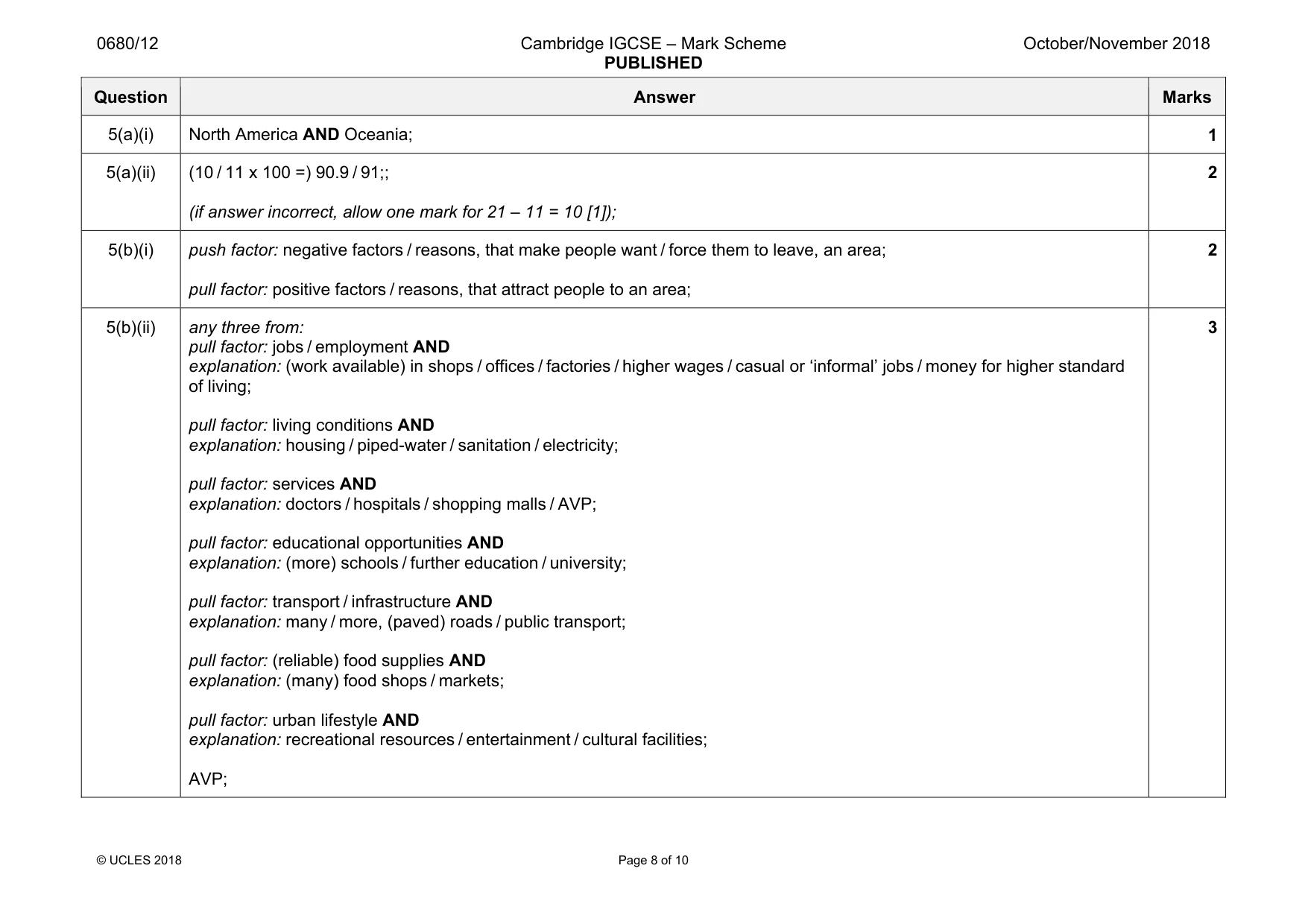
0680/12 Cambridge IGCSE – Mark Scheme PUBLISHED October/November 2018 © UCLES 2018 Page 8 of 10 Question Answer Marks 5(a)(i) North America AND Oceania; 1 5(a)(ii) (10 / 11 x 100 =) 90.9 / 91;; (if answer incorrect, allow one mark for 21 – 11 = 10 [1]); 2 5(b)(i) push factor: negative factors / reasons, that make people want / force them to leave, an area; pull factor: positive factors / reasons, that attract people to an area; 2 5(b)(ii) any three from: pull factor: jobs / employment AND explanation: (work available) in shops / offices / factories / higher wages / casual or ‘informal’ jobs / money for higher standard of living; pull factor: living conditions AND explanation: housing / piped-water / sanitation / electricity; pull factor: services AND explanation: doctors / hospitals / shopping malls / AVP; pull factor: educational opportunities AND explanation: (more) schools / further education / university; pull factor: transport / infrastructure AND explanation: many / more, (paved) roads / public transport; pull factor: (reliable) food supplies AND explanation: (many) food shops / markets; pull factor: urban lifestyle AND explanation: recreational resources / entertainment / cultural facilities; AVP; 3
Mark scheme, page 9
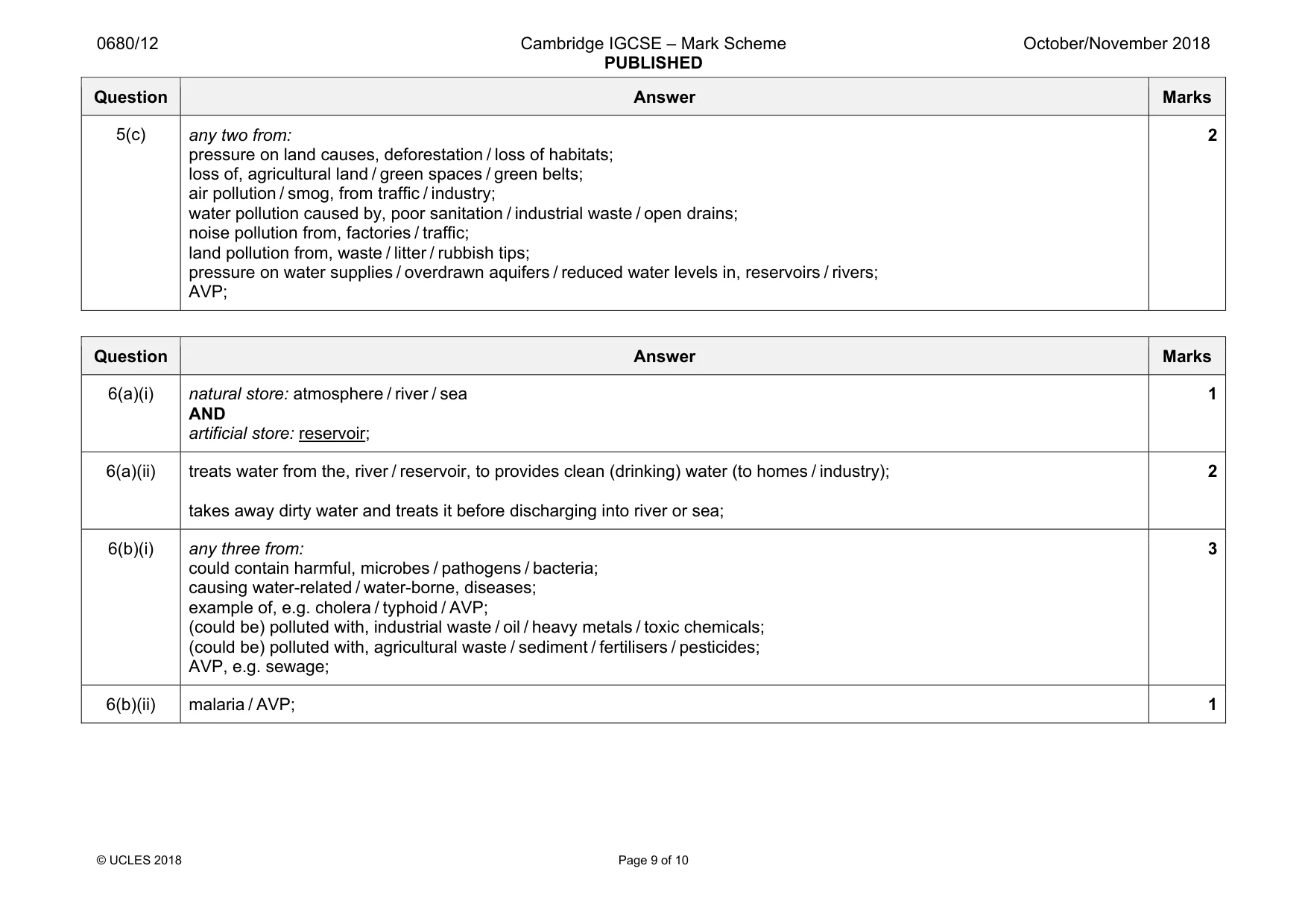
0680/12 Cambridge IGCSE – Mark Scheme PUBLISHED October/November 2018 © UCLES 2018 Page 9 of 10 Question Answer Marks 5(c) any two from: pressure on land causes, deforestation / loss of habitats; loss of, agricultural land / green spaces / green belts; air pollution / smog, from traffic / industry; water pollution caused by, poor sanitation / industrial waste / open drains; noise pollution from, factories / traffic; land pollution from, waste / litter / rubbish tips; pressure on water supplies / overdrawn aquifers / reduced water levels in, reservoirs / rivers; AVP; 2 Question Answer Marks 6(a)(i) natural store: atmosphere / river / sea AND artificial store: reservoir; 1 6(a)(ii) treats water from the, river / reservoir, to provides clean (drinking) water (to homes / industry); takes away dirty water and treats it before discharging into river or sea; 2 6(b)(i) any three from: could contain harmful, microbes / pathogens / bacteria; causing water-related / water-borne, diseases; example of, e.g. cholera / typhoid / AVP; (could be) polluted with, industrial waste / oil / heavy metals / toxic chemicals; (could be) polluted with, agricultural waste / sediment / fertilisers / pesticides; AVP, e.g. sewage; 3 6(b)(ii) malaria / AVP; 1
Mark scheme, page 10
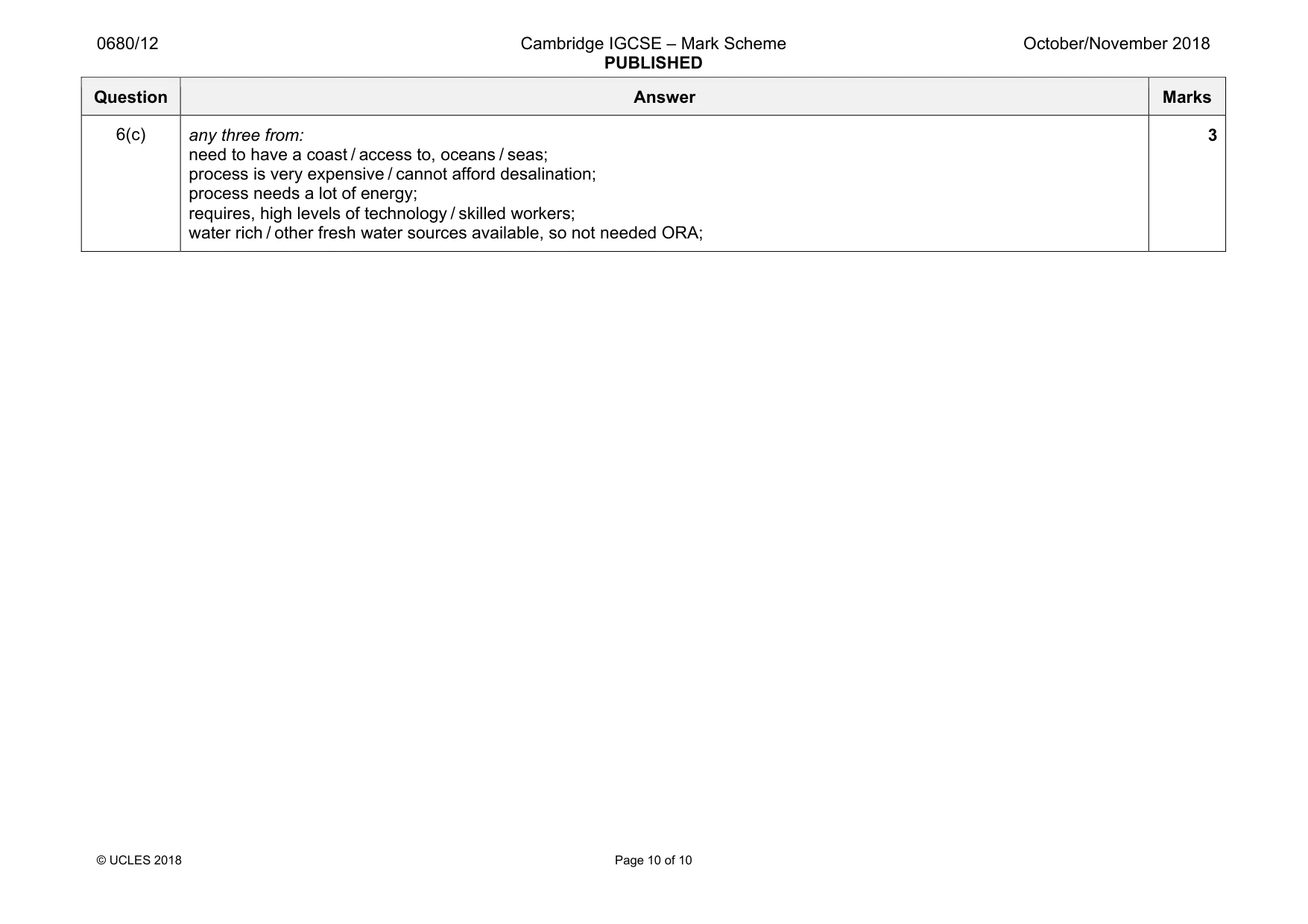
0680/12 Cambridge IGCSE – Mark Scheme PUBLISHED October/November 2018 © UCLES 2018 Page 10 of 10 Question Answer Marks 6(c) any three from: need to have a coast / access to, oceans / seas; process is very expensive / cannot afford desalination; process needs a lot of energy; requires, high levels of technology / skilled workers; water rich / other fresh water sources available, so not needed ORA; 3
What you needed in this session
Cambridge’s own grade thresholds for 2018 Oct/Nov, Paper 1 · Variant 2. A higher threshold means an easier paper — the bar moves with how the cohort did.