Cambridge IGCSE Environmental Management 0680 — 2018 Oct/Nov Paper 1 · Variant 1
0680/11/O/N/18 · 60 marks · ≈68 min
The question paper and its mark scheme, free to read here and free to download. This is Cambridge’s own paper, exactly as it was sat.
Question paper16 pages


Mark scheme12 pages
Answers below. Sit the paper first if you are practising.
Paper as text
Question paper, page 1
This document consists of 14 printed pages and 2 blank pages. DC (SCD/JB) 148050/4 © UCLES 2018 [Turn over * 5 9 9 7 6 9 4 3 8 3 * ENVIRONMENTAL MANAGEMENT 0680/11 Paper 1 October/November 2018 1 hour 30 minutes Candidates answer on the Question Paper. No Additional Materials are required. READ THESE INSTRUCTIONS FIRST Write your Centre number, candidate number and name on all the work you hand in. Write in dark blue or black pen. You may use an HB pencil for any diagrams or graphs. Do not use staples, paper clips, glue or correction fluid. DO NOT WRITE IN ANY BARCODES. Answer all questions. Electronic calculators may be used. You may lose marks if you do not show your working or if you do not use appropriate units. At the end of the examination, fasten all your work securely together. The number of marks is given in brackets [ ] at the end of each question or part question. Cambridge International Examinations Cambridge International General Certificate of Secondary Education
Question paper, page 2
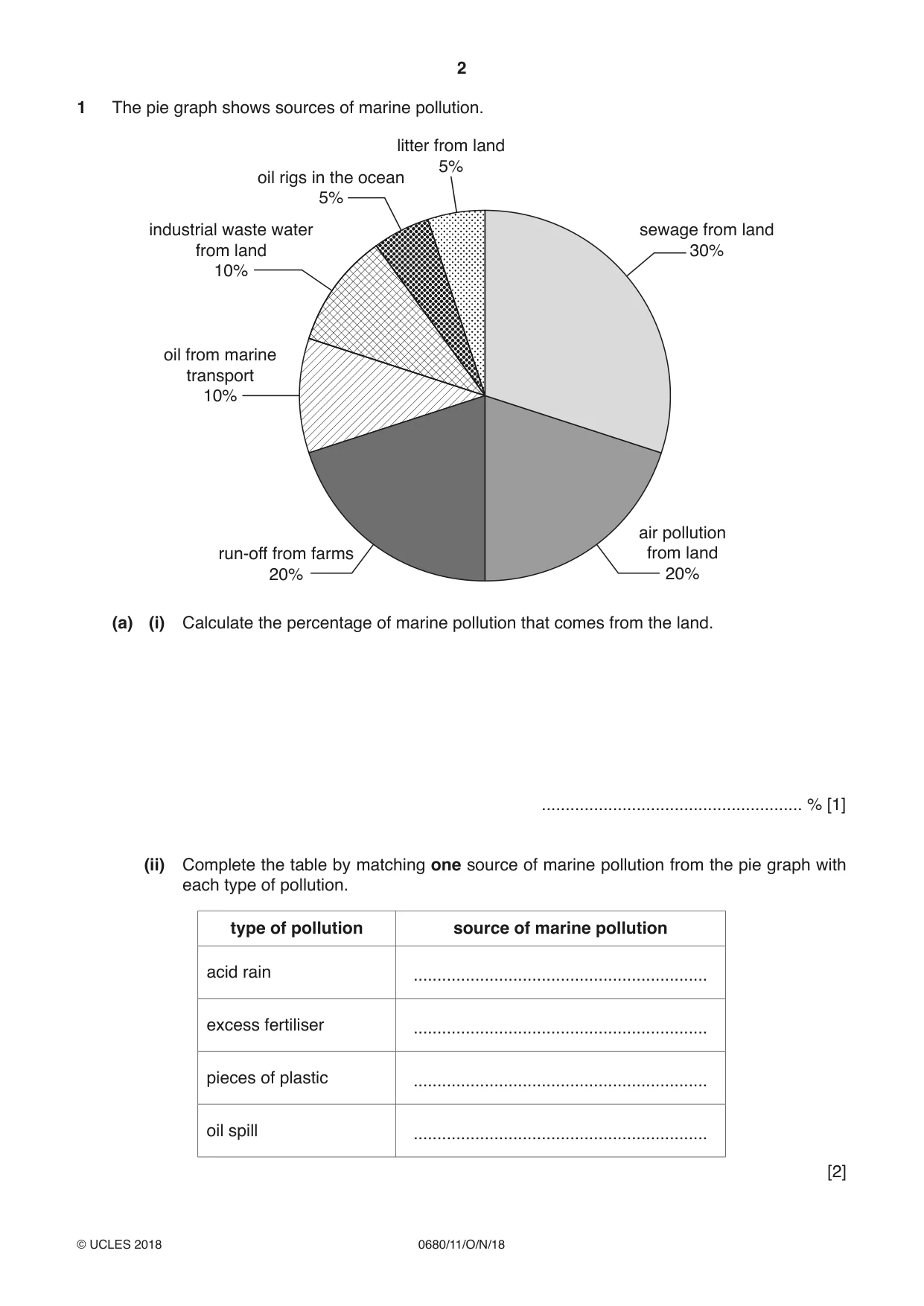
2 0680/11/O/N/18 © UCLES 2018 1 The pie graph shows sources of marine pollution. litter from land 5% oil rigs in the ocean 5% industrial waste water from land 10% oil from marine transport 10% run-off from farms 20% air pollution from land 20% sewage from land 30% (a) (i) Calculate the percentage of marine pollution that comes from the land. … % [1] (ii) Complete the table by matching one source of marine pollution from the pie graph with each type of pollution. type of pollution source of marine pollution acid rain … excess fertiliser … pieces of plastic … oil spill … [2]
Question paper, page 3
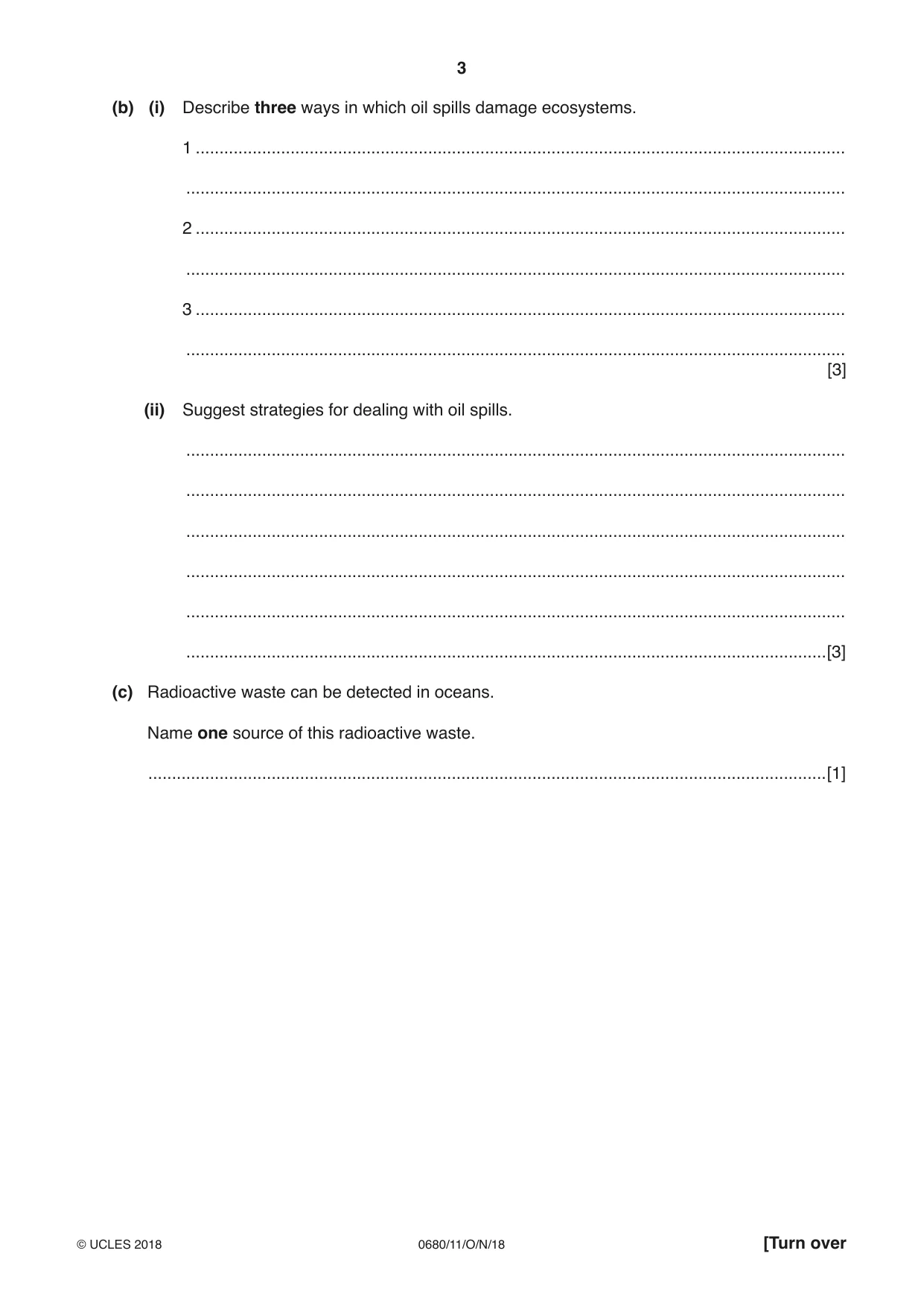
3 0680/11/O/N/18 © UCLES 2018 [Turn over (b) (i) Describe three ways in which oil spills damage ecosystems. 1 … … 2 … … 3 … … [3] (ii) Suggest strategies for dealing with oil spills. … … … … … …[3] (c) Radioactive waste can be detected in oceans. Name one source of this radioactive waste. …[1]
Question paper, page 4
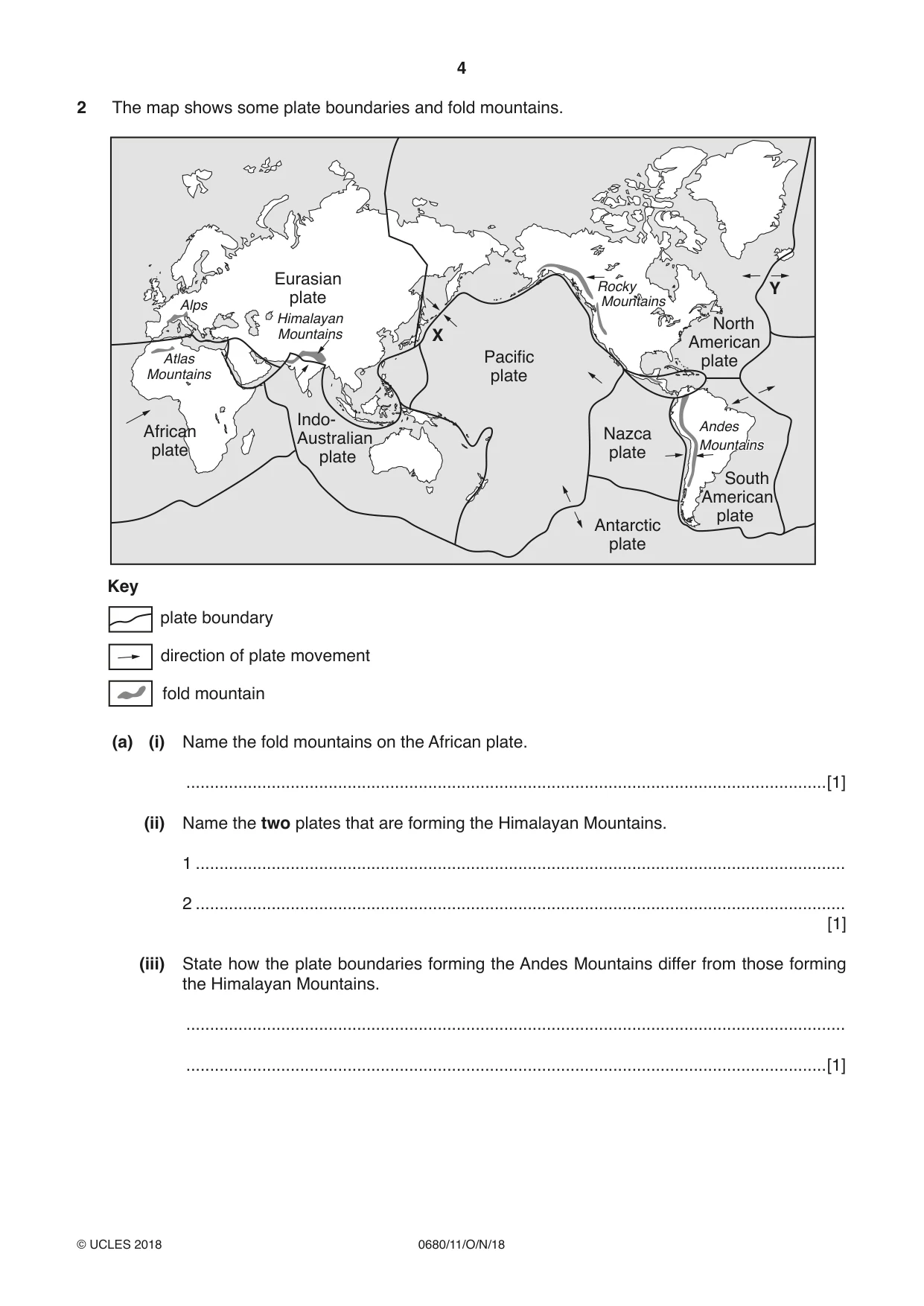
4 0680/11/O/N/18 © UCLES 2018 2 The map shows some plate boundaries and fold mountains. Key plate boundary direction of plate movement fold mountain Eurasian plate Pacific plate Antarctic plate Nazca plate Rocky Mountains Rocky Mountains Andes Mountains Andes Mountains Himalayan Mountains Alps Atlas Mountains North American plate South American plate African plate Indo- Australian plate X Y (a) (i) Name the fold mountains on the African plate. …[1] (ii) Name the two plates that are forming the Himalayan Mountains. 1 … 2 … [1] (iii) State how the plate boundaries forming the Andes Mountains differ from those forming the Himalayan Mountains. … …[1]
Question paper, page 5
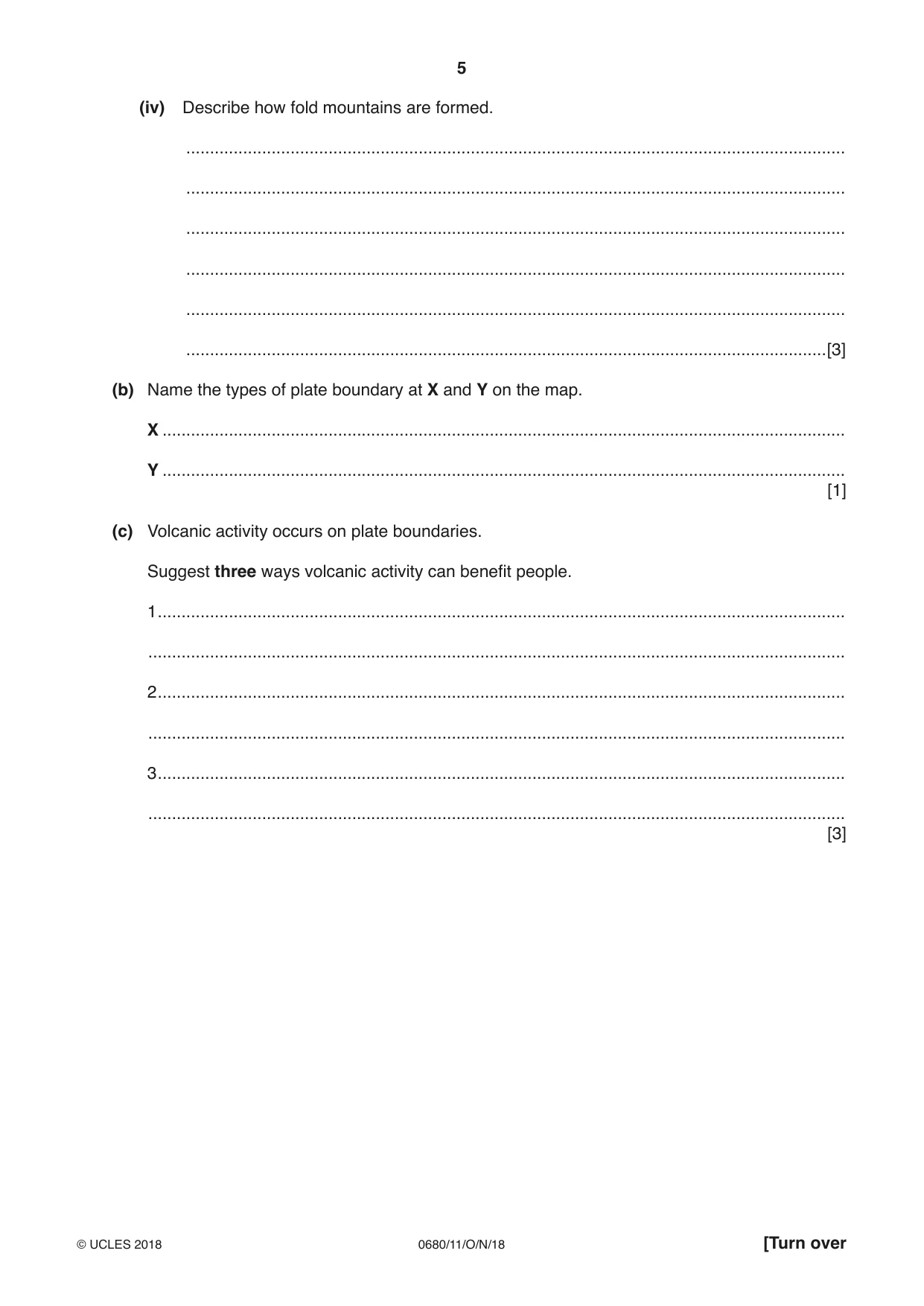
5 0680/11/O/N/18 © UCLES 2018 [Turn over (iv) Describe how fold mountains are formed. … … … … … …[3] (b) Name the types of plate boundary at X and Y on the map. X … Y … [1] (c) Volcanic activity occurs on plate boundaries. Suggest three ways volcanic activity can benefit people. 1 … … 2 … … 3 … … [3]
Question paper, page 6
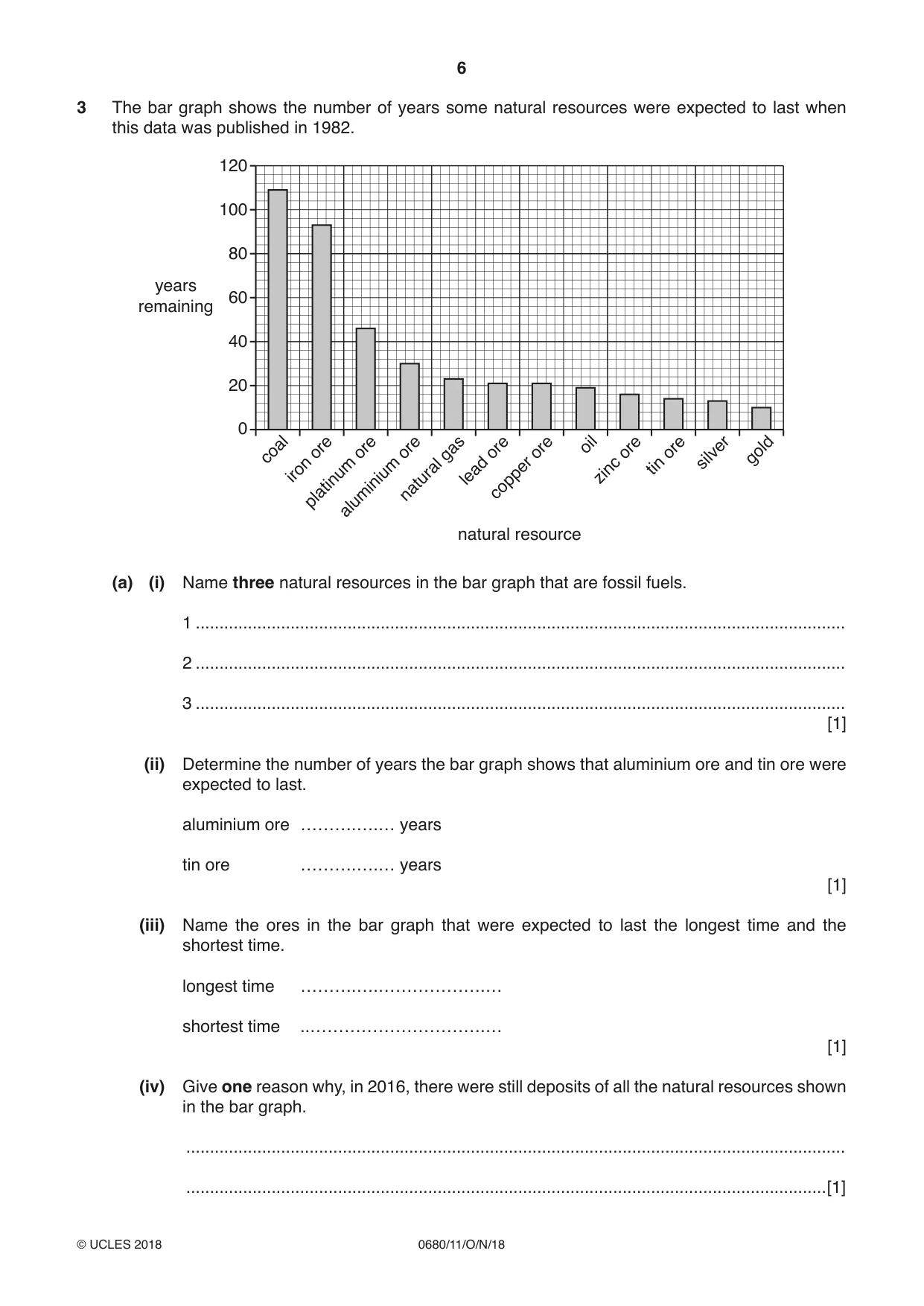
6 0680/11/O/N/18 © UCLES 2018 3 The bar graph shows the number of years some natural resources were expected to last when this data was published in 1982. 120 100 80 60 40 20 0 coal iron ore platinum ore aluminium ore natural gas lead ore copper ore oil zinc ore tin ore silver gold natural resource years remaining (a) (i) Name three natural resources in the bar graph that are fossil fuels. 1 … 2 … 3 … [1] (ii) Determine the number of years the bar graph shows that aluminium ore and tin ore were expected to last. aluminium ore ……….….… years tin ore ……….….… years [1] (iii) Name the ores in the bar graph that were expected to last the longest time and the shortest time. longest time ……….….……………….… shortest time ..………………………….… [1] (iv) Give one reason why, in 2016, there were still deposits of all the natural resources shown in the bar graph. … …[1]
Question paper, page 7
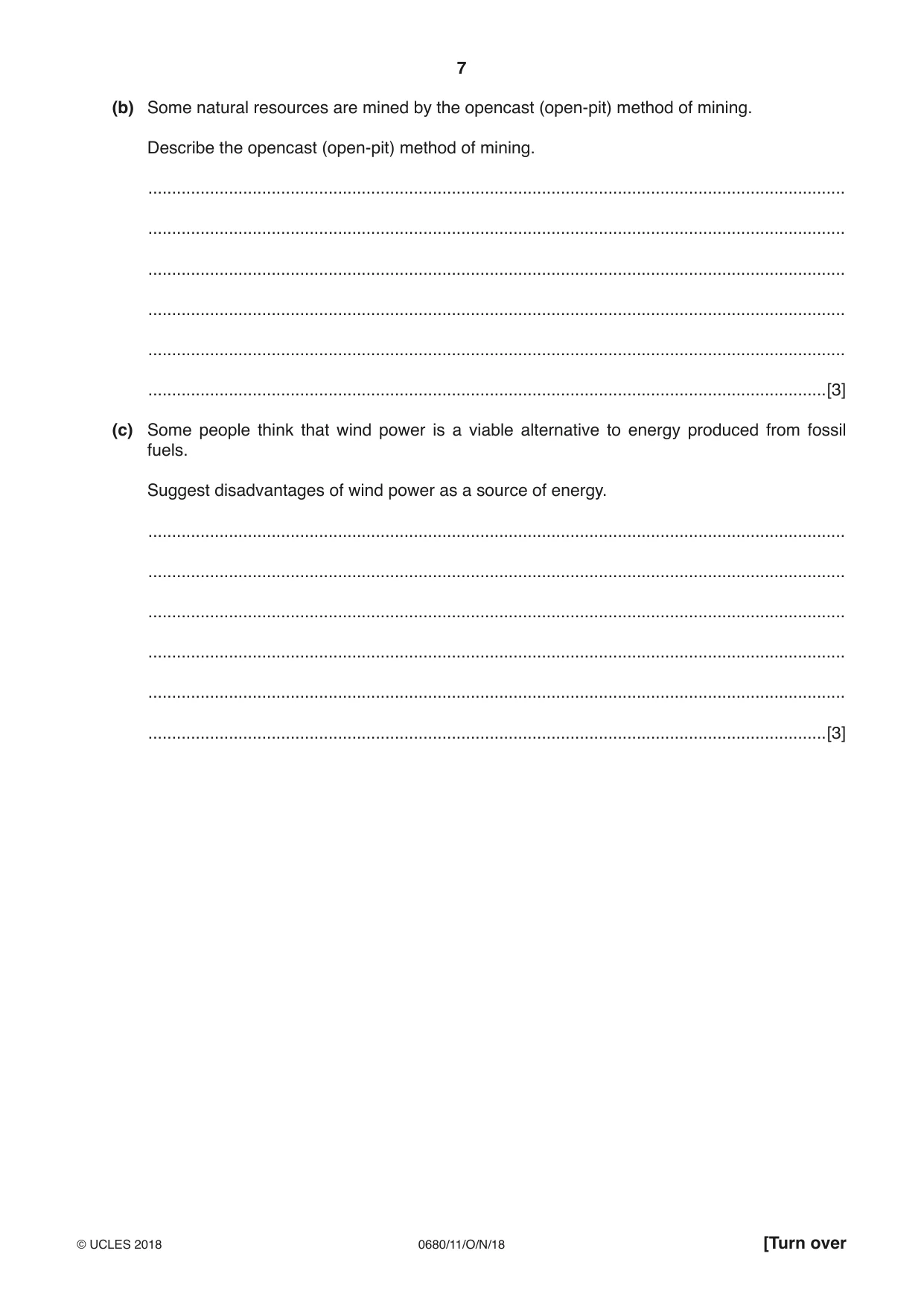
7 0680/11/O/N/18 © UCLES 2018 [Turn over (b) Some natural resources are mined by the opencast (open-pit) method of mining. Describe the opencast (open-pit) method of mining. … … … … … …[3] (c) Some people think that wind power is a viable alternative to energy produced from fossil fuels. Suggest disadvantages of wind power as a source of energy. … … … … … …[3]
Question paper, page 8
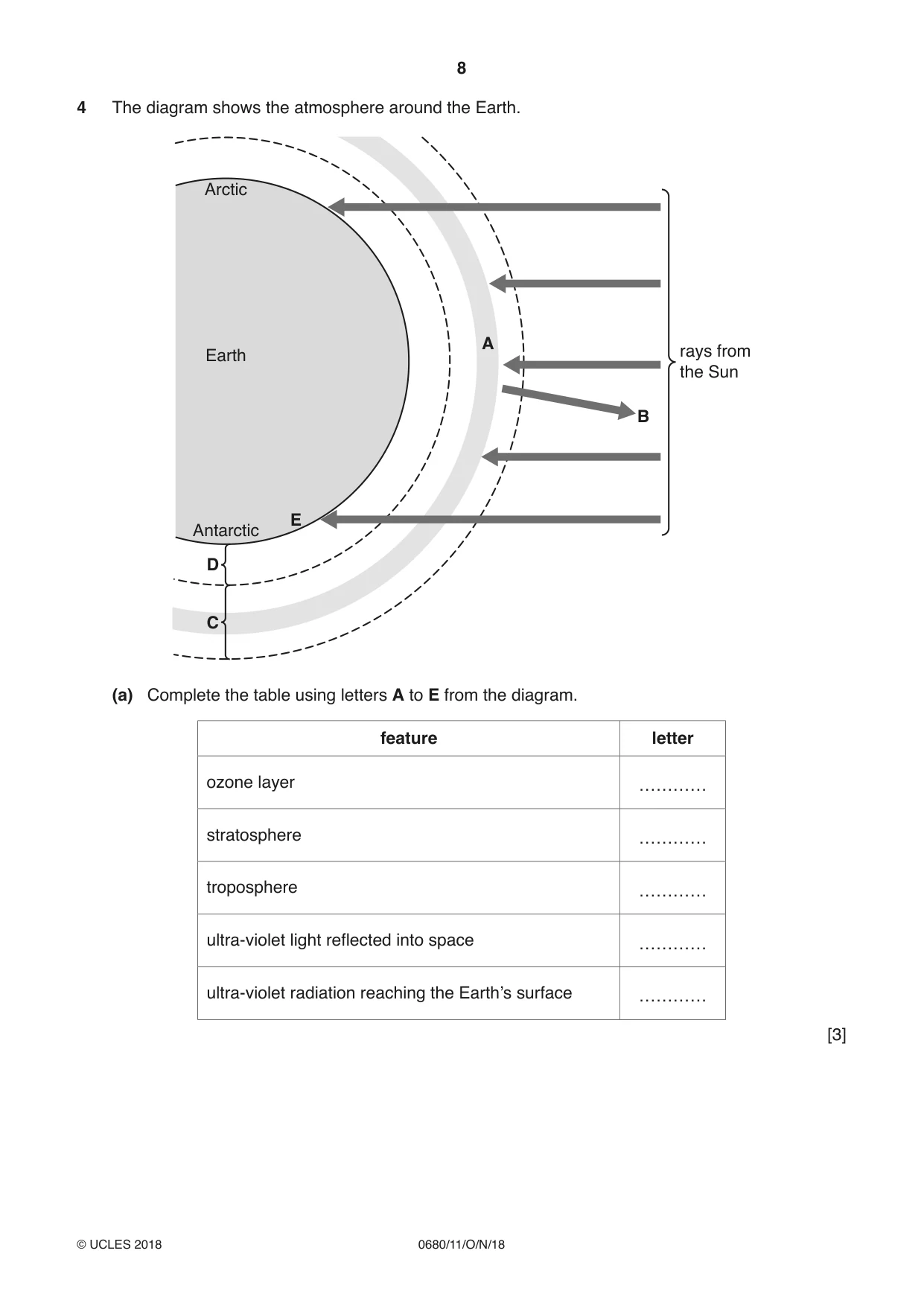
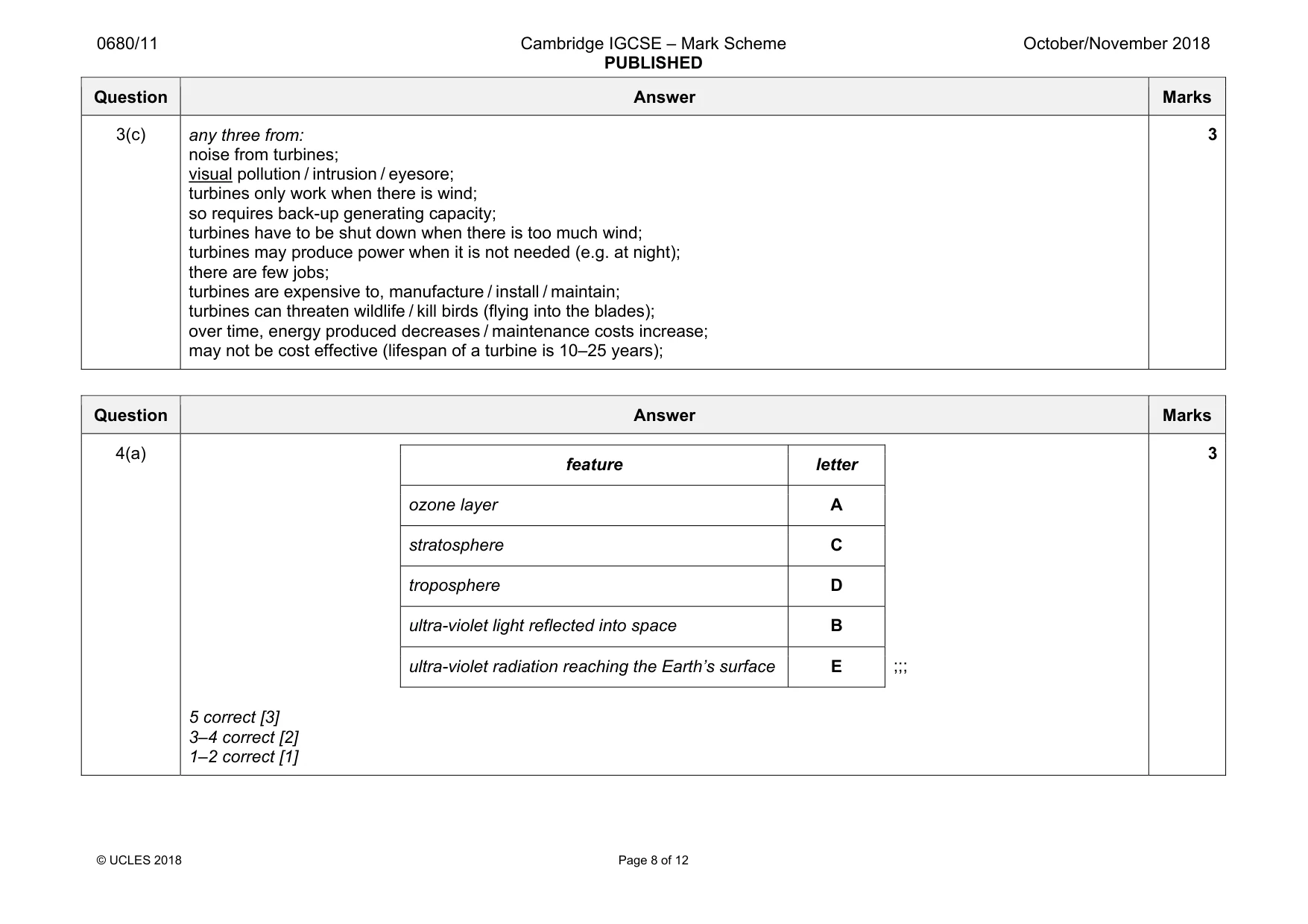
8 0680/11/O/N/18 © UCLES 2018 4 The diagram shows the atmosphere around the Earth. Arctic Earth Antarctic D E B A C rays from the Sun (a) Complete the table using letters A to E from the diagram. feature letter ozone layer ………… stratosphere ………… troposphere ………… ultra-violet light reflected into space ………… ultra-violet radiation reaching the Earth’s surface ………… [3]
Question paper, page 9
9 0680/11/O/N/18 © UCLES 2018 [Turn over (b) Describe how human activities have damaged the ozone layer. … … … … … …[3] (c) Production of the chemicals that caused damage to the ozone layer was banned in 1987 by an international agreement. Suggest why an international agreement was needed. … …[1] (d) The depletion of the ozone layer is at its greatest over the Antarctic. Australia and Argentina are countries close to the Antarctic. Suggest reasons why people living in Australia and Argentina are advised to keep their skin covered and wear a hat when out in the sun. … … … … … …[3]
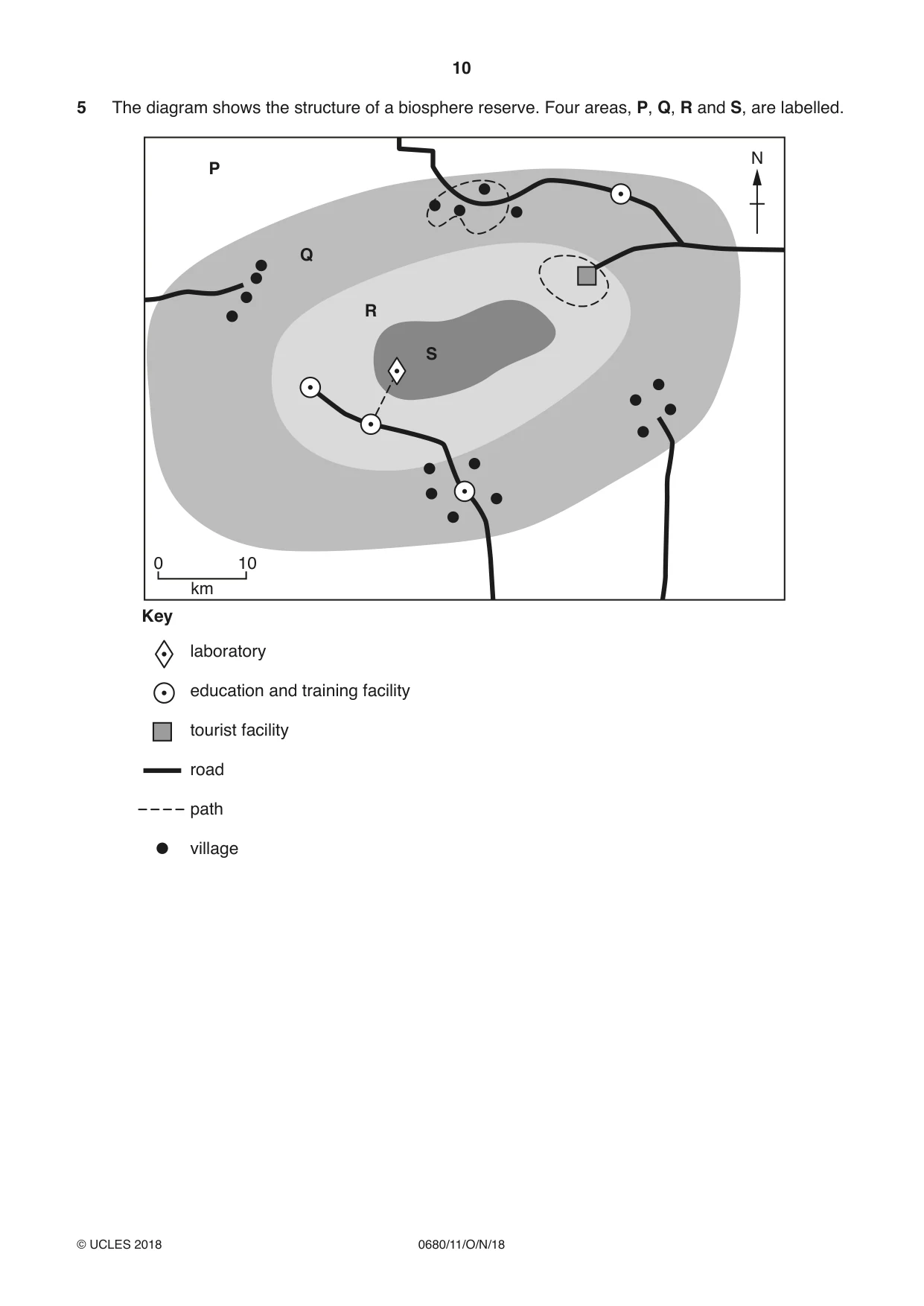
Question paper, page 10
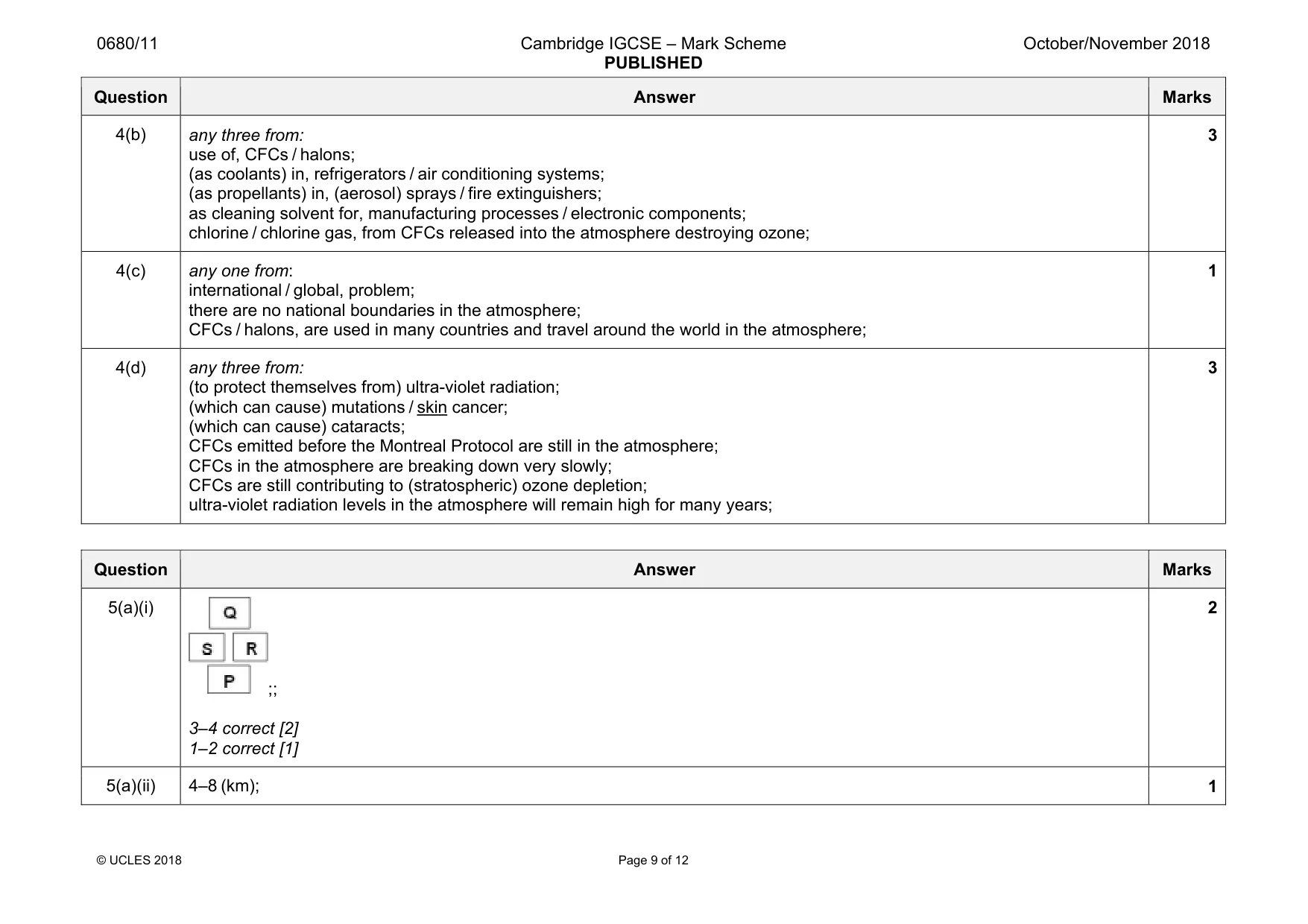
10 0680/11/O/N/18 © UCLES 2018 5 The diagram shows the structure of a biosphere reserve. Four areas, P, Q, R and S, are labelled. village path road tourist facility education and training facility laboratory Key N S R Q P km 10 0
Question paper, page 11
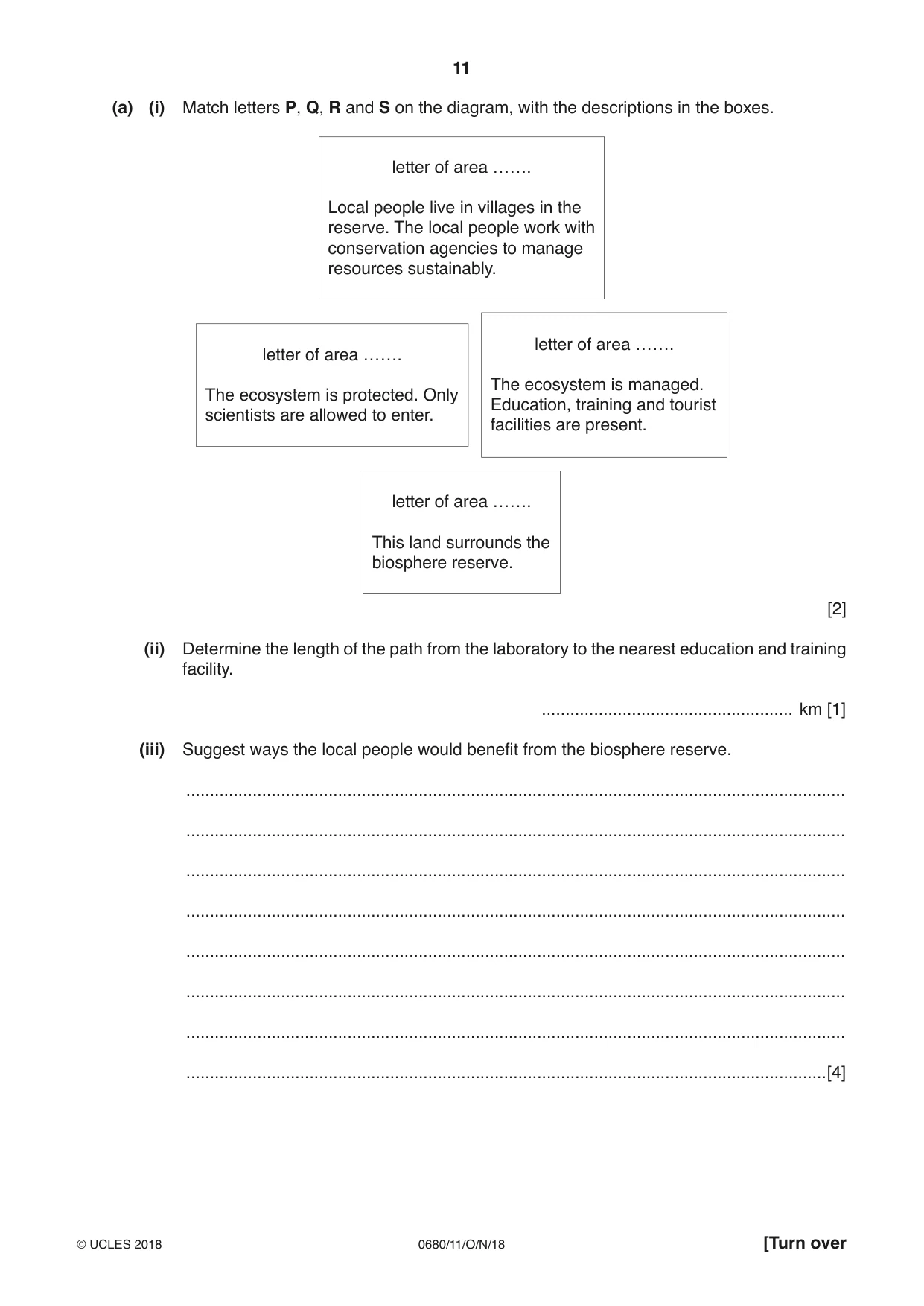
11 0680/11/O/N/18 © UCLES 2018 [Turn over (a) (i) Match letters P, Q, R and S on the diagram, with the descriptions in the boxes. letter of area ……. Local people live in villages in the reserve. The local people work with conservation agencies to manage resources sustainably. letter of area ……. The ecosystem is protected. Only scientists are allowed to enter. letter of area ……. The ecosystem is managed. Education, training and tourist facilities are present. letter of area ……. This land surrounds the biosphere reserve. [2] (ii) Determine the length of the path from the laboratory to the nearest education and training facility. … km [1] (iii) Suggest ways the local people would benefit from the biosphere reserve. … … … … … … … …[4]
Question paper, page 12
12 0680/11/O/N/18 © UCLES 2018 (b) Biosphere reserves are one strategy for conserving ecosystems. Describe other strategies for conserving ecosystems. … … … … … …[3]
Question paper, page 13
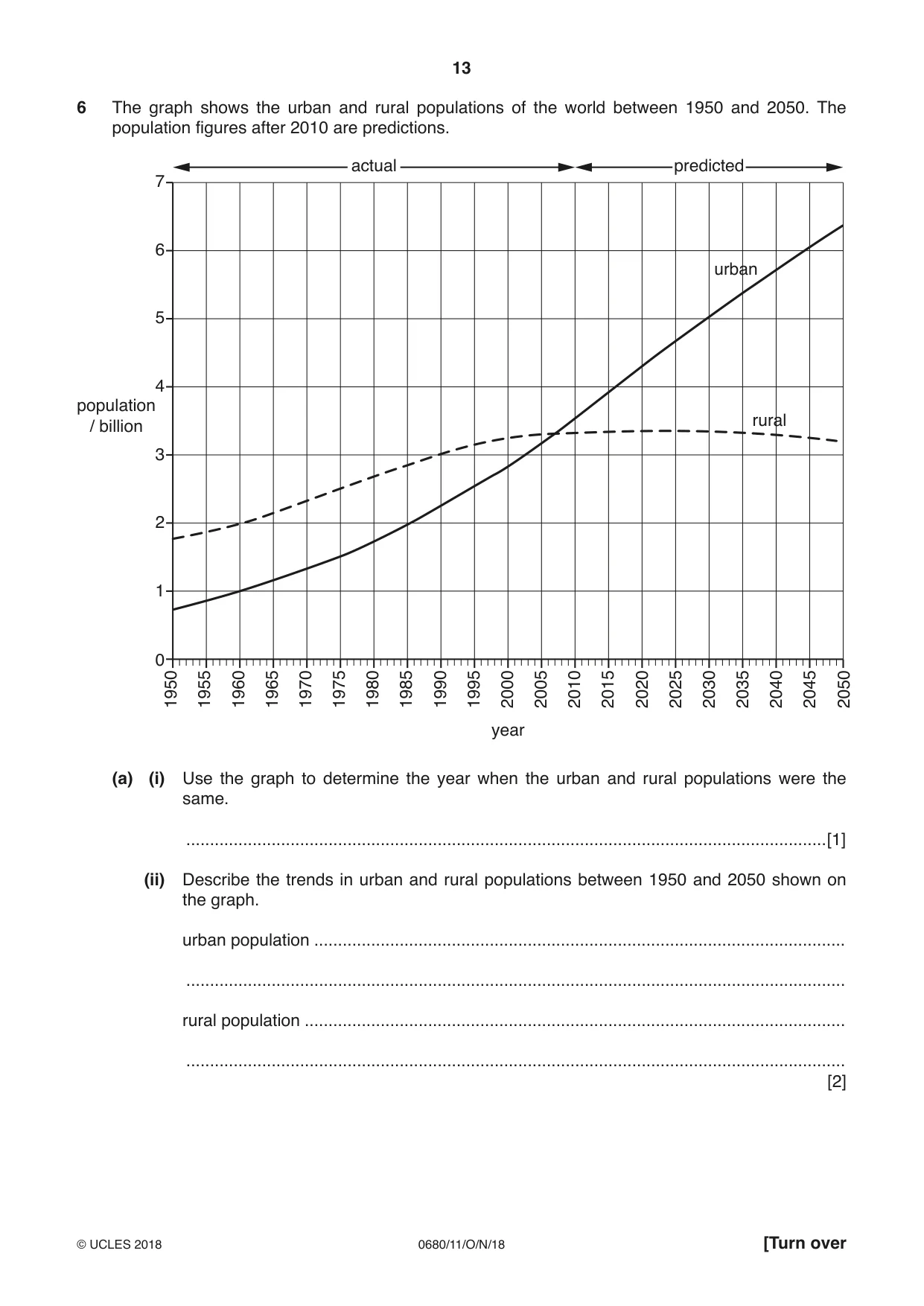
13 0680/11/O/N/18 © UCLES 2018 [Turn over 6 The graph shows the urban and rural populations of the world between 1950 and 2050. The population figures after 2010 are predictions. 1950 1955 1960 1965 1970 1975 1980 1985 1990 1995 2000 2005 2010 2015 2020 2025 2030 2035 2040 2045 2050 0 1 2 3 4 5 6 7 population / billion urban rural actual year predicted (a) (i) Use the graph to determine the year when the urban and rural populations were the same. …[1] (ii) Describe the trends in urban and rural populations between 1950 and 2050 shown on the graph. urban population … … rural population … … [2]
Question paper, page 14
14 0680/11/O/N/18 © UCLES 2018 (b) Migration can cause urban population to change. (i) State what is meant by the term migration. … …[1] (ii) Suggest one reason, other than migration, why urban populations change. … …[1] (c) Describe two problems caused by the rapid growth of urban populations in developing countries. 1 … … 2 … … [2] (d) Suggest strategies that can be used to limit population growth. … … … … … …[3]
Question paper, page 15
15 0680/11/O/N/18 © UCLES 2018 BLANK PAGE
Question paper, page 16
16 0680/11/O/N/18 © UCLES 2018 BLANK PAGE Permission to reproduce items where third-party owned material protected by copyright is included has been sought and cleared where possible. Every reasonable effort has been made by the publisher (UCLES) to trace copyright holders, but if any items requiring clearance have unwittingly been included, the publisher will be pleased to make amends at the earliest possible opportunity. To avoid the issue of disclosure of answer-related information to candidates, all copyright acknowledgements are reproduced online in the Cambridge International Examinations Copyright Acknowledgements Booklet. This is produced for each series of examinations and is freely available to download at www.cie.org.uk after the live examination series. Cambridge International Examinations is part of the Cambridge Assessment Group. Cambridge Assessment is the brand name of University of Cambridge Local Examinations Syndicate (UCLES), which is itself a department of the University of Cambridge.
Mark scheme, page 1
This document consists of 12 printed pages. © UCLES 2018 [Turn over Cambridge Assessment International Education Cambridge International General Certificate of Secondary Education ENVIRONMENTAL MANAGEMENT 0680/11 Paper 1 October/November 2018 MARK SCHEME Maximum Mark: 60 Published This mark scheme is published as an aid to teachers and candidates, to indicate the requirements of the examination. It shows the basis on which Examiners were instructed to award marks. It does not indicate the details of the discussions that took place at an Examiners’ meeting before marking began, which would have considered the acceptability of alternative answers. Mark schemes should be read in conjunction with the question paper and the Principal Examiner Report for Teachers. Cambridge International will not enter into discussions about these mark schemes. Cambridge International is publishing the mark schemes for the October/November 2018 series for most Cambridge IGCSE™, Cambridge International A and AS Level components and some Cambridge O Level components.
Mark scheme, page 2
0680/11 Cambridge IGCSE – Mark Scheme PUBLISHED October/November 2018 © UCLES 2018 Page 2 of 12 Generic Marking Principles These general marking principles must be applied by all examiners when marking candidate answers. They should be applied alongside the specific content of the mark scheme or generic level descriptors for a question. Each question paper and mark scheme will also comply with these marking principles. GENERIC MARKING PRINCIPLE 1: Marks must be awarded in line with: • the specific content of the mark scheme or the generic level descriptors for the question • the specific skills defined in the mark scheme or in the generic level descriptors for the question • the standard of response required by a candidate as exemplified by the standardisation scripts. GENERIC MARKING PRINCIPLE 2: Marks awarded are always whole marks (not half marks, or other fractions). GENERIC MARKING PRINCIPLE 3: Marks must be awarded positively: • marks are awarded for correct/valid answers, as defined in the mark scheme. However, credit is given for valid answers which go beyond the scope of the syllabus and mark scheme, referring to your Team Leader as appropriate • marks are awarded when candidates clearly demonstrate what they know and can do • marks are not deducted for errors • marks are not deducted for omissions • answers should only be judged on the quality of spelling, punctuation and grammar when these features are specifically assessed by the question as indicated by the mark scheme. The meaning, however, should be unambiguous. GENERIC MARKING PRINCIPLE 4: Rules must be applied consistently e.g. in situations where candidates have not followed instructions or in the application of generic level descriptors.
Mark scheme, page 3
0680/11 Cambridge IGCSE – Mark Scheme PUBLISHED October/November 2018 © UCLES 2018 Page 3 of 12 GENERIC MARKING PRINCIPLE 5: Marks should be awarded using the full range of marks defined in the mark scheme for the question (however; the use of the full mark range may be limited according to the quality of the candidate responses seen). GENERIC MARKING PRINCIPLE 6: Marks awarded are based solely on the requirements as defined in the mark scheme. Marks should not be awarded with grade thresholds or grade descriptors in mind.
Mark scheme, page 4
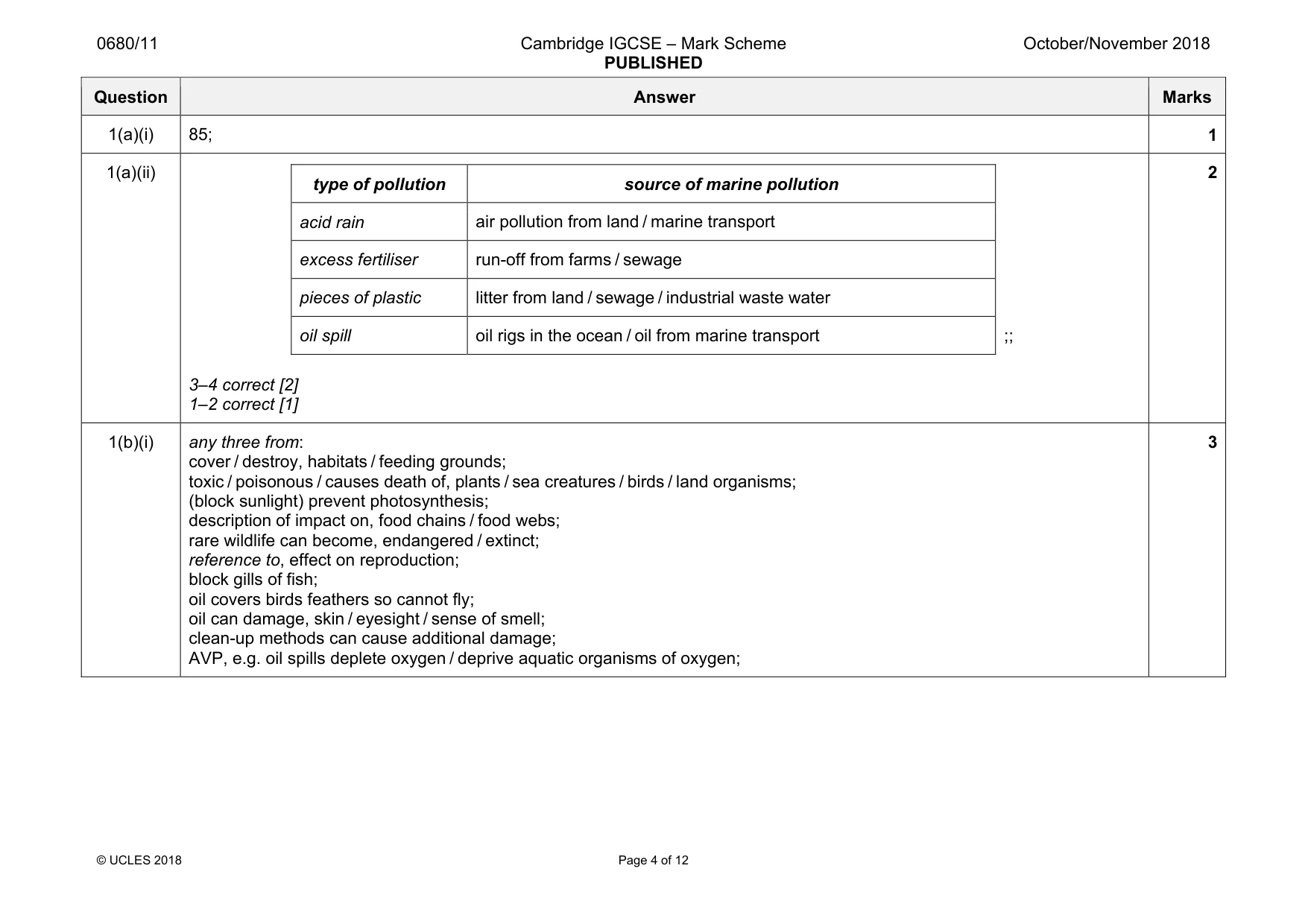
0680/11 Cambridge IGCSE – Mark Scheme PUBLISHED October/November 2018 © UCLES 2018 Page 4 of 12 Question Answer Marks 1(a)(i) 85; 1 1(a)(ii) type of pollution source of marine pollution acid rain air pollution from land / marine transport excess fertiliser run-off from farms / sewage pieces of plastic litter from land / sewage / industrial waste water oil spill oil rigs in the ocean / oil from marine transport ;; 3–4 correct [2] 1–2 correct [1] 2 1(b)(i) any three from: cover / destroy, habitats / feeding grounds; toxic / poisonous / causes death of, plants / sea creatures / birds / land organisms; (block sunlight) prevent photosynthesis; description of impact on, food chains / food webs; rare wildlife can become, endangered / extinct; reference to, effect on reproduction; block gills of fish; oil covers birds feathers so cannot fly; oil can damage, skin / eyesight / sense of smell; clean-up methods can cause additional damage; AVP, e.g. oil spills deplete oxygen / deprive aquatic organisms of oxygen; 3
Mark scheme, page 5
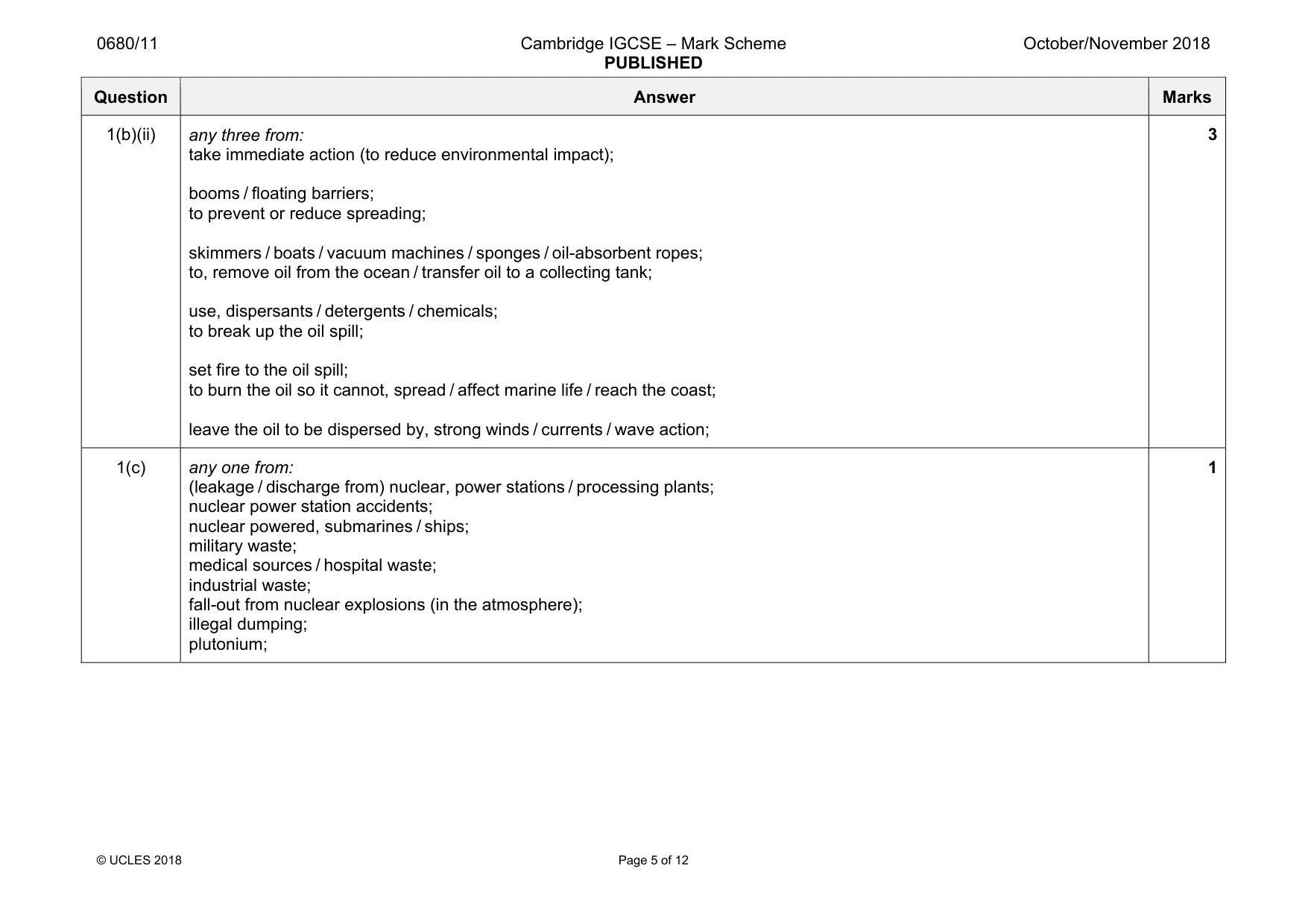
0680/11 Cambridge IGCSE – Mark Scheme PUBLISHED October/November 2018 © UCLES 2018 Page 5 of 12 Question Answer Marks 1(b)(ii) any three from: take immediate action (to reduce environmental impact); booms / floating barriers; to prevent or reduce spreading; skimmers / boats / vacuum machines / sponges / oil-absorbent ropes; to, remove oil from the ocean / transfer oil to a collecting tank; use, dispersants / detergents / chemicals; to break up the oil spill; set fire to the oil spill; to burn the oil so it cannot, spread / affect marine life / reach the coast; leave the oil to be dispersed by, strong winds / currents / wave action; 3 1(c) any one from: (leakage / discharge from) nuclear, power stations / processing plants; nuclear power station accidents; nuclear powered, submarines / ships; military waste; medical sources / hospital waste; industrial waste; fall-out from nuclear explosions (in the atmosphere); illegal dumping; plutonium; 1
Mark scheme, page 6
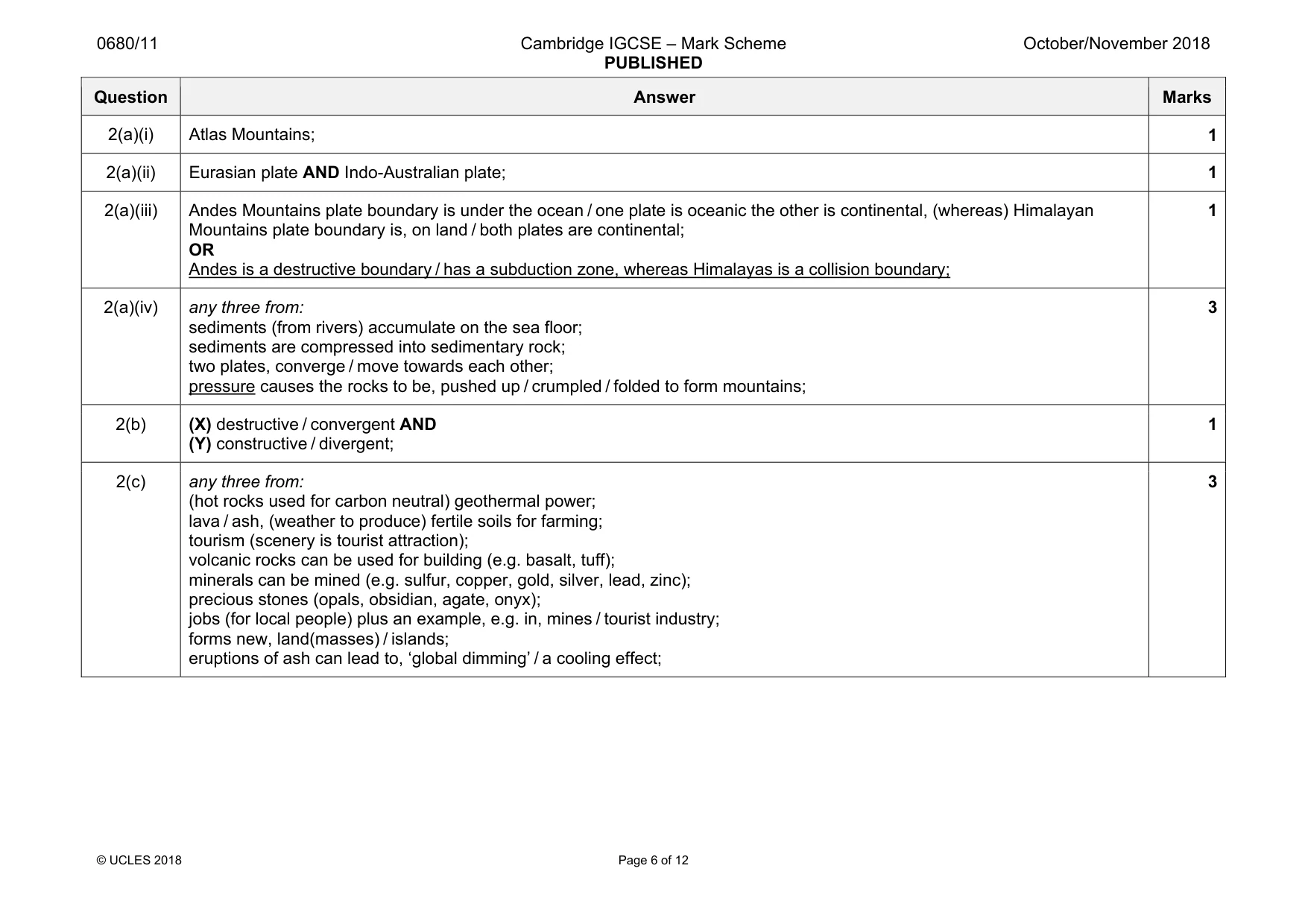
0680/11 Cambridge IGCSE – Mark Scheme PUBLISHED October/November 2018 © UCLES 2018 Page 6 of 12 Question Answer Marks 2(a)(i) Atlas Mountains; 1 2(a)(ii) Eurasian plate AND Indo-Australian plate; 1 2(a)(iii) Andes Mountains plate boundary is under the ocean / one plate is oceanic the other is continental, (whereas) Himalayan Mountains plate boundary is, on land / both plates are continental; OR Andes is a destructive boundary / has a subduction zone, whereas Himalayas is a collision boundary; 1 2(a)(iv) any three from: sediments (from rivers) accumulate on the sea floor; sediments are compressed into sedimentary rock; two plates, converge / move towards each other; pressure causes the rocks to be, pushed up / crumpled / folded to form mountains; 3 2(b) (X) destructive / convergent AND (Y) constructive / divergent; 1 2(c) any three from: (hot rocks used for carbon neutral) geothermal power; lava / ash, (weather to produce) fertile soils for farming; tourism (scenery is tourist attraction); volcanic rocks can be used for building (e.g. basalt, tuff); minerals can be mined (e.g. sulfur, copper, gold, silver, lead, zinc); precious stones (opals, obsidian, agate, onyx); jobs (for local people) plus an example, e.g. in, mines / tourist industry; forms new, land(masses) / islands; eruptions of ash can lead to, ‘global dimming’ / a cooling effect; 3
Mark scheme, page 7
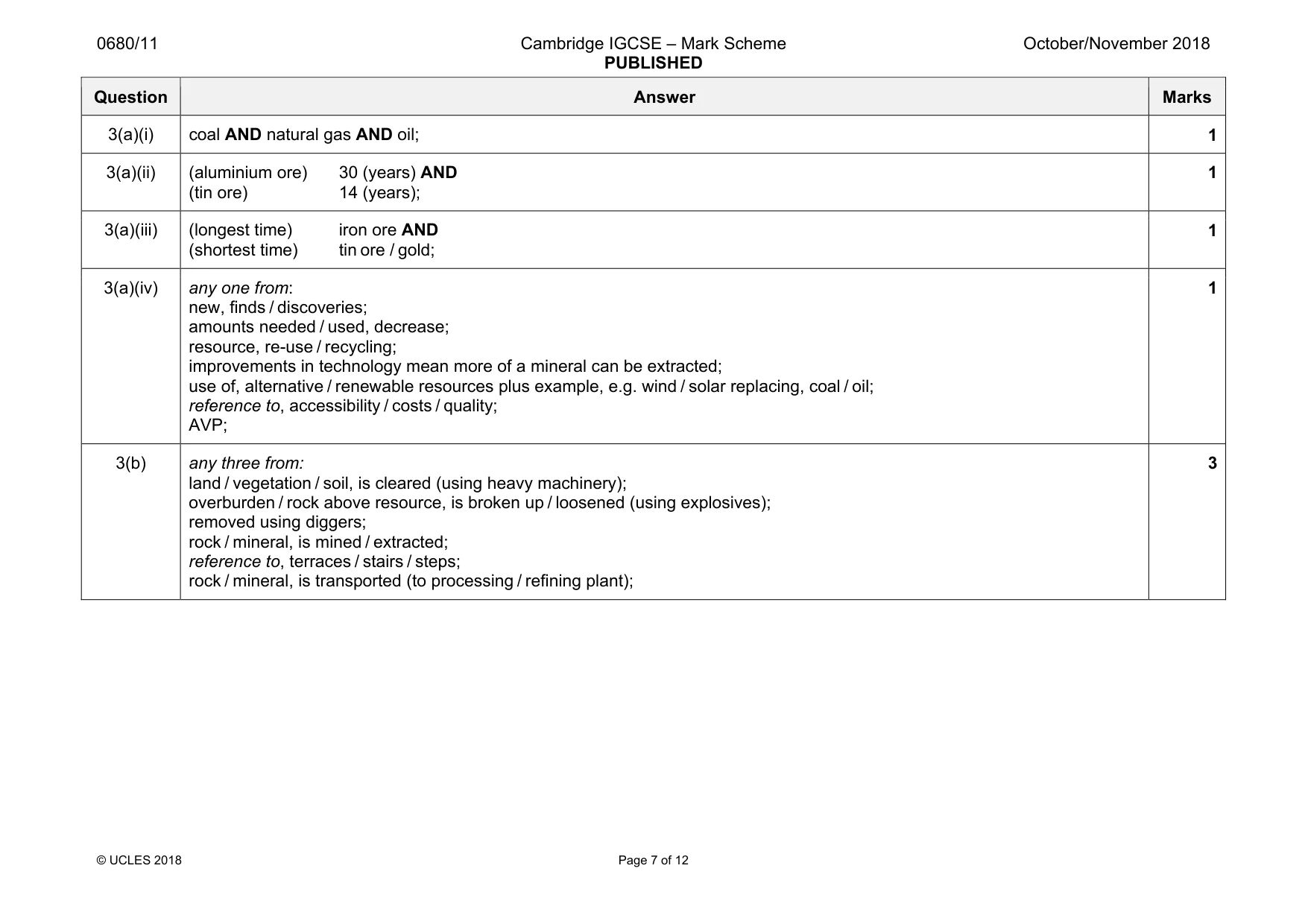
0680/11 Cambridge IGCSE – Mark Scheme PUBLISHED October/November 2018 © UCLES 2018 Page 7 of 12 Question Answer Marks 3(a)(i) coal AND natural gas AND oil; 1 3(a)(ii) (aluminium ore) 30 (years) AND (tin ore) 14 (years); 1 3(a)(iii) (longest time) iron ore AND (shortest time) tin ore / gold; 1 3(a)(iv) any one from: new, finds / discoveries; amounts needed / used, decrease; resource, re-use / recycling; improvements in technology mean more of a mineral can be extracted; use of, alternative / renewable resources plus example, e.g. wind / solar replacing, coal / oil; reference to, accessibility / costs / quality; AVP; 1 3(b) any three from: land / vegetation / soil, is cleared (using heavy machinery); overburden / rock above resource, is broken up / loosened (using explosives); removed using diggers; rock / mineral, is mined / extracted; reference to, terraces / stairs / steps; rock / mineral, is transported (to processing / refining plant); 3
Mark scheme, page 8
0680/11 Cambridge IGCSE – Mark Scheme PUBLISHED October/November 2018 © UCLES 2018 Page 8 of 12 Question Answer Marks 3(c) any three from: noise from turbines; visual pollution / intrusion / eyesore; turbines only work when there is wind; so requires back-up generating capacity; turbines have to be shut down when there is too much wind; turbines may produce power when it is not needed (e.g. at night); there are few jobs; turbines are expensive to, manufacture / install / maintain; turbines can threaten wildlife / kill birds (flying into the blades); over time, energy produced decreases / maintenance costs increase; may not be cost effective (lifespan of a turbine is 10–25 years); 3 Question Answer Marks 4(a) feature letter ozone layer A stratosphere C troposphere D ultra-violet light reflected into space B ultra-violet radiation reaching the Earth’s surface E ;;; 5 correct [3] 3–4 correct [2] 1–2 correct [1] 3
Mark scheme, page 9
0680/11 Cambridge IGCSE – Mark Scheme PUBLISHED October/November 2018 © UCLES 2018 Page 9 of 12 Question Answer Marks 4(b) any three from: use of, CFCs / halons; (as coolants) in, refrigerators / air conditioning systems; (as propellants) in, (aerosol) sprays / fire extinguishers; as cleaning solvent for, manufacturing processes / electronic components; chlorine / chlorine gas, from CFCs released into the atmosphere destroying ozone; 3 4(c) any one from: international / global, problem; there are no national boundaries in the atmosphere; CFCs / halons, are used in many countries and travel around the world in the atmosphere; 1 4(d) any three from: (to protect themselves from) ultra-violet radiation; (which can cause) mutations / skin cancer; (which can cause) cataracts; CFCs emitted before the Montreal Protocol are still in the atmosphere; CFCs in the atmosphere are breaking down very slowly; CFCs are still contributing to (stratospheric) ozone depletion; ultra-violet radiation levels in the atmosphere will remain high for many years; 3 Question Answer Marks 5(a)(i) ;; 3–4 correct [2] 1–2 correct [1] 2 5(a)(ii) 4–8 (km); 1
Mark scheme, page 10
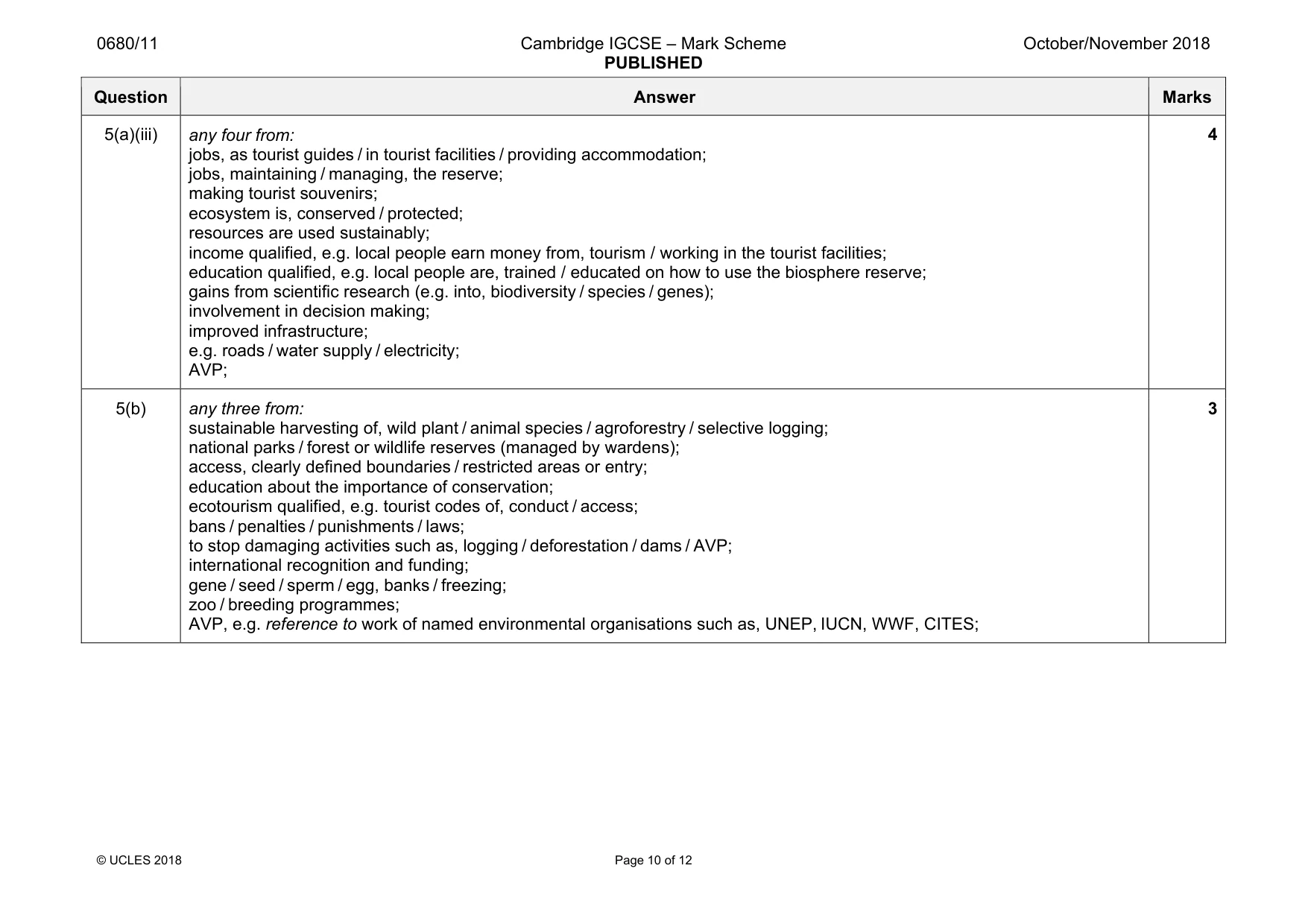
0680/11 Cambridge IGCSE – Mark Scheme PUBLISHED October/November 2018 © UCLES 2018 Page 10 of 12 Question Answer Marks 5(a)(iii) any four from: jobs, as tourist guides / in tourist facilities / providing accommodation; jobs, maintaining / managing, the reserve; making tourist souvenirs; ecosystem is, conserved / protected; resources are used sustainably; income qualified, e.g. local people earn money from, tourism / working in the tourist facilities; education qualified, e.g. local people are, trained / educated on how to use the biosphere reserve; gains from scientific research (e.g. into, biodiversity / species / genes); involvement in decision making; improved infrastructure; e.g. roads / water supply / electricity; AVP; 4 5(b) any three from: sustainable harvesting of, wild plant / animal species / agroforestry / selective logging; national parks / forest or wildlife reserves (managed by wardens); access, clearly defined boundaries / restricted areas or entry; education about the importance of conservation; ecotourism qualified, e.g. tourist codes of, conduct / access; bans / penalties / punishments / laws; to stop damaging activities such as, logging / deforestation / dams / AVP; international recognition and funding; gene / seed / sperm / egg, banks / freezing; zoo / breeding programmes; AVP, e.g. reference to work of named environmental organisations such as, UNEP, IUCN, WWF, CITES; 3
Mark scheme, page 11
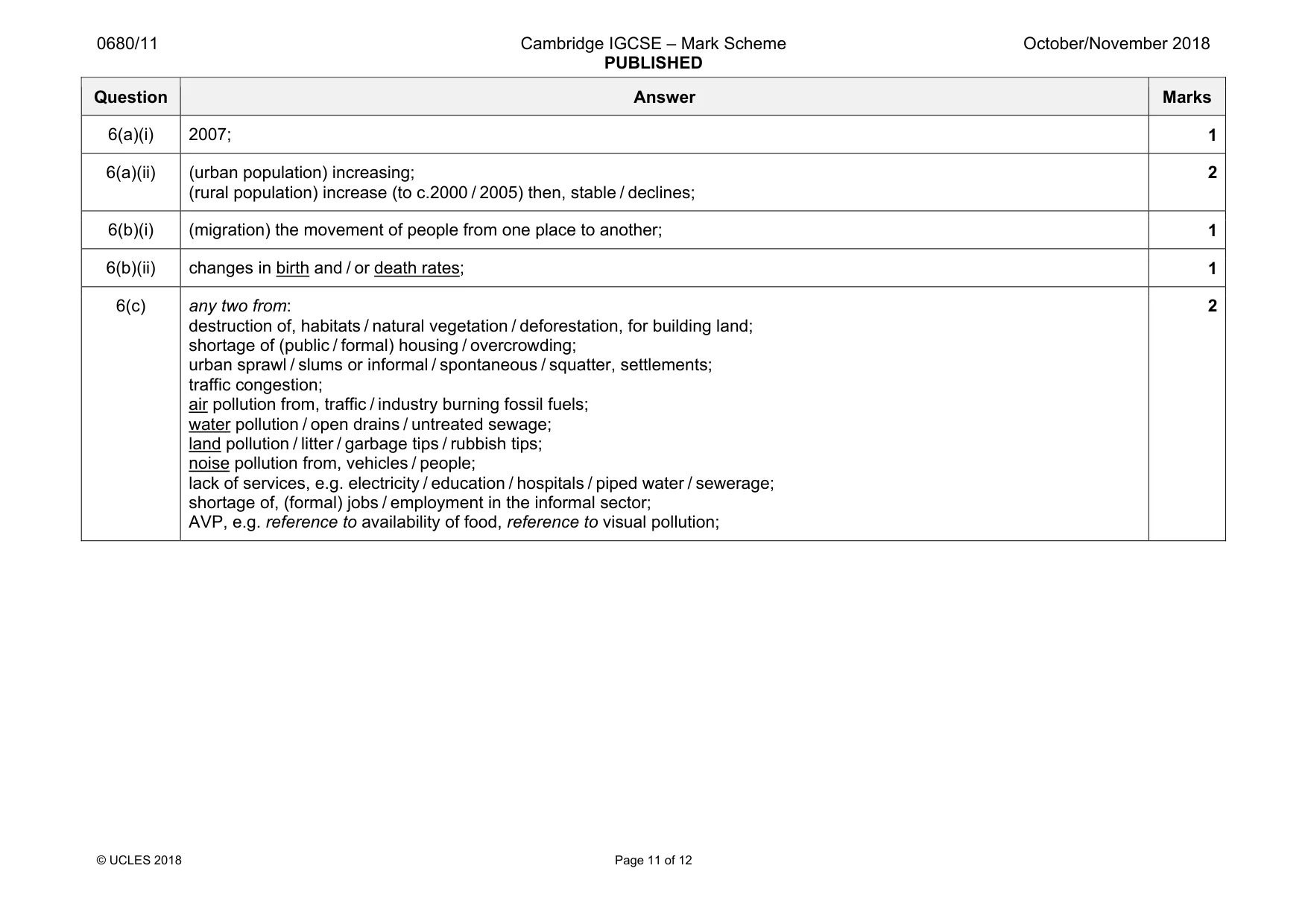
0680/11 Cambridge IGCSE – Mark Scheme PUBLISHED October/November 2018 © UCLES 2018 Page 11 of 12 Question Answer Marks 6(a)(i) 2007; 1 6(a)(ii) (urban population) increasing; (rural population) increase (to c.2000 / 2005) then, stable / declines; 2 6(b)(i) (migration) the movement of people from one place to another; 1 6(b)(ii) changes in birth and / or death rates; 1 6(c) any two from: destruction of, habitats / natural vegetation / deforestation, for building land; shortage of (public / formal) housing / overcrowding; urban sprawl / slums or informal / spontaneous / squatter, settlements; traffic congestion; air pollution from, traffic / industry burning fossil fuels; water pollution / open drains / untreated sewage; land pollution / litter / garbage tips / rubbish tips; noise pollution from, vehicles / people; lack of services, e.g. electricity / education / hospitals / piped water / sewerage; shortage of, (formal) jobs / employment in the informal sector; AVP, e.g. reference to availability of food, reference to visual pollution; 2
Mark scheme, page 12
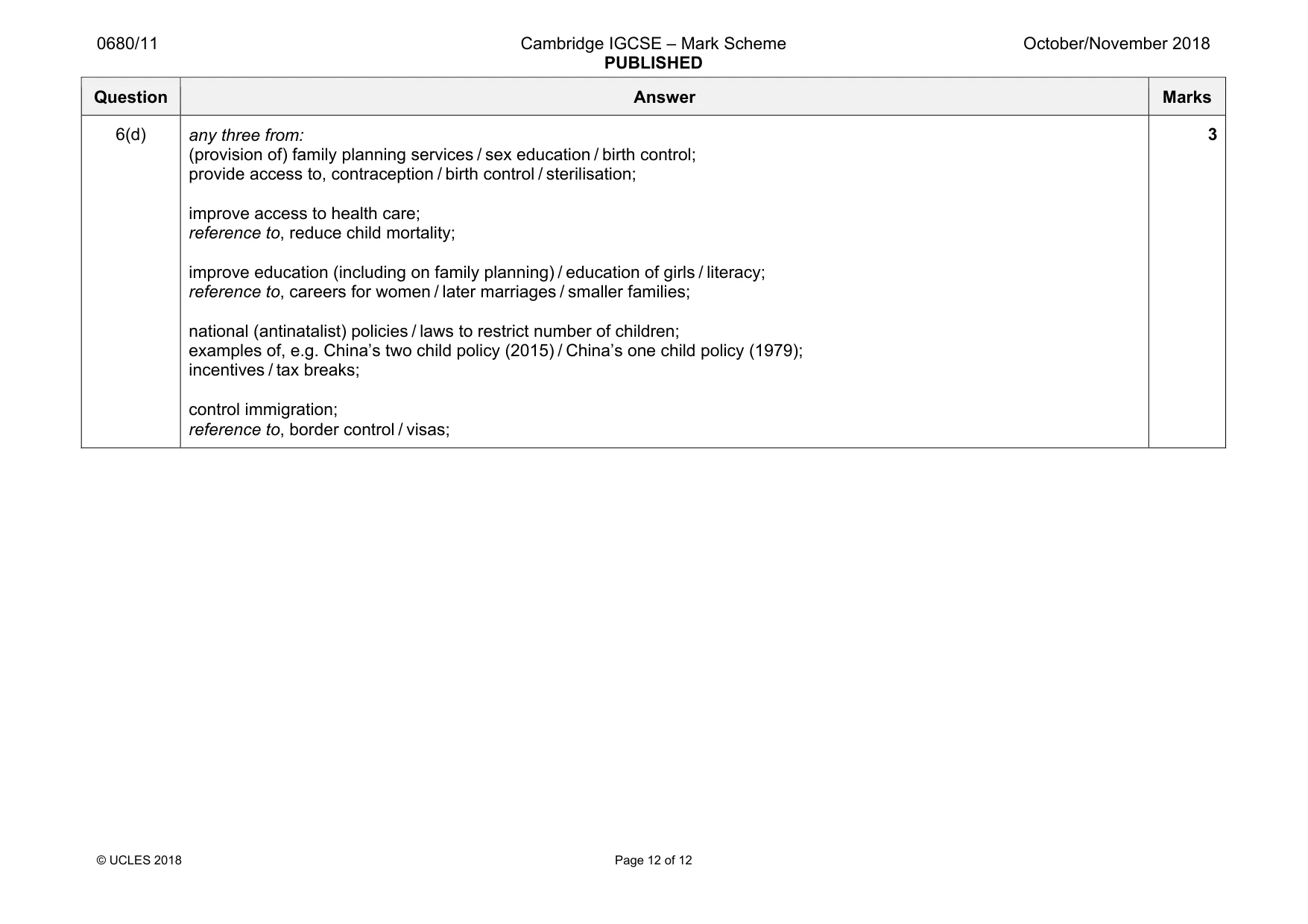
0680/11 Cambridge IGCSE – Mark Scheme PUBLISHED October/November 2018 © UCLES 2018 Page 12 of 12 Question Answer Marks 6(d) any three from: (provision of) family planning services / sex education / birth control; provide access to, contraception / birth control / sterilisation; improve access to health care; reference to, reduce child mortality; improve education (including on family planning) / education of girls / literacy; reference to, careers for women / later marriages / smaller families; national (antinatalist) policies / laws to restrict number of children; examples of, e.g. China’s two child policy (2015) / China’s one child policy (1979); incentives / tax breaks; control immigration; reference to, border control / visas; 3
What you needed in this session
Cambridge’s own grade thresholds for 2018 Oct/Nov, Paper 1 · Variant 1. A higher threshold means an easier paper — the bar moves with how the cohort did.