Cambridge IGCSE Environmental Management 0680 — 2018 May/June Paper 1 · Variant 2
0680/12/M/J/18 · 60 marks · ≈68 min
The question paper and its mark scheme, free to read here and free to download. This is Cambridge’s own paper, exactly as it was sat.
Question paper16 pages
Mark scheme11 pages
Answers below. Sit the paper first if you are practising.
Paper as text
Question paper, page 1
* 6 4 6 4 3 3 4 1 8 3 * This document consists of 16 printed pages. DC (SC/CGW) 144279/2 © UCLES 2018 [Turn over Cambridge International Examinations Cambridge International General Certificate of Secondary Education ENVIRONMENTAL MANAGEMENT 0680/12 Paper 1 May/June 2018 1 hour 30 minutes Candidates answer on the Question Paper. No Additional Materials are required. READ THESE INSTRUCTIONS FIRST Write your Centre number, candidate number and name on all the work you hand in. Write in dark blue or black pen. You may use an HB pencil for any diagrams or graphs. Do not use staples, paper clips, glue or correction fluid. DO NOT WRITE IN ANY BARCODES. Answer all questions. Electronic calculators may be used. You may lose marks if you do not show your working or if you do not use appropriate units. At the end of the examination, fasten all your work securely together. The number of marks is given in brackets [ ] at the end of each question or part question.
Question paper, page 2
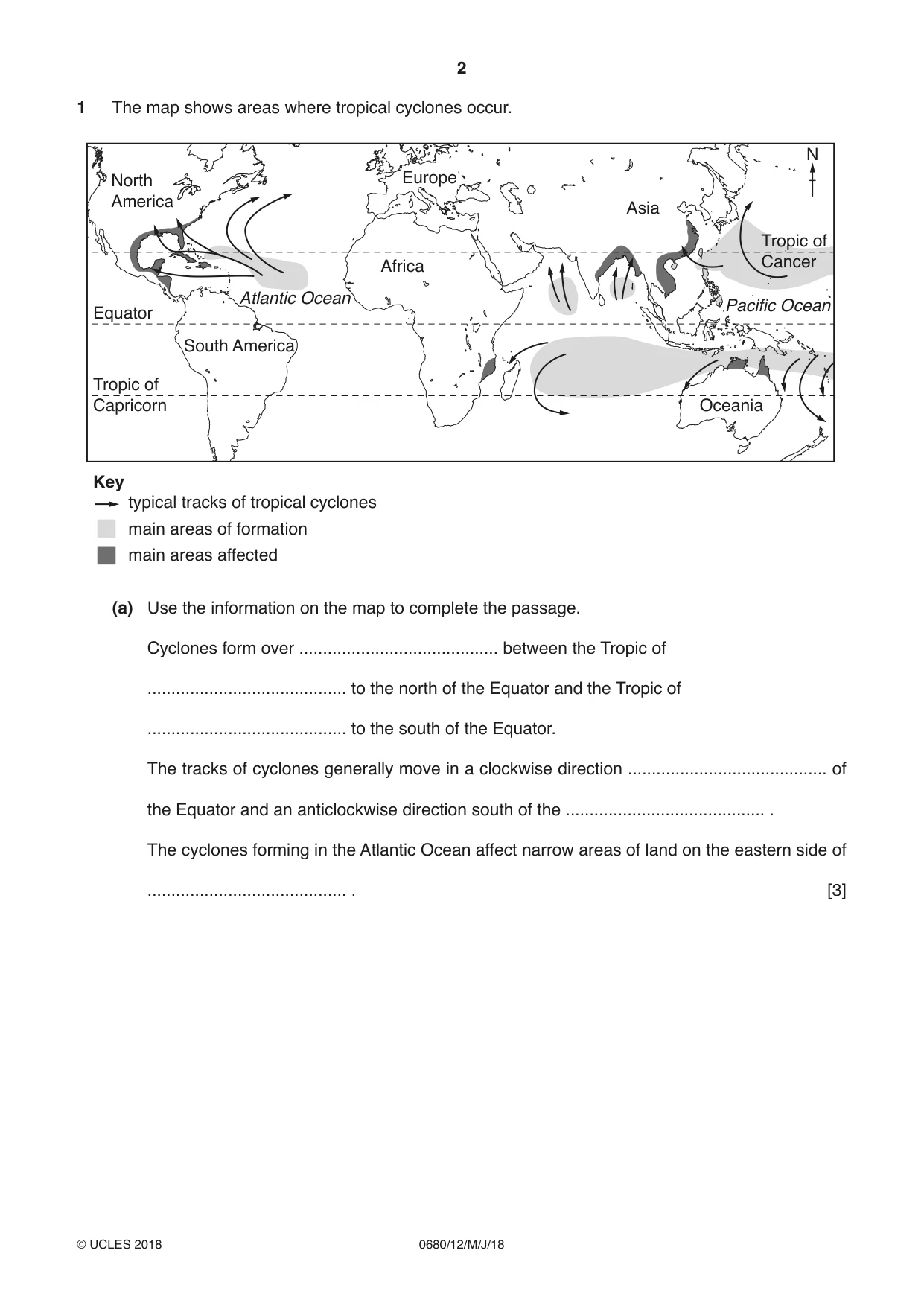
2 0680/12/M/J/18 © UCLES 2018 1 The map shows areas where tropical cyclones occur. Asia Oceania Africa Europe North America South America Tropic of Capricorn Tropic of Cancer N Equator Key typical tracks of tropical cyclones main areas of formation main areas affected Atlantic Ocean Pacific Ocean (a) Use the information on the map to complete the passage. Cyclones form over … between the Tropic of … to the north of the Equator and the Tropic of … to the south of the Equator. The tracks of cyclones generally move in a clockwise direction … of the Equator and an anticlockwise direction south of the … . The cyclones forming in the Atlantic Ocean affect narrow areas of land on the eastern side of … . [3]
Question paper, page 3
3 0680/12/M/J/18 © UCLES 2018 [Turn over (b) Describe ways in which tropical cyclones are a hazard to people living in the areas affected. … … … … … … … …[4] (c) Suggest strategies to reduce the impact of tropical cyclones. … … … … … …[3]
Question paper, page 4
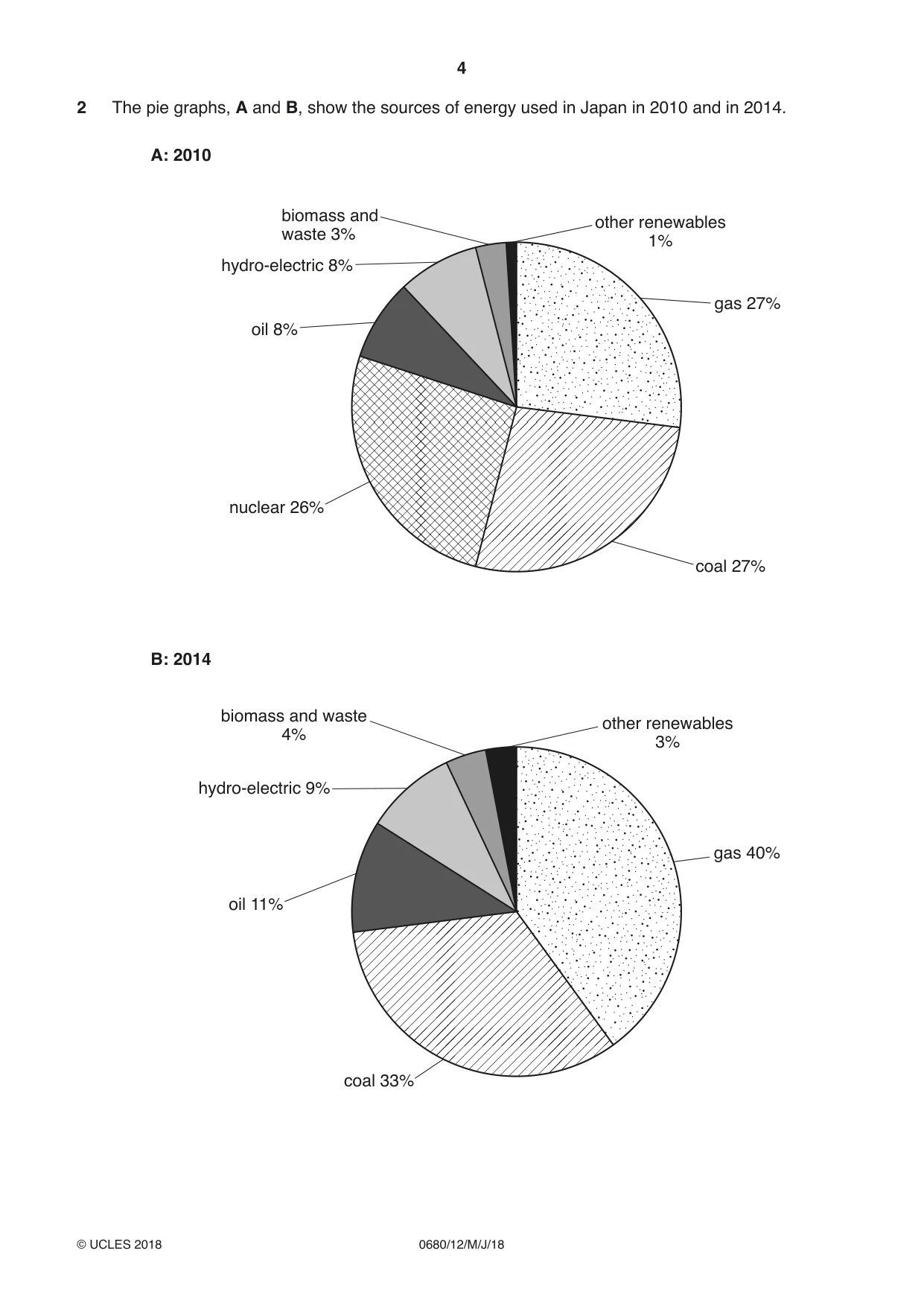
4 0680/12/M/J/18 © UCLES 2018 2 The pie graphs, A and B, show the sources of energy used in Japan in 2010 and in 2014. oil 8% nuclear 26% hydro-electric 8% hydro-electric 9% biomass and waste 3% biomass and waste 4% other renewables 1% other renewables 3% gas 27% gas 40% coal 27% A: 2010 B: 2014 coal 33% oil 11%
Question paper, page 5
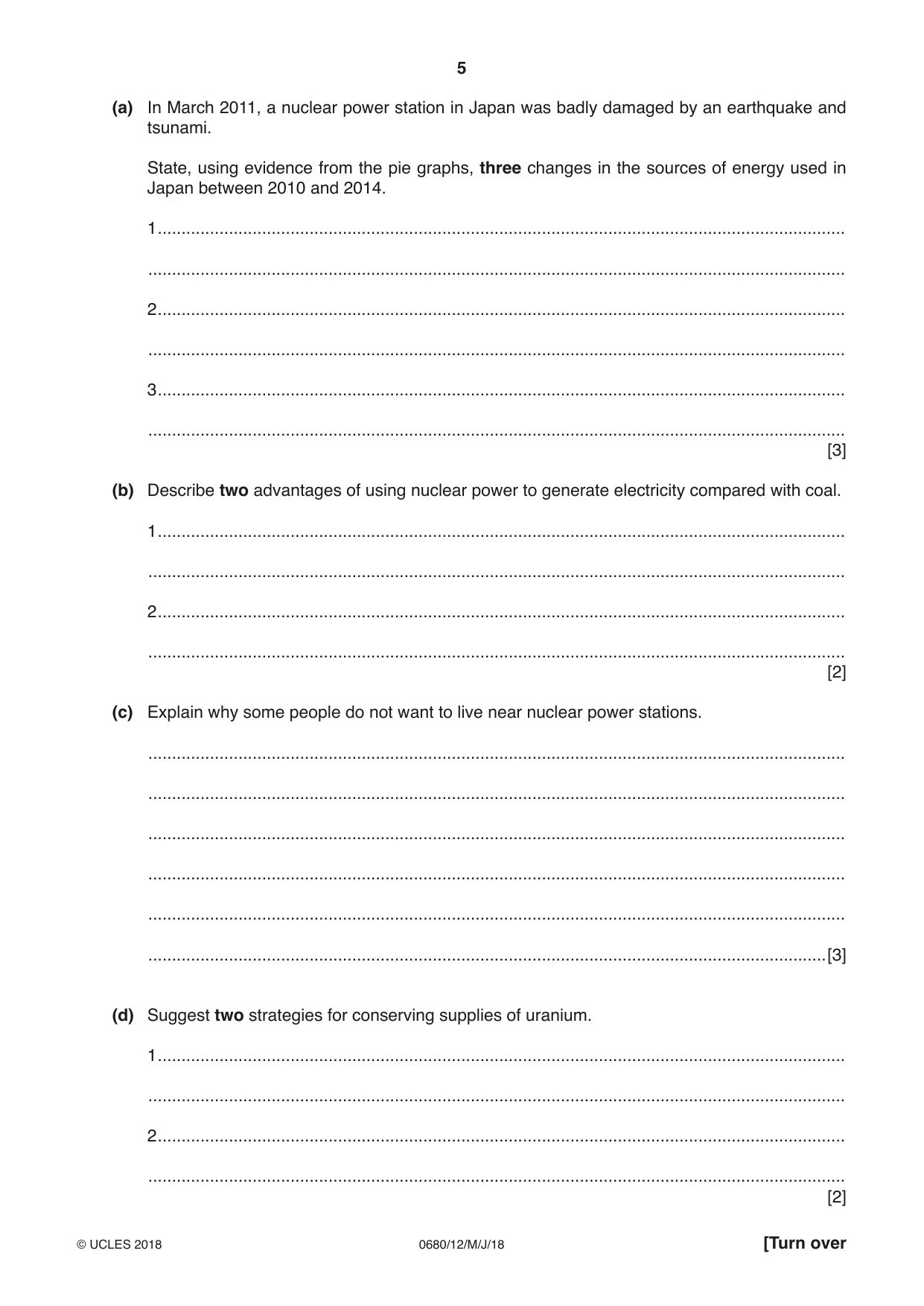
5 0680/12/M/J/18 © UCLES 2018 [Turn over (a) In March 2011, a nuclear power station in Japan was badly damaged by an earthquake and tsunami. State, using evidence from the pie graphs, three changes in the sources of energy used in Japan between 2010 and 2014. 1 … … 2 … … 3 … … [3] (b) Describe two advantages of using nuclear power to generate electricity compared with coal. 1 … … 2 … … [2] (c) Explain why some people do not want to live near nuclear power stations. … … … … … …[3] (d) Suggest two strategies for conserving supplies of uranium. 1 … … 2 … … [2]
Question paper, page 6
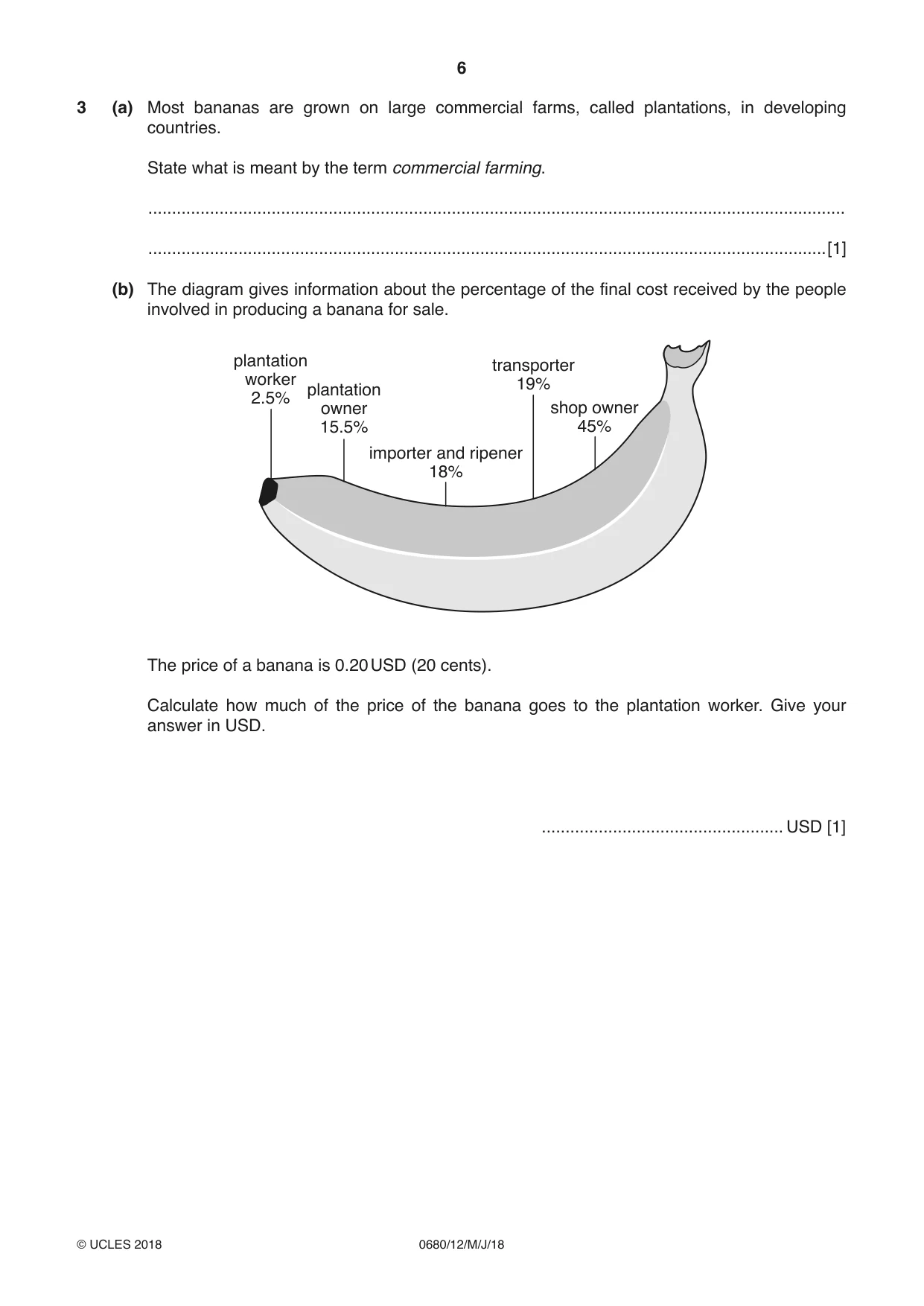
6 0680/12/M/J/18 © UCLES 2018 3 (a) Most bananas are grown on large commercial farms, called plantations, in developing countries. State what is meant by the term commercial farming. … …[1] (b) The diagram gives information about the percentage of the final cost received by the people involved in producing a banana for sale. plantation worker 2.5% plantation owner 15.5% importer and ripener 18% transporter 19% shop owner 45% The price of a banana is 0.20 USD (20 cents). Calculate how much of the price of the banana goes to the plantation worker. Give your answer in USD. … USD [1]
Question paper, page 7
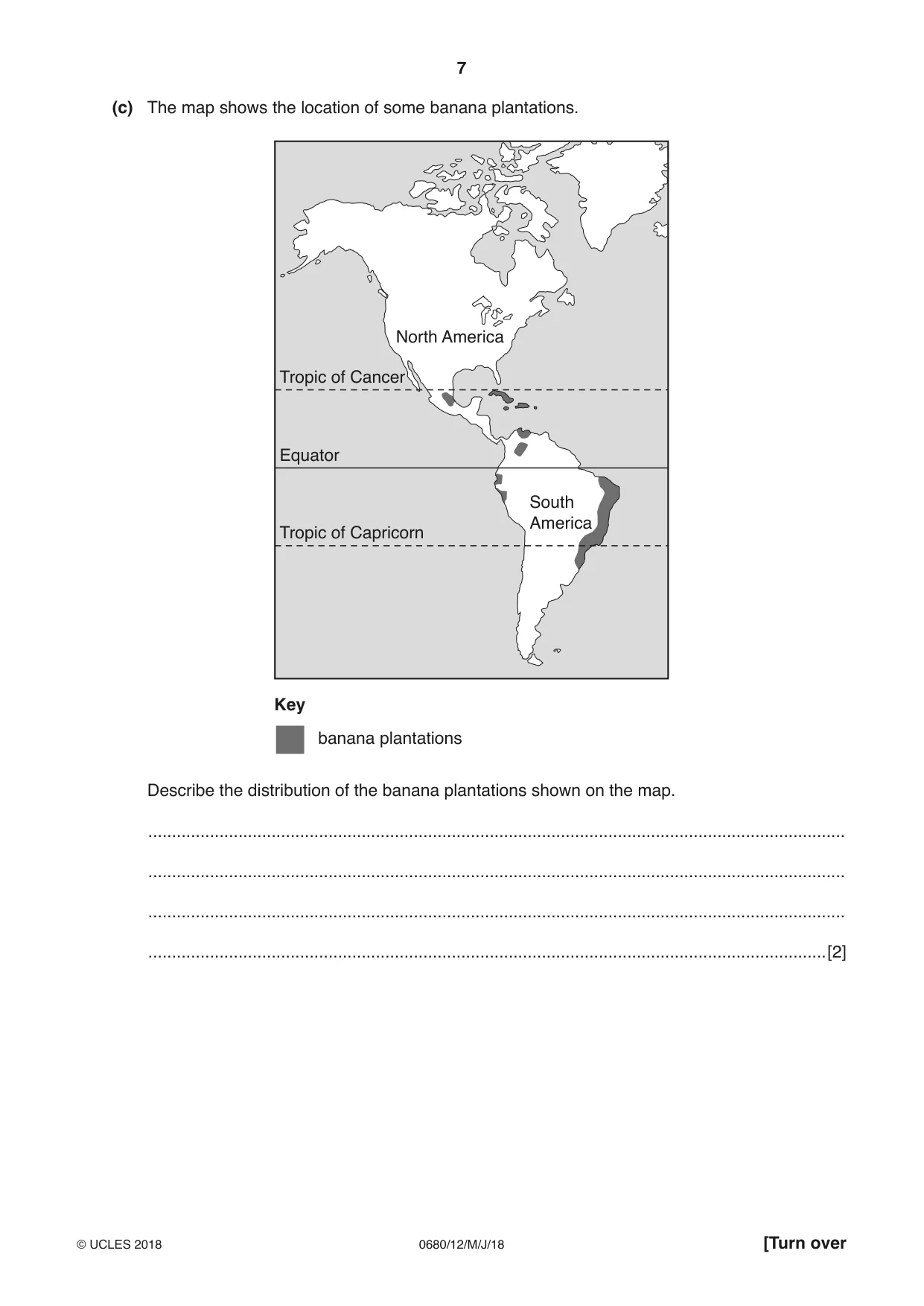
7 0680/12/M/J/18 © UCLES 2018 [Turn over (c) The map shows the location of some banana plantations. Equator Tropic of Capricorn Key banana plantations Tropic of Cancer North America South America Describe the distribution of the banana plantations shown on the map. … … … …[2]
Question paper, page 8
8 0680/12/M/J/18 © UCLES 2018 (d) Suggest reasons why most of the trade in bananas is from developing countries to developed countries in Europe and North America. … … … … … …[3] (e) Large quantities of pesticides are used on banana plantations. Explain how pesticides can cause problems for the environment. … … … … … …[3]
Question paper, page 9
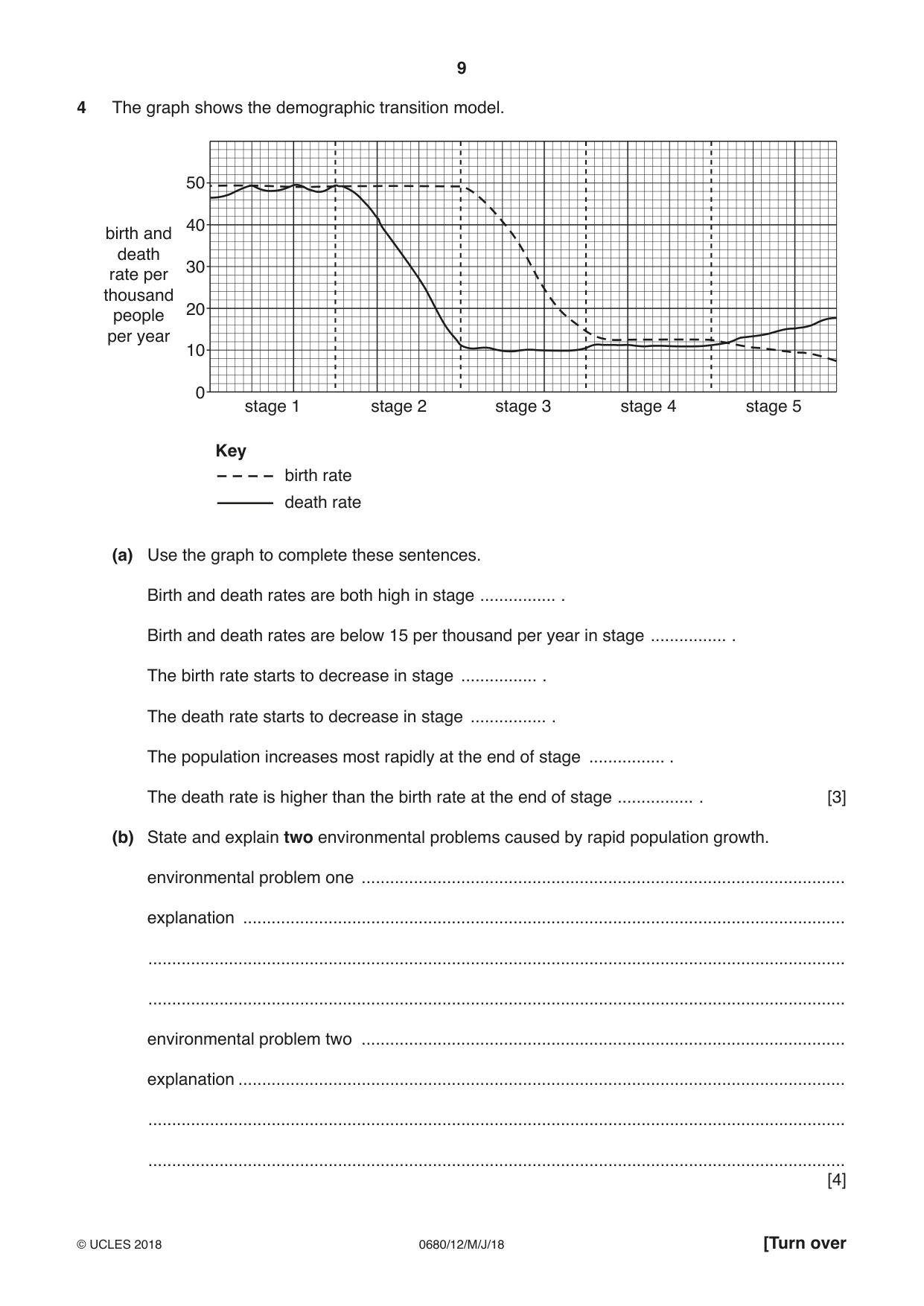
9 0680/12/M/J/18 © UCLES 2018 [Turn over 4 The graph shows the demographic transition model. 50 40 30 birth and death rate per thousand people per year stage 1 Key birth rate death rate stage 2 stage 3 stage 4 stage 5 20 10 0 (a) Use the graph to complete these sentences. Birth and death rates are both high in stage … . Birth and death rates are below 15 per thousand per year in stage … . The birth rate starts to decrease in stage … . The death rate starts to decrease in stage … . The population increases most rapidly at the end of stage … . The death rate is higher than the birth rate at the end of stage … . [3] (b) State and explain two environmental problems caused by rapid population growth. environmental problem one … explanation … … … environmental problem two … explanation … … … [4]
Question paper, page 10
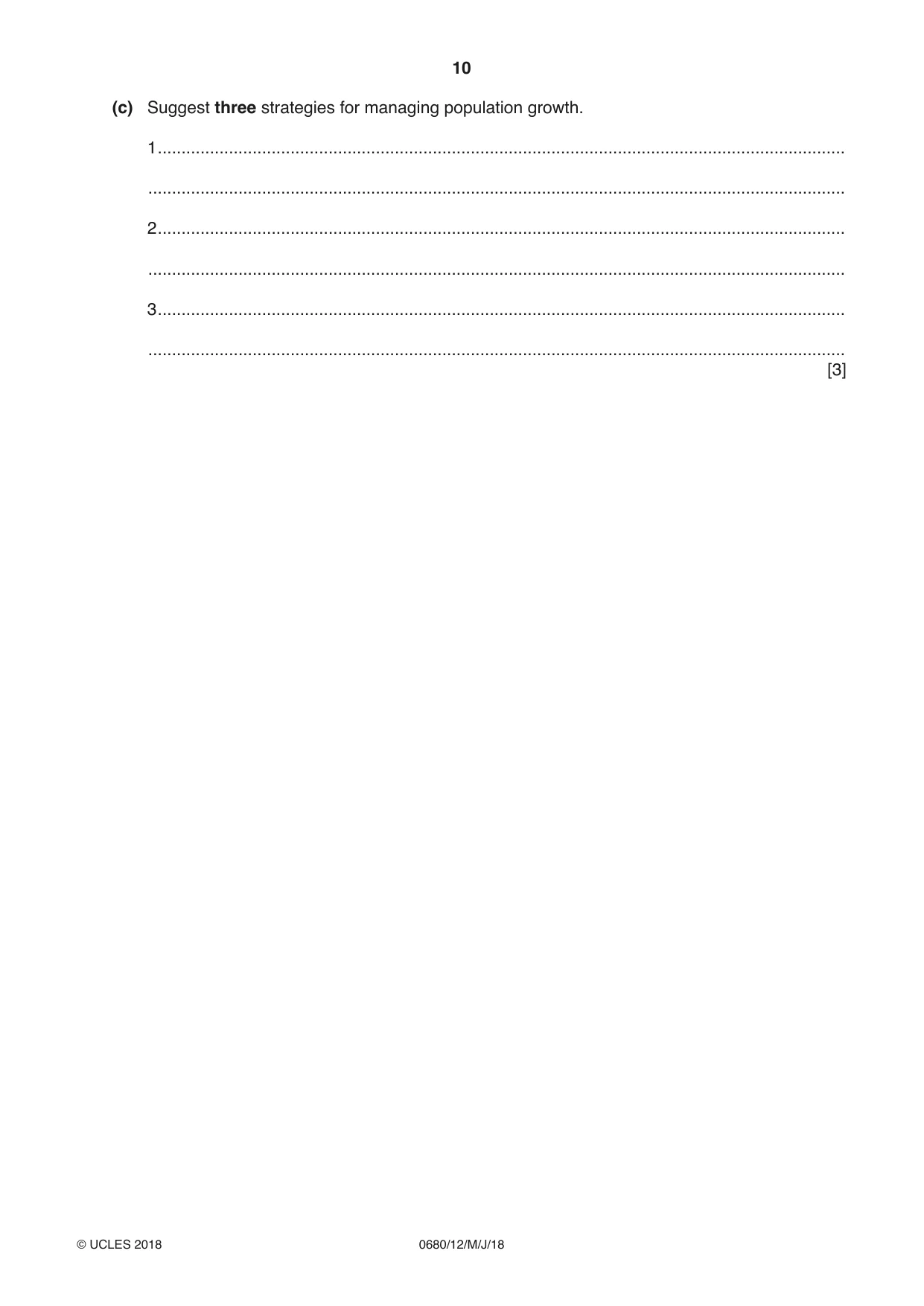
10 0680/12/M/J/18 © UCLES 2018 (c) Suggest three strategies for managing population growth. 1 … … 2 … … 3 … … [3]
Question paper, page 11
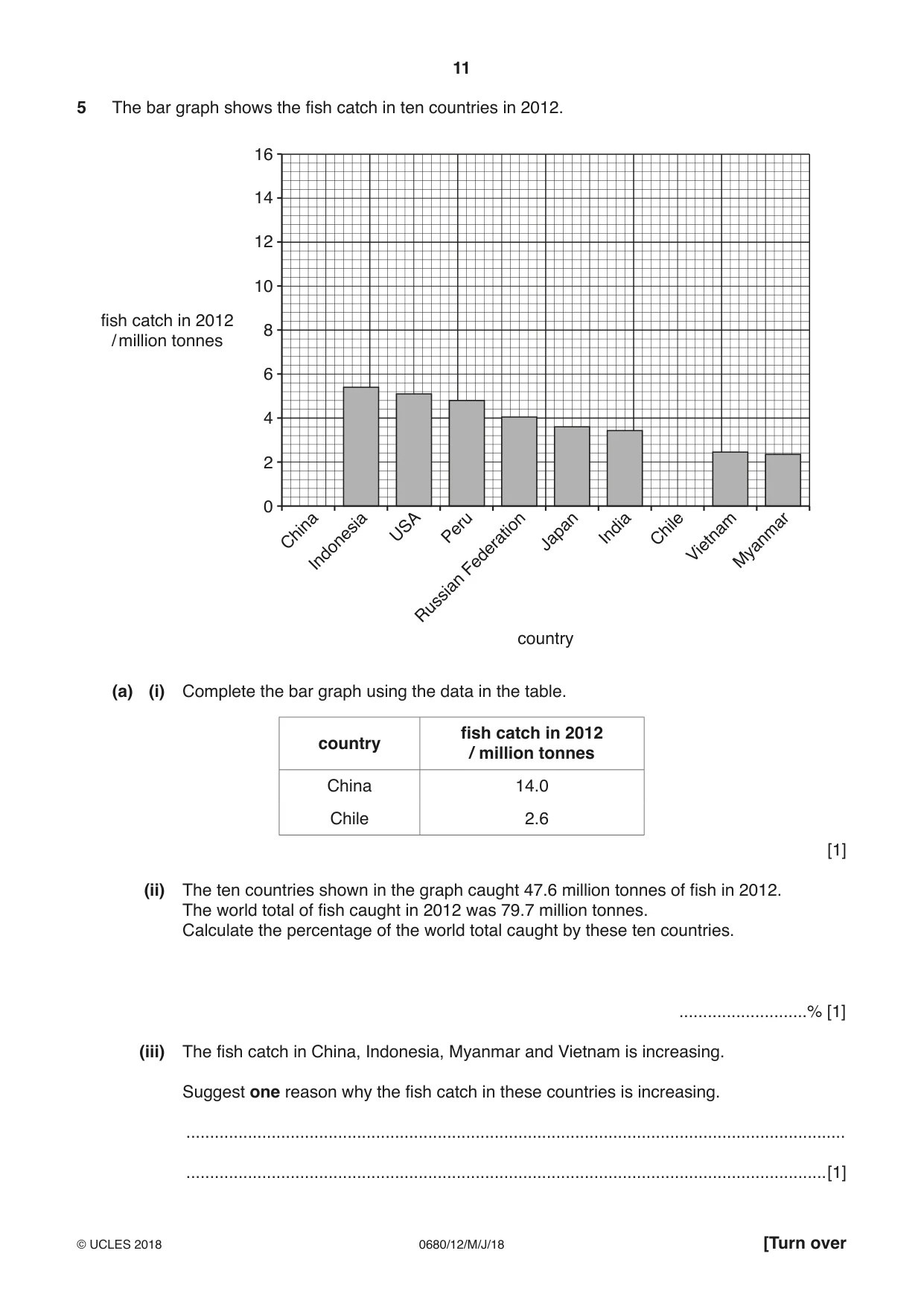
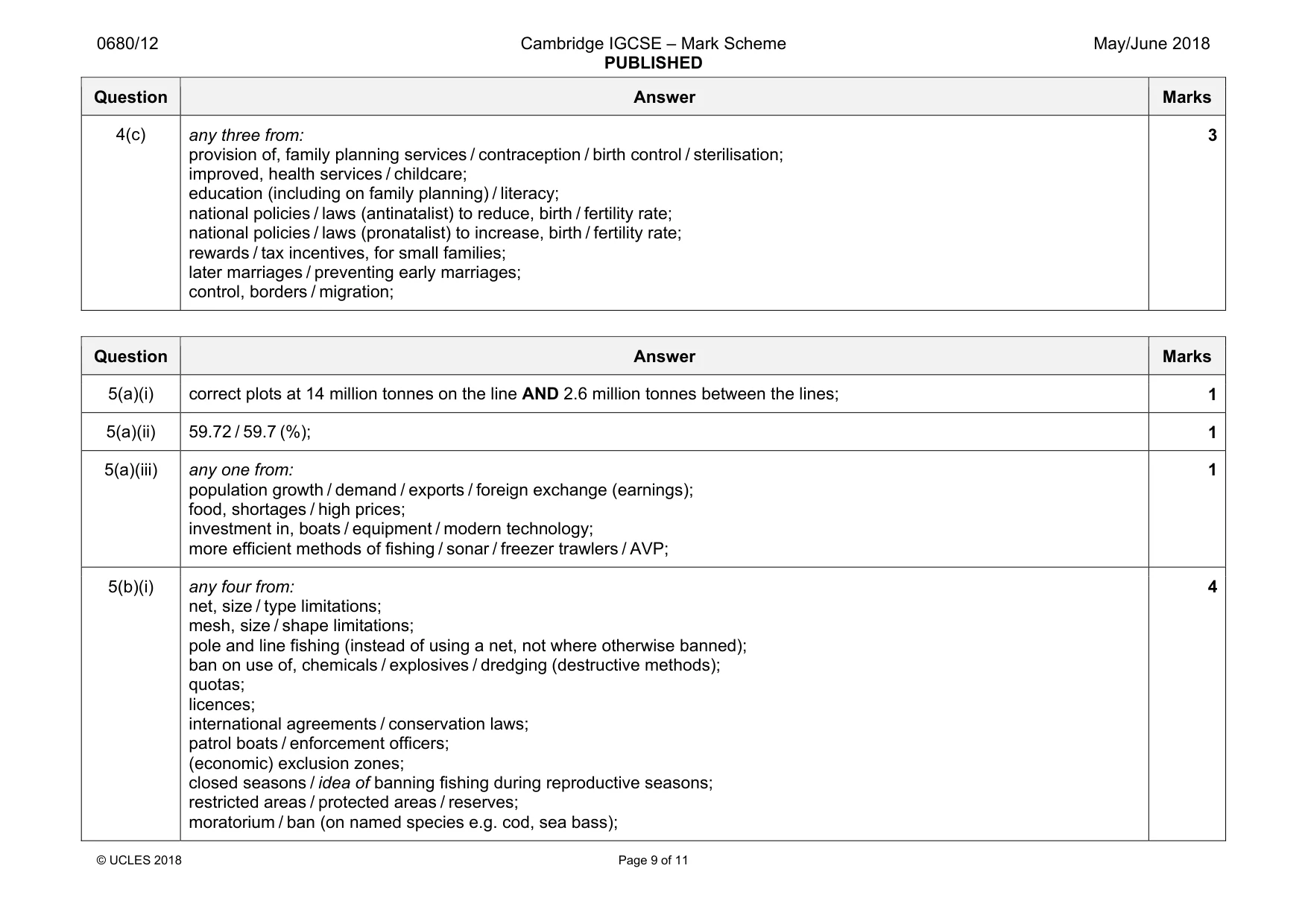
11 0680/12/M/J/18 © UCLES 2018 [Turn over 5 The bar graph shows the fish catch in ten countries in 2012. China Indonesia USA Peru Russian Federation Japan India Chile Vietnam Myanmar 0 2 4 6 country fish catch in 2012 / million tonnes 8 10 12 14 16 (a) (i) Complete the bar graph using the data in the table. country fish catch in 2012 / million tonnes China 14.0 Chile 2.6 [1] (ii) The ten countries shown in the graph caught 47.6 million tonnes of fish in 2012. The world total of fish caught in 2012 was 79.7 million tonnes. Calculate the percentage of the world total caught by these ten countries. …% [1] (iii) The fish catch in China, Indonesia, Myanmar and Vietnam is increasing. Suggest one reason why the fish catch in these countries is increasing. … …[1]
Question paper, page 12
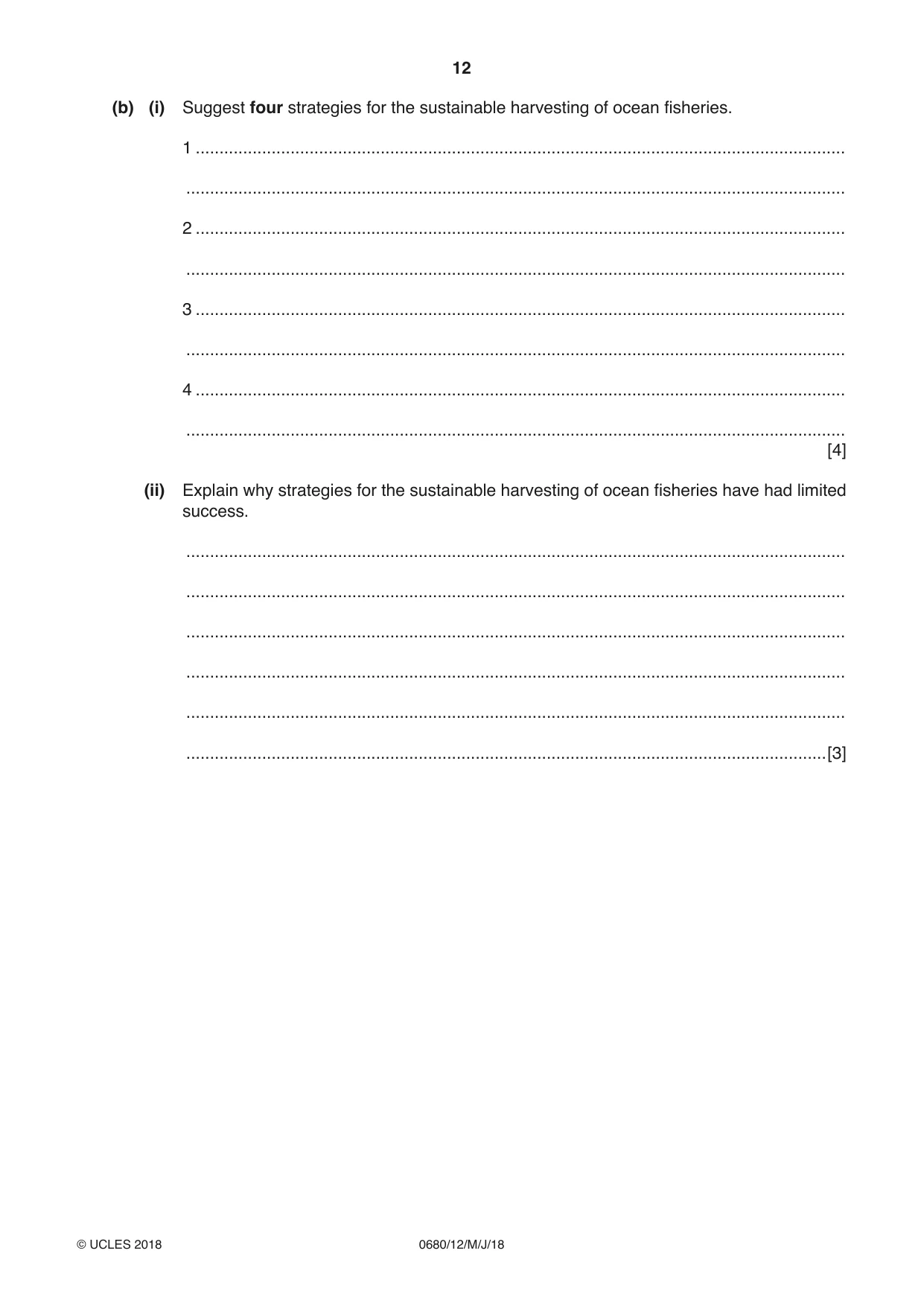
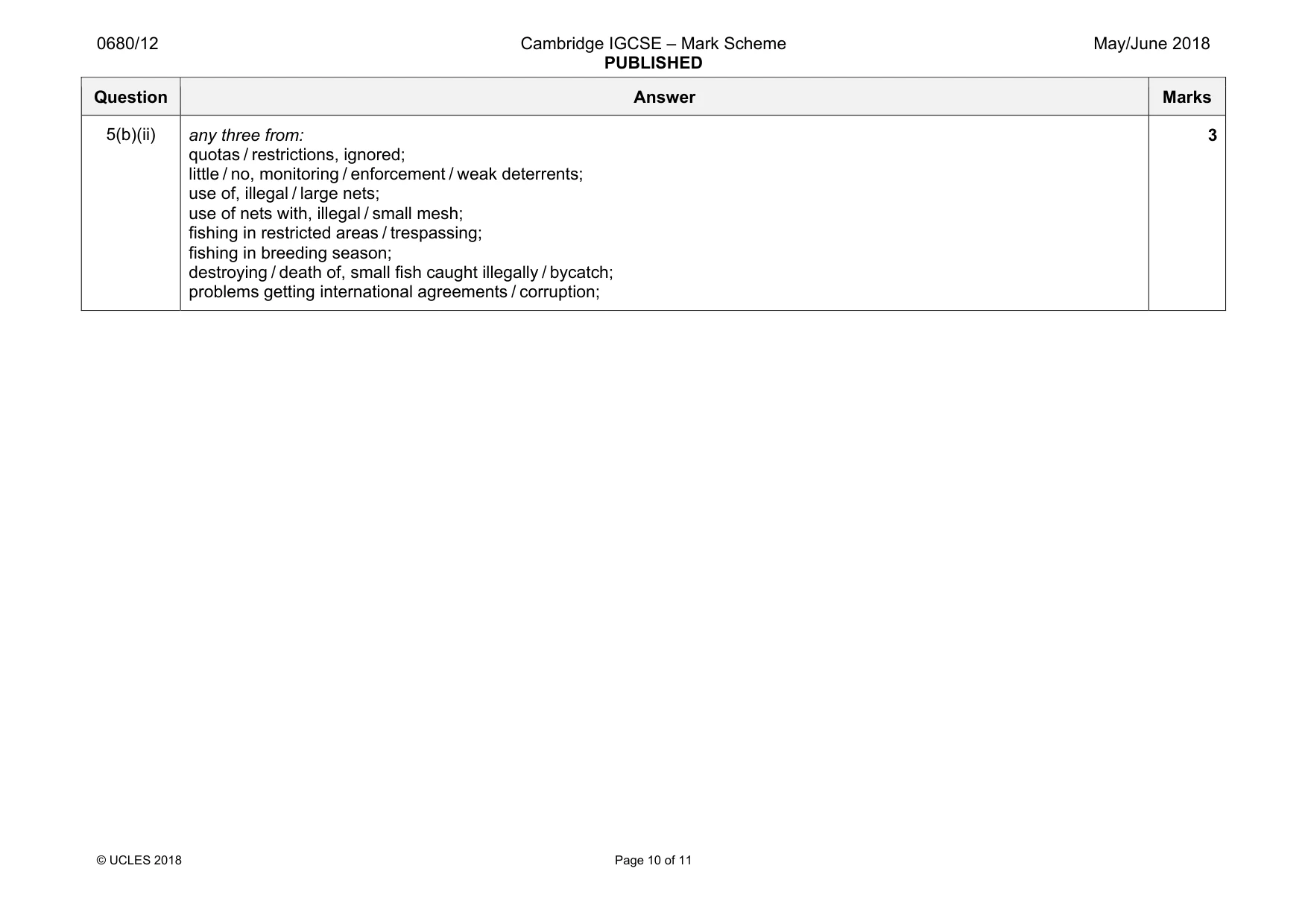
12 0680/12/M/J/18 © UCLES 2018 (b) (i) Suggest four strategies for the sustainable harvesting of ocean fisheries. 1 … … 2 … … 3 … … 4 … … [4] (ii) Explain why strategies for the sustainable harvesting of ocean fisheries have had limited success. … … … … … …[3]
Question paper, page 13
13 0680/12/M/J/18 © UCLES 2018 [Turn over Question 6 begins on page 14.
Question paper, page 14
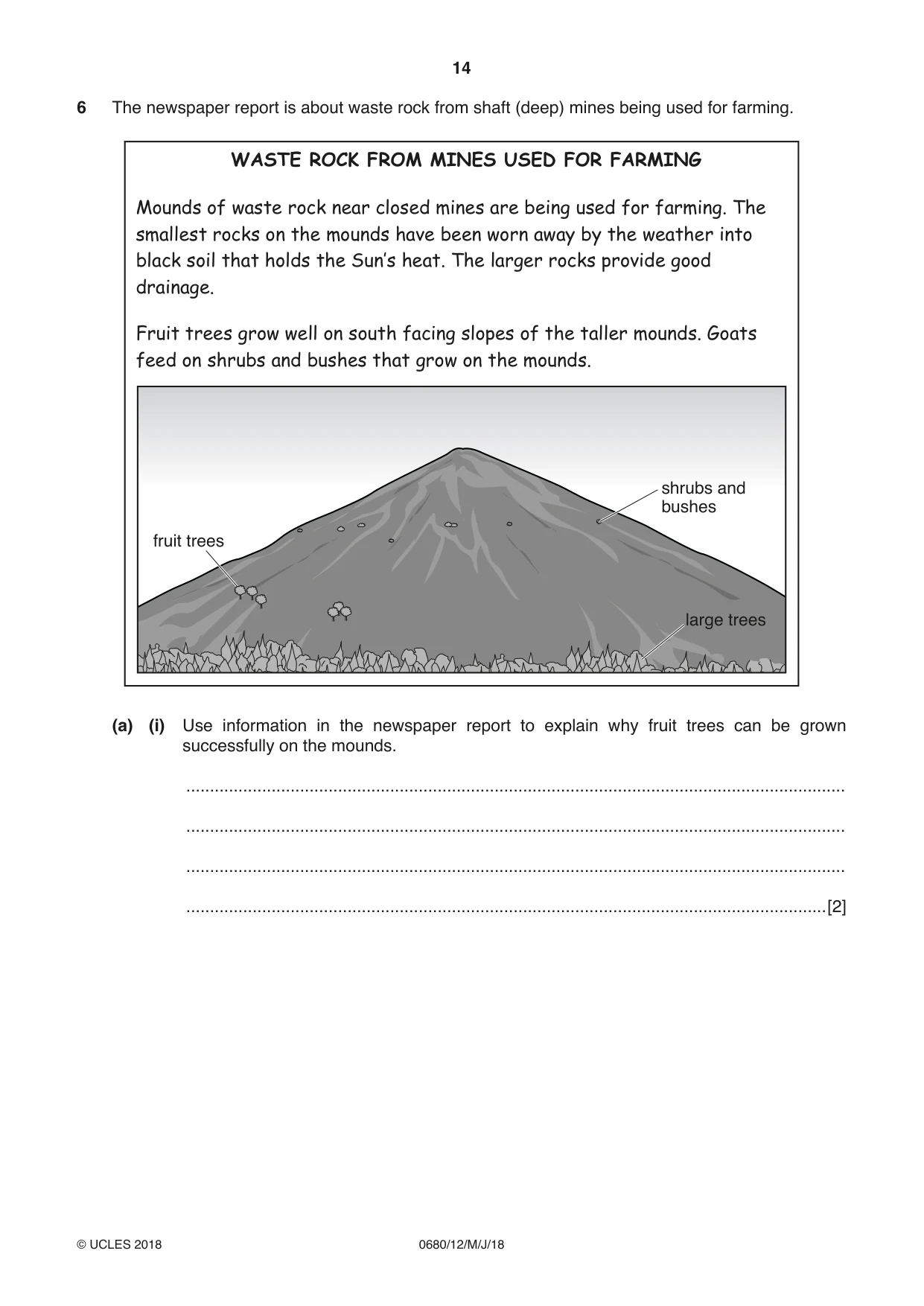
14 0680/12/M/J/18 © UCLES 2018 6 The newspaper report is about waste rock from shaft (deep) mines being used for farming. WASTE ROCK FROM MINES USED FOR FARMING Mounds of waste rock near closed mines are being used for farming. The smallest rocks on the mounds have been worn away by the weather into black soil that holds the Sun‛s heat. The larger rocks provide good drainage. Fruit trees grow well on south facing slopes of the taller mounds. Goats feed on shrubs and bushes that grow on the mounds. shrubs and bushes large trees fruit trees (a) (i) Use information in the newspaper report to explain why fruit trees can be grown successfully on the mounds. … … … …[2]
Question paper, page 15
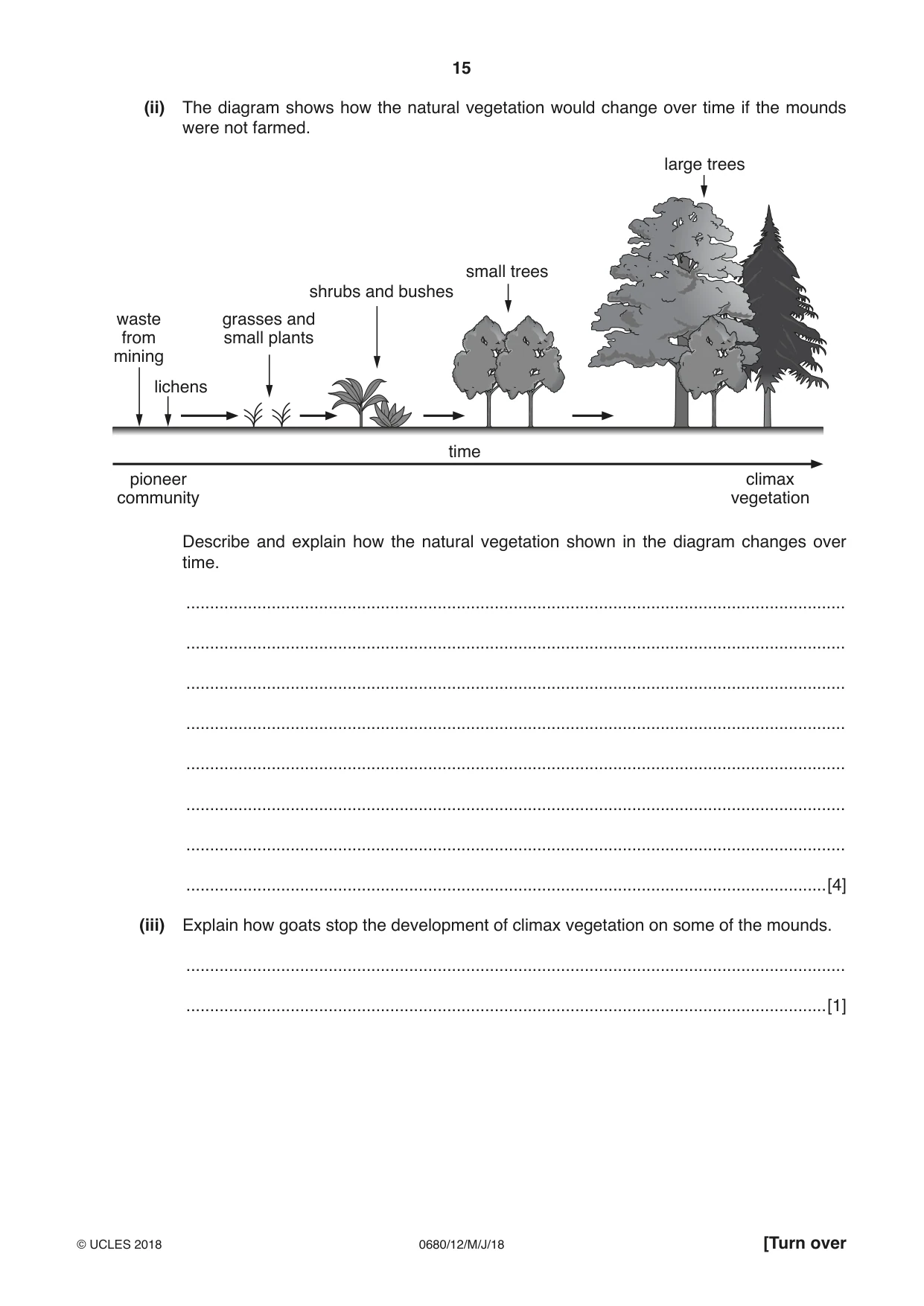
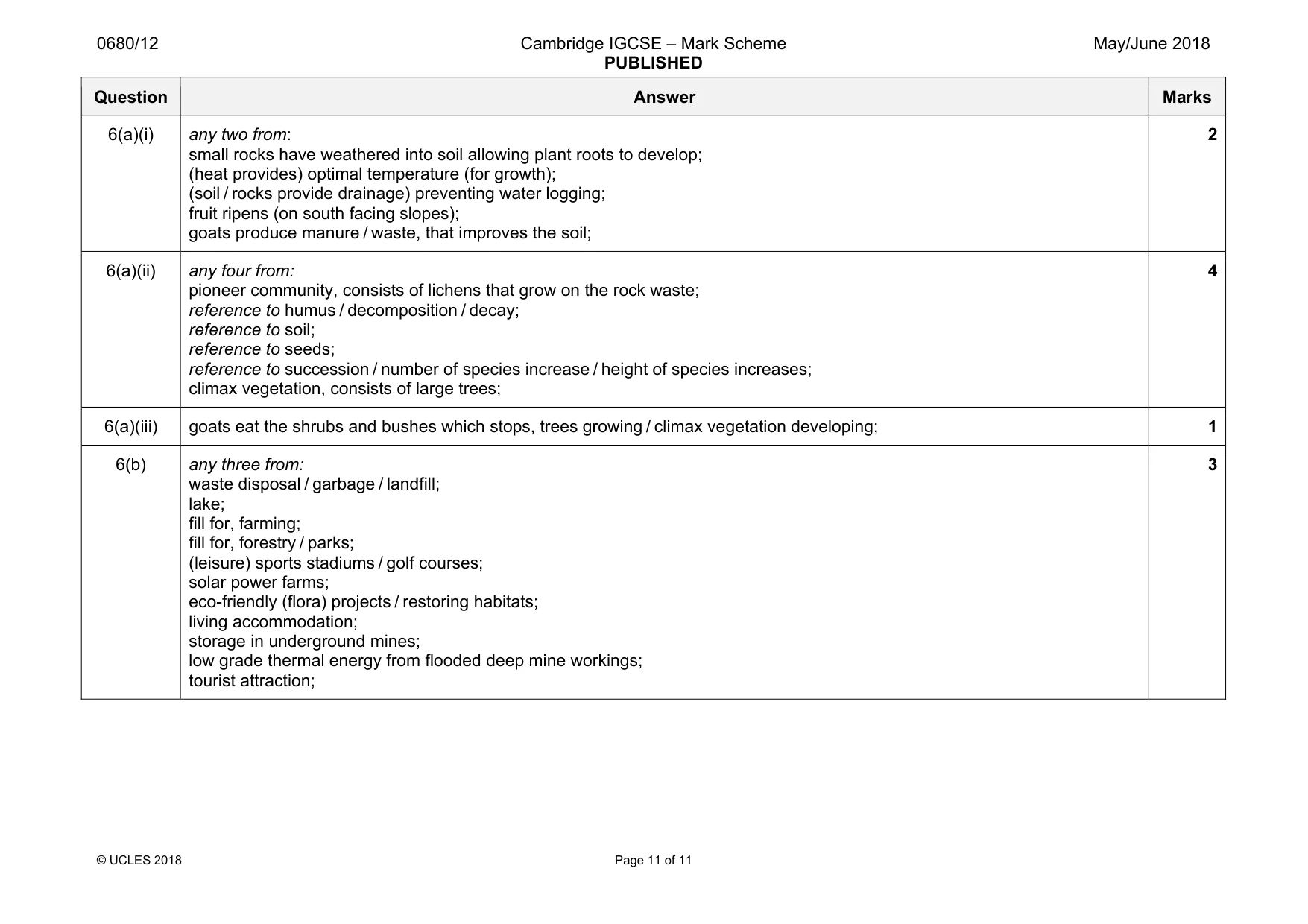
15 0680/12/M/J/18 © UCLES 2018 (ii) The diagram shows how the natural vegetation would change over time if the mounds were not farmed. waste from mining grasses and small plants small trees large trees shrubs and bushes time pioneer community climax vegetation lichens Describe and explain how the natural vegetation shown in the diagram changes over time. … … … … … … … …[4] (iii) Explain how goats stop the development of climax vegetation on some of the mounds. … …[1] [Turn over
Question paper, page 16
16 0680/12/M/J/18 © UCLES 2018 Permission to reproduce items where third-party owned material protected by copyright is included has been sought and cleared where possible. Every reasonable effort has been made by the publisher (UCLES) to trace copyright holders, but if any items requiring clearance have unwittingly been included, the publisher will be pleased to make amends at the earliest possible opportunity. To avoid the issue of disclosure of answer-related information to candidates, all copyright acknowledgements are reproduced online in the Cambridge International Examinations Copyright Acknowledgements Booklet. This is produced for each series of examinations and is freely available to download at www.cie.org.uk after the live examination series. Cambridge International Examinations is part of the Cambridge Assessment Group. Cambridge Assessment is the brand name of University of Cambridge Local Examinations Syndicate (UCLES), which is itself a department of the University of Cambridge. (b) Suggest ways that mines can be used after extraction has finished. … … … … … …[3]
Mark scheme, page 1
® IGCSE is a registered trademark. This document consists of 11 printed pages. © UCLES 2018 [Turn over Cambridge Assessment International Education Cambridge International General Certificate of Secondary Education ENVIRONMENTAL MANAGEMENT 0680/12 Paper 1 May/June 2018 MARK SCHEME Maximum Mark: 60 Published This mark scheme is published as an aid to teachers and candidates, to indicate the requirements of the examination. It shows the basis on which Examiners were instructed to award marks. It does not indicate the details of the discussions that took place at an Examiners’ meeting before marking began, which would have considered the acceptability of alternative answers. Mark schemes should be read in conjunction with the question paper and the Principal Examiner Report for Teachers. Cambridge International will not enter into discussions about these mark schemes. Cambridge International is publishing the mark schemes for the May/June 2018 series for most Cambridge IGCSE®, Cambridge International A and AS Level and Cambridge Pre-U components, and some Cambridge O Level components.
Mark scheme, page 2
0680/12 Cambridge IGCSE – Mark Scheme PUBLISHED May/June 2018 © UCLES 2018 Page 2 of 11 Generic Marking Principles These general marking principles must be applied by all examiners when marking candidate answers. They should be applied alongside the specific content of the mark scheme or generic level descriptors for a question. Each question paper and mark scheme will also comply with these marking principles. GENERIC MARKING PRINCIPLE 1: Marks must be awarded in line with: • the specific content of the mark scheme or the generic level descriptors for the question • the specific skills defined in the mark scheme or in the generic level descriptors for the question • the standard of response required by a candidate as exemplified by the standardisation scripts. GENERIC MARKING PRINCIPLE 2: Marks awarded are always whole marks (not half marks, or other fractions). GENERIC MARKING PRINCIPLE 3: Marks must be awarded positively: • marks are awarded for correct/valid answers, as defined in the mark scheme. However, credit is given for valid answers which go beyond the scope of the syllabus and mark scheme, referring to your Team Leader as appropriate • marks are awarded when candidates clearly demonstrate what they know and can do • marks are not deducted for errors • marks are not deducted for omissions • answers should only be judged on the quality of spelling, punctuation and grammar when these features are specifically assessed by the question as indicated by the mark scheme. The meaning, however, should be unambiguous. GENERIC MARKING PRINCIPLE 4: Rules must be applied consistently e.g. in situations where candidates have not followed instructions or in the application of generic level descriptors.
Mark scheme, page 3
0680/12 Cambridge IGCSE – Mark Scheme PUBLISHED May/June 2018 © UCLES 2018 Page 3 of 11 GENERIC MARKING PRINCIPLE 5: Marks should be awarded using the full range of marks defined in the mark scheme for the question (however; the use of the full mark range may be limited according to the quality of the candidate responses seen). GENERIC MARKING PRINCIPLE 6: Marks awarded are based solely on the requirements as defined in the mark scheme. Marks should not be awarded with grade thresholds or grade descriptors in mind.
Mark scheme, page 4
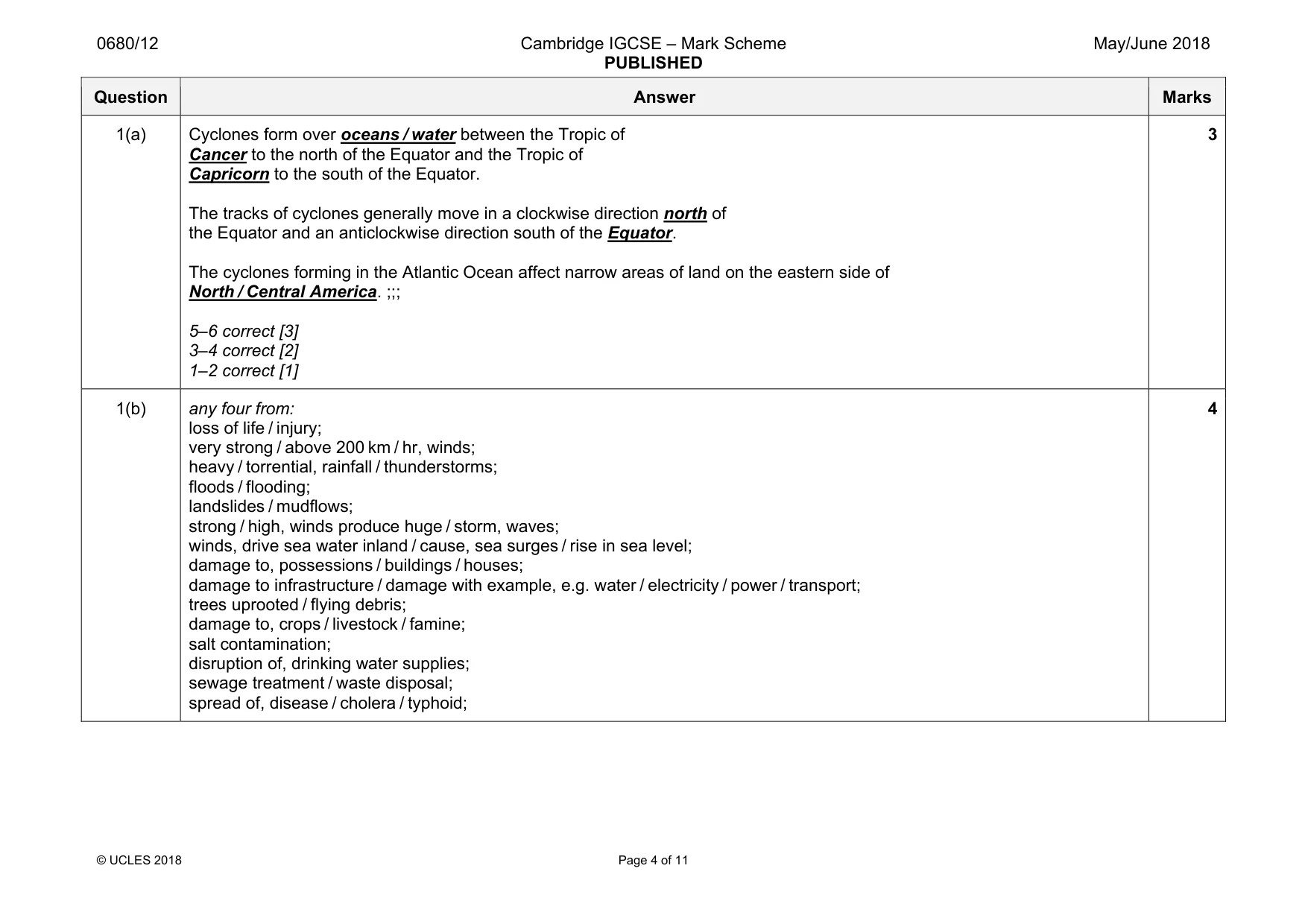
0680/12 Cambridge IGCSE – Mark Scheme PUBLISHED May/June 2018 © UCLES 2018 Page 4 of 11 Question Answer Marks 1(a) Cyclones form over oceans / water between the Tropic of Cancer to the north of the Equator and the Tropic of Capricorn to the south of the Equator. The tracks of cyclones generally move in a clockwise direction north of the Equator and an anticlockwise direction south of the Equator. The cyclones forming in the Atlantic Ocean affect narrow areas of land on the eastern side of North / Central America. ;;; 5–6 correct [3] 3–4 correct [2] 1–2 correct [1] 3 1(b) any four from: loss of life / injury; very strong / above 200 km / hr, winds; heavy / torrential, rainfall / thunderstorms; floods / flooding; landslides / mudflows; strong / high, winds produce huge / storm, waves; winds, drive sea water inland / cause, sea surges / rise in sea level; damage to, possessions / buildings / houses; damage to infrastructure / damage with example, e.g. water / electricity / power / transport; trees uprooted / flying debris; damage to, crops / livestock / famine; salt contamination; disruption of, drinking water supplies; sewage treatment / waste disposal; spread of, disease / cholera / typhoid; 4
Mark scheme, page 5
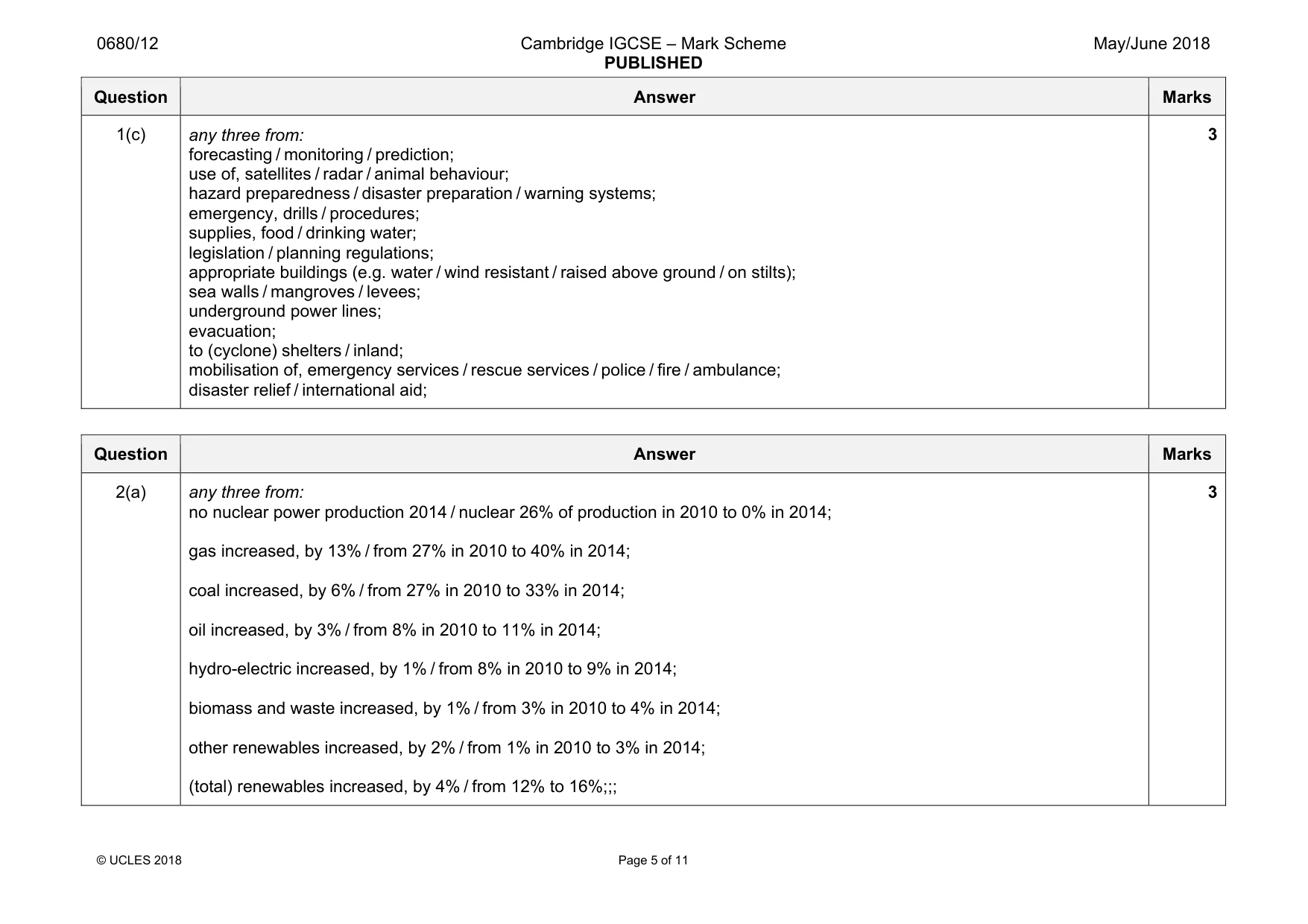
0680/12 Cambridge IGCSE – Mark Scheme PUBLISHED May/June 2018 © UCLES 2018 Page 5 of 11 Question Answer Marks 1(c) any three from: forecasting / monitoring / prediction; use of, satellites / radar / animal behaviour; hazard preparedness / disaster preparation / warning systems; emergency, drills / procedures; supplies, food / drinking water; legislation / planning regulations; appropriate buildings (e.g. water / wind resistant / raised above ground / on stilts); sea walls / mangroves / levees; underground power lines; evacuation; to (cyclone) shelters / inland; mobilisation of, emergency services / rescue services / police / fire / ambulance; disaster relief / international aid; 3 Question Answer Marks 2(a) any three from: no nuclear power production 2014 / nuclear 26% of production in 2010 to 0% in 2014; gas increased, by 13% / from 27% in 2010 to 40% in 2014; coal increased, by 6% / from 27% in 2010 to 33% in 2014; oil increased, by 3% / from 8% in 2010 to 11% in 2014; hydro-electric increased, by 1% / from 8% in 2010 to 9% in 2014; biomass and waste increased, by 1% / from 3% in 2010 to 4% in 2014; other renewables increased, by 2% / from 1% in 2010 to 3% in 2014; (total) renewables increased, by 4% / from 12% to 16%;;; 3
Mark scheme, page 6
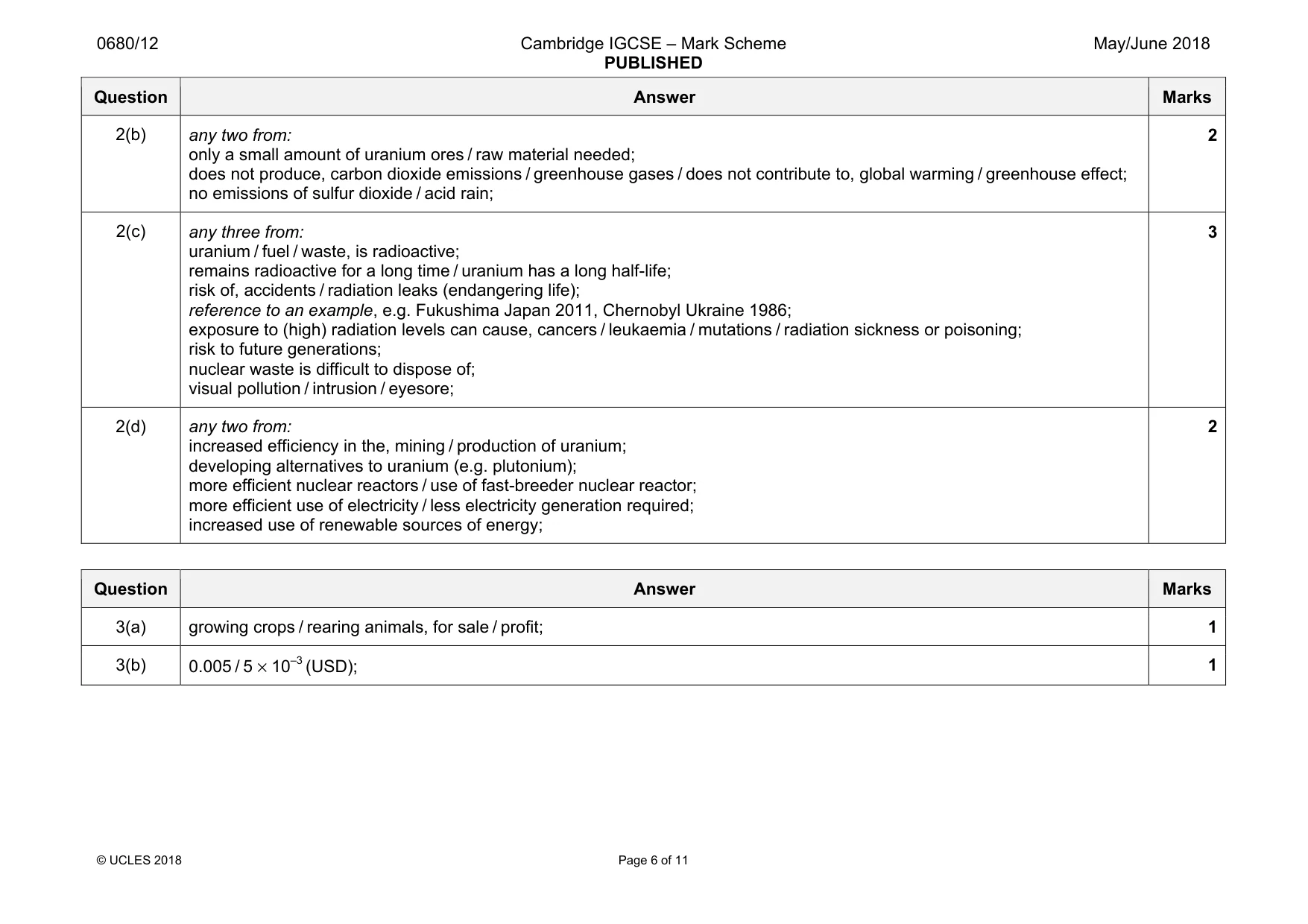
0680/12 Cambridge IGCSE – Mark Scheme PUBLISHED May/June 2018 © UCLES 2018 Page 6 of 11 Question Answer Marks 2(b) any two from: only a small amount of uranium ores / raw material needed; does not produce, carbon dioxide emissions / greenhouse gases / does not contribute to, global warming / greenhouse effect; no emissions of sulfur dioxide / acid rain; 2 2(c) any three from: uranium / fuel / waste, is radioactive; remains radioactive for a long time / uranium has a long half-life; risk of, accidents / radiation leaks (endangering life); reference to an example, e.g. Fukushima Japan 2011, Chernobyl Ukraine 1986; exposure to (high) radiation levels can cause, cancers / leukaemia / mutations / radiation sickness or poisoning; risk to future generations; nuclear waste is difficult to dispose of; visual pollution / intrusion / eyesore; 3 2(d) any two from: increased efficiency in the, mining / production of uranium; developing alternatives to uranium (e.g. plutonium); more efficient nuclear reactors / use of fast-breeder nuclear reactor; more efficient use of electricity / less electricity generation required; increased use of renewable sources of energy; 2 Question Answer Marks 3(a) growing crops / rearing animals, for sale / profit; 1 3(b) 0.005 / 5 × 10⁻³ (USD); 1
Mark scheme, page 7
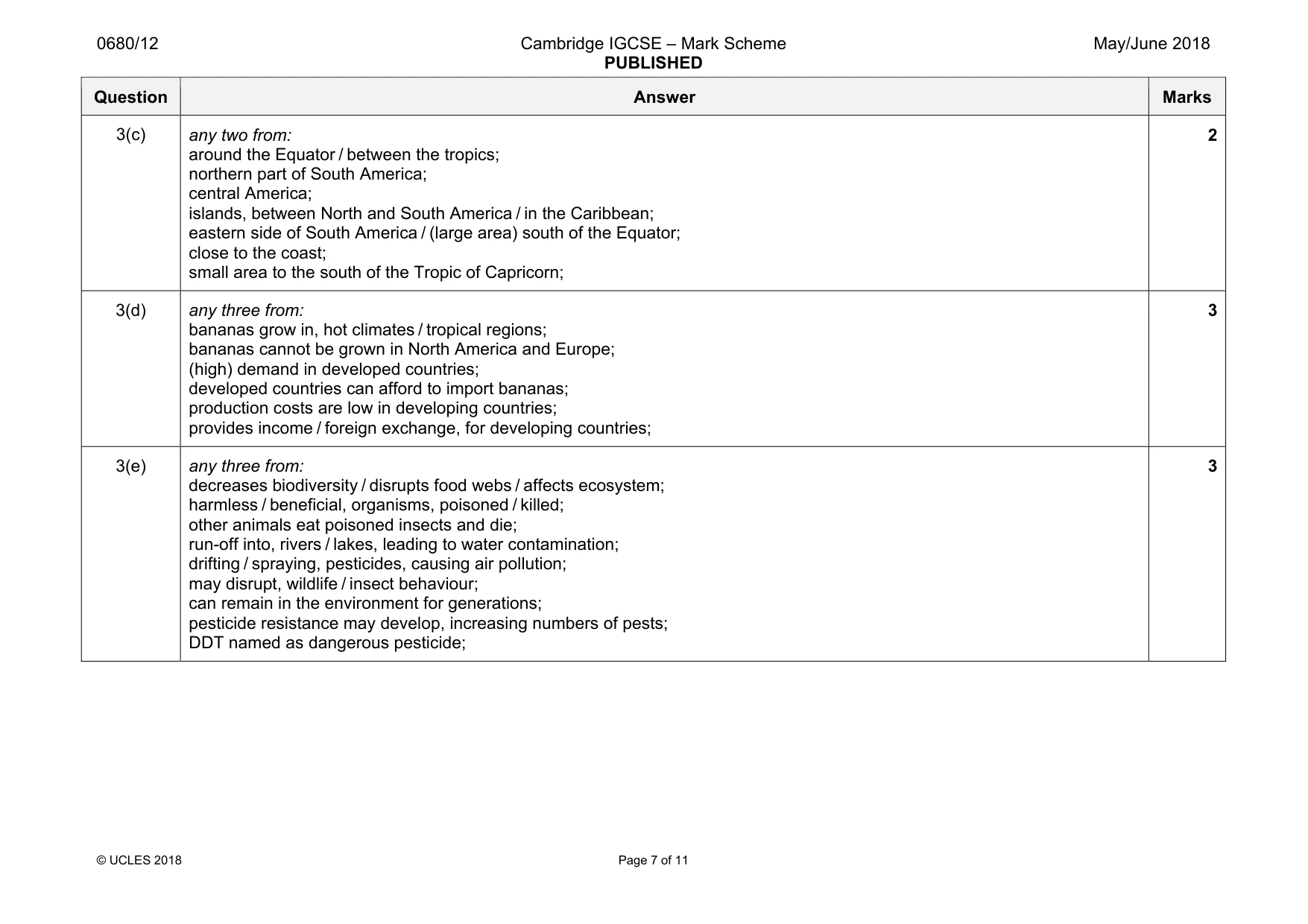
0680/12 Cambridge IGCSE – Mark Scheme PUBLISHED May/June 2018 © UCLES 2018 Page 7 of 11 Question Answer Marks 3(c) any two from: around the Equator / between the tropics; northern part of South America; central America; islands, between North and South America / in the Caribbean; eastern side of South America / (large area) south of the Equator; close to the coast; small area to the south of the Tropic of Capricorn; 2 3(d) any three from: bananas grow in, hot climates / tropical regions; bananas cannot be grown in North America and Europe; (high) demand in developed countries; developed countries can afford to import bananas; production costs are low in developing countries; provides income / foreign exchange, for developing countries; 3 3(e) any three from: decreases biodiversity / disrupts food webs / affects ecosystem; harmless / beneficial, organisms, poisoned / killed; other animals eat poisoned insects and die; run-off into, rivers / lakes, leading to water contamination; drifting / spraying, pesticides, causing air pollution; may disrupt, wildlife / insect behaviour; can remain in the environment for generations; pesticide resistance may develop, increasing numbers of pests; DDT named as dangerous pesticide; 3
Mark scheme, page 8
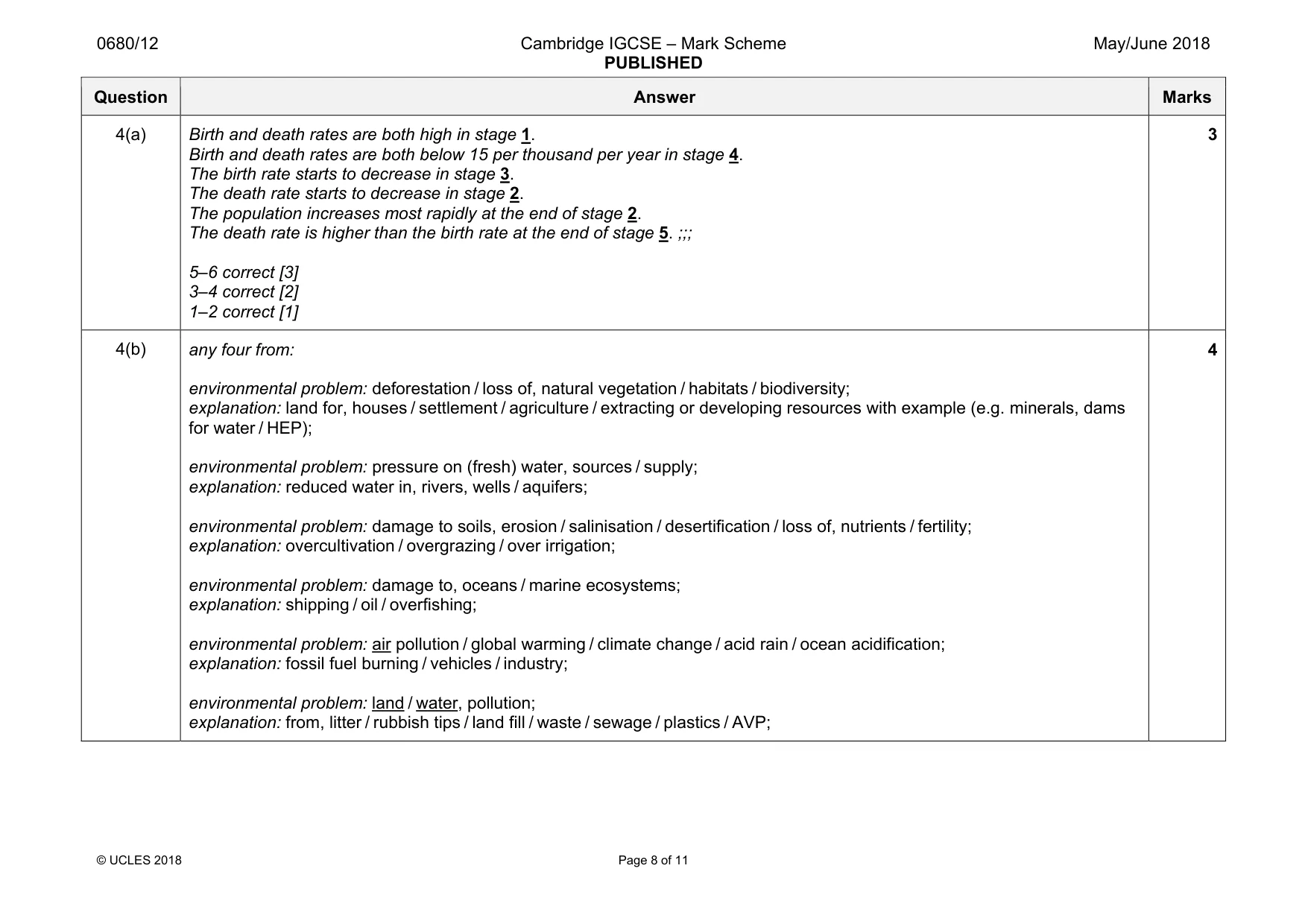
0680/12 Cambridge IGCSE – Mark Scheme PUBLISHED May/June 2018 © UCLES 2018 Page 8 of 11 Question Answer Marks 4(a) Birth and death rates are both high in stage 1. Birth and death rates are both below 15 per thousand per year in stage 4. The birth rate starts to decrease in stage 3. The death rate starts to decrease in stage 2. The population increases most rapidly at the end of stage 2. The death rate is higher than the birth rate at the end of stage 5. ;;; 5–6 correct [3] 3–4 correct [2] 1–2 correct [1] 3 4(b) any four from: environmental problem: deforestation / loss of, natural vegetation / habitats / biodiversity; explanation: land for, houses / settlement / agriculture / extracting or developing resources with example (e.g. minerals, dams for water / HEP); environmental problem: pressure on (fresh) water, sources / supply; explanation: reduced water in, rivers, wells / aquifers; environmental problem: damage to soils, erosion / salinisation / desertification / loss of, nutrients / fertility; explanation: overcultivation / overgrazing / over irrigation; environmental problem: damage to, oceans / marine ecosystems; explanation: shipping / oil / overfishing; environmental problem: air pollution / global warming / climate change / acid rain / ocean acidification; explanation: fossil fuel burning / vehicles / industry; environmental problem: land / water, pollution; explanation: from, litter / rubbish tips / land fill / waste / sewage / plastics / AVP; 4
Mark scheme, page 9
0680/12 Cambridge IGCSE – Mark Scheme PUBLISHED May/June 2018 © UCLES 2018 Page 9 of 11 Question Answer Marks 4(c) any three from: provision of, family planning services / contraception / birth control / sterilisation; improved, health services / childcare; education (including on family planning) / literacy; national policies / laws (antinatalist) to reduce, birth / fertility rate; national policies / laws (pronatalist) to increase, birth / fertility rate; rewards / tax incentives, for small families; later marriages / preventing early marriages; control, borders / migration; 3 Question Answer Marks 5(a)(i) correct plots at 14 million tonnes on the line AND 2.6 million tonnes between the lines; 1 5(a)(ii) 59.72 / 59.7 (%); 1 5(a)(iii) any one from: population growth / demand / exports / foreign exchange (earnings); food, shortages / high prices; investment in, boats / equipment / modern technology; more efficient methods of fishing / sonar / freezer trawlers / AVP; 1 5(b)(i) any four from: net, size / type limitations; mesh, size / shape limitations; pole and line fishing (instead of using a net, not where otherwise banned); ban on use of, chemicals / explosives / dredging (destructive methods); quotas; licences; international agreements / conservation laws; patrol boats / enforcement officers; (economic) exclusion zones; closed seasons / idea of banning fishing during reproductive seasons; restricted areas / protected areas / reserves; moratorium / ban (on named species e.g. cod, sea bass); 4
Mark scheme, page 10
0680/12 Cambridge IGCSE – Mark Scheme PUBLISHED May/June 2018 © UCLES 2018 Page 10 of 11 Question Answer Marks 5(b)(ii) any three from: quotas / restrictions, ignored; little / no, monitoring / enforcement / weak deterrents; use of, illegal / large nets; use of nets with, illegal / small mesh; fishing in restricted areas / trespassing; fishing in breeding season; destroying / death of, small fish caught illegally / bycatch; problems getting international agreements / corruption; 3
Mark scheme, page 11
0680/12 Cambridge IGCSE – Mark Scheme PUBLISHED May/June 2018 © UCLES 2018 Page 11 of 11 Question Answer Marks 6(a)(i) any two from: small rocks have weathered into soil allowing plant roots to develop; (heat provides) optimal temperature (for growth); (soil / rocks provide drainage) preventing water logging; fruit ripens (on south facing slopes); goats produce manure / waste, that improves the soil; 2 6(a)(ii) any four from: pioneer community, consists of lichens that grow on the rock waste; reference to humus / decomposition / decay; reference to soil; reference to seeds; reference to succession / number of species increase / height of species increases; climax vegetation, consists of large trees; 4 6(a)(iii) goats eat the shrubs and bushes which stops, trees growing / climax vegetation developing; 1 6(b) any three from: waste disposal / garbage / landfill; lake; fill for, farming; fill for, forestry / parks; (leisure) sports stadiums / golf courses; solar power farms; eco-friendly (flora) projects / restoring habitats; living accommodation; storage in underground mines; low grade thermal energy from flooded deep mine workings; tourist attraction; 3
What you needed in this session
Cambridge’s own grade thresholds for 2018 May/June, Paper 1 · Variant 2. A higher threshold means an easier paper — the bar moves with how the cohort did.