Cambridge IGCSE Environmental Management 0680 — 2018 May/June Paper 1 · Variant 3
0680/13/M/J/18 · 60 marks · ≈68 min
The question paper and its mark scheme, free to read here and free to download. This is Cambridge’s own paper, exactly as it was sat.
Question paper16 pages
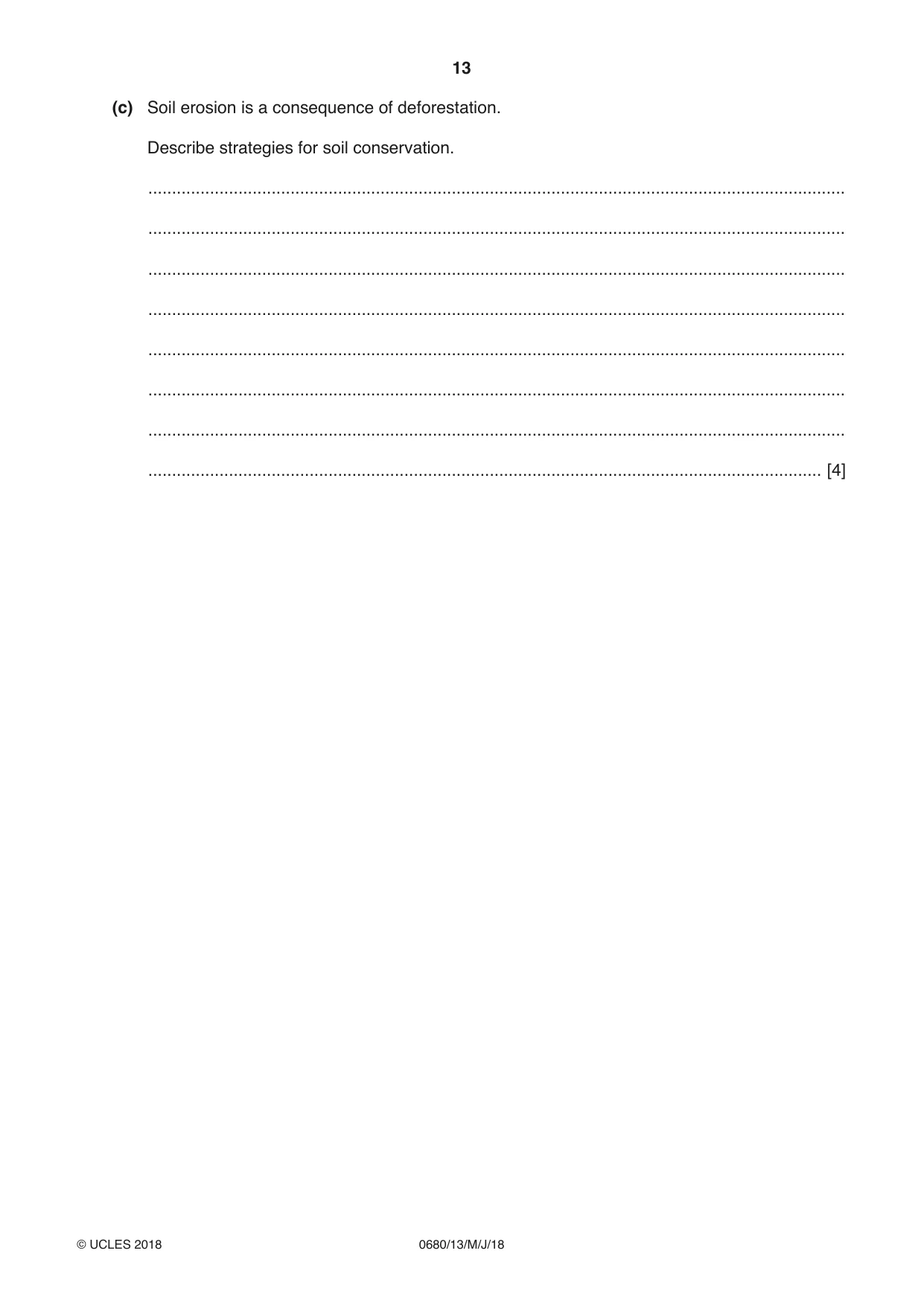


Mark scheme10 pages
Answers below. Sit the paper first if you are practising.
Paper as text
Question paper, page 1
* 3 0 3 2 4 1 0 0 2 5 * This document consists of 13 printed pages and 3 blank pages. DC (NF/FC) 144328/3 © UCLES 2018 [Turn over Cambridge International Examinations Cambridge International General Certificate of Secondary Education ENVIRONMENTAL MANAGEMENT 0680/13 Paper 1 May/June 2018 1 hour 30 minutes Candidates answer on the Question Paper. No Additional Materials are required. READ THESE INSTRUCTIONS FIRST Write your Centre number, candidate number and name on all the work you hand in. Write in dark blue or black pen. You may use an HB pencil for any diagrams or graphs. Do not use staples, paper clips, glue or correction fluid. DO NOT WRITE IN ANY BARCODES. Answer all questions. Electronic calculators may be used. You may lose marks if you do not show your working or if you do not use appropriate units. At the end of the examination, fasten all your work securely together. The number of marks is given in brackets [ ] at the end of each question or part question.
Question paper, page 2
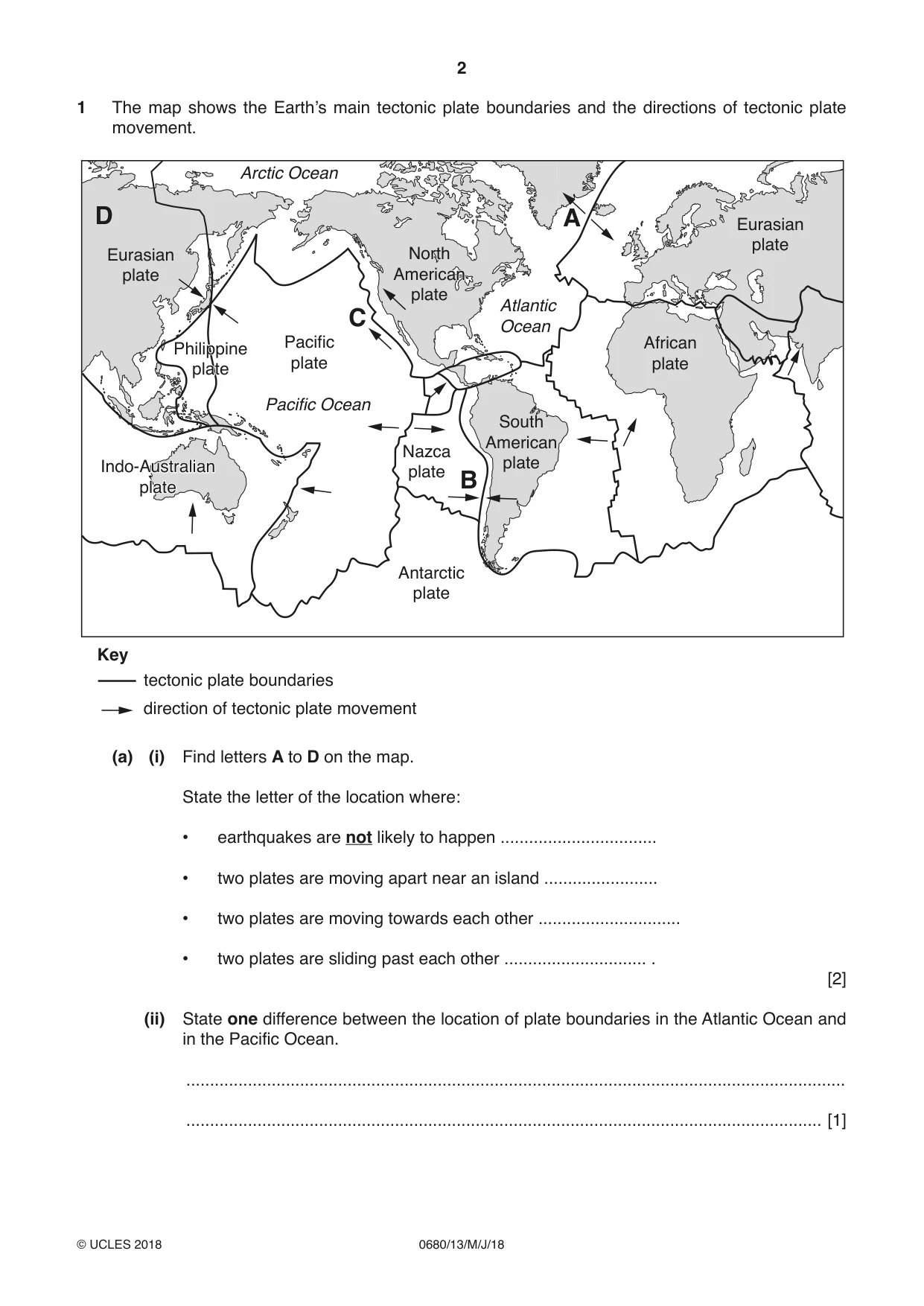
2 0680/13/M/J/18 © UCLES 2018 1 The map shows the Earth’s main tectonic plate boundaries and the directions of tectonic plate movement. tectonic plate boundaries Key direction of tectonic plate movement Pacific Ocean Arctic Ocean Atlantic Ocean South American plate Antarctic plate African plate Eurasian plate Nazca plate Pacific plate Eurasian plate B C A D North American plate North American plate Indo-Australian plate Indo-Australian plate Philippine plate Philippine plate (a) (i) Find letters A to D on the map. State the letter of the location where: • earthquakes are not likely to happen … • two plates are moving apart near an island … • two plates are moving towards each other … • two plates are sliding past each other … . [2] (ii) State one difference between the location of plate boundaries in the Atlantic Ocean and in the Pacific Ocean. … … [1]
Question paper, page 3
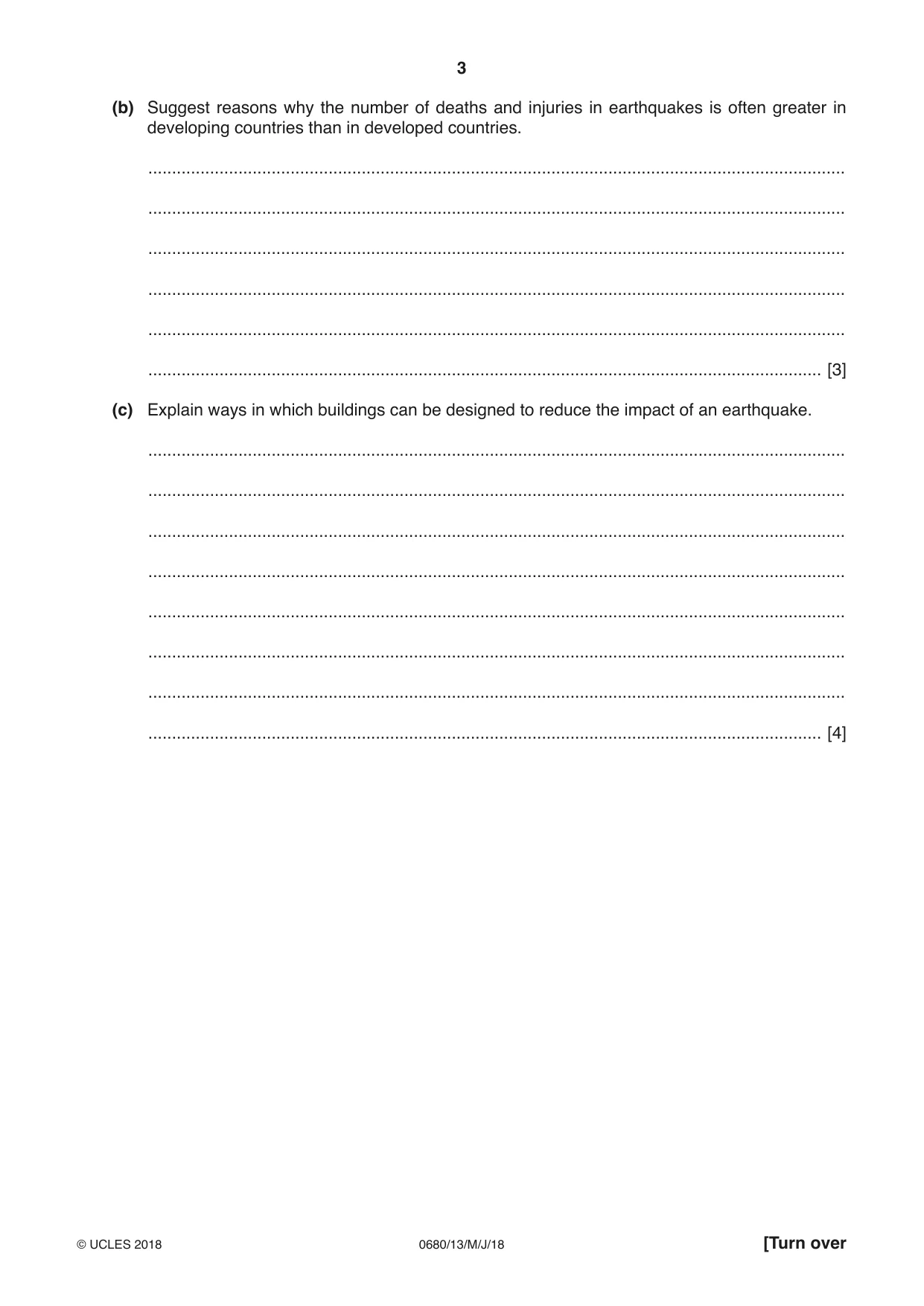
3 0680/13/M/J/18 © UCLES 2018 [Turn over (b) Suggest reasons why the number of deaths and injuries in earthquakes is often greater in developing countries than in developed countries. … … … … … … [3] (c) Explain ways in which buildings can be designed to reduce the impact of an earthquake. … … … … … … … … [4]
Question paper, page 4
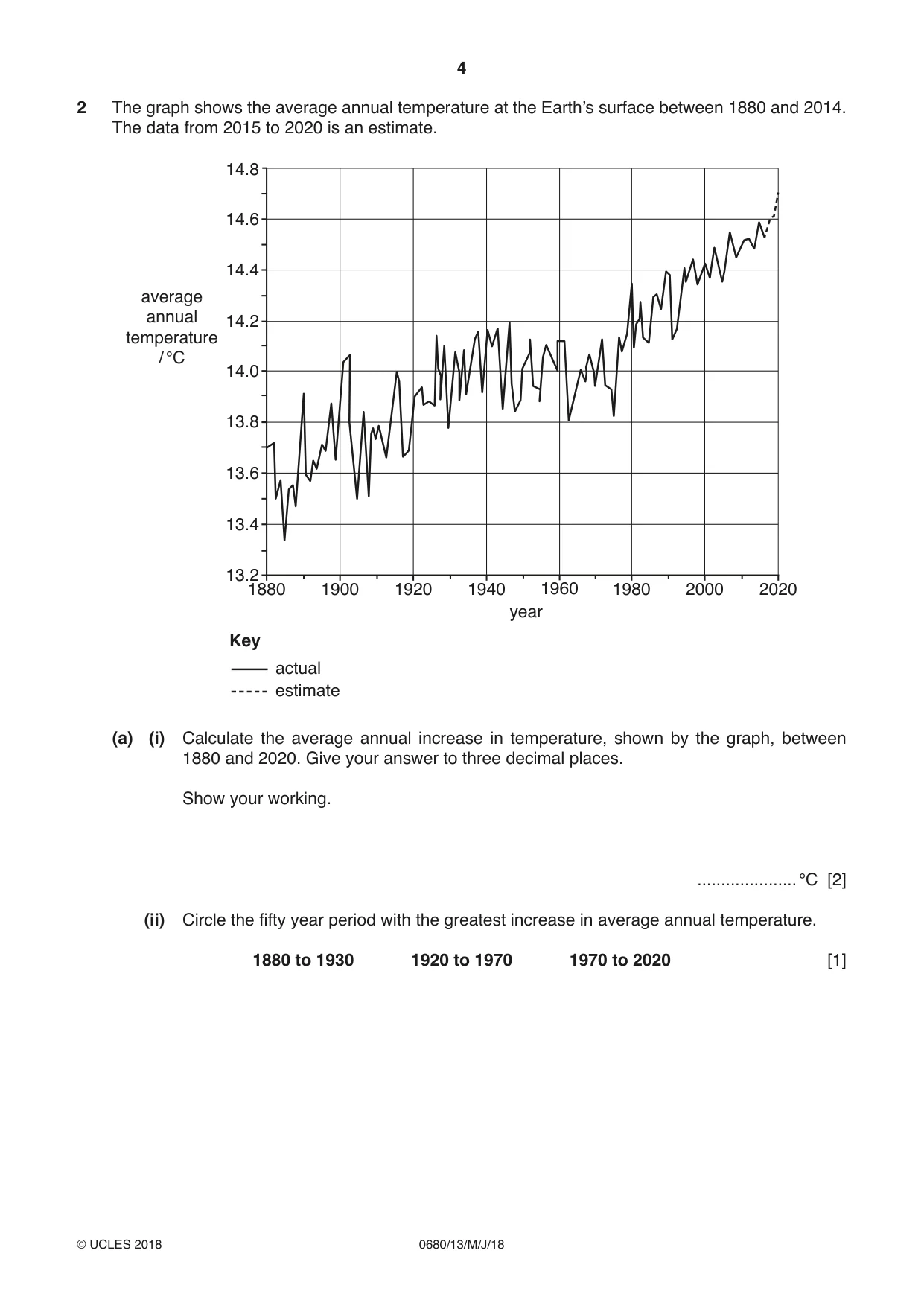
4 0680/13/M/J/18 © UCLES 2018 2 The graph shows the average annual temperature at the Earth’s surface between 1880 and 2014. The data from 2015 to 2020 is an estimate. 1880 13.8 14.0 13.2 13.6 13.4 14.2 average annual temperature / °C 14.4 14.6 14.8 1900 1920 1940 year Key actual estimate 1960 1980 2000 2020 (a) (i) Calculate the average annual increase in temperature, shown by the graph, between 1880 and 2020. Give your answer to three decimal places. Show your working. … °C [2] (ii) Circle the fifty year period with the greatest increase in average annual temperature. 1880 to 1930 1920 to 1970 1970 to 2020 [1]
Question paper, page 5
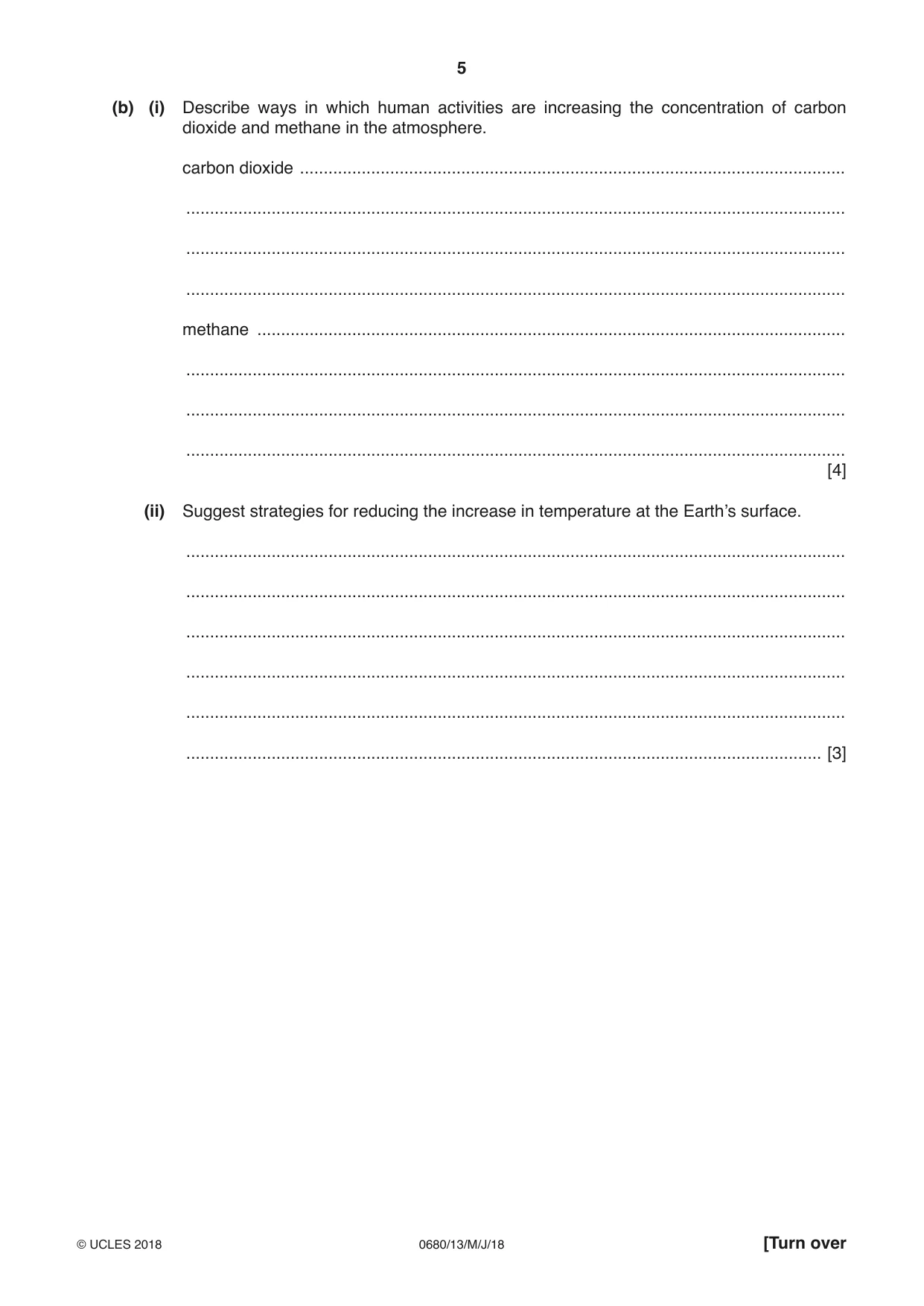
5 0680/13/M/J/18 © UCLES 2018 [Turn over (b) (i) Describe ways in which human activities are increasing the concentration of carbon dioxide and methane in the atmosphere. carbon dioxide … … … … methane … … … … [4] (ii) Suggest strategies for reducing the increase in temperature at the Earth’s surface. … … … … … … [3]
Question paper, page 6
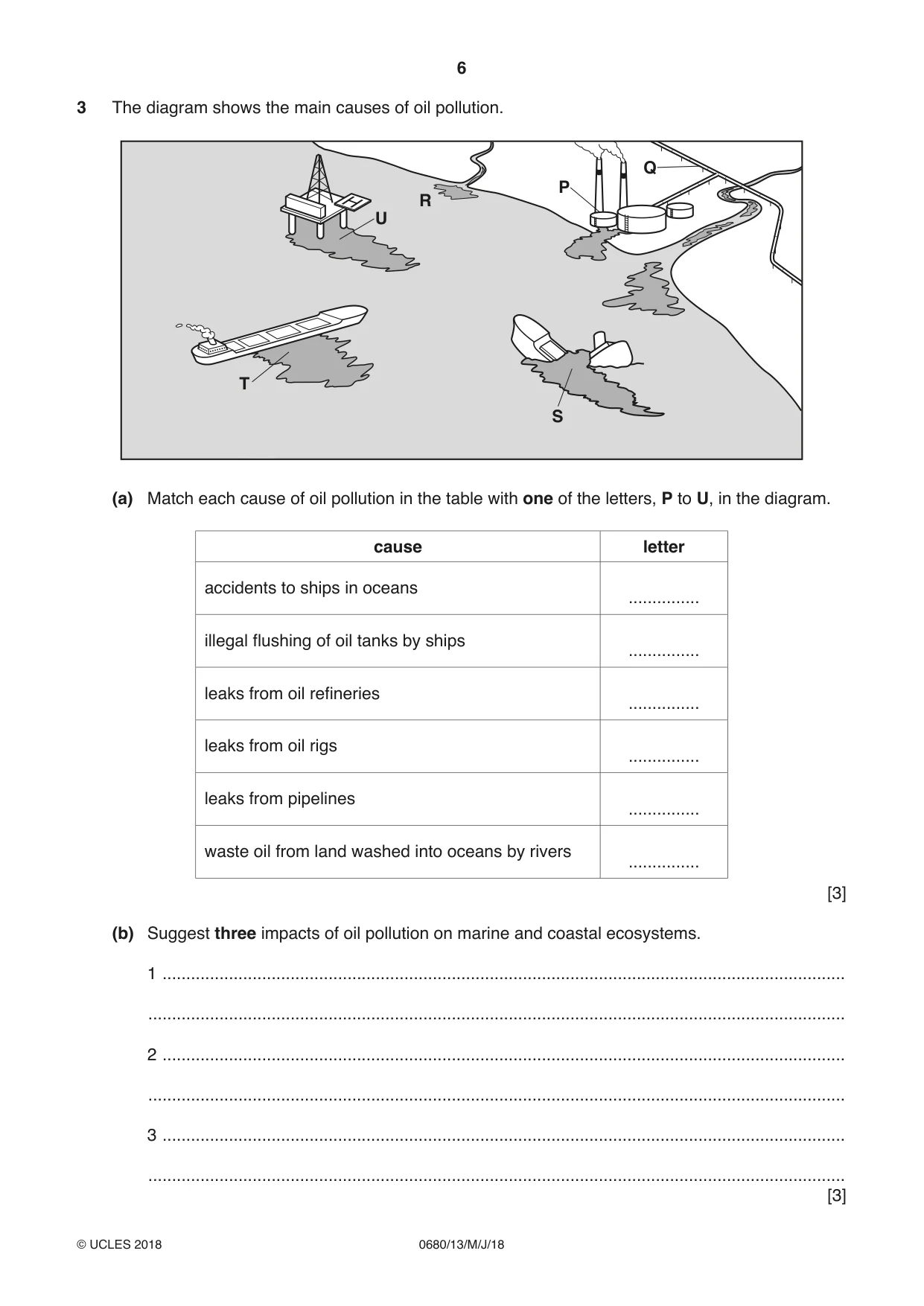
6 0680/13/M/J/18 © UCLES 2018 3 The diagram shows the main causes of oil pollution. T U P Q S R (a) Match each cause of oil pollution in the table with one of the letters, P to U, in the diagram. cause letter accidents to ships in oceans … illegal flushing of oil tanks by ships … leaks from oil refineries … leaks from oil rigs … leaks from pipelines … waste oil from land washed into oceans by rivers … [3] (b) Suggest three impacts of oil pollution on marine and coastal ecosystems. 1 … … 2 … … 3 … … [3]
Question paper, page 7
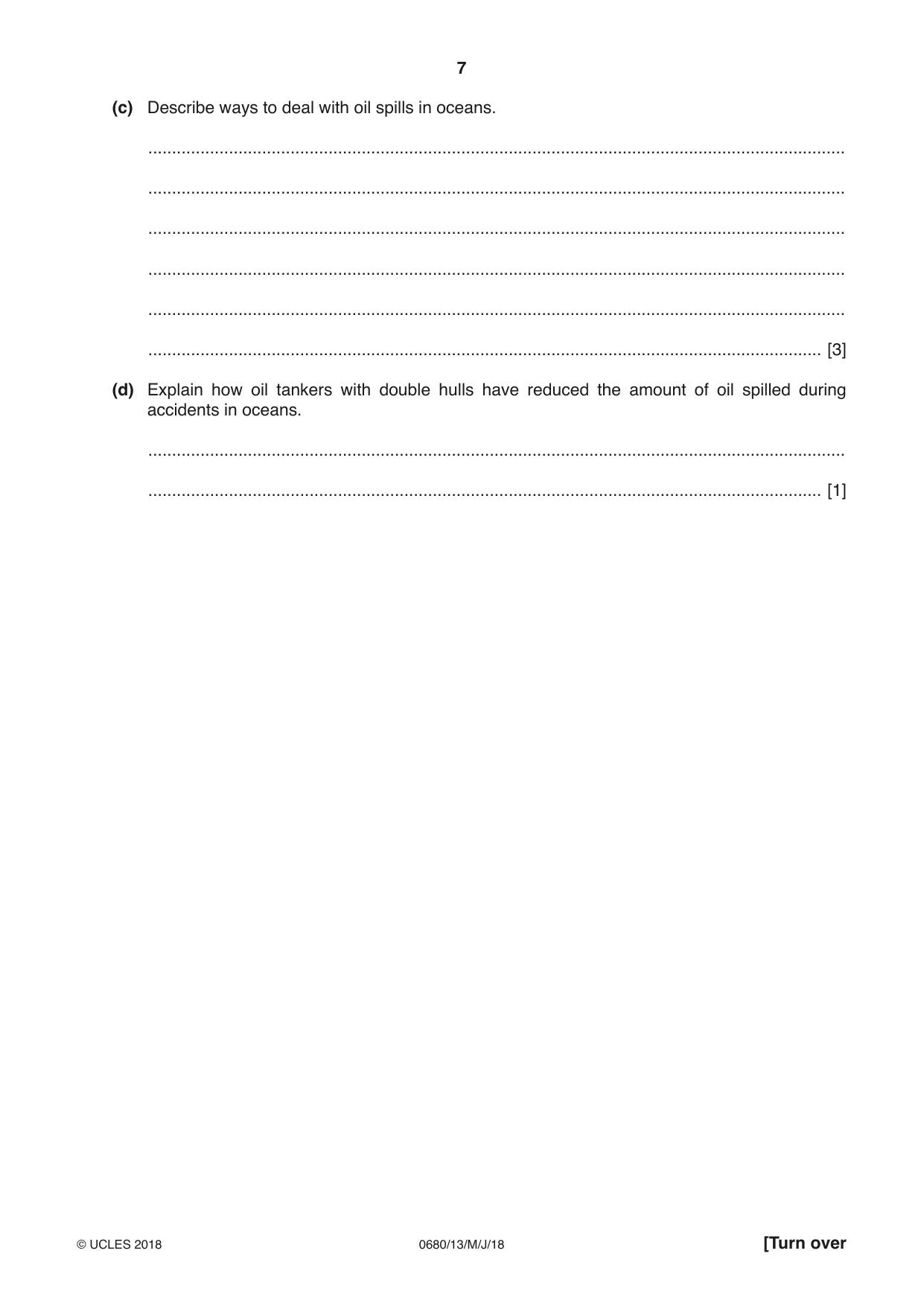
7 0680/13/M/J/18 © UCLES 2018 [Turn over (c) Describe ways to deal with oil spills in oceans. … … … … … … [3] (d) Explain how oil tankers with double hulls have reduced the amount of oil spilled during accidents in oceans. … … [1]
Question paper, page 8
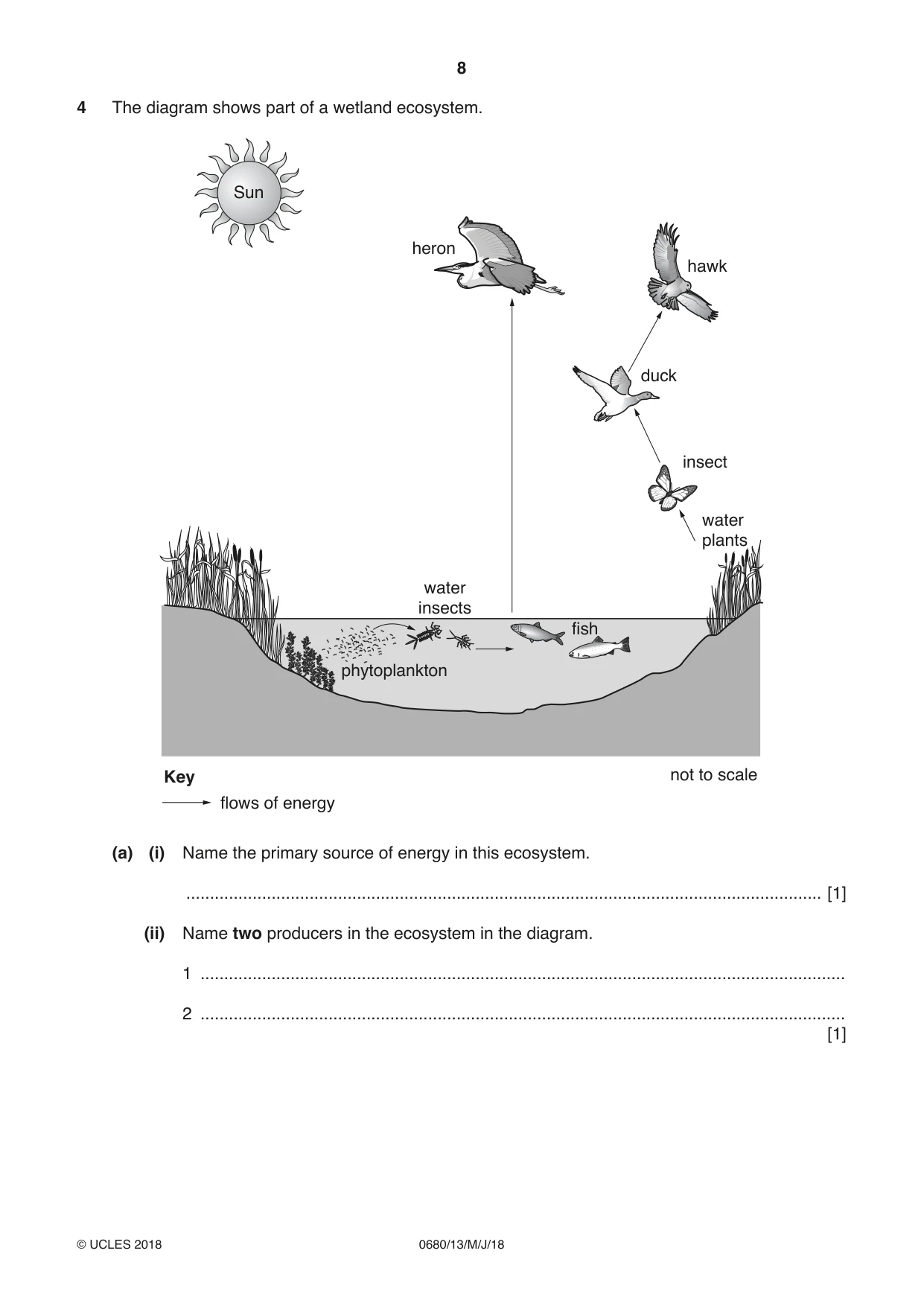
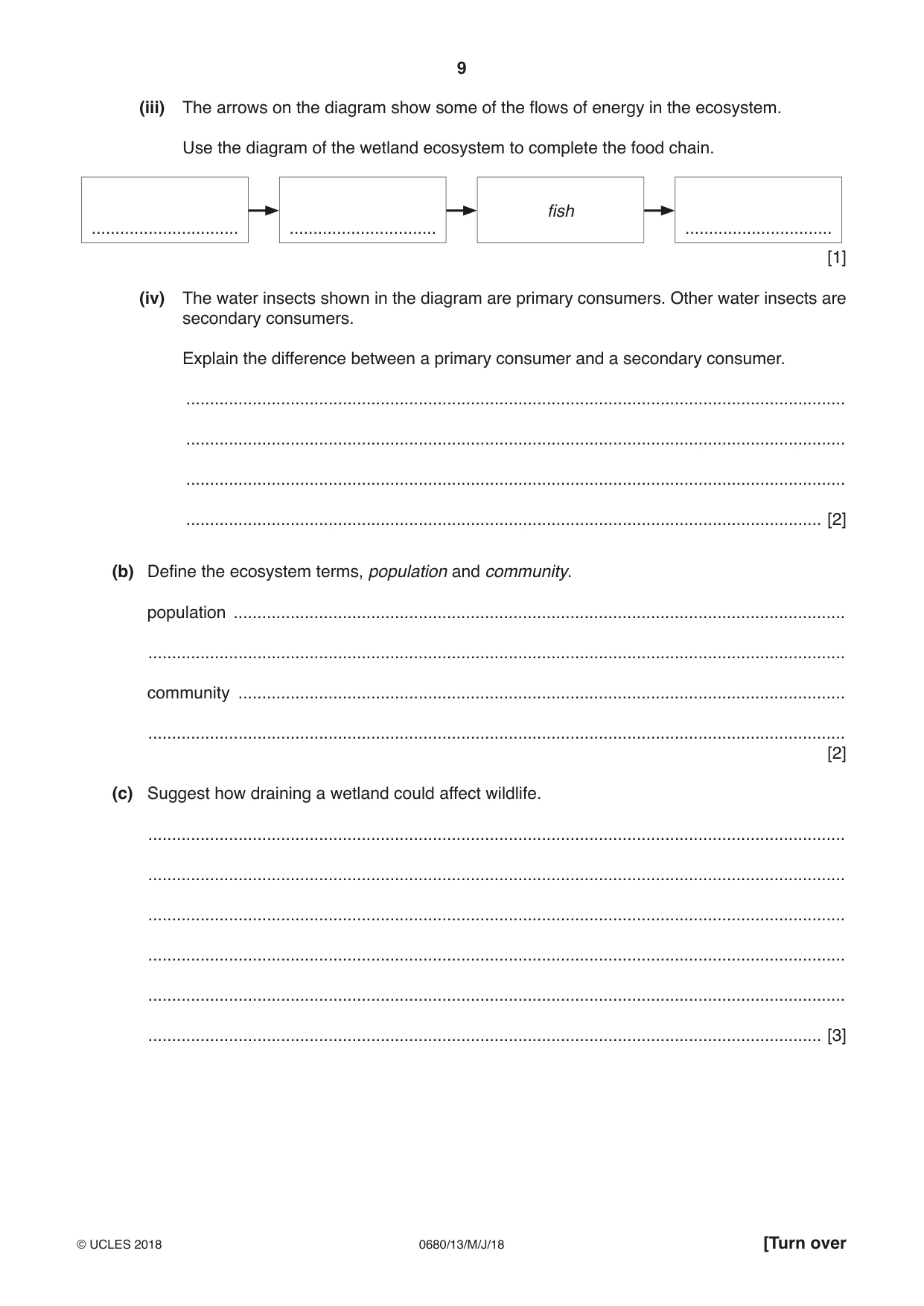
8 0680/13/M/J/18 © UCLES 2018 4 The diagram shows part of a wetland ecosystem. heron hawk duck insect water plants fish phytoplankton Key flows of energy water insects Sun not to scale (a) (i) Name the primary source of energy in this ecosystem. … [1] (ii) Name two producers in the ecosystem in the diagram. 1 … 2 … [1]
Question paper, page 9
9 0680/13/M/J/18 © UCLES 2018 [Turn over (iii) The arrows on the diagram show some of the flows of energy in the ecosystem. Use the diagram of the wetland ecosystem to complete the food chain. … fish … … [1] (iv) The water insects shown in the diagram are primary consumers. Other water insects are secondary consumers. Explain the difference between a primary consumer and a secondary consumer. … … … … [2] (b) Define the ecosystem terms, population and community. population … … community … … [2] (c) Suggest how draining a wetland could affect wildlife. … … … … … … [3]
Question paper, page 10
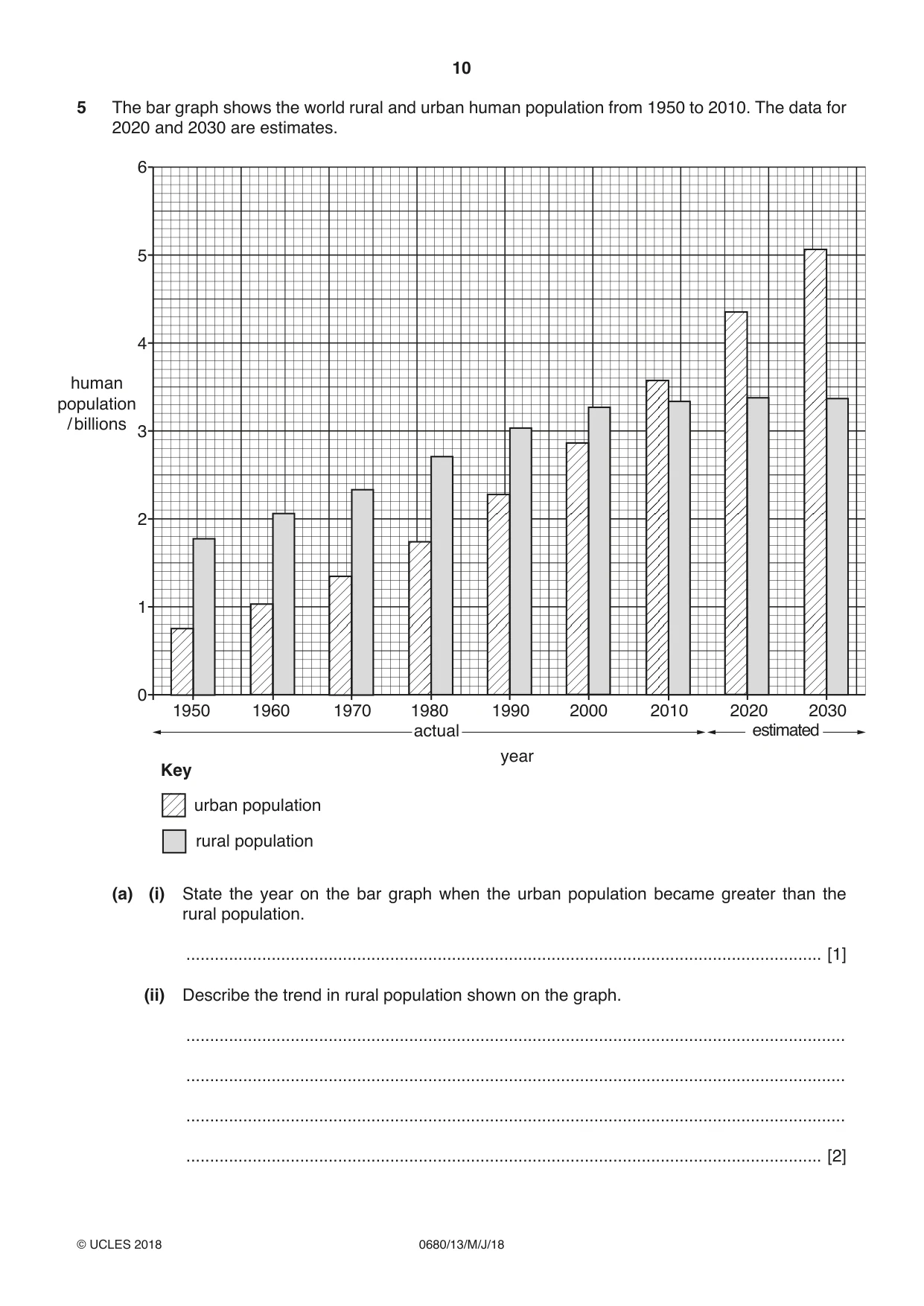
10 0680/13/M/J/18 © UCLES 2018 5 The bar graph shows the world rural and urban human population from 1950 to 2010. The data for 2020 and 2030 are estimates. 1950 0 1 2 3 4 human population / billions 5 6 1960 1970 1980 1990 year urban population rural population 2000 2010 2020 2030 actual Key estimated year (a) (i) State the year on the bar graph when the urban population became greater than the rural population. … [1] (ii) Describe the trend in rural population shown on the graph. … … … … [2]
Question paper, page 11
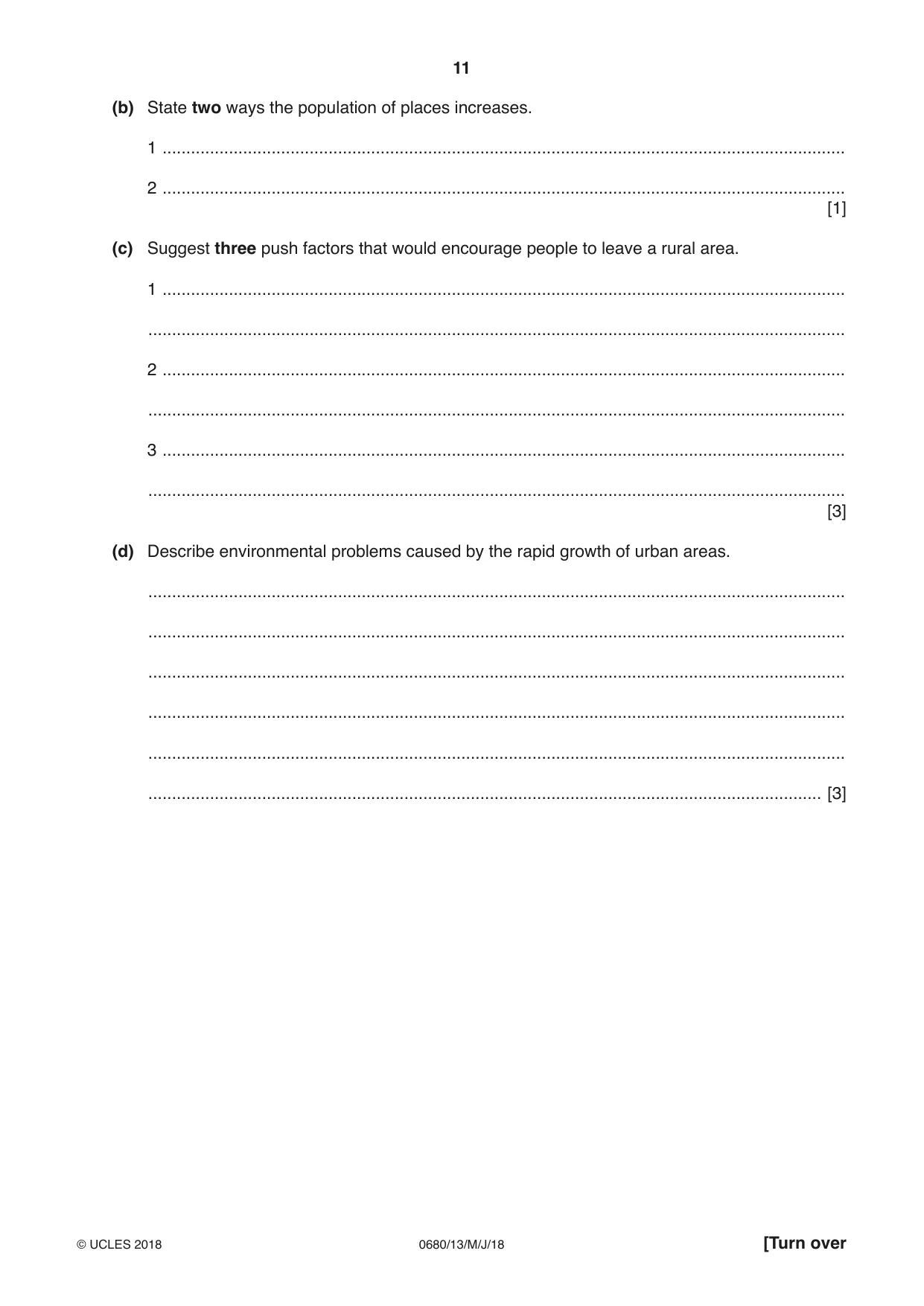
11 0680/13/M/J/18 © UCLES 2018 [Turn over (b) State two ways the population of places increases. 1 … 2 … [1] (c) Suggest three push factors that would encourage people to leave a rural area. 1 … … 2 … … 3 … … [3] (d) Describe environmental problems caused by the rapid growth of urban areas. … … … … … … [3]
Question paper, page 12
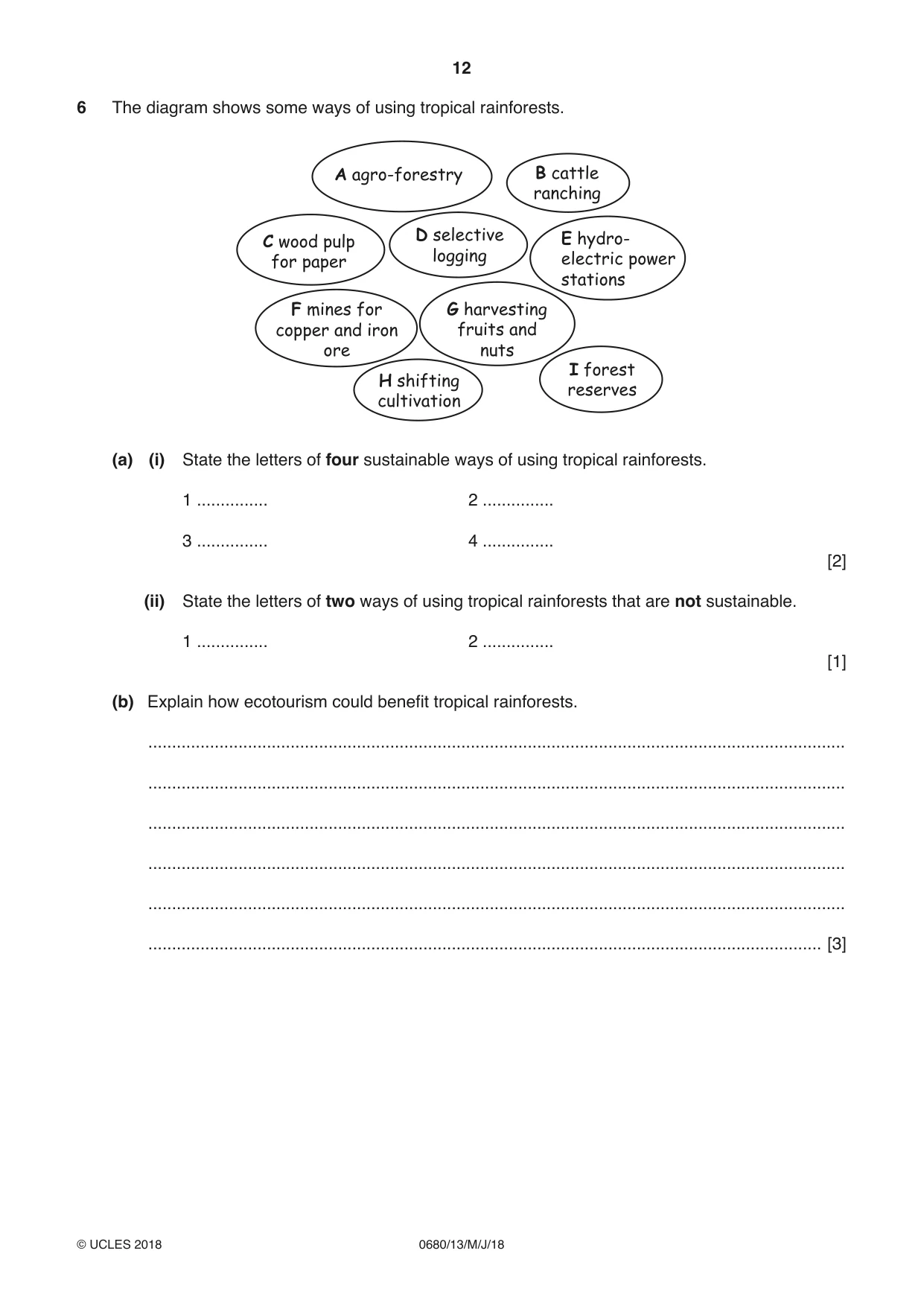
12 0680/13/M/J/18 © UCLES 2018 6 The diagram shows some ways of using tropical rainforests. A agro-forestry B cattle ranching D selective logging C wood pulp for paper F mines for copper and iron ore H shifting cultivation G harvesting fruits and nuts I forest reserves E hydro- electric power stations (a) (i) State the letters of four sustainable ways of using tropical rainforests. 1 … 2 … 3 … 4 … [2] (ii) State the letters of two ways of using tropical rainforests that are not sustainable. 1 … 2 … [1] (b) Explain how ecotourism could benefit tropical rainforests. … … … … … … [3]
Question paper, page 13
13 0680/13/M/J/18 © UCLES 2018 (c) Soil erosion is a consequence of deforestation. Describe strategies for soil conservation. … … … … … … … … [4]
Question paper, page 14
14 0680/13/M/J/18 © UCLES 2018 BLANK PAGE
Question paper, page 15
15 0680/13/M/J/18 © UCLES 2018 BLANK PAGE
Question paper, page 16
16 0680/13/M/J/18 © UCLES 2018 Permission to reproduce items where third-party owned material protected by copyright is included has been sought and cleared where possible. Every reasonable effort has been made by the publisher (UCLES) to trace copyright holders, but if any items requiring clearance have unwittingly been included, the publisher will be pleased to make amends at the earliest possible opportunity. To avoid the issue of disclosure of answer-related information to candidates, all copyright acknowledgements are reproduced online in the Cambridge International Examinations Copyright Acknowledgements Booklet. This is produced for each series of examinations and is freely available to download at www.cie.org.uk after the live examination series. Cambridge International Examinations is part of the Cambridge Assessment Group. Cambridge Assessment is the brand name of University of Cambridge Local Examinations Syndicate (UCLES), which is itself a department of the University of Cambridge. BLANK PAGE
Mark scheme, page 1
IGCSE™ is a registered trademark. This document consists of 10 printed pages. © UCLES 2018 [Turn over Cambridge Assessment International Education Cambridge International General Certificate of Secondary Education ENVIRONMENTAL MANAGEMENT 0680/13 Paper 1 May/June 2018 MARK SCHEME Maximum Mark: 60 Published This mark scheme is published as an aid to teachers and candidates, to indicate the requirements of the examination. It shows the basis on which Examiners were instructed to award marks. It does not indicate the details of the discussions that took place at an Examiners’ meeting before marking began, which would have considered the acceptability of alternative answers. Mark schemes should be read in conjunction with the question paper and the Principal Examiner Report for Teachers. Cambridge International will not enter into discussions about these mark schemes. Cambridge International is publishing the mark schemes for the May/June 2018 series for most Cambridge IGCSE™, Cambridge International A and AS Level and Cambridge Pre-U components, and some Cambridge O Level components.
Mark scheme, page 2
0680/13 Cambridge IGCSE – Mark Scheme PUBLISHED May/June 2018 © UCLES 2018 Page 2 of 10 Generic Marking Principles These general marking principles must be applied by all examiners when marking candidate answers. They should be applied alongside the specific content of the mark scheme or generic level descriptors for a question. Each question paper and mark scheme will also comply with these marking principles. GENERIC MARKING PRINCIPLE 1: Marks must be awarded in line with: • the specific content of the mark scheme or the generic level descriptors for the question • the specific skills defined in the mark scheme or in the generic level descriptors for the question • the standard of response required by a candidate as exemplified by the standardisation scripts. GENERIC MARKING PRINCIPLE 2: Marks awarded are always whole marks (not half marks, or other fractions). GENERIC MARKING PRINCIPLE 3: Marks must be awarded positively: • marks are awarded for correct/valid answers, as defined in the mark scheme. However, credit is given for valid answers which go beyond the scope of the syllabus and mark scheme, referring to your Team Leader as appropriate • marks are awarded when candidates clearly demonstrate what they know and can do • marks are not deducted for errors • marks are not deducted for omissions • answers should only be judged on the quality of spelling, punctuation and grammar when these features are specifically assessed by the question as indicated by the mark scheme. The meaning, however, should be unambiguous. GENERIC MARKING PRINCIPLE 4: Rules must be applied consistently e.g. in situations where candidates have not followed instructions or in the application of generic level descriptors.
Mark scheme, page 3
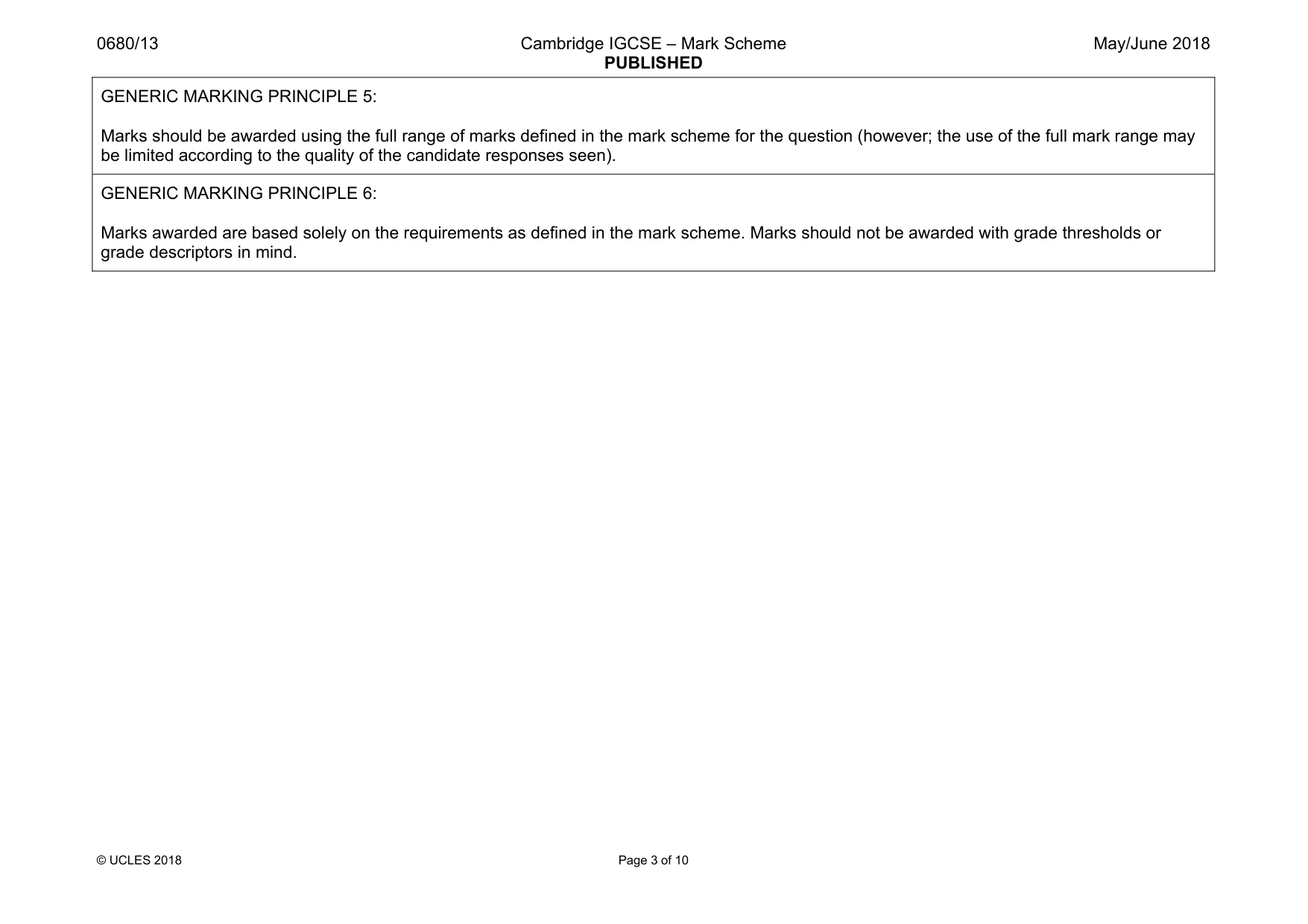
0680/13 Cambridge IGCSE – Mark Scheme PUBLISHED May/June 2018 © UCLES 2018 Page 3 of 10 GENERIC MARKING PRINCIPLE 5: Marks should be awarded using the full range of marks defined in the mark scheme for the question (however; the use of the full mark range may be limited according to the quality of the candidate responses seen). GENERIC MARKING PRINCIPLE 6: Marks awarded are based solely on the requirements as defined in the mark scheme. Marks should not be awarded with grade thresholds or grade descriptors in mind.
Mark scheme, page 4
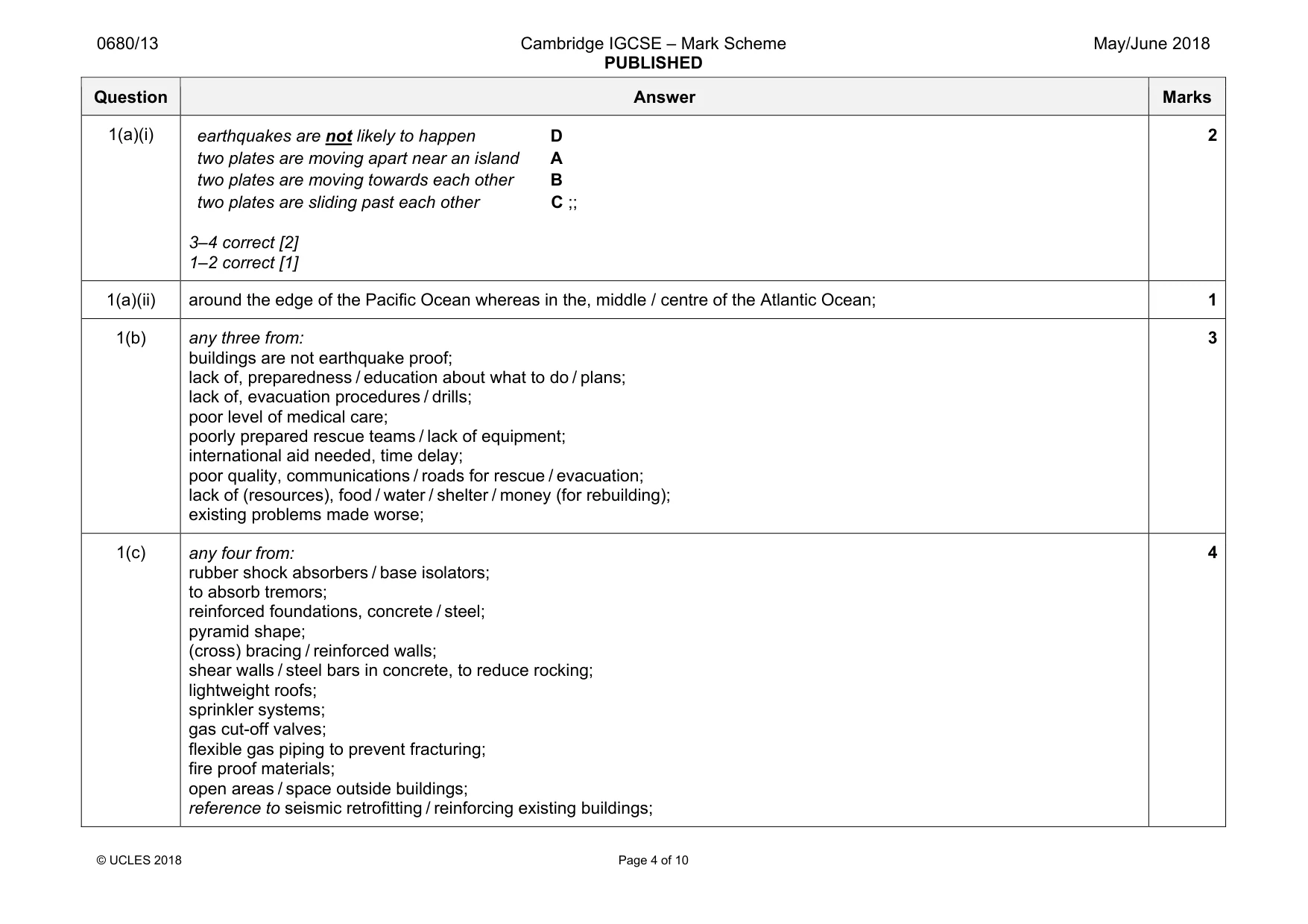
0680/13 Cambridge IGCSE – Mark Scheme PUBLISHED May/June 2018 © UCLES 2018 Page 4 of 10 Question Answer Marks 1(a)(i) earthquakes are not likely to happen D two plates are moving apart near an island A two plates are moving towards each other B two plates are sliding past each other C ;; 3–4 correct [2] 1–2 correct [1] 2 1(a)(ii) around the edge of the Pacific Ocean whereas in the, middle / centre of the Atlantic Ocean; 1 1(b) any three from: buildings are not earthquake proof; lack of, preparedness / education about what to do / plans; lack of, evacuation procedures / drills; poor level of medical care; poorly prepared rescue teams / lack of equipment; international aid needed, time delay; poor quality, communications / roads for rescue / evacuation; lack of (resources), food / water / shelter / money (for rebuilding); existing problems made worse; 3 1(c) any four from: rubber shock absorbers / base isolators; to absorb tremors; reinforced foundations, concrete / steel; pyramid shape; (cross) bracing / reinforced walls; shear walls / steel bars in concrete, to reduce rocking; lightweight roofs; sprinkler systems; gas cut-off valves; flexible gas piping to prevent fracturing; fire proof materials; open areas / space outside buildings; reference to seismic retrofitting / reinforcing existing buildings; 4
Mark scheme, page 5
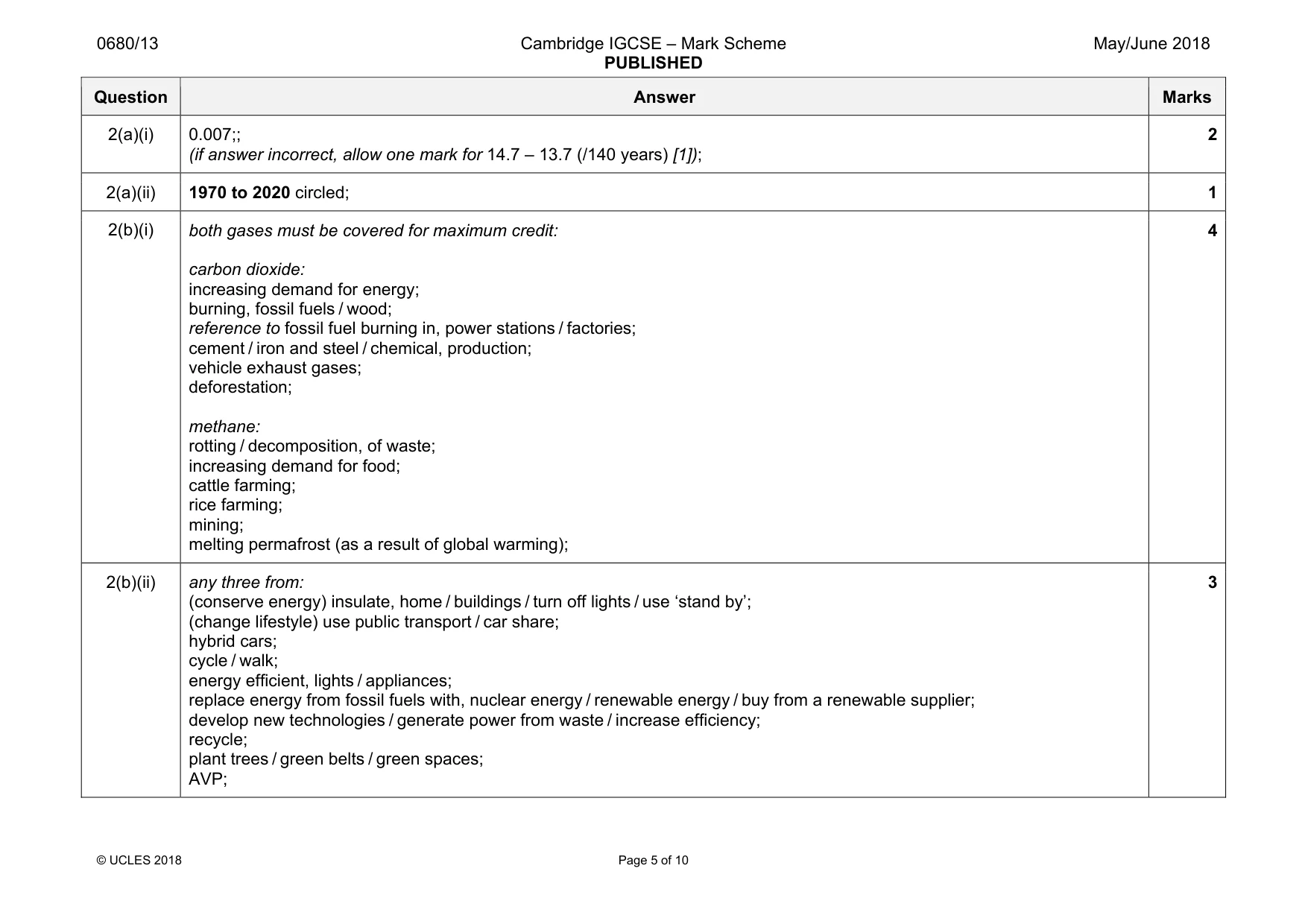
0680/13 Cambridge IGCSE – Mark Scheme PUBLISHED May/June 2018 © UCLES 2018 Page 5 of 10 Question Answer Marks 2(a)(i) 0.007;; (if answer incorrect, allow one mark for 14.7 – 13.7 (/140 years) [1]); 2 2(a)(ii) 1970 to 2020 circled; 1 2(b)(i) both gases must be covered for maximum credit: carbon dioxide: increasing demand for energy; burning, fossil fuels / wood; reference to fossil fuel burning in, power stations / factories; cement / iron and steel / chemical, production; vehicle exhaust gases; deforestation; methane: rotting / decomposition, of waste; increasing demand for food; cattle farming; rice farming; mining; melting permafrost (as a result of global warming); 4 2(b)(ii) any three from: (conserve energy) insulate, home / buildings / turn off lights / use ‘stand by’; (change lifestyle) use public transport / car share; hybrid cars; cycle / walk; energy efficient, lights / appliances; replace energy from fossil fuels with, nuclear energy / renewable energy / buy from a renewable supplier; develop new technologies / generate power from waste / increase efficiency; recycle; plant trees / green belts / green spaces; AVP; 3
Mark scheme, page 6
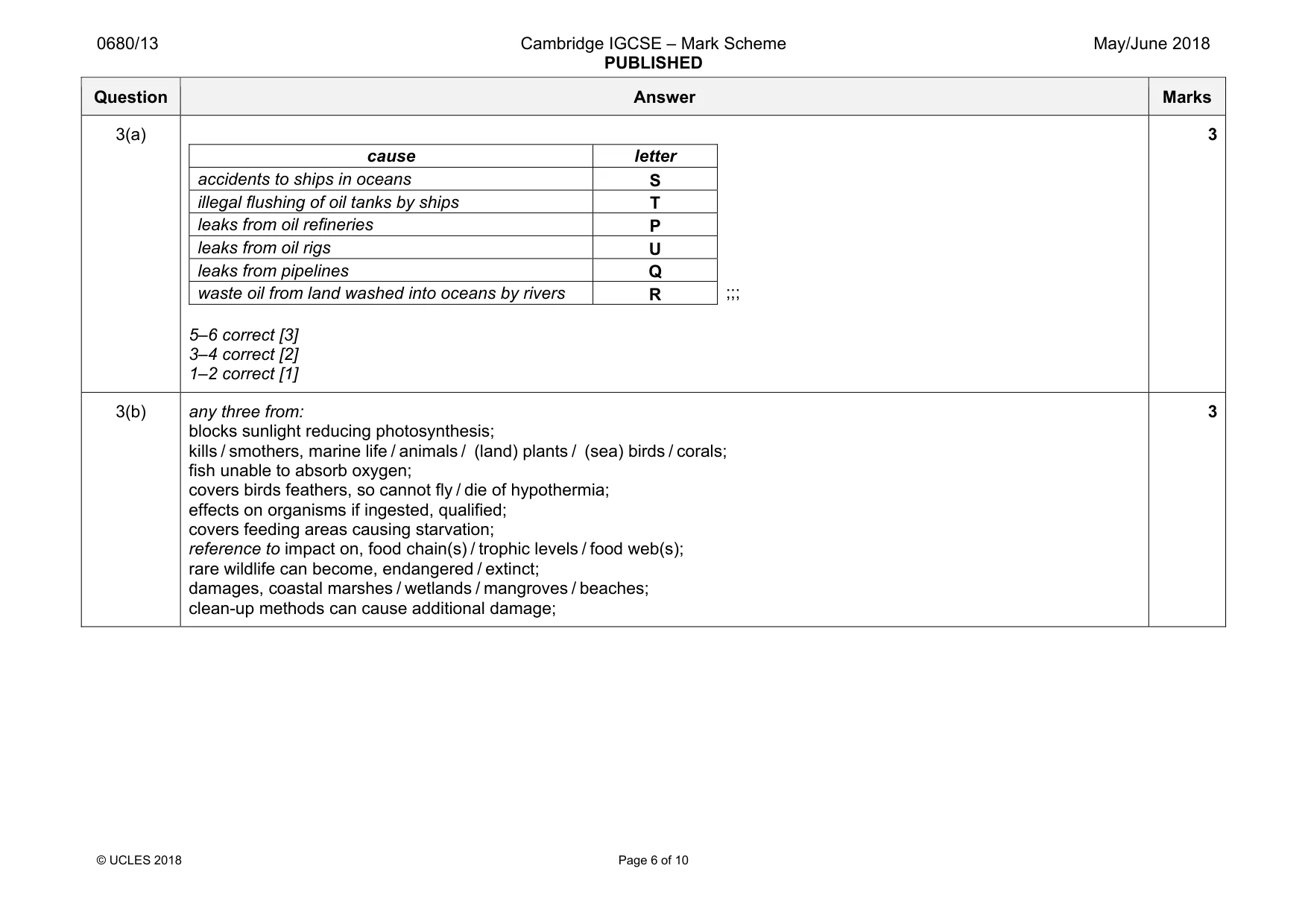
0680/13 Cambridge IGCSE – Mark Scheme PUBLISHED May/June 2018 © UCLES 2018 Page 6 of 10 Question Answer Marks 3(a) cause letter accidents to ships in oceans S illegal flushing of oil tanks by ships T leaks from oil refineries P leaks from oil rigs U leaks from pipelines Q waste oil from land washed into oceans by rivers R ;;; 5–6 correct [3] 3–4 correct [2] 1–2 correct [1] 3 3(b) any three from: blocks sunlight reducing photosynthesis; kills / smothers, marine life / animals / (land) plants / (sea) birds / corals; fish unable to absorb oxygen; covers birds feathers, so cannot fly / die of hypothermia; effects on organisms if ingested, qualified; covers feeding areas causing starvation; reference to impact on, food chain(s) / trophic levels / food web(s); rare wildlife can become, endangered / extinct; damages, coastal marshes / wetlands / mangroves / beaches; clean-up methods can cause additional damage; 3
Mark scheme, page 7
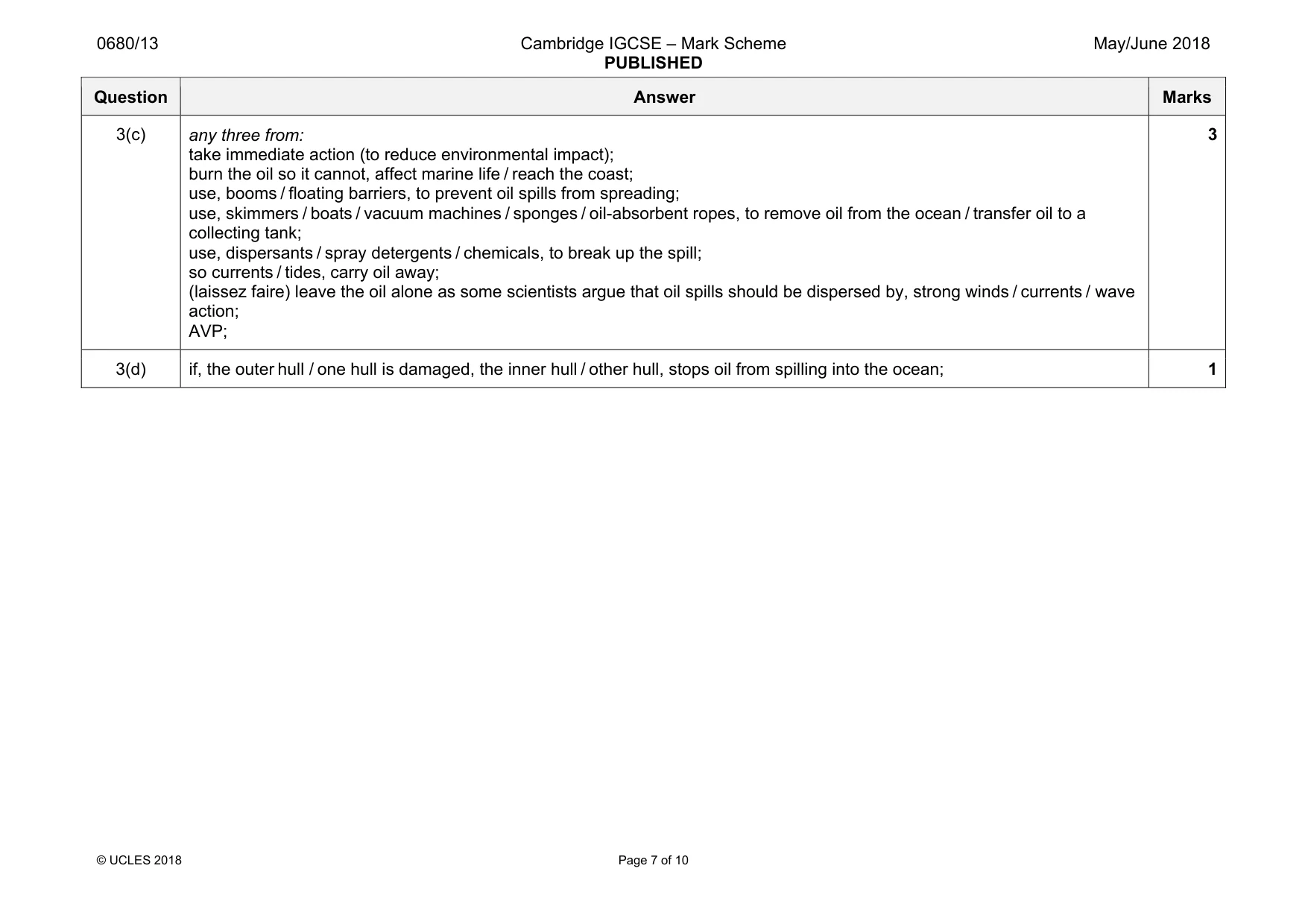
0680/13 Cambridge IGCSE – Mark Scheme PUBLISHED May/June 2018 © UCLES 2018 Page 7 of 10 Question Answer Marks 3(c) any three from: take immediate action (to reduce environmental impact); burn the oil so it cannot, affect marine life / reach the coast; use, booms / floating barriers, to prevent oil spills from spreading; use, skimmers / boats / vacuum machines / sponges / oil-absorbent ropes, to remove oil from the ocean / transfer oil to a collecting tank; use, dispersants / spray detergents / chemicals, to break up the spill; so currents / tides, carry oil away; (laissez faire) leave the oil alone as some scientists argue that oil spills should be dispersed by, strong winds / currents / wave action; AVP; 3 3(d) if, the outer hull / one hull is damaged, the inner hull / other hull, stops oil from spilling into the ocean; 1
Mark scheme, page 8
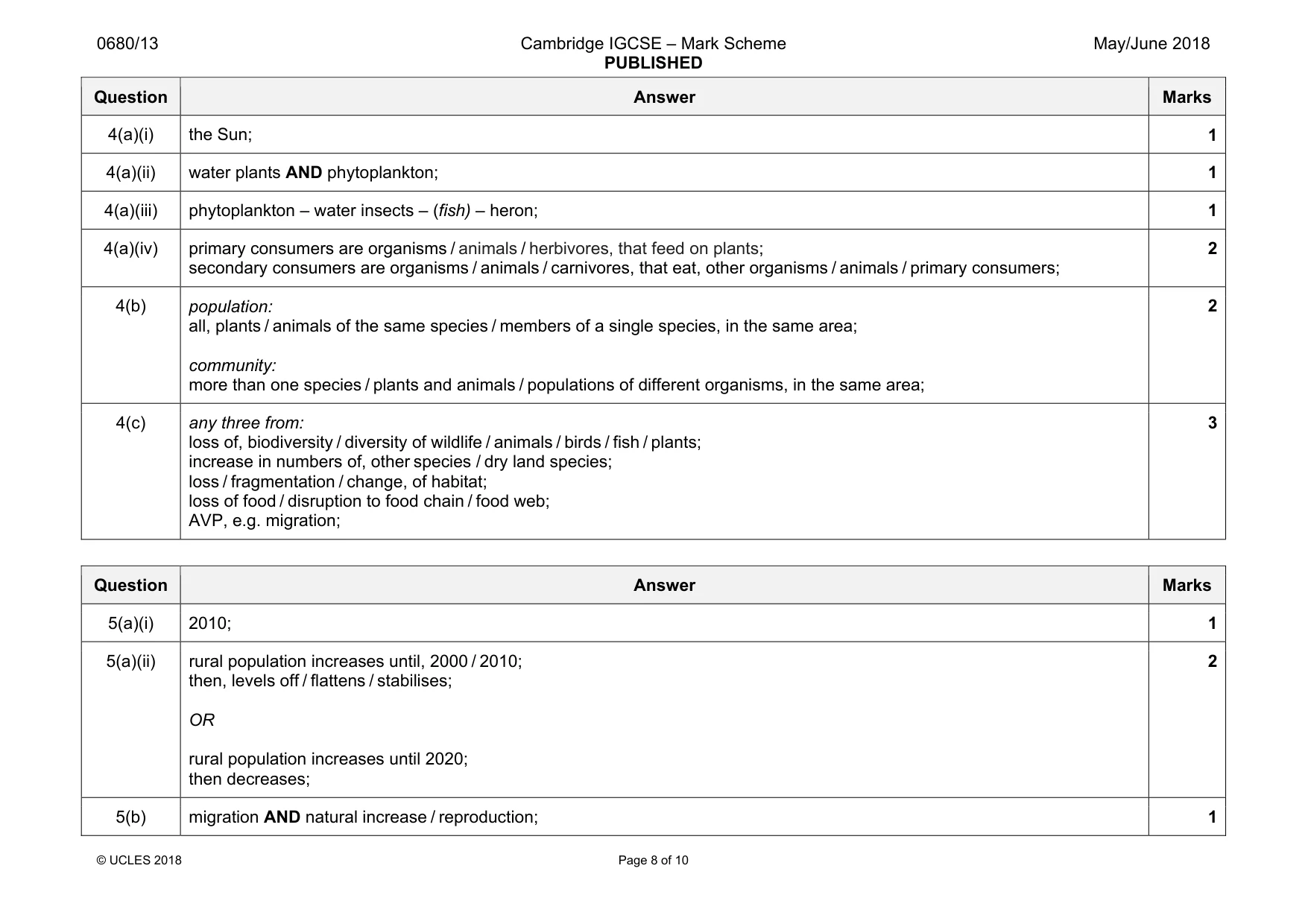
0680/13 Cambridge IGCSE – Mark Scheme PUBLISHED May/June 2018 © UCLES 2018 Page 8 of 10 Question Answer Marks 4(a)(i) the Sun; 1 4(a)(ii) water plants AND phytoplankton; 1 4(a)(iii) phytoplankton – water insects – (fish) – heron; 1 4(a)(iv) primary consumers are organisms / animals / herbivores, that feed on plants; secondary consumers are organisms / animals / carnivores, that eat, other organisms / animals / primary consumers; 2 4(b) population: all, plants / animals of the same species / members of a single species, in the same area; community: more than one species / plants and animals / populations of different organisms, in the same area; 2 4(c) any three from: loss of, biodiversity / diversity of wildlife / animals / birds / fish / plants; increase in numbers of, other species / dry land species; loss / fragmentation / change, of habitat; loss of food / disruption to food chain / food web; AVP, e.g. migration; 3 Question Answer Marks 5(a)(i) 2010; 1 5(a)(ii) rural population increases until, 2000 / 2010; then, levels off / flattens / stabilises; OR rural population increases until 2020; then decreases; 2 5(b) migration AND natural increase / reproduction; 1
Mark scheme, page 9
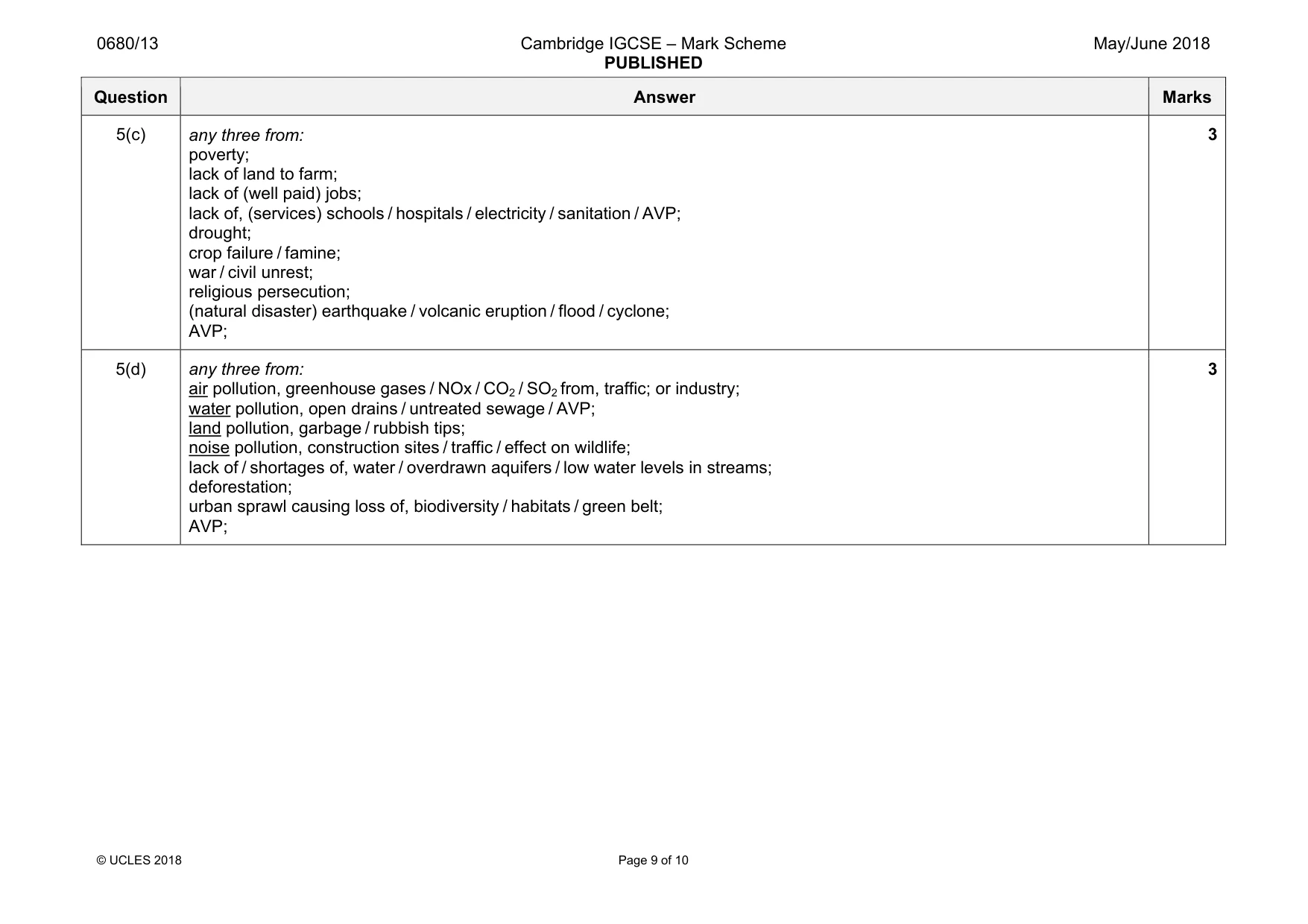
0680/13 Cambridge IGCSE – Mark Scheme PUBLISHED May/June 2018 © UCLES 2018 Page 9 of 10 Question Answer Marks 5(c) any three from: poverty; lack of land to farm; lack of (well paid) jobs; lack of, (services) schools / hospitals / electricity / sanitation / AVP; drought; crop failure / famine; war / civil unrest; religious persecution; (natural disaster) earthquake / volcanic eruption / flood / cyclone; AVP; 3 5(d) any three from: air pollution, greenhouse gases / NOx / CO2 / SO2 from, traffic; or industry; water pollution, open drains / untreated sewage / AVP; land pollution, garbage / rubbish tips; noise pollution, construction sites / traffic / effect on wildlife; lack of / shortages of, water / overdrawn aquifers / low water levels in streams; deforestation; urban sprawl causing loss of, biodiversity / habitats / green belt; AVP; 3
Mark scheme, page 10
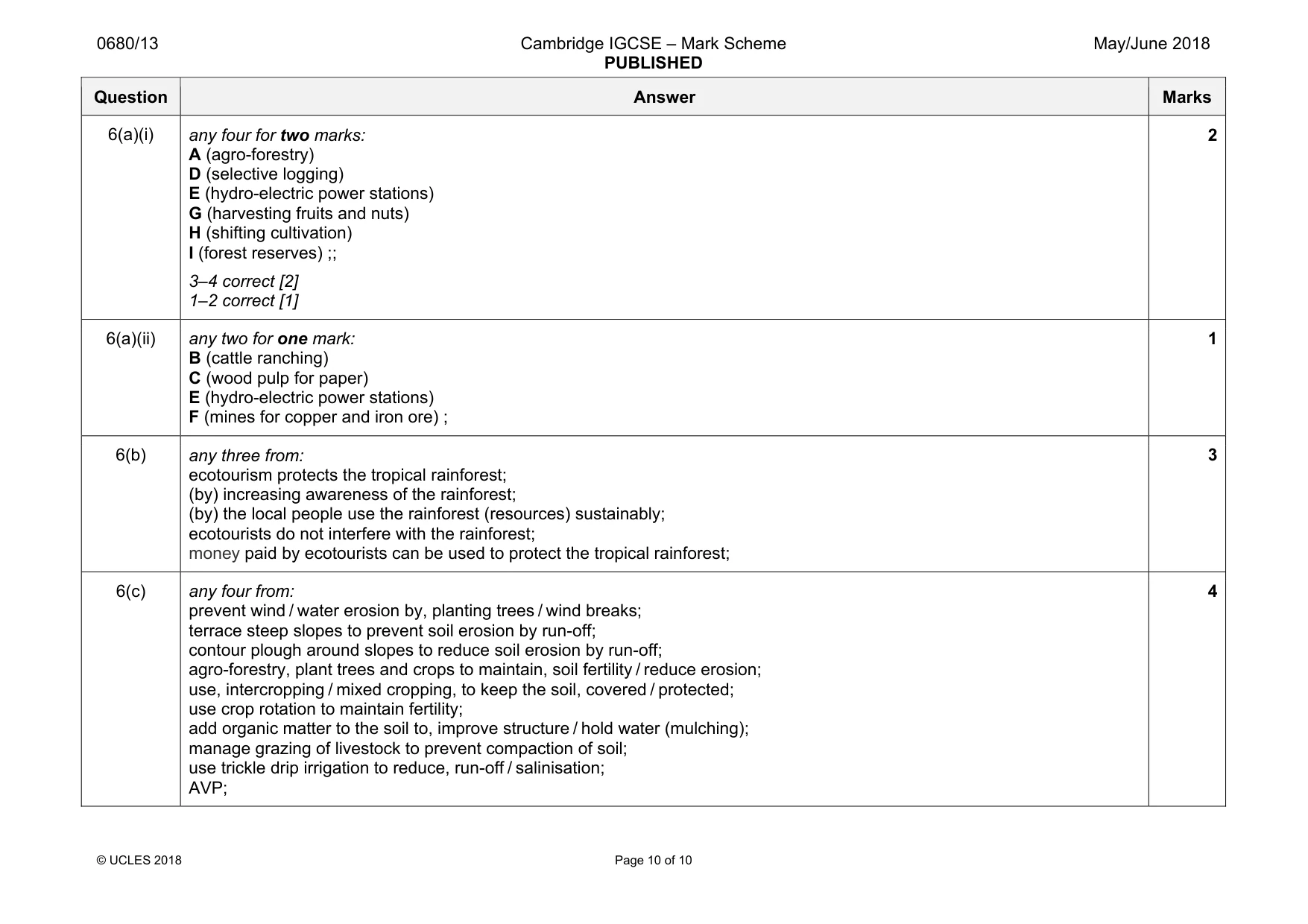
0680/13 Cambridge IGCSE – Mark Scheme PUBLISHED May/June 2018 © UCLES 2018 Page 10 of 10 Question Answer Marks 6(a)(i) any four for two marks: A (agro-forestry) D (selective logging) E (hydro-electric power stations) G (harvesting fruits and nuts) H (shifting cultivation) I (forest reserves) ;; 3–4 correct [2] 1–2 correct [1] 2 6(a)(ii) any two for one mark: B (cattle ranching) C (wood pulp for paper) E (hydro-electric power stations) F (mines for copper and iron ore) ; 1 6(b) any three from: ecotourism protects the tropical rainforest; (by) increasing awareness of the rainforest; (by) the local people use the rainforest (resources) sustainably; ecotourists do not interfere with the rainforest; money paid by ecotourists can be used to protect the tropical rainforest; 3 6(c) any four from: prevent wind / water erosion by, planting trees / wind breaks; terrace steep slopes to prevent soil erosion by run-off; contour plough around slopes to reduce soil erosion by run-off; agro-forestry, plant trees and crops to maintain, soil fertility / reduce erosion; use, intercropping / mixed cropping, to keep the soil, covered / protected; use crop rotation to maintain fertility; add organic matter to the soil to, improve structure / hold water (mulching); manage grazing of livestock to prevent compaction of soil; use trickle drip irrigation to reduce, run-off / salinisation; AVP; 4
What you needed in this session
Cambridge’s own grade thresholds for 2018 May/June, Paper 1 · Variant 3. A higher threshold means an easier paper — the bar moves with how the cohort did.