Cambridge IGCSE Environmental Management 0680 — 2018 May/June Paper 1 · Variant 1
0680/11/M/J/18 · 60 marks · ≈68 min
The question paper and its mark scheme, free to read here and free to download. This is Cambridge’s own paper, exactly as it was sat.
Question paper16 pages


Mark scheme10 pages
Answers below. Sit the paper first if you are practising.
Paper as text
Question paper, page 1
* 3 8 1 1 7 9 3 1 6 1 * Cambridge International Examinations Cambridge International General Certificate of Secondary Education ENVIRONMENTAL MANAGEMENT 0680/11 Paper 1 May/June 2018 1 hour 30 minutes Candidates answer on the Question Paper. No Additional Materials are required. READ THESE INSTRUCTIONS FIRST Write your Centre number, candidate number and name on all the work you hand in. Write in dark blue or black pen. You may use an HB pencil for any diagrams or graphs. Do not use staples, paper clips, glue or correction fluid. DO NOT WRITE IN ANY BARCODES. Answer all questions. Electronic calculators may be used. You may lose marks if you do not show your working or if you do not use appropriate units. At the end of the examination, fasten all your work securely together. The number of marks is given in brackets [ ] at the end of each question or part question. This document consists of 14 printed pages and 2 blank pages. DC (ST/SG) 144182/3 © UCLES 2018 [Turn over
Question paper, page 2
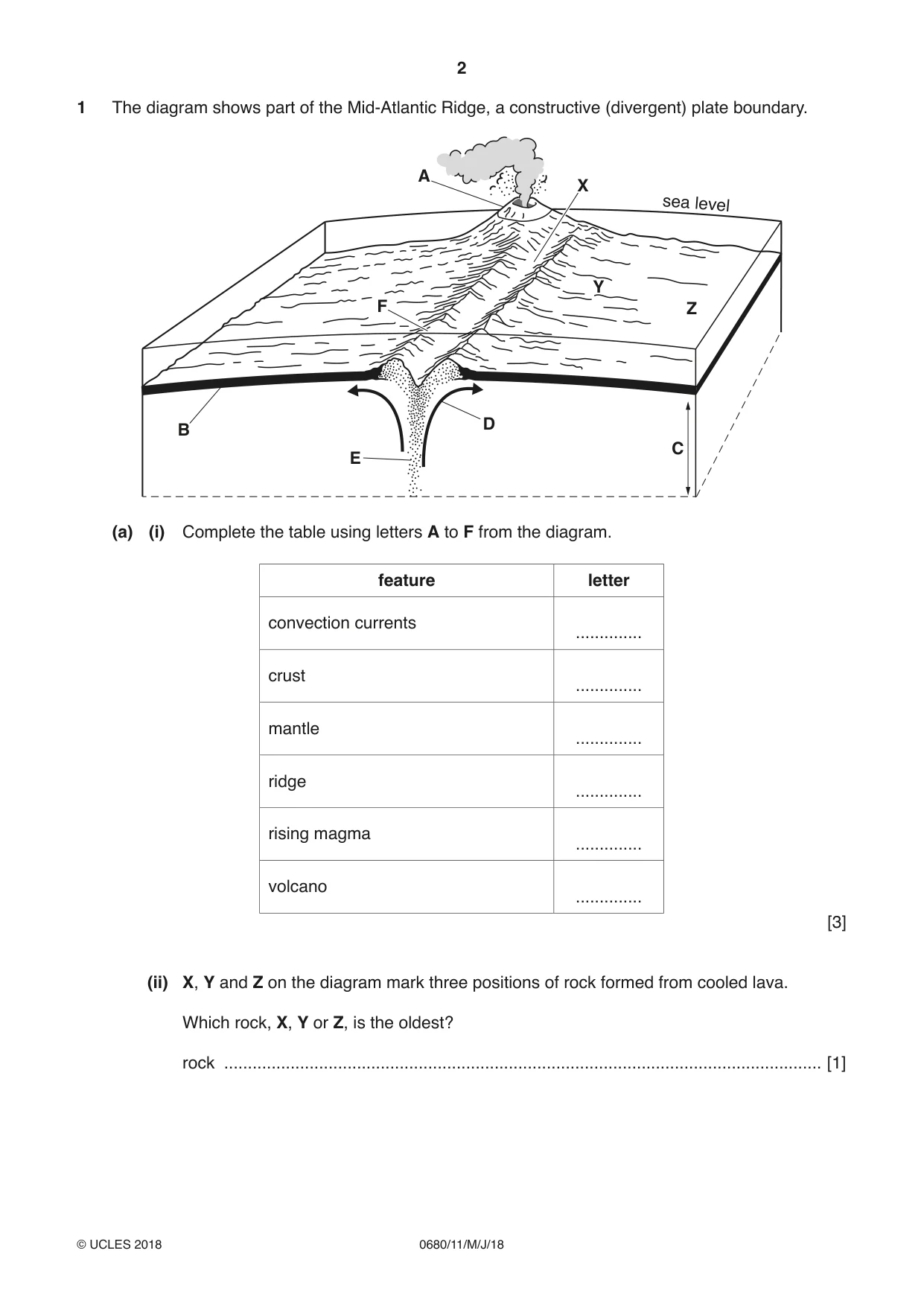
2 0680/11/M/J/18 © UCLES 2018 1 The diagram shows part of the Mid-Atlantic Ridge, a constructive (divergent) plate boundary. sea level X Y Z A B C D E F (a) (i) Complete the table using letters A to F from the diagram. feature letter convection currents … crust … mantle … ridge … rising magma … volcano … [3] (ii) X, Y and Z on the diagram mark three positions of rock formed from cooled lava. Which rock, X, Y or Z, is the oldest? rock … [1]
Question paper, page 3
3 0680/11/M/J/18 © UCLES 2018 [Turn over (b) Describe the tectonic processes that occur at a constructive (divergent) plate boundary. … … … … … …[3] (c) Suggest three benefits for people living near a volcano. 1 … … 2 … … 3 … … [3]
Question paper, page 4
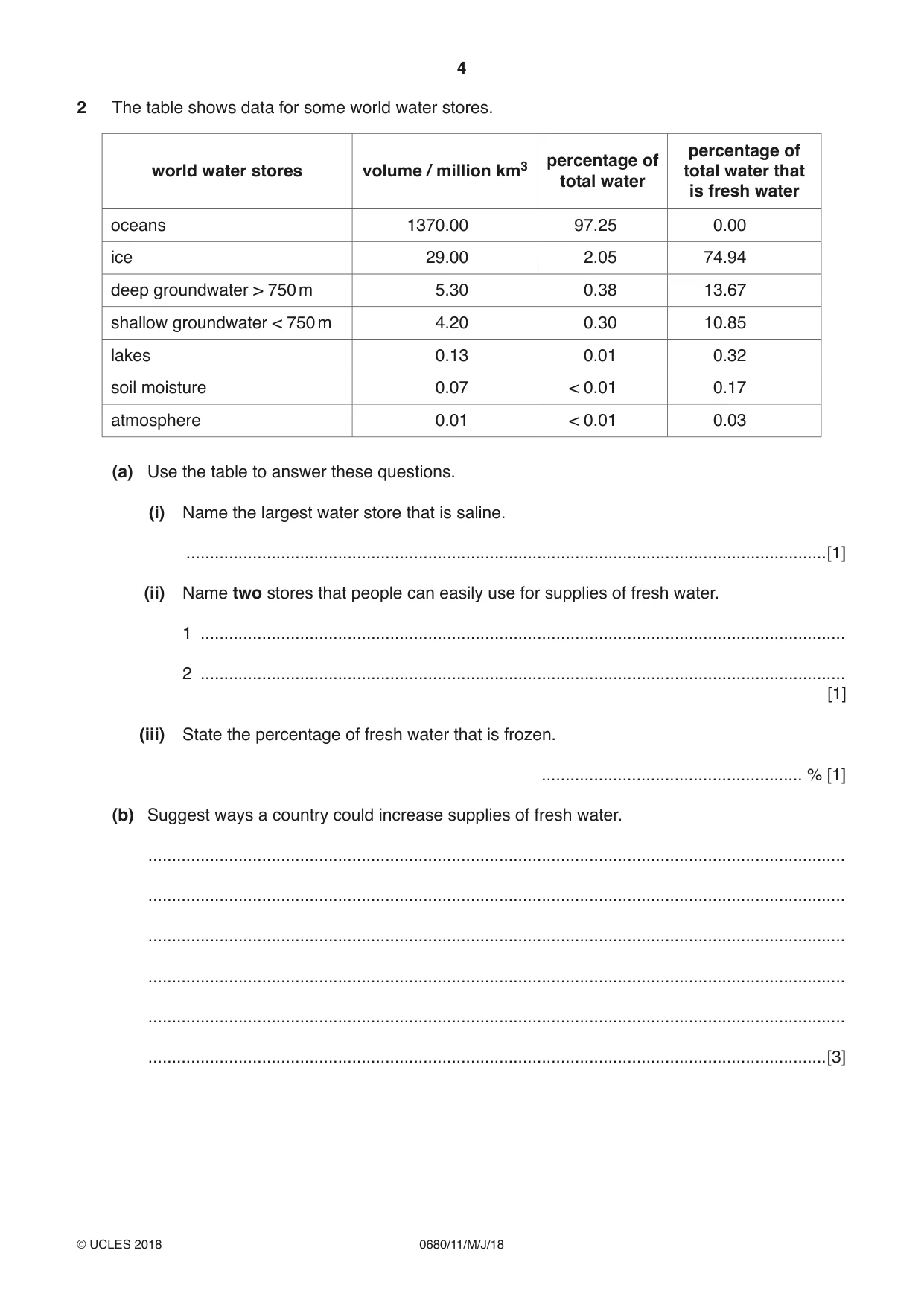
4 0680/11/M/J/18 © UCLES 2018 2 The table shows data for some world water stores. world water stores volume / million km3 percentage of total water percentage of total water that is fresh water oceans 1370.00 97.25 0.00 ice 29.00 2.05 74.94 deep groundwater > 750 m 5.30 0.38 13.67 shallow groundwater < 750 m 4.20 0.30 10.85 lakes 0.13 0.01 0.32 soil moisture 0.07 < 0.01 0.17 atmosphere 0.01 < 0.01 0.03 (a) Use the table to answer these questions. (i) Name the largest water store that is saline. …[1] (ii) Name two stores that people can easily use for supplies of fresh water. 1 … 2 … [1] (iii) State the percentage of fresh water that is frozen. … % [1] (b) Suggest ways a country could increase supplies of fresh water. … … … … … …[3]
Question paper, page 5
5 0680/11/M/J/18 © UCLES 2018 [Turn over (c) Give reasons why fresh water is often not safe to drink. … … … … … … … …[4]
Question paper, page 6
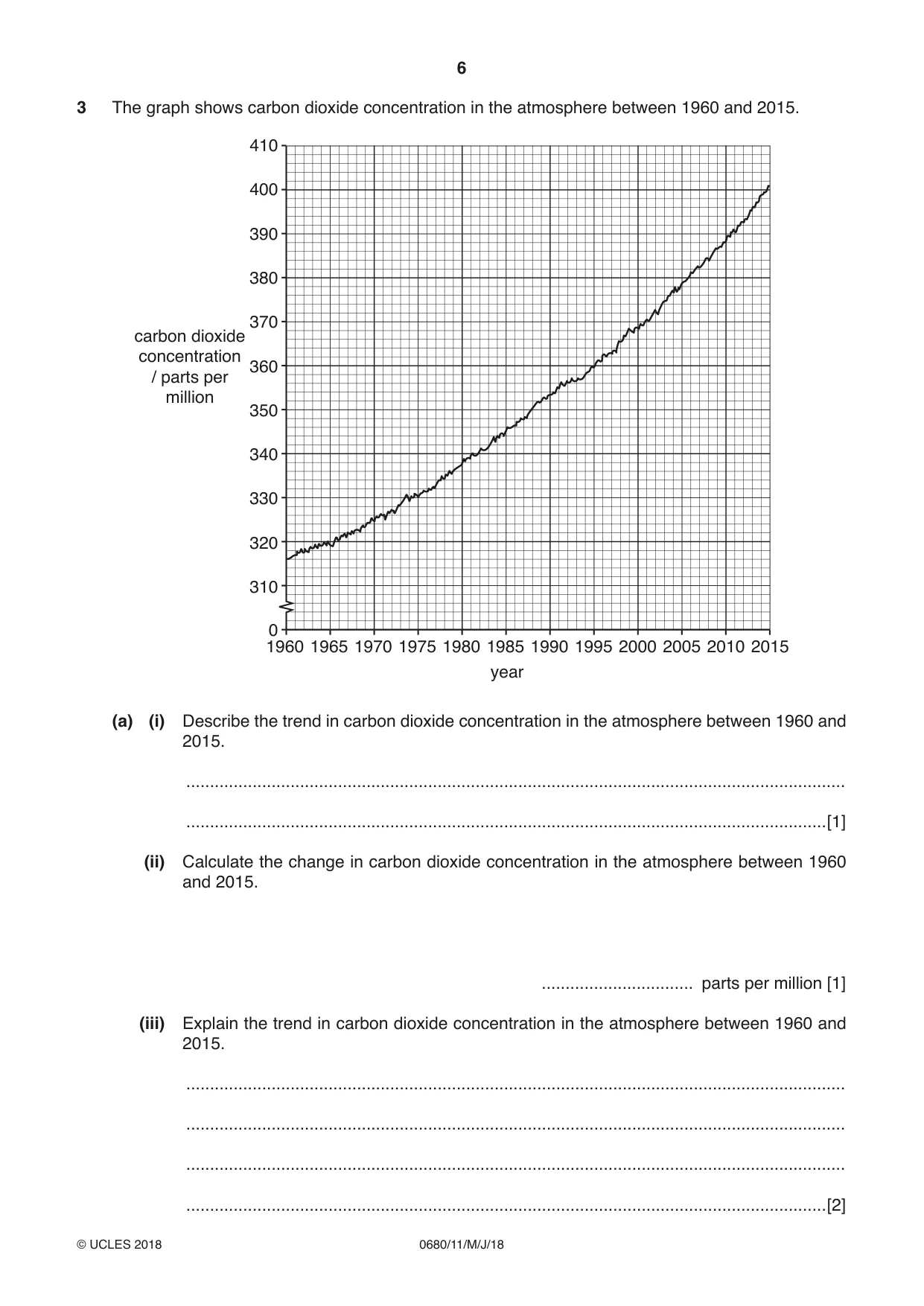
6 0680/11/M/J/18 © UCLES 2018 3 The graph shows carbon dioxide concentration in the atmosphere between 1960 and 2015. 410 400 390 380 370 360 350 340 330 320 310 0 1960 1965 1970 1975 1980 1985 1990 1995 2000 2005 2010 2015 year carbon dioxide concentration / parts per million (a) (i) Describe the trend in carbon dioxide concentration in the atmosphere between 1960 and 2015. … …[1] (ii) Calculate the change in carbon dioxide concentration in the atmosphere between 1960 and 2015. … parts per million [1] (iii) Explain the trend in carbon dioxide concentration in the atmosphere between 1960 and 2015. … … … …[2]
Question paper, page 7
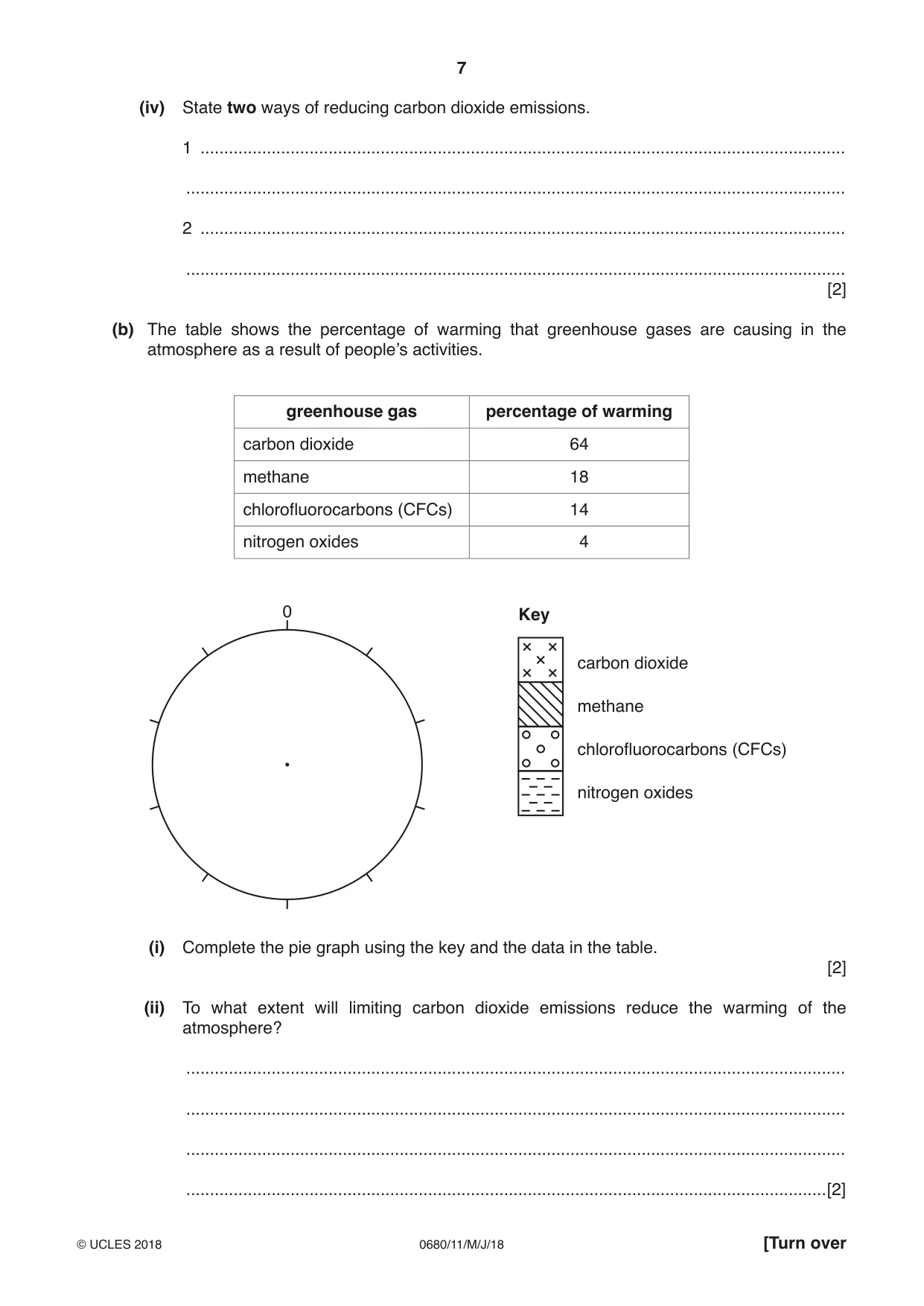
7 0680/11/M/J/18 © UCLES 2018 [Turn over (iv) State two ways of reducing carbon dioxide emissions. 1 … … 2 … … [2] (b) The table shows the percentage of warming that greenhouse gases are causing in the atmosphere as a result of people’s activities. greenhouse gas percentage of warming carbon dioxide 64 methane 18 chlorofluorocarbons (CFCs) 14 nitrogen oxides 4 0 Key carbon dioxide methane chlorofluorocarbons (CFCs) nitrogen oxides (i) Complete the pie graph using the key and the data in the table. [2] (ii) To what extent will limiting carbon dioxide emissions reduce the warming of the atmosphere? … … … …[2]
Question paper, page 8
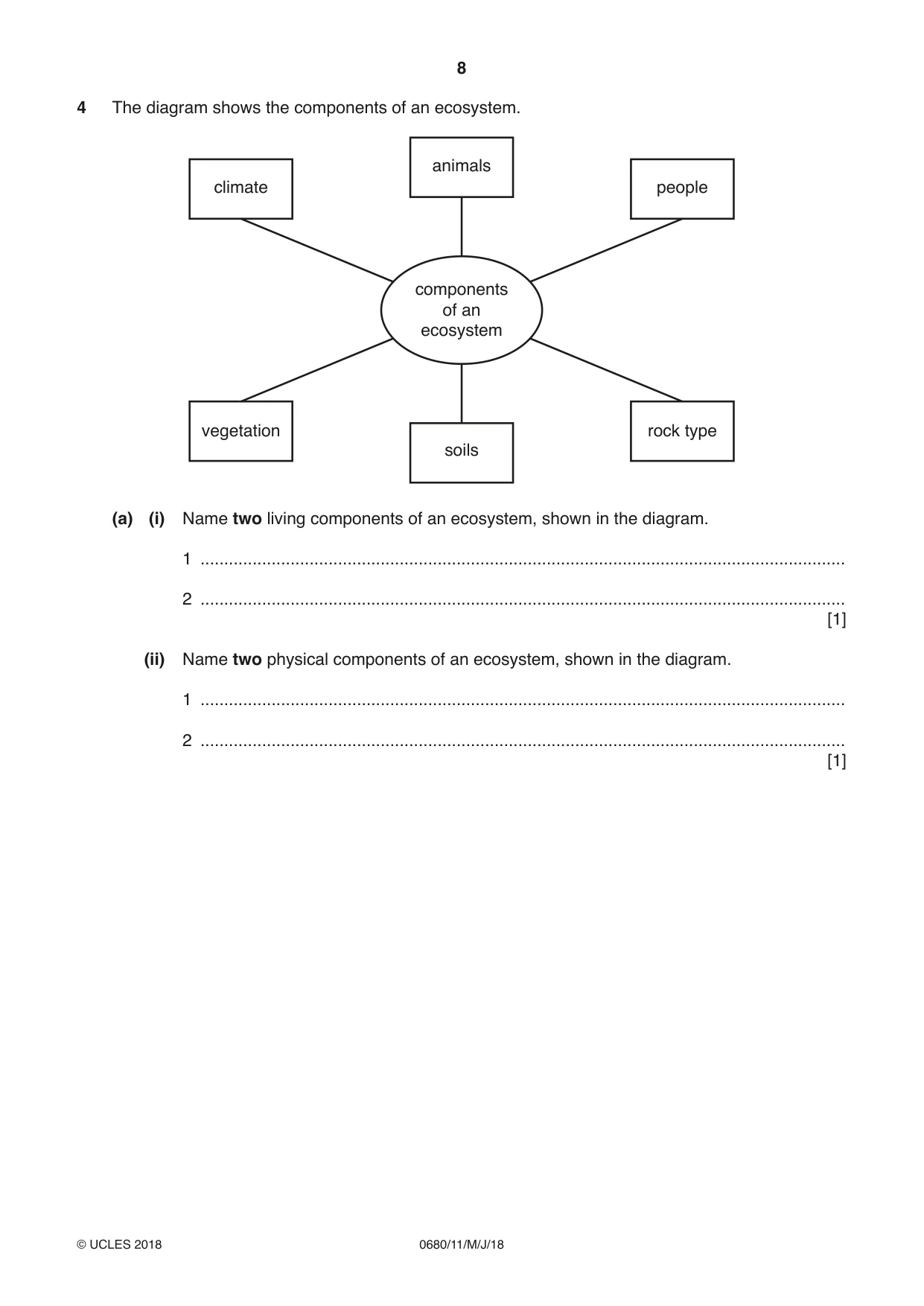
8 0680/11/M/J/18 © UCLES 2018 4 The diagram shows the components of an ecosystem. components of an ecosystem animals people climate soils rock type vegetation (a) (i) Name two living components of an ecosystem, shown in the diagram. 1 … 2 … [1] (ii) Name two physical components of an ecosystem, shown in the diagram. 1 … 2 … [1]
Question paper, page 9
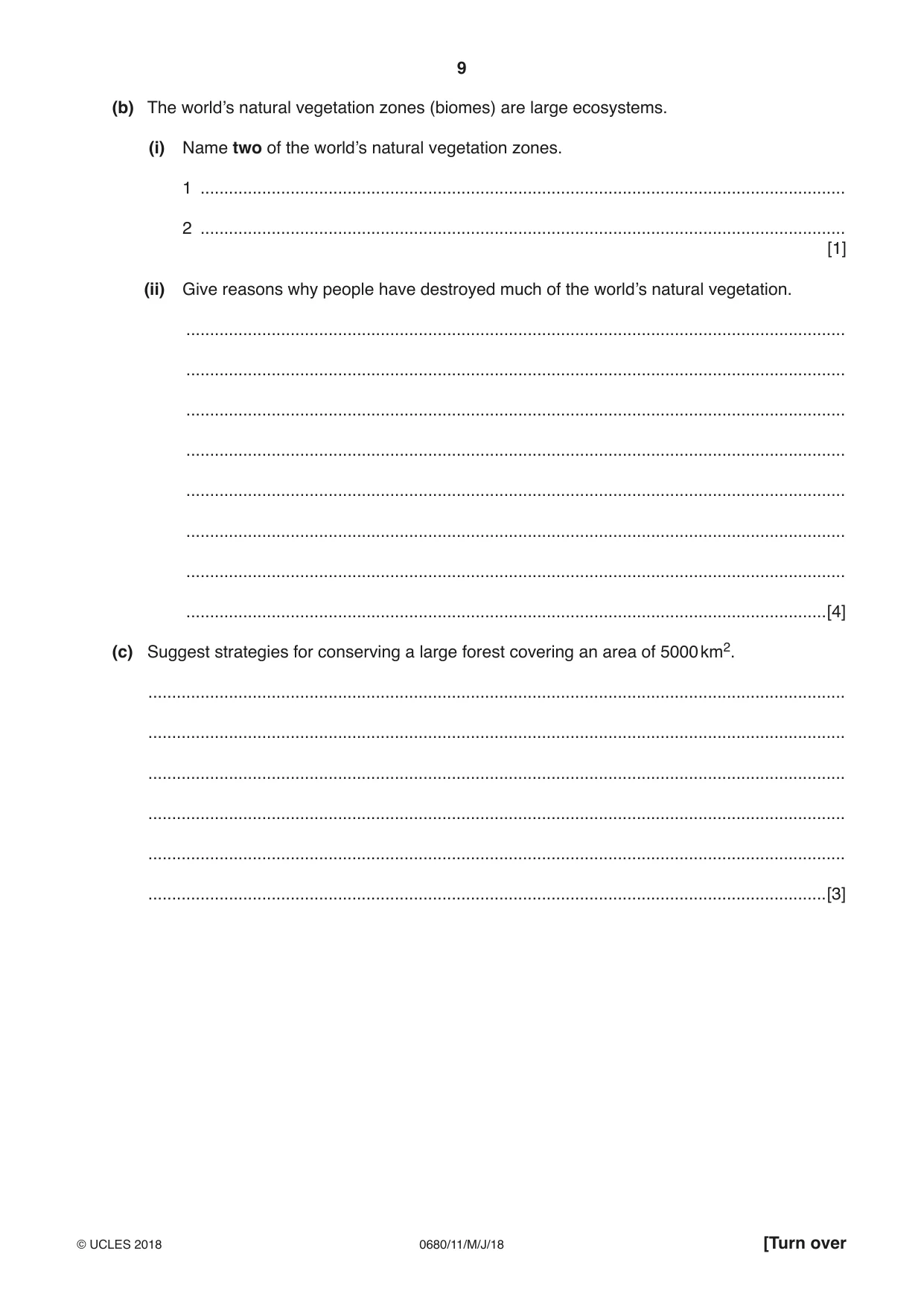
9 0680/11/M/J/18 © UCLES 2018 [Turn over (b) The world’s natural vegetation zones (biomes) are large ecosystems. (i) Name two of the world’s natural vegetation zones. 1 … 2 … [1] (ii) Give reasons why people have destroyed much of the world’s natural vegetation. … … … … … … … …[4] (c) Suggest strategies for conserving a large forest covering an area of 5000 km2. … … … … … …[3]
Question paper, page 10
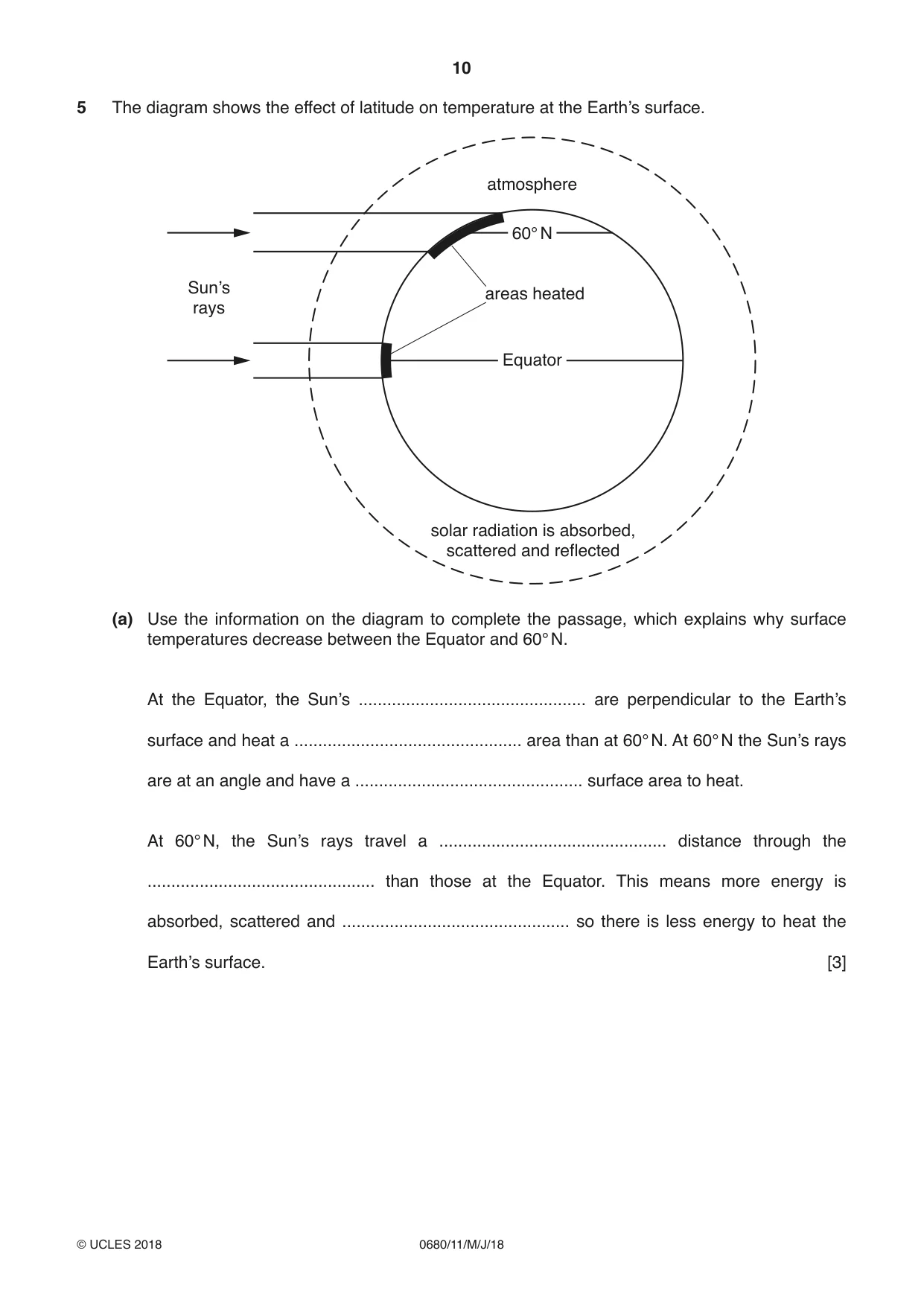
10 0680/11/M/J/18 © UCLES 2018 5 The diagram shows the effect of latitude on temperature at the Earth’s surface. atmosphere 60° N Equator areas heated solar radiation is absorbed, scattered and reflected Sun’s rays (a) Use the information on the diagram to complete the passage, which explains why surface temperatures decrease between the Equator and 60° N. At the Equator, the Sun’s … are perpendicular to the Earth’s surface and heat a … area than at 60° N. At 60° N the Sun’s rays are at an angle and have a … surface area to heat. At 60° N, the Sun’s rays travel a … distance through the … than those at the Equator. This means more energy is absorbed, scattered and … so there is less energy to heat the Earth’s surface. [3]
Question paper, page 11
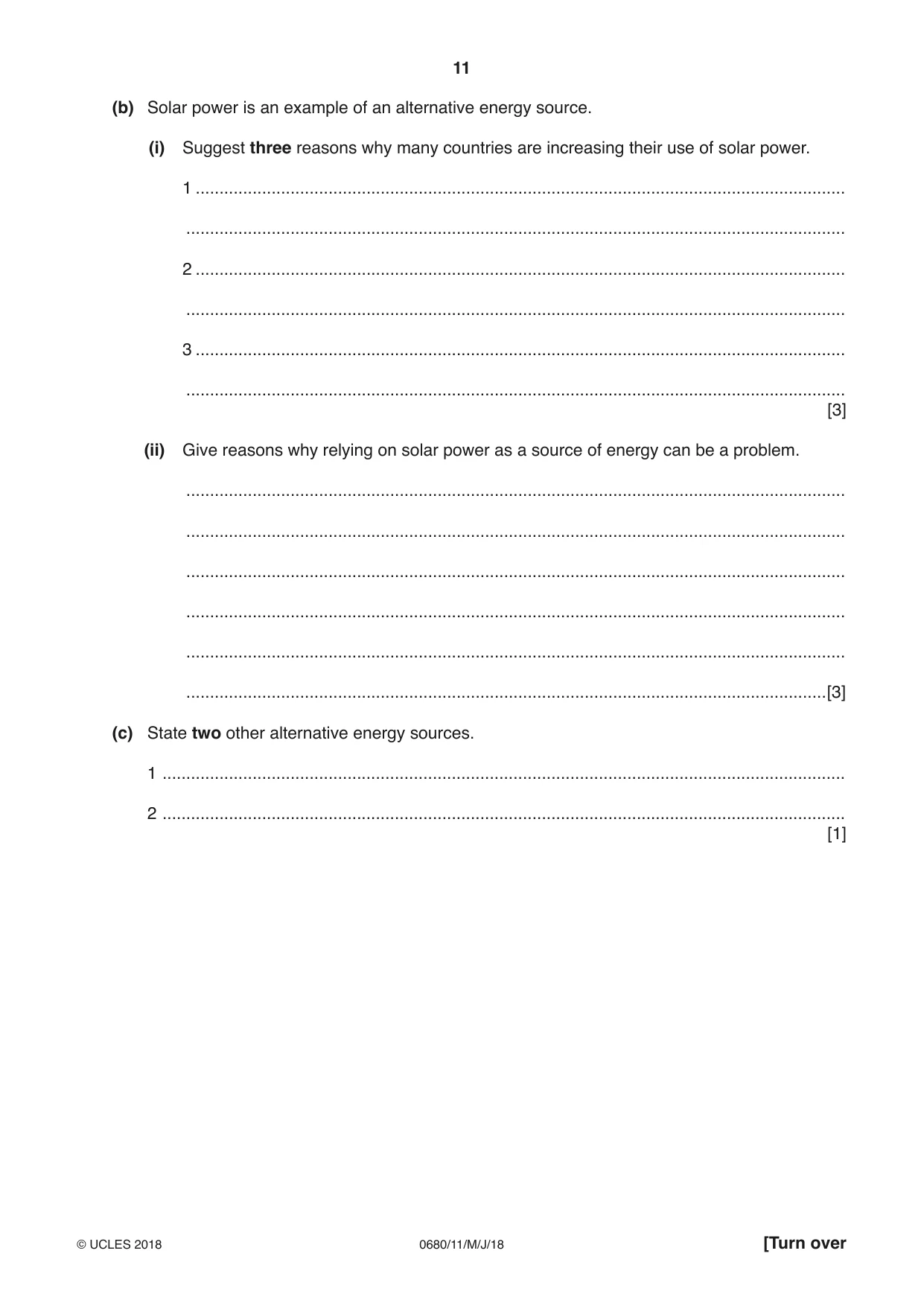
11 0680/11/M/J/18 © UCLES 2018 [Turn over (b) Solar power is an example of an alternative energy source. (i) Suggest three reasons why many countries are increasing their use of solar power. 1 … … 2 … … 3 … … [3] (ii) Give reasons why relying on solar power as a source of energy can be a problem. … … … … … …[3] (c) State two other alternative energy sources. 1 … 2 … [1]
Question paper, page 12
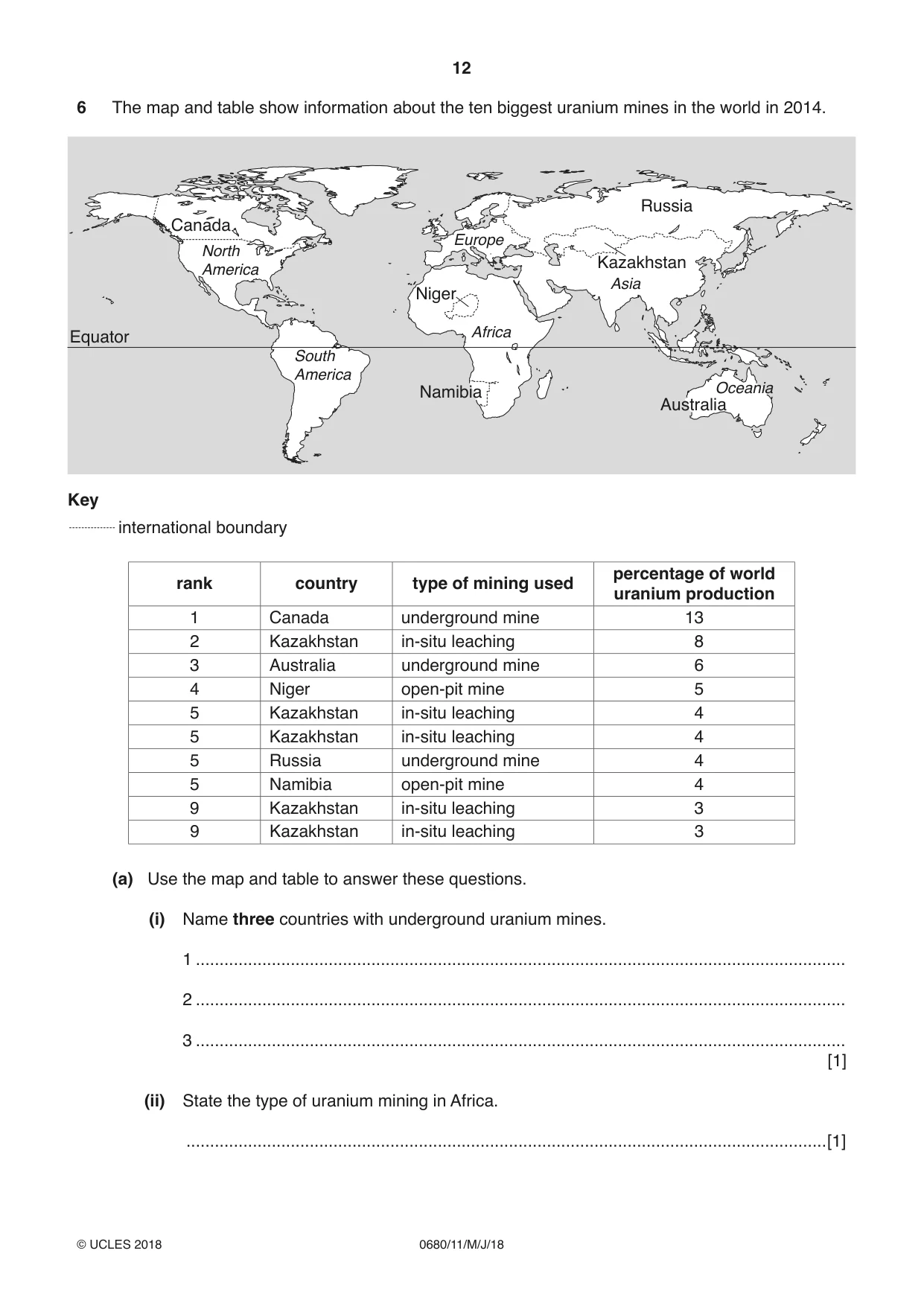
12 0680/11/M/J/18 © UCLES 2018 6 The map and table show information about the ten biggest uranium mines in the world in 2014. Equator Canada North America South America Africa Europe Asia Oceania Russia Niger Australia Namibia Kazakhstan Key international boundary rank country type of mining used percentage of world uranium production 1 Canada underground mine 13 2 Kazakhstan in-situ leaching 8 3 Australia underground mine 6 4 Niger open-pit mine 5 5 Kazakhstan in-situ leaching 4 5 Kazakhstan in-situ leaching 4 5 Russia underground mine 4 5 Namibia open-pit mine 4 9 Kazakhstan in-situ leaching 3 9 Kazakhstan in-situ leaching 3 (a) Use the map and table to answer these questions. (i) Name three countries with underground uranium mines. 1 … 2 … 3 … [1] (ii) State the type of uranium mining in Africa. …[1]
Question paper, page 13
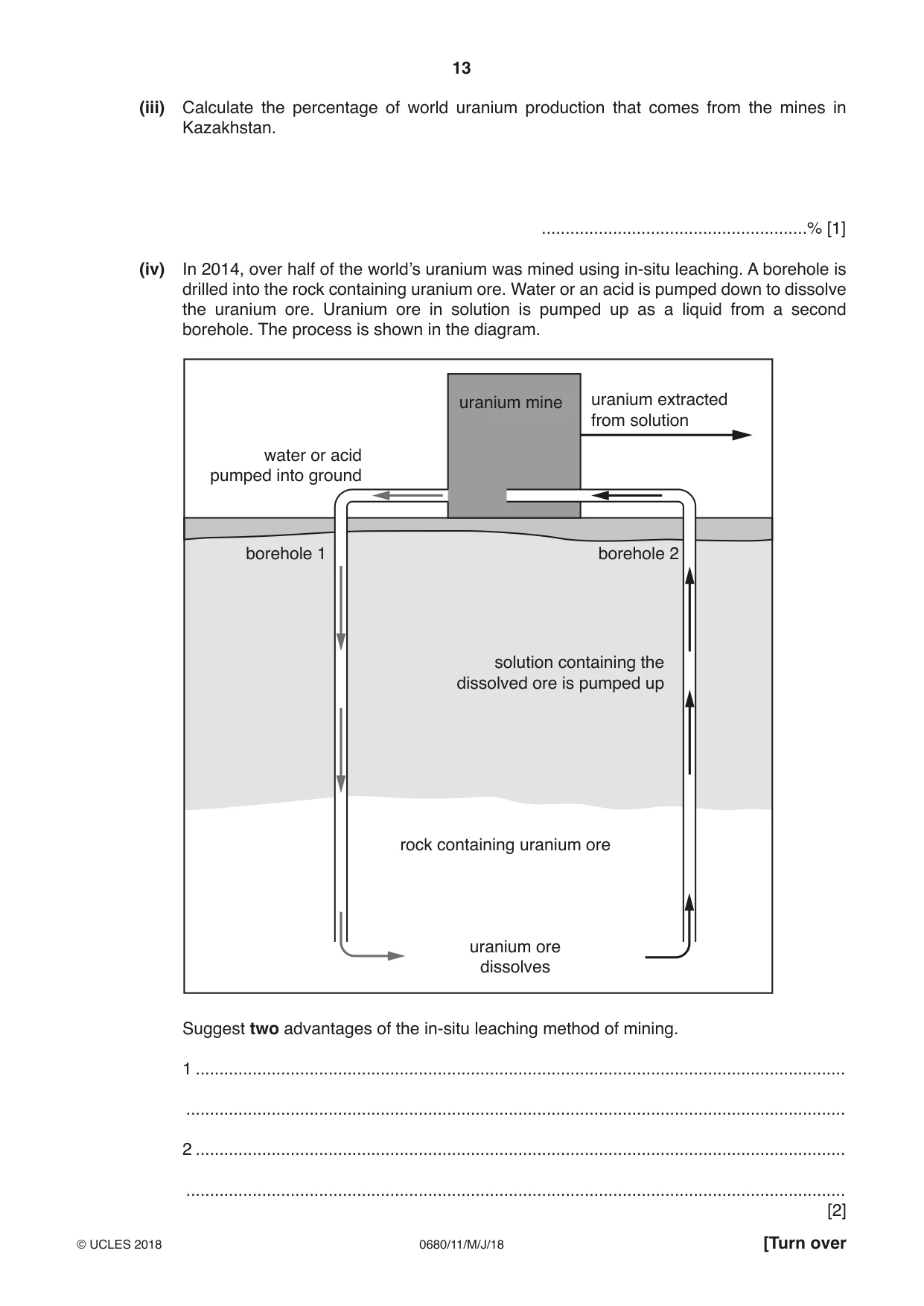
13 0680/11/M/J/18 © UCLES 2018 [Turn over (iii) Calculate the percentage of world uranium production that comes from the mines in Kazakhstan. …% [1] (iv) In 2014, over half of the world’s uranium was mined using in-situ leaching. A borehole is drilled into the rock containing uranium ore. Water or an acid is pumped down to dissolve the uranium ore. Uranium ore in solution is pumped up as a liquid from a second borehole. The process is shown in the diagram. water or acid pumped into ground uranium extracted from solution borehole 2 borehole 1 solution containing the dissolved ore is pumped up uranium ore dissolves rock containing uranium ore uranium mine Suggest two advantages of the in-situ leaching method of mining. 1 … … 2 … … [2]
Question paper, page 14
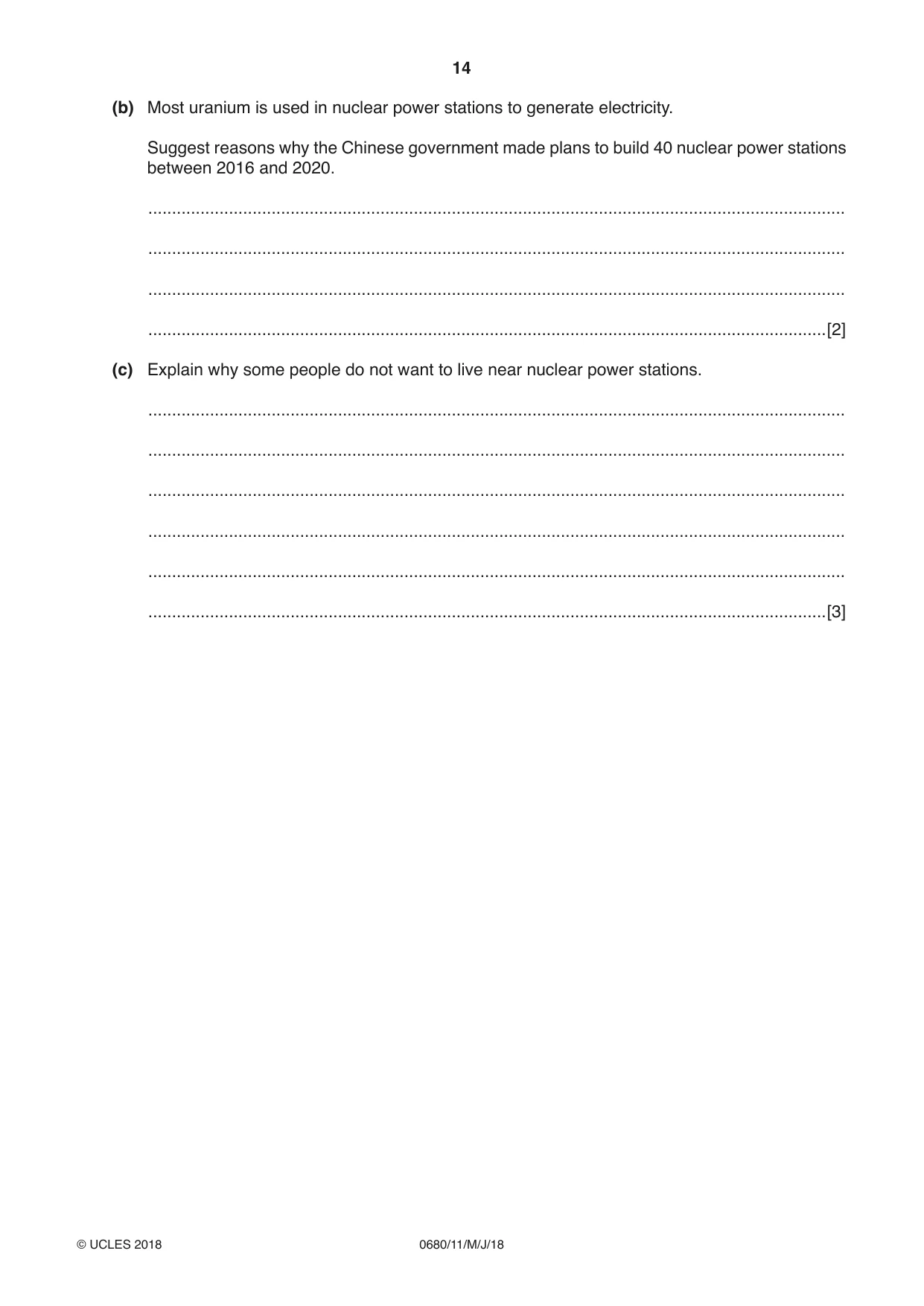
14 0680/11/M/J/18 © UCLES 2018 (b) Most uranium is used in nuclear power stations to generate electricity. Suggest reasons why the Chinese government made plans to build 40 nuclear power stations between 2016 and 2020. … … … …[2] (c) Explain why some people do not want to live near nuclear power stations. … … … … … …[3]
Question paper, page 15
15 0680/11/M/J/18 © UCLES 2018 BLANK PAGE
Question paper, page 16
16 0680/11/M/J/18 © UCLES 2018 Permission to reproduce items where third-party owned material protected by copyright is included has been sought and cleared where possible. Every reasonable effort has been made by the publisher (UCLES) to trace copyright holders, but if any items requiring clearance have unwittingly been included, the publisher will be pleased to make amends at the earliest possible opportunity. To avoid the issue of disclosure of answer-related information to candidates, all copyright acknowledgements are reproduced online in the Cambridge International Examinations Copyright Acknowledgements Booklet. This is produced for each series of examinations and is freely available to download at www.cie.org.uk after the live examination series. Cambridge International Examinations is part of the Cambridge Assessment Group. Cambridge Assessment is the brand name of University of Cambridge Local Examinations Syndicate (UCLES), which is itself a department of the University of Cambridge. BLANK PAGE
Mark scheme, page 1
IGCSE™ is a registered trademark. This document consists of 10 printed pages. © UCLES 2018 [Turn over Cambridge Assessment International Education Cambridge International General Certificate of Secondary Education ENVIRONMENTAL MANAGEMENT 0680/11 Paper 1 May/June 2018 MARK SCHEME Maximum Mark: 60 Published This mark scheme is published as an aid to teachers and candidates, to indicate the requirements of the examination. It shows the basis on which Examiners were instructed to award marks. It does not indicate the details of the discussions that took place at an Examiners’ meeting before marking began, which would have considered the acceptability of alternative answers. Mark schemes should be read in conjunction with the question paper and the Principal Examiner Report for Teachers. Cambridge International will not enter into discussions about these mark schemes. Cambridge International is publishing the mark schemes for the May/June 2018 series for most Cambridge IGCSE™, Cambridge International A and AS Level and Cambridge Pre-U components, and some Cambridge O Level components.
Mark scheme, page 2
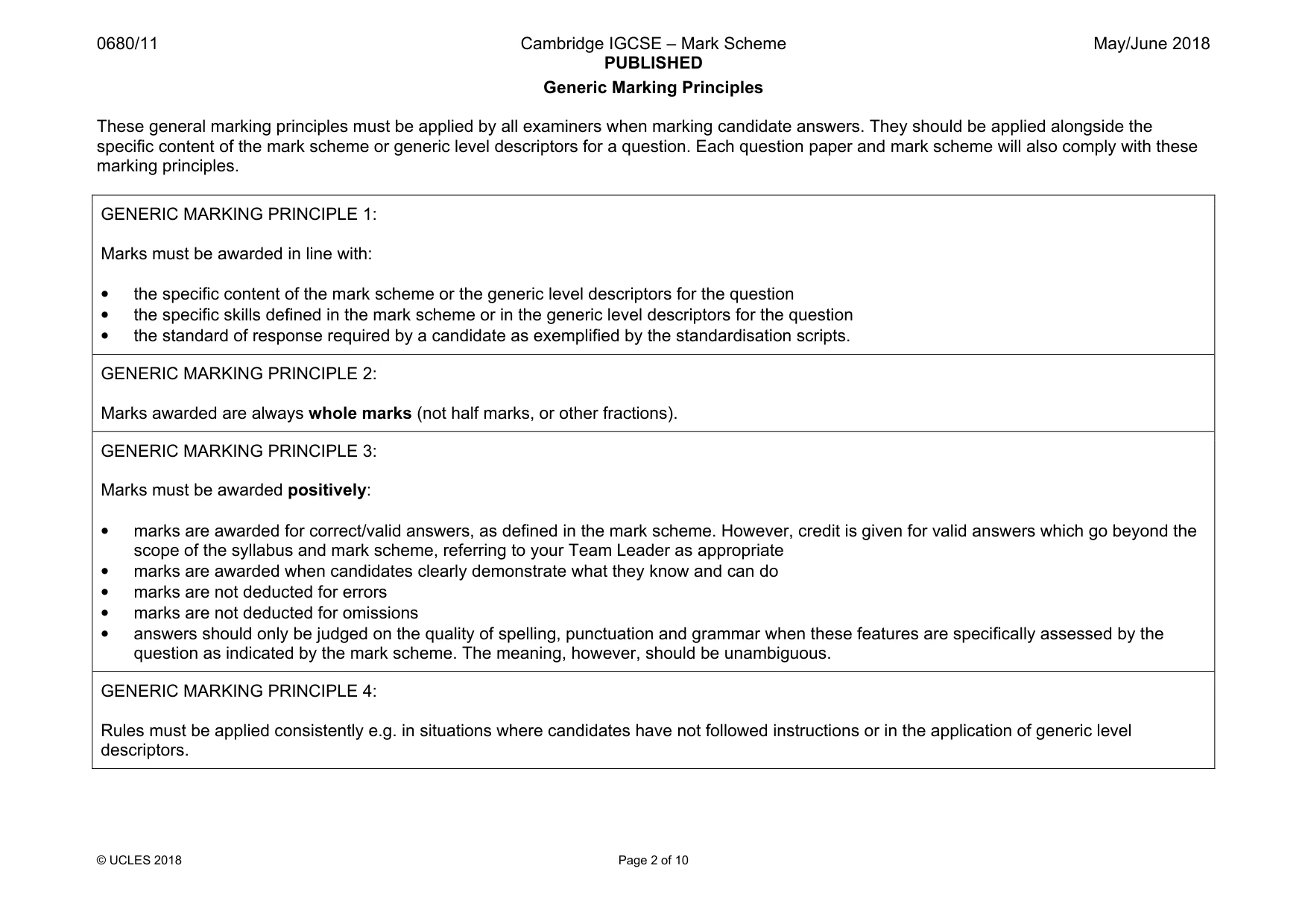
0680/11 Cambridge IGCSE – Mark Scheme PUBLISHED May/June 2018 © UCLES 2018 Page 2 of 10 Generic Marking Principles These general marking principles must be applied by all examiners when marking candidate answers. They should be applied alongside the specific content of the mark scheme or generic level descriptors for a question. Each question paper and mark scheme will also comply with these marking principles. GENERIC MARKING PRINCIPLE 1: Marks must be awarded in line with: • the specific content of the mark scheme or the generic level descriptors for the question • the specific skills defined in the mark scheme or in the generic level descriptors for the question • the standard of response required by a candidate as exemplified by the standardisation scripts. GENERIC MARKING PRINCIPLE 2: Marks awarded are always whole marks (not half marks, or other fractions). GENERIC MARKING PRINCIPLE 3: Marks must be awarded positively: • marks are awarded for correct/valid answers, as defined in the mark scheme. However, credit is given for valid answers which go beyond the scope of the syllabus and mark scheme, referring to your Team Leader as appropriate • marks are awarded when candidates clearly demonstrate what they know and can do • marks are not deducted for errors • marks are not deducted for omissions • answers should only be judged on the quality of spelling, punctuation and grammar when these features are specifically assessed by the question as indicated by the mark scheme. The meaning, however, should be unambiguous. GENERIC MARKING PRINCIPLE 4: Rules must be applied consistently e.g. in situations where candidates have not followed instructions or in the application of generic level descriptors.
Mark scheme, page 3
0680/11 Cambridge IGCSE – Mark Scheme PUBLISHED May/June 2018 © UCLES 2018 Page 3 of 10 GENERIC MARKING PRINCIPLE 5: Marks should be awarded using the full range of marks defined in the mark scheme for the question (however; the use of the full mark range may be limited according to the quality of the candidate responses seen). GENERIC MARKING PRINCIPLE 6: Marks awarded are based solely on the requirements as defined in the mark scheme. Marks should not be awarded with grade thresholds or grade descriptors in mind.
Mark scheme, page 4
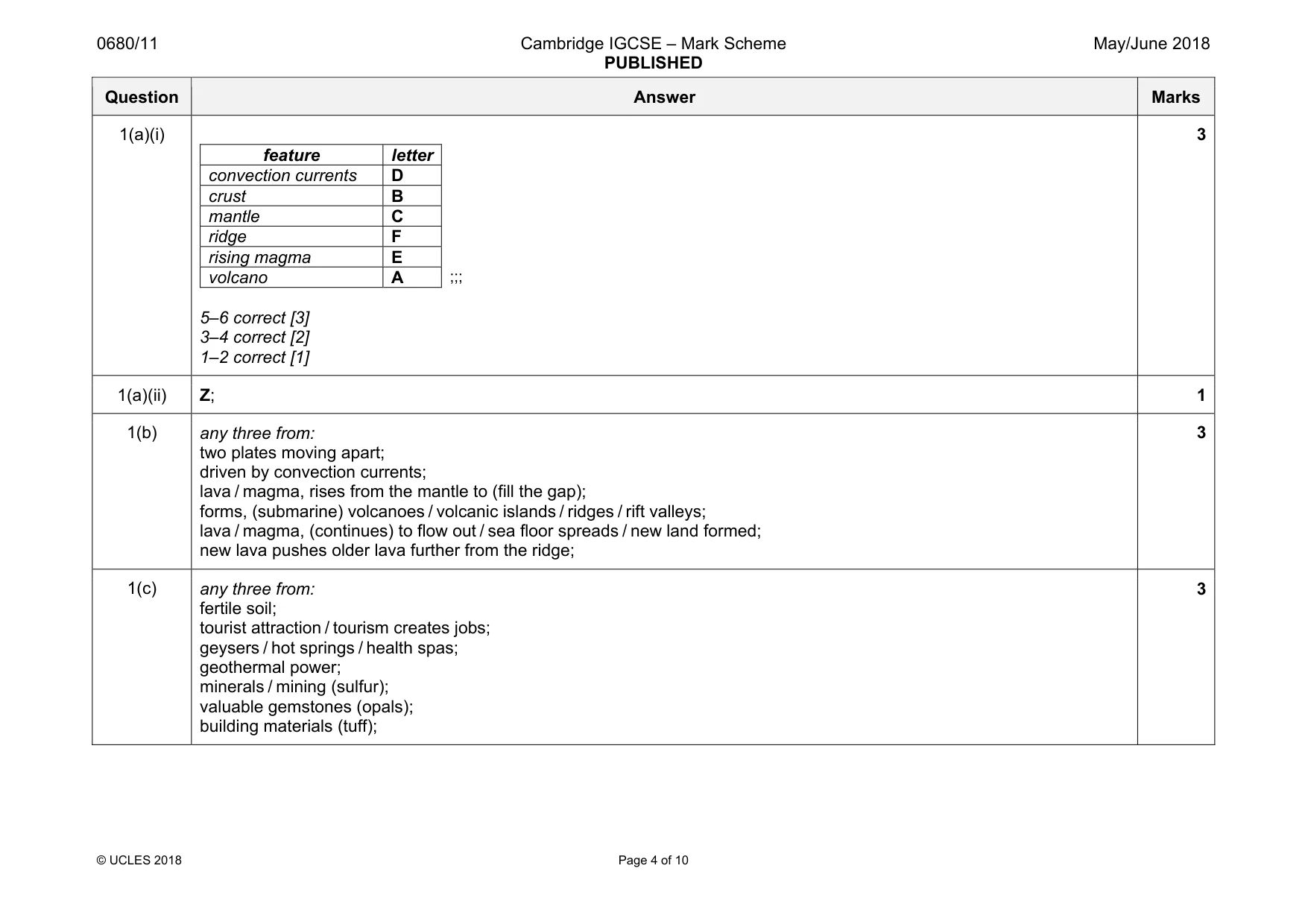
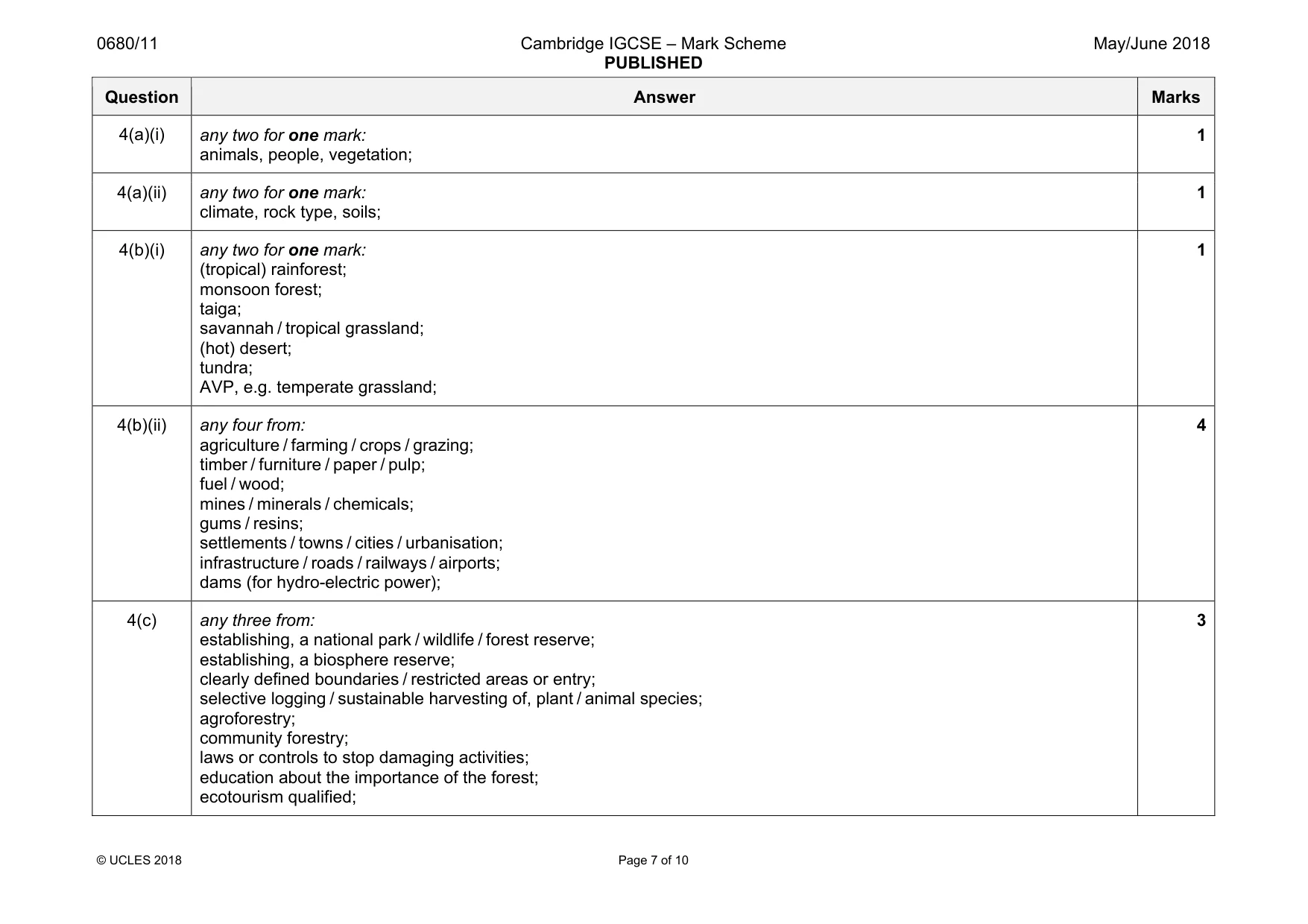
0680/11 Cambridge IGCSE – Mark Scheme PUBLISHED May/June 2018 © UCLES 2018 Page 4 of 10 Question Answer Marks 1(a)(i) feature letter convection currents D crust B mantle C ridge F rising magma E volcano A ;;; 5–6 correct [3] 3–4 correct [2] 1–2 correct [1] 3 1(a)(ii) Z; 1 1(b) any three from: two plates moving apart; driven by convection currents; lava / magma, rises from the mantle to (fill the gap); forms, (submarine) volcanoes / volcanic islands / ridges / rift valleys; lava / magma, (continues) to flow out / sea floor spreads / new land formed; new lava pushes older lava further from the ridge; 3 1(c) any three from: fertile soil; tourist attraction / tourism creates jobs; geysers / hot springs / health spas; geothermal power; minerals / mining (sulfur); valuable gemstones (opals); building materials (tuff); 3
Mark scheme, page 5
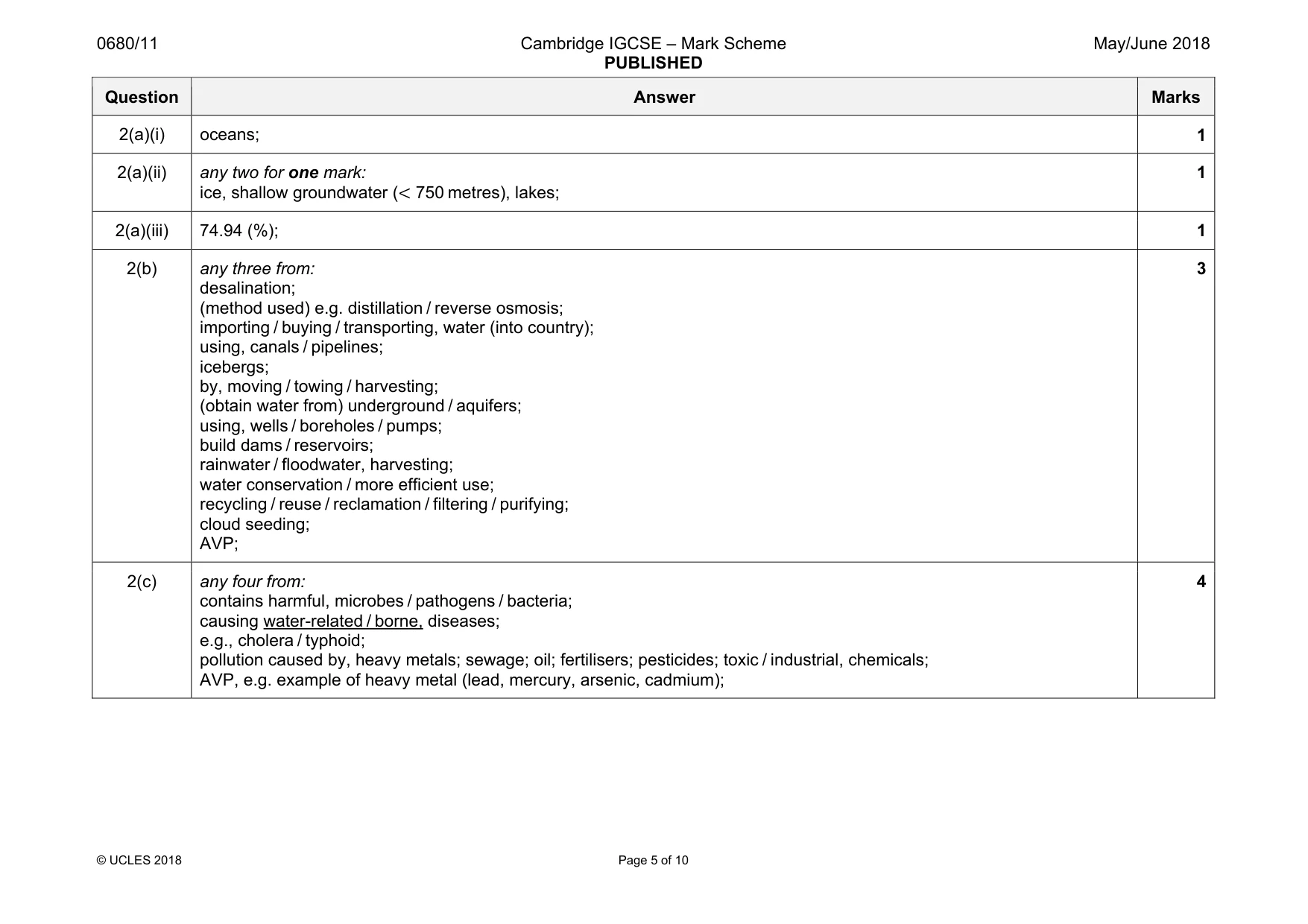
0680/11 Cambridge IGCSE – Mark Scheme PUBLISHED May/June 2018 © UCLES 2018 Page 5 of 10 Question Answer Marks 2(a)(i) oceans; 1 2(a)(ii) any two for one mark: ice, shallow groundwater (< 750 metres), lakes; 1 2(a)(iii) 74.94 (%); 1 2(b) any three from: desalination; (method used) e.g. distillation / reverse osmosis; importing / buying / transporting, water (into country); using, canals / pipelines; icebergs; by, moving / towing / harvesting; (obtain water from) underground / aquifers; using, wells / boreholes / pumps; build dams / reservoirs; rainwater / floodwater, harvesting; water conservation / more efficient use; recycling / reuse / reclamation / filtering / purifying; cloud seeding; AVP; 3 2(c) any four from: contains harmful, microbes / pathogens / bacteria; causing water-related / borne, diseases; e.g., cholera / typhoid; pollution caused by, heavy metals; sewage; oil; fertilisers; pesticides; toxic / industrial, chemicals; AVP, e.g. example of heavy metal (lead, mercury, arsenic, cadmium); 4
Mark scheme, page 6
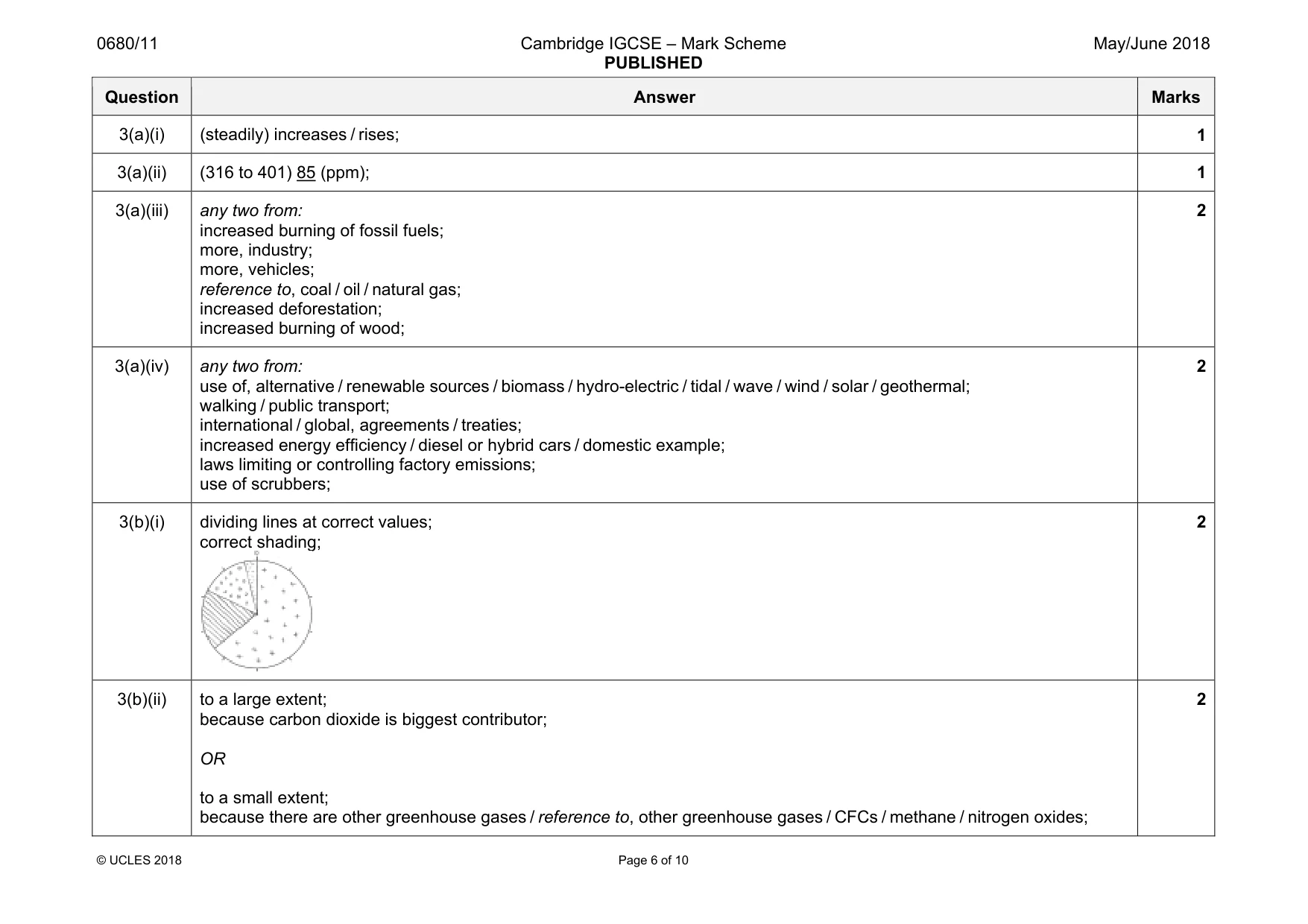
0680/11 Cambridge IGCSE – Mark Scheme PUBLISHED May/June 2018 © UCLES 2018 Page 6 of 10 Question Answer Marks 3(a)(i) (steadily) increases / rises; 1 3(a)(ii) (316 to 401) 85 (ppm); 1 3(a)(iii) any two from: increased burning of fossil fuels; more, industry; more, vehicles; reference to, coal / oil / natural gas; increased deforestation; increased burning of wood; 2 3(a)(iv) any two from: use of, alternative / renewable sources / biomass / hydro-electric / tidal / wave / wind / solar / geothermal; walking / public transport; international / global, agreements / treaties; increased energy efficiency / diesel or hybrid cars / domestic example; laws limiting or controlling factory emissions; use of scrubbers; 2 3(b)(i) dividing lines at correct values; correct shading; 2 3(b)(ii) to a large extent; because carbon dioxide is biggest contributor; OR to a small extent; because there are other greenhouse gases / reference to, other greenhouse gases / CFCs / methane / nitrogen oxides; 2
Mark scheme, page 7
0680/11 Cambridge IGCSE – Mark Scheme PUBLISHED May/June 2018 © UCLES 2018 Page 7 of 10 Question Answer Marks 4(a)(i) any two for one mark: animals, people, vegetation; 1 4(a)(ii) any two for one mark: climate, rock type, soils; 1 4(b)(i) any two for one mark: (tropical) rainforest; monsoon forest; taiga; savannah / tropical grassland; (hot) desert; tundra; AVP, e.g. temperate grassland; 1 4(b)(ii) any four from: agriculture / farming / crops / grazing; timber / furniture / paper / pulp; fuel / wood; mines / minerals / chemicals; gums / resins; settlements / towns / cities / urbanisation; infrastructure / roads / railways / airports; dams (for hydro-electric power); 4 4(c) any three from: establishing, a national park / wildlife / forest reserve; establishing, a biosphere reserve; clearly defined boundaries / restricted areas or entry; selective logging / sustainable harvesting of, plant / animal species; agroforestry; community forestry; laws or controls to stop damaging activities; education about the importance of the forest; ecotourism qualified; 3
Mark scheme, page 8
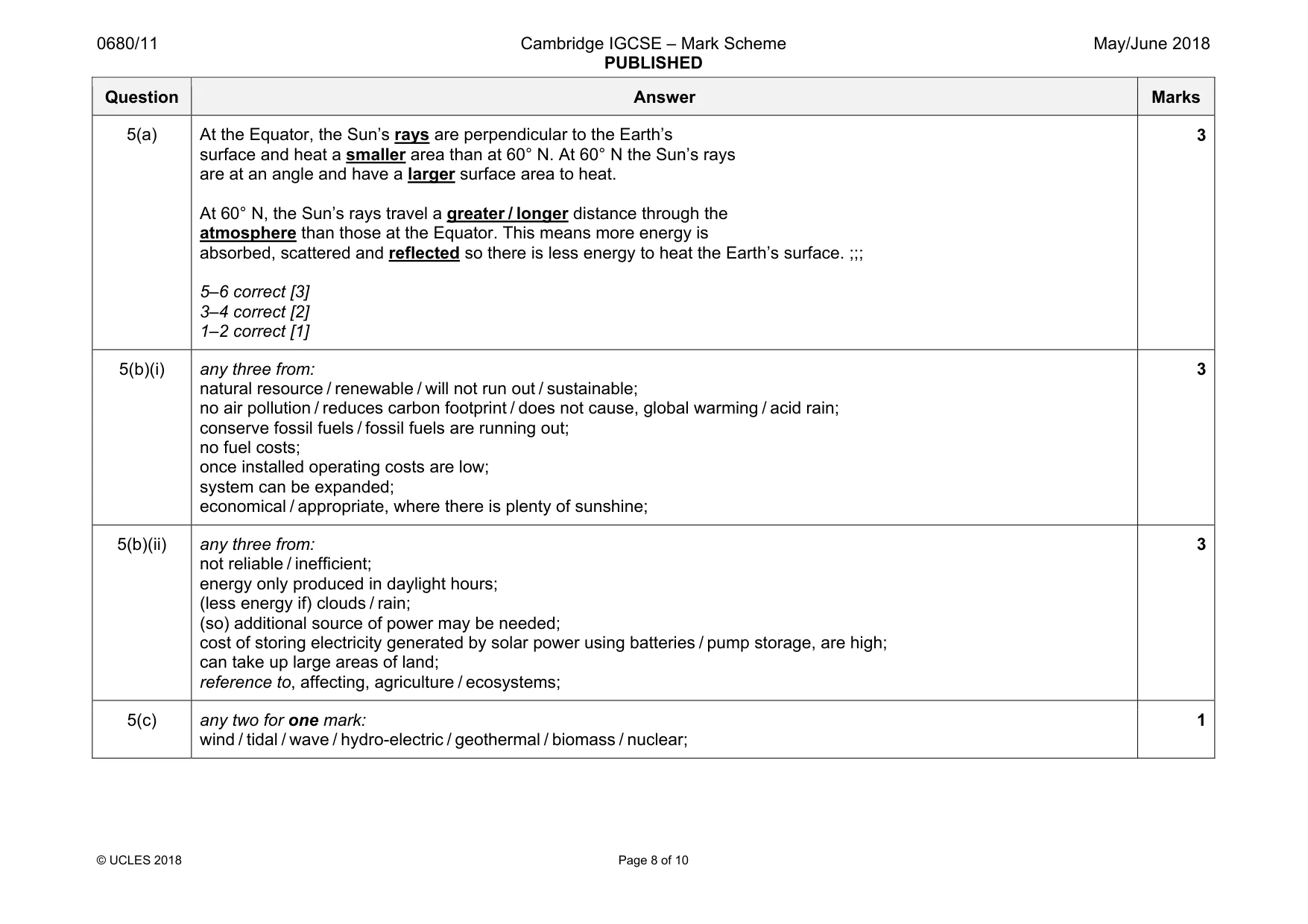
0680/11 Cambridge IGCSE – Mark Scheme PUBLISHED May/June 2018 © UCLES 2018 Page 8 of 10 Question Answer Marks 5(a) At the Equator, the Sun’s rays are perpendicular to the Earth’s surface and heat a smaller area than at 60° N. At 60° N the Sun’s rays are at an angle and have a larger surface area to heat. At 60° N, the Sun’s rays travel a greater / longer distance through the atmosphere than those at the Equator. This means more energy is absorbed, scattered and reflected so there is less energy to heat the Earth’s surface. ;;; 5–6 correct [3] 3–4 correct [2] 1–2 correct [1] 3 5(b)(i) any three from: natural resource / renewable / will not run out / sustainable; no air pollution / reduces carbon footprint / does not cause, global warming / acid rain; conserve fossil fuels / fossil fuels are running out; no fuel costs; once installed operating costs are low; system can be expanded; economical / appropriate, where there is plenty of sunshine; 3 5(b)(ii) any three from: not reliable / inefficient; energy only produced in daylight hours; (less energy if) clouds / rain; (so) additional source of power may be needed; cost of storing electricity generated by solar power using batteries / pump storage, are high; can take up large areas of land; reference to, affecting, agriculture / ecosystems; 3 5(c) any two for one mark: wind / tidal / wave / hydro-electric / geothermal / biomass / nuclear; 1
Mark scheme, page 9
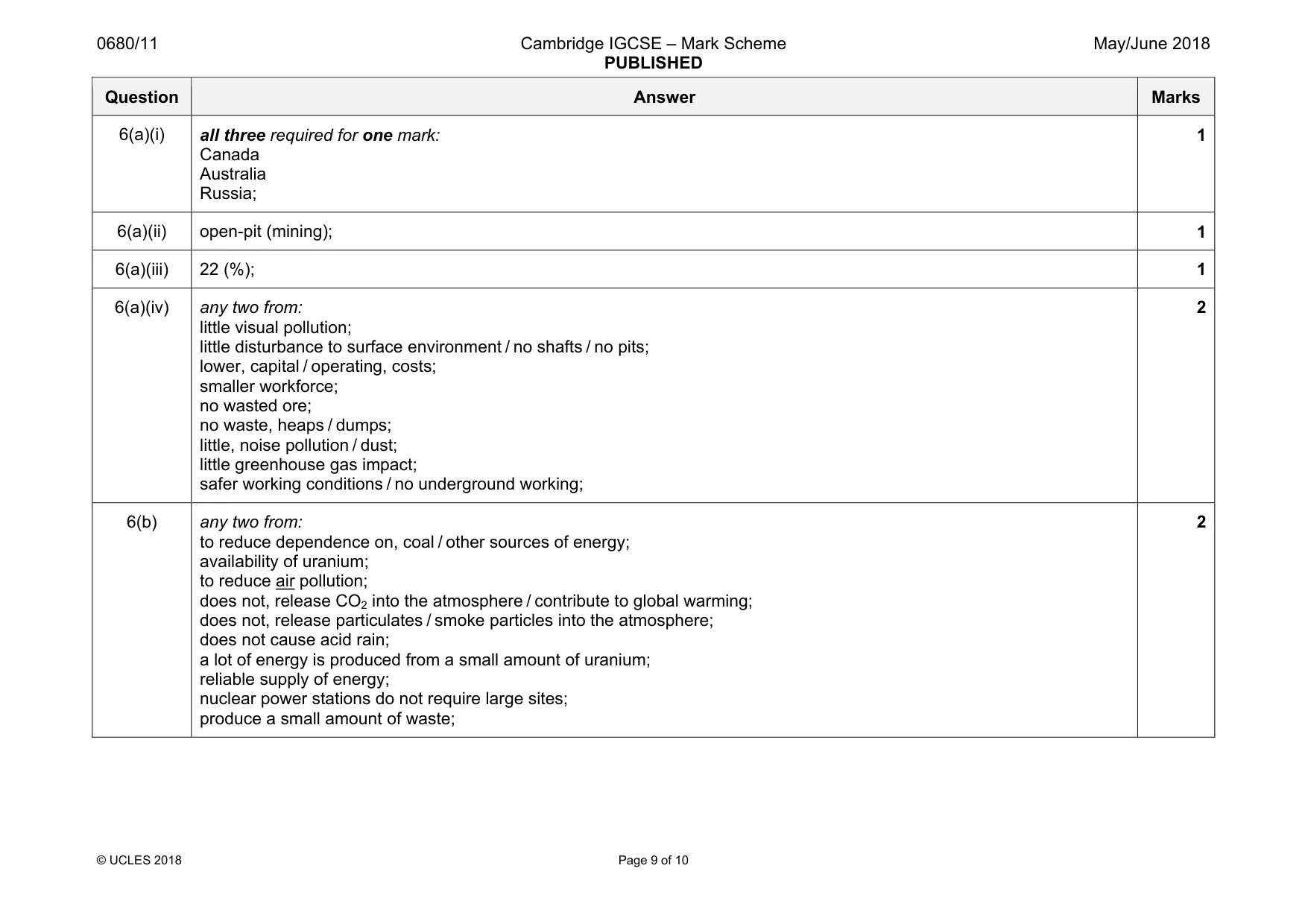
0680/11 Cambridge IGCSE – Mark Scheme PUBLISHED May/June 2018 © UCLES 2018 Page 9 of 10 Question Answer Marks 6(a)(i) all three required for one mark: Canada Australia Russia; 1 6(a)(ii) open-pit (mining); 1 6(a)(iii) 22 (%); 1 6(a)(iv) any two from: little visual pollution; little disturbance to surface environment / no shafts / no pits; lower, capital / operating, costs; smaller workforce; no wasted ore; no waste, heaps / dumps; little, noise pollution / dust; little greenhouse gas impact; safer working conditions / no underground working; 2 6(b) any two from: to reduce dependence on, coal / other sources of energy; availability of uranium; to reduce air pollution; does not, release CO2 into the atmosphere / contribute to global warming; does not, release particulates / smoke particles into the atmosphere; does not cause acid rain; a lot of energy is produced from a small amount of uranium; reliable supply of energy; nuclear power stations do not require large sites; produce a small amount of waste; 2
Mark scheme, page 10
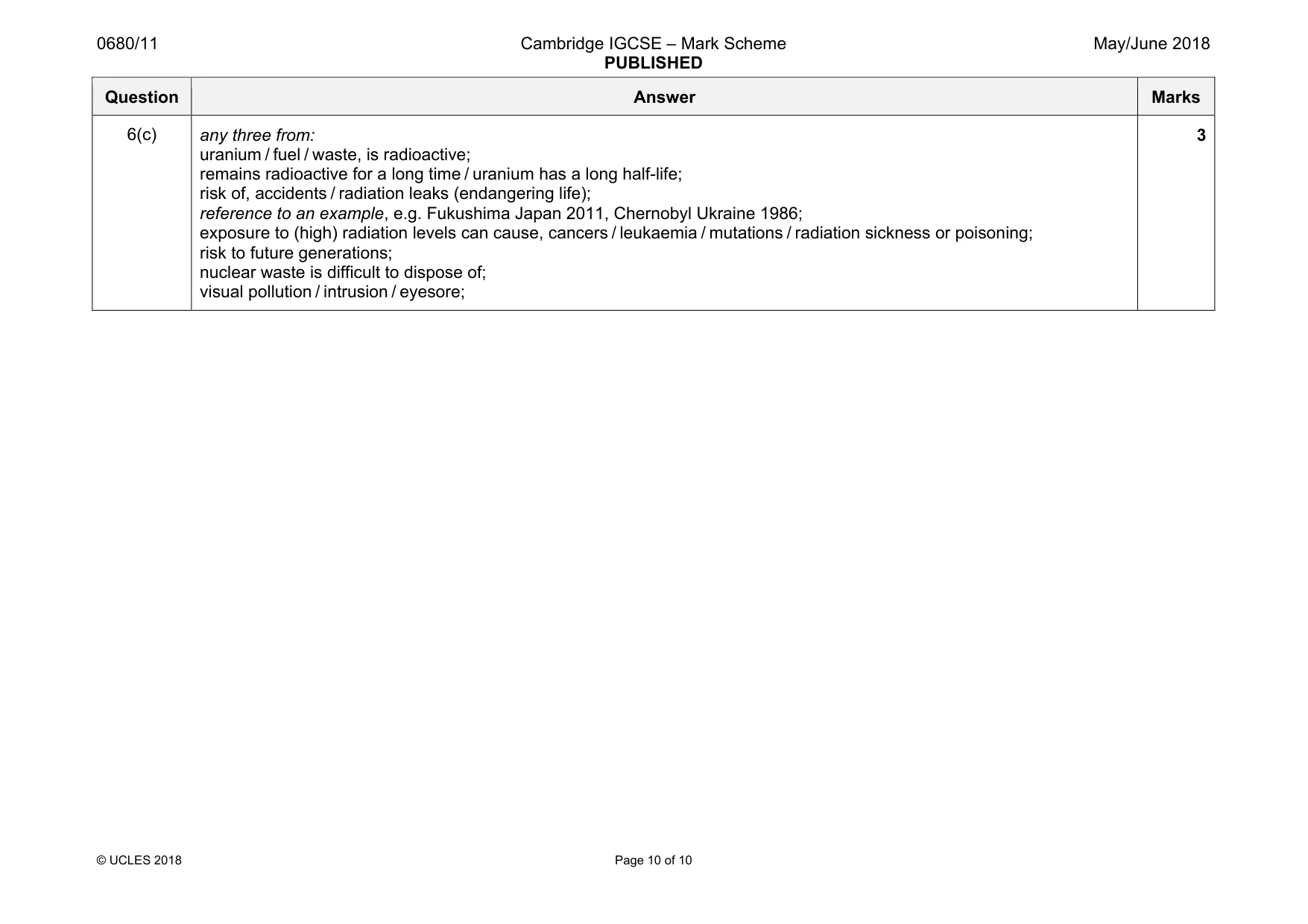
0680/11 Cambridge IGCSE – Mark Scheme PUBLISHED May/June 2018 © UCLES 2018 Page 10 of 10 Question Answer Marks 6(c) any three from: uranium / fuel / waste, is radioactive; remains radioactive for a long time / uranium has a long half-life; risk of, accidents / radiation leaks (endangering life); reference to an example, e.g. Fukushima Japan 2011, Chernobyl Ukraine 1986; exposure to (high) radiation levels can cause, cancers / leukaemia / mutations / radiation sickness or poisoning; risk to future generations; nuclear waste is difficult to dispose of; visual pollution / intrusion / eyesore; 3
What you needed in this session
Cambridge’s own grade thresholds for 2018 May/June, Paper 1 · Variant 1. A higher threshold means an easier paper — the bar moves with how the cohort did.