Cambridge IGCSE Environmental Management 0680 — 2017 Oct/Nov Paper 1 · Variant 2
0680/12/O/N/17 · 60 marks · ≈68 min
The question paper and its mark scheme, free to read here and free to download. This is Cambridge’s own paper, exactly as it was sat.
Question paper16 pages




Mark scheme9 pages
Answers below. Sit the paper first if you are practising.
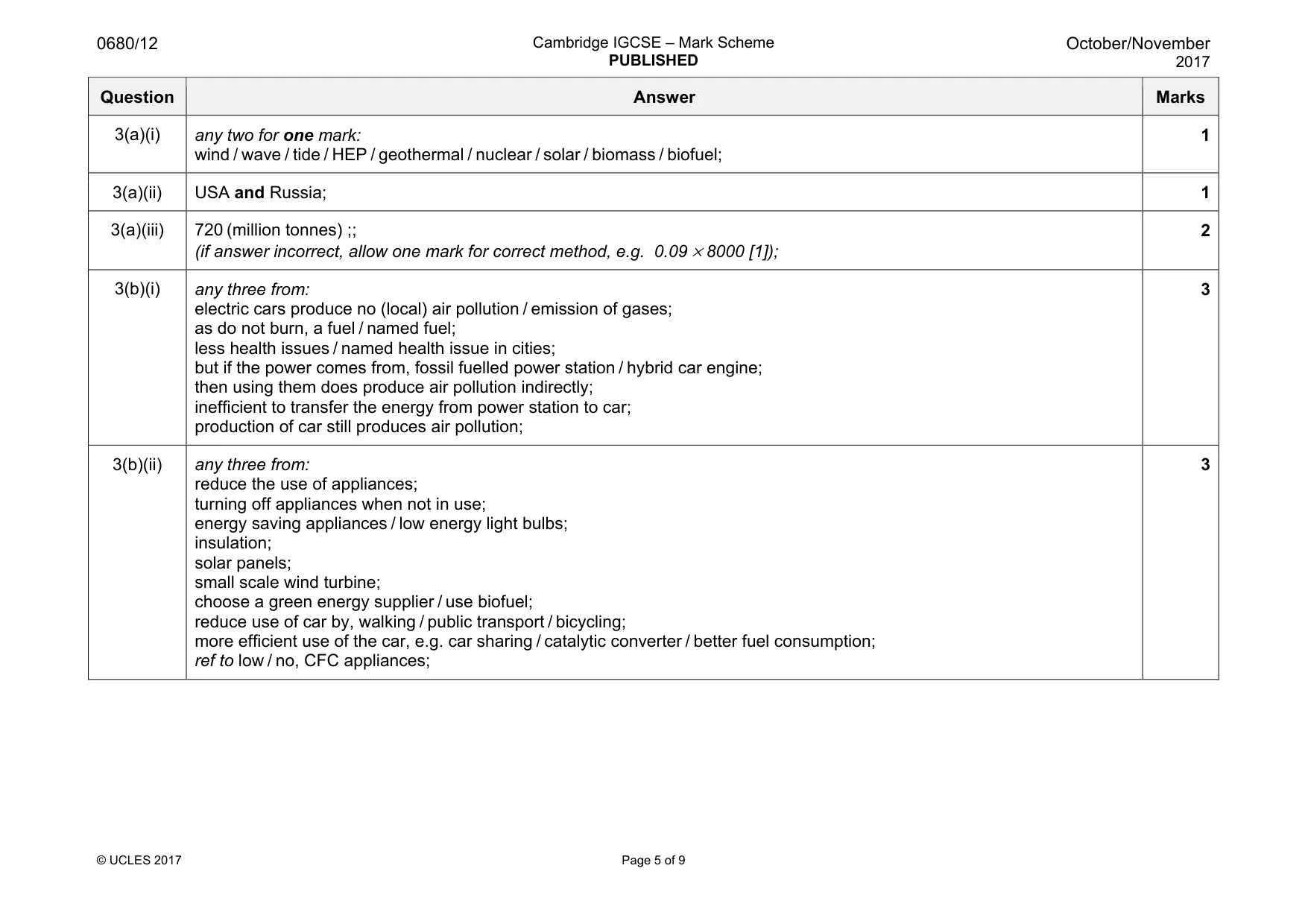
Paper as text
Question paper, page 1
* 4 8 0 3 8 5 2 5 8 3 * This document consists of 14 printed pages and 2 blank pages. DC (AL/JG) 136879/3 © UCLES 2017 [Turn over ENVIRONMENTAL MANAGEMENT 0680/12 Paper 1 October/November 2017 1 hour 30 minutes Candidates answer on the Question Paper. No Additional Materials are required. READ THESE INSTRUCTIONS FIRST Write your Centre number, candidate number and name on all the work you hand in. Write in dark blue or black pen. You may use an HB pencil for any diagrams or graphs. Do not use staples, paper clips, glue or correction fluid. DO NOT WRITE IN ANY BARCODES. Answer all questions. Electronic calculators may be used. You may lose marks if you do not show your working or if you do not use appropriate units. At the end of the examination, fasten all your work securely together. The number of marks is given in brackets [ ] at the end of each question or part question. Cambridge International Examinations Cambridge International General Certificate of Secondary Education
Question paper, page 2
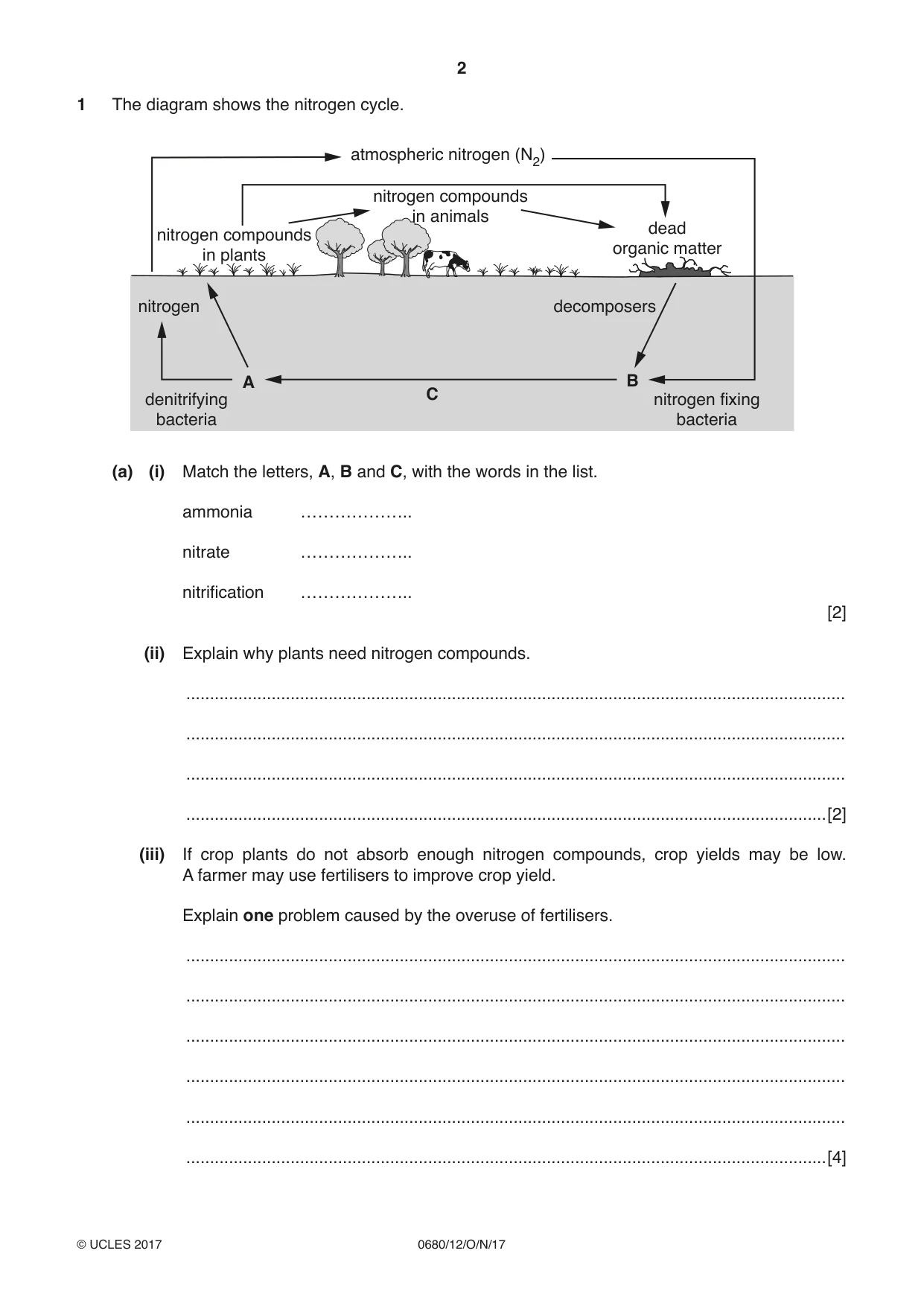
2 0680/12/O/N/17 © UCLES 2017 1 The diagram shows the nitrogen cycle. nitrogen compounds in plants nitrogen atmospheric nitrogen (N2) decomposers nitrogen fixing bacteria denitrifying bacteria dead organic matter A C B nitrogen compounds in animals (a) (i) Match the letters, A, B and C, with the words in the list. ammonia ……………….. nitrate ……………….. nitrification ……………….. [2] (ii) Explain why plants need nitrogen compounds. … … … …[2] (iii) If crop plants do not absorb enough nitrogen compounds, crop yields may be low. A farmer may use fertilisers to improve crop yield. Explain one problem caused by the overuse of fertilisers. … … … … … …[4]
Question paper, page 3
3 0680/12/O/N/17 © UCLES 2017 [Turn over (iv) Suggest one way crop yields may be improved without the use of fertilisers. … … … …[2]
Question paper, page 4
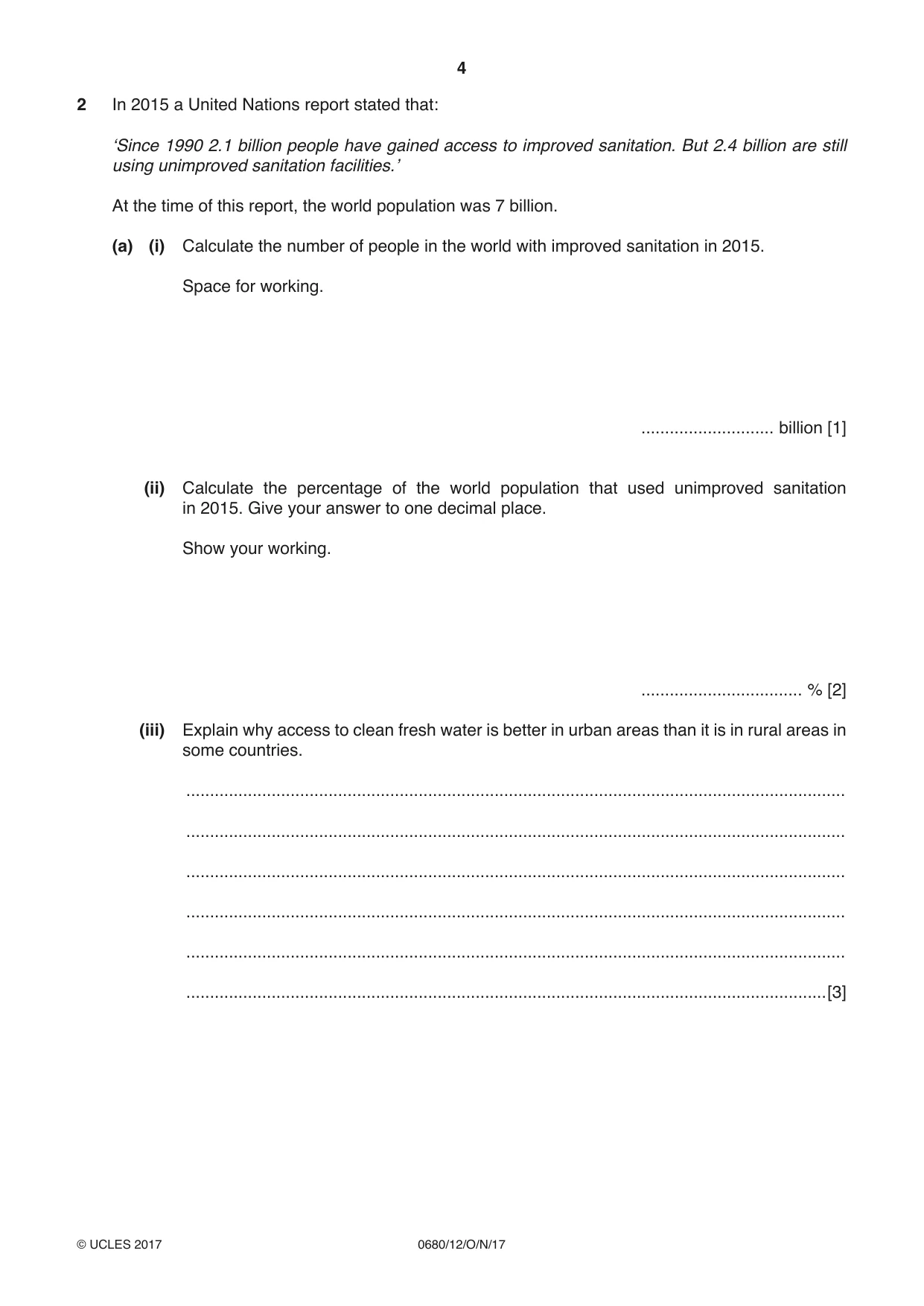
4 0680/12/O/N/17 © UCLES 2017 2 In 2015 a United Nations report stated that: ‘Since 1990 2.1 billion people have gained access to improved sanitation. But 2.4 billion are still using unimproved sanitation facilities.’ At the time of this report, the world population was 7 billion. (a) (i) Calculate the number of people in the world with improved sanitation in 2015. Space for working. … billion [1] (ii) Calculate the percentage of the world population that used unimproved sanitation in 2015. Give your answer to one decimal place. Show your working. … % [2] (iii) Explain why access to clean fresh water is better in urban areas than it is in rural areas in some countries. … … … … … …[3]
Question paper, page 5
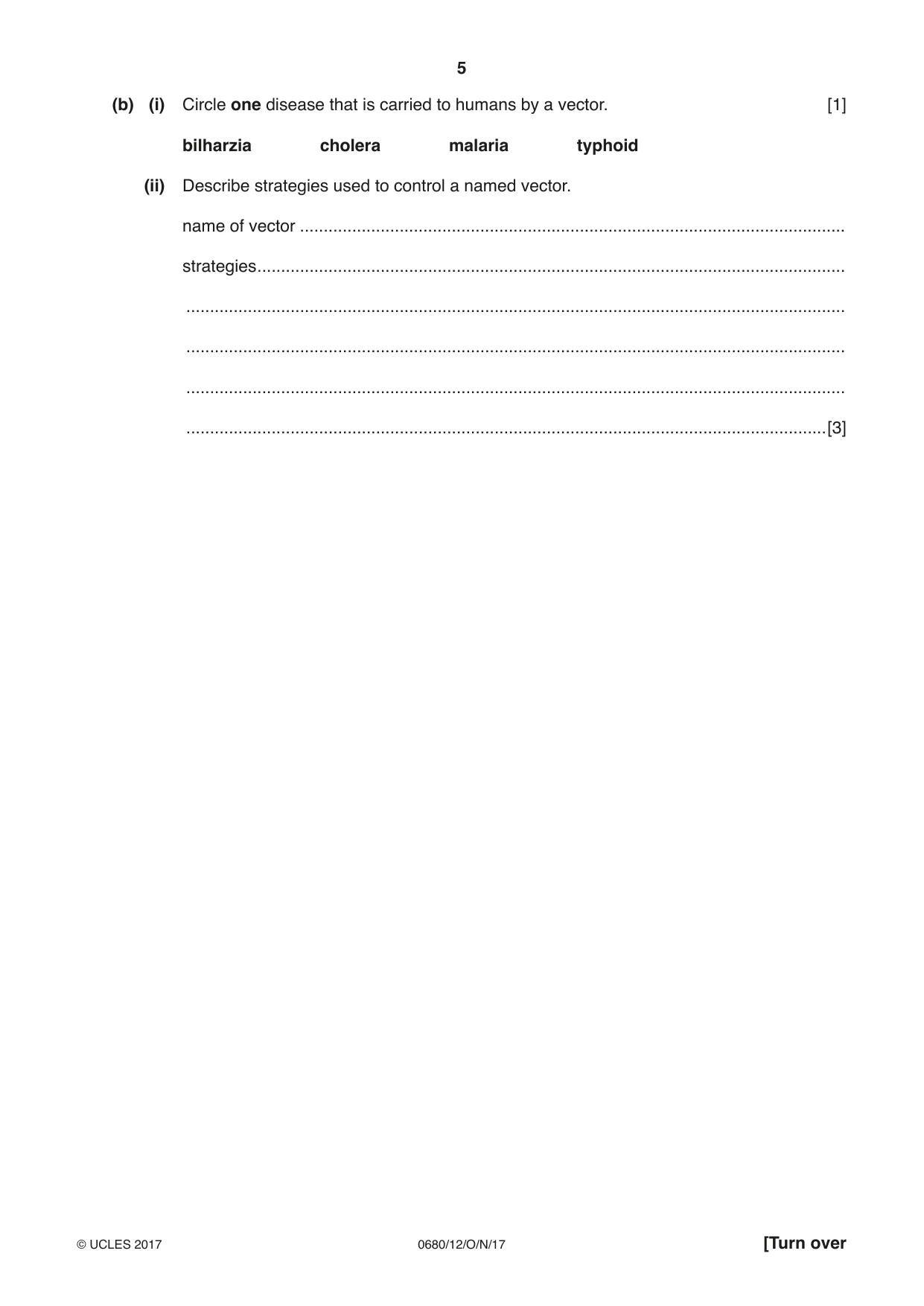
5 0680/12/O/N/17 © UCLES 2017 [Turn over (b) (i) Circle one disease that is carried to humans by a vector. [1] bilharzia cholera malaria typhoid (ii) Describe strategies used to control a named vector. name of vector … strategies … … … … …[3]
Question paper, page 6
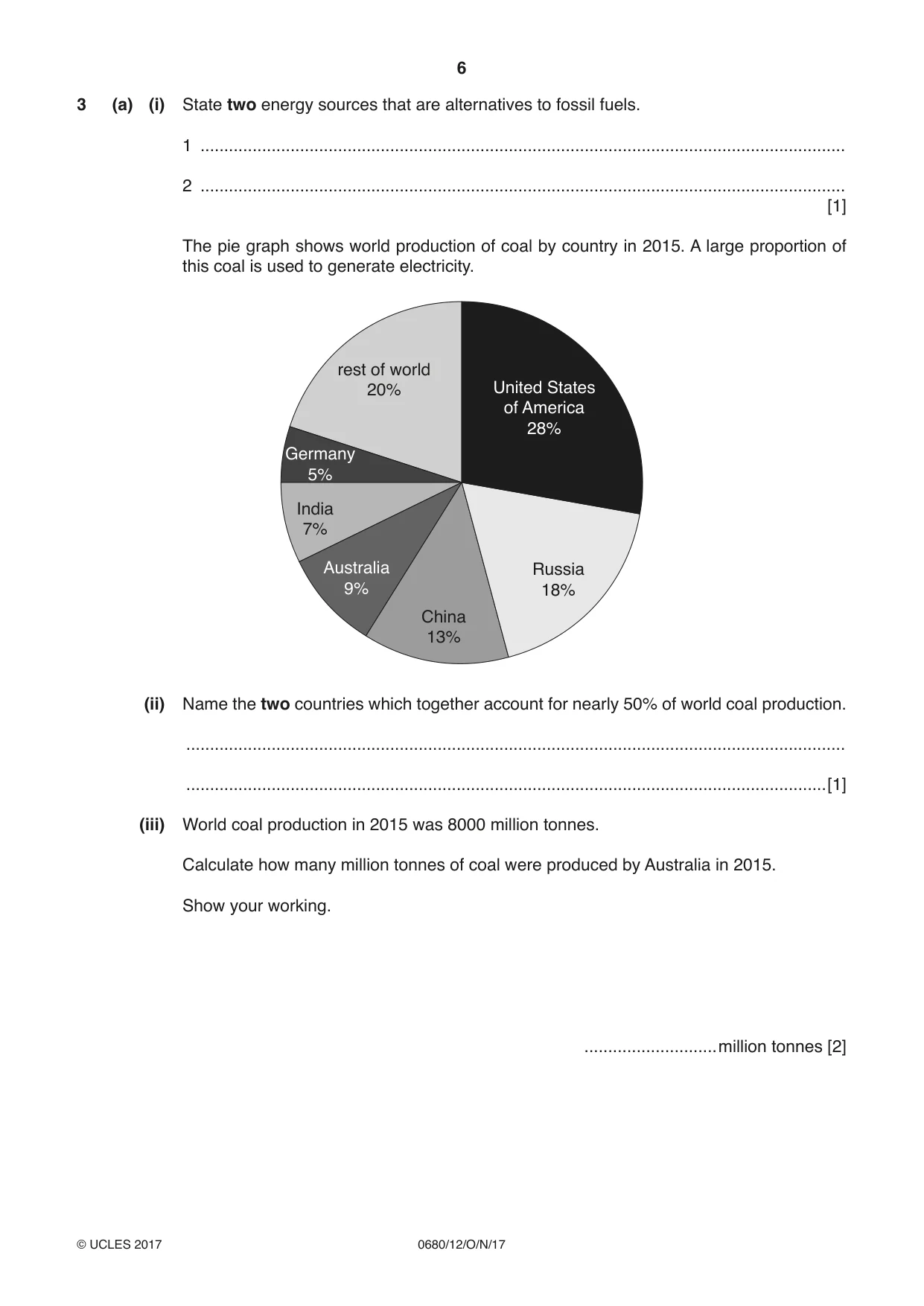
6 0680/12/O/N/17 © UCLES 2017 3 (a) (i) State two energy sources that are alternatives to fossil fuels. 1 … 2 … [1] The pie graph shows world production of coal by country in 2015. A large proportion of this coal is used to generate electricity. United States of America 28% Russia 18% China 13% India 7% Germany 5% Australia 9% rest of world 20% (ii) Name the two countries which together account for nearly 50% of world coal production. … …[1] (iii) World coal production in 2015 was 8000 million tonnes. Calculate how many million tonnes of coal were produced by Australia in 2015. Show your working. …million tonnes [2]
Question paper, page 7
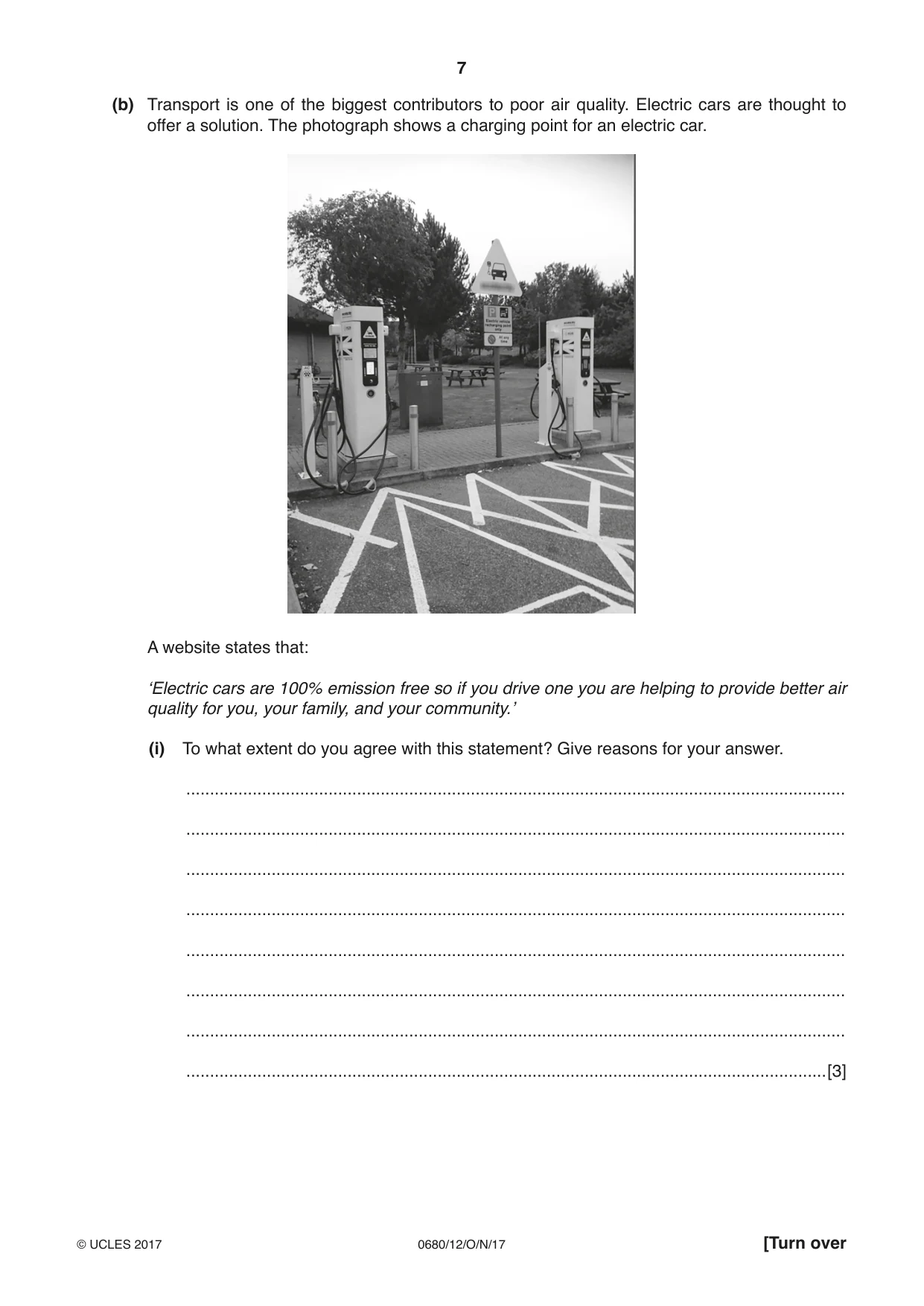
7 0680/12/O/N/17 © UCLES 2017 [Turn over (b) Transport is one of the biggest contributors to poor air quality. Electric cars are thought to offer a solution. The photograph shows a charging point for an electric car. A website states that: ‘Electric cars are 100% emission free so if you drive one you are helping to provide better air quality for you, your family, and your community.’ (i) To what extent do you agree with this statement? Give reasons for your answer. … … … … … … … …[3]
Question paper, page 8
8 0680/12/O/N/17 © UCLES 2017 (ii) Describe how householders in developed countries could reduce their contribution to air pollution. … … … …[3]
Question paper, page 9
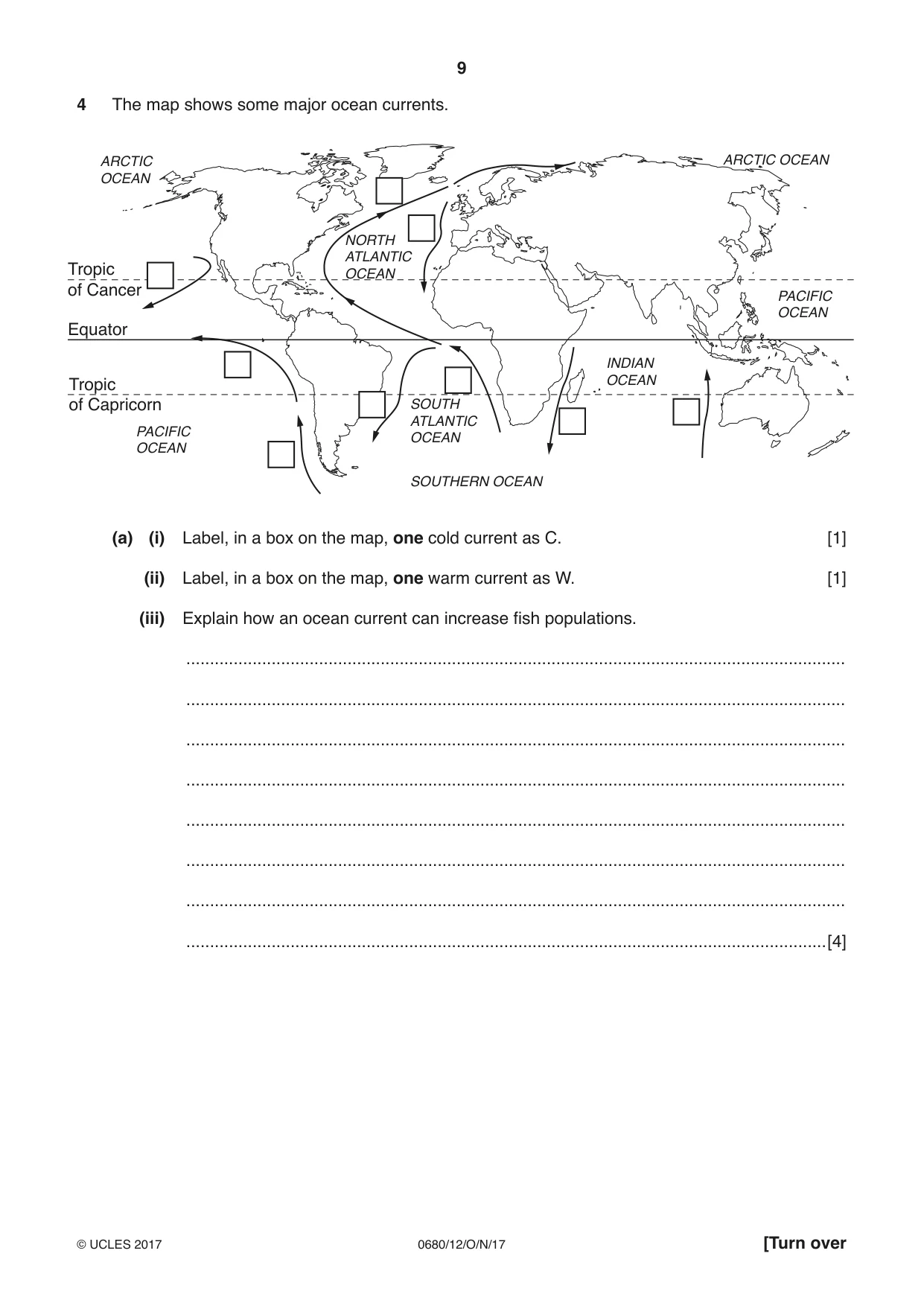
9 0680/12/O/N/17 © UCLES 2017 [Turn over 4 The map shows some major ocean currents. Tropic of Cancer Tropic of Capricorn Equator PACIFIC OCEAN ARCTIC OCEAN ARCTIC OCEAN PACIFIC OCEAN INDIAN OCEAN SOUTH ATLANTIC OCEAN NORTH ATLANTIC OCEAN SOUTHERN OCEAN (a) (i) Label, in a box on the map, one cold current as C. [1] (ii) Label, in a box on the map, one warm current as W. [1] (iii) Explain how an ocean current can increase fish populations. … … … … … … … …[4]
Question paper, page 10
10 0680/12/O/N/17 © UCLES 2017 (b) (i) State one way in which pollution with raw sewage might affect water quality in the ocean. … …[1] (ii) Explain how raw sewage can be managed to reduce its effects on water quality. … … … … … …[3]
Question paper, page 11
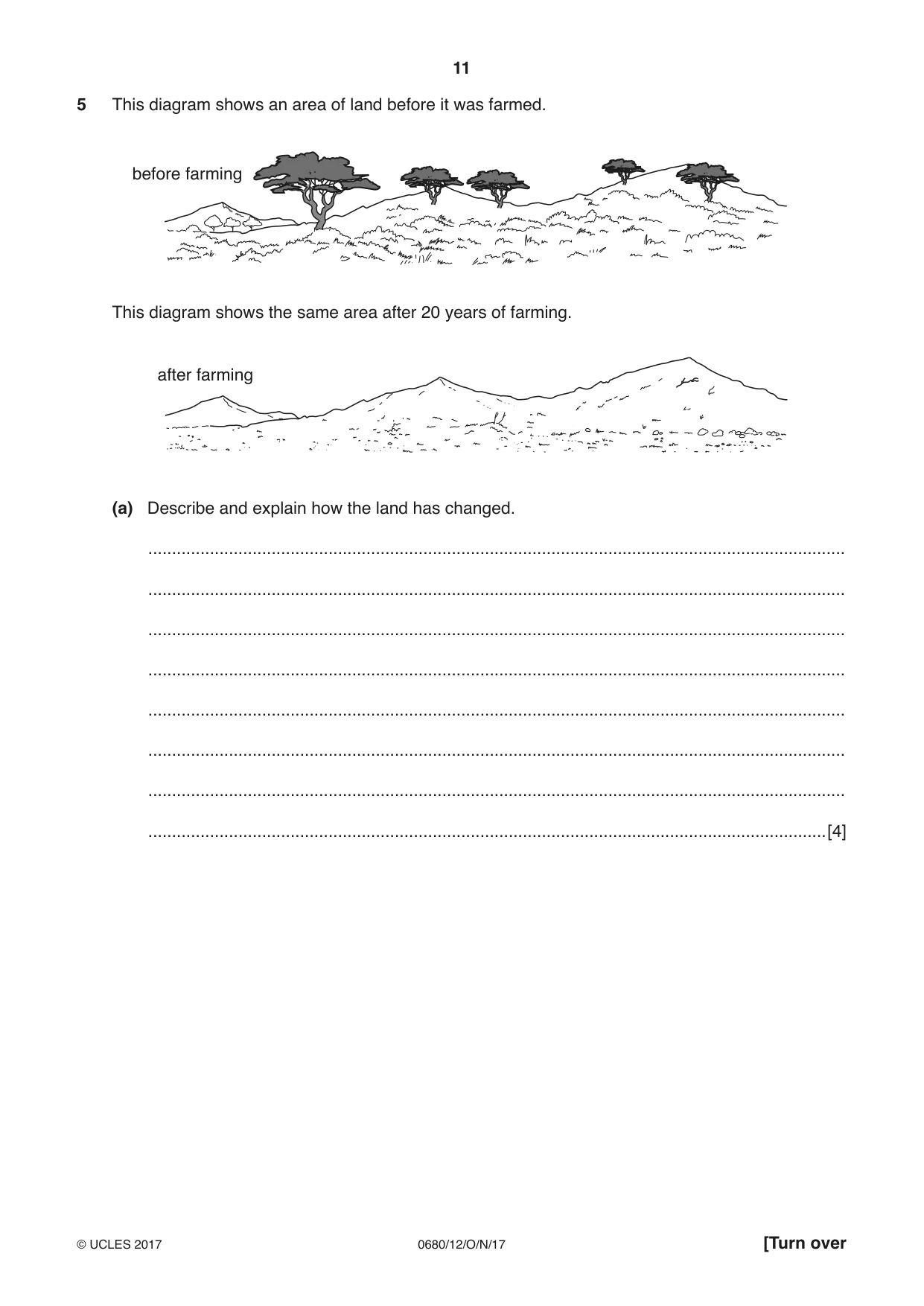
11 0680/12/O/N/17 © UCLES 2017 [Turn over 5 This diagram shows an area of land before it was farmed. before farming This diagram shows the same area after 20 years of farming. after farming (a) Describe and explain how the land has changed. … … … … … … … …[4]
Question paper, page 12
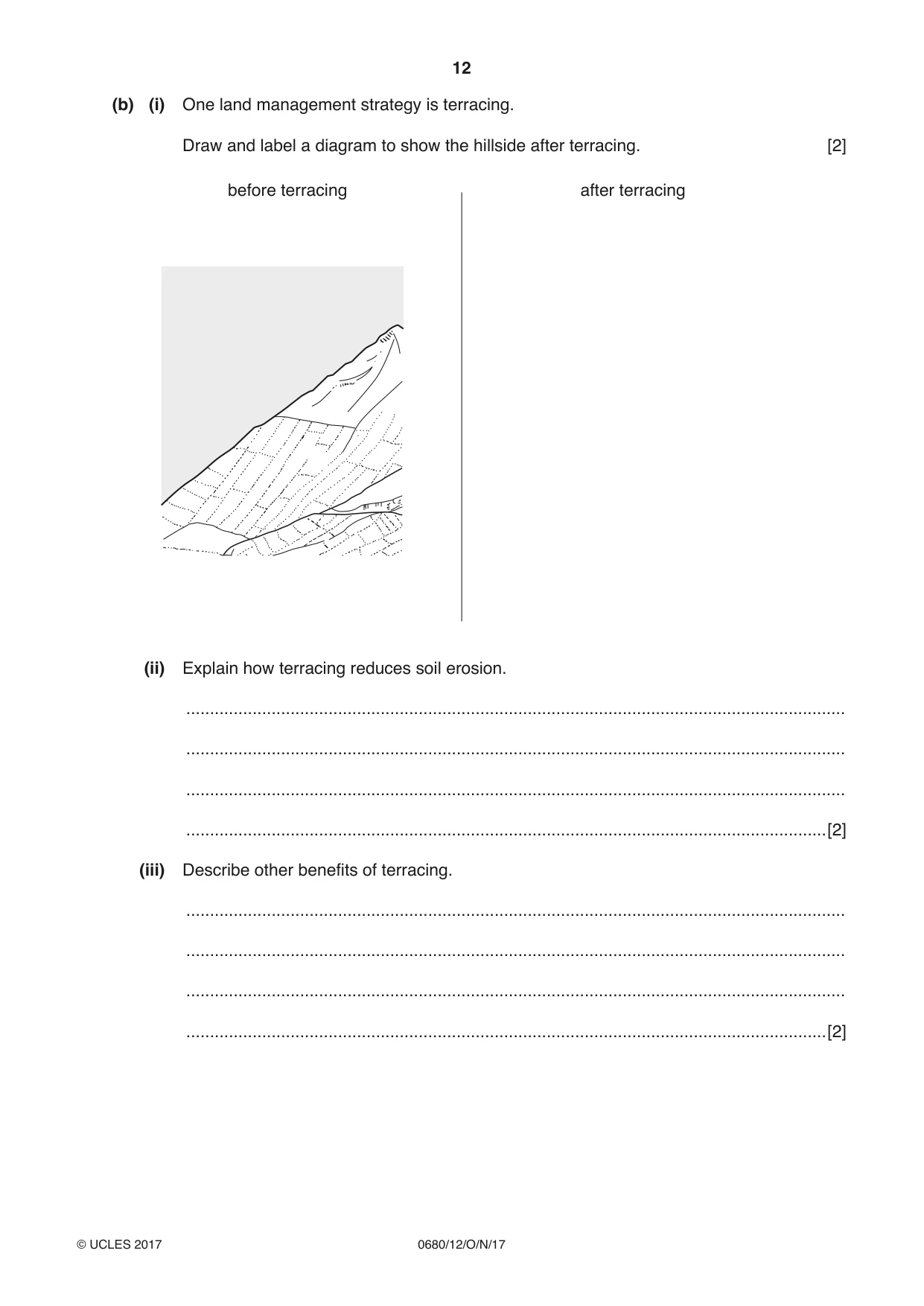
12 0680/12/O/N/17 © UCLES 2017 (b) (i) One land management strategy is terracing. Draw and label a diagram to show the hillside after terracing. [2] before terracing after terracing (ii) Explain how terracing reduces soil erosion. … … … …[2] (iii) Describe other benefits of terracing. … … … …[2]
Question paper, page 13
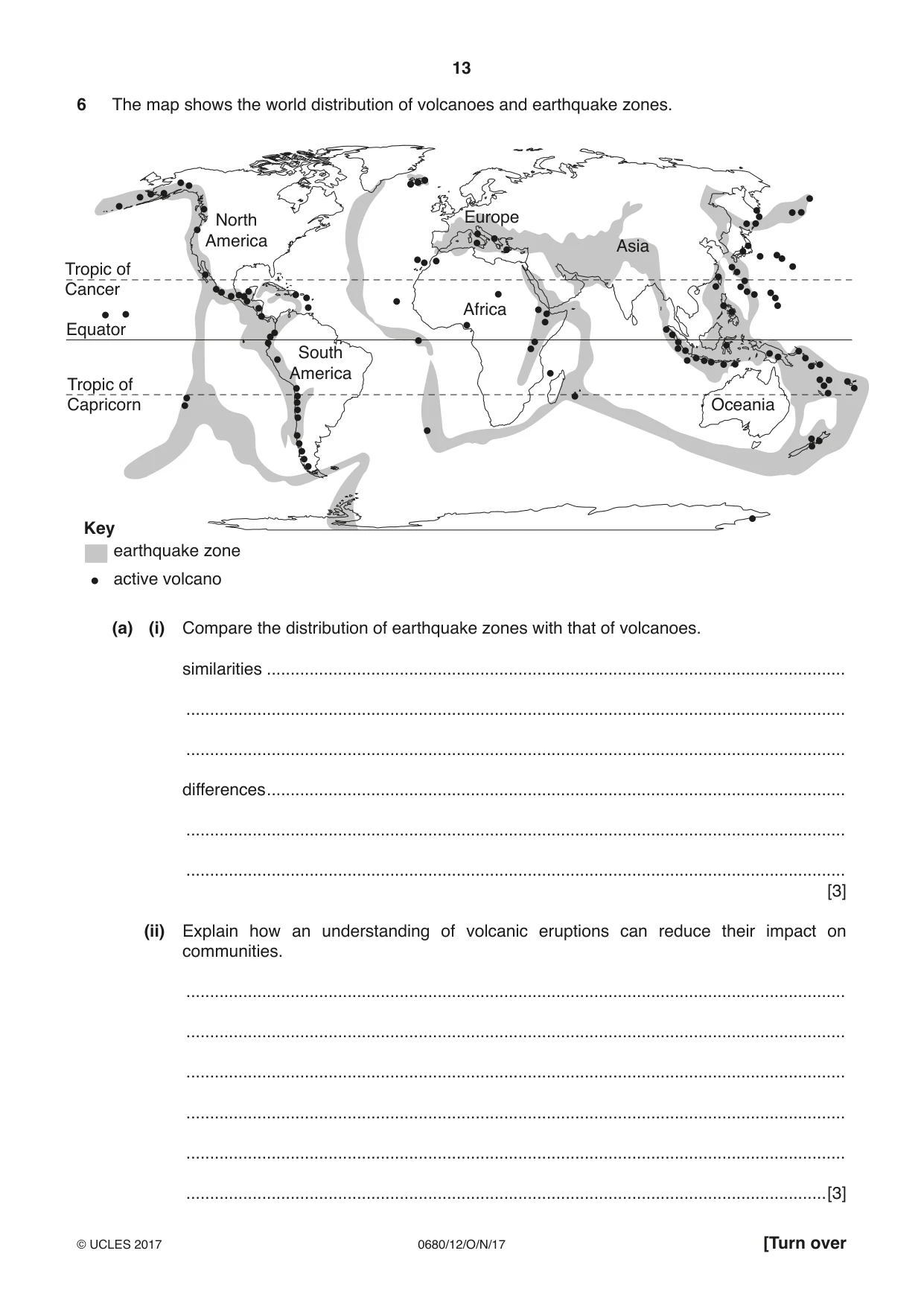
13 0680/12/O/N/17 © UCLES 2017 [Turn over 6 The map shows the world distribution of volcanoes and earthquake zones. Key earthquake zone active volcano Tropic of Cancer Tropic of Capricorn Equator North America South America Africa Europe Asia Oceania (a) (i) Compare the distribution of earthquake zones with that of volcanoes. similarities … … … differences … … … [3] (ii) Explain how an understanding of volcanic eruptions can reduce their impact on communities. … … … … … …[3]
Question paper, page 14
14 0680/12/O/N/17 © UCLES 2017 (b) (i) Nuclear energy does not contribute to acid rain or an increased global temperature. Name one source of energy which does contribute to both of these problems. …[1] (ii) Describe some of the problems which are associated with nuclear power. … … … … … …[3]
Question paper, page 15
15 0680/12/O/N/17 © UCLES 2017 BLANK PAGE
Question paper, page 16
16 0680/12/O/N/17 © UCLES 2017 BLANK PAGE Permission to reproduce items where third-party owned material protected by copyright is included has been sought and cleared where possible. Every reasonable effort has been made by the publisher (UCLES) to trace copyright holders, but if any items requiring clearance have unwittingly been included, the publisher will be pleased to make amends at the earliest possible opportunity. To avoid the issue of disclosure of answer-related information to candidates, all copyright acknowledgements are reproduced online in the Cambridge International Examinations Copyright Acknowledgements Booklet. This is produced for each series of examinations and is freely available to download at www.cie.org.uk after the live examination series. Cambridge International Examinations is part of the Cambridge Assessment Group. Cambridge Assessment is the brand name of University of Cambridge Local Examinations Syndicate (UCLES), which is itself a department of the University of Cambridge.
Mark scheme, page 1
® IGCSE is a registered trademark. This document consists of 9 printed pages. © UCLES 2017 [Turn over Cambridge Assessment International Education Cambridge International General Certificate of Secondary Education ENVIRONMENTAL MANAGEMENT 0680/12 Paper 1 October/November 2017 MARK SCHEME Maximum Mark: 60 Published This mark scheme is published as an aid to teachers and candidates, to indicate the requirements of the examination. It shows the basis on which Examiners were instructed to award marks. It does not indicate the details of the discussions that took place at an Examiners’ meeting before marking began, which would have considered the acceptability of alternative answers. Mark schemes should be read in conjunction with the question paper and the Principal Examiner Report for Teachers. Cambridge International will not enter into discussions about these mark schemes. Cambridge International is publishing the mark schemes for the October/November 2017 series for most Cambridge IGCSE®, Cambridge International A and AS Level components and some Cambridge O Level components.
Mark scheme, page 2
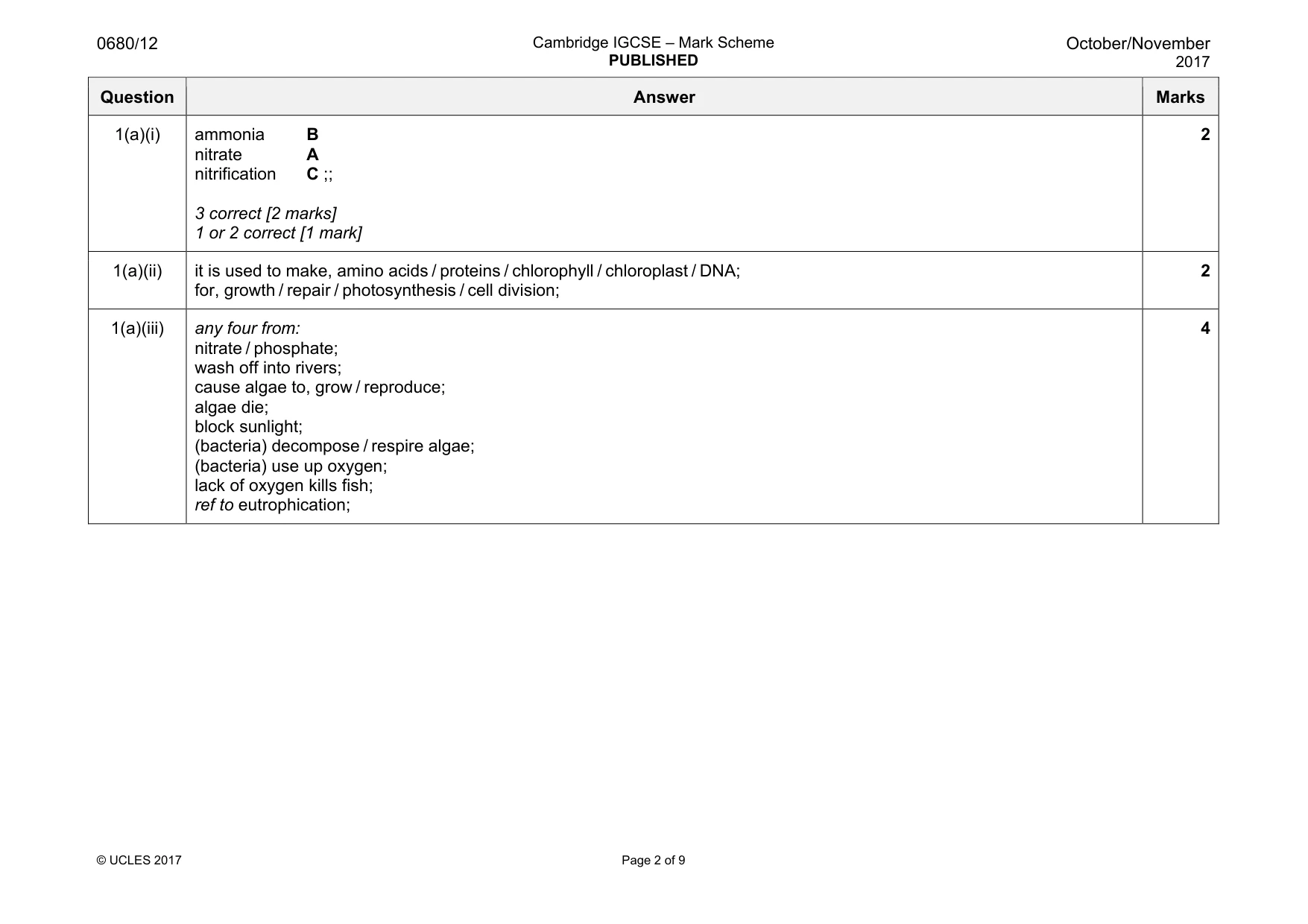
0680/12 Cambridge IGCSE – Mark Scheme PUBLISHED October/November 2017 © UCLES 2017 Page 2 of 9 Question Answer Marks 1(a)(i) ammonia B nitrate A nitrification C ;; 3 correct [2 marks] 1 or 2 correct [1 mark] 2 1(a)(ii) it is used to make, amino acids / proteins / chlorophyll / chloroplast / DNA; for, growth / repair / photosynthesis / cell division; 2 1(a)(iii) any four from: nitrate / phosphate; wash off into rivers; cause algae to, grow / reproduce; algae die; block sunlight; (bacteria) decompose / respire algae; (bacteria) use up oxygen; lack of oxygen kills fish; ref to eutrophication; 4
Mark scheme, page 3
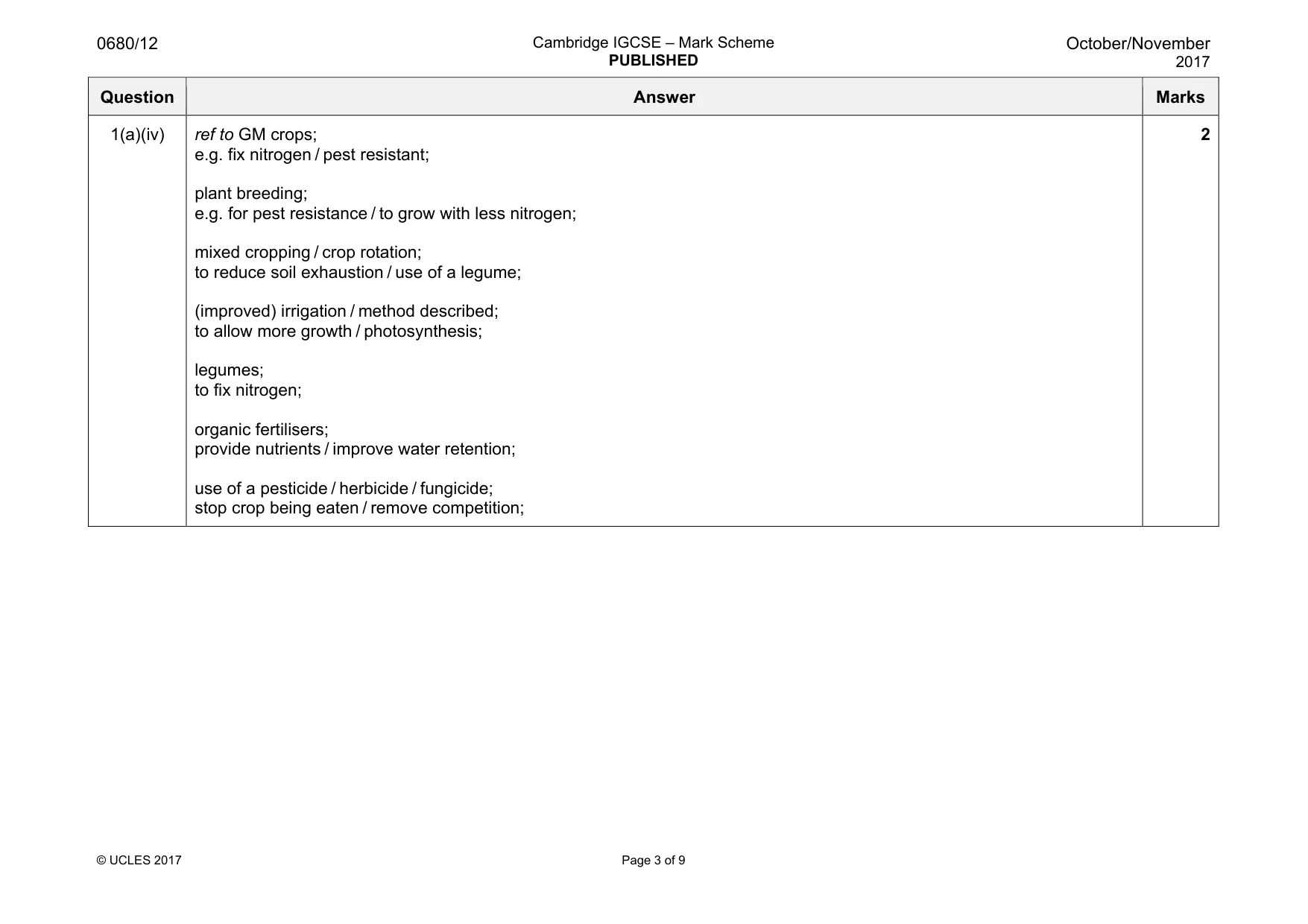
0680/12 Cambridge IGCSE – Mark Scheme PUBLISHED October/November 2017 © UCLES 2017 Page 3 of 9 Question Answer Marks 1(a)(iv) ref to GM crops; e.g. fix nitrogen / pest resistant; plant breeding; e.g. for pest resistance / to grow with less nitrogen; mixed cropping / crop rotation; to reduce soil exhaustion / use of a legume; (improved) irrigation / method described; to allow more growth / photosynthesis; legumes; to fix nitrogen; organic fertilisers; provide nutrients / improve water retention; use of a pesticide / herbicide / fungicide; stop crop being eaten / remove competition; 2
Mark scheme, page 4
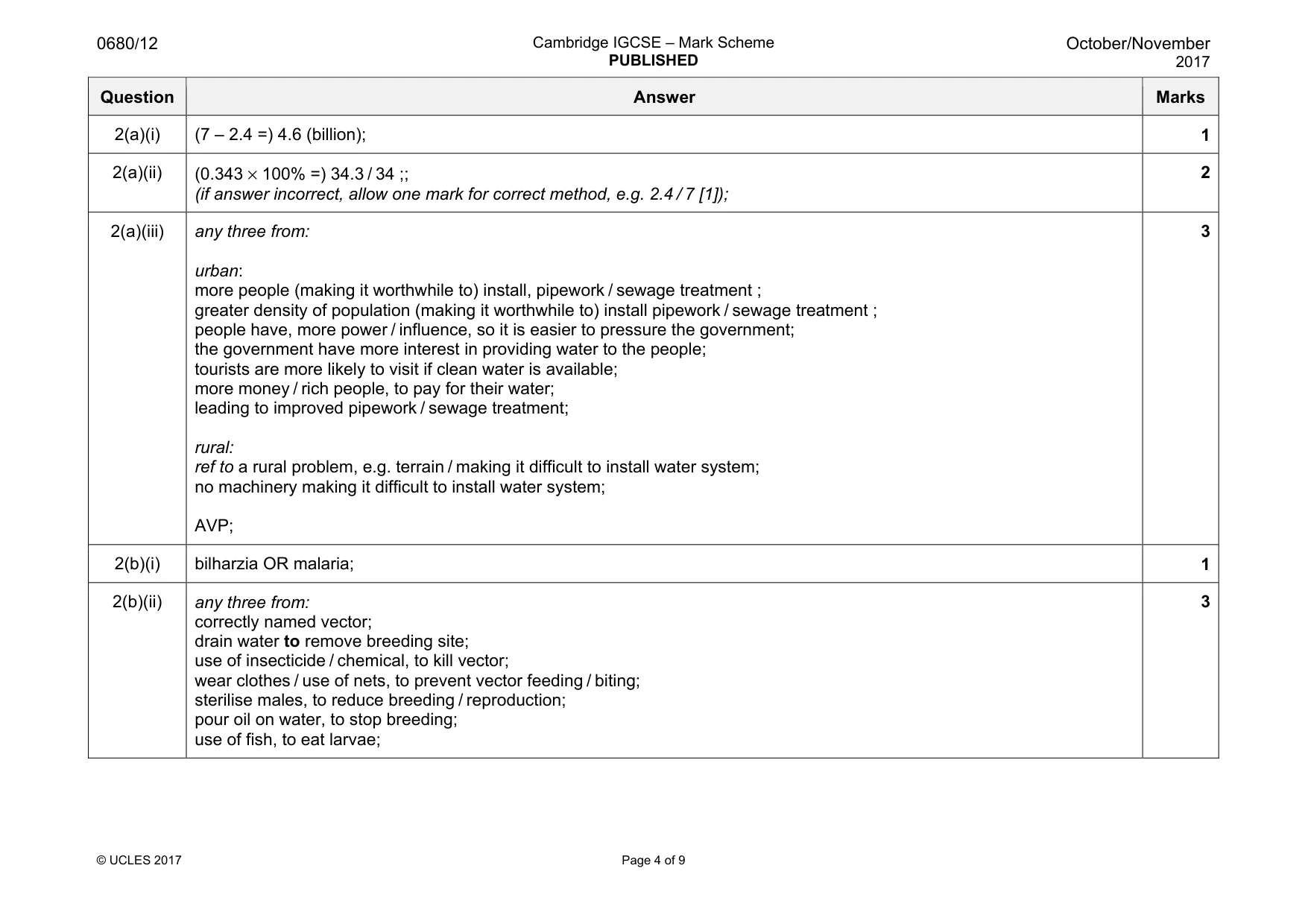
0680/12 Cambridge IGCSE – Mark Scheme PUBLISHED October/November 2017 © UCLES 2017 Page 4 of 9 Question Answer Marks 2(a)(i) (7 – 2.4 =) 4.6 (billion); 1 2(a)(ii) (0.343 × 100% =) 34.3 / 34 ;; (if answer incorrect, allow one mark for correct method, e.g. 2.4 / 7 [1]); 2 2(a)(iii) any three from: urban: more people (making it worthwhile to) install, pipework / sewage treatment ; greater density of population (making it worthwhile to) install pipework / sewage treatment ; people have, more power / influence, so it is easier to pressure the government; the government have more interest in providing water to the people; tourists are more likely to visit if clean water is available; more money / rich people, to pay for their water; leading to improved pipework / sewage treatment; rural: ref to a rural problem, e.g. terrain / making it difficult to install water system; no machinery making it difficult to install water system; AVP; 3 2(b)(i) bilharzia OR malaria; 1 2(b)(ii) any three from: correctly named vector; drain water to remove breeding site; use of insecticide / chemical, to kill vector; wear clothes / use of nets, to prevent vector feeding / biting; sterilise males, to reduce breeding / reproduction; pour oil on water, to stop breeding; use of fish, to eat larvae; 3
Mark scheme, page 5
0680/12 Cambridge IGCSE – Mark Scheme PUBLISHED October/November 2017 © UCLES 2017 Page 5 of 9 Question Answer Marks 3(a)(i) any two for one mark: wind / wave / tide / HEP / geothermal / nuclear / solar / biomass / biofuel; 1 3(a)(ii) USA and Russia; 1 3(a)(iii) 720 (million tonnes) ;; (if answer incorrect, allow one mark for correct method, e.g. 0.09 × 8000 [1]); 2 3(b)(i) any three from: electric cars produce no (local) air pollution / emission of gases; as do not burn, a fuel / named fuel; less health issues / named health issue in cities; but if the power comes from, fossil fuelled power station / hybrid car engine; then using them does produce air pollution indirectly; inefficient to transfer the energy from power station to car; production of car still produces air pollution; 3 3(b)(ii) any three from: reduce the use of appliances; turning off appliances when not in use; energy saving appliances / low energy light bulbs; insulation; solar panels; small scale wind turbine; choose a green energy supplier / use biofuel; reduce use of car by, walking / public transport / bicycling; more efficient use of the car, e.g. car sharing / catalytic converter / better fuel consumption; ref to low / no, CFC appliances; 3
Mark scheme, page 6
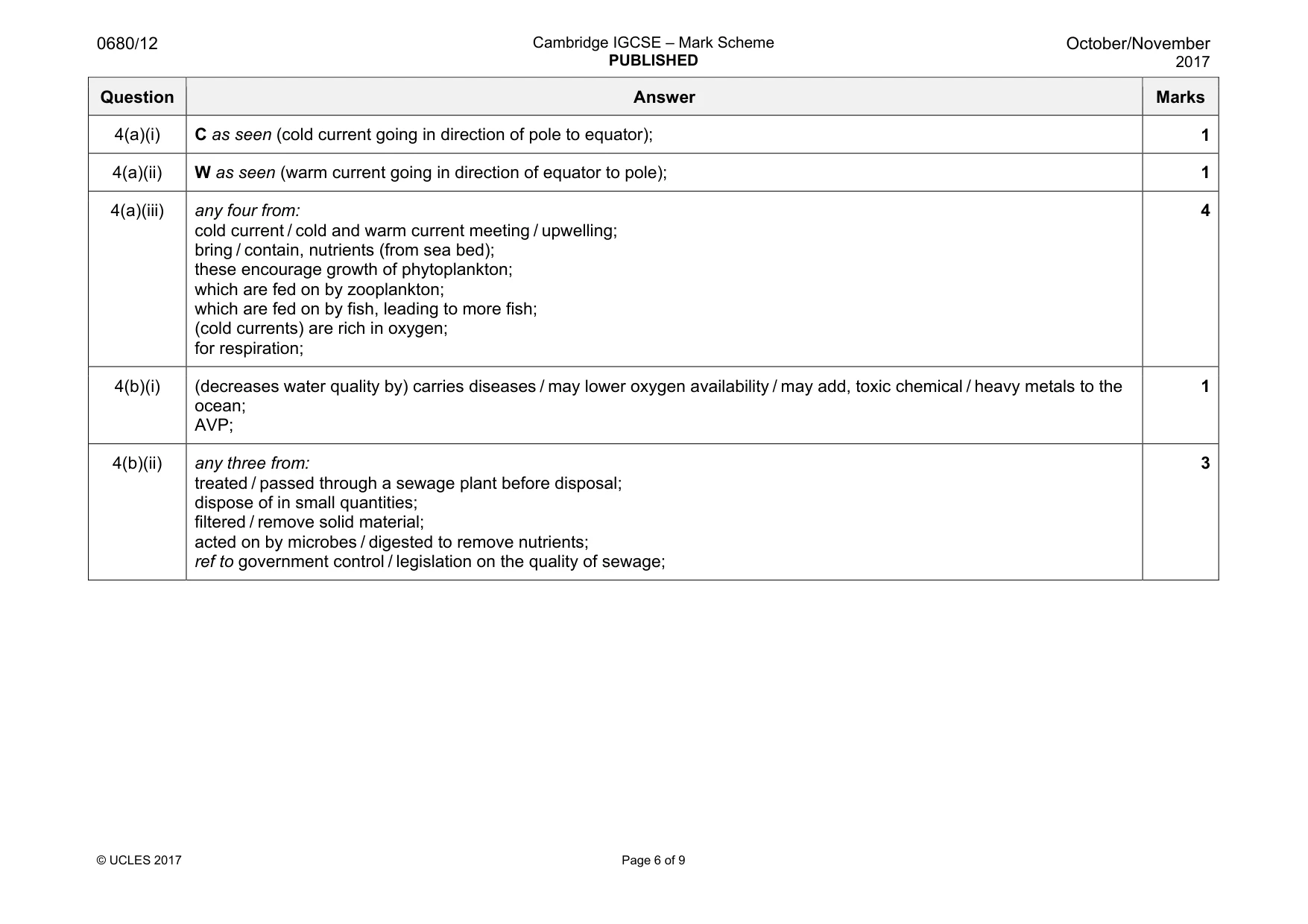
0680/12 Cambridge IGCSE – Mark Scheme PUBLISHED October/November 2017 © UCLES 2017 Page 6 of 9 Question Answer Marks 4(a)(i) C as seen (cold current going in direction of pole to equator); 1 4(a)(ii) W as seen (warm current going in direction of equator to pole); 1 4(a)(iii) any four from: cold current / cold and warm current meeting / upwelling; bring / contain, nutrients (from sea bed); these encourage growth of phytoplankton; which are fed on by zooplankton; which are fed on by fish, leading to more fish; (cold currents) are rich in oxygen; for respiration; 4 4(b)(i) (decreases water quality by) carries diseases / may lower oxygen availability / may add, toxic chemical / heavy metals to the ocean; AVP; 1 4(b)(ii) any three from: treated / passed through a sewage plant before disposal; dispose of in small quantities; filtered / remove solid material; acted on by microbes / digested to remove nutrients; ref to government control / legislation on the quality of sewage; 3
Mark scheme, page 7
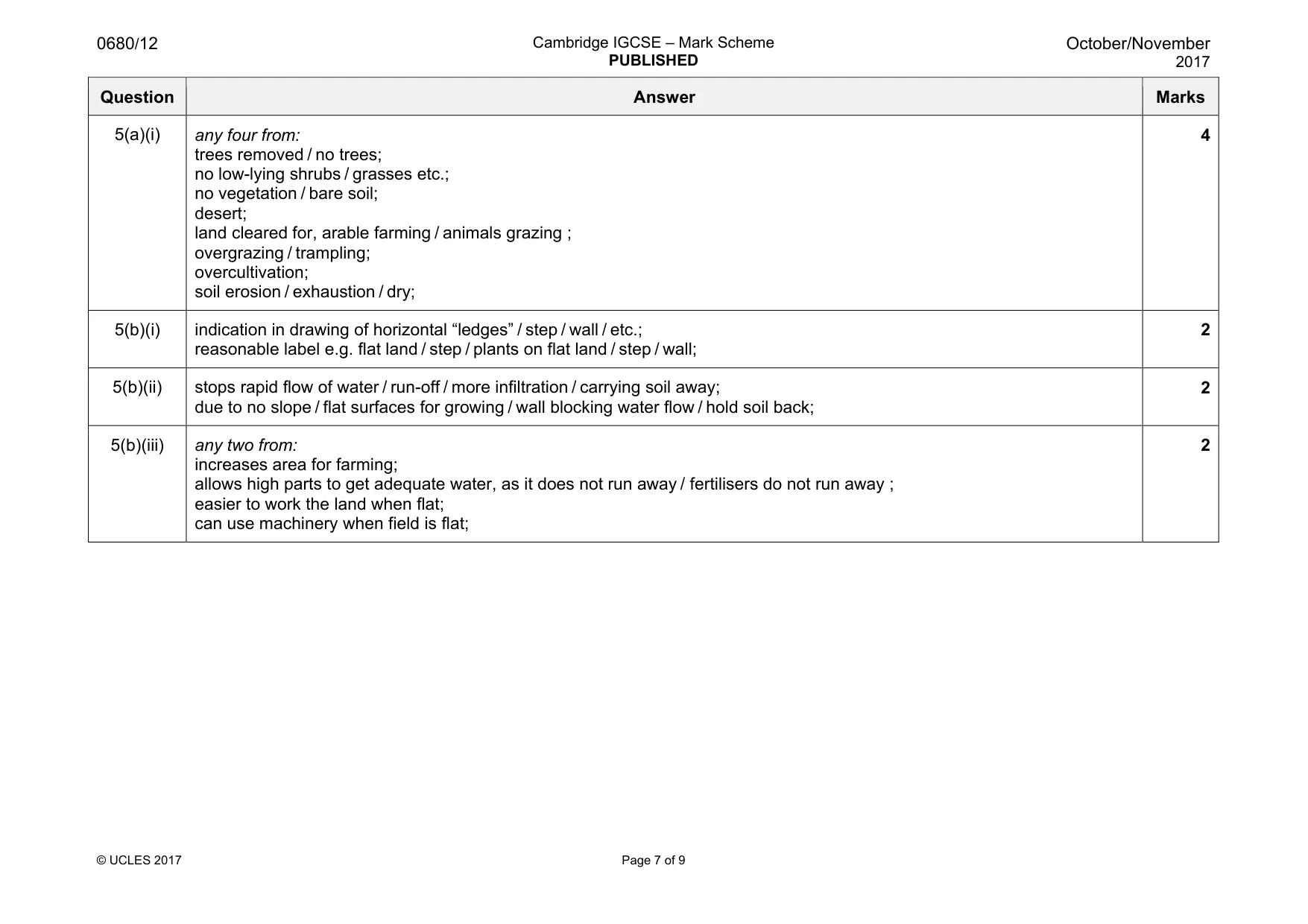
0680/12 Cambridge IGCSE – Mark Scheme PUBLISHED October/November 2017 © UCLES 2017 Page 7 of 9 Question Answer Marks 5(a)(i) any four from: trees removed / no trees; no low-lying shrubs / grasses etc.; no vegetation / bare soil; desert; land cleared for, arable farming / animals grazing ; overgrazing / trampling; overcultivation; soil erosion / exhaustion / dry; 4 5(b)(i) indication in drawing of horizontal “ledges” / step / wall / etc.; reasonable label e.g. flat land / step / plants on flat land / step / wall; 2 5(b)(ii) stops rapid flow of water / run-off / more infiltration / carrying soil away; due to no slope / flat surfaces for growing / wall blocking water flow / hold soil back; 2 5(b)(iii) any two from: increases area for farming; allows high parts to get adequate water, as it does not run away / fertilisers do not run away ; easier to work the land when flat; can use machinery when field is flat; 2
Mark scheme, page 8
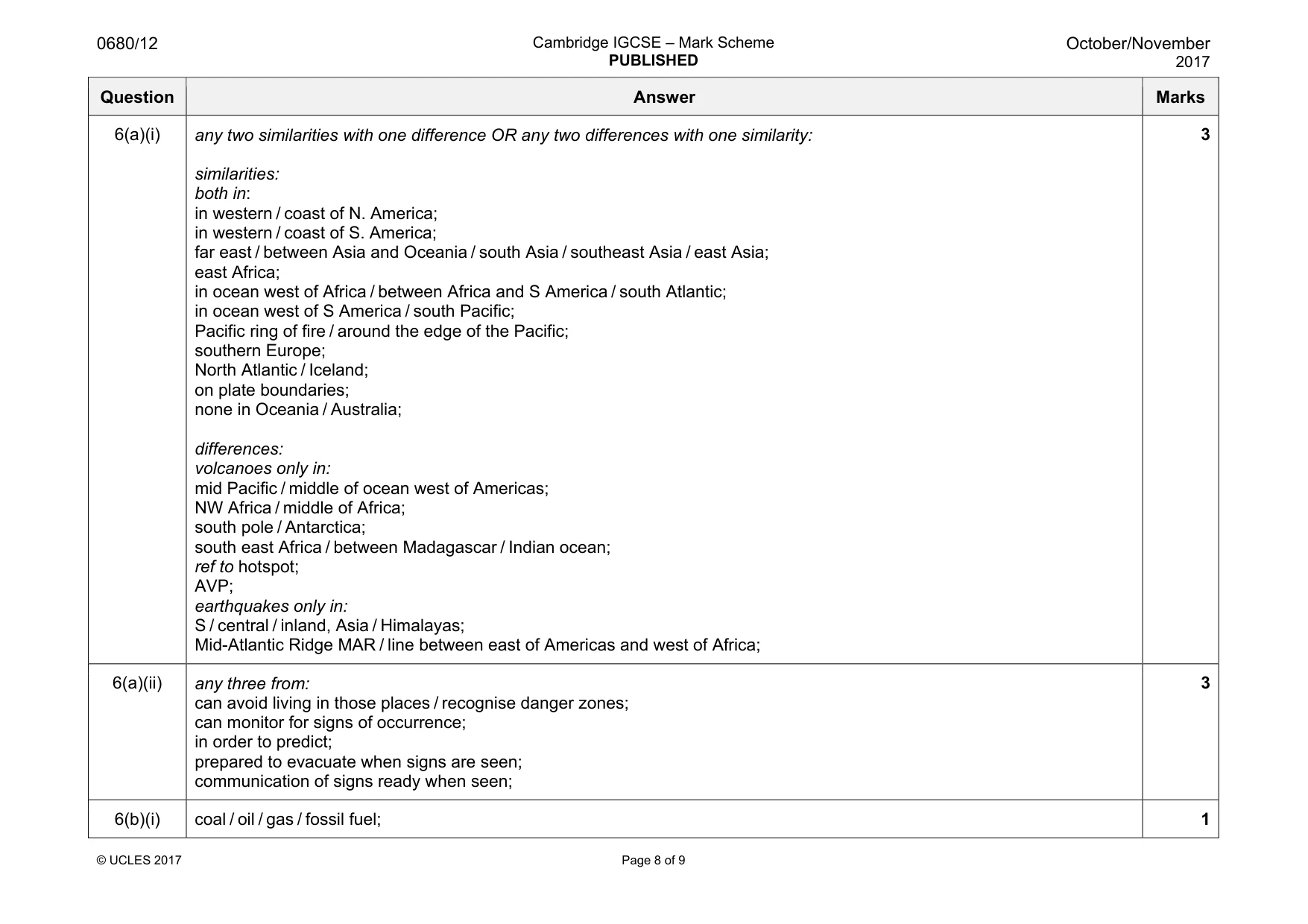
0680/12 Cambridge IGCSE – Mark Scheme PUBLISHED October/November 2017 © UCLES 2017 Page 8 of 9 Question Answer Marks 6(a)(i) any two similarities with one difference OR any two differences with one similarity: similarities: both in: in western / coast of N. America; in western / coast of S. America; far east / between Asia and Oceania / south Asia / southeast Asia / east Asia; east Africa; in ocean west of Africa / between Africa and S America / south Atlantic; in ocean west of S America / south Pacific; Pacific ring of fire / around the edge of the Pacific; southern Europe; North Atlantic / Iceland; on plate boundaries; none in Oceania / Australia; differences: volcanoes only in: mid Pacific / middle of ocean west of Americas; NW Africa / middle of Africa; south pole / Antarctica; south east Africa / between Madagascar / Indian ocean; ref to hotspot; AVP; earthquakes only in: S / central / inland, Asia / Himalayas; Mid-Atlantic Ridge MAR / line between east of Americas and west of Africa; 3 6(a)(ii) any three from: can avoid living in those places / recognise danger zones; can monitor for signs of occurrence; in order to predict; prepared to evacuate when signs are seen; communication of signs ready when seen; 3 6(b)(i) coal / oil / gas / fossil fuel; 1
Mark scheme, page 9
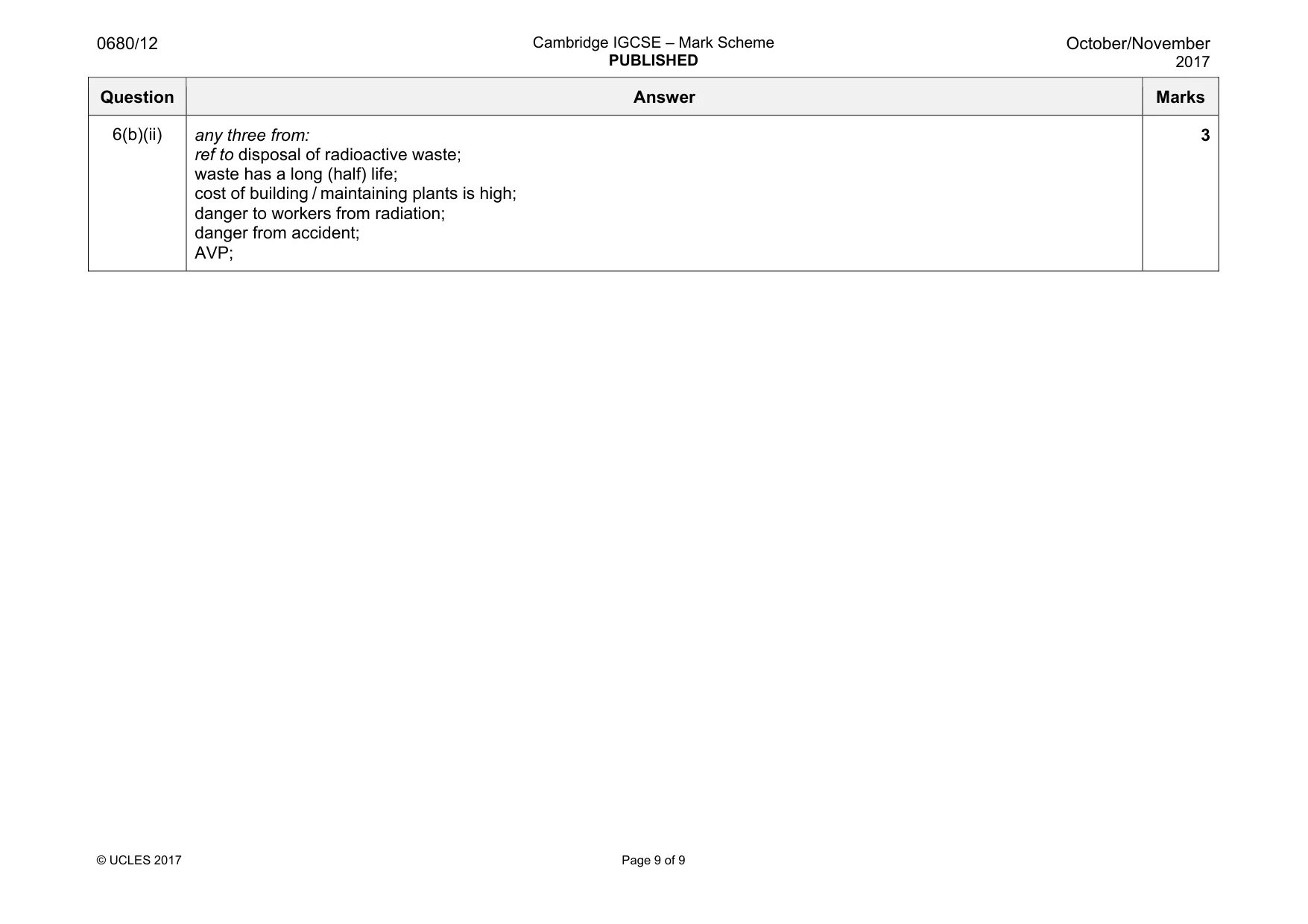
0680/12 Cambridge IGCSE – Mark Scheme PUBLISHED October/November 2017 © UCLES 2017 Page 9 of 9 Question Answer Marks 6(b)(ii) any three from: ref to disposal of radioactive waste; waste has a long (half) life; cost of building / maintaining plants is high; danger to workers from radiation; danger from accident; AVP; 3
What you needed in this session
Cambridge’s own grade thresholds for 2017 Oct/Nov, Paper 1 · Variant 2. A higher threshold means an easier paper — the bar moves with how the cohort did.