Cambridge IGCSE Environmental Management 0680 — 2017 Oct/Nov Paper 1 · Variant 1
0680/11/O/N/17 · 60 marks · ≈68 min
The question paper and its mark scheme, free to read here and free to download. This is Cambridge’s own paper, exactly as it was sat.
Question paper16 pages

Mark scheme10 pages
Answers below. Sit the paper first if you are practising.
Paper as text
Question paper, page 1
* 3 6 5 3 6 9 6 4 9 6 * Cambridge International Examinations Cambridge International General Certificate of Secondary Education This document consists of 14 printed pages and 2 blank pages. DC (NH/FC) 136839/4 © UCLES 2017 [Turn over ENVIRONMENTAL MANAGEMENT 0680/11 Paper 1 October/November 2017 1 hour 30 minutes Candidates answer on the Question Paper. No Additional Materials are required. READ THESE INSTRUCTIONS FIRST Write your Centre number, candidate number and name on all the work you hand in. Write in dark blue or black pen. You may use an HB pencil for any diagrams or graphs. Do not use staples, paper clips, glue or correction fluid. DO NOT WRITE IN ANY BARCODES. Answer all questions. Electronic calculators may be used. You may lose marks if you do not show your working or if you do not use appropriate units. At the end of the examination, fasten all your work securely together. The number of marks is given in brackets [ ] at the end of each question or part question.
Question paper, page 2
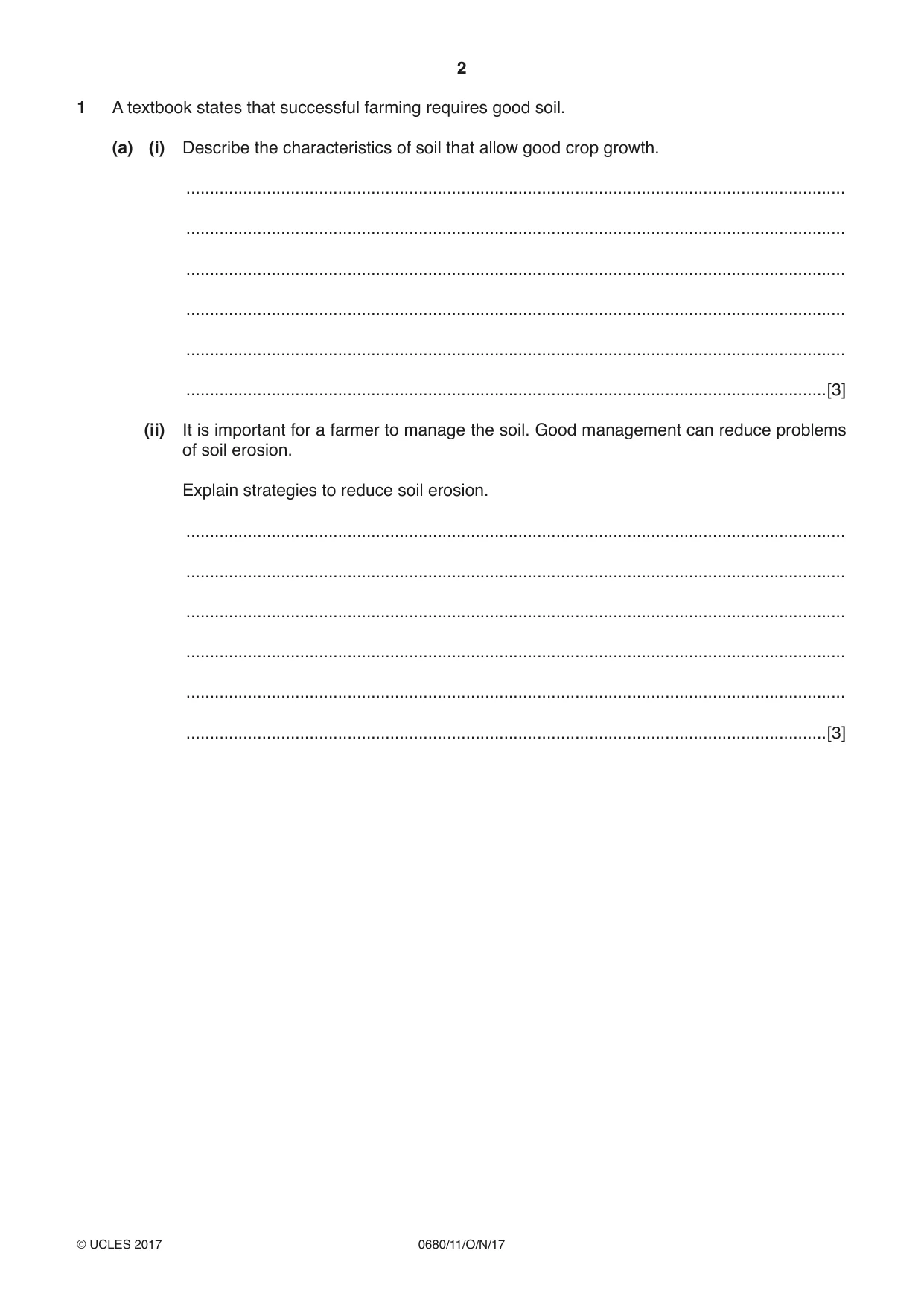
2 0680/11/O/N/17 © UCLES 2017 1 A textbook states that successful farming requires good soil. (a) (i) Describe the characteristics of soil that allow good crop growth. … … … … … …[3] (ii) It is important for a farmer to manage the soil. Good management can reduce problems of soil erosion. Explain strategies to reduce soil erosion. … … … … … …[3]
Question paper, page 3
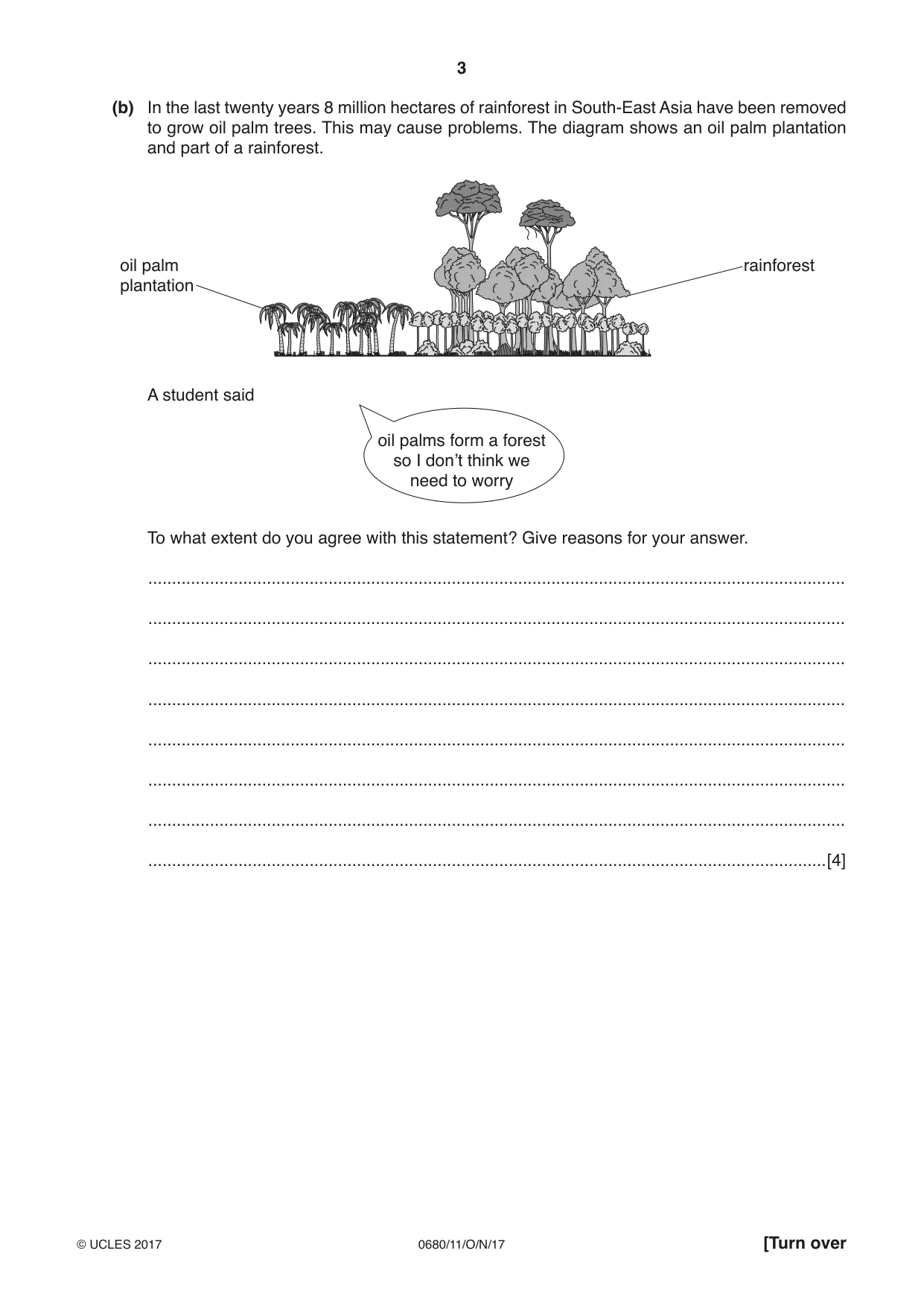
3 0680/11/O/N/17 © UCLES 2017 [Turn over (b) In the last twenty years 8 million hectares of rainforest in South-East Asia have been removed to grow oil palm trees. This may cause problems. The diagram shows an oil palm plantation and part of a rainforest. oil palm plantation rainforest A student said oil palms form a forest so I don’t think we need to worry To what extent do you agree with this statement? Give reasons for your answer. … … … … … … … …[4]
Question paper, page 4
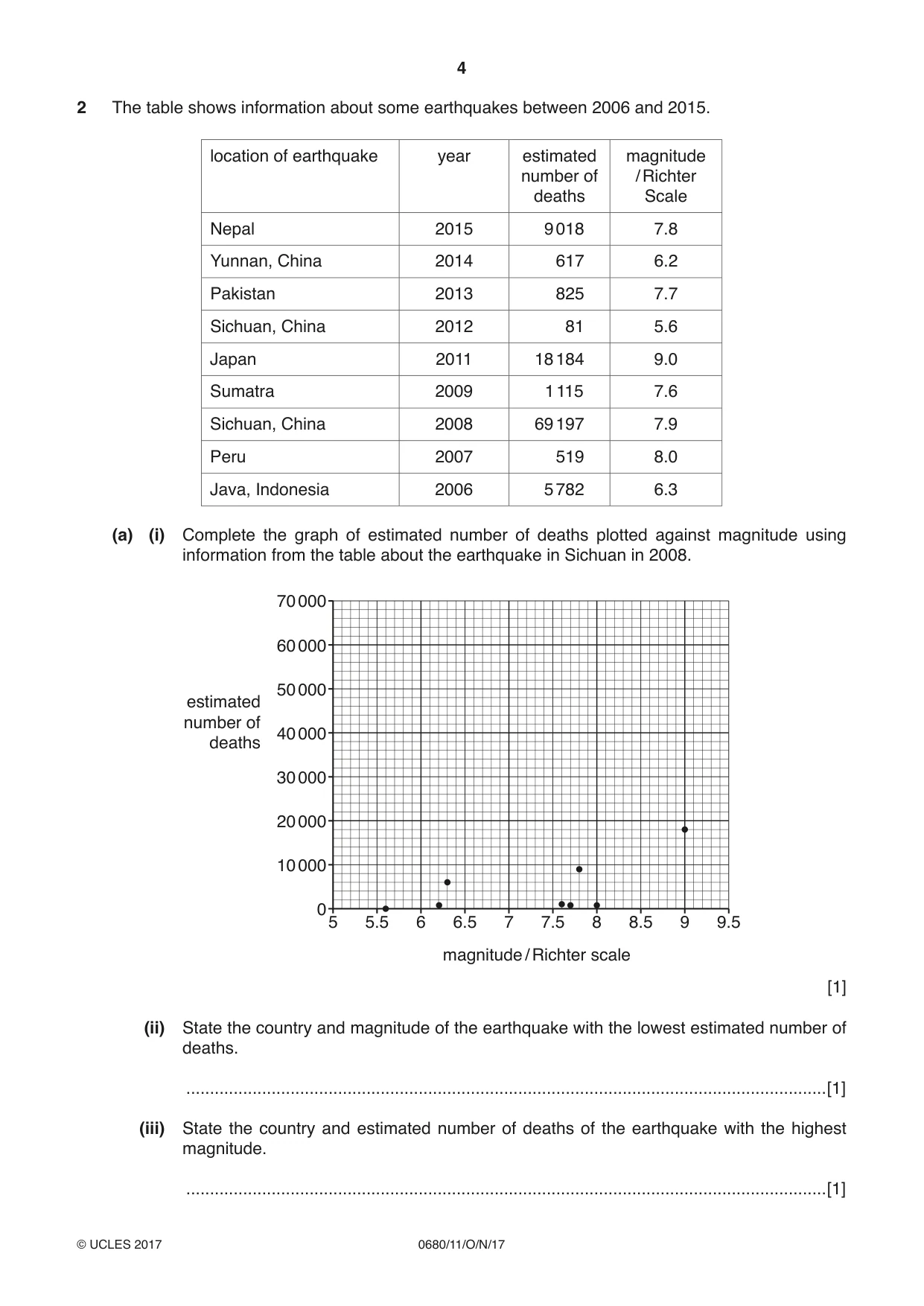
4 0680/11/O/N/17 © UCLES 2017 2 The table shows information about some earthquakes between 2006 and 2015. location of earthquake year estimated number of deaths magnitude / Richter Scale Nepal 2015 9 018 7.8 Yunnan, China 2014 617 6.2 Pakistan 2013 825 7.7 Sichuan, China 2012 81 5.6 Japan 2011 18 184 9.0 Sumatra 2009 1 115 7.6 Sichuan, China 2008 69 197 7.9 Peru 2007 519 8.0 Java, Indonesia 2006 5 782 6.3 (a) (i) Complete the graph of estimated number of deaths plotted against magnitude using information from the table about the earthquake in Sichuan in 2008. 5 0 10 000 20 000 30 000 40 000 50 000 estimated number of deaths 60 000 70 000 5.5 6 6.5 7 7.5 magnitude / Richter scale 8 8.5 9 9.5 [1] (ii) State the country and magnitude of the earthquake with the lowest estimated number of deaths. …[1] (iii) State the country and estimated number of deaths of the earthquake with the highest magnitude. …[1]
Question paper, page 5
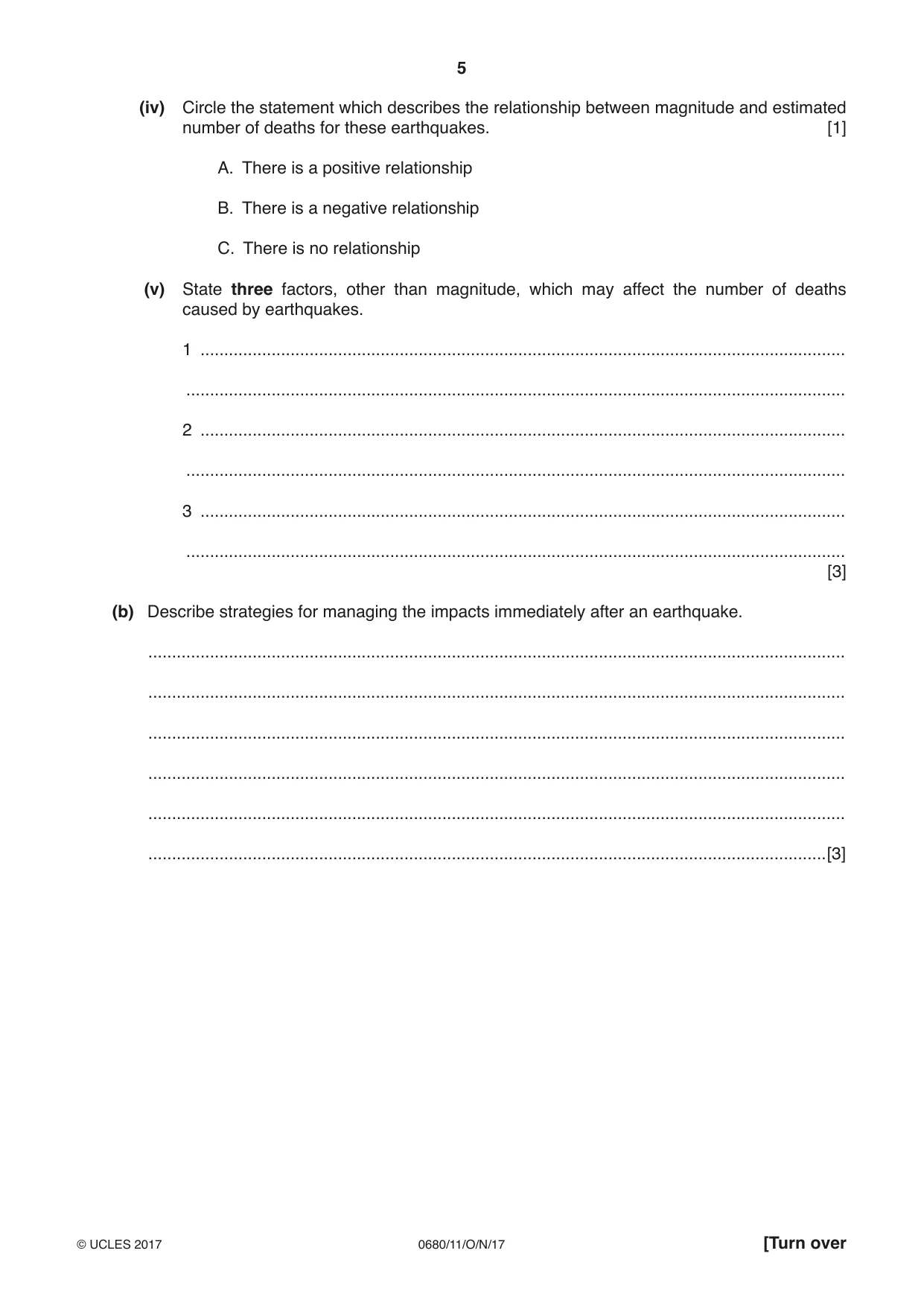
5 0680/11/O/N/17 © UCLES 2017 [Turn over (iv) Circle the statement which describes the relationship between magnitude and estimated number of deaths for these earthquakes. [1] A. There is a positive relationship B. There is a negative relationship C. There is no relationship (v) State three factors, other than magnitude, which may affect the number of deaths caused by earthquakes. 1 … … 2 … … 3 … … [3] (b) Describe strategies for managing the impacts immediately after an earthquake. … … … … … …[3]
Question paper, page 6
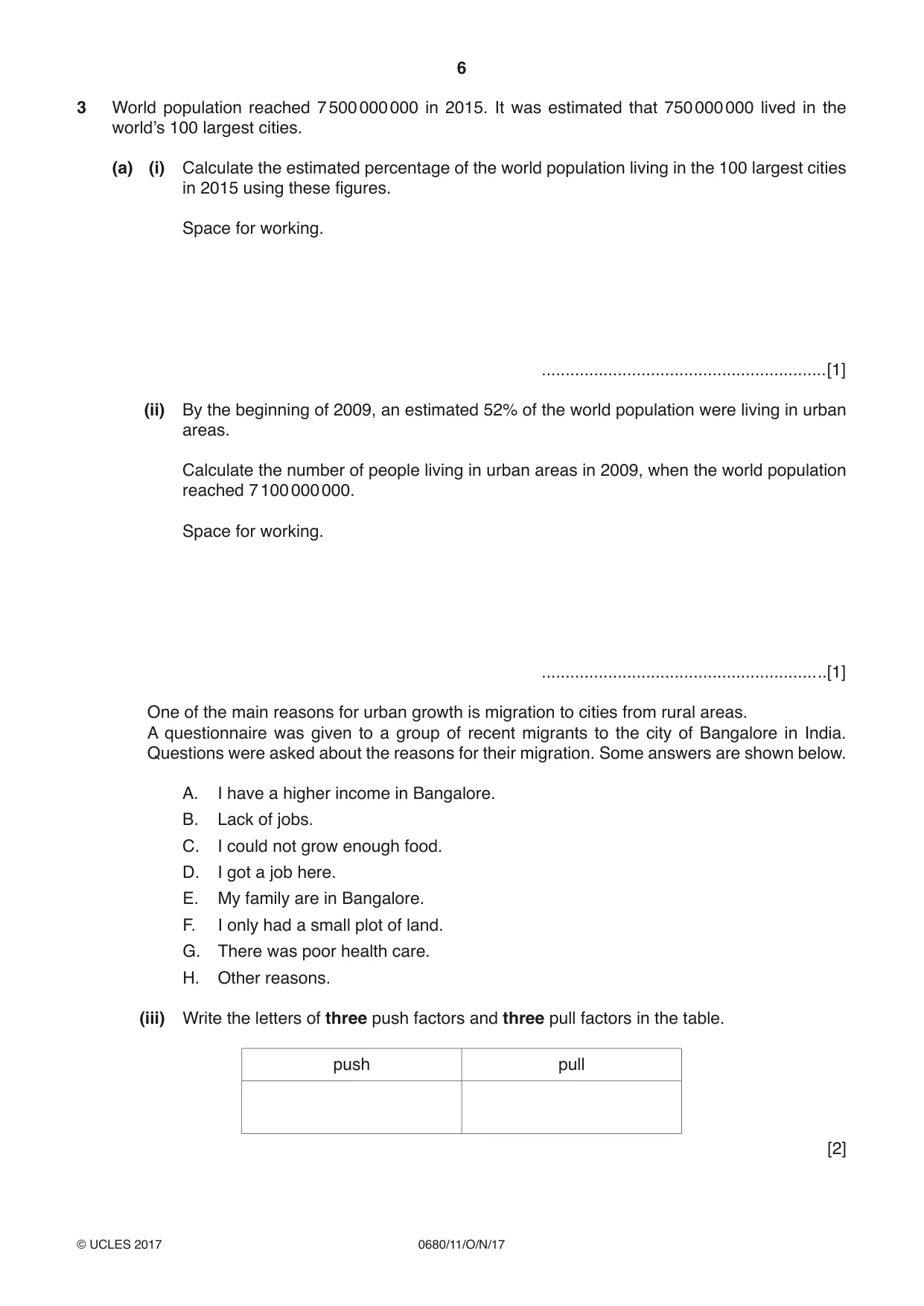
6 0680/11/O/N/17 © UCLES 2017 3 World population reached 7 500 000 000 in 2015. It was estimated that 750 000 000 lived in the world’s 100 largest cities. (a) (i) Calculate the estimated percentage of the world population living in the 100 largest cities in 2015 using these figures. Space for working. …[1] (ii) By the beginning of 2009, an estimated 52% of the world population were living in urban areas. Calculate the number of people living in urban areas in 2009, when the world population reached 7 100 000 000. Space for working. …[1] One of the main reasons for urban growth is migration to cities from rural areas. A questionnaire was given to a group of recent migrants to the city of Bangalore in India. Questions were asked about the reasons for their migration. Some answers are shown below. A. I have a higher income in Bangalore. B. Lack of jobs. C. I could not grow enough food. D. I got a job here. E. My family are in Bangalore. F. I only had a small plot of land. G. There was poor health care. H. Other reasons. (iii) Write the letters of three push factors and three pull factors in the table. push pull [2]
Question paper, page 7
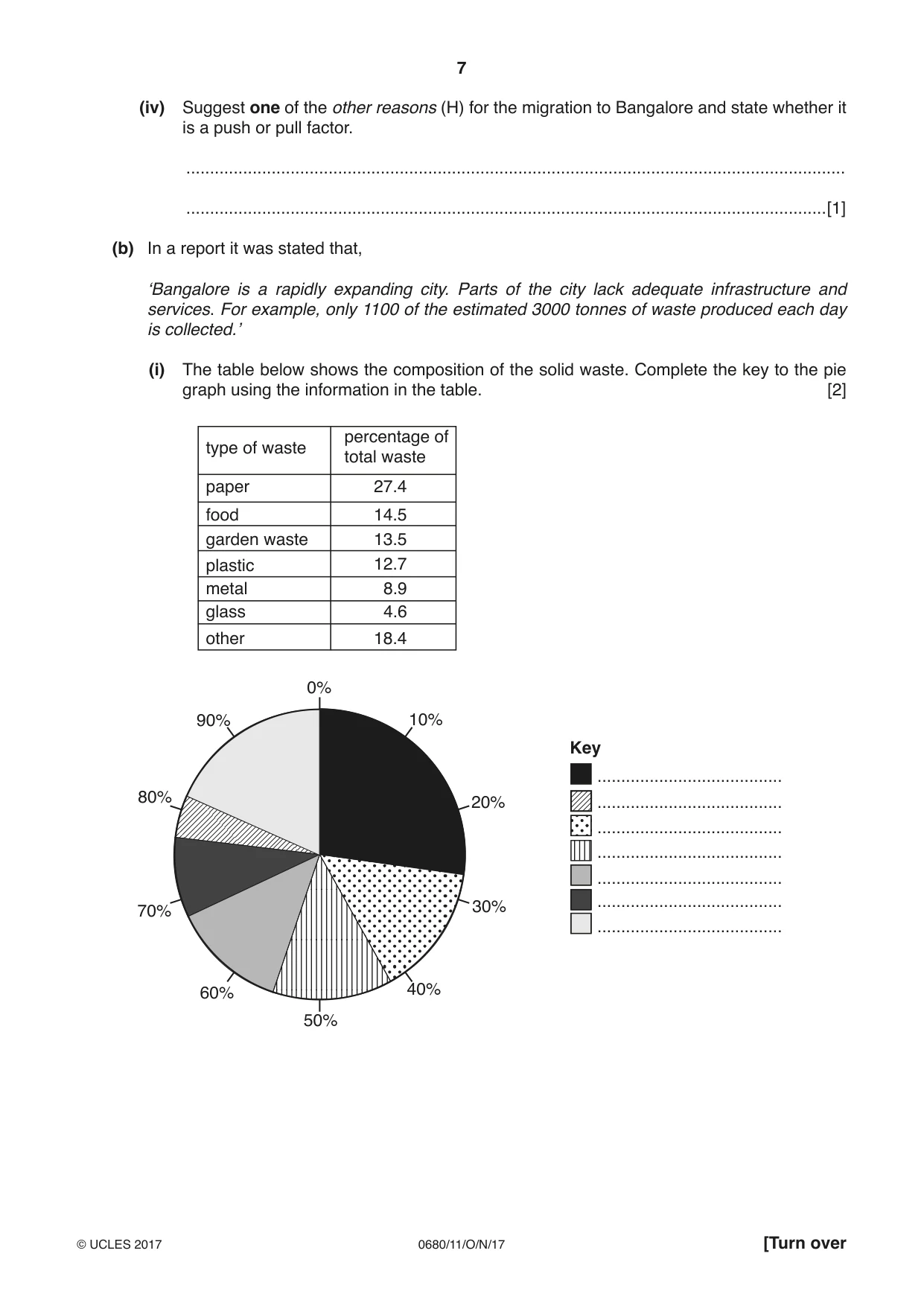
7 0680/11/O/N/17 © UCLES 2017 [Turn over (iv) Suggest one of the other reasons (H) for the migration to Bangalore and state whether it is a push or pull factor. … …[1] (b) In a report it was stated that, ‘Bangalore is a rapidly expanding city. Parts of the city lack adequate infrastructure and services. For example, only 1100 of the estimated 3000 tonnes of waste produced each day is collected.’ (i) The table below shows the composition of the solid waste. Complete the key to the pie graph using the information in the table. [2] 0% 10% 20% 30% 40% 50% 60% 70% 80% 90% Key type of waste percentage of total waste plastic 27.4 other 18.4 food 14.5 garden waste 13.5 paper 12.7 metal 8.9 glass … … … … … … … 4.6
Question paper, page 8
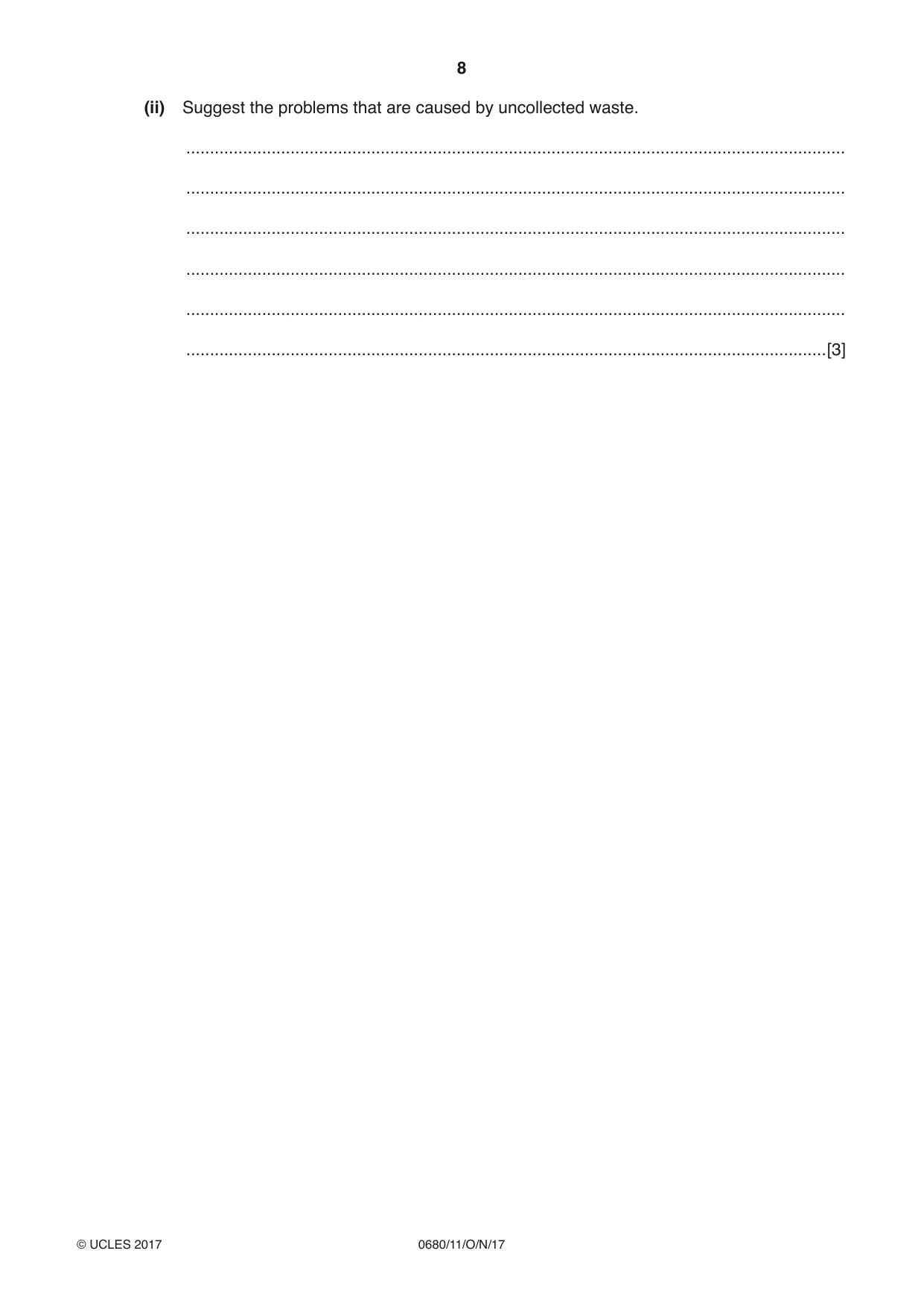
8 0680/11/O/N/17 © UCLES 2017 (ii) Suggest the problems that are caused by uncollected waste. … … … … … …[3]
Question paper, page 9
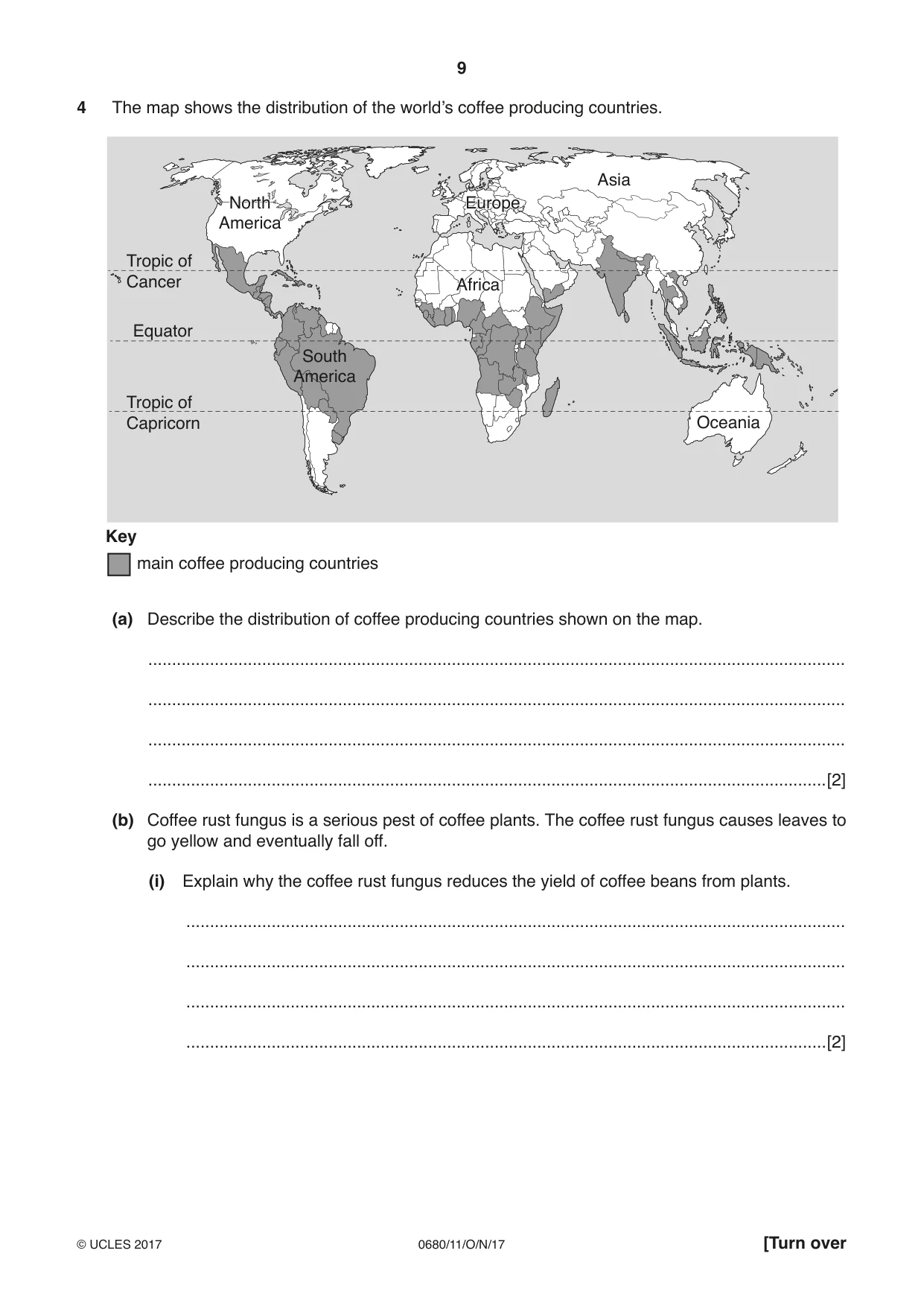
9 0680/11/O/N/17 © UCLES 2017 [Turn over 4 The map shows the distribution of the world’s coffee producing countries. Tropic of Cancer Tropic of Capricorn main coffee producing countries Key Equator Europe Africa Asia South America North America Europe Africa Asia Oceania Oceania South America North America (a) Describe the distribution of coffee producing countries shown on the map. … … … …[2] (b) Coffee rust fungus is a serious pest of coffee plants. The coffee rust fungus causes leaves to go yellow and eventually fall off. (i) Explain why the coffee rust fungus reduces the yield of coffee beans from plants. … … … …[2]
Question paper, page 10
10 0680/11/O/N/17 © UCLES 2017 (ii) Coffee plants can be grown above 3500 m where it is too cold for the coffee rust fungus. Explain how climate change might lead to an increase in the number of coffee plants affected by coffee rust fungus. … … … …[2] (c) Suggest techniques for reducing crop pests. … … … … … … … …[4]
Question paper, page 11
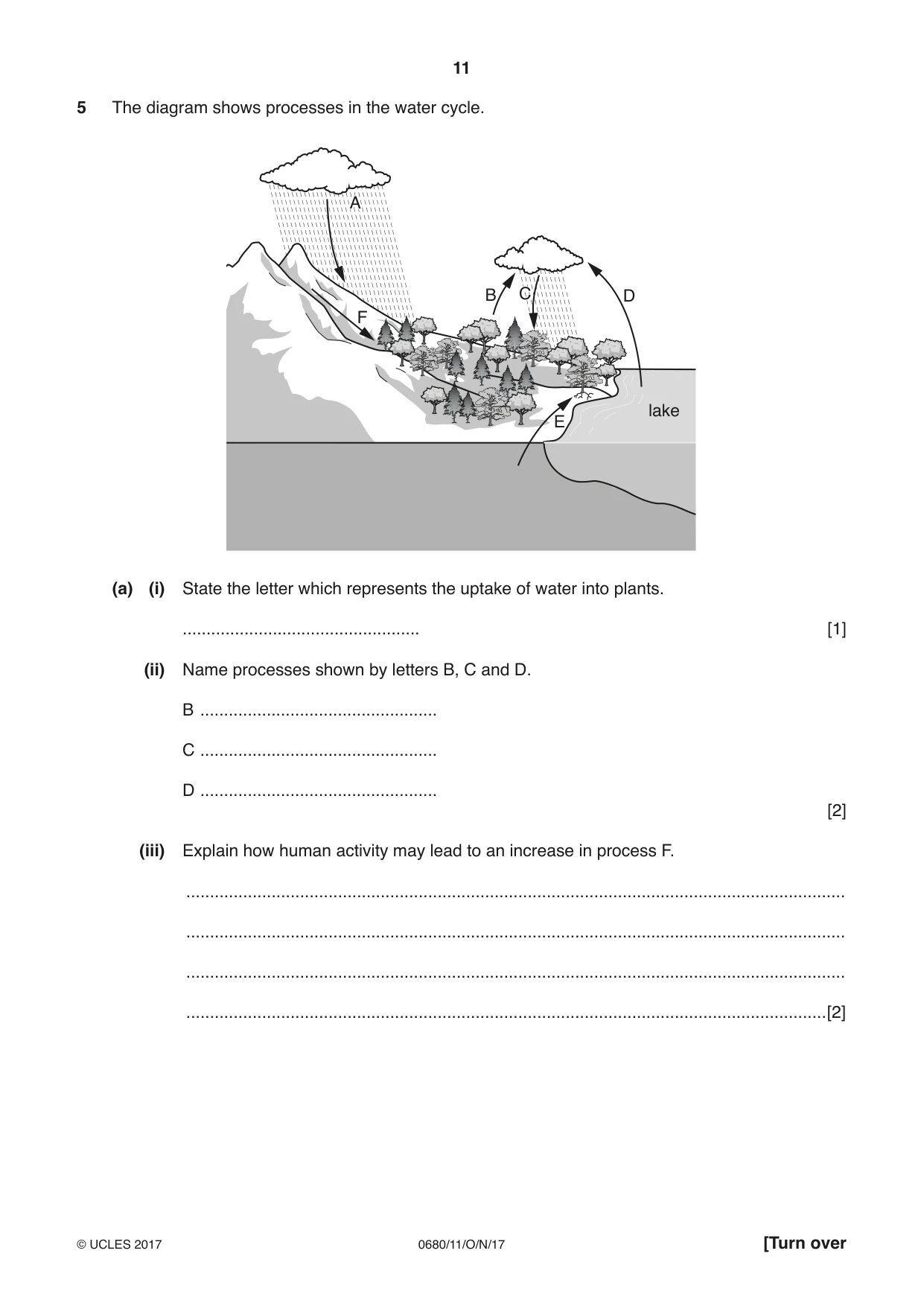
11 0680/11/O/N/17 © UCLES 2017 [Turn over 5 The diagram shows processes in the water cycle. A B C D F E lake (a) (i) State the letter which represents the uptake of water into plants. … [1] (ii) Name processes shown by letters B, C and D. B … C … D … [2] (iii) Explain how human activity may lead to an increase in process F. … … … …[2]
Question paper, page 12
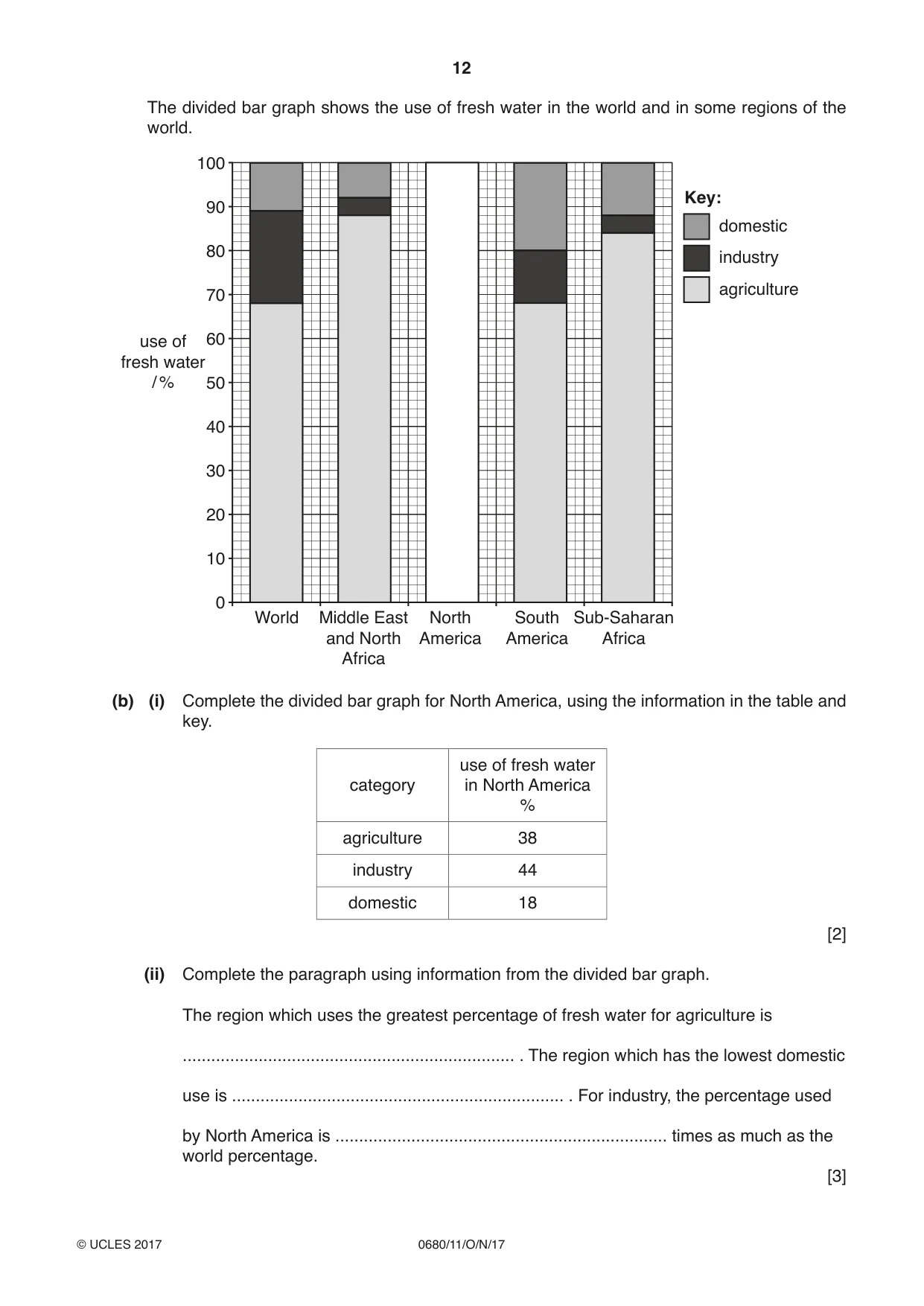
12 0680/11/O/N/17 © UCLES 2017 The divided bar graph shows the use of fresh water in the world and in some regions of the world. 0 10 20 30 40 50 60 70 use of fresh water / % 80 90 100 World Middle East and North Africa North America South America Sub-Saharan Africa domestic Key: industry agriculture (b) (i) Complete the divided bar graph for North America, using the information in the table and key. category use of fresh water in North America % agriculture 38 industry 44 domestic 18 [2] (ii) Complete the paragraph using information from the divided bar graph. The region which uses the greatest percentage of fresh water for agriculture is … . The region which has the lowest domestic use is … . For industry, the percentage used by North America is … times as much as the world percentage. [3]
Question paper, page 13
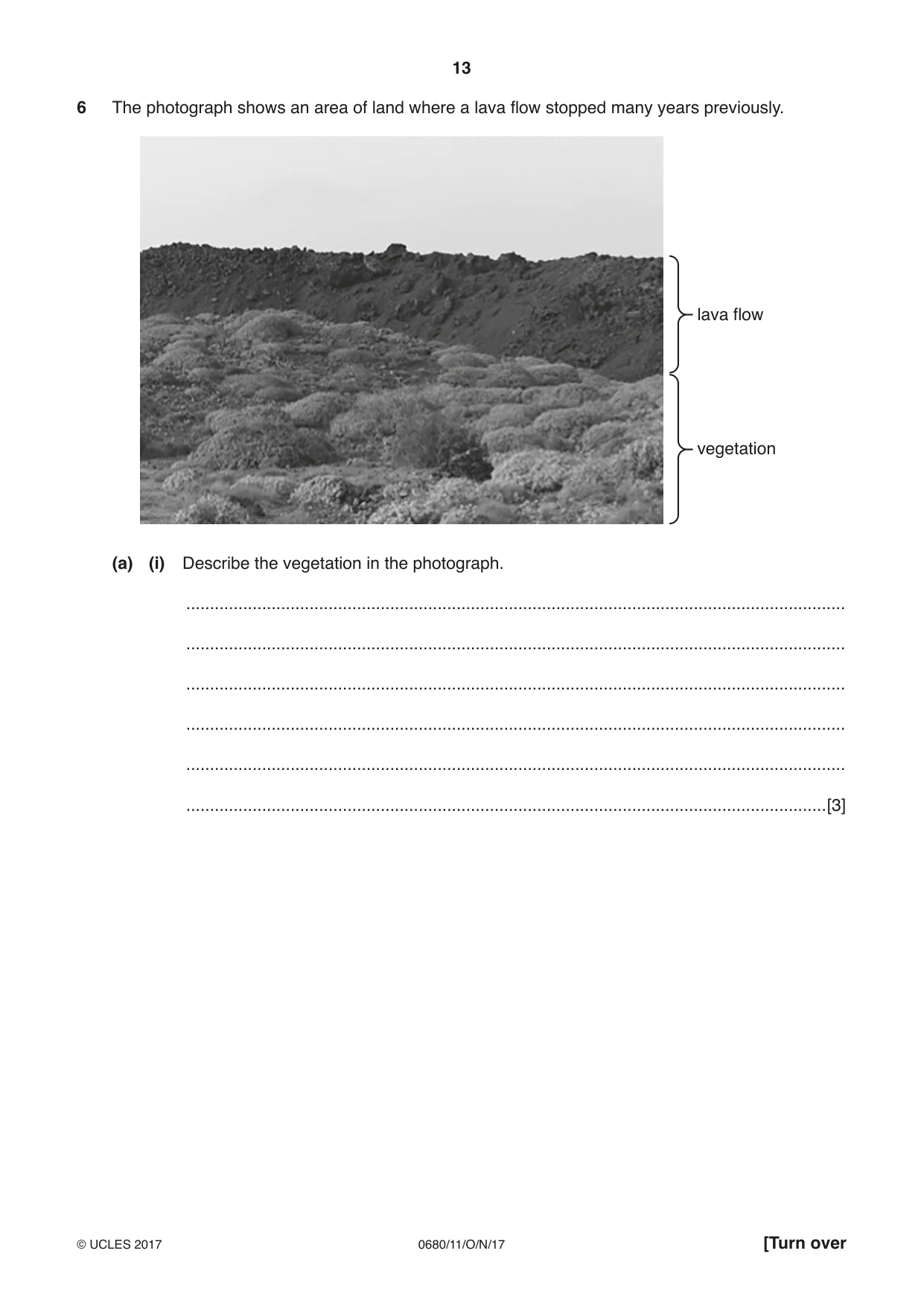
13 0680/11/O/N/17 © UCLES 2017 [Turn over 6 The photograph shows an area of land where a lava flow stopped many years previously. lava flow vegetation (a) (i) Describe the vegetation in the photograph. … … … … … …[3]
Question paper, page 14
14 0680/11/O/N/17 © UCLES 2017 (ii) A guide explained to visitors that, after many years, vegetation would eventually grow on the lava flow. Explain how this would happen. … … … … … … … …[4] (b) If a natural area is threatened by destruction, one strategy to conserve it is to set up a biosphere reserve. Describe the main features of a biosphere reserve. … … … … … …[3]
Question paper, page 15
15 0680/11/O/N/17 © UCLES 2017 BLANK PAGE
Question paper, page 16
16 0680/11/O/N/17 © UCLES 2017 Permission to reproduce items where third-party owned material protected by copyright is included has been sought and cleared where possible. Every reasonable effort has been made by the publisher (UCLES) to trace copyright holders, but if any items requiring clearance have unwittingly been included, the publisher will be pleased to make amends at the earliest possible opportunity. To avoid the issue of disclosure of answer-related information to candidates, all copyright acknowledgements are reproduced online in the Cambridge International Examinations Copyright Acknowledgements Booklet. This is produced for each series of examinations and is freely available to download at www.cie.org.uk after the live examination series. Cambridge International Examinations is part of the Cambridge Assessment Group. Cambridge Assessment is the brand name of University of Cambridge Local Examinations Syndicate (UCLES), which is itself a department of the University of Cambridge. BLANK PAGE
Mark scheme, page 1
® IGCSE is a registered trademark. This document consists of 10 printed pages. © UCLES 2017 [Turn over Cambridge Assessment International Education Cambridge International General Certificate of Secondary Education ENVIRONMENTAL MANAGEMENT 0680/11 Paper 1 October/November 2017 MARK SCHEME Maximum Mark: 60 Published This mark scheme is published as an aid to teachers and candidates, to indicate the requirements of the examination. It shows the basis on which Examiners were instructed to award marks. It does not indicate the details of the discussions that took place at an Examiners’ meeting before marking began, which would have considered the acceptability of alternative answers. Mark schemes should be read in conjunction with the question paper and the Principal Examiner Report for Teachers. Cambridge International will not enter into discussions about these mark schemes. Cambridge International is publishing the mark schemes for the October/November 2017 series for most Cambridge IGCSE®, Cambridge International A and AS Level components and some Cambridge O Level components.
Mark scheme, page 2
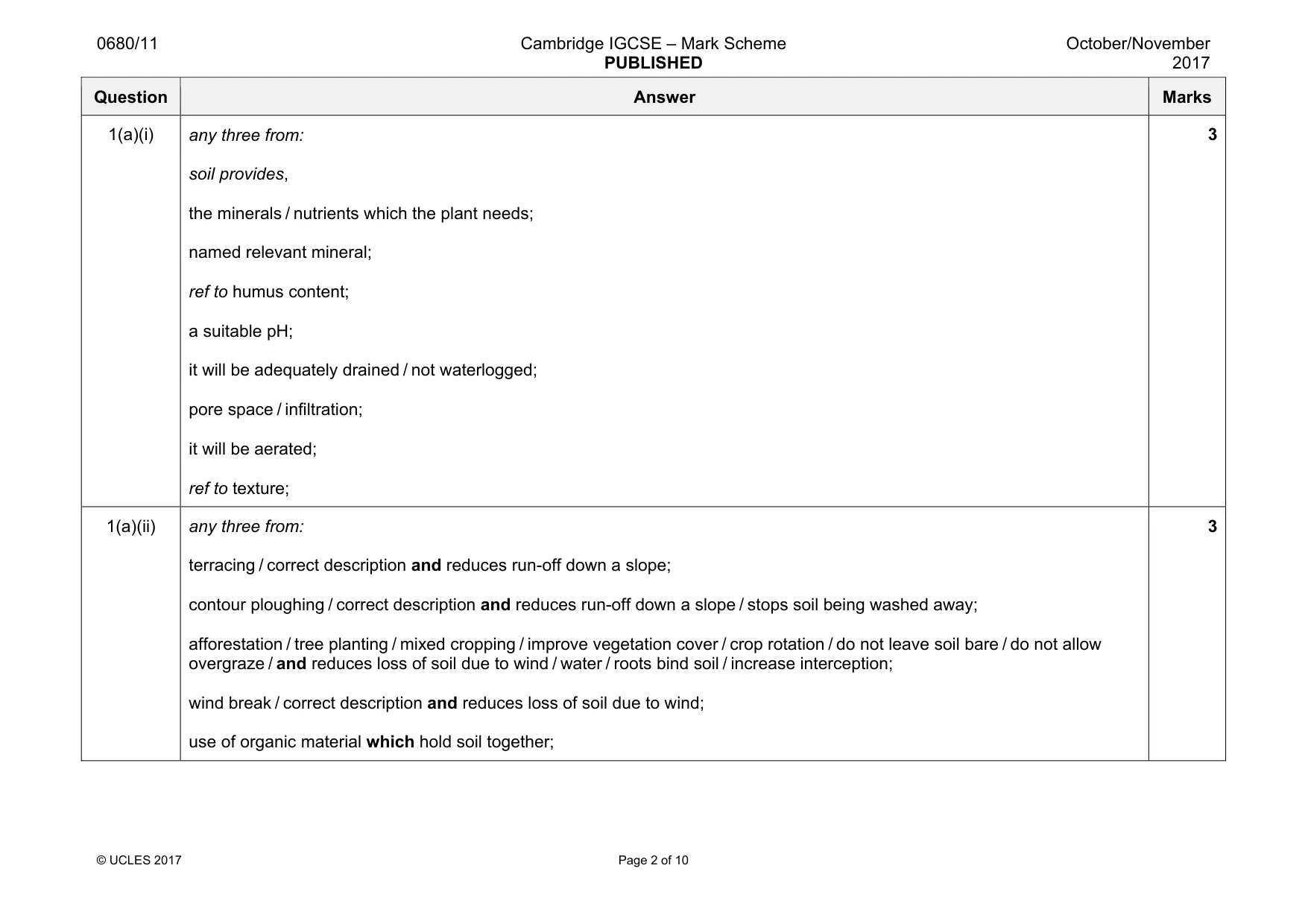
0680/11 Cambridge IGCSE – Mark Scheme PUBLISHED October/November 2017 © UCLES 2017 Page 2 of 10 Question Answer Marks 1(a)(i) any three from: soil provides, the minerals / nutrients which the plant needs; named relevant mineral; ref to humus content; a suitable pH; it will be adequately drained / not waterlogged; pore space / infiltration; it will be aerated; ref to texture; 3 1(a)(ii) any three from: terracing / correct description and reduces run-off down a slope; contour ploughing / correct description and reduces run-off down a slope / stops soil being washed away; afforestation / tree planting / mixed cropping / improve vegetation cover / crop rotation / do not leave soil bare / do not allow overgraze / and reduces loss of soil due to wind / water / roots bind soil / increase interception; wind break / correct description and reduces loss of soil due to wind; use of organic material which hold soil together; 3
Mark scheme, page 3
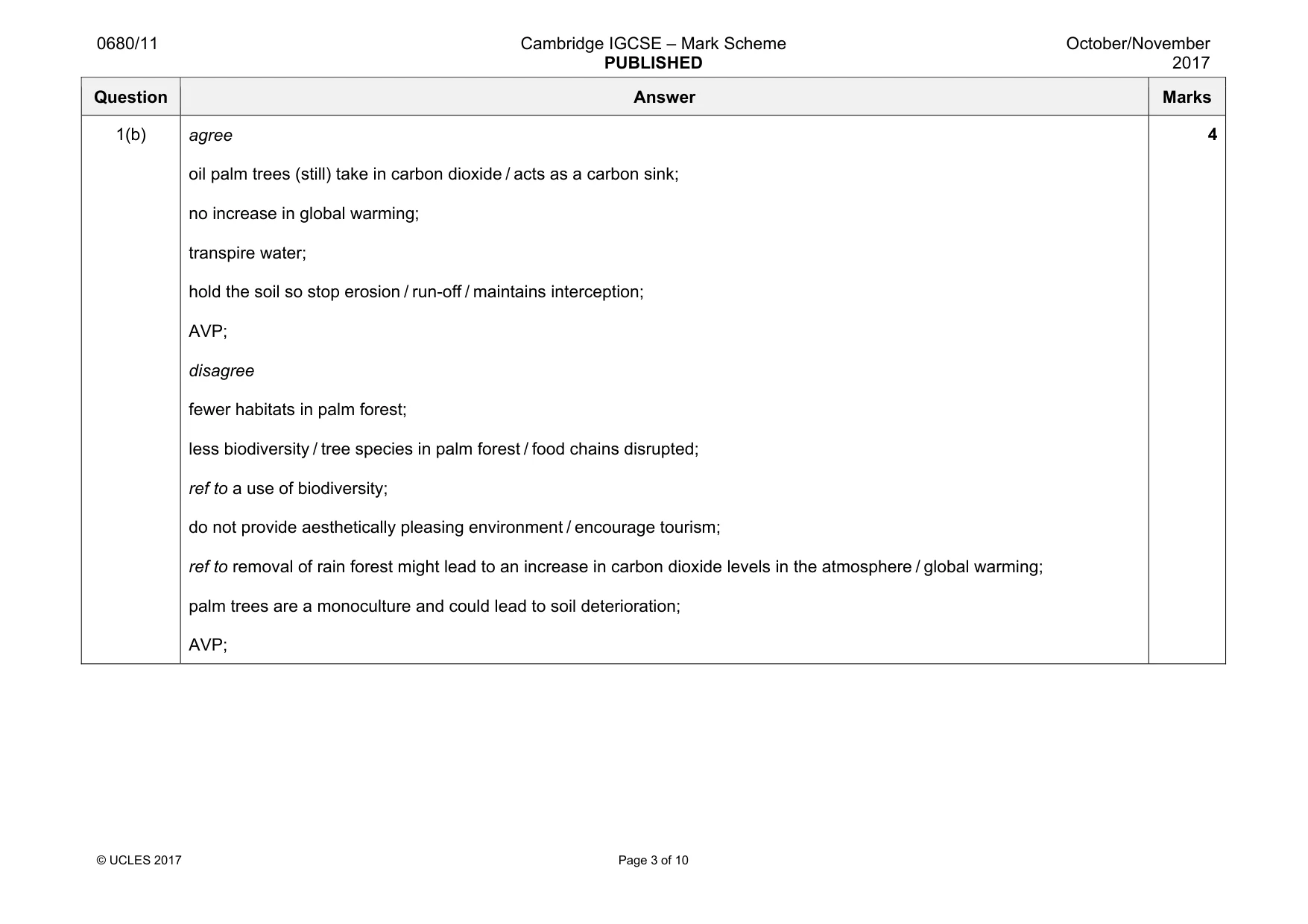
0680/11 Cambridge IGCSE – Mark Scheme PUBLISHED October/November 2017 © UCLES 2017 Page 3 of 10 Question Answer Marks 1(b) agree oil palm trees (still) take in carbon dioxide / acts as a carbon sink; no increase in global warming; transpire water; hold the soil so stop erosion / run-off / maintains interception; AVP; disagree fewer habitats in palm forest; less biodiversity / tree species in palm forest / food chains disrupted; ref to a use of biodiversity; do not provide aesthetically pleasing environment / encourage tourism; ref to removal of rain forest might lead to an increase in carbon dioxide levels in the atmosphere / global warming; palm trees are a monoculture and could lead to soil deterioration; AVP; 4
Mark scheme, page 4
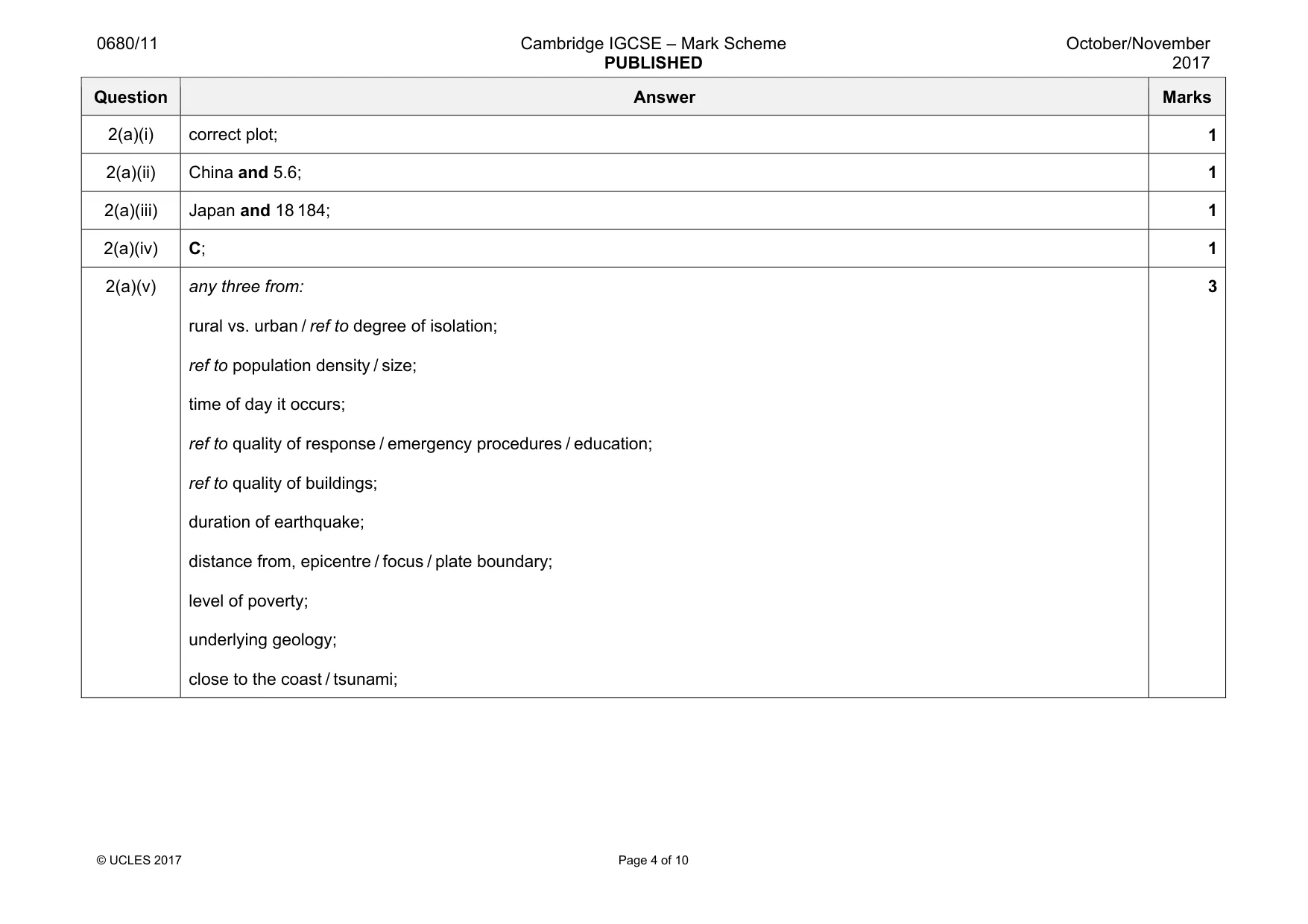
0680/11 Cambridge IGCSE – Mark Scheme PUBLISHED October/November 2017 © UCLES 2017 Page 4 of 10 Question Answer Marks 2(a)(i) correct plot; 1 2(a)(ii) China and 5.6; 1 2(a)(iii) Japan and 18 184; 1 2(a)(iv) C; 1 2(a)(v) any three from: rural vs. urban / ref to degree of isolation; ref to population density / size; time of day it occurs; ref to quality of response / emergency procedures / education; ref to quality of buildings; duration of earthquake; distance from, epicentre / focus / plate boundary; level of poverty; underlying geology; close to the coast / tsunami; 3
Mark scheme, page 5
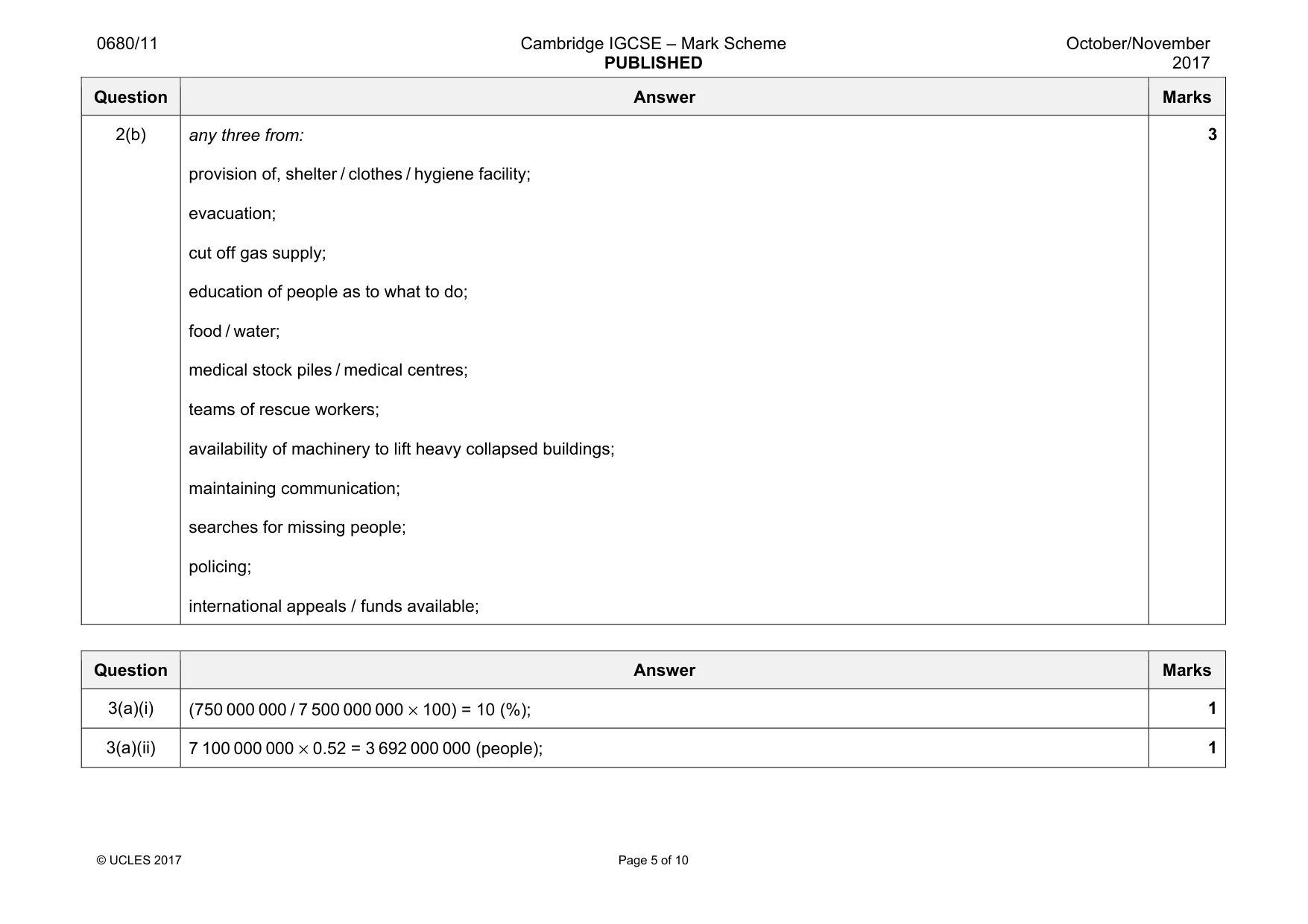
0680/11 Cambridge IGCSE – Mark Scheme PUBLISHED October/November 2017 © UCLES 2017 Page 5 of 10 Question Answer Marks 2(b) any three from: provision of, shelter / clothes / hygiene facility; evacuation; cut off gas supply; education of people as to what to do; food / water; medical stock piles / medical centres; teams of rescue workers; availability of machinery to lift heavy collapsed buildings; maintaining communication; searches for missing people; policing; international appeals / funds available; 3 Question Answer Marks 3(a)(i) (750 000 000 / 7 500 000 000 × 100) = 10 (%); 1 3(a)(ii) 7 100 000 000 × 0.52 = 3 692 000 000 (people); 1
Mark scheme, page 6
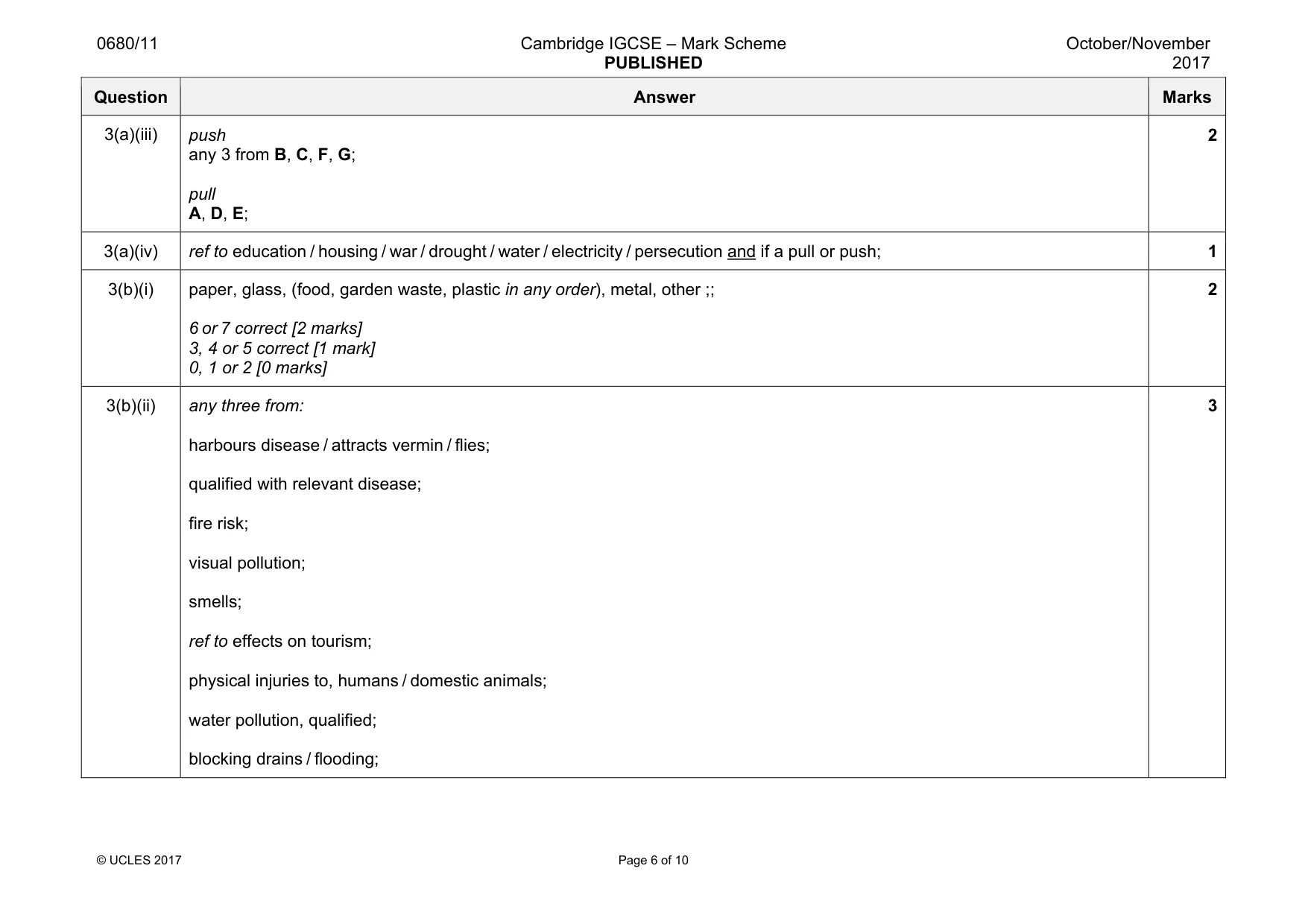
0680/11 Cambridge IGCSE – Mark Scheme PUBLISHED October/November 2017 © UCLES 2017 Page 6 of 10 Question Answer Marks 3(a)(iii) push any 3 from B, C, F, G; pull A, D, E; 2 3(a)(iv) ref to education / housing / war / drought / water / electricity / persecution and if a pull or push; 1 3(b)(i) paper, glass, (food, garden waste, plastic in any order), metal, other ;; 6 or 7 correct [2 marks] 3, 4 or 5 correct [1 mark] 0, 1 or 2 [0 marks] 2 3(b)(ii) any three from: harbours disease / attracts vermin / flies; qualified with relevant disease; fire risk; visual pollution; smells; ref to effects on tourism; physical injuries to, humans / domestic animals; water pollution, qualified; blocking drains / flooding; 3
Mark scheme, page 7
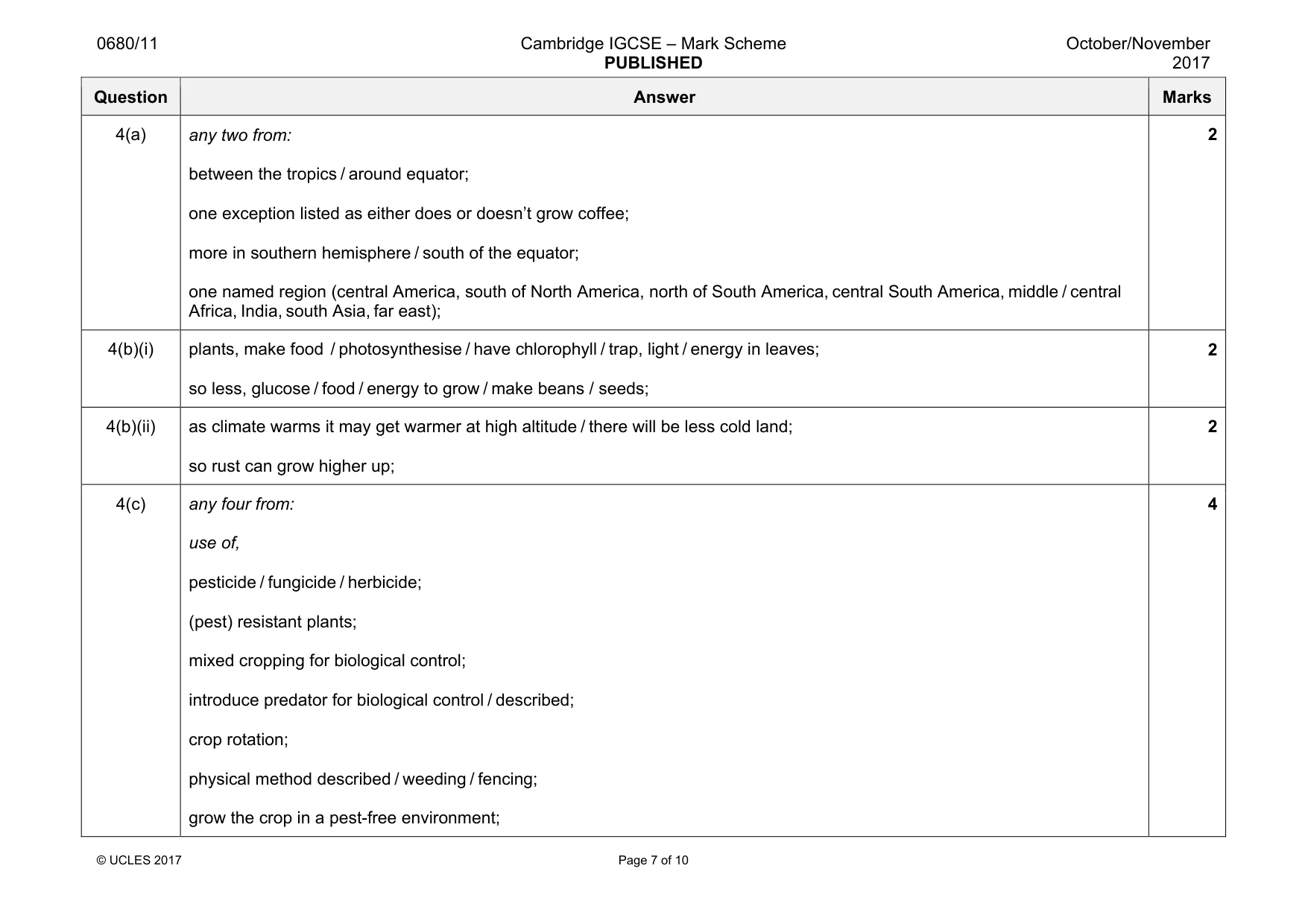
0680/11 Cambridge IGCSE – Mark Scheme PUBLISHED October/November 2017 © UCLES 2017 Page 7 of 10 Question Answer Marks 4(a) any two from: between the tropics / around equator; one exception listed as either does or doesn’t grow coffee; more in southern hemisphere / south of the equator; one named region (central America, south of North America, north of South America, central South America, middle / central Africa, India, south Asia, far east); 2 4(b)(i) plants, make food / photosynthesise / have chlorophyll / trap, light / energy in leaves; so less, glucose / food / energy to grow / make beans / seeds; 2 4(b)(ii) as climate warms it may get warmer at high altitude / there will be less cold land; so rust can grow higher up; 2 4(c) any four from: use of, pesticide / fungicide / herbicide; (pest) resistant plants; mixed cropping for biological control; introduce predator for biological control / described; crop rotation; physical method described / weeding / fencing; grow the crop in a pest-free environment; 4
Mark scheme, page 8
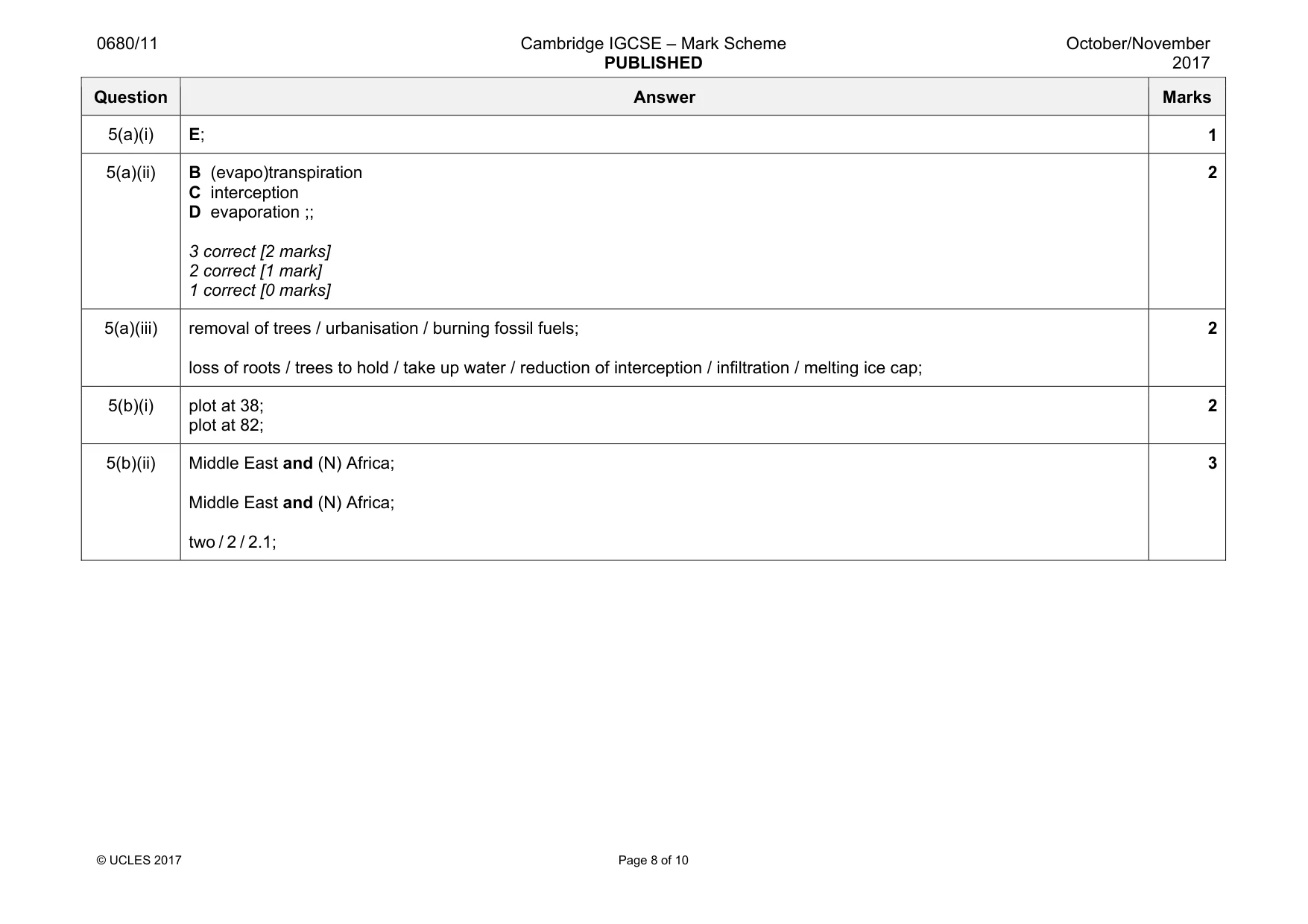
0680/11 Cambridge IGCSE – Mark Scheme PUBLISHED October/November 2017 © UCLES 2017 Page 8 of 10 Question Answer Marks 5(a)(i) E; 1 5(a)(ii) B (evapo)transpiration C interception D evaporation ;; 3 correct [2 marks] 2 correct [1 mark] 1 correct [0 marks] 2 5(a)(iii) removal of trees / urbanisation / burning fossil fuels; loss of roots / trees to hold / take up water / reduction of interception / infiltration / melting ice cap; 2 5(b)(i) plot at 38; plot at 82; 2 5(b)(ii) Middle East and (N) Africa; Middle East and (N) Africa; two / 2 / 2.1; 3
Mark scheme, page 9
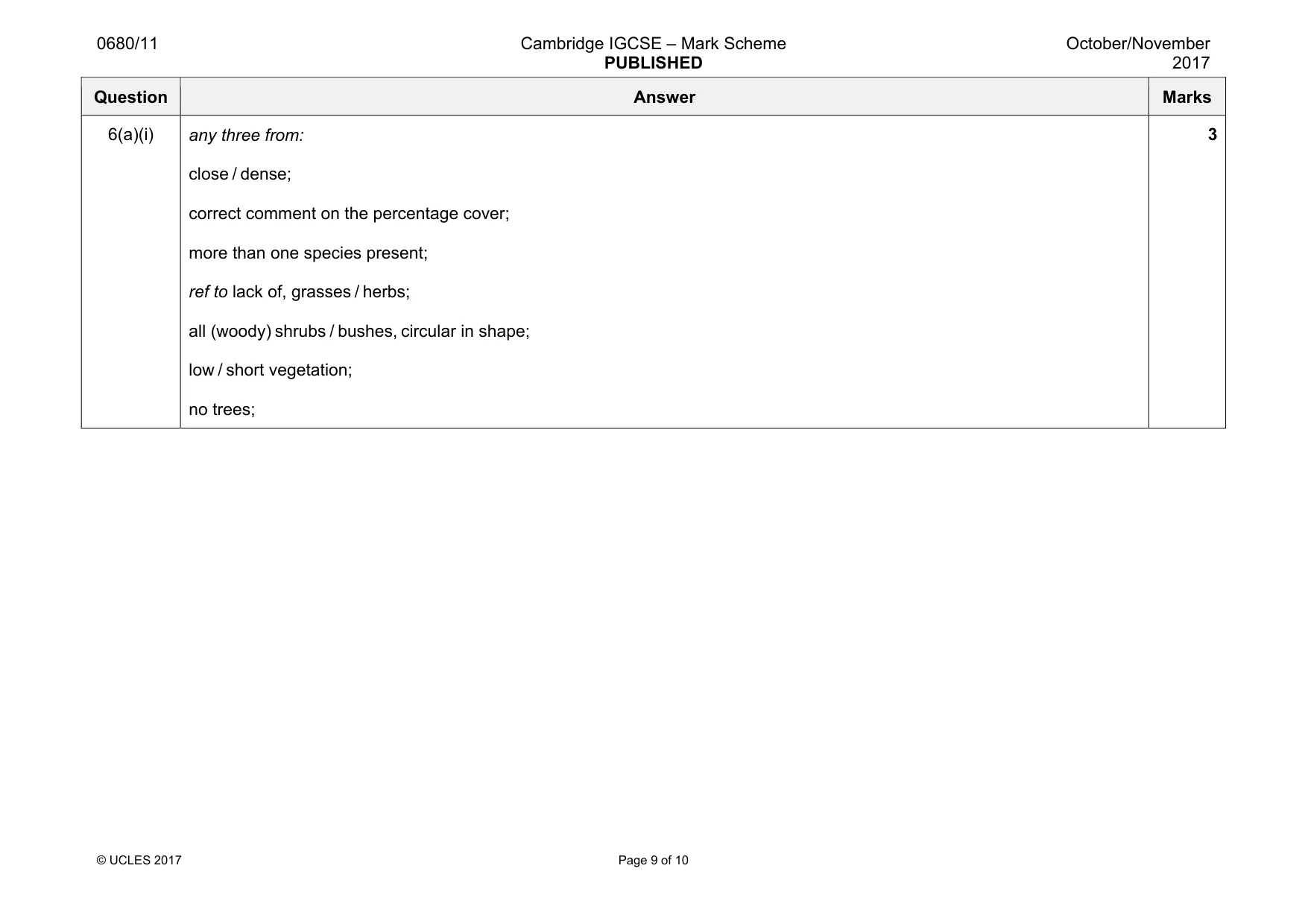
0680/11 Cambridge IGCSE – Mark Scheme PUBLISHED October/November 2017 © UCLES 2017 Page 9 of 10 Question Answer Marks 6(a)(i) any three from: close / dense; correct comment on the percentage cover; more than one species present; ref to lack of, grasses / herbs; all (woody) shrubs / bushes, circular in shape; low / short vegetation; no trees; 3
Mark scheme, page 10
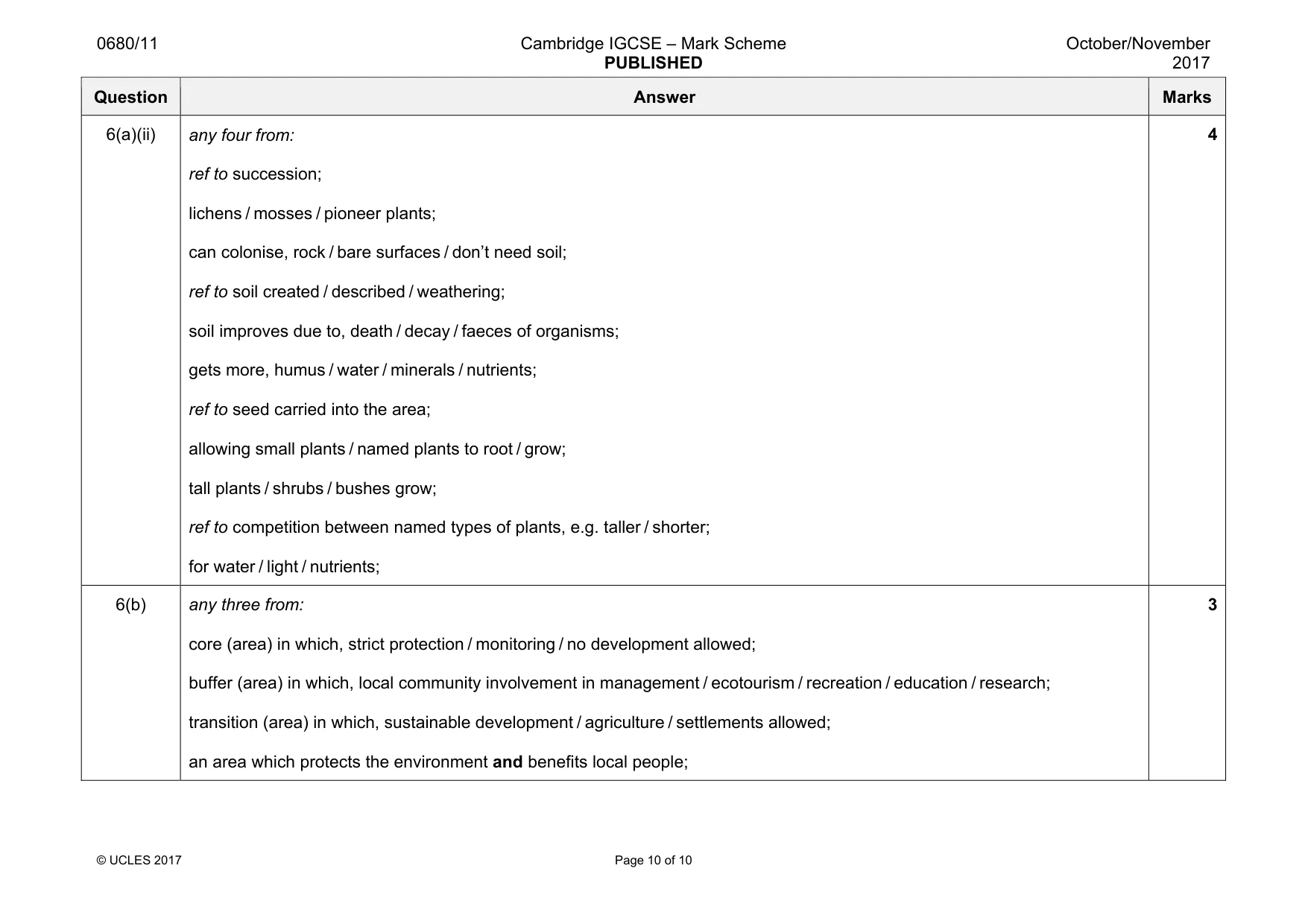
0680/11 Cambridge IGCSE – Mark Scheme PUBLISHED October/November 2017 © UCLES 2017 Page 10 of 10 Question Answer Marks 6(a)(ii) any four from: ref to succession; lichens / mosses / pioneer plants; can colonise, rock / bare surfaces / don’t need soil; ref to soil created / described / weathering; soil improves due to, death / decay / faeces of organisms; gets more, humus / water / minerals / nutrients; ref to seed carried into the area; allowing small plants / named plants to root / grow; tall plants / shrubs / bushes grow; ref to competition between named types of plants, e.g. taller / shorter; for water / light / nutrients; 4 6(b) any three from: core (area) in which, strict protection / monitoring / no development allowed; buffer (area) in which, local community involvement in management / ecotourism / recreation / education / research; transition (area) in which, sustainable development / agriculture / settlements allowed; an area which protects the environment and benefits local people; 3
What you needed in this session
Cambridge’s own grade thresholds for 2017 Oct/Nov, Paper 1 · Variant 1. A higher threshold means an easier paper — the bar moves with how the cohort did.