Cambridge IGCSE Environmental Management 0680 — 2017 Oct/Nov Paper 1 · Variant 3
0680/13/O/N/17 · 60 marks · ≈68 min
The question paper and its mark scheme, free to read here and free to download. This is Cambridge’s own paper, exactly as it was sat.
Question paper16 pages


Mark scheme7 pages
Answers below. Sit the paper first if you are practising.
Paper as text
Question paper, page 1
* 1 5 5 8 8 0 3 5 4 7 * This document consists of 13 printed pages and 3 blank pages. DC (KN/SG) 135020/3 © UCLES 2017 [Turn over ENVIRONMENTAL MANAGEMENT 0680/13 Paper 1 October/November 2017 1 hour 30 minutes Candidates answer on the Question Paper. No Additional Materials are required. READ THESE INSTRUCTIONS FIRST Write your Centre number, candidate number and name on all the work you hand in. Write in dark blue or black pen. You may use an HB pencil for any diagrams or graphs. Do not use staples, paper clips, glue or correction fluid. DO NOT WRITE IN ANY BARCODES. Answer all questions. Electronic calculators may be used. You may lose marks if you do not show your working or if you do not use appropriate units. At the end of the examination, fasten all your work securely together. The number of marks is given in brackets [ ] at the end of each question or part question. Cambridge International Examinations Cambridge International General Certificate of Secondary Education
Question paper, page 2
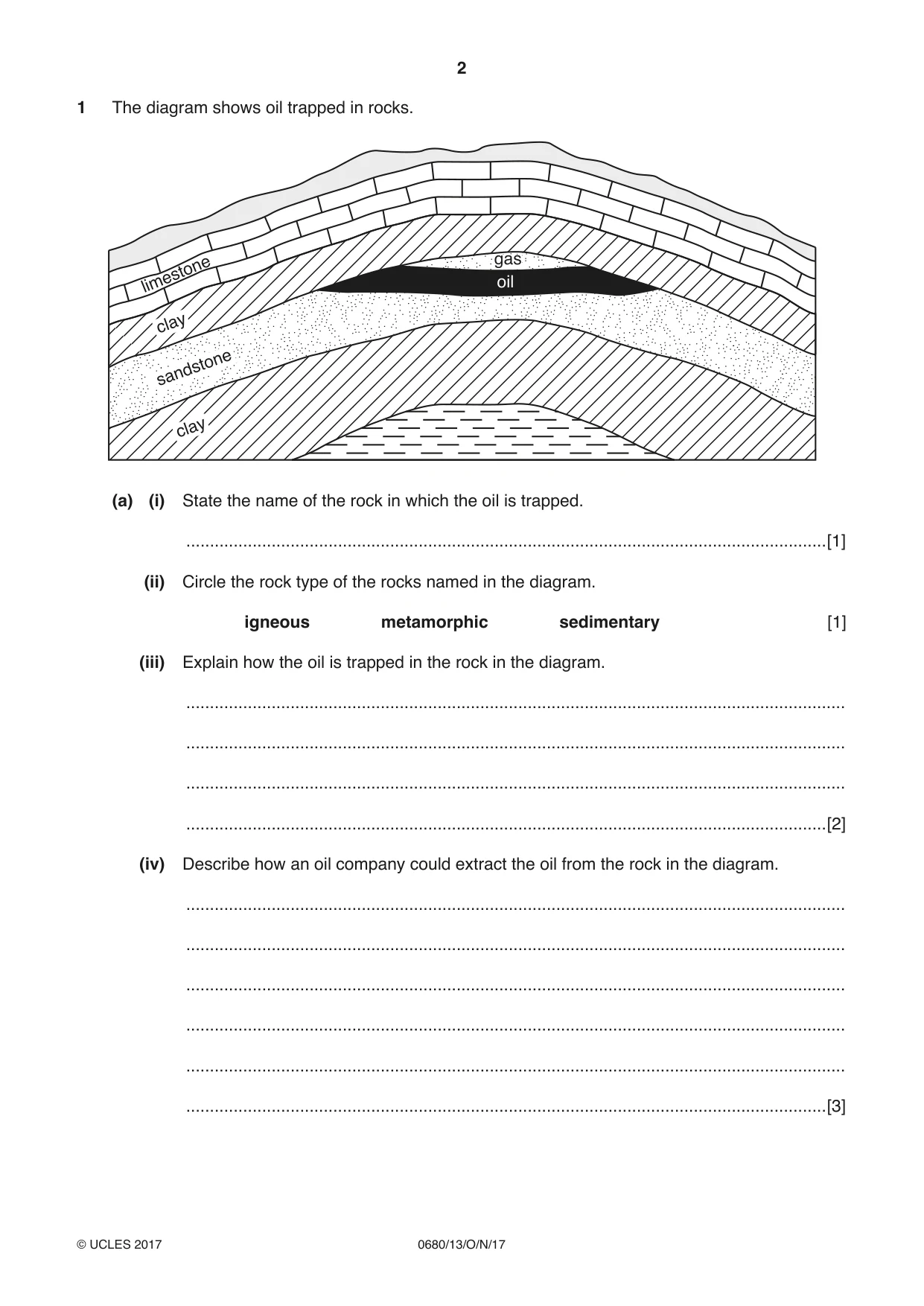
2 0680/13/O/N/17 © UCLES 2017 1 The diagram shows oil trapped in rocks. limestone clay clay sandstone gas oil (a) (i) State the name of the rock in which the oil is trapped. …[1] (ii) Circle the rock type of the rocks named in the diagram. igneous metamorphic sedimentary [1] (iii) Explain how the oil is trapped in the rock in the diagram. … … … …[2] (iv) Describe how an oil company could extract the oil from the rock in the diagram. … … … … … …[3]
Question paper, page 3
3 0680/13/O/N/17 © UCLES 2017 [Turn over (b) Suggest ways the environment could be damaged when oil is transported from one part of the world to another. … … … … … …[3]
Question paper, page 4
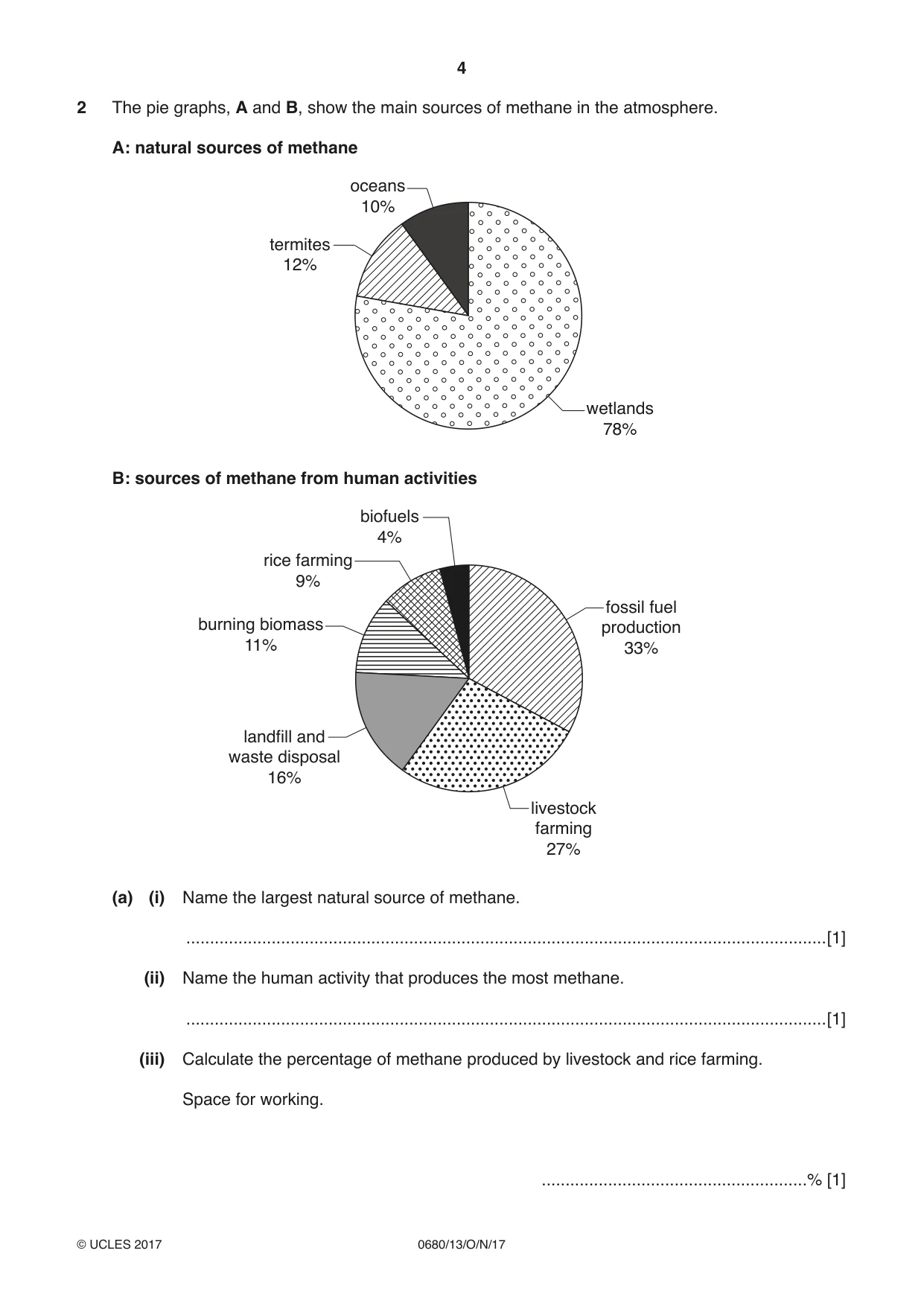
4 0680/13/O/N/17 © UCLES 2017 2 The pie graphs, A and B, show the main sources of methane in the atmosphere. A: natural sources of methane wetlands 78% termites 12% oceans 10% B: sources of methane from human activities biofuels 4% fossil fuel production 33% livestock farming 27% landfill and waste disposal 16% burning biomass 11% rice farming 9% (a) (i) Name the largest natural source of methane. …[1] (ii) Name the human activity that produces the most methane. …[1] (iii) Calculate the percentage of methane produced by livestock and rice farming. Space for working. …% [1]
Question paper, page 5
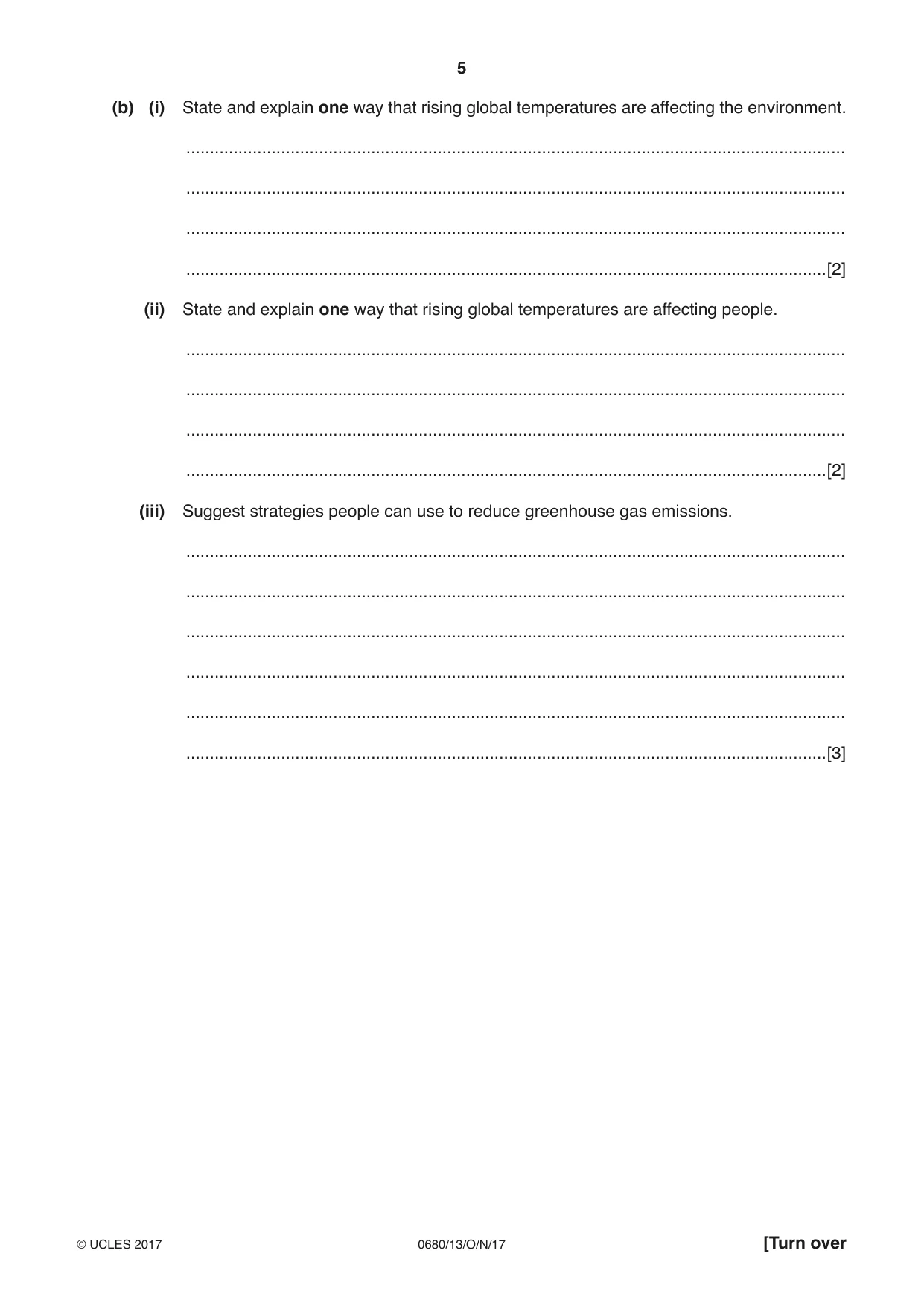
5 0680/13/O/N/17 © UCLES 2017 [Turn over (b) (i) State and explain one way that rising global temperatures are affecting the environment. … … … …[2] (ii) State and explain one way that rising global temperatures are affecting people. … … … …[2] (iii) Suggest strategies people can use to reduce greenhouse gas emissions. … … … … … …[3]
Question paper, page 6
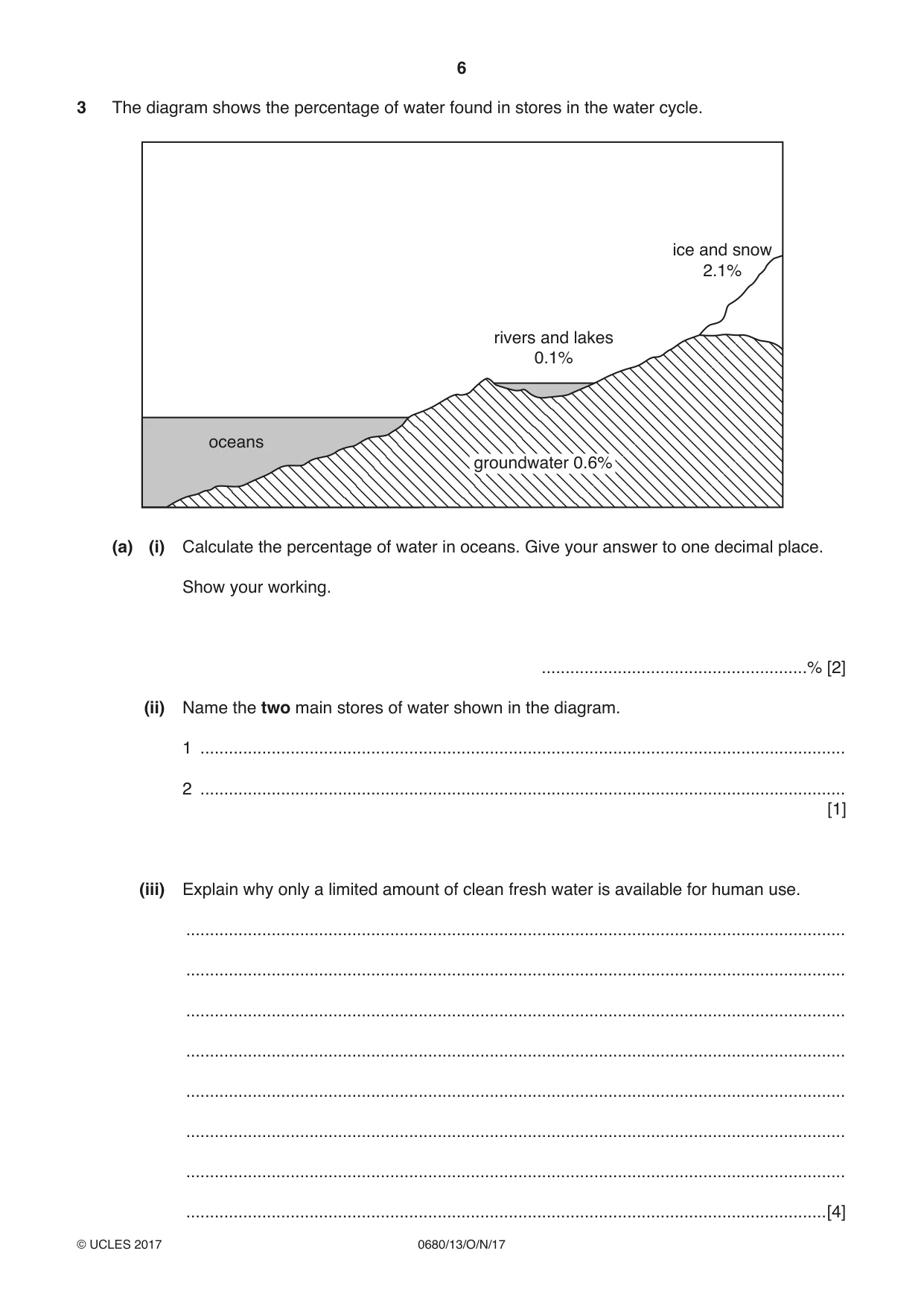
6 0680/13/O/N/17 © UCLES 2017 3 The diagram shows the percentage of water found in stores in the water cycle. rivers and lakes 0.1% ice and snow 2.1% oceans groundwater 0.6% (a) (i) Calculate the percentage of water in oceans. Give your answer to one decimal place. Show your working. …% [2] (ii) Name the two main stores of water shown in the diagram. 1 … 2 … [1] (iii) Explain why only a limited amount of clean fresh water is available for human use. … … … … … … … …[4]
Question paper, page 7
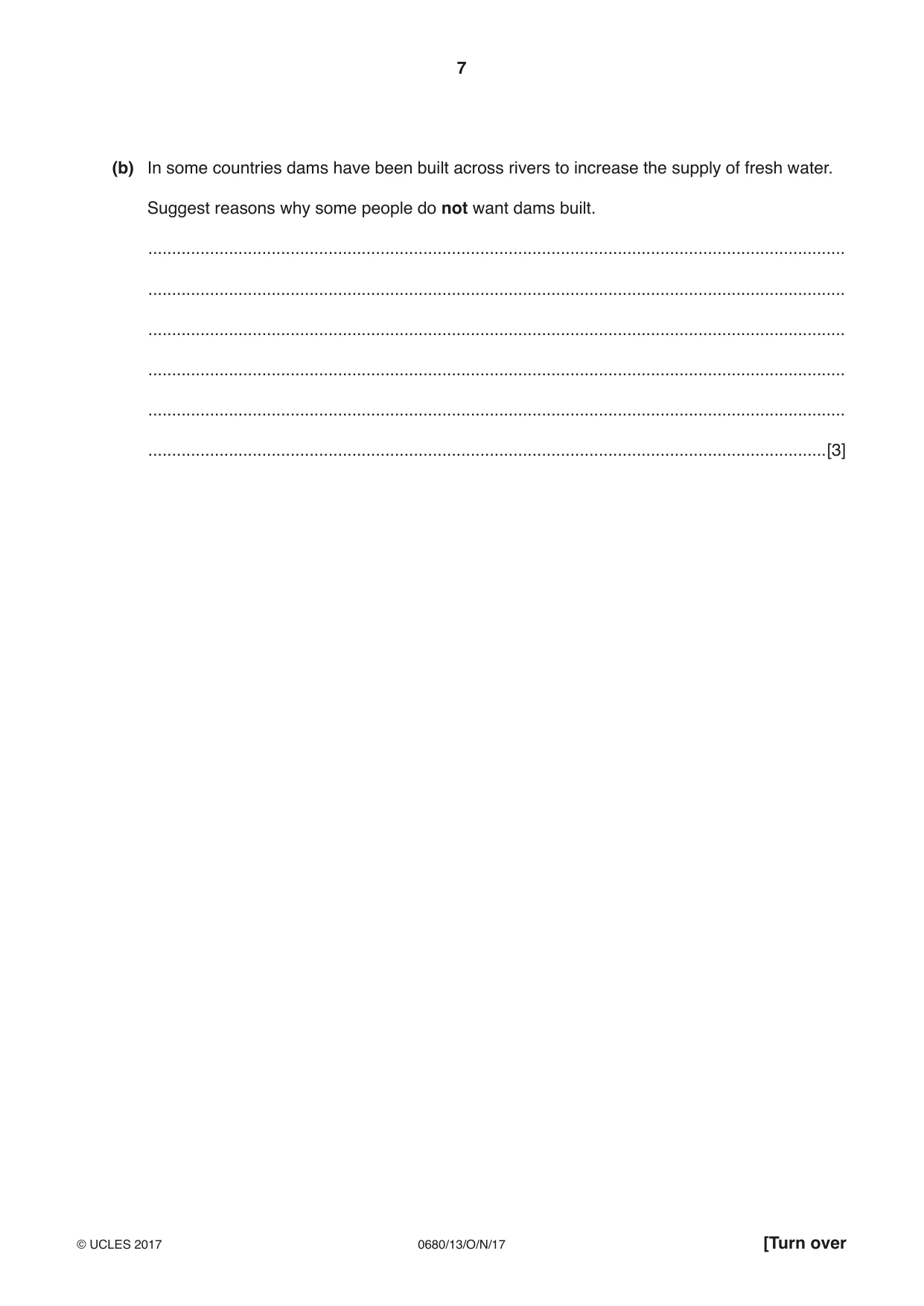
7 0680/13/O/N/17 © UCLES 2017 [Turn over (b) In some countries dams have been built across rivers to increase the supply of fresh water. Suggest reasons why some people do not want dams built. … … … … … …[3]
Question paper, page 8
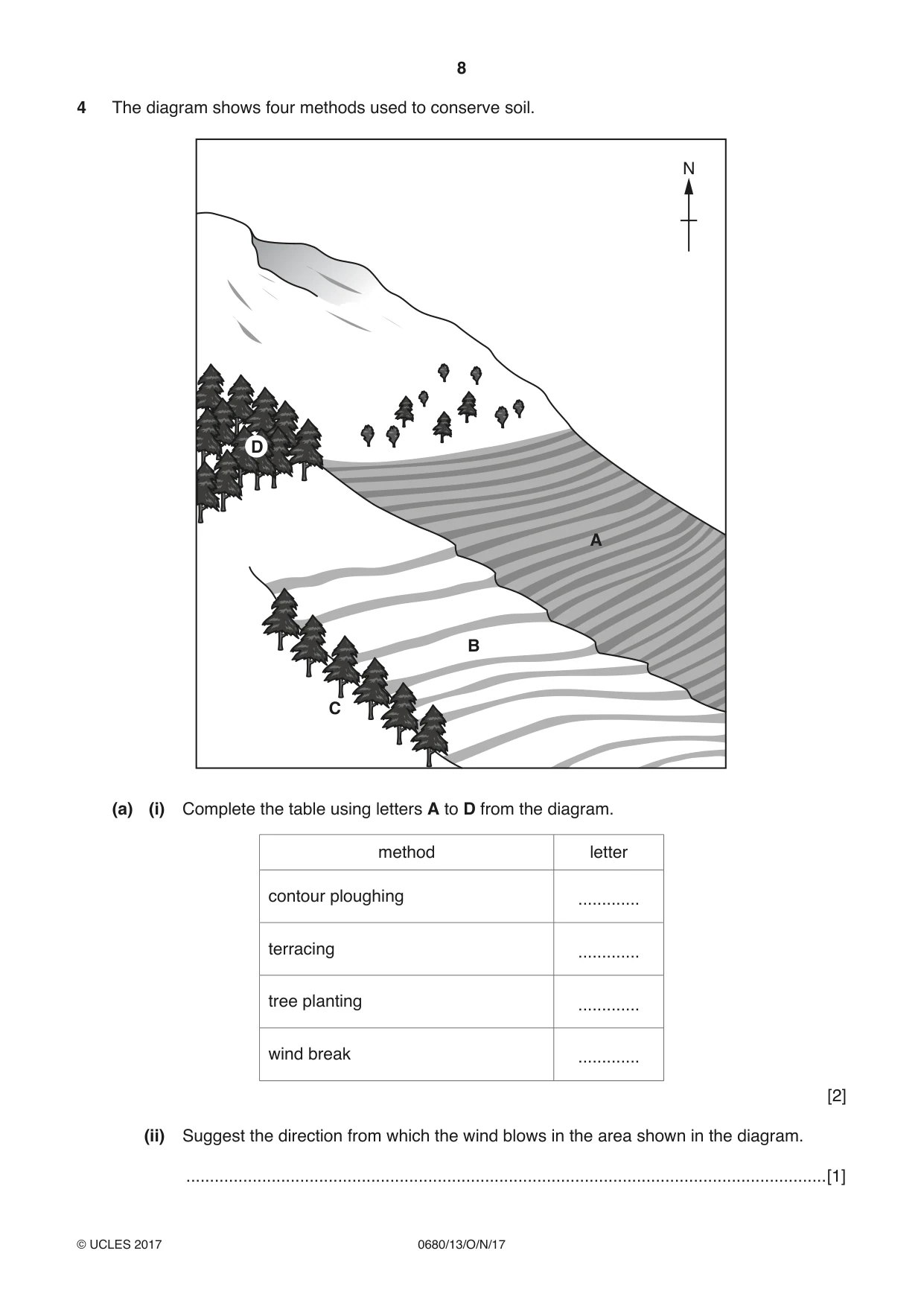
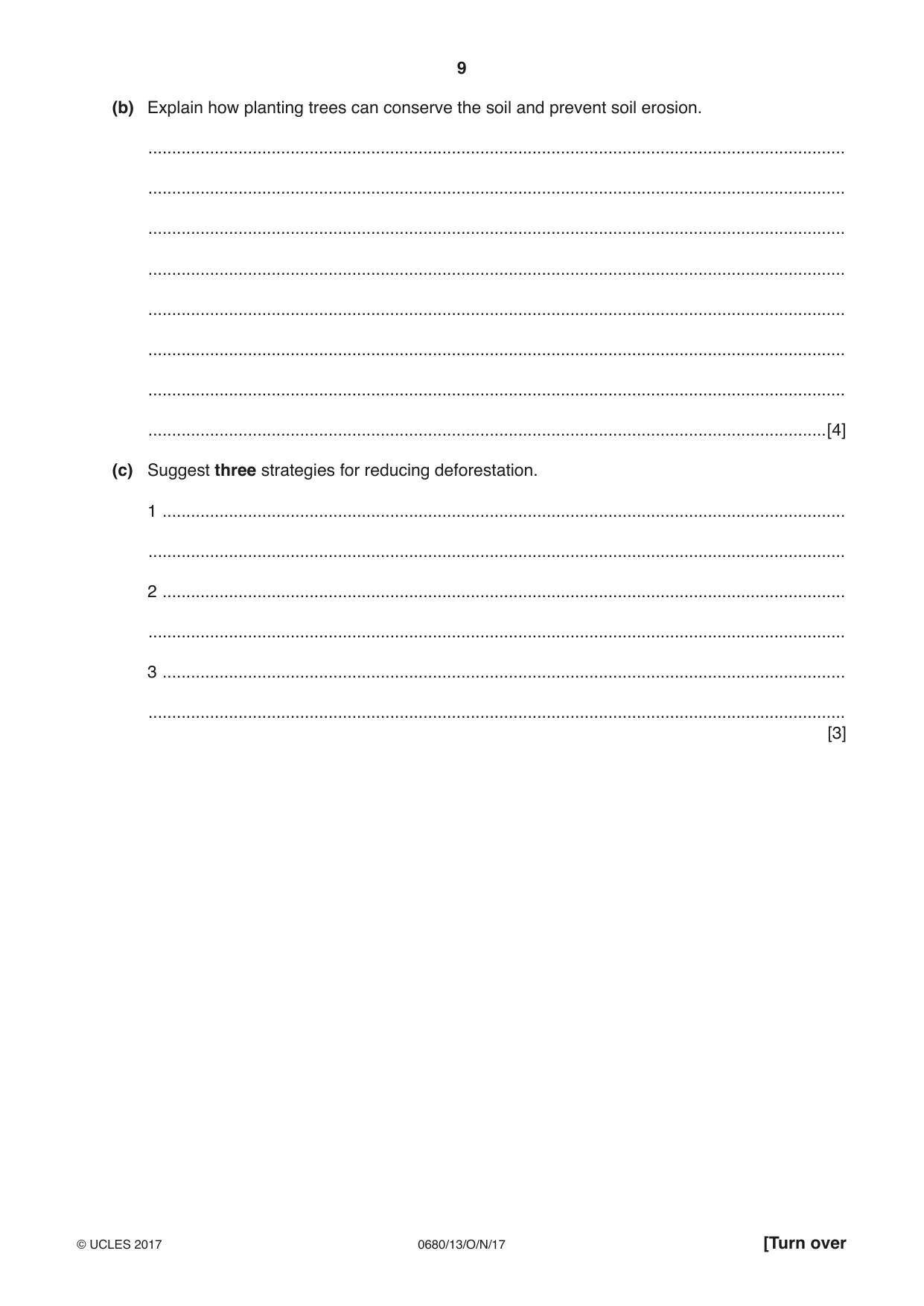
8 0680/13/O/N/17 © UCLES 2017 4 The diagram shows four methods used to conserve soil. C B D A N (a) (i) Complete the table using letters A to D from the diagram. method letter contour ploughing … terracing … tree planting … wind break … [2] (ii) Suggest the direction from which the wind blows in the area shown in the diagram. …[1]
Question paper, page 9
9 0680/13/O/N/17 © UCLES 2017 [Turn over (b) Explain how planting trees can conserve the soil and prevent soil erosion. … … … … … … … …[4] (c) Suggest three strategies for reducing deforestation. 1 … … 2 … … 3 … … [3]
Question paper, page 10
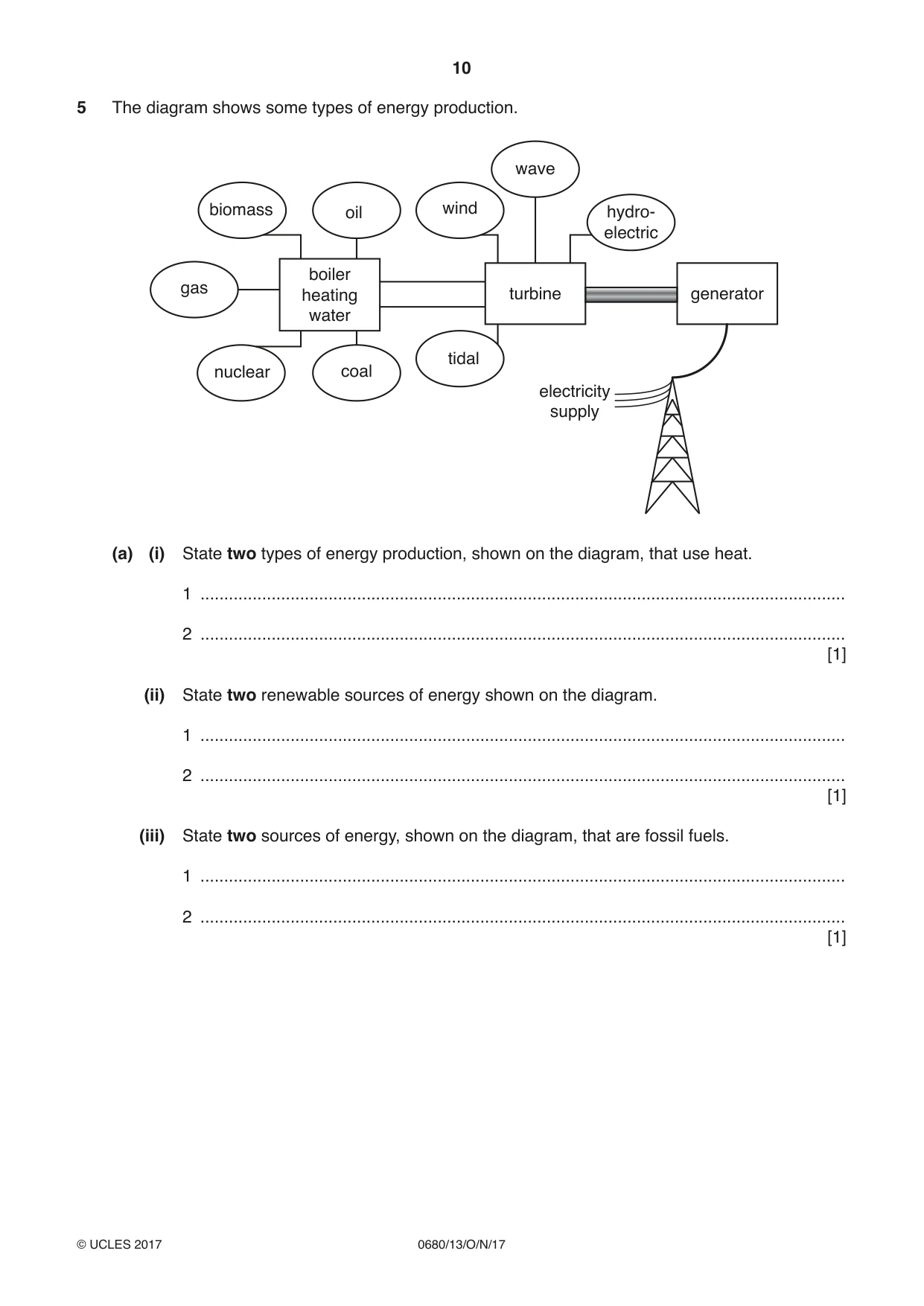
10 0680/13/O/N/17 © UCLES 2017 5 The diagram shows some types of energy production. hydro- electric generator turbine wave wind tidal coal nuclear gas biomass oil boiler heating water electricity supply (a) (i) State two types of energy production, shown on the diagram, that use heat. 1 … 2 … [1] (ii) State two renewable sources of energy shown on the diagram. 1 … 2 … [1] (iii) State two sources of energy, shown on the diagram, that are fossil fuels. 1 … 2 … [1]
Question paper, page 11
11 0680/13/O/N/17 © UCLES 2017 [Turn over (b) Explain two advantages and two disadvantages of using wind power to generate electricity. advantages … … … … disadvantages … … … … [4] (c) Iceland is located in the northern Atlantic Ocean close to the Arctic Circle on a plate boundary. (i) Suggest one reason why people use more energy per person in Iceland than in any other country. … …[1] (ii) Suggest how living on a plate boundary meets most of the energy needs of people in Iceland. … … … …[2]
Question paper, page 12
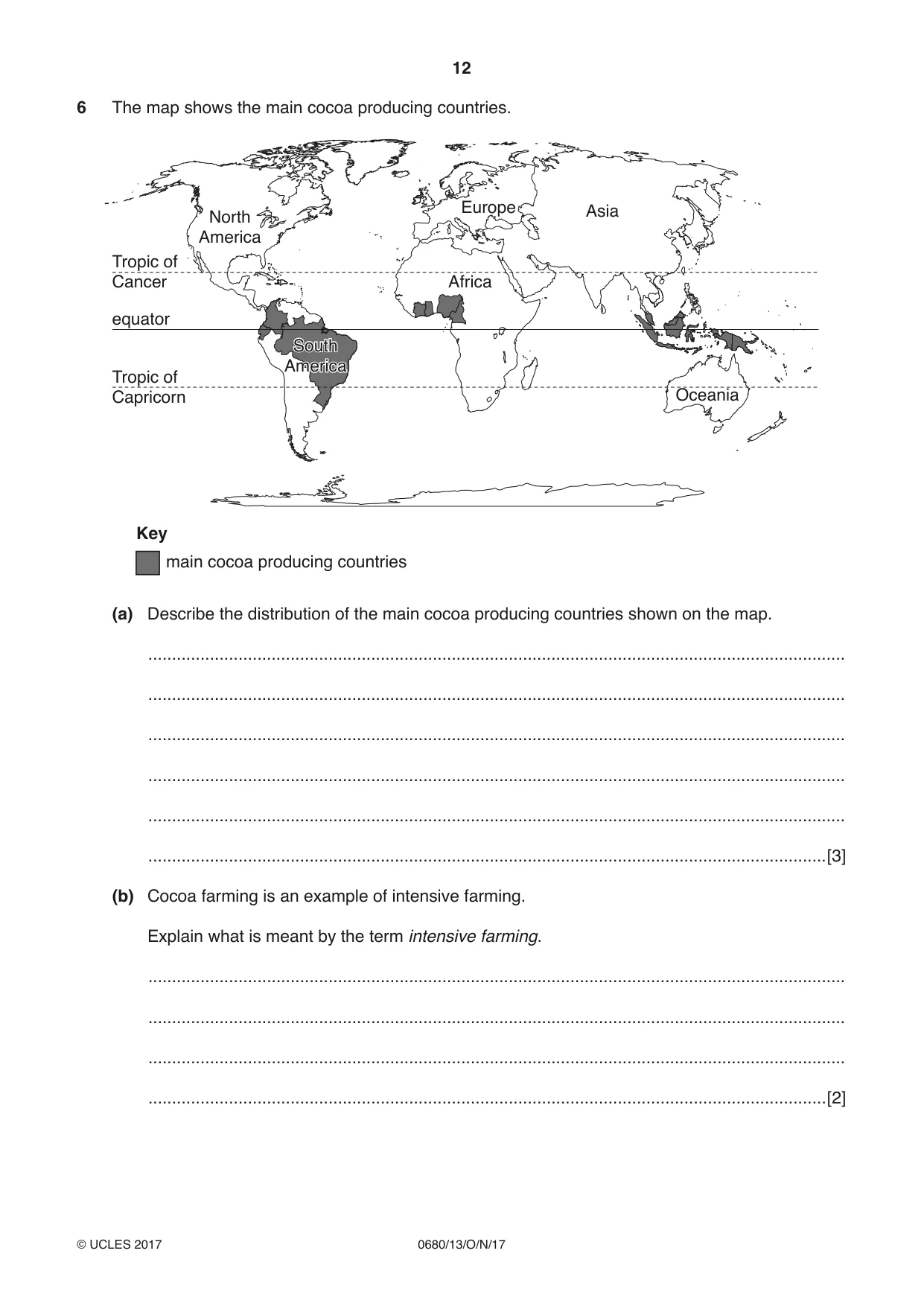
12 0680/13/O/N/17 © UCLES 2017 6 The map shows the main cocoa producing countries. North America South America South America Africa Europe Asia Oceania equator Tropic of Capricorn Tropic of Cancer Key main cocoa producing countries (a) Describe the distribution of the main cocoa producing countries shown on the map. … … … … … …[3] (b) Cocoa farming is an example of intensive farming. Explain what is meant by the term intensive farming. … … … …[2]
Question paper, page 13
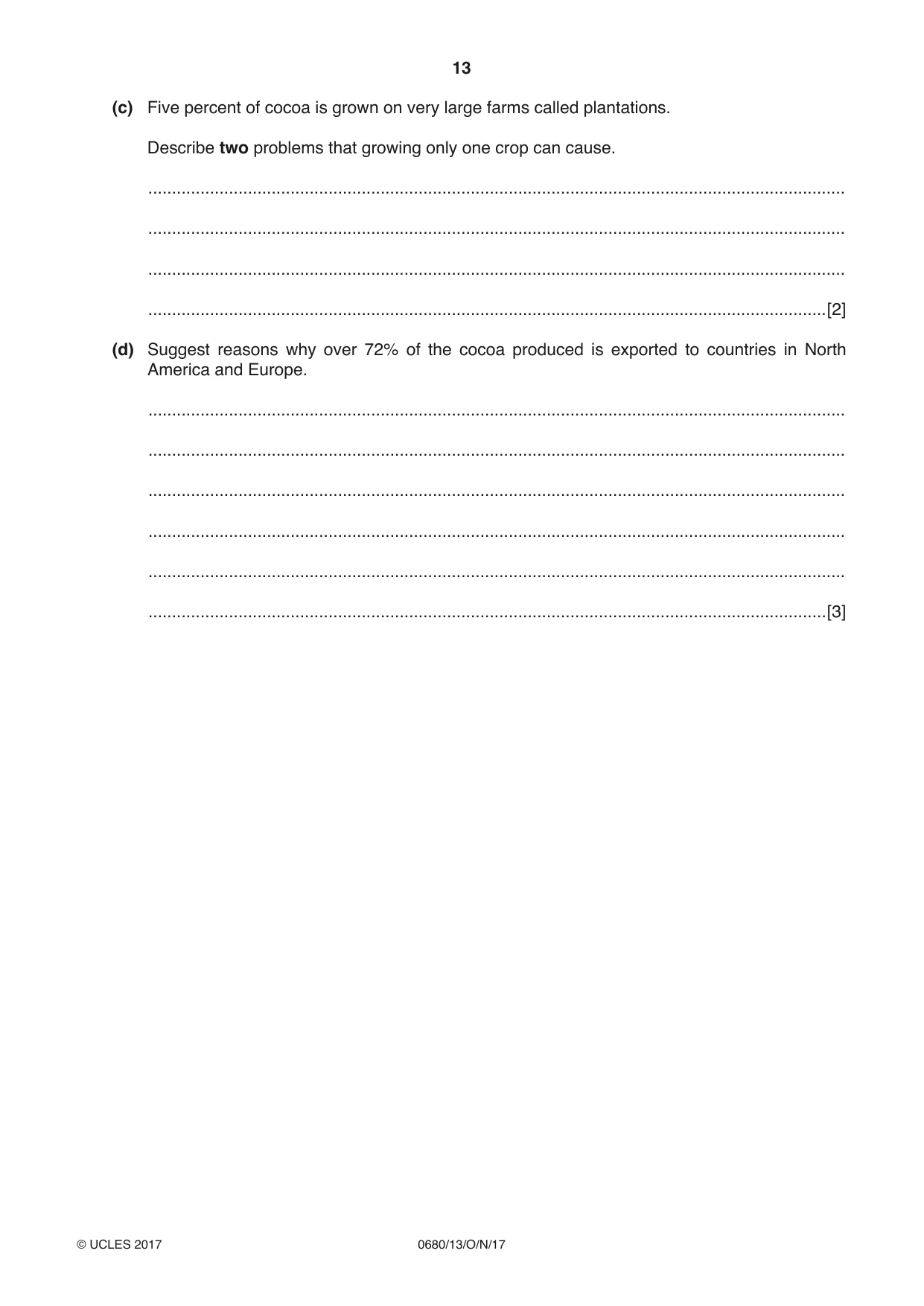
13 0680/13/O/N/17 © UCLES 2017 (c) Five percent of cocoa is grown on very large farms called plantations. Describe two problems that growing only one crop can cause. … … … …[2] (d) Suggest reasons why over 72% of the cocoa produced is exported to countries in North America and Europe. … … … … … …[3]
Question paper, page 14
14 0680/13/O/N/17 © UCLES 2017 BLANK PAGE
Question paper, page 15
15 0680/13/O/N/17 © UCLES 2017 BLANK PAGE
Question paper, page 16
16 0680/13/O/N/17 © UCLES 2017 Permission to reproduce items where third-party owned material protected by copyright is included has been sought and cleared where possible. Every reasonable effort has been made by the publisher (UCLES) to trace copyright holders, but if any items requiring clearance have unwittingly been included, the publisher will be pleased to make amends at the earliest possible opportunity. To avoid the issue of disclosure of answer-related information to candidates, all copyright acknowledgements are reproduced online in the Cambridge International Examinations Copyright Acknowledgements Booklet. This is produced for each series of examinations and is freely available to download at www.cie.org.uk after the live examination series. Cambridge International Examinations is part of the Cambridge Assessment Group. Cambridge Assessment is the brand name of University of Cambridge Local Examinations Syndicate (UCLES), which is itself a department of the University of Cambridge. BLANK PAGE
Mark scheme, page 1
® IGCSE is a registered trademark. This document consists of 7 printed pages. © UCLES 2017 [Turn over Cambridge Assessment International Education Cambridge International General Certificate of Secondary Education ENVIRONMENTAL MANAGEMENT 0680/13 Paper 1 October/November 2017 MARK SCHEME Maximum Mark: 60 Published This mark scheme is published as an aid to teachers and candidates, to indicate the requirements of the examination. It shows the basis on which Examiners were instructed to award marks. It does not indicate the details of the discussions that took place at an Examiners’ meeting before marking began, which would have considered the acceptability of alternative answers. Mark schemes should be read in conjunction with the question paper and the Principal Examiner Report for Teachers. Cambridge International will not enter into discussions about these mark schemes. Cambridge International is publishing the mark schemes for the October/November 2017 series for most Cambridge IGCSE®, Cambridge International A and AS Level components and some Cambridge O Level components.
Mark scheme, page 2
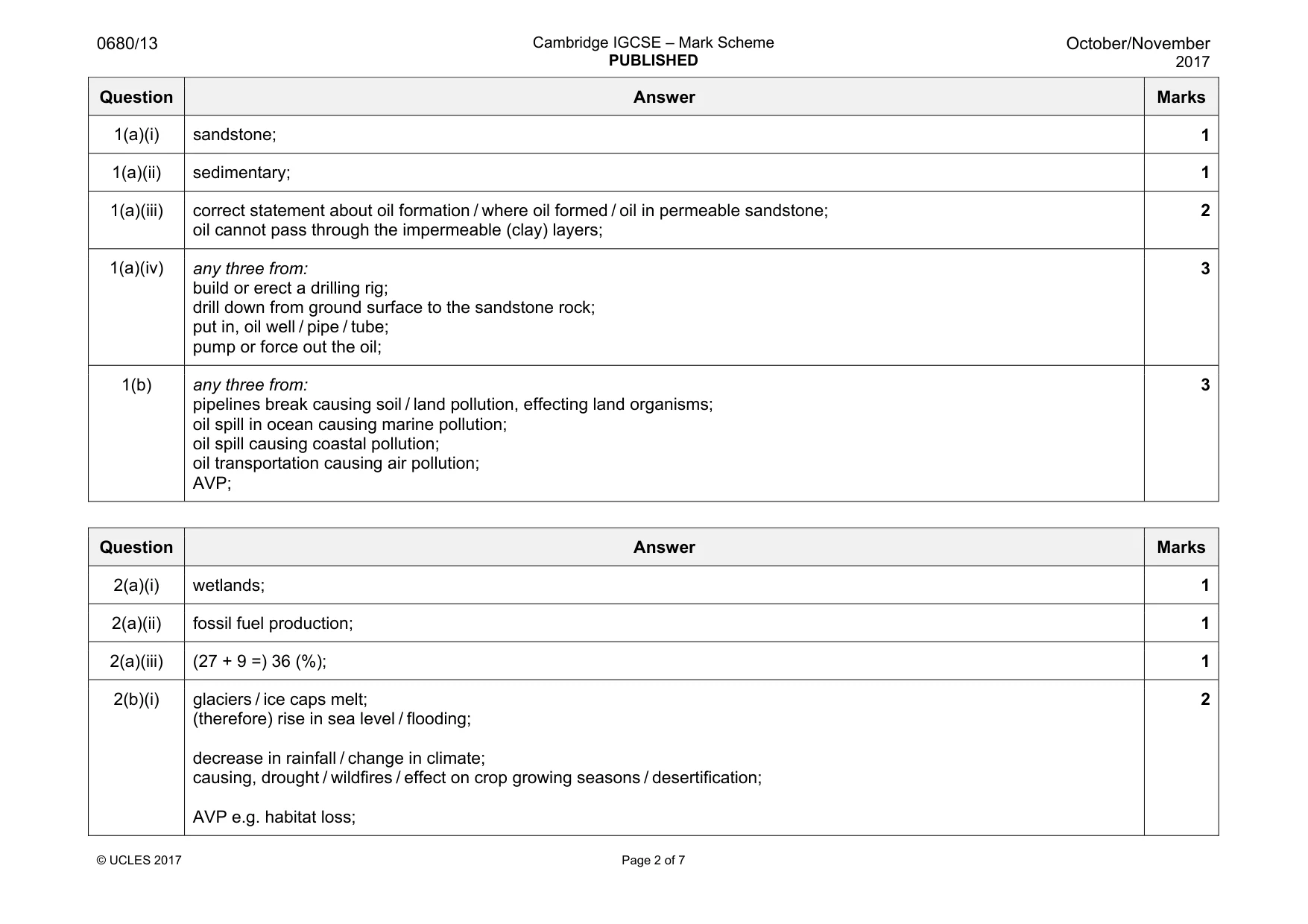
0680/13 Cambridge IGCSE – Mark Scheme PUBLISHED October/November 2017 © UCLES 2017 Page 2 of 7 Question Answer Marks 1(a)(i) sandstone; 1 1(a)(ii) sedimentary; 1 1(a)(iii) correct statement about oil formation / where oil formed / oil in permeable sandstone; oil cannot pass through the impermeable (clay) layers; 2 1(a)(iv) any three from: build or erect a drilling rig; drill down from ground surface to the sandstone rock; put in, oil well / pipe / tube; pump or force out the oil; 3 1(b) any three from: pipelines break causing soil / land pollution, effecting land organisms; oil spill in ocean causing marine pollution; oil spill causing coastal pollution; oil transportation causing air pollution; AVP; 3 Question Answer Marks 2(a)(i) wetlands; 1 2(a)(ii) fossil fuel production; 1 2(a)(iii) (27 + 9 =) 36 (%); 1 2(b)(i) glaciers / ice caps melt; (therefore) rise in sea level / flooding; decrease in rainfall / change in climate; causing, drought / wildfires / effect on crop growing seasons / desertification; AVP e.g. habitat loss; 2
Mark scheme, page 3
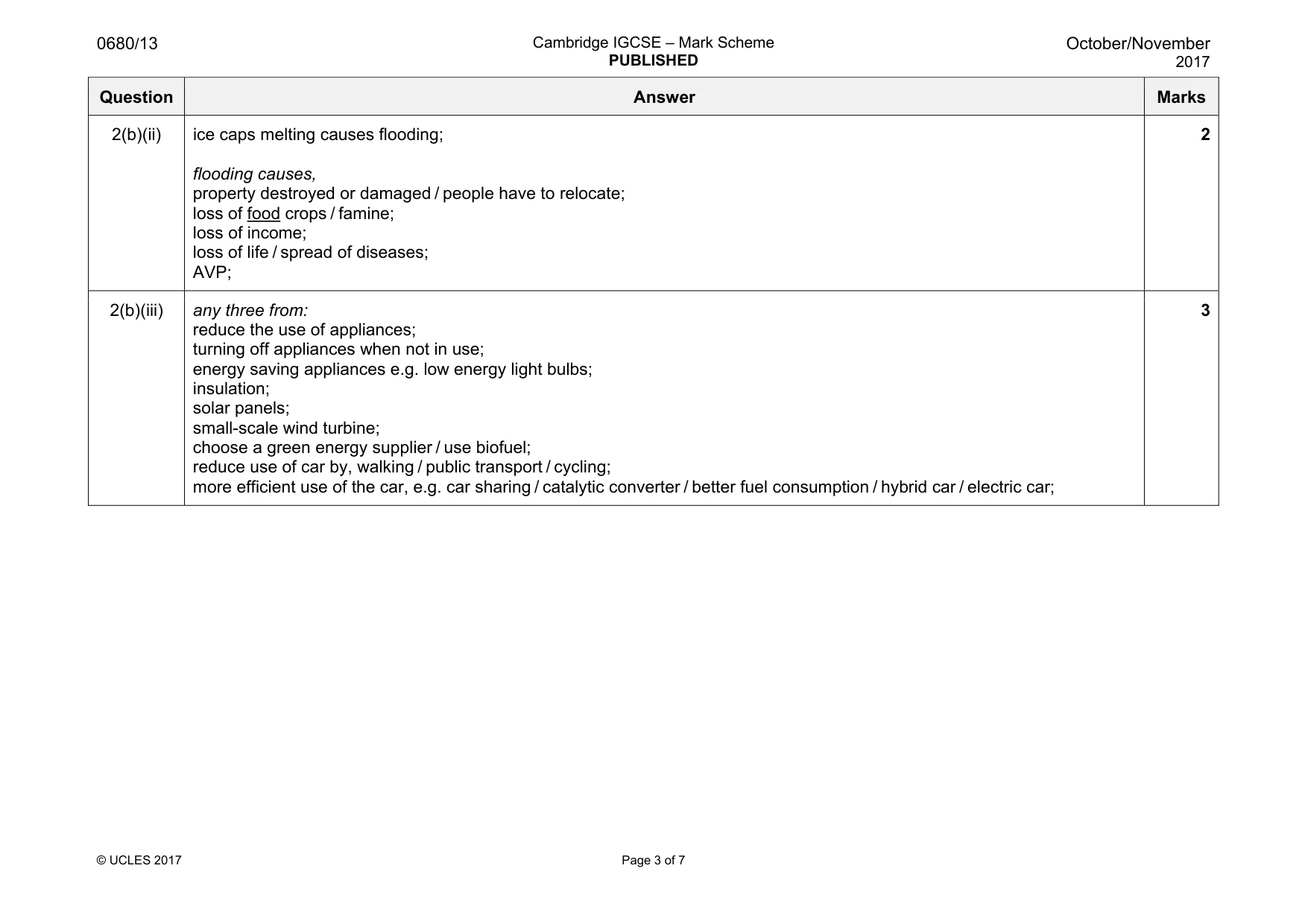
0680/13 Cambridge IGCSE – Mark Scheme PUBLISHED October/November 2017 © UCLES 2017 Page 3 of 7 Question Answer Marks 2(b)(ii) ice caps melting causes flooding; flooding causes, property destroyed or damaged / people have to relocate; loss of food crops / famine; loss of income; loss of life / spread of diseases; AVP; 2 2(b)(iii) any three from: reduce the use of appliances; turning off appliances when not in use; energy saving appliances e.g. low energy light bulbs; insulation; solar panels; small-scale wind turbine; choose a green energy supplier / use biofuel; reduce use of car by, walking / public transport / cycling; more efficient use of the car, e.g. car sharing / catalytic converter / better fuel consumption / hybrid car / electric car; 3
Mark scheme, page 4
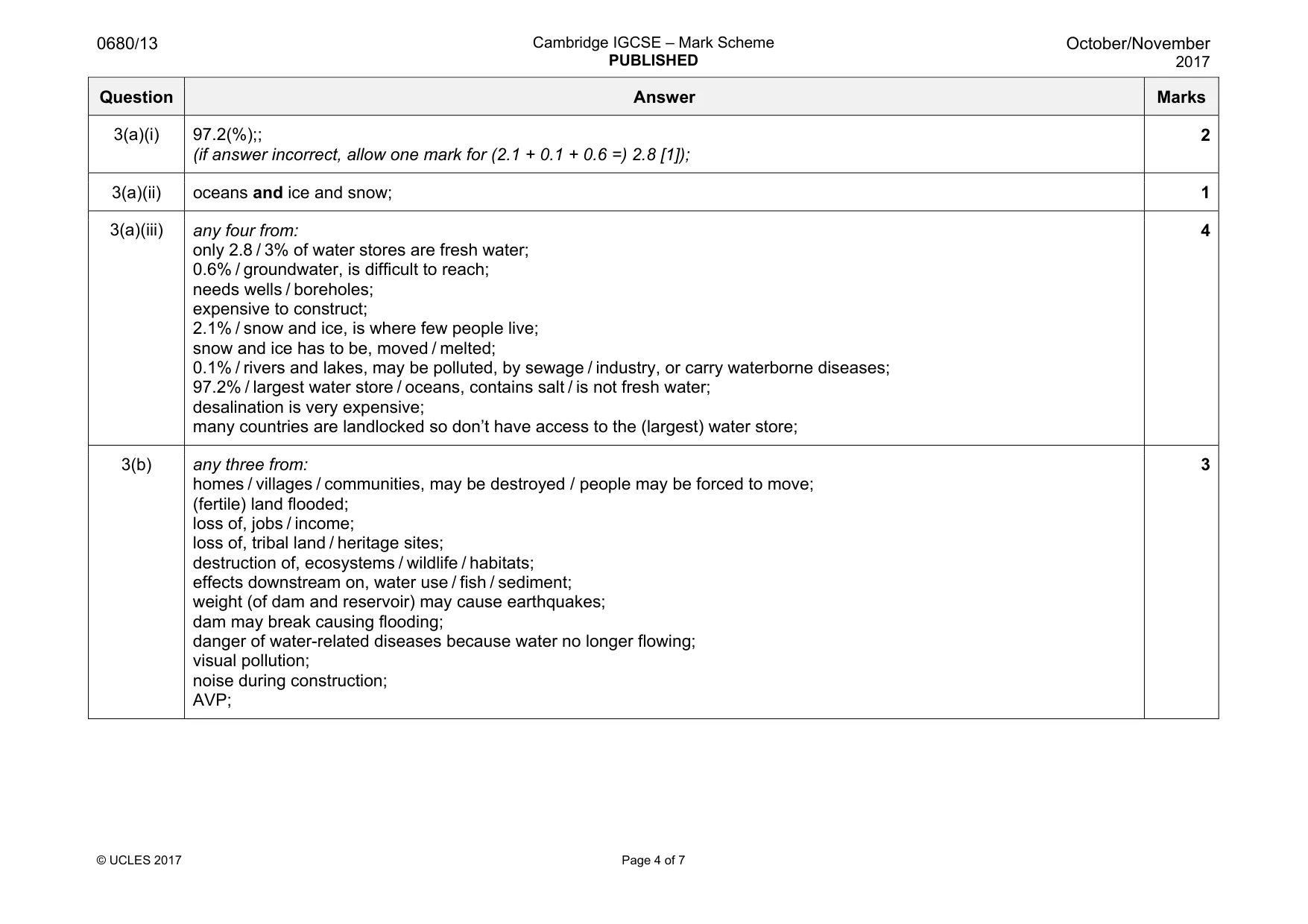
0680/13 Cambridge IGCSE – Mark Scheme PUBLISHED October/November 2017 © UCLES 2017 Page 4 of 7 Question Answer Marks 3(a)(i) 97.2(%);; (if answer incorrect, allow one mark for (2.1 + 0.1 + 0.6 =) 2.8 [1]); 2 3(a)(ii) oceans and ice and snow; 1 3(a)(iii) any four from: only 2.8 / 3% of water stores are fresh water; 0.6% / groundwater, is difficult to reach; needs wells / boreholes; expensive to construct; 2.1% / snow and ice, is where few people live; snow and ice has to be, moved / melted; 0.1% / rivers and lakes, may be polluted, by sewage / industry, or carry waterborne diseases; 97.2% / largest water store / oceans, contains salt / is not fresh water; desalination is very expensive; many countries are landlocked so don’t have access to the (largest) water store; 4 3(b) any three from: homes / villages / communities, may be destroyed / people may be forced to move; (fertile) land flooded; loss of, jobs / income; loss of, tribal land / heritage sites; destruction of, ecosystems / wildlife / habitats; effects downstream on, water use / fish / sediment; weight (of dam and reservoir) may cause earthquakes; dam may break causing flooding; danger of water-related diseases because water no longer flowing; visual pollution; noise during construction; AVP; 3
Mark scheme, page 5
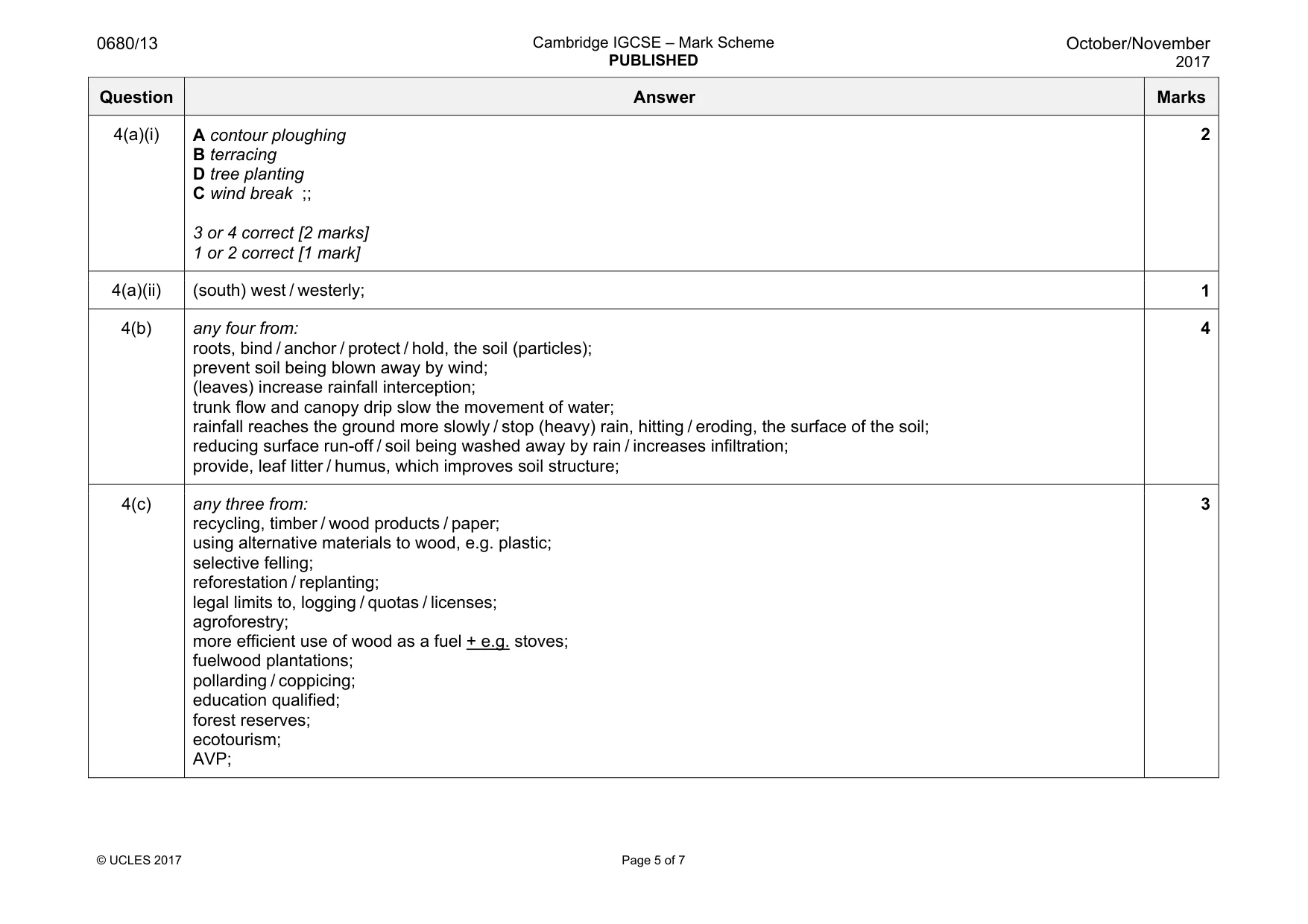
0680/13 Cambridge IGCSE – Mark Scheme PUBLISHED October/November 2017 © UCLES 2017 Page 5 of 7 Question Answer Marks 4(a)(i) A contour ploughing B terracing D tree planting C wind break ;; 3 or 4 correct [2 marks] 1 or 2 correct [1 mark] 2 4(a)(ii) (south) west / westerly; 1 4(b) any four from: roots, bind / anchor / protect / hold, the soil (particles); prevent soil being blown away by wind; (leaves) increase rainfall interception; trunk flow and canopy drip slow the movement of water; rainfall reaches the ground more slowly / stop (heavy) rain, hitting / eroding, the surface of the soil; reducing surface run-off / soil being washed away by rain / increases infiltration; provide, leaf litter / humus, which improves soil structure; 4 4(c) any three from: recycling, timber / wood products / paper; using alternative materials to wood, e.g. plastic; selective felling; reforestation / replanting; legal limits to, logging / quotas / licenses; agroforestry; more efficient use of wood as a fuel + e.g. stoves; fuelwood plantations; pollarding / coppicing; education qualified; forest reserves; ecotourism; AVP; 3
Mark scheme, page 6
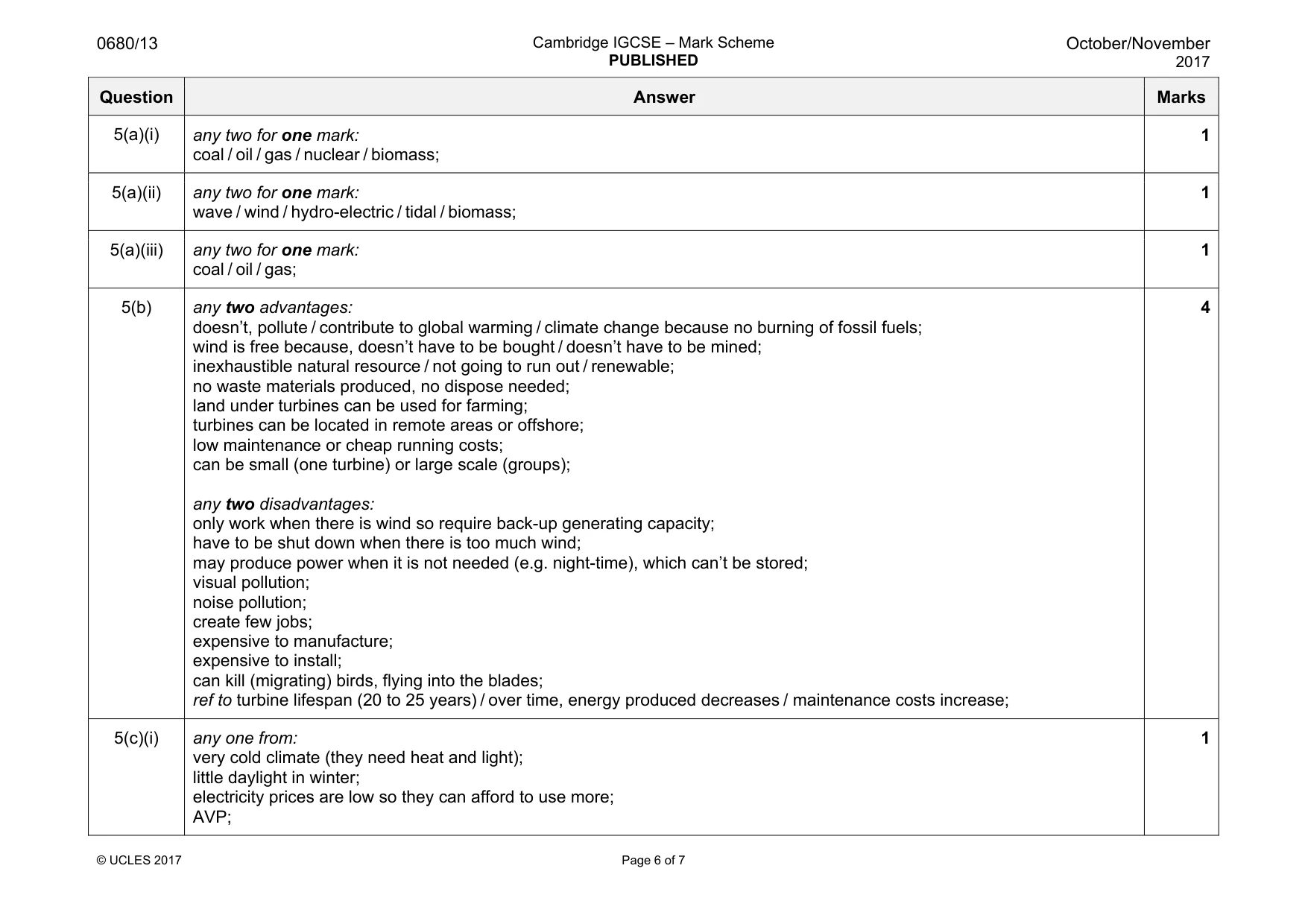
0680/13 Cambridge IGCSE – Mark Scheme PUBLISHED October/November 2017 © UCLES 2017 Page 6 of 7 Question Answer Marks 5(a)(i) any two for one mark: coal / oil / gas / nuclear / biomass; 1 5(a)(ii) any two for one mark: wave / wind / hydro-electric / tidal / biomass; 1 5(a)(iii) any two for one mark: coal / oil / gas; 1 5(b) any two advantages: doesn’t, pollute / contribute to global warming / climate change because no burning of fossil fuels; wind is free because, doesn’t have to be bought / doesn’t have to be mined; inexhaustible natural resource / not going to run out / renewable; no waste materials produced, no dispose needed; land under turbines can be used for farming; turbines can be located in remote areas or offshore; low maintenance or cheap running costs; can be small (one turbine) or large scale (groups); any two disadvantages: only work when there is wind so require back-up generating capacity; have to be shut down when there is too much wind; may produce power when it is not needed (e.g. night-time), which can’t be stored; visual pollution; noise pollution; create few jobs; expensive to manufacture; expensive to install; can kill (migrating) birds, flying into the blades; ref to turbine lifespan (20 to 25 years) / over time, energy produced decreases / maintenance costs increase; 4 5(c)(i) any one from: very cold climate (they need heat and light); little daylight in winter; electricity prices are low so they can afford to use more; AVP; 1
Mark scheme, page 7
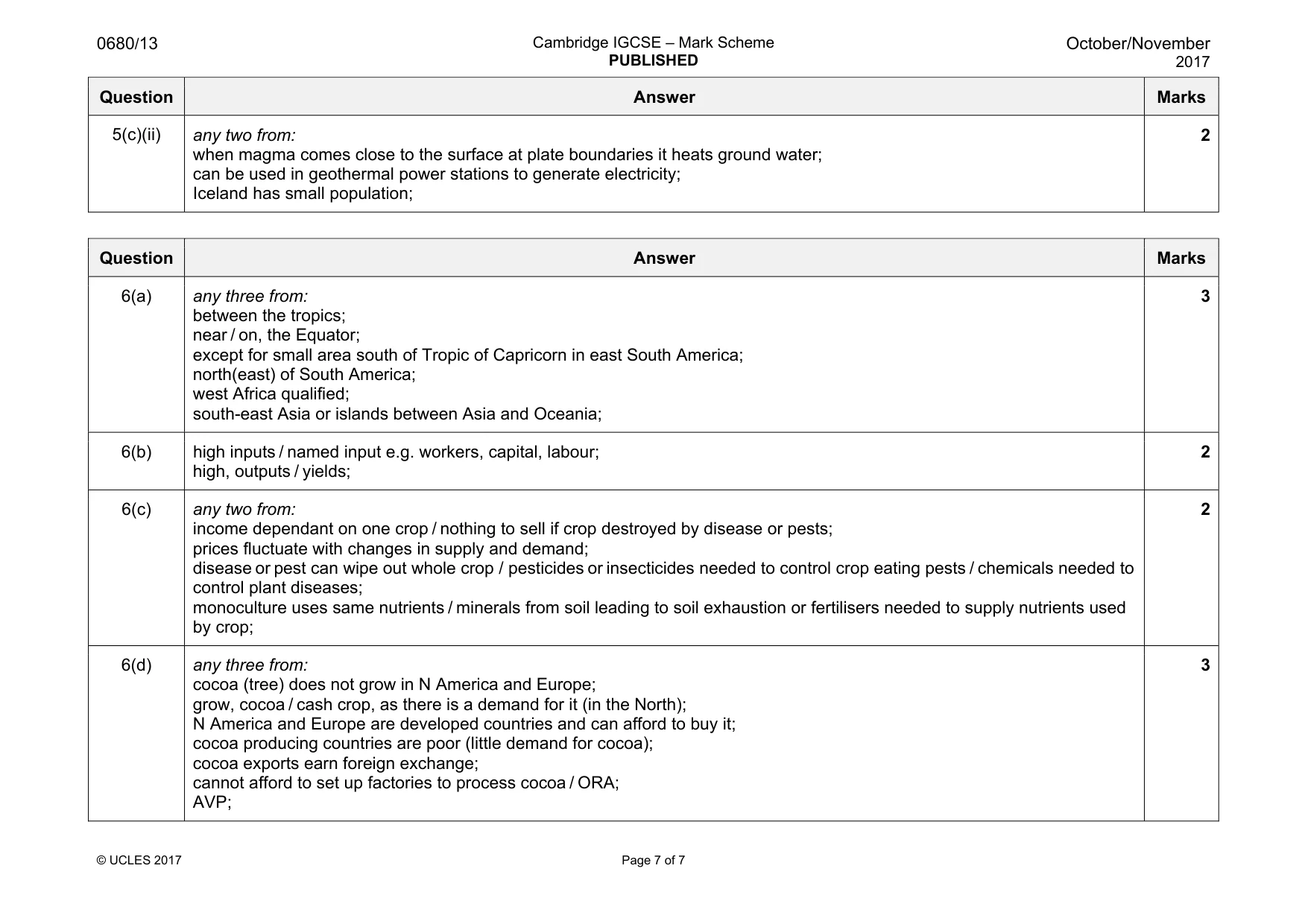
0680/13 Cambridge IGCSE – Mark Scheme PUBLISHED October/November 2017 © UCLES 2017 Page 7 of 7 Question Answer Marks 5(c)(ii) any two from: when magma comes close to the surface at plate boundaries it heats ground water; can be used in geothermal power stations to generate electricity; Iceland has small population; 2 Question Answer Marks 6(a) any three from: between the tropics; near / on, the Equator; except for small area south of Tropic of Capricorn in east South America; north(east) of South America; west Africa qualified; south-east Asia or islands between Asia and Oceania; 3 6(b) high inputs / named input e.g. workers, capital, labour; high, outputs / yields; 2 6(c) any two from: income dependant on one crop / nothing to sell if crop destroyed by disease or pests; prices fluctuate with changes in supply and demand; disease or pest can wipe out whole crop / pesticides or insecticides needed to control crop eating pests / chemicals needed to control plant diseases; monoculture uses same nutrients / minerals from soil leading to soil exhaustion or fertilisers needed to supply nutrients used by crop; 2 6(d) any three from: cocoa (tree) does not grow in N America and Europe; grow, cocoa / cash crop, as there is a demand for it (in the North); N America and Europe are developed countries and can afford to buy it; cocoa producing countries are poor (little demand for cocoa); cocoa exports earn foreign exchange; cannot afford to set up factories to process cocoa / ORA; AVP; 3
What you needed in this session
Cambridge’s own grade thresholds for 2017 Oct/Nov, Paper 1 · Variant 3. A higher threshold means an easier paper — the bar moves with how the cohort did.