Cambridge IGCSE Environmental Management 0680 — 2016 Oct/Nov Paper 2 · Variant 1
0680/21/O/N/16 · 80 marks · ≈90 min
The question paper and its mark scheme, free to read here and free to download. This is Cambridge’s own paper, exactly as it was sat.
Question paper16 pages

Mark scheme9 pages
Answers below. Sit the paper first if you are practising.
Paper as text
Question paper, page 1
This document consists of 15 printed pages and 1 blank page. DC (LK/SG) 114934/3 © UCLES 2016 [Turn over Cambridge International Examinations Cambridge International General Certificate of Secondary Education * 1 0 0 7 4 6 9 9 2 0 * ENVIRONMENTAL MANAGEMENT 0680/21 Paper 2 October/November 2016 1 hour 45 minutes Candidates answer on the Question Paper. No Additional Materials are required. READ THESE INSTRUCTIONS FIRST Write your Centre number, candidate number and name on all the work you hand in. Write in dark blue or black pen. You may use an HB pencil for any diagrams or graphs. Do not use staples, paper clips, glue or correction fluid. DO NOT WRITE IN ANY BARCODES. Answer both questions. Electronic calculators may be used. You may lose marks if you do not show your working or if you do not use appropriate units. At the end of the examination, fasten all your work securely together. The number of marks is given in brackets [ ] at the end of each question or part question.
Question paper, page 2
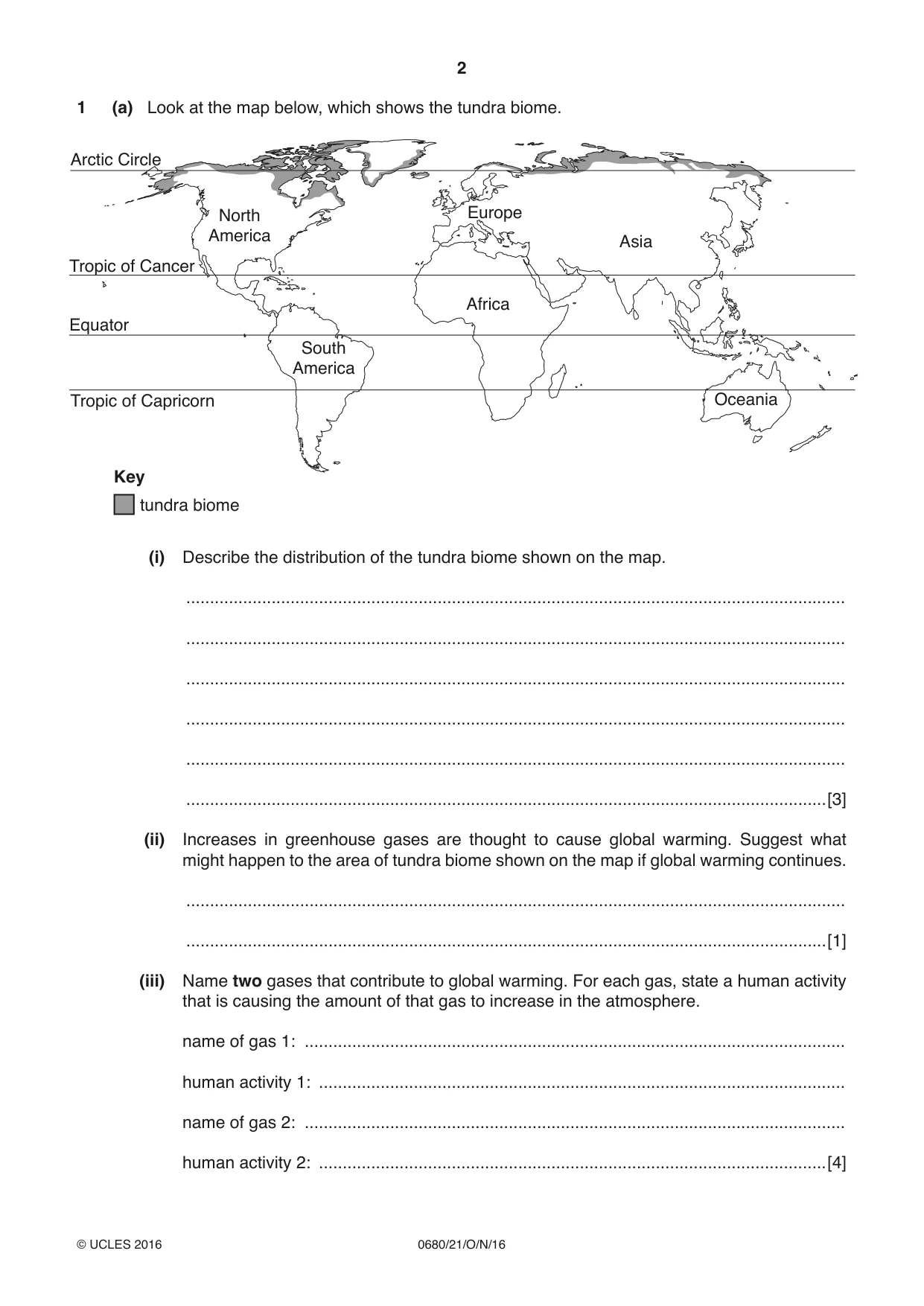
2 0680/21/O/N/16 © UCLES 2016 1 (a) Look at the map below, which shows the tundra biome. tundra biome Arctic Circle Tropic of Cancer Tropic of Capricorn Equator North America South America Africa Europe Asia Oceania Key (i) Describe the distribution of the tundra biome shown on the map. … … … … … …[3] (ii) Increases in greenhouse gases are thought to cause global warming. Suggest what might happen to the area of tundra biome shown on the map if global warming continues. … …[1] (iii) Name two gases that contribute to global warming. For each gas, state a human activity that is causing the amount of that gas to increase in the atmosphere. name of gas 1: … human activity 1: … name of gas 2: … human activity 2: …[4]
Question paper, page 3
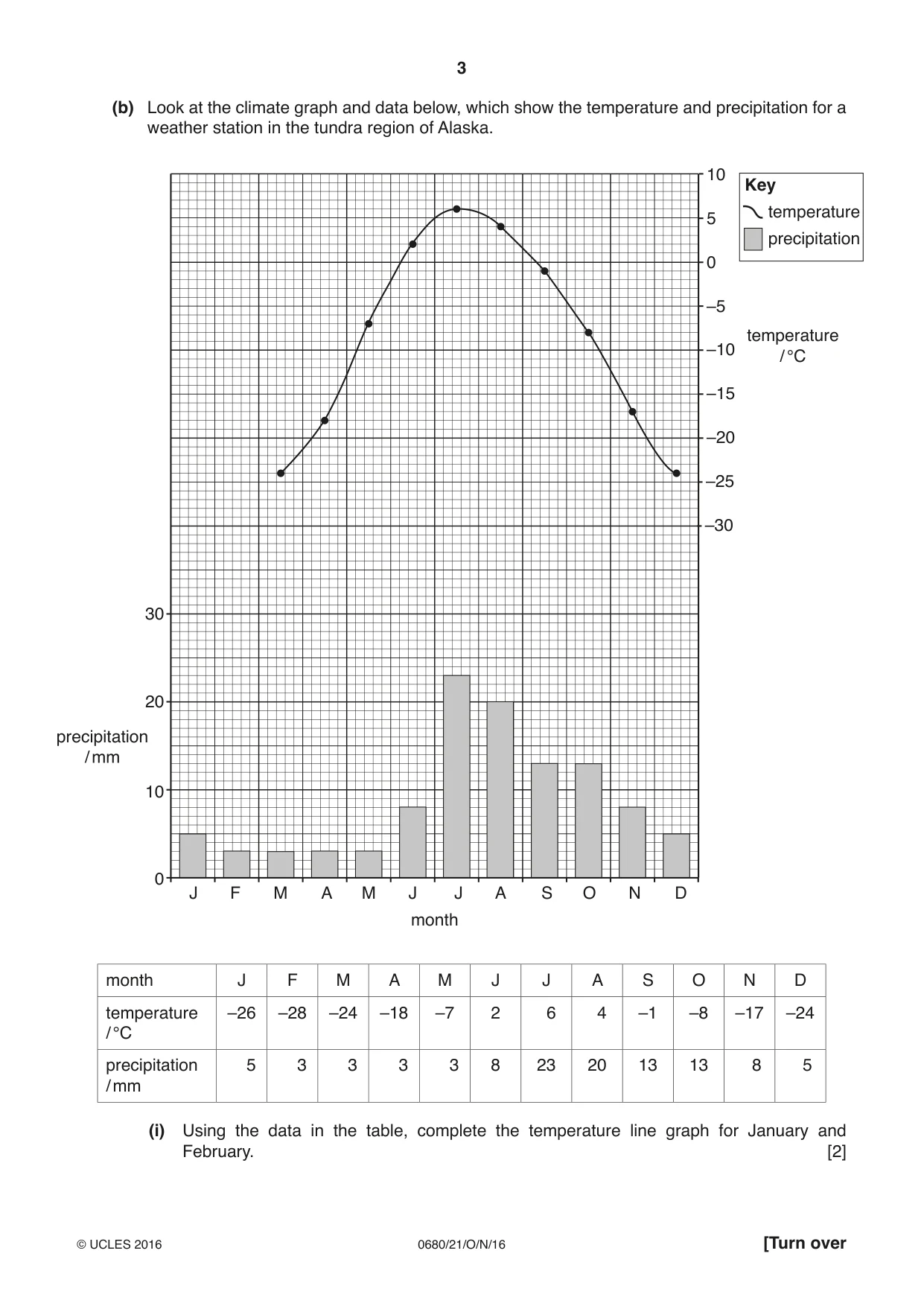
3 0680/21/O/N/16 © UCLES 2016 [Turn over (b) Look at the climate graph and data below, which show the temperature and precipitation for a weather station in the tundra region of Alaska. –15 –10 –20 –5 0 20 0 10 5 J F M A M J J A S O N D 30 –25 –30 10 month temperature / °C precipitation / mm precipitation Key temperature month J F M A M J J A S O N D temperature / °C –26 –28 –24 –18 –7 2 6 4 –1 –8 –17 –24 precipitation / mm 5 3 3 3 3 8 23 20 13 13 8 5 (i) Using the data in the table, complete the temperature line graph for January and February. [2]
Question paper, page 4
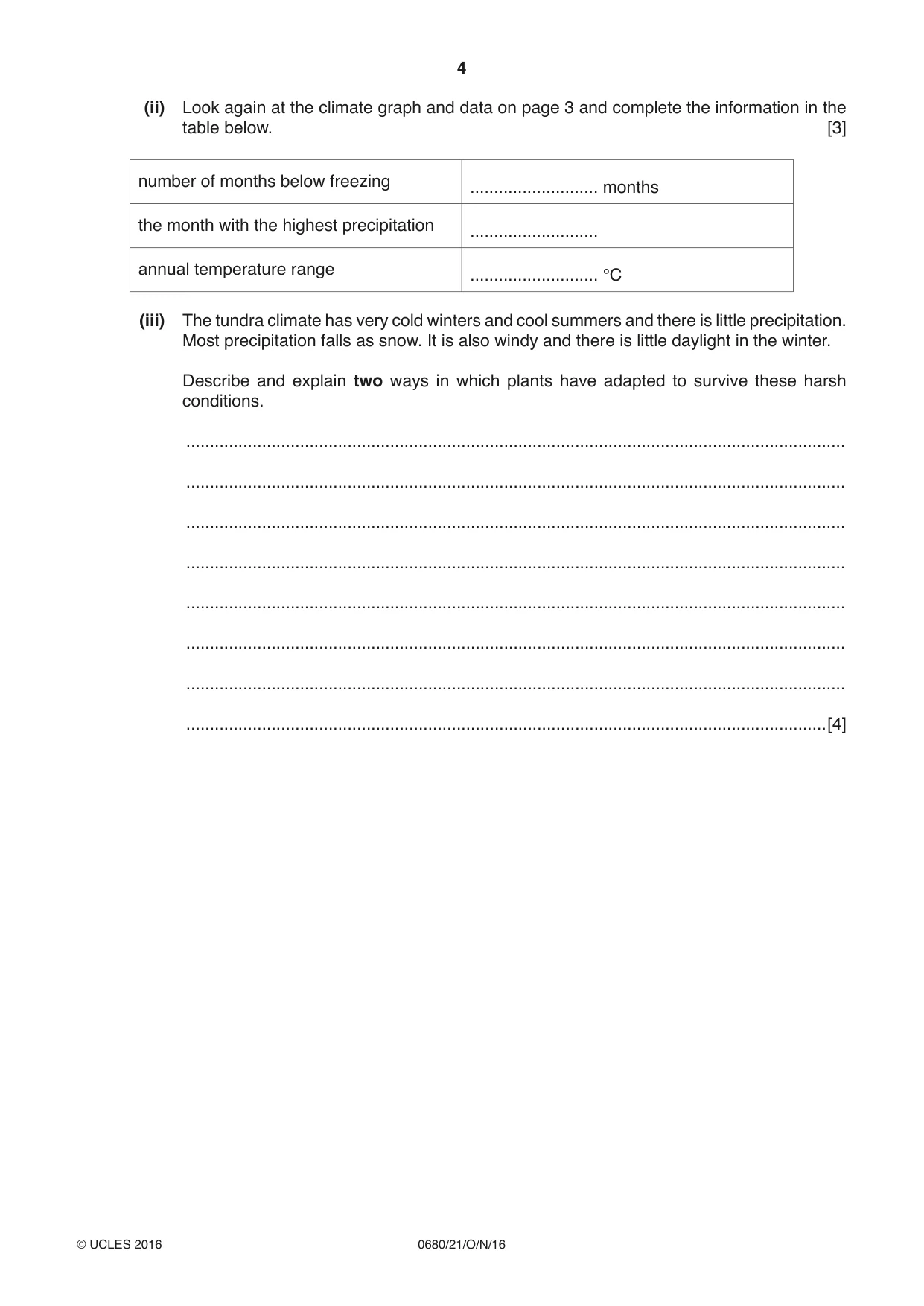
4 0680/21/O/N/16 © UCLES 2016 (ii) Look again at the climate graph and data on page 3 and complete the information in the table below. [3] number of months below freezing … months the month with the highest precipitation … annual temperature range … °C (iii) The tundra climate has very cold winters and cool summers and there is little precipitation. Most precipitation falls as snow. It is also windy and there is little daylight in the winter. Describe and explain two ways in which plants have adapted to survive these harsh conditions. … … … … … … … …[4]
Question paper, page 5
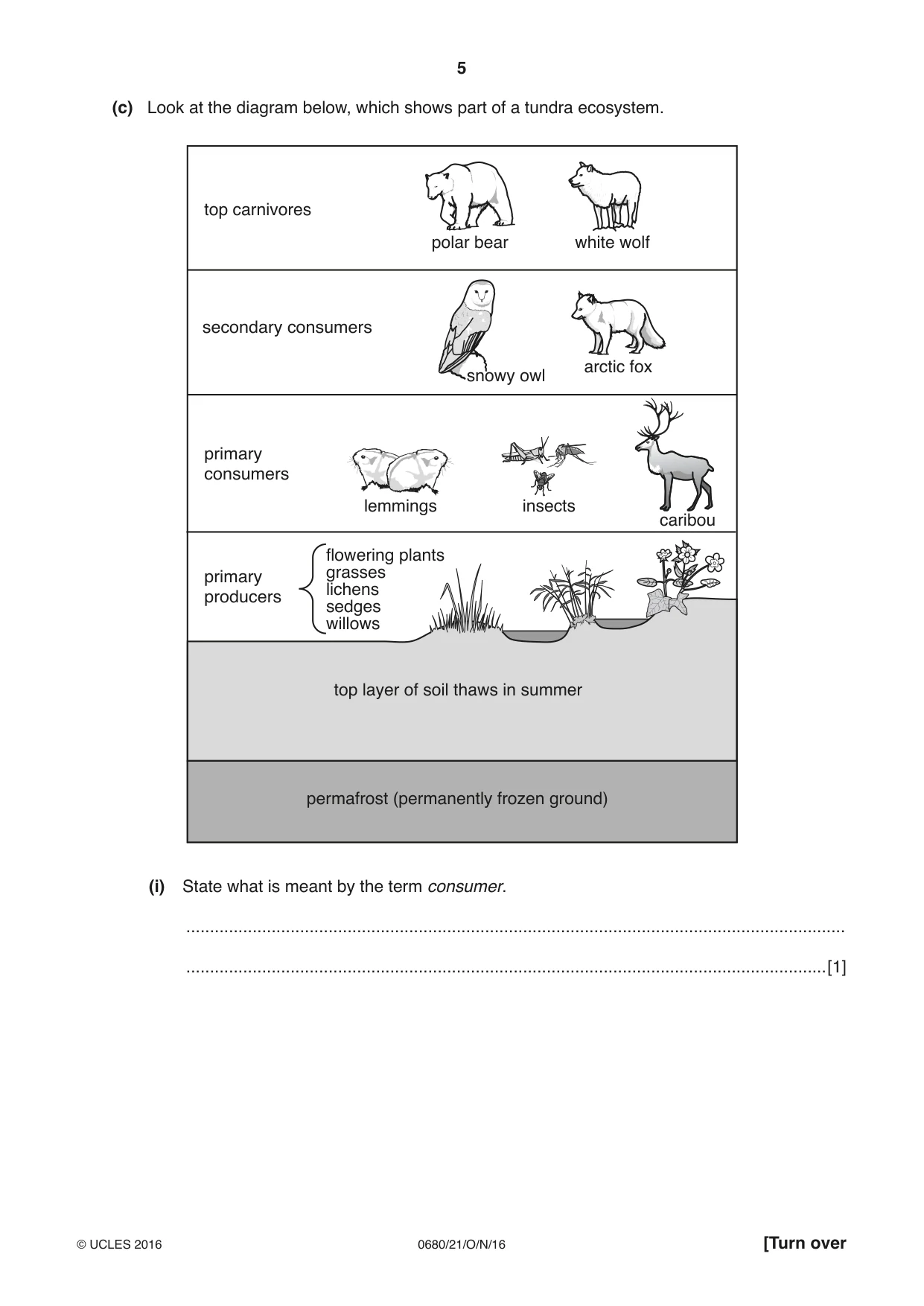
5 0680/21/O/N/16 © UCLES 2016 [Turn over (c) Look at the diagram below, which shows part of a tundra ecosystem. polar bear white wolf arctic fox snowy owl lemmings caribou grasses lichens sedges willows insects flowering plants top carnivores secondary consumers primary consumers primary producers top layer of soil thaws in summer permafrost (permanently frozen ground) (i) State what is meant by the term consumer. … …[1]
Question paper, page 6
6 0680/21/O/N/16 © UCLES 2016 (ii) Read the information in the text box. Some animals are moving further north into tundra regions as a result of global warming. One example is the red fox, which is a secondary consumer. Suggest ways in which the tundra ecosystem could be affected by the movement of the red fox. … … … … … … … …[4] (d) In 1968 a large oil field was discovered in the Alaskan tundra. (i) Explain how the oil was formed. … … … … … …[3]
Question paper, page 7
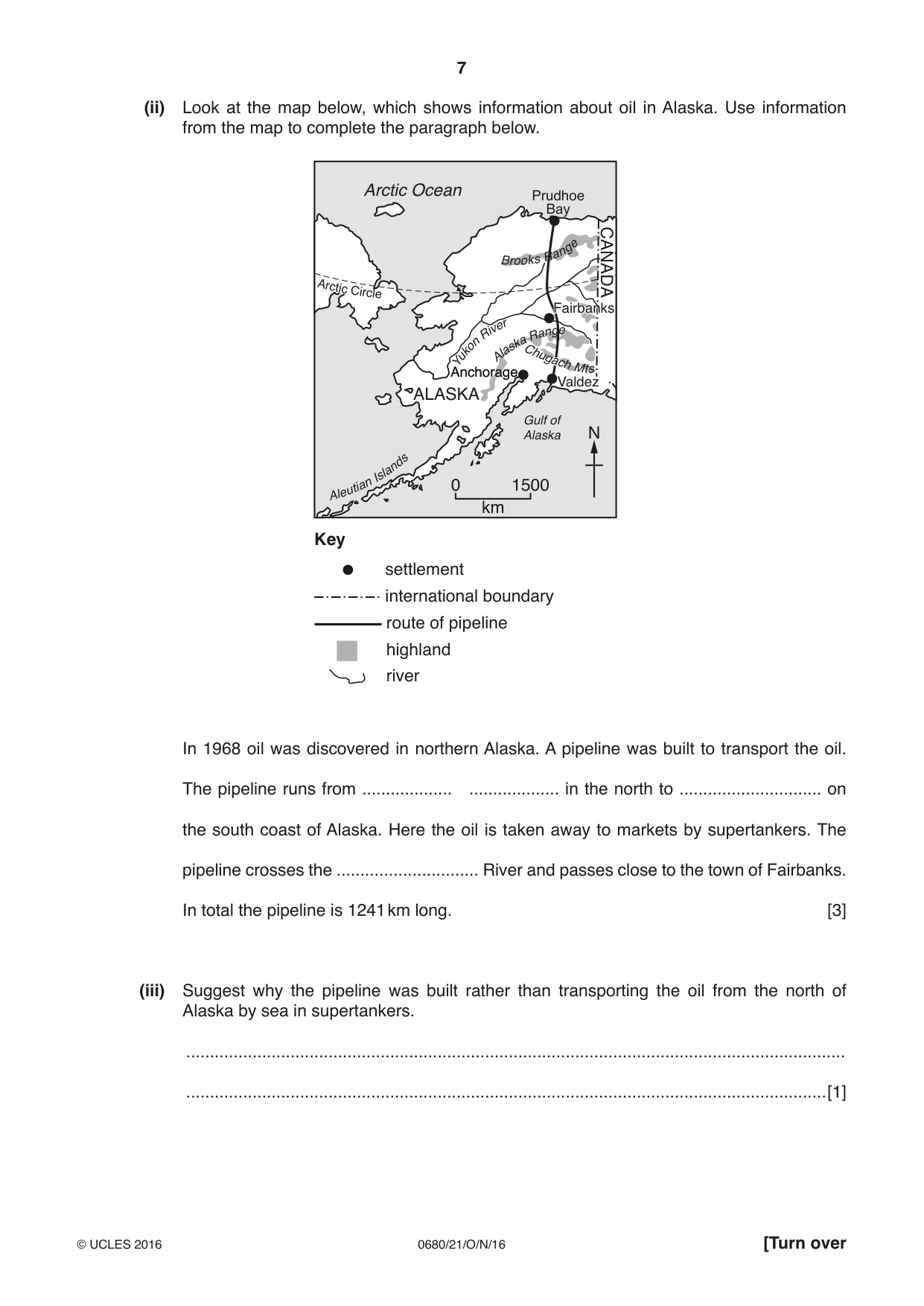
7 0680/21/O/N/16 © UCLES 2016 [Turn over (ii) Look at the map below, which shows information about oil in Alaska. Use information from the map to complete the paragraph below. Arc tic Circl e Arctic Ocean Prudhoe Bay Br o o k s R a n g e A la s k a R a n g e Y u k o n R iv e r Chu ga ch M t s Al eu tia n Is la n d s Fairbanks Fairbanks Anchorage Valdez ALASKA Gulf of Alaska Anchorage 0 1500 km N Key settlement international boundary route of pipeline highland river CANADA CANADA In 1968 oil was discovered in northern Alaska. A pipeline was built to transport the oil. The pipeline runs from … … in the north to … on the south coast of Alaska. Here the oil is taken away to markets by supertankers. The pipeline crosses the … River and passes close to the town of Fairbanks. In total the pipeline is 1241 km long. [3] (iii) Suggest why the pipeline was built rather than transporting the oil from the north of Alaska by sea in supertankers. … …[1]
Question paper, page 8
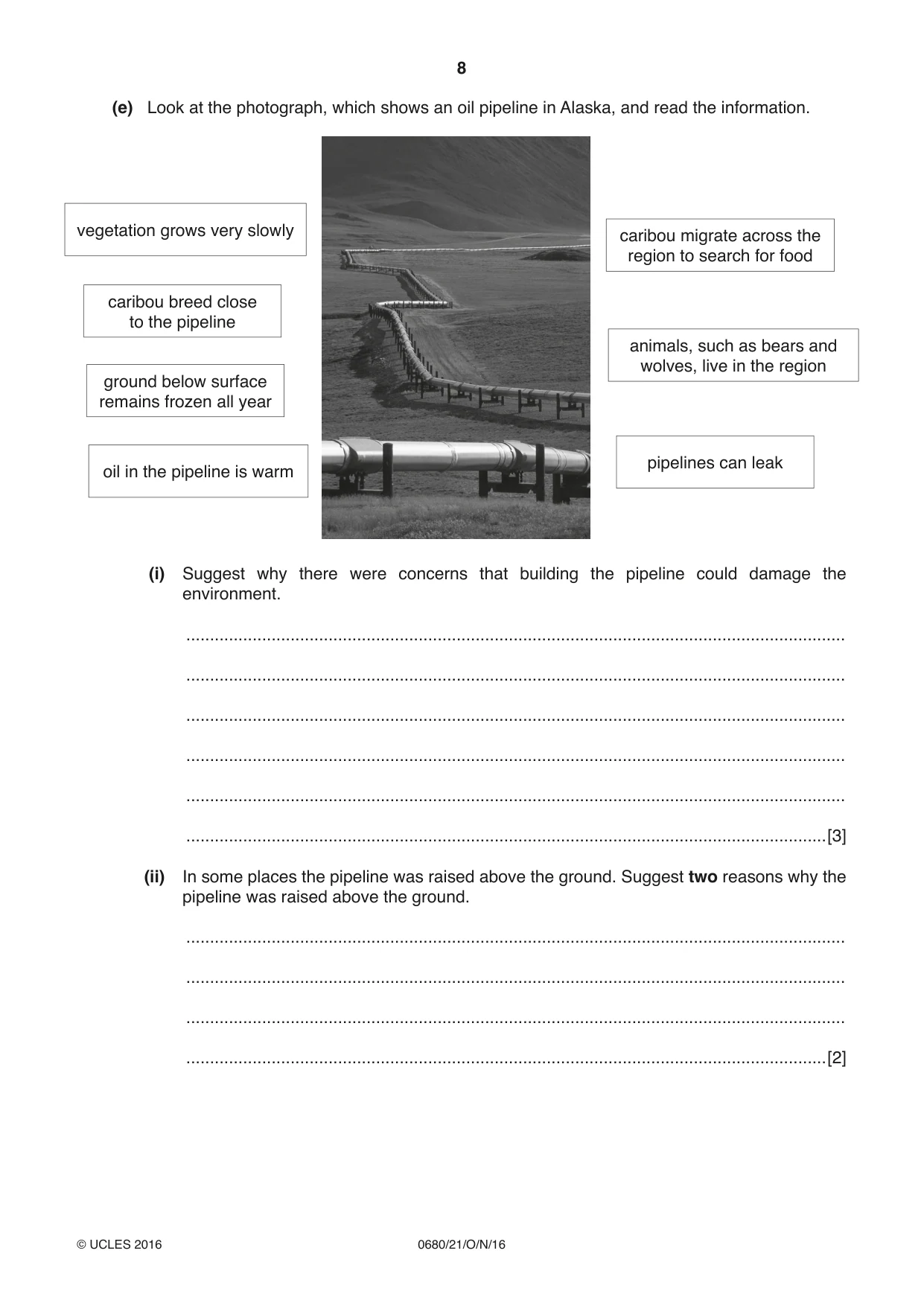
8 0680/21/O/N/16 © UCLES 2016 (e) Look at the photograph, which shows an oil pipeline in Alaska, and read the information. vegetation grows very slowly ground below surface remains frozen all year oil in the pipeline is warm caribou migrate across the region to search for food animals, such as bears and wolves, live in the region pipelines can leak caribou breed close to the pipeline (i) Suggest why there were concerns that building the pipeline could damage the environment. … … … … … …[3] (ii) In some places the pipeline was raised above the ground. Suggest two reasons why the pipeline was raised above the ground. … … … …[2]
Question paper, page 9
9 0680/21/O/N/16 © UCLES 2016 [Turn over (f) Fossil fuels such as oil have provided much of the world’s energy in the past. Suggest reasons why some countries are developing alternative sources of energy but other countries are continuing to rely on fossil fuels. … … … … … … … … … … … …[6]
Question paper, page 10
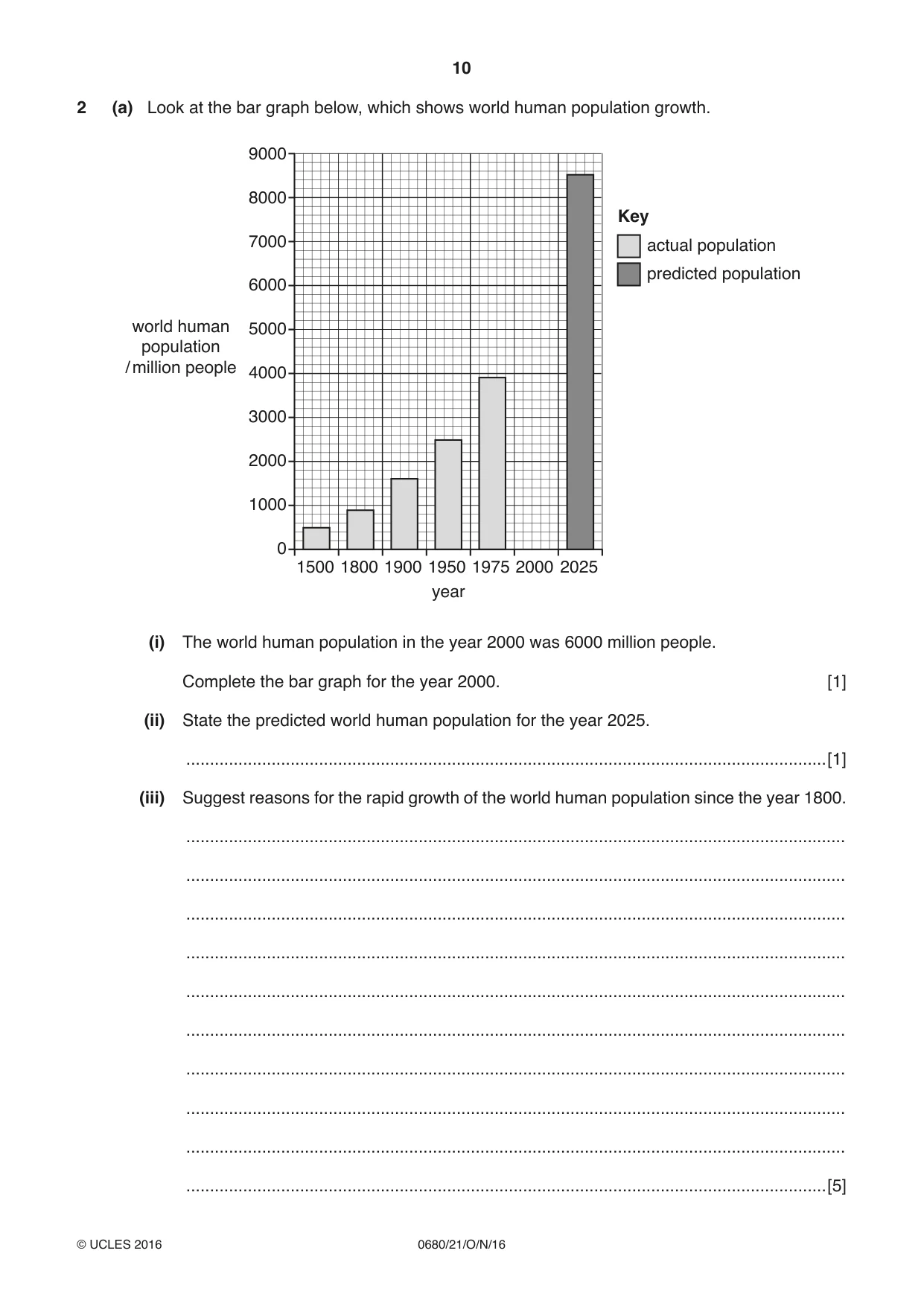
10 0680/21/O/N/16 © UCLES 2016 2 (a) Look at the bar graph below, which shows world human population growth. 1500 1800 1900 1950 year 1975 2000 2025 9000 8000 7000 6000 5000 4000 3000 2000 1000 0 world human population / million people actual population predicted population Key (i) The world human population in the year 2000 was 6000 million people. Complete the bar graph for the year 2000. [1] (ii) State the predicted world human population for the year 2025. …[1] (iii) Suggest reasons for the rapid growth of the world human population since the year 1800. … … … … … … … … … …[5]
Question paper, page 11
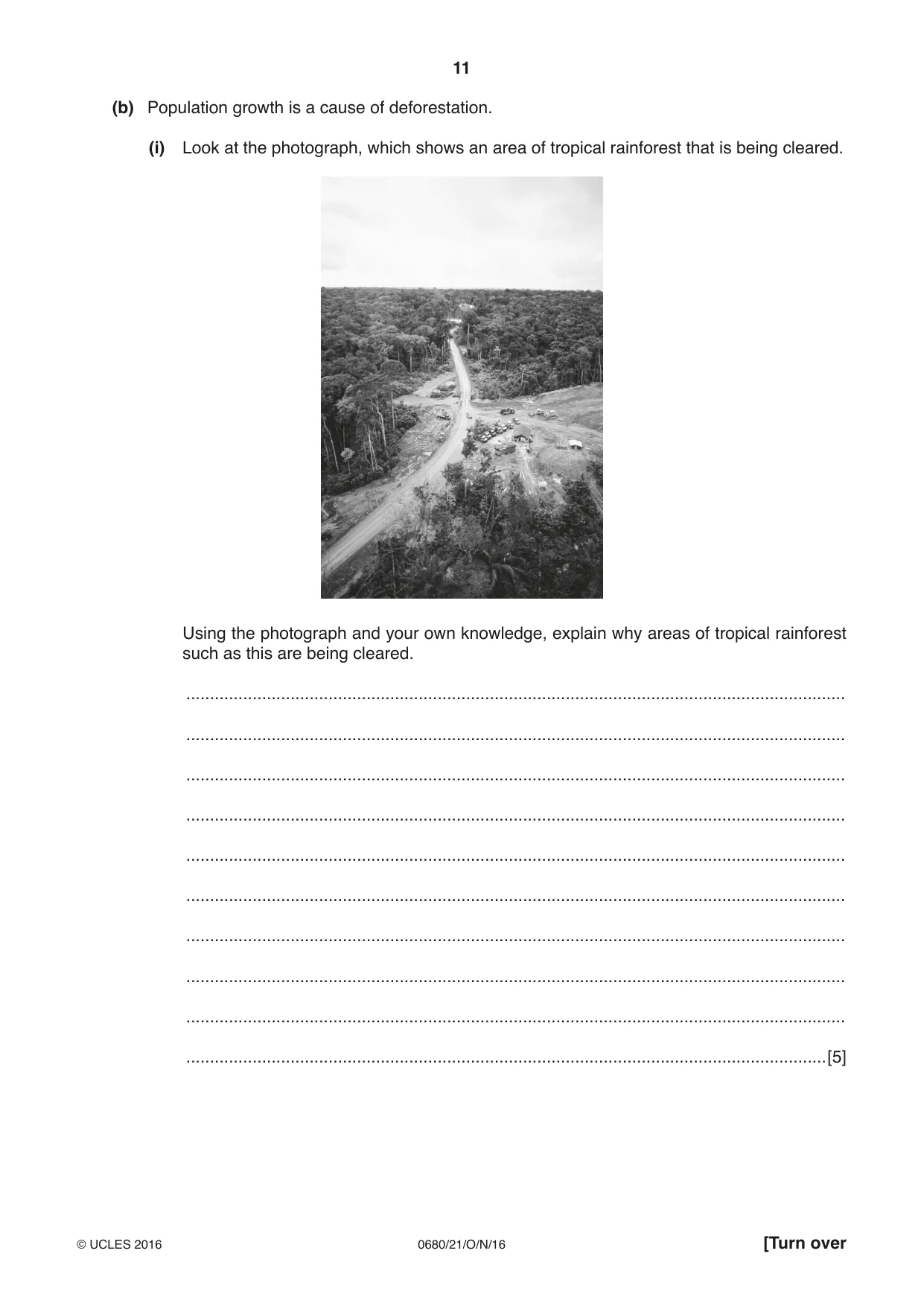
11 0680/21/O/N/16 © UCLES 2016 [Turn over (b) Population growth is a cause of deforestation. (i) Look at the photograph, which shows an area of tropical rainforest that is being cleared. Using the photograph and your own knowledge, explain why areas of tropical rainforest such as this are being cleared. … … … … … … … … … …[5]
Question paper, page 12
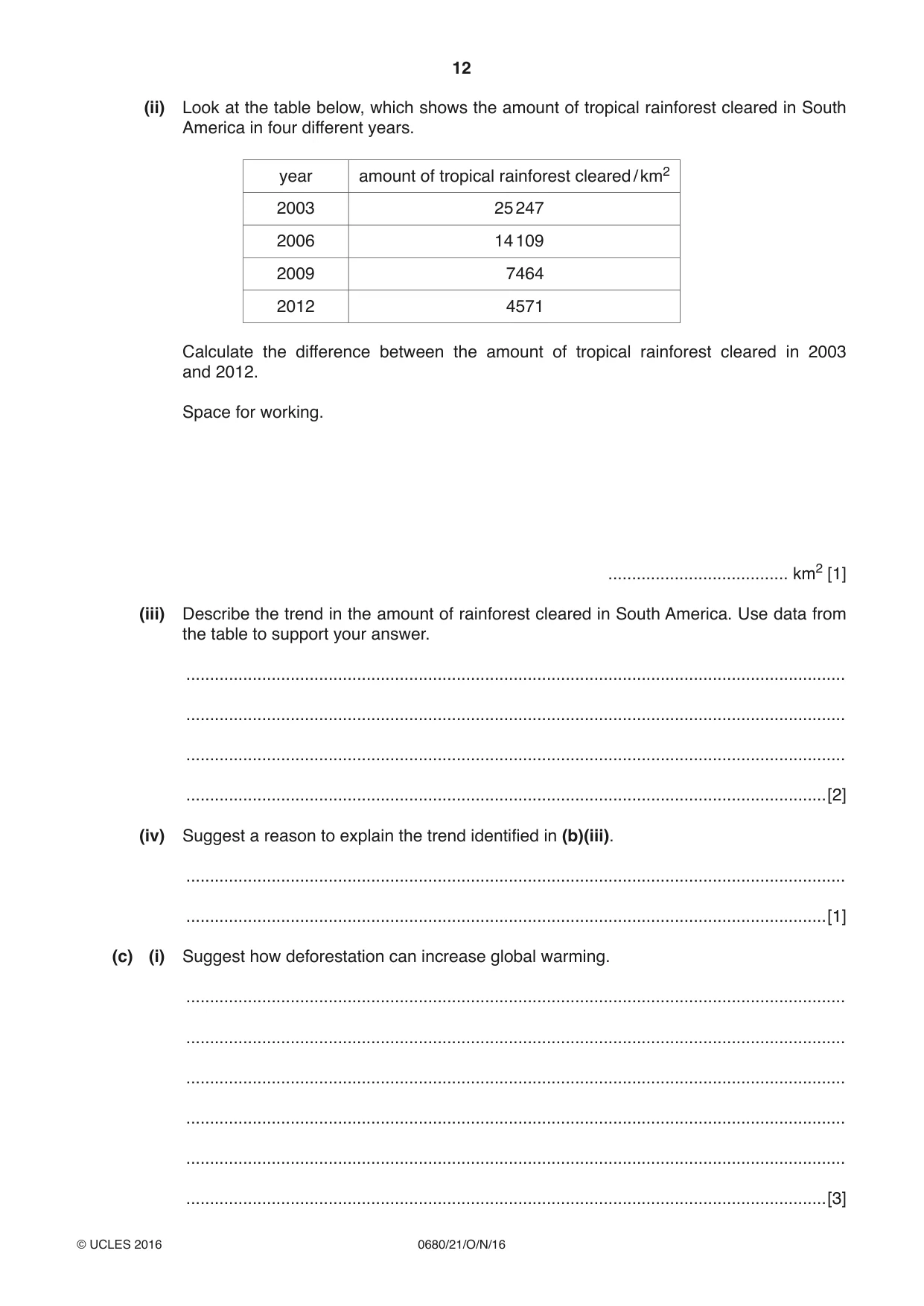
12 0680/21/O/N/16 © UCLES 2016 (ii) Look at the table below, which shows the amount of tropical rainforest cleared in South America in four different years. year amount of tropical rainforest cleared / km2 2003 25 247 2006 14 109 2009 7464 2012 4571 Calculate the difference between the amount of tropical rainforest cleared in 2003 and 2012. Space for working. … km2 [1] (iii) Describe the trend in the amount of rainforest cleared in South America. Use data from the table to support your answer. … … … …[2] (iv) Suggest a reason to explain the trend identified in (b)(iii). … …[1] (c) (i) Suggest how deforestation can increase global warming. … … … … … …[3]
Question paper, page 13
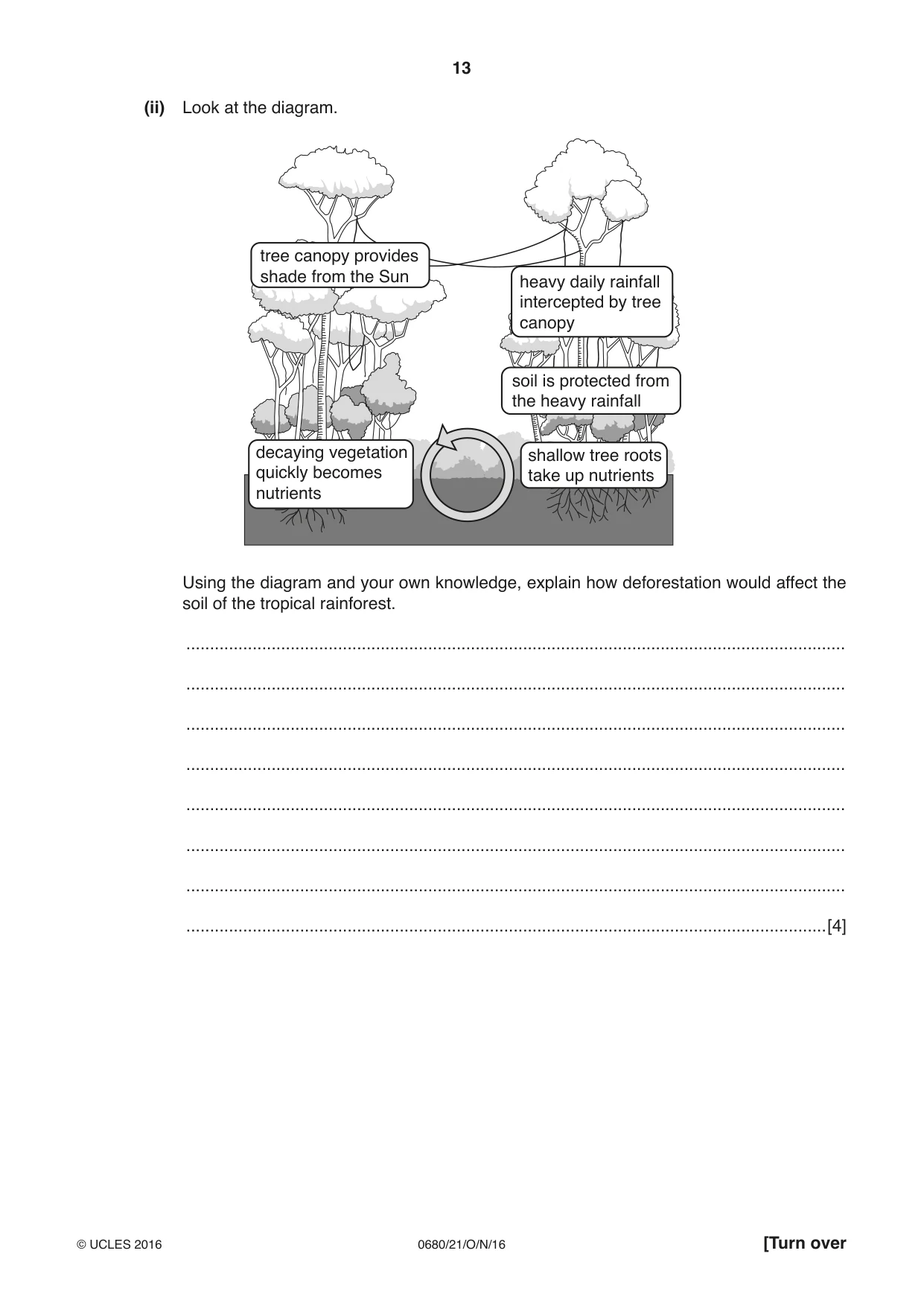
13 0680/21/O/N/16 © UCLES 2016 [Turn over (ii) Look at the diagram. heavy daily rainfall intercepted by tree canopy soil is protected from the heavy rainfall shallow tree roots take up nutrients tree canopy provides shade from the Sun decaying vegetation quickly becomes nutrients Using the diagram and your own knowledge, explain how deforestation would affect the soil of the tropical rainforest. … … … … … … … …[4]
Question paper, page 14
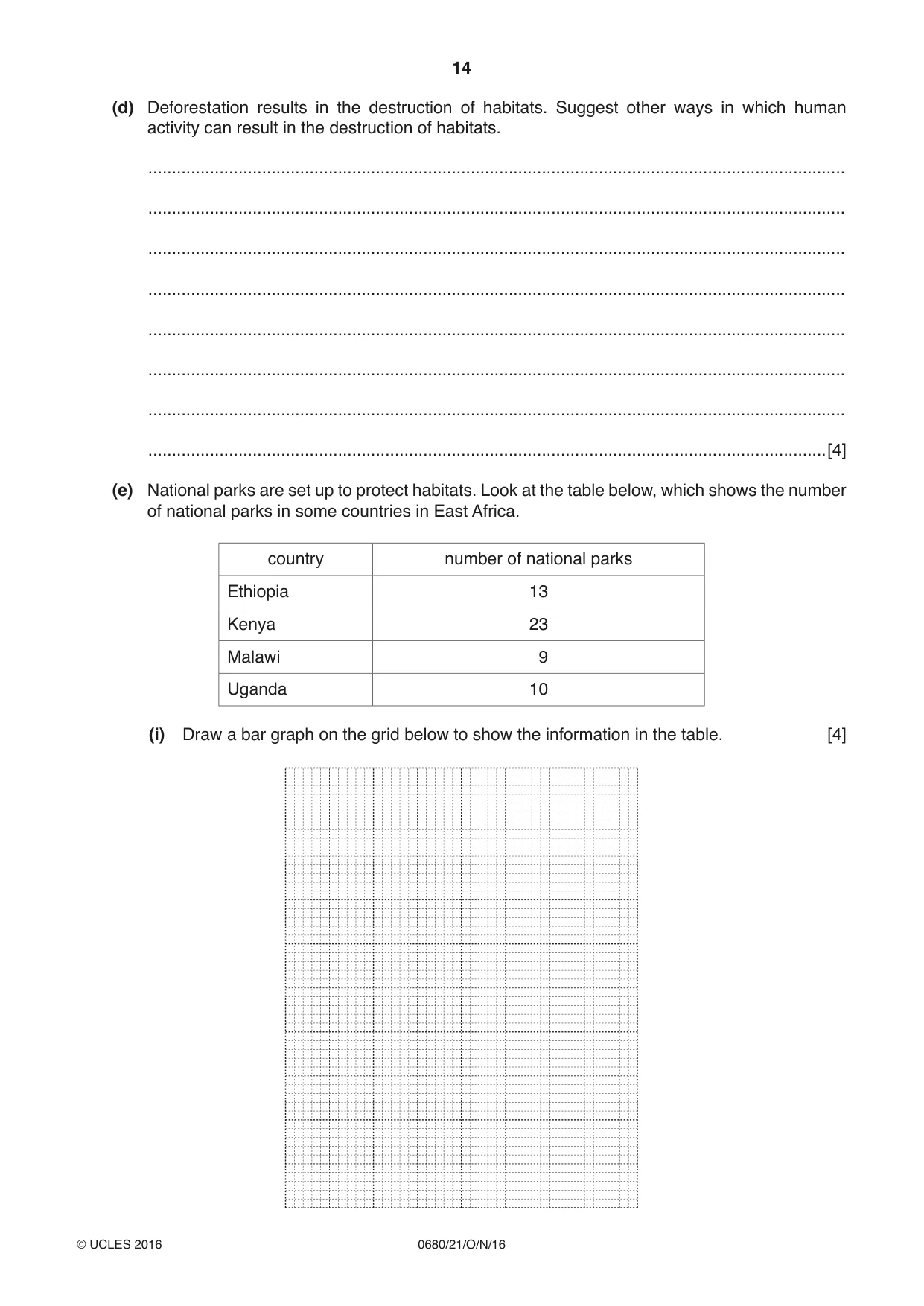
14 0680/21/O/N/16 © UCLES 2016 (d) Deforestation results in the destruction of habitats. Suggest other ways in which human activity can result in the destruction of habitats. … … … … … … … …[4] (e) National parks are set up to protect habitats. Look at the table below, which shows the number of national parks in some countries in East Africa. country number of national parks Ethiopia 13 Kenya 23 Malawi 9 Uganda 10 (i) Draw a bar graph on the grid below to show the information in the table. [4]
Question paper, page 15
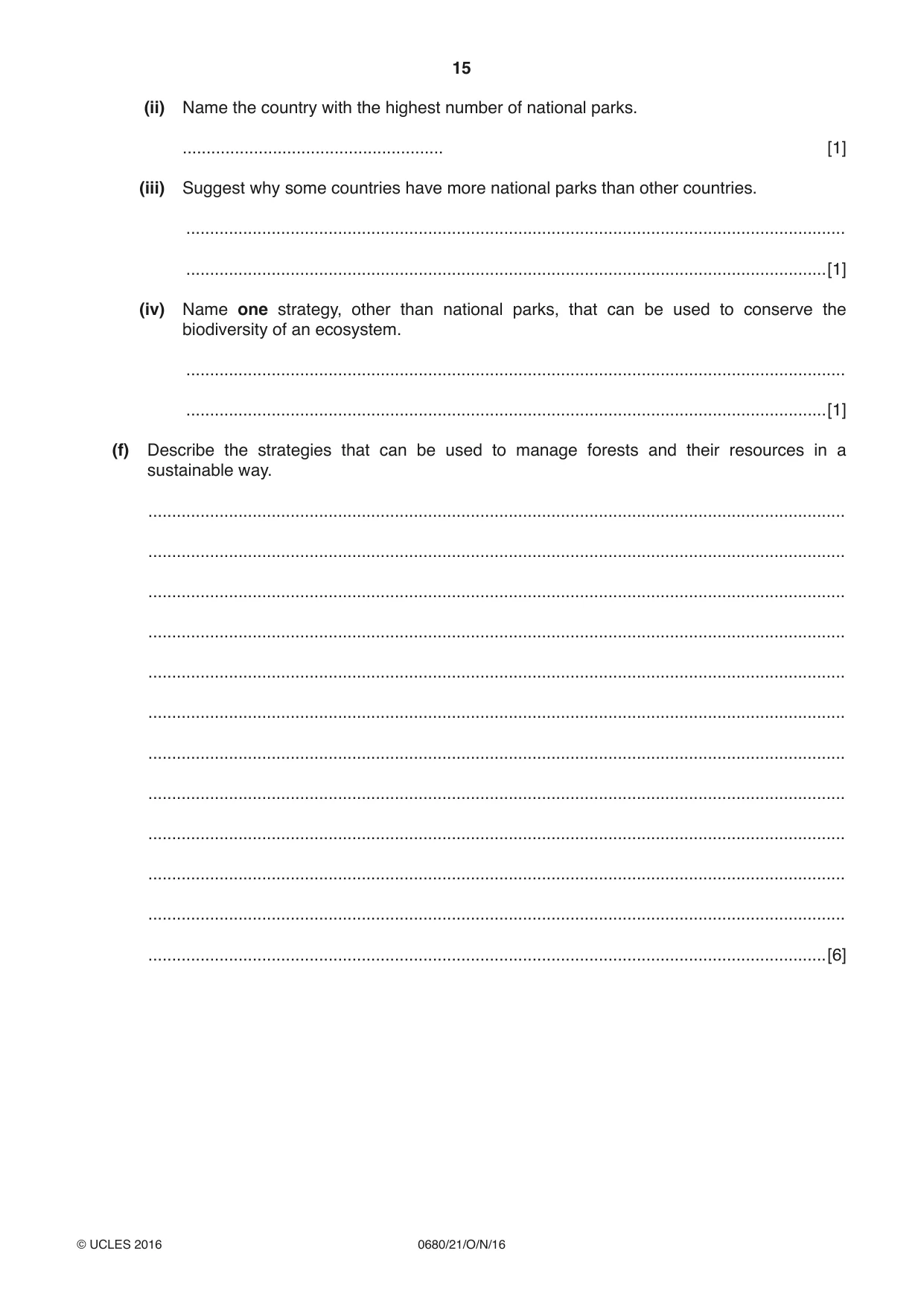
15 0680/21/O/N/16 © UCLES 2016 (ii) Name the country with the highest number of national parks. … [1] (iii) Suggest why some countries have more national parks than other countries. … …[1] (iv) Name one strategy, other than national parks, that can be used to conserve the biodiversity of an ecosystem. … …[1] (f) Describe the strategies that can be used to manage forests and their resources in a sustainable way. … … … … … … … … … … … …[6]
Question paper, page 16
16 0680/21/O/N/16 © UCLES 2016 Permission to reproduce items where third-party owned material protected by copyright is included has been sought and cleared where possible. Every reasonable effort has been made by the publisher (UCLES) to trace copyright holders, but if any items requiring clearance have unwittingly been included, the publisher will be pleased to make amends at the earliest possible opportunity. To avoid the issue of disclosure of answer-related information to candidates, all copyright acknowledgements are reproduced online in the Cambridge International Examinations Copyright Acknowledgements Booklet. This is produced for each series of examinations and is freely available to download at www.cie.org.uk after the live examination series. Cambridge International Examinations is part of the Cambridge Assessment Group. Cambridge Assessment is the brand name of University of Cambridge Local Examinations Syndicate (UCLES), which is itself a department of the University of Cambridge. BLANK PAGE
Mark scheme, page 1
® IGCSE is the registered trademark of Cambridge International Examinations. This document consists of 9 printed pages. © UCLES 2016 [Turn over Cambridge International Examinations Cambridge International General Certificate of Secondary Education ENVIRONMENTAL MANAGEMENT 0680/21 Paper 2 October/November 2016 MARK SCHEME Maximum Mark: 80 Published This mark scheme is published as an aid to teachers and candidates, to indicate the requirements of the examination. It shows the basis on which Examiners were instructed to award marks. It does not indicate the details of the discussions that took place at an Examiners’ meeting before marking began, which would have considered the acceptability of alternative answers. Mark schemes should be read in conjunction with the question paper and the Principal Examiner Report for Teachers. Cambridge will not enter into discussions about these mark schemes. Cambridge is publishing the mark schemes for the October/November 2016 series for most Cambridge IGCSE®, Cambridge International A and AS Level components and some Cambridge O Level components.
Mark scheme, page 2
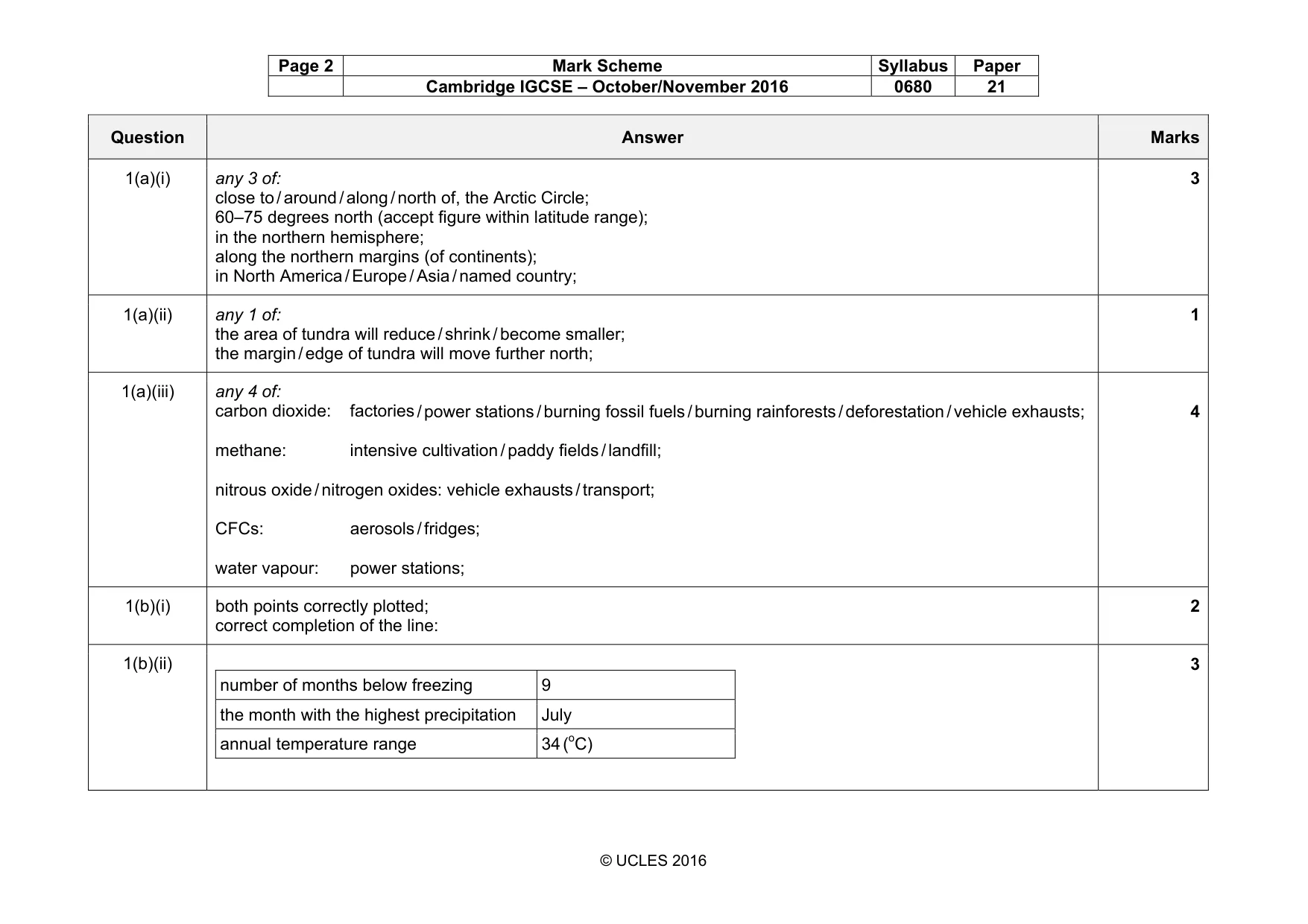
Page 2 Mark Scheme Syllabus Paper Cambridge IGCSE – October/November 2016 0680 21 © UCLES 2016 Question Answer Marks 1(a)(i) any 3 of: close to / around / along / north of, the Arctic Circle; 60–75 degrees north (accept figure within latitude range); in the northern hemisphere; along the northern margins (of continents); in North America / Europe / Asia / named country; 3 1(a)(ii) any 1 of: the area of tundra will reduce / shrink / become smaller; the margin / edge of tundra will move further north; 1 1(a)(iii) any 4 of: carbon dioxide: factories / power stations / burning fossil fuels / burning rainforests / deforestation / vehicle exhausts; methane: intensive cultivation / paddy fields / landfill; nitrous oxide / nitrogen oxides: vehicle exhausts / transport; CFCs: aerosols / fridges; water vapour: power stations; 4 1(b)(i) both points correctly plotted; correct completion of the line: 2 1(b)(ii) number of months below freezing 9 the month with the highest precipitation July annual temperature range 34 (oC) 3
Mark scheme, page 3
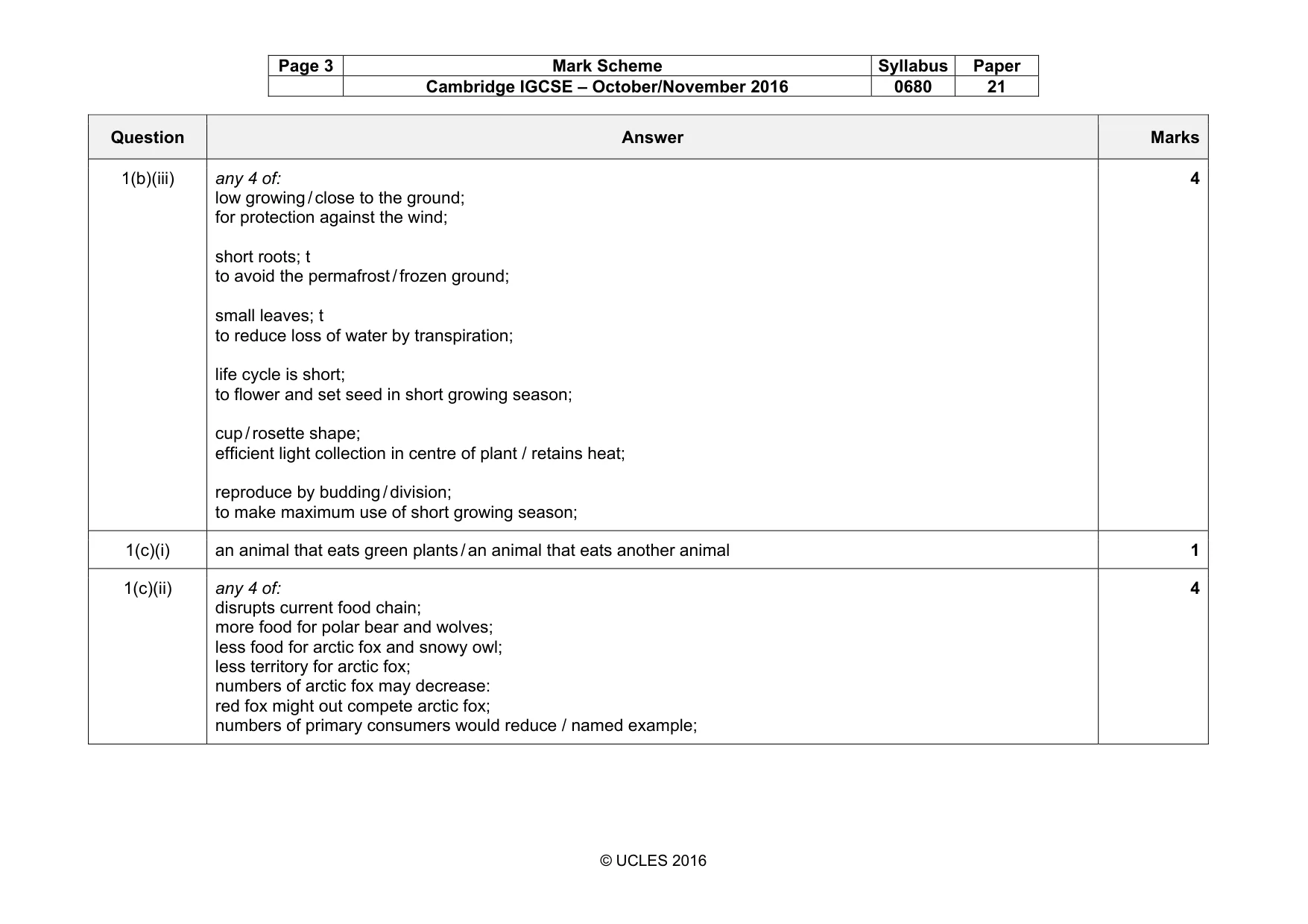
Page 3 Mark Scheme Syllabus Paper Cambridge IGCSE – October/November 2016 0680 21 © UCLES 2016 Question Answer Marks 1(b)(iii) any 4 of: low growing / close to the ground; for protection against the wind; short roots; t to avoid the permafrost / frozen ground; small leaves; t to reduce loss of water by transpiration; life cycle is short; to flower and set seed in short growing season; cup / rosette shape; efficient light collection in centre of plant / retains heat; reproduce by budding / division; to make maximum use of short growing season; 4 1(c)(i) an animal that eats green plants / an animal that eats another animal 1 1(c)(ii) any 4 of: disrupts current food chain; more food for polar bear and wolves; less food for arctic fox and snowy owl; less territory for arctic fox; numbers of arctic fox may decrease: red fox might out compete arctic fox; numbers of primary consumers would reduce / named example; 4
Mark scheme, page 4
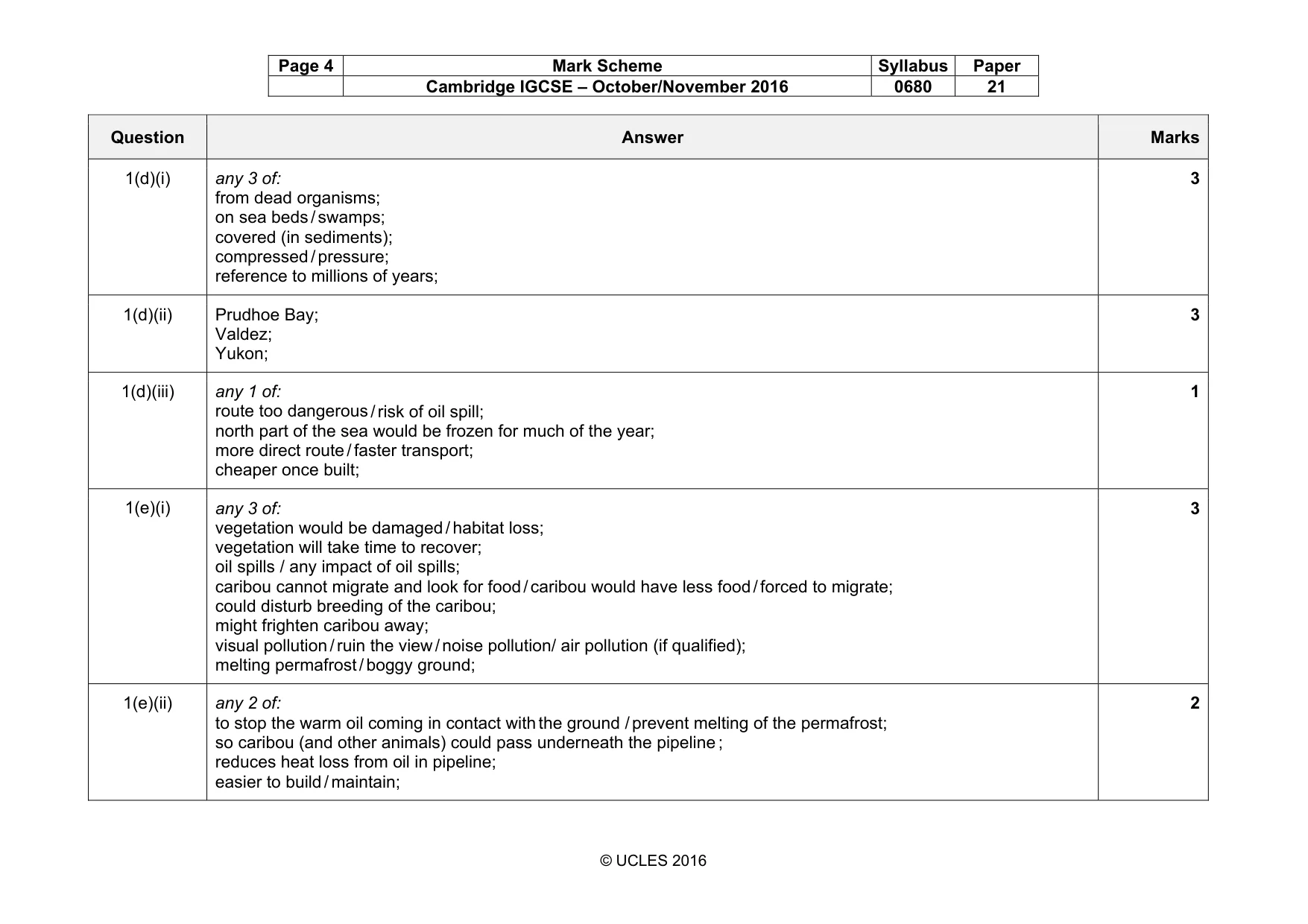
Page 4 Mark Scheme Syllabus Paper Cambridge IGCSE – October/November 2016 0680 21 © UCLES 2016 Question Answer Marks 1(d)(i) any 3 of: from dead organisms; on sea beds / swamps; covered (in sediments); compressed / pressure; reference to millions of years; 3 1(d)(ii) Prudhoe Bay; Valdez; Yukon; 3 1(d)(iii) any 1 of: route too dangerous / risk of oil spill; north part of the sea would be frozen for much of the year; more direct route / faster transport; cheaper once built; 1 1(e)(i) any 3 of: vegetation would be damaged / habitat loss; vegetation will take time to recover; oil spills / any impact of oil spills; caribou cannot migrate and look for food / caribou would have less food / forced to migrate; could disturb breeding of the caribou; might frighten caribou away; visual pollution / ruin the view / noise pollution/ air pollution (if qualified); melting permafrost / boggy ground; 3 1(e)(ii) any 2 of: to stop the warm oil coming in contact with the ground / prevent melting of the permafrost; so caribou (and other animals) could pass underneath the pipeline ; reduces heat loss from oil in pipeline; easier to build / maintain; 2
Mark scheme, page 5
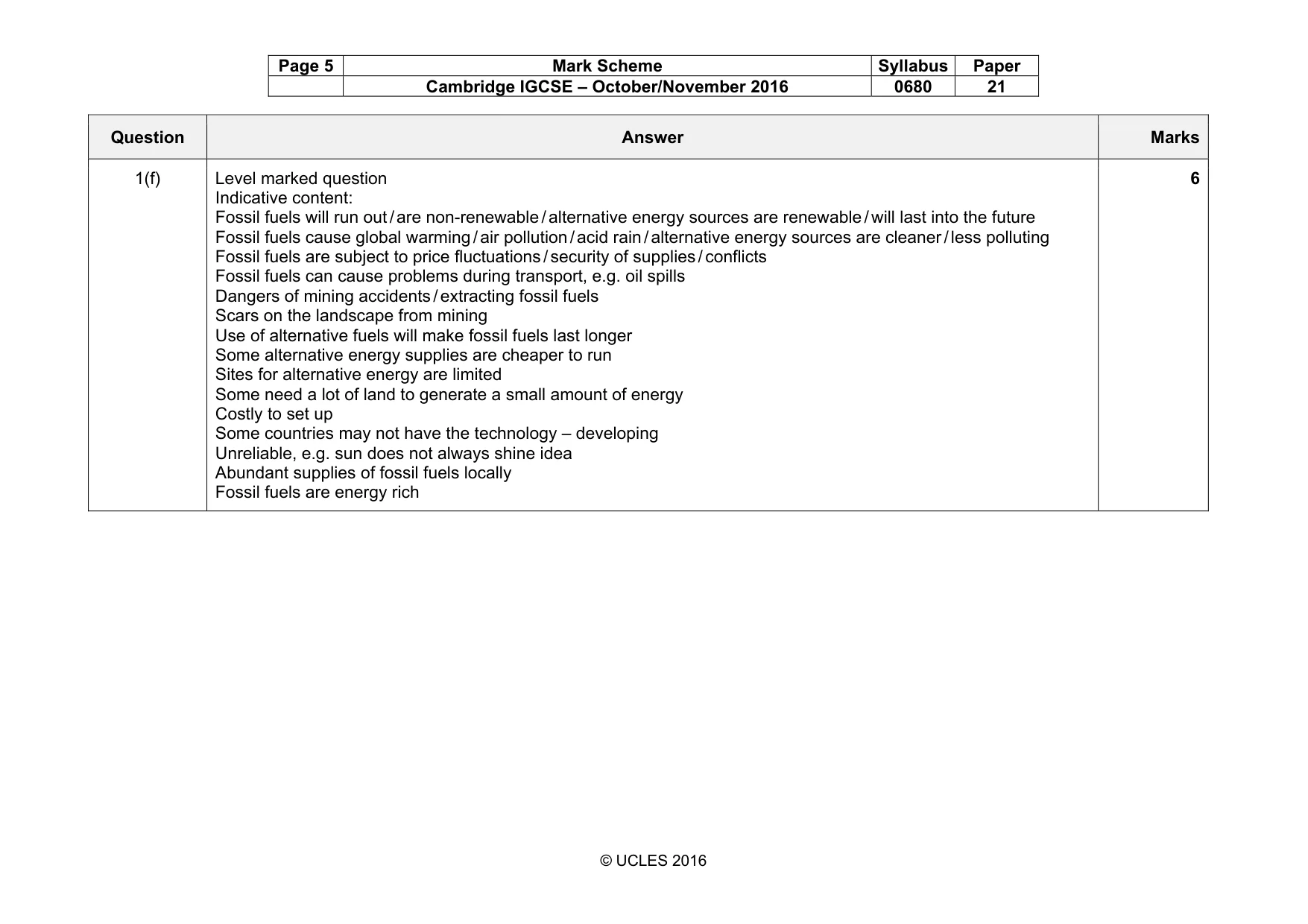
Page 5 Mark Scheme Syllabus Paper Cambridge IGCSE – October/November 2016 0680 21 © UCLES 2016 Question Answer Marks 1(f) Level marked question Indicative content: Fossil fuels will run out / are non-renewable / alternative energy sources are renewable / will last into the future Fossil fuels cause global warming / air pollution / acid rain / alternative energy sources are cleaner / less polluting Fossil fuels are subject to price fluctuations / security of supplies / conflicts Fossil fuels can cause problems during transport, e.g. oil spills Dangers of mining accidents / extracting fossil fuels Scars on the landscape from mining Use of alternative fuels will make fossil fuels last longer Some alternative energy supplies are cheaper to run Sites for alternative energy are limited Some need a lot of land to generate a small amount of energy Costly to set up Some countries may not have the technology – developing Unreliable, e.g. sun does not always shine idea Abundant supplies of fossil fuels locally Fossil fuels are energy rich 6
Mark scheme, page 6
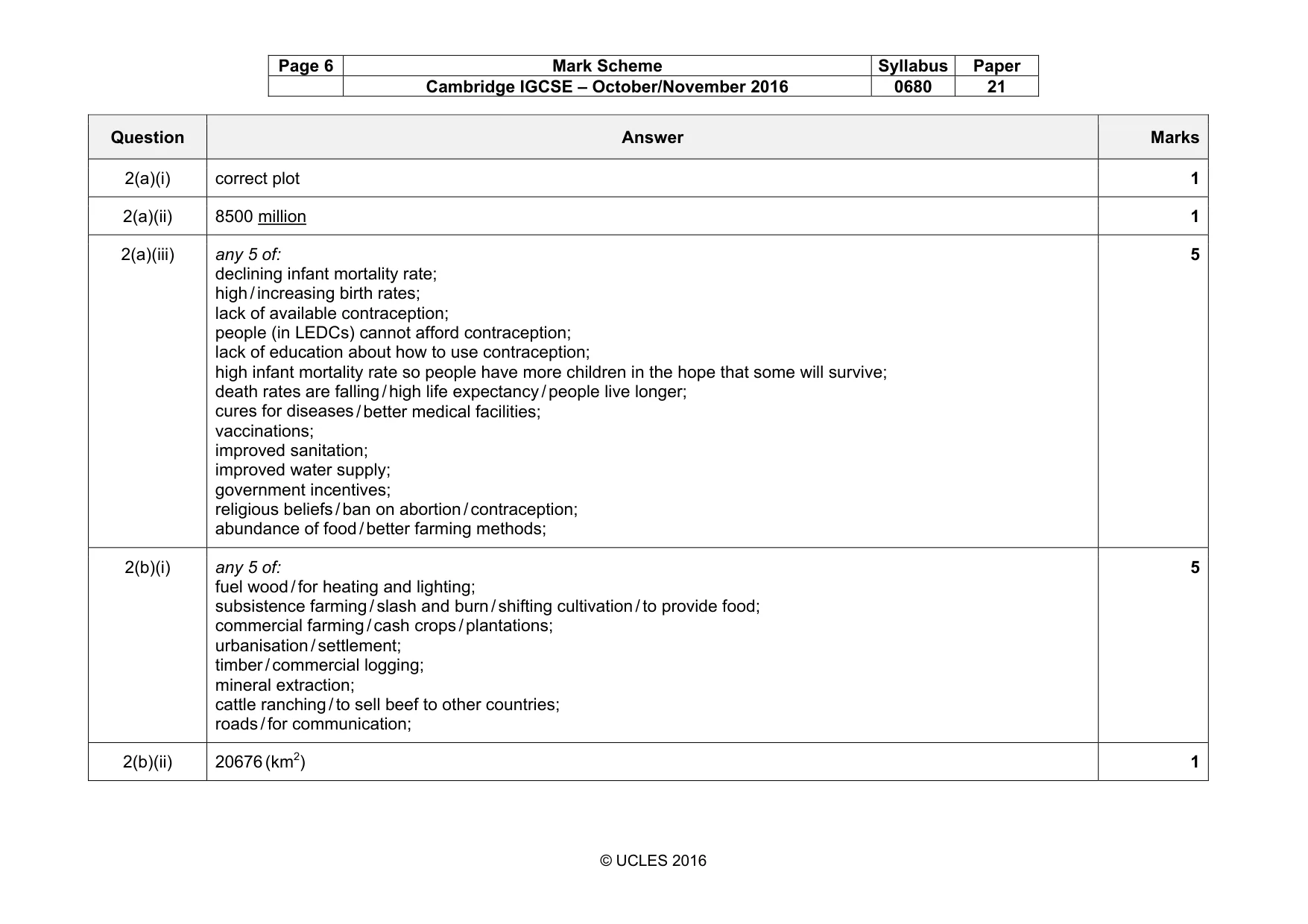
Page 6 Mark Scheme Syllabus Paper Cambridge IGCSE – October/November 2016 0680 21 © UCLES 2016 Question Answer Marks 2(a)(i) correct plot 1 2(a)(ii) 8500 million 1 2(a)(iii) any 5 of: declining infant mortality rate; high / increasing birth rates; lack of available contraception; people (in LEDCs) cannot afford contraception; lack of education about how to use contraception; high infant mortality rate so people have more children in the hope that some will survive; death rates are falling / high life expectancy / people live longer; cures for diseases / better medical facilities; vaccinations; improved sanitation; improved water supply; government incentives; religious beliefs / ban on abortion / contraception; abundance of food / better farming methods; 5 2(b)(i) any 5 of: fuel wood / for heating and lighting; subsistence farming / slash and burn / shifting cultivation / to provide food; commercial farming / cash crops / plantations; urbanisation / settlement; timber / commercial logging; mineral extraction; cattle ranching / to sell beef to other countries; roads / for communication; 5 2(b)(ii) 20676 (km2) 1
Mark scheme, page 7
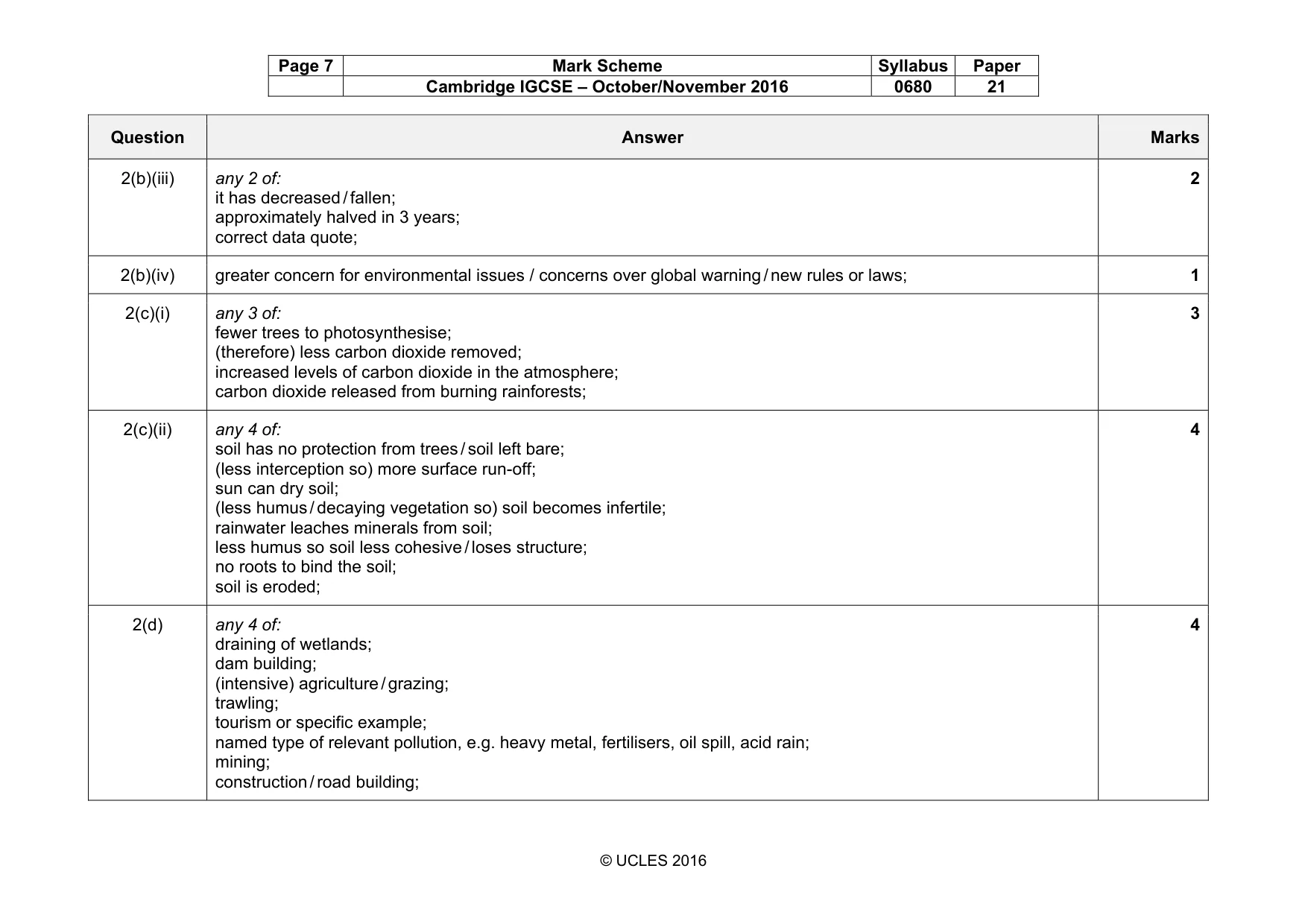
Page 7 Mark Scheme Syllabus Paper Cambridge IGCSE – October/November 2016 0680 21 © UCLES 2016 Question Answer Marks 2(b)(iii) any 2 of: it has decreased / fallen; approximately halved in 3 years; correct data quote; 2 2(b)(iv) greater concern for environmental issues / concerns over global warning / new rules or laws; 1 2(c)(i) any 3 of: fewer trees to photosynthesise; (therefore) less carbon dioxide removed; increased levels of carbon dioxide in the atmosphere; carbon dioxide released from burning rainforests; 3 2(c)(ii) any 4 of: soil has no protection from trees / soil left bare; (less interception so) more surface run-off; sun can dry soil; (less humus / decaying vegetation so) soil becomes infertile; rainwater leaches minerals from soil; less humus so soil less cohesive / loses structure; no roots to bind the soil; soil is eroded; 4 2(d) any 4 of: draining of wetlands; dam building; (intensive) agriculture / grazing; trawling; tourism or specific example; named type of relevant pollution, e.g. heavy metal, fertilisers, oil spill, acid rain; mining; construction / road building; 4
Mark scheme, page 8
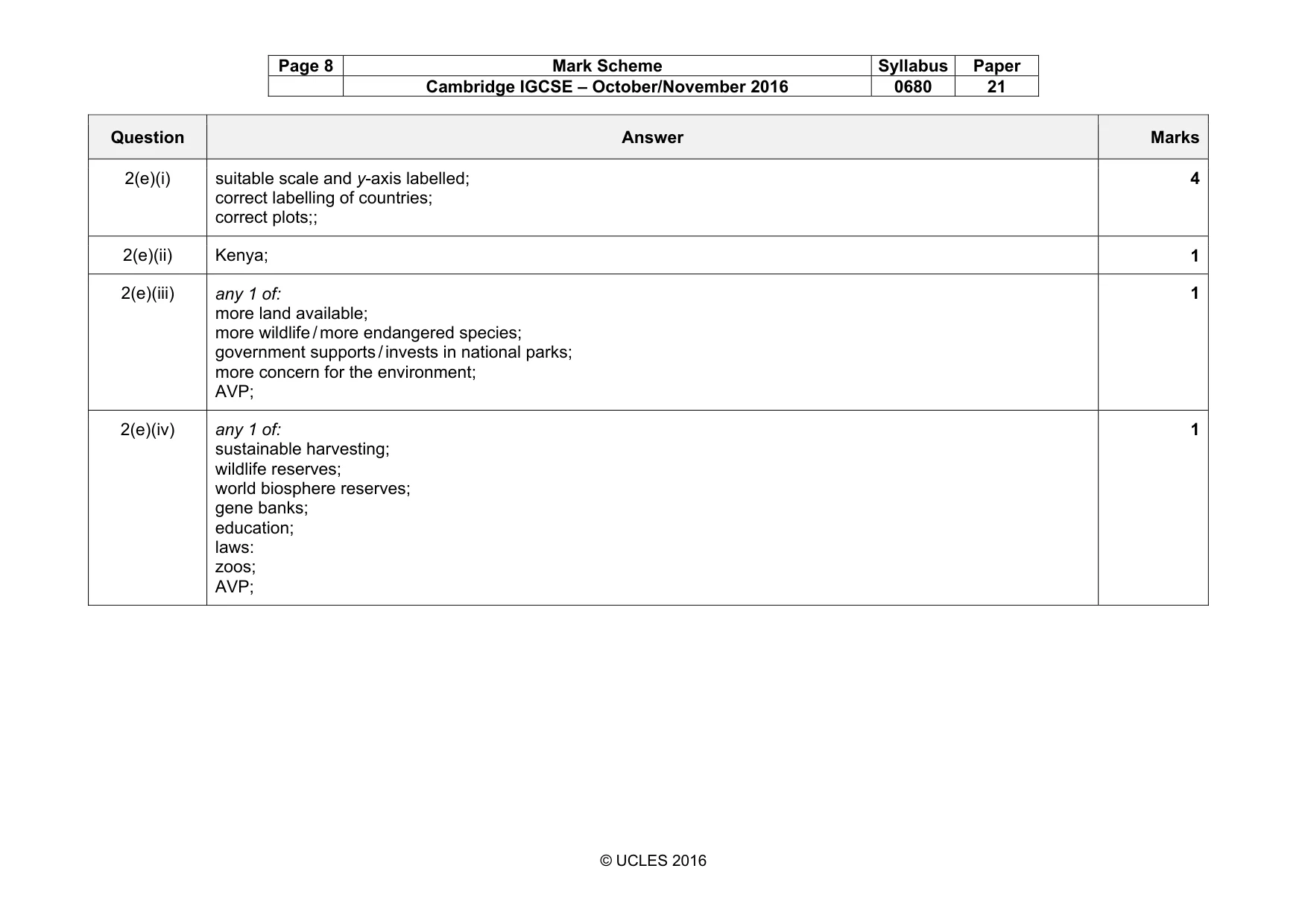
Page 8 Mark Scheme Syllabus Paper Cambridge IGCSE – October/November 2016 0680 21 © UCLES 2016 Question Answer Marks 2(e)(i) suitable scale and y-axis labelled; correct labelling of countries; correct plots;; 4 2(e)(ii) Kenya; 1 2(e)(iii) any 1 of: more land available; more wildlife / more endangered species; government supports / invests in national parks; more concern for the environment; AVP; 1 2(e)(iv) any 1 of: sustainable harvesting; wildlife reserves; world biosphere reserves; gene banks; education; laws: zoos; AVP; 1
Mark scheme, page 9
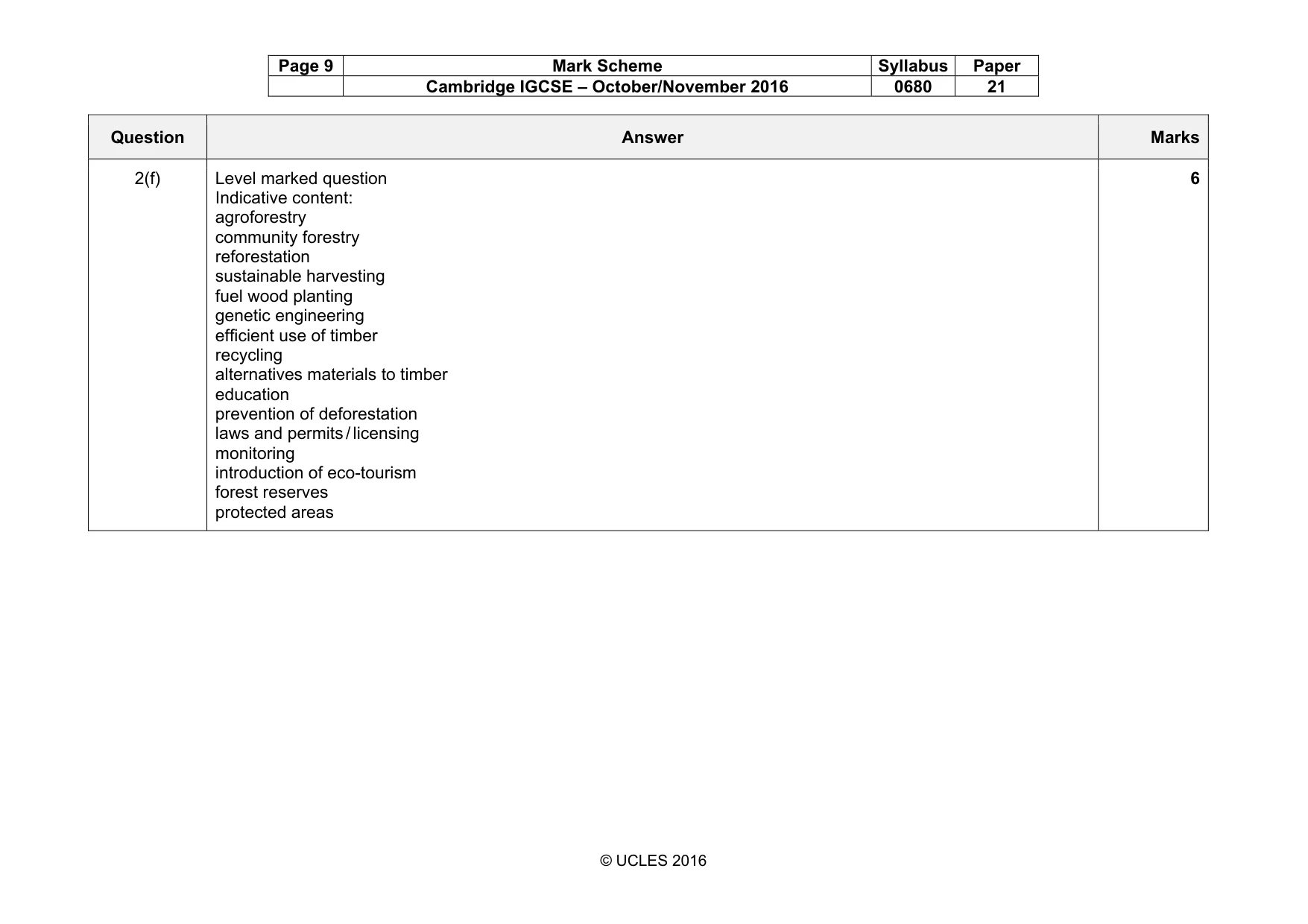
Page 9 Mark Scheme Syllabus Paper Cambridge IGCSE – October/November 2016 0680 21 © UCLES 2016 Question Answer Marks 2(f) Level marked question Indicative content: agroforestry community forestry reforestation sustainable harvesting fuel wood planting genetic engineering efficient use of timber recycling alternatives materials to timber education prevention of deforestation laws and permits / licensing monitoring introduction of eco-tourism forest reserves protected areas 6
What you needed in this session
Cambridge’s own grade thresholds for 2016 Oct/Nov, Paper 2 · Variant 1. A higher threshold means an easier paper — the bar moves with how the cohort did.