Cambridge IGCSE Environmental Management 0680 — 2016 May/June Paper 1 · Variant 2
0680/12/M/J/16 · 60 marks · ≈68 min
The question paper and its mark scheme, free to read here and free to download. This is Cambridge’s own paper, exactly as it was sat.
Question paper16 pages
Mark scheme7 pages
Answers below. Sit the paper first if you are practising.
Paper as text
Question paper, page 1
This document consists of 14 printed pages and 2 blank pages. DC (ST/JG) 113535/2 © UCLES 2016 [Turn over Cambridge International Examinations Cambridge International General Certificate of Secondary Education * 0 1 5 0 7 1 7 5 8 3 * ENVIRONMENTAL MANAGEMENT 0680/12 Paper 1 May/June 2016 1 hour 30 minutes Candidates answer on the Question Paper. No Additional Materials are required. READ THESE INSTRUCTIONS FIRST Write your Centre number, candidate number and name on all the work you hand in. Write in dark blue or black pen. You may use an HB pencil for any diagrams or graphs. Do not use staples, paper clips, glue or correction fluid. DO NOT WRITE IN ANY BARCODES. Answer all questions. Electronic calculators may be used. You may lose marks if you do not show your working or if you do not use appropriate units. At the end of the examination, fasten all your work securely together. The number of marks is given in brackets [ ] at the end of each question or part question.
Question paper, page 2
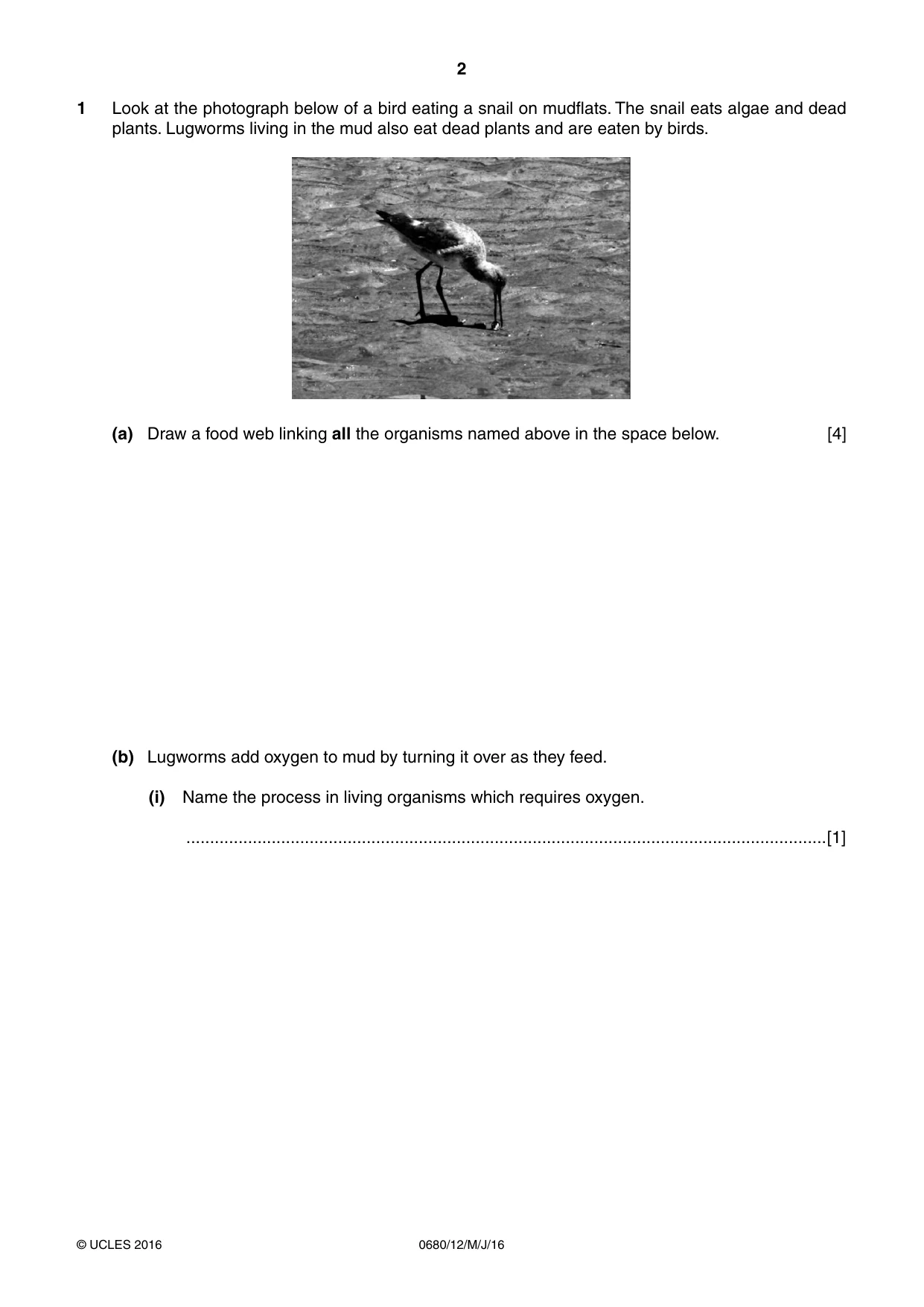
2 0680/12/M/J/16 © UCLES 2016 1 Look at the photograph below of a bird eating a snail on mudflats. The snail eats algae and dead plants. Lugworms living in the mud also eat dead plants and are eaten by birds. (a) Draw a food web linking all the organisms named above in the space below. [4] (b) Lugworms add oxygen to mud by turning it over as they feed. (i) Name the process in living organisms which requires oxygen. …[1]
Question paper, page 3
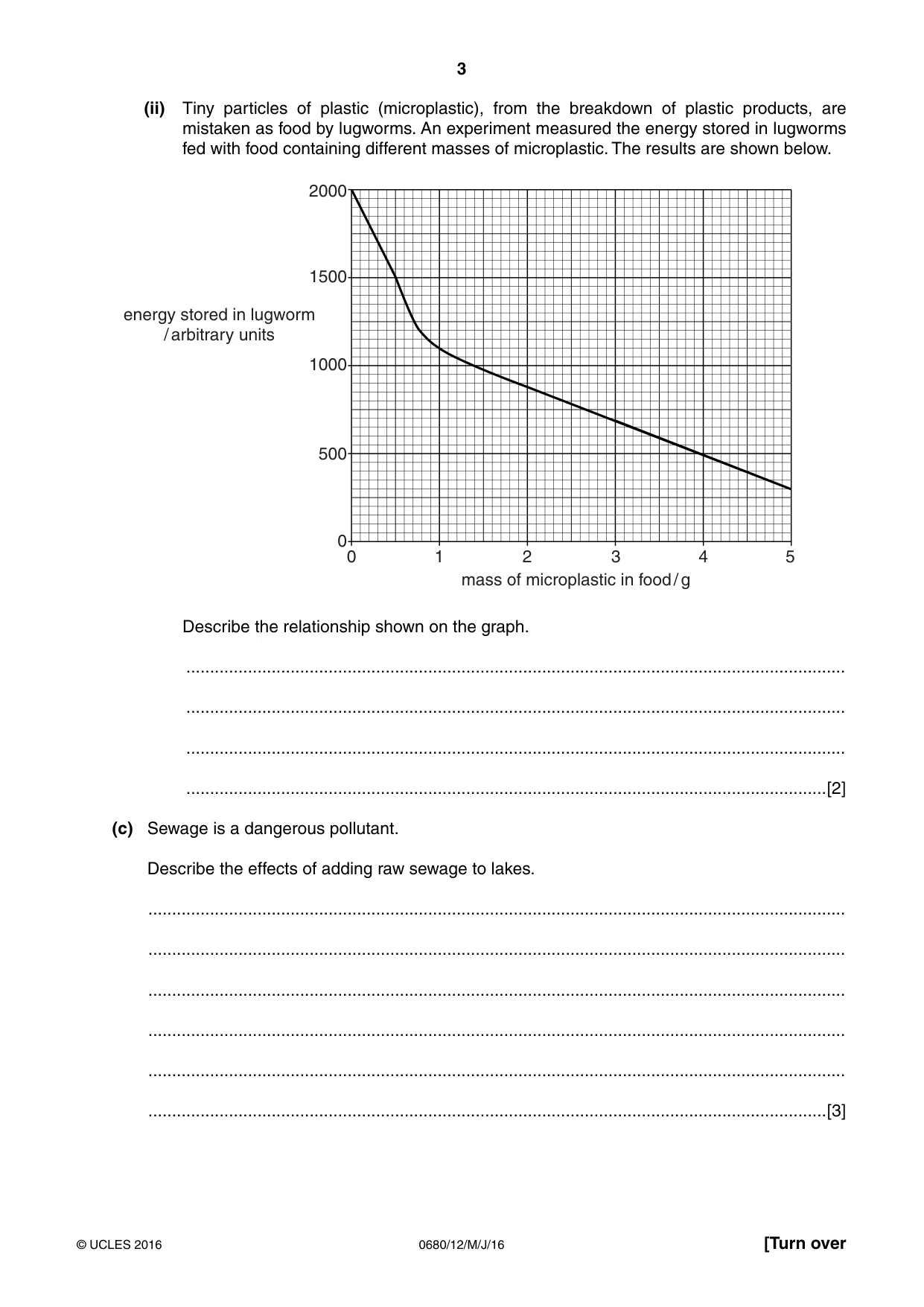
3 0680/12/M/J/16 © UCLES 2016 [Turn over (ii) Tiny particles of plastic (microplastic), from the breakdown of plastic products, are mistaken as food by lugworms. An experiment measured the energy stored in lugworms fed with food containing different masses of microplastic. The results are shown below. 0 500 1000 1500 2000 0 1 2 3 4 5 energy stored in lugworm / arbitrary units mass of microplastic in food / g Describe the relationship shown on the graph. … … … …[2] (c) Sewage is a dangerous pollutant. Describe the effects of adding raw sewage to lakes. … … … … … …[3]
Question paper, page 4
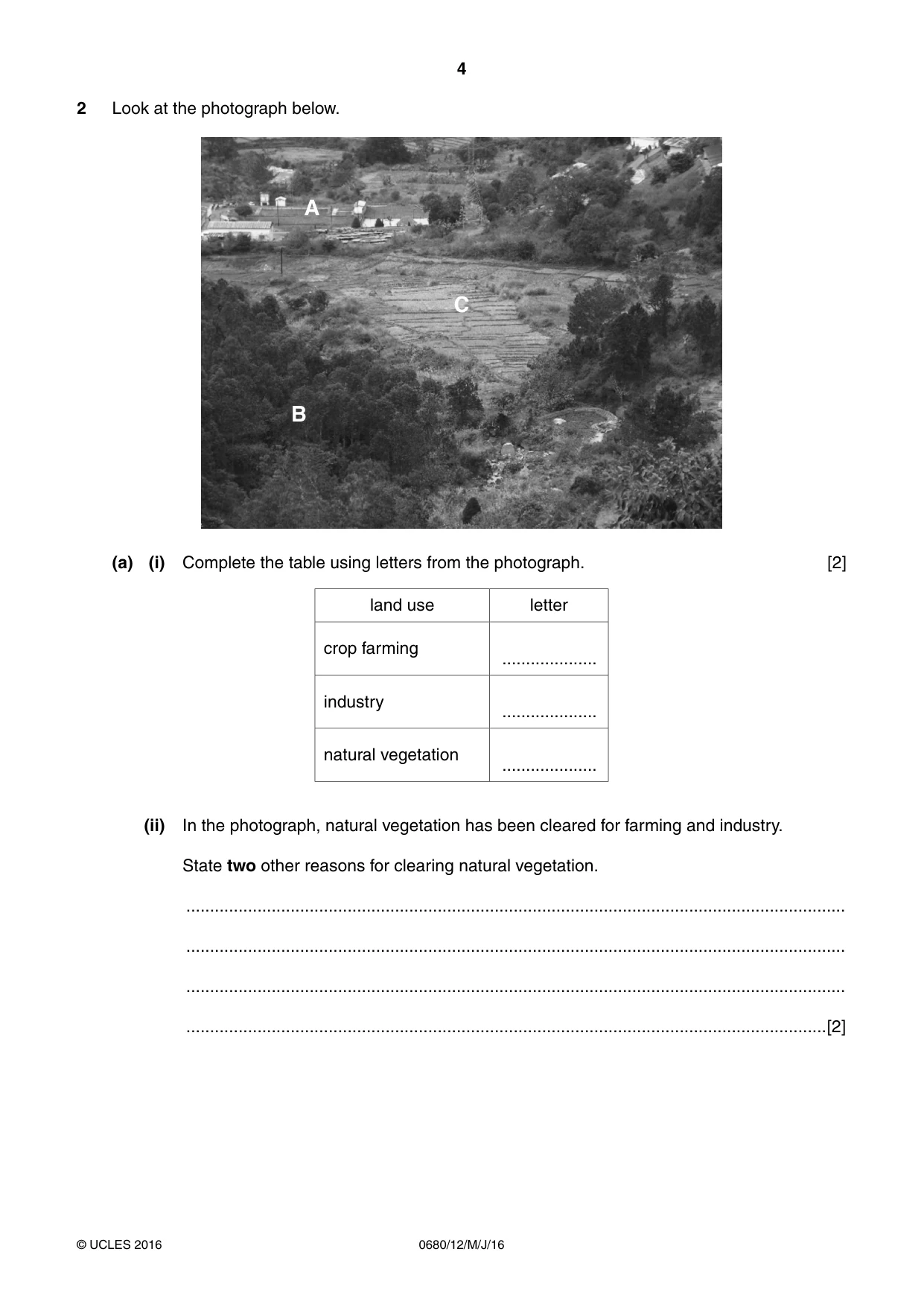
4 0680/12/M/J/16 © UCLES 2016 2 Look at the photograph below. C A B (a) (i) Complete the table using letters from the photograph. [2] land use letter crop farming … industry … natural vegetation … (ii) In the photograph, natural vegetation has been cleared for farming and industry. State two other reasons for clearing natural vegetation. … … … …[2]
Question paper, page 5
5 0680/12/M/J/16 © UCLES 2016 [Turn over (iii) Explain how clearing natural vegetation can cause soil erosion. … … … … … … … …[4] (b) Explain how community forestry can be used to manage forests sustainably. … … … …[2]
Question paper, page 6
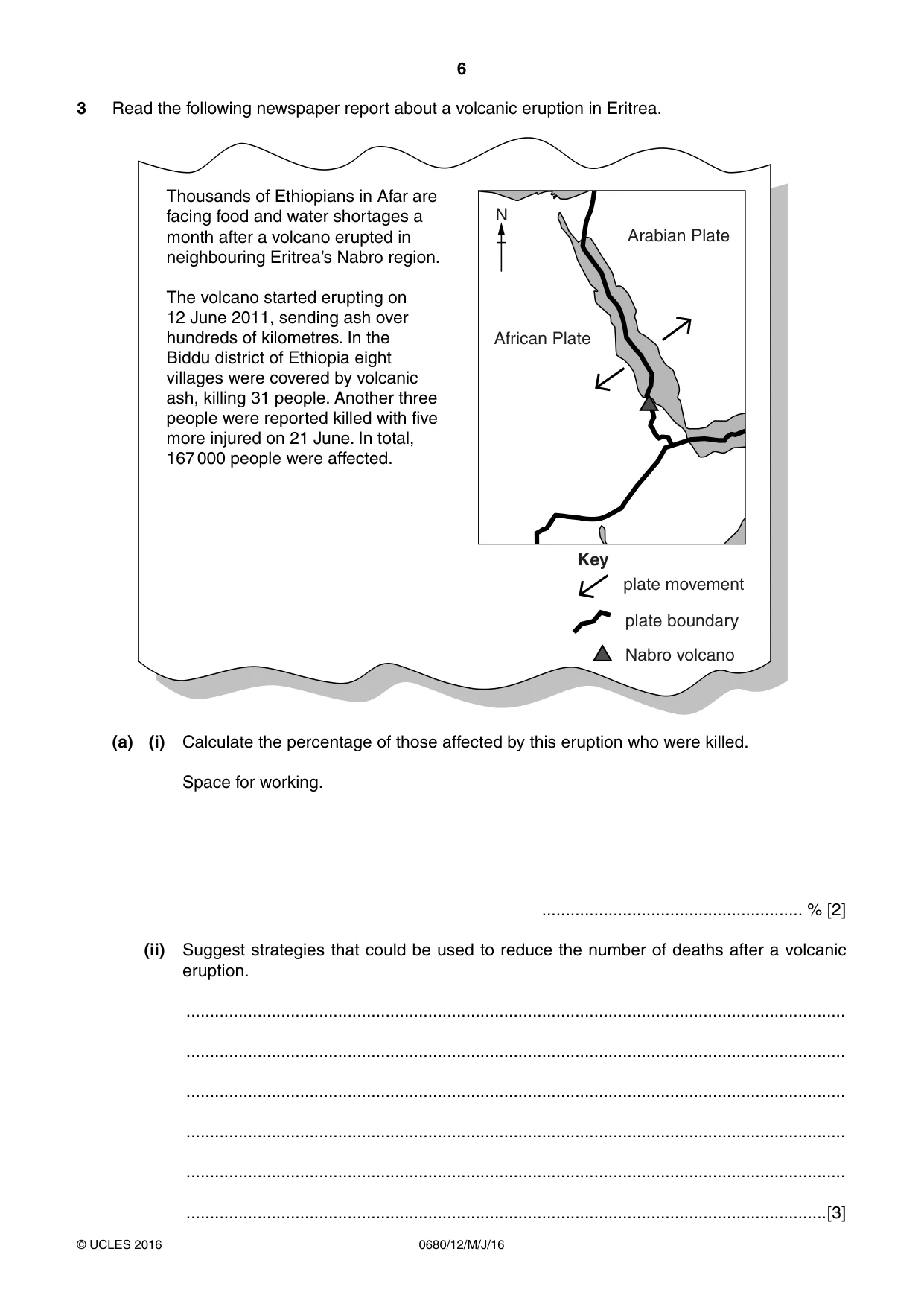
6 0680/12/M/J/16 © UCLES 2016 3 Read the following newspaper report about a volcanic eruption in Eritrea. African Plate Arabian Plate N plate movement .H\ plate boundary Nabro volcano Thousands of Ethiopians in Afar are facing food and water shortages a month after a volcano erupted in neighbouring Eritrea’s Nabro region. The volcano started erupting on 12 June 2011, sending ash over hundreds of kilometres. In the Biddu district of Ethiopia eight villages were covered by volcanic ash, killing 31 people. Another three people were reported killed with five more injured on 21 June. In total, 167 000 people were affected. (a) (i) Calculate the percentage of those affected by this eruption who were killed. Space for working. … % [2] (ii) Suggest strategies that could be used to reduce the number of deaths after a volcanic eruption. … … … … … …[3]
Question paper, page 7
7 0680/12/M/J/16 © UCLES 2016 [Turn over (iii) Explain why a volcano formed in the Nabro region. … … … … … …[3] (b) State two ways in which volcanoes are hazardous and may cause death. … … … …[2]
Question paper, page 8
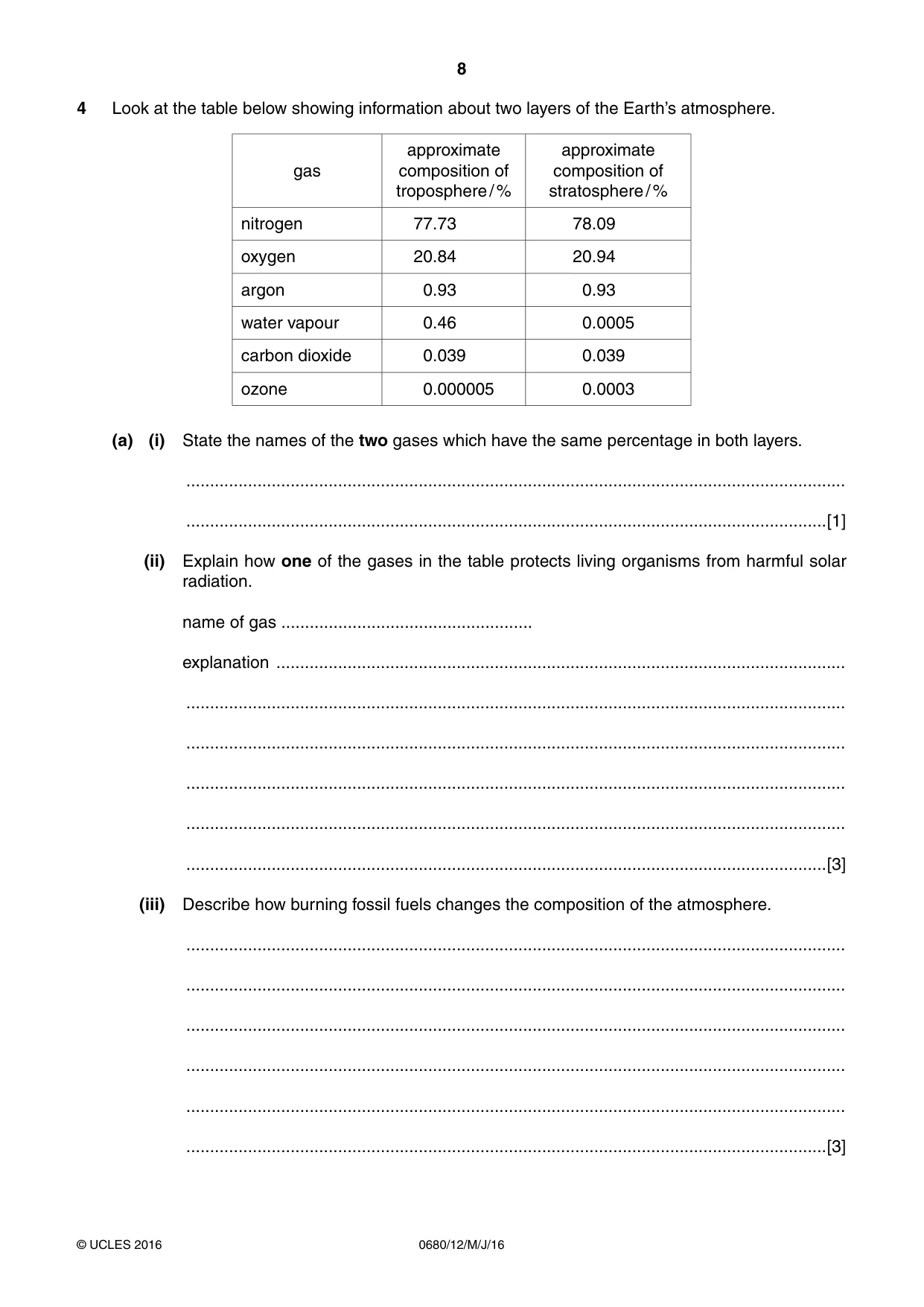
8 0680/12/M/J/16 © UCLES 2016 4 Look at the table below showing information about two layers of the Earth’s atmosphere. gas approximate composition of troposphere / % approximate composition of stratosphere / % nitrogen 77.73 78.09 oxygen 20.84 20.94 argon 0.93 0.93 water vapour 0.46 0.0005 carbon dioxide 0.039 0.039 ozone 0.000005 0.0003 (a) (i) State the names of the two gases which have the same percentage in both layers. … …[1] (ii) Explain how one of the gases in the table protects living organisms from harmful solar radiation. name of gas … explanation … … … … … …[3] (iii) Describe how burning fossil fuels changes the composition of the atmosphere. … … … … … …[3]
Question paper, page 9
9 0680/12/M/J/16 © UCLES 2016 [Turn over (b) Would you be in favour of using biomass as a source of energy? Circle your answer: no yes Give reasons for your answer. … … … … … …[3]
Question paper, page 10
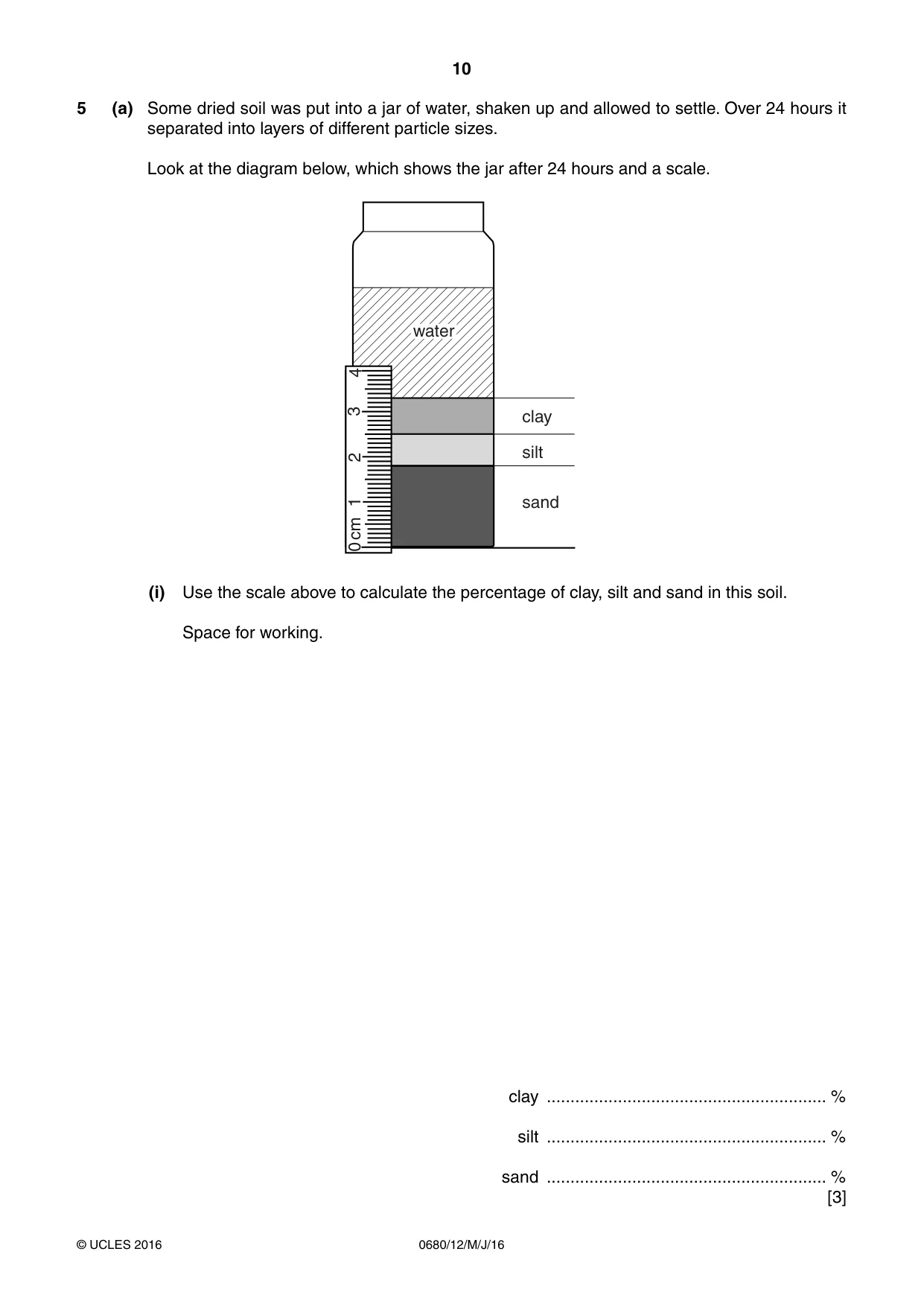
10 0680/12/M/J/16 © UCLES 2016 5 (a) Some dried soil was put into a jar of water, shaken up and allowed to settle. Over 24 hours it separated into layers of different particle sizes. Look at the diagram below, which shows the jar after 24 hours and a scale. 4 3 2 1 0 sand silt clay water cm (i) Use the scale above to calculate the percentage of clay, silt and sand in this soil. Space for working. clay … % silt … % sand … % [3]
Question paper, page 11
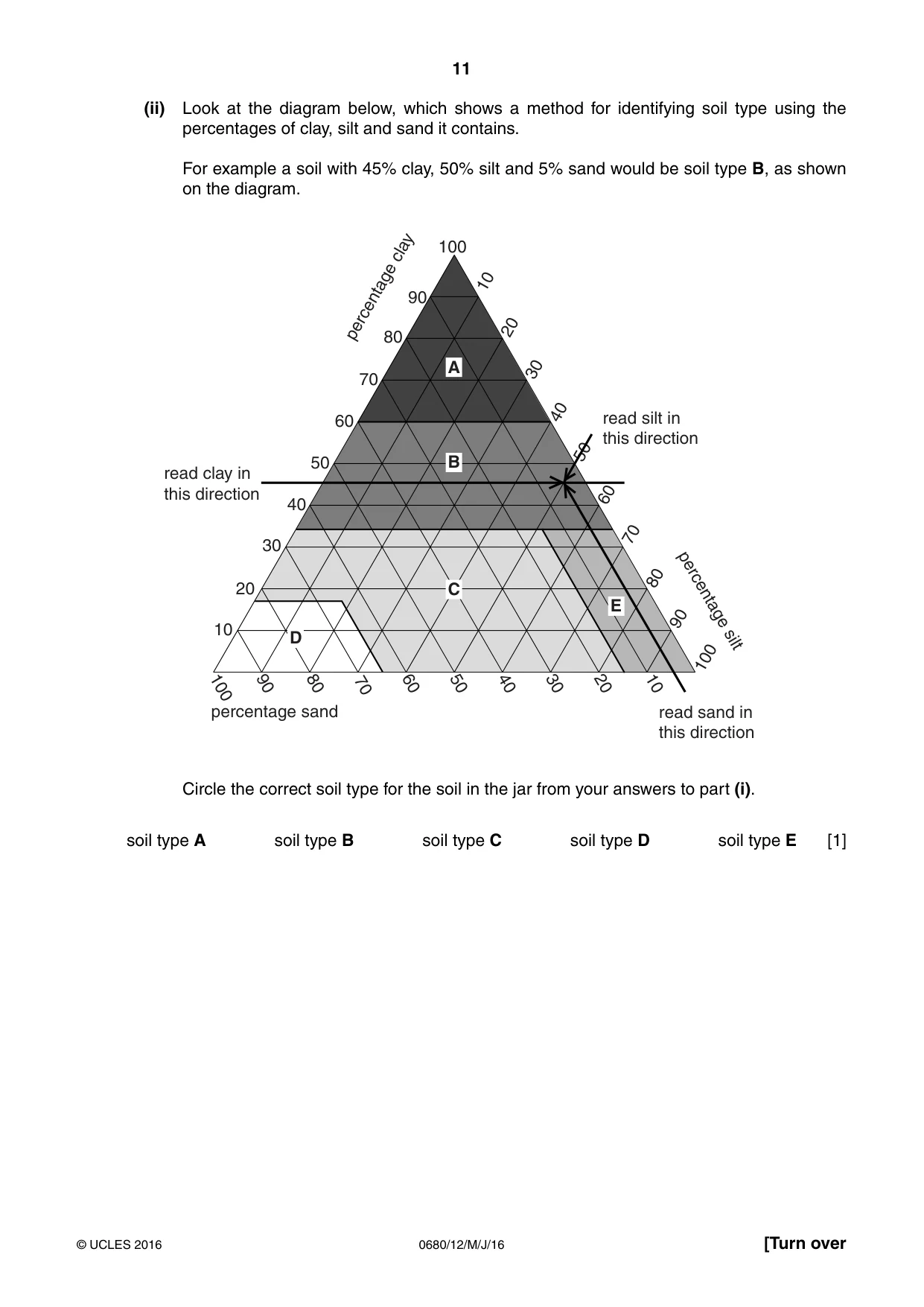
11 0680/12/M/J/16 © UCLES 2016 [Turn over (ii) Look at the diagram below, which shows a method for identifying soil type using the percentages of clay, silt and sand it contains. For example a soil with 45% clay, 50% silt and 5% sand would be soil type B, as shown on the diagram. 10 10 20 30 40 50 60 70 80 90 100 20 30 40 60 70 80 90 100 50 10 20 30 40 50 60 70 80 90 100 read silt in this direction read clay in this direction read sand in this direction percentage clay percentage sand percentage silt A B C D E Circle the correct soil type for the soil in the jar from your answers to part (i). soil type A soil type B soil type C soil type D soil type E [1]
Question paper, page 12
12 0680/12/M/J/16 © UCLES 2016 (iii) Explain how dead plants and animals become part of the soil as organic matter (humus). … … … … … …[3] (b) Farmers often use pesticides to improve crop yield. Explain how the overuse of pesticides may damage the environment around a farm. … … … … … …[3]
Question paper, page 13
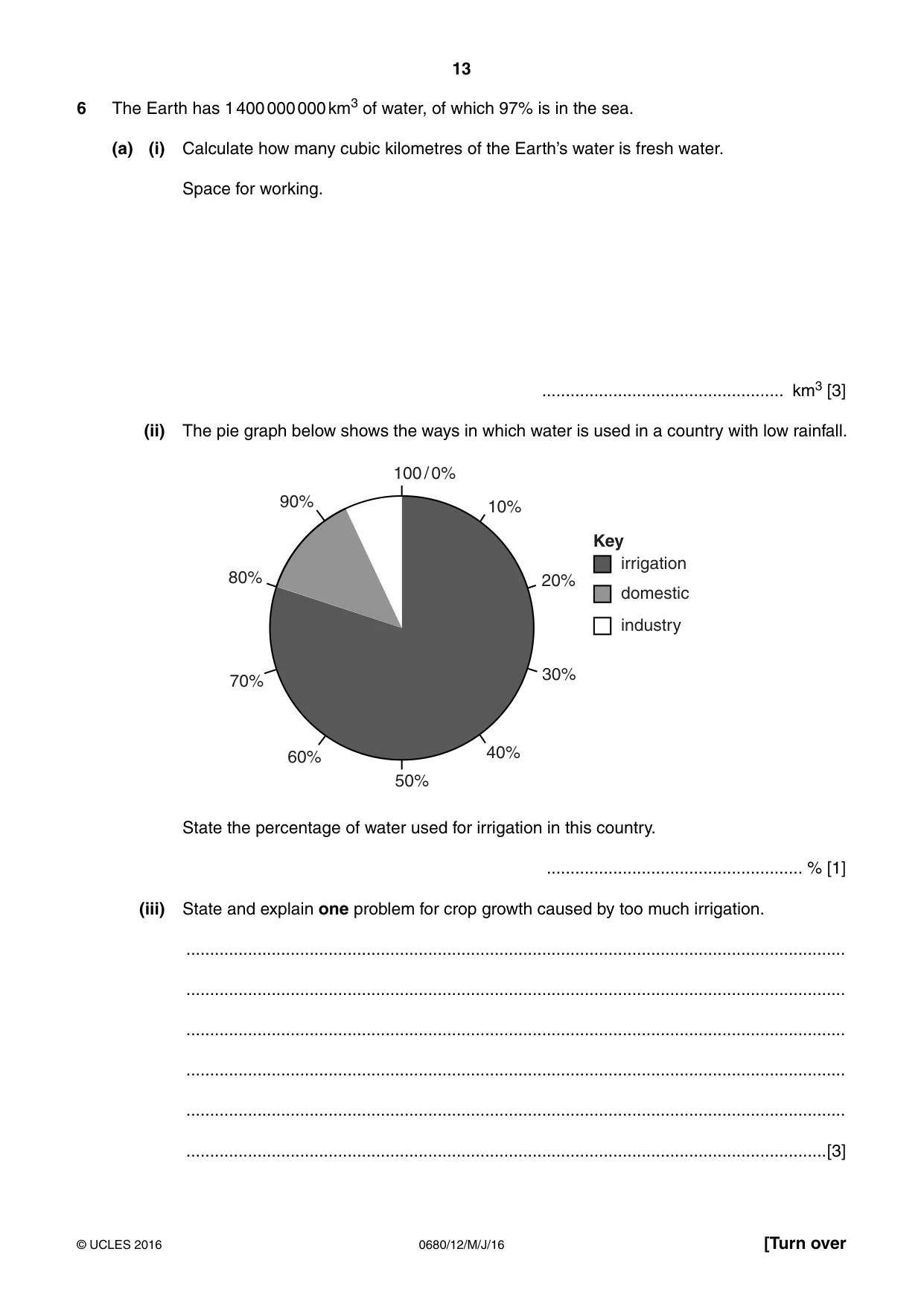
13 0680/12/M/J/16 © UCLES 2016 [Turn over 6 The Earth has 1 400 000 000 km3 of water, of which 97% is in the sea. (a) (i) Calculate how many cubic kilometres of the Earth’s water is fresh water. Space for working. … km3 [3] (ii) The pie graph below shows the ways in which water is used in a country with low rainfall. 100 / 0% 10% 20% 30% 40% 50% 60% 70% 80% 90% irrigation domestic industry Key State the percentage of water used for irrigation in this country. … % [1] (iii) State and explain one problem for crop growth caused by too much irrigation. … … … … … …[3]
Question paper, page 14
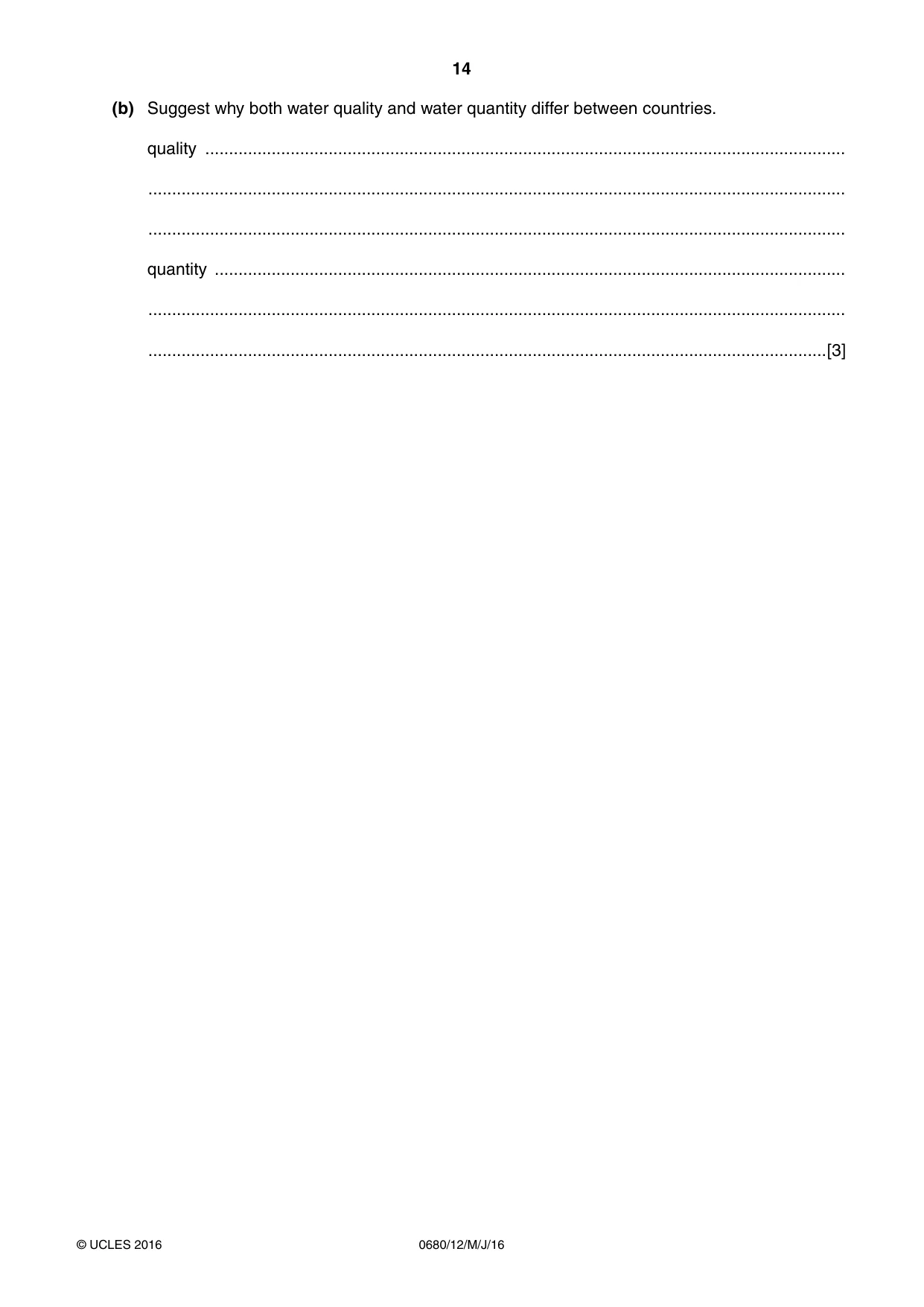
14 0680/12/M/J/16 © UCLES 2016 (b) Suggest why both water quality and water quantity differ between countries. quality … … … quantity … … …[3]
Question paper, page 15
15 0680/12/M/J/16 © UCLES 2016 BLANK PAGE
Question paper, page 16
16 0680/12/M/J/16 © UCLES 2016 Permission to reproduce items where third-party owned material protected by copyright is included has been sought and cleared where possible. Every reasonable effort has been made by the publisher (UCLES) to trace copyright holders, but if any items requiring clearance have unwittingly been included, the publisher will be pleased to make amends at the earliest possible opportunity. To avoid the issue of disclosure of answer-related information to candidates, all copyright acknowledgements are reproduced online in the Cambridge International Examinations Copyright Acknowledgements Booklet. This is produced for each series of examinations and is freely available to download at www.cie.org.uk after the live examination series. Cambridge International Examinations is part of the Cambridge Assessment Group. Cambridge Assessment is the brand name of University of Cambridge Local Examinations Syndicate (UCLES), which is itself a department of the University of Cambridge. BLANK PAGE
Mark scheme, page 1
® IGCSE is the registered trademark of Cambridge International Examinations. This document consists of 7 printed pages. © UCLES 2016 [Turn over Cambridge International Examinations Cambridge International General Certificate of Secondary Education ENVIRONMENTAL MANAGEMENT 0680/12 Paper 1 May/June 2016 MARK SCHEME Maximum Mark: 60 Published This mark scheme is published as an aid to teachers and candidates, to indicate the requirements of the examination. It shows the basis on which Examiners were instructed to award marks. It does not indicate the details of the discussions that took place at an Examiners’ meeting before marking began, which would have considered the acceptability of alternative answers. Mark schemes should be read in conjunction with the question paper and the Principal Examiner Report for Teachers. Cambridge will not enter into discussions about these mark schemes. Cambridge is publishing the mark schemes for the May/June 2016 series for most Cambridge IGCSE®, Cambridge International A and AS Level components and some Cambridge O Level components.
Mark scheme, page 2
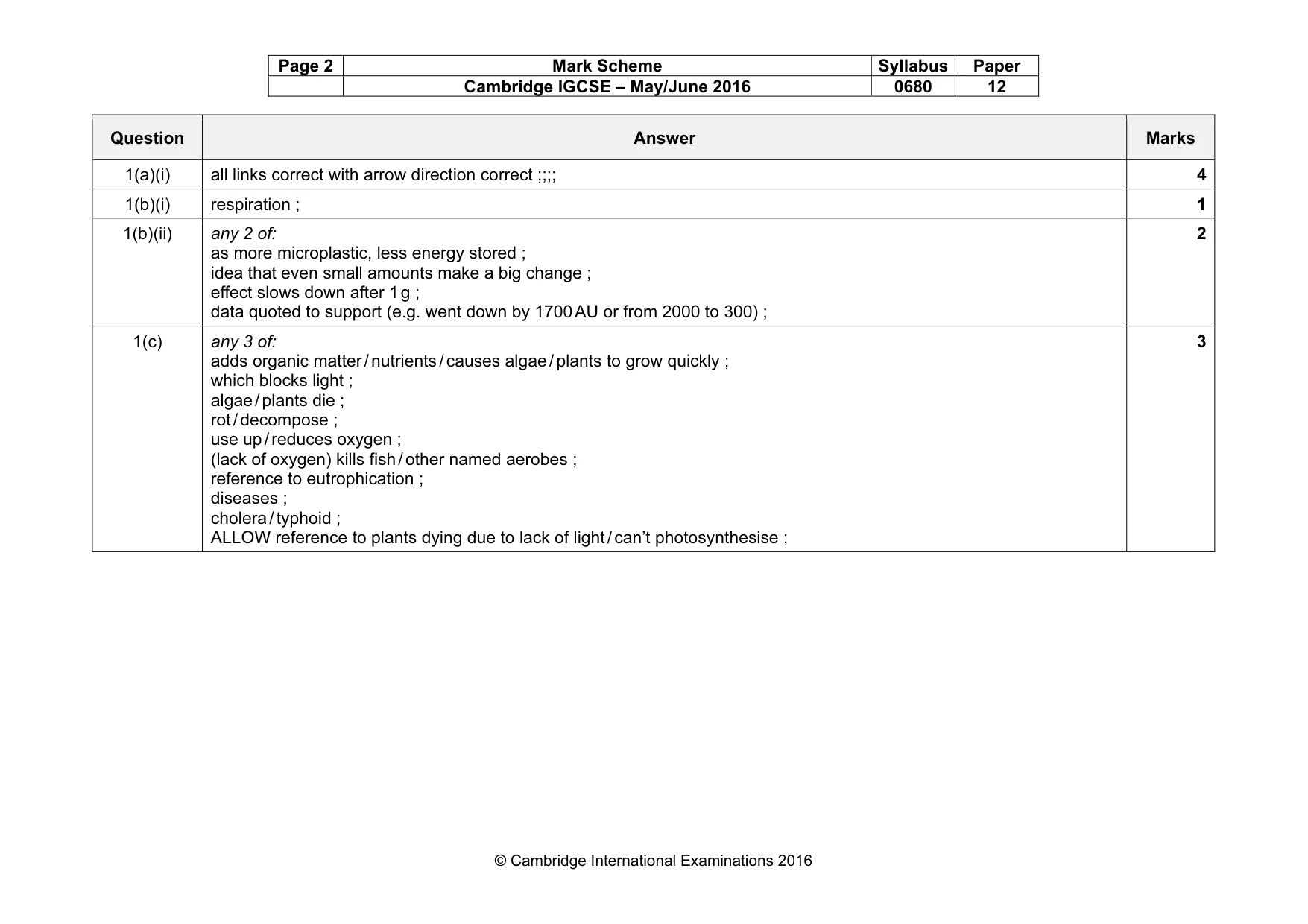
Page 2 Mark Scheme Syllabus Paper Cambridge IGCSE – May/June 2016 0680 12 © Cambridge International Examinations 2016 Question Answer Marks 1(a)(i) all links correct with arrow direction correct ;;;; 4 1(b)(i) respiration ; 1 1(b)(ii) any 2 of: as more microplastic, less energy stored ; idea that even small amounts make a big change ; effect slows down after 1 g ; data quoted to support (e.g. went down by 1700 AU or from 2000 to 300) ; 2 1(c) any 3 of: adds organic matter / nutrients / causes algae / plants to grow quickly ; which blocks light ; algae / plants die ; rot / decompose ; use up / reduces oxygen ; (lack of oxygen) kills fish / other named aerobes ; reference to eutrophication ; diseases ; cholera / typhoid ; ALLOW reference to plants dying due to lack of light / can’t photosynthesise ; 3
Mark scheme, page 3
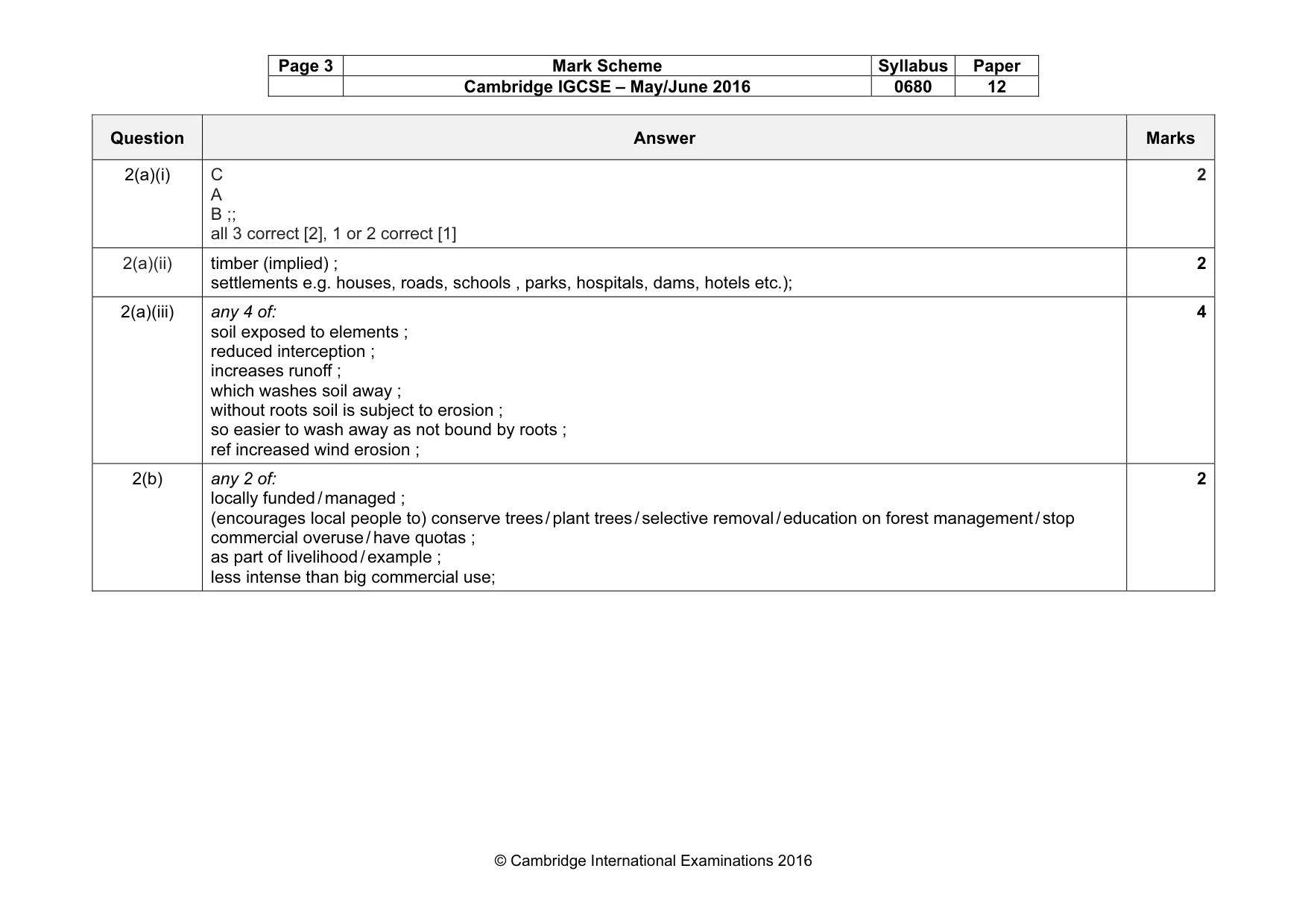
Page 3 Mark Scheme Syllabus Paper Cambridge IGCSE – May/June 2016 0680 12 © Cambridge International Examinations 2016 Question Answer Marks 2(a)(i) C A B ;; all 3 correct [2], 1 or 2 correct [1] 2 2(a)(ii) timber (implied) ; settlements e.g. houses, roads, schools , parks, hospitals, dams, hotels etc.); 2 2(a)(iii) any 4 of: soil exposed to elements ; reduced interception ; increases runoff ; which washes soil away ; without roots soil is subject to erosion ; so easier to wash away as not bound by roots ; ref increased wind erosion ; 4 2(b) any 2 of: locally funded / managed ; (encourages local people to) conserve trees / plant trees / selective removal / education on forest management / stop commercial overuse / have quotas ; as part of livelihood / example ; less intense than big commercial use; 2
Mark scheme, page 4
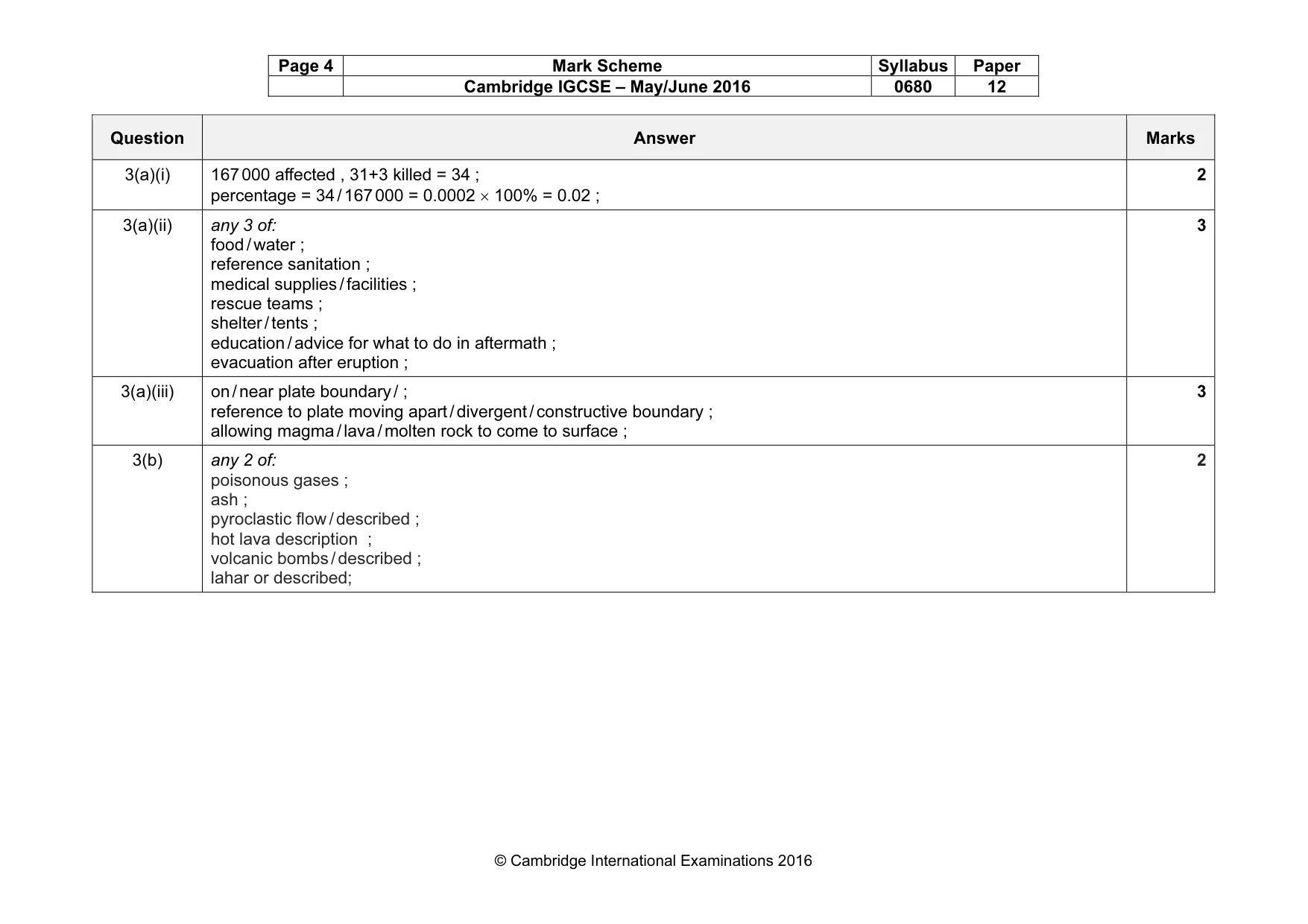
Page 4 Mark Scheme Syllabus Paper Cambridge IGCSE – May/June 2016 0680 12 © Cambridge International Examinations 2016 Question Answer Marks 3(a)(i) 167 000 affected , 31+3 killed = 34 ; percentage = 34 / 167 000 = 0.0002 × 100% = 0.02 ; 2 3(a)(ii) any 3 of: food / water ; reference sanitation ; medical supplies / facilities ; rescue teams ; shelter / tents ; education / advice for what to do in aftermath ; evacuation after eruption ; 3 3(a)(iii) on / near plate boundary / ; reference to plate moving apart / divergent / constructive boundary ; allowing magma / lava / molten rock to come to surface ; 3 3(b) any 2 of: poisonous gases ; ash ; pyroclastic flow / described ; hot lava description ; volcanic bombs / described ; lahar or described; 2
Mark scheme, page 5
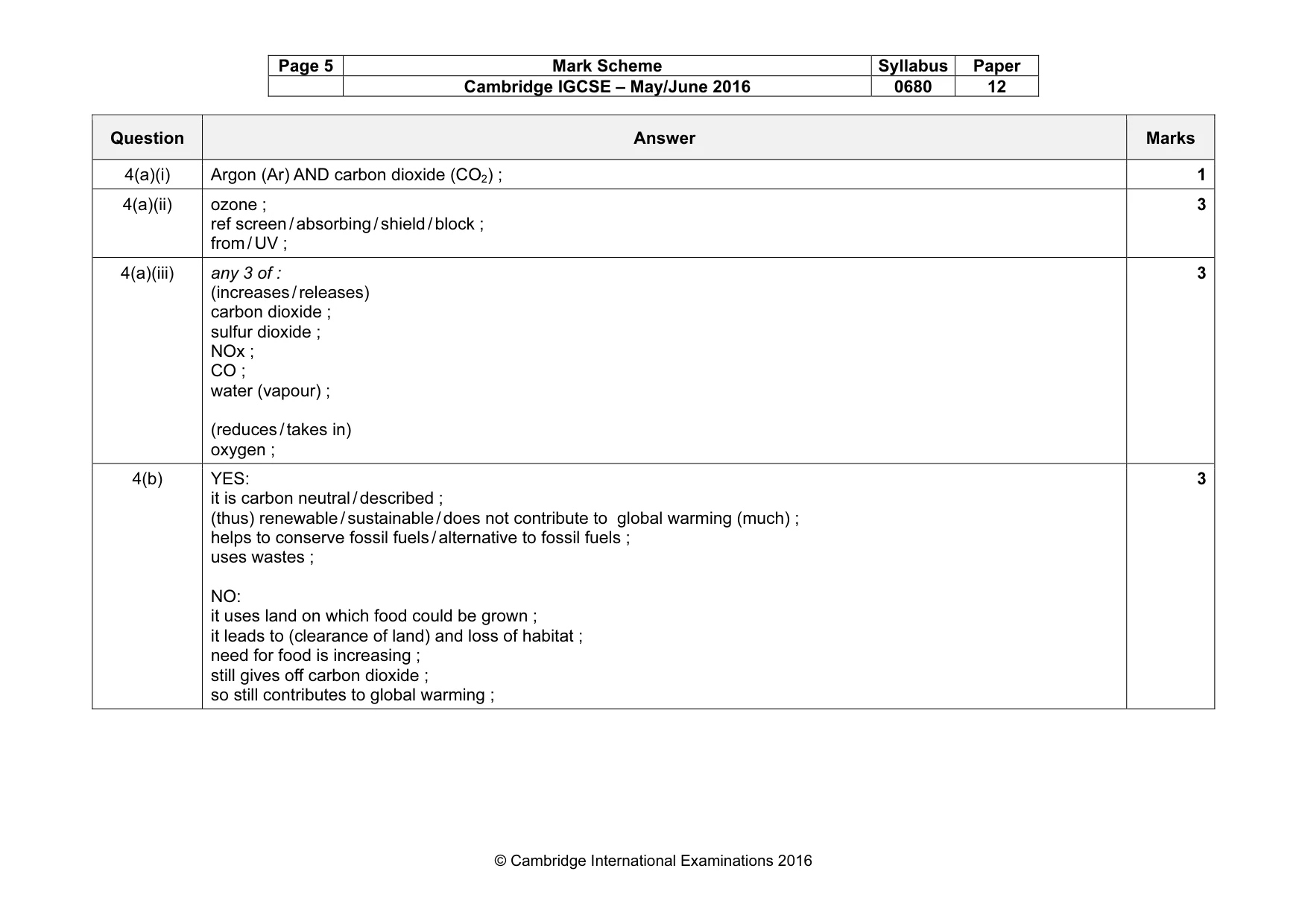
Page 5 Mark Scheme Syllabus Paper Cambridge IGCSE – May/June 2016 0680 12 © Cambridge International Examinations 2016 Question Answer Marks 4(a)(i) Argon (Ar) AND carbon dioxide (CO2) ; 1 4(a)(ii) ozone ; ref screen / absorbing / shield / block ; from / UV ; 3 4(a)(iii) any 3 of : (increases / releases) carbon dioxide ; sulfur dioxide ; NOx ; CO ; water (vapour) ; (reduces / takes in) oxygen ; 3 4(b) YES: it is carbon neutral / described ; (thus) renewable / sustainable / does not contribute to global warming (much) ; helps to conserve fossil fuels / alternative to fossil fuels ; uses wastes ; NO: it uses land on which food could be grown ; it leads to (clearance of land) and loss of habitat ; need for food is increasing ; still gives off carbon dioxide ; so still contributes to global warming ; 3
Mark scheme, page 6
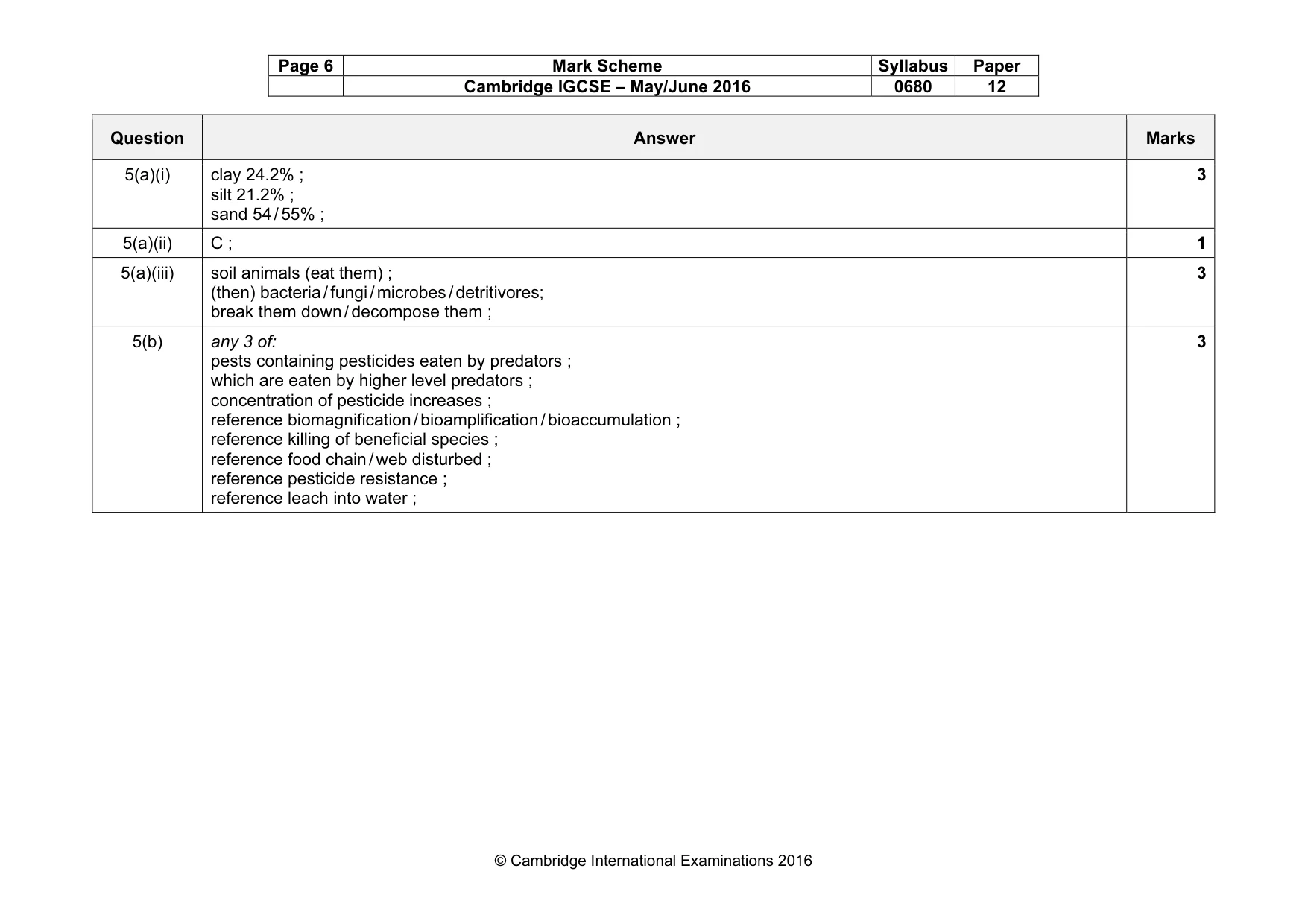
Page 6 Mark Scheme Syllabus Paper Cambridge IGCSE – May/June 2016 0680 12 © Cambridge International Examinations 2016 Question Answer Marks 5(a)(i) clay 24.2% ; silt 21.2% ; sand 54 / 55% ; 3 5(a)(ii) C ; 1 5(a)(iii) soil animals (eat them) ; (then) bacteria / fungi / microbes / detritivores; break them down / decompose them ; 3 5(b) any 3 of: pests containing pesticides eaten by predators ; which are eaten by higher level predators ; concentration of pesticide increases ; reference biomagnification / bioamplification / bioaccumulation ; reference killing of beneficial species ; reference food chain / web disturbed ; reference pesticide resistance ; reference leach into water ; 3
Mark scheme, page 7
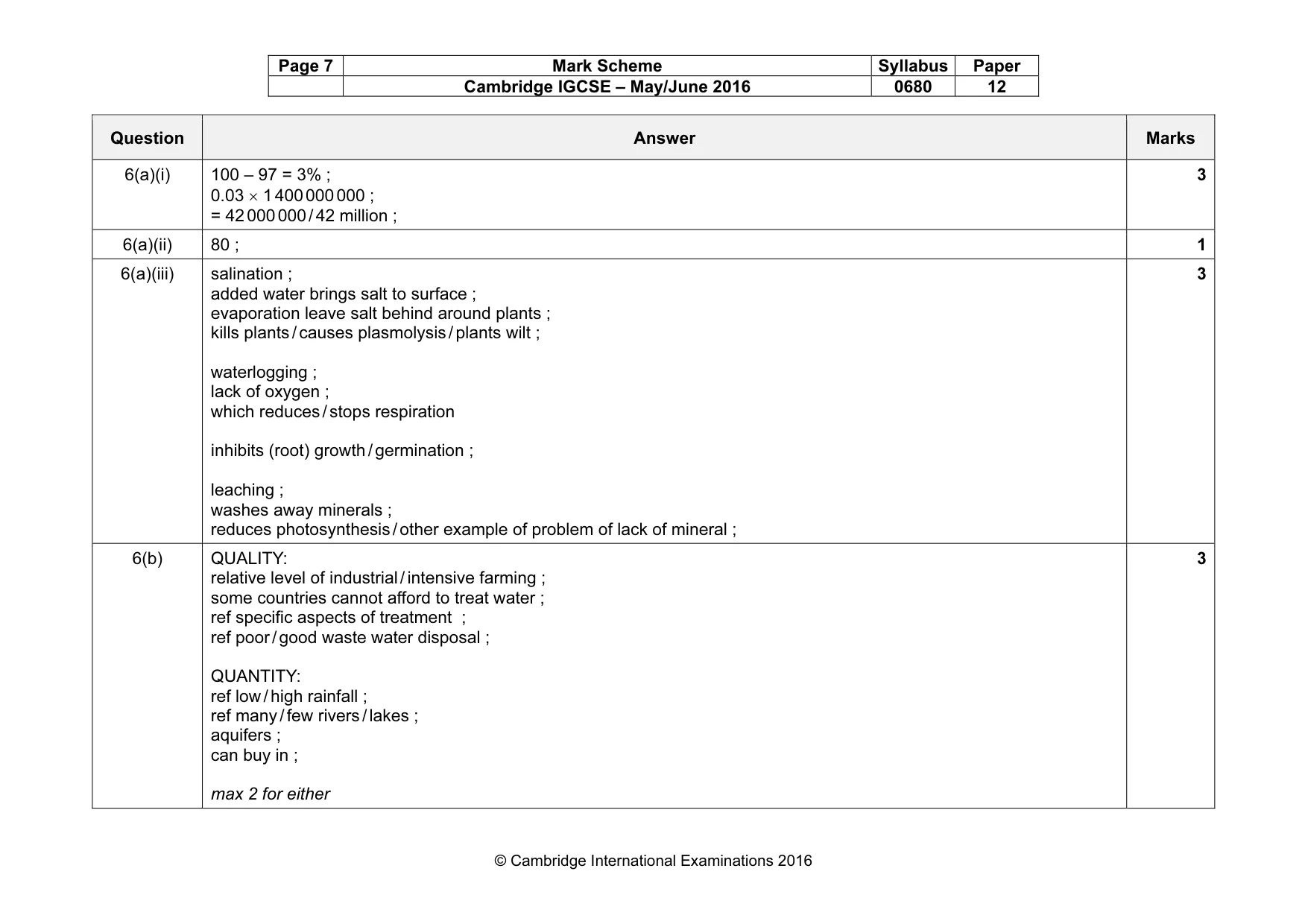
Page 7 Mark Scheme Syllabus Paper Cambridge IGCSE – May/June 2016 0680 12 © Cambridge International Examinations 2016 Question Answer Marks 6(a)(i) 100 – 97 = 3% ; 0.03 × 1 400 000 000 ; = 42 000 000 / 42 million ; 3 6(a)(ii) 80 ; 1 6(a)(iii) salination ; added water brings salt to surface ; evaporation leave salt behind around plants ; kills plants / causes plasmolysis / plants wilt ; waterlogging ; lack of oxygen ; which reduces / stops respiration inhibits (root) growth / germination ; leaching ; washes away minerals ; reduces photosynthesis / other example of problem of lack of mineral ; 3 6(b) QUALITY: relative level of industrial / intensive farming ; some countries cannot afford to treat water ; ref specific aspects of treatment ; ref poor / good waste water disposal ; QUANTITY: ref low / high rainfall ; ref many / few rivers / lakes ; aquifers ; can buy in ; max 2 for either 3
What you needed in this session
Cambridge’s own grade thresholds for 2016 May/June, Paper 1 · Variant 2. A higher threshold means an easier paper — the bar moves with how the cohort did.