Cambridge IGCSE Environmental Management 0680 — 2016 May/June Paper 1 · Variant 3
0680/13/M/J/16 · 60 marks · ≈68 min
The question paper and its mark scheme, free to read here and free to download. This is Cambridge’s own paper, exactly as it was sat.
Question paper16 pages
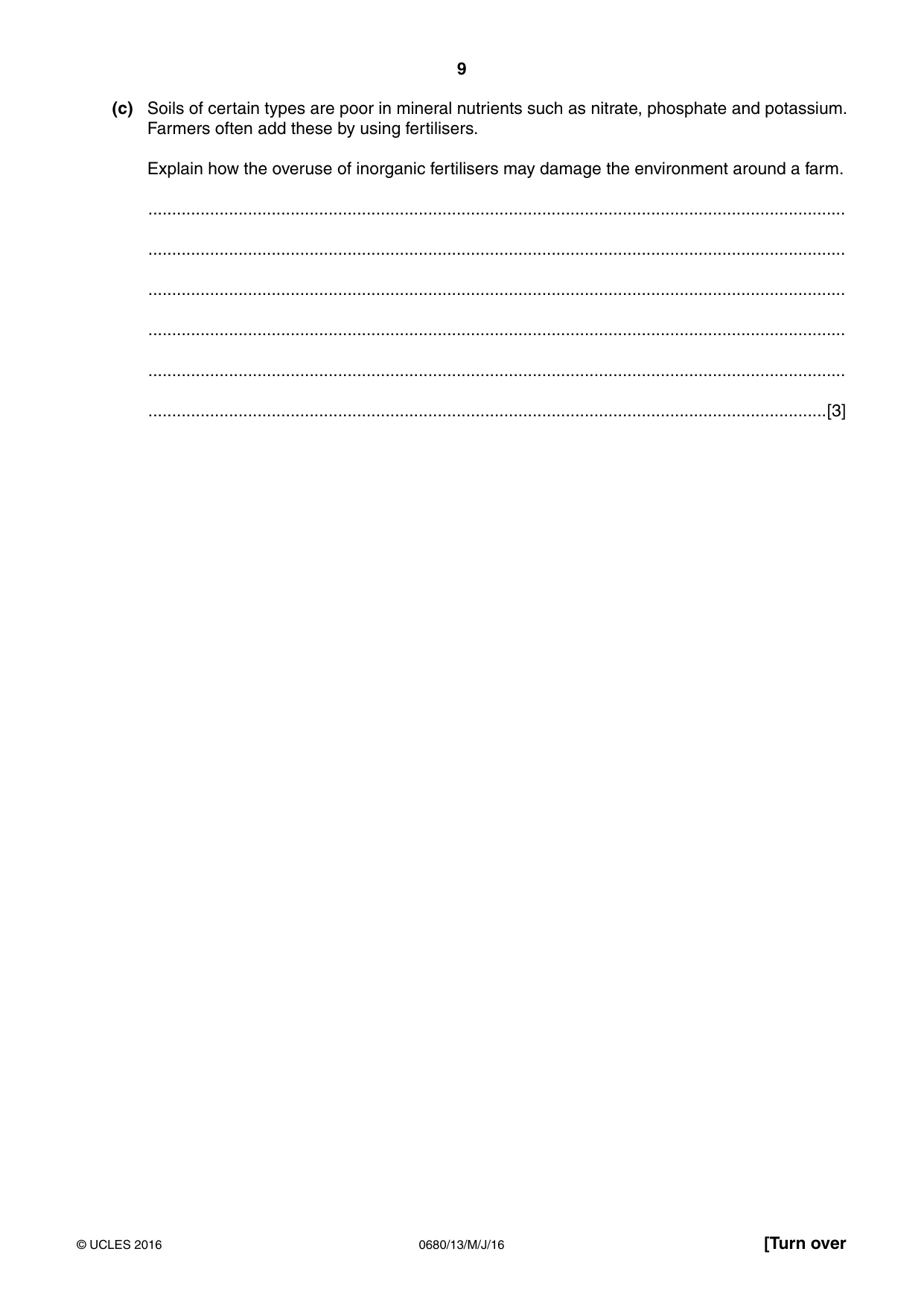

Mark scheme7 pages
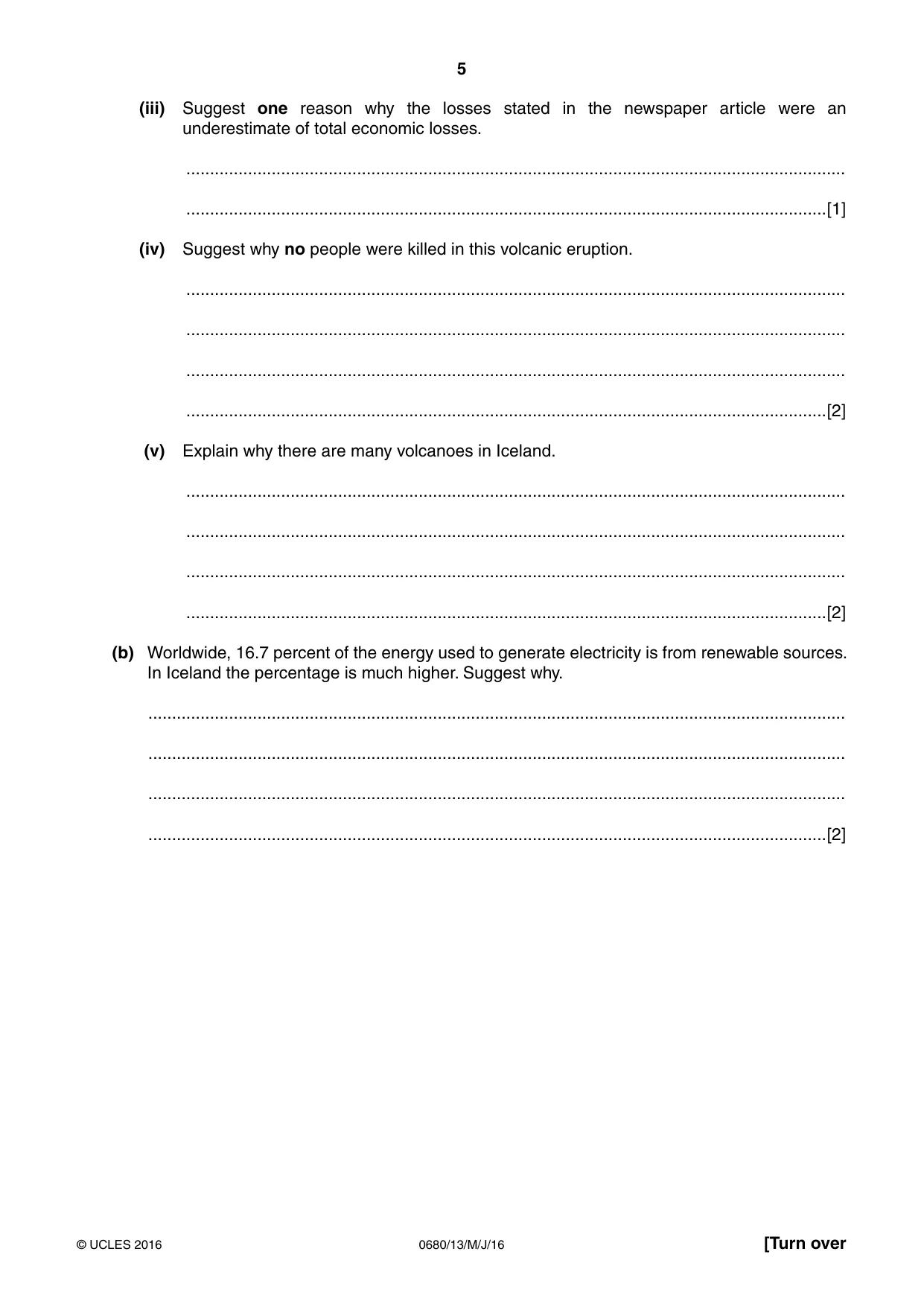
Answers below. Sit the paper first if you are practising.
Paper as text
Question paper, page 1
This document consists of 13 printed pages and 3 blank pages. DC (ST/JG) 113536/3 © UCLES 2016 [Turn over Cambridge International Examinations Cambridge International General Certificate of Secondary Education * 9 2 8 0 5 8 5 0 4 3 * ENVIRONMENTAL MANAGEMENT 0680/13 Paper 1 May/June 2016 1 hour 30 minutes Candidates answer on the Question Paper. No Additional Materials are required. READ THESE INSTRUCTIONS FIRST Write your Centre number, candidate number and name on all the work you hand in. Write in dark blue or black pen. You may use an HB pencil for any diagrams or graphs. Do not use staples, paper clips, glue or correction fluid. DO NOT WRITE IN ANY BARCODES. Answer all questions. Electronic calculators may be used. You may lose marks if you do not show your working or if you do not use appropriate units. At the end of the examination, fasten all your work securely together. The number of marks is given in brackets [ ] at the end of each question or part question.
Question paper, page 2
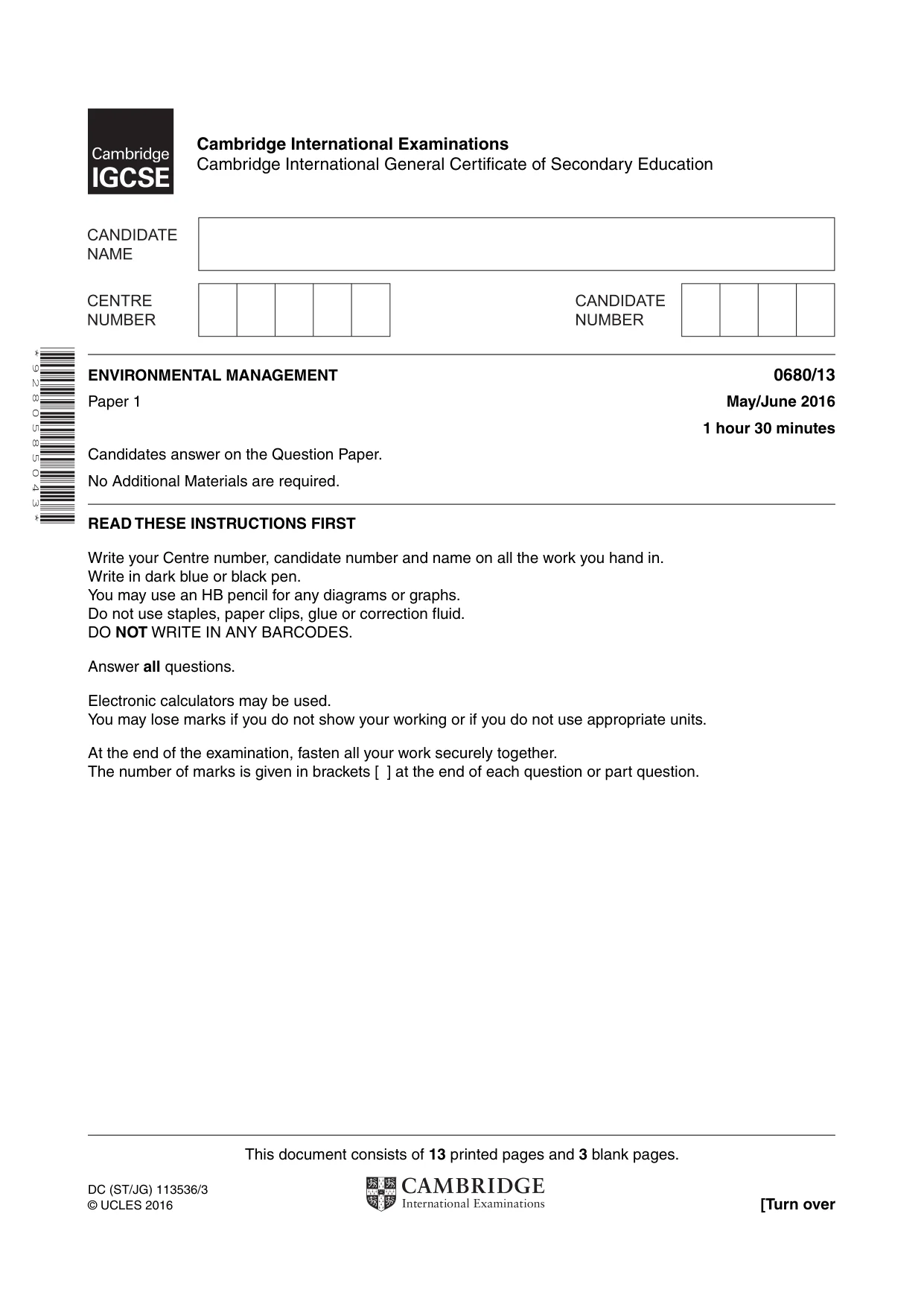
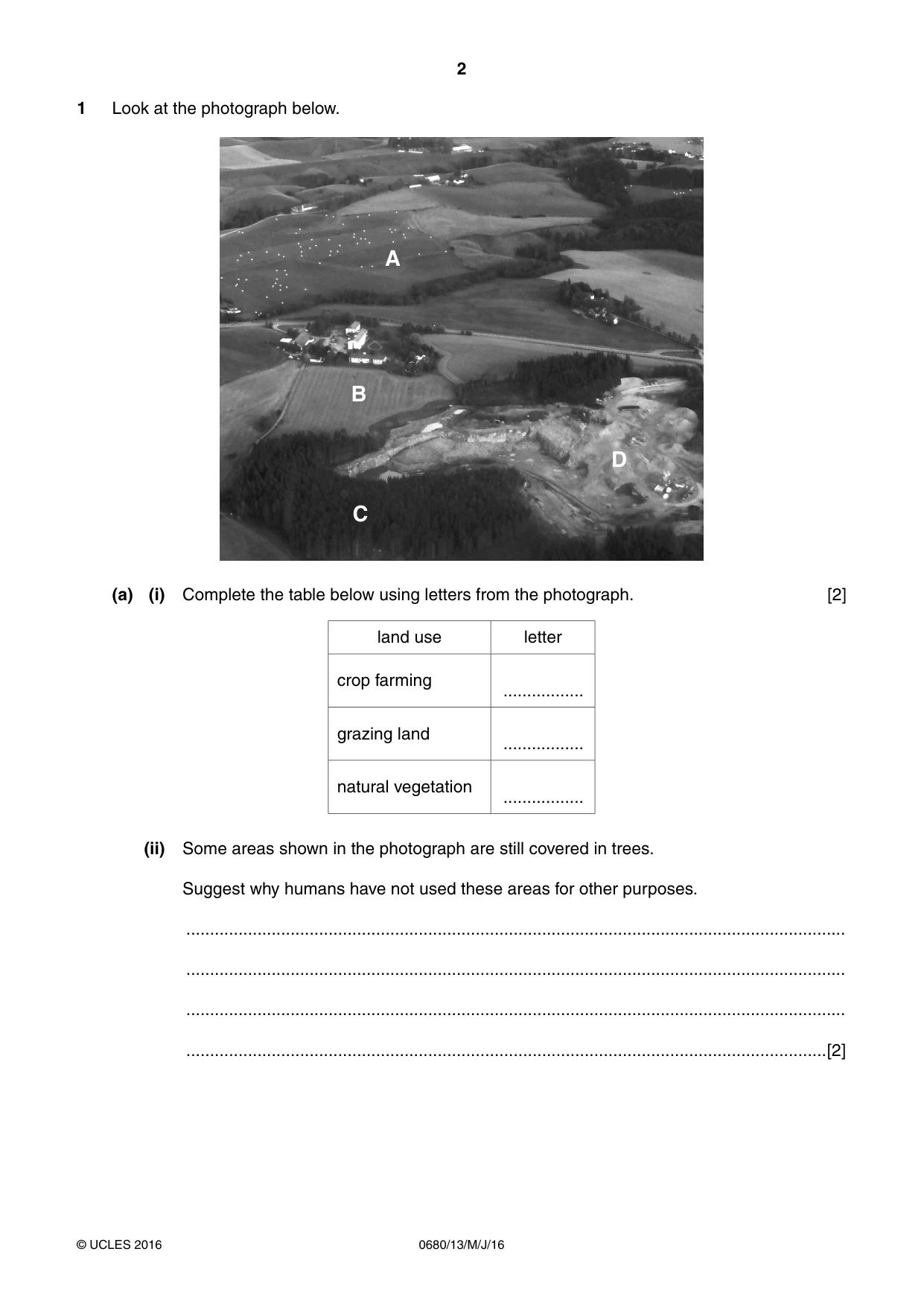
2 0680/13/M/J/16 © UCLES 2016 1 Look at the photograph below. A B D C (a) (i) Complete the table below using letters from the photograph. [2] land use letter crop farming … grazing land … natural vegetation … (ii) Some areas shown in the photograph are still covered in trees. Suggest why humans have not used these areas for other purposes. … … … …[2]
Question paper, page 3
3 0680/13/M/J/16 © UCLES 2016 [Turn over (iii) Suggest why there is an open-pit (opencast) mine at D. … …[1] (iv) Describe ways in which environments damaged by mining can be improved. … … … … … …[3] (b) Hardwood trees are found in tropical forests. Explain how hardwood forests can be managed by sustainable harvesting. … … … …[2]
Question paper, page 4
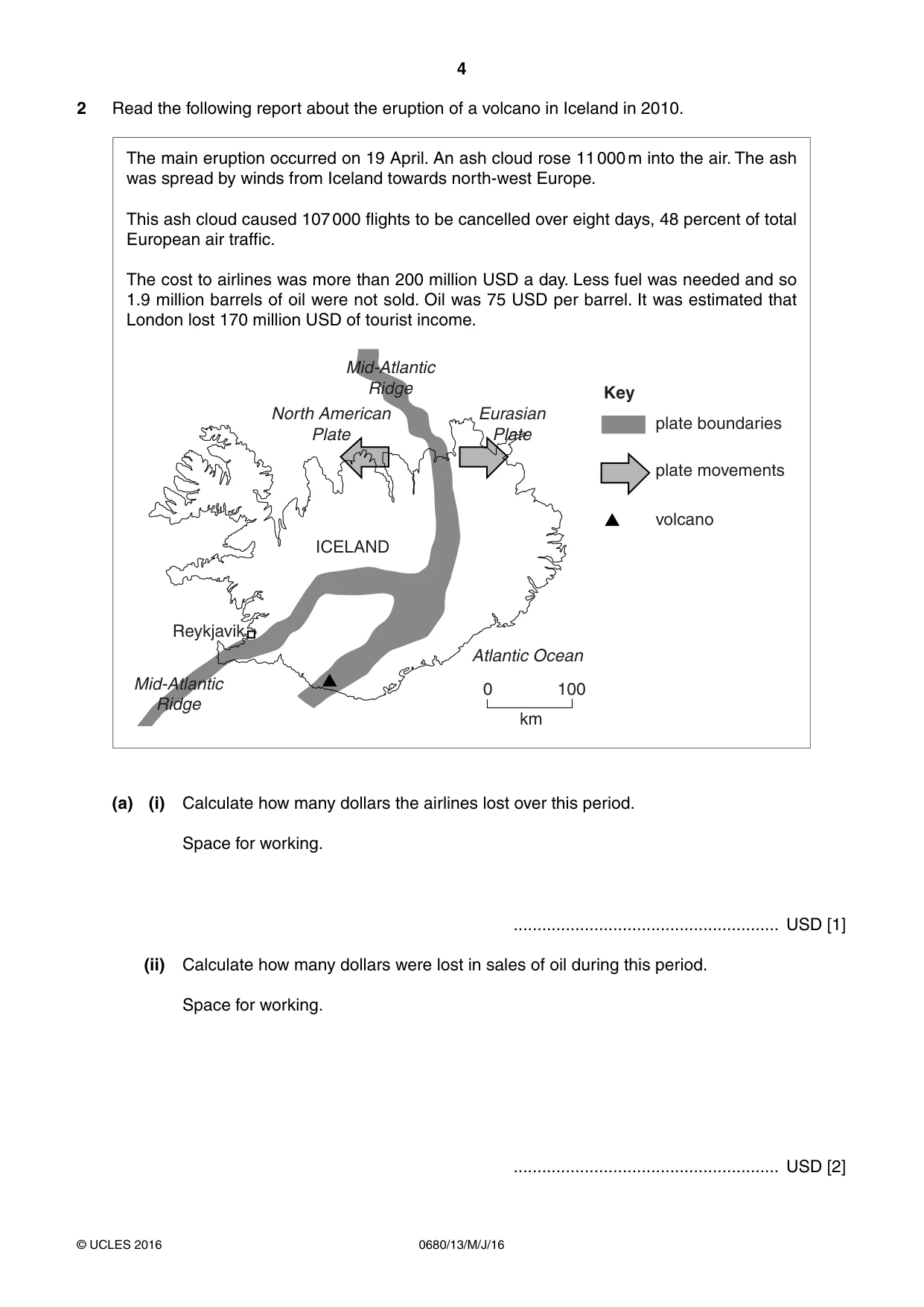
4 0680/13/M/J/16 © UCLES 2016 2 Read the following report about the eruption of a volcano in Iceland in 2010. The main eruption occurred on 19 April. An ash cloud rose 11 000 m into the air. The ash was spread by winds from Iceland towards north-west Europe. This ash cloud caused 107 000 flights to be cancelled over eight days, 48 percent of total European air traffic. The cost to airlines was more than 200 million USD a day. Less fuel was needed and so 1.9 million barrels of oil were not sold. Oil was 75 USD per barrel. It was estimated that London lost 170 million USD of tourist income. Mid-Atlantic Ridge Mid-Atlantic Ridge Eurasian Plate Atlantic Ocean North American Plate ICELAND Reykjavik plate boundaries .H\ plate movements volcano 0 100 km (a) (i) Calculate how many dollars the airlines lost over this period. Space for working. … USD [1] (ii) Calculate how many dollars were lost in sales of oil during this period. Space for working. … USD [2]
Question paper, page 5
5 0680/13/M/J/16 © UCLES 2016 [Turn over (iii) Suggest one reason why the losses stated in the newspaper article were an underestimate of total economic losses. … …[1] (iv) Suggest why no people were killed in this volcanic eruption. … … … …[2] (v) Explain why there are many volcanoes in Iceland. … … … …[2] (b) Worldwide, 16.7 percent of the energy used to generate electricity is from renewable sources. In Iceland the percentage is much higher. Suggest why. … … … …[2]
Question paper, page 6
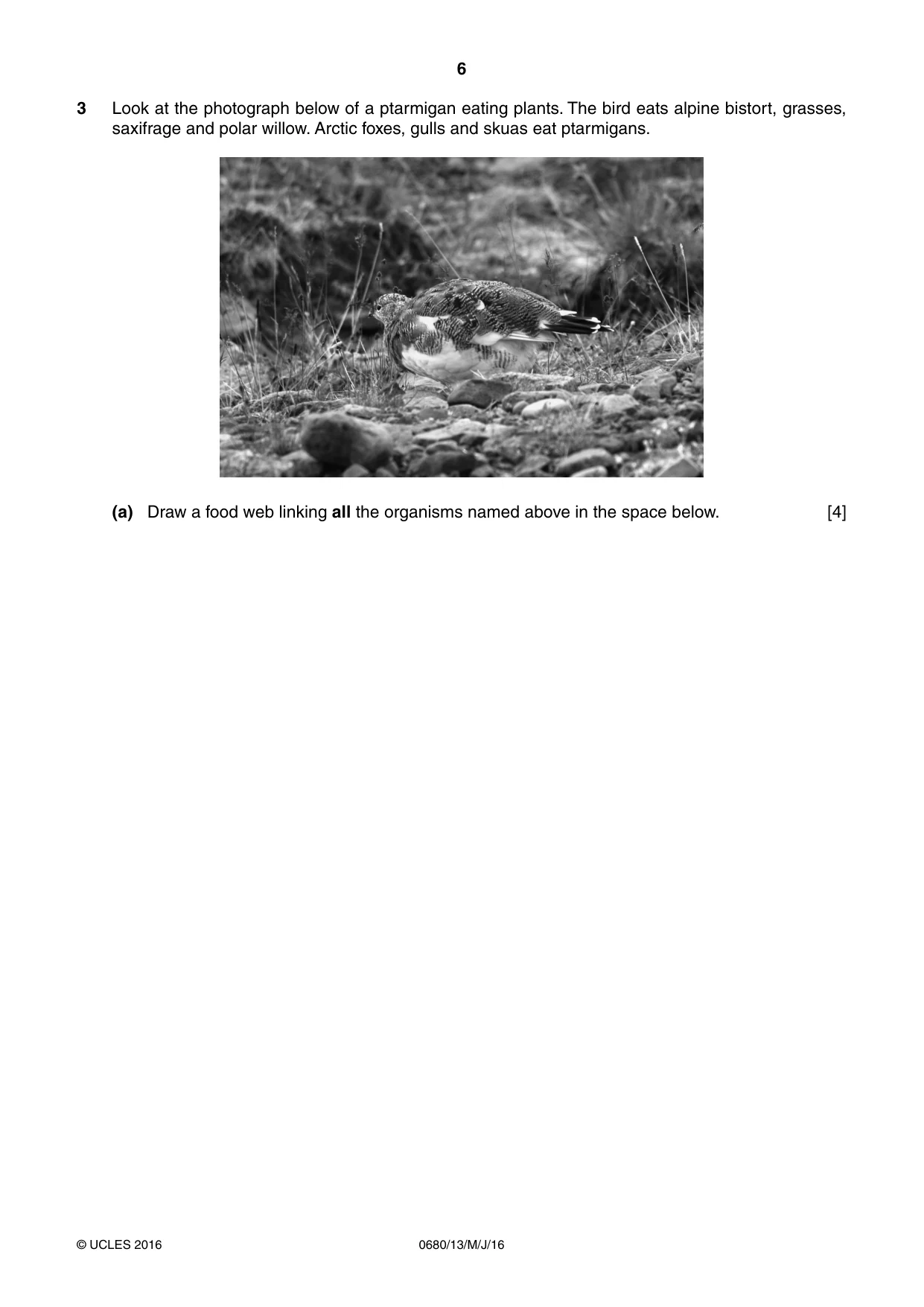
6 0680/13/M/J/16 © UCLES 2016 3 Look at the photograph below of a ptarmigan eating plants. The bird eats alpine bistort, grasses, saxifrage and polar willow. Arctic foxes, gulls and skuas eat ptarmigans. (a) Draw a food web linking all the organisms named above in the space below. [4]
Question paper, page 7
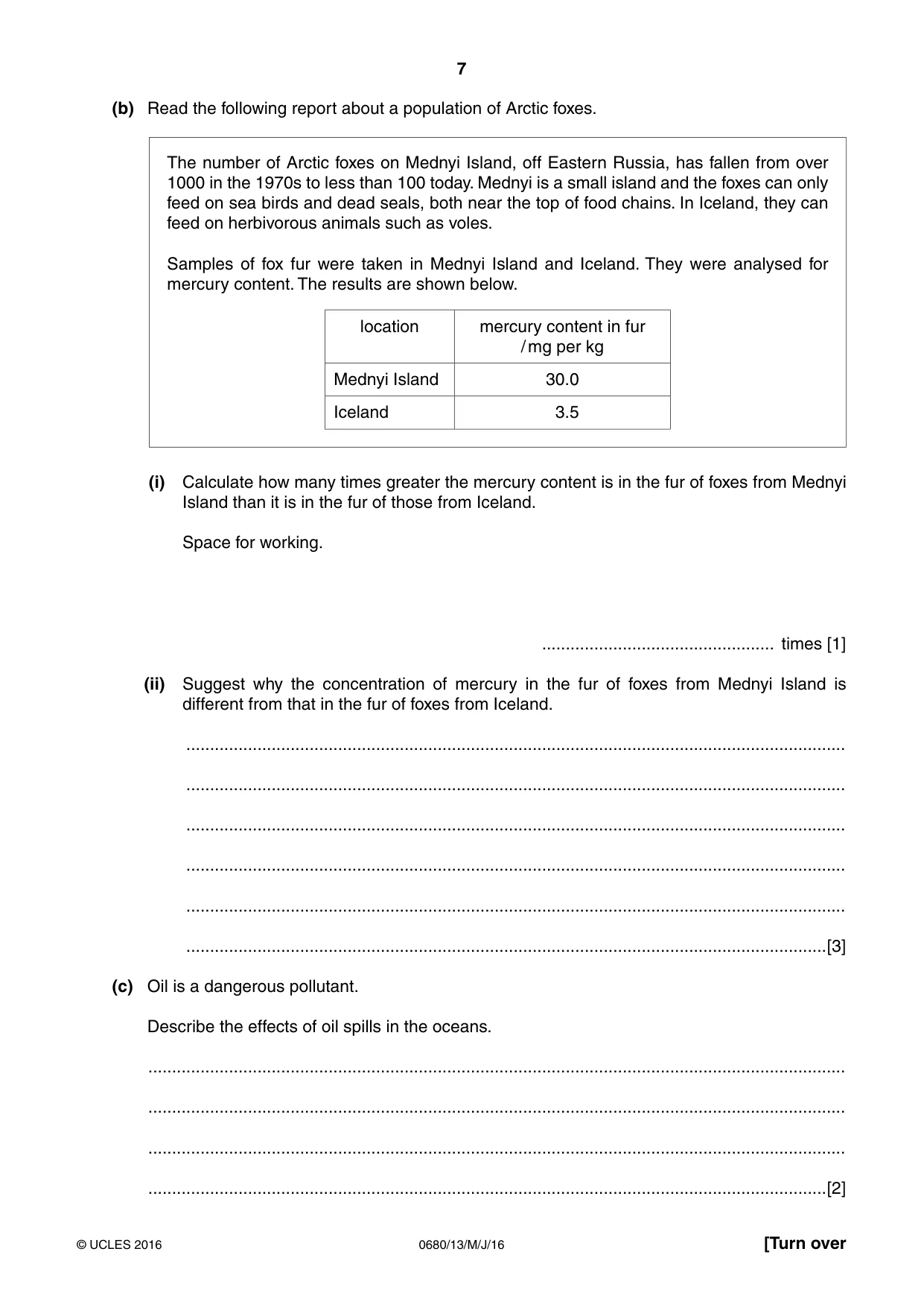
7 0680/13/M/J/16 © UCLES 2016 [Turn over (b) Read the following report about a population of Arctic foxes. The number of Arctic foxes on Mednyi Island, off Eastern Russia, has fallen from over 1000 in the 1970s to less than 100 today. Mednyi is a small island and the foxes can only feed on sea birds and dead seals, both near the top of food chains. In Iceland, they can feed on herbivorous animals such as voles. Samples of fox fur were taken in Mednyi Island and Iceland. They were analysed for mercury content. The results are shown below. location mercury content in fur / mg per kg Mednyi Island 30.0 Iceland 3.5 (i) Calculate how many times greater the mercury content is in the fur of foxes from Mednyi Island than it is in the fur of those from Iceland. Space for working. … times [1] (ii) Suggest why the concentration of mercury in the fur of foxes from Mednyi Island is different from that in the fur of foxes from Iceland. … … … … … …[3] (c) Oil is a dangerous pollutant. Describe the effects of oil spills in the oceans. … … … …[2]
Question paper, page 8
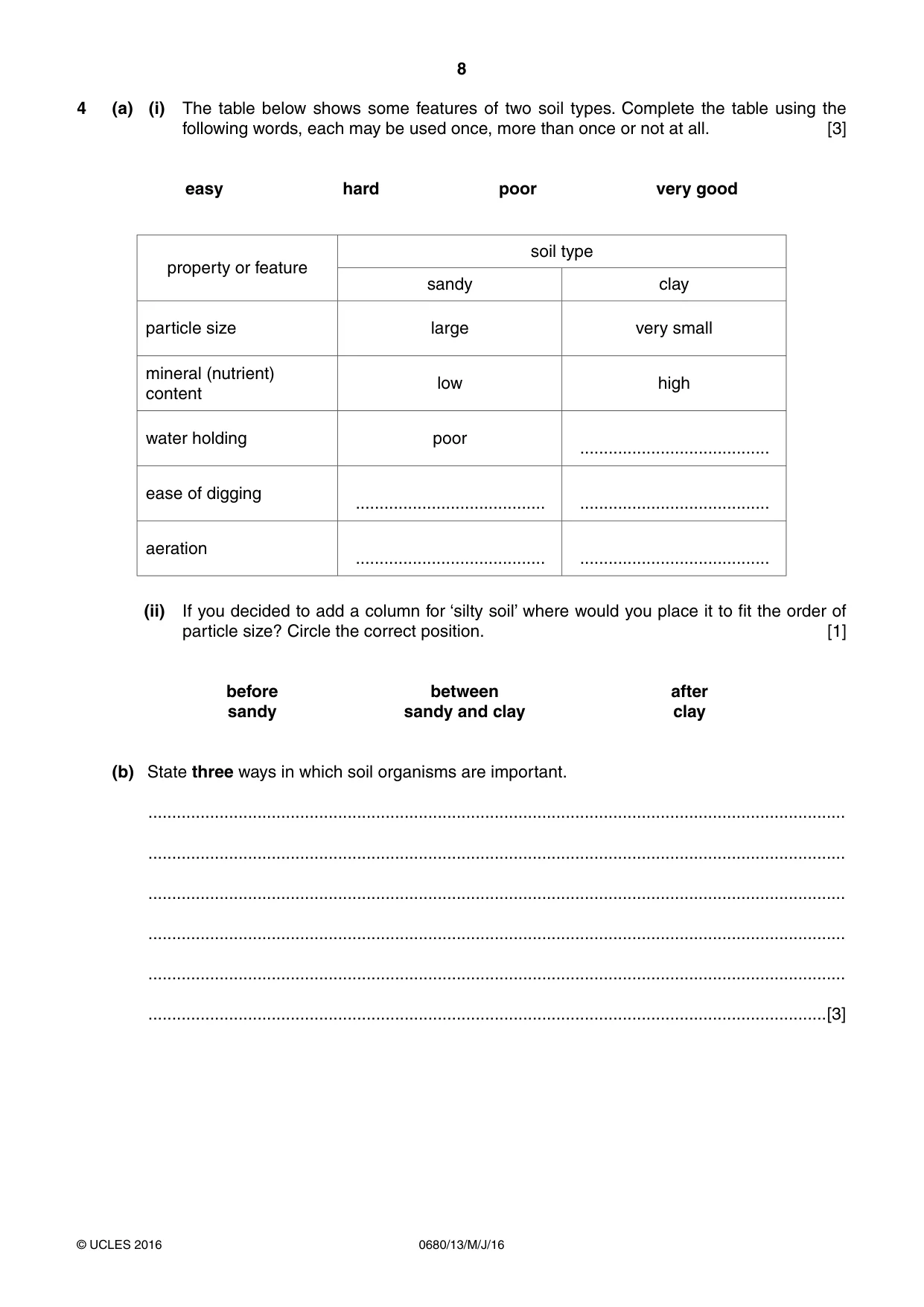
8 0680/13/M/J/16 © UCLES 2016 4 (a) (i) The table below shows some features of two soil types. Complete the table using the following words, each may be used once, more than once or not at all. [3] easy hard poor very good property or feature soil type sandy clay particle size large very small mineral (nutrient) content low high water holding poor … ease of digging … … aeration … … (ii) If you decided to add a column for ‘silty soil’ where would you place it to fit the order of particle size? Circle the correct position. [1] before between after sandy sandy and clay clay (b) State three ways in which soil organisms are important. … … … … … …[3]
Question paper, page 9
9 0680/13/M/J/16 © UCLES 2016 [Turn over (c) Soils of certain types are poor in mineral nutrients such as nitrate, phosphate and potassium. Farmers often add these by using fertilisers. Explain how the overuse of inorganic fertilisers may damage the environment around a farm. … … … … … …[3]
Question paper, page 10
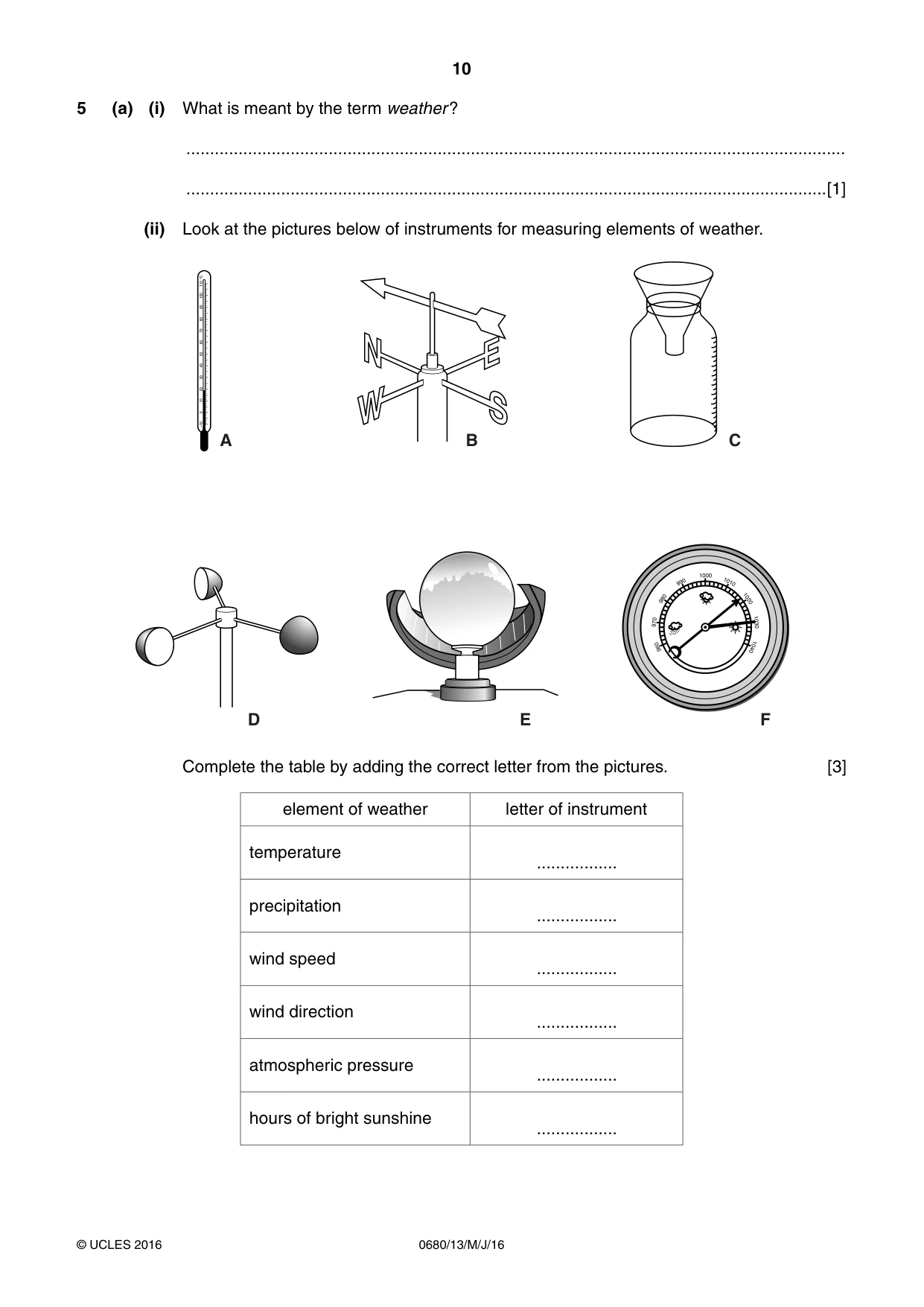
10 0680/13/M/J/16 © UCLES 2016 5 (a) (i) What is meant by the term weather ? … …[1] (ii) Look at the pictures below of instruments for measuring elements of weather. A D E F B C Complete the table by adding the correct letter from the pictures. [3] element of weather letter of instrument temperature … precipitation … wind speed … wind direction … atmospheric pressure … hours of bright sunshine …
Question paper, page 11
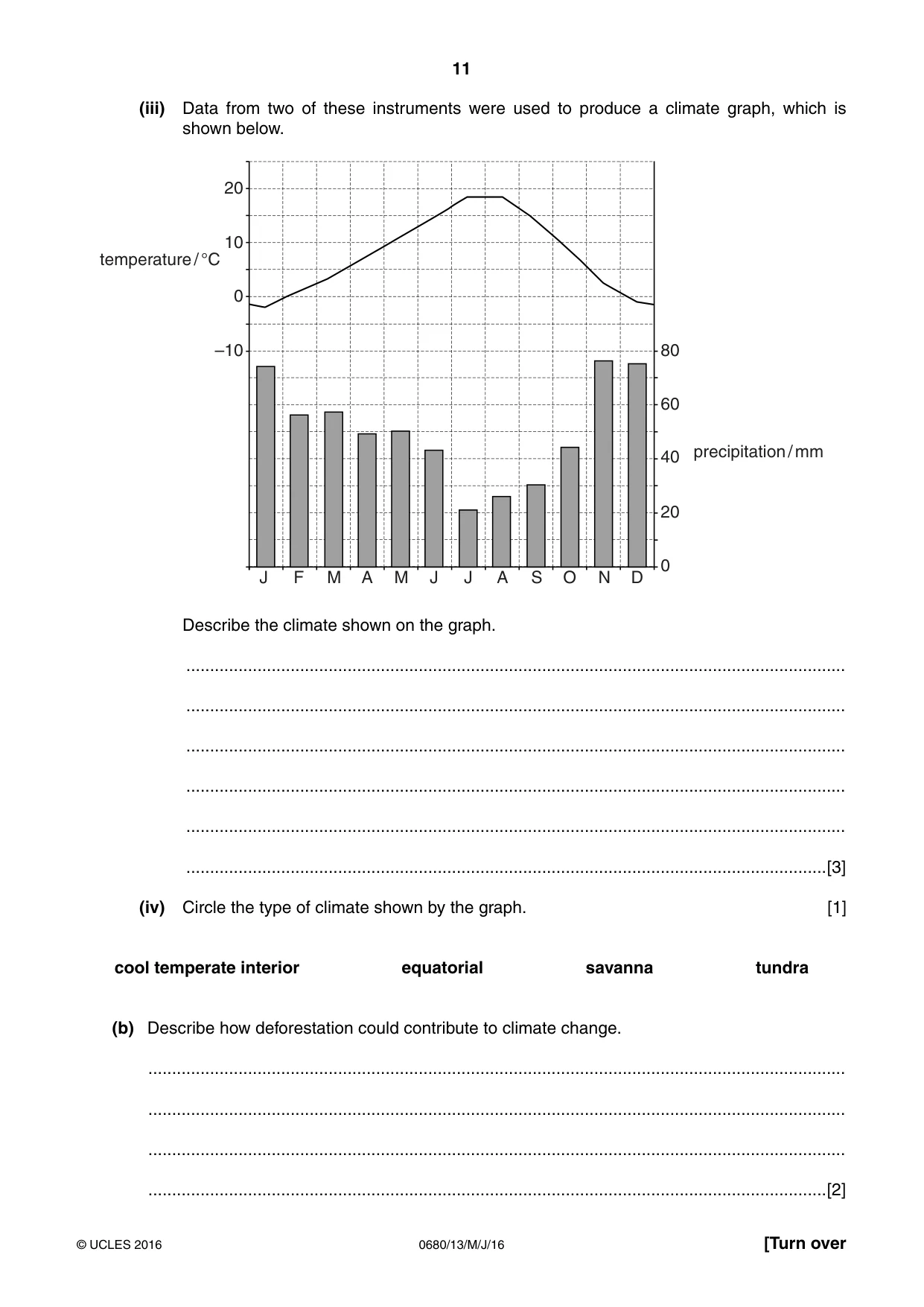
11 0680/13/M/J/16 © UCLES 2016 [Turn over (iii) Data from two of these instruments were used to produce a climate graph, which is shown below. 0 20 40 60 80 –10 0 10 20 J F M A M J J A S O N D precipitation / mm temperature / °C Describe the climate shown on the graph. … … … … … …[3] (iv) Circle the type of climate shown by the graph. [1] cool temperate interior equatorial savanna tundra (b) Describe how deforestation could contribute to climate change. … … … …[2]
Question paper, page 12
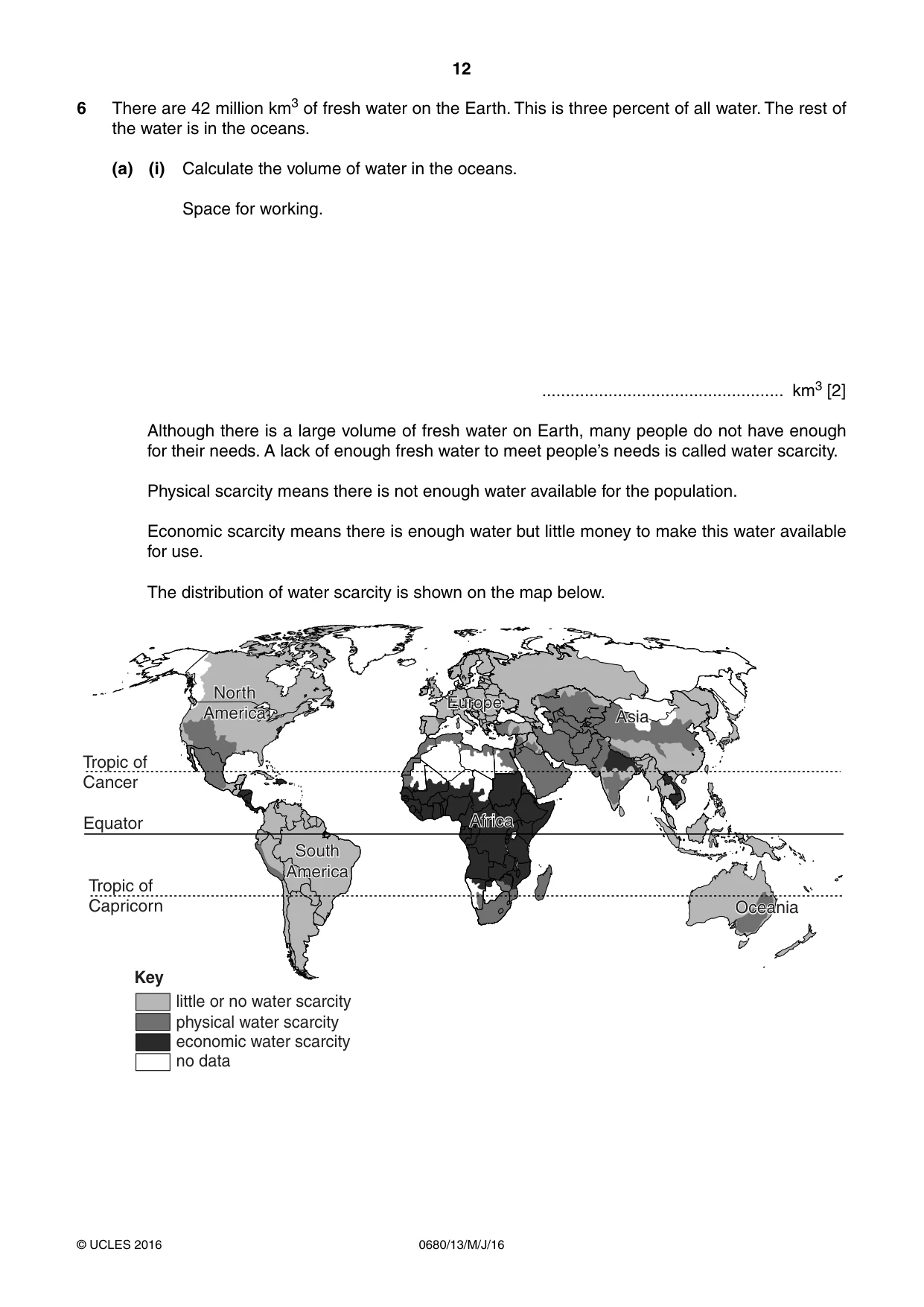
12 0680/13/M/J/16 © UCLES 2016 6 There are 42 million km3 of fresh water on the Earth. This is three percent of all water. The rest of the water is in the oceans. (a) (i) Calculate the volume of water in the oceans. Space for working. … km3 [2] Although there is a large volume of fresh water on Earth, many people do not have enough for their needs. A lack of enough fresh water to meet people’s needs is called water scarcity. Physical scarcity means there is not enough water available for the population. Economic scarcity means there is enough water but little money to make this water available for use. The distribution of water scarcity is shown on the map below. Key little or no water scarcity physical water scarcity economic water scarcity no data Tropic of Capricorn Tropic of Cancer Equator North America South America Europe Africa Asia Oceania North America South America Europe Africa Asia Oceania
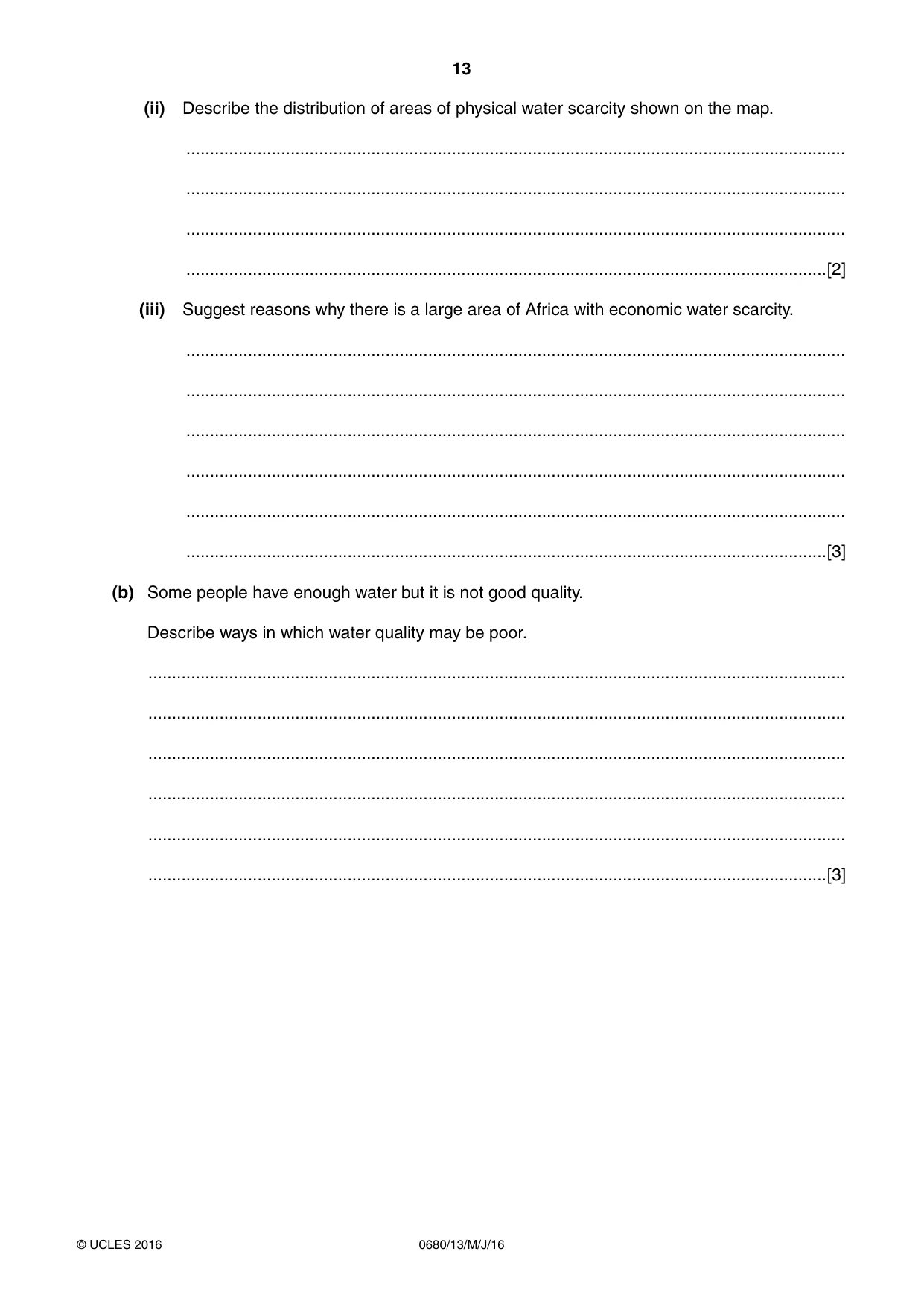
Question paper, page 13
13 0680/13/M/J/16 © UCLES 2016 (ii) Describe the distribution of areas of physical water scarcity shown on the map. … … … …[2] (iii) Suggest reasons why there is a large area of Africa with economic water scarcity. … … … … … …[3] (b) Some people have enough water but it is not good quality. Describe ways in which water quality may be poor. … … … … … …[3]
Question paper, page 14
14 0680/13/M/J/16 © UCLES 2016 BLANK PAGE
Question paper, page 15
15 0680/13/M/J/16 © UCLES 2016 BLANK PAGE
Question paper, page 16
16 0680/13/M/J/16 © UCLES 2016 Permission to reproduce items where third-party owned material protected by copyright is included has been sought and cleared where possible. Every reasonable effort has been made by the publisher (UCLES) to trace copyright holders, but if any items requiring clearance have unwittingly been included, the publisher will be pleased to make amends at the earliest possible opportunity. To avoid the issue of disclosure of answer-related information to candidates, all copyright acknowledgements are reproduced online in the Cambridge International Examinations Copyright Acknowledgements Booklet. This is produced for each series of examinations and is freely available to download at www.cie.org.uk after the live examination series. Cambridge International Examinations is part of the Cambridge Assessment Group. Cambridge Assessment is the brand name of University of Cambridge Local Examinations Syndicate (UCLES), which is itself a department of the University of Cambridge. BLANK PAGE
Mark scheme, page 1
® IGCSE is the registered trademark of Cambridge International Examinations. This document consists of 7 printed pages. © UCLES 2016 [Turn over Cambridge International Examinations Cambridge International General Certificate of Secondary Education ENVIRONMENTAL MANAGEMENT 0680/13 Paper 1 May/June 2016 MARK SCHEME Maximum Mark: 60 Published This mark scheme is published as an aid to teachers and candidates, to indicate the requirements of the examination. It shows the basis on which Examiners were instructed to award marks. It does not indicate the details of the discussions that took place at an Examiners’ meeting before marking began, which would have considered the acceptability of alternative answers. Mark schemes should be read in conjunction with the question paper and the Principal Examiner Report for Teachers. Cambridge will not enter into discussions about these mark schemes. Cambridge is publishing the mark schemes for the May/June 2016 series for most Cambridge IGCSE®, Cambridge International A and AS Level components and some Cambridge O Level components.
Mark scheme, page 2
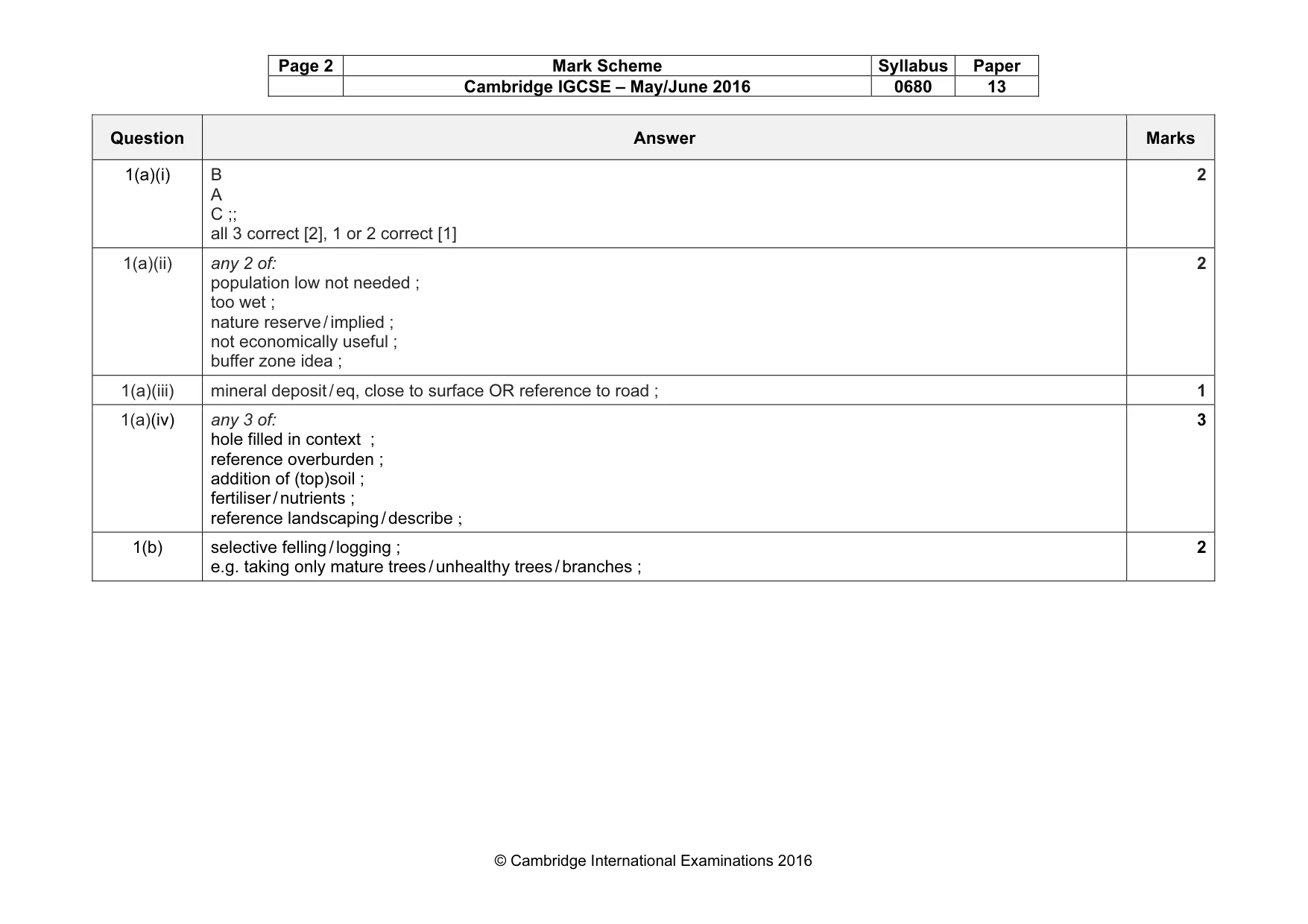
Page 2 Mark Scheme Syllabus Paper Cambridge IGCSE – May/June 2016 0680 13 © Cambridge International Examinations 2016 Question Answer Marks 1(a)(i) B A C ;; all 3 correct [2], 1 or 2 correct [1] 2 1(a)(ii) any 2 of: population low not needed ; too wet ; nature reserve / implied ; not economically useful ; buffer zone idea ; 2 1(a)(iii) mineral deposit / eq, close to surface OR reference to road ; 1 1(a)(iv) any 3 of: hole filled in context ; reference overburden ; addition of (top)soil ; fertiliser / nutrients ; reference landscaping / describe ; 3 1(b) selective felling / logging ; e.g. taking only mature trees / unhealthy trees / branches ; 2
Mark scheme, page 3
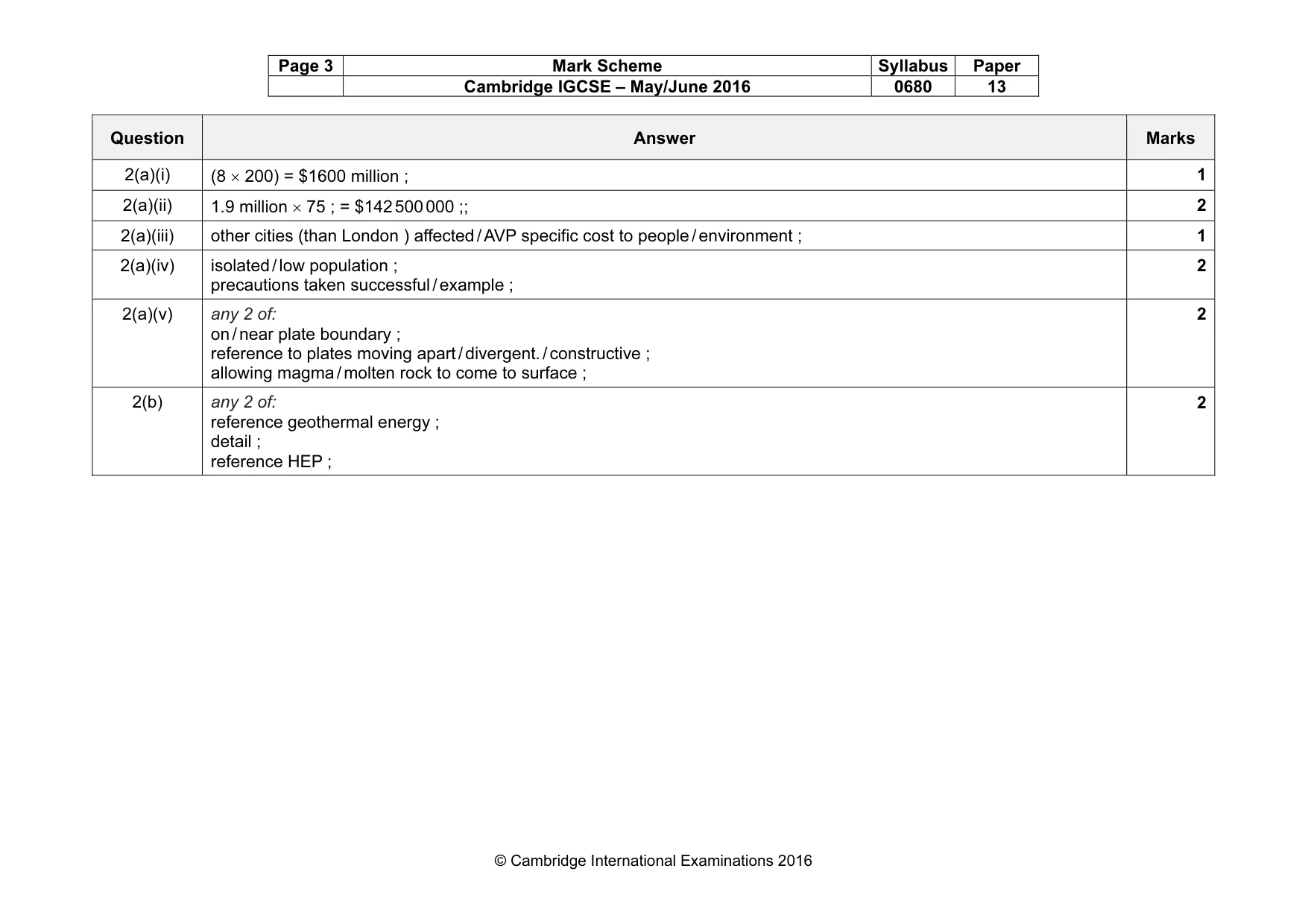
Page 3 Mark Scheme Syllabus Paper Cambridge IGCSE – May/June 2016 0680 13 © Cambridge International Examinations 2016 Question Answer Marks 2(a)(i) (8 × 200) = $1600 million ; 1 2(a)(ii) 1.9 million × 75 ; = $142 500 000 ;; 2 2(a)(iii) other cities (than London ) affected / AVP specific cost to people / environment ; 1 2(a)(iv) isolated / low population ; precautions taken successful / example ; 2 2(a)(v) any 2 of: on / near plate boundary ; reference to plates moving apart / divergent. / constructive ; allowing magma / molten rock to come to surface ; 2 2(b) any 2 of: reference geothermal energy ; detail ; reference HEP ; 2
Mark scheme, page 4
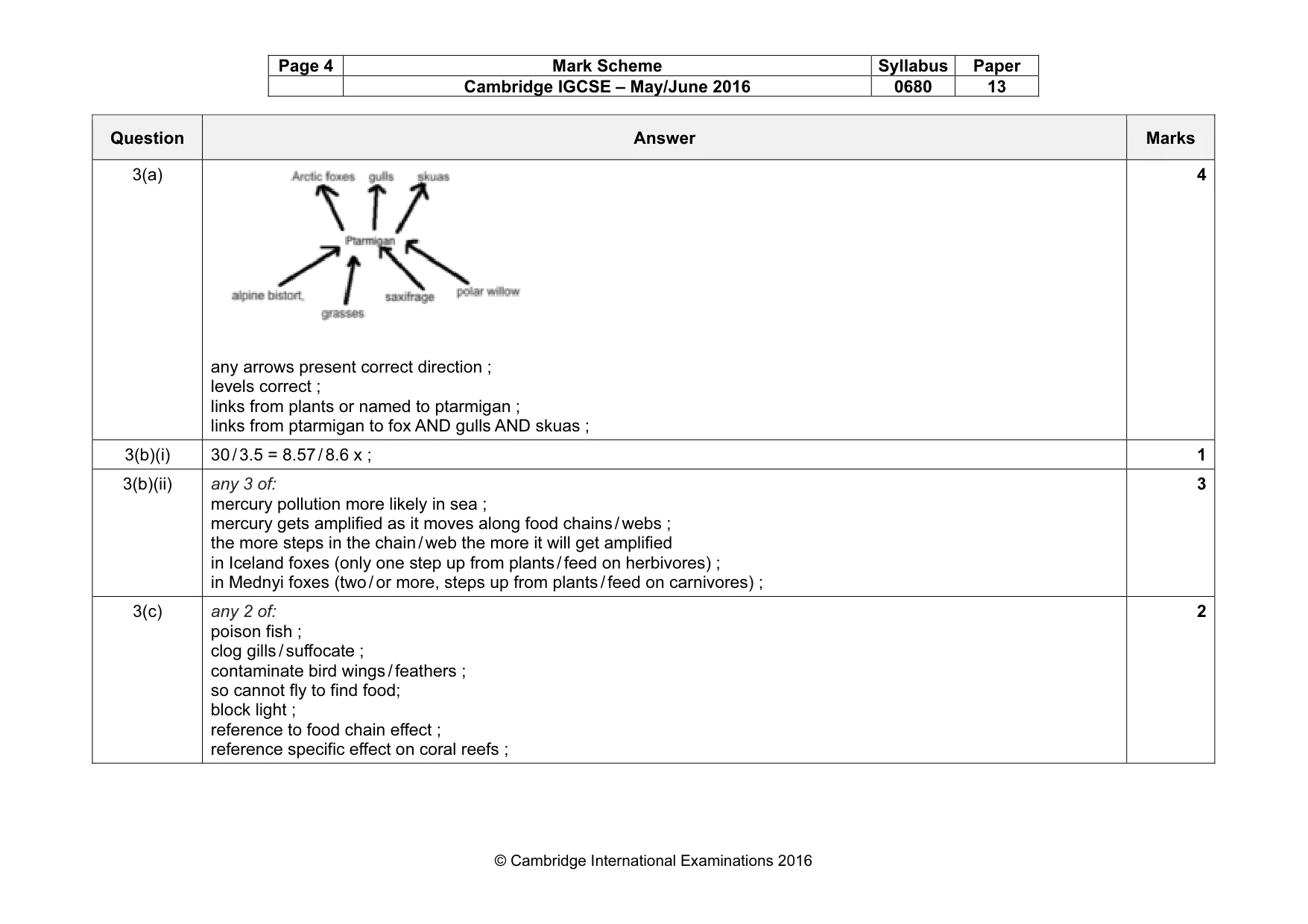
Page 4 Mark Scheme Syllabus Paper Cambridge IGCSE – May/June 2016 0680 13 © Cambridge International Examinations 2016 Question Answer Marks 3(a) any arrows present correct direction ; levels correct ; links from plants or named to ptarmigan ; links from ptarmigan to fox AND gulls AND skuas ; 4 3(b)(i) 30 / 3.5 = 8.57 / 8.6 x ; 1 3(b)(ii) any 3 of: mercury pollution more likely in sea ; mercury gets amplified as it moves along food chains / webs ; the more steps in the chain / web the more it will get amplified in Iceland foxes (only one step up from plants / feed on herbivores) ; in Mednyi foxes (two / or more, steps up from plants / feed on carnivores) ; 3 3(c) any 2 of: poison fish ; clog gills / suffocate ; contaminate bird wings / feathers ; so cannot fly to find food; block light ; reference to food chain effect ; reference specific effect on coral reefs ; 2
Mark scheme, page 5
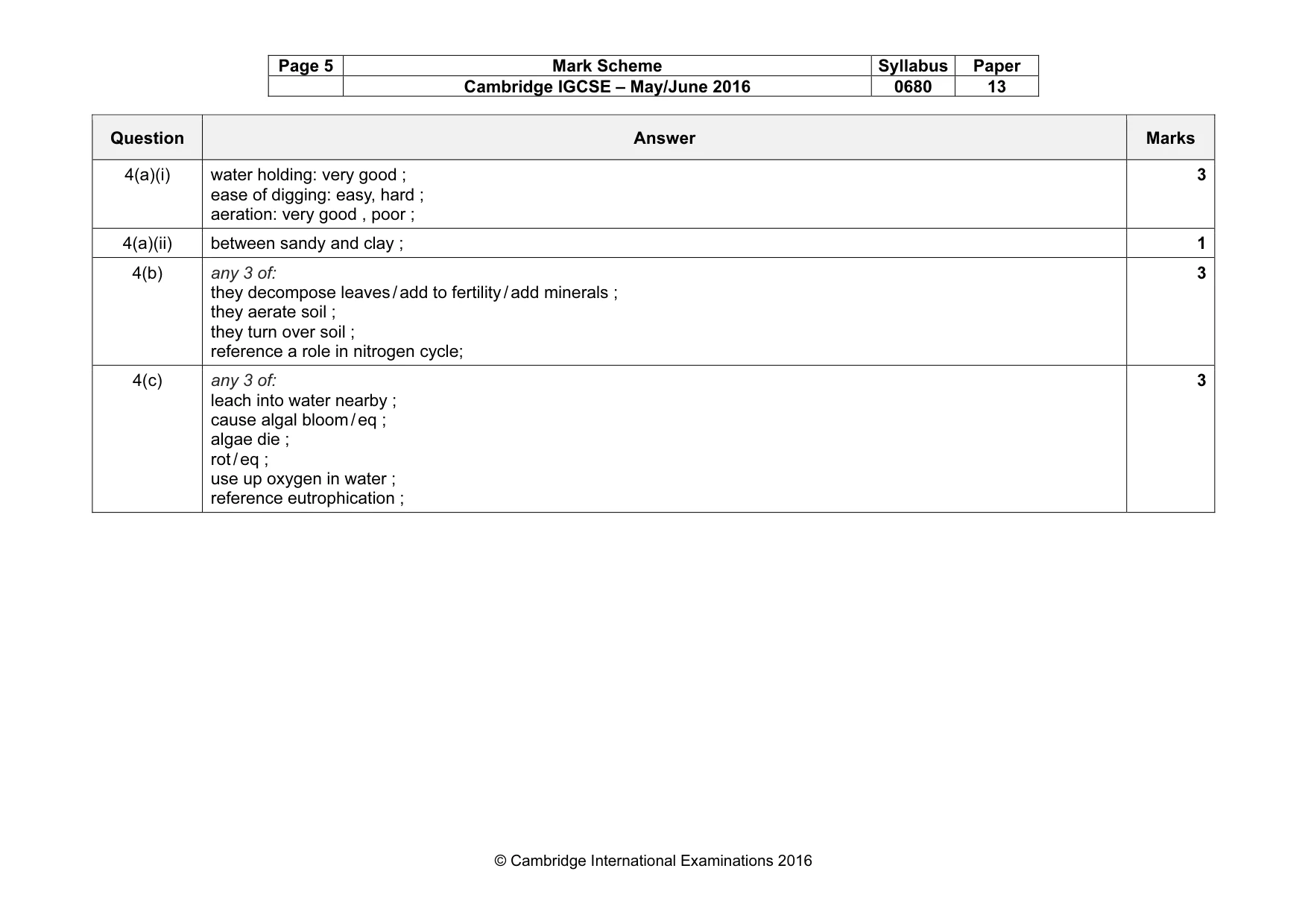
Page 5 Mark Scheme Syllabus Paper Cambridge IGCSE – May/June 2016 0680 13 © Cambridge International Examinations 2016 Question Answer Marks 4(a)(i) water holding: very good ; ease of digging: easy, hard ; aeration: very good , poor ; 3 4(a)(ii) between sandy and clay ; 1 4(b) any 3 of: they decompose leaves / add to fertility / add minerals ; they aerate soil ; they turn over soil ; reference a role in nitrogen cycle; 3 4(c) any 3 of: leach into water nearby ; cause algal bloom / eq ; algae die ; rot / eq ; use up oxygen in water ; reference eutrophication ; 3
Mark scheme, page 6
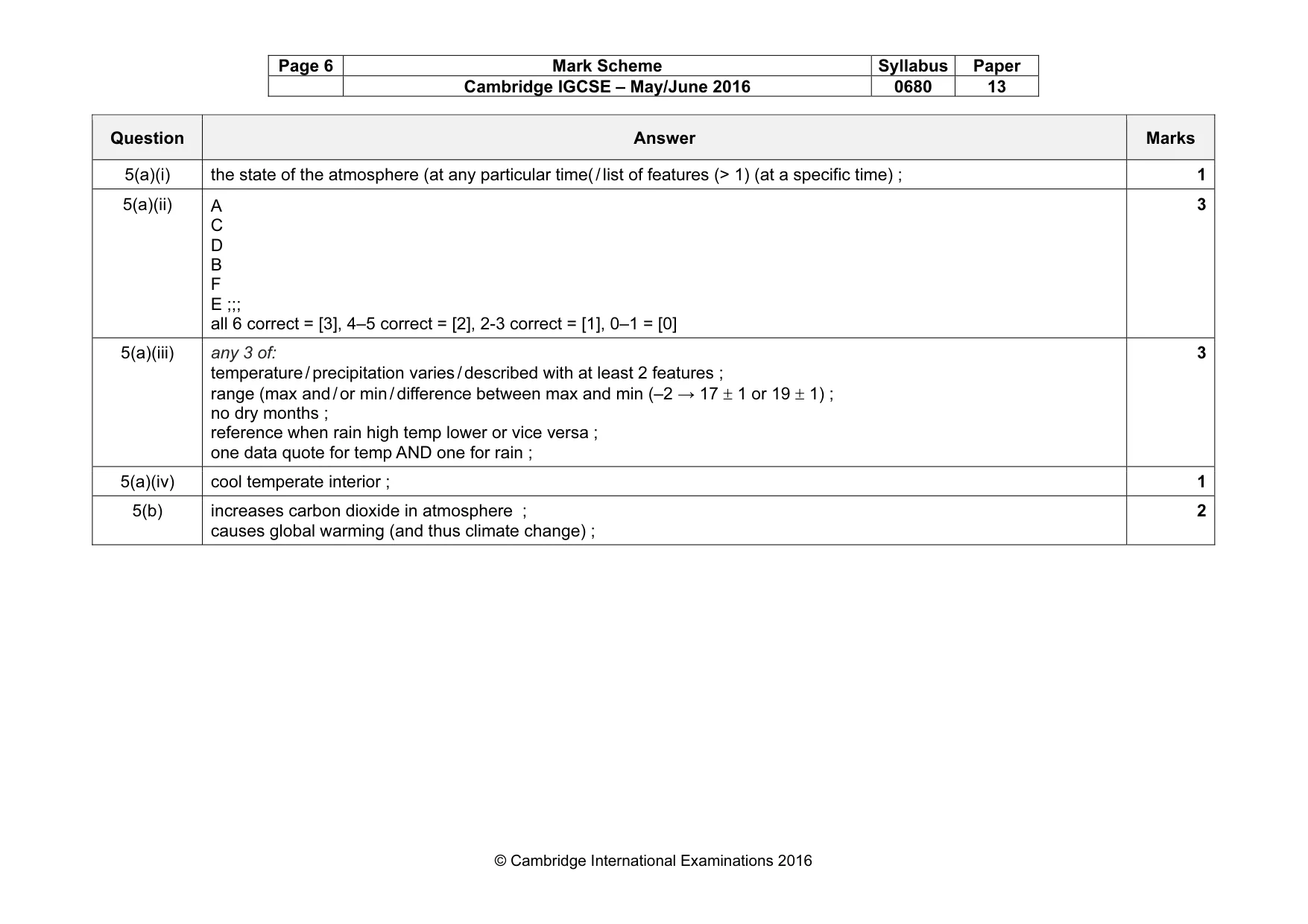
Page 6 Mark Scheme Syllabus Paper Cambridge IGCSE – May/June 2016 0680 13 © Cambridge International Examinations 2016 Question Answer Marks 5(a)(i) the state of the atmosphere (at any particular time( / list of features (> 1) (at a specific time) ; 1 5(a)(ii) A C D B F E ;;; all 6 correct = [3], 4–5 correct = [2], 2-3 correct = [1], 0–1 = [0] 3 5(a)(iii) any 3 of: temperature / precipitation varies / described with at least 2 features ; range (max and / or min / difference between max and min (–2 → 17 ± 1 or 19 ± 1) ; no dry months ; reference when rain high temp lower or vice versa ; one data quote for temp AND one for rain ; 3 5(a)(iv) cool temperate interior ; 1 5(b) increases carbon dioxide in atmosphere ; causes global warming (and thus climate change) ; 2
Mark scheme, page 7
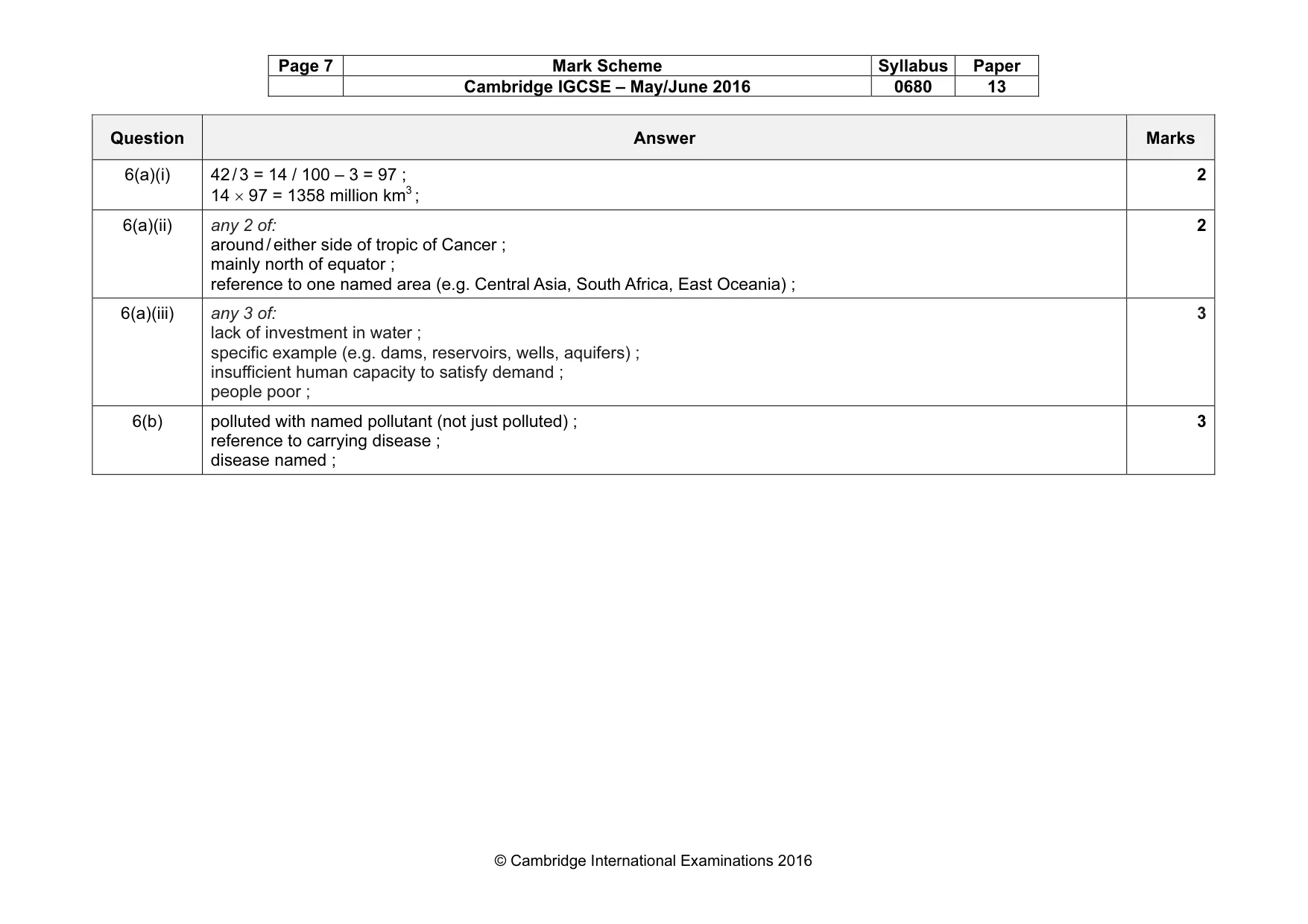
Page 7 Mark Scheme Syllabus Paper Cambridge IGCSE – May/June 2016 0680 13 © Cambridge International Examinations 2016 Question Answer Marks 6(a)(i) 42 / 3 = 14 / 100 – 3 = 97 ; 14 × 97 = 1358 million km3 ; 2 6(a)(ii) any 2 of: around / either side of tropic of Cancer ; mainly north of equator ; reference to one named area (e.g. Central Asia, South Africa, East Oceania) ; 2 6(a)(iii) any 3 of: lack of investment in water ; specific example (e.g. dams, reservoirs, wells, aquifers) ; insufficient human capacity to satisfy demand ; people poor ; 3 6(b) polluted with named pollutant (not just polluted) ; reference to carrying disease ; disease named ; 3
What you needed in this session
Cambridge’s own grade thresholds for 2016 May/June, Paper 1 · Variant 3. A higher threshold means an easier paper — the bar moves with how the cohort did.