Cambridge IGCSE Environmental Management 0680 — 2016 May/June Paper 1 · Variant 1
0680/11/M/J/16 · 60 marks · ≈68 min
The question paper and its mark scheme, free to read here and free to download. This is Cambridge’s own paper, exactly as it was sat.
Question paper16 pages




Mark scheme7 pages
Answers below. Sit the paper first if you are practising.
Paper as text
Question paper, page 1
This document consists of 13 printed pages and 3 blank pages. DC (ST/JG) 113534/3 © UCLES 2016 [Turn over Cambridge International Examinations Cambridge International General Certificate of Secondary Education * 9 2 0 2 3 5 3 6 6 8 * ENVIRONMENTAL MANAGEMENT 0680/11 Paper 1 May/June 2016 1 hour 30 minutes Candidates answer on the Question Paper. No Additional Materials are required. READ THESE INSTRUCTIONS FIRST Write your Centre number, candidate number and name on all the work you hand in. Write in dark blue or black pen. You may use an HB pencil for any diagrams or graphs. Do not use staples, paper clips, glue or correction fluid. DO NOT WRITE IN ANY BARCODES. Answer all questions. Electronic calculators may be used. You may lose marks if you do not show your working or if you do not use appropriate units. At the end of the examination, fasten all your work securely together. The number of marks is given in brackets [ ] at the end of each question or part question.
Question paper, page 2
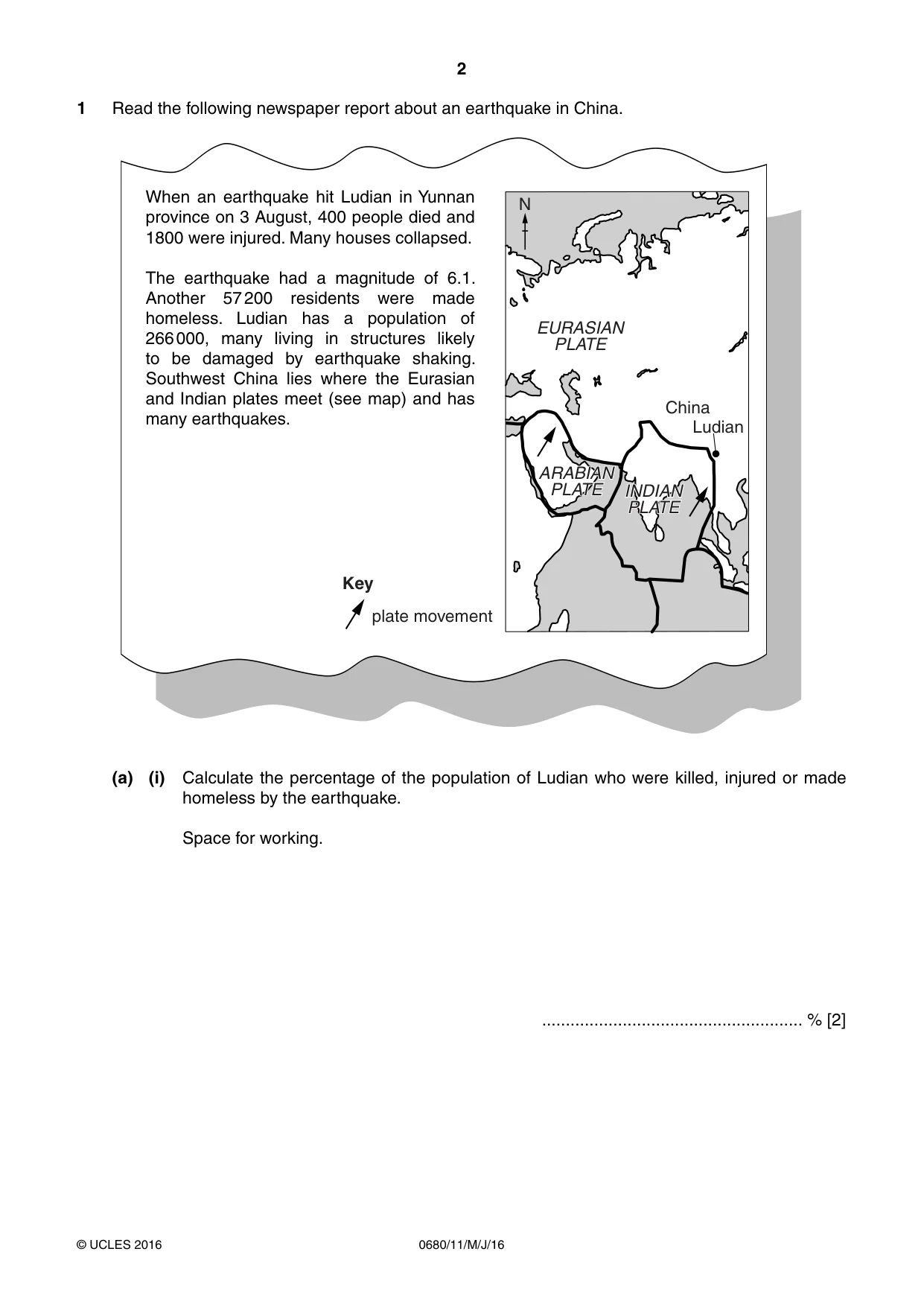
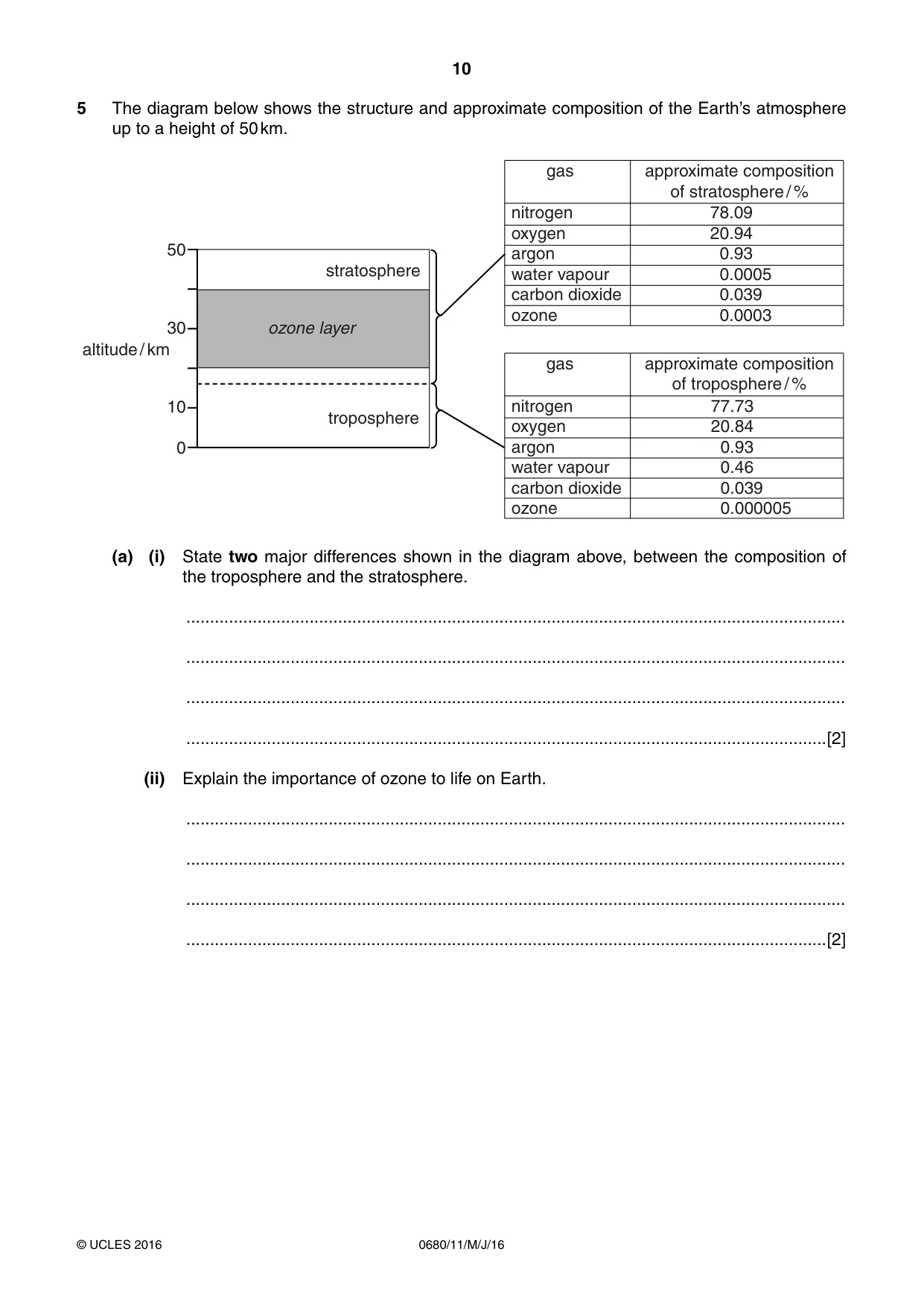
2 0680/11/M/J/16 © UCLES 2016 1 Read the following newspaper report about an earthquake in China. EURASIAN PLATE ARABIAN PLATE ARABIAN PLATE INDIAN PLATE INDIAN PLATE China Ludian N .H\ plate movement When an earthquake hit Ludian in Yunnan province on 3 August, 400 people died and 1800 were injured. Many houses collapsed. The earthquake had a magnitude of 6.1. Another 57 200 residents were made homeless. Ludian has a population of 266 000, many living in structures likely to be damaged by earthquake shaking. Southwest China lies where the Eurasian and Indian plates meet (see map) and has many earthquakes. (a) (i) Calculate the percentage of the population of Ludian who were killed, injured or made homeless by the earthquake. Space for working. … % [2]
Question paper, page 3
3 0680/11/M/J/16 © UCLES 2016 [Turn over (ii) Describe what could be done in the future to reduce the number of ‘structures likely to be damaged by earthquake shaking’. … … … … … …[3] (iii) Use the newspaper report to explain why southwest China has many earthquakes. … … … … … …[3] (b) Describe two advantages to people of living on or near a plate boundary. … … … …[2]
Question paper, page 4
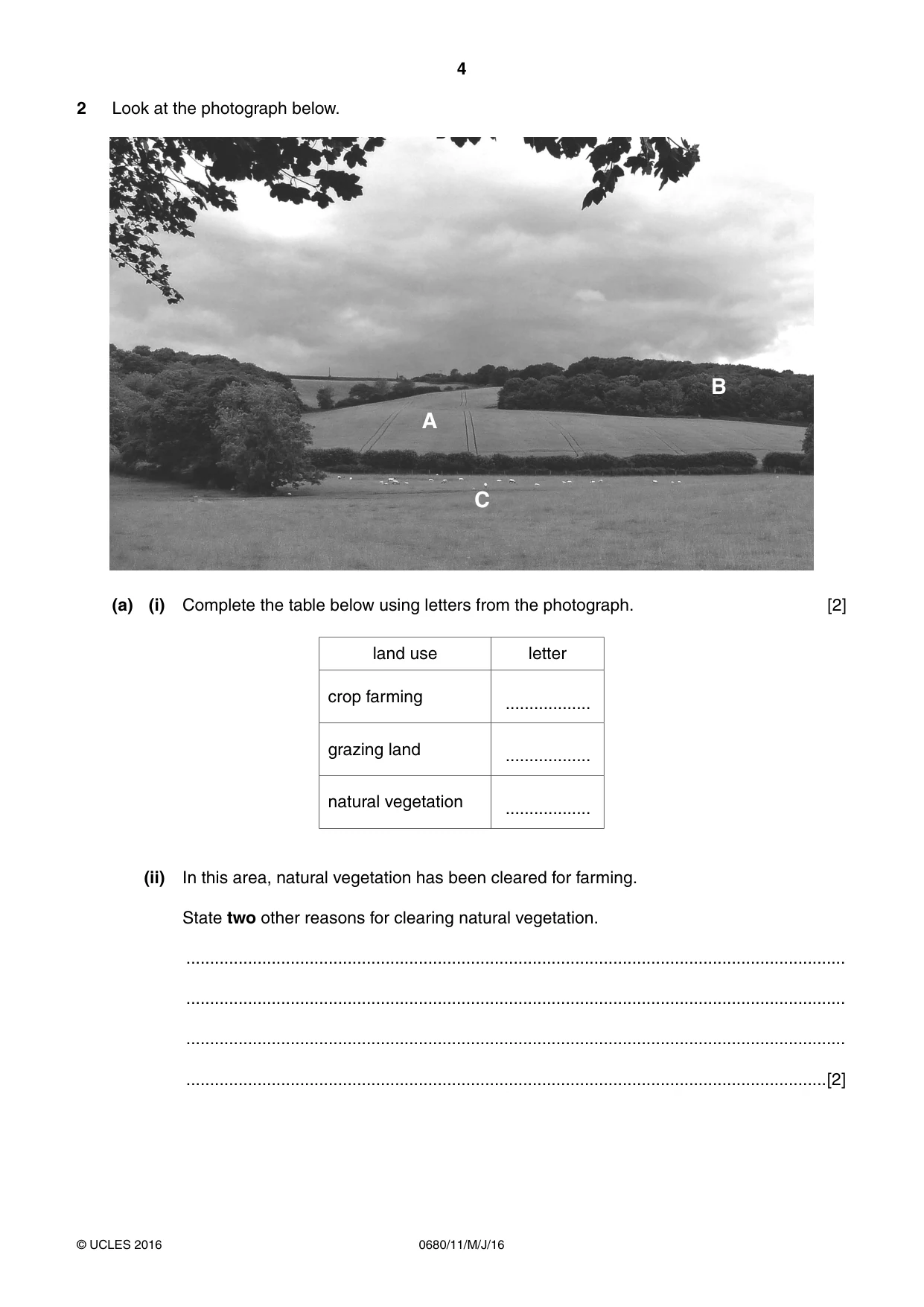
4 0680/11/M/J/16 © UCLES 2016 2 Look at the photograph below. A B C (a) (i) Complete the table below using letters from the photograph. [2] land use letter crop farming … grazing land … natural vegetation … (ii) In this area, natural vegetation has been cleared for farming. State two other reasons for clearing natural vegetation. … … … …[2]
Question paper, page 5
5 0680/11/M/J/16 © UCLES 2016 [Turn over (iii) Explain how removal of natural vegetation can lead to desertification. … … … … … … … …[4] (b) Explain how agro-forestry can be used to manage forests sustainably. … … … …[2]
Question paper, page 6
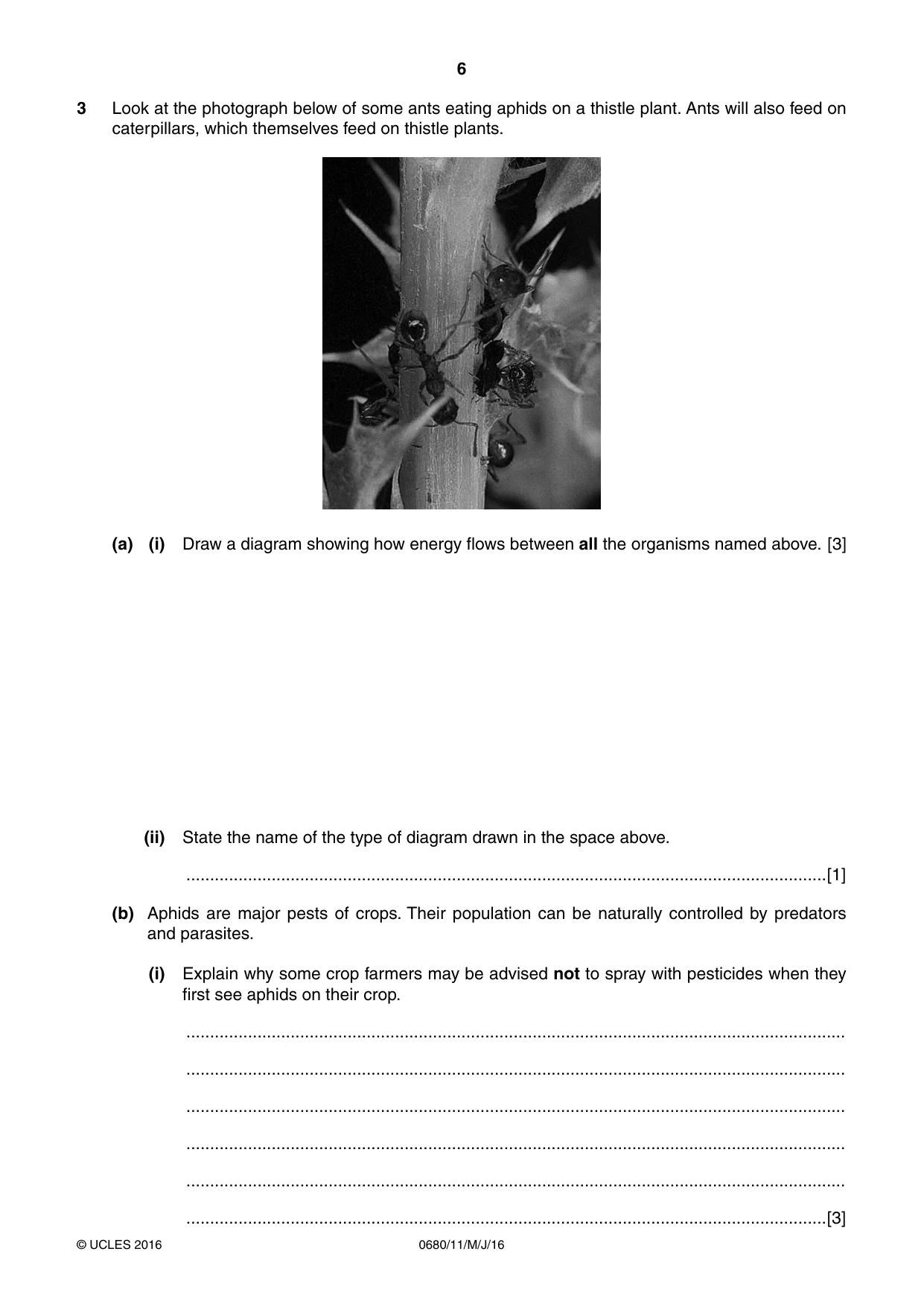
6 0680/11/M/J/16 © UCLES 2016 3 Look at the photograph below of some ants eating aphids on a thistle plant. Ants will also feed on caterpillars, which themselves feed on thistle plants. (a) (i) Draw a diagram showing how energy flows between all the organisms named above. [3] (ii) State the name of the type of diagram drawn in the space above. …[1] (b) Aphids are major pests of crops. Their population can be naturally controlled by predators and parasites. (i) Explain why some crop farmers may be advised not to spray with pesticides when they first see aphids on their crop. … … … … … …[3]
Question paper, page 7
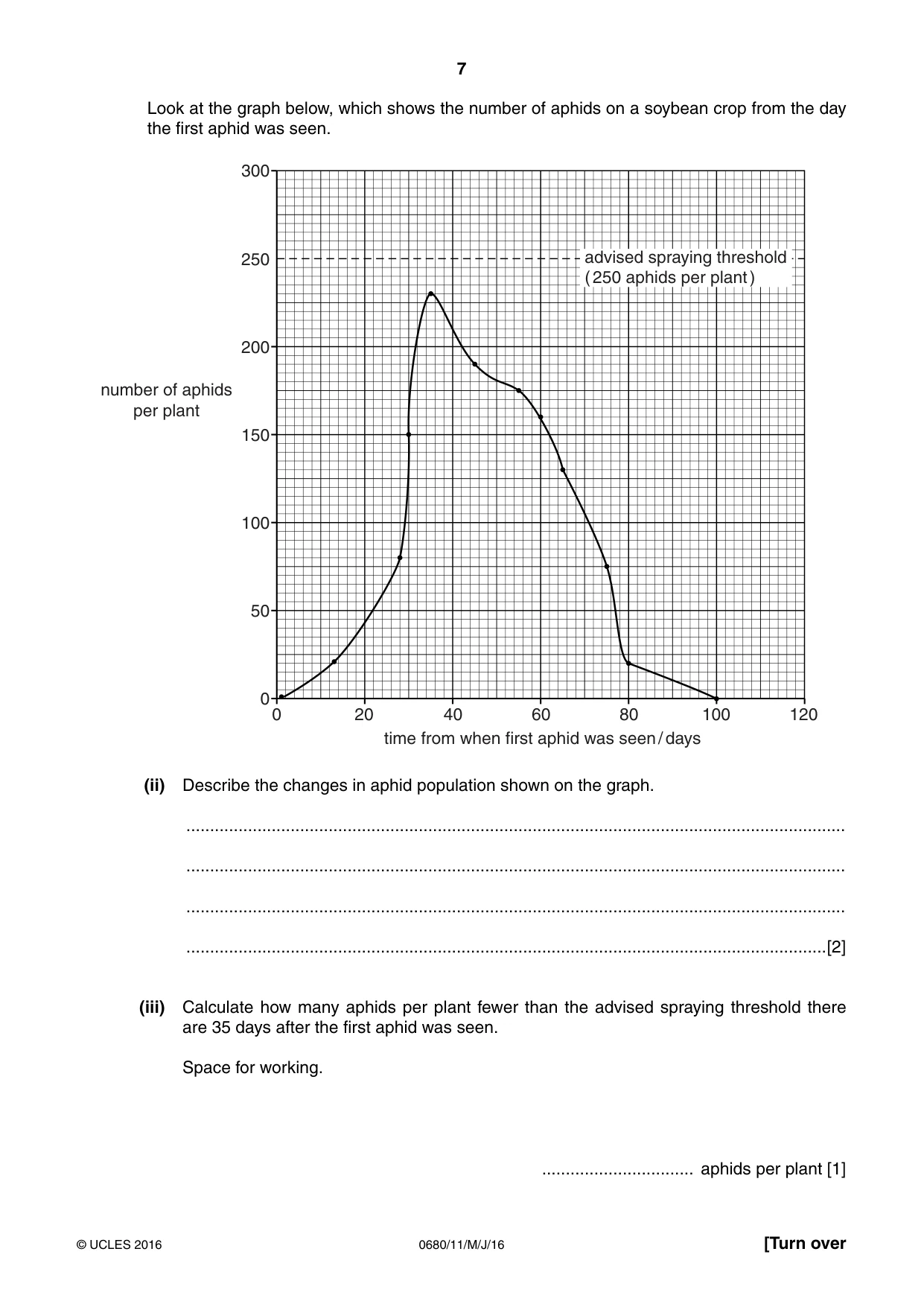
7 0680/11/M/J/16 © UCLES 2016 [Turn over Look at the graph below, which shows the number of aphids on a soybean crop from the day the first aphid was seen. 0 time from when first aphid was seen / days 50 100 150 number of aphids per plant 200 250 300 0 20 40 60 80 100 120 advised spraying threshold ( 250 aphids per plant ) (ii) Describe the changes in aphid population shown on the graph. … … … …[2] (iii) Calculate how many aphids per plant fewer than the advised spraying threshold there are 35 days after the first aphid was seen. Space for working. … aphids per plant [1]
Question paper, page 8
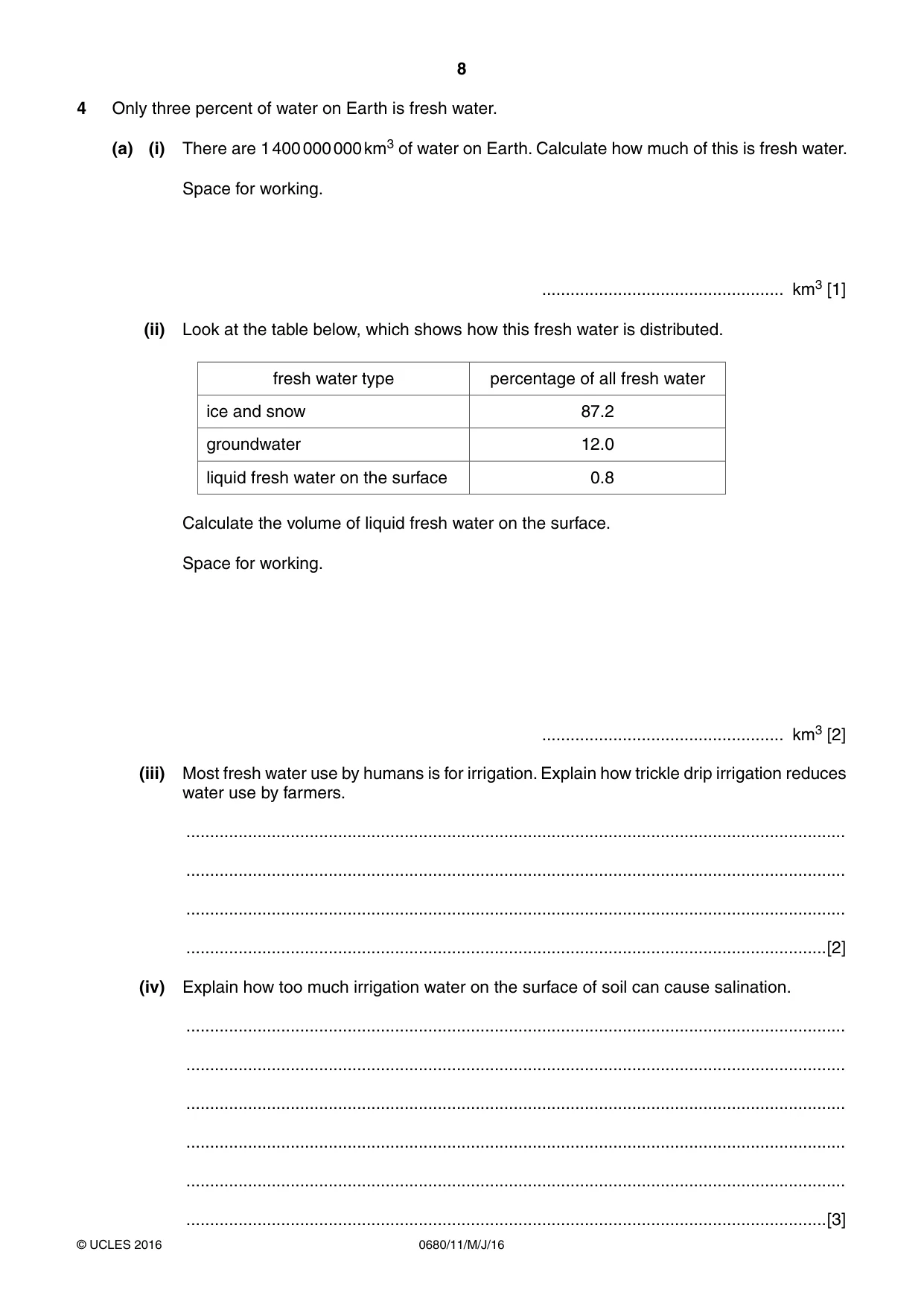
8 0680/11/M/J/16 © UCLES 2016 4 Only three percent of water on Earth is fresh water. (a) (i) There are 1 400 000 000 km3 of water on Earth. Calculate how much of this is fresh water. Space for working. … km3 [1] (ii) Look at the table below, which shows how this fresh water is distributed. fresh water type percentage of all fresh water ice and snow 87.2 groundwater 12.0 liquid fresh water on the surface 0.8 Calculate the volume of liquid fresh water on the surface. Space for working. … km3 [2] (iii) Most fresh water use by humans is for irrigation. Explain how trickle drip irrigation reduces water use by farmers. … … … …[2] (iv) Explain how too much irrigation water on the surface of soil can cause salination. … … … … … …[3]
Question paper, page 9
9 0680/11/M/J/16 © UCLES 2016 [Turn over (b) Explain why there is more water that is safe to drink in urban areas than in rural areas. … … … …[2]
Question paper, page 10
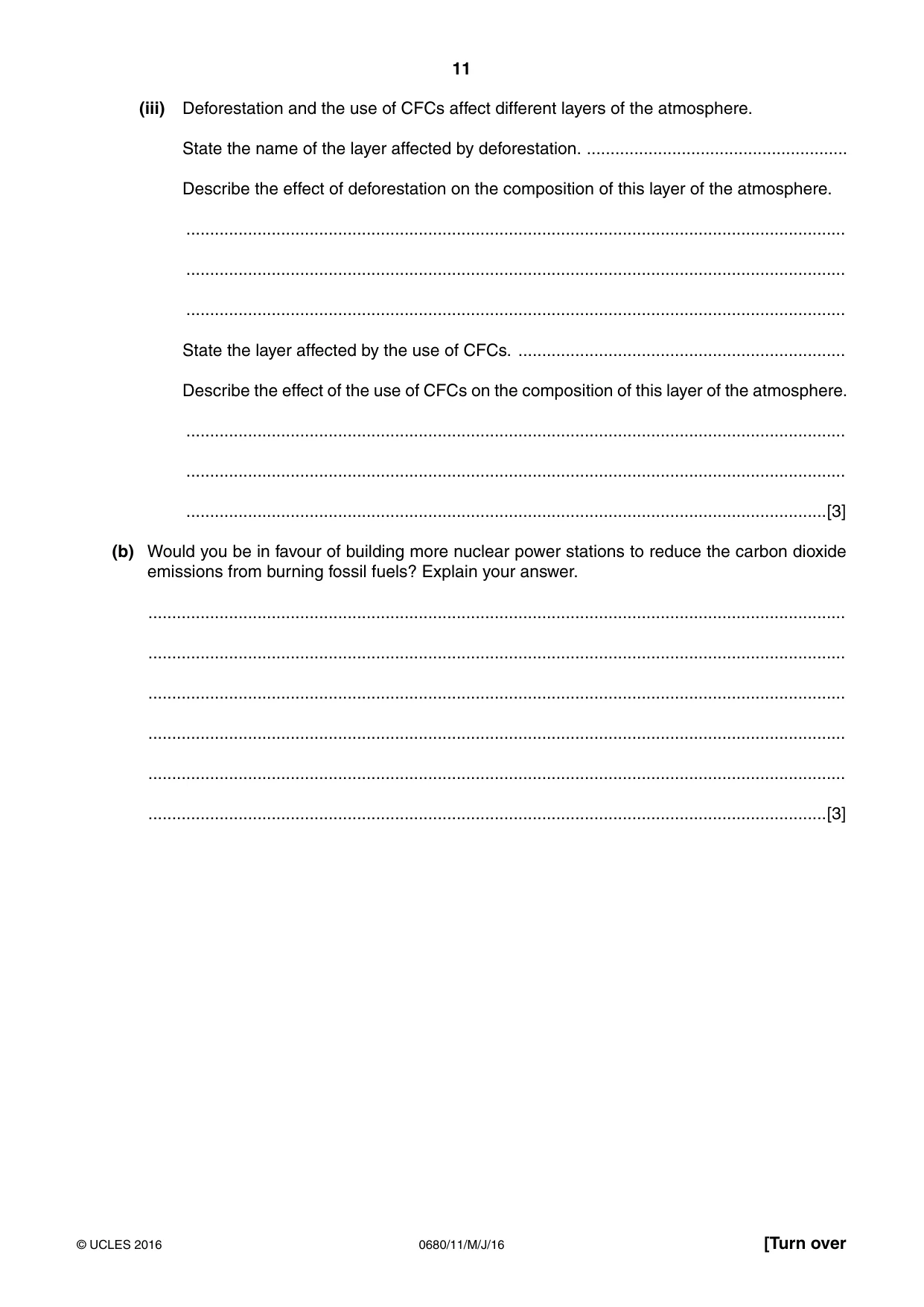
10 0680/11/M/J/16 © UCLES 2016 5 The diagram below shows the structure and approximate composition of the Earth’s atmosphere up to a height of 50 km. 50 30 10 0 stratosphere ozone layer troposphere altitude / km nitrogen oxygen argon water vapour carbon dioxide ozone 77.73 20.84 0.93 0.46 0.039 0.000005 nitrogen oxygen argon water vapour carbon dioxide ozone 78.09 20.94 0.93 0.0005 0.039 0.0003 approximate composition of troposphere / % gas approximate composition of stratosphere / % gas (a) (i) State two major differences shown in the diagram above, between the composition of the troposphere and the stratosphere. … … … …[2] (ii) Explain the importance of ozone to life on Earth. … … … …[2]
Question paper, page 11
11 0680/11/M/J/16 © UCLES 2016 [Turn over (iii) Deforestation and the use of CFCs affect different layers of the atmosphere. State the name of the layer affected by deforestation. … Describe the effect of deforestation on the composition of this layer of the atmosphere. … … … State the layer affected by the use of CFCs. … Describe the effect of the use of CFCs on the composition of this layer of the atmosphere. … … …[3] (b) Would you be in favour of building more nuclear power stations to reduce the carbon dioxide emissions from burning fossil fuels? Explain your answer. … … … … … …[3]
Question paper, page 12
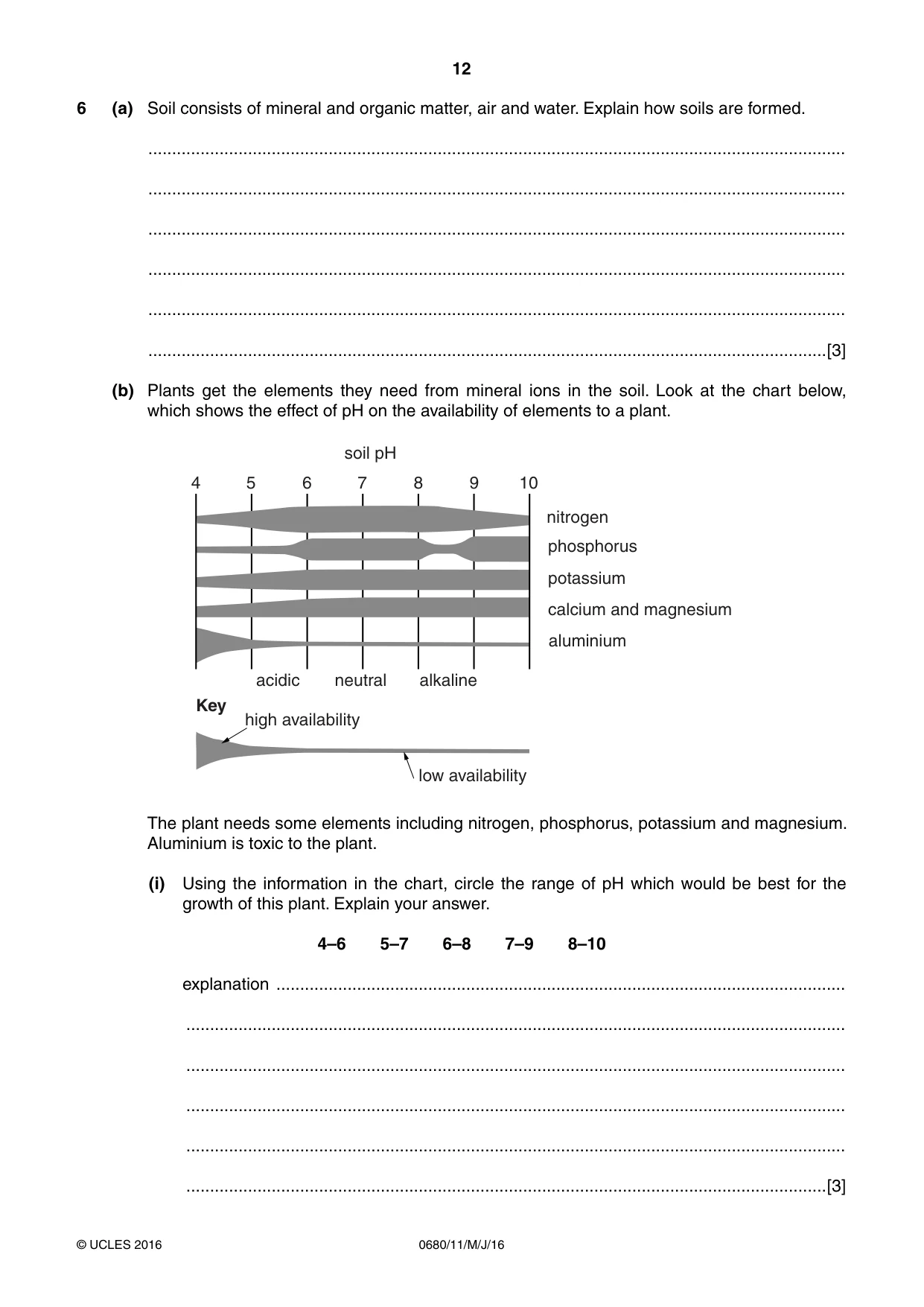
12 0680/11/M/J/16 © UCLES 2016 6 (a) Soil consists of mineral and organic matter, air and water. Explain how soils are formed. … … … … … …[3] (b) Plants get the elements they need from mineral ions in the soil. Look at the chart below, which shows the effect of pH on the availability of elements to a plant. 4 5 6 7 8 9 10 nitrogen phosphorus potassium aluminium alkaline acidic neutral calcium and magnesium soil pH high availability low availability Key The plant needs some elements including nitrogen, phosphorus, potassium and magnesium. Aluminium is toxic to the plant. (i) Using the information in the chart, circle the range of pH which would be best for the growth of this plant. Explain your answer. 4–6 5–7 6–8 7–9 8–10 explanation … … … … … …[3]
Question paper, page 13
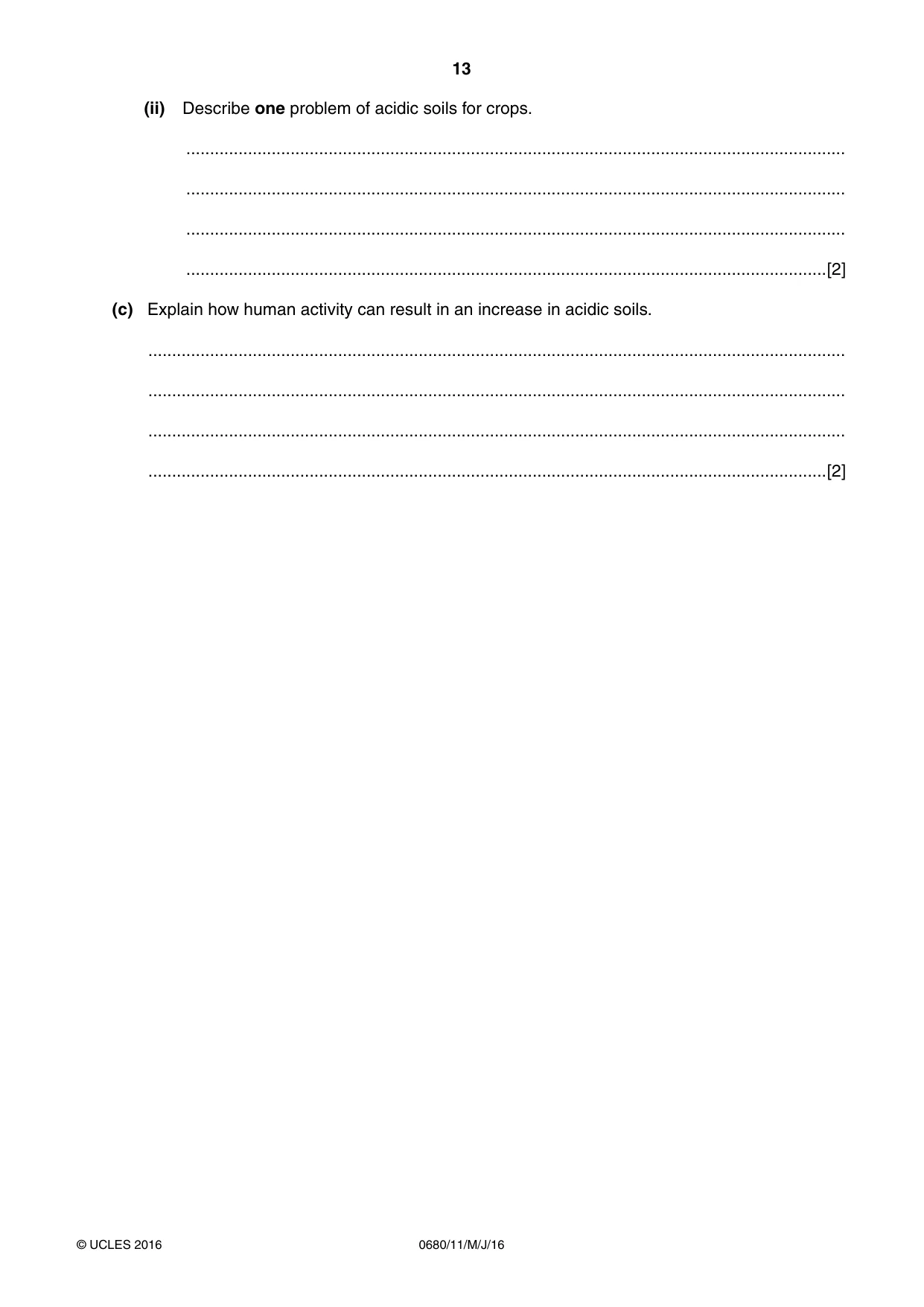
13 0680/11/M/J/16 © UCLES 2016 (ii) Describe one problem of acidic soils for crops. … … … …[2] (c) Explain how human activity can result in an increase in acidic soils. … … … …[2]
Question paper, page 14
14 0680/11/M/J/16 © UCLES 2016 BLANK PAGE
Question paper, page 15
15 0680/11/M/J/16 © UCLES 2016 BLANK PAGE
Question paper, page 16
16 0680/11/M/J/16 © UCLES 2016 Permission to reproduce items where third-party owned material protected by copyright is included has been sought and cleared where possible. Every reasonable effort has been made by the publisher (UCLES) to trace copyright holders, but if any items requiring clearance have unwittingly been included, the publisher will be pleased to make amends at the earliest possible opportunity. To avoid the issue of disclosure of answer-related information to candidates, all copyright acknowledgements are reproduced online in the Cambridge International Examinations Copyright Acknowledgements Booklet. This is produced for each series of examinations and is freely available to download at www.cie.org.uk after the live examination series. Cambridge International Examinations is part of the Cambridge Assessment Group. Cambridge Assessment is the brand name of University of Cambridge Local Examinations Syndicate (UCLES), which is itself a department of the University of Cambridge. BLANK PAGE
Mark scheme, page 1
® IGCSE is the registered trademark of Cambridge International Examinations. This document consists of 7 printed pages. © UCLES 2016 [Turn over Cambridge International Examinations Cambridge International General Certificate of Secondary Education ENVIRONMENTAL MANAGEMENT 0680/11 Paper 1 May/June 2016 MARK SCHEME Maximum Mark: 60 Published This mark scheme is published as an aid to teachers and candidates, to indicate the requirements of the examination. It shows the basis on which Examiners were instructed to award marks. It does not indicate the details of the discussions that took place at an Examiners’ meeting before marking began, which would have considered the acceptability of alternative answers. Mark schemes should be read in conjunction with the question paper and the Principal Examiner Report for Teachers. Cambridge will not enter into discussions about these mark schemes. Cambridge is publishing the mark schemes for the May/June 2016 series for most Cambridge IGCSE®, Cambridge International A and AS Level components and some Cambridge O Level components.
Mark scheme, page 2
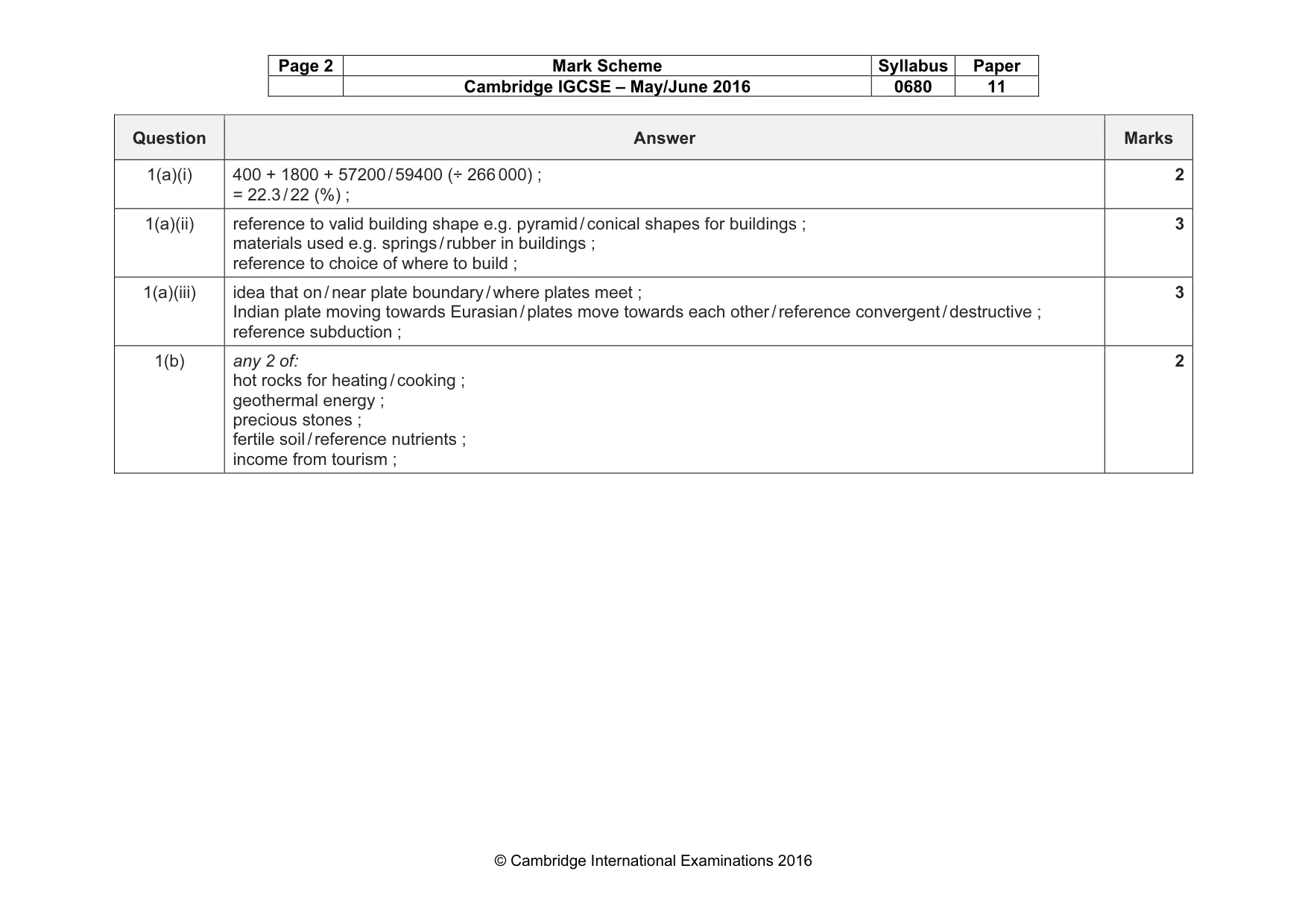
Page 2 Mark Scheme Syllabus Paper Cambridge IGCSE – May/June 2016 0680 11 © Cambridge International Examinations 2016 Question Answer Marks 1(a)(i) 400 + 1800 + 57200 / 59400 (÷ 266 000) ; = 22.3 / 22 (%) ; 2 1(a)(ii) reference to valid building shape e.g. pyramid / conical shapes for buildings ; materials used e.g. springs / rubber in buildings ; reference to choice of where to build ; 3 1(a)(iii) idea that on / near plate boundary / where plates meet ; Indian plate moving towards Eurasian / plates move towards each other / reference convergent / destructive ; reference subduction ; 3 1(b) any 2 of: hot rocks for heating / cooking ; geothermal energy ; precious stones ; fertile soil / reference nutrients ; income from tourism ; 2
Mark scheme, page 3
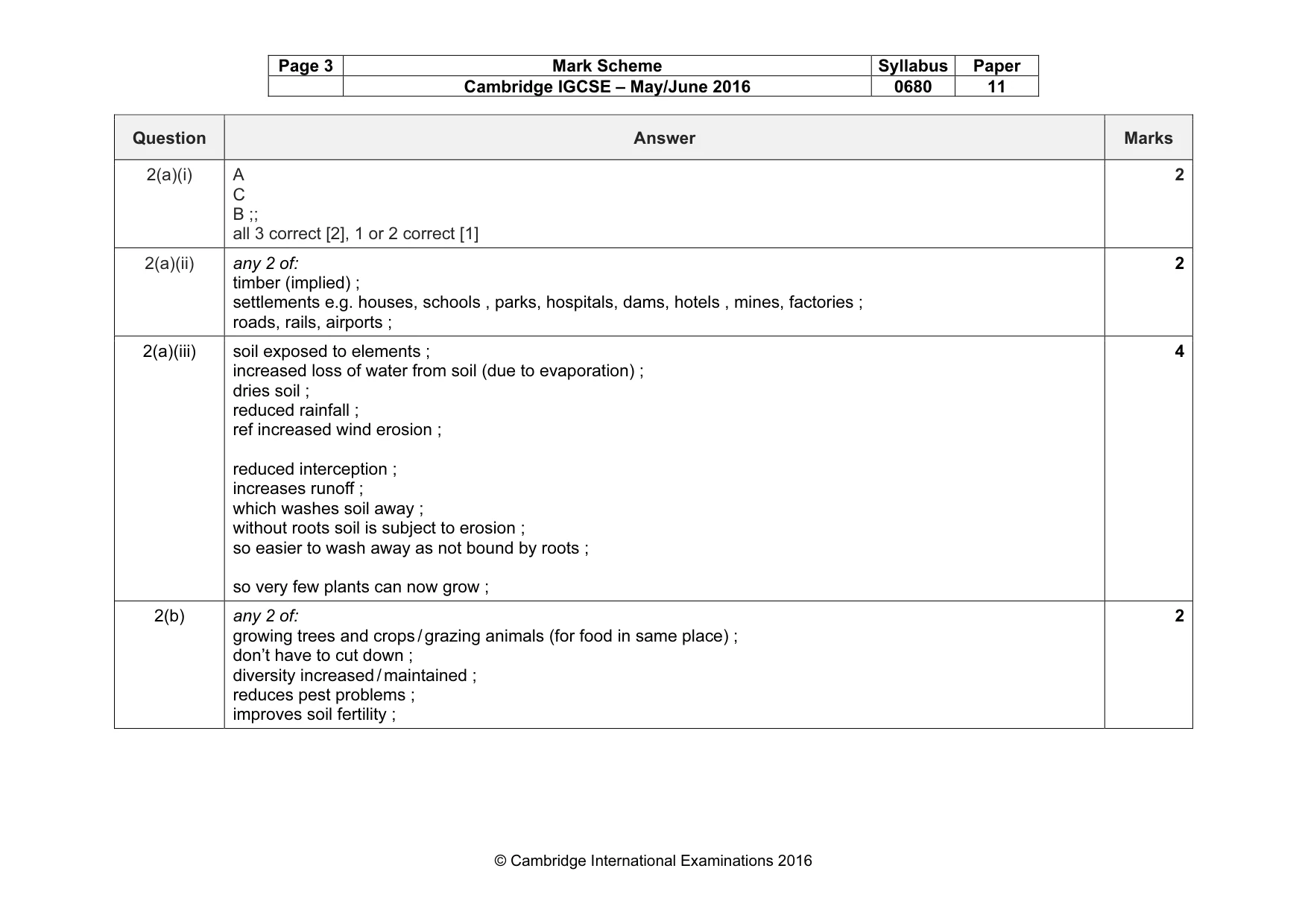
Page 3 Mark Scheme Syllabus Paper Cambridge IGCSE – May/June 2016 0680 11 © Cambridge International Examinations 2016 Question Answer Marks 2(a)(i) A C B ;; all 3 correct [2], 1 or 2 correct [1] 2 2(a)(ii) any 2 of: timber (implied) ; settlements e.g. houses, schools , parks, hospitals, dams, hotels , mines, factories ; roads, rails, airports ; 2 2(a)(iii) soil exposed to elements ; increased loss of water from soil (due to evaporation) ; dries soil ; reduced rainfall ; ref increased wind erosion ; reduced interception ; increases runoff ; which washes soil away ; without roots soil is subject to erosion ; so easier to wash away as not bound by roots ; so very few plants can now grow ; 4 2(b) any 2 of: growing trees and crops / grazing animals (for food in same place) ; don’t have to cut down ; diversity increased / maintained ; reduces pest problems ; improves soil fertility ; 2
Mark scheme, page 4
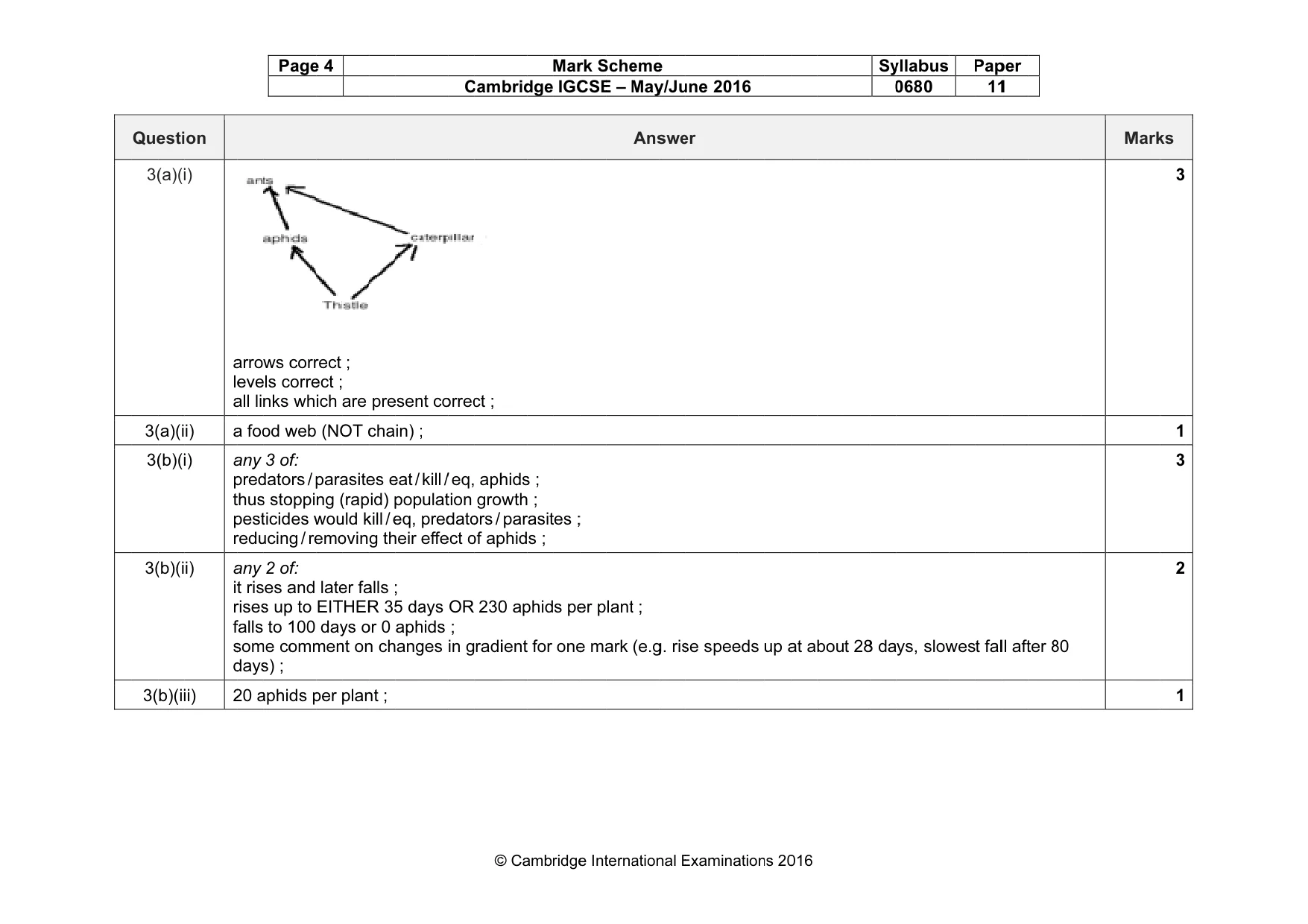
Que 3( 3( 3( 3( 3( esti (a)(i (a)(i (b)(i (b)(i b)(ii on i) i) i) i) ii) a le a a a p t p r a it r f s d 2 arrow eve all lin a foo any pred thus pest redu any t ris rises falls som days 20 a P ws c ls c nks od w 3 of dato s sto ticid ucing 2 of es a s up to 1 me co s) ; aphid age corr orre wh web f: ors / p oppi es w g / re f: and p to 100 omm ds p e 4 rect ect ; ich (NO para ng ( wou emo late EIT day men per p ; are OT c asite (rap uld k ovin er fa HER ys o nt on plan pre cha es e id) p kill / e g th alls ; R 35 or 0 n ch nt ; esen in) ; eat / pop eq, heir e ; 5 da aph ang nt co kill / ulat pred effe ays hids ges C orrec / eq, tion dato ect o OR ; in g Cam © ct ; aph gro ors / of ap 230 radi brid © Ca hids owth par phid 0 ap ient dge ambr s ; ; rasit s ; phid t for Mar IGC ridge es ; s pe one rk S CSE e Int ; er p e ma Sche E – M terna lant ark eme May ation Ans t ; (e.g e y/Ju nal E swe g. ris une Exam er se s 201 mina spee 16 ation eds ns 20 up a 016 at about 28 Sy 0 8 da yllab 068 ys, bus 0 slow P wes Pap 11 t fal per 1 ll after 80 Marks 3 1 3 2 1
Mark scheme, page 5
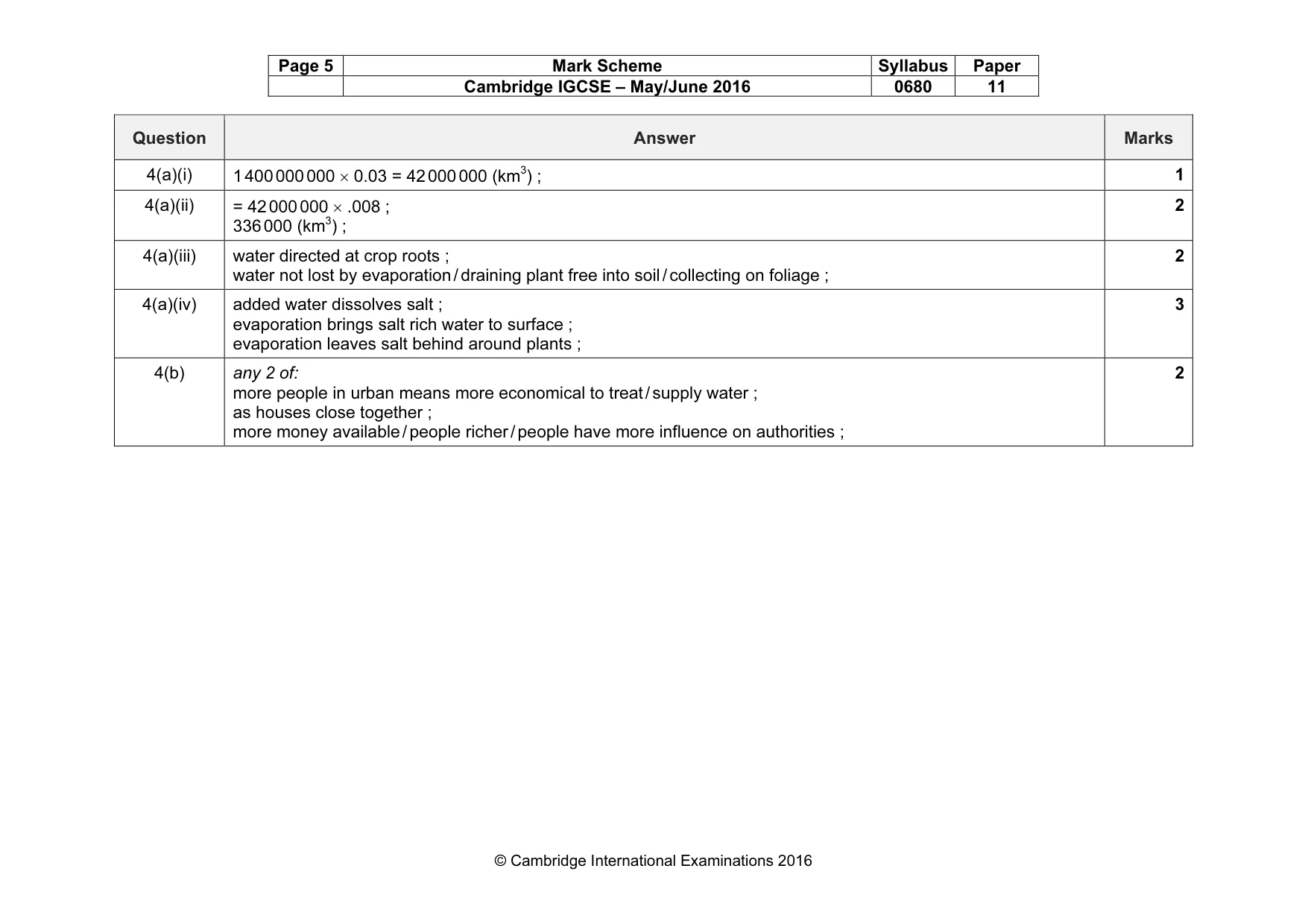
Page 5 Mark Scheme Syllabus Paper Cambridge IGCSE – May/June 2016 0680 11 © Cambridge International Examinations 2016 Question Answer Marks 4(a)(i) 1 400 000 000 × 0.03 = 42 000 000 (km3) ; 1 4(a)(ii) = 42 000 000 × .008 ; 336 000 (km3) ; 2 4(a)(iii) water directed at crop roots ; water not lost by evaporation / draining plant free into soil / collecting on foliage ; 2 4(a)(iv) added water dissolves salt ; evaporation brings salt rich water to surface ; evaporation leaves salt behind around plants ; 3 4(b) any 2 of: more people in urban means more economical to treat / supply water ; as houses close together ; more money available / people richer / people have more influence on authorities ; 2
Mark scheme, page 6
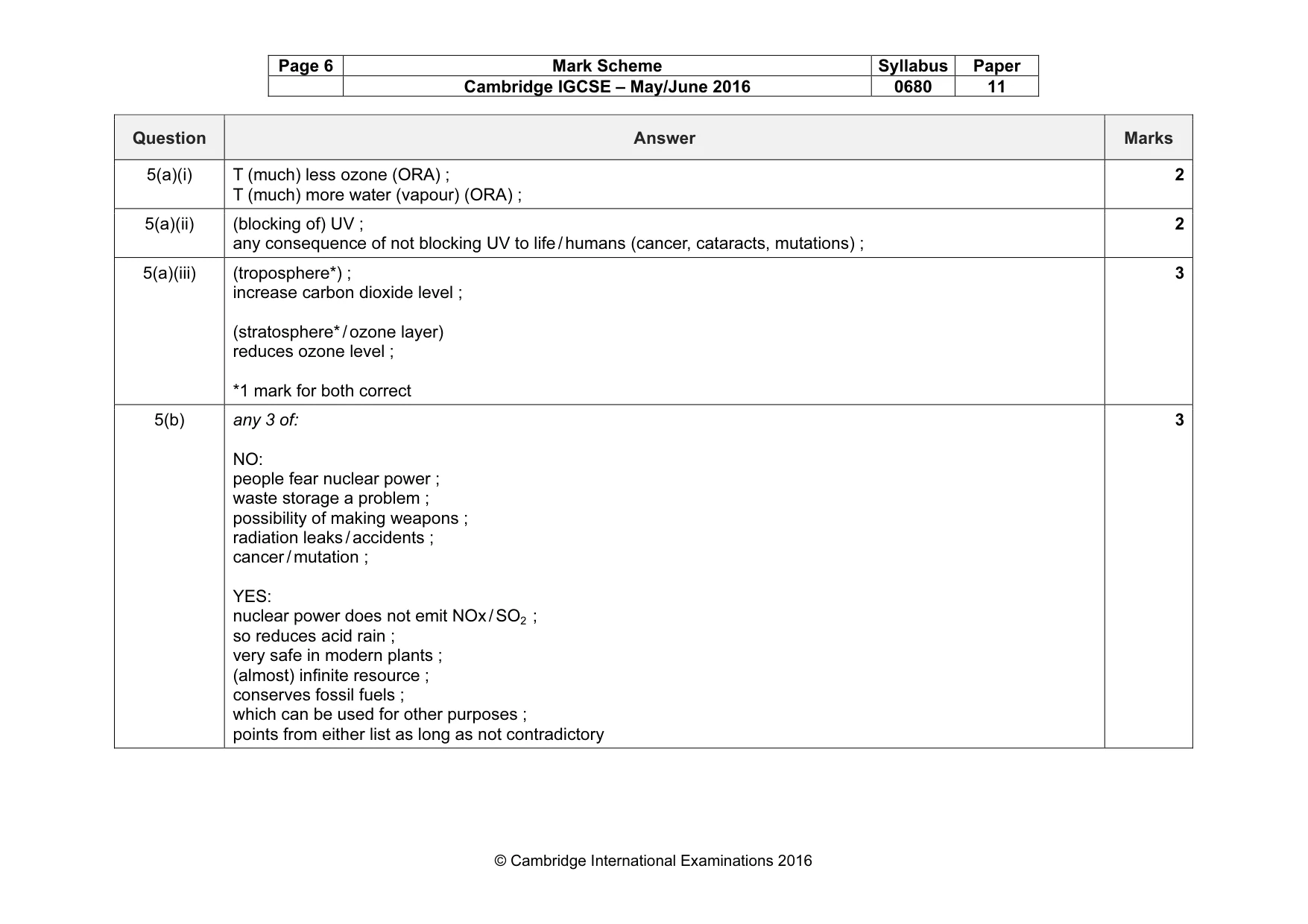
Page 6 Mark Scheme Syllabus Paper Cambridge IGCSE – May/June 2016 0680 11 © Cambridge International Examinations 2016 Question Answer Marks 5(a)(i) T (much) less ozone (ORA) ; T (much) more water (vapour) (ORA) ; 2 5(a)(ii) (blocking of) UV ; any consequence of not blocking UV to life / humans (cancer, cataracts, mutations) ; 2 5(a)(iii) (troposphere*) ; increase carbon dioxide level ; (stratosphere* / ozone layer) reduces ozone level ; *1 mark for both correct 3 5(b) any 3 of: NO: people fear nuclear power ; waste storage a problem ; possibility of making weapons ; radiation leaks / accidents ; cancer / mutation ; YES: nuclear power does not emit NOx / SO2 ; so reduces acid rain ; very safe in modern plants ; (almost) infinite resource ; conserves fossil fuels ; which can be used for other purposes ; points from either list as long as not contradictory 3
Mark scheme, page 7
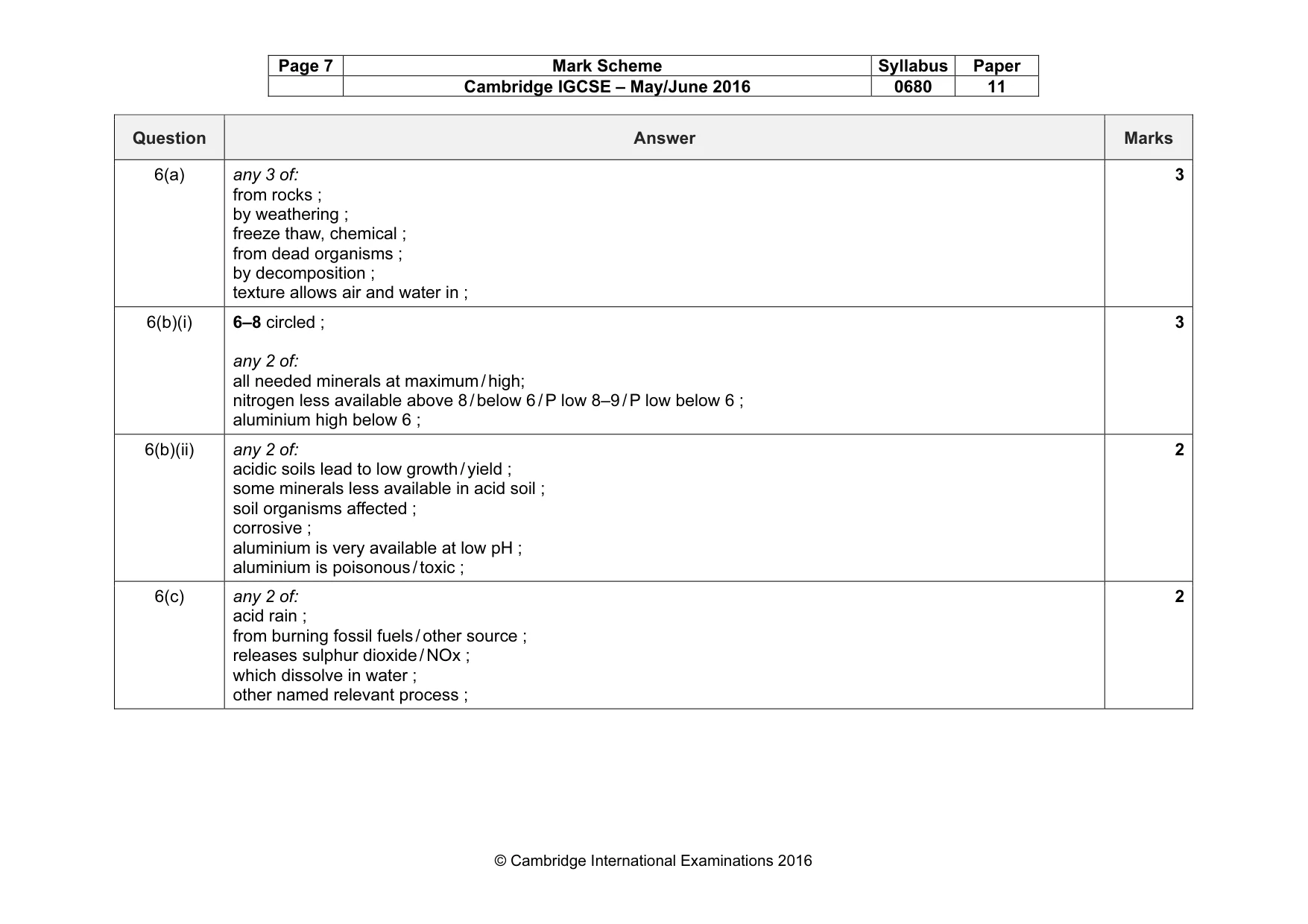
Page 7 Mark Scheme Syllabus Paper Cambridge IGCSE – May/June 2016 0680 11 © Cambridge International Examinations 2016 Question Answer Marks 6(a) any 3 of: from rocks ; by weathering ; freeze thaw, chemical ; from dead organisms ; by decomposition ; texture allows air and water in ; 3 6(b)(i) 6–8 circled ; any 2 of: all needed minerals at maximum / high; nitrogen less available above 8 / below 6 / P low 8–9 / P low below 6 ; aluminium high below 6 ; 3 6(b)(ii) any 2 of: acidic soils lead to low growth / yield ; some minerals less available in acid soil ; soil organisms affected ; corrosive ; aluminium is very available at low pH ; aluminium is poisonous / toxic ; 2 6(c) any 2 of: acid rain ; from burning fossil fuels / other source ; releases sulphur dioxide / NOx ; which dissolve in water ; other named relevant process ; 2
What you needed in this session
Cambridge’s own grade thresholds for 2016 May/June, Paper 1 · Variant 1. A higher threshold means an easier paper — the bar moves with how the cohort did.