Cambridge IGCSE Environmental Management 0680 — 2015 Oct/Nov Paper 1 · Variant 2
0680/12/O/N/15 · 60 marks · ≈68 min
The question paper and its mark scheme, free to read here and free to download. This is Cambridge’s own paper, exactly as it was sat.
Question paper16 pages


Mark scheme5 pages
Answers below. Sit the paper first if you are practising.
Paper as text
Question paper, page 1
This document consists of 13 printed pages and 3 blank pages. DC (ST/SW) 97055/3 © UCLES 2015 [Turn over Cambridge International Examinations Cambridge International General Certificate of Secondary Education * 3 6 2 4 0 5 9 5 1 2 * ENVIRONMENTAL MANAGEMENT 0680/12 Paper 1 October/November 2015 1 hour 30 minutes Candidates answer on the Question Paper. No Additional Materials are required. READ THESE INSTRUCTIONS FIRST Write your Centre number, candidate number and name on all the work you hand in. Write in dark blue or black pen. You may use an HB pencil for any diagrams or graphs. Do not use staples, paper clips, glue or correction fluid. DO NOT WRITE IN ANY BARCODES. Answer all questions. Electronic calculators may be used. You may lose marks if you do not show your working or if you do not use appropriate units. At the end of the examination, fasten all your work securely together. The number of marks is given in brackets [ ] at the end of each question or part question.
Question paper, page 2
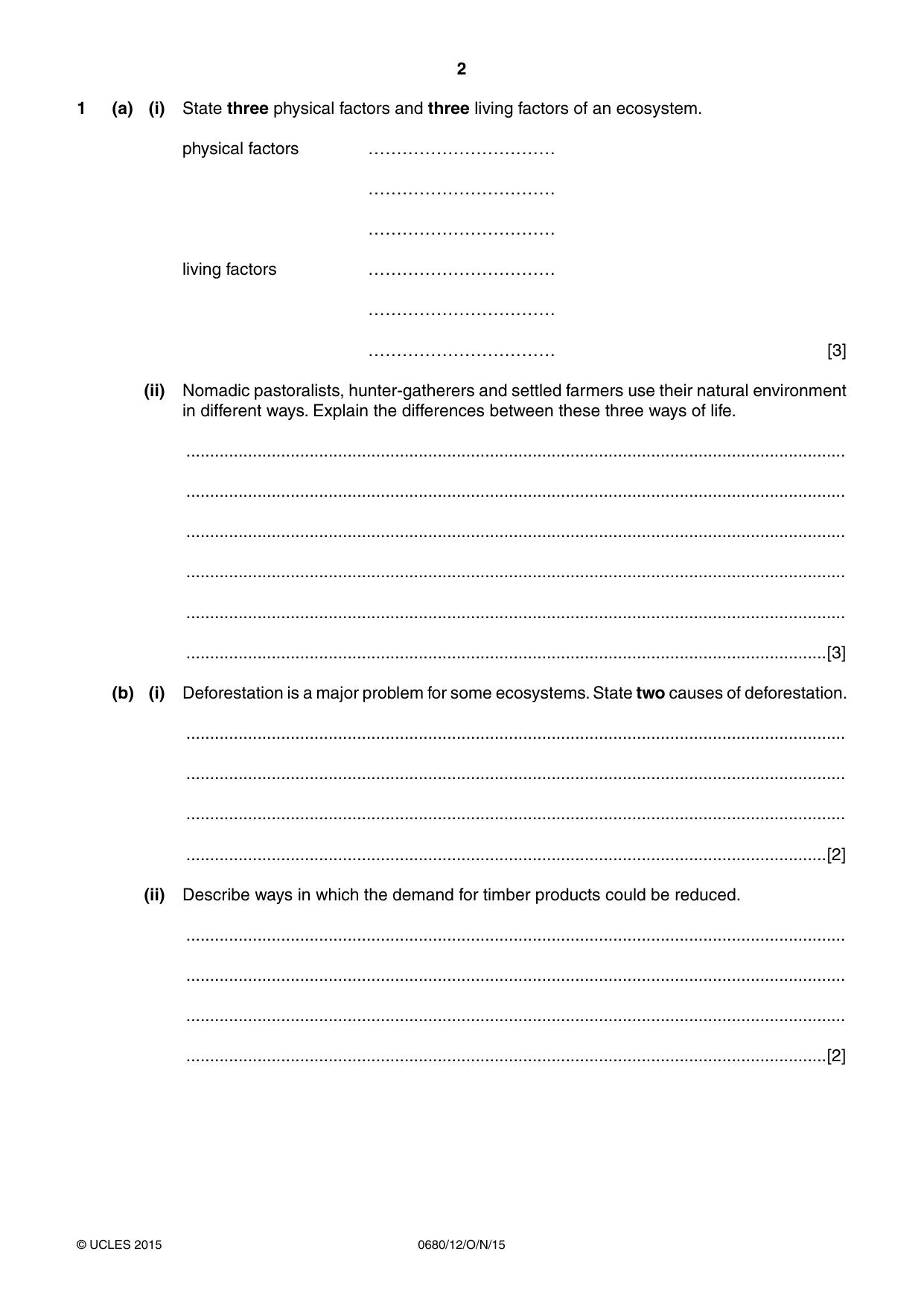
2 0680/12/O/N/15 © UCLES 2015 1 (a) (i) State three physical factors and three living factors of an ecosystem. physical factors …………………………… …………………………… …………………………… living factors …………………………… …………………………… …………………………… [3] (ii) Nomadic pastoralists, hunter-gatherers and settled farmers use their natural environment in different ways. Explain the differences between these three ways of life. … … … … … …[3] (b) (i) Deforestation is a major problem for some ecosystems. State two causes of deforestation. … … … …[2] (ii) Describe ways in which the demand for timber products could be reduced. … … … …[2]
Question paper, page 3
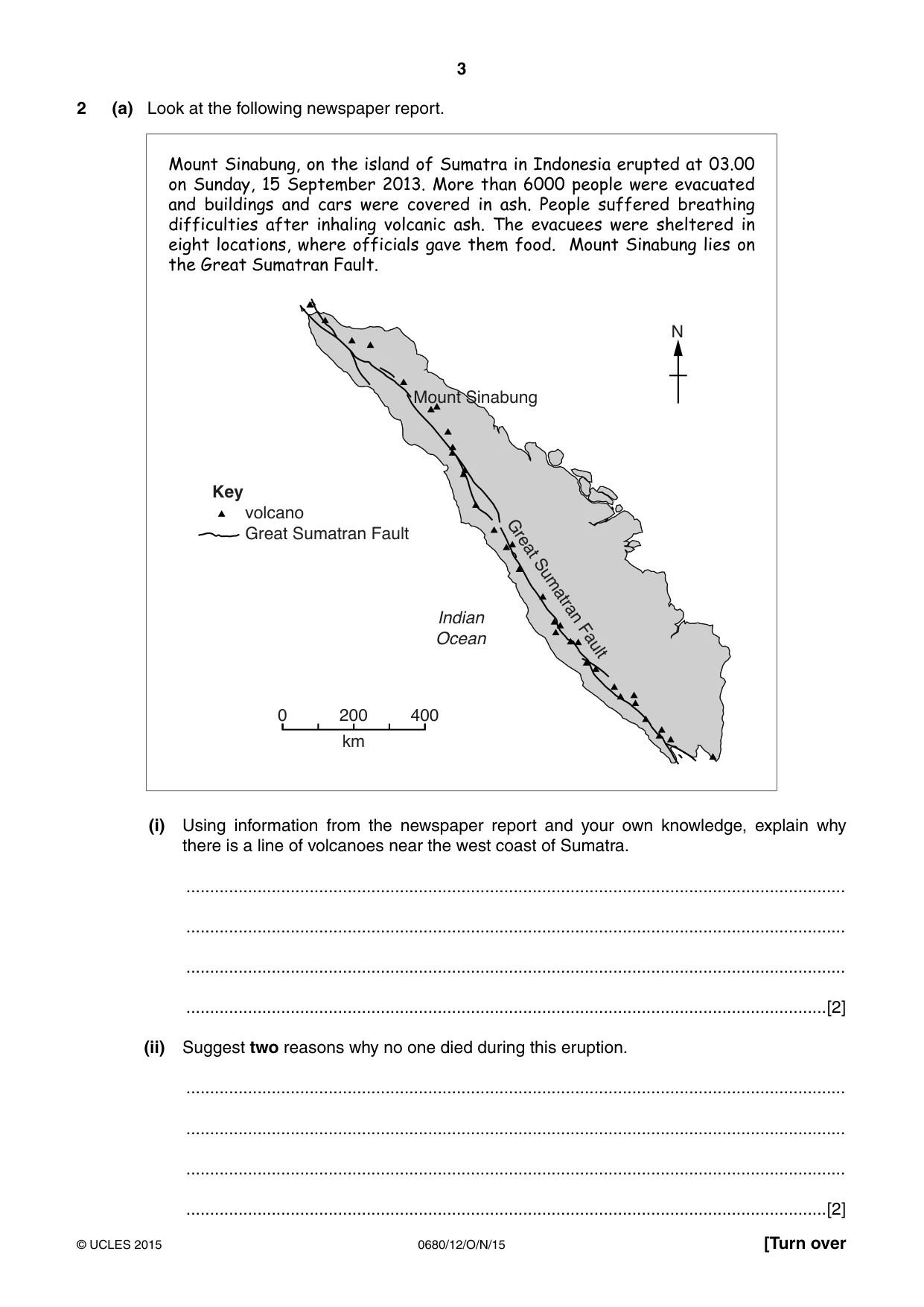
3 0680/12/O/N/15 © UCLES 2015 [Turn over 2 (a) Look at the following newspaper report. Mount Sinabung, on the island of Sumatra in Indonesia erupted at 03.00 on Sunday, 15 September 2013. More than 6000 people were evacuated and buildings and cars were covered in ash. People suffered breathing difficulties after inhaling volcanic ash. The evacuees were sheltered in eight locations, where officials gave them food. Mount Sinabung lies on the Great Sumatran Fault. Great Sumatran Fault Mount Sinabung Indian Ocean volcano Great Sumatran Fault Key 0 200 km 400 N (i) Using information from the newspaper report and your own knowledge, explain why there is a line of volcanoes near the west coast of Sumatra. … … … …[2] (ii) Suggest two reasons why no one died during this eruption. … … … …[2]
Question paper, page 4
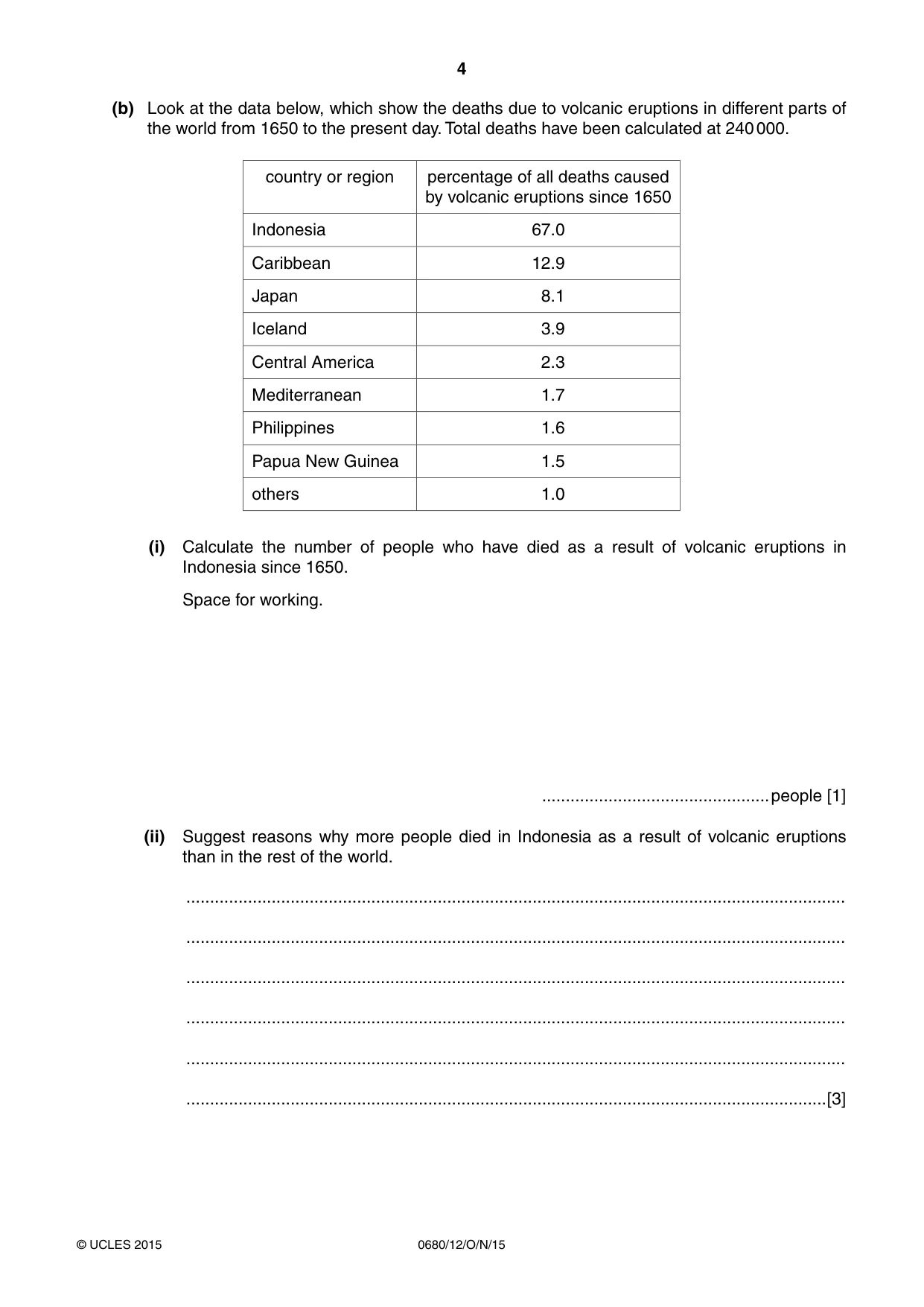
4 0680/12/O/N/15 © UCLES 2015 (b) Look at the data below, which show the deaths due to volcanic eruptions in different parts of the world from 1650 to the present day. Total deaths have been calculated at 240 000. country or region percentage of all deaths caused by volcanic eruptions since 1650 Indones ia 67.0 Caribbean 12.9 Japan 8.1 Iceland 3.9 Central America 2.3 Mediterranean 1.7 Philippines 1.6 Papua New Guinea 1.5 others 1.0 (i) Calculate the number of people who have died as a result of volcanic eruptions in Indonesia since 1650. Space for working. …people [1] (ii) Suggest reasons why more people died in Indonesia as a result of volcanic eruptions than in the rest of the world. … … … … … …[3]
Question paper, page 5
5 0680/12/O/N/15 © UCLES 2015 [Turn over (iii) Explain reasons why, even though there is a risk, people live close to volcanoes. … … … …[2]
Question paper, page 6
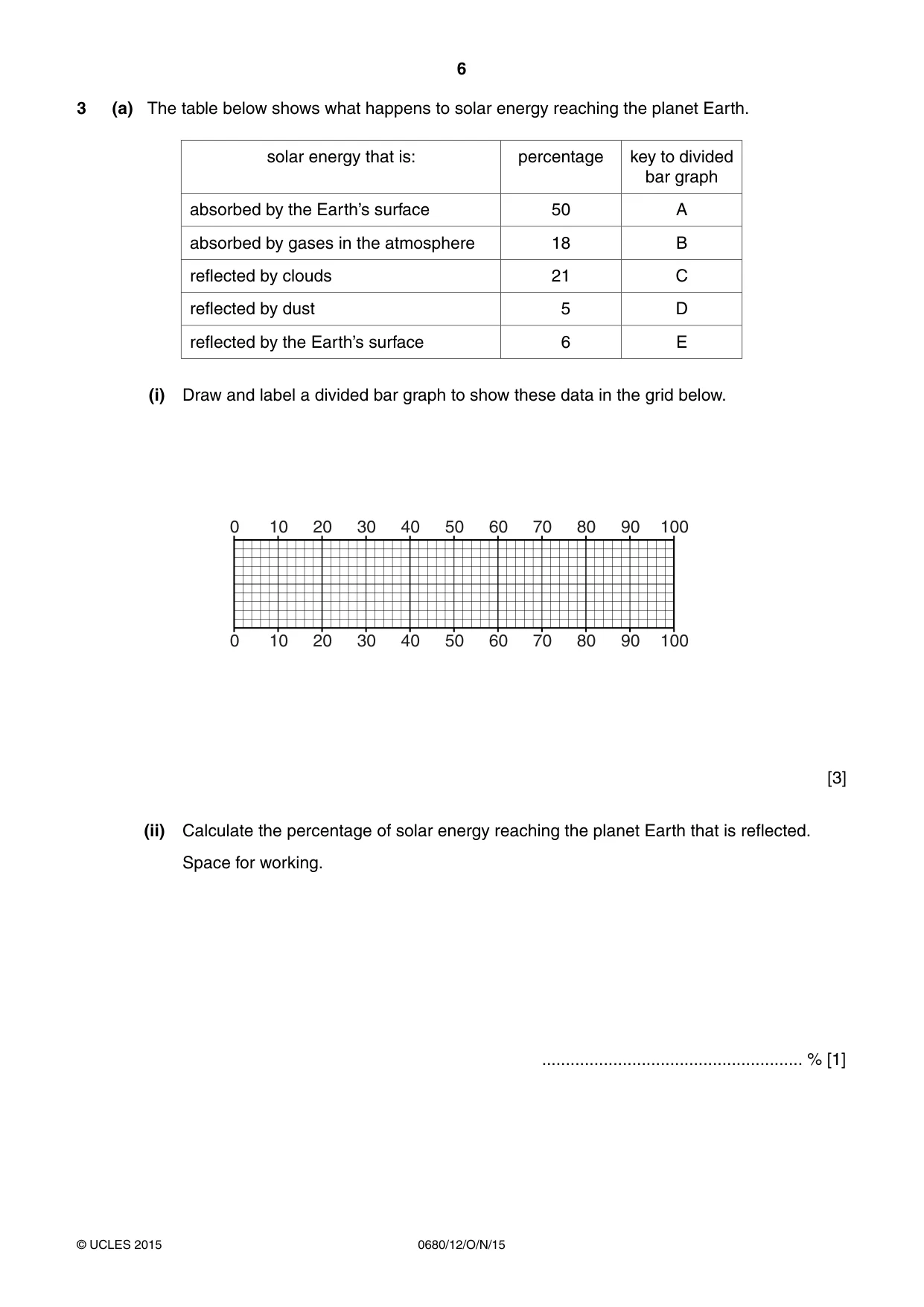
6 0680/12/O/N/15 © UCLES 2015 3 (a) The table below shows what happens to solar energy reaching the planet Earth. solar energy that is: percentage key to divided bar graph absorbed by the Earth’s surface 50 A absorbed by gases in the atmosphere 18 B reflected by clouds 21 C reflected by dust 5 D reflected by the Earth’s surface 6 E (i) Draw and label a divided bar graph to show these data in the grid below. 0 10 20 30 40 50 60 70 80 90 100 0 10 20 30 40 50 60 70 80 90 100 [3] (ii) Calculate the percentage of solar energy reaching the planet Earth that is reflected. Space for working. … % [1]
Question paper, page 7
7 0680/12/O/N/15 © UCLES 2015 [Turn over (b) (i) The heat from the Sun causes winds. Describe how wind speed and direction can be measured. … … … …[2] (ii) Measurements of wind speed and direction help decide where to locate wind turbines to generate electricity. Suggest four reasons why a country might increase the use of wind power to generate electricity. … … … … … … … …[4]
Question paper, page 8
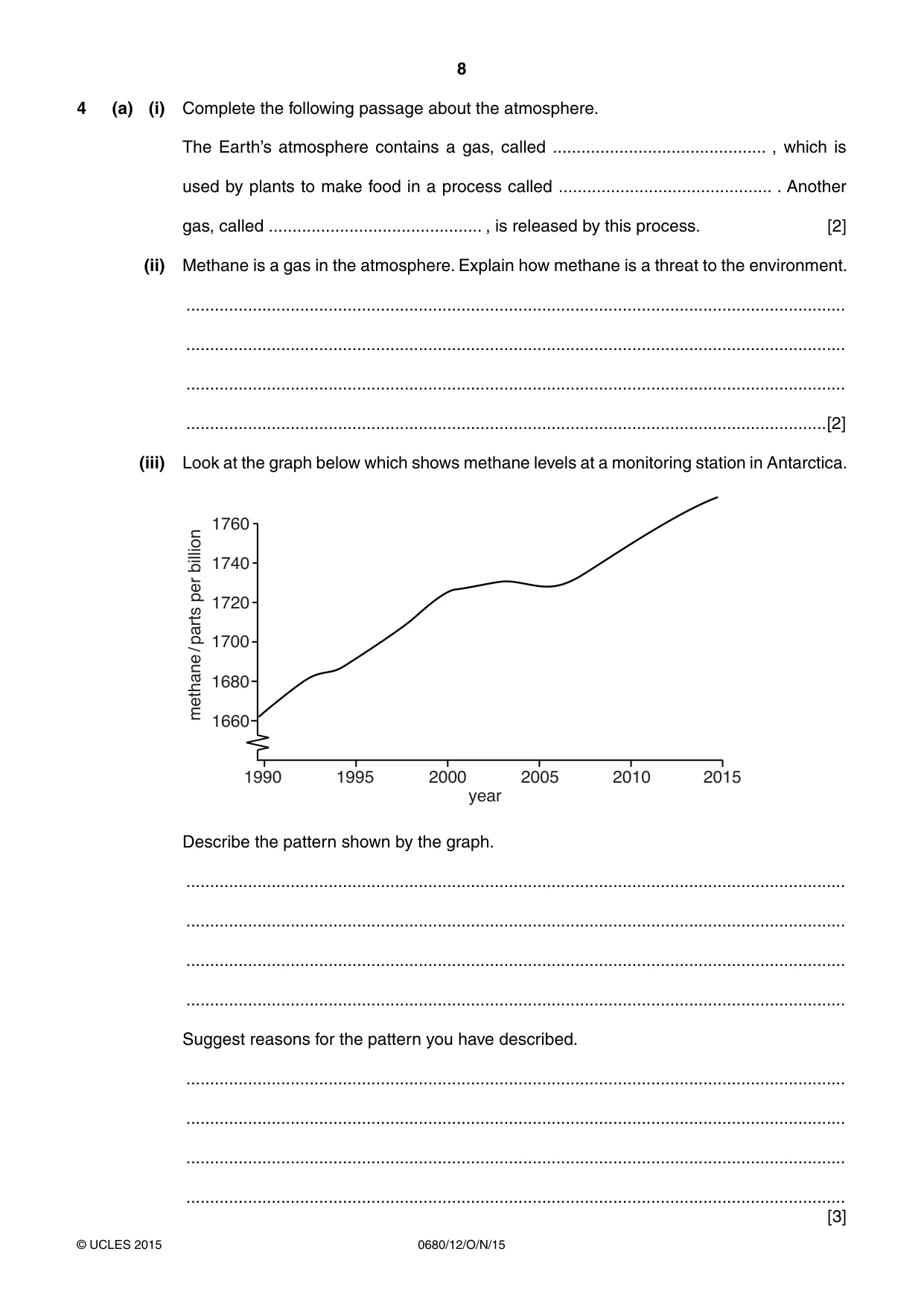
8 0680/12/O/N/15 © UCLES 2015 4 (a) (i) Complete the following passage about the atmosphere. The Earth’s atmosphere contains a gas, called … , which is used by plants to make food in a process called … . Another gas, called … , is released by this process. [2] (ii) Methane is a gas in the atmosphere. Explain how methane is a threat to the environment. … … … …[2] (iii) Look at the graph below which shows methane levels at a monitoring station in Antarctica. 1660 1990 1995 2000 2005 year 2010 2015 1680 1700 methane / parts per billion 1720 1740 1760 Describe the pattern shown by the graph. … … … … Suggest reasons for the pattern you have described. … … … … [3]
Question paper, page 9
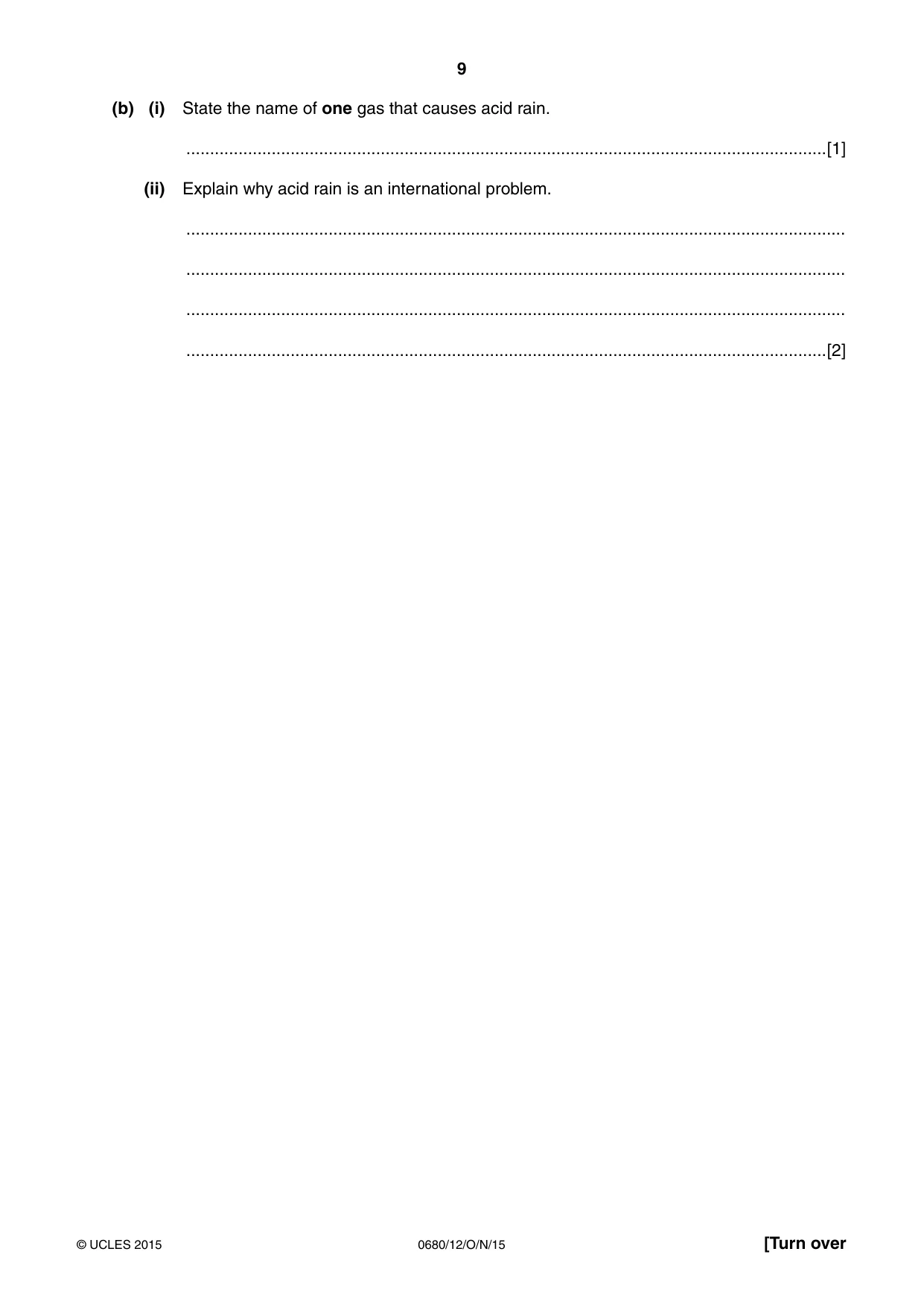
9 0680/12/O/N/15 © UCLES 2015 [Turn over (b) (i) State the name of one gas that causes acid rain. …[1] (ii) Explain why acid rain is an international problem. … … … …[2]
Question paper, page 10
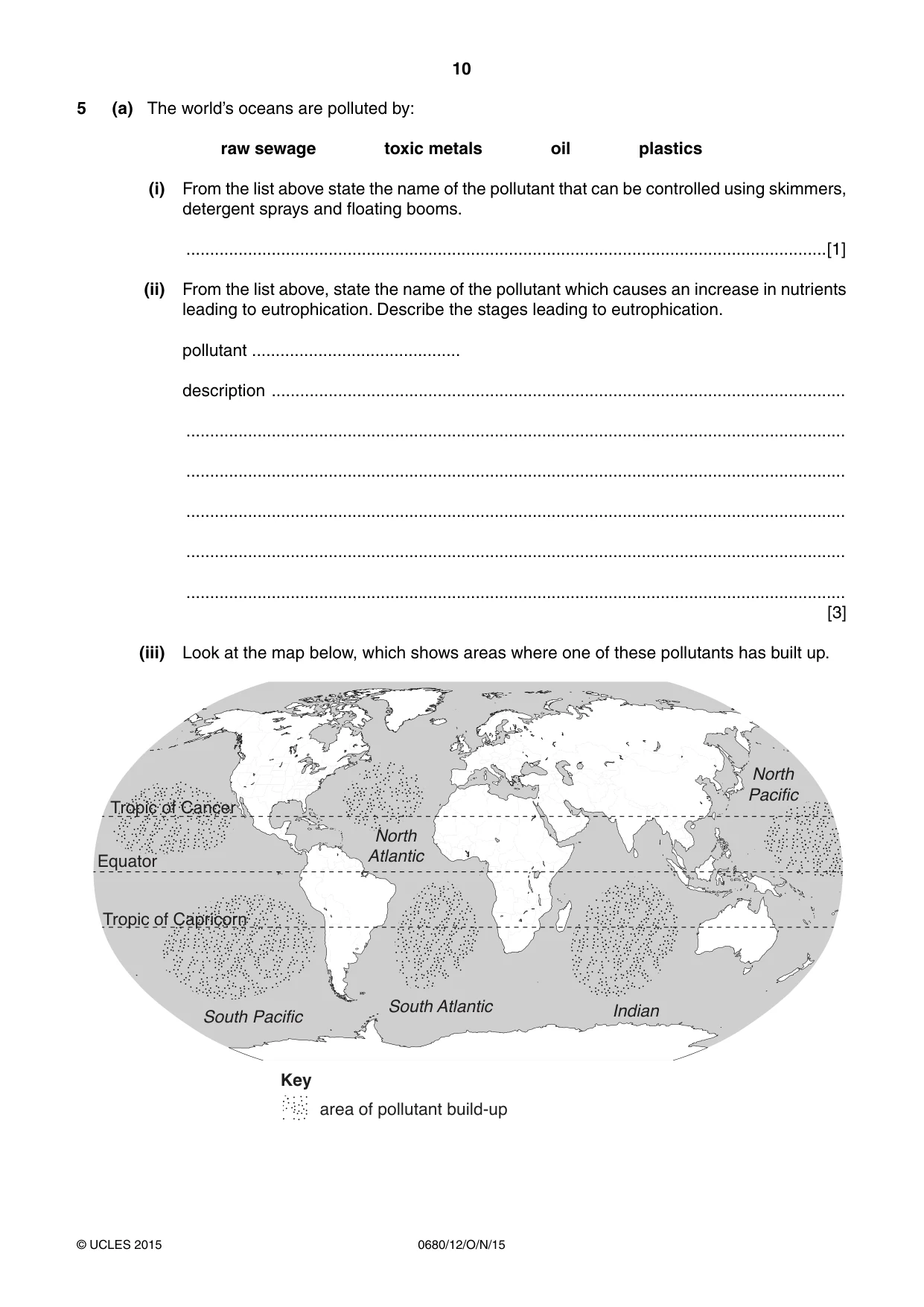
10 0680/12/O/N/15 © UCLES 2015 5 (a) The world’s oceans are polluted by: raw sewage toxic metals oil plastics (i) From the list above state the name of the pollutant that can be controlled using skimmers, detergent sprays and floating booms. …[1] (ii) From the list above, state the name of the pollutant which causes an increase in nutrients leading to eutrophication. Describe the stages leading to eutrophication. pollutant … description … … … … … … [3] (iii) Look at the map below, which shows areas where one of these pollutants has built up. Equator Tropic of Cancer Tropic of Capricorn North Atlantic North Pacific South Pacific South Atlantic Indian Key area of pollutant build-up
Question paper, page 11
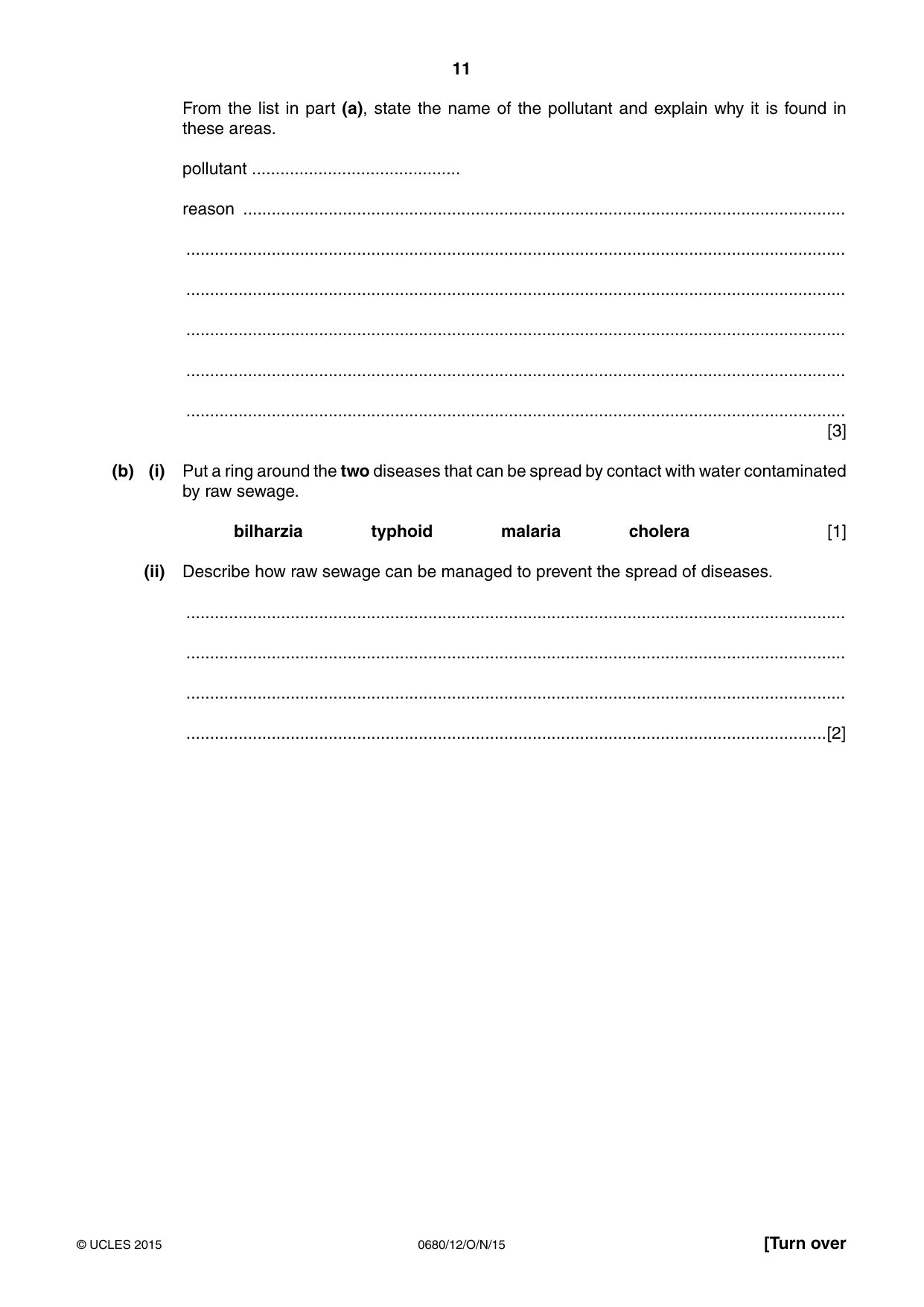
11 0680/12/O/N/15 © UCLES 2015 [Turn over From the list in part (a), state the name of the pollutant and explain why it is found in these areas. pollutant … reason … … … … … … [3] (b) (i) Put a ring around the two diseases that can be spread by contact with water contaminated by raw sewage. bilharzia typhoid malaria cholera [1] (ii) Describe how raw sewage can be managed to prevent the spread of diseases. … … … …[2]
Question paper, page 12
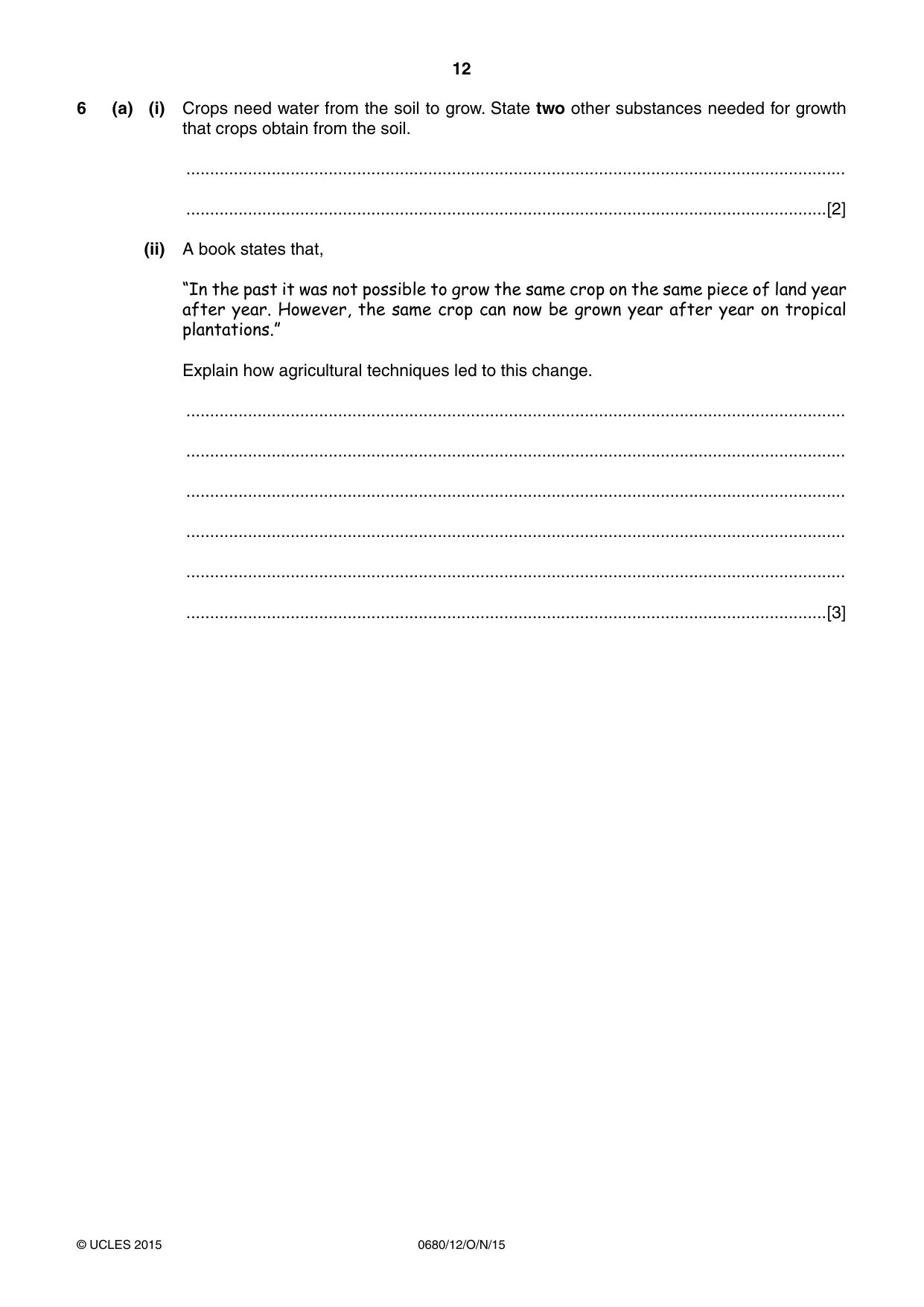
12 0680/12/O/N/15 © UCLES 2015 6 (a) (i) Crops need water from the soil to grow. State two other substances needed for growth that crops obtain from the soil. … …[2] (ii) A book states that, “In the past it was not possible to grow the same crop on the same piece of land year after year. However, the same crop can now be grown year after year on tropical plantations.” Explain how agricultural techniques led to this change. … … … … … …[3]
Question paper, page 13
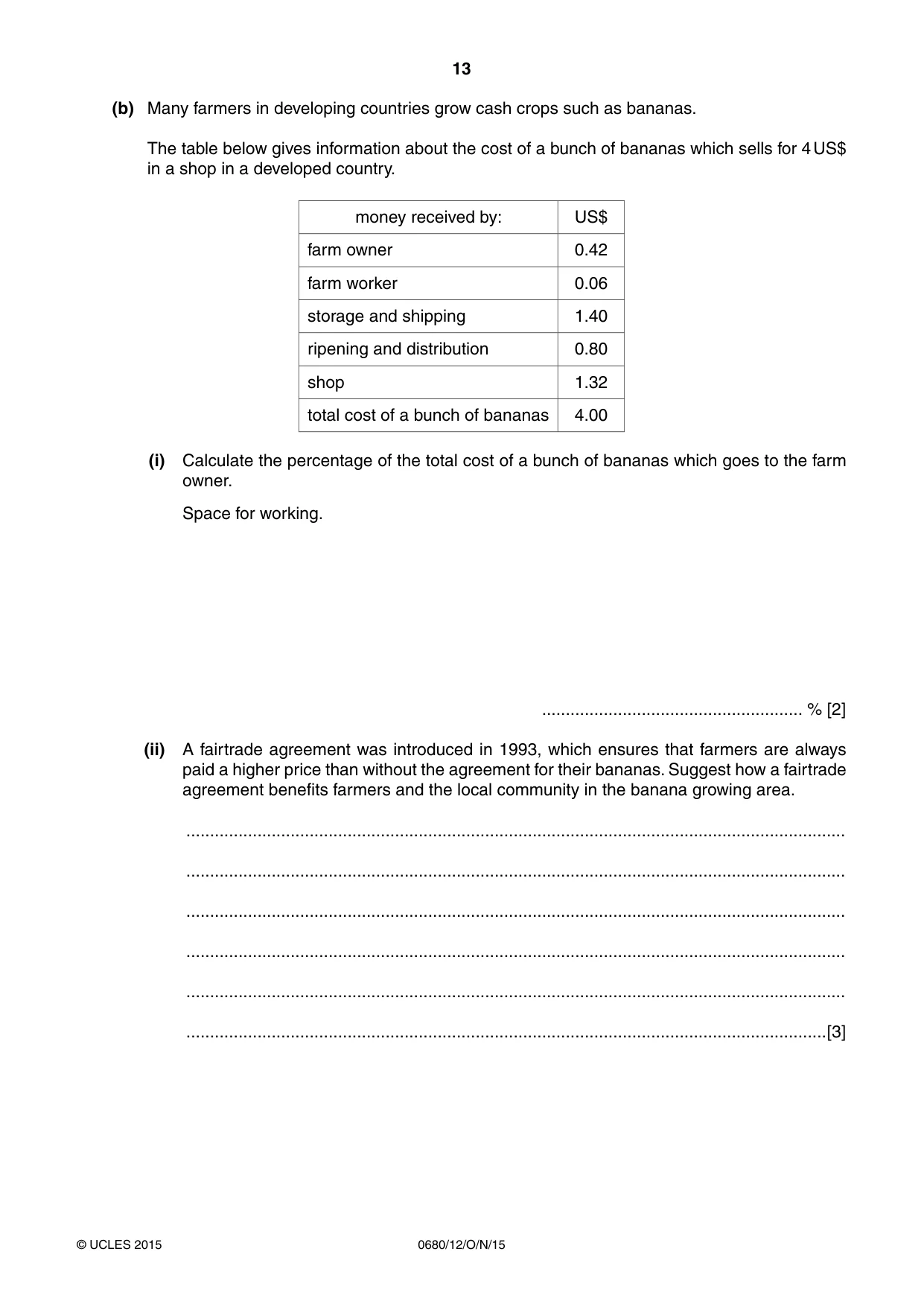
13 0680/12/O/N/15 © UCLES 2015 (b) Many farmers in developing countries grow cash crops such as bananas. The table below gives information about the cost of a bunch of bananas which sells for 4 US$ in a shop in a developed country. money received by: US$ farm owner 0.42 farm worker 0.06 storage and shipping 1.40 ripening and distribution 0.80 shop 1.32 total cost of a bunch of bananas 4.00 (i) Calculate the percentage of the total cost of a bunch of bananas which goes to the farm owner. Space for working. … % [2] (ii) A fairtrade agreement was introduced in 1993, which ensures that farmers are always paid a higher price than without the agreement for their bananas. Suggest how a fairtrade agreement benefits farmers and the local community in the banana growing area. … … … … … …[3]
Question paper, page 14
14 0680/12/O/N/15 © UCLES 2015 BLANK PAGE
Question paper, page 15
15 0680/12/O/N/15 © UCLES 2015 BLANK PAGE
Question paper, page 16
16 0680/12/O/N/15 © UCLES 2015 Permission to reproduce items where third-party owned material protected by copyright is included has been sought and cleared where possible. Every reasonable effort has been made by the publisher (UCLES) to trace copyright holders, but if any items requiring clearance have unwittingly been included, the publisher will be pleased to make amends at the earliest possible opportunity. To avoid the issue of disclosure of answer-related information to candidates, all copyright acknowledgements are reproduced online in the Cambridge International Examinations Copyright Acknowledgements Booklet. This is produced for each series of examinations and is freely available to download at www.cie.org.uk after the live examination series. Cambridge International Examinations is part of the Cambridge Assessment Group. Cambridge Assessment is the brand name of University of Cambridge Local Examinations Syndicate (UCLES), which is itself a department of the University of Cambridge. BLANK PAGE
Mark scheme, page 1
® IGCSE is the registered trademark of Cambridge International Examinations. CAMBRIDGE INTERNATIONAL EXAMINATIONS Cambridge International General Certificate of Secondary Education MARK SCHEME for the October/November 2015 series 0680 ENVIRONMENTAL MANAGEMENT 0680/12 Paper 1, maximum raw mark 60 This mark scheme is published as an aid to teachers and candidates, to indicate the requirements of the examination. It shows the basis on which Examiners were instructed to award marks. It does not indicate the details of the discussions that took place at an Examiners’ meeting before marking began, which would have considered the acceptability of alternative answers. Mark schemes should be read in conjunction with the question paper and the Principal Examiner Report for Teachers. Cambridge will not enter into discussions about these mark schemes. Cambridge is publishing the mark schemes for the October/November 2015 series for most Cambridge IGCSE®, Cambridge International A and AS Level components and some Cambridge O Level components.
Mark scheme, page 2
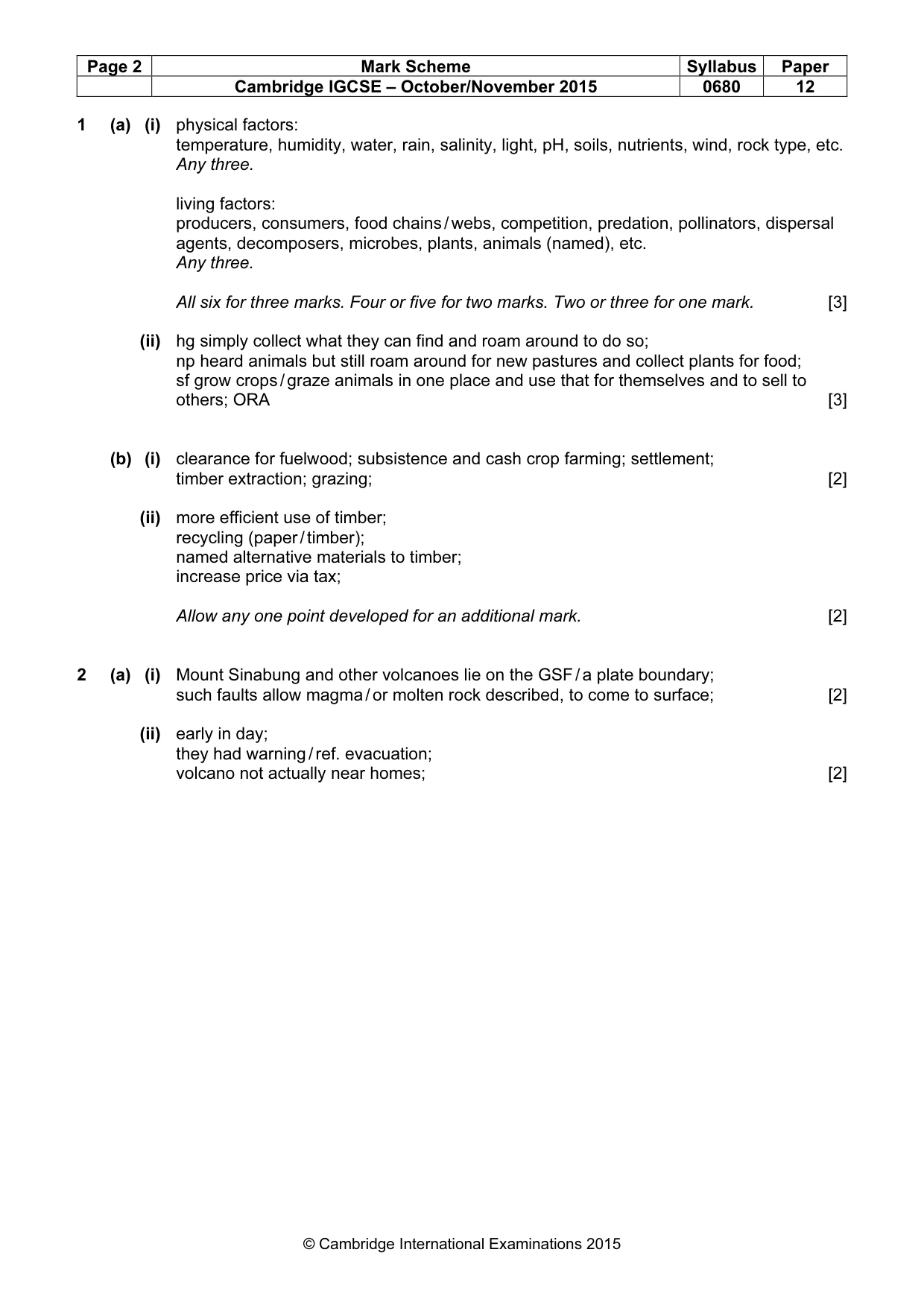
Page 2 Mark Scheme Syllabus Paper Cambridge IGCSE – October/November 2015 0680 12 © Cambridge International Examinations 2015 1 (a) (i) physical factors: temperature, humidity, water, rain, salinity, light, pH, soils, nutrients, wind, rock type, etc. Any three. living factors: producers, consumers, food chains / webs, competition, predation, pollinators, dispersal agents, decomposers, microbes, plants, animals (named), etc. Any three. All six for three marks. Four or five for two marks. Two or three for one mark. [3] (ii) hg simply collect what they can find and roam around to do so; np heard animals but still roam around for new pastures and collect plants for food; sf grow crops / graze animals in one place and use that for themselves and to sell to others; ORA [3] (b) (i) clearance for fuelwood; subsistence and cash crop farming; settlement; timber extraction; grazing; [2] (ii) more efficient use of timber; recycling (paper / timber); named alternative materials to timber; increase price via tax; Allow any one point developed for an additional mark. [2] 2 (a) (i) Mount Sinabung and other volcanoes lie on the GSF / a plate boundary; such faults allow magma / or molten rock described, to come to surface; [2] (ii) early in day; they had warning / ref. evacuation; volcano not actually near homes; [2]
Mark scheme, page 3
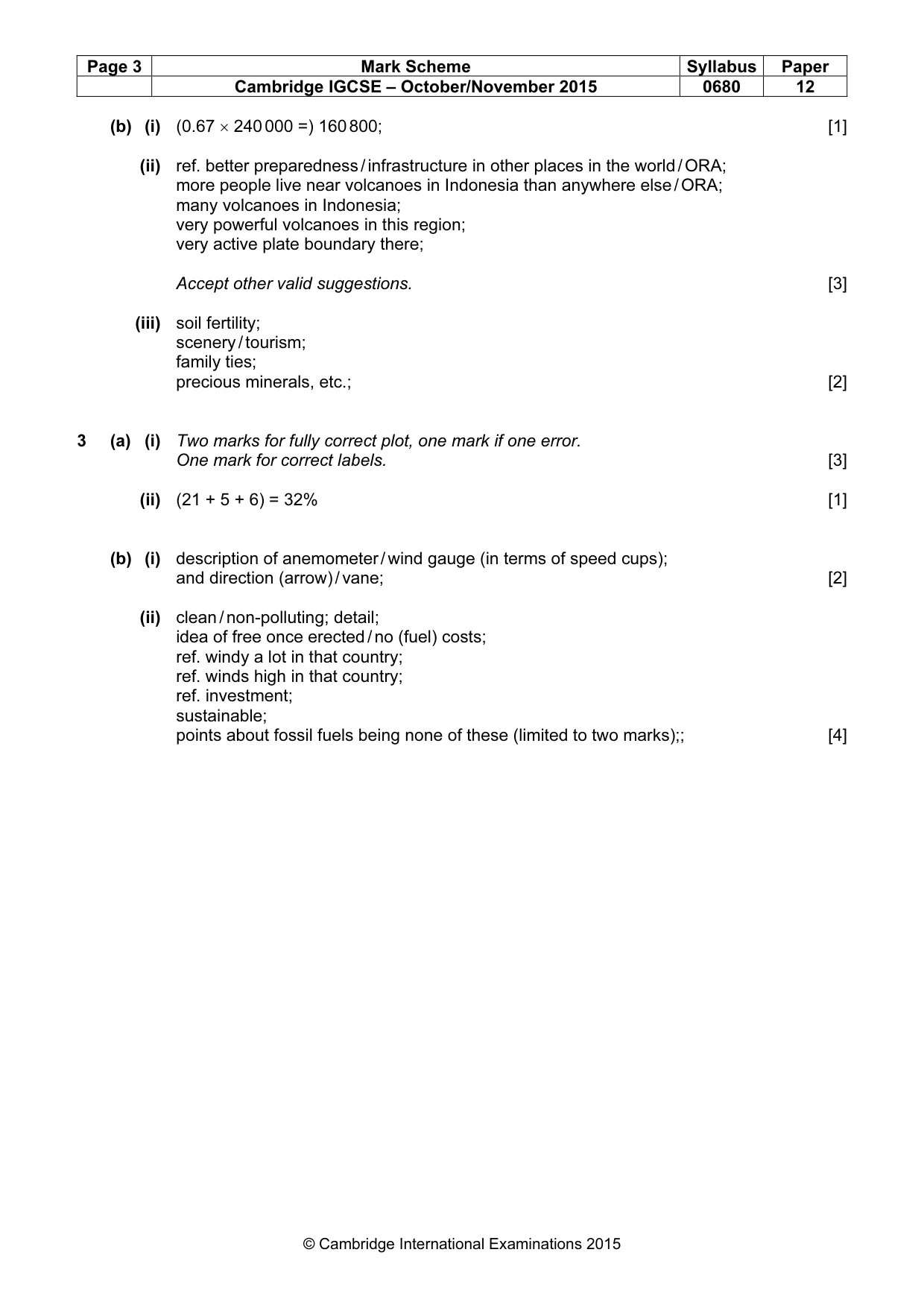
Page 3 Mark Scheme Syllabus Paper Cambridge IGCSE – October/November 2015 0680 12 © Cambridge International Examinations 2015 (b) (i) (0.67 × 240 000 =) 160 800; [1] (ii) ref. better preparedness / infrastructure in other places in the world / ORA; more people live near volcanoes in Indonesia than anywhere else / ORA; many volcanoes in Indonesia; very powerful volcanoes in this region; very active plate boundary there; Accept other valid suggestions. [3] (iii) soil fertility; scenery / tourism; family ties; precious minerals, etc.; [2] 3 (a) (i) Two marks for fully correct plot, one mark if one error. One mark for correct labels. [3] (ii) (21 + 5 + 6) = 32% [1] (b) (i) description of anemometer / wind gauge (in terms of speed cups); and direction (arrow) / vane; [2] (ii) clean / non-polluting; detail; idea of free once erected / no (fuel) costs; ref. windy a lot in that country; ref. winds high in that country; ref. investment; sustainable; points about fossil fuels being none of these (limited to two marks);; [4]
Mark scheme, page 4
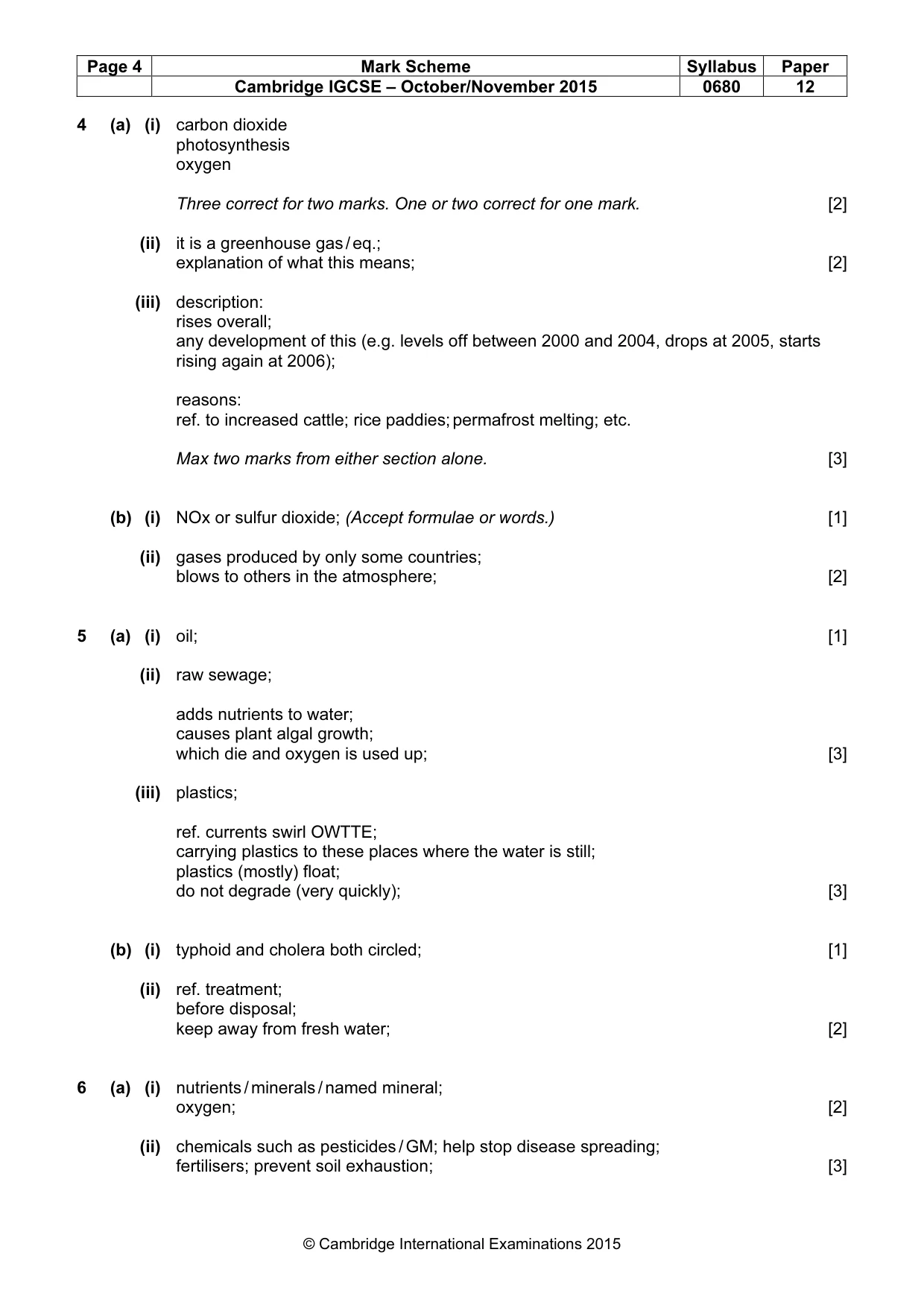
Page 4 Mark Scheme Syllabus Paper Cambridge IGCSE – October/November 2015 0680 12 © Cambridge International Examinations 2015 4 (a) (i) carbon dioxide photosynthesis oxygen Three correct for two marks. One or two correct for one mark. [2] (ii) it is a greenhouse gas / eq.; explanation of what this means; [2] (iii) description: rises overall; any development of this (e.g. levels off between 2000 and 2004, drops at 2005, starts rising again at 2006); reasons: ref. to increased cattle; rice paddies; permafrost melting; etc. Max two marks from either section alone. [3] (b) (i) NOx or sulfur dioxide; (Accept formulae or words.) [1] (ii) gases produced by only some countries; blows to others in the atmosphere; [2] 5 (a) (i) oil; [1] (ii) raw sewage; adds nutrients to water; causes plant algal growth; which die and oxygen is used up; [3] (iii) plastics; ref. currents swirl OWTTE; carrying plastics to these places where the water is still; plastics (mostly) float; do not degrade (very quickly); [3] (b) (i) typhoid and cholera both circled; [1] (ii) ref. treatment; before disposal; keep away from fresh water; [2] 6 (a) (i) nutrients / minerals / named mineral; oxygen; [2] (ii) chemicals such as pesticides / GM; help stop disease spreading; fertilisers; prevent soil exhaustion; [3]
Mark scheme, page 5
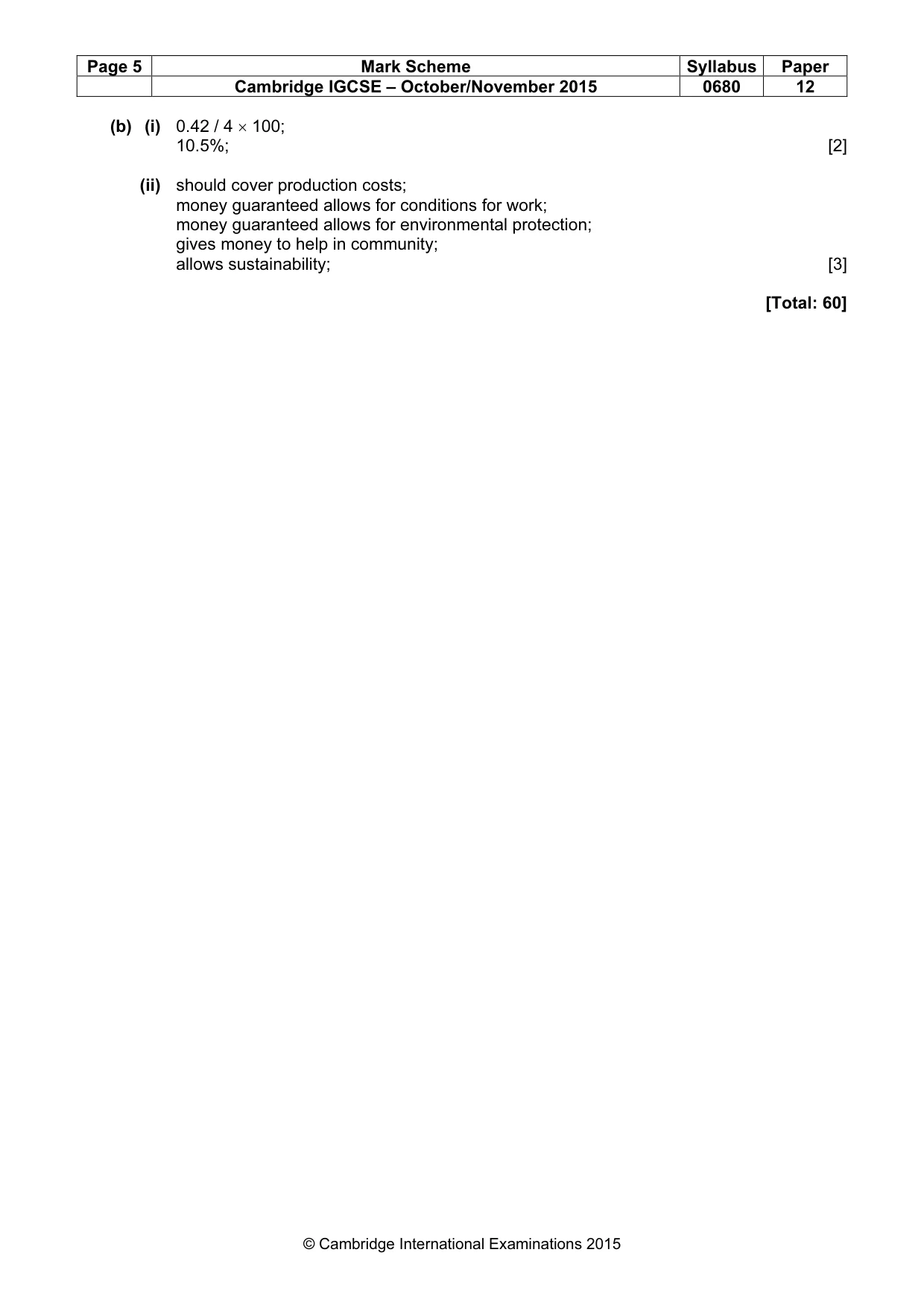
Page 5 Mark Scheme Syllabus Paper Cambridge IGCSE – October/November 2015 0680 12 © Cambridge International Examinations 2015 (b) (i) 0.42 / 4 × 100; 10.5%; [2] (ii) should cover production costs; money guaranteed allows for conditions for work; money guaranteed allows for environmental protection; gives money to help in community; allows sustainability; [3] [Total: 60]
What you needed in this session
Cambridge’s own grade thresholds for 2015 Oct/Nov, Paper 1 · Variant 2. A higher threshold means an easier paper — the bar moves with how the cohort did.