Cambridge IGCSE Environmental Management 0680 — 2015 Oct/Nov Paper 1 · Variant 1
0680/11/O/N/15 · 60 marks · ≈68 min
The question paper and its mark scheme, free to read here and free to download. This is Cambridge’s own paper, exactly as it was sat.
Question paper16 pages


Mark scheme6 pages
Answers below. Sit the paper first if you are practising.
Paper as text
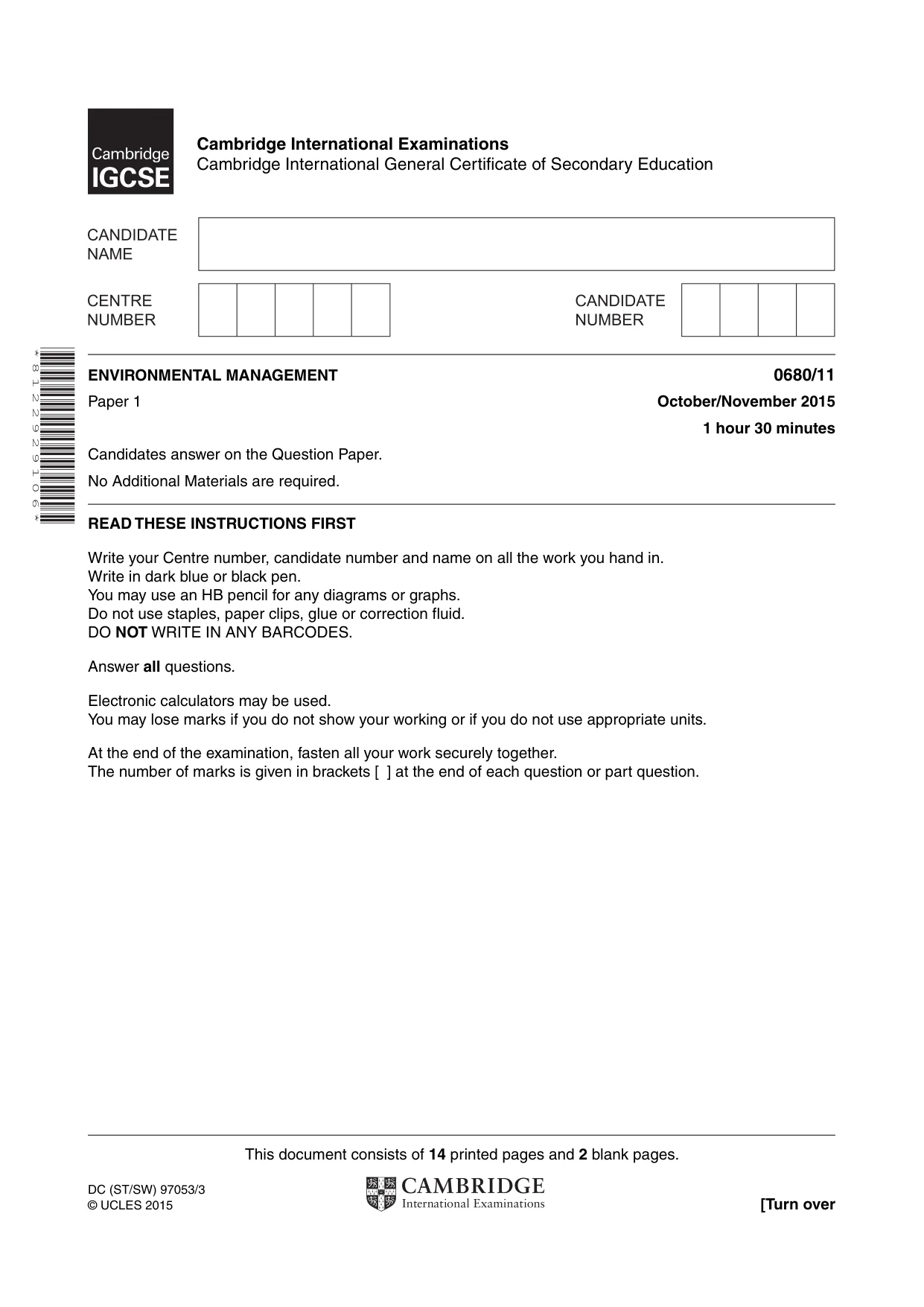
Question paper, page 1
This document consists of 14 printed pages and 2 blank pages. DC (ST/SW) 97053/3 © UCLES 2015 [Turn over Cambridge International Examinations Cambridge International General Certificate of Secondary Education * 8 1 2 2 9 2 9 1 0 6 * ENVIRONMENTAL MANAGEMENT 0680/11 Paper 1 October/November 2015 1 hour 30 minutes Candidates answer on the Question Paper. No Additional Materials are required. READ THESE INSTRUCTIONS FIRST Write your Centre number, candidate number and name on all the work you hand in. Write in dark blue or black pen. You may use an HB pencil for any diagrams or graphs. Do not use staples, paper clips, glue or correction fluid. DO NOT WRITE IN ANY BARCODES. Answer all questions. Electronic calculators may be used. You may lose marks if you do not show your working or if you do not use appropriate units. At the end of the examination, fasten all your work securely together. The number of marks is given in brackets [ ] at the end of each question or part question.
Question paper, page 2
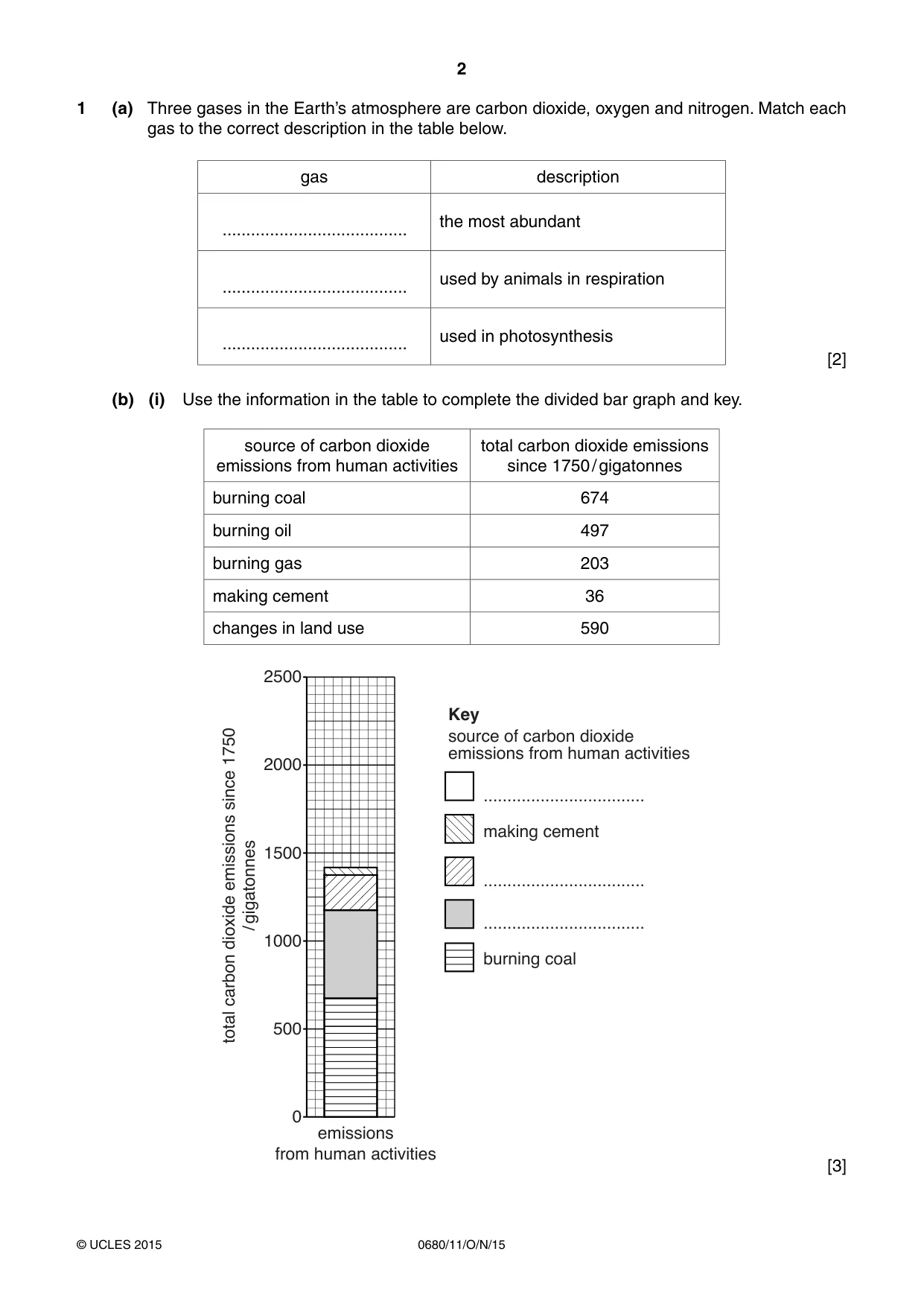
2 0680/11/O/N/15 © UCLES 2015 1 (a) Three gases in the Earth’s atmosphere are carbon dioxide, oxygen and nitrogen. Match each gas to the correct description in the table below. gas description … the most abundant … used by animals in respiration … used in photosynthesis [2] (b) (i) Use the information in the table to complete the divided bar graph and key. source of carbon dioxide emissions from human activities total carbon dioxide emissions since 1750 / gigatonnes burning coal 674 burning oil 497 burning gas 203 making cement 36 changes in land use 590 0 emissions from human activities … … … making cement Key source of carbon dioxide emissions from human activities burning coal 500 1000 1500 total carbon dioxide emissions since 1750 / gigatonnes 2000 2500 [3]
Question paper, page 3
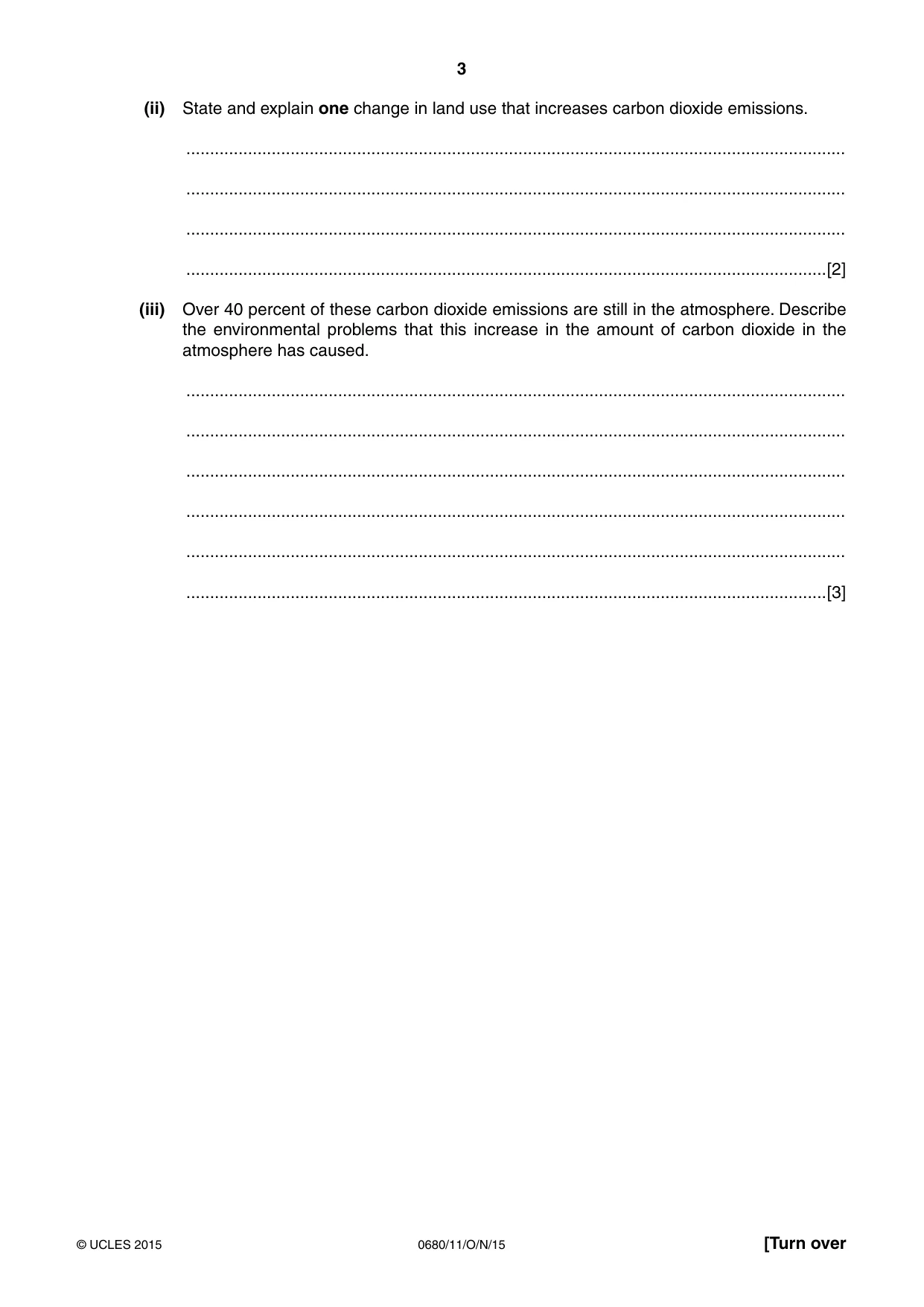
3 0680/11/O/N/15 © UCLES 2015 [Turn over (ii) State and explain one change in land use that increases carbon dioxide emissions. … … … …[2] (iii) Over 40 percent of these carbon dioxide emissions are still in the atmosphere. Describe the environmental problems that this increase in the amount of carbon dioxide in the atmosphere has caused. … … … … … …[3]
Question paper, page 4
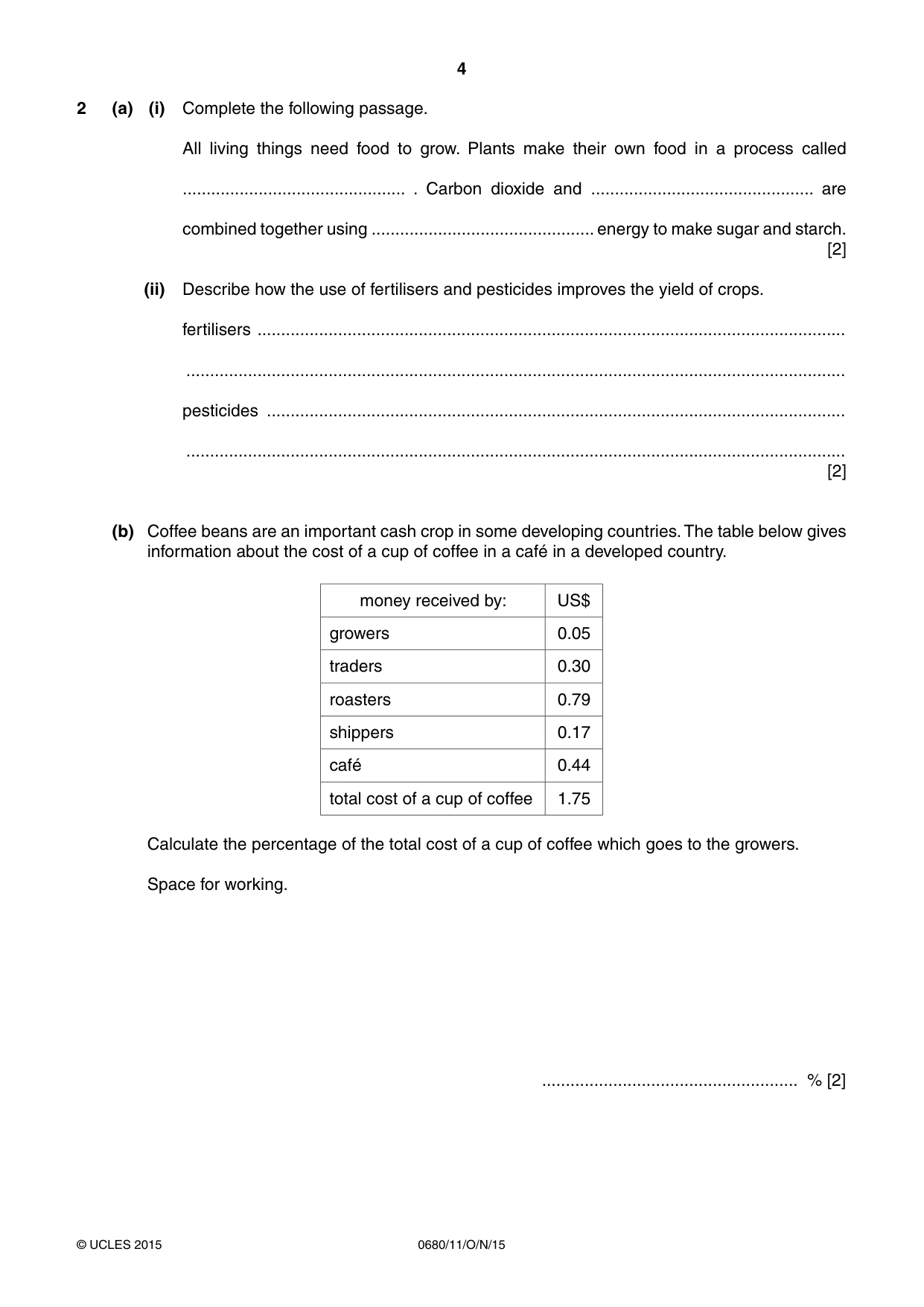
4 0680/11/O/N/15 © UCLES 2015 2 (a) (i) Complete the following passage. All living things need food to grow. Plants make their own food in a process called … . Carbon dioxide and … are combined together using … energy to make sugar and starch. [2] (ii) Describe how the use of fertilisers and pesticides improves the yield of crops. fertilisers … … pesticides … … [2] (b) Coffee beans are an important cash crop in some developing countries. The table below gives information about the cost of a cup of coffee in a café in a developed country. money received by: US$ growers 0.05 traders 0.30 roasters 0.79 shippers 0.17 café 0.44 total cost of a cup of coffee 1.75 Calculate the percentage of the total cost of a cup of coffee which goes to the growers. Space for working. … % [2]
Question paper, page 5
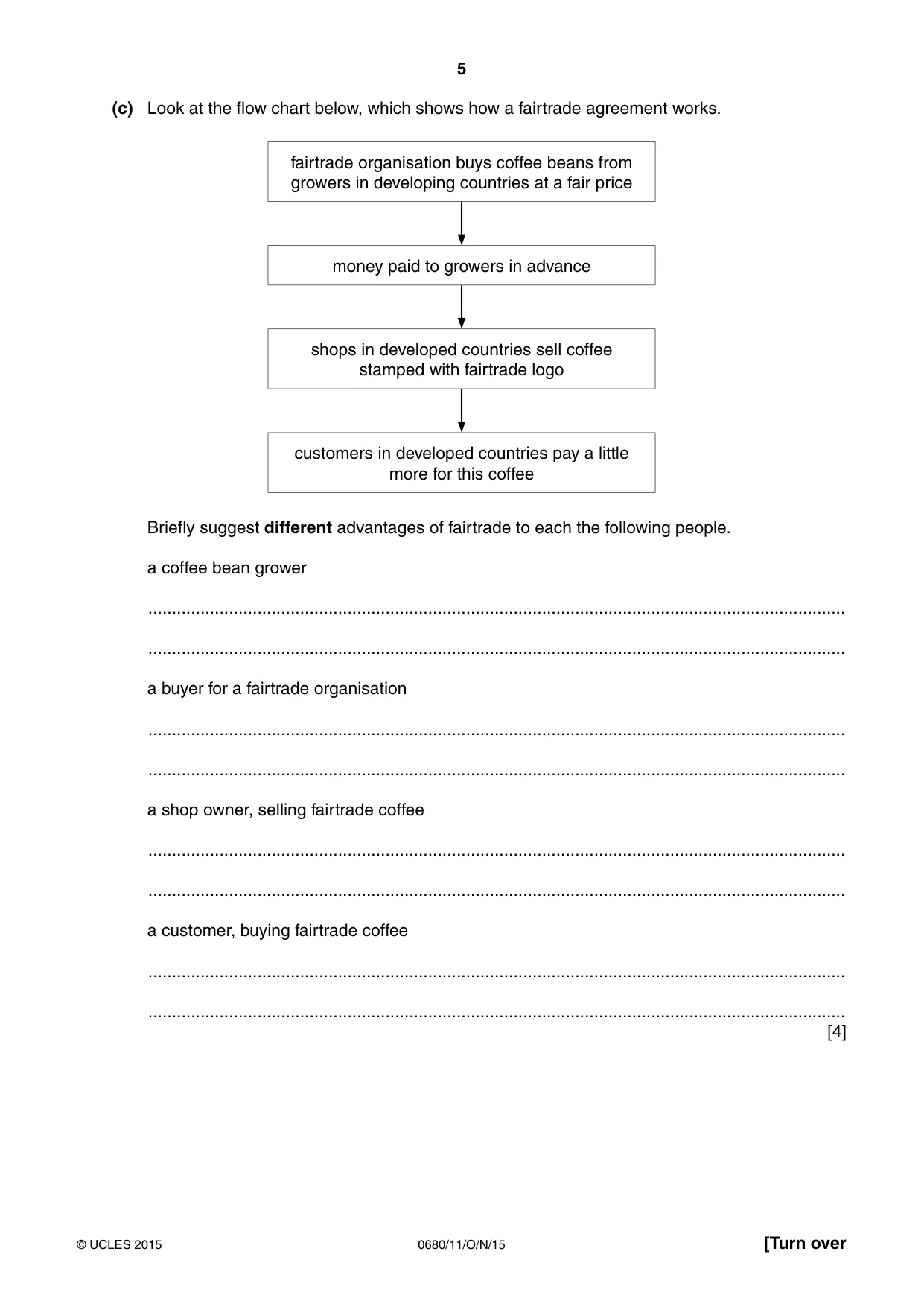
5 0680/11/O/N/15 © UCLES 2015 [Turn over (c) Look at the flow chart below, which shows how a fairtrade agreement works. fairtrade organisation buys coffee beans from growers in developing countries at a fair price money paid to growers in advance shops in developed countries sell coffee stamped with fairtrade logo customers in developed countries pay a little more for this coffee Briefly suggest different advantages of fairtrade to each the following people. a coffee bean grower … … a buyer for a fairtrade organisation … … a shop owner, selling fairtrade coffee … … a customer, buying fairtrade coffee … … [4]
Question paper, page 6
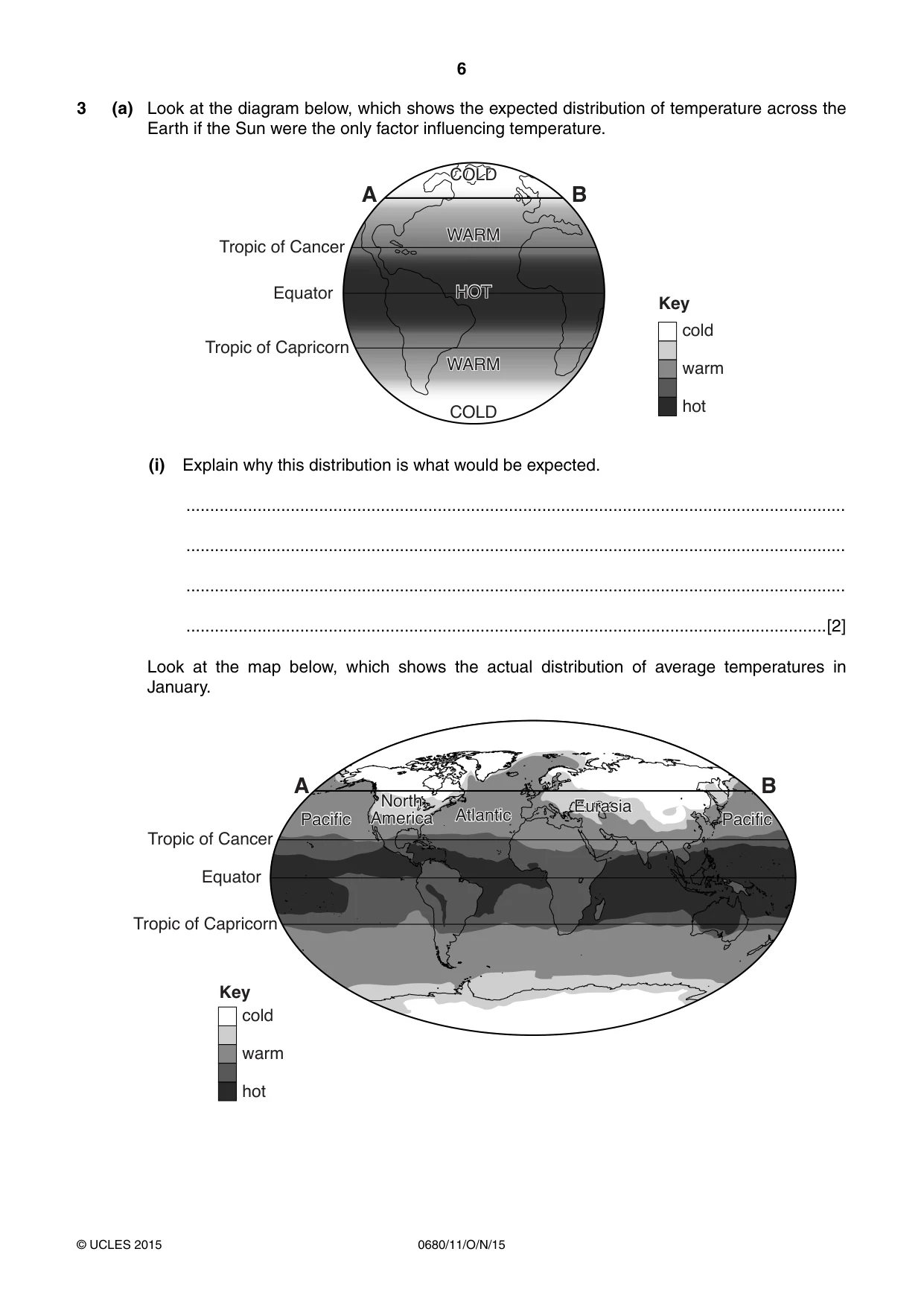
6 0680/11/O/N/15 © UCLES 2015 3 (a) Look at the diagram below, which shows the expected distribution of temperature across the Earth if the Sun were the only factor influencing temperature. A B WARM HOT WARM COLD COLD Tropic of Cancer Tropic of Capricorn Equator Key cold warm hot (i) Explain why this distribution is what would be expected. … … … …[2] Look at the map below, which shows the actual distribution of average temperatures in January. Key cold warm hot A North America Pacific Pacific Atlantic Eurasia B Tropic of Cancer Tropic of Capricorn Equator
Question paper, page 7
7 0680/11/O/N/15 © UCLES 2015 [Turn over (ii) Describe and explain the differences between the expected and actual distribution of temperature along the line labelled A to B. … … … … … …[3] (b) (i) Energy from the Sun is an example of alternative energy. State the names of two other alternative energy sources. … …[2] (ii) Thousands of villages in a developing country are not connected to a national power grid, supplying electricity from power stations. This country gets an average of 300 sunny days a year. Suggest what the government might do to supply the people living in these villages with electricity. … … … … … …[3]
Question paper, page 8
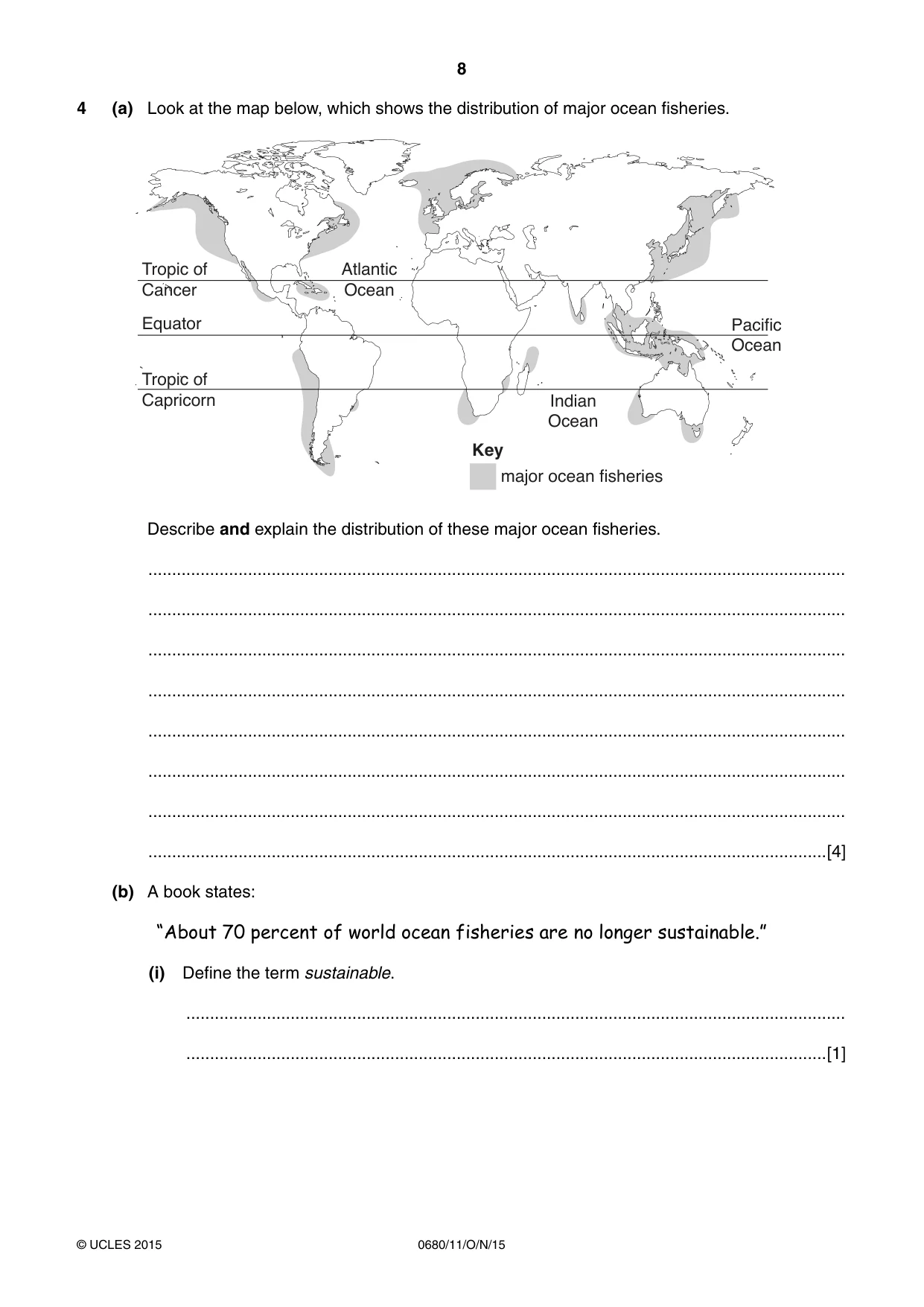
8 0680/11/O/N/15 © UCLES 2015 4 (a) Look at the map below, which shows the distribution of major ocean fisheries. Key major ocean fisheries Tropic of Cancer Equator Atlantic Ocean Indian Ocean Pacific Ocean Tropic of Capricorn Describe and explain the distribution of these major ocean fisheries. … … … … … … … …[4] (b) A book states: “About 70 percent of world ocean fisheries are no longer sustainable.” (i) Define the term sustainable. … …[1]
Question paper, page 9
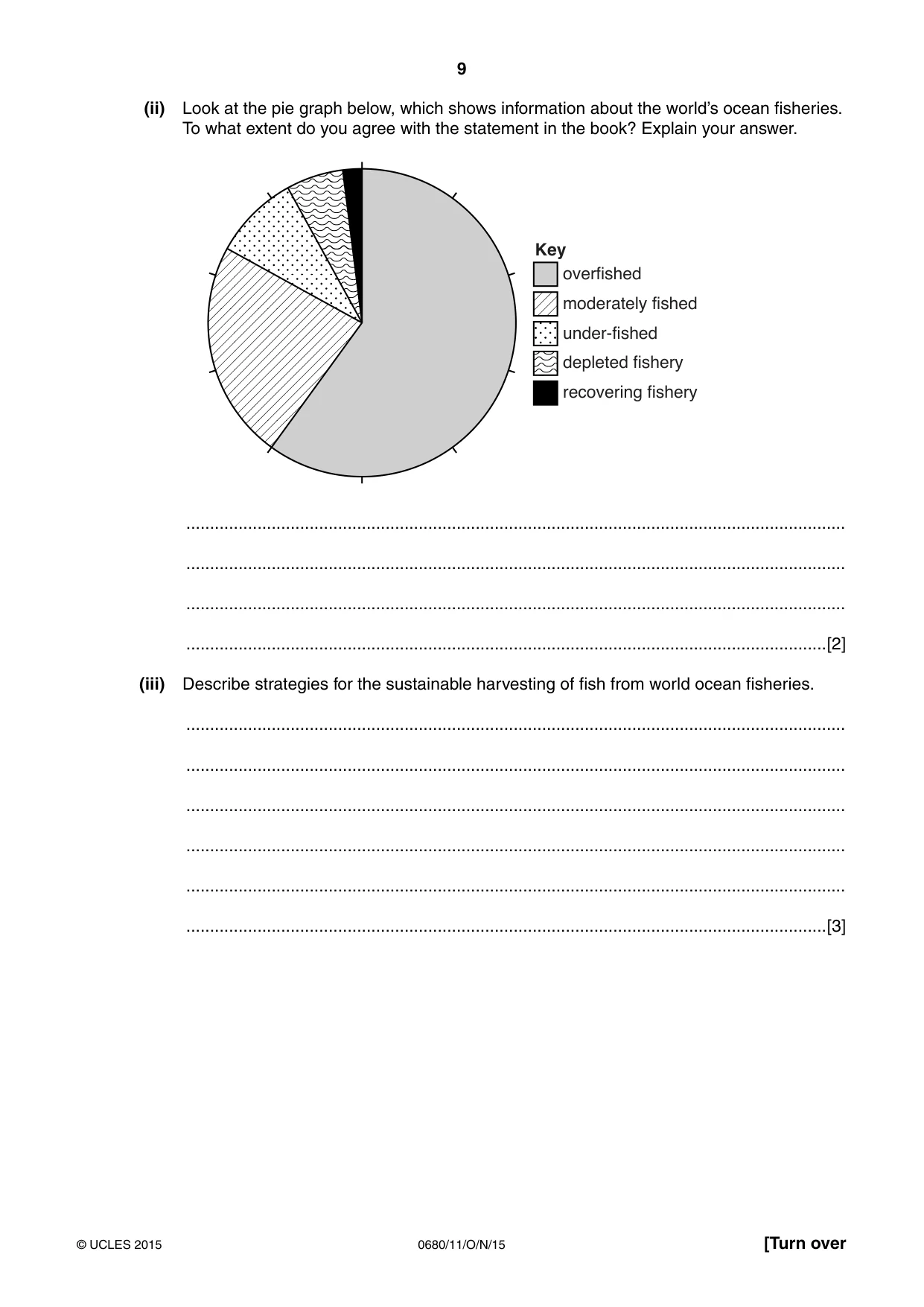
9 0680/11/O/N/15 © UCLES 2015 [Turn over (ii) Look at the pie graph below, which shows information about the world’s ocean fisheries. To what extent do you agree with the statement in the book? Explain your answer. overfished moderately fished under-fished depleted fishery recovering fishery Key … … … …[2] (iii) Describe strategies for the sustainable harvesting of fish from world ocean fisheries. … … … … … …[3]
Question paper, page 10
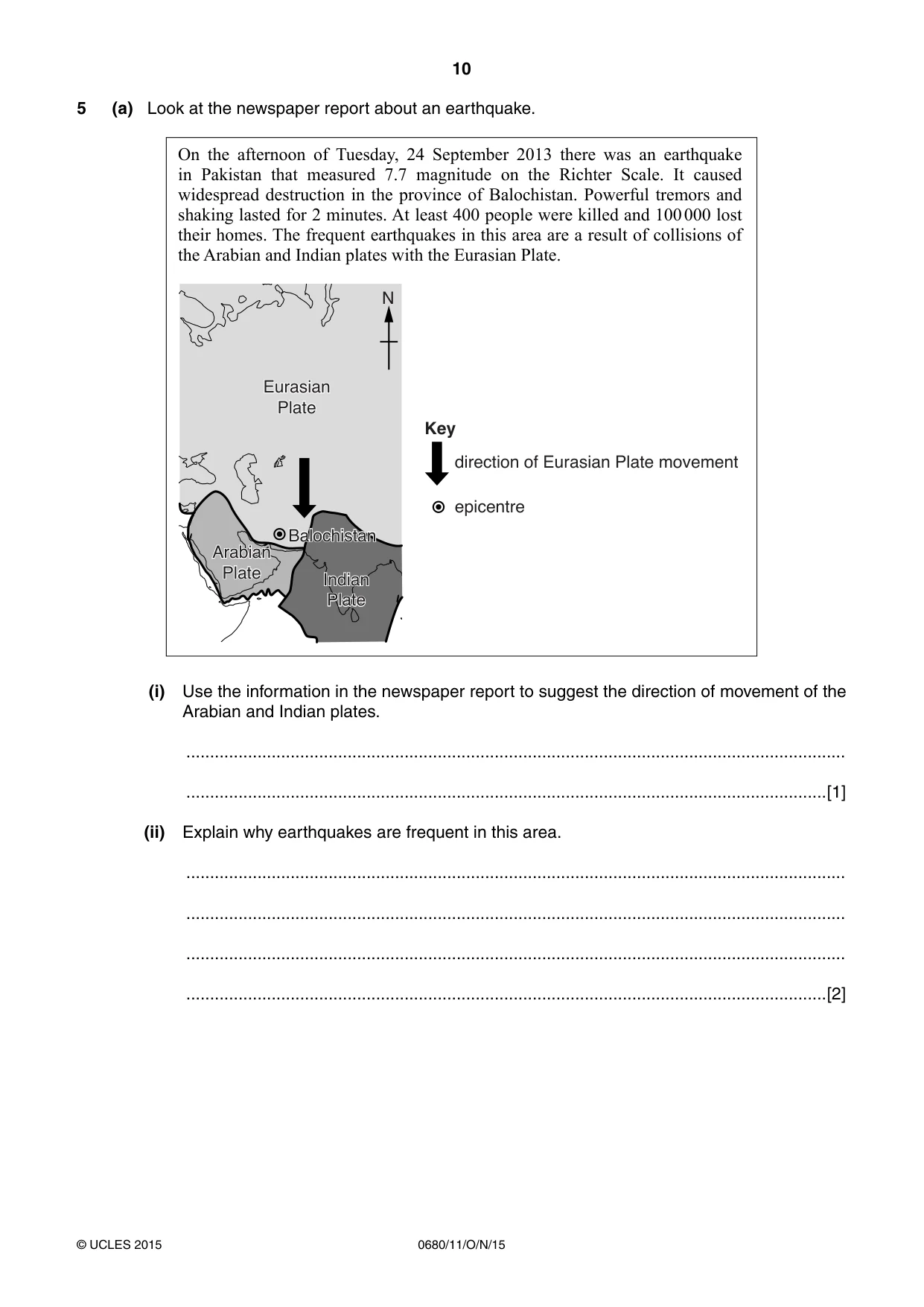
10 0680/11/O/N/15 © UCLES 2015 5 (a) Look at the newspaper report about an earthquake. Indian Plate Arabian Plate Eurasian Plate N Key direction of Eurasian Plate movement epicentre Balochistan On the afternoon of Tuesday, 24 September 2013 there was an earthquake in Pakistan that measured 7.7 magnitude on the Richter Scale. It caused widespread destruction in the province of Balochistan. Powerful tremors and shaking lasted for 2 minutes. At least 400 people were killed and 100 000 lost their homes. The frequent earthquakes in this area are a result of collisions of the Arabian and Indian plates with the Eurasian Plate. (i) Use the information in the newspaper report to suggest the direction of movement of the Arabian and Indian plates. … …[1] (ii) Explain why earthquakes are frequent in this area. … … … …[2]
Question paper, page 11
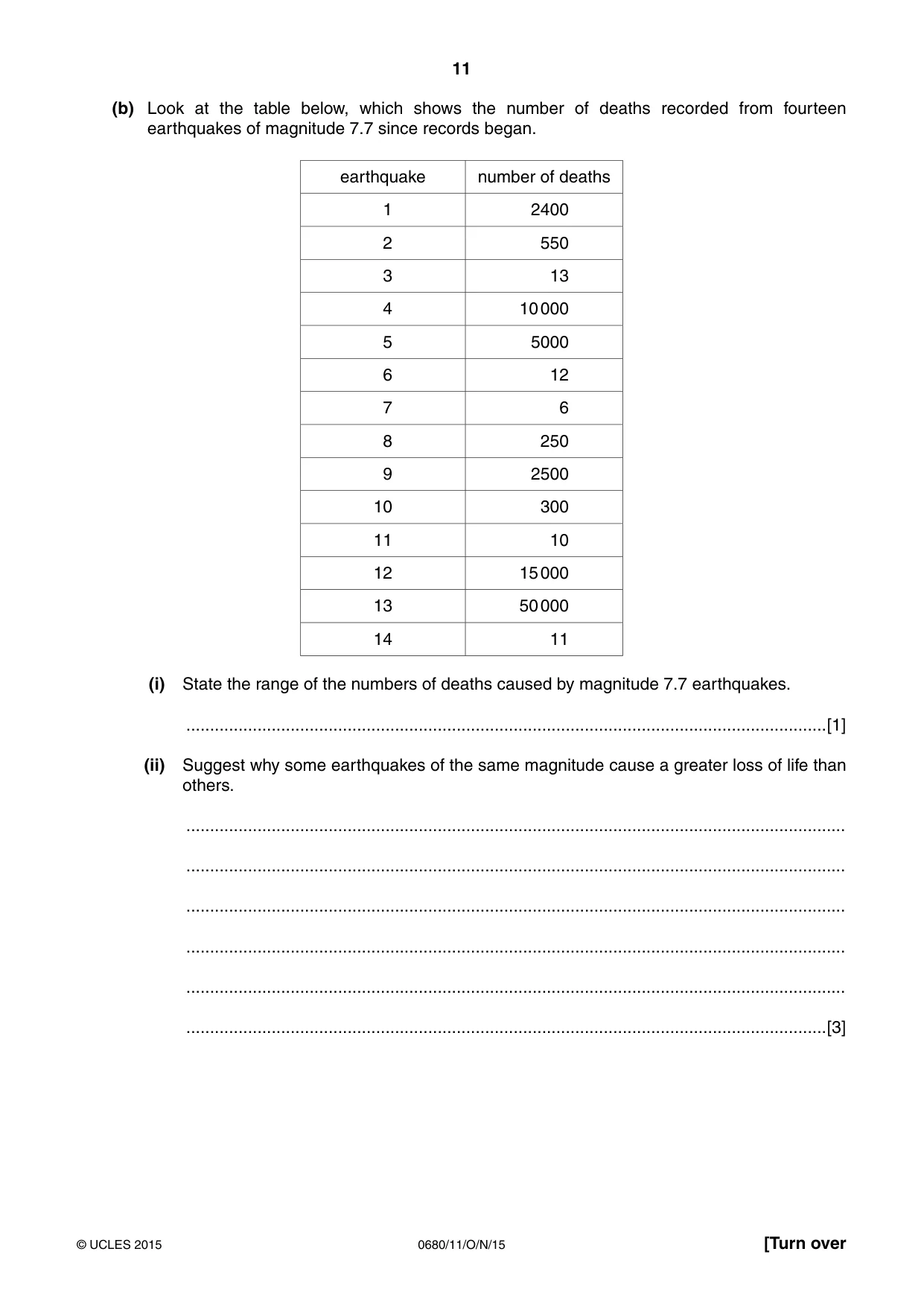
11 0680/11/O/N/15 © UCLES 2015 [Turn over (b) Look at the table below, which shows the number of deaths recorded from fourteen earthquakes of magnitude 7.7 since records began. earthquake number of deaths 1 2400 2 550 3 13 4 10 000 5 5000 6 12 7 6 8 250 9 2500 10 300 11 10 12 15 000 13 50 000 14 11 (i) State the range of the numbers of deaths caused by magnitude 7.7 earthquakes. …[1] (ii) Suggest why some earthquakes of the same magnitude cause a greater loss of life than others. … … … … … …[3]
Question paper, page 12
12 0680/11/O/N/15 © UCLES 2015 (c) Explain why fewer people are usually killed during volcanic eruptions than during earthquakes. … … … … … …[3]
Question paper, page 13
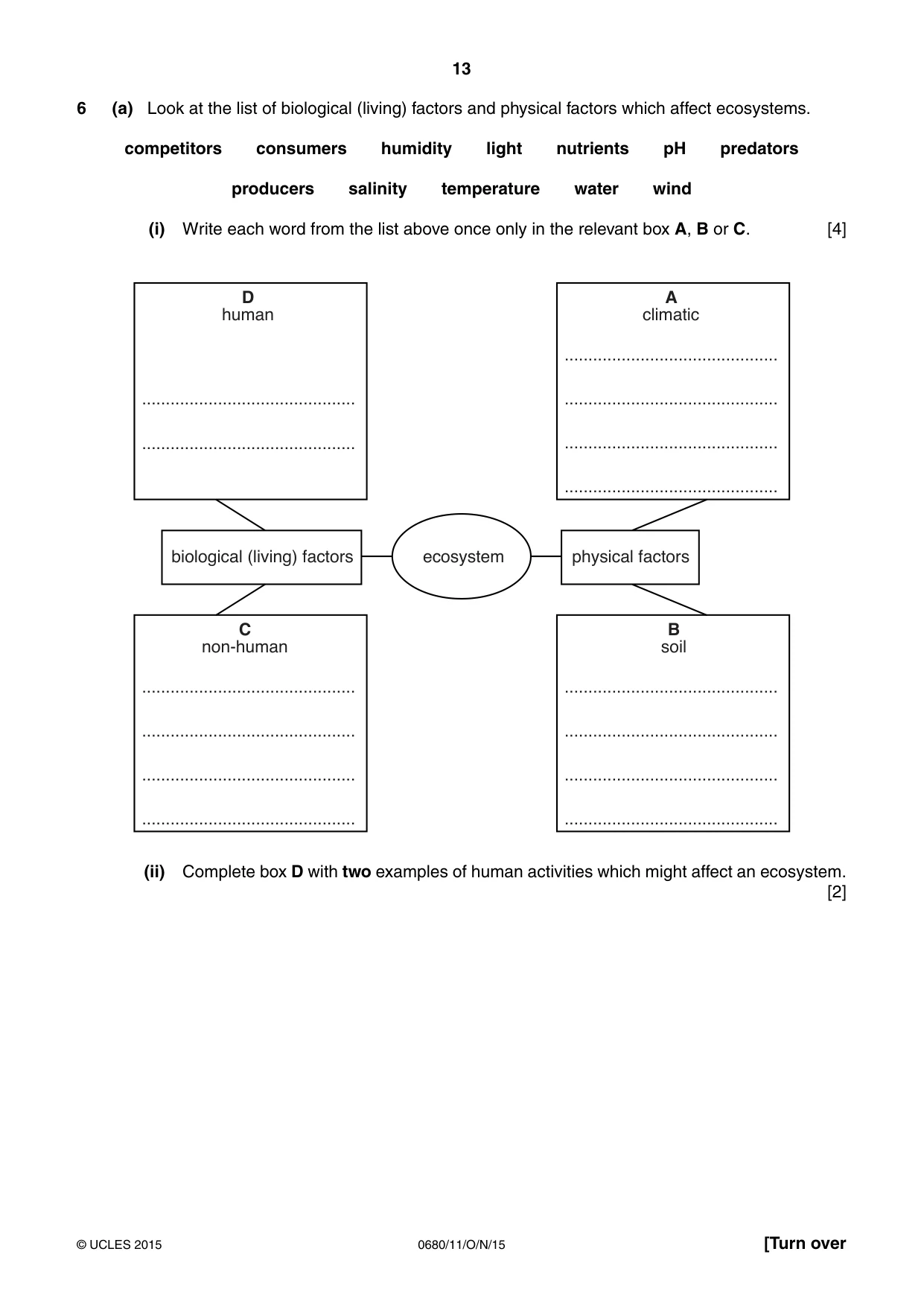
13 0680/11/O/N/15 © UCLES 2015 [Turn over 6 (a) Look at the list of biological (living) factors and physical factors which affect ecosystems. competitors consumers humidity light nutrients pH predators producers salinity temperature water wind (i) Write each word from the list above once only in the relevant box A, B or C. [4] D human … … … … … … … … … … … … … … A climatic C non-human B soil ecosystem biological (living) factors physical factors (ii) Complete box D with two examples of human activities which might affect an ecosystem. [2]
Question paper, page 14
14 0680/11/O/N/15 © UCLES 2015 (b) (i) Soil erosion is a major problem for ecosystems around the world. Describe and explain one cause of soil erosion. … … … …[2] (ii) Describe one strategy for the conservation of soil. … … … …[2]
Question paper, page 15
15 0680/11/O/N/15 © UCLES 2015 BLANK PAGE
Question paper, page 16
16 0680/11/O/N/15 © UCLES 2015 Permission to reproduce items where third-party owned material protected by copyright is included has been sought and cleared where possible. Every reasonable effort has been made by the publisher (UCLES) to trace copyright holders, but if any items requiring clearance have unwittingly been included, the publisher will be pleased to make amends at the earliest possible opportunity. To avoid the issue of disclosure of answer-related information to candidates, all copyright acknowledgements are reproduced online in the Cambridge International Examinations Copyright Acknowledgements Booklet. This is produced for each series of examinations and is freely available to download at www.cie.org.uk after the live examination series. Cambridge International Examinations is part of the Cambridge Assessment Group. Cambridge Assessment is the brand name of University of Cambridge Local Examinations Syndicate (UCLES), which is itself a department of the University of Cambridge. BLANK PAGE
Mark scheme, page 1
® IGCSE is the registered trademark of Cambridge International Examinations. CAMBRIDGE INTERNATIONAL EXAMINATIONS Cambridge International General Certificate of Secondary Education MARK SCHEME for the October/November 2015 series 0680 ENVIRONMENTAL MANAGEMENT 0680/11 Paper 1, maximum raw mark 60 This mark scheme is published as an aid to teachers and candidates, to indicate the requirements of the examination. It shows the basis on which Examiners were instructed to award marks. It does not indicate the details of the discussions that took place at an Examiners’ meeting before marking began, which would have considered the acceptability of alternative answers. Mark schemes should be read in conjunction with the question paper and the Principal Examiner Report for Teachers. Cambridge will not enter into discussions about these mark schemes. Cambridge is publishing the mark schemes for the October/November 2015 series for most Cambridge IGCSE®, Cambridge International A and AS Level components and some Cambridge O Level components.
Mark scheme, page 2
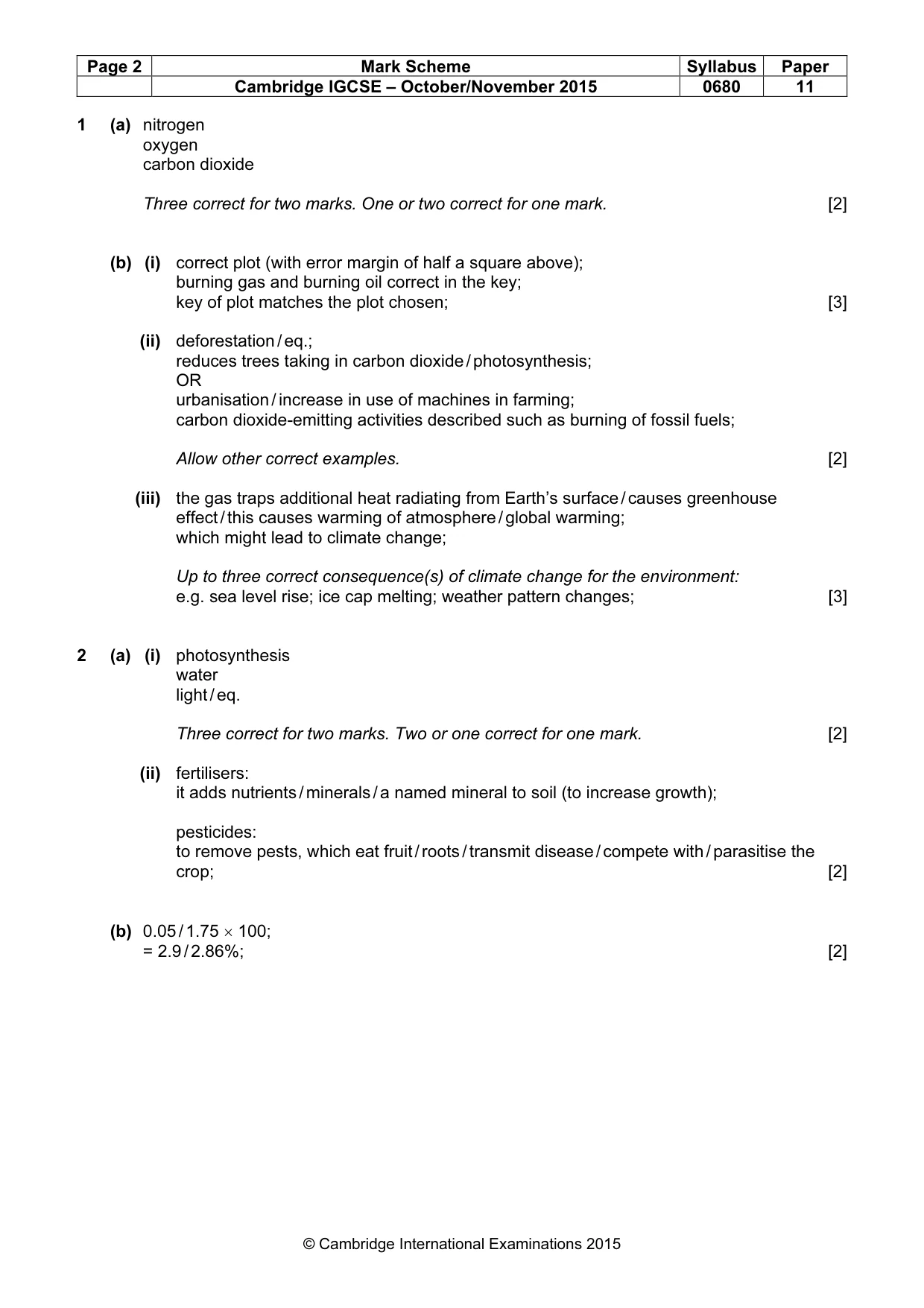
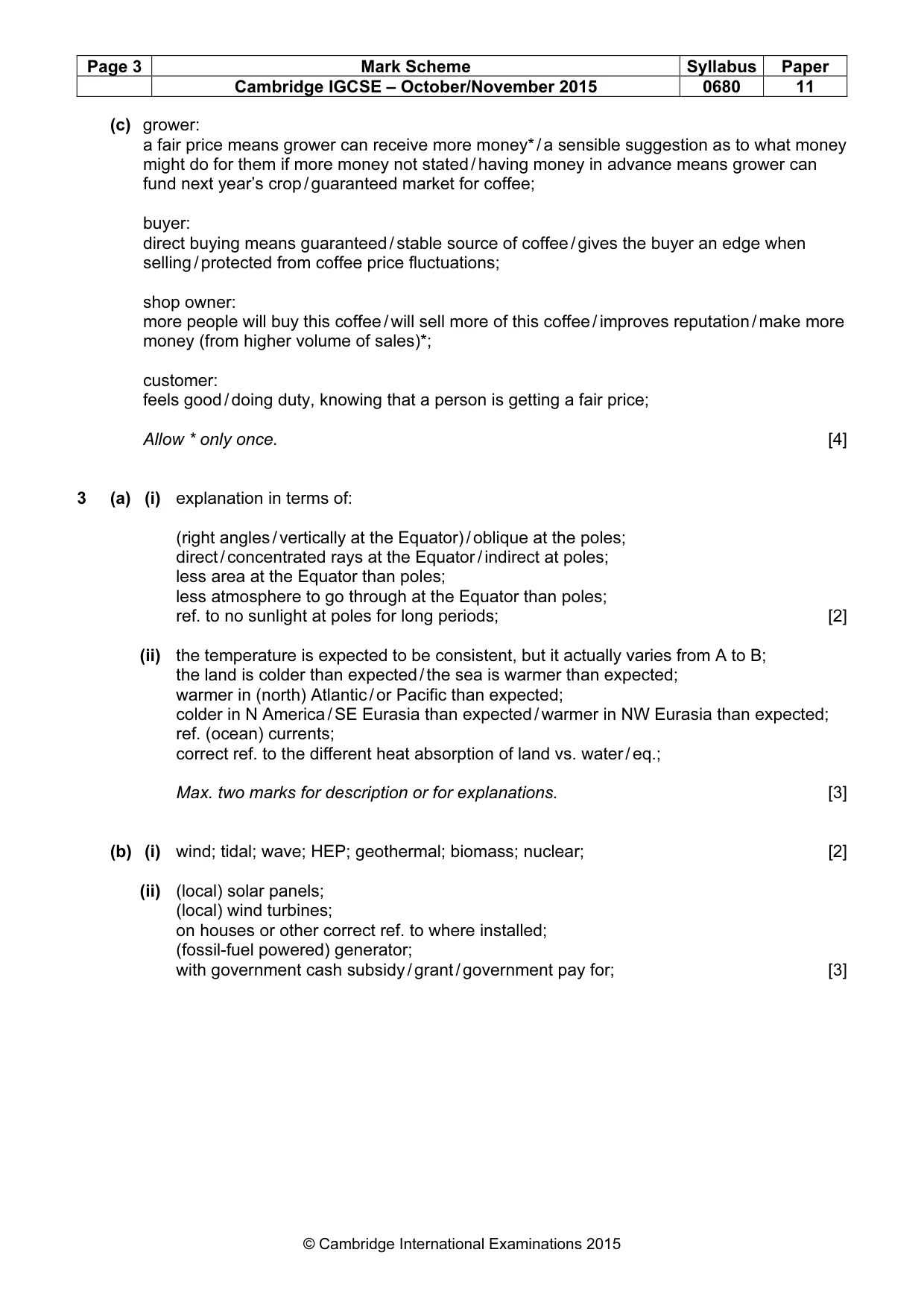
Page 2 Mark Scheme Syllabus Paper Cambridge IGCSE – October/November 2015 0680 11 © Cambridge International Examinations 2015 1 (a) nitrogen oxygen carbon dioxide Three correct for two marks. One or two correct for one mark. [2] (b) (i) correct plot (with error margin of half a square above); burning gas and burning oil correct in the key; key of plot matches the plot chosen; [3] (ii) deforestation / eq.; reduces trees taking in carbon dioxide / photosynthesis; OR urbanisation / increase in use of machines in farming; carbon dioxide-emitting activities described such as burning of fossil fuels; Allow other correct examples. [2] (iii) the gas traps additional heat radiating from Earth’s surface / causes greenhouse effect / this causes warming of atmosphere / global warming; which might lead to climate change; Up to three correct consequence(s) of climate change for the environment: e.g. sea level rise; ice cap melting; weather pattern changes; [3] 2 (a) (i) photosynthesis water light / eq. Three correct for two marks. Two or one correct for one mark. [2] (ii) fertilisers: it adds nutrients / minerals / a named mineral to soil (to increase growth); pesticides: to remove pests, which eat fruit / roots / transmit disease / compete with / parasitise the crop; [2] (b) 0.05 / 1.75 × 100; = 2.9 / 2.86%; [2]
Mark scheme, page 3
Page 3 Mark Scheme Syllabus Paper Cambridge IGCSE – October/November 2015 0680 11 © Cambridge International Examinations 2015 (c) grower: a fair price means grower can receive more money* / a sensible suggestion as to what money might do for them if more money not stated / having money in advance means grower can fund next year’s crop / guaranteed market for coffee; buyer: direct buying means guaranteed / stable source of coffee / gives the buyer an edge when selling / protected from coffee price fluctuations; shop owner: more people will buy this coffee / will sell more of this coffee / improves reputation / make more money (from higher volume of sales)*; customer: feels good / doing duty, knowing that a person is getting a fair price; Allow * only once. [4] 3 (a) (i) explanation in terms of: (right angles / vertically at the Equator) / oblique at the poles; direct / concentrated rays at the Equator / indirect at poles; less area at the Equator than poles; less atmosphere to go through at the Equator than poles; ref. to no sunlight at poles for long periods; [2] (ii) the temperature is expected to be consistent, but it actually varies from A to B; the land is colder than expected / the sea is warmer than expected; warmer in (north) Atlantic / or Pacific than expected; colder in N America / SE Eurasia than expected / warmer in NW Eurasia than expected; ref. (ocean) currents; correct ref. to the different heat absorption of land vs. water / eq.; Max. two marks for description or for explanations. [3] (b) (i) wind; tidal; wave; HEP; geothermal; biomass; nuclear; [2] (ii) (local) solar panels; (local) wind turbines; on houses or other correct ref. to where installed; (fossil-fuel powered) generator; with government cash subsidy / grant / government pay for; [3]
Mark scheme, page 4
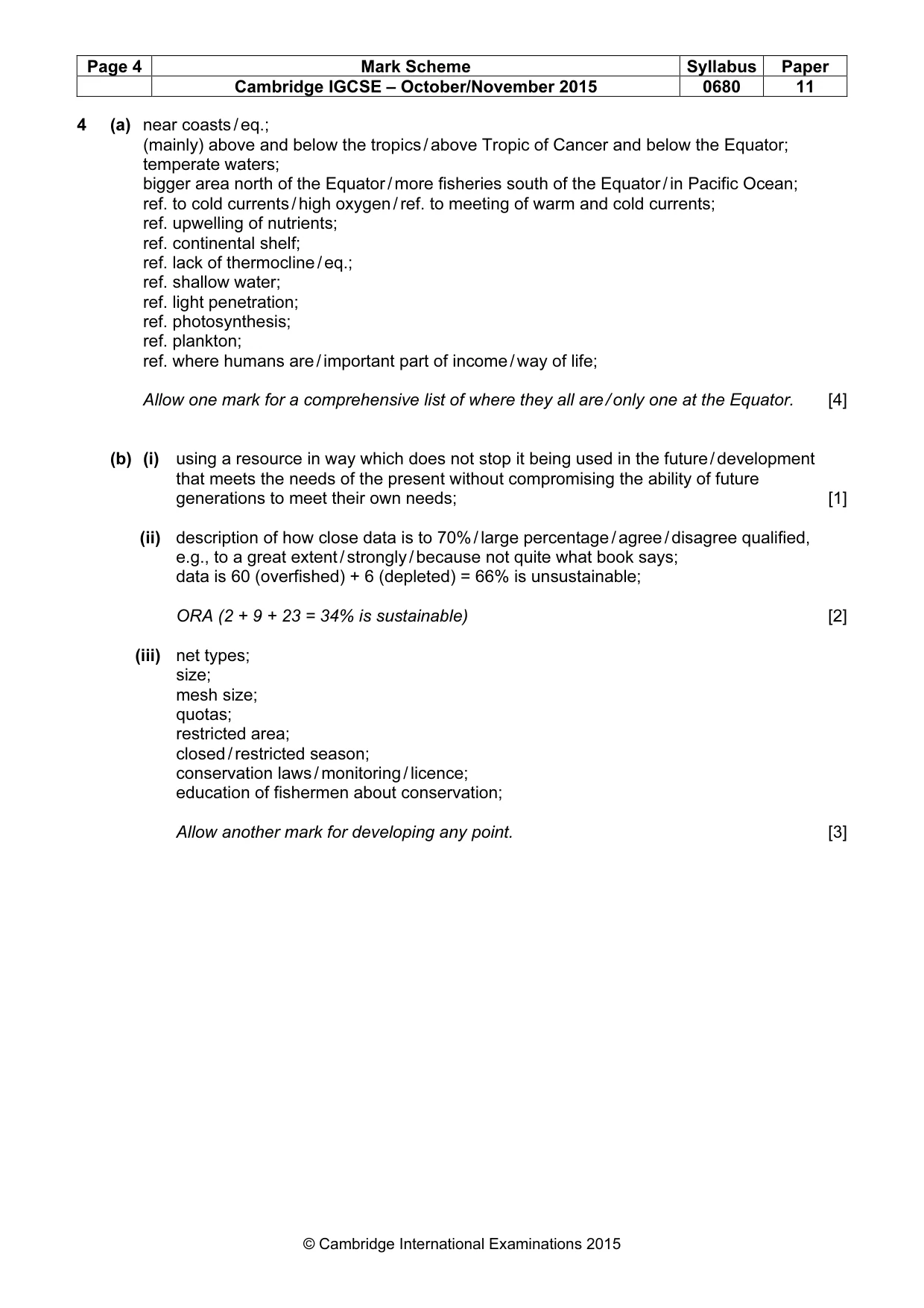
Page 4 Mark Scheme Syllabus Paper Cambridge IGCSE – October/November 2015 0680 11 © Cambridge International Examinations 2015 4 (a) near coasts / eq.; (mainly) above and below the tropics / above Tropic of Cancer and below the Equator; temperate waters; bigger area north of the Equator / more fisheries south of the Equator / in Pacific Ocean; ref. to cold currents / high oxygen / ref. to meeting of warm and cold currents; ref. upwelling of nutrients; ref. continental shelf; ref. lack of thermocline / eq.; ref. shallow water; ref. light penetration; ref. photosynthesis; ref. plankton; ref. where humans are / important part of income / way of life; Allow one mark for a comprehensive list of where they all are / only one at the Equator. [4] (b) (i) using a resource in way which does not stop it being used in the future / development that meets the needs of the present without compromising the ability of future generations to meet their own needs; [1] (ii) description of how close data is to 70% / large percentage / agree / disagree qualified, e.g., to a great extent / strongly / because not quite what book says; data is 60 (overfished) + 6 (depleted) = 66% is unsustainable; ORA (2 + 9 + 23 = 34% is sustainable) [2] (iii) net types; size; mesh size; quotas; restricted area; closed / restricted season; conservation laws / monitoring / licence; education of fishermen about conservation; Allow another mark for developing any point. [3]
Mark scheme, page 5
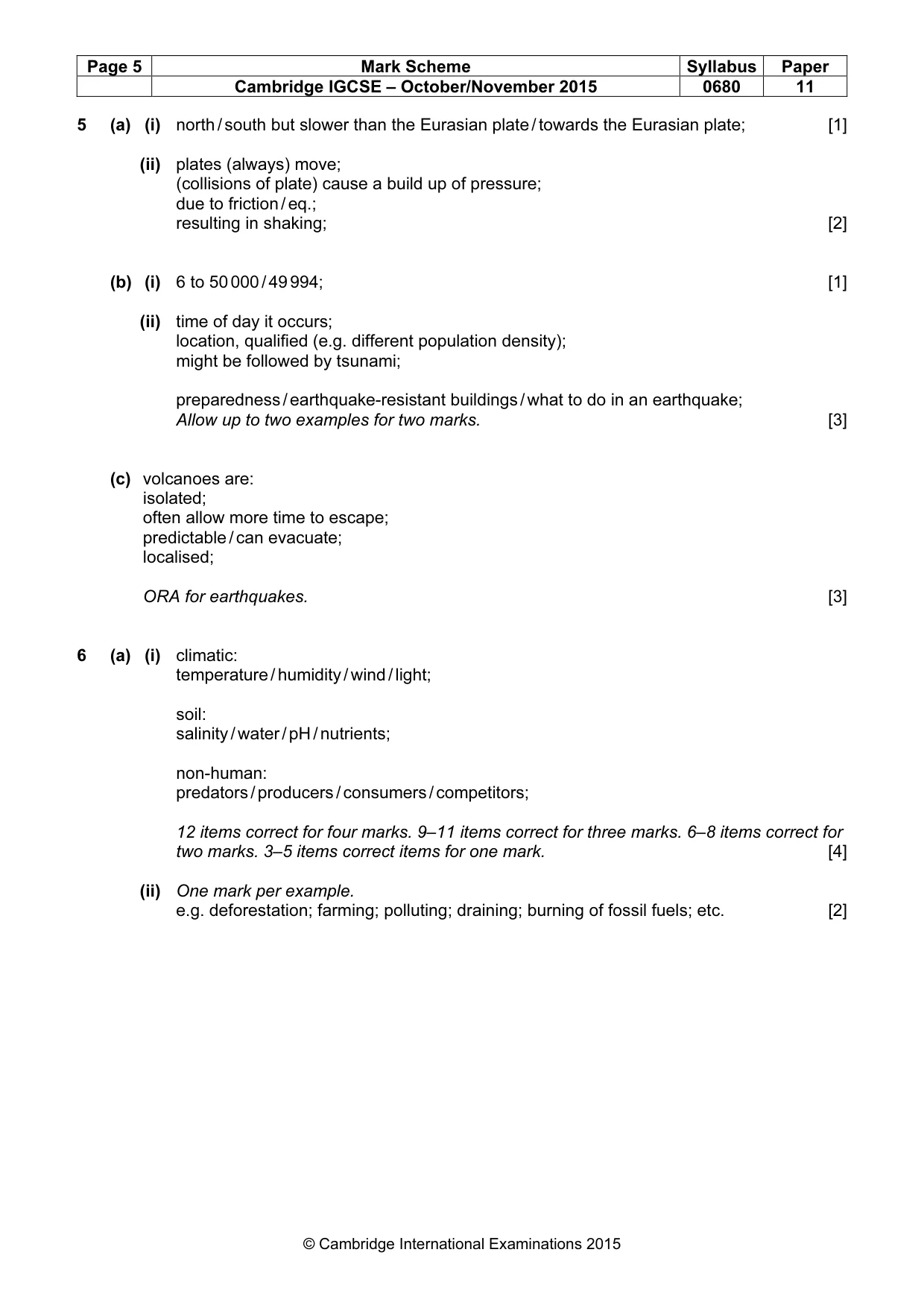
Page 5 Mark Scheme Syllabus Paper Cambridge IGCSE – October/November 2015 0680 11 © Cambridge International Examinations 2015 5 (a) (i) north / south but slower than the Eurasian plate / towards the Eurasian plate; [1] (ii) plates (always) move; (collisions of plate) cause a build up of pressure; due to friction / eq.; resulting in shaking; [2] (b) (i) 6 to 50 000 / 49 994; [1] (ii) time of day it occurs; location, qualified (e.g. different population density); might be followed by tsunami; preparedness / earthquake-resistant buildings / what to do in an earthquake; Allow up to two examples for two marks. [3] (c) volcanoes are: isolated; often allow more time to escape; predictable / can evacuate; localised; ORA for earthquakes. [3] 6 (a) (i) climatic: temperature / humidity / wind / light; soil: salinity / water / pH / nutrients; non-human: predators / producers / consumers / competitors; 12 items correct for four marks. 9–11 items correct for three marks. 6–8 items correct for two marks. 3–5 items correct items for one mark. [4] (ii) One mark per example. e.g. deforestation; farming; polluting; draining; burning of fossil fuels; etc. [2]
Mark scheme, page 6
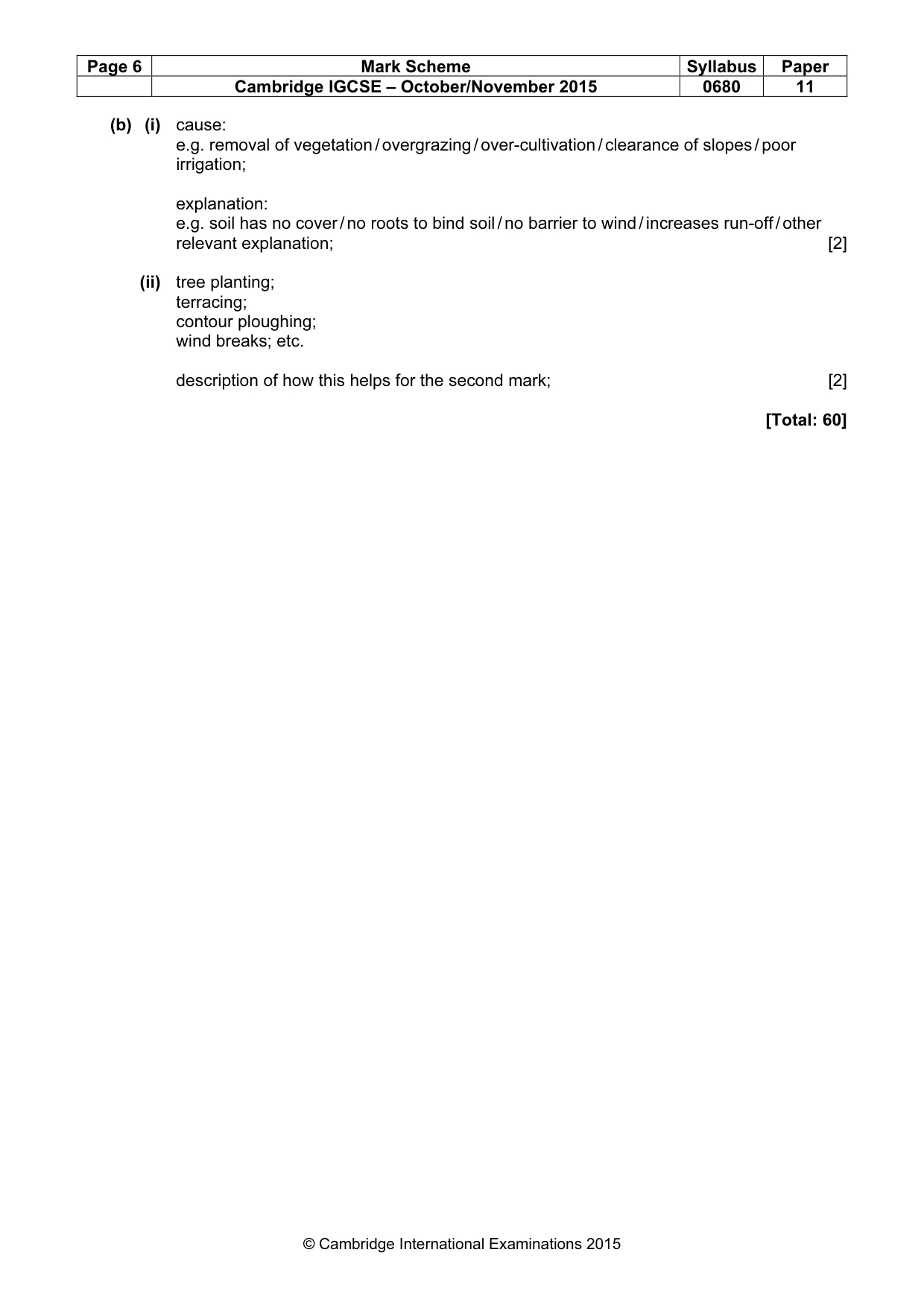
Page 6 Mark Scheme Syllabus Paper Cambridge IGCSE – October/November 2015 0680 11 © Cambridge International Examinations 2015 (b) (i) cause: e.g. removal of vegetation / overgrazing / over-cultivation / clearance of slopes / poor irrigation; explanation: e.g. soil has no cover / no roots to bind soil / no barrier to wind / increases run-off / other relevant explanation; [2] (ii) tree planting; terracing; contour ploughing; wind breaks; etc. description of how this helps for the second mark; [2] [Total: 60]
What you needed in this session
Cambridge’s own grade thresholds for 2015 Oct/Nov, Paper 1 · Variant 1. A higher threshold means an easier paper — the bar moves with how the cohort did.