Cambridge IGCSE Environmental Management 0680 — 2015 May/June Paper 1 · Variant 2
0680/12/M/J/15 · 60 marks · ≈68 min
The question paper and its mark scheme, free to read here and free to download. This is Cambridge’s own paper, exactly as it was sat.
Question paper16 pages

Mark scheme5 pages
Answers below. Sit the paper first if you are practising.
Paper as text
Question paper, page 1
This document consists of 15 printed pages and 1 blank page. DC (CW/CGW) 94239/3 © UCLES 2015 [Turn over Cambridge International Examinations Cambridge International General Certificate of Secondary Education * 2 5 6 8 1 1 6 6 7 5 * ENVIRONMENTAL MANAGEMENT 0680/12 Paper 1 May/June 2015 1 hour 30 minutes Candidates answer on the Question Paper. No Additional Materials are required. READ THESE INSTRUCTIONS FIRST Write your Centre number, candidate number and name on all the work you hand in. Write in dark blue or black pen. You may use an HB pencil for any diagrams or graphs. Do not use staples, paper clips, glue or correction fluid. DO NOT WRITE IN ANY BARCODES. Answer all questions. Electronic calculators may be used. You may lose marks if you do not show your working or if you do not use appropriate units. At the end of the examination, fasten all your work securely together. The number of marks is given in brackets [ ] at the end of each question or part question.
Question paper, page 2
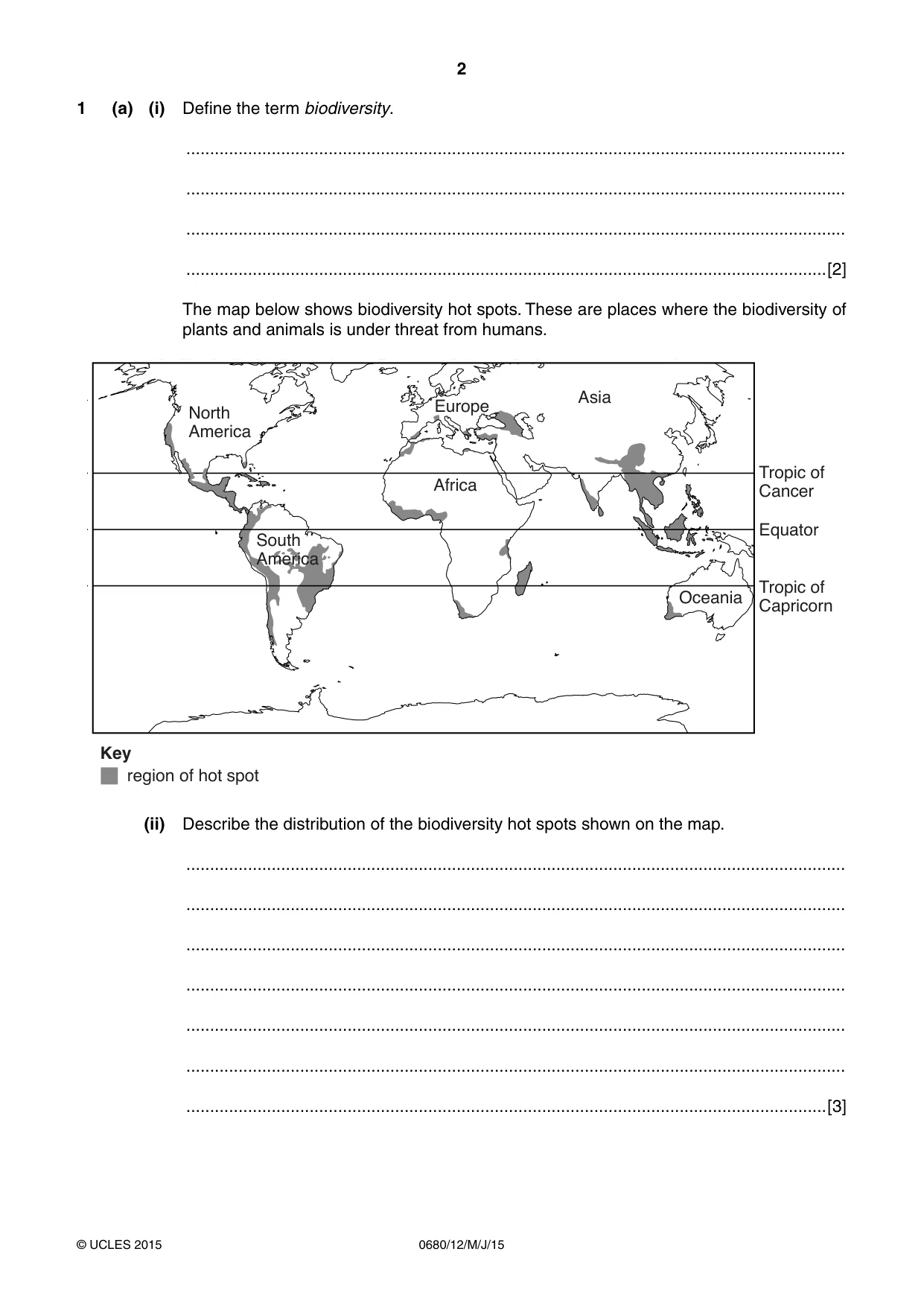
2 0680/12/M/J/15 © UCLES 2015 1 (a) (i) Define the term biodiversity. … … … …[2] The map below shows biodiversity hot spots. These are places where the biodiversity of plants and animals is under threat from humans. North America region of hot spot Key South America Africa Europe Asia Tropic of Cancer Tropic of Capricorn Equator Oceania (ii) Describe the distribution of the biodiversity hot spots shown on the map. … … … … … … …[3]
Question paper, page 3
3 0680/12/M/J/15 © UCLES 2015 [Turn over (b) (i) Biodiversity is being lost around the world. State two reasons why this is a problem. … … … …[2] (ii) Describe a strategy for conservation of biodiversity. … … … … … …[3]
Question paper, page 4
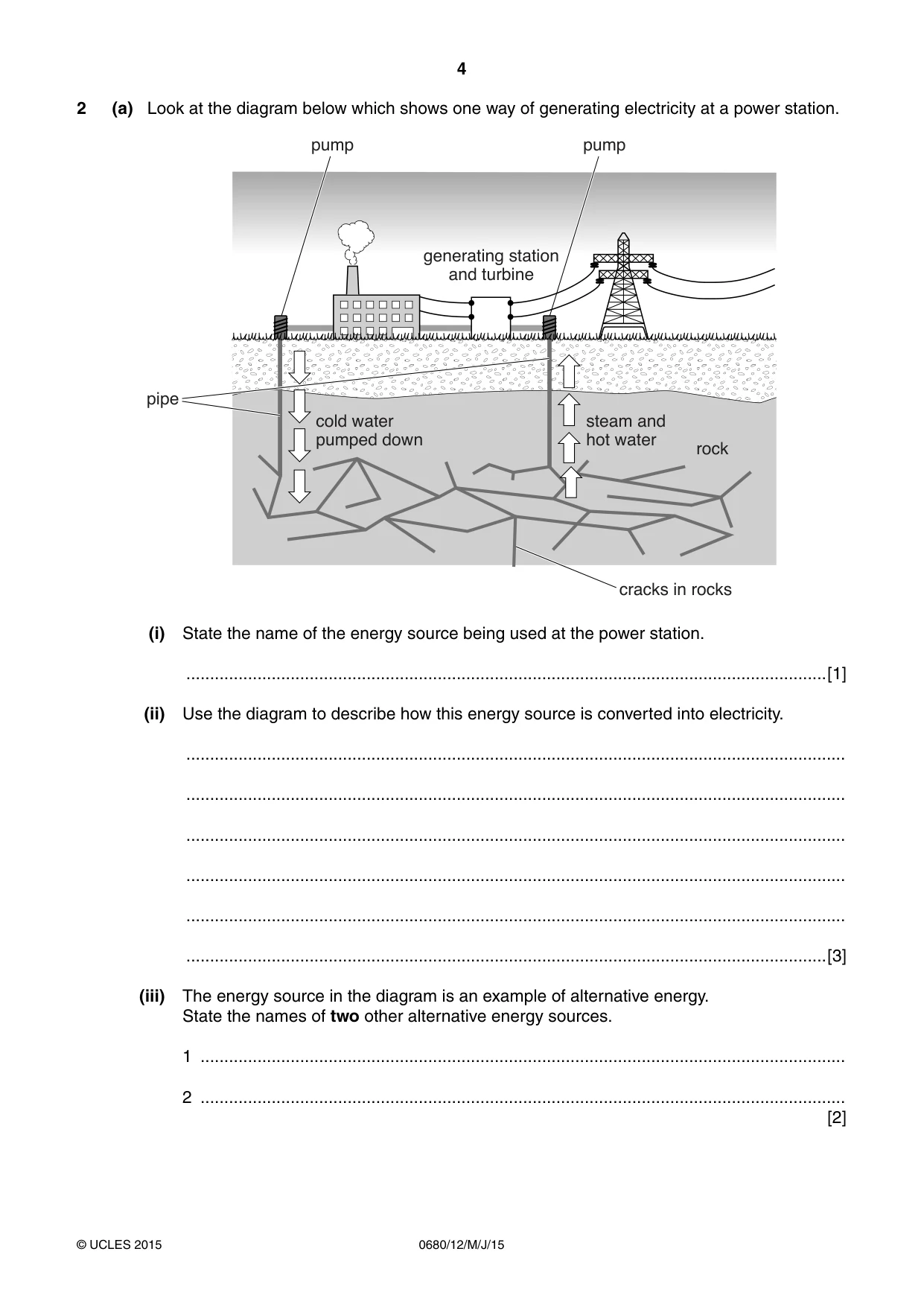
4 0680/12/M/J/15 © UCLES 2015 2 (a) Look at the diagram below which shows one way of generating electricity at a power station. pump pipe rock cracks in rocks steam and hot water cold water pumped down pump generating station and turbine (i) State the name of the energy source being used at the power station. …[1] (ii) Use the diagram to describe how this energy source is converted into electricity. … … … … … …[3] (iii) The energy source in the diagram is an example of alternative energy. State the names of two other alternative energy sources. 1 … 2 … [2]
Question paper, page 5
5 0680/12/M/J/15 © UCLES 2015 [Turn over (b) (i) Define the term alternative energy. … …[1] (ii) Suggest reasons for needing alternative energy sources. … … … … … …[3]
Question paper, page 6
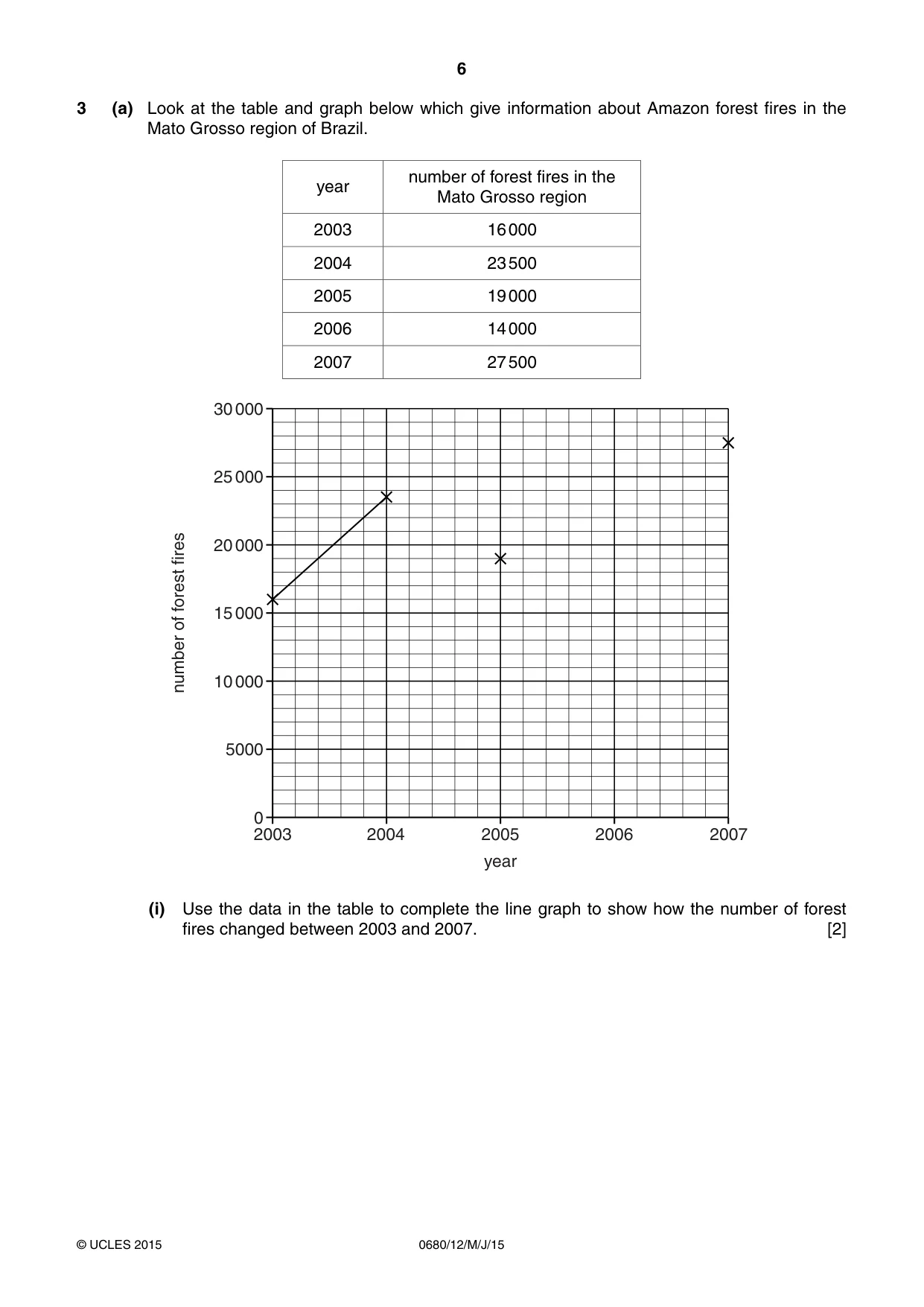
6 0680/12/M/J/15 © UCLES 2015 3 (a) Look at the table and graph below which give information about Amazon forest fires in the Mato Grosso region of Brazil. year number of forest fires in the Mato Grosso region 2003 16 000 2004 23 500 2005 19 000 2006 14 000 2007 27 500 30 000 25 000 20 000 number of forest fires 15 000 10 000 5000 2003 2004 2005 year 2006 2007 0 (i) Use the data in the table to complete the line graph to show how the number of forest fires changed between 2003 and 2007. [2]
Question paper, page 7
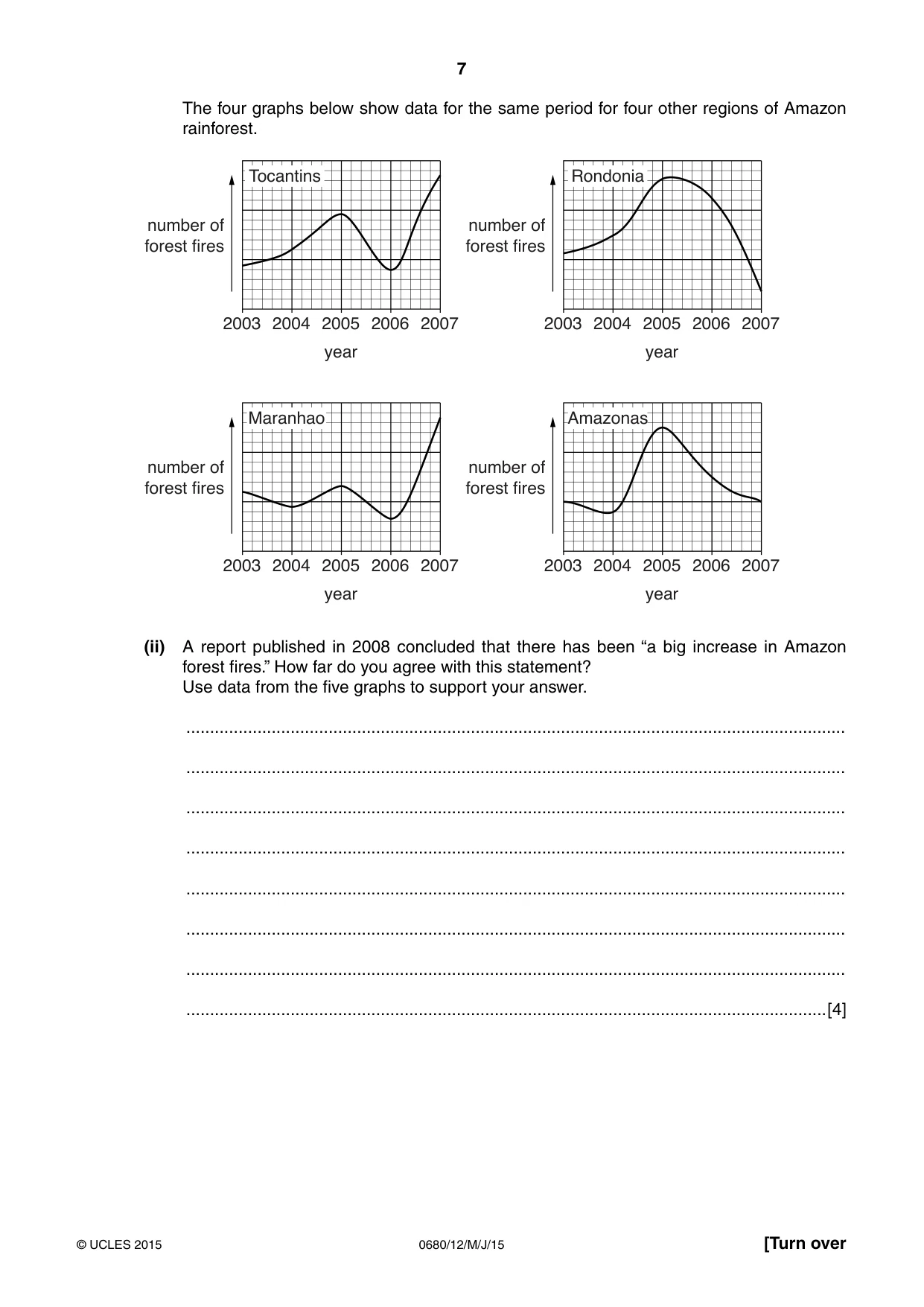
7 0680/12/M/J/15 © UCLES 2015 [Turn over The four graphs below show data for the same period for four other regions of Amazon rainforest. 2003 2004 2005 2006 2007 Tocantins 2003 number of forest fires number of forest fires number of forest fires 2004 2005 2006 2007 Rondonia 2003 2004 2005 2006 2007 Maranhao number of forest fires 2003 2004 2005 year year year year 2006 2007 Amazonas (ii) A report published in 2008 concluded that there has been “a big increase in Amazon forest fires.” How far do you agree with this statement? Use data from the five graphs to support your answer. … … … … … … … …[4]
Question paper, page 8
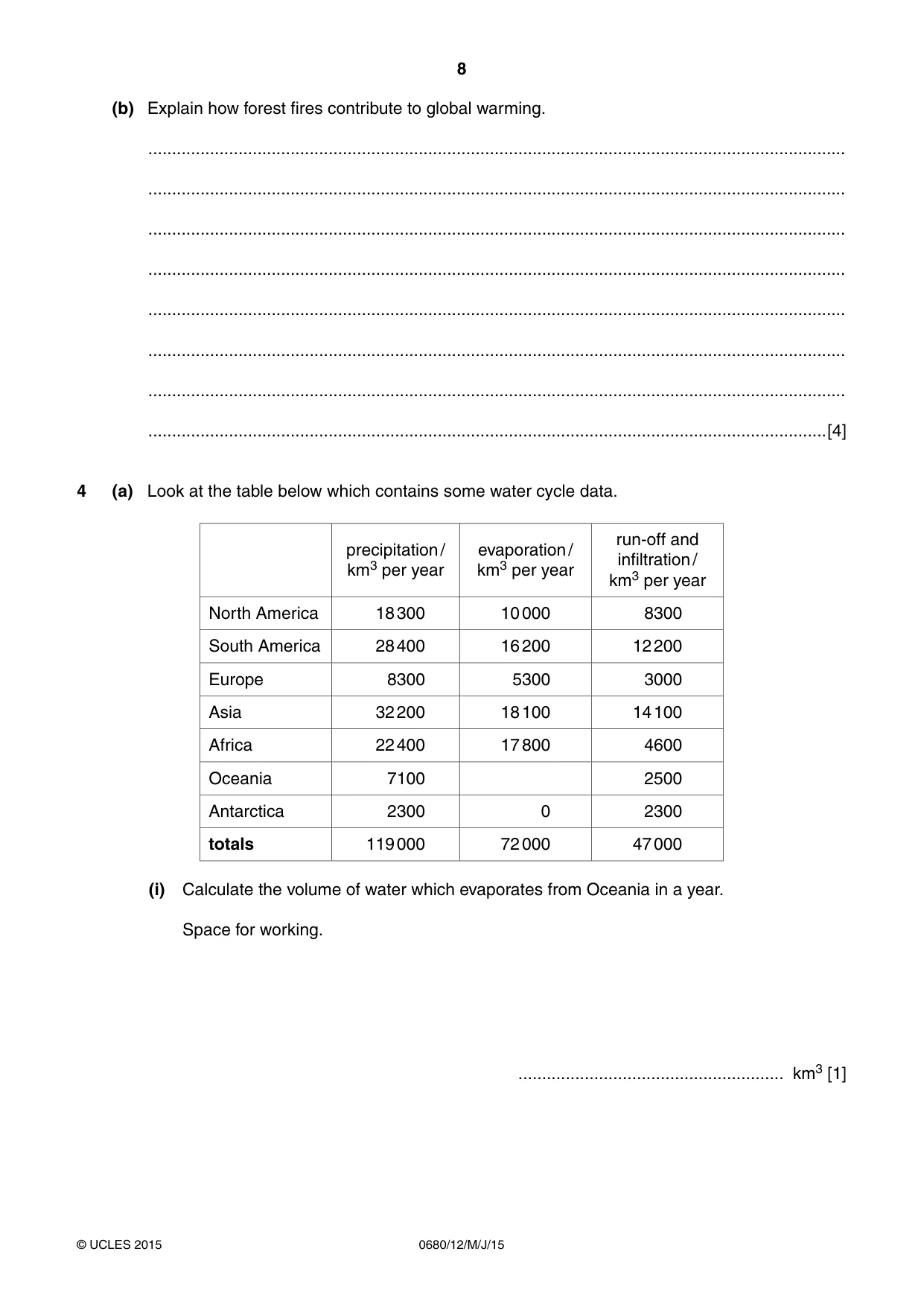
8 0680/12/M/J/15 © UCLES 2015 (b) Explain how forest fires contribute to global warming. … … … … … … … …[4] 4 (a) Look at the table below which contains some water cycle data. precipitation / km3 per year evaporation / km3 per year run-off and infiltration / km3 per year North America 18 300 10 000 8300 South America 28 400 16 200 12 200 Europe 8300 5300 3000 Asia 32 200 18 100 14 100 Africa 22 400 17 800 4600 Oceania 7100 2500 Antarctica 2300 0 2300 totals 119 000 72 000 47 000 (i) Calculate the volume of water which evaporates from Oceania in a year. Space for working. … km3 [1]
Question paper, page 9
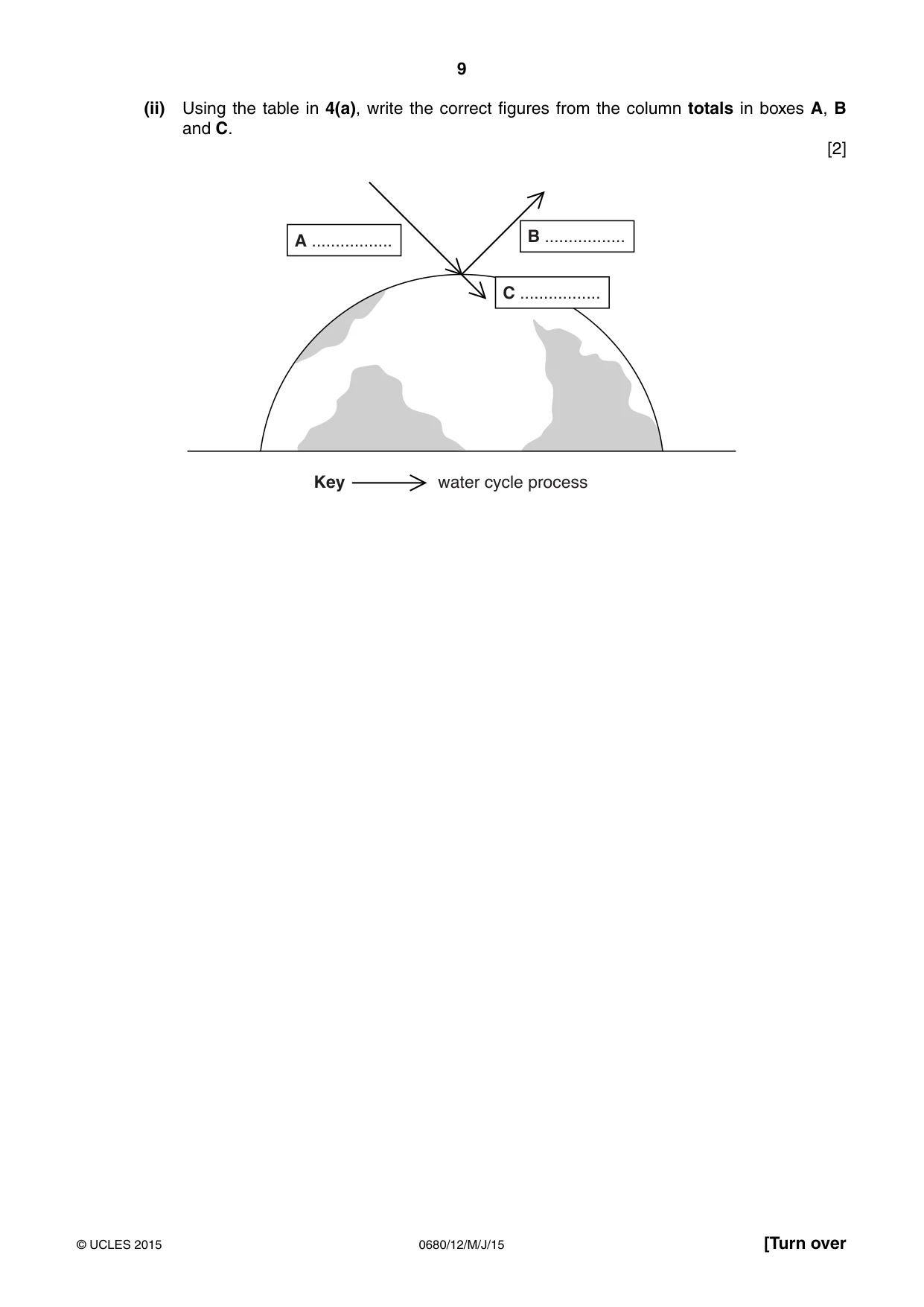
9 0680/12/M/J/15 © UCLES 2015 [Turn over (ii) Using the table in 4(a), write the correct figures from the column totals in boxes A, B and C. [2] A … B … Key water cycle process C …
Question paper, page 10
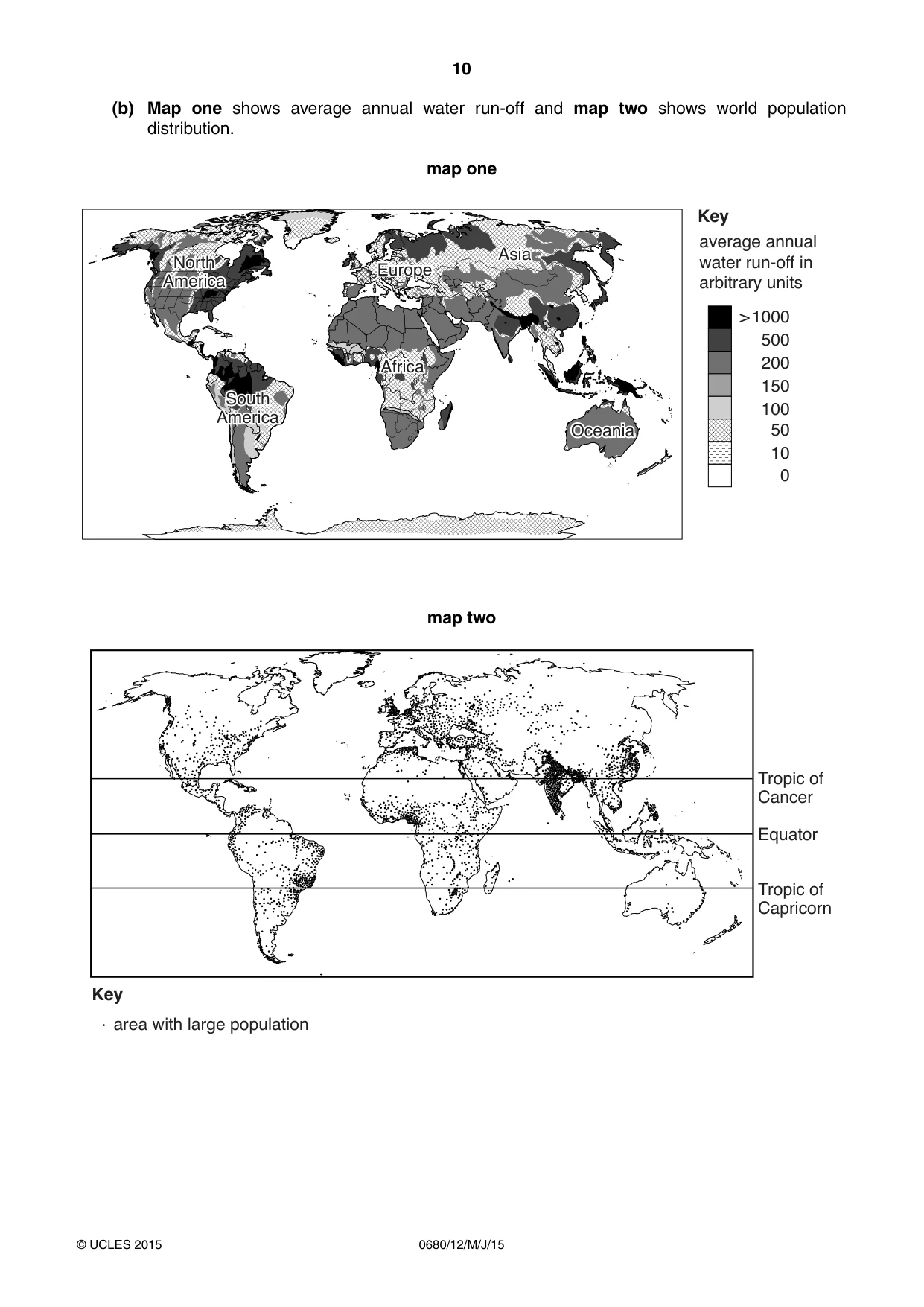
10 0680/12/M/J/15 © UCLES 2015 (b) Map one shows average annual water run-off and map two shows world population distribution. map one average annual water run-off in arbitrary units South America Key > 1000 500 200 150 100 50 10 0 South America North America North America Europe Europe Asia Asia Africa Africa Oceania Oceania map two Tropic of Cancer Tropic of Capricorn Equator Key area with large population
Question paper, page 11
11 0680/12/M/J/15 © UCLES 2015 [Turn over A textbook states, “Water isn’t always where you need it most.” (i) Use the maps to discuss how far you agree with the textbook statement. … … … … … … … …[4] (ii) Explain why, in some parts of the world, water quality is better in urban areas than in rural areas. … … … … … …[3]
Question paper, page 12
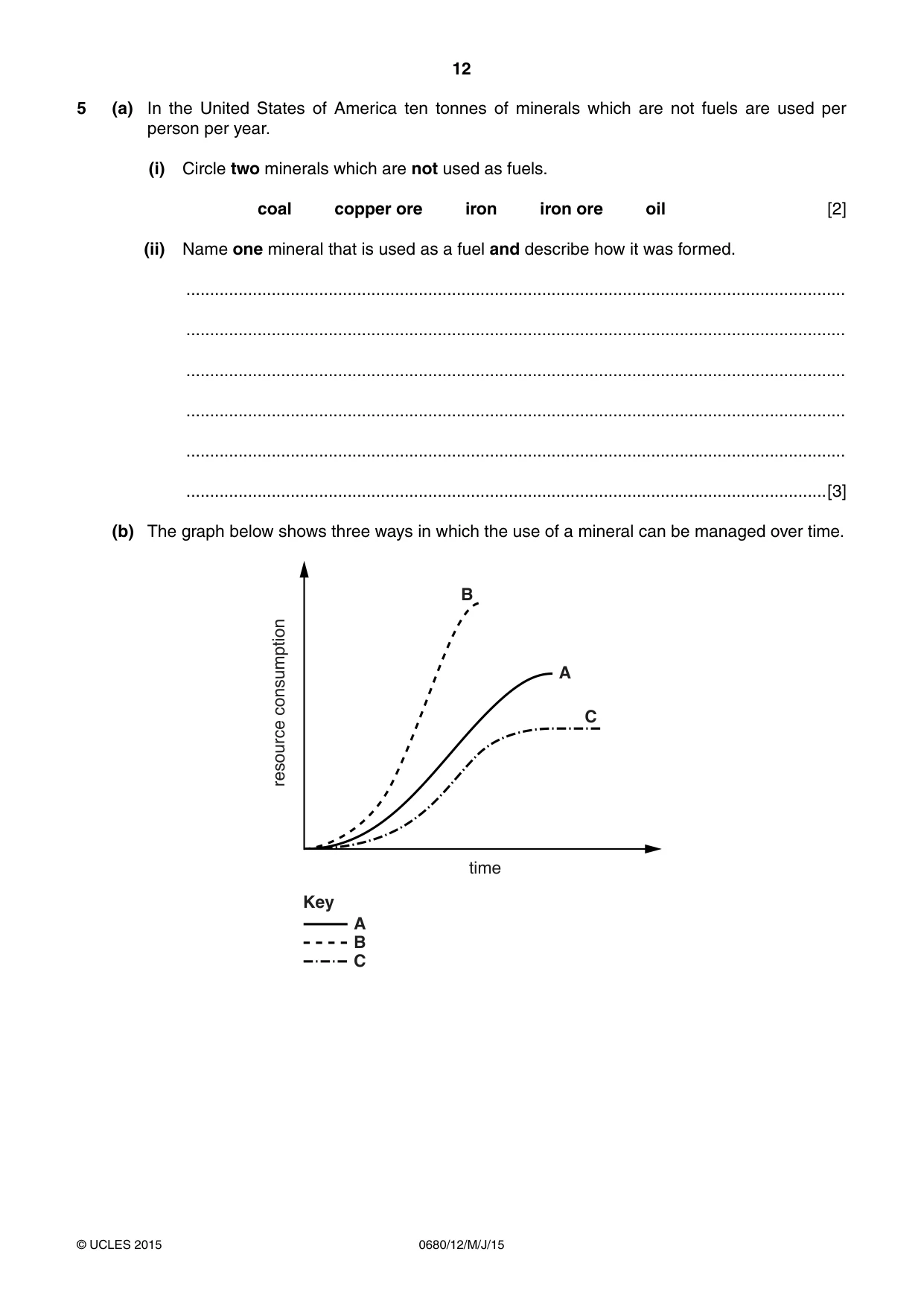
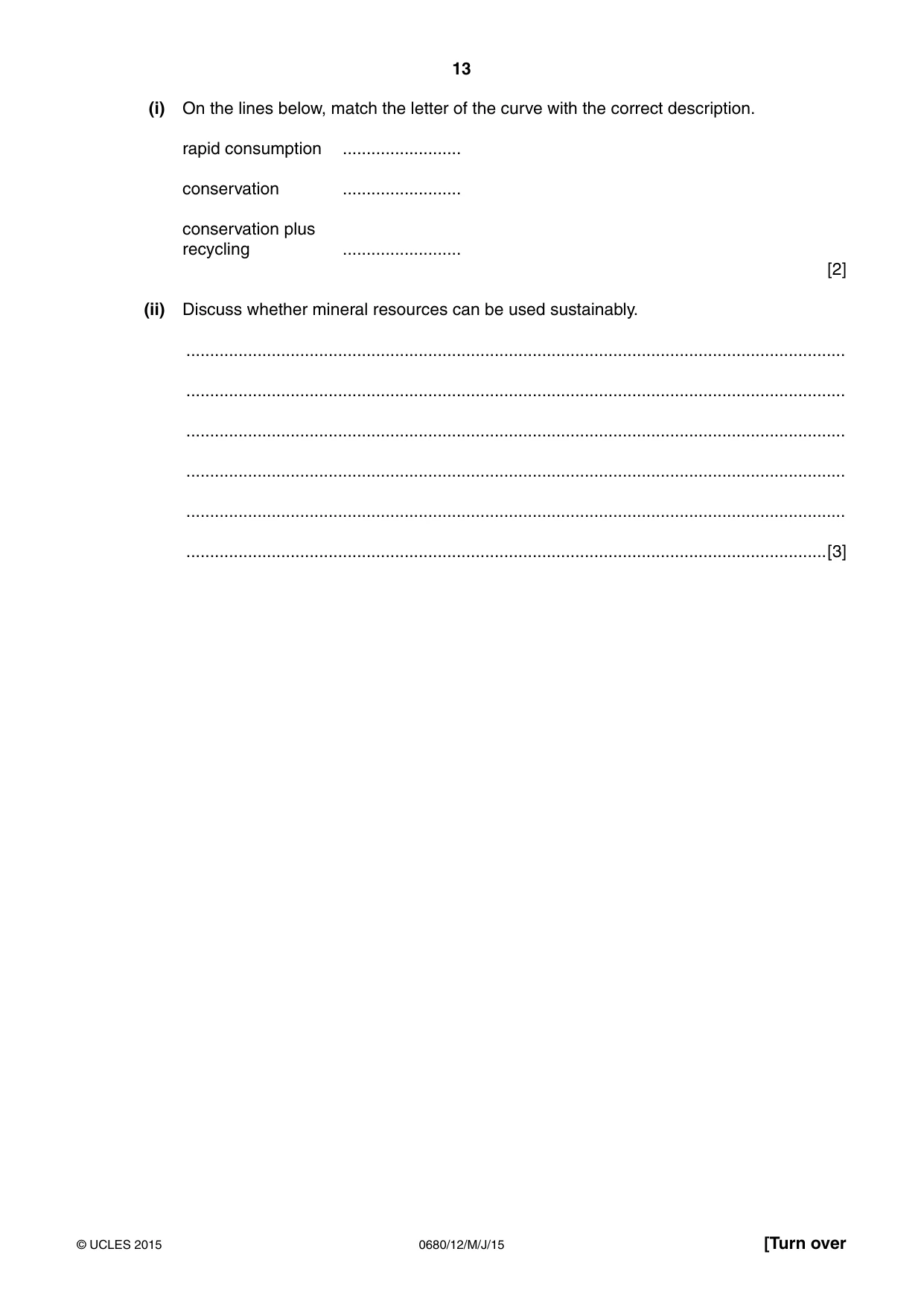
12 0680/12/M/J/15 © UCLES 2015 5 (a) In the United States of America ten tonnes of minerals which are not fuels are used per person per year. (i) Circle two minerals which are not used as fuels. coal copper ore iron iron ore oil [2] (ii) Name one mineral that is used as a fuel and describe how it was formed. … … … … … …[3] (b) The graph below shows three ways in which the use of a mineral can be managed over time. time Key A B C resource consumption B A C
Question paper, page 13
13 0680/12/M/J/15 © UCLES 2015 [Turn over (i) On the lines below, match the letter of the curve with the correct description. rapid consumption … conservation … conservation plus recycling … [2] (ii) Discuss whether mineral resources can be used sustainably. … … … … … …[3]
Question paper, page 14
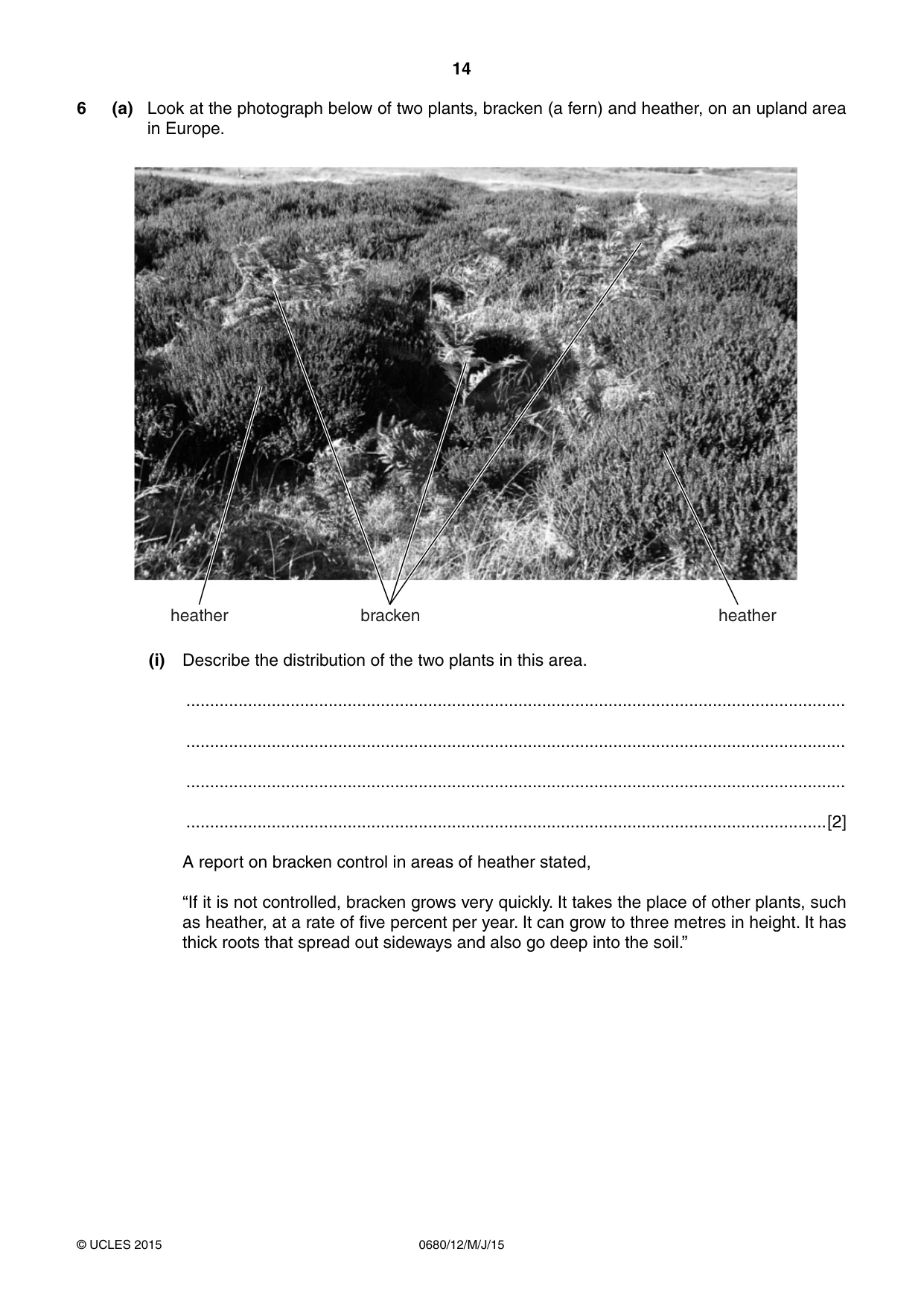
14 0680/12/M/J/15 © UCLES 2015 6 (a) Look at the photograph below of two plants, bracken (a fern) and heather, on an upland area in Europe. heather heather bracken (i) Describe the distribution of the two plants in this area. … … … …[2] A report on bracken control in areas of heather stated, “If it is not controlled, bracken grows very quickly. It takes the place of other plants, such as heather, at a rate of five percent per year. It can grow to three metres in height. It has thick roots that spread out sideways and also go deep into the soil.”
Question paper, page 15
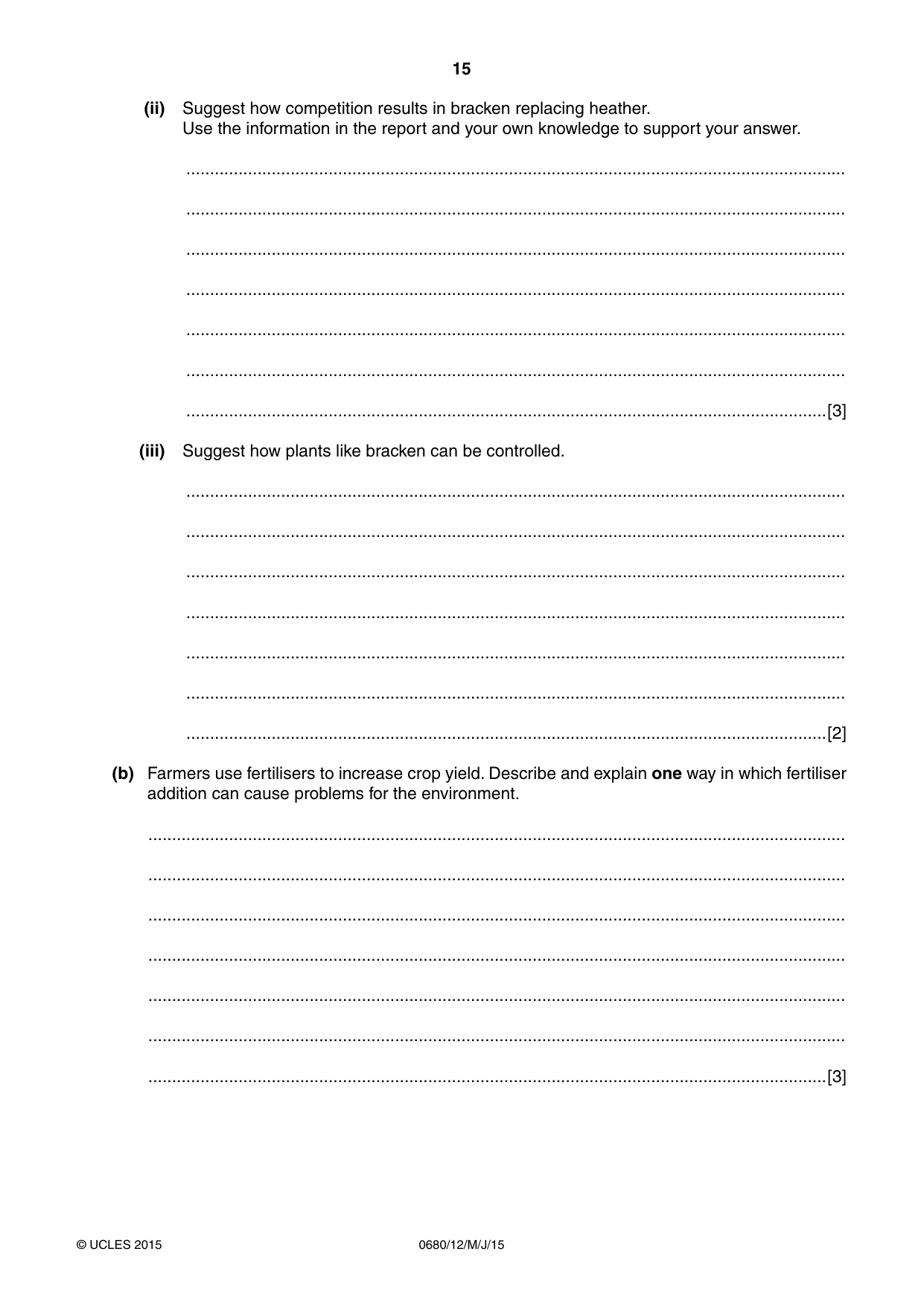
15 0680/12/M/J/15 © UCLES 2015 (ii) Suggest how competition results in bracken replacing heather. Use the information in the report and your own knowledge to support your answer. … … … … … … …[3] (iii) Suggest how plants like bracken can be controlled. … … … … … … …[2] (b) Farmers use fertilisers to increase crop yield. Describe and explain one way in which fertiliser addition can cause problems for the environment. … … … … … … …[3]
Question paper, page 16
16 0680/12/M/J/15 © UCLES 2015 Permission to reproduce items where third-party owned material protected by copyright is included has been sought and cleared where possible. Every reasonable effort has been made by the publisher (UCLES) to trace copyright holders, but if any items requiring clearance have unwittingly been included, the publisher will be pleased to make amends at the earliest possible opportunity. To avoid the issue of disclosure of answer-related information to candidates, all copyright acknowledgements are reproduced online in the Cambridge International Examinations Copyright Acknowledgements Booklet. This is produced for each series of examinations and is freely available to download at www.cie.org.uk after the live examination series. Cambridge International Examinations is part of the Cambridge Assessment Group. Cambridge Assessment is the brand name of University of Cambridge Local Examinations Syndicate (UCLES), which is itself a department of the University of Cambridge. BLANK PAGE
Mark scheme, page 1
® IGCSE is the registered trademark of Cambridge International Examinations. CAMBRIDGE INTERNATIONAL EXAMINATIONS Cambridge International General Certificate of Secondary Education MARK SCHEME for the May/June 2015 series 0680 ENVIRONMENTAL MANAGEMENT 0680/12 Paper 1, maximum raw mark 60 This mark scheme is published as an aid to teachers and candidates, to indicate the requirements of the examination. It shows the basis on which Examiners were instructed to award marks. It does not indicate the details of the discussions that took place at an Examiners’ meeting before marking began, which would have considered the acceptability of alternative answers. Mark schemes should be read in conjunction with the question paper and the Principal Examiner Report for Teachers. Cambridge will not enter into discussions about these mark schemes. Cambridge is publishing the mark schemes for the May/June 2015 series for most Cambridge IGCSE®, Cambridge International A and AS Level components and some Cambridge O Level components.
Mark scheme, page 2
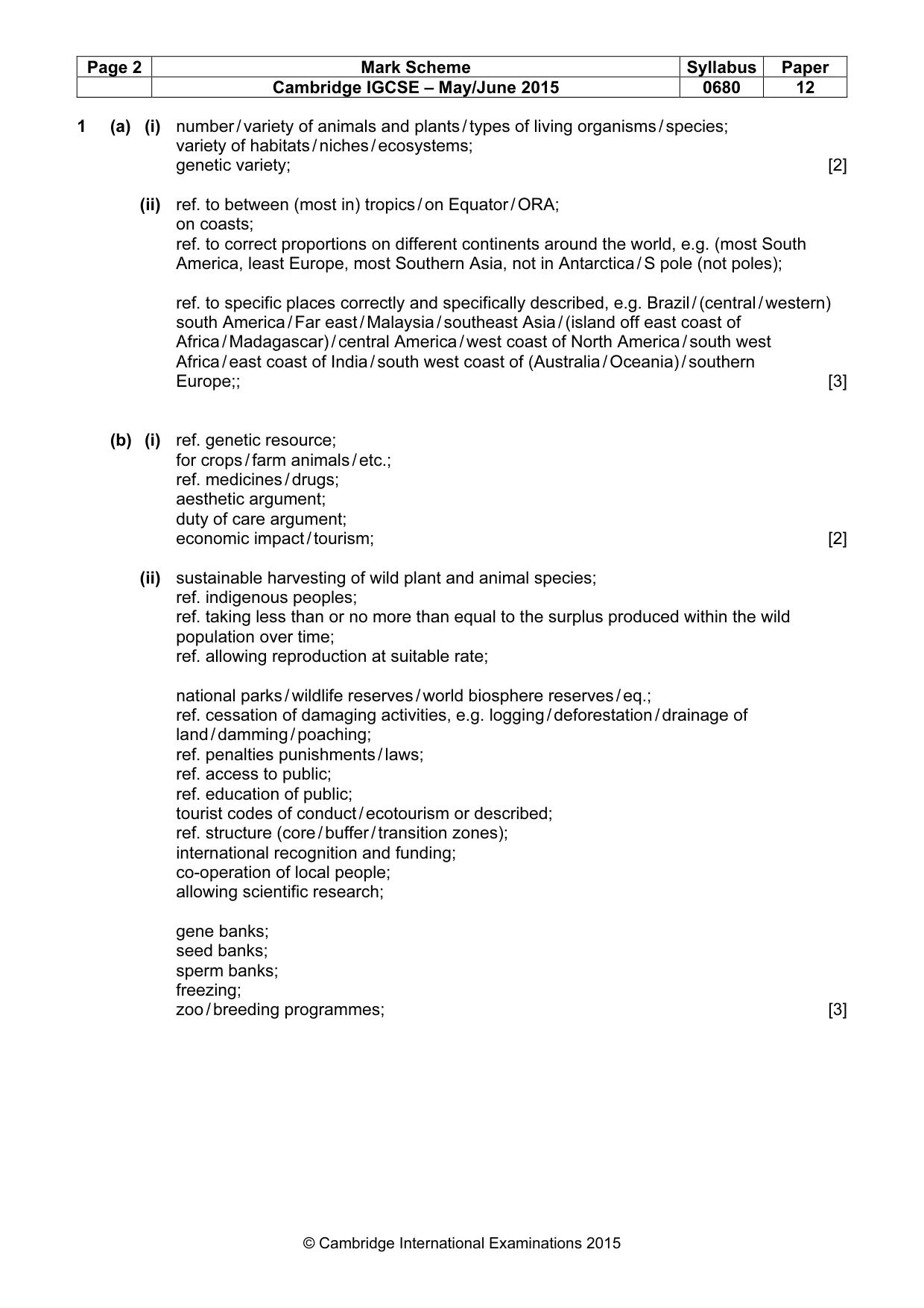
Page 2 Mark Scheme Syllabus Paper Cambridge IGCSE – May/June 2015 0680 12 © Cambridge International Examinations 2015 1 (a) (i) number / variety of animals and plants / types of living organisms / species; variety of habitats / niches / ecosystems; genetic variety; [2] (ii) ref. to between (most in) tropics / on Equator / ORA; on coasts; ref. to correct proportions on different continents around the world, e.g. (most South America, least Europe, most Southern Asia, not in Antarctica / S pole (not poles); ref. to specific places correctly and specifically described, e.g. Brazil / (central / western) south America / Far east / Malaysia / southeast Asia / (island off east coast of Africa / Madagascar) / central America / west coast of North America / south west Africa / east coast of India / south west coast of (Australia / Oceania) / southern Europe;; [3] (b) (i) ref. genetic resource; for crops / farm animals / etc.; ref. medicines / drugs; aesthetic argument; duty of care argument; economic impact / tourism; [2] (ii) sustainable harvesting of wild plant and animal species; ref. indigenous peoples; ref. taking less than or no more than equal to the surplus produced within the wild population over time; ref. allowing reproduction at suitable rate; national parks / wildlife reserves / world biosphere reserves / eq.; ref. cessation of damaging activities, e.g. logging / deforestation / drainage of land / damming / poaching; ref. penalties punishments / laws; ref. access to public; ref. education of public; tourist codes of conduct / ecotourism or described; ref. structure (core / buffer / transition zones); international recognition and funding; co-operation of local people; allowing scientific research; gene banks; seed banks; sperm banks; freezing; zoo / breeding programmes; [3]
Mark scheme, page 3
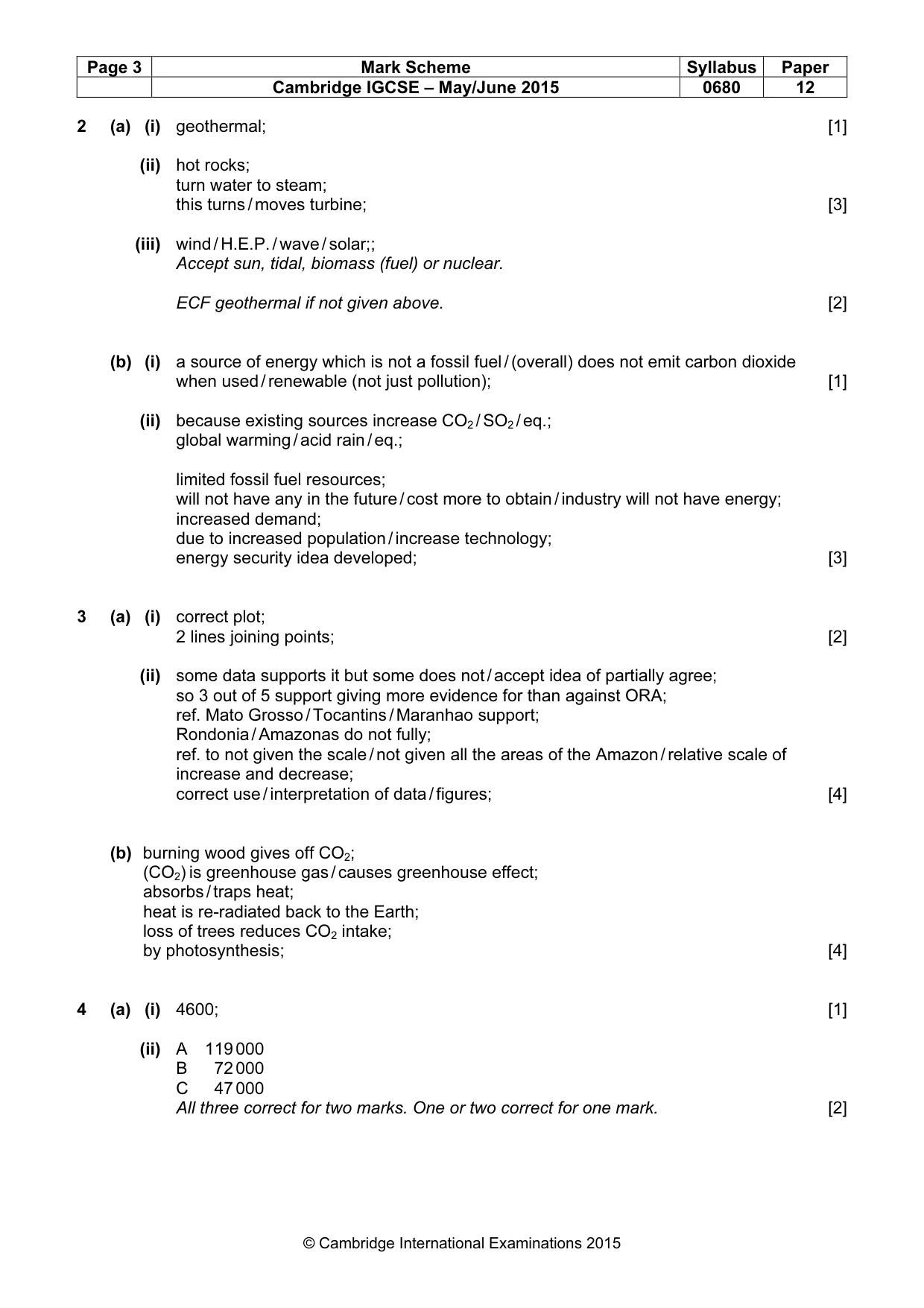
Page 3 Mark Scheme Syllabus Paper Cambridge IGCSE – May/June 2015 0680 12 © Cambridge International Examinations 2015 2 (a) (i) geothermal; [1] (ii) hot rocks; turn water to steam; this turns / moves turbine; [3] (iii) wind / H.E.P. / wave / solar;; Accept sun, tidal, biomass (fuel) or nuclear. ECF geothermal if not given above. [2] (b) (i) a source of energy which is not a fossil fuel / (overall) does not emit carbon dioxide when used / renewable (not just pollution); [1] (ii) because existing sources increase CO2 / SO2 / eq.; global warming / acid rain / eq.; limited fossil fuel resources; will not have any in the future / cost more to obtain / industry will not have energy; increased demand; due to increased population / increase technology; energy security idea developed; [3] 3 (a) (i) correct plot; 2 lines joining points; [2] (ii) some data supports it but some does not / accept idea of partially agree; so 3 out of 5 support giving more evidence for than against ORA; ref. Mato Grosso / Tocantins / Maranhao support; Rondonia / Amazonas do not fully; ref. to not given the scale / not given all the areas of the Amazon / relative scale of increase and decrease; correct use / interpretation of data / figures; [4] (b) burning wood gives off CO2; (CO2) is greenhouse gas / causes greenhouse effect; absorbs / traps heat; heat is re-radiated back to the Earth; loss of trees reduces CO2 intake; by photosynthesis; [4] 4 (a) (i) 4600; [1] (ii) A 119 000 B 72 000 C 47 000 All three correct for two marks. One or two correct for one mark. [2]
Mark scheme, page 4
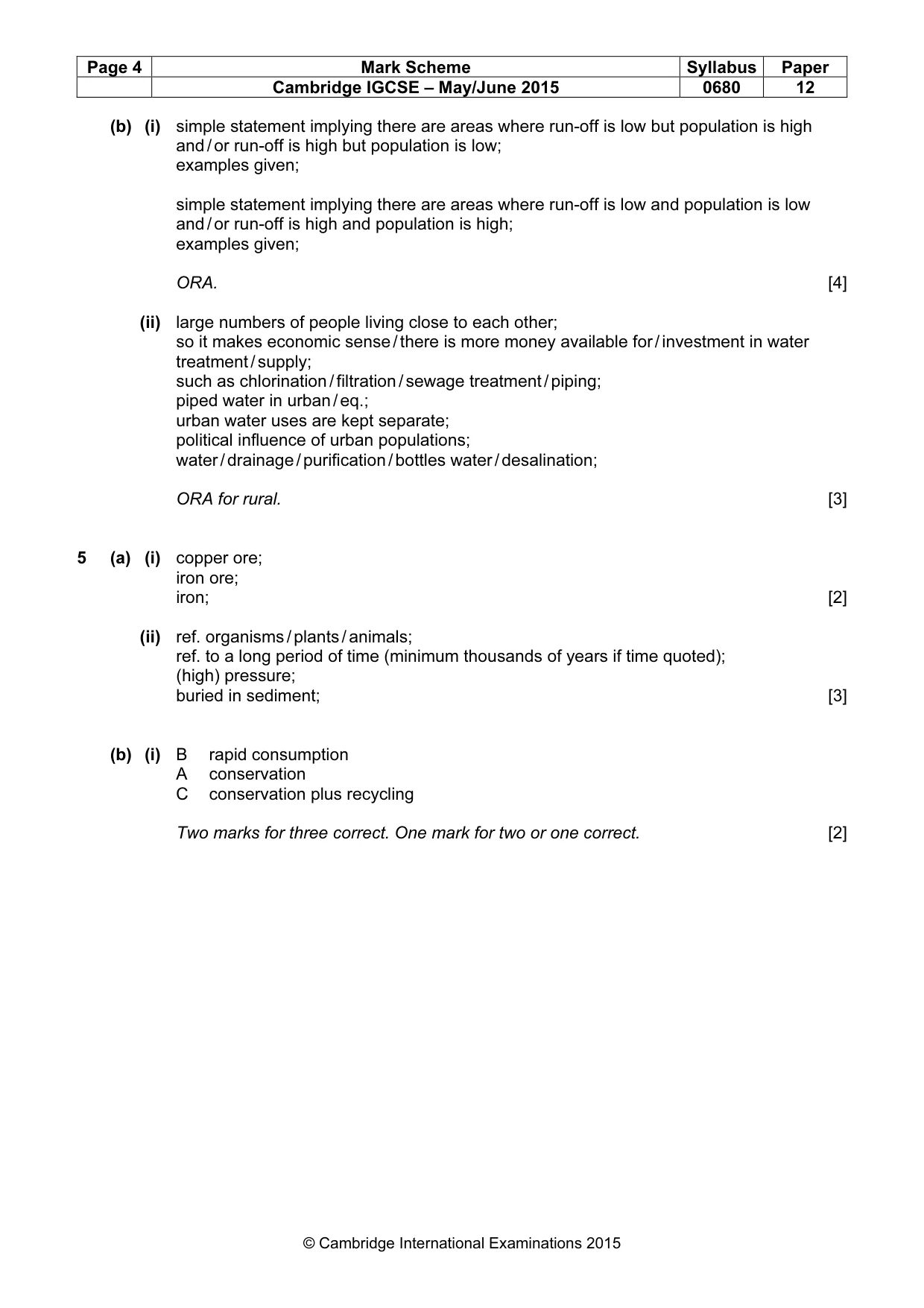
Page 4 Mark Scheme Syllabus Paper Cambridge IGCSE – May/June 2015 0680 12 © Cambridge International Examinations 2015 (b) (i) simple statement implying there are areas where run-off is low but population is high and / or run-off is high but population is low; examples given; simple statement implying there are areas where run-off is low and population is low and / or run-off is high and population is high; examples given; ORA. [4] (ii) large numbers of people living close to each other; so it makes economic sense / there is more money available for / investment in water treatment / supply; such as chlorination / filtration / sewage treatment / piping; piped water in urban / eq.; urban water uses are kept separate; political influence of urban populations; water / drainage / purification / bottles water / desalination; ORA for rural. [3] 5 (a) (i) copper ore; iron ore; iron; [2] (ii) ref. organisms / plants / animals; ref. to a long period of time (minimum thousands of years if time quoted); (high) pressure; buried in sediment; [3] (b) (i) B rapid consumption A conservation C conservation plus recycling Two marks for three correct. One mark for two or one correct. [2]
Mark scheme, page 5
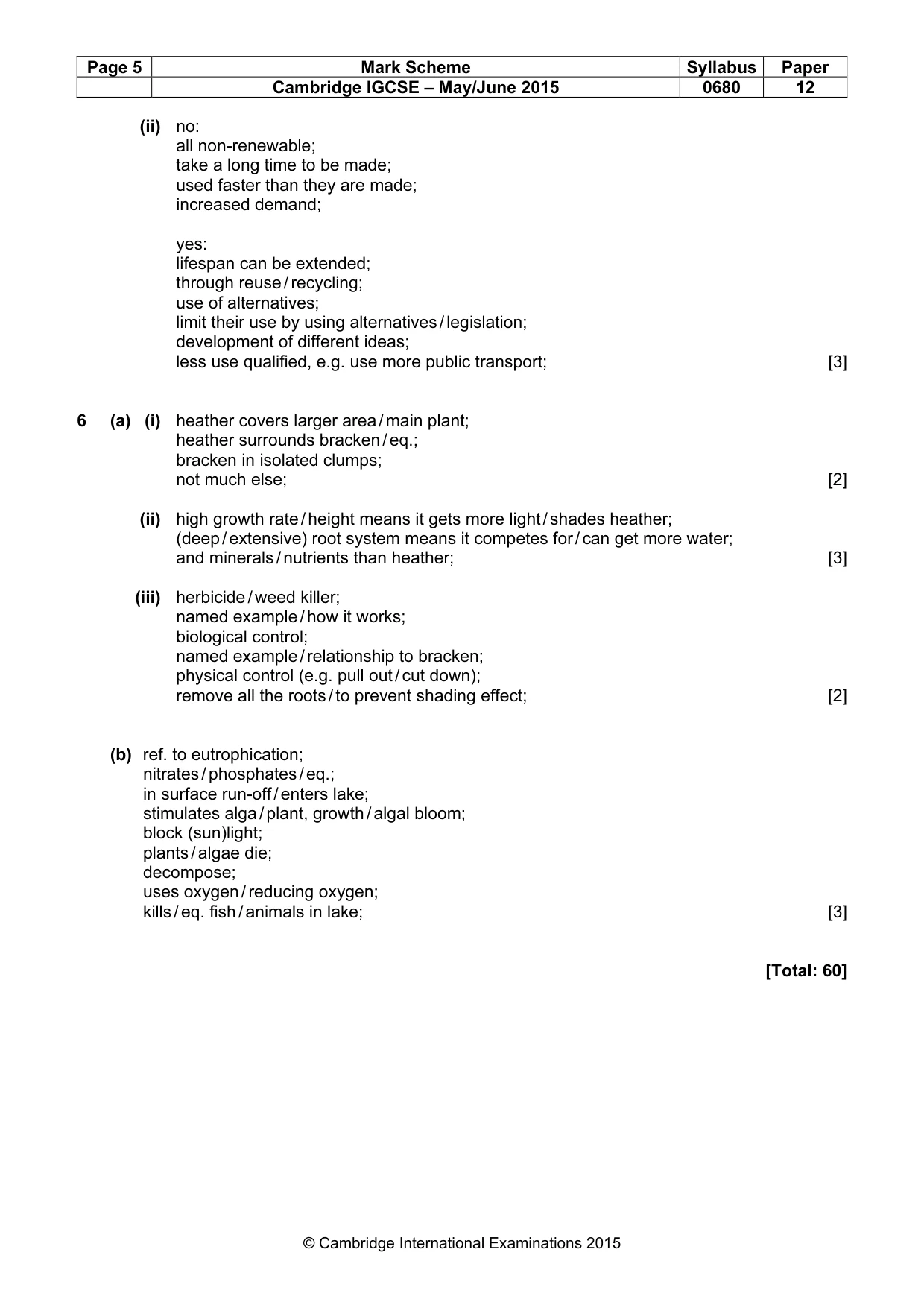
Page 5 Mark Scheme Syllabus Paper Cambridge IGCSE – May/June 2015 0680 12 © Cambridge International Examinations 2015 (ii) no: all non-renewable; take a long time to be made; used faster than they are made; increased demand; yes: lifespan can be extended; through reuse / recycling; use of alternatives; limit their use by using alternatives / legislation; development of different ideas; less use qualified, e.g. use more public transport; [3] 6 (a) (i) heather covers larger area / main plant; heather surrounds bracken / eq.; bracken in isolated clumps; not much else; [2] (ii) high growth rate / height means it gets more light / shades heather; (deep / extensive) root system means it competes for / can get more water; and minerals / nutrients than heather; [3] (iii) herbicide / weed killer; named example / how it works; biological control; named example / relationship to bracken; physical control (e.g. pull out / cut down); remove all the roots / to prevent shading effect; [2] (b) ref. to eutrophication; nitrates / phosphates / eq.; in surface run-off / enters lake; stimulates alga / plant, growth / algal bloom; block (sun)light; plants / algae die; decompose; uses oxygen / reducing oxygen; kills / eq. fish / animals in lake; [3] [Total: 60]
What you needed in this session
Cambridge’s own grade thresholds for 2015 May/June, Paper 1 · Variant 2. A higher threshold means an easier paper — the bar moves with how the cohort did.