Cambridge IGCSE Environmental Management 0680 — 2015 May/June Paper 1 · Variant 3
0680/13/M/J/15 · 60 marks · ≈68 min
The question paper and its mark scheme, free to read here and free to download. This is Cambridge’s own paper, exactly as it was sat.
Question paper16 pages
Mark scheme4 pages
Answers below. Sit the paper first if you are practising.
Paper as text
Question paper, page 1
This document consists of 16 printed pages. DC (AC/FD) 100889/4 © UCLES 2015 [Turn over Cambridge International Examinations Cambridge International General Certificate of Secondary Education * 2 8 0 5 5 4 0 6 7 0 * ENVIRONMENTAL MANAGEMENT 0680/13 Paper 1 May/June 2015 1 hour 30 minutes Candidates answer on the Question Paper. No Additional Materials are required. READ THESE INSTRUCTIONS FIRST Write your Centre number, candidate number and name on all the work you hand in. Write in dark blue or black pen. You may use an HB pencil for any diagrams or graphs. Do not use staples, paper clips, glue or correction fluid. DO NOT WRITE IN ANY BARCODES. Answer all questions. Electronic calculators may be used. You may lose marks if you do not show your working or if you do not use appropriate units. At the end of the examination, fasten all your work securely together. The number of marks is given in brackets [ ] at the end of each question or part question.
Question paper, page 2
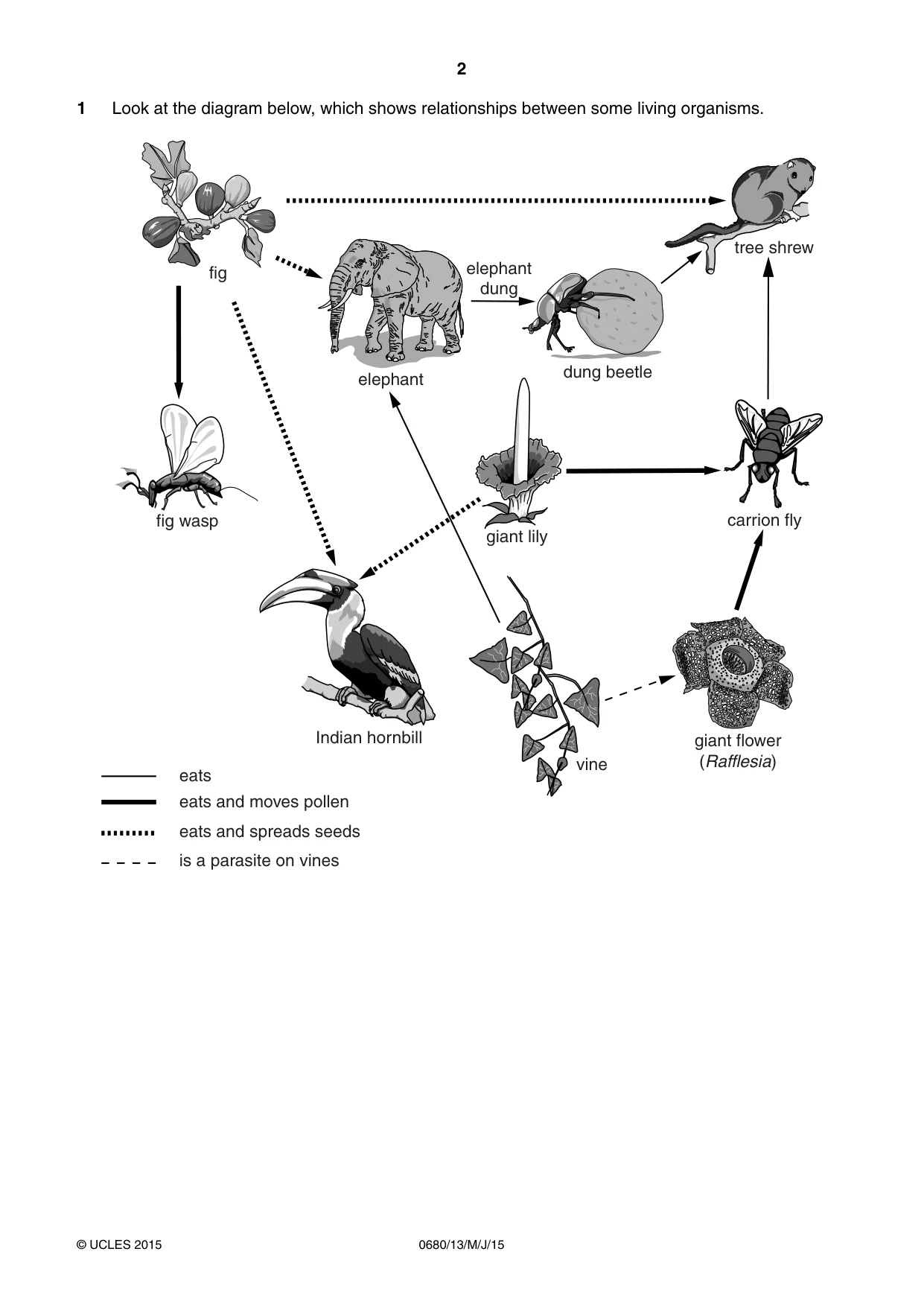
2 0680/13/M/J/15 © UCLES 2015 1 Look at the diagram below, which shows relationships between some living organisms. fig fig wasp Indian hornbill eats eats and moves pollen eats and spreads seeds is a parasite on vines vine giant lily giant flower (5DIIOHVLD) carrion fly elephant elephant dung dung beetle tree shrew
Question paper, page 3
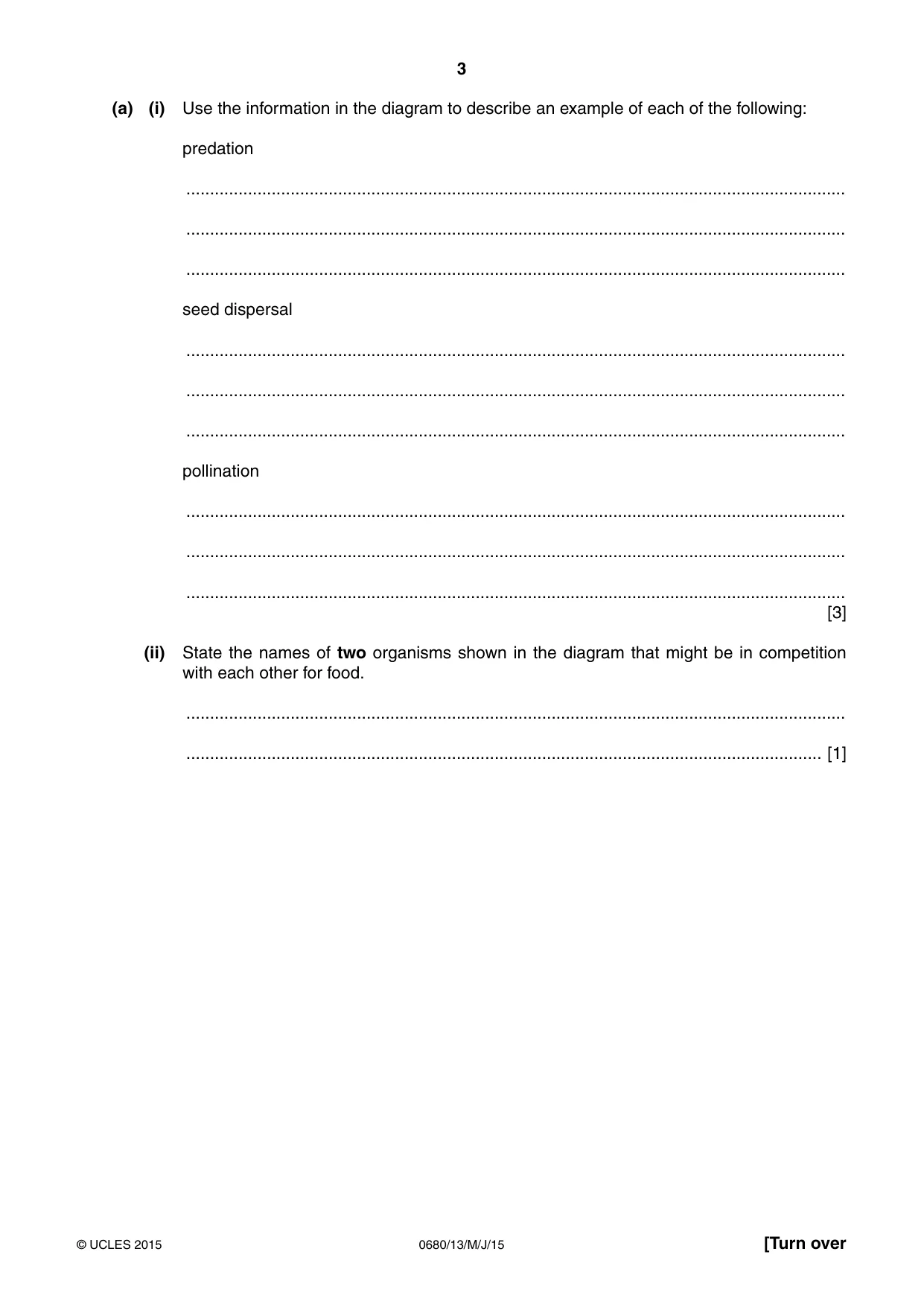
3 0680/13/M/J/15 © UCLES 2015 [Turn over (a) (i) Use the information in the diagram to describe an example of each of the following: predation … … … seed dispersal … … … pollination … … … [3] (ii) State the names of two organisms shown in the diagram that might be in competition with each other for food. … … [1]
Question paper, page 4
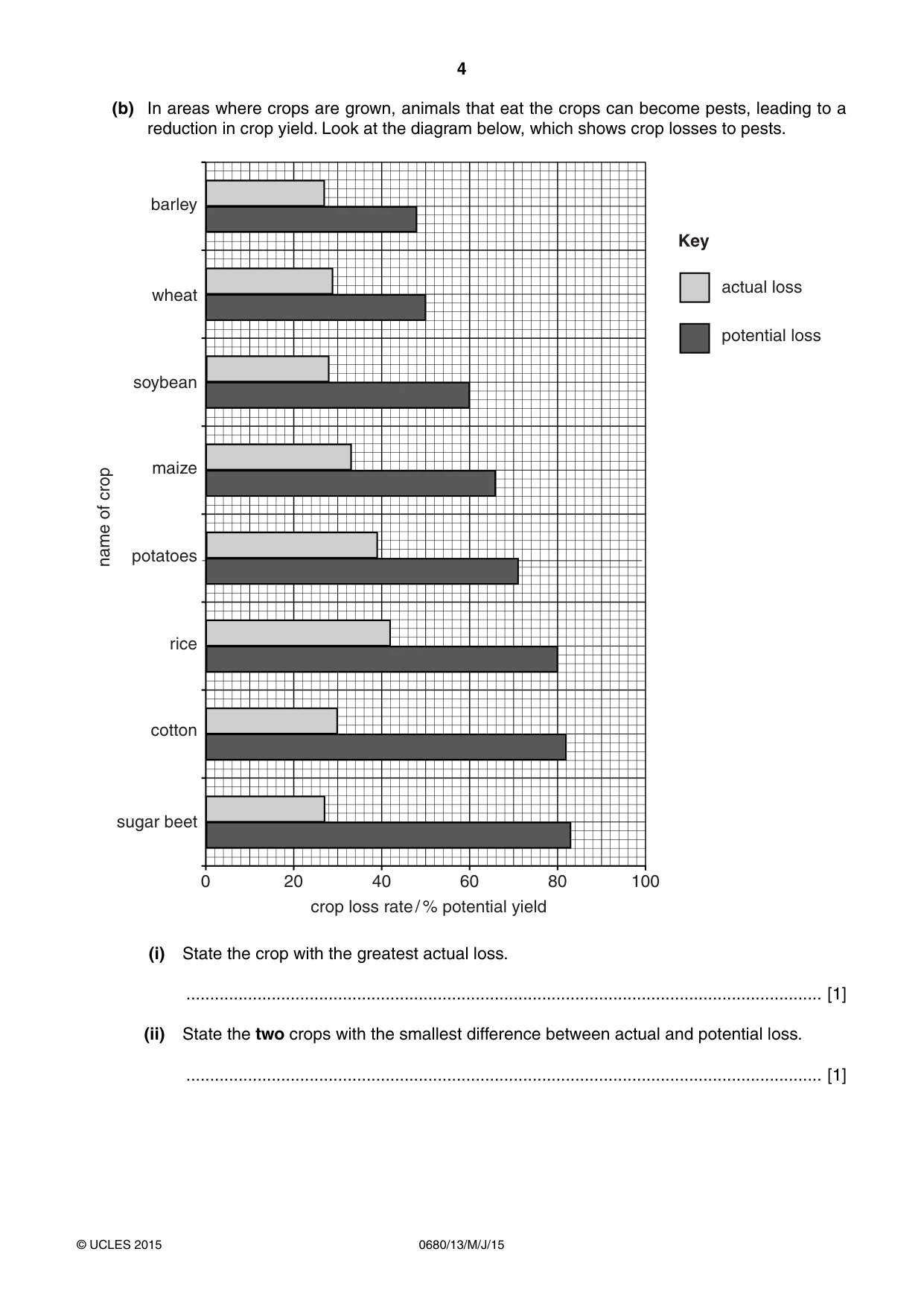
4 0680/13/M/J/15 © UCLES 2015 (b) In areas where crops are grown, animals that eat the crops can become pests, leading to a reduction in crop yield. Look at the diagram below, which shows crop losses to pests. name of crop barley wheat soybean maize potatoes rice cotton sugar beet actual loss .H\ potential loss crop loss rate / % potential yield 0 20 40 60 80 100 (i) State the crop with the greatest actual loss. … [1] (ii) State the two crops with the smallest difference between actual and potential loss. … [1]
Question paper, page 5
5 0680/13/M/J/15 © UCLES 2015 [Turn over (iii) One way to reduce losses to pests is to produce new crop strains. Describe two ways in which new crop strains could be produced. … … … … … … … … [4]
Question paper, page 6
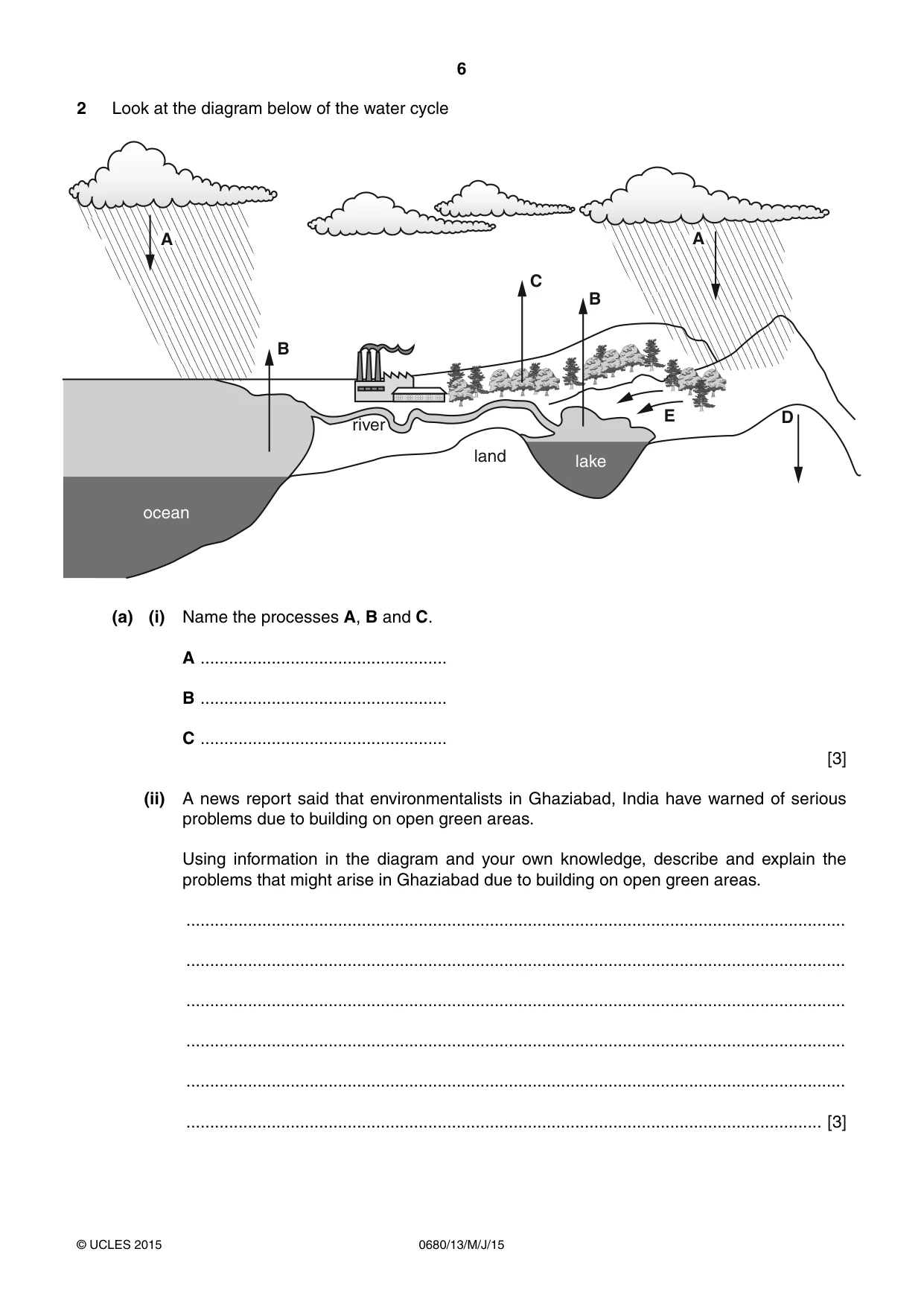
6 0680/13/M/J/15 © UCLES 2015 2 Look at the diagram below of the water cycle lake ocean land river ' ( $ $ % & % (a) (i) Name the processes A, B and C. A … B … C … [3] (ii) A news report said that environmentalists in Ghaziabad, India have warned of serious problems due to building on open green areas. Using information in the diagram and your own knowledge, describe and explain the problems that might arise in Ghaziabad due to building on open green areas. … … … … … … [3]
Question paper, page 7
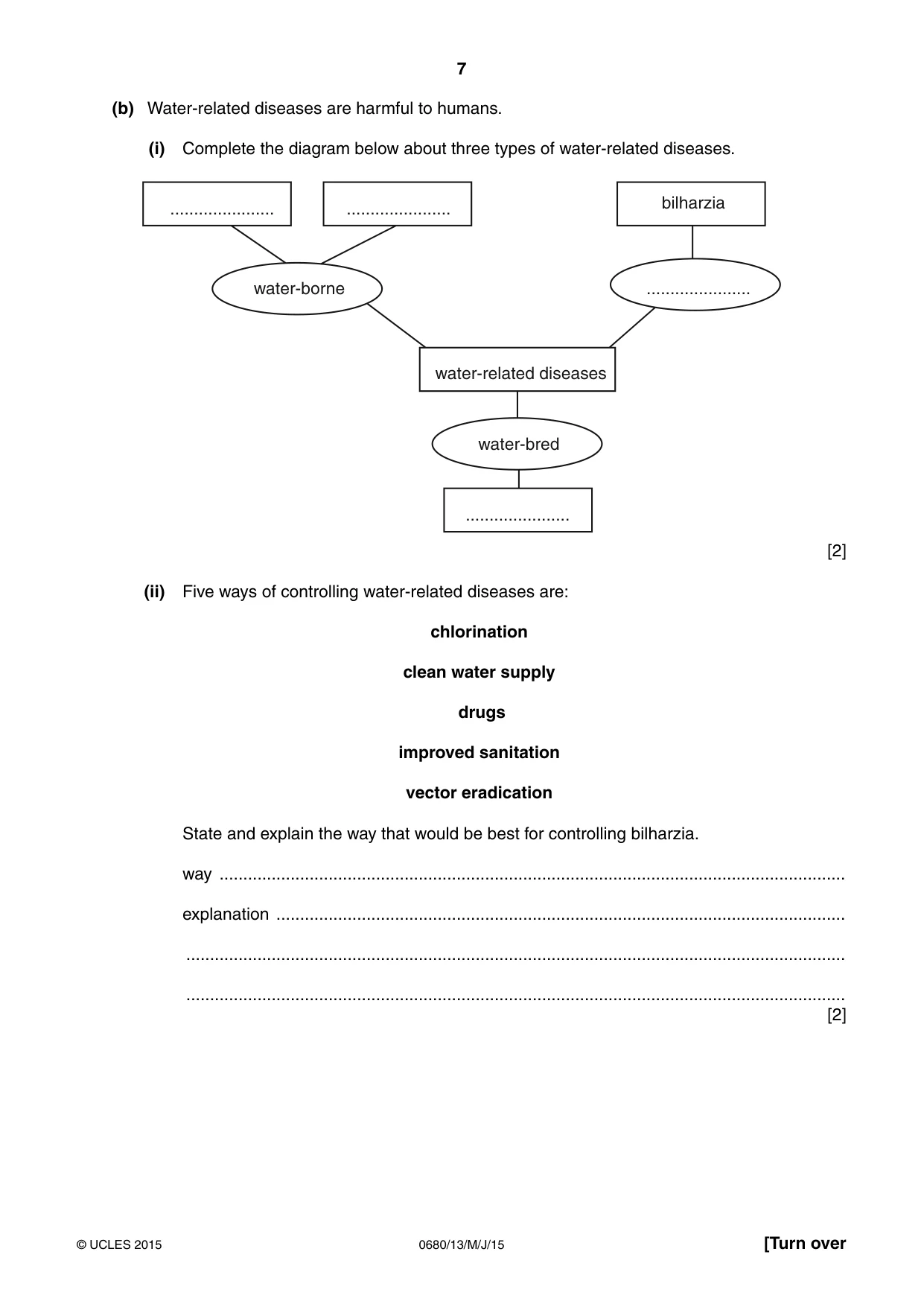
7 0680/13/M/J/15 © UCLES 2015 [Turn over (b) Water-related diseases are harmful to humans. (i) Complete the diagram below about three types of water-related diseases. water-borne bilharzia … … … … water-related diseases water-bred [2] (ii) Five ways of controlling water-related diseases are: chlorination clean water supply drugs improved sanitation vector eradication State and explain the way that would be best for controlling bilharzia. way … explanation … … … [2]
Question paper, page 8
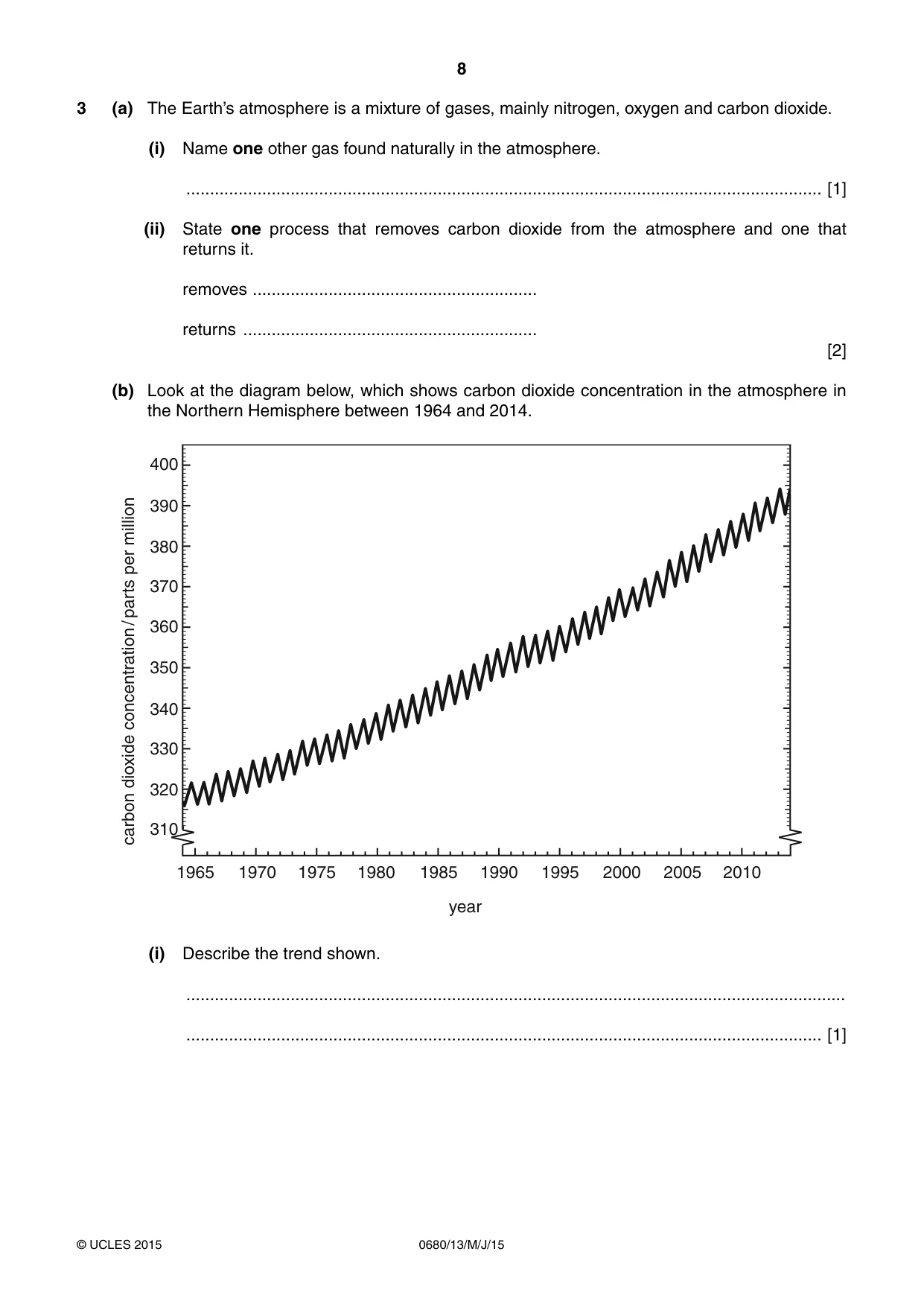
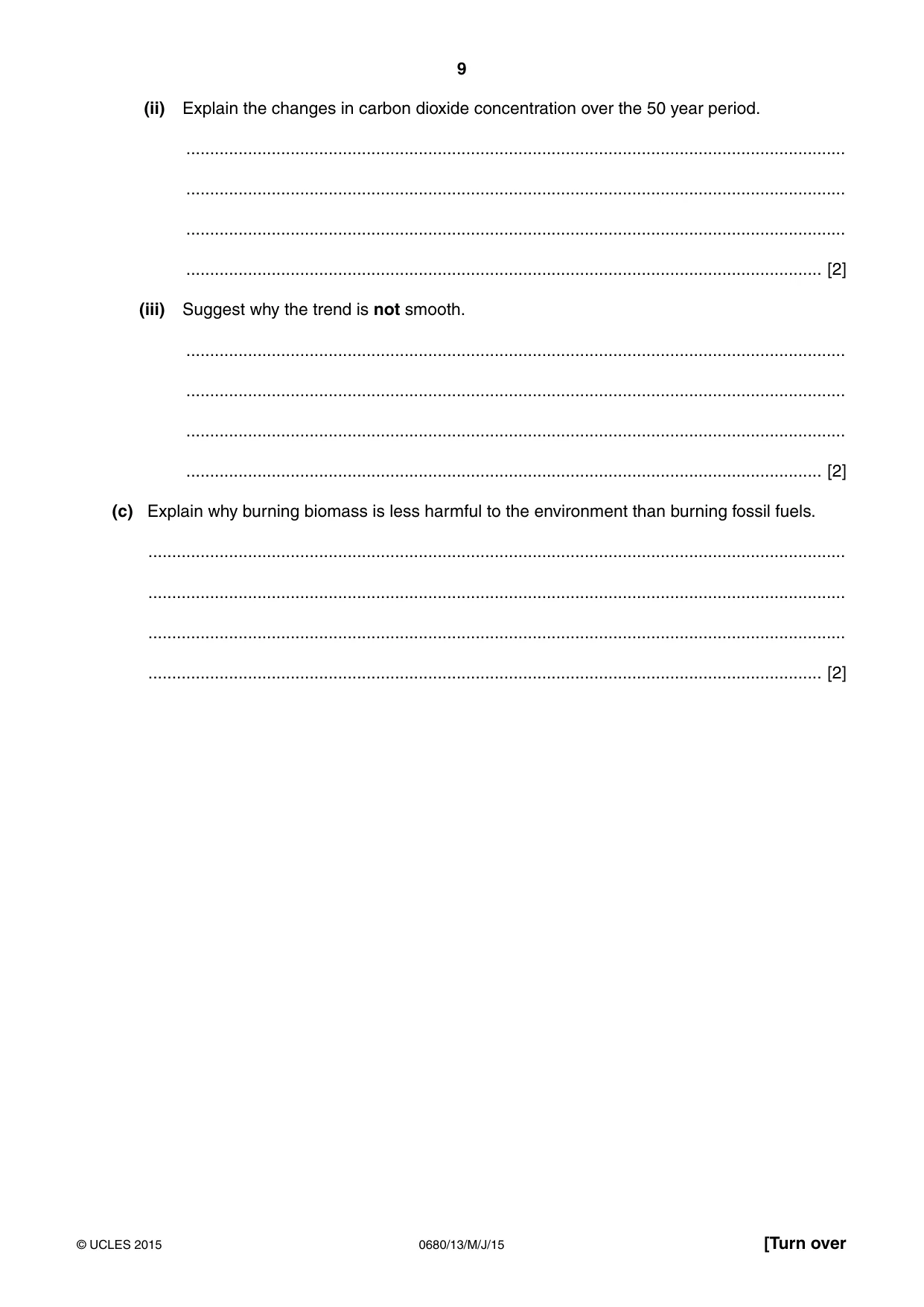
8 0680/13/M/J/15 © UCLES 2015 3 (a) The Earth’s atmosphere is a mixture of gases, mainly nitrogen, oxygen and carbon dioxide. (i) Name one other gas found naturally in the atmosphere. … [1] (ii) State one process that removes carbon dioxide from the atmosphere and one that returns it. removes … returns … [2] (b) Look at the diagram below, which shows carbon dioxide concentration in the atmosphere in the Northern Hemisphere between 1964 and 2014. 310 320 330 340 350 360 370 380 390 400 carbon dioxide concentration / parts per million 1965 1970 1975 1980 1985 year 1990 1995 2000 2005 2010 (i) Describe the trend shown. … … [1]
Question paper, page 9
9 0680/13/M/J/15 © UCLES 2015 [Turn over (ii) Explain the changes in carbon dioxide concentration over the 50 year period. … … … … [2] (iii) Suggest why the trend is not smooth. … … … … [2] (c) Explain why burning biomass is less harmful to the environment than burning fossil fuels. … … … … [2]
Question paper, page 10
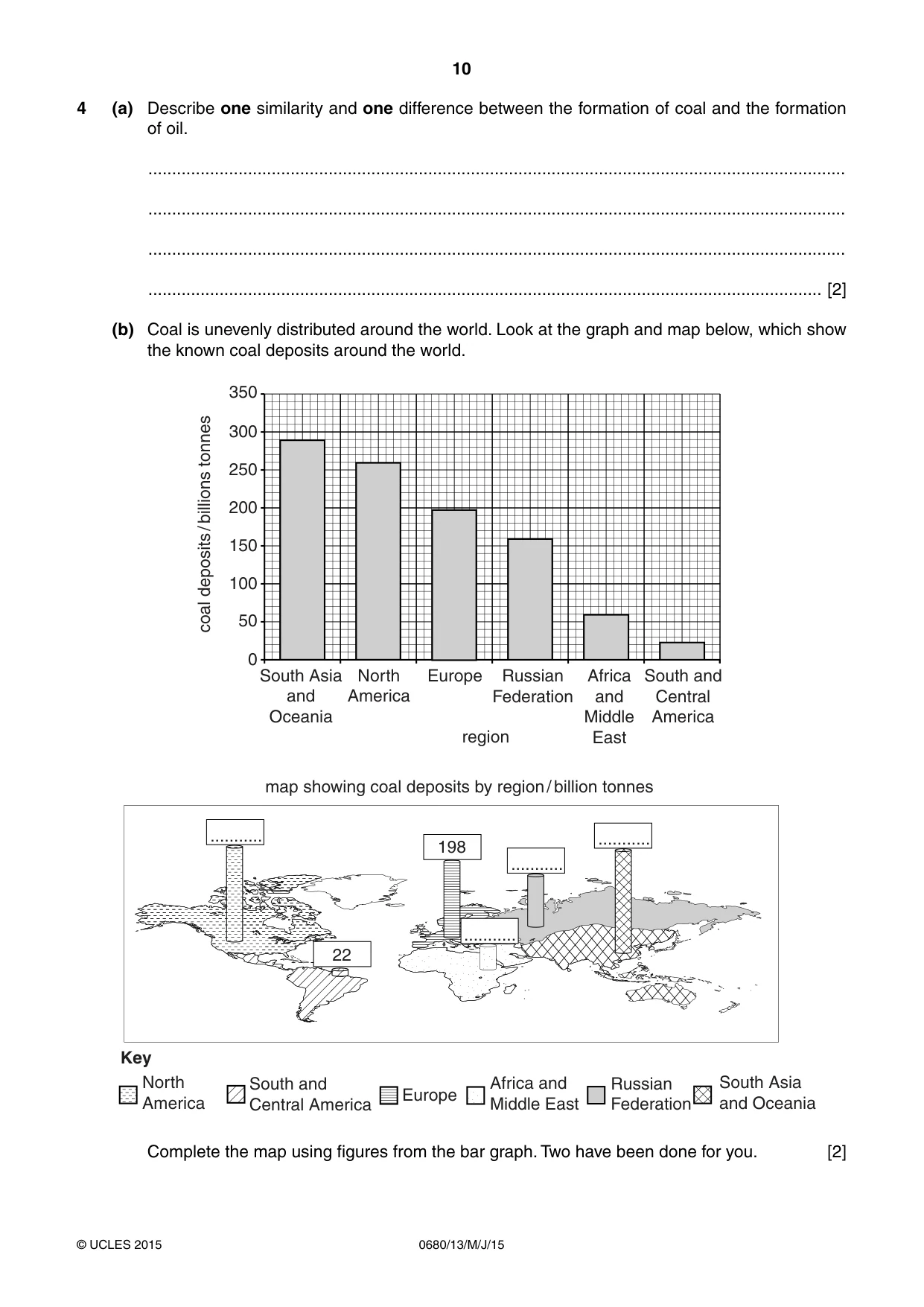
10 0680/13/M/J/15 © UCLES 2015 4 (a) Describe one similarity and one difference between the formation of coal and the formation of oil. … … … … [2] (b) Coal is unevenly distributed around the world. Look at the graph and map below, which show the known coal deposits around the world. South Asia and Oceania North America Europe region coal deposits / billions tonnes 0 50 100 150 200 250 300 350 Russian Federation Africa and Middle East South and Central America … 22 Russian Federation .H\ South and Central America Europe map showing coal deposits by region / billion tonnes Africa and Middle East North America South Asia and Oceania 198 … … … Complete the map using figures from the bar graph. Two have been done for you. [2]
Question paper, page 11
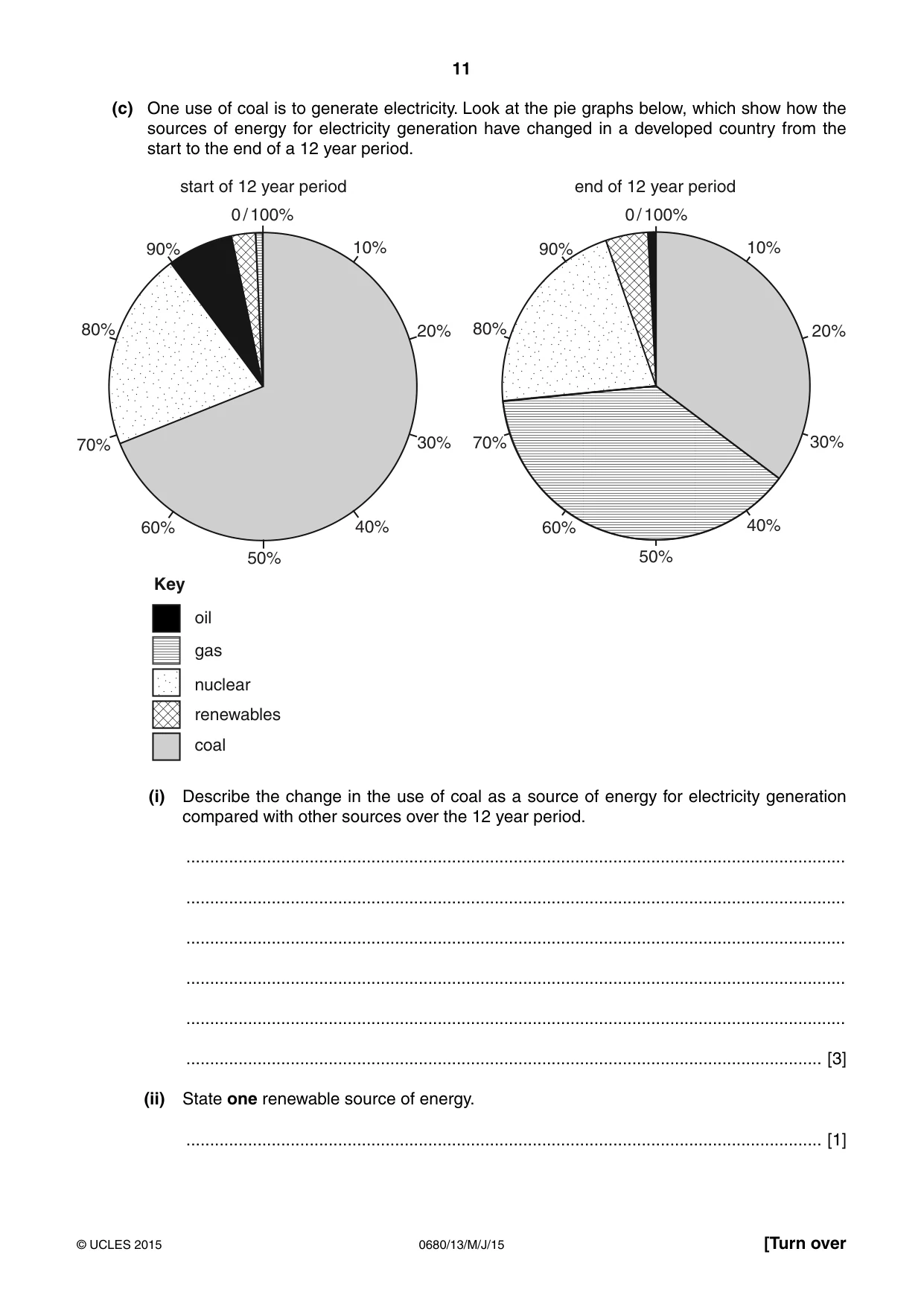
11 0680/13/M/J/15 © UCLES 2015 [Turn over (c) One use of coal is to generate electricity. Look at the pie graphs below, which show how the sources of energy for electricity generation have changed in a developed country from the start to the end of a 12 year period. oil gas nuclear renewables coal .H\ end of 12 year period start of 12 year period 0 / 100% 10% 20% 30% 40% 50% 60% 70% 80% 90% 10% 20% 30% 40% 50% 60% 70% 80% 90% 0 / 100% (i) Describe the change in the use of coal as a source of energy for electricity generation compared with other sources over the 12 year period. … … … … … … [3] (ii) State one renewable source of energy. … [1]
Question paper, page 12
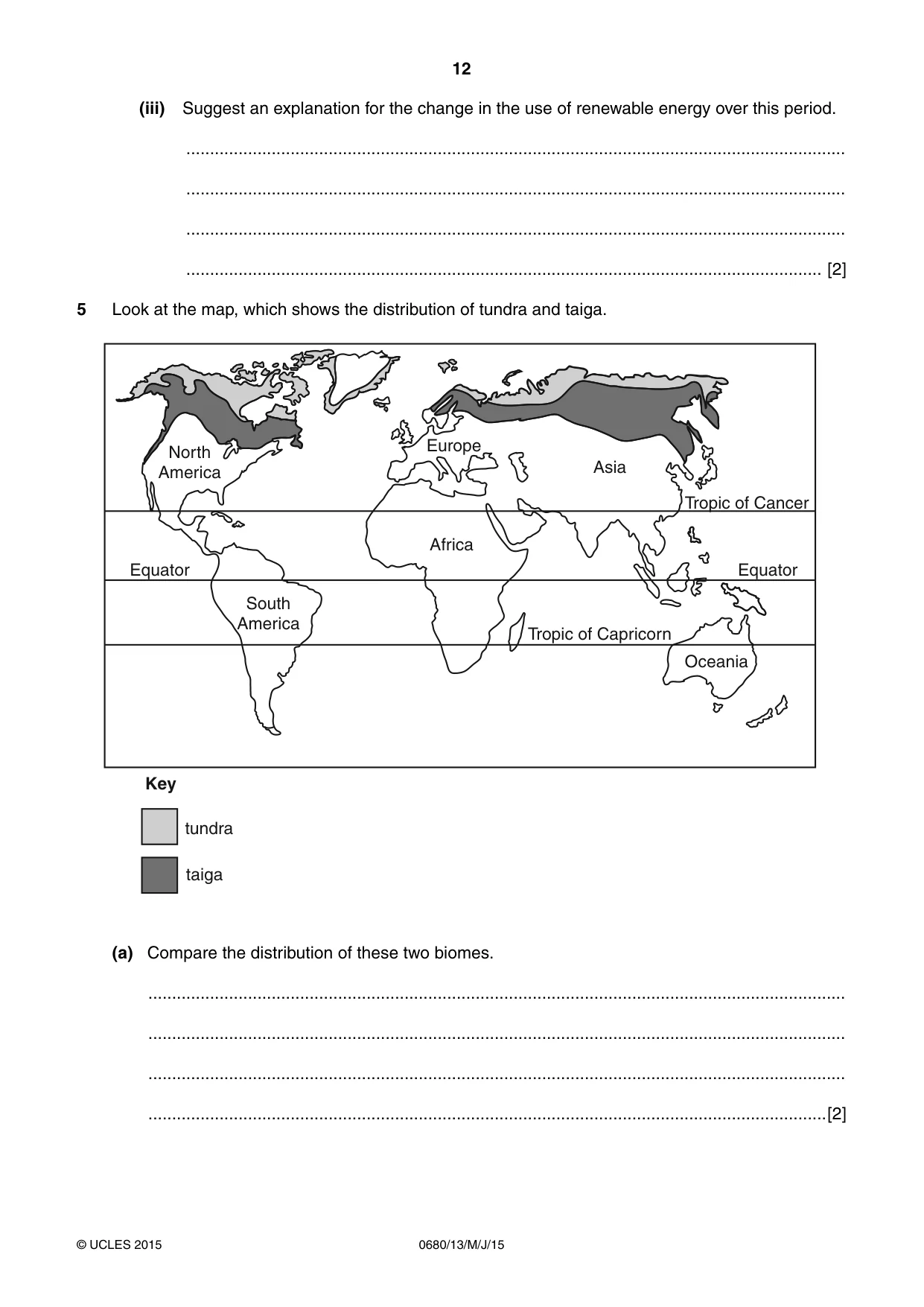
12 0680/13/M/J/15 © UCLES 2015 (iii) Suggest an explanation for the change in the use of renewable energy over this period. … … … … [2] 5 Look at the map, which shows the distribution of tundra and taiga. tundra taiga .H\ Tropic of Cancer Tropic of Capricorn Equator Equator North America South America Africa Europe Asia Oceania (a) Compare the distribution of these two biomes. … … … …[2]
Question paper, page 13
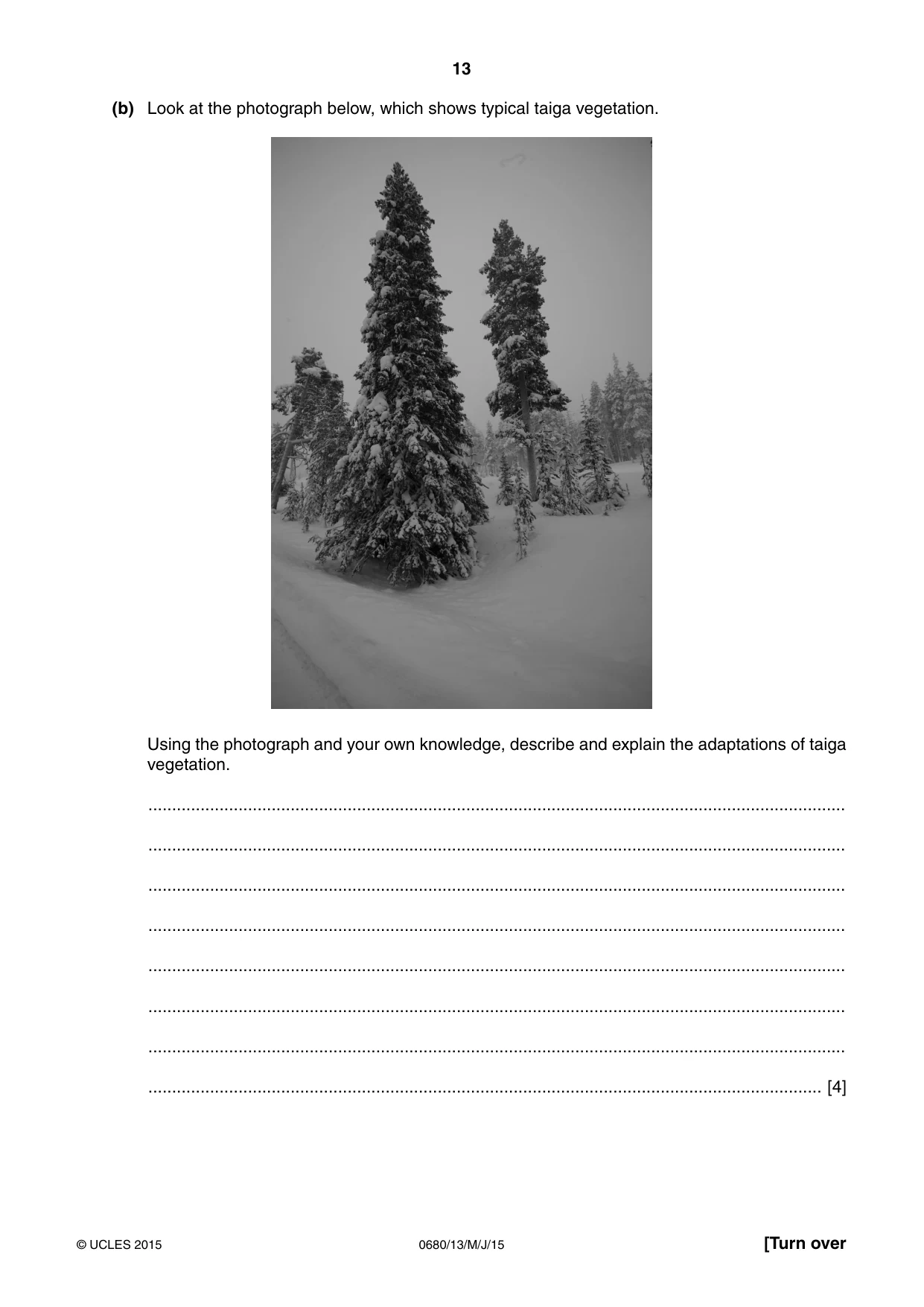
13 0680/13/M/J/15 © UCLES 2015 [Turn over (b) Look at the photograph below, which shows typical taiga vegetation. Using the photograph and your own knowledge, describe and explain the adaptations of taiga vegetation. … … … … … … … … [4]
Question paper, page 14
14 0680/13/M/J/15 © UCLES 2015 (c) (i) Suggest four reasons for deforestation. … … … … [2] (ii) For two of the reasons you have given, suggest why the deforestation rate is higher in tropical rainforest than in taiga forest. … … … … [2]
Question paper, page 15
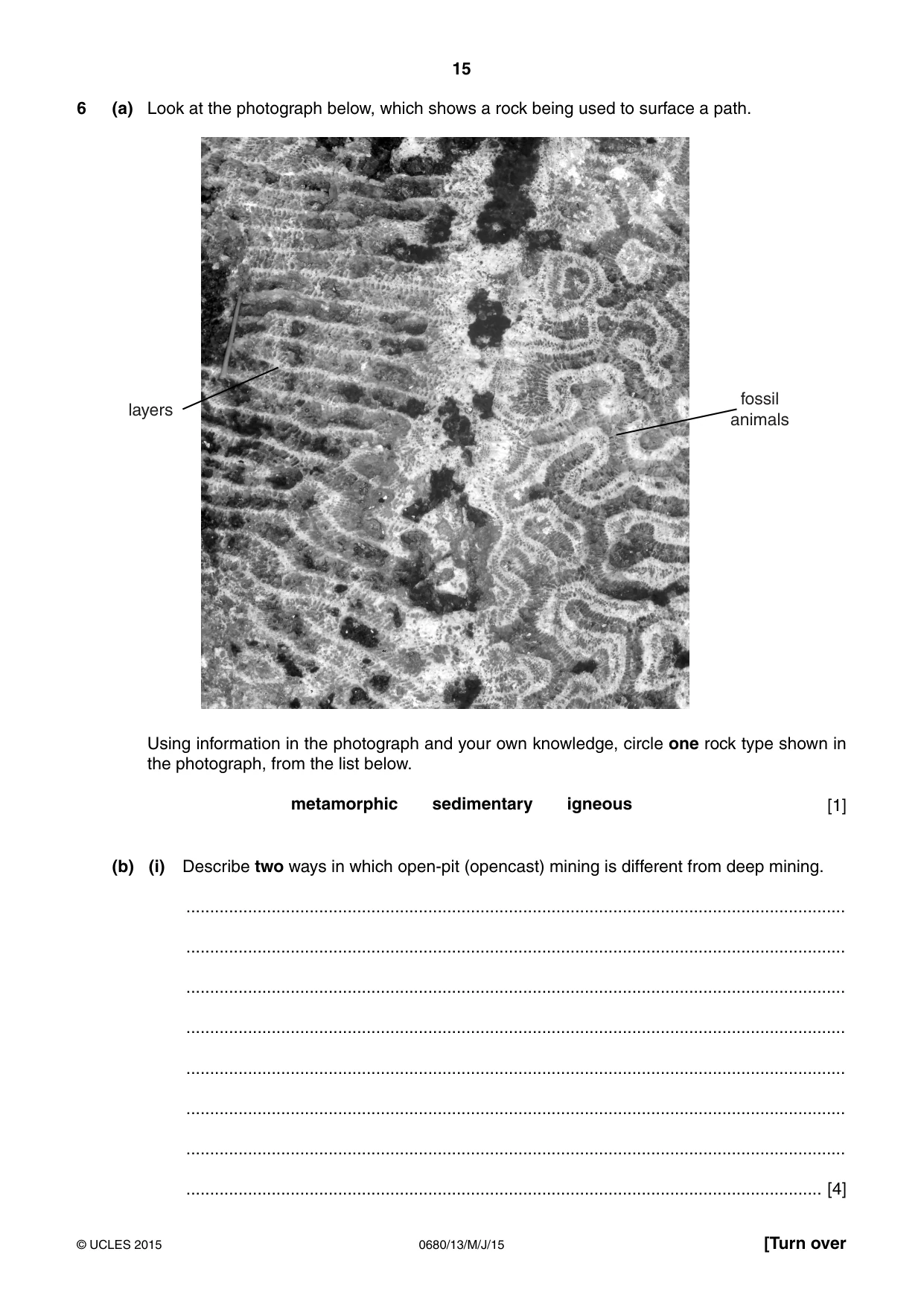
15 0680/13/M/J/15 © UCLES 2015 [Turn over 6 (a) Look at the photograph below, which shows a rock being used to surface a path. layers fossil animals Using information in the photograph and your own knowledge, circle one rock type shown in the photograph, from the list below. metamorphic sedimentary igneous [1] (b) (i) Describe two ways in which open-pit (opencast) mining is different from deep mining. … … … … … … … … [4]
Question paper, page 16
16 0680/13/M/J/15 © UCLES 2015 (ii) Describe the impact deep mining of coal can have on the environment. … … … … … … [3] (iii) Suggest two ways in which environments damaged by open-pit (opencast) mining might be conserved. … … … … [2] Permission to reproduce items where third-party owned material protected by copyright is included has been sought and cleared where possible. Every reasonable effort has been made by the publisher (UCLES) to trace copyright holders, but if any items requiring clearance have unwittingly been included, the publisher will be pleased to make amends at the earliest possible opportunity. To avoid the issue of disclosure of answer-related information to candidates, all copyright acknowledgements are reproduced online in the Cambridge International Examinations Copyright Acknowledgements Booklet. This is produced for each series of examinations and is freely available to download at www.cie.org.uk after the live examination series. Cambridge International Examinations is part of the Cambridge Assessment Group. Cambridge Assessment is the brand name of University of Cambridge Local Examinations Syndicate (UCLES), which is itself a department of the University of Cambridge.
Mark scheme, page 1
® IGCSE is the registered trademark of Cambridge International Examinations. CAMBRIDGE INTERNATIONAL EXAMINATIONS Cambridge International General Certificate of Secondary Education MARK SCHEME for the May/June 2015 series 0680 ENVIRONMENTAL MANAGEMENT 0680/13 Paper 1, maximum raw mark 60 This mark scheme is published as an aid to teachers and candidates, to indicate the requirements of the examination. It shows the basis on which Examiners were instructed to award marks. It does not indicate the details of the discussions that took place at an Examiners’ meeting before marking began, which would have considered the acceptability of alternative answers. Mark schemes should be read in conjunction with the question paper and the Principal Examiner Report for Teachers. Cambridge will not enter into discussions about these mark schemes. Cambridge is publishing the mark schemes for the May/June 2015 series for most Cambridge IGCSE®, Cambridge International A and AS Level components and some Cambridge O Level components.
Mark scheme, page 2
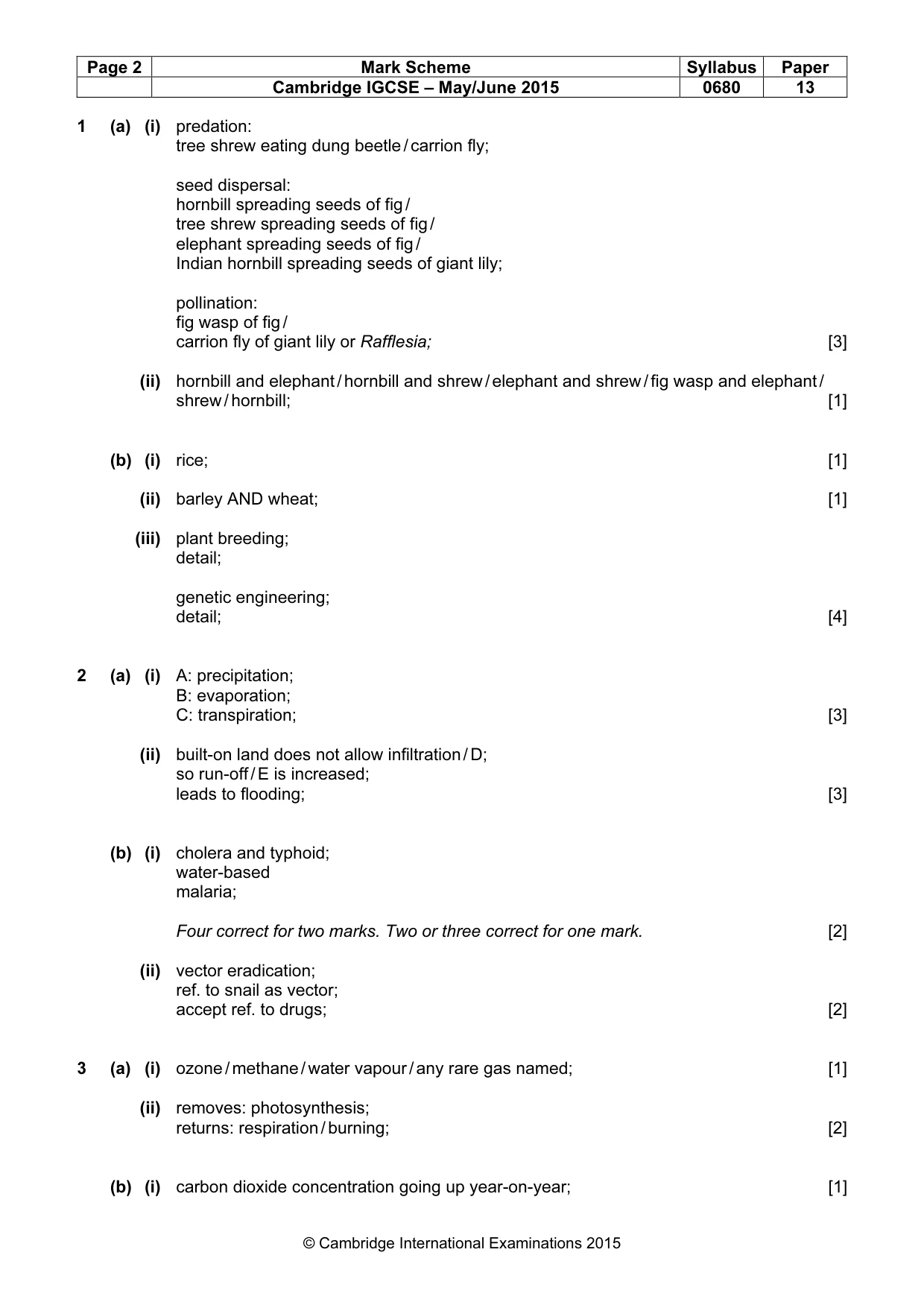
Page 2 Mark Scheme Syllabus Paper Cambridge IGCSE – May/June 2015 0680 13 © Cambridge International Examinations 2015 1 (a) (i) predation: tree shrew eating dung beetle / carrion fly; seed dispersal: hornbill spreading seeds of fig / tree shrew spreading seeds of fig / elephant spreading seeds of fig / Indian hornbill spreading seeds of giant lily; pollination: fig wasp of fig / carrion fly of giant lily or Rafflesia; [3] (ii) hornbill and elephant / hornbill and shrew / elephant and shrew / fig wasp and elephant / shrew / hornbill; [1] (b) (i) rice; [1] (ii) barley AND wheat; [1] (iii) plant breeding; detail; genetic engineering; detail; [4] 2 (a) (i) A: precipitation; B: evaporation; C: transpiration; [3] (ii) built-on land does not allow infiltration / D; so run-off / E is increased; leads to flooding; [3] (b) (i) cholera and typhoid; water-based malaria; Four correct for two marks. Two or three correct for one mark. [2] (ii) vector eradication; ref. to snail as vector; accept ref. to drugs; [2] 3 (a) (i) ozone / methane / water vapour / any rare gas named; [1] (ii) removes: photosynthesis; returns: respiration / burning; [2] (b) (i) carbon dioxide concentration going up year-on-year; [1]
Mark scheme, page 3
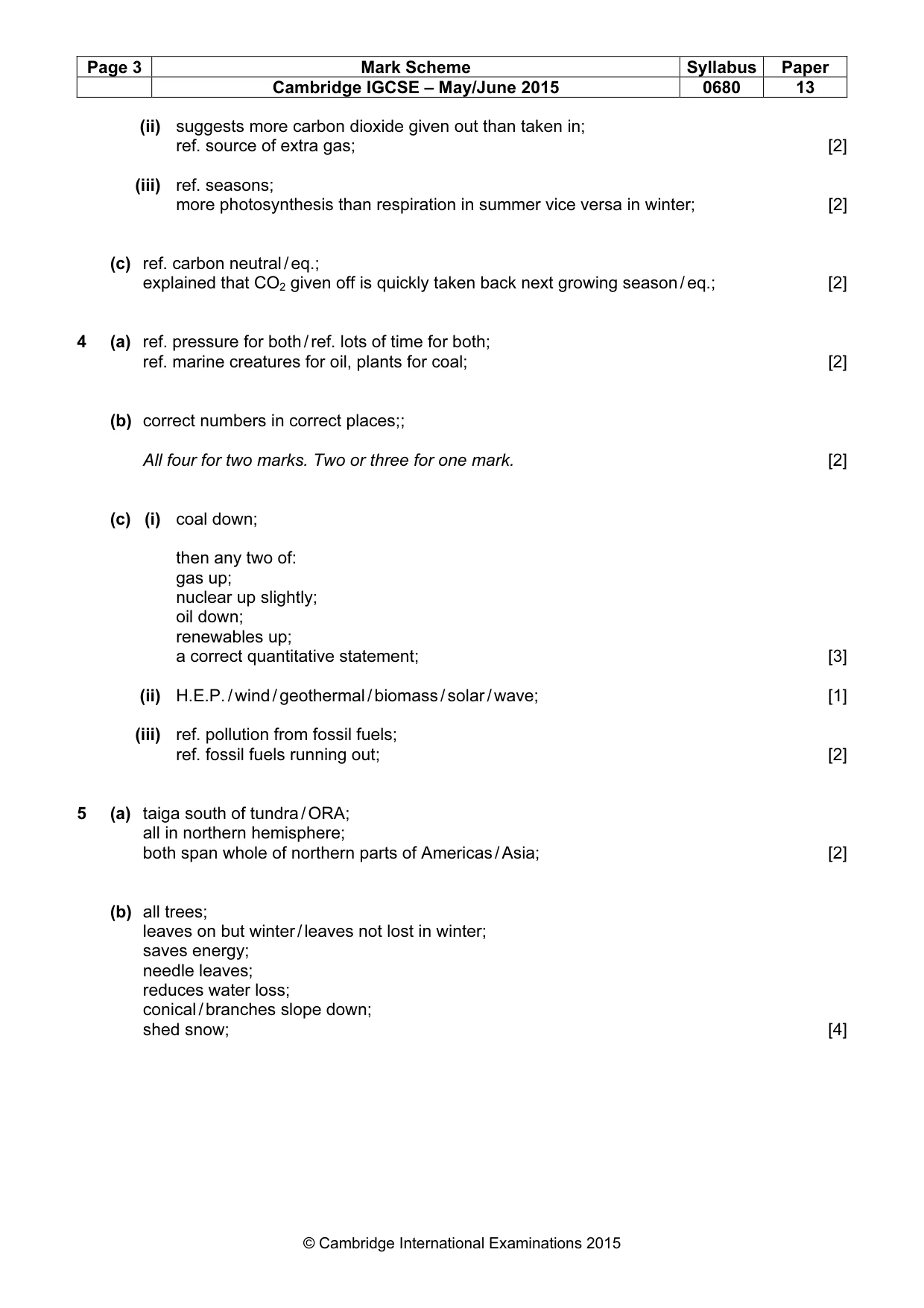
Page 3 Mark Scheme Syllabus Paper Cambridge IGCSE – May/June 2015 0680 13 © Cambridge International Examinations 2015 (ii) suggests more carbon dioxide given out than taken in; ref. source of extra gas; [2] (iii) ref. seasons; more photosynthesis than respiration in summer vice versa in winter; [2] (c) ref. carbon neutral / eq.; explained that CO2 given off is quickly taken back next growing season / eq.; [2] 4 (a) ref. pressure for both / ref. lots of time for both; ref. marine creatures for oil, plants for coal; [2] (b) correct numbers in correct places;; All four for two marks. Two or three for one mark. [2] (c) (i) coal down; then any two of: gas up; nuclear up slightly; oil down; renewables up; a correct quantitative statement; [3] (ii) H.E.P. / wind / geothermal / biomass / solar / wave; [1] (iii) ref. pollution from fossil fuels; ref. fossil fuels running out; [2] 5 (a) taiga south of tundra / ORA; all in northern hemisphere; both span whole of northern parts of Americas / Asia; [2] (b) all trees; leaves on but winter / leaves not lost in winter; saves energy; needle leaves; reduces water loss; conical / branches slope down; shed snow; [4]
Mark scheme, page 4
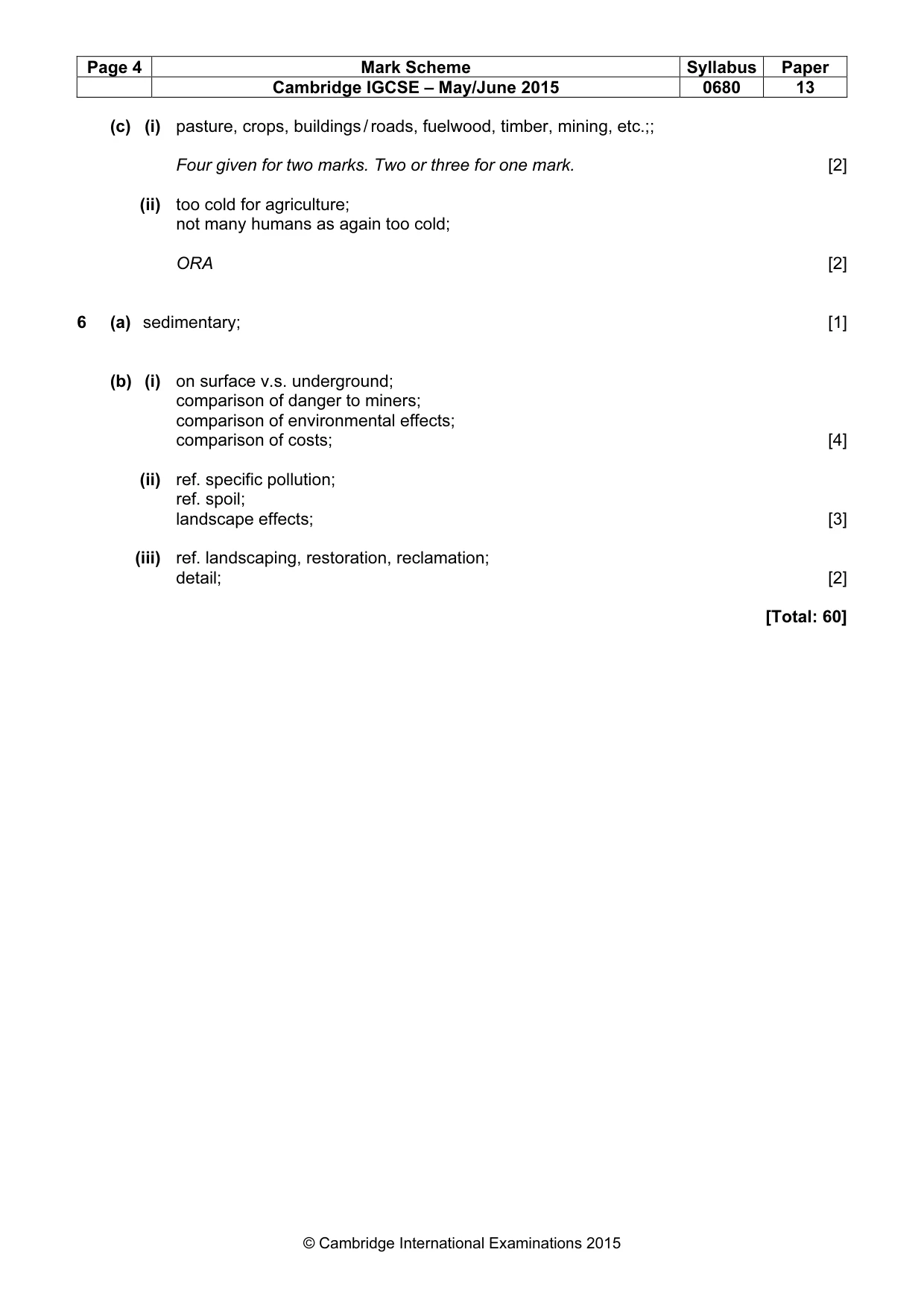
Page 4 Mark Scheme Syllabus Paper Cambridge IGCSE – May/June 2015 0680 13 © Cambridge International Examinations 2015 (c) (i) pasture, crops, buildings / roads, fuelwood, timber, mining, etc.;; Four given for two marks. Two or three for one mark. [2] (ii) too cold for agriculture; not many humans as again too cold; ORA [2] 6 (a) sedimentary; [1] (b) (i) on surface v.s. underground; comparison of danger to miners; comparison of environmental effects; comparison of costs; [4] (ii) ref. specific pollution; ref. spoil; landscape effects; [3] (iii) ref. landscaping, restoration, reclamation; detail; [2] [Total: 60]
What you needed in this session
Cambridge’s own grade thresholds for 2015 May/June, Paper 1 · Variant 3. A higher threshold means an easier paper — the bar moves with how the cohort did.