Cambridge IGCSE Environmental Management 0680 — 2014 Oct/Nov Paper 1 · Variant 2
0680/12/O/N/14 · 60 marks · ≈68 min
The question paper and its mark scheme, free to read here and free to download. This is Cambridge’s own paper, exactly as it was sat.
Question paper12 pages
Mark scheme4 pages
Answers below. Sit the paper first if you are practising.
Paper as text
Question paper, page 1
This document consists of 12 printed pages. DC (CW/SW) 81154/6 © UCLES 2014 [Turn over Cambridge International Examinations Cambridge International General Certificate of Secondary Education * 3 8 8 1 7 0 0 8 5 0 * ENVIRONMENTAL MANAGEMENT 0680/12 Paper 1 October/November 2014 1 hour 30 minutes Candidates answer on the Question Paper. Additional Materials: Ruler READ THESE INSTRUCTIONS FIRST Write your Centre number, candidate number and name on all the work you hand in. Write in dark blue or black pen. You may use an HB pencil for any diagrams or graphs. Do not use staples, paper clips, glue or correction fluid. DO NOT WRITE IN ANY BARCODES. Answer all questions. Electronic calculators may be used. You may lose marks if you do not show your working or if you do not use appropriate units. At the end of the examination, fasten all your work securely together. The number of marks is given in brackets [ ] at the end of each question or part question.
Question paper, page 2
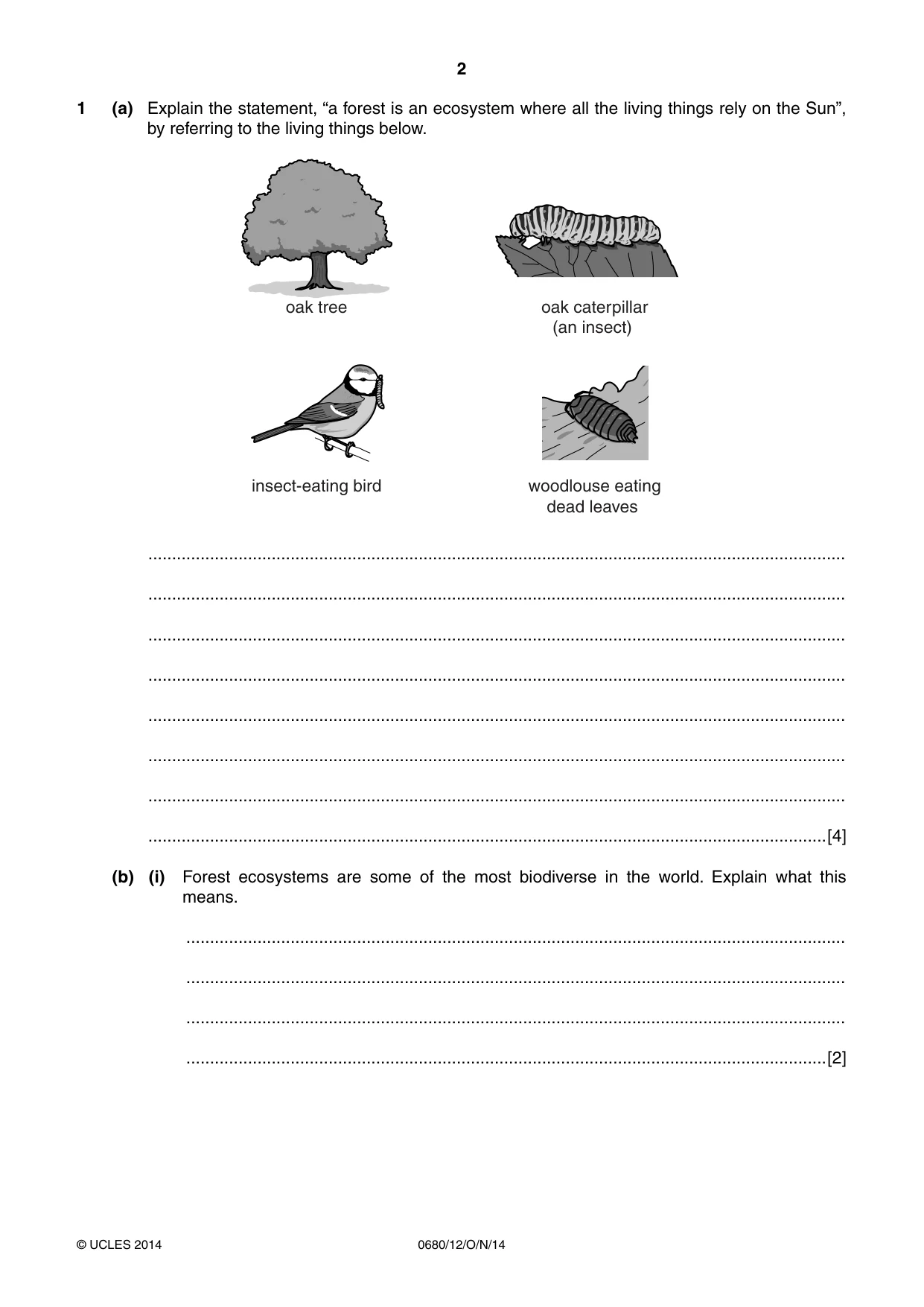
2 0680/12/O/N/14 © UCLES 2014 1 (a) Explain the statement, “a forest is an ecosystem where all the living things rely on the Sun”, by referring to the living things below. oak tree insect-eating bird oak caterpillar (an insect) woodlouse eating dead leaves … … … … … … … …[4] (b) (i) Forest ecosystems are some of the most biodiverse in the world. Explain what this means. … … … …[2]
Question paper, page 3
3 0680/12/O/N/14 © UCLES 2014 [Turn over (ii) What human activities are leading to a reduction in biodiversity? … … … …[2] (iii) Suggest why biodiversity should be conserved. … … … …[2]
Question paper, page 4
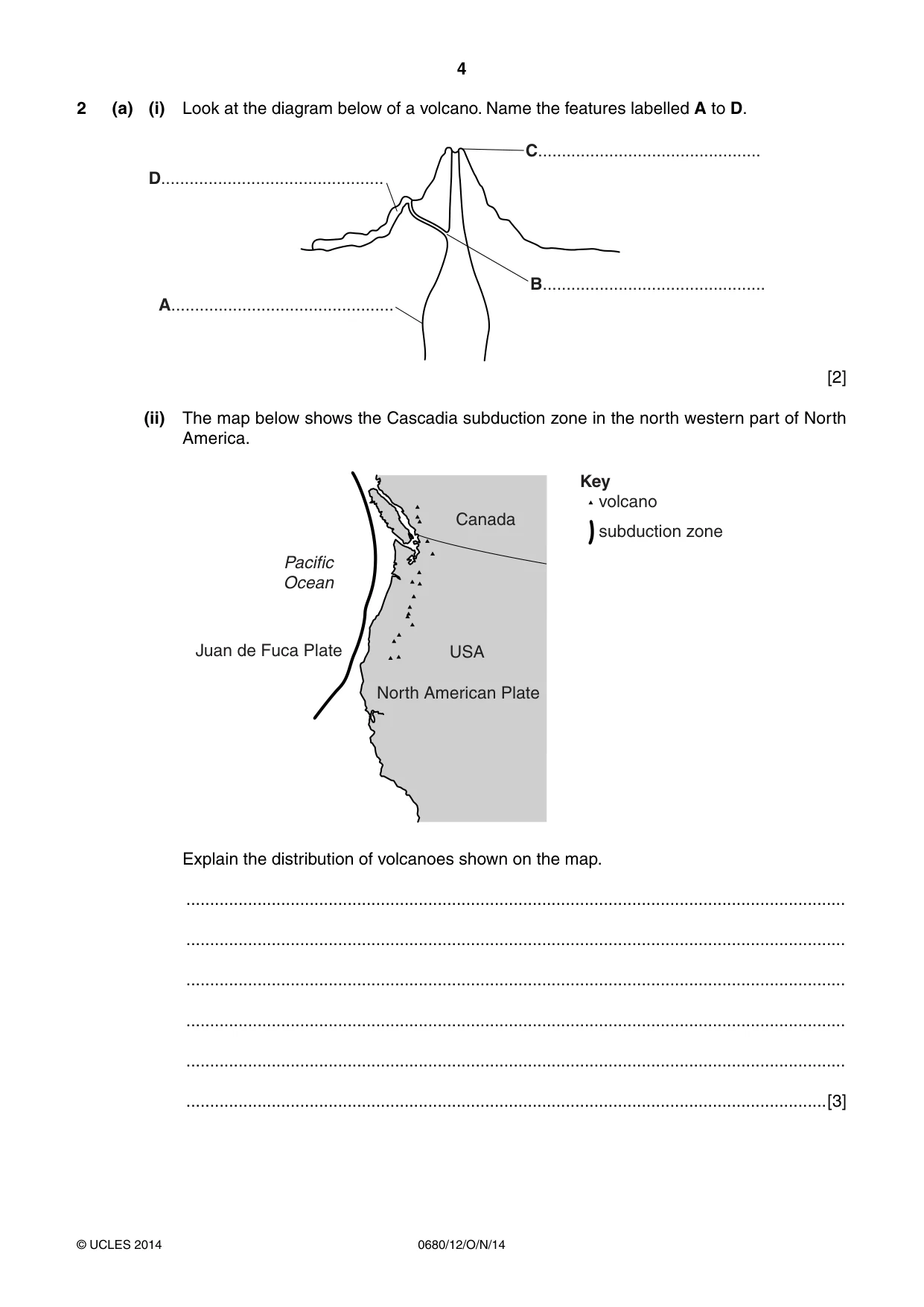
4 0680/12/O/N/14 © UCLES 2014 2 (a) (i) Look at the diagram below of a volcano. Name the features labelled A to D. C… B… D… A… [2] (ii) The map below shows the Cascadia subduction zone in the north western part of North America. Canada Juan de Fuca Plate North American Plate USA volcano subduction zone Key Pacific Ocean Explain the distribution of volcanoes shown on the map. … … … … … …[3]
Question paper, page 5
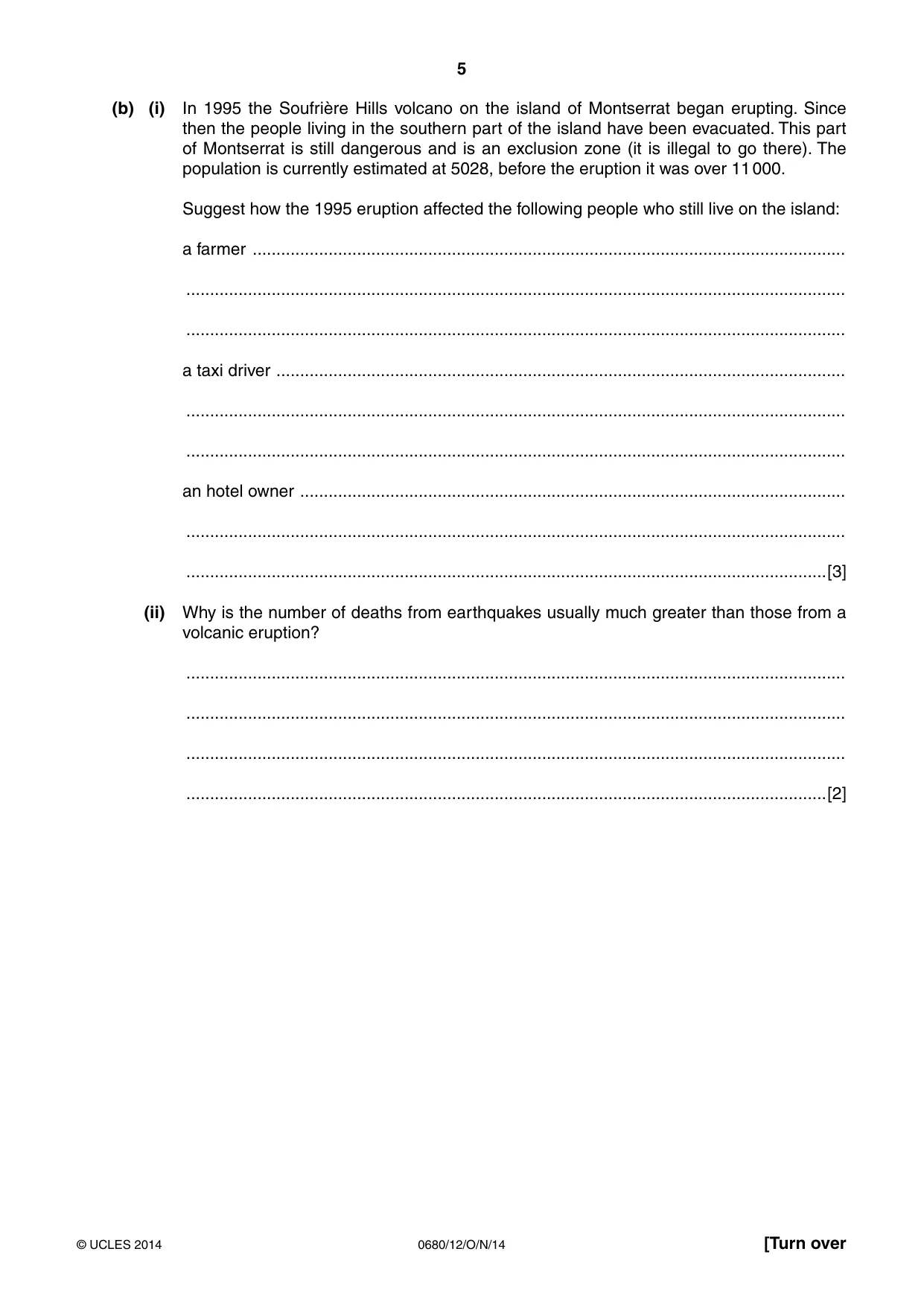
5 0680/12/O/N/14 © UCLES 2014 [Turn over (b) (i) In 1995 the Soufrière Hills volcano on the island of Montserrat began erupting. Since then the people living in the southern part of the island have been evacuated. This part of Montserrat is still dangerous and is an exclusion zone (it is illegal to go there). The population is currently estimated at 5028, before the eruption it was over 11 000. Suggest how the 1995 eruption affected the following people who still live on the island: a farmer … … … a taxi driver … … … an hotel owner … … …[3] (ii) Why is the number of deaths from earthquakes usually much greater than those from a volcanic eruption? … … … …[2]
Question paper, page 6
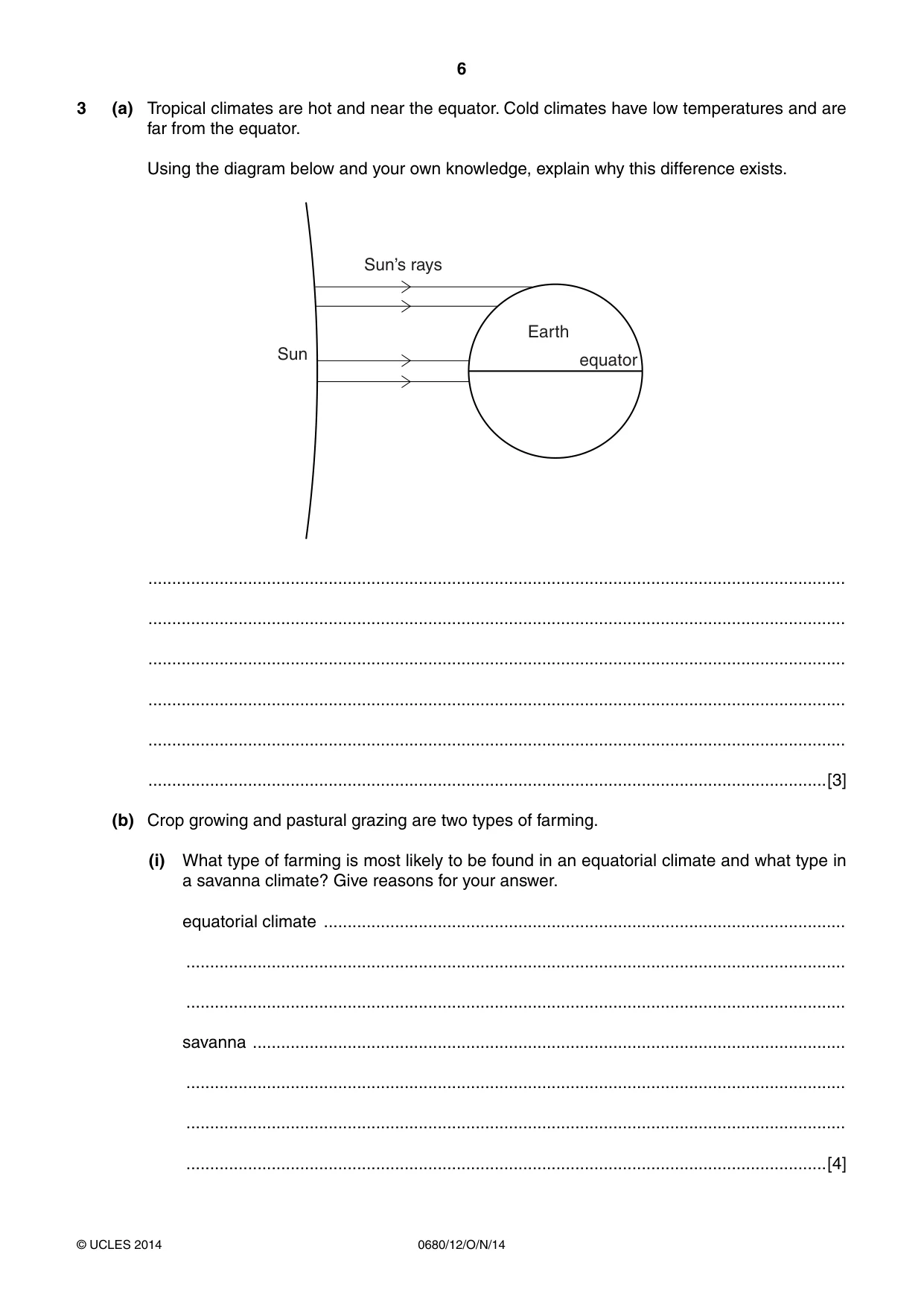
6 0680/12/O/N/14 © UCLES 2014 3 (a) Tropical climates are hot and near the equator. Cold climates have low temperatures and are far from the equator. Using the diagram below and your own knowledge, explain why this difference exists. Earth equator Sun Sun’s rays … … … … … …[3] (b) Crop growing and pastural grazing are two types of farming. (i) What type of farming is most likely to be found in an equatorial climate and what type in a savanna climate? Give reasons for your answer. equatorial climate … … … savanna … … … …[4]
Question paper, page 7
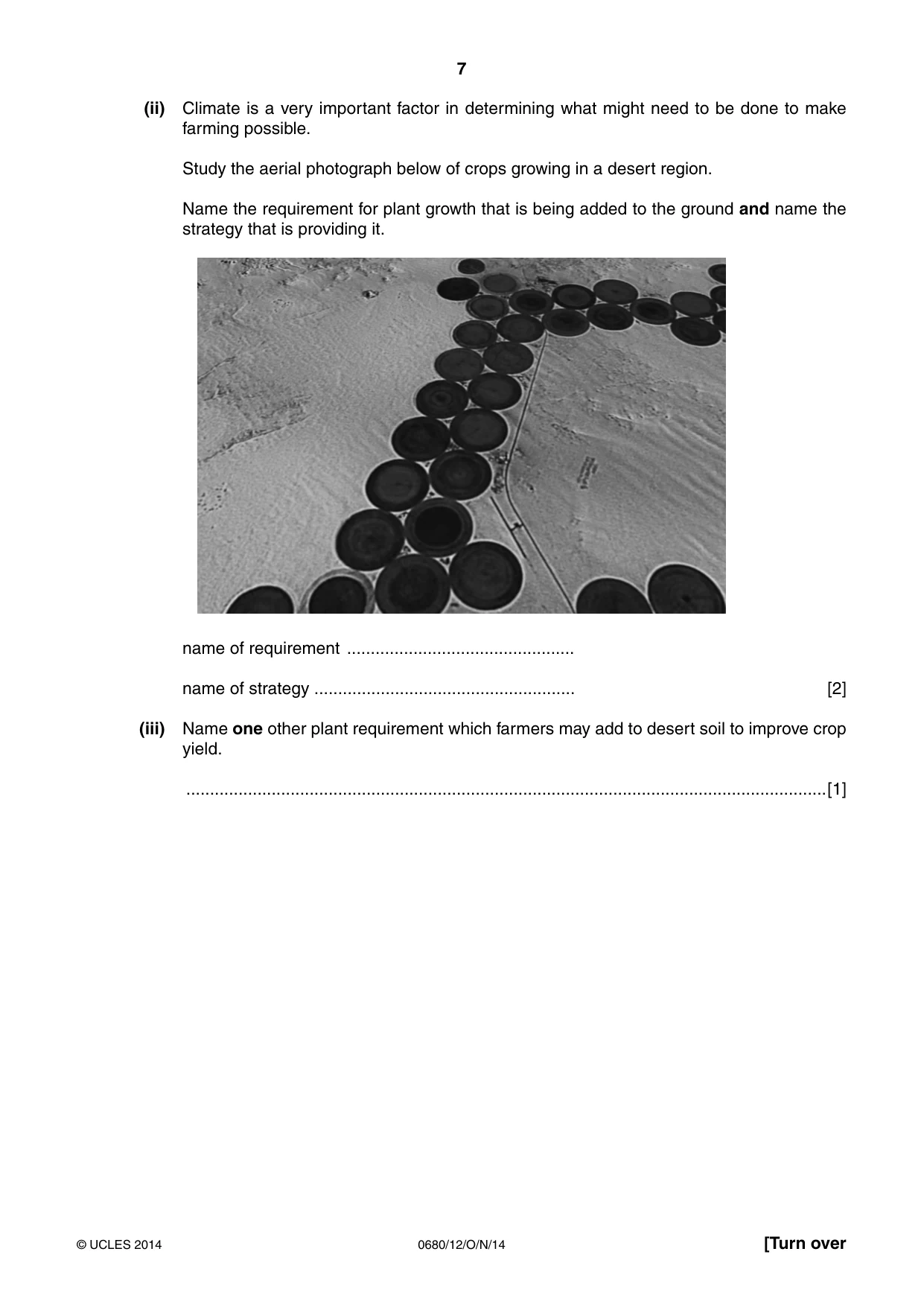
7 0680/12/O/N/14 © UCLES 2014 [Turn over (ii) Climate is a very important factor in determining what might need to be done to make farming possible. Study the aerial photograph below of crops growing in a desert region. Name the requirement for plant growth that is being added to the ground and name the strategy that is providing it. name of requirement … name of strategy … [2] (iii) Name one other plant requirement which farmers may add to desert soil to improve crop yield. …[1]
Question paper, page 8
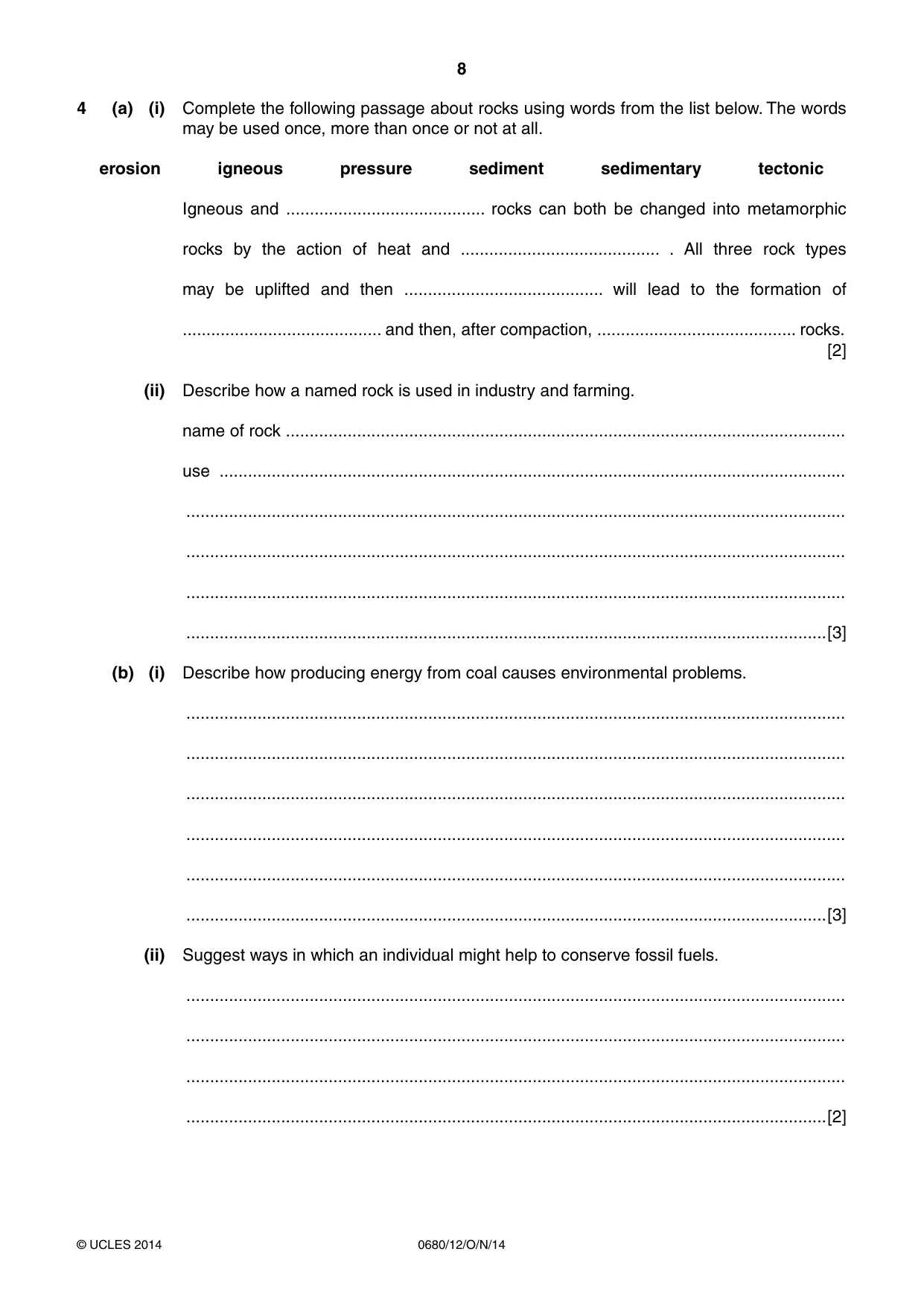
8 0680/12/O/N/14 © UCLES 2014 4 (a) (i) Complete the following passage about rocks using words from the list below. The words may be used once, more than once or not at all. erosion igneous pressure sediment sedimentary tectonic Igneous and … rocks can both be changed into metamorphic rocks by the action of heat and … . All three rock types may be uplifted and then … will lead to the formation of … and then, after compaction, … rocks. [2] (ii) Describe how a named rock is used in industry and farming. name of rock … use … … … … …[3] (b) (i) Describe how producing energy from coal causes environmental problems. … … … … … …[3] (ii) Suggest ways in which an individual might help to conserve fossil fuels. … … … …[2]
Question paper, page 9
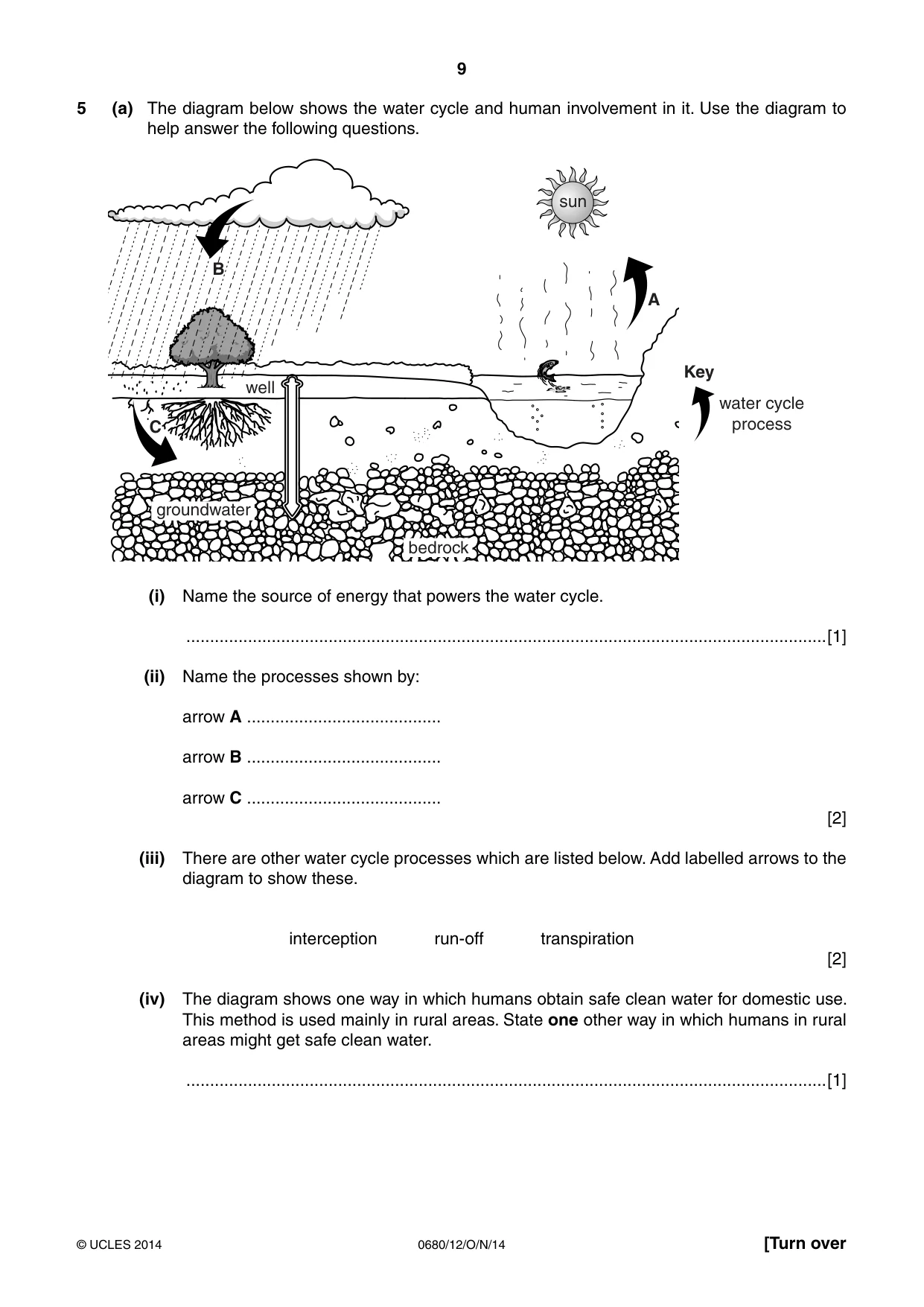
9 0680/12/O/N/14 © UCLES 2014 [Turn over 5 (a) The diagram below shows the water cycle and human involvement in it. Use the diagram to help answer the following questions. A B C well sun groundwater bedrock Key water cycle process (i) Name the source of energy that powers the water cycle. …[1] (ii) Name the processes shown by: arrow A … arrow B … arrow C … [2] (iii) There are other water cycle processes which are listed below. Add labelled arrows to the diagram to show these. interception run-off transpiration [2] (iv) The diagram shows one way in which humans obtain safe clean water for domestic use. This method is used mainly in rural areas. State one other way in which humans in rural areas might get safe clean water. …[1]
Question paper, page 10
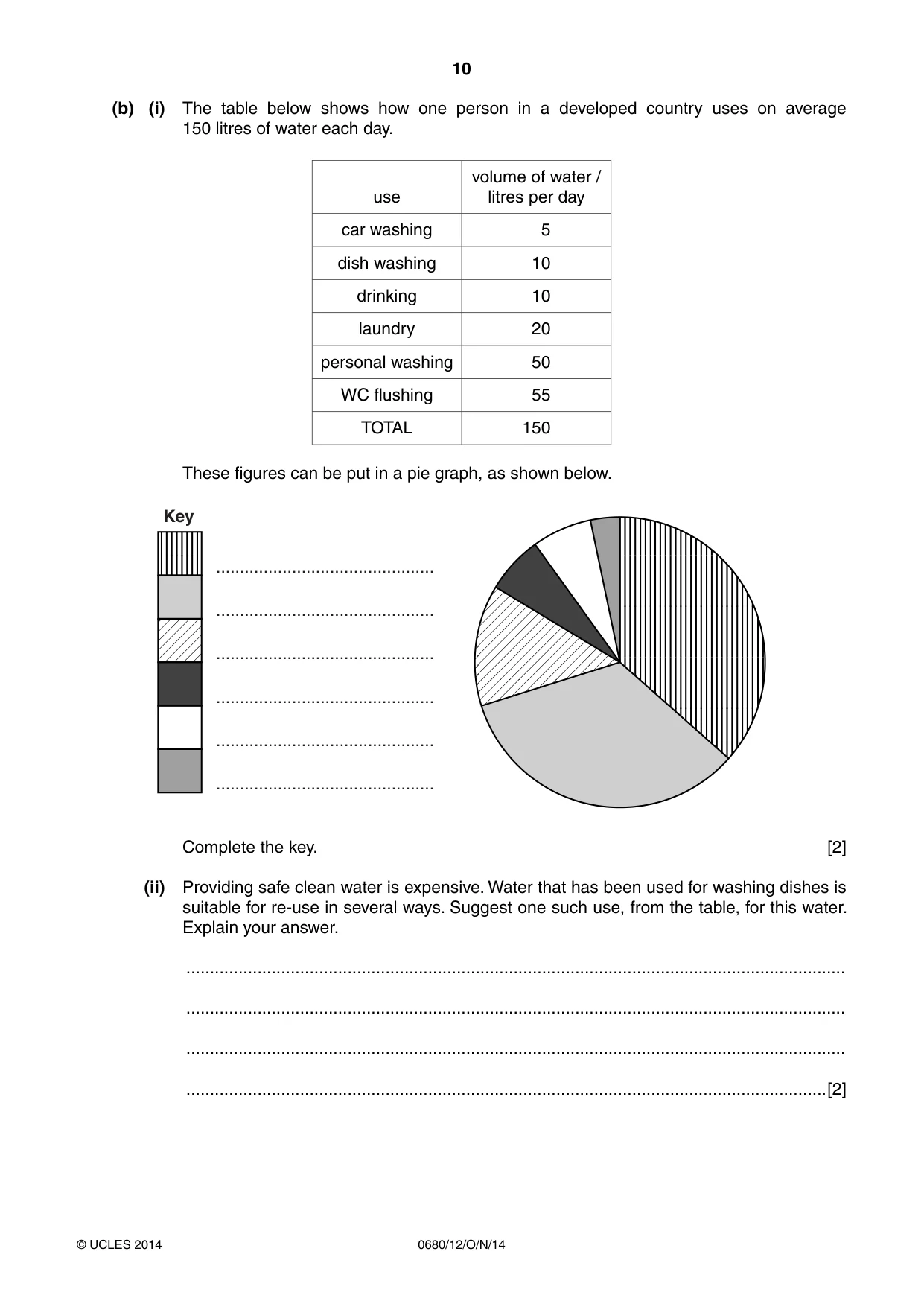
10 0680/12/O/N/14 © UCLES 2014 (b) (i) The table below shows how one person in a developed country uses on average 150 litres of water each day. use volume of water / litres per day car washing 5 dish washing 10 drinking 10 laundry 20 personal washing 50 WC flushing 55 TOTAL 150 These figures can be put in a pie graph, as shown below. Key … … … … … … Complete the key. [2] (ii) Providing safe clean water is expensive. Water that has been used for washing dishes is suitable for re-use in several ways. Suggest one such use, from the table, for this water. Explain your answer. … … … …[2]
Question paper, page 11
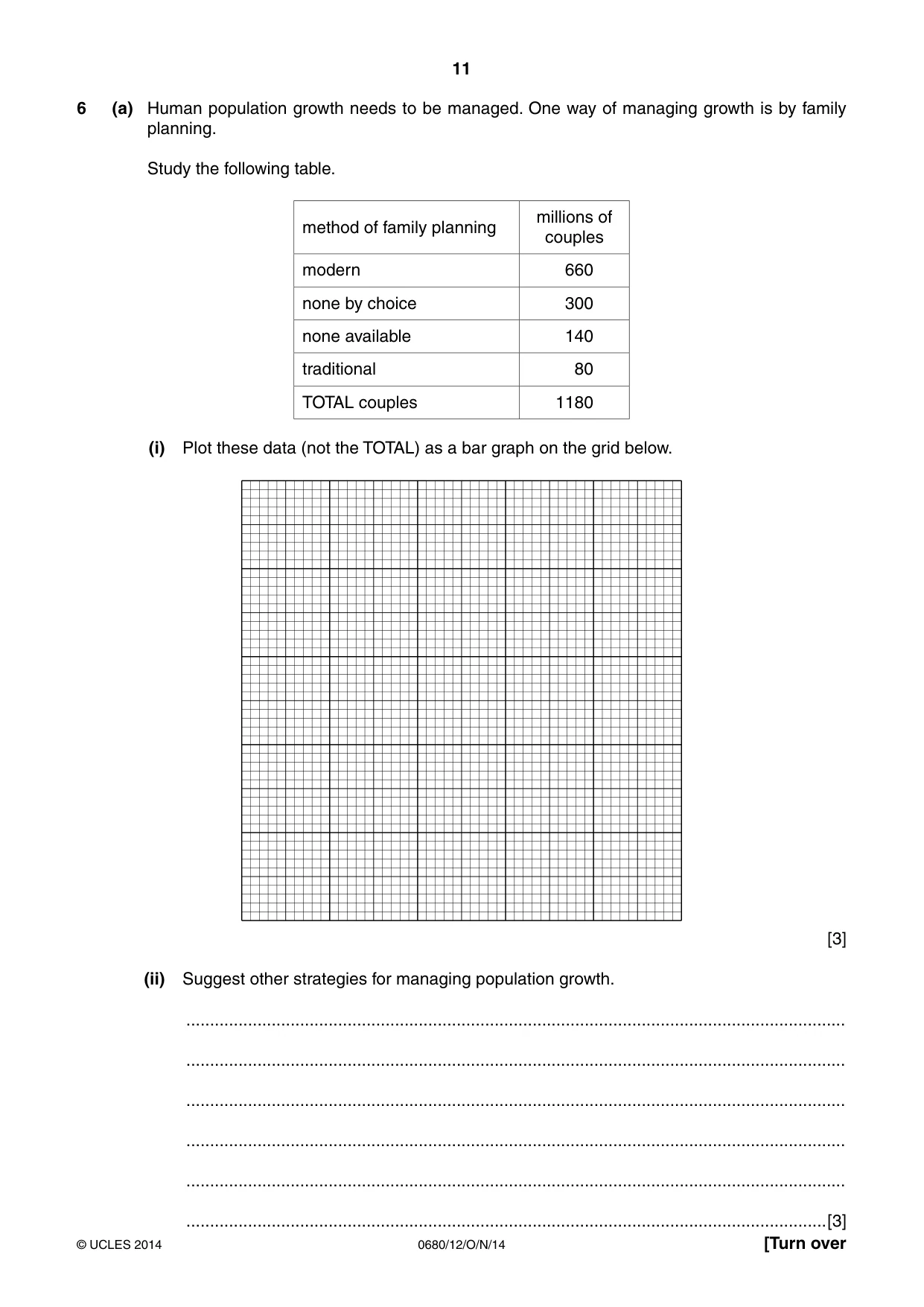
11 0680/12/O/N/14 © UCLES 2014 [Turn over 6 (a) Human population growth needs to be managed. One way of managing growth is by family planning. Study the following table. method of family planning millions of couples modern 660 none by choice 300 none available 140 traditional 80 TOTAL couples 1180 (i) Plot these data (not the TOTAL) as a bar graph on the grid below. [3] (ii) Suggest other strategies for managing population growth. … … … … … …[3]
Question paper, page 12
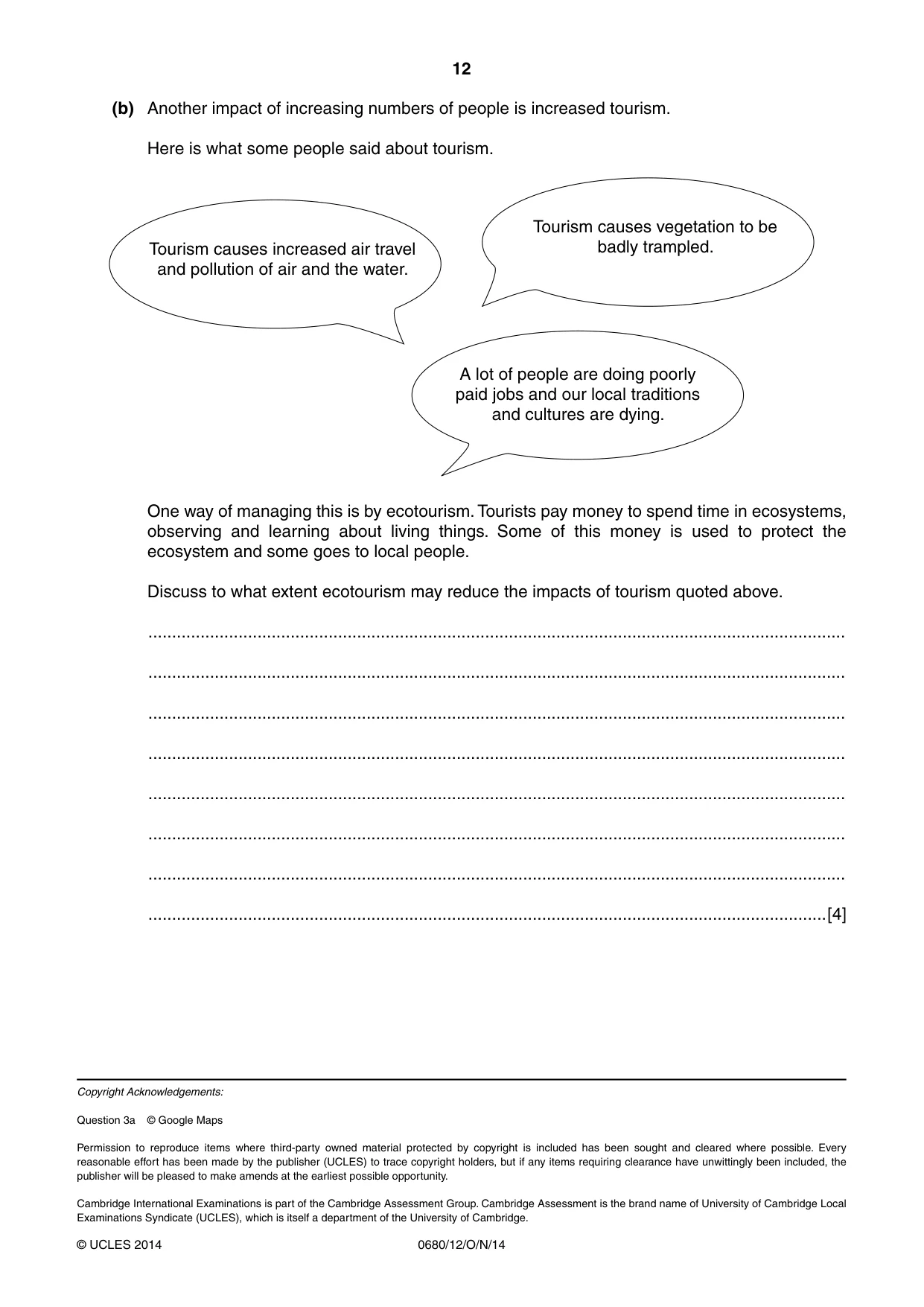
12 0680/12/O/N/14 © UCLES 2014 (b) Another impact of increasing numbers of people is increased tourism. Here is what some people said about tourism. Tourism causes increased air travel and pollution of air and the water. Tourism causes vegetation to be badly trampled. A lot of people are doing poorly paid jobs and our local traditions and cultures are dying. One way of managing this is by ecotourism. Tourists pay money to spend time in ecosystems, observing and learning about living things. Some of this money is used to protect the ecosystem and some goes to local people. Discuss to what extent ecotourism may reduce the impacts of tourism quoted above. … … … … … … … …[4] Copyright Acknowledgements: Question 3a © Google Maps Permission to reproduce items where third-party owned material protected by copyright is included has been sought and cleared where possible. Every reasonable effort has been made by the publisher (UCLES) to trace copyright holders, but if any items requiring clearance have unwittingly been included, the publisher will be pleased to make amends at the earliest possible opportunity. Cambridge International Examinations is part of the Cambridge Assessment Group. Cambridge Assessment is the brand name of University of Cambridge Local Examinations Syndicate (UCLES), which is itself a department of the University of Cambridge.
Mark scheme, page 1
® IGCSE is the registered trademark of Cambridge International Examinations. CAMBRIDGE INTERNATIONAL EXAMINATIONS Cambridge International General Certificate of Secondary Education MARK SCHEME for the October/November 2014 series 0680 ENVIRONMENTAL MANAGEMENT 0680/12 Paper 1, maximum raw mark 60 This mark scheme is published as an aid to teachers and candidates, to indicate the requirements of the examination. It shows the basis on which Examiners were instructed to award marks. It does not indicate the details of the discussions that took place at an Examiners’ meeting before marking began, which would have considered the acceptability of alternative answers. Mark schemes should be read in conjunction with the question paper and the Principal Examiner Report for Teachers. Cambridge will not enter into discussions about these mark schemes. Cambridge is publishing the mark schemes for the October/November 2014 series for most Cambridge IGCSE®, Cambridge International A and AS Level components and some Cambridge O Level components.
Mark scheme, page 2
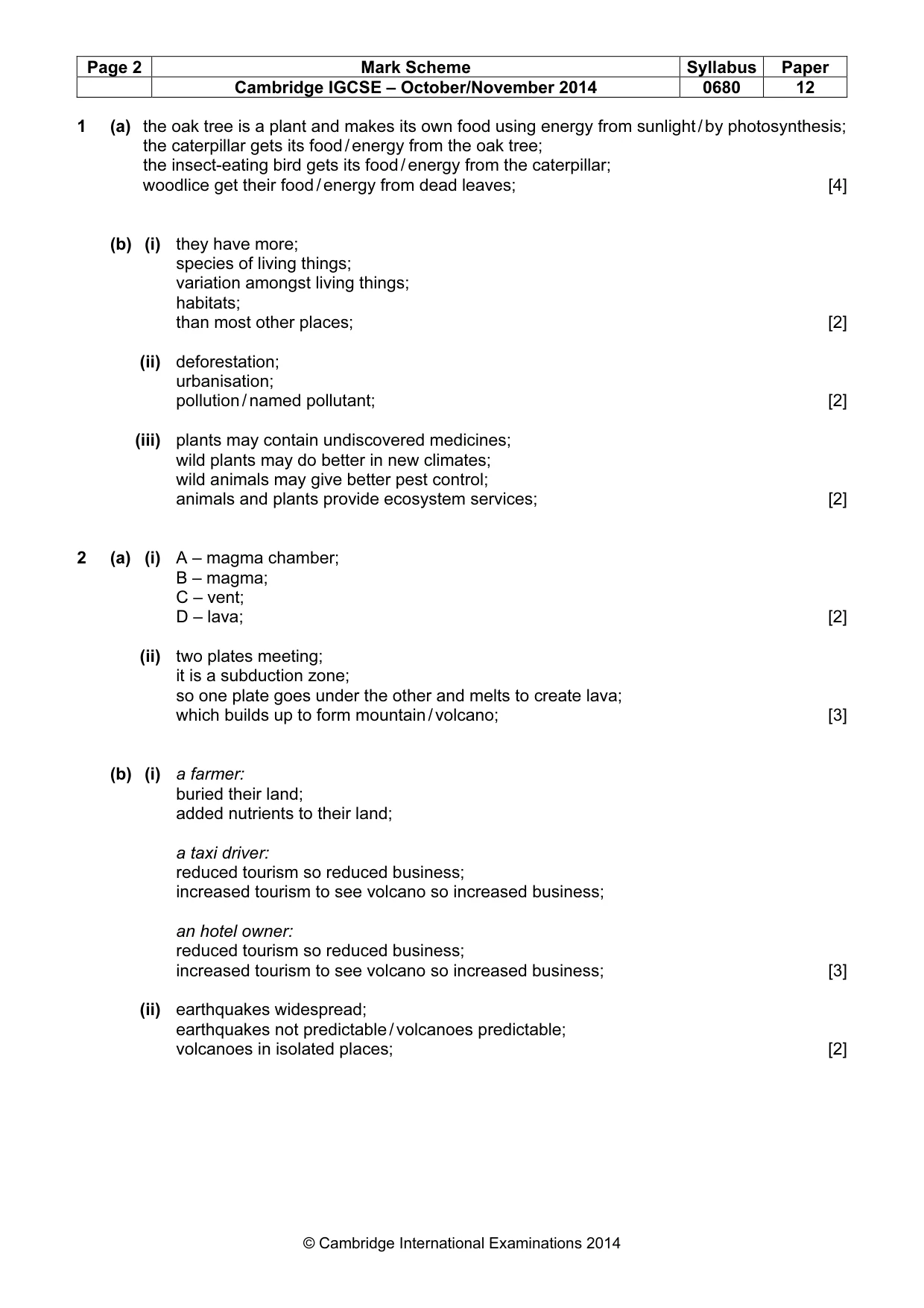
Page 2 Mark Scheme Syllabus Paper Cambridge IGCSE – October/November 2014 0680 12 © Cambridge International Examinations 2014 1 (a) the oak tree is a plant and makes its own food using energy from sunlight / by photosynthesis; the caterpillar gets its food / energy from the oak tree; the insect-eating bird gets its food / energy from the caterpillar; woodlice get their food / energy from dead leaves; [4] (b) (i) they have more; species of living things; variation amongst living things; habitats; than most other places; [2] (ii) deforestation; urbanisation; pollution / named pollutant; [2] (iii) plants may contain undiscovered medicines; wild plants may do better in new climates; wild animals may give better pest control; animals and plants provide ecosystem services; [2] 2 (a) (i) A – magma chamber; B – magma; C – vent; D – lava; [2] (ii) two plates meeting; it is a subduction zone; so one plate goes under the other and melts to create lava; which builds up to form mountain / volcano; [3] (b) (i) a farmer: buried their land; added nutrients to their land; a taxi driver: reduced tourism so reduced business; increased tourism to see volcano so increased business; an hotel owner: reduced tourism so reduced business; increased tourism to see volcano so increased business; [3] (ii) earthquakes widespread; earthquakes not predictable / volcanoes predictable; volcanoes in isolated places; [2]
Mark scheme, page 3
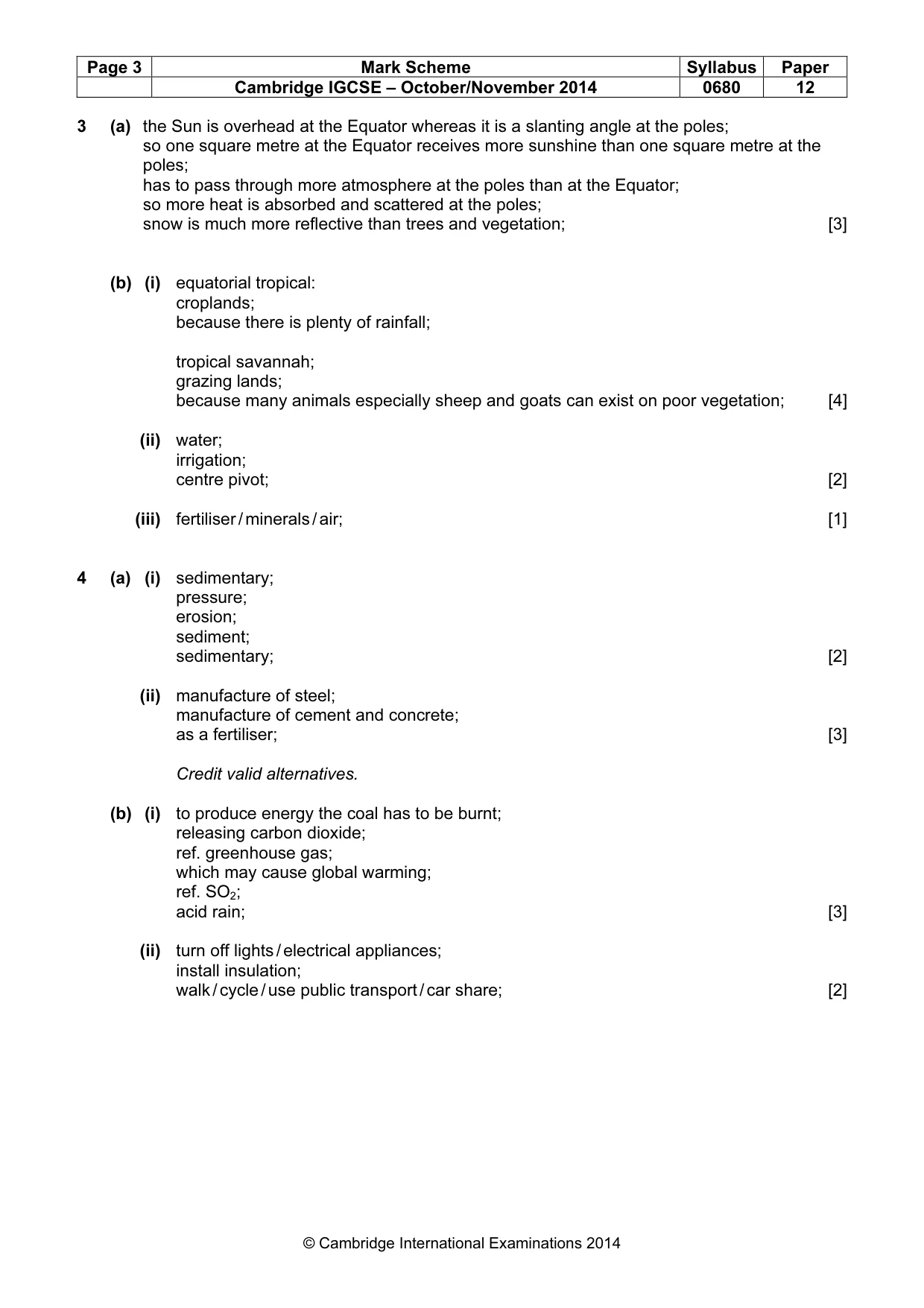
Page 3 Mark Scheme Syllabus Paper Cambridge IGCSE – October/November 2014 0680 12 © Cambridge International Examinations 2014 3 (a) the Sun is overhead at the Equator whereas it is a slanting angle at the poles; so one square metre at the Equator receives more sunshine than one square metre at the poles; has to pass through more atmosphere at the poles than at the Equator; so more heat is absorbed and scattered at the poles; snow is much more reflective than trees and vegetation; [3] (b) (i) equatorial tropical: croplands; because there is plenty of rainfall; tropical savannah; grazing lands; because many animals especially sheep and goats can exist on poor vegetation; [4] (ii) water; irrigation; centre pivot; [2] (iii) fertiliser / minerals / air; [1] 4 (a) (i) sedimentary; pressure; erosion; sediment; sedimentary; [2] (ii) manufacture of steel; manufacture of cement and concrete; as a fertiliser; [3] Credit valid alternatives. (b) (i) to produce energy the coal has to be burnt; releasing carbon dioxide; ref. greenhouse gas; which may cause global warming; ref. SO2; acid rain; [3] (ii) turn off lights / electrical appliances; install insulation; walk / cycle / use public transport / car share; [2]
Mark scheme, page 4
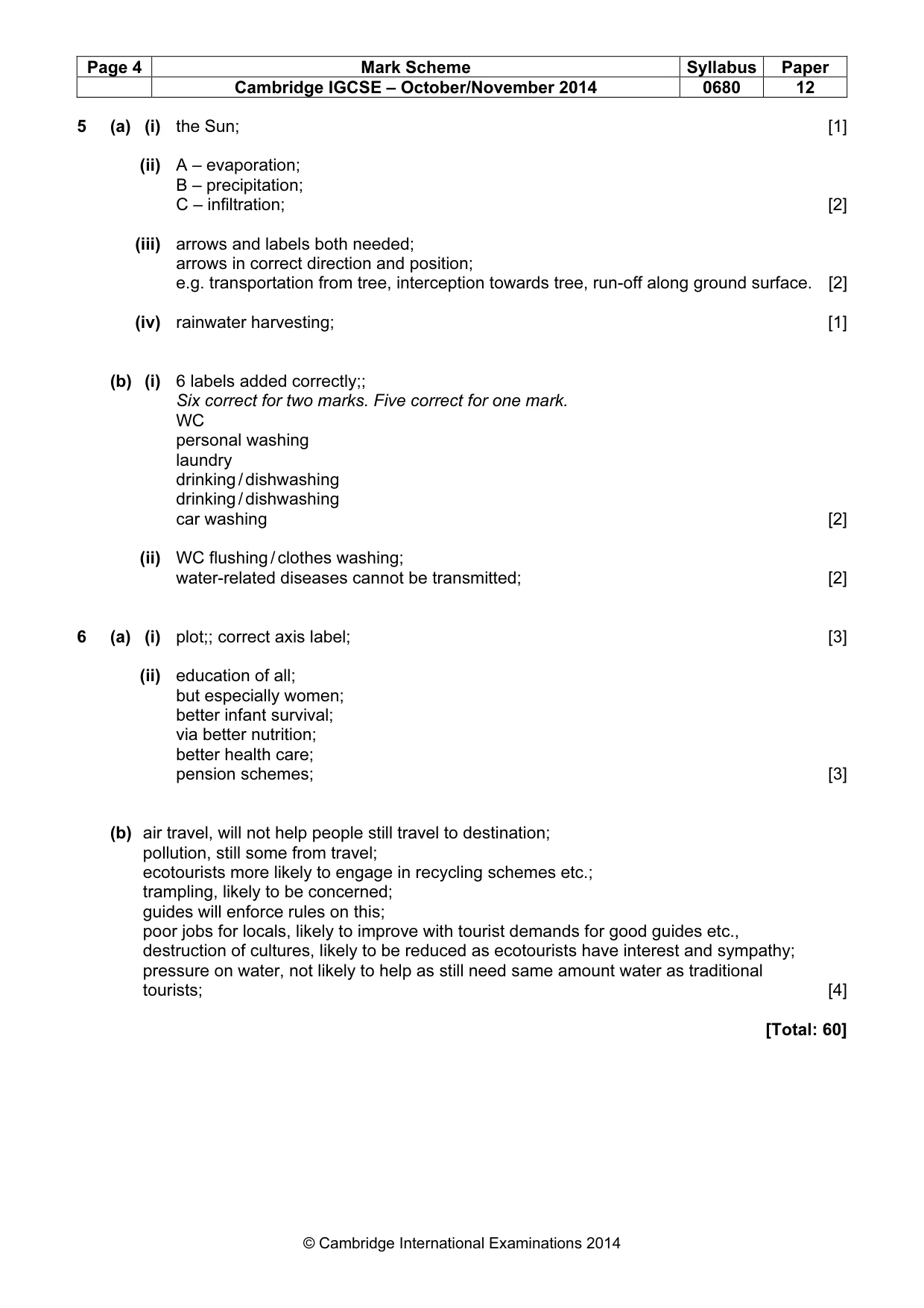
Page 4 Mark Scheme Syllabus Paper Cambridge IGCSE – October/November 2014 0680 12 © Cambridge International Examinations 2014 5 (a) (i) the Sun; [1] (ii) A – evaporation; B – precipitation; C – infiltration; [2] (iii) arrows and labels both needed; arrows in correct direction and position; e.g. transportation from tree, interception towards tree, run-off along ground surface. [2] (iv) rainwater harvesting; [1] (b) (i) 6 labels added correctly;; Six correct for two marks. Five correct for one mark. WC personal washing laundry drinking / dishwashing drinking / dishwashing car washing [2] (ii) WC flushing / clothes washing; water-related diseases cannot be transmitted; [2] 6 (a) (i) plot;; correct axis label; [3] (ii) education of all; but especially women; better infant survival; via better nutrition; better health care; pension schemes; [3] (b) air travel, will not help people still travel to destination; pollution, still some from travel; ecotourists more likely to engage in recycling schemes etc.; trampling, likely to be concerned; guides will enforce rules on this; poor jobs for locals, likely to improve with tourist demands for good guides etc., destruction of cultures, likely to be reduced as ecotourists have interest and sympathy; pressure on water, not likely to help as still need same amount water as traditional tourists; [4] [Total: 60]
What you needed in this session
Cambridge’s own grade thresholds for 2014 Oct/Nov, Paper 1 · Variant 2. A higher threshold means an easier paper — the bar moves with how the cohort did.