Cambridge IGCSE Environmental Management 0680 — 2014 Oct/Nov Paper 1 · Variant 1
0680/11/O/N/14 · 60 marks · ≈68 min
The question paper and its mark scheme, free to read here and free to download. This is Cambridge’s own paper, exactly as it was sat.
Question paper12 pages
Mark scheme5 pages
Answers below. Sit the paper first if you are practising.
Paper as text
Question paper, page 1
This document consists of 12 printed pages. DC (CW/SW) 81153/5 © UCLES 2014 [Turn over Cambridge International Examinations Cambridge International General Certificate of Secondary Education * 3 3 9 0 4 0 2 9 8 6 * ENVIRONMENTAL MANAGEMENT 0680/11 Paper 1 October/November 2014 1 hour 30 minutes Candidates answer on the Question Paper. Additional Materials: Ruler READ THESE INSTRUCTIONS FIRST Write your Centre number, candidate number and name on all the work you hand in. Write in dark blue or black pen. You may use an HB pencil for any diagrams or graphs. Do not use staples, paper clips, glue or correction fluid. DO NOT WRITE IN ANY BARCODES. Answer all questions. Electronic calculators may be used. You may lose marks if you do not show your working or if you do not use appropriate units. At the end of the examination, fasten all your work securely together. The number of marks is given in brackets [ ] at the end of each question or part question.
Question paper, page 2
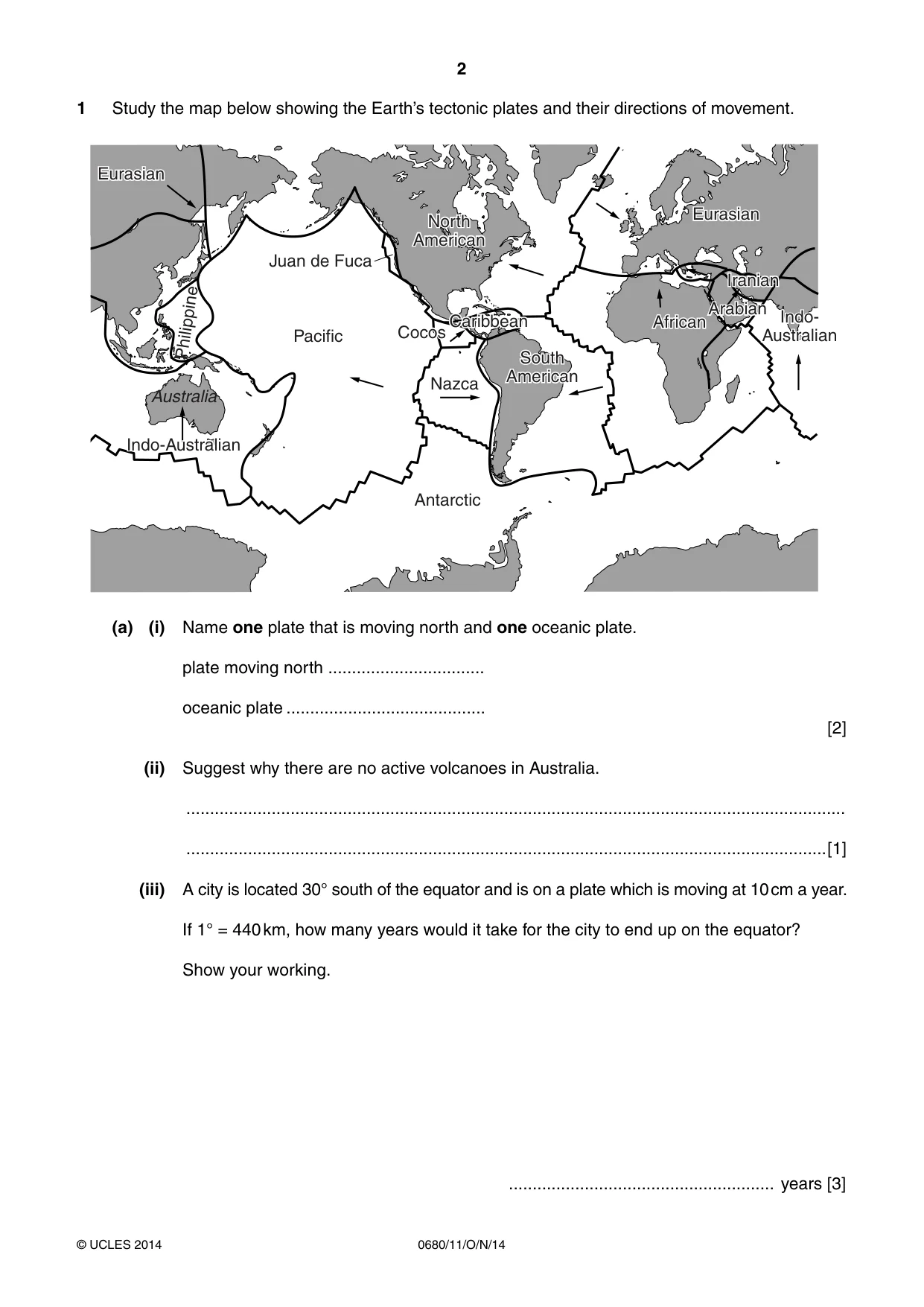
2 0680/11/O/N/14 © UCLES 2014 1 Study the map below showing the Earth’s tectonic plates and their directions of movement. Pacific North American South American Caribbean Cocos Philippine Eurasian Eurasian Australia Indo-Australian Indo- Australian Antarctic Nazca AfricanArabian Iranian Juan de Fuca (a) (i) Name one plate that is moving north and one oceanic plate. plate moving north … oceanic plate … [2] (ii) Suggest why there are no active volcanoes in Australia. … …[1] (iii) A city is located 30° south of the equator and is on a plate which is moving at 10 cm a year. If 1° = 440 km, how many years would it take for the city to end up on the equator? Show your working. … years [3]
Question paper, page 3
3 0680/11/O/N/14 © UCLES 2014 [Turn over (b) Suggest and explain reasons why some people choose to live near a volcano. … … … … … … … …[4]
Question paper, page 4
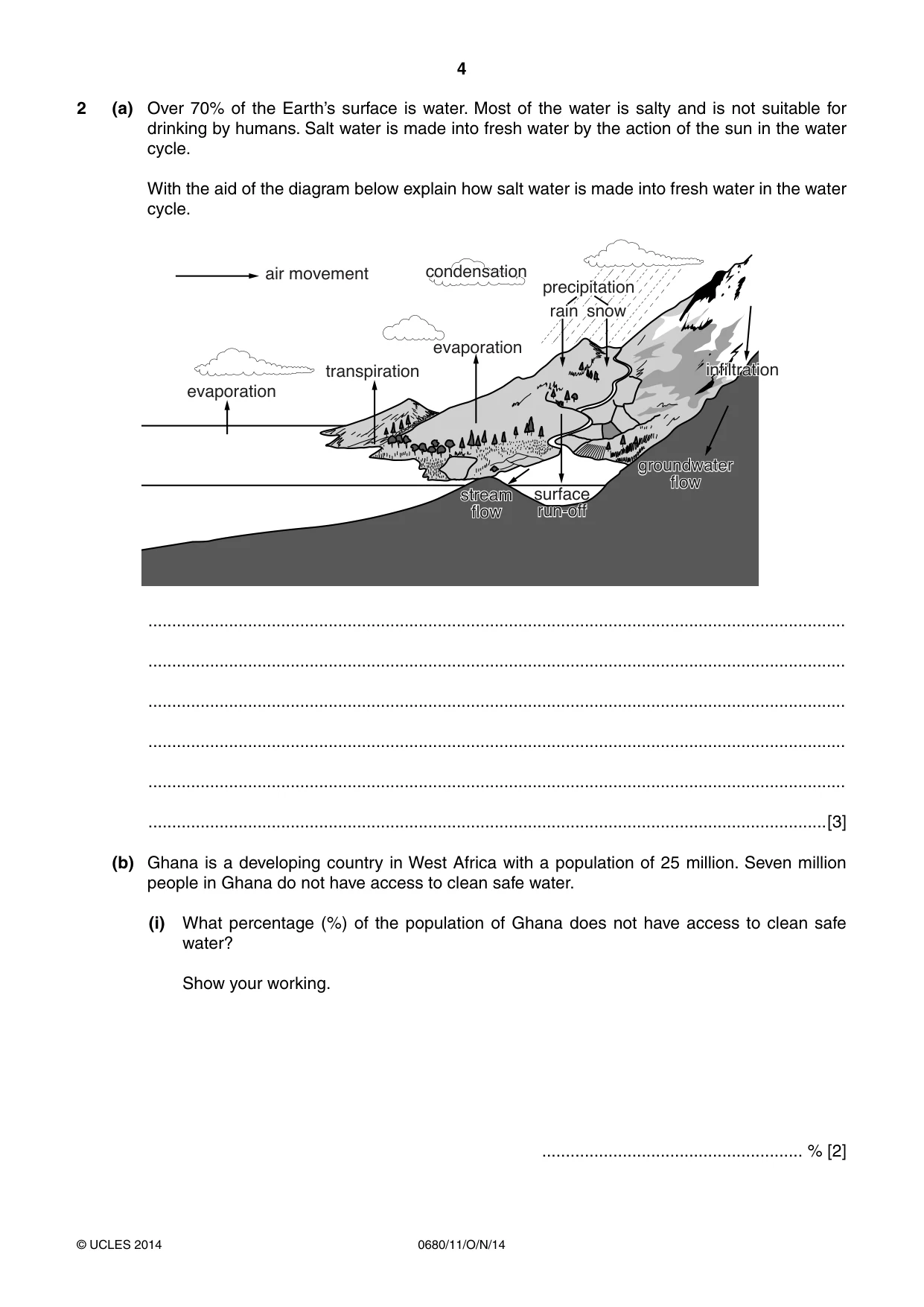
4 0680/11/O/N/14 © UCLES 2014 2 (a) Over 70% of the Earth’s surface is water. Most of the water is salty and is not suitable for drinking by humans. Salt water is made into fresh water by the action of the sun in the water cycle. With the aid of the diagram below explain how salt water is made into fresh water in the water cycle. evaporation evaporation stream flow surface run-off groundwater flow infiltration precipitation condensation rain snow transpiration air movement … … … … … …[3] (b) Ghana is a developing country in West Africa with a population of 25 million. Seven million people in Ghana do not have access to clean safe water. (i) What percentage (%) of the population of Ghana does not have access to clean safe water? Show your working. … % [2]
Question paper, page 5
5 0680/11/O/N/14 © UCLES 2014 [Turn over (ii) Explain two ways in which fresh water might not be safe to drink. … … … … … …[3] (iii) Suggest how water that is safe to drink might be supplied to a village in Ghana. … … … … … …[2]
Question paper, page 6
6 0680/11/O/N/14 © UCLES 2014 3 (a) (i) Complete the following passage about the gases which make up the Earth’s atmosphere, by filling in the missing words. The Earth’s atmosphere is a mixture of gases. The most abundant gas is … , followed by … . A gas which makes up less than 0.04% of the atmosphere but from which plants make food is … … . High up in the atmosphere is the … layer which absorbs UV radiation from the Sun. [2] (ii) Explain why it is important for life on Earth that most UV light is screened out at the top of the atmosphere. … … … …[2]
Question paper, page 7
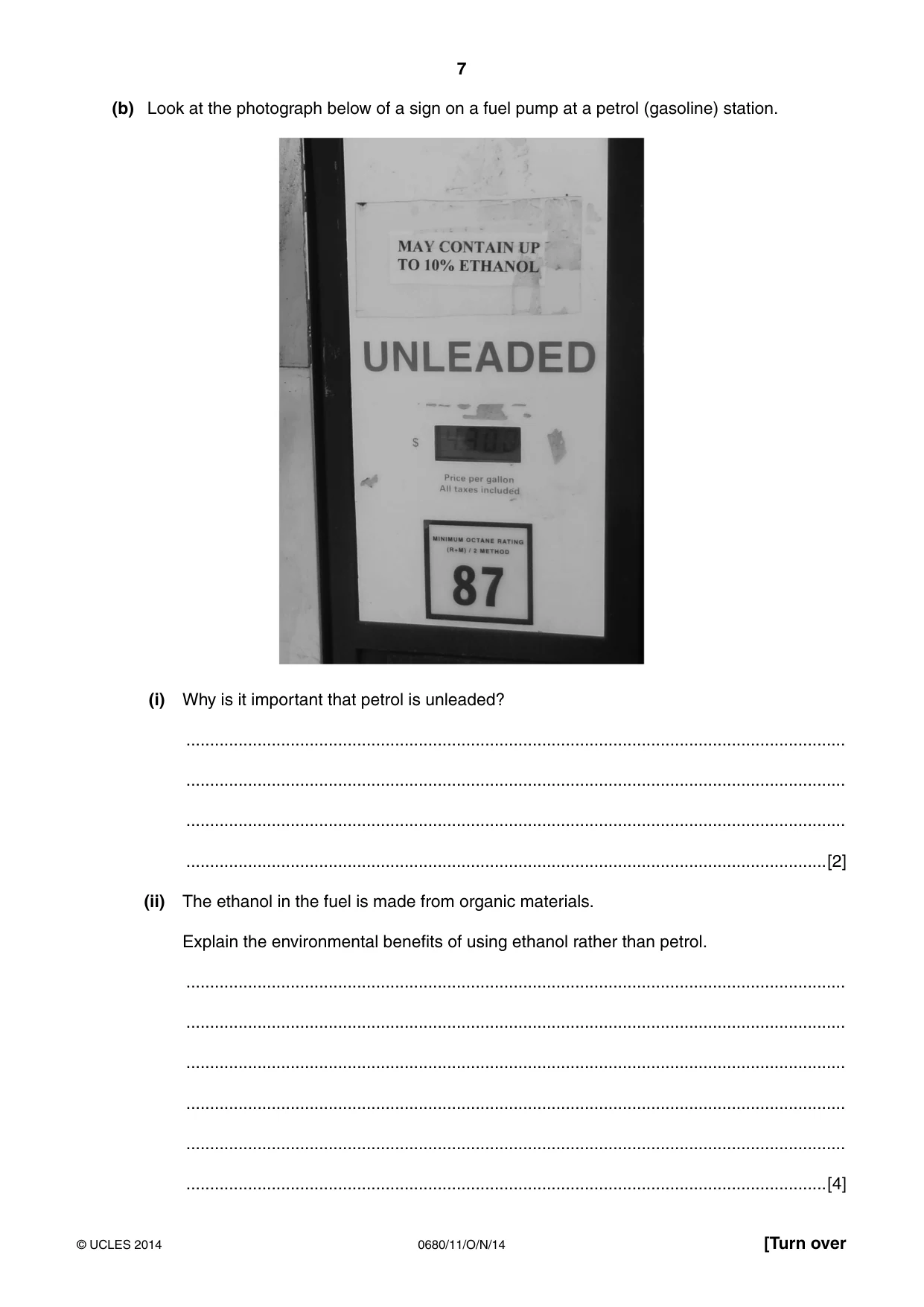
7 0680/11/O/N/14 © UCLES 2014 [Turn over (b) Look at the photograph below of a sign on a fuel pump at a petrol (gasoline) station. (i) Why is it important that petrol is unleaded? … … … …[2] (ii) The ethanol in the fuel is made from organic materials. Explain the environmental benefits of using ethanol rather than petrol. … … … … … …[4]
Question paper, page 8
8 0680/11/O/N/14 © UCLES 2014 4 In 1937 an area of agricultural land around Machakos in Kenya was described like this: ‘The Machakos Reserve is a large area of land on which uncontrolled agricultural development has occurred. The local people have misused the land and this has caused hopeless and miserable poverty. Their farmland is turning into a desert of rocks, stones and sand.’ (i) Describe how the land could have been misused. … … … … … … … …[4] (ii) In 1937 the population of the area was about 250 000, by 1990 it was 1 500 000. How many times bigger was the population in 1990 than it was in 1937? Show your working. … times [2]
Question paper, page 9
9 0680/11/O/N/14 © UCLES 2014 [Turn over (iii) Although the population has increased, the soil is now much better for farming than it was in 1937. Look at the photographs below showing the same area in 1937 and 1990. Describe the changes in the photographs that show how the soil has been conserved. Explain how these changes have conserved the soil. 1937 1990 … … … … … … … …[4]
Question paper, page 10
10 0680/11/O/N/14 © UCLES 2014 5 (a) The table shows crop yields in a developing and a developed country. developing world country developed world country yield of cereals per hectare / tonnes 2.2 3.9 yield of roots and tubers per hectare / tonnes 13.8 29.2 (i) How much more total crop yield is produced in the developed world country than in the developing world country? Show your working. … tonnes [2] (ii) Suggest reasons for the low total crop yield in the developing country. … … … … …[3] (iii) Describe ways in which a developing country might increase its agricultural yields. … … … … …[3] (b) What are the disadvantages of farmland in a developing country being used to grow biomass for fuel? … … … …[2]
Question paper, page 11
11 0680/11/O/N/14 © UCLES 2014 [Turn over 6 The pie graph shows land use in a developed country in 2009. rough grazing permanent grassland crops other agriculture urban forestry Key (a) (i) What percentage of this land was urban in 2009? … [1] (ii) Extensive and intensive are two systems of farming. The following are some of the impacts that farming may have: • overuse of pesticides and inorganic fertilisers • crops requiring irrigation • traditional crop varieties disappearing • overproduction and waste in developed countries • concentration of land owned by fewer people • environmental damage, such as pollution and soil erosion • habitat loss Which system of farming, extensive or intensive, contributes most to such impacts? Explain your choice. … … … … … … … … … …[5]
Question paper, page 12
12 0680/11/O/N/14 © UCLES 2014 (b) Human uses of the natural environment often lead to habitat destruction. Describe how conservation organisations such as UNEP, IUCN, WWF and CITES might help to reduce habitat destruction and its effects. … … … … … … … …[4] Copyright Acknowledgements: Question 3b G Skinner © UCLES Question 4 © M Tiffen et al.; More People, Less Erosion; J Wiley & Sons Ltd; 1994 Permission to reproduce items where third-party owned material protected by copyright is included has been sought and cleared where possible. Every reasonable effort has been made by the publisher (UCLES) to trace copyright holders, but if any items requiring clearance have unwittingly been included, the publisher will be pleased to make amends at the earliest possible opportunity. Cambridge International Examinations is part of the Cambridge Assessment Group. Cambridge Assessment is the brand name of University of Cambridge Local Examinations Syndicate (UCLES), which is itself a department of the University of Cambridge.
Mark scheme, page 1
® IGCSE is the registered trademark of Cambridge International Examinations. CAMBRIDGE INTERNATIONAL EXAMINATIONS Cambridge International General Certificate of Secondary Education MARK SCHEME for the October/November 2014 series 0680 ENVIRONMENTAL MANAGEMENT 0680/11 Paper 1, maximum raw mark 60 This mark scheme is published as an aid to teachers and candidates, to indicate the requirements of the examination. It shows the basis on which Examiners were instructed to award marks. It does not indicate the details of the discussions that took place at an Examiners’ meeting before marking began, which would have considered the acceptability of alternative answers. Mark schemes should be read in conjunction with the question paper and the Principal Examiner Report for Teachers. Cambridge will not enter into discussions about these mark schemes. Cambridge is publishing the mark schemes for the October/November 2014 series for most Cambridge IGCSE®, Cambridge International A and AS Level components and some Cambridge O Level components.
Mark scheme, page 2
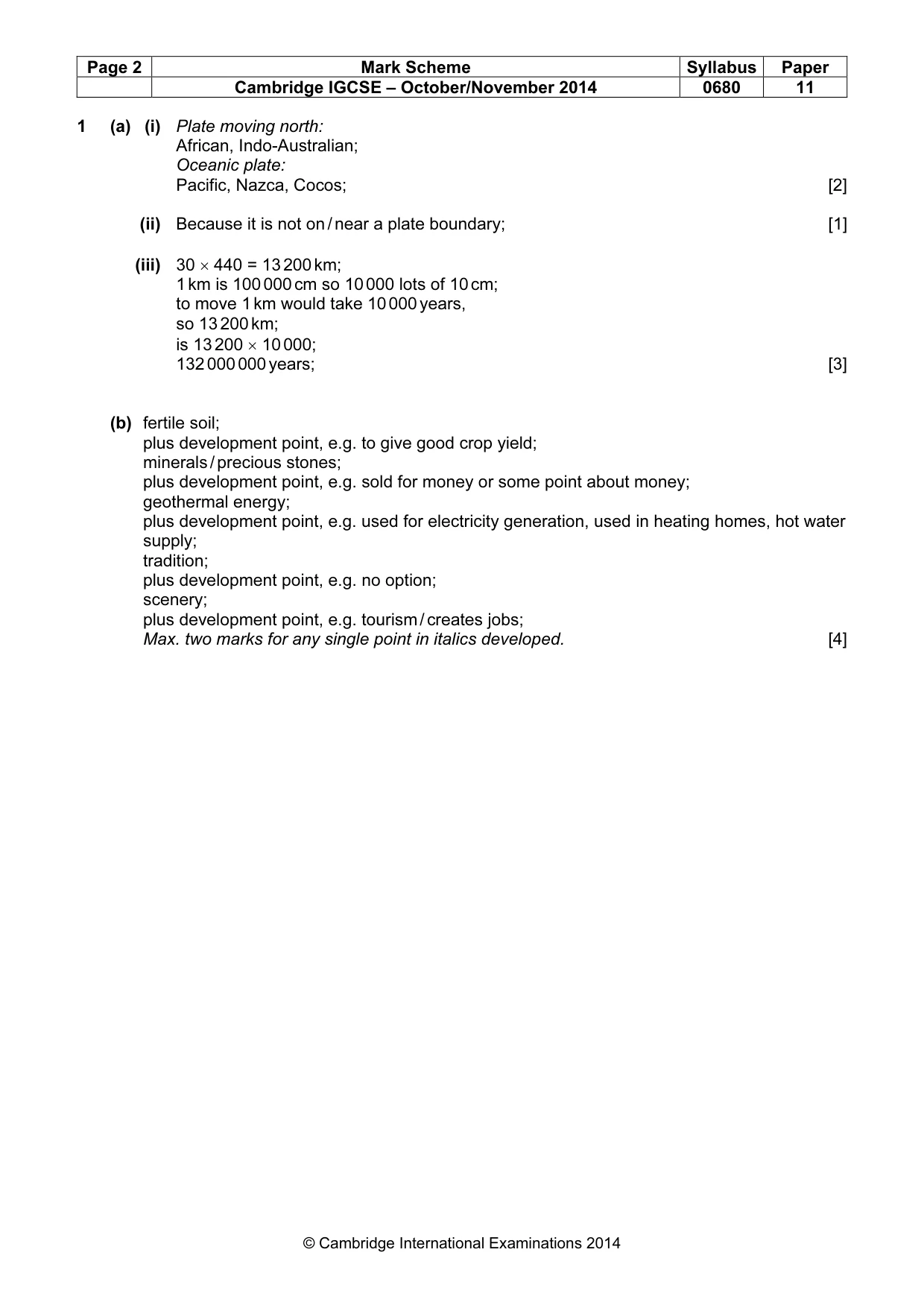
Page 2 Mark Scheme Syllabus Paper Cambridge IGCSE – October/November 2014 0680 11 © Cambridge International Examinations 2014 1 (a) (i) Plate moving north: African, Indo-Australian; Oceanic plate: Pacific, Nazca, Cocos; [2] (ii) Because it is not on / near a plate boundary; [1] (iii) 30 × 440 = 13 200 km; 1 km is 100 000 cm so 10 000 lots of 10 cm; to move 1 km would take 10 000 years, so 13 200 km; is 13 200 × 10 000; 132 000 000 years; [3] (b) fertile soil; plus development point, e.g. to give good crop yield; minerals / precious stones; plus development point, e.g. sold for money or some point about money; geothermal energy; plus development point, e.g. used for electricity generation, used in heating homes, hot water supply; tradition; plus development point, e.g. no option; scenery; plus development point, e.g. tourism / creates jobs; Max. two marks for any single point in italics developed. [4]
Mark scheme, page 3
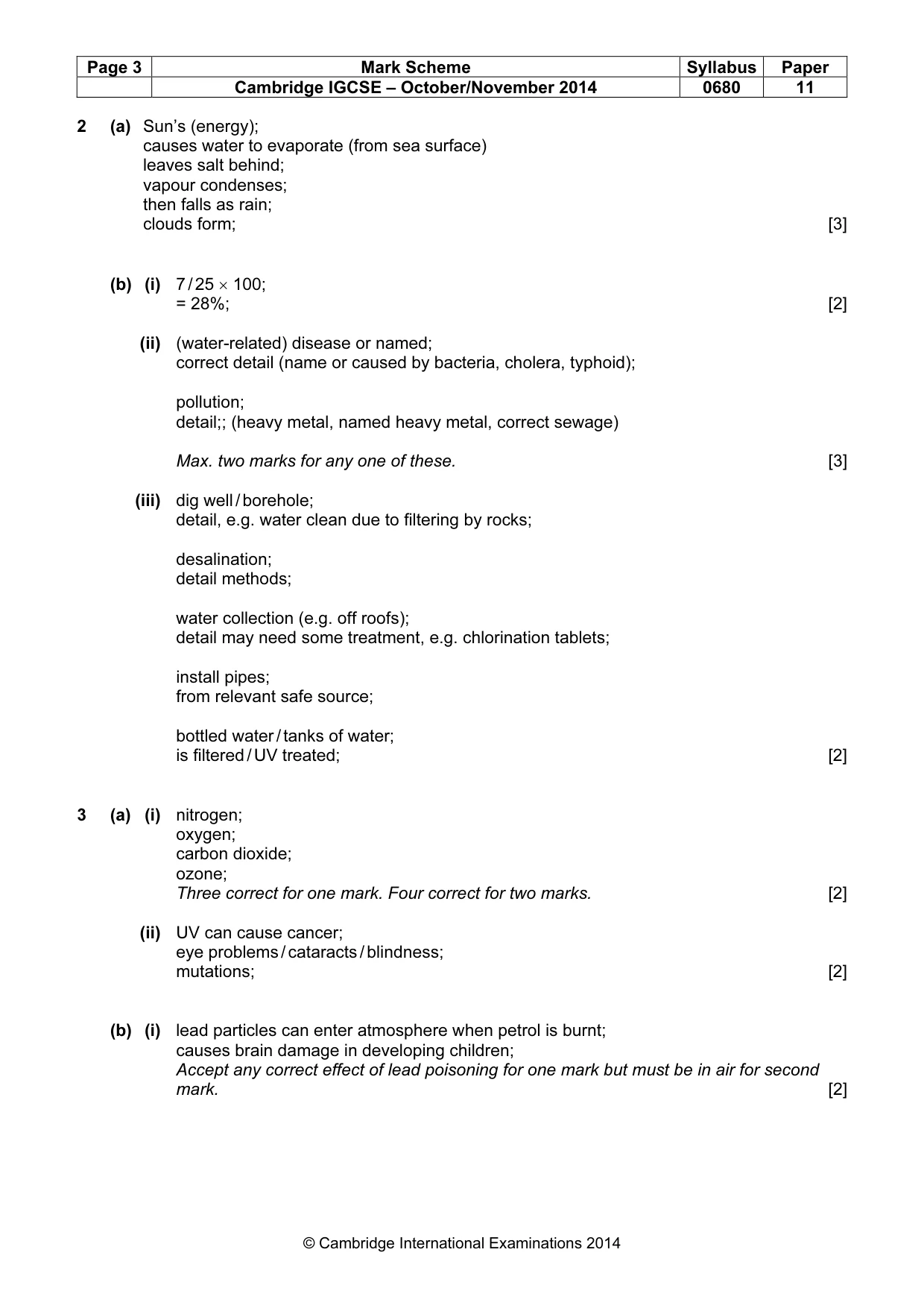
Page 3 Mark Scheme Syllabus Paper Cambridge IGCSE – October/November 2014 0680 11 © Cambridge International Examinations 2014 2 (a) Sun’s (energy); causes water to evaporate (from sea surface) leaves salt behind; vapour condenses; then falls as rain; clouds form; [3] (b) (i) 7 / 25 × 100; = 28%; [2] (ii) (water-related) disease or named; correct detail (name or caused by bacteria, cholera, typhoid); pollution; detail;; (heavy metal, named heavy metal, correct sewage) Max. two marks for any one of these. [3] (iii) dig well / borehole; detail, e.g. water clean due to filtering by rocks; desalination; detail methods; water collection (e.g. off roofs); detail may need some treatment, e.g. chlorination tablets; install pipes; from relevant safe source; bottled water / tanks of water; is filtered / UV treated; [2] 3 (a) (i) nitrogen; oxygen; carbon dioxide; ozone; Three correct for one mark. Four correct for two marks. [2] (ii) UV can cause cancer; eye problems / cataracts / blindness; mutations; [2] (b) (i) lead particles can enter atmosphere when petrol is burnt; causes brain damage in developing children; Accept any correct effect of lead poisoning for one mark but must be in air for second mark. [2]
Mark scheme, page 4
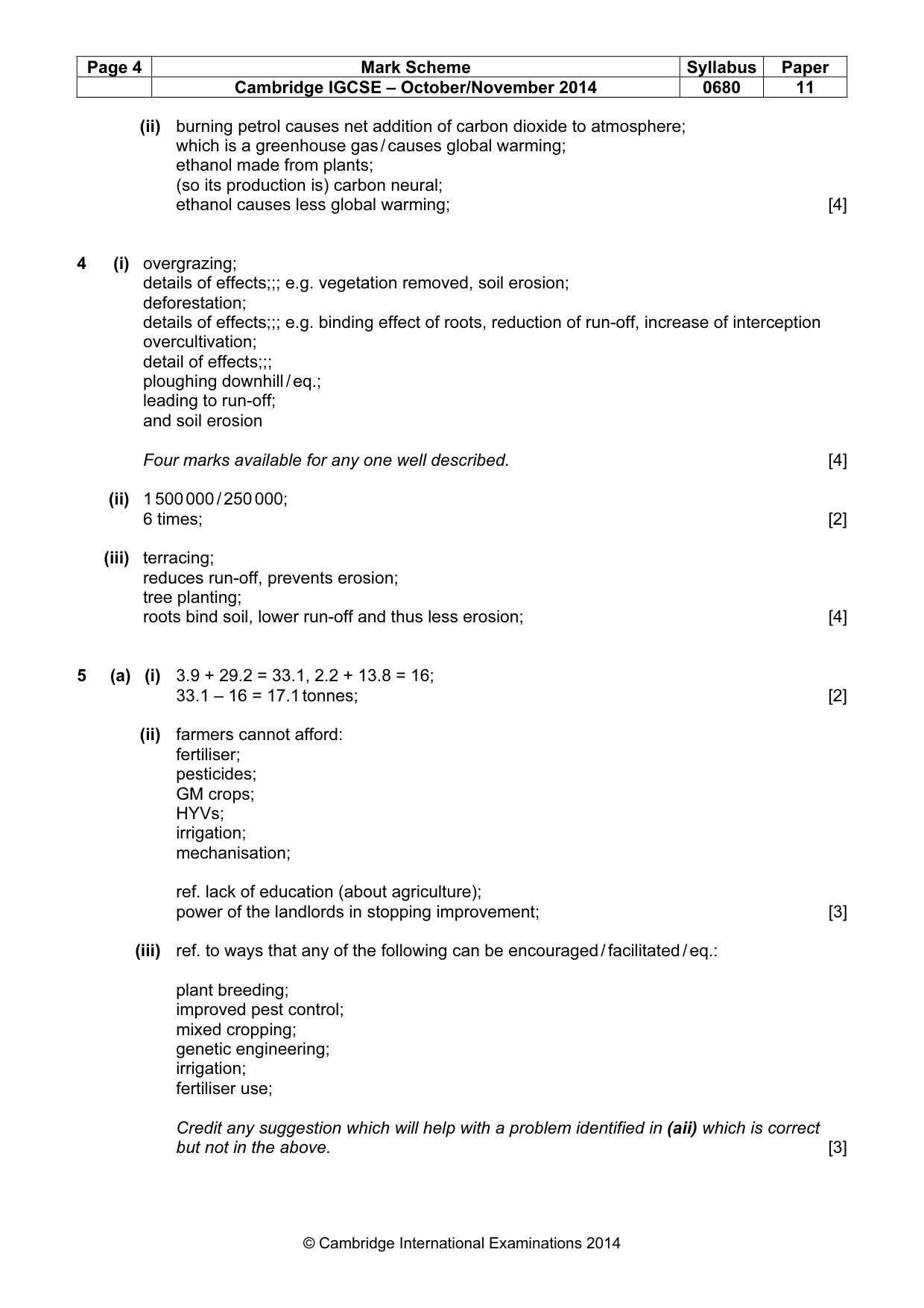
Page 4 Mark Scheme Syllabus Paper Cambridge IGCSE – October/November 2014 0680 11 © Cambridge International Examinations 2014 (ii) burning petrol causes net addition of carbon dioxide to atmosphere; which is a greenhouse gas / causes global warming; ethanol made from plants; (so its production is) carbon neural; ethanol causes less global warming; [4] 4 (i) overgrazing; details of effects;;; e.g. vegetation removed, soil erosion; deforestation; details of effects;;; e.g. binding effect of roots, reduction of run-off, increase of interception overcultivation; detail of effects;;; ploughing downhill / eq.; leading to run-off; and soil erosion Four marks available for any one well described. [4] (ii) 1 500 000 / 250 000; 6 times; [2] (iii) terracing; reduces run-off, prevents erosion; tree planting; roots bind soil, lower run-off and thus less erosion; [4] 5 (a) (i) 3.9 + 29.2 = 33.1, 2.2 + 13.8 = 16; 33.1 – 16 = 17.1 tonnes; [2] (ii) farmers cannot afford: fertiliser; pesticides; GM crops; HYVs; irrigation; mechanisation; ref. lack of education (about agriculture); power of the landlords in stopping improvement; [3] (iii) ref. to ways that any of the following can be encouraged / facilitated / eq.: plant breeding; improved pest control; mixed cropping; genetic engineering; irrigation; fertiliser use; Credit any suggestion which will help with a problem identified in (aii) which is correct but not in the above. [3]
Mark scheme, page 5
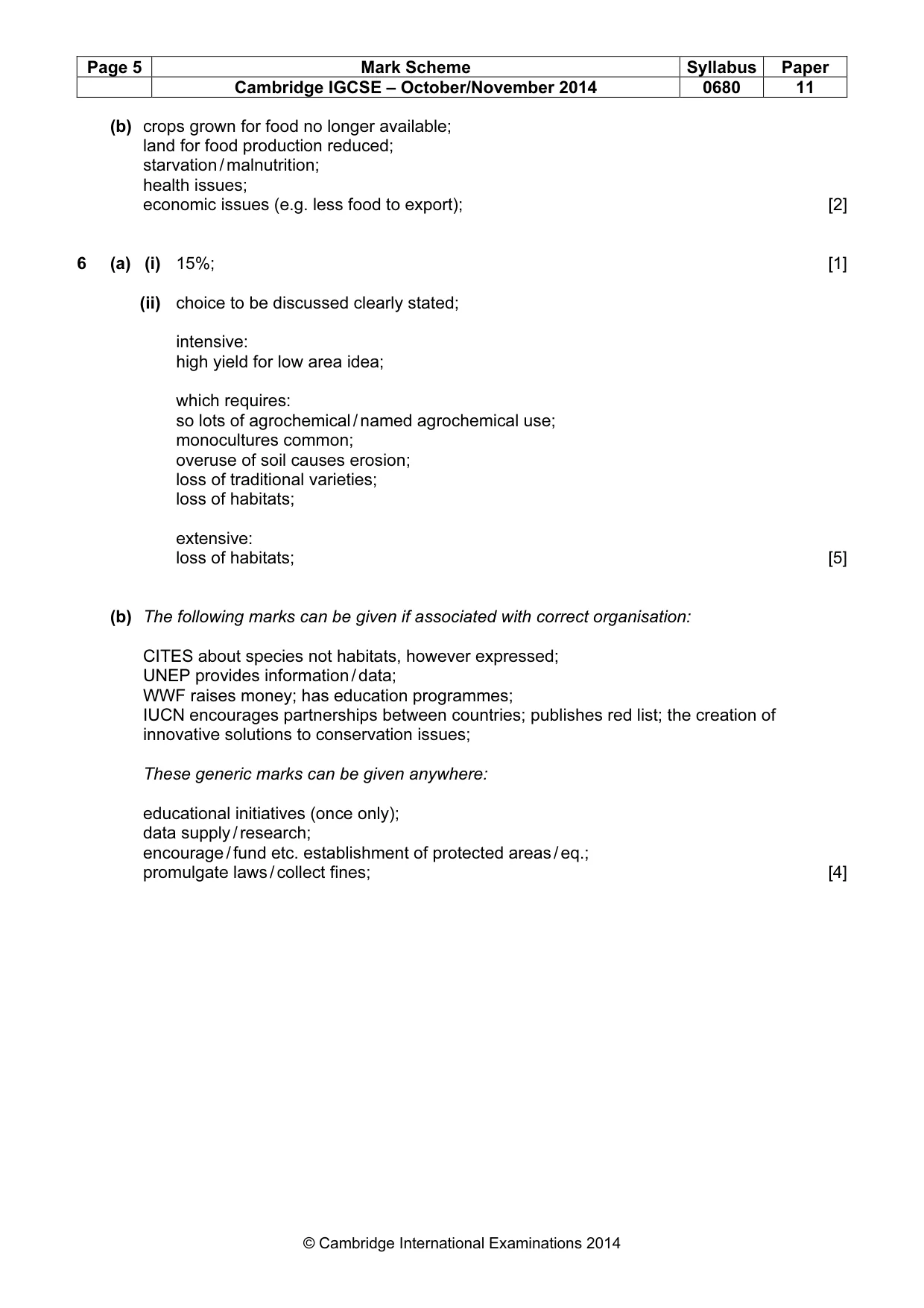
Page 5 Mark Scheme Syllabus Paper Cambridge IGCSE – October/November 2014 0680 11 © Cambridge International Examinations 2014 (b) crops grown for food no longer available; land for food production reduced; starvation / malnutrition; health issues; economic issues (e.g. less food to export); [2] 6 (a) (i) 15%; [1] (ii) choice to be discussed clearly stated; intensive: high yield for low area idea; which requires: so lots of agrochemical / named agrochemical use; monocultures common; overuse of soil causes erosion; loss of traditional varieties; loss of habitats; extensive: loss of habitats; [5] (b) The following marks can be given if associated with correct organisation: CITES about species not habitats, however expressed; UNEP provides information / data; WWF raises money; has education programmes; IUCN encourages partnerships between countries; publishes red list; the creation of innovative solutions to conservation issues; These generic marks can be given anywhere: educational initiatives (once only); data supply / research; encourage / fund etc. establishment of protected areas / eq.; promulgate laws / collect fines; [4]
What you needed in this session
Cambridge’s own grade thresholds for 2014 Oct/Nov, Paper 1 · Variant 1. A higher threshold means an easier paper — the bar moves with how the cohort did.