Cambridge IGCSE Environmental Management 0680 — 2014 May/June Paper 1 · Variant 1
0680/11/M/J/14 · 60 marks · ≈68 min
The question paper and its mark scheme, free to read here and free to download. This is Cambridge’s own paper, exactly as it was sat.
Question paper16 pages




Mark scheme4 pages
Answers below. Sit the paper first if you are practising.
Paper as text
Question paper, page 1
This document consists of 13 printed pages and 3 blank pages. DC (CW/SW) 80698/3 © UCLES 2014 [Turn over Cambridge International Examinations Cambridge International General Certificate of Secondary Education * 5 1 1 8 1 5 6 1 1 9 * ENVIRONMENTAL MANAGEMENT 0680/11 Paper 1 May/June 2014 1 hour 30 minutes Candidates answer on the Question Paper. Additional Materials: Ruler READ THESE INSTRUCTIONS FIRST Write your Centre number, candidate number and name on all the work you hand in. Write in dark blue or black pen. You may use an HB pencil for any diagrams or graphs. Do not use staples, paper clips, glue or correction fluid. DO NOT WRITE IN ANY BARCODES. Answer all questions. Electronic calculators may be used. You may lose marks if you do not show your working or if you do not use appropriate units. At the end of the examination, fasten all your work securely together. The number of marks is given in brackets [ ] at the end of each question or part question.
Question paper, page 2
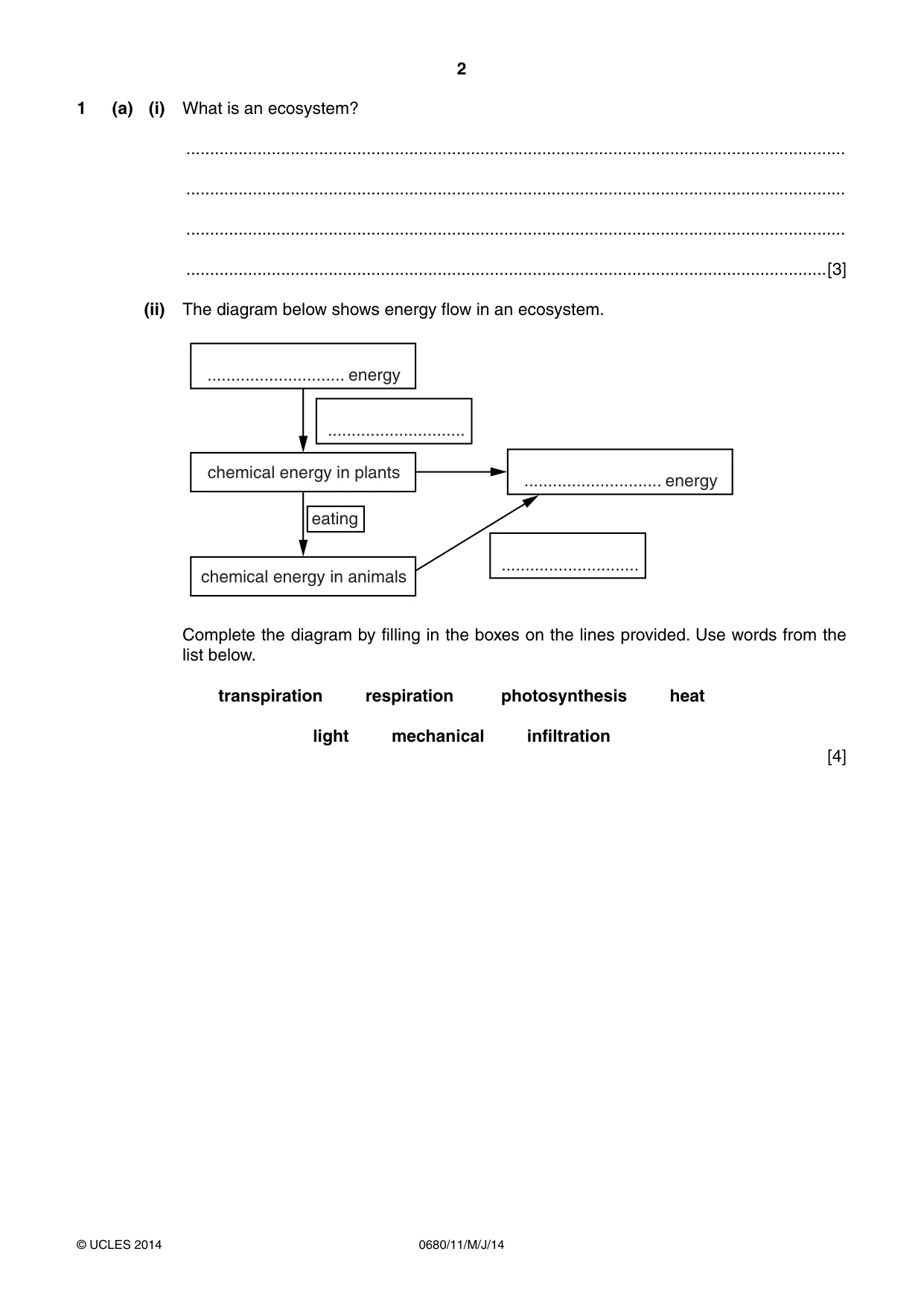
2 0680/11/M/J/14 © UCLES 2014 1 (a) (i) What is an ecosystem? … … … …[3] (ii) The diagram below shows energy flow in an ecosystem. chemical energy in plants chemical energy in animals eating … energy … energy … … Complete the diagram by filling in the boxes on the lines provided. Use words from the list below. transpiration respiration photosynthesis heat light mechanical infiltration [4]
Question paper, page 3
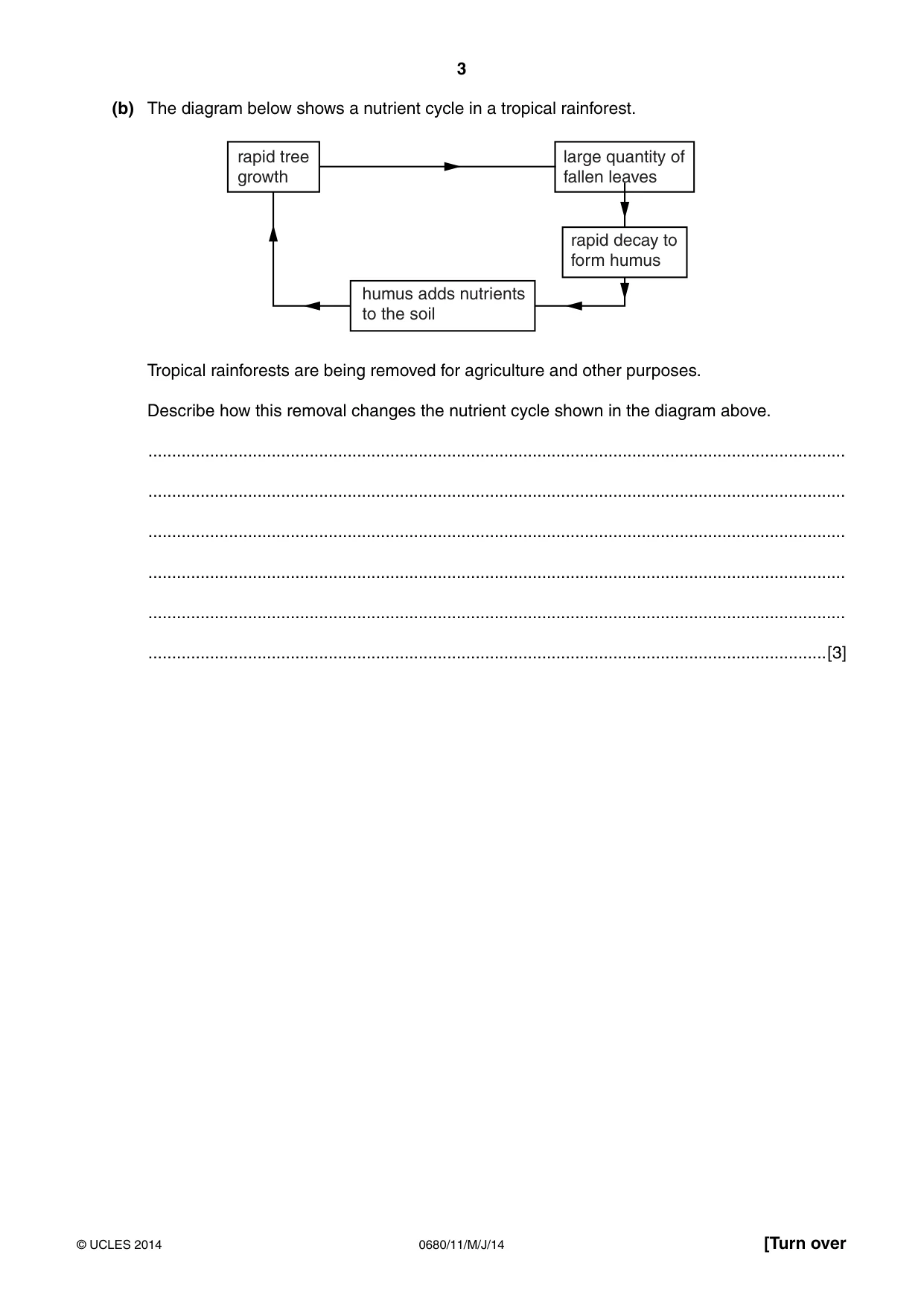
3 0680/11/M/J/14 © UCLES 2014 [Turn over (b) The diagram below shows a nutrient cycle in a tropical rainforest. rapid tree growth large quantity of fallen leaves rapid decay to form humus humus adds nutrients to the soil Tropical rainforests are being removed for agriculture and other purposes. Describe how this removal changes the nutrient cycle shown in the diagram above. … … … … … …[3]
Question paper, page 4
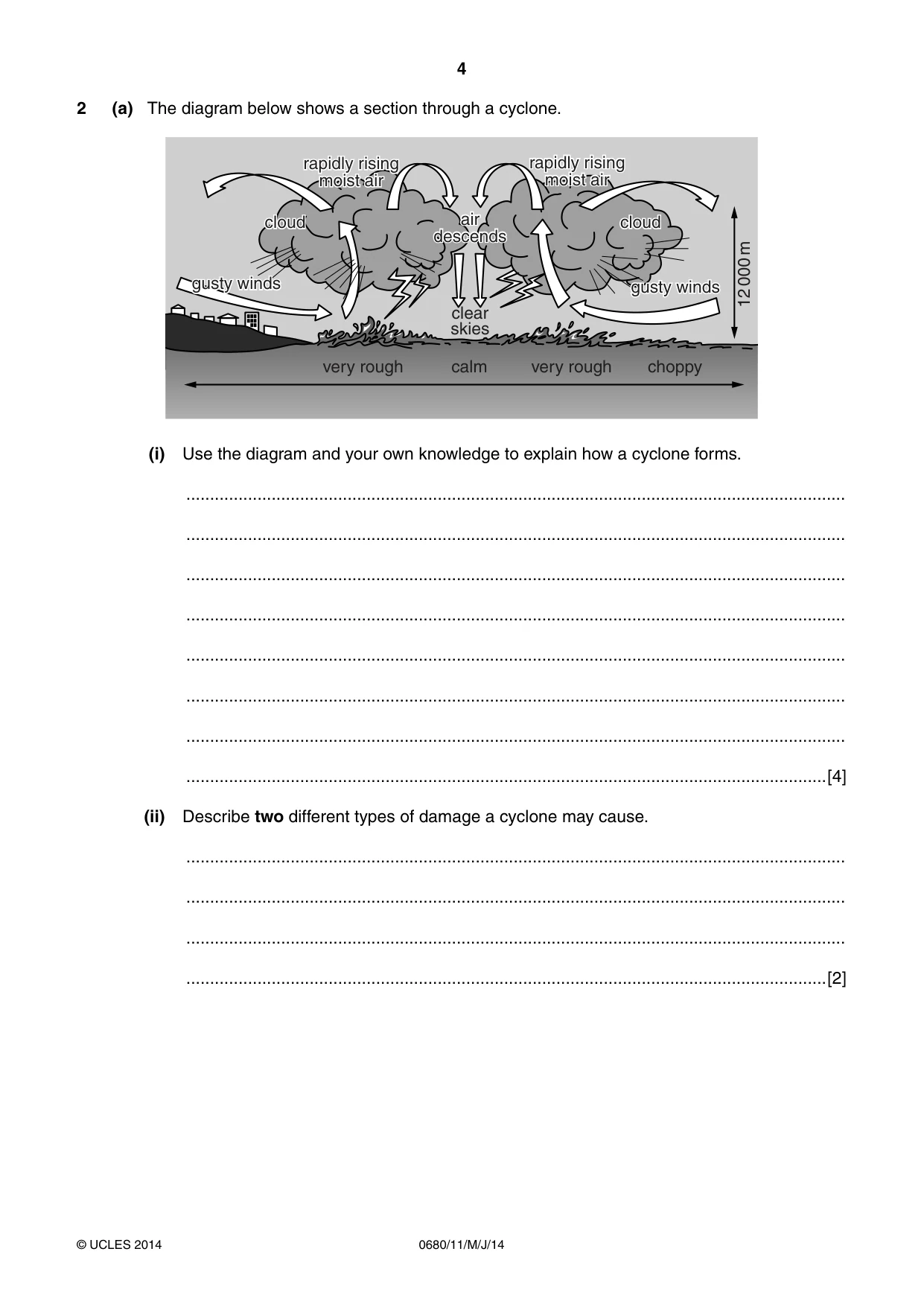
4 0680/11/M/J/14 © UCLES 2014 2 (a) The diagram below shows a section through a cyclone. 12 000 m very rough calm rapidly rising moist air rapidly rising moist air cloud cloud gusty winds gusty winds air descends clear skies very rough choppy (i) Use the diagram and your own knowledge to explain how a cyclone forms. … … … … … … … …[4] (ii) Describe two different types of damage a cyclone may cause. … … … …[2]
Question paper, page 5
5 0680/11/M/J/14 © UCLES 2014 [Turn over (iii) In one country in 1970, 300 000 people died in a cyclone. When a more severe cyclone struck the same area 20 years later, 130 000 people died. Suggest what the authorities may have done to achieve this change. … … … …[2] (b) Wind can be used as a source of power. State two ways in which the power of the wind is used. 1 … … 2 … …[2]
Question paper, page 6
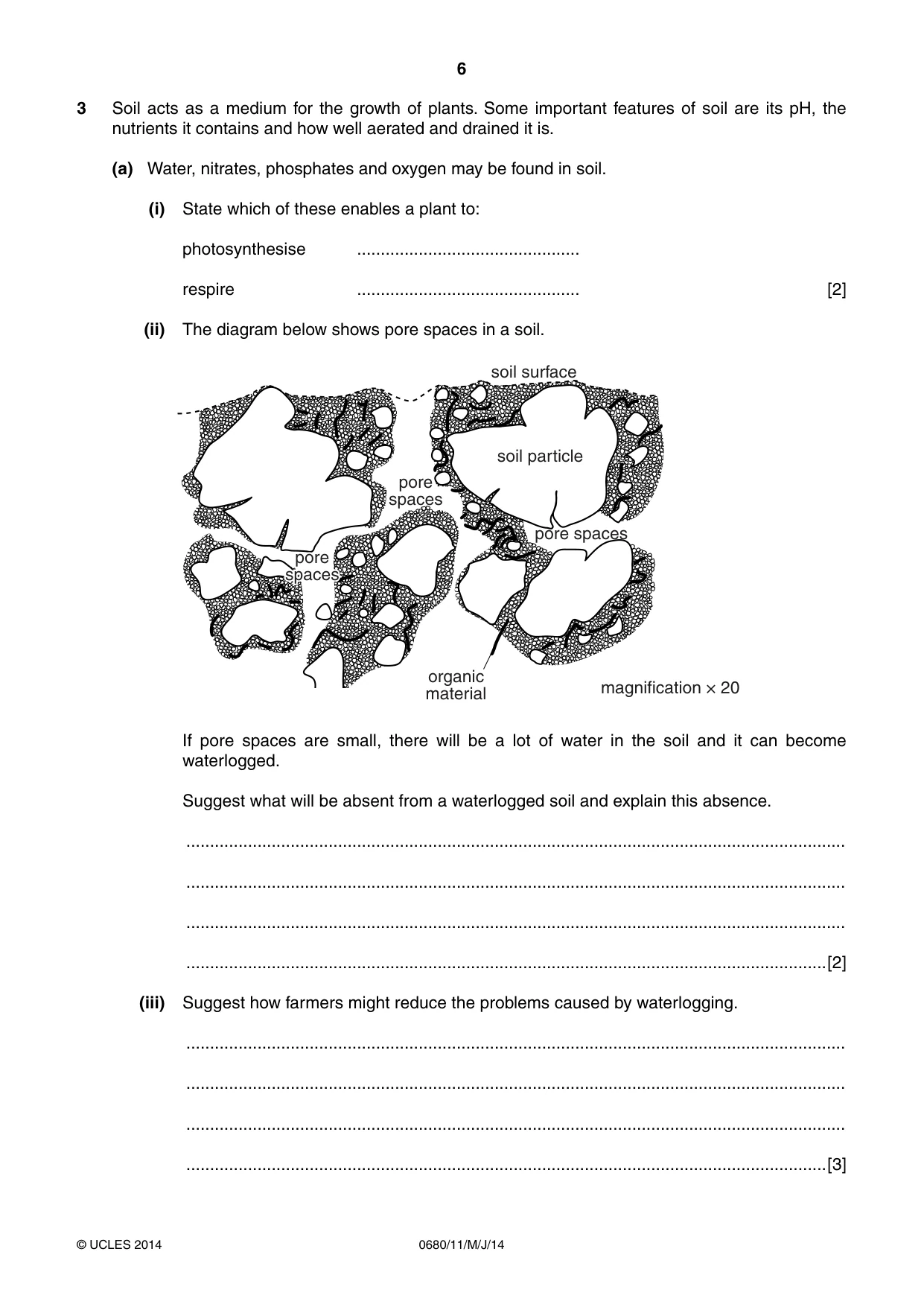
6 0680/11/M/J/14 © UCLES 2014 3 Soil acts as a medium for the growth of plants. Some important features of soil are its pH, the nutrients it contains and how well aerated and drained it is. (a) Water, nitrates, phosphates and oxygen may be found in soil. (i) State which of these enables a plant to: photosynthesise … respire … [2] (ii) The diagram below shows pore spaces in a soil. soil particle soil surface pore spaces pore spaces pore spaces organic material magnification × 20 If pore spaces are small, there will be a lot of water in the soil and it can become waterlogged. Suggest what will be absent from a waterlogged soil and explain this absence. … … … …[2] (iii) Suggest how farmers might reduce the problems caused by waterlogging. … … … …[3]
Question paper, page 7
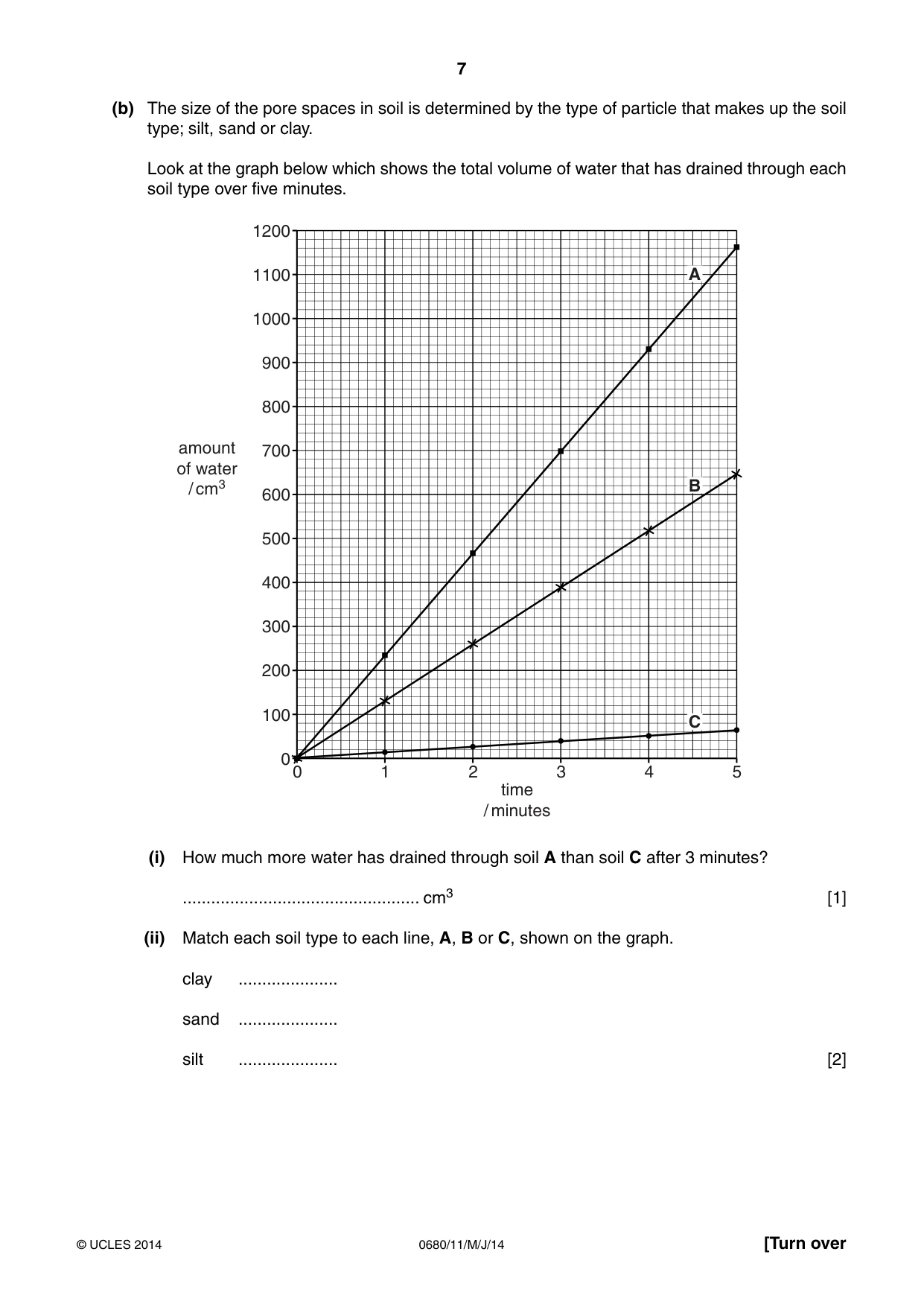
7 0680/11/M/J/14 © UCLES 2014 [Turn over (b) The size of the pore spaces in soil is determined by the type of particle that makes up the soil type; silt, sand or clay. Look at the graph below which shows the total volume of water that has drained through each soil type over five minutes. 0 0 100 200 300 400 500 600 700 800 900 1000 1100 1200 1 2 3 time / minutes amount of water / cm3 4 5 A B C (i) How much more water has drained through soil A than soil C after 3 minutes? … cm3 [1] (ii) Match each soil type to each line, A, B or C, shown on the graph. clay … sand … silt … [2]
Question paper, page 8
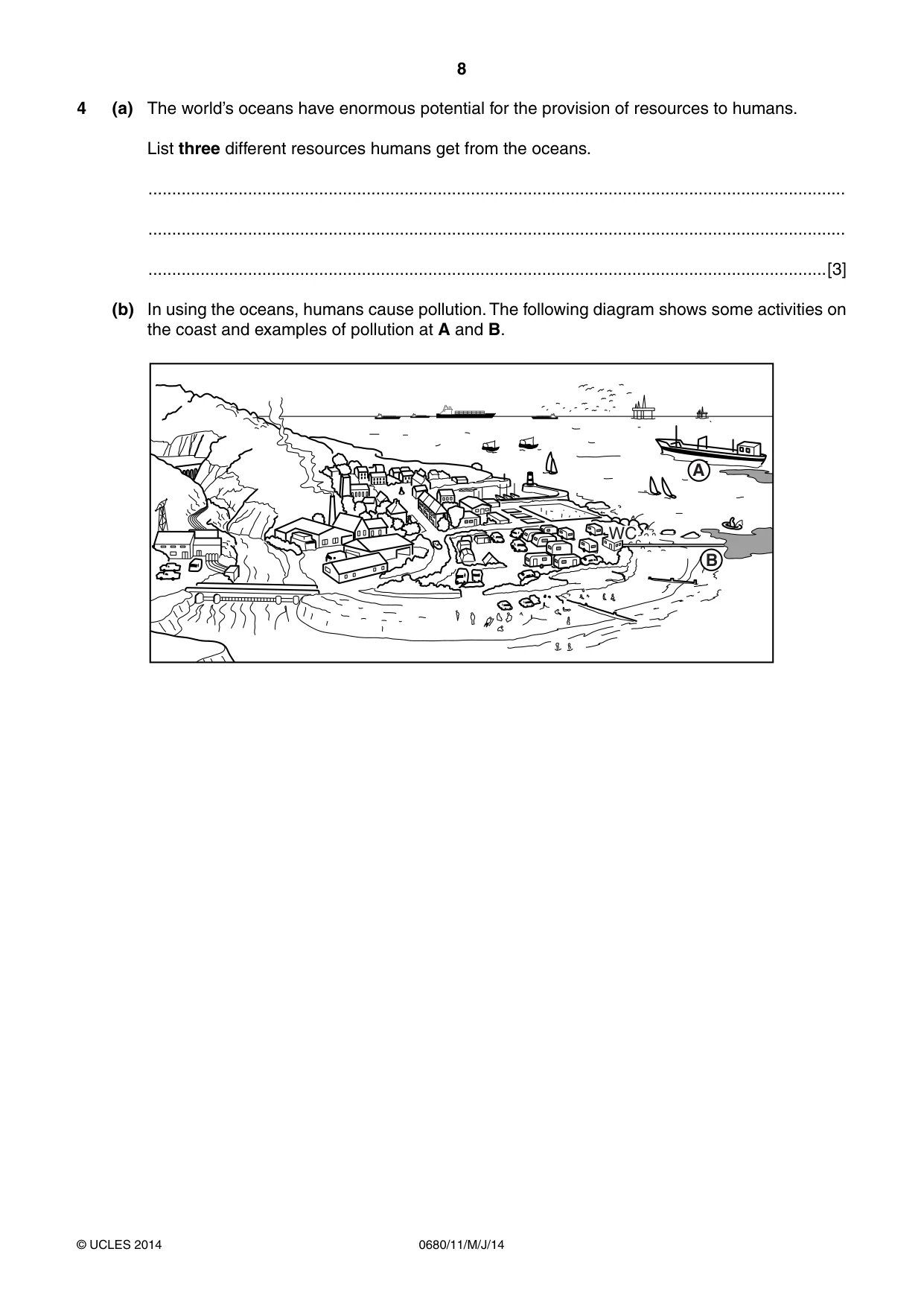
8 0680/11/M/J/14 © UCLES 2014 4 (a) The world’s oceans have enormous potential for the provision of resources to humans. List three different resources humans get from the oceans. … … …[3] (b) In using the oceans, humans cause pollution. The following diagram shows some activities on the coast and examples of pollution at A and B. A B WC
Question paper, page 9
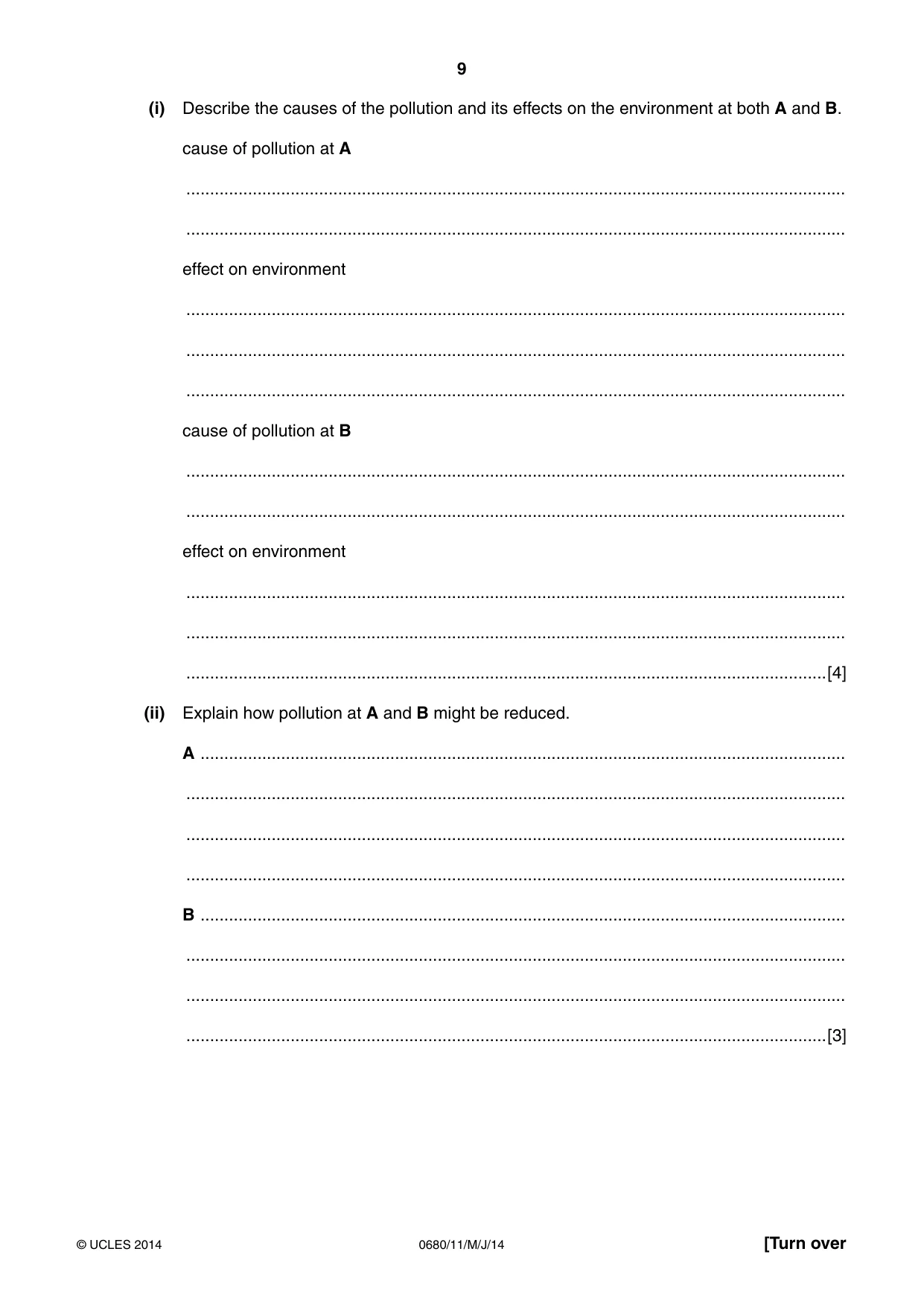
9 0680/11/M/J/14 © UCLES 2014 [Turn over (i) Describe the causes of the pollution and its effects on the environment at both A and B. cause of pollution at A … … effect on environment … … … cause of pollution at B … … effect on environment … … …[4] (ii) Explain how pollution at A and B might be reduced. A … … … … B … … … …[3]
Question paper, page 10
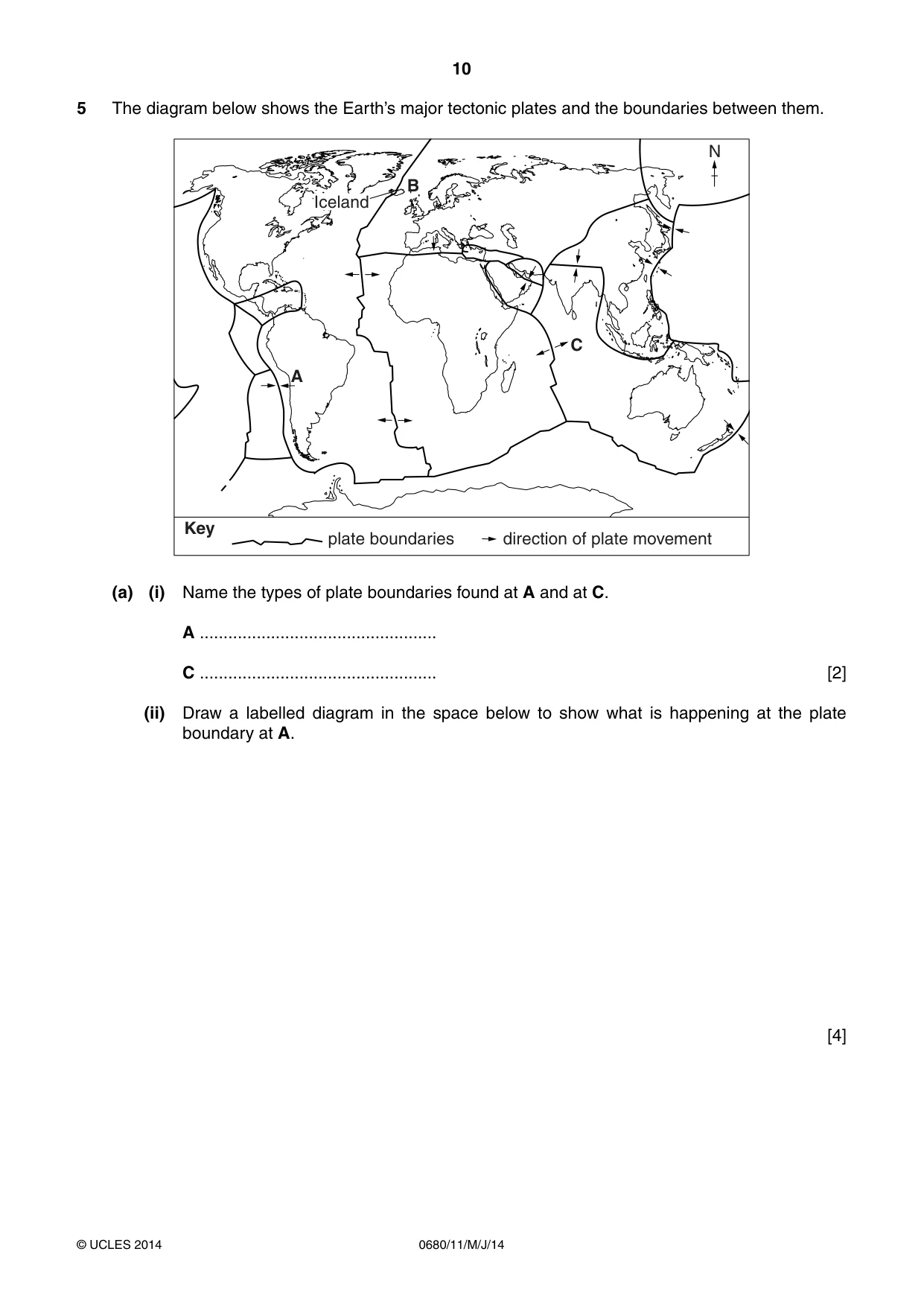
10 0680/11/M/J/14 © UCLES 2014 5 The diagram below shows the Earth’s major tectonic plates and the boundaries between them. N A B C Iceland plate boundaries Key direction of plate movement (a) (i) Name the types of plate boundaries found at A and at C. A … C … [2] (ii) Draw a labelled diagram in the space below to show what is happening at the plate boundary at A. [4]
Question paper, page 11
11 0680/11/M/J/14 © UCLES 2014 [Turn over (b) Describe ways in which Iceland may benefit from its location near plate boundary B on the map. … … … … … … … …[4]
Question paper, page 12
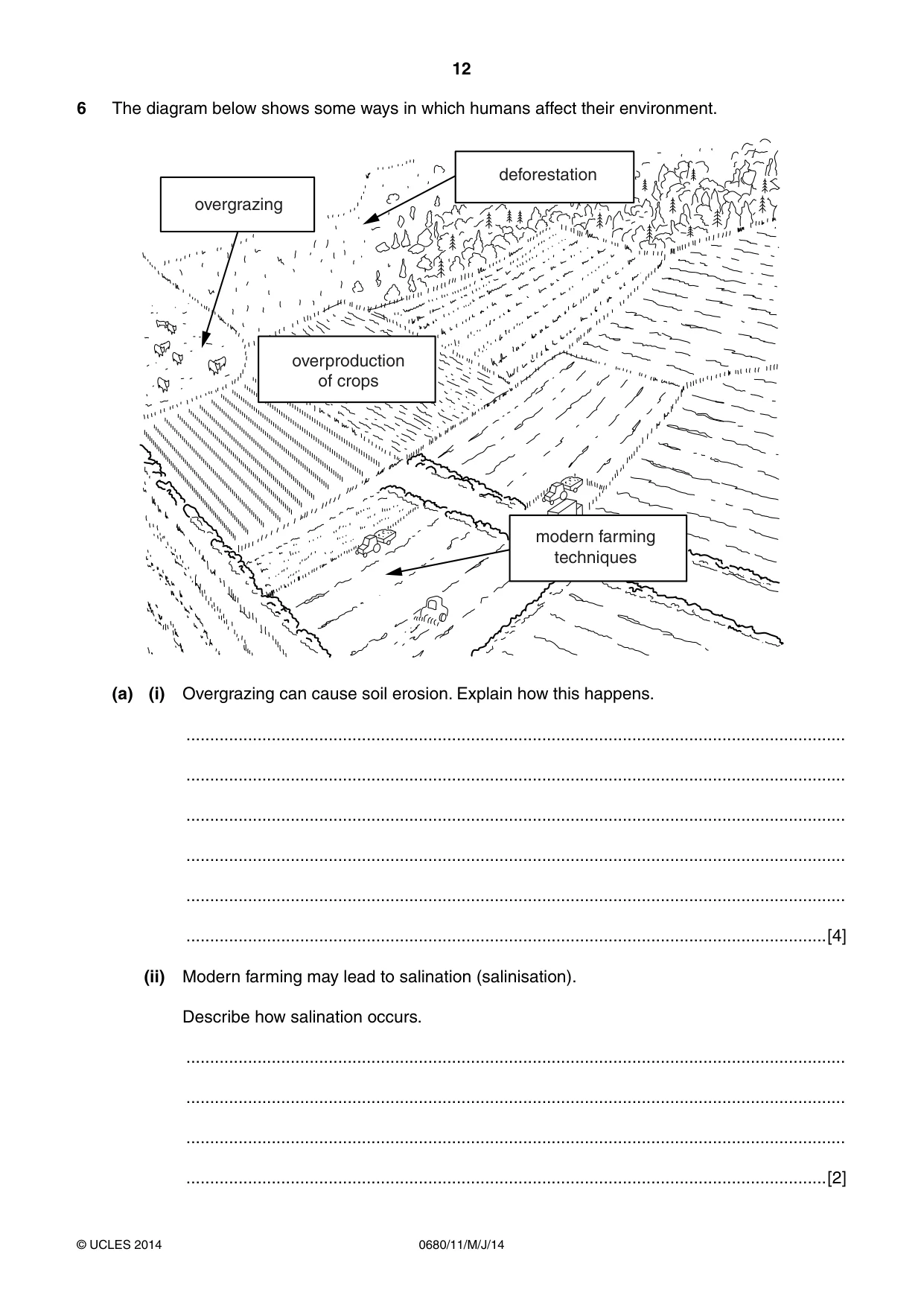
12 0680/11/M/J/14 © UCLES 2014 6 The diagram below shows some ways in which humans affect their environment. modern farming techniques overproduction of crops overgrazing deforestation (a) (i) Overgrazing can cause soil erosion. Explain how this happens. … … … … … …[4] (ii) Modern farming may lead to salination (salinisation). Describe how salination occurs. … … … …[2]
Question paper, page 13
13 0680/11/M/J/14 © UCLES 2014 (b) How might forests be managed sustainably? … … … … … … …[4]
Question paper, page 14
14 0680/11/M/J/14 © UCLES 2014 BLANK PAGE
Question paper, page 15
15 0680/11/M/J/14 © UCLES 2014 BLANK PAGE
Question paper, page 16
16 0680/11/M/J/14 © UCLES 2014 BLANK PAGE Permission to reproduce items where third-party owned material protected by copyright is included has been sought and cleared where possible. Every reasonable effort has been made by the publisher (UCLES) to trace copyright holders, but if any items requiring clearance have unwittingly been included, the publisher will be pleased to make amends at the earliest possible opportunity. Cambridge International Examinations is part of the Cambridge Assessment Group. Cambridge Assessment is the brand name of University of Cambridge Local Examinations Syndicate (UCLES), which is itself a department of the University of Cambridge.
Mark scheme, page 1
CAMBRIDGE INTERNATIONAL EXAMINATIONS International General Certificate of Secondary Education MARK SCHEME for the May/June 2014 series 0680 ENVIRONMENTAL MANAGEMENT 0680/11 Paper 1, maximum raw mark 60 This mark scheme is published as an aid to teachers and candidates, to indicate the requirements of the examination. It shows the basis on which Examiners were instructed to award marks. It does not indicate the details of the discussions that took place at an Examiners’ meeting before marking began, which would have considered the acceptability of alternative answers. Mark schemes should be read in conjunction with the question paper and the Principal Examiner Report for Teachers. Cambridge will not enter into discussions about these mark schemes. Cambridge is publishing the mark schemes for the May/June 2014 series for most IGCSE, GCE Advanced Level and Advanced Subsidiary Level components and some Ordinary Level components.
Mark scheme, page 2
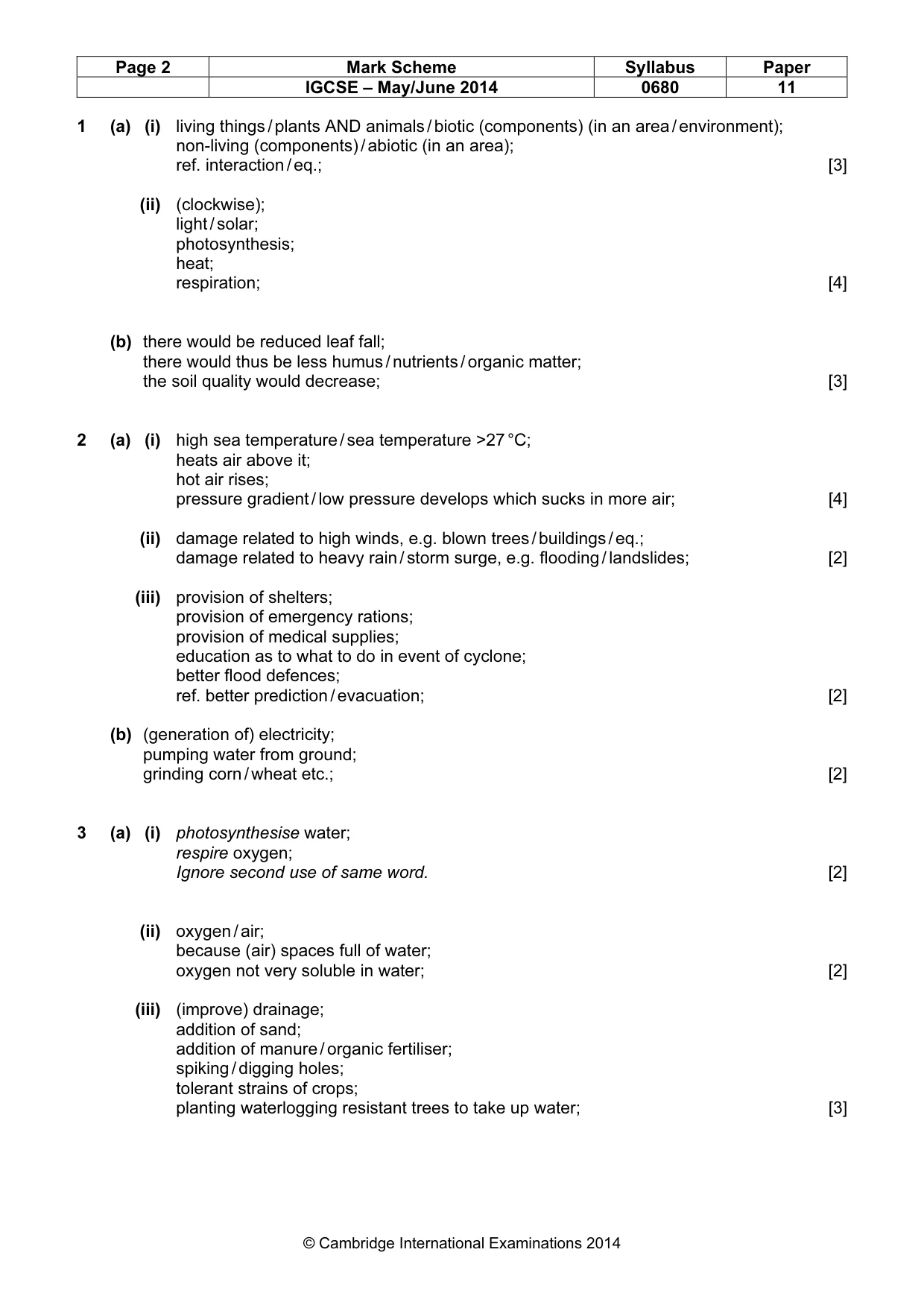
Page 2 Mark Scheme Syllabus Paper IGCSE – May/June 2014 0680 11 © Cambridge International Examinations 2014 1 (a) (i) living things / plants AND animals / biotic (components) (in an area / environment); non-living (components) / abiotic (in an area); ref. interaction / eq.; [3] (ii) (clockwise); light / solar; photosynthesis; heat; respiration; [4] (b) there would be reduced leaf fall; there would thus be less humus / nutrients / organic matter; the soil quality would decrease; [3] 2 (a) (i) high sea temperature / sea temperature >27 °C; heats air above it; hot air rises; pressure gradient / low pressure develops which sucks in more air; [4] (ii) damage related to high winds, e.g. blown trees / buildings / eq.; damage related to heavy rain / storm surge, e.g. flooding / landslides; [2] (iii) provision of shelters; provision of emergency rations; provision of medical supplies; education as to what to do in event of cyclone; better flood defences; ref. better prediction / evacuation; [2] (b) (generation of) electricity; pumping water from ground; grinding corn / wheat etc.; [2] 3 (a) (i) photosynthesise water; respire oxygen; Ignore second use of same word. [2] (ii) oxygen / air; because (air) spaces full of water; oxygen not very soluble in water; [2] (iii) (improve) drainage; addition of sand; addition of manure / organic fertiliser; spiking / digging holes; tolerant strains of crops; planting waterlogging resistant trees to take up water; [3]
Mark scheme, page 3
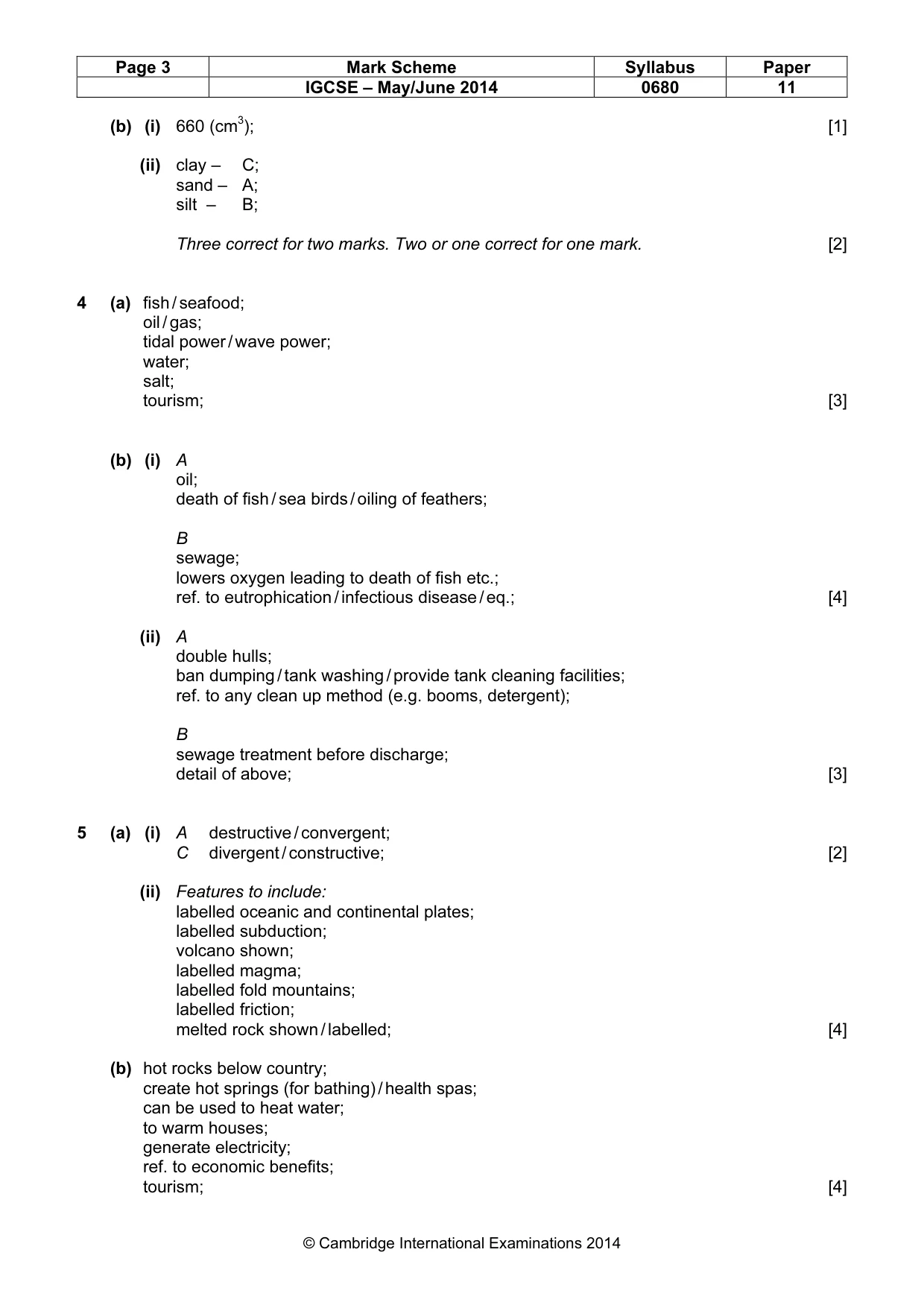
Page 3 Mark Scheme Syllabus Paper IGCSE – May/June 2014 0680 11 © Cambridge International Examinations 2014 (b) (i) 660 (cm3); [1] (ii) clay – C; sand – A; silt – B; Three correct for two marks. Two or one correct for one mark. [2] 4 (a) fish / seafood; oil / gas; tidal power / wave power; water; salt; tourism; [3] (b) (i) A oil; death of fish / sea birds / oiling of feathers; B sewage; lowers oxygen leading to death of fish etc.; ref. to eutrophication / infectious disease / eq.; [4] (ii) A double hulls; ban dumping / tank washing / provide tank cleaning facilities; ref. to any clean up method (e.g. booms, detergent); B sewage treatment before discharge; detail of above; [3] 5 (a) (i) A destructive / convergent; C divergent / constructive; [2] (ii) Features to include: labelled oceanic and continental plates; labelled subduction; volcano shown; labelled magma; labelled fold mountains; labelled friction; melted rock shown / labelled; [4] (b) hot rocks below country; create hot springs (for bathing) / health spas; can be used to heat water; to warm houses; generate electricity; ref. to economic benefits; tourism; [4]
Mark scheme, page 4
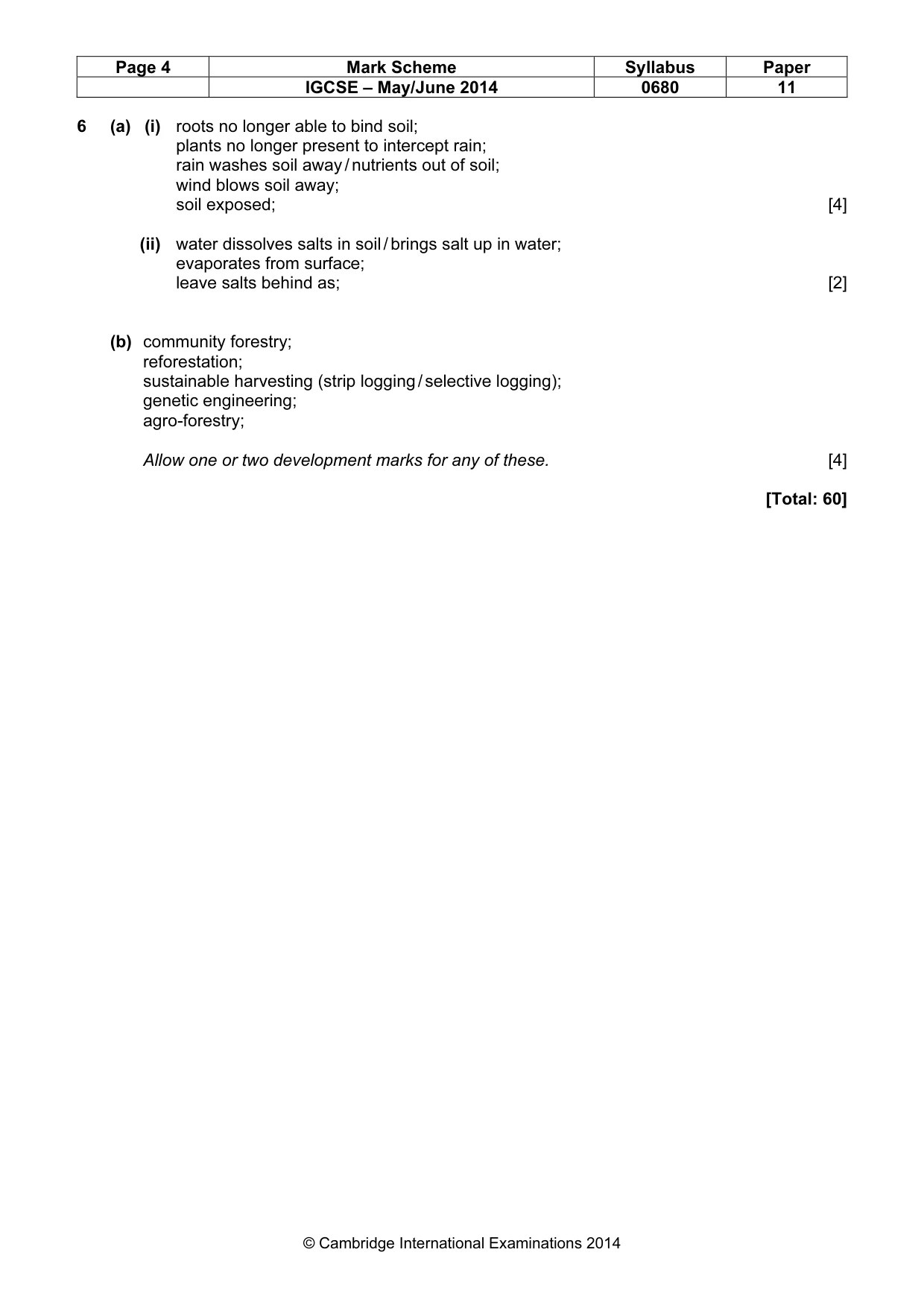
Page 4 Mark Scheme Syllabus Paper IGCSE – May/June 2014 0680 11 © Cambridge International Examinations 2014 6 (a) (i) roots no longer able to bind soil; plants no longer present to intercept rain; rain washes soil away / nutrients out of soil; wind blows soil away; soil exposed; [4] (ii) water dissolves salts in soil / brings salt up in water; evaporates from surface; leave salts behind as; [2] (b) community forestry; reforestation; sustainable harvesting (strip logging / selective logging); genetic engineering; agro-forestry; Allow one or two development marks for any of these. [4] [Total: 60]
What you needed in this session
Cambridge’s own grade thresholds for 2014 May/June, Paper 1 · Variant 1. A higher threshold means an easier paper — the bar moves with how the cohort did.