Cambridge IGCSE Environmental Management 0680 — 2014 May/June Paper 1 · Variant 3
0680/13/M/J/14 · 60 marks · ≈68 min
The question paper and its mark scheme, free to read here and free to download. This is Cambridge’s own paper, exactly as it was sat.
Question paper16 pages



Mark scheme7 pages
Answers below. Sit the paper first if you are practising.
Paper as text
Question paper, page 1
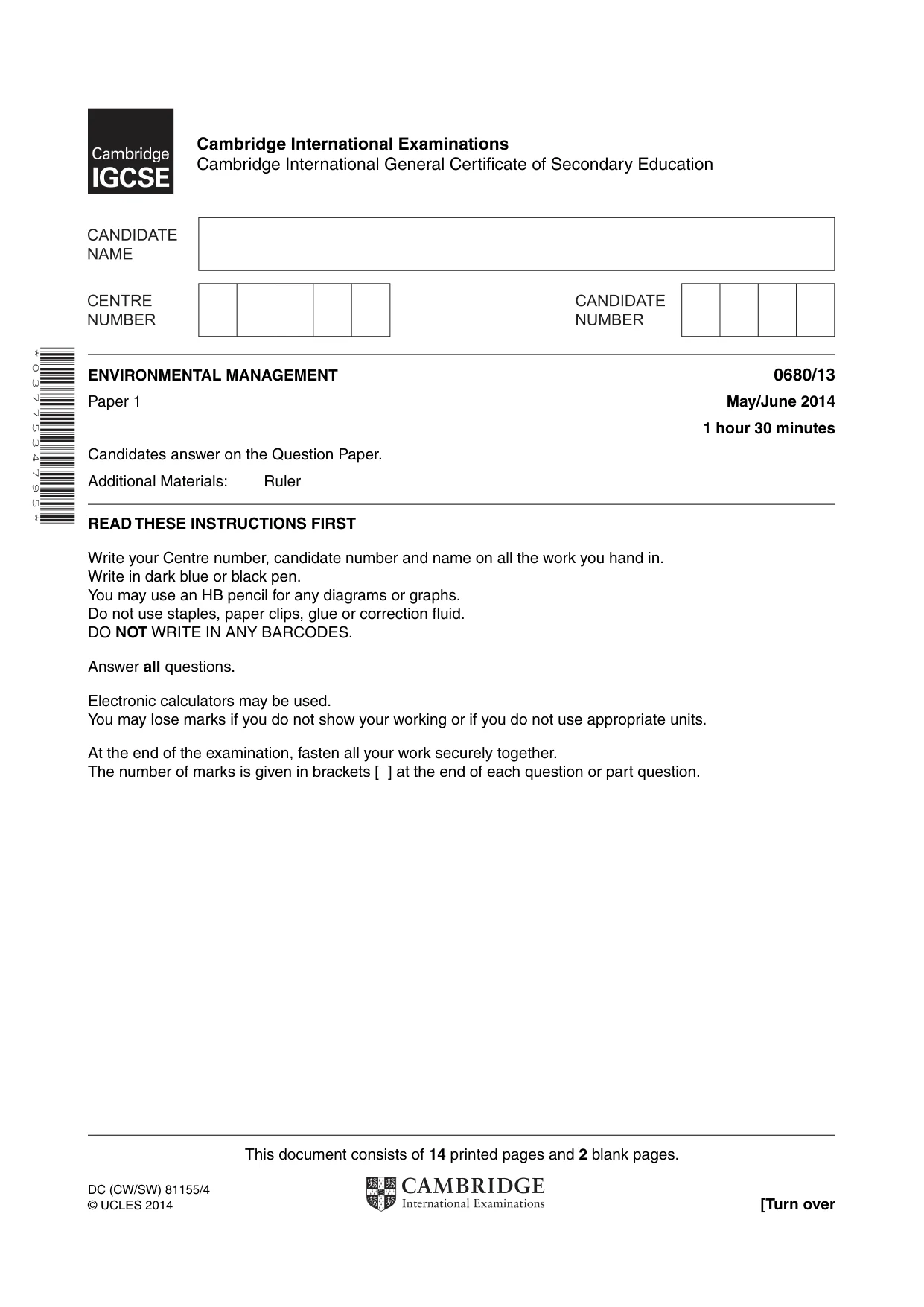
This document consists of 14 printed pages and 2 blank pages. DC (CW/SW) 81155/4 © UCLES 2014 [Turn over Cambridge International Examinations Cambridge International General Certificate of Secondary Education * 0 3 7 7 5 3 4 7 9 5 * ENVIRONMENTAL MANAGEMENT 0680/13 Paper 1 May/June 2014 1 hour 30 minutes Candidates answer on the Question Paper. Additional Materials: Ruler READ THESE INSTRUCTIONS FIRST Write your Centre number, candidate number and name on all the work you hand in. Write in dark blue or black pen. You may use an HB pencil for any diagrams or graphs. Do not use staples, paper clips, glue or correction fluid. DO NOT WRITE IN ANY BARCODES. Answer all questions. Electronic calculators may be used. You may lose marks if you do not show your working or if you do not use appropriate units. At the end of the examination, fasten all your work securely together. The number of marks is given in brackets [ ] at the end of each question or part question.
Question paper, page 2
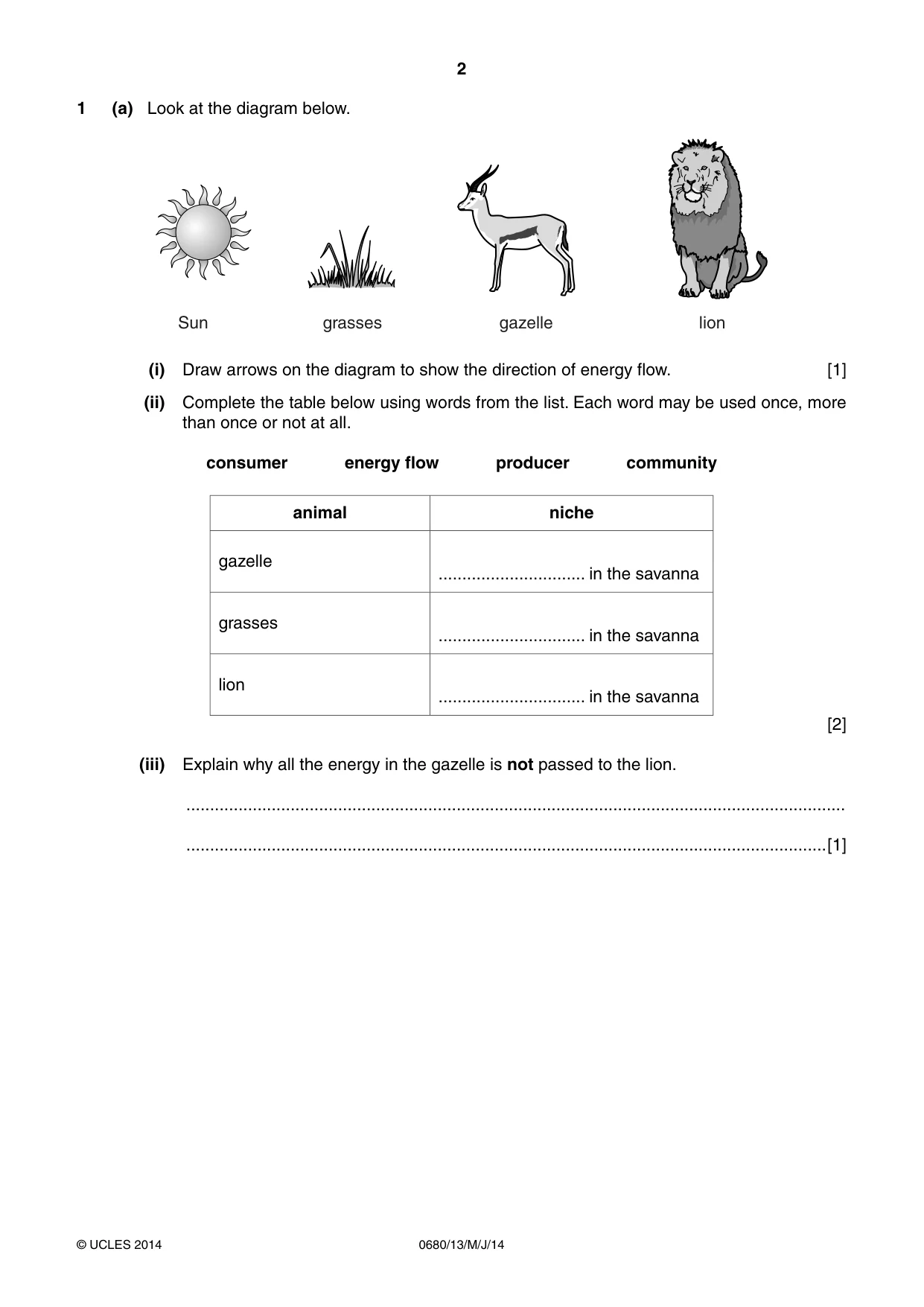
2 0680/13/M/J/14 © UCLES 2014 1 (a) Look at the diagram below. Sun grasses gazelle lion (i) Draw arrows on the diagram to show the direction of energy flow. [1] (ii) Complete the table below using words from the list. Each word may be used once, more than once or not at all. consumer energy flow producer community animal niche gazelle … in the savanna grasses … in the savanna lion … in the savanna [2] (iii) Explain why all the energy in the gazelle is not passed to the lion. … …[1]
Question paper, page 3
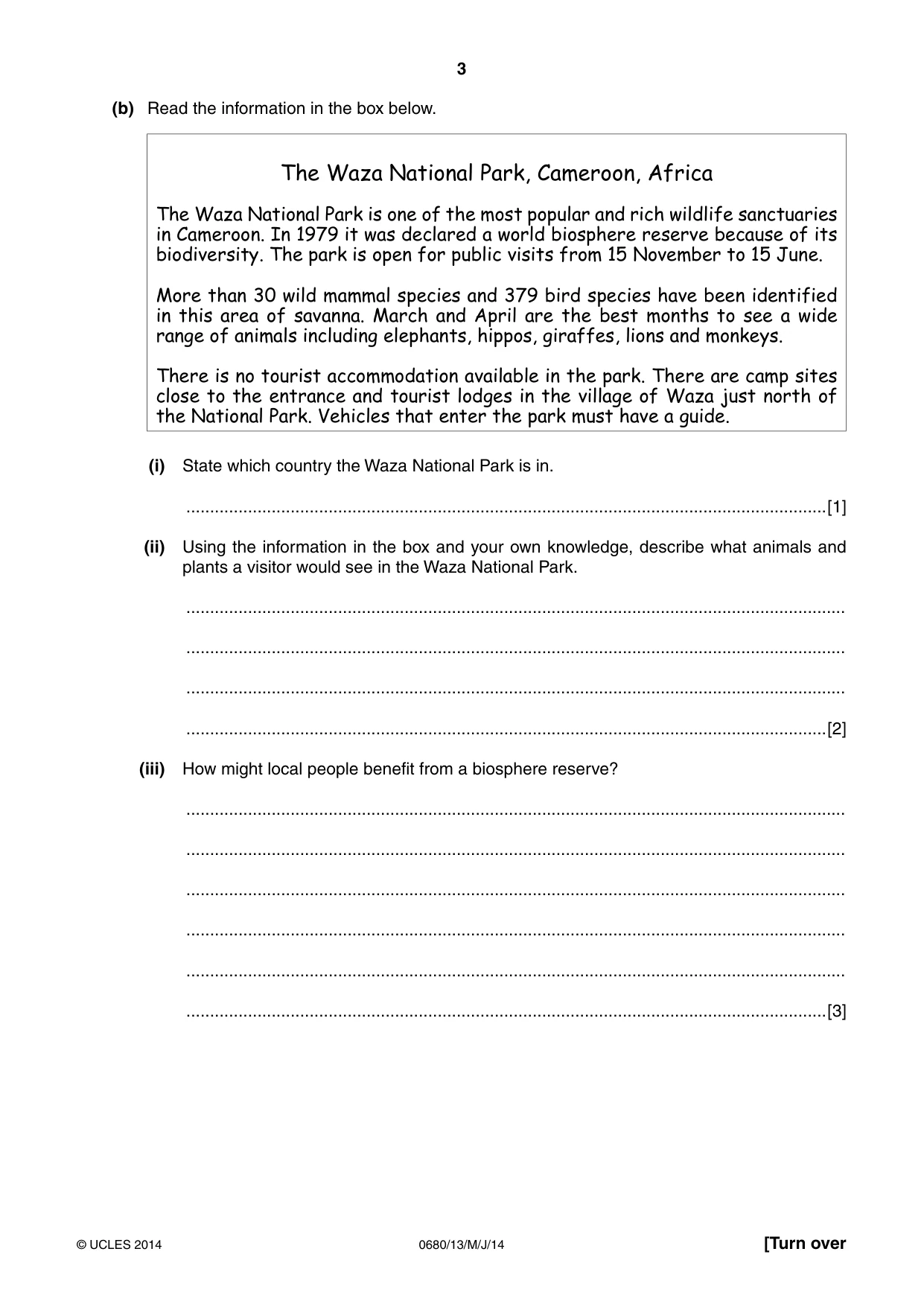
3 0680/13/M/J/14 © UCLES 2014 [Turn over (b) Read the information in the box below. The Waza National Park, Cameroon, Africa The Waza National Park is one of the most popular and rich wildlife sanctuaries in Cameroon. In 1979 it was declared a world biosphere reserve because of its biodiversity. The park is open for public visits from 15 November to 15 June. More than 30 wild mammal species and 379 bird species have been identified in this area of savanna. March and April are the best months to see a wide range of animals including elephants, hippos, giraffes, lions and monkeys. There is no tourist accommodation available in the park. There are camp sites close to the entrance and tourist lodges in the village of Waza just north of the National Park. Vehicles that enter the park must have a guide. (i) State which country the Waza National Park is in. …[1] (ii) Using the information in the box and your own knowledge, describe what animals and plants a visitor would see in the Waza National Park. … … … …[2] (iii) How might local people benefit from a biosphere reserve? … … … … … …[3]
Question paper, page 4
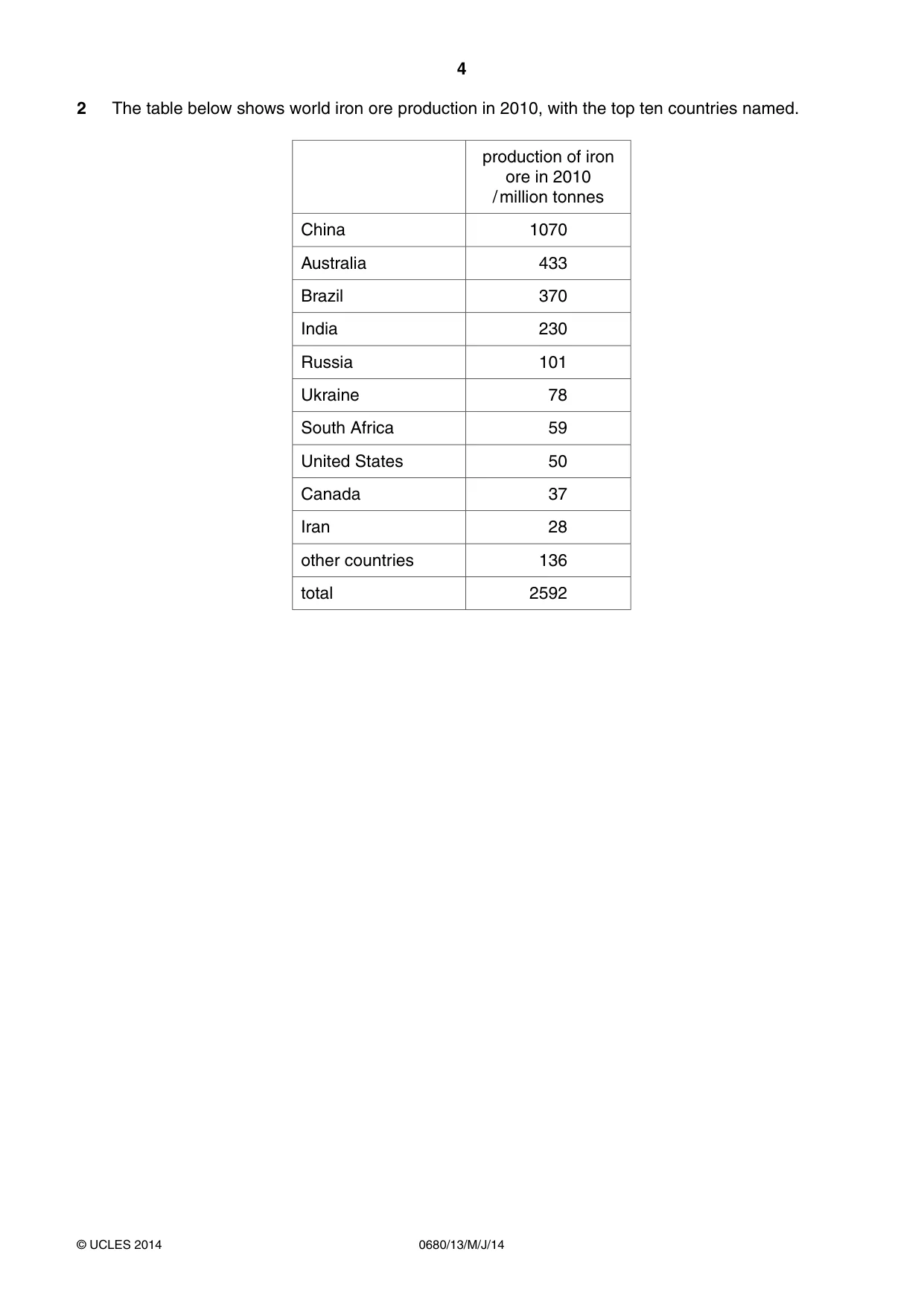
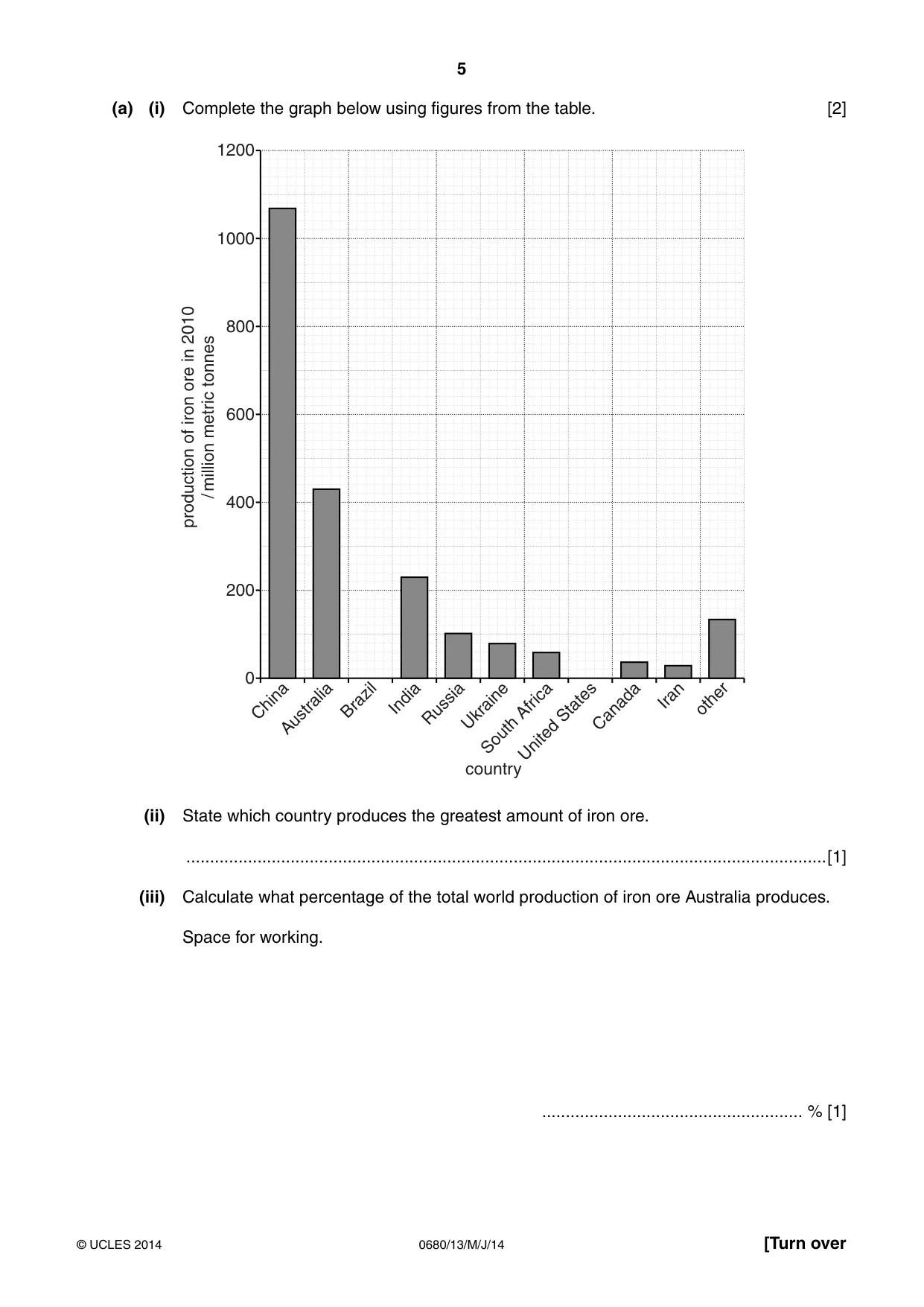
4 0680/13/M/J/14 © UCLES 2014 2 The table below shows world iron ore production in 2010, with the top ten countries named. production of iron ore in 2010 / million tonnes China 1070 Australia 433 Brazil 370 India 230 Russia 101 Ukraine 78 South Africa 59 United States 50 Canada 37 Iran 28 other countries 136 total 2592
Question paper, page 5
5 0680/13/M/J/14 © UCLES 2014 [Turn over (a) (i) Complete the graph below using figures from the table. [2] China Australia Brazil India Russia Ukraine South Africa United States Canada Iran other 0 200 400 600 production of iron ore in 2010 / million metric tonnes 800 1000 1200 country (ii) State which country produces the greatest amount of iron ore. …[1] (iii) Calculate what percentage of the total world production of iron ore Australia produces. Space for working. … % [1]
Question paper, page 6
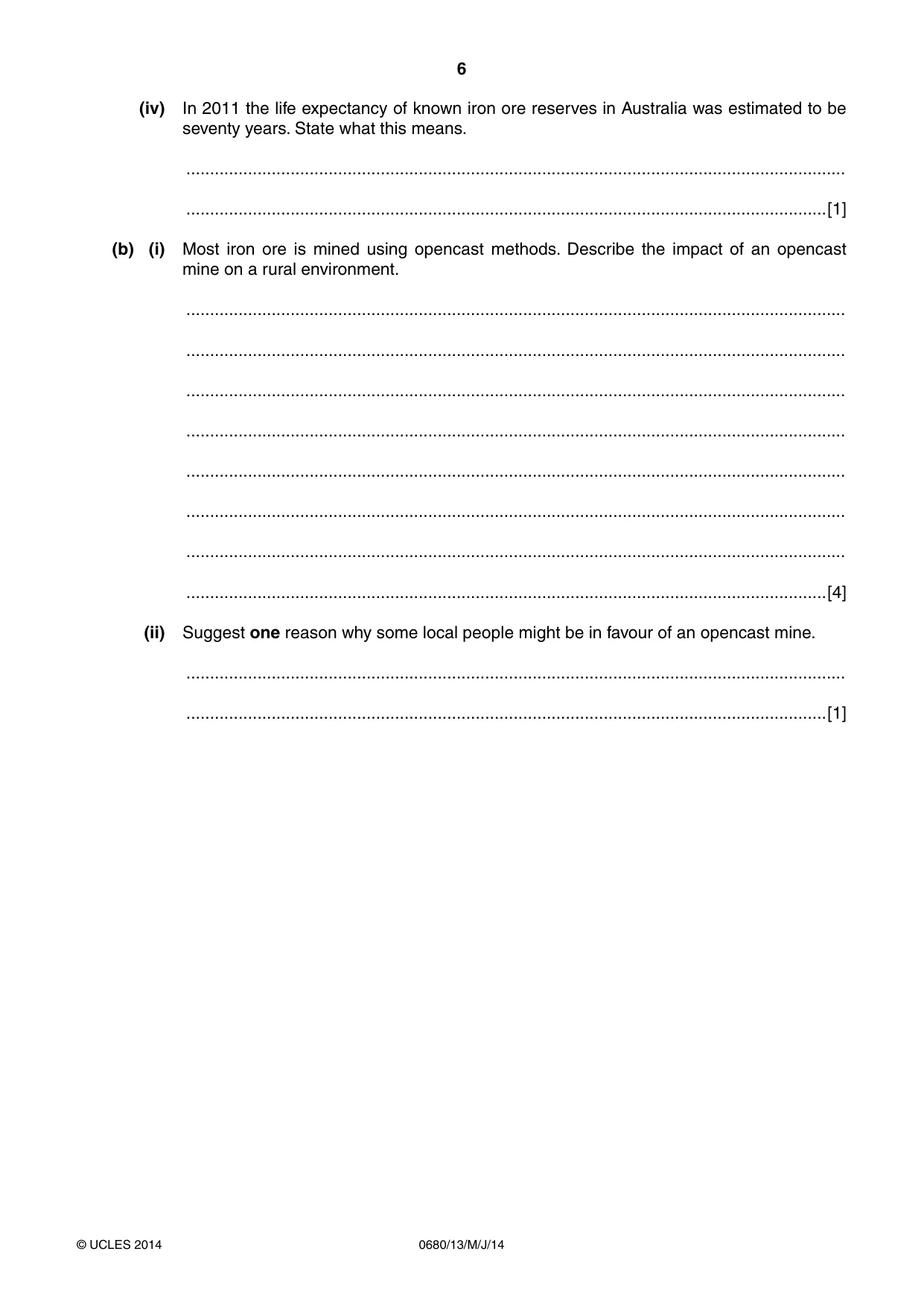
6 0680/13/M/J/14 © UCLES 2014 (iv) In 2011 the life expectancy of known iron ore reserves in Australia was estimated to be seventy years. State what this means. … …[1] (b) (i) Most iron ore is mined using opencast methods. Describe the impact of an opencast mine on a rural environment. … … … … … … … …[4] (ii) Suggest one reason why some local people might be in favour of an opencast mine. … …[1]
Question paper, page 7
7 0680/13/M/J/14 © UCLES 2014 [Turn over BLANK PAGE TURN OVER FOR QUESTION 3
Question paper, page 8
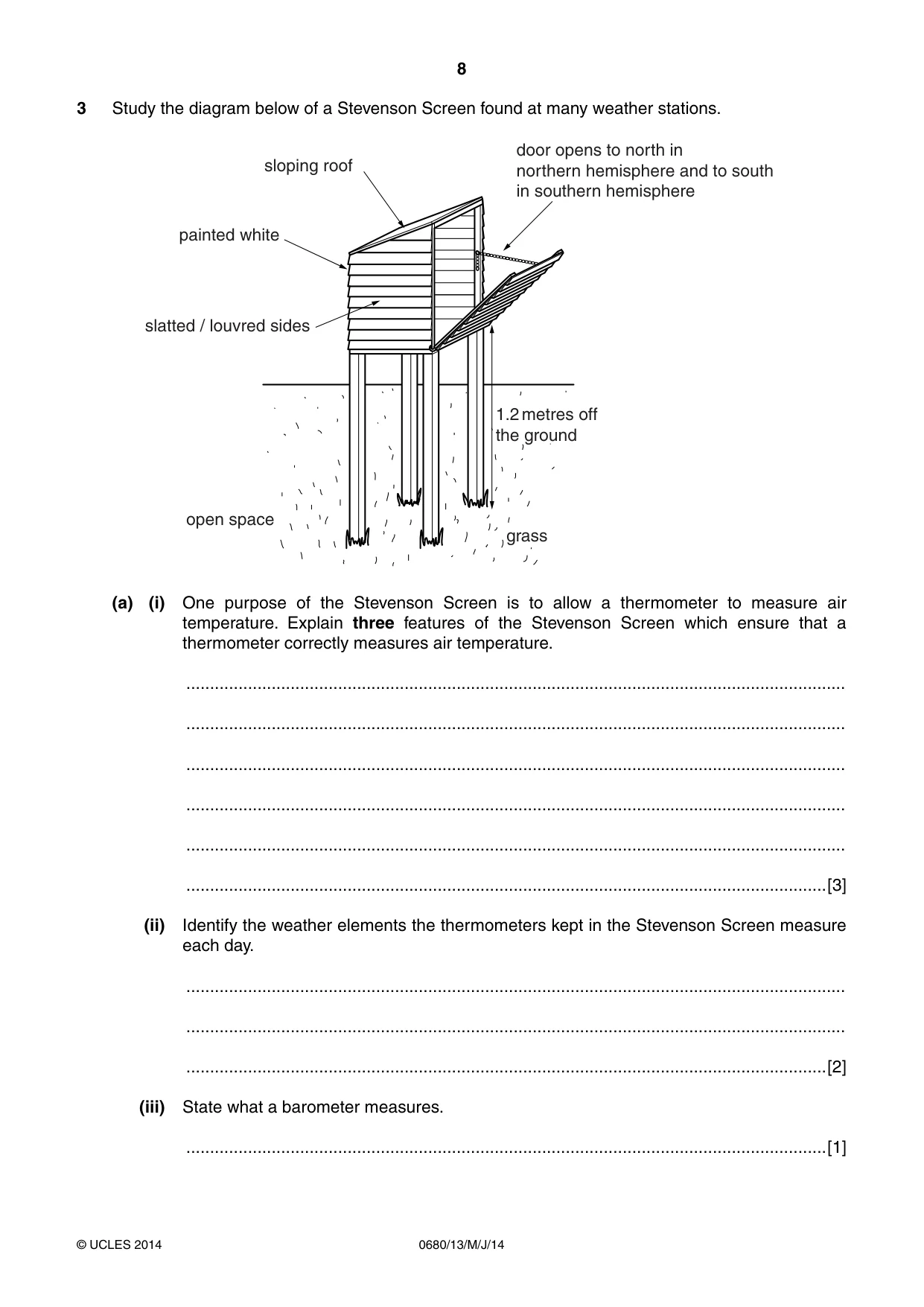
8 0680/13/M/J/14 © UCLES 2014 3 Study the diagram below of a Stevenson Screen found at many weather stations. sloping roof painted white slatted / louvred sides open space grass door opens to north in northern hemisphere and to south in southern hemisphere 1.2 metres off the ground (a) (i) One purpose of the Stevenson Screen is to allow a thermometer to measure air temperature. Explain three features of the Stevenson Screen which ensure that a thermometer correctly measures air temperature. … … … … … …[3] (ii) Identify the weather elements the thermometers kept in the Stevenson Screen measure each day. … … …[2] (iii) State what a barometer measures. …[1]
Question paper, page 9
9 0680/13/M/J/14 © UCLES 2014 [Turn over (b) Acid rain is precipitation that contains pollutants. Describe two strategies for reducing acid rain. … … … … … … … …[4]
Question paper, page 10
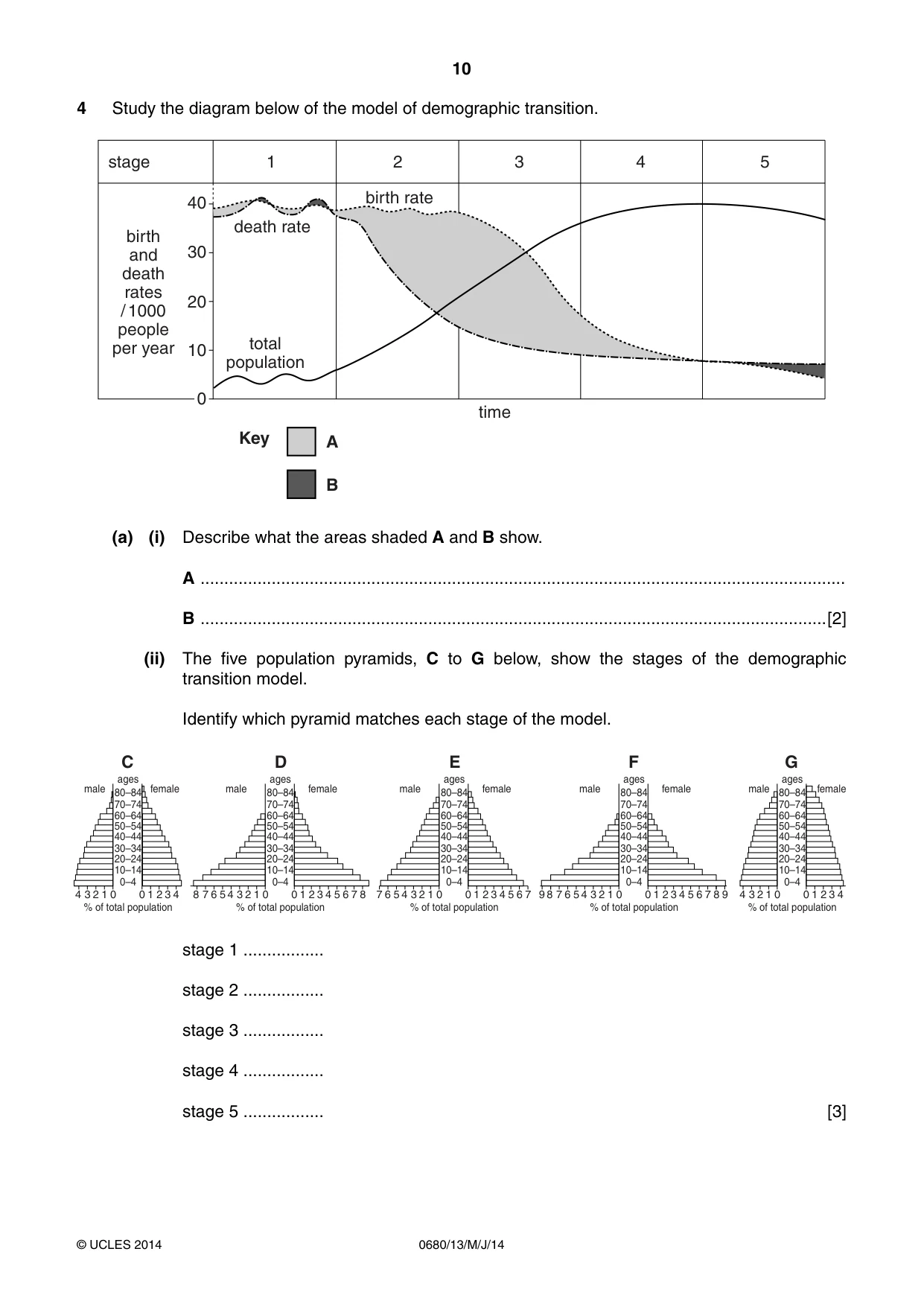
10 0680/13/M/J/14 © UCLES 2014 4 Study the diagram below of the model of demographic transition. 0 10 20 30 40 birth and death rates / 1000 people per year time 1 stage 2 3 4 5 birth rate death rate total population Key A B (a) (i) Describe what the areas shaded A and B show. A … B …[2] (ii) The five population pyramids, C to G below, show the stages of the demographic transition model. Identify which pyramid matches each stage of the model. 0 0 1 1 2 2 3 3 4 4 5 5 6 6 7 7 8 9 8 9 80–84 ages male female 70–74 60–64 50–54 40–44 30–34 20–24 10–14 0–4 % of total population 0 0 1 1 2 2 3 3 4 4 5 5 6 6 7 7 8 8 80–84 ages male female 70–74 60–64 50–54 40–44 30–34 20–24 10–14 0–4 % of total population 0 0 1 1 2 2 3 3 4 4 5 5 6 6 7 7 80–84 ages male female 70–74 60–64 50–54 40–44 30–34 20–24 10–14 0–4 % of total population 0 0 1 1 2 2 3 3 4 4 80–84 ages male female 70–74 60–64 50–54 40–44 30–34 20–24 10–14 0–4 % of total population 0 0 1 1 2 2 3 3 4 4 80–84 ages male female 70–74 60–64 50–54 40–44 30–34 20–24 10–14 0–4 % of total population C D E F G stage 1 … stage 2 … stage 3 … stage 4 … stage 5 … [3]
Question paper, page 11
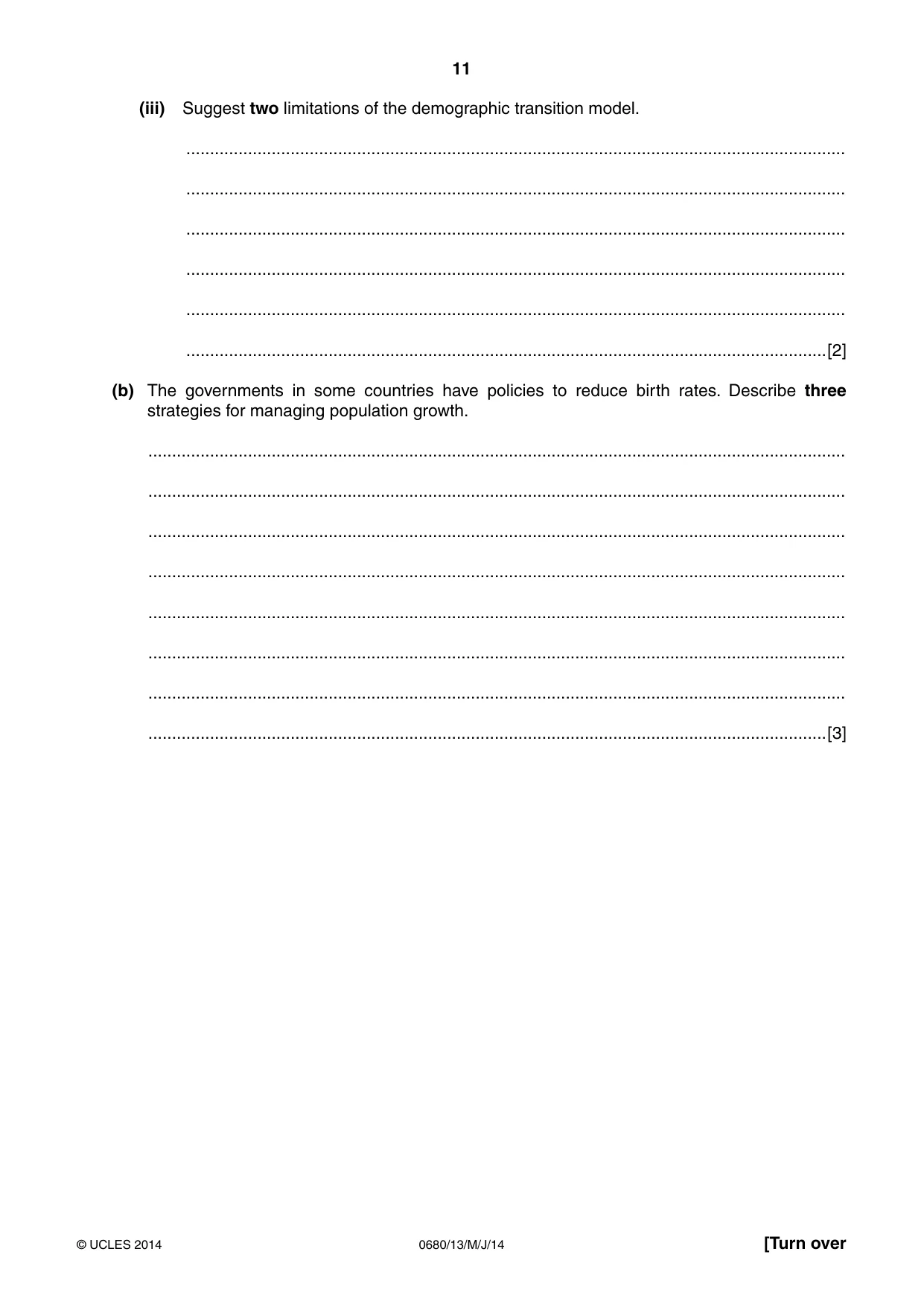
11 0680/13/M/J/14 © UCLES 2014 [Turn over (iii) Suggest two limitations of the demographic transition model. … … … … … …[2] (b) The governments in some countries have policies to reduce birth rates. Describe three strategies for managing population growth. … … … … … … … …[3]
Question paper, page 12
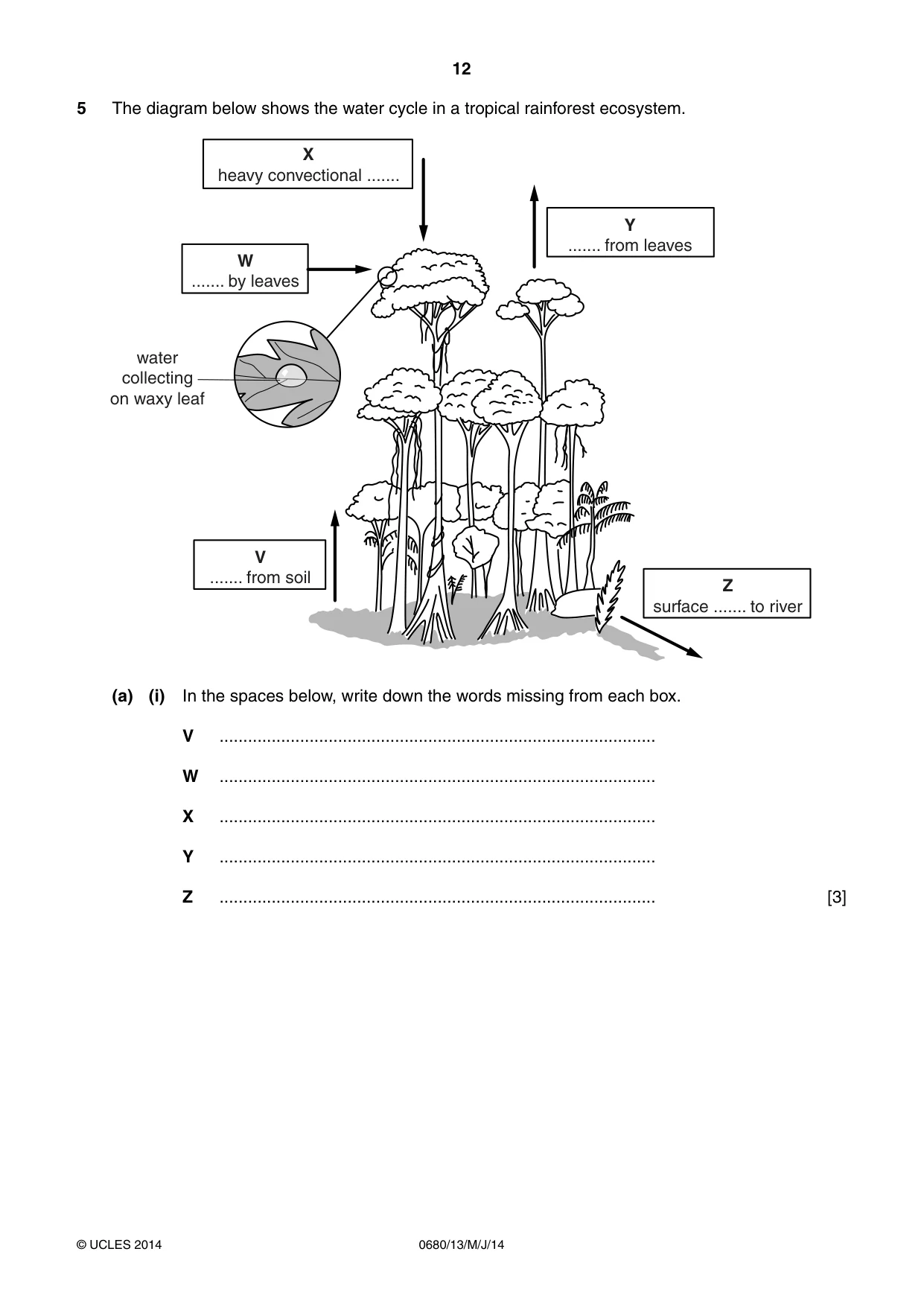
12 0680/13/M/J/14 © UCLES 2014 5 The diagram below shows the water cycle in a tropical rainforest ecosystem. X heavy convectional … W … by leaves water collecting on waxy leaf Y … from leaves Z surface … to river V … from soil (a) (i) In the spaces below, write down the words missing from each box. V … W … X … Y … Z … [3]
Question paper, page 13
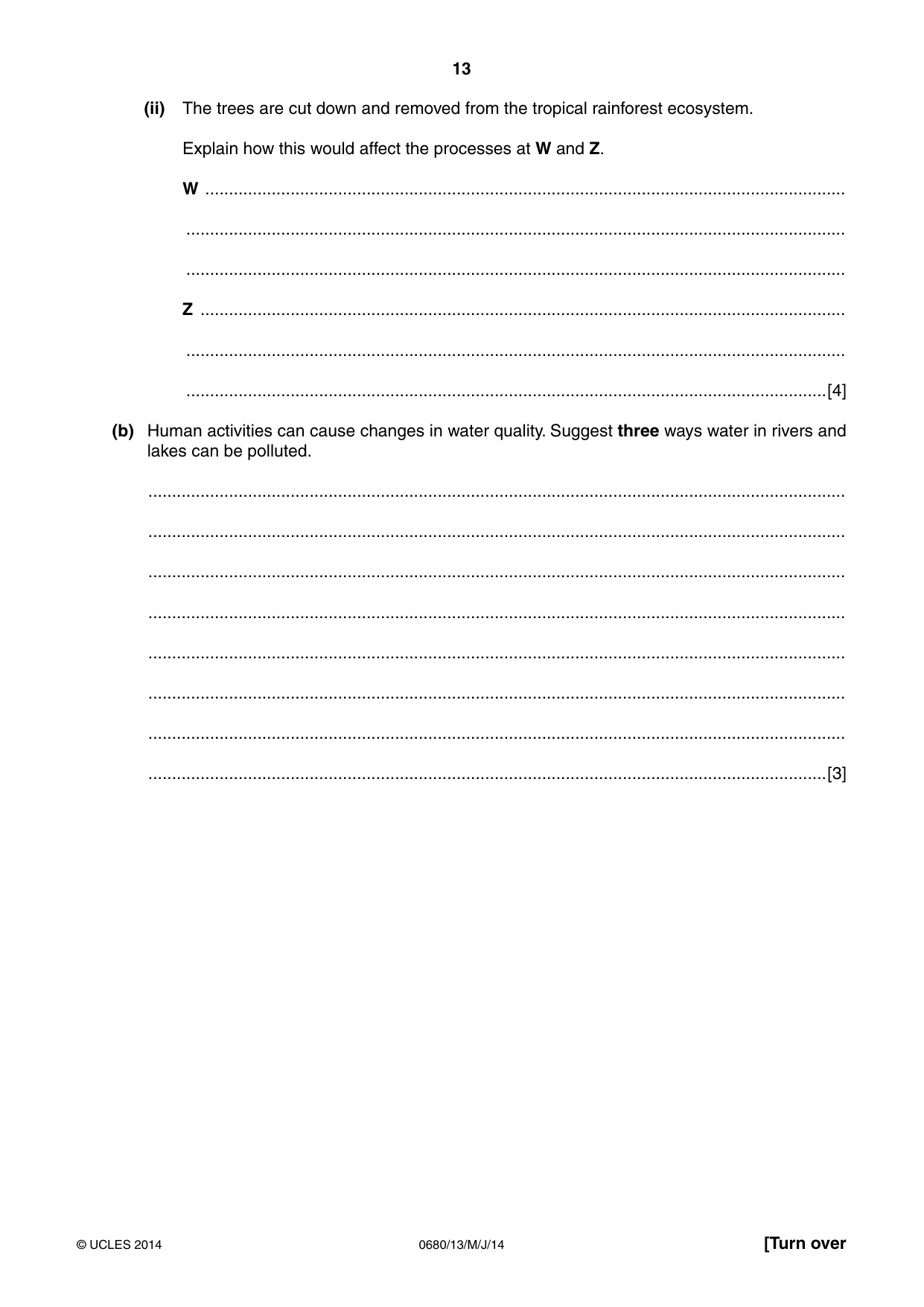
13 0680/13/M/J/14 © UCLES 2014 [Turn over (ii) The trees are cut down and removed from the tropical rainforest ecosystem. Explain how this would affect the processes at W and Z. W … … … Z … … …[4] (b) Human activities can cause changes in water quality. Suggest three ways water in rivers and lakes can be polluted. … … … … … … … …[3]
Question paper, page 14
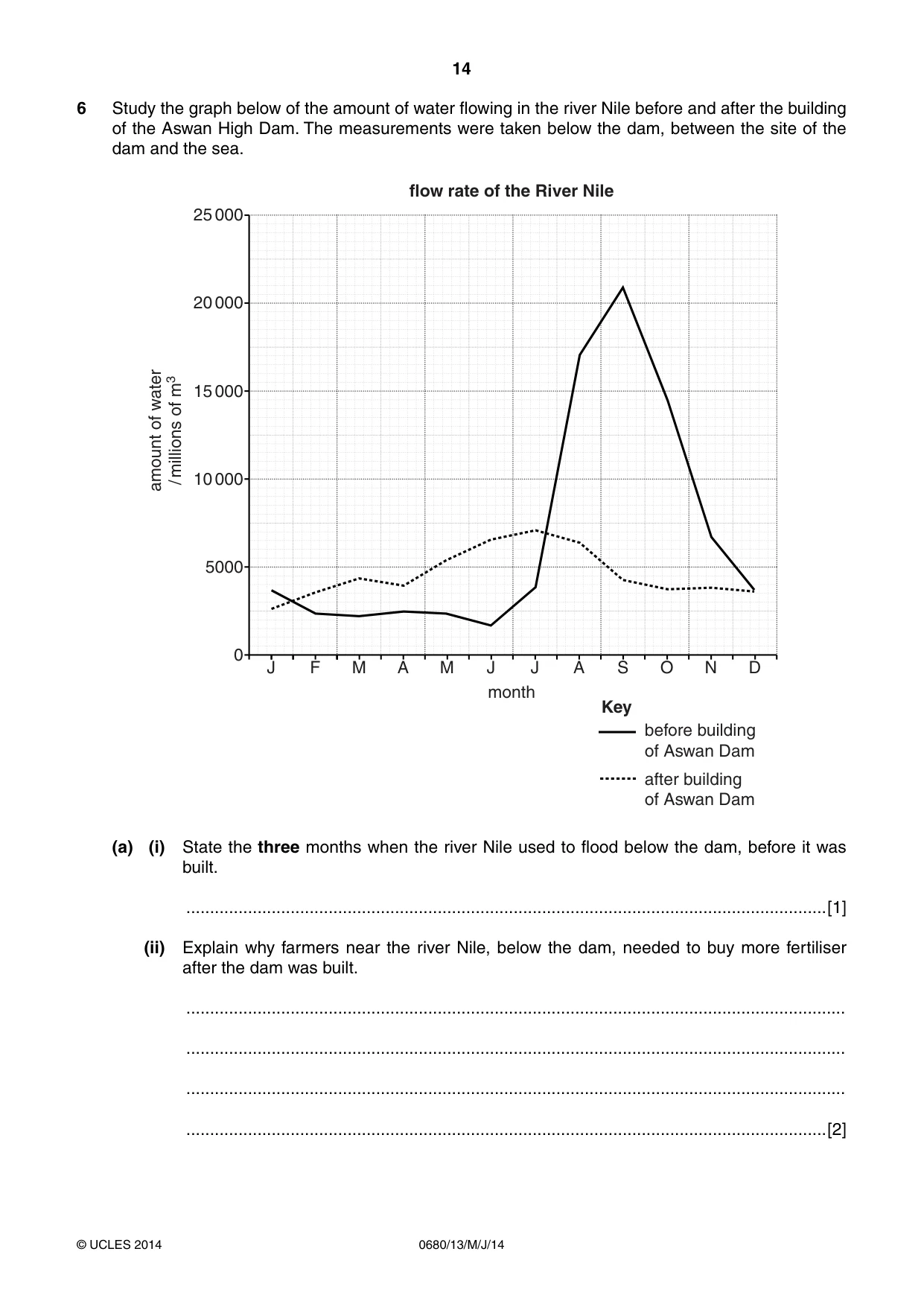
14 0680/13/M/J/14 © UCLES 2014 6 Study the graph below of the amount of water flowing in the river Nile before and after the building of the Aswan High Dam. The measurements were taken below the dam, between the site of the dam and the sea. 0 J F M A M J J A S O N D 5000 10 000 15 000 amount of water / millions of m3 month flow rate of the River Nile 20 000 25 000 before building of Aswan Dam Key after building of Aswan Dam (a) (i) State the three months when the river Nile used to flood below the dam, before it was built. …[1] (ii) Explain why farmers near the river Nile, below the dam, needed to buy more fertiliser after the dam was built. … … … …[2]
Question paper, page 15
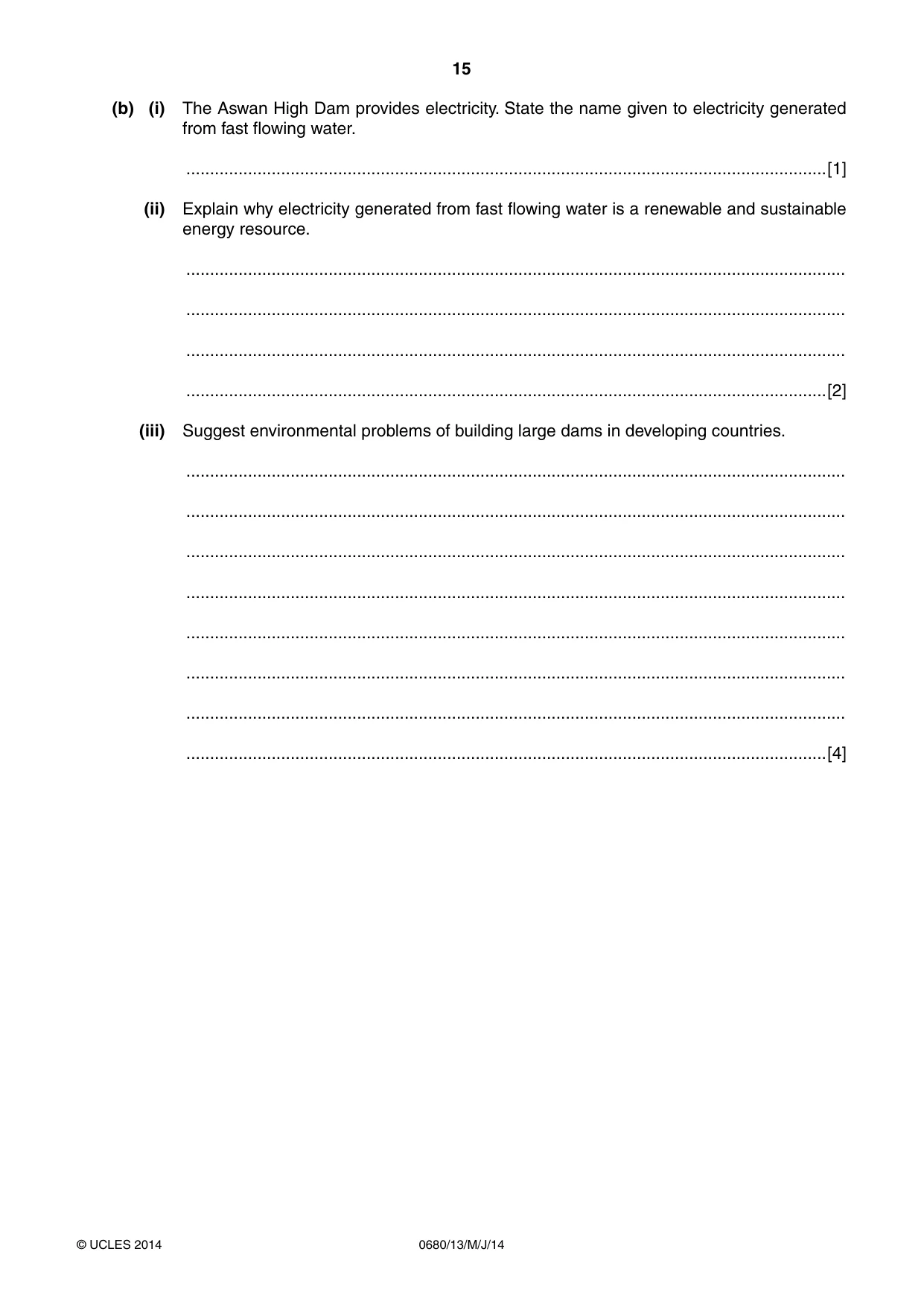
15 0680/13/M/J/14 © UCLES 2014 (b) (i) The Aswan High Dam provides electricity. State the name given to electricity generated from fast flowing water. …[1] (ii) Explain why electricity generated from fast flowing water is a renewable and sustainable energy resource. … … … …[2] (iii) Suggest environmental problems of building large dams in developing countries. … … … … … … … …[4]
Question paper, page 16
16 0680/13/M/J/14 © UCLES 2014 BLANK PAGE Copyright Acknowledgements: Question 2 © http://minerals.usgs.gov/minerals/pubs/commodity/iron_ore/mcs-2012-feore.pdf. Question 6 © Alan Doherty & Malcolm McDonald; River Basin Management; Hodder and Stoughton Ltd; 1992. Permission to reproduce items where third-party owned material protected by copyright is included has been sought and cleared where possible. Every reasonable effort has been made by the publisher (UCLES) to trace copyright holders, but if any items requiring clearance have unwittingly been included, the publisher will be pleased to make amends at the earliest possible opportunity. Cambridge International Examinations is part of the Cambridge Assessment Group. Cambridge Assessment is the brand name of University of Cambridge Local Examinations Syndicate (UCLES), which is itself a department of the University of Cambridge.
Mark scheme, page 1
CAMBRIDGE INTERNATIONAL EXAMINATIONS International General Certificate of Secondary Education MARK SCHEME for the May/June 2014 series 0680 ENVIRONMENTAL MANAGEMENT 0680/13 Paper 1, maximum raw mark 60 This mark scheme is published as an aid to teachers and candidates, to indicate the requirements of the examination. It shows the basis on which Examiners were instructed to award marks. It does not indicate the details of the discussions that took place at an Examiners’ meeting before marking began, which would have considered the acceptability of alternative answers. Mark schemes should be read in conjunction with the question paper and the Principal Examiner Report for Teachers. Cambridge will not enter into discussions about these mark schemes. Cambridge is publishing the mark schemes for the May/June 2014 series for most IGCSE, GCE Advanced Level and Advanced Subsidiary Level components and some Ordinary Level components.
Mark scheme, page 2
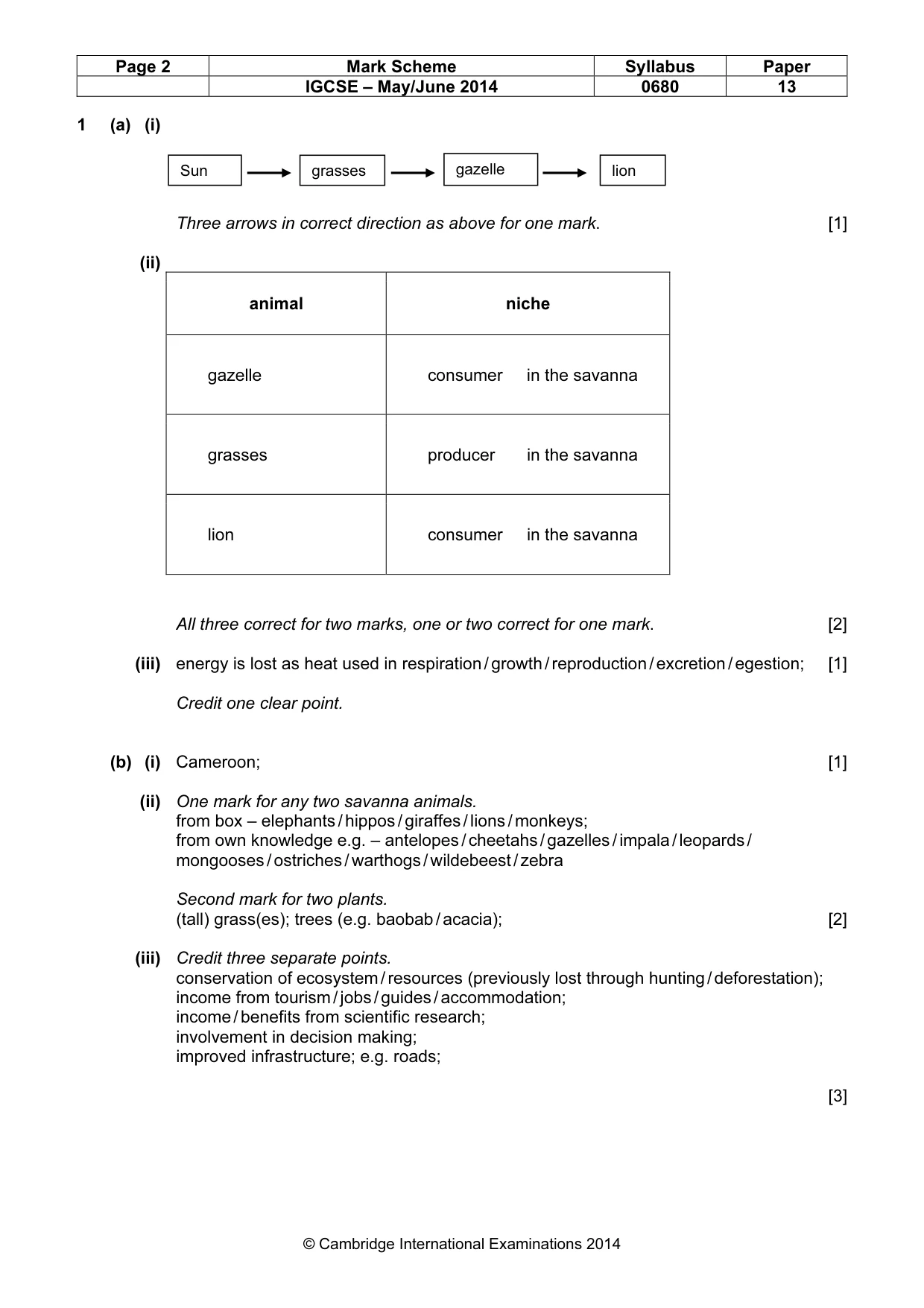
Page 2 Mark Scheme Syllabus Paper IGCSE – May/June 2014 0680 13 © Cambridge International Examinations 2014 1 (a) (i) Three arrows in correct direction as above for one mark. [1] (ii) animal niche gazelle consumer in the savanna grasses producer in the savanna lion consumer in the savanna All three correct for two marks, one or two correct for one mark. [2] (iii) energy is lost as heat used in respiration / growth / reproduction / excretion / egestion; [1] Credit one clear point. (b) (i) Cameroon; [1] (ii) One mark for any two savanna animals. from box – elephants / hippos / giraffes / lions / monkeys; from own knowledge e.g. – antelopes / cheetahs / gazelles / impala / leopards / mongooses / ostriches / warthogs / wildebeest / zebra Second mark for two plants. (tall) grass(es); trees (e.g. baobab / acacia); [2] (iii) Credit three separate points. conservation of ecosystem / resources (previously lost through hunting / deforestation); income from tourism / jobs / guides / accommodation; income / benefits from scientific research; involvement in decision making; improved infrastructure; e.g. roads; [3] Sun grasses gazelle lion
Mark scheme, page 3
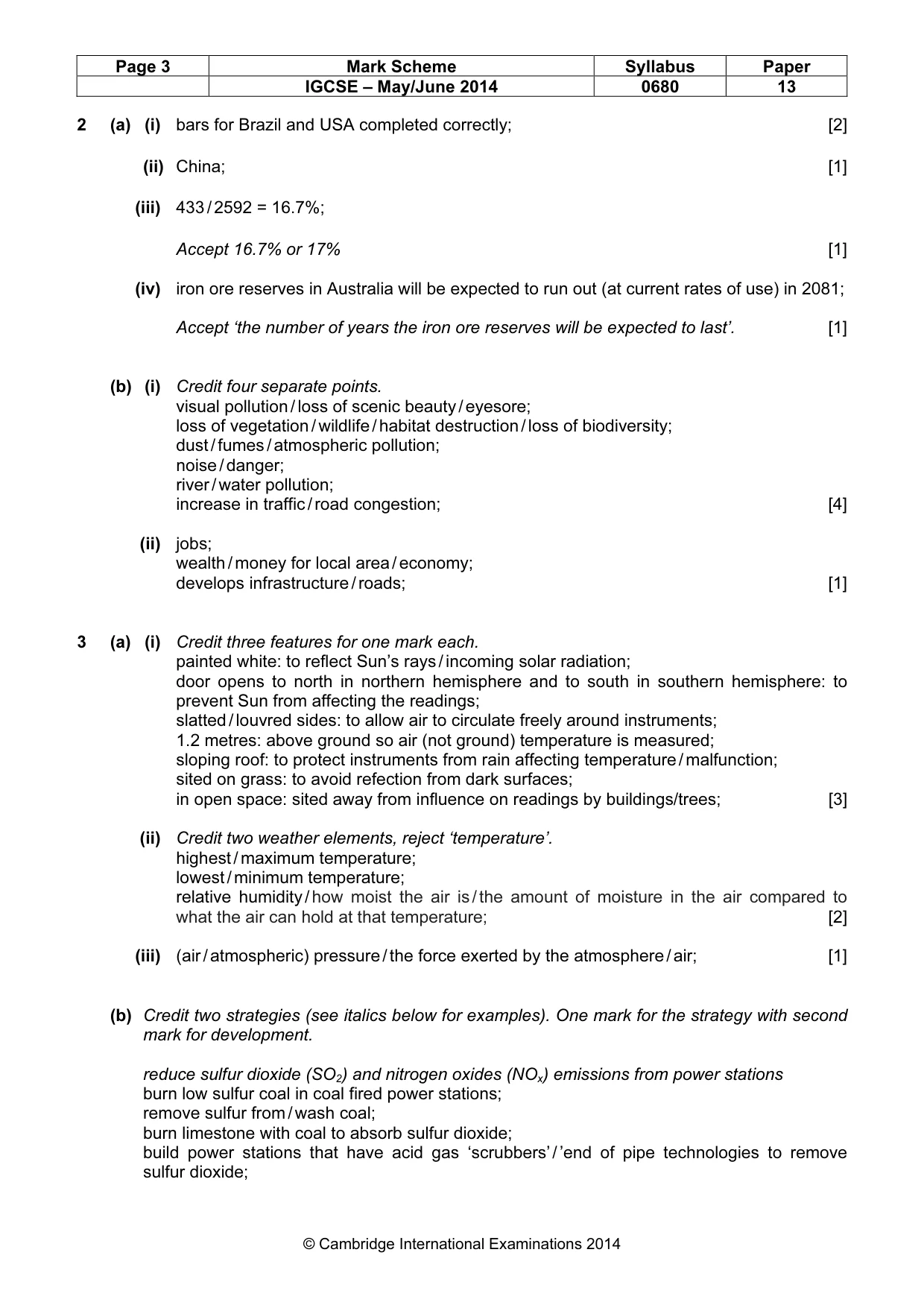
Page 3 Mark Scheme Syllabus Paper IGCSE – May/June 2014 0680 13 © Cambridge International Examinations 2014 2 (a) (i) bars for Brazil and USA completed correctly; [2] (ii) China; [1] (iii) 433 / 2592 = 16.7%; Accept 16.7% or 17% [1] (iv) iron ore reserves in Australia will be expected to run out (at current rates of use) in 2081; Accept ‘the number of years the iron ore reserves will be expected to last’. [1] (b) (i) Credit four separate points. visual pollution / loss of scenic beauty / eyesore; loss of vegetation / wildlife / habitat destruction / loss of biodiversity; dust / fumes / atmospheric pollution; noise / danger; river / water pollution; increase in traffic / road congestion; [4] (ii) jobs; wealth / money for local area / economy; develops infrastructure / roads; [1] 3 (a) (i) Credit three features for one mark each. painted white: to reflect Sun’s rays / incoming solar radiation; door opens to north in northern hemisphere and to south in southern hemisphere: to prevent Sun from affecting the readings; slatted / louvred sides: to allow air to circulate freely around instruments; 1.2 metres: above ground so air (not ground) temperature is measured; sloping roof: to protect instruments from rain affecting temperature / malfunction; sited on grass: to avoid refection from dark surfaces; in open space: sited away from influence on readings by buildings/trees; [3] (ii) Credit two weather elements, reject ‘temperature’. highest / maximum temperature; lowest / minimum temperature; relative humidity / how moist the air is / the amount of moisture in the air compared to what the air can hold at that temperature; [2] (iii) (air / atmospheric) pressure / the force exerted by the atmosphere / air; [1] (b) Credit two strategies (see italics below for examples). One mark for the strategy with second mark for development. reduce sulfur dioxide (SO2) and nitrogen oxides (NOx) emissions from power stations burn low sulfur coal in coal fired power stations; remove sulfur from / wash coal; burn limestone with coal to absorb sulfur dioxide; build power stations that have acid gas ‘scrubbers’ / ’end of pipe technologies to remove sulfur dioxide;
Mark scheme, page 4
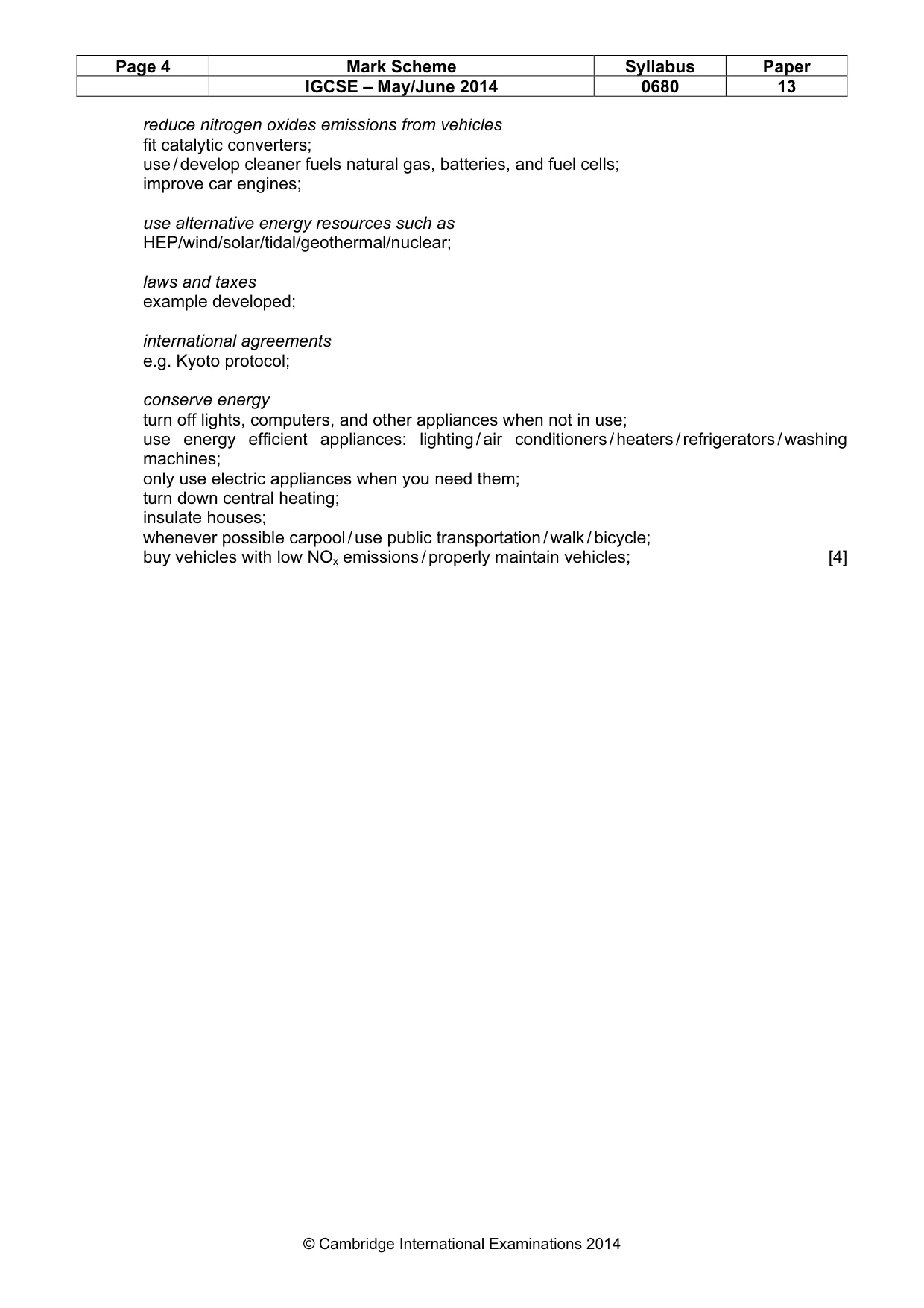
Page 4 Mark Scheme Syllabus Paper IGCSE – May/June 2014 0680 13 © Cambridge International Examinations 2014 reduce nitrogen oxides emissions from vehicles fit catalytic converters; use / develop cleaner fuels natural gas, batteries, and fuel cells; improve car engines; use alternative energy resources such as HEP/wind/solar/tidal/geothermal/nuclear; laws and taxes example developed; international agreements e.g. Kyoto protocol; conserve energy turn off lights, computers, and other appliances when not in use; use energy efficient appliances: lighting / air conditioners / heaters / refrigerators / washing machines; only use electric appliances when you need them; turn down central heating; insulate houses; whenever possible carpool / use public transportation / walk / bicycle; buy vehicles with low NOx emissions / properly maintain vehicles; [4]
Mark scheme, page 5
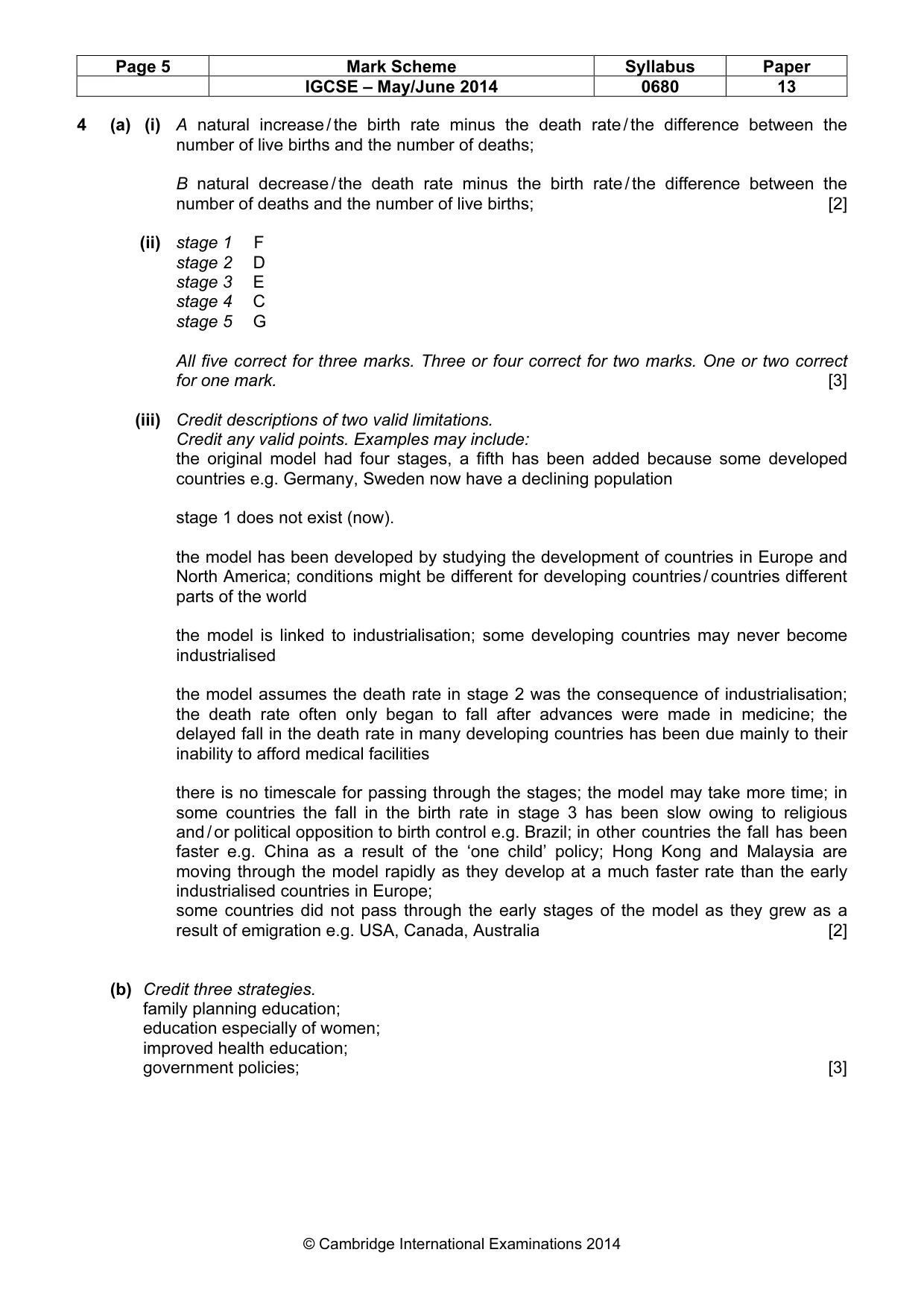
Page 5 Mark Scheme Syllabus Paper IGCSE – May/June 2014 0680 13 © Cambridge International Examinations 2014 4 (a) (i) A natural increase / the birth rate minus the death rate / the difference between the number of live births and the number of deaths; B natural decrease / the death rate minus the birth rate / the difference between the number of deaths and the number of live births; [2] (ii) stage 1 F stage 2 D stage 3 E stage 4 C stage 5 G All five correct for three marks. Three or four correct for two marks. One or two correct for one mark. [3] (iii) Credit descriptions of two valid limitations. Credit any valid points. Examples may include: the original model had four stages, a fifth has been added because some developed countries e.g. Germany, Sweden now have a declining population stage 1 does not exist (now). the model has been developed by studying the development of countries in Europe and North America; conditions might be different for developing countries / countries different parts of the world the model is linked to industrialisation; some developing countries may never become industrialised the model assumes the death rate in stage 2 was the consequence of industrialisation; the death rate often only began to fall after advances were made in medicine; the delayed fall in the death rate in many developing countries has been due mainly to their inability to afford medical facilities there is no timescale for passing through the stages; the model may take more time; in some countries the fall in the birth rate in stage 3 has been slow owing to religious and / or political opposition to birth control e.g. Brazil; in other countries the fall has been faster e.g. China as a result of the ‘one child’ policy; Hong Kong and Malaysia are moving through the model rapidly as they develop at a much faster rate than the early industrialised countries in Europe; some countries did not pass through the early stages of the model as they grew as a result of emigration e.g. USA, Canada, Australia [2] (b) Credit three strategies. family planning education; education especially of women; improved health education; government policies; [3]
Mark scheme, page 6
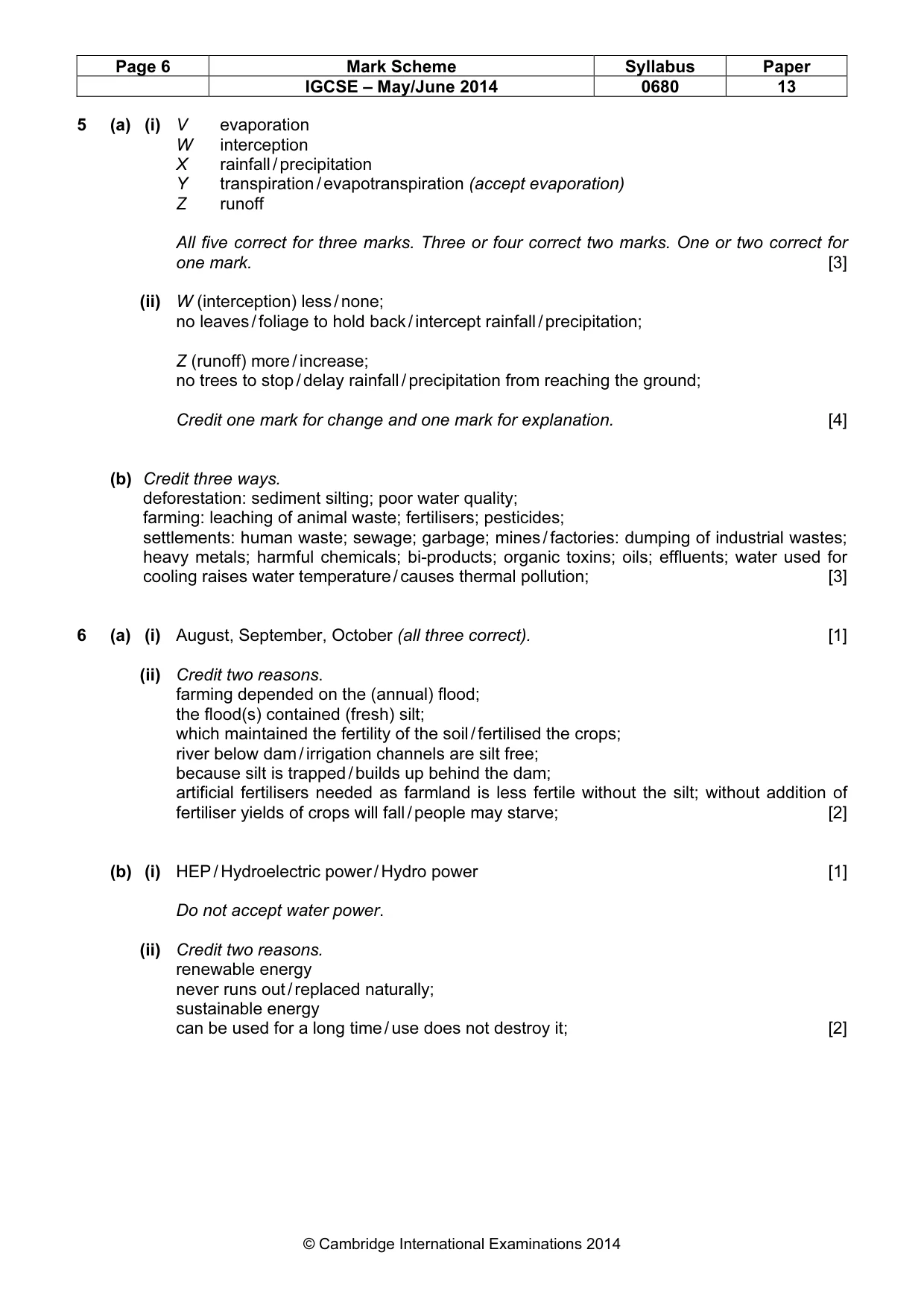
Page 6 Mark Scheme Syllabus Paper IGCSE – May/June 2014 0680 13 © Cambridge International Examinations 2014 5 (a) (i) V evaporation W interception X rainfall / precipitation Y transpiration / evapotranspiration (accept evaporation) Z runoff All five correct for three marks. Three or four correct two marks. One or two correct for one mark. [3] (ii) W (interception) less / none; no leaves / foliage to hold back / intercept rainfall / precipitation; Z (runoff) more / increase; no trees to stop / delay rainfall / precipitation from reaching the ground; Credit one mark for change and one mark for explanation. [4] (b) Credit three ways. deforestation: sediment silting; poor water quality;. farming: leaching of animal waste; fertilisers; pesticides; settlements: human waste; sewage; garbage; mines / factories: dumping of industrial wastes; heavy metals; harmful chemicals; bi-products; organic toxins; oils; effluents; water used for cooling raises water temperature / causes thermal pollution; [3] 6 (a) (i) August, September, October (all three correct). [1] (ii) Credit two reasons. farming depended on the (annual) flood; the flood(s) contained (fresh) silt; which maintained the fertility of the soil / fertilised the crops; river below dam / irrigation channels are silt free; because silt is trapped / builds up behind the dam; artificial fertilisers needed as farmland is less fertile without the silt; without addition of fertiliser yields of crops will fall / people may starve; [2] (b) (i) HEP / Hydroelectric power / Hydro power [1] Do not accept water power. (ii) Credit two reasons. renewable energy never runs out / replaced naturally; sustainable energy can be used for a long time / use does not destroy it; [2]
Mark scheme, page 7
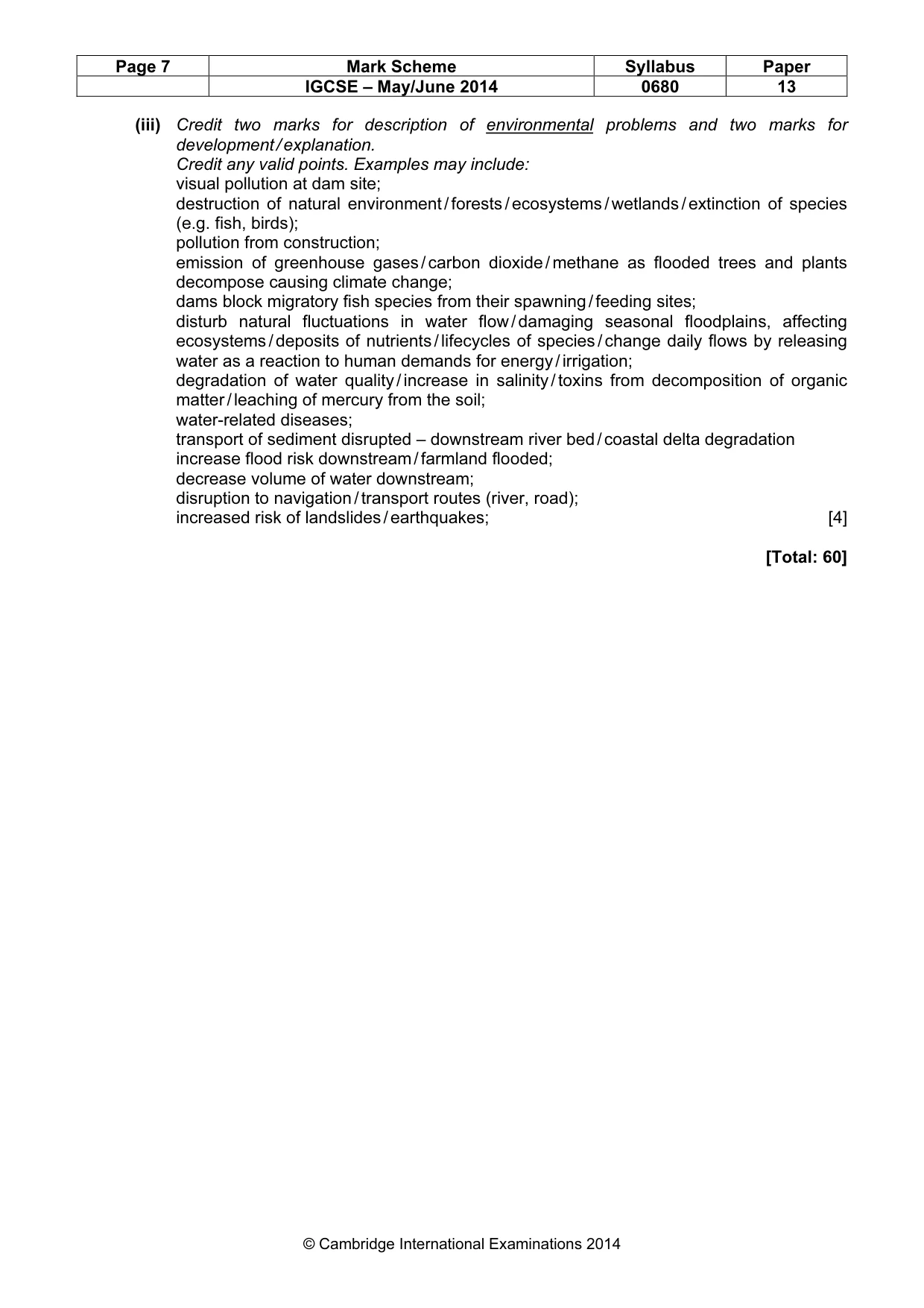
Page 7 Mark Scheme Syllabus Paper IGCSE – May/June 2014 0680 13 © Cambridge International Examinations 2014 (iii) Credit two marks for description of environmental problems and two marks for development / explanation. Credit any valid points. Examples may include: visual pollution at dam site; destruction of natural environment / forests / ecosystems / wetlands / extinction of species (e.g. fish, birds); pollution from construction; emission of greenhouse gases / carbon dioxide / methane as flooded trees and plants decompose causing climate change; dams block migratory fish species from their spawning / feeding sites; disturb natural fluctuations in water flow / damaging seasonal floodplains, affecting ecosystems / deposits of nutrients / lifecycles of species / change daily flows by releasing water as a reaction to human demands for energy / irrigation; degradation of water quality / increase in salinity / toxins from decomposition of organic matter / leaching of mercury from the soil; water-related diseases; transport of sediment disrupted – downstream river bed / coastal delta degradation increase flood risk downstream / farmland flooded; decrease volume of water downstream; disruption to navigation / transport routes (river, road); increased risk of landslides / earthquakes; [4] [Total: 60]
What you needed in this session
Cambridge’s own grade thresholds for 2014 May/June, Paper 1 · Variant 3. A higher threshold means an easier paper — the bar moves with how the cohort did.