Cambridge IGCSE Environmental Management 0680 — 2013 Oct/Nov Paper 1 · Variant 1
0680/11/O/N/13 · 60 marks · ≈68 min
The question paper and its mark scheme, free to read here and free to download. This is Cambridge’s own paper, exactly as it was sat.
Question paper16 pages

Mark scheme6 pages
Answers below. Sit the paper first if you are practising.
Paper as text
Question paper, page 1
This document consists of 15 printed pages and 1 blank page. DC (NF/CGW) 70274/3 © UCLES 2013 [Turn over UNIVERSITY OF CAMBRIDGE INTERNATIONAL EXAMINATIONS International General Certificate of Secondary Education * 2 9 6 1 7 5 5 3 5 7 * ENVIRONMENTAL MANAGEMENT 0680/11 Paper 1 October/November 2013 1 hour 30 minutes Candidates answer on the Question Paper. Additional Materials: Ruler READ THESE INSTRUCTIONS FIRST Write your Centre number, candidate number and name on all the work you hand in. Write in dark blue or black pen. You may use a soft pencil for any diagrams, graphs or rough working. Do not use staples, paper clips, highlighters, glue or correction fluid. DO NOT WRITE IN ANY BARCODES. Answer all questions. Electronic calculators may be used. You may lose marks if you do not show your working or if you do not use appropriate units. At the end of the examination, fasten all your work securely together. The number of marks is given in brackets [ ] at the end of each question or part question. For Examiner’s Use 1 2 3 4 5 6 Total
Question paper, page 2
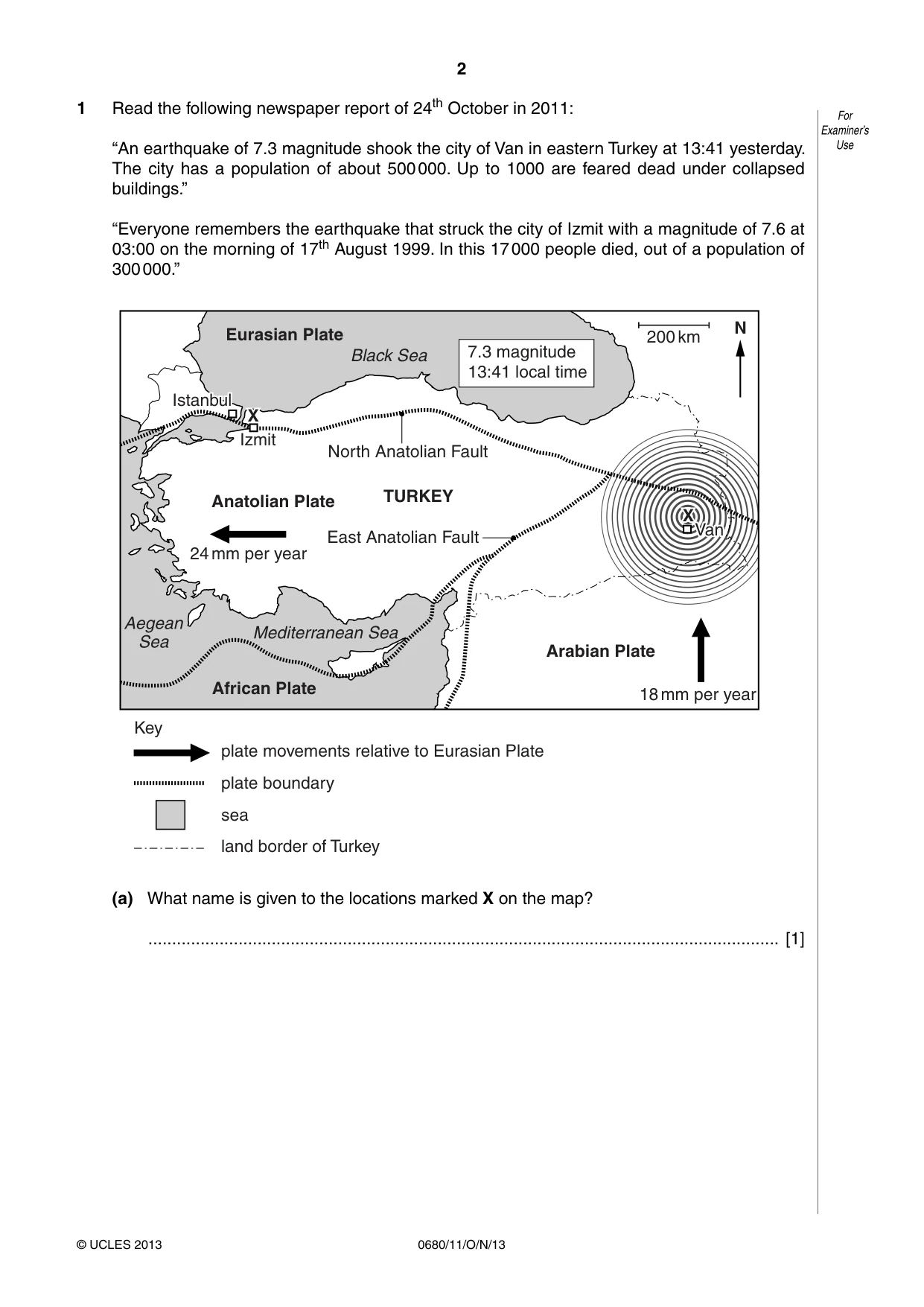
2 0680/11/O/N/13 © UCLES 2013 For Examiner’s Use 1 Read the following newspaper report of 24th October in 2011: “An earthquake of 7.3 magnitude shook the city of Van in eastern Turkey at 13:41 yesterday. The city has a population of about 500 000. Up to 1000 are feared dead under collapsed buildings.” “Everyone remembers the earthquake that struck the city of Izmit with a magnitude of 7.6 at 03:00 on the morning of 17th August 1999. In this 17 000 people died, out of a population of 300 000.” Eurasian Plate African Plate TURKEY N North Anatolian Fault East Anatolian Fault 24 mm per year Key plate movements relative to Eurasian Plate plate boundary sea 18 mm per year Aegean Sea Black Sea Mediterranean Sea Izmit Arabian Plate Anatolian Plate Van X 7.3 magnitude 13:41 local time 200 km land border of Turkey X Istanbul Istanbul (a) What name is given to the locations marked X on the map? … [1]
Question paper, page 3
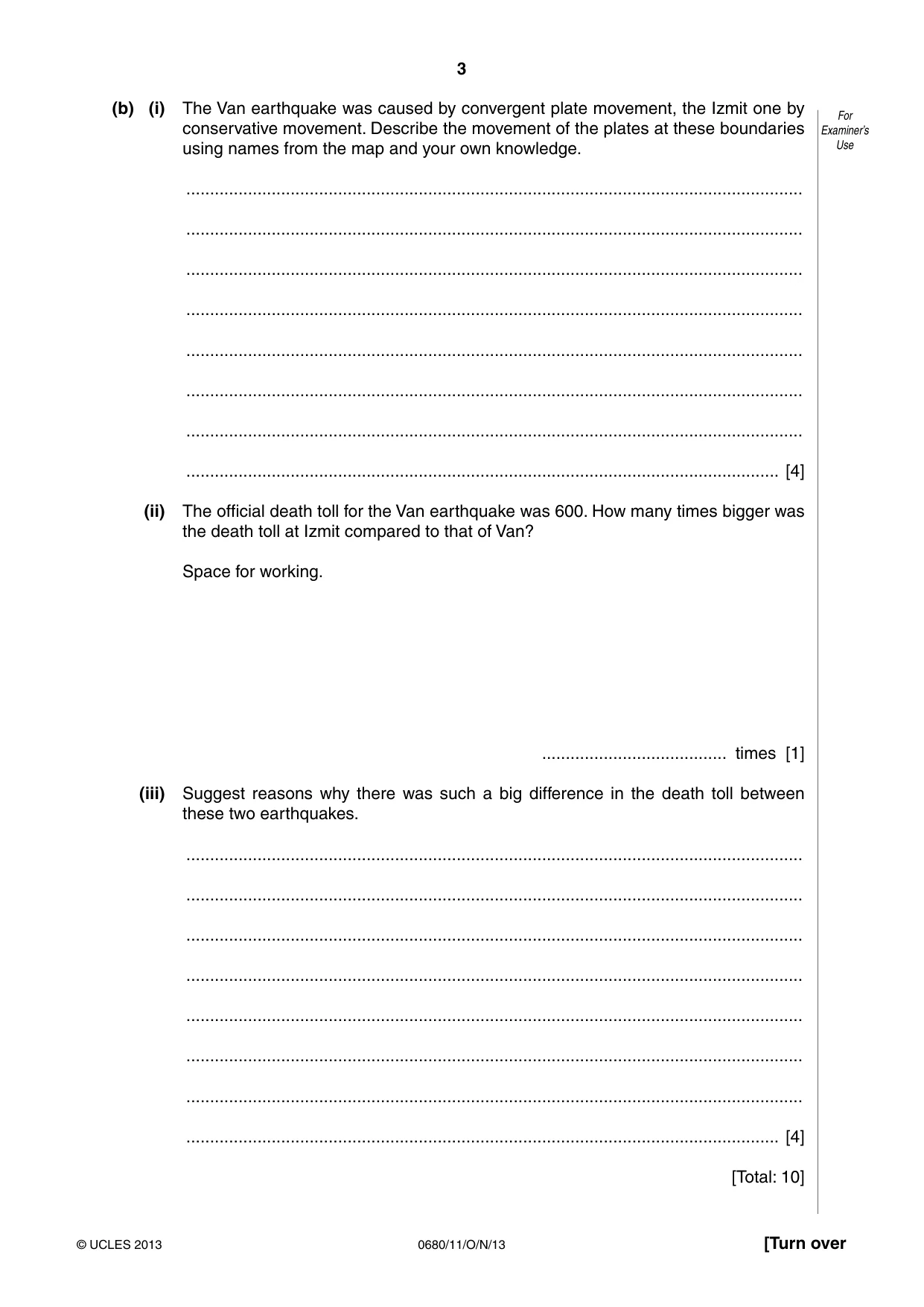
3 0680/11/O/N/13 © UCLES 2013 [Turn over For Examiner’s Use (b) (i) The Van earthquake was caused by convergent plate movement, the Izmit one by conservative movement. Describe the movement of the plates at these boundaries using names from the map and your own knowledge. … … … … … … … … [4] (ii) The official death toll for the Van earthquake was 600. How many times bigger was the death toll at Izmit compared to that of Van? Space for working. … times [1] (iii) Suggest reasons why there was such a big difference in the death toll between these two earthquakes. … … … … … … … … [4] [Total: 10]
Question paper, page 4
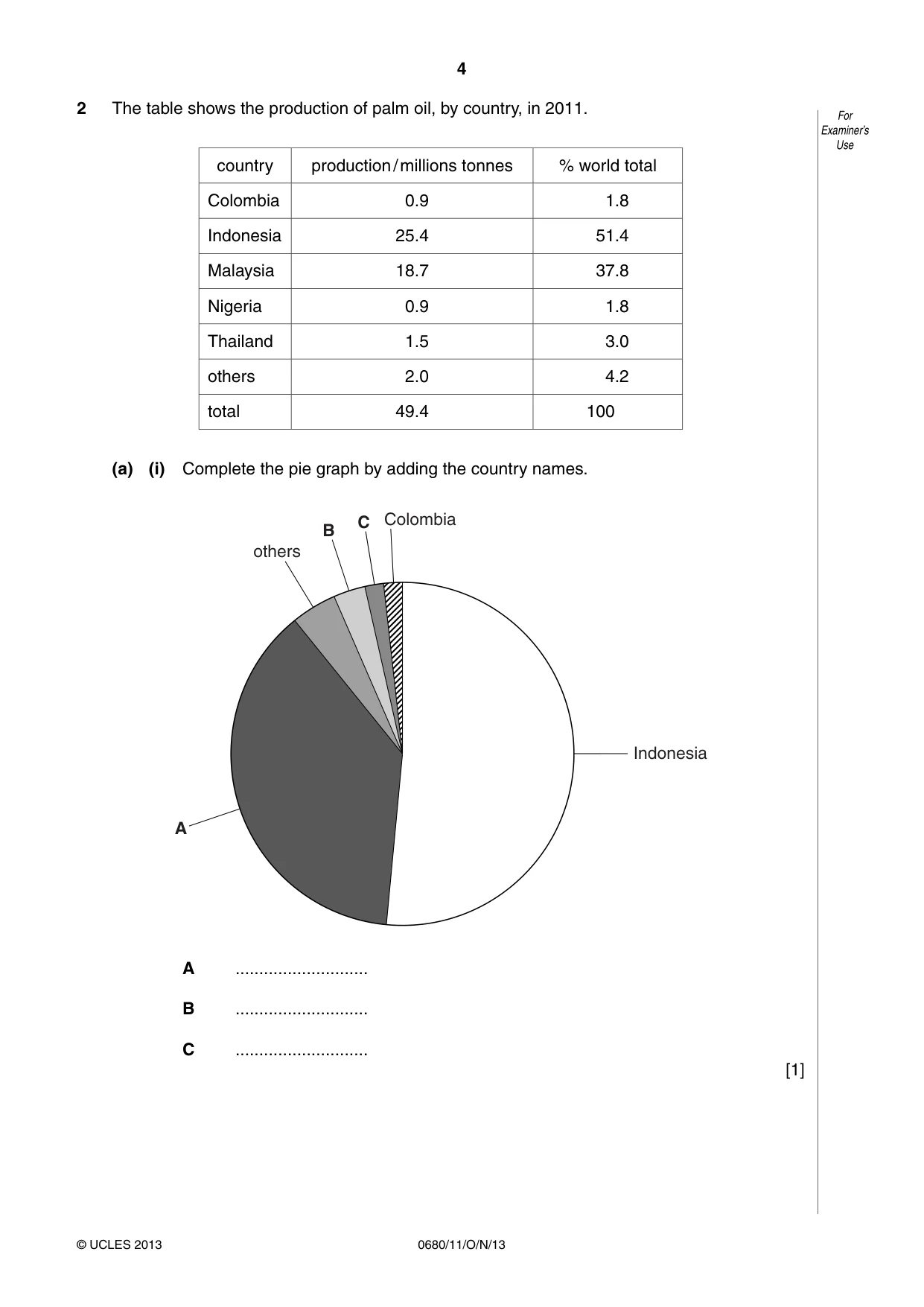
4 0680/11/O/N/13 © UCLES 2013 For Examiner’s Use 2 The table shows the production of palm oil, by country, in 2011. country production / millions tonnes % world total Colombia 0.9 1.8 Indonesia 25.4 51.4 Malaysia 18.7 37.8 Nigeria 0.9 1.8 Thailand 1.5 3.0 others 2.0 4.2 total 49.4 100 (a) (i) Complete the pie graph by adding the country names. A B C Colombia Indonesia others A … B … C … [1]
Question paper, page 5
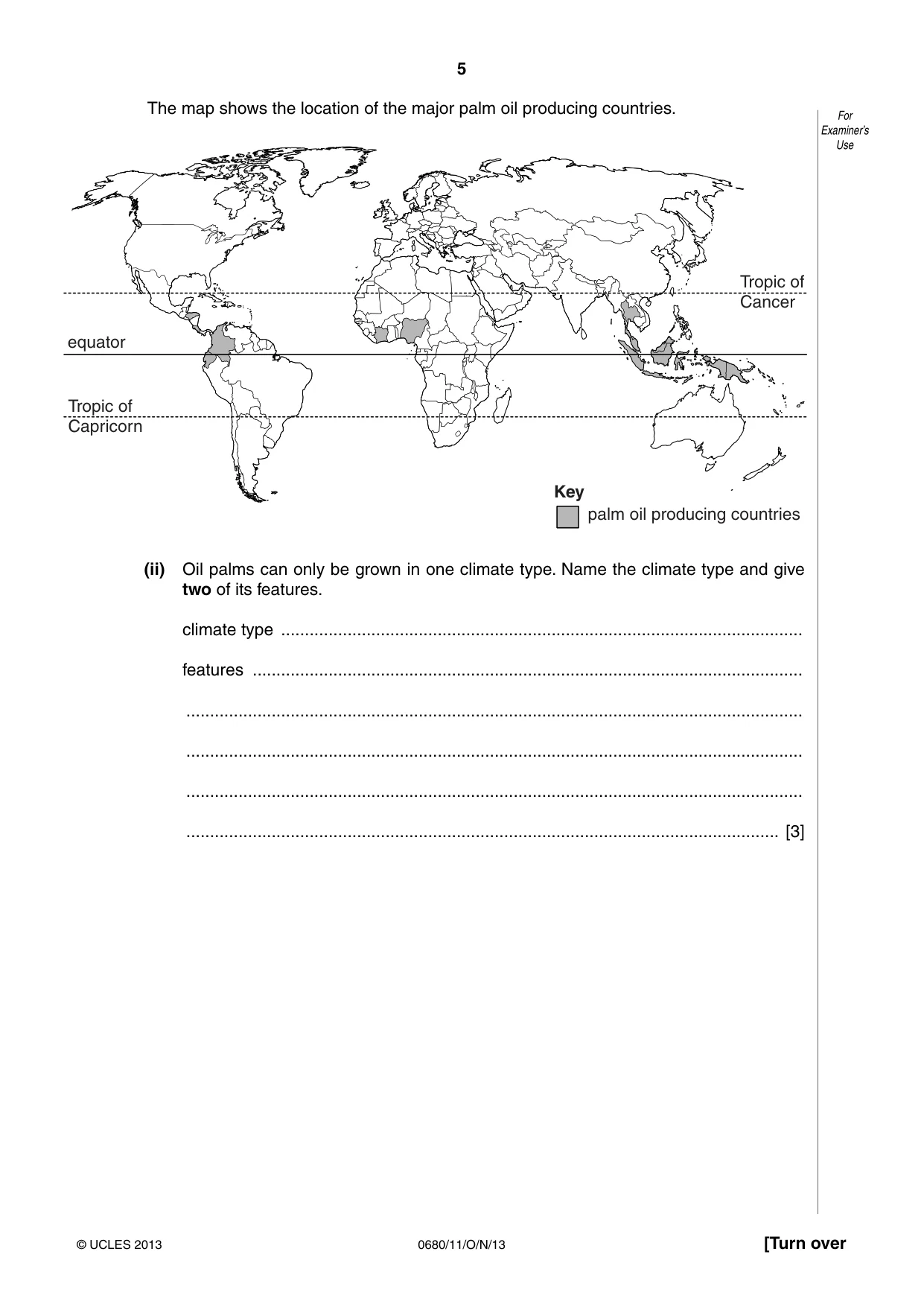
5 0680/11/O/N/13 © UCLES 2013 [Turn over For Examiner’s Use The map shows the location of the major palm oil producing countries. equator palm oil producing countries Key Tropic of Capricorn Tropic of Cancer (ii) Oil palms can only be grown in one climate type. Name the climate type and give two of its features. climate type … features … … … … … [3]
Question paper, page 6
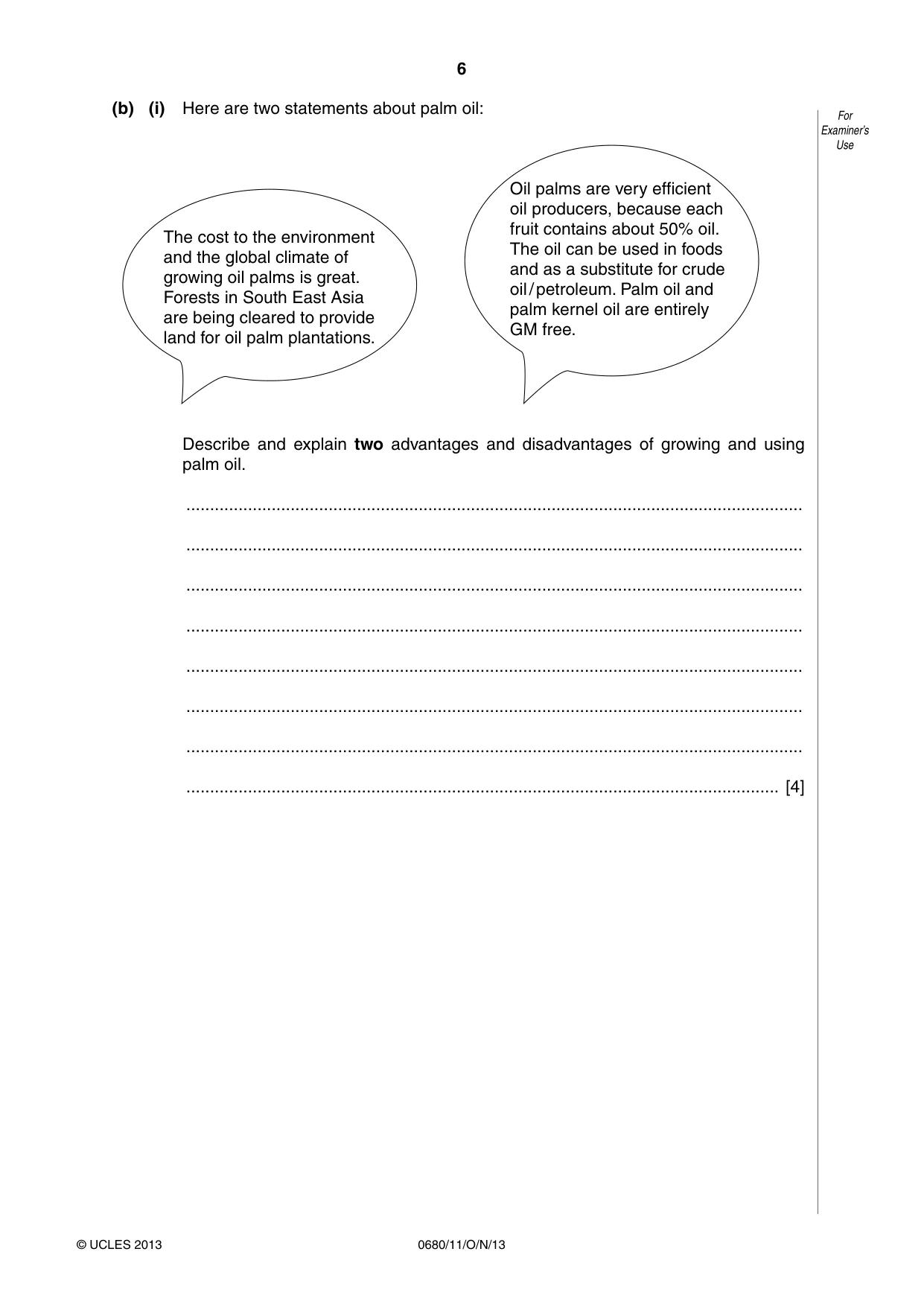
6 0680/11/O/N/13 © UCLES 2013 For Examiner’s Use (b) (i) Here are two statements about palm oil: The cost to the environment and the global climate of growing oil palms is great. Forests in South East Asia are being cleared to provide land for oil palm plantations. Oil palms are very efficient oil producers, because each fruit contains about 50% oil. The oil can be used in foods and as a substitute for crude oil / petroleum. Palm oil and palm kernel oil are entirely GM free. Describe and explain two advantages and disadvantages of growing and using palm oil. … … … … … … … … [4]
Question paper, page 7
7 0680/11/O/N/13 © UCLES 2013 [Turn over For Examiner’s Use (ii) One species threatened by the spread of oil palm plantations is the orangutan in Malaysia. Suggest how this animal might be conserved. … … … … [2] [Total: 10]
Question paper, page 8
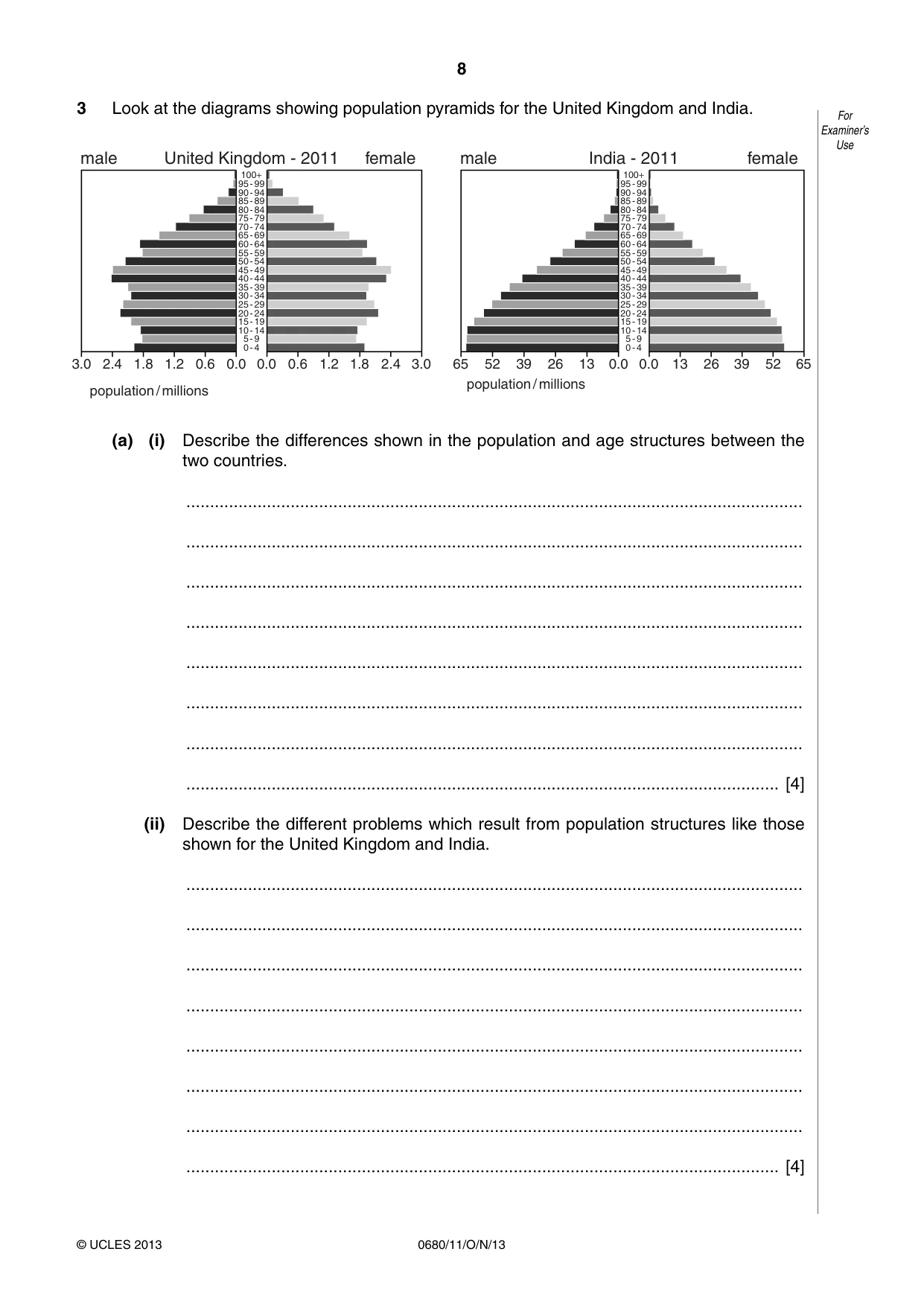
8 0680/11/O/N/13 © UCLES 2013 For Examiner’s Use 3 Look at the diagrams showing population pyramids for the United Kingdom and India. 3.0 population / millions male female United Kingdom - 2011 2.4 1.8 1.2 0.6 0 - 4 5 - 9 10 - 14 15 - 19 20 - 24 25 - 29 30 - 34 35 - 39 40 - 44 45 - 49 50 - 54 55 - 59 60 - 64 65 - 69 70 - 74 75 - 79 80 - 84 85 - 89 90 - 94 95 - 99 100+ 0.0 3.0 2.4 1.8 1.2 0.6 0.0 65 population / millions male female India - 2011 52 39 26 13 0 - 4 5 - 9 10 - 14 15 - 19 20 - 24 25 - 29 30 - 34 35 - 39 40 - 44 45 - 49 50 - 54 55 - 59 60 - 64 65 - 69 70 - 74 75 - 79 80 - 84 85 - 89 90 - 94 95 - 99 100+ 0.0 65 52 39 26 13 0.0 (a) (i) Describe the differences shown in the population and age structures between the two countries. … … … … … … … … [4] (ii) Describe the different problems which result from population structures like those shown for the United Kingdom and India. … … … … … … … … [4]
Question paper, page 9
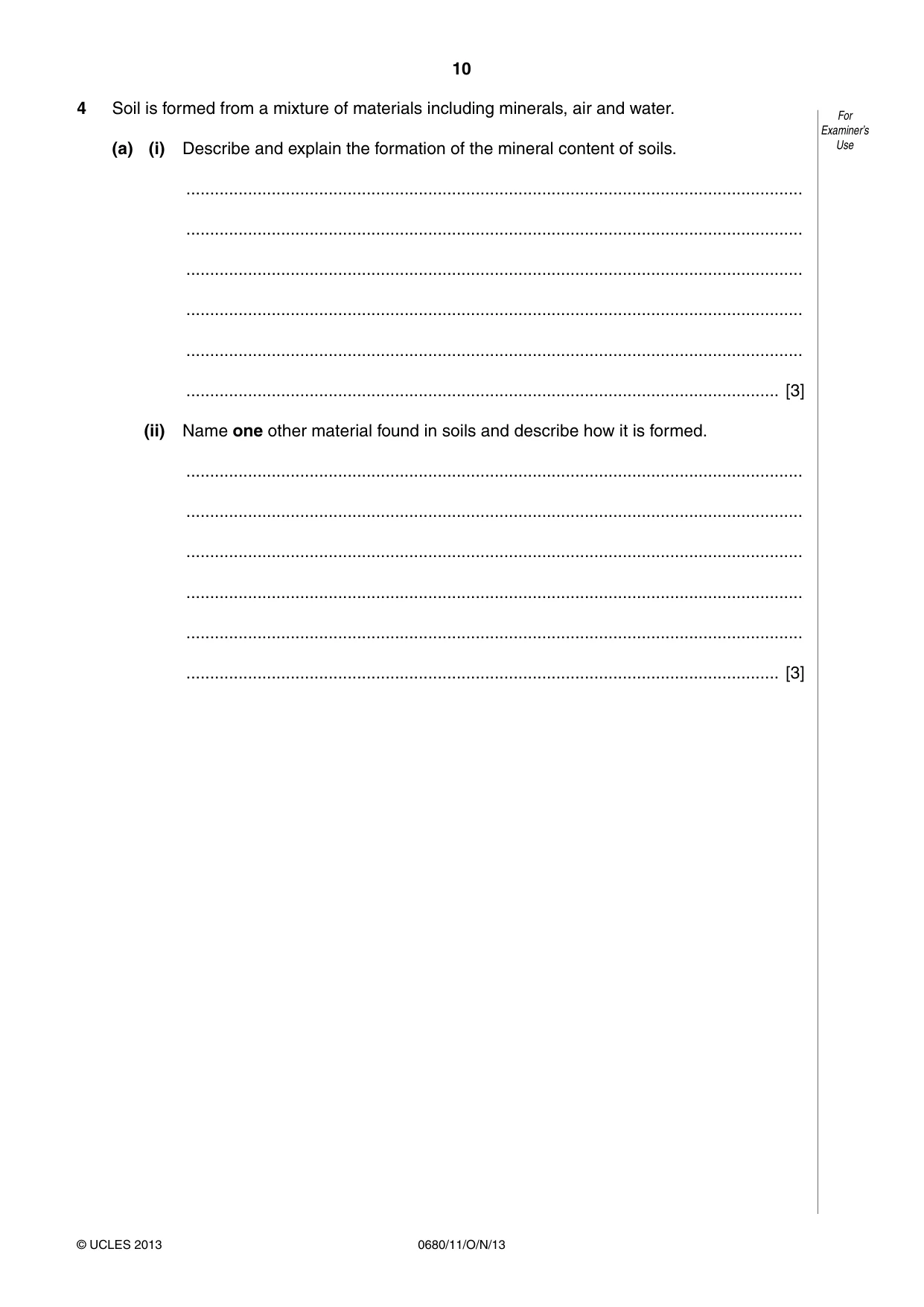
9 0680/11/O/N/13 © UCLES 2013 [Turn over For Examiner’s Use (b) How can national policies help to solve population problems? … … … … [2] [Total: 10]
Question paper, page 10
10 0680/11/O/N/13 © UCLES 2013 For Examiner’s Use 4 Soil is formed from a mixture of materials including minerals, air and water. (a) (i) Describe and explain the formation of the mineral content of soils. … … … … … … [3] (ii) Name one other material found in soils and describe how it is formed. … … … … … … [3]
Question paper, page 11
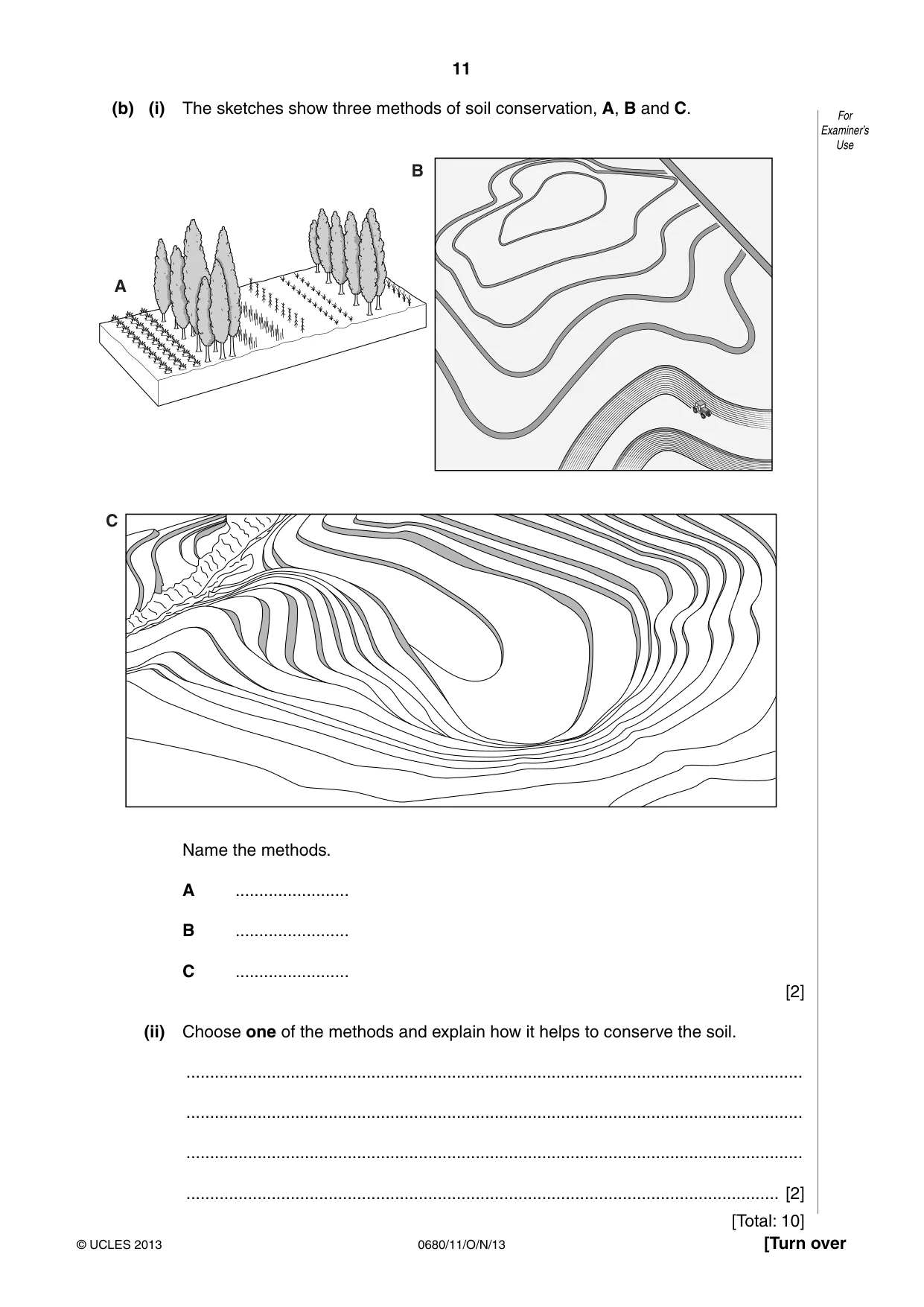
11 0680/11/O/N/13 © UCLES 2013 [Turn over For Examiner’s Use (b) (i) The sketches show three methods of soil conservation, A, B and C. A B C Name the methods. A … B … C … [2] (ii) Choose one of the methods and explain how it helps to conserve the soil. … … … … [2] [Total: 10]
Question paper, page 12
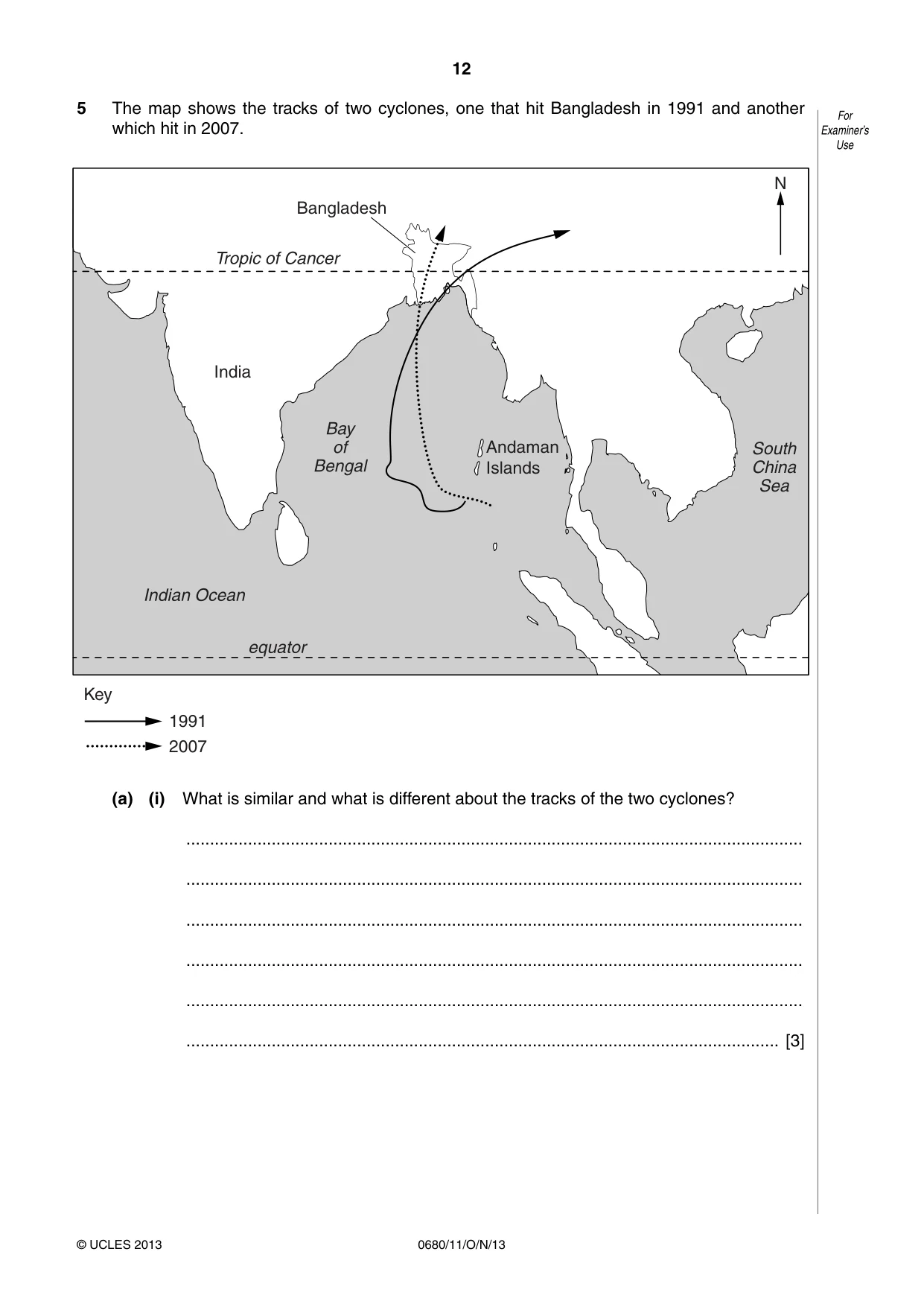
12 0680/11/O/N/13 © UCLES 2013 For Examiner’s Use 5 The map shows the tracks of two cyclones, one that hit Bangladesh in 1991 and another which hit in 2007. N Key 1991 India Andaman Islands Bangladesh Tropic of Cancer equator Bay of Bengal South China Sea Indian Ocean 2007 (a) (i) What is similar and what is different about the tracks of the two cyclones? … … … … … … [3]
Question paper, page 13
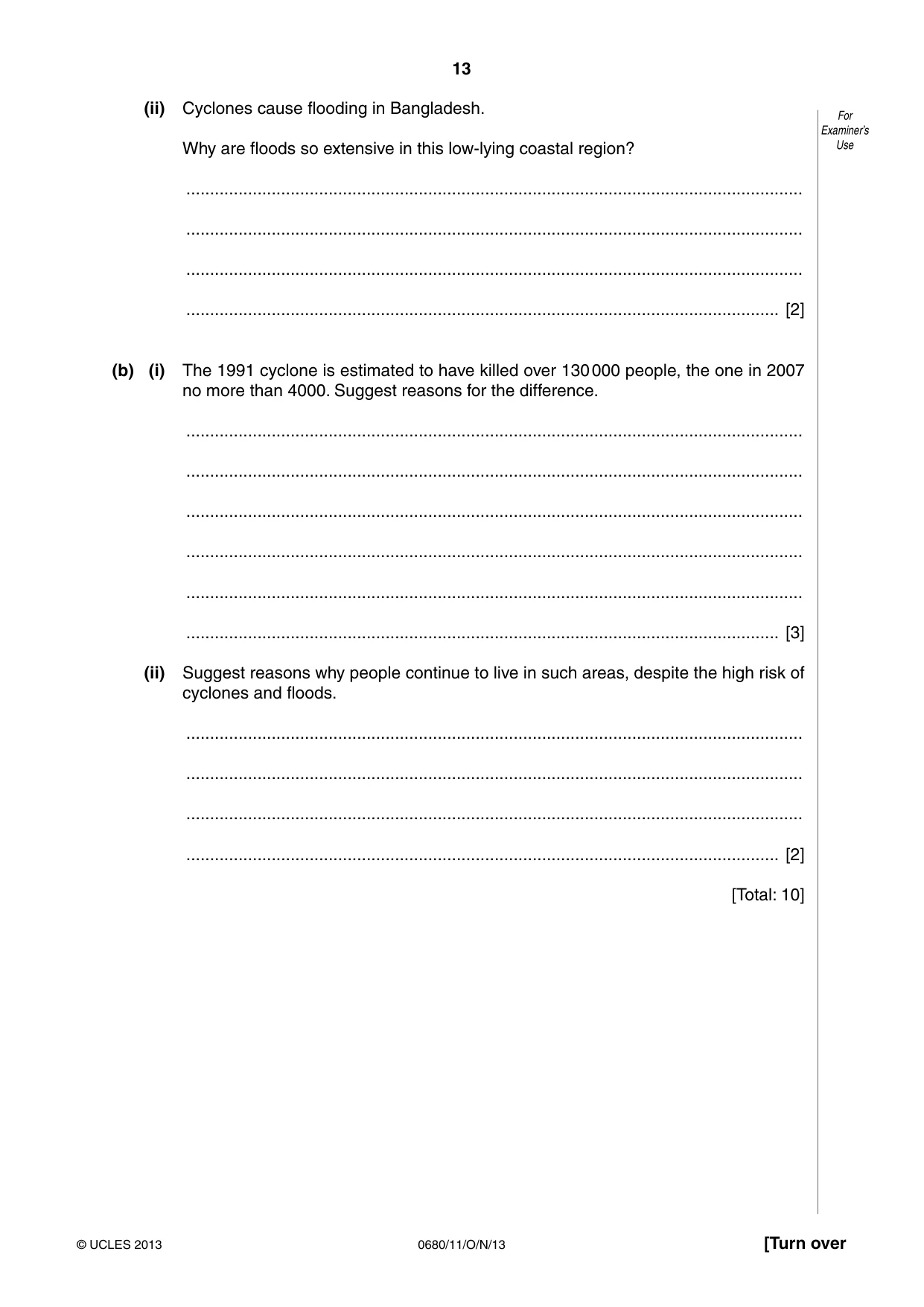
13 0680/11/O/N/13 © UCLES 2013 [Turn over For Examiner’s Use (ii) Cyclones cause flooding in Bangladesh. Why are floods so extensive in this low-lying coastal region? … … … … [2] (b) (i) The 1991 cyclone is estimated to have killed over 130 000 people, the one in 2007 no more than 4000. Suggest reasons for the difference. … … … … … … [3] (ii) Suggest reasons why people continue to live in such areas, despite the high risk of cyclones and floods. … … … … [2] [Total: 10]
Question paper, page 14
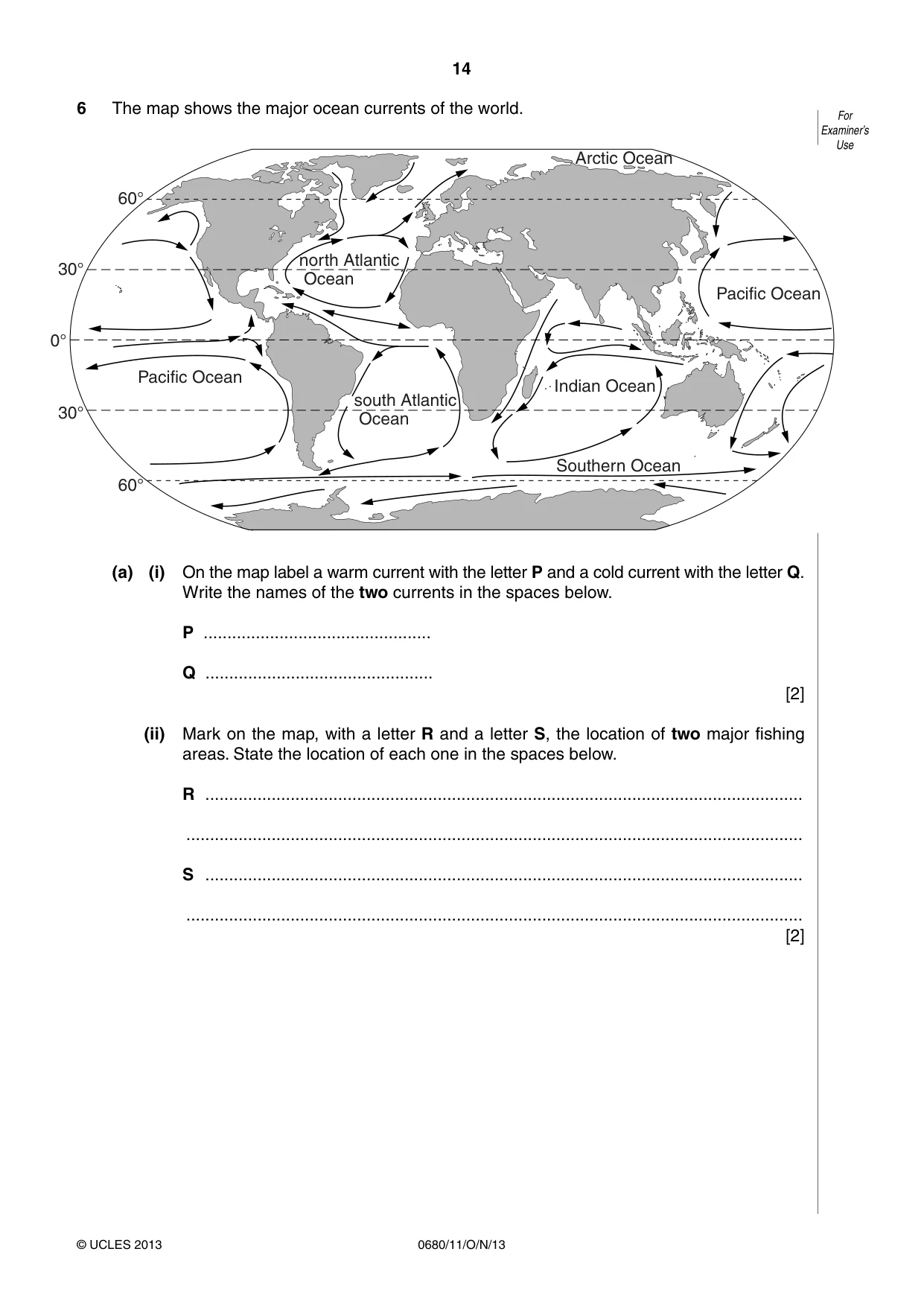
14 0680/11/O/N/13 © UCLES 2013 For Examiner’s Use 6 The map shows the major ocean currents of the world. south Atlantic Ocean north Atlantic Ocean 0° 30° 60° 60° 30° Southern Ocean Pacific Ocean Pacific Ocean Indian Ocean Arctic Ocean (a) (i) On the map label a warm current with the letter P and a cold current with the letter Q. Write the names of the two currents in the spaces below. P … Q … [2] (ii) Mark on the map, with a letter R and a letter S, the location of two major fishing areas. State the location of each one in the spaces below. R … … S … … [2]
Question paper, page 15
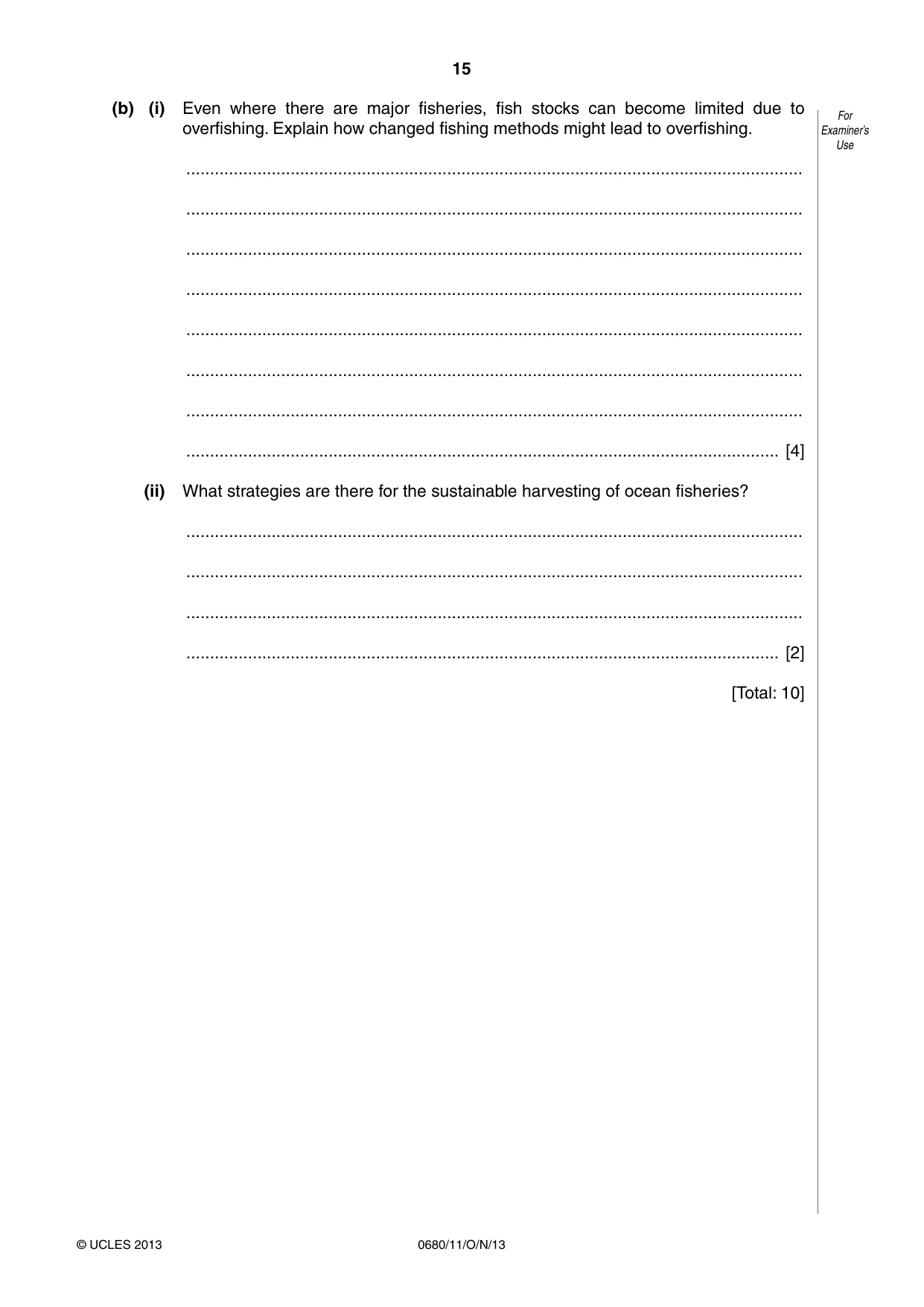
15 0680/11/O/N/13 © UCLES 2013 For Examiner’s Use (b) (i) Even where there are major fisheries, fish stocks can become limited due to overfishing. Explain how changed fishing methods might lead to overfishing. … … … … … … … … [4] (ii) What strategies are there for the sustainable harvesting of ocean fisheries? … … … … [2] [Total: 10]
Question paper, page 16
16 0680/11/O/N/13 © UCLES 2013 Permission to reproduce items where third-party owned material protected by copyright is included has been sought and cleared where possible. Every reasonable effort has been made by the publisher (UCLES) to trace copyright holders, but if any items requiring clearance have unwittingly been included, the publisher will be pleased to make amends at the earliest possible opportunity. University of Cambridge International Examinations is part of the Cambridge Assessment Group. Cambridge Assessment is the brand name of University of Cambridge Local Examinations Syndicate (UCLES), which is itself a department of the University of Cambridge. BLANK PAGE
Mark scheme, page 1
CAMBRIDGE INTERNATIONAL EXAMINATIONS International General Certificate of Secondary Education MARK SCHEME for the October/November 2013 series 0680 ENVIRONMENTAL MANAGEMENT 0680/11 Paper 1, maximum raw mark 60 This mark scheme is published as an aid to teachers and candidates, to indicate the requirements of the examination. It shows the basis on which Examiners were instructed to award marks. It does not indicate the details of the discussions that took place at an Examiners’ meeting before marking began, which would have considered the acceptability of alternative answers. Mark schemes should be read in conjunction with the question paper and the Principal Examiner Report for Teachers. Cambridge will not enter into discussions about these mark schemes. Cambridge is publishing the mark schemes for the October/November 2013 series for most IGCSE, GCE Advanced Level and Advanced Subsidiary Level components and some Ordinary Level components.
Mark scheme, page 2
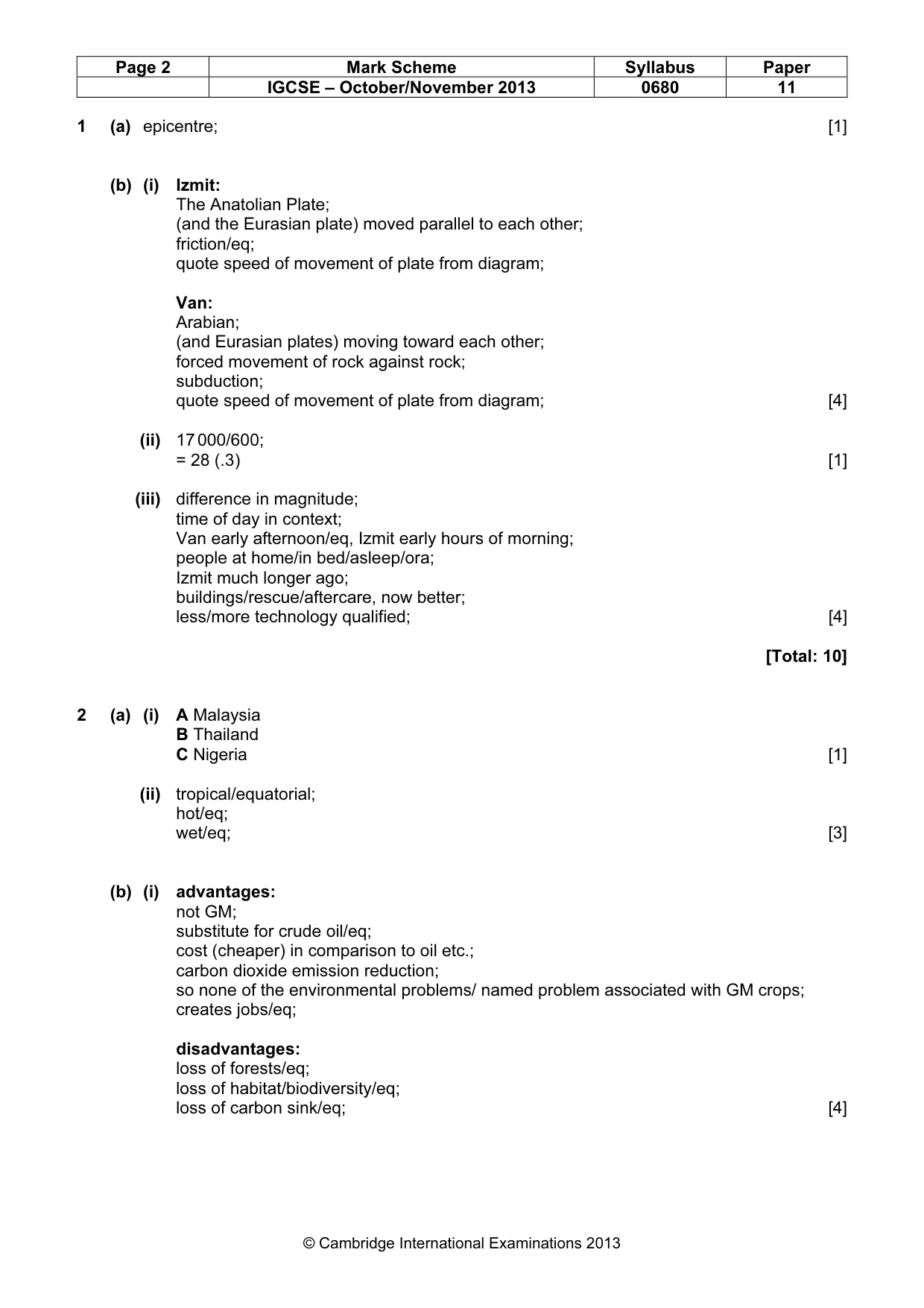
Page 2 Mark Scheme Syllabus Paper IGCSE – October/November 2013 0680 11 © Cambridge International Examinations 2013 1 (a) epicentre; [1] (b) (i) Izmit: The Anatolian Plate; (and the Eurasian plate) moved parallel to each other; friction/eq; quote speed of movement of plate from diagram; Van: Arabian; (and Eurasian plates) moving toward each other; forced movement of rock against rock; subduction; quote speed of movement of plate from diagram; [4] (ii) 17 000/600; = 28 (.3) [1] (iii) difference in magnitude; time of day in context; Van early afternoon/eq, Izmit early hours of morning; people at home/in bed/asleep/ora; Izmit much longer ago; buildings/rescue/aftercare, now better; less/more technology qualified; [4] [Total: 10] 2 (a) (i) A Malaysia B Thailand C Nigeria [1] (ii) tropical/equatorial; hot/eq; wet/eq; [3] (b) (i) advantages: not GM; substitute for crude oil/eq; cost (cheaper) in comparison to oil etc.; carbon dioxide emission reduction; so none of the environmental problems/ named problem associated with GM crops; creates jobs/eq; disadvantages: loss of forests/eq; loss of habitat/biodiversity/eq; loss of carbon sink/eq; [4]
Mark scheme, page 3
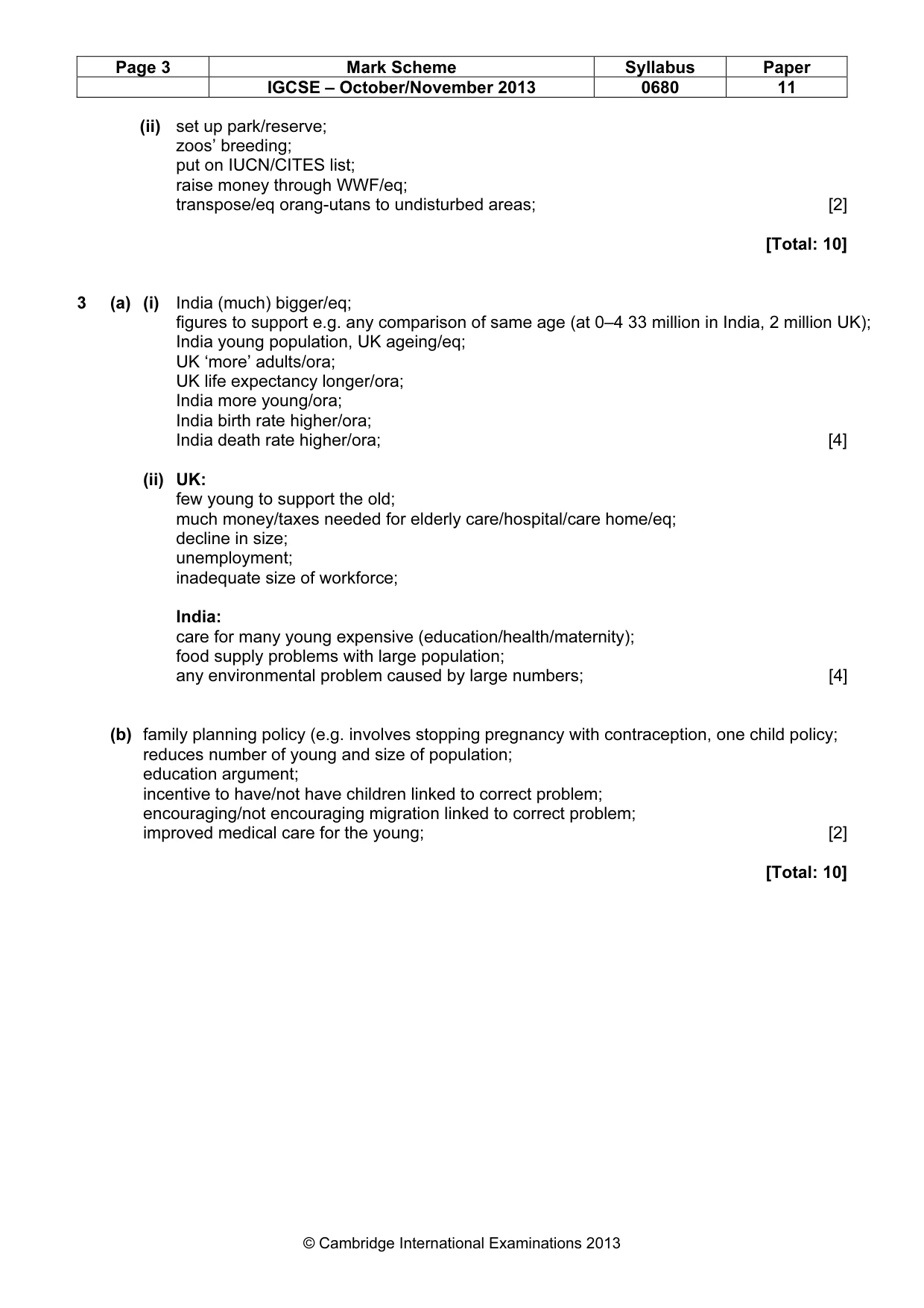
Page 3 Mark Scheme Syllabus Paper IGCSE – October/November 2013 0680 11 © Cambridge International Examinations 2013 (ii) set up park/reserve; zoos’ breeding; put on IUCN/CITES list; raise money through WWF/eq; transpose/eq orang-utans to undisturbed areas; [2] [Total: 10] 3 (a) (i) India (much) bigger/eq; figures to support e.g. any comparison of same age (at 0–4 33 million in India, 2 million UK); India young population, UK ageing/eq; UK ‘more’ adults/ora; UK life expectancy longer/ora; India more young/ora; India birth rate higher/ora; India death rate higher/ora; [4] (ii) UK: few young to support the old; much money/taxes needed for elderly care/hospital/care home/eq; decline in size; unemployment; inadequate size of workforce; India: care for many young expensive (education/health/maternity); food supply problems with large population; any environmental problem caused by large numbers; [4] (b) family planning policy (e.g. involves stopping pregnancy with contraception, one child policy; reduces number of young and size of population; education argument; incentive to have/not have children linked to correct problem; encouraging/not encouraging migration linked to correct problem; improved medical care for the young; [2] [Total: 10]
Mark scheme, page 4
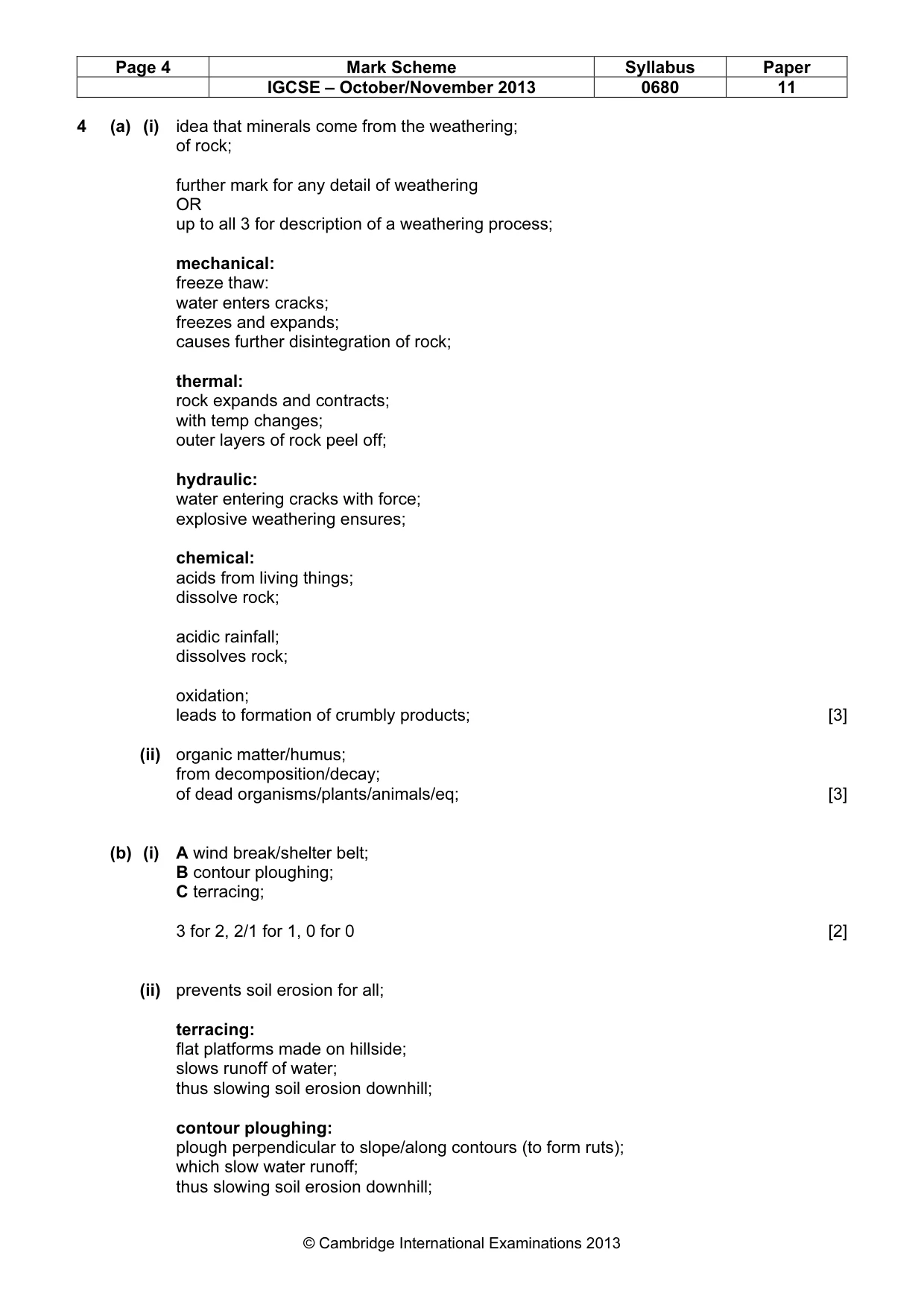
Page 4 Mark Scheme Syllabus Paper IGCSE – October/November 2013 0680 11 © Cambridge International Examinations 2013 4 (a) (i) idea that minerals come from the weathering; of rock; further mark for any detail of weathering OR up to all 3 for description of a weathering process; mechanical: freeze thaw: water enters cracks; freezes and expands; causes further disintegration of rock; thermal: rock expands and contracts; with temp changes; outer layers of rock peel off; hydraulic: water entering cracks with force; explosive weathering ensures; chemical: acids from living things; dissolve rock; acidic rainfall; dissolves rock; oxidation; leads to formation of crumbly products; [3] (ii) organic matter/humus; from decomposition/decay; of dead organisms/plants/animals/eq; [3] (b) (i) A wind break/shelter belt; B contour ploughing; C terracing; 3 for 2, 2/1 for 1, 0 for 0 [2] (ii) prevents soil erosion for all; terracing: flat platforms made on hillside; slows runoff of water; thus slowing soil erosion downhill; contour ploughing: plough perpendicular to slope/along contours (to form ruts); which slow water runoff; thus slowing soil erosion downhill;
Mark scheme, page 5
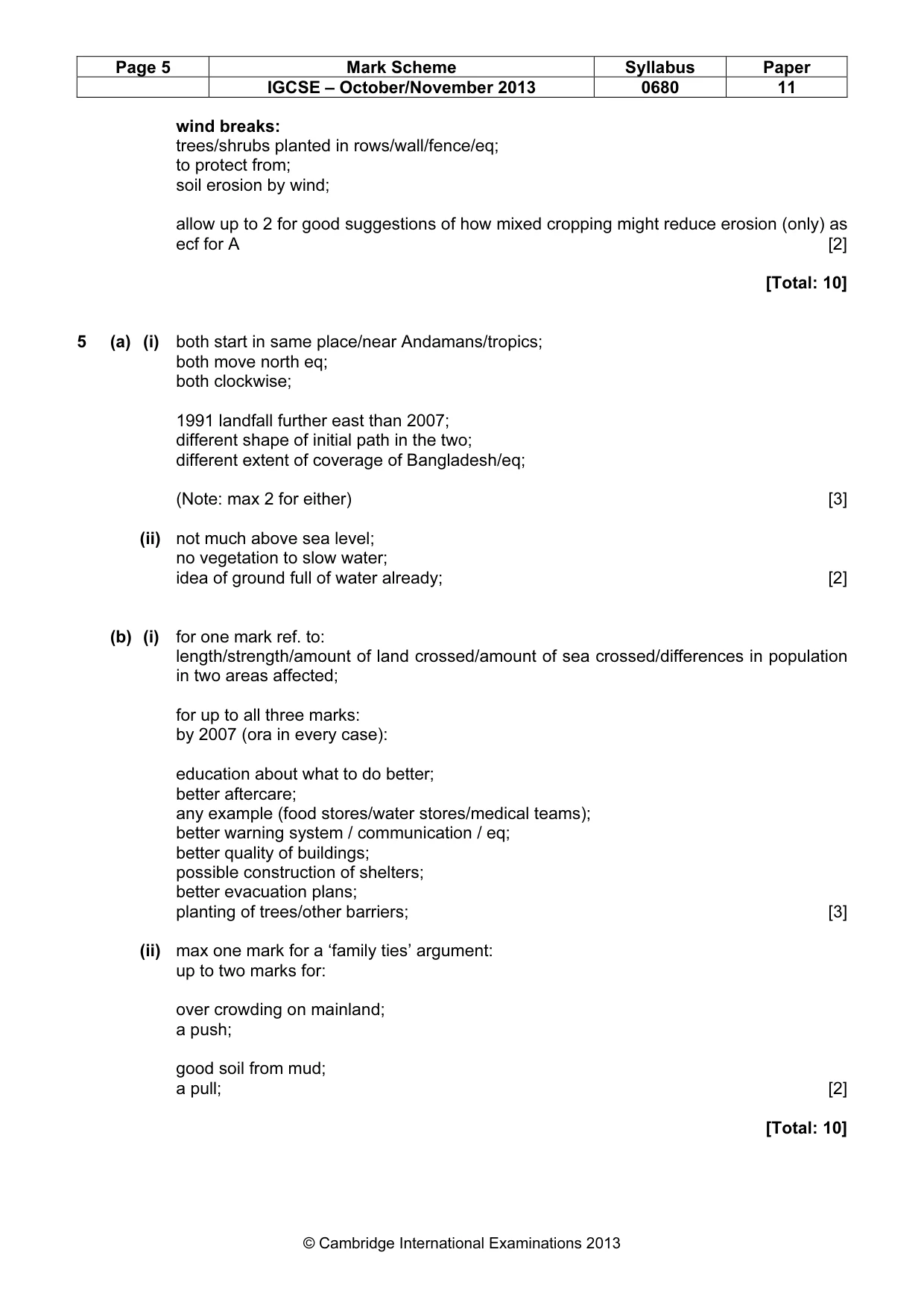
Page 5 Mark Scheme Syllabus Paper IGCSE – October/November 2013 0680 11 © Cambridge International Examinations 2013 wind breaks: trees/shrubs planted in rows/wall/fence/eq; to protect from; soil erosion by wind; allow up to 2 for good suggestions of how mixed cropping might reduce erosion (only) as ecf for A [2] [Total: 10] 5 (a) (i) both start in same place/near Andamans/tropics; both move north eq; both clockwise; 1991 landfall further east than 2007; different shape of initial path in the two; different extent of coverage of Bangladesh/eq; (Note: max 2 for either) [3] (ii) not much above sea level; no vegetation to slow water; idea of ground full of water already; [2] (b) (i) for one mark ref. to: length/strength/amount of land crossed/amount of sea crossed/differences in population in two areas affected; for up to all three marks: by 2007 (ora in every case): education about what to do better; better aftercare; any example (food stores/water stores/medical teams); better warning system / communication / eq; better quality of buildings; possible construction of shelters; better evacuation plans; planting of trees/other barriers; [3] (ii) max one mark for a ‘family ties’ argument: up to two marks for: over crowding on mainland; a push; good soil from mud; a pull; [2] [Total: 10]
Mark scheme, page 6
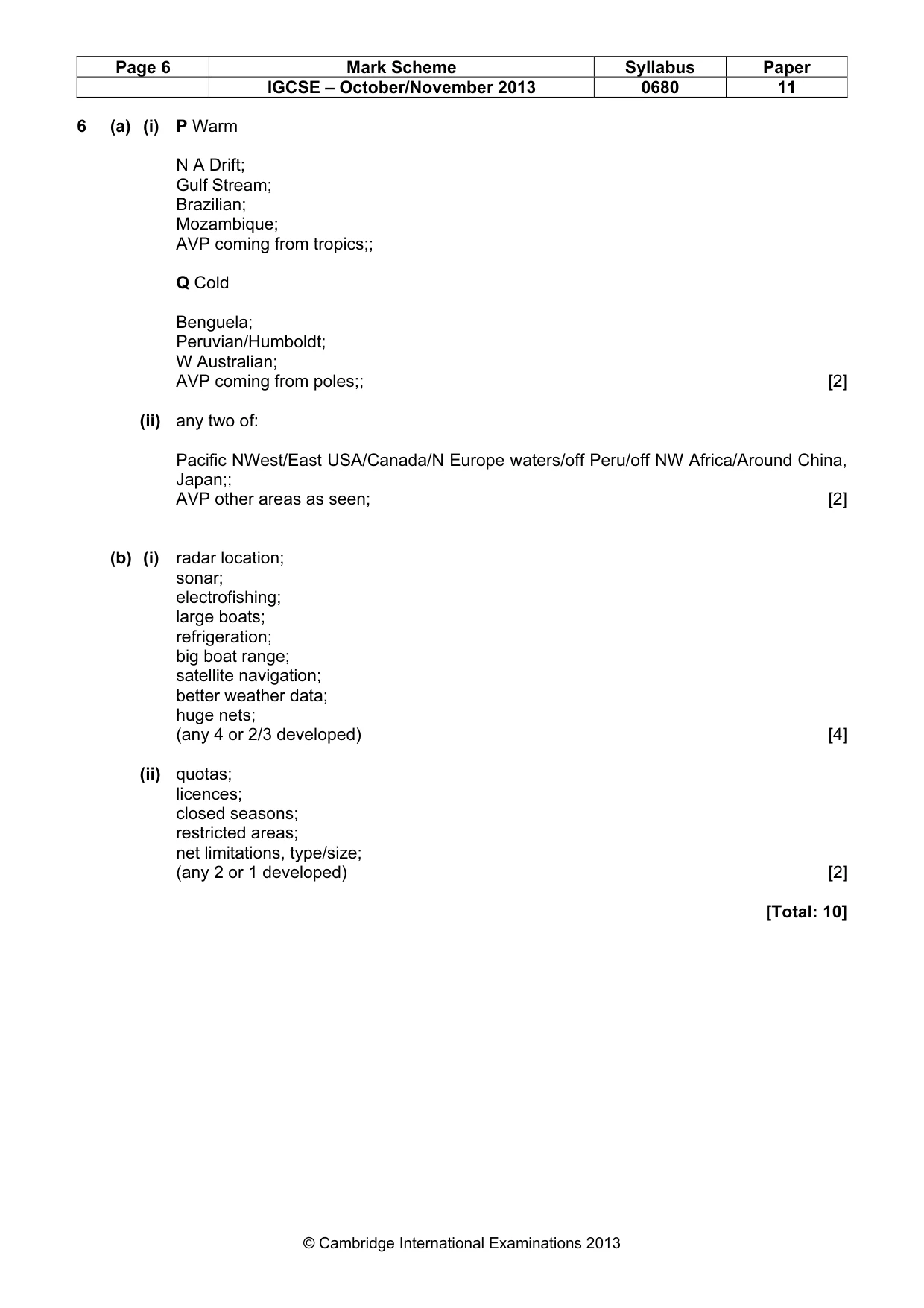
Page 6 Mark Scheme Syllabus Paper IGCSE – October/November 2013 0680 11 © Cambridge International Examinations 2013 6 (a) (i) P Warm N A Drift; Gulf Stream; Brazilian; Mozambique; AVP coming from tropics;; Q Cold Benguela; Peruvian/Humboldt; W Australian; AVP coming from poles;; [2] (ii) any two of: Pacific NWest/East USA/Canada/N Europe waters/off Peru/off NW Africa/Around China, Japan;; AVP other areas as seen; [2] (b) (i) radar location; sonar; electrofishing; large boats; refrigeration; big boat range; satellite navigation; better weather data; huge nets; (any 4 or 2/3 developed) [4] (ii) quotas; licences; closed seasons; restricted areas; net limitations, type/size; (any 2 or 1 developed) [2] [Total: 10]
What you needed in this session
Cambridge’s own grade thresholds for 2013 Oct/Nov, Paper 1 · Variant 1. A higher threshold means an easier paper — the bar moves with how the cohort did.