Cambridge IGCSE Environmental Management 0680 — 2013 Oct/Nov Paper 1 · Variant 3
0680/13/O/N/13 · 60 marks · ≈68 min
The question paper and its mark scheme, free to read here and free to download. This is Cambridge’s own paper, exactly as it was sat.
Question paper16 pages



Mark scheme6 pages
Answers below. Sit the paper first if you are practising.

Paper as text
Question paper, page 1
This document consists of 13 printed pages and 3 blank pages. DC (NF/SW) 69737/3 © UCLES 2013 [Turn over UNIVERSITY OF CAMBRIDGE INTERNATIONAL EXAMINATIONS International General Certificate of Secondary Education * 2 4 3 2 8 4 8 8 9 5 * ENVIRONMENTAL MANAGEMENT 0680/13 Paper 1 October/November 2013 1 hour 30 minutes Candidates answer on the Question Paper. Additional Materials: Ruler READ THESE INSTRUCTIONS FIRST Write your Centre number, candidate number and name on all the work you hand in. Write in dark blue or black pen. You may use a soft pencil for any diagrams, graphs or rough working. Do not use staples, paper clips, highlighters, glue or correction fluid. DO NOT WRITE IN ANY BARCODES. Answer all questions. Electronic calculators may be used. You may lose marks if you do not show your working or if you do not use appropriate units. At the end of the examination, fasten all your work securely together. The number of marks is given in brackets [ ] at the end of each question or part question. For Examiner’s Use 1 2 3 4 5 6 Total
Question paper, page 2
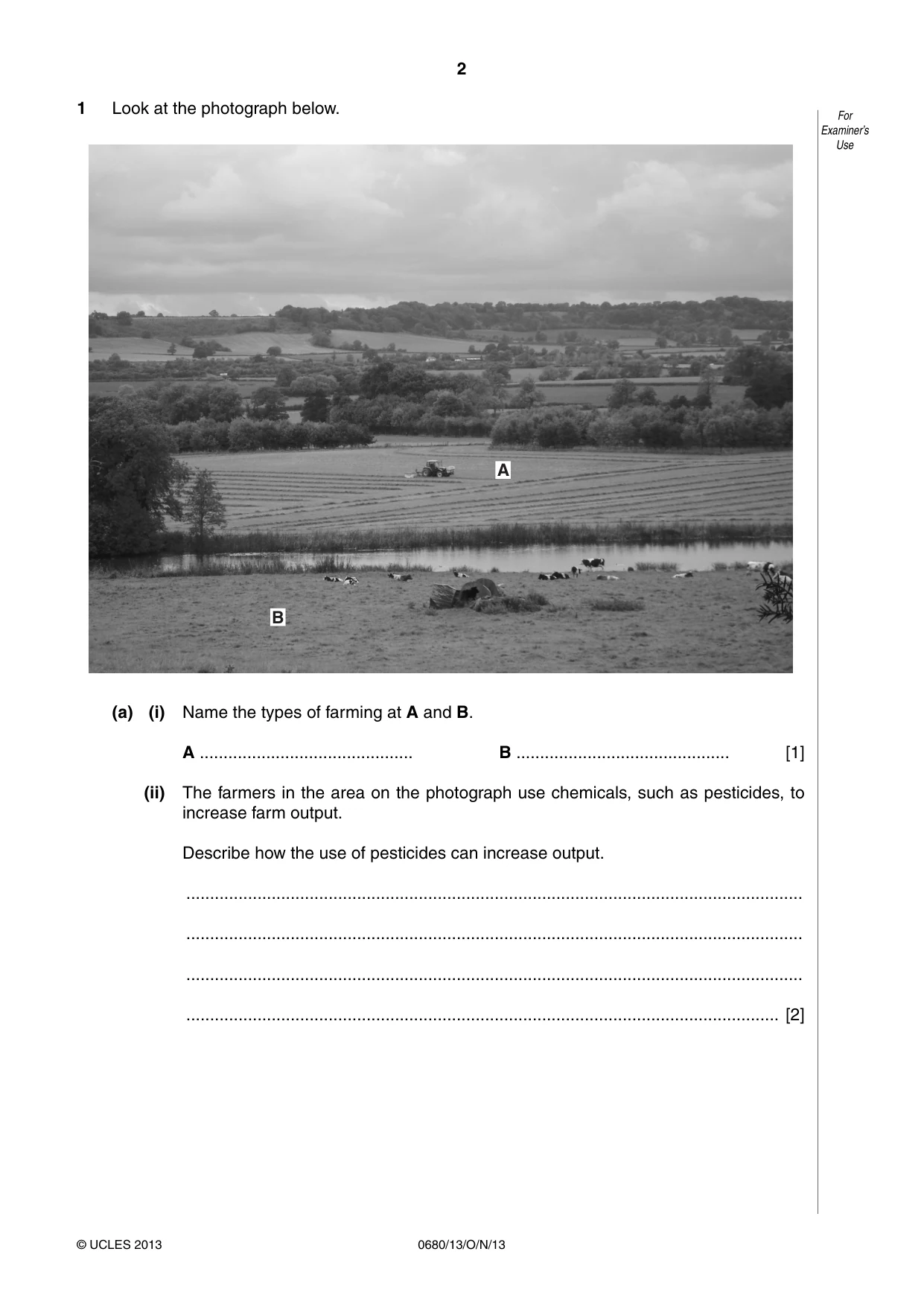
2 0680/13/O/N/13 © UCLES 2013 For Examiner’s Use 1 Look at the photograph below. A B (a) (i) Name the types of farming at A and B. A … B … [1] (ii) The farmers in the area on the photograph use chemicals, such as pesticides, to increase farm output. Describe how the use of pesticides can increase output. … … … … [2]
Question paper, page 3
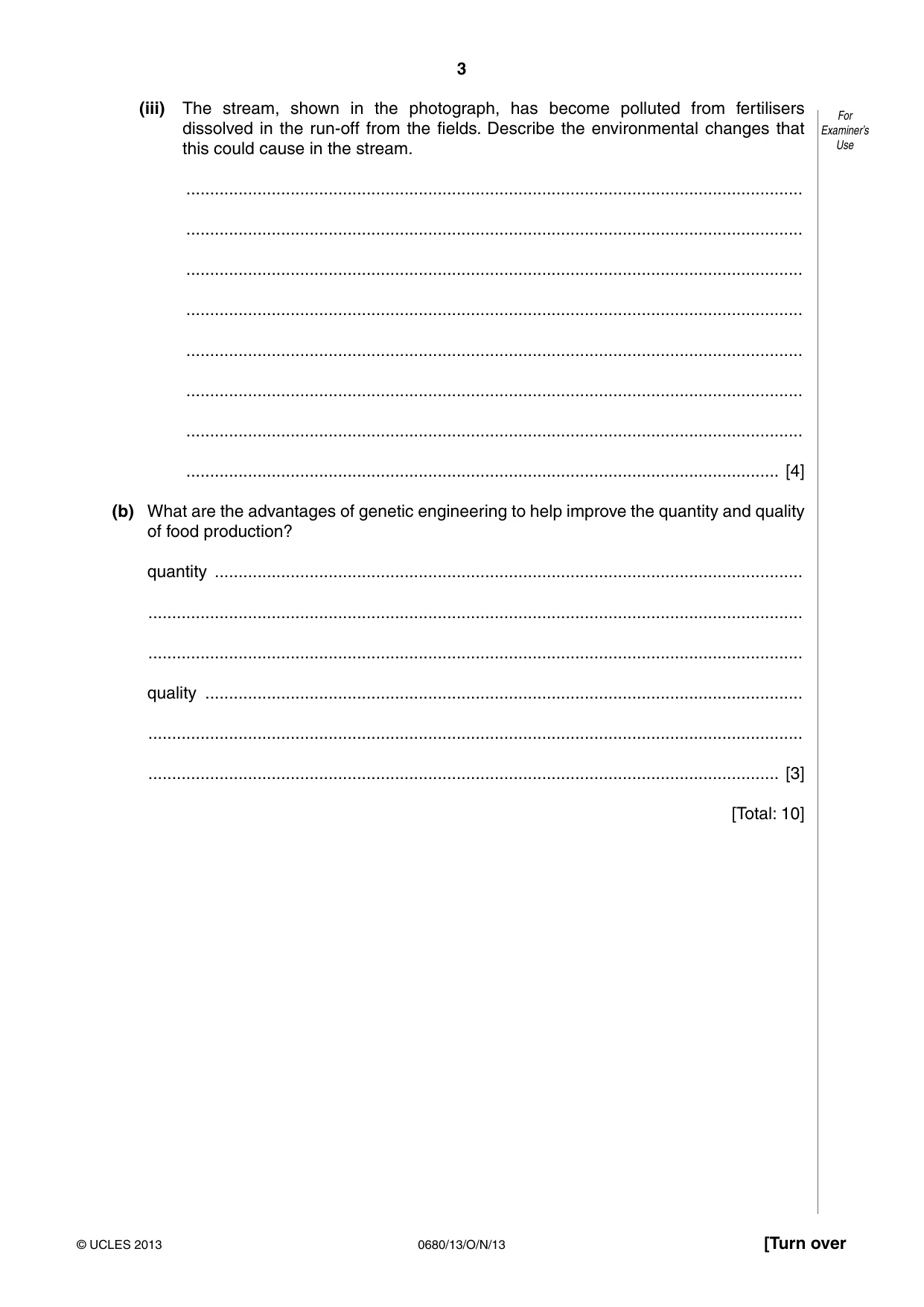
3 0680/13/O/N/13 © UCLES 2013 [Turn over For Examiner’s Use (iii) The stream, shown in the photograph, has become polluted from fertilisers dissolved in the run-off from the fields. Describe the environmental changes that this could cause in the stream. … … … … … … … … [4] (b) What are the advantages of genetic engineering to help improve the quantity and quality of food production? quantity … … … quality … … … [3] [Total: 10]
Question paper, page 4
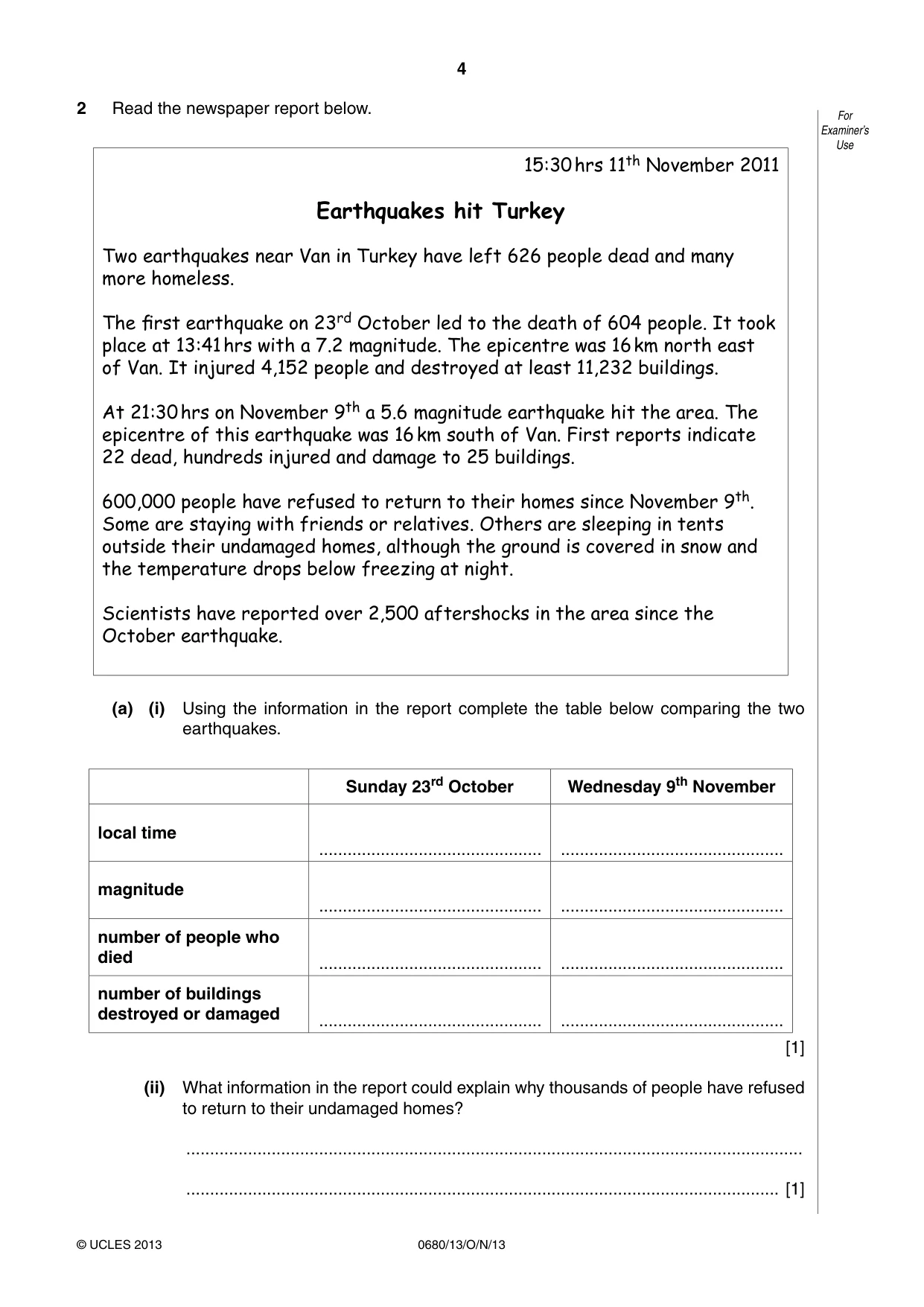
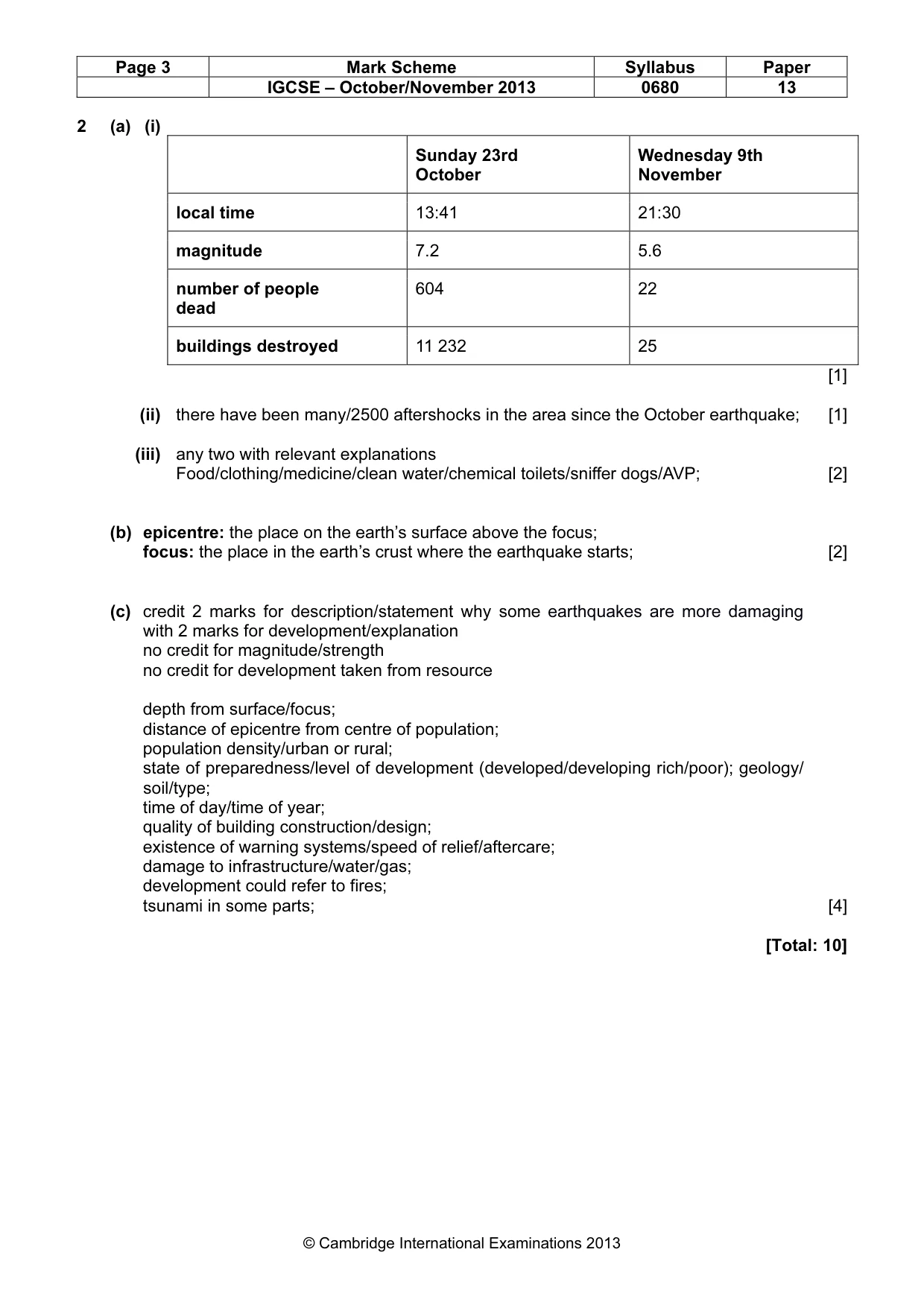
4 0680/13/O/N/13 © UCLES 2013 For Examiner’s Use 2 Read the newspaper report below. 15:30 hrs 11th November 2011 Earthquakes hit Turkey Two earthquakes near Van in Turkey have left 626 people dead and many more homeless. The fi rst earthquake on 23rd October led to the death of 604 people. It took place at 13:41 hrs with a 7.2 magnitude. The epicentre was 16 km north east of Van. It injured 4,152 people and destroyed at least 11,232 buildings. At 21:30 hrs on November 9th a 5.6 magnitude earthquake hit the area. The epicentre of this earthquake was 16 km south of Van. First reports indicate 22 dead, hundreds injured and damage to 25 buildings. 600,000 people have refused to return to their homes since November 9th. Some are staying with friends or relatives. Others are sleeping in tents outside their undamaged homes, although the ground is covered in snow and the temperature drops below freezing at night. Scientists have reported over 2,500 aftershocks in the area since the October earthquake. (a) (i) Using the information in the report complete the table below comparing the two earthquakes. Sunday 23rd October Wednesday 9th November local time … … magnitude … … number of people who died … … number of buildings destroyed or damaged … … [1] (ii) What information in the report could explain why thousands of people have refused to return to their undamaged homes? … … [1]
Question paper, page 5
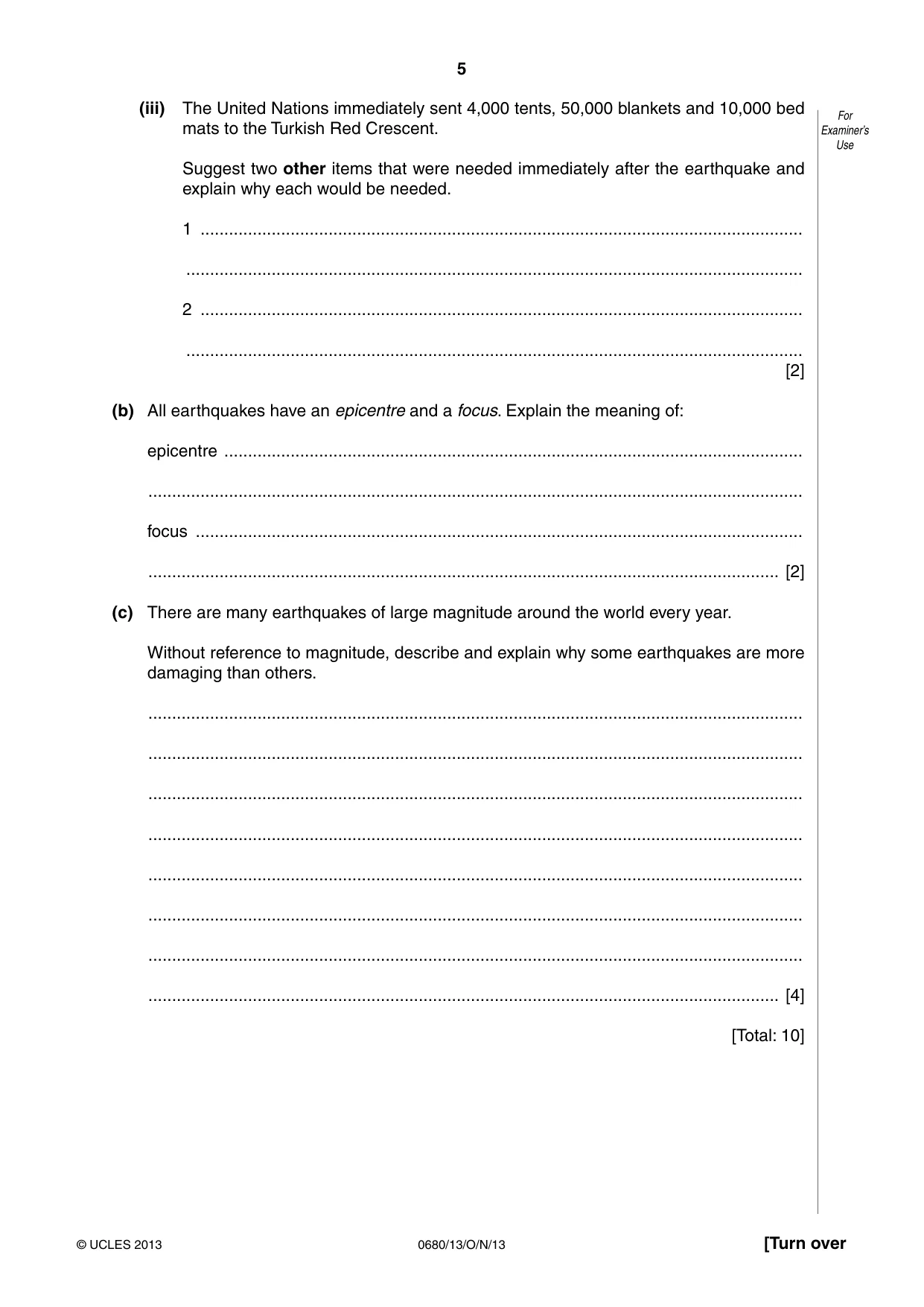
5 0680/13/O/N/13 © UCLES 2013 [Turn over For Examiner’s Use (iii) The United Nations immediately sent 4,000 tents, 50,000 blankets and 10,000 bed mats to the Turkish Red Crescent. Suggest two other items that were needed immediately after the earthquake and explain why each would be needed. 1 … … 2 … … [2] (b) All earthquakes have an epicentre and a focus. Explain the meaning of: epicentre … … focus … … [2] (c) There are many earthquakes of large magnitude around the world every year. Without reference to magnitude, describe and explain why some earthquakes are more damaging than others. … … … … … … … … [4] [Total: 10]
Question paper, page 6
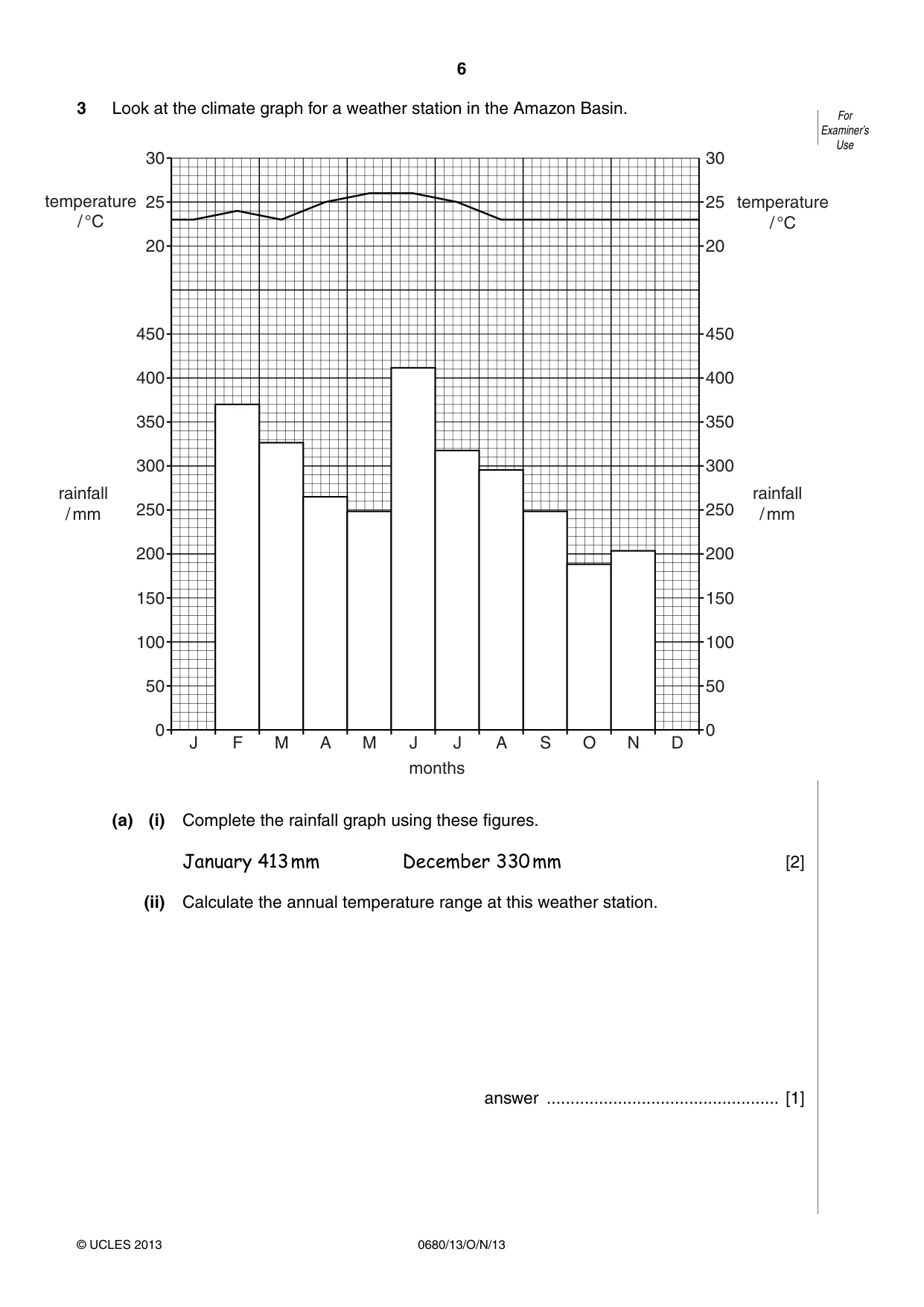
6 0680/13/O/N/13 © UCLES 2013 For Examiner’s Use 3 Look at the climate graph for a weather station in the Amazon Basin. J 0 50 100 150 200 250 300 350 400 450 20 25 30 0 50 100 150 200 250 300 350 400 450 20 25 30 F M A M J J months rainfall / mm temperature / °C rainfall / mm temperature / °C A S O N D (a) (i) Complete the rainfall graph using these figures. January 413 mm December 330 mm [2] (ii) Calculate the annual temperature range at this weather station. answer … [1]
Question paper, page 7
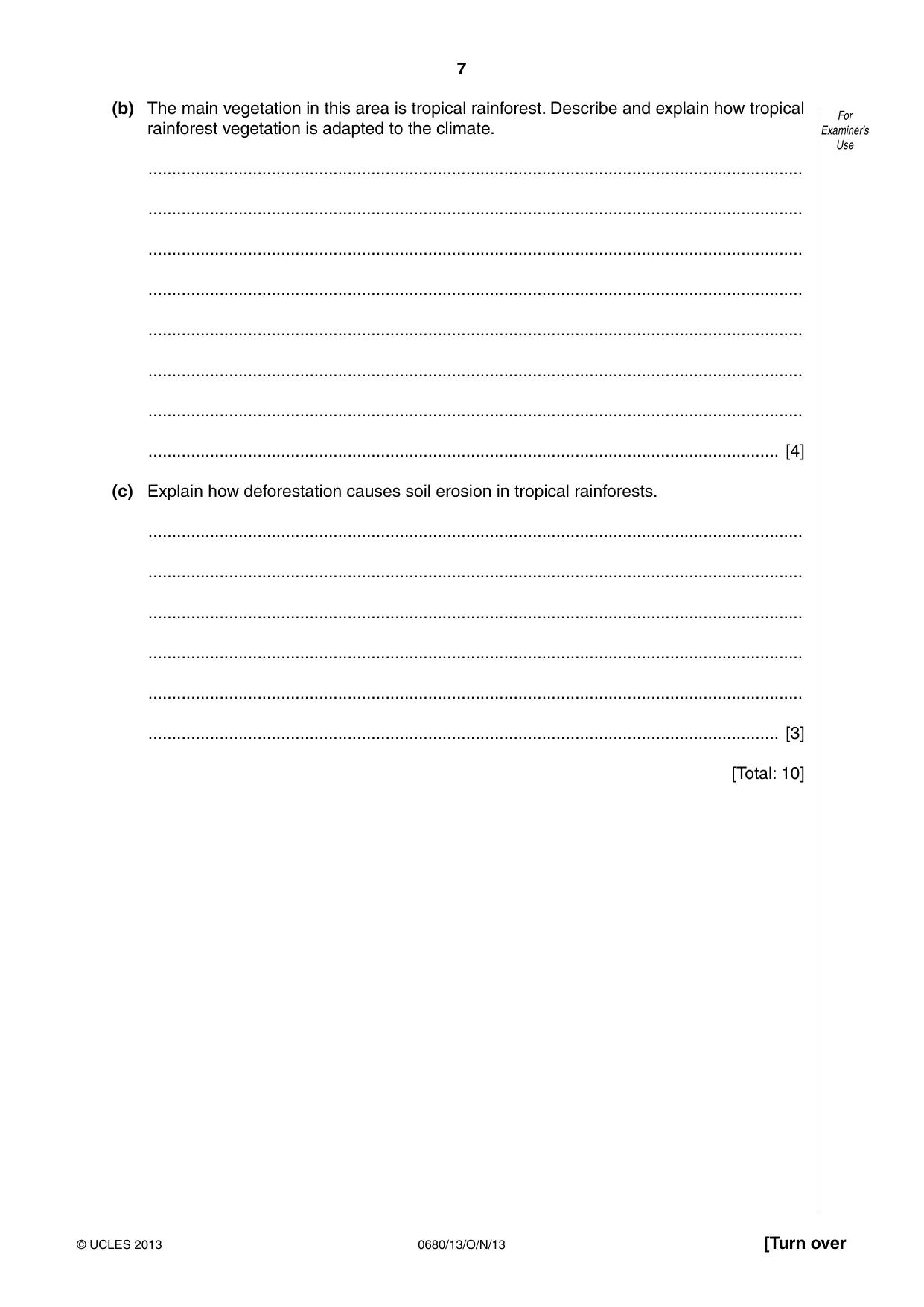
7 0680/13/O/N/13 © UCLES 2013 [Turn over For Examiner’s Use (b) The main vegetation in this area is tropical rainforest. Describe and explain how tropical rainforest vegetation is adapted to the climate. … … … … … … … … [4] (c) Explain how deforestation causes soil erosion in tropical rainforests. … … … … … … [3] [Total: 10]
Question paper, page 8
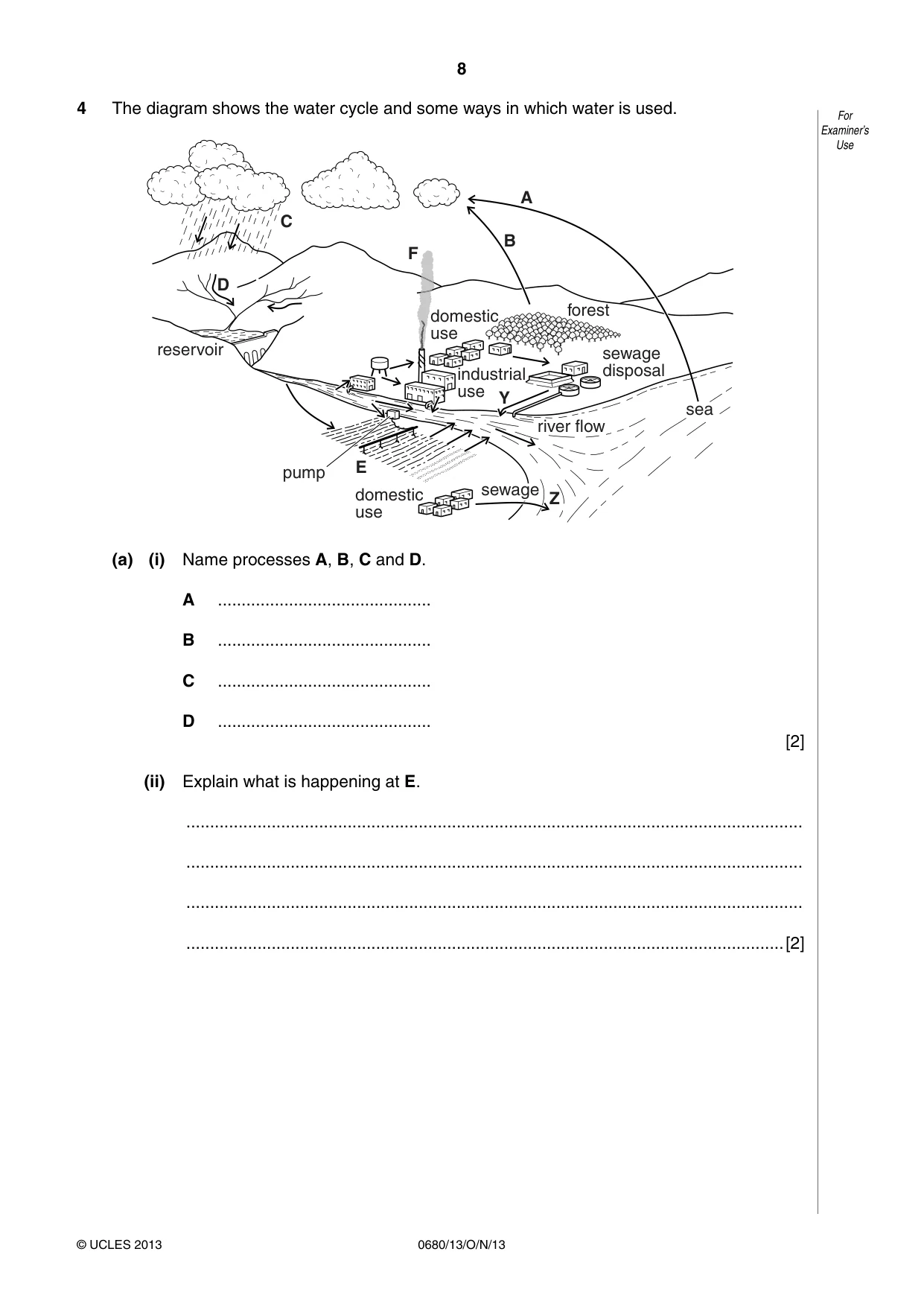
8 0680/13/O/N/13 © UCLES 2013 For Examiner’s Use 4 The diagram shows the water cycle and some ways in which water is used. reservoir forest sewage disposal sea river flow D C A B E F Y Z sewage domestic use domestic use industrial use pump (a) (i) Name processes A, B, C and D. A … B … C … D … [2] (ii) Explain what is happening at E. … … … …[2]
Question paper, page 9
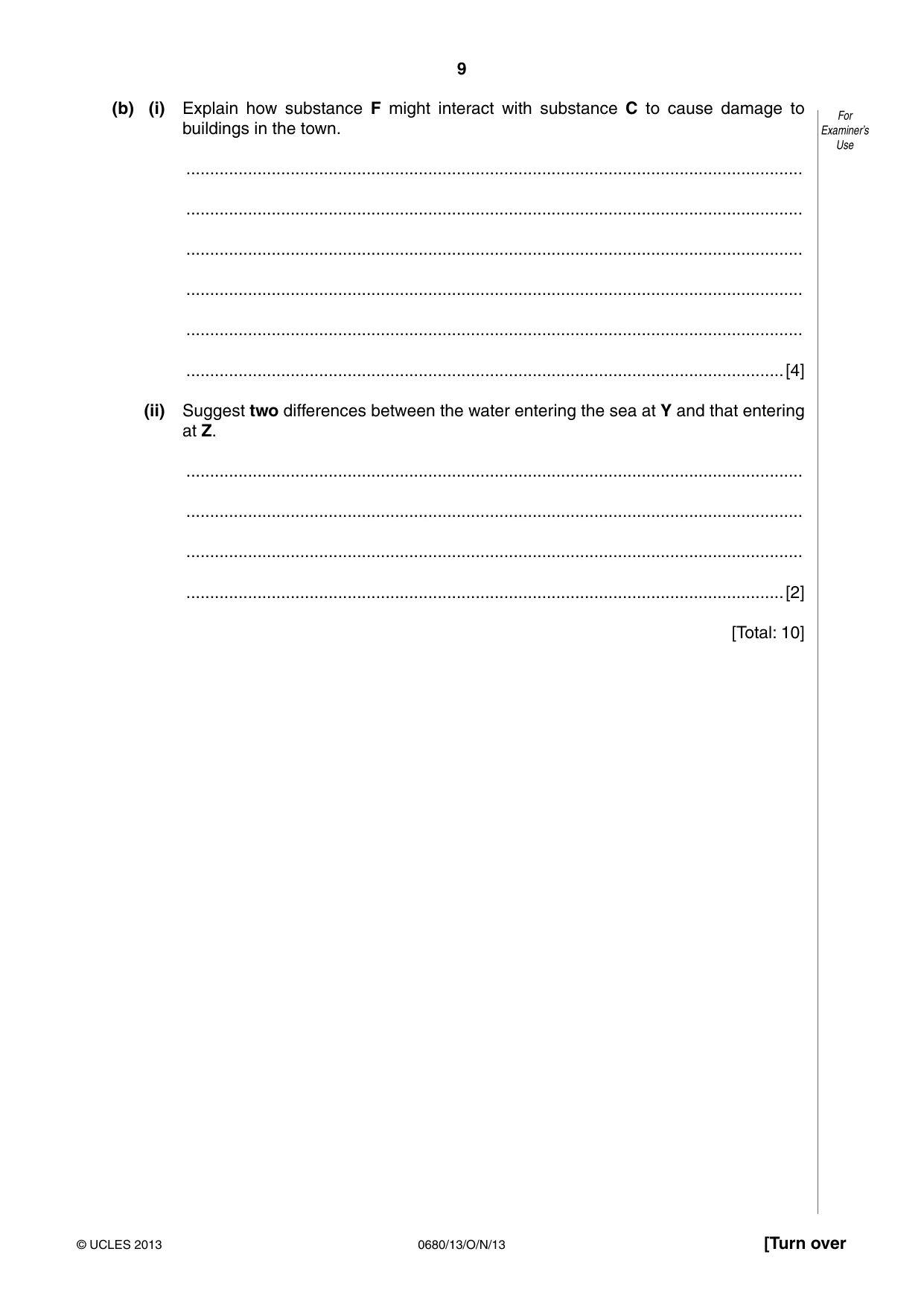
9 0680/13/O/N/13 © UCLES 2013 [Turn over For Examiner’s Use (b) (i) Explain how substance F might interact with substance C to cause damage to buildings in the town. … … … … … …[4] (ii) Suggest two differences between the water entering the sea at Y and that entering at Z. … … … …[2] [Total: 10]
Question paper, page 10
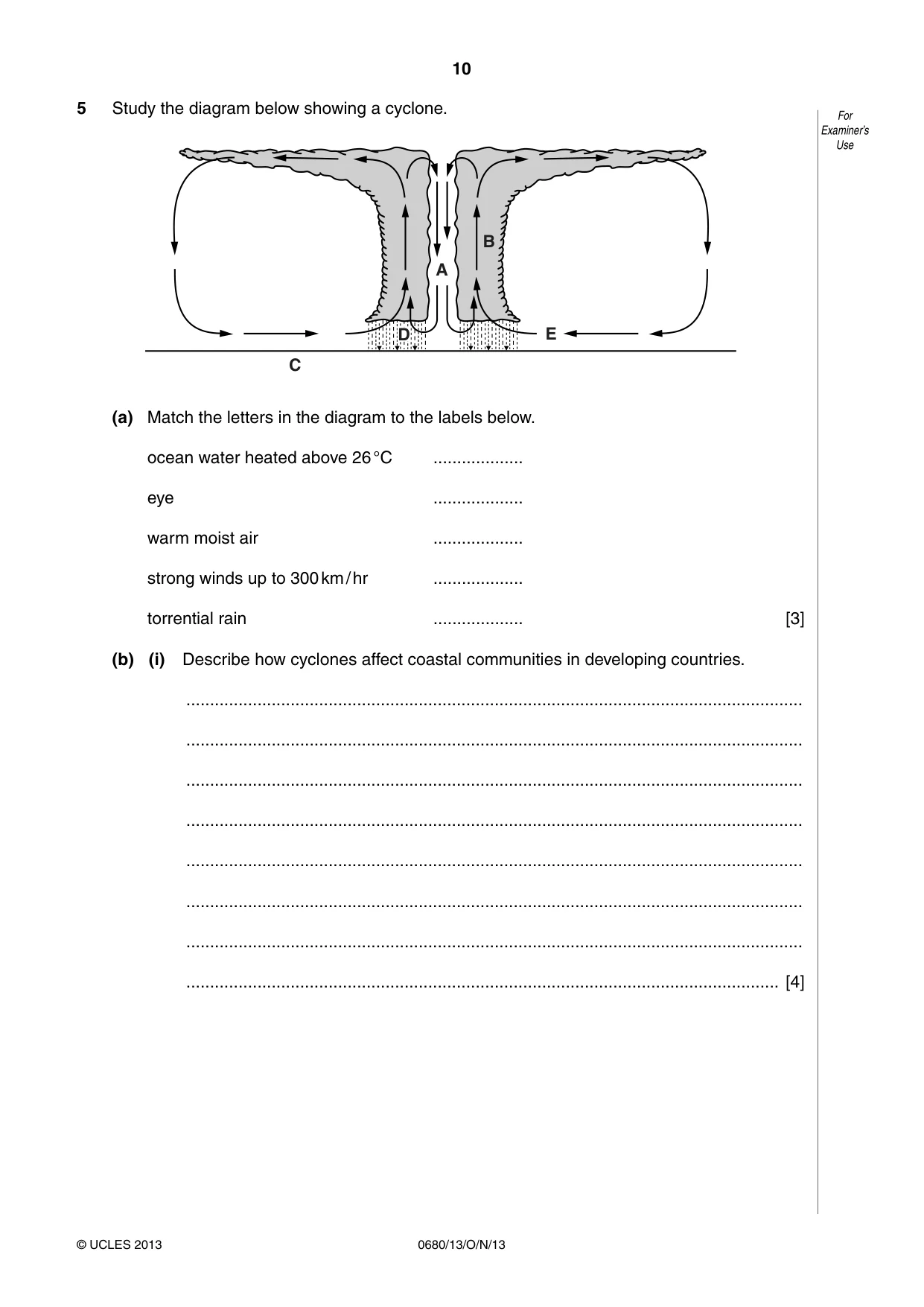
10 0680/13/O/N/13 © UCLES 2013 For Examiner’s Use 5 Study the diagram below showing a cyclone. D E A B C (a) Match the letters in the diagram to the labels below. ocean water heated above 26 °C … eye … warm moist air … strong winds up to 300 km / hr … torrential rain … [3] (b) (i) Describe how cyclones affect coastal communities in developing countries. … … … … … … … … [4]
Question paper, page 11
11 0680/13/O/N/13 © UCLES 2013 [Turn over For Examiner’s Use (ii) Suggest strategies to reduce the impact of cyclones on people. … … … … … … [3] [Total: 10]
Question paper, page 12
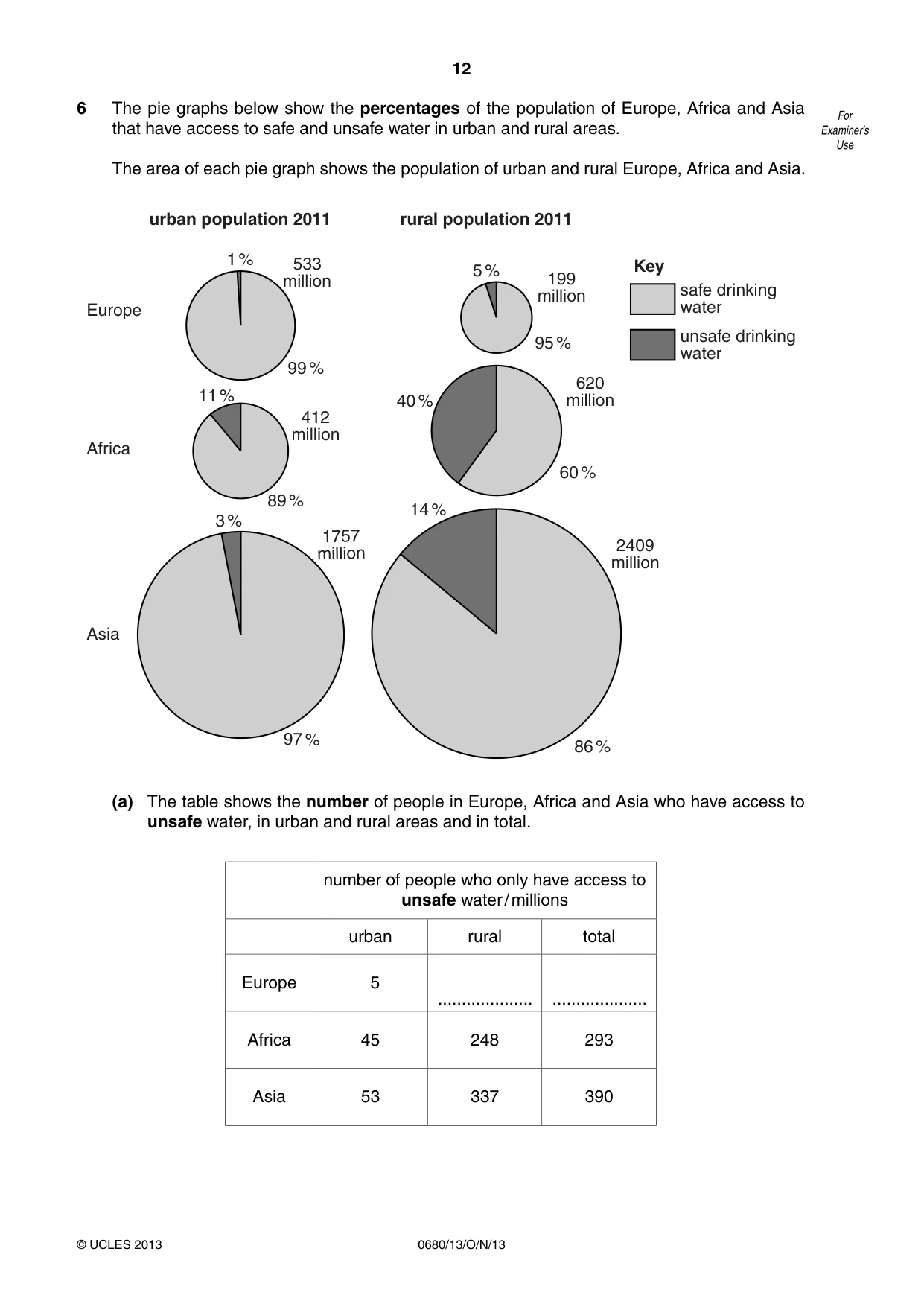
12 0680/13/O/N/13 © UCLES 2013 For Examiner’s Use 6 The pie graphs below show the percentages of the population of Europe, Africa and Asia that have access to safe and unsafe water in urban and rural areas. The area of each pie graph shows the population of urban and rural Europe, Africa and Asia. 1 % 11 % 3 % 14 % 40 % 5 % urban population 2011 rural population 2011 97 % 86 % 60 % 95 % 199 million Key safe drinking water 620 million 2409 million 1757 million 412 million 533 million 89 % 99 % Europe Africa Asia unsafe drinking water (a) The table shows the number of people in Europe, Africa and Asia who have access to unsafe water, in urban and rural areas and in total. number of people who only have access to unsafe water / millions urban rural total Europe 5 … … Africa 45 248 293 Asia 53 337 390
Question paper, page 13
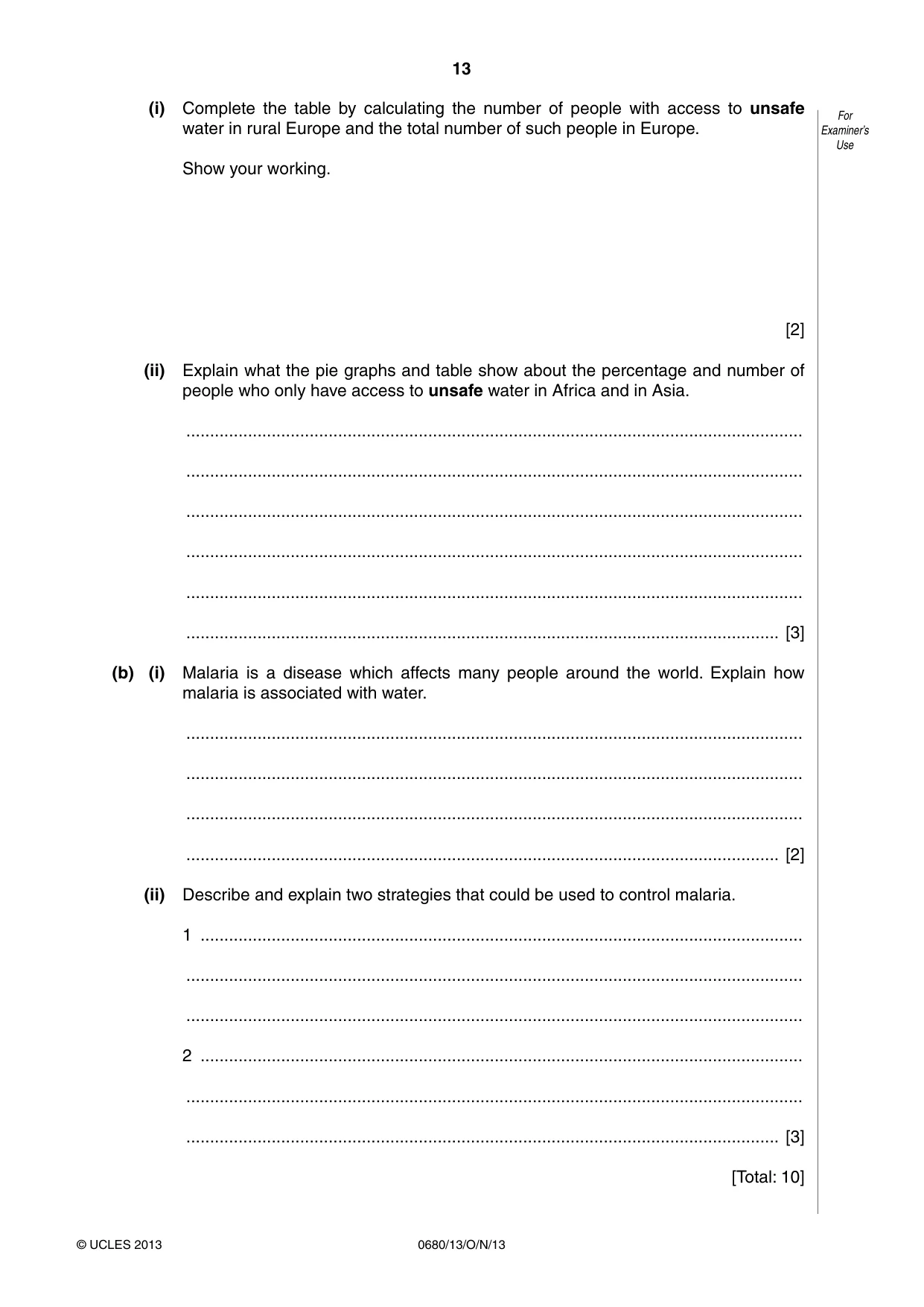
13 0680/13/O/N/13 © UCLES 2013 For Examiner’s Use (i) Complete the table by calculating the number of people with access to unsafe water in rural Europe and the total number of such people in Europe. Show your working. [2] (ii) Explain what the pie graphs and table show about the percentage and number of people who only have access to unsafe water in Africa and in Asia. … … … … … … [3] (b) (i) Malaria is a disease which affects many people around the world. Explain how malaria is associated with water. … … … … [2] (ii) Describe and explain two strategies that could be used to control malaria. 1 … … … 2 … … … [3] [Total: 10]
Question paper, page 14
14 0680/13/O/N/13 © UCLES 2013 BLANK PAGE
Question paper, page 15
15 0680/13/O/N/13 © UCLES 2013 BLANK PAGE
Question paper, page 16
16 0680/13/O/N/13 © UCLES 2013 Permission to reproduce items where third-party owned material protected by copyright is included has been sought and cleared where possible. Every reasonable effort has been made by the publisher (UCLES) to trace copyright holders, but if any items requiring clearance have unwittingly been included, the publisher will be pleased to make amends at the earliest possible opportunity. University of Cambridge International Examinations is part of the Cambridge Assessment Group. Cambridge Assessment is the brand name of University of Cambridge Local Examinations Syndicate (UCLES), which is itself a department of the University of Cambridge. BLANK PAGE
Mark scheme, page 1
CAMBRIDGE INTERNATIONAL EXAMINATIONS International General Certificate of Secondary Education MARK SCHEME for the October/November 2013 series 0680 ENVIRONMENTAL MANAGEMENT 0680/13 Paper 1, maximum raw mark 60 This mark scheme is published as an aid to teachers and candidates, to indicate the requirements of the examination. It shows the basis on which Examiners were instructed to award marks. It does not indicate the details of the discussions that took place at an Examiners’ meeting before marking began, which would have considered the acceptability of alternative answers. Mark schemes should be read in conjunction with the question paper and the Principal Examiner Report for Teachers. Cambridge will not enter into discussions about these mark schemes. Cambridge is publishing the mark schemes for the October/November 2013 series for most IGCSE, GCE Advanced Level and Advanced Subsidiary Level components and some Ordinary Level components.
Mark scheme, page 2
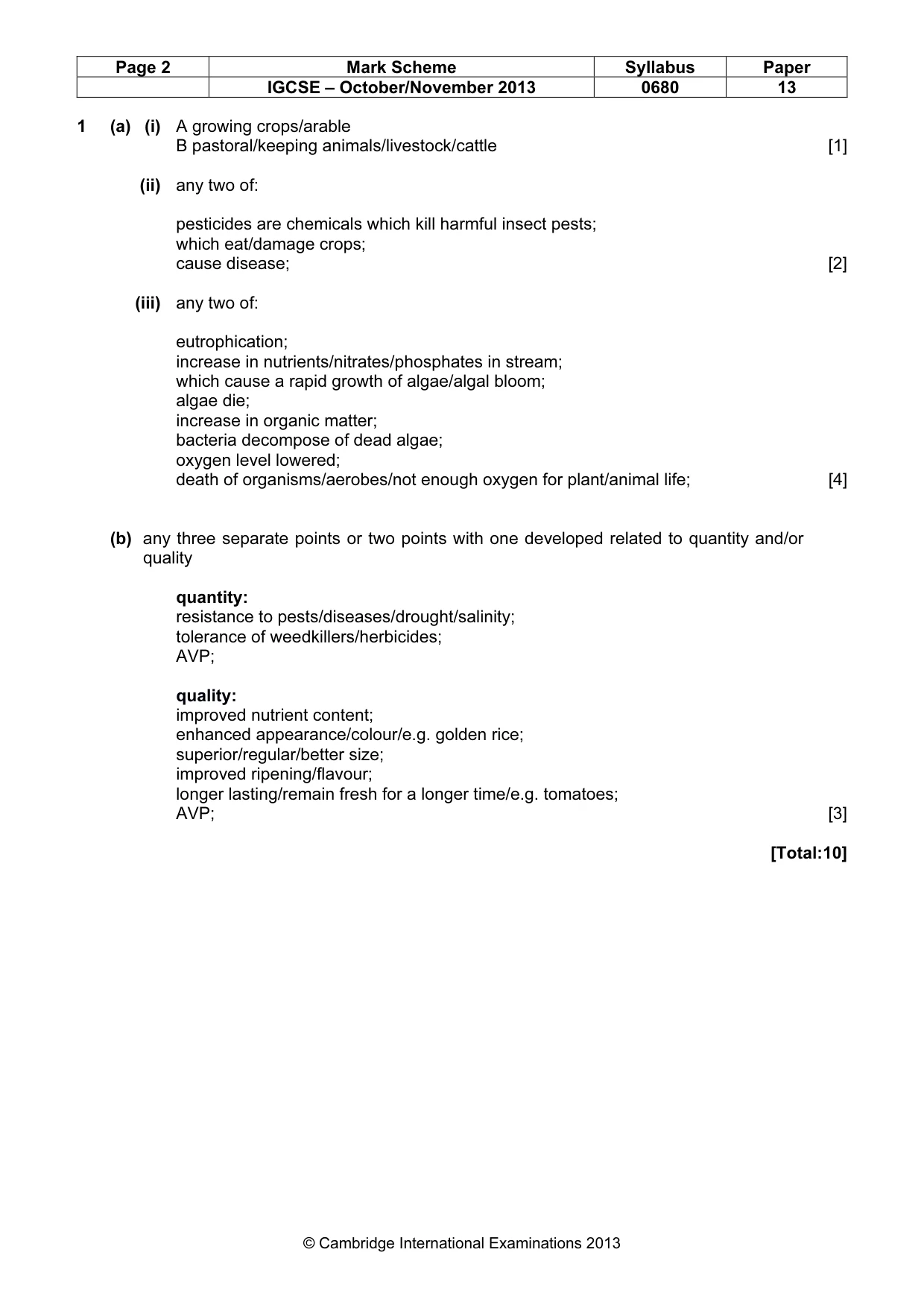
Page 2 Mark Scheme Syllabus Paper IGCSE – October/November 2013 0680 13 © Cambridge International Examinations 2013 1 (a) (i) A growing crops/arable B pastoral/keeping animals/livestock/cattle [1] (ii) any two of: pesticides are chemicals which kill harmful insect pests; which eat/damage crops; cause disease; [2] (iii) any two of: eutrophication; increase in nutrients/nitrates/phosphates in stream; which cause a rapid growth of algae/algal bloom; algae die; increase in organic matter; bacteria decompose of dead algae; oxygen level lowered; death of organisms/aerobes/not enough oxygen for plant/animal life; [4] (b) any three separate points or two points with one developed related to quantity and/or quality quantity: resistance to pests/diseases/drought/salinity; tolerance of weedkillers/herbicides; AVP; quality: improved nutrient content; enhanced appearance/colour/e.g. golden rice; superior/regular/better size; improved ripening/flavour; longer lasting/remain fresh for a longer time/e.g. tomatoes; AVP; [3] [Total:10]
Mark scheme, page 3
Page 3 Mark Scheme Syllabus Paper IGCSE – October/November 2013 0680 13 © Cambridge International Examinations 2013 2 (a) (i) Sunday 23rd October Wednesday 9th November local time 13:41 21:30 magnitude 7.2 5.6 number of people dead 604 22 buildings destroyed 11 232 25 [1] (ii) there have been many/2500 aftershocks in the area since the October earthquake; [1] (iii) any two with relevant explanations Food/clothing/medicine/clean water/chemical toilets/sniffer dogs/AVP; [2] (b) epicentre: the place on the earth’s surface above the focus; focus: the place in the earth’s crust where the earthquake starts; [2] (c) credit 2 marks for description/statement why some earthquakes are more damaging with 2 marks for development/explanation no credit for magnitude/strength no credit for development taken from resource depth from surface/focus; distance of epicentre from centre of population; population density/urban or rural; state of preparedness/level of development (developed/developing rich/poor); geology/ soil/type; time of day/time of year; quality of building construction/design; existence of warning systems/speed of relief/aftercare; damage to infrastructure/water/gas; development could refer to fires; tsunami in some parts; [4] [Total: 10]
Mark scheme, page 4
Page 4 Mark Scheme Syllabus Paper IGCSE – October/November 2013 0680 13 © Cambridge International Examinations 2013 3 (a) (i) January 413 mm; December 330 mm; [2] (ii) 3; [1] (b) any two descriptions developed correctly: tall (1); to get sunlight (1); drip tips (1); remove heavy rainfall (1); falls every afternoon (1); large leaves (1); allow more transpiration (1); thick/dark/leathery/waxy leaves (1); withstand high temperatures/absorb more available light/allow more photosynthesis (1); flexible leaf stems; leaves move with the sun to maximise photosynthesis shallow roots (1); extract soil nutrients (1); from surface layers (1); buttress roots (1); support weight of trees as they grow to reach sunlight (1); trees are evergreen/deciduous trees (1); shed their leaves at different times (1); distinct layers/stratification (1); competition for heat, light, rainfall (1); few/no branches on trees (1); grow upwards towards the light (1); tallest trees smooth trunks small leaves (1); wind (1); tallest trees small leaves (1); strong sunlight [4] (c) any three of: trees/tree litter no longer protect soil; roots no longer hold soil together; soil is exposed to heavy rain; surface run-off increases; top soil is washed away/eroded; [3] [Total: 10] 4 (a) (i) A evaporation; B transpiration/ evapotranspiration; C precipitation; D runoff; [2] (ii) irrigation; water drawn off stream to give to crops; [2] (b) (i) F is smoke maybe with sulfur dioxide/NOx gases; dissolve in rain at C; to give acid rain; dissolve stone of buildings; [4] (ii) more organic matter in Z / eq; more bacteria/ microbes / eq in Z; [2] [Total: 10]
Mark scheme, page 5
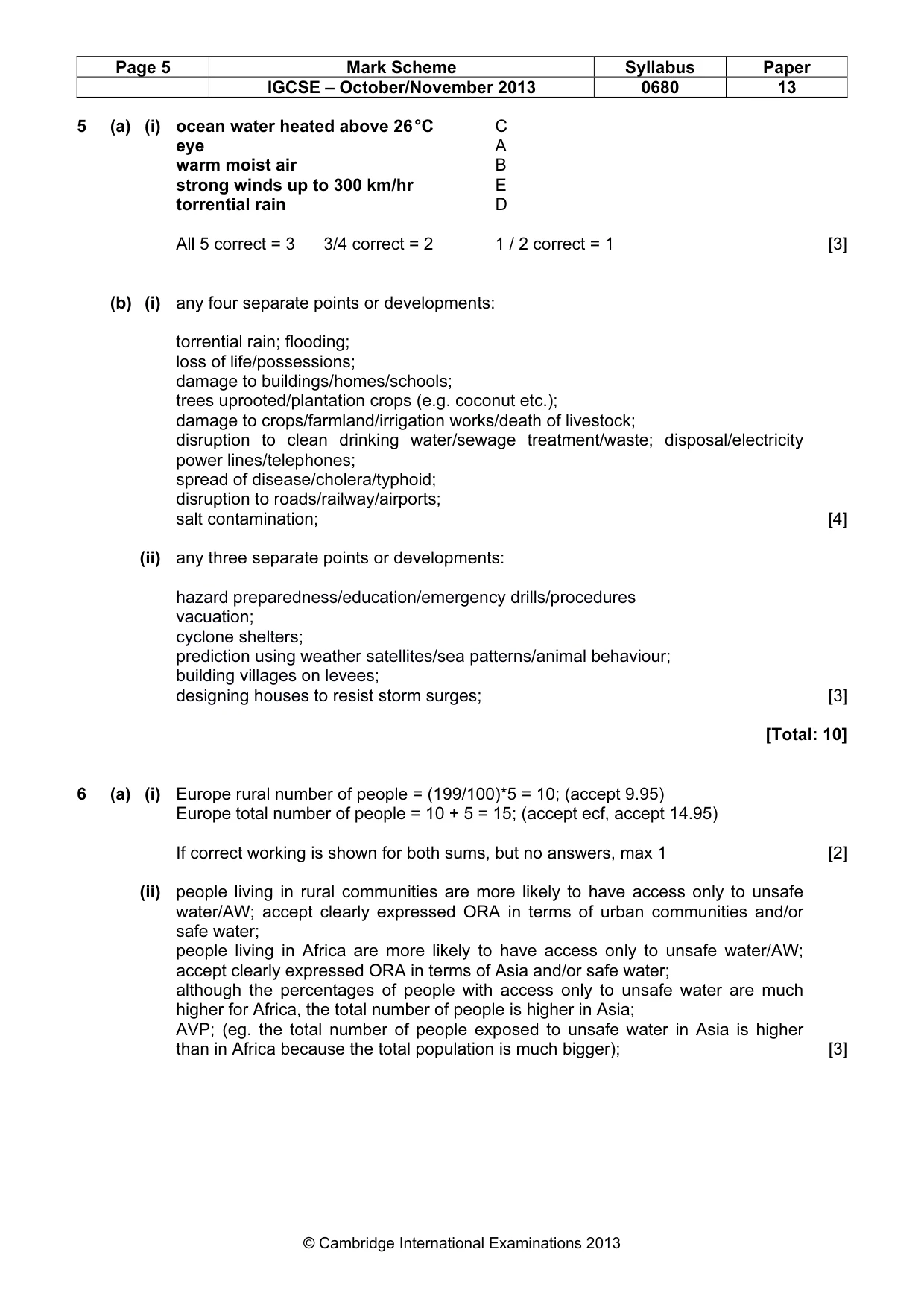
Page 5 Mark Scheme Syllabus Paper IGCSE – October/November 2013 0680 13 © Cambridge International Examinations 2013 5 (a) (i) ocean water heated above 26 °C C eye A warm moist air B strong winds up to 300 km/hr E torrential rain D All 5 correct = 3 3/4 correct = 2 1 / 2 correct = 1 [3] (b) (i) any four separate points or developments: torrential rain; flooding; loss of life/possessions; damage to buildings/homes/schools; trees uprooted/plantation crops (e.g. coconut etc.); damage to crops/farmland/irrigation works/death of livestock; disruption to clean drinking water/sewage treatment/waste; disposal/electricity power lines/telephones; spread of disease/cholera/typhoid; disruption to roads/railway/airports; salt contamination; [4] (ii) any three separate points or developments: hazard preparedness/education/emergency drills/procedures vacuation; cyclone shelters; prediction using weather satellites/sea patterns/animal behaviour; building villages on levees; designing houses to resist storm surges; [3] [Total: 10] 6 (a) (i) Europe rural number of people = (199/100)*5 = 10; (accept 9.95) Europe total number of people = 10 + 5 = 15; (accept ecf, accept 14.95) If correct working is shown for both sums, but no answers, max 1 [2] (ii) people living in rural communities are more likely to have access only to unsafe water/AW; accept clearly expressed ORA in terms of urban communities and/or safe water; people living in Africa are more likely to have access only to unsafe water/AW; accept clearly expressed ORA in terms of Asia and/or safe water; although the percentages of people with access only to unsafe water are much higher for Africa, the total number of people is higher in Asia; AVP; (eg. the total number of people exposed to unsafe water in Asia is higher than in Africa because the total population is much bigger); [3]
Mark scheme, page 6
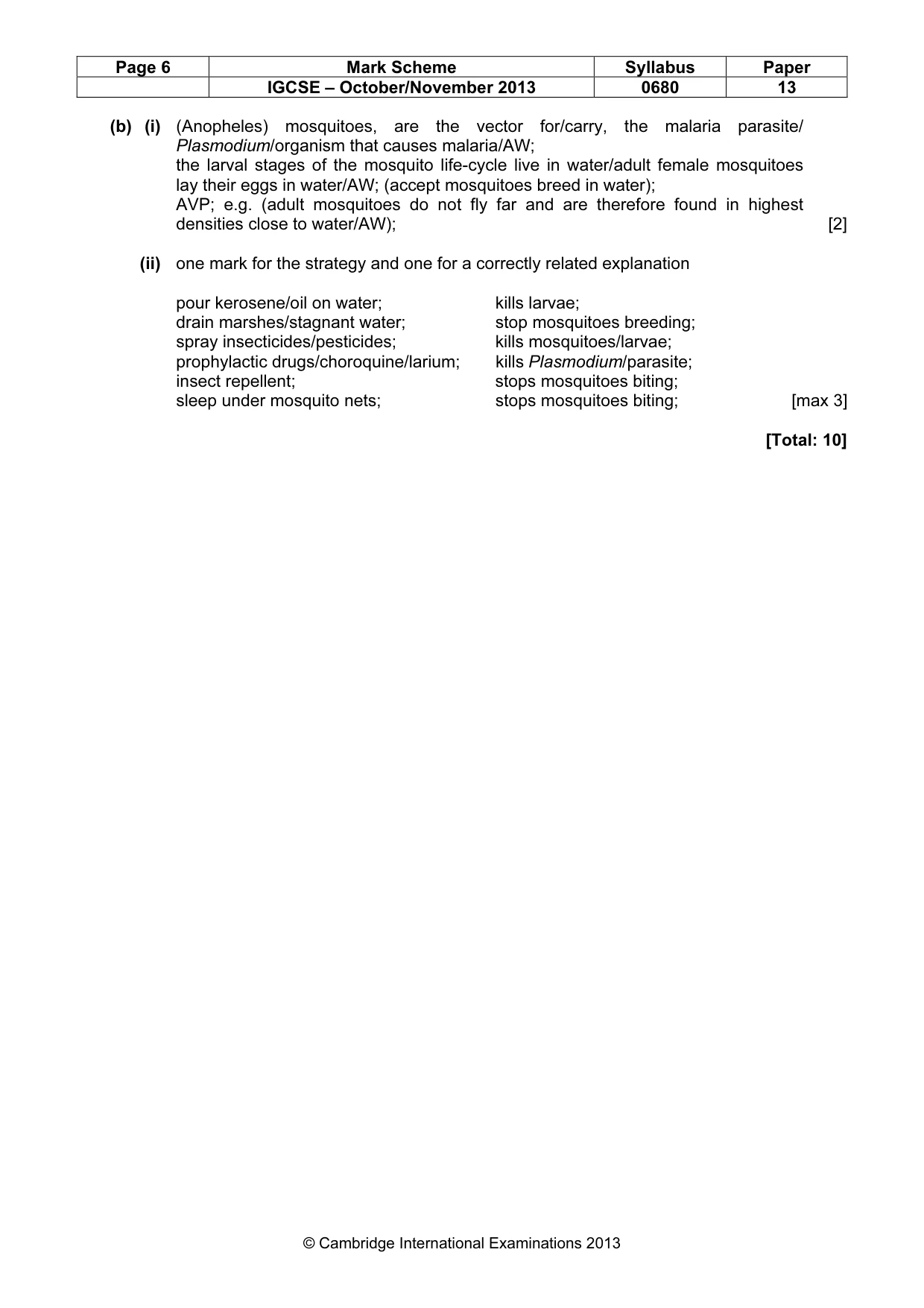
Page 6 Mark Scheme Syllabus Paper IGCSE – October/November 2013 0680 13 © Cambridge International Examinations 2013 (b) (i) (Anopheles) mosquitoes, are the vector for/carry, the malaria parasite/ Plasmodium/organism that causes malaria/AW; the larval stages of the mosquito life-cycle live in water/adult female mosquitoes lay their eggs in water/AW; (accept mosquitoes breed in water); AVP; e.g. (adult mosquitoes do not fly far and are therefore found in highest densities close to water/AW); [2] (ii) one mark for the strategy and one for a correctly related explanation pour kerosene/oil on water; kills larvae; drain marshes/stagnant water; stop mosquitoes breeding; spray insecticides/pesticides; kills mosquitoes/larvae; prophylactic drugs/choroquine/larium; kills Plasmodium/parasite; insect repellent; stops mosquitoes biting; sleep under mosquito nets; stops mosquitoes biting; [max 3] [Total: 10]
What you needed in this session
Cambridge’s own grade thresholds for 2013 Oct/Nov, Paper 1 · Variant 3. A higher threshold means an easier paper — the bar moves with how the cohort did.