Cambridge IGCSE Environmental Management 0680 — 2013 May/June Paper 1 · Variant 2
0680/12/M/J/13 · 60 marks · ≈68 min
The question paper and its mark scheme, free to read here and free to download. This is Cambridge’s own paper, exactly as it was sat.
Question paper16 pages
Mark scheme7 pages
Answers below. Sit the paper first if you are practising.
Paper as text
Question paper, page 1
This document consists of 16 printed pages. DC (SJF/SW) 67839/2 © UCLES 2013 [Turn over UNIVERSITY OF CAMBRIDGE INTERNATIONAL EXAMINATIONS International General Certificate of Secondary Education READ THESE INSTRUCTIONS FIRST Write your Centre number, candidate number and name on all the work you hand in. Write in dark blue or black pen. You may use a soft pencil for any diagrams, graphs or rough working. Do not use staples, paper clips, highlighters, glue or correction fluid. DO NOT WRITE IN ANY BARCODES. Electronic calculators may be used. Answer all questions. At the end of the examination, fasten all your work securely together. The number of marks is given in brackets [ ] at the end of each question or part question. * 5 8 3 4 5 5 2 3 9 5 * ENVIRONMENTAL MANAGEMENT 0680/12 Paper 1 May/June 2013 1 hour 30 minutes Candidates answer on the Question Paper. Additional Materials: Ruler For Examiner’s Use 1 2 3 4 5 6 Total
Question paper, page 2
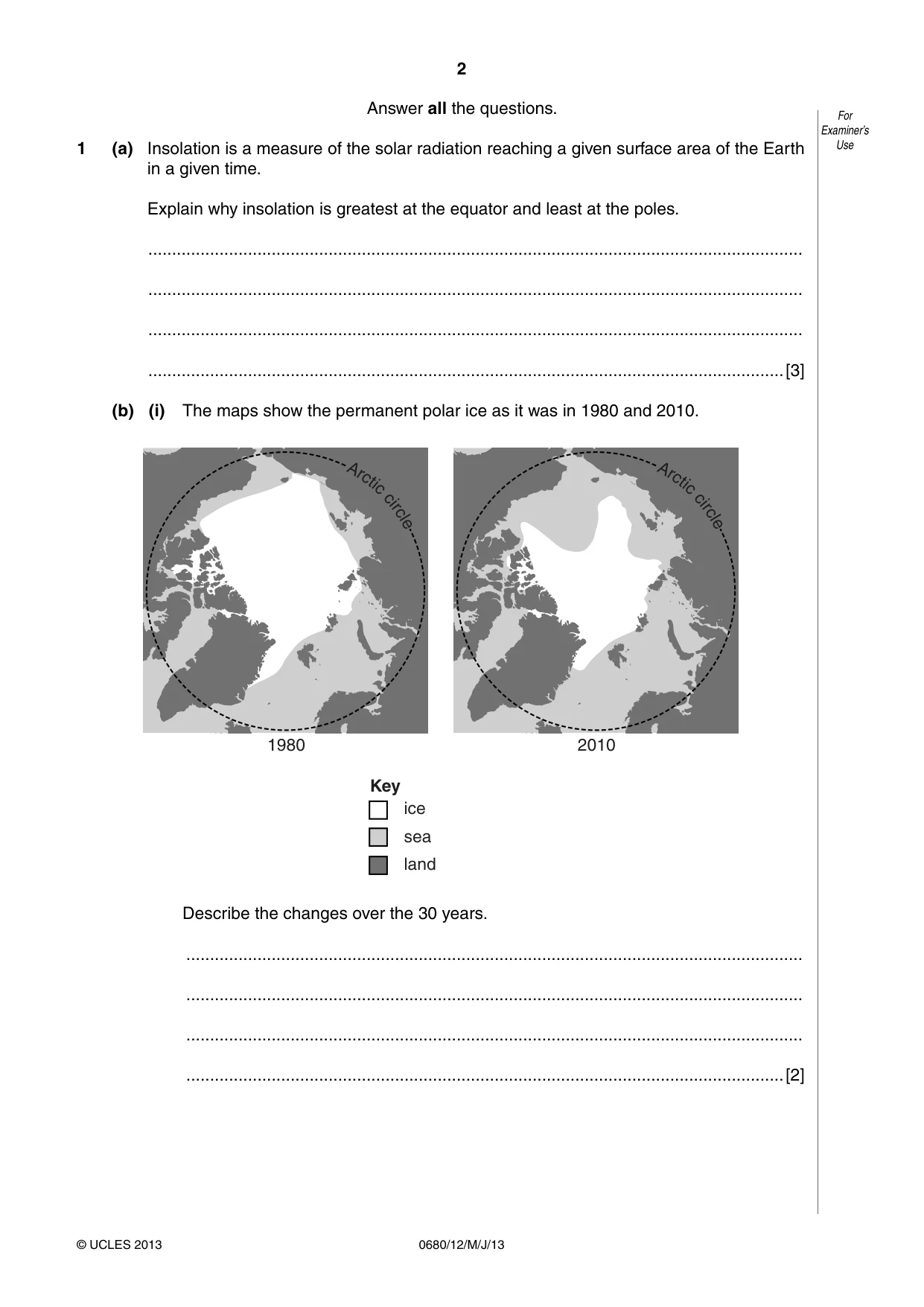
2 © UCLES 2013 For Examiner’s Use 0680/12/M/J/13 Answer all the questions. 1 (a) Insolation is a measure of the solar radiation reaching a given surface area of the Earth in a given time. Explain why insolation is greatest at the equator and least at the poles. … … … …[3] (b) (i) The maps show the permanent polar ice as it was in 1980 and 2010. A r c ti c c ir c l e A r c ti c c ir c l e 1980 Key ice sea land 2010 Describe the changes over the 30 years. … … … …[2]
Question paper, page 3
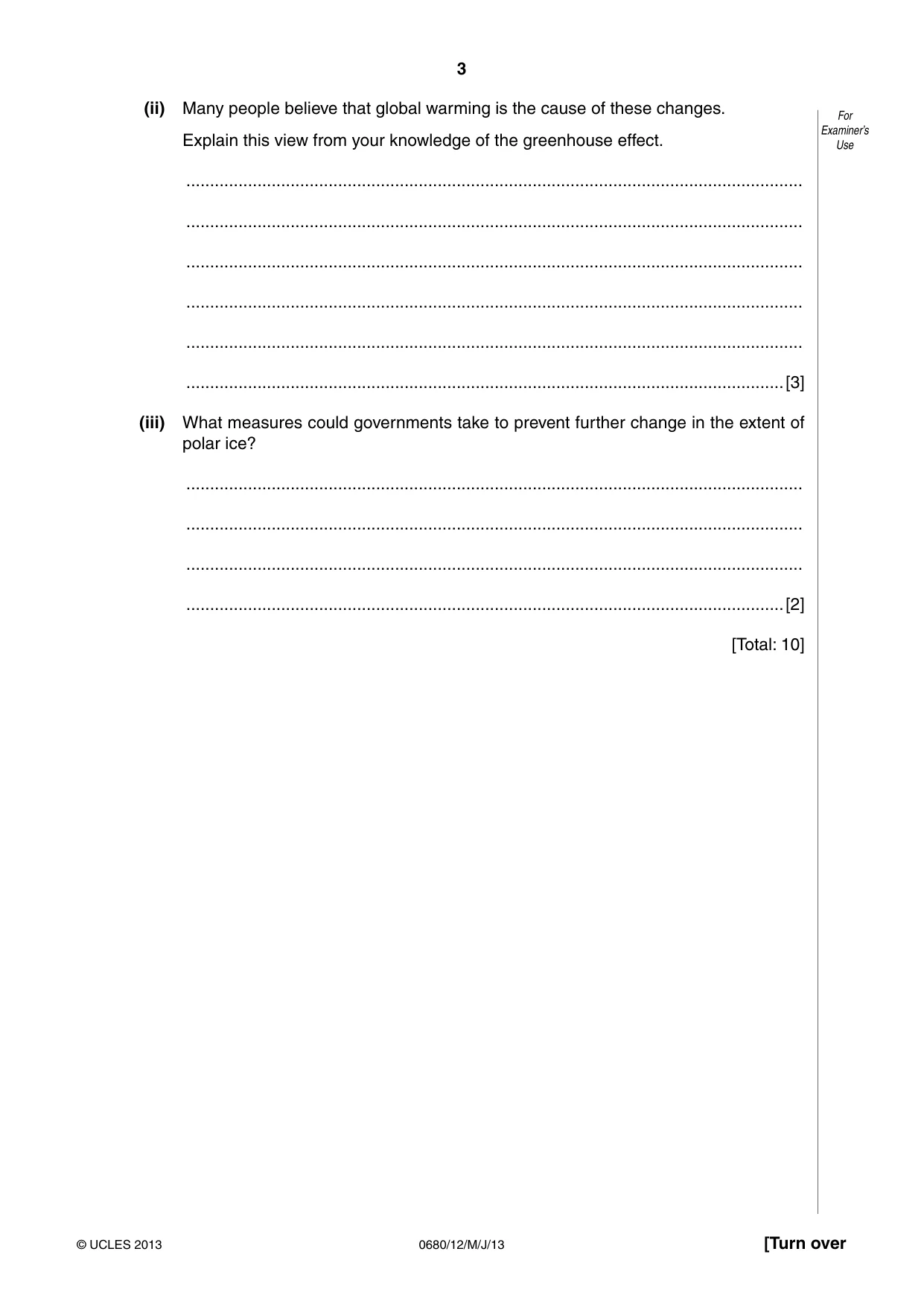
3 © UCLES 2013 [Turn over For Examiner’s Use 0680/12/M/J/13 (ii) Many people believe that global warming is the cause of these changes. Explain this view from your knowledge of the greenhouse effect. … … … … … …[3] (iii) What measures could governments take to prevent further change in the extent of polar ice? … … … …[2] [Total: 10]
Question paper, page 4
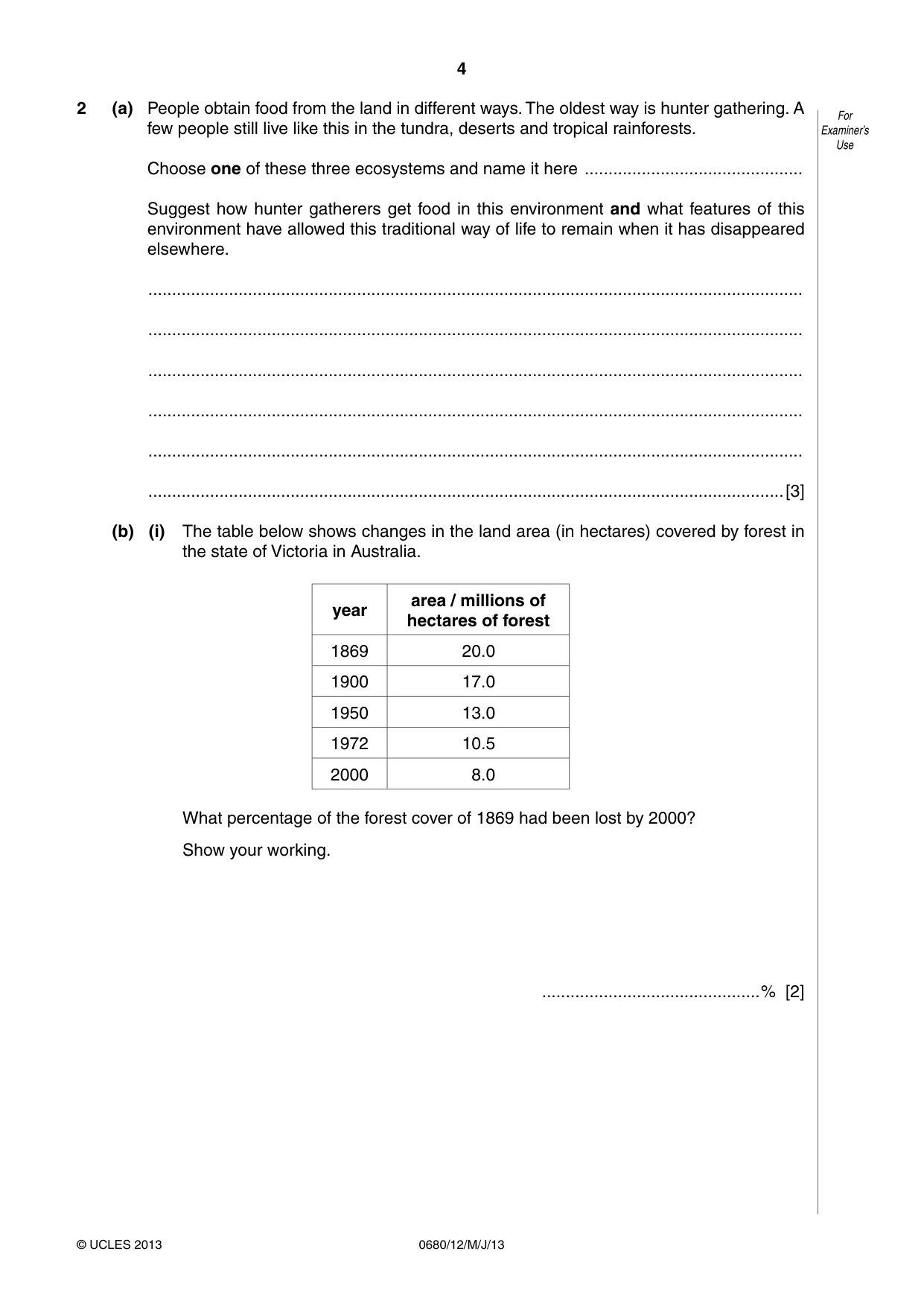
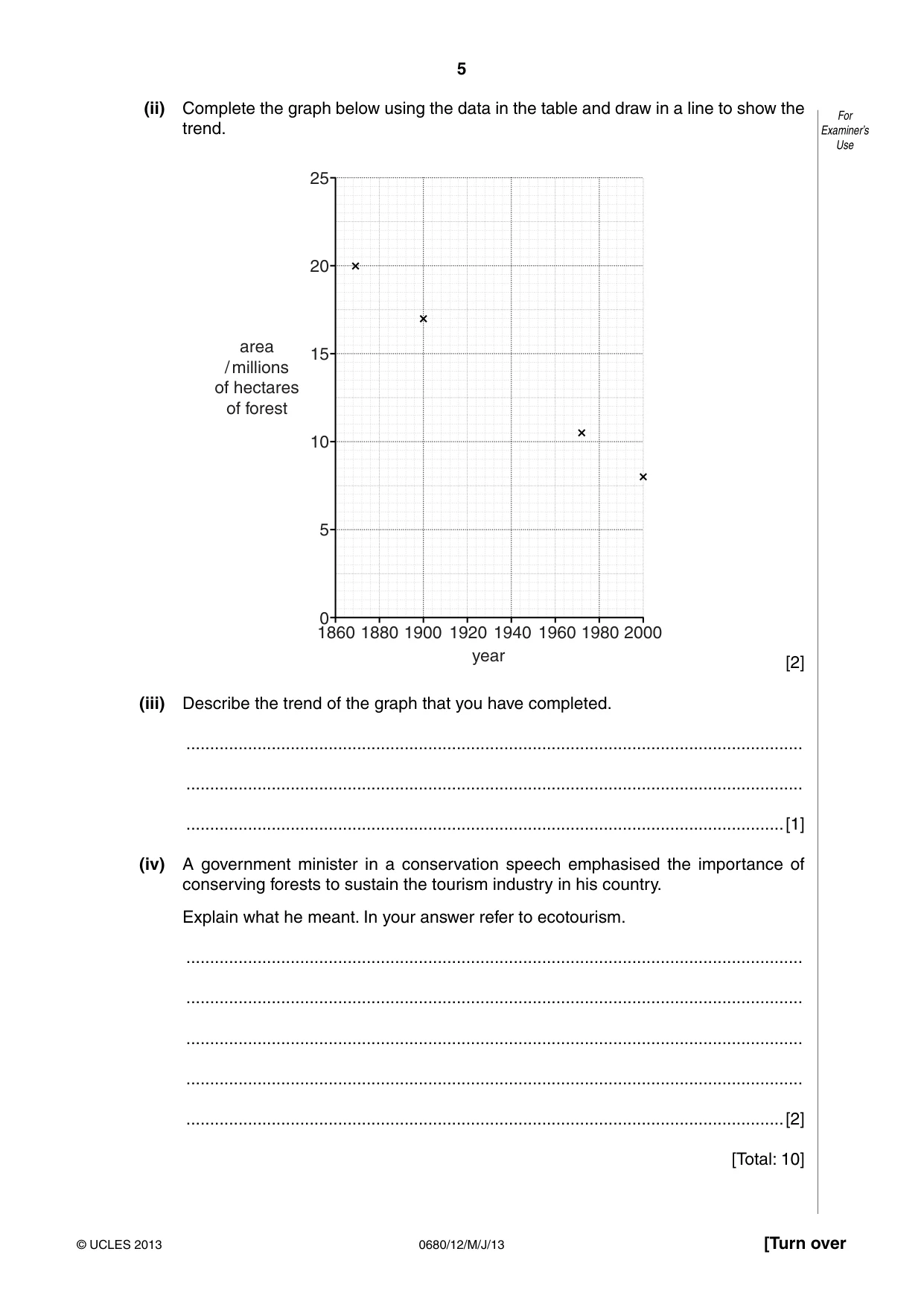
4 © UCLES 2013 For Examiner’s Use 0680/12/M/J/13 2 (a) People obtain food from the land in different ways. The oldest way is hunter gathering. A few people still live like this in the tundra, deserts and tropical rainforests. Choose one of these three ecosystems and name it here … Suggest how hunter gatherers get food in this environment and what features of this environment have allowed this traditional way of life to remain when it has disappeared elsewhere. … … … … … …[3] (b) (i) The table below shows changes in the land area (in hectares) covered by forest in the state of Victoria in Australia. year area / millions of hectares of forest 1869 20.0 1900 17.0 1950 13.0 1972 10.5 2000 8.0 What percentage of the forest cover of 1869 had been lost by 2000? Show your working. …% [2]
Question paper, page 5
5 © UCLES 2013 [Turn over For Examiner’s Use 0680/12/M/J/13 (ii) Complete the graph below using the data in the table and draw in a line to show the trend. 1860 1880 1900 1920 1940 year 1960 1980 2000 0 10 15 5 20 area / millions of hectares of forest 25 [2] (iii) Describe the trend of the graph that you have completed. … … …[1] (iv) A government minister in a conservation speech emphasised the importance of conserving forests to sustain the tourism industry in his country. Explain what he meant. In your answer refer to ecotourism. … … … … …[2] [Total: 10]
Question paper, page 6
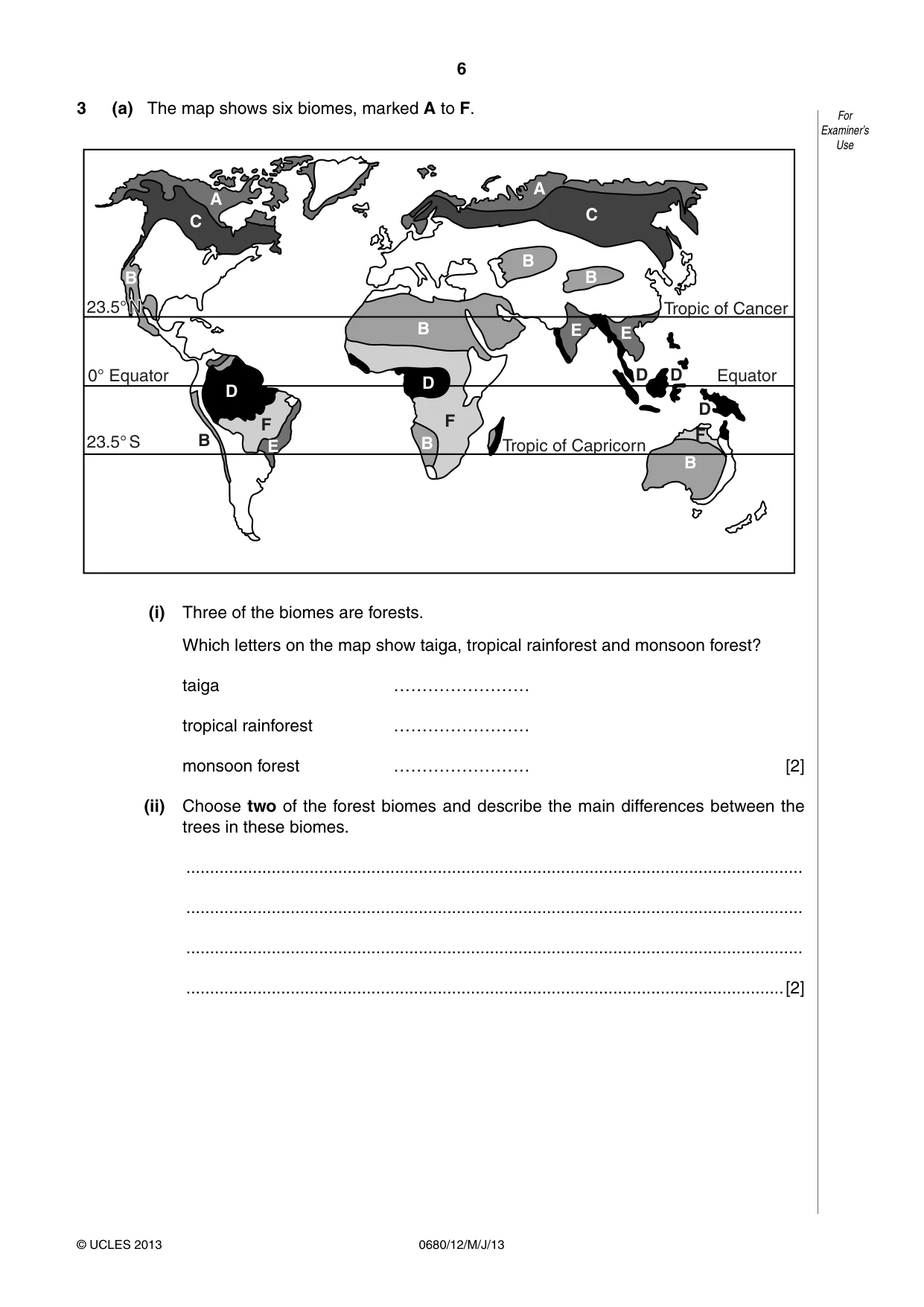
6 © UCLES 2013 For Examiner’s Use 0680/12/M/J/13 3 (a) The map shows six biomes, marked A to F. Tropic of Cancer Tropic of Capricorn Equator Equator 0° 23.5° S A A C C D D B B B B F F B F D D D B B E E E 23.5° N (i) Three of the biomes are forests. Which letters on the map show taiga, tropical rainforest and monsoon forest? taiga …………………… tropical rainforest …………………… monsoon forest …………………… [2] (ii) Choose two of the forest biomes and describe the main differences between the trees in these biomes. … … … …[2]
Question paper, page 7
7 © UCLES 2013 [Turn over For Examiner’s Use 0680/12/M/J/13 (b) The 2011 World Environment Day had as its theme, ‘Forests: Nature at Your Service’. The theme was chosen to highlight the environmental, economic and social importance of the world’s forests as they are affected by deforestation. (i) What did the organisers mean by ‘the environmental importance of the world’s forests’? … … … … … …[3] (ii) How can the problem of deforestation be reduced? … … … … … …[3] [Total: 10]
Question paper, page 8
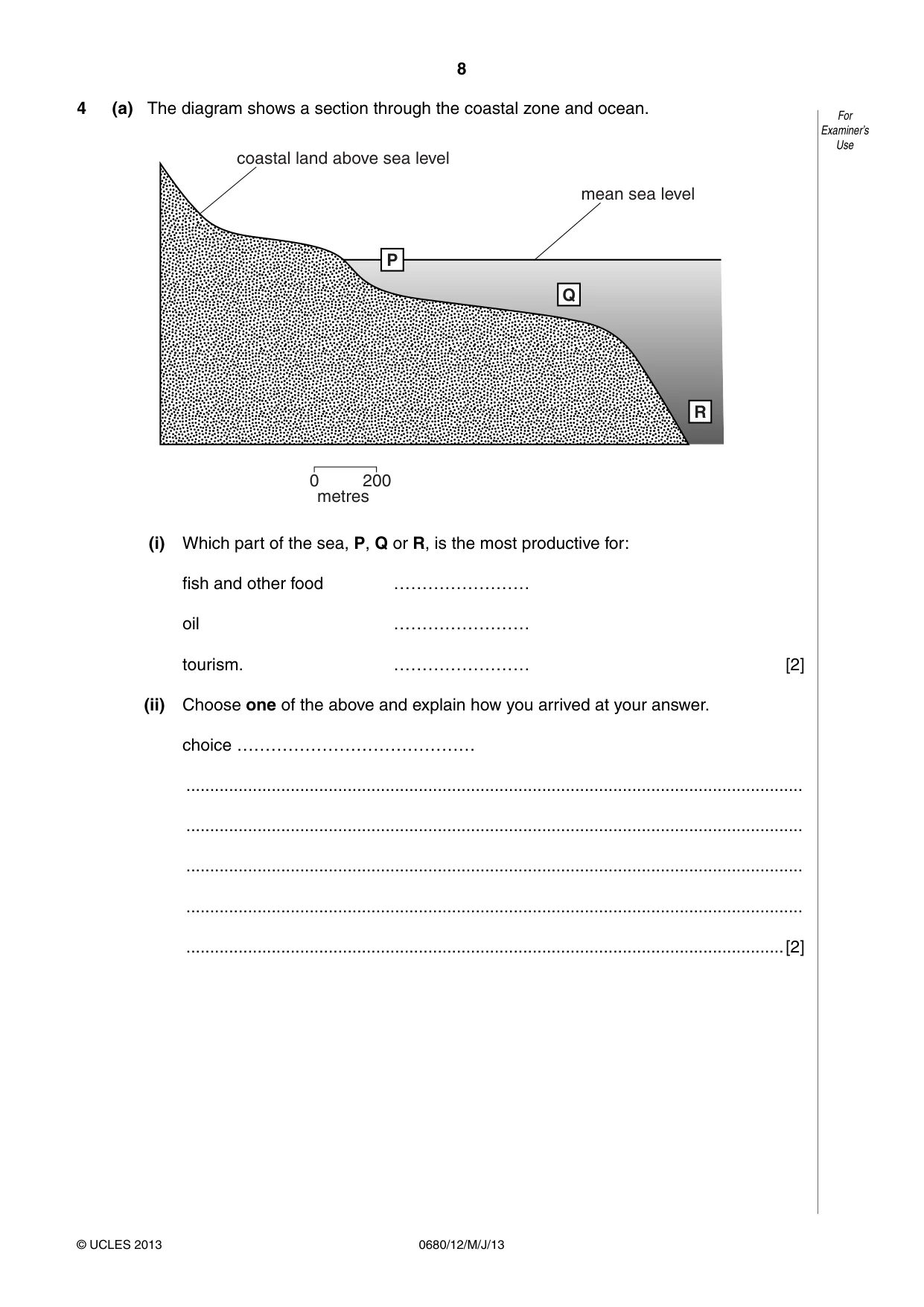
8 © UCLES 2013 For Examiner’s Use 0680/12/M/J/13 4 (a) The diagram shows a section through the coastal zone and ocean. mean sea level coastal land above sea level 0 200 metres P Q R (i) Which part of the sea, P, Q or R, is the most productive for: fish and other food …………………… oil …………………… tourism. …………………… [2] (ii) Choose one of the above and explain how you arrived at your answer. choice …………………………………… … … … … …[2]
Question paper, page 9
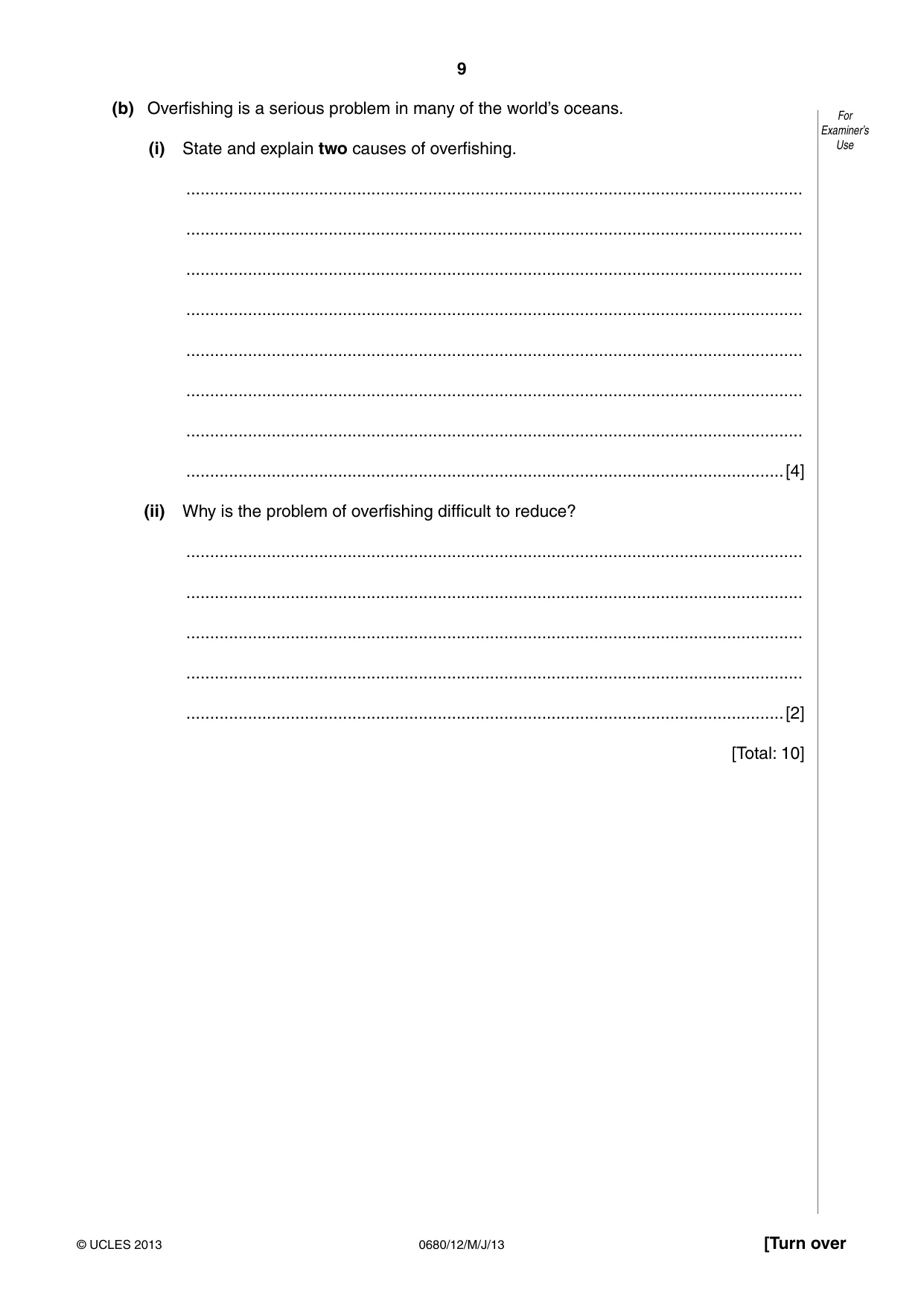
9 © UCLES 2013 [Turn over For Examiner’s Use 0680/12/M/J/13 (b) Overfishing is a serious problem in many of the world’s oceans. (i) State and explain two causes of overfishing. … … … … … … … …[4] (ii) Why is the problem of overfishing difficult to reduce? … … … … …[2] [Total: 10]
Question paper, page 10
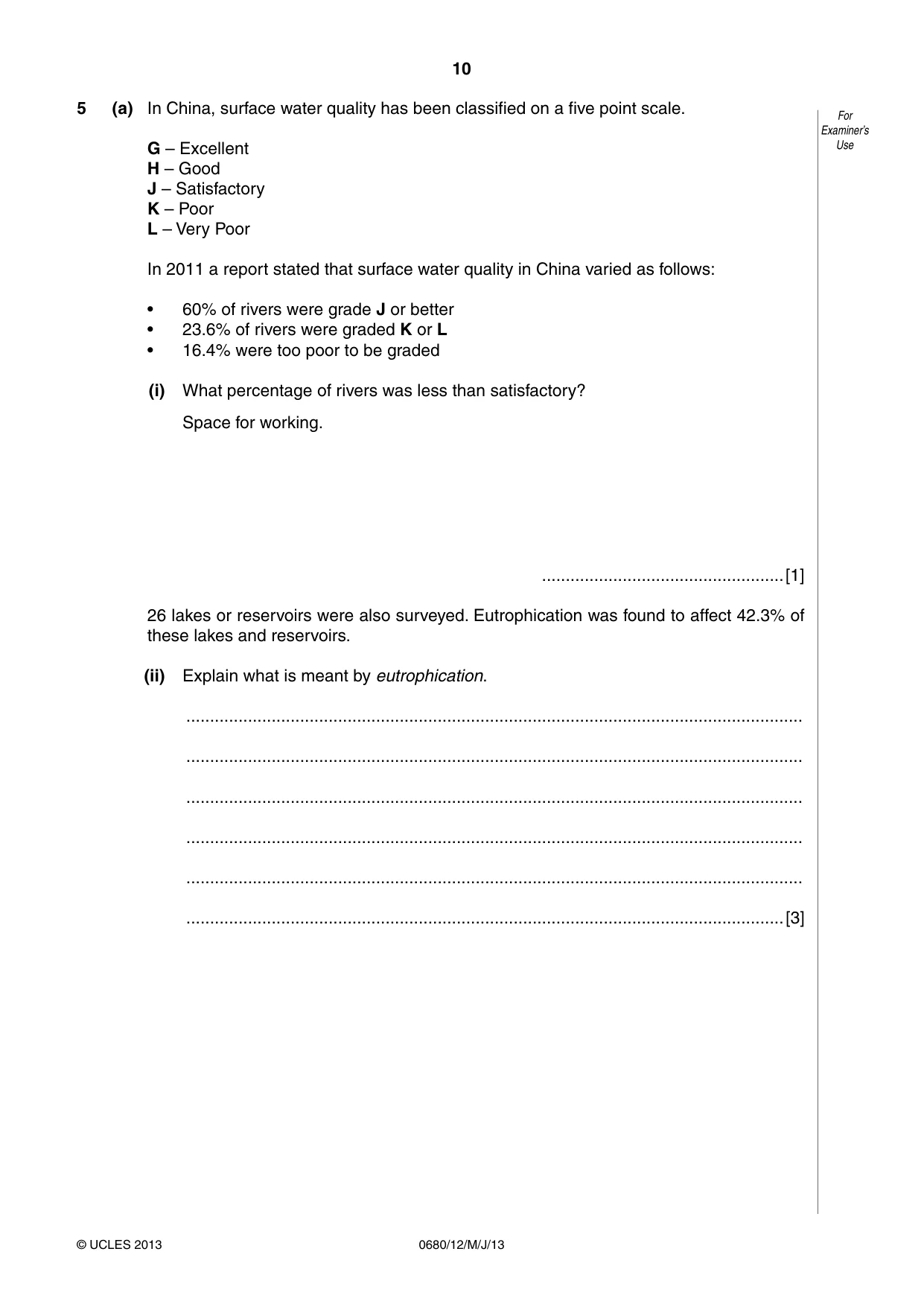
10 © UCLES 2013 For Examiner’s Use 0680/12/M/J/13 5 (a) In China, surface water quality has been classified on a five point scale. G – Excellent H – Good J – Satisfactory K – Poor L – Very Poor In 2011 a report stated that surface water quality in China varied as follows: • 60% of rivers were grade J or better • 23.6% of rivers were graded K or L • 16.4% were too poor to be graded (i) What percentage of rivers was less than satisfactory? Space for working. …[1] 26 lakes or reservoirs were also surveyed. Eutrophication was found to affect 42.3% of these lakes and reservoirs. (ii) Explain what is meant by eutrophication. … … … … … …[3]
Question paper, page 11
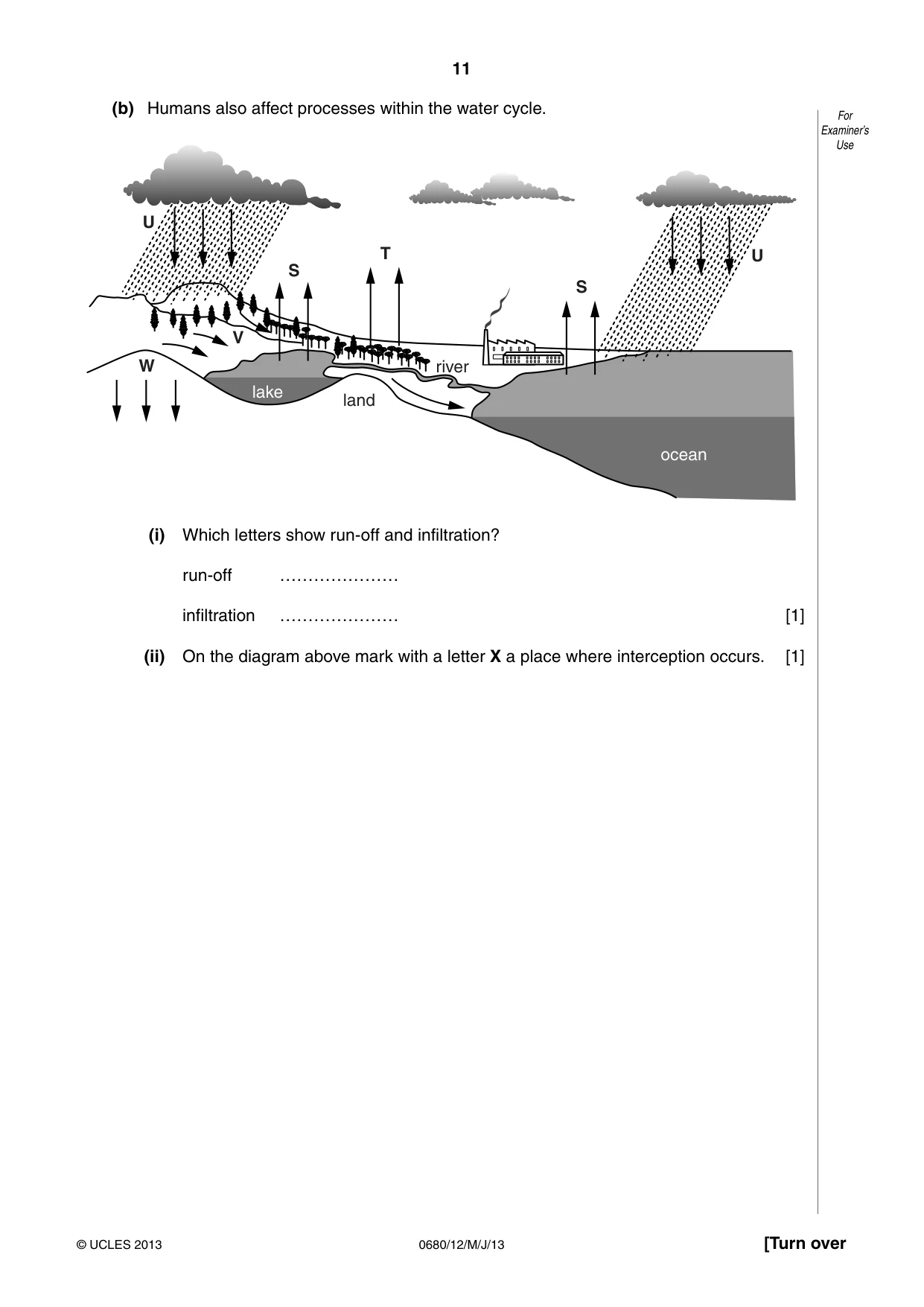
11 © UCLES 2013 [Turn over For Examiner’s Use 0680/12/M/J/13 (b) Humans also affect processes within the water cycle. land river lake ocean U U S V W S T (i) Which letters show run-off and infiltration? run-off ………………… infiltration ………………… [1] (ii) On the diagram above mark with a letter X a place where interception occurs. [1]
Question paper, page 12
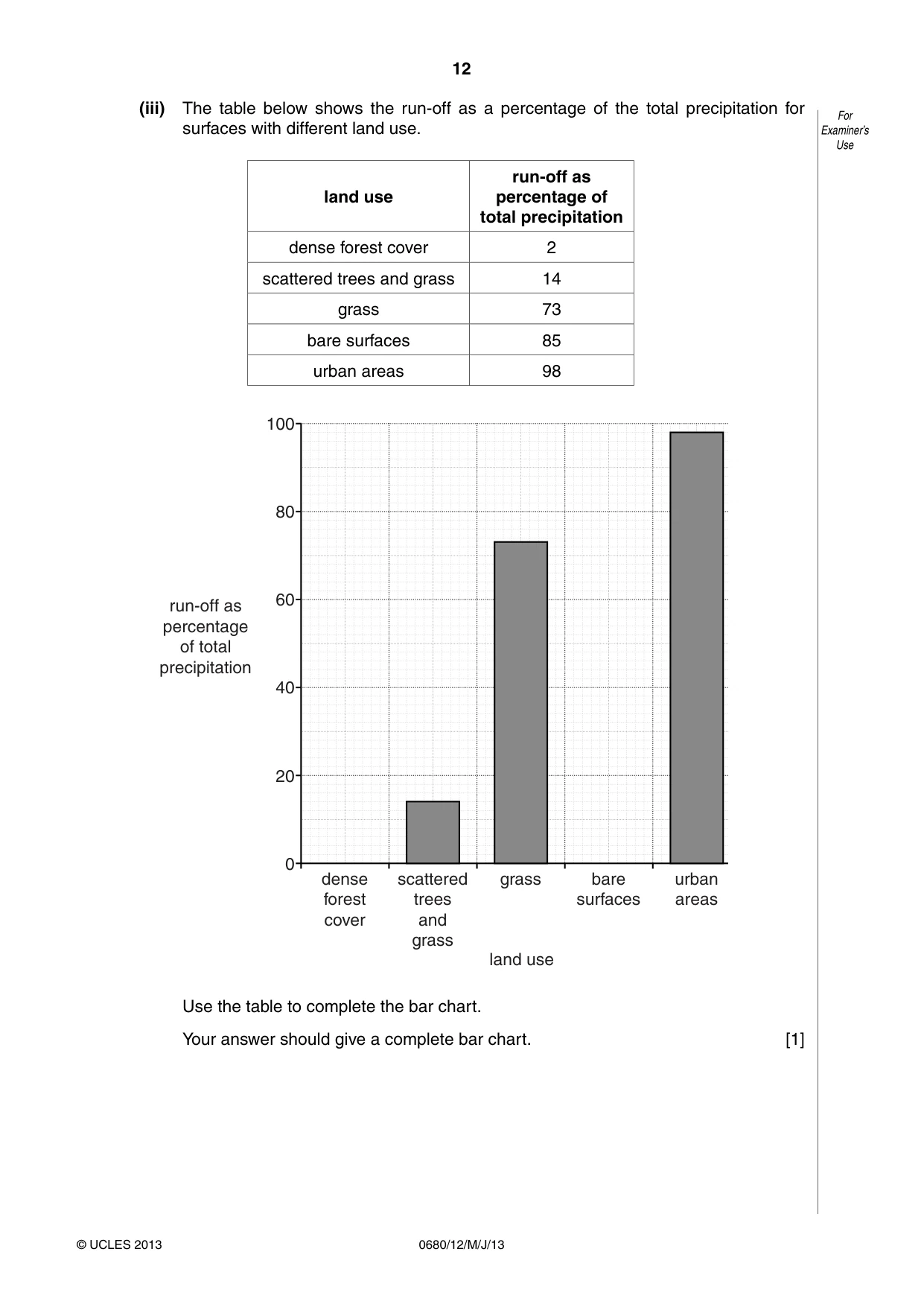
12 © UCLES 2013 For Examiner’s Use 0680/12/M/J/13 (iii) The table below shows the run-off as a percentage of the total precipitation for surfaces with different land use. land use run-off as percentage of total precipitation dense forest cover 2 scattered trees and grass 14 grass 73 bare surfaces 85 urban areas 98 dense forest cover scattered trees and grass grass bare surfaces urban areas land use 0 40 60 20 80 run-off as percentage of total precipitation 100 Use the table to complete the bar chart. Your answer should give a complete bar chart. [1]
Question paper, page 13
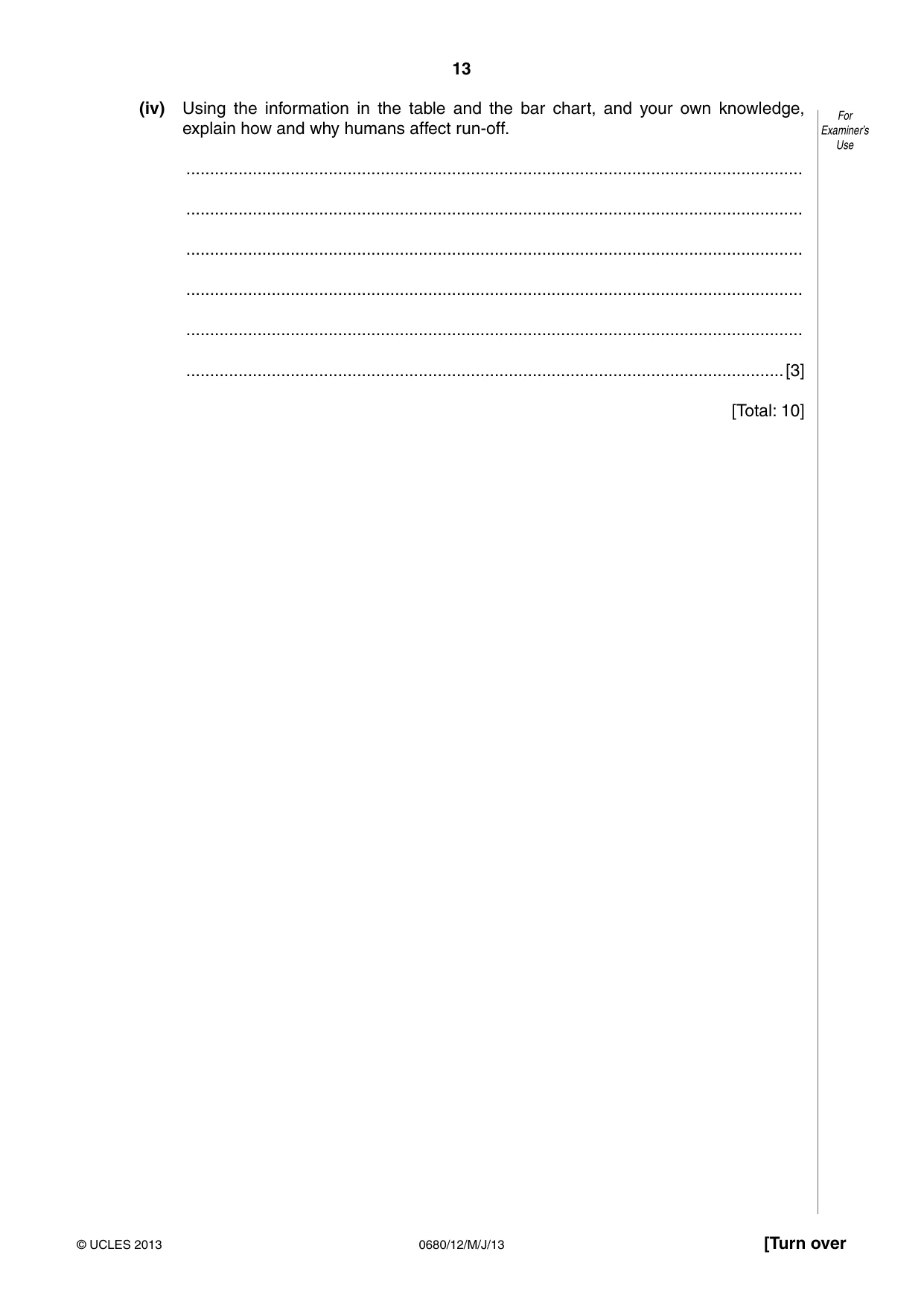
13 © UCLES 2013 [Turn over For Examiner’s Use 0680/12/M/J/13 (iv) Using the information in the table and the bar chart, and your own knowledge, explain how and why humans affect run-off. … … … … … …[3] [Total: 10]
Question paper, page 14
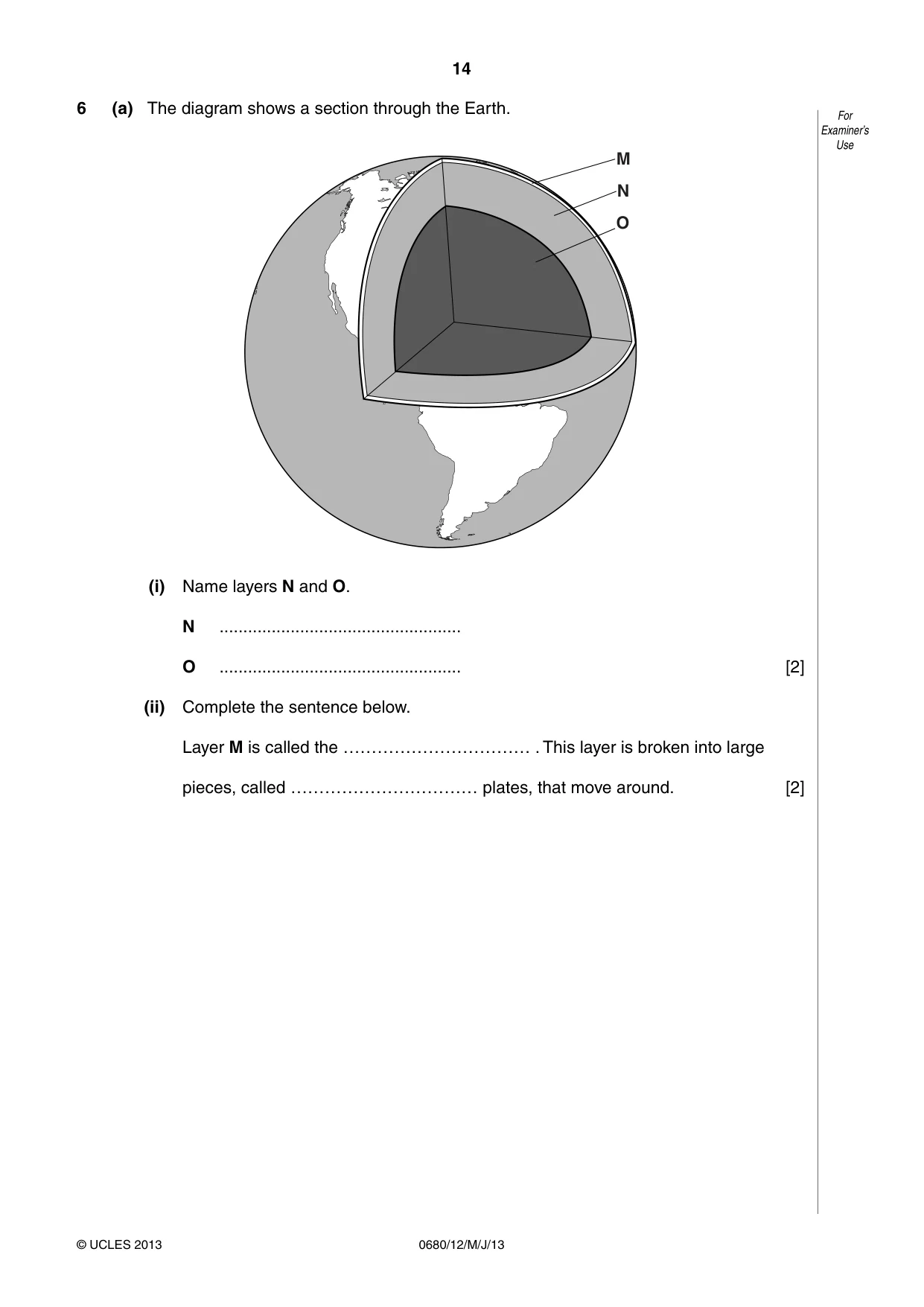
14 © UCLES 2013 For Examiner’s Use 0680/12/M/J/13 6 (a) The diagram shows a section through the Earth. M N O (i) Name layers N and O. N … O … [2] (ii) Complete the sentence below. Layer M is called the …………………………… . This layer is broken into large pieces, called …………………………… plates, that move around. [2]
Question paper, page 15
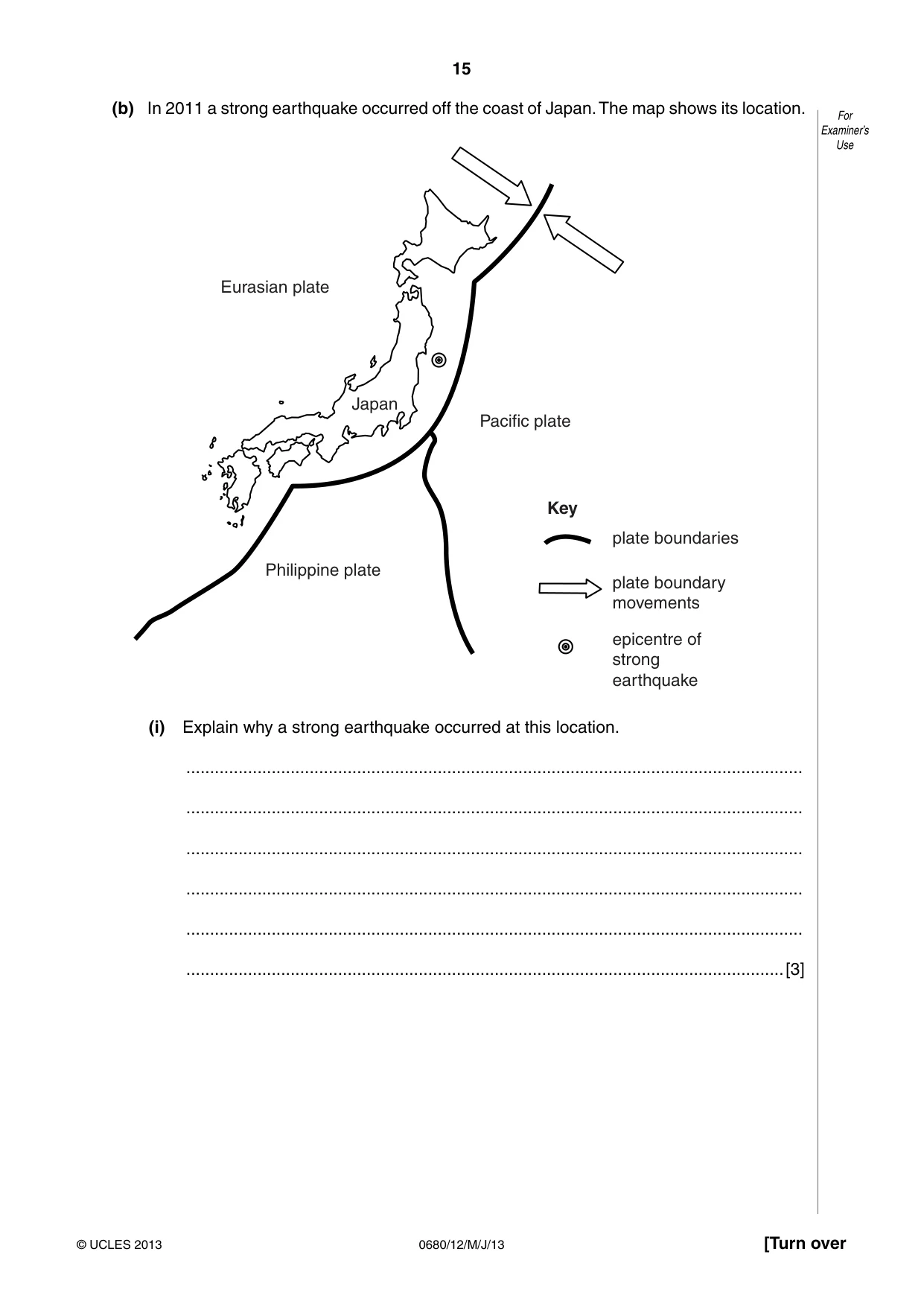
15 © UCLES 2013 [Turn over For Examiner’s Use 0680/12/M/J/13 (b) In 2011 a strong earthquake occurred off the coast of Japan. The map shows its location. Japan Eurasian plate Philippine plate Pacific plate Key plate boundaries plate boundary movements epicentre of strong earthquake (i) Explain why a strong earthquake occurred at this location. … … … … … …[3]
Question paper, page 16
16 © UCLES 2013 For Examiner’s Use 0680/12/M/J/13 (ii) Over 15 000 people living on the NE coast of Japan lost their lives. Explain why people in this area were the worst affected. … … … … … …[3] [Total: 10] Permission to reproduce items where third-party owned material protected by copyright is included has been sought and cleared where possible. Every reasonable effort has been made by the publisher (UCLES) to trace copyright holders, but if any items requiring clearance have unwittingly been included, the publisher will be pleased to make amends at the earliest possible opportunity. University of Cambridge International Examinations is part of the Cambridge Assessment Group. Cambridge Assessment is the brand name of University of Cambridge Local Examinations Syndicate (UCLES), which is itself a department of the University of Cambridge.
Mark scheme, page 1
CAMBRIDGE INTERNATIONAL EXAMINATIONS International General Certificate of Secondary Education MARK SCHEME for the May/June 2013 series 0680 ENVIRONMENTAL MANAGEMENT 0680/12 Paper 1, maximum raw mark 60 This mark scheme is published as an aid to teachers and candidates, to indicate the requirements of the examination. It shows the basis on which Examiners were instructed to award marks. It does not indicate the details of the discussions that took place at an Examiners’ meeting before marking began, which would have considered the acceptability of alternative answers. Mark schemes should be read in conjunction with the question paper and the Principal Examiner Report for Teachers. Cambridge will not enter into discussions about these mark schemes. Cambridge is publishing the mark schemes for the May/June 2013 series for most IGCSE, GCE Advanced Level and Advanced Subsidiary Level components and some Ordinary Level components.
Mark scheme, page 2
Page 2 Mark Scheme Syllabus Paper IGCSE – May/June 2013 0680 12 © Cambridge International Examinations 2013 General notes Symbols used in Environmental Management mark schemes. / separates alternatives for a marking point – other valid ways of expressing the same idea are also credited ; separates points for the award of a mark [3] indicates the number of marks available italic indicates that this is information about the marking points and is not required to gain credit italic text is also used for comments about alternatives that should be accepted, ignored or rejected ora or reverse argument – shows that an argument from an alternative viewpoint will be credited AW alternative wording, sometimes called ‘or words to that effect’ – AW is used when there are many different ways of expressing the same idea ( ) the word / phrase in brackets is not required to gain marks but sets the context of the response for credit e.g. (nuclear) waste – nuclear is not needed but if it was described as a domestic waste then no mark is awarded volcanic underlined words – the answer must contain exactly this word ecf error carried forward – if an incorrect answer is given to part of a question, and this answer is subsequently used by a candidate in later parts of the question, this indicates that the candidate’s incorrect answer will be used as a starting point for marking the later parts of the question
Mark scheme, page 3
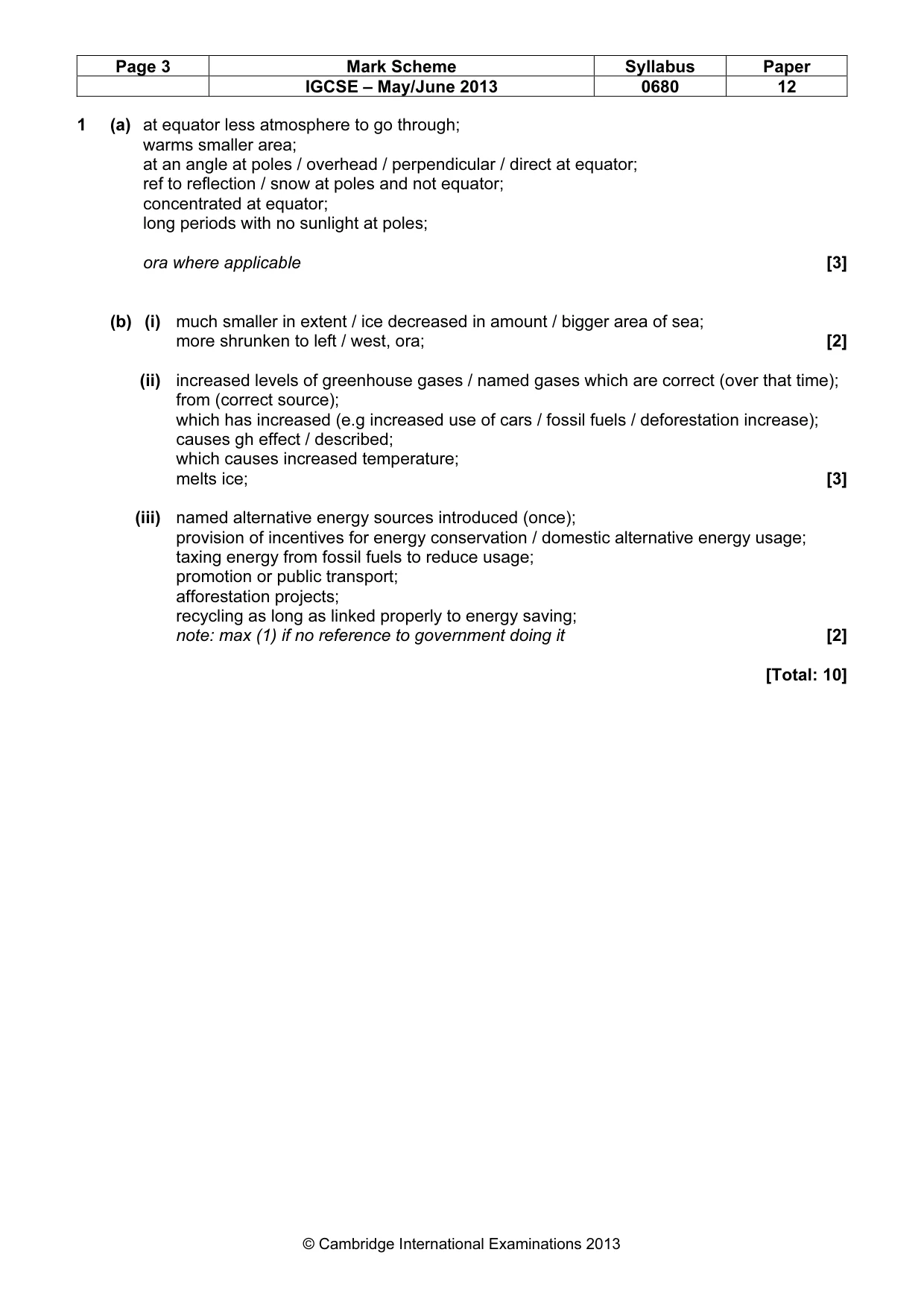
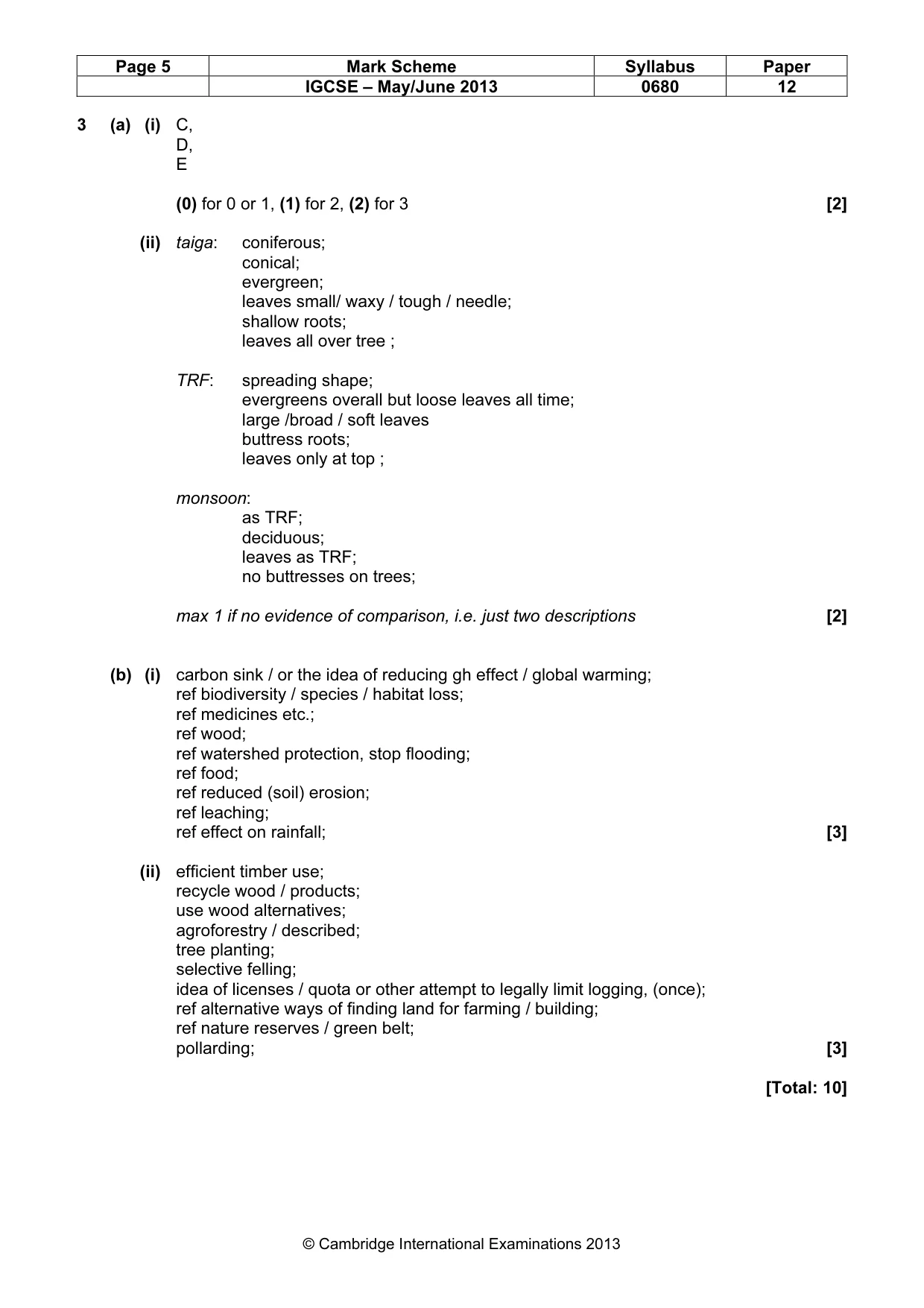
Page 3 Mark Scheme Syllabus Paper IGCSE – May/June 2013 0680 12 © Cambridge International Examinations 2013 1 (a) at equator less atmosphere to go through; warms smaller area; at an angle at poles / overhead / perpendicular / direct at equator; ref to reflection / snow at poles and not equator; concentrated at equator; long periods with no sunlight at poles; ora where applicable [3] (b) (i) much smaller in extent / ice decreased in amount / bigger area of sea; more shrunken to left / west, ora; [2] (ii) increased levels of greenhouse gases / named gases which are correct (over that time); from (correct source); which has increased (e.g increased use of cars / fossil fuels / deforestation increase); causes gh effect / described; which causes increased temperature; melts ice; [3] (iii) named alternative energy sources introduced (once); provision of incentives for energy conservation / domestic alternative energy usage; taxing energy from fossil fuels to reduce usage; promotion or public transport; afforestation projects; recycling as long as linked properly to energy saving; note: max (1) if no reference to government doing it [2] [Total: 10]
Mark scheme, page 4
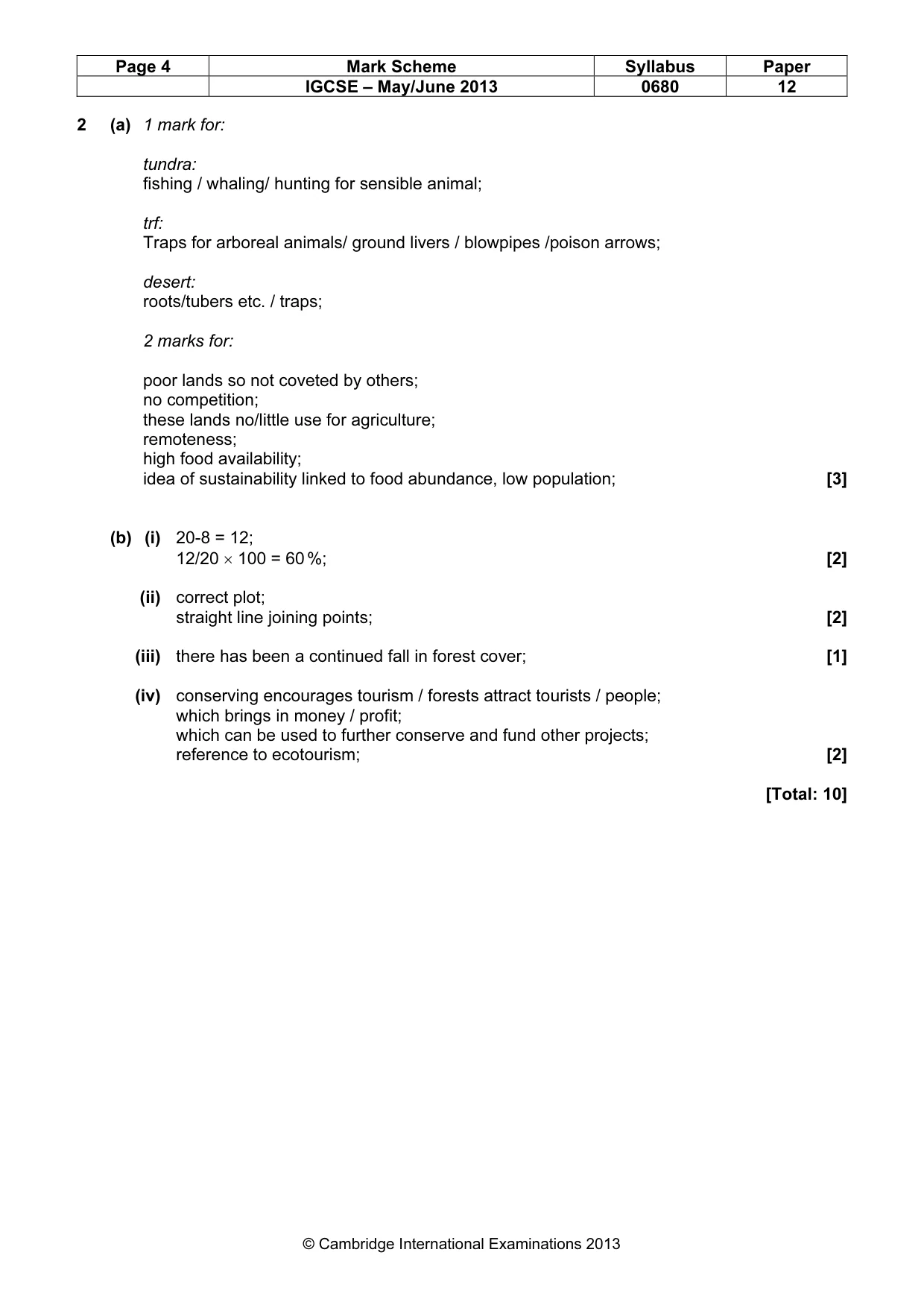
Page 4 Mark Scheme Syllabus Paper IGCSE – May/June 2013 0680 12 © Cambridge International Examinations 2013 2 (a) 1 mark for: tundra: fishing / whaling/ hunting for sensible animal; trf: Traps for arboreal animals/ ground livers / blowpipes /poison arrows; desert: roots/tubers etc. / traps; 2 marks for: poor lands so not coveted by others; no competition; these lands no/little use for agriculture; remoteness; high food availability; idea of sustainability linked to food abundance, low population; [3] (b) (i) 20-8 = 12; 12/20 × 100 = 60 %; [2] (ii) correct plot; straight line joining points; [2] (iii) there has been a continued fall in forest cover; [1] (iv) conserving encourages tourism / forests attract tourists / people; which brings in money / profit; which can be used to further conserve and fund other projects; reference to ecotourism; [2] [Total: 10]
Mark scheme, page 5
Page 5 Mark Scheme Syllabus Paper IGCSE – May/June 2013 0680 12 © Cambridge International Examinations 2013 3 (a) (i) C, D, E (0) for 0 or 1, (1) for 2, (2) for 3 [2] (ii) taiga: coniferous; conical; evergreen; leaves small/ waxy / tough / needle; shallow roots; leaves all over tree ; TRF: spreading shape; evergreens overall but loose leaves all time; large /broad / soft leaves buttress roots; leaves only at top ; monsoon: as TRF; deciduous; leaves as TRF; no buttresses on trees; max 1 if no evidence of comparison, i.e. just two descriptions [2] (b) (i) carbon sink / or the idea of reducing gh effect / global warming; ref biodiversity / species / habitat loss; ref medicines etc.; ref wood; ref watershed protection, stop flooding; ref food; ref reduced (soil) erosion; ref leaching; ref effect on rainfall; [3] (ii) efficient timber use; recycle wood / products; use wood alternatives; agroforestry / described; tree planting; selective felling; idea of licenses / quota or other attempt to legally limit logging, (once); ref alternative ways of finding land for farming / building; ref nature reserves / green belt; pollarding; [3] [Total: 10]
Mark scheme, page 6
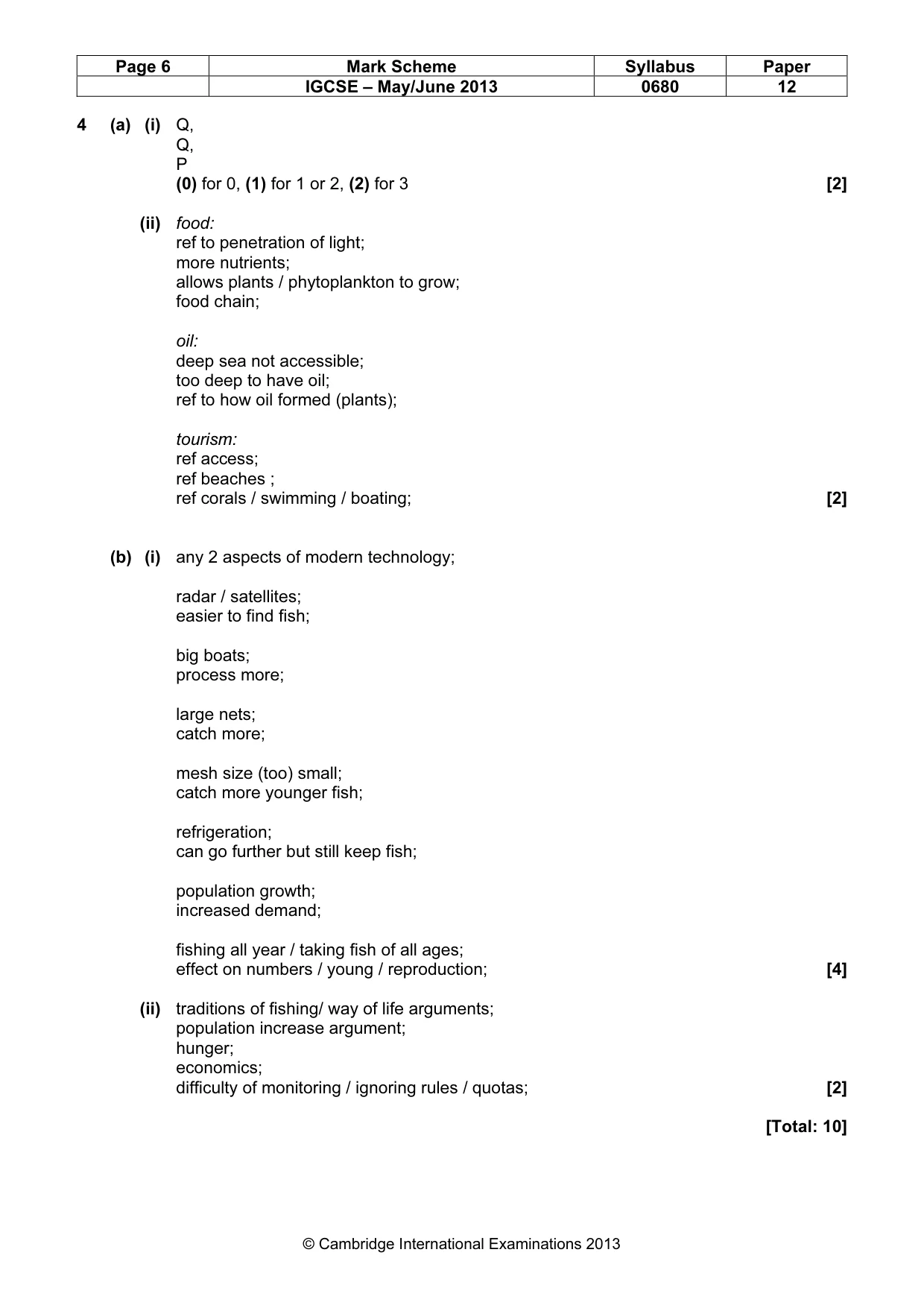
Page 6 Mark Scheme Syllabus Paper IGCSE – May/June 2013 0680 12 © Cambridge International Examinations 2013 4 (a) (i) Q, Q, P (0) for 0, (1) for 1 or 2, (2) for 3 [2] (ii) food: ref to penetration of light; more nutrients; allows plants / phytoplankton to grow; food chain; oil: deep sea not accessible; too deep to have oil; ref to how oil formed (plants); tourism: ref access; ref beaches ; ref corals / swimming / boating; [2] (b) (i) any 2 aspects of modern technology; radar / satellites; easier to find fish; big boats; process more; large nets; catch more; mesh size (too) small; catch more younger fish; refrigeration; can go further but still keep fish; population growth; increased demand; fishing all year / taking fish of all ages; effect on numbers / young / reproduction; [4] (ii) traditions of fishing/ way of life arguments; population increase argument; hunger; economics; difficulty of monitoring / ignoring rules / quotas; [2] [Total: 10]
Mark scheme, page 7
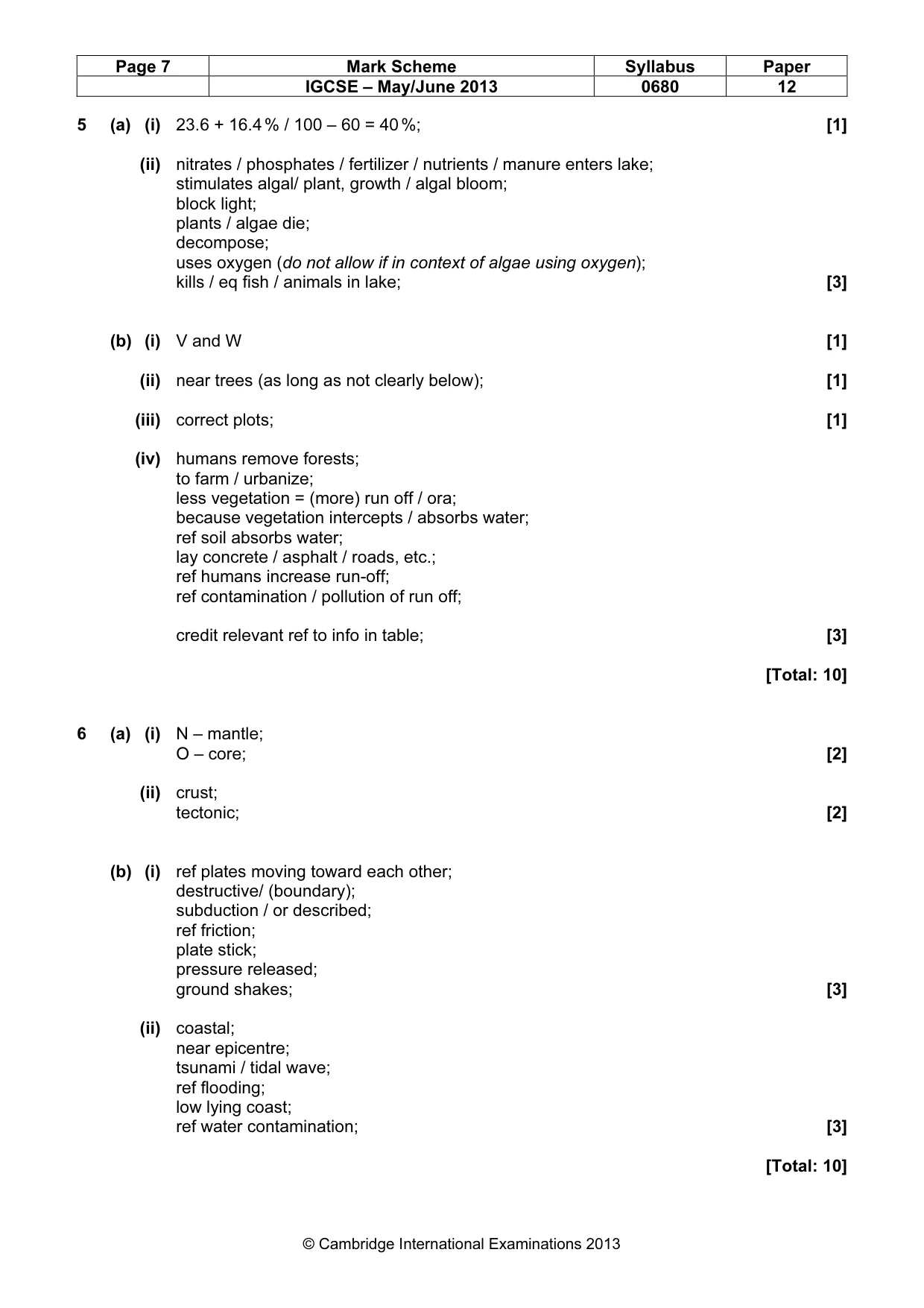
Page 7 Mark Scheme Syllabus Paper IGCSE – May/June 2013 0680 12 © Cambridge International Examinations 2013 5 (a) (i) 23.6 + 16.4 % / 100 – 60 = 40 %; [1] (ii) nitrates / phosphates / fertilizer / nutrients / manure enters lake; stimulates algal/ plant, growth / algal bloom; block light; plants / algae die; decompose; uses oxygen (do not allow if in context of algae using oxygen); kills / eq fish / animals in lake; [3] (b) (i) V and W [1] (ii) near trees (as long as not clearly below); [1] (iii) correct plots; [1] (iv) humans remove forests; to farm / urbanize; less vegetation = (more) run off / ora; because vegetation intercepts / absorbs water; ref soil absorbs water; lay concrete / asphalt / roads, etc.; ref humans increase run-off; ref contamination / pollution of run off; credit relevant ref to info in table; [3] [Total: 10] 6 (a) (i) N – mantle; O – core; [2] (ii) crust; tectonic; [2] (b) (i) ref plates moving toward each other; destructive/ (boundary); subduction / or described; ref friction; plate stick; pressure released; ground shakes; [3] (ii) coastal; near epicentre; tsunami / tidal wave; ref flooding; low lying coast; ref water contamination; [3] [Total: 10]
What you needed in this session
Cambridge’s own grade thresholds for 2013 May/June, Paper 1 · Variant 2. A higher threshold means an easier paper — the bar moves with how the cohort did.