Cambridge IGCSE Environmental Management 0680 — 2013 May/June Paper 1 · Variant 3
0680/13/M/J/13 · 60 marks · ≈68 min
The question paper and its mark scheme, free to read here and free to download. This is Cambridge’s own paper, exactly as it was sat.
Question paper16 pages

Mark scheme7 pages
Answers below. Sit the paper first if you are practising.
Paper as text
Question paper, page 1
This document consists of 15 printed pages and 1 blank page. DC (SJF/SW) 67837/2 © UCLES 2013 [Turn over UNIVERSITY OF CAMBRIDGE INTERNATIONAL EXAMINATIONS International General Certificate of Secondary Education * 9 3 2 7 9 3 6 6 5 1 * ENVIRONMENTAL MANAGEMENT 0680/13 Paper 1 May/June 2013 1 hour 30 minutes Candidates answer on the Question Paper. Additional Materials: Ruler READ THESE INSTRUCTIONS FIRST Write your Centre number, candidate number and name on all the work you hand in. Write in dark blue or black pen. You may use a soft pencil for any diagrams, graphs or rough working. Do not use staples, paper clips, highlighters, glue or correction fluid. Electronic calculators may be used. DO NOT WRITE IN ANY BARCODES. Answer all questions. At the end of the examination, fasten all your work securely together. The number of marks is given in brackets [ ] at the end of each question or part question. For Examiner’s Use 1 2 3 4 5 6 Total
Question paper, page 2
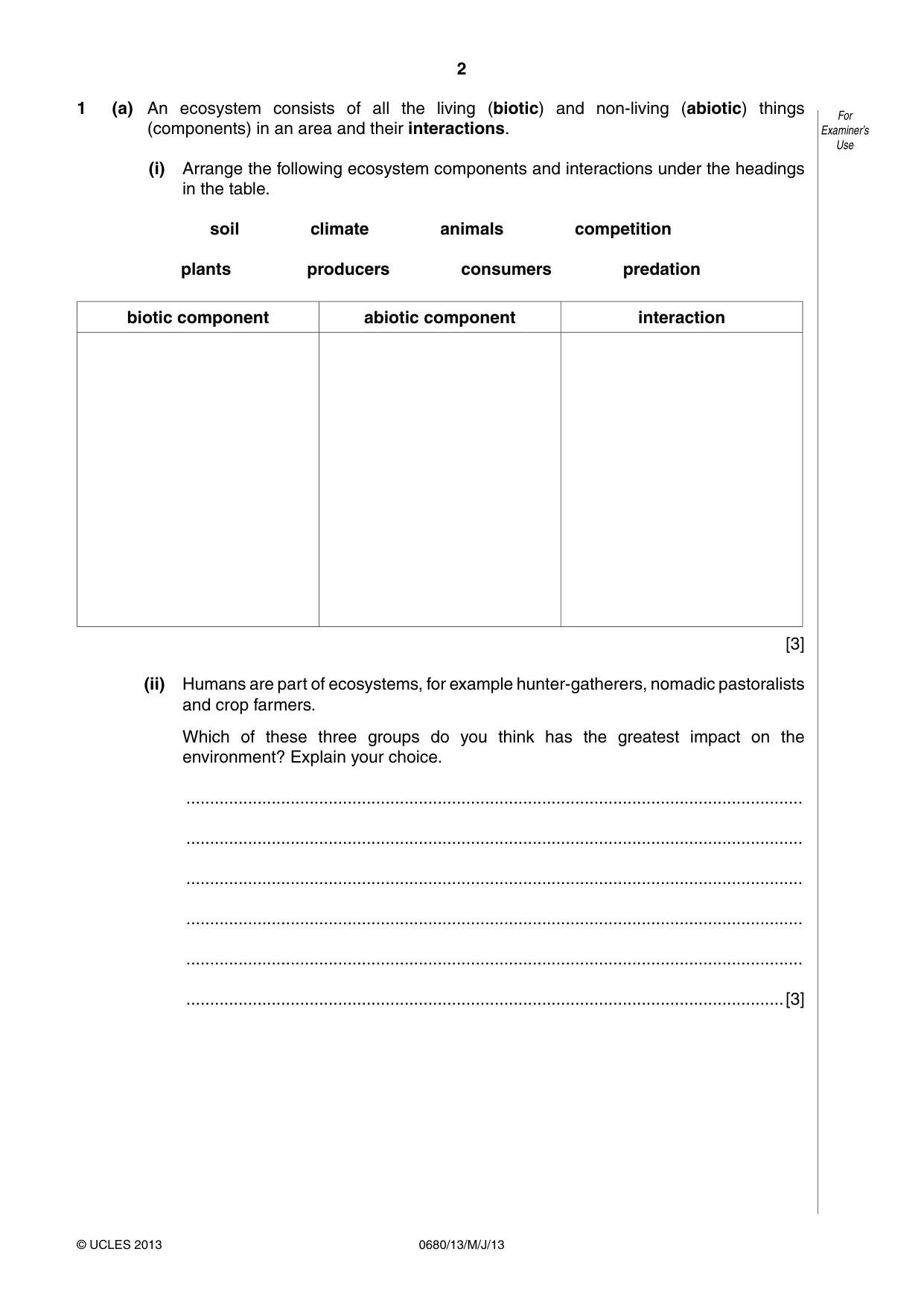
2 0680/13/M/J/13 © UCLES 2013 For Examiner’s Use 1 (a) An ecosystem consists of all the living (biotic) and non-living (abiotic) things (components) in an area and their interactions. (i) Arrange the following ecosystem components and interactions under the headings in the table. soil climate animals competition plants producers consumers predation biotic component abiotic component interaction [3] (ii) Humans are part of ecosystems, for example hunter-gatherers, nomadic pastoralists and crop farmers. Which of these three groups do you think has the greatest impact on the environment? Explain your choice. … … … … … …[3]
Question paper, page 3
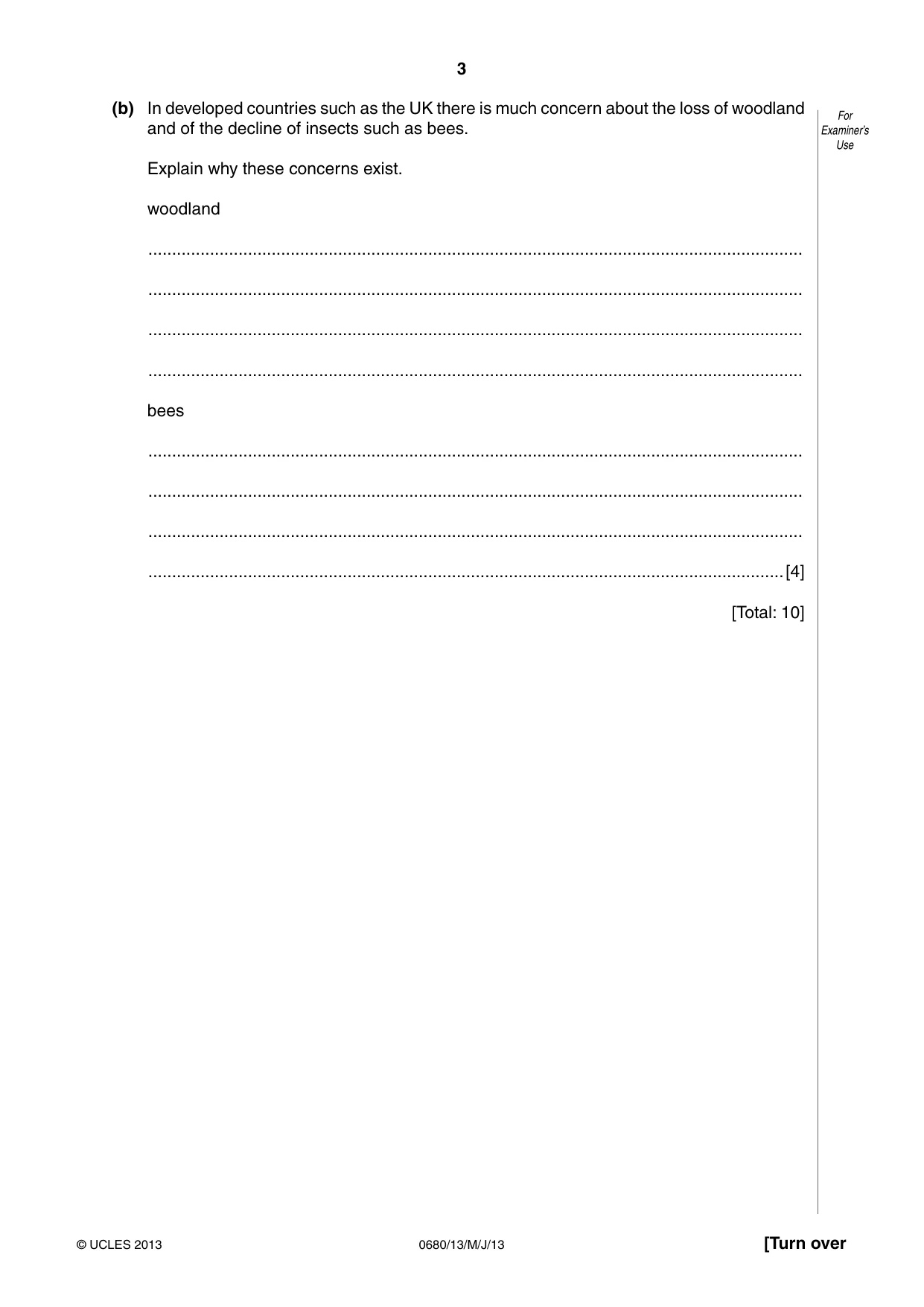
3 0680/13/M/J/13 © UCLES 2013 [Turn over For Examiner’s Use (b) In developed countries such as the UK there is much concern about the loss of woodland and of the decline of insects such as bees. Explain why these concerns exist. woodland … … … … bees … … … …[4] [Total: 10]
Question paper, page 4
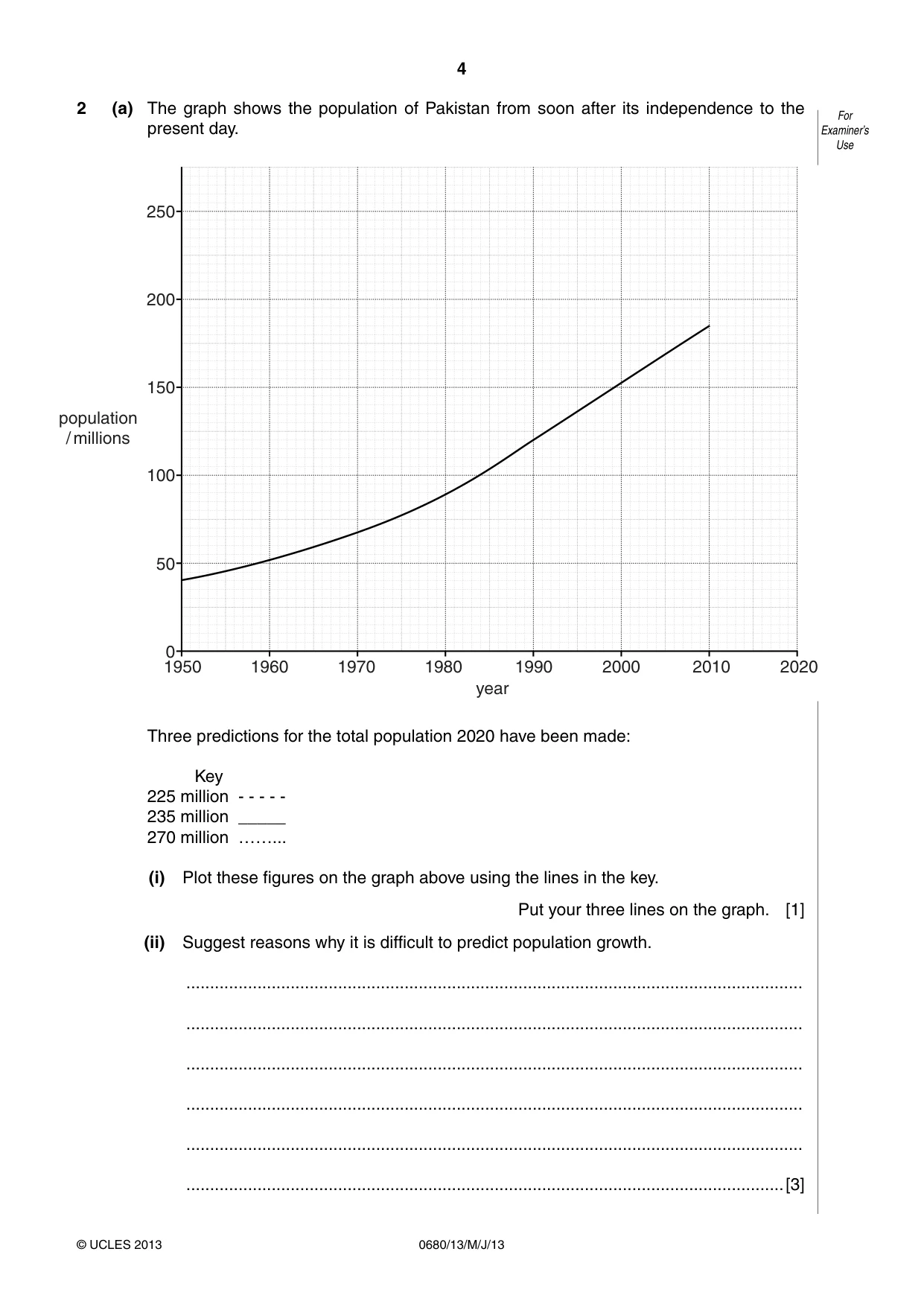
4 0680/13/M/J/13 © UCLES 2013 For Examiner’s Use 2 (a) The graph shows the population of Pakistan from soon after its independence to the present day. 1950 1960 1970 1980 1990 year 2000 2010 2020 0 100 150 50 200 population / millions 250 Three predictions for the total population 2020 have been made: Key 225 million - - - - - 235 million _____ 270 million ……... (i) Plot these figures on the graph above using the lines in the key. Put your three lines on the graph. [1] (ii) Suggest reasons why it is difficult to predict population growth. … … … … … …[3]
Question paper, page 5
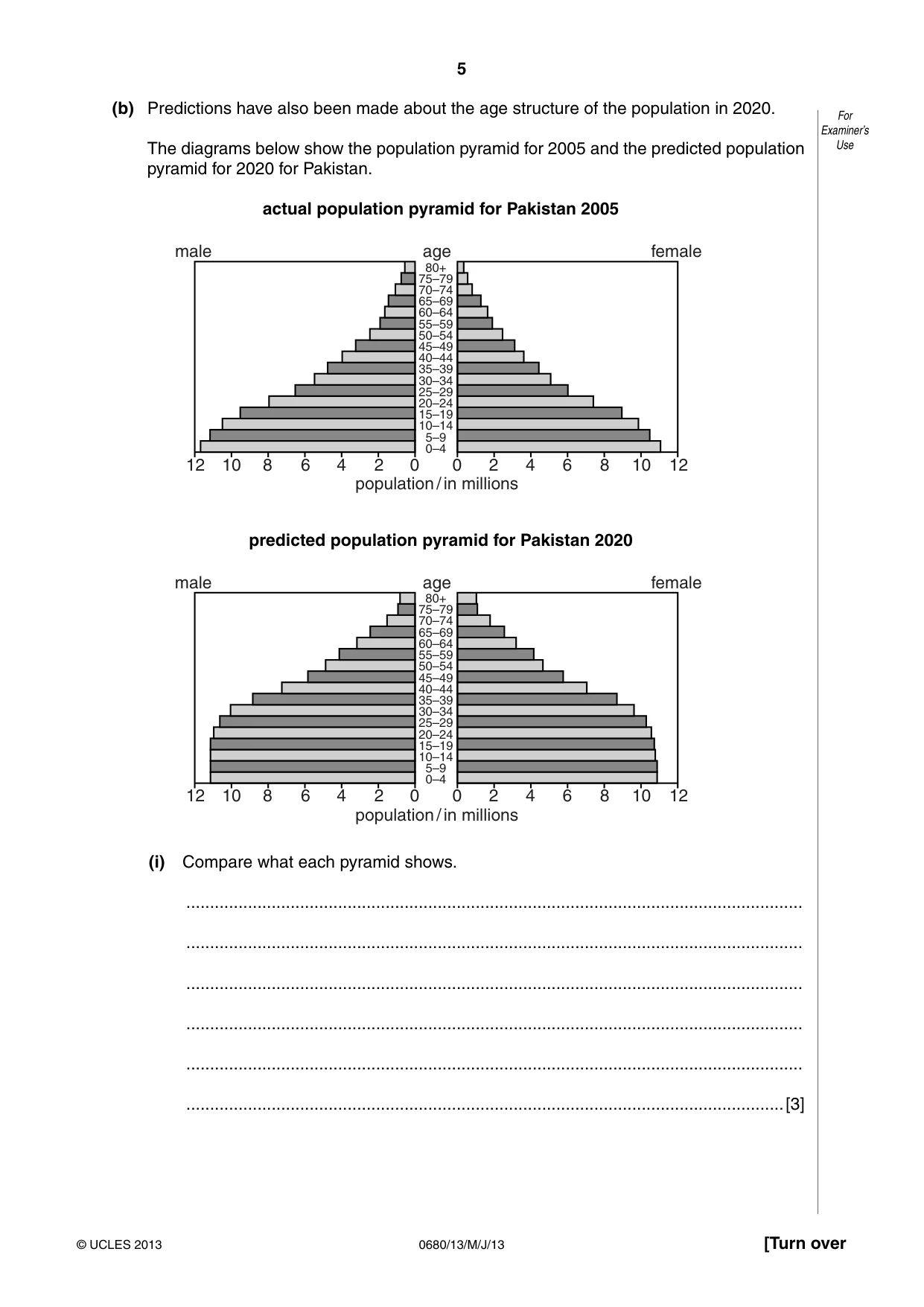
5 0680/13/M/J/13 © UCLES 2013 [Turn over For Examiner’s Use (b) Predictions have also been made about the age structure of the population in 2020. The diagrams below show the population pyramid for 2005 and the predicted population pyramid for 2020 for Pakistan. actual population pyramid for Pakistan 2005 12 12 10 10 8 8 6 6 4 4 2 2 0 0 80+ 75–79 70–74 65–69 60–64 55–59 50–54 45–49 40–44 35–39 30–34 25–29 20–24 15–19 10–14 5–9 0–4 male age population / in millions female predicted population pyramid for Pakistan 2020 12 12 10 10 8 8 6 6 4 4 2 2 0 0 80+ 75–79 70–74 65–69 60–64 55–59 50–54 45–49 40–44 35–39 30–34 25–29 20–24 15–19 10–14 5–9 0–4 male age population / in millions female (i) Compare what each pyramid shows. … … … … … …[3]
Question paper, page 6
6 0680/13/M/J/13 © UCLES 2013 For Examiner’s Use (ii) Suggest what the government of Pakistan might do to prepare for the changes that may occur by 2020. … … … … … …[3] [Total: 10]
Question paper, page 7
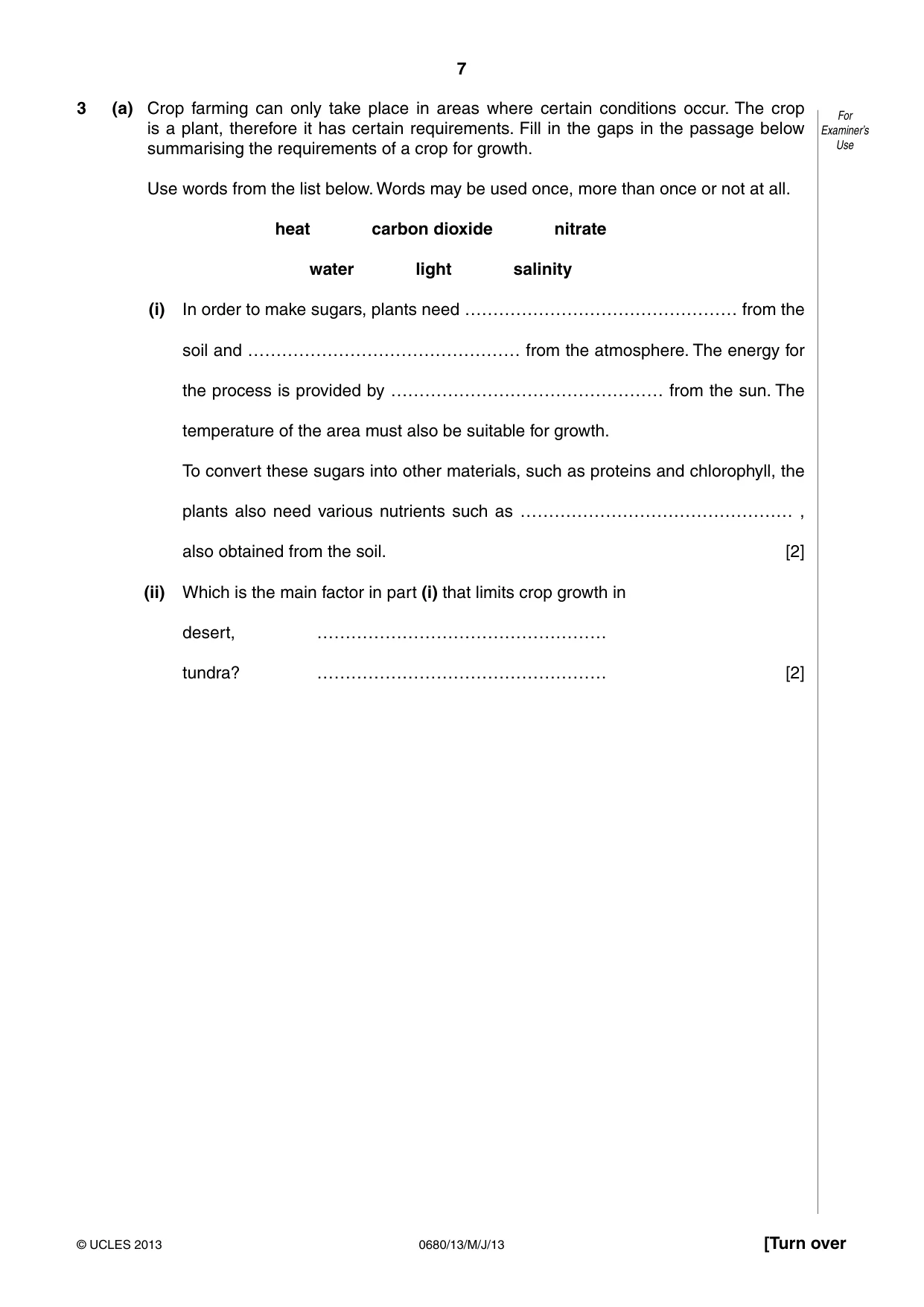
7 0680/13/M/J/13 © UCLES 2013 [Turn over For Examiner’s Use 3 (a) Crop farming can only take place in areas where certain conditions occur. The crop is a plant, therefore it has certain requirements. Fill in the gaps in the passage below summarising the requirements of a crop for growth. Use words from the list below. Words may be used once, more than once or not at all. heat carbon dioxide nitrate water light salinity (i) In order to make sugars, plants need ………………………………………… from the soil and ………………………………………… from the atmosphere. The energy for the process is provided by ………………………………………… from the sun. The temperature of the area must also be suitable for growth. To convert these sugars into other materials, such as proteins and chlorophyll, the plants also need various nutrients such as ………………………………………… , also obtained from the soil. [2] (ii) Which is the main factor in part (i) that limits crop growth in desert, …………………………………………… tundra? …………………………………………… [2]
Question paper, page 8
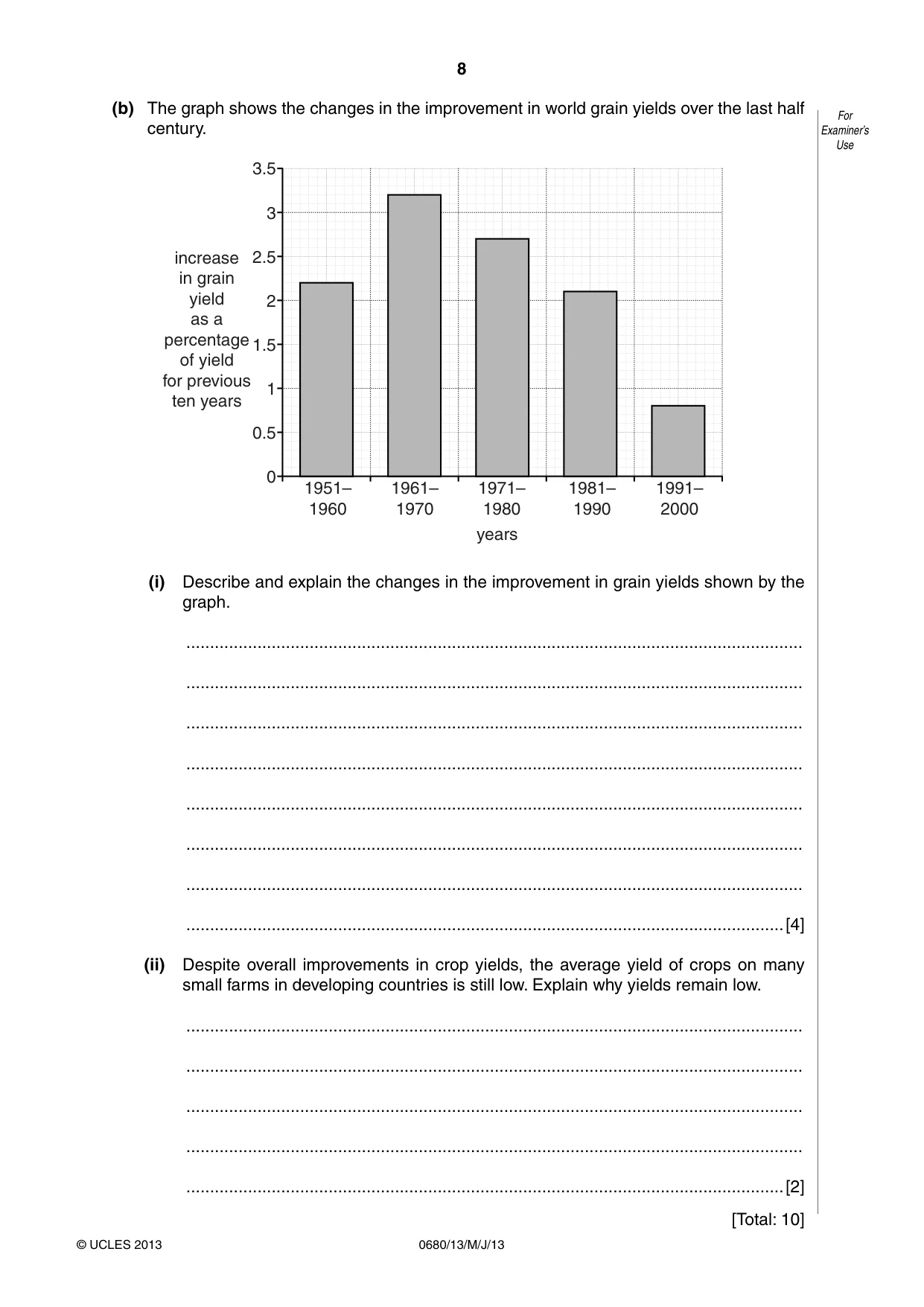
8 0680/13/M/J/13 © UCLES 2013 For Examiner’s Use (b) The graph shows the changes in the improvement in world grain yields over the last half century. 1951– 1960 1961– 1970 1971– 1980 1981– 1990 years 1991– 2000 0 2 3 3.5 1 1.5 2.5 0.5 increase in grain yield as a percentage of yield for previous ten years (i) Describe and explain the changes in the improvement in grain yields shown by the graph. … … … … … … … …[4] (ii) Despite overall improvements in crop yields, the average yield of crops on many small farms in developing countries is still low. Explain why yields remain low. … … … … …[2] [Total: 10]
Question paper, page 9
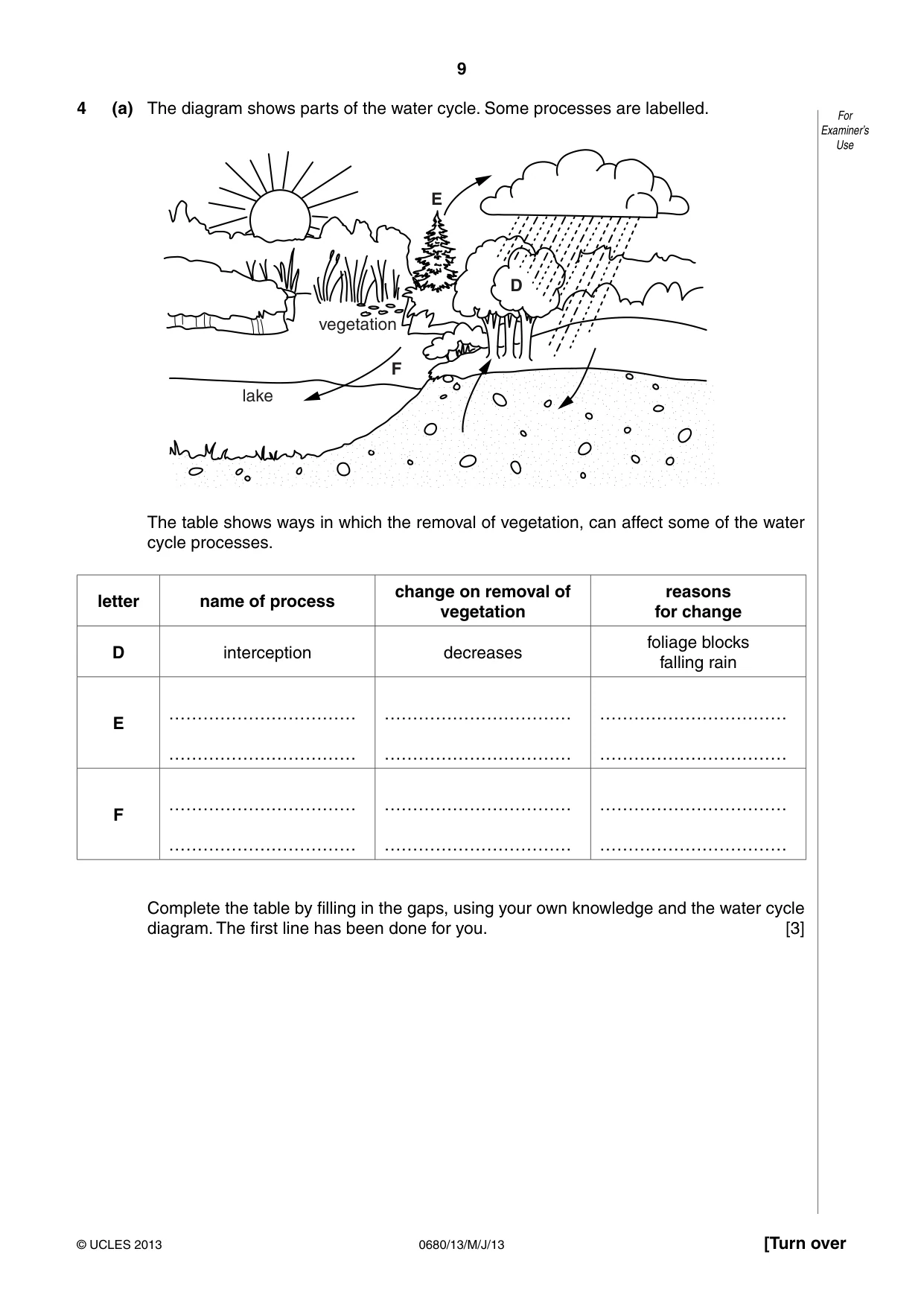
9 0680/13/M/J/13 © UCLES 2013 [Turn over For Examiner’s Use 4 (a) The diagram shows parts of the water cycle. Some processes are labelled. E D vegetation lake F The table shows ways in which the removal of vegetation, can affect some of the water cycle processes. letter name of process change on removal of vegetation reasons for change D interception decreases foliage blocks falling rain E …………………………… …………………………… …………………………… …………………………… …………………………… …………………………… F …………………………… …………………………… …………………………… …………………………… …………………………… …………………………… Complete the table by filling in the gaps, using your own knowledge and the water cycle diagram. The first line has been done for you. [3]
Question paper, page 10
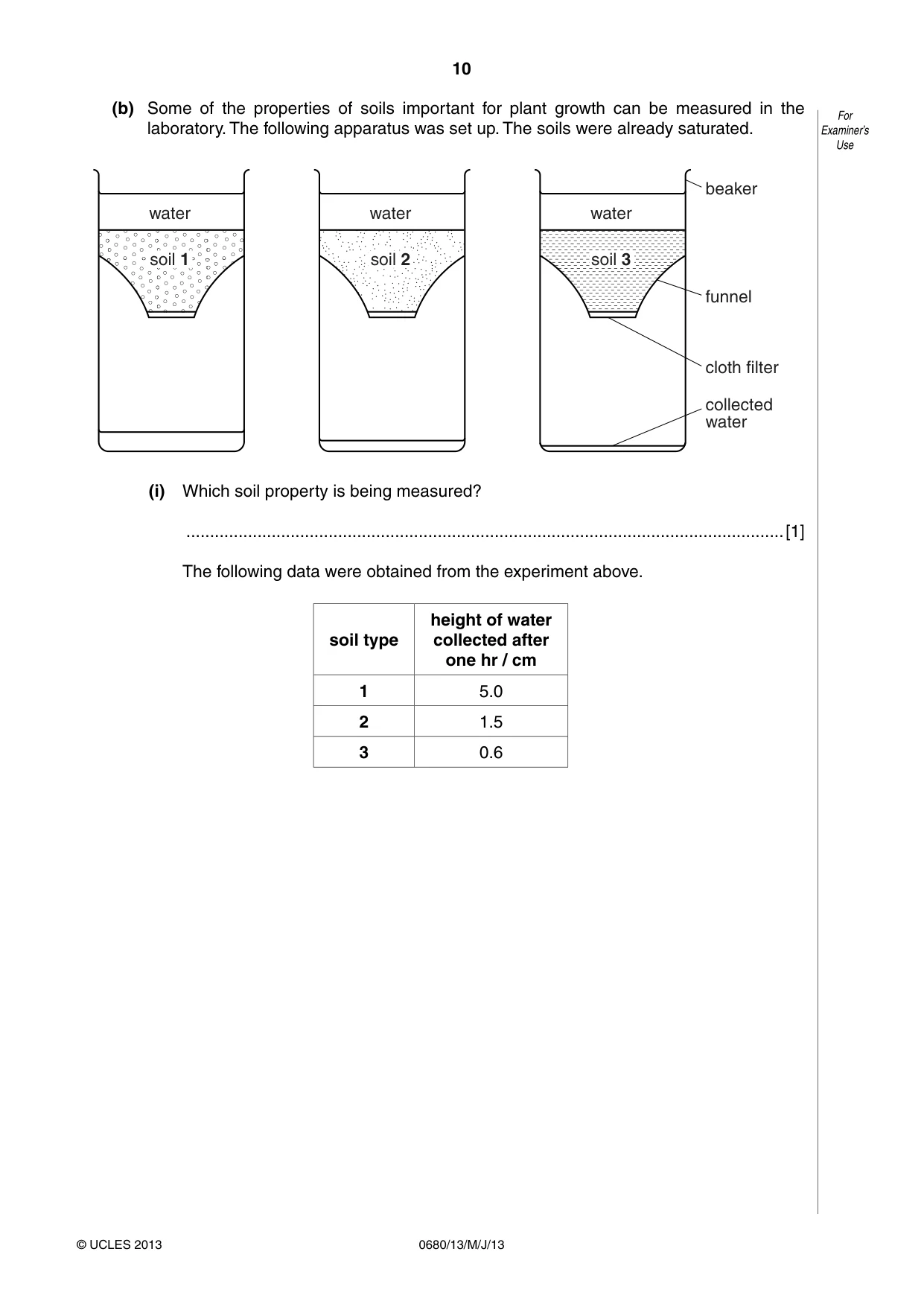
10 0680/13/M/J/13 © UCLES 2013 For Examiner’s Use (b) Some of the properties of soils important for plant growth can be measured in the laboratory. The following apparatus was set up. The soils were already saturated. cloth filter collected water funnel beaker water soil 1 water soil 2 water soil 3 (i) Which soil property is being measured? …[1] The following data were obtained from the experiment above. soil type height of water collected after one hr / cm 1 5.0 2 1.5 3 0.6
Question paper, page 11
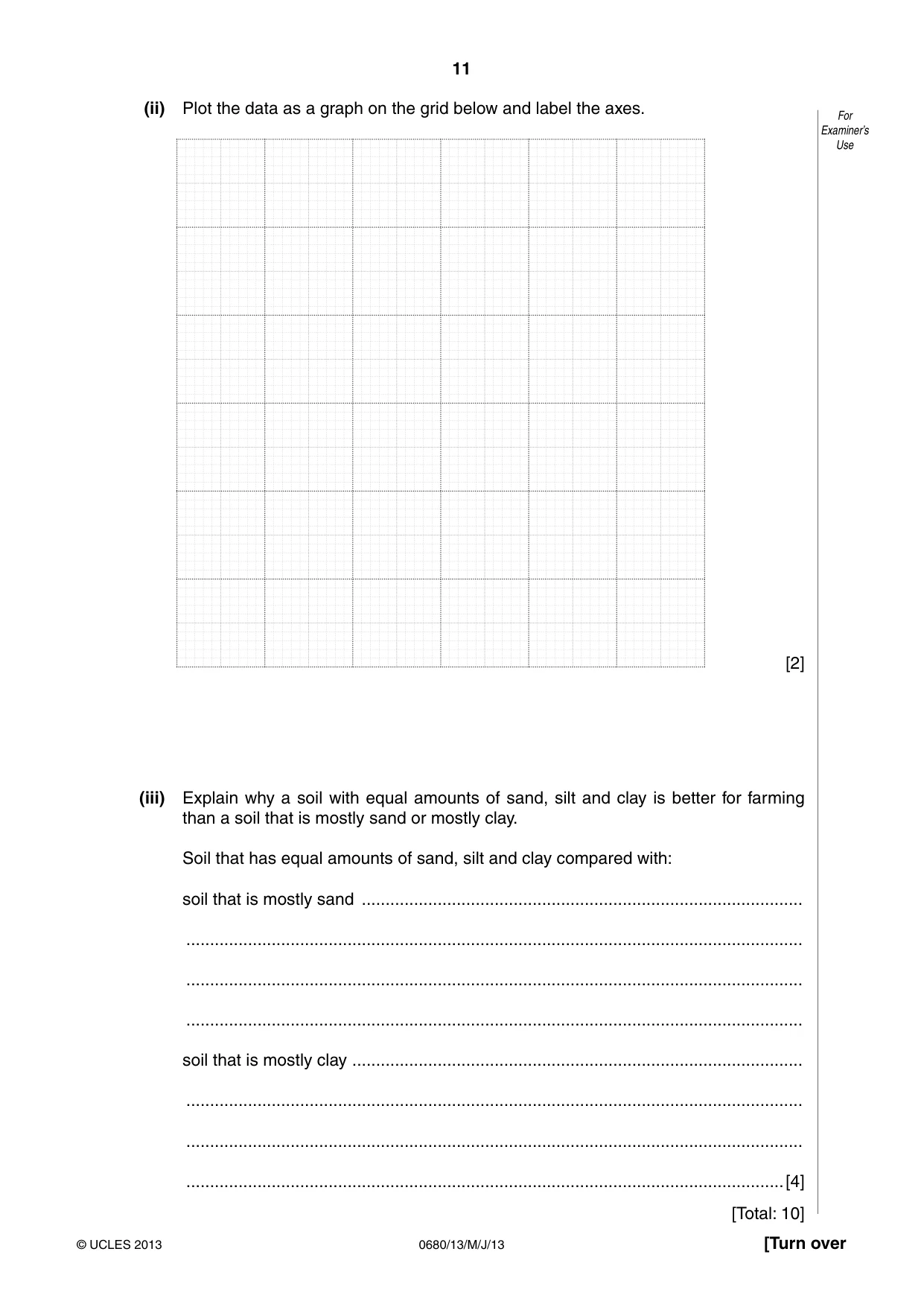
11 0680/13/M/J/13 © UCLES 2013 [Turn over For Examiner’s Use (ii) Plot the data as a graph on the grid below and label the axes. [2] (iii) Explain why a soil with equal amounts of sand, silt and clay is better for farming than a soil that is mostly sand or mostly clay. Soil that has equal amounts of sand, silt and clay compared with: soil that is mostly sand … … … … soil that is mostly clay … … … …[4] [Total: 10]
Question paper, page 12
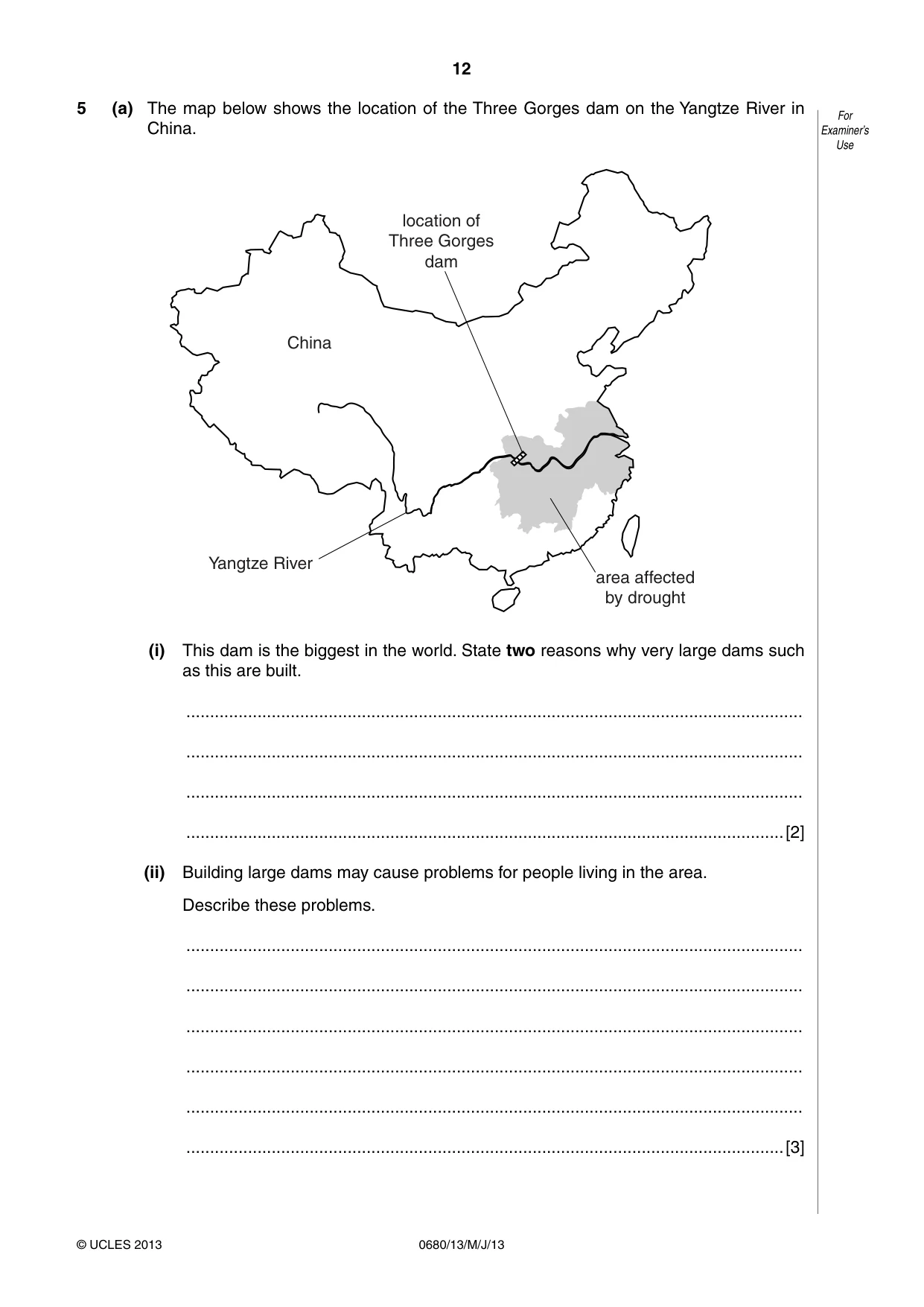
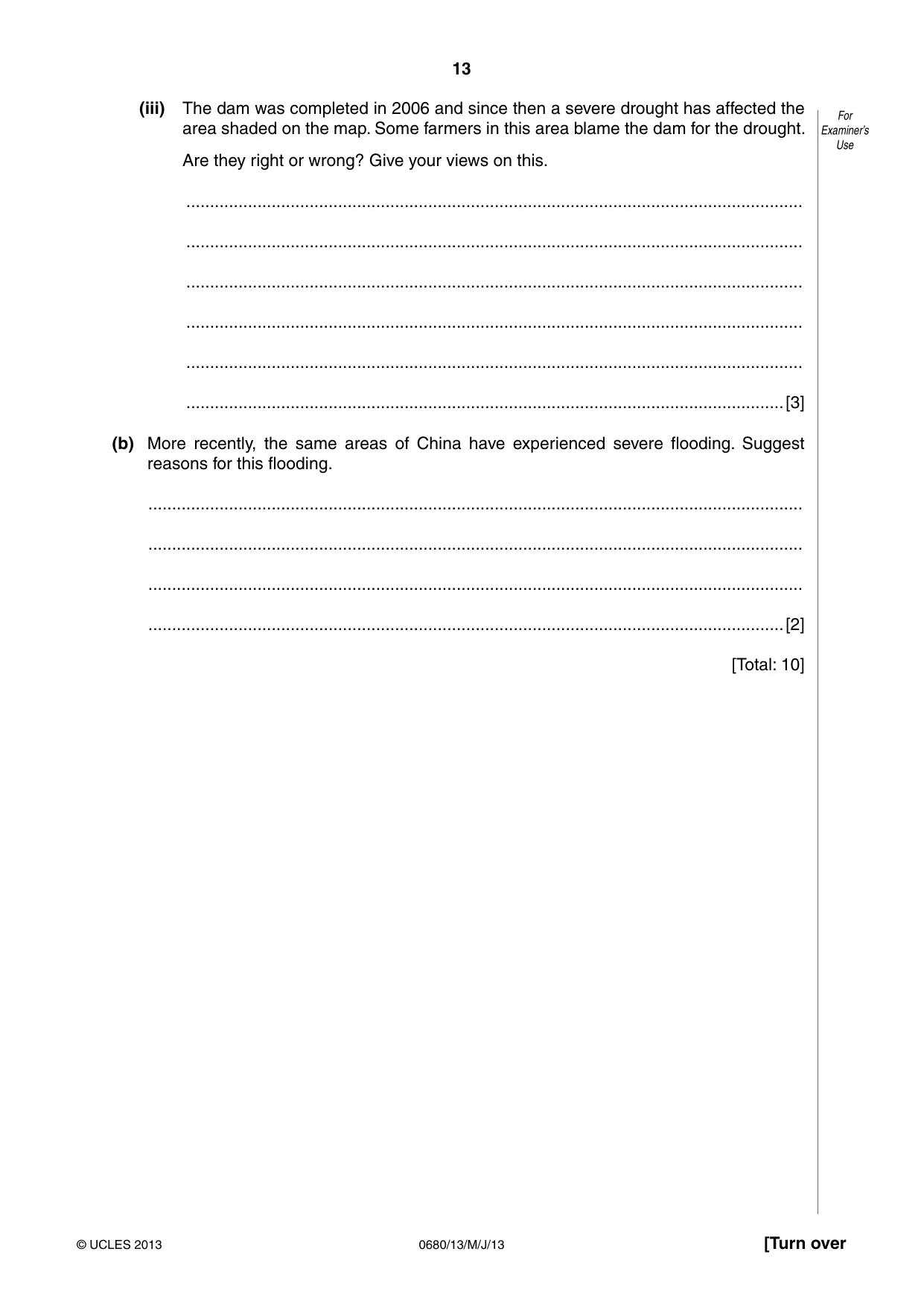
12 0680/13/M/J/13 © UCLES 2013 For Examiner’s Use 5 (a) The map below shows the location of the Three Gorges dam on the Yangtze River in China. China Yangtze River area affected by drought location of Three Gorges dam (i) This dam is the biggest in the world. State two reasons why very large dams such as this are built. … … … …[2] (ii) Building large dams may cause problems for people living in the area. Describe these problems. … … … … … …[3]
Question paper, page 13
13 0680/13/M/J/13 © UCLES 2013 [Turn over For Examiner’s Use (iii) The dam was completed in 2006 and since then a severe drought has affected the area shaded on the map. Some farmers in this area blame the dam for the drought. Are they right or wrong? Give your views on this. … … … … … …[3] (b) More recently, the same areas of China have experienced severe flooding. Suggest reasons for this flooding. … … … …[2] [Total: 10]
Question paper, page 14
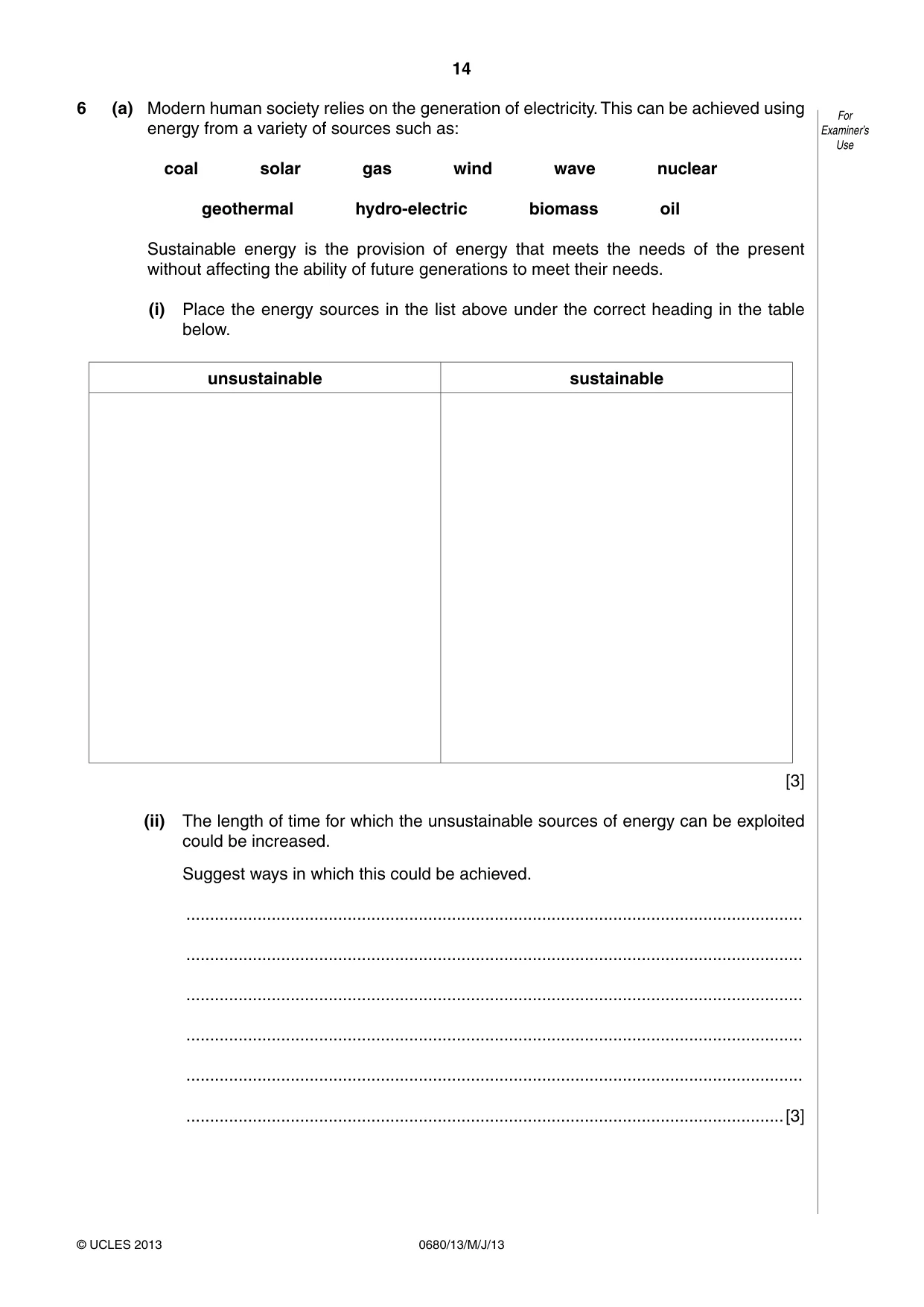
14 0680/13/M/J/13 © UCLES 2013 For Examiner’s Use 6 (a) Modern human society relies on the generation of electricity. This can be achieved using energy from a variety of sources such as: coal solar gas wind wave nuclear geothermal hydro-electric biomass oil Sustainable energy is the provision of energy that meets the needs of the present without affecting the ability of future generations to meet their needs. (i) Place the energy sources in the list above under the correct heading in the table below. unsustainable sustainable [3] (ii) The length of time for which the unsustainable sources of energy can be exploited could be increased. Suggest ways in which this could be achieved. … … … … … …[3]
Question paper, page 15
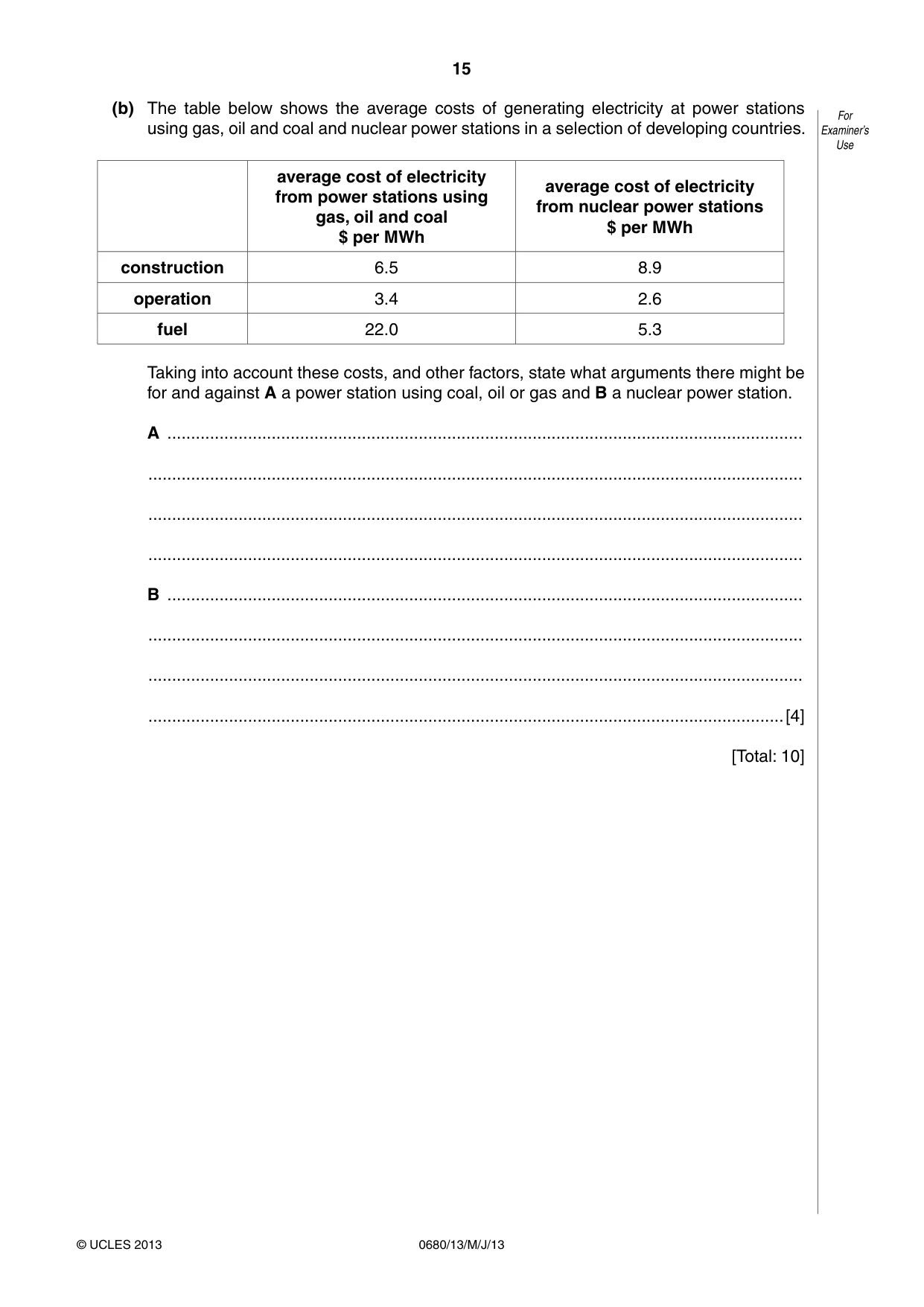
15 0680/13/M/J/13 © UCLES 2013 For Examiner’s Use (b) The table below shows the average costs of generating electricity at power stations using gas, oil and coal and nuclear power stations in a selection of developing countries. average cost of electricity from power stations using gas, oil and coal $ per MWh average cost of electricity from nuclear power stations $ per MWh construction 6.5 8.9 operation 3.4 2.6 fuel 22.0 5.3 Taking into account these costs, and other factors, state what arguments there might be for and against A a power station using coal, oil or gas and B a nuclear power station. A … … … … B … … … …[4] [Total: 10]
Question paper, page 16
16 0680/13/M/J/13 © UCLES 2013 BLANK PAGE Permission to reproduce items where third-party owned material protected by copyright is included has been sought and cleared where possible. Every reasonable effort has been made by the publisher (UCLES) to trace copyright holders, but if any items requiring clearance have unwittingly been included, the publisher will be pleased to make amends at the earliest possible opportunity. University of Cambridge International Examinations is part of the Cambridge Assessment Group. Cambridge Assessment is the brand name of University of Cambridge Local Examinations Syndicate (UCLES), which is itself a department of the University of Cambridge.
Mark scheme, page 1
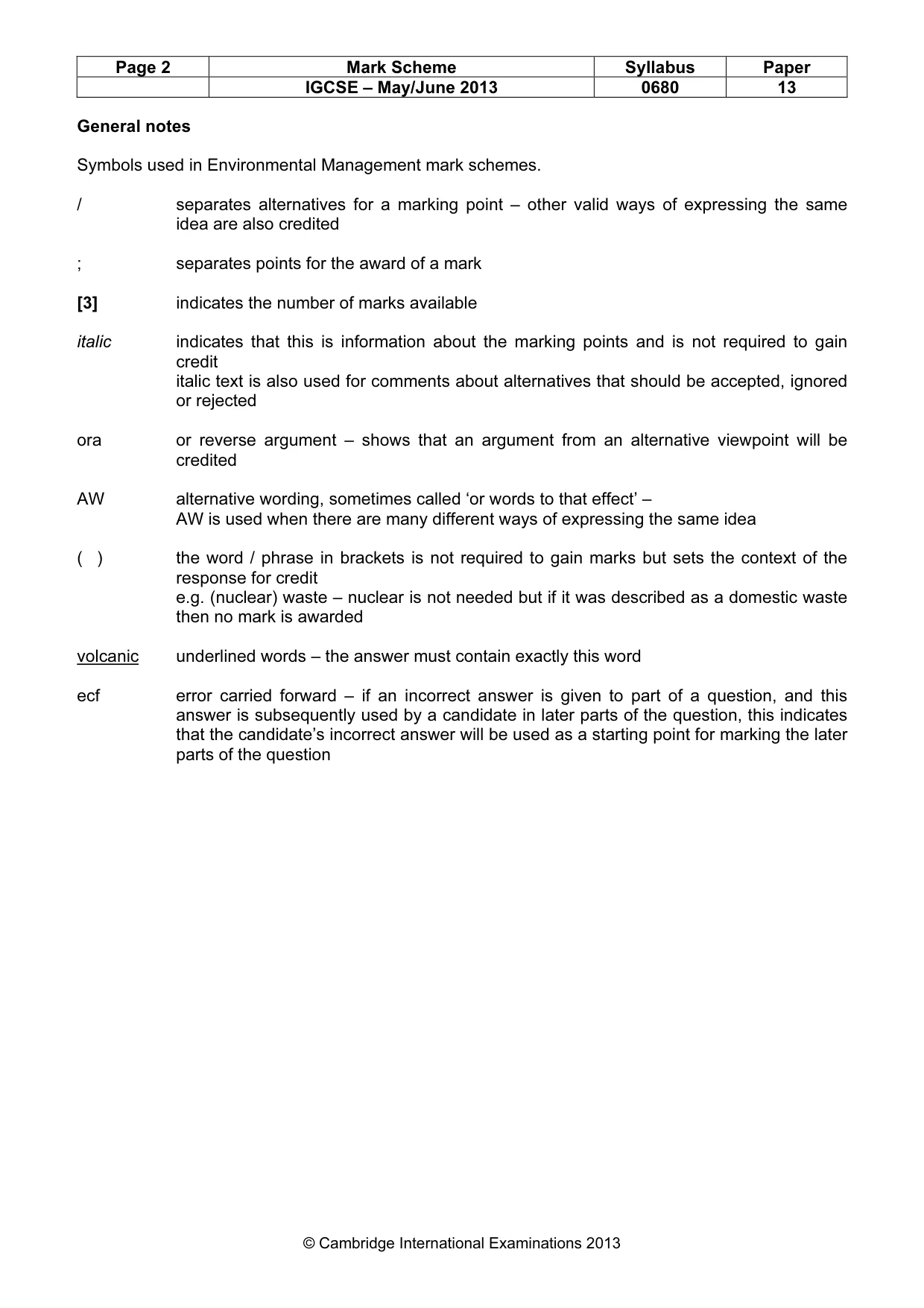
CAMBRIDGE INTERNATIONAL EXAMINATIONS International General Certificate of Secondary Education MARK SCHEME for the May/June 2013 series 0680 ENVIRONMENTAL MANAGEMENT 0680/13 Paper 1, maximum raw mark 60 This mark scheme is published as an aid to teachers and candidates, to indicate the requirements of the examination. It shows the basis on which Examiners were instructed to award marks. It does not indicate the details of the discussions that took place at an Examiners’ meeting before marking began, which would have considered the acceptability of alternative answers. Mark schemes should be read in conjunction with the question paper and the Principal Examiner Report for Teachers. Cambridge will not enter into discussions about these mark schemes. Cambridge is publishing the mark schemes for the May/June 2013 series for most IGCSE, GCE Advanced Level and Advanced Subsidiary Level components and some Ordinary Level components.
Mark scheme, page 2
Page 2 Mark Scheme Syllabus Paper IGCSE – May/June 2013 0680 13 © Cambridge International Examinations 2013 General notes Symbols used in Environmental Management mark schemes. / separates alternatives for a marking point – other valid ways of expressing the same idea are also credited ; separates points for the award of a mark [3] indicates the number of marks available italic indicates that this is information about the marking points and is not required to gain credit italic text is also used for comments about alternatives that should be accepted, ignored or rejected ora or reverse argument – shows that an argument from an alternative viewpoint will be credited AW alternative wording, sometimes called ‘or words to that effect’ – AW is used when there are many different ways of expressing the same idea ( ) the word / phrase in brackets is not required to gain marks but sets the context of the response for credit e.g. (nuclear) waste – nuclear is not needed but if it was described as a domestic waste then no mark is awarded volcanic underlined words – the answer must contain exactly this word ecf error carried forward – if an incorrect answer is given to part of a question, and this answer is subsequently used by a candidate in later parts of the question, this indicates that the candidate’s incorrect answer will be used as a starting point for marking the later parts of the question
Mark scheme, page 3
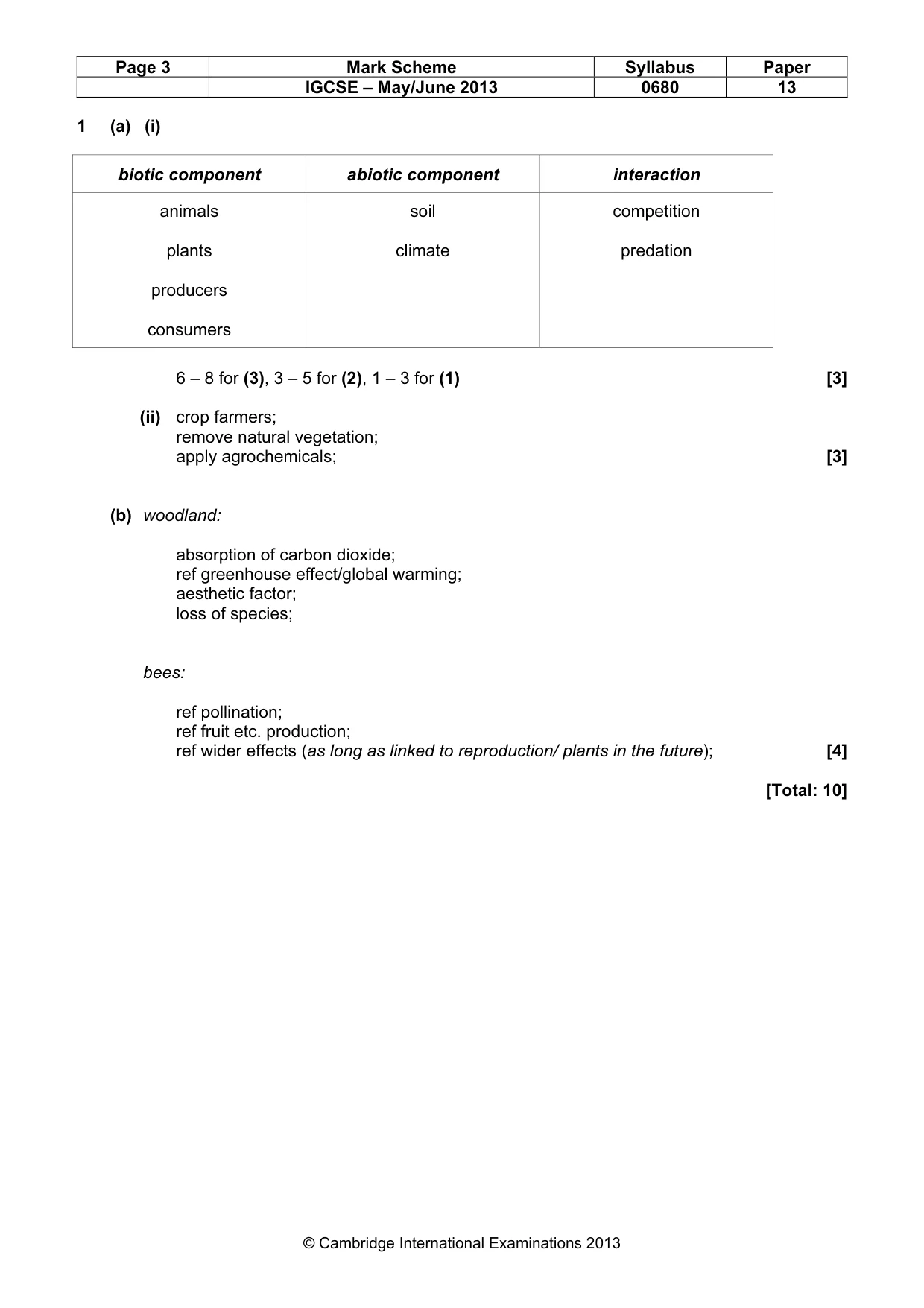
Page 3 Mark Scheme Syllabus Paper IGCSE – May/June 2013 0680 13 © Cambridge International Examinations 2013 1 (a) (i) biotic component abiotic component interaction animals plants producers consumers soil climate competition predation 6 – 8 for (3), 3 – 5 for (2), 1 – 3 for (1) [3] (ii) crop farmers; remove natural vegetation; apply agrochemicals; [3] (b) woodland: absorption of carbon dioxide; ref greenhouse effect/global warming; aesthetic factor; loss of species; bees: ref pollination; ref fruit etc. production; ref wider effects (as long as linked to reproduction/ plants in the future); [4] [Total: 10]
Mark scheme, page 4
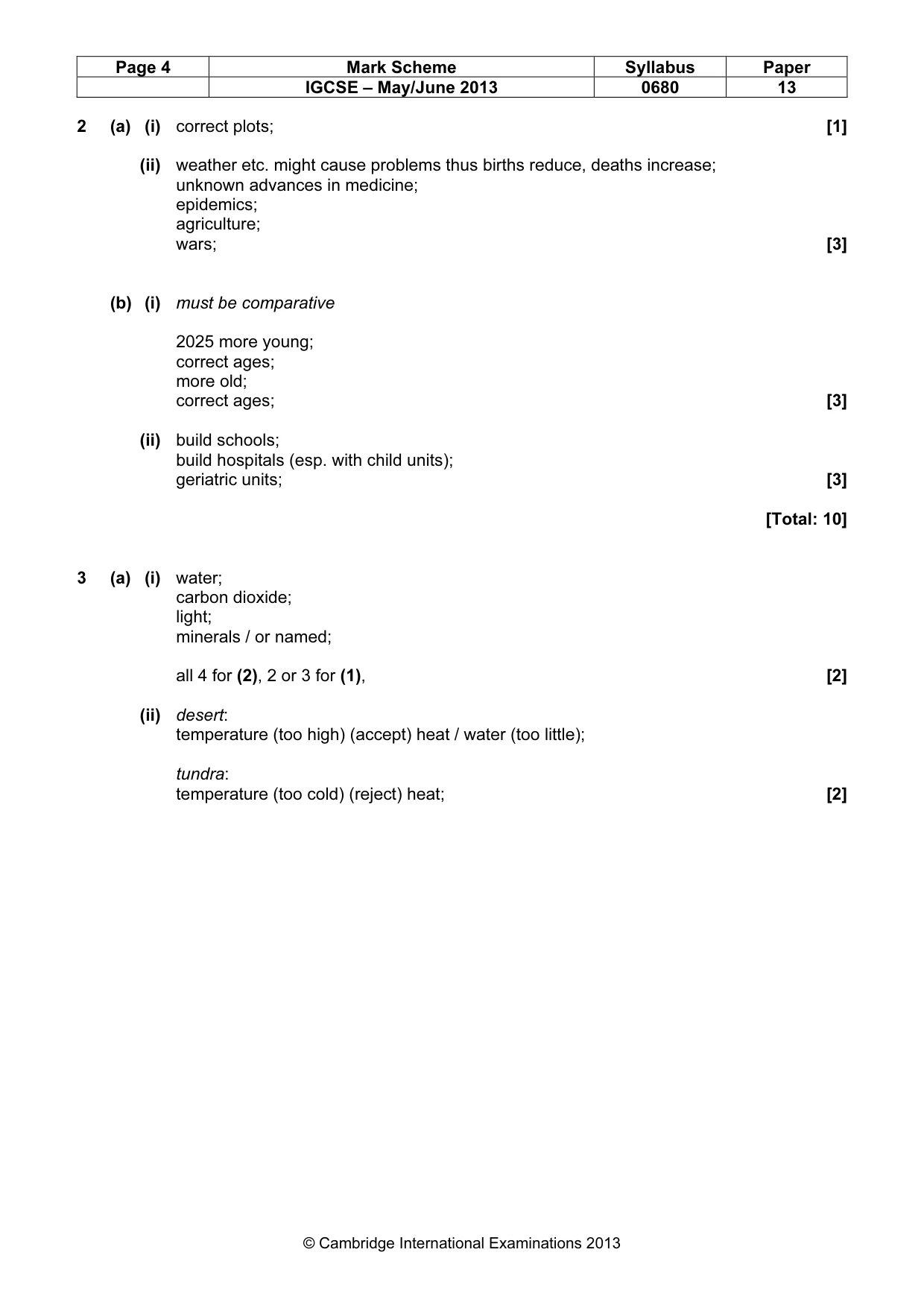
Page 4 Mark Scheme Syllabus Paper IGCSE – May/June 2013 0680 13 © Cambridge International Examinations 2013 2 (a) (i) correct plots; [1] (ii) weather etc. might cause problems thus births reduce, deaths increase; unknown advances in medicine; epidemics; agriculture; wars; [3] (b) (i) must be comparative 2025 more young; correct ages; more old; correct ages; [3] (ii) build schools; build hospitals (esp. with child units); geriatric units; [3] [Total: 10] 3 (a) (i) water; carbon dioxide; light; minerals / or named; all 4 for (2), 2 or 3 for (1), [2] (ii) desert: temperature (too high) (accept) heat / water (too little); tundra: temperature (too cold) (reject) heat; [2]
Mark scheme, page 5
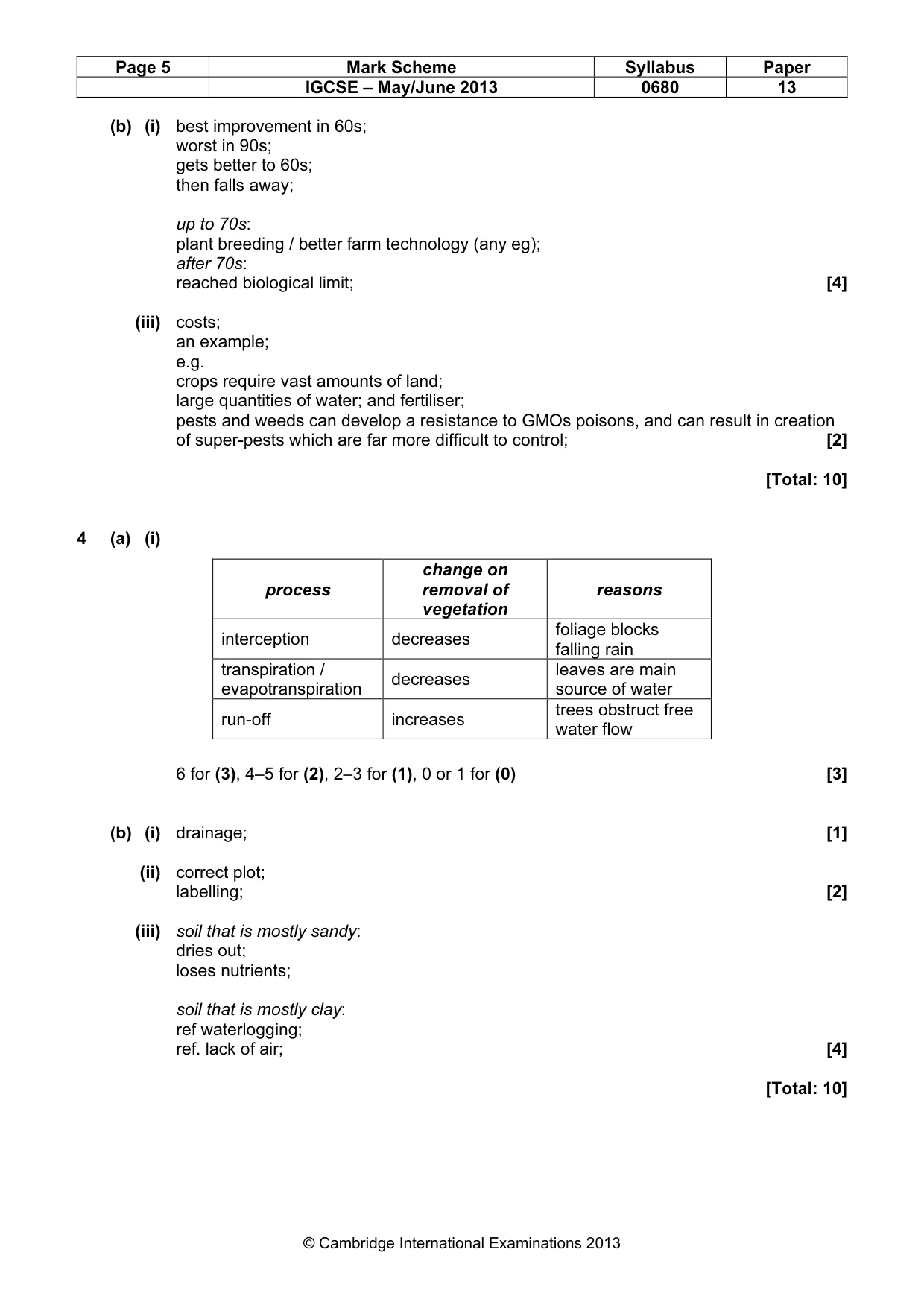
Page 5 Mark Scheme Syllabus Paper IGCSE – May/June 2013 0680 13 © Cambridge International Examinations 2013 (b) (i) best improvement in 60s; worst in 90s; gets better to 60s; then falls away; up to 70s: plant breeding / better farm technology (any eg); after 70s: reached biological limit; [4] (iii) costs; an example; e.g. crops require vast amounts of land; large quantities of water; and fertiliser; pests and weeds can develop a resistance to GMOs poisons, and can result in creation of super-pests which are far more difficult to control; [2] [Total: 10] 4 (a) (i) 6 for (3), 4–5 for (2), 2–3 for (1), 0 or 1 for (0) [3] (b) (i) drainage; [1] (ii) correct plot; labelling; [2] (iii) soil that is mostly sandy: dries out; loses nutrients; soil that is mostly clay: ref waterlogging; ref. lack of air; [4] [Total: 10] process change on removal of vegetation reasons interception decreases foliage blocks falling rain transpiration / evapotranspiration decreases leaves are main source of water run-off increases trees obstruct free water flow
Mark scheme, page 6
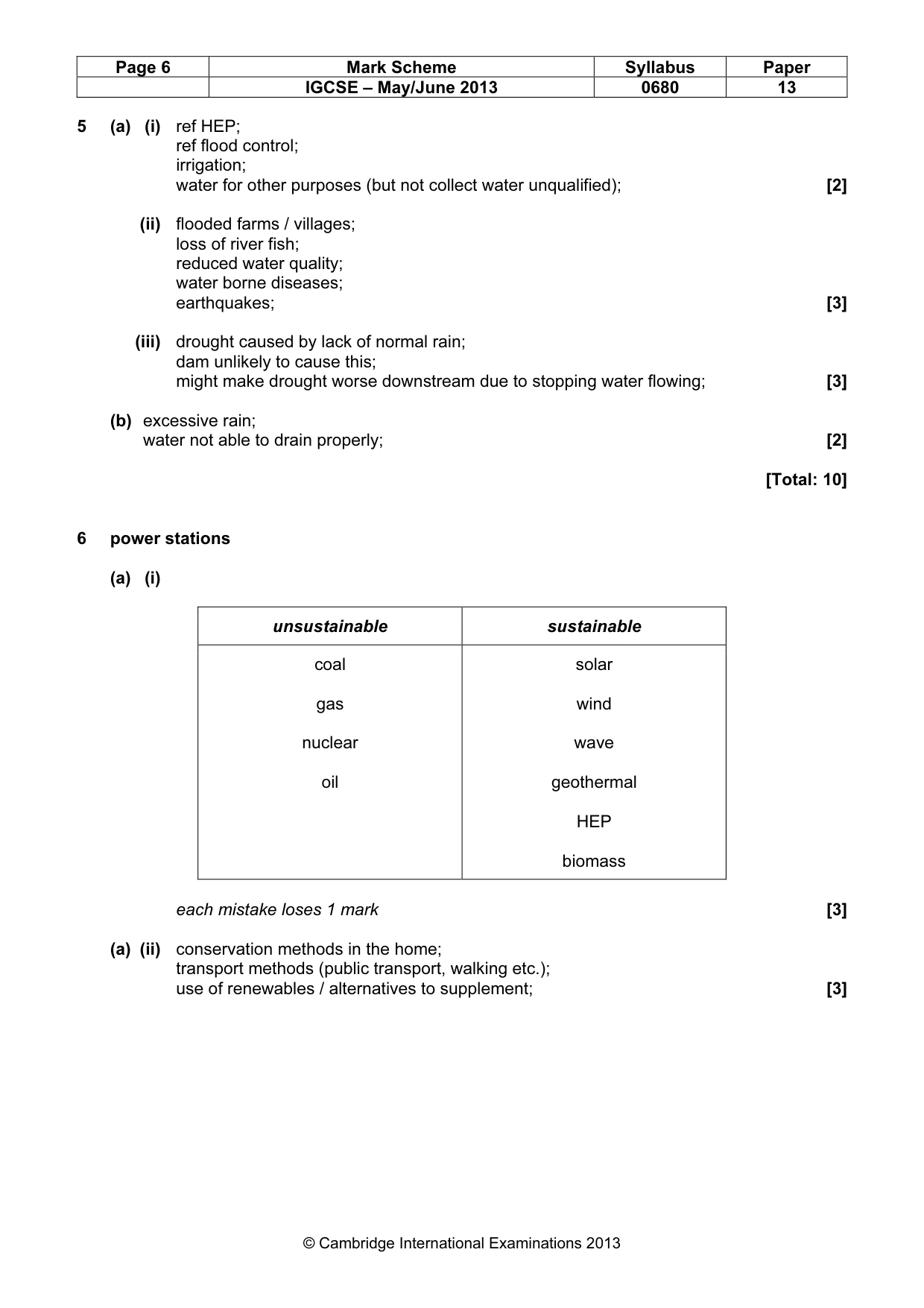
Page 6 Mark Scheme Syllabus Paper IGCSE – May/June 2013 0680 13 © Cambridge International Examinations 2013 5 (a) (i) ref HEP; ref flood control; irrigation; water for other purposes (but not collect water unqualified); [2] (ii) flooded farms / villages; loss of river fish; reduced water quality; water borne diseases; earthquakes; [3] (iii) drought caused by lack of normal rain; dam unlikely to cause this; might make drought worse downstream due to stopping water flowing; [3] (b) excessive rain; water not able to drain properly; [2] [Total: 10] 6 power stations (a) (i) unsustainable sustainable coal gas nuclear oil solar wind wave geothermal HEP biomass each mistake loses 1 mark [3] (a) (ii) conservation methods in the home; transport methods (public transport, walking etc.); use of renewables / alternatives to supplement; [3]
Mark scheme, page 7
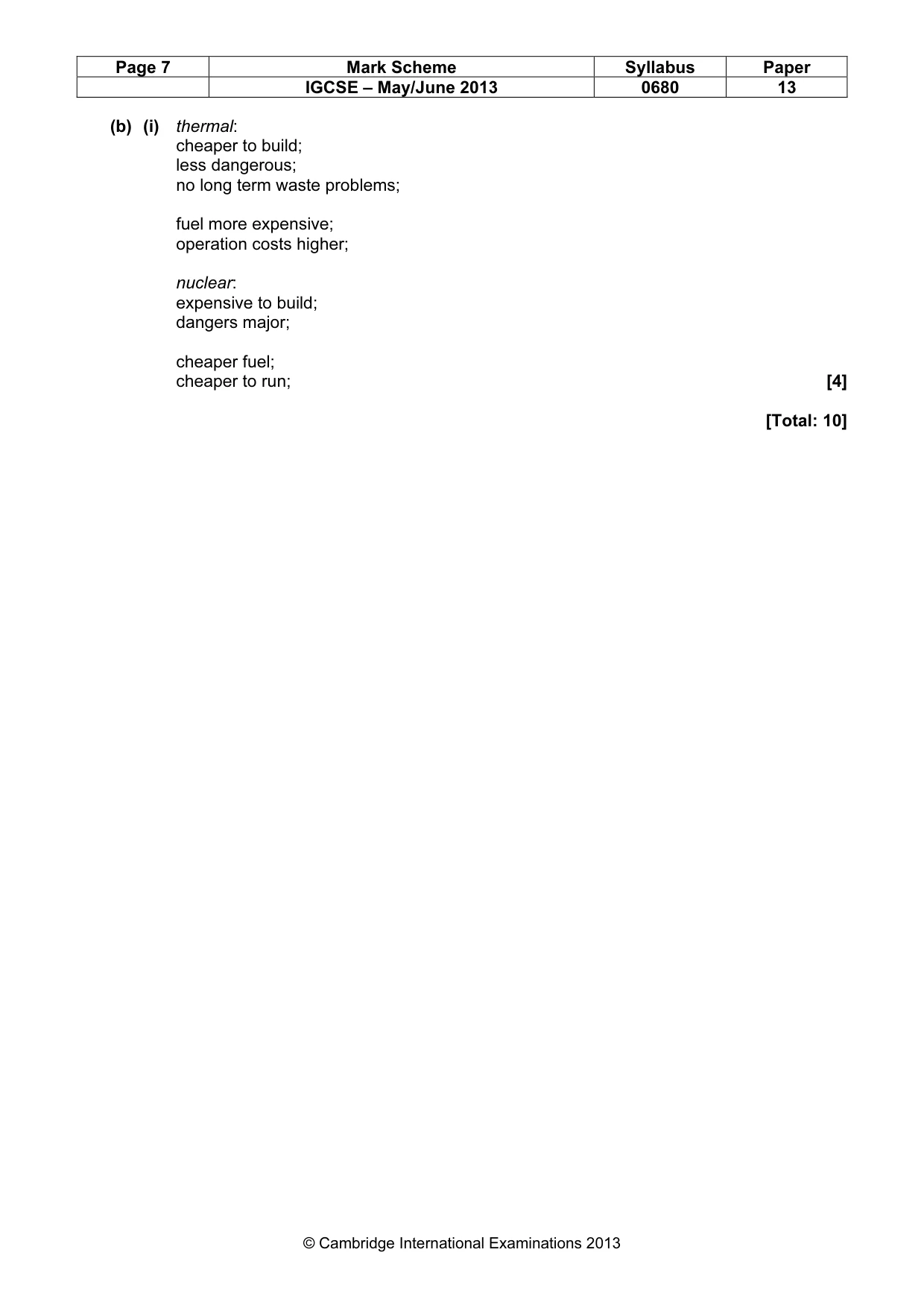
Page 7 Mark Scheme Syllabus Paper IGCSE – May/June 2013 0680 13 © Cambridge International Examinations 2013 (b) (i) thermal: cheaper to build; less dangerous; no long term waste problems; fuel more expensive; operation costs higher; nuclear: expensive to build; dangers major; cheaper fuel; cheaper to run; [4] [Total: 10]
What you needed in this session
Cambridge’s own grade thresholds for 2013 May/June, Paper 1 · Variant 3. A higher threshold means an easier paper — the bar moves with how the cohort did.