Cambridge IGCSE Environmental Management 0680 — 2011 Oct/Nov Paper 2 · Variant 1
0680/21/O/N/11 · 80 marks · ≈90 min
The question paper and its mark scheme, free to read here and free to download. This is Cambridge’s own paper, exactly as it was sat.
Question paper20 pages









Mark scheme7 pages
Answers below. Sit the paper first if you are practising.
Paper as text
Question paper, page 1
This document consists of 17 printed pages and 3 blank pages. DC (NH/JG) 33872/6 © UCLES 2011 [Turn over UNIVERSITY OF CAMBRIDGE INTERNATIONAL EXAMINATIONS International General Certificate of Secondary Education * 5 8 9 6 3 8 0 2 9 8 * ENVIRONMENTAL MANAGEMENT 0680/21 Paper 2 October/November 2011 1 hour 45 minutes Candidates answer on the Question Paper. Additional Materials: Ruler READ THESE INSTRUCTIONS FIRST Write your Centre number, candidate number and name on all the work you hand in. Write in dark blue or black pen. You may use a soft pencil for any diagrams, graphs or rough working. Do not use staples, paper clips, highlighters, glue or correction fluid. DO NOT WRITE IN ANY BARCODES. Answer both questions. At the end of the examination, fasten all your work securely together. The number of marks is given in brackets [ ] at the end of each question or part question. For Examiner’s Use 1 2 Total www.XtremePapers.com
Question paper, page 2
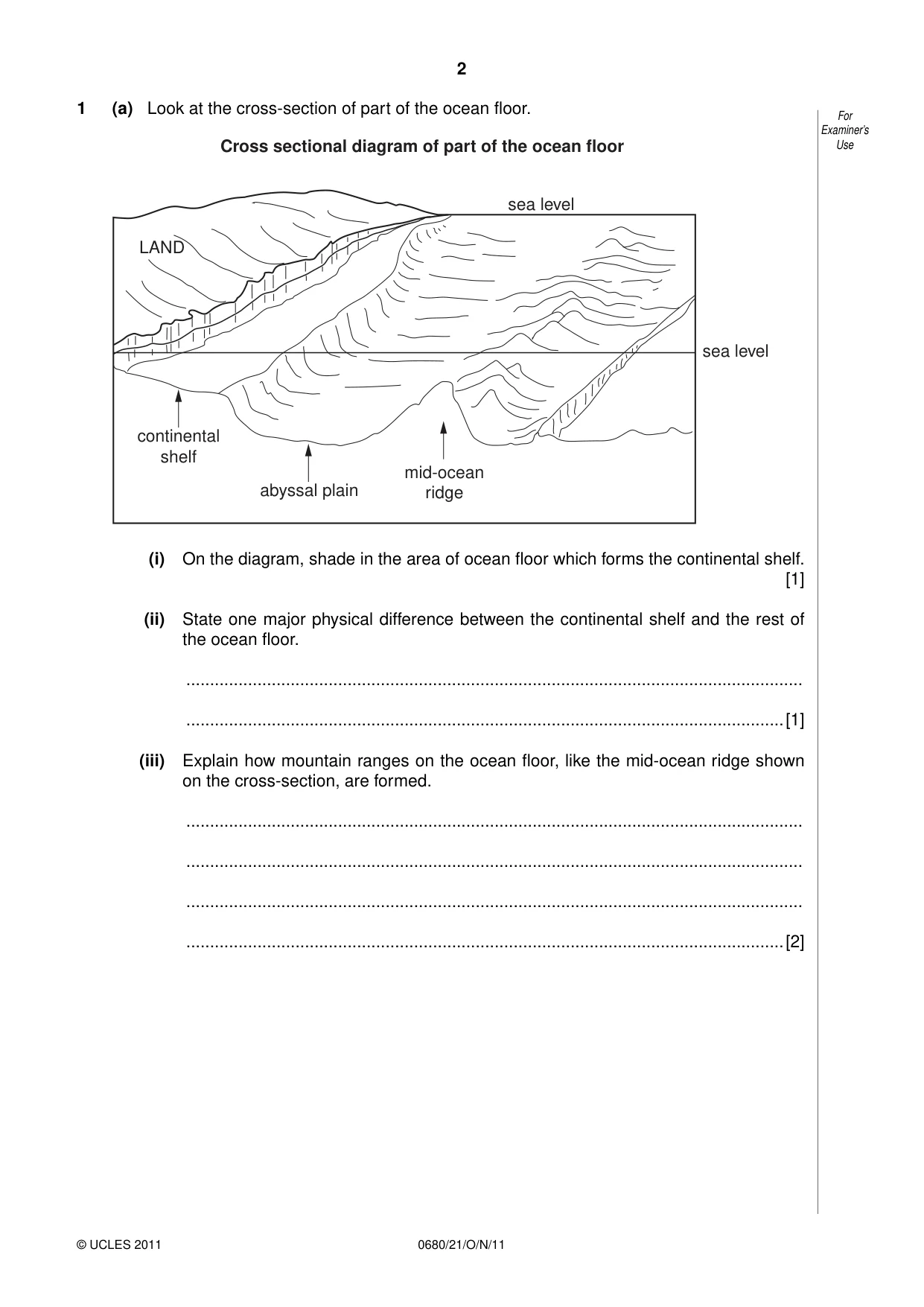
2 0680/21/O/N/11 © UCLES 2011 For Examiner’s Use 1 (a) Look at the cross-section of part of the ocean floor. abyssal plain continental shelf mid-ocean ridge sea level sea level LAND Cross sectional diagram of part of the ocean floor (i) On the diagram, shade in the area of ocean floor which forms the continental shelf. [1] (ii) State one major physical difference between the continental shelf and the rest of the ocean floor. … …[1] (iii) Explain how mountain ranges on the ocean floor, like the mid-ocean ridge shown on the cross-section, are formed. … … … …[2]
Question paper, page 3
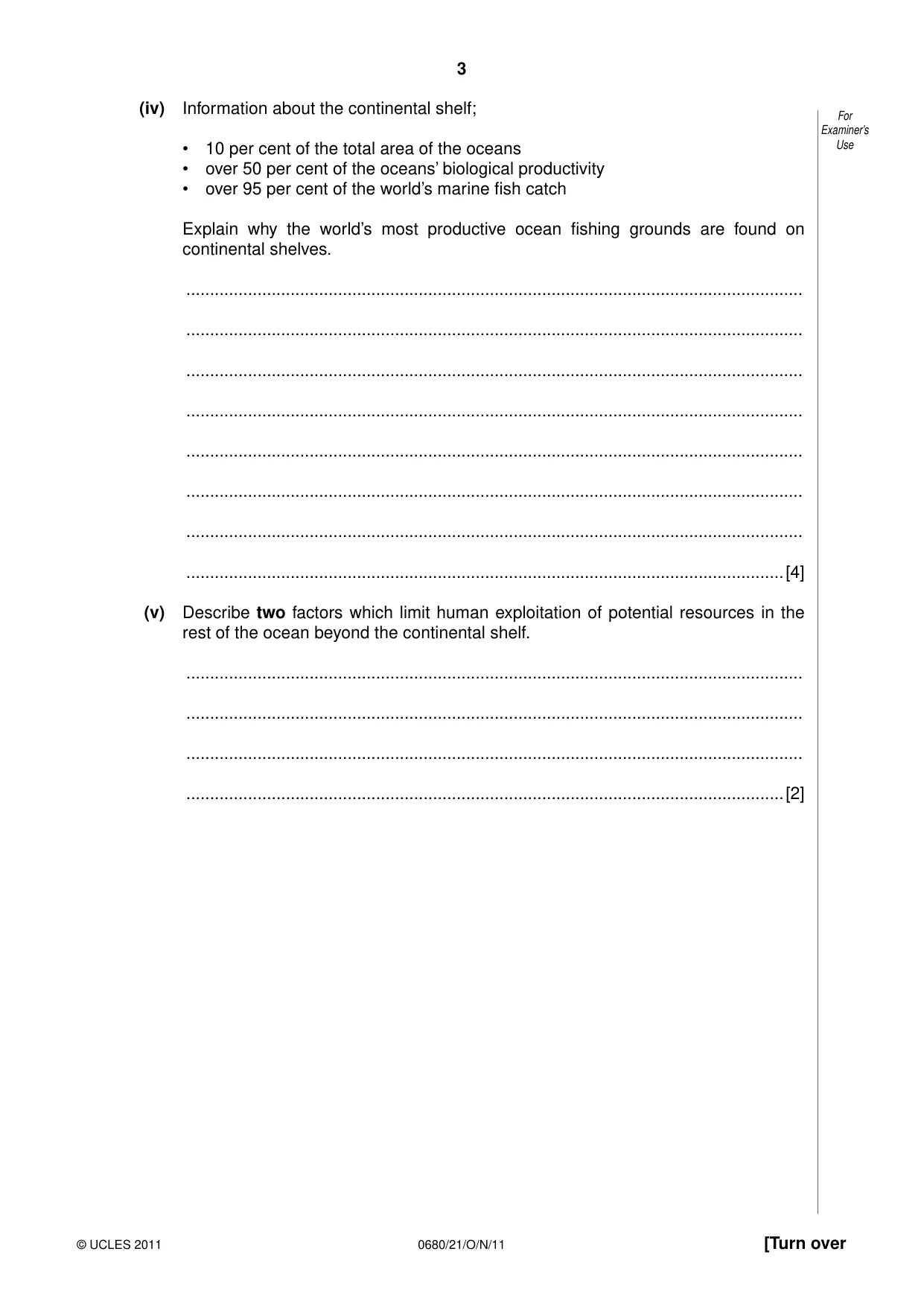
3 0680/21/O/N/11 © UCLES 2011 [Turn over For Examiner’s Use (iv) Information about the continental shelf; • 10 per cent of the total area of the oceans • over 50 per cent of the oceans’ biological productivity • over 95 per cent of the world’s marine fish catch Explain why the world’s most productive ocean fishing grounds are found on continental shelves. … … … … … … … …[4] (v) Describe two factors which limit human exploitation of potential resources in the rest of the ocean beyond the continental shelf. … … … …[2]
Question paper, page 4
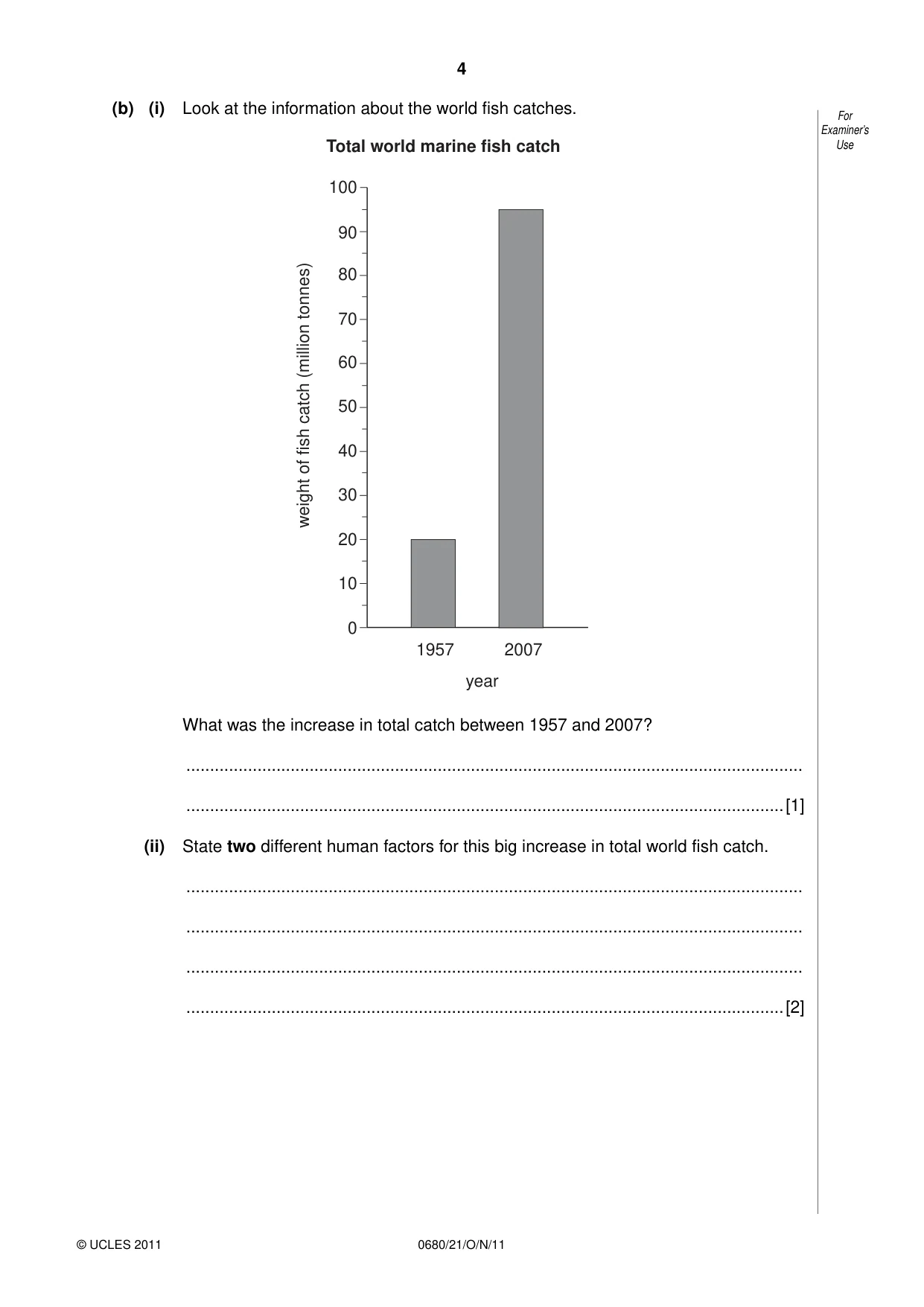
4 0680/21/O/N/11 © UCLES 2011 For Examiner’s Use (b) (i) Look at the information about the world fish catches. 0 10 20 30 40 50 weight of fish catch (million tonnes) 60 70 80 90 100 1957 2007 Total world marine fish catch year What was the increase in total catch between 1957 and 2007? … …[1] (ii) State two different human factors for this big increase in total world fish catch. … … … …[2]
Question paper, page 5
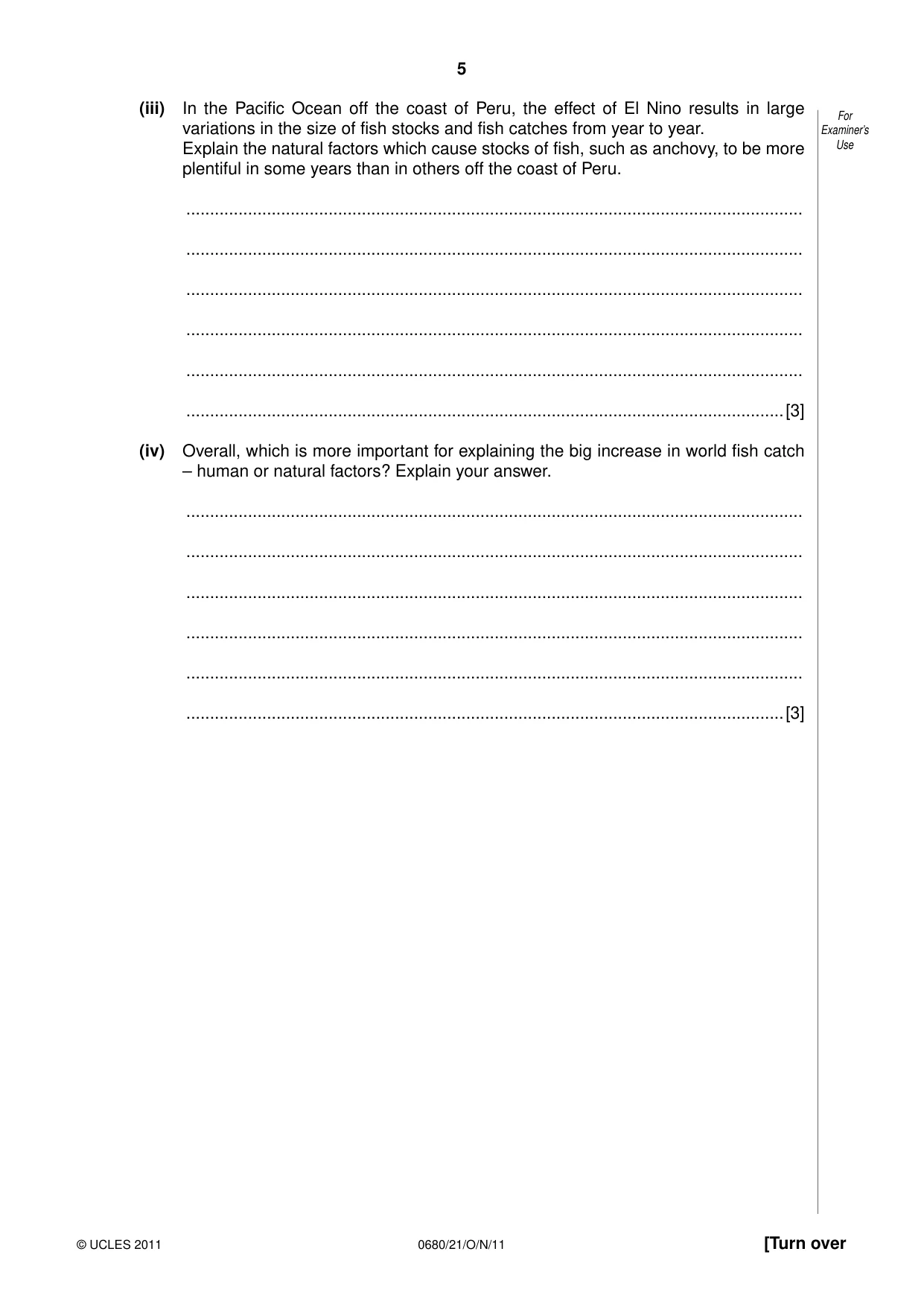
5 0680/21/O/N/11 © UCLES 2011 [Turn over For Examiner’s Use (iii) In the Pacific Ocean off the coast of Peru, the effect of El Nino results in large variations in the size of fish stocks and fish catches from year to year. Explain the natural factors which cause stocks of fish, such as anchovy, to be more plentiful in some years than in others off the coast of Peru. … … … … … …[3] (iv) Overall, which is more important for explaining the big increase in world fish catch – human or natural factors? Explain your answer. … … … … … …[3]
Question paper, page 6
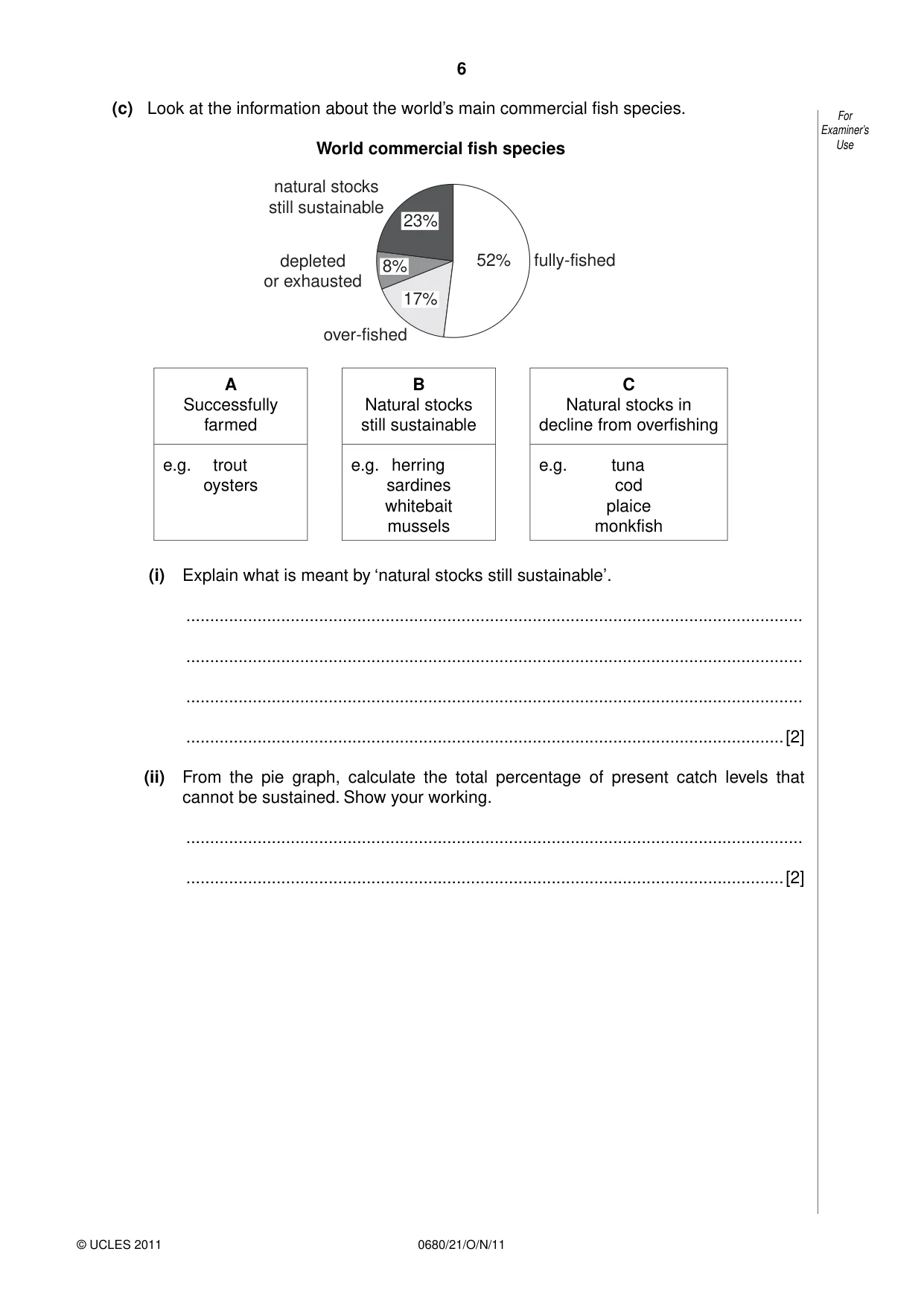
6 0680/21/O/N/11 © UCLES 2011 For Examiner’s Use (c) Look at the information about the world’s main commercial fish species. World commercial fish species fully-fished over-fished depleted or exhausted natural stocks still sustainable 52% 17% 8% 23% A Successfully farmed e.g. trout oysters B Natural stocks still sustainable e.g. herring sardines whitebait mussels C Natural stocks in decline from overfishing e.g. tuna cod plaice monkfish (i) Explain what is meant by ‘natural stocks still sustainable’. … … … …[2] (ii) From the pie graph, calculate the total percentage of present catch levels that cannot be sustained. Show your working. … …[2]
Question paper, page 7
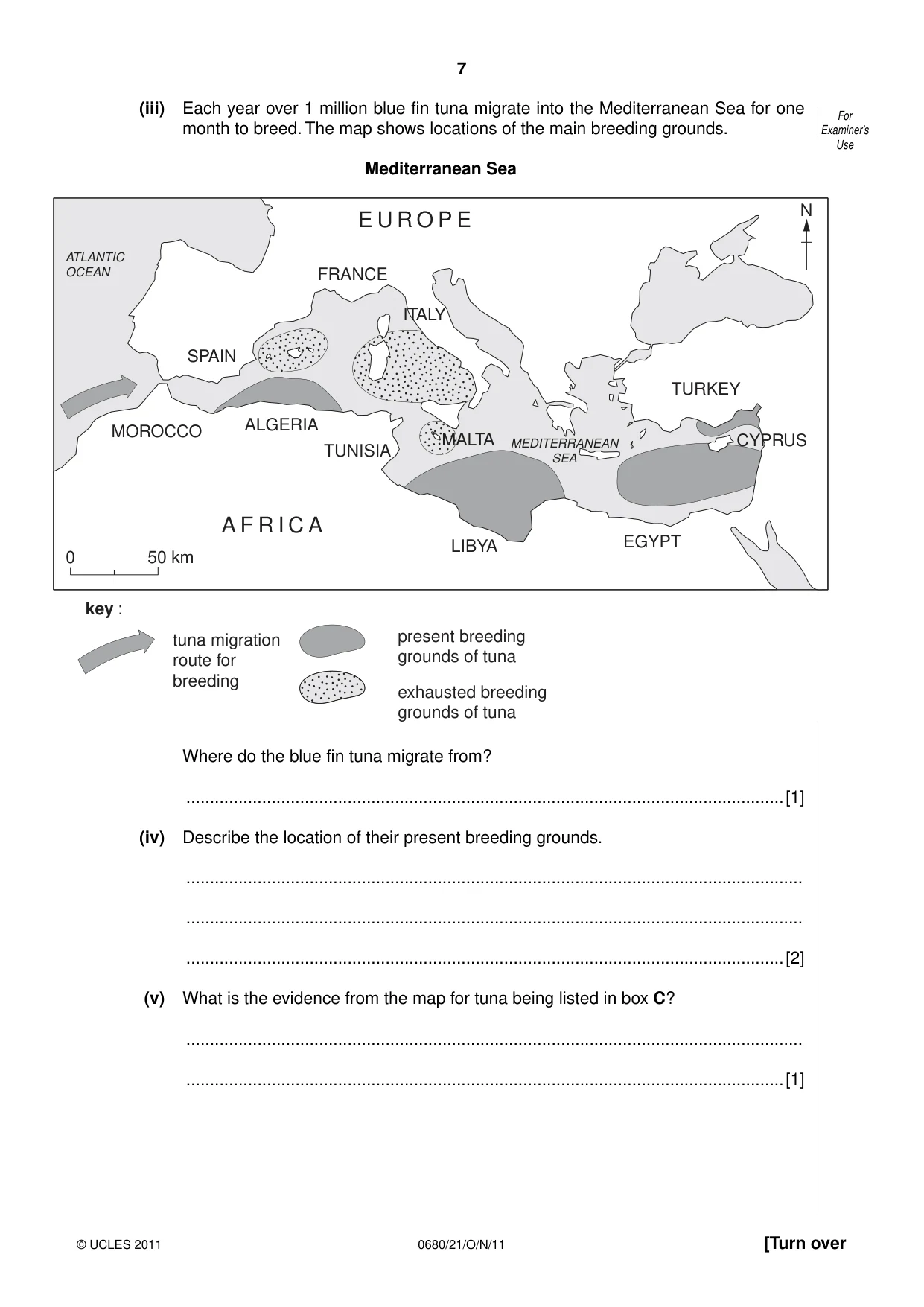
7 0680/21/O/N/11 © UCLES 2011 [Turn over For Examiner’s Use (iii) Each year over 1 million blue fin tuna migrate into the Mediterranean Sea for one month to breed. The map shows locations of the main breeding grounds. Mediterranean Sea ATLANTIC OCEAN MEDITERRANEAN SEA SPAIN FRANCE ITALY TURKEY CYPRUS EGYPT LIBYA MALTA TUNISIA ALGERIA A F R I C A E U R O P E MOROCCO 0 50 km tuna migration route for breeding present breeding grounds of tuna exhausted breeding grounds of tuna N key : Where do the blue fin tuna migrate from? …[1] (iv) Describe the location of their present breeding grounds. … … …[2] (v) What is the evidence from the map for tuna being listed in box C? … …[1]
Question paper, page 8
8 0680/21/O/N/11 © UCLES 2011 For Examiner’s Use (vi) Weight of breeding age tuna remaining in the Mediterranean Sea 1970–2005 (thousand tonnes) 1970 180 1990 150 1975 220 1995 160 1980 150 2000 70 1985 130 2005 50 In the grid below draw a line graph to show these values. years weight of tuna (thousand tonnes) [3] (vii) Describe the evidence from the values and the graph for tuna being listed in box C. … … … … …[3]
Question paper, page 9
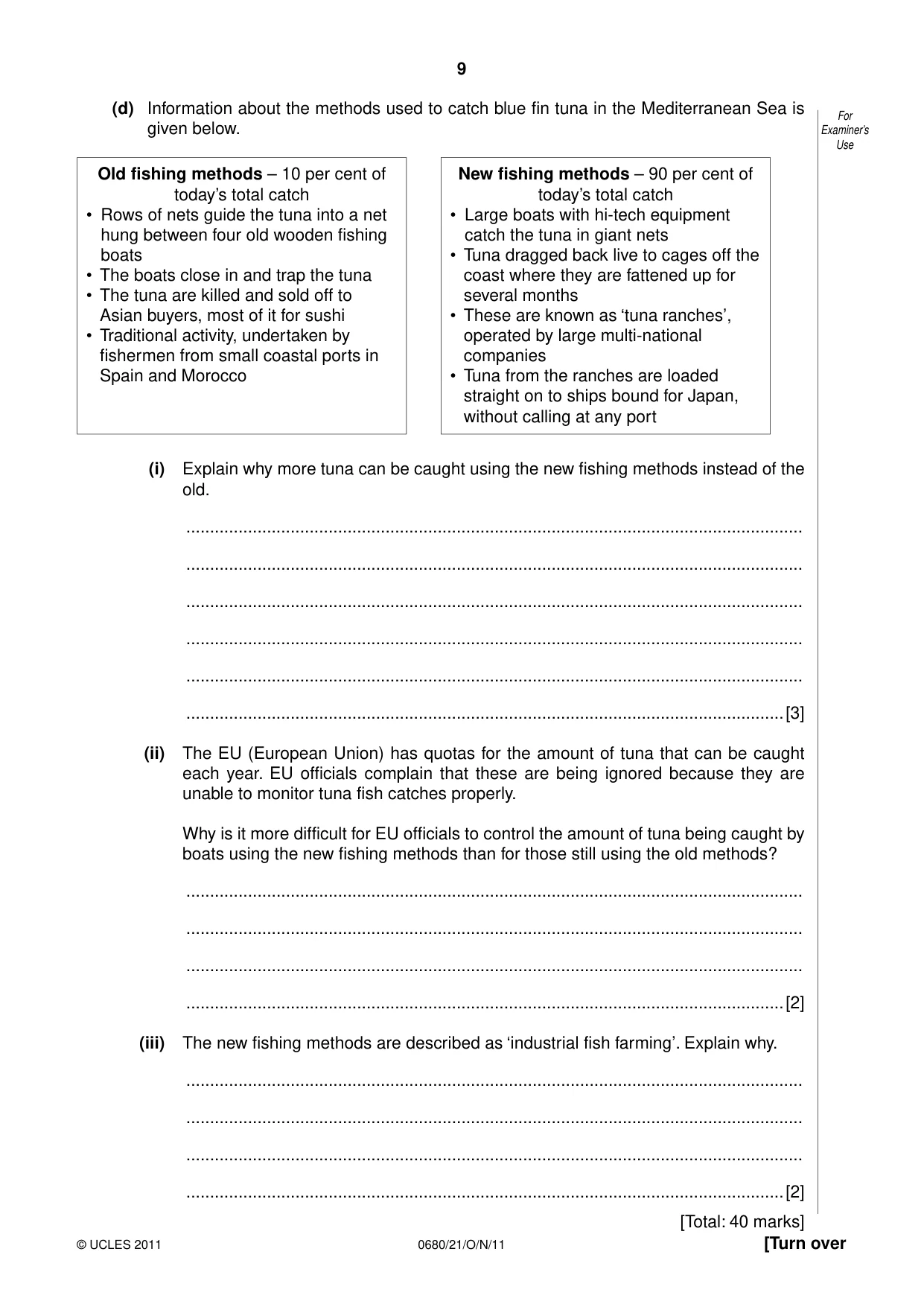
9 0680/21/O/N/11 © UCLES 2011 [Turn over For Examiner’s Use (d) Information about the methods used to catch blue fin tuna in the Mediterranean Sea is given below. Old fishing methods – 10 per cent of today’s total catch • Rows of nets guide the tuna into a net hung between four old wooden fishing boats • The boats close in and trap the tuna • The tuna are killed and sold off to Asian buyers, most of it for sushi • Traditional activity, undertaken by fishermen from small coastal ports in Spain and Morocco New fishing methods – 90 per cent of today’s total catch • Large boats with hi-tech equipment catch the tuna in giant nets • Tuna dragged back live to cages off the coast where they are fattened up for several months • These are known as ‘tuna ranches’, operated by large multi-national companies • Tuna from the ranches are loaded straight on to ships bound for Japan, without calling at any port (i) Explain why more tuna can be caught using the new fishing methods instead of the old. … … … … … …[3] (ii) The EU (European Union) has quotas for the amount of tuna that can be caught each year. EU officials complain that these are being ignored because they are unable to monitor tuna fish catches properly. Why is it more difficult for EU officials to control the amount of tuna being caught by boats using the new fishing methods than for those still using the old methods? … … … …[2] (iii) The new fishing methods are described as ‘industrial fish farming’. Explain why. … … … …[2] [Total: 40 marks]
Question paper, page 10
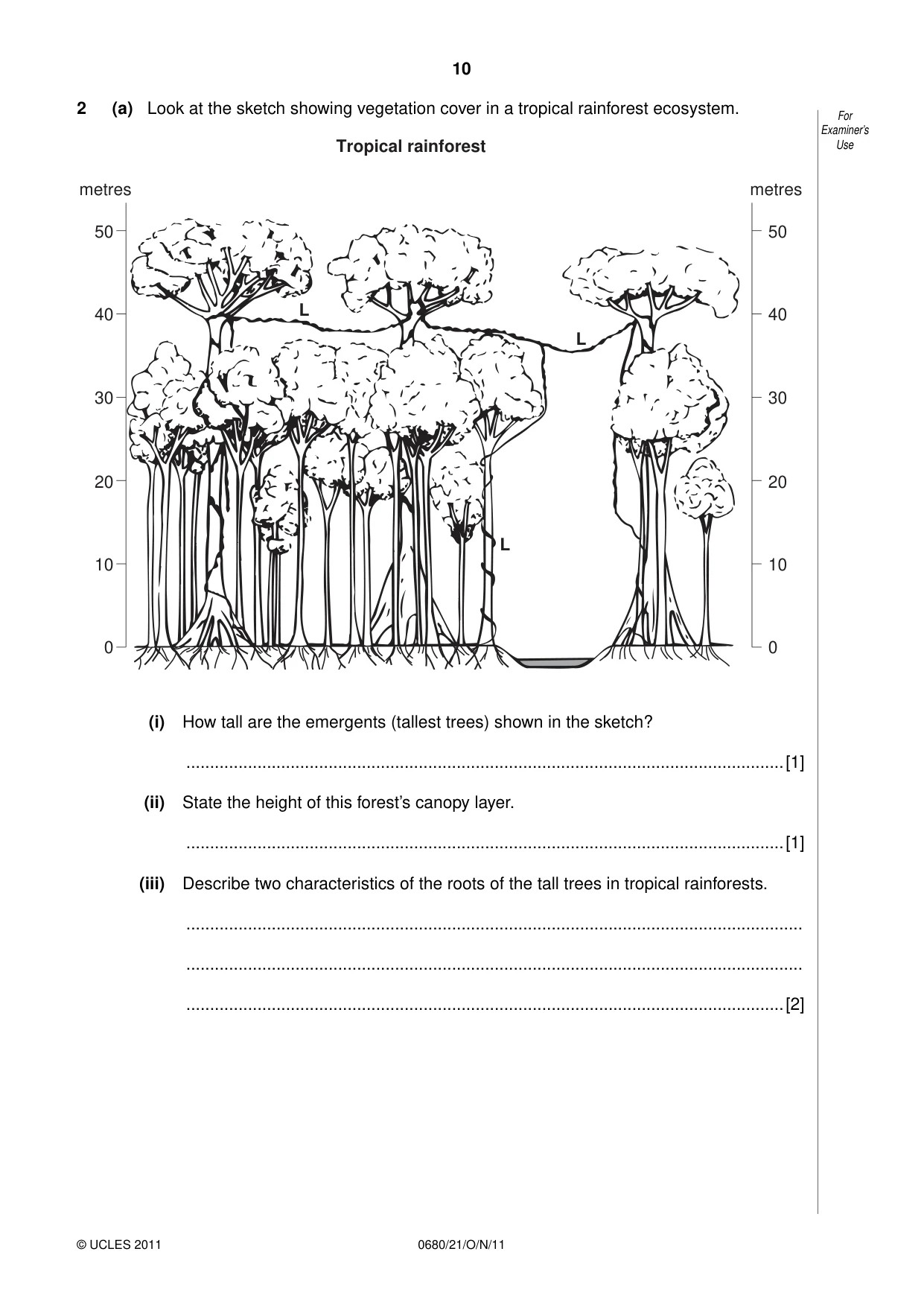
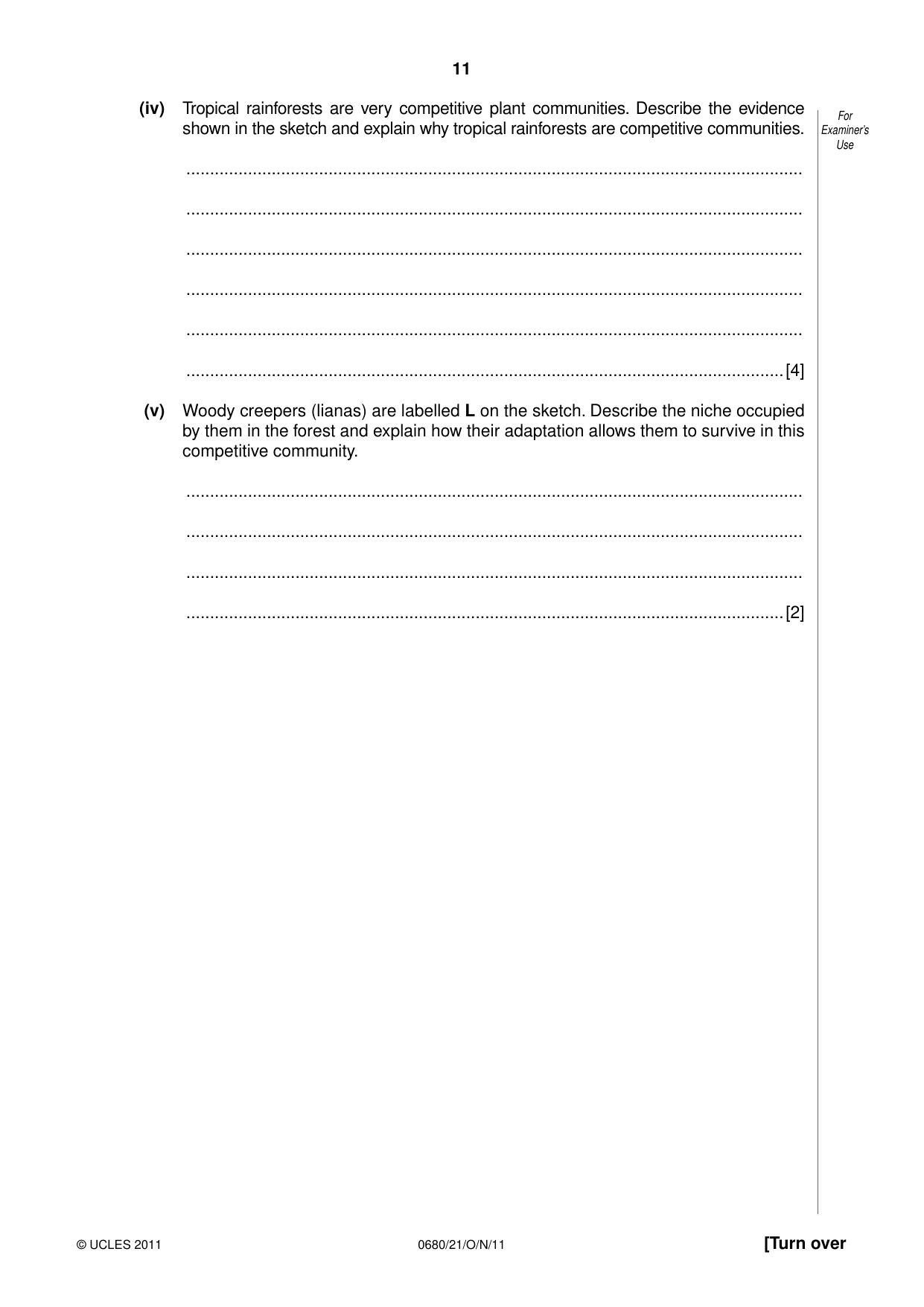
10 0680/21/O/N/11 © UCLES 2011 For Examiner’s Use 2 (a) Look at the sketch showing vegetation cover in a tropical rainforest ecosystem. 0 10 20 30 40 50 0 10 20 30 40 50 metres Tropical rainforest metres L L L (i) How tall are the emergents (tallest trees) shown in the sketch? …[1] (ii) State the height of this forest’s canopy layer. …[1] (iii) Describe two characteristics of the roots of the tall trees in tropical rainforests. … … …[2]
Question paper, page 11
11 0680/21/O/N/11 © UCLES 2011 [Turn over For Examiner’s Use (iv) Tropical rainforests are very competitive plant communities. Describe the evidence shown in the sketch and explain why tropical rainforests are competitive communities. … … … … … …[4] (v) Woody creepers (lianas) are labelled L on the sketch. Describe the niche occupied by them in the forest and explain how their adaptation allows them to survive in this competitive community. … … … …[2]
Question paper, page 12
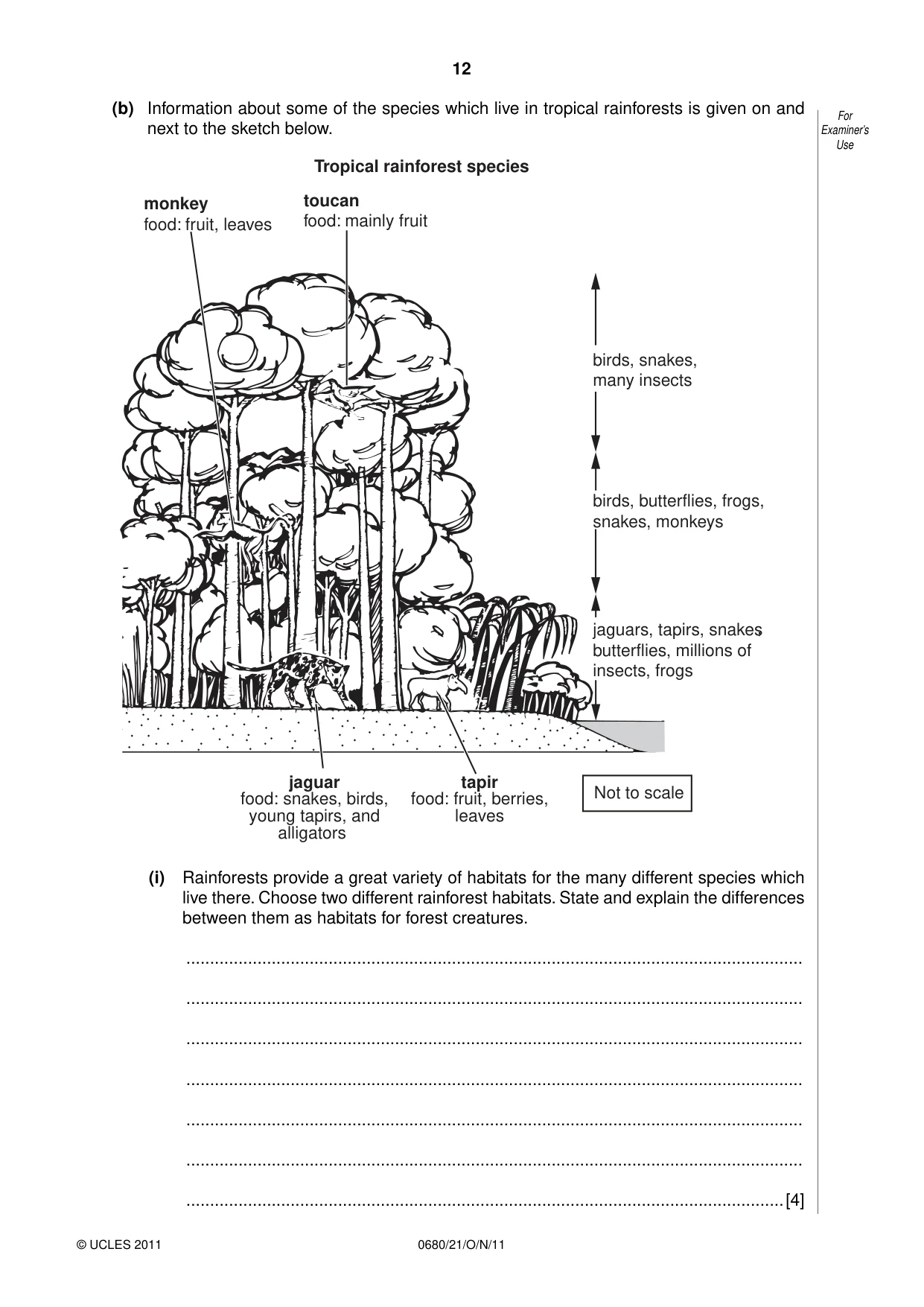
12 0680/21/O/N/11 © UCLES 2011 For Examiner’s Use (b) Information about some of the species which live in tropical rainforests is given on and next to the sketch below. jaguar food: snakes, birds, young tapirs, and alligators tapir food: fruit, berries, leaves Not to scale jaguars, tapirs, snakes butterflies, millions of insects, frogs birds, butterflies, frogs, snakes, monkeys birds, snakes, many insects toucan food: mainly fruit monkey food: fruit, leaves Tropical rainforest species , (i) Rainforests provide a great variety of habitats for the many different species which live there. Choose two different rainforest habitats. State and explain the differences between them as habitats for forest creatures. … … … … … … …[4]
Question paper, page 13
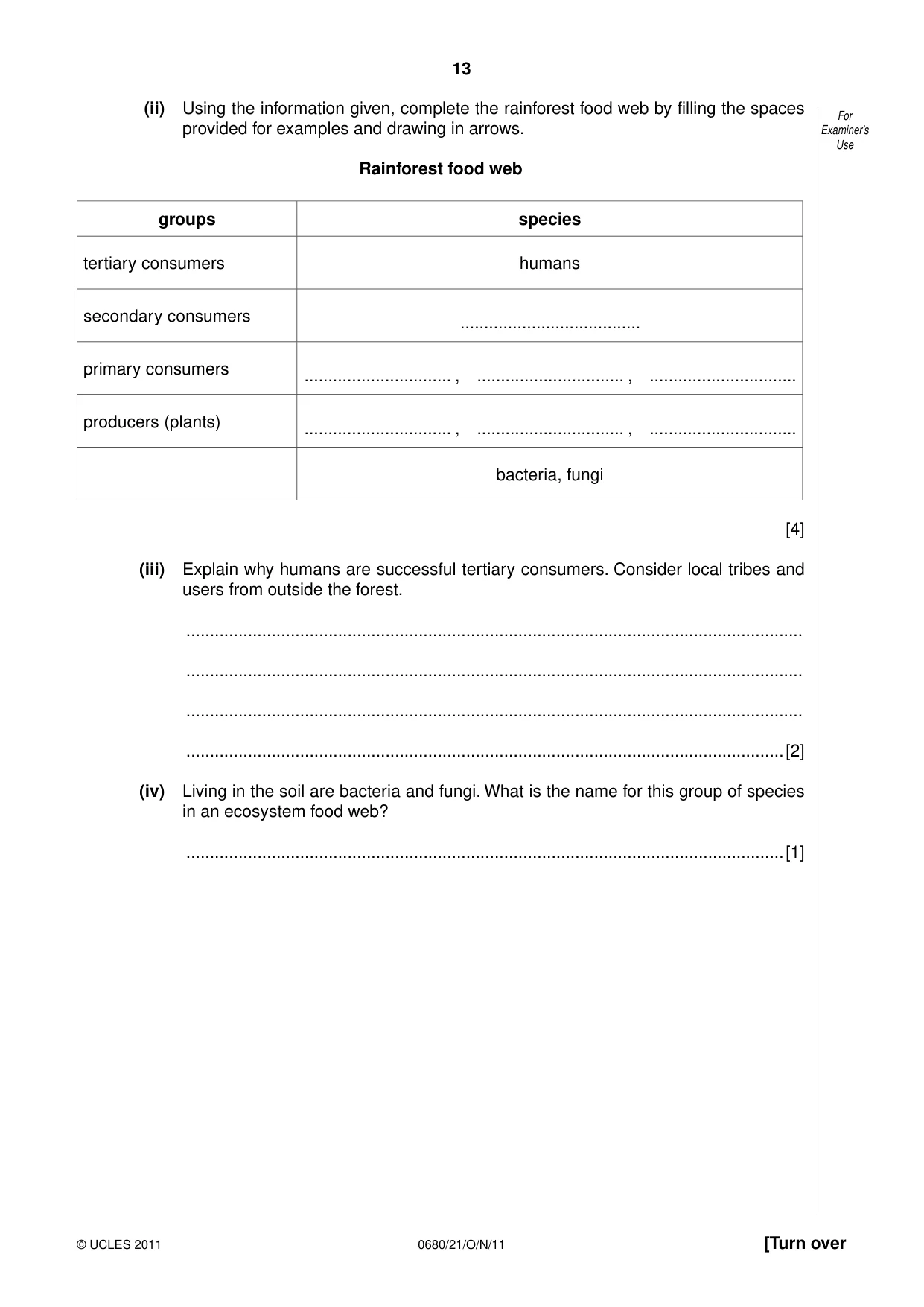
13 0680/21/O/N/11 © UCLES 2011 [Turn over For Examiner’s Use (ii) Using the information given, complete the rainforest food web by filling the spaces provided for examples and drawing in arrows. Rainforest food web groups species tertiary consumers humans secondary consumers … primary consumers … , … , … producers (plants) … , … , … bacteria, fungi [4] (iii) Explain why humans are successful tertiary consumers. Consider local tribes and users from outside the forest. … … … …[2] (iv) Living in the soil are bacteria and fungi. What is the name for this group of species in an ecosystem food web? …[1]
Question paper, page 14
14 0680/21/O/N/11 © UCLES 2011 For Examiner’s Use (c) The island of Madagascar split apart from India about 100 million years ago. The Indian plate and its movement north Africa Indian plate 20 million years ago 55 million years ago 80 million years ago Madagascar (i) Name the theory used by geologists to explain the northward movement of India. …[1] (ii) Where and why has the movement of India led to mountain building? … … … …[2] (d) Today’s animals and plants in Madagascar evolved in isolation from other land masses. As a result, • 90 per cent of its plants and 70 per cent of its animals are endemic – this means they are unique to Madagascar, found nowhere else. • it is called a conservation hotspot – this means a place with very diverse species, threatened by destruction. Many species have already become extinct by uncontrolled hunting. Also 80 per cent of the island’s dense forest cover has already been lost. What remains is under threat from mining and logging.
Question paper, page 15
15 0680/21/O/N/11 © UCLES 2011 [Turn over For Examiner’s Use (i) Should people be concerned about the loss of plant and animal species in Madagascar? Explain your view on this. … … … … … … … …[4] (ii) Organisations with an interest in species conservation include IUCN WWF CITES Choose one of them and briefly describe the type of conservation work it does. name of organisation … … … … … … …[3]
Question paper, page 16
16 0680/21/O/N/11 © UCLES 2011 For Examiner’s Use (e) In 2003 the Government of Madagascar began to take conservation seriously for the first time. The plan was to increase the area under conservation and to support better the already existing National Parks. Half the tourist revenue from the National Parks was to go to surrounding communities. The Parks and Reserves will give employment to local people in tourist jobs such as guides. Madagascar is a country of poor people. More than half of them live on less than US$1 per day. (i) The plan for the National Parks is an example of ecotourism. What is meant by ecotourism? … … … …[2] (ii) How might this plan increase the chances of the forests and wildlife of Madagascar being preserved? … … … …[2]
Question paper, page 17
17 0680/21/O/N/11 © UCLES 2011 For Examiner’s Use (f) One plan put forward in global climate negotiations is that developing countries, such as Madagascar, should be paid by richer developed countries for not clearing their rainforests. (i) Describe how they think this plan will help to slow down local and global climate changes. … … … … … (ii) How good or bad an idea is this plan? Explain its possible advantages and disadvantages. … … … … …[5] [Total: 40 marks]
Question paper, page 18
18 0680/21/O/N/11 © UCLES 2011 BLANK PAGE
Question paper, page 19
19 0680/21/O/N/11 © UCLES 2011 BLANK PAGE
Question paper, page 20
20 0680/21/O/N/11 © UCLES 2011 BLANK PAGE Permission to reproduce items where third-party owned material protected by copyright is included has been sought and cleared where possible. Every reasonable effort has been made by the publisher (UCLES) to trace copyright holders, but if any items requiring clearance have unwittingly been included, the publisher will be pleased to make amends at the earliest possible opportunity. University of Cambridge International Examinations is part of the Cambridge Assessment Group. Cambridge Assessment is the brand name of University of Cambridge Local Examinations Syndicate (UCLES), which is itself a department of the University of Cambridge.
Mark scheme, page 1
UNIVERSITY OF CAMBRIDGE INTERNATIONAL EXAMINATIONS International General Certificate of Secondary Education MARK SCHEME for the October/November 2011 question paper for the guidance of teachers 0680 ENVIRONMENTAL MANAGEMENT 0680/21 Paper 2, maximum raw mark 80 This mark scheme is published as an aid to teachers and candidates, to indicate the requirements of the examination. It shows the basis on which Examiners were instructed to award marks. It does not indicate the details of the discussions that took place at an Examiners’ meeting before marking began, which would have considered the acceptability of alternative answers. Mark schemes must be read in conjunction with the question papers and the report on the examination. • Cambridge will not enter into discussions or correspondence in connection with these mark schemes. Cambridge is publishing the mark schemes for the October/November 2011 question papers for most IGCSE, GCE Advanced Level and Advanced Subsidiary Level syllabuses and some Ordinary Level syllabuses. www.XtremePapers.com
Mark scheme, page 2
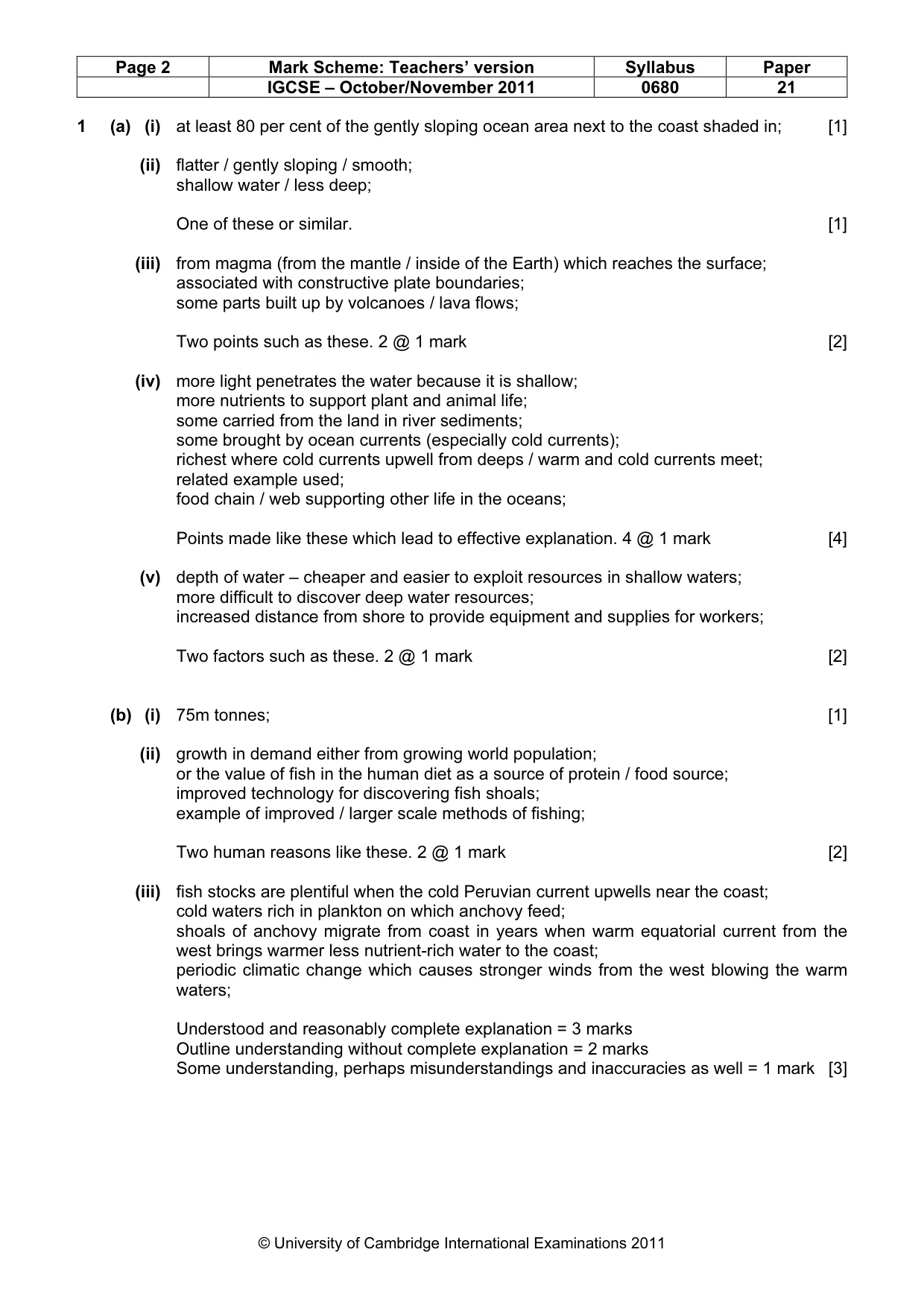
Page 2 Mark Scheme: Teachers’ version Syllabus Paper IGCSE – October/November 2011 0680 21 © University of Cambridge International Examinations 2011 1 (a) (i) at least 80 per cent of the gently sloping ocean area next to the coast shaded in; [1] (ii) flatter / gently sloping / smooth; shallow water / less deep; One of these or similar. [1] (iii) from magma (from the mantle / inside of the Earth) which reaches the surface; associated with constructive plate boundaries; some parts built up by volcanoes / lava flows; Two points such as these. 2 @ 1 mark [2] (iv) more light penetrates the water because it is shallow; more nutrients to support plant and animal life; some carried from the land in river sediments; some brought by ocean currents (especially cold currents); richest where cold currents upwell from deeps / warm and cold currents meet; related example used; food chain / web supporting other life in the oceans; Points made like these which lead to effective explanation. 4 @ 1 mark [4] (v) depth of water – cheaper and easier to exploit resources in shallow waters; more difficult to discover deep water resources; increased distance from shore to provide equipment and supplies for workers; Two factors such as these. 2 @ 1 mark [2] (b) (i) 75m tonnes; [1] (ii) growth in demand either from growing world population; or the value of fish in the human diet as a source of protein / food source; improved technology for discovering fish shoals; example of improved / larger scale methods of fishing; Two human reasons like these. 2 @ 1 mark [2] (iii) fish stocks are plentiful when the cold Peruvian current upwells near the coast; cold waters rich in plankton on which anchovy feed; shoals of anchovy migrate from coast in years when warm equatorial current from the west brings warmer less nutrient-rich water to the coast; periodic climatic change which causes stronger winds from the west blowing the warm waters; Understood and reasonably complete explanation = 3 marks Outline understanding without complete explanation = 2 marks Some understanding, perhaps misunderstandings and inaccuracies as well = 1 mark [3]
Mark scheme, page 3
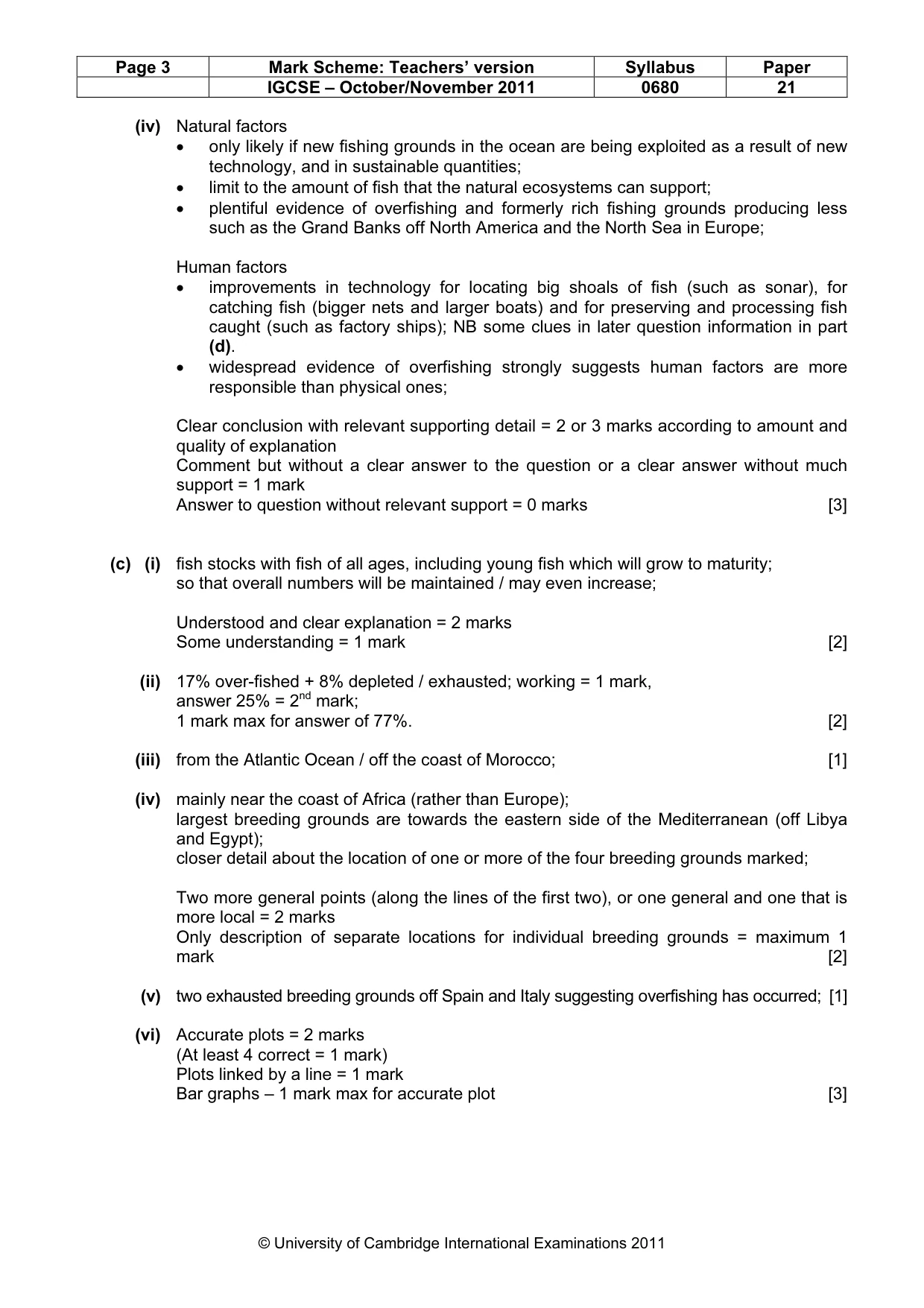
Page 3 Mark Scheme: Teachers’ version Syllabus Paper IGCSE – October/November 2011 0680 21 © University of Cambridge International Examinations 2011 (iv) Natural factors • only likely if new fishing grounds in the ocean are being exploited as a result of new technology, and in sustainable quantities; • limit to the amount of fish that the natural ecosystems can support; • plentiful evidence of overfishing and formerly rich fishing grounds producing less such as the Grand Banks off North America and the North Sea in Europe; Human factors • improvements in technology for locating big shoals of fish (such as sonar), for catching fish (bigger nets and larger boats) and for preserving and processing fish caught (such as factory ships); NB some clues in later question information in part (d). • widespread evidence of overfishing strongly suggests human factors are more responsible than physical ones; Clear conclusion with relevant supporting detail = 2 or 3 marks according to amount and quality of explanation Comment but without a clear answer to the question or a clear answer without much support = 1 mark Answer to question without relevant support = 0 marks [3] (c) (i) fish stocks with fish of all ages, including young fish which will grow to maturity; so that overall numbers will be maintained / may even increase; Understood and clear explanation = 2 marks Some understanding = 1 mark [2] (ii) 17% over-fished + 8% depleted / exhausted; working = 1 mark, answer 25% = 2nd mark; 1 mark max for answer of 77%. [2] (iii) from the Atlantic Ocean / off the coast of Morocco; [1] (iv) mainly near the coast of Africa (rather than Europe); largest breeding grounds are towards the eastern side of the Mediterranean (off Libya and Egypt); closer detail about the location of one or more of the four breeding grounds marked; Two more general points (along the lines of the first two), or one general and one that is more local = 2 marks Only description of separate locations for individual breeding grounds = maximum 1 mark [2] (v) two exhausted breeding grounds off Spain and Italy suggesting overfishing has occurred; [1] (vi) Accurate plots = 2 marks (At least 4 correct = 1 mark) Plots linked by a line = 1 mark Bar graphs – 1 mark max for accurate plot [3]
Mark scheme, page 4
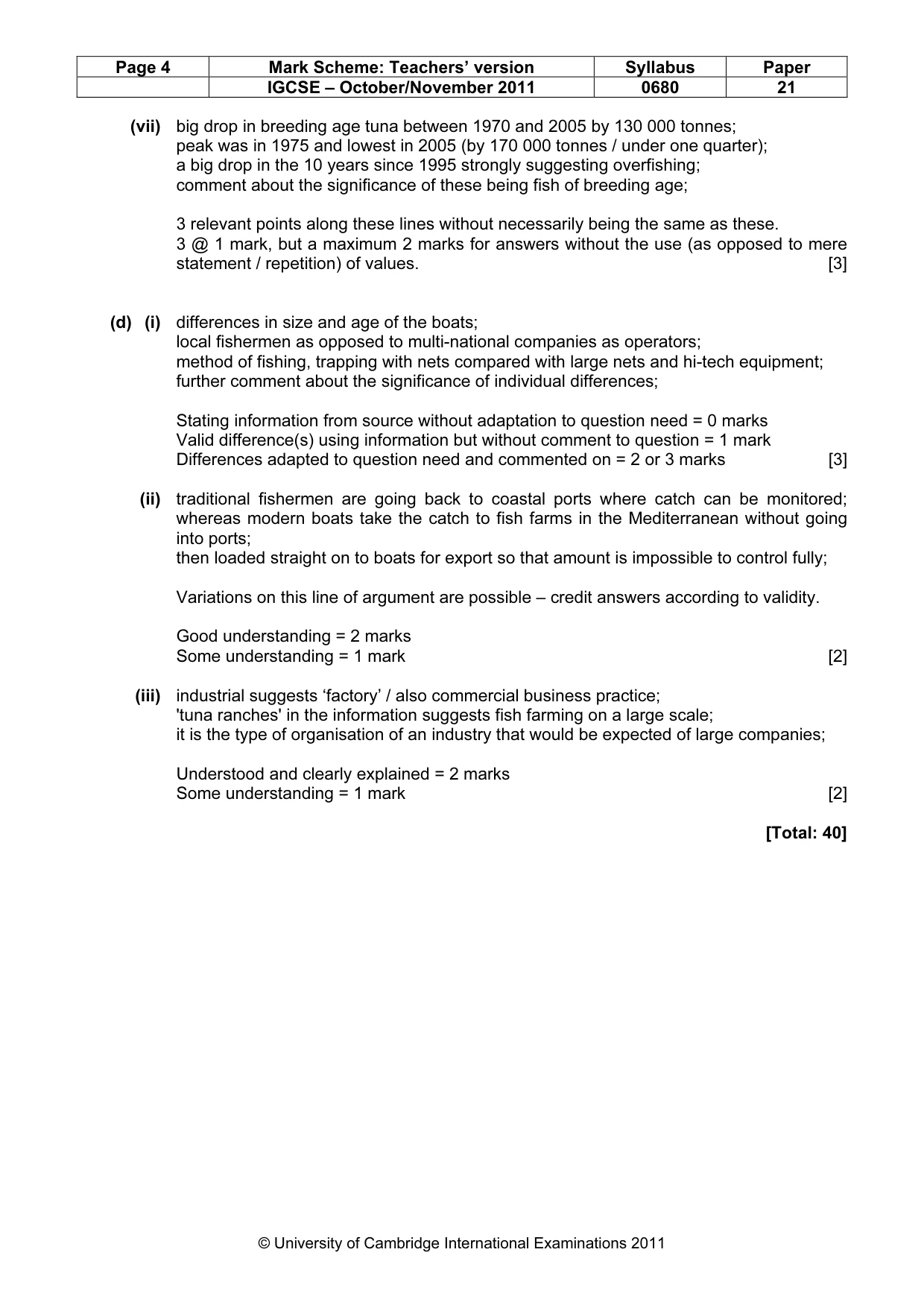
Page 4 Mark Scheme: Teachers’ version Syllabus Paper IGCSE – October/November 2011 0680 21 © University of Cambridge International Examinations 2011 (vii) big drop in breeding age tuna between 1970 and 2005 by 130 000 tonnes; peak was in 1975 and lowest in 2005 (by 170 000 tonnes / under one quarter); a big drop in the 10 years since 1995 strongly suggesting overfishing; comment about the significance of these being fish of breeding age; 3 relevant points along these lines without necessarily being the same as these. 3 @ 1 mark, but a maximum 2 marks for answers without the use (as opposed to mere statement / repetition) of values. [3] (d) (i) differences in size and age of the boats; local fishermen as opposed to multi-national companies as operators; method of fishing, trapping with nets compared with large nets and hi-tech equipment; further comment about the significance of individual differences; Stating information from source without adaptation to question need = 0 marks Valid difference(s) using information but without comment to question = 1 mark Differences adapted to question need and commented on = 2 or 3 marks [3] (ii) traditional fishermen are going back to coastal ports where catch can be monitored; whereas modern boats take the catch to fish farms in the Mediterranean without going into ports; then loaded straight on to boats for export so that amount is impossible to control fully; Variations on this line of argument are possible – credit answers according to validity. Good understanding = 2 marks Some understanding = 1 mark [2] (iii) industrial suggests ‘factory’ / also commercial business practice; 'tuna ranches' in the information suggests fish farming on a large scale; it is the type of organisation of an industry that would be expected of large companies; Understood and clearly explained = 2 marks Some understanding = 1 mark [2] [Total: 40]
Mark scheme, page 5
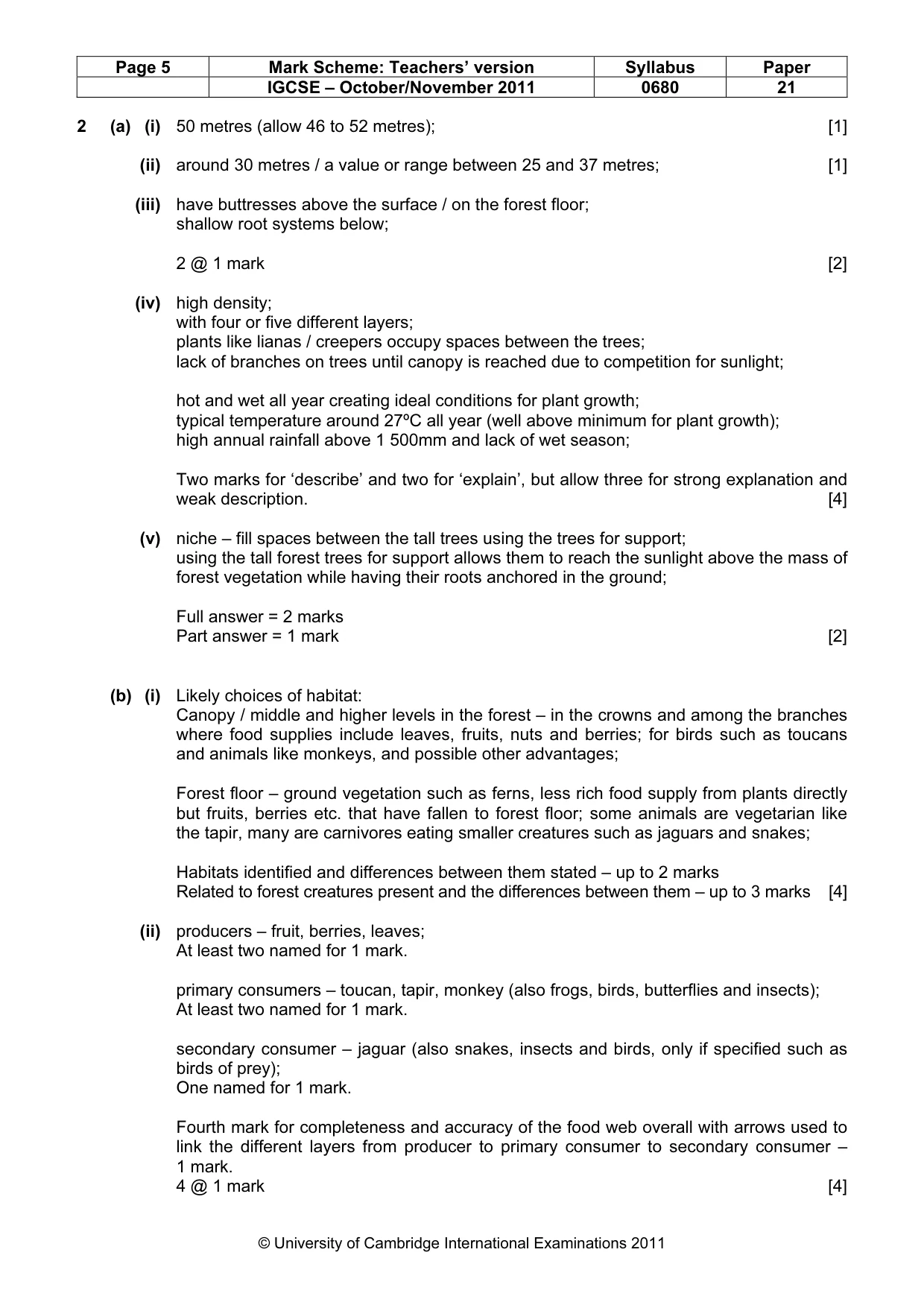
Page 5 Mark Scheme: Teachers’ version Syllabus Paper IGCSE – October/November 2011 0680 21 © University of Cambridge International Examinations 2011 2 (a) (i) 50 metres (allow 46 to 52 metres); [1] (ii) around 30 metres / a value or range between 25 and 37 metres; [1] (iii) have buttresses above the surface / on the forest floor; shallow root systems below; 2 @ 1 mark [2] (iv) high density; with four or five different layers; plants like lianas / creepers occupy spaces between the trees; lack of branches on trees until canopy is reached due to competition for sunlight; hot and wet all year creating ideal conditions for plant growth; typical temperature around 27ºC all year (well above minimum for plant growth); high annual rainfall above 1 500mm and lack of wet season; Two marks for ‘describe’ and two for ‘explain’, but allow three for strong explanation and weak description. [4] (v) niche – fill spaces between the tall trees using the trees for support; using the tall forest trees for support allows them to reach the sunlight above the mass of forest vegetation while having their roots anchored in the ground; Full answer = 2 marks Part answer = 1 mark [2] (b) (i) Likely choices of habitat: Canopy / middle and higher levels in the forest – in the crowns and among the branches where food supplies include leaves, fruits, nuts and berries; for birds such as toucans and animals like monkeys, and possible other advantages; Forest floor – ground vegetation such as ferns, less rich food supply from plants directly but fruits, berries etc. that have fallen to forest floor; some animals are vegetarian like the tapir, many are carnivores eating smaller creatures such as jaguars and snakes; Habitats identified and differences between them stated – up to 2 marks Related to forest creatures present and the differences between them – up to 3 marks [4] (ii) producers – fruit, berries, leaves; At least two named for 1 mark. primary consumers – toucan, tapir, monkey (also frogs, birds, butterflies and insects); At least two named for 1 mark. secondary consumer – jaguar (also snakes, insects and birds, only if specified such as birds of prey); One named for 1 mark. Fourth mark for completeness and accuracy of the food web overall with arrows used to link the different layers from producer to primary consumer to secondary consumer – 1 mark. 4 @ 1 mark [4]
Mark scheme, page 6
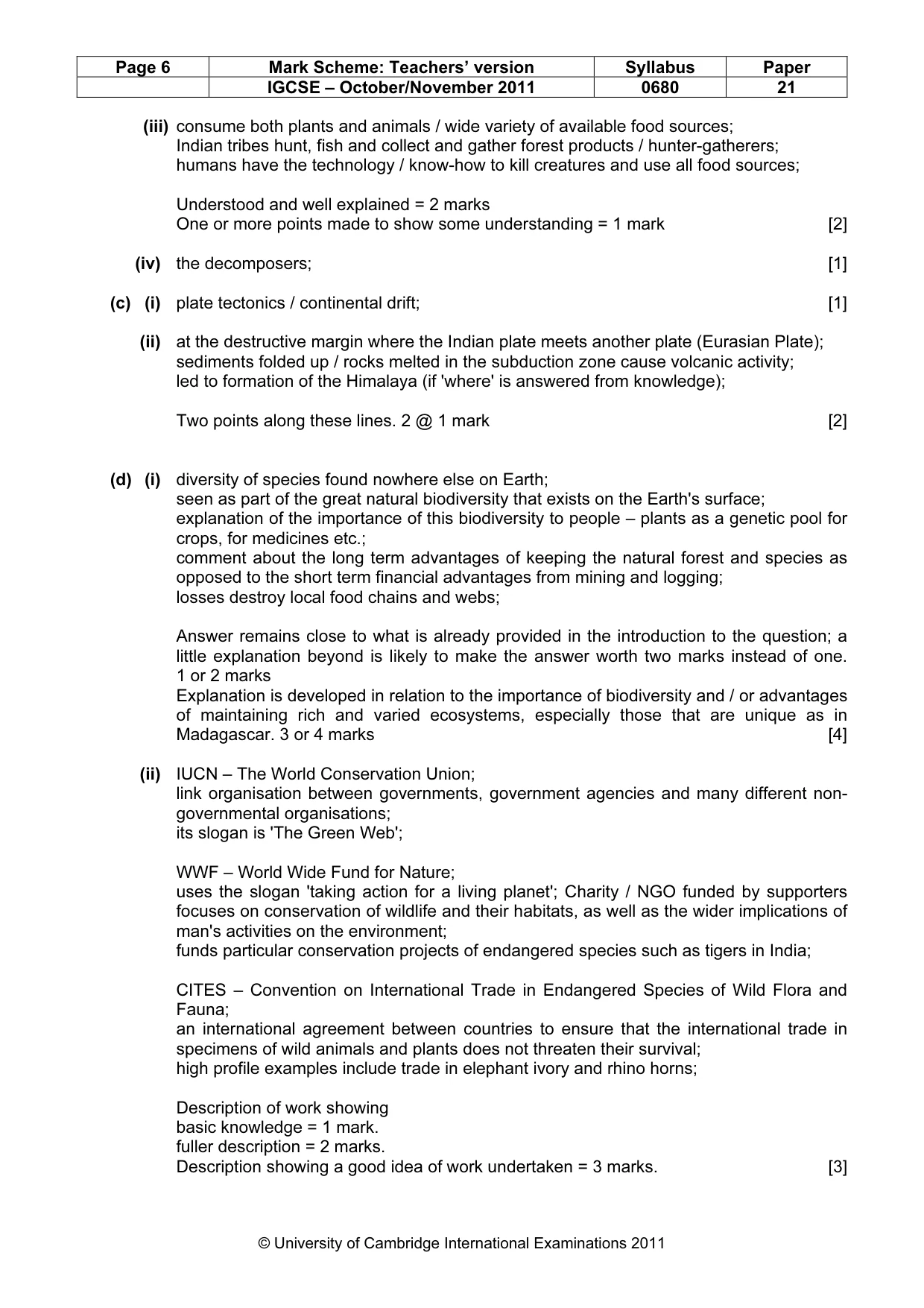
Page 6 Mark Scheme: Teachers’ version Syllabus Paper IGCSE – October/November 2011 0680 21 © University of Cambridge International Examinations 2011 (iii) consume both plants and animals / wide variety of available food sources; Indian tribes hunt, fish and collect and gather forest products / hunter-gatherers; humans have the technology / know-how to kill creatures and use all food sources; Understood and well explained = 2 marks One or more points made to show some understanding = 1 mark [2] (iv) the decomposers; [1] (c) (i) plate tectonics / continental drift; [1] (ii) at the destructive margin where the Indian plate meets another plate (Eurasian Plate); sediments folded up / rocks melted in the subduction zone cause volcanic activity; led to formation of the Himalaya (if 'where' is answered from knowledge); Two points along these lines. 2 @ 1 mark [2] (d) (i) diversity of species found nowhere else on Earth; seen as part of the great natural biodiversity that exists on the Earth's surface; explanation of the importance of this biodiversity to people – plants as a genetic pool for crops, for medicines etc.; comment about the long term advantages of keeping the natural forest and species as opposed to the short term financial advantages from mining and logging; losses destroy local food chains and webs; Answer remains close to what is already provided in the introduction to the question; a little explanation beyond is likely to make the answer worth two marks instead of one. 1 or 2 marks Explanation is developed in relation to the importance of biodiversity and / or advantages of maintaining rich and varied ecosystems, especially those that are unique as in Madagascar. 3 or 4 marks [4] (ii) IUCN – The World Conservation Union; link organisation between governments, government agencies and many different non- governmental organisations; its slogan is 'The Green Web'; WWF – World Wide Fund for Nature; uses the slogan 'taking action for a living planet'; Charity / NGO funded by supporters focuses on conservation of wildlife and their habitats, as well as the wider implications of man's activities on the environment; funds particular conservation projects of endangered species such as tigers in India; CITES – Convention on International Trade in Endangered Species of Wild Flora and Fauna; an international agreement between countries to ensure that the international trade in specimens of wild animals and plants does not threaten their survival; high profile examples include trade in elephant ivory and rhino horns; Description of work showing basic knowledge = 1 mark. fuller description = 2 marks. Description showing a good idea of work undertaken = 3 marks. [3]
Mark scheme, page 7
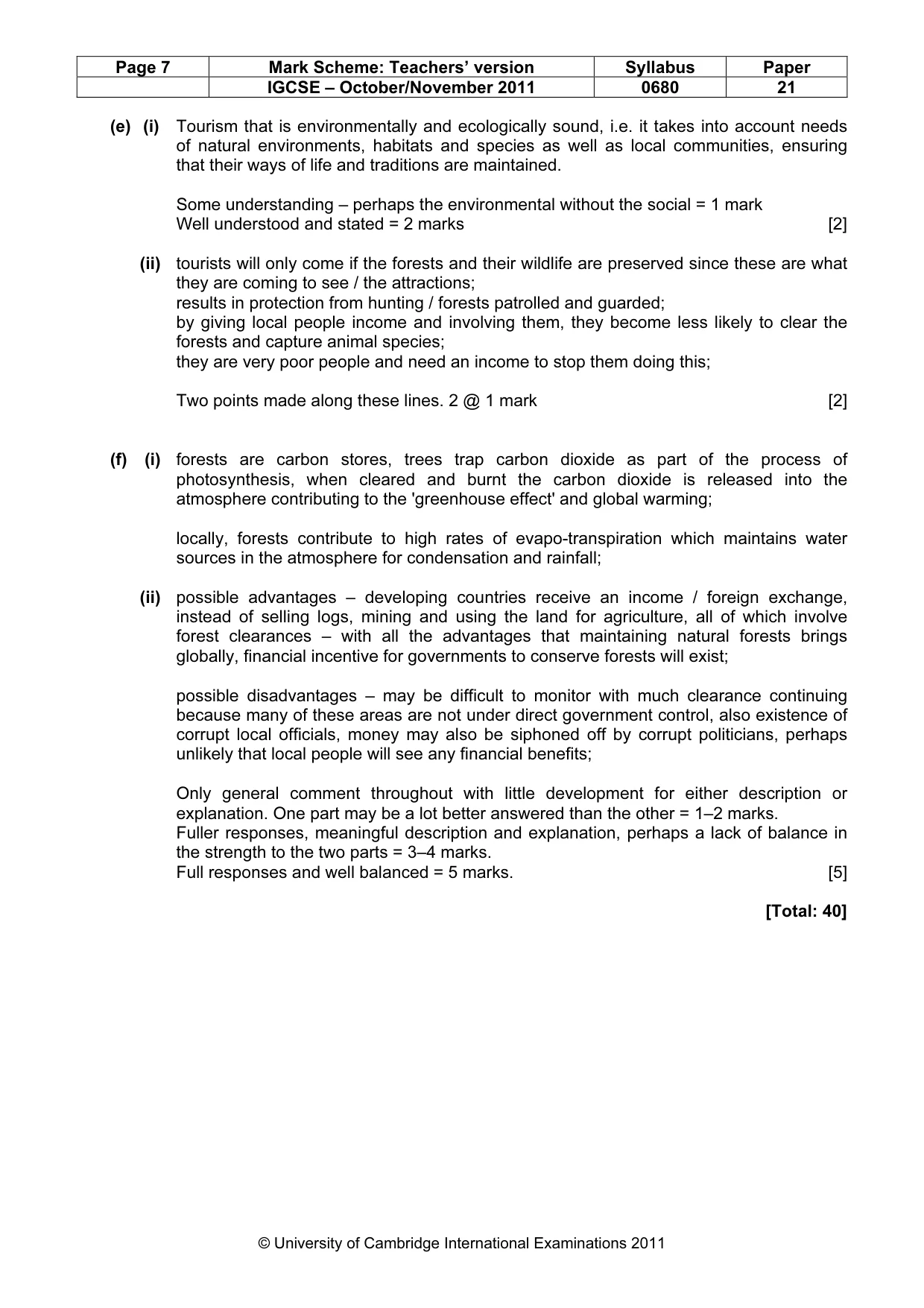
Page 7 Mark Scheme: Teachers’ version Syllabus Paper IGCSE – October/November 2011 0680 21 © University of Cambridge International Examinations 2011 (e) (i) Tourism that is environmentally and ecologically sound, i.e. it takes into account needs of natural environments, habitats and species as well as local communities, ensuring that their ways of life and traditions are maintained. Some understanding – perhaps the environmental without the social = 1 mark Well understood and stated = 2 marks [2] (ii) tourists will only come if the forests and their wildlife are preserved since these are what they are coming to see / the attractions; results in protection from hunting / forests patrolled and guarded; by giving local people income and involving them, they become less likely to clear the forests and capture animal species; they are very poor people and need an income to stop them doing this; Two points made along these lines. 2 @ 1 mark [2] (f) (i) forests are carbon stores, trees trap carbon dioxide as part of the process of photosynthesis, when cleared and burnt the carbon dioxide is released into the atmosphere contributing to the 'greenhouse effect' and global warming; locally, forests contribute to high rates of evapo-transpiration which maintains water sources in the atmosphere for condensation and rainfall; (ii) possible advantages – developing countries receive an income / foreign exchange, instead of selling logs, mining and using the land for agriculture, all of which involve forest clearances – with all the advantages that maintaining natural forests brings globally, financial incentive for governments to conserve forests will exist; possible disadvantages – may be difficult to monitor with much clearance continuing because many of these areas are not under direct government control, also existence of corrupt local officials, money may also be siphoned off by corrupt politicians, perhaps unlikely that local people will see any financial benefits; Only general comment throughout with little development for either description or explanation. One part may be a lot better answered than the other = 1–2 marks. Fuller responses, meaningful description and explanation, perhaps a lack of balance in the strength to the two parts = 3–4 marks. Full responses and well balanced = 5 marks. [5] [Total: 40]
What you needed in this session
Cambridge’s own grade thresholds for 2011 Oct/Nov, Paper 2 · Variant 1. A higher threshold means an easier paper — the bar moves with how the cohort did.