Cambridge IGCSE Environmental Management 0680 — 2010 May/June Paper 1 · Variant 2
0680/12/M/J/10 · 60 marks · ≈68 min
The question paper and its mark scheme, free to read here and free to download. This is Cambridge’s own paper, exactly as it was sat.
Question paper12 pages
Mark scheme4 pages
Answers below. Sit the paper first if you are practising.
Paper as text
Question paper, page 1
This document consists of 12 printed pages. DC (LEO/SW) 19496/3 © UCLES 2010 [Turn over UNIVERSITY OF CAMBRIDGE INTERNATIONAL EXAMINATIONS International General Certificate of Secondary Education READ THESE INSTRUCTIONS FIRST Write your Centre number, candidate number and name on all the work you hand in. Write in dark blue or black pen. You may use a soft pencil for any diagrams, graphs or rough working. Do not use staples, paper clips, highlighters, glue or correction fluid. DO NOT WRITE IN ANY BARCODES. Answer all questions. At the end of the examination, fasten all your work securely together. The number of marks is given in brackets [ ] at the end of each question or part question. * 7 6 5 0 7 6 2 4 3 6 * ENVIRONMENTAL MANAGEMENT 0680/12 Paper 1 May/June 2010 1 hour 30 minutes Candidates answer on the Question Paper. Additional Materials: Ruler For Examiner’s Use 1 2 3 4 5 6 Total www.XtremePapers.com
Question paper, page 2
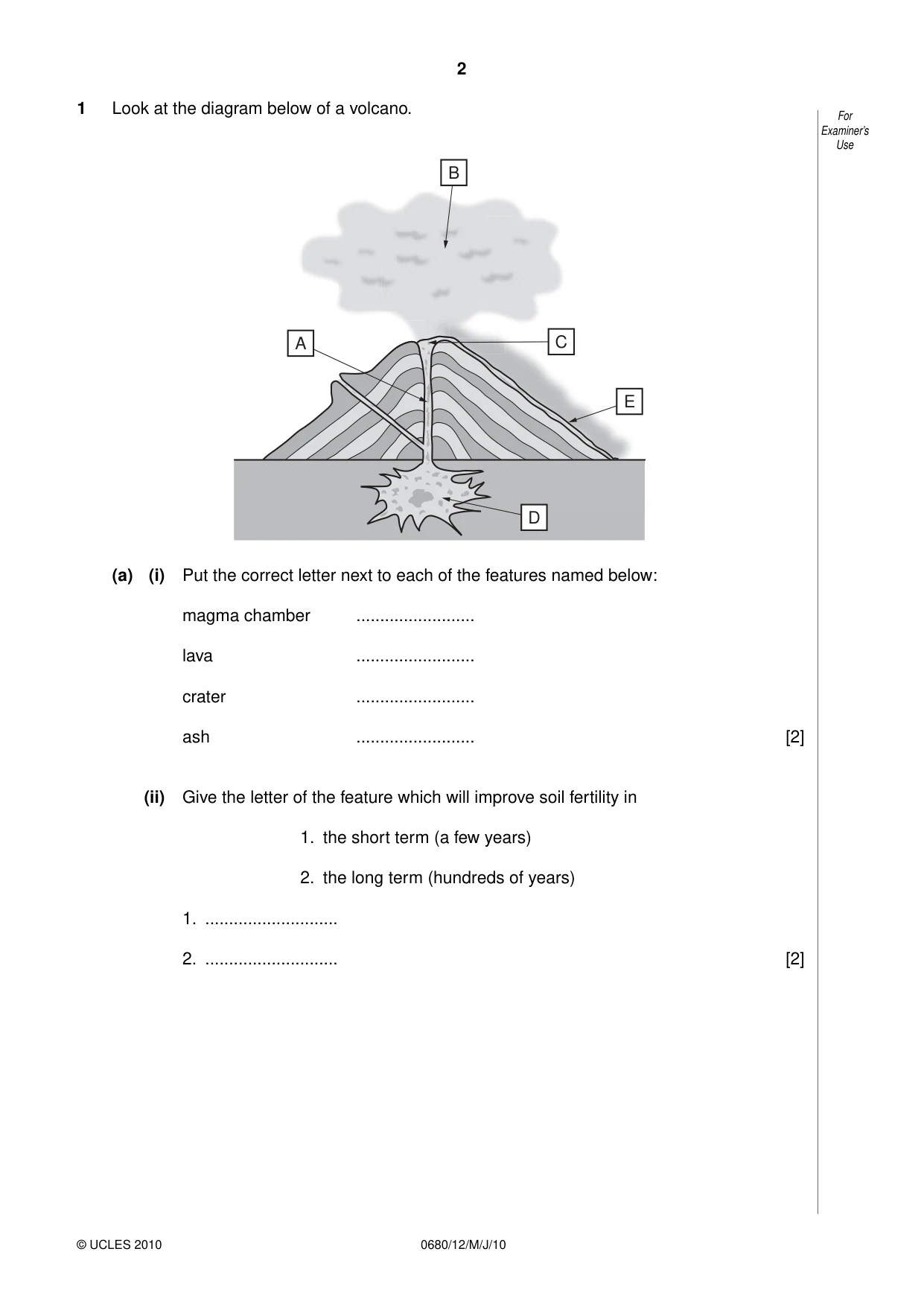
2 © UCLES 2010 For Examiner’s Use 0680/12/M/J/10 1 Look at the diagram below of a volcano. A B C E D (a) (i) Put the correct letter next to each of the features named below: magma chamber … lava … crater … ash … [2] (ii) Give the letter of the feature which will improve soil fertility in 1. the short term (a few years) 2. the long term (hundreds of years) 1. … 2. … [2]
Question paper, page 3
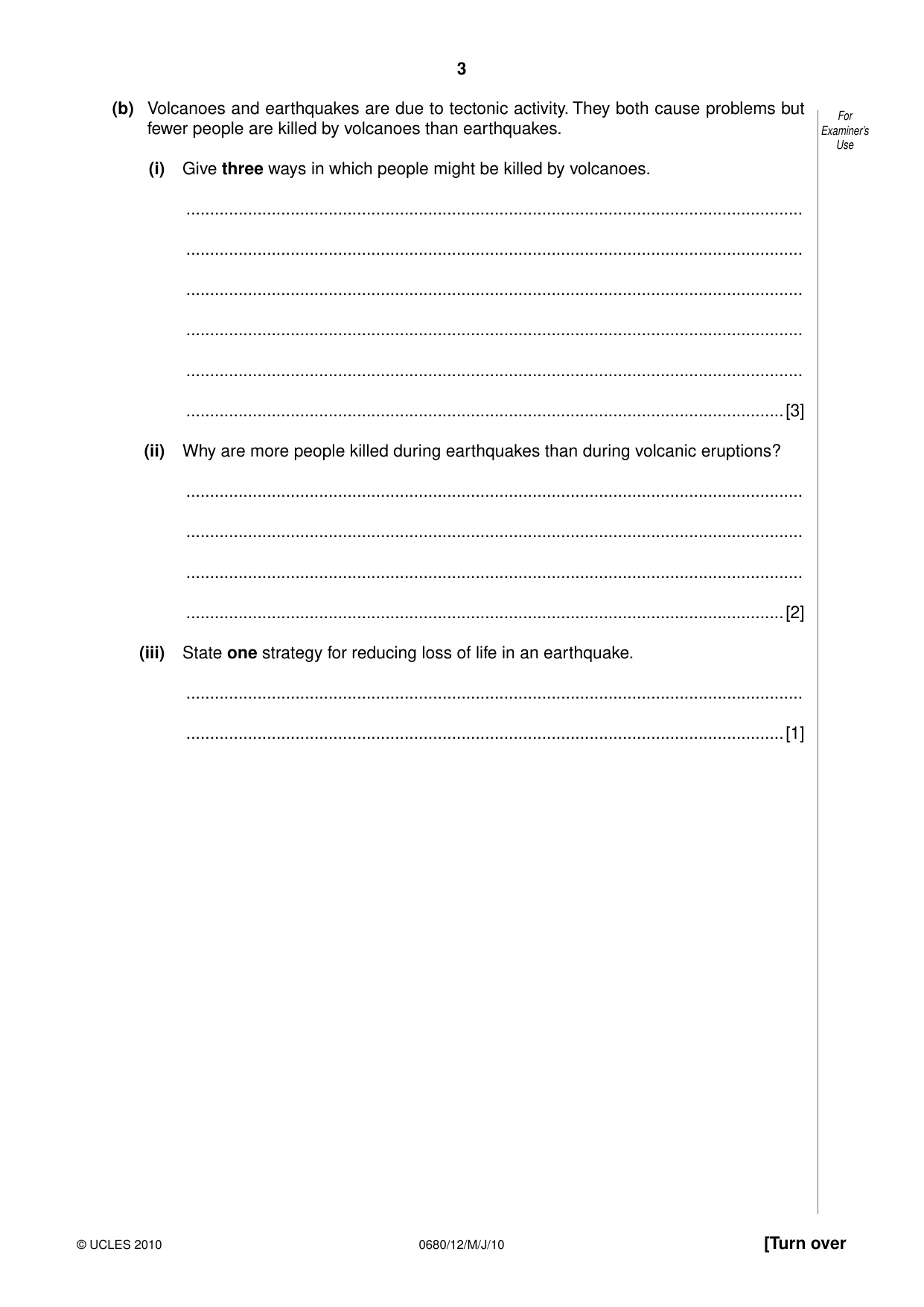
3 © UCLES 2010 [Turn over For Examiner’s Use 0680/12/M/J/10 (b) Volcanoes and earthquakes are due to tectonic activity. They both cause problems but fewer people are killed by volcanoes than earthquakes. (i) Give three ways in which people might be killed by volcanoes. … … … … … …[3] (ii) Why are more people killed during earthquakes than during volcanic eruptions? … … … …[2] (iii) State one strategy for reducing loss of life in an earthquake. … …[1]
Question paper, page 4
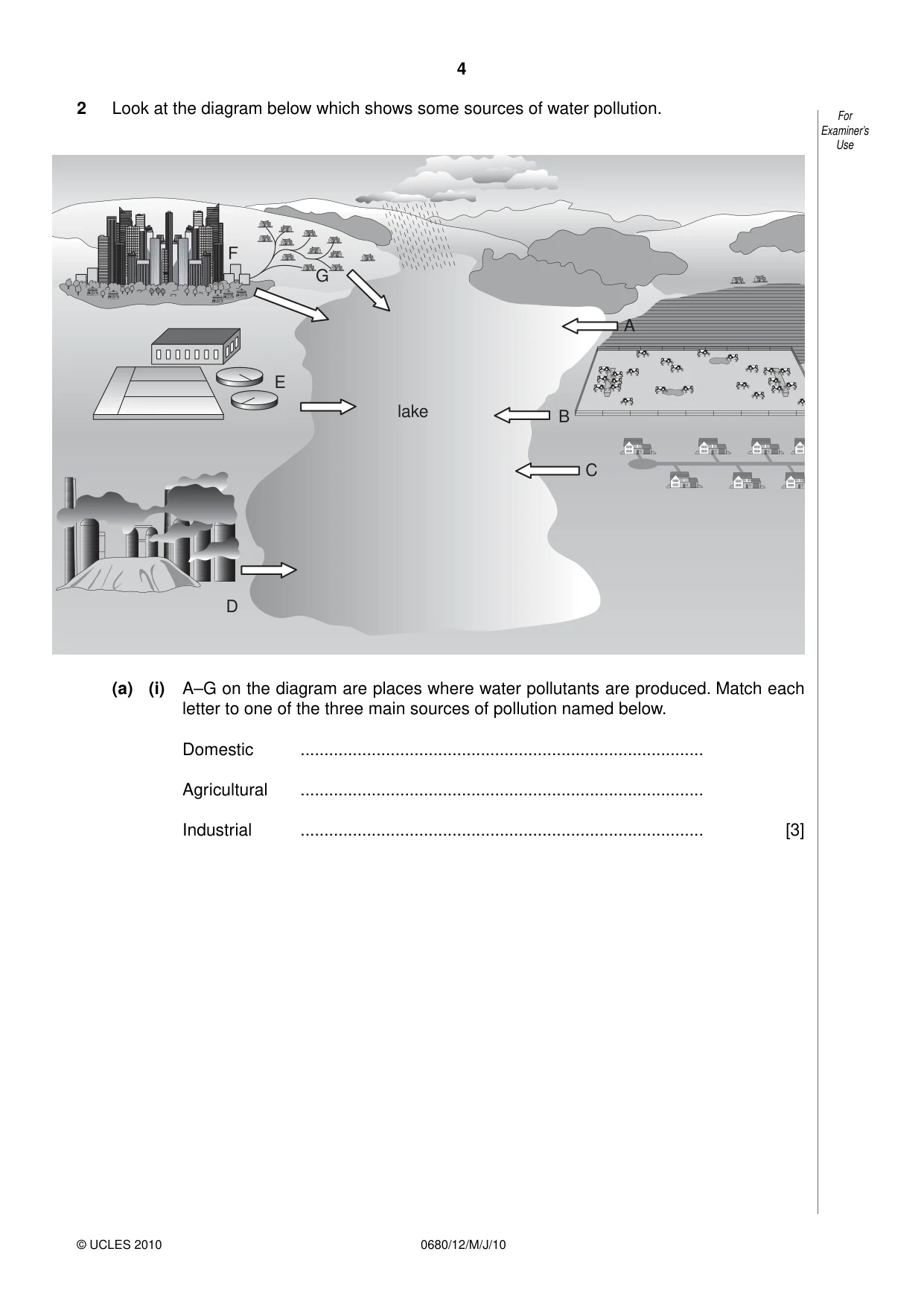
4 © UCLES 2010 For Examiner’s Use 0680/12/M/J/10 2 Look at the diagram below which shows some sources of water pollution. D C B lake A G F E (a) (i) A–G on the diagram are places where water pollutants are produced. Match each letter to one of the three main sources of pollution named below. Domestic … Agricultural … Industrial … [3]
Question paper, page 5
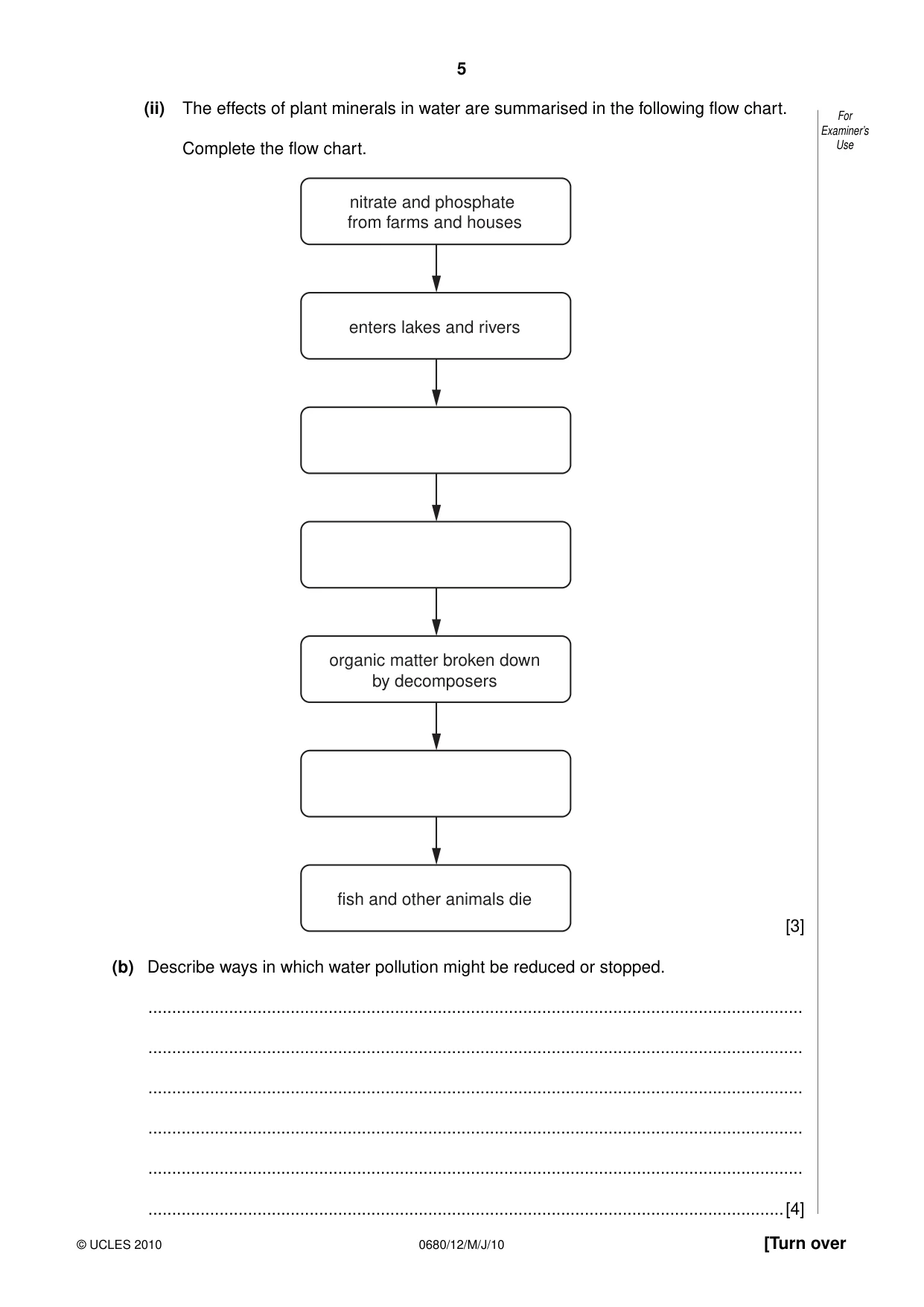
5 © UCLES 2010 [Turn over For Examiner’s Use 0680/12/M/J/10 (ii) The effects of plant minerals in water are summarised in the following flow chart. Complete the flow chart. nitrate and phosphate from farms and houses enters lakes and rivers organic matter broken down by decomposers fish and other animals die [3] (b) Describe ways in which water pollution might be reduced or stopped. … … … … … …[4]
Question paper, page 6
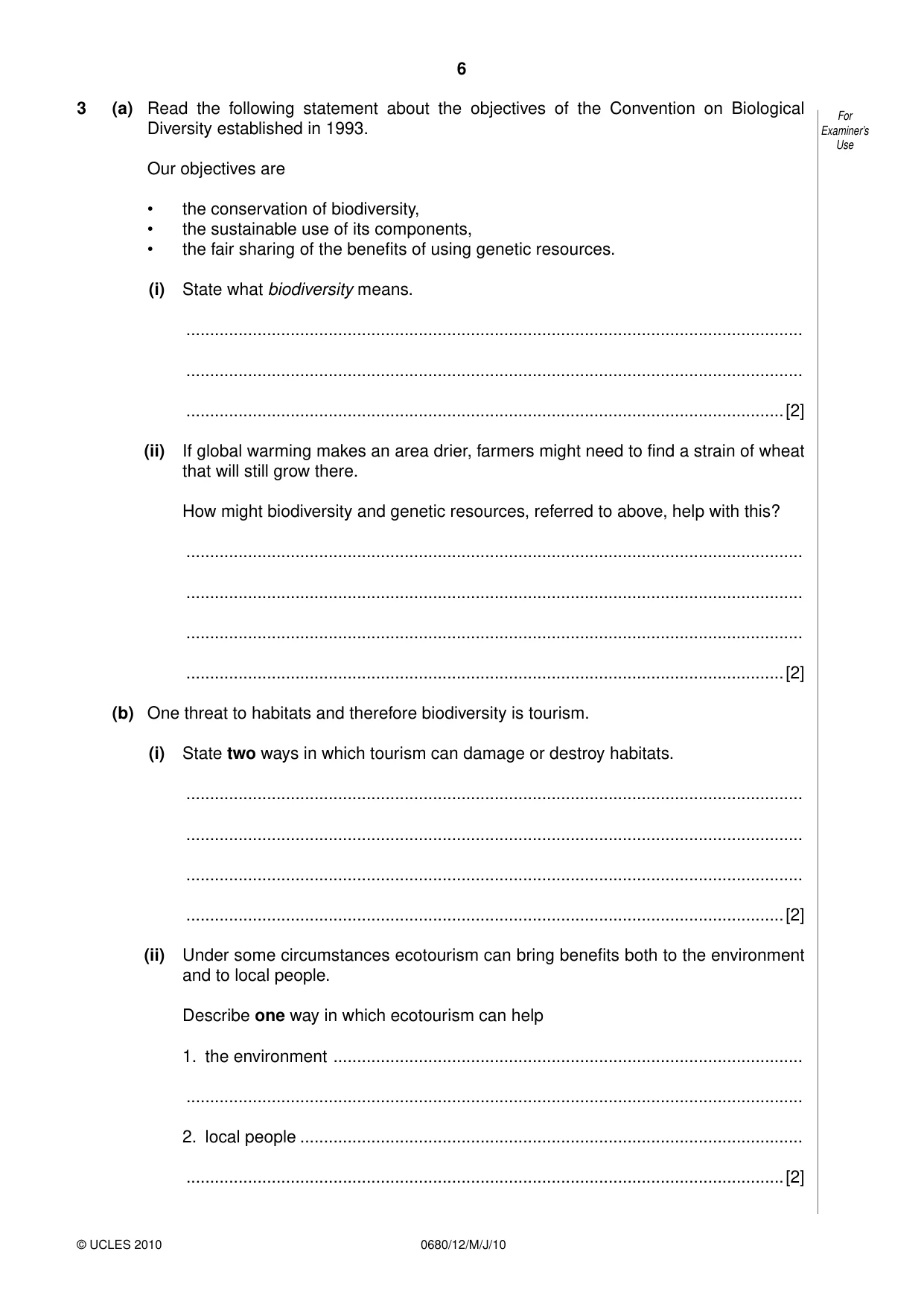
6 © UCLES 2010 For Examiner’s Use 0680/12/M/J/10 3 (a) Read the following statement about the objectives of the Convention on Biological Diversity established in 1993. Our objectives are • the conservation of biodiversity, • the sustainable use of its components, • the fair sharing of the benefits of using genetic resources. (i) State what biodiversity means. … … …[2] (ii) If global warming makes an area drier, farmers might need to find a strain of wheat that will still grow there. How might biodiversity and genetic resources, referred to above, help with this? … … … …[2] (b) One threat to habitats and therefore biodiversity is tourism. (i) State two ways in which tourism can damage or destroy habitats. … … … …[2] (ii) Under some circumstances ecotourism can bring benefits both to the environment and to local people. Describe one way in which ecotourism can help 1. the environment … … 2. local people … …[2]
Question paper, page 7
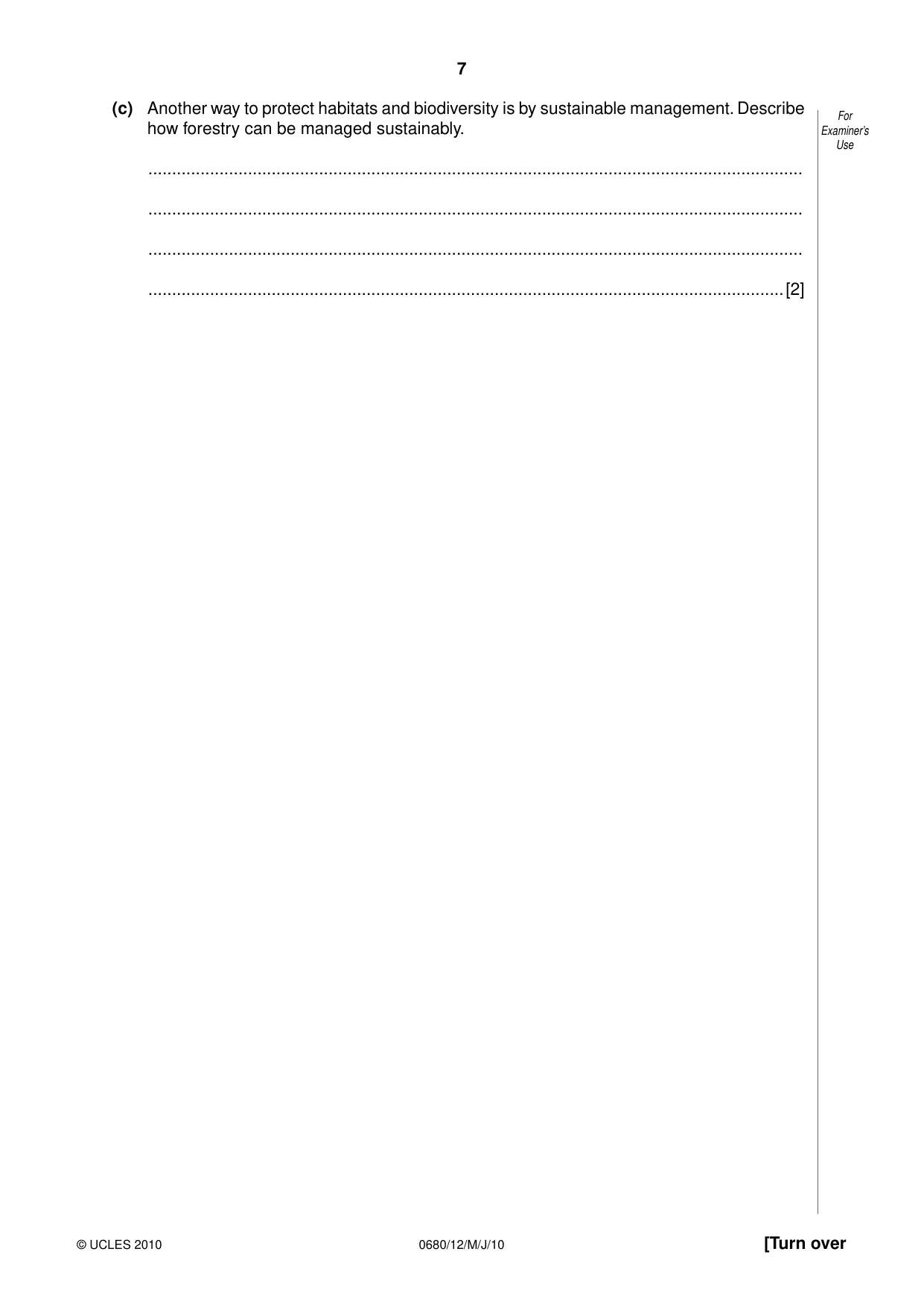
7 © UCLES 2010 [Turn over For Examiner’s Use 0680/12/M/J/10 (c) Another way to protect habitats and biodiversity is by sustainable management. Describe how forestry can be managed sustainably. … … … …[2]
Question paper, page 8
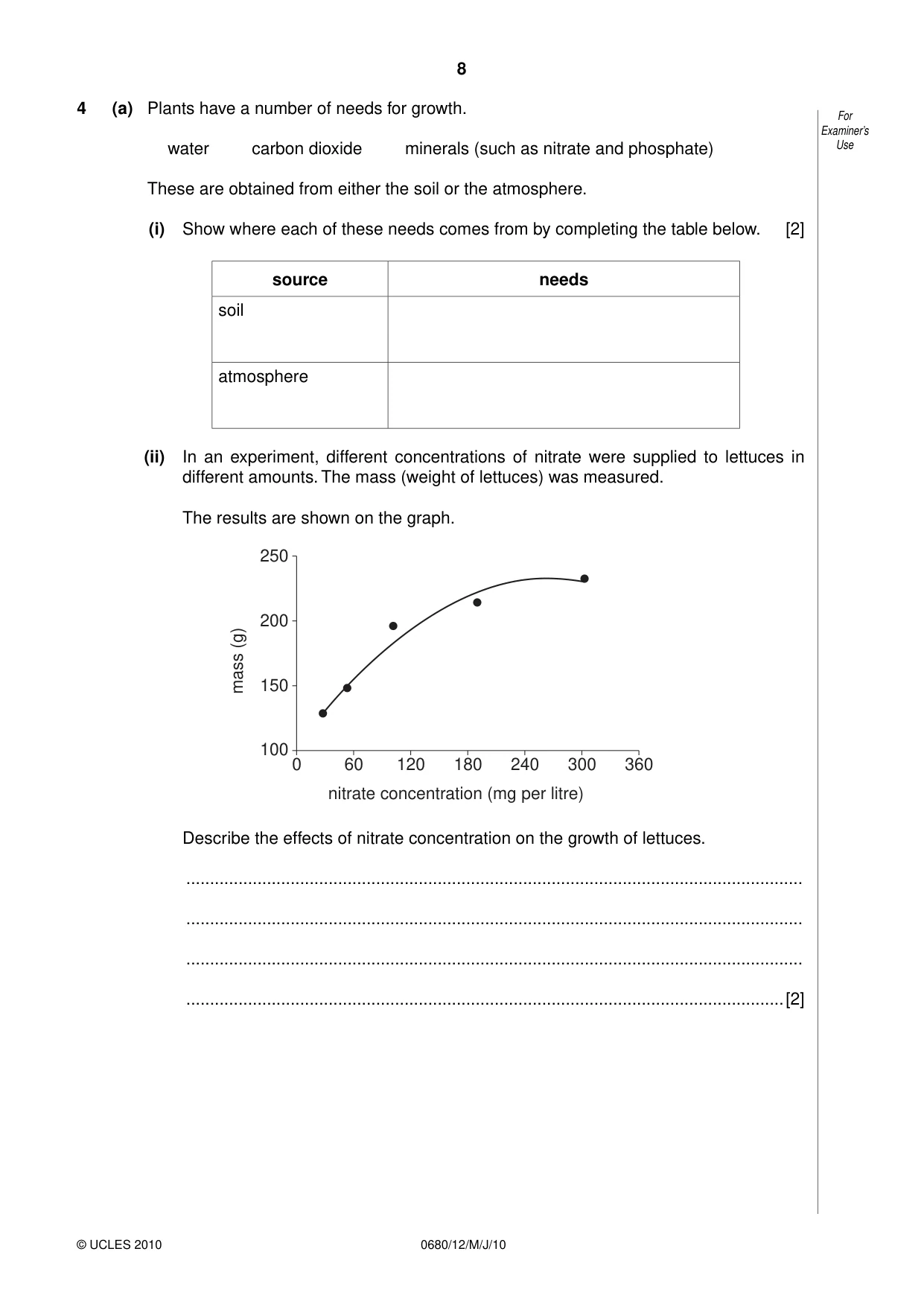
8 © UCLES 2010 For Examiner’s Use 0680/12/M/J/10 4 (a) Plants have a number of needs for growth. water carbon dioxide minerals (such as nitrate and phosphate) These are obtained from either the soil or the atmosphere. (i) Show where each of these needs comes from by completing the table below. [2] source needs soil atmosphere (ii) In an experiment, different concentrations of nitrate were supplied to lettuces in different amounts. The mass (weight of lettuces) was measured. The results are shown on the graph. 250 200 150 100 0 60 120 180 240 300 360 nitrate concentration (mg per litre) mass (g) Describe the effects of nitrate concentration on the growth of lettuces. … … … …[2]
Question paper, page 9
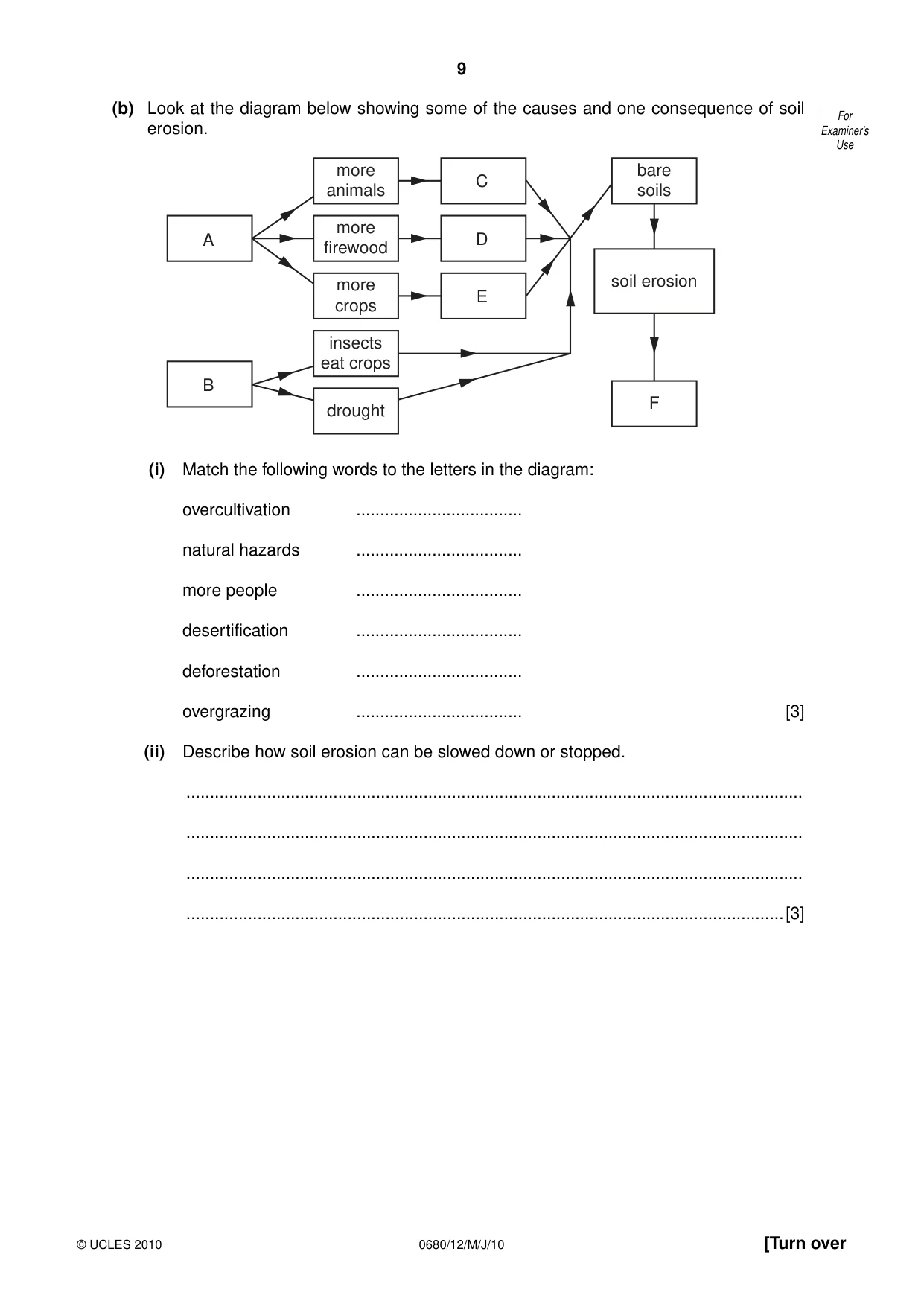
9 © UCLES 2010 [Turn over For Examiner’s Use 0680/12/M/J/10 (b) Look at the diagram below showing some of the causes and one consequence of soil erosion. more animals bare soils soil erosion F E D C A B more firewood more crops insects eat crops drought (i) Match the following words to the letters in the diagram: overcultivation … natural hazards … more people … desertification … deforestation … overgrazing … [3] (ii) Describe how soil erosion can be slowed down or stopped. … … … …[3]
Question paper, page 10
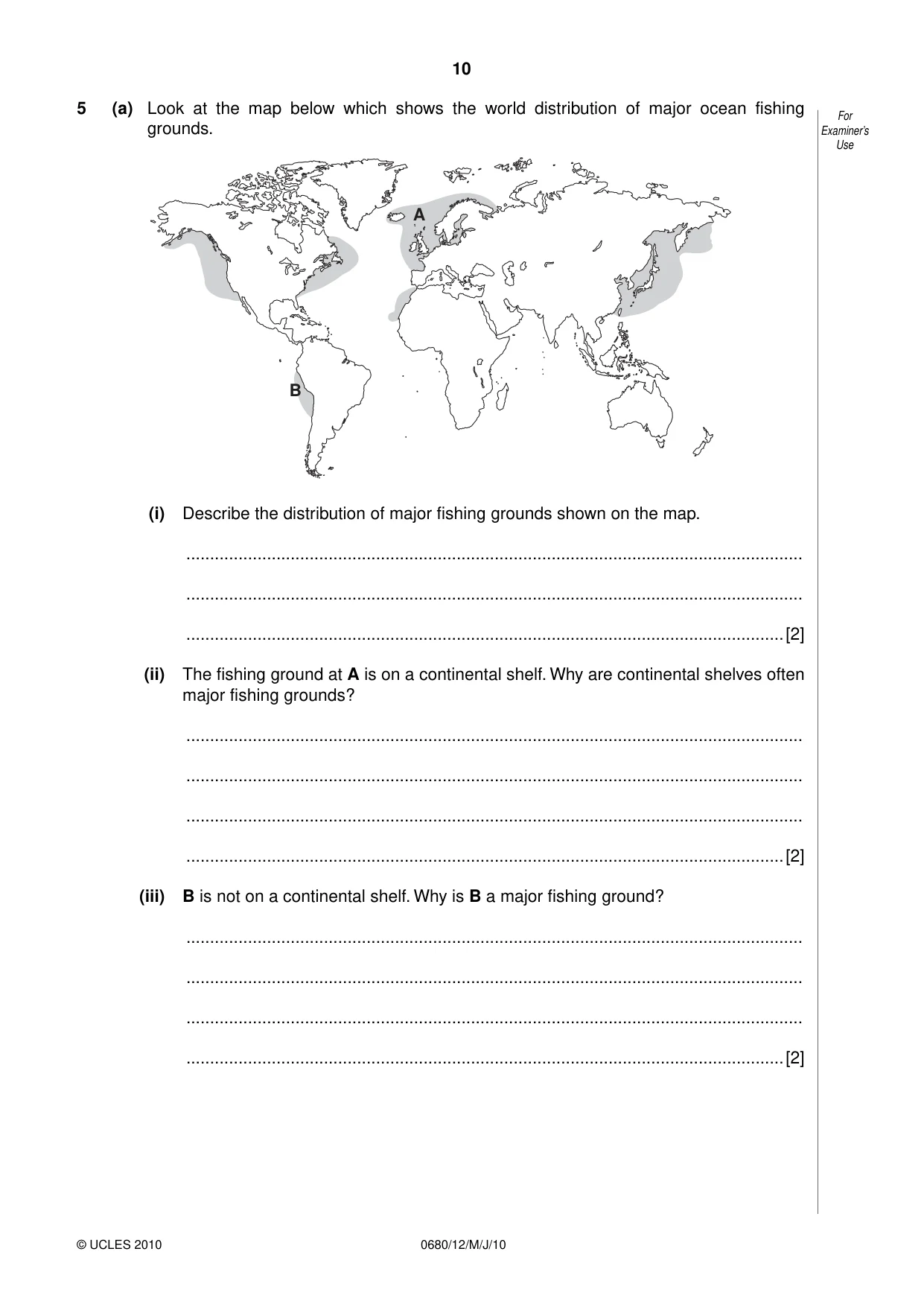
10 © UCLES 2010 For Examiner’s Use 0680/12/M/J/10 5 (a) Look at the map below which shows the world distribution of major ocean fishing grounds. A B (i) Describe the distribution of major fishing grounds shown on the map. … … …[2] (ii) The fishing ground at A is on a continental shelf. Why are continental shelves often major fishing grounds? … … … …[2] (iii) B is not on a continental shelf. Why is B a major fishing ground? … … … …[2]
Question paper, page 11
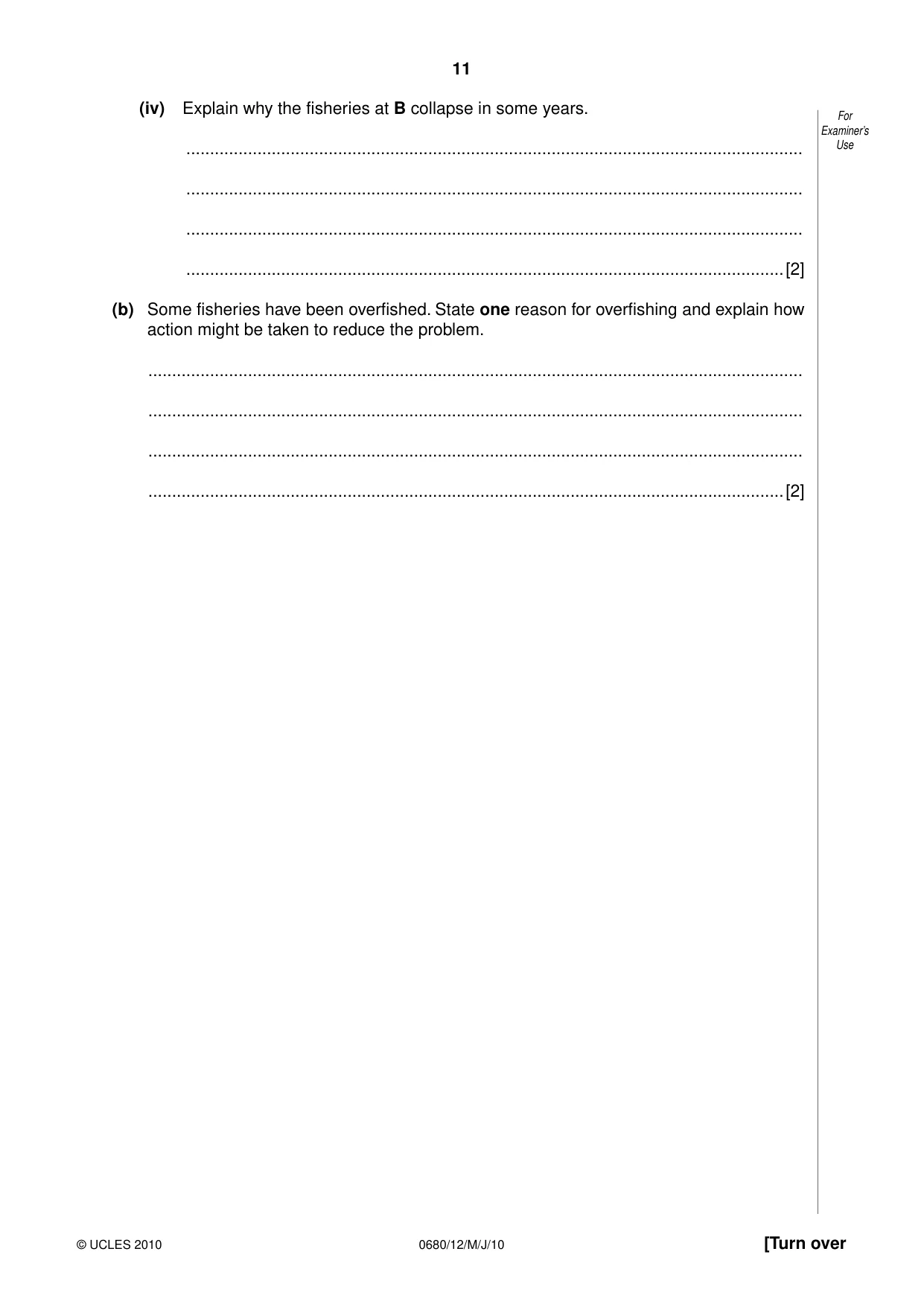
11 © UCLES 2010 [Turn over For Examiner’s Use 0680/12/M/J/10 (iv) Explain why the fisheries at B collapse in some years. … … … …[2] (b) Some fisheries have been overfished. State one reason for overfishing and explain how action might be taken to reduce the problem. … … … …[2]
Question paper, page 12
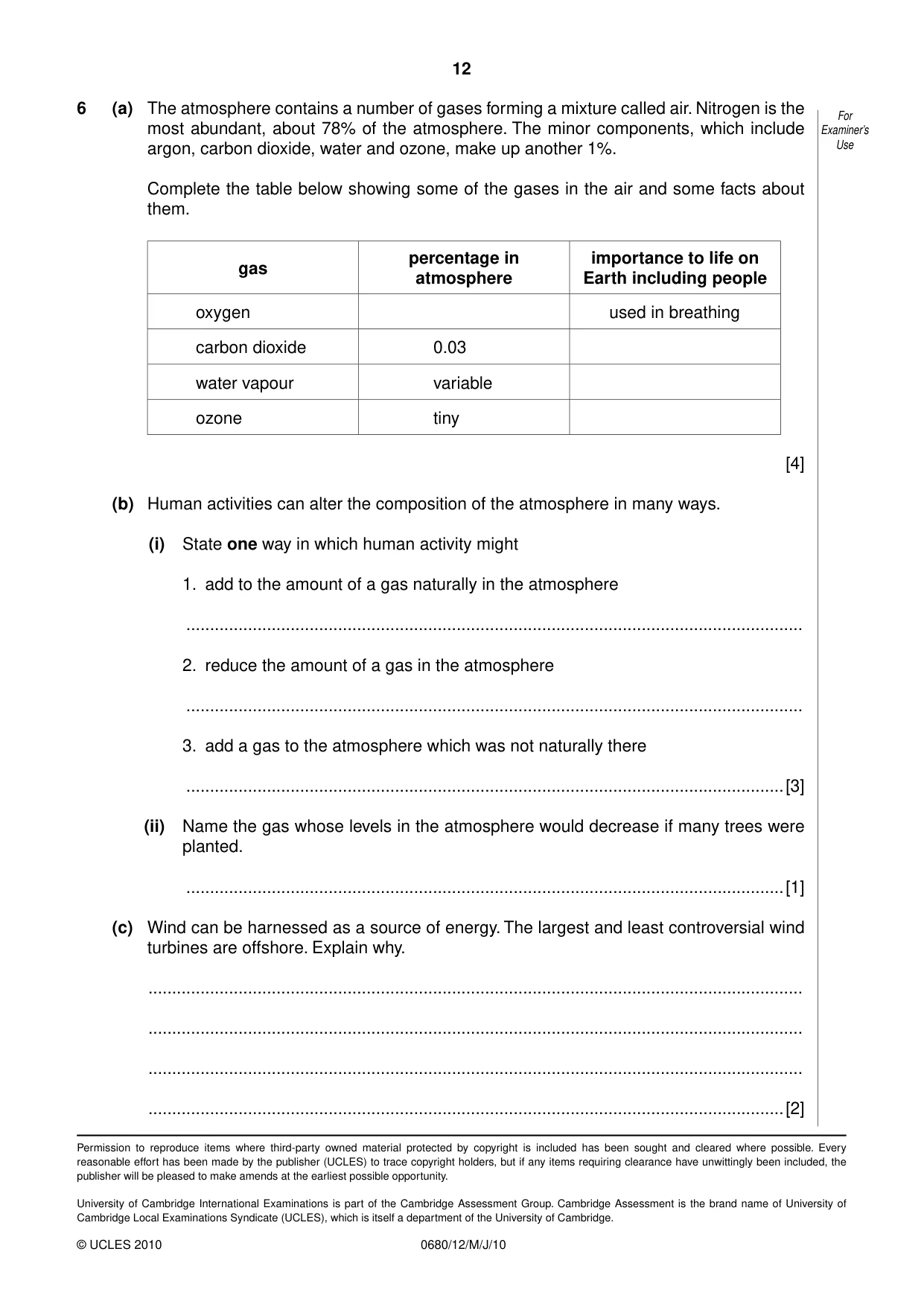
12 © UCLES 2010 0680/12/M/J/10 For Examiner’s Use 6 (a) The atmosphere contains a number of gases forming a mixture called air. Nitrogen is the most abundant, about 78% of the atmosphere. The minor components, which include argon, carbon dioxide, water and ozone, make up another 1%. Complete the table below showing some of the gases in the air and some facts about them. gas percentage in atmosphere importance to life on Earth including people oxygen used in breathing carbon dioxide 0.03 water vapour variable ozone tiny [4] (b) Human activities can alter the composition of the atmosphere in many ways. (i) State one way in which human activity might 1. add to the amount of a gas naturally in the atmosphere … 2. reduce the amount of a gas in the atmosphere … 3. add a gas to the atmosphere which was not naturally there …[3] (ii) Name the gas whose levels in the atmosphere would decrease if many trees were planted. …[1] (c) Wind can be harnessed as a source of energy. The largest and least controversial wind turbines are offshore. Explain why. … … … …[2] Permission to reproduce items where third-party owned material protected by copyright is included has been sought and cleared where possible. Every reasonable effort has been made by the publisher (UCLES) to trace copyright holders, but if any items requiring clearance have unwittingly been included, the publisher will be pleased to make amends at the earliest possible opportunity. University of Cambridge International Examinations is part of the Cambridge Assessment Group. Cambridge Assessment is the brand name of University of Cambridge Local Examinations Syndicate (UCLES), which is itself a department of the University of Cambridge.
Mark scheme, page 1
UNIVERSITY OF CAMBRIDGE INTERNATIONAL EXAMINATIONS International General Certificate of Secondary Education MARK SCHEME for the May/June 2010 question paper for the guidance of teachers 0680 ENVIRONMENTAL MANAGEMENT 0680/12 Paper 12, maximum raw mark 60 This mark scheme is published as an aid to teachers and candidates, to indicate the requirements of the examination. It shows the basis on which Examiners were instructed to award marks. It does not indicate the details of the discussions that took place at an Examiners’ meeting before marking began, which would have considered the acceptability of alternative answers. Mark schemes must be read in conjunction with the question papers and the report on the examination. • CIE will not enter into discussions or correspondence in connection with these mark schemes. CIE is publishing the mark schemes for the May/June 2010 question papers for most IGCSE, GCE Advanced Level and Advanced Subsidiary Level syllabuses and some Ordinary Level syllabuses. www.XtremePapers.com
Mark scheme, page 2
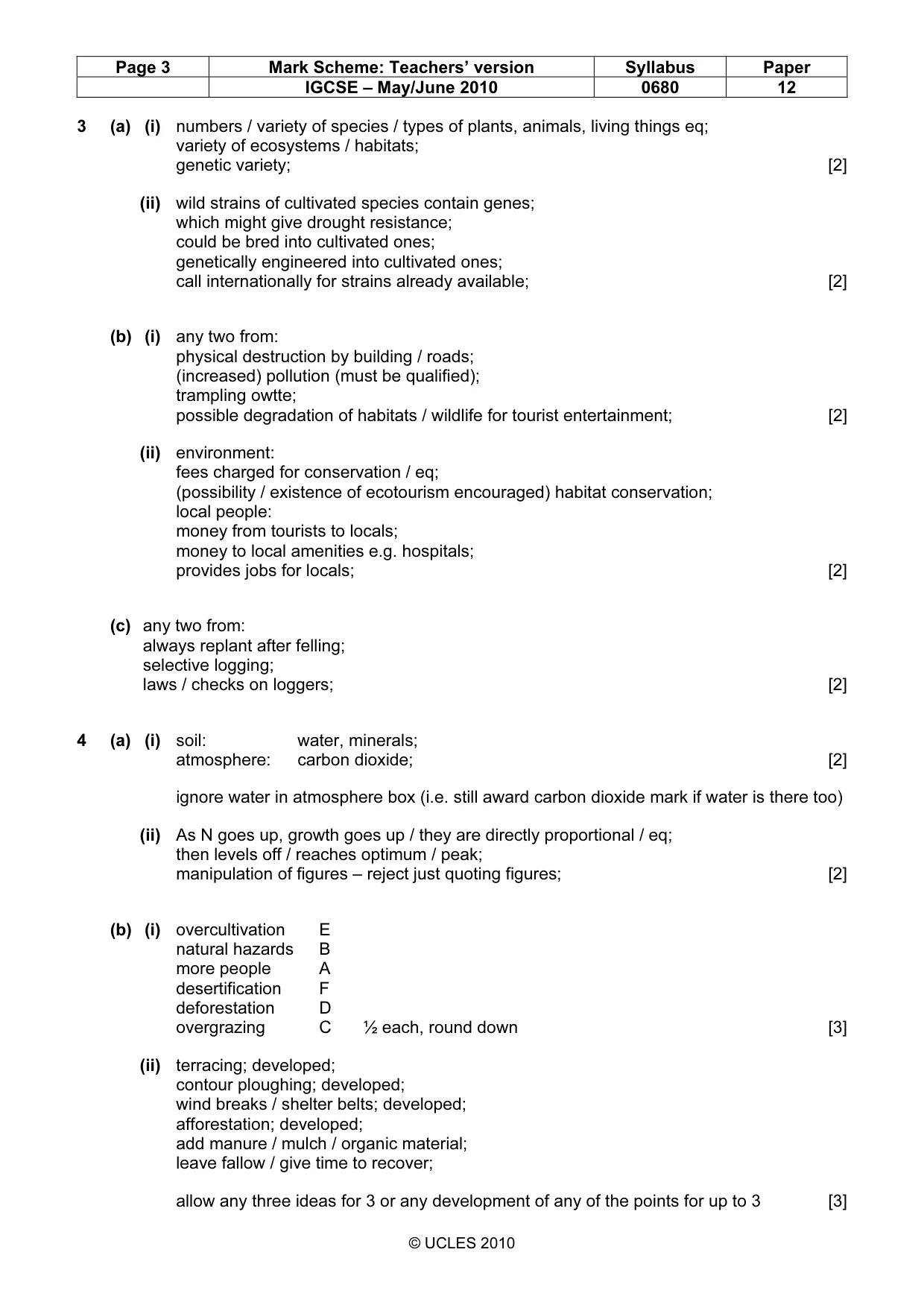
Page 2 Mark Scheme: Teachers’ version Syllabus Paper IGCSE – May/June 2010 0680 12 © UCLES 2010 1 (a) (i) magma chamber D lava E crater C ash B [2] (ii) 1. B 2. E [2] (b) (i) any three from: breathing related problems (suffocation / poisoning); physical if living at top (buried / hit etc.); caught by lava flow, incinerated; floods / mud slides due to ice / snow melt; consequent collapse of buildings in context [3] reject knock on effects about food supply (ii) any two from: earthquakes: no warning / ora; sudden / quick / happens all at once / ora; widespread / ora; volcano: more often very remote / ora; [2] (ora – or reverse argument) (iii) better stronger buildings / any aspect of improved after care / evacuation of prone areas; [1] 2 (a) (i) domestic C, E, G, F agricultural G, A, B industrial D, E [3] (ii) BOX 1 growth / bloom (eq) of algae – accept plants grow; BOX 2 algae die / give organic matter; BOX 3 uses up oxygen / oxygen levels fall / no oxygen; [3] (b) detergent substitutes; sewage treatment; regulation; education; regulate fertiliser addition; reduction of acid rain causing gases; [4] either four ideas stated or any developed for another mark in each case reject answer which just talk about not doing things like use fertiliser, pesticides, farm near rivers reject just prevent without a how
Mark scheme, page 3
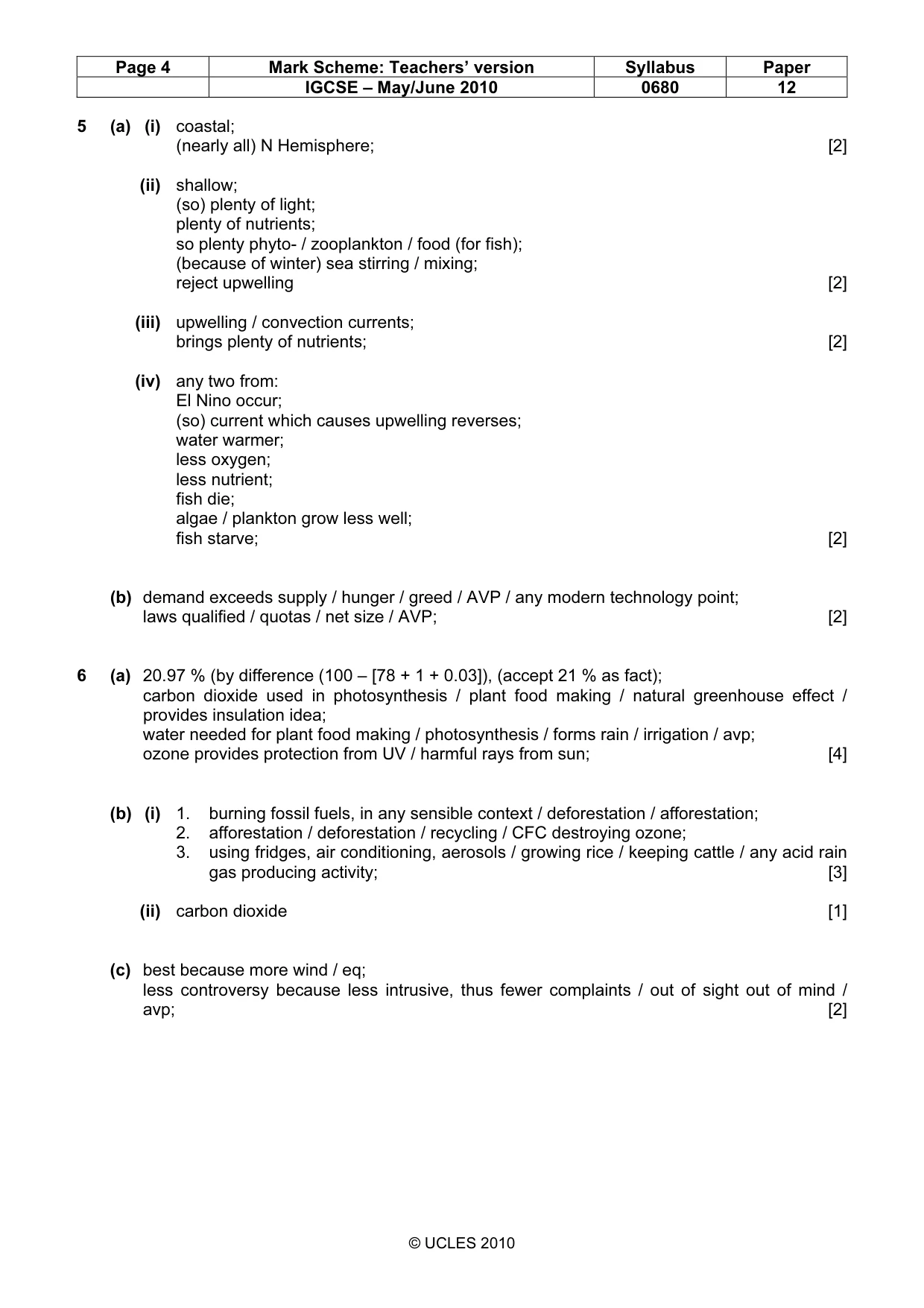
Page 3 Mark Scheme: Teachers’ version Syllabus Paper IGCSE – May/June 2010 0680 12 © UCLES 2010 3 (a) (i) numbers / variety of species / types of plants, animals, living things eq; variety of ecosystems / habitats; genetic variety; [2] (ii) wild strains of cultivated species contain genes; which might give drought resistance; could be bred into cultivated ones; genetically engineered into cultivated ones; call internationally for strains already available; [2] (b) (i) any two from: physical destruction by building / roads; (increased) pollution (must be qualified); trampling owtte; possible degradation of habitats / wildlife for tourist entertainment; [2] (ii) environment: fees charged for conservation / eq; (possibility / existence of ecotourism encouraged) habitat conservation; local people: money from tourists to locals; money to local amenities e.g. hospitals; provides jobs for locals; [2] (c) any two from: always replant after felling; selective logging; laws / checks on loggers; [2] 4 (a) (i) soil: water, minerals; atmosphere: carbon dioxide; [2] ignore water in atmosphere box (i.e. still award carbon dioxide mark if water is there too) (ii) As N goes up, growth goes up / they are directly proportional / eq; then levels off / reaches optimum / peak; manipulation of figures – reject just quoting figures; [2] (b) (i) overcultivation E natural hazards B more people A desertification F deforestation D overgrazing C ½ each, round down [3] (ii) terracing; developed; contour ploughing; developed; wind breaks / shelter belts; developed; afforestation; developed; add manure / mulch / organic material; leave fallow / give time to recover; allow any three ideas for 3 or any development of any of the points for up to 3 [3]
Mark scheme, page 4
Page 4 Mark Scheme: Teachers’ version Syllabus Paper IGCSE – May/June 2010 0680 12 © UCLES 2010 5 (a) (i) coastal; (nearly all) N Hemisphere; [2] (ii) shallow; (so) plenty of light; plenty of nutrients; so plenty phyto- / zooplankton / food (for fish); (because of winter) sea stirring / mixing; reject upwelling [2] (iii) upwelling / convection currents; brings plenty of nutrients; [2] (iv) any two from: El Nino occur; (so) current which causes upwelling reverses; water warmer; less oxygen; less nutrient; fish die; algae / plankton grow less well; fish starve; [2] (b) demand exceeds supply / hunger / greed / AVP / any modern technology point; laws qualified / quotas / net size / AVP; [2] 6 (a) 20.97 % (by difference (100 – [78 + 1 + 0.03]), (accept 21 % as fact); carbon dioxide used in photosynthesis / plant food making / natural greenhouse effect / provides insulation idea; water needed for plant food making / photosynthesis / forms rain / irrigation / avp; ozone provides protection from UV / harmful rays from sun; [4] (b) (i) 1. burning fossil fuels, in any sensible context / deforestation / afforestation; 2. afforestation / deforestation / recycling / CFC destroying ozone; 3. using fridges, air conditioning, aerosols / growing rice / keeping cattle / any acid rain gas producing activity; [3] (ii) carbon dioxide [1] (c) best because more wind / eq; less controversy because less intrusive, thus fewer complaints / out of sight out of mind / avp; [2]
What you needed in this session
Cambridge’s own grade thresholds for 2010 May/June, Paper 1 · Variant 2. A higher threshold means an easier paper — the bar moves with how the cohort did.