Cambridge IGCSE Environmental Management 0680 — 2010 May/June Paper 1 · Variant 1
0680/11/M/J/10 · 60 marks · ≈68 min
The question paper and its mark scheme, free to read here and free to download. This is Cambridge’s own paper, exactly as it was sat.
Question paper12 pages

Mark scheme3 pages
Answers below. Sit the paper first if you are practising.
Paper as text
Question paper, page 1
This document consists of 11 printed pages and 1 blank page. DC (AC/DJ) 16492/5 © UCLES 2010 [Turn over UNIVERSITY OF CAMBRIDGE INTERNATIONAL EXAMINATIONS International General Certificate of Secondary Education READ THESE INSTRUCTIONS FIRST Write your Centre number, candidate number and name on all the work you hand in. Write in dark blue or black pen. You may use a soft pencil for any diagrams, graphs or rough working. Do not use staples, paper clips, highlighters, glue or correction fluid. DO NOT WRITE IN ANY BARCODES. Answer all questions. At the end of the examination, fasten all your work securely together. The number of marks is given in brackets [ ] at the end of each question or part question. * 2 6 3 2 8 7 4 2 7 6 * ENVIRONMENTAL MANAGEMENT 0680/11 Paper 1 May/June 2010 1 hour 30 minutes Candidates answer on the Question Paper. Additional Materials: Ruler For Examiner’s Use 1 2 3 4 5 6 Total www.XtremePapers.com
Question paper, page 2
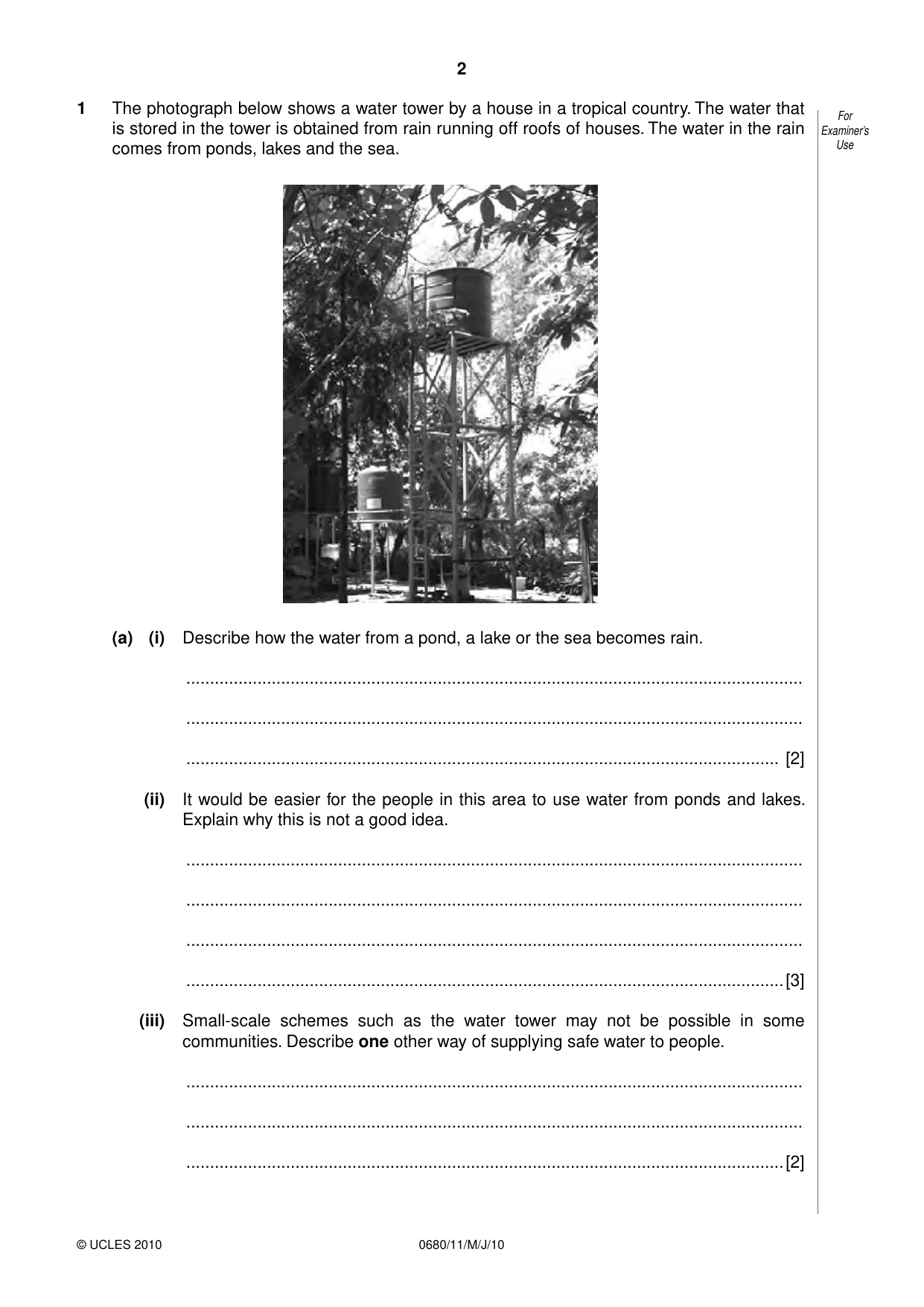
2 0680/11/M/J/10 © UCLES 2010 For Examiner’s Use 1 The photograph below shows a water tower by a house in a tropical country. The water that is stored in the tower is obtained from rain running off roofs of houses. The water in the rain comes from ponds, lakes and the sea. (a) (i) Describe how the water from a pond, a lake or the sea becomes rain. … … … [2] (ii) It would be easier for the people in this area to use water from ponds and lakes. Explain why this is not a good idea. … … … …[3] (iii) Small-scale schemes such as the water tower may not be possible in some communities. Describe one other way of supplying safe water to people. … … …[2]
Question paper, page 3
3 [Turn over 0680/11/M/J/10 © UCLES 2010 For Examiner’s Use (b) Most of the water on Earth is in the oceans. As well as being a store of water, the oceans are also an important source of food for humans. Describe and explain where the world’s main oceanic fisheries are located. … … … … … … [3]
Question paper, page 4
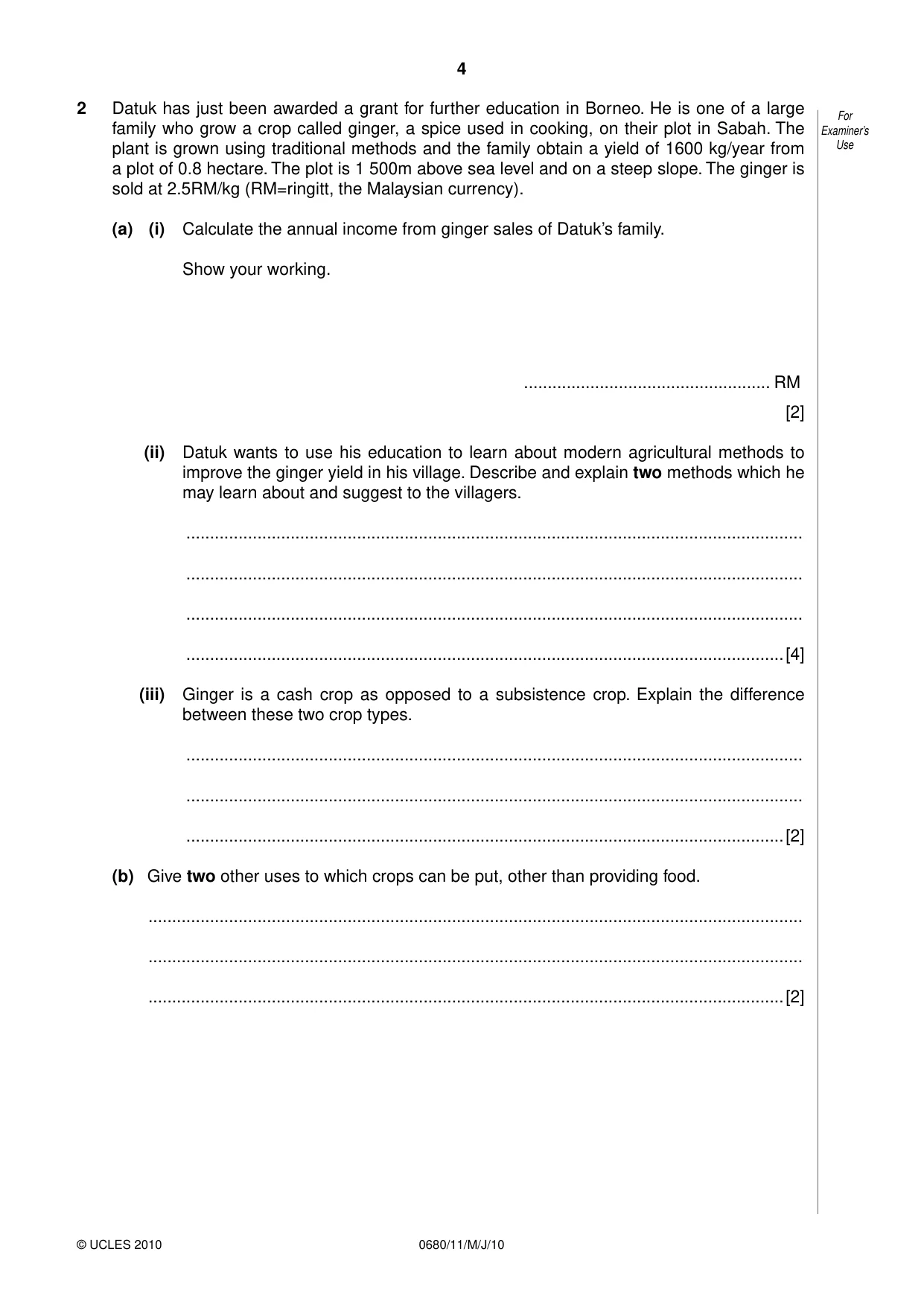
4 0680/11/M/J/10 © UCLES 2010 For Examiner’s Use 2 Datuk has just been awarded a grant for further education in Borneo. He is one of a large family who grow a crop called ginger, a spice used in cooking, on their plot in Sabah. The plant is grown using traditional methods and the family obtain a yield of 1600 kg/year from a plot of 0.8 hectare. The plot is 1 500m above sea level and on a steep slope. The ginger is sold at 2.5RM/kg (RM=ringitt, the Malaysian currency). (a) (i) Calculate the annual income from ginger sales of Datuk’s family. Show your working. … RM [2] (ii) Datuk wants to use his education to learn about modern agricultural methods to improve the ginger yield in his village. Describe and explain two methods which he may learn about and suggest to the villagers. … … … …[4] (iii) Ginger is a cash crop as opposed to a subsistence crop. Explain the difference between these two crop types. … … …[2] (b) Give two other uses to which crops can be put, other than providing food. … … …[2]
Question paper, page 5
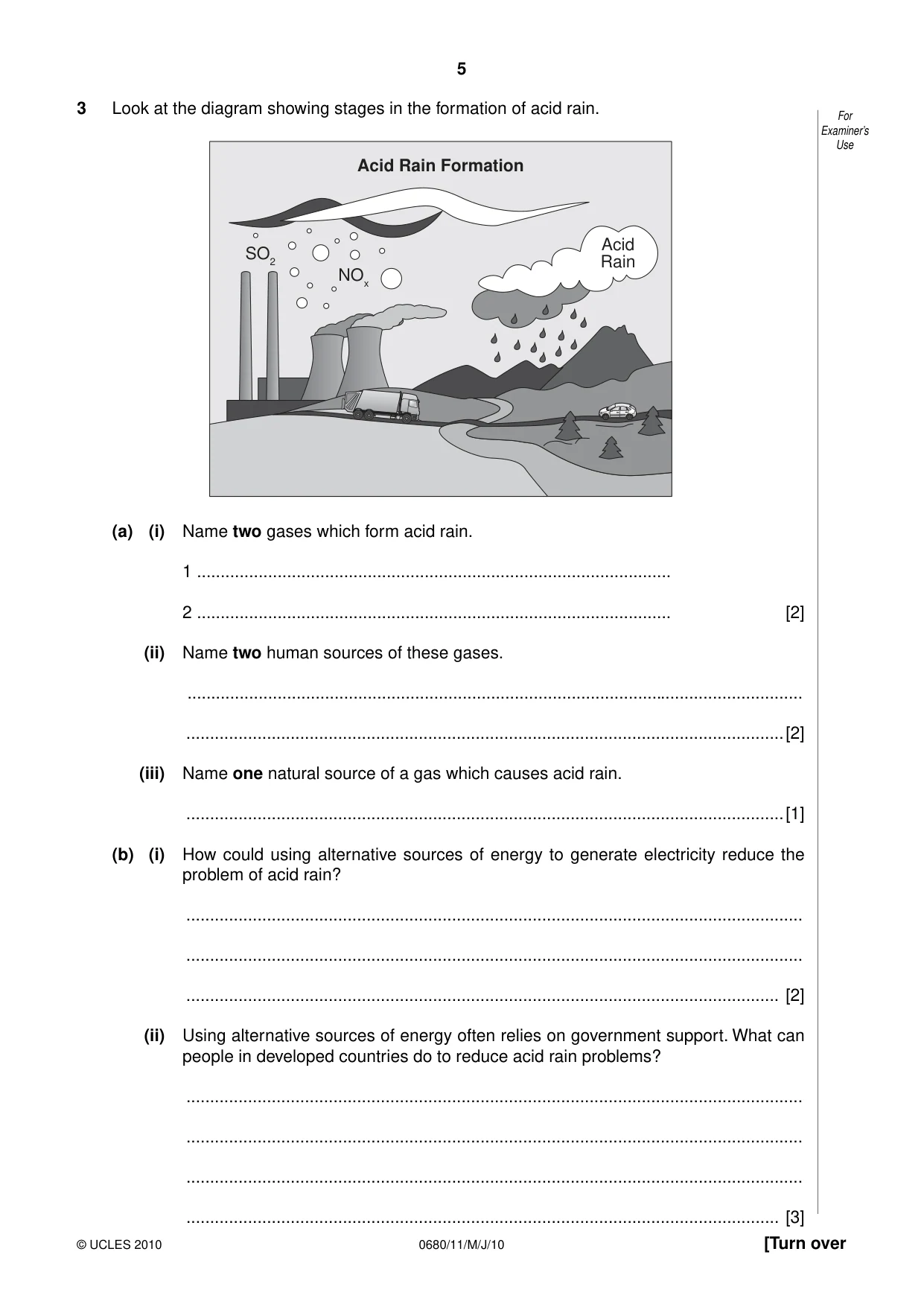
5 [Turn over 0680/11/M/J/10 © UCLES 2010 For Examiner’s Use 3 Look at the diagram showing stages in the formation of acid rain. Acid Rain Formation Acid Rain SO2 NOx (a) (i) Name two gases which form acid rain. 1 … 2 … [2] (ii) Name two human sources of these gases. … …[2] (iii) Name one natural source of a gas which causes acid rain. …[1] (b) (i) How could using alternative sources of energy to generate electricity reduce the problem of acid rain? … … … [2] (ii) Using alternative sources of energy often relies on government support. What can people in developed countries do to reduce acid rain problems? … … … … [3]
Question paper, page 6
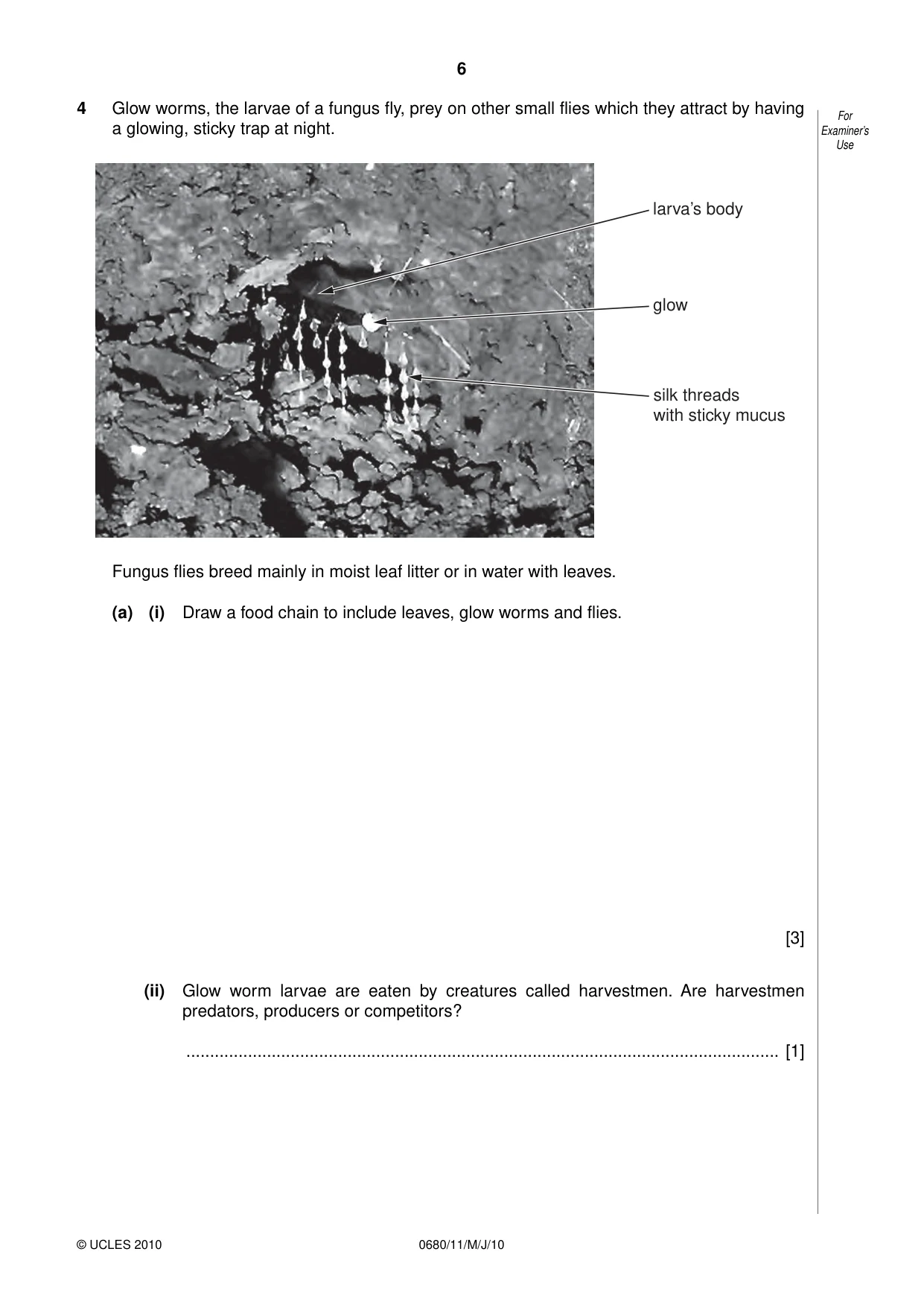
6 0680/11/M/J/10 © UCLES 2010 For Examiner’s Use 4 Glow worms, the larvae of a fungus fly, prey on other small flies which they attract by having a glowing, sticky trap at night. larva’s body glow silk threads with sticky mucus Fungus flies breed mainly in moist leaf litter or in water with leaves. (a) (i) Draw a food chain to include leaves, glow worms and flies. [3] (ii) Glow worm larvae are eaten by creatures called harvestmen. Are harvestmen predators, producers or competitors? … [1]
Question paper, page 7
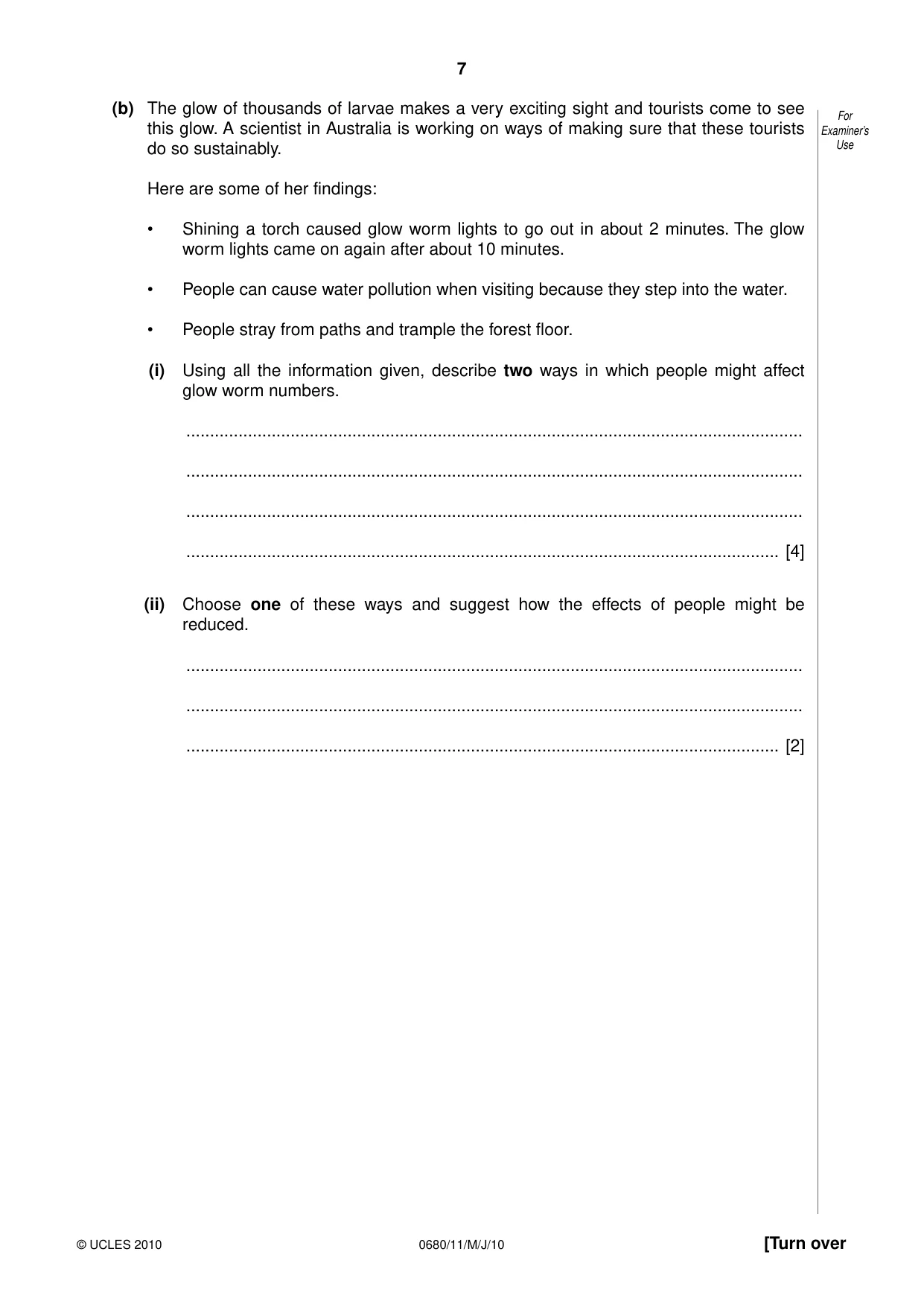
7 [Turn over 0680/11/M/J/10 © UCLES 2010 For Examiner’s Use (b) The glow of thousands of larvae makes a very exciting sight and tourists come to see this glow. A scientist in Australia is working on ways of making sure that these tourists do so sustainably. Here are some of her findings: • Shining a torch caused glow worm lights to go out in about 2 minutes. The glow worm lights came on again after about 10 minutes. • People can cause water pollution when visiting because they step into the water. • People stray from paths and trample the forest floor. (i) Using all the information given, describe two ways in which people might affect glow worm numbers. … … … … [4] (ii) Choose one of these ways and suggest how the effects of people might be reduced. … … … [2]
Question paper, page 8
8 0680/11/M/J/10 © UCLES 2010 For Examiner’s Use 5 (a) One of the components of soil is mineral particles. Where have these particles come from and how were they formed? … … … … [2] (b) (i) Read the following passage about the composition of soil. Fill each gap using the best word from the list below. The words may be used once, more than once or not at all. clay, inorganic, little, much, organic, oxygen, plants, rocks, water Soils, apart from mineral particles, contain dead, decaying … and animals (called … matter). Soil can be very different from one location to another, but generally consists of inorganic particles, … matter, … and air. The inorganic particles are the … that have been broken down into smaller pieces. The size of the pieces varies from pebbles, particles of sand to silt or … . The amount of water in the soil is linked to the climate and is one thing that can affect the amount of air. Very wet soil has … air. The composition of the soil affects the plants and therefore the animals that can live there. [4]
Question paper, page 9
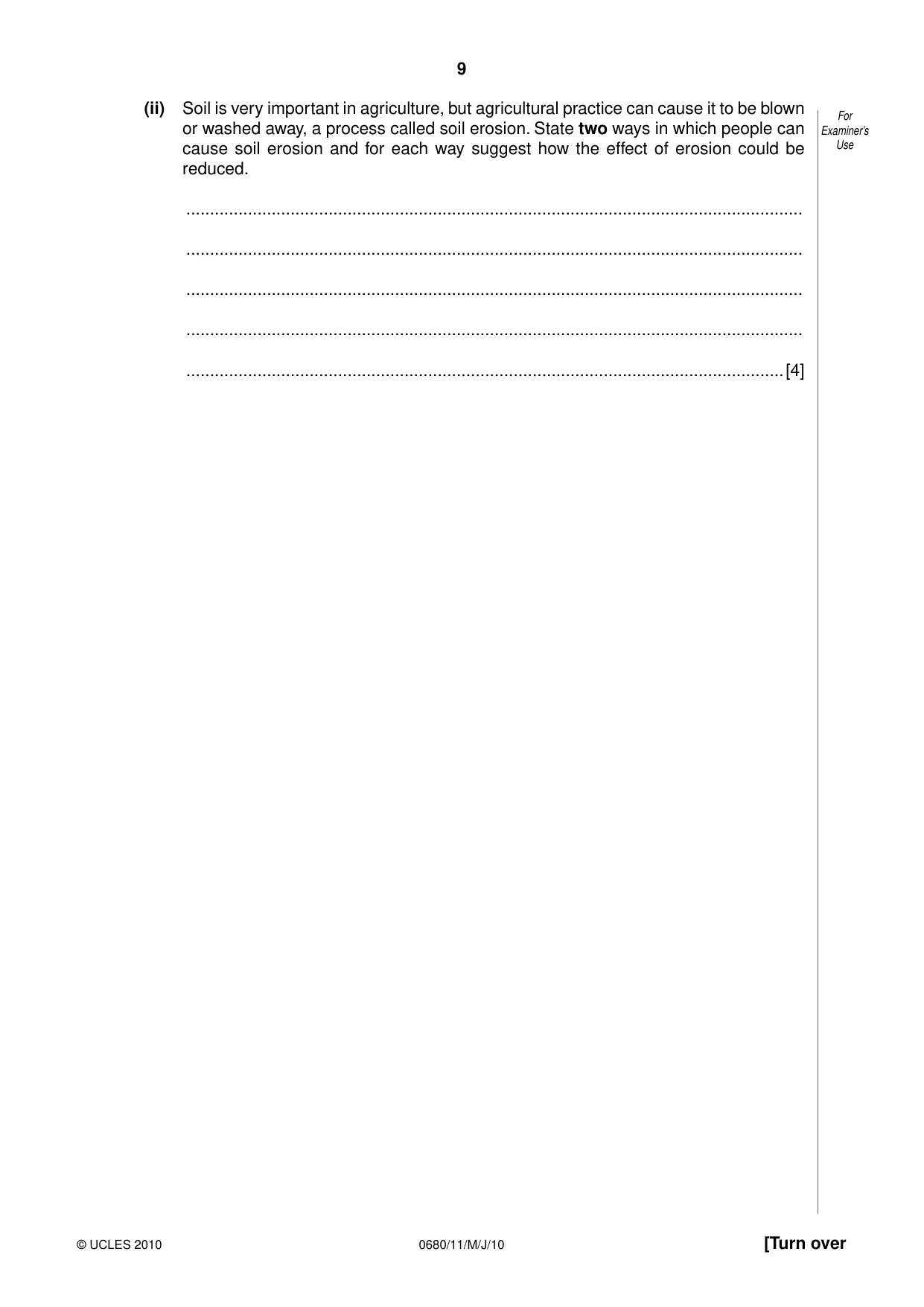
9 [Turn over 0680/11/M/J/10 © UCLES 2010 For Examiner’s Use (ii) Soil is very important in agriculture, but agricultural practice can cause it to be blown or washed away, a process called soil erosion. State two ways in which people can cause soil erosion and for each way suggest how the effect of erosion could be reduced. … … … … …[4]
Question paper, page 10
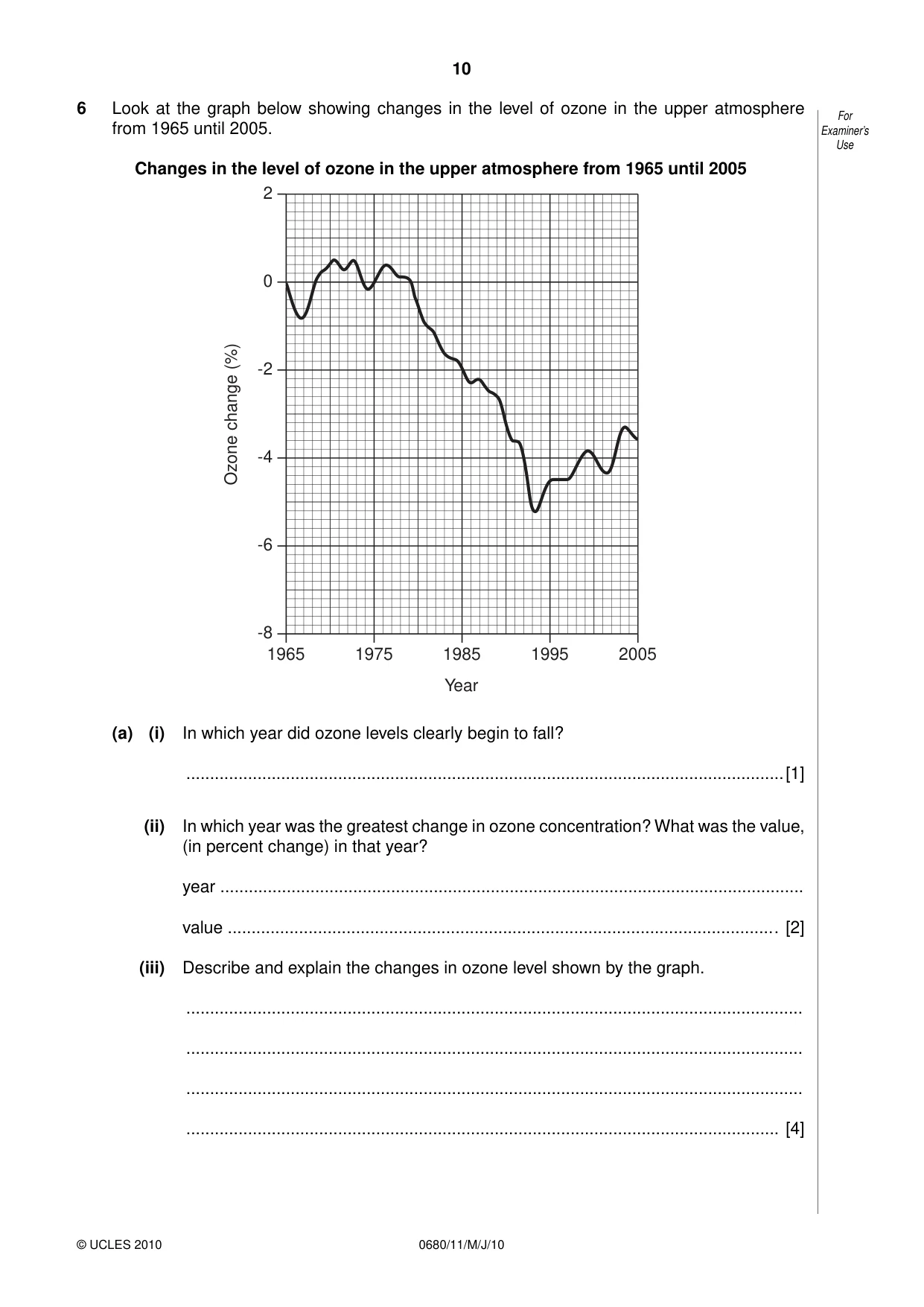
10 0680/11/M/J/10 © UCLES 2010 For Examiner’s Use 6 Look at the graph below showing changes in the level of ozone in the upper atmosphere from 1965 until 2005. Changes in the level of ozone in the upper atmosphere from 1965 until 2005 2 0 -2 Ozone change (%) -4 -6 -8 1965 1975 1985 Year 1995 2005 (a) (i) In which year did ozone levels clearly begin to fall? …[1] (ii) In which year was the greatest change in ozone concentration? What was the value, (in percent change) in that year? year … value … . [2] (iii) Describe and explain the changes in ozone level shown by the graph. … … … … [4]
Question paper, page 11
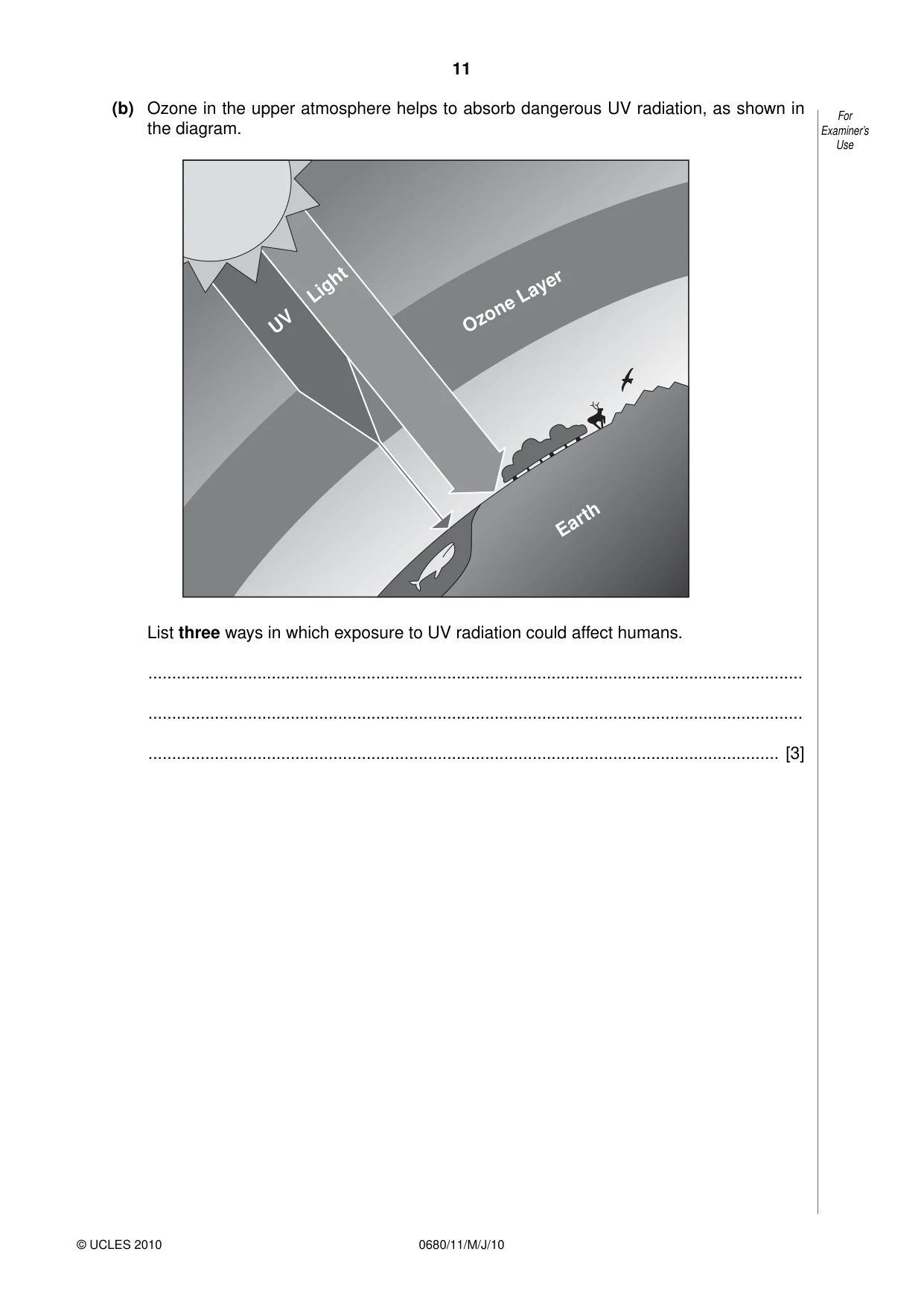
11 0680/11/M/J/10 © UCLES 2010 For Examiner’s Use (b) Ozone in the upper atmosphere helps to absorb dangerous UV radiation, as shown in the diagram. Light Ozone Layer Earth UV List three ways in which exposure to UV radiation could affect humans. … … … [3]
Question paper, page 12
12 0680/11/M/J/10 © UCLES 2010 Permission to reproduce items where third-party owned material protected by copyright is included has been sought and cleared where possible. Every reasonable effort has been made by the publisher (UCLES) to trace copyright holders, but if any items requiring clearance have unwittingly been included, the publisher will be pleased to make amends at the earliest possible opportunity. University of Cambridge International Examinations is part of the Cambridge Assessment Group. Cambridge Assessment is the brand name of University of Cambridge Local Examinations Syndicate (UCLES), which is itself a department of the University of Cambridge. BLANK PAGE
Mark scheme, page 1
UNIVERSITY OF CAMBRIDGE INTERNATIONAL EXAMINATIONS International General Certificate of Secondary Education MARK SCHEME for the May/June 2010 question paper for the guidance of teachers 0680 ENVIRONMENTAL MANAGEMENT 0680/11 Paper 11, maximum raw mark 60 This mark scheme is published as an aid to teachers and candidates, to indicate the requirements of the examination. It shows the basis on which Examiners were instructed to award marks. It does not indicate the details of the discussions that took place at an Examiners’ meeting before marking began, which would have considered the acceptability of alternative answers. Mark schemes must be read in conjunction with the question papers and the report on the examination. • CIE will not enter into discussions or correspondence in connection with these mark schemes. CIE is publishing the mark schemes for the May/June 2010 question papers for most IGCSE, GCE Advanced Level and Advanced Subsidiary Level syllabuses and some Ordinary Level syllabuses. www.XtremePapers.com
Mark scheme, page 2
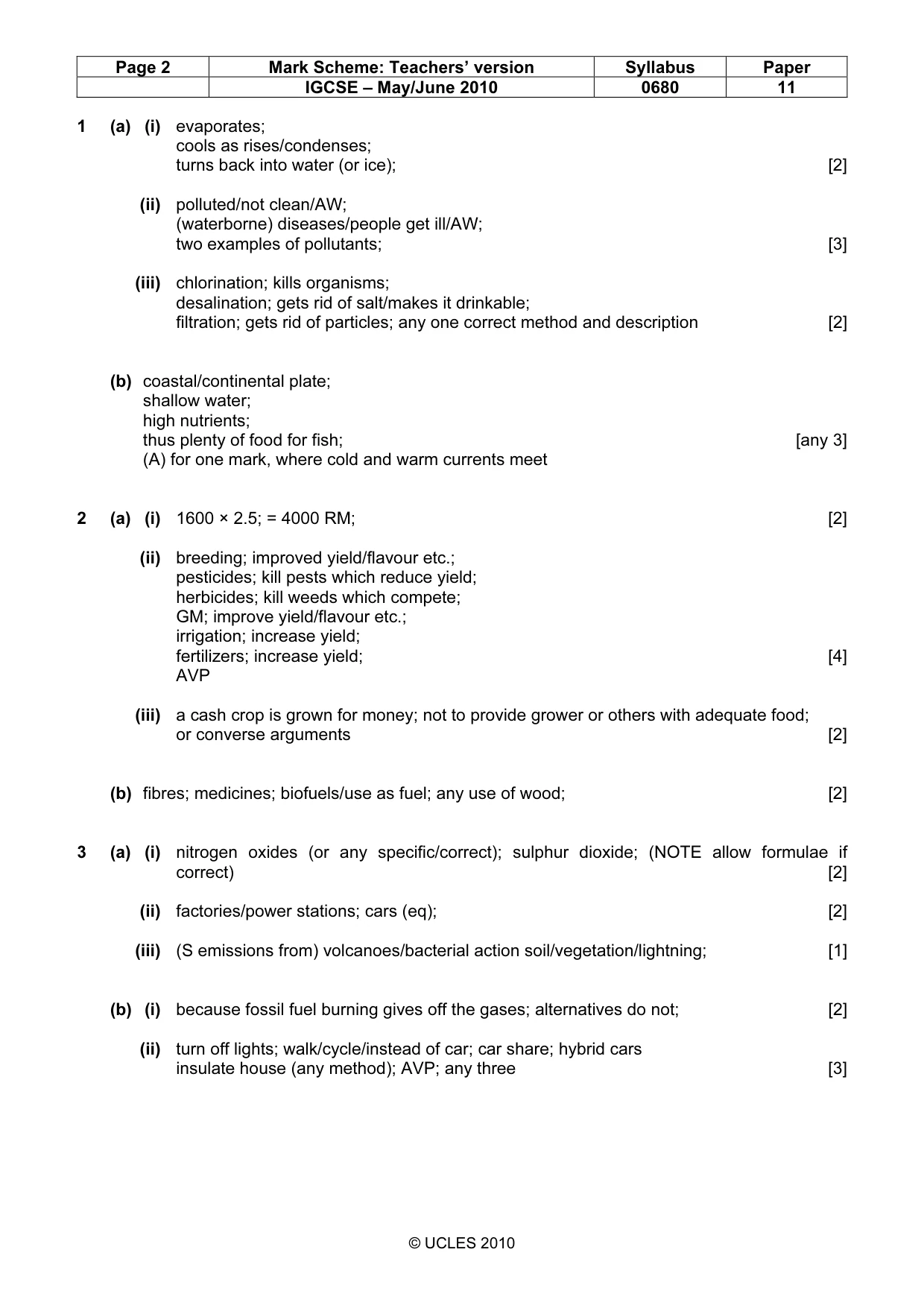
Page 2 Mark Scheme: Teachers’ version Syllabus Paper IGCSE – May/June 2010 0680 11 © UCLES 2010 1 (a) (i) evaporates; cools as rises/condenses; turns back into water (or ice); [2] (ii) polluted/not clean/AW; (waterborne) diseases/people get ill/AW; two examples of pollutants; [3] (iii) chlorination; kills organisms; desalination; gets rid of salt/makes it drinkable; filtration; gets rid of particles; any one correct method and description [2] (b) coastal/continental plate; shallow water; high nutrients; thus plenty of food for fish; [any 3] (A) for one mark, where cold and warm currents meet 2 (a) (i) 1600 × 2.5; = 4000 RM; [2] (ii) breeding; improved yield/flavour etc.; pesticides; kill pests which reduce yield; herbicides; kill weeds which compete; GM; improve yield/flavour etc.; irrigation; increase yield; fertilizers; increase yield; [4] AVP (iii) a cash crop is grown for money; not to provide grower or others with adequate food; or converse arguments [2] (b) fibres; medicines; biofuels/use as fuel; any use of wood; [2] 3 (a) (i) nitrogen oxides (or any specific/correct); sulphur dioxide; (NOTE allow formulae if correct) [2] (ii) factories/power stations; cars (eq); [2] (iii) (S emissions from) volcanoes/bacterial action soil/vegetation/lightning; [1] (b) (i) because fossil fuel burning gives off the gases; alternatives do not; [2] (ii) turn off lights; walk/cycle/instead of car; car share; hybrid cars insulate house (any method); AVP; any three [3]
Mark scheme, page 3
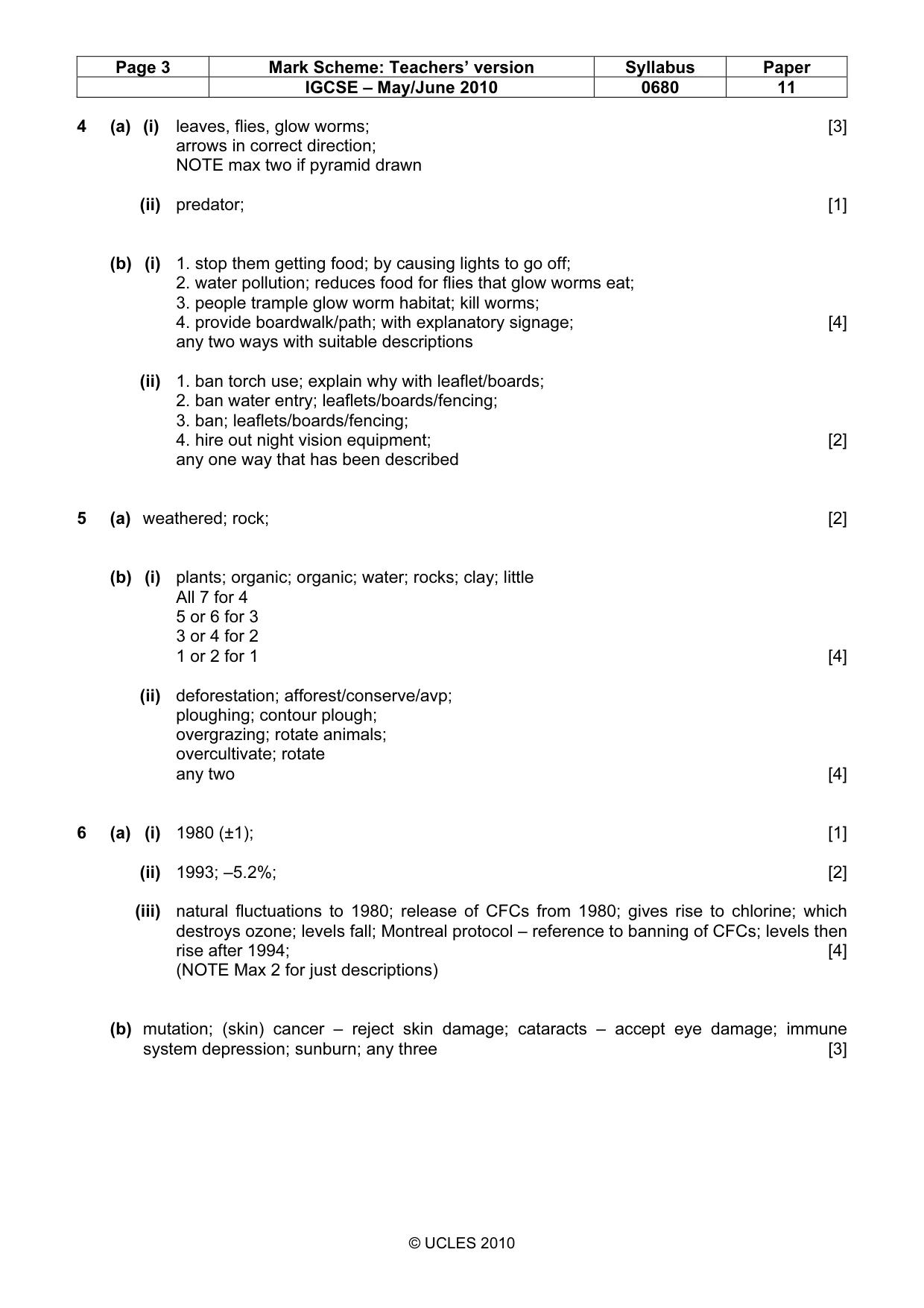
Page 3 Mark Scheme: Teachers’ version Syllabus Paper IGCSE – May/June 2010 0680 11 © UCLES 2010 4 (a) (i) leaves, flies, glow worms; [3] arrows in correct direction; NOTE max two if pyramid drawn (ii) predator; [1] (b) (i) 1. stop them getting food; by causing lights to go off; 2. water pollution; reduces food for flies that glow worms eat; 3. people trample glow worm habitat; kill worms; 4. provide boardwalk/path; with explanatory signage; [4] any two ways with suitable descriptions (ii) 1. ban torch use; explain why with leaflet/boards; 2. ban water entry; leaflets/boards/fencing; 3. ban; leaflets/boards/fencing; 4. hire out night vision equipment; [2] any one way that has been described 5 (a) weathered; rock; [2] (b) (i) plants; organic; organic; water; rocks; clay; little All 7 for 4 5 or 6 for 3 3 or 4 for 2 1 or 2 for 1 [4] (ii) deforestation; afforest/conserve/avp; ploughing; contour plough; overgrazing; rotate animals; overcultivate; rotate any two [4] 6 (a) (i) 1980 (±1); [1] (ii) 1993; –5.2%; [2] (iii) natural fluctuations to 1980; release of CFCs from 1980; gives rise to chlorine; which destroys ozone; levels fall; Montreal protocol – reference to banning of CFCs; levels then rise after 1994; [4] (NOTE Max 2 for just descriptions) (b) mutation; (skin) cancer – reject skin damage; cataracts – accept eye damage; immune system depression; sunburn; any three [3]
What you needed in this session
Cambridge’s own grade thresholds for 2010 May/June, Paper 1 · Variant 1. A higher threshold means an easier paper — the bar moves with how the cohort did.