Cambridge IGCSE Environmental Management 0680 — 2009 May/June Paper 4 · Variant 1
0680/41/M/J/09 · 60 marks · ≈68 min
The question paper and its mark scheme, free to read here and free to download. This is Cambridge’s own paper, exactly as it was sat.
Question paper20 pages











Mark scheme4 pages
Answers below. Sit the paper first if you are practising.

Paper as text
Question paper, page 1
This document consists of 18 printed pages and 2 blank pages. SP (CM/CGW) T74841/1 © UCLES 2009 [Turn over UNIVERSITY OF CAMBRIDGE INTERNATIONAL EXAMINATIONS International General Certificate of Secondary Education General Certificate of Education Ordinary Level READ THESE INSTRUCTIONS FIRST Write your Centre number, candidate number and name on all the work you hand in. Write in dark blue or black pen. You may use a soft pencil for any diagrams, graphs or rough working. Do not use staples, paper clips, highlighters, glue or correction fluid. DO NOT WRITE IN ANY BARCODES. Answer all questions. Study the appropriate Source materials before you start to write your answers. Credit will be given for appropriate selection and use of data in your answers and for relevant interpretation of these data. Suggestions for data sources are given in some questions. You may use the source data to draw diagrams and graphs or to do calculations to illustrate your answers. At the end of the examination, fasten all your work securely together. The number of marks is given in brackets [ ] at the end of each question or part question. * 2 7 6 0 1 7 9 6 1 0 * ENVIRONMENTAL MANAGEMENT 0680/04 5014/02 Alternative to Coursework May/June 2009 1 hour 30 minutes Candidates answer on the Question Paper. Additional Materials: Ruler For Examiner’s Use www.XtremePapers.com
Question paper, page 2
2 5014/02, 0680/04/M/J/09 © UCLES 2009 Equator Sri Lanka Fig. 1 map of the World
Question paper, page 3
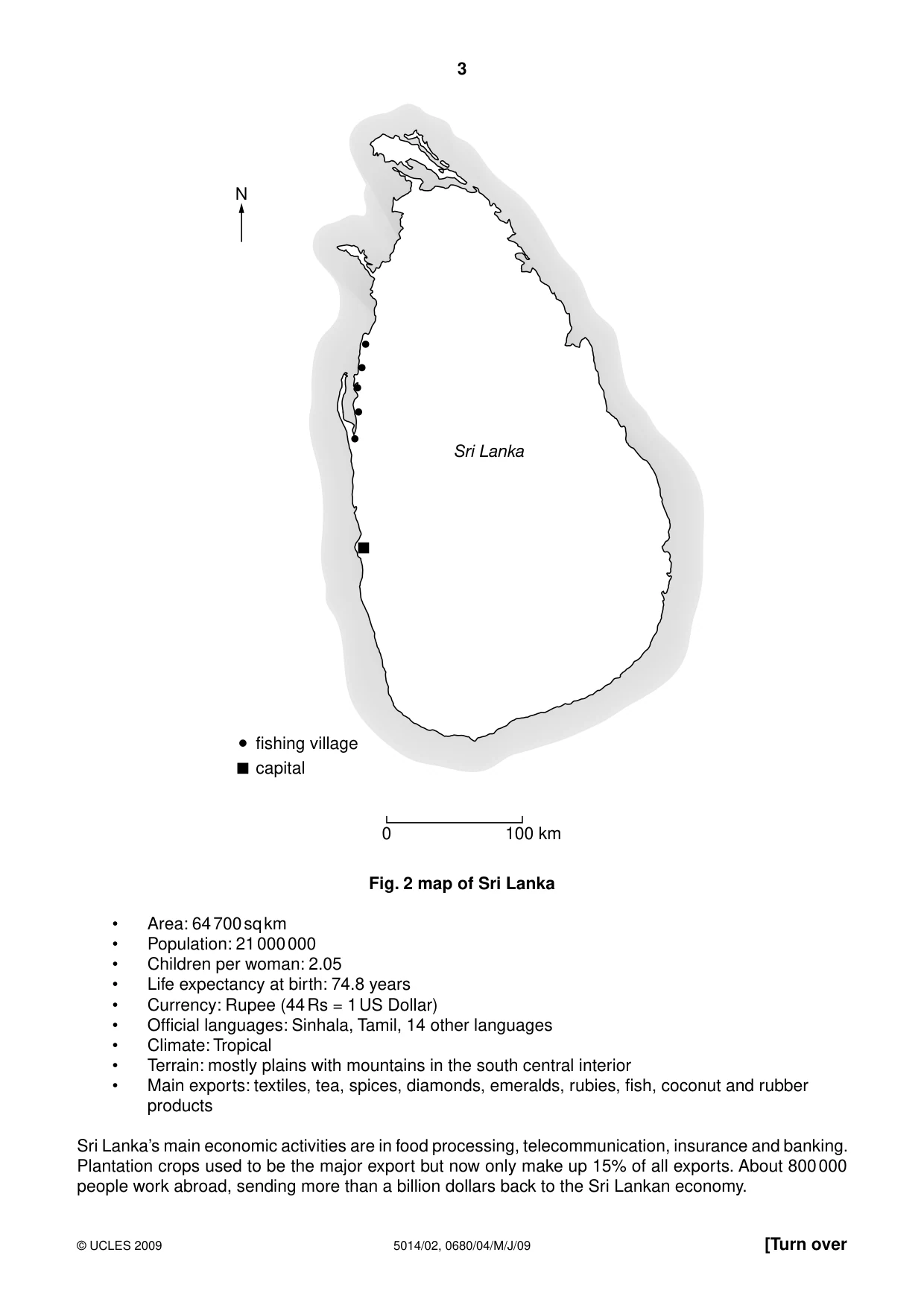
3 5014/02, 0680/04/M/J/09 © UCLES 2009 [Turn over 0 capital fishing village Sri Lanka 100 km N Fig. 2 map of Sri Lanka • Area: 64 700 sq km • Population: 21 000 000 • Children per woman: 2.05 • Life expectancy at birth: 74.8 years • Currency: Rupee (44 Rs = 1 US Dollar) • Official languages: Sinhala, Tamil, 14 other languages • Climate: Tropical • Terrain: mostly plains with mountains in the south central interior • Main exports: textiles, tea, spices, diamonds, emeralds, rubies, fish, coconut and rubber products Sri Lanka’s main economic activities are in food processing, telecommunication, insurance and banking. Plantation crops used to be the major export but now only make up 15% of all exports. About 800 000 people work abroad, sending more than a billion dollars back to the Sri Lankan economy.
Question paper, page 4
4 5014/02, 0680/04/M/J/09 © UCLES 2009 For Examiner’s Use 1 Fishing is an important activity for people living in coastal villages. Villages often have lagoons near them. The lagoons are areas of brackish water separated from the sea by narrow strips of sand or shingle. Brackish water is not as salty as sea water. The government has set up trial fishponds to grow milkfish and shrimp in brackish water. There is a world-wide demand for shrimp and the milkfish are for local consumption. Many villagers want to start their own fishponds. (a) Suggest why fish is an important part of the diet for village people. … … [1] (b) Suggest why more fishponds would be an advantage to (i) the villagers … … (ii) the government … … [2]
Question paper, page 5
5 5014/02, 0680/04/M/J/09 © UCLES 2009 [Turn over BLANK PAGE
Question paper, page 6
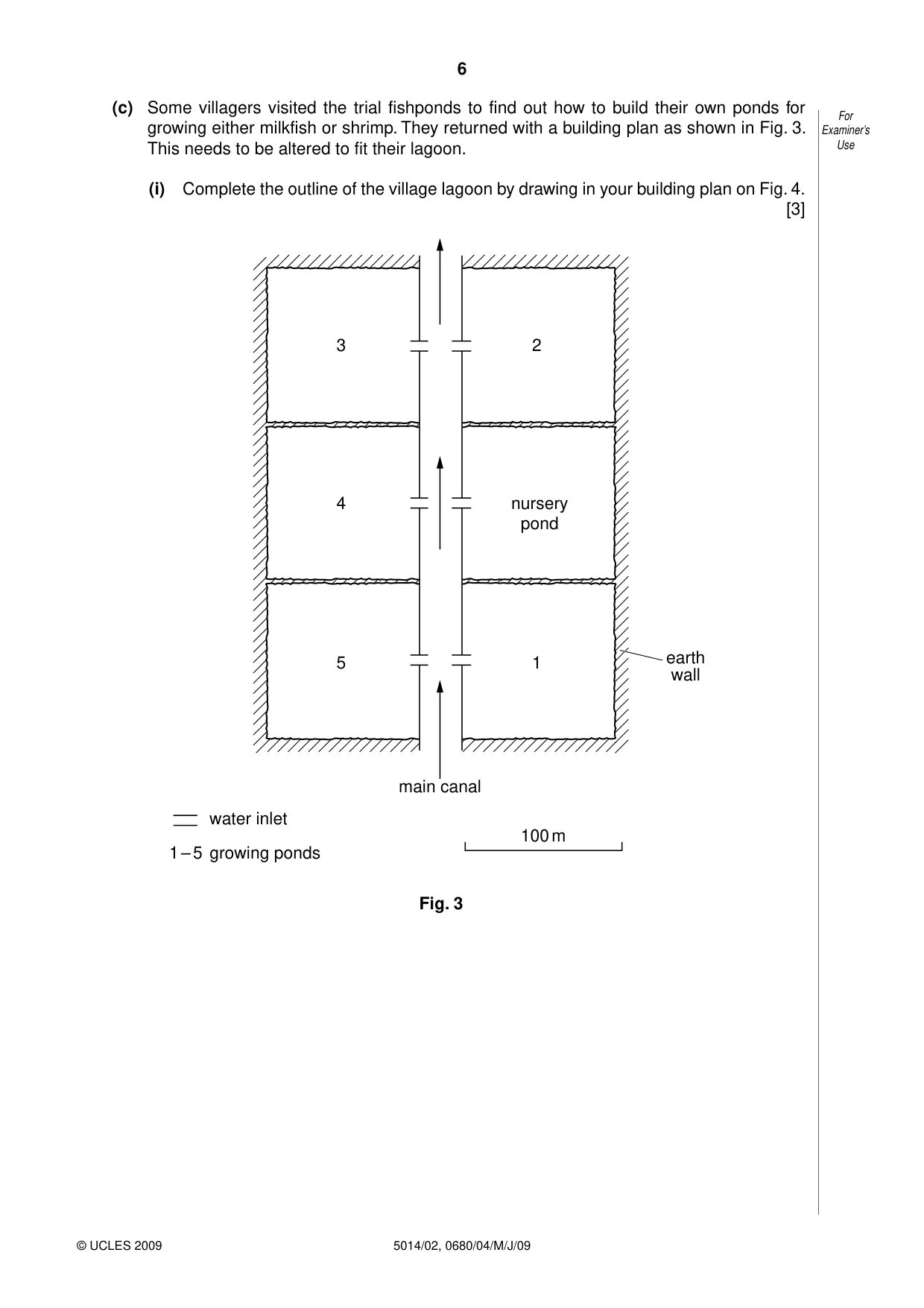
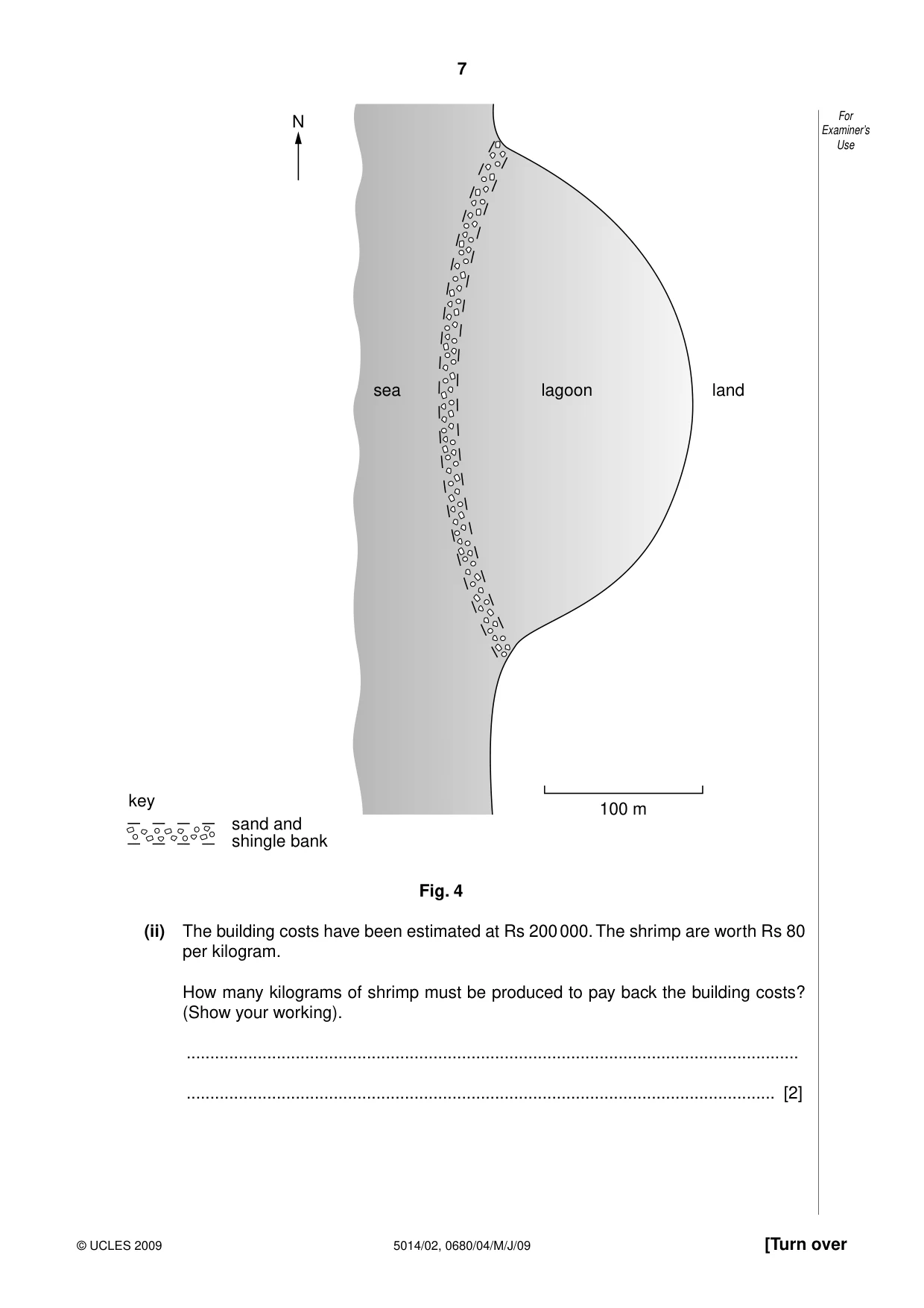
6 5014/02, 0680/04/M/J/09 © UCLES 2009 For Examiner’s Use (c) Some villagers visited the trial fishponds to find out how to build their own ponds for growing either milkfish or shrimp. They returned with a building plan as shown in Fig. 3. This needs to be altered to fit their lagoon. (i) Complete the outline of the village lagoon by drawing in your building plan on Fig. 4. [3] 3 4 5 2 nursery pond earth wall main canal 100m water inlet 1–5 growing ponds 1 Fig. 3
Question paper, page 7
7 5014/02, 0680/04/M/J/09 © UCLES 2009 [Turn over For Examiner’s Use lagoon land key sand and shingle bank sea 100 m N Fig. 4 (ii) The building costs have been estimated at Rs 200 000. The shrimp are worth Rs 80 per kilogram. How many kilograms of shrimp must be produced to pay back the building costs? (Show your working). … … [2]
Question paper, page 8
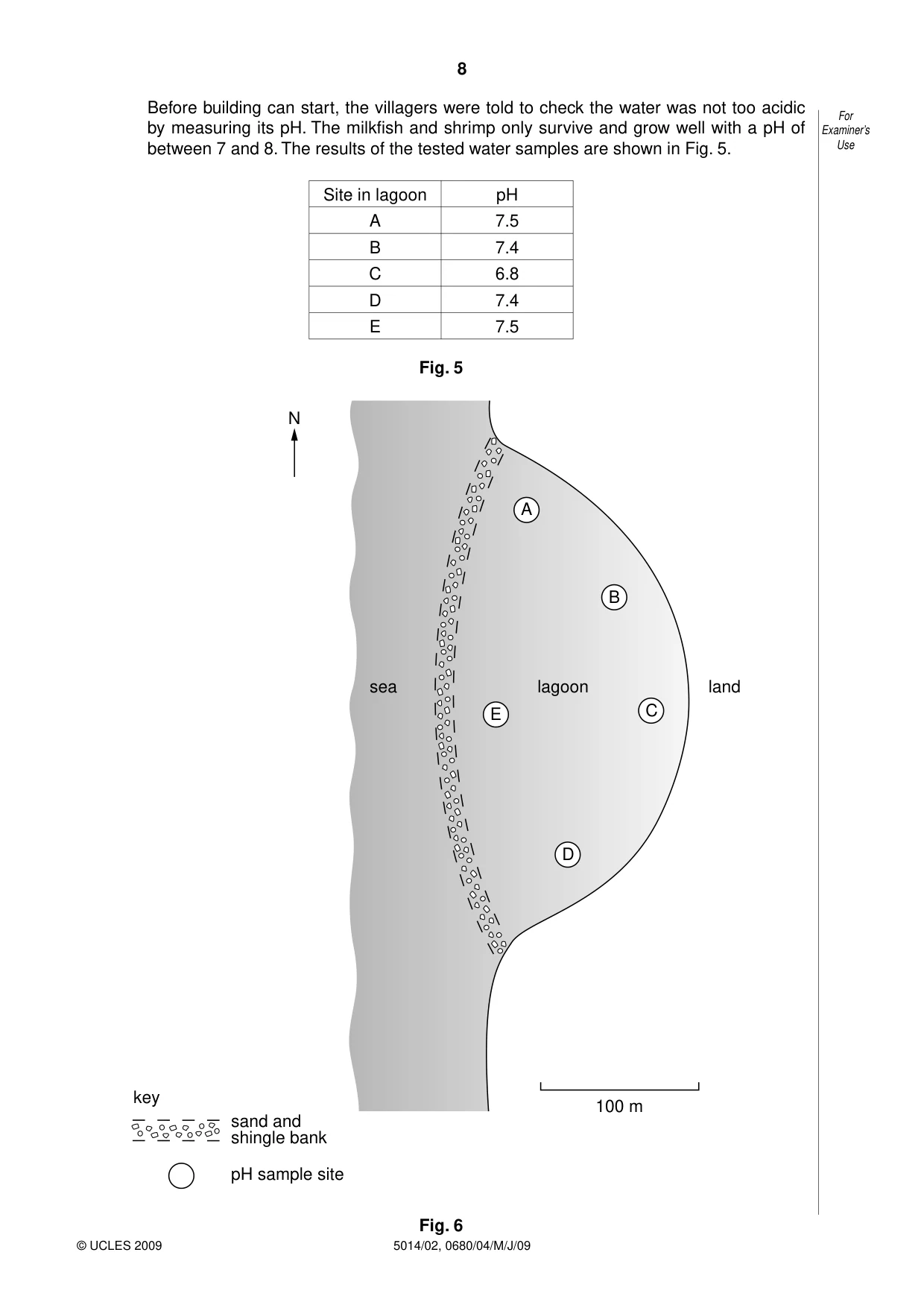
8 5014/02, 0680/04/M/J/09 © UCLES 2009 For Examiner’s Use Before building can start, the villagers were told to check the water was not too acidic by measuring its pH. The milkfish and shrimp only survive and grow well with a pH of between 7 and 8. The results of the tested water samples are shown in Fig. 5. Site in lagoon pH A 7.5 B 7.4 C 6.8 D 7.4 E 7.5 Fig. 5 lagoon land sea 100 m N A B C E D key sand and shingle bank pH sample site Fig. 6
Question paper, page 9
9 5014/02, 0680/04/M/J/09 © UCLES 2009 [Turn over For Examiner’s Use The villagers showed their results to some older people in the village who remembered that a large quantity of coconut husks had been buried in part of the lagoon. This is what three villagers said ‘we must go and dig up the coconut husks’. ‘we must take more pH samples’. ‘we should not build any fishponds’. (iii) What would you advise the villagers to do? Explain as fully as you can. … … … … … [3]
Question paper, page 10
10 5014/02, 0680/04/M/J/09 © UCLES 2009 For Examiner’s Use There are mangrove swamps near the village where small mangrove trees grow close together in shallow sea water. They are a good habitat for fish to spawn and grow. Some villagers want to build more fishponds by clearing the mangrove swamp to make another brackish lagoon. Other villagers think this will not be a sustainable development. Arguments FOR Arguments AGAINST • more money from exports • mangroves protect the coast • more jobs • loss of spawning grounds • less reliant on fishing • reduced fishing catches • mangroves are of no value • more labour needed to maintain fishponds (d) (i) Explain why this further development might not be sustainable. … … … … … … … … [5] Milkfish breed in the sea; the fertile eggs hatch into fry. Some fishermen specialise in catching the fry and keeping them alive in special containers. Sometimes not enough fry can be caught to stock all the fishponds. (ii) What research do you think should be carried out to support the continued development of fishponds? … … … [2]
Question paper, page 11
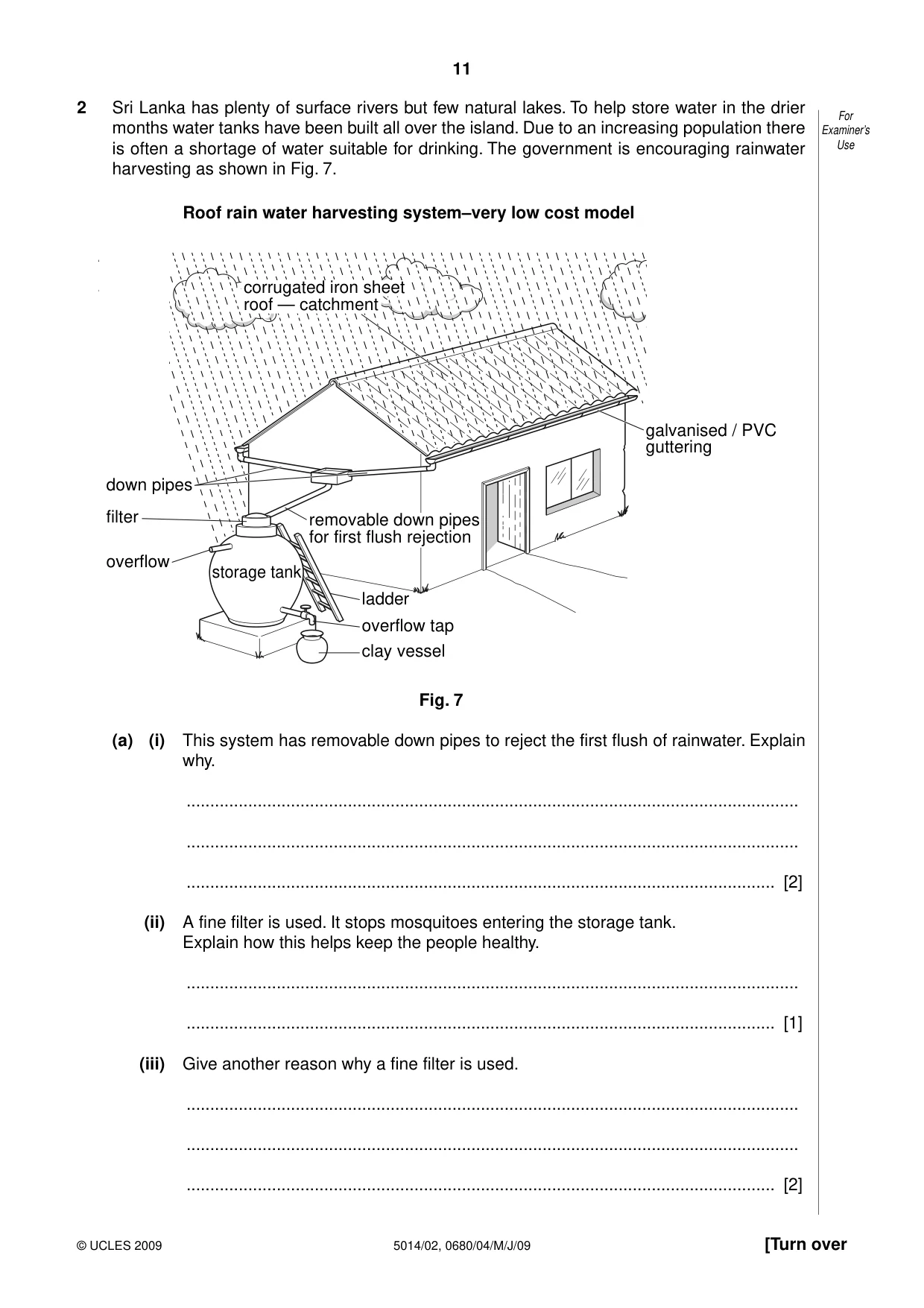
11 5014/02, 0680/04/M/J/09 © UCLES 2009 [Turn over For Examiner’s Use 2 Sri Lanka has plenty of surface rivers but few natural lakes. To help store water in the drier months water tanks have been built all over the island. Due to an increasing population there is often a shortage of water suitable for drinking. The government is encouraging rainwater harvesting as shown in Fig. 7. storage tank ladder overflow filter down pipes Roof rain water harvesting system–very low cost model overflow tap clay vessel corrugated iron sheet roof — catchment galvanised / PVC guttering removable down pipes for first flush rejection Fig. 7 (a) (i) This system has removable down pipes to reject the first flush of rainwater. Explain why. … … … [2] (ii) A fine filter is used. It stops mosquitoes entering the storage tank. Explain how this helps keep the people healthy. … … [1] (iii) Give another reason why a fine filter is used. … … … [2]
Question paper, page 12
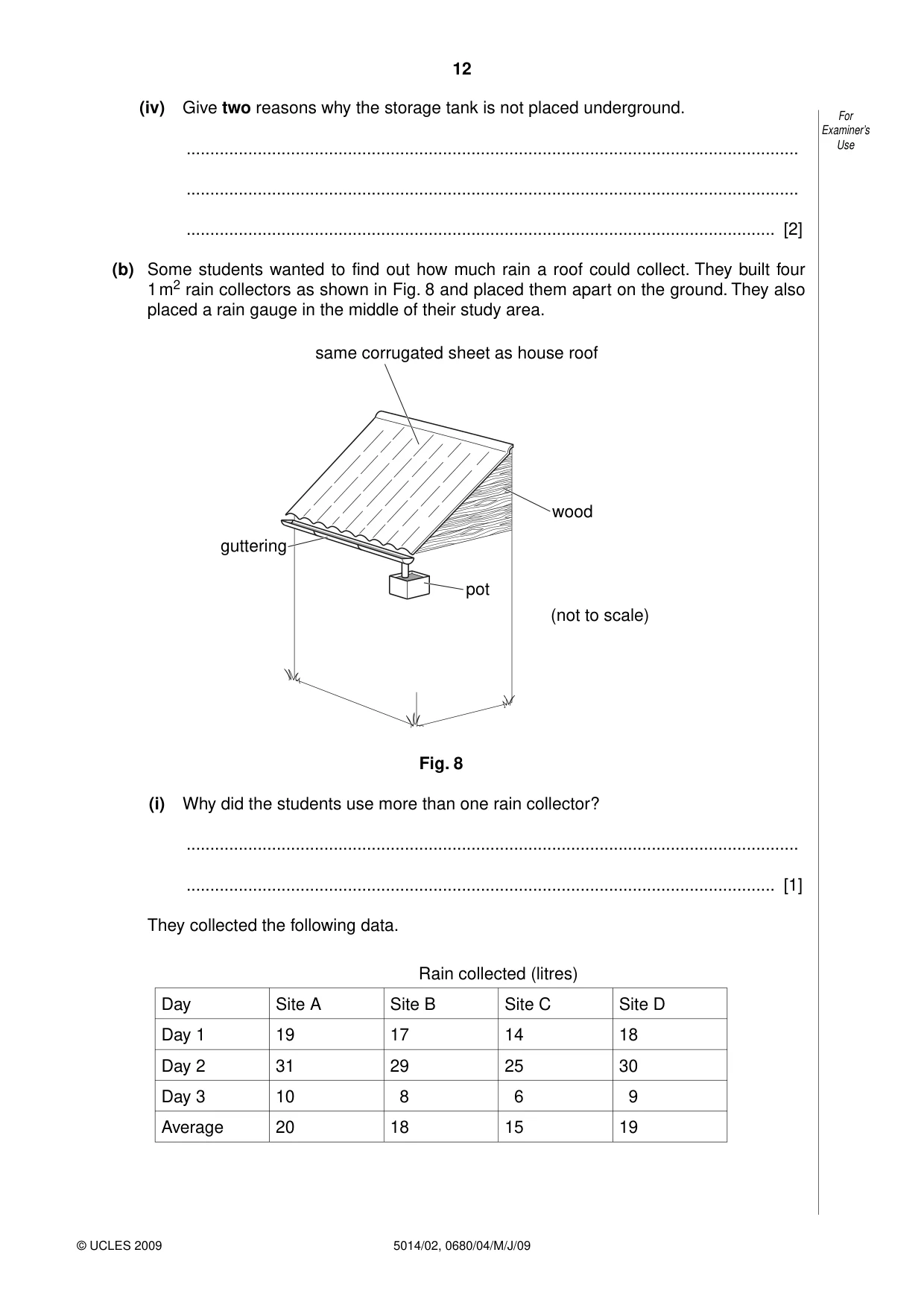
12 5014/02, 0680/04/M/J/09 © UCLES 2009 For Examiner’s Use (iv) Give two reasons why the storage tank is not placed underground. … … … [2] (b) Some students wanted to find out how much rain a roof could collect. They built four 1 m2 rain collectors as shown in Fig. 8 and placed them apart on the ground. They also placed a rain gauge in the middle of their study area. guttering (not to scale) pot wood same corrugated sheet as house roof Fig. 8 (i) Why did the students use more than one rain collector? … … [1] They collected the following data. Rain collected (litres) Day Site A Site B Site C Site D Day 1 19 17 14 18 Day 2 31 29 25 30 Day 3 10 8 6 9 Average 20 18 15 19
Question paper, page 13
13 5014/02, 0680/04/M/J/09 © UCLES 2009 [Turn over For Examiner’s Use (ii) Plot the data on a graph. [4] (iii) Which rain collector harvested the least water? Suggest two possible reasons for this. … … … [2] (iv) The roof area of a house is 40 m2. How much water is likely to have been collected on day one? … … … [2]
Question paper, page 14
14 5014/02, 0680/04/M/J/09 © UCLES 2009 For Examiner’s Use (v) Why did the students use a rain gauge as well as the rain collectors? … … … [1] Look at the climate data in Fig. 9. Month Temperature °C Average precipitation mm Number of wet days January 27 173 10 February 28 66 4 March 29 48 4 April 32 58 5 May 33 69 5 June 33 28 2 July 33 51 2 August 33 107 6 September 33 107 6 October 31 221 13 November 29 358 17 December 27 368 16 Fig. 9 (vi) In which months is the harvested water most needed? Give a reason for your answer. … … … … [3]
Question paper, page 15
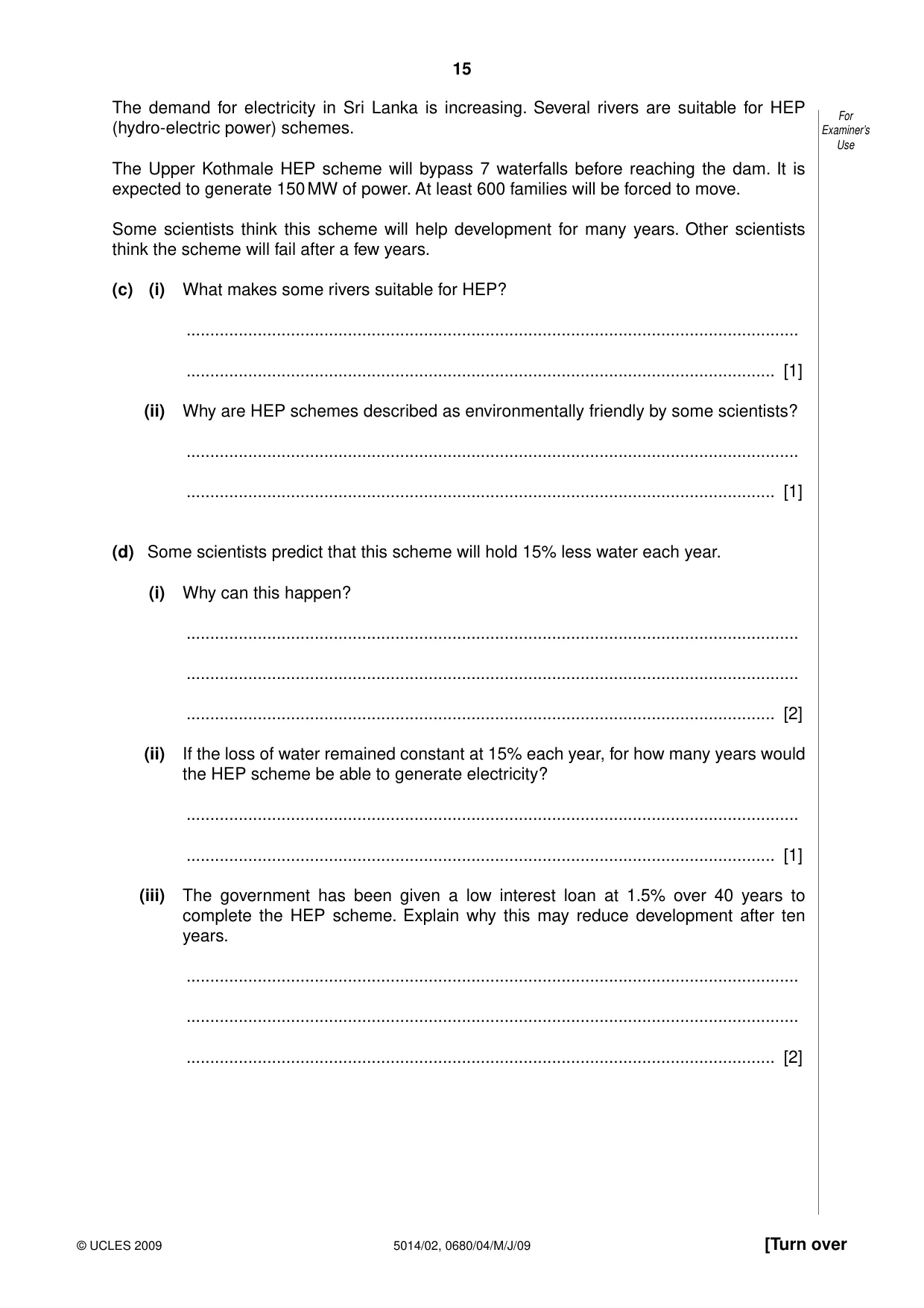
15 5014/02, 0680/04/M/J/09 © UCLES 2009 [Turn over For Examiner’s Use The demand for electricity in Sri Lanka is increasing. Several rivers are suitable for HEP (hydro-electric power) schemes. The Upper Kothmale HEP scheme will bypass 7 waterfalls before reaching the dam. It is expected to generate 150 MW of power. At least 600 families will be forced to move. Some scientists think this scheme will help development for many years. Other scientists think the scheme will fail after a few years. (c) (i) What makes some rivers suitable for HEP? … … [1] (ii) Why are HEP schemes described as environmentally friendly by some scientists? … … [1] (d) Some scientists predict that this scheme will hold 15% less water each year. (i) Why can this happen? … … … [2] (ii) If the loss of water remained constant at 15% each year, for how many years would the HEP scheme be able to generate electricity? … … [1] (iii) The government has been given a low interest loan at 1.5% over 40 years to complete the HEP scheme. Explain why this may reduce development after ten years. … … … [2]
Question paper, page 16
16 5014/02, 0680/04/M/J/09 © UCLES 2009 For Examiner’s Use (e) One of the villagers who is being forced to move said, ‘The new houses are superb; living in one of these houses will be a dream come true’. Another villager said, ‘Where will you keep your two cows and grow vegetables to sell?’ The first villager said, ‘I will fit the cows into my new home and I will find other means of earning a living in town’. Suggest how this new way of life might have advantages and disadvantages for the villagers. (i) advantages … … … (ii) disadvantages … … … [4]
Question paper, page 17
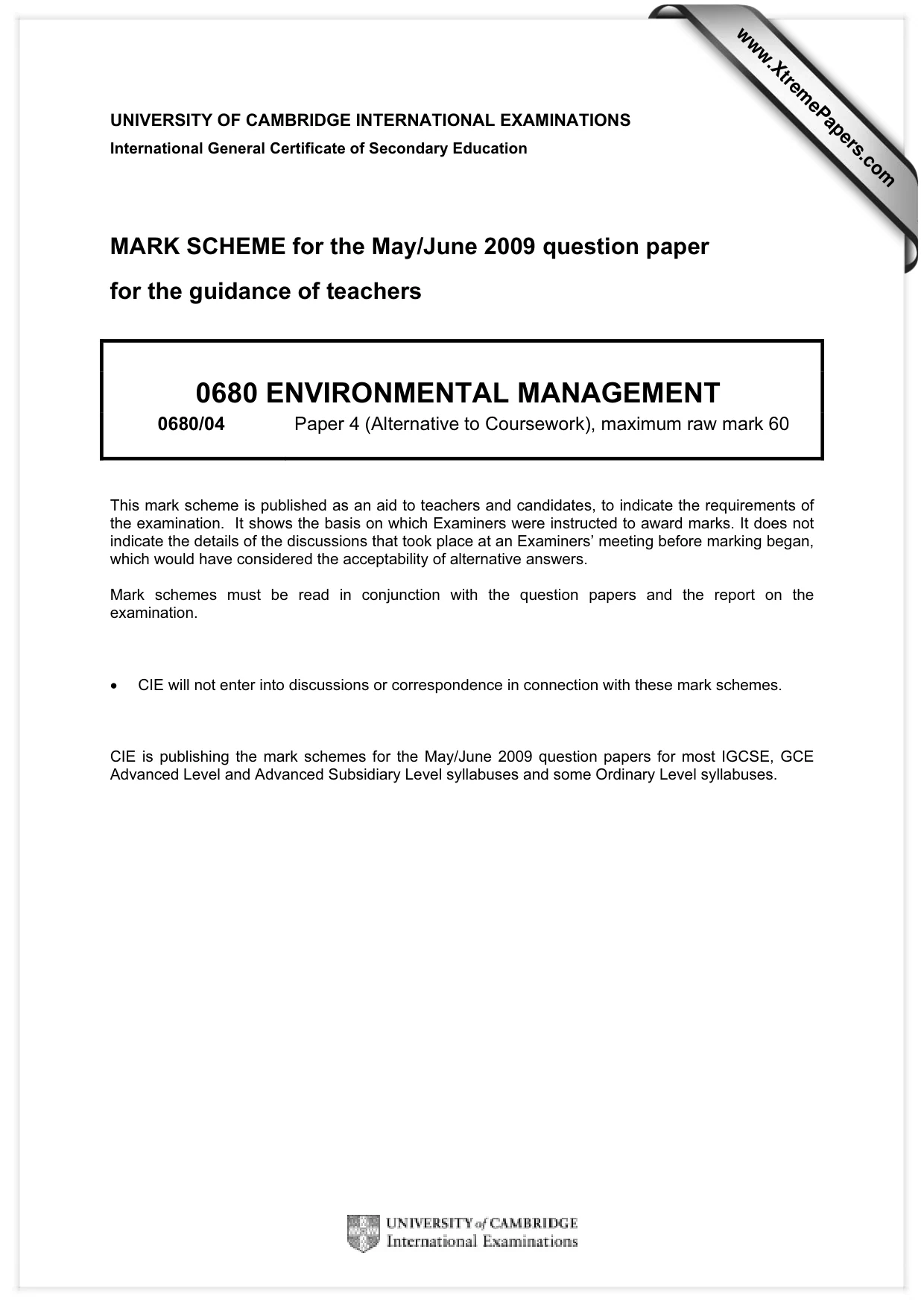
17 5014/02, 0680/04/M/J/09 © UCLES 2009 [Turn over For Examiner’s Use 3 Fig. 10 Coconuts are an important export crop and 90% of Sri Lanka’s production comes from small farms about 2 hectare in size. The coconut trees are planted at 140 trees per hectare. Other plants can be grown between the trees and livestock are tied to the trees (Fig. 10). The annual income for one small farm is shown in Fig. 11. Farm produce Annual income Rs vegetables 300 coconuts 3 400 pasture plants (peas, beans, some grasses) 1 800 cattle 31 500 chickens 8 000 total 45 000 Fig. 11 (a) (i) What percentage of total annual income comes from cattle? … … [2]
Question paper, page 18
18 5014/02, 0680/04/M/J/09 © UCLES 2009 For Examiner’s Use (ii) The pasture plants always include leguminous species (peas, beans, some grasses). Explain how this increases the productivity of the farm. … … … [2] (iii) In 1997 the coconut mite started to infect the trees and the coconuts could not be sold. Explain why most farmers decided to keep their trees. … … … [2] (b) A farmer divides his farm into four equal plots as shown in Fig. 12. The farmer knows the following: • tea bushes can be picked all year • chickens find most of their own food • cows can feed on pasture plants and coconut wastes • vegetables can be grown in small plots plot 1 plot 2 plot 4 plot 3 Fig. 12
Question paper, page 19
19 5014/02, 0680/04/M/J/09 © UCLES 2009 For Examiner’s Use Describe, in detail, how the farmer could maintain income and productivity on the farm. … … … … … … … … [5]
Question paper, page 20
20 5014/02, 0680/04/M/J/09 BLANK PAGE Permission to reproduce items where third-party owned material protected by copyright is included has been sought and cleared where possible. Every reasonable effort has been made by the publisher (UCLES) to trace copyright holders, but if any items requiring clearance have unwittingly been included, the publisher will be pleased to make amends at the earliest possible opportunity. University of Cambridge International Examinations is part of the Cambridge Assessment Group. Cambridge Assessment is the brand name of University of Cambridge Local Examinations Syndicate (UCLES), which is itself a department of the University of Cambridge.
Mark scheme, page 1
UNIVERSITY OF CAMBRIDGE INTERNATIONAL EXAMINATIONS International General Certificate of Secondary Education MARK SCHEME for the May/June 2009 question paper for the guidance of teachers 0680 ENVIRONMENTAL MANAGEMENT 0680/04 Paper 4 (Alternative to Coursework), maximum raw mark 60 This mark scheme is published as an aid to teachers and candidates, to indicate the requirements of the examination. It shows the basis on which Examiners were instructed to award marks. It does not indicate the details of the discussions that took place at an Examiners’ meeting before marking began, which would have considered the acceptability of alternative answers. Mark schemes must be read in conjunction with the question papers and the report on the examination. • CIE will not enter into discussions or correspondence in connection with these mark schemes. CIE is publishing the mark schemes for the May/June 2009 question papers for most IGCSE, GCE Advanced Level and Advanced Subsidiary Level syllabuses and some Ordinary Level syllabuses. www.XtremePapers.com
Mark scheme, page 2
Page 2 Mark Scheme: Teachers’ version Syllabus Paper IGCSE – May/June 2009 0680 04 © UCLES 2009 1 (a) protein/oils/energy/calcium/vitamin D/prevents kwashiorkor/rickets; [1] [A vitamins and minerals R nutrition] (b) to villagers: more income; employment; more food; raise standard of living; can afford schools/medical treatment; to government: more foreign exchange; economic advantage e.g. exports/BOP;more taxes; more money for infrastructure e.g. hospitals; villagers need less/no aid; [max 2] (c) (i) drawing sealed ponds inside lagoon; six ponds; one labelled nursery pond; [3] (ii) 200 000 ÷ 80; = 2500 (Kg); ignore other units [2] (iii) 1 coconuts located at C/nearest the land; 2 dig up coconuts – why to get pH between 7–8/see if pH changes; 3 take more samples – why to check the results/see if pH changes over time; 4 not building ponds – why not in acid parts/below pH 7/C/build in other areas/ABDE; [3] (d) (i) lose coastal protection against storms/flooding so damage the village/their boats/the fishponds; spawning grounds are lost so no more breeding stock; reduced fishing catches so less food/health/income/jobs; too many ponds means too much labour directed at ponds/cost of labour/not enough labour for other tasks/e.g. of tasks; leads to poverty; AVP; further details of the above [max 5] (ii) find out how to breed to produce eggs in ponds/eq; set up special breeding ponds; how to keep fry alive/encourage growth; better method of catching fry/how often can they be caught/discover their breeding pattern/location of breeding; [2] 2 (a) (i) to prevent impurities/dirt/solid debris; first flush is acidic/prevent chemical pollution e.g. pesticides; [R fertilisers] [2] (ii) mosquitoes would lay their eggs; larvae hatch and increase mosquito population; so more diseases spread; [1] (iii) stop more solids/debris/dirt entering; stop other animals entering; maintain water quality; [2] (iv) lots of work/cost of digging the hole; increased risk of contamination/flooding; or leakage/breakage; more maintenance if underground; need to pump water out/eq; [2] (b) (i) to find the average/make data more reliable/accurate/precise/valid; [1] (ii) appropriate scaling; axes labelled with key as needed;; plots correct (allow 25% error); [4] (iii) C – collector damaged/leakage; in a sheltered or windy spot; [A ref to interception R evaporation unqualified] [2] (iv) 19 + 17 + 14 + 18 = 68 ÷ 4 = 17; x 40 = 680 litres/eq; [2] [correct answer only ;;]
Mark scheme, page 3
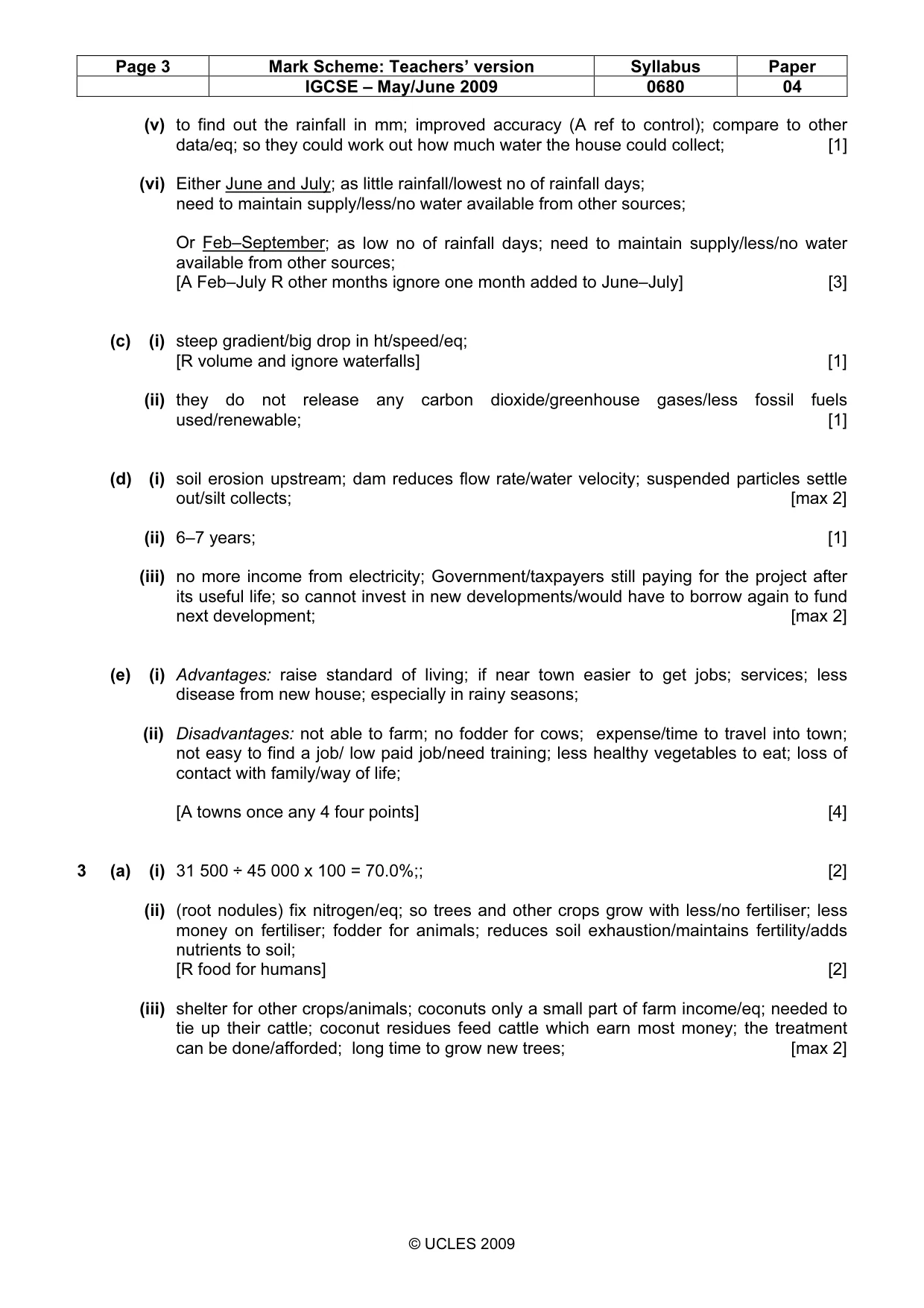
Page 3 Mark Scheme: Teachers’ version Syllabus Paper IGCSE – May/June 2009 0680 04 © UCLES 2009 (v) to find out the rainfall in mm; improved accuracy (A ref to control); compare to other data/eq; so they could work out how much water the house could collect; [1] (vi) Either June and July; as little rainfall/lowest no of rainfall days; need to maintain supply/less/no water available from other sources; Or Feb–September; as low no of rainfall days; need to maintain supply/less/no water available from other sources; [A Feb–July R other months ignore one month added to June–July] [3] (c) (i) steep gradient/big drop in ht/speed/eq; [R volume and ignore waterfalls] [1] (ii) they do not release any carbon dioxide/greenhouse gases/less fossil fuels used/renewable; [1] (d) (i) soil erosion upstream; dam reduces flow rate/water velocity; suspended particles settle out/silt collects; [max 2] (ii) 6–7 years; [1] (iii) no more income from electricity; Government/taxpayers still paying for the project after its useful life; so cannot invest in new developments/would have to borrow again to fund next development; [max 2] (e) (i) Advantages: raise standard of living; if near town easier to get jobs; services; less disease from new house; especially in rainy seasons; (ii) Disadvantages: not able to farm; no fodder for cows; expense/time to travel into town; not easy to find a job/ low paid job/need training; less healthy vegetables to eat; loss of contact with family/way of life; [A towns once any 4 four points] [4] 3 (a) (i) 31 500 ÷ 45 000 x 100 = 70.0%;; [2] (ii) (root nodules) fix nitrogen/eq; so trees and other crops grow with less/no fertiliser; less money on fertiliser; fodder for animals; reduces soil exhaustion/maintains fertility/adds nutrients to soil; [R food for humans] [2] (iii) shelter for other crops/animals; coconuts only a small part of farm income/eq; needed to tie up their cattle; coconut residues feed cattle which earn most money; the treatment can be done/afforded; long time to grow new trees; [max 2]
Mark scheme, page 4
Page 4 Mark Scheme: Teachers’ version Syllabus Paper IGCSE – May/June 2009 0680 04 © UCLES 2009 (b) award one mark for each of the ideas 1. rotation idea; 2. fallow plot; 3. intercropping/described; 4. tea as a cash crop; 5. ref to animal manure; 6. no/less need for fertilisers; 7. maintains soil fertility; 8. balanced farming of plants and at least one animal; 9. income from another sold product (other than tea); [max 5]
What you needed in this session
Cambridge’s own grade thresholds for 2009 May/June, Paper 4 · Variant 1. A higher threshold means an easier paper — the bar moves with how the cohort did.