Cambridge IGCSE Environmental Management 0680 — 2008 May/June Paper 4 · Variant 1
0680/41/M/J/08 · 60 marks · ≈68 min
The question paper and its mark scheme, free to read here and free to download. This is Cambridge’s own paper, exactly as it was sat.
Question paper20 pages




Mark scheme3 pages
Answers below. Sit the paper first if you are practising.
Paper as text
Question paper, page 1
This document consists of 18 printed pages and 2 blank pages. SP (NF/CGW) T51773/4 © UCLES 2008 [Turn over UNIVERSITY OF CAMBRIDGE INTERNATIONAL EXAMINATIONS International General Certificate of Secondary Education General Certificate of Education Ordinary Level READ THESE INSTRUCTIONS FIRST Write your Centre number, candidate number and name on all the work you hand in. Write in dark blue or black pen. You may use a soft pencil for any diagrams, graphs or rough working. Do not use staples, paper clips, highlighters, glue or correction fluid. DO NOT WRITE IN ANY BARCODES. Answer all questions. Study the appropriate Source materials before you start to write your answers. Credit will be given for appropriate selection and use of data in your answers and for relevant interpretation of these data. Suggestions for data sources are given in some questions. You may use the source data to draw diagrams and graphs or to do calculations to illustrate your answers. At the end of the examination, fasten all your work securely together. The number of marks is given in brackets [ ] at the end of each question or part question. * 8 5 8 3 3 3 5 6 9 9 * ENVIRONMENTAL MANAGEMENT 0680/04 5014/02 Alternative to Coursework May/June 2008 1 hour 30 minutes Candidates answer on the Question Paper. Additional Materials: Ruler For Examiner’s Use www.XtremePapers.com
Question paper, page 2
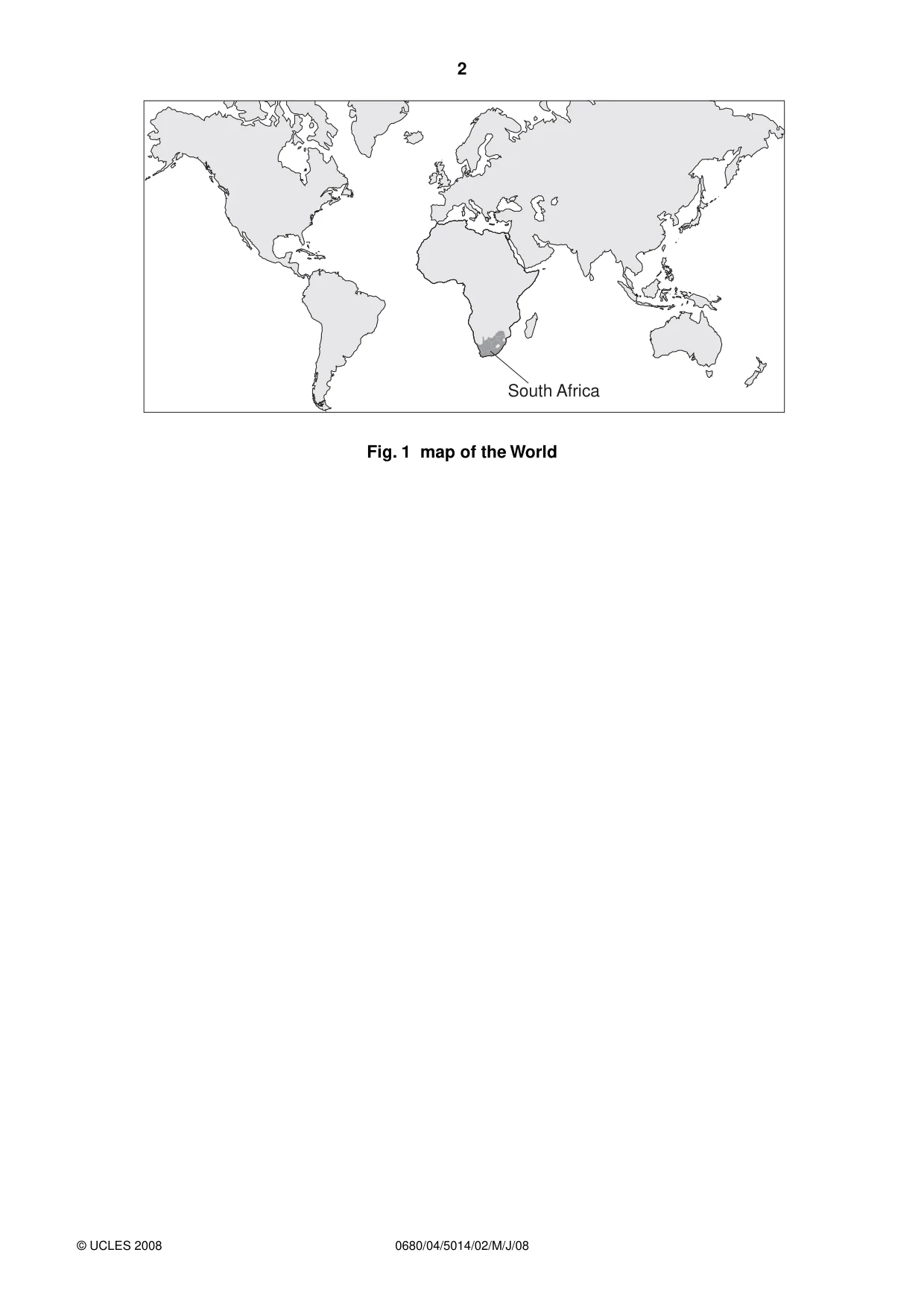
2 0680/04/5014/02/M/J/08 © UCLES 2008 South Africa Fig. 1 map of the World
Question paper, page 3
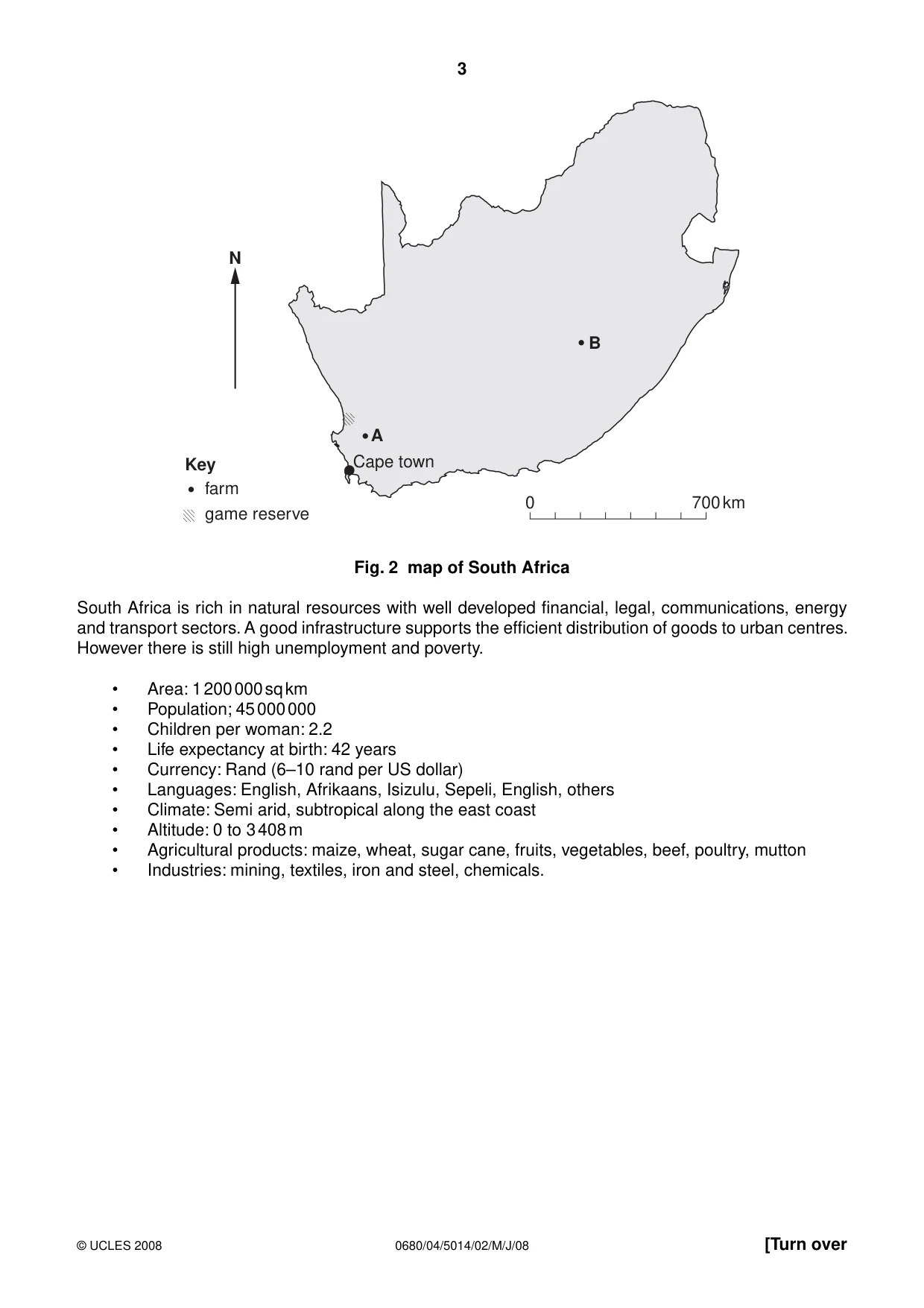
3 0680/04/5014/02/M/J/08 © UCLES 2008 [Turn over Cape town farm game reserve Key A N B 0 700 km Fig. 2 map of South Africa South Africa is rich in natural resources with well developed financial, legal, communications, energy and transport sectors. A good infrastructure supports the efficient distribution of goods to urban centres. However there is still high unemployment and poverty. • Area: 1 200 000 sq km • Population; 45 000 000 • Children per woman: 2.2 • Life expectancy at birth: 42 years • Currency: Rand (6–10 rand per US dollar) • Languages: English, Afrikaans, Isizulu, Sepeli, English, others • Climate: Semi arid, subtropical along the east coast • Altitude: 0 to 3 408 m • Agricultural products: maize, wheat, sugar cane, fruits, vegetables, beef, poultry, mutton • Industries: mining, textiles, iron and steel, chemicals.
Question paper, page 4
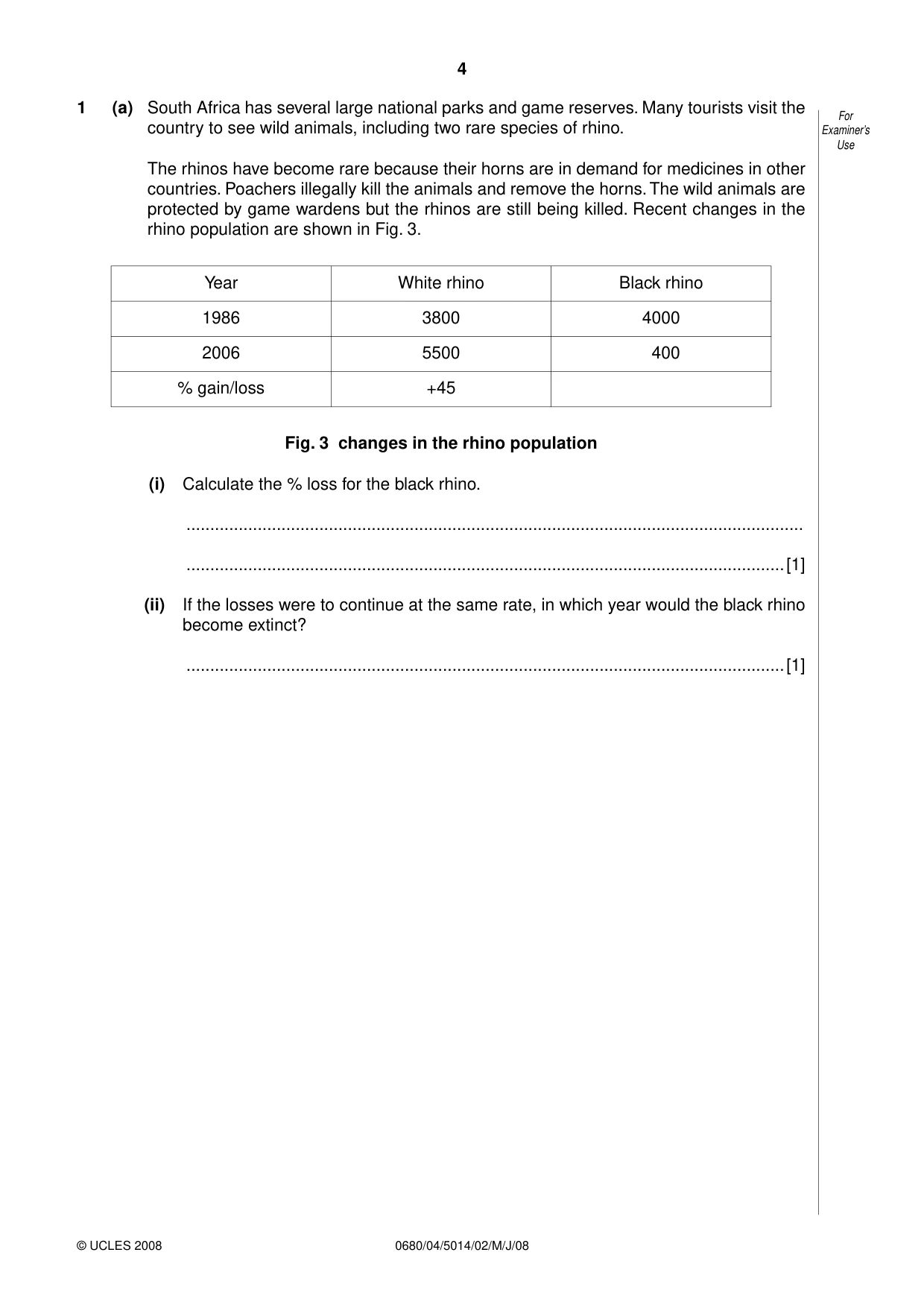
4 0680/04/5014/02/M/J/08 © UCLES 2008 For Examiner’s Use 1 (a) South Africa has several large national parks and game reserves. Many tourists visit the country to see wild animals, including two rare species of rhino. The rhinos have become rare because their horns are in demand for medicines in other countries. Poachers illegally kill the animals and remove the horns. The wild animals are protected by game wardens but the rhinos are still being killed. Recent changes in the rhino population are shown in Fig. 3. Year White rhino Black rhino 1986 3800 4000 2006 5500 400 % gain/loss +45 Fig. 3 changes in the rhino population (i) Calculate the % loss for the black rhino. … …[1] (ii) If the losses were to continue at the same rate, in which year would the black rhino become extinct? …[1]
Question paper, page 5
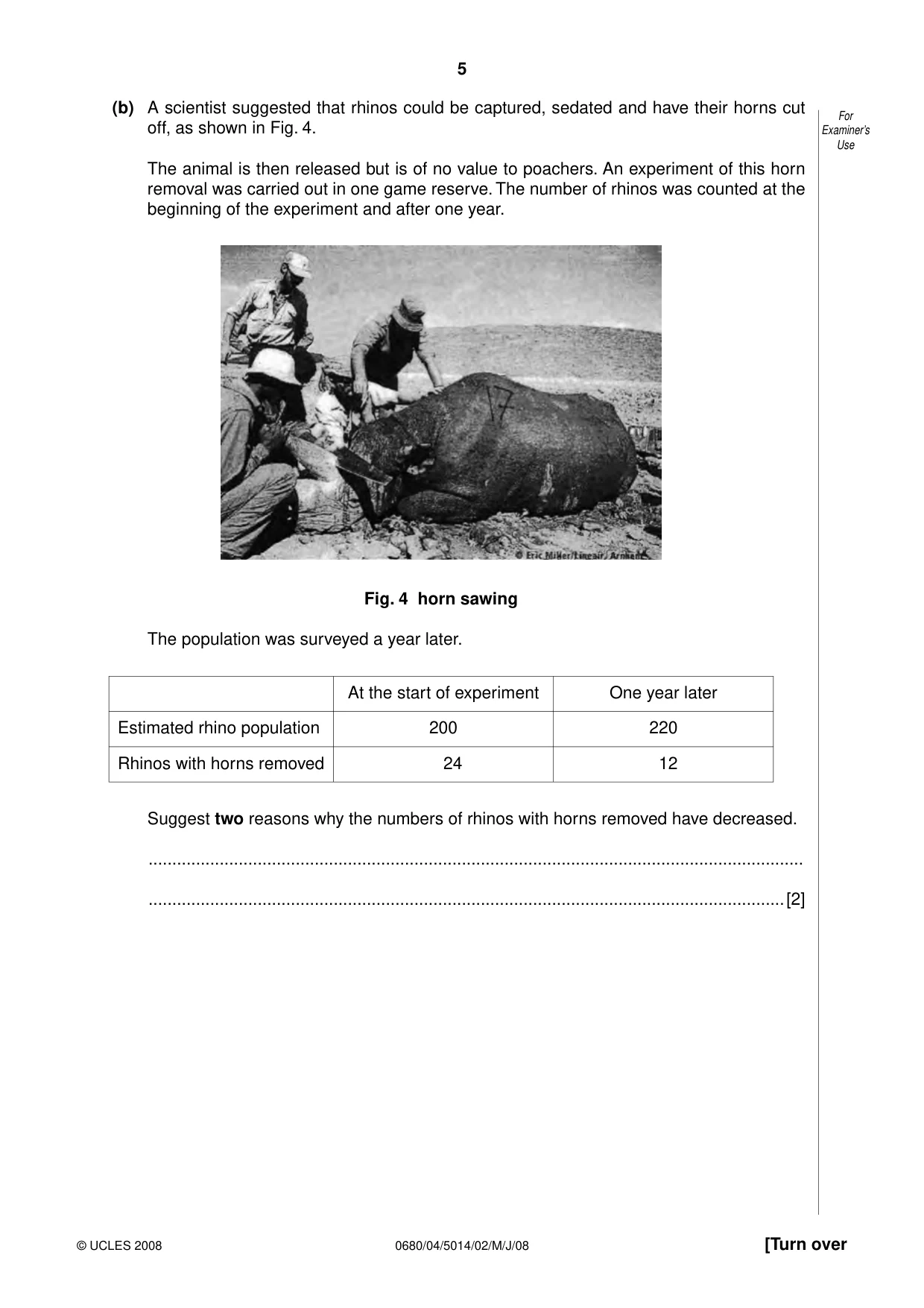
5 0680/04/5014/02/M/J/08 © UCLES 2008 [Turn over For Examiner’s Use (b) A scientist suggested that rhinos could be captured, sedated and have their horns cut off, as shown in Fig. 4. The animal is then released but is of no value to poachers. An experiment of this horn removal was carried out in one game reserve. The number of rhinos was counted at the beginning of the experiment and after one year. Fig. 4 horn sawing The population was surveyed a year later. At the start of experiment One year later Estimated rhino population 200 220 Rhinos with horns removed 24 12 Suggest two reasons why the numbers of rhinos with horns removed have decreased. … …[2]
Question paper, page 6
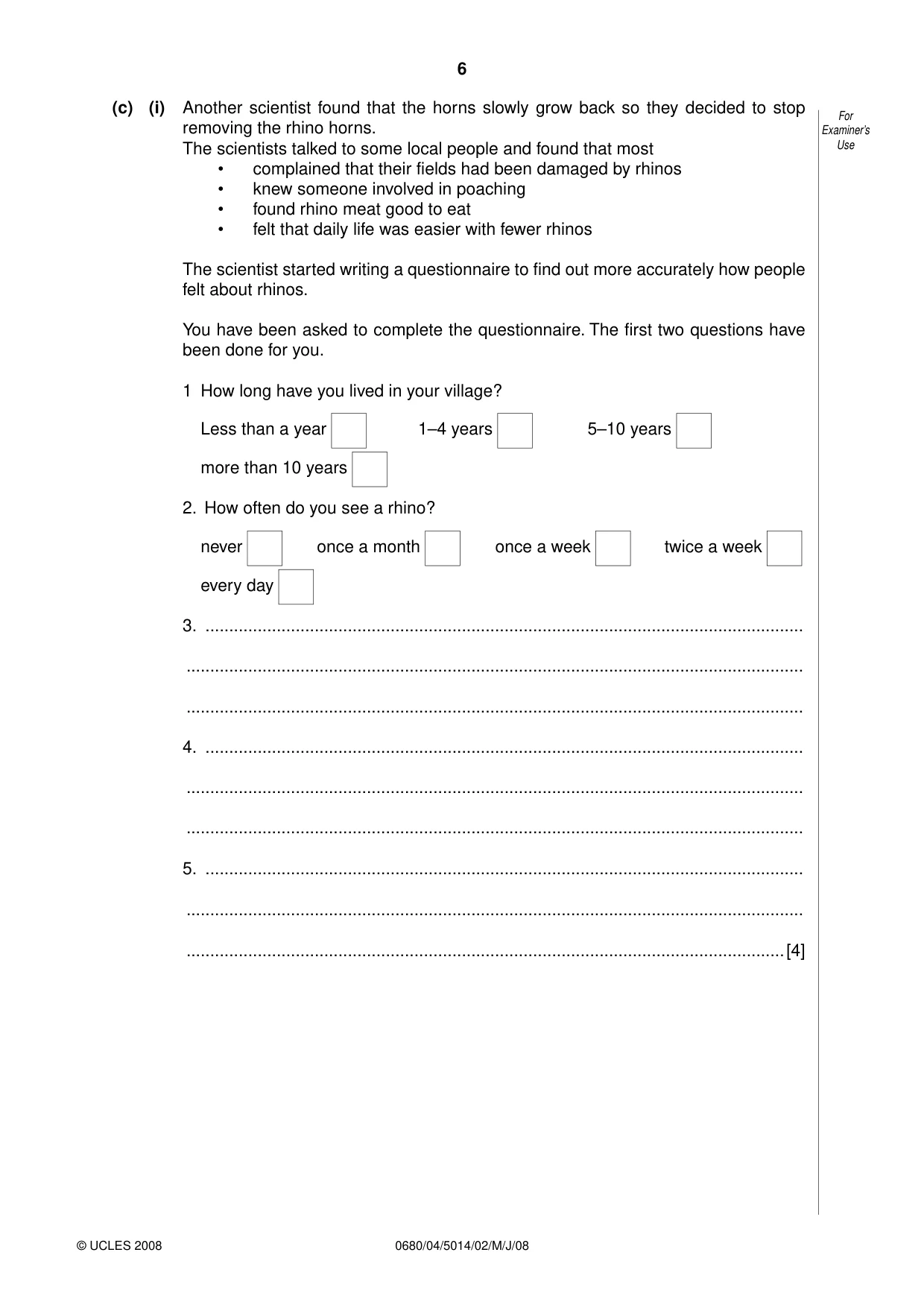
6 0680/04/5014/02/M/J/08 © UCLES 2008 For Examiner’s Use (c) (i) Another scientist found that the horns slowly grow back so they decided to stop removing the rhino horns. The scientists talked to some local people and found that most • complained that their fields had been damaged by rhinos • knew someone involved in poaching • found rhino meat good to eat • felt that daily life was easier with fewer rhinos The scientist started writing a questionnaire to find out more accurately how people felt about rhinos. You have been asked to complete the questionnaire. The first two questions have been done for you. 1 How long have you lived in your village? Less than a year 1–4 years 5–10 years more than 10 years 2. How often do you see a rhino? never once a month once a week twice a week every day 3. … … … 4. … … … 5. … … …[4]
Question paper, page 7
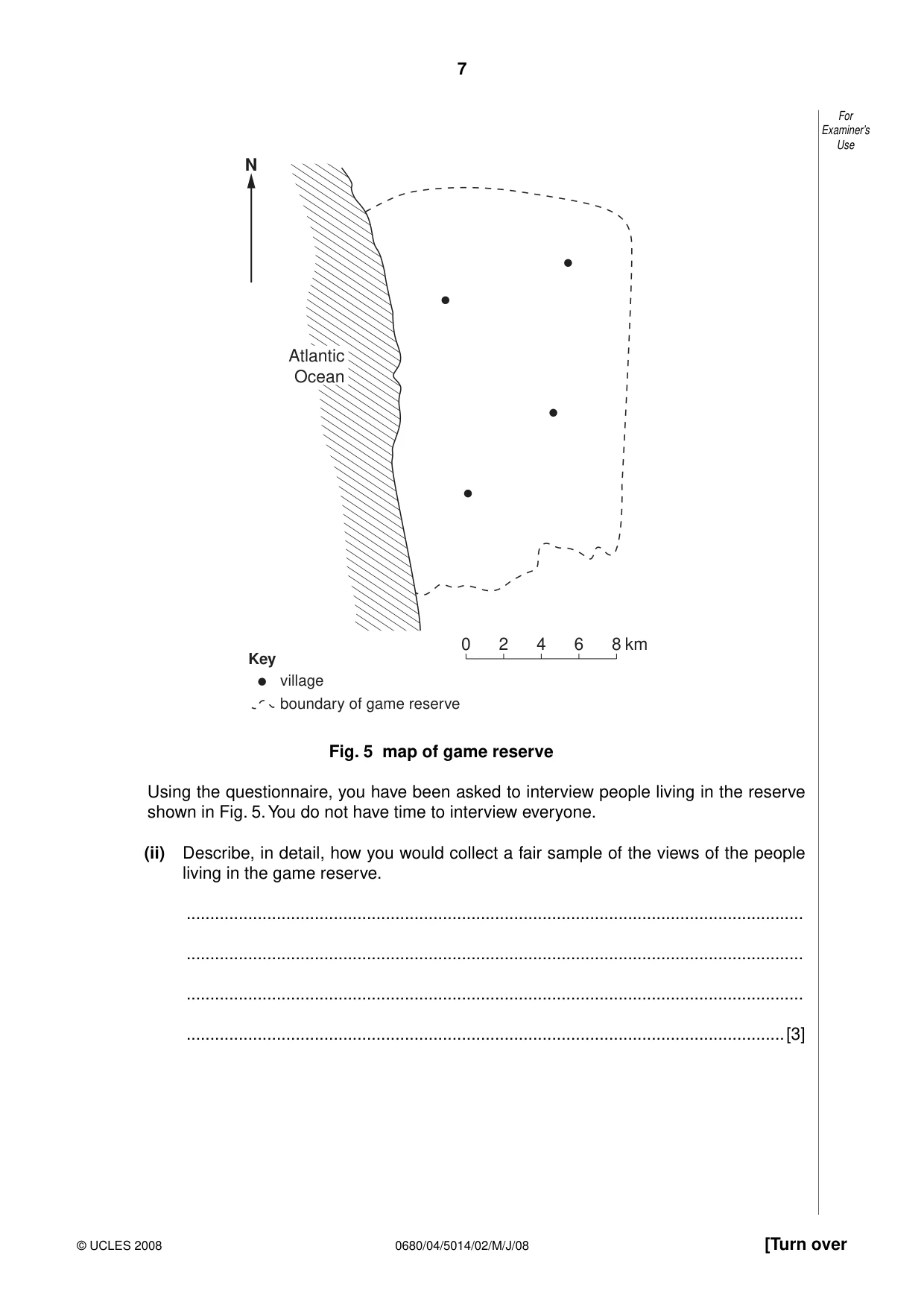
7 0680/04/5014/02/M/J/08 © UCLES 2008 [Turn over For Examiner’s Use village Key Atlantic Ocean 0 2 4 6 8 km N boundary of game reserve Fig. 5 map of game reserve Using the questionnaire, you have been asked to interview people living in the reserve shown in Fig. 5. You do not have time to interview everyone. (ii) Describe, in detail, how you would collect a fair sample of the views of the people living in the game reserve. … … … …[3]
Question paper, page 8
8 0680/04/5014/02/M/J/08 © UCLES 2008 For Examiner’s Use (d) A third scientist proposed that the government should allow the rhinos to become the property of the local people and of the owners of some large farms. The government will give them a licence to shoot rhinos and sell the meat and horn for a trial period of three years. (i) Explain how this proposal could prevent the rhino becoming extinct. … … … …[2] (ii) Draw a suitable table for the owner of one large farm to record the results of the trial over three years. [3] (e) Another scientist proposed that rhino horn should be ‘harvested’ by local people and sold to the government for legal international trade. The horns grow back and can be ‘harvested’ again. Explain why this could provide a very good future for (i) local people, … … … (ii) rhinos. … … …[4]
Question paper, page 9
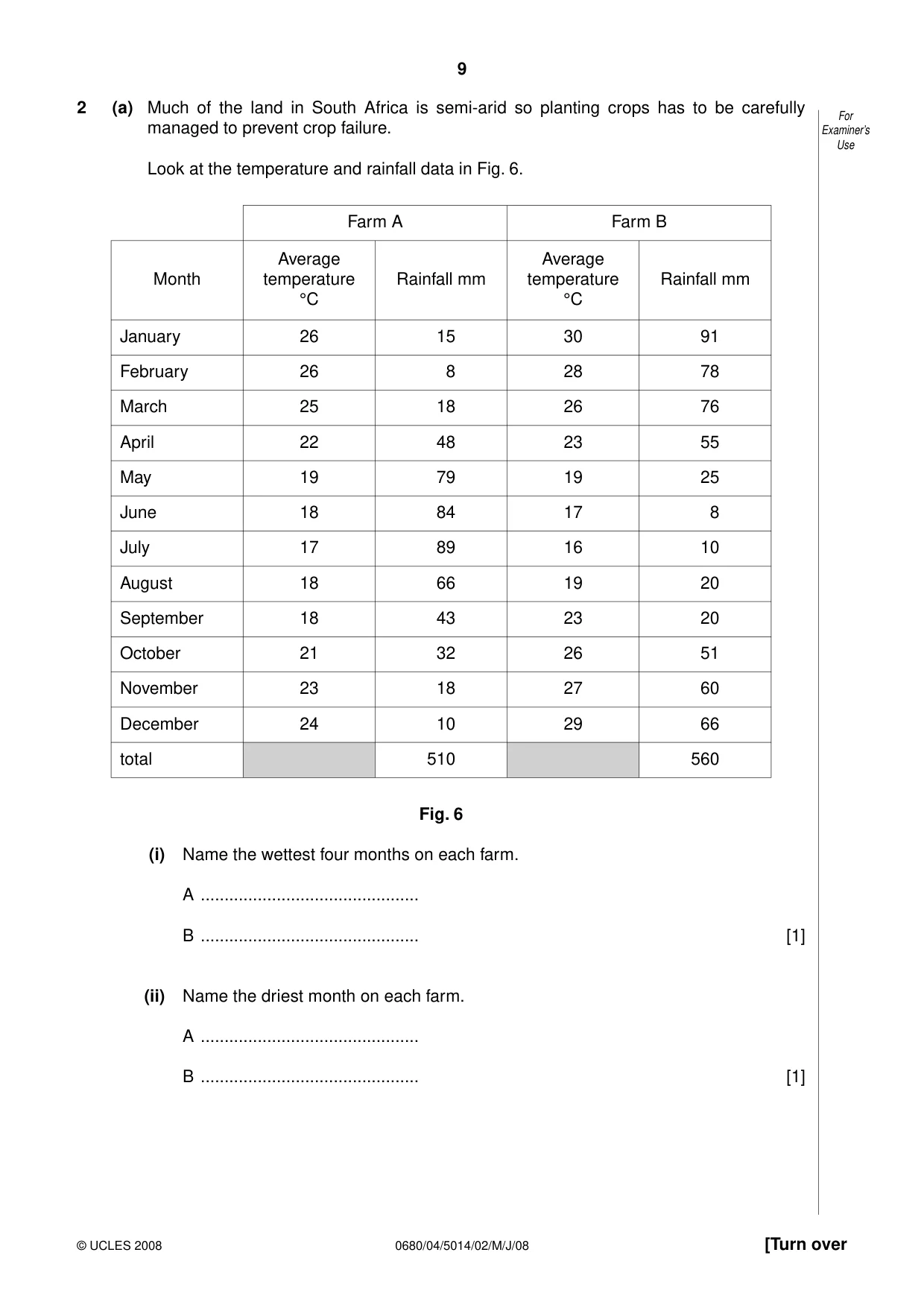
9 0680/04/5014/02/M/J/08 © UCLES 2008 [Turn over For Examiner’s Use 2 (a) Much of the land in South Africa is semi-arid so planting crops has to be carefully managed to prevent crop failure. Look at the temperature and rainfall data in Fig. 6. Farm A Farm B Month Average temperature °C Rainfall mm Average temperature °C Rainfall mm January 26 15 30 91 February 26 8 28 78 March 25 18 26 76 April 22 48 23 55 May 19 79 19 25 June 18 84 17 8 July 17 89 16 10 August 18 66 19 20 September 18 43 23 20 October 21 32 26 51 November 23 18 27 60 December 24 10 29 66 total 510 560 Fig. 6 (i) Name the wettest four months on each farm. A … B … [1] (ii) Name the driest month on each farm. A … B … [1]
Question paper, page 10
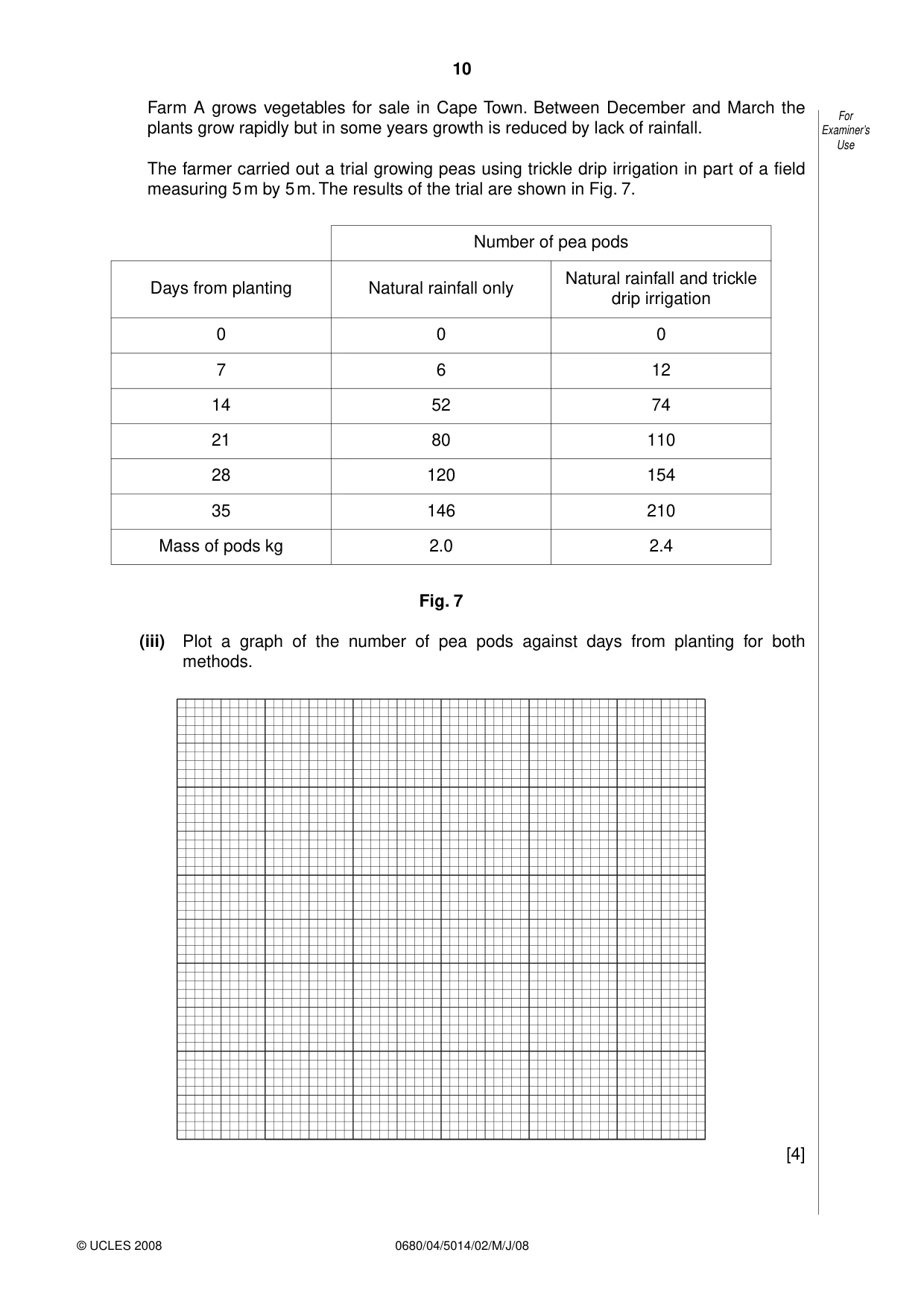
10 0680/04/5014/02/M/J/08 © UCLES 2008 For Examiner’s Use Farm A grows vegetables for sale in Cape Town. Between December and March the plants grow rapidly but in some years growth is reduced by lack of rainfall. The farmer carried out a trial growing peas using trickle drip irrigation in part of a field measuring 5 m by 5 m. The results of the trial are shown in Fig. 7. Number of pea pods Days from planting Natural rainfall only Natural rainfall and trickle drip irrigation 0 0 0 7 6 12 14 52 74 21 80 110 28 120 154 35 146 210 Mass of pods kg 2.0 2.4 Fig. 7 (iii) Plot a graph of the number of pea pods against days from planting for both methods. [4]
Question paper, page 11
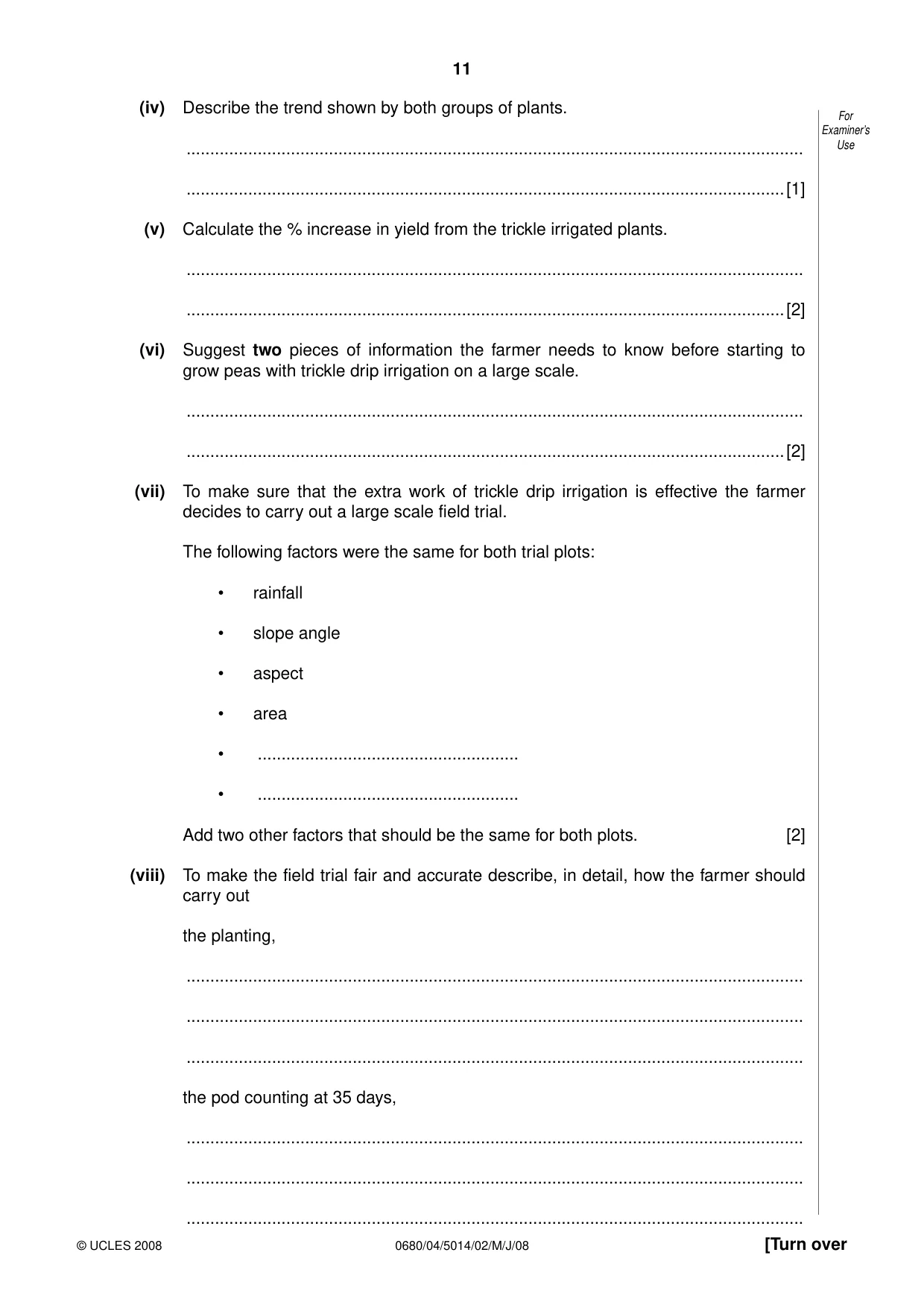
11 0680/04/5014/02/M/J/08 © UCLES 2008 [Turn over For Examiner’s Use (iv) Describe the trend shown by both groups of plants. … …[1] (v) Calculate the % increase in yield from the trickle irrigated plants. … …[2] (vi) Suggest two pieces of information the farmer needs to know before starting to grow peas with trickle drip irrigation on a large scale. … …[2] (vii) To make sure that the extra work of trickle drip irrigation is effective the farmer decides to carry out a large scale field trial. The following factors were the same for both trial plots: • rainfall • slope angle • aspect • area • … • … Add two other factors that should be the same for both plots. [2] (viii) To make the field trial fair and accurate describe, in detail, how the farmer should carry out the planting, … … … the pod counting at 35 days, … … …
Question paper, page 12
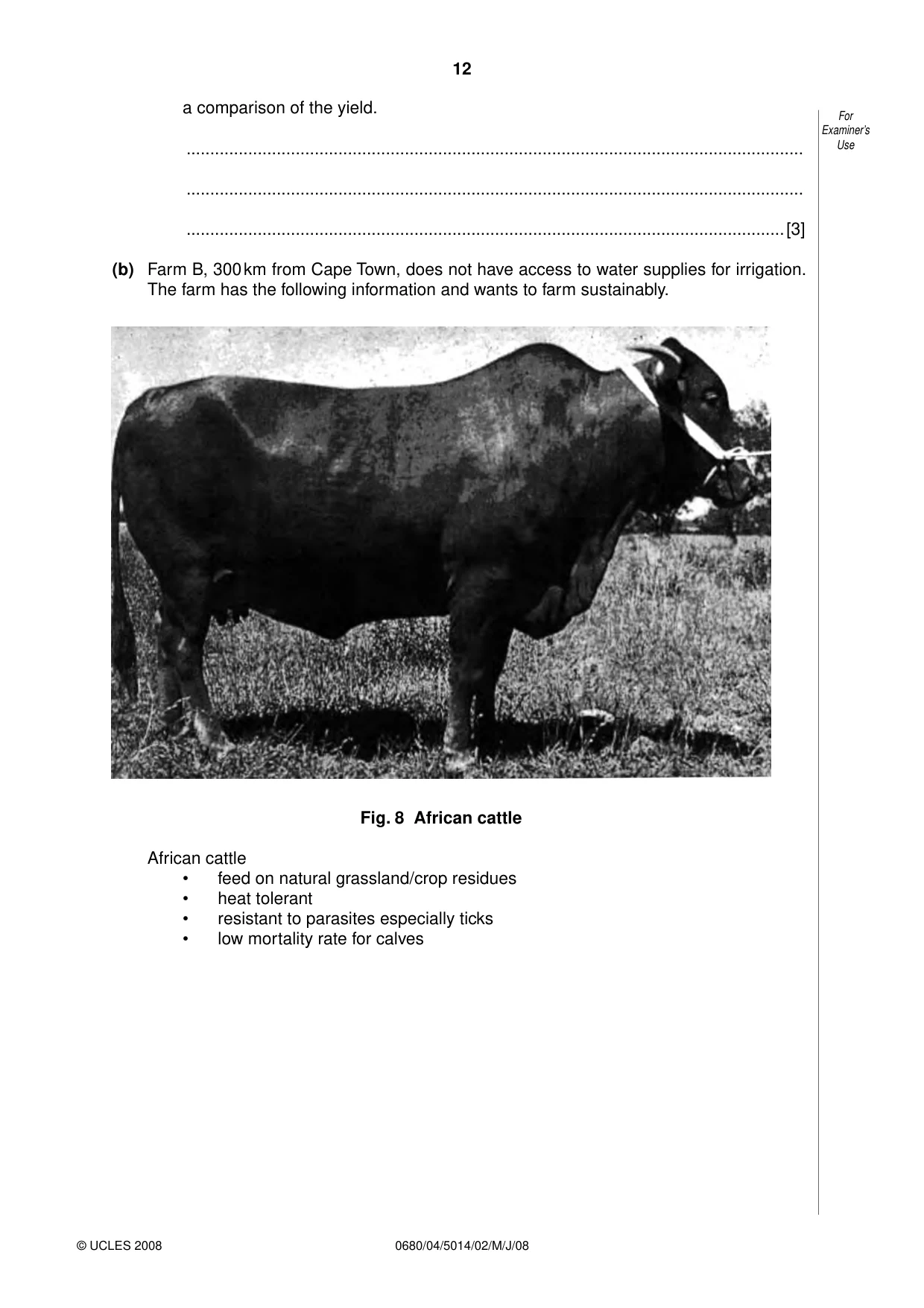
12 0680/04/5014/02/M/J/08 © UCLES 2008 For Examiner’s Use a comparison of the yield. … … …[3] (b) Farm B, 300 km from Cape Town, does not have access to water supplies for irrigation. The farm has the following information and wants to farm sustainably. Fig. 8 African cattle African cattle • feed on natural grassland/crop residues • heat tolerant • resistant to parasites especially ticks • low mortality rate for calves
Question paper, page 13
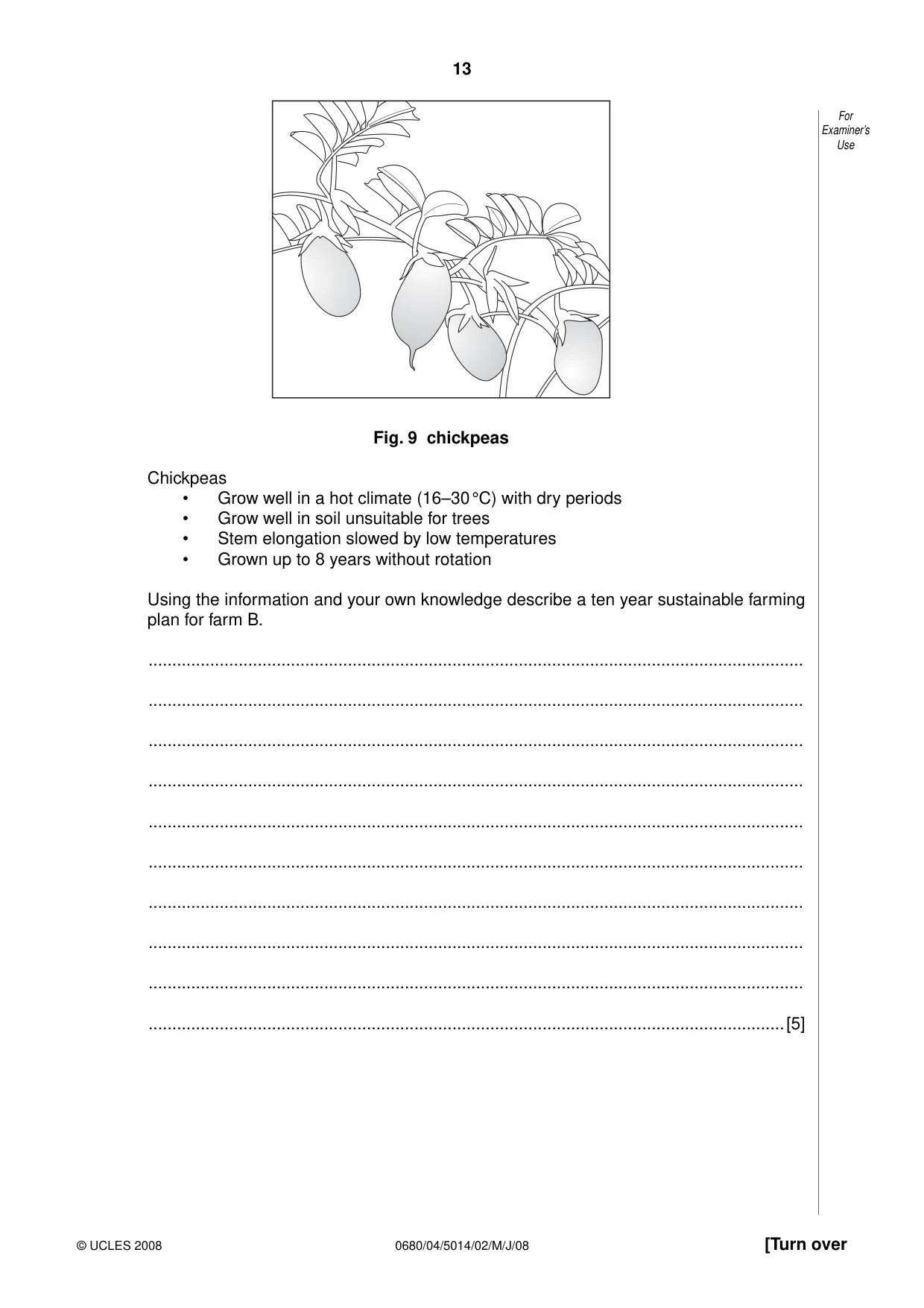
13 0680/04/5014/02/M/J/08 © UCLES 2008 [Turn over For Examiner’s Use Fig. 9 chickpeas Chickpeas • Grow well in a hot climate (16–30 °C) with dry periods • Grow well in soil unsuitable for trees • Stem elongation slowed by low temperatures • Grown up to 8 years without rotation Using the information and your own knowledge describe a ten year sustainable farming plan for farm B. … … … … … … … … … …[5]
Question paper, page 14
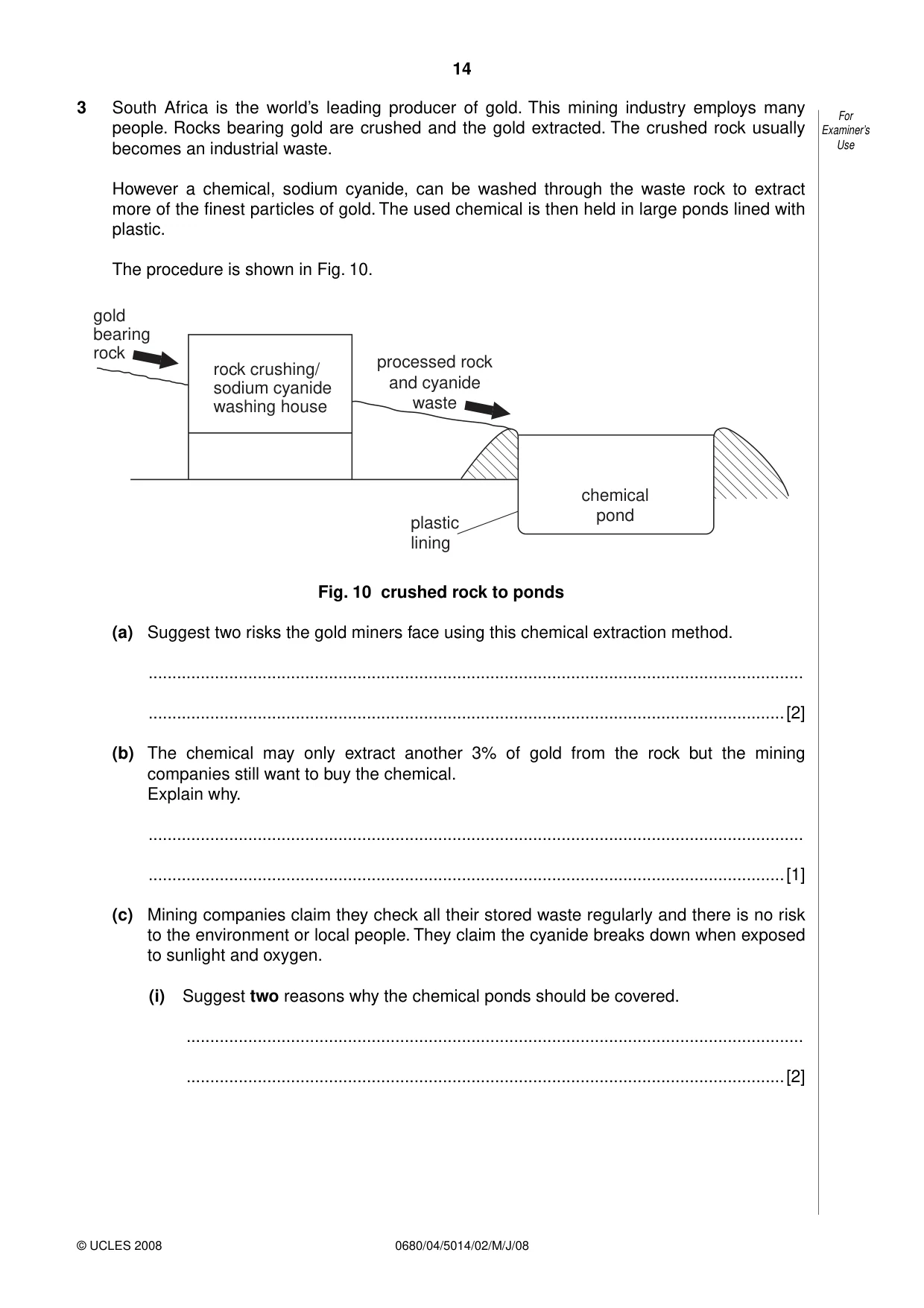
14 0680/04/5014/02/M/J/08 © UCLES 2008 For Examiner’s Use 3 South Africa is the world’s leading producer of gold. This mining industry employs many people. Rocks bearing gold are crushed and the gold extracted. The crushed rock usually becomes an industrial waste. However a chemical, sodium cyanide, can be washed through the waste rock to extract more of the finest particles of gold. The used chemical is then held in large ponds lined with plastic. The procedure is shown in Fig. 10. plastic lining chemical pond processed rock and cyanide waste gold bearing rock rock crushing/ sodium cyanide washing house Fig. 10 crushed rock to ponds (a) Suggest two risks the gold miners face using this chemical extraction method. … …[2] (b) The chemical may only extract another 3% of gold from the rock but the mining companies still want to buy the chemical. Explain why. … …[1] (c) Mining companies claim they check all their stored waste regularly and there is no risk to the environment or local people. They claim the cyanide breaks down when exposed to sunlight and oxygen. (i) Suggest two reasons why the chemical ponds should be covered. … …[2]
Question paper, page 15
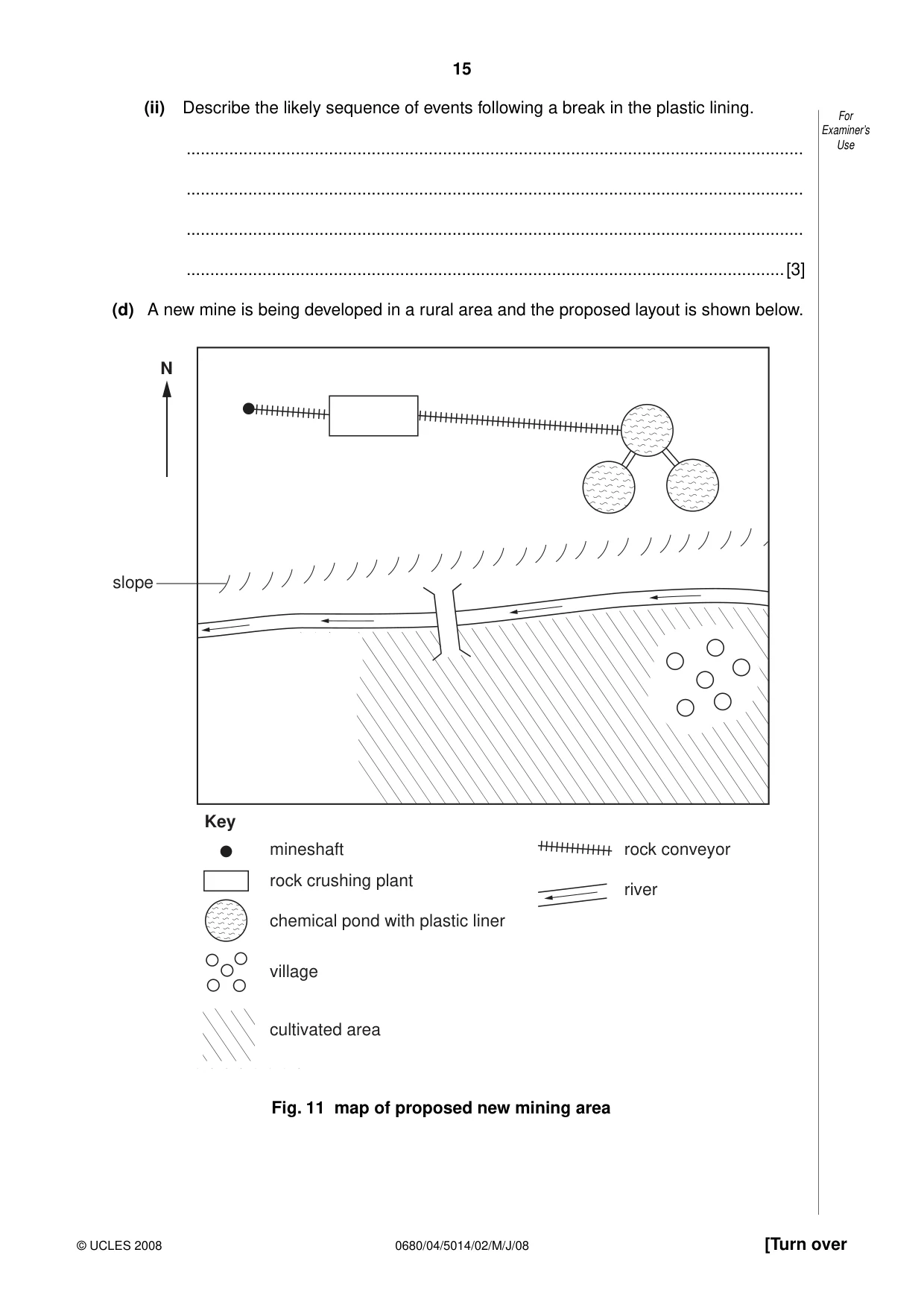
15 0680/04/5014/02/M/J/08 © UCLES 2008 [Turn over For Examiner’s Use (ii) Describe the likely sequence of events following a break in the plastic lining. … … … …[3] (d) A new mine is being developed in a rural area and the proposed layout is shown below. N slope mineshaft Key rock crushing plant rock conveyor river chemical pond with plastic liner village cultivated area Fig. 11 map of proposed new mining area
Question paper, page 16
16 0680/04/5014/02/M/J/08 © UCLES 2008 For Examiner’s Use Suggest why some local people (i) want the mine developed, … … … (ii) do not want the mine developed. … … …[3] (iii) Suggest what is good about the plan. … …[1] (iv) Suggest one possible problem with it. … …[1]
Question paper, page 17
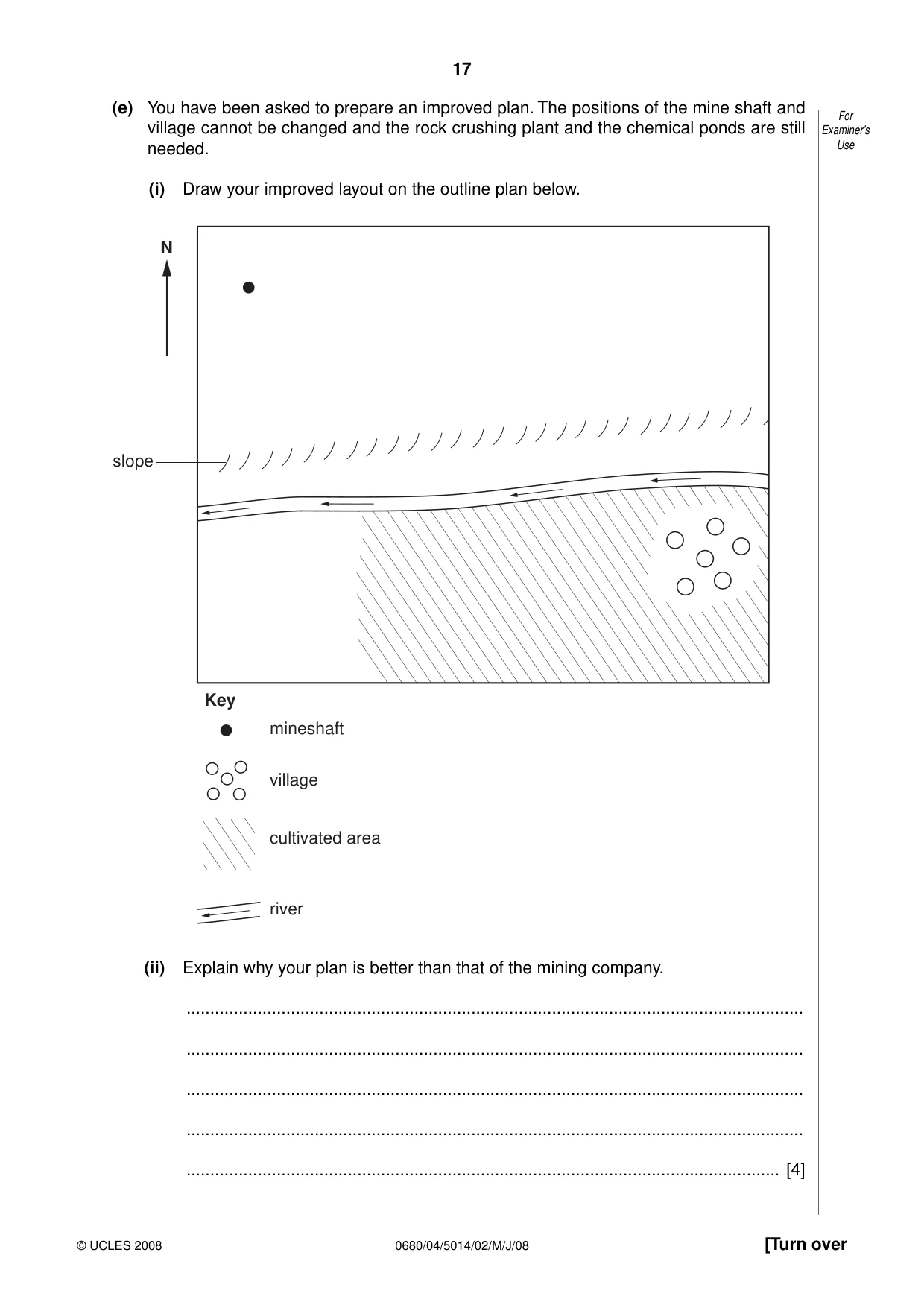
17 0680/04/5014/02/M/J/08 © UCLES 2008 [Turn over For Examiner’s Use (e) You have been asked to prepare an improved plan. The positions of the mine shaft and village cannot be changed and the rock crushing plant and the chemical ponds are still needed. (i) Draw your improved layout on the outline plan below. N slope mineshaft Key village cultivated area river (ii) Explain why your plan is better than that of the mining company. … … … … … [4]
Question paper, page 18
18 0680/04/5014/02/M/J/08 © UCLES 2008 For Examiner’s Use (f) The villagers will need to check that the river is still biologically healthy after the mining starts. Describe how they should do this. … … …[2]
Question paper, page 20
20 0680/04/5014/02/M/J/08 BLANK PAGE Permission to reproduce items where third-party owned material protected by copyright is included has been sought and cleared where possible. Every reasonable effort has been made by the publisher (UCLES) to trace copyright holders, but if any items requiring clearance have unwittingly been included, the publisher will be pleased to make amends at the earliest possible opportunity. University of Cambridge International Examinations is part of the Cambridge Assessment Group. Cambridge Assessment is the brand name of University of Cambridge Local Examinations Syndicate (UCLES), which is itself a department of the University of Cambridge.
Mark scheme, page 1
UNIVERSITY OF CAMBRIDGE INTERNATIONAL EXAMINATIONS International General Certificate of Secondary Education MARK SCHEME for the May/June 2008 question paper 0680 ENVIRONMENTAL MANAGEMENT 0680/04 Paper 4 (Alternative to Coursework), maximum raw mark 60 This mark scheme is published as an aid to teachers and candidates, to indicate the requirements of the examination. It shows the basis on which Examiners were instructed to award marks. It does not indicate the details of the discussions that took place at an Examiners’ meeting before marking began. All Examiners are instructed that alternative correct answers and unexpected approaches in candidates’ scripts must be given marks that fairly reflect the relevant knowledge and skills demonstrated. Mark schemes must be read in conjunction with the question papers and the report on the examination. • CIE will not enter into discussions or correspondence in connection with these mark schemes. CIE is publishing the mark schemes for the May/June 2008 question papers for most IGCSE, GCE Advanced Level and Advanced Subsidiary Level syllabuses and some Ordinary Level syllabuses. www.XtremePapers.com
Mark scheme, page 2
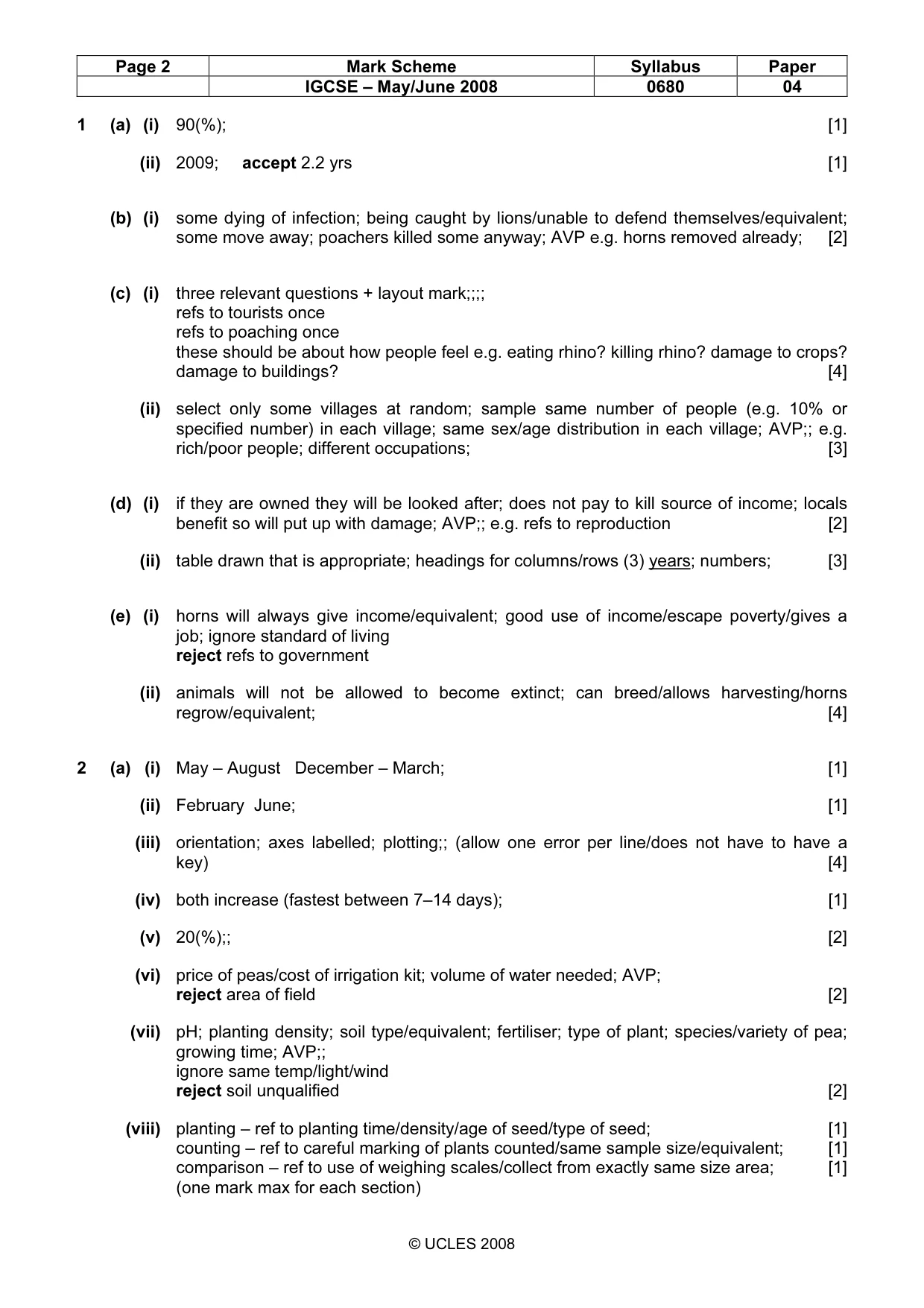
Page 2 Mark Scheme Syllabus Paper IGCSE – May/June 2008 0680 04 © UCLES 2008 1 (a) (i) 90(%); [1] (ii) 2009; accept 2.2 yrs [1] (b) (i) some dying of infection; being caught by lions/unable to defend themselves/equivalent; some move away; poachers killed some anyway; AVP e.g. horns removed already; [2] (c) (i) three relevant questions + layout mark;;;; refs to tourists once refs to poaching once these should be about how people feel e.g. eating rhino? killing rhino? damage to crops? damage to buildings? [4] (ii) select only some villages at random; sample same number of people (e.g. 10% or specified number) in each village; same sex/age distribution in each village; AVP;; e.g. rich/poor people; different occupations; [3] (d) (i) if they are owned they will be looked after; does not pay to kill source of income; locals benefit so will put up with damage; AVP;; e.g. refs to reproduction [2] (ii) table drawn that is appropriate; headings for columns/rows (3) years; numbers; [3] (e) (i) horns will always give income/equivalent; good use of income/escape poverty/gives a job; ignore standard of living reject refs to government (ii) animals will not be allowed to become extinct; can breed/allows harvesting/horns regrow/equivalent; [4] 2 (a) (i) May – August December – March; [1] (ii) February June; [1] (iii) orientation; axes labelled; plotting;; (allow one error per line/does not have to have a key) [4] (iv) both increase (fastest between 7–14 days); [1] (v) 20(%);; [2] (vi) price of peas/cost of irrigation kit; volume of water needed; AVP; reject area of field [2] (vii) pH; planting density; soil type/equivalent; fertiliser; type of plant; species/variety of pea; growing time; AVP;; ignore same temp/light/wind reject soil unqualified [2] (viii) planting – ref to planting time/density/age of seed/type of seed; [1] counting – ref to careful marking of plants counted/same sample size/equivalent; [1] comparison – ref to use of weighing scales/collect from exactly same size area; [1] (one mark max for each section)
Mark scheme, page 3
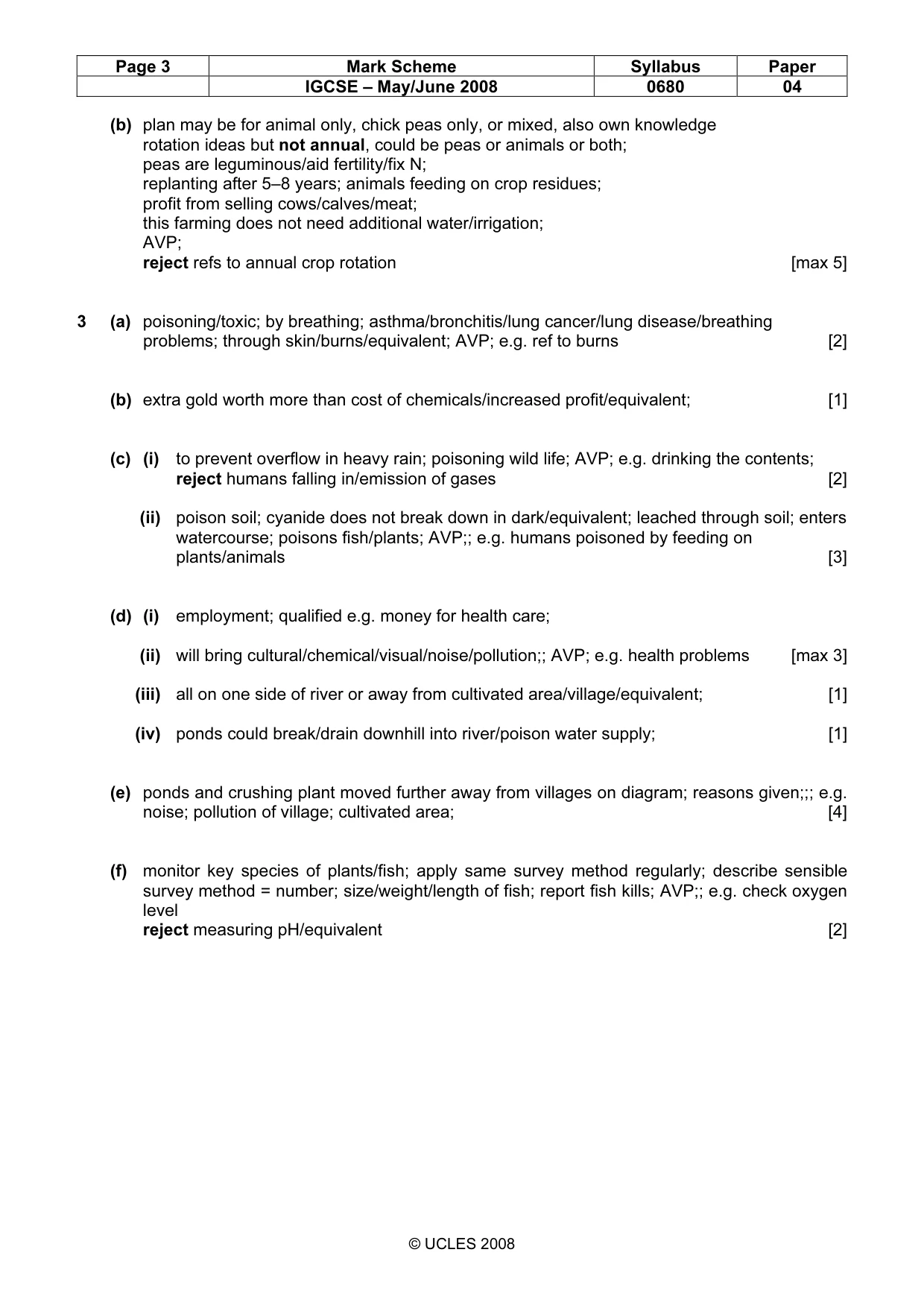
Page 3 Mark Scheme Syllabus Paper IGCSE – May/June 2008 0680 04 © UCLES 2008 (b) plan may be for animal only, chick peas only, or mixed, also own knowledge rotation ideas but not annual, could be peas or animals or both; peas are leguminous/aid fertility/fix N; replanting after 5–8 years; animals feeding on crop residues; profit from selling cows/calves/meat; this farming does not need additional water/irrigation; AVP; reject refs to annual crop rotation [max 5] 3 (a) poisoning/toxic; by breathing; asthma/bronchitis/lung cancer/lung disease/breathing problems; through skin/burns/equivalent; AVP; e.g. ref to burns [2] (b) extra gold worth more than cost of chemicals/increased profit/equivalent; [1] (c) (i) to prevent overflow in heavy rain; poisoning wild life; AVP; e.g. drinking the contents; reject humans falling in/emission of gases [2] (ii) poison soil; cyanide does not break down in dark/equivalent; leached through soil; enters watercourse; poisons fish/plants; AVP;; e.g. humans poisoned by feeding on plants/animals [3] (d) (i) employment; qualified e.g. money for health care; (ii) will bring cultural/chemical/visual/noise/pollution;; AVP; e.g. health problems [max 3] (iii) all on one side of river or away from cultivated area/village/equivalent; [1] (iv) ponds could break/drain downhill into river/poison water supply; [1] (e) ponds and crushing plant moved further away from villages on diagram; reasons given;;; e.g. noise; pollution of village; cultivated area; [4] (f) monitor key species of plants/fish; apply same survey method regularly; describe sensible survey method = number; size/weight/length of fish; report fish kills; AVP;; e.g. check oxygen level reject measuring pH/equivalent [2]
What you needed in this session
Cambridge’s own grade thresholds for 2008 May/June, Paper 4 · Variant 1. A higher threshold means an easier paper — the bar moves with how the cohort did.